Label Propagation Using Amendable Clamping
1
○ Tatsurou Miyazaki
Tokyo University of Science
Yasunobu Sumikawa
Tokyo University of Science
Motivation
2
Motivation
3
Motivation
4
Motivation
5
Motivation
6
Motivation
7
Motivation
8
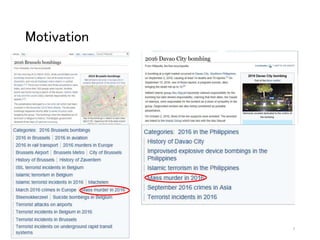
Suicide bombings is not assigned.
Motivation
9
• Mass murder and Suicide bombings is not assigned.
Motivation
• Problem 1 : taking high cost
• Semi-supervised learning is known as better approach.
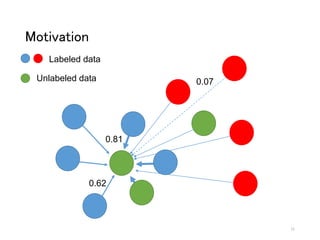
• Ex.) Lapel Propagation (LP)
10
11
Labeled data
Unlabeled data
0.81
0.07
0.62
Motivation
Motivation
• Problem 2 : the quality of dataset fall.
• Wrong : Linear Neighborhood Propagation (LNP)
• Missing : our proposed approach
12
Effect of missing labels
13
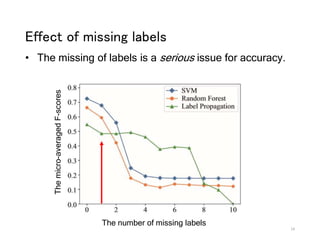
The number of missing labels
Themicro-averagedF-scores• The missing of labels is a serious issue for accuracy.
Effect of missing labels
14
The number of missing labels
Themicro-averagedF-scores• The missing of labels is a serious issue for accuracy.
Effect of missing labels
15
The number of missing labels
Themicro-averagedF-scores• The missing of labels is a serious issue for accuracy.
Our approach
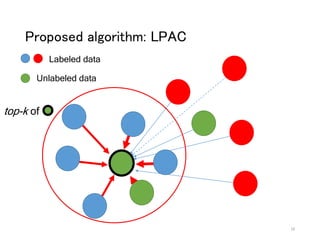
• label propagation using amendable clamping (LPAC).
• Objective: decreasing the impact of missing labels on accuracy.
• Our approach is 45% higher than comparative
approach.
• document : 70%
• label : 50%
16
17
Labeled data
Unlabeled data
Proposed algorithm: LPAC
18
top-k of
Labeled data
Unlabeled data
Proposed algorithm: LPAC
19
top-k of
Labeled data at nth iteration Instead of clamping
we set average valuesUnlabeled data at nth iteration
Proposed algorithm: LPAC
20
top-k of
Labeled data at nth iteration
Unlabeled data at nth iteration
Instead of clamping
we set average values
Experimental setting
21
Dataset SIAM 2007 Text Mining Competition dataset
Labeled data 4819
Unlabeled data 4819
Classes 22
Average number of
label
3.41
• We apply latent dirichlet allocation (LDA) to our data.
Experimental setting
22
• The ratio of documents that has missing labels.
Label A
Label B
Label A
Label C
Ex.) Extraction ratio is 40%. (2 documents / 5 documents)
Experimental setting
23
• The ratio of documents that has missing labels.
Label A
Label B
Label A
Label C
Ex.) Extraction ratio is 40%. (2 documents / 5 documents)
Experimental setting
24
• The ratio of missing labels.
Ex.) Removal ratio is 50%.
1. Label A
2. Label B
3. Label C
4. Label D
(2 labels / 4 labels)
Experimental setting
25
• The ratio of missing labels.
1. Label A
2. Label B
3. Label C
4. Label D
(2 labels / 4 labels)Ex.) Removal ratio is 50%.
26
Experimental setting
Comparative algorithm
LP (traditional)
DLP (Dynamic Label Propagation, state-of-
the-art)
LNP (Linear neighborhoods propagation)
Random Forest
SVM
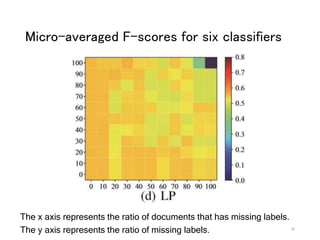
Micro-averaged F-scores for six classifiers
27
The x axis represents the ratio of documents that has missing labels.
The y axis represents the ratio of missing labels.
28
The x axis represents the ratio of documents that has missing labels.
The y axis represents the ratio of missing labels.
Micro-averaged F-scores for six classifiers
29
The x axis represents the ratio of documents that has missing labels.
The y axis represents the ratio of missing labels.
Micro-averaged F-scores for six classifiers
30
The x axis represents the ratio of documents that has missing labels.
The y axis represents the ratio of missing labels.
Micro-averaged F-scores for six classifiers
31
The x axis represents the ratio of documents that has missing labels.
The y axis represents the ratio of missing labels.
Micro-averaged F-scores for six classifiers
32
The x axis represents the ratio of documents that has missing labels.
The y axis represents the ratio of missing labels.
Conclusion
• We propose a multi-label classification (LPAC) for a
moderately challenging multi-labeling task.
1. Propagating labels according to top-k similar data.
2. Updating labeled data by taking cluster assumption.
33
Conclusion
• We propose a multi-label classification (LPAC) for a
moderately challenging multi-labeling task.
1. Propagating labels according to top-k similar data.
2. Updating labeled data by taking cluster assumption.
• Future work
1. The effective utilization of label correlation.
2. How effectively our algorithm works on a real dataset.
3. Establishing algorithm that can be trained on dataset including
both of wrong and missing.
34

Label Propagation using Amendable Clamping

  • 1.
    Label Propagation UsingAmendable Clamping 1 ○ Tatsurou Miyazaki Tokyo University of Science Yasunobu Sumikawa Tokyo University of Science
  • 2.
  • 3.
  • 4.
  • 5.
  • 6.
  • 7.
  • 8.
  • 9.
    Motivation 9 • Mass murderand Suicide bombings is not assigned.
  • 10.
    Motivation • Problem 1: taking high cost • Semi-supervised learning is known as better approach. • Ex.) Lapel Propagation (LP) 10
  • 11.
  • 12.
    Motivation • Problem 2: the quality of dataset fall. • Wrong : Linear Neighborhood Propagation (LNP) • Missing : our proposed approach 12
  • 13.
    Effect of missinglabels 13 The number of missing labels Themicro-averagedF-scores• The missing of labels is a serious issue for accuracy.
  • 14.
    Effect of missinglabels 14 The number of missing labels Themicro-averagedF-scores• The missing of labels is a serious issue for accuracy.
  • 15.
    Effect of missinglabels 15 The number of missing labels Themicro-averagedF-scores• The missing of labels is a serious issue for accuracy.
  • 16.
    Our approach • labelpropagation using amendable clamping (LPAC). • Objective: decreasing the impact of missing labels on accuracy. • Our approach is 45% higher than comparative approach. • document : 70% • label : 50% 16
  • 17.
  • 18.
    Proposed algorithm: LPAC 18 top-kof Labeled data Unlabeled data
  • 19.
    Proposed algorithm: LPAC 19 top-kof Labeled data at nth iteration Instead of clamping we set average valuesUnlabeled data at nth iteration
  • 20.
    Proposed algorithm: LPAC 20 top-kof Labeled data at nth iteration Unlabeled data at nth iteration Instead of clamping we set average values
  • 21.
    Experimental setting 21 Dataset SIAM2007 Text Mining Competition dataset Labeled data 4819 Unlabeled data 4819 Classes 22 Average number of label 3.41 • We apply latent dirichlet allocation (LDA) to our data.
  • 22.
    Experimental setting 22 • Theratio of documents that has missing labels. Label A Label B Label A Label C Ex.) Extraction ratio is 40%. (2 documents / 5 documents)
  • 23.
    Experimental setting 23 • Theratio of documents that has missing labels. Label A Label B Label A Label C Ex.) Extraction ratio is 40%. (2 documents / 5 documents)
  • 24.
    Experimental setting 24 • Theratio of missing labels. Ex.) Removal ratio is 50%. 1. Label A 2. Label B 3. Label C 4. Label D (2 labels / 4 labels)
  • 25.
    Experimental setting 25 • Theratio of missing labels. 1. Label A 2. Label B 3. Label C 4. Label D (2 labels / 4 labels)Ex.) Removal ratio is 50%.
  • 26.
    26 Experimental setting Comparative algorithm LP(traditional) DLP (Dynamic Label Propagation, state-of- the-art) LNP (Linear neighborhoods propagation) Random Forest SVM
  • 27.
    Micro-averaged F-scores forsix classifiers 27 The x axis represents the ratio of documents that has missing labels. The y axis represents the ratio of missing labels.
  • 28.
    28 The x axisrepresents the ratio of documents that has missing labels. The y axis represents the ratio of missing labels. Micro-averaged F-scores for six classifiers
  • 29.
    29 The x axisrepresents the ratio of documents that has missing labels. The y axis represents the ratio of missing labels. Micro-averaged F-scores for six classifiers
  • 30.
    Micro-averaged F-scores forsix classifiers 30 The x axis represents the ratio of documents that has missing labels. The y axis represents the ratio of missing labels.
  • 31.
    Micro-averaged F-scores forsix classifiers 31 The x axis represents the ratio of documents that has missing labels. The y axis represents the ratio of missing labels.
  • 32.
    Micro-averaged F-scores forsix classifiers 32 The x axis represents the ratio of documents that has missing labels. The y axis represents the ratio of missing labels.
  • 33.
    Conclusion • We proposea multi-label classification (LPAC) for a moderately challenging multi-labeling task. 1. Propagating labels according to top-k similar data. 2. Updating labeled data by taking cluster assumption. 33
  • 34.
    Conclusion • We proposea multi-label classification (LPAC) for a moderately challenging multi-labeling task. 1. Propagating labels according to top-k similar data. 2. Updating labeled data by taking cluster assumption. • Future work 1. The effective utilization of label correlation. 2. How effectively our algorithm works on a real dataset. 3. Establishing algorithm that can be trained on dataset including both of wrong and missing. 34