LEARNING OBJECTIVES:
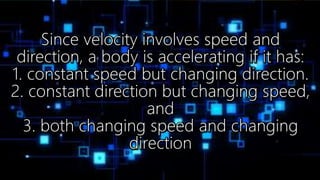
•Give the three things to
consider in determining
acceleration.
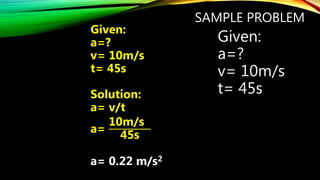
SAMPLE PROBLEM
Given:
a=?
v= 10m/s
t= 45s
Given:
a=?
v= 10m/s
t= 45s
Solution:
a= v/t
a=
10m/s
45s
a= 0.22 m/s2
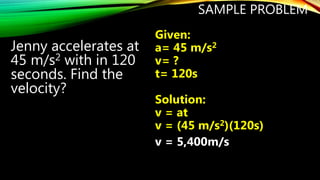
SAMPLE PROBLEM
Jenny accelerates at
45 m/s2 with in 120
seconds. Find the
velocity?
Given:
a= 45 m/s2
v= ?
t= 120s
Solution:
v = at
v = (45 m/s2)(120s)
v = 5,400m/s

L3 acceleration

Editor's Notes

  • #2 After determining “how far the object moves?”, the next question will be “How fast did the object move?” This information can be provided by the object’s speed or velocity.
  • #4 Having a uniform velocity while traveling is impossible to achieve. As we enter a road with heavy traffic, our vehicle slows down. Then after passing that crowded street, we speed up. There is a change in velocity. This change in velocity in a particular time interval is called accelartion.
  • #5 Having a uniform velocity while traveling is impossible to achieve. As we enter a road with heavy traffic, our vehicle slows down. Then after passing that crowded street, we speed up. There is a change in velocity. This change in velocity in a particular time interval is called accelartion. Acceleration does not only refer to speeding up but also to slowing down.
  • #6 For instance, a car is traveling north at a speed of 30 km/h, then turns right at corner while maintaining its speed. The speed of the car is uniform at 30 km/h but the velocity changes because its direction changes from north to east.
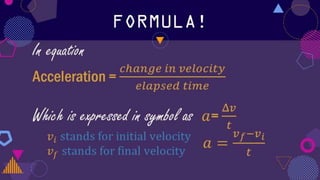
  • #8 Since the velocity is increasing or decreasing uniformly with time, we can express the average velocity as the arithmetic average of the initial and final velocity.