KWL Charts
Defining
Creating
Revising
By Mary C. Acevedo, M.Ed., TESOL
References
 National-Louis University. (2010).
Department of Reading and Language.
Retrieved from
http://nlu.nl.edu/academics/nce/randl/faculty/do
 Ogle, D. M. (1986). K-W-L: A teaching
model that develops active reading of
expository text. Reading Teacher, 39, 564-
570. Retrieved from
http://www.doc-txt.com/Donna-Ogle-KWL.pdf
What is a KWL Chart?
 A graphic organizer that
summarizes what a student already
knows about a subject, what he
wants to learn about the subject,
and what he finally learned about
the subject.
Creating a KWL Chart
 A table consisting of only 3 columns and
at least 5 rows.
 Columns =
K (know)
W (want to know)
L (learned)
 Rows =
Row 1 = headings for each column (K W L)
Rows 2-5 = minimum 4 questions:
If you don’t know what to ask, use the information
questions (i.e., wh- questions): who, what, when,
where, why, how, which) for inspiration.
Filling in the KWL Chart
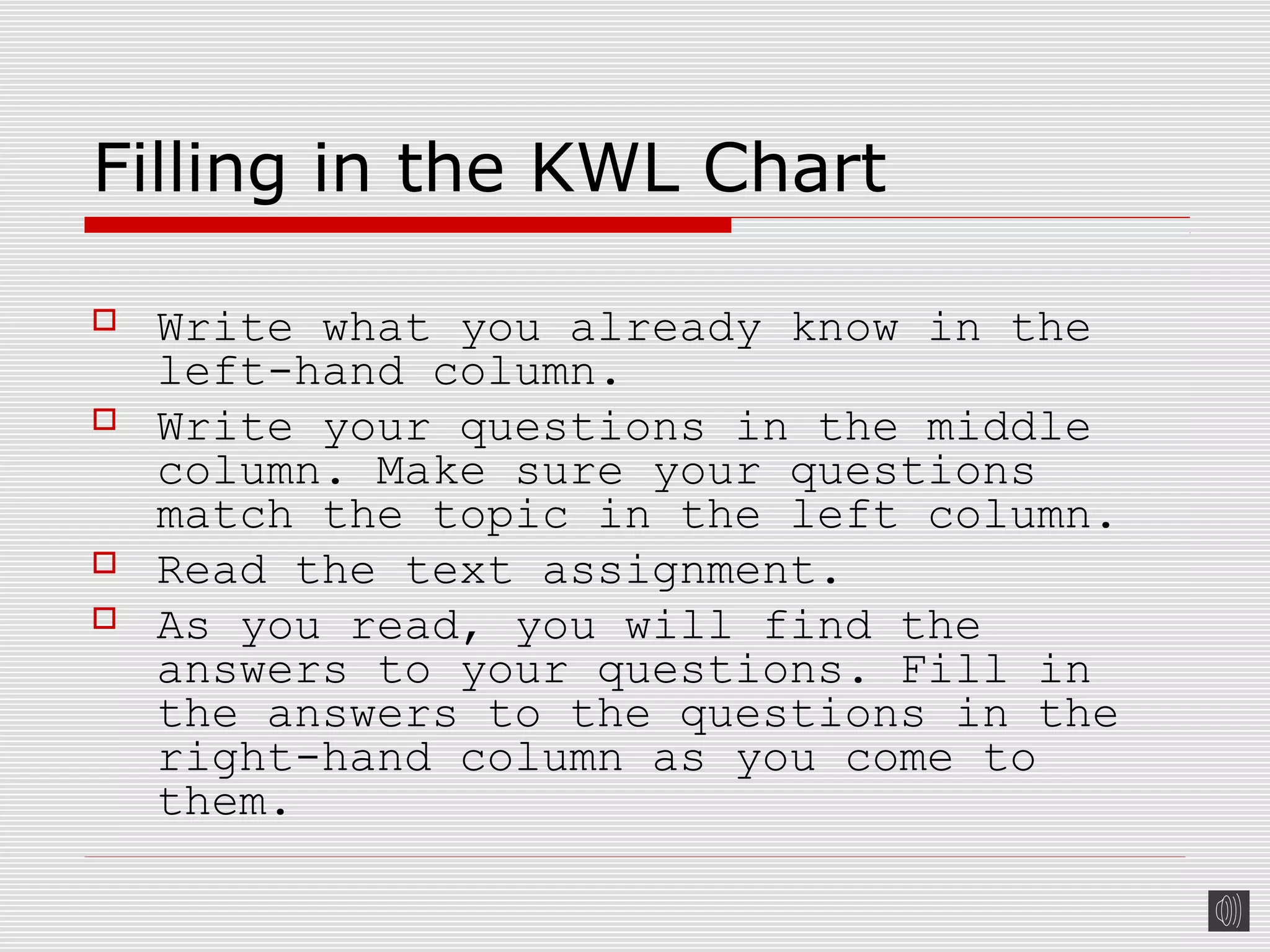
 Write what you already know in the
left-hand column.
 Write your questions in the middle
column. Make sure your questions
match the topic in the left column.
 Read the text assignment.
 As you read, you will find the
answers to your questions. Fill in
the answers to the questions in the
right-hand column as you come to
them.
Revising
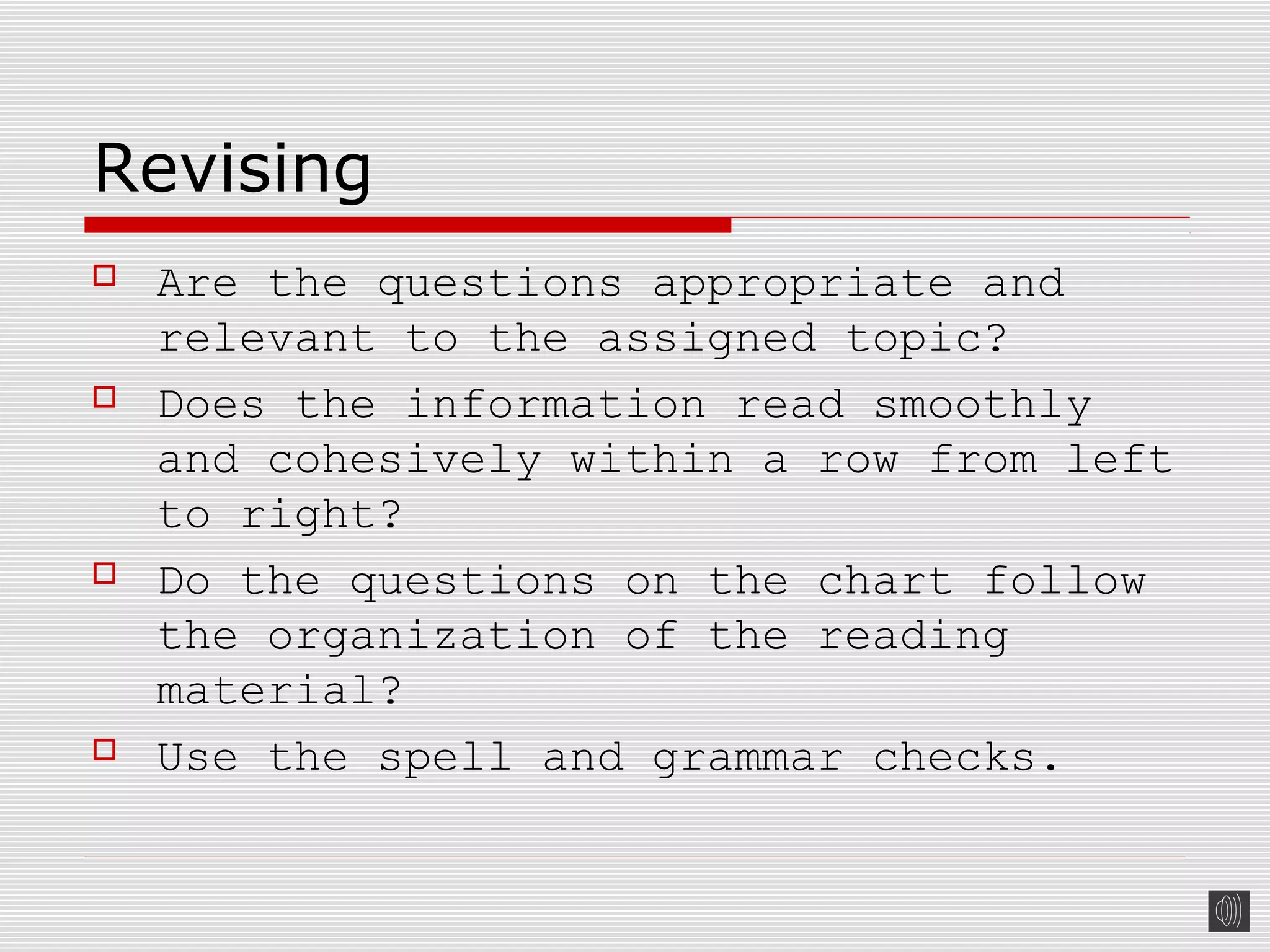
 Are the questions appropriate and
relevant to the assigned topic?
 Does the information read smoothly
and cohesively within a row from left
to right?
 Do the questions on the chart follow
the organization of the reading
material?
 Use the spell and grammar checks.
Revising
 Are the questions appropriate and
relevant to the assigned topic?
 Does the information read smoothly
and cohesively within a row from left
to right?
 Do the questions on the chart follow
the organization of the reading
material?
 Use the spell and grammar checks.

KWL Charts: Defining, Creating, Revising

  • 1.
  • 2.
    References  National-Louis University.(2010). Department of Reading and Language. Retrieved from http://nlu.nl.edu/academics/nce/randl/faculty/do  Ogle, D. M. (1986). K-W-L: A teaching model that develops active reading of expository text. Reading Teacher, 39, 564- 570. Retrieved from http://www.doc-txt.com/Donna-Ogle-KWL.pdf
  • 3.
    What is aKWL Chart?  A graphic organizer that summarizes what a student already knows about a subject, what he wants to learn about the subject, and what he finally learned about the subject.
  • 4.
    Creating a KWLChart  A table consisting of only 3 columns and at least 5 rows.  Columns = K (know) W (want to know) L (learned)  Rows = Row 1 = headings for each column (K W L) Rows 2-5 = minimum 4 questions: If you don’t know what to ask, use the information questions (i.e., wh- questions): who, what, when, where, why, how, which) for inspiration.
  • 5.
    Filling in theKWL Chart  Write what you already know in the left-hand column.  Write your questions in the middle column. Make sure your questions match the topic in the left column.  Read the text assignment.  As you read, you will find the answers to your questions. Fill in the answers to the questions in the right-hand column as you come to them.
  • 6.
    Revising  Are thequestions appropriate and relevant to the assigned topic?  Does the information read smoothly and cohesively within a row from left to right?  Do the questions on the chart follow the organization of the reading material?  Use the spell and grammar checks.
  • 7.
    Revising  Are thequestions appropriate and relevant to the assigned topic?  Does the information read smoothly and cohesively within a row from left to right?  Do the questions on the chart follow the organization of the reading material?  Use the spell and grammar checks.