ReadingReading
Expository TextExpository Text
How to become a better reader.How to become a better reader.
by S. Nelson & M. Wellsby S. Nelson & M. Wells
J. Barker Elementary 2006J. Barker Elementary 2006
Teachers need to teach students how to
read each type of text as they encounter
it if they are to read them successfully.
A book on a fireman’s job is an expository text.
Being able to identify the patterns of
expository text will increase
comprehension resulting in
effective, successful readers.
Expository Text
Expository text makes up the bulk of
(most of) what adults read.
 teachers read text books
 policemen read reports and records
 lawyers read legal papers
 veterinarians read medical books
In school, after 2nd or 3rd grade, this is also true.
(Often the only exception is reading fiction books
during A. R. time).
Therefore, students need to know:
 how to identify text structure
 how this type of text structure
works,
 how you should prepare to read it,
 & what to do once you begin
reading expository texts.
Expository Texts
include:
 text books,
 non-fiction trade (library) books,
 newspaper & magazine articles,
 directions,
 essays,
 speeches,
 user manuals (how-to guides),
 government documents
(such as the driver’s
license test booklet).
There are certain elements found in
expository text, each type of element
makes its own demands on the reader:
 description,
 sequence,
 comparison,
 cause & effect,
 problem & solution.
Elements of Expository Text:
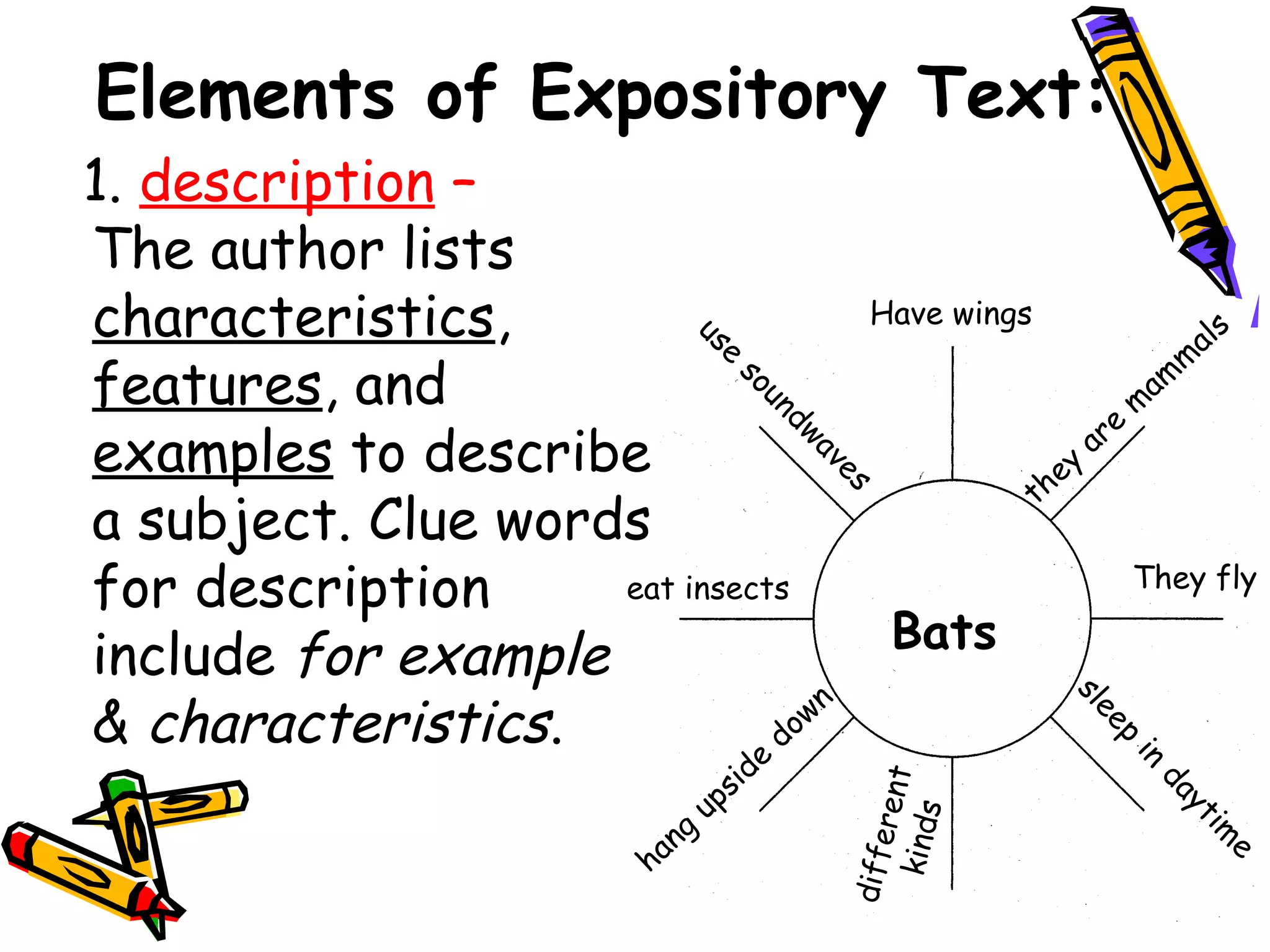
1. description –
The author lists
characteristics,
features, and
examples to describe
a subject. Clue words
for description
include for example
& characteristics.
 
Bats
Have wings
They fly
sleep
in
daytim
e
hang
upside
down
differentkinds
they
are
m
am
m
als
use
soundwaves
eat insects
Elements of Expository Text:
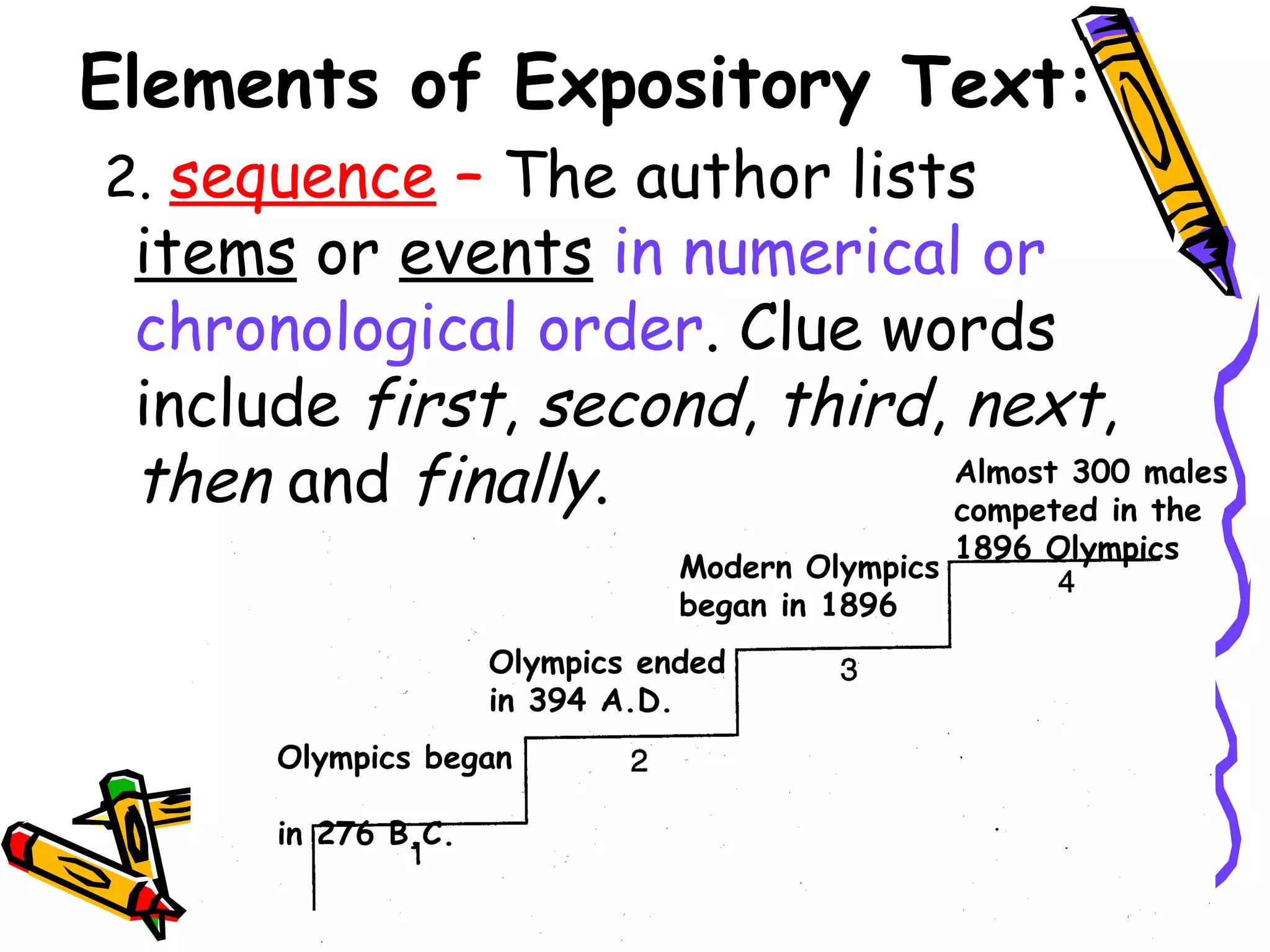
2. sequence – The author lists
items or events in numerical or
chronological order. Clue words
include first, second, third, next,
then and finally.
Olympics began
in 276 B.C.
Olympics ended
in 394 A.D.
Modern Olympics
began in 1896
Almost 300 males
competed in the
1896 Olympics
Elements of Expository Text:
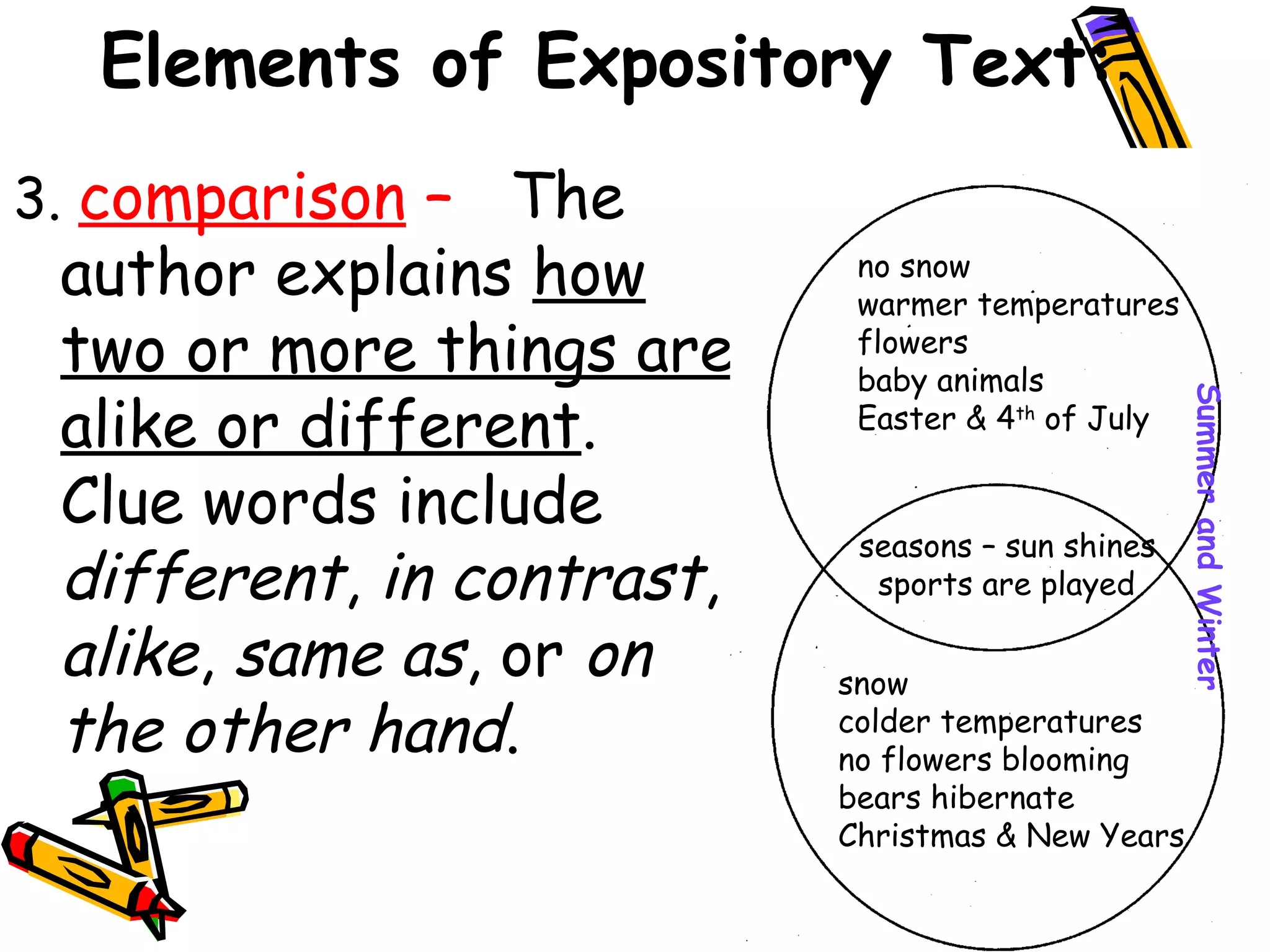
3. comparison – The
author explains how
two or more things are
alike or different.
Clue words include
different, in contrast,
alike, same as, or on
the other hand.
SummerandWinter
seasons – sun shines
sports are played
no snow
warmer temperatures
flowers
baby animals
Easter & 4th
of July
snow
colder temperatures
no flowers blooming
bears hibernate
Christmas & New Years
Elements of Expository Text:
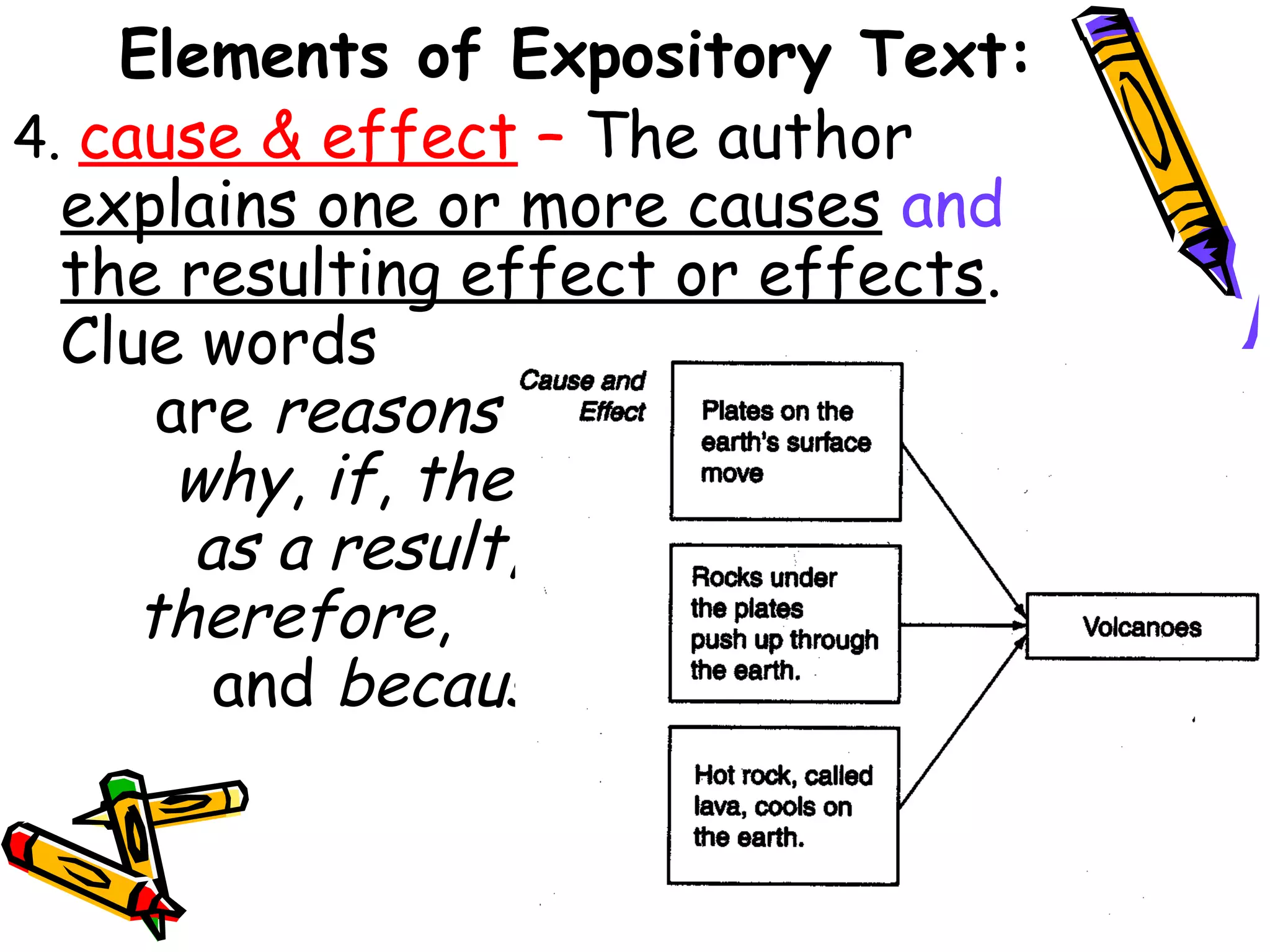
4. cause & effect – The author
explains one or more causes and
the resulting effect or effects.
Clue words
are reasons
why, if, then,
as a result,
therefore,
and because.
Elements of Expository Text:
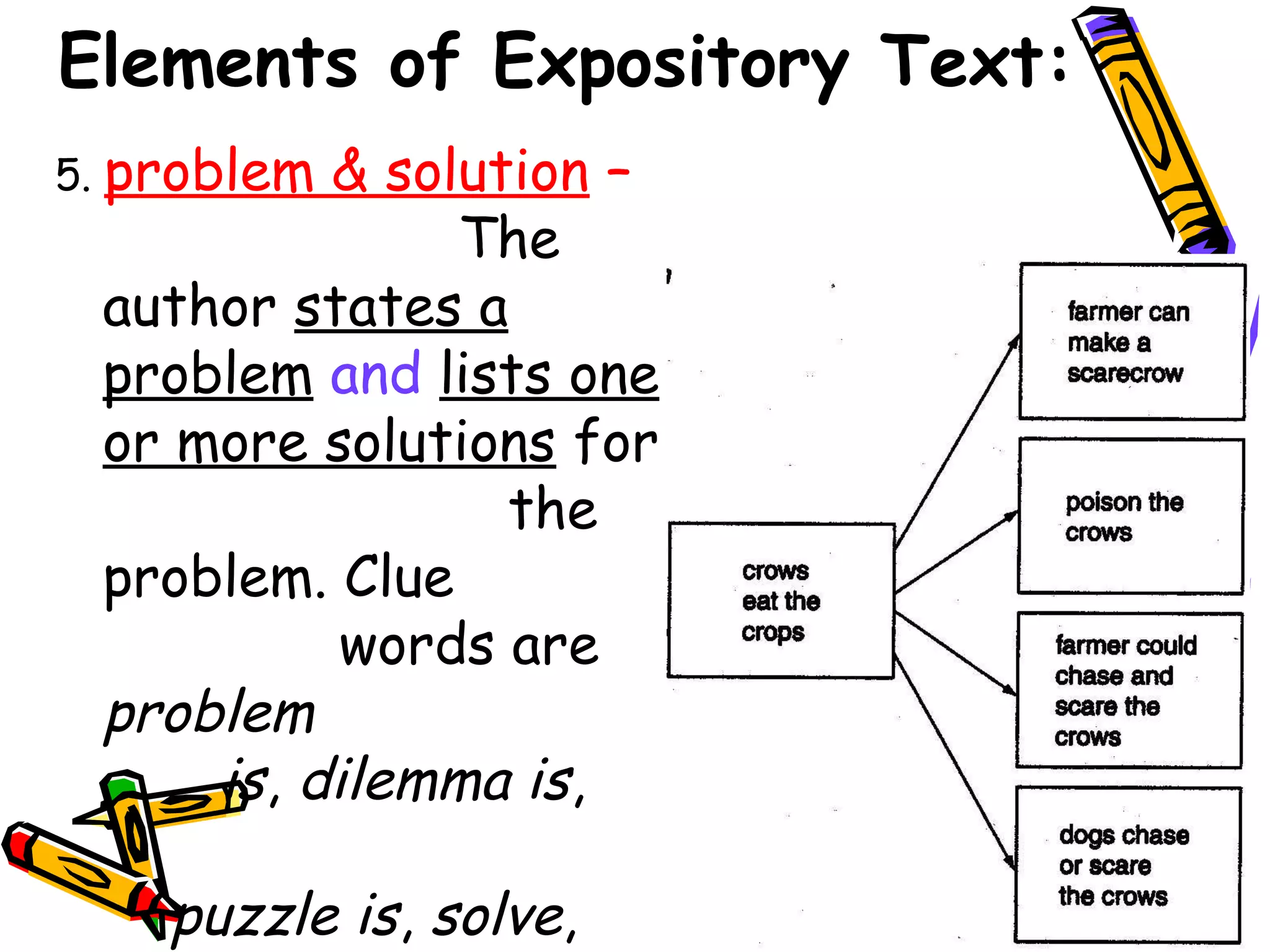
5. problem & solution –
The
author states a
problem and lists one
or more solutions for
the
problem. Clue
words are
problem
is, dilemma is,
puzzle is, solve,
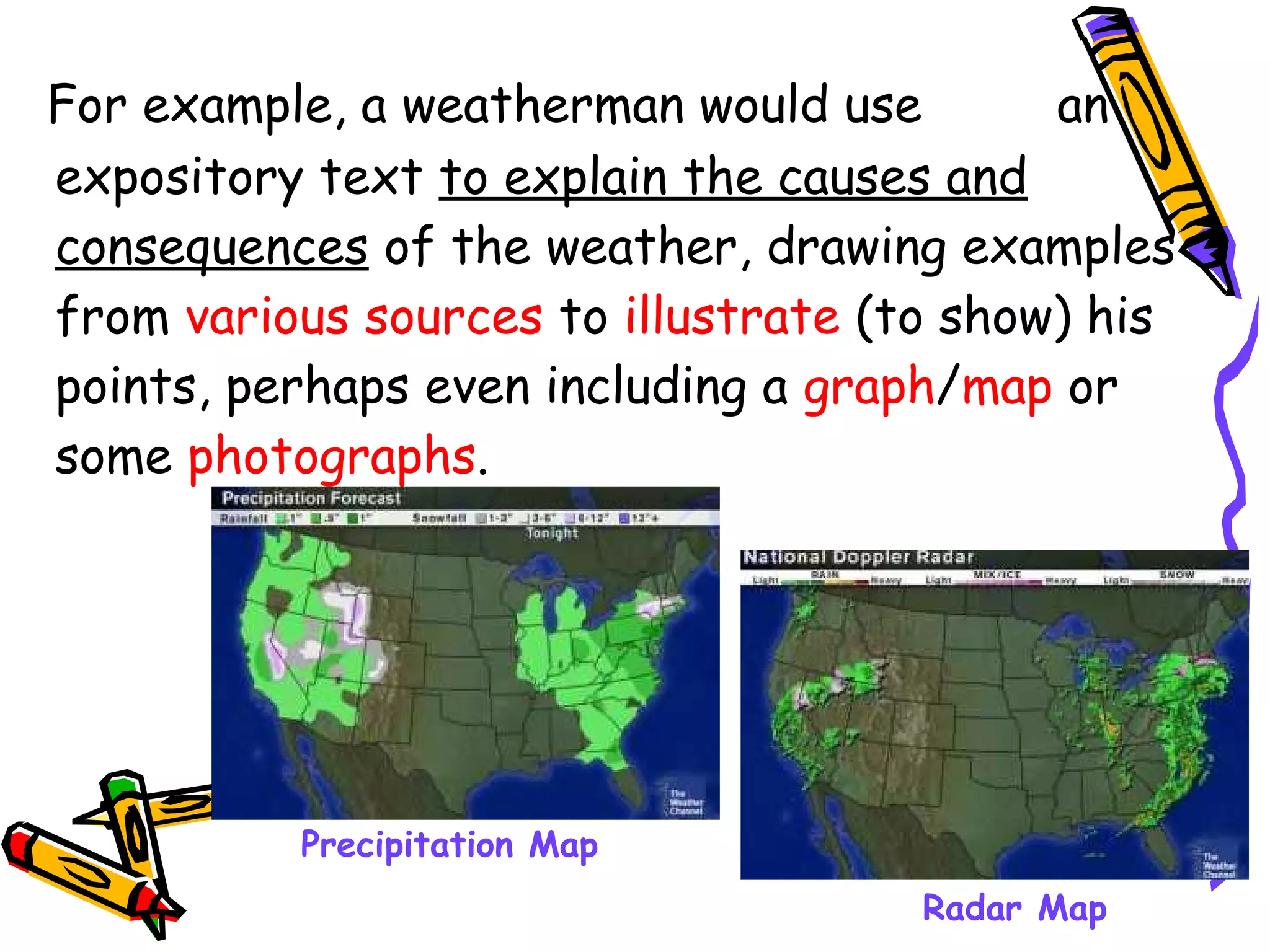
For example, a weatherman would use an
expository text to explain the causes and
consequences of the weather, drawing examples
from various sources to illustrate (to show) his
points, perhaps even including a graph/map or
some photographs.
Radar Map
Precipitation Map
Follow These Steps When
Reading Expository Text
1. Learn how to use the comprehension
aids in content area textbooks,
including:
• chapter overviews,
• headings that outline the chapter,
• helpful graphics,
• technical words defined in text, and
• end-of-chapter summaries.
Review
2. Create questions before reading.
Before reading each section of a
chapter:
• you should turn the section heading
into a question and read the section
to find the answer to the question
• as you read, you should take notes, &
• then you should answer the questions
you created.
3. Identify Expository Text Structures
• learn the 5 expository text structures
(description, sequence, comparison,
cause & effect, and problem & solution)
• identify the text structure in the
section as you read
4. Pay attention to the Key Terms
• teachers should assist by introducing the
key terms that will be presented in the text
• find the meaning of these key words as you
read the selection – often these terms will
be bold type or defined in the text
5. Focus on Main Ideas
• stay focused on the overall
information (the main idea) being
presented in each section as you
read
• creating an outline or taking notes as
you read will make it easier to
remember the main ideas
6. Use Activities & Graphic Organizers
to enhance meaning
• begin with activities such as
brainstorming and KWL (know, want
to know, and learned)
• graphic organizers such as webs,
Venn Diagrams, and note taking to
enhance meaning of text
7. Use Headings
• use headings to select and organize
information
• students can add details to the
headings as they read
8. Ask Self-Questions
• become active read by asking
yourself questions as you read
• monitor your comprehension of the
text through your questions and
responses
9. Use Listen-Read-Discuss Format
• in a class setting, the teacher should
present key concepts orally to the
class
• students then read and discuss the
text
• finally, students review the selection
making sure to go over the main ideas
presented in the text
10. Create Text Sets
• in a class setting, the teacher should
supplement textbook assignments
with information from a variety of
sources such as:
 other non-fiction books
 internet sources
 PowerPoint® presentations
 fictional stories and poems
Warning – ahead…
Mature (older) readers should identify
the source (i.e., the original publication
and date) of the article – especially IF
they are using the article to support their
own research.
Outdated information or inaccurate (not
correct) sources can lead to problems
with their own papers/speeches/and can
even lead to legal (courts and
lawyers) problems.

Expository text in reading power point

  • 1.
    ReadingReading Expository TextExpository Text Howto become a better reader.How to become a better reader. by S. Nelson & M. Wellsby S. Nelson & M. Wells J. Barker Elementary 2006J. Barker Elementary 2006
  • 2.
    Teachers need toteach students how to read each type of text as they encounter it if they are to read them successfully. A book on a fireman’s job is an expository text. Being able to identify the patterns of expository text will increase comprehension resulting in effective, successful readers.
  • 3.
    Expository Text Expository textmakes up the bulk of (most of) what adults read.  teachers read text books  policemen read reports and records  lawyers read legal papers  veterinarians read medical books In school, after 2nd or 3rd grade, this is also true. (Often the only exception is reading fiction books during A. R. time).
  • 4.
    Therefore, students needto know:  how to identify text structure  how this type of text structure works,  how you should prepare to read it,  & what to do once you begin reading expository texts.
  • 5.
    Expository Texts include:  textbooks,  non-fiction trade (library) books,  newspaper & magazine articles,  directions,  essays,  speeches,  user manuals (how-to guides),  government documents (such as the driver’s license test booklet).
  • 6.
    There are certainelements found in expository text, each type of element makes its own demands on the reader:  description,  sequence,  comparison,  cause & effect,  problem & solution.
  • 7.
    Elements of ExpositoryText: 1. description – The author lists characteristics, features, and examples to describe a subject. Clue words for description include for example & characteristics.   Bats Have wings They fly sleep in daytim e hang upside down differentkinds they are m am m als use soundwaves eat insects
  • 8.
    Elements of ExpositoryText: 2. sequence – The author lists items or events in numerical or chronological order. Clue words include first, second, third, next, then and finally. Olympics began in 276 B.C. Olympics ended in 394 A.D. Modern Olympics began in 1896 Almost 300 males competed in the 1896 Olympics
  • 9.
    Elements of ExpositoryText: 3. comparison – The author explains how two or more things are alike or different. Clue words include different, in contrast, alike, same as, or on the other hand. SummerandWinter seasons – sun shines sports are played no snow warmer temperatures flowers baby animals Easter & 4th of July snow colder temperatures no flowers blooming bears hibernate Christmas & New Years
  • 10.
    Elements of ExpositoryText: 4. cause & effect – The author explains one or more causes and the resulting effect or effects. Clue words are reasons why, if, then, as a result, therefore, and because.
  • 11.
    Elements of ExpositoryText: 5. problem & solution – The author states a problem and lists one or more solutions for the problem. Clue words are problem is, dilemma is, puzzle is, solve,
  • 12.
    For example, aweatherman would use an expository text to explain the causes and consequences of the weather, drawing examples from various sources to illustrate (to show) his points, perhaps even including a graph/map or some photographs. Radar Map Precipitation Map
  • 13.
    Follow These StepsWhen Reading Expository Text 1. Learn how to use the comprehension aids in content area textbooks, including: • chapter overviews, • headings that outline the chapter, • helpful graphics, • technical words defined in text, and • end-of-chapter summaries. Review
  • 14.
    2. Create questionsbefore reading. Before reading each section of a chapter: • you should turn the section heading into a question and read the section to find the answer to the question • as you read, you should take notes, & • then you should answer the questions you created.
  • 15.
    3. Identify ExpositoryText Structures • learn the 5 expository text structures (description, sequence, comparison, cause & effect, and problem & solution) • identify the text structure in the section as you read
  • 16.
    4. Pay attentionto the Key Terms • teachers should assist by introducing the key terms that will be presented in the text • find the meaning of these key words as you read the selection – often these terms will be bold type or defined in the text
  • 17.
    5. Focus onMain Ideas • stay focused on the overall information (the main idea) being presented in each section as you read • creating an outline or taking notes as you read will make it easier to remember the main ideas
  • 18.
    6. Use Activities& Graphic Organizers to enhance meaning • begin with activities such as brainstorming and KWL (know, want to know, and learned) • graphic organizers such as webs, Venn Diagrams, and note taking to enhance meaning of text
  • 19.
    7. Use Headings •use headings to select and organize information • students can add details to the headings as they read
  • 20.
    8. Ask Self-Questions •become active read by asking yourself questions as you read • monitor your comprehension of the text through your questions and responses
  • 21.
    9. Use Listen-Read-DiscussFormat • in a class setting, the teacher should present key concepts orally to the class • students then read and discuss the text • finally, students review the selection making sure to go over the main ideas presented in the text
  • 22.
    10. Create TextSets • in a class setting, the teacher should supplement textbook assignments with information from a variety of sources such as:  other non-fiction books  internet sources  PowerPoint® presentations  fictional stories and poems
  • 23.
    Warning – ahead… Mature(older) readers should identify the source (i.e., the original publication and date) of the article – especially IF they are using the article to support their own research. Outdated information or inaccurate (not correct) sources can lead to problems with their own papers/speeches/and can even lead to legal (courts and lawyers) problems.