A STUDY ON CONSUMER BEHAVIOUR RELATED TO
DIFFERENT BRAND BIKES SPECIAL REFERENCE IN CBE
(KTM)
CONTENTS
Chapter no. CONTENTS PAGE NO.
1 INTRODUCTION 1
1.1. Introduction to the Concept of Study 1
1.2. Statement of the Problem 4
1.3. Objectives of the Study 5
1.4. Scope of the Study 6
1.5. Methodology 7
1.6. Limitations 11
2 ORGANIZATION PROFILE 12
2.1. History of the Organization 12
2.2. Management 14
2.3. Organization Structure 16
3 ANALYSIS AND INTERPRETATION 21
4
4.0. CONCLUSION
4.1. Findings And Suggestion
42
42
5 REFERENCE 43
LIST OF TABLE
List of Table
Table No. Particulars Page. No.
3.1 Age of the respondent 21
3.2 Marital Status of the respondent 22
3.3 Income of the respondent 23
3.4 Own Bike 24
3.5 Cleanliness And Comfort Of Service 25
3.6 Vehicle delivered on time 26
3.7 Feel about KTM 27
3.8 KTM ad in TV 28
3.9 Reasons to purchase KTM 29
3.10 Owned KTM vehicle 30
3.11 Bike do you like most 31
3.12 CC Bike you want 32
3.13 Maximum Mileage of given by KTM 33
3.14 Attractive Price of Company 34
3.15 Feel service charge and repair charge is reasonable 36
3.16 Do you rate overall service experience 37
3.17 Types of problems you face at the time of service 38
3.18 Model are you using the bike 39
3.19 Sales person spend sufficient time with you 40
LIST OF CHART
List of Chart
Table No. Particulars Page. No.
3.1 Age of the respondent 22
3.2 Marital Status of the respondent 23
3.3 Income of the respondent 24
3.4 Own Bike 25
3.5 Cleanliness And Comfort Of Service 26
3.6 Vehicle delivered on time 27
3.7 Feel about KTM 28
3.8 KTM ad in TV 29
3.9 Reasons to purchase KTM 30
3.10 Owned KTM vehicle 31
3.11 Bike do you like most 32
3.12 CC Bike you want 33
3.13 Maximum Mileage of given by KTM 34
3.14 Attractive Price of Company 35
3.15 Feel service charge and repair charge is reasonable 36
3.16 Do you rate overall service experience 37
3.17 Types of problems you face at the time of service 38
3.18 Model are you using the bike 39
3.19 Sales person spend sufficient time with you 41
INTRODUCTION
1
ABSTRACT:
This study is based to identify the factors that influence the consumer buying
behaviour of the two wheeler Bikes at COIMBATORE, cities of Tamilnadu. The survey
is mainly focused on the buying behaviour of the consumer that motivates them to
purchase the two wheeler bikes.
The marketing philosophy of business assumes that an organisation can best serve,
prosper and attain profit by identifying and satisfying the needs of its customers. This
however, is a recent thinking; various definitions of marketing have been given from
different perspective, exchanges and utility being the two important once. The current
millennium has unfolded new business rules, the most significant of them being that past
or experience in a given product market is no indicator for future success.
Market leadership cannot be taken for granted because customer loyalty does not
exist. The customer today has a much wider choice. India is the second largest producer
of the two-wheeler in the world. The two wheeler segment contribute the largest volume
all the segments in automobile industry in India. The country stands next to China and
Japan in terms of production and sales respectively.
2
CHAPTER I
INTRODUCTION
1.1 INTRODUCTION
Consumer Response
Efficient Consumer Response (ECR) is a joint trade and industry body working
towards making the grocery sector as a whole more responsive to consumer demand and
promote the removal of unnecessary costs from the supply chain.
There are four focus areas under ECR: demand management, supply management, enablers
and integrators, which are intended to be addressed as an integrated set. These form the basis
of the ECR Global Scorecard.
ECR Europe
ECR Europe was launched in 1994. With its headquarters in Brussels, the
organization works in co-operation with national ECR initiatives in most European countries.
Participation in projects at European and national levels is open to companies in the grocery
and Fast Moving Consumer Goods sectors – inc=luding retailers, wholesalers, manufacturers,
suppliers, brokers and third-party service providers such as logistics operators.
Every year ECR Europe organizes projects where companies from Europe explore new areas
of working together. The results of these projects are published and there is an annual ECR
Europe conference.
Consumer-Response Marketing (CRM) is a full service Canadian Marketing Fulfillment
Company that delivers a wide variety of services for business-to-business (B2B) and
Business-to-Consumer (B2C) direct response programs.
From our contact centre through order processing, rebate cheque issuance to our Pick „n Pac
and distribution systems, CRM provides the expertise, experience, discipline and flexibility to
help your company grow.
3
Market Survey
Market survey--where you actually speak to members of your target audience--are an
important part of market research. You can choose to hire a company to do it for you, but
conducting the interviews yourself will most likely give you a much better idea of the needs
of your target audience and will provide you with insights that you might not otherwise have
gleaned.
If you're going the do-it-yourself route, you'll probably want to act as the focus group
moderator. As the moderator, you'll want to encourage an open-ended flow of conversation
and be sure to solicit comments from quieter members, or you may end up getting all your
information from the talkative participants only.
4
1.2 STATEMENT OF THE PROBLEM
Consumer‟s needs are the focuses of marketing. To be successful marketing managers, it
is important for him to understand the nature and characteristics of consumers. India
is emerging as one of the fastest developing nation in the world with the
economic liberalization in full swing, the most MNC are making a beeline favor country
with their Hi-tech consumer durables, particularly. So in two-wheeler industry, the
leading local players in the two-wheeler industry are tying up with reputed MNC to
come out with new model and technology to cater to the growing needs of the two-
wheeler marketing.
5
1.3 OBJECTIVES OF THE STUDY
 To know about the factors influencing the customer decisions of purchasing KTM bike.
 The main objective of the study is to find out to what extent the customers are responded.
 To know about the services rendered by the dealer.
 To know about the company‟s after Sales and Services.
 To know the respondents problems towards KTM vehicles.
6
1.4 SCOPE OF THE STUDY
The scope of the study was extended only to the respondents of Coimbatore. It does
not cover all the consumer using KTM vehicles. The result of the study are use full to
assess customers response and let us know what exactly customers are looking for when
they buy a two-wheeler. It gives the idea of the sectors need to improve, to stabilize the
market and to provide customer relationship. It helps in getting feedback about the
product quality. The project helps to put in to practice the theoretical aspects of the study
into reality.
7
1.5 RESEARCH METHODOLOGY
Research methodology describes how the research study was undertaken. This includes
the specifications of research design, sampling design, population, sampling technique,
and sampling frame, sample size, sample unit, tools for analysis, source of data, and
method of data collection.
RESEARCH DESIGN:
A research design is a framework or blueprint for conducting the research project. It
details the procedures necessary for obtaining the information needed to structure or
solve research problems.
” A research design is the arrangement if conditions for collection and analysis of data in
a simple manner that aims to combine relevance to the research purpose with economy
in procedure”
8
TYPE OF RESEARCH: (DESCRIPTIVE RESEARCH
It is a fact finding research with adequate interpretation. It uses simple analysis of data,
through analysis we can find out the characteristics of customers, so by using descriptive
research method to find the customers satisfaction towards KTM
SAMPLE DESIGN:
a) POPULATION:
Population for this organization research study is customers of KTM.
b) SAMPLING TECHNIQUE:
For this research study Non-Probability sampling that too (Convenient sample) is used
for analysis.
CONVENIENT SAMPLING
A statistical method of drawing representative data by selecting people because of the ease of
their volunteering or selecting units because of their availability or easy access. The
advantages of this type of sampling are the availability and the quickness with which data can
be gathered. The disadvantages are the risk that the sample might not represent the population
as a whole, and it might be biased by volunteers. For example, a study to determine the
average age and sex of gamblers at a casino that is conducted for three hours on a weekday
afternoon might be overrepresented by elderly people who have retired and underrepresented
by people of working age.
c) SAMPLING FRAME:
Sampling Frame is a representation of the elements of the target population. It consists of a
list or set of directions for identifying the target population.
Sampling frame for this research study is customers of KTM.
9
d) SAMPLE SIZE:
Sample size of the research is 100 customers of KTM.
e) SAMPLE UNIT:
A sampling unit is an element, or a unit containing the element, that is available for selection
at some stage of the sampling process.
TOOLS FOR ANALYSIS:
 SPSS Package
 Percentage analysis
 Cross tab
DATA SOURCE
PRIMARY DATA :
Primary data was collected from the respondents by administering in a structured
questionnaire and also through observations, interview and discussion with management.
SECONDARY DATA:
Secondary data is data collected by someone other than the user. Common sources of
secondary data for social science include census, organizational records and data collected
through qualitative methodologies or qualitative research. Primary data, by contrast, are
collected by the investigator conducting the research.
10
SAMPLE DESIGN
The type of sampling, chosen is convenience sampling.
Sampling
The sample size is restricted to 100 from
1. House wives and
2. Working women
TOOLS
Tools that are to be used for analysis are:-
1. Simple percentage analysis
2. Average rank analysis
3. Average score analysis
4. Analysis of variance (ANOVA)
5. Factor Analysis
11
1.6 LIMITATION OF THE STUDY
 Time has been a major constraint throughout the study.
 As this survey was restricted to Coimbatore this cannot be stated as an in depth research
on this subject.
 Enough care is taken in formulating the questionnaire; still some errors may creep in.
 The consumer response varies according to different products.
 Quality verses price was not taken into the consideration.
ORGANIZATION PROFILE
12
CHAPTER II
2.0. ORGANIZATION PROFILE
Early years
In 1934, an Austrian engineer Johann (Hans) Trunkenpolzset up a fitter's and car
repair shop in Mattighofen. In 1937, he started selling DKW motorcycles, and Opel cars the
following year. His shop was known as Kraftfahrzeug Trunkenpolz Mattighofen, but the
name was unregistered. During the Second World War, his wife took care of the business
which was thriving mainly on account of diesel engine repairs.
After the war, demand for repair works fell sharply and Trunkenpolz started thinking
about producing his own motorcycles. The prototype of his first motorcycle, the R100, was
built in 1951. The components of the motorcycle were produced in house, except for the
Rotax engines which were made by Fichtel & Sachs. Serial production of the R100 started in
1953. With just 20 employees, motorcycles were built at the rate of three per day.
KTM 1953–1991
In 1953, businessman Ernst Kronreif became a sizable shareholder of the company
which was renamed and registered as Kronreif & Trunkenpolz Mattighofen. In 1954, the
R125 Tourist was introduced followed by the Grand Tourist and the scooter Mirabell in 1955.
The company secured its first racing title in the 1954 Austrian 125cc national championship.
In 1956, KTM made its appearance at the International Six Days Trials where Egon Dornauer
won a gold medal on a KTM machine.
In 1957, KTM built the Trophy 125cc first sports motorcycle. KTM's first moped, called
Mecky, was launched in 1957, followed by Ponny Iin 1960 and Ponny II in 1962 and Comet
in 1963. The 1960s also saw the beginning of the bicycle production in Mattighofen. Ernst
Kronreif died in 1960. Two years later in 1962, Hans Trunkenpolz also died of a heart attack.
His son Erich Trunkenpolz took charge of the company's management.
As the company continued to expand, the workforce totaled 400 in 1971, and forty years after
it was founded, KTM was offering 42 different models. Besides, KTM was able to produce
motorcycles for the racing industry. During the 1970s and 80s, KTM also started to develop
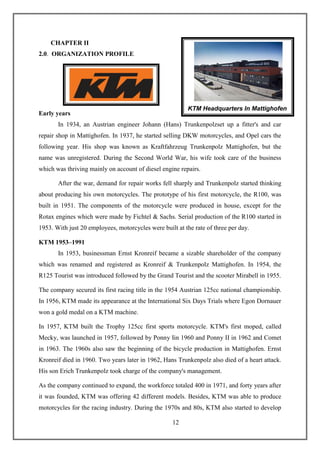
KTM Headquarters In Mattighofen
13
and produce motors and radiators. Radiators sold to European car manufacturers constituted a
sizable part of the company's business in the 1980s.
In 1978, US subsidiary KTM North America Inc. was founded in Lorain, Ohio.
In 1980, the company was renamed KTM Motor-Fahrzeugbau KG. One year later,
KTM had about 700 employees and a turnover of 750m. Schilling (about 54.5m. Euro).
International business then amounted to 76 % of the company turnover.
However, scooter and moped turnover sank rapidly, and production had to be halted in 1988.
Erich Trunkenpolz died in 1989. Takeover of a 51 % interest in the company by the Austrian
investment trust GIT Trust Holding controlled by Austrian politician Josef Taus in 1989 was
followed by unsuccessful attempts to turn the indebted company around, and in 1991, KTM
management was transferred to a consortium of creditor banks.
KTM after 1991
In 1992, the company was split into four new entities: KTM Sportmotorcycle GmbH
(motorcycles division), KTM Fahrrad GmbH (bicycles division), KTM Kühler GmbH
(radiators division) and KTM Werkzeugbau GmbH (tooling division).
Now owned by KTM Motorradholding GmbH, which was formed by Cross Holding (a Cross
Industries daughter), and other investors, KTM Sportmotorcycle GmbH started operation in
1992 and later took over the sibling tooling division KTM Werkzeugbau. In the following
years, while steadily increasing production and turnover, investing in new production and R
& D facilities, introducing new models and successfully sponsoring and taking part in various
race sport events, the company underwent a series of restructurings and stakeholder changes
guided by KTM's managing director and Cross Industries owner Stefan Pierer. In 1994, KTM
started production of the Duke series of road motorcycles, in 1996, KTM motocross
machines were first decked out in KTM's signature orange color, and 1997 saw the
introduction of LC4 Supermoto and Adventure motorcycles. In 2007, the company debuted
the KTM X-Bow sports car.
In 1995, KTM Motorradholding GmbH acquired Swedish motorcycle maker
Husaberg AB and took control of the Dutch company White Power Suspension.
In 2007, Indian motorcycle manufacturer Bajaj Auto bought a 14.5% stake in KTM
Power Sports AG. By 2013, Bajaj Auto held a 47.97% interest in the company.
14
In 2013, KTM acquired the formerly Swedish motorcycle maker Husqvarna
Motorcycles from its prior owner BMW Motorrad AG. The same year, KTM re-integrated
the brand Husaberg into Husqvarna Motorcycles from which it had spun off in the 1990s
when Husqvarna was sold to the Italian company Cagiva.
As the final result of the restructuring process, KTM Motorradholding GmbH had
become KTM AG in 2012. In 2015, KTM generated a turnover of over 1 billion Euro and
employed 2515 people by the end of that year. Of the four separate companies left after the
1992 split, three were now again part of the KTM Group: KTM Sportmotorcycle GmbH,
KTM Werkzeugbau GmbH and KTM Kühler GmbH (today WP Radiators). KTM Fahrrad
GmbH (KTM Bike Industries) remained an independent company and is owned by Chinese
investors. KTM-Group today contains the brands KTM and Husqvarna Motorcycles.
2.1. Management
Ownership
KTM AG is presently owned by CROSS KraftFahrZeug Holding GmbH (51,28 %)
and Bajaj Auto Limited International Holdings B.V. (47,99 %). CROSS KraftFahrZeug
Holding GmbH is a subsidiary of KTM Industries AG (prior to 2016 CROSS Industries AG),
founded by KTM AG‟s current CEO Stefan Pierer. KTM Industries AG is owned by Pierer
Industrie AG (74,89 %).
Subsidiaries
As of 2017, KTM AG has the following subsidiaries:
 KTM-Racing AG (Switzerland, 100 %)
 KTM-Sportmotorcycle India Private Ltd. (India, 100 %)
 KTM Sportmotorcycle GmbH (100 %, distribution of motorcycles and parts)
 Husqvarna Motorcycles GmbH (100 %, distribution of motorcycles and parts)
 KTM Sportcar GmbH (100 %, production and distribution of the KTM X-Bow)
 KTM Technologies GmbH (74 %, R&D services)
 KTM Immobilien GmbH (99 %, owner of all property and buildings of the KTM
Group)
15
 WP AG (25 %, former White Power suspension GmbH, production of motorcycle
components)
 Kiska GmbH (26 %, design company for the KTM Group)
Furthermore, KTM Sportmotorcycle GmbH and Husqvarna Motorcycles GmbH operate
24 respectively 7 distribution subsidiaries worldwide, most of them in European and Asian
countries and in the US.
Joint ventures
KTM started exporting their GS model to USA in 1968 through an American
importer, John Penton under the Penton brand. This Joint Venture lasted until KTM
established KTM America Inc. in Ohio in 1978.
In 2005, KTM-Sportmotocycle began a partnership with ATV manufacturer Polaris
Industries with the goal of shared R&D, and more importantly shared distribution networks.
This partnership was a two-year trial arrangement, at the end of which both parties had the
option of merging the two companies into one. In 2006, KTM announced that the partnership
with Polaris had been downgraded, and would instead only supply their 450cc and 510cc
RFS engines to Polaris.
In January 2008, Bajaj announced that it would jointly develop two new 125cc and
200cc bikes for Europe and the Far East. The bikes would be badged KTM. In January 2012,
Bajaj launched the Duke 200 model in India.
KTM operates distribution joint ventures in Dubai (KTM UAE), New Zealand (KTM
New Zealand), and the Philippines (KTM Philippines)
16
2.3. Organization Structure
17
About RC200
The 2017 model year
of the KTM RC200
doesn‟t have
mechanical updates,
other than the fact
that the engine is now
BS4 compliant. A couple of changes have been made to its appearance – there are orange
wheels, a white/orange paint scheme which has been introduced for 2017. Nothing else
changes though, not even the price. That makes it a little more value for money, and as far as
entry-level crotch rockets go, you can‟t get much better than the RC200. There‟s still no
ABS, even as an option, and just like its elder sibling, it retains the scalpel-sharp handling
that made us like it so much. If you‟re looking for an all-new RC200, though, you‟ll have to
wait until the end of 2017 or beyond. There isn‟t any real competition for the RC200 - the
only other product that is as committed is the KTM YZF-R15, and that sits a segment below
the RC200. The bike is priced at Rs 1,74,797 (ex-showroom,Delhi)
KTM RC 390
The 2017 edition of the KTM
RC 390 was recently launched in
January, 2017. The new KTM
RC 390 gets cosmetic updates
and new features. It now gets a
black and orange colour scheme,
but with fresh graphic design in
white. The body of the bike have
orange-coloured panels which
were previously used only for
the trellis frame and alloy wheels. The 2017 KTM RC 390 has been priced at Rs 2.25 lakh,
ex-showroom, Delhi. The new graphics make the KTM motorcycle look sporty and more
appealing and another visual distinguish between the new bike and the old bike is the exhaust
18
muffler. Unlike the old RC 390 which has an underbelly exhaust system, the new KTM RC
390 sports a side-mounted exhaust. On the mechanical front, the bike now gets ride-by-wire
system which improves the throttle response of the bike and the RC 390 is the only bike in its
segment to feature it. Power is derived from the same 373.3cc single-cylinder liquid-cooled
mill which is now BS-IV compliant and continues to produce the same power output of
43.5PS at 9000rpm while max torque has been bumped up 1Nm to 36Nm at 7000rpm. The
bike gets new adjustable clutch and brake levers. It also gets bigger rear view mirrors, which
should make them more usable with a better field of view. The front disc is also a larger
320mm dia unit while ABS remains standard. Suspension and frame of the bike remain
unchanged. The BS-IV version of the KTM RC390 weighs 163.5kg which is a massive gain
of 15kg in comparison to
the older bike.
KTM 200 Duke
February 23, 2017: KTM has launched the
updated BS-IV version of the 200 Duke in
India. The 200 Duke was KTM's first
offering for India. The bike found many
admirers as it came with a good
combination of performance, features and
decent pricing.
The 200 Duke misses out on the new 2017
Duke design language that the 390 Duke
and 250 Duke get. Nevertheless, the old
design including the sculpted fuel tank, underbelly exhaust, exposed trellis frame and
minimal bodywork made the 200 Duke stand apart from its rivals. As part of its 2017
updates, the new bike gets new graphics and will come in three new colours. The bike now
features orange wheels instead of black on the previous iteration. Features include a
comprehensive all-digital instrument console. The bike gets high spec suspension in the form
of 43m WP upside down forks upfront and a WP monoshock at the rear.
Powering the bike is a 199.5cc displacement motor that puts out 26PS and 19.2Nm of torque.
Performance is among the highlights of the KTM 200 Duke as the 130kg kerb weight endows
it with an impressive power-to-weight ratio. The powerplant is mated to a 6-speed gearbox.
19
The KTM 200 Duke is priced at Rs 1.43 lakhs (Ex-Delhi). The 200 Duke faces competition
from the TVS RTR 200 and the Bajaj 200 NS.
KTM 390 Duke
February 23, 2017:
KTM‟s feature-packed
2017 Duke 390 has
been launched. The
2017 model gets a
complete redesign with
full LED headlamps, a
revised BSIV motor,
new exhaust, ride-by-
wire and a colour TFT tablet-type instrument console. The 390 Duke should offer the best
performance under the Rs 2.5 lakh price bracket owing to the high-performance 373cc engine
and the lightweight chassis and bodywork. The bike also gets a host of first-in-class features
like a colour TFT screen, standard switchable ABS and slipper clutch. The 390 Duke is
priced at Rs 2.26 lakh (ex-Delhi). The bike faces competition from the Benelli TNT 300 and
Kawasaki Z250 which are priced way higher. The 2017 KTM 390 Duke should be able to
hold the crown of the best sports bike under the Rs 3 lakh price bracket.
KTM 250 Duke
February 23, 2017: The
250 Duke is the latest
addition to the KTM
Duke range in India.
The 2017 model
features a completely
new design and borrows
styling bits and features
from both the new 390 Duke and 200 Duke. KTM already manufactures the 250 Duke in
India and exports it to other countries so local production should keep prices competitive.
The 250 Duke carries a similar design as the new 390 Duke but gets black wheels and black
20
front frame. The headlamp is the same split one as the 390 Duke but misses out on LED
technology and features a conventional halogen bulb instead. It also misses out on the colour
LCD screen and has an updated digital unit. The bike has a 248.8cc liquid-cooled motor that
makes 30PS, 5PS more than the 200 Duke. It gets a slipper clutch. The 250 Duke will sit in
between the 200 Duke and the 390 Duke. The bike is priced at Rs 1.73 lakh (ex-Delhi).
Rivals include the Benelli TNT 25 and the Mahindra Mojo.
KTM 1050 Adventure
KTM unveiled the 1050
Adventure at the 2014
EICMA motorcycle show
in Milan, Italy. The 1050
Adventure will be the first
litre-class offering from
KTM in the Indian two-
wheeler market. Powering
the bike is a 1,050cc V-
twin motor churning out
96PS of peak power. The
1050 Adventure is a modern KTM ADV bike, well equipped with Ride Mode Technology,
ABS, and traction control. The ABS can be shut off, as well as the traction control, and the
level of electronic intervention is dependent on the chosen ride mode. Though the KTM 1050
Adventure is an entry-level offering, KTM have been generous on the motorcycle as it
features goodies such as ride-by-wire throttle, three ride modes (Sport, Street, Rain), traction
control, a slipper clutch and ABS. Another novel feature on the KTM 1050 Adventure is the
fact the windscreen, handlebars, and foot pegs are all adjustable. Other details include the
expected KTM trellis frame (made from chrome-moly steel and powdercoated orange), plus
top-quality WP suspension hardware, dual-plug ignition, Keihin engine management, and a
slipper clutch. Also noteworthy are cast wheels, plus adjustable footpegs, an adjustable
handlebar and an adjustable windscreen.
ANALYSIS AND INTERPRETATION
21
CHAPTER III
3.0. DATA ANALYSIS AND INTERPRETATION
INTRODUCTION
The main objective of the study is to assess the satisfaction level of the customers. The
data analysis is done form the data collected through the questionnaire filled by the
customers. For analysis of the data, percentage analysis, test is used. Therefore this
chapter highlights the satisfaction level of the customers of KTM . It is based upon the
primary data collected by the researcher.
Table No. 3.1. Age of the respondent
Age Frequency Percent Valid Percent
Cumulative
Percent
Valid
”Below 15 years “ 24 24.0 24.0 24.0
“16-25” 36 36.0 36.0 60.0
“26-35 “ 16 16.0 16.0 76.0
“36-45 12 1 1 88.0
above 45 12 1 1 100.0
Total 100 100.0 100.0
Interpretation
From the table it shows that 24% of respondents are below 15 yrs , 36% respondents are
16-25, 16% respondents are 26-35,12% respondents are 36-45,12% respondents are
above 45.
22
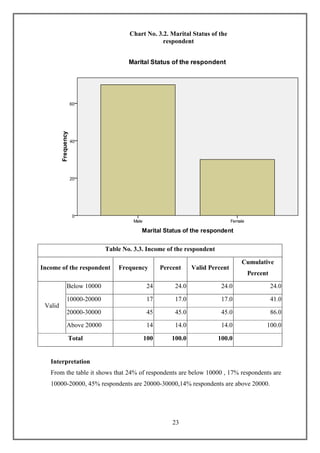
Table No. 3.2. Marital Status of the respondent
Marital Status of the
respondent
Frequency Percent Valid Percent
Cumulative
Percent
Valid
Male 70 70.0 70.0 70.0
Female 30 30.0 30.0 100.0
Total 100 100.0 100.0
Interpretation
From the table it shows that 70% of respondents are MALE , 30% respondents are
FEMALE.
Chart No. 3.1. Age of the respondent
23
Table No. 3.3. Income of the respondent
Income of the respondent Frequency Percent Valid Percent
Cumulative
Percent
Valid
Below 10000 24 24.0 24.0 24.0
10000-20000 17 17.0 17.0 41.0
20000-30000 45 45.0 45.0 86.0
Above 20000 14 14.0 14.0 100.0
Total 100 100.0 100.0
Interpretation
From the table it shows that 24% of respondents are below 10000 , 17% respondents are
10000-20000, 45% respondents are 20000-30000,14% respondents are above 20000.
Chart No. 3.2. Marital Status of the
respondent
24
Table No. 3.4. Own Bike
Own Bike Frequency Percent Valid Percent
Cumulative
Percent
Valid
Yes 72 7 7 7
No 28 28.0 28.0 100.0
Total 100 100.0 100.0
Interpretation
From the table it shows that 72% of respondents are YES, 28% respondents are NO.
Chart No. 3.3. Income of the respondent
25
Table No. 3.5. Cleanliness And Comfort Of Service
Cleanliness and
Comfort Of Service
Frequency Percent Valid Percent
Cumulative
Percent
Valid
Excellent 18 18.0 18.0 18.0
Good 40 40.0 40.0 58.0
Fair 32 3 3 90.0
Poor 10 10.0 10.0 100.0
Total 100 100.0 100.0
Interpretation
From the table it shows that 18% of respondents are Excellent, 40% respondents are
Good, 32% respondents are Fair ,10% respondents are Poor.
Chart No. 3.4. Own Bike
26
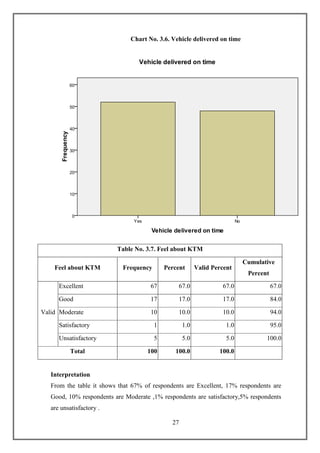
Table No. 3.6. Vehicle delivered on time
Vehicle delivered
on time
Frequency Percent Valid Percent
Cumulative
Percent
Valid
Yes 52 5 5 5
No 48 48.0 48.0 100.0
Total 100 100.0 100.0
Interpretation
From the table it shows that 52% of respondents are Yes,48% respondents are NO.
Chart No. 3.5. Cleanliness And Comfort Of
Service
27
Table No. 3.7. Feel about KTM
Feel about KTM Frequency Percent Valid Percent
Cumulative
Percent
Valid
Excellent 67 67.0 67.0 67.0
Good 17 17.0 17.0 84.0
Moderate 10 10.0 10.0 94.0
Satisfactory 1 1.0 1.0 95.0
Unsatisfactory 5 5.0 5.0 100.0
Total 100 100.0 100.0
Interpretation
From the table it shows that 67% of respondents are Excellent, 17% respondents are
Good, 10% respondents are Moderate ,1% respondents are satisfactory,5% respondents
are unsatisfactory .
Chart No. 3.6. Vehicle delivered on time
28
Table No. 3.8. KTM ad in TV
KTM ad in TV Frequency Percent Valid Percent
Cumulative
Percent
Valid
Yes 81 81.0 81.0 81.0
No 19 19.0 19.0 100.0
Total 100 100.0 100.0
Interpretation
From the table it shows that 81% of respondents are YES , 19% respondents are NO.
Feel about KTM
Chart No. 3.7. Feel about KTM
29
Table No. 3.9. Reasons to purchase KTM
Reasons to purchase KTM Frequency Percent
Valid
Percent
Cumulative
Percent
Valid
Mileage 8 8.0 8.0 8.0
Low maintenance 14 14.0 14.0 2
Price 72 7 7 94.0
Wide range of
products
2 96.0
Brand name 4 4.0 4.0 100.0
Total 100 100.0 100.0
KTM ad in TV
Chart No. 3.8. KTM ad in TV
30
Interpretation
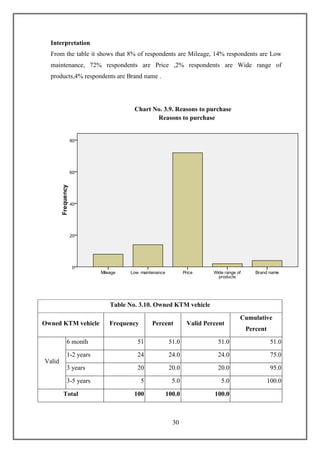
From the table it shows that 8% of respondents are Mileage, 14% respondents are Low
maintenance, 72% respondents are Price ,2% respondents are Wide range of
products,4% respondents are Brand name .
Table No. 3.10. Owned KTM vehicle
Owned KTM vehicle Frequency Percent Valid Percent
Cumulative
Percent
Valid
6 month 51 51.0 51.0 51.0
1-2 years 24 24.0 24.0 75.0
3 years 20 20.0 20.0 95.0
3-5 years 5 5.0 5.0 100.0
Total 100 100.0 100.0
Reasons to purchase
KTM
Chart No. 3.9. Reasons to purchase
KTM
31
Interpretation
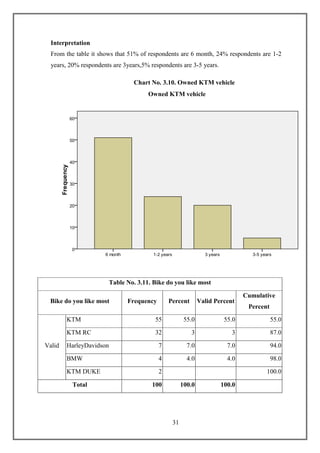
From the table it shows that 51% of respondents are 6 month, 24% respondents are 1-2
years, 20% respondents are 3years,5% respondents are 3-5 years.
Table No. 3.11. Bike do you like most
Bike do you like most Frequency Percent Valid Percent
Cumulative
Percent
Valid
KTM 55 55.0 55.0 55.0
KTM RC 32 3 3 87.0
HarleyDavidson 7 7.0 7.0 94.0
BMW 4 4.0 4.0 98.0
KTM DUKE 2 100.0
Total 100 100.0 100.0
Owned KTM vehicle
Chart No. 3.10. Owned KTM vehicle
32
Interpretation
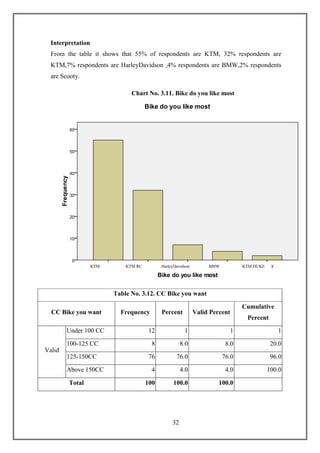
From the table it shows that 55% of respondents are KTM, 32% respondents are
KTM,7% respondents are HarleyDavidson ,4% respondents are BMW,2% respondents
are Scooty.
Table No. 3.12. CC Bike you want
CC Bike you want Frequency Percent Valid Percent
Cumulative
Percent
Valid
Under 100 CC 12 1 1 1
100-125 CC 8 8.0 8.0 20.0
125-150CC 76 76.0 76.0 96.0
Above 150CC 4 4.0 4.0 100.0
Total 100 100.0 100.0
KTM KTM RC HarleyDavidson BMW KTM DUKE
Chart No. 3.11. Bike do you like most
33
Interpretation
From the table it shows that 12% of respondents are under 100cc, 8% respondents are
100-125cc,76% respondents are 125-150cc,4% respondents are 150cc.
Table No. 3.13. Maximum Mileage of given by KTM
Maximum Mileage of given
by KTM
Frequency Percent Valid Percent
Cumulative
Percent
Valid
KTM 59 59.0 59.0 59.0
KTM RC 25 25.0 25.0 84.0
HarleyDavidson 14 14.0 14.0 98.0
BMW 2 100.0
Total 100 100.0 100.0
Chart No. 3.12. CC Bike you want
34
Interpretation
From the table it shows that 59% of respondents are KTM, 25% respondents are
KTM,14% respondents are HarleyDavidson ,2% respondents are Jupiter.
Table No. 3.14. Attractive Price of Company
Attractive Price of Company Frequency Percent
Valid
Percent
Cumulative
Percent
Valid
KTM 50 50.0 50.0 50.0
KTM RC 28 28.0 28.0 78.0
HARLEYDAVIDSON 15 15.0 15.0 93.0
BMW 7 7.0 7.0 100.0
Total 100 100.0 100.0
Maximum Mileage of given by KTM
KTM RC HarleyDavidson BMW KTM DUKE
Chart No. 3.13. Maximum Mileage of given by KTM
35
Interpretation
From the table it shows that 50% of respondents are KTM, 28% respondents are KTM
RC,15% respondents are HarleyDavidson ,7% respondents are BMW.
KTM RC HarleyDavidson BMW KTM DUKE
Chart No. 3.14. Attractive Price of Company
36
Table No. 3.15. Feel service charge and repair charge is reasonable
Feel service charge and
repair charge is
reasonable
Frequency Percent Valid Percent
Cumulative
Percent
Valid
Excellent 56 56.0 56.0 56.0
Good 24 24.0 24.0 80.0
Fair 16 16.0 16.0 96.0
Poor 4 4.0 4.0 100.0
Total 100 100.0 100.0
Interpretation
From the table it shows that 56% of respondents are Excellent, 24% respondents are
Good,16% respondents are Fair,4% respondents are poor.
Chart No. 3.15. Feel service charge and repair charge is reasonable
37
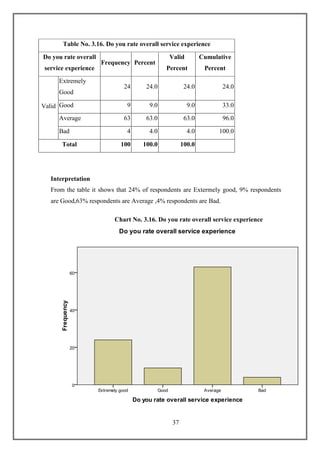
Table No. 3.16. Do you rate overall service experience
Do you rate overall
service experience
Frequency Percent
Valid
Percent
Cumulative
Percent
Valid
Extremely
Good
24 24.0 24.0 24.0
Good 9 9.0 9.0 33.0
Average 63 63.0 63.0 96.0
Bad 4 4.0 4.0 100.0
Total 100 100.0 100.0
Interpretation
From the table it shows that 24% of respondents are Extermely good, 9% respondents
are Good,63% respondents are Average ,4% respondents are Bad.
Chart No. 3.16. Do you rate overall service experience
38
Table No. 3.17. Types of problems you face at the time of service
Types of problems you face at
the time of service
Frequency Percent Valid Percent
Cumulative
Percent
Valid
Highly satisfied 51 51.0 51.0 51.0
Satisfied 37 37.0 37.0 88.0
Average 10 10.0 10.0 98.0
Dissatisfied 1 1.0 1.0 99.0
Highly
dissatisfied
1 1.0 1.0 100.0
Total 100 100.0 100.0
Interpretation
From the table it shows that 51% of respondents are Highlysatisfied, 37% respondents
are satisfied, 10% respondents are Average,1% respondents are Dissatisfied,1 %
respondents are Highly dissatisfied.
39
Table No. 3.18. Model are you using the bike
Model are you using
the bike
Frequency Percent Valid Percent
Cumulative
Percent
Valid
2 Strokes 47 47.0 47.0 47.0
4 Strokes 53 53.0 53.0 100.0
Total 100 100.0 100.0
Interpretation
From the table it shows that 47% of respondents are 2 strokes, 53% respondents are 4
strokes.
Chart No. 3.17. Types of problems you face at the time of service
40
Table No. 3.19. Sales person spend sufficient time with you
Sales person spend
sufficient time with
you
Frequency Percent Valid Percent
Cumulative
Percent
Valid
Yes 47 47.0 47.0 47.0
No 53 53.0 53.0 100.0
Total 100 100.0 100.0
Interpretation
From the table it shows that 47% of respondents are YES, 53% respondents are NO.
Chart No. 3.18. Model are you using the bike
41
Table No. 3.19. Sales person spend sufficient time with you
CONCLUSION
42
CHARTER IV
4.0. CONCLUSION
This study is based on the customer response of KTM. Finding and suggestion has been
found through data collected with customers by preparing structured questionnaire, the
questions contains in the questionnaire is based on the observation done in the organization. I
hope this study will help the organization in general to improve the customer response in the
company for longer period. I conclude this report as been prepared completely based on my
own knowledge.
4.1 FINDINGS AND SUGGESTION
Findings
 Majority of the respondents are satisfied with the bike models available.
 Most of the respondents own KTM already.
 More respondents are highly satisfied with the service of the KTM.
 Majority of the respondents are satisfied with price, mileage, fuel efficiency.
4.1.1. Suggestion
 From this study, suggesting that to have much more service to the customers.
 Through this study, customers are interested in KTM suggesting to improve the
availability.
 From this study, customers are satisfied and suggesting to improve to the next level.
REFERENCE
43
CHAPTER V
REFERENCE:
WEBSITE ADDRESS:
https://www.ktm.com/in/
CONSUMER BEHAVIOUR (WIKIPEDIA)
SALES PROMOTION (WIKIPEDIA)
BOOKS:
PEARSON (1998) PEARSON EDUATION, Inc) statistical tools for management.
43
A STUDY ON CONSUMER BEHAVIOUR RELATED TO DIFFERENT
BRAND BIKES SPECIAL REFERENCE IN CBE (KTM)
QUESTIONNAIRE
Name:
1) Age
a) Below 15 years b) 16-25 c) 26-35 d) 36-45 e) above 45
2) Gender
a) Male b) Female
3) Income
a) Below 10000 b) 10000-20000 c) 20000-30000 d) above 20000
4) Occupation
a) Government employee b) private employee c) self employee d) students e) others
5) Marital status
a) Married b) unmarried
6) Do you own any bike
a) Yes b) no
7) Which brand you possess...............................
8) When you entered, what was the total time taken before someone from the staff
attended you
a) Excellent b) good c) fair d) poor
9) How do you rate cleanliness and comfort of service reception and customer waiting
lounge
a) Excellent b) good c) fair d) poor
10) Did the sales person spend sufficient time with you and explain everything about the
vehicle
a) Yes b) no
11) Was the vehicle delivered on promised time
a) Yes b) no
12) Were you offered test drive during your visit to our show room
a) Yes b) no
13) How do you feel about KTM two wheeler vehicles
a) Excellent b) good c) moderate d) satisfactory e) unsatisfactory
14) What are the reasons to purchase KTM vehicles
a) Mileage b) low maintenance c) price d) wide range of products e) brand name
15) When did you owned KTM vehicle
a) 6 month b) 1-2 years c) 3 years d) 3-5 years
16) What are the different types of problems you face at the time of service your vehicle
a) High price spare parts b) non availability of spare parts
c) delay in service d) low quality of spare parts
17) Which Model are you using the bike
a) 2 Strokes b) 4 Strokes
44
18 ) Which bike do you like most
a) KTM RC b) Harley Davidson
c ) BMW d) KTM DUKE
19) What will you prefer?
a) Mileage b) Power
b) Maintenance c) Price
d) Looking
20) How much CC Bike you want
a) Under 200 CC b) 200 - 300 CC
c) 300 – 400 CC d)Above 400 CC
21)Maximum Mileage of given by
a) KTM RC b) Harley Davidson
c ) BMW d) KTM DUKE
22)Attractive Price of Company
a) KTM RC b) Harley Davidson
c ) BMW d) KTM DUKE
23)Do you feel service charge and repair charge is reasonable
a) Excellent b) Good c) Fair d) Poor
24) How do you rate overall service experience
a) Extremely good b) good c) average d) bad e) extremely bad
25) Are you satisfied with the availability of bike models
a) Highly satisfied b) satisfied c) average d) dissatisfied e) highly dissatisfied
26) State if any other suggestion
.........................................................................................................................................
.........................................................................................................................................

Ktm cbe full project

  • 1.
    A STUDY ONCONSUMER BEHAVIOUR RELATED TO DIFFERENT BRAND BIKES SPECIAL REFERENCE IN CBE (KTM)
  • 2.
  • 3.
    Chapter no. CONTENTSPAGE NO. 1 INTRODUCTION 1 1.1. Introduction to the Concept of Study 1 1.2. Statement of the Problem 4 1.3. Objectives of the Study 5 1.4. Scope of the Study 6 1.5. Methodology 7 1.6. Limitations 11 2 ORGANIZATION PROFILE 12 2.1. History of the Organization 12 2.2. Management 14 2.3. Organization Structure 16 3 ANALYSIS AND INTERPRETATION 21 4 4.0. CONCLUSION 4.1. Findings And Suggestion 42 42 5 REFERENCE 43
  • 4.
  • 5.
    List of Table TableNo. Particulars Page. No. 3.1 Age of the respondent 21 3.2 Marital Status of the respondent 22 3.3 Income of the respondent 23 3.4 Own Bike 24 3.5 Cleanliness And Comfort Of Service 25 3.6 Vehicle delivered on time 26 3.7 Feel about KTM 27 3.8 KTM ad in TV 28 3.9 Reasons to purchase KTM 29 3.10 Owned KTM vehicle 30 3.11 Bike do you like most 31 3.12 CC Bike you want 32 3.13 Maximum Mileage of given by KTM 33 3.14 Attractive Price of Company 34 3.15 Feel service charge and repair charge is reasonable 36 3.16 Do you rate overall service experience 37 3.17 Types of problems you face at the time of service 38 3.18 Model are you using the bike 39 3.19 Sales person spend sufficient time with you 40
  • 6.
  • 7.
    List of Chart TableNo. Particulars Page. No. 3.1 Age of the respondent 22 3.2 Marital Status of the respondent 23 3.3 Income of the respondent 24 3.4 Own Bike 25 3.5 Cleanliness And Comfort Of Service 26 3.6 Vehicle delivered on time 27 3.7 Feel about KTM 28 3.8 KTM ad in TV 29 3.9 Reasons to purchase KTM 30 3.10 Owned KTM vehicle 31 3.11 Bike do you like most 32 3.12 CC Bike you want 33 3.13 Maximum Mileage of given by KTM 34 3.14 Attractive Price of Company 35 3.15 Feel service charge and repair charge is reasonable 36 3.16 Do you rate overall service experience 37 3.17 Types of problems you face at the time of service 38 3.18 Model are you using the bike 39 3.19 Sales person spend sufficient time with you 41
  • 8.
  • 9.
    1 ABSTRACT: This study isbased to identify the factors that influence the consumer buying behaviour of the two wheeler Bikes at COIMBATORE, cities of Tamilnadu. The survey is mainly focused on the buying behaviour of the consumer that motivates them to purchase the two wheeler bikes. The marketing philosophy of business assumes that an organisation can best serve, prosper and attain profit by identifying and satisfying the needs of its customers. This however, is a recent thinking; various definitions of marketing have been given from different perspective, exchanges and utility being the two important once. The current millennium has unfolded new business rules, the most significant of them being that past or experience in a given product market is no indicator for future success. Market leadership cannot be taken for granted because customer loyalty does not exist. The customer today has a much wider choice. India is the second largest producer of the two-wheeler in the world. The two wheeler segment contribute the largest volume all the segments in automobile industry in India. The country stands next to China and Japan in terms of production and sales respectively.
  • 10.
    2 CHAPTER I INTRODUCTION 1.1 INTRODUCTION ConsumerResponse Efficient Consumer Response (ECR) is a joint trade and industry body working towards making the grocery sector as a whole more responsive to consumer demand and promote the removal of unnecessary costs from the supply chain. There are four focus areas under ECR: demand management, supply management, enablers and integrators, which are intended to be addressed as an integrated set. These form the basis of the ECR Global Scorecard. ECR Europe ECR Europe was launched in 1994. With its headquarters in Brussels, the organization works in co-operation with national ECR initiatives in most European countries. Participation in projects at European and national levels is open to companies in the grocery and Fast Moving Consumer Goods sectors – inc=luding retailers, wholesalers, manufacturers, suppliers, brokers and third-party service providers such as logistics operators. Every year ECR Europe organizes projects where companies from Europe explore new areas of working together. The results of these projects are published and there is an annual ECR Europe conference. Consumer-Response Marketing (CRM) is a full service Canadian Marketing Fulfillment Company that delivers a wide variety of services for business-to-business (B2B) and Business-to-Consumer (B2C) direct response programs. From our contact centre through order processing, rebate cheque issuance to our Pick „n Pac and distribution systems, CRM provides the expertise, experience, discipline and flexibility to help your company grow.
  • 11.
    3 Market Survey Market survey--whereyou actually speak to members of your target audience--are an important part of market research. You can choose to hire a company to do it for you, but conducting the interviews yourself will most likely give you a much better idea of the needs of your target audience and will provide you with insights that you might not otherwise have gleaned. If you're going the do-it-yourself route, you'll probably want to act as the focus group moderator. As the moderator, you'll want to encourage an open-ended flow of conversation and be sure to solicit comments from quieter members, or you may end up getting all your information from the talkative participants only.
  • 12.
    4 1.2 STATEMENT OFTHE PROBLEM Consumer‟s needs are the focuses of marketing. To be successful marketing managers, it is important for him to understand the nature and characteristics of consumers. India is emerging as one of the fastest developing nation in the world with the economic liberalization in full swing, the most MNC are making a beeline favor country with their Hi-tech consumer durables, particularly. So in two-wheeler industry, the leading local players in the two-wheeler industry are tying up with reputed MNC to come out with new model and technology to cater to the growing needs of the two- wheeler marketing.
  • 13.
    5 1.3 OBJECTIVES OFTHE STUDY  To know about the factors influencing the customer decisions of purchasing KTM bike.  The main objective of the study is to find out to what extent the customers are responded.  To know about the services rendered by the dealer.  To know about the company‟s after Sales and Services.  To know the respondents problems towards KTM vehicles.
  • 14.
    6 1.4 SCOPE OFTHE STUDY The scope of the study was extended only to the respondents of Coimbatore. It does not cover all the consumer using KTM vehicles. The result of the study are use full to assess customers response and let us know what exactly customers are looking for when they buy a two-wheeler. It gives the idea of the sectors need to improve, to stabilize the market and to provide customer relationship. It helps in getting feedback about the product quality. The project helps to put in to practice the theoretical aspects of the study into reality.
  • 15.
    7 1.5 RESEARCH METHODOLOGY Researchmethodology describes how the research study was undertaken. This includes the specifications of research design, sampling design, population, sampling technique, and sampling frame, sample size, sample unit, tools for analysis, source of data, and method of data collection. RESEARCH DESIGN: A research design is a framework or blueprint for conducting the research project. It details the procedures necessary for obtaining the information needed to structure or solve research problems. ” A research design is the arrangement if conditions for collection and analysis of data in a simple manner that aims to combine relevance to the research purpose with economy in procedure”
  • 16.
    8 TYPE OF RESEARCH:(DESCRIPTIVE RESEARCH It is a fact finding research with adequate interpretation. It uses simple analysis of data, through analysis we can find out the characteristics of customers, so by using descriptive research method to find the customers satisfaction towards KTM SAMPLE DESIGN: a) POPULATION: Population for this organization research study is customers of KTM. b) SAMPLING TECHNIQUE: For this research study Non-Probability sampling that too (Convenient sample) is used for analysis. CONVENIENT SAMPLING A statistical method of drawing representative data by selecting people because of the ease of their volunteering or selecting units because of their availability or easy access. The advantages of this type of sampling are the availability and the quickness with which data can be gathered. The disadvantages are the risk that the sample might not represent the population as a whole, and it might be biased by volunteers. For example, a study to determine the average age and sex of gamblers at a casino that is conducted for three hours on a weekday afternoon might be overrepresented by elderly people who have retired and underrepresented by people of working age. c) SAMPLING FRAME: Sampling Frame is a representation of the elements of the target population. It consists of a list or set of directions for identifying the target population. Sampling frame for this research study is customers of KTM.
  • 17.
    9 d) SAMPLE SIZE: Samplesize of the research is 100 customers of KTM. e) SAMPLE UNIT: A sampling unit is an element, or a unit containing the element, that is available for selection at some stage of the sampling process. TOOLS FOR ANALYSIS:  SPSS Package  Percentage analysis  Cross tab DATA SOURCE PRIMARY DATA : Primary data was collected from the respondents by administering in a structured questionnaire and also through observations, interview and discussion with management. SECONDARY DATA: Secondary data is data collected by someone other than the user. Common sources of secondary data for social science include census, organizational records and data collected through qualitative methodologies or qualitative research. Primary data, by contrast, are collected by the investigator conducting the research.
  • 18.
    10 SAMPLE DESIGN The typeof sampling, chosen is convenience sampling. Sampling The sample size is restricted to 100 from 1. House wives and 2. Working women TOOLS Tools that are to be used for analysis are:- 1. Simple percentage analysis 2. Average rank analysis 3. Average score analysis 4. Analysis of variance (ANOVA) 5. Factor Analysis
  • 19.
    11 1.6 LIMITATION OFTHE STUDY  Time has been a major constraint throughout the study.  As this survey was restricted to Coimbatore this cannot be stated as an in depth research on this subject.  Enough care is taken in formulating the questionnaire; still some errors may creep in.  The consumer response varies according to different products.  Quality verses price was not taken into the consideration.
  • 20.
  • 21.
    12 CHAPTER II 2.0. ORGANIZATIONPROFILE Early years In 1934, an Austrian engineer Johann (Hans) Trunkenpolzset up a fitter's and car repair shop in Mattighofen. In 1937, he started selling DKW motorcycles, and Opel cars the following year. His shop was known as Kraftfahrzeug Trunkenpolz Mattighofen, but the name was unregistered. During the Second World War, his wife took care of the business which was thriving mainly on account of diesel engine repairs. After the war, demand for repair works fell sharply and Trunkenpolz started thinking about producing his own motorcycles. The prototype of his first motorcycle, the R100, was built in 1951. The components of the motorcycle were produced in house, except for the Rotax engines which were made by Fichtel & Sachs. Serial production of the R100 started in 1953. With just 20 employees, motorcycles were built at the rate of three per day. KTM 1953–1991 In 1953, businessman Ernst Kronreif became a sizable shareholder of the company which was renamed and registered as Kronreif & Trunkenpolz Mattighofen. In 1954, the R125 Tourist was introduced followed by the Grand Tourist and the scooter Mirabell in 1955. The company secured its first racing title in the 1954 Austrian 125cc national championship. In 1956, KTM made its appearance at the International Six Days Trials where Egon Dornauer won a gold medal on a KTM machine. In 1957, KTM built the Trophy 125cc first sports motorcycle. KTM's first moped, called Mecky, was launched in 1957, followed by Ponny Iin 1960 and Ponny II in 1962 and Comet in 1963. The 1960s also saw the beginning of the bicycle production in Mattighofen. Ernst Kronreif died in 1960. Two years later in 1962, Hans Trunkenpolz also died of a heart attack. His son Erich Trunkenpolz took charge of the company's management. As the company continued to expand, the workforce totaled 400 in 1971, and forty years after it was founded, KTM was offering 42 different models. Besides, KTM was able to produce motorcycles for the racing industry. During the 1970s and 80s, KTM also started to develop KTM Headquarters In Mattighofen
  • 22.
    13 and produce motorsand radiators. Radiators sold to European car manufacturers constituted a sizable part of the company's business in the 1980s. In 1978, US subsidiary KTM North America Inc. was founded in Lorain, Ohio. In 1980, the company was renamed KTM Motor-Fahrzeugbau KG. One year later, KTM had about 700 employees and a turnover of 750m. Schilling (about 54.5m. Euro). International business then amounted to 76 % of the company turnover. However, scooter and moped turnover sank rapidly, and production had to be halted in 1988. Erich Trunkenpolz died in 1989. Takeover of a 51 % interest in the company by the Austrian investment trust GIT Trust Holding controlled by Austrian politician Josef Taus in 1989 was followed by unsuccessful attempts to turn the indebted company around, and in 1991, KTM management was transferred to a consortium of creditor banks. KTM after 1991 In 1992, the company was split into four new entities: KTM Sportmotorcycle GmbH (motorcycles division), KTM Fahrrad GmbH (bicycles division), KTM Kühler GmbH (radiators division) and KTM Werkzeugbau GmbH (tooling division). Now owned by KTM Motorradholding GmbH, which was formed by Cross Holding (a Cross Industries daughter), and other investors, KTM Sportmotorcycle GmbH started operation in 1992 and later took over the sibling tooling division KTM Werkzeugbau. In the following years, while steadily increasing production and turnover, investing in new production and R & D facilities, introducing new models and successfully sponsoring and taking part in various race sport events, the company underwent a series of restructurings and stakeholder changes guided by KTM's managing director and Cross Industries owner Stefan Pierer. In 1994, KTM started production of the Duke series of road motorcycles, in 1996, KTM motocross machines were first decked out in KTM's signature orange color, and 1997 saw the introduction of LC4 Supermoto and Adventure motorcycles. In 2007, the company debuted the KTM X-Bow sports car. In 1995, KTM Motorradholding GmbH acquired Swedish motorcycle maker Husaberg AB and took control of the Dutch company White Power Suspension. In 2007, Indian motorcycle manufacturer Bajaj Auto bought a 14.5% stake in KTM Power Sports AG. By 2013, Bajaj Auto held a 47.97% interest in the company.
  • 23.
    14 In 2013, KTMacquired the formerly Swedish motorcycle maker Husqvarna Motorcycles from its prior owner BMW Motorrad AG. The same year, KTM re-integrated the brand Husaberg into Husqvarna Motorcycles from which it had spun off in the 1990s when Husqvarna was sold to the Italian company Cagiva. As the final result of the restructuring process, KTM Motorradholding GmbH had become KTM AG in 2012. In 2015, KTM generated a turnover of over 1 billion Euro and employed 2515 people by the end of that year. Of the four separate companies left after the 1992 split, three were now again part of the KTM Group: KTM Sportmotorcycle GmbH, KTM Werkzeugbau GmbH and KTM Kühler GmbH (today WP Radiators). KTM Fahrrad GmbH (KTM Bike Industries) remained an independent company and is owned by Chinese investors. KTM-Group today contains the brands KTM and Husqvarna Motorcycles. 2.1. Management Ownership KTM AG is presently owned by CROSS KraftFahrZeug Holding GmbH (51,28 %) and Bajaj Auto Limited International Holdings B.V. (47,99 %). CROSS KraftFahrZeug Holding GmbH is a subsidiary of KTM Industries AG (prior to 2016 CROSS Industries AG), founded by KTM AG‟s current CEO Stefan Pierer. KTM Industries AG is owned by Pierer Industrie AG (74,89 %). Subsidiaries As of 2017, KTM AG has the following subsidiaries:  KTM-Racing AG (Switzerland, 100 %)  KTM-Sportmotorcycle India Private Ltd. (India, 100 %)  KTM Sportmotorcycle GmbH (100 %, distribution of motorcycles and parts)  Husqvarna Motorcycles GmbH (100 %, distribution of motorcycles and parts)  KTM Sportcar GmbH (100 %, production and distribution of the KTM X-Bow)  KTM Technologies GmbH (74 %, R&D services)  KTM Immobilien GmbH (99 %, owner of all property and buildings of the KTM Group)
  • 24.
    15  WP AG(25 %, former White Power suspension GmbH, production of motorcycle components)  Kiska GmbH (26 %, design company for the KTM Group) Furthermore, KTM Sportmotorcycle GmbH and Husqvarna Motorcycles GmbH operate 24 respectively 7 distribution subsidiaries worldwide, most of them in European and Asian countries and in the US. Joint ventures KTM started exporting their GS model to USA in 1968 through an American importer, John Penton under the Penton brand. This Joint Venture lasted until KTM established KTM America Inc. in Ohio in 1978. In 2005, KTM-Sportmotocycle began a partnership with ATV manufacturer Polaris Industries with the goal of shared R&D, and more importantly shared distribution networks. This partnership was a two-year trial arrangement, at the end of which both parties had the option of merging the two companies into one. In 2006, KTM announced that the partnership with Polaris had been downgraded, and would instead only supply their 450cc and 510cc RFS engines to Polaris. In January 2008, Bajaj announced that it would jointly develop two new 125cc and 200cc bikes for Europe and the Far East. The bikes would be badged KTM. In January 2012, Bajaj launched the Duke 200 model in India. KTM operates distribution joint ventures in Dubai (KTM UAE), New Zealand (KTM New Zealand), and the Philippines (KTM Philippines)
  • 25.
  • 26.
    17 About RC200 The 2017model year of the KTM RC200 doesn‟t have mechanical updates, other than the fact that the engine is now BS4 compliant. A couple of changes have been made to its appearance – there are orange wheels, a white/orange paint scheme which has been introduced for 2017. Nothing else changes though, not even the price. That makes it a little more value for money, and as far as entry-level crotch rockets go, you can‟t get much better than the RC200. There‟s still no ABS, even as an option, and just like its elder sibling, it retains the scalpel-sharp handling that made us like it so much. If you‟re looking for an all-new RC200, though, you‟ll have to wait until the end of 2017 or beyond. There isn‟t any real competition for the RC200 - the only other product that is as committed is the KTM YZF-R15, and that sits a segment below the RC200. The bike is priced at Rs 1,74,797 (ex-showroom,Delhi) KTM RC 390 The 2017 edition of the KTM RC 390 was recently launched in January, 2017. The new KTM RC 390 gets cosmetic updates and new features. It now gets a black and orange colour scheme, but with fresh graphic design in white. The body of the bike have orange-coloured panels which were previously used only for the trellis frame and alloy wheels. The 2017 KTM RC 390 has been priced at Rs 2.25 lakh, ex-showroom, Delhi. The new graphics make the KTM motorcycle look sporty and more appealing and another visual distinguish between the new bike and the old bike is the exhaust
  • 27.
    18 muffler. Unlike theold RC 390 which has an underbelly exhaust system, the new KTM RC 390 sports a side-mounted exhaust. On the mechanical front, the bike now gets ride-by-wire system which improves the throttle response of the bike and the RC 390 is the only bike in its segment to feature it. Power is derived from the same 373.3cc single-cylinder liquid-cooled mill which is now BS-IV compliant and continues to produce the same power output of 43.5PS at 9000rpm while max torque has been bumped up 1Nm to 36Nm at 7000rpm. The bike gets new adjustable clutch and brake levers. It also gets bigger rear view mirrors, which should make them more usable with a better field of view. The front disc is also a larger 320mm dia unit while ABS remains standard. Suspension and frame of the bike remain unchanged. The BS-IV version of the KTM RC390 weighs 163.5kg which is a massive gain of 15kg in comparison to the older bike. KTM 200 Duke February 23, 2017: KTM has launched the updated BS-IV version of the 200 Duke in India. The 200 Duke was KTM's first offering for India. The bike found many admirers as it came with a good combination of performance, features and decent pricing. The 200 Duke misses out on the new 2017 Duke design language that the 390 Duke and 250 Duke get. Nevertheless, the old design including the sculpted fuel tank, underbelly exhaust, exposed trellis frame and minimal bodywork made the 200 Duke stand apart from its rivals. As part of its 2017 updates, the new bike gets new graphics and will come in three new colours. The bike now features orange wheels instead of black on the previous iteration. Features include a comprehensive all-digital instrument console. The bike gets high spec suspension in the form of 43m WP upside down forks upfront and a WP monoshock at the rear. Powering the bike is a 199.5cc displacement motor that puts out 26PS and 19.2Nm of torque. Performance is among the highlights of the KTM 200 Duke as the 130kg kerb weight endows it with an impressive power-to-weight ratio. The powerplant is mated to a 6-speed gearbox.
  • 28.
    19 The KTM 200Duke is priced at Rs 1.43 lakhs (Ex-Delhi). The 200 Duke faces competition from the TVS RTR 200 and the Bajaj 200 NS. KTM 390 Duke February 23, 2017: KTM‟s feature-packed 2017 Duke 390 has been launched. The 2017 model gets a complete redesign with full LED headlamps, a revised BSIV motor, new exhaust, ride-by- wire and a colour TFT tablet-type instrument console. The 390 Duke should offer the best performance under the Rs 2.5 lakh price bracket owing to the high-performance 373cc engine and the lightweight chassis and bodywork. The bike also gets a host of first-in-class features like a colour TFT screen, standard switchable ABS and slipper clutch. The 390 Duke is priced at Rs 2.26 lakh (ex-Delhi). The bike faces competition from the Benelli TNT 300 and Kawasaki Z250 which are priced way higher. The 2017 KTM 390 Duke should be able to hold the crown of the best sports bike under the Rs 3 lakh price bracket. KTM 250 Duke February 23, 2017: The 250 Duke is the latest addition to the KTM Duke range in India. The 2017 model features a completely new design and borrows styling bits and features from both the new 390 Duke and 200 Duke. KTM already manufactures the 250 Duke in India and exports it to other countries so local production should keep prices competitive. The 250 Duke carries a similar design as the new 390 Duke but gets black wheels and black
  • 29.
    20 front frame. Theheadlamp is the same split one as the 390 Duke but misses out on LED technology and features a conventional halogen bulb instead. It also misses out on the colour LCD screen and has an updated digital unit. The bike has a 248.8cc liquid-cooled motor that makes 30PS, 5PS more than the 200 Duke. It gets a slipper clutch. The 250 Duke will sit in between the 200 Duke and the 390 Duke. The bike is priced at Rs 1.73 lakh (ex-Delhi). Rivals include the Benelli TNT 25 and the Mahindra Mojo. KTM 1050 Adventure KTM unveiled the 1050 Adventure at the 2014 EICMA motorcycle show in Milan, Italy. The 1050 Adventure will be the first litre-class offering from KTM in the Indian two- wheeler market. Powering the bike is a 1,050cc V- twin motor churning out 96PS of peak power. The 1050 Adventure is a modern KTM ADV bike, well equipped with Ride Mode Technology, ABS, and traction control. The ABS can be shut off, as well as the traction control, and the level of electronic intervention is dependent on the chosen ride mode. Though the KTM 1050 Adventure is an entry-level offering, KTM have been generous on the motorcycle as it features goodies such as ride-by-wire throttle, three ride modes (Sport, Street, Rain), traction control, a slipper clutch and ABS. Another novel feature on the KTM 1050 Adventure is the fact the windscreen, handlebars, and foot pegs are all adjustable. Other details include the expected KTM trellis frame (made from chrome-moly steel and powdercoated orange), plus top-quality WP suspension hardware, dual-plug ignition, Keihin engine management, and a slipper clutch. Also noteworthy are cast wheels, plus adjustable footpegs, an adjustable handlebar and an adjustable windscreen.
  • 30.
  • 31.
    21 CHAPTER III 3.0. DATAANALYSIS AND INTERPRETATION INTRODUCTION The main objective of the study is to assess the satisfaction level of the customers. The data analysis is done form the data collected through the questionnaire filled by the customers. For analysis of the data, percentage analysis, test is used. Therefore this chapter highlights the satisfaction level of the customers of KTM . It is based upon the primary data collected by the researcher. Table No. 3.1. Age of the respondent Age Frequency Percent Valid Percent Cumulative Percent Valid ”Below 15 years “ 24 24.0 24.0 24.0 “16-25” 36 36.0 36.0 60.0 “26-35 “ 16 16.0 16.0 76.0 “36-45 12 1 1 88.0 above 45 12 1 1 100.0 Total 100 100.0 100.0 Interpretation From the table it shows that 24% of respondents are below 15 yrs , 36% respondents are 16-25, 16% respondents are 26-35,12% respondents are 36-45,12% respondents are above 45.
  • 32.
    22 Table No. 3.2.Marital Status of the respondent Marital Status of the respondent Frequency Percent Valid Percent Cumulative Percent Valid Male 70 70.0 70.0 70.0 Female 30 30.0 30.0 100.0 Total 100 100.0 100.0 Interpretation From the table it shows that 70% of respondents are MALE , 30% respondents are FEMALE. Chart No. 3.1. Age of the respondent
  • 33.
    23 Table No. 3.3.Income of the respondent Income of the respondent Frequency Percent Valid Percent Cumulative Percent Valid Below 10000 24 24.0 24.0 24.0 10000-20000 17 17.0 17.0 41.0 20000-30000 45 45.0 45.0 86.0 Above 20000 14 14.0 14.0 100.0 Total 100 100.0 100.0 Interpretation From the table it shows that 24% of respondents are below 10000 , 17% respondents are 10000-20000, 45% respondents are 20000-30000,14% respondents are above 20000. Chart No. 3.2. Marital Status of the respondent
  • 34.
    24 Table No. 3.4.Own Bike Own Bike Frequency Percent Valid Percent Cumulative Percent Valid Yes 72 7 7 7 No 28 28.0 28.0 100.0 Total 100 100.0 100.0 Interpretation From the table it shows that 72% of respondents are YES, 28% respondents are NO. Chart No. 3.3. Income of the respondent
  • 35.
    25 Table No. 3.5.Cleanliness And Comfort Of Service Cleanliness and Comfort Of Service Frequency Percent Valid Percent Cumulative Percent Valid Excellent 18 18.0 18.0 18.0 Good 40 40.0 40.0 58.0 Fair 32 3 3 90.0 Poor 10 10.0 10.0 100.0 Total 100 100.0 100.0 Interpretation From the table it shows that 18% of respondents are Excellent, 40% respondents are Good, 32% respondents are Fair ,10% respondents are Poor. Chart No. 3.4. Own Bike
  • 36.
    26 Table No. 3.6.Vehicle delivered on time Vehicle delivered on time Frequency Percent Valid Percent Cumulative Percent Valid Yes 52 5 5 5 No 48 48.0 48.0 100.0 Total 100 100.0 100.0 Interpretation From the table it shows that 52% of respondents are Yes,48% respondents are NO. Chart No. 3.5. Cleanliness And Comfort Of Service
  • 37.
    27 Table No. 3.7.Feel about KTM Feel about KTM Frequency Percent Valid Percent Cumulative Percent Valid Excellent 67 67.0 67.0 67.0 Good 17 17.0 17.0 84.0 Moderate 10 10.0 10.0 94.0 Satisfactory 1 1.0 1.0 95.0 Unsatisfactory 5 5.0 5.0 100.0 Total 100 100.0 100.0 Interpretation From the table it shows that 67% of respondents are Excellent, 17% respondents are Good, 10% respondents are Moderate ,1% respondents are satisfactory,5% respondents are unsatisfactory . Chart No. 3.6. Vehicle delivered on time
  • 38.
    28 Table No. 3.8.KTM ad in TV KTM ad in TV Frequency Percent Valid Percent Cumulative Percent Valid Yes 81 81.0 81.0 81.0 No 19 19.0 19.0 100.0 Total 100 100.0 100.0 Interpretation From the table it shows that 81% of respondents are YES , 19% respondents are NO. Feel about KTM Chart No. 3.7. Feel about KTM
  • 39.
    29 Table No. 3.9.Reasons to purchase KTM Reasons to purchase KTM Frequency Percent Valid Percent Cumulative Percent Valid Mileage 8 8.0 8.0 8.0 Low maintenance 14 14.0 14.0 2 Price 72 7 7 94.0 Wide range of products 2 96.0 Brand name 4 4.0 4.0 100.0 Total 100 100.0 100.0 KTM ad in TV Chart No. 3.8. KTM ad in TV
  • 40.
    30 Interpretation From the tableit shows that 8% of respondents are Mileage, 14% respondents are Low maintenance, 72% respondents are Price ,2% respondents are Wide range of products,4% respondents are Brand name . Table No. 3.10. Owned KTM vehicle Owned KTM vehicle Frequency Percent Valid Percent Cumulative Percent Valid 6 month 51 51.0 51.0 51.0 1-2 years 24 24.0 24.0 75.0 3 years 20 20.0 20.0 95.0 3-5 years 5 5.0 5.0 100.0 Total 100 100.0 100.0 Reasons to purchase KTM Chart No. 3.9. Reasons to purchase KTM
  • 41.
    31 Interpretation From the tableit shows that 51% of respondents are 6 month, 24% respondents are 1-2 years, 20% respondents are 3years,5% respondents are 3-5 years. Table No. 3.11. Bike do you like most Bike do you like most Frequency Percent Valid Percent Cumulative Percent Valid KTM 55 55.0 55.0 55.0 KTM RC 32 3 3 87.0 HarleyDavidson 7 7.0 7.0 94.0 BMW 4 4.0 4.0 98.0 KTM DUKE 2 100.0 Total 100 100.0 100.0 Owned KTM vehicle Chart No. 3.10. Owned KTM vehicle
  • 42.
    32 Interpretation From the tableit shows that 55% of respondents are KTM, 32% respondents are KTM,7% respondents are HarleyDavidson ,4% respondents are BMW,2% respondents are Scooty. Table No. 3.12. CC Bike you want CC Bike you want Frequency Percent Valid Percent Cumulative Percent Valid Under 100 CC 12 1 1 1 100-125 CC 8 8.0 8.0 20.0 125-150CC 76 76.0 76.0 96.0 Above 150CC 4 4.0 4.0 100.0 Total 100 100.0 100.0 KTM KTM RC HarleyDavidson BMW KTM DUKE Chart No. 3.11. Bike do you like most
  • 43.
    33 Interpretation From the tableit shows that 12% of respondents are under 100cc, 8% respondents are 100-125cc,76% respondents are 125-150cc,4% respondents are 150cc. Table No. 3.13. Maximum Mileage of given by KTM Maximum Mileage of given by KTM Frequency Percent Valid Percent Cumulative Percent Valid KTM 59 59.0 59.0 59.0 KTM RC 25 25.0 25.0 84.0 HarleyDavidson 14 14.0 14.0 98.0 BMW 2 100.0 Total 100 100.0 100.0 Chart No. 3.12. CC Bike you want
  • 44.
    34 Interpretation From the tableit shows that 59% of respondents are KTM, 25% respondents are KTM,14% respondents are HarleyDavidson ,2% respondents are Jupiter. Table No. 3.14. Attractive Price of Company Attractive Price of Company Frequency Percent Valid Percent Cumulative Percent Valid KTM 50 50.0 50.0 50.0 KTM RC 28 28.0 28.0 78.0 HARLEYDAVIDSON 15 15.0 15.0 93.0 BMW 7 7.0 7.0 100.0 Total 100 100.0 100.0 Maximum Mileage of given by KTM KTM RC HarleyDavidson BMW KTM DUKE Chart No. 3.13. Maximum Mileage of given by KTM
  • 45.
    35 Interpretation From the tableit shows that 50% of respondents are KTM, 28% respondents are KTM RC,15% respondents are HarleyDavidson ,7% respondents are BMW. KTM RC HarleyDavidson BMW KTM DUKE Chart No. 3.14. Attractive Price of Company
  • 46.
    36 Table No. 3.15.Feel service charge and repair charge is reasonable Feel service charge and repair charge is reasonable Frequency Percent Valid Percent Cumulative Percent Valid Excellent 56 56.0 56.0 56.0 Good 24 24.0 24.0 80.0 Fair 16 16.0 16.0 96.0 Poor 4 4.0 4.0 100.0 Total 100 100.0 100.0 Interpretation From the table it shows that 56% of respondents are Excellent, 24% respondents are Good,16% respondents are Fair,4% respondents are poor. Chart No. 3.15. Feel service charge and repair charge is reasonable
  • 47.
    37 Table No. 3.16.Do you rate overall service experience Do you rate overall service experience Frequency Percent Valid Percent Cumulative Percent Valid Extremely Good 24 24.0 24.0 24.0 Good 9 9.0 9.0 33.0 Average 63 63.0 63.0 96.0 Bad 4 4.0 4.0 100.0 Total 100 100.0 100.0 Interpretation From the table it shows that 24% of respondents are Extermely good, 9% respondents are Good,63% respondents are Average ,4% respondents are Bad. Chart No. 3.16. Do you rate overall service experience
  • 48.
    38 Table No. 3.17.Types of problems you face at the time of service Types of problems you face at the time of service Frequency Percent Valid Percent Cumulative Percent Valid Highly satisfied 51 51.0 51.0 51.0 Satisfied 37 37.0 37.0 88.0 Average 10 10.0 10.0 98.0 Dissatisfied 1 1.0 1.0 99.0 Highly dissatisfied 1 1.0 1.0 100.0 Total 100 100.0 100.0 Interpretation From the table it shows that 51% of respondents are Highlysatisfied, 37% respondents are satisfied, 10% respondents are Average,1% respondents are Dissatisfied,1 % respondents are Highly dissatisfied.
  • 49.
    39 Table No. 3.18.Model are you using the bike Model are you using the bike Frequency Percent Valid Percent Cumulative Percent Valid 2 Strokes 47 47.0 47.0 47.0 4 Strokes 53 53.0 53.0 100.0 Total 100 100.0 100.0 Interpretation From the table it shows that 47% of respondents are 2 strokes, 53% respondents are 4 strokes. Chart No. 3.17. Types of problems you face at the time of service
  • 50.
    40 Table No. 3.19.Sales person spend sufficient time with you Sales person spend sufficient time with you Frequency Percent Valid Percent Cumulative Percent Valid Yes 47 47.0 47.0 47.0 No 53 53.0 53.0 100.0 Total 100 100.0 100.0 Interpretation From the table it shows that 47% of respondents are YES, 53% respondents are NO. Chart No. 3.18. Model are you using the bike
  • 51.
    41 Table No. 3.19.Sales person spend sufficient time with you
  • 52.
  • 53.
    42 CHARTER IV 4.0. CONCLUSION Thisstudy is based on the customer response of KTM. Finding and suggestion has been found through data collected with customers by preparing structured questionnaire, the questions contains in the questionnaire is based on the observation done in the organization. I hope this study will help the organization in general to improve the customer response in the company for longer period. I conclude this report as been prepared completely based on my own knowledge. 4.1 FINDINGS AND SUGGESTION Findings  Majority of the respondents are satisfied with the bike models available.  Most of the respondents own KTM already.  More respondents are highly satisfied with the service of the KTM.  Majority of the respondents are satisfied with price, mileage, fuel efficiency. 4.1.1. Suggestion  From this study, suggesting that to have much more service to the customers.  Through this study, customers are interested in KTM suggesting to improve the availability.  From this study, customers are satisfied and suggesting to improve to the next level.
  • 54.
  • 55.
    43 CHAPTER V REFERENCE: WEBSITE ADDRESS: https://www.ktm.com/in/ CONSUMERBEHAVIOUR (WIKIPEDIA) SALES PROMOTION (WIKIPEDIA) BOOKS: PEARSON (1998) PEARSON EDUATION, Inc) statistical tools for management.
  • 56.
    43 A STUDY ONCONSUMER BEHAVIOUR RELATED TO DIFFERENT BRAND BIKES SPECIAL REFERENCE IN CBE (KTM) QUESTIONNAIRE Name: 1) Age a) Below 15 years b) 16-25 c) 26-35 d) 36-45 e) above 45 2) Gender a) Male b) Female 3) Income a) Below 10000 b) 10000-20000 c) 20000-30000 d) above 20000 4) Occupation a) Government employee b) private employee c) self employee d) students e) others 5) Marital status a) Married b) unmarried 6) Do you own any bike a) Yes b) no 7) Which brand you possess............................... 8) When you entered, what was the total time taken before someone from the staff attended you a) Excellent b) good c) fair d) poor 9) How do you rate cleanliness and comfort of service reception and customer waiting lounge a) Excellent b) good c) fair d) poor 10) Did the sales person spend sufficient time with you and explain everything about the vehicle a) Yes b) no 11) Was the vehicle delivered on promised time a) Yes b) no 12) Were you offered test drive during your visit to our show room a) Yes b) no 13) How do you feel about KTM two wheeler vehicles a) Excellent b) good c) moderate d) satisfactory e) unsatisfactory 14) What are the reasons to purchase KTM vehicles a) Mileage b) low maintenance c) price d) wide range of products e) brand name 15) When did you owned KTM vehicle a) 6 month b) 1-2 years c) 3 years d) 3-5 years 16) What are the different types of problems you face at the time of service your vehicle a) High price spare parts b) non availability of spare parts c) delay in service d) low quality of spare parts 17) Which Model are you using the bike a) 2 Strokes b) 4 Strokes
  • 57.
    44 18 ) Whichbike do you like most a) KTM RC b) Harley Davidson c ) BMW d) KTM DUKE 19) What will you prefer? a) Mileage b) Power b) Maintenance c) Price d) Looking 20) How much CC Bike you want a) Under 200 CC b) 200 - 300 CC c) 300 – 400 CC d)Above 400 CC 21)Maximum Mileage of given by a) KTM RC b) Harley Davidson c ) BMW d) KTM DUKE 22)Attractive Price of Company a) KTM RC b) Harley Davidson c ) BMW d) KTM DUKE 23)Do you feel service charge and repair charge is reasonable a) Excellent b) Good c) Fair d) Poor 24) How do you rate overall service experience a) Extremely good b) good c) average d) bad e) extremely bad 25) Are you satisfied with the availability of bike models a) Highly satisfied b) satisfied c) average d) dissatisfied e) highly dissatisfied 26) State if any other suggestion ......................................................................................................................................... .........................................................................................................................................