Korean
Language
by Brian Giaquinta
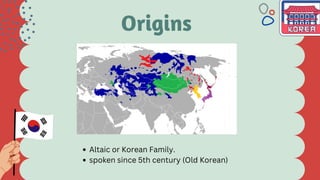
Origins
Altaic or Korean Family.
spoken since 5th century (Old Korean)
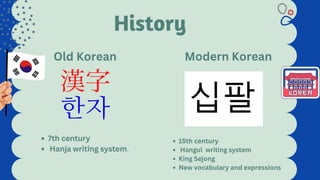
History
Old Korean Modern Korean
7th century
Hanja writing system.
15th century
Hangul writing system
King Sejong
New vocabulary and expressions
Vocabulary origins and Foreign
influences
사랑(sarang): Meaning "love" in Korean, this word is indigenous to the
language and represents a fundamental concept.
감사합니다(gamsahamnida): Meaning "thank you" in Korean, this phrase
is indigenous to the language, expressing gratitude.
장난(jangnan): Translating to "joke" or "play" in Korean, this term
originates from native Korean vocabulary.
미래(mirae): Signifying "future" in Korean, this word is an example of a
concept rooted in the native Korean lexicon.
Native Korean Words:
학교(hakgyo): The word for "school" in Korean, written in Hanja as 學校, illustrates
the influence of Chinese characters on Korean vocabulary.
전화(jeonhwa): The word for "phone" in Korean, written in Hanja as 電話,
demonstrates the influence of Chinese characters on modern Korean vocabulary
related to communication.
음식(eumsik): Meaning "food" in Korean, the Hanja 飮食illustrates the historical
adoption of culinary terminology from Chinese.
의사(uisa): Referring to a "doctor" or "physician" in Korean, the Hanja 醫師
showcases the influence of Chinese characters in the medical field.
Chinese Loanwords (Hanja):
Vocabulary origins and Foreign
influences
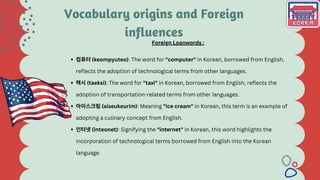
컴퓨터(keompyuteo): The word for "computer" in Korean, borrowed from English,
reflects the adoption of technological terms from other languages.
택시(taeksi): The word for "taxi" in Korean, borrowed from English, reflects the
adoption of transportation-related terms from other languages.
아이스크림(aiseukeurim): Meaning "ice cream" in Korean, this term is an example of
adopting a culinary concept from English.
인터넷(inteonet): Signifying the "internet" in Korean, this word highlights the
incorporation of technological terms borrowed from English into the Korean
language.
Foreign Loanwords :
Vocabulary origins and Foreign
influences
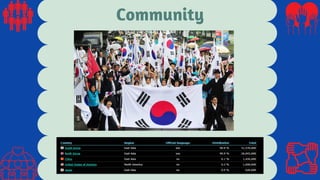
Community
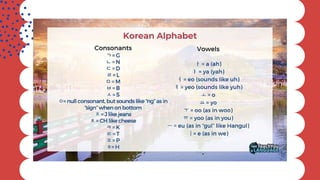
Writing System
Developed in the 15th century
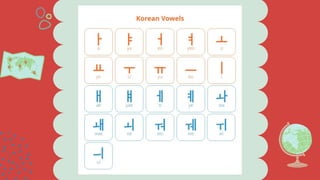
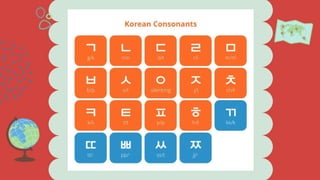
14 consonants, 10 vowels
phonetic writing system
“ Hangul”
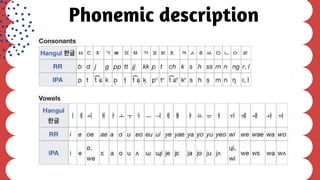
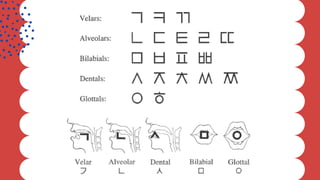
Phonemic description
Korean is a pitch accent
language
Syllable timed-language
In Korean language these
consonant sounds don’t exist:
/v/, /θ/, /ð/,/z/, /ʃ/
"바다" (bada) "sea" ( low pitch in both syllables)
"바다" (BAda) "to be angry" ( high pitch in the
first syllable)
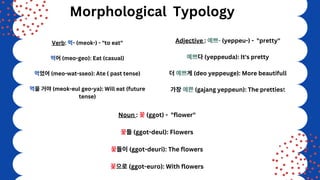
Morphological Typology
Verb: 먹- (meok-) - "to eat"
먹어(meo-geo): Eat (casual)
먹었어(meo-wat-sseo): Ate ( past tense)
먹을거야(meok-eul geo-ya): Will eat (future
tense)
Adjective : 예쁘- (yeppeu-) - "pretty"
예쁘다(yeppeuda): It's pretty
더예쁘게(deo yeppeuge): More beautifull
가장예쁜(gajang yeppeun): The prettiest
Noun : 꽃(ggot) - "flower"
꽃들(ggot-deul): Flowers
꽃들이(ggot-deuri): The flowers
꽃으로(ggot-euro): With flowers
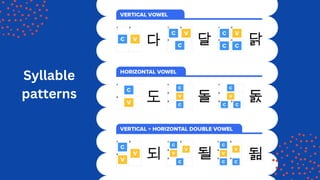
Syllable
patterns
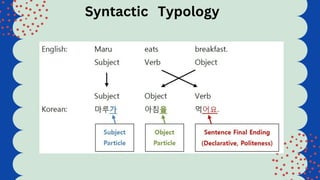
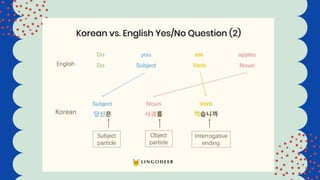
Syntactic Typology
Korean Language Presentation by Brian Giaquinta

Korean Language Presentation by Brian Giaquinta

  • 1.
  • 2.
    Origins Altaic or KoreanFamily. spoken since 5th century (Old Korean)
  • 3.
    History Old Korean ModernKorean 7th century Hanja writing system. 15th century Hangul writing system King Sejong New vocabulary and expressions
  • 4.
    Vocabulary origins andForeign influences 사랑(sarang): Meaning "love" in Korean, this word is indigenous to the language and represents a fundamental concept. 감사합니다(gamsahamnida): Meaning "thank you" in Korean, this phrase is indigenous to the language, expressing gratitude. 장난(jangnan): Translating to "joke" or "play" in Korean, this term originates from native Korean vocabulary. 미래(mirae): Signifying "future" in Korean, this word is an example of a concept rooted in the native Korean lexicon. Native Korean Words:
  • 5.
    학교(hakgyo): The wordfor "school" in Korean, written in Hanja as 學校, illustrates the influence of Chinese characters on Korean vocabulary. 전화(jeonhwa): The word for "phone" in Korean, written in Hanja as 電話, demonstrates the influence of Chinese characters on modern Korean vocabulary related to communication. 음식(eumsik): Meaning "food" in Korean, the Hanja 飮食illustrates the historical adoption of culinary terminology from Chinese. 의사(uisa): Referring to a "doctor" or "physician" in Korean, the Hanja 醫師 showcases the influence of Chinese characters in the medical field. Chinese Loanwords (Hanja): Vocabulary origins and Foreign influences
  • 6.
    컴퓨터(keompyuteo): The wordfor "computer" in Korean, borrowed from English, reflects the adoption of technological terms from other languages. 택시(taeksi): The word for "taxi" in Korean, borrowed from English, reflects the adoption of transportation-related terms from other languages. 아이스크림(aiseukeurim): Meaning "ice cream" in Korean, this term is an example of adopting a culinary concept from English. 인터넷(inteonet): Signifying the "internet" in Korean, this word highlights the incorporation of technological terms borrowed from English into the Korean language. Foreign Loanwords : Vocabulary origins and Foreign influences
  • 7.
  • 8.
    Writing System Developed inthe 15th century 14 consonants, 10 vowels phonetic writing system “ Hangul”
  • 12.
  • 14.
    Korean is apitch accent language Syllable timed-language In Korean language these consonant sounds don’t exist: /v/, /θ/, /ð/,/z/, /ʃ/ "바다" (bada) "sea" ( low pitch in both syllables) "바다" (BAda) "to be angry" ( high pitch in the first syllable)
  • 15.
    Morphological Typology Verb: 먹-(meok-) - "to eat" 먹어(meo-geo): Eat (casual) 먹었어(meo-wat-sseo): Ate ( past tense) 먹을거야(meok-eul geo-ya): Will eat (future tense) Adjective : 예쁘- (yeppeu-) - "pretty" 예쁘다(yeppeuda): It's pretty 더예쁘게(deo yeppeuge): More beautifull 가장예쁜(gajang yeppeun): The prettiest Noun : 꽃(ggot) - "flower" 꽃들(ggot-deul): Flowers 꽃들이(ggot-deuri): The flowers 꽃으로(ggot-euro): With flowers
  • 16.
  • 17.