
The Korean NationalThe Korean National
FlowerFlower
MugunghwaMugunghwa
National Korean Studies SeminarNational Korean Studies Seminar
Copyright 2014
Sung Kim and Mary Connor
Bringing Korea to the K-12 ClassroomsBringing Korea to the K-12 Classrooms
The Korean NationalThe Korean National
FlowerFlower
MugunghwaMugunghwa
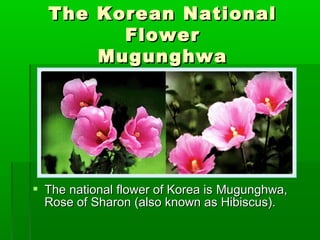
 The national flower of Korea isThe national flower of Korea is MMugunghwa,ugunghwa,
RRose ofose of SSharon (also known as Hibiscus).haron (also known as Hibiscus).
Mugunghwa FactsMugunghwa Facts
1.1. The flower’s symbolic significance stems fromThe flower’s symbolic significance stems from
the Korean word mugung, meaningthe Korean word mugung, meaning
immortality.immortality.
2.2. This word accurately reflects the enduringThis word accurately reflects the enduring
nature of Korean culture, and thenature of Korean culture, and the
determination and perseverance of the Koreandetermination and perseverance of the Korean
people.people.
3.3. Every year from July to October, a profusion ofEvery year from July to October, a profusion of
MMugunghwa blossoms graces the entireugunghwa blossoms graces the entire
country.country.
Mugunghwa FactsMugunghwa Facts
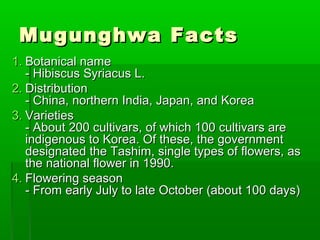
1.1. Botanical nameBotanical name
- Hibiscus Syriacus L.- Hibiscus Syriacus L.
2.2. DistributionDistribution
- China, northern India, Japan, and Korea- China, northern India, Japan, and Korea
3.3. VarietiesVarieties
- About 200 cultivars, of which 100 cultivars are- About 200 cultivars, of which 100 cultivars are
indigenous to Korea. Of these, the governmentindigenous to Korea. Of these, the government
designated the Tashim, single types of flowers, asdesignated the Tashim, single types of flowers, as
the national flower in 1990.the national flower in 1990.
4.4. Flowering seasonFlowering season
- From early July to late October (about 100 days)- From early July to late October (about 100 days)
Various typesVarious types
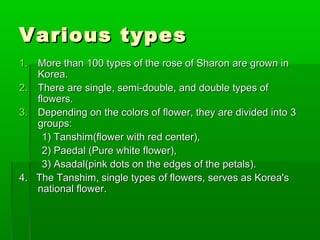
1.1. MMore than 100ore than 100 typestypes of the rose of Sharonof the rose of Sharon are grown inare grown in
Korea.Korea.
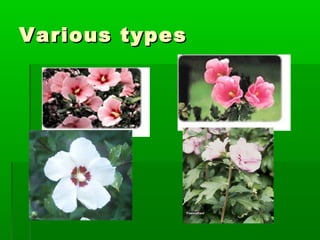
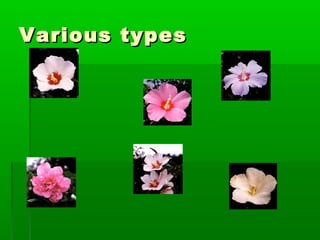
2.2. There are single, semi-double, and double types ofThere are single, semi-double, and double types of
flowers.flowers.
3.3. Depending on the colors of flower, they are divided into 3Depending on the colors of flower, they are divided into 3
groupgroups:s:
1)1) Tanshim(flower with red center),Tanshim(flower with red center),
2)2) Paedal (Pure white flower),Paedal (Pure white flower),
3)3) Asadal(pink dots on the edges of the petals).Asadal(pink dots on the edges of the petals).
4.4. The Tanshim, single types of flowers, serves as Korea'sThe Tanshim, single types of flowers, serves as Korea's
national flower.national flower.
Various typesVarious types
Flowering SeasonFlowering Season
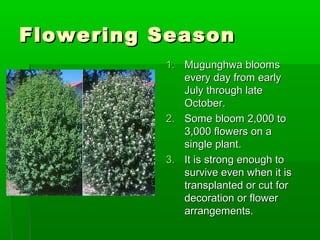
1.1. MugunghwaMugunghwa bloomsblooms
every day from earlyevery day from early
July through lateJuly through late
October.October.
2.2. SomeSome bloombloom 2,000 to2,000 to
3,0003,000 flowersflowers on aon a
single plantsingle plant..
3.3. It isIt is strong enough tostrong enough to
survive even when it issurvive even when it is
transplanted or cut fortransplanted or cut for
decoration or flowerdecoration or flower
arrangements.arrangements.
Symbol of GloriesSymbol of Glories
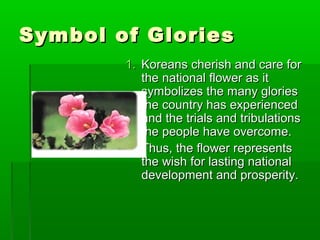
1.1. Koreans cherish and care forKoreans cherish and care for
the national flower as itthe national flower as it
symbolizes the many gloriessymbolizes the many glories
the country has experiencedthe country has experienced
and the trials and tribulationsand the trials and tribulations
the people have overcome.the people have overcome.
2.2. Thus, the flower representsThus, the flower represents
the wish for lasting nationalthe wish for lasting national
development and prosperity.development and prosperity.
The Korean NationalThe Korean National
SymbolSymbol
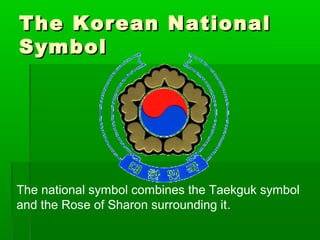
The national symbol combines the Taekguk symbol
and the Rose of Sharon surrounding it.
ReferencesReferences
 http://english.tour2korea.com/01TripPlanhttp://english.tour2korea.com/01TripPlan
ner/KoreaInBrief/na_symbols.asp?ner/KoreaInBrief/na_symbols.asp?
kosm=m1_1&konum=2kosm=m1_1&konum=2
 http://www.opm.go.kr/warp/webapp/contehttp://www.opm.go.kr/warp/webapp/conte
nt/view?meta_id=english&id=23nt/view?meta_id=english&id=23

Korea ppt-korean national flower

  • 1.
    The Korean NationalTheKorean National FlowerFlower MugunghwaMugunghwa National Korean Studies SeminarNational Korean Studies Seminar Copyright 2014 Sung Kim and Mary Connor Bringing Korea to the K-12 ClassroomsBringing Korea to the K-12 Classrooms
  • 2.
    The Korean NationalTheKorean National FlowerFlower MugunghwaMugunghwa  The national flower of Korea isThe national flower of Korea is MMugunghwa,ugunghwa, RRose ofose of SSharon (also known as Hibiscus).haron (also known as Hibiscus).
  • 3.
    Mugunghwa FactsMugunghwa Facts 1.1.The flower’s symbolic significance stems fromThe flower’s symbolic significance stems from the Korean word mugung, meaningthe Korean word mugung, meaning immortality.immortality. 2.2. This word accurately reflects the enduringThis word accurately reflects the enduring nature of Korean culture, and thenature of Korean culture, and the determination and perseverance of the Koreandetermination and perseverance of the Korean people.people. 3.3. Every year from July to October, a profusion ofEvery year from July to October, a profusion of MMugunghwa blossoms graces the entireugunghwa blossoms graces the entire country.country.
  • 4.
    Mugunghwa FactsMugunghwa Facts 1.1.Botanical nameBotanical name - Hibiscus Syriacus L.- Hibiscus Syriacus L. 2.2. DistributionDistribution - China, northern India, Japan, and Korea- China, northern India, Japan, and Korea 3.3. VarietiesVarieties - About 200 cultivars, of which 100 cultivars are- About 200 cultivars, of which 100 cultivars are indigenous to Korea. Of these, the governmentindigenous to Korea. Of these, the government designated the Tashim, single types of flowers, asdesignated the Tashim, single types of flowers, as the national flower in 1990.the national flower in 1990. 4.4. Flowering seasonFlowering season - From early July to late October (about 100 days)- From early July to late October (about 100 days)
  • 5.
    Various typesVarious types 1.1.MMore than 100ore than 100 typestypes of the rose of Sharonof the rose of Sharon are grown inare grown in Korea.Korea. 2.2. There are single, semi-double, and double types ofThere are single, semi-double, and double types of flowers.flowers. 3.3. Depending on the colors of flower, they are divided into 3Depending on the colors of flower, they are divided into 3 groupgroups:s: 1)1) Tanshim(flower with red center),Tanshim(flower with red center), 2)2) Paedal (Pure white flower),Paedal (Pure white flower), 3)3) Asadal(pink dots on the edges of the petals).Asadal(pink dots on the edges of the petals). 4.4. The Tanshim, single types of flowers, serves as Korea'sThe Tanshim, single types of flowers, serves as Korea's national flower.national flower.
  • 6.
  • 7.
  • 8.
    Flowering SeasonFlowering Season 1.1.MugunghwaMugunghwa bloomsblooms every day from earlyevery day from early July through lateJuly through late October.October. 2.2. SomeSome bloombloom 2,000 to2,000 to 3,0003,000 flowersflowers on aon a single plantsingle plant.. 3.3. It isIt is strong enough tostrong enough to survive even when it issurvive even when it is transplanted or cut fortransplanted or cut for decoration or flowerdecoration or flower arrangements.arrangements.
  • 9.
    Symbol of GloriesSymbolof Glories 1.1. Koreans cherish and care forKoreans cherish and care for the national flower as itthe national flower as it symbolizes the many gloriessymbolizes the many glories the country has experiencedthe country has experienced and the trials and tribulationsand the trials and tribulations the people have overcome.the people have overcome. 2.2. Thus, the flower representsThus, the flower represents the wish for lasting nationalthe wish for lasting national development and prosperity.development and prosperity.
  • 10.
    The Korean NationalTheKorean National SymbolSymbol The national symbol combines the Taekguk symbol and the Rose of Sharon surrounding it.
  • 11.