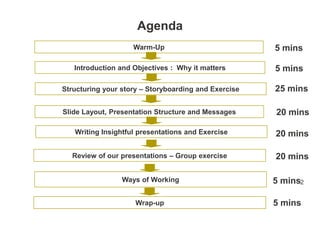
Agenda
Warm-Up 5 mins
Introduction and Objectives : Why it matters 5 mins
Structuring your story – Storyboarding and Exercise 25 mins
Slide Layout, Presentation Structure and Messages 20 mins
Writing Insightful presentations and Exercise 20 mins
Review of our presentations – Group exercise 20 mins
Ways of Working 5 mins2
Wrap-up 5 mins
INTRODUCTION
Background: Why dowe need to be able to make effective
presentations?
Effective presentations are essential to the way we work since they:
Enable us to present complex messages in a simple and persuasive way
Help to focus on telling the story and delivering real insight rather than
just ―data dumping‖
Give you the confidence to step back from the detail, and focus on
appreciating and responding to the emotional and political responses as
well as the rational
Ensure you provide your audience with the elements needed to enable
and convince them to take action / make decisions as required
5.
INTRODUCTION
The purpose oftoday’s session is to help you improve
the quality and impact of your written presentations
Objectives
● To understand the importance of varying presentation style to
ensure it is appropriate for any given audience / situation
● To learn how to design high quality and high impact written
presentations:
– Easy to understand
– Compelling the desired action
● To understand the importance of going beyond data presentation to
drive out insights
● To establish a ―Modus Operandus‖ to:
– Lay out a presentation in all its component parts at an early stage
– Use the storyboard to help identify and communicate the analysis
needed
– Use a consistent presentation format
6.
INTRODUCTION
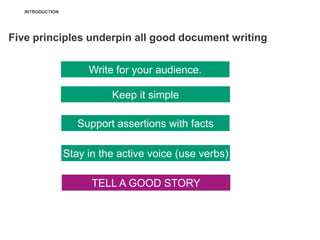
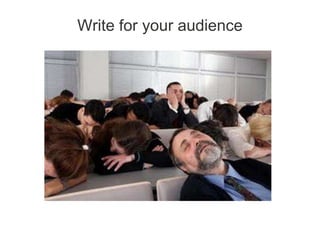
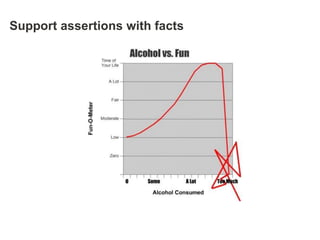
Five principles underpinall good document writing
Write for your audience.
Keep it simple
Support assertions with facts
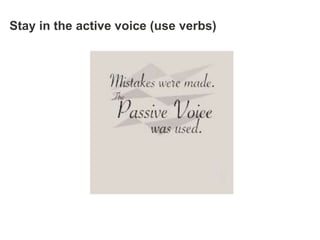
Stay in the active voice (use verbs)
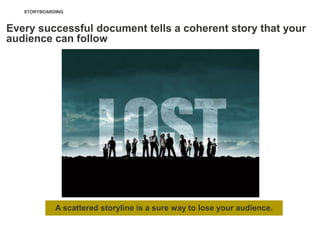
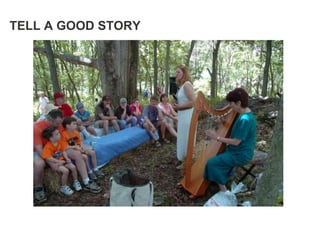
TELL A GOOD STORY
7.
INTRODUCTION
Beware: Written presentationsmay not always be the most
appropriate technique for your audience
● It is very important to know your audience and what they are likely
to respond best to
● Make sure you keep your end point in mind - what is it you are trying
to achieve, and what method is going to best achieve that?
– Much of the presenting we do in Tesco is far more about facilitating
decision-making rather than getting lots of data across
● Understanding some of the other techniques available to you should
help you select the most appropriate medium:
– Flipcharts
– Brown Paper
– Open discussion
– Other (video, audio, exercises/games etc)
STRUCTURING YOUR STORY
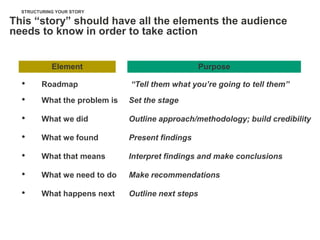
This“story” should have all the elements the audience
needs to know in order to take action
Element Purpose
• Roadmap “Tell them what you’re going to tell them”
• What the problem is Set the stage
• What we did Outline approach/methodology; build credibility
• What we found Present findings
• What that means Interpret findings and make conclusions
• What we need to do Make recommendations
• What happens next Outline next steps
11.
STRUCTURING YOUR STORY
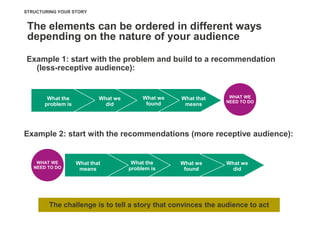
The elements can be ordered in different ways
depending on the nature of your audience
Example 1: start with the problem and build to a recommendation
(less-receptive audience):
What the What we What we What that WHAT WE
NEED TO DO
problem is did found means
Example 2: start with the recommendations (more receptive audience):
WHAT WE What that What the What we What we
NEED TO DO means problem is found did
The challenge is to tell a story that convinces the audience to act
12.
GETTING STARTED
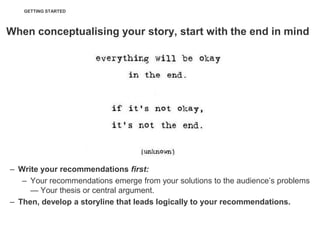
When conceptualisingyour story, start with the end in mind
– Write your recommendations first:
– Your recommendations emerge from your solutions to the audience‘s problems
— Your thesis or central argument.
– Then, develop a storyline that leads logically to your recommendations.
GETTING STARTED -STORYBOARDING
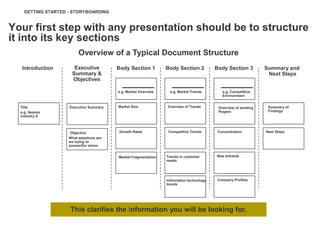
Your first step with any presentation should be to structure
it into its key sections
Overview of a Typical Document Structure
Introduction Executive Body Section 1 Body Section 2 Body Section 3 Summary and
Summary & Next Steps
Objectives
e.g. Market Overview e.g. Market Trends e.g. Competitive
Environment
Title Executive Summary Market Size Overview of Trends Overview of existing Summary of
e.g. Assess Players Findings
industry X
Objective Growth Rates Competitive Trends Concentration Next Steps
What questions are
we trying to
answer/for whom
Market Fragmentation Trends in customer New entrants
needs
Information technology Company Profiles
trends
This clarifies the information you will be looking for.
15.
GETTING STARTED -STORYBOARDING
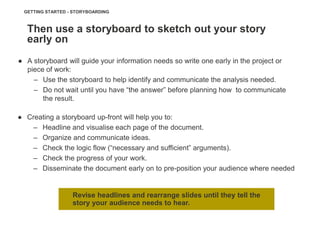
Then use a storyboard to sketch out your story
early on
● A storyboard will guide your information needs so write one early in the project or
piece of work:
– Use the storyboard to help identify and communicate the analysis needed.
– Do not wait until you have ―the answer‖ before planning how to communicate
the result.
● Creating a storyboard up-front will help you to:
– Headline and visualise each page of the document.
– Organize and communicate ideas.
– Check the logic flow (―necessary and sufficient‖ arguments).
– Check the progress of your work.
– Disseminate the document early on to pre-position your audience where needed
Revise headlines and rearrange slides until they tell the
story your audience needs to hear.
16.
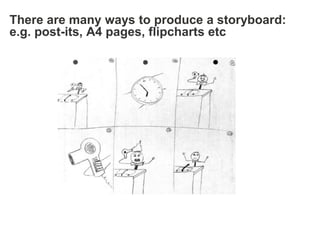
There are manyways to produce a storyboard:
e.g. post-its, A4 pages, flipcharts etc
17.
GETTING STARTED -STORYBOARDING
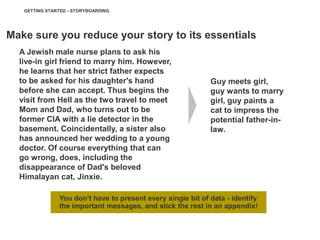
Make sure you reduce your story to its essentials
A Jewish male nurse plans to ask his
live-in girl friend to marry him. However,
he learns that her strict father expects
to be asked for his daughter's hand Guy meets girl,
before she can accept. Thus begins the guy wants to marry
visit from Hell as the two travel to meet girl, guy paints a
Mom and Dad, who turns out to be cat to impress the
former CIA with a lie detector in the potential father-in-
basement. Coincidentally, a sister also law.
has announced her wedding to a young
doctor. Of course everything that can
go wrong, does, including the
disappearance of Dad's beloved
Himalayan cat, Jinxie.
You don’t have to present every single bit of data - identify
the important messages, and stick the rest in an appendix!
18.
BREAKOUT 1A: CREATINGA STORYBOARD ( 5 minutes)
•Before you see any data, in your pairs, write a storyboard for your
case study:
• Prepare the headlines for your storyboard (on paper is sufficient)
• No more than 5 headlines (i.e. slides) long
• Be prepared to present your story back to the larger group
• Remember that the audience should be able to understand the story
solely from the headlines
•Timing: 5 mins preparation
19.
BREAKOUT 1B: REFININGTHE STORYBOARD ( 5 minutes)
• Refine your story now that you have your analysis:
• No more than 5 slides long
• Be prepared to present your story back to the larger group
• Remember the audience should be able to understand the story
solely from the headlines
• Timing: 5 mins preparation
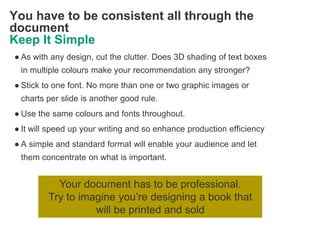
You have tobe consistent all through the
document
Keep It Simple
● As with any design, cut the clutter. Does 3D shading of text boxes
in multiple colours make your recommendation any stronger?
● Stick to one font. No more than one or two graphic images or
charts per slide is another good rule.
● Use the same colours and fonts throughout.
● It will speed up your writing and so enhance production efficiency
● A simple and standard format will enable your audience and let
them concentrate on what is important.
Your document has to be professional.
Try to imagine you‘re designing a book that
will be printed and sold
24.
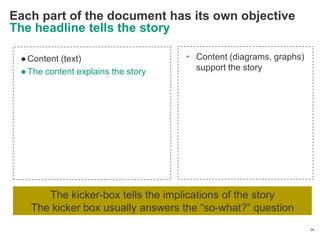
Each part ofthe document has its own objective
The headline tells the story
● Content (text) • Content (diagrams, graphs)
● The content explains the story support the story
The kicker-box tells the implications of the story
The kicker box usually answers the ―so-what?‖ question
24
25.
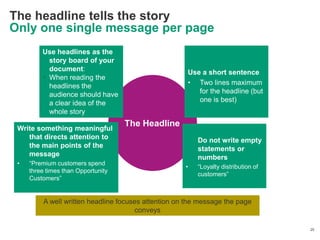
The headline tellsthe story
Only one single message per page
Use headlines as the
story board of your
document: Use a short sentence
When reading the
headlines the • Two lines maximum
audience should have for the headline (but
a clear idea of the one is best)
whole story
Write something meaningful
The Headline
that directs attention to Do not write empty
the main points of the statements or
message numbers
• ―Premium customers spend
• ―Loyalty distribution of
three times than Opportunity
customers‖
Customers‖
A well written headline focuses attention on the message the page
conveys
25
SLIDE PRESENTATION
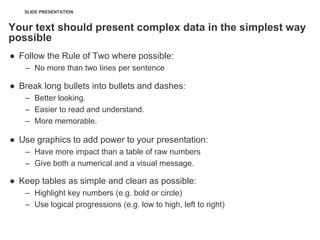
Your textshould present complex data in the simplest way
possible
● Follow the Rule of Two where possible:
– No more than two lines per sentence
● Break long bullets into bullets and dashes:
– Better looking.
– Easier to read and understand.
– More memorable.
● Use graphics to add power to your presentation:
– Have more impact than a table of raw numbers
– Give both a numerical and a visual message.
● Keep tables as simple and clean as possible:
– Highlight key numbers (e.g. bold or circle)
– Use logical progressions (e.g. low to high, left to right)
28.
SLIDE PRESENTATION
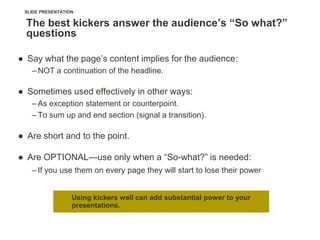
The best kickers answer the audience’s “So what?”
questions
● Say what the page‘s content implies for the audience:
– NOT a continuation of the headline.
● Sometimes used effectively in other ways:
– As exception statement or counterpoint.
– To sum up and end section (signal a transition).
● Are short and to the point.
● Are OPTIONAL—use only when a ―So-what?‖ is needed:
– If you use them on every page they will start to lose their power
Using kickers well can add substantial power to your
presentations.
29.
SLIDE PRESENTATION
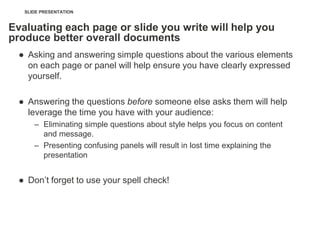
Evaluating eachpage or slide you write will help you
produce better overall documents
● Asking and answering simple questions about the various elements
on each page or panel will help ensure you have clearly expressed
yourself.
● Answering the questions before someone else asks them will help
leverage the time you have with your audience:
– Eliminating simple questions about style helps you focus on content
and message.
– Presenting confusing panels will result in lost time explaining the
presentation
● Don‘t forget to use your spell check!
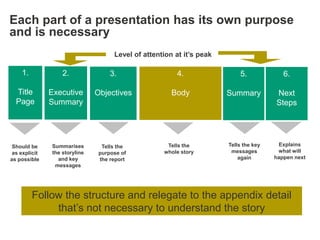
Each part ofa presentation has its own purpose
and is necessary
Level of attention at it’s peak
1. 2. 3. 4. 5. 6.
Title Executive Objectives Body Summary Next
Page Summary Steps
Should be Summarises Tells the Tells the Tells the key Explains
as explicit the storyline purpose of whole story messages what will
as possible and key the report again happen next
messages
Follow the structure and relegate to the appendix detail
that‘s not necessary to understand the story
32.
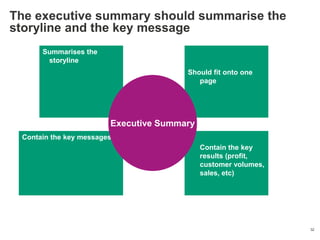
The executive summaryshould summarise the
storyline and the key message
Summarises the
storyline
Should fit onto one
page
{title}
• {text}
Executive Summary
Contain the key messages
Contain the key
results (profit,
customer volumes,
sales, etc)
32
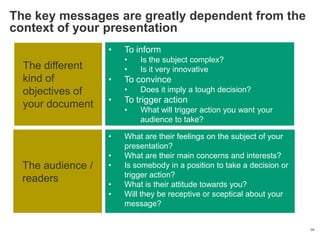
The key messagesare greatly dependent from the
context of your presentation
• To inform
• Is the subject complex?
The different • Is it very innovative
kind of • To convince
objectives of • Does it imply a tough decision?
• To trigger action
your document • What will trigger action you want your
audience to take?
• What are their feelings on the subject of your
presentation?
• What are their main concerns and interests?
The audience / • Is somebody in a position to take a decision or
trigger action?
readers • What is their attitude towards you?
• Will they be receptive or sceptical about your
message?
34
35.
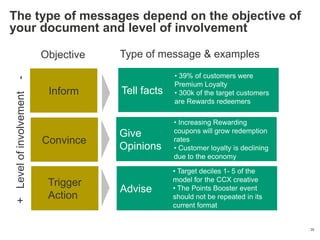
The type ofmessages depend on the objective of
your document and level of involvement
Objective Type of message & examples
• 39% of customers were
-
Premium Loyalty
Inform Tell facts • 300k of the target customers
+ Level of involvement
are Rewards redeemers
• Increasing Rewarding
Give coupons will grow redemption
Convince rates
Opinions • Customer loyalty is declining
due to the economy
• Target deciles 1- 5 of the
model for the CCX creative
Trigger • The Points Booster event
Advise
Action should not be repeated in its
current format
35
36.
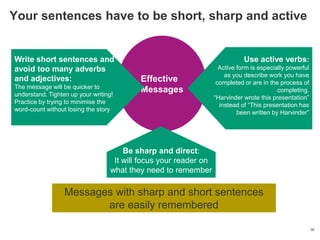
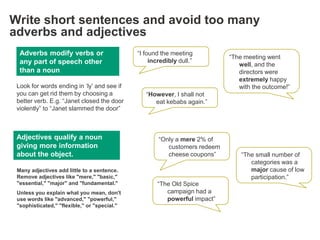
Your sentences haveto be short, sharp and active
Write short sentences and Use active verbs:
avoid too many adverbs Active form is especially powerful
as you describe work you have
and adjectives: Effective completed or are in the process of
The message will be quicker to
understand. Tighten up your writing!
Messages completing.
―Harvinder wrote this presentation‖
Practice by trying to minimise the
instead of ―This presentation has
word-count without losing the story
been written by Harvinder‖
Be sharp and direct:
It will focus your reader on
what they need to remember
Messages with sharp and short sentences
are easily remembered
36
37.
Write short sentencesand avoid too many
adverbs and adjectives
Adverbs modify verbs or ―I found the meeting
―The meeting went
any part of speech other incredibly dull.‖
well, and the
than a noun directors were
extremely happy
Look for words ending in ‗ly‘ and see if with the outcome!‖
you can get rid them by choosing a ―However, I shall not
better verb. E.g. ―Janet closed the door eat kebabs again.‖
violently‖ to ―Janet slammed the door‖
Adjectives qualify a noun ―Only a mere 2% of
giving more information customers redeem
about the object. cheese coupons‖ ―The small number of
categories was a
Many adjectives add little to a sentence. major cause of low
Remove adjectives like "mere," "basic," participation.‖
"essential," "major" and "fundamental." ―The Old Spice
Unless you explain what you mean, don't campaign had a
use words like "advanced," "powerful," powerful impact‖
"sophisticated," "flexible," or "special."
38.
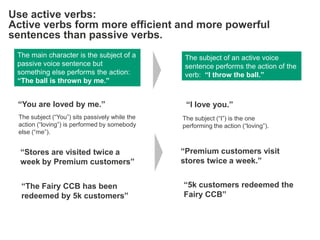
Use active verbs:
Activeverbs form more efficient and more powerful
sentences than passive verbs.
The main character is the subject of a The subject of an active voice
passive voice sentence but sentence performs the action of the
something else performs the action: verb: “I throw the ball.”
“The ball is thrown by me.”
“You are loved by me.” “I love you.”
The subject (―You‖) sits passively while the The subject (―I‖) is the one
action (―loving‖) is performed by somebody performing the action (―loving‖).
else (―me‖).
“Stores are visited twice a “Premium customers visit
week by Premium customers” stores twice a week.”
“The Fairy CCB has been “5k customers redeemed the
redeemed by 5k customers” Fairy CCB”
39.
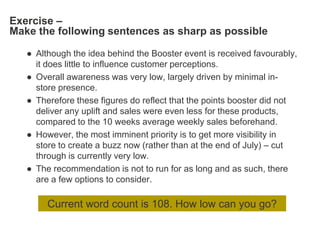
Exercise –
Make thefollowing sentences as sharp as possible
● Although the idea behind the Booster event is received favourably,
it does little to influence customer perceptions.
● Overall awareness was very low, largely driven by minimal in-
store presence.
● Therefore these figures do reflect that the points booster did not
deliver any uplift and sales were even less for these products,
compared to the 10 weeks average weekly sales beforehand.
● However, the most imminent priority is to get more visibility in
store to create a buzz now (rather than at the end of July) – cut
through is currently very low.
● The recommendation is not to run for as long and as such, there
are a few options to consider.
Current word count is 108. How low can you go?
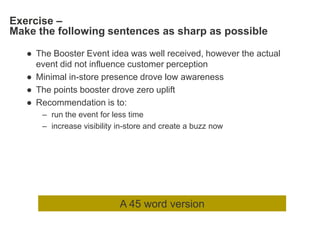
Exercise –
Make thefollowing sentences as sharp as possible
● The Booster Event idea was well received, however the actual
event did not influence customer perception
● Minimal in-store presence drove low awareness
● The points booster drove zero uplift
● Recommendation is to:
– run the event for less time
– increase visibility in-store and create a buzz now
A 45 word version
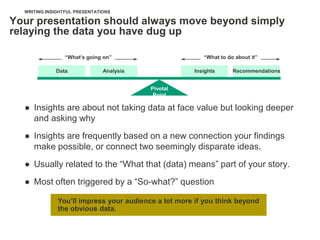
WRITING INSIGHTFUL PRESENTATIONS
Yourpresentation should always move beyond simply
relaying the data you have dug up
“What’s going on” “What to do about it”
Data Analysis Insights Recommendations
Pivotal
Point
● Insights are about not taking data at face value but looking deeper
and asking why
● Insights are frequently based on a new connection your findings
make possible, or connect two seemingly disparate ideas.
● Usually related to the ―What that (data) means‖ part of your story.
● Most often triggered by a ―So-what?‖ question
You’ll impress your audience a lot more if you think beyond
the obvious data.
44.
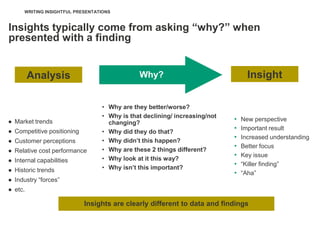
WRITING INSIGHTFUL PRESENTATIONS
Insightstypically come from asking “why?” when
presented with a finding
Analysis Why? Insight
• Why are they better/worse?
• Why is that declining/ increasing/not
● Market trends • New perspective
changing?
● Competitive positioning • Important result
• Why did they do that?
• Increased understanding
● Customer perceptions • Why didn’t this happen?
• Better focus
● Relative cost performance • Why are these 2 things different?
• Key issue
● Internal capabilities • Why look at it this way?
• ―Killer finding‖
● Historic trends • Why isn’t this important?
• ―Aha‖
● Industry ―forces‖
● etc.
Insights are clearly different to data and findings
45.
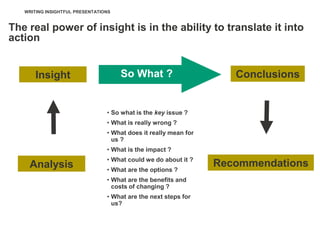
WRITING INSIGHTFUL PRESENTATIONS
Thereal power of insight is in the ability to translate it into
action
Insight So What ? Conclusions
• So what is the key issue ?
• What is really wrong ?
• What does it really mean for
us ?
• What is the impact ?
• What could we do about it ?
Analysis • What are the options ?
Recommendations
• What are the benefits and
costs of changing ?
• What are the next steps for
us?
46.
WRITING INSIGHTFUL PRESENTATIONS
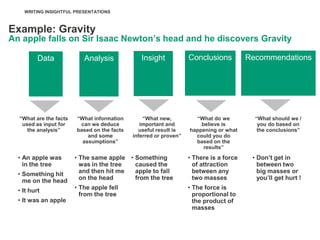
Example:Gravity
An apple falls on Sir Isaac Newton’s head and he discovers Gravity
Data Analysis Insight Conclusions Recommendations
“What are the facts “What information “What new, “What do we “What should we /
used as input for can we deduce important and believe is you do based on
the analysis” based on the facts useful result is happening or what the conclusions”
and some inferred or proven” could you do
assumptions” based on the
results”
• An apple was • The same apple • Something • There is a force • Don’t get in
in the tree was in the tree caused the of attraction between two
• Something hit and then hit me apple to fall between any big masses or
me on the head on the head from the tree two masses you’ll get hurt !
• It hurt • The apple fell • The force is
from the tree proportional to
• It was an apple the product of
masses
47.
WRITING INSIGHTFUL PRESENTATIONS
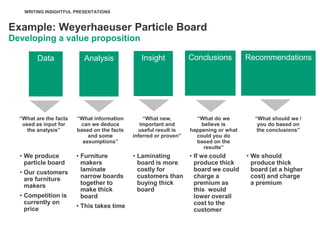
Example:Weyerhaeuser Particle Board
Developing a value proposition
Data Analysis Insight Conclusions Recommendations
“What are the facts “What information “What new, “What do we “What should we /
used as input for can we deduce important and believe is you do based on
the analysis” based on the facts useful result is happening or what the conclusions”
and some inferred or proven” could you do
assumptions” based on the
results”
• We produce • Furniture • Laminating • If we could • We should
particle board makers board is more produce thick produce thick
• Our customers laminate costly for board we could board (at a higher
are furniture narrow boards customers than charge a cost) and charge
makers together to buying thick premium as a premium
make thick board this would
• Competition is board lower overall
currently on cost to the
price • This takes time
customer
48.
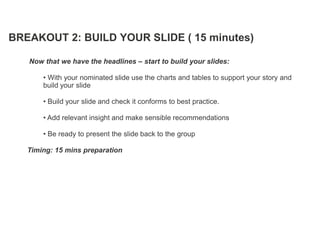
BREAKOUT 2: BUILDYOUR SLIDE ( 15 minutes)
Now that we have the headlines – start to build your slides:
• With your nominated slide use the charts and tables to support your story and
build your slide
• Build your slide and check it conforms to best practice.
• Add relevant insight and make sensible recommendations
• Be ready to present the slide back to the group
Timing: 15 mins preparation
FINISHING UP
Ensure yourpresentation adheres to the basic guidelines
we discussed
• The overall presentation:
– Has a logical structure.
– Builds toward recommendations and next steps.
• The headlines:
– Capture the panel‘s principal message.
– Are written in clear language.
– Tell the story on their own.
• The slides:
– Tell a top-down story.
– Provide solid data to support the assertions in the headlines.
– Present that data in a simple way
– Are
insightful
52.
FINISHING UP
FINALLY,LETS QUICKLY REVISIT THE
FIVE PRINCIPLES OF GOOD
DOCUMENT WRITING
Final Check –Does it pass the elevator test?
Imagine your presentation is going to someone very senior. They
don‘t have any background on the topic and have just two minutes
to devote to it.
Could they pick up the report and understand it without explanation?
If not, simplify!
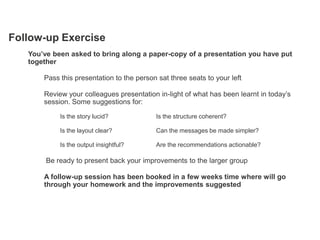
Follow-up Exercise
You’ve been asked to bring along a paper-copy of a presentation you have put
together
Pass this presentation to the person sat three seats to your left
Review your colleagues presentation in-light of what has been learnt in today‘s
session. Some suggestions for:
Is the story lucid? Is the structure coherent?
Is the layout clear? Can the messages be made simpler?
Is the output insightful? Are the recommendations actionable?
Be ready to present back your improvements to the larger group
A follow-up session has been booked in a few weeks time where will go
through your homework and the improvements suggested
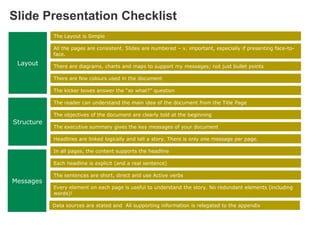
Slide Presentation Checklist
The Layout is Simple
All the pages are consistent. Slides are numbered – v. important, especially if presenting face-to-
face.
Layout There are diagrams, charts and maps to support my messages; not just bullet points
There are few colours used in the document
The kicker boxes answer the “so what?” question
The reader can understand the main idea of the document from the Title Page
The objectives of the document are clearly told at the beginning
Structure
The executive summary gives the key messages of your document
Headlines are linked logically and tell a story. There is only one message per page.
In all pages, the content supports the headline
Each headline is explicit (and a real sentence)
The sentences are short, direct and use Active verbs
Messages
Every element on each page is useful to understand the story. No redundant elements (including
words)!
Data sources are stated and All supporting information is relegated to the appendix
63.
Bullets are notyour only option!
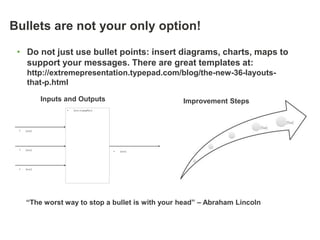
• Do not just use bullet points: insert diagrams, charts, maps to
support your messages. There are great templates at:
http://extremepresentation.typepad.com/blog/the-new-36-layouts-
that-p.html
Inputs and Outputs Improvement Steps
• {text or graphics}
• {text}
• {text} • {text}
• {text}
“The worst way to stop a bullet is with your head” – Abraham Lincoln