how to:
sharpen your knives at home
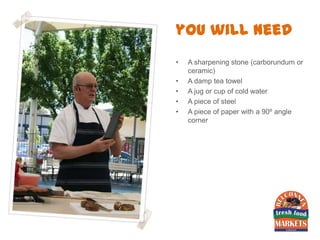
you will need
•   A sharpening stone (carborundum or
    ceramic)
•   A damp tea towel
•   A jug or cup of cold water
•   A piece of steel
•   A piece of paper with a 90º angle
    corner
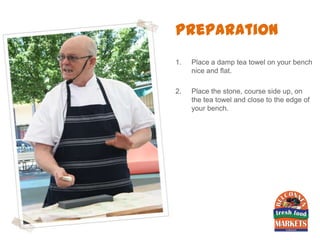
preparation
1.   Place a damp tea towel on your bench
     nice and flat.

2.   Place the stone, course side up, on
     the tea towel and close to the edge of
     your bench.
preparation
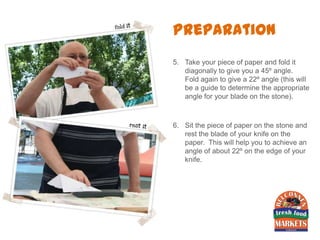
5. Take your piece of paper and fold it
   diagonally to give you a 45º angle.
   Fold again to give a 22º angle (this will
   be a guide to determine the appropriate
   angle for your blade on the stone).


6. Sit the piece of paper on the stone and
   rest the blade of your knife on the
   paper. This will help you to achieve an
   angle of about 22º on the edge of your
   knife.
method
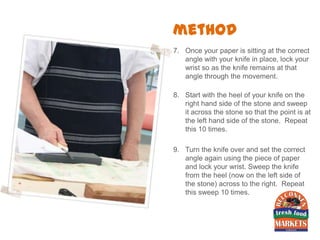
7. Once your paper is sitting at the correct
   angle with your knife in place, lock your
   wrist so as the knife remains at that
   angle through the movement.

8. Start with the heel of your knife on the
   right hand side of the stone and sweep
   it across the stone so that the point is at
   the left hand side of the stone. Repeat
   this 10 times.

9. Turn the knife over and set the correct
   angle again using the piece of paper
   and lock your wrist. Sweep the knife
   from the heel (now on the left side of
   the stone) across to the right. Repeat
   this sweep 10 times.
method
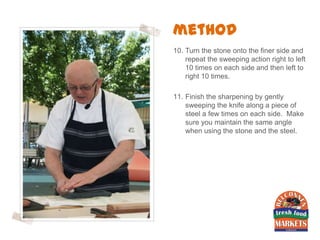
10. Turn the stone onto the finer side and
    repeat the sweeping action right to left
    10 times on each side and then left to
    right 10 times.

11. Finish the sharpening by gently
    sweeping the knife along a piece of
    steel a few times on each side. Make
    sure you maintain the same angle
    when using the stone and the steel.
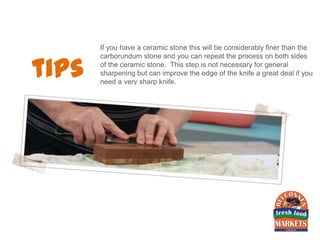
If you have a ceramic stone this will be considerably finer than the


tips
       carborundum stone and you can repeat the process on both sides
       of the ceramic stone. This step is not necessary for general
       sharpening but can improve the edge of the knife a great deal if you
       need a very sharp knife.
This presentation was proudly bought to you by:
A special thank you to
    David Peddle
For more fresh ideas, visit
       bffm.com.au

Knife sharpening

  • 1.
    how to: sharpen yourknives at home
  • 2.
    you will need • A sharpening stone (carborundum or ceramic) • A damp tea towel • A jug or cup of cold water • A piece of steel • A piece of paper with a 90º angle corner
  • 3.
    preparation 1. Place a damp tea towel on your bench nice and flat. 2. Place the stone, course side up, on the tea towel and close to the edge of your bench.
  • 4.
    preparation 5. Take yourpiece of paper and fold it diagonally to give you a 45º angle. Fold again to give a 22º angle (this will be a guide to determine the appropriate angle for your blade on the stone). 6. Sit the piece of paper on the stone and rest the blade of your knife on the paper. This will help you to achieve an angle of about 22º on the edge of your knife.
  • 5.
    method 7. Once yourpaper is sitting at the correct angle with your knife in place, lock your wrist so as the knife remains at that angle through the movement. 8. Start with the heel of your knife on the right hand side of the stone and sweep it across the stone so that the point is at the left hand side of the stone. Repeat this 10 times. 9. Turn the knife over and set the correct angle again using the piece of paper and lock your wrist. Sweep the knife from the heel (now on the left side of the stone) across to the right. Repeat this sweep 10 times.
  • 6.
    method 10. Turn thestone onto the finer side and repeat the sweeping action right to left 10 times on each side and then left to right 10 times. 11. Finish the sharpening by gently sweeping the knife along a piece of steel a few times on each side. Make sure you maintain the same angle when using the stone and the steel.
  • 7.
    If you havea ceramic stone this will be considerably finer than the tips carborundum stone and you can repeat the process on both sides of the ceramic stone. This step is not necessary for general sharpening but can improve the edge of the knife a great deal if you need a very sharp knife.
  • 8.
    This presentation wasproudly bought to you by:
  • 9.
    A special thankyou to David Peddle
  • 10.
    For more freshideas, visit bffm.com.au