Privacy and Security:
   Building a Privacy and Security
Culture in Health CareOrganizations

April 25th, 2012
Joy Pritts, JD,
Chief Privacy Officer
Office of the National Coordinator
Health Information Technology
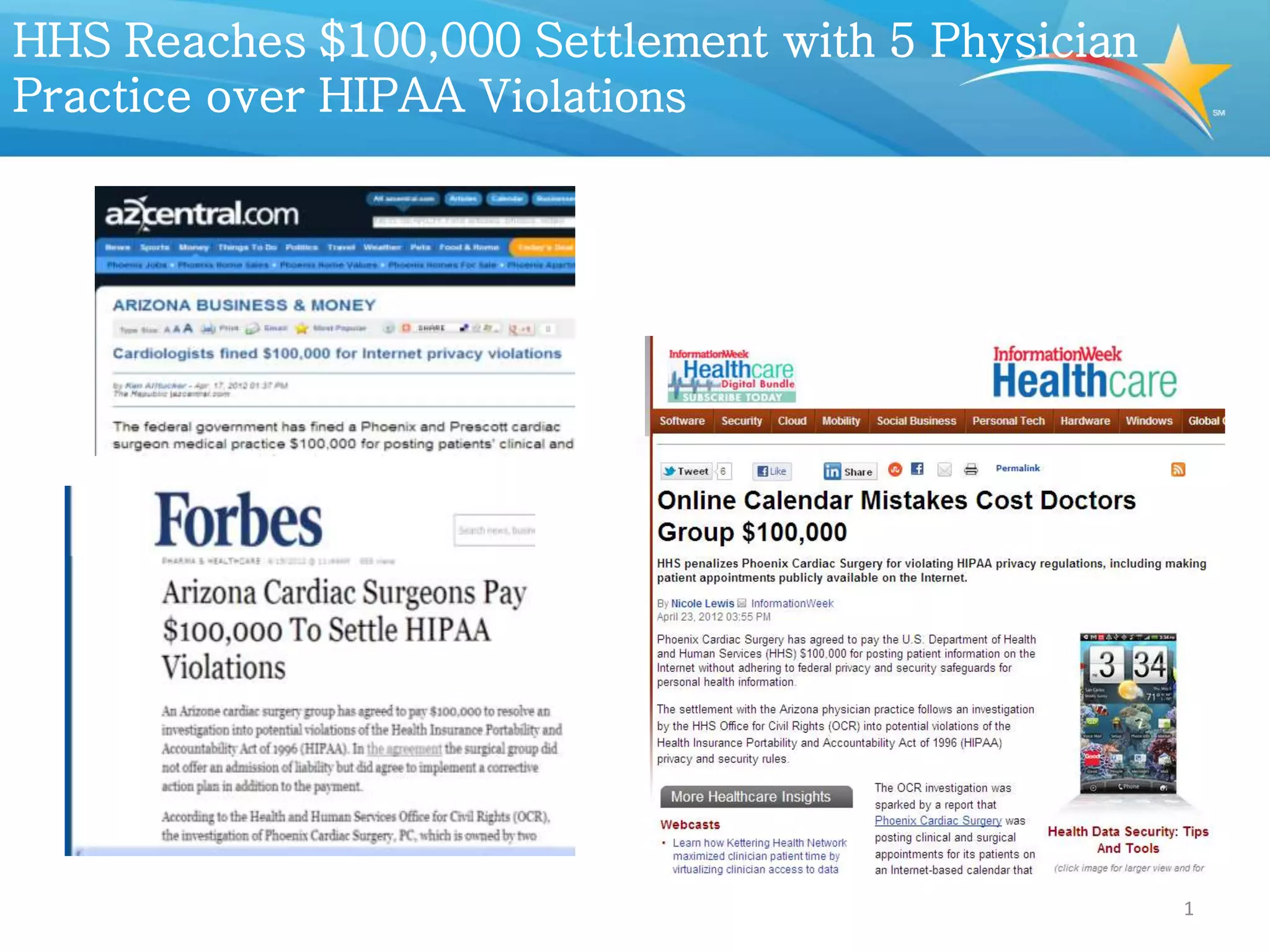
HHS Reaches $100,000 Settlement with 5 Physician
Practice over HIPAA Violations


                                                   1
Why Create a Culture of Privacy and Security?

• Assists Compliance to Law
   – New Developments
       • HIPAA Privacy and Security Rules
       • Enforcement
• Good business
• It’s Just the Right Thing To Do – Patient Trust


                                                    2
Compliance:
Federal Health Information Privacy Laws
• HIPAA Privacy and Security Rules
   – Health Insurance Portability and Accountability
     Act of 1996, effective 2003 and 2005, respectively

• Health Information Technology for Economic
  and Clinical Health (HITECH) Act of 2009 –
  Final Rule submitted to OMB March 24th, 2012

• Others (e.g., 42 CFR part 2)

                                                          3
Who Must Comply with HIPAA Privacy and Security Rules?


  • Covered entities (CEs)
    –Health plans
    –Health care clearinghouses
    –Most health care providers


                                                    4
Business Associates and HITECH
• Business Associates include:
  • EHR Vendors
  • Data Analytic Firms
• HITECH Clarifies Business Associates include:
  • Health Information Exchanges
  • Personal Health Record Vendors
• HITECH Specifies that Business Associates
  • Must follow administrative, physical and technical
    safeguards of the Security Rule
  • Must Follow use and Disclosure Limits of Privacy Rule
  • Subject to the same Civil and Criminal Penalties as
    Covered Entities                                    5
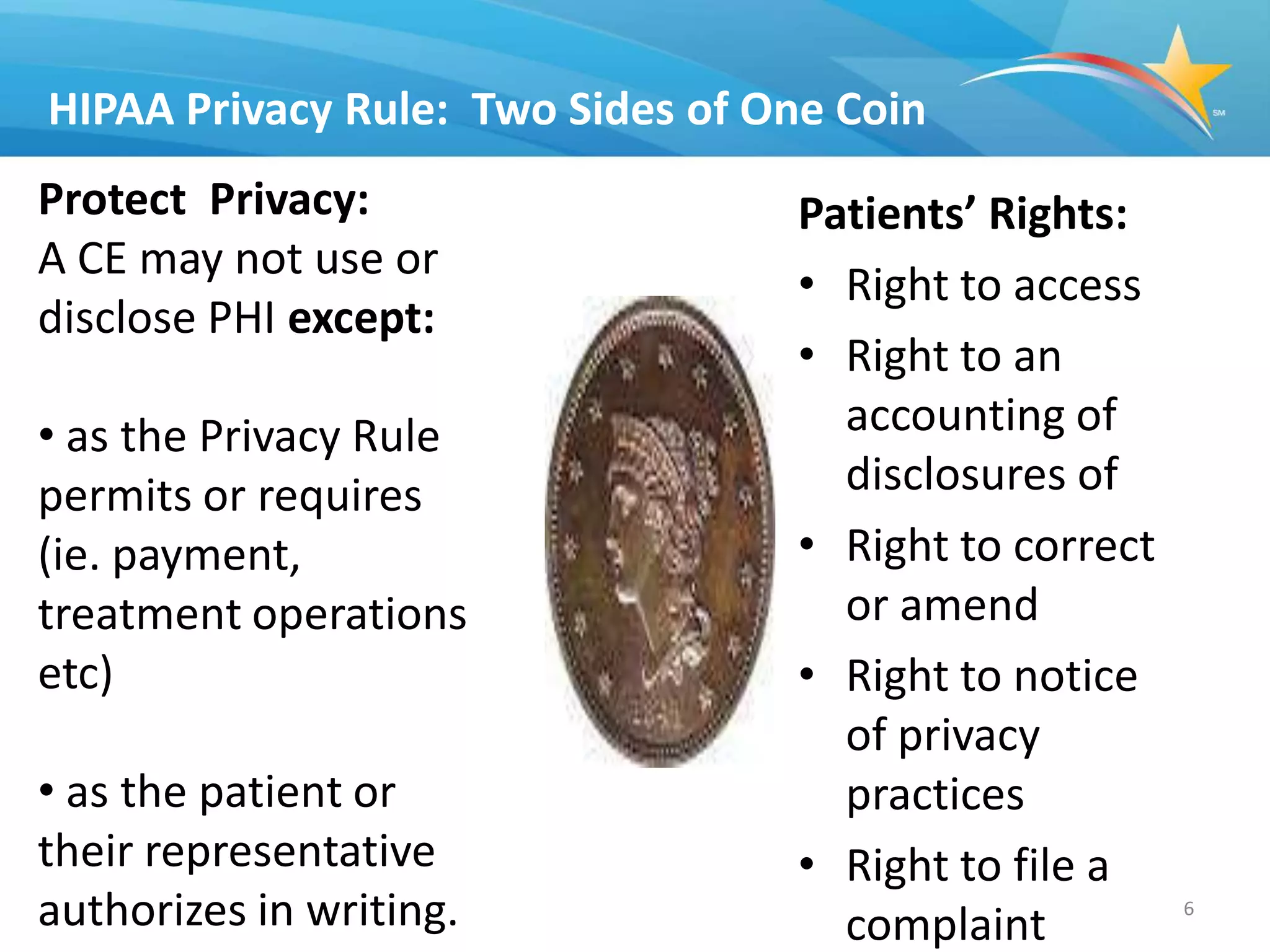
HIPAA Privacy Rule: Two Sides of One Coin
Protect Privacy:                  Patients’ Rights:
A CE may not use or
                                  • Right to access
disclose PHI except:
                                  • Right to an
• as the Privacy Rule               accounting of
permits or requires                 disclosures of
(ie. payment,                     • Right to correct
treatment operations                or amend
etc)                              • Right to notice
                                    of privacy
• as the patient or                 practices
their representative              • Right to file a
authorizes in writing.              complaint
                                                       6
HIPAA Security Rule (CFR 164.306)


• Protects Patient Health Information that is transmitted by or
  maintained in any form of electronic media
• Framework of Technical, Administrative, Physical Safeguards
• Ensures workforce training and compliance

Flexible Approach (Addressable):
 Size, complexity and capabilities of Covered Entity
 Security Capabilities of CE hardware and software
 Cost of Security Measures
 Probability and criticality of potential risks to ePHI
                                                              7
So…


           Isn’t this old news?

      Then, why Are So Many Organizations
           Not In Compliance?


                                            8
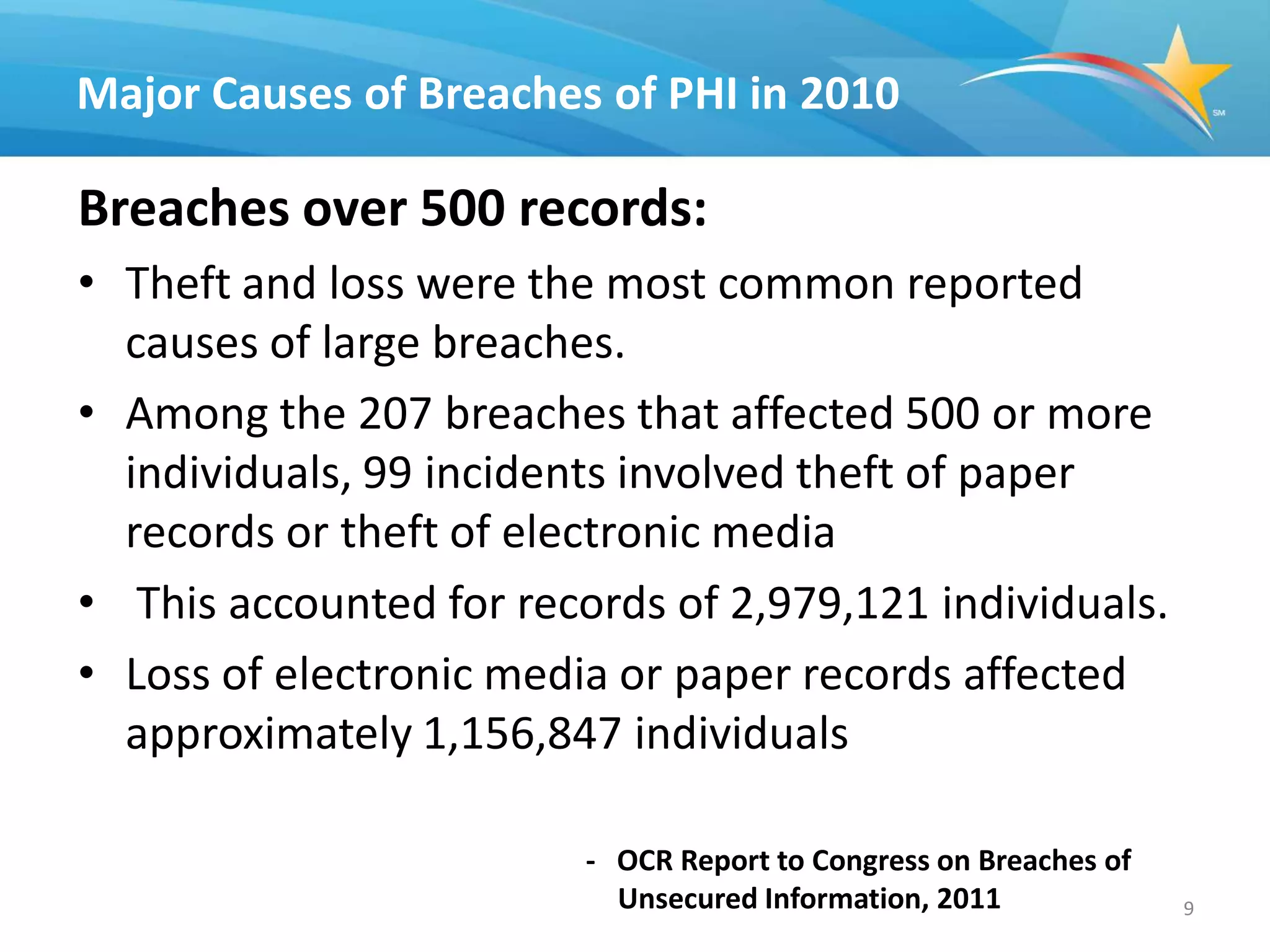
Major Causes of Breaches of PHI in 2010

Breaches over 500 records:
• Theft and loss were the most common reported
  causes of large breaches.
• Among the 207 breaches that affected 500 or more
  individuals, 99 incidents involved theft of paper
  records or theft of electronic media
• This accounted for records of 2,979,121 individuals.
• Loss of electronic media or paper records affected
  approximately 1,156,847 individuals

                         - OCR Report to Congress on Breaches of
                           Unsecured Information, 2011             9
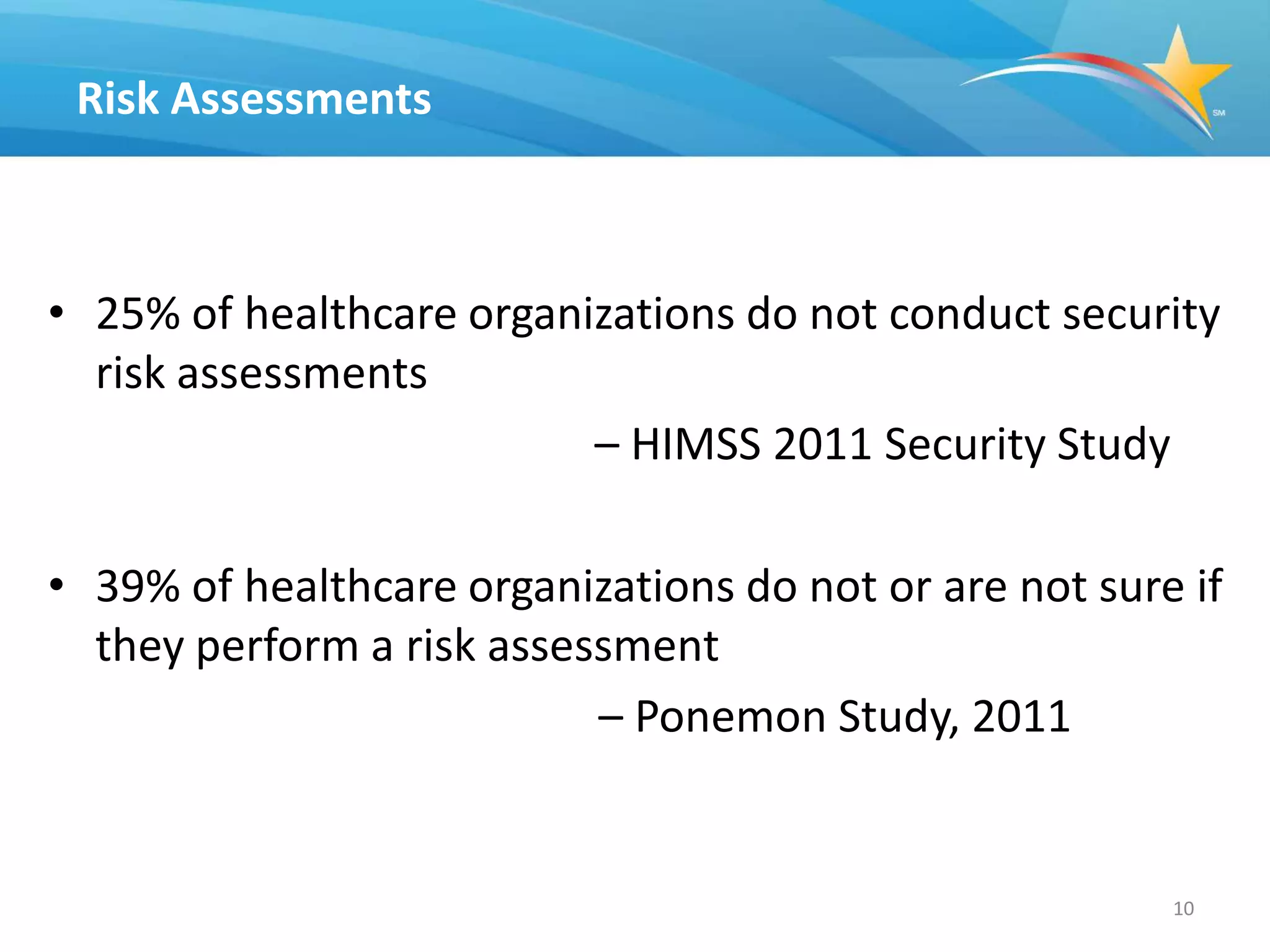
Risk Assessments


• 25% of healthcare organizations do not conduct security
  risk assessments
                          – HIMSS 2011 Security Study

• 39% of healthcare organizations do not or are not sure if
  they perform a risk assessment
                           – Ponemon Study, 2011


                                                        10
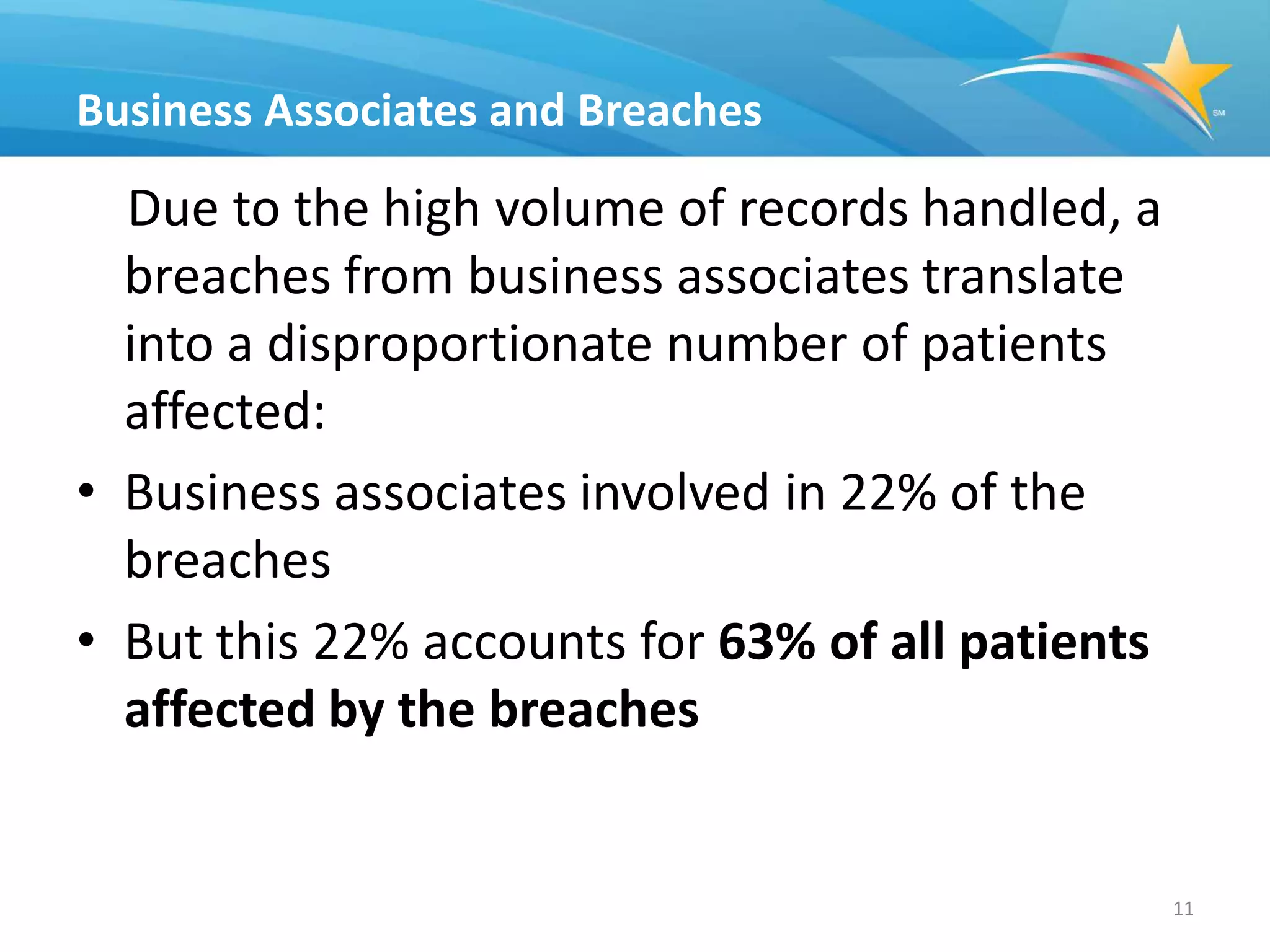
Business Associates and Breaches

  Due to the high volume of records handled, a
  breaches from business associates translate
  into a disproportionate number of patients
  affected:
• Business associates involved in 22% of the
  breaches
• But this 22% accounts for 63% of all patients
  affected by the breaches


                                                  11
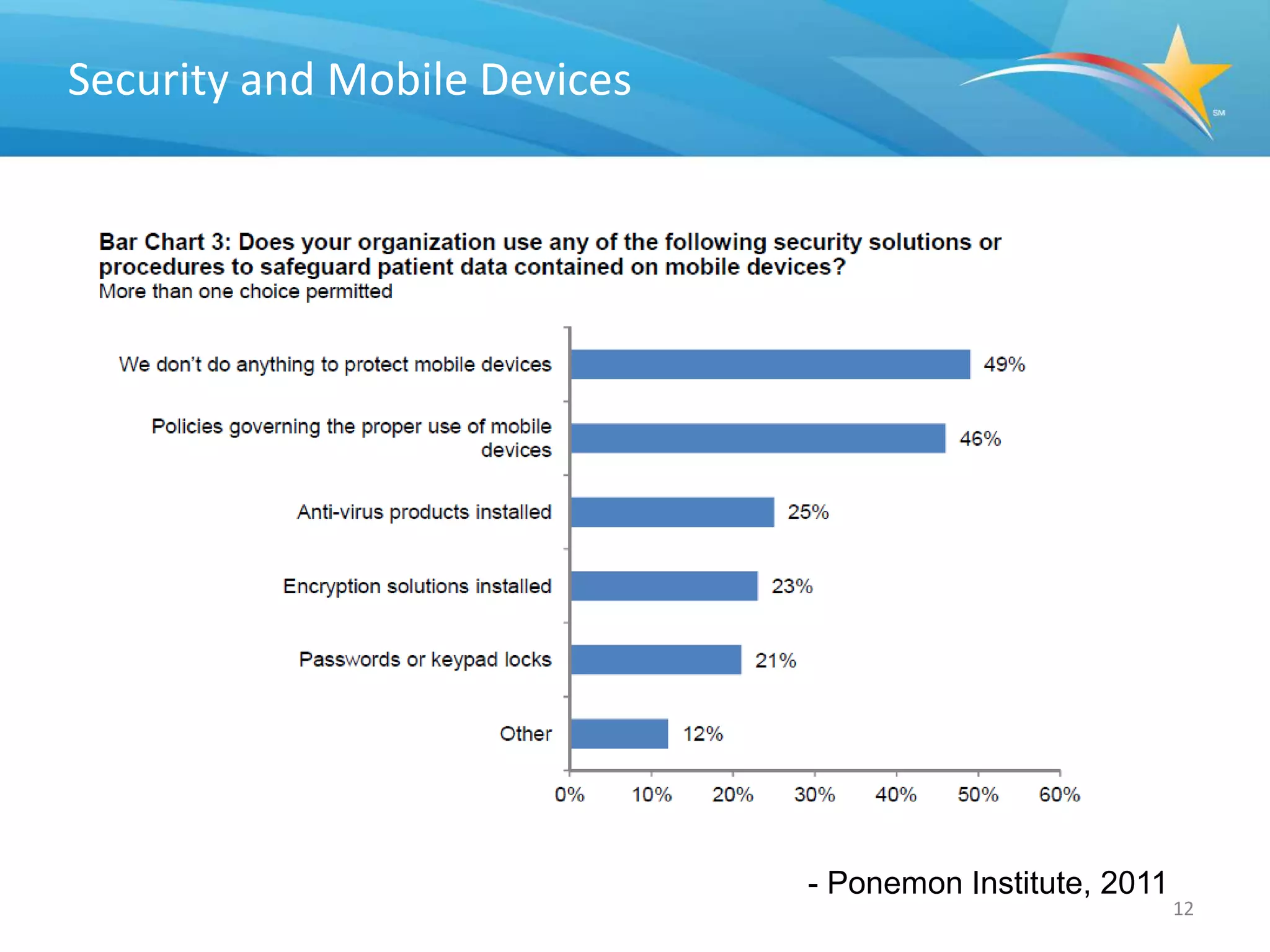
Security and Mobile Devices


                              - Ponemon Institute, 2011
                                                          12
HITECH: It’s a New Day . . .


                               13
HITECH and Privacy and Security


• Established Chief Privacy Officer for the Office
  of the National Coordinator
• Increased fines for breaches
• Created mandatory fines for willful neglect
• Created Mandatory Breach Notification Rule
• Established basis for Meaningful Use


                                                 14
Meaningful Use and Privacy and Security

MU Stage 1 requires eligible providers and hospitals to
• Conduct or review a security risk analysis in
  accordance with the requirements under 45 CFR
  164.308(a)(1) and implement security updates as
  necessary and correct identified security deficiencies
  as part of its risk management process.
• No exclusion.


                                                          15
Enforcement


• OCR has begun systematic audits of 150
  organizations

• CMS and Meaningful Use audits for
  Incentive funds are set to begin


                                           16
Enforcement: Large organizations

• Blue Cross Blue Shield of Tennessee (BCBST)
  settled with OCR for $1,500,000 for the theft of
  57 hard drives to theft, March 13, 2012
• Hard Drives contained names, social security
  numbers, diagnosis codes, DoB and Plan ID #s for
  over 1 million individuals
• Caused by failure to implement appropriate
  physical access controls

                                               17
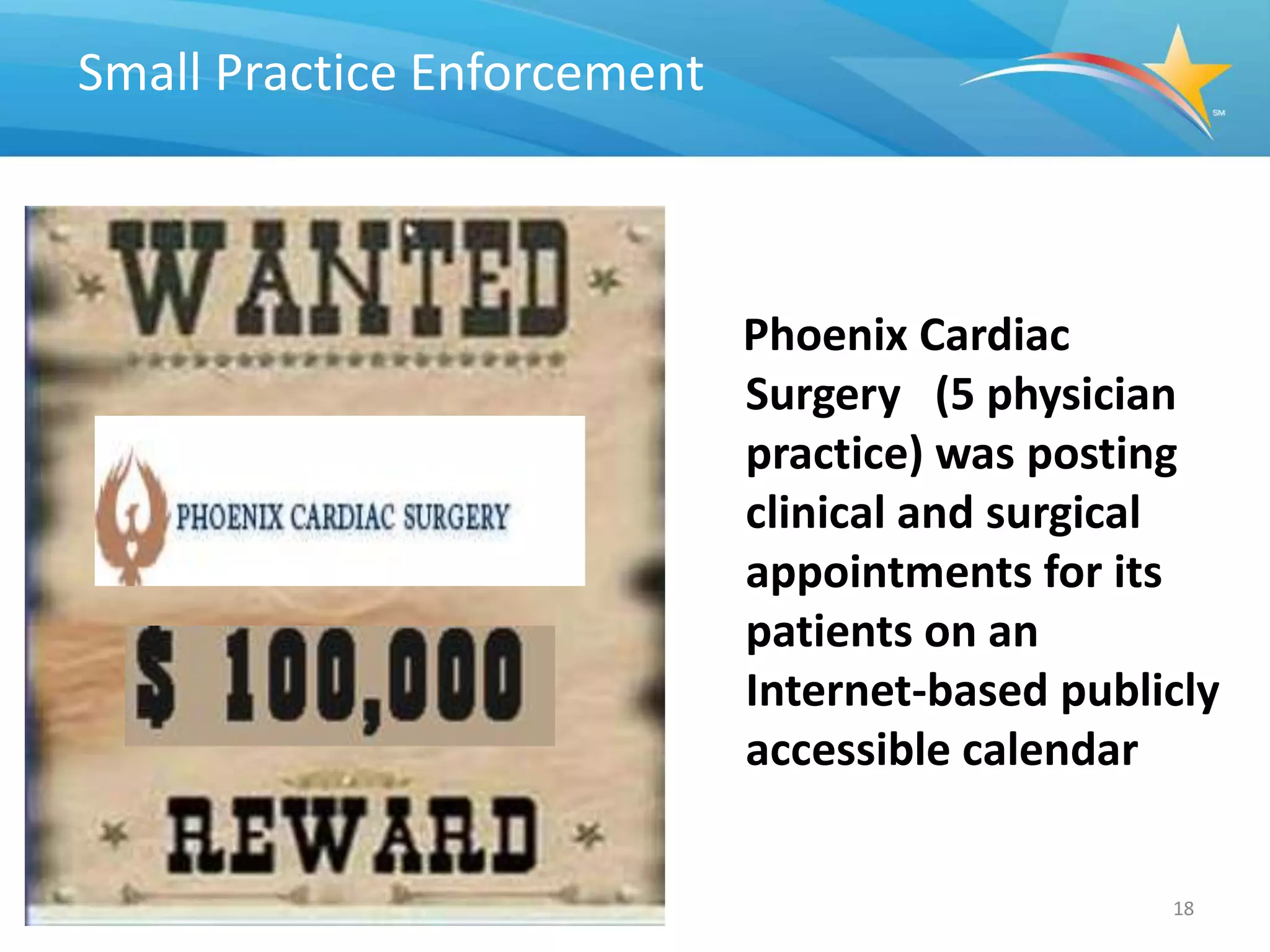
Small Practice Enforcement


                             Phoenix Cardiac
                             Surgery (5 physician
                             practice) was posting
                             clinical and surgical
                             appointments for its
                             patients on an
                             Internet-based publicly
                             accessible calendar


                                                 18
Phoenix Cardiac Surgery


• July 2007 to February 2009, Practice posted over 1,000
  separate entries of ePHI on a publicly accessible,
  Internet-based calendar

• September 2005 until November 2009, Practice daily
  transmitted ePHI from an Internet-based email account
  to workforce members’ personal Internet-based email
  accounts


                                                       19
OCR’s Other Findings

• Failure to implement adequate policies and procedures
  to appropriately safeguard patient information
• Failure to document any employee training on its policies
  and procedures on the Privacy and Security Rules
• Failure to identify a security official and conduct a risk
  analysis
• Failure to obtain business associate agreements with
  Internet-based email and calendar services that included
  storage of and access to its PHI


                                                         20
Outcome of Investigation

• $100,000 Settlement
• Corrective Action Plan includes:
   – Develop written policies and procedures, submitted to and
     approved by OCR and documented training for employees
   – “An accurate and thorough” risk assessment of the potential
     risks and vulnerabilities to PHI
   – Submission of Risk Management Plan to OCR
   – Identification of Security Official
   – Business Associates Agreements
   – Any violation of policies and procedures will be a Reportable
     events to OCR
   CAP available at:
     http://www.hhs.gov/ocr/privacy/hipaa/enforcement/examples/pcsurgery_
                                                                      21
     agreement.pdf
“We hope that health care providers pay careful
 attention to this resolution agreement and understand
 that the HIPAA Privacy and Security Rules have been in
 place for many years, and OCR expects full compliance
 no matter the size of a covered entity.”


                      - Leon Rodriguez
                        Director of the Office for Civil Rights
                        April 17th 2012, OCR Press Release

                                                              22
The Real Loss – Patient Trust


  Beyond Compliance and Return on Investment,
Ensuring Patient Privacy is Just the Right Thing to Do


                                                  23
Good Business: Patient Trust
    The ROI for Breach Prevention

    Diminished productivity and financial consequences
    due to a breach can be severe. Organizations reported:
•   The potential result is patient churn; the average
    lifetime value of one lost patient is $113,400
•   Economic impact
•   Loss of time and productivity
•   Diminishment of brand or reputation
•   LOSS OF PATIENT GOODWILL

                                    - Ponemon, “Second Annual Benchmark Study
                                                                         24
Developing a Privacy and Security Culture

Challenges:
   • Providers and Staff may have little understanding
     of new technology and privacy and security issues
   • Providers and Staff are reticent about asking
     questions or for assistance
   • Adopting new software and workflow in the fast-
     moving healthcare culture is difficult
   • Vendors may assume that providers and staff
     understand privacy and not adequately train

                                                     25
Strategies

• Executive Leadership Communicate Essential Value
• Privacy and Security Metrics are included in Employee
  Performance Plans/Evaluations
• Considered as part of physical environment, patient care,
  and all communications
• Staff are made to feel comfortable in asking questions
  and for help, resources are widely and freely available
• Training, is regular and updated and an essential part of
  the overall strategic plan
• Continuous Improvement and audits completed and
  results communicated to all
                                                          26
ONC’s Office of the Chief Privacy Officer
Recent and Current Projects

•   Personal Health Record Roundtable
•   Mobile Device Roundtable
•   Small practice Risk Assessment – original and revised
•   HIE Privacy and Security Program Information Notice
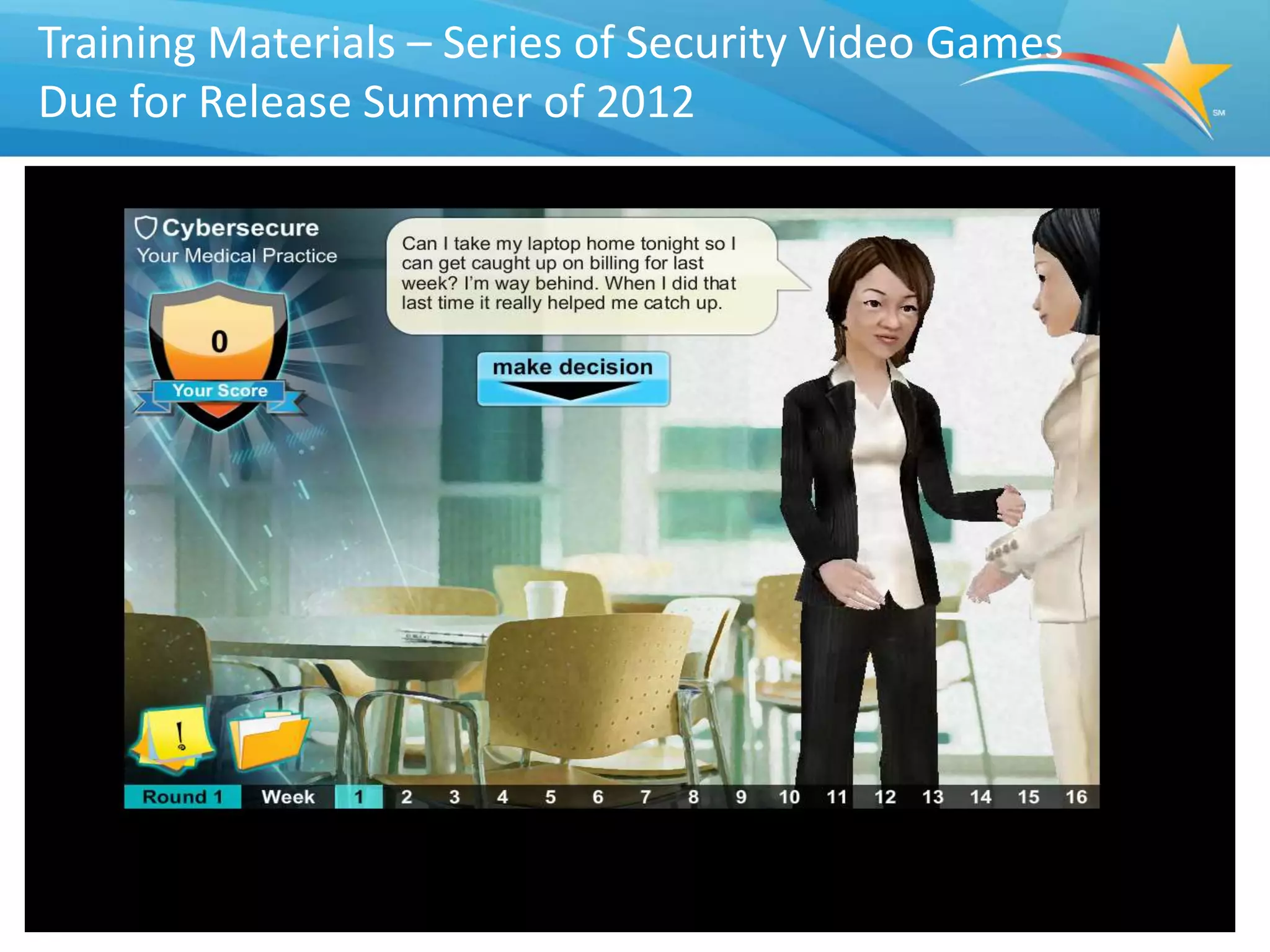
•   Security Training and Video Games
•   Research project on security configurations of mobile
    devices
•   Mobile device good practices videos and materials
•   Website redesign: www.healthit.gov
•   Data Segmentation Project
•   Community College Curriculum Privacy and Security Review
                                                           27
Training Materials – Series of Security Video Games
Due for Release Summer of 2012


                            DRAFT                     28
Sharing Responsibility for Ensuring Patient Privacy
     We all have a role to play in keeping health
     information private and secure.
 •   Government establishes P/S policies that are
     affordable and workable
 •   Vendors should create easy-to-use P/S features
     and communicate importance
 •   Providers and staff should understand their role
     in protecting patient privacy
 •   Patients understand their rights and basic
     means of securing their PHI                   29
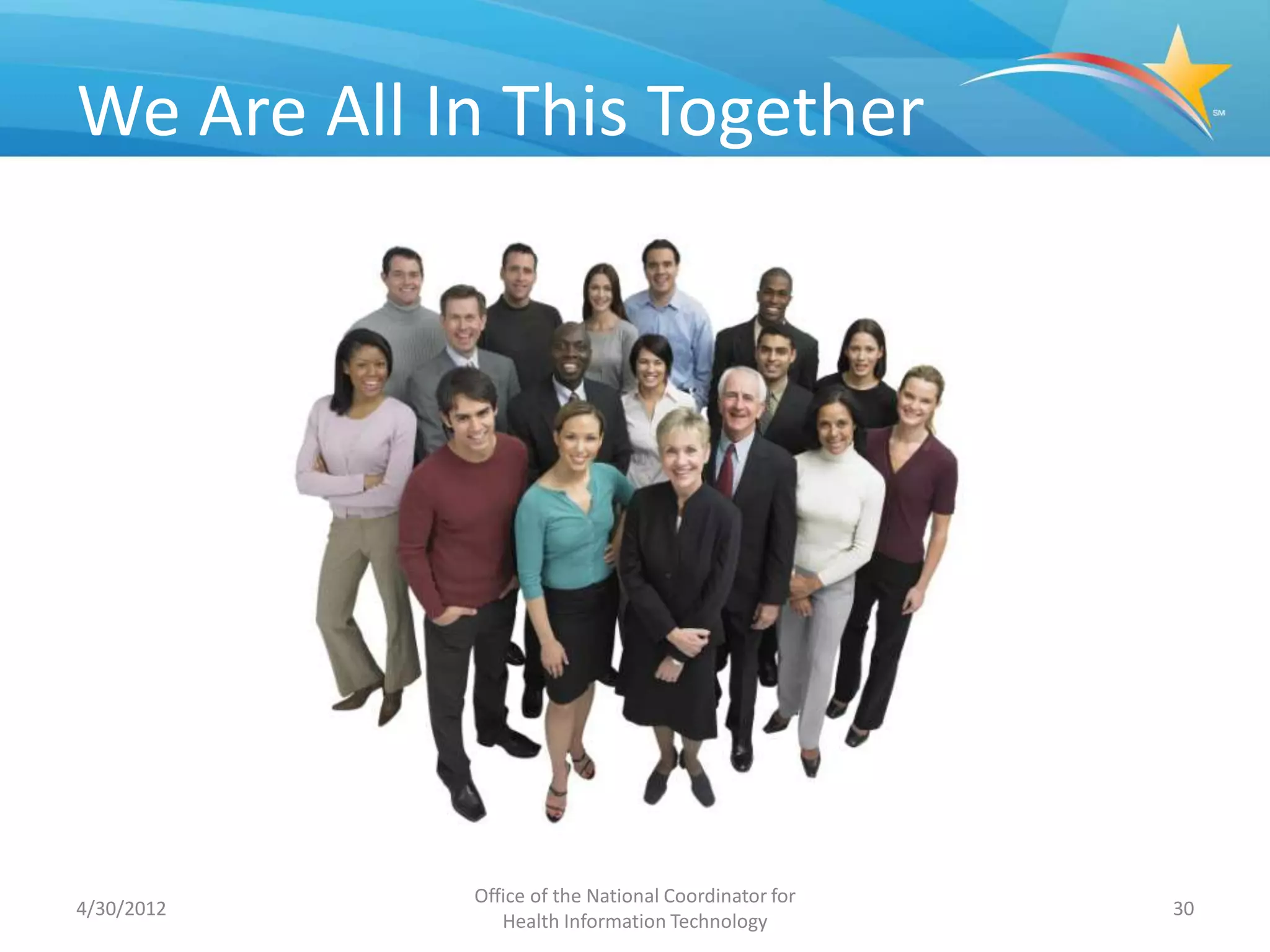
We Are All In This Together


            Office of the National Coordinator for
4/30/2012                                            30
               Health Information Technology
Conclusion


             Questions?


                          31
HIPAA/HITECH Resources
•   Privacy and Security Section of HealthIT.gov: http://healthit.hhs.gov

•   Are you a Covered Entity?:
    http://www.hhs.gov/ocr/privacy/hipaa/understanding/coveredentities/index.html

•   OCR HIPAA Privacy Rule Training Materials:
    http://www.hhs.gov/ocr/privacy/hipaa/understanding/training/index.html

•   OCR Guidance on Significant Aspects of the HIPAA Privacy Rule:
    http://www.hhs.gov/ocr/privacy/hipaa/understanding/coveredentities/privacyguidance.html

•   OCR Settlement with Phoenix Cardiac Surgery:
    http://www.hhs.gov/news/press/2012pres/04/20120417a.html

•   Fast Facts about the HIPAA Privacy Rule:
    http://www.hhs.gov/ocr/privacy/hipaa/understanding/coveredentities/cefastfacts.html

•   The HHS Office of Civil Rights, HIPAA FAQs: http://www.hhs.gov/ocr/privacy/hipaa/faq/index.html

•   Guidance materials for Small Providers, Small Health Plans, and other Small Businesses:
    http://www.hhs.gov/ocr/privacy/hipaa/understanding/coveredentities/smallbusiness.html

•   OCR’s Sample Business Associate Contract Provisions:
    http://www.hhs.gov/ocr/privacy/hipaa/understanding/coveredentities/contractprov.html
                                                                                                  32
Other Federal Law Resources

•   42 CFR Pt. 2: http://www.samhsa.gov/healthPrivacy/

•   Title X Confidentiality: 42 C.F.R. § 59.11:
    http://ecfr.gpoaccess.gov/cgi/t/text/text-
    idx?c=ecfr&sid=ce18bb9053f3b026e8983fd8ac27170c&rgn=div8&view=text&nod
    e=42:1.0.1.4.43.1.19.11&idno=42

•   GINA deferring to HIPAA: 29 C.F.R. §§ 1635.9(c) and 1635.11(d):
    http://ecfr.gpoaccess.gov/cgi/t/text/text-
    idx?c=ecfr&sid=ecbc0d928c8f11dbab0c20532d0101c9&rgn=div8&view=text&nod
    e=29:4.1.4.1.21.0.26.9&idno=29 and http://ecfr.gpoaccess.gov/cgi/t/text/text-
    idx?c=ecfr&sid=ecbc0d928c8f11dbab0c20532d0101c9&rgn=div8&view=text&nod
    e=29:4.1.4.1.21.0.26.11&idno=29
      – GINA: http://www.ornl.gov/sci/techresources/Human_Genome/publicat/GINAMay2008.pdf

•   HIPAA deferring to FERPA; exceptions to “protected health information” under
    (2)(i) and (2)(ii) in 45 C.F.R. § 160.103: http://ecfr.gpoaccess.gov/cgi/t/text/text-
    idx?c=ecfr&sid=35aa826589279b8cff00d53c641a609f&rgn=div8&view=text&node
    =45:1.0.1.3.74.1.27.3&idno=45
      – FERPA/HIPAA Guidance: http://www2.ed.gov/policy/gen/guid/fpco/doc/ferpa-hipaa-
        guidance.pdf
4/30/2012                                    ONC                                            33
Other Resources

•   For state privacy laws, see the National Conference of State Legislators (NCSL):
    http://www.ncsl.org/?tabid=17173

•   For state privacy law information: http://ihcrp.georgetown.edu/privacy/records.html

•   National Governor’s Association (NAG) Report on state laws and HIE:
    http://www.nga.org/Files/pdf/1103HIECONSENTLAWSREPORT.PDF

•   Health Information Security and Privacy Collaboration (HISPC) reports on state laws:
    http://healthit.hhs.gov/portal/server.pt/community/healthit_hhs_gov__hispc/1240

•   The Financial Management of Cyber Risk: “An Implementation Framework for CFOs”
    American National Standards Institute, 2010

•   Second Annual Benchmark Study on Patient Privacy and Data Security, 2011 Ponemon Institute

•   OCR’s Sample Business Associate Contract Provisions:
    http://www.hhs.gov/ocr/privacy/hipaa/understanding/coveredentities/contractprov.html


                                     Office of the National Coordinator for
4/30/2012                                                                                        34
                                        Health Information Technology

Keynote Presentation "Building a Culture of Privacy and Security into Your Organization"

  • 1.
    Privacy and Security: Building a Privacy and Security Culture in Health CareOrganizations April 25th, 2012 Joy Pritts, JD, Chief Privacy Officer Office of the National Coordinator Health Information Technology
  • 2.
    HHS Reaches $100,000Settlement with 5 Physician Practice over HIPAA Violations 1
  • 3.
    Why Create aCulture of Privacy and Security? • Assists Compliance to Law – New Developments • HIPAA Privacy and Security Rules • Enforcement • Good business • It’s Just the Right Thing To Do – Patient Trust 2
  • 4.
    Compliance: Federal Health InformationPrivacy Laws • HIPAA Privacy and Security Rules – Health Insurance Portability and Accountability Act of 1996, effective 2003 and 2005, respectively • Health Information Technology for Economic and Clinical Health (HITECH) Act of 2009 – Final Rule submitted to OMB March 24th, 2012 • Others (e.g., 42 CFR part 2) 3
  • 5.
    Who Must Complywith HIPAA Privacy and Security Rules? • Covered entities (CEs) –Health plans –Health care clearinghouses –Most health care providers 4
  • 6.
    Business Associates andHITECH • Business Associates include: • EHR Vendors • Data Analytic Firms • HITECH Clarifies Business Associates include: • Health Information Exchanges • Personal Health Record Vendors • HITECH Specifies that Business Associates • Must follow administrative, physical and technical safeguards of the Security Rule • Must Follow use and Disclosure Limits of Privacy Rule • Subject to the same Civil and Criminal Penalties as Covered Entities 5
  • 7.
    HIPAA Privacy Rule:Two Sides of One Coin Protect Privacy: Patients’ Rights: A CE may not use or • Right to access disclose PHI except: • Right to an • as the Privacy Rule accounting of permits or requires disclosures of (ie. payment, • Right to correct treatment operations or amend etc) • Right to notice of privacy • as the patient or practices their representative • Right to file a authorizes in writing. complaint 6
  • 8.
    HIPAA Security Rule(CFR 164.306) • Protects Patient Health Information that is transmitted by or maintained in any form of electronic media • Framework of Technical, Administrative, Physical Safeguards • Ensures workforce training and compliance Flexible Approach (Addressable):  Size, complexity and capabilities of Covered Entity  Security Capabilities of CE hardware and software  Cost of Security Measures  Probability and criticality of potential risks to ePHI 7
  • 9.
    So… Isn’t this old news? Then, why Are So Many Organizations Not In Compliance? 8
  • 10.
    Major Causes ofBreaches of PHI in 2010 Breaches over 500 records: • Theft and loss were the most common reported causes of large breaches. • Among the 207 breaches that affected 500 or more individuals, 99 incidents involved theft of paper records or theft of electronic media • This accounted for records of 2,979,121 individuals. • Loss of electronic media or paper records affected approximately 1,156,847 individuals - OCR Report to Congress on Breaches of Unsecured Information, 2011 9
  • 11.
    Risk Assessments • 25%of healthcare organizations do not conduct security risk assessments – HIMSS 2011 Security Study • 39% of healthcare organizations do not or are not sure if they perform a risk assessment – Ponemon Study, 2011 10
  • 12.
    Business Associates andBreaches Due to the high volume of records handled, a breaches from business associates translate into a disproportionate number of patients affected: • Business associates involved in 22% of the breaches • But this 22% accounts for 63% of all patients affected by the breaches 11
  • 13.
    Security and MobileDevices - Ponemon Institute, 2011 12
  • 14.
    HITECH: It’s aNew Day . . . 13
  • 15.
    HITECH and Privacyand Security • Established Chief Privacy Officer for the Office of the National Coordinator • Increased fines for breaches • Created mandatory fines for willful neglect • Created Mandatory Breach Notification Rule • Established basis for Meaningful Use 14
  • 16.
    Meaningful Use andPrivacy and Security MU Stage 1 requires eligible providers and hospitals to • Conduct or review a security risk analysis in accordance with the requirements under 45 CFR 164.308(a)(1) and implement security updates as necessary and correct identified security deficiencies as part of its risk management process. • No exclusion. 15
  • 17.
    Enforcement • OCR hasbegun systematic audits of 150 organizations • CMS and Meaningful Use audits for Incentive funds are set to begin 16
  • 18.
    Enforcement: Large organizations •Blue Cross Blue Shield of Tennessee (BCBST) settled with OCR for $1,500,000 for the theft of 57 hard drives to theft, March 13, 2012 • Hard Drives contained names, social security numbers, diagnosis codes, DoB and Plan ID #s for over 1 million individuals • Caused by failure to implement appropriate physical access controls 17
  • 19.
    Small Practice Enforcement Phoenix Cardiac Surgery (5 physician practice) was posting clinical and surgical appointments for its patients on an Internet-based publicly accessible calendar 18
  • 20.
    Phoenix Cardiac Surgery •July 2007 to February 2009, Practice posted over 1,000 separate entries of ePHI on a publicly accessible, Internet-based calendar • September 2005 until November 2009, Practice daily transmitted ePHI from an Internet-based email account to workforce members’ personal Internet-based email accounts 19
  • 21.
    OCR’s Other Findings •Failure to implement adequate policies and procedures to appropriately safeguard patient information • Failure to document any employee training on its policies and procedures on the Privacy and Security Rules • Failure to identify a security official and conduct a risk analysis • Failure to obtain business associate agreements with Internet-based email and calendar services that included storage of and access to its PHI 20
  • 22.
    Outcome of Investigation •$100,000 Settlement • Corrective Action Plan includes: – Develop written policies and procedures, submitted to and approved by OCR and documented training for employees – “An accurate and thorough” risk assessment of the potential risks and vulnerabilities to PHI – Submission of Risk Management Plan to OCR – Identification of Security Official – Business Associates Agreements – Any violation of policies and procedures will be a Reportable events to OCR CAP available at: http://www.hhs.gov/ocr/privacy/hipaa/enforcement/examples/pcsurgery_ 21 agreement.pdf
  • 23.
    “We hope thathealth care providers pay careful attention to this resolution agreement and understand that the HIPAA Privacy and Security Rules have been in place for many years, and OCR expects full compliance no matter the size of a covered entity.” - Leon Rodriguez Director of the Office for Civil Rights April 17th 2012, OCR Press Release 22
  • 24.
    The Real Loss– Patient Trust Beyond Compliance and Return on Investment, Ensuring Patient Privacy is Just the Right Thing to Do 23
  • 25.
    Good Business: PatientTrust The ROI for Breach Prevention Diminished productivity and financial consequences due to a breach can be severe. Organizations reported: • The potential result is patient churn; the average lifetime value of one lost patient is $113,400 • Economic impact • Loss of time and productivity • Diminishment of brand or reputation • LOSS OF PATIENT GOODWILL - Ponemon, “Second Annual Benchmark Study 24
  • 26.
    Developing a Privacyand Security Culture Challenges: • Providers and Staff may have little understanding of new technology and privacy and security issues • Providers and Staff are reticent about asking questions or for assistance • Adopting new software and workflow in the fast- moving healthcare culture is difficult • Vendors may assume that providers and staff understand privacy and not adequately train 25
  • 27.
    Strategies • Executive LeadershipCommunicate Essential Value • Privacy and Security Metrics are included in Employee Performance Plans/Evaluations • Considered as part of physical environment, patient care, and all communications • Staff are made to feel comfortable in asking questions and for help, resources are widely and freely available • Training, is regular and updated and an essential part of the overall strategic plan • Continuous Improvement and audits completed and results communicated to all 26
  • 28.
    ONC’s Office ofthe Chief Privacy Officer Recent and Current Projects • Personal Health Record Roundtable • Mobile Device Roundtable • Small practice Risk Assessment – original and revised • HIE Privacy and Security Program Information Notice • Security Training and Video Games • Research project on security configurations of mobile devices • Mobile device good practices videos and materials • Website redesign: www.healthit.gov • Data Segmentation Project • Community College Curriculum Privacy and Security Review 27
  • 29.
    Training Materials –Series of Security Video Games Due for Release Summer of 2012 DRAFT 28
  • 30.
    Sharing Responsibility forEnsuring Patient Privacy We all have a role to play in keeping health information private and secure. • Government establishes P/S policies that are affordable and workable • Vendors should create easy-to-use P/S features and communicate importance • Providers and staff should understand their role in protecting patient privacy • Patients understand their rights and basic means of securing their PHI 29
  • 31.
    We Are AllIn This Together Office of the National Coordinator for 4/30/2012 30 Health Information Technology
  • 32.
    Conclusion Questions? 31
  • 33.
    HIPAA/HITECH Resources • Privacy and Security Section of HealthIT.gov: http://healthit.hhs.gov • Are you a Covered Entity?: http://www.hhs.gov/ocr/privacy/hipaa/understanding/coveredentities/index.html • OCR HIPAA Privacy Rule Training Materials: http://www.hhs.gov/ocr/privacy/hipaa/understanding/training/index.html • OCR Guidance on Significant Aspects of the HIPAA Privacy Rule: http://www.hhs.gov/ocr/privacy/hipaa/understanding/coveredentities/privacyguidance.html • OCR Settlement with Phoenix Cardiac Surgery: http://www.hhs.gov/news/press/2012pres/04/20120417a.html • Fast Facts about the HIPAA Privacy Rule: http://www.hhs.gov/ocr/privacy/hipaa/understanding/coveredentities/cefastfacts.html • The HHS Office of Civil Rights, HIPAA FAQs: http://www.hhs.gov/ocr/privacy/hipaa/faq/index.html • Guidance materials for Small Providers, Small Health Plans, and other Small Businesses: http://www.hhs.gov/ocr/privacy/hipaa/understanding/coveredentities/smallbusiness.html • OCR’s Sample Business Associate Contract Provisions: http://www.hhs.gov/ocr/privacy/hipaa/understanding/coveredentities/contractprov.html 32
  • 34.
    Other Federal LawResources • 42 CFR Pt. 2: http://www.samhsa.gov/healthPrivacy/ • Title X Confidentiality: 42 C.F.R. § 59.11: http://ecfr.gpoaccess.gov/cgi/t/text/text- idx?c=ecfr&sid=ce18bb9053f3b026e8983fd8ac27170c&rgn=div8&view=text&nod e=42:1.0.1.4.43.1.19.11&idno=42 • GINA deferring to HIPAA: 29 C.F.R. §§ 1635.9(c) and 1635.11(d): http://ecfr.gpoaccess.gov/cgi/t/text/text- idx?c=ecfr&sid=ecbc0d928c8f11dbab0c20532d0101c9&rgn=div8&view=text&nod e=29:4.1.4.1.21.0.26.9&idno=29 and http://ecfr.gpoaccess.gov/cgi/t/text/text- idx?c=ecfr&sid=ecbc0d928c8f11dbab0c20532d0101c9&rgn=div8&view=text&nod e=29:4.1.4.1.21.0.26.11&idno=29 – GINA: http://www.ornl.gov/sci/techresources/Human_Genome/publicat/GINAMay2008.pdf • HIPAA deferring to FERPA; exceptions to “protected health information” under (2)(i) and (2)(ii) in 45 C.F.R. § 160.103: http://ecfr.gpoaccess.gov/cgi/t/text/text- idx?c=ecfr&sid=35aa826589279b8cff00d53c641a609f&rgn=div8&view=text&node =45:1.0.1.3.74.1.27.3&idno=45 – FERPA/HIPAA Guidance: http://www2.ed.gov/policy/gen/guid/fpco/doc/ferpa-hipaa- guidance.pdf 4/30/2012 ONC 33
  • 35.
    Other Resources • For state privacy laws, see the National Conference of State Legislators (NCSL): http://www.ncsl.org/?tabid=17173 • For state privacy law information: http://ihcrp.georgetown.edu/privacy/records.html • National Governor’s Association (NAG) Report on state laws and HIE: http://www.nga.org/Files/pdf/1103HIECONSENTLAWSREPORT.PDF • Health Information Security and Privacy Collaboration (HISPC) reports on state laws: http://healthit.hhs.gov/portal/server.pt/community/healthit_hhs_gov__hispc/1240 • The Financial Management of Cyber Risk: “An Implementation Framework for CFOs” American National Standards Institute, 2010 • Second Annual Benchmark Study on Patient Privacy and Data Security, 2011 Ponemon Institute • OCR’s Sample Business Associate Contract Provisions: http://www.hhs.gov/ocr/privacy/hipaa/understanding/coveredentities/contractprov.html Office of the National Coordinator for 4/30/2012 34 Health Information Technology