Exploring the Arts Toolkits:  PD workshop Presented by Missi Baker, KET education consultant [email_address] www.missibket.blogspot.com
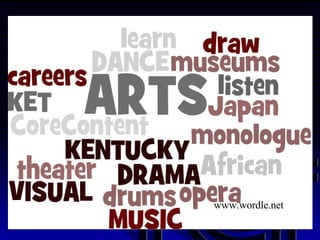
www.wordle.net
What are the Arts Toolkits? The Arts Toolkits are KET’s response to then-Kentucky Commissioner of Education Gene Wilhoit’s challenge in 2000 to “develop a dynamic and powerful arts and humanities toolkit that would be built from the Kentucky Core Content, Program of Studies, and Academic Expectations” (2). During the 2001-2002 prototype stage, KET, KDE, the Kentucky Center, the Kentucky Arts Council, the Speed Art Museum, Stage One, and teachers from across the state who attended the summer Arts Academies all served as partners in the development of the Arts Toolkits (2).
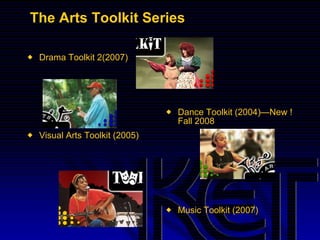
The Arts Toolkit Series Drama Toolkit 2(2007) Visual Arts Toolkit (2005) Dance Toolkit (2004)—New ! Fall 2008 Music Toolkit (2007)
You should leave here today with… A thorough understanding of the materials and resources available in the Arts Toolkits Specific dramatic, dance, and visual arts topics you want to incorporate into your classroom Ideas for cross-curricular and/or collaborative units using the toolkits & subject-area core content Toolkit options you want to research further A better sense of how to communicate as a faculty in order to deliver arts and humanities core content to your students
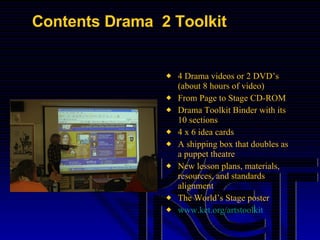
Contents Drama  2 Toolkit  4 Drama videos or 2 DVD’s (about 8 hours of video) From Page to Stage CD-ROM Drama Toolkit Binder with its 10 sections 4 x 6 idea cards A shipping box that doubles as a puppet theatre New lesson plans, materials, resources, and standards alignment The World’s Stage poster www.ket.org/artstoolkit
Drama 2 Using the Toolkit Lesson Plans Glossary Responding to Drama Especially for Primary  Drama and Culture Periods and Styles Creating Drama KY Drama Resources Index
A typical Drama Toolkit lesson plan contains the following elements: Grade level(s) Materials Vocabulary Academic expectations Program of studies Core content Essential questions Length Concept/objectives Activities Portfolio-appropriate writing for the lesson Toolkit resources Instructional strategies and resources Additional ideas Support, connections, and resources Applications across the curriculum Open response assessment and rubric Performance assessment and rubric
Activity Time! Wee Willie Winkie  Wee Willie Winkie runs through the town, Upstairs and downstairs in his nightgown, Tapping at the window and crying through the lock, Are all the children in their beds, it's past eight o'clock? I am thinking of a word that rhymes with_____.
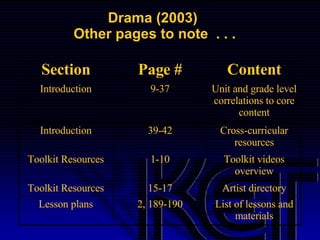
Drama (2003)  Other pages to note  . . . Section Page # Content Introduction 9-37 Unit and grade level correlations to core content Introduction 39-42 Cross-curricular resources Toolkit Resources 1-10 Toolkit videos overview Toolkit Resources 15-17 Artist directory Lesson plans 2, 189-190 List of lessons and materials
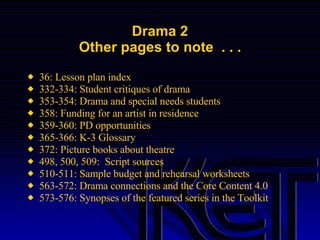
Drama 2 Other pages to note  . . . 36: Lesson plan index  332-334: Student critiques of drama  353-354: Drama and special needs students  358: Funding for an artist in residence 359-360: PD opportunities  365-366: K-3 Glossary  372: Picture books about theatre  498, 500, 509:  Script sources  510-511: Sample budget and rehearsal worksheets 563-572: Drama connections and the Core Content 4.0 573-576: Synopses of the featured series in the Toolkit
Drama Toolkit Copyright Policy “ The Drama Arts Toolkit is a coyrighted product.  Printed materials may be copied for use as student handouts or in a limited fashion for sharing with other teachers (for example, copying one lesson plan to share).  The Toolkit should not be copied in its entirety.  The Toolkit videos, DVD’s, and CD-ROM should not be copied” (5).
Think behind the scenes . . . Staging Makeup Costumes Different versions of the same story Characterization or interpretation Promotion Financing Casting
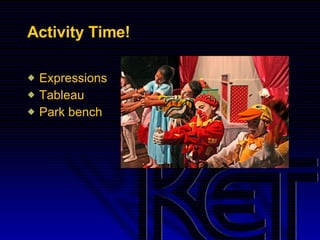
Activity Time! Expressions Tableau Park bench
Arts Toolkit Website: www.ket.org/artstoolkit Updates New unit and lesson plans Additional resources List serve options
Ideas to consider . . . Have students create skits around groups of words (e.g. three words for a 4-minute skit) Give students a generic, unpunctuated sentence (Why I didn’t know that) and ask them to punctuate/perform it for different emotions/music [anger, surprise, embarrassment] Give students an excerpt/section of unpunctuated dialogue and ask them to (1) break it into characters, (2) punctuate it, and (3) add setting and stage directions
More ideas to consider . . . Cut out pictures of people from magazines and let students pantomime the picture while others guess who the character portrays. (use as characters) Make a pile of shoes and have students draw one at random or have students use their shoe and tell where their shoe came from, where it has been, and why it ended up in the Discarded Shoe Pile.  Works on storytelling and improvisation.
More ideas to consider . . . Compile a box of random items, have each student draw an item out of a box.  Then start a story and each student has to incorporate the item into the story in some way. Using an ink pen, have the students pretend the ink pen is something other than and ink pen and the class has to guess what the ink pen represents (i.e. a tube of lipstick, or microphone). Make a stack of card with each containing a different emotion (i.e. happy, sad, angry). Students have to say the letters ABC portraying the emotion.
More ideas to consider . . . Have two stacks of index cards one with character (i.e.  principal, clown, big bad wolf) Then have a stack of cards with different scenes.  Students draw a scenes card and character card and create a skit. Readers’ Theatre:  Divide lines/segments in half with a boy reading the 1 st  half, a girl the 2 nd  half, or students each read a single word, or variations on different reading patterns.
Activity Time Idea cards
Visual art project . . . Class mural of a classic art piece, genre, or style (Draw a grid on the picture you want reproduced.  Grid out a large sheet of paper or section on a wall.  Students are responsible for reproducing the design in their own grids.) Use art to reinforce parts of speech, create poetry Use a group of pictures clipped randomly from magazines and have students create stories and/or storyboards
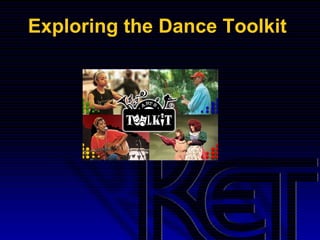
Exploring the Dance Toolkit
The Dance Toolkit contains . . . 4 Dance Toolkit videos or a single, 4-part DVD DanceSense  enhanced DVD Dance Toolkit binder with its 10 sections KDE CD-ROM (lesson plan templates, etc.) Arts Toolkit website  www.ket.org/artstoolkit 4 x 6 idea cards Dancing Through Time, an illustrated timeline of the history of dance (extra copies of this poster can be ordered)
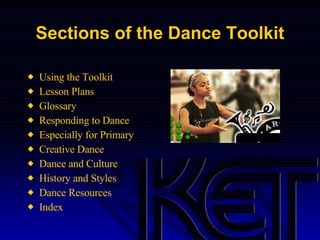
Sections of the Dance Toolkit Using the Toolkit Lesson Plans Glossary Responding to Dance Especially for Primary Creative Dance Dance and Culture History and Styles Dance Resources Index
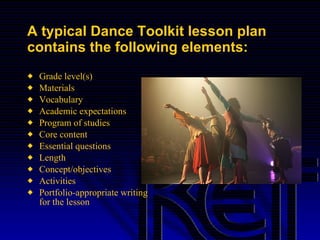
A typical Dance Toolkit lesson plan contains the following elements: Grade level(s) Materials Vocabulary Academic expectations Program of studies Core content Essential questions Length Concept/objectives Activities Portfolio-appropriate writing for the lesson
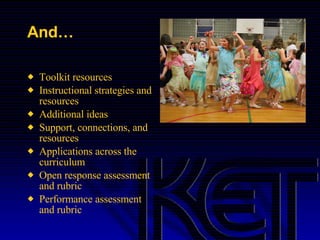
And… Toolkit resources Instructional strategies and resources Additional ideas Support, connections, and resources Applications across the curriculum Open response assessment and rubric Performance assessment and rubric
Other pages to note  . . . 9-17:  Dance Toolkit video descriptions 19-21:  DanceSense  enhanced DVD overview 43-44: Integrating the arts and Core Content 45-52, 57: Inclusive dance and special needs 53:  Successfully engaging and working with a performance artist or artist-in-residence 58: List of lesson plans and grade levels 287-290:  How to respond to dance 303: Writing a dance critique 336:  A pitfall/pointer list for teachers 371-373: Tips for teaching traditional dances 411:  Creating cultural trunks 417:  Tips for using the Toolkit timeline 460-485:  Teacher’s guide/overview to  DanceSense 531-535:  Core Content guide and connections
Dance Toolkit Copyright Policy “ The Dance Arts Toolkit is a coyrighted product.  Printed materials may be copied for use as student handouts or in a limited fashion for sharing with other teachers (for example, copying one lesson plan to share).  The Toolkit should not be copied in its entirety.  The Toolkit videos, DVD’s, and CD-ROM should not be copied” (5).
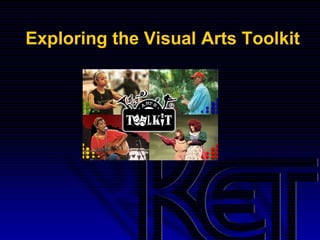
Exploring the Visual Arts Toolkit
The Visual Arts Toolkit contains . . . 2 DVD’s or 1 DVD & 1 box of VHS tapes 1 set of colored transparencies Visual Arts Toolkit binder with its 12 sections Kentucky Virtual Art Museum CD-ROM Arts Toolkit website  www.ket.org/artstoolkit 4 x 6 idea cards 1 Visual Arts poster with images and quotations
Sections of the Visual Arts Toolkit Using the Toolkit Effective Teaching Lesson Plans Glossary Responding to Art For Primary Art and Culture Periods and Styles Making Art Resources Art works  Index
A typical Visual Arts Toolkit lesson plan contains the following elements: Grade level(s) Materials Vocabulary Academic expectations Program of studies Core content Essential questions Length Concept/objectives Activities Portfolio-appropriate writing for the lesson Toolkit resources Instructional strategies and resources Additional ideas Support, connections, and resources Applications across the curriculum Open response assessment and rubric Performance assessment and rubric
Other pages to note  . . . 4-19:  Visual Art Toolkit video/DVD descriptions 26:  Arts listservs 57-63: CATS and Visual Arts Emphasis at Various Grade Levels  65: Lesson plan listing 297-308:  How to discuss and write about art successfully 325-326:  Arts and special needs students 327-332:  Accelerated Reader and other arts-related books for primary 345-346: K-3 Glossary 367-370:  Exploding and avoiding stereotypes when teaching (see 379) 373-377: Ethnic, Regional, and Native American arts resources 539-540: Quick tips for getting the most out of arts resources 569: Fun with Art Worksheet 573:  Arts as Inspiration for Writing 581-603:  Core Content 4.0 Cross-Referencing
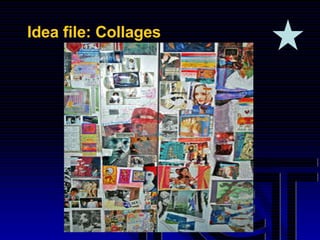
Idea file: Collages
 
Arts Toolkit Website: www.ket.org/artstoolkit Updates New unit and lesson plans Additional resources List serve options
The  KET’S  Music Arts Toolkit !
KET Educational Services Provided to Kentucky Schools Instructional Television (ITV) Programming KET EncycloMedia Professional Development Distance Learning Web Resources  Workshops Arts Toolkits Teacher’s Guides & print materials E-news!
Music Toolkit (available later this Month) Toolkit Components 3 Music Arts Toolkit DVDs- Over 12 hours of  Video World of Music  CD-ROM Music Arts Toolkit  binder of Lesson Plans and Information Music posters Music Idea Cards Arts Toolkit Website Access
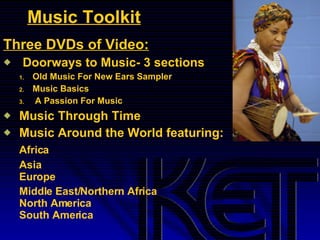
Music Toolkit Three DVDs of Video: Doorways to Music- 3 sections Old Music For New Ears Sampler  Music Basics A Passion For Music Music Through Time Music Around the World featuring: Africa Asia Europe Middle East/Northern Africa North America South America
Music Toolkit Interactive World of Music CD: Video, Audio files, images, information, and activities in three areas: Making Music Toolkit World of Music Tour Listening Assessments
Music Arts Toolkit Binder: Source of lesson plans, ideas, student handouts, and reference information.  Here is how it is organized… Milan, Jesse. Flickr.com. Creative Commons License
Contents Using the Toolkit Inclusive Teaching Lesson Plans: 1 st  page in book/  whole  lessons located on CD- ROM Music Basics Sallykins.  flickr.com . Creatvie commons license .
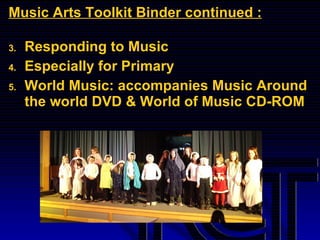
Music Arts Toolkit Binder continued : Responding to Music Especially for Primary World Music: accompanies Music Around the world DVD & World of Music CD-ROM
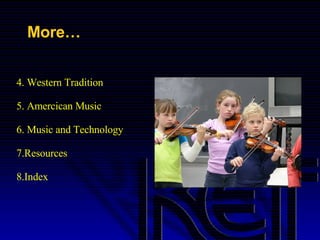
More… 4. Western Tradition 5. Amercican Music 6. Music and Technology 7.Resources 8.Index Scudder. Flickr.com. Creative Commons License. 29Jly 2008.
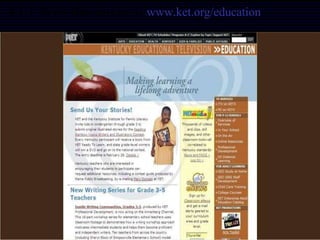
KET Web Resources at   www.ket.org/education
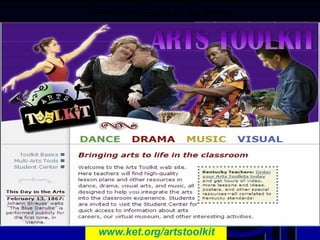
www.ket.org/artstoolkit The Arts Toolkit Website
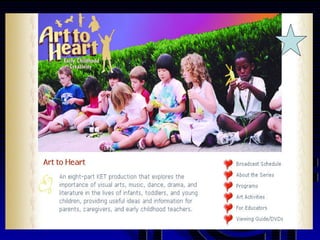
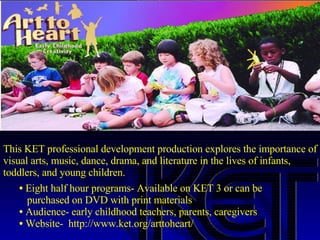
This KET professional development production explores the importance of visual arts, music, dance, drama, and literature in the lives of infants, toddlers, and young children.  Eight half hour programs- Available on KET 3 or can be    purchased on DVD with print materials  Audience- early childhood teachers, parents, caregivers Website-  http://www.ket.org/arttoheart/
How to Order Arts Toolkits To place your order, call Allison NeCamp at 800-945-9167 with PO or credit card number  Or FAX the order form with PO number to 859-258-7399 Or mail the form with PO, check, or credit card information to: KET Tape Duplication, 600 Cooper Dr., Lexington, KY 40502-2296.  Make checks to KET.  Note:  Cannot ship outside the state of Kentucky.
Missi Baker KET Education Consultant Northeast Kentucky [email_address] 1.800.432.0951  ext. 7265 www.missibket.blogspot.com

KET Arts Toolkits Overview

  • 1.
    Exploring the ArtsToolkits: PD workshop Presented by Missi Baker, KET education consultant [email_address] www.missibket.blogspot.com
  • 2.
  • 3.
    What are theArts Toolkits? The Arts Toolkits are KET’s response to then-Kentucky Commissioner of Education Gene Wilhoit’s challenge in 2000 to “develop a dynamic and powerful arts and humanities toolkit that would be built from the Kentucky Core Content, Program of Studies, and Academic Expectations” (2). During the 2001-2002 prototype stage, KET, KDE, the Kentucky Center, the Kentucky Arts Council, the Speed Art Museum, Stage One, and teachers from across the state who attended the summer Arts Academies all served as partners in the development of the Arts Toolkits (2).
  • 4.
    The Arts ToolkitSeries Drama Toolkit 2(2007) Visual Arts Toolkit (2005) Dance Toolkit (2004)—New ! Fall 2008 Music Toolkit (2007)
  • 5.
    You should leavehere today with… A thorough understanding of the materials and resources available in the Arts Toolkits Specific dramatic, dance, and visual arts topics you want to incorporate into your classroom Ideas for cross-curricular and/or collaborative units using the toolkits & subject-area core content Toolkit options you want to research further A better sense of how to communicate as a faculty in order to deliver arts and humanities core content to your students
  • 6.
    Contents Drama 2 Toolkit 4 Drama videos or 2 DVD’s (about 8 hours of video) From Page to Stage CD-ROM Drama Toolkit Binder with its 10 sections 4 x 6 idea cards A shipping box that doubles as a puppet theatre New lesson plans, materials, resources, and standards alignment The World’s Stage poster www.ket.org/artstoolkit
  • 7.
    Drama 2 Usingthe Toolkit Lesson Plans Glossary Responding to Drama Especially for Primary Drama and Culture Periods and Styles Creating Drama KY Drama Resources Index
  • 8.
    A typical DramaToolkit lesson plan contains the following elements: Grade level(s) Materials Vocabulary Academic expectations Program of studies Core content Essential questions Length Concept/objectives Activities Portfolio-appropriate writing for the lesson Toolkit resources Instructional strategies and resources Additional ideas Support, connections, and resources Applications across the curriculum Open response assessment and rubric Performance assessment and rubric
  • 9.
    Activity Time! WeeWillie Winkie Wee Willie Winkie runs through the town, Upstairs and downstairs in his nightgown, Tapping at the window and crying through the lock, Are all the children in their beds, it's past eight o'clock? I am thinking of a word that rhymes with_____.
  • 10.
    Drama (2003) Other pages to note . . . Section Page # Content Introduction 9-37 Unit and grade level correlations to core content Introduction 39-42 Cross-curricular resources Toolkit Resources 1-10 Toolkit videos overview Toolkit Resources 15-17 Artist directory Lesson plans 2, 189-190 List of lessons and materials
  • 11.
    Drama 2 Otherpages to note . . . 36: Lesson plan index 332-334: Student critiques of drama 353-354: Drama and special needs students 358: Funding for an artist in residence 359-360: PD opportunities 365-366: K-3 Glossary 372: Picture books about theatre 498, 500, 509: Script sources 510-511: Sample budget and rehearsal worksheets 563-572: Drama connections and the Core Content 4.0 573-576: Synopses of the featured series in the Toolkit
  • 12.
    Drama Toolkit CopyrightPolicy “ The Drama Arts Toolkit is a coyrighted product. Printed materials may be copied for use as student handouts or in a limited fashion for sharing with other teachers (for example, copying one lesson plan to share). The Toolkit should not be copied in its entirety. The Toolkit videos, DVD’s, and CD-ROM should not be copied” (5).
  • 13.
    Think behind thescenes . . . Staging Makeup Costumes Different versions of the same story Characterization or interpretation Promotion Financing Casting
  • 14.
    Activity Time! ExpressionsTableau Park bench
  • 15.
    Arts Toolkit Website:www.ket.org/artstoolkit Updates New unit and lesson plans Additional resources List serve options
  • 16.
    Ideas to consider. . . Have students create skits around groups of words (e.g. three words for a 4-minute skit) Give students a generic, unpunctuated sentence (Why I didn’t know that) and ask them to punctuate/perform it for different emotions/music [anger, surprise, embarrassment] Give students an excerpt/section of unpunctuated dialogue and ask them to (1) break it into characters, (2) punctuate it, and (3) add setting and stage directions
  • 17.
    More ideas toconsider . . . Cut out pictures of people from magazines and let students pantomime the picture while others guess who the character portrays. (use as characters) Make a pile of shoes and have students draw one at random or have students use their shoe and tell where their shoe came from, where it has been, and why it ended up in the Discarded Shoe Pile. Works on storytelling and improvisation.
  • 18.
    More ideas toconsider . . . Compile a box of random items, have each student draw an item out of a box. Then start a story and each student has to incorporate the item into the story in some way. Using an ink pen, have the students pretend the ink pen is something other than and ink pen and the class has to guess what the ink pen represents (i.e. a tube of lipstick, or microphone). Make a stack of card with each containing a different emotion (i.e. happy, sad, angry). Students have to say the letters ABC portraying the emotion.
  • 19.
    More ideas toconsider . . . Have two stacks of index cards one with character (i.e. principal, clown, big bad wolf) Then have a stack of cards with different scenes. Students draw a scenes card and character card and create a skit. Readers’ Theatre: Divide lines/segments in half with a boy reading the 1 st half, a girl the 2 nd half, or students each read a single word, or variations on different reading patterns.
  • 20.
  • 21.
    Visual art project. . . Class mural of a classic art piece, genre, or style (Draw a grid on the picture you want reproduced. Grid out a large sheet of paper or section on a wall. Students are responsible for reproducing the design in their own grids.) Use art to reinforce parts of speech, create poetry Use a group of pictures clipped randomly from magazines and have students create stories and/or storyboards
  • 22.
  • 23.
    The Dance Toolkitcontains . . . 4 Dance Toolkit videos or a single, 4-part DVD DanceSense enhanced DVD Dance Toolkit binder with its 10 sections KDE CD-ROM (lesson plan templates, etc.) Arts Toolkit website www.ket.org/artstoolkit 4 x 6 idea cards Dancing Through Time, an illustrated timeline of the history of dance (extra copies of this poster can be ordered)
  • 24.
    Sections of theDance Toolkit Using the Toolkit Lesson Plans Glossary Responding to Dance Especially for Primary Creative Dance Dance and Culture History and Styles Dance Resources Index
  • 25.
    A typical DanceToolkit lesson plan contains the following elements: Grade level(s) Materials Vocabulary Academic expectations Program of studies Core content Essential questions Length Concept/objectives Activities Portfolio-appropriate writing for the lesson
  • 26.
    And… Toolkit resourcesInstructional strategies and resources Additional ideas Support, connections, and resources Applications across the curriculum Open response assessment and rubric Performance assessment and rubric
  • 27.
    Other pages tonote . . . 9-17: Dance Toolkit video descriptions 19-21: DanceSense enhanced DVD overview 43-44: Integrating the arts and Core Content 45-52, 57: Inclusive dance and special needs 53: Successfully engaging and working with a performance artist or artist-in-residence 58: List of lesson plans and grade levels 287-290: How to respond to dance 303: Writing a dance critique 336: A pitfall/pointer list for teachers 371-373: Tips for teaching traditional dances 411: Creating cultural trunks 417: Tips for using the Toolkit timeline 460-485: Teacher’s guide/overview to DanceSense 531-535: Core Content guide and connections
  • 28.
    Dance Toolkit CopyrightPolicy “ The Dance Arts Toolkit is a coyrighted product. Printed materials may be copied for use as student handouts or in a limited fashion for sharing with other teachers (for example, copying one lesson plan to share). The Toolkit should not be copied in its entirety. The Toolkit videos, DVD’s, and CD-ROM should not be copied” (5).
  • 29.
  • 30.
    The Visual ArtsToolkit contains . . . 2 DVD’s or 1 DVD & 1 box of VHS tapes 1 set of colored transparencies Visual Arts Toolkit binder with its 12 sections Kentucky Virtual Art Museum CD-ROM Arts Toolkit website www.ket.org/artstoolkit 4 x 6 idea cards 1 Visual Arts poster with images and quotations
  • 31.
    Sections of theVisual Arts Toolkit Using the Toolkit Effective Teaching Lesson Plans Glossary Responding to Art For Primary Art and Culture Periods and Styles Making Art Resources Art works Index
  • 32.
    A typical VisualArts Toolkit lesson plan contains the following elements: Grade level(s) Materials Vocabulary Academic expectations Program of studies Core content Essential questions Length Concept/objectives Activities Portfolio-appropriate writing for the lesson Toolkit resources Instructional strategies and resources Additional ideas Support, connections, and resources Applications across the curriculum Open response assessment and rubric Performance assessment and rubric
  • 33.
    Other pages tonote . . . 4-19: Visual Art Toolkit video/DVD descriptions 26: Arts listservs 57-63: CATS and Visual Arts Emphasis at Various Grade Levels 65: Lesson plan listing 297-308: How to discuss and write about art successfully 325-326: Arts and special needs students 327-332: Accelerated Reader and other arts-related books for primary 345-346: K-3 Glossary 367-370: Exploding and avoiding stereotypes when teaching (see 379) 373-377: Ethnic, Regional, and Native American arts resources 539-540: Quick tips for getting the most out of arts resources 569: Fun with Art Worksheet 573: Arts as Inspiration for Writing 581-603: Core Content 4.0 Cross-Referencing
  • 34.
  • 35.
  • 36.
    Arts Toolkit Website:www.ket.org/artstoolkit Updates New unit and lesson plans Additional resources List serve options
  • 37.
    The KET’S Music Arts Toolkit !
  • 38.
    The KET’S Music Arts Toolkit !
  • 39.
    KET Educational ServicesProvided to Kentucky Schools Instructional Television (ITV) Programming KET EncycloMedia Professional Development Distance Learning Web Resources Workshops Arts Toolkits Teacher’s Guides & print materials E-news!
  • 40.
    Music Toolkit (availablelater this Month) Toolkit Components 3 Music Arts Toolkit DVDs- Over 12 hours of Video World of Music CD-ROM Music Arts Toolkit binder of Lesson Plans and Information Music posters Music Idea Cards Arts Toolkit Website Access
  • 41.
    Music Toolkit ThreeDVDs of Video: Doorways to Music- 3 sections Old Music For New Ears Sampler Music Basics A Passion For Music Music Through Time Music Around the World featuring: Africa Asia Europe Middle East/Northern Africa North America South America
  • 42.
    Music Toolkit InteractiveWorld of Music CD: Video, Audio files, images, information, and activities in three areas: Making Music Toolkit World of Music Tour Listening Assessments
  • 43.
    Music Arts ToolkitBinder: Source of lesson plans, ideas, student handouts, and reference information. Here is how it is organized… Milan, Jesse. Flickr.com. Creative Commons License
  • 44.
    Contents Using theToolkit Inclusive Teaching Lesson Plans: 1 st page in book/ whole lessons located on CD- ROM Music Basics Sallykins. flickr.com . Creatvie commons license .
  • 45.
    Music Arts ToolkitBinder continued : Responding to Music Especially for Primary World Music: accompanies Music Around the world DVD & World of Music CD-ROM
  • 46.
    More… 4. WesternTradition 5. Amercican Music 6. Music and Technology 7.Resources 8.Index Scudder. Flickr.com. Creative Commons License. 29Jly 2008.
  • 47.
    KET Web Resourcesat www.ket.org/education
  • 48.
  • 49.
    This KET professionaldevelopment production explores the importance of visual arts, music, dance, drama, and literature in the lives of infants, toddlers, and young children. Eight half hour programs- Available on KET 3 or can be purchased on DVD with print materials Audience- early childhood teachers, parents, caregivers Website- http://www.ket.org/arttoheart/
  • 50.
    How to OrderArts Toolkits To place your order, call Allison NeCamp at 800-945-9167 with PO or credit card number Or FAX the order form with PO number to 859-258-7399 Or mail the form with PO, check, or credit card information to: KET Tape Duplication, 600 Cooper Dr., Lexington, KY 40502-2296. Make checks to KET. Note: Cannot ship outside the state of Kentucky.
  • 51.
    Missi Baker KETEducation Consultant Northeast Kentucky [email_address] 1.800.432.0951 ext. 7265 www.missibket.blogspot.com