Kepler’s law of planetary
motion
Physics Project
2
Johannes Kepler
Johannes Kepler was a German mathematician, astronomer, and
astrologer. A key figure in the 17th century scientific revolution, he is best
known for his laws of planetary motion, based on his works Astronomia
nova, Harmonices Mundi, and Epitome of Copernican Astronomy. These
works also provided one of the foundations for Isaac Newton's theory of
universal gravitation.
Keplers’s law of planetary motion
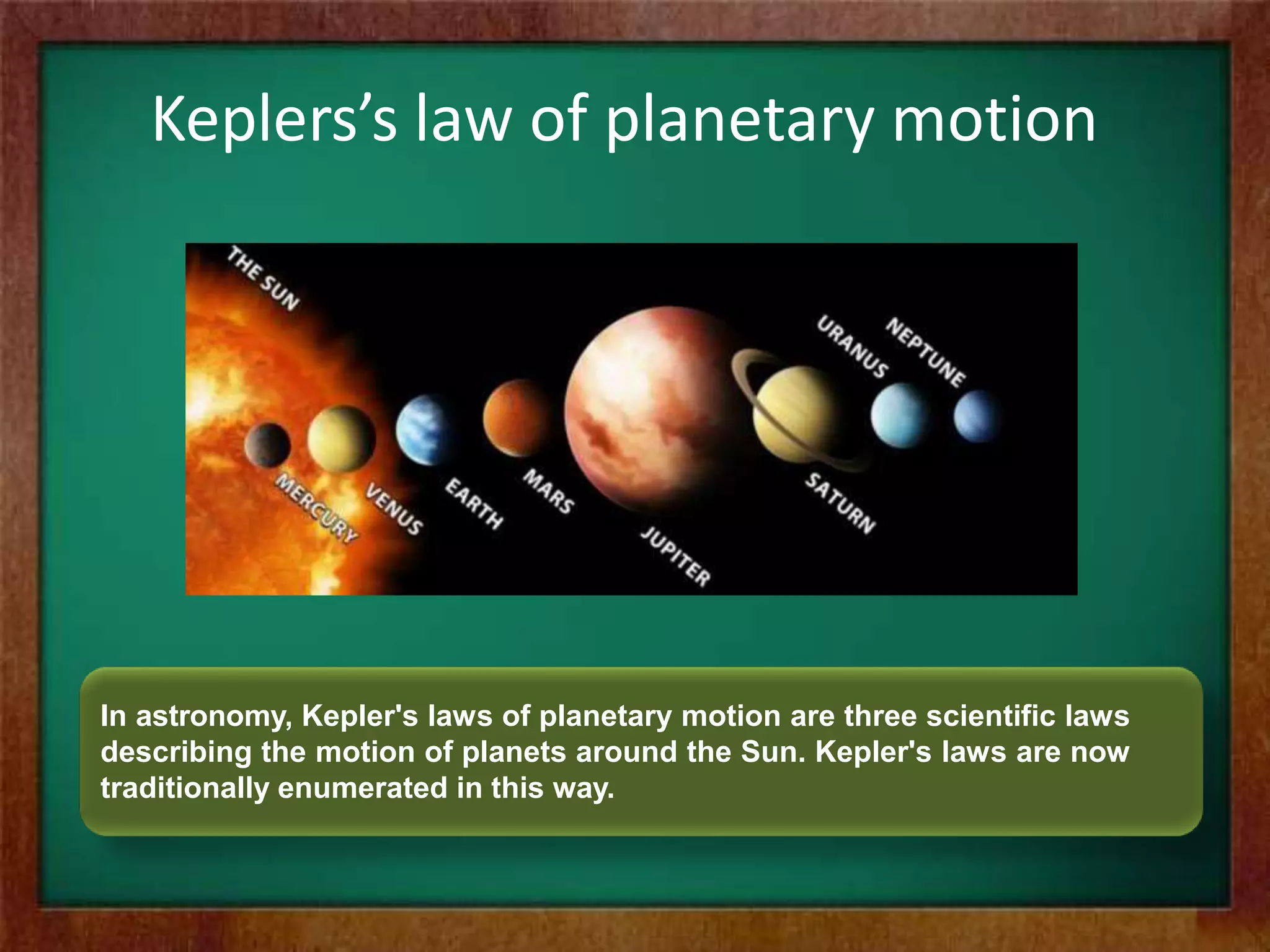
In astronomy, Kepler's laws of planetary motion are three scientific laws
describing the motion of planets around the Sun. Kepler's laws are now
traditionally enumerated in this way.
Three laws of Kepler
Kepler’s first law- Law of orbit
Kepler’s second law- Law of equal areas
Kepler’s third law- Law of periods
1
2
3
Kepler’s first law- Law of orbit
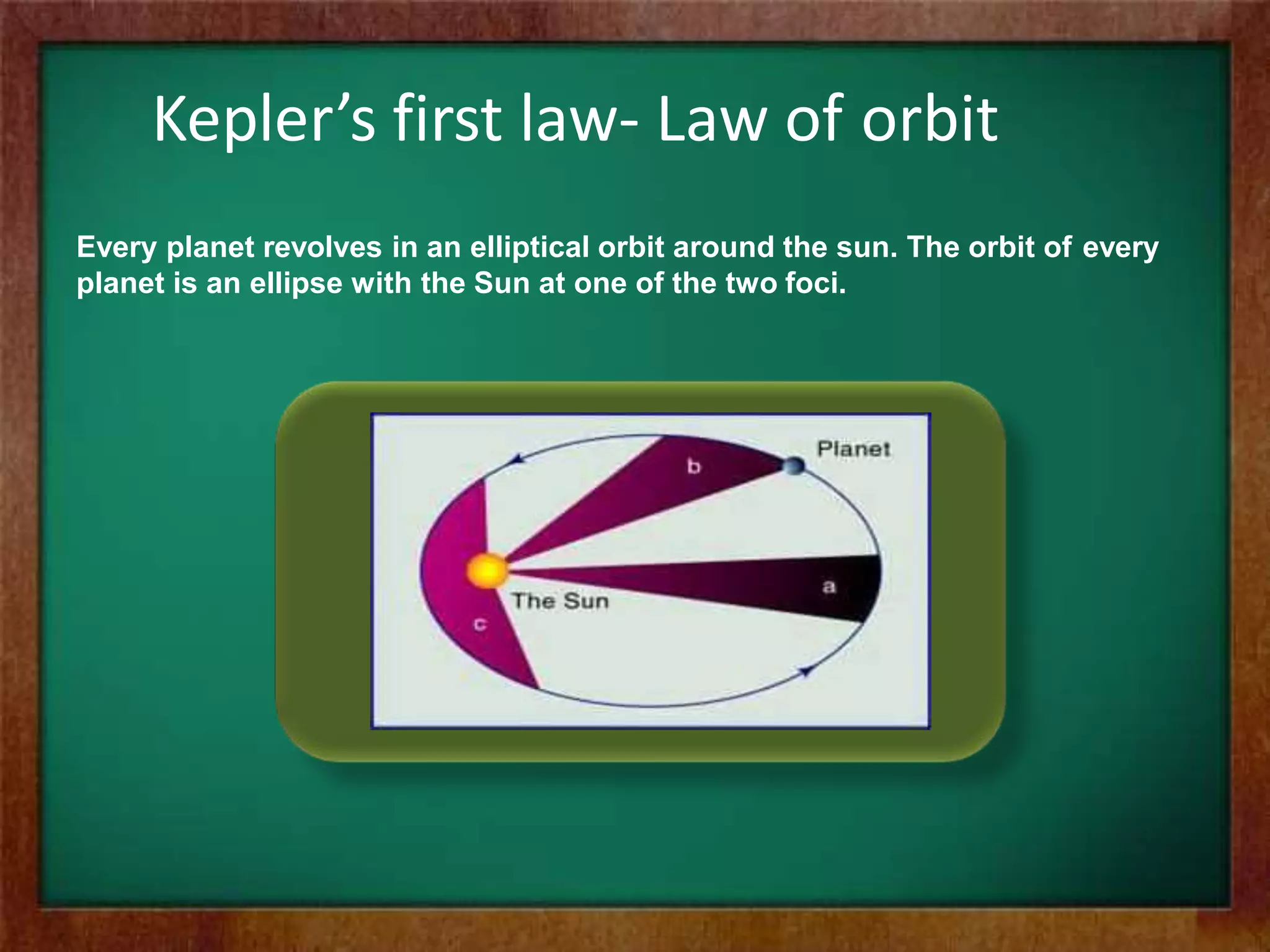
Every planet revolves in an elliptical orbit around the sun. The orbit of every
planet is an ellipse with the Sun at one of the two foci.
Kepler’s second law- Law of equal
area
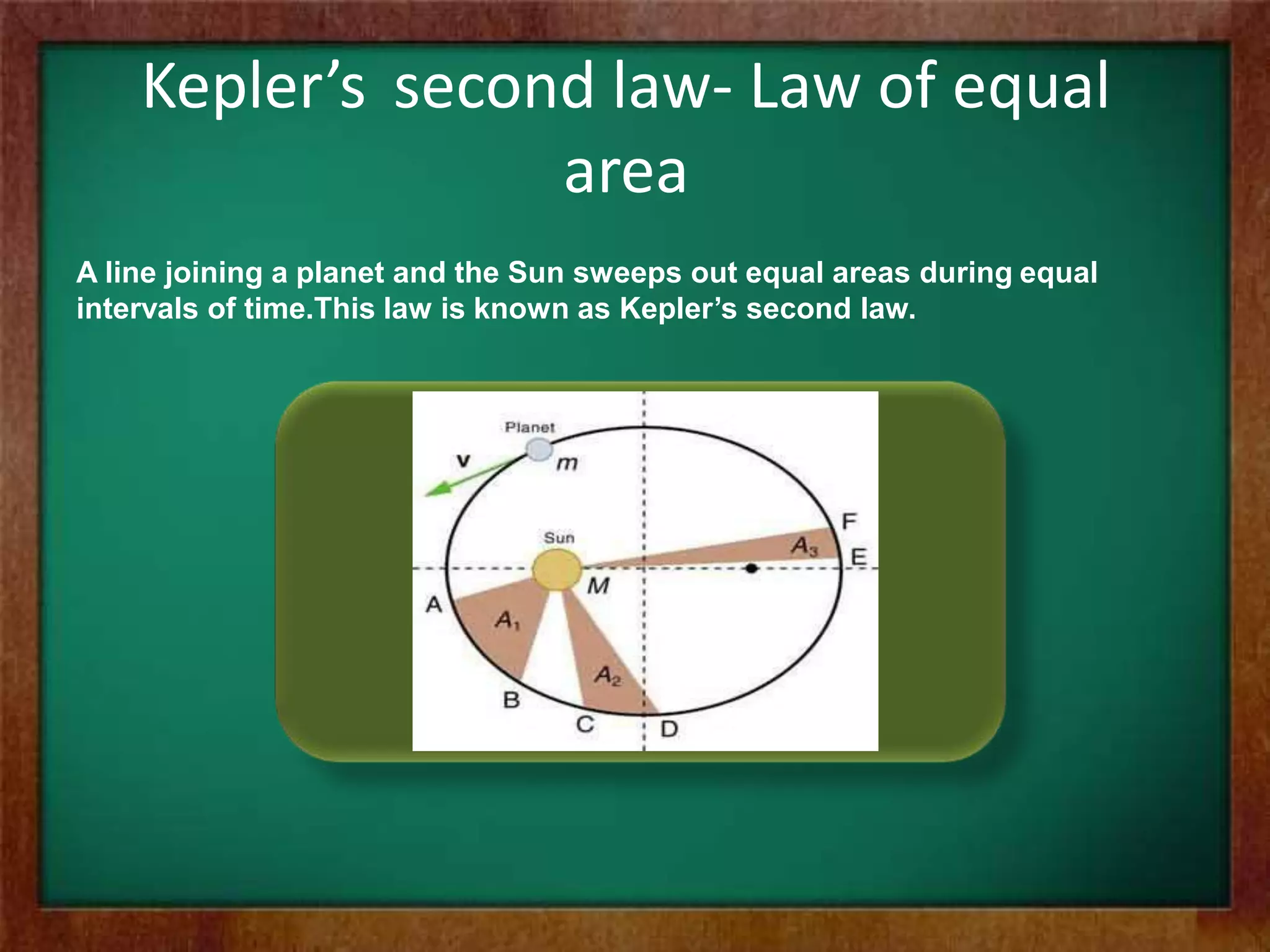
A line joining a planet and the Sun sweeps out equal areas during equal
intervals of time.This law is known as Kepler’s second law.
Kepler’s third law- Law of periods
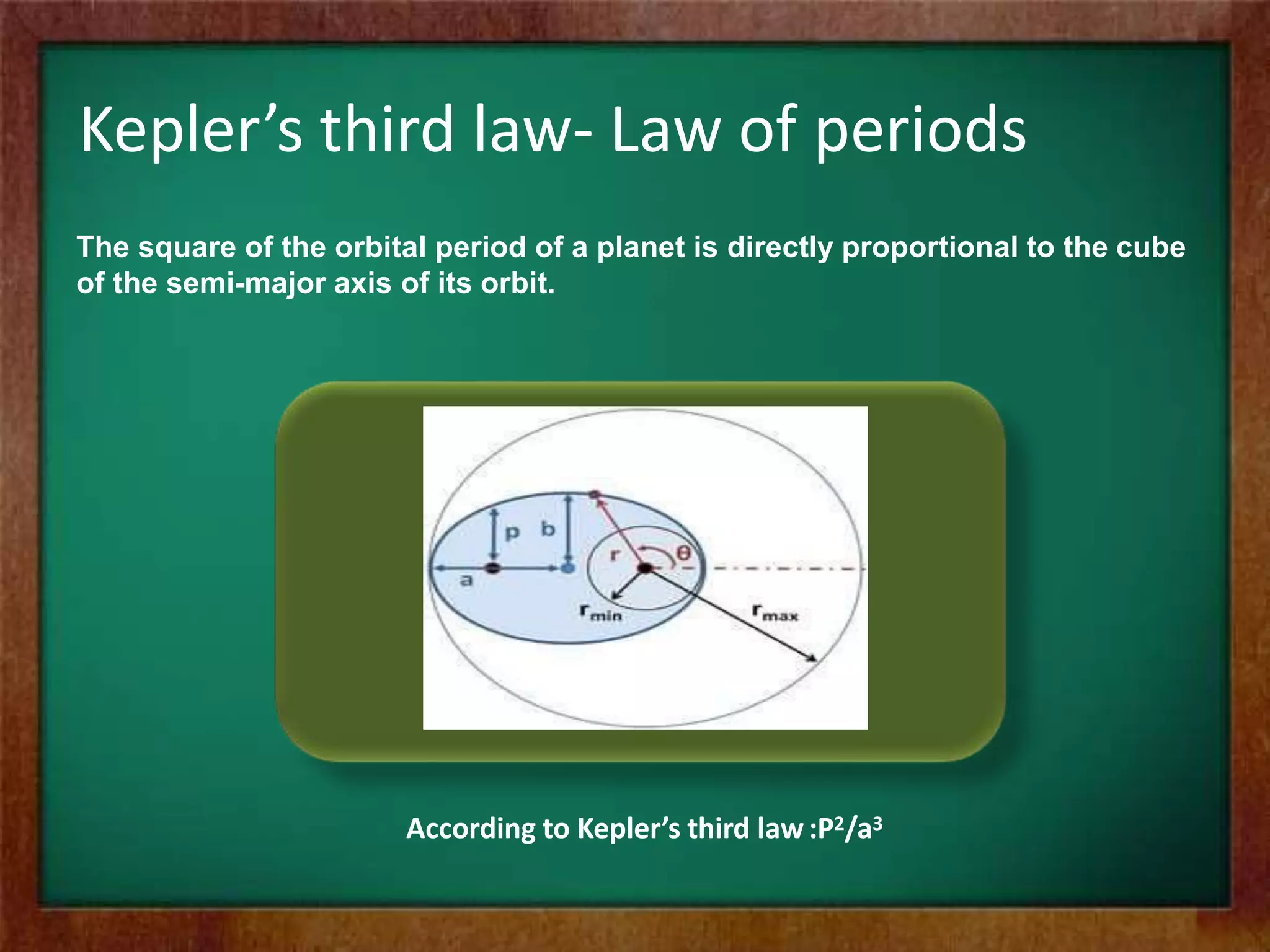
The square of the orbital period of a planet is directly proportional to the cube
of the semi-major axis of its orbit.
According to Kepler’s third law:P2/a3
Mathematical representation of
Kepler’s third law
P2/a3
‘P’ is the time taken for a planet to complete an orbit around the
sun
‘a’ is the mean value between the maximum and minimum
distances between the planet and sun
Contribution of Kepler’s law
 With the help of Kepler’s second law, Newton introduced the Law of
universal gravitation (Newton’s law of gravitation).
 Kepler’s laws are very useful in the study of planet orbit systems.
 These laws are also very important for satellite motion.
Newton’s law of universal gravitation
Newton's law of universal gravitation states that any two bodies in the universe attract
each other with a force that is directly proportional to the product of their masses and
inversely proportional to the square of the distance between them.
M
m
r
F= GmM
r2
Universalgravitational
constant
Mass of body1
Mass of body2
Distance between
two matter
Thanks

Keplar's laws of planetary motion Class 11 physics

  • 1.
    Kepler’s law ofplanetary motion Physics Project
  • 2.
  • 3.
    Johannes Kepler Johannes Keplerwas a German mathematician, astronomer, and astrologer. A key figure in the 17th century scientific revolution, he is best known for his laws of planetary motion, based on his works Astronomia nova, Harmonices Mundi, and Epitome of Copernican Astronomy. These works also provided one of the foundations for Isaac Newton's theory of universal gravitation.
  • 4.
    Keplers’s law ofplanetary motion In astronomy, Kepler's laws of planetary motion are three scientific laws describing the motion of planets around the Sun. Kepler's laws are now traditionally enumerated in this way.
  • 5.
    Three laws ofKepler Kepler’s first law- Law of orbit Kepler’s second law- Law of equal areas Kepler’s third law- Law of periods 1 2 3
  • 6.
    Kepler’s first law-Law of orbit Every planet revolves in an elliptical orbit around the sun. The orbit of every planet is an ellipse with the Sun at one of the two foci.
  • 7.
    Kepler’s second law-Law of equal area A line joining a planet and the Sun sweeps out equal areas during equal intervals of time.This law is known as Kepler’s second law.
  • 8.
    Kepler’s third law-Law of periods The square of the orbital period of a planet is directly proportional to the cube of the semi-major axis of its orbit. According to Kepler’s third law:P2/a3
  • 9.
    Mathematical representation of Kepler’sthird law P2/a3 ‘P’ is the time taken for a planet to complete an orbit around the sun ‘a’ is the mean value between the maximum and minimum distances between the planet and sun
  • 10.
    Contribution of Kepler’slaw  With the help of Kepler’s second law, Newton introduced the Law of universal gravitation (Newton’s law of gravitation).  Kepler’s laws are very useful in the study of planet orbit systems.  These laws are also very important for satellite motion.
  • 11.
    Newton’s law ofuniversal gravitation Newton's law of universal gravitation states that any two bodies in the universe attract each other with a force that is directly proportional to the product of their masses and inversely proportional to the square of the distance between them. M m r F= GmM r2 Universalgravitational constant Mass of body1 Mass of body2 Distance between two matter
  • 12.