MARS
JOHANNES KEPLER
THE SOLAR SYSTEM
MARS
JOHANNES KEPLER
THE SOLAR SYSTEM
LAWS OF PLANETARY MOTIONLAWS OF PLANETARY MOTION
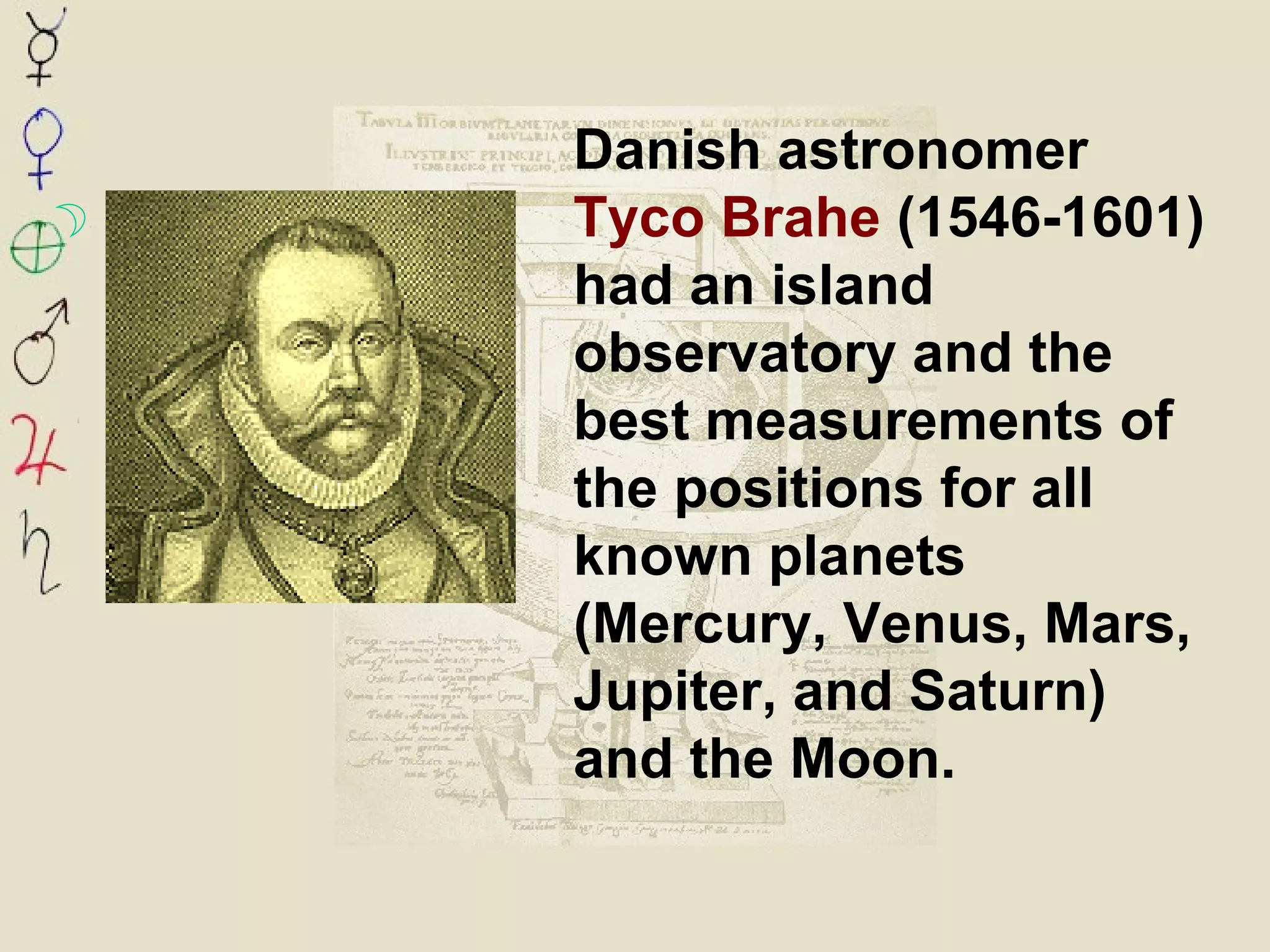
Danish astronomer
Tyco Brahe (1546-1601)
had an island
observatory and the
best measurements of
the positions for all
known planets
(Mercury, Venus, Mars,
Jupiter, and Saturn)
and the Moon.
Picture of Brahe
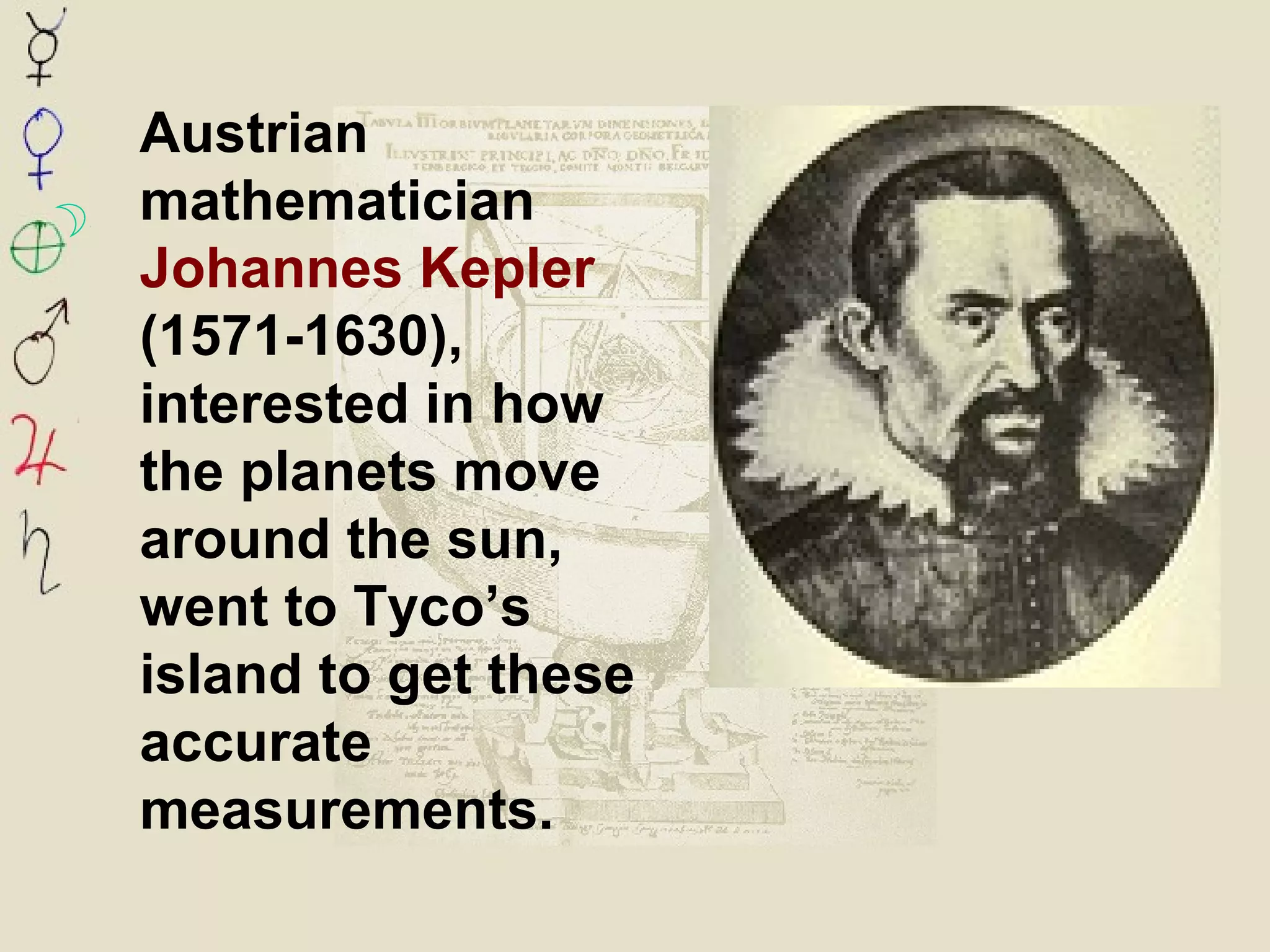
Austrian
mathematician
Johannes Kepler
(1571-1630),
interested in how
the planets move
around the sun,
went to Tyco’s
island to get these
accurate
measurements.
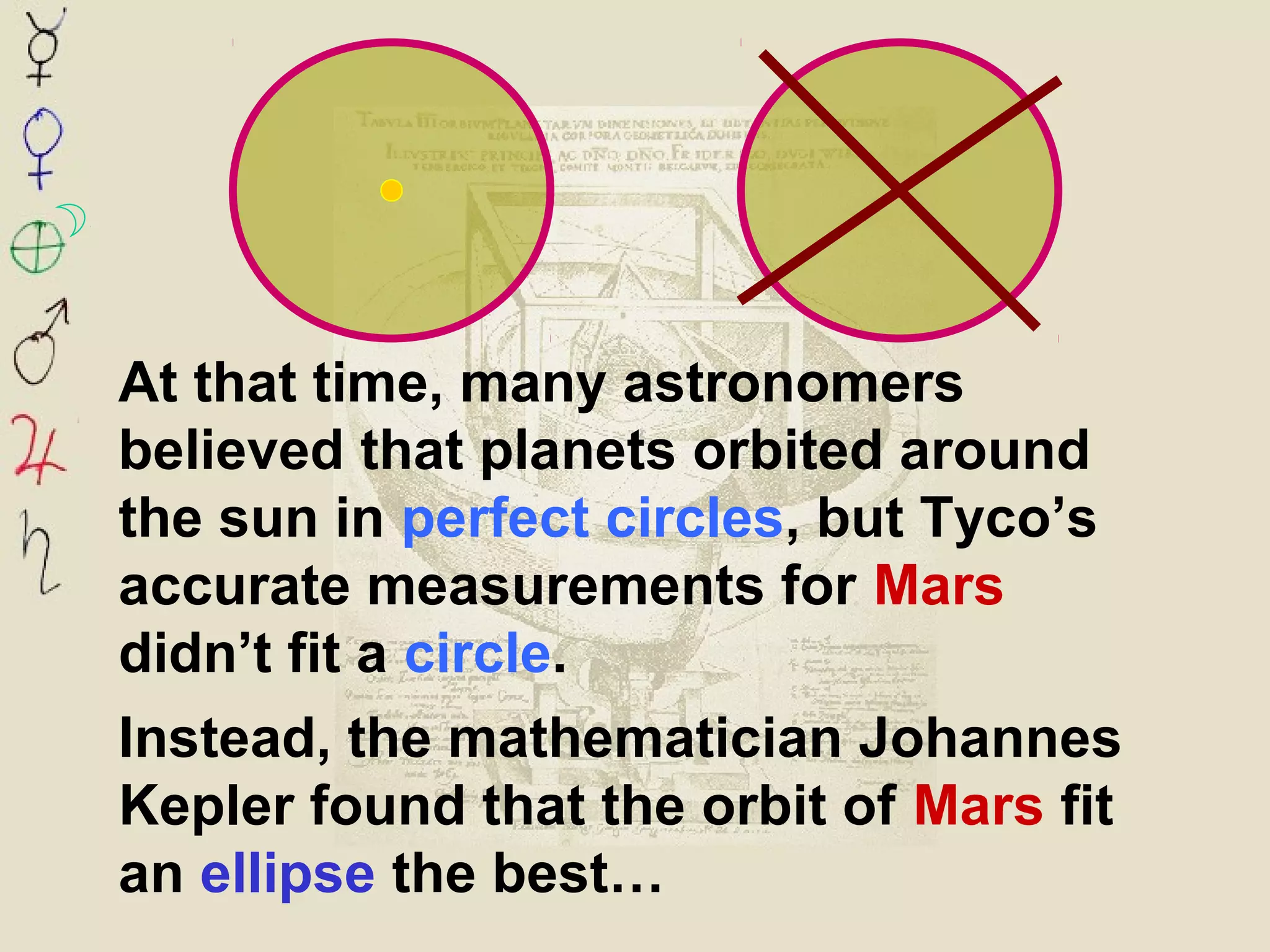
At that time, many astronomers
believed that planets orbited around
the sun in perfect circles, but Tyco’s
accurate measurements for Mars
didn’t fit a circle.
Instead, the mathematician Johannes
Kepler found that the orbit of Mars fit
an ellipse the best…
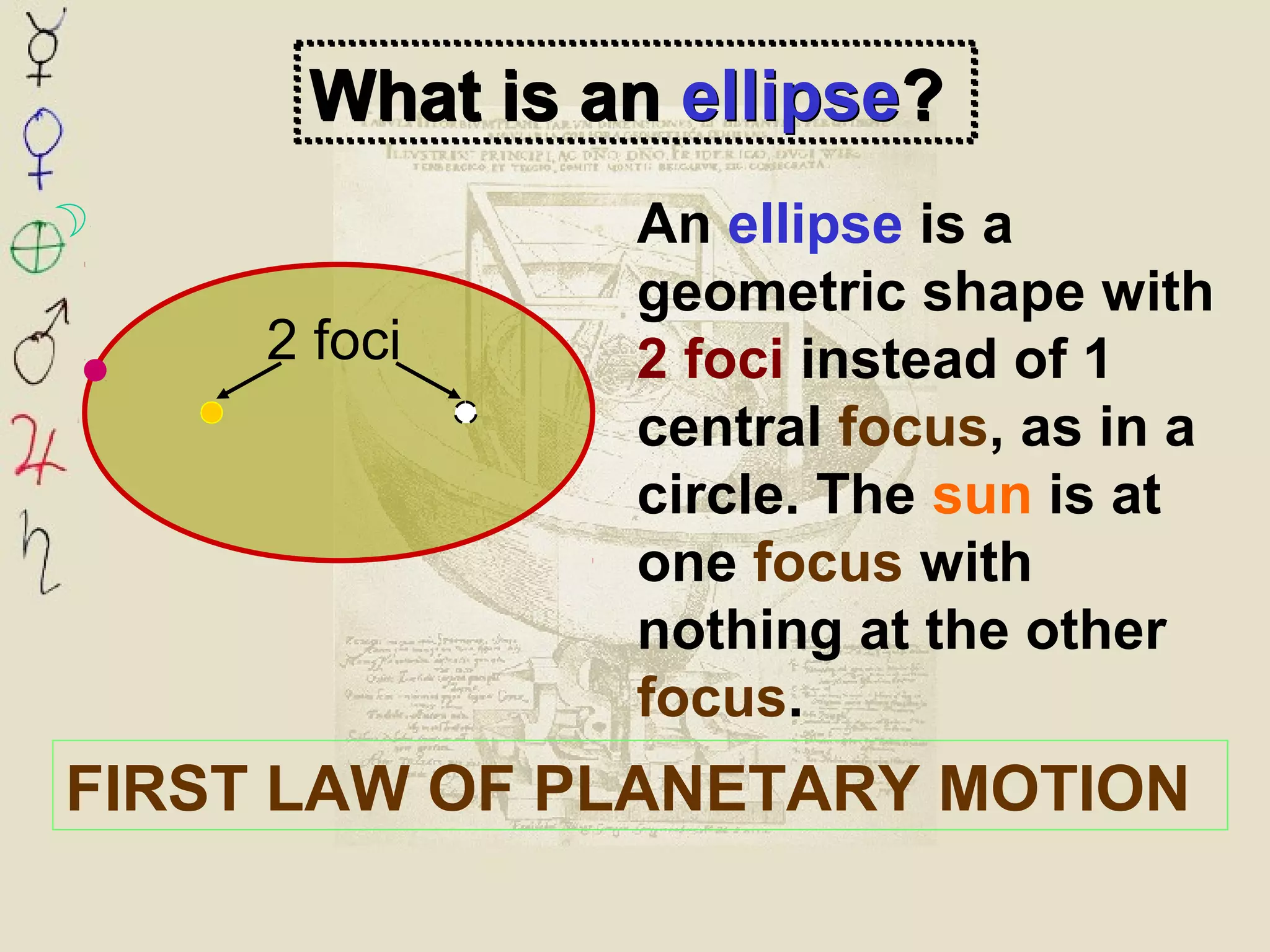
What is an ellipse?What is an ellipse?
2 foci
An ellipse is a
geometric shape with
2 foci instead of 1
central focus, as in a
circle. The sun is at
one focus with
nothing at the other
focus.
FIRST LAW OF PLANETARY MOTION
An ellipse also has…
…a major axis …and a minor axis
Semi-major axis
Perihelion Aphelion
Perihelion: When Mars or any another planet
is closest to the sun.
Aphelion: When Mars or any other planet is
farthest from the sun.
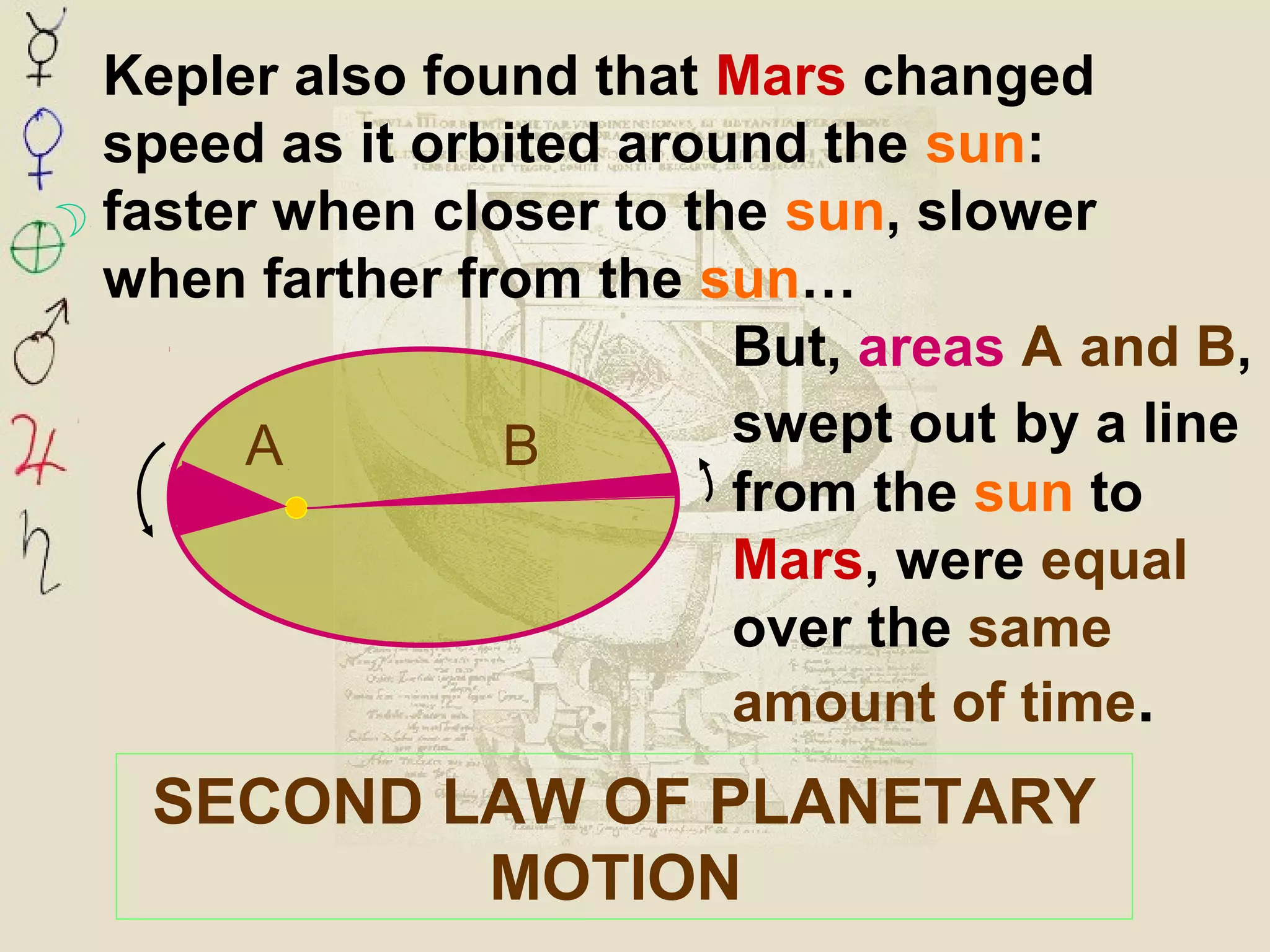
Kepler also found that Mars changed
speed as it orbited around the sun:
faster when closer to the sun, slower
when farther from the sun…
A B
But, areas A and B,
swept out by a line
from the sun to
Mars, were equal
over the same
amount of time.
SECOND LAW OF PLANETARY
MOTION
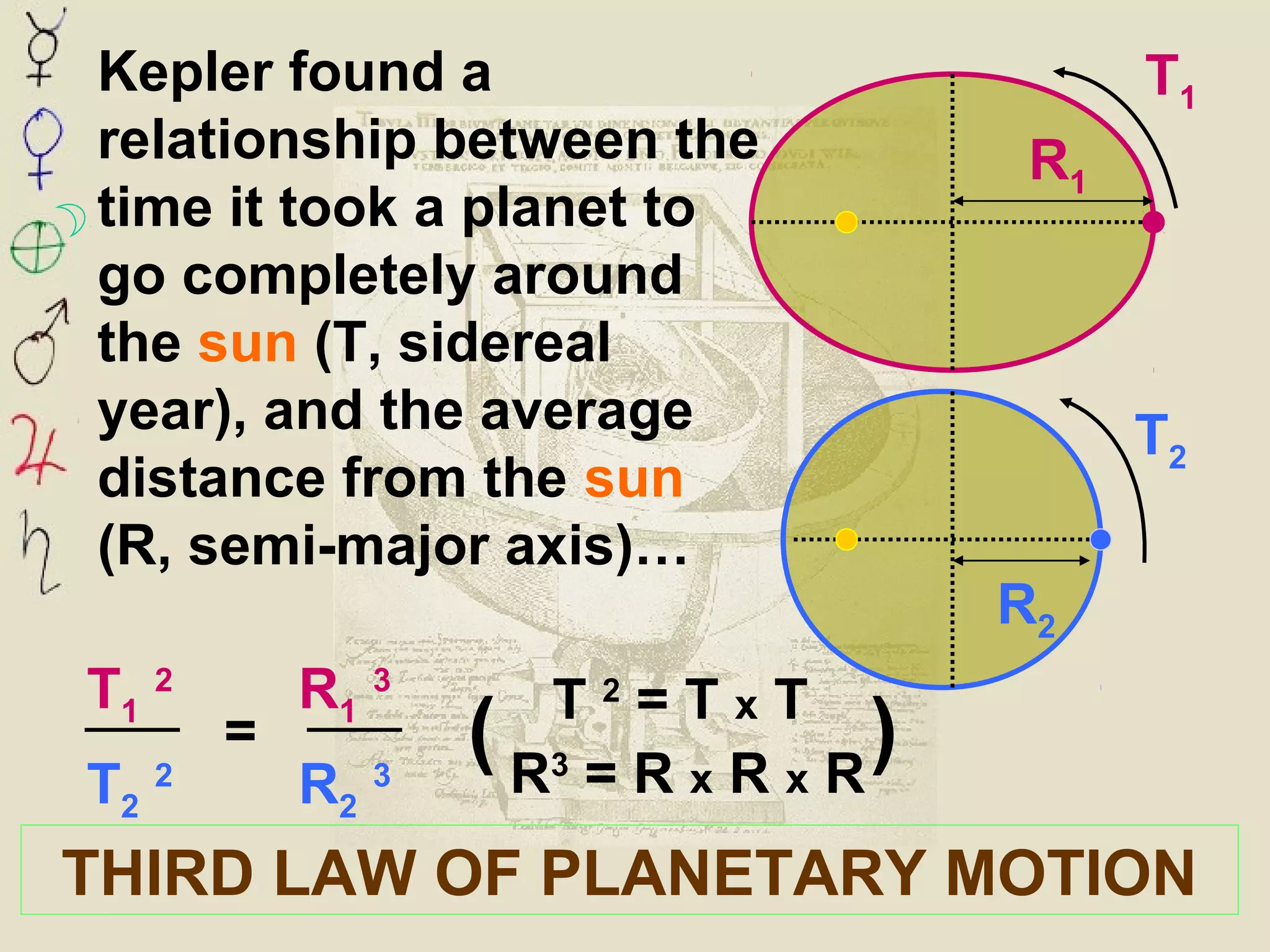
Kepler found a
relationship between the
time it took a planet to
go completely around
the sun (T, sidereal
year), and the average
distance from the sun
(R, semi-major axis)…
R1
R2
T1
T2
T1
2
R1
3
T2
2
R2
3
=
T 2
= T x T
R3
= R x R x R
( )
THIRD LAW OF PLANETARY MOTION
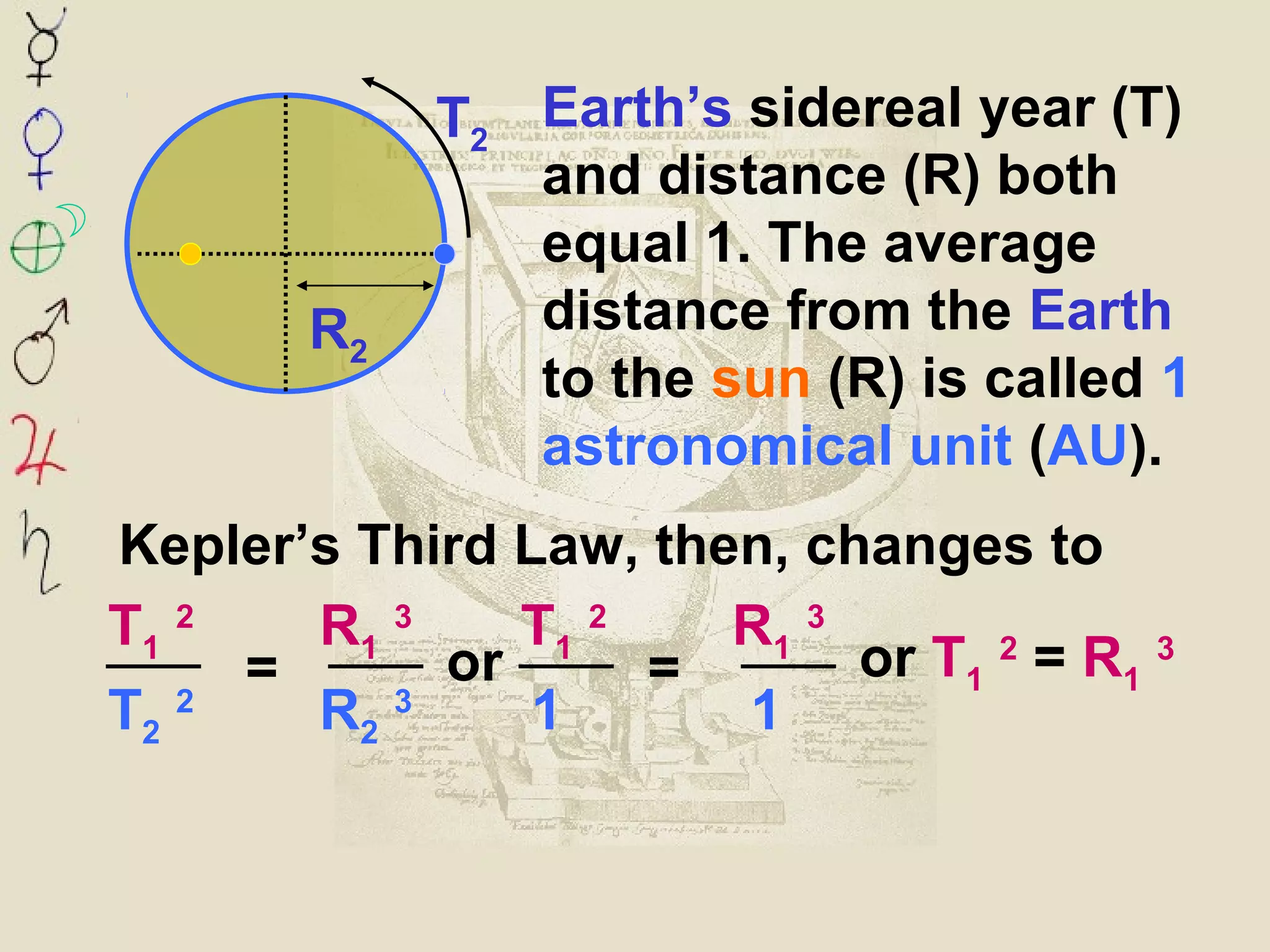
T2
R2
Earth’s sidereal year (T)
and distance (R) both
equal 1. The average
distance from the Earth
to the sun (R) is called 1
astronomical unit (AU).
Kepler’s Third Law, then, changes to
T1
2
R1
3
T1
2
R1
3
T2
2
R2
3
1 1
= =or or T1
2
= R1
3
Planet T(yrs) R(au) T2
R3
Venus 0.62 0.72 0.38 0.37
Earth 1.00 1.00 1.00 1.00
Mars 1.88 1.52 3.53 3.51
Jupiter 11.86 5.20 141 141
When we compare the orbits
of the planets…
We find that T2
and R3
are essentially equal.
Kepler’s Laws apply to any celestial
body orbiting any other celestial
body.
• Any planet around a sun
• The moon around the Earth
• Any satellite around the Earth
• The international space station
• Any rings around any planet
Later, Isaac Newton built upon Kepler’s Laws
to confirm his own Law of Gravitation.
THE RED PLANET MARS IS FOREVER
LINKED TO OUR UNDERSTANDING OF
THE SOLAR SYSTEM AND ONE OF THE
4 BASIC FORCES OF NATURE.
If it wasn’t for Mars and its complicated
travels across the night sky, Johannes
Kepler may not have derived his Laws of
Planetary Motion. Isaac Newton might not
have had a foundation for his Law of
Gravitation...

Kepler's laws of planetary motion

  • 1.
    MARS JOHANNES KEPLER THE SOLARSYSTEM MARS JOHANNES KEPLER THE SOLAR SYSTEM LAWS OF PLANETARY MOTIONLAWS OF PLANETARY MOTION
  • 2.
    Danish astronomer Tyco Brahe(1546-1601) had an island observatory and the best measurements of the positions for all known planets (Mercury, Venus, Mars, Jupiter, and Saturn) and the Moon. Picture of Brahe
  • 3.
    Austrian mathematician Johannes Kepler (1571-1630), interested inhow the planets move around the sun, went to Tyco’s island to get these accurate measurements.
  • 4.
    At that time,many astronomers believed that planets orbited around the sun in perfect circles, but Tyco’s accurate measurements for Mars didn’t fit a circle. Instead, the mathematician Johannes Kepler found that the orbit of Mars fit an ellipse the best…
  • 5.
    What is anellipse?What is an ellipse? 2 foci An ellipse is a geometric shape with 2 foci instead of 1 central focus, as in a circle. The sun is at one focus with nothing at the other focus. FIRST LAW OF PLANETARY MOTION
  • 6.
    An ellipse alsohas… …a major axis …and a minor axis Semi-major axis Perihelion Aphelion Perihelion: When Mars or any another planet is closest to the sun. Aphelion: When Mars or any other planet is farthest from the sun.
  • 7.
    Kepler also foundthat Mars changed speed as it orbited around the sun: faster when closer to the sun, slower when farther from the sun… A B But, areas A and B, swept out by a line from the sun to Mars, were equal over the same amount of time. SECOND LAW OF PLANETARY MOTION
  • 8.
    Kepler found a relationshipbetween the time it took a planet to go completely around the sun (T, sidereal year), and the average distance from the sun (R, semi-major axis)… R1 R2 T1 T2 T1 2 R1 3 T2 2 R2 3 = T 2 = T x T R3 = R x R x R ( ) THIRD LAW OF PLANETARY MOTION
  • 9.
    T2 R2 Earth’s sidereal year(T) and distance (R) both equal 1. The average distance from the Earth to the sun (R) is called 1 astronomical unit (AU). Kepler’s Third Law, then, changes to T1 2 R1 3 T1 2 R1 3 T2 2 R2 3 1 1 = =or or T1 2 = R1 3
  • 10.
    Planet T(yrs) R(au)T2 R3 Venus 0.62 0.72 0.38 0.37 Earth 1.00 1.00 1.00 1.00 Mars 1.88 1.52 3.53 3.51 Jupiter 11.86 5.20 141 141 When we compare the orbits of the planets… We find that T2 and R3 are essentially equal.
  • 11.
    Kepler’s Laws applyto any celestial body orbiting any other celestial body. • Any planet around a sun • The moon around the Earth • Any satellite around the Earth • The international space station • Any rings around any planet
  • 12.
    Later, Isaac Newtonbuilt upon Kepler’s Laws to confirm his own Law of Gravitation. THE RED PLANET MARS IS FOREVER LINKED TO OUR UNDERSTANDING OF THE SOLAR SYSTEM AND ONE OF THE 4 BASIC FORCES OF NATURE. If it wasn’t for Mars and its complicated travels across the night sky, Johannes Kepler may not have derived his Laws of Planetary Motion. Isaac Newton might not have had a foundation for his Law of Gravitation...