LEADERSHIP IS STEWARDSHIP
                   Understanding God’s Principles for Financial Stewardship

                  “if you have not been faithful in the use of *worldly wealth+,
                  Who will entrust the true riches to you?” (Luke 16: 11 NASB)


Leaders are stewards, not owners of god’s resources (I Corinthians 4: 1-2). We must both model
and teach God’s people about the stewardship of their time, talent and money. The purpose of
this study is to reach God’s financial principles in order to know Christ more intimately, be free
to serve him and to fund the Great Commission.

Because God cares for us He gave us guidelines for handling money. The Bible contains more
than 2, 350 verses dealing with money and possessions. Jesus taught more about money than
almost any other subject. He spoke of it in sixteen of His thirty-eight parables. We all
understand that money is a practical issue in life, but it is also a spiritual issue as we lead our
families and ministries. Where we put our money reveals much about our spiritual life. Jesus
said, “Where your treasure is, there your heart will be also” (Matthew 6:21).
The way we handle our money has an impact on how intimate our relationship is with Christ.
Money is a primary competitor with Christ for the lordship of our lives (Matthew 6:24). God
desires to exercise Lordship over all.. and that includes our finances.

In this session we will look at:
         Ownership versus stewardship
         Earning and budgeting
         Saving and giving
         Spending and teaching your people

Leadership, Ownership and Stewardship

It is important for leaders to recognize the difference between ownership and stewardship. God
is the owner. We are stewards. God maintains certain responsibilities and he has given other
responsibilities to us. Let’s examine the difference:


God’s Part

   1. God is the ___OWNER_________ of _____EVERYTHING___________. (Psalm 24:1)
   2. God is in ____CONTROL__________. (Psalm 135:6)
   3. God will provide for our ____NEEDS_______. (Philippians 4:19)
Our Part

    1. We are stewards of _GOD’S___________ possessions. (A steward is a manager of
       someone else’s possessions).
    2. We are to be ____FAITHFUL________. (I Corinthians 4:2)
    3. When we are faithful, we will ___BENEFIT______ in three ways:

        a. We will grow closer to Jesus Christ.
        b. We will develop godly character.
        c. We will begin to have financial stability.

                     John Wesley lived by these financial rules in the 18th Century:
                                                  Earn all you can.
                                                  Save all you can.
                                                  Give all you can.


Let’s use this as an outline for our discussion in this lesson.


_____Earn_________       ALL YOU CAN
The bible instructs us to work hard, as if we worked directly for the Lord ( Colossians 3:23-25). In
Proverbs 6:6-11, we are told to study a tiny bug the ant- to see a model for our work ethic. The ant
displays the following three characteristics:

    1. Initiative-The ant needs no ruler to tell it to work.
    2. Industry-The ant works hard preparing food for the future.
    3. Integrity-the ant does not labor for money or selfish gain.

    Earning all you can is not about setting a goal to make more money; It’s not about greed. In fact,
    Scripture warns us about greed. Timothy teaches that greed brings all kinds of snares, and that the
    love of money is the root of all sorts of evil (1 Timothy 6:9-10).


    To earn all you can and not be controlled by greed is essential. The key is contentment. Paul the
    Apostle wrote, “Now godliness actually is a means of great gain when accompanied by
    contentment.” (1 Timothy 6:6) So, how much can we accumulate as a Christian leader? What
    material possessions do we need to be content? The same Scripture provides an answer:

    “And if we have food and covering, with these we shall be content.” 1 Timothy 6:8
Earning all we can is about working hard. It’s also about earning more so we can invest it in the
needs of others. We’ll discuss this in more detail in the “Give All You Can” section of this lesson.

____Save___________ All You Can

Saving is about preparing for the future. Scripture encourages saving. Note the following
guidelines for saving money:

1.   Save only if you are also ________Giving___________.
2.   Save ___Regularly_________.
3.   Why save?
a.   Save for unexpected __Emergencies___________.
b.   Save for longer-term ______NEEDS_______.
c.   Save for major ___PURCHASES___________.
d.   Save for ____PLANNED GIVING_________(Future investing).


4. __AVOID__________ get- rich- quick- plans and gambling (Proverbs 28:22).

Budgeting Your Income
In order to save all you can, you will need to use a budget to manage your money. Using a budget is
simply telling your money where you want it to go, instead of guessing where it all went.

1. Develop and use a plan to control spending(Proverbs 27:23). Using a spending plan is a practical
   and wise way for you to control your spending patterns.

   Example: Sit down and plan your budget each year. Determine which needs should take priority
   in the budget, including any debt that you have. Next, establish how much money you can invest
   in each area before you spend anything. Write it down on paper and choose someone to hold
   you accountable to it.
2. Repay what is borrowed (Psalm 37:21). If you do have debt, include it in your budget so you can
   repay it as promptly as possible (Proverbs 3:2728).

   ____GIVE___________ All You Can
   The Scripture calls us to give generously. We are never more like God than when we’re giving. “
   For God so loved the world, that He gave…” Jesus celebrated those who gave sacrificially,
   beyond the call of duty. The following passages of Scripture encourage us to give.
1. Give to your ___Church_________ (Malachi 3:10; Matthew 23:23)
   Tithing is one tenth of your income: Hebrews 7:3,6; Proverbs 3:9-10
2. Give to other ___MINISTRIES________. (Matthew 10:42, Mark 10:29-30)
   This is investing in the Gospel above your regular gifts: Luke 6:38.
3. Give to the ___POOR__________. (Proverbs 19-17).
       This is sharing with people in need, as though they were Christ.

        In all three cases God considers our gifts as giving to Him! We are placing treasures in heaven.
        The bible teaches that giving is an investment in which God promises a return for you and for
        God’s kingdom.


        How Much Should We Give?
        We read about tithing in Malachi 3:8-10. Abraham (before the law of Moses) gave a
        tenth to Melchizedek, the priest of God. Mosaic law required tithes and offerings. The
        New Testament principle is to give generously; Jesus praised sacrificial giving. (Mark
        12:42-44). Both the Old and New Testaments teach we should give our first and best
        gifts to the Lord.


        Giving with the Right Attitude
        1.   Give out of a heart of love.(1 Corinthians 13:3, John 3:16)
        2.   Give cheerfully. (11 Corinthians 9:7)
        3.   Give to God first as an expression of priority. (Proverbs 3:9)
        4.   Give to God systematically.(11 Corinthians 8:1-4)
        5.   Give proportionately.(1 Corinthians 8:11-15)
        6.   Give regardless of your circumstances.(Philippians 4:10-19)
        7.   Give strategically- maximum Kingdom impact.(Matthew 6:19-21)

        The Blessing of Giving
             1.   Giving __DRAWS OUR HEART__________ toward Christ.
             2.   Giving _____DEVELOPS GODLY CHARACTER__________ and makes us like Jesus.
             3.   Giving allows us to put our ___TREASURES IN HEAVEN____________.
             4.   Giving can produce a ___MATERIAL INCREASE__________ to the giver.


All Remove __DEBT________ as Fast as You Can
John Wesley didn’t include debt in his financial rules, but we feel it is a valid and important issue to
address in the 21st Century. For leaders, debt can be a distraction, causing us to lose focus. It can also be
a burden, sapping our strength from our ministry. Furthermore it can become like a chain, limiting our
options and slowing us down.
The bible doesn’t say borrowing is sin, but it does discourage it. Debt is money or possessions which one
person is obligated to pay to another. It includes money owed to banks, friends, relatives, credit
companies and other financial institutions.


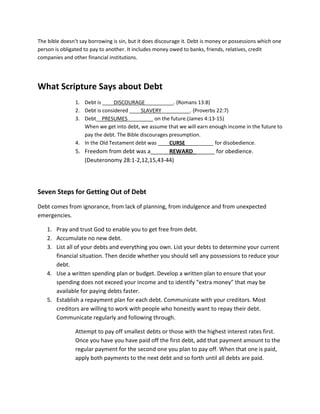
What Scripture Says about Debt
                1. Debt is ____DISCOURAGE__________. (Romans 13:8)
                2. Debt is considered ____SLAVERY__________. (Proverbs 22:7)
                3. Debt__PRESUMES_________ on the future.(James 4:13-15)
                   When we get into debt, we assume that we will earn enough income in the future to
                   pay the debt. The Bible discourages presumption.
                4. In the Old Testament debt was ____CURSE__________ for disobedience.
                5. Freedom from debt was a______REWARD_______ for obedience.
                   (Deuteronomy 28:1-2,12,15,43-44)


Seven Steps for Getting Out of Debt
Debt comes from ignorance, from lack of planning, from indulgence and from unexpected
emergencies.

    1. Pray and trust God to enable you to get free from debt.
    2. Accumulate no new debt.
    3. List all of your debts and everything you own. List your debts to determine your current
       financial situation. Then decide whether you should sell any possessions to reduce your
       debt.
    4. Use a written spending plan or budget. Develop a written plan to ensure that your
       spending does not exceed your income and to identify “extra money” that may be
       available for paying debts faster.
    5. Establish a repayment plan for each debt. Communicate with your creditors. Most
       creditors are willing to work with people who honestly want to repay their debt.
       Communicate regularly and following through.

                Attempt to pay off smallest debts or those with the highest interest rates first.
                Once you have you have paid off the first debt, add that payment amount to the
                regular payment for the second one you plan to pay off. When that one is paid,
                apply both payments to the next debt and so forth until all debts are paid.
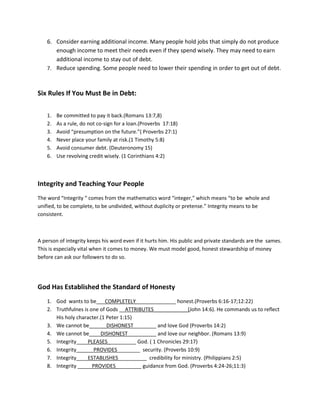
6. Consider earning additional income. Many people hold jobs that simply do not produce
       enough income to meet their needs even if they spend wisely. They may need to earn
       additional income to stay out of debt.
    7. Reduce spending. Some people need to lower their spending in order to get out of debt .


Six Rules If You Must Be in Debt:

    1.   Be committed to pay it back.(Romans 13:7,8)
    2.   As a rule, do not co-sign for a loan.(Proverbs 17:18)
    3.   Avoid “presumption on the future.”( Proverbs 27:1)
    4.   Never place your family at risk.(1 Timothy 5:8)
    5.   Avoid consumer debt. (Deuteronomy 15)
    6.   Use revolving credit wisely. (1 Corinthians 4:2)


Integrity and Teaching Your People
The word “Integrity “ comes from the mathematics word “integer,” which means “to be whole and
unified, to be complete, to be undivided, without duplicity or pretense.” Integrity means to be
consistent.


A person of integrity keeps his word even if it hurts him. His public and private standards are the sames.
This is especially vital when it comes to money. We must model good, honest stewardship of money
before can ask our followers to do so.


God Has Established the Standard of Honesty
    1. God wants to be___COMPLETELY______________ honest.(Proverbs 6:16-17;12:22)
    2. Truthfulnes is one of Gods __ATTRIBUTES____________(John 14:6). He commands us to reflect
       His holy character.(1 Peter 1:15)
    3. We cannot be______DISHONEST________ and love God (Proverbs 14:2)
    4. We cannot be____DISHONEST__________ and love our neighbor. (Romans 13:9)
    5. Integrity____PLEASES__________ God. ( 1 Chronicles 29:17)
    6. Integrity______PROVIDES________ security. (Proverbs 10:9)
    7. Integrity____ESTABLISHES__________ credibility for ministry. (Philippians 2:5)
    8. Integrity _____PROVIDES_________ guidance from God. (Proverbs 4:24-26;11:3)
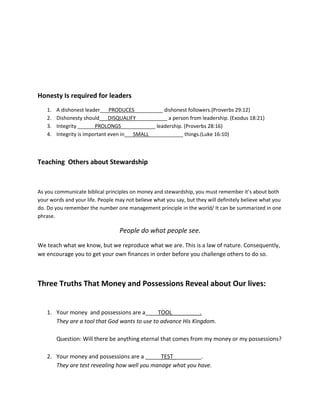
Honesty Is required for leaders
    1.   A dishonest leader___PRODUCES__________ dishonest followers.(Proverbs 29:12)
    2.   Dishonesty should___DISQUALIFY___________ a person from leadership. (Exodus 18:21)
    3.   Integrity ______PROLONGS____________ leadership. (Proverbs 28:16)
    4.   Integrity is important even in___SMALL____________ things.(Luke 16:10)


Teaching Others about Stewardship


As you communicate biblical principles on money and stewardship, you must remember it’s about both
your words and your life. People may not believe what you say, but they will definitely believe what you
do. Do you remember the number one management principle in the world/ It can be summarized in one
phrase.

                                  People do what people see.
We teach what we know, but we reproduce what we are. This is a law of nature. Consequently,
we encourage you to get your own finances in order before you challenge others to do so.


Three Truths That Money and Possessions Reveal about Our lives:


    1. Your money and possessions are a____TOOL_________.
       They are a tool that God wants to use to advance His Kingdom.

         Question: Will there be anything eternal that comes from my money or my possessions?

    2. Your money and possessions are a _____TEST_________.
       They are test revealing how well you manage what you have.
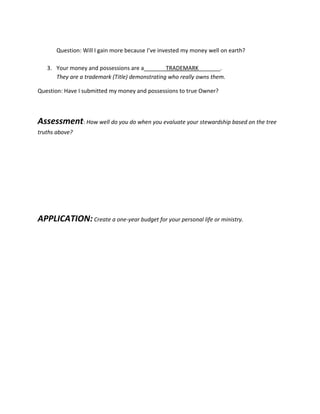
Question: Will I gain more because I’ve invested my money well on earth?

   3. Your money and possessions are a_______TRADEMARK_______.
      They are a trademark (Title) demonstrating who really owns them.

Question: Have I submitted my money and possessions to true Owner?


Assessment: How well do you do when you evaluate your stewardship based on the tree
truths above?


APPLICATION: Create a one-year budget for your personal life or ministry.

Kent philip neri(1styear high.)

  • 1.
    LEADERSHIP IS STEWARDSHIP Understanding God’s Principles for Financial Stewardship “if you have not been faithful in the use of *worldly wealth+, Who will entrust the true riches to you?” (Luke 16: 11 NASB) Leaders are stewards, not owners of god’s resources (I Corinthians 4: 1-2). We must both model and teach God’s people about the stewardship of their time, talent and money. The purpose of this study is to reach God’s financial principles in order to know Christ more intimately, be free to serve him and to fund the Great Commission. Because God cares for us He gave us guidelines for handling money. The Bible contains more than 2, 350 verses dealing with money and possessions. Jesus taught more about money than almost any other subject. He spoke of it in sixteen of His thirty-eight parables. We all understand that money is a practical issue in life, but it is also a spiritual issue as we lead our families and ministries. Where we put our money reveals much about our spiritual life. Jesus said, “Where your treasure is, there your heart will be also” (Matthew 6:21). The way we handle our money has an impact on how intimate our relationship is with Christ. Money is a primary competitor with Christ for the lordship of our lives (Matthew 6:24). God desires to exercise Lordship over all.. and that includes our finances. In this session we will look at: Ownership versus stewardship Earning and budgeting Saving and giving Spending and teaching your people Leadership, Ownership and Stewardship It is important for leaders to recognize the difference between ownership and stewardship. God is the owner. We are stewards. God maintains certain responsibilities and he has given other responsibilities to us. Let’s examine the difference: God’s Part 1. God is the ___OWNER_________ of _____EVERYTHING___________. (Psalm 24:1) 2. God is in ____CONTROL__________. (Psalm 135:6) 3. God will provide for our ____NEEDS_______. (Philippians 4:19)
  • 2.
    Our Part 1. We are stewards of _GOD’S___________ possessions. (A steward is a manager of someone else’s possessions). 2. We are to be ____FAITHFUL________. (I Corinthians 4:2) 3. When we are faithful, we will ___BENEFIT______ in three ways: a. We will grow closer to Jesus Christ. b. We will develop godly character. c. We will begin to have financial stability. John Wesley lived by these financial rules in the 18th Century: Earn all you can. Save all you can. Give all you can. Let’s use this as an outline for our discussion in this lesson. _____Earn_________ ALL YOU CAN The bible instructs us to work hard, as if we worked directly for the Lord ( Colossians 3:23-25). In Proverbs 6:6-11, we are told to study a tiny bug the ant- to see a model for our work ethic. The ant displays the following three characteristics: 1. Initiative-The ant needs no ruler to tell it to work. 2. Industry-The ant works hard preparing food for the future. 3. Integrity-the ant does not labor for money or selfish gain. Earning all you can is not about setting a goal to make more money; It’s not about greed. In fact, Scripture warns us about greed. Timothy teaches that greed brings all kinds of snares, and that the love of money is the root of all sorts of evil (1 Timothy 6:9-10). To earn all you can and not be controlled by greed is essential. The key is contentment. Paul the Apostle wrote, “Now godliness actually is a means of great gain when accompanied by contentment.” (1 Timothy 6:6) So, how much can we accumulate as a Christian leader? What material possessions do we need to be content? The same Scripture provides an answer: “And if we have food and covering, with these we shall be content.” 1 Timothy 6:8
  • 3.
    Earning all wecan is about working hard. It’s also about earning more so we can invest it in the needs of others. We’ll discuss this in more detail in the “Give All You Can” section of this lesson. ____Save___________ All You Can Saving is about preparing for the future. Scripture encourages saving. Note the following guidelines for saving money: 1. Save only if you are also ________Giving___________. 2. Save ___Regularly_________. 3. Why save? a. Save for unexpected __Emergencies___________. b. Save for longer-term ______NEEDS_______. c. Save for major ___PURCHASES___________. d. Save for ____PLANNED GIVING_________(Future investing). 4. __AVOID__________ get- rich- quick- plans and gambling (Proverbs 28:22). Budgeting Your Income In order to save all you can, you will need to use a budget to manage your money. Using a budget is simply telling your money where you want it to go, instead of guessing where it all went. 1. Develop and use a plan to control spending(Proverbs 27:23). Using a spending plan is a practical and wise way for you to control your spending patterns. Example: Sit down and plan your budget each year. Determine which needs should take priority in the budget, including any debt that you have. Next, establish how much money you can invest in each area before you spend anything. Write it down on paper and choose someone to hold you accountable to it. 2. Repay what is borrowed (Psalm 37:21). If you do have debt, include it in your budget so you can repay it as promptly as possible (Proverbs 3:2728). ____GIVE___________ All You Can The Scripture calls us to give generously. We are never more like God than when we’re giving. “ For God so loved the world, that He gave…” Jesus celebrated those who gave sacrificially, beyond the call of duty. The following passages of Scripture encourage us to give. 1. Give to your ___Church_________ (Malachi 3:10; Matthew 23:23) Tithing is one tenth of your income: Hebrews 7:3,6; Proverbs 3:9-10 2. Give to other ___MINISTRIES________. (Matthew 10:42, Mark 10:29-30) This is investing in the Gospel above your regular gifts: Luke 6:38.
  • 4.
    3. Give tothe ___POOR__________. (Proverbs 19-17). This is sharing with people in need, as though they were Christ. In all three cases God considers our gifts as giving to Him! We are placing treasures in heaven. The bible teaches that giving is an investment in which God promises a return for you and for God’s kingdom. How Much Should We Give? We read about tithing in Malachi 3:8-10. Abraham (before the law of Moses) gave a tenth to Melchizedek, the priest of God. Mosaic law required tithes and offerings. The New Testament principle is to give generously; Jesus praised sacrificial giving. (Mark 12:42-44). Both the Old and New Testaments teach we should give our first and best gifts to the Lord. Giving with the Right Attitude 1. Give out of a heart of love.(1 Corinthians 13:3, John 3:16) 2. Give cheerfully. (11 Corinthians 9:7) 3. Give to God first as an expression of priority. (Proverbs 3:9) 4. Give to God systematically.(11 Corinthians 8:1-4) 5. Give proportionately.(1 Corinthians 8:11-15) 6. Give regardless of your circumstances.(Philippians 4:10-19) 7. Give strategically- maximum Kingdom impact.(Matthew 6:19-21) The Blessing of Giving 1. Giving __DRAWS OUR HEART__________ toward Christ. 2. Giving _____DEVELOPS GODLY CHARACTER__________ and makes us like Jesus. 3. Giving allows us to put our ___TREASURES IN HEAVEN____________. 4. Giving can produce a ___MATERIAL INCREASE__________ to the giver. All Remove __DEBT________ as Fast as You Can John Wesley didn’t include debt in his financial rules, but we feel it is a valid and important issue to address in the 21st Century. For leaders, debt can be a distraction, causing us to lose focus. It can also be a burden, sapping our strength from our ministry. Furthermore it can become like a chain, limiting our options and slowing us down.
  • 5.
    The bible doesn’tsay borrowing is sin, but it does discourage it. Debt is money or possessions which one person is obligated to pay to another. It includes money owed to banks, friends, relatives, credit companies and other financial institutions. What Scripture Says about Debt 1. Debt is ____DISCOURAGE__________. (Romans 13:8) 2. Debt is considered ____SLAVERY__________. (Proverbs 22:7) 3. Debt__PRESUMES_________ on the future.(James 4:13-15) When we get into debt, we assume that we will earn enough income in the future to pay the debt. The Bible discourages presumption. 4. In the Old Testament debt was ____CURSE__________ for disobedience. 5. Freedom from debt was a______REWARD_______ for obedience. (Deuteronomy 28:1-2,12,15,43-44) Seven Steps for Getting Out of Debt Debt comes from ignorance, from lack of planning, from indulgence and from unexpected emergencies. 1. Pray and trust God to enable you to get free from debt. 2. Accumulate no new debt. 3. List all of your debts and everything you own. List your debts to determine your current financial situation. Then decide whether you should sell any possessions to reduce your debt. 4. Use a written spending plan or budget. Develop a written plan to ensure that your spending does not exceed your income and to identify “extra money” that may be available for paying debts faster. 5. Establish a repayment plan for each debt. Communicate with your creditors. Most creditors are willing to work with people who honestly want to repay their debt. Communicate regularly and following through. Attempt to pay off smallest debts or those with the highest interest rates first. Once you have you have paid off the first debt, add that payment amount to the regular payment for the second one you plan to pay off. When that one is paid, apply both payments to the next debt and so forth until all debts are paid.
  • 6.
    6. Consider earningadditional income. Many people hold jobs that simply do not produce enough income to meet their needs even if they spend wisely. They may need to earn additional income to stay out of debt. 7. Reduce spending. Some people need to lower their spending in order to get out of debt . Six Rules If You Must Be in Debt: 1. Be committed to pay it back.(Romans 13:7,8) 2. As a rule, do not co-sign for a loan.(Proverbs 17:18) 3. Avoid “presumption on the future.”( Proverbs 27:1) 4. Never place your family at risk.(1 Timothy 5:8) 5. Avoid consumer debt. (Deuteronomy 15) 6. Use revolving credit wisely. (1 Corinthians 4:2) Integrity and Teaching Your People The word “Integrity “ comes from the mathematics word “integer,” which means “to be whole and unified, to be complete, to be undivided, without duplicity or pretense.” Integrity means to be consistent. A person of integrity keeps his word even if it hurts him. His public and private standards are the sames. This is especially vital when it comes to money. We must model good, honest stewardship of money before can ask our followers to do so. God Has Established the Standard of Honesty 1. God wants to be___COMPLETELY______________ honest.(Proverbs 6:16-17;12:22) 2. Truthfulnes is one of Gods __ATTRIBUTES____________(John 14:6). He commands us to reflect His holy character.(1 Peter 1:15) 3. We cannot be______DISHONEST________ and love God (Proverbs 14:2) 4. We cannot be____DISHONEST__________ and love our neighbor. (Romans 13:9) 5. Integrity____PLEASES__________ God. ( 1 Chronicles 29:17) 6. Integrity______PROVIDES________ security. (Proverbs 10:9) 7. Integrity____ESTABLISHES__________ credibility for ministry. (Philippians 2:5) 8. Integrity _____PROVIDES_________ guidance from God. (Proverbs 4:24-26;11:3)
  • 7.
    Honesty Is requiredfor leaders 1. A dishonest leader___PRODUCES__________ dishonest followers.(Proverbs 29:12) 2. Dishonesty should___DISQUALIFY___________ a person from leadership. (Exodus 18:21) 3. Integrity ______PROLONGS____________ leadership. (Proverbs 28:16) 4. Integrity is important even in___SMALL____________ things.(Luke 16:10) Teaching Others about Stewardship As you communicate biblical principles on money and stewardship, you must remember it’s about both your words and your life. People may not believe what you say, but they will definitely believe what you do. Do you remember the number one management principle in the world/ It can be summarized in one phrase. People do what people see. We teach what we know, but we reproduce what we are. This is a law of nature. Consequently, we encourage you to get your own finances in order before you challenge others to do so. Three Truths That Money and Possessions Reveal about Our lives: 1. Your money and possessions are a____TOOL_________. They are a tool that God wants to use to advance His Kingdom. Question: Will there be anything eternal that comes from my money or my possessions? 2. Your money and possessions are a _____TEST_________. They are test revealing how well you manage what you have.
  • 8.
    Question: Will Igain more because I’ve invested my money well on earth? 3. Your money and possessions are a_______TRADEMARK_______. They are a trademark (Title) demonstrating who really owns them. Question: Have I submitted my money and possessions to true Owner? Assessment: How well do you do when you evaluate your stewardship based on the tree truths above? APPLICATION: Create a one-year budget for your personal life or ministry.