Katalon Studio
GUI Overview
Toolbar
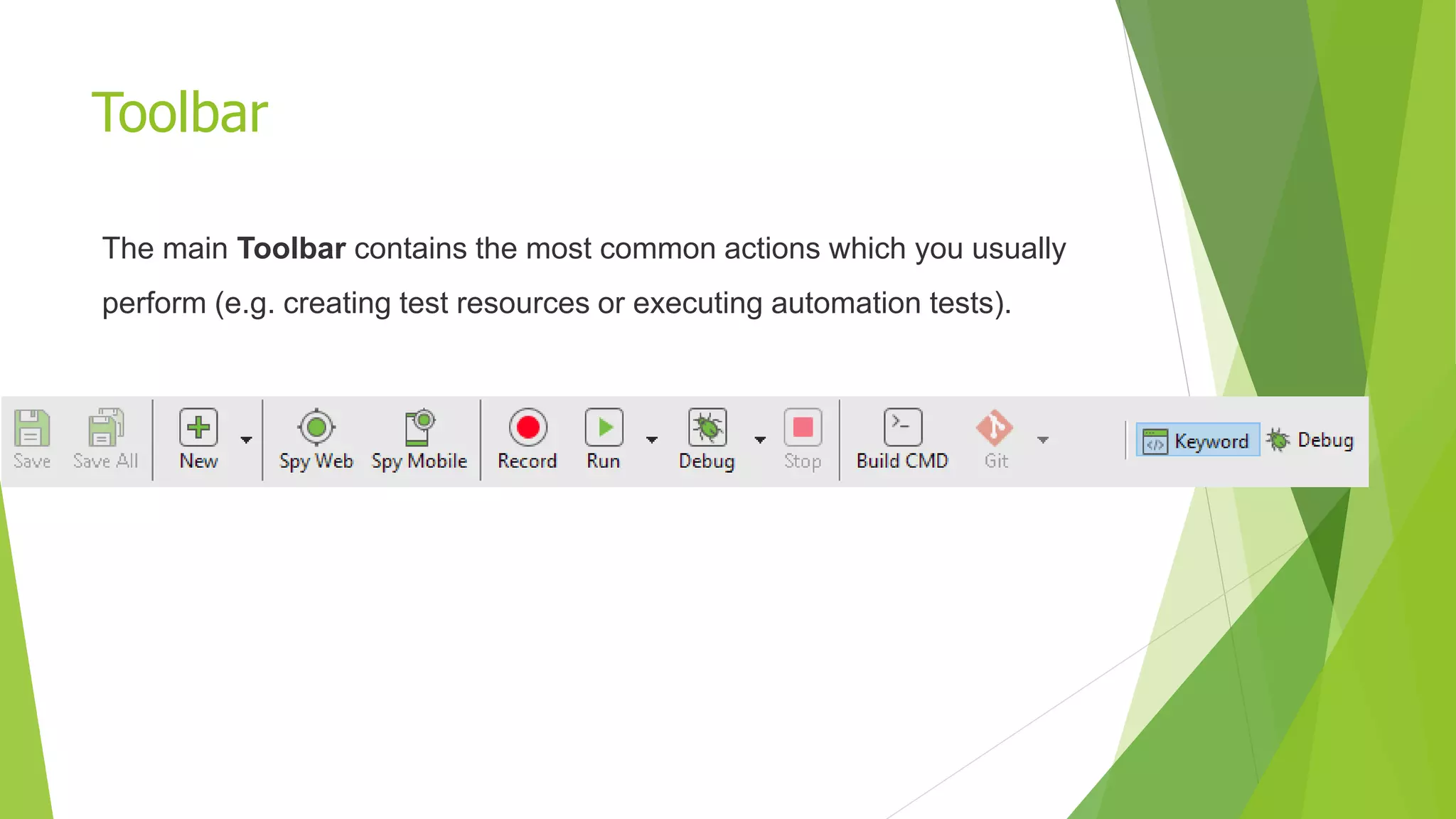
The main Toolbar contains the most common actions which you usually
perform (e.g. creating test resources or executing automation tests).
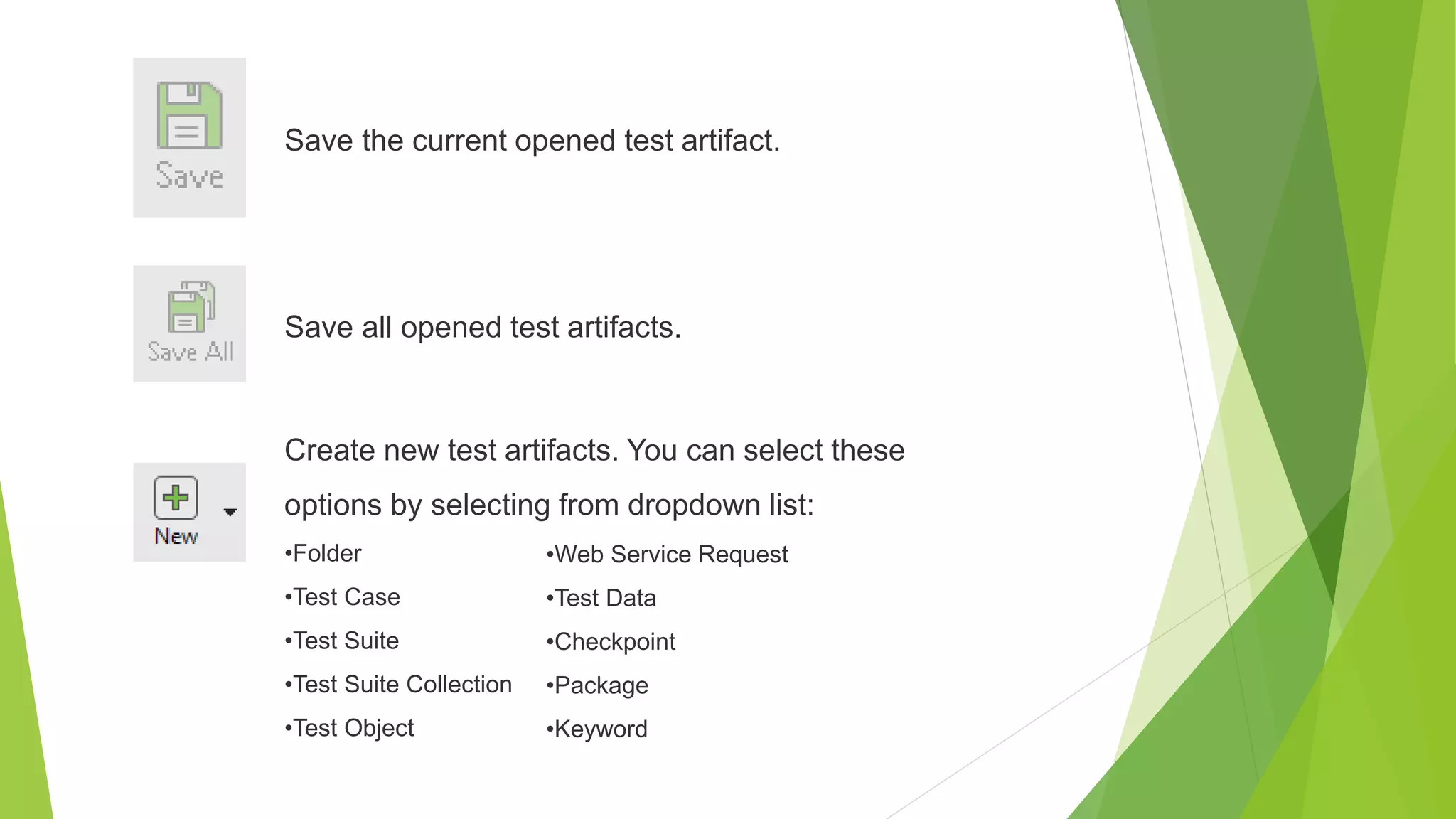
Save the current opened test artifact.
Save all opened test artifacts.
Create new test artifacts. You can select these
options by selecting from dropdown list:
•Folder
•Test Case
•Test Suite
•Test Suite Collection
•Test Object
•Web Service Request
•Test Data
•Checkpoint
•Package
•Keyword
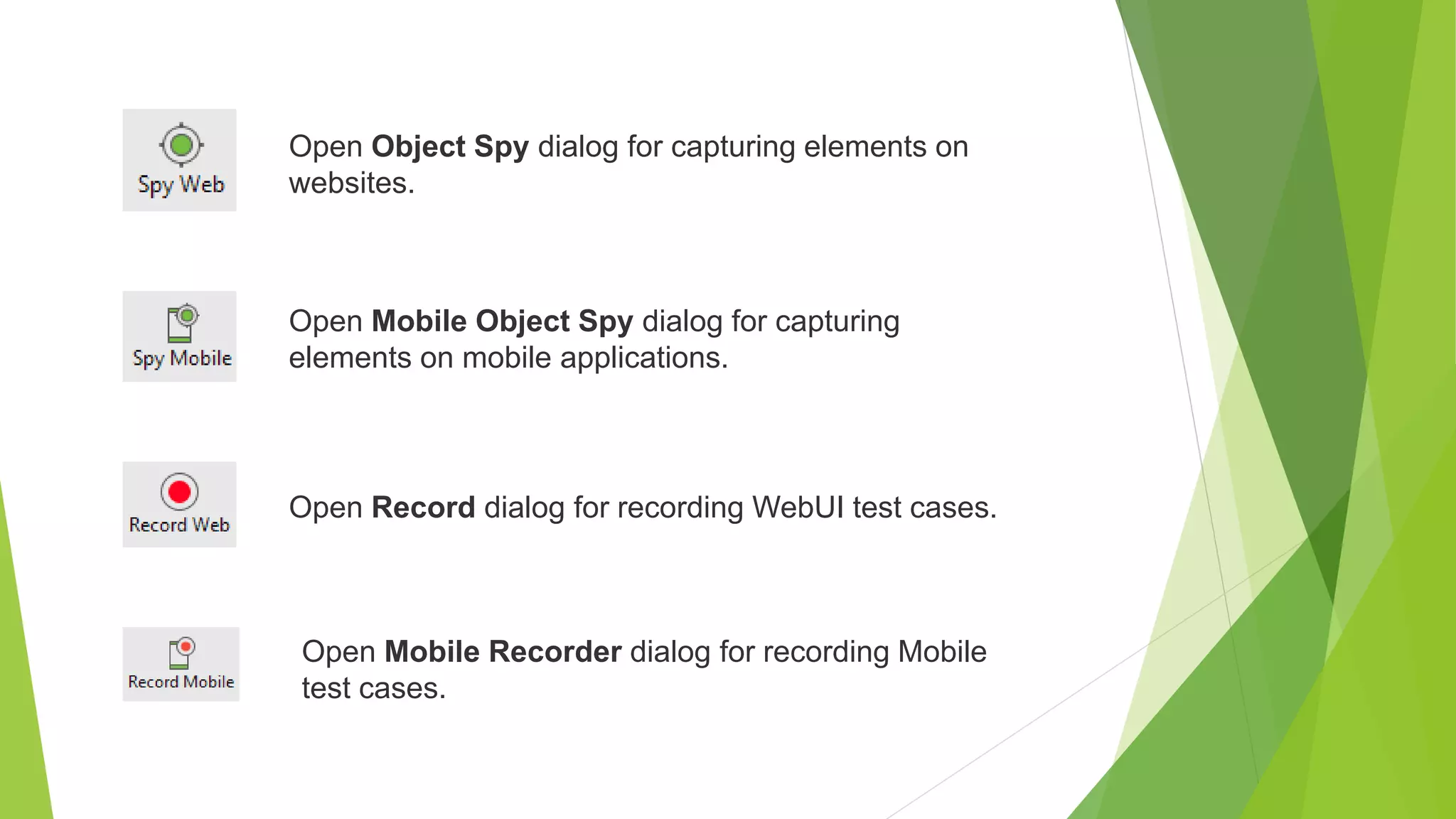
Open Object Spy dialog for capturing elements on
websites.
Open Mobile Object Spy dialog for capturing
elements on mobile applications.
Open Record dialog for recording WebUI test cases.
Open Mobile Recorder dialog for recording Mobile
test cases.
Run the current open test case. You can select these
options by selecting from dropdown list:
•Chrome
•Firefox
•IE
•Safari
•Edge
•Remote
•Headless
•Android
•iOS (on macOS)
•Custom
Debug the current open test case. You can select these
options by selecting from dropdownlist:
•Chrome
•Firefox
•IE
•Safari
•Edge
•Remote
•Headless
•Android
•iOS (on macOS)
•Custom
Stop the current execution
Open Command Builder for generating commands for
console execution
Command for Git activities. You can select these options
by selecting from dropdownlist (after enabling Git):
•Clone Project
•Share Project
•Show History
•Manage Branches
•Commit
•Push
•Pull
•Fetch
Tests Explorer View
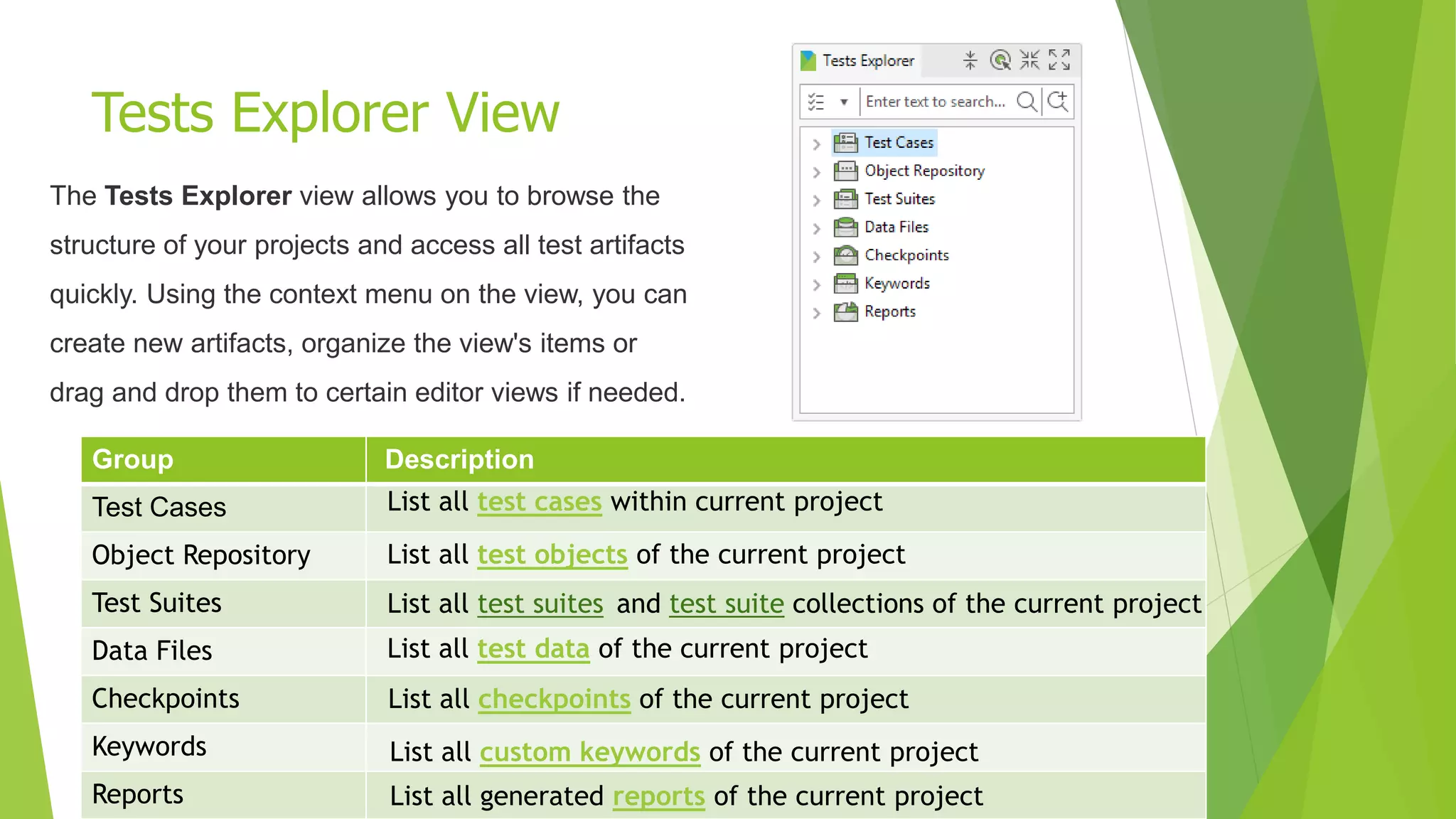
The Tests Explorer view allows you to browse the
structure of your projects and access all test artifacts
quickly. Using the context menu on the view, you can
create new artifacts, organize the view's items or
drag and drop them to certain editor views if needed.
Group Description
Test Cases
Object Repository
Test Suites
Data Files
Checkpoints
Keywords
Reports
List all test cases within current project
List all test objects of the current project
List all test suites and test suite collections of the current project
List all test data of the current project
List all checkpoints of the current project
List all custom keywords of the current project
List all generated reports of the current project
Keywords Browser View
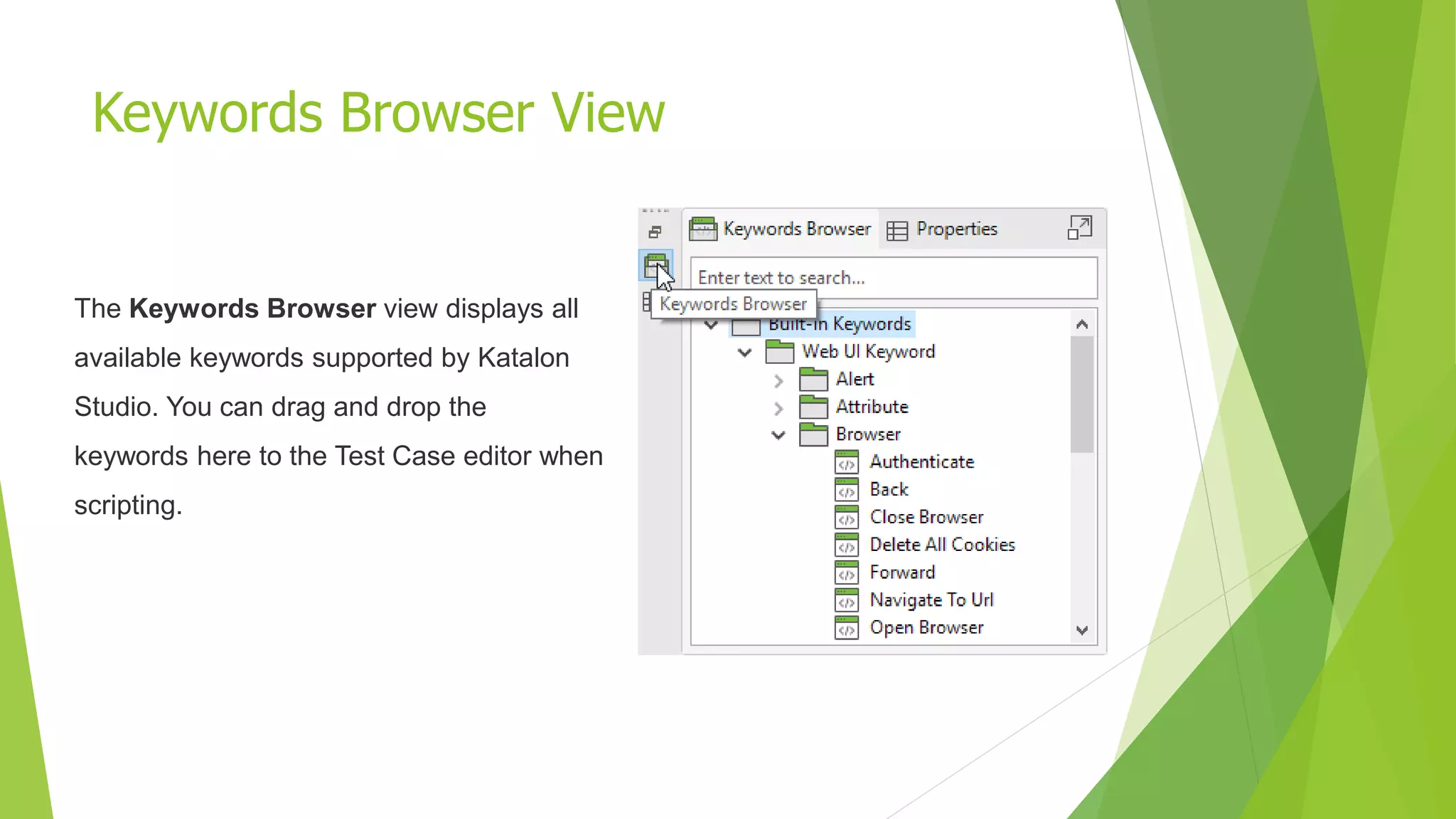
The Keywords Browser view displays all
available keywords supported by Katalon
Studio. You can drag and drop the
keywords here to the Test Case editor when
scripting.
Editors
Test Case Editors
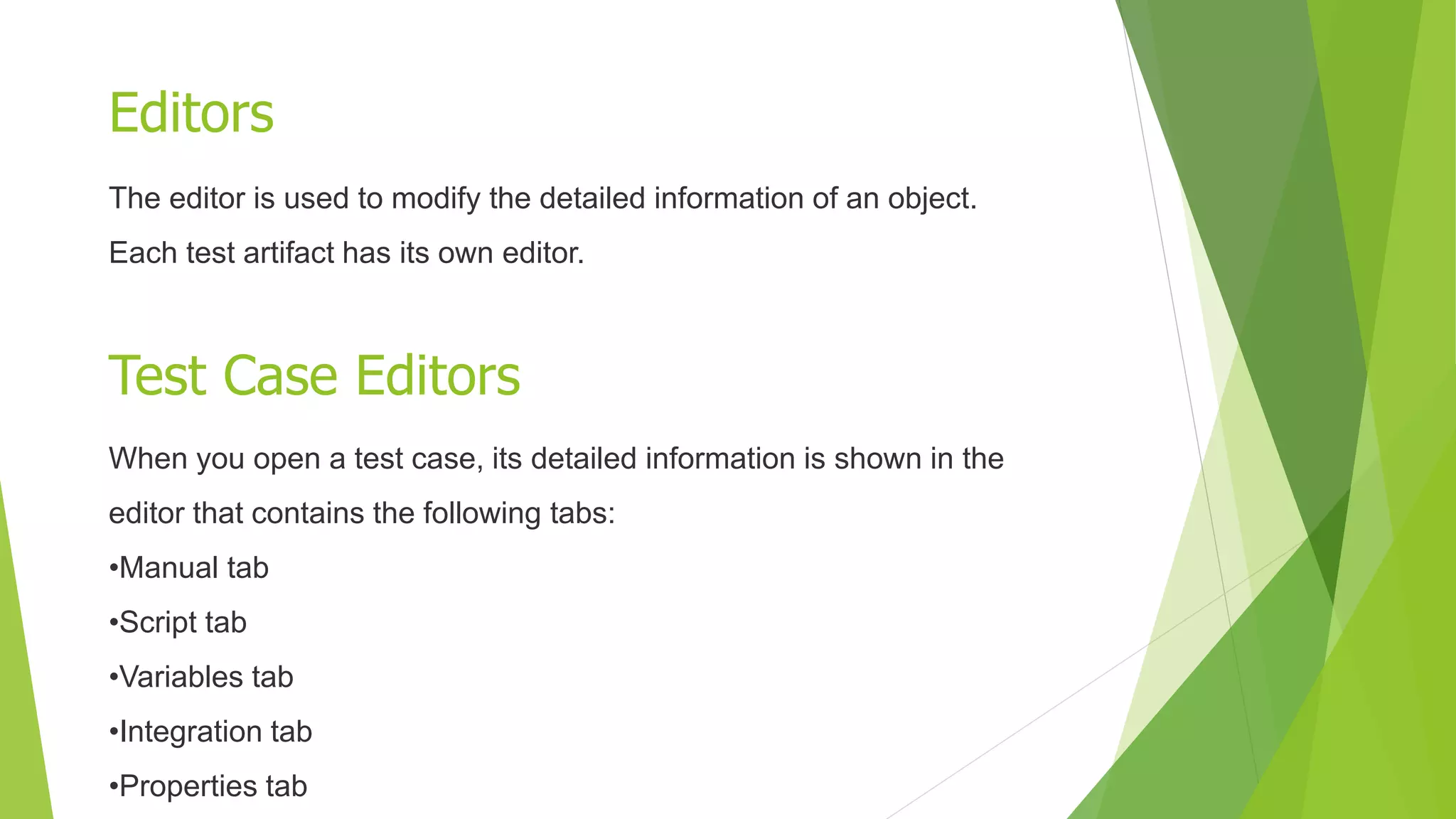
The editor is used to modify the detailed information of an object.
Each test artifact has its own editor.
When you open a test case, its detailed information is shown in the
editor that contains the following tabs:
•Manual tab
•Script tab
•Variables tab
•Integration tab
•Properties tab
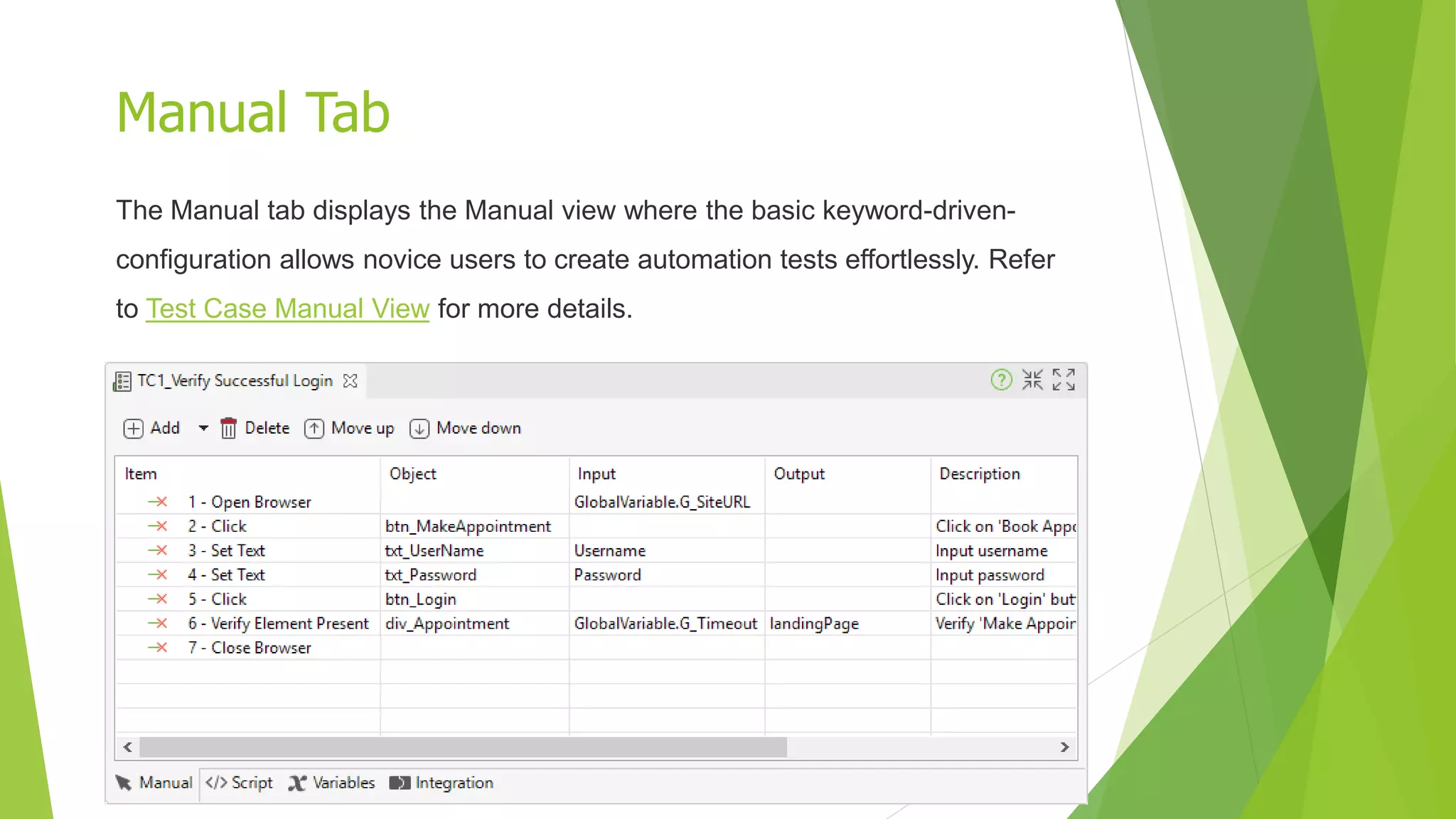
Manual Tab
The Manual tab displays the Manual view where the basic keyword-driven-
configuration allows novice users to create automation tests effortlessly. Refer
to Test Case Manual View for more details.
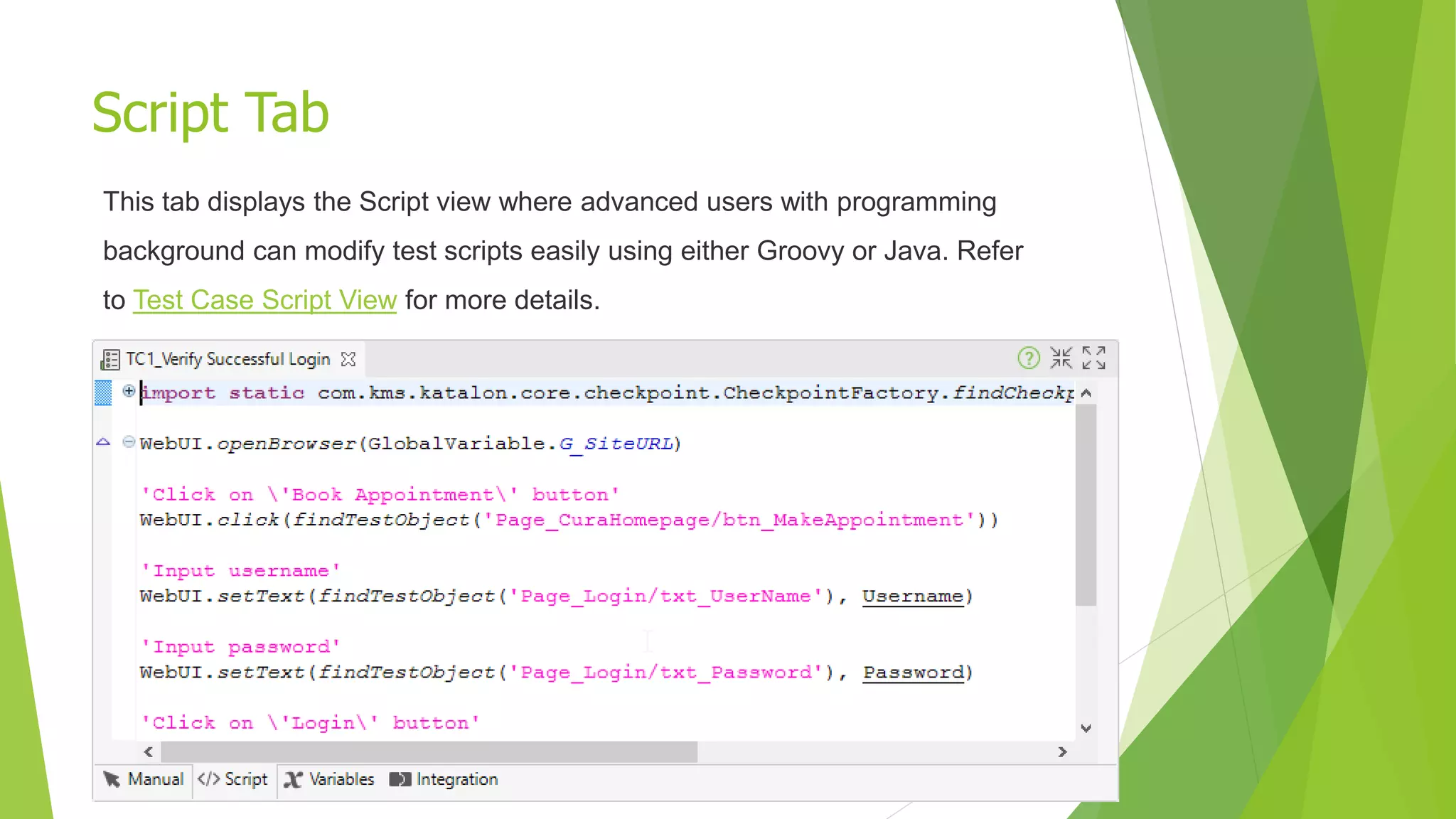
Script Tab
This tab displays the Script view where advanced users with programming
background can modify test scripts easily using either Groovy or Java. Refer
to Test Case Script View for more details.
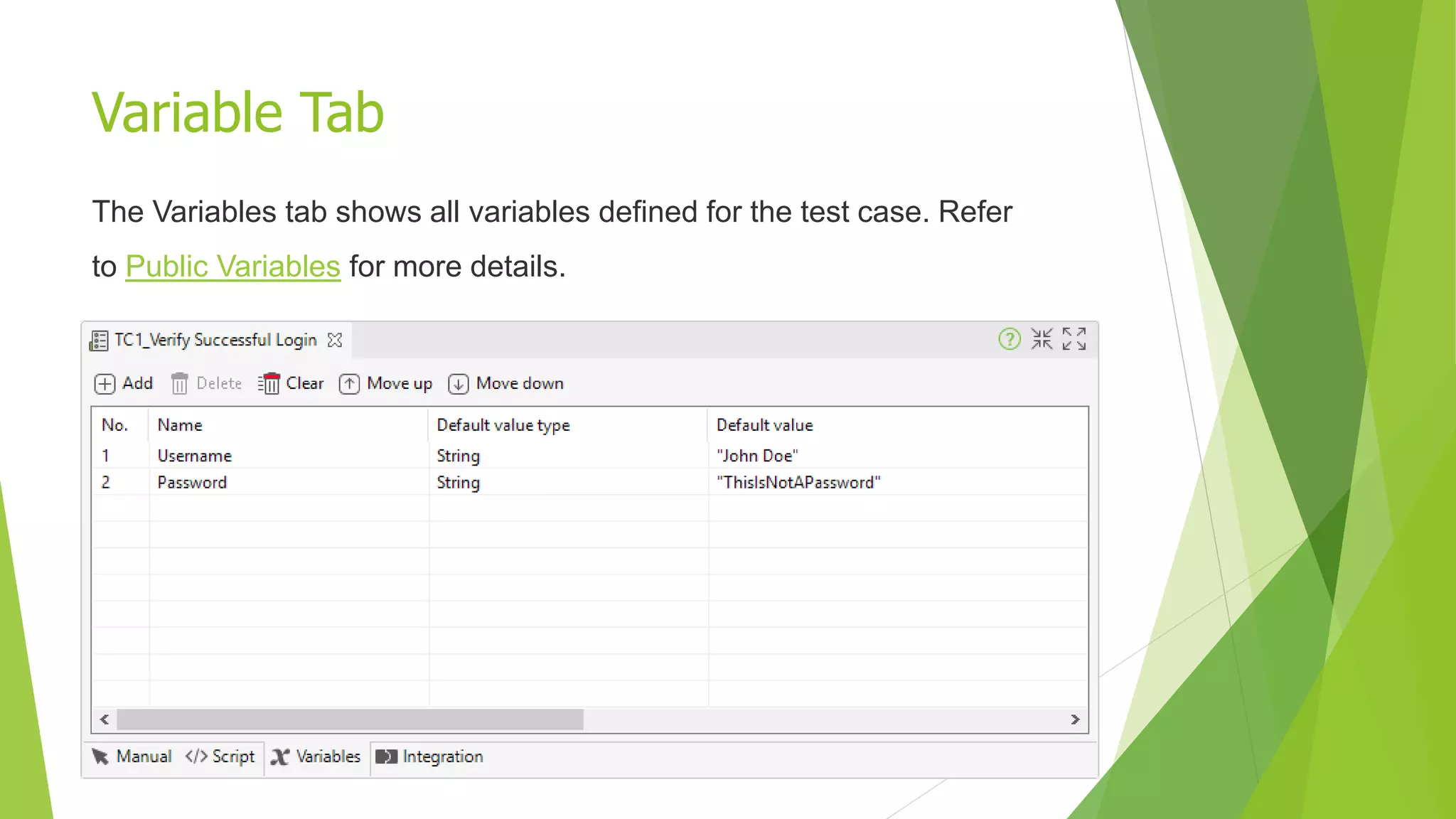
Variable Tab
The Variables tab shows all variables defined for the test case. Refer
to Public Variables for more details.
Integration Tab
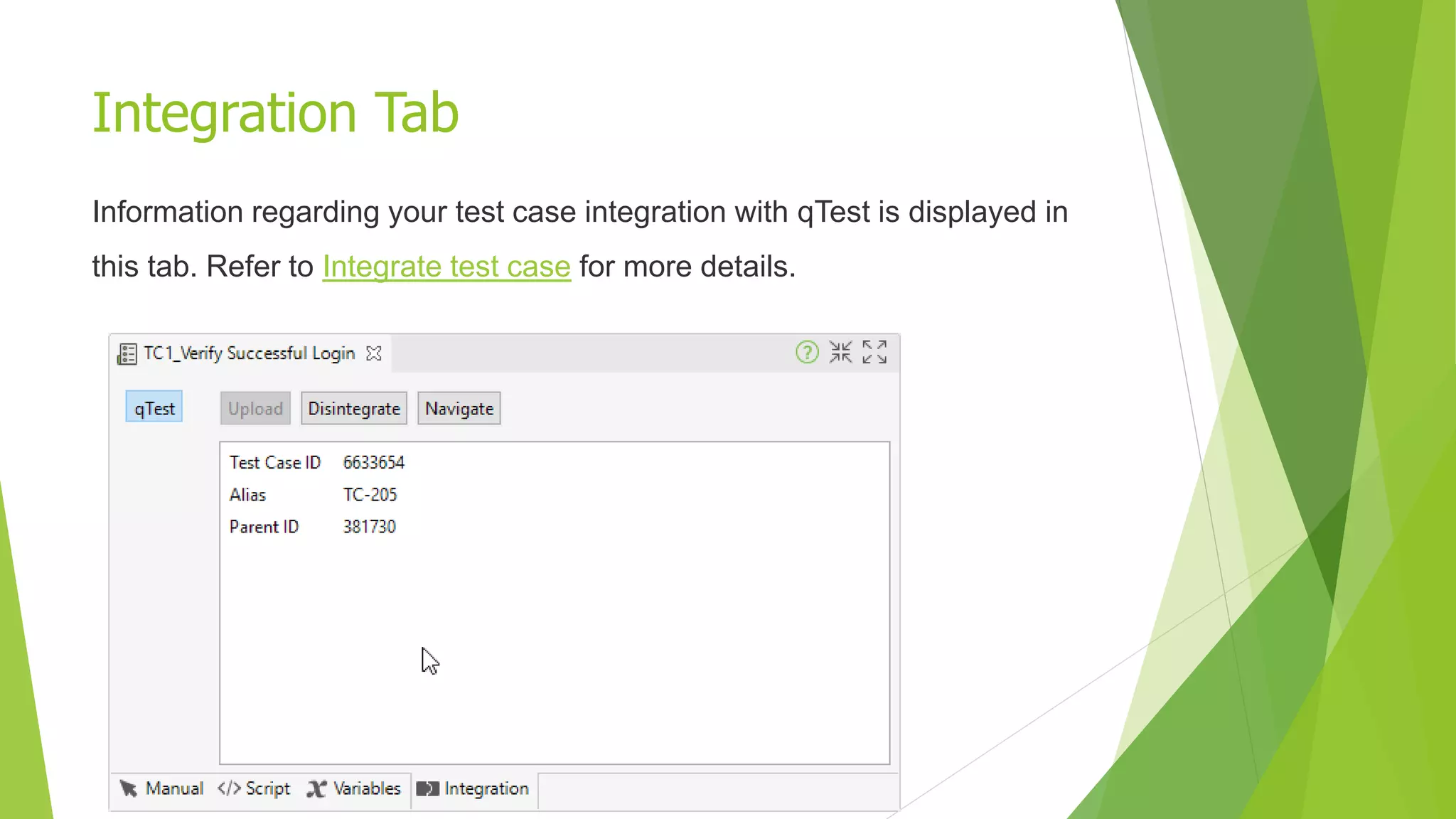
Information regarding your test case integration with qTest is displayed in
this tab. Refer to Integrate test case for more details.
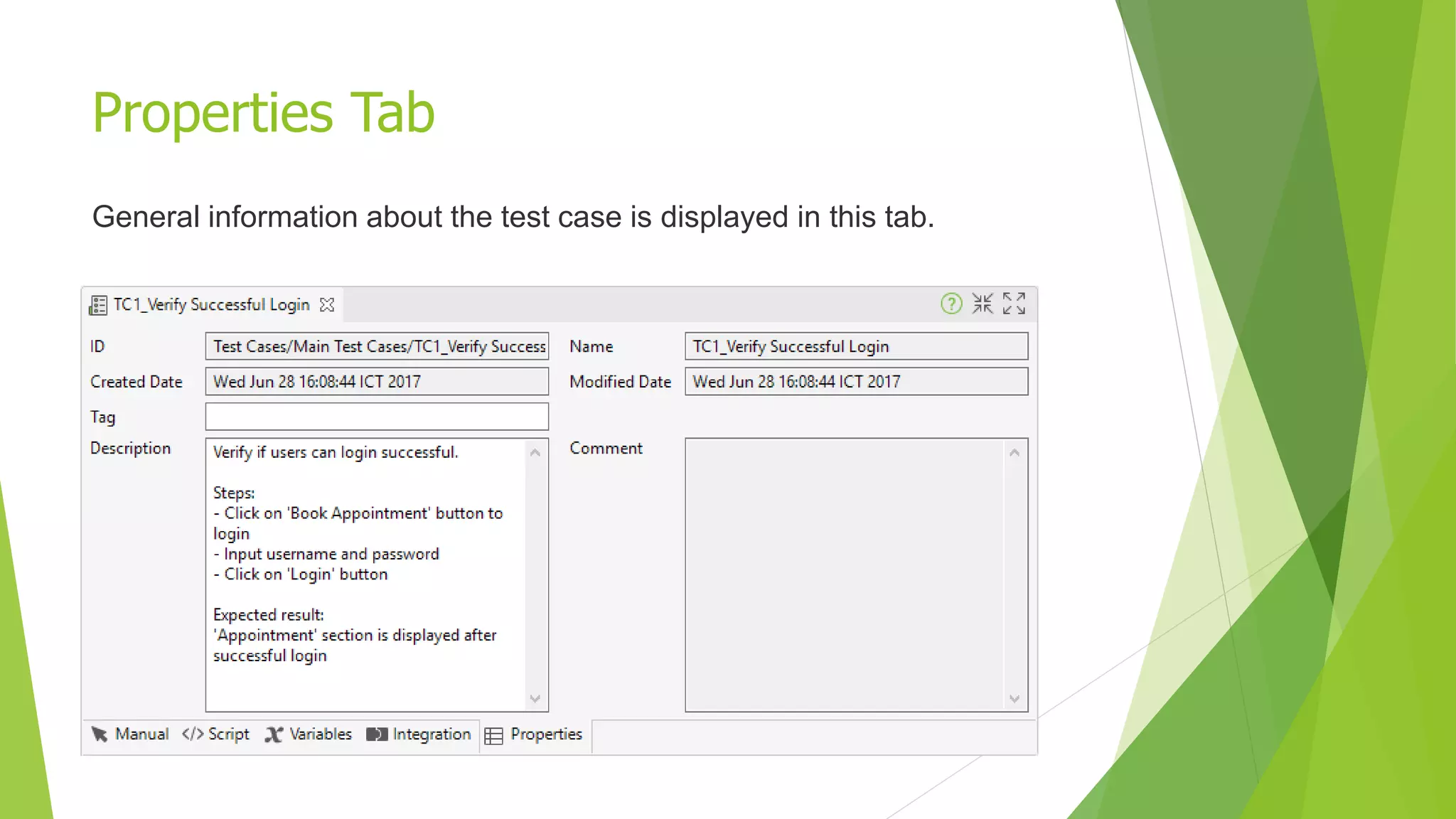
Properties Tab
General information about the test case is displayed in this tab.
Test Object Editor
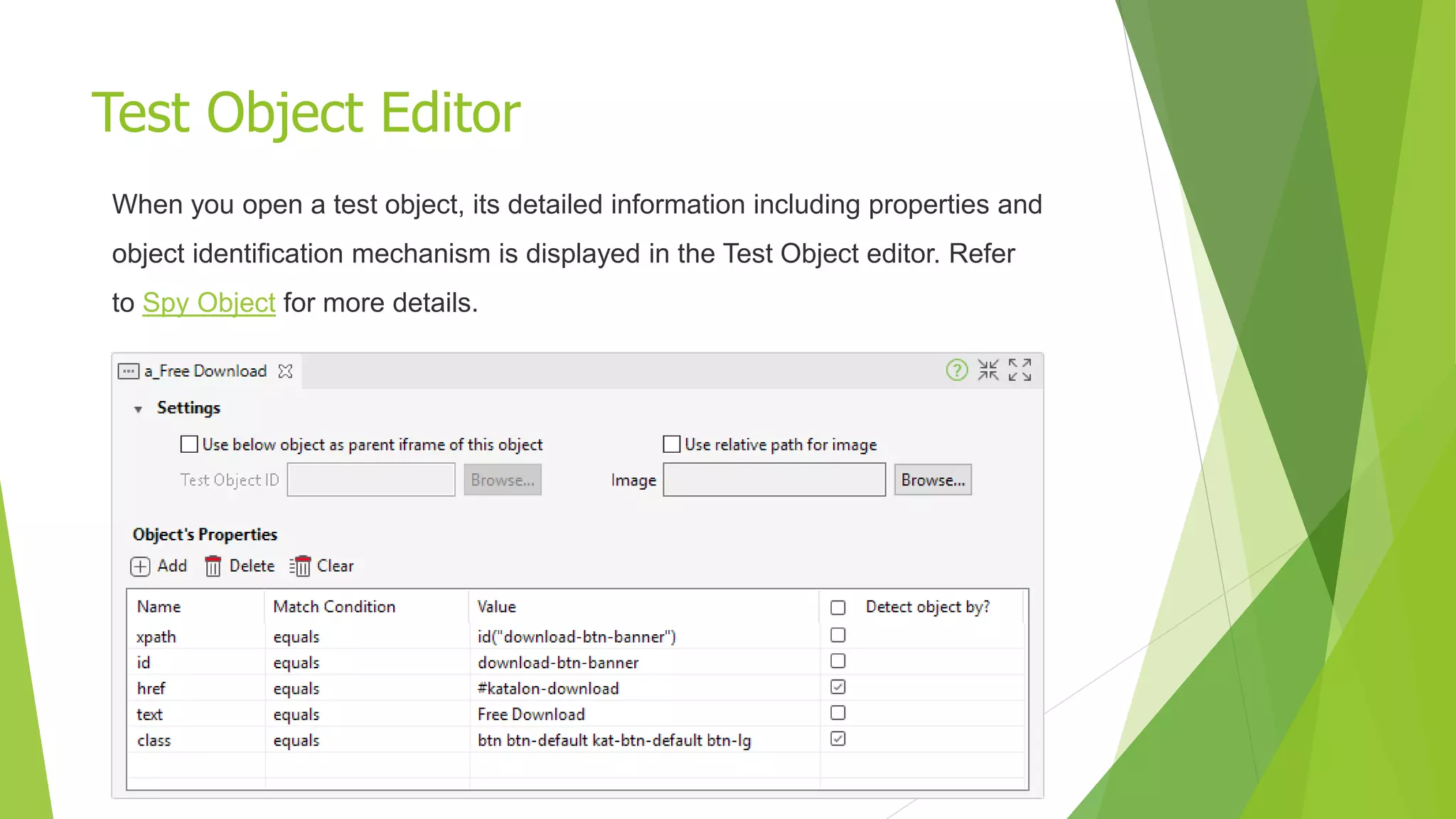
When you open a test object, its detailed information including properties and
object identification mechanism is displayed in the Test Object editor. Refer
to Spy Object for more details.
Web Service Editor
RESTful Request Object Editor
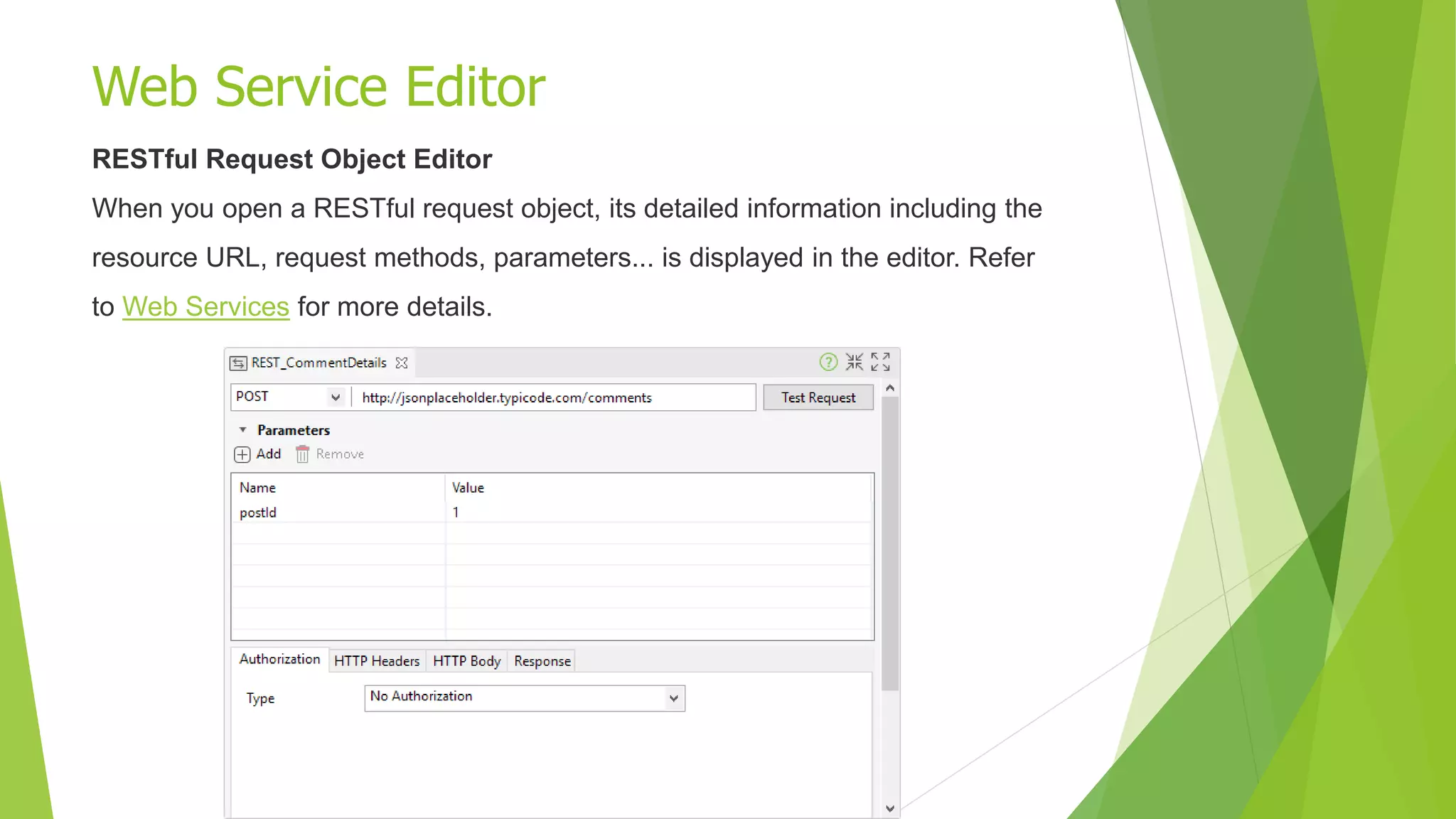
When you open a RESTful request object, its detailed information including the
resource URL, request methods, parameters... is displayed in the editor. Refer
to Web Services for more details.
Web Service Editor
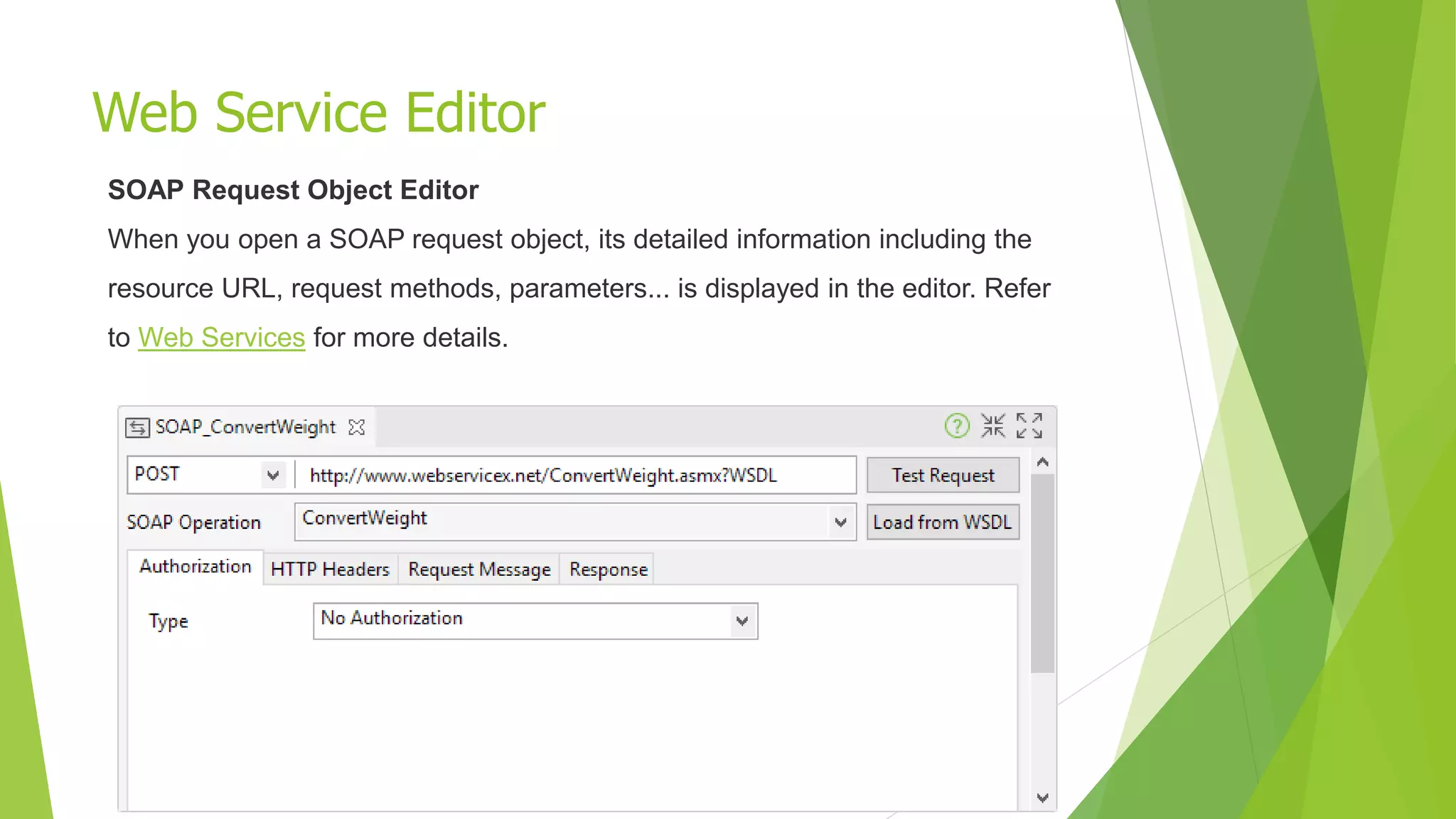
SOAP Request Object Editor
When you open a SOAP request object, its detailed information including the
resource URL, request methods, parameters... is displayed in the editor. Refer
to Web Services for more details.
Test Suite Editor
When you open a test suite, its detailed information is displayed in
the Test Suite editor that contains the following tabs:
•Main tab
•Integration tab
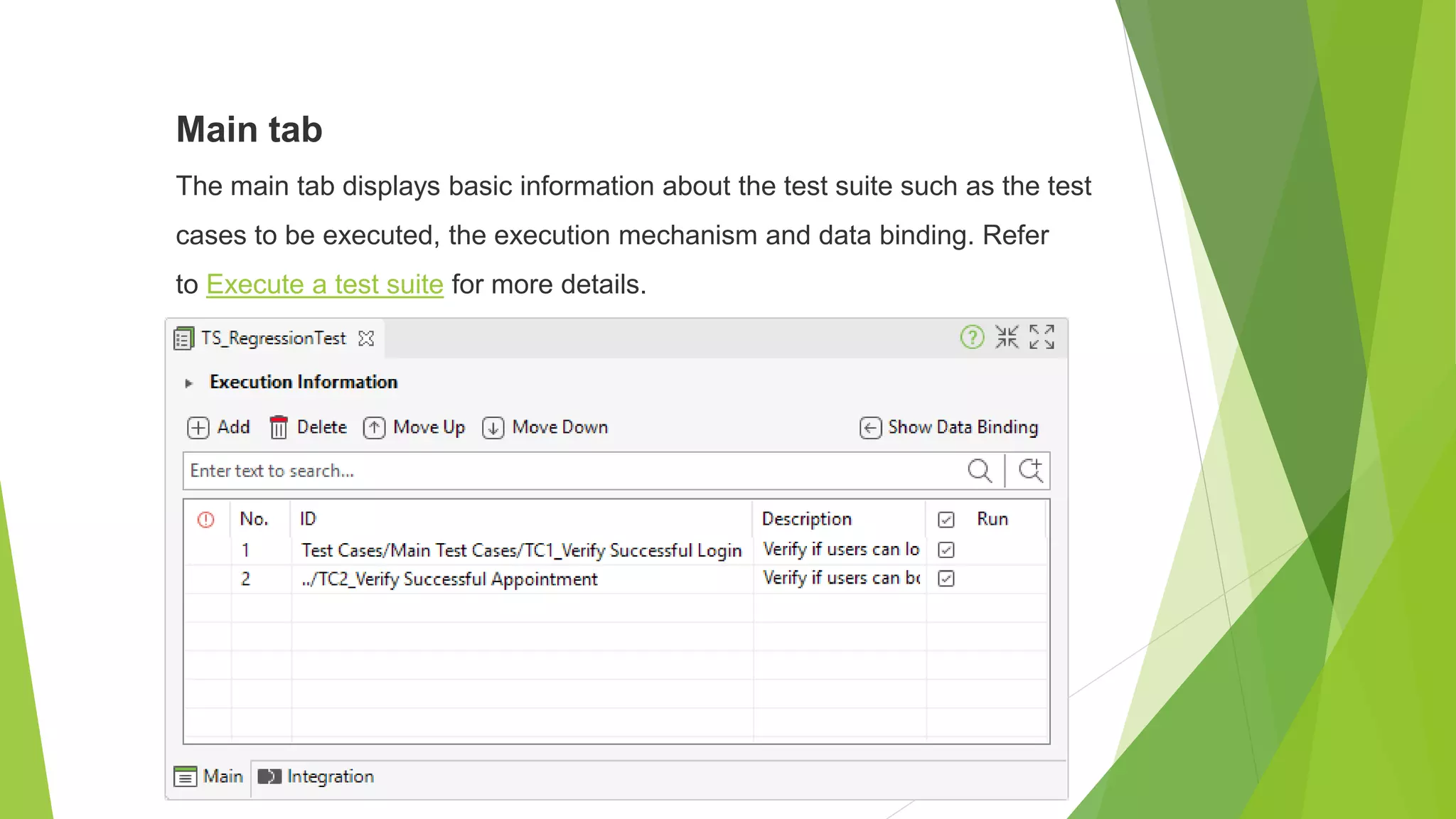
Main tab
The main tab displays basic information about the test suite such as the test
cases to be executed, the execution mechanism and data binding. Refer
to Execute a test suite for more details.
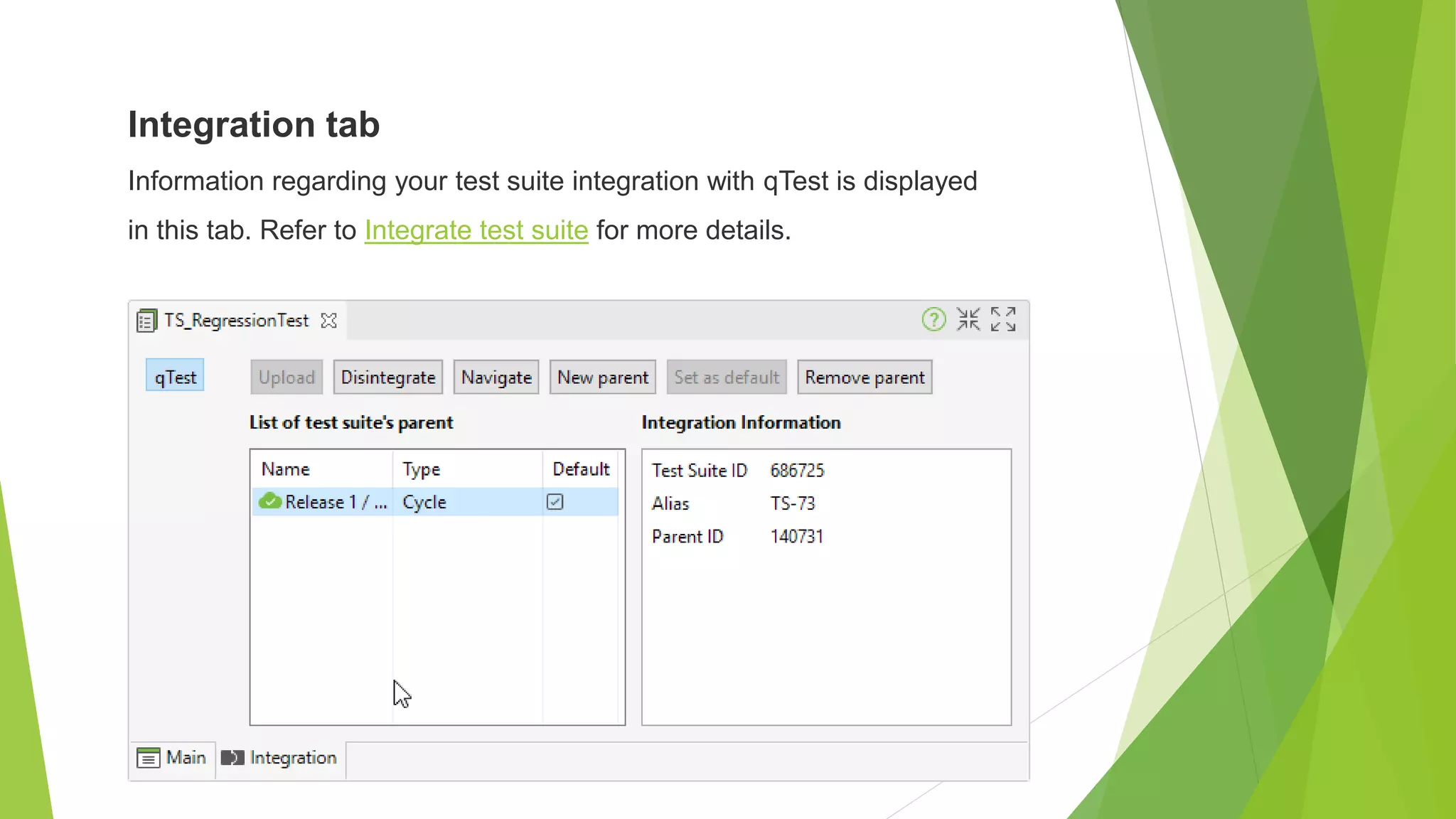
Integration tab
Information regarding your test suite integration with qTest is displayed
in this tab. Refer to Integrate test suite for more details.
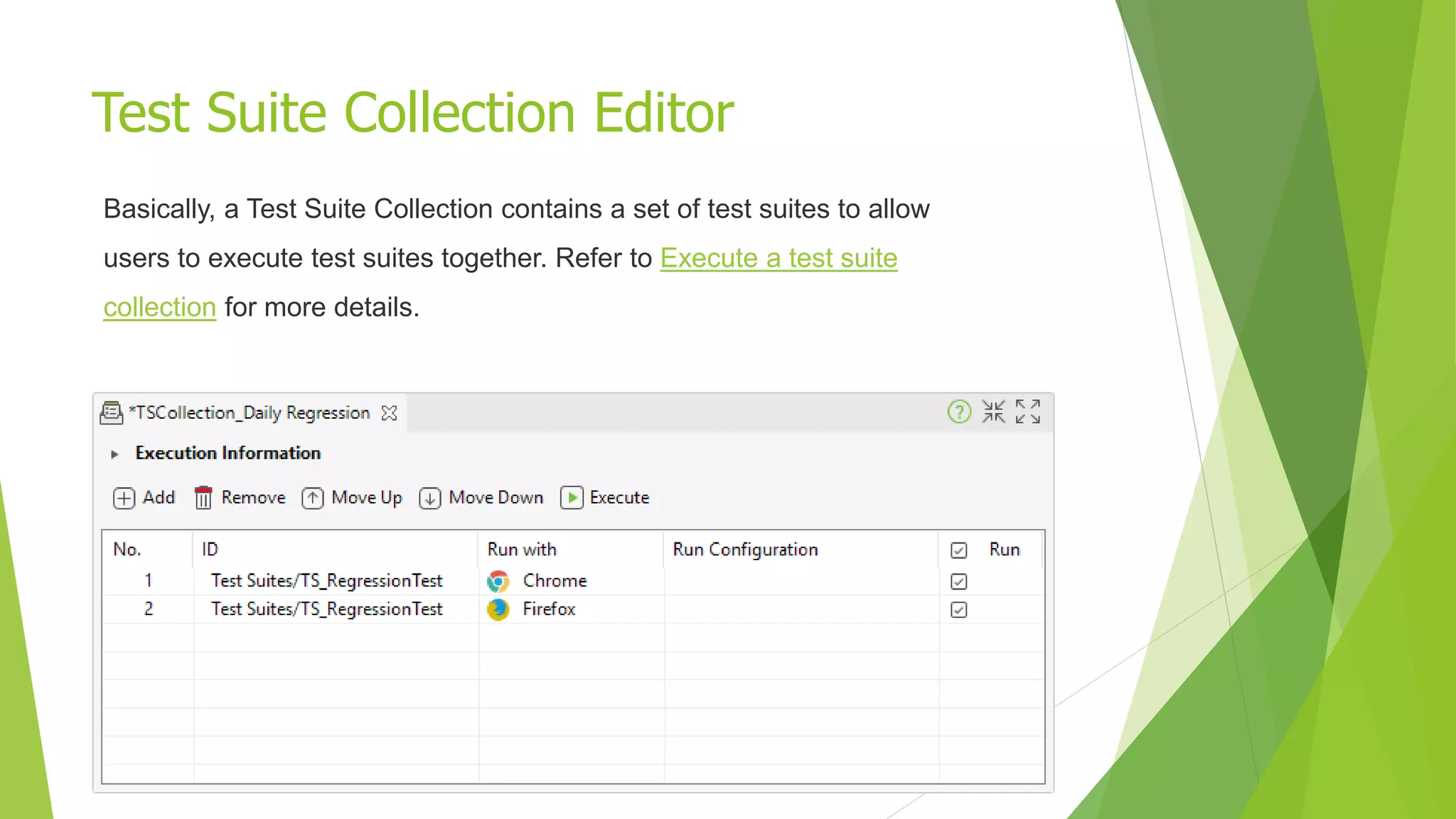
Test Suite Collection Editor
Basically, a Test Suite Collection contains a set of test suites to allow
users to execute test suites together. Refer to Execute a test suite
collection for more details.
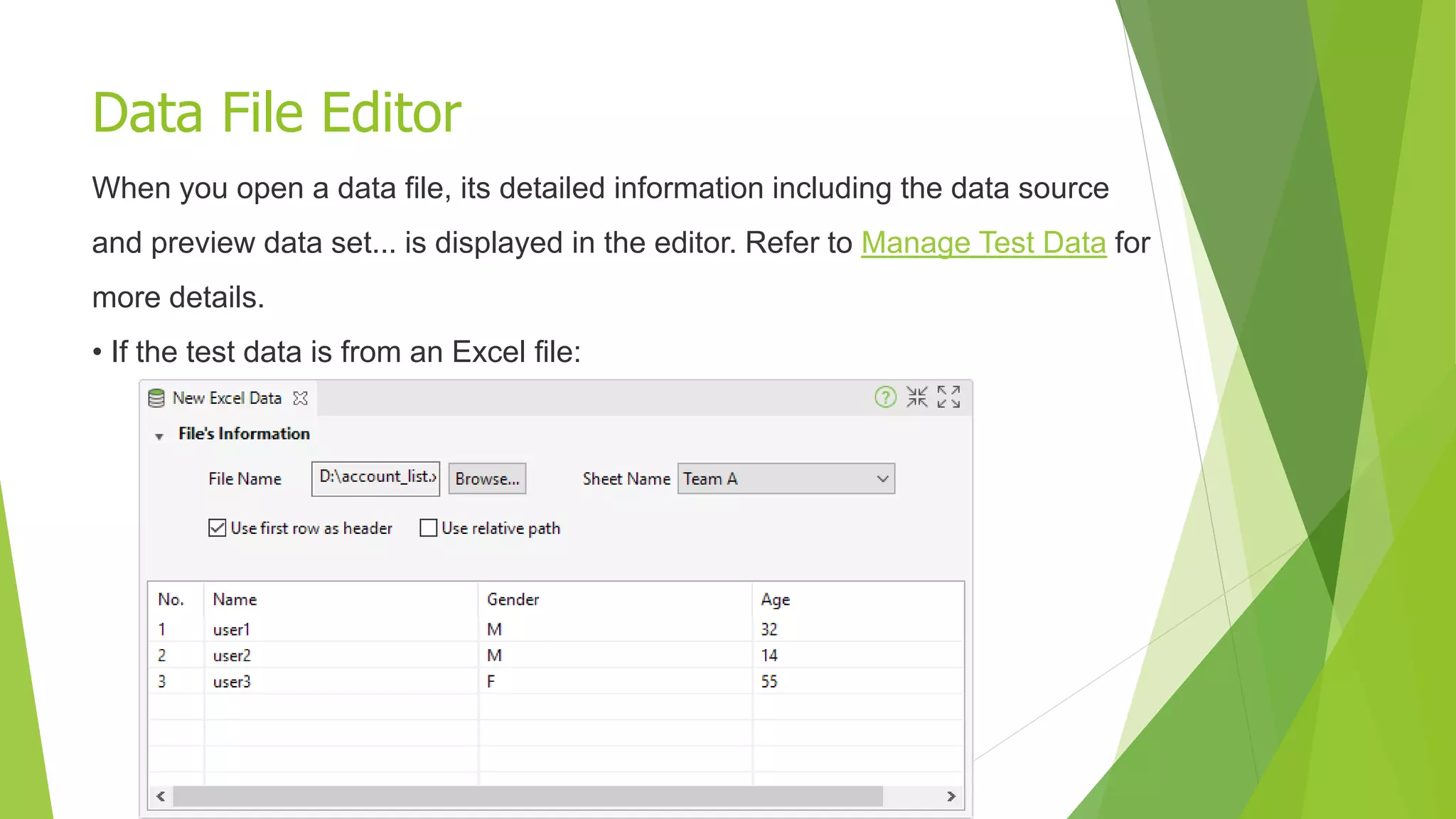
Data File Editor
When you open a data file, its detailed information including the data source
and preview data set... is displayed in the editor. Refer to Manage Test Data for
more details.
• If the test data is from an Excel file:
• If the test data is from a CSV file:
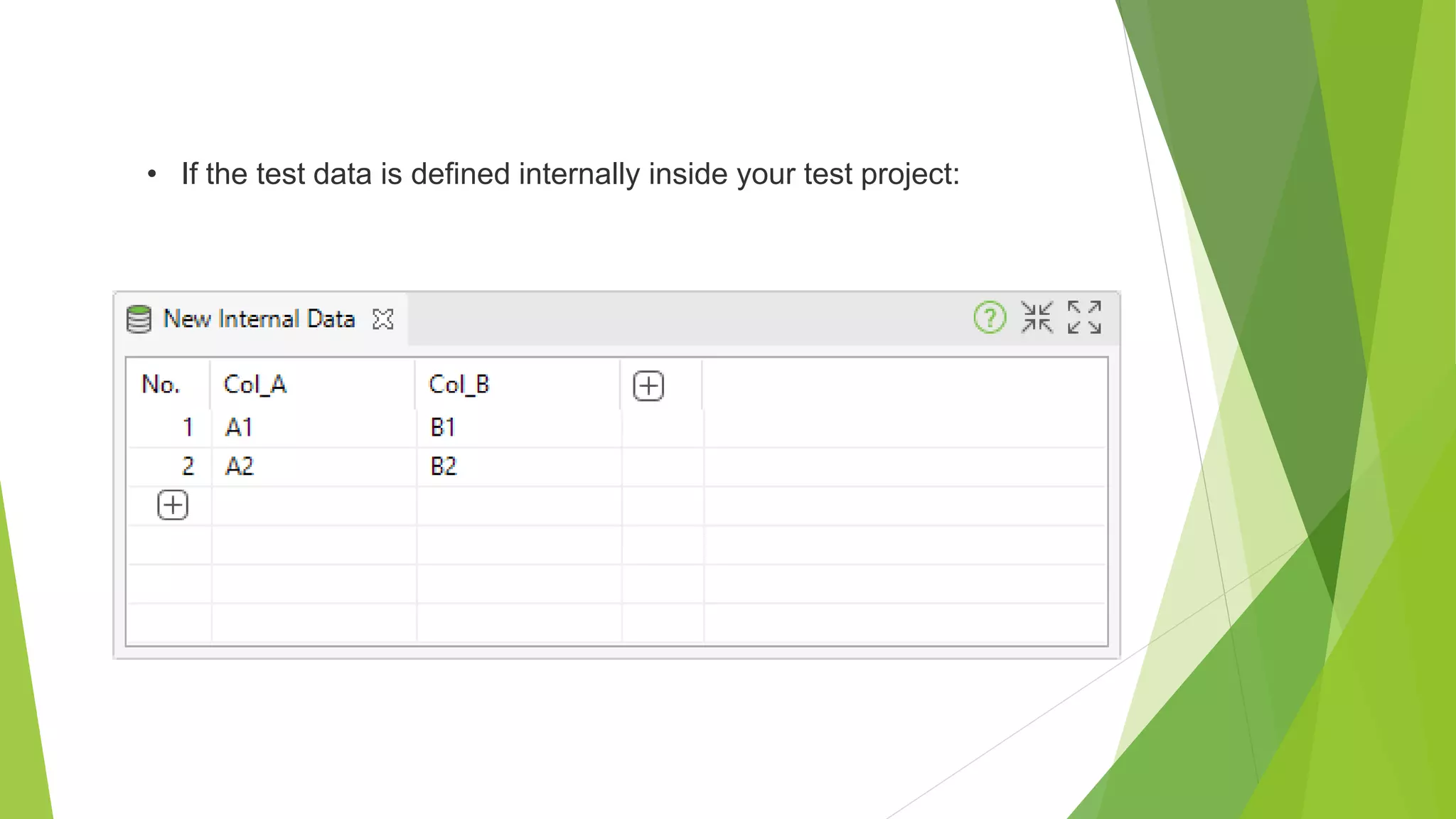
• If the test data is defined internally inside your test project:
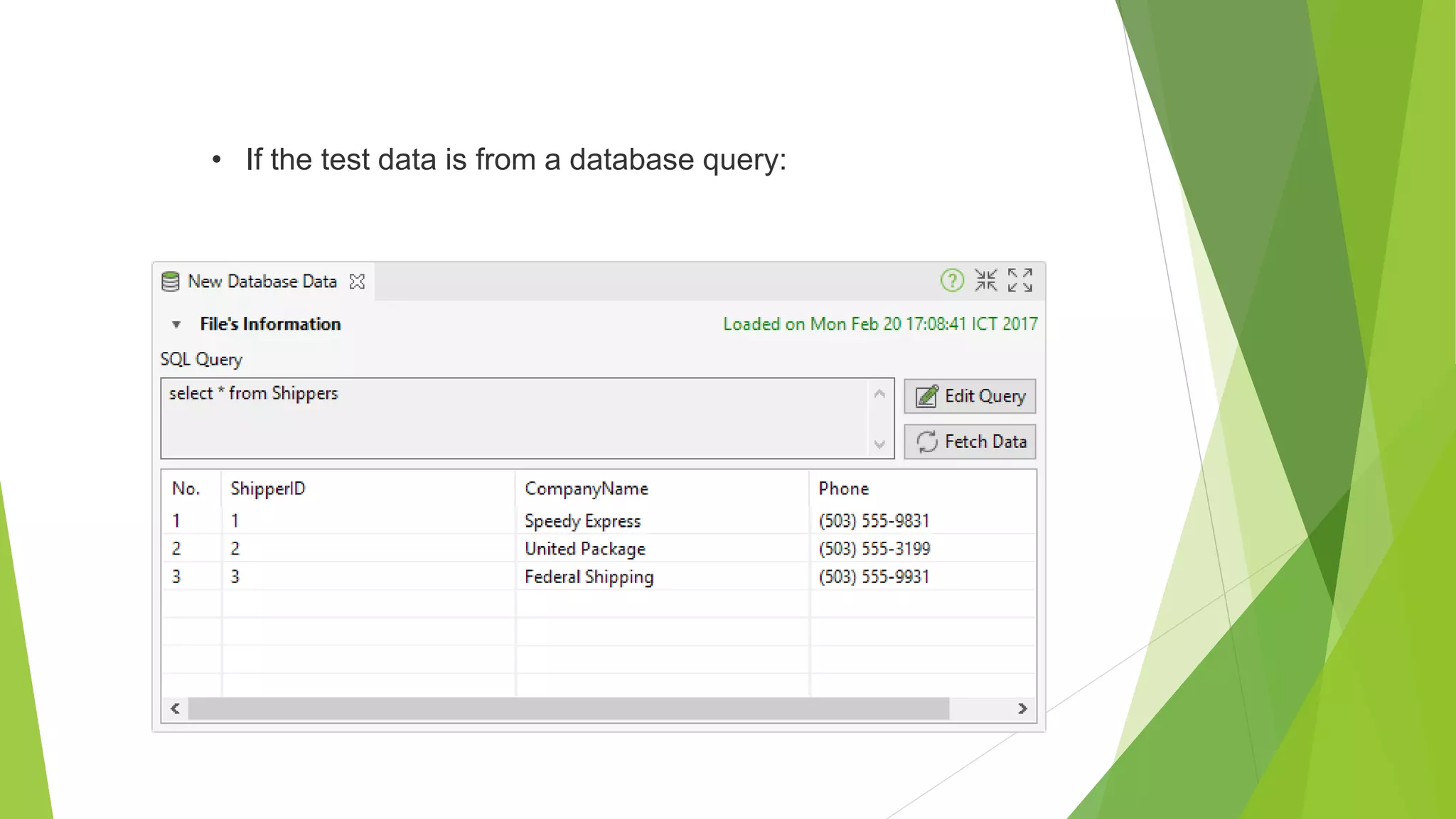
• If the test data is from a database query:
Checkpoint Editor
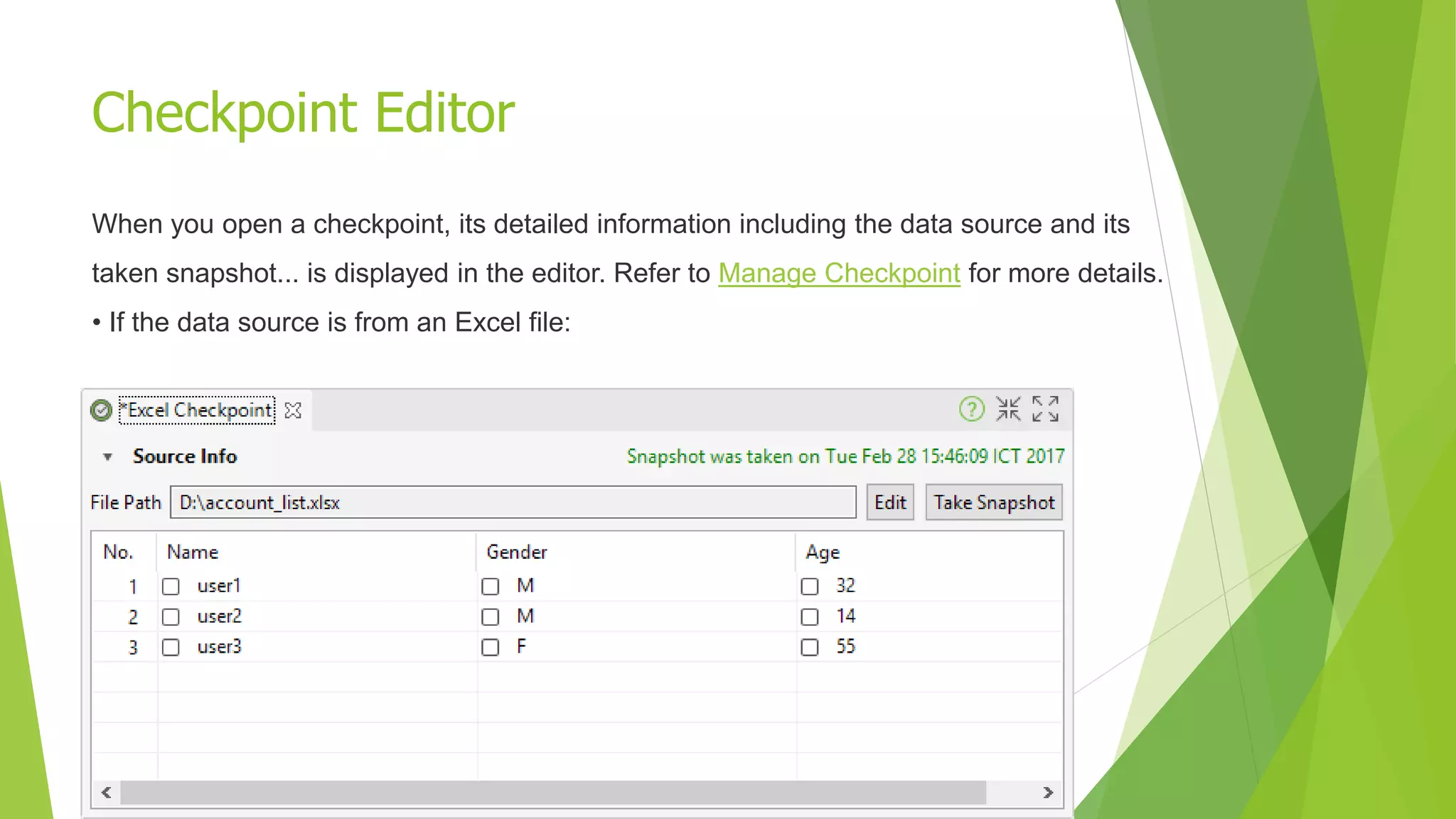
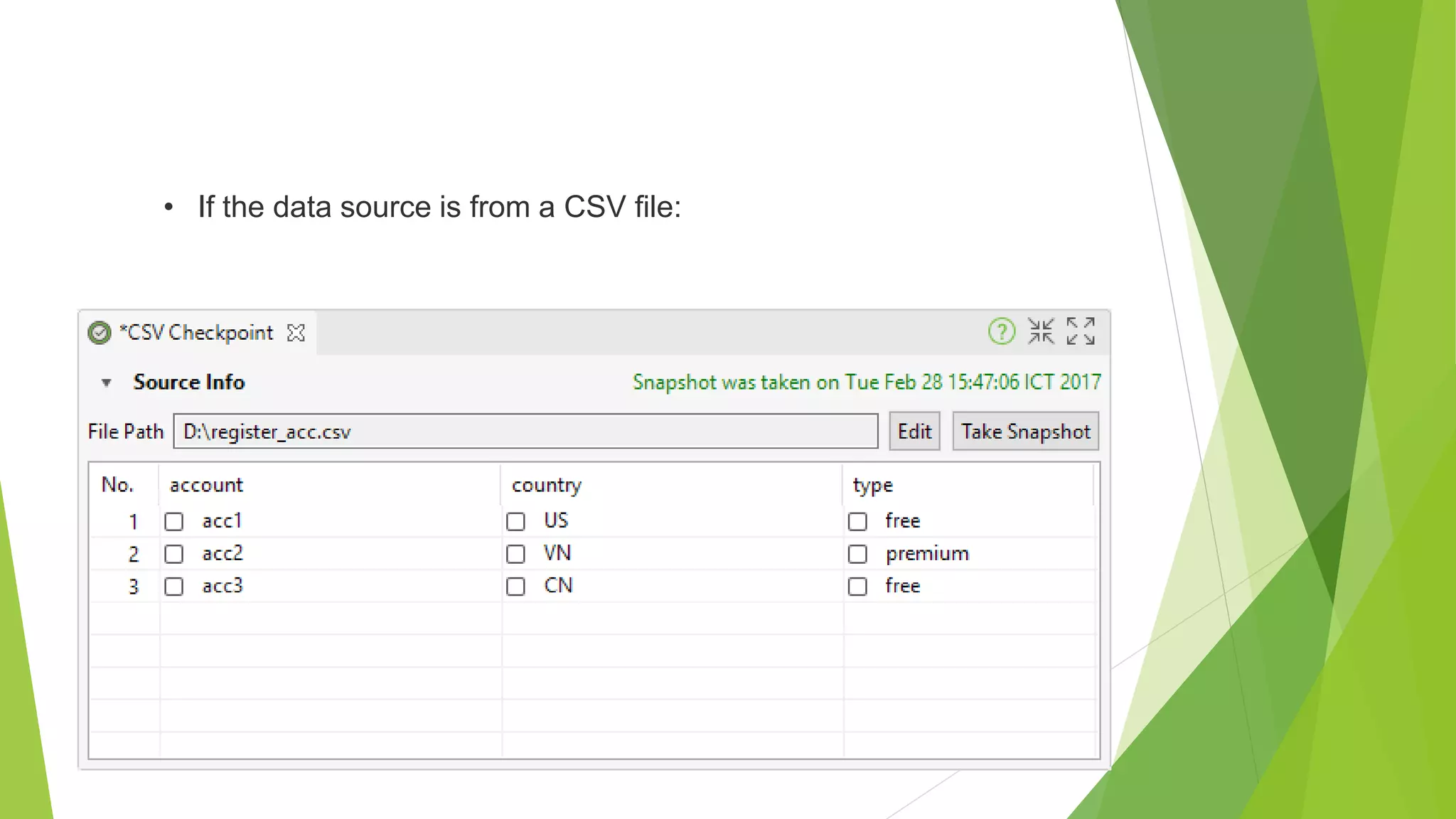
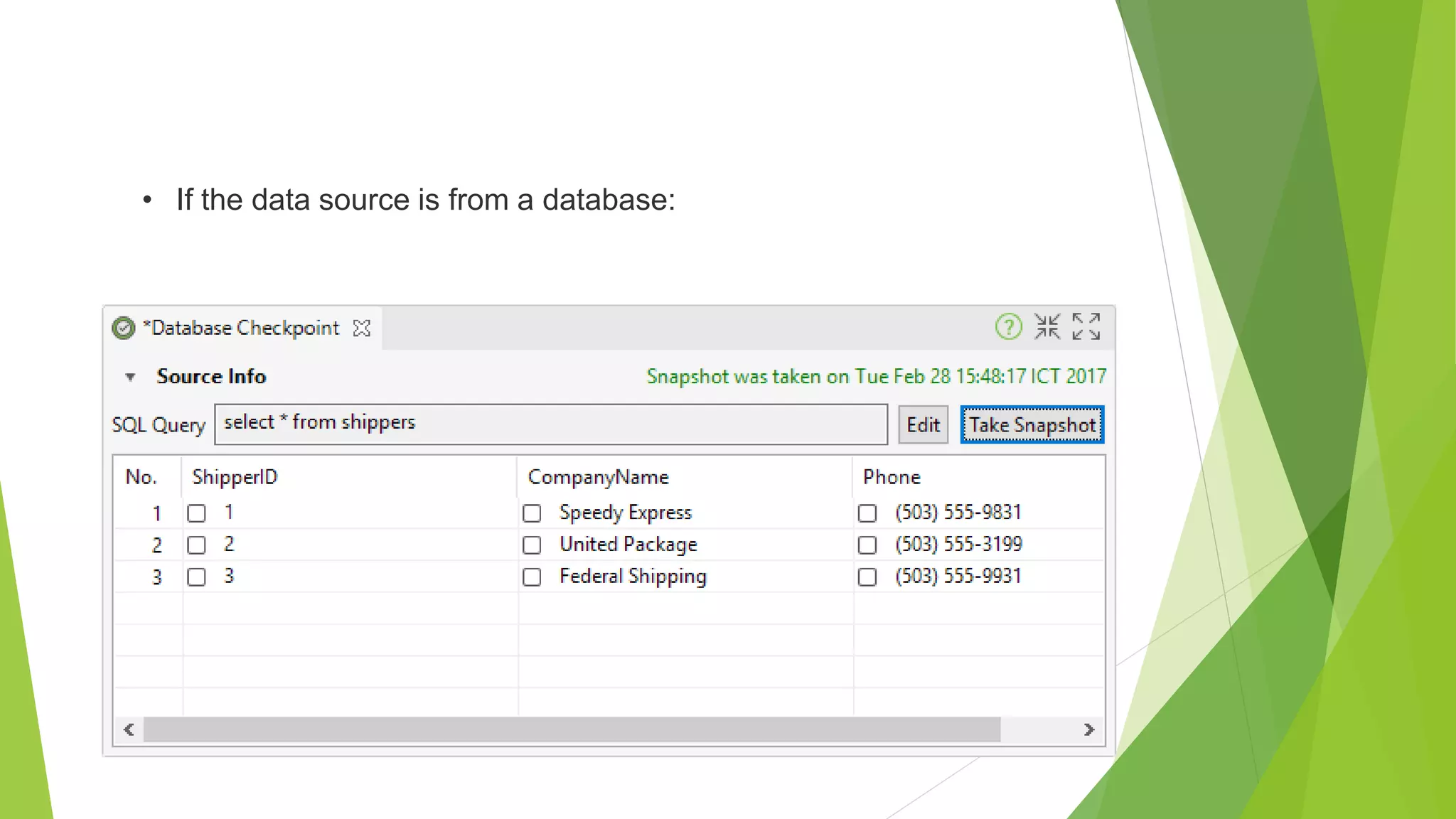
When you open a checkpoint, its detailed information including the data source and its
taken snapshot... is displayed in the editor. Refer to Manage Checkpoint for more details.
• If the data source is from an Excel file:
• If the data source is from a CSV file:
• If the data source is from a database:
• If the data source is from existing test data:
Keyword Editor
When you open a custom keyword, its content is displayed in the scripting editor. This
scripting editor is similar to the Script view of test cases where you can define new custom
keywords easily using Groovy or Java. Refer to Define custom keywords for more details.
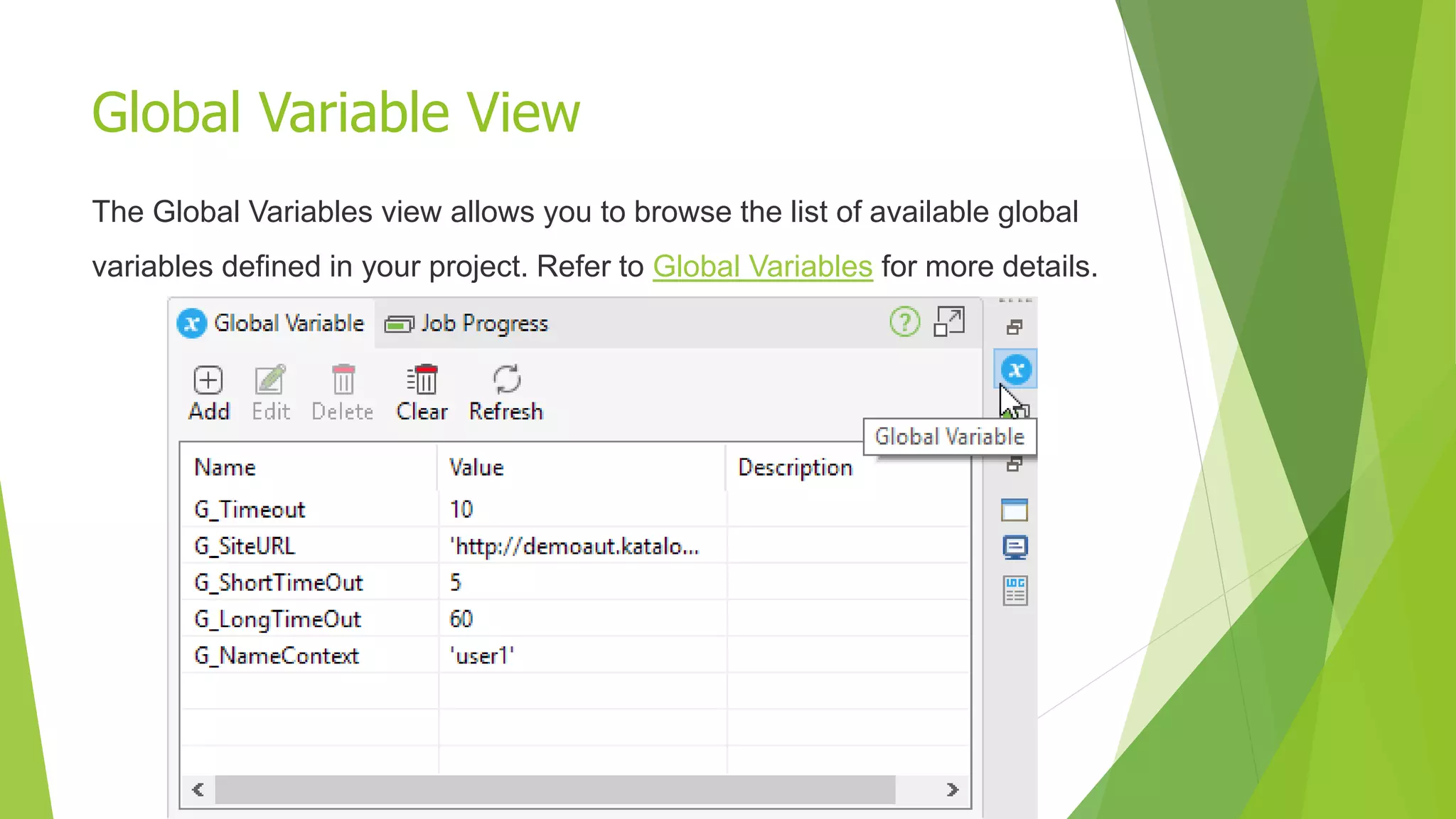
Global Variable View
The Global Variables view allows you to browse the list of available global
variables defined in your project. Refer to Global Variables for more details.
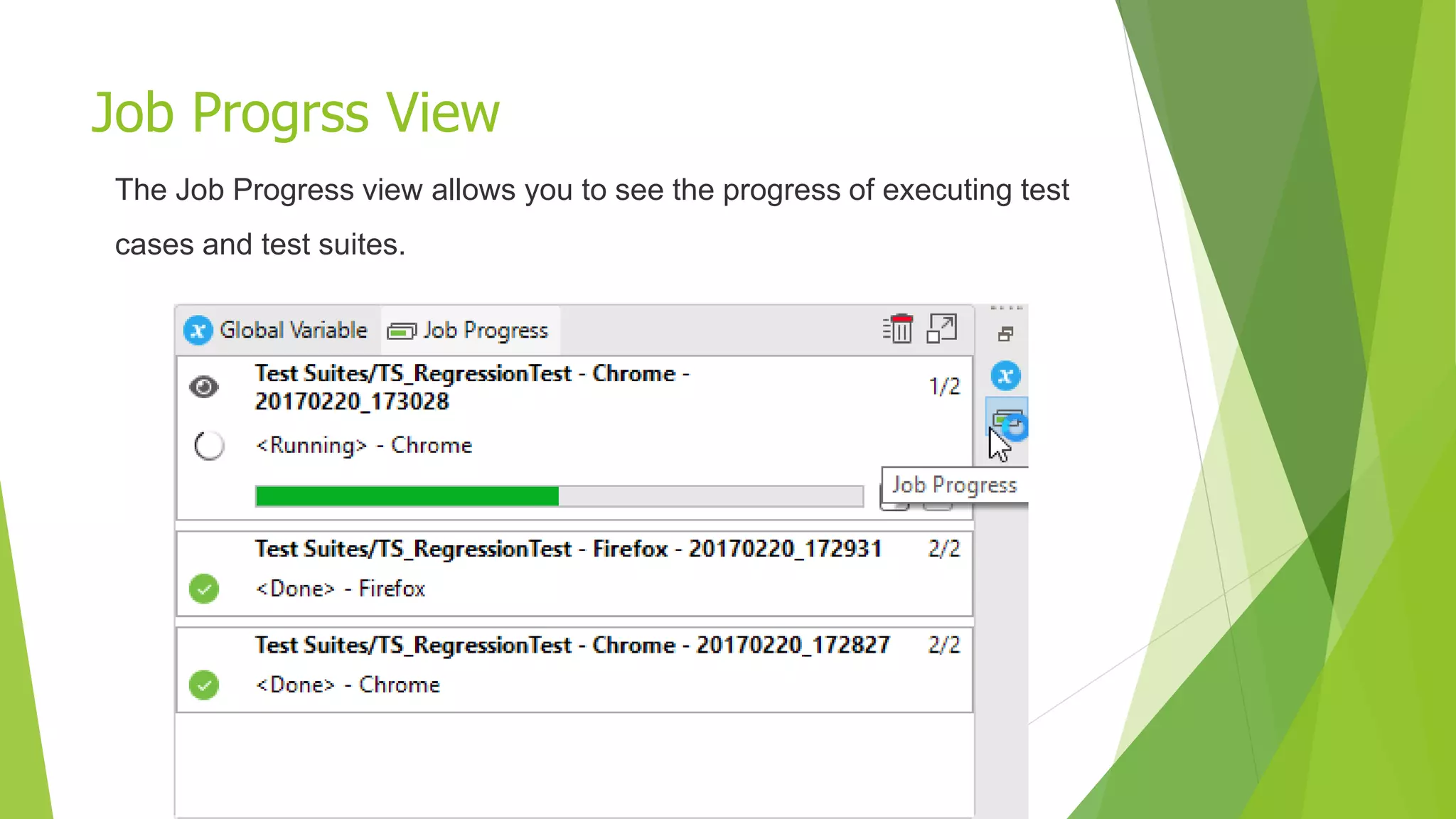
Job Progrss View
The Job Progress view allows you to see the progress of executing test
cases and test suites.
Problems View
The Problems view shows errors and warning messages raised when you are setting
up a project or designing the test case, test suite, test object or test data.
The messages displayed in the Problems view can be
configured via the drop-down menu of this view.
Console View
The Console view shows the system logs of all run-time activities
performed while the automation test is being executed. The console
output generated from test scripts is also displayed here.
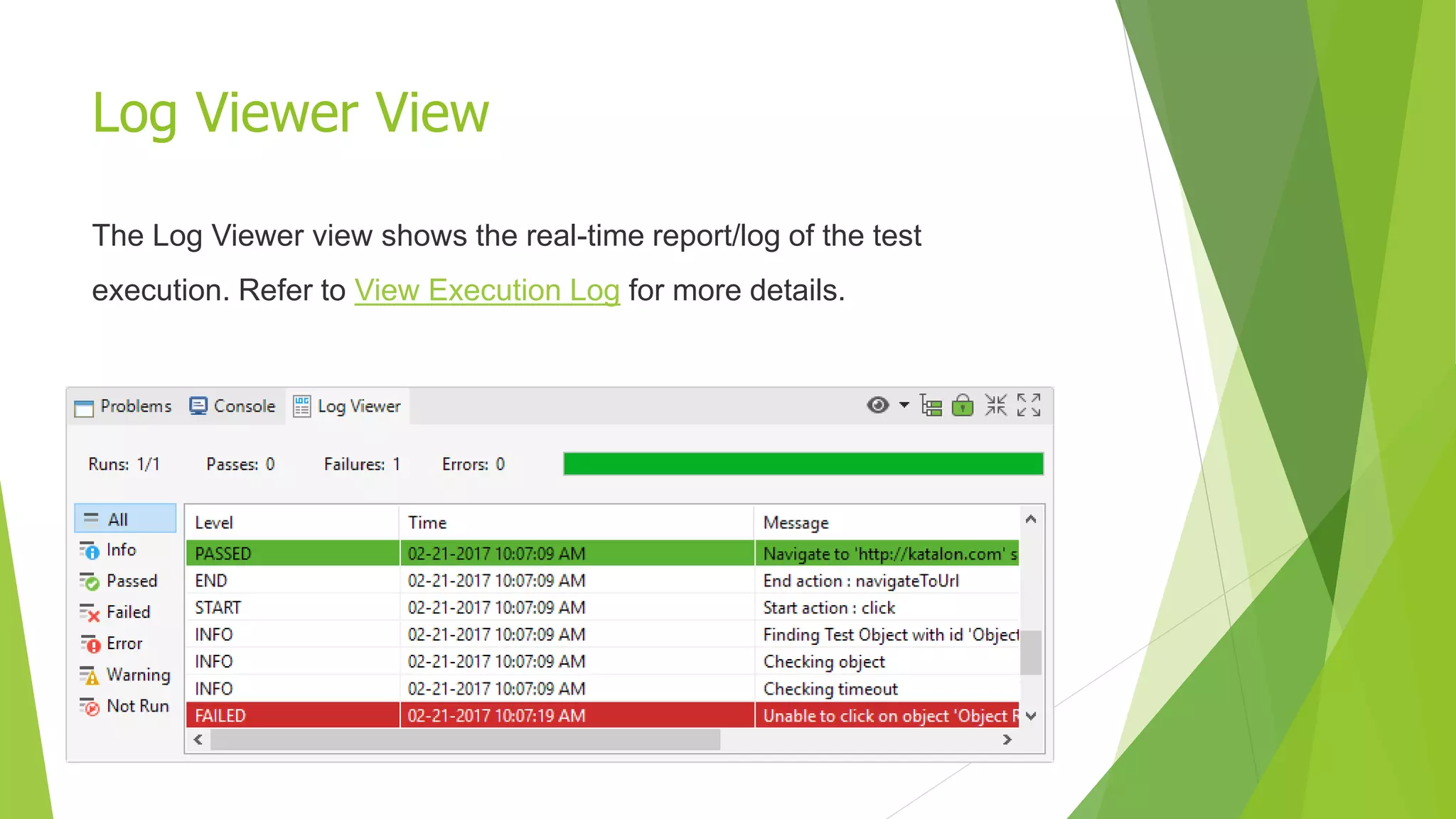
Log Viewer View
The Log Viewer view shows the real-time report/log of the test
execution. Refer to View Execution Log for more details.
Search View
The Search view shows the search results from the search function. You can
double-click on a search entry to navigate to the corresponding position in
the editor.
Report View
The Report view allows you to view detailed information of a completed
test execution for a certain test suite. Refer to Test Suite Report for
more details.
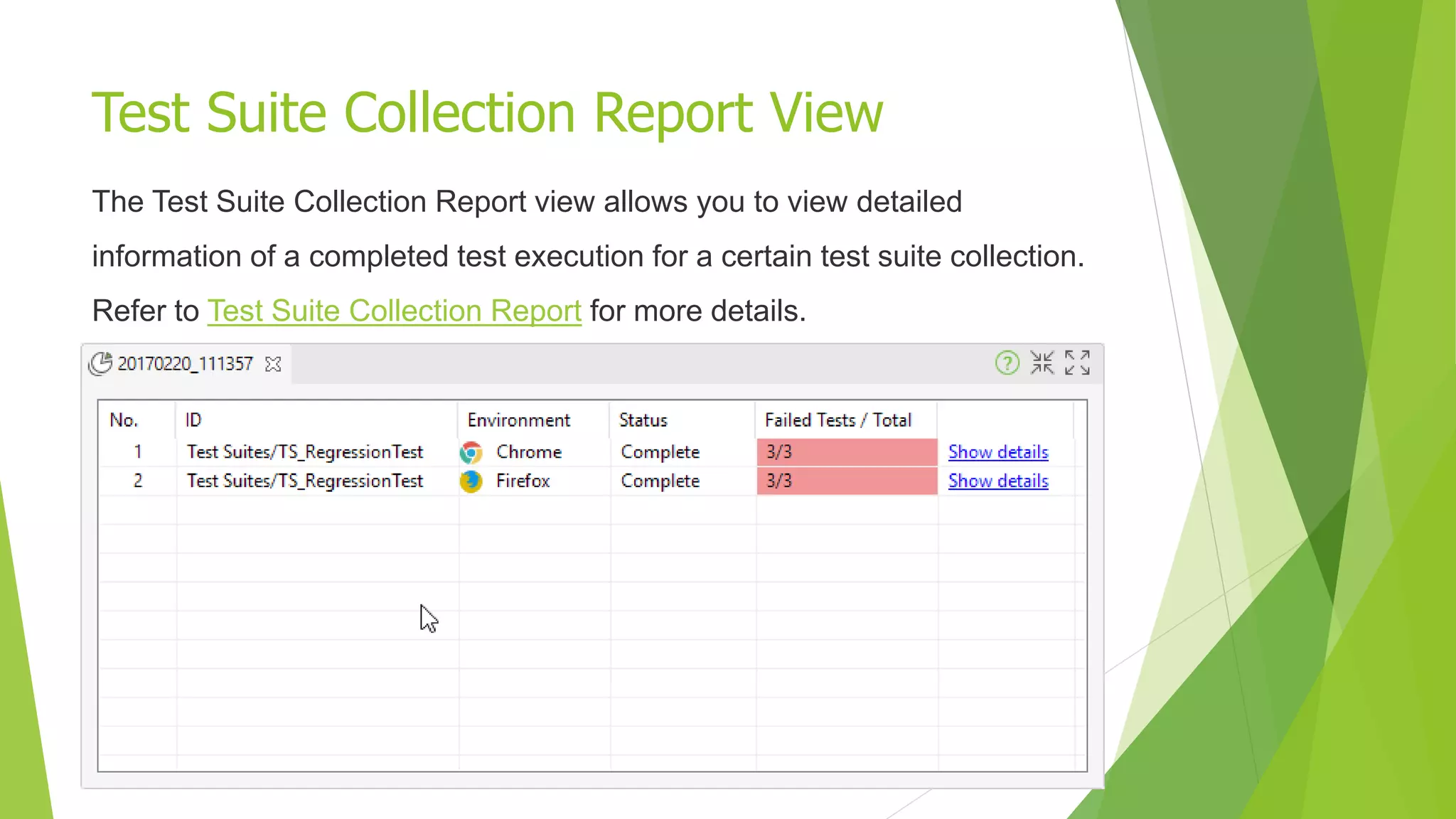
Test Suite Collection Report View
The Test Suite Collection Report view allows you to view detailed
information of a completed test execution for a certain test suite collection.
Refer to Test Suite Collection Report for more details.

Katalon Studio - GUI Overview

  • 1.
  • 2.
    Toolbar The main Toolbarcontains the most common actions which you usually perform (e.g. creating test resources or executing automation tests).
  • 3.
    Save the currentopened test artifact. Save all opened test artifacts. Create new test artifacts. You can select these options by selecting from dropdown list: •Folder •Test Case •Test Suite •Test Suite Collection •Test Object •Web Service Request •Test Data •Checkpoint •Package •Keyword
  • 4.
    Open Object Spydialog for capturing elements on websites. Open Mobile Object Spy dialog for capturing elements on mobile applications. Open Record dialog for recording WebUI test cases. Open Mobile Recorder dialog for recording Mobile test cases.
  • 5.
    Run the currentopen test case. You can select these options by selecting from dropdown list: •Chrome •Firefox •IE •Safari •Edge •Remote •Headless •Android •iOS (on macOS) •Custom Debug the current open test case. You can select these options by selecting from dropdownlist: •Chrome •Firefox •IE •Safari •Edge •Remote •Headless •Android •iOS (on macOS) •Custom
  • 6.
    Stop the currentexecution Open Command Builder for generating commands for console execution Command for Git activities. You can select these options by selecting from dropdownlist (after enabling Git): •Clone Project •Share Project •Show History •Manage Branches •Commit •Push •Pull •Fetch
  • 7.
    Tests Explorer View TheTests Explorer view allows you to browse the structure of your projects and access all test artifacts quickly. Using the context menu on the view, you can create new artifacts, organize the view's items or drag and drop them to certain editor views if needed. Group Description Test Cases Object Repository Test Suites Data Files Checkpoints Keywords Reports List all test cases within current project List all test objects of the current project List all test suites and test suite collections of the current project List all test data of the current project List all checkpoints of the current project List all custom keywords of the current project List all generated reports of the current project
  • 8.
    Keywords Browser View TheKeywords Browser view displays all available keywords supported by Katalon Studio. You can drag and drop the keywords here to the Test Case editor when scripting.
  • 9.
    Editors Test Case Editors Theeditor is used to modify the detailed information of an object. Each test artifact has its own editor. When you open a test case, its detailed information is shown in the editor that contains the following tabs: •Manual tab •Script tab •Variables tab •Integration tab •Properties tab
  • 10.
    Manual Tab The Manualtab displays the Manual view where the basic keyword-driven- configuration allows novice users to create automation tests effortlessly. Refer to Test Case Manual View for more details.
  • 11.
    Script Tab This tabdisplays the Script view where advanced users with programming background can modify test scripts easily using either Groovy or Java. Refer to Test Case Script View for more details.
  • 12.
    Variable Tab The Variablestab shows all variables defined for the test case. Refer to Public Variables for more details.
  • 13.
    Integration Tab Information regardingyour test case integration with qTest is displayed in this tab. Refer to Integrate test case for more details.
  • 14.
    Properties Tab General informationabout the test case is displayed in this tab.
  • 15.
    Test Object Editor Whenyou open a test object, its detailed information including properties and object identification mechanism is displayed in the Test Object editor. Refer to Spy Object for more details.
  • 16.
    Web Service Editor RESTfulRequest Object Editor When you open a RESTful request object, its detailed information including the resource URL, request methods, parameters... is displayed in the editor. Refer to Web Services for more details.
  • 17.
    Web Service Editor SOAPRequest Object Editor When you open a SOAP request object, its detailed information including the resource URL, request methods, parameters... is displayed in the editor. Refer to Web Services for more details.
  • 18.
    Test Suite Editor Whenyou open a test suite, its detailed information is displayed in the Test Suite editor that contains the following tabs: •Main tab •Integration tab
  • 19.
    Main tab The maintab displays basic information about the test suite such as the test cases to be executed, the execution mechanism and data binding. Refer to Execute a test suite for more details.
  • 20.
    Integration tab Information regardingyour test suite integration with qTest is displayed in this tab. Refer to Integrate test suite for more details.
  • 21.
    Test Suite CollectionEditor Basically, a Test Suite Collection contains a set of test suites to allow users to execute test suites together. Refer to Execute a test suite collection for more details.
  • 22.
    Data File Editor Whenyou open a data file, its detailed information including the data source and preview data set... is displayed in the editor. Refer to Manage Test Data for more details. • If the test data is from an Excel file:
  • 23.
    • If thetest data is from a CSV file:
  • 24.
    • If thetest data is defined internally inside your test project:
  • 25.
    • If thetest data is from a database query:
  • 26.
    Checkpoint Editor When youopen a checkpoint, its detailed information including the data source and its taken snapshot... is displayed in the editor. Refer to Manage Checkpoint for more details. • If the data source is from an Excel file:
  • 27.
    • If thedata source is from a CSV file:
  • 28.
    • If thedata source is from a database:
  • 29.
    • If thedata source is from existing test data:
  • 30.
    Keyword Editor When youopen a custom keyword, its content is displayed in the scripting editor. This scripting editor is similar to the Script view of test cases where you can define new custom keywords easily using Groovy or Java. Refer to Define custom keywords for more details.
  • 31.
    Global Variable View TheGlobal Variables view allows you to browse the list of available global variables defined in your project. Refer to Global Variables for more details.
  • 32.
    Job Progrss View TheJob Progress view allows you to see the progress of executing test cases and test suites.
  • 33.
    Problems View The Problemsview shows errors and warning messages raised when you are setting up a project or designing the test case, test suite, test object or test data. The messages displayed in the Problems view can be configured via the drop-down menu of this view.
  • 34.
    Console View The Consoleview shows the system logs of all run-time activities performed while the automation test is being executed. The console output generated from test scripts is also displayed here.
  • 35.
    Log Viewer View TheLog Viewer view shows the real-time report/log of the test execution. Refer to View Execution Log for more details.
  • 36.
    Search View The Searchview shows the search results from the search function. You can double-click on a search entry to navigate to the corresponding position in the editor.
  • 37.
    Report View The Reportview allows you to view detailed information of a completed test execution for a certain test suite. Refer to Test Suite Report for more details.
  • 38.
    Test Suite CollectionReport View The Test Suite Collection Report view allows you to view detailed information of a completed test execution for a certain test suite collection. Refer to Test Suite Collection Report for more details.