Jurisdiction in
Cyberspace
PRESENTED BY
NEHA GARG, ASSISTANT PROFESSOR, DEPARTMENT OF
LAW
What is Cyberspace
•Borderless territory for dissemination of information
•Interconnected by wire or wireless mode
•The word ‘cyberspace’ was used for the first time “Burning Chrome” in 1982 and in 1984, in
the Novel Neuromancer’ by William Gibson, (American-Canadian fiction writer) which
described an interaction between the human mind and computers.
•Source: https://pixabay.com/images/search/cyberspace
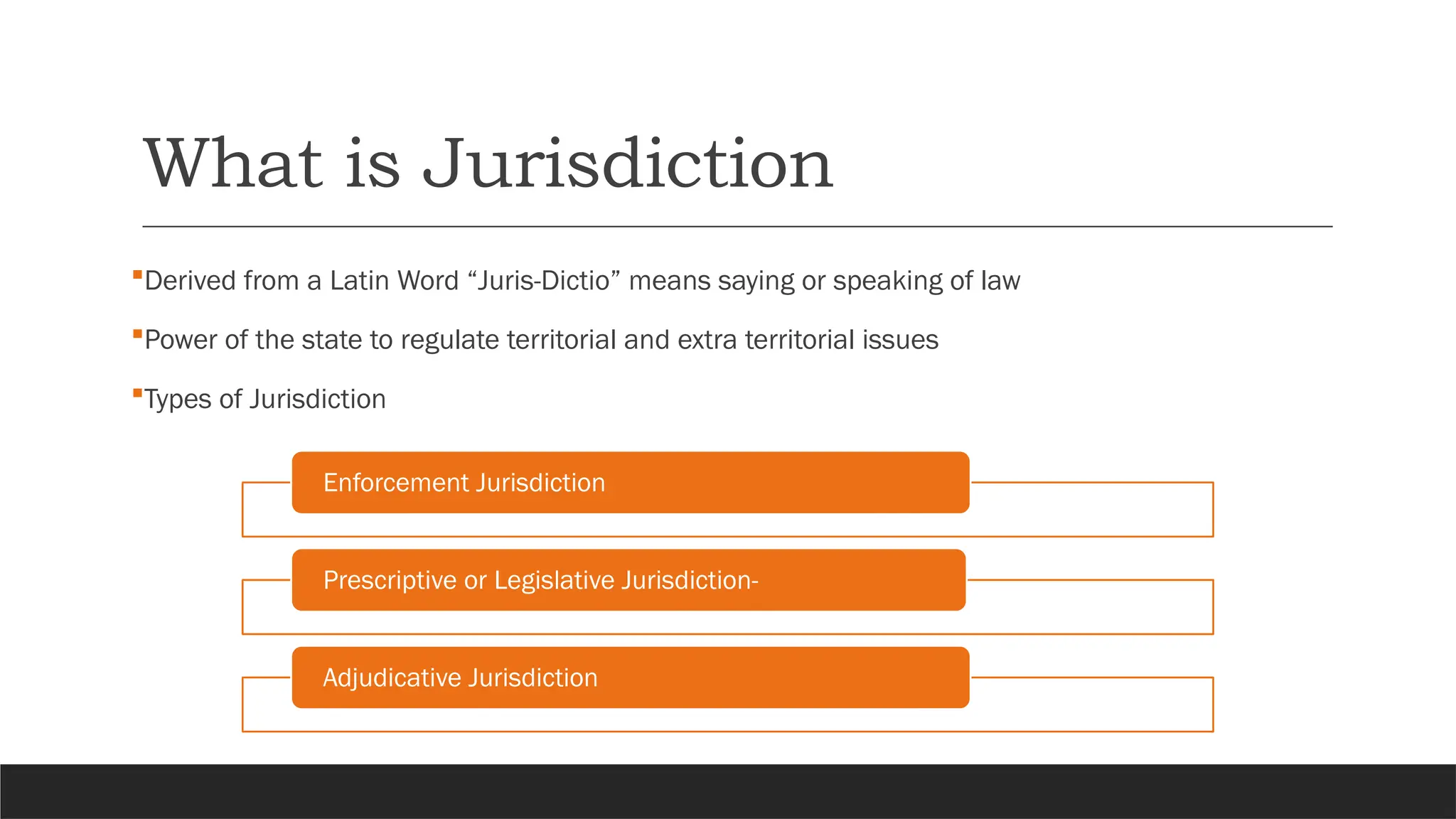
What is Jurisdiction
Derived from a Latin Word “Juris-Dictio” means saying or speaking of law
Power of the state to regulate territorial and extra territorial issues
Types of Jurisdiction
Enforcement Jurisdiction
Prescriptive or Legislative Jurisdiction-
Adjudicative Jurisdiction
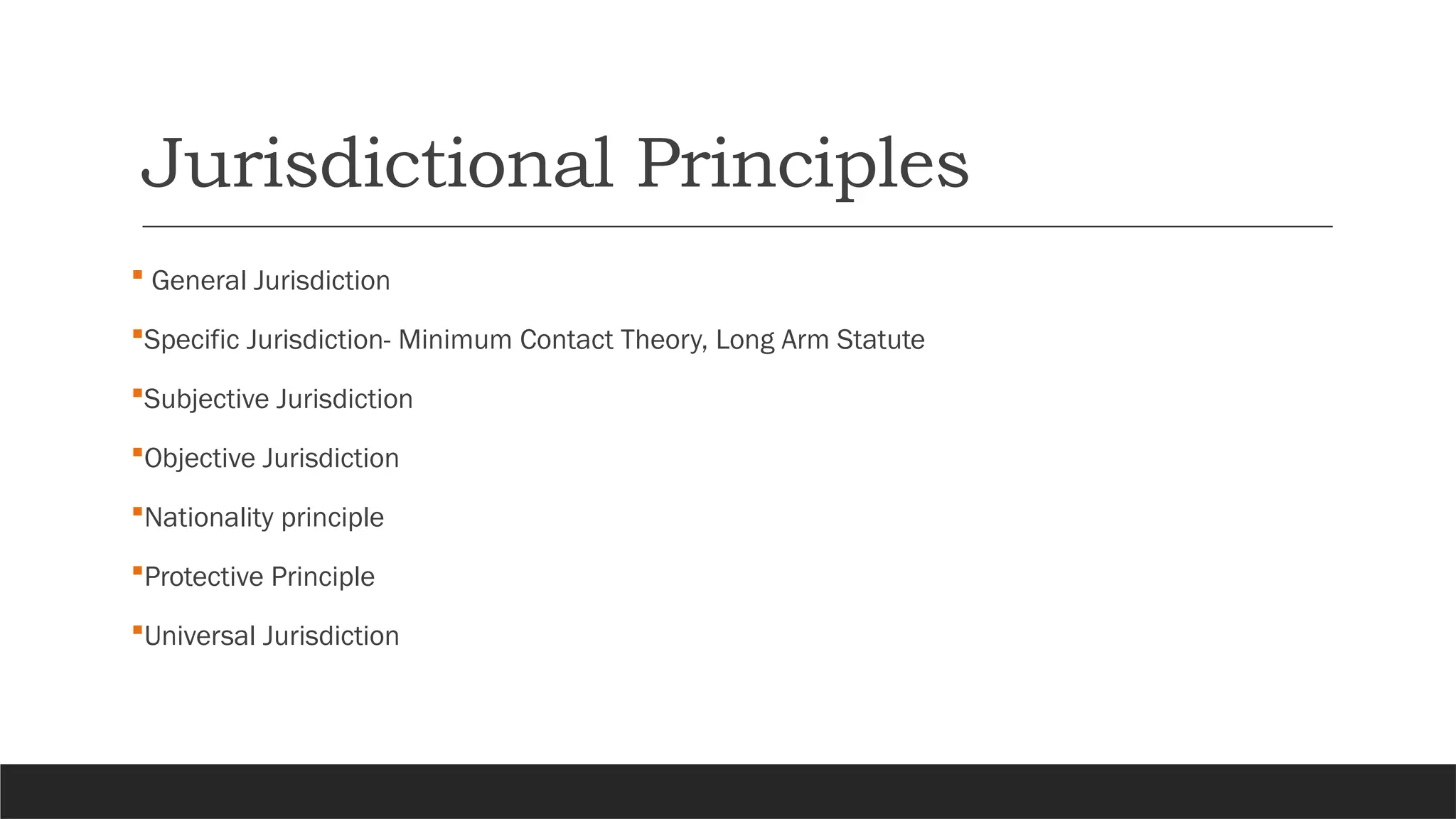
Jurisdictional Principles
 General Jurisdiction
Specific Jurisdiction- Minimum Contact Theory, Long Arm Statute
Subjective Jurisdiction
Objective Jurisdiction
Nationality principle
Protective Principle
Universal Jurisdiction
Tests to Determine Jurisdiction
Minimum Contact Theory- Purposeful availment of benefit, reasonable exercise of
Jurisdiction
Effects Test-Intentional Action aimed at foreign state to cause injury
Sliding Scale theory- Nature of Business activities. Active, passive and Interactive
website
Choice of law theory in case of conflict of laws- For example-To mitigate oil spill
USA approach in Cyber
Jurisdiction
Followed general and Special Jurisdiction
In International Shoe Company v Washington 326 U.S. 310, 66 S.Ct. 154, 90 L.Ed. 95 Court applied minimum contact
theory based on minimum contact with forum state based on nature and quality of the activity without violation of justice
and fair play.
In Worldwide Volkswagen Corporation v. Woodson 444 U.S. 286 (1980) added the concept of foresee-ability in availing
the facilities of the forum state to facilitate his trade and services
In Zippo Manufacturing Company v Zippo.com 952 F. Supp. 1119 (W.D. Pa. 1997)sliding scale test was applied providing
minimum contacts, arising out of contact of defendant and exercise as per due process of law- Active, Passive and
Interactive websites.
Calder v Jones 465 U.S. 783 (1984) mere active website not enough but causing of harm to forum state intentionally and
knowingly
In Cybersell, Inc. v. Cybersell, Inc. 130 F.3d 414 (9th Cir. 1997 (“Cybersell”), the Ninth Circuit, sharp contrast to the
Connecticut federal court in the Inset case, rejected the notion that a home page “purposely avails” itself of the privilege of
conducting activities within a jurisdiction merely because it merely can be assessed there.
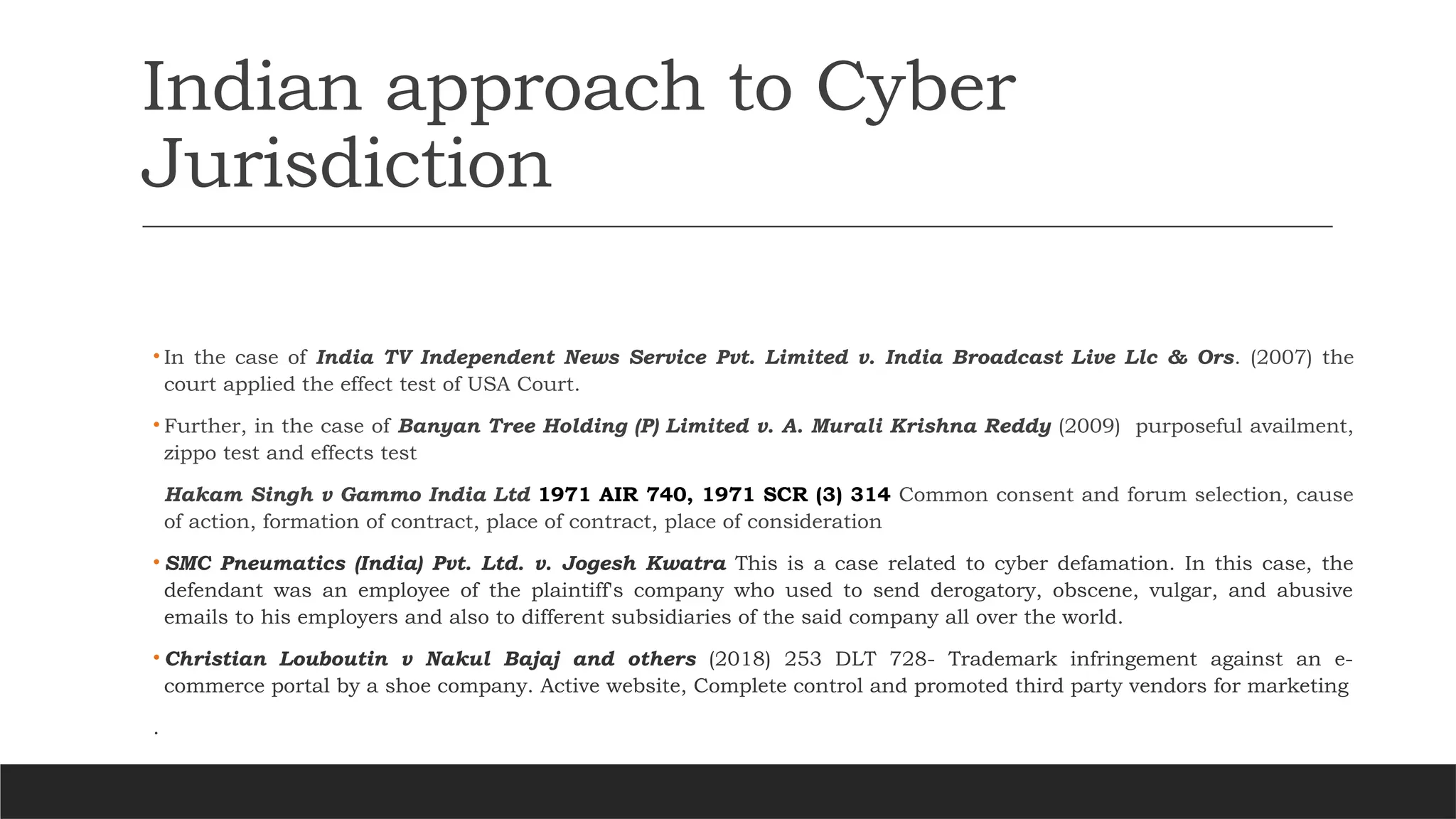
Indian approach to Cyber
Jurisdiction
• In the case of India TV Independent News Service Pvt. Limited v. India Broadcast Live Llc & Ors. (2007) the
court applied the effect test of USA Court.
• Further, in the case of Banyan Tree Holding (P) Limited v. A. Murali Krishna Reddy (2009) purposeful availment,
zippo test and effects test
Hakam Singh v Gammo India Ltd 1971 AIR 740, 1971 SCR (3) 314 Common consent and forum selection, cause
of action, formation of contract, place of contract, place of consideration
• SMC Pneumatics (India) Pvt. Ltd. v. Jogesh Kwatra This is a case related to cyber defamation. In this case, the
defendant was an employee of the plaintiff's company who used to send derogatory, obscene, vulgar, and abusive
emails to his employers and also to different subsidiaries of the said company all over the world.
• Christian Louboutin v Nakul Bajaj and others (2018) 253 DLT 728- Trademark infringement against an e-
commerce portal by a shoe company. Active website, Complete control and promoted third party vendors for marketing
.
Indian Legislation governing
Jurisdiction in Cyberspace
General Jurisdiction rules
 CPC-
1. Section 20(c)- Cause of Action
Prescriptive Jurisdiction
 IT Act, 2000-
1. Section 1(2) Extra territorial Jurisdiction to any offence committed outside India by any person
2. Section 13 (3), 13 (4) , Section 75- Extra territorial Jurisdiction to any offence committed outside India irrespective of
nationality provided that the act made use of computer, computer network or system in India
3. Section 46,48 and 61
 CrPc Section 182 requires that any offence of cheating by means of telecommunication be tried into any court whose local
jurisdiction such message were sent or received. In case of the offender commits the crime beyond local jurisdiction but
resides within the local jurisdiction, then within the jurisdiction of local court where he resides may inquire into the matter
as if it is committed in the local area. Section 188 incorporate the nationality principle of jurisdiction as it provides that if a
citizen of India outside the country commits the offence, the same is subject to the jurisdiction of court in India.
International Conventions on
Cyber Jurisdiction
Convention on Cyber Crime, 2001 also known as the Budapest Convention-
Article 22 allows jurisdiction if a crime is committed in its territory by On board a
ship flying the flag of the country, On board an aircraft registered under the laws
of the country, by one of the countries nationals, if the offence is punishable
under criminal law.
United Nations Convention against Transnational Organized Crime (UNTOC)
2003- Also known as Palermo Convention- Extradition, mutual legal assistance.
THANK YOU

Jurisdictional Issues in Cyberspace.pptx

  • 1.
    Jurisdiction in Cyberspace PRESENTED BY NEHAGARG, ASSISTANT PROFESSOR, DEPARTMENT OF LAW
  • 2.
    What is Cyberspace •Borderlessterritory for dissemination of information •Interconnected by wire or wireless mode •The word ‘cyberspace’ was used for the first time “Burning Chrome” in 1982 and in 1984, in the Novel Neuromancer’ by William Gibson, (American-Canadian fiction writer) which described an interaction between the human mind and computers. •Source: https://pixabay.com/images/search/cyberspace
  • 3.
    What is Jurisdiction Derivedfrom a Latin Word “Juris-Dictio” means saying or speaking of law Power of the state to regulate territorial and extra territorial issues Types of Jurisdiction Enforcement Jurisdiction Prescriptive or Legislative Jurisdiction- Adjudicative Jurisdiction
  • 4.
    Jurisdictional Principles  GeneralJurisdiction Specific Jurisdiction- Minimum Contact Theory, Long Arm Statute Subjective Jurisdiction Objective Jurisdiction Nationality principle Protective Principle Universal Jurisdiction
  • 5.
    Tests to DetermineJurisdiction Minimum Contact Theory- Purposeful availment of benefit, reasonable exercise of Jurisdiction Effects Test-Intentional Action aimed at foreign state to cause injury Sliding Scale theory- Nature of Business activities. Active, passive and Interactive website Choice of law theory in case of conflict of laws- For example-To mitigate oil spill
  • 6.
    USA approach inCyber Jurisdiction Followed general and Special Jurisdiction In International Shoe Company v Washington 326 U.S. 310, 66 S.Ct. 154, 90 L.Ed. 95 Court applied minimum contact theory based on minimum contact with forum state based on nature and quality of the activity without violation of justice and fair play. In Worldwide Volkswagen Corporation v. Woodson 444 U.S. 286 (1980) added the concept of foresee-ability in availing the facilities of the forum state to facilitate his trade and services In Zippo Manufacturing Company v Zippo.com 952 F. Supp. 1119 (W.D. Pa. 1997)sliding scale test was applied providing minimum contacts, arising out of contact of defendant and exercise as per due process of law- Active, Passive and Interactive websites. Calder v Jones 465 U.S. 783 (1984) mere active website not enough but causing of harm to forum state intentionally and knowingly In Cybersell, Inc. v. Cybersell, Inc. 130 F.3d 414 (9th Cir. 1997 (“Cybersell”), the Ninth Circuit, sharp contrast to the Connecticut federal court in the Inset case, rejected the notion that a home page “purposely avails” itself of the privilege of conducting activities within a jurisdiction merely because it merely can be assessed there.
  • 7.
    Indian approach toCyber Jurisdiction • In the case of India TV Independent News Service Pvt. Limited v. India Broadcast Live Llc & Ors. (2007) the court applied the effect test of USA Court. • Further, in the case of Banyan Tree Holding (P) Limited v. A. Murali Krishna Reddy (2009) purposeful availment, zippo test and effects test Hakam Singh v Gammo India Ltd 1971 AIR 740, 1971 SCR (3) 314 Common consent and forum selection, cause of action, formation of contract, place of contract, place of consideration • SMC Pneumatics (India) Pvt. Ltd. v. Jogesh Kwatra This is a case related to cyber defamation. In this case, the defendant was an employee of the plaintiff's company who used to send derogatory, obscene, vulgar, and abusive emails to his employers and also to different subsidiaries of the said company all over the world. • Christian Louboutin v Nakul Bajaj and others (2018) 253 DLT 728- Trademark infringement against an e- commerce portal by a shoe company. Active website, Complete control and promoted third party vendors for marketing .
  • 8.
    Indian Legislation governing Jurisdictionin Cyberspace General Jurisdiction rules  CPC- 1. Section 20(c)- Cause of Action Prescriptive Jurisdiction  IT Act, 2000- 1. Section 1(2) Extra territorial Jurisdiction to any offence committed outside India by any person 2. Section 13 (3), 13 (4) , Section 75- Extra territorial Jurisdiction to any offence committed outside India irrespective of nationality provided that the act made use of computer, computer network or system in India 3. Section 46,48 and 61  CrPc Section 182 requires that any offence of cheating by means of telecommunication be tried into any court whose local jurisdiction such message were sent or received. In case of the offender commits the crime beyond local jurisdiction but resides within the local jurisdiction, then within the jurisdiction of local court where he resides may inquire into the matter as if it is committed in the local area. Section 188 incorporate the nationality principle of jurisdiction as it provides that if a citizen of India outside the country commits the offence, the same is subject to the jurisdiction of court in India.
  • 9.
    International Conventions on CyberJurisdiction Convention on Cyber Crime, 2001 also known as the Budapest Convention- Article 22 allows jurisdiction if a crime is committed in its territory by On board a ship flying the flag of the country, On board an aircraft registered under the laws of the country, by one of the countries nationals, if the offence is punishable under criminal law. United Nations Convention against Transnational Organized Crime (UNTOC) 2003- Also known as Palermo Convention- Extradition, mutual legal assistance.
  • 10.