Fiscal Revolution Raise
Gold To The Throne
Points To Be Covered Today:
• Will a Fiscal Revolution Raise Gold to the Throne?
• Will Rates Rally Further, Pushing Gold Down?
• Gold News & Analysis
• Gold Technical Overview
Will A Fiscal Revolution Raise Gold To The
Throne?
• There is growing acceptance for an aggressive fiscal policy, which could
be supportive for gold prices from the fundamental, long-term point of view.
• We live in turbulent times. The pandemic is still raging and will most likely
have lost lasting effects on our society.
• But a revolution is also happening right before our eyes. And I don’t mean
another storming of the U.S. Capitol or the clash of individual investors
with big fish on Wall Street.
• I have in mind something less spectacular but potentially more
influential: a macroeconomic revolution.
• I refer here to the growing acceptance of easy fiscal policy. In the
aftermath of the Great Recession, the central banks adopted an
aggressive monetary policy, slashing interest rates to almost zero and
introducing quantitative easing.
• It has become a new norm since then.
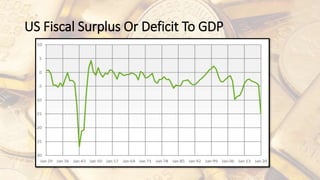
US Fiscal Surplus Or Deficit To GDP
US Fiscal Surplus Or Deficit To GDP - I
• According to the IMF’s Fiscal Monitor Update from January 2021,
fiscal deficits amounted to 13.3 percent of GDP, on average, in
advanced economies, in 2021, a spike from 3.3 percent seen in
2019.
• As a consequence, the gross global debt approached 98 percent in
2020 and it’s projected to reach 99.5 percent of the world’s GDP by
the end of this year.
• What is important to note here is that government support wasn’t
limited mainly to the financial institutions and big companies (such as
automakers), as was the case in 2009, but it was distributed more
widely. There was a huge direct money transfer to Main Street,
including checks for practically all citizens. This is important for two
reasons.
US Fiscal Surplus Or Deficit To GDP - II
• First, money flowing into the economy through nonfinancial institutions and
people’s accounts may be more inflationary. This is because money
doesn’t stay in the financial market where it mainly raises asset prices, but
it’s more likely to be spent on consumer goods, boosting the CPI inflation
rate.
• Higher officially reported inflation (and relatively lower asset prices) should
support gold, which is seen by investors as an inflation hedge.
• Second, the direct cash transfer to the people creates a dangerous
precedent. From now, each time the economy falls into crisis, people will
demand checks.
• It means that fiscal responses would have to be increasingly larger to meet
the inflated expectations of the public.
• It also implies that we are approaching a universal basic income, with its
mammoth fiscal costs and all related negative economic and social
consequences.
US Fiscal Surplus Or Deficit To GDP - III
• Summing up, we live in revolutionary times. The old paradigm that
“central banks are the only game in town” has been replaced by the
idea that fiscal policy should be more aggressively used.
• Maintaining balanced budgets is also a dead concept – who would
care about deficits when interest rates are so low?
• However, assigning a greater role to fiscal policy in achieving
macroeconomic goals increases the risk of higher inflation and
macroeconomic instability, as politicians tend to be pro-cyclical and
reckless.
• After all, the economic orthodoxy that monetary policy is better
suited to achieve macroeconomic stability didn’t come out from
nowhere, but from awful experiences of the fiscal follies of the past.
I’m not a fan of central bankers, but they are at least less short-
sighted than politicians who think mainly about how to win the next
election and stay in power.
US Fiscal Surplus Or Deficit To GDP - IV
• The growing acceptance of easy fiscal policy should be positive
for gold prices, especially considering that it will be
accompanied by an accommodative monetary policy.
• Such a policy mix should increase the public debt and inflation,
which could support gold prices. The caveat is that investors
have so far welcomed more stimulus flowing from both
the Fed and the Treasury.
• But this “go big” approach of Powell and Yellen increases the
longer-term risk for the economy, which could materialize –
similar to the pandemic – sooner than anyone thought.
Will Rates Rally Further, Pushing Gold
Down?
• The recent rally in the bond yields pushed gold prices down, but
this trend won’t continue forever, as the Fed will likely be forced
to step in.
• In March, we saw a continuation of the rally in bond yields that
started in February.
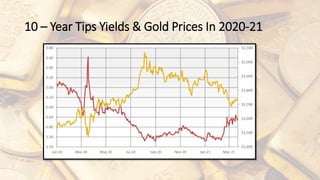
• As the chart below shows, the 10-year real interest rates have
soared from -1.06 on February 10 to -0.66 percent on March 23.
10 – Year Tips Yields & Gold Prices In 2020-21
10 – Year Tips Yields & Gold Prices In 2020-21 - I
• What is clear from the chart is the strong correlation between the 10-year TIPS yields and
the gold prices. As a consequence, the rising bond yields made gold struggle. However, in
March, the real interest rates were much more choppy compared to February, when they
surged decisively. It may signal a lack of fuel for the further rally, at least for a while.
• Now, what is important here is that despite the recent jump in the real yields, they remain
extremely low from the historical point of view. And they remain well below zero! This is
good news for the gold market, as the yellow metal shines the most when real interest
rates are negative.
• Of course, the direction of change is also very important, not just the absolute level. So,
the question is, will the rates increase further? Well, it’s unfortunately possible, as the
improving economic outlook and risk appetite are encouraging investors to buy stocks
rather than bonds.
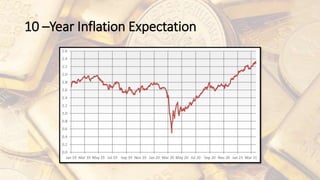
• On the other hand, the rising inflation expectations suggest that real yields may struggle
to increase further, or they actually may go down. As the chart below shows, the market
expectations of inflation in the next 10 years, derived from the Treasuries, have risen from
0.50 at the bottom in March 2020 to 2.31 on March 24, 2021.
10 –Year Inflation Expectation
10 –Year Inflation Expectation - I
• Given the increase that has already taken place, the further rise may be limited.
• But the broad money supply is still rising at an accelerating pace, and investors still don’t
believe that the Fed will not hike the federal funds rate to combat rising inflation. They
don’t buy the new monetary framework and all the talking about letting inflation overshoot
the Fed’s target.
• Of course, the promise to be irresponsible in the future is not very credible, but investors
shouldn’t underestimate the recklessness of central bankers.
• You see, we live in an era of weak policymakers unable to make serious commitments, or
take unpopular actions, contrary to the needs of Wall Street and the government.
• For example, Janet Yellen, as a Treasury Secretary, should stress fiscal discipline –
instead, she praised the “go big” approach of the new administration. Congress has
already passed the $1.9 trillion fiscal stimulus and the next additional spending is coming.
• The legislative proposal of new government expenditures on infrastructure and other
priorities (such as climate change and the labor market) could collectively cost more than
$3 trillion.
10 –Year Inflation Expectation - II
• It’s true that the additional government spending and the necessary borrowing
could push up the yields (this is an important downward risk for gold).
• But rising interest rates could hamper the economic recovery and make
government financing more costly, further ballooning already mammoth fiscal
deficits.
• So, the Fed will likely have to step in and expand its quantitative easing
program or introduce other measures, such as the yield curve control, to curb the
long-term interest rates. It will weaken the dollar, thus supporting gold prices.
• As a reminder, the Bank of Japan has started to target the yield on 10-year
government bonds at around zero percent in 2016, as it decided that the
rapid monetary base expansion via large-scale asset purchases was
unsustainable.
• More recently, the European Central Bank has announced in March the
acceleration in the pace of its QE in a response to the rally in bond yields.
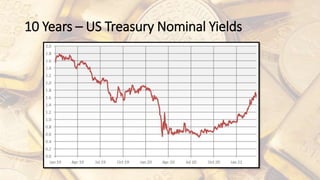
10 Years – US Treasury Nominal Yields
10 Years – US Treasury Nominal Yields - I
• Should we be surprised, given the bond bubble created by the
central banks? They have kept the bond yields artificially
depressed for years, so even a modest normalization –
perfectly justified by the expectations of economic recovery and
rising inflation – could collapse the house of cards and cause
a financial crisis.
• Hence, although markets have become more optimistic
recently, I’m afraid that bears and black swans haven’t said the
last word yet. And neither has gold.
Gold News & Analysis
• Gold remains pressured for third consecutive day as sellers attack weekly bottom.
• Treasury yields stays offered but King dollar stays firmer.
• G7, US-China and Brexit offer market jitters ahead of the key events.
• Gold (XAU/USD) prices remain pressured during a three-day downtrend of around $1,883,
down 0.26% on a day, ahead of the Super Thursday’s European session.
• In doing so, the quote fades earlier bounce off the day’s bottom of $1,885.16 as traders
await the key US Consumer Price Index (CPI) and the European Central Bank (ECB)
outcomes.
• Source:
• Gold Forecast, News and Analysis - FXStreet
Gold News & Analysis - I
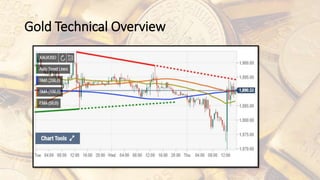
• XAU/USD's technical bearish picture to allow for more declines
• Gold price is extending the previous decline, undermined by the dollar’s demand.
• Thursday’s European Central Bank (ECB) monetary policy decision and US
Consumer Price Index (CPI) data are set to highlight policymaker’s thinking about
monetary stimulus.
• Meanwhile, gold’s four-hour chart paints a bearish picture heading into the key
event risks, FXStreet’s Dhwani Mehta briefs.
• Source:
• Gold Price Analysis: XAU/USD's technical bearish picture to allow for more
declines (fxstreet.com)
Gold Technical Overview
Fiscal Revolution Raise
Gold To The Throne
THA NKS FOR LISTENING
Fiscal Revolution Raise Gold To The Throne

June 11 I Session 1 I GBIH

  • 1.
  • 2.
    Points To BeCovered Today: • Will a Fiscal Revolution Raise Gold to the Throne? • Will Rates Rally Further, Pushing Gold Down? • Gold News & Analysis • Gold Technical Overview
  • 3.
    Will A FiscalRevolution Raise Gold To The Throne? • There is growing acceptance for an aggressive fiscal policy, which could be supportive for gold prices from the fundamental, long-term point of view. • We live in turbulent times. The pandemic is still raging and will most likely have lost lasting effects on our society. • But a revolution is also happening right before our eyes. And I don’t mean another storming of the U.S. Capitol or the clash of individual investors with big fish on Wall Street. • I have in mind something less spectacular but potentially more influential: a macroeconomic revolution. • I refer here to the growing acceptance of easy fiscal policy. In the aftermath of the Great Recession, the central banks adopted an aggressive monetary policy, slashing interest rates to almost zero and introducing quantitative easing. • It has become a new norm since then.
  • 4.
    US Fiscal SurplusOr Deficit To GDP
  • 5.
    US Fiscal SurplusOr Deficit To GDP - I • According to the IMF’s Fiscal Monitor Update from January 2021, fiscal deficits amounted to 13.3 percent of GDP, on average, in advanced economies, in 2021, a spike from 3.3 percent seen in 2019. • As a consequence, the gross global debt approached 98 percent in 2020 and it’s projected to reach 99.5 percent of the world’s GDP by the end of this year. • What is important to note here is that government support wasn’t limited mainly to the financial institutions and big companies (such as automakers), as was the case in 2009, but it was distributed more widely. There was a huge direct money transfer to Main Street, including checks for practically all citizens. This is important for two reasons.
  • 6.
    US Fiscal SurplusOr Deficit To GDP - II • First, money flowing into the economy through nonfinancial institutions and people’s accounts may be more inflationary. This is because money doesn’t stay in the financial market where it mainly raises asset prices, but it’s more likely to be spent on consumer goods, boosting the CPI inflation rate. • Higher officially reported inflation (and relatively lower asset prices) should support gold, which is seen by investors as an inflation hedge. • Second, the direct cash transfer to the people creates a dangerous precedent. From now, each time the economy falls into crisis, people will demand checks. • It means that fiscal responses would have to be increasingly larger to meet the inflated expectations of the public. • It also implies that we are approaching a universal basic income, with its mammoth fiscal costs and all related negative economic and social consequences.
  • 7.
    US Fiscal SurplusOr Deficit To GDP - III • Summing up, we live in revolutionary times. The old paradigm that “central banks are the only game in town” has been replaced by the idea that fiscal policy should be more aggressively used. • Maintaining balanced budgets is also a dead concept – who would care about deficits when interest rates are so low? • However, assigning a greater role to fiscal policy in achieving macroeconomic goals increases the risk of higher inflation and macroeconomic instability, as politicians tend to be pro-cyclical and reckless. • After all, the economic orthodoxy that monetary policy is better suited to achieve macroeconomic stability didn’t come out from nowhere, but from awful experiences of the fiscal follies of the past. I’m not a fan of central bankers, but they are at least less short- sighted than politicians who think mainly about how to win the next election and stay in power.
  • 8.
    US Fiscal SurplusOr Deficit To GDP - IV • The growing acceptance of easy fiscal policy should be positive for gold prices, especially considering that it will be accompanied by an accommodative monetary policy. • Such a policy mix should increase the public debt and inflation, which could support gold prices. The caveat is that investors have so far welcomed more stimulus flowing from both the Fed and the Treasury. • But this “go big” approach of Powell and Yellen increases the longer-term risk for the economy, which could materialize – similar to the pandemic – sooner than anyone thought.
  • 9.
    Will Rates RallyFurther, Pushing Gold Down? • The recent rally in the bond yields pushed gold prices down, but this trend won’t continue forever, as the Fed will likely be forced to step in. • In March, we saw a continuation of the rally in bond yields that started in February. • As the chart below shows, the 10-year real interest rates have soared from -1.06 on February 10 to -0.66 percent on March 23.
  • 10.
    10 – YearTips Yields & Gold Prices In 2020-21
  • 11.
    10 – YearTips Yields & Gold Prices In 2020-21 - I • What is clear from the chart is the strong correlation between the 10-year TIPS yields and the gold prices. As a consequence, the rising bond yields made gold struggle. However, in March, the real interest rates were much more choppy compared to February, when they surged decisively. It may signal a lack of fuel for the further rally, at least for a while. • Now, what is important here is that despite the recent jump in the real yields, they remain extremely low from the historical point of view. And they remain well below zero! This is good news for the gold market, as the yellow metal shines the most when real interest rates are negative. • Of course, the direction of change is also very important, not just the absolute level. So, the question is, will the rates increase further? Well, it’s unfortunately possible, as the improving economic outlook and risk appetite are encouraging investors to buy stocks rather than bonds. • On the other hand, the rising inflation expectations suggest that real yields may struggle to increase further, or they actually may go down. As the chart below shows, the market expectations of inflation in the next 10 years, derived from the Treasuries, have risen from 0.50 at the bottom in March 2020 to 2.31 on March 24, 2021.
  • 12.
  • 13.
    10 –Year InflationExpectation - I • Given the increase that has already taken place, the further rise may be limited. • But the broad money supply is still rising at an accelerating pace, and investors still don’t believe that the Fed will not hike the federal funds rate to combat rising inflation. They don’t buy the new monetary framework and all the talking about letting inflation overshoot the Fed’s target. • Of course, the promise to be irresponsible in the future is not very credible, but investors shouldn’t underestimate the recklessness of central bankers. • You see, we live in an era of weak policymakers unable to make serious commitments, or take unpopular actions, contrary to the needs of Wall Street and the government. • For example, Janet Yellen, as a Treasury Secretary, should stress fiscal discipline – instead, she praised the “go big” approach of the new administration. Congress has already passed the $1.9 trillion fiscal stimulus and the next additional spending is coming. • The legislative proposal of new government expenditures on infrastructure and other priorities (such as climate change and the labor market) could collectively cost more than $3 trillion.
  • 14.
    10 –Year InflationExpectation - II • It’s true that the additional government spending and the necessary borrowing could push up the yields (this is an important downward risk for gold). • But rising interest rates could hamper the economic recovery and make government financing more costly, further ballooning already mammoth fiscal deficits. • So, the Fed will likely have to step in and expand its quantitative easing program or introduce other measures, such as the yield curve control, to curb the long-term interest rates. It will weaken the dollar, thus supporting gold prices. • As a reminder, the Bank of Japan has started to target the yield on 10-year government bonds at around zero percent in 2016, as it decided that the rapid monetary base expansion via large-scale asset purchases was unsustainable. • More recently, the European Central Bank has announced in March the acceleration in the pace of its QE in a response to the rally in bond yields.
  • 15.
    10 Years –US Treasury Nominal Yields
  • 16.
    10 Years –US Treasury Nominal Yields - I • Should we be surprised, given the bond bubble created by the central banks? They have kept the bond yields artificially depressed for years, so even a modest normalization – perfectly justified by the expectations of economic recovery and rising inflation – could collapse the house of cards and cause a financial crisis. • Hence, although markets have become more optimistic recently, I’m afraid that bears and black swans haven’t said the last word yet. And neither has gold.
  • 17.
    Gold News &Analysis • Gold remains pressured for third consecutive day as sellers attack weekly bottom. • Treasury yields stays offered but King dollar stays firmer. • G7, US-China and Brexit offer market jitters ahead of the key events. • Gold (XAU/USD) prices remain pressured during a three-day downtrend of around $1,883, down 0.26% on a day, ahead of the Super Thursday’s European session. • In doing so, the quote fades earlier bounce off the day’s bottom of $1,885.16 as traders await the key US Consumer Price Index (CPI) and the European Central Bank (ECB) outcomes. • Source: • Gold Forecast, News and Analysis - FXStreet
  • 18.
    Gold News &Analysis - I • XAU/USD's technical bearish picture to allow for more declines • Gold price is extending the previous decline, undermined by the dollar’s demand. • Thursday’s European Central Bank (ECB) monetary policy decision and US Consumer Price Index (CPI) data are set to highlight policymaker’s thinking about monetary stimulus. • Meanwhile, gold’s four-hour chart paints a bearish picture heading into the key event risks, FXStreet’s Dhwani Mehta briefs. • Source: • Gold Price Analysis: XAU/USD's technical bearish picture to allow for more declines (fxstreet.com)
  • 19.
  • 20.
  • 21.
    THA NKS FORLISTENING Fiscal Revolution Raise Gold To The Throne