er's Explo ration of
    A Beginn               Learned
    R efactorin g: Lessons

A lightning talk by Lana Lodge
this talk
    W hy I wa nted to give

● Got really excited about refactoring after
  last month's talk
● Wanted to force myself to learn more
● Wanted to force myself to refactor my work
  code
● Wanted to engage in feedback here that
  might teach me even more
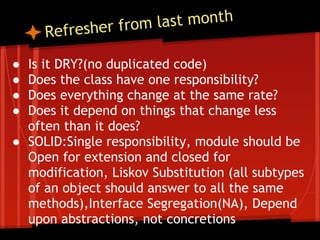
resher from last month
     Ref
● Is it DRY?(no duplicated code)
● Does the class have one responsibility?
● Does everything change at the same rate?
● Does it depend on things that change less
  often than it does?
● SOLID:Single responsibility, module should be
  Open for extension and closed for
  modification, Liskov Substitution (all subtypes
  of an object should answer to all the same
  methods),Interface Segregation(NA), Depend
  upon abstractions, not concretions
ething Sme lls Bad :S
    Som

● My project used to be simple....but with
  increasing requirements and having been
  taught by the last dev who put ALL
  FUNCTIONALITY in the controller..I have 1
  controller that handles all functionality for
  a complex set of forms with over 1000 lines
  of code :S...lots of "bad smells"
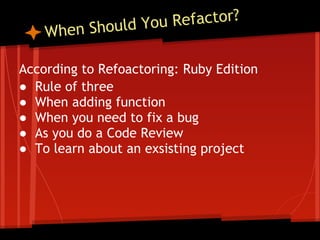
Should You Refactor?
    When

According to Refoactoring: Ruby Edition
● Rule of three
● When adding function
● When you need to fix a bug
● As you do a Code Review
● To learn about an exsisting project
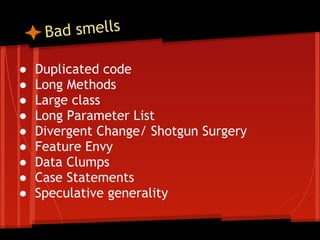
B ad smells

●   Duplicated code
●   Long Methods
●   Large class
●   Long Parameter List
●   Divergent Change/ Shotgun Surgery
●   Feature Envy
●   Data Clumps
●   Case Statements
●   Speculative generality
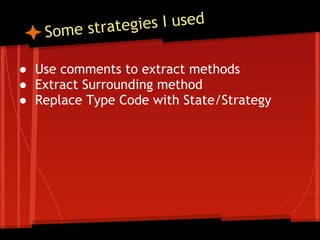
S ome strate gies I used

● Use comments to extract methods
● Extract Surrounding method
● Replace Type Code with State/Strategy
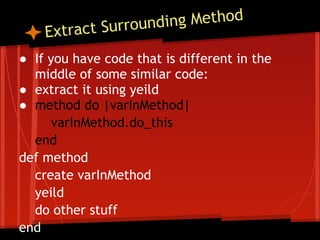
c t Surroundi ng Method
    Extra
● If you have code that is different in the
  middle of some similar code:
● extract it using yeild
● method do |varInMethod|
      varInMethod.do_this
  end
def method
  create varInMethod
  yeild
  do other stuff
end
place Type  code with
    Re
    Stat e/Strategy
● Like inheritence but not
● Make an object type for every "kind of"
  thing with the differing method in that
  object type
● Assign an object of the right type to a more
  general object
● This is for when your objects change type
  during calculations which use this differing
  method

July 2012 Ruby Tuesday - Lana Lodge - Refactoring Lighting Talk

  • 1.
    er's Explo rationof A Beginn Learned R efactorin g: Lessons A lightning talk by Lana Lodge
  • 2.
    this talk W hy I wa nted to give ● Got really excited about refactoring after last month's talk ● Wanted to force myself to learn more ● Wanted to force myself to refactor my work code ● Wanted to engage in feedback here that might teach me even more
  • 3.
    resher from lastmonth Ref ● Is it DRY?(no duplicated code) ● Does the class have one responsibility? ● Does everything change at the same rate? ● Does it depend on things that change less often than it does? ● SOLID:Single responsibility, module should be Open for extension and closed for modification, Liskov Substitution (all subtypes of an object should answer to all the same methods),Interface Segregation(NA), Depend upon abstractions, not concretions
  • 4.
    ething Sme llsBad :S Som ● My project used to be simple....but with increasing requirements and having been taught by the last dev who put ALL FUNCTIONALITY in the controller..I have 1 controller that handles all functionality for a complex set of forms with over 1000 lines of code :S...lots of "bad smells"
  • 5.
    Should You Refactor? When According to Refoactoring: Ruby Edition ● Rule of three ● When adding function ● When you need to fix a bug ● As you do a Code Review ● To learn about an exsisting project
  • 6.
    B ad smells ● Duplicated code ● Long Methods ● Large class ● Long Parameter List ● Divergent Change/ Shotgun Surgery ● Feature Envy ● Data Clumps ● Case Statements ● Speculative generality
  • 7.
    S ome strategies I used ● Use comments to extract methods ● Extract Surrounding method ● Replace Type Code with State/Strategy
  • 8.
    c t Surrounding Method Extra ● If you have code that is different in the middle of some similar code: ● extract it using yeild ● method do |varInMethod| varInMethod.do_this end def method create varInMethod yeild do other stuff end
  • 9.
    place Type code with Re Stat e/Strategy ● Like inheritence but not ● Make an object type for every "kind of" thing with the differing method in that object type ● Assign an object of the right type to a more general object ● This is for when your objects change type during calculations which use this differing method