1
ORIGINAL RESEARCH
Evaluation of a Nurse-Led Educational Telephone Intervention
to Support Self-Management of Patients with Chronic Obstructive
Pulmonary Disease: A Randomized Feasibility Study
Julia Billington,1
Samantha Coster,2
Trevor Murrells,2
and Ian Norman2
1 Central Surgery, Surbiton Health Centre, Surbiton,
Surrey, United Kingdom
2 King’s College London Florence Nightingale
Faculty of Nursing and Midwifery, James Clerk
Maxwell Building, Waterloo Road, London, United
Kingdom
Keywords: COPD assessment tool questionnaire,
primary care, action plans, symptom exacerbation,
telephone support
Correspondence to: Samantha Coster, King’s
College London Florence Nightingale Faculty of
Nursing and Midwifery, James Clerk Maxwell
Building, Waterloo Road, London SE1 8WA,
United Kingdom, phone: +44 2078483513,
email: Samantha.coster@kcl.ac.uk
Abstract
This randomized, two armed feasibility study in a UK General Practice Surgery
investigated the feasibility of introducing a nurse-led educational telephone
intervention for patients with chronic obstructive pulmonary disease (COPD) to
reinforce their understanding and use of their self-management plan. Methods:
73 patients were randomly allocated to a control group which received standard
care including a self-management plan or an intervention group which received
in addition, two scheduled telephone calls over six weeks from a practice nurse.
Calls were tailored to the needs of the patient, but provided education about the
use of their plan to manage exacerbations, use of health services and emergency
medication.The primary endpoint to be tested was the impact of symptoms assessed
by the COPD Assessment Tool (CAT) at baseline and 12 weeks. Secondary endpoints
were self-reported exacerbations, emergency visits and service satisfaction.
Results: Follow-up CAT data was available for 69 of the 73 randomized patients.
CAT scores in the intervention group decreased significantly showing improvement
between time 1 and 2 (Time 1 = 15.56 vs 12.44 at Time 2, Mean difference: 3.12, CI
1.52 – 4.72, p <0.05) with no significant change in the control group. A significant
difference between the CAT scores of the intervention and control groups was found
at time 2 adjusting for baseline CAT scores at time 1 (−2.38 (−4.40 to −0.36) p <0.05.)
No significant change was found in exacerbations between the groups at time 2.
Satisfaction ratings did not vary significantly between the intervention and control
groups over time. Conclusion: A nurse-led telephone intervention is feasible in
primary care and may help to improve patients’ health and well-being.
COPD, 00:1–9, 2014
ISSN: 1541-2555 print / 1541-2563 online
Copyright © Informa Healthcare USA, Inc.
DOI: 10.3109/15412555.2014.974735
Introduction
Self-management is seen as a cornerstone to successful COPD management.
A Cochrane review of 14 trials concluded that self-management education
was significantly associated with a reduction in hospital admissions (1) while a
recent meta-analysis (2) reported that complex self-management interventions
reduced use of urgent care by 32%. A key component of most self-management
programs are action plans. However, a Cochrane review found that action plans
with only brief patient education of one hour or less did not reduce patients’
health care utilisation or improve quality of life, anxiety and depression, mortal-
ity, lung function or respiratory symptoms. The plans did increase patients’ abil-
ity to react appropriately to an exacerbation, through the initiation of oral cor-
ticosteroids and better self-management knowledge (3). More recently written
action plans have been associated with a statistically and clinically significant
COPDDownloadedfrominformahealthcare.combyGPspracticestaffandCCGstaffinNHSKingstonCCGon02/18/15
Forpersonaluseonly.
Copyright © 2014 Informa Healthcare USA, Inc
2 Billington et al.
reduction of five days in the exacerbation recovery period
although only in 40.1% of the reported exacerbations did
patients actually used their action plan (4).
Although not adequately understood, the attitudes of
both patients with COPD and health care staff towards
action plans may play an important role in explaining
how patients’ use them. A survey of doctor’s attitudes
to action plans in COPD revealed that the most com-
mon reason for not providing them is perceived lack of
patient understanding of their illness (5). Sadeghi et al.
(6) also suggests that health literacy is a significant barrier
to self-care. Cognitive impairment and memory issues
can be related to hypoxemia and depression, while lower
health literacy is more prevalent in older populations (7).
Patients can also have trouble obtaining and recalling
information presented during clinic visits (8). Research
also suggests that “successful self-managers” classified
by their self-reported activity following self-management
courses, tend to be younger and living with other people
(9). Thus some patients, particularly older ones, may not
fully benefit from intensive self-management courses (9).
Delivering programs to enhance self-management,
including smoking cessation and pulmonary rehabilitation
programs, often involves considerable financial resources
and substantial training of healthcare staff. In addition,
international figures from the UK, Australia and Canada
suggest that only 1–2% of patients are actually receiving
training in pulmonary rehabilitation. This is attributed to
bothpatientfactors,inadditiontolowratesofpatientrefer-
ral and lack of resources to provide courses (10). Uptake
of programs when offered across Europe is cited as low as
33% to 39% (11), and attrition from self-management pro-
grams for COPD are typically around 30% (12).
Research suggests that practical issues, such as disrup-
tion to routine, feeling unwell, poor mobility, inconve-
nient timing and travel difficulties are commonly cited
reasons for non-attendance, in conjunction with a belief
that the treatment is not worthwhile (13). Problems with
mobility, travel and ill health are only likely to increase
as patients become older. Although home-based training
could address some of these issues, home visits by profes-
sional staff are expensive in terms of time and number
of patients seen, and thus hard to implement in settings
with limited resources (13). Telephone-based education
or counselling with patients, which reduces professionals’
travel time, is likely to be a less-expensive approach com-
pared to individual face-to-face visits in patient’s homes.
A randomised study by Wong et al. (14) evaluated
the impact of providing a simple telephone intervention
to 60 patients with COPD, which focused on increas-
ing patient self-efficacy after discharge from an acute
hospital in Hong Kong. The calls were brief, lasting only
10–20 minutes, with an average call 12.8 minutes, and
occurred at 3–7 days and 14–20 days after discharge.
The study found that these telephone follow-ups were
effective in increasing patients’ perceived self-efficacy in
managing dyspnea, as well as reducing the number of
visits to accident and emergency departments.
A recent Canadian multi-centre RCT of 233 patients
examined the impact of providing patients with COPD
a personalised action plan based on early symptom rec-
ognition and related individualised pharmacological and
non-pharmacological treatments. In addition, patients
were given the contact details of a case manager, who
also conducted two standardised telephone reinforce-
ment sessions at 1 and 4 months to enhance patents
understanding and adherence concerning action plan
and provide additional information when needed. A
self-reported decrease in the impact of exacerbations on
health status and the intensity of exacerbations was found
in the intervention group, although there was no differ-
ence in healthcare utilisation or exacerbation rate (15).
The aim of this study was to examine whether a tele-
phone support intervention designed to promote the
use of their action plan for self-management increased
patient well-being and reduced symptom severity in a UK
primary care setting. Specific objectives were to deter-
mine the: 1) feasibility of the study procedure, 2) feasi-
bility of the intervention, 3) potential effect sizes of the
intervention, and 4) costs of delivering the intervention.
Methods
This study was a single-centre, two-armed randomized
trial comparing the effect of a COPD self-management
plan with nurse telephone support (intervention) versus
the self-management plan alone (usual care) on patient
well-being and symptom severity.
Sample
Recruitment was from the patient population of a single
General Practice in Greater London providing services
for a total of 12,500 patients. All patients diagnosed
with COPD, living in the community and managed in
primary care were screened for eligibility.
Patients were deemed eligible if they were 1) on the
COPD register, based on their clinical symptoms and
previous spirometry results of FEV1/FVC ratio of 70% or
less, which was not fully reversible, and 2) able to speak
and read English to a level to be able to give informed
consent and complete a questionnaire.
Patients were diagnosed and placed on the register
using a number of different diagnostic indicators namely:
spirometry readings, clinical presentation, illness history
and lifestyle factors (e.g., smoking), the GP’s diagnosis
and that of the secondary care chest clinic to which the
patients had been previously referred. Given this, patients
were not excluded from the trial if, at their annual review,
but prior to randomization, they showed slight reversibil-
ity as they were still considered to be part of the target
population of patients managing COPD in primary care.
Exclusion criteria were patients with a concurrent seri-
ous illness such as lung cancer to avoid overburdening
them and patients living in a nursing or residential home,
or whom were housebound and so would be unable to
attend the surgery for annual review.
COPDDownloadedfrominformahealthcare.combyGPspracticestaffandCCGstaffinNHSKingstonCCGon02/18/15
Forpersonaluseonly.
Nurse-Led Telephone Support for COPD Patients 3
www.copdjournal.com
Recruitment
Patients were invited to take part in the study by post. All
participants who responded to the invitation to partici-
pate by returning written consent were asked to attend the
surgery for their COPD annual review. Baseline measures
were obtained at the clinic prior to the review. The review
itself comprised a meeting with the practice nurse or nurse
practitioner for a spirometry screening, and tests for capil-
lary oxygen saturation, height, weight and blood pressure
(BP). The spirometry screening took place by experienced
practice nurses using two Microlab MK8 spirometers that
were calibrated by a trained nurse using the appropriate
syringe equipment. This was followed by a discussion of
symptoms and current therapy, the number of exacerba-
tions since last visit and the number of A&E attendances
and admissions in the previous 12 months.
All patients were given a two-page self-management
plan, tailored to each patient, which consisted of a
standard action plan with guidelines to help the patient
recognize their exacerbation symptoms, how to take
their emergency medication if appropriate, and instruc-
tions to make a surgery appointment within 3 days of
commencing the emergency medication. The self-man-
agement plans were generated by the practice, based
on local primary care practice guidelines for COPD
services, but adapted to also include social information.
In addition it had a list of out of hours contact details
for the patient and details of where to obtain further
emergency medication along with the patient’s social
circumstances in case of involvement by a third party.
With the patient’s permission, these plans were also
faxed to the local pharmacist, out of hours Doctor ser-
vice and district nurse or community matron. As part
of the review a prescription was issued to each patient
for emergency antibiotics and emergency oral steroids.
Following the review, patients were not stratified but
randomly assigned by a statistician not conducting the
analysis, using a random number generator function
on spreadsheet software, to either the intervention or
control group. The study including recruitment and data
collection took place between May–November 2012.
Description of the Intervention
The intervention group received exactly the same treat-
ment as the usual care group and in addition, over a
6-week period, participants in the intervention arm
were contacted twice by a single advanced nurse practi-
tioner, at weeks three and five post baseline by scheduled
telephone appointment. The review by Dennis et al. (16)
of telephone interventions concluded that unscripted
(patient-centred) interventions appeared to be most
effective for improving self-management skills in people
from vulnerable groups and that planned (scheduled)
calls helped promote relationships between patients and
their health service provider. Thus the telephone support
was both scheduled to occur at certain pre-determined
time points and was also unscripted, i.e., individualized
to the patient. The telephone call was to be a maximum
of 25 minutes in duration and covered the topics pre-
sented in Table 1, as required by the patient.
Within this largely older population, with over three
quarters of study participants over 65, the main purpose
of the intervention was to provide a recap of the self-
management information received by patients at the
review and also to answer any specific questions that
patients had about using the self-management plan to
manage symptoms and initiate emergency medication
use. The nurse did this in a systematic way using an infor-
mation sheet to guide her questioning. Where appro-
priate, she provided general encouragement regarding
self-management. The nurse did not routinely provide
lifestyle advice regarding smoking cessation, exercise
or weight reduction but this was occasionally discussed
if the patient had particular questions or concerns. The
nurse also assessed the patient’s self-reported health at
the time of the call and suggested a clinic visit if she was
concerned. The nurse accessed all the patients’ electronic
medical records at the time of the telephone intervention
and used open-ended questions to promote discussion.
Outcome measures
COPD Assessment Tool (CAT)(17) is an eight-item mea-
sure of self-perceived health status and well-being. It asks
the respondents about the following symptoms: cough,
phlegm, chest tightness, breathlessness, and limitations of
daily living, confidence managing the illness, sleep prob-
lems and poor energy levels. The CAT provides a score of
0–40 units, to indicate the impact of disease (18). A CAT
score of less than 10 would suggest that COPD is having
a low impact on the patient’s perceived health and well-
being, 10–20 a medium impact, and 21–40 would suggest
a moderate-to-severe impact. A change in score of 2 units
has been identified by experts involved in developing the
test as being clinically significant (18). The secondary
outcomes were: self-reported visits to A&E department
or hospital admission; and self-reported number of exac-
erbations in the previous three months.
Table 1. To show content of the intervention
Topic* Advice
Living with the condition 1. Answering any patient queries about
managing their condition or general
health
Using the Action plan 2. Advice on using plan to recognise
breakthrough symptoms and appropriate
action to take
Using Medication 3. Offering advice on the appropriate use
of and access to medications aimed at
improving concordance with action plan
Encouragement 4. Encouragement where patients were
engaging with self-managing their
condition
Offering Support 5. Offering an appointment to see the nurse
or the doctor if their health appeared to
be deteriorating
*Intervention tailored to each patient so that not all topics were covered in the same
depth.
COPDDownloadedfrominformahealthcare.combyGPspracticestaffandCCGstaffinNHSKingstonCCGon02/18/15
Forpersonaluseonly.
Copyright © 2014 Informa Healthcare USA, Inc
4 Billington et al.
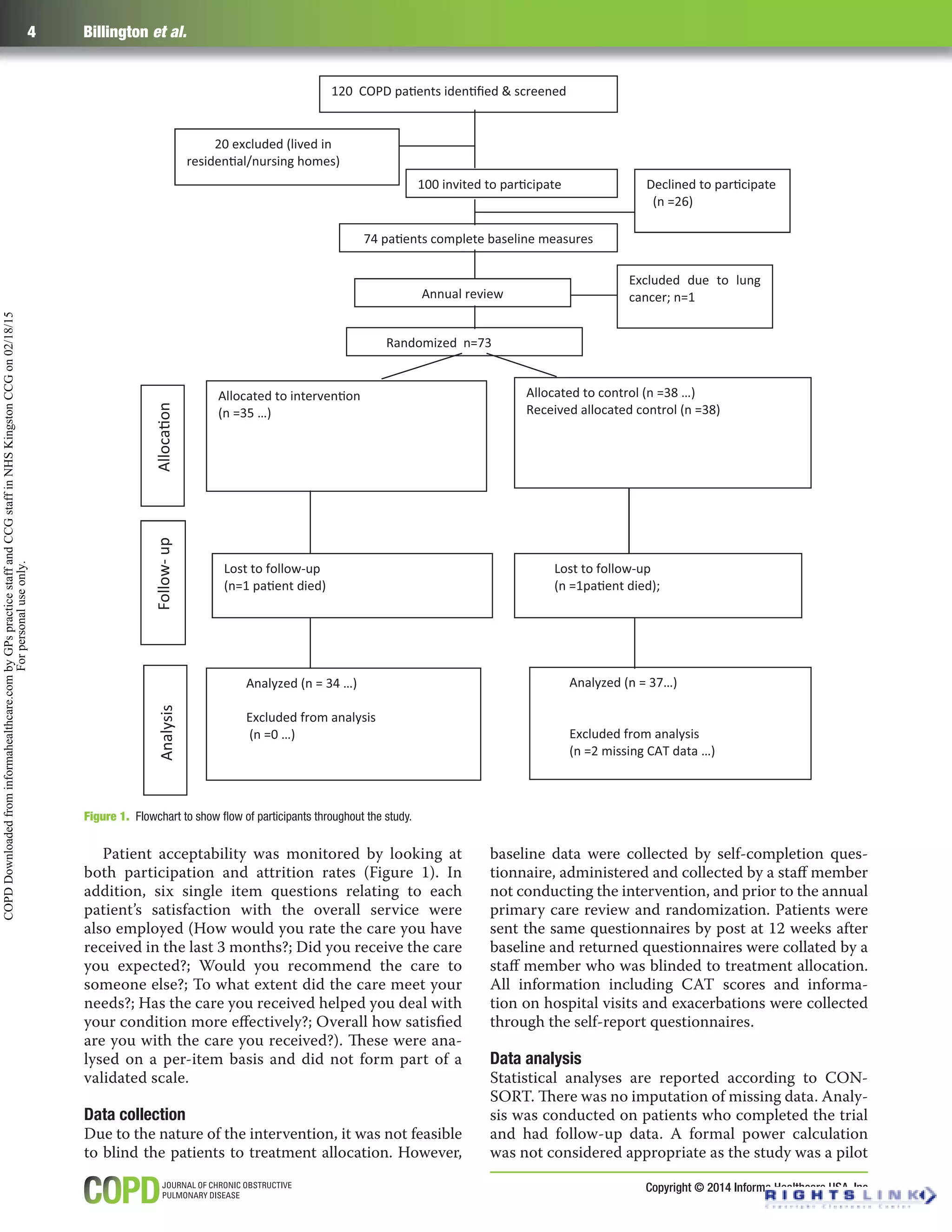
Patient acceptability was monitored by looking at
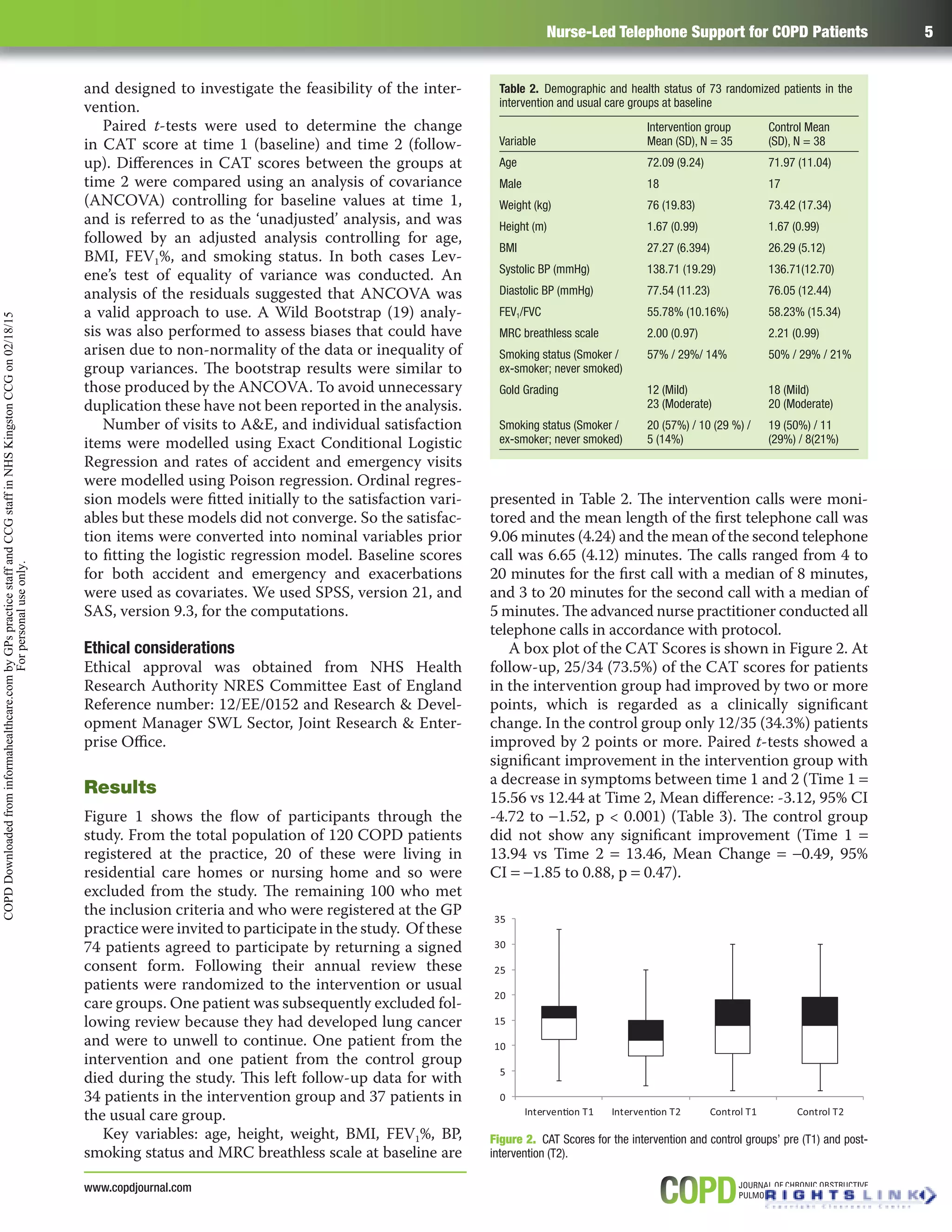
both participation and attrition rates (Figure 1). In
addition, six single item questions relating to each
patient’s satisfaction with the overall service were
also employed (How would you rate the care you have
received in the last 3 months?; Did you receive the care
you expected?; Would you recommend the care to
someone else?; To what extent did the care meet your
needs?; Has the care you received helped you deal with
your condition more effectively?; Overall how satisfied
are you with the care you received?). These were ana-
lysed on a per-item basis and did not form part of a
validated scale.
Data collection
Due to the nature of the intervention, it was not feasible
to blind the patients to treatment allocation. However,
baseline data were collected by self-completion ques-
tionnaire, administered and collected by a staff member
not conducting the intervention, and prior to the annual
primary care review and randomization. Patients were
sent the same questionnaires by post at 12 weeks after
baseline and returned questionnaires were collated by a
staff member who was blinded to treatment allocation.
All information including CAT scores and informa-
tion on hospital visits and exacerbations were collected
through the self-report questionnaires.
Data analysis
Statistical analyses are reported according to CON-
SORT. There was no imputation of missing data. Analy-
sis was conducted on patients who completed the trial
and had follow-up data. A formal power calculation
was not considered appropriate as the study was a pilot
120 COPD paƟents idenƟfied & screened
Declined to parƟcipate
(n =26)
Randomized n=73
Allocated to intervenƟon
(n =35 …)
Allocated to control (n =38 …)
Received allocated control (n =38)
Lost to follow-up
(n=1 paƟent died)
Lost to follow-up
(n =1paƟent died);
Analyzed (n = 34 …)
Excluded from analysis
(n =0 …)
Analyzed (n = 37…)
Excluded from analysis
(n =2 missing CAT data …)
AllocaƟonAnalysisFollow-up
74 paƟents complete baseline measures
Annual review
20 excluded (lived in
residenƟal/nursing homes)
100 invited to parƟcipate
Excluded due to lung
cancer; n=1
Figure 1. Flowchart to show flow of participants throughout the study.
COPDDownloadedfrominformahealthcare.combyGPspracticestaffandCCGstaffinNHSKingstonCCGon02/18/15
Forpersonaluseonly.
Nurse-Led Telephone Support for COPD Patients 5
www.copdjournal.com
and designed to investigate the feasibility of the inter-
vention.
Paired t-tests were used to determine the change
in CAT score at time 1 (baseline) and time 2 (follow-
up). Differences in CAT scores between the groups at
time 2 were compared using an analysis of covariance
(ANCOVA) controlling for baseline values at time 1,
and is referred to as the ‘unadjusted’ analysis, and was
followed by an adjusted analysis controlling for age,
BMI, FEV1%, and smoking status. In both cases Lev-
ene’s test of equality of variance was conducted. An
analysis of the residuals suggested that ANCOVA was
a valid approach to use. A Wild Bootstrap (19) analy-
sis was also performed to assess biases that could have
arisen due to non-normality of the data or inequality of
group variances. The bootstrap results were similar to
those produced by the ANCOVA. To avoid unnecessary
duplication these have not been reported in the analysis.
Number of visits to A&E, and individual satisfaction
items were modelled using Exact Conditional Logistic
Regression and rates of accident and emergency visits
were modelled using Poison regression. Ordinal regres-
sion models were fitted initially to the satisfaction vari-
ables but these models did not converge. So the satisfac-
tion items were converted into nominal variables prior
to fitting the logistic regression model. Baseline scores
for both accident and emergency and exacerbations
were used as covariates. We used SPSS, version 21, and
SAS, version 9.3, for the computations.
Ethical considerations
Ethical approval was obtained from NHS Health
Research Authority NRES Committee East of England
Reference number: 12/EE/0152 and Research & Devel-
opment Manager SWL Sector, Joint Research & Enter-
prise Office.
Results
Figure 1 shows the flow of participants through the
study. From the total population of 120 COPD patients
registered at the practice, 20 of these were living in
residential care homes or nursing home and so were
excluded from the study. The remaining 100 who met
the inclusion criteria and who were registered at the GP
practice were invited to participate in the study. Of these
74 patients agreed to participate by returning a signed
consent form. Following their annual review these
patients were randomized to the intervention or usual
care groups. One patient was subsequently excluded fol-
lowing review because they had developed lung cancer
and were to unwell to continue. One patient from the
intervention and one patient from the control group
died during the study. This left follow-up data for with
34 patients in the intervention group and 37 patients in
the usual care group.
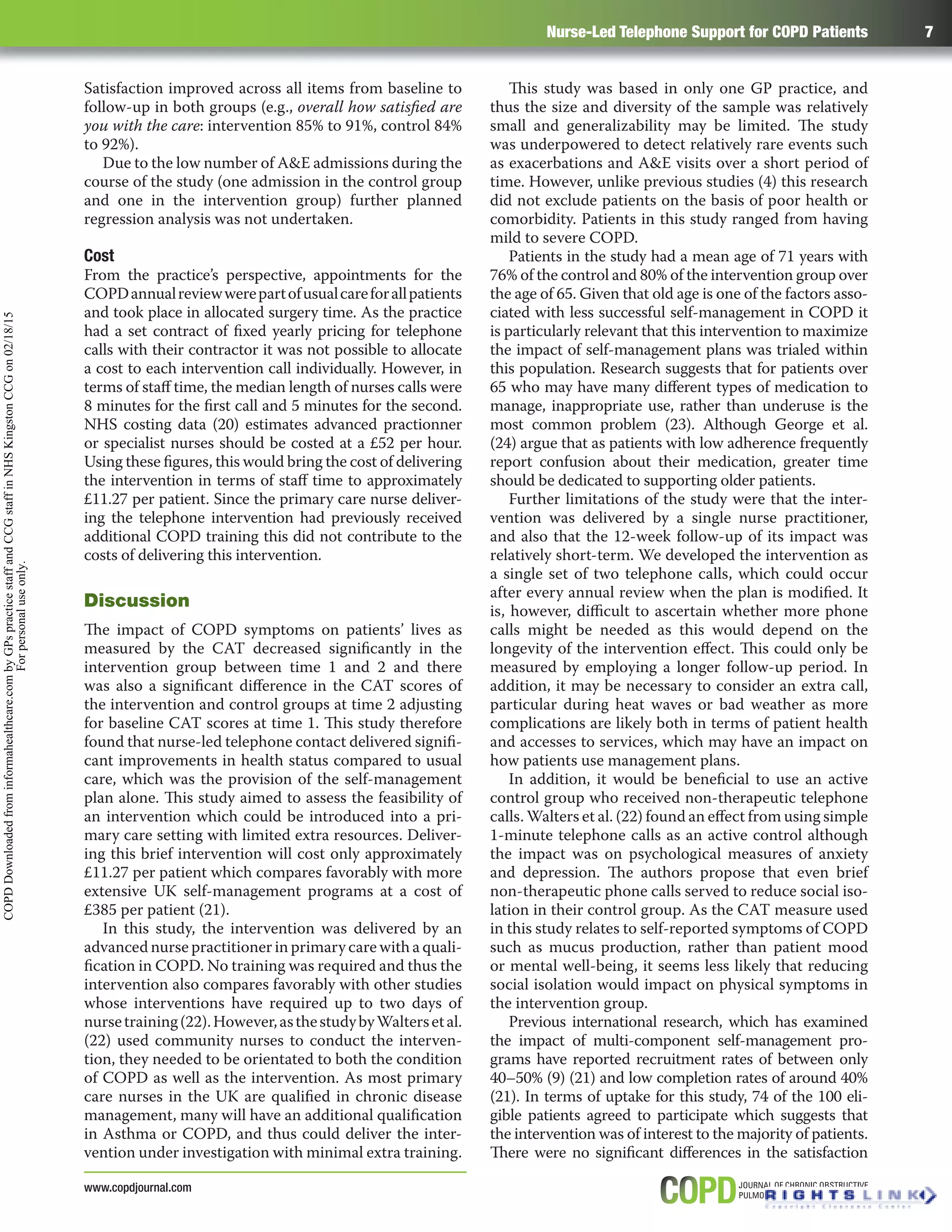
Key variables: age, height, weight, BMI, FEV1%, BP,
smoking status and MRC breathless scale at baseline are
presented in Table 2. The intervention calls were moni-
tored and the mean length of the first telephone call was
9.06 minutes (4.24) and the mean of the second telephone
call was 6.65 (4.12) minutes. The calls ranged from 4 to
20 minutes for the first call with a median of 8 minutes,
and 3 to 20 minutes for the second call with a median of
5 minutes. The advanced nurse practitioner conducted all
telephone calls in accordance with protocol.
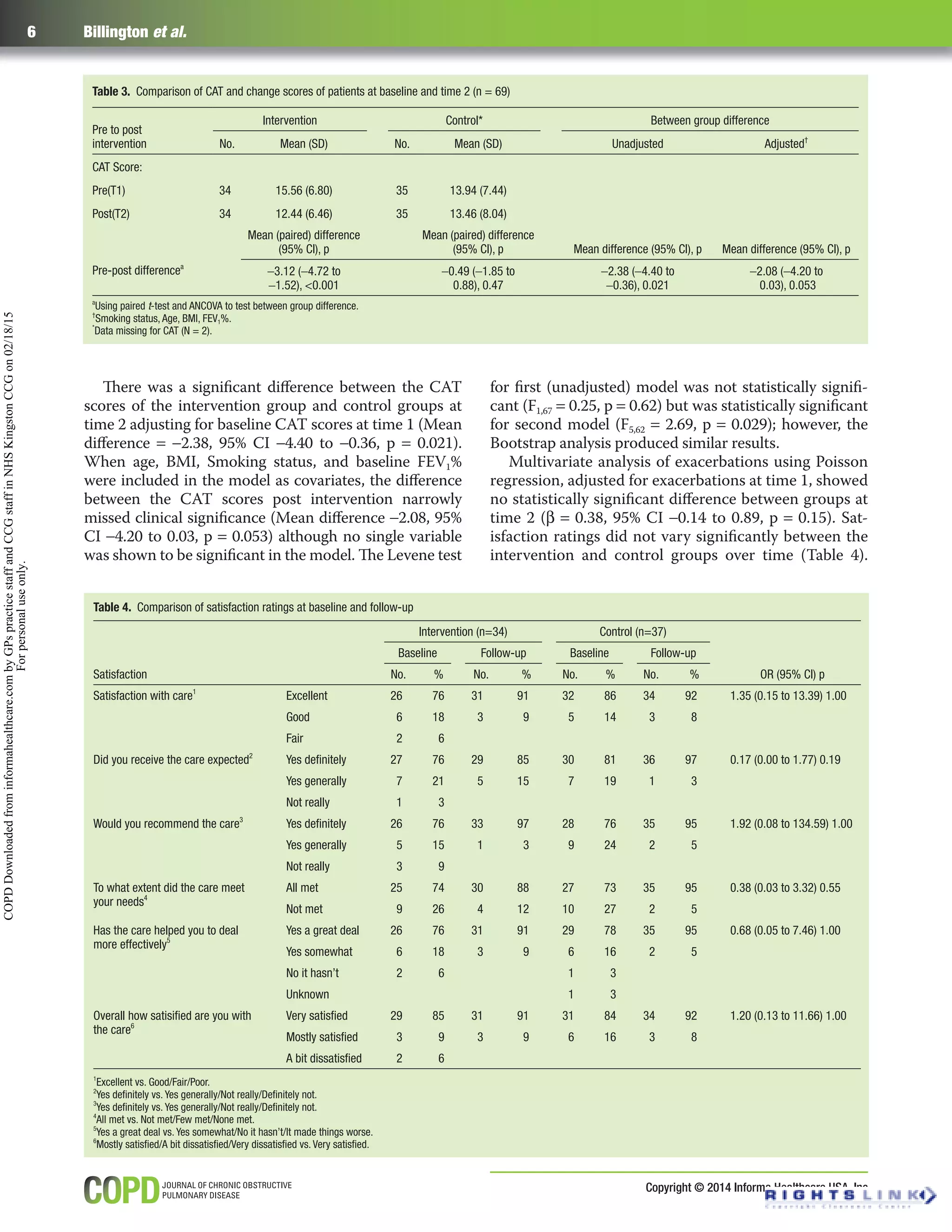
A box plot of the CAT Scores is shown in Figure 2. At
follow-up, 25/34 (73.5%) of the CAT scores for patients
in the intervention group had improved by two or more
points, which is regarded as a clinically significant
change. In the control group only 12/35 (34.3%) patients
improved by 2 points or more. Paired t-tests showed a
significant improvement in the intervention group with
a decrease in symptoms between time 1 and 2 (Time 1 =
15.56 vs 12.44 at Time 2, Mean difference: -3.12, 95% CI
-4.72 to −1.52, p < 0.001) (Table 3). The control group
did not show any significant improvement (Time 1 =
13.94 vs Time 2 = 13.46, Mean Change = −0.49, 95%
CI = −1.85 to 0.88, p = 0.47).
Table 2. Demographic and health status of 73 randomized patients in the
intervention and usual care groups at baseline
Variable
Intervention group
Mean (SD), N = 35
Control Mean
(SD), N = 38
Age 72.09 (9.24) 71.97 (11.04)
Male 18 17
Weight (kg) 76 (19.83) 73.42 (17.34)
Height (m) 1.67 (0.99) 1.67 (0.99)
BMI 27.27 (6.394) 26.29 (5.12)
Systolic BP (mmHg) 138.71 (19.29) 136.71(12.70)
Diastolic BP (mmHg) 77.54 (11.23) 76.05 (12.44)
FEV1/FVC 55.78% (10.16%) 58.23% (15.34)
MRC breathless scale 2.00 (0.97) 2.21 (0.99)
Smoking status (Smoker /
ex-smoker; never smoked)
57% / 29%/ 14% 50% / 29% / 21%
Gold Grading 12 (Mild)
23 (Moderate)
18 (Mild)
20 (Moderate)
Smoking status (Smoker /
ex-smoker; never smoked)
20 (57%) / 10 (29 %) /
5 (14%)
19 (50%) / 11
(29%) / 8(21%)
0
5
10
15
20
25
30
35
IntervenƟon T1 IntervenƟon T2 Control T1 Control T2
Figure 2. CAT Scores for the intervention and control groups’ pre (T1) and post-
intervention (T2).
COPDDownloadedfrominformahealthcare.combyGPspracticestaffandCCGstaffinNHSKingstonCCGon02/18/15
Forpersonaluseonly.
Copyright © 2014 Informa Healthcare USA, Inc
6 Billington et al.
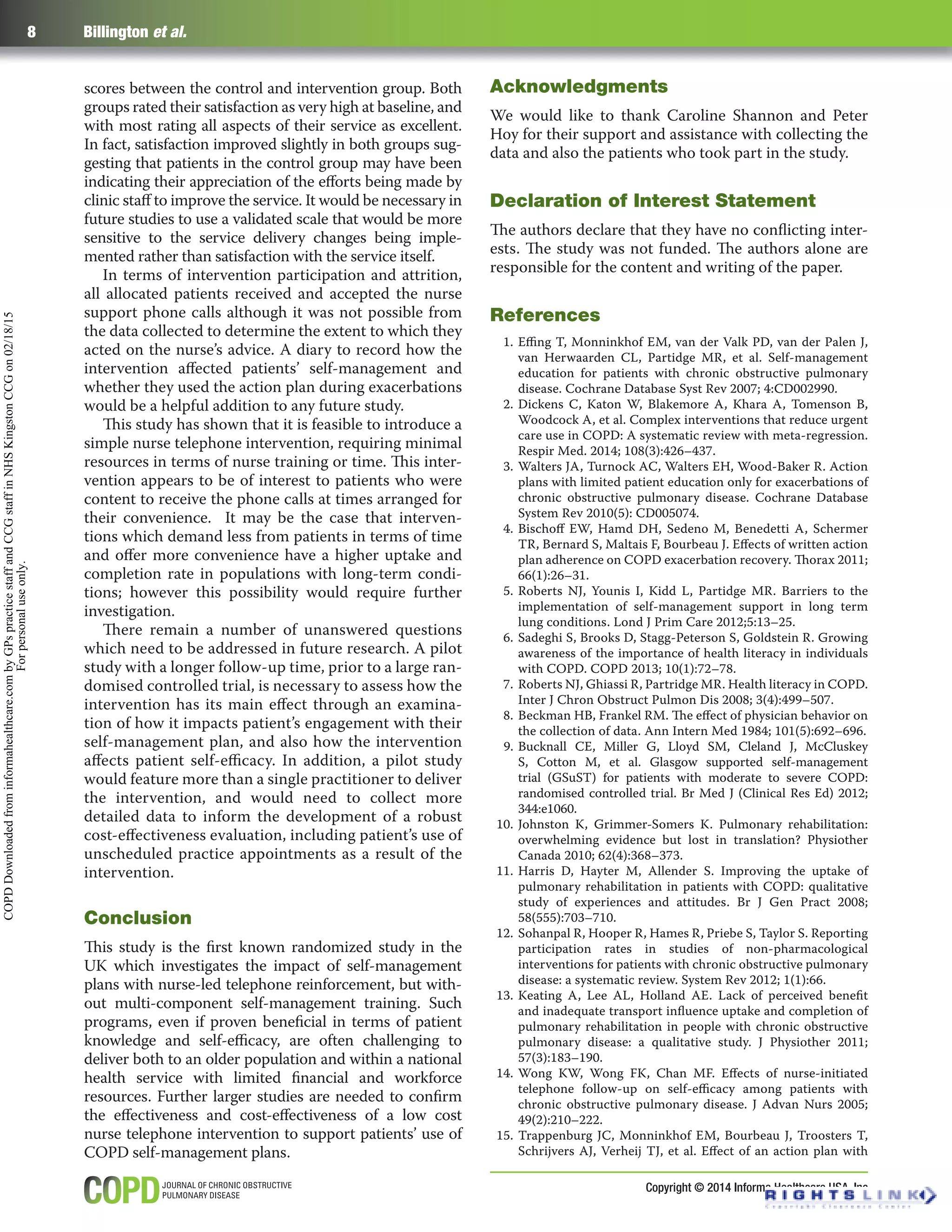
There was a significant difference between the CAT
scores of the intervention group and control groups at
time 2 adjusting for baseline CAT scores at time 1 (Mean
difference = −2.38, 95% CI −4.40 to −0.36, p = 0.021).
When age, BMI, Smoking status, and baseline FEV1%
were included in the model as covariates, the difference
between the CAT scores post intervention narrowly
missed clinical significance (Mean difference −2.08, 95%
CI −4.20 to 0.03, p = 0.053) although no single variable
was shown to be significant in the model. The Levene test
for first (unadjusted) model was not statistically signifi-
cant (F1,67 = 0.25, p = 0.62) but was statistically significant
for second model (F5,62 = 2.69, p = 0.029); however, the
Bootstrap analysis produced similar results.
Multivariate analysis of exacerbations using Poisson
regression, adjusted for exacerbations at time 1, showed
no statistically significant difference between groups at
time 2 (β = 0.38, 95% CI −0.14 to 0.89, p = 0.15). Sat-
isfaction ratings did not vary significantly between the
intervention and control groups over time (Table 4).
Table 4. Comparison of satisfaction ratings at baseline and follow-up
Satisfaction 
  Intervention (n=34) Control (n=37)  
  Baseline Follow-up Baseline Follow-up  
  No. % No. %   No. % No. % OR (95% CI) p
Satisfaction with care1
Excellent 26 76 31 91 32 86 34 92 1.35 (0.15 to 13.39) 1.00
Good 6 18 3 9 5 14 3 8  
Fair 2 6              
Did you receive the care expected2
Yes definitely 27 76 29 85 30 81 36 97 0.17 (0.00 to 1.77) 0.19
Yes generally 7 21 5 15 7 19 1 3  
Not really 1 3              
Would you recommend the care3
Yes definitely 26 76 33 97 28 76 35 95 1.92 (0.08 to 134.59) 1.00
Yes generally 5 15 1 3 9 24 2 5  
Not really 3 9              
To what extent did the care meet
your needs4
All met 25 74 30 88 27 73 35 95 0.38 (0.03 to 3.32) 0.55
Not met 9 26 4 12   10 27 2 5
Has the care helped you to deal
more effectively5
Yes a great deal 26 76 31 91 29 78 35 95 0.68 (0.05 to 7.46) 1.00
Yes somewhat 6 18 3 9 6 16 2 5  
No it hasn’t 2 6 1 3  
Unknown     1 3      
Overall how satisified are you with
the care6
Very satisfied 29 85 31 91 31 84 34 92 1.20 (0.13 to 11.66) 1.00
Mostly satisfied 3 9 3 9 6 16 3 8  
A bit dissatisfied 2 6              
1
Excellent vs. Good/Fair/Poor.
2
Yes definitely vs. Yes generally/Not really/Definitely not.
3
Yes definitely vs. Yes generally/Not really/Definitely not.
4
All met vs. Not met/Few met/None met.
5
Yes a great deal vs. Yes somewhat/No it hasn’t/It made things worse.
6
Mostly satisfied/A bit dissatisfied/Very dissatisfied vs. Very satisfied.
Table 3. Comparison of CAT and change scores of patients at baseline and time 2 (n = 69)
Pre to post
intervention
Intervention Control* Between group difference
No. Mean (SD) No. Mean (SD) Unadjusted Adjusted†
CAT Score:
Pre(T1) 34 15.56 (6.80)   35 13.94 (7.44)      
Post(T2) 34 12.44 (6.46)   35 13.46 (8.04)      
   
Mean (paired) difference
(95% CI), p    
Mean (paired) difference
(95% CI), p   Mean difference (95% CI), p Mean difference (95% CI), p
Pre-post differencea
 
−3.12 (−4.72 to
−1.52), <0.001    
−0.49 (−1.85 to
0.88), 0.47  
−2.38 (−4.40 to
−0.36), 0.021
−2.08 (−4.20 to
0.03), 0.053
a
Using paired t-test and ANCOVA to test between group difference.
†
Smoking status, Age, BMI, FEV1%.
*
Data missing for CAT (N = 2).
COPDDownloadedfrominformahealthcare.combyGPspracticestaffandCCGstaffinNHSKingstonCCGon02/18/15
Forpersonaluseonly.
Nurse-Led Telephone Support for COPD Patients 7
www.copdjournal.com
Satisfaction improved across all items from baseline to
follow-up in both groups (e.g., overall how satisfied are
you with the care: intervention 85% to 91%, control 84%
to 92%).
Due to the low number of A&E admissions during the
course of the study (one admission in the control group
and one in the intervention group) further planned
regression analysis was not undertaken.
Cost
From the practice’s perspective, appointments for the
COPDannualreviewwerepartofusualcareforallpatients
and took place in allocated surgery time. As the practice
had a set contract of fixed yearly pricing for telephone
calls with their contractor it was not possible to allocate
a cost to each intervention call individually. However, in
terms of staff time, the median length of nurses calls were
8 minutes for the first call and 5 minutes for the second.
NHS costing data (20) estimates advanced practionner
or specialist nurses should be costed at a £52 per hour.
Using these figures, this would bring the cost of delivering
the intervention in terms of staff time to approximately
£11.27 per patient. Since the primary care nurse deliver-
ing the telephone intervention had previously received
additional COPD training this did not contribute to the
costs of delivering this intervention.
Discussion
The impact of COPD symptoms on patients’ lives as
measured by the CAT decreased significantly in the
intervention group between time 1 and 2 and there
was also a significant difference in the CAT scores of
the intervention and control groups at time 2 adjusting
for baseline CAT scores at time 1. This study therefore
found that nurse-led telephone contact delivered signifi-
cant improvements in health status compared to usual
care, which was the provision of the self-management
plan alone. This study aimed to assess the feasibility of
an intervention which could be introduced into a pri-
mary care setting with limited extra resources. Deliver-
ing this brief intervention will cost only approximately
£11.27 per patient which compares favorably with more
extensive UK self-management programs at a cost of
£385 per patient (21).
In this study, the intervention was delivered by an
advanced nurse practitioner in primary care with a quali-
fication in COPD. No training was required and thus the
intervention also compares favorably with other studies
whose interventions have required up to two days of
nursetraining(22).However,asthestudybyWaltersetal.
(22) used community nurses to conduct the interven-
tion, they needed to be orientated to both the condition
of COPD as well as the intervention. As most primary
care nurses in the UK are qualified in chronic disease
management, many will have an additional qualification
in Asthma or COPD, and thus could deliver the inter-
vention under investigation with minimal extra training.
This study was based in only one GP practice, and
thus the size and diversity of the sample was relatively
small and generalizability may be limited. The study
was underpowered to detect relatively rare events such
as exacerbations and A&E visits over a short period of
time. However, unlike previous studies (4) this research
did not exclude patients on the basis of poor health or
comorbidity. Patients in this study ranged from having
mild to severe COPD.
Patients in the study had a mean age of 71 years with
76% of the control and 80% of the intervention group over
the age of 65. Given that old age is one of the factors asso-
ciated with less successful self-management in COPD it
is particularly relevant that this intervention to maximize
the impact of self-management plans was trialed within
this population. Research suggests that for patients over
65 who may have many different types of medication to
manage, inappropriate use, rather than underuse is the
most common problem (23). Although George et al.
(24) argue that as patients with low adherence frequently
report confusion about their medication, greater time
should be dedicated to supporting older patients.
Further limitations of the study were that the inter-
vention was delivered by a single nurse practitioner,
and also that the 12-week follow-up of its impact was
relatively short-term. We developed the intervention as
a single set of two telephone calls, which could occur
after every annual review when the plan is modified. It
is, however, difficult to ascertain whether more phone
calls might be needed as this would depend on the
longevity of the intervention effect. This could only be
measured by employing a longer follow-up period. In
addition, it may be necessary to consider an extra call,
particular during heat waves or bad weather as more
complications are likely both in terms of patient health
and accesses to services, which may have an impact on
how patients use management plans.
In addition, it would be beneficial to use an active
control group who received non-therapeutic telephone
calls. Walters et al. (22) found an effect from using simple
1-minute telephone calls as an active control although
the impact was on psychological measures of anxiety
and depression. The authors propose that even brief
non-therapeutic phone calls served to reduce social iso-
lation in their control group. As the CAT measure used
in this study relates to self-reported symptoms of COPD
such as mucus production, rather than patient mood
or mental well-being, it seems less likely that reducing
social isolation would impact on physical symptoms in
the intervention group.
Previous international research, which has examined
the impact of multi-component self-management pro-
grams have reported recruitment rates of between only
40–50% (9) (21) and low completion rates of around 40%
(21). In terms of uptake for this study, 74 of the 100 eli-
gible patients agreed to participate which suggests that
the intervention was of interest to the majority of patients.
There were no significant differences in the satisfaction
COPDDownloadedfrominformahealthcare.combyGPspracticestaffandCCGstaffinNHSKingstonCCGon02/18/15
Forpersonaluseonly.
Copyright © 2014 Informa Healthcare USA, Inc
8 Billington et al.
scores between the control and intervention group. Both
groups rated their satisfaction as very high at baseline, and
with most rating all aspects of their service as excellent.
In fact, satisfaction improved slightly in both groups sug-
gesting that patients in the control group may have been
indicating their appreciation of the efforts being made by
clinic staff to improve the service. It would be necessary in
future studies to use a validated scale that would be more
sensitive to the service delivery changes being imple-
mented rather than satisfaction with the service itself.
In terms of intervention participation and attrition,
all allocated patients received and accepted the nurse
support phone calls although it was not possible from
the data collected to determine the extent to which they
acted on the nurse’s advice. A diary to record how the
intervention affected patients’ self-management and
whether they used the action plan during exacerbations
would be a helpful addition to any future study.
This study has shown that it is feasible to introduce a
simple nurse telephone intervention, requiring minimal
resources in terms of nurse training or time. This inter-
vention appears to be of interest to patients who were
content to receive the phone calls at times arranged for
their convenience. It may be the case that interven-
tions which demand less from patients in terms of time
and offer more convenience have a higher uptake and
completion rate in populations with long-term condi-
tions; however this possibility would require further
investigation.
There remain a number of unanswered questions
which need to be addressed in future research. A pilot
study with a longer follow-up time, prior to a large ran-
domised controlled trial, is necessary to assess how the
intervention has its main effect through an examina-
tion of how it impacts patient’s engagement with their
self-management plan, and also how the intervention
affects patient self-efficacy. In addition, a pilot study
would feature more than a single practitioner to deliver
the intervention, and would need to collect more
detailed data to inform the development of a robust
cost-effectiveness evaluation, including patient’s use of
unscheduled practice appointments as a result of the
intervention.
Conclusion
This study is the first known randomized study in the
UK which investigates the impact of self-management
plans with nurse-led telephone reinforcement, but with-
out multi-component self-management training. Such
programs, even if proven beneficial in terms of patient
knowledge and self-efficacy, are often challenging to
deliver both to an older population and within a national
health service with limited financial and workforce
resources. Further larger studies are needed to confirm
the effectiveness and cost-effectiveness of a low cost
nurse telephone intervention to support patients’ use of
COPD self-management plans.
Acknowledgments
We would like to thank Caroline Shannon and Peter
Hoy for their support and assistance with collecting the
data and also the patients who took part in the study.
Declaration of Interest Statement
The authors declare that they have no conflicting inter-
ests. The study was not funded. The authors alone are
responsible for the content and writing of the paper.
References
1. Effing T, Monninkhof EM, van der Valk PD, van der Palen J,
van Herwaarden CL, Partidge MR, et al. Self-management
education for patients with chronic obstructive pulmonary
disease. Cochrane Database Syst Rev 2007; 4:CD002990.
2. Dickens C, Katon W, Blakemore A, Khara A, Tomenson B,
Woodcock A, et al. Complex interventions that reduce urgent
care use in COPD: A systematic review with meta-regression.
Respir Med. 2014; 108(3):426–437.
3. Walters JA, Turnock AC, Walters EH, Wood-Baker R. Action
plans with limited patient education only for exacerbations of
chronic obstructive pulmonary disease. Cochrane Database
System Rev 2010(5): CD005074.
4. Bischoff EW, Hamd DH, Sedeno M, Benedetti A, Schermer
TR, Bernard S, Maltais F, Bourbeau J. Effects of written action
plan adherence on COPD exacerbation recovery. Thorax 2011;
66(1):26–31.
5. Roberts NJ, Younis I, Kidd L, Partidge MR. Barriers to the
implementation of self-management support in long term
lung conditions. Lond J Prim Care 2012;5:13–25.
6. Sadeghi S, Brooks D, Stagg-Peterson S, Goldstein R. Growing
awareness of the importance of health literacy in individuals
with COPD. COPD 2013; 10(1):72–78.
7. Roberts NJ, Ghiassi R, Partridge MR. Health literacy in COPD.
Inter J Chron Obstruct Pulmon Dis 2008; 3(4):499–507.
8. Beckman HB, Frankel RM. The effect of physician behavior on
the collection of data. Ann Intern Med 1984; 101(5):692–696.
9. Bucknall CE, Miller G, Lloyd SM, Cleland J, McCluskey
S, Cotton M, et al. Glasgow supported self-management
trial (GSuST) for patients with moderate to severe COPD:
randomised controlled trial. Br Med J (Clinical Res Ed) 2012;
344:e1060.
10. Johnston K, Grimmer-Somers K. Pulmonary rehabilitation:
overwhelming evidence but lost in translation? Physiother
Canada 2010; 62(4):368–373.
11. Harris D, Hayter M, Allender S. Improving the uptake of
pulmonary rehabilitation in patients with COPD: qualitative
study of experiences and attitudes. Br J Gen Pract 2008;
58(555):703–710.
12. Sohanpal R, Hooper R, Hames R, Priebe S, Taylor S. Reporting
participation rates in studies of non-pharmacological
interventions for patients with chronic obstructive pulmonary
disease: a systematic review. System Rev 2012; 1(1):66.
13. Keating A, Lee AL, Holland AE. Lack of perceived benefit
and inadequate transport influence uptake and completion of
pulmonary rehabilitation in people with chronic obstructive
pulmonary disease: a qualitative study. J Physiother 2011;
57(3):183–190.
14. Wong KW, Wong FK, Chan MF. Effects of nurse-initiated
telephone follow-up on self-efficacy among patients with
chronic obstructive pulmonary disease. J Advan Nurs 2005;
49(2):210–222.
15. Trappenburg JC, Monninkhof EM, Bourbeau J, Troosters T,
Schrijvers AJ, Verheij TJ, et al. Effect of an action plan with
COPDDownloadedfrominformahealthcare.combyGPspracticestaffandCCGstaffinNHSKingstonCCGon02/18/15
Forpersonaluseonly.
Nurse-Led Telephone Support for COPD Patients 9
www.copdjournal.com
ongoing support by a case manager on exacerbation-related
outcome in patients with COPD: a multicentre randomised
controlled trial. Thorax 2011; 66(11):977–984.
16. Dennis SM, Harris M, Lloyd J, Powell Davies G, Faruqi N,
Zwar N. Do people with existing chronic conditions benefit
from telephone coaching? A rapid review. Austral Health Rev
2013; 37(3):381–388.
17. GlaxoSmithKline. COPD Assessement Test (CAT) Available
from:http://www.catestonline.org (accessed 11 December, 2011).
18. Jones P. W. G, Harding G. P, Berry P. I, Wiklund I., Chen
W-H., N. KL. Development and first validation of the COPD
Assessment Test. Euro Respir J 2009; 34:648–654.
19. Liu R, Y. Bootstrap procedures under some non-I.I.D. models.
Ann Stat 1988; 16(4):1696–1708.
20. Curtis L. Unit costs of health and social care. Canterbury:
Personal Social Services Research Unit, University of Kent,
2012.
21. Taylor SJ, Sohanpal R, Bremner SA, Devine A, McDaid
D, Fernandez JL, et al. Self-management support for
moderate-to-severe chronic obstructive pulmonary disease:
a pilot randomised controlled trial. Br J Gen Pract 2012;
62(603):e687–695.
22. Walters J, Cameron-Tucker H, Wills K. Schuz N, Scott J,
Robinson A et al. Effects of telephone health mentoring in
community-recruited chronic obstructive pulmonary disease
on self-management capacity, quality of life and psychological
morbidity: a randomised controlled trial. BMJ Open 2013;
3(9) e003097.
23. Steinman MA, Landefeld CS, Rosenthal GE, Berthenthal D,
Sen S, Kaboli PJ. Polypharmacy and prescribing quality in
older people. J Am Geriatr Soc 2006; 54(10):1516–1523.
24. George J, Kong DC, Thoman R, Stewart K. Factors associated
with medication nonadherence in patients with COPD. Chest
2005; 128(5):3198–3204.
COPDDownloadedfrominformahealthcare.combyGPspracticestaffandCCGstaffinNHSKingstonCCGon02/18/15
Forpersonaluseonly.

julia Billington research

  • 1.
    1 ORIGINAL RESEARCH Evaluation ofa Nurse-Led Educational Telephone Intervention to Support Self-Management of Patients with Chronic Obstructive Pulmonary Disease: A Randomized Feasibility Study Julia Billington,1 Samantha Coster,2 Trevor Murrells,2 and Ian Norman2 1 Central Surgery, Surbiton Health Centre, Surbiton, Surrey, United Kingdom 2 King’s College London Florence Nightingale Faculty of Nursing and Midwifery, James Clerk Maxwell Building, Waterloo Road, London, United Kingdom Keywords: COPD assessment tool questionnaire, primary care, action plans, symptom exacerbation, telephone support Correspondence to: Samantha Coster, King’s College London Florence Nightingale Faculty of Nursing and Midwifery, James Clerk Maxwell Building, Waterloo Road, London SE1 8WA, United Kingdom, phone: +44 2078483513, email: Samantha.coster@kcl.ac.uk Abstract This randomized, two armed feasibility study in a UK General Practice Surgery investigated the feasibility of introducing a nurse-led educational telephone intervention for patients with chronic obstructive pulmonary disease (COPD) to reinforce their understanding and use of their self-management plan. Methods: 73 patients were randomly allocated to a control group which received standard care including a self-management plan or an intervention group which received in addition, two scheduled telephone calls over six weeks from a practice nurse. Calls were tailored to the needs of the patient, but provided education about the use of their plan to manage exacerbations, use of health services and emergency medication.The primary endpoint to be tested was the impact of symptoms assessed by the COPD Assessment Tool (CAT) at baseline and 12 weeks. Secondary endpoints were self-reported exacerbations, emergency visits and service satisfaction. Results: Follow-up CAT data was available for 69 of the 73 randomized patients. CAT scores in the intervention group decreased significantly showing improvement between time 1 and 2 (Time 1 = 15.56 vs 12.44 at Time 2, Mean difference: 3.12, CI 1.52 – 4.72, p <0.05) with no significant change in the control group. A significant difference between the CAT scores of the intervention and control groups was found at time 2 adjusting for baseline CAT scores at time 1 (−2.38 (−4.40 to −0.36) p <0.05.) No significant change was found in exacerbations between the groups at time 2. Satisfaction ratings did not vary significantly between the intervention and control groups over time. Conclusion: A nurse-led telephone intervention is feasible in primary care and may help to improve patients’ health and well-being. COPD, 00:1–9, 2014 ISSN: 1541-2555 print / 1541-2563 online Copyright © Informa Healthcare USA, Inc. DOI: 10.3109/15412555.2014.974735 Introduction Self-management is seen as a cornerstone to successful COPD management. A Cochrane review of 14 trials concluded that self-management education was significantly associated with a reduction in hospital admissions (1) while a recent meta-analysis (2) reported that complex self-management interventions reduced use of urgent care by 32%. A key component of most self-management programs are action plans. However, a Cochrane review found that action plans with only brief patient education of one hour or less did not reduce patients’ health care utilisation or improve quality of life, anxiety and depression, mortal- ity, lung function or respiratory symptoms. The plans did increase patients’ abil- ity to react appropriately to an exacerbation, through the initiation of oral cor- ticosteroids and better self-management knowledge (3). More recently written action plans have been associated with a statistically and clinically significant COPDDownloadedfrominformahealthcare.combyGPspracticestaffandCCGstaffinNHSKingstonCCGon02/18/15 Forpersonaluseonly.
  • 2.
    Copyright © 2014Informa Healthcare USA, Inc 2 Billington et al. reduction of five days in the exacerbation recovery period although only in 40.1% of the reported exacerbations did patients actually used their action plan (4). Although not adequately understood, the attitudes of both patients with COPD and health care staff towards action plans may play an important role in explaining how patients’ use them. A survey of doctor’s attitudes to action plans in COPD revealed that the most com- mon reason for not providing them is perceived lack of patient understanding of their illness (5). Sadeghi et al. (6) also suggests that health literacy is a significant barrier to self-care. Cognitive impairment and memory issues can be related to hypoxemia and depression, while lower health literacy is more prevalent in older populations (7). Patients can also have trouble obtaining and recalling information presented during clinic visits (8). Research also suggests that “successful self-managers” classified by their self-reported activity following self-management courses, tend to be younger and living with other people (9). Thus some patients, particularly older ones, may not fully benefit from intensive self-management courses (9). Delivering programs to enhance self-management, including smoking cessation and pulmonary rehabilitation programs, often involves considerable financial resources and substantial training of healthcare staff. In addition, international figures from the UK, Australia and Canada suggest that only 1–2% of patients are actually receiving training in pulmonary rehabilitation. This is attributed to bothpatientfactors,inadditiontolowratesofpatientrefer- ral and lack of resources to provide courses (10). Uptake of programs when offered across Europe is cited as low as 33% to 39% (11), and attrition from self-management pro- grams for COPD are typically around 30% (12). Research suggests that practical issues, such as disrup- tion to routine, feeling unwell, poor mobility, inconve- nient timing and travel difficulties are commonly cited reasons for non-attendance, in conjunction with a belief that the treatment is not worthwhile (13). Problems with mobility, travel and ill health are only likely to increase as patients become older. Although home-based training could address some of these issues, home visits by profes- sional staff are expensive in terms of time and number of patients seen, and thus hard to implement in settings with limited resources (13). Telephone-based education or counselling with patients, which reduces professionals’ travel time, is likely to be a less-expensive approach com- pared to individual face-to-face visits in patient’s homes. A randomised study by Wong et al. (14) evaluated the impact of providing a simple telephone intervention to 60 patients with COPD, which focused on increas- ing patient self-efficacy after discharge from an acute hospital in Hong Kong. The calls were brief, lasting only 10–20 minutes, with an average call 12.8 minutes, and occurred at 3–7 days and 14–20 days after discharge. The study found that these telephone follow-ups were effective in increasing patients’ perceived self-efficacy in managing dyspnea, as well as reducing the number of visits to accident and emergency departments. A recent Canadian multi-centre RCT of 233 patients examined the impact of providing patients with COPD a personalised action plan based on early symptom rec- ognition and related individualised pharmacological and non-pharmacological treatments. In addition, patients were given the contact details of a case manager, who also conducted two standardised telephone reinforce- ment sessions at 1 and 4 months to enhance patents understanding and adherence concerning action plan and provide additional information when needed. A self-reported decrease in the impact of exacerbations on health status and the intensity of exacerbations was found in the intervention group, although there was no differ- ence in healthcare utilisation or exacerbation rate (15). The aim of this study was to examine whether a tele- phone support intervention designed to promote the use of their action plan for self-management increased patient well-being and reduced symptom severity in a UK primary care setting. Specific objectives were to deter- mine the: 1) feasibility of the study procedure, 2) feasi- bility of the intervention, 3) potential effect sizes of the intervention, and 4) costs of delivering the intervention. Methods This study was a single-centre, two-armed randomized trial comparing the effect of a COPD self-management plan with nurse telephone support (intervention) versus the self-management plan alone (usual care) on patient well-being and symptom severity. Sample Recruitment was from the patient population of a single General Practice in Greater London providing services for a total of 12,500 patients. All patients diagnosed with COPD, living in the community and managed in primary care were screened for eligibility. Patients were deemed eligible if they were 1) on the COPD register, based on their clinical symptoms and previous spirometry results of FEV1/FVC ratio of 70% or less, which was not fully reversible, and 2) able to speak and read English to a level to be able to give informed consent and complete a questionnaire. Patients were diagnosed and placed on the register using a number of different diagnostic indicators namely: spirometry readings, clinical presentation, illness history and lifestyle factors (e.g., smoking), the GP’s diagnosis and that of the secondary care chest clinic to which the patients had been previously referred. Given this, patients were not excluded from the trial if, at their annual review, but prior to randomization, they showed slight reversibil- ity as they were still considered to be part of the target population of patients managing COPD in primary care. Exclusion criteria were patients with a concurrent seri- ous illness such as lung cancer to avoid overburdening them and patients living in a nursing or residential home, or whom were housebound and so would be unable to attend the surgery for annual review. COPDDownloadedfrominformahealthcare.combyGPspracticestaffandCCGstaffinNHSKingstonCCGon02/18/15 Forpersonaluseonly.
  • 3.
    Nurse-Led Telephone Supportfor COPD Patients 3 www.copdjournal.com Recruitment Patients were invited to take part in the study by post. All participants who responded to the invitation to partici- pate by returning written consent were asked to attend the surgery for their COPD annual review. Baseline measures were obtained at the clinic prior to the review. The review itself comprised a meeting with the practice nurse or nurse practitioner for a spirometry screening, and tests for capil- lary oxygen saturation, height, weight and blood pressure (BP). The spirometry screening took place by experienced practice nurses using two Microlab MK8 spirometers that were calibrated by a trained nurse using the appropriate syringe equipment. This was followed by a discussion of symptoms and current therapy, the number of exacerba- tions since last visit and the number of A&E attendances and admissions in the previous 12 months. All patients were given a two-page self-management plan, tailored to each patient, which consisted of a standard action plan with guidelines to help the patient recognize their exacerbation symptoms, how to take their emergency medication if appropriate, and instruc- tions to make a surgery appointment within 3 days of commencing the emergency medication. The self-man- agement plans were generated by the practice, based on local primary care practice guidelines for COPD services, but adapted to also include social information. In addition it had a list of out of hours contact details for the patient and details of where to obtain further emergency medication along with the patient’s social circumstances in case of involvement by a third party. With the patient’s permission, these plans were also faxed to the local pharmacist, out of hours Doctor ser- vice and district nurse or community matron. As part of the review a prescription was issued to each patient for emergency antibiotics and emergency oral steroids. Following the review, patients were not stratified but randomly assigned by a statistician not conducting the analysis, using a random number generator function on spreadsheet software, to either the intervention or control group. The study including recruitment and data collection took place between May–November 2012. Description of the Intervention The intervention group received exactly the same treat- ment as the usual care group and in addition, over a 6-week period, participants in the intervention arm were contacted twice by a single advanced nurse practi- tioner, at weeks three and five post baseline by scheduled telephone appointment. The review by Dennis et al. (16) of telephone interventions concluded that unscripted (patient-centred) interventions appeared to be most effective for improving self-management skills in people from vulnerable groups and that planned (scheduled) calls helped promote relationships between patients and their health service provider. Thus the telephone support was both scheduled to occur at certain pre-determined time points and was also unscripted, i.e., individualized to the patient. The telephone call was to be a maximum of 25 minutes in duration and covered the topics pre- sented in Table 1, as required by the patient. Within this largely older population, with over three quarters of study participants over 65, the main purpose of the intervention was to provide a recap of the self- management information received by patients at the review and also to answer any specific questions that patients had about using the self-management plan to manage symptoms and initiate emergency medication use. The nurse did this in a systematic way using an infor- mation sheet to guide her questioning. Where appro- priate, she provided general encouragement regarding self-management. The nurse did not routinely provide lifestyle advice regarding smoking cessation, exercise or weight reduction but this was occasionally discussed if the patient had particular questions or concerns. The nurse also assessed the patient’s self-reported health at the time of the call and suggested a clinic visit if she was concerned. The nurse accessed all the patients’ electronic medical records at the time of the telephone intervention and used open-ended questions to promote discussion. Outcome measures COPD Assessment Tool (CAT)(17) is an eight-item mea- sure of self-perceived health status and well-being. It asks the respondents about the following symptoms: cough, phlegm, chest tightness, breathlessness, and limitations of daily living, confidence managing the illness, sleep prob- lems and poor energy levels. The CAT provides a score of 0–40 units, to indicate the impact of disease (18). A CAT score of less than 10 would suggest that COPD is having a low impact on the patient’s perceived health and well- being, 10–20 a medium impact, and 21–40 would suggest a moderate-to-severe impact. A change in score of 2 units has been identified by experts involved in developing the test as being clinically significant (18). The secondary outcomes were: self-reported visits to A&E department or hospital admission; and self-reported number of exac- erbations in the previous three months. Table 1. To show content of the intervention Topic* Advice Living with the condition 1. Answering any patient queries about managing their condition or general health Using the Action plan 2. Advice on using plan to recognise breakthrough symptoms and appropriate action to take Using Medication 3. Offering advice on the appropriate use of and access to medications aimed at improving concordance with action plan Encouragement 4. Encouragement where patients were engaging with self-managing their condition Offering Support 5. Offering an appointment to see the nurse or the doctor if their health appeared to be deteriorating *Intervention tailored to each patient so that not all topics were covered in the same depth. COPDDownloadedfrominformahealthcare.combyGPspracticestaffandCCGstaffinNHSKingstonCCGon02/18/15 Forpersonaluseonly.
  • 4.
    Copyright © 2014Informa Healthcare USA, Inc 4 Billington et al. Patient acceptability was monitored by looking at both participation and attrition rates (Figure 1). In addition, six single item questions relating to each patient’s satisfaction with the overall service were also employed (How would you rate the care you have received in the last 3 months?; Did you receive the care you expected?; Would you recommend the care to someone else?; To what extent did the care meet your needs?; Has the care you received helped you deal with your condition more effectively?; Overall how satisfied are you with the care you received?). These were ana- lysed on a per-item basis and did not form part of a validated scale. Data collection Due to the nature of the intervention, it was not feasible to blind the patients to treatment allocation. However, baseline data were collected by self-completion ques- tionnaire, administered and collected by a staff member not conducting the intervention, and prior to the annual primary care review and randomization. Patients were sent the same questionnaires by post at 12 weeks after baseline and returned questionnaires were collated by a staff member who was blinded to treatment allocation. All information including CAT scores and informa- tion on hospital visits and exacerbations were collected through the self-report questionnaires. Data analysis Statistical analyses are reported according to CON- SORT. There was no imputation of missing data. Analy- sis was conducted on patients who completed the trial and had follow-up data. A formal power calculation was not considered appropriate as the study was a pilot 120 COPD paƟents idenƟfied & screened Declined to parƟcipate (n =26) Randomized n=73 Allocated to intervenƟon (n =35 …) Allocated to control (n =38 …) Received allocated control (n =38) Lost to follow-up (n=1 paƟent died) Lost to follow-up (n =1paƟent died); Analyzed (n = 34 …) Excluded from analysis (n =0 …) Analyzed (n = 37…) Excluded from analysis (n =2 missing CAT data …) AllocaƟonAnalysisFollow-up 74 paƟents complete baseline measures Annual review 20 excluded (lived in residenƟal/nursing homes) 100 invited to parƟcipate Excluded due to lung cancer; n=1 Figure 1. Flowchart to show flow of participants throughout the study. COPDDownloadedfrominformahealthcare.combyGPspracticestaffandCCGstaffinNHSKingstonCCGon02/18/15 Forpersonaluseonly.
  • 5.
    Nurse-Led Telephone Supportfor COPD Patients 5 www.copdjournal.com and designed to investigate the feasibility of the inter- vention. Paired t-tests were used to determine the change in CAT score at time 1 (baseline) and time 2 (follow- up). Differences in CAT scores between the groups at time 2 were compared using an analysis of covariance (ANCOVA) controlling for baseline values at time 1, and is referred to as the ‘unadjusted’ analysis, and was followed by an adjusted analysis controlling for age, BMI, FEV1%, and smoking status. In both cases Lev- ene’s test of equality of variance was conducted. An analysis of the residuals suggested that ANCOVA was a valid approach to use. A Wild Bootstrap (19) analy- sis was also performed to assess biases that could have arisen due to non-normality of the data or inequality of group variances. The bootstrap results were similar to those produced by the ANCOVA. To avoid unnecessary duplication these have not been reported in the analysis. Number of visits to A&E, and individual satisfaction items were modelled using Exact Conditional Logistic Regression and rates of accident and emergency visits were modelled using Poison regression. Ordinal regres- sion models were fitted initially to the satisfaction vari- ables but these models did not converge. So the satisfac- tion items were converted into nominal variables prior to fitting the logistic regression model. Baseline scores for both accident and emergency and exacerbations were used as covariates. We used SPSS, version 21, and SAS, version 9.3, for the computations. Ethical considerations Ethical approval was obtained from NHS Health Research Authority NRES Committee East of England Reference number: 12/EE/0152 and Research & Devel- opment Manager SWL Sector, Joint Research & Enter- prise Office. Results Figure 1 shows the flow of participants through the study. From the total population of 120 COPD patients registered at the practice, 20 of these were living in residential care homes or nursing home and so were excluded from the study. The remaining 100 who met the inclusion criteria and who were registered at the GP practice were invited to participate in the study. Of these 74 patients agreed to participate by returning a signed consent form. Following their annual review these patients were randomized to the intervention or usual care groups. One patient was subsequently excluded fol- lowing review because they had developed lung cancer and were to unwell to continue. One patient from the intervention and one patient from the control group died during the study. This left follow-up data for with 34 patients in the intervention group and 37 patients in the usual care group. Key variables: age, height, weight, BMI, FEV1%, BP, smoking status and MRC breathless scale at baseline are presented in Table 2. The intervention calls were moni- tored and the mean length of the first telephone call was 9.06 minutes (4.24) and the mean of the second telephone call was 6.65 (4.12) minutes. The calls ranged from 4 to 20 minutes for the first call with a median of 8 minutes, and 3 to 20 minutes for the second call with a median of 5 minutes. The advanced nurse practitioner conducted all telephone calls in accordance with protocol. A box plot of the CAT Scores is shown in Figure 2. At follow-up, 25/34 (73.5%) of the CAT scores for patients in the intervention group had improved by two or more points, which is regarded as a clinically significant change. In the control group only 12/35 (34.3%) patients improved by 2 points or more. Paired t-tests showed a significant improvement in the intervention group with a decrease in symptoms between time 1 and 2 (Time 1 = 15.56 vs 12.44 at Time 2, Mean difference: -3.12, 95% CI -4.72 to −1.52, p < 0.001) (Table 3). The control group did not show any significant improvement (Time 1 = 13.94 vs Time 2 = 13.46, Mean Change = −0.49, 95% CI = −1.85 to 0.88, p = 0.47). Table 2. Demographic and health status of 73 randomized patients in the intervention and usual care groups at baseline Variable Intervention group Mean (SD), N = 35 Control Mean (SD), N = 38 Age 72.09 (9.24) 71.97 (11.04) Male 18 17 Weight (kg) 76 (19.83) 73.42 (17.34) Height (m) 1.67 (0.99) 1.67 (0.99) BMI 27.27 (6.394) 26.29 (5.12) Systolic BP (mmHg) 138.71 (19.29) 136.71(12.70) Diastolic BP (mmHg) 77.54 (11.23) 76.05 (12.44) FEV1/FVC 55.78% (10.16%) 58.23% (15.34) MRC breathless scale 2.00 (0.97) 2.21 (0.99) Smoking status (Smoker / ex-smoker; never smoked) 57% / 29%/ 14% 50% / 29% / 21% Gold Grading 12 (Mild) 23 (Moderate) 18 (Mild) 20 (Moderate) Smoking status (Smoker / ex-smoker; never smoked) 20 (57%) / 10 (29 %) / 5 (14%) 19 (50%) / 11 (29%) / 8(21%) 0 5 10 15 20 25 30 35 IntervenƟon T1 IntervenƟon T2 Control T1 Control T2 Figure 2. CAT Scores for the intervention and control groups’ pre (T1) and post- intervention (T2). COPDDownloadedfrominformahealthcare.combyGPspracticestaffandCCGstaffinNHSKingstonCCGon02/18/15 Forpersonaluseonly.
  • 6.
    Copyright © 2014Informa Healthcare USA, Inc 6 Billington et al. There was a significant difference between the CAT scores of the intervention group and control groups at time 2 adjusting for baseline CAT scores at time 1 (Mean difference = −2.38, 95% CI −4.40 to −0.36, p = 0.021). When age, BMI, Smoking status, and baseline FEV1% were included in the model as covariates, the difference between the CAT scores post intervention narrowly missed clinical significance (Mean difference −2.08, 95% CI −4.20 to 0.03, p = 0.053) although no single variable was shown to be significant in the model. The Levene test for first (unadjusted) model was not statistically signifi- cant (F1,67 = 0.25, p = 0.62) but was statistically significant for second model (F5,62 = 2.69, p = 0.029); however, the Bootstrap analysis produced similar results. Multivariate analysis of exacerbations using Poisson regression, adjusted for exacerbations at time 1, showed no statistically significant difference between groups at time 2 (β = 0.38, 95% CI −0.14 to 0.89, p = 0.15). Sat- isfaction ratings did not vary significantly between the intervention and control groups over time (Table 4). Table 4. Comparison of satisfaction ratings at baseline and follow-up Satisfaction    Intervention (n=34) Control (n=37)     Baseline Follow-up Baseline Follow-up     No. % No. %   No. % No. % OR (95% CI) p Satisfaction with care1 Excellent 26 76 31 91 32 86 34 92 1.35 (0.15 to 13.39) 1.00 Good 6 18 3 9 5 14 3 8   Fair 2 6               Did you receive the care expected2 Yes definitely 27 76 29 85 30 81 36 97 0.17 (0.00 to 1.77) 0.19 Yes generally 7 21 5 15 7 19 1 3   Not really 1 3               Would you recommend the care3 Yes definitely 26 76 33 97 28 76 35 95 1.92 (0.08 to 134.59) 1.00 Yes generally 5 15 1 3 9 24 2 5   Not really 3 9               To what extent did the care meet your needs4 All met 25 74 30 88 27 73 35 95 0.38 (0.03 to 3.32) 0.55 Not met 9 26 4 12   10 27 2 5 Has the care helped you to deal more effectively5 Yes a great deal 26 76 31 91 29 78 35 95 0.68 (0.05 to 7.46) 1.00 Yes somewhat 6 18 3 9 6 16 2 5   No it hasn’t 2 6 1 3   Unknown     1 3       Overall how satisified are you with the care6 Very satisfied 29 85 31 91 31 84 34 92 1.20 (0.13 to 11.66) 1.00 Mostly satisfied 3 9 3 9 6 16 3 8   A bit dissatisfied 2 6               1 Excellent vs. Good/Fair/Poor. 2 Yes definitely vs. Yes generally/Not really/Definitely not. 3 Yes definitely vs. Yes generally/Not really/Definitely not. 4 All met vs. Not met/Few met/None met. 5 Yes a great deal vs. Yes somewhat/No it hasn’t/It made things worse. 6 Mostly satisfied/A bit dissatisfied/Very dissatisfied vs. Very satisfied. Table 3. Comparison of CAT and change scores of patients at baseline and time 2 (n = 69) Pre to post intervention Intervention Control* Between group difference No. Mean (SD) No. Mean (SD) Unadjusted Adjusted† CAT Score: Pre(T1) 34 15.56 (6.80)   35 13.94 (7.44)       Post(T2) 34 12.44 (6.46)   35 13.46 (8.04)           Mean (paired) difference (95% CI), p     Mean (paired) difference (95% CI), p   Mean difference (95% CI), p Mean difference (95% CI), p Pre-post differencea   −3.12 (−4.72 to −1.52), <0.001     −0.49 (−1.85 to 0.88), 0.47   −2.38 (−4.40 to −0.36), 0.021 −2.08 (−4.20 to 0.03), 0.053 a Using paired t-test and ANCOVA to test between group difference. † Smoking status, Age, BMI, FEV1%. * Data missing for CAT (N = 2). COPDDownloadedfrominformahealthcare.combyGPspracticestaffandCCGstaffinNHSKingstonCCGon02/18/15 Forpersonaluseonly.
  • 7.
    Nurse-Led Telephone Supportfor COPD Patients 7 www.copdjournal.com Satisfaction improved across all items from baseline to follow-up in both groups (e.g., overall how satisfied are you with the care: intervention 85% to 91%, control 84% to 92%). Due to the low number of A&E admissions during the course of the study (one admission in the control group and one in the intervention group) further planned regression analysis was not undertaken. Cost From the practice’s perspective, appointments for the COPDannualreviewwerepartofusualcareforallpatients and took place in allocated surgery time. As the practice had a set contract of fixed yearly pricing for telephone calls with their contractor it was not possible to allocate a cost to each intervention call individually. However, in terms of staff time, the median length of nurses calls were 8 minutes for the first call and 5 minutes for the second. NHS costing data (20) estimates advanced practionner or specialist nurses should be costed at a £52 per hour. Using these figures, this would bring the cost of delivering the intervention in terms of staff time to approximately £11.27 per patient. Since the primary care nurse deliver- ing the telephone intervention had previously received additional COPD training this did not contribute to the costs of delivering this intervention. Discussion The impact of COPD symptoms on patients’ lives as measured by the CAT decreased significantly in the intervention group between time 1 and 2 and there was also a significant difference in the CAT scores of the intervention and control groups at time 2 adjusting for baseline CAT scores at time 1. This study therefore found that nurse-led telephone contact delivered signifi- cant improvements in health status compared to usual care, which was the provision of the self-management plan alone. This study aimed to assess the feasibility of an intervention which could be introduced into a pri- mary care setting with limited extra resources. Deliver- ing this brief intervention will cost only approximately £11.27 per patient which compares favorably with more extensive UK self-management programs at a cost of £385 per patient (21). In this study, the intervention was delivered by an advanced nurse practitioner in primary care with a quali- fication in COPD. No training was required and thus the intervention also compares favorably with other studies whose interventions have required up to two days of nursetraining(22).However,asthestudybyWaltersetal. (22) used community nurses to conduct the interven- tion, they needed to be orientated to both the condition of COPD as well as the intervention. As most primary care nurses in the UK are qualified in chronic disease management, many will have an additional qualification in Asthma or COPD, and thus could deliver the inter- vention under investigation with minimal extra training. This study was based in only one GP practice, and thus the size and diversity of the sample was relatively small and generalizability may be limited. The study was underpowered to detect relatively rare events such as exacerbations and A&E visits over a short period of time. However, unlike previous studies (4) this research did not exclude patients on the basis of poor health or comorbidity. Patients in this study ranged from having mild to severe COPD. Patients in the study had a mean age of 71 years with 76% of the control and 80% of the intervention group over the age of 65. Given that old age is one of the factors asso- ciated with less successful self-management in COPD it is particularly relevant that this intervention to maximize the impact of self-management plans was trialed within this population. Research suggests that for patients over 65 who may have many different types of medication to manage, inappropriate use, rather than underuse is the most common problem (23). Although George et al. (24) argue that as patients with low adherence frequently report confusion about their medication, greater time should be dedicated to supporting older patients. Further limitations of the study were that the inter- vention was delivered by a single nurse practitioner, and also that the 12-week follow-up of its impact was relatively short-term. We developed the intervention as a single set of two telephone calls, which could occur after every annual review when the plan is modified. It is, however, difficult to ascertain whether more phone calls might be needed as this would depend on the longevity of the intervention effect. This could only be measured by employing a longer follow-up period. In addition, it may be necessary to consider an extra call, particular during heat waves or bad weather as more complications are likely both in terms of patient health and accesses to services, which may have an impact on how patients use management plans. In addition, it would be beneficial to use an active control group who received non-therapeutic telephone calls. Walters et al. (22) found an effect from using simple 1-minute telephone calls as an active control although the impact was on psychological measures of anxiety and depression. The authors propose that even brief non-therapeutic phone calls served to reduce social iso- lation in their control group. As the CAT measure used in this study relates to self-reported symptoms of COPD such as mucus production, rather than patient mood or mental well-being, it seems less likely that reducing social isolation would impact on physical symptoms in the intervention group. Previous international research, which has examined the impact of multi-component self-management pro- grams have reported recruitment rates of between only 40–50% (9) (21) and low completion rates of around 40% (21). In terms of uptake for this study, 74 of the 100 eli- gible patients agreed to participate which suggests that the intervention was of interest to the majority of patients. There were no significant differences in the satisfaction COPDDownloadedfrominformahealthcare.combyGPspracticestaffandCCGstaffinNHSKingstonCCGon02/18/15 Forpersonaluseonly.
  • 8.
    Copyright © 2014Informa Healthcare USA, Inc 8 Billington et al. scores between the control and intervention group. Both groups rated their satisfaction as very high at baseline, and with most rating all aspects of their service as excellent. In fact, satisfaction improved slightly in both groups sug- gesting that patients in the control group may have been indicating their appreciation of the efforts being made by clinic staff to improve the service. It would be necessary in future studies to use a validated scale that would be more sensitive to the service delivery changes being imple- mented rather than satisfaction with the service itself. In terms of intervention participation and attrition, all allocated patients received and accepted the nurse support phone calls although it was not possible from the data collected to determine the extent to which they acted on the nurse’s advice. A diary to record how the intervention affected patients’ self-management and whether they used the action plan during exacerbations would be a helpful addition to any future study. This study has shown that it is feasible to introduce a simple nurse telephone intervention, requiring minimal resources in terms of nurse training or time. This inter- vention appears to be of interest to patients who were content to receive the phone calls at times arranged for their convenience. It may be the case that interven- tions which demand less from patients in terms of time and offer more convenience have a higher uptake and completion rate in populations with long-term condi- tions; however this possibility would require further investigation. There remain a number of unanswered questions which need to be addressed in future research. A pilot study with a longer follow-up time, prior to a large ran- domised controlled trial, is necessary to assess how the intervention has its main effect through an examina- tion of how it impacts patient’s engagement with their self-management plan, and also how the intervention affects patient self-efficacy. In addition, a pilot study would feature more than a single practitioner to deliver the intervention, and would need to collect more detailed data to inform the development of a robust cost-effectiveness evaluation, including patient’s use of unscheduled practice appointments as a result of the intervention. Conclusion This study is the first known randomized study in the UK which investigates the impact of self-management plans with nurse-led telephone reinforcement, but with- out multi-component self-management training. Such programs, even if proven beneficial in terms of patient knowledge and self-efficacy, are often challenging to deliver both to an older population and within a national health service with limited financial and workforce resources. Further larger studies are needed to confirm the effectiveness and cost-effectiveness of a low cost nurse telephone intervention to support patients’ use of COPD self-management plans. Acknowledgments We would like to thank Caroline Shannon and Peter Hoy for their support and assistance with collecting the data and also the patients who took part in the study. Declaration of Interest Statement The authors declare that they have no conflicting inter- ests. The study was not funded. The authors alone are responsible for the content and writing of the paper. References 1. Effing T, Monninkhof EM, van der Valk PD, van der Palen J, van Herwaarden CL, Partidge MR, et al. Self-management education for patients with chronic obstructive pulmonary disease. Cochrane Database Syst Rev 2007; 4:CD002990. 2. Dickens C, Katon W, Blakemore A, Khara A, Tomenson B, Woodcock A, et al. Complex interventions that reduce urgent care use in COPD: A systematic review with meta-regression. Respir Med. 2014; 108(3):426–437. 3. Walters JA, Turnock AC, Walters EH, Wood-Baker R. Action plans with limited patient education only for exacerbations of chronic obstructive pulmonary disease. Cochrane Database System Rev 2010(5): CD005074. 4. Bischoff EW, Hamd DH, Sedeno M, Benedetti A, Schermer TR, Bernard S, Maltais F, Bourbeau J. Effects of written action plan adherence on COPD exacerbation recovery. Thorax 2011; 66(1):26–31. 5. Roberts NJ, Younis I, Kidd L, Partidge MR. Barriers to the implementation of self-management support in long term lung conditions. Lond J Prim Care 2012;5:13–25. 6. Sadeghi S, Brooks D, Stagg-Peterson S, Goldstein R. Growing awareness of the importance of health literacy in individuals with COPD. COPD 2013; 10(1):72–78. 7. Roberts NJ, Ghiassi R, Partridge MR. Health literacy in COPD. Inter J Chron Obstruct Pulmon Dis 2008; 3(4):499–507. 8. Beckman HB, Frankel RM. The effect of physician behavior on the collection of data. Ann Intern Med 1984; 101(5):692–696. 9. Bucknall CE, Miller G, Lloyd SM, Cleland J, McCluskey S, Cotton M, et al. Glasgow supported self-management trial (GSuST) for patients with moderate to severe COPD: randomised controlled trial. Br Med J (Clinical Res Ed) 2012; 344:e1060. 10. Johnston K, Grimmer-Somers K. Pulmonary rehabilitation: overwhelming evidence but lost in translation? Physiother Canada 2010; 62(4):368–373. 11. Harris D, Hayter M, Allender S. Improving the uptake of pulmonary rehabilitation in patients with COPD: qualitative study of experiences and attitudes. Br J Gen Pract 2008; 58(555):703–710. 12. Sohanpal R, Hooper R, Hames R, Priebe S, Taylor S. Reporting participation rates in studies of non-pharmacological interventions for patients with chronic obstructive pulmonary disease: a systematic review. System Rev 2012; 1(1):66. 13. Keating A, Lee AL, Holland AE. Lack of perceived benefit and inadequate transport influence uptake and completion of pulmonary rehabilitation in people with chronic obstructive pulmonary disease: a qualitative study. J Physiother 2011; 57(3):183–190. 14. Wong KW, Wong FK, Chan MF. Effects of nurse-initiated telephone follow-up on self-efficacy among patients with chronic obstructive pulmonary disease. J Advan Nurs 2005; 49(2):210–222. 15. Trappenburg JC, Monninkhof EM, Bourbeau J, Troosters T, Schrijvers AJ, Verheij TJ, et al. Effect of an action plan with COPDDownloadedfrominformahealthcare.combyGPspracticestaffandCCGstaffinNHSKingstonCCGon02/18/15 Forpersonaluseonly.
  • 9.
    Nurse-Led Telephone Supportfor COPD Patients 9 www.copdjournal.com ongoing support by a case manager on exacerbation-related outcome in patients with COPD: a multicentre randomised controlled trial. Thorax 2011; 66(11):977–984. 16. Dennis SM, Harris M, Lloyd J, Powell Davies G, Faruqi N, Zwar N. Do people with existing chronic conditions benefit from telephone coaching? A rapid review. Austral Health Rev 2013; 37(3):381–388. 17. GlaxoSmithKline. COPD Assessement Test (CAT) Available from:http://www.catestonline.org (accessed 11 December, 2011). 18. Jones P. W. G, Harding G. P, Berry P. I, Wiklund I., Chen W-H., N. KL. Development and first validation of the COPD Assessment Test. Euro Respir J 2009; 34:648–654. 19. Liu R, Y. Bootstrap procedures under some non-I.I.D. models. Ann Stat 1988; 16(4):1696–1708. 20. Curtis L. Unit costs of health and social care. Canterbury: Personal Social Services Research Unit, University of Kent, 2012. 21. Taylor SJ, Sohanpal R, Bremner SA, Devine A, McDaid D, Fernandez JL, et al. Self-management support for moderate-to-severe chronic obstructive pulmonary disease: a pilot randomised controlled trial. Br J Gen Pract 2012; 62(603):e687–695. 22. Walters J, Cameron-Tucker H, Wills K. Schuz N, Scott J, Robinson A et al. Effects of telephone health mentoring in community-recruited chronic obstructive pulmonary disease on self-management capacity, quality of life and psychological morbidity: a randomised controlled trial. BMJ Open 2013; 3(9) e003097. 23. Steinman MA, Landefeld CS, Rosenthal GE, Berthenthal D, Sen S, Kaboli PJ. Polypharmacy and prescribing quality in older people. J Am Geriatr Soc 2006; 54(10):1516–1523. 24. George J, Kong DC, Thoman R, Stewart K. Factors associated with medication nonadherence in patients with COPD. Chest 2005; 128(5):3198–3204. COPDDownloadedfrominformahealthcare.combyGPspracticestaffandCCGstaffinNHSKingstonCCGon02/18/15 Forpersonaluseonly.