JS Scope, Lexical Scope,
Hosting Concept
What is Scope?
Scope means lifespan of a variables. It determine accessibility/visibility of the variables
inside the JavaScript code. There are three types of scope.
● Global
● Local
● Blocked(ES6)
Global Scope
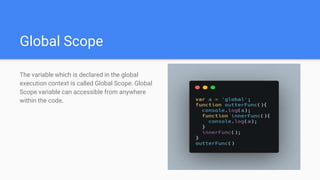
The variable which is declared in the global
execution context is called Global Scope. Global
Scope variable can accessible from anywhere
within the code.
Local Scope
Locally scoped variables are only visible and accessible within their local scope. There are 2
local scopes.
1. Function
2. Blocked
Function Scope
The variable which is declared inside the
function is called function scope. The function
scope variable cannot be accessed or modified
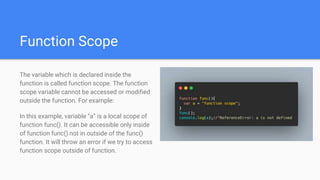
outside the function. For example:
In this example, variable “a” is a local scope of
function func(). It can be accessible only inside
of function func() not in outside of the func()
function. It will throw an error if we try to access
function scope outside of function.
Block Scope
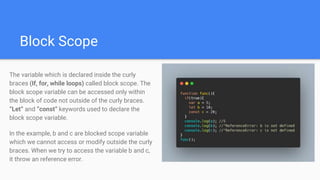
The variable which is declared inside the curly
braces (If, for, while loops) called block scope. The
block scope variable can be accessed only within
the block of code not outside of the curly braces.
“Let” and “const” keywords used to declare the
block scope variable.
In the example, b and c are blocked scope variable
which we cannot access or modify outside the curly
braces. When we try to access the variable b and c,
it throw an reference error.
Lexical Scope
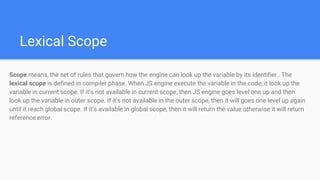
Scope means, the set of rules that govern how the engine can look up the variable by its identifier . The
lexical scope is defined in compiler phase. When JS engine execute the variable in the code, it look up the
variable in current scope. If it’s not available in current scope, then JS engine goes level one up and then
look up the variable in outer scope. If it’s not available in the outer scope, then it will goes one level up again
until it reach global scope. If it’s available in global scope, then it will return the value otherwise it will return
reference error.
Lexical Scope
Lexical Scope
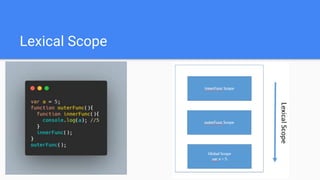
In the above example,When JS engine execute console.log(a), it starts lookup variable “a” in the current
scope (innerFunc scope). Since the variable “a” is not available in the scope, JS engine goes one level up
and lookup the variable “a” in outer scope (outerFunc scope). Since the variable “a” is also not available in
the outer scope as well, so the JS engine goes level up again and look up the variable in global scope. The
JS finally finds the value a in global scope and then JS engine return value 5 and display it in log. If variable
“a” is not defined in anywhere in code, then it will return “ “ReferenceError: a is not defined” error.
Hoisting
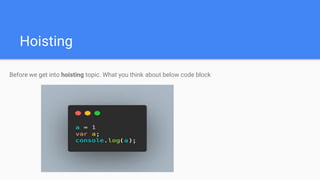
Before we get into hoisting topic. What you think about below code block
Hoisting
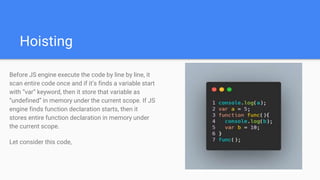
Before JS engine execute the code by line by line, it
scan entire code once and if it’s finds a variable start
with “var” keyword, then it store that variable as
“undefined” in memory under the current scope. If JS
engine finds function declaration starts, then it
stores entire function declaration in memory under
the current scope.
Let consider this code,
Reference:
1. https://medium.com/@a.mahesh06/js-scope-lexical-scope-hoisting-concept-ca6b08c6eaf
2. https://medium.com/@a.mahesh06/how-javascript-execution-works-is-js-a-compiler-or-
interpreter-540e4f829582
Code Snippet :
1. https://carbon.now.sh/?bg=rgba(171%2C%20184%2C%20195%2C%201)&t=a11y-
dark&wt=none&l=javascript&ds=true&dsyoff=20px&dsblur=68px&wc=true&wa=true&pv=56
px&ph=56px&ln=false&fl=1&fm=Hack&fs=14px&lh=133%25&si=false&es=2x&wm=false&c
ode=1%2520console.log(a)%253B%2520%250A2%2520var%2520a%2520%253D%25205
%253B%250A3%2520function%2520func()%257B%250A4%2520%2520%2520console.lo
g(b)%253B%250A5%2520%2520%2520var%2520b%2520%253D%252010%253B%250A
6%2520%257D%250A7%2520func()%253B
2. https://snipit.io/lists/0/34819
Thank you
- Santhosh Kumar S

Js scope

  • 1.
    JS Scope, LexicalScope, Hosting Concept
  • 2.
    What is Scope? Scopemeans lifespan of a variables. It determine accessibility/visibility of the variables inside the JavaScript code. There are three types of scope. ● Global ● Local ● Blocked(ES6)
  • 3.
    Global Scope The variablewhich is declared in the global execution context is called Global Scope. Global Scope variable can accessible from anywhere within the code.
  • 4.
    Local Scope Locally scopedvariables are only visible and accessible within their local scope. There are 2 local scopes. 1. Function 2. Blocked
  • 5.
    Function Scope The variablewhich is declared inside the function is called function scope. The function scope variable cannot be accessed or modified outside the function. For example: In this example, variable “a” is a local scope of function func(). It can be accessible only inside of function func() not in outside of the func() function. It will throw an error if we try to access function scope outside of function.
  • 6.
    Block Scope The variablewhich is declared inside the curly braces (If, for, while loops) called block scope. The block scope variable can be accessed only within the block of code not outside of the curly braces. “Let” and “const” keywords used to declare the block scope variable. In the example, b and c are blocked scope variable which we cannot access or modify outside the curly braces. When we try to access the variable b and c, it throw an reference error.
  • 7.
    Lexical Scope Scope means,the set of rules that govern how the engine can look up the variable by its identifier . The lexical scope is defined in compiler phase. When JS engine execute the variable in the code, it look up the variable in current scope. If it’s not available in current scope, then JS engine goes level one up and then look up the variable in outer scope. If it’s not available in the outer scope, then it will goes one level up again until it reach global scope. If it’s available in global scope, then it will return the value otherwise it will return reference error.
  • 8.
  • 9.
    Lexical Scope In theabove example,When JS engine execute console.log(a), it starts lookup variable “a” in the current scope (innerFunc scope). Since the variable “a” is not available in the scope, JS engine goes one level up and lookup the variable “a” in outer scope (outerFunc scope). Since the variable “a” is also not available in the outer scope as well, so the JS engine goes level up again and look up the variable in global scope. The JS finally finds the value a in global scope and then JS engine return value 5 and display it in log. If variable “a” is not defined in anywhere in code, then it will return “ “ReferenceError: a is not defined” error.
  • 10.
    Hoisting Before we getinto hoisting topic. What you think about below code block
  • 11.
    Hoisting Before JS engineexecute the code by line by line, it scan entire code once and if it’s finds a variable start with “var” keyword, then it store that variable as “undefined” in memory under the current scope. If JS engine finds function declaration starts, then it stores entire function declaration in memory under the current scope. Let consider this code,
  • 12.
    Reference: 1. https://medium.com/@a.mahesh06/js-scope-lexical-scope-hoisting-concept-ca6b08c6eaf 2. https://medium.com/@a.mahesh06/how-javascript-execution-works-is-js-a-compiler-or- interpreter-540e4f829582 CodeSnippet : 1. https://carbon.now.sh/?bg=rgba(171%2C%20184%2C%20195%2C%201)&t=a11y- dark&wt=none&l=javascript&ds=true&dsyoff=20px&dsblur=68px&wc=true&wa=true&pv=56 px&ph=56px&ln=false&fl=1&fm=Hack&fs=14px&lh=133%25&si=false&es=2x&wm=false&c ode=1%2520console.log(a)%253B%2520%250A2%2520var%2520a%2520%253D%25205 %253B%250A3%2520function%2520func()%257B%250A4%2520%2520%2520console.lo g(b)%253B%250A5%2520%2520%2520var%2520b%2520%253D%252010%253B%250A 6%2520%257D%250A7%2520func()%253B 2. https://snipit.io/lists/0/34819
  • 13.