JOURNALISTIC ROLE
   ORIENTATION
THE CASE OF NAVAL ENERGY POLICY &
              DEBATE
INTRODUCTION

• Context
  • Military
  • Political


• Coverage

• Analysis

• Results and Implications
U.S. NAVY

• ROLES

 • In Department of Defense (DOD)

 • In fuel consumption

 • In global marketplace
FUEL-BASED VULNERABILITIES

• Strategic

• Tactical

• Logistical

• Financial


―Energy is our soft underbelly.”
          –Colonoel Bob Charette,
 US Marine Corps Expeditionary Energy Office
ENERGY SECURITY
AS NATIONAL SECURITY


            "We're not doing it to be
            faddish, we're not doing it
            to be green. We're not
            doing it for any other
            reason except it takes
            care of a military
            vulnerability that we
            have.”
                 -Ray Mabus, SECNAV
NAVAL ENERGY
              POLICY AND GOALS

1. Increase use of alternative fuels throughout the
   Department of the Navy (DON)

2. Increase alternative energy ashore

3. Sail the Great Green Fleet

4. Reduce non-tactical petroleum use

5. Energy-efficient acquisition
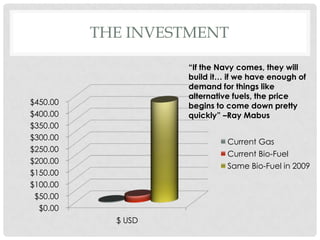
THE INVESTMENT

                    “If the Navy comes, they will
                    build it… if we have enough of
                    demand for things like
                    alternative fuels, the price
$450.00             begins to come down pretty
$400.00             quickly” –Ray Mabus
$350.00
$300.00
                             Current Gas
$250.00
                             Current Bio-Fuel
$200.00
                             Same Bio-Fuel in 2009
$150.00
$100.00
 $50.00
  $0.00
            $ USD
POLITICS MAKE STRANGE BEDFELLOWS

•   Budget
•   Alternative energy constituency
•   Green Agenda
•   Big Oil Constituency
•   Fiscal Watchdogs
•   House vs. Senate
THE GREAT GREEN FLEET

• Carrier Strike Group (CSG): U.S.S. Nimitz
• RIMPAC in Hawaii
• 900,000 gallons of 50/50 fuel mix = $12.1 million extra
MEDIA COVERAGE

• International Outlets: RIMPAC

• Frequency

• What roles do media adopt in covering this issue?
JOURNALISTIC ROLES

              • Interpreter

              • Mobilizer

              • Adversary

              • Advocate

              • Disseminator
HYPOTHESES


• H1:
  • More writers will adopt an Interpreter role than the
    roles of Mobilizer, Advocate, Adversary, or
    Disseminator.


• H2:
  • More writers will adopt an Advocate role than
    Mobilizer, Adversary, or Disseminator.
METHOD


• LexisNexis query of Global Publications using
  keyword query for ―Great Green Fleet‖

• Qualitative Content Analysis, assessing role
  orientation
    • Role Examples from coverage
RESULTS


                New York Times

Interpreter          20

Mobilizer             1

Adversary             5

Advocate              5

Disseminator          1

      Total:         32
HYPOTHESES

• H1: Accepted –more Interpreter roles adopted
      than any other role


• H2: Rejected—there were equal numbers of
      advocates and Adversaries
IMPLICATIONS

       • Reversal on budget
         limitations may be due
         to effective interpretive
         coverage

       • Naval message was
         well-received and well-
         communicated by
         journalists
LIMITATIONS

• LexisNexis

• Query parameters

• Included all media coverage
THANK YOU


    Questions?

      Susanna Joy
  JRN873 Final Project
Michigan State University
    December 2012

Jrn 873 presentation

  • 1.
    JOURNALISTIC ROLE ORIENTATION THE CASE OF NAVAL ENERGY POLICY & DEBATE
  • 2.
    INTRODUCTION • Context • Military • Political • Coverage • Analysis • Results and Implications
  • 3.
    U.S. NAVY • ROLES • In Department of Defense (DOD) • In fuel consumption • In global marketplace
  • 4.
    FUEL-BASED VULNERABILITIES • Strategic •Tactical • Logistical • Financial ―Energy is our soft underbelly.” –Colonoel Bob Charette, US Marine Corps Expeditionary Energy Office
  • 5.
    ENERGY SECURITY AS NATIONALSECURITY "We're not doing it to be faddish, we're not doing it to be green. We're not doing it for any other reason except it takes care of a military vulnerability that we have.” -Ray Mabus, SECNAV
  • 6.
    NAVAL ENERGY POLICY AND GOALS 1. Increase use of alternative fuels throughout the Department of the Navy (DON) 2. Increase alternative energy ashore 3. Sail the Great Green Fleet 4. Reduce non-tactical petroleum use 5. Energy-efficient acquisition
  • 7.
    THE INVESTMENT “If the Navy comes, they will build it… if we have enough of demand for things like alternative fuels, the price $450.00 begins to come down pretty $400.00 quickly” –Ray Mabus $350.00 $300.00 Current Gas $250.00 Current Bio-Fuel $200.00 Same Bio-Fuel in 2009 $150.00 $100.00 $50.00 $0.00 $ USD
  • 8.
    POLITICS MAKE STRANGEBEDFELLOWS • Budget • Alternative energy constituency • Green Agenda • Big Oil Constituency • Fiscal Watchdogs • House vs. Senate
  • 9.
    THE GREAT GREENFLEET • Carrier Strike Group (CSG): U.S.S. Nimitz • RIMPAC in Hawaii • 900,000 gallons of 50/50 fuel mix = $12.1 million extra
  • 10.
    MEDIA COVERAGE • InternationalOutlets: RIMPAC • Frequency • What roles do media adopt in covering this issue?
  • 11.
    JOURNALISTIC ROLES • Interpreter • Mobilizer • Adversary • Advocate • Disseminator
  • 12.
    HYPOTHESES • H1: • More writers will adopt an Interpreter role than the roles of Mobilizer, Advocate, Adversary, or Disseminator. • H2: • More writers will adopt an Advocate role than Mobilizer, Adversary, or Disseminator.
  • 13.
    METHOD • LexisNexis queryof Global Publications using keyword query for ―Great Green Fleet‖ • Qualitative Content Analysis, assessing role orientation • Role Examples from coverage
  • 14.
    RESULTS New York Times Interpreter 20 Mobilizer 1 Adversary 5 Advocate 5 Disseminator 1 Total: 32
  • 15.
    HYPOTHESES • H1: Accepted–more Interpreter roles adopted than any other role • H2: Rejected—there were equal numbers of advocates and Adversaries
  • 16.
    IMPLICATIONS • Reversal on budget limitations may be due to effective interpretive coverage • Naval message was well-received and well- communicated by journalists
  • 17.
    LIMITATIONS • LexisNexis • Queryparameters • Included all media coverage
  • 18.
    THANK YOU Questions? Susanna Joy JRN873 Final Project Michigan State University December 2012

Editor's Notes

  • #4 US NAVYDOD:70 % of world is water… 80% of world’s population lives within 100 miles of water…. And 90% of the world’s commerce travels by water.Power projection: Navy can have a response force (humanitarian, hostile escalations) can have an aircraft carrier battle group with 80 planes within (always out In Japan…. West Coast and East Coast Carrier… always 1 or 2 in or near the Arabian Sea…. A floating piece of America—a mobile military base– that requires no permissions.We have 10 of them. No one else has more than 2. FUEL CONSUMPTION: Daily: 12 million gallons of crude oil daily; Global: Guarantor of safe global trade…. Otherwise, strategic waterways could be used as choke points when it suited their agendas… piracy that is seen from lawless Somalian gangs would be rampant.
  • #5 FUEL-BASED VULNERABILITIESSTRATEGIC: (plan of action) Developing a plan of action must always include a plan for fuelTACTICAL: (Use of equipmentU.S. Navy tacitly gives those countries that produce oil and affect its price an undue influence on how we operate. We would never allow these nations to build our ships, aircraft or ground vehicles, but we give them a say in whether our ships sail, our aircraft fly or our ground vehicles run.LOGISTICAL: (flow of resources):*vulnerabiity of supply-truck convoys in theatre….FINANCIAL: last year, $500 million dollars to cover unforseen rises in fuel costs…to get 1 gallon of gas to theatre of war in Afghanistan = $400/gallon
  • #6 The military sees this as a national security issue… as reliance of oil limits and puts the force at a disadvantage. Economic security …. But they (SAY) they do not see this as a “green” choice, or the “environmentally friendly” choice…. Just a strategic one.
  • #7 3 years ago, 2009,Ray Mabus: SECNAV , rolled out
  • #8 Affordability of technology is dependent on intial investments…… GPS; the Internet
  • #9 Republicans USUALLY support a pro-military agenda, but on this issue, where the military insists that it needs to strategically “green” itself, the military industrial complex has aligned itself with (previously) anti-establishment environmentalists, and come up against hard resistance from the GOP, while Republican lobbyists insist that strategic fuel vulnerability is one more reason to find sources of domestic oil.House– limited $ spent on biofuel not to exceed costs of petro-fuel… Green Fleet Exercises… Nov. 28, Senate repealed this limitation 62-37. Expect kickback from House, whose Republican representatives are even more conservative than original…Fiscal Cliff– Sequestration 500 billion in cuts in next 10 years-……
  • #12 Interpreter: investigate official claims; analyze complex problems; discuss national policy “Slowly but steadily the U.S. Navy is maintaining a course for electric-drive propulsion as a way to save fuel costs, reduce ship lifecycle expenses and provide the extra power needed to run advanced radars and weapons the service is planning for its future fleet. “2. Mobilizer: Set agenda; influence public opinion; motivate toward civic activity “In the years ahead China's and India's presence will increase, so we must take the opportunity while we can to highlight to the world Australia's brain power and research potential, to ensure that we remain a relevant key stakeholder in life sciences.It is a shame more Australian politicians don't come to this pinnacle biotechnology conference and become infected with the enormous potential of science to improve human life and the environment.The premiers of NSW and Victoria should be here to see where the future lies and understand the role Australia can play.”3. Adversarial: adversary of business or public officials: But like an aircraft carrier changing course, it may take longer for warmists in government to admit their commitment to biofuel and other costly green products is unsustainable. --Washington Times4. Advocate: tell people about issues we believe in; advocate for causes if Congress will simply refrain from forcing the Navy to use corn ethanol or liquid coal -- neither of which are clean or efficient, but are located in many Congressional districts -- we might really get a green revolution in the military. That could save lives, money and the planet, and might even help us win -- or avoid -- the next war. Go Navy!5. Disseminator: entertain… quick to publicize: US forces give the nod to biofuels MICHAEL RICHARDSON D on't laugh! The United States military is dead serious about being able to fly its combat and cargo planes on jet fuel derived from algae and plants, and to power many of its warships on biodiesel from used cooking oil and non-food-grade animal fats.” Caberra Times--Australia
  • #14 Yielded 49 articles…. Wondered if I did something wrong….rfd? Discuss policy? (Interpreter: A major Navy exercise last week meant to demonstrate the feasibility of powering ships, fighter planes and other military craft on biofuels also had another audience: those in Congress who want to limit funding for military biofuel programs. (Energy industry publication)Mobilizer:Adversarial: LEAD: “If America had a spend-like-a-drunken-sailor aware, Navy Secretary Ray Mabus would win hands down for blowing $12 million on biofuel.” –Washington TimesAdvocate: “Greening defense will pay both environmental and reputational dividends.”LEAD: “Biofuels are a long term solution for a long term problem.”—Australian newspaperDisseminator: humor, irony, wit… quick?
  • #15 Resulting articles = 49 articles.17 weren’t evaluated b/c they were abstracts, airline industry publications (advertising), repeats of the same article in a different outlet, or merely had a cursory mention of GGFSo, n=32
  • #17 Issues: including science, military story, fiscal story, political story
  • #18 Didn’t feel confident my search was effective“Great Green Fleet” as proxy for whole Navy Energy Story…. Ran “Mabus” and “energy” in two outlets…Included diverse media publications, not just hard news stories. The purpose of the study was not just assess the trends in the hard news coverage, but the broad coverage, and diverse role orientations to include advocacy and adversary examples.