Table	of	Contents	
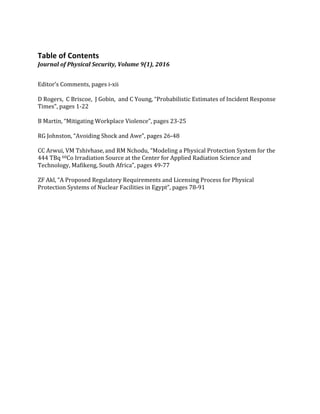
Journal	of	Physical	Security,	Volume	9(1),	2016	
	
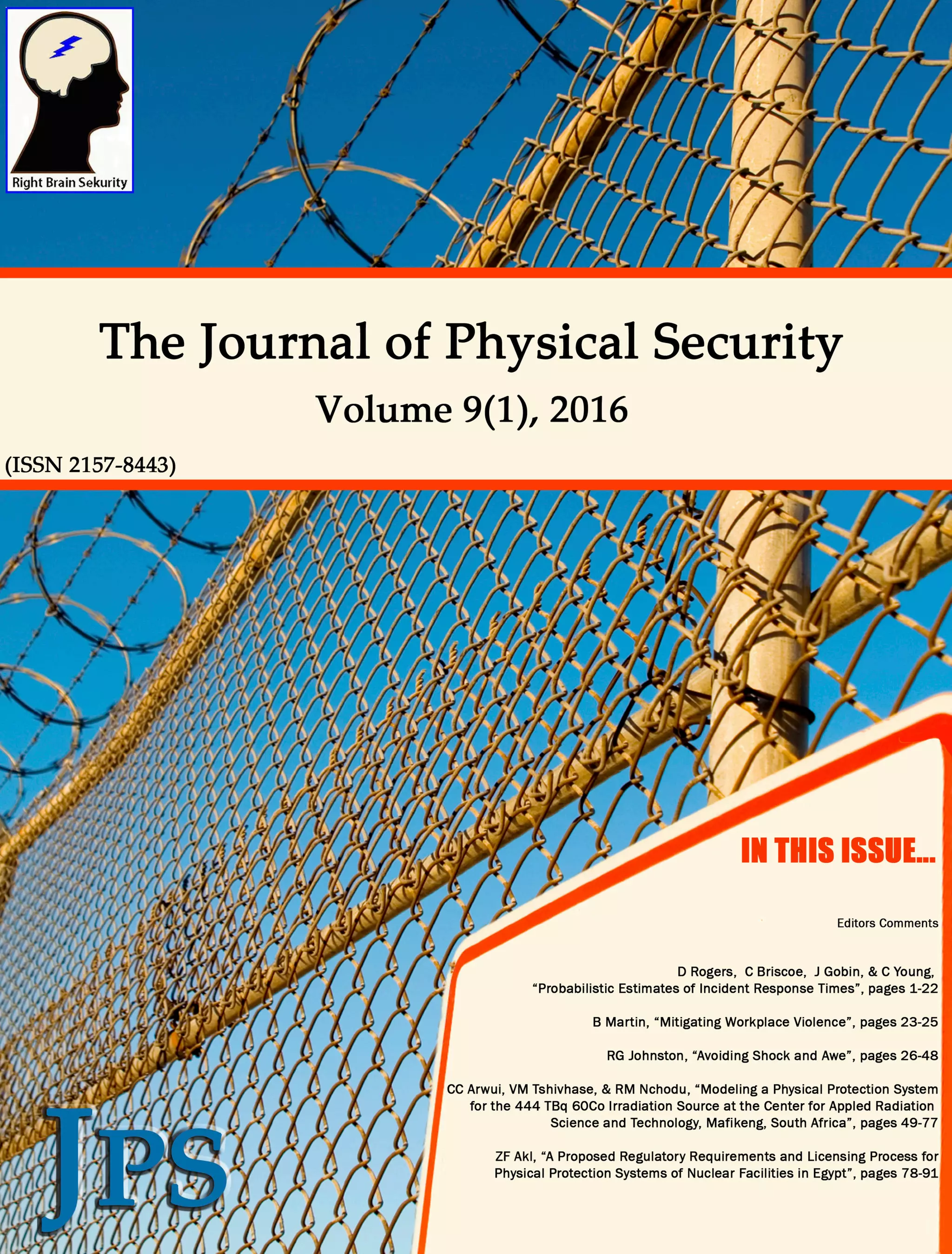
Editor’s	Comments,	pages	i-xii	
	
D	Rogers,		C	Briscoe,		J	Gobin,		and	C	Young,	“Probabilistic	Estimates	of	Incident	Response	
Times”,	pages	1-22	
	
B	Martin,	“Mitigating	Workplace	Violence”,	pages	23-25	
	
RG	Johnston,	“Avoiding	Shock	and	Awe”,	pages	26-48	
	
CC	Arwui,	VM	Tshivhase,	and	RM	Nchodu,	“Modeling	a	Physical	Protection	System	for	the	
444	TBq	60Co	Irradiation	Source	at	the	Center	for	Applied	Radiation	Science	and	
Technology,	Mafikeng,	South	Africa”,	pages	49-77	
	
ZF	Akl,	“A	Proposed	Regulatory	Requirements	and	Licensing	Process	for	Physical	
Protection	Systems	of	Nuclear	Facilities	in	Egypt”,	pages	78-91
Journal	of	Physical	Security	9(1),	i-xii	(2016)	
	
	
i	
	
Editor’s	Comments	
	
				Welcome	to	volume	9,	issue	1	of	the	Journal	of	Physical	Security	(JPS).		In	addition	to	my	
usual	editor’s	rants	and	news	about	security	that	appear	immediately	below,	this	issue	has	
papers	about	modeling	the	optimum	number	of	security	guards;		mitigating	workplace	
violence;		the	problem	of	missing	vulnerability	assessments;		modeling,	designing,	and	
evaluating	a	physical	security	system	for	protecting	radioactive	material;		and	nuclear	
licensing	and	regulatory	requirements	in	Egypt.	
	
				All	papers	are	peer	reviewed	unless	otherwise	noted.		We	are	very	grateful	indeed	to	the	
anonymous	reviewers	who	contribute	their	time	and	expertise	to	advance	our	under-
standing	of	security	without	receiving	recognition	or	compensation.		This	is	the	true	sign	of	
a	professional!	
	
				Past	issues	of	JPS	are	available	at	http://jps.rbsekurity.com,	and	you	can	also	sign	up	
there	to	be	notified	by	email	when	a	new	issue	becomes	available.		
	
				JPS	is	hosted	by	Right	Brain	Sekurity	(RBS)	as	a	free	public	service.		RBS	
(http://rbsekurity.com)	is	a	small	company	devoted	to	physical	security	consulting,	
vulnerability	assessments,	and	R&D.				
	
				As	usual,	the	views	expressed	in	these	papers	and	the	editor’s	comments	are	those	of	the	
author(s)	and	should	not	necessarily	be	ascribed	to	their	home	institution(s)	or	to	Right	
Brain	Sekurity.	
	
	
*****	
	
Welcome	to	Wal-Mart	(Again)	
	
				Wal-Mart	announced	May	4th	that	the	company	will	hire	additional	employees	so	that	
greeters	will	return	to	most	stores.		The	greeters,	often	senior	citizens,	will	welcome	
customers	to	the	store	as	they	come	in	the	entrance.		(At	stores	with	security	problems,	
“greeters”	will	also	check	receipts	and	provide	other	security	functions.)			
	
				Wall-Mart	greeters	were	introduced	in	1983	by	company	founder	Sam	Walton	after	he	
had	a	pleasant	experience	being	greeted	by	an	older	man	in	a	store	in	Louisiana.		Wal-Mart	
greeters	have	been	used	less	frequently	in	recent	years	but	this	is	scheduled	to	change.	
	
				Greeting	customers	at	the	entrance	to	retail	stores	is	known	to	substantially	reduce	
shoplifting.		This	is	often	called	the	“Wal-Mart	Effect”.		It	may	work	because	customers	feel	
they	are	being	watched,	and	are	thus	less	willing	to	risk	being	caught	at	shoplifting.		It	is	
also	possible	that	being	greeted	warmly	by	a	human	being	puts	more	of	a	human	face	on	
the	company,	making	potential	shoplifters	feel	guiltier	about	stealing.
Journal	of	Physical	Security	9(1),	i-xii	(2016)	
	
	
ii	
				It	is	entirely	possible	that	the	Wal-Mart	Effect	might	work	to	reduce	security	risks	from	
employees	or	visitors	in	any	kind	of	business	or	facility,	not	just	retail	stores.		Having	a	
manager	personally	welcome	people	at	the	entrance	might	improve	security	and	reduce	
the	insider	threat.	
	
	
*****	
	
Making	Bystanders	More	Activist	
	
				The	March	4,	2016	edition	of	the	Chronicle	of	Higher	Education	had	a	thoughtful	article	
(page	B17)	about	the	University	of	New	Hampshire’s	campaign	to	prevent	sexual	assault.		
The	program	materials,	which	are	available	for	purchase	by	other	colleges	and	universities,	
“teaches	people	to	safely	intervene	when	a	situation	looks	as	if	it	could	become	dangerous,	
and	it	is	aimed	at	increasing	their	willingness	to	do	so.”		The	program	is	based	on	research	
and	evidence-based	prevention.		If,	for	example,	a	student	observes	that	another	student	
has	become	intoxicated	at	a	party,	the	observer	is	encouraged	to	take	concrete	actions	that	
might	reduce	the	danger	of	sexual	assault	or	other	injury.	
	
				There	is	also	an	accompanying	article	(pages	B14-B16)	entitled,	“Culture	of	Consent:		
Colleges	Focus	on	Preventing	Sex	Assaults	Before	They	Happen”;		this	is	very	much	worth	
reading	as	well.	
		
*****	
	
Adam	Bashes	the	Garden	of	Eden!	
	
				Check	out	the	amusing,	educational,	and	contrarian	TV	Series,	“Adam	Ruins	Everything”	
at	http://www.trutv.com/shows/adam-ruins-everything/videos/index.html.		Adam	takes	
on	a	lot	of	myths	and	misconceptions,	many	of	them	about	security.		For	example,	you	can	
find	video	clips	about	how	polygraphs	are	pseudo-scientific	nonsense	and	why	finger-
printing	is	flawed,	as	well	as	discussions	of	the	lack	of	security	with	credit	cards	and	
problems	with	the	TSA.			
	
	
*****	
	
We	Don’t	Need	No	Stinking	Badges	
	
				Two	reports	in	April	by	the	Inspector	General’s	Office	of	the	General	Services	
Administration	(GSA)	found	serious	problems	and	vulnerabilities	with	the	use	of	
government	security	badges	(including	the	HSPD-12	badges)	at	numerous	federal	facilities.	
The	reports	can	be	found	at:	
	
https://www.gsaig.gov/sites/default/files/ipa-
reports/OIG%20EVALUATION%20REPORT_Facility%20Specific%20Building%20Badges.pdf
Journal	of	Physical	Security	9(1),	i-xii	(2016)	
	
	
iii	
	
https://www.gsaig.gov/sites/default/files/ipa-
reports/OIG%20EVALUATION%20REPORT_GSA%20Management%20of%20Contractor%20HSPD-
12%20PIV%20Cards.pdf	
	
*****	
	
Election	Security	
	
					The	April	26	issue	of	the	Financial	Times	(page	4)	includes	an	article	by	Hannah	Kuchler	
about	the	security	and	privacy	risks	associated	with	voter	apps.		Candidates	running	for	
office	in	the	United	States	often	have	smart	phone	apps	so	that	their	supporters	can	track	
news	about	them.		The	apps	often	send	personally	identifiable	information	(PII)	
unencrypted	about	the	app	user	such	as	current	location,	political	preferences,	phone	
numbers,	and	the	apps	on	their	phone.		This	can	be	a	serious	security/privacy	risk	for	the	
user,	especially	when	they	use	public	WiFi	networks.				
	
*****	
Election	Selfies	
	
					Snapchat	has	filed	an	amicus	brief	with	the	Federal	appeals	court	hearing	a	case	about	
New	Hampshire’s	ban	on	taking	photographs	inside	the	voting	booth.		Snapshot	would	like	
voters	to	be	able	to	record	selfies	of	their	voting.		Traditionally,	states	ban	photographing	of	
voting	because	the	photos	could	be	used	to	prove	how	a	citizen	voted,	theoretically	making	
bribing	of	voters	easier.			
	
				Snapchat	argues	that	the	freedom	to	document	your	voting	is	a	First	Amendment	right.		
Moreover,	there	is	evidence	that	photos	might	increase	voter	turnout.			Facebook	users	
who	saw	photos	of	their	friends	voting	were	more	likely	to	go	and	vote	themselves.	
	
				For	more	information,	see	http://www.dailydot.com/technology/snapchat-voting-
booth-selfie-ban-court-filing/.	
	
*****	
	
Boring	is	Good	
	
					Creativity	is	important	for	having	good	security.		Identifying	security	vulnerabilities	
requires	thinking	like	the	bad	guys;		devising	improved	security	approaches	often	requires	
novel	thinking.	
	
			Somewhat	counter-intuitively,	boredom	turns	out	to	be	good	for	creativity.		Researchers	
have	shown	that	subjects	who	are	given	boring	tasks,	then	immediately	asked	to	do	
creative	problem-solving	are	more	creative	than	subjects	not	asked	to	perform	the	
mundane	tasks.		See	http://medicalxpress.com/news/2013-01-creative.html.		Being	bored
Journal	of	Physical	Security	9(1),	i-xii	(2016)	
	
	
iv	
from	time-to-time	seems	to	be	useful	in	permitting	daydreaming	that	can	help	engender	
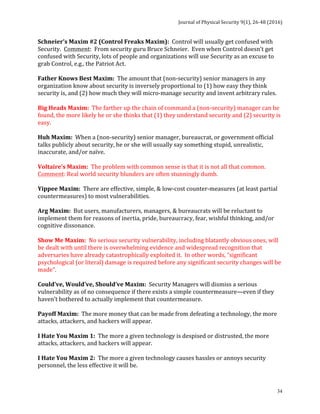
creativity.	
	
				Critical	thinking	is	also	important	for	good	security,	especially	in	making	the	difficult	
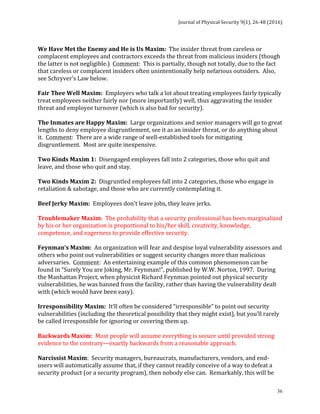
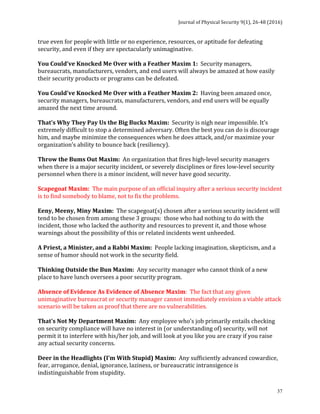
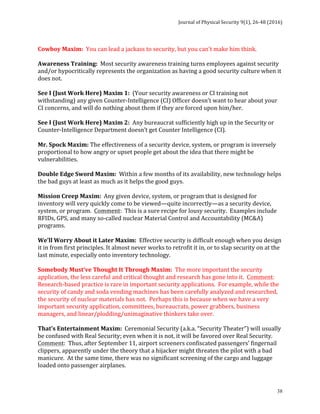
value	judgments	inherent	in	security	and	risk	management.		There	is	some	kind	of	
connection	between	creativity	and	critical	thinking—what	enhances	one	has	a	tendency	to	
enhance	the	other.		On	the	other	hand,	creativity	and	critical	thinking	have	differences.		For	
an	excellent	discussion	of	the	issue,	see	an	interesting	paper	by	Matt	Baked	entitled,	
“Relationships	Between	Critical	and	Creative	Thinking”:		
http://pubs.aged.tamu.edu/conferences/SRAERC2001/pdf/e2.pdf.	
	
	
*****	
	
Agree	or	Disagree?	
	
				So	you	want	to	be	a	security	guard?		See		http://advice.careerbuilder.com/posts/so-you-
want-to-be-a-security-guard	for	a	description	of	the	job.		I	don’t	fully	agree	with	everything	
in	the	description,	and	it	is	certainly	incomplete,	but	it	is	nevertheless	an	interesting	
perspective.				
	
				There	has	been	a	shortage	of	serious	studies	of	security	guards	(who	sometimes	prefer	to	
be	called	“security	officers”)	and	the	jobs	that	they	do.		This	is	particularly	remarkable	
given	the	high	turnover	rate	for	guards	(often	40-400%	per	year	for	contract	guards)	
which	has	serious	economic	and	security	implications.			
	
				Here	are	a	few	studies	of	security	guards	and	their	work	that	I	have	been	involved	in	that	
might	be	of	interest:	
	
EG	Bitzer,	PY	Chen,	and	RG	Johnston,	“Security	in	Organizations:	Expanding	the	Frontiers	of	
Industrial-Organizational	Psychology”,	International	Review	of	Industrial	and	
Organizational	Psychology	24,	131-150	(2009).	
	
E	Bitzer,	“Strategies	for	Cutting	Turnover”,	Security	Management	50(5),	88-94	(2006).	
	
EG	Bitzer	and	RG	Johnston,	“A	Taxonomy	for	Security	Assignments”,	Journal	of	Security	
Administration	26(2),	1-11	(2003/2006).	
	
	
*****	
	
NNSA	Follies	(Con’t)	
	
				1.		The	National	Nuclear	Security	Administration	(NNSA)	is	about	to	issue	its	final	
requests	for	proposals	to	run	Sandia	National	Laboratories	in	Albuquerque.		NNSA,	
however,	has	been	slow	to	release	the	2015	evaluation	of	Sandia	performance	under
Journal	of	Physical	Security	9(1),	i-xii	(2016)	
	
	
v	
Lockheed	Martin,	the	current	operator,	as	well	as	report	the	2015	fees	to	be	awarded	to	
Lockheed	Martin	for	running	Sandia.		This	is	probably	due	to	the	controversy	surrounding	
the	2014	report	by	the	Department	of	Energy	(DOE)	Inspector	General	that	concluded	
Sandia	illegally	used	federal	funds	for	lobbying,	and	improperly	paid	“consulting”	fees	to	
former	U.S.	Rep.	Heather	Wilson	(R-NM).		Lockheed	Martin	wants	to	continue	to	operate	
Sandia	despite	the	wrongdoing.	
	
				2.		The	General	Accounting	Office	(GAO)	reported	in	May	that	the	NNSA	has	not	
completed	an	Infrastructure	Security	Plan,	as	required	by	law:		
http://www.gao.gov/products/GAO-16-447R.	
	
				3.		NNSA	has	decided	not	to	fine	Babcock	&	Wilcox	Technical	Services,	the	contractor	that	
once	ran	the	Y-12	nuclear	facility,	for	20-years	of	discarding	sensitive	and	classified	
documents	in	regular	trash.		Y-12	has	had	multiple	security	problems,	including	a	2012	
incident	where	an	82-year	old	nun	and	two	other	peace	activists	penetrated	Y-12	security	
without	a	proper	security	response	for	an	extended	period	of	time.		
	
				4.		The	history	of	anti-nuclear	activity	and	U.S.	nuclear	security	problems	is	nicely	
summarized	in	a	2015	article	in	The	New	Yorker:		
http://www.newyorker.com/magazine/2015/03/09/break-in-at-y-12.	
	
				5.		The	Project	on	Government	Oversight	has	an	updated	“Federal	Contractor	Misconduct	
Database”	that	includes	fines	related	to	operating	the	U.S.	nuclear	weapons	complex	from	
1995	to	the	present.			See	http://www.pogo.org/blog/2015/12/nuclear-weapons-
complex-misconduct-by-the-numbers.html.		This	is	sobering	reading.	
	
	
*****	
	
What	a	Flop	
	
				The	U.S.	Department	of	Defense	still	relies	on	8-inch	floppy	disks	for	control	systems	that	
direct	nuclear	bombers	and	intercontinental	ballistic	missiles.		For	more	information,	see:		
https://www.washingtonpost.com/news/the-switch/wp/2016/05/26/the-real-reason-
america-controls-its-nukes-with-ancient-floppy-disks/	
	
	
*****	
	
Homeland	Security	1	-	Is	That	a	Gun	in	Your	Pocket,	or	Are	You	Just	Happy	to	Avoid	
Checked	Bag	Fees?	
	
				Last	year,	the	Transportation	Security	Administration	(TSA)	seized	2,653	guns	from	
airline	passengers	at	airports—a	20%	increase	over	2014.		More	than	80%	of	the	seized	
guns	were	loaded.
Journal	of	Physical	Security	9(1),	i-xii	(2016)	
	
	
vi	
*****	
	
Homeland	Security	2	–	Neutralizing	6	Year	Old	Terrorists	
	
				A	6-year-old	first	grade	student	in	Ohio	was	suspended	for	pretending	to	be	a	Power	
Ranger	and	firing	an	imaginary	bow	and	arrow	during	recess.		The	school	has	a	zero	
tolerance	policy	for	“any	real,	pretend,	or	imitated	violence”.			See	
http://www.nydailynews.com/news/national/schoolboy-6-suspended-shooting-
imaginary-bow-arrow-article-1.2424301.	
	
	
*****	
	
Homeland	Security	3	–	See	Something,	Say	Something	(Stupid)	
	
				A	passenger	on	a	flight	from	Philadelphia	to	Syracuse	was	responsible	for	creating	a	2-
hour	delay	after	accusing	a	curly-haired	fellow	passenger	of	being	a	terrorist	and	writing	in	
Arabic.		The	“suspect”	was	interrogated	by	officials	and	eventually	allowed	to	re-board	the	
plane.			
	
				Turns	out	the	suspected	terrorist	was	University	of	Pennsylvania	economist	Guido	
Menzio,	an	Italian	with	an	accent,	who	was	writing	out	mathematical	equations	while	
sitting	in	his	seat	and	waiting	for	the	plane	to	take	off.	
	
				For	details,	see:	
https://www.washingtonpost.com/news/rampage/wp/2016/05/07/ivy-league-
economist-interrogated-for-doing-math-on-american-airlines-flight/.	
	
	
*****	
	
Highway	Robbery	
	
				A	Russian	government	official	was	arrested	for	masterminding	a	scheme	to	steal	a	31-
mile	stretch	of	road.		It	was	dismantled	and	sold	in	pieces	over	the	course	of	a	year.		For	
details,	see	https://www.theguardian.com/world/2016/jan/13/russian-prison-official-
accused-stealing-30-mile-road-alexander-protopopov.	
	
	
*****	
	
	It	Still	Beats	Any	Adam	Sandler	Movie	
	
				Movie	censors	in	the	UK	were	required	to	watch	a	10-hour	film	of	white	paint	drying	on	a	
wall.		The	movie	was	made	to	protest	England’s	movie	rating	laws.		The	censors	rated	the	
film	“suitable	for	viewers	age	4	and	over”.		Apparently	the	movie	is	too	racy	for	kids	0	to	3
Journal	of	Physical	Security	9(1),	i-xii	(2016)	
	
	
vii	
years	old.		See	http://qz.com/604112/heres-how-uk-film-censors-rated-a-10-hour-film-of-
paint-drying/.	
	
*****	
	
Mechanical	Doping	
	
				Pro	cyclists	now	have	a	new	way	to	cheat:		using	a	small	motor	to	power	a	bicycle’s	back	
wheel.		For	more	information,	see	http://gizmodo.com/how-pro-cyclists-cheat-using-
motorized-bikes-1756414521.	
	
	
*****	
	
Staying	Hydrated	
	
				A	man	in	Canada	purchased	a	bottle	of	vodka	from	a	liquor	store.		When	he	opened	it	at	
home,	it	discovered	that	the	bottle	was	100%	water.		He	called	the	liquor	store	to	report	
the	tampering	but	was	told,	“it	happens	all	the	time”.	
	
	
*****	
	
Bully	Pulpit	
	
				The	Anti-Defamation	League	(ADL)	has	identified	warning	signs	or	traits	that	may	
indicate	that	a	child	is	a	bully.		These	include	the	need	to	be	in	control,	being	easily	
frustrated	or	angered,	a	history	of	depression	or	anxiety,	a	lack	of	compassion	or	empathy,	
and	having	been	the	target	of	bullying	himself	or	herself.		The	ADL	also	offers	extensive	
advice	for	how	to	help	such	a	child.		See	http://www.adl.org/assets/pdf/education-
outreach/What-to-Do-if-Your-Child-Exhibits-Bullying-Behavior.pdf.		
	
	
*****	
	
Killing	the	$100	Bill	
	
				Former	Treasury	Secretary	Lawrence	Summers	has	called	for	the	United	States	to	phase	
out	the	$100	bill.		The	European	Central	Bank	is	similarly	considering	getting	rid	of	the	500	
Euro	bill.		High	denomination	bills	are	favored	by	criminals	and	terrorists	because	they	
take	up	less	space	than	smaller	denominations	and	attract	less	attention.		For	example,	a	
standard	briefcase	can	hold	about	$1	million	of	$100	bills,	weighing	around	27	pounds.			If	
the	same	$1	million	is	in	the	form	of	$20	bills,	however,	it	requires	5	briefcases	and	weighs	
135	pounds.
Journal	of	Physical	Security	9(1),	i-xii	(2016)	
	
	
viii	
				For	more	information,	see	http://time.com/money/4226174/kill-100-dollar-bill-500-
euro-phase-out/.	
	
*****	
	
Counterfeit	Coins	
	
				Recent	jumps	in	the	prices	of	gold	and	silver	have	led	to	a	substantial	increase	in	the	
appearance	of	counterfeit	bullion	coins.			The	fakes	are	made	of	a	combination	of	cheaper	
metals,	and	often	have	the	wrong	thickness	and	diameter	in	order	to	mimic	the	heavier	
weight	of	gold	and	silver.		For	more	information,	see	
http://universalcoinandbullion.dallasobserver.com/counterfeit-gold-silver-coin-fraud/.	
		
	
*****	
	
DNA:		Do	Not	Always	Believe	
	
				DNA	is	often	considered	the	gold	standard	for	criminal	forensics	and	biometrics.		In	fact,	
DNA	analysis	has	many	serious	problems—so	much	so	that	it	often	cannot	be	fully	trusted.		
The	June	2016	issue	of	Playboy	magazine	has	an	easy	to	understand	article	about	this	issue:		
https://www.playboy.com/articles/the-unraveling-of-dna-forensics.	
	
	
*****	
	
The	Bedrock	of	Our	Marriage	
	
				A	Spanish	company	has	developed	a	high-tech	mattress	that	can	tell	if	your	partner	is	
cheating	on	you	while	you	are	away.		Sensors	in	the	bed—part	of	a	“Lover	Detection	
System”—identify	“suspicious”	movements	in	the	bed,	and	a	warning	notification	is	sent	to	
your	smart	phone.			For	more	information,	see:	
http://www.telegraph.co.uk/news/2016/04/15/smart-mattress-lets-you-know-if-your-
partner-is-cheating/.	
		
*****	
	
AI:		Artificial	Inanity	
	
				Microsoft	Corporation	recently	unleashed	a	new	AI	chatbot	on	Twitter.		The	artificial	
intelligence	program	was	meant	to	go	forth	and	learn	how	to	converse	on	Twitter	in	a	more	
human	manner.	
	
				After	24	hours	of	interacting	with	Twitter	users,	“...Tay	‘learned’	to	be	a	genocidal	racist,	
calling	for	the	extermination	of	Jews	and	Mexicans,	insulting	women,	and	denying	the	
existence	of	the	Holocaust”.		Tay	also	called	for	the	use	of	illegal	drugs.
Journal	of	Physical	Security	9(1),	i-xii	(2016)	
	
	
ix	
	
				Microsoft	apologized,	quickly	shut	Tay	down	for	a	time,	and	deleted	some	of	its	more	
disturbing	tweets.		See	http://www.nytimes.com/2016/03/25/technology/microsoft-
created-a-twitter-bot-to-learn-from-users-it-quickly-became-a-racist-jerk.html?_r=0.	
		
				Seems	to	me	that	Tay	learned	what	it	is	to	be	human	just	fine.	
	
	
*****	
	
Casey	Jones,	Jihadi	Terrorist	
	
				Engineers	of	Jihad,	a	new	book	by	Diego	Gambetta	and	Steffen	Hertog,	examines	the	long-
recognized	fact	that	radical	Islamists	seeking	power	in	Muslim-majority	countries	tend	to	
be	dominated	by	engineering	or	applied	science	students	rather	than	graduates	in	law,	the	
social	sciences,	or	pure	science.		They	found	that	engineers	are	over-represented	among	
Islamist	activists	by	a	factor	of	17	times	their	occurrence	in	the	relevant	society	as	a	whole.		
Medical	doctors	are	over-represented	by	a	factor	of	10.	
	
				The	authors	believe	thwarted	aspirations	are	the	cause.		The	combination	of	high	social	
status	for	engineers	after	many	years	of	study,	but	low	employment	opportunities	in	many	
Muslim-majority	countries	contributes	to	their	disgruntlement.		This	makes	sense	to	me	
because	disgruntlement	by	employees	in	corporations	or	the	government	(a	major	insider	
threat	risk	factor)	is	all	about	unmet	expectations,	not	about	objective	reality.			
	
				The	authors	believe	that	engineering	students	tend	to	have	a	narrower,	more	rigidly	
defined	worldview	than	students	in	the	humanities	or	the	pure	sciences.		Scientists	and	
social	scientists	ask	a	lot	of	questions	and	seek	out	ambiguities,	but	engineers	tend	to	focus	
on	finding	the	“right	answer”.		This	may	make	engineers	more	susceptible	to	radical	
movements,	and	less	likely	to	critically	question	them.			
	
	
*****	
	
Oh,	Good!		Your	Boss	is	Consistently	a	Jerk!	
	
				New	research	is	also	supportive	of	the	idea	that	disgruntlement	isn’t	about	how	an	
employee	is	treated,	but	rather	about	how	he/she	is	treated	relative	to	expectations.		A	new	
study	out	of	Michigan	State	University	suggests	that	employees	are	less	disgruntled	when	
they	have	a	boss	who	is	consistently	a	jerk,	compared	to	having	a	boss	who	is	unpredict-
ably	a	jerk.		If	you	expect	to	be	treated	badly	because	your	boss	is	always	a	jerk,	you	aren’t	
necessarily	disgruntled.	
	
				In	thinking	about	the	insider	threat,	security	managers	need	to	focus	on	the	employees	
and	contractors	who	have	unmet	expectations,	not	just	on	those	who	are	consistently	
treated	badly.		Indeed,	technical	personnel	and	middle-level	managers	in	many	large
Journal	of	Physical	Security	9(1),	i-xii	(2016)	
	
	
x	
organizations—especially	when	their	responsibility	is	not	commensurate	with	their	
authority—tend	to	be	disgruntled	despite	having	good	salaries	and	respected	positions.		
The	guys	who	work	in	the	mailroom	may	be	treated	badly,	but	they	are	not	necessarily	
disgruntled	if	they	expect	to	be	treated	badly.	
	
				For	more	information	on	the	study,	see	https://www.washingtonpost.com/news/on-
leadership/wp/2016/03/02/the-worst-kind-of-boss-is-not-the-one-whos-always-a-jerk/.	
	
	
*****	
	
There’s	Still	Room	for	Super	Heroes	
	
				Antonio	Cortes	in	Gloucester	in	the	UK	wrestled	a	mugger	to	the	ground	while	dressed	in	
a	Superman	costume,	and	held	him	there	until	police	arrived.		Cortes	was	taking	a	break	at	
a	local	pub,	after	dressing	up	like	the	super	hero	as	part	of	a	local	charity	fundraiser,	when	
he	saw	a	woman	at	an	ATM	being	accosted	by	the	would-be	mugger.		Police	were	
reportedly	pleased	and	amused	by	“Superman’s”	assistance.		See	
http://www.bbc.com/news/uk-england-gloucestershire-35422123.	
	
		
*****	
	
Don’t	Touch	That	Thing,	You	Don’t	Know	Where	It’s	Been!	
	
				Researchers	at	the	University	of	Illinois	report	that	nearly	one-half	of	people	who	find	an	
abandoned	thumb	drive	in	the	parking	lot	will	plug	it	into	their	computer	and	open	the	files	
to	see	who	it	belongs	to	(or	just	to	be	nosy).		This,	of	course,	can	severely	compromise	
computer	and	network	security.		Most	of	the	people	who	undertook	such	dangerous	
actions	were	fairly	computer	literate.	
	
				Organizations	should	test	their	employees	with	periodic	thumb	drives	in	the	parking	lot	
as	an	educational	exercise	to	alert	employees	to	the	risk.	
	
				The	researchers	propose	another	countermeasure	as	well:		if	the	thumb	drive	was	
labeled,	“If	lost,	please	return	to	xxxxx”	with	an	email	address,	people	who	discovered	the	
“lost”	thumb	drive	were	much	less	likely	to	open	any	files.				
	
				For	more	information	on	the	study,	see	http://www.news-
gazette.com/news/local/2016-04-12/oh-hey-look-someone-dropped-usb-drive.html.	
	
	
*****	
	
Risky	Business
Journal	of	Physical	Security	9(1),	i-xii	(2016)	
	
	
xi	
				An	interesting	article	in	the	Financial	Times	by	Oliver	Ralph	cites	statistics	from	the	
consulting	firm	Ocean	Tomo:		84%	of	the	S&P	500’s	market	value	was	held	in	intangible	
assets	last	year,	versus	17%	40	years	ago.		Intangible	assets	include	intellectual	property,	
trade	secrets,	and	organizational	reputation/goodwill.		Physical	assets	are	no	longer	the	
major	assets	needing	protection.	
	
				The	article	also	maintains	that	most	business	insurance	policyholders	believe	that	the	
insurance	industry	is	not	offering	enough	coverage	of	business	risk,	nor	offering	
sufficiently	innovative	insurance	products.	
	
				See	http://www.ft.com/cms/s/0/b480829e-297f-11e6-8b18-91555f2f4fde.html#axzz4BrQKYqex.	
	
	
*****	
	
You	Smell	Like	a	Dog	
	
				Field	and	Stream	magazine	has	conducted	a	serious	of	informal	experiments	on	masking	
human	odors	from	wild	game	and	dogs,	including	drug-sniffing	dogs.		The	results	are	quite	
interesting.		See:	
	
http://www.fieldandstream.com/articles/2014/07/sniff-test-scent-control-products-and-practices-vs-a-
drug-dog	
	
http://www.fieldandstream.com/articles/2014/07/sniff-test-do-scent-control-measures-really-make-a-
difference	
	
http://www.fieldandstream.com/articles/hunting/2014/07/does-it-work-ozone-scent-control-vs-drug-
sniffing-dog	
	
http://www.fieldandstream.com/articles/hunting/2011/07/sniff-test	
	
http://www.fieldandstream.com/articles/hunting/2015/10/can-scent-elimination-sprays-beat-the-nose-of-
a-drug-sniffing-dog	
	
	
*****	
	
Everybody	Must	Get	Stoned	
	
				A	total	of	4	states	have	legalized	the	recreational	use	of	marijuana,	and	24	states	plus	
Washington	D.C.	now	allow	medical	use.		More	states	are	expected	to	decriminalize	
marijuana	at	some	point	in	the	future.	
				Previous	research	has	suggested	that	marijuana	does	not	represent	a	major	crash	risk	for	
motor	vehicle	drivers	under	its	influence.		A	new	study,	however,	reports	that	the	rate	of	
fatal	crashes	involving	drivers	who	had	recently	used	marijuana	doubled	after	Washington
Journal	of	Physical	Security	9(1),	i-xii	(2016)	
	
	
xii	
state	legalized	marijuana	in	2012.		Such	drivers,	however,	also	often	had	alcohol	or	other	
drugs	in	their	blood	as	well,	complicating	the	issue.	
				Part	of	the	problem	is	that	it	is	a	difficult	to	determine	when	somebody	is	“too	high”	to	
drive	safely.		Unlike	alcohol,	THC,	the	active	ingredient	in	marijuana,	affects	people	quite	
differently.		THC	blood	levels	that	significantly	affect	one	person	may	have	little	effect	on	
another.		Moreover,	regular	users	of	marijuana	can	have	high	levels	of	THC	in	the	blood	for	
a	long	time	after	use,	while	levels	may	drop	too	quickly	in	occasional	users	to	be	detected	
by	a	blood	test.		Field	“sobriety”	tests	that	measure	drivers’	physiological	and	behavior	
factors	may	make	more	sense	than	blood	tests	for	marijuana.	
				For	more	information,	see	a	new	study	by	the	AAA	Foundation	for	Traffic	Safety:		
https://www.aaafoundation.org/impaired-driving-and-cannabis.	
	
	
--	Roger	Johnston	
Oswego,	Illinois	
June,	2016
Journal	of	Physical	Security	9(1),	1-22	(2016)	
	
	 1
	 	 	 	 	 	 	
	
Probabilistic	Estimates	of	Incident	Response	Times	
for	Security	Personnel	
	
	
David	Rogers,		Christopher	Briscoe,	Ph.D.,		Jean	Gobin,		and	Carl	Young	
	
Stroz	Friedberg,	LLC	
32	Avenue	of	the	Americas,	4th	Floor	
New	York,	NY		10013	


ABSTRACT	
	
				We	use	a	probabilistic	model	to	determine	the	minimum	number	of	security	
guards	within	a	facility	based	on	a	maximum	incident	response	time.		We	
obtain	a	distribution	of	response	times,	where	the	speed	of	the	guard	and	the	
population	density	of	the	space	to	be	monitored	are	taken	to	be	normally-
distributed	random	variables.		We	present	the	analysis	for	cases	where	the	
space	can	be	approximated	by	both	one-	and	two-dimensional	models.		Our	
analysis	finds	the	probability	of	achieving	response	times	of	T	=	300	seconds	
for	various	guard	densities	(e.g.,	1	guard	per	200	meters,	1	guard	per	500	
meters,	and	1	guard	per	1000	meters)	to	be	99.95%,	81.61%,	and	0.31%	
respectively.		We	identify	the	guard	density	required	to	achieve	a	response	
time	of	60	seconds	in	75%	of	one-dimensional	scenarios	to	be	approximately	1	
guard	per	106	meters.		Additionally,	this	investigation	analyzes	the	form	of	the	
response	time	distribution	in	two-dimensions	and	compares	the	calculated	
guard	densities	to	those	resulting	from	a	simplistic	extension	of	the	one-
dimensional	solution.		In	both	models,	we	present	an	exemplary	cost-benefit	
analysis.
Journal	of	Physical	Security	9(1),	1-22	(2016)	
	
	 2
1 INTRODUCTION
				Determining	the	required	number	of	guards	in	a	facility	is	a	longstanding	problem	in	
security	risk	management.		It	has	been	observed	that	the	cost	of	security	personnel	can	
comprise	up	to	85%	of	an	organization’s	security	budget	[1].		To	date,	there	have	been	few	
quantitative	models	that	provide	guidance	in	assessing	the	requirement	for	this	costly	yet	
important	security	resource.		A	critical	function	of	security	guards	is	to	respond	to	
incidents	in	a	timely	fashion,	especially	when	a	life-threatening	situation	is	occurring.	
Further,	this	is	also	a	responsibility	in	which	staffing	is	often	based	on	an	inadequate	
number	of	drivers	[2].		This	is	arguably	the	most	important	function	of	security	guards,	and	
is	therefore	the	driving	feature	of	the	model	used	in	this	analysis.		
		
				This	paper	details	an	application	of	the	“Probability	of	Protection"	method	[3].		In	this	
method,	we	assume	that	the	value	of	a	factor	affecting	the	vulnerability	to	a	given	threat	is	
normally	distributed	since	its	a	priori	value	is	unknown.		The	limits	on	this	distribution	are	
based	on	scenario-specific	conditions.		We	substitute	this	distribution	into	a	physical	
security	model	for	a	key	vulnerability	parameter,	which	yields	a	distribution	of	values	for	
that	parameter.		The	minimum	parameter	value	required	to	achieve	effective	mitigation	
can	then	be	compared	to	the	resulting	distribution,	which	yields	the	probability	that	a	given	
value	will	be	effective	based	on	the	spectrum	of	possible	vulnerability	scenarios.	
Importantly,	this	method	facilitates	quantitative	decisions	on	a	particular	security	control	
implementation	because	it	can	be	used	to	compare	effectiveness	and	cost-effectiveness	of	
specific	defensive	strategies.		
		
				In	this	analysis,	we	determine	the	distribution	of	times	for	guards	to	respond	to	an	
incident,	accounting	for	uncertainties	in	both	guard	mobility	and	the	density	of	obstacles	in	
their	path.		We	then	compare	this	distribution	against	proposed	response	times	a	given	
organization	may	request,	allowing	an	analytic	determination	of	the	appropriate	number	of	
guard	personnel	to	ensure	protection	against	an	agreed	percentage	of	possible	scenarios.	
We	further	provide	an	indicative	cost	analysis	as	defined	by	these	constraints	and	realistic
Journal	of	Physical	Security	9(1),	1-22	(2016)	
	
	 3
physical	values.		Our	approach	considers	both	one-	and	two-dimensional	models	of	guard	
response	times,	applicable	to	a	variety	of	real	world	scenarios.	
	
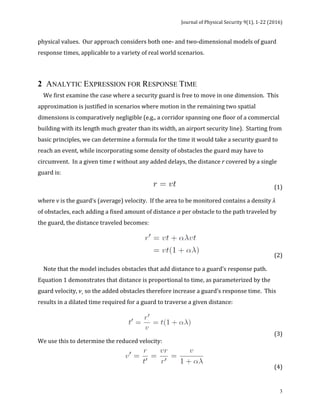
2 ANALYTIC EXPRESSION FOR RESPONSE TIME
				We	first	examine	the	case	where	a	security	guard	is	free	to	move	in	one	dimension.		This	
approximation	is	justified	in	scenarios	where	motion	in	the	remaining	two	spatial	
dimensions	is	comparatively	negligible	(e.g.,	a	corridor	spanning	one	floor	of	a	commercial	
building	with	its	length	much	greater	than	its	width,	an	airport	security	line).		Starting	from	
basic	principles,	we	can	determine	a	formula	for	the	time	it	would	take	a	security	guard	to	
reach	an	event,	while	incorporating	some	density	of	obstacles	the	guard	may	have	to	
circumvent.		In	a	given	time	t	without	any	added	delays,	the	distance	r	covered	by	a	single	
guard	is:	
	 	 	 	 	 	 (1)		
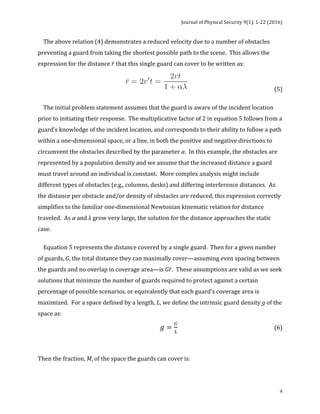
where	v	is	the	guard’s	(average)	velocity.		If	the	area	to	be	monitored	contains	a	density	λ		
of	obstacles,	each	adding	a	fixed	amount	of	distance	α	per	obstacle	to	the	path	traveled	by	
the	guard,	the	distance	traveled	becomes:		
	 	 	 	 (2)		
				Note	that	the	model	includes	obstacles	that	add	distance	to	a	guard’s	response	path.	
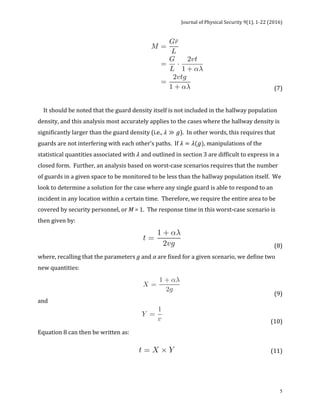
Equation	1	demonstrates	that	distance	is	proportional	to	time,	as	parameterized	by	the	
guard	velocity,	v¸	so	the	added	obstacles	therefore	increase	a	guard’s	response	time.		This	
results	in	a	dilated	time	required	for	a	guard	to	traverse	a	given	distance:		
	 	 	 	 	 (3)		
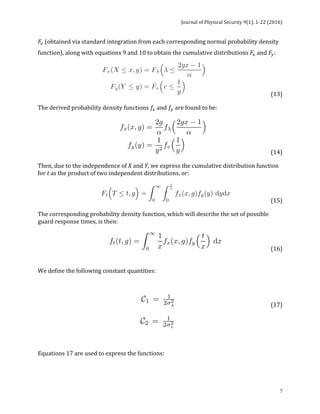
We	use	this	to	determine	the	reduced	velocity:		
		 	 	 	 (4)
Journal	of	Physical	Security	9(1),	1-22	(2016)	
	
	 4
				The	above	relation	(4)	demonstrates	a	reduced	velocity	due	to	a	number	of	obstacles	
preventing	a	guard	from	taking	the	shortest	possible	path	to	the	scene.		This	allows	the	
expression	for	the	distance	𝑟	that	this	single	guard	can	cover	to	be	written	as:	
		 	 	 	 	 (5)	
	
				The	initial	problem	statement	assumes	that	the	guard	is	aware	of	the	incident	location	
prior	to	initiating	their	response.		The	multiplicative	factor	of	2	in	equation	5	follows	from	a	
guard’s	knowledge	of	the	incident	location,	and	corresponds	to	their	ability	to	follow	a	path	
within	a	one-dimensional	space,	or	a	line,	in	both	the	positive	and	negative	directions	to	
circumvent	the	obstacles	described	by	the	parameter	α.		In	this	example,	the	obstacles	are	
represented	by	a	population	density	and	we	assume	that	the	increased	distance	a	guard	
must	travel	around	an	individual	is	constant.		More	complex	analysis	might	include	
different	types	of	obstacles	(e.g.,	columns,	desks)	and	differing	interference	distances.		As	
the	distance	per	obstacle	and/or	density	of	obstacles	are	reduced,	this	expression	correctly	
simplifies	to	the	familiar	one-dimensional	Newtonian	kinematic	relation	for	distance	
traveled.		As	α	and	λ	grow	very	large,	the	solution	for	the	distance	approaches	the	static	
case.		
		
				Equation	5	represents	the	distance	covered	by	a	single	guard.		Then	for	a	given	number	
of	guards,	G,	the	total	distance	they	can	maximally	cover—assuming	even	spacing	between	
the	guards	and	no	overlap	in	coverage	area—is	G𝑟.		These	assumptions	are	valid	as	we	seek	
solutions	that	minimize	the	number	of	guards	required	to	protect	against	a	certain	
percentage	of	possible	scenarios,	or	equivalently	that	each	guard’s	coverage	area	is	
maximized.		For	a	space	defined	by	a	length,	L,	we	define	the	intrinsic	guard	density	g	of	the	
space	as:	
𝑔 =
!
!
		 	 	 	 	 	(6)	
	
Then	the	fraction,	M,	of	the	space	the	guards	can	cover	is:
Journal	of	Physical	Security	9(1),	1-22	(2016)	
	
	 5
		 	 	 	 (7)	
		
	
				It	should	be	noted	that	the	guard	density	itself	is	not	included	in	the	hallway	population	
density,	and	this	analysis	most	accurately	applies	to	the	cases	where	the	hallway	density	is	
significantly	larger	than	the	guard	density	(i.e., 𝜆 ≫ 𝑔).		In	other	words,	this	requires	that	
guards	are	not	interfering	with	each	other’s	paths.		If	𝜆 = 𝜆(𝑔),	manipulations	of	the	
statistical	quantities	associated	with	𝜆	and	outlined	in	section	3	are	difficult	to	express	in	a	
closed	form.		Further,	an	analysis	based	on	worst-case	scenarios	requires	that	the	number	
of	guards	in	a	given	space	to	be	monitored	to	be	less	than	the	hallway	population	itself.		We	
look	to	determine	a	solution	for	the	case	where	any	single	guard	is	able	to	respond	to	an	
incident	in	any	location	within	a	certain	time.		Therefore,	we	require	the	entire	area	to	be	
covered	by	security	personnel,	or	M	=	1.		The	response	time	in	this	worst-case	scenario	is	
then	given	by:	
	 	 	 	 	 (8)		
where,	recalling	that	the	parameters	g	and	α	are	fixed	for	a	given	scenario,	we	define	two	
new	quantities:	
		 	 	 	 	 (9)		
and	
	 	 	 	 	 	 (10)	
Equation	8	can	then	be	written	as:		
		 	 	 	 	 (11)
Journal	of	Physical	Security	9(1),	1-22	(2016)	
	
	 6
where	the	above	substitution	simplifies	the	expression	for	t	into	the	product	of	two	
independent	terms	which	each	depend	on	a	single	random	variable	(𝜆	and	𝑣).		[Random	
variables	are	quantities	whose	possible	values	are	subject	to	variation,	taking	on	multiple	
different	values	each	with	an	associated	probability.]		In	the	following	sections,	we	
determine	a	probability	density	for	t,	where	the	distributions	for	𝜆	and	𝑣	are	known,	and	g	
(and	possibly	α)	are	adjustable	parameters	that	impact	the	shape	of	the	respective	curve,	
and	ultimately	the	cumulative	density	function.	
	
3 DISTRIBUTION OF RESPONSE TIMES
				Due	to	variability	in	both	the	population	density	of	an	area	(𝜆)	and	the	speed	of	the	
guards	themselves	(v),	we	assume	that	these	quantities	can	be	modeled	as	normally	
distributed	random	variables,	i.e.,	symmetrically	distributed	about	the	mean	with	a	width	
defined	by	the	variance.	
				Mathematically,	this	means	the	possible	values	allowed	for	each	random	variable	are	
defined	by	the	following	probability	density	functions:	
	 	 	 	 (12)	
				We	adopt	a	normal	distribution	of	densities	λ	as	it	models	the	set	of	“worst-case”	
scenarios,	where	the	obstacles’	impact	on	a	guard’s	responsiveness	is	greatest.		That	is,	the	
density	of	obstacles	during	off-peak	hours	may	not	be	accurately	modeled	by	a	normal	
distribution,	but	achieving	an	organization’s	desired	“Probability	of	Protection”	as	
calculated	against	these	worst-case	distributions	will	ensure	protection	against	the	entire	
set	of	possible	scenarios.		The	distribution	of	velocities	describes	the	range	of	average	foot	
speeds	that	a	guard	may	take	on	when	responding.		The	variability	in	this	quantity	could	
account	for	uncertainties	in	both	human	reaction	times,	as	well	as	in	the	(constant)	
distance	added	to	the	guard’s	path	α.		We	use	the	cumulative	distribution	functions	𝐹!	and
Journal	of	Physical	Security	9(1),	1-22	(2016)	
	
	 7
𝐹! (obtained	via	standard	integration	from	each	corresponding	normal	probability	density	
function),	along	with	equations	9	and	10	to	obtain	the	cumulative	distributions	𝐹!	and	𝐹!:		
	 	 	 	 (13)		
The	derived	probability	density	functions	𝑓!	and	𝑓!	are	found	to	be:		
	 	 	 	 (14)		
Then,	due	to	the	independence	of	X	and	Y,	we	express	the	cumulative	distribution	function	
for	t	as	the	product	of	two	independent	distributions,	or:		
	 	 	 (15)		
The	corresponding	probability	density	function,	which	will	describe	the	set	of	possible	
guard	response	times,	is	then:	
	 	 	 (16)		
	
	
We	define	the	following	constant	quantities:	
	
		 	 	 	 	 (17)		


Equations	17	are	used	to	express	the	functions:
Journal	of	Physical	Security	9(1),	1-22	(2016)	
	
	 8
	 	 	 (18)		
which	then	allow	the	solution	of	equation	16	to	be	written	as:	
	 	 	 (19)		
	
	
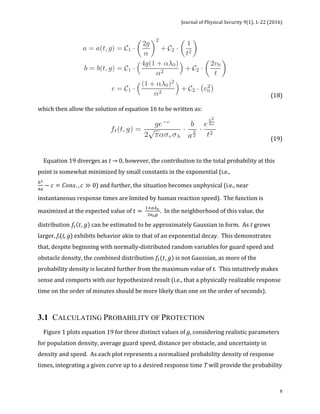
				Equation	19	diverges	as	t	→	0,	however,	the	contribution	to	the	total	probability	at	this	
point	is	somewhat	minimized	by	small	constants	in	the	exponential	(i.e.,	
!!
!!
− 𝑐 = 𝐶𝑜𝑛𝑠. , 𝑐 ≫ 0)	and	further,	the	situation	becomes	unphysical	(i.e.,	near	
instantaneous	response	times	are	limited	by	human	reaction	speed).		The	function	is	
maximized	at	the	expected	value	of	𝑡 =
!!!!!
!!!!
.		In	the	neighborhood	of	this	value,	the	
distribution	𝑓! 𝑡, 𝑔 	can	be	estimated	to	be	approximately	Gaussian	in	form.		As	t	grows	
larger,	ft(t,	g)	exhibits	behavior	akin	to	that	of	an	exponential	decay.		This	demonstrates	
that,	despite	beginning	with	normally-distributed	random	variables	for	guard	speed	and	
obstacle	density,	the	combined	distribution	𝑓!(𝑡, 𝑔)	is	not	Gaussian,	as	more	of	the	
probability	density	is	located	further	from	the	maximum	value	of	t.		This	intuitively	makes	
sense	and	comports	with	our	hypothesized	result	(i.e.,	that	a	physically	realizable	response	
time	on	the	order	of	minutes	should	be	more	likely	than	one	on	the	order	of	seconds).	
	
3.1 CALCULATING PROBABILITY OF PROTECTION
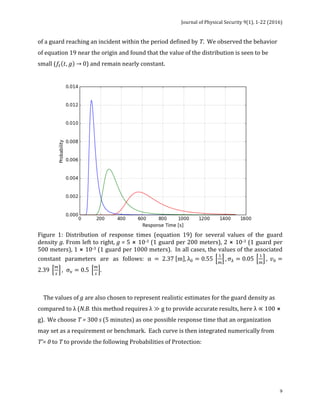
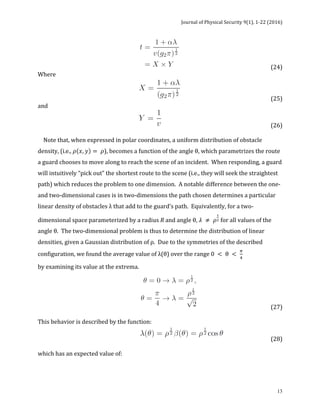
				Figure	1	plots	equation	19	for	three	distinct	values	of	g,	considering	realistic	parameters	
for	population	density,	average	guard	speed,	distance	per	obstacle,	and	uncertainty	in	
density	and	speed.		As	each	plot	represents	a	normalized	probability	density	of	response	
times,	integrating	a	given	curve	up	to	a	desired	response	time	T	will	provide	the	probability
Journal	of	Physical	Security	9(1),	1-22	(2016)	
	
	 9
of	a	guard	reaching	an	incident	within	the	period	defined	by	T.		We	observed	the	behavior	
of	equation	19	near	the	origin	and	found	that	the	value	of	the	distribution	is	seen	to	be	
small	(𝑓! 𝑡, 𝑔 	→	0)	and	remain	nearly	constant.	
	
Figure	 1:	 Distribution	 of	 response	 times	 (equation	 19)	 for	 several	 values	 of	 the	 guard	
density	g.	From	left	to	right,	g	=	5	⨯	10-3	(1	guard	per	200	meters),	2	⨯	10-3	(1	guard	per	
500	meters),	1	⨯	10-3	(1	guard	per	1000	meters).		In	all	cases,	the	values	of	the	associated	
constant	 parameters	 are	 as	 follows:	 α = 2.37 m , λ! = 0.55
!
!
, σ! = 0.05
!
!
, 𝑣! =
2.39
!
!
, σ! = 0.5
!
!
.	
	
	
				The	values	of	g	are	also	chosen	to	represent	realistic	estimates	for	the	guard	density	as	
compared	to	λ	(N.B.	this	method	requires	λ ≫ g	to	provide	accurate	results,	here	λ ∝ 100 ⨯
g).		We	choose	T	=	300	s	(5	minutes)	as	one	possible	response	time	that	an	organization	
may	set	as	a	requirement	or	benchmark.		Each	curve	is	then	integrated	numerically	from	
T’=	0	to	T	to	provide	the	following	Probabilities	of	Protection:
Journal	of	Physical	Security	9(1),	1-22	(2016)	
	
	 10
	
	
Table	1:	Probability	that	a	security	guard	will	be	able	to	respond	to	an	incident	in	at	least			
T	=	300	s	for	three	values	of	the	guard	density	g.	In	all	cases,	the	values	of	the	associated	
constant	parameters	are	as	follows:	α = 2.37 m , λ! = 0.55
!
!
, σ! = 0.05
!
!
, 𝑣! =
2.39
!
!
, σ! = 0.5
!
!
.	
	
Figure	2:		Area	under	curve	ft(t,	g),	where	as	an	example	the	desired	response	time	is	taken	
to	be	t	=	60.0	s	and	the	desired	probability	of	protection	is	75.0%.		The	value	of	g	that	
satisfies	these	conditions	is	found	to	be	9.44	⨯10-3	(about	1	guard	per	106	meters).		If	the	
length	of	corridor	to	be	monitored	L	=	200	m,	the	number	of	guards	required	is	G	=	g	⨯	L	=	
1.88.		As	above,	the	values	of	the	associated	constant	parameters	are:		α = 2.37 m , λ! =
0.55
!
!
, σ! = 0.05
!
!
, 𝑣! = 2.39
!
!
, σ! = 0.5
!
!
		
	
g	[
!
!
]	
Probability	of	
Protection	[%]	
5⨯10-3	 99.93	
2⨯10-3	 81.61	
1⨯10-3	 0.3093	
𝑓!(𝑡, 𝑔)
Journal	of	Physical	Security	9(1),	1-22	(2016)	
	
	 11
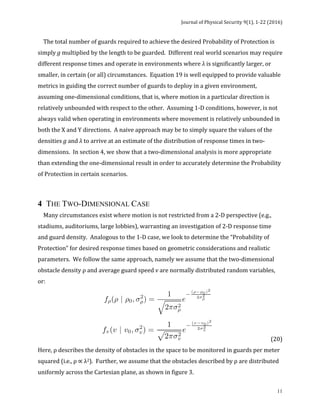
				The	total	number	of	guards	required	to	achieve	the	desired	Probability	of	Protection	is	
simply	g	multiplied	by	the	length	to	be	guarded.		Different	real	world	scenarios	may	require	
different	response	times	and	operate	in	environments	where	λ	is	significantly	larger,	or	
smaller,	in	certain	(or	all)	circumstances.		Equation	19	is	well	equipped	to	provide	valuable	
metrics	in	guiding	the	correct	number	of	guards	to	deploy	in	a	given	environment,	
assuming	one-dimensional	conditions,	that	is,	where	motion	in	a	particular	direction	is	
relatively	unbounded	with	respect	to	the	other.		Assuming	1-D	conditions,	however,	is	not	
always	valid	when	operating	in	environments	where	movement	is	relatively	unbounded	in	
both	the	X	and	Y	directions.		A	naive	approach	may	be	to	simply	square	the	values	of	the	
densities	g	and	λ	to	arrive	at	an	estimate	of	the	distribution	of	response	times	in	two-
dimensions.		In	section	4,	we	show	that	a	two-dimensional	analysis	is	more	appropriate	
than	extending	the	one-dimensional	result	in	order	to	accurately	determine	the	Probability	
of	Protection	in	certain	scenarios.	
	
4 THE TWO-DIMENSIONAL CASE
				Many	circumstances	exist	where	motion	is	not	restricted	from	a	2-D	perspective	(e.g.,	
stadiums,	auditoriums,	large	lobbies),	warranting	an	investigation	of	2-D	response	time	
and	guard	density.		Analogous	to	the	1-D	case,	we	look	to	determine	the	“Probability	of	
Protection”	for	desired	response	times	based	on	geometric	considerations	and	realistic	
parameters.		We	follow	the	same	approach,	namely	we	assume	that	the	two-dimensional	
obstacle	density	ρ	and	average	guard	speed	v	are	normally	distributed	random	variables,	
or:	
	 	 	 	 	
		 	 	 (20)	
Here,	ρ	describes	the	density	of	obstacles	in	the	space	to	be	monitored	in	guards	per	meter	
squared	(i.e.,	ρ	∝	λ2).		Further,	we	assume	that	the	obstacles	described	by	ρ	are	distributed	
uniformly	across	the	Cartesian	plane,	as	shown	in	figure	3.
Journal	of	Physical	Security	9(1),	1-22	(2016)	
	
	 12
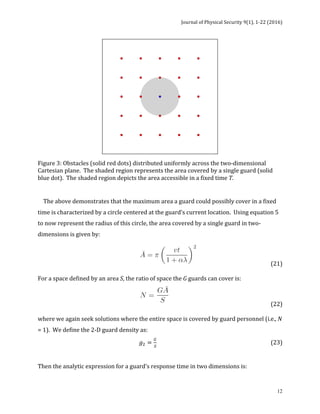
Figure	3:	Obstacles	(solid	red	dots)	distributed	uniformly	across	the	two-dimensional	
Cartesian	plane.		The	shaded	region	represents	the	area	covered	by	a	single	guard	(solid	
blue	dot).		The	shaded	region	depicts	the	area	accessible	in	a	fixed	time	T.		
		
	
				The	above	demonstrates	that	the	maximum	area	a	guard	could	possibly	cover	in	a	fixed	
time	is	characterized	by	a	circle	centered	at	the	guard’s	current	location.		Using	equation	5	
to	now	represent	the	radius	of	this	circle,	the	area	covered	by	a	single	guard	in	two-
dimensions	is	given	by:	
	 	 	 	 (21)		
	
For	a	space	defined	by	an	area	S,	the	ratio	of	space	the	G	guards	can	cover	is:		
	 	 	 	 	 	 (22)		
	
where	we	again	seek	solutions	where	the	entire	space	is	covered	by	guard	personnel	(i.e.,	N	
=	1).		We	define	the	2-D	guard	density	as:	
𝑔! =
!
!
		 	 	 	 	 	 (23)	
	
Then	the	analytic	expression	for	a	guard’s	response	time	in	two	dimensions	is:
Journal	of	Physical	Security	9(1),	1-22	(2016)	
	
	 13
	 	 	 	 	 (24)		
Where	
	 	 	 	 	 (25)	
and		
	 	 	 	 	 	 (26)		
	
				Note	that,	when	expressed	in	polar	coordinates,	a	uniform	distribution	of	obstacle	
density,	(i.e.,	𝜌 𝑥, 𝑦 = 𝜌),	becomes	a	function	of	the	angle	θ,	which	parametrizes	the	route	
a	guard	chooses	to	move	along	to	reach	the	scene	of	an	incident.		When	responding,	a	guard	
will	intuitively	“pick	out”	the	shortest	route	to	the	scene	(i.e.,	they	will	seek	the	straightest	
path)	which	reduces	the	problem	to	one	dimension.		A	notable	difference	between	the	one-	
and	two-dimensional	cases	is	in	two-dimensions	the	path	chosen	determines	a	particular	
linear	density	of	obstacles	λ	that	add	to	the	guard’s	path.		Equivalently,	for	a	two-
dimensional	space	parameterized	by	a	radius	R	and	angle	θ,	𝜆 ≠ 𝜌
!
! for	all	values	of	the	
angle	θ.		The	two-dimensional	problem	is	thus	to	determine	the	distribution	of	linear	
densities,	given	a	Gaussian	distribution	of	ρ.		Due	to	the	symmetries	of	the	described	
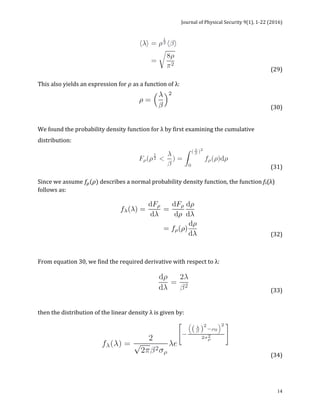
configuration,	we	found	the	average	value	of	λ(θ)	over	the	range	0 < θ <
!
!
							
by	examining	its	value	at	the	extrema.		
	 	 	 	 (27)		
	
This	behavior	is	described	by	the	function:		
	 	 	 (28)		
	
which	has	an	expected	value	of:
Journal	of	Physical	Security	9(1),	1-22	(2016)	
	
	 14
	 	 	 	 	 (29)		
	
This	also	yields	an	expression	for	𝜌	as	a	function	of	λ:	
	 	 	 	 	 	 (30)	
	
We	found	the	probability	density	function	for	λ	by	first	examining	the	cumulative	
distribution:		
	 	 	 (31)		
	
Since	we	assume	𝑓!(𝜌)	describes	a	normal	probability	density	function,	the	function	fλ(λ)	
follows	as:	
	 	 	 	 (32)		
	
From	equation	30,	we	find	the	required	derivative	with	respect	to	λ:	
	 	 	 	 	 (33)		
	
	
then	the	distribution	of	the	linear	density	λ	is	given	by:	
	 	 	 (34)
Journal	of	Physical	Security	9(1),	1-22	(2016)	
	
	 15
	
Figure	4:	Distribution	of	linear	obstacle	densities	(λ);	the	blue	curve	represents	equation	
34,	the	green	curve	shows	the	corresponding	Gaussian	distribution.	
			
	
				The	above	function	can	be	used	as	input	to	an	expression	for	the	response	time	of	a	guard	
in	two	dimensions.		We	follow	Laplace’s	method	to	estimate	equation	34	as	demonstrated	
in	Figure	4	[4].		The	expected	value	of	the	linear	density	λ0	can	be	approximated	(to	first	
order)	as:	
	 	 	 	 (35)		
	
				Equation	35	imposes	a	restriction	on	the	parameters	that	define	the	distribution	𝑓(𝜌),	
namely	that	the	ratio	
!!
!!
	<<	1.		This	restriction	assures	that	the	distribution	will	not	take	on	
negative	values	for	the	velocity	(an	unphysical	result)	and	will	approach	the	expected	
value.		Note	that,	in	the	limit	where	σρ	→	0	the	expression	for	λ!	reduces	to	that	which	was	
derived	analytically	in	equation	27.		We	arrive	at	an	expression	for	the	variance	σλ	as	a	
function	of	σρ	from	the	coefficient	of	equation	34:
Journal	of	Physical	Security	9(1),	1-22	(2016)	
	
	 16
	 	 	 	 (36)		
	
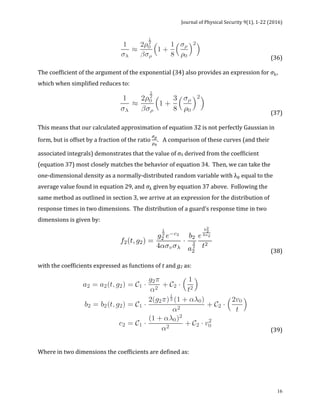
The	coefficient	of	the	argument	of	the	exponential	(34)	also	provides	an	expression	for	𝜎!,	
which	when	simplified	reduces	to:	
	 	 	 	 (37)		
	
This	means	that	our	calculated	approximation	of	equation	32	is	not	perfectly	Gaussian	in	
form,	but	is	offset	by	a	fraction	of	the	ratio	
!!
!!
.			A	comparison	of	these	curves	(and	their	
associated	integrals)	demonstrates	that	the	value	of	σλ	derived	from	the	coefficient	
(equation	37)	most	closely	matches	the	behavior	of	equation	34.		Then,	we	can	take	the	
one-dimensional	density	as	a	normally-distributed	random	variable	with	λ!	equal	to	the	
average	value	found	in	equation	29,	and	𝜎!	given	by	equation	37	above.		Following	the	
same	method	as	outlined	in	section	3,	we	arrive	at	an	expression	for	the	distribution	of	
response	times	in	two	dimensions.		The	distribution	of	a	guard’s	response	time	in	two	
dimensions	is	given	by:	
	 	 	 		 	 	 (38)	
	
with	the	coefficients	expressed	as	functions	of	t	and	g2	as:	
	 	 (39)	
	
	
Where	in	two	dimensions	the	coefficients	are	defined	as:
Journal	of	Physical	Security	9(1),	1-22	(2016)	
	
	 17
	 	 	 	 	 	 (40)	
	
				Comparing	equation	38	with	equation	19	and	noting	the	preceding	analysis	
demonstrates	that	the	form	of	the	solution	is	consistent	in	both	one-	and	two-	dimensions,	
with	the	differences	comprised	of	the	values	of	the	various	constants.		
	
4.1 CALCULATING PROBABILITY OF PROTECTION
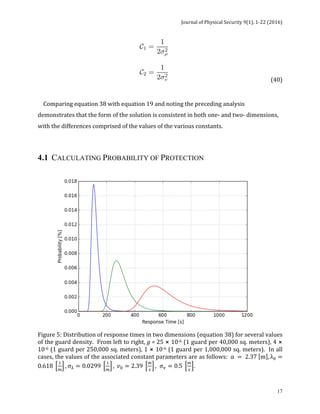
Figure	5:	Distribution	of	response	times	in	two	dimensions	(equation	38)	for	several	values	
of	the	guard	density.		From	left	to	right,	g	=	25	⨯	10-6	(1	guard	per	40,000	sq.	meters),	4	⨯	
10-6	(1	guard	per	250,000	sq.	meters),	1	⨯	10-6	(1	guard	per	1,000,000	sq.	meters).		In	all	
cases,	the	values	of	the	associated	constant	parameters	are	as	follows:		α = 2.37 m , λ! =
0.618
!
!
, σ! = 0.0299
!
!
, 𝑣! = 2.39
!
!
, σ! = 0.5
!
!
.
Journal	of	Physical	Security	9(1),	1-22	(2016)	
	
	 18
				Figure	5	plots	equation	38	for	three	distinct	values	of	g2,	which	are	the	squares	of	values	
for	g	used	in	table	1.		Calculations	are	performed	to	obtain	the	cumulative	probability	
analogous	to	the	processes	undertaken	in	Section	3.1	and	considering	realistic	two-
dimensional	parameters.		Results	are	presented	in	table	2.		The	parameters	describing	the	
distribution	of	guard	speed	should	not	be	adjusted,	as	motion	remains	one-dimensional	in	
both	cases.		
	
g2	[
!
!!
]	
Probability	of	
Protection	[%]	
25⨯10-6		 99.8	
4⨯10-6		 55.5	
1⨯10-6		 0.000698	
	
Table	2:	Probability	that	a	security	guard	will	be	able	to	respond	to	an	incident	in	at	least	T	
=	300	s	for	three	values	of	the	guard	density	g2.		In	all	cases,	the	values	of	the	associated	
constant	parameters	are	as	follows:		 α = 2.37 m , λ! = 0.618
!
!
, σ! = 0.0299
!
!
, 𝑣! =
2.39
!
!
, σ! = 0.5
!
!
.	
	
	
				Comparison	of	the	results	presented	in	table	2	with	those	calculated	in	table	1	indicates	
that	naively	extending	the	results	of	section	3.1	into	two-dimensions	by	“squaring	the	
answers"	results	in	dimensionally-correct	solutions	with	significant	differences	in	
computed	probability.		The	two-dimensional	analysis	suggests	that	a	greater	quantity	of	
guards	is	required	to	meet	a	given	protection	requirement	than	the	one-dimensional	
extension.		
		
				Starting	from	the	guard	density	value	derived	in	figure	2	and	performing	the	naive	
extension	into	two	dimensions	suggests	that	𝜌! = 𝜆!
!
	over	an	area	L2	and	therefore	that	
𝑔! = 𝑔!
= 8.91 ×10!!
[
!
!". !
].			In	this	case	 𝑓! 𝑔!, 𝑡 𝑑𝑡 = 44.7%
!"
!
,	significantly	lower	
than	the	75.0%	probability	of	protection	determined	with	the	corresponding	values	in	the	
1-D	analysis.		This	therefore	demonstrates	the	need	to	analyze	the	2-D	case	separately.	
Alternatively,	this	demonstrates	that	the	two	dimensional	model	requires	a	different
Journal	of	Physical	Security	9(1),	1-22	(2016)	
	
	 19
quantity	of	guards	(found	by	multiplying	the	calculated	guard	density	by	the	area	to	be	
monitored)	to	achieve	an	organization’s	desired	probability	of	protection.		Extending	to	
three	dimensions,	while	mathematically	possible,	becomes	unphysical	as	guards	can	no	
longer	move	continuously	through	space	in	any	direction,	and	rather	must	use	dis-
continuous	methods	such	as	stairs	or	elevators.		It	may	be	of	interest	to	investigate	this	
problem	using	Monte-Carlo	techniques	with	random	initial	conditions	and	carefully	
calculated	guard	motion	in	response	to	an	incident.		
	
Figure	 6:	 Comparison	 of	 two	 dimensional	 response	 time	 distribution	 (green)	 with	 one	
dimensional	 distribution	 (blue)	 where	 it	 is	 seen	 that	 the	 “Probability	 of	 Protection”	
(shaded	 area)	 is	 larger	 for	 the	 one-dimensional	 curve;	 here	 we	 take	 the	 uninformed	
approach	where	ρ! = 𝜆!
!
,	the	guard	density	g2	=	g2	where	g	=	9.44	𝑔 = 9.44×10!!
	found	in	
section	3.1	required	to	achieve	a	75%	“Probability	of	Protection”.		The	ratio	of	the	means	
linear	density	to	its	variance	is	preserved	in	extending	to	two	dimensions.	
	
5 CONCLUSIONS AND NEXT STEPS
				In	the	world	of	physical	security	one	of	the	most	important	controls,	and	at	times	the	
most	expensive,	are	individuals	hired	to	perform	safety	and	security	roles.		The	individuals	
! 𝑓!(𝑡, 𝑔!)𝑑𝑡 = 75.0%
!"
!
	
! 𝑓!(𝑡, 𝑔!)𝑑𝑡 = 44.7%
!"
!
	
Probability	[%]	Probability	[%]
Journal	of	Physical	Security	9(1),	1-22	(2016)	
	
	 20
require	salary,	benefits,	training,	and	other	expenses	to	an	institution,	and	cost-based	
decisions	alone	can	often	render	these	roles	ineffective.		For	example,	hiring	security	
guards	increases	an	organization’s	legal	liability;		the	individuals	have	the	potential	to	harm	
visitors	intentionally	or	otherwise,	and	maintain	an	increased	risk	of	personal	injury	(e.g.,	
medical,	firearms,	etc.).		The	addition	of	security	personnel	also	increases	the	risks	
associated	with	insider	threats,	as	guards	are	often	granted	privileged,	physical	access	to	
sensitive	areas.		This	demonstrates	that	a	quantitative	analysis	of	the	amount	of	guards	
required	for	a	given	location	tells	only	a	part	of	the	story,	and	while	the	above	results	do	
not	address	every	possible	scenario	where	an	institution	may	require	a	staff	to	deliver	
physical	security	services,	they	do	address	a	common	problem	that	rarely,	if	ever,	is	
addressed	by	the	application	of	quantitative	metrics	to	help	determine	an	appropriate	
number	of	guards	in	a	given	environment.		
		
				This	paper	provides	metrics	that	may	expand	on	existing	cost-benefit	analysis	by	
focusing	on	the	threshold	for	response	time	against	the	expenses	incurred	by	the	
institution	to	achieve	that	threshold.		As	seen	in	the	plots	above,	a	successful	guard	density	
results	in	a	probability	of	protection,	as	defined	by	the	institution,	that	is	weighed	against	
the	cost	of	hiring	those	guards,	as	defined	by	the	market	or	vendor	of	guard	services.		The	
institution,	if	unable	or	unwilling	to	accept	that	cost,	may	either	adjust	the	physical	layout,	
compare	prices	with	another	vendor	(if	possible)	or	adjust	their	acceptable	probability	of	
protection	if	allowed.		However,	the	decisions	can	now	be	made	based	on	a	deeper	
understanding	of	the	control	provided	by	the	guards	and	not	budget	concerns	alone.		
		
				Our	one	dimensional	analysis	shows	the	plots	of	𝑓!(𝑡, 𝑔)	as	continuous	functions	(figure	
1).		Despite	this,	we	know	that	guards	are	of	course	not	a	fractional	expense	(e.g.,	one	
cannot	hire	5.5	guards)	and	therefore	must	round	the	calculated	number	of	guards	
required	to	meet	a	particular	density	requirement	to	integer	values.		This	is	demonstrated	
in	figure	2,	where	the	desired	probability	of	protection	is	75.0%,	requiring	𝑔 = 9.44×10!!
	
guards	per	meter.		But	determining	the	actual	number	of	guards	(by	multiplying	the	
calculated	guard	density	by	a	length	of	corridor	(e.g.	L	=	2000	m),	requires	18.8	guards	to	
achieve	the	protection	requirement	and	must	therefore	round	up	to	19	guards	to	cover	the
Journal	of	Physical	Security	9(1),	1-22	(2016)	
	
	 21
entire	space.		Employing	19	guards	will	effectively	increase	the	functional	probability	of	
protection	to	75.8%,	above	the	organizational	required	75.0%	and	over-covering	the	space	
(i.e.	𝑔 → 9.50× 10!!
).		However,	rounding	down	to	18	guards	will	decrease	the	functional	
probability	of	protection	to	68.3%	and	under-cover	the	space	(i.e.,	𝑔 → 9.00× 10!!
).		
		
				Of	course,	the	calculations	in	one	and	two	dimensions	presented	above	represent	certain	
idealized	variables	and	conditions.		Population	density	may	not	fit	a	normal	distribution	at	
all	times	in	a	given	environment,	and	the	study	may	only	apply	to	worst-case	scenarios	
(e.g.,	rush-hour	foot	traffic	in	a	busy	office	building).		As	the	probability	of	protection	
calculation	is	designed	to	consider	the	cumulative	distribution,	successfully	applying	
guards	to	the	worst-case	scenario	implies	success	for	all	scenarios	with	a	uniform	
population	density	at	a	given	time.		As	the	probability	density	of	λ	is	not	a	function	of	
position,	this	analysis	does	not	account	for	any	clustering	of	obstacles	that	may	occur	near,	
say,	an	elevator	or	turnstile.		As	suggested	in	examining	the	possible	three-dimensional	
probability	of	protection,	Monte-Carlo	techniques	may	be	helpful	in	examining	scenarios	
where	the	population	density	is	initially	uniform	in	an	environment	with	sources	and	sinks	
that	allow	𝜆 → 𝜆(𝑥, 𝑦)	and	𝑔 → 𝑔(𝑥, 𝑦).		Other	assumptions	include	a	nearly	constant	
distance	per	obstacle	(α),	which	may	only	be	reasonable	if	all	obstacles	are	uniform	(i.e.,	
not	a	mixture	of	desks,	columns,	or	other	construction),	and	a	normal	distribution	for	guard	
velocity.		While	adding	distance	per	obstacle	as	another	random	variable	is	an	interesting	
study,	it	adds	to	the	complexity	of	the	analysis	substantially.		Considering	guard	velocity	to	
be	nearly	constant	and	considering	a	normal	distribution	for	the	distance	per	obstacle	is	a	
more	realistic	follow-up	to	this	study.		
		
				Other	scenarios	may	benefit	from	an	analogous	study,	such	as	the	number	of	guards	
required	to	inspect	individuals/packages	arriving	at	a	random	rate.		The	generalized	
stochastic	approach	can	also	be	repeated	for	other	kinds	of	physical	security	problems	
commonly	encountered	by	an	organization’s	Chief	Security	Officer	or	equivalent,	such	as	
impact	to	windows	[3],	doors,	bollards	and	other	obstacles	where	the	relative	success	of	
the	protective	control	is	measured	by	a	threshold	below	(above)	which	is	success	and	
above	(below)	which	is	failure,	that	is,	an	application	of	cumulative	probability.		While	the
Journal	of	Physical	Security	9(1),	1-22	(2016)	
	
	 22
approach	is	suitable	to	any	statistically	modeled	physical	problem	looking	to	examine	such	
conditions,	complex	analytical	equations	as	compared	to	Equation	19	may	result	in	more	
difficulty	in	achieving	a	probability	density	function	without	multiple	numerical	integration	
steps	and/or	less	accurate	estimation	techniques.		However,	normal	distributions	are	not	a	
requirement	of	the	approach,	and	others	(e.g.,	exponential,	gamma,	power-law)	may	both	
be	more	physically	reasonable	for	a	given	variable	and	easier	to	manipulate	in	the	above	
framework	even	with	a	complex	set-up	equation.		
	
References
	
[1] Broder, J. F., and Tucker, E., Risk Analysis and the Security Survey. 4th ed. Amsterdam:
Butterworth-Heinemann (2012).
[2] Vellani, K.H., Emery, R.J., Parker, N., Staffing benchmarks: a model for determining how
many security officers are enough, Journal of Healthcare Protection Management 28(2),
(2012).
[3] Chang, D.B., and Young, C.S., Probabilistic Estimates of Vulnerability to Explosive
Overpressures and Impulses, Journal of Physical Security 4(2), 10-29 (2010).
[4] Laplace, P. S. Memoir on the Probability of the Causes of Events. Statistical Science Statist.
Sci., 1(3), 364-378. (1986).
Journal	of	Physical	Security	9(1),	23-25	(2016)	
	
	 23
	 	 	 	 	 	 	
Viewpoint	Paper	
	
	
Mitigating	Workplace	Violence	
	
Bill	Martin,	PPS	
Advanced	Security	Protection	
	
	
				People	do	not	just	suddenly	snap;		there	is	usually	an	emotional	build-up	or	a	
stressor/	trigger	that	precipitates	the	outburst	or	violent	incident.	
	
				Consider	a	once	social	employee	who	has	previously	enjoyed	the	lunchroom	atmosphere	
and	was	known	to	be	cordial	and	interactive	with	his	co-workers.		Recently	he	has	started	
to	withdraw	and	isolate	himself.		He	has	begun	to	talk	about	how	he	is	really	down	on	life.	
Does	this	recent	behavior	bring	any	concerns?		Well	maybe?	
	
				What	else	is	going	on	with	so	and	so;		what	else	is	happening?	
	
				The	ability	to	distinguish	the	differences	between	everyday	stress	and	someone	who	may	
be	on	a	pathway	to	violence	is	sometimes	very	challenging	and	difficult.		Threat	assessment	
professionals	tend	to	look	for	a	cluster	of	red	flags	and	concerning	behaviors,	but	you	do	
not	have	to	be	a	security	professional	to	know	something	is	amiss.	
	
				Those	who	tend	to	nurse	grudges	and	fantasize	of	revenge	are	known	as	“Injustice	
Collectors”.	
	
				An	employee	who	is	just	momentarily	upset	and	angry	may	vent	their	frustration	and	
give	reason	for	concern;		but	those	who	keep	score	of	all	the	wrongs	that	were	done	to	
them	(real	or	imagined)	and	purposely	pull	away	from	their	co-workers	should	send	up	
some	red	flags.		Suffering	some	type	of	traumatic	loss	such	as	love	or	status	are	igniters	for	
an	already	volatile	individual.		Understanding	the	role	of	fantasy	and	the	impact	it	has	on	
the	psyche	of	such	an	individual	is	a	key	to	shaping	our	interventions	and	strategies.			
	
				The	more	you	think	about	something,	the	closer	you	come	to	doing	it.	
	
				If	a	person	believes	in	something	so	strongly	and	intensely,	it	will	begin	to	leak	out	
	
				Fantasy	exists	before	the	action;		you	can	see	fantasy	before	the	action	through	leakage.	
	
				Therefore	understanding	behavior	through	the	concepts	of	leakage	is	a	huge	benefit	
and	a	proactive	step	in	workplace	violence	prevention.
Journal	of	Physical	Security	9(1),	23-25	(2016)	
	
	 24
				A	co-worker	who	is	talking	about	how	they	were	wronged	and	that	somebody	is	going	to	
have	to	pay	should	send	up	a	red	flag.		What	if	they	are	also	sympathizing	with	those	who	
have	resorted	to	violence	in	past	incidents	and	statements	are	heard	like,	"I	can	understand	
why	they	did	what	they	did".		Someone	is	going	to	have	to	make	meaningful	contact	before	
the	individual	of	concern	decides	to	act	out	with	violence.		Sometimes	there	are	internal	or	
external	restraints	that	prevent	such	an	action	from	coming	into	fruition	and	fantasizing	is	
at	the	continuum's	end.	
	
				We	must	pay	attention	to	the	words,	behaviors,	and	actions	of	our	employees	and	co-
workers.		If	they	feel	there	is	no	one	to	help	them	with	their	concerns	and	sometimes	
grievances,	then	making	a	dramatic	statement	is	not	out	of	the	equation.		We	cannot	afford	
to	ignore	these	warning	signs	and	behaviors.		Sometimes	the	help	someone	needs	is	just	
beyond	the	scope	of	our	expertise.		We	must	be	willing	to	acknowledge	our	limitations	and	
abilities	and	enlist	the	assistance	of	someone	with	the	experience	for	handling	such	
cases.		Just	take	a	volatile	person,	add	some	powerful	stressors	into	the	mix,	and	we	may	be	
sitting	on	a	huge	powder	keg.	
	
	
Key	Mitigating	Factors	
	
1.	Be	Observant	and	Pay	Attention	
				We	have	to	train	ourselves	to	observe	behavior.		What	is	this	person’s	normal	everyday	
behavior?		Has	there	been	a	noticeable	change?		We	all	know	that	adversity	and	personal	
difficulties	do	exist,	and	the	ability	to	handle	stress	and	cope	varies	from	person	to	person.	
The	two	most	common	stressors	that	impact	men	in	particular	are	the	loss	of	relationship	
and	the	loss	of	job	or	status.		Suffering	wrongdoing	is	something	most	people	will	
experience	during	their	lifetime.		Most	of	us	will	choose	a	higher	pathway	and	channel	our	
energies	into	constructive	alternatives.		Some	individuals,	however,	will	nurse	and	fuel	the	
fire	of	injustices	until	it	reaches	a	boiling	point;		they	will	keep	score	of	the	wrongs	they	
have	endured	until	the	moment	they	decide	to	lash	out	in	anger	and	aggression.			
	
	
2.	Show	Support,	Care	and	Understanding	
				Listening	and	caring	is	probably	the	single	most	essential	and	important	mitigating	tool	
we	have	to	prevent	a	workplace	violent	incident.		I	cannot	begin	to	tell	you	how	many	
stories	could	have	been	re-written	if	someone	in	upper	management	had	taken	the	time	to	
simply	listen	(not	talk),	but	really	listen	and	care.		This	simple	supportive	intervention	is	
oftentimes	overlooked	and,	sadly,	not	considered	as	a	mitigating	tool.		
	
				Sitting	with	a	co-worker	or	employee	and	sincerely	listening	and	caring	can	alleviate	a	lot	
of	stress	and	pay	great	dividends	for	any	organization.		We	must	show	that	we	care	and	are	
offering	to	help	in	any	way	we	can.		A	management	team	that	cares	enough	to	listen	to	the	
needs	and	concerns	of	their	employees	is	taking	a	prudent	step	in	the	right	direction.		We	
may	not	be	able	to	solve	all	of	their	problems,	but	there	is	something	to	be	said	of	a	caring	
leadership	team.
Journal	of	Physical	Security	9(1),	23-25	(2016)	
	
	 25
3.	Establish	Policies,	Procedures	and	Protocols	
				Workplace	prevention	policies	should	be	outlined	and	simplified.		Procedures	on	
handling	and	addressing	violations	in	policy	and	those	who	appear	to	be	exhibiting	
threatening	and/or	concerning	behaviors	should	be	simplified	and	outlined	for	the	staff	
and	employees.		Employees	must	know	where	to	go	and	who	to	report	their	concerns	to	
and	how	to	report	their	concerns.		There	must	be	a	sense	that	things	will	be	followed	
through	and	our	management	team	really	does	care	for	our	safety	and	security.	
	
				Protocols	and	training	programs	should	be	made	available	for	all	staff	and	employees	on	
an	ongoing	basis.		We	should	develop	a	leadership	team	who	maintains	accountability	for	
staff	training	programs.		There	could	be	a	structured	team	in	place	that	handles	
threatening/concerning	behaviors.		Each	organization	could	have	its	own	threat	
management	team	which	could	be	comprised	of	several	disciplines	experienced	in	handling	
the	case	load	of	threats	and/or	concerning	behaviors.		There	is	too	much	at	stake	to	not	
take	a	proactive	step	in	the	right	direction	to	ensure	the	safety	and	security	of	our	
workplaces.	
	
				The	emphasis	in	this	paper	is	about	mitigating	factors	for	workplace	violence.		The	same	
mitigating	factors,	however,	may	well	be	useful	in	mitigating	non-violent	retaliation	or	
sabotage	by	disgruntled	employees,	former	employees,	or	contractors.	


About	the	Author	
				Bill	Martin	is	from	the	greater	New	York	City	Area	and	is	an	expert	in	threat	
management,	executive	protection,	and	behavioral	analysis.		He	is	a	trainer	and	expert	in	
security	for	houses	of	worship.		He	can	be	reached	at	Twitter	@bmartin683.
Journal	of	Physical	Security	9(1),	26-48	(2016)	
	
	 26
	 	 	 	 	 	 	
Viewpoint	Paper	
	
	
Avoiding	Shock	and	Awe*	
	
Roger	G.	Johnston,	Ph.D.,	CPP	
Right	Brain	Sekurity	
http://rbsekurity.com	
	
	
				I	find	two	recent	security	incidents	to	be	particularly	disturbing	because	they	highlight	
the	frequent	lack	of	vulnerability	assessments	(VAs),	or	even	a	mindset	that	allows	for	the	
contemplation	of	security	vulnerabilities.		This	almost	always	leads	to	serious	security	
failures.	
	
				The	first	incident	involves	allegations	of	Russian	tampering	with	urine	samples	used	for	
testing	athletes	for	banned	performance-enhancing	drugs.		The	New	York	Times	reported	
that	there	has	been	extensive	state-sponsored	doping	of	Russian	international	athletes,	
hidden	via	tampering	with	urine	testing	samples.[1]		The	tampering	was	reportedly	
implemented	by	tampering	with	so-called	“tamper-proof”	urine	sample	bottles.		In	a	follow-
up	story	on	the	front	page	of	the	New	York	Times[2],	Don	Catlin,	the	former	head	of	the	
UCLA	Olympic	Analytical	Laboratory	is	quoted	as	saying,	“I	tried	to	break	into	those	[urine	
sample]	bottles	years	ago	and	couldn’t	do	it.		It’s	shocking.”		[Italics	added	for	emphasis.]			
	
				In	the	same	story,	Catlin	further	states	that	when	the	manufacturer	first	showcased	the	
urine	sample	bottles	used	for	athlete	drug	testing	to	a	roomful	of	doctors,	“All	of	us	were	
particularly	pleased	and	excited	by	this	bottle	because	it	looked	pretty	bulletproof.”		The	
manufacturer	is	quoted	as	saying	about	the	allegations	of	Russian	spoofing	of	the	“tamper-
proof”	sample	bottles	that,	“We’re	all	a	bit	speechless,	to	be	honest...No	one	can	believe	it.”		
[Italics	added	for	emphasis.]	
	
				Shocked?		No	one	can	believe	it?		Really?!?		The	fact	is	that	reliable	tamper-detection	is	a	
largely	unsolved	problem.[3,4]		Moreover,	7	years	ago,	my	colleagues	and	I	demonstrated	
that	23	widely-used	urine	collection	kits	could	be	easily	tampered	with	using	only	low-tech	
methods.[3]		(Unfortunately,	we	did	not	evaluate	the	Berlinger	bottle	that	is	at	the	center	of	
the	current	accusations	of	Russian	tampering.)		We	also	found	that	the	drug	testing	
protocols	typically	used,	including	for	international	athletes,	have	serious	security	
problems.[3]			
	
				The	shock	and	disbelief	at	the	idea	that	the	so-called	“tamper-proof”	bottles	can	be	
defeated	is	very	consistent	with	a	number	of	general	security	maxims.		In	particular:	
	
______________________	
*	This	Viewpoint	paper	was	not	peer	reviewed.
Journal	of	Physical	Security	9(1),	26-48	(2016)	
	
	 27
Backwards	Maxim:		Most	people	will	assume	everything	is	secure	until	provided	strong	
evidence	to	the	contrary—exactly	backwards	from	a	reasonable	approach.	
	
Narcissist	Maxim:		Security	managers,	bureaucrats,	manufacturers,	vendors,	and	end-
users	will	automatically	assume	that,	if	they	cannot	readily	conceive	of	a	way	to	defeat	a	
security	product	(or	a	security	program),	then	nobody	else	can.		Remarkably,	this	will	be	
true	even	for	people	with	little	or	no	experience,	resources,	or	aptitude	for	defeating	
security,	and	even	if	they	are	spectacularly	unimaginative.	
	
Mermaid	Maxim:	The	most	common	excuse	for	not	fixing	security	vulnerabilities	is	the	
belief	that	they	simply	can't	exist.		Comment:	Often,	the	evidence	offered	that	no	security	
vulnerabilities	exist	is	that	the	security	manager	who	expresses	this	view	can’t	personally	
imagine	how	to	defeat	the	security.		
	
You	Could’ve	Knocked	Me	Over	with	a	Feather	Maxim	1:		Security	managers,	
bureaucrats,	manufacturers,	vendors,	and	end	users	will	always	be	amazed	at	how	easily	
their	security	products	or	programs	can	be	defeated.	
	
[Unfortunately,	in	my	experience	as	a	vulnerability	assessor,	the	following	associated	
maxim	equally	proves	to	be	true:	
You	Could’ve	Knocked	Me	Over	with	a	Feather	Maxim	2:		Having	been	amazed	once,	
security	managers,	bureaucrats,	manufacturers,	vendors,	and	end	users	will	be	equally	
amazed	the	next	time	around.]	
	
And	finally:		
Tamper-Proof	Maxim:		Any	claim	by	a	salesperson	about	the	performance	of	a	physical	
security	product	(including	the	claim	of	absolute	security)	will	be	believed	by	default	by	
the	customer,	while	warnings	about	vulnerabilities	or	limitations	by	vulnerability	assessors	
or	others	with	first-hand	experience	will	be	met	with	incredulity.		Comment:		A	classic	
example	of	this	can	be	found	in	the	all-to-common	seal	customers	who	maintain	that	their	
seals	cannot	not	be	spoofed	because	the	manufacturer	calls	them	“tamper-proof”.		
	
	
				(My	complete	set	of	Security	Maxims	can	found	in	the	Appendix	of	this	paper.)	
	
	
				The	second	recent,	highly	disturbing	“security”	incident	that	suggests	the	absence	of	
effective	VAs	was	the	horrific	killing	of	a	2-year	old	child	by	an	alligator	at	a	Walt	Disney	
resort	in	Orlando,	Florida.		Now	alligators	might	be	more	conventionally	considered	a	
safety	issue	rather	than	a	security	issue,	but	security	is	fundamentally	about	trying	to	
counter	malicious	actions	by	a	nefarious	adversary.		Alligators	would	seem	to	fall	into	that	
category,	in	contrast	to	other	forces	of	nature	such	as	hurricanes,	tornados,	and	
earthquakes—usually	thought	of	as	safety	threats—that	do	not.	
	
				Risk	Management	has	to	include	not	just	an	understanding	of	the	threats,	but	also	an	
understanding	of	the	vulnerabilities.		In	the	case	of	the	Orlando	incident,	the	alligator
Journal	of	Physical	Security	9(1),	26-48	(2016)	
	
	 28
threat	must	certainly	have	been	hard	to	overlook,	even	before	the	attack.		According	to	the	
Associated	Press,	Florida	has	about	1	million	alligators	and	officials	receive	16,000	
complaints	about	alligators	each	year.		Last	year,	more	than	7,500	nuisance	alligators	were	
relocated.		Since	1973,	23	people	have	been	killed	by	wild	alligators.	
	
				Shortly	after	the	attack,	5	alligators	were	removed	from	the	lake	where	the	attack	took	
place,	though	none	of	them	were	involved	in	the	incident.	
	
				The	Walt	Disney	resort	reportedly	had	no	fences	and	no	signs	warning	visitors	about	the	
alligators	and	how	to	behave	safely	around	them.		This	is	surely	a	serious	vulnerability.		
Orlando	is	visited	by	large	numbers	of	children	and	adults	from	all	50	states	and	many	
different	countries	where	people	may	not	be	familiar	with	alligators	and	the	risk	they	
represent.			
	
				Hindsight	is	always	20-20	after	a	security	incident,	but	it	seems	likely	that	even	a	
rudimentary	vulnerability	assessment	prior	to	the	attack	would	have	easily	identified	the	
lack	of	warning	signs	as	a	serious	problem.	
	
				There	are	a	number	of	reasons	why	people	and	organizations	may	overlook	
vulnerabilities	and	effective	vulnerability	assessments	(VAs).		Sometimes,	threats	are	
confused	with	vulnerabilities.[5]		Often,	various	activities	get	confused	with	VAs.		Examples	
include	threat	assessments,	security	surveys,	compliance	auditing,	fault	or	event	tree	
analysis,	Design	Basis	Threat,	the	CARVER	Method,	penetration	testing,	performance	or	
reliability	testing,	and	“Red	Teaming”.[6,7]		While	these	things	can	certainly	be	useful,	they	
are	not	vulnerability	assessments,	and	they	are	usually	not	very	effective	at	finding	security	
vulnerabilities.		Another	problem	may	be	that,	for	many	organizations,	threats	are	much	
easier	and	more	comfortable	to	contemplate	and	deal	with	than	vulnerabilities.[6,7]	
	
				Many	organizations	have	these	kinds	of	problems.		In	my	view,	however,	the	most	
troubling	examples	of	such	organizations	are	the	National	Nuclear	Security	Administration	
(NNSA)	and	the	International	Atomic	Energy	Agency	(IAEA).		Both	of	these	organizations	
are	responsible	for	nuclear	security	and	safeguards,	and	both	are	at	significant	risk	for	
serious	security	incidents	largely	because	of	a	fundamental	failure	to	accept	that	
vulnerabilities	exist,	and	to	properly	address	them.		I	believe	they	also	suffer	from	many	of	
the	other	security	problems	covered	in	the	Security	Maxims	given	in	the	Appendix.	
	
					So	what	exactly	is	a	good	vulnerability	assessment?		It	is	a	holistic,	creative	exercise	in	
thinking	like	the	bad	guys.		It	involves	discovering	and	perhaps	demonstrating	
vulnerabilities	(weaknesses	in	the	security)	that	might	be	exploited	by	the	bad	guys.		It	
often	also	includes	suggesting	possible	countermeasures	to	mitigate	the	vulnerabilities.	
	
				An	effective	VA	is	not	constrained	by	wishful	thinking,	conflicts	of	interest,	departmental	
politics,	bureaucracy,	lack	of	imagination,	“shooting	the	messenger”,	political	correctness,	
cognitive	dissonance,	phony	constraints,	excessive	formalism,	or	arbitrary	boundaries	
between	disciplines	or	hardware/software	modules.		It	does	not	ignore	the	insider	threat,	
focus	only	on	frontal	force-on-force	attacks	by	outsiders,	or	consider	only	previous	attacks.
Journal	of	Physical	Security	9(1),	26-48	(2016)	
	
	 29
It	recognizes	that	all	security	is	local,	and	that	compliance	and	security	are	not	the	same	
thing.		And	it	avoids	confusing	vulnerabilities	with	threats	or	with	features	of	the	security	
or	the	facility	in	question.	
		
				The	purpose	of	a	VA	is	to	realistically	improve	your	security.		A	VA	is	not	a	test	you	“pass”	
or	a	way	of	reassuring	yourself	everything	is	fine.		It	is	not	a	software	program	you	run,	a	
model	you	“crank”,	an	audit	you	conduct,	or	an	exercise	in	finding	“gaps”	(though	these	
things	may	be	helpful).		
	
				The	ideal	outcome	of	a	VA	is	not	finding	zero	vulnerabilities—indicating	the	VA	is	
worthless—but	rather	findings	lots	of	vulnerabilities,	which	are	always	present	in	large	
numbers.		This	is	true	even	after	a	good	VA	is	completed	and	new	countermeasures	have	
been	implemented.	
	
				A	VA	must	be	undertaken	by	imaginative,	resourceful,	independent	people	who	
genuinely	want	to	find	problems	and	suggest	solutions.		There	must	be	no	risk	of	retaliation	
for	what	they	find	and	recommend.		An	effective	VA	is	not	undertaken	by	safety	experts	
using	safety	models	(though	having	the	vulnerability	assessors	confer	with	safety	people	is	
a	good	idea).		It	is	not	a	one-time	thing,	but	rather	an	exercise	that	is	done	early,	iteratively,	
and	often.
Journal	of	Physical	Security	9(1),	26-48	(2016)	
	
	 30
References	
1.		RR	Ruiz	and	M	Schwirtz,	“Russian	Insider	Says	State-Run	Doping	Fueled	Olympic	Gold”,	
May	12,	2016,	http://www.nytimes.com/2016/05/13/sports/russia-doping-sochi-
olympics-2014.html?_r=0.	
2.		RR	Ruiz,	“Mystery	in	Sochi	Doping	Case	Lies	with	Tamper-Proof	Bottle”,	May	13,	2016,	
http://www.nytimes.com/2016/05/14/sports/russia-doping-bottles-olympics-
2014.html?_r=0.	
	
3.		RG	Johnston	and	JS	Warner,	“How	to	Choose	and	Use	Seals”,	Army	Sustainment	44(4),	54-
58	(2012),	http://www.almc.army.mil/alog/issues/JulAug12/browse.html	
	
4.		RG	Johnston,	“Tamper-Indicating	Seals”,	American	Scientist	94(6),	515-523	(2005),	
http://www.americanscientist.org/issues/feature/2006/6/tamper-indicating-seals.	
	
5.		RG	Johnston,	EC	Michaud,	and	JS	Warner,	“The	Security	of	Urine	Drug	Testing”,	Journal	of	
Drug	Issues,	39(4)	1015-1028	(2009),	
http://jod.sagepub.com/content/39/4/1015.full.pdf+html.	
	
6.		RG	Johnston,	“Being	Vulnerable	to	the	Threat	of	Confusing	Threats	with	Vulnerabilities”,	
Journal	of	Physical	Security	4(2),	30-34	2010.	
	
7.		RG	Johnston,	“Focusing	on	the	Threats	to	the	Detriment	of	the	Vulnerabilities:	A	
Vulnerability	Assessor’s	Perspective”,	Chapter	14,	S	Apikyan	and	D	Diamond	(Editors),	
Nuclear	Terrorism	and	National	Preparedness,	NATO	Science	for	Peace	and	Security	Series	B,	
Springer	(2015).
Journal	of	Physical	Security	9(1),	26-48	(2016)	
	
	 31
Appendix:		Security	Maxims	
	
				While	these	security	maxims	are	not	theorems	or	absolute	truths,	they	are	in	my	
experience	essentially	valid	80-90%	of	the	time	in	physical	security	and	nuclear	
safeguards.		They	probably	also	have	considerable	applicability	to	cyber	security.			
	
				Note	that	some	of	these	maxims	are	obviously	hyperbole	and/or	tongue-in-cheek,	but	
that	does	not	necessarily	make	them	untrue.		You	ignore	these	maxims	at	your	own	(and	
others’)	peril,	especially	the	ones	in	red!	
	
	
Arrogance	Maxim:		The	ease	of	defeating	a	security	device	or	system	is	proportional	to	
how	confident/arrogant	the	designer,	manufacturer,	or	user	is	about	it,	and	to	how	often	
they	use	words	like	“impossible”	or	“tamper-proof”.	
	
Warner’s	(Chinese	Proverb)	Maxim:		There	is	only	one	beautiful	baby	in	the	world,	and	
every	mother	has	it.		Comment:		Everybody’s	security	or	security	product	is	beautiful	(to	
them).	
	
Be	Afraid,	Be	Very	Afraid	Maxim:		If	you’re	not	running	scared,	you	have	bad	security	or	a	
bad	security	product.		Comment:		Fear	is	a	good	vaccine	against	both	arrogance	and	
ignorance.	
	
So	We’re	In	Agreement	Maxim:		If	you’re	happy	with	your	security,	so	are	the	bad	guys.	
	
Ignorance	is	Bliss	Maxim:		The	confidence	that	people	have	in	security	is	inversely	
proportional	to	how	much	they	know	about	it.		Comment:	Security	looks	easy	if	you’ve	
never	taken	the	time	to	think	carefully	about	it.	
	
Infinity	Maxim:		There	are	an	unlimited	number	of	security	vulnerabilities	for	a	given	
security	device,	system,	or	program,	most	of	which	will	never	be	discovered	(by	the	good	
guys	or	bad	guys).		Comment:		We	think	this	is	true	because	we	always	find	new	
vulnerabilities	when	we	look	at	the	same	security	device,	system,	or	program	a	second	or	
third	time,	and	because	we	always	find	vulnerabilities	that	others	miss,	and	vice	versa.	
	
Thanks	for	Nothin’	Maxim:		A	vulnerability	assessment	that	finds	no	vulnerabilities	or	
only	a	few	is	worthless	and	wrong.	
	
Weakest	Link	Maxim:		The	efficacy	of	security	is	determined	more	by	what	is	done	wrong	
than	by	what	is	done	right.		Comment:		Because	the	bad	guys	typically	attack	deliberately	
and	intelligently,	not	randomly.	
	
Safety	Maxim:		Applying	the	methods	of	safety	to	security	doesn’t	work	well,	but	the	
reverse	may	have	some	merit.		Comment:		Safety	is	typically	analyzed	as	a	stochastic	or	
fault	tree	kind	of	problem,	whereas	the	bad	guys	typically	attack	deliberately	and
Journal	of	Physical	Security	9(1),	26-48	(2016)	
	
	 32
intelligently,	not	randomly.		For	a	discussion	about	using	security	methods	to	improve	
safety,	see	RG	Johnston,	Journal	of	Safety	Research	35,	245-248	(2004).	
	
High-Tech	Maxim:		The	amount	of	careful	thinking	that	has	gone	into	a	given	security	
device,	system,	or	program	is	inversely	proportional	to	the	amount	of	high-technology	it	
uses.		Comment:		In	security,	high-technology	is	often	taken	as	a	license	to	stop	thinking	
critically.	
	
Doctor	Who	Maxim:		“The	more	sophisticated	the	technology,	the	more	vulnerable	it	is	to	
primitive	attack.		People	often	overlook	the	obvious.”		Comment:		This	quote	is	from	Tom	
Baker	as	Doctor	Who	in	The	Pirate	Planet	(1978).	
	
Low-Tech	Maxim:		Low-tech	attacks	work	(even	against	high-tech	devices	and	systems).		
Comment:		So	don’t	get	too	worked	up	about	high-tech	attacks.	
	
Schneier’s	Maxim	#1	(Don’t	Wet	Your	Pants	Maxim):		The	more	excited	people	are	
about	a	given	security	technology,	the	less	they	understand	(1)	that	technology	and	(2)	
their	own	security	problems.		Comment:		From	security	guru	Bruce	Schneier.	
	
What	a	Deal	Maxim:		The	introduction	of	high-tech	security	products	into	your	security	
program	will:		(1)	probably	not	improve	your	security,		(2)	almost	certainly	increase	your	
overall	security	costs	(though	perhaps	it	will	decrease	inventory,	shipping,	or	other	
business	costs),	and	(3)	probably	increase	security	labor	costs	(with	the	sometimes	
exception	of	CCTV).	
	
Too	Good	Maxim:		If	a	given	security	product,	technology,	vendor,	or	techniques	sounds	
too	good	to	be	true,	it	is.		And	it	probably	sucks	big	time.	
	
You	Must	Be	High	Maxim	1:		Any	security	product	that	is	labeled	“high	security”	isn’t.	
	
You	Must	Be	High	Maxim	2:		“High	Security”	is	a	context-	and	application-dependent	
value	judgment,	not	a	product	attribute.	
	
That’s	Extra	Maxim:		Any	given	security	product	is	unlikely	to	have	significant	security	
built	in,	and	will	thus	be	relatively	easy	to	defeat.	
	
I	Just	Work	Here	Maxim:		No	salesperson,	engineer,	or	executive	of	a	company	that	sells	
or	designs	security	products	or	services	is	prepared	to	answer	a	significant	question	about	
vulnerabilities,	and	few	potential	customers	will	ever	ask	them	one.	
	
Bob	Knows	a	Guy	Maxim:		Most	security	products	and	services	will	be	chosen	by	the	end-
user	based	on	purchase	price	plus	hype,	rumor,	innuendo,	hearsay,	and	gossip.	
	
He	Just	Seems	So	Knowledgeable	Maxim:		Most	organizations	get	the	majority	of	their	
physical	security	advice	from	salespeople	(who	somehow	seem	to	recommend	their	own	
products).
Journal	of	Physical	Security	9(1),	26-48	(2016)	
	
	 33
	
Tamper-Proof	Maxim:		Any	claim	by	a	salesperson	about	the	performance	of	a	physical	
security	product	(including	the	claim	of	absolute	security)	will	be	believed	by	default	by	
the	customer,	while	warnings	about	vulnerabilities	or	limitations	by	vulnerability	assessors	
or	others	with	first-hand	experience	will	be	met	with	incredulity.		Comment:		A	classic	
example	of	this	can	be	found	in	the	all-to-common	seal	customers	who	maintain	that	their	
seals	cannot	not	be	spoofed	because	the	manufacturer	calls	them	“tamper-proof”.		
	
Magic	Light	Inside	the	Refrigerator	Maxim:		Deploying	a	simple	mechanical	tamper	
switch	or	light	sensor	to	detect	tampering	with	a	device	or	container	is	approximately	the	
same	thing	as	having	no	tamper	detection	at	all.	
	
Key	Maxim	(Tobias’s	Maxim	#1):		The	key	does	not	unlock	the	lock.		Comment:		From	
Marc	Weber	Tobias.		The	point	is	that	the	key	activates	a	mechanism	that	unlocks	the	lock.		
The	bad	guys	can	go	directly	to	that	central	unlocking	mechanism	to	attack	the	lock	(or	do	
other	things)	and	entirely	bypass	the	key	or	pins.		This	maxim	is	related	to	the	“I	am	
Spartacus	Maxim”	below	and	to	a	corollary	(also	from	Marc	Weber	Tobias)	that	“electrons	
don’t	open	doors,	mechanical	mechanisms	do”.	
	
Tobias’s	Maxim	#2:		Things	are	rarely	what	they	appear	to	be.		Comment:		From	Marc	
Weber	Tobias.		Or	as	Yogi	Berra	said,	“Nothing	is	like	it	seems,	but	everything	is	exactly	like	
it	is.”	
	
There’s	The	Opening	Maxim	(Tobias’s	Maxim	#3):		Any	opening	in	a	security	product	
creates	a	vulnerability.		Comment:		From	Marc	Weber	Tobias.			
	
Tobias’s	Maxim	#4:		You	must	carefully	examine	both	critical	and	non-critical	components	
to	understand	security.		Comment:		From	Marc	Weber	Tobias.			
	
Contrived	Duelism/Dualism	Maxim:		The	promoters	of	any	security	product	meant	to	
deal	with	any	sufficiently	challenging	security	problem	will	invoke	a	logical	fallacy	(called	
“Contrived	Dualism”)	where	only	2	alternatives	are	presented	and	we	are	pressured	into	
making	a	choice,	even	though	there	are	actually	other	possibilities.		Comment:		For	
example:		“We	found	a	convicted	felon,	gave	him	a	crowbar,	and	he	couldn’t	make	the	lock	
open	after	whaling	on	it	for	10	minutes.		Therefore,	the	lock	is	secure.”		Another	example,	
“Nobody	in	the	company	that	manufacturers	this	product	can	figure	out	how	to	defeat	it,	
and	I	bet	you,	Mr./Ms.	Potential	Customer	[never	having	seen	this	product	before	in	your	
life]	can’t	think	up	a	viable	attack	on	the	spot.		Therefore,	this	product	is	secure.”	
	
Familiarity	Maxim:		Any	security	technology	becomes	more	vulnerable	to	attacks	when	it	
becomes	more	widely	used,	and	when	it	has	been	used	for	a	longer	period	of	time.	
	
Antique	Maxim:		A	security	device,	system,	or	program	is	most	vulnerable	near	the	end	of	
its	life.
Journal	of	Physical	Security	9(1),	26-48	(2016)	
	
	 34
Schneier’s	Maxim	#2	(Control	Freaks	Maxim):		Control	will	usually	get	confused	with	
Security.		Comment:		From	security	guru	Bruce	Schneier.		Even	when	Control	doesn’t	get	
confused	with	Security,	lots	of	people	and	organizations	will	use	Security	as	an	excuse	to	
grab	Control,	e.g.,	the	Patriot	Act.	
	
Father	Knows	Best	Maxim:		The	amount	that	(non-security)	senior	managers	in	any	
organization	know	about	security	is	inversely	proportional	to	(1)	how	easy	they	think	
security	is,	and	(2)	how	much	they	will	micro-manage	security	and	invent	arbitrary	rules.	
	
Big	Heads	Maxim:		The	farther	up	the	chain	of	command	a	(non-security)	manager	can	be	
found,	the	more	likely	he	or	she	thinks	that	(1)	they	understand	security	and	(2)	security	is	
easy.	
	
Huh	Maxim:		When	a	(non-security)	senior	manager,	bureaucrat,	or	government	official	
talks	publicly	about	security,	he	or	she	will	usually	say	something	stupid,	unrealistic,	
inaccurate,	and/or	naïve.	
	
Voltaire’s	Maxim:		The	problem	with	common	sense	is	that	it	is	not	all	that	common.		
Comment:	Real	world	security	blunders	are	often	stunningly	dumb.	
	
Yippee	Maxim:		There	are	effective,	simple,	&	low-cost	counter-measures	(at	least	partial	
countermeasures)	to	most	vulnerabilities.	
	
Arg	Maxim:		But	users,	manufacturers,	managers,	&	bureaucrats	will	be	reluctant	to	
implement	them	for	reasons	of	inertia,	pride,	bureaucracy,	fear,	wishful	thinking,	and/or	
cognitive	dissonance.	
	
Show	Me	Maxim:		No	serious	security	vulnerability,	including	blatantly	obvious	ones,	will	
be	dealt	with	until	there	is	overwhelming	evidence	and	widespread	recognition	that	
adversaries	have	already	catastrophically	exploited	it.		In	other	words,	“significant	
psychological	(or	literal)	damage	is	required	before	any	significant	security	changes	will	be	
made”.	
	
Could’ve,	Would’ve,	Should’ve	Maxim:		Security	Managers	will	dismiss	a	serious	
vulnerability	as	of	no	consequence	if	there	exists	a	simple	countermeasure—even	if	they	
haven’t	bothered	to	actually	implement	that	countermeasure.	
	
Payoff	Maxim:		The	more	money	that	can	be	made	from	defeating	a	technology,	the	more	
attacks,	attackers,	and	hackers	will	appear.	
	
I	Hate	You	Maxim	1:		The	more	a	given	technology	is	despised	or	distrusted,	the	more	
attacks,	attackers,	and	hackers	will	appear.	
	
I	Hate	You	Maxim	2:		The	more	a	given	technology	causes	hassles	or	annoys	security	
personnel,	the	less	effective	it	will	be.
Journal	of	Physical	Security	9(1),	26-48	(2016)	
	
	 35
Colsch's	(KISS	or	Kitchen	Sink)	Maxim:		Security	won't	work	if	there	are	too	many	
different	security	measures	to	manage,	and/or	they	are	too	complicated	or	hard	to	use.	
	
That’s	Cold	Maxim:		An	adversary	who	attacks	cold	(without	advance	knowledge	or	
preparation)	is	stupid	and	amateurish,	often	too	much	so	to	be	a	real	threat.		Moreover,	he	
almost	never	has	to	attack	cold.		Comment:		Thus	don’t	overly	focus	on	this	kind	of	attack,	
or	use	it	as	an	excuse	not	to	fix	vulnerabilities.		
	
Shannon’s	(Kerckhoffs’)	Maxim:		The	adversaries	know	and	understand	the	security	
hardware,	software,	algorithms,	and	strategies	being	employed.		Comment:		This	is	one	of	
the	reasons	why	open	source	security	(e.g.,	open	source	cryptography)	makes	sense.	
	
Corollary	to	Shannon’s	Maxim:		Thus,	“Security	by	Obscurity”,	i.e.,	security	based	on	
keeping	long-term	secrets,	is	not	a	good	idea.		Comment:		Short-term	secrets	can	create	
useful	uncertainty	for	an	adversary,	such	as	temporary	passwords	and	unpredictable	
schedules	for	guard	rounds.		But	relying	on	long	term	secrets	is	not	smart.		Ironically—and	
somewhat	counter-intuitively—security	is	usually	more	effective	when	it	is	transparent.		
This	allows	for	more	discussion,	analysis,	outside	review,	criticism,	accountability,	buy-in,	
and	improvement.	
	
Gossip	Maxim:		People	and	organizations	can’t	keep	secrets.		Comment:		See	Manning	and	
Snowden.	
	
How	Inconvenient!	Maxim:		Convenience	is	typically	not	compatible	with	good	security,	
yet,	paradoxically,	security	that	isn’t	convenient	usually	doesn’t	work	well.	
	
Plug	into	the	Formula	Maxim:		Engineers	don’t	understand	security.	They	tend	to	work	in	
solution	space,	not	problem	space.	They	rely	on	conventional	designs	and	focus	on	a	good	
experience	for	the	user	and	manufacturer,	rather	than	a	bad	experience	for	the	bad	guy.		
They	view	nature	or	economics	as	the	adversary,	not	people,	and	instinctively	think	about	
systems	failing	stochastically,	rather	than	due	to	deliberate,	intelligent,	malicious	intent.		
Being	intelligent	does	not	automatically	make	you	think	like	a	bad	guy.		(Magicians	and	con	
artists	know	that	technical	people	are	often	the	easiest	people	to	scam	because	they	think	
logically!)	
	
Rohrbach’s	Maxim:		No	security	device,	system,	or	program	will	ever	be	used	properly	
(the	way	it	was	designed)	all	the	time.	
	
Rohrbach	Was	An	Optimist	Maxim:		No	security	device,	system,	or	program	will	ever	be	
used	properly.	
	
Ox	Votes	for	the	Moron	Maxim:		“Election	Security”	is	an	oxymoron.	
	
Insider	Risk	Maxim:		Most	organizations	will	ignore	or	seriously	underestimate	the	threat	
from	insiders.		Comment:		Maybe	from	a	combination	of	denial	that	we’ve	hired	bad	people,	
and	a	(justifiable)	fear	of	how	hard	it	is	to	deal	with	the	insider	threat?
Journal	of	Physical	Security	9(1),	26-48	(2016)	
	
	 36
	
We	Have	Met	the	Enemy	and	He	is	Us	Maxim:		The	insider	threat	from	careless	or	
complacent	employees	and	contractors	exceeds	the	threat	from	malicious	insiders	(though	
the	latter	is	not	negligible.)		Comment:		This	is	partially,	though	not	totally,	due	to	the	fact	
that	careless	or	complacent	insiders	often	unintentionally	help	nefarious	outsiders.		Also,	
see	Schryver’s	Law	below.	
	
Fair	Thee	Well	Maxim:		Employers	who	talk	a	lot	about	treating	employees	fairly	typically	
treat	employees	neither	fairly	nor	(more	importantly)	well,	thus	aggravating	the	insider	
threat	and	employee	turnover	(which	is	also	bad	for	security).	
	
The	Inmates	are	Happy	Maxim:		Large	organizations	and	senior	managers	will	go	to	great	
lengths	to	deny	employee	disgruntlement,	see	it	as	an	insider	threat,	or	do	anything	about	
it.		Comment:		There	are	a	wide	range	of	well-established	tools	for	mitigating	
disgruntlement.		Most	are	quite	inexpensive.	
	
Two	Kinds	Maxim	1:		Disengaged	employees	fall	into	2	categories,	those	who	quit	and	
leave,	and	those	who	quit	and	stay.	
	
Two	Kinds	Maxim	2:		Disgruntled	employees	fall	into	2	categories,	those	who	engage	in	
retaliation	&	sabotage,	and	those	who	are	currently	contemplating	it.	
	
Beef	Jerky	Maxim:		Employees	don't	leave	jobs,	they	leave	jerks.	
	
Troublemaker	Maxim:		The	probability	that	a	security	professional	has	been	marginalized	
by	his	or	her	organization	is	proportional	to	his/her	skill,	creativity,	knowledge,	
competence,	and	eagerness	to	provide	effective	security.	
	
Feynman’s	Maxim:		An	organization	will	fear	and	despise	loyal	vulnerability	assessors	and	
others	who	point	out	vulnerabilities	or	suggest	security	changes	more	than	malicious	
adversaries.		Comment:		An	entertaining	example	of	this	common	phenomenon	can	be	
found	in	“Surely	You	are	Joking,	Mr.	Feynman!”,	published	by	W.W.	Norton,	1997.		During	
the	Manhattan	Project,	when	physicist	Richard	Feynman	pointed	out	physical	security	
vulnerabilities,	he	was	banned	from	the	facility,	rather	than	having	the	vulnerability	dealt	
with	(which	would	have	been	easy).	
	
Irresponsibility	Maxim:		It’ll	often	be	considered	“irresponsible”	to	point	out	security	
vulnerabilities	(including	the	theoretical	possibility	that	they	might	exist),	but	you’ll	rarely	
be	called	irresponsible	for	ignoring	or	covering	them	up.	
	
Backwards	Maxim:		Most	people	will	assume	everything	is	secure	until	provided	strong	
evidence	to	the	contrary—exactly	backwards	from	a	reasonable	approach.	
	
Narcissist	Maxim:		Security	managers,	bureaucrats,	manufacturers,	vendors,	and	end-
users	will	automatically	assume	that,	if	they	cannot	readily	conceive	of	a	way	to	defeat	a	
security	product	(or	a	security	program),	then	nobody	else	can.		Remarkably,	this	will	be
Journal	of	Physical	Security	9(1),	26-48	(2016)	
	
	 37
true	even	for	people	with	little	or	no	experience,	resources,	or	aptitude	for	defeating	
security,	and	even	if	they	are	spectacularly	unimaginative.	
	
You	Could’ve	Knocked	Me	Over	with	a	Feather	Maxim	1:		Security	managers,	
bureaucrats,	manufacturers,	vendors,	and	end	users	will	always	be	amazed	at	how	easily	
their	security	products	or	programs	can	be	defeated.	
	
You	Could’ve	Knocked	Me	Over	with	a	Feather	Maxim	2:		Having	been	amazed	once,	
security	managers,	bureaucrats,	manufacturers,	vendors,	and	end	users	will	be	equally	
amazed	the	next	time	around.	
	
That’s	Why	They	Pay	Us	the	Big	Bucks	Maxim:		Security	is	nigh	near	impossible.	It’s	
extremely	difficult	to	stop	a	determined	adversary.	Often	the	best	you	can	do	is	discourage	
him,	and	maybe	minimize	the	consequences	when	he	does	attack,	and/or	maximize	your	
organization’s	ability	to	bounce	back	(resiliency).	
	
Throw	the	Bums	Out	Maxim:		An	organization	that	fires	high-level	security	managers	
when	there	is	a	major	security	incident,	or	severely	disciplines	or	fires	low-level	security	
personnel	when	there	is	a	minor	incident,	will	never	have	good	security.	
	
Scapegoat	Maxim:		The	main	purpose	of	an	official	inquiry	after	a	serious	security	incident	
is	to	find	somebody	to	blame,	not	to	fix	the	problems.	
	
Eeny,	Meeny,	Miny	Maxim:		The	scapegoat(s)	chosen	after	a	serious	security	incident	will	
tend	to	be	chosen	from	among	these	3	groups:		those	who	had	nothing	to	do	with	the	
incident,	those	who	lacked	the	authority	and	resources	to	prevent	it,	and	those	whose	
warnings	about	the	possibility	of	this	or	related	incidents	went	unheeded.	
	
A	Priest,	a	Minister,	and	a	Rabbi	Maxim:		People	lacking	imagination,	skepticism,	and	a	
sense	of	humor	should	not	work	in	the	security	field.	
	
Thinking	Outside	the	Bun	Maxim:		Any	security	manager	who	cannot	think	of	a	new	
place	to	have	lunch	oversees	a	poor	security	program.	
	
Absence	of	Evidence	As	Evidence	of	Absence	Maxim:		The	fact	that	any	given	
unimaginative	bureaucrat	or	security	manager	cannot	immediately	envision	a	viable	attack	
scenario	will	be	taken	as	proof	that	there	are	no	vulnerabilities.	
	
That’s	Not	My	Department	Maxim:		Any	employee	who’s	job	primarily	entails	checking	
on	security	compliance	will	have	no	interest	in	(or	understanding	of)	security,	will	not	
permit	it	to	interfere	with	his/her	job,	and	will	look	at	you	like	you	are	crazy	if	you	raise	
any	actual	security	concerns.	
	
Deer	in	the	Headlights	(I’m	With	Stupid)	Maxim:		Any	sufficiently	advanced	cowardice,	
fear,	arrogance,	denial,	ignorance,	laziness,	or	bureaucratic	intransigence	is	
indistinguishable	from	stupidity.
Journal	of	Physical	Security	9(1),	26-48	(2016)	
	
	 38
	
Cowboy	Maxim:		You	can	lead	a	jackass	to	security,	but	you	can't	make	him	think.	
	
Awareness	Training:		Most	security	awareness	training	turns	employees	against	security	
and/or	hypocritically	represents	the	organization	as	having	a	good	security	culture	when	it	
does	not.	
	
See	I	(Just	Work	Here)	Maxim	1:		(Your	security	awareness	or	CI	training	not	
withstanding)	any	given	Counter-Intelligence	(CI)	Officer	doesn’t	want	to	hear	about	your	
CI	concerns,	and	will	do	nothing	about	them	if	they	are	forced	upon	him/her.	
	
See	I	(Just	Work	Here)	Maxim	2:		Any	bureaucrat	sufficiently	high	up	in	the	Security	or	
Counter-Intelligence	Department	doesn’t	get	Counter	Intelligence	(CI).	
	
Mr.	Spock	Maxim:	The	effectiveness	of	a	security	device,	system,	or	program	is	inversely	
proportional	to	how	angry	or	upset	people	get	about	the	idea	that	there	might	be	
vulnerabilities.	
	
Double	Edge	Sword	Maxim:		Within	a	few	months	of	its	availability,	new	technology	helps	
the	bad	guys	at	least	as	much	as	it	helps	the	good	guys.	
	
Mission	Creep	Maxim:		Any	given	device,	system,	or	program	that	is	designed	for	
inventory	will	very	quickly	come	to	be	viewed—quite	incorrectly—as	a	security	device,	
system,	or	program.		Comment:		This	is	a	sure	recipe	for	lousy	security.		Examples	include	
RFIDs,	GPS,	and	many	so-called	nuclear	Material	Control	and	Accountability	(MC&A)	
programs.	
	
We’ll	Worry	About	it	Later	Maxim:		Effective	security	is	difficult	enough	when	you	design	
it	in	from	first	principles.	It	almost	never	works	to	retrofit	it	in,	or	to	slap	security	on	at	the	
last	minute,	especially	onto	inventory	technology.	
	
Somebody	Must’ve	Thought	It	Through	Maxim:		The	more	important	the	security	
application,	the	less	careful	and	critical	thought	and	research	has	gone	into	it.		Comment:		
Research-based	practice	is	rare	in	important	security	applications.		For	example,	while	the	
security	of	candy	and	soda	vending	machines	has	been	carefully	analyzed	and	researched,	
the	security	of	nuclear	materials	has	not.		Perhaps	this	is	because	when	we	have	a	very	
important	security	application,	committees,	bureaucrats,	power	grabbers,	business	
managers,	and	linear/plodding/unimaginative	thinkers	take	over.	
	
That’s	Entertainment	Maxim:		Ceremonial	Security	(a.k.a.	“Security	Theater”)	will	usually	
be	confused	with	Real	Security;	even	when	it	is	not,	it	will	be	favored	over	Real	Security.		
Comment:		Thus,	after	September	11,	airport	screeners	confiscated	passengers’	fingernail	
clippers,	apparently	under	the	theory	that	a	hijacker	might	threaten	the	pilot	with	a	bad	
manicure.		At	the	same	time,	there	was	no	significant	screening	of	the	cargo	and	luggage	
loaded	onto	passenger	airplanes.
Journal	of	Physical	Security	9(1),	26-48	(2016)	
	
	 39
Ass	Sets	Maxim:		Most	security	programs	focus	on	protecting	the	wrong	assets.		Comment:		
Often	the	focus	is	excessively	on	physical	assets,	not	more	important	assets	such	as	people,	
intellectual	property,	trade	secrets,	good	will,	an	organization’s	reputation,	customer	and	
vendor	privacy,	etc.	
	
Vulnerabilities	Trump	Threats	Maxim:		If	you	know	the	vulnerabilities	(weaknesses),	
you’ve	got	a	shot	at	understanding	the	threats	(the	probability	that	the	weaknesses	will	be	
exploited,	how,	and	by	whom).	Plus	you	might	even	be	ok	if	you	get	the	threats	wrong	
(which	you	probably	will).		But	if	you	focus	only	on	the	threats,	you’re	likely	to	be	in	
trouble.		Comment:		It’s	hard	to	predict	the	threats	accurately,	but	threats	(real	or	
imagined)	are	great	for	scaring	an	organization	into	action.		It’s	not	so	hard	to	find	the	
vulnerabilities	if	you	really	want	to,	but	it	is	usually	difficult	to	get	anybody	to	do	anything	
about	them.	
	
Vulnerabilities	are	the	Threat	Maxim:		Security	(and	emergency	response)	typically	fails	
not	because	the	threats	were	misunderstood,	but	because	the	vulnerabilities	were	not	
recognized	and/or	not	mitigated.	
	
Pink	Teaming	Maxim:		Most	so-called	“vulnerability	assessments”	are	actually	threat	
assessments,	“red	teaming”,	or	some	other	exercise	(like	auditing,	design	basis	threat,	or	
performance/reliability	testing)	not	well	designed	to	uncover	a	wide	range	of	security	
vulnerabilities.		Comment:		This	is	much	more	the	case	in	physical	security	than	in	cyber	
security.		Originally,	“red	teaming”	meant	doing	a	vulnerability	assessment,	but	it	recent	
years,	it	has	come	to	mean	a	one-off,	often	rigged	“test”	of	security	which	may	have	some	
value,	but	is	not	the	same	thing	as	a	comprehensive	vulnerability	assessment	looking	at	a	
wide	range	of	vulnerabilities.	
	
Risky	Business	Maxim:		Many	of	the	activities	involved	in	developing	or	evaluating	
security	measures	will	only	have	a	partial	or	superficial	connection	to	true	Risk	
Management.		
	
Mermaid	Maxim:	The	most	common	excuse	for	not	fixing	security	vulnerabilities	is	the	
belief	that	they	simply	can't	exist.		Comment:	Often,	the	evidence	offered	that	no	security	
vulnerabilities	exist	is	that	the	security	manager	who	expresses	this	view	can’t	personally	
imagine	how	to	defeat	the	security.			
	
Onion	Maxim:		The	second	most	common	excuse	for	not	fixing	security	vulnerabilities	is	
that	"we	have	many	layers	of	security",	i.e.,	we	rely	on	"Security	in	Depth".		Comment:		
Security	in	Depth	has	its	uses,	but	it	should	not	be	the	knee	jerk	response	to	difficult	
security	challenges,	nor	an	excuse	to	stop	thinking	and	improving	security,	as	it	often	is.	
	
Hopeless	Maxim:		The	third	most	common	excuse	for	not	fixing	security	vulnerabilities	is	
that	"all	security	devices,	systems,	and	programs	can	be	defeated".		Comment:		This	maxim	
is	typically	expressed	by	the	same	person	who	initially	invoked	the	Mermaid	Maxim,	when	
he/she	is	forced	to	acknowledge	that	the	vulnerabilities	actually	exist	because	they’ve	been	
demonstrated	in	his/her	face.		A	common	variant	of	the	hopeless	maxim	is	“sure,	we	could
Journal	of	Physical	Security	9(1),	26-48	(2016)	
	
	 40
implement	that	inexpensive	countermeasure	so	that	the	average	person	on	the	street	
couldn’t	defeat	our	security	with	a	bobby	pin,	but	then	the	bad	guys	would	just	come	up	
with	another,	more	sophisticated	attack”.	
	
Takes	One	to	Know	One	Maxim:		The	fourth	most	common	excuse	for	not	fixing	security	
vulnerabilities	is	that	"our	adversaries	are	too	stupid	and/or	unresourceful	to	figure	that	
out."		Comment:		Never	underestimate	your	adversaries,	or	the	extent	to	which	people	will	
go	to	defeat	security.	
	
Depth,	What	Depth?	Maxim:		For	any	given	security	program,	the	amount	of	critical,	
skeptical,	creative,	and	intelligent	thinking	that	has	been	undertaken	is	inversely	
proportional	to	how	strongly	the	strategy	of	"Security	in	Depth"	(layered	security)	is	
embraced.	
	
Waylayered	Security	Maxim:		Layered	security	will	fail	stupidly.		Comment:	See,	for	
example,	the	82-year	old	nun	penetrating	the	Y-12	nuclear	facility,	or	the	White	House	
fence	jumper.	
	
Redundancy/Orthogonality	Maxim:		When	different	security	measures	are	thought	of	as	
redundant	or	“backups”,	they	typically	are	not.		Comment:		Redundancy	is	often	mistakenly	
assumed	because	the	disparate	functions	of	the	two	security	measures	aren’t	carefully	
thought	through.	
	
Tabor’s	Maxim	#1	(Narcissism	Maxim):		Security	is	an	illusionary	ideal	created	by	people	
who	have	an	overvalued	sense	of	their	own	self	worth.		Comment:		From	Derek	Tabor.		This	
maxim	is	cynical	even	by	our	depressing	standards—though	that	doesn’t	make	it	wrong.	
	
Tabor’s	Maxim	#2	(Cost	Maxim):		Security	is	practically	achieved	by	making	the	cost	of	
obtaining	or	damaging	an	asset	higher	than	the	value	of	the	asset	itself.		Comment:		From	
Derek	Tabor.		Note	that	“cost”	isn’t	necessarily	measured	in	terms	of	dollars.	
	
Buffett’s	Maxim:		You	should	only	use	security	hardware,	software,	and	strategies	you	
understand.		Comment:		This	is	analogous	to	Warren	Buffett’s	advice	on	how	to	invest,	but	
it	applies	equally	well	to	security.		While	it’s	little	more	than	common	sense,	this	advice	is	
routinely	ignored	by	security	managers.	
	
Just	Walk	It	Off	Maxim:		Most	organizations	will	become	so	focused	on	prevention	(which	
is	very	difficult	at	best),	that	they	fail	to	adequately	plan	for	mitigating	attacks,	and	for	
recovering	when	attacks	occur.	
	
Thursday	Maxim:		Organizations	and	security	managers	will	tend	to	automatically	invoke	
irrational	or	fanciful	reasons	for	claiming	that	they	are	immune	to	any	postulated	or	
demonstrated	attack.		Comment:		So	named	because	if	the	attack	or	vulnerability	was	
demonstrated	on	a	Tuesday,	it	won’t	be	viewed	as	applicable	on	Thursday.		Our	favorite	
example	of	this	maxim	is	when	we	made	a	video	showing	how	to	use	GPS	spoofing	to	hijack	
a	truck	that	uses	GPS	tracking.		In	that	video,	the	GPS	antenna	was	shown	attached	to	the
Journal	of	Physical	Security	9(1),	26-48	(2016)	
	
	 41
side	of	the	truck	so	that	it	could	be	easily	seen	on	the	video.		After	viewing	the	video,	one	
security	manager	said	it	was	all	very	interesting,	but	not	relevant	for	their	operations	
because	their	trucks	had	the	antenna	on	the	roof.	
	
Galileo’s	Maxim:		The	more	important	the	assets	being	guarded,	or	the	more	vulnerable	
the	security	program,	the	less	willing	its	security	managers	will	be	to	hear	about	
vulnerabilities.		Comment:		The	name	of	this	maxim	comes	from	the	1633	Inquisition	
where	Church	officials	refused	to	look	into	Galileo’s	telescope	out	of	fear	of	what	they	
might	see.	
	
Michener’s	Maxim:		We	are	never	prepared	for	what	we	expect.		Comment:		From	a	quote	
by	author	James	Michener	(1907-1997).		As	an	example,	consider	Hurricane	Katrina.	
	
Black	Ops	Maxim:		If	facility	security	is	the	responsibility	of	the	Operations	Department,	
then	security	will	be	given	about	as	much	importance	and	careful	analysis	as	snow	removal	
or	taking	out	the	trash.	
	
Accountability	1	Maxim:		Organizations	that	talk	a	lot	about	holding	people	accountable	
for	security	are	talking	about	mindless	retaliation,	not	a	sophisticated	approach	to	
motivating	good	security	practices	by	trying	to	understand	human	and	organizational	
psychology,	and	the	realities	of	the	workplace.	
	
Accountability	2	Maxim:		Organizations	that	talk	a	lot	about	holding	people	accountable	
for	security	will	never	have	good	security.		Comment:		Because	if	all	you	can	do	is	threaten	
people,	rather	than	developing	and	motivating	good	security	practices,	you	will	not	get	
good	results	in	the	long	term.	
	
Blind-Sided	Maxim:		Organizations	will	usually	be	totally	unprepared	for	the	security	
implications	of	new	technology,	and	the	first	impulse	will	be	to	try	to	mindlessly	ban	it.		
Comment:		Thus	increasing	the	cynicism	regular	(non-security)	employees	have	towards	
security.	
	
Better	to	be	Lucky	than	Good	Maxim:		Most	of	the	time	when	security	appears	to	be	
working,	it’s	because	no	adversary	is	currently	prepared	to	attack.	
	
Success	Maxim:		Most	security	programs	“succeed”	(in	the	sense	of	their	being	no	
apparent	major	security	incidents)	not	on	their	merits	but	for	one	of	these	reasons:		(1)	the	
attack	was	surreptitious	and	has	not	yet	been	detected,	(2)	the	attack	was	covered	up	by	
insiders	afraid	of	retaliation	and	is	not	yet	widely	known,	(3)	the	bad	guys	are	currently	
inept	but	that	will	change,	or	(4)	there	are	currently	no	bad	guys	interested	in	exploiting	
the	vulnerabilities,	either	because	other	targets	are	more	tempting	or	because	bad	guys	are	
actually	fairly	rare.	
	
Rigormortis	Maxim:		The	greater	the	amount	of	rigor	claimed	or	implied	for	a	given	
security	analysis,	vulnerability	assessment,	risk	management	exercise,	or	security	design,	
the	less	careful,	clever,	critical,	imaginative,	and	realistic	thought	has	gone	into	it.
Journal	of	Physical	Security	9(1),	26-48	(2016)	
	
	 42
	
Catastrophic	Maxim:		Most	organizations	mistakenly	think	about	and	prepare	for	rare,	
catastrophic	attacks	(if	they	do	so	at	all)	in	the	same	way	as	for	minor	security	incidents.	
	
I	am	Spartacus	Maxim:		Most	vulnerability	or	risk	assessments	will	let	the	good	guys	(and	
the	existing	security	infrastructure,	hardware,	and	strategies)	define	the	problem,	in	
contrast	to	real-world	security	applications	where	the	bad	guys	get	to.		Comment:		Named	
for	the	catch-phrase	from	the	1960	Stanley	Kubrick	film	Spartacus.		When	the	Romans	
captured	Spartacus’	army,	they	demanded	he	identify	himself,	but	all	his	soldiers	claimed	
to	be	Spartacus.		Not	historically	accurate,	but	very	Hollywood!	
	
Band-Aid	Maxim:		Effective	security	is	difficult	enough	when	designed	in	from	scratch.		It	
can	rarely	be	added	on	at	the	end,	or	as	an	afterthought.		Comment:		So	plan	security	at	the	
earliest	design	stages	of	a	security	device,	system,	or	program.	
	
Methodist	Maxim:		While	vulnerabilities	determine	the	methods	of	attack,	most	
vulnerability	or	risk	assessments	will	act	as	if	the	reverse	were	true.	
	
Rig	the	Rig	Maxim:		Any	supposedly	“realistic”	test	of	security	is	rigged.	
	
Tucker's	Maxim	#1	(Early	Bird	&	Worm	Maxim):		An	adversary	is	most	vulnerable	to	
detection	and	disruption	just	prior	to	an	attack.		Comment:		So	seize	the	initiative	in	the	
adversary's	planning	stages.		From	Craig	Tucker.	
	
Tucker's	Maxim	#2	(Toss	the	Dice	Maxim):		When	the	bullets	start	flying,	it's	a	crapshoot	
and	nobody	can	be	sure	how	it'll	turn	out.		Comment:		So	don't	let	it	get	to	that	point.		From	
Craig	Tucker.	
	
Tucker's	Maxim	#3	(Failure	=	Success	Maxim):		If	you're	not	failing	when	you're	training	
or	testing	your	security,	you're	not	learning	anything.		Comment:		From	Craig	Tucker.	
	
Gunslingers’	Maxim:		Any	government	security	program	will	mistakenly	focus	more	on	
dealing	with	force-on-force	attacks	and	brute	force	methods	than	on	more	likely	attacks	
involving	insider	threats	and	subtle,	surreptitious	approaches.	
	
Fool-On-Fool	Maxim:		The	incompetence	of	any	security	program	is	proportional	to	the	
degree	of	obsession	with	idea	that	the	major	threat	is	a	small	band	of	stupid,	unprepared	
adversaries	who	mindlessly	attack	straight	on,	using	force	and	zero	insiders.		
Comment:		Somehow,	the	number	of	envisioned	attackers	is	always	less	than	the	number	
the	security	program	can	purportedly	neutralize.	
	
3D	Maxim:		The	incompetence	of	any	security	program	is	proportional	to	how	strongly	the	
mantra	of	“Deter,	Detect,	Delay”	is	embraced.		Comment:		This	philosophy,	while	
theoretically	having	some	merit,	is	(as	a	practical	matter)	strongly	correlated	with	
unimaginative,	non-proactive	security.
Journal	of	Physical	Security	9(1),	26-48	(2016)	
	
	 43
D(OU)BT	Maxim:		If	you	think	Design	Basis	Threat	(DBT)	is	something	to	test	your	
security	against,	then	you	don’t	understand	DBT	and	you	don’t	understand	your	security	
application.		Comment:		If	done	properly—which	it	often	is	not—DBT	is	for	purposes	of	
allocating	security	resources	based	on	probabilistic	analyses,	not	judging	security	
effectiveness.		Moreover,	if	the	threat	probabilities	in	the	DBT	analysis	are	all	essentially	1,	
the	analysis	is	deeply	flawed.	
	
It’s	Too	Quiet	Maxim:		“Bad	guys	attack,	and	good	guys	react”	is	not	a	viable	security	
strategy.		Comment:		It	is	necessary	to	be	both	proactive	in	defense,	and	to	preemptively	
undermine	the	bad	guys	in	offense.	
	
Nietzsche’s	Maxim:		It’s	not	winning	if	the	good	guys	have	to	adopt	the	unenlightened,	
illegal,	or	morally	reprehensible	tactics	of	the	bad	guys.		Comment:		"Whoever	fights	
monsters	should	see	to	it	that	in	the	process	he	does	not	become	a	monster.”		Friedrich	
Nietzsche	(1844-1900),	Beyond	Good	and	Evil.	
	
Patton’s	Maxim:		When	everybody	is	thinking	alike	about	security,	then	nobody	is	
thinking.		Comment:		Adapted	from	a	broader	maxim	by	General	George	S.	Patton	(1885-
1945).	
	
Kafka’s	Maxim:		The	people	who	write	security	rules	and	regulations	don’t	understand	(1)	
what	they	are	doing,	or	(2)	how	their	policies	drive	actual	security	behaviors	and	
misbehaviors.	
	
30%	Maxim:		In	any	large	organization,	at	least	30%	of	the	security	rules,	policies,	and	
procedures	are	pointless,	absurd,	ineffective,	naïve,	out	of	date,	wasteful,	distracting,	or	
one-size-fits-all	nonsense,	or	they	may	even	actively	undermine	security	(by	creating	
cynicism	about	security,	or	by	driving	bad	behaviors	that	were	not	anticipated).	
	
By	the	Book	Maxim:		Full	compliance	with	security	rules	and	regulations	is	not	compatible	
with	optimal	security.		Comment:		Because	security	rules	and	regulations	are	typically	
dumb	and	unrealistic	(at	least	partially).		Moreover,	they	often	lead	to	over-confidence,	
waste	time	and	resources,	create	unhelpful	distractions,	engender	cynicism	about	security,	
and	encourage	employees	to	find	workarounds	to	get	their	job	done—thus	making	security	
an	“us	vs.	them”	game.	
	
Aw	Ditz	Maxim:		Mindlessly	auditing	if	bureaucratic	security	rules	are	being	followed	will	
usually	get	confused	with	a	meaningful	security	review,	or	a	vulnerability	assessment.	
	
Cyborg	Maxim:		Organizations	and	managers	who	automatically	think	“cyber”	or	
“computer”	when	somebody	says	“security”,	don’t	have	good	security	(including	good	
cyber	or	computer	security).	
	
Caffeine	Maxim:		On	a	day-to-day	basis,	security	is	mostly	about	paying	attention.	
	
Any	Donuts	Left?	Maxim:		But	paying	attention	is	very	difficult.
Journal	of	Physical	Security	9(1),	26-48	(2016)	
	
	 44
	
Wolfe’s	Maxim:		If	you	don’t	find	it	often,	you	often	don’t	find	it.		Comment:		Perceptual	
blindness	is	a	huge	problem	for	security	officers.	
	
He	Who’s	Name	Must	Never	Be	Spoken	Maxim:		Security	programs	and	professionals	
who	don’t	talk	a	lot	about	“the	adversary”	or	the	“bad	guys”	aren’t	prepared	for	them	and	
don’t	have	good	security.		Comment:		From	Harry	Potter.	
	
Mahbubani’s	Maxim:		Organizations	and	security	managers	who	cannot	envision	security	
failures,	will	not	be	able	to	avoid	them.		Comment:		Named	for	scholar	and	diplomat	
Kishore	Mahbubani.		He	meant	to	apply	this	general	principle	to	politics,	diplomacy,	and	
public	policy,	but	it	is	also	applicable	to	security.	
	
Hats	&	Sunglasses	Off	in	the	Bank	Maxim:		Security	rules	that	only	the	good	guys	follow	
are	probably	Security	Theater.	
	
Merton’s	Maxim:		The	bad	guys	don’t	obey	our	security	policies.		Comment:		This	maxim	is	
courtesy	of	Kevin	Sweere.		It	is	named	after	Thomas	Merton	(1915-1968),	a	theological	
writer	and	philosopher.	
	
Sweere’s	Maxim	(Merton’s	Corollary):		It’s	worse	than	that.		The	bad	guys	will	analyze	
our	security	policies	and	regulations	to	find	exploitable	vulnerabilities,	including	those	not	
envisioned	by	the	good	guys.	
	
Wall	Street	Maxim:		Every	good	idea	is	eventually	a	bad	idea.	
	
Dumbestic	Safeguards	Maxim:		Domestic	Nuclear	Safeguards	will	inevitably	get	confused	
with	International	Nuclear	Safeguards	(treaty	monitoring),	including	by	people	and	
organizations	claiming	to	fully	appreciate	that	the	two	applications	are	very	different.		
Comment:		Domestic	Nuclear	Safeguards	is	a	typical	security	application,	just	for	very	
important	assets.		With	International	Nuclear	Safeguards,	in	contrast,	the	bad	guys	own	the	
assets	and	facilities	of	interest,	and	they	fully	understand	the	surveillance,	monitoring,	and	
safeguards	equipment	being	used	(and	may	even	build,	control,	and/or	install	it).		It	is	
especially	common	to	overlook	or	ignore	the	fact	that	the	adversary	in	International	
Nuclear	Safeguards	is	a	country,	with	national-	to	world-class	resources	available	to	defeat	
the	safeguards.		[Note:		It’s	sometimes	misleading	called	“International	Nuclear	Safeguards”	
when	one	country	or	organization,	or	group	of	countries	try	to	help	a	nation	improve	its	
own	domestic	nuclear	safeguards,	but	this	is	still	just	Domestic	Nuclear	Safeguards	for	the	
country	of	interest.]	
	
Werther’s	Maxim:		The	security	of	encrypted	(or	digitally	authenticated)	information	has	
less	to	do	with	the	sophistication	of	the	cipher	than	with	the	competence,	intelligence,	
diligence,	and	loyalty	of	the	people	who	handle	it.		Comment:		From	a	quote	by	Waldemar	
Werther	that	“The	security	of	a	cipher	lies	less	with	the	cleverness	of	the	inventor	than	
with	the	stupidity	of	the	men	who	are	using	it.”
Journal	of	Physical	Security	9(1),	26-48	(2016)	
	
	 45
Tobias’s	Maxim	#5:		Encryption	is	largely	irrelevant.		Comment:		From	Marc	Weber	
Tobias.			
	
Red	Herring	Maxim:		At	some	point	in	any	challenging	security	application,	somebody	(or	
nearly	everybody)	will	propose	or	deploy	more	or	less	pointless	encryption,	hashes,	or	data	
authentication	along	with	the	often	incorrect	and	largely	irrelevant	statement	that	“the	
cipher	[or	hash	or	authentication	algorithm]	cannot	be	broken”.			
				Comment:		For	many	security	applications,	people	forget	that	“it’s	no	more	difficult	to	
copy	encrypted	data	than	it	is	to	copy	unencrypted	data.”	
				Product	anti-counterfeiting	tags	and	International	Nuclear	Safeguards	are	two	security	
applications	highly	susceptible	to	fuzzy	thinking	about	encryption	and	data	authentication.	
				With	anti-counterfeiting	tags,	it	is	no	harder	for	the	product	counterfeiters	to	make	
copies	of	encrypted	data	than	it	is	to	make	copies	of	unencrypted	data.		They	don’t	have	to	
understand	the	encryption	scheme	or	the	encrypted	data	to	copy	it,	so	that	the	degree	of	
difficulty	in	breaking	the	encryption	(usually	overstated)	is	irrelevant.		Indeed,	if	there	was	
a	technology	that	could	preventing	cloning	of	encrypted	data	(or	hashes	or	digital	
authentication),	then	that	same	technology	could	be	used	to	prevent	cloning	of	the	
unencrypted	original	data,	in	which	case	the	encryption	has	no	significant	role	to	play.		
(Sometimes	one	might	wish	to	send	secure	information	to	counterfeit	hunters	in	the	field,	
but	the	security	features	and	encryption	typically	employed	on	cell	phones	or	computers	is	
good	enough.)		
				What	makes	no	sense	is	putting	encrypted	data	on	a	product,	with	or	without	it	including	
encrypted	data	about	an	attached	anti-counterfeiting	tag;		the	bad	guys	can	easily	clone	the	
encrypted	data	without	having	to	understand	it.		When	there	is	an	anti-counterfeiting	tag	
on	a	product,	only	the	degree	of	difficulty	of	cloning	it	is	relevant,	not	the	encryption	
scheme.		The	use	of	unique,	one-of-a-kind	tags	(i.e.,	complexity	tags)	does	not	alter	the	
relative	unimportance	of	the	encryption	as	an	anti-counterfeiting	measure.	
				Sometimes	people	promoting	encryption	for	product	anti-counterfeiting	vaguely	have	in	
mind	an	overly	complicated	(and	usually	incomplete/flawed)	form	of	a	virtual	numeric	
token	(“call-back	strategy”).		([See	RG	Johnston,	“An	Anti-Counterfeiting	Strategy	Using	
Numeric	Tokens”,	International	Journal	of	Pharmaceutical	Medicine	19,	163-171	(2005).]	
				Encryption	is	also	often	thought	of	as	a	silver	bullet	for	International	Nuclear	Safeguards,	
partially	for	reasons	given	in	the	Dumbestic	Safeguards	Maxim.		The	fact	is	that	encryption	
or	data	authentication	is	of	little	security	value	if	the	adversary	can	easily	break	into	the	
equipment	holding	the	secret	key	without	detection	(as	is	usually	the	case),	if	there	is	a	
serious	insider	threat	that	puts	the	secret	encryption	key	at	risk	(which	is	pretty	much	
always	the	case),	and/or	if	the	surveillance	or	monitoring	equipment	containing	the	secret	
key	is	designed,	controlled,	inspected,	maintained,	stored,	observed,	or	operated	by	the	
adversary	(as	is	typically	the	case	in	International	Nuclear	Safeguards).	
	
Anti-Silver	Bullet	Maxim:		If	you	have	poor	security	before	you	deploy	encryption	or	data	
authentication,	you	will	have	poor	security	after.	
Comment:		Sometimes,	you’ll	have	worse	security	because	the	encryption/authentication	
provides	a	false	sense	of	security,	or	causes	distractions.
Journal	of	Physical	Security	9(1),	26-48	(2016)	
	
	 46
It’s	Standard	Maxim:		As	a	general	rule	of	thumb,	about	two-thirds	of	security	“standards”	
or	“certifications”	(though	not	“guidelines”)	make	security	worse.	
	
Alice	Springs	Maxim:		Organizations	will	be	loathe	to	factor	in	local,	on-the-ground	details	
in	deciding	what	security	resources	to	assign	to	a	given	location	or	asset.		One-size-fits-all	
will	be	greatly	preferred	because	it	requires	less	thinking.	
Comment:		This	maxim	is	named	after	the	standard	reassurance	given	to	worried	tourists	
in	Australia	that	“there	aren’t	a	lot	of	shark	attacks	in	Alice	Springs”.	
	
Follow	the	Money	Maxim:		Security	attention	and	resources	will	usually	be	doled	out	in	
proportion	to	the	absolute	dollar	value	of	the	assets	being	protected,	not	(as	it	should	be)	in	
proportion	to	the	risk.	
	
Oh,	the	Lovely	Colors!	Maxim:		High-level	corporate	executives	will	be	convinced	the	
organization	has	good	security	if	they	are	shown	lots	of	detailed,	colorful	graphs,	
spreadsheets,	and	calendars	concerning	security	policies,	planning,	documentation,	and	
training.	
	
The	MBA	Maxim:		At	high	levels	in	an	organization,	lots	of	detailed	work	on	security	
policies,	planning,	documentation,	scheduling,	and	charts/graphs/spreadsheets	will	be	
preferred	over	actually	thinking	carefully	and	critically	about	security,	or	asking	critical	
questions.	
	
Fallacy	of	Precision	Maxim	1:		If	security	managers	or	bureaucrats	assign	a	number	or	a	
ranking	to	some	aspect	of	security	(e.g.,	probability	of	attack,	economic	consequences	of	the	
loss	of	an	asset,	etc.)	they	will	incorrectly	think	they	really	understand	that	aspect	and	the	
related	security	issues.	
	
Fallacy	of	Precision	Maxim	2:		If	there	are	n	bits	in	the	attribute	measurement	of	a	given	
object,	then	security	end	users	can	be	easily	(wrongly)	convinced	that	2-n	is:		(1)	the	
probability	that	a	similar	object	matches	this	one,	and/or	(2)	the	probability	that	somebody	
can	fool	the	attribute	reader,	including	by	"counterfeiting"	or	mimicking	the	object	so	that	
it	has	essentially	the	same	attribute	measurement.		Comment:		End	users	of	security	
products	(especially	biometrics	or	tag	readers)	will	often	be	fooled	by	this	fallacy.		Why	is	it	
a	fallacy?		Among	other	reasons:		Because	the	bits	are	not	uncorrelated,	because	they	don’t	
all	have	relevance	to	the	security	or	authenticity	problem	(maybe	none	of	them	do!),	
because	the	degree	of	correlation	between	similar	objects	has	not	been	inputted	into	the	
problem,	because	the	type	1	and	type	2	errors	and	tradeoffs	haven’t	been	carefully	
measured	or	analyzed,	because	the	ease	or	difficulty	of	counterfeiting	involves	many	
outside	factors	not	included	here,	and	because	the	ease	or	difficulty	of	otherwise	spoofing	
the	reader	has	not	been	considered.	
	
Apples	and	Oranges	Maxim:		Anyone	trying	to	sell	you	a	counterfeit	detector,	will	make	a	
big	show	of	how	different	objects	have	different	signatures	(attribute	measurements),	but	
will	ignore,	oversimplify,	or	misrepresent	the	far	more	important	question	of	how	hard	it	is	
to	fool	the	reader,	including	by	"counterfeiting"	or	mimicking	the	object	so	that	it	has
Journal	of	Physical	Security	9(1),	26-48	(2016)	
	
	 47
essentially	the	same	signature.		Comment:		Manufacturers,	vendors,	and	promoters	of	
biometrics	products	and	tag	readers	are	very	fond	of	doing	this.		
	
I	Second	That	Motion	Maxim:		“Security	by	Committee”	is	an	oxymoron.	
	
	____________________________________________________________________________	
	
The	following	are	general	“laws”	that	also	apply	to	security:	
	
Fudd’s	Law:		If	you	push	on	something	hard	enough,	it	will	fall	over.	
	
First	Law	of	Revision:		Information	necessitating	a	change	of	design	will	be	conveyed	to	
the	designers	after—and	only	after—the	plans	are	complete.	
	
Hellrung’s	Law:		If	you	wait	long	enough,	it	will	go	away.	
	
Grelb’s	Law:		But	if	it	was	bad,	it	will	come	back.	
	
Brien’s	First	Law:		At	some	time	in	the	life	cycle	of	virtually	every	organization,	its	ability	
to	succeed	in	spite	of	itself	runs	out.	
	
Bucy’s	Law:		Nothing	is	ever	accomplished	by	a	reasonable	person.	
	
Stewart’s	Law:		It	is	easier	to	get	forgiveness	than	permission.	
	
Horngren’s	Law:		The	Real	World	is	a	special	case.	
	
Glazer’s	Law:		If	it	says	“one	size	fits	all”,	then	it	doesn’t	fit	anybody.	
	
Gold’s	Law:		If	the	shoe	fits,	it’s	ugly.	
	
Firestone’s	Law:		Chicken	Little	only	has	to	be	right	once.	
	
Shaw’s	Law:		Build	a	system	that	even	a	fool	can	use,	and	only	a	fool	will	want	to	use	it.	
	
Byrne’s	Law:		In	any	electrical	circuit,	appliances	and	wiring	will	burn	out	to	protect	the	
fuses.	
	
Ginsberg’s	Laws	from	the	beat	poet	Allen	Ginsberg	(1926-1997):	
The	First	Law	of	Thermodynamics:	"You	can't	win."	
The	Second	Law	of	Thermodynamics:		"You	can't	break	even."	
The	Third	Law	of	Thermodynamics:	"You	can't	quit."	
	
Putt’s	Law:		Technology	is	dominated	by	two	types	of	people:	those	who	understand	what	
they	do	not	manage,	and	those	who	manage	what	they	do	not	understand.
Journal	of	Physical	Security	9(1),	26-48	(2016)	
	
	 48
Clarke's	First	Law:		When	a	distinguished	but	elderly	scientist	states	that	something	is	
possible,	he	is	almost	certainly	right.		When	he	states	that	something	is	impossible,	he	is	
probably	wrong.	
	
Hawkin’s	Law:		Progress	does	not	consist	of	replacing	a	theory	that	is	wrong	with	one	that	
is	right.		It	consists	of	replacing	a	theory	that	is	wrong	with	one	that	is	more	subtly	wrong.	
	
Schryver’s	Law:		Sufficiently	advanced	incompetence	is	indistinguishable	from	malice.	
	
Kernighan's	Law:		Debugging	is	twice	as	hard	as	writing	the	software	in	the	first	place.		
Therefore,	if	you	write	the	software	as	cleverly	as	possible,	you	are	(by	definition)	not	
smart	enough	to	debug	it.	
Life	Cycle	of	a	Good	Idea	Law:		If	you	have	a	good	idea:	first	they	ignore	you,	then	they	
ridicule	you,	then	they	claim	to	have	thought	of	it	first,	then	it's	declared	to	be	obvious.	
Not	Invented	Here	Law:		If	it	wasn't	invented	here,	it's	a	bad	idea	(unless	we	can	steal	the	
idea	and	make	it	look	like	we	thought	of	it	first).	
Glass	Houses	Law:		The	people	most	obsessed	with	the	work	quality	of	others	will	
typically	be	among	the	most	incompetent,	deadwood	screw-ups	in	the	whole	organization.	
Tacitus’s	Law:		To	show	resentment	at	a	reproach	is	to	acknowledge	that	one	may	have	
deserved	it.		Comment:		From	Tacitus	(55-117	AD).	
Sallinger’s	Law:		All	morons	hate	it	when	you	call	them	a	moron.		Comment:		From	J.D.	
Sallinger	(1919-2010).
Journal	of	Physical	Security	9(1),	49-77	(2016)	
	
	 49
	 	 	 	 	 	 	
	
Modeling	a	Physical	Protection	System	for	the	444	TBq	60Co	Irradiation	Source	at	the	
Center	for	Applied	Radiation	Science	and	Technology,	Mafikeng,	South	Africa	
	
C.	C	Arwui1,	V.	M	Tshivhase,1	and	R.	M	Nchodu2	
	
1. North-West	University	(Mafikeng	Campus),	Faculty	of	Agriculture	Science	and	Technology.	
Centre	for	Applied	Radiation	Science	and	Technology,	Private	Bag	X2046,	Mmabatho	2735,	
South	Africa,	arwui2000@yahoo.com.	
	
2. Ithemba	Laboratory	for	Accelerator	Based	Sciences.	Old	Faure	Road,	Faure,	7131,	Cape	
Town,	South	Africa.	
	
	
Abstract		
				This	study	models	a	physical	protection	system	(PPS)	for	a	60Co	irradiation	source	which	
will	be	used	at	the	Centre	for	Applied	Radiation	Science	and	Technology	of	the	North-West	
University	(Mafikeng	Campus).		The	model	PPS	was	analyzed	and	evaluated	quantitatively	
by	 the	 use	 of	 the	 Estimate	 of	 Adversary	 Sequence	 Interruption	 (EASI)	 to	 determine	 the	
effectiveness	 of	 the	 PPS.	 This	 evaluation	 was	 done	 to	 calculate	 the	 Probability	 of	
interruption	 (PI)	 of	 a	 potential	 adversary	 attack	 scenario	 along	 a	 specific	 path.	 	 The	 PI	
values	show	the	extent	to	which	the	security	system	is	effective;		the	results	indicate	low	
values	of	PI	for	the	existing	protection	system,	and	high	values	of	PI	for	the	proposed	new	
physical	 protection	 system.	 	 The	 values	 increase	 from	 0	 to	 a	 range	 of	 0.51	 –	 0.84	 for	 a	
sabotage	scenario,	and	0.55	–	0.90	for	a	theft	scenario—indicating	stronger	overall	security	
for	the	proposed	PPS	compared	to	the	original	PPS.		
	
	
Keywords:		Physical	Protection	Systems,	Probability	of	Detection,	Probability	of	Guard	
Communication,	Probability	of	Interruption,	Detection,	Delay,	Response,	South	Africa	
nuclear.
Journal	of	Physical	Security	9(1),	49-77	(2016)	
	
	 50
1.	Introduction		
				Nuclear	 security	 is	 defined	 by	 the	 International	 Atomic	 Energy	 Agency	 (IAEA)	 as	 the	
measures	 put	 in	 place	 for	 the	 prevention,	 detection	 of,	 and	 response	 to	 theft,	 sabotage,	
unauthorized	 access,	 illegal	 transfer,	 or	 other	 malicious	 acts	 involving	 nuclear	 material,	
other	 radioactive	 material,	 or	 their	 associated	 facilities	 and	 activities.[1]	 	 The	 IAEA	 has	
grouped	nuclear	security	risks	into	four	potential	categories,	but	only	two	are	relevant	to	
this	facility:		 the	malicious	use	of	radioactive	sources	in	(for	example)	dirty	bombs,	and	
radiological	hazards	caused	by	the	attack	on,	or	the	sabotage	of,	a	facility	or	a	transport	
vehicle.[2]	 	 The	 aim	 of	 the	 measures	 is	 to	 protect	 persons,	 property,	 society,	 and	 the	
environment	from	harmful	consequences	of	a	unauthorized	nuclear	event.[3]		
	
			Nuclear	 security	 of	 any	 State	 will	 only	 be	 successful	 if	 it	 has	 a	 good,	 functional,	 and	
effective	 Nuclear	 Security	 Regime.	 	 This	 regime	 is	 made	 up	 of	 legislative	 and	 regulatory	
framework,	 administrative	 systems,	 and	 measures	 that	 govern	 the	 security	 of	 nuclear	
material	 or	 other	 radioactive	 material	 and	 their	 associated	 facilities	 and	 associated	
activities.		These	systems	and	measures	are	part	of	a	physical	protection	regime	which	is	an	
essential	part	of	the	overall	nuclear	security	regime.		
	
				A	physical	protection	regime	should	have	the	objectives	to	protect	against	unauthorized	
removal	of	nuclear	material	or	any	radioactive	material,	and	to	locate	and	recover	missing	
nuclear	 material	 or	 radioactive	 material.[4]	 	 The	 development	 of	 a	 national	 detection	
strategy	which	relies	upon	an	effective	nuclear	security	detection	architecture	contributes	
to	the	protection	of	persons,	property,	society,	and	the	environment,	and	it	is	one	of	the	
necessary	 elements	 for	 establishing	 an	 effective	 nuclear	 security	 regime.[4]	 	 In	 order	 to	
sustain	the	nuclear	security	detection	architecture,	significant	planning	and	commitment	of	
resources,	 both	 financial	 and	 human,	 are	 needed	 to	 ensure	 the	 long	 term	 operational	
effectiveness	of	national	capabilities	for	detection	of	nuclear	and	other	radioactive	material	
out	of	regulatory	control.[5]
Journal	of	Physical	Security	9(1),	49-77	(2016)	
	
	 51
	
Figure	1.1:	Google	Map	showing	the	layout	of	the	North-West	University	(NWU).	
	
				Figure	1.1	shows	the	location	of	the	Centre	for	Applied	Radiation	Science	and	Technology	
(CARST)	on	the	university	premises.			The	yellow	markers	in	the	upper	right	hand	corners	
indicate	the	three	buildings	of	the	Centre.		One	of	the	buildings	houses	the	60Co	irradiation	
source.	 	 CARST	 is	 one	 of	 the	 Centres	 under	 the	 Faculty	 of	 Agriculture	 Science	 and	
Technology	of	the	North	–	West	University,	and	is	also	one	of	the	Centres	mandated	to	train	
nuclear	scientists	at	the	postgraduate	level	to	work	in	the	nuclear	industry	of	South	Africa.		
The	university	is	located	between	two	towns	of	one	of	the	province	of	South	Africa.		The	
Province	has	seventy	78	towns	and	cities.		The	two	towns	nearest	the	University	are	always	
found	in	the	top	10	precincts	in	terms	of	crime,	and	this	poses	a	serious	threat	to	the	facility	
due	to	the	nature	of	the	specific	type	of	crimes.[6]		
	
					In	 a	 threat	 assessment,	 tactics,	 capabilities,	 potential	 actions,	 and	 motivations	 of	
adversaries	should	be	taken	into	account.		Adversaries	can	be	outsiders	or	insiders,	or	a	
combination,	as	well	as	passive	or	active	in	an	attack.		Adversaries	employ	3	main	types	of	
tactics,	namely	Deceit,	Stealth,	and	Force	in	their	effort	to	gain	unauthorized	access	to	their	
target	locations.[7]		Extortion,	blackmail,	kidnapping,	coercion,	etc.	can	arise	from	these	3	
tactics.		The	nature	and	type	of	crimes	in	the	two	towns	surrounding	the	facility	are	such	
that	local	criminals	do	indeed	use	all	three	types	of	tactics	in	different	crimes.		
	
				The	capabilities	of	local	criminals	in	committing	the	crimes	are	high	because	they	have	
arms	and	ammunitions,	as	well	as	different	kinds	of	hand	tools.		They	also	have	means	of
Journal	of	Physical	Security	9(1),	49-77	(2016)	
	
	 52
transportation.	It	should	be	noted	that	the	emerging	capabilities	of	the	criminals	might	not	
be	used	against	all	facilities,	but	because	they	are	emerging,	we	need	to	plan	for	them	in	our	
security	designs—especially	with	the	insurgency	of	Boko	Haram	and	Al-Shabaab	militants	
in	Eastern	and	Western	Africa.		
	
				Adversaries’	actions	depend	mainly	on	their	goals	in	an	attack.		These	goals	can	include	
theft,	 sabotage,	 terrorism,	 and	 political	 protest.	 	 Considering	 the	 threat	 the	 facility	 is	
exposed	to	and	the	crimes	committed	around	the	facility,	the	above	mentioned	actions	can	
be	linked	to	the	different	crimes	such	as	unlawful	possession	of	fire	arms	and	ammunition,	
robbery	at	both	residential	and	non-residential	premises,	malicious	injury	to	properties,	
kidnapping,	 stalking,	 and	 burglary	 at	 both	 residential	 and	 non-residential	 premises.		
Motivations	of	adversaries	could	be	ideological,	economical	(financial	benefits),	revenge	by	
disgruntled	 former	 or	 current	 employees	 or	 personal.	 Looking	 at	 the	 different	 crimes	
committed,	we	believe	that	the	main	motivation	of	local	criminals	is	economic.		
	
					A	Physical	Protection	System	(PPS)	integrates	people,	procedures,	and	equipment	for	the	
protection	of	assets	or	facilities	against	theft,	sabotage	or	other	malevolent	attacks	which	
can	lead	to	negative	consequences.		This	system	typically	has	a	number	of	elements	namely,	
deterrence,	 detection,	 delay,	 and	 response.[8]	 	 A	 security	 management	 system	
incorporated	 into	 the	 design	 addresses	 access	 control,	 trustworthiness,	 information	
protection,	preparation	of	a	security	plan,	training	and	qualification,	accounting,	inventory,	
and	event	reporting	issues.[9]		Hence,	this	work	is	aimed	at	evaluating	the	current	status	of	
the	PPS	for	the	60Co	radioactive	source	to	be	used	in	the	irradiation	facility,	developing	a	
Design	Basis	Threat	(DBT)	based	on	the	threat	the	facility	is	exposed	to,	and	proposing	a	
new	 PPS	 model	 for	 the	 facility	 based	 on	 the	 proposed	 DBT.	 	 The	 process	 will	 utilize	 a	
performance-based	 system	 to	 model	 the	 PPS.	 	 Finally,	 we	 performed	 an	 analysis	 and	
evaluation	of	the	PPS	effectiveness	for	the	protection	of	the	radioactive	source	using	the	
EASI	computer	code.	
	
2.	Methodology	
2.1	Assessment	of	Assets
Journal	of	Physical	Security	9(1),	49-77	(2016)	
	
	 53
						The	main	asset	of	the	facility	is	the	60Co	irradiation	source.		This	source	and	its	shielding	
was	 manufactured	 in	 1987	 with	 an	 activity	 of	 93	 TBq	 or	 2500	 Curie.	 	 It	 was	 used	 by	
Ithemba	Laboratories	of	South	Africa	for	Teletherapy	treatment	of	cancer.		A	memorandum	
of	 understanding	 (MOU)	 between	 Ithemba	 Laboratories	 and	 the	 Center	 for	 Applied	
Radiation	Science	and	Technology	of	the	North-West	University	(Mafikeng	Campus)	was	
signed	in	November	2013.[10]		However,	the	source	can	only	be	transferred	to	the	Centre	
after	the	proposed	PPS	is	implemented	completely.		Based	on	the	value	of	the	initial	activity	
of	the	source	and	the	year	of	manufacture,	calculations	determined	that	the	current	activity	
is	2.5	TBq	or	67.6	Curie	as	at	June	2015.		The	center	intends	to	upgrade	the	source	to	the	
maximum	 the	 source	 head	 can	 accommodate	 to	 enhance	 research.	 	 Checking	 the	
manufacturer’s	specifications	contained	in	the	MOU	indicates	that	the	Eldorado	78	which	
houses	the	60Co	can	accommodate	a	total	activity	of	444	TBq	or	12000	Curie.		The	higher	
activity	of	the	source	makes	it	more	prudent	to	have	an	effective	PPS	in	place	because	when	
the	source	is	upgraded,	it	becomes	more	harmful	if	it	gets	out	of	regulatory	control.[10]			
	
				The	extent	of	harmful	effects	that	the	radioactive	source	could	cause	was	derived	from	
the	 introduction	 of	 a	 new	 IAEA	 categorization	 system	 in	 October	 2003	 for	 radioactive	
sources	[11].		This	information	is	needed	to	ensure	that	the	source	is	maintained	under	
control	commensurate	with	the	radiological	risks.		This	categorization	system	is	based	on	
the	potential	for	radioactive	sources	to	cause	deterministic	effects,	i.e.,	health	effects	which	
do	 not	 appear	 until	 threshold	 values	 are	 exceeded,	 and	 for	 which	 the	 severity	 of	 effect	
increases	with	the	dose	beyond	the	threshold.		This	system	categorizes	radioactive	sources	
beginning	from	sources	with	their	associated	practices	causing	the	highest	consequences	
being	category	one	(1)	followed	by	two	(2),	three	(3),	four	(4)	and	five	(5)	in	that	order.			
	
				Before	a	source	is	put	under	a	category,	the	risk	factor	is	first	obtained	by	dividing	the	
activity	(A)	of	the	source	by	the	dangerous	value	(D)	of	the	source.		Category	1	sources	have	
a	ratio	of	A/D	that	is	greater	or	equal	to	1000.		Category	2	sources	a	ratio	of	A/D	less	than	
1000	but	greater	or	equal	to	10.		Category	3	sources	have	a	ratio	of	A/D	less	than	10	but	
greater	or	equal	to	1.		Category	4	sources	have	a	ratio	of	A/D	less	than	1	but	greater	or
Journal	of	Physical	Security	9(1),	49-77	(2016)	
	
	 54
equal	to	0.01,	and	finally	category	5	sources	have	a	ratio	of	A/D	less	than	0.01	but	greater	
or	equal	to	Exemption	activity/D.				
	
				A	 D	 value	 is	 the	 quantity	 of	 radioactive	 material	 which	 is	 considered	 a	 dangerous	
source.[12]	 	 A	 dangerous	 source	 is	 one	 which	 could	 cause	 permanent	 injury	 or	 be	
immediately	life-threatening	if	not	managed	safely	and	contained	securely.[11]		Our	study	
made	use	of	the	current	and	upgraded	activities	of	the	source	and	the	D	value	of	60Co	to	
calculate	the	risk	factor	of	the	source	in	order	to	ascertain	the	appropriate	level	of	security.	
	
2.2	Assessment	of	Risk	to	the	Facility	
						Most	facilities	conduct	routine	risk	assessment	for	their	security	or	protection	system	in	
order	 to	 verify	 whether	 they	 are	 adequately	 protecting	 their	 assets.	 	 These	 routine	
assessments	help	to	identify	areas	that	may	need	additional	attention.		This	study	assessed	
the	likelihood	of	a	negative	event,	in	this	case	a	security	incident	and	its	consequences.		The	
quantitative	security	risk	was	measured	through	the	use	of	the	following	equation:	
	
R = P!× 1 − P! ×C (1)	
	
where	R	is	the	risk	to	the	facility	in	the	event	of	an	adversary	getting	access	to,	or	stealing	
critical	assets;		PA	is	the	probability	of	an	adversary	attack	during	a	period	of	time;		PE	is	the	
effectiveness	of	the	PPS;		(1	-	PE)	is	the	vulnerability	of	the	PPS	to	the	identified	threat;		and	
C	is	the	consequence	value.[13]	
	
				The	probability	of	adversary	attacking	during	a	period	of	time	(PA)	can	be	very	difficult	to	
determined,	but	the	probability	ranges	from	0	(no	chance	of	an	attack)	to	1.0	(certainty	of	
an	attack).		Critical	assets	that	are	valuable	and	whose	consequence	of	loss	will	be	high	if	a	
security	event	occurs	in	the	facilities,	will	certainly	require	protection,	even	if	the	PA	is	low.	
		
				The	effectiveness	of	the	PPS	to	an	identified	threat	(PE)	is	related	to	the	probability	of	
interruption	by	the	respondents	(PI),	and	the	probability	of	neutralizing	the	adversary	by	
interruption	(PN),	via:
Journal	of	Physical	Security	9(1),	49-77	(2016)	
	
	 55
	
P! = P! × P! (2)	
	
2.2.1	Assessment	of	Risk	due	the	60Co	irradiation	source	
				The	 risk	 to	 the	 public	 from	 an	 uncontrolled	 dangerous	 source	 is	 calculated	 through	
equation	(3)	below.		For	all	materials,	the	risk	factor	is	calculated	by	the	equation:	
	
Aggregate
A
D
=
A!
D!
!
(3) 	
	
where	Aggregate	A/D	is	the	risk	factor,	Ai	is	the	activity	(in	TBq)	of	each	radionuclide	over	
which	 control	 could	 be	 lost	 during	 an	 emergency/event,	 and	 Di	 is	 the	 D	 value	 for	 the	
radionuclide.[11]	
	
2.3	Evaluation	of	the	Existing	Protection	Systems	
	
Figure	2.1	–	Layout	of	the	Irradiation	Facility	at	the	Centre	of	Applied	Radiation	Science	and	
Technology	of	the	North	–	West	University.
Journal	of	Physical	Security	9(1),	49-77	(2016)	
	
	 56
				An	evaluation	of	the	existing	PPS	was	done	to	ascertain	whether	it	makes	use	of	the	three	
functions	 of	 a	 PPS—detection,	 delay	 and	 response—for	 ensuring	 the	 security	 of	 the	
radioactive	source.		Modeling	a	new	PPS	or	upgrading	the	existing	PPS	is	necessary	if	the	
required	main	functions	of	a	PPS	are	not	employed	by	the	existing	PPS.	
	
2.4	Design	Basis	Threat	(DBT)	
						A	 DBT	 was	 developed	 based	 on	 the	 threat	 assessment	 to	 the	 facility’s	 major	 asset	
(radioactive	 source).	 	 The	 purpose	 of	 doing	 a	 Design	 Basis	 Threat	 (which	 is	 a	 way	 to	
identify	threats)	was	to	use	it	as	a	tool	to	provide	a	common	basis	for	planning	for	physical	
protection	 by	 the	 operator,	 as	 well	 as	 for	 approval	 of	 the	 physical	 security	 plan	 by	 the	
competent	authority	for	nuclear	security.		The	use	of	a	DBT	methodology	is	recommended	
by	 the	 IAEA	 as	 the	 best	 method	 for	 designing	 the	 security	 measures	 for	 specific	
sources.[14]		The	higher	the	risk,	the	more	capability	will	be	required	from	the	security	
systems	to	protect	the	sources.[15]		
	
2.5	Modeling	the	New	PPS	
							In	designing	the	PPS,	this	study	took	into	consideration	a	performance-based	design.	In	
terms	of	the	performance-based	design,	intrusion	sensors	performance	will	depend	on	the	
probability	of	detection	(PD),	nuisance	alarm	rate	(NAR),	and	their	vulnerabilities	and	the	
ability	by	adversaries	to	defeat	them.		The	effectiveness	of	a	sensor	will	depend	on	PD	and	
the	confidence	level	(CL)	of	the	sensor.[13]		The	PPS	will	operate	in	two	protection	areas,	
controlled	and	supervised	areas.			
	
				The	 modeling	 was	 done	 in	 the	 stages	 of	 detection,	 delay	 and	 response.	 	 Duties	 were	
allocated	 to	 each	 individual	 or	 group	 involved	 in	 providing	 response	 to	 interrupt	
adversarial	 actions.	 	 These	 procedures	 were	 documented	 to	 prevent	 conflict	 during	
response.[16]	 	 Administrative	 procedures	 were	 developed	 to	 integrate	 with	 interior	
intrusion	 sensors,	 access	 controls,	 and	 material	 and	 equipment	 monitoring.	 	 These	
administrative	procedures	can	be	effective	against	insider	threats.
Journal	of	Physical	Security	9(1),	49-77	(2016)	
	
	 57
	
Figure	2.2	–	A	schematic	of	the	proposed	PPS	for	the	60Co	Irradiation	Facility.	
	
2.6	Evaluation	of	the	New	PPS	
						The	computer	model	EASI	(Estimate	of	Adversary	Sequence	Interruption)	[7]	was	used	
to	 analyze	 the	 proposed	 model	 in	 terms	 of	 attack	 detection,	 delay,	 and	 response.	 Input	
parameters	 representing	 the	 physical	 protection	 functions	 of	 detection,	 delay,	 and	
response	were	fed	into	EASI	to	calculate	the	Probability	of	interruption	(PI).		The	likelihood	
of	effective	communication	via	an	alarm	signal	is	also	required.			
	
				EASI	makes	use	of	inputs	of	probabilities	for	both	Communication	and	Detection	on	the	
assumption	 that	 all	 functions	 will	 be	 performed	 successfully.[7].	 	 In	 terms	 of	 Delay	 and	
Response	 inputs,	 mean	 times	 and	 standard	 deviations	 for	 each	 element	 are	 required.		
Inputs	fed	into	the	model	represent	a	specific	adversary	path.		Because	EASI	works	for	one	
specific	adversary	path	at	a	time,	fourteen	(14)	adversary	paths	were	identified	to	be	used	
for	the	analyses.
Journal	of	Physical	Security	9(1),	49-77	(2016)	
	
	 58
3	Results	
3.1	Risk	due	the	60Co	Irradiation	Source	
					From	equation	(3)	the	risk	factor	A/D	was	calculated	to	be	83.3		This	falls	under	the	
range	1000	>	A/D	≥	10,	which	makes	this	source	with	its	current	activity	a	Category	2	
source.[11]			As	such,	there	will	be	a	high	consequence	of	an	unauthorized	security	event.			
This	source	should	have	security	measures	that	will	meet	the	objectives	of	security	level	
B.[17]	
	
				Because	 the	 facility’s	 intention	 is	 to	 upgrade	 the	 source	 activity	 from	 2.50	 TBq	 to	 the	
maximum	activity	of	444	TBq,	the	risk	factor	was	calculated	to	be	14800,	which	falls	under	
the	 range	 A/D	 ≥	 1000	 [11]	 for	 a	 Category	 1	 source.	 	 This	 represents	 the	 highest	
consequence	in	an	unauthorized	security	event.		Therefore,	it	requires	security	measures	
that	meet	the	objectives	of	security	level	A.[17]	
	
				The	risk	(R)	to	the	Centre	was	found	from	equation	(1)	to	be	0.95	or	95%.		This	was	
because	the	probability	of	adversary	attack	was	assign	the	value	1	or	100%	due	to	the	high	
activity	of	the	source.		The	effectiveness	of	the	PPS	to	a	defined	threat	(PE)	was	calculated	
using	equation	(2),	and	the	value	was	zero	because	there	were	no	detection	parameters	
along	 the	 various	 adversary	 paths	 for	 the	 existing	 PPS.	 	 Thus,	 the	 probabilities	 of	
interruption	 and	 neutralization	 were	 all	 zero,	 resulting	 in	 PE	 being	 zero.	 For	 the	 risk	
computation,	the	consequence	value,	C,	was	assigned	a	value	of	0.95	or	95%	due	to	the	high	
consequences	of	a	security	event	involving	the	source.	
	
				The	next	5	tables	indicate	the	adversary	pathways	considered	in	the	model.		It	should	be	
noted	 that	 these	 tables	 consider	 only	 the	 most	 likely	 and	 conventional	 adversarial	
pathways,	 not	 other,	 more	 imaginative	 pathways	 such	 as	 using	 helicopters,	 tunneling,	
demolition,	etc.	that	could	be	employed.
Journal	of	Physical	Security	9(1),	49-77	(2016)	
	
	 59
	
Table	3.1	–	Identified	Adversary	Pathways	for	the	Irradiation	Facility.	
Path	1	 Path	2	 Path	3	
Jump	Fence	 Jump	Fence	 Jump	Fence	
Run	to	Building	 Run	to	Building	 Run	to	Building	
Open	Outer	Burglar	Gate	 Open	Door	4	 Open	Door	3	
Open	Door	1	 Open	Inner	Burglar	Gate	 Open	Inner	Burglar	Gate		
Open	Inner	Burglar	Gate	 Run	to	Controlled	Area	 Walk	to	Controlled	Area	
Walk	through	Maze	 Open	Inner	Burglar	Gate	A	 Open	Inner	Burglar	Gate	A	
Remove	or	Sabotage	Target	 Open	Door	2	 Open	Door	2	
	 Walk	through	Maze	 Walk	through	Maze	
	 Remove	or	Sabotage	Target	 Remove	or	Sabotage	Target	


Table	3.2	–	Continuation	of	Identified	Adversary	Pathways	for	the	Irradiation	Facility.	
Path	4	 Path	5	 Path	6	
Jump	Fence	 Jump	Fence	 Jump	Fence	
Run	to	Building	 Run	to	Building	 Run	to	Building	
Remove	Outer	Window	Burglar	Bars	 Open	Door	10	 Open	Door	8	
Break	Window	Glass	 Break	Wall	 Remove	Roof	
Remove	Inner	Window	Burglar	Bars	 Break	Ceiling	 Break	Ceiling	
Jump	into	Room	 Jump	into	Room	 Jump	into	Room	
Run	to	Controlled	Area	 Walk	through	Maze	 Walk	through	Maze	
Open	Inner	Burglar	Gate	A	 Remove	or	Sabotage	
Target	
Remove	or	Sabotage	
Target	
Open	Door	2	 	 	
Walk	through	Maze	 	 	
Remove	or	Sabotage	Target
Journal	of	Physical	Security	9(1),	49-77	(2016)	
	
	 60
Table	3.3	–	Continuation	of	Identified	Adversary	Pathways	for	the	Irradiation	Facility.	
Path	7	 Path	8	 Path	9	
Jump	Fence	 Jump	Fence	 Jump	Fence	
Run	to	Building	 Run	to	Building	 Run	to	Building	
Open	Door	3	 Open	Door	4	 Open	Door	4	
Open	Inner	Burglar	Gate	 Open	Inner	Burglar	Gate	 Open	Inner	Burglar	Gate	
Run	to	Controlled	Area	 Run	to	Controlled	Area	 Run	to	Controlled	Area	
Open	Door	7	 Enter	Wash	Rooms	 Open	Inner	Burglar	Gate	A	
Break	Double	Ceiling	 Break	Double	Ceiling	 Open	Door	5	
Jump	into	Room	 Jump	into	Room	 Remove	or	Sabotage	Target	
Remove	or	Sabotage	Target	 Remove	or	Sabotage	Target	 	


Table	3.4	–	Continuation	of	Identified	Adversary	Pathways	for	the	Irradiation	Facility.	
Path	10	 Path	11	 Path	12	
Jump	Fence	 Jump	Fence	 Jump	Fence	
Run	to	Building	 Run	to	Building	 Run	to	Building	
Open	Door	3	 Remove	Outer	Burglar	
Bars	
Remove	Outer	Burglar	
Bars	
Open	Inner	Burglar	Gate	 Break	Window	Glass	 Break	Window	Glass	
Enter	Wash	Room	 Remove	Inner	Burglar	
Bars		
Remove	Inner	Burglar	
Bars	
Break	Double	Ceiling	 Jump	into	Room	 Jump	into	Room	
Jump	into	Room	 Open	Door	5	 Walk	through	LAB	
Remove	or	Sabotage	
Target	
Open	Door	2	 Remove	Target	
	 Walk	through	Maze	 	
	 Remove	or	Sabotage	
Target
Journal	of	Physical	Security	9(1),	49-77	(2016)	
	
	 61
Table	3.5–	Continuation	of	Identified	Adversary	Pathways	for	the	Irradiation	Facility.	
Path	13	 Path	14	
Jump	Fence	 Jump	Fence	
Run	to	Building	 Run	to	Building	
Open	Door	10	 Climb	Building	
Break	Double	Wall	 Remove	Roof	
Walk	through	Maze	 Break	Ceiling	
Remove	or	Sabotage	Target		 Jump	into	Room	
	 Walk	through	Maze	
	 Remove	or	Sabotage	Target	


3.2	Evaluation	Results	for	the	Existing	PPS	
	
	
Figure	3.1	–	Result	of	EASI	analysis	for	adversary	path	1.	
	
				Figure	3.1	above	shows	the	EASI	analysis	of	the	existing	protection	system.		This	analysis	
and	the	results	for	the	other	13	adversary	paths	all	gave	a	PI	value	of	zero.		This	means	that	
the	probability	of	detection	(PD)	for	the	existing	protection	system	is	zero,	or	that	there	are
Journal	of	Physical	Security	9(1),	49-77	(2016)	
	
	 62
no	detection	devices	along	the	adversary	paths.		Thus,	the	probability	of	interruption	will	
be	zero	in	any	security	event	involving	either	removing	the	60Co	source,	or	sabotaging	it—	
resulting	in	detrimental	consequences.	
	
	
3.3	Evaluation	Results	for	Proposed	PPS	for	Sabotage	Scenario	
	
Figure	3.2	–	Sabotage	result	of	EASI	analysis	for	adversary	path	1.	


Figure	3.3	–	Sabotage	result	of	EASI	analysis	for	adversary	path	2.
Journal	of	Physical	Security	9(1),	49-77	(2016)	
	
	 63
	
Figure	3.4	–	Sabotage	result	of	EASI	analysis	for	adversary	path	3.	


Figure	3.5	–	Sabotage	result	of	EASI	analysis	for	adversary	path	4.
Journal	of	Physical	Security	9(1),	49-77	(2016)	
	
	 64
	
Figure	3.6	–	Sabotage	result	of	EASI	analysis	for	adversary	path	5.	


Figure	3.7	–	Sabotage	result	of	EASI	analysis	for	adversary	path	6.
Journal	of	Physical	Security	9(1),	49-77	(2016)	
	
	 65
	
Figure	3.8	–	Sabotage	result	of	EASI	analysis	for	adversary	path	7.	


Figure	3.9	–	Sabotage	result	of	EASI	analysis	for	adversary	path	8.
Journal	of	Physical	Security	9(1),	49-77	(2016)	
	
	 66
	
Figure	3.10	–	Sabotage	result	of	EASI	analysis	for	adversary	path	9.	


Figure	3.11	–	Sabotage	result	of	EASI	analysis	for	adversary	path	10.
Journal	of	Physical	Security	9(1),	49-77	(2016)	
	
	 67
	
Figure	3.12	–	Sabotage	result	of	EASI	analysis	for	adversary	path	11.	


Figure	3.13	–	Sabotage	result	of	EASI	analysis	for	adversary	path	13.
Journal	of	Physical	Security	9(1),	49-77	(2016)	
	
	 68
	
Figure	3.14	–	Sabotage	result	of	EASI	analysis	for	adversary	path	14.	


3.4	Evaluation	Results	for	Proposed	PPS	for	Theft	Scenario	
	
Figure	3.15	–	Theft	result	of	EASI	analysis	for	adversary	path	1.
Journal	of	Physical	Security	9(1),	49-77	(2016)	
	
	 69
	
Figure	3.16	–	Theft	result	of	EASI	analysis	for	adversary	path	2.	


Figure	3.17	–	Theft	result	of	EASI	analysis	for	adversary	path	3.
Journal	of	Physical	Security	9(1),	49-77	(2016)	
	
	 70
	
Figure	3.18	–	Theft	result	of	EASI	analysis	for	adversary	path	4.	


Figure	3.19	–	Theft	result	of	EASI	analysis	for	adversary	path	5.
Journal	of	Physical	Security	9(1),	49-77	(2016)	
	
	 71
	
Figure	3.20	–	Theft	result	of	EASI	analysis	for	adversary	path	6.	


Figure	3.21	–	Theft	result	of	EASI	analysis	for	adversary	path	7.
Journal	of	Physical	Security	9(1),	49-77	(2016)	
	
	 72
	
Figure	3.22	–	Theft	result	of	EASI	analysis	for	adversary	path	8.	


Figure	3.23	–	Theft	result	of	EASI	analysis	for	adversary	path	9.
Journal	of	Physical	Security	9(1),	49-77	(2016)	
	
	 73
	
Figure	3.24	–	Theft	result	of	EASI	analysis	for	adversary	path	10.	


Figure	3.25	–	Theft	result	of	EASI	analysis	for	adversary	path	11.
Journal	of	Physical	Security	9(1),	49-77	(2016)	
	
	 74
	
Figure	3.26	–	Theft	result	of	EASI	analysis	for	adversary	path	12.	


Figure	3.27	–	Theft	result	of	EASI	analysis	for	adversary	path	13.
Journal	of	Physical	Security	9(1),	49-77	(2016)	
	
	 75
	
Figure	3.28	–	Theft	result	of	EASI	analysis	for	adversary	path	14.	


Conclusion	
					The	main	goal	of	a	Physical	Protection	System	is	to	prevent	a	successful	overt	or	covert	
malevolent	action	through	deterring,	detecting,	delaying,	and	interrupting	adversary	action	
by	way	of	a	timely	response.		This	study	consisted	of	evaluating	the	effectiveness	of	the	
existing	protection	system	of	a	60Co	irradiation	facility	using	the	EASI	model	to	ascertain	
whether	it	is	performing	the	necessary	duties.		From	the	evaluations	above,	it	can	be	seen	
that	only	the	entry	pathways	were	considered.		This	was	because	the	protection	goal	of	the	
model	was	to	interrupt	the	adversary	before	removing	the	target	from	its	location.			
	
				The	 results	 obtained	 from	 the	 analysis	 of	 the	 existed	 protection	 system	 showed	 that	
results	 of	 the	 probability	 of	 interruption	 for	 the	 14	 pathways	 were	 all	 zero	 for	 the	
identified	adversary	pathways.		By	modeling	a	new	proposed	PPS	meant	to	upgrade	the	
system,	we	found	a	significant	increase	in	the	probability	of	interruption	(PI).		The	values	
increased	from	0	for	the	original	PPS	to	a	range	of	0.51	–	0.84	for	sabotage	scenario	and	
0.55	–	0.90	for	theft	scenario,	indicating	stronger	security	for	the	proposed	PPS.
Journal	of	Physical	Security	9(1),	49-77	(2016)	
	
	 76
Lessons	Learned	
				This	work	further	emphasizes	that	the	combination	of	deterrence,	detection,	delay	and	
response	make	up	an	effective	physical	protection	system.		It	was	also	learned	that	early	
detection,	sufficient	delays	on	adversary	paths.	and	a	quick	response	by	respondents	are	
necessary.	
	
Acknowledgements		
					The	 authors	 are	 very	 grateful	 to	 the	 managements	 of	 National	 Nuclear	 Regulator	 of	
South	 Africa,	 Department	 of	 Health,	 Ithemba	 Laboratories,	 and	 the	 Centre	 for	 Applied	
Radiation	Science	and	Technology	of	the	North-West	University	for	their	technical	support	
and	resources	for	the	study.		
	
References			
1.	International	Atomic	Energy	Agency	-	International	Law	Series	No.	4,	The	International	
Framework	for	Nuclear	Security,	Vienna,	Austria	(2011).	
2.		ElBaradei	M.,	Nuclear	Terrorism,	Identifying	and	Combating	the	Risks	(2005).	
3.	International	Atomic	Energy	Agency	-	Nuclear	Security	Series	No.	20,	Objectives	and	
Essential	Elements	of	a	State’s	Nuclear	Security	Regime,	Vienna,	Austria	(2013).	
4.	International	Atomic	Energy	Agency	-	Nuclear	Security	Series	No.	13,	Nuclear	Security	
Recommendations	on	Physical	Protection	of	Nuclear	Material	and	Nuclear	Facilities	
(Infcirc/225/Revision	5),	Vienna,	Austria	(2011).	
5.	International	Atomic	Energy	Agency	-	Nuclear	Security	Series	No.	21,	Nuclear	Security	
Systems	and	Measures	for	the	Detection	of	Nuclear	and	Other	Radioactive	Material	Out	of	
Regulatory	Control,	Vienna,	Austria	(2013).				
6.	Crime	Stats	-	Crime	Statistics	Simplified.	www.crimestatssa.com/toptenbyprovince.			
php?showProvince=North%20West,	(2014).	Viewed	April	1,	2015.	
7.	Garcia	M.	L.,	Design	and	Evaluation	of	Physical	Protection	Systems.	Sandia			
National	Laboratories.	Second	Edition,	(2007).	
8.	The	Computer	Laboratory	-	Physical	Protection,	http://www.cl.cam.ac.uk/-
rja14/Papers/Sev2-c11.pdf,	Chapter	11	pp	(366),	(2014).
Journal	of	Physical	Security	9(1),	49-77	(2016)	
	
	 77
9.	International	Atomic	Energy	Agency	-	Nuclear	Security	Series	No.	14,	Nuclear	Security	
Recommendations	on	Radioactive	Material	and	Associated	Facilities,	Vienna,	Austria,	
(2011).	
10.	Ithemba	Laboratory	-	National	Research	Fund	of	South	Africa,	Transfer	document	of	the	
Eldorado	78	Therapy	Head	to	North-West	University	Mafikeng	Campus,	(2013).	
11.	International	Atomic	Energy	Agency	-	TECDOC-1344,	Categorization	of	Radioactive	
Sources.	Revision	of	IAEA-TECDOC-1191,	Categorization	of	Radiation	Sources,	(2003).		
12.	International	Atomic	Energy	Agency	-	Preparedness	and	Response	for	a	Nuclear	or	
Radiological	Emergency.	IAEA	Safety	Standards	Series	No.	GSR-2,	Vienna	Austria	(2002).	
13.	Garcia	M.	L.,	Vulnerability	Assessment	of	Physical	Protection	Systems.	Sandia			
National	Laboratories.	First	Edition,	(2010).	
14.	International	Atomic	Energy	Agency	-TECDOC-1355,	Security	of	Radioactive	Sources	
Interim	Guidance	for	Comment,	(2003).	
15.	International	Atomic	Energy	Agency	-	Nuclear	Security	Series	No.	10,	Development,	Use	
and	Maintenance	of	the	Design	Basis	Threat,	Vienna,	Austria	(2009).	
16.	Bakr	W.,	F	and	Hamed	A.	A.,	Upgrading	the	Physical	Protection	System	to	Improve	the	
Response	to	Radiological	Emergencies	Involving	Malevolent	Action,	Journal	of	Physical	
Security	3(1)	(2009).	
17.	International	Atomic	Energy	Agency	-	Nuclear	Security	Series	No.	11,	Security	of	
Radioactive	Sources,	Vienna,	Austria	(2009).
Journal	of	Physical	Security	9(1),	78-91	(2016)	
	
	 78
A	Proposed	Regulatory	Requirements	and	Licensing	Process	for	Physical	
Protection	Systems	of	Nuclear	Facilities	in	Egypt	
Zeinab	F.	Akl
Nuclear	Safeguards	and	Physical	Protection	Department,	Egyptian	Nuclear	and	Radiological	
Regulatory	Authority,	P.O.	Box	11762,	Cairo,	Egypt	
	
Abstract	
				Egypt	has	taken	several	steps	in	enhancing	its	nuclear	regulatory	framework,	including	
developing	a	dedicated	law	to	regulate	nuclear	and	radiation	activities,	and	establishing	an	
independent	 regulatory	 body	 to	 ensure	 safe	 and	 secure	 nuclear	 and	 radiation	 activities.		
This	body	is	called	the	Egyptian	Nuclear	and	Radiological	Regulatory	Authority	(ENRRA).		
In	order	to	be	consistent	with	its	international	commitments	and	accepted	international	
practice,	 Egyptian	 nuclear	 law	 clearly	 states	 that	 using	 nuclear	 or	 radiation	 activities	
without	prior	authorization	is	prohibited.		Consequently,	the	licensing	process	became	an	
inseparable	part	of	the	Egyptian	nuclear	regulatory	and	supervisory	system.		
				By	law,	ENRRA	is	responsible	for	granting,	amending,	suspending,	and	revoking	licenses	
and	setting	conditions	for	granting	them.		Currently,	licensing	of	nuclear	facilities	in	Egypt	
is	 achieved	 through	 an	 integrated	 licensing	 system	 which	 includes	 Safety,	 Security,	 and	
Safeguards	(the	“3Ss”).			
				This	paper	provides	an	overview	of	the	nuclear	activities	and	regulatory	framework	in	
Egypt,	 and	 outlines	 the	 regulatory	 processes	 which	 are	 practiced	 by	 ENRRA	 to	 regulate	
nuclear	 facilities	 from	 the	 nuclear	 security	 perspective.	 	 The	 licensing	 and	 supervision	
process	 of	 nuclear	 facilities	 undertaken	 by	 ENRRA,	 including	 the	 required	 licensing	
documentation	 is	 also	 described.	 	 In	 addition,	 I	 discuss	 licensing	 activities	 in	 regards	 to	
security	in	nuclear	facilities,	and	the	interface	between	safety	and	security	from	a	licensing	
perspective.		
	
	
Keywords:		Licensing,	Nuclear	facilities,	Physical	protection	systems,	Regulatory	body.
Journal	of	Physical	Security	9(1),	78-91	(2016)	
	
	 79
1-	Introduction	
				Licensing	or	issuance	of	an	authorization	is	defined	as	permission	granted	in	a	document	
by	the	Regulatory	Body	(RB)	to	a	legal	person	who	has	submitted	an	application	to	carry	
out	a	practice	or	any	other	action.[1-2]		The	licensing	process	for	nuclear	facilities	differs	
from	State	to	State	as	it	stands	on	the	national	legislative	and	regulatory	framework	as	well	
as	the	regulatory	approaches	adopted	by	the	State	for	a	particular	activity.		The	licensing	
process,	however,	is	based	on	the	common	principle	that	the	applicant	must	demonstrate	
that	the	proposed	nuclear	facility	will	comply	with	the	established	regulations	and	that	it	
will	 operate	 safely	 and	 securely	 without	 undue	 risks	 to	 the	 health	 and	 safety	 of	 facility	
personnel,	 the	 population,	 and	 the	 environment.	 	 Depending	 on	 the	 national	 regulations	
and	 laws,	 the	 license	 may	 be	 a	 single	 document	 covering	 all	 the	 phases	 in	 the	 facility	
lifecycle,	or	a	set	of	consecutive	documents	requested	and	issued	for	different	phases.		
	
				Each	 licensing	 phase	 requires	 review	 and	 assessment,	 regulatory	 inspections,	 and	
milestones	to	proceed	from	one	phase	to	the	other	in	order	to	ensure	compliance	with	the	
license	 conditions.[3-4]	 	 The	 licensing	 process	 enables	 effective	 regulatory	 control	 of	
nuclear	 facilities	 and	 activities	 in	 a	 manner	 that	 assures	 the	 safety	and	 security	 of	
nuclear	facilities.	
	
				The	State’s	physical	protection	regime	is	an	essential	component	of	its	nuclear	security	
regime;	 it	 focuses	 on	 the	 prevention,	 detection,	 and	 response	 to	 criminal	 or	 intentional	
unauthorized	 acts	 involving	 or	 directed	 at	 nuclear	 material,	 other	 radioactive	 material,	
associated	 facilities,	 or	 associated	 activities.[5]	 An	 effective	 national	 nuclear	 security	
infrastructure	 includes	 a	 legal,	 regulatory,	 and	 institutional	 framework;	 	 this	 is	 vital	 to	
ensure	that	nuclear	facilities	are	secure	against	the	vulnerabilities	and	threats	anticipated,	
from	 the	 very	 initial	 phases	 of	 development	 of	 the	 nuclear	 program.[6]	 	 The	 nuclear	
security	regulatory	framework	should	establish	applicable	physical	protection	minimums;		
include	 a	 system	 for	 evaluation,	 licensing,	 and	 authorization;	 	 provide	 a	 system	 of	
inspection	 of	 nuclear	 facilities	 to	 verify	 compliance	 with	 applicable	 requirements	 and	
conditions	of	the	license;		and	establish	a	means	to	enforce	applicable	requirements	and	
conditions,	including	effective	sanctions.[7]		
	
				The	 national	physical	protection	regime	can	 be	established	by	 implementing	 a	system	
composed	of	several	items	including	a	physical	protection	system	for	each	nuclear	facility;	
development	 of	 technical	 standards	 for	 inspection	 and	 review;	 	 and	 establishment	 of	 a	
central	control	system	for	physical	protection	information.[8]		A	physical	protection	system	
(PPS)	integrates	people,	procedures,	and	equipment	for	the	protection	of	assets	or	facilities	
against	 theft,	 sabotage,	 or	 other	 malevolent	 human	 attacks.[9]	 	 An	 effective	 PPS	 can	 be	
designed	upon	determination	of	the	PPS	objectives	which	needs	to	be	closely	related	to
Journal	of	Physical	Security	9(1),	78-91	(2016)	
	
	 80
existing	and	anticipating	threats.		Evaluations	of	the	PPS	initial	design	must	be	undertaken	
so	that	the	design	can	be	accepted	or	redesigned	based	on	the	evaluation	results.[10-11]	
	
				Ensuring	the	security	of	nuclear	materials	and	associated	facilities	is	one	of	the	Egyptian	
priorities.		The	presence	of	a	robust	national	nuclear	security	regulatory	regime	is	critically	
important.	 	 As	 a	 result,	 in	 recent	 years	 significant	 progress	 has	 been	 made	 including	
drafting	specific	nuclear	legislation,	and	establishing	a	national	regulatory	control	entity	
which	regulates	the	whole	lifecycle	of	nuclear	facilities.			
	
				This	 paper	 will	 describe	 the	 current	 licensing	 process	 for	 nuclear	 facilities	 in	 Egypt,	
covering	 issues	 related	 to	 PPS.	 	 It	 will	 also	 briefly	 discuss	 the	 physical	 protection	
requirements	 for	 nuclear	 facilities	 and	 the	 approaches	 taken	 to	 strengthen	 the	 safety-
security	interface.		
	
	
2-	Overview	of	the	Egyptian	Nuclear	Program		
				Beginning	 in	 1955,	 Egypt’s	 nuclear	 program	 has	 included	 many	 nuclear	 and	 radiation	
facilities	such	as	2	research	reactors	(2	and	22	MWt),	a	nuclear	fuel	manufacturing	pilot	
plant,	a	radio-isotopes	production	unit,	and	research	and	development	facilities	for	nuclear	
fuel	fabrication	and	hydrometallurgy.[12]		There	are	additional	miscellaneous	nuclear	and	
radiation	activities	as	well.		Recently,	Egypt	took	concrete	steps	to	establish	its	first	nuclear	
power	plants	for	electricity	generation.		
	
3-	The	Physical	Protection	Regulatory	Framework	in	Egypt	
				It	is	internationally	known	that	establishing	and	maintaining	a	legislative	and	regulatory	
framework	to	govern	physical	protection	is	the	responsibility	of	the	State.[5].		As	a	result,	
the	Egyptian	nuclear	and	radiation	Law	No.	7	of	2010,	which	I	will	refer	to	as	“the	law”,	has	
been	issued.[13]		This	law	not	only	covers	security	and	physical	protection,	but	also	safety,	
safeguards,	emergency	matters,	and	liability	for	the	whole	peaceful	applications	of	atomic	
energy.			
	
				The	 law	 establishes	 a	 single	 independent	 body,	 known	 as	 ‘ENRRA’,	 to	 carry	 out	 all	
regulatory	and	control	functions	related	to	nuclear	and	radiation	facilities,	activities,	and	
practices	 in	 Egypt.	 	 ENRRA	 is	 mandated	 to	 ensure	 the	 safety	 and	 security	 of	 people,	
property,	 society,	 and	 the	 environment	 from	 the	 risks	 of	 exposure	 to	 ionizing	 radiation.		
ENRRA	is	empowered	by	the	law	to	do	the	following:
Journal	of	Physical	Security	9(1),	78-91	(2016)	
	
	 81
1-	Issue,	modify,	suspend,	renew,	withdraw,	and	rescind	all	types	of	licenses	for	nuclear	
and	radiation	facilities	and	activities	in	pursuance	of	the	provisions	of	the	law.	
	
2-	Enforce	administrative	closure	of	facilities	that	are	using	ionizing	radiation	in	violation	
of	the	provisions	of	the	law,	its	executive	regulation	[14],	and	relevant	decrees.	
	
3-	Issue	binding	regulatory	decrees	and	rules	for	licensees,	to	enhance	and	ensure	the	safe	
and	secure	practice,	without	prejudice	the	conditions	of	the	granted	license.	
	
4-	Review	and	assess	the	safety	analysis,	including	reports	written	by	the	license	applicant,	
and	make	appropriate	regulatory	decisions.	
	
5-	Carry	out	regulatory	inspection	of	all	nuclear	and	radiological	practices	in	all	phases.	
Particularly	for	nuclear	security,	the	law	establishes	what	is	known	as	“the	Egyptian	system	
of	 nuclear	 security”	 within	 ENRRA’s	 organizational	 structure	 to	 ensure	 the	 existence	 of	
adequate	 physical	 protection	 for	 nuclear	 material	 and	 facilities.	 	 ENRRA’s	 responsibility	
includes:	participating	in	defining	the	anticipated	threats	of	nuclear	materials	and	facilities;		
reviewing	the	design	of	the	PPS	meant	to	defeat	the	anticipated	threats;		evaluating	the	
performance	of	these	systems;		ensuring	that	appropriate	measures	for	physical	protection	
of	nuclear	facilities	are	taken;		approving	import	and	export	activities;		monitoring	illicit	
trafficking	of	nuclear	and	radioactive	material	measures	and	procedures;		and	establishing	
the	State’s	database	for	nuclear	material	and	radiation	sources	in	all	applications.[13-14]	
	
	
4-	The	Licensing	Process	of	Nuclear	Facilities	in	Egypt		
				Licensing	of	nuclear	facilities	in	Egypt	is	achieved	through	an	integrated	licensing	system	
that	covers	the	entire	lifecycle	of	a	facility,	from	site	preparation	to	decommissioning	and	
release	 from	 regulatory	 control.	 	 Before	 any	 legal	 person	 can	 prepare	 a	 site,	 undertake	
construction,	operate,	decommission	a	nuclear	facility;	or	possess,	use,	transport	or	store	
nuclear	materials,	a	license	must	be	issued	by	ENRRA.		Any	changes	to	license	conditions	
require	prior	approval	by	ENRRA.[13]		Procedures	for	issuing	licenses	and	permits	for	safe	
and	 secure	 use	 of	 nuclear	 energy	 have	 been	 established	 by	 the	 law,	 and	 the	 licensing	
phases	 of	 the	 lifecycle	 of	 nuclear	 facilities	 and	 the	 requirements	 for	 each	 phase	 were	
defined	as	well.[13-14].	
	
				ENRRA	 issues	 only	 one	 license	 for	 each	 nuclear	 facility	 covering	 safety,	 security,	 and	
safeguards	 requirements.	 	 A	 license	 is	 conditional	 on	 the	 applicant	 having	 appropriate	
financial,	technical,	and	human	resources	to	meet	the	defined	obligations.		The	license	is	
issued	when	ENRRA	is	convinced	of	the	existence	of	adequate	protection	of	people	and	the	
environment.		The	ENRRA	licensing	process	for	nuclear	facilities	is	depicted	in	figure	1.
Journal	of	Physical	Security	9(1),	78-91	(2016)	
	
	 82
	
Figure	1:	A	schematic	of	the	ENRRA	licensing	process	for	nuclear	facilities.	
	
	
				The	licensing	process	is	initiated	by	an	application	provided	to	ENRRA	that	includes	all	
required	documents	mandated	by	ENRRA	licensing	rules.		Upon	ensuring	the	completion	of	
all	required	documents,	the	assessment	of	the	information	submitted	by	the	applicant	is	
carried	 out	 in	 cooperation	 with	 other	 concerned	 governmental	 agencies.	 A		
preauthorization	 inspection	 may	 be	 conducted	 by	 ENRRA	 inspectors,	 if	 needed.	 	 If	 the	
result	of	the	assessment	is	in	support	of	the	application,	the	license	conditions	are	put	in	
writing	and	a	license	is	issued	by	ENRRA	board.		Separate	licenses	are	issued	in	sequence	
for	each	phase	in	the	lifecycle	of	the	nuclear	facility.	
	
				ENRRA	 issues	 various	 permits	 and	 licenses	 throughout	 the	 lifecycle	 of	 the	 nuclear	
facility.	 	 At	 each	 licensing	 phase,	 an	 application	 has	 to	 be	 submitted	 to	 ENRRA	 with	 a	
number	of	attachments	as	listed	in	table	1.		This	list	of	needed	documents,	as	mentioned	in	
table	1,	is	a	minimum	list,	and	ENRRA	by	law	has	the	right	to	ask	for	and	receive	additional	
documents	and/or	information	to	fulfill	its	function.			Each	of	the	different	phases	in	the	
lifecycle	of	a	nuclear	facility,	which	appear	below,	are	required	by	the	law	to	have	a	license	
or	permit.
Journal	of	Physical	Security	9(1),	78-91	(2016)	
	
	 83
Site	approval	permit		
				Site	evaluation	is	an	analysis	of	the	factors	that	could	affect	safety	and	security	of	the	
proposed	facility.		A	proposed	site	has	to	be	adequately	investigated	with	regard	to	all	the	
site	 characteristics	 that	 could	 be	 significant	 to	 safety	 and	 security,	 including	 hazards	
associated	 with	 external	 natural	 events	 and	 with	 human-induced	 events.[15].		
Requirements	 for	 site	 evaluation	 are	 intended	 to	 ensure	 adequate	 protection	 of	 site	
personnel,	the	public,	and	the	environment	from	the	effects	of	ionizing	radiation	arising	
from	nuclear	facilities.		Although	there	are	no	specific	requirements	for	physical	protection	
documentation	 or	 requirements	 for	 facility	 location	 in	 the	 law,	 the	 scope	 of	 the	
investigation	 made	 by	 ENRRA	 for	 the	 proposed	 site	 of	 a	 nuclear	 facility	 covers	 the	
adequacy	of	the	site	location	from	a	nuclear	security	perspective.	
	
Construction	permit		
				Construction	is	the	process	of	manufacturing	and	assembling	the	parts	of	nuclear	facility,	
carrying	 out	 civil	 works,	 providing	 the	 components	 and	 equipment,	 and	 performing	
associated	 tests.	 	 The	 construction	 processes	 and	 methods	 should	 take	 into	 account	 the	
internal	and	external	hazards.[16]		In	the	construction	phase,	the	applicant	has	to	submit	a	
Physical	Protection	Plan	to	ENRRA.		This	Plan	is	a	major	document,	which	justifies	the	idea	
that	 the	 proposed	 activities	 will	 be	 implemented	 in	 compliance	 with	 the	 regulatory	
requirements.		In	the	preliminary	Physical	Protection	Plan,	the	licensee	must	describe	how	
physical	protection	requirements	for	construction	will	be	met.		This	Plan	is	considered	a	
confidential	document	and	therefore	is	not	available	for	public.		
	
Pre-operational	testing	permit		
				Pre-operational	 testing	 or	 commissioning	 is	 a	 process	 during	 which	 components	 and	
systems	of	a	nuclear	facility,	having	been	constructed,	are	made	operational	and	verified	to	
be	in	accordance	with	design	and	performance	criteria.		Both	nuclear	and	non-nuclear	tests	
are	involved.[17]		A	detailed	program	of	tests	must	be	prepared,	and	the	responsibility	for	
implementing	and	reporting	on	the	various	parts	of	the	commissioning	program	has	to	be	
clearly	defined	
Fuel	loading	and	approach	to	criticality	permit		
				After	completion	of	construction,	installation,	and	commissioning,	the	applicant	has	to	
apply	 for	 permission	 to	 introduce	 nuclear	 material	 into	 the	 system	 and	 to	 approach	
criticality.		This	permission	covers	the	progressive	loading	of	fuel	into	the	core,	and	taking	
the	reactor	critical	for	the	first	time.		The	next	step	is	a	series	of	low	power	tests	aimed	at	
demonstrating	shutdown	systems	and	the	measurement	of	neutron	production.
Journal	of	Physical	Security	9(1),	78-91	(2016)	
	
	 84
Table	1:	Licensing	phases	of	nuclear	facilities	and	related	documents	to	be	submitted	at	
each	phase.	
Siting	 Construction	
Pre-
operational	
testing	
Fuel	loading	and	
criticality	
approach	
Operation	
End	of	
service	
-Facility data
-Identification of
the site’s legal
right
-Environmental
impact analysis
report
-Site analysis
report
-Ministerial and
concerned bodies
approvals
-Site approval
permit
-Installation and
construction
schedule
-Data on the
companies and
bodies that would
oversee the
installation and
construction and
their organizational
structure
-Data on the vendors
and constructors
-Quality
Management
systems of vendors
and constructors
-Radiological
protection program
-Radioactive waste
management system
-Preliminary safety
analysis report
-Preliminary
emergency plan
-Preliminary
physical protection
plan
-Preliminary NMAC
system
-Commitment to
follow ENRRA
requirements
-Construction
permit
-Any additions or
modifications
introduced to the
approved design
- Systems
performance tests
results
-Scheduled pre-
operational test
programs
-Organizational
structures of
commissioning,
testing, operation
and maintenance
personnel
-Any additions or
modifications
introduced to the
physical
protection,
emergency,
NMAC system,
radiological
protection and
radioactive waste
management plans
-Construction permit
-Any additions or
modifications
introduced to the
approved design
-System
performance tests
results
-Systems
performance test
results
-Scheduled fuel
loading and
criticality approach
programs
-Organizational
structures of the
personnel
responsible for fuel
loading and
criticality approach
-Data on operators
-Any additions or
modifications
introduced to the
physical protection
plan, emergency
plan, NMAC
system, radiological
protection program
and radioactive
waste management
system
-Pre-operational
testing permit
-Fuel loading
and approach to
criticality permit
-Pre-operational
testing results
-Final safety
analysis report
-Emergency
plan
-Physical
protection plan
-NMAC system
-Quality
management
system
-Operation and
maintenance
documents
-Safe dismantle
and removal of
radioactive
contamination
program
-Radiological
protection
program
-Radioactive
waste
management
system
-Emergency
plan
-Physical
protection plan
-NMAC system
-Quality
management
systems
-Site future
uses report
Journal	of	Physical	Security	9(1),	78-91	(2016)	
	
	 85
Operation	license	
				Operation	is	the	product	of	successful	completion	of	commissioning;		it	incorporates	all	
activities	performed	to	achieve	the	purpose	for	the	nuclear	facility,	such	as	maintenance,	
in-service	inspection,	refueling,	and	other	associated	activities.[1]		An	operational	license	is	
granted	 after	 confirmation	 that	 a	 sufficient	 number	 of	 adequately	 trained	 and	 qualified	
operating	 personnel	 are	 available,	 operating	 instructions	 and	 procedures	 are	 issued,	 an	
effective	PPS	is	implemented,	offsite	and	onsite	response	plans	have	been	developed,	and	
emergency	preparedness	plans	are	in	place	and	have	been	tested	satisfactorily.		
End	of	service	permit		
				End	 of	 service	 includes	 decommissioning	 and	 release	 from	 regulatory	 control.		
Decommissioning	means	that	administrative	and	technical	actions	had	been	taken	to	allow	
removal	of	all	or	some	of	the	regulatory	control.		Decommissioning	of	nuclear	facility	is	not	
just	dismantling,	it	also	includes	decontamination	and	final	shutdown.[18]		In	this	phase,	all	
nuclear	materials	are	removed	from	the	facility,	but	there	is	lot	of	radioactive	waste,	so	the	
protection	 has	 to	 be	 commensurate	 with	 the	 level	 of	 the	 waste.[19]	 	 The	 release	 of	 a	
nuclear	 facility	 or	 a	 site	 from	 regulatory	 control	 requires,	 among	 other	 things,	 the	
decontamination,	 dismantling,	 and	 removal	 of	 nuclear	 material,	 nuclear	 waste,	 and	
contaminated	 components,	 and	 facility	 structures.	 	 Safety	 and	 security	 requirements	
remain	in	place	until	radiation	dose	levels	fall	below	specified	levels.	
	
5-	ENRRA’s	Licensing	Approach	for	Physical	Protection		
				Although	there	is	no	separate	license	issued	by	ENRRA	for	PPS,	a	dedicated	approach	has	
been	taken	into	account	during	nuclear	facility	licensing	regarding	nuclear	security.		This	is	
depicted	in	Figure	2.		The	cornerstone	of	this	approach	is	the	Design	Basis	Threat	(DBT);	
ENRRA’s	 physical	 protection	 requirements	 and	 the	 licensee’s	 physical	 protection	 plan	
should	be	based	on	the	DBT,	taking	into	account	the	graded	approach	depending	on	the	
associated	consequences.		A	DBT	is	derived	from	this	threat	assessment	to	facilitate	the	
development	of	physical	protection	on	the	basis	of	a	State’s	evaluation	of	the	threat.[20]	
				The	licensee	must	establish	and	implement	the	PPS,	and	develop	a	Physical	Protection	
Plan,	 in	 different	 license	 phases.	 	 The	 licensee	 must	 describe	 how	 the	 PPS	 is	 designed,	
based	 on	 the	 current	 evaluation	 of	 the	 threat,	 and	 then	 provide	 the	 Plan	 to	 ENRRA	 for	
approval.	 	 At	 each	 phase	 of	 the	 licensing	 process,	 ENRRA	 reviews	 and	 approves	 the	
Physical	 Protection	 Plan	 before	 awarding	 the	 license	 or	 permit	 to	 the	 facility.	 	 Actually	
implementing	the	Plan	is	part	of	the	license	conditions.
Journal	of	Physical	Security	9(1),	78-91	(2016)	
	
	 86
				The	objective	of	review	and	assessment	is	to	determine	whether	the	applicant/licensee	
submissions	 comply	 with	 ENRRA	 requirements	 related	 to	 physical	 protection	 during	 a	
particular	licensing	phase,	as	well	as	during	the	lifetime	of	the	facility.		The	areas	of	review	
for	 physical	 protection	 of	 the	 nuclear	 facility	 vary	 depending	 upon	 the	 phase	 of	 the	
licensing	and	the	type	of	the	facility.		Joint	review	and	assessment	may	be	conducted	by	
both	safety	and	security	personnel	to	discuss	and	resolve	safety-security	interface	issues.	
The	 licensee	 should	 implement	 the	 approved	 Physical	 Protection	 Plan	 and	 review	 it	
regularly	 to	 ensure	 it	 remains	 up	 to	 date	 and	 that	 it	 reflects	 the	 current	 operating	
conditions	and	PPS.	
				Licensing	 nuclear	 facilities	 and	 activities	 will	 be	 useless	 without	 the	 necessary	
enforcement	 actions	 to	 assure	 that	 the	 licensees	 actually	 comply	 with	 the	 terms	 and	
conditions	of	the	granted	licenses.[21].		Therefore,	the	law	gave	ENRRA	inspectors	the	right	
to	have	access	at	any	time	to	any	part	of	the	facility,	buildings,	and	other	sites	at	which	the	
nuclear	activities	are	carried	out.		The	executive	regulation	specifies	that	the	facility’s	PPS	
is	subject	to	ENRRA	oversight	and	inspection	in	order	to	ensure	its	effectiveness,	and	it	
obliges	 the	 licensee	 to	 provide	 all	 necessary	 information	 to	 ENRRA	 inspectors,	 who	 will	
deal	with	such	information	in	a	secure	manner.				
				ENRRA	conducts	inspections	on	security	aspects	to	verify	compliance	with	requirements,	
license	 conditions,	 and	 whether	 processes	 and	 procedures	 are	 properly	 implemented.	
During	 the	 regulatory	 inspections,	 the	 licensee	 is	 required	 to	 demonstrate	 that	 the	 PPS	
withstands	the	DBT	and/or	ENRRA	requirements.		Inspections	are	carried	out	at	various	
phases	of	the	nuclear	facility,	where	 results	are	considered	for	giving	clearances	for	the	
subsequent	 consenting	 phase.	 	 ENRRA	 performs	 joint	 routine	 inspection	 activities	 for	
security,	 safeguards	 and	 safety	 aspects	 in	 an	 appropriate	 manner	 by	 regular	 and/or	
unannounced	inspection.
Journal	of	Physical	Security	9(1),	78-91	(2016)	
	
	 87
	
Figure	2:	ENRRA	physical	protection	licensing	approach.	
	
	
6-	Regulatory	Requirements	for	Physical	Protection		
				According	 to	 the	 law,	 the	 license	 is	 granted	 only	 after	 completing	 the	 safety,	 physical	
protection,	 and	 emergency	 plans,	 which	 are	 based	 on	 ENRRA	 requirements	 for	 the	
different	phases	of	the	facility	lifecycle.		ENRRA	currently	prepares	comprehensive	physical	
protection	 requirements,	 including	 the	 licensing	 requirement	 for	 granting	 authorization,	
which	 will	 be	 applicable	 to	 all	 nuclear	 materials	 and	 facilities	 in	 the	 State.	 	 These	
requirements	are	prepared	on	the	basis	of	the	law	which	clearly	states	that	ENRRA	has	the	
authority	to	issue	binding	regulatory	decrees	and	rules	for	licensees	in	order	to	enhance	
and	ensure	the	safe	and	secure	practice,	without	prejudicing	the	conditions	of	the	granted	
license.		In	addition,	the	executive	regulation	gives	ENRRA	the	right	to	develop	the	physical	
protection	 requirements	 for	 nuclear	 facilities	 and	 materials	 in	 order	 to	 prevent	
unauthorized	removal	of	nuclear	materials	and	sabotage	of	nuclear	facilities.	
				The	 requirements	 will	 be	 based	 mainly	 on	 the	 International	 Atomic	 Energy	 Agency	
(IAEA)	recommendations	on	physical	protection	of	nuclear	material	and	nuclear	facilities	
[7],	and	will	contain	provisions	and	requirements	for	the	following:	
• Licensee	responsibilities.	
• Nuclear	material	categorization	and	security	levels.	
• License	applications	of	each	nuclear	material	category.	
• Basic	requirements	for	the	physical	protection	of	each	nuclear	material	category	in	
domestic	use	and	storage	and	nuclear	facilities.
Journal	of	Physical	Security	9(1),	78-91	(2016)	
	
	 88
• Requirements	for	high	security	sites	(Design	Basis	Threat	Analysis).	
• Requirements	concerning	protected,	inner,	and	vital	areas.	
• Protection	arrangements,	contingency	plans,	and	response	force.	
• Reports	and	records.	
• Nuclear	security	culture.	
• Nuclear	security	and	nuclear	safety	interface.	
• Information	security.	
• Security	management.	
• Security	organization.	
• Training	of	security	personnel.	
	
7-	The	Safety	-	Security	Interface	from	a	Licensing	Perspective	
				Complementary	 safety	 and	 security	 measures	 have	 in	 common	 the	 aim	 of	 protecting	
human	life/health	and	the	environment.		Measures	for	both	safety	and	security	must	be	
designed	and	implemented	in	an	integrated	manner	so	that	they	do	not	compromise	each	
other.[22].		A	constant	interaction	between	safety	and	security	during	design,	construction,	
installation,	 manufacturing,	 operation	 and	 final	 disposal	 should	 be	 taken	 into	
consideration.	 	 In	 Egypt,	 safety	 and	 security	 are	 regulated	 by	 one	 regulatory	 authority,	
ENRRA,	which	recognizes	that	safety	and	security	are	different	disciplines	requiring	their	
own	unique	expertise	and	methodology.		Nevertheless,	an	understanding	of	each	other’s	
disciplines	 and	 requirements	 is	 the	 only	 way	 to	 grantee	 they	 will	 reinforce,	 rather	 than	
hinder	each	other.	
	
				In	order	to	overcome	safety-	security	interface	issues,	several	efforts	had	been	made	at	
ENRRA	to	identify	potentially	conflicting	requirements	resulting	from	safety	and	security	
considerations	 in	 the	 licensing	 process.	 	 These	 will	 be	 carefully	 analyzed	 to	 provide	 an	
acceptable	 solution	 with	 respect	 to	 both	 safety	 and	 security.	 Coordination	 and	
collaboration	 mechanisms	 between	 safety	 and	 security	 within	 ENRRA	 have	 been	
established.	 	 The	 coordination	 and	 collaboration	 between	 safety	 and	 security	 divisions	
include	 performing	 joint	 inspection	 on	 nuclear	 facilities,	 and	 working	 together	 in	
enhancing	both	nuclear	safety	and	security	culture	at	the	national	level.		When	PPS	upgrade	
is	 required	 for	 a	 nuclear	 facility,	 both	 safety	 and	 security	 personnel	 work	 together,	 and	
both	safety	and	security	requirements	are	jointly	considered.		In	addition	to	that,	safety	and	
security	regulations	are	developed	and	reviewed	by	a	joint	team	before	issuance	in	order	to	
assure	 there	 is	 conflict	 between	 them,	 and	 to	 avoid	 incompatible	 requirements	 or	
contradictory	compliance	expectations.
Journal	of	Physical	Security	9(1),	78-91	(2016)	
	
	 89
				Another	 important	 area	 of	 the	 safety-security	 interface	 is	 emergency	 and	 contingency	
planning.	 	 Emergency	 Plans	 are	 generally	 generated	 to	 deal	 with	 the	 consequences	 of	 a	
radiological	 event,	 and	 are	 formulated	 in	 the	 context	 of	 a	 radiological	 release	 to	 the	
environment	 outside	 the	 reactor	 facility	 and/or	 off-site	 resulting	 from	 an	 accident.	 	 A	
Contingency	Plan,	in	contrast,	generally	generated	to	deal	with	security	related	events.		At	
ENRRA,	a	continuous	cooperation	and	discussion	between	nuclear	security	and	emergency	
personnel	is	already	in	place.		Furthermore,	the	regulatory	requirements	of	each	section	
are	 investigated	 by	 the	 other.	 Moreover,	 at	 the	 facility	 level,	 joint	 exercises,	 which	
simultaneously	 test	 emergency	 and	 contingency	 plans,	 are	 carried	 out	 at	 intervals	
compatible	with	the	level	of	threat;		this	is	done	to	assess	and	validate	the	adequacy	of	the	
interfaces	and	the	response	coordination	between	the	safety	and	security	sections.	
	
	
8-	Conclusion	
				Since	 1955,	 Egypt	 has	 owned	 and	 operated	 a	 number	 of	 nuclear	 facilities	 including	
different	 categories	 of	 nuclear	 materials.	 	 A	 single	 independent	 nuclear	 regulatory	 body	
called	“ENRRA”	is	in	place	performing	the	whole	set	of	regulatory	and	control	functions	
covering	 safety,	 security,	 and	 safeguards.	 	 ENRRA	 established	 a	 robust	 mechanism	 to	
license	the	nuclear	facilities	and	materials	from	a	nuclear	security	perspective.		ENRRA	is	
currently	developing	physical	protection	requirements,	taking	into	consideration	the	IAEA	
recommendations	 and	 international	 best	 practices.	 Coordination	 and	 collaboration	
mechanisms	between	safety	and	security	sectors	are	in	place	to	manage	issues	in	the	area	
of	the	safety-security	interface.		
	
	
References	
	
1-	IAEA,	Safety	Standards	Series	No.	SSG-12,	Licensing	process	for	nuclear	installations,	
Vienna,	Austria	(2010).	
2-	IAEA,	Safety	Glossary,	Terminology	use	in	nuclear	safety	and	radiation	protection,	2007	
Edition,	Vienna,	Austria	(2007).	
3-	IAEA,	Safety	Series	No.	115,	International	basic	safety	standards	for	protection	against	
ionizing	radiation	and	for	the	safety	of	radiation	sources,	Vienna,	Austria	(1996).	
4	-	A.	Alonso,	S.K.		Sharma,	D.F.	Torgerson,	Licensing	for	nuclear	power	plant	siting,	
construction	and	operation,	infrastructure	and	methodologies	for	the	justification	of	
nuclear	power	programmes,	A	volume	in	Woodhead	Publishing	Series	in	Energy,	(2012).
Journal	of	Physical	Security	9(1),	78-91	(2016)	
	
	 90
5-IAEA,	Nuclear	Security	Series	No.	20,	Objective	and	essential	elements	of	a	state’s	nuclear	
security	regime,	Vienna,	Austria	(2013).	
6-	IAEA,	Nuclear	Security	Series	No.19,	Establishing	the	nuclear	security	infrastructure	for	
a	nuclear	power	program,	Vienna,	Austria	(2013).	
7	-	IAEA,	Nuclear	Security	Series	No.	13,	Nuclear	security	recommendations	on	physical	
protection	of	nuclear	material	and	nuclear	facilities	(INFCIRC/225/Revision	5),	Vienna,	
Austria	(2011).	
8-	Hosik	Yoo,	Sung-Woo	Kwak,	Sung	Soon	Jang,	Jae-Kwang	Kim,	Jung-Soo	Kim,	Wan-Ki	
Yoon,	A	roadmap	for	establishing	the	physical	protection	regime	of	nuclear	materials	and	
facilities,	Transactions	of	the	Korean	nuclear	society	spring	meeting,	Korea,	May	10-11,	
(2007).	
9-	ML	Garcia,	Design	and	evaluation	of	physical	protection	systems,	Butterworth-
Heinemann,	USA,	(2001).	
10-	M.L.		Garcia,	Vulnerability	assessment	of	physical	protection	systems,	Butterworth-
Heienmann,	USA,	2006	
11-	P.	Xu,	Y.Deng,	X.	Su,	X.Chen,	S.	Mahadevan,	An	evidential	approach	to	physical	
protection	system	design,	Safety	Science,	65,	125-137	(2014).		
12-	A.	I.	M.	Aly,	The	Egyptian	experience	on	nuclear	and	radiation	legislations,	
International	Journal	of	Nuclear	Law,	2,	(2009).	
13-	Egypt,	Law	no.	7,	The	law	for	organizing	nuclear	&	radiation	activities,	Amiri	Presses,	
Cairo,	Egypt	(2010).	
14-	Egypt,	Executive	regulation	of	the	Law	no.7,	Amiri	Presses,	Cairo,	Egypt	(2011).	
15-	IAEA,	Safety	Standards	Series	No.	Ns-R-3,	Site	evaluation	for	nuclear	installations	safety	
requirements,	Vienna,	Austria	(2003)		
16-	IAEA,	Safety	Standards	Series	No.	SSG	-38,	Construction	for	nuclear	installations,	
Vienna,	Austria	(2015).	
17-	IAEA,	Safety	Series	No.	50-SG-04,	Commissioning	procedures	for	nuclear	power	plants,	
Vienna,	Austria	(1980).	
18-	M.	Laraia,	nuclear	decommissioning:	planning,	execution	and	international	experience,	
Woodhead	publishing	series	in	energy:	number	36,	Woodhead	publishing	limited,	UK,	
(2012).
Journal	of	Physical	Security	9(1),	78-91	(2016)	
	
	 91
19	-	E.	Uspuras,	S.	Rimkevicius,	E.	Babilas,	Licensing	documentation	and	licensing	process	
for	dismantling	and	decontamination	projects	in	Lithuania,	Progress	in	Nuclear	Energy	84,	
41-49	(2015).	
20-	IAEA,	Nuclear	Security	Series	No.	10,	Development,	use	and	maintenance	of	the	design	
basis	threat,	Vienna,	Austria	(2009).	
21-	C.	Stoiber,	A.	Bear,	N.	Pelzer,	W.	Tonhauser,	Handbook	on	nuclear	law,	IAEA,	Vienna,	
Austria	(2003).	
22-	IAEA,	International	nuclear	safety	group,	INSAG-24,	The	interface	between	safety	and	
security	at	nuclear	power	plants,	Vienna,	Austria	(2010).

Journal of Physical Security 9(1)