- Dr.VIJAYKUMAR
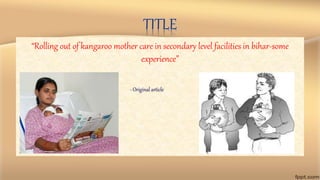
“Rolling out of kangaroo mother care in secondary level facilities in bihar-some
experience”
- Original article
authors
1. Sutapa B.Neogi….,Additional Professor(IIPH,Delhi)
2. Monica Chauhan…,Project Associate(IIPH,Delhi)
3. Jyothi Sharma…….,Associate Professor(IIPH,Delhi)
4. Preethi Negandhi…., Associate Professor(IIPH,Delhi)
5. Ghanshyam Sethy….,Health Specialist(UNICEF,Bihar)
abstract
 BACKGROUND :
KMC as powerful and easy-to-use method to promote health & well being
and reduce mortality in preterm/lowbirth weight babies.
 OBJECTIVE :
• To improve awareness among ANM/Nurses working in 20 level facilities.
• To Assess the Responsiveness of Public Health system to roll out KMC in
secondary level facilities.
 METHODS :
Intervention Implementation & assessment.
 RESULT :
The intervention clearly seemed to improve the awareness among
ANM/nurses but still there is scope for lot of improvement.
Terminologies explained
 PRETERM – Baby born before 37 weeks of gestation in India.
 LBW – Birth Weight less than 2500 grams in India.
 KANGAROO MOTHER CARE :
It is defined as skin-to-skin contact between a mother and her
newborn with exclusive breast milkand early discharge from hospital.
 KMC Corner – A dedicated space in Postnatal ward of Hopital for mother
to ensure privacy, reclining chair and cloth to wrap baby in KMC position.
introduction
 Preterm birth is one of the leading causes of under-five child deaths
worldwide and in India.
 30% of neonates-7.5 million are born with LBW in India.
 About 40% of LBW infants are born Preterm.
KMC as a Strategy :
 Recent evidence indicate that,KMC is closely associated with significant
reduction in overall under five mortality in global areas.
 There is also reduction in mean duration of hospital stay by 2.4 days.
 Globally- health cares emphasizing the significance of continuation of KMC at
home also after discharge ,increses the benefits of KMC manifold.
Why this study is essential?
 In India :
• Despite skin-to-skin contact traditionally being a part of child survival
intervention packages,focused attention was a critical gap.
• It’s implementation has not been satisfactory compared to
globally.KMC guidelines and policies are also not strong enough to
impact significant changes.
• There is felt need to create scientific evidence to address the feasibility
of adaptation and scale-up of this KMC model.
methodology
KANGAROO MOTHER CARE INTERVENTION MODEL
• Intervention implemented : At Districts of GAYA and purnea in Bihar.
• Criteria taken : Initial assessment of all Health Facilities having delivery
load of more than 200 was conducted.
• Study method : INTERVENTION IMPLEMENTATION & ASSESSMENT
• STUDY DURATION : 8 Months(August 2015 – march 2016)
• Financial support : UNICEF,BIHAR
METHODOLOGY
3 PHASES OF INTERVENTION:
1. SITUATION ANALYSIS :
• Target facilities assessed for infrastructure and logistics
• Care providers(ANM/Nurses) assessed for awareness,knowledge,skills and practice
of KMC using a pretested simple check list.
2. Implementation of intervention :
• Based on initial assessment 2 sub-divisional hospital,3 referral hospital and 1 chc
were identified for setting up KMC Corners under INAP in 2 districts of Bihar.
3. Interim assessment:
• Data collected from health care facilities by talking to the staff as well as through
observation to assess the improvement of awareness about KMC in identical facilities
in both Districts.
result
After Intervention, a definite improvement in the
awareness among ANM/nurses about KMC.
Care providers were adept to providing KMC in the same
facilities instead of referring every LBW baby to New Born
Critical Care as was happening previously.
Clearly seemed to impact the availability of infrastructure
required for KMC, as provision was made for separate
rooms/beds/curtains for providing KMC in selected facility.
conclusion
There is commitment at
National level to promote
KMC in every facility.
Our Experiences have
shown that it is possible to
roll-out KMC in secondary
level facilities.
Review of literature
1. “KMC to prevent neonatal deaths due to preterm birth
complkication”-Lawn(metanalysis 1988-2009)
2. “Knowledge and attitude of nursing staff and mothers
towards KMC” –Solomon(cross sectional study2003-10)
3. “Community based KMC for LBW-pilot study”-ICMR
4. “KMC: A simple method to care for LBW in developing
countries”-Akthar(intervention study2004-2007)
5. “Implementation of facility based KMC:Lesson from
multi-country study”-Bergh.AM
Critical analysis
Strength of this article :
Thought Provoking.
It Emphasizes the significance of implementing KMC in 20 facilities.
It also tries to find probable solution to issues such as
financing,manpower,information and service delivery,though not
precisely.
Critical analysis
Weakness of this article :
Limited duration of intervention was a relatively short time
TO ASSESS THE IMPACT OF ANY INTERVENTION.
The number of facilities where the model could be implemented
was small.
No clear cut sample size and lag of records and reports creates
holes in this study.
Not have much impact to attract policy makers of public health
system-which is the main goal of this article.
How it can be improved
 Financial crisis :
• Should have calculated the expenses of Implementing the model
beforehand.
• Should have tried to raise funds from NGO’s and Foreign collaboration
apart from current financial support.
 Sample determination:
• Sample size and technique should be clear cutly mentioned
beforehand and should strictly followed throughout study.
 Reports & records :
• questionairre should be effective.Collection of reports & records should
be thoroughly Monitored- For achieving high success rate.
JOURNAL CLUB ACTIVITY

JOURNAL CLUB ACTIVITY

  • 1.
  • 2.
    “Rolling out ofkangaroo mother care in secondary level facilities in bihar-some experience” - Original article
  • 3.
    authors 1. Sutapa B.Neogi….,AdditionalProfessor(IIPH,Delhi) 2. Monica Chauhan…,Project Associate(IIPH,Delhi) 3. Jyothi Sharma…….,Associate Professor(IIPH,Delhi) 4. Preethi Negandhi…., Associate Professor(IIPH,Delhi) 5. Ghanshyam Sethy….,Health Specialist(UNICEF,Bihar)
  • 4.
    abstract  BACKGROUND : KMCas powerful and easy-to-use method to promote health & well being and reduce mortality in preterm/lowbirth weight babies.  OBJECTIVE : • To improve awareness among ANM/Nurses working in 20 level facilities. • To Assess the Responsiveness of Public Health system to roll out KMC in secondary level facilities.  METHODS : Intervention Implementation & assessment.  RESULT : The intervention clearly seemed to improve the awareness among ANM/nurses but still there is scope for lot of improvement.
  • 5.
    Terminologies explained  PRETERM– Baby born before 37 weeks of gestation in India.  LBW – Birth Weight less than 2500 grams in India.  KANGAROO MOTHER CARE : It is defined as skin-to-skin contact between a mother and her newborn with exclusive breast milkand early discharge from hospital.  KMC Corner – A dedicated space in Postnatal ward of Hopital for mother to ensure privacy, reclining chair and cloth to wrap baby in KMC position.
  • 6.
    introduction  Preterm birthis one of the leading causes of under-five child deaths worldwide and in India.  30% of neonates-7.5 million are born with LBW in India.  About 40% of LBW infants are born Preterm. KMC as a Strategy :  Recent evidence indicate that,KMC is closely associated with significant reduction in overall under five mortality in global areas.  There is also reduction in mean duration of hospital stay by 2.4 days.  Globally- health cares emphasizing the significance of continuation of KMC at home also after discharge ,increses the benefits of KMC manifold.
  • 7.
    Why this studyis essential?  In India : • Despite skin-to-skin contact traditionally being a part of child survival intervention packages,focused attention was a critical gap. • It’s implementation has not been satisfactory compared to globally.KMC guidelines and policies are also not strong enough to impact significant changes. • There is felt need to create scientific evidence to address the feasibility of adaptation and scale-up of this KMC model.
  • 8.
    methodology KANGAROO MOTHER CAREINTERVENTION MODEL • Intervention implemented : At Districts of GAYA and purnea in Bihar. • Criteria taken : Initial assessment of all Health Facilities having delivery load of more than 200 was conducted. • Study method : INTERVENTION IMPLEMENTATION & ASSESSMENT • STUDY DURATION : 8 Months(August 2015 – march 2016) • Financial support : UNICEF,BIHAR
  • 9.
    METHODOLOGY 3 PHASES OFINTERVENTION: 1. SITUATION ANALYSIS : • Target facilities assessed for infrastructure and logistics • Care providers(ANM/Nurses) assessed for awareness,knowledge,skills and practice of KMC using a pretested simple check list. 2. Implementation of intervention : • Based on initial assessment 2 sub-divisional hospital,3 referral hospital and 1 chc were identified for setting up KMC Corners under INAP in 2 districts of Bihar. 3. Interim assessment: • Data collected from health care facilities by talking to the staff as well as through observation to assess the improvement of awareness about KMC in identical facilities in both Districts.
  • 10.
    result After Intervention, adefinite improvement in the awareness among ANM/nurses about KMC. Care providers were adept to providing KMC in the same facilities instead of referring every LBW baby to New Born Critical Care as was happening previously. Clearly seemed to impact the availability of infrastructure required for KMC, as provision was made for separate rooms/beds/curtains for providing KMC in selected facility.
  • 11.
    conclusion There is commitmentat National level to promote KMC in every facility. Our Experiences have shown that it is possible to roll-out KMC in secondary level facilities.
  • 12.
    Review of literature 1.“KMC to prevent neonatal deaths due to preterm birth complkication”-Lawn(metanalysis 1988-2009) 2. “Knowledge and attitude of nursing staff and mothers towards KMC” –Solomon(cross sectional study2003-10) 3. “Community based KMC for LBW-pilot study”-ICMR 4. “KMC: A simple method to care for LBW in developing countries”-Akthar(intervention study2004-2007) 5. “Implementation of facility based KMC:Lesson from multi-country study”-Bergh.AM
  • 13.
    Critical analysis Strength ofthis article : Thought Provoking. It Emphasizes the significance of implementing KMC in 20 facilities. It also tries to find probable solution to issues such as financing,manpower,information and service delivery,though not precisely.
  • 14.
    Critical analysis Weakness ofthis article : Limited duration of intervention was a relatively short time TO ASSESS THE IMPACT OF ANY INTERVENTION. The number of facilities where the model could be implemented was small. No clear cut sample size and lag of records and reports creates holes in this study. Not have much impact to attract policy makers of public health system-which is the main goal of this article.
  • 15.
    How it canbe improved  Financial crisis : • Should have calculated the expenses of Implementing the model beforehand. • Should have tried to raise funds from NGO’s and Foreign collaboration apart from current financial support.  Sample determination: • Sample size and technique should be clear cutly mentioned beforehand and should strictly followed throughout study.  Reports & records : • questionairre should be effective.Collection of reports & records should be thoroughly Monitored- For achieving high success rate.