Page 1/18
Active Learning: EFL teachers’ Role in ELT
Classrooms of Ebantu District Secondary Schools
Misgana Duresa (  misganaduresa2008@gmail.com )
Madda Walabu Univefrsity
Research Article
Keywords: active learning strategies, EFL teachers’ role, insignificant relationship, apply
Posted Date: December 22nd, 2023
DOI: https://doi.org/10.21203/rs.3.rs-3757678/v1
License:   This work is licensed under a Creative Commons Attribution 4.0 International License.
Read Full License
Page 2/18
Abstract
The study intended to investigate EFL teachers’ role in implementing active learning in ELT classrooms.
The study used descriptive survey design with mixed method. Participants of the study were 15 EFL
teachers and 5 students of Ebantu District high schools who were selected comprehensively and
randomly respectively. The data obtained through questionnaire was entered into SPSS version-25
whereas students were interviewed individually. Mean and standard deviation were computed for the data
collected through questionnaire and described in words whereas coding, categorizing and describing was
used for interview. Besides, p-value was calculated using bivariate analysis. The result of the study
revealed that active learning strategies were not used effectively in which teachers showed their role
moderately. There was also insignificant relationship between teachers’ use of active learning strategies
and the role they played. Therefore, teachers should understand the concept and varied types of active
learning strategies to apply them effectively.
1. Introduction
In contemporary world, where technology and globalization are rapidly growing, active learning plays a
great role in the development of students’ participation and independence in ELT classes (Petersen &
Gorman, 2014). It also increases students’ multidirectional skills like content knowledge, critical thinking
and remembering of course content and self-confidence as well as motivation for both teachers and
students (Diochon and Cameron, 2001 and Cherney, 2008).
Active learning is essential for students to participate more in the classroom and acquire long lasting
knowledge from their lessons, but its application is not well understood by both students and teachers. In
other words, there is a misunderstanding among teachers regarding their roles in fostering students’
engagement in learning because both teachers and students perceive that teachers are the only source of
what is done whereas students are passive in the class (Hattie, 2009).This is related with the fact that
active learning strategies are not implemented in the ELT classrooms. This is also related with the guiding
role of teachers though students should also play their role. This means, teachers do not fully play their
role in implementing active learning. On the other hand, this is associated with the cognition of teachers
about ‘active learning” and ‘strategies ‘of addressing this active learning.
To make students get new information, they need to be provided with existing knowledge in order to
understand the material to be learnt. This can be successfully done if active learning approach is
designed for students. The idea is contrasted with a passive approach to learning in which the teacher
primarily talks to students and simply assumes they will make sense of what is said without needing to
check. Active learning requires students to think hard and to practice using new knowledge and skills in
order to develop long-term recall and a deeper understanding (Nuthall, 2007). This deeper understanding
also enables learners to connect different ideas together and to think creatively. Active learning becomes
meaningful and effective when it is used with by active learning strategies.
Page 3/18
Although the use of active learning in line with using active learning strategies plays enumerable
advantages in developing students’ active participation, teachers didn’t fulfill what is expected of them.
The fact is true for Ebantu District secondary schools because, from the researcher’s observation, active
learning was not implemented in ELT classrooms effectively.
Conversely, study conducted by Yusuk (2020) regarding perceptions and practices of EFL school teachers
on implementing active learning in Thai English language classrooms stressed that teachers agree that
using active learning strategies have a positive effect on teaching English and developing students'
performance. Implementing active learning has advantage in enhancing learners’ performance specially
in English. Momani, et al. (2016) also supported by studying on the impact of implementing active
learning strategies in teaching English from the perspective of Tabuk educational region intermediate
school teachers and found that 90% of the teachers agree that using active learning strategies have a
positive effect on teaching English and developing students' performance.
However, the study conducted by Teshome (2017) on classroom participation and development of
student attitudes: a study of active learning practices in Ethiopian primary education showed that the
extent to which students actively participate in classroom instruction is dominated by watching and
listening to the teacher. Mebratu & Woldemariam (2018) also conducted study on perceptions and
practices of EFL teachers in implementing active learning in English classes: the case of three selected
secondary schools in Dawro zone, Ethiopia and his finding indicated that teachers’ practices of active
learning were poor. Therefore, the study aimed to fill the gap by investigating EFL teachers’ Role in ELT
classrooms in implementing active learning focusing on the following objectives which aimed to:
Identify active learning strategies used in ELT classrooms.
Find out the role of EFL teacher in implementing active learning.
Quantify whether there is significant relationship between teachers’ role and using active learning
strategies.
2. Literature Review
2.1. Theoretical Foundation of Active Learning
Scholars tried to put their view on the history and trend of active learning. The cognitive constructivism
advocates that knowledge is built by considering things in our memory (Drew, 2020). Active learning is
based on a theory of learning called constructivism which emphasizes the fact that learners construct or
build their own understanding. The theory of social constructivism says that learning happens primarily
through social interaction with others, such as a teacher or a learners’ peers. Social constructivism also
believes that we actively construct knowledge in our minds, but recognizes the important role of social
interaction in this process (Drew, 2020). According to revised Bloom’s Taxonomy, active learning
approaches helps students develop at every stage of Bloom’s Taxonomy. It also enables learners to
engage with the more complex cognitive processes such as to evaluate and create, and build a
Page 4/18
knowledge. In this way, students need to actively involved in, and aware of their own learning to develop
metacognitive knowledge.
2.2. Active Learning
Active learning is an approach to instruction in which all students are asked to engage in the learning
process, which involves problem solving, paired discussions, longer activities or pedagogical frameworks
like case studies, role plays, and structured team-based learning. Active learning is student-centered
approach in which the responsibility for learning is placed upon the student, often working in
collaboration with classmates (Arthur & Zelda, 1987 & Drew, 2020). Therefore, learning is effective if
students fully engage in activity provided for them to construct their meaning. This process is also should
be facilitated by the subject teacher.
2.3. Benefit of Active Learning
Using active learning/strategies have different importance or benefits, especially regarding the students’
progress in learning. Active learning enhances students’ participation. As Adler (1982) stated, using active
learning can make learning active contrary to the fact that students become passive. In other words using
active learning or strategies in teaching learning process is the process in which students discover the
main agent. This means discovering is not the teacher, but the student. Learning is not a spectator sport.
Students do not learn much just by sitting in class listening to teachers, memorizing pre-packaged
assignments, and spitting out answers. They must talk about what they are learning, write about it, relate
it to past experiences, and apply it to their daily lives. They must make what they learn part of themselves
(Chickering & Gamson, 1987).
In language classroom, teachers are encouraged, and expected, to select teaching strategies and learning
activities that support multiple language domains (Echevarria, et al., 2004). These language domains
include listening, reading, speaking and writing. When students use active learning students’ skills in
relation to these skills becomes developed. The following are also the common identified benefits of
active learning (Homework, 2021, Whenham, 2021, Echevarria, et al., 2004, Chickering & Gamson, 1987).
2.3.1. Active Learning Develops Collaborative Skills
Collaboration is a pillar of most active learning approaches (Whenham, 2021). In increasingly team-
oriented workplaces, students whose only experience is with essay writing and exams will find themselves
at a disadvantage. By working together in breakout groups, students develop the abilities they’ll need to
collaborate in the workforce.
2.3.2. Active Learning Encourages Risk Taking
Homework (2021) puts that students may initially resist the move to active learning; after all, it’s easy to
sit in class and take notes until the talking is done. Active learning pulls students out of their comfort
zone by creating an environment where risk taking is encouraged. As they get more comfortable sharing
Page 5/18
their thoughts, defending their conclusions and building on each other’s ideas, they will gain confidence
and self-possession.
2.3.3. Active Learning Enhances Student Preparation
Throughout college days, there were likely courses that didn’t require much day-to-day effort beyond
simply showing up to class (Echevarria, et al., 2004). Students could be tired or disengaged, and the prof
likely didn’t notice; especially if you hid in the back rows of the lecture hall. And now with many classes
partially or fully online, it’s even easier to tune out. But in an active learning classroom, no one’s invisible.
It’s immediately apparent when students haven’t taken the time to prepare, so there’s greater motivation to
show up, in mind and body.
2.3.4. Active Learning Increases Engagement
Homework (2021) states that students who are actively learning are able to actively engage in classroom
activities. Whether solving a problem, debating an issue or researching a concept, they are processing
ideas and forging deeper understanding. If teachers are looking for new ideas to get your students
thinking, try these quick active learning activities.
2.3.5. Active Learning Improves Critical Thinking
As Echevarria, et al., (2004) & Homework (2021) put, in a world where fake news has become part of our
daily discourse, the ability to identify a legitimate source or spot a faulty argument is only becoming more
important. Active learning shifts the focus of learning from passively (and possibly unquestioningly)
digesting information to being accountable for actively engaging with sources and perspectives. In
addition, when students share ideas, they learn to build stronger arguments, challenge presumptions and
recognize leaps of logic.
2.3.4. Active Learning Makes Technology More Powerful
Contrary to lecture halls, which often have displays that students don’t get to use and audio systems that
only pick up a presenter’s voice, many active learning classrooms are filled with tools and systems that
put students at the center (Whenham, 2021). It is possible to get more details on technology and other
essential items you can add to your active learning space with this active learning space checklist.
2.3.5. Active Learning Sparks Creative Thinking
Chickering and Gamson (1987) & Whenham (2021) asserted that creativity is one of the key skills needed
for the workplace of the future and one of the hardest to teach using traditional methods. Active learning
helps students understand that creativity; it develops with effort and hard work. With lots of practice
flexing their creative muscles, students also see how both individual reflection and collaborative exchange
can lead to better ideas and more novel solutions to problems.
2.3.6. Active Learning Fosters Real Problem Solving
Page 6/18
Having the ability to solve complex problems was the most important skill needed for future jobs
(Whenham, 2021). In language classrooms, especially students can solve problem happened among
students. For example, if students are given responsibility to use spoken English in the classroom to be
independent and deliver their own thought, the problem of communication barriers can be solved.
2.4. Challenges or Barriers that Prevent Using Active
Learning Strategies
Centre for Teaching Support and Innovation (2011) identified some commonly mentioned obstacles to
use active learning instructional strategies.
2.4.1. Large Class Sizes Prevent Implementation of Active
Learning Strategies
Large class size may restrict the use of certain active learning instructional strategies (e.g. it is difficult to
involve all students in class discussion in groups) but certainly not all. For example, dividing large classes
into small groups can allow for productive in-class discussion activities (Heppner, 2007 & Stanley &
Porter, 2002).
2.4.2. Most Instructors Think of Themselves as Being Good
Lecturers
Though many view lecturing as a useful means of transmitting information, attending a lecture does not
necessarily give rise to student learning (Heppner, 2007). Evidence of this can be seen clearly in the
disparity between what an instructor thinks he or she has taught effectively and the actually proportion of
course content his or her students successfully demonstrate they have understood and remember on their
examination papers.
2.4.3. Lack of Materials or Equipment Needed to Support
Active Learning Approaches
Lack of materials or equipment needed to support active learning can be a barrier to the use of some
active learning strategies but certainly not all (Heppner, 2007 & Hotchkiss, 2002). For example, asking
students to summarize in writing the material they have read or to form pairs to evaluate statements or
assertions does not require any equipment. And while classroom use of personal response devices or
clickers has become the current instructional rage (and for many good reasons based upon the findings
of numerous studies), low cost alternatives described later in this handout are also available to interested
faculty.
2.4.4. Students Resist Non-Lecture Approaches
Students resist non-lecturing approaches because active learning alternatives provide a sharp contrast to
the very familiar passive listening role to which they have become accustomed. With explicit instruction in
Page 7/18
how to actively participate and learn in less-traditional modes, students soon come to favor new
approaches (Doyle, 2008).
2.5. Active Learning Strategies
As identified by Paulson (2005), Irvine et al. (2006), Barkley et al., 2005, Mahamod & Somasundram
(2017) & Whenham (2021) active learning strategies are categorized in different types. Though there are
many strategies, some of these are identified for present study.
2.5.1. Give One Get One
According to Irvine et al (2006), this activity is designed to help students’ access of prior knowledge. It
promotes connection between students and allows the teacher to get some feedback about prior learning.
This means, strategy helps students to share their experience collaboratively.
2.5.2. Note-Taking Pairs
Students work in pair to improve their note-taking, writing and organization skills (Barkley et al.,
2005).Often, there are gaps in students’ notes and with this collaborative learning technique, students are
given time to check, compare and correct their notes with their partner. In this way, while some students
generate their ideas, the others may jot down important ideas in order to organize and bring the ideas to
general or common sense.
2.5.3. Saying Something
This activity provides students with an opportunity to engage with a text and then respond to it in a low
risk situation. It can be used as a tool to build further activities on (Short, et al., 1996 & Centre for
Teaching Support and Innovation, 2011). Students read a text up to a set point and pause and say
something about what they have read to their partner. They may, for example: summarize the section;
identify a key point; make a connection to their own work; share their thinking about a new idea or raise a
question about a concept or strategy presented.
2.5.4. Think-Pair-Share
Think-Pair-Share (TPS) is a cooperative structure in which partners privately think about a question, then
discuss their responses with one another. As a relatively simple structure that can be implemented quickly,
Think-Pair-Share can be incorporated into almost any form of instruction. It is particularly useful for
actively involving all students during lectures. After a question is posed to the group by the instructor,
students think independently about the question, forming ideas of their own and are grouped into pairs to
discuss their thoughts. Pairs are grouped into larger groups for discussion and larger groups share their
ideas with the entire class.
2.5.5. Problem Solving
Page 8/18
Structured problem solving provides students with a process for solving a complex, content-based
problem within a specified time limit (Barkley et al., 2005).All members must agree to a solution and must
be able to explain both the answer and the strategy used to solve the problem. It helps students identify
the logic approach behind the problem and identify where their logic fails by providing them with the
steps to working out the solution to the problem. Teacher leads a whole-class discussion about student
insights into a contextually rich dilemma that requires application of content previously learned by other
means.
2.5.6. Brainstorming
It is possible to introduce a topic or problem and then ask for student input by giving students a minute to
write down their ideas, and then record them on the board (Barkley et al., 2005). For example, the before
starting the day’s lesson, it is possible to tell the topic of the lesson and make stduents generate what
they know about the topic from their prior understanding. This on the other hand increase students’ ability
to think critically.
2.5.7. Case Studies
We can use real-life stories that describe what happened to a community, family, school, or individual to
prompt students to integrate their classroom knowledge with their knowledge of real-world situations,
actions, and consequences.
2.5.8. Clarification Pauses
This is a simple technique aimed at fostering “active listening” (Barkley et al., 2005). Throughout a
lecture, particularly after stating defining a key concept, stop, let and ask students to clarify. It is also
extremely effective approach to increase student engagements’ as well as fostering critical/creative
thinking. This involves the frequent use of classroom questions including questions posed by the
instructor to students and questions posed by students to either their classmates or their instructor.
Instructor-posed questions can help arouse student interest and curiosity, sharpen students’ thinking
skills, and demonstrate the application of theory to practice, assess students’ knowledge, skills, or
attitudes, and prepare students for licensure examinations.
2.5.9. Cooperative Groups in Class
This includes posing a question on which each cooperative group will work while teacher circulates
around the room answering questions, asking further questions, keeping the groups on task, and so forth
(Paulson, 2005). After an appropriate time for group discussion, ask students to share their discussion
points with the rest of the class. To do so instructor assigns students to heterogeneous groups of 3-6
followed by choosing a leader and a scribe (note‐taker) and they are given a task to work together.
Following, they produce a group answer share their answers with the rest of the class.
2.5.10. Games/Simulations/Active Review Sessions
Page 9/18
The instructor poses questions and the students work on them in groups. Then students are asked to
show their solutions to the whole group and discuss any differences among solutions proposed.
2.5.11. Peer/group Review
Using this strategy student may evaluate group presentations or documents to assess the quality of the
content and delivery of information. Large class is divided into small groups of 3-5 students. Each group
selects specific topic from a list of topics generated by the teacher and groups subdivide assignments
among members. Students exchange drafts with another group for peer group evaluation; and teacher
evaluates draft.
2.5.12. Hands-on Technology
Students use technology such as simulation programs to get a deeper understanding of course concepts.
For instance, they could use their cellphone to many things which is connected with language ability like
drills/dialogues.
2.5.13. Interactive Lecture
Teacher breaks up the lecture at least once per class to have all of the students participate in activity that
lets them work directly with the material. Students could observe and interpret features of images,
interpret graphs, make calculation and estimates.
2.5.14. Self-Assessment
According to McKeachie (2005) & Paulson (2005), students receive a quiz or a checklist of ideas to
determine their understanding of the subject. Concept inventories or similar tools may be used at the
beginning of the chapter for students to help students identify their misconceptions and evaluate
themselves.
2.5.15. Fish Bowl
According to McKeachie (2005), students are given index cards, and asked to write down one question
concerning the course material. At the end of the period, students deposit their questions in a fish bowl.
The instructor then draws several questions out of the bowl and answers them for the class or asks the
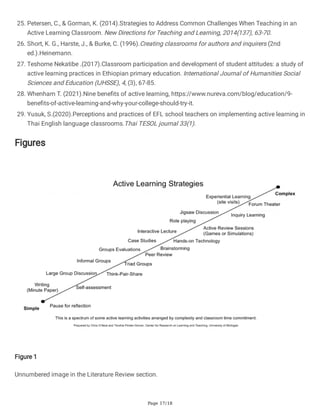
class to answer them. Generally, active learning strategies can shortly be seen in the following diagram.
2.6. The Role of Teacher in Implementing Active Learning
Active and participatory classroom has implications for the role of the teacher. There is a shift from a
teacher-centered model to a learner-centered approach to learning and teaching. The shift from product-
driven learning to process-driven is also useful for enhancing active learning. These changes encourage
teachers to reflect not only on the key principles of learning and teaching but also on their role in the
process. Teacher should change from teacher-centered classroom to learner-centered classroom, product-
centered learning to process-centered learning, teacher as a ‘transmitter of knowledge’ to teacher as an
Page 10/18
organizer of knowledge, teacher as a ‘doer’ for children to teachers as an ‘enabler’, facilitating pupils in
their learning and subject-specific focus to holistic learning focus.
3. Method
3.1. Research Design
In order to address the intended research objective, the descriptive survey research design with mixed-
method method was employed because using quantitative and qualitative method the reliability of data is
increased. Creswell (2012) put that a mixed-method approach seems more convenient than using one of
the two methods. Therefore, the use of both qualitative and quantitative techniques helps the researcher
to draw valid conclusions.
3.2. Participants
Participants of the study were students and English teachers of Ebantu District high schools. These
subjects were selected to participate in giving information because they are nearer to the information and
can give sufficient information
3.3. Sample Size and Sampling Techniques
3.3.1. Sample Size
For the study 3 schools namely, Birbirsa Waja, Gatama Bese and Hinde high schools were selected
purposively whereas 15 teachers were selected comprehensively to fill questionnaire whereas and five
students were taken randomly for interview.
3.3.2. Sampling Techniques
To select schools, purposive sampling technique was used whereas teachers were selected
comprehensively (Gay et al., 2012). Teachers were taken comprehensively whereas students were
registered and given a code. After that they were selected using lottery system. For interview, students
were selected randomly.
3.4. Instruments
3.4.1. Questionnaire
Based on the review of related literature and research objectives the questions was designed and
administrated to 5 teachers and some modifications were made. This is to ensure the validity and
reliability of the questionnaire. For 1st and 2nd research questions the Likert scale “Strongly Disagree (1),
Disagree (2), Undecided (3), Agree (4) and Strongly Agree (5)” was used (Mokhtari & Sheory, 2002)
whereas there was no need of preparing specific questions for research question 3 because the
Page 11/18
relationship between using strategies and teachers role in implementing active learning were seen based
on question 1 and 2.
3.4.2. Interview
Interview is a data collection tool which is used to gather specific information and elicit more reliable
information from the interviewees. Therefore, semi-structured interview was used to gather qualitative
data. Peer-review was used to keep the validity and reliability of this tools. The advantage of using
interview is that respondents can give their opinion freely (Pallant, 2011). Respondents were appointed on
the occasion they could be available after regular class and conducted individually. This tool was used to
support the data obtained through questionnaire.
3.5. Procedures
The data was collected through the following procedures. Firstly, respondents were appointed and were
administered questions. After that, the question papers were collected and were computed using SPSS
version 25. For interview, respondents were asked and note was handled.
3.6. Data Analysis
Descriptive statistics like mean and standard deviation for research question 1 and 2 and P-vale for
research question 3 was computed using SPSS version 25. The use of the strategies was evaluated by
mean value: 1.00-2.40 = low, 2.50–3.40 = medium, 3.50-5.00 = high whereas significance p-value was
observed at P < .05. The correlation coefficient index is between + 1 and − 1 whereas “r”-values greater
than 0.50 = strong correlation “r”-values, around 0.30 = moderate correlation, and “r”-values around 0.20 =
weak correlation (Pallant, 2011).After that the result obtained through questionnaire was analyzed
quantitatively in words. In addition, the result obtained from interview was transcribed, coded, categorized
and described in words to support data obtained through students’ questionnaire. Finally, conclusions
and recommendations was made.
4. Results and Discussions
4.1. Strategies used in ELT Classrooms
Page 12/18
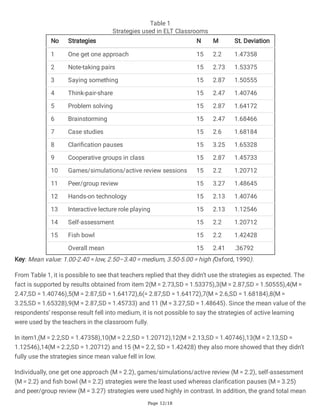
Table 1
Strategies used in ELT Classrooms
No Strategies N M St. Deviation
1 One get one approach 15 2.2 1.47358
2 Note-taking pairs 15 2.73 1.53375
3 Saying something 15 2.87 1.50555
4 Think-pair-share 15 2.47 1.40746
5 Problem solving 15 2.87 1.64172
6 Brainstorming 15 2.47 1.68466
7 Case studies 15 2.6 1.68184
8 Clarification pauses 15 3.25 1.65328
9 Cooperative groups in class 15 2.87 1.45733
10 Games/simulations/active review sessions 15 2.2 1.20712
11 Peer/group review 15 3.27 1.48645
12 Hands-on technology 15 2.13 1.40746
13 Interactive lecture role playing 15 2.13 1.12546
14 Self-assessment 15 2.2 1.20712
15 Fish bowl 15 2.2 1.42428
Overall mean 15 2.41 .36792
Key: Mean value: 1.00-2.40 = low, 2.50–3.40 = medium, 3.50-5.00 = high (Oxford, 1990).
From Table 1, it is possible to see that teachers replied that they didn’t use the strategies as expected. The
fact is supported by results obtained from item 2(M = 2.73,SD = 1.53375),3(M = 2.87,SD = 1.50555),4(M =
2.47,SD = 1.40746),5(M = 2.87,SD = 1.64172),6(= 2.87,SD = 1.64172),7(M = 2.6,SD = 1.68184),8(M =
3.25,SD = 1.65328),9(M = 2.87,SD = 1.45733) and 11 (M = 3.27,SD = 1.48645). Since the mean value of the
respondents’ response result fell into medium, it is not possible to say the strategies of active learning
were used by the teachers in the classroom fully.
In item1,(M = 2.2,SD = 1.47358),10(M = 2.2,SD = 1.20712),12(M = 2.13,SD = 1.40746),13(M = 2.13,SD =
1.12546),14(M = 2.2,SD = 1.20712) and 15 (M = 2.2, SD = 1.42428) they also more showed that they didn’t
fully use the strategies since mean value fell in low.
Individually, one get one approach (M = 2.2), games/simulations/active review (M = 2.2), self-assessment
(M = 2.2) and fish bowl (M = 2.2) strategies were the least used whereas clarification pauses (M = 3.25)
and peer/group review (M = 3.27) strategies were used highly in contrast. In addition, the grand total mean
Page 13/18
value (M = 2.41, SD = .36792) fell in medium which support that the strategies were not used as needed.
This indicates that the use of teaching strategies among teachers was exactly moderate which we can
say the application and benefits of the strategies is left out. From interview item 1, it is possible to add
that except S1 and S2 none of the teachers could clarify what active learning strategies mean. These
teachers themselves round the bush rather than giving exact concept. This means students were not
familiar to these strategies when they learn English. In the response obtained from the interview item 2,
only S1 and S5 gave approximate answers though these answers couldn’t be what was expected of them.
4.2. Role of teachers in Implementing Active Learning
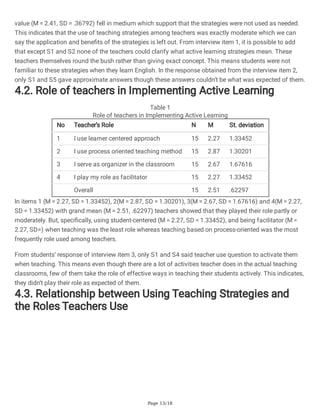
Table 1
Role of teachers in Implementing Active Learning
No Teacher’s Role N M St. deviation
1 I use learner centered approach 15 2.27 1.33452
2 I use process oriented teaching method 15 2.87 1.30201
3 I serve as organizer in the classroom 15 2.67 1.67616
4 I play my role as facilitator 15 2.27 1.33452
Overall 15 2.51 .62297
In items 1 (M = 2.27, SD = 1.33452), 2(M = 2.87, SD = 1.30201), 3(M = 2.67, SD = 1.67616) and 4(M = 2.27,
SD = 1.33452) with grand mean (M = 2.51, .62297) teachers showed that they played their role partly or
moderately. But, specifically, using student-centered (M = 2.27, SD = 1.33452), and being facilitator (M =
2.27, SD=) when teaching was the least role whereas teaching based on process-oriented was the most
frequently role used among teachers.
From students’ response of interview item 3, only S1 and S4 said teacher use question to activate them
when teaching. This means even though there are a lot of activities teacher does in the actual teaching
classrooms, few of them take the role of effective ways in teaching their students actively. This indicates,
they didn’t play their role as expected of them.
4.3. Relationship between Using Teaching Strategies and
the Roles Teachers Use
Page 14/18
Table 3
Relationship between using teaching strategies and the roles teachers use
Correlations
Overall mean (strategies) Overall mean ( role)
Overall mean (strategies) Pearson Correlation 1 .313
Sig. (2-tailed) .256
N 15 15
Overall mean (role) Pearson Correlation .313 1
Sig. (2-tailed) .256
N 15 15
* Correlation is significant at the 0.05 level (2-tailed).
Key: “r”-values greater than .50 = strong correlation, “r”-values around .30 = moderate correlation, “r”-values
around .20 = weak correlation.
From the table, it is possible to see that there is moderate and insignificant correlation between using
active learning strategies and teachers’ role (r = -0.313, n = 15, p (.256) > 0 .05. This means, there is
moderate relationship between using active learning strategies and this relationship is not significant or
true since the values of p > .05
5. Conclusion
To conclude, active learning strategies like one get one approach, games, self-assessment and fish bowl
were the least used strategies whereas clarification and peer/group review were the highest strategies
used among teachers though strategies were used moderately. Besides, teachers showed that they didn’t
play their role in providing student-centered instruction and being facilitator; however, played their role
focusing on process-oriented and being organizer in the classroom moderately. Generally, teachers played
their role moderately and this indicates that they didn’t do what was expected of them. Furthermore, there
was moderate relationship between strategy use and teachers’ role followed by insignificant relationship;
and there could be other factors’ to be found. Thus, to improve the process of active learning in high
schools, teachers should be aware of the different types of active learning strategies followed by effective
implementation. Teachers should also identify their roles and do what they have to do in the ELT
classrooms.
Abbreviations
EFL English as Foreign Language
ELT English Language Teaching
Page 15/18
TPS Think-Pair-Share
SPSS Statistical Package for Social Science
Declarations
Ethical approval and Consent to Participate
All procedures performed in the study were in accordance with the ethical standards of the institutional
research committee. Informed consent was obtained from all the individual participants included in this
study.
Competing interests
The authors declare no competing interests.
Acknowledgments
The author would like to thank teachers who participated in this study.
Consent for Publication
The participants were informed that the study would be published in a journal and the findings would be
shared with them.
Funding
This research did not receive any specific grant from funding agencies.
Availability of data
Data are available from the corresponding author on reasonable request.
References
1. Adler, M.J. (1982).The Paideia proposal: An education manifesto. NY: Macmillan.
2. Arthur W. Chickering & Zelda F. Gamson.(1987). Seven Principles for Good Practice. AAHE Bulletin 39:
3-7, March 1987.
3. Barkley, E., Cross, P.K., & Major, C.H. (2005).Collaborative learning techniques: A handbook for college
faculty. Jossey-Bass.
4. Centre for Teaching Support & Innovation. (2023).Active learning,https://tatp.utoronto.ca/teaching-
toolkit/supporting-students/active-learning-adapting-teaching-techniques/.
5. Cherney, I. (2008).The effects of active learning on students’ memories for course content. Active
Learning in Higher Education, 9(2), 152-171.
Page 16/18
6. Chickering, A.W. & Gamson, Z.F. (1987).Seven principles for good practice.AAHE Bulletin, 39(7), 3-7.
7. Creswell, J. W. (2012).Educational research (4th ed.).New York: Education.
8. Diochon, M.(2001).Technology-based interactive learning: Designing an international student
research project. Active Learning in Higher Education, 2(2), 114-127.
9. Doyle, T. (2008).Helping students learn in a learner-centered environment: A guide to facilitating
learning in higher education. Stylus Publishing, Sterling.
10. Drew, V., & Mackie, L. (2011).Extending the constructs of active learning: implications for teachers’
pedagogy and practice. Curriculum Journal, 22(4), 451-467.
11. Gay, L.R., Mills, G.E. & Airasian, P. (2012). Educational Research: Competencies for Analysis and
Application (10th Ed,). Pearson Education.
12. Heppner, F. (2007).Teaching the large college class: A guidebook for instructors with multitudes.
Jossey-Bass, San Francisco.
13. Homework (2021).Seven Benefits of Active Learning in the Classroom,
https://homework.sg/blog/benefits-of-active-learning-in-the-
classroom/#:~:text=Here%20are%20the%20benefits%20of,they%20prepare%20ahead%20of%20time.
14. Hattie, J. (20009).Visible Learning: A Synthesis of Over 800 Meta-Analyses Relating to Achievement.
Routledge.
15. Irvine, Judith, Douglas R. Buehl and Barbara J. Radcliffe. (2006).Strategies to Enhance Literacy and
Learning in Middle School Content Area Classrooms. Allyn and Bacon.
16. Mahamod, Z. & Somasundram,B.(2017).Effectiveness of Cooperative Learning on the Achievement
and Motivation of the Student in Learning Malay Language. Creative Education, 2017, 8, 2438-2454.
17. Mebratu Mulatu, Woldemariam Bezabih (2018).Perceptions and practices of EFL teachers in
implementing active learning in English classes: the case of three selected secondary schools in
Dawro Zone, SNNPRS, and Ethiopia. International Journal of Education, 10 (2), 88-94.
18. McKeachie, W.J. (2005).How to make lectures more effective. In Teaching tips: Strategies, research,
and theory for college and university teachers (11th ed.) (pp. 52-68).Houghton Mifflin Co.
19. Mokhtari, K., & Sheorey, R. (2002).Measuring ESL students’ awareness of reading Strategies. Journal
of Developmental Education, 25(3), 2-10.
20. Momani, M., Ahmad,M. & Alatawi, M. (2016).The impact of implementing active learning strategies in
teaching English from the perspective of Tabuk educational region intermediate school teachers.
Asian Journal of Educational Research, 4 (1), 2016.
21. Nuthall, G. (2007).The Hidden Lives of Learners’ Wellington. New Zealand: NZCER Press.
22. Oxford, R. L. (1990).Language learning strategies: What every teacher should know. Newbury House.
23. Pallant, J. (2011).SPSS survival manual: A step by step guide to data analysis using SPSS (4th ed.).
Ever best Co.
24. Paulson, D.R., & Faust, J.L. (n.d.)(2005).Active learning for the college classroom.
http://www.calstatela.edu/dept/chem/chem2/Active/.
Page 17/18
25. Petersen, C., & Gorman, K. (2014).Strategies to Address Common Challenges When Teaching in an
Active Learning Classroom. New Directions for Teaching and Learning, 2014(137), 63-70.
26. Short, K. G., Harste, J., & Burke, C. (1996).Creating classrooms for authors and inquirers (2nd
ed.).Heinemann.
27. Teshome Nekatibe .(2017).Classroom participation and development of student attitudes: a study of
active learning practices in Ethiopian primary education. International Journal of Humanities Social
Sciences and Education (IJHSSE), 4, (3), 67-85.
28. Whenham T. (2021).Nine benefits of active learning, https://www.nureva.com/blog/education/9-
benefits-of-active-learning-and-why-your-college-should-try-it.
29. Yusuk, S.(2020).Perceptions and practices of EFL school teachers on implementing active learning in
Thai English language classrooms.Thai TESOL journal 33(1).
Figures
Figure 1
Unnumbered image in the Literature Review section.
Page 18/18
Supplementary Files
This is a list of supplementary files associated with this preprint. Click to download.
Appendix.docx

Journal article published on teaching English language

  • 1.
    Page 1/18 Active Learning:EFL teachers’ Role in ELT Classrooms of Ebantu District Secondary Schools Misgana Duresa (  misganaduresa2008@gmail.com ) Madda Walabu Univefrsity Research Article Keywords: active learning strategies, EFL teachers’ role, insignificant relationship, apply Posted Date: December 22nd, 2023 DOI: https://doi.org/10.21203/rs.3.rs-3757678/v1 License:   This work is licensed under a Creative Commons Attribution 4.0 International License. Read Full License
  • 2.
    Page 2/18 Abstract The studyintended to investigate EFL teachers’ role in implementing active learning in ELT classrooms. The study used descriptive survey design with mixed method. Participants of the study were 15 EFL teachers and 5 students of Ebantu District high schools who were selected comprehensively and randomly respectively. The data obtained through questionnaire was entered into SPSS version-25 whereas students were interviewed individually. Mean and standard deviation were computed for the data collected through questionnaire and described in words whereas coding, categorizing and describing was used for interview. Besides, p-value was calculated using bivariate analysis. The result of the study revealed that active learning strategies were not used effectively in which teachers showed their role moderately. There was also insignificant relationship between teachers’ use of active learning strategies and the role they played. Therefore, teachers should understand the concept and varied types of active learning strategies to apply them effectively. 1. Introduction In contemporary world, where technology and globalization are rapidly growing, active learning plays a great role in the development of students’ participation and independence in ELT classes (Petersen & Gorman, 2014). It also increases students’ multidirectional skills like content knowledge, critical thinking and remembering of course content and self-confidence as well as motivation for both teachers and students (Diochon and Cameron, 2001 and Cherney, 2008). Active learning is essential for students to participate more in the classroom and acquire long lasting knowledge from their lessons, but its application is not well understood by both students and teachers. In other words, there is a misunderstanding among teachers regarding their roles in fostering students’ engagement in learning because both teachers and students perceive that teachers are the only source of what is done whereas students are passive in the class (Hattie, 2009).This is related with the fact that active learning strategies are not implemented in the ELT classrooms. This is also related with the guiding role of teachers though students should also play their role. This means, teachers do not fully play their role in implementing active learning. On the other hand, this is associated with the cognition of teachers about ‘active learning” and ‘strategies ‘of addressing this active learning. To make students get new information, they need to be provided with existing knowledge in order to understand the material to be learnt. This can be successfully done if active learning approach is designed for students. The idea is contrasted with a passive approach to learning in which the teacher primarily talks to students and simply assumes they will make sense of what is said without needing to check. Active learning requires students to think hard and to practice using new knowledge and skills in order to develop long-term recall and a deeper understanding (Nuthall, 2007). This deeper understanding also enables learners to connect different ideas together and to think creatively. Active learning becomes meaningful and effective when it is used with by active learning strategies.
  • 3.
    Page 3/18 Although theuse of active learning in line with using active learning strategies plays enumerable advantages in developing students’ active participation, teachers didn’t fulfill what is expected of them. The fact is true for Ebantu District secondary schools because, from the researcher’s observation, active learning was not implemented in ELT classrooms effectively. Conversely, study conducted by Yusuk (2020) regarding perceptions and practices of EFL school teachers on implementing active learning in Thai English language classrooms stressed that teachers agree that using active learning strategies have a positive effect on teaching English and developing students' performance. Implementing active learning has advantage in enhancing learners’ performance specially in English. Momani, et al. (2016) also supported by studying on the impact of implementing active learning strategies in teaching English from the perspective of Tabuk educational region intermediate school teachers and found that 90% of the teachers agree that using active learning strategies have a positive effect on teaching English and developing students' performance. However, the study conducted by Teshome (2017) on classroom participation and development of student attitudes: a study of active learning practices in Ethiopian primary education showed that the extent to which students actively participate in classroom instruction is dominated by watching and listening to the teacher. Mebratu & Woldemariam (2018) also conducted study on perceptions and practices of EFL teachers in implementing active learning in English classes: the case of three selected secondary schools in Dawro zone, Ethiopia and his finding indicated that teachers’ practices of active learning were poor. Therefore, the study aimed to fill the gap by investigating EFL teachers’ Role in ELT classrooms in implementing active learning focusing on the following objectives which aimed to: Identify active learning strategies used in ELT classrooms. Find out the role of EFL teacher in implementing active learning. Quantify whether there is significant relationship between teachers’ role and using active learning strategies. 2. Literature Review 2.1. Theoretical Foundation of Active Learning Scholars tried to put their view on the history and trend of active learning. The cognitive constructivism advocates that knowledge is built by considering things in our memory (Drew, 2020). Active learning is based on a theory of learning called constructivism which emphasizes the fact that learners construct or build their own understanding. The theory of social constructivism says that learning happens primarily through social interaction with others, such as a teacher or a learners’ peers. Social constructivism also believes that we actively construct knowledge in our minds, but recognizes the important role of social interaction in this process (Drew, 2020). According to revised Bloom’s Taxonomy, active learning approaches helps students develop at every stage of Bloom’s Taxonomy. It also enables learners to engage with the more complex cognitive processes such as to evaluate and create, and build a
  • 4.
    Page 4/18 knowledge. Inthis way, students need to actively involved in, and aware of their own learning to develop metacognitive knowledge. 2.2. Active Learning Active learning is an approach to instruction in which all students are asked to engage in the learning process, which involves problem solving, paired discussions, longer activities or pedagogical frameworks like case studies, role plays, and structured team-based learning. Active learning is student-centered approach in which the responsibility for learning is placed upon the student, often working in collaboration with classmates (Arthur & Zelda, 1987 & Drew, 2020). Therefore, learning is effective if students fully engage in activity provided for them to construct their meaning. This process is also should be facilitated by the subject teacher. 2.3. Benefit of Active Learning Using active learning/strategies have different importance or benefits, especially regarding the students’ progress in learning. Active learning enhances students’ participation. As Adler (1982) stated, using active learning can make learning active contrary to the fact that students become passive. In other words using active learning or strategies in teaching learning process is the process in which students discover the main agent. This means discovering is not the teacher, but the student. Learning is not a spectator sport. Students do not learn much just by sitting in class listening to teachers, memorizing pre-packaged assignments, and spitting out answers. They must talk about what they are learning, write about it, relate it to past experiences, and apply it to their daily lives. They must make what they learn part of themselves (Chickering & Gamson, 1987). In language classroom, teachers are encouraged, and expected, to select teaching strategies and learning activities that support multiple language domains (Echevarria, et al., 2004). These language domains include listening, reading, speaking and writing. When students use active learning students’ skills in relation to these skills becomes developed. The following are also the common identified benefits of active learning (Homework, 2021, Whenham, 2021, Echevarria, et al., 2004, Chickering & Gamson, 1987). 2.3.1. Active Learning Develops Collaborative Skills Collaboration is a pillar of most active learning approaches (Whenham, 2021). In increasingly team- oriented workplaces, students whose only experience is with essay writing and exams will find themselves at a disadvantage. By working together in breakout groups, students develop the abilities they’ll need to collaborate in the workforce. 2.3.2. Active Learning Encourages Risk Taking Homework (2021) puts that students may initially resist the move to active learning; after all, it’s easy to sit in class and take notes until the talking is done. Active learning pulls students out of their comfort zone by creating an environment where risk taking is encouraged. As they get more comfortable sharing
  • 5.
    Page 5/18 their thoughts,defending their conclusions and building on each other’s ideas, they will gain confidence and self-possession. 2.3.3. Active Learning Enhances Student Preparation Throughout college days, there were likely courses that didn’t require much day-to-day effort beyond simply showing up to class (Echevarria, et al., 2004). Students could be tired or disengaged, and the prof likely didn’t notice; especially if you hid in the back rows of the lecture hall. And now with many classes partially or fully online, it’s even easier to tune out. But in an active learning classroom, no one’s invisible. It’s immediately apparent when students haven’t taken the time to prepare, so there’s greater motivation to show up, in mind and body. 2.3.4. Active Learning Increases Engagement Homework (2021) states that students who are actively learning are able to actively engage in classroom activities. Whether solving a problem, debating an issue or researching a concept, they are processing ideas and forging deeper understanding. If teachers are looking for new ideas to get your students thinking, try these quick active learning activities. 2.3.5. Active Learning Improves Critical Thinking As Echevarria, et al., (2004) & Homework (2021) put, in a world where fake news has become part of our daily discourse, the ability to identify a legitimate source or spot a faulty argument is only becoming more important. Active learning shifts the focus of learning from passively (and possibly unquestioningly) digesting information to being accountable for actively engaging with sources and perspectives. In addition, when students share ideas, they learn to build stronger arguments, challenge presumptions and recognize leaps of logic. 2.3.4. Active Learning Makes Technology More Powerful Contrary to lecture halls, which often have displays that students don’t get to use and audio systems that only pick up a presenter’s voice, many active learning classrooms are filled with tools and systems that put students at the center (Whenham, 2021). It is possible to get more details on technology and other essential items you can add to your active learning space with this active learning space checklist. 2.3.5. Active Learning Sparks Creative Thinking Chickering and Gamson (1987) & Whenham (2021) asserted that creativity is one of the key skills needed for the workplace of the future and one of the hardest to teach using traditional methods. Active learning helps students understand that creativity; it develops with effort and hard work. With lots of practice flexing their creative muscles, students also see how both individual reflection and collaborative exchange can lead to better ideas and more novel solutions to problems. 2.3.6. Active Learning Fosters Real Problem Solving
  • 6.
    Page 6/18 Having theability to solve complex problems was the most important skill needed for future jobs (Whenham, 2021). In language classrooms, especially students can solve problem happened among students. For example, if students are given responsibility to use spoken English in the classroom to be independent and deliver their own thought, the problem of communication barriers can be solved. 2.4. Challenges or Barriers that Prevent Using Active Learning Strategies Centre for Teaching Support and Innovation (2011) identified some commonly mentioned obstacles to use active learning instructional strategies. 2.4.1. Large Class Sizes Prevent Implementation of Active Learning Strategies Large class size may restrict the use of certain active learning instructional strategies (e.g. it is difficult to involve all students in class discussion in groups) but certainly not all. For example, dividing large classes into small groups can allow for productive in-class discussion activities (Heppner, 2007 & Stanley & Porter, 2002). 2.4.2. Most Instructors Think of Themselves as Being Good Lecturers Though many view lecturing as a useful means of transmitting information, attending a lecture does not necessarily give rise to student learning (Heppner, 2007). Evidence of this can be seen clearly in the disparity between what an instructor thinks he or she has taught effectively and the actually proportion of course content his or her students successfully demonstrate they have understood and remember on their examination papers. 2.4.3. Lack of Materials or Equipment Needed to Support Active Learning Approaches Lack of materials or equipment needed to support active learning can be a barrier to the use of some active learning strategies but certainly not all (Heppner, 2007 & Hotchkiss, 2002). For example, asking students to summarize in writing the material they have read or to form pairs to evaluate statements or assertions does not require any equipment. And while classroom use of personal response devices or clickers has become the current instructional rage (and for many good reasons based upon the findings of numerous studies), low cost alternatives described later in this handout are also available to interested faculty. 2.4.4. Students Resist Non-Lecture Approaches Students resist non-lecturing approaches because active learning alternatives provide a sharp contrast to the very familiar passive listening role to which they have become accustomed. With explicit instruction in
  • 7.
    Page 7/18 how toactively participate and learn in less-traditional modes, students soon come to favor new approaches (Doyle, 2008). 2.5. Active Learning Strategies As identified by Paulson (2005), Irvine et al. (2006), Barkley et al., 2005, Mahamod & Somasundram (2017) & Whenham (2021) active learning strategies are categorized in different types. Though there are many strategies, some of these are identified for present study. 2.5.1. Give One Get One According to Irvine et al (2006), this activity is designed to help students’ access of prior knowledge. It promotes connection between students and allows the teacher to get some feedback about prior learning. This means, strategy helps students to share their experience collaboratively. 2.5.2. Note-Taking Pairs Students work in pair to improve their note-taking, writing and organization skills (Barkley et al., 2005).Often, there are gaps in students’ notes and with this collaborative learning technique, students are given time to check, compare and correct their notes with their partner. In this way, while some students generate their ideas, the others may jot down important ideas in order to organize and bring the ideas to general or common sense. 2.5.3. Saying Something This activity provides students with an opportunity to engage with a text and then respond to it in a low risk situation. It can be used as a tool to build further activities on (Short, et al., 1996 & Centre for Teaching Support and Innovation, 2011). Students read a text up to a set point and pause and say something about what they have read to their partner. They may, for example: summarize the section; identify a key point; make a connection to their own work; share their thinking about a new idea or raise a question about a concept or strategy presented. 2.5.4. Think-Pair-Share Think-Pair-Share (TPS) is a cooperative structure in which partners privately think about a question, then discuss their responses with one another. As a relatively simple structure that can be implemented quickly, Think-Pair-Share can be incorporated into almost any form of instruction. It is particularly useful for actively involving all students during lectures. After a question is posed to the group by the instructor, students think independently about the question, forming ideas of their own and are grouped into pairs to discuss their thoughts. Pairs are grouped into larger groups for discussion and larger groups share their ideas with the entire class. 2.5.5. Problem Solving
  • 8.
    Page 8/18 Structured problemsolving provides students with a process for solving a complex, content-based problem within a specified time limit (Barkley et al., 2005).All members must agree to a solution and must be able to explain both the answer and the strategy used to solve the problem. It helps students identify the logic approach behind the problem and identify where their logic fails by providing them with the steps to working out the solution to the problem. Teacher leads a whole-class discussion about student insights into a contextually rich dilemma that requires application of content previously learned by other means. 2.5.6. Brainstorming It is possible to introduce a topic or problem and then ask for student input by giving students a minute to write down their ideas, and then record them on the board (Barkley et al., 2005). For example, the before starting the day’s lesson, it is possible to tell the topic of the lesson and make stduents generate what they know about the topic from their prior understanding. This on the other hand increase students’ ability to think critically. 2.5.7. Case Studies We can use real-life stories that describe what happened to a community, family, school, or individual to prompt students to integrate their classroom knowledge with their knowledge of real-world situations, actions, and consequences. 2.5.8. Clarification Pauses This is a simple technique aimed at fostering “active listening” (Barkley et al., 2005). Throughout a lecture, particularly after stating defining a key concept, stop, let and ask students to clarify. It is also extremely effective approach to increase student engagements’ as well as fostering critical/creative thinking. This involves the frequent use of classroom questions including questions posed by the instructor to students and questions posed by students to either their classmates or their instructor. Instructor-posed questions can help arouse student interest and curiosity, sharpen students’ thinking skills, and demonstrate the application of theory to practice, assess students’ knowledge, skills, or attitudes, and prepare students for licensure examinations. 2.5.9. Cooperative Groups in Class This includes posing a question on which each cooperative group will work while teacher circulates around the room answering questions, asking further questions, keeping the groups on task, and so forth (Paulson, 2005). After an appropriate time for group discussion, ask students to share their discussion points with the rest of the class. To do so instructor assigns students to heterogeneous groups of 3-6 followed by choosing a leader and a scribe (note‐taker) and they are given a task to work together. Following, they produce a group answer share their answers with the rest of the class. 2.5.10. Games/Simulations/Active Review Sessions
  • 9.
    Page 9/18 The instructorposes questions and the students work on them in groups. Then students are asked to show their solutions to the whole group and discuss any differences among solutions proposed. 2.5.11. Peer/group Review Using this strategy student may evaluate group presentations or documents to assess the quality of the content and delivery of information. Large class is divided into small groups of 3-5 students. Each group selects specific topic from a list of topics generated by the teacher and groups subdivide assignments among members. Students exchange drafts with another group for peer group evaluation; and teacher evaluates draft. 2.5.12. Hands-on Technology Students use technology such as simulation programs to get a deeper understanding of course concepts. For instance, they could use their cellphone to many things which is connected with language ability like drills/dialogues. 2.5.13. Interactive Lecture Teacher breaks up the lecture at least once per class to have all of the students participate in activity that lets them work directly with the material. Students could observe and interpret features of images, interpret graphs, make calculation and estimates. 2.5.14. Self-Assessment According to McKeachie (2005) & Paulson (2005), students receive a quiz or a checklist of ideas to determine their understanding of the subject. Concept inventories or similar tools may be used at the beginning of the chapter for students to help students identify their misconceptions and evaluate themselves. 2.5.15. Fish Bowl According to McKeachie (2005), students are given index cards, and asked to write down one question concerning the course material. At the end of the period, students deposit their questions in a fish bowl. The instructor then draws several questions out of the bowl and answers them for the class or asks the class to answer them. Generally, active learning strategies can shortly be seen in the following diagram. 2.6. The Role of Teacher in Implementing Active Learning Active and participatory classroom has implications for the role of the teacher. There is a shift from a teacher-centered model to a learner-centered approach to learning and teaching. The shift from product- driven learning to process-driven is also useful for enhancing active learning. These changes encourage teachers to reflect not only on the key principles of learning and teaching but also on their role in the process. Teacher should change from teacher-centered classroom to learner-centered classroom, product- centered learning to process-centered learning, teacher as a ‘transmitter of knowledge’ to teacher as an
  • 10.
    Page 10/18 organizer ofknowledge, teacher as a ‘doer’ for children to teachers as an ‘enabler’, facilitating pupils in their learning and subject-specific focus to holistic learning focus. 3. Method 3.1. Research Design In order to address the intended research objective, the descriptive survey research design with mixed- method method was employed because using quantitative and qualitative method the reliability of data is increased. Creswell (2012) put that a mixed-method approach seems more convenient than using one of the two methods. Therefore, the use of both qualitative and quantitative techniques helps the researcher to draw valid conclusions. 3.2. Participants Participants of the study were students and English teachers of Ebantu District high schools. These subjects were selected to participate in giving information because they are nearer to the information and can give sufficient information 3.3. Sample Size and Sampling Techniques 3.3.1. Sample Size For the study 3 schools namely, Birbirsa Waja, Gatama Bese and Hinde high schools were selected purposively whereas 15 teachers were selected comprehensively to fill questionnaire whereas and five students were taken randomly for interview. 3.3.2. Sampling Techniques To select schools, purposive sampling technique was used whereas teachers were selected comprehensively (Gay et al., 2012). Teachers were taken comprehensively whereas students were registered and given a code. After that they were selected using lottery system. For interview, students were selected randomly. 3.4. Instruments 3.4.1. Questionnaire Based on the review of related literature and research objectives the questions was designed and administrated to 5 teachers and some modifications were made. This is to ensure the validity and reliability of the questionnaire. For 1st and 2nd research questions the Likert scale “Strongly Disagree (1), Disagree (2), Undecided (3), Agree (4) and Strongly Agree (5)” was used (Mokhtari & Sheory, 2002) whereas there was no need of preparing specific questions for research question 3 because the
  • 11.
    Page 11/18 relationship betweenusing strategies and teachers role in implementing active learning were seen based on question 1 and 2. 3.4.2. Interview Interview is a data collection tool which is used to gather specific information and elicit more reliable information from the interviewees. Therefore, semi-structured interview was used to gather qualitative data. Peer-review was used to keep the validity and reliability of this tools. The advantage of using interview is that respondents can give their opinion freely (Pallant, 2011). Respondents were appointed on the occasion they could be available after regular class and conducted individually. This tool was used to support the data obtained through questionnaire. 3.5. Procedures The data was collected through the following procedures. Firstly, respondents were appointed and were administered questions. After that, the question papers were collected and were computed using SPSS version 25. For interview, respondents were asked and note was handled. 3.6. Data Analysis Descriptive statistics like mean and standard deviation for research question 1 and 2 and P-vale for research question 3 was computed using SPSS version 25. The use of the strategies was evaluated by mean value: 1.00-2.40 = low, 2.50–3.40 = medium, 3.50-5.00 = high whereas significance p-value was observed at P < .05. The correlation coefficient index is between + 1 and − 1 whereas “r”-values greater than 0.50 = strong correlation “r”-values, around 0.30 = moderate correlation, and “r”-values around 0.20 = weak correlation (Pallant, 2011).After that the result obtained through questionnaire was analyzed quantitatively in words. In addition, the result obtained from interview was transcribed, coded, categorized and described in words to support data obtained through students’ questionnaire. Finally, conclusions and recommendations was made. 4. Results and Discussions 4.1. Strategies used in ELT Classrooms
  • 12.
    Page 12/18 Table 1 Strategiesused in ELT Classrooms No Strategies N M St. Deviation 1 One get one approach 15 2.2 1.47358 2 Note-taking pairs 15 2.73 1.53375 3 Saying something 15 2.87 1.50555 4 Think-pair-share 15 2.47 1.40746 5 Problem solving 15 2.87 1.64172 6 Brainstorming 15 2.47 1.68466 7 Case studies 15 2.6 1.68184 8 Clarification pauses 15 3.25 1.65328 9 Cooperative groups in class 15 2.87 1.45733 10 Games/simulations/active review sessions 15 2.2 1.20712 11 Peer/group review 15 3.27 1.48645 12 Hands-on technology 15 2.13 1.40746 13 Interactive lecture role playing 15 2.13 1.12546 14 Self-assessment 15 2.2 1.20712 15 Fish bowl 15 2.2 1.42428 Overall mean 15 2.41 .36792 Key: Mean value: 1.00-2.40 = low, 2.50–3.40 = medium, 3.50-5.00 = high (Oxford, 1990). From Table 1, it is possible to see that teachers replied that they didn’t use the strategies as expected. The fact is supported by results obtained from item 2(M = 2.73,SD = 1.53375),3(M = 2.87,SD = 1.50555),4(M = 2.47,SD = 1.40746),5(M = 2.87,SD = 1.64172),6(= 2.87,SD = 1.64172),7(M = 2.6,SD = 1.68184),8(M = 3.25,SD = 1.65328),9(M = 2.87,SD = 1.45733) and 11 (M = 3.27,SD = 1.48645). Since the mean value of the respondents’ response result fell into medium, it is not possible to say the strategies of active learning were used by the teachers in the classroom fully. In item1,(M = 2.2,SD = 1.47358),10(M = 2.2,SD = 1.20712),12(M = 2.13,SD = 1.40746),13(M = 2.13,SD = 1.12546),14(M = 2.2,SD = 1.20712) and 15 (M = 2.2, SD = 1.42428) they also more showed that they didn’t fully use the strategies since mean value fell in low. Individually, one get one approach (M = 2.2), games/simulations/active review (M = 2.2), self-assessment (M = 2.2) and fish bowl (M = 2.2) strategies were the least used whereas clarification pauses (M = 3.25) and peer/group review (M = 3.27) strategies were used highly in contrast. In addition, the grand total mean
  • 13.
    Page 13/18 value (M= 2.41, SD = .36792) fell in medium which support that the strategies were not used as needed. This indicates that the use of teaching strategies among teachers was exactly moderate which we can say the application and benefits of the strategies is left out. From interview item 1, it is possible to add that except S1 and S2 none of the teachers could clarify what active learning strategies mean. These teachers themselves round the bush rather than giving exact concept. This means students were not familiar to these strategies when they learn English. In the response obtained from the interview item 2, only S1 and S5 gave approximate answers though these answers couldn’t be what was expected of them. 4.2. Role of teachers in Implementing Active Learning Table 1 Role of teachers in Implementing Active Learning No Teacher’s Role N M St. deviation 1 I use learner centered approach 15 2.27 1.33452 2 I use process oriented teaching method 15 2.87 1.30201 3 I serve as organizer in the classroom 15 2.67 1.67616 4 I play my role as facilitator 15 2.27 1.33452 Overall 15 2.51 .62297 In items 1 (M = 2.27, SD = 1.33452), 2(M = 2.87, SD = 1.30201), 3(M = 2.67, SD = 1.67616) and 4(M = 2.27, SD = 1.33452) with grand mean (M = 2.51, .62297) teachers showed that they played their role partly or moderately. But, specifically, using student-centered (M = 2.27, SD = 1.33452), and being facilitator (M = 2.27, SD=) when teaching was the least role whereas teaching based on process-oriented was the most frequently role used among teachers. From students’ response of interview item 3, only S1 and S4 said teacher use question to activate them when teaching. This means even though there are a lot of activities teacher does in the actual teaching classrooms, few of them take the role of effective ways in teaching their students actively. This indicates, they didn’t play their role as expected of them. 4.3. Relationship between Using Teaching Strategies and the Roles Teachers Use
  • 14.
    Page 14/18 Table 3 Relationshipbetween using teaching strategies and the roles teachers use Correlations Overall mean (strategies) Overall mean ( role) Overall mean (strategies) Pearson Correlation 1 .313 Sig. (2-tailed) .256 N 15 15 Overall mean (role) Pearson Correlation .313 1 Sig. (2-tailed) .256 N 15 15 * Correlation is significant at the 0.05 level (2-tailed). Key: “r”-values greater than .50 = strong correlation, “r”-values around .30 = moderate correlation, “r”-values around .20 = weak correlation. From the table, it is possible to see that there is moderate and insignificant correlation between using active learning strategies and teachers’ role (r = -0.313, n = 15, p (.256) > 0 .05. This means, there is moderate relationship between using active learning strategies and this relationship is not significant or true since the values of p > .05 5. Conclusion To conclude, active learning strategies like one get one approach, games, self-assessment and fish bowl were the least used strategies whereas clarification and peer/group review were the highest strategies used among teachers though strategies were used moderately. Besides, teachers showed that they didn’t play their role in providing student-centered instruction and being facilitator; however, played their role focusing on process-oriented and being organizer in the classroom moderately. Generally, teachers played their role moderately and this indicates that they didn’t do what was expected of them. Furthermore, there was moderate relationship between strategy use and teachers’ role followed by insignificant relationship; and there could be other factors’ to be found. Thus, to improve the process of active learning in high schools, teachers should be aware of the different types of active learning strategies followed by effective implementation. Teachers should also identify their roles and do what they have to do in the ELT classrooms. Abbreviations EFL English as Foreign Language ELT English Language Teaching
  • 15.
    Page 15/18 TPS Think-Pair-Share SPSSStatistical Package for Social Science Declarations Ethical approval and Consent to Participate All procedures performed in the study were in accordance with the ethical standards of the institutional research committee. Informed consent was obtained from all the individual participants included in this study. Competing interests The authors declare no competing interests. Acknowledgments The author would like to thank teachers who participated in this study. Consent for Publication The participants were informed that the study would be published in a journal and the findings would be shared with them. Funding This research did not receive any specific grant from funding agencies. Availability of data Data are available from the corresponding author on reasonable request. References 1. Adler, M.J. (1982).The Paideia proposal: An education manifesto. NY: Macmillan. 2. Arthur W. Chickering & Zelda F. Gamson.(1987). Seven Principles for Good Practice. AAHE Bulletin 39: 3-7, March 1987. 3. Barkley, E., Cross, P.K., & Major, C.H. (2005).Collaborative learning techniques: A handbook for college faculty. Jossey-Bass. 4. Centre for Teaching Support & Innovation. (2023).Active learning,https://tatp.utoronto.ca/teaching- toolkit/supporting-students/active-learning-adapting-teaching-techniques/. 5. Cherney, I. (2008).The effects of active learning on students’ memories for course content. Active Learning in Higher Education, 9(2), 152-171.
  • 16.
    Page 16/18 6. Chickering,A.W. & Gamson, Z.F. (1987).Seven principles for good practice.AAHE Bulletin, 39(7), 3-7. 7. Creswell, J. W. (2012).Educational research (4th ed.).New York: Education. 8. Diochon, M.(2001).Technology-based interactive learning: Designing an international student research project. Active Learning in Higher Education, 2(2), 114-127. 9. Doyle, T. (2008).Helping students learn in a learner-centered environment: A guide to facilitating learning in higher education. Stylus Publishing, Sterling. 10. Drew, V., & Mackie, L. (2011).Extending the constructs of active learning: implications for teachers’ pedagogy and practice. Curriculum Journal, 22(4), 451-467. 11. Gay, L.R., Mills, G.E. & Airasian, P. (2012). Educational Research: Competencies for Analysis and Application (10th Ed,). Pearson Education. 12. Heppner, F. (2007).Teaching the large college class: A guidebook for instructors with multitudes. Jossey-Bass, San Francisco. 13. Homework (2021).Seven Benefits of Active Learning in the Classroom, https://homework.sg/blog/benefits-of-active-learning-in-the- classroom/#:~:text=Here%20are%20the%20benefits%20of,they%20prepare%20ahead%20of%20time. 14. Hattie, J. (20009).Visible Learning: A Synthesis of Over 800 Meta-Analyses Relating to Achievement. Routledge. 15. Irvine, Judith, Douglas R. Buehl and Barbara J. Radcliffe. (2006).Strategies to Enhance Literacy and Learning in Middle School Content Area Classrooms. Allyn and Bacon. 16. Mahamod, Z. & Somasundram,B.(2017).Effectiveness of Cooperative Learning on the Achievement and Motivation of the Student in Learning Malay Language. Creative Education, 2017, 8, 2438-2454. 17. Mebratu Mulatu, Woldemariam Bezabih (2018).Perceptions and practices of EFL teachers in implementing active learning in English classes: the case of three selected secondary schools in Dawro Zone, SNNPRS, and Ethiopia. International Journal of Education, 10 (2), 88-94. 18. McKeachie, W.J. (2005).How to make lectures more effective. In Teaching tips: Strategies, research, and theory for college and university teachers (11th ed.) (pp. 52-68).Houghton Mifflin Co. 19. Mokhtari, K., & Sheorey, R. (2002).Measuring ESL students’ awareness of reading Strategies. Journal of Developmental Education, 25(3), 2-10. 20. Momani, M., Ahmad,M. & Alatawi, M. (2016).The impact of implementing active learning strategies in teaching English from the perspective of Tabuk educational region intermediate school teachers. Asian Journal of Educational Research, 4 (1), 2016. 21. Nuthall, G. (2007).The Hidden Lives of Learners’ Wellington. New Zealand: NZCER Press. 22. Oxford, R. L. (1990).Language learning strategies: What every teacher should know. Newbury House. 23. Pallant, J. (2011).SPSS survival manual: A step by step guide to data analysis using SPSS (4th ed.). Ever best Co. 24. Paulson, D.R., & Faust, J.L. (n.d.)(2005).Active learning for the college classroom. http://www.calstatela.edu/dept/chem/chem2/Active/.
  • 17.
    Page 17/18 25. Petersen,C., & Gorman, K. (2014).Strategies to Address Common Challenges When Teaching in an Active Learning Classroom. New Directions for Teaching and Learning, 2014(137), 63-70. 26. Short, K. G., Harste, J., & Burke, C. (1996).Creating classrooms for authors and inquirers (2nd ed.).Heinemann. 27. Teshome Nekatibe .(2017).Classroom participation and development of student attitudes: a study of active learning practices in Ethiopian primary education. International Journal of Humanities Social Sciences and Education (IJHSSE), 4, (3), 67-85. 28. Whenham T. (2021).Nine benefits of active learning, https://www.nureva.com/blog/education/9- benefits-of-active-learning-and-why-your-college-should-try-it. 29. Yusuk, S.(2020).Perceptions and practices of EFL school teachers on implementing active learning in Thai English language classrooms.Thai TESOL journal 33(1). Figures Figure 1 Unnumbered image in the Literature Review section.
  • 18.
    Page 18/18 Supplementary Files Thisis a list of supplementary files associated with this preprint. Click to download. Appendix.docx