JOIN OPERATION
KANCHANA RANI G
• A SQL JOIN clause combines records from two or more tables in
a Database.
• Means for combining fields from 2 tables by using values
common to each.
• Mainly 4 types
* INNER
* OUTER
* LEFT
*RIGHT
JION
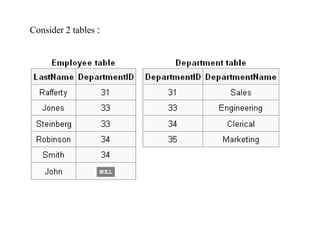
Consider 2 tables :
Inner Join
• Creates a new result table by combining column values of two
tables based upon the join-predicate.
• 2 ways to express join :
* Explicit Join Notation
* Implicit Join Notation
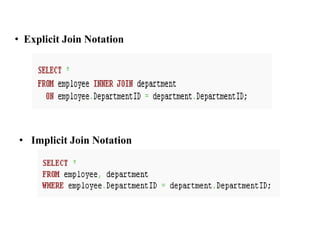
• Explicit Join Notation
• Implicit Join Notation
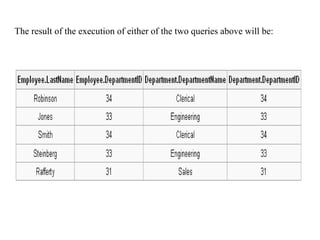
The result of the execution of either of the two queries above will be:
Natural Join
• The join predicate arises implicitly by comparing all columns
in both tables that have the same column-names in the joined
tables.
• The resulting joined table contains only one column for each
pair of equally named columns.
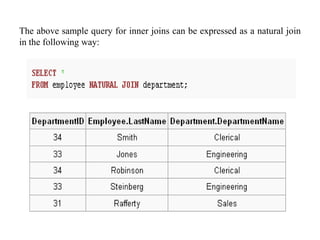
The above sample query for inner joins can be expressed as a natural join
in the following way:
Outer Join
• An outer join does not require each record in the two joined
tables to have a matching record.
• The joined table retains each record, even if no other matching
record exists.
• Outer joins subdivide further into left outer joins, right outer
joins, and full outer joins, depending on which table's rows
are retained.
Left outer joins
• The result of a left outer join (or simply left join) for table A
and B always contains all records of the "left" table (A), even
if the join-condition does not find any matching record in the
"right" table (B).
• This means that if the ON clause matches 0 (zero) records in B
(for a given record in A), the join will still return a row in the
result (for that record)—but with NULL in each column from
B.
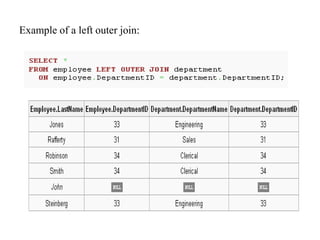
Example of a left outer join:
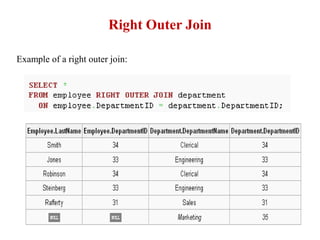
Example of a right outer join:
Right Outer Join
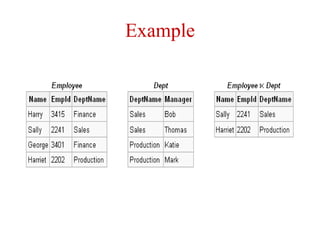
Semi Join [(⋉) or (⋊) ]
• The left semi join is joining similar to the natural join and
written as R ⋉ S where R and S are relations.
• The result of this semi join is the set of all tuples in R for
which there is a tuple in S that is equal on their common
attribute names.
Example
Theta-join
• If we want to combine tuples from two relations where the
combination condition is not simply the equality of shared
attributes then it is convenient to have a more general form of
join operator, which is the θ-join (or theta-join).
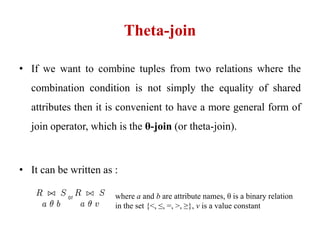
• It can be written as :
where a and b are attribute names, θ is a binary relation
in the set {<, ≤, =, >, ≥}, v is a value constant
Example
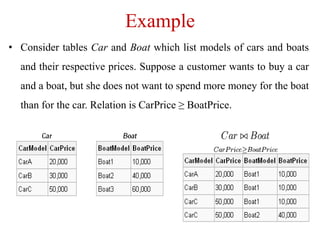
• Consider tables Car and Boat which list models of cars and boats
and their respective prices. Suppose a customer wants to buy a car
and a boat, but she does not want to spend more money for the boat
than for the car. Relation is CarPrice ≥ BoatPrice.
THANKS

Join

  • 1.
  • 2.
    • A SQLJOIN clause combines records from two or more tables in a Database. • Means for combining fields from 2 tables by using values common to each. • Mainly 4 types * INNER * OUTER * LEFT *RIGHT JION
  • 3.
  • 4.
    Inner Join • Createsa new result table by combining column values of two tables based upon the join-predicate. • 2 ways to express join : * Explicit Join Notation * Implicit Join Notation
  • 5.
    • Explicit JoinNotation • Implicit Join Notation
  • 6.
    The result ofthe execution of either of the two queries above will be:
  • 7.
    Natural Join • Thejoin predicate arises implicitly by comparing all columns in both tables that have the same column-names in the joined tables. • The resulting joined table contains only one column for each pair of equally named columns.
  • 8.
    The above samplequery for inner joins can be expressed as a natural join in the following way:
  • 9.
    Outer Join • Anouter join does not require each record in the two joined tables to have a matching record. • The joined table retains each record, even if no other matching record exists. • Outer joins subdivide further into left outer joins, right outer joins, and full outer joins, depending on which table's rows are retained.
  • 10.
    Left outer joins •The result of a left outer join (or simply left join) for table A and B always contains all records of the "left" table (A), even if the join-condition does not find any matching record in the "right" table (B). • This means that if the ON clause matches 0 (zero) records in B (for a given record in A), the join will still return a row in the result (for that record)—but with NULL in each column from B.
  • 11.
    Example of aleft outer join:
  • 12.
    Example of aright outer join: Right Outer Join
  • 13.
    Semi Join [(⋉)or (⋊) ] • The left semi join is joining similar to the natural join and written as R ⋉ S where R and S are relations. • The result of this semi join is the set of all tuples in R for which there is a tuple in S that is equal on their common attribute names.
  • 14.
  • 15.
    Theta-join • If wewant to combine tuples from two relations where the combination condition is not simply the equality of shared attributes then it is convenient to have a more general form of join operator, which is the θ-join (or theta-join). • It can be written as : where a and b are attribute names, θ is a binary relation in the set {<, ≤, =, >, ≥}, v is a value constant
  • 16.
    Example • Consider tablesCar and Boat which list models of cars and boats and their respective prices. Suppose a customer wants to buy a car and a boat, but she does not want to spend more money for the boat than for the car. Relation is CarPrice ≥ BoatPrice.
  • 17.