Tell me aboutyourself and your qualifications
• The employer asks this question
to better understand your skills
and accomplishments and why
you think you'd be a good fit.
Your answer should be concise
and direct. Include information
about your background, your
key achievements and why you
think you’re suited for the open
role.
Example answer: “I’ve been a bookkeeper for the
past three years where I track accounts payable and
receivable, as well as oversee payroll. I’ve been able
to find and resolve discrepancies between amounts
owed and received, which has ended up saving our
company thousands of dollars in underpaid bills. I
recently earned my CPA degree and think my
experience with bookkeeping and attention to detail
would make me a great fit for your open public
accountant role.”
3.
How would youdescribe yourself ?
When interviewers ask you to talk
about yourself, they’re looking for
information about how your
qualities and characteristics align
with the skills they believe is
required to succeed in the role. If
possible, include quantifiable
results to demonstrate how you
use your best attributes to drive
success.
Example: “I am a vigilant and proactive
Security Officer working to ensure safe,
secure and orderly environments. I’m also a
lifelong learner always seeking out the
latest security equipment and techniques to
patrol buildings. Lastly, I am thorough in
documenting all incidents and actively
making suggestions to management about
security improvements and changes.”
4.
Why do youwant to work at this company?
Interviewers ask this question to see if
you took the time to research the
company and consider how you
would fit within the company culture.
The best way to prepare for this
question is to do your homework and
learn about the products, services,
values, history and culture of the
prospective employer.
Example answer: “This company is always
ahead of tech trends and is constantly
looking for ways to improve their products,
and that sort of innovative thinking really
inspires me. I also appreciate how much
this company has given back to the
community, especially in efforts to produce
more eco-friendly products. I’m always
looking for ways to lower my own carbon
footprint.”
5.
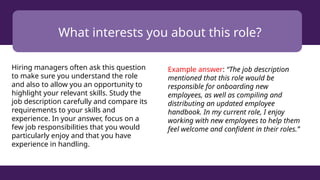
What interests youabout this role?
Hiring managers often ask this question
to make sure you understand the role
and also to allow you an opportunity to
highlight your relevant skills. Study the
job description carefully and compare its
requirements to your skills and
experience. In your answer, focus on a
few job responsibilities that you would
particularly enjoy and that you have
experience in handling.
Example answer: “The job description
mentioned that this role would be
responsible for onboarding new
employees, as well as compiling and
distributing an updated employee
handbook. In my current role, I enjoy
working with new employees to help them
feel welcome and confident in their roles.”
6.
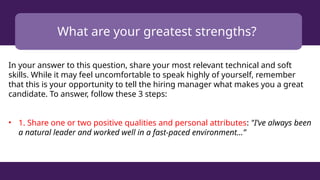
What are yourgreatest strengths?
In your answer to this question, share your most relevant technical and soft
skills. While it may feel uncomfortable to speak highly of yourself, remember
that this is your opportunity to tell the hiring manager what makes you a great
candidate. To answer, follow these 3 steps:
• 1. Share one or two positive qualities and personal attributes: "I’ve always been
a natural leader and worked well in a fast-paced environment...”
7.
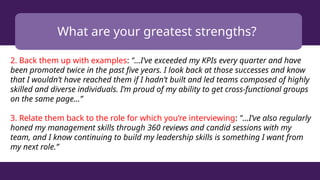
What are yourgreatest strengths?
2. Back them up with examples: "...I’ve exceeded my KPIs every quarter and have
been promoted twice in the past five years. I look back at those successes and know
that I wouldn’t have reached them if I hadn’t built and led teams composed of highly
skilled and diverse individuals. I’m proud of my ability to get cross-functional groups
on the same page...”
3. Relate them back to the role for which you’re interviewing: "...I’ve also regularly
honed my management skills through 360 reviews and candid sessions with my
team, and I know continuing to build my leadership skills is something I want from
my next role.”
8.
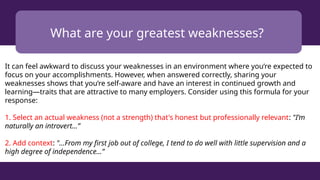
What are yourgreatest weaknesses?
It can feel awkward to discuss your weaknesses in an environment where you’re expected to
focus on your accomplishments. However, when answered correctly, sharing your
weaknesses shows that you’re self-aware and have an interest in continued growth and
learning—traits that are attractive to many employers. Consider using this formula for your
response:
1. Select an actual weakness (not a strength) that's honest but professionally relevant: "I’m
naturally an introvert...”
2. Add context: "...From my first job out of college, I tend to do well with little supervision and a
high degree of independence...”
9.
What are yourgreatest weaknesses?
3. Provide a specific example:" ...After being assigned to a team that needed to give monthly
progress updates, I knew I owed it to my teammates and myself to learn how to collaborate better
with others..”
4. Explain how you overcame or are working to overcome it: "...I took an online course on
improving communication skills and learned how to reach out to my teammates with more
confidence, and also how to brush up on presentation skills so that I felt more relaxed when it was
my turn to deliver a monthly presentation. I’m never going to be the most vocal person in a
meeting but I can definitely contribute to any conversation and be an effective team player.”
10.
What are yourgoals for the future?
Hiring managers often ask about your
future goals to determine whether you’re
likely to stay with the company long-
term. Additionally, this question is used
to gauge your ambition, expectations for
your career and ability to plan ahead. The
best way to handle this question is to
examine your current career trajectory
and how this role could help you reach
your long-term goals.
Example answer: “I’d like to continue
developing my marketing expertise over the
next several years. One of the reasons I’m
interested in working for a fast-growing
startup company is that I’ll have the ability to
wear many hats and collaborate with a variety
of departments. I believe this experience will
serve me well in achieving my ultimate goal of
someday leading a marketing department.”
11.
Where do yousee yourself in five years?
Understanding how you imagine your
life in the future can help employers
understand whether the trajectory of
the role and company fits in with your
personal development goals. To
answer, provide general ideas about
the skills you want to develop, the
types of roles you would like to be in
and the things you would like to have
accomplished.
Example: “In five years, I’d like to be an
industry expert in my field with the ability
to train and mentor students and entry-
level designers. I would also like to gain
specialised knowledge in user experience to
be a well-rounded contributor working with
design and marketing teams on large scale
projects that make a difference in the
company and to the global community.”
12.
Why are youleaving your current job?
There are many reasons for leaving a
job. Prepare a thoughtful answer that
will give your interviewer confidence
that you’re being deliberate about this
job change. Instead of focusing on the
negative aspects of your current or
previous role, focus on the future and
what you hope to gain in your next
position.
Example: “I’m looking for an opportunity that
gives me the ability to build closer, long-term
relationships with clients. In my current role,
the sales cycle is so short that I don’t spend as
much time building a rapport with my
customers as I’d like. Relationship-building is
one of the reasons I chose a career in sales
and I look forward to working with a company
in which that’s a top priority.”