JESUS WAS WARNINGABOUT DECEIVERS
EDITED BY GLENN PEASE
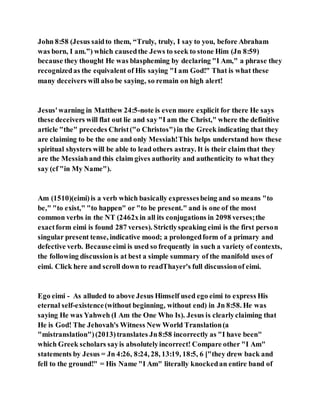
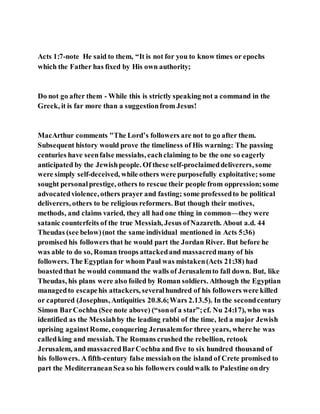
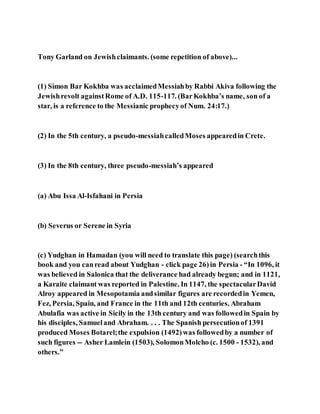
Luke 21:8-9 8He replied: "Watchout that you are not
deceived. For many will come in my name, claiming, 'I
am he,' and, 'The time is near.' Do not followthem.
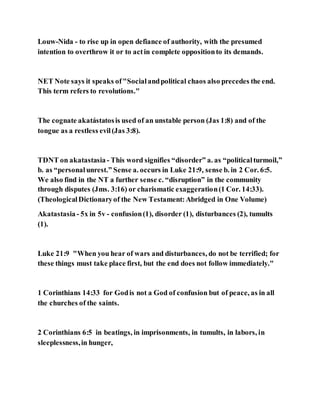
9Whenyou hear of wars and uprisings, do not be
frightened. These things must happen first, but the
end will not come right away."
BIBLEHUB RESOURCES
Biblical Illustrator
Master, but when shall these things be?
Luke 21:7-28
Judaism overthrown
D. C. Hughes, M. A.
I. THE MASTER'S WARNING CONCERNING FALSE CHRISTS.
1. Many will assume the daring role.
(1)Some saying, "I am Christ."
(2)Others saying, "The time draweth near."
2. There is danger of being deceived. "Take heed," etc.
II. THE MASTER'S INSTRUCTION IN RESPECTTO WHAT MUST
PRECEDEHIS COMING.
1. The great events which must precede.
(1)Politicalcommotion.
(2)Physicalchanges.
(3)Socialdistresses.
2. The persecutionthat must precede.
(1)Its severity.
(2)Its advantage.
(3)Support under it.
(4)Assurance and counselin view of it.
3. Jerusalem's destructionmust precede it.
(1)This destruction was then near.
(2)This destruction terrible.Lessons:
1. Christ's wonderful knowledge offuture events.
(1)He foreknew the destiny of all nations.
(2)The oppositionwith which Christianity would be met.
(3)The trials His disciples would have to endure.
(4)Christ knows no surprise.
2. Christ's wonderful ability to maintain His gospeland to sustain his
followers.
(1)No power canoverthrow it.
(2)His followers will triumph.
3. Jerusalem's destructionsymbolizes the dreadful doom of those who reject
Christ.
(D. C. Hughes, M. A.)
The end
American Sunday SchoolWorld.
When I was a Sunday-schoolscholar — after I had finished reading my
library books — I would look at the words on the last pages, "THE END,"
and underneath these words were pictures; some of them I remember. There
was a hand holding an inverted torch, and it seemedto say, "The flame is
dying out, this is the end." Another picture was a candlestick with a candle
burned almostout, and the last flickering light of the candle said, " The light
is going out, soonit will leave you in darkness."In another book a man was
seenas having left his house, the door was closedandhe was shut out in the
outer darkness. He was walking in a narrow path, and just before him there
was a pitfall, and in it were the words, "The end"; truly man steps out of this
life into the next. There was a picture I saw only once, but I can never forget
the impressionthat it left on my mind. It was a midnight scene, with the moon
and stars lighting up the darkness that hung over a graveyard, and on a
tombstone more prominent than the rest were these impressive words, "The
end." So there is an end to a book, an end to our days, our months, our lives,
and an end to everything on earth. There is an end of working, of learning,
and, whether neglectedor improved, there will be an end of all our teaching.
Sabbath-schoolscholars andteachers, "Work while it is day, for the night
cometh when no man can work."
(American Sunday SchoolWorld.)
Experience of an earthquake
From "Bible Echoes,"
The traveller Humboldt gives an interesting accountof the first earthquake he
witnessed. It was at Cumana, in South America. The first shock came after a
strange stillness. It causedan earthquake in his mind, for it overthrew in a
moment all his lifelong notions about the safety of the earth. He could no
longertrust the soil which up to that day had felt so firm under his feet. He
had only one thought — universal, boundless destruction. Even the crocodiles
ran from the river Orinoco howling into the woods;the dogs and pigs were
powerless withfear. The whole city seemed"the hearth of destruction." The
houses could not shelter, for they were falling in ruins. He turned to the trees,
but they were overthrown. His next thought was to run to the mountains, but
they were reeling like drunken men. He then lookedtowards the sea. Lo! it
had fled; and the ships, which a few minutes before were in deep water, were
rocking on the bare sand. He tells us that, being then at his wit's end, he
lookedup, and observed that heavenalone was perfectly calm and unshaken.
Many strange things are yet to come upon the world — earthquakes,
overturnings, upheavings. But amid them all, as the Book tells us, the
Christian shall look up to the heavenly One, "Jesus Christ, the same
yesterday, and to-day, and for ever," and to His heavenly home which cannot
be moved.
(From "Bible Echoes,")
Frequency of earthquakes
Dr. Talmage.
An earthquake is only a volcano hushed up. When Stromboli and Cotopaxi
and Vesuvius stop breathing, let the foundations of the earth beware. Seven
rheum and earthquakes in two centuries recordedin the catalogue ofthe
British Association. Trajan, the Emperor, goes to ancient Antioch, and amid
the splendour of his receptionis met by an earthquake that nearly destroys
the Emperor's life. Lisbon, fair and beautiful at ten o'clock on November1,
1755, in six minutes sixty thousand have perished, and Voltaire writes of
them: "Forthat region it was the last judgment, nothing wanting but a
trumpet!" Europe and America feeling the throb. Fifteen hundred chimneys
in Bostonpartially or fully destroyed. But the disasters ofother centuries have
had their counterpart in our own. In 1812 Caracaswas caughtin the grip of
the earthquake;in 1822, in Chili, one hundred thousand square miles of land
by volcanic force upheaved to four and sevenfeet of permanent elevation;in
1854 Japanfelt the geologicalagony;Naples shakenin 1857;Mexico in 1858;
Mendoza, the capitalof the Argentine Republic, in 1861;Manilla terrorisedin
1863;the HawaiianIslands by such force uplifted and let down in 1871;
Nevada shakenin 1871, Antiochin 1872, California in 1872, SanSalvadorin
1873, while in the summer of 1883 whatsubterranean excitements!Ischia, an
island of the Mediterranean, a beautiful Italian watering-place, vineyard clad,
surrounded by all natural charm and historicalreminiscence;yonder Capri,
the summer resortof the Roman emperors;yonder, Naples, the paradise of
art — this beautiful island suddenly toppled into the trough of the earth, eight
thousand merry-makers perishing, and some of them so far down beneaththe
reachof human obsequies that it may be said of many a one of them as it was
said of Moses, "The Lord buried him."
(Dr. Talmage.)
It shall turn to you for a testimony
The testimony of life
J. B. Brown, B. A.
The tale of it shall live on. The light of their lives shall shine through their
forms and reveal the inner glory in eternity. This is the eternal recompense —
revelation. The revelation of the Christlike spirit in a world where to be
Christlike is to be glorious and blessed;where the scars ofbattle are marks of
honour, and the martyr's brow is anointed like Christ's with the oil of joy and
gladness through eternity. And now what are we doing which shall turn to us
for a testimony at that day? A testimony of what? What is the record that
shall be read out about us? What hidden things shall the book of
remembrance reveal? How much is said and done daily because we love God
and must do His will at whatevercost? Many a cleverstroke of business is
done, no doubt; many a happy speculation;or perhaps a brilliant trick, or
next door to it. Quite right, quite fair, no doubt, as business goes in these days,
but not the kind of thing which will turn to you for a testimony when it is read
out on high. Realize it. Set it before your mind's eye. Beings of angelic truth,
purity, charity, all round you, circle beyond circle;and Christ, who lived that
life which it makes us blush to read about, in the midst. And what is there in
your life in tune with it; which you will hear read out with joy in that great
company; which makes you the blessedfreeman of that world in which "the
Lamb who was slain" is King? What deeds do we leave for recompense atthe
resurrectionof the just? No matter what the world thinks about it, the real
question is, What do we think of it ourselves? In the quiet hours when the
world is shut out, and its babbling is silent, what do we think of it? There is a
sterner, surer Judge within than any that the world can setto weigh us. How
stand we before that tribunal? It will prophesy to us how we shall stand
before the bar of Christ at last.
(J. B. Brown, B. A.)
I will give you a mouth and wisdom
Christ's promise the support of His despisedministers
R. South, D. D.
I. THE PREDICTIONhere implied, viz., that the apostles should not fail of
adversaries to oppose them. This, indeed, was to be no small argument of their
apostolic mission. Forsuch as engage themselvesin the service of that grating,
displeasing thing to the world, called"truth," must expectthe natural issue
and consequentof truth, which is a mortal hatred of those who speak it. The
next thing offering itself to our considerationis, how this enmity (especiallyin
the apostles'time, which the words chiefly point at) was to exert itself.
1. Forgainsaying;the word in the Greek is ἀντειπε1FC0;ιν, importing
opposition in disputation, with an endeavour to repel or confute what is
allegedby another. And thus we find the apostles frequently and fiercely
encounteredby adversaries ofvery different persuasions, by Jews and
Gentiles, and the severalsects belonging to both. They were perpetually railed
at as deceivers and impostors, even while they were endeavouring to
undeceive the world from those wretchedimpostures and delusions which had
so long and so miserably bewitchedit: in a word, they were like physicians
exchanging cures for curses;and reviled and abusedby their froward
patients, while they were doing all they could for their health and recovery.
But —
2. The other branch of the opposition designedagainstthe apostles and
ministers of Christ is expressedby "resisting";a word importing a much
more substantial kind of enmity than that which only spends at the mouth,
and shows itselfin froth and noise; an enmity which, instead of scoffs and
verbal assaults, should encounterthem with all that art could contrive or
violence execute;with whips and scourges,crossand gibbet, swords and axes;
and though bare words draw no blood, yet these, to be sure, would. And such
were the weapons with which they were to act their butcheries upon the
Christians; till at length, through all the sorts and degrees ofcruelty, the same
martyrdom should both crownand conclude their sufferings together.
II. CHRIST'S PROMISE TO HIS APOSTLES OF SUCH AN ASSISTANCE
FROM ABOVE AS SHOULD OVERCOME AND MASTER ALL THEIR
ADVERSARIES'OPPOSITION.
1. Forthe thing promised, "a mouth and wisdom", that is, an ability of
speaking, joinedwith an equal prudence in actionand behaviour. Which
things we will considerfirst singly, and then in conjunction. And —(1) For the
ability of speaking conferredupon the apostles. It was highly requisite that
those who were to be the interpreters and spokesmenofheaven should have a
rhetoric taught them from thence too; and as much beyond any that could be
taught them by human rules and art as the subjects they were to speak of
surpassedthe subject of all human eloquence. Now this ability of speech, I
conceive, was to be attended with these three properties of it.
(a)Greatclearness andperspicuity.
(b)An unaffected plainness and simplicity.
(c)A suitable and becoming zeal or fervour.(2) The other and next is that of
wisdom, the noblest endowment of the mind of man of all others, of an endless
extent, and of a boundless comprehension;and, in a word, the liveliest
representationthat a creatednature can afford of the infinity of its Maker.
And this, as it is in men, is properly the great principle, directing them how to
demean themselves in all the particular passages, accidents, andoccasions of
human life, which being in the full compass ofthem indeed innumerable, to
recount and treat of them all here would be next to impossible; but as for that
wisdom which most peculiarly belongedto the first dispensers and ministers
of the gospel, I shall only mention two instances, in which it most remarkably
shows itself, namely —(a) That they opposedneither things nor persons, any
further than they stoodin their way in the ministry of it. On the contrary, "I
am become all things to all men," says St. Paul, and that neither to gain
favour nor interest, but only converts to Christianity (1 Corinthians 9:22).(b)
The other instance of the wisdom given by our Saviour to His apostles was
their resolute opposing all doctrines and interests whatsoever, so faras they
stoodin opposition to the gospel.
2. The person promising, who was Christ Himself: "I will give you a mouth
and wisdom." I lay particular stress and remark upon this, because Christ
seems by this very thing to give His disciples an assurance ofHis resurrection.
For surely they could not expectto receive gifts from above, while the giver of
them was underground.
III. BY WHAT MEANS CHRIST CONFERREDTHOSE GIFTS UPON HIS
DISCIPLES AND APOSTLES;and that we find was by the effusion of the
Holy Ghost, the author and giver of every goodand perfectgift, ministerial
gifts more especially.
(R. South, D. D.)
A scoffersilenced
One evening, a few years ago, while a few believers in Christ were holding an
open-air meeting in the CaledonianRoad, London, a man commencedto
mock the speakerandtaunt him with being paid half-a-crownto come and
preach to the people, and even went so far as to charge the preacherwith
telling a parcel of lies. No notice was takenof the mockerfor some little time,
but as he persisted in making a disturbance, and declaring that the person
addressing the meeting did it for money, and that it was a good thing for him
to be able to gethalf-a-crown so easily, the gentleman stopped short in his
discourse, and turning to the scoffer, said, "My dear friend, it is you that are
uttering untruths; I do not preach for half-a-crown, but for a crown, 'a crown
of righteousness, whichthe Lord, the righteous Judge, shall give me;' and He
will give you one too if you will only go to Him and ask for it." The disturber
said but little after this, and stayedtill the meeting closed.
A martyr's beautiful reply
That was a beautiful reply of MargaretMaitland, Scotland's maiden martyr,
to her persecutors. Theyhad bound an agedChristian to a stake far out
betweenlow and high tide, and Margaretherselfto another stake nearerthe
shore. They hoped that, seeing the struggles and painful death of her
companion, she would be terrified and would recant. She gazedon the awful
scene with deep sympathy, but without any manifestationof fear. When they
askedher, "Margaret,whatdo you see yonder?" she replied, "I see Christ
suffering in the person of one of His saints." She knew that when her turn
came to be suffocatedby the rising tide Christ would be with her also;that He
would share in her sufferings;that He would sustain her in the terrible ordeal.
This is the kind of faith we need for ourselves and for the Church.
In your patience possessye your souls.
Patience
DeanKitchin.
It should rather read, By your endurance ye shall gain possessionofyour
lives. It is also "ye shall bring your spiritual life safely through the coming
troubles." It was a sore trial for the early Christians to he severedfrom their
holy places, from their city home. In that sundering of cherishedties there lay,
we may well believe, an agonythat changedthe very nature of those who
endured it. But it taught them to look far afield, to bow down at no single
shrine, and sent them forth to evangelize the world. Out of the ruin of their
most cherishedrelics there grew up a more noble conceptionof the Church.
Age after age eachtime of change has seemed to bring with it the end; at each
crisis have been heard the same appeals to heaven, the same despair of earth;
and yet to those who had patience the evil time has passedaway, and men
have found themselves living in a fresh air of hope with expanded vision and
largerpowers for good. Our tranquility is little affectedby news of distant
suffering. It is the old Horatian difference betweenthe eyes and the ears. We
fancy that our own troubles are far the worst the world has ever been called
on to undergo. Warnings come from older men to whom the dark cloud seems
to coverthe heavens. The young see the sunshine coming up with soft rich
colours of promise from behind the storm. Are there any peculiar causes for
alarm?
I. The alarm is as old as Christendom.
II. The existence ofsome life is a cheering thing.
III. We need more manliness in our religion; more that will attract bard-knit
men.
IV. If the Christian faith is to declare its Divine origin in the face of vehement
attack or learned contempt, it cannot be by shutting itself up in safe sanctuary
and refusing to enter the field with its antagonists. It is not without anguish
that we rise "out of our dead selves to better things." Yet there is no other
way for the nobles of mankind.
(DeanKitchin.)
On patience
H. Blair, D. D.
The possessionof our souls is a very emphaticalexpression. It describes that
state in which a man has both the full command, and the undisturbed
enjoyment, of himself; in opposition to his under going some inward agitation
which discomposes his powers. Upon the leastreflection it must appear, how
essentialsucha state of mind is to happiness. He only who thus possesseshis
soul is capable of possessing anyother thing with advantage;and, in order to
attain and preserve this self-possession, the most important requisite is, the
habitual exercise ofpatience. I know that patience is apt to be ranked, by
many, among the more humble and obscure virtues; belonging chiefly to those
who groanon a sick bed, or who languish in a prison. If their situation be,
happily, of a different kind, they imagine that there is no occasionfor the
discipline of patience being preachedto them. But I hope to make it appear,
that, in every circumstance of life, no virtue is more important, both to duty
and to happiness; or more requisite for forming a manly and worthy
character. It principally, indeed, regards the disagreeable circumstances
which are apt to occur. But in our present state, the occurrence ofthese is so
frequent, that, in every condition of life, patience is incessantlycalledforth.
I. PATIENCE UNDER PROVOCATIONS. We are provoked, sometimes by
the folly and levity of those with whom we are connected;sometimes by their
indifference, or neglect;by the incivility of a friend, the haughtiness of a
superior, or the insolent behaviour of one in lower station. Hardly a day
passes,without somewhator other occurring, which serves to ruffle the man
of impatient spirit. Of course, sucha man lives in a continual storm. He knows
not what it is to enjoy a train of goodhumour. Servants, neighbours, friends,
spouse, and children, all, through the unrestrained violence of his temper,
become sources ofdisturbance and vexation to him. In vain is affluence;in
yam are health and prosperity. The leasttrifle is sufficient to discompose his
mind, and poisonhis pleasures. His very amusements are mixed with
turbulence and passion. I would beseechthis man to considerof what small
moment the provocations whichhe receives, orat leastimagines himself to
receive, are really in themselves;but of what great moment he makes them by
suffering them to deprive him of the possessionofhimself.
II. PATIENCE UNDER DISAPPOINTMENTS.Are we not, eachin his turn,
doomed to experience the uncertainty of worldly pursuits? Why, then,
aggravate ourmisfortunes by the unreasonable violence of an impatient spirit
Perhaps the accomplishmentof our designs might have been pregnant with
misery. Perhaps from our present disappointment future prosperity may rise.
III. PATIENCE UNDER RESTRAINTS.No man is, or canbe, always his own
master. We are obliged, in a thousand cases, to submit and obey. The
discipline of patience preserves our minds easy, by conforming them to our
state. By the impetuosity of an impatient and unsubmitting temper, we fight
againstan unconquerable power; and aggravatethe evils we must endure.
IV. Patience under injuries and wrongs. To these, amidst the present
confusionof the world, all are exposed. No station is so high, no power so
great, no characterso unblemished, as to exempt men from being attackedby
rashness, malice, orenvy. To behave under such attacks withdue patience
and moderation, is, it must be confessed, one of the most trying exercisesof
virtue. But, in order to prevent mistakes on this subject, it is necessaryto
observe, that a tame submission to wrongs is not required by religion. We are
by no means to imagine that religion tends to extinguish the sense ofhonour,
or to suppress the exertion of a manly spirit. It is under a false apprehension
of this kind that Christian patience is sometimes stigmatized in discourse as
no other than a different name for cowardice. Onthe contrary, every man of
virtue ought to feel what is due to his character, and to support properly his
own rights. Resentmentof wrong is a useful principle in human nature; and
for the wisestpurposes was implanted in our frame. It is the necessaryguard
of private rights; and the greatrestraint on the insolence of the violent, who, if
no resistance were made, would trample on the gentle and peaceable.
Resentment, however, if not kept within due bounds, is in hazard of rising into
fierce and cruel revenge. It is the office of patience to temper resentment by
reason.
V. PATIENCE UNDER ADVERSITYAND AFFLICTION. This is the most
common sense in which this virtue is understood; as it respects disease,
poverty, old age, loss offriends, and the other calamities which are incident to
human life. In general, there are two chief exercises ofpatience under
adversity; one respecting God, and another respecting men. Patience with
respectto God, must, in the days of trouble, suppress the risings of a
murmuring and rebellious spirit. Patience in adversity, with respectto men,
must appear by the composure and tranquility of our behaviour. The loud
complaint, the querulous temper, and fretful spirit, disgrace everycharacter.
They show a mind that is unmanned by misfortunes. We weakenthereby the
sympathy of others;and estrange them from the offices of kindness and
comfort. The exertions of pity will be feeble, when it is mingled with contempt.
(H. Blair, D. D.)
On patience
T. Secker.
Now the feelings unavoidably disagreeable to us, and tempting us to
impatience, are chiefly pain, sorrow, fear, and anger.
1. Pain: under which may be comprehended also sickness, restlessness,and
languid lowness.
2. The next source of impatience before mentioned is sorrow:which
sometimes is mere sympathy with the calamities of others.
3. The next cause of impatience, mentioned before was fear.
4. The last trial of our patience, of which I proposed to speak, is anger.
(T. Secker.)
Patient self-possessionin times of trial
W. Binnie, D. D.
Be collected, that you may be strong; stand still, and stand firmly, if you can
do nothing else;do not slip back, or step aside, or attempt anything wrong or
questionable. Patience is not merely a passive submission to evil, a dull,
stupid, unfeeling indifference, like the insensibility of woodor stone; it is the
result of thought; it implies effort; it is a sort of active bearing up of oneself
under the pressure of calamity, which at once indicates self-possessionand
secures it; it reacts upon that from which it proceeds, and causes itto become
strongerand stronger. I wish now to requestyour attention to some of the
advantages whichflow from obedience to the precept, in the case of
Christians, when calledto suffer great affliction, or when exposedto the fear
of impending calamity.
1. In the first place, there is the consciousnessofnot increasing the affliction
by sin. If a Christian is impatient, and gives way to fretfulness and temper, or
other forms of restiveness under trouble, he not only loses the advantage of
calmness and self-possession, but his conscience receives a freshinjury; his
proper religious feelings are hurt; his inward personalpeace is disturbed; and
thus the trouble presses upon him with double weight. It is a greatblessing not
to be exposedto this.
2. In the next place, self-possessionin a time of trouble will enable an
individual to take a just view of his actual circumstances,and of the nature
and ends of the Divine infliction. We are under the rule and guidance of One
who has always an objectin what He does — an object worthy of Himself, and
connectedwith the peace and holiness of His Church.
3. In the third place, the man who has full possessionofhimself in a time of
affliction will be able to engage in certain exercisesofmind which trouble calls
to, but which are impossible, or next to it, when the soul is disturbed by
agitationand excitement. "In the day of adversity consider." "Callupon Me
in the day of trouble." "Glorify Me in the fire." "Enterinto thy chamber."
"Be still, and know that I am God." "My son, despise not thou the chastening
of the Lord, neither faint when thou art rebuked of Him." But none of these
things can be done, or done well, if the man is not quiet, patient, and self-
possessed;if he is the victim of hurry, alarm, consternation, and surprise.
4. Observe, fourthly, that it is only by such self-possessionas the text
inculcates, that an individual will be able to selectand apply the proper means
of escape from calamity, or which may help him to meet it, or to counteractits
effects.
5. In the lastplace, obedience to the text, explained as an exhortation, will best
prepare a man for the end and result of trouble, whatever that result may be.
If the cloud and the calamity pass away, and the man be fully delivered from
it, he will be able to look back with serenity and gratitude, free from self-
reproachor shame. If it terminate fatally, for himself or others, he will be able
to acquiesce, withintelligent faith, in the Divine will.
(W. Binnie, D. D.)
The soul won by patience
DeanVaughan.
The Authorised Version reads, "In your patience possessye your souls." It
bids the imperilled Christian, fortified by promise, to endure to the end,
keeping his soul tranquil and trustful. A beautiful precept, yet inferior, both
in reading and rendering, but most certainly in the latter, to one other, which
is that of the RevisedVersion, "In your patience ye shall win your souls." For
the imperative we substitute the future; in other words, for preceptwe read
promise. This is one change — for "possess" we read"win"; for a soul given
in creation, we are bidden to look for a soul to be given in glory. The case is
one of those in which the word before us always means to acquire, and never
means to possess.Now we turn from a comparisonof renderings to the
application of the saying itself. "In your patience ye shall win your souls,"
"some of you shall be put to death," "ye shall be hated of all men," "not a
hair of your head shall perish,... in your patience ye shall win your souls."
Deathitself shall not prevent this; for the soul here spokenof is the life's life,
the thing which unbelief and unfaithfulness canalone forfeit for any man, the
thing which is savedby faith, the thing which is acquired, gained, wonin the
exercise ofpatience. There is a lower truth in the saying in reference to this
present life. Multitudes of human lives have been won by patience;the
histories of battles and siegesare in large part histories of the triumph of
patience;cities would have been lost, and fields would have been lost, but for
the grace ofpatience in the commanders and the leaders. But certainly the
converse is true; in patience has been defeat, has been disaster, has been
bloodshed, a thousand and ten thousand times; the analogyof earth and time
gives support to the promise when we read it as it was spokenof the soul and
of things heavenly. What is patience as Christ speaks it? The Greek wordfor
patience is made up of two parts, one meaning continuance, and the other
meaning submission; so that the combined term may be defined as submissive
waiting, that frame of mind which is will. ing to wait as knowing whom it
serves, willing to endure as seeing the Invisible; recognizing the creaturely
attitude of subjection to the Creator;recognizing also the filial relationship
which implies a controlling hand and a loving mind in heaven. Submissive
waiting, this is patience, and we see, then, why greatthings should be spoken
of it, why it should even be made the sum of Christian virtues, why to it rather
than to any other grace, the promise should be affixed, "In your patience" —
in the exercise, resolvedand unwearied, of the grace of submissive expectancy
— "ye shall at last win your souls." "Thenthe soul is not yet won?" Yes and
no; the soul, the true life of eachone, is already redeemed, bought, bought
back with precious blood; and the soul, the life's life of eachone, is already
committed to us by Christ Himself for omnipotent keeping. "Iknow," St. Paul
writes, "whom I have believed, and I am persuaded that He is able to guard
my deposit" — the soulwhich I have committed to Him — "againstthat day."
This is true. Our Lord speaks nothere to contradict His own word, or to
vitiate His own work, which says quite indiscriminately in Holy Scripture,
"Ye were saved," that is, on Calvary; "Ye have been saved," this is, in
redemption; "Ye are being saved," that is, in the work of grace;"Ye shall be
saved," that is, in the day of glory. But, in fullest consistencywithall these,
there is room for a promise, "Ye shalt win your souls." Let no man presume.
There is a sense in which the life's life hangs suspended on that mark, as St.
Paul calls it, which is the goalof the race. "I," he says, "countnot myself to
have apprehended." There is a grace ofsubmissive expectancy; still, and
because there is this, there is a something yet in front of me. At present I do
not quite possessevenmy own soul. Oh! it often eludes me when I would say,
"All my own I carry with me." Oh I there are many misgivings and doubtings
in us, even in the things most Surely believed. I cannotalways command the
life's life, which is the soul, when I would carry it with me to the mercy-seat. I
find earth and the world, flesh, and sense oftentimes too strong and too
predominately present with me just when I would be at my very bestfor
prayer and praise. I cannot pretend to say that I have quite attained even to
the possessionofmy own innermost being. A greatpromise. Now let us lose
ourselves for a moment in the contemplationof this promise, "Ye shall win
your souls";and then in one last word see the connectionof it with the realm
and regionof patience. "In your patience ye shall win your souls":at last my
soul shall be my own. That is the promise. It is a wonderful interpretation of a
wonderful saying appended to the parable of the unrighteous steward:"If ye
have not been faithful in the use of that which was so precarious and so
fugitive that even while you had it it might rather be called"another's" — the
possessionin greateror lessermeasure of the substance of this world —
"who," our Lord asks, "who should give you that which is your own" — that
which is your own, still to be won — the soul, the life's life of this text?
Patience may lack, often does lack, one at leastof its ingredients; there might
be a waiting which was no submission, which, on the contrary, was indolence,
was procrastination, was dallying, the man sitting still, and letting alone, and
waiting upon chances whichare no grace at all, but the opposite;or there
might be a submission which was no enterprise, and waiting upon Providence
with more or less of the resignationwhich is the ape and shadow of patience,
which has in it no doing nor daring for Christ, no present running and
fighting, and, therefore, no future crown. But who shall speak the praises of
the realgospel, Christian, spiritual patience?
(DeanVaughan.)
Making for ourselves souls
NewmanSmyth, D. D.
The revised translationrestores this word of Jesus to its original force. The
Lord did not bid His disciples simply to possess theirsouls in patience. He told
them that through endurance they were to win their souls. Souls, then, are for
us to win. Literally the word used by Jesus means, procure for yourselves
souls. Life is to be to us, in some sense, anacquisition of soul. This active verb
used by Jesus in relation to the soulis suggestive. How may the disciples
acquire their own souls? Are we to work with the Creatorin making our own
souls? We are to go into life, and, as men in business gain possessions, we are
to procure our souls from life. Souls, then, may not be such ready-made
products of nature as we are accustomedto imagine; the souls of men are
possibly but the seeds of immortality. They may be the germs scatteredby a
spiritual power in this soil of the flesh, and destined to spring up, and to grow,
if we do not succeedin killing them, into the powers of an endless life. In what
ways are we to set about procuring for ourselves souls? The first thing for us
to do is the thing which those men had already done to whom Jesus gave this
promise that they should win their souls. What they had done — the first
decisive step which they had takenin the work of finding their lives — was
not, indeed, to acquaint themselves with all knowledge, orto peer into all
mysteries. They had not even lingered at the doors of the schoolof the
Rabbies. But when One who spake as never man spake, and who lookedinto
men's souls with the light of a Divine Spirit in His eye, came walking upon the
beachwhere they were mending their nets, and bade them leave all and follow
Him, they heard their own being commanded as by the King of truth, and at
once they left all and followedHim. They counted not the cost;they obeyed
when they found themselves commandedby God in Christ. This promise, "Ye
shall win your souls," was addressedto men who had surrendered themselves
wholly to that which they had seen, and knew of God. It was a pledge of soul
made to men who had the wills of disciples. This prime condition of winning
our souls remains unchanged, and no simpler or more searching words for it
can be framed than those first requirements of Jesus Christof every man —
"Repent," "believe." Ifa man wishes in all sincerity to gain his own soul, he
must begin by turning with a will from the sin of the world which he knows
has laid foul, destructive hand upon his life; he must rise, and meet duty,
trusting himself with all his heart to every whisper of truth and echo of God
within him. The first stepin the way of acquiring our souls, let me repeat, is
the decisionof discipleship. I answerthen, secondly, we are to acquire soul by
living now with all the soul we do have. If we are to win souls from life, we
must put our whole souls into life; but the trouble with us is that we often do
not. We live half-hearted, and with a certain reserve often of ourselves from
our every-day life in the world. But you remember how Jesus insistedthat His
disciples should serve God and love man with all their souls, and with all their
strength. The wayto gain more soul and better is to live freely and heartily
with all the soul we do have. Christ alone may show us what a whole-hearted,
whole-souledlife should be. He completes lives. He gives soul and heart
abundantly in life. Has He not said we are to love God with all our minds, and
all our hearts, and all our strength? "Yes," some one thinks, "but how can I
in my little tread-mill of a life, in my circumscribedsphere, put my whole soul
into it, live with all my might? I wish I had an opportunity of life into which I
could throw all my soul — but what am I and my little place? I know I am not
living with all my heart." But you may I You may, if you are willing to learn
Jesus'secret, andto find your life while losing it. Perhaps in the very effort it
may costus to put our hearts into little things — to do common things as
disciples heartily as unto the Lord — may be the exercise ofsoul which God
has appointed for us that thereby we may gain capacityof spirit for the whole
service of heaven. Right here it may help us to come back to our text. In your
patience ye shall win your souls. Not many of those disciples to whom Jesus
was then speaking became distinguishedChristians. They had no greatpart to
play in this world. All but three or four of the twelve are only names to us. But
every man of them had a splendid chance to win soul by endurance. God gives
to common people this opportunity of winning on earth souls large enough
and goodenough to appreciate by and by what heaven is. Patience may be the
making of a soul. That regiment of men is held all the morning waiting under
fire. They broke camp with enthusiasm enough to sweepthem up to any line
of flame. But they are held still through long hours. They might show splendid
courage in action; but the orders arc to stand. Only to stand still under fire!
But that day of endurance is enough to make a veteranof the recruit of
yesterday. The discipline of waiting under life's fire makes veteran souls.
Through the habit of endurance God trains often his best souls. If you keepup
heart in your life of trial, by that patience what a soul for God's kingdom may
be won!
(NewmanSmyth, D. D.)
How to use life
NewmanSmyth, D. D.
How different life must look — how different what we callsometimes its
strange providences must look — to the eye of one above who cansee souls,
and how they are forming for the endless life! And our own souls — is this
world absorbing and exhausting them, or by the grace ofGod are we
transmuting all our work and experience of life into more soul and sweeter?
My friends, am I not bringing to you from this word of the Lord a very simple
yet all-sufficient testfor everything you are doing or planning in your lives?
Can I acquire soul by it? Be sure, any course of life which causes any
shrinkage of soul is not right. The open Christian life is constantenlargement
of heart. Long ago the Hebrew poet lookedup, and saw that the soul that runs
in the way of the Lord's commandments is enlarged. "Be ye also enlarged,"
said an apostle, in Jesus'name. His gospeldoes not come to you and me with a
close systemof restrictions confronting us on every hand with unnatural
restraints. Christ does for us what Satan offered to do for Christ, but never
had the power to do — He gives us all the kingdoms of this world, because He
gives us receptive souls and pure hearts for all God's works and worlds. All
things are yours, for ye are Christ's, and Christ is God's. Yon shall be
disciples of the Divine Man. You are here for a little while to procure for
yourselves souls, and to help others win their souls. God's Spirit is here with
you to give you hearts in sympathy with all Godlike things. Grieve not that
Holy Spirit. Beware ofanything which helps kill soul. A man's life consisteth
not in the abundance of the things which he possesseth. Acquire soul!
(NewmanSmyth, D. D.)
Self-winning
NewmanSmyth, D. D.
This baby has to learn to see. He has eyes, sound, clear, lovely orbs into which
a mother's eye looks as into deep wells of love, but when he emerges into
consciousnessandbegins to take note of things around him, hold up a ball
before him, and see how aimless is his graspat it. His eye has not yet learned
to calculate distances. Youknow how the blind, when restoredto sight, have
to learn to see:sight and seeing are not the same things. Sight is a gift of
nature. Seeing has to be won. That blind man whom Jesus healeddid not at
once receive powerto see. At the first touch he said, "I see men, for I behold
them as trees, walking," in vague outline, confused, like the blending of trees
in a grove. When Jesus laid His hand upon him a secondtime, he saw all
things clearly. We see the same truth as related to specialtraining of the
senses.We have all heard the story of "eyes and no eyes." One man will see
the material for a volume where another sees nothing but stocksand stones.
And, going still deeper, there is that moral something which we callself-
mastery. In how many do you see it? How many men do you see who make
their thoughts work on given lines; who have their hand on the gates which
shut out vain and wickedthoughts; in whom the whole moral and spiritual
nature is obedient to law, and is marshalled and massedand directed by a
supreme will? We saya man is self-possessed. Whatdo we mean by that, but
that there resides in the man a power which holds all his faculties at
command, and brings them to bear in spite of all distractions? There canbe
no better phrase to express it. He possesseshimself. He can do what he will
with that side of the self which he choosesto use. Man's selfmust develop
powers of resistance andcontrol. It must be so completely in hand that he can
say to wind and water, "You shall not possess me and carry me whither you
will. Rather shall you do my bidding, and grind my corn, and turn my lathe,
and carry me whither I will." "Nature, red in tooth and claw," roars and
pants and rages afterhim. He must win his life from her jaws. And no less
does the truth hold higher up. As we follow human nature upward, it is only
the antagonists thatchange. The contactand the conflictare perpetuated. The
Bible is full of this. It may indeed be saidthat the underlying truth of the
whole Bible, working itself out through the successivestagesofhistory and the
infinite varieties of human experience, is, how shall a man win his own soul? A
whole economy of secret, spiritual forces is arrayed againstthis
consummation. Hence it is that Paul says, "We that are in this tabernacle do
groan." Hence we are told of a wrestle which is not with flesh and blood, but
with spiritual hosts;marshalled and organized evil in the spiritual realm;
princes of darkness. So, too, our Lord told Peterof an unseenterrible power,
fired with malignant desire to sift him as wheat. And under the stress ofthis
fact, the whole current of New Testamentteaching settles down into one
sharply-defined channel; that spiritual mastery, self-possession, self-wielding,
are the outcome only of patient effort and discipline protractedup to the very
end. Accordingly we hear an apostle, far on in his Christian career, saying, "I
keepmy body under." The greatfeature of this text is that Christ points us
awayfrom circumstances to souls. You stand some day by the oceanswept
with a tempest. It is a grand spectacle.A score of things in the clouds and in
the waves appealto yam You mark the height of the billows, their tremendous
volume and swiftness axedpower, their mad struggle round the sunken reefs;
but after all it is not the grandeur or the terror of the scene whichmost
enchains you. Your interest is concentratedonthat ship yonder. You forget
the spectacleofthe maddened oceanas you watchher fight with it. The
question which fills your mind is not how long the storm is going to continue,
or whether it is likely to become more severe. It is whether the ship will ride
out the gale. And so all circumstances take their characterfrom their relation
to man's soul. The question is whether the man will ride out the storm of
circumstance;the whole significance ofcircumstance turns on whether it will
conquer the man or be conquered by him; whether it will swallow up the soul,
or whether the man will bring his soul alive and entire out of the tempest. This
is the way in which Christ, as He is pictured in the text, looks outupon that
horrible tempest of blood and fire; and this is the attitude of the whole Bible
toward the struggle and convulsion of this world. Through it all Godhas His
eye on man's moral destiny. To us, often, the principal things are the war and
the confusion, the dislocationand the overturning. To Him the principal thing
is the destiny of that soul in the midst of the storm. Will the man win his soul
or not? Circumstances will adjust themselves if men are right. The great
struggle in God's eyes is not betweenparties or sects oropinions. It is between
the souland the world. Victory is the man's overcoming the world; not one
side of the world getting the better of the other; not the victory of the man's
native force of will and physical power over the things which assailhis fortune
or his reputation, but the perfecting of his spiritual manhood in the teeth of all
the loss and damage and pain which this world can bring to him. You and I
will win this battle if we shall win our souls.
(NewmanSmyth, D. D.)
Patience, the precious little herb
Two little German girls, Brigitte and Wallburg, were on their way to the
town, and eachcarrieda heavy basketoffruit on her heart. Brigitte
murmured and sighedconstantly; Wallburg only laughed and joked. Brigitte
said: "What makes you laugh so? Your basketis quite as heavy as mine, and
you are no strongerthan I am." Wallburg answered:"I have a precious little
herb on my load, which makes me hardly feelit at all. Put some of it on your
load as well." "O," cried Brigitte, "it must indeed be a precious little herb! I
should like to lighten my load with it; so tell me at once what it is called."
Wallburg replied, "The precious little herb that makes all burdens light is
called'patience.'"
Jerusalemshall be trodden down
The desolationof Jerusalemconfirms our faith in God's promises
Samuel Rutherford says:"We too often believe the promises as the man that
read Plato's writings concerning the immortality of the soul. So long as the
book was in his hand, he believed what was said; but as soonas he laid it
down, he began to imagine that his soul was only an airy vapour that
perisheth with the expiring of the breath. It would greatlyhelp to preserve us
from this, and strengthen our faith, if we oftener comparedScripture with
Scripture, and prediction with fulfilment." Two rabbis, we are told,
approaching Jerusalem, observeda fox running up the hill of Zion. Aged
Rabbi Joshua wept, but Rabbi Eliezer laughed. "Wherefore dostthou weep?"
demanded Eliezer. "I weepbecause I see what was written in the
Lamentations fulfilled: 'Becauseofthe mountain of Zion which is desolate, the
foxes fall upon it.'" "And therefore do I laugh," said Rabbi Eliezer; "for when
I see with my own eyes that Godhas fulfilled His threatenings to the letter, I
have thereby a pledge that not one of His promises shall fail, for He is ever
more ready to show mercy than judgment."
Restorationofthe Jews
In the year 1808, the generous Lewis Way, when riding with a friend in
Devonshire, had his attention drawn by a companion to some stately trees in a
park they were passing. "Do you know," saidhis friend, "the singular
condition that is attachedto these oaks?A lady who formerly owned this
park, stipulated in her will that they should not be cut down until Jerusalem
should againbe in possessionofIsrael; and they are growing still." Mr. Way's
heart was deeply moved by this incident. The idea of the restorationof the
Jews took possessionofhis mind. In the following year he succeededin
forming the London Societyofthe Jews. The labours of this and other
kindred societieshave since been so graciouslyowned, that in England and on
the Continent there are now thousands of Jewishconverts, many of whom are
ministers of the gospel, some of them preachers and students whose names
have become almosthousehold words in the Church of Christ.
There shall be signs
Signs of the times
PresidentDavies, M. A.
The mere simple relations of these portentous appearancesstrike us with
horror: and Josephus, who has left us a full history of these times, informs us
that they all actually happened at that tragicalperiod. When he enters upon
the subject, he uses some of the very words of this chapter, proposing to speak
of the signs and prodigies which presignified the approaching desolation;and
he mentions the following horrendous prognostications:A star, in the shape of
a sword, or a comet, pointing down upon the city, was seento hang over it for
a whole year. There were other strange and unaccountable meteors seenin the
aerialregions:armies in battle-array, and chariots surrounding the country
and investing their cities;and this before sunset. The great gate of the temple,
which twenty men could scarcelyshut, and which was made fast with bolts
and bars, opened of its own accordto let in their enemies:"for so," says
Josephus, our wise men understood the omen. At the ninth hour of the night a
greatlight shone upon the temple and the altar, as if it had been noon-day;
and at the feastof Pentecost, whenthe priests went at midnight into the
temple to attend their service, they first heard a kind of noise as of persons
removing from a place, and then a voice, "Let us awayfrom hence." And
what Josephus relates is confirmed by Tacitus, a Romanhistorian of the same
age who had no connectionwith the Jews.
1. There seems to be a correspondenceand propriety in it, that there should
be a kind of sympathy betweenthe natural and moral world; that when the
kingdoms of the earth are tossedand agitated, the earth itself should totter
and tremble under them; that when the light of the rational world, the
splendour of courts and kingdoms, is about to be extinguished or obscured,
the sun and moon, and other lights of the material world, should abate their
glory too, and, as it were, appear in mourning; that when some grand event is
hastening to the birth, that terribly illustrious stranger, a comet, should make
us a visit, as its harbinger, and shake its horrendous tail over the astonished
world; that when peace is broke among the nations, the harmony of the
elements should likewise be broken, and they should fall into transient
animosities and conflicts, like the restless beings forwhose use they were
formed. There is an apparent congruity and propriety in these things, and
therefore the argument is at leastplausible; but as it is drawn only from
analogy, which does not universally hold, I shall not lay much stress upon it.
And yet, on the other hand, as there is an obvious analogy, which does
unquestionably hold in many instances, betweenthe natural and moral world,
the argument is not to be utterly disregarded.
2. These unusual appearances are peculiarlyadapted to raise the attention of
mankind, and prepare them for important revolutions. There is a propriety
and advantage, if not a necessity, especiallywith regard to that part of
mankind (and there are always many such upon earth) whose benefit is
intended by these extraordinary events and revolutions, that they be prepared
for them. And they cannot prepare for them without some generalexpectation
of them; and they can have no expectationof them without some warning or
premonition of them. Now the ordinary appearances in nature cannot answer
this end, because they are ordinary, and therefore not adapted to rouse and
fix the attention; and because they really have no such premonitory
signification. And as to the Word of God, it may have no direct perceivable
reference to such extraordinary periods; and, therefore, cangive us no
previous warning of their approach. But these unusual phenomena are
peculiarly adapted to this end: their novelty and terror catch the attention of
the gazing world. Such premonitions would be striking illustrations of the
goodness andequity of his administration, who does not usually let the blow
fall without previous warning, and they would contribute to the right
improvement of such dispensations. This, therefore, I think, we may look
upon, at least, as a probable argument; especiallyif we add that, as these
unusual appearances are, in their own nature, fit to be premonitions, so —
3. It seems natural to mankind to view them in that light; and they have been
universally lookedupon in that light in all ages and countries. As to the Jews,
the matter is clear; for Josephus tells us, that their wise men actually put this
constructionupon those alarming appearances, whichpreceded the
destruction of Jerusalem. And as they had been accustomedto miracles for
the confirmation of their religion, they were even extravagantin their
demands of this sort of evidence upon every occasion;as we find in the history
of the evangelists. As to the Gentiles, this was the generalsentiment of all
ranks among them, not only of the vulgar, but of their poets and philosophers.
From mankind's generallylooking for miracles to prove a religion Divine, and
from impostors pretending to them, we justly infer that God has so formed
our nature, that it is natural to us to expectand regardthis sort of evidence in
this case:and that God does adapt himself to this innate tendency, and has
actually wrought true miracles to attestthe true religion: and we may, with
equal reason, infer from the superstitions of mankind, with regardto omens
and prodigies, that God has given a natural bent to our minds to look for
them; and that in extraordinary periods he really does give such previous
signs of future events.
4. History informs us, that such unusual commotions and appearances in the
natural world, have, with a surprising regularity, generally precededunusual
commotions and revolutions in the moral world, or among the nations of the
earth. When an hypothesis is supported by experiments and matters of fact, it
ought to be receivedas true. And this argument will appeardecisive, ii we
find, in fact, that such commotions and revolutions in the world have been
uniformly precededby some prodigies: for such an uniformity of such
extraordinary periods, cannot be the effectof chance, or of blind natural
causes, unadjustedand undirected by an intelligent superior power; but it
must be the effectof design, a wise and gooddesign, to alarm the world, and
put them in a proper posture to meet these grand occurrences.There is
nothing more natural, nothing which astronomers cancompute with more
exactness,than eclipses ofthe sun and moon; and yet these have so regularly
and uniformly preceded the first grand breaches, and the total overthrow of
kingdoms and nations, that we cannot but think they were intended to signify
such revolutions; and thus mankind generallyinterpreted them. A total
eclipse of the sun happened before the captivity of the ten tribes by the
Assyrians; before the captivity of the Jews in Babylon; at the death of Christ,
about thirty-seven years and a half before the last destruction of Jerusalem;
and about the same number of years before the slaughter of six hundred
thousand Jews under Adrian; before the conquestof the Babylonians by the
Medes;and before the fall of the Mede-Persian, Grecian, and Romanempires.
Upon the whole, let us endeavourto put ourselves in a posture of readiness to
meet with all events that may be approaching. Though I know not these
futurities, yet I know it shall be well with them that fear God: but it will not
be well with the wicked;neither shall he prolong his days, which are as a
shadow;because he feareth not before God.
(President Davies, M. A.)
SecondSunday in Advent
J. A. Seiss, D. D.
This coming is not at death. Deathis nowhere called the coming of Christ. It
may be the going of the saints to Him, but it is not His coming to them, in any
such sense as that in which we declare in the Creed: " He shall come to judge
the quick and the dead." Though, in some sense, always present, there are
respects in which He is quite absent, in which He has been absent since the
day of His ascensionfrom the Mount of Olives, and in which He will continue
to be absentuntil mankind "shall see the Son of Man coming in a cloud, with
powerand greatglory." And in that same sense in which He is now absent
from the earth, He is againto come to the earth, when "everyeye shall see
Him, and all kindreds of the earth shall wail because ofHim."
I. Let us, therefore, in the first place, ASSURE OURSELVES OF THE
SCRIPTURALNESSAND ORTHODOXYOF THE DOCTRINE, THAT
THE GLORIOUS LORD JESUS CHRIST IS REALLY AND LITERALLY
TO RETURN AGAIN IN PERSONTO OUR WORLD. This is the more
important, as the tendencies are to neglectand explain awaythis article of the
faith. It was a vital and characteristic part of the faith and hope of the early
Christians to look forward to, and to expect, the coming againof the Lord
Jesus. Indeed the whole success ofredemption itself is conditioned upon His
return. To strike it out, would confound the whole system of salvation, carry
utter confusion into all attempts intelligently to believe or defend the gospelas
of God, and dry up the heartiestand hopefullest springs of faith, holiness, and
Christian life.
II. With this point settled, let us look next at THE SIGNS WHICH THE
SAVIOUR SPECIFIEDAS THE HERALDS OF HIS SECOND COMING.
These are given with greatparticularity in the text before us. Luther
distinguished them into two leading classes;and we may safelyfollow him in
this, as also in his exposition of the words which describe them.
1. He finds in the text a Divine prediction of an ever-growing earthiness,
sensuality, and unbelief, on the part of the greatmass of men, as the day of
judgment draws near. There is to be no millennium of universal
righteousness, liberty, and peace, before Christ comes;but "evil men and
seducers shallwax worse and worse, deceiving, and being deceived" (2
Timothy 3:13).
2. The secondclass is given with equal distinctness, and embraces many
wonders in nature, so imposing as to challenge universalobservation.
III. Finally, let us glance at THE SORT OF AFFECTIONS WHICHTHE
OCCURRENCE OF THESE SIGNS OF THE SAVIOUR'S COMING
SHOULD BEGET AND NURTURE IN OUR SOULS. Luther wellread the
human heart, when be said, "There be very few who would not rather that the
day of judgment might never come." But this is not the way in which our
Saviour would have us affectedby this subject. It is indeed a terrible thing for
the guilty, and is meant so to be, that it may break up their false security, and
arouse them to repentance and a better life; but it is designedto be a joy and
consolationto all true believers. It is intended to be a thing of precious
promise and of glad hope to them.
(J. A. Seiss, D. D.)
Terror produced by a meteoric shower
During a greatmeteoric showerin South Carolina, an eye-witness writes:"I
was suddenly awakenedby the most distressing cries that ever fell on my ears.
Shrieks of horror and cries for mercy I could hear from most of them of the
three plantations, amounting in all to about six hundred or eight hundred.
While earnestly listening for the cause, I heard a faint voice near the door
calling my name. I arose, and taking my sword, stoodat the door. At this same
time I still heard the same voice beseeching me to rise, saying:'Oh, my God!
the world is on fire!' I then opened the door, and it is difficult to saywhich
excited me the most — the awfulness ofthe scene, orthe distressedcries of
them. Upwards of a hundred lay prostrate on the ground — some speechless,
and some with the bitterest cries, but with their hands raised imploring God
to save the world and them. The scene was truly awful, for never did rain fall
much thicker than the meteors fell towards the earth; east, west, north, and
south it was the same."
Encouragementfrom Christ's promised advent
A. Farindon, D. D.
I. The persons unto whom these words are uttered, in the particle "your":
"Lift up your heads."
II. What things they are of which our Saviour here speaks, in the first words
of the text: "Now whenthese things begin to come to pass."
III. The behaviour which our Saviour commends unto us, in these words:
"Look up, lift up your heads."
IV. Last of all, the reasonor encouragement;words of life and power to raise
us from all faintness of heart and dulness of spirit: "Foryour redemption
draweth nigh." It will not be amiss a little to considerwhence it comes to pass
that in the late declining age of the world so greatdisorder, distemper, and
confusionhave their place:and it shall yield us some lessons for our
instruction.
1. And, first of all, it may seemto be natural, and that it cannot be otherwise.
For our common experience tells us, that all things are apt to breed somewhat
by which themselves are ruined. How many plants do we see which breed that
worm which eats out their very heart! We see the body of man, let it be never
so carefully, so precisely ordered, yet at length it grows foul, and every day
gathers matter of weaknessand disease,which, at first occasioning a general
disproportion in the parts, must at the last of necessitydraw after it the ruin
and dissolution of the whole. It may then seem to fall out in this greatbody of
the world as it doth in this lesserbody of ours: by its own distemper it is the
cause ofits own ruin. For the things here mentioned by our Saviour are
nothing else but the diseasesofthe old decaying world. The failing of light in
the sun and moon — what is it but the blindness of the world — an
imperfection very incident to age? Tumults in the sea and waters — what are
they but the distemper of superfluous humours, which abound in age? Wars
and turnouts of wars are but the falling out of the prime qualities, in the union
and harmony of which the very being of the creature did consist. Scarcelyhad
the world come to any growth and ripeness, but that it grew to that height of
distemper that there was no way to purge it but by a generalflood, "in which,
as it were in the baptism, its former sins were done away" (Hosea 4:17).
2. But you may peradventure take this for a speculation, and no more; and I
have urged it no further than as a probable conjecture. And therefore I will
give you a secondreason. Besides this natural inclination, God Himself hath a
further purpose in it. He that observes the ways of God as far as He hath
expressedHimself, shall find that He hath a delight to show unto the world
those that are His; to lift them up on high, and mark and characterthem out
by some notable trial and temptation. To draw this down to our present
purpose: To try the strength, the faith, the love, the perseverance ofthose who
are His, God is pleasedto give way to this tumult and danger in the lastdays.
He sets before us these terrors and affrightments, to see whether we fear
anything more than Him, or whether anything canshake the reliance and
trust which we repose in Him; whether our faith will be strong when the
world is weak;whether our light will shine when the sun is darkened; whether
we can establishourselves in the power of God's Spirit when "the powers of
heaven are shaken" (Matthew 24:29). And indeed what are all these signs here
mentioned but mormoes, mere toys to fright children with, if we could truly
considerthat, if the world should sink, and fall upon our heads, it cannot hurt
a soul, nor yet so grind the body into dust that Godcannot raise it up again?
3. As sin and iniquity have increased, so have the means to reclaim it. As
wickednesshath broken in as a flood, so hath judgment been poured forth,
and doth swell, wave upon wave, line upon line, judgment upon judgment, to
meet it, and purge it, and carry it awaywith itself, and so run out both
togetherinto the boundless oceanof God's mercy. This is God's method; who
knows whereofwe are made, and therefore must needs know what is fittest to
cure us. If His little army of caterpillars, if common calamities, will not purge
us, He brings in sword, and famine, and pestilence, to make the potion
stronger.
III. Our third generalpart was the considerationof the behaviour which our
Saviour commends unto us in these words: "Look up, and lift up your heads";
words borrowed from the behaviour which men use when all things go as they
would hare them. As herbs, when the sun comes nearthem, peep out of the
earth, or as summer-birds begin to sing when the spring is entered, so ought it
to be with us "whenthese things come to pass." This winter should make us a
spring; this noise and tumult should make us sing. Wars, famines, plagues,
inundations, tumults, confusion of the world, these bring in the spring of all
true Christians; and by these, as by the coming of summer-birds, we are
forewarnedthat our Sun of Righteousness draws near.
1. Fearis a burden that maketh us not able to look upwards, towards that
which might rid and ease us of it, but towards something that may hide and
coverus.
2. Grief is another weightthat pressethdown. "Why art thou castdown, O my
soul?" saith David (Psalm 42:5, 11).
3. These two, fearand sorrow, are the mother and the nurse, the beginners
and fomenters, of all murmuring and repining. What are all the pleasures,
what are all the terrors, of the world to him that is made one with Christ, who
conquered also?Thattherefore this doctrine may pass the better, which at
first sight is but harsh and rugged, we will show you —
1. That it is possible to arm ourselves with such courage and resolution in
common calamities.
2. That it is a greatfolly not to do so.
3. What impediments and hindrances they be which overthrow our courage,
and take our hearts from us, when such things as these come to pass.
1. And, first, of the possibility of this doctrine. And, if we look a little upon the
manners of men, we shall find them very apt and ready to plead
impossibilities and difficulties where their own practice confutes them. Now to
manifest the possibility of this, I think I cannot do it better than by an
ensample: and I will give .you one, and that too of an Ethnic man, that knew
not Christ, nor His rich promises, nor everheard of the glory of the gospel.
There is a hill in Italy, Vesuvius they call it, which is wont sometimes to break
cut in flames of fire, to the terror and amazement of all that dwell nigh unto it.
The first time that in the memory of man it fired, was in the days of Vespasian
the emperor; at which time it brake forth with that horrible noise and cry,
with that concussionandshaking of the earth near about it, with that
darkness and stench, that all within the compass thought of nothing now but
aeternamillam et novissimam mundo noctem, "that time was ended, and the
world drawing to its dissolution." Pliny, the greatphilosopher, and the author
of the famous "History of Nature," lay then at Micenum, not far off: and out
of a desire he had to inform himself, he drew nearto the place where he
thought the fire began. And in the midst of that horror and confusionso
undaunted and fearless was he that he studied, and wrote, and ate, and slept,
and omitted nothing of his usual course. His nephew, a greatman afterwards
with Trajan the emperor, out of whom I take this history, reports himself,
that being there at that time, notwithstanding all the terrors and
affrightments, yet he calledfor his books, he read, he noted, as if he had not
been near the mountain Vesuvius, but in his study and closet:and yet was at
that time but eighteenyears of age. I have been somewhatthe more large,
besides my custom, in opening the particulars of this story, because it is the
very emblem, the very picture, of the world's dissolution, and of the behaviour
which is here enjoined Christians when that time shall come. What, though
there be signs in the sun and moon and stars? must my light thereof be turned
into darkness? must my sun setat noon, and my stars, those virtues which
should shine in my soul, fall out of their sphere and firmament? When the
world is reedy to sink, do thou raise thyself with expectationof eternalglory.
2. I have done with the first point — the possibility of the doctrine, that we
must arm ourselves with courage and resolution againstcommoncalamities. I
proceednow to the second — that it is an argument of greatfolly not to do so.
Is it not a greatfolly to create evil, to multiply evils; to discolourthat which
was sent for our good, and make it evil; to make that which speakethpeace
and comfort unto us a messengerofdeath?
3. Let us now considerthe lets and impediments, or the reasons whyour
hearts fail us at such sights as these. I shall at this time only remove a
pretended one;having spokenof self-love and want of faith, which are real
and true hindrances of Christian courage. The main pretence we make for our
pusillanimity and cowardice is our natural weakness, whichwe derived from
our first parents, and brought with us into the world. Fearnot, therefore:why
should we fear? Christ hath subdued our enemies, and takenfrom them every
weaponthat may hurt us. He hath takenthe sting not only from sin, but from
those evils which are the natural issues and products of sin. He hath made
afflictions joyful, terrors lovely, that thou mayest "look up" upon them, and
"lift up thy head." I have done with this pretence of natural weakness,and
with my third part; and I come now to the fourth and last, the encouragement
our Saviour giveth: "Foryour redemption draweth nigh."
IV. And "when these things come to pass," whensuch terrible signs appear,
this news is very seasonable. "As coldwaters to a thirsty soul" (Proverbs
25:25), so is the promise of liberty to those "who have been in bondage all
their life long" (Hebrews 2:15), under the fear of those evils which show
themselves unto us, and leadus captive, and keepus in prison, so that we
cannot look up. How will the prisoner even sing in his chains, when news is
brought that his ransom is paid, and his redemption near at hand! It is a
liberty to be told we shall be free: and it is not easyto determine whether it
more affectus when it is come, or when it is but in the approach, drawing
nigh; when we are free, or when we are but told that shortly we shall be so.
And indeed our redemption is actus individuus, "one entire act";and we are
redeemedat once from all; though the full accomplishment of it be by degrees.
But we may say 'truly of this first redemption what some in St. Paul said
falselyof the secondresurrection, This redemption's time "is pastalready" (2
Timothy 2:18); past on our Redeemer's side, nothing left undone by Him: only
it remains on ours to sue out our pardon, and make our redemption sure. And
therefore there is anotherredemption that they call praeservantem, "which
settles and establishes us, preserves" us in an angelicalstate, free from sin,
from passions, from fear. And when this comes, we shall sin no more, hope no
more, fear no more: all sins shall be purged out, all hope shall be fulfilled, all
tears shall be wiped from our eyes, and all trembling from our hearts. And
this is the redemption here meant, the only trust of the Christian, the
expectationof the faithful.
(A. Farindon, D. D.)
Signs of nearing redemption
T. Guthrie, D. D.
Ere autumn has tinted the woodlands, or the cornfields are falling to the
reaper's song, or hoary hilltops like grey hairs on an agedhead give warning
of winter's approach, I have seenthe swallow'sbrood pruning their feathers
and putting their long wings to the proof; and though they might return to
their nests in the window eaves, oralight again on the housetops, they darted
awayin the direction of sunny lands. Thus they showedthat they were birds
bound for a foreign clime, and that the period of their migration from the
scene oftheir birth was at hand. Grace also has its prognostics. Theyare as
infallible as those of nature. So when the soul, filled with longings to be gone,
is often darting awayto glory, and soaring upwards, rises on the wings of
faith, till this greatworld, from her sublime elevationlooks a little thing,
God's people know that they have the earnestofthe Spirit. These are the
pledges of heaven — a sure sign that "their redemption draweth nigh." Such
devout feelings afford the most blessedevidence that with Christ at the helm,
and "the wind" that "blowethwhere it listeth" in our swelling sails, we are
drawing nigh to the land that is very far off; even as the reeds and leaves and
fruits that float upon the briny waves, as the birds of strange and gorgeous
plumage that fly round his ship and alight upon its yards, as the sweet-scented
odours which the winds waft out to sea assure the weary mariner that ere long
he shall drop his anchor and end his voyage in the desired haven.
(T. Guthrie, D. D.)
COMMENTARIES
Ellicott's Commentary for English Readers
(8) Saying, I am Christ.—Literally, I am. The italics show that the word
“Christ” is an interpolation. The sentence is better left in the vaguenessofthe
original, or with only a pronoun as the predicate, I am He. The use of the
words in John 1:21; John 8:58, may be referred to as showing that they had
become significanteven without a predicate.
The time draweth near.—Better, the seasonhas come near.
Go ye not therefore . . .—The better MSS. omit the last words.
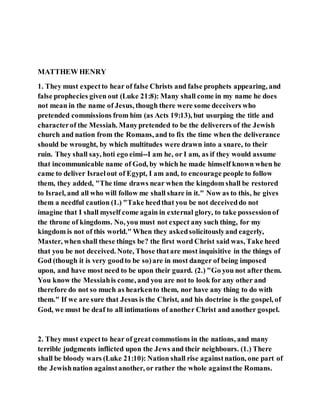
Matthew Henry's Concise Commentary
21:5-28 With much curiosity those about Christ ask as to the time when the
greatdesolationshould be. He answers with clearnessand fulness, as far as
was necessaryto teach them their duty; for all knowledge is desirable as far as
it is in order to practice. Though spiritual judgements are the most common
in gospeltimes, yet God makes use of temporal judgments also. Christ tells
them what hard things they should suffer for his name's sake, and encourages
them to bear up under their trials, and to go on in their work,
notwithstanding the opposition they would meet with. God will stand by you,
and own you, and assistyou. This was remarkably fulfilled after the pouring
out of the Spirit, by whom Christ gave his disciples wisdom and utterance.
Though we may be losers forChrist, we shall not, we cannotbe losers by him,
in the end. It is our duty and interest at all times, especiallyin perilous, trying
times, to secure the safetyof our own souls. It is by Christian patience we keep
possessionofour ownsouls, and keepout all those impressions which would
put us out of temper. We may view the prophecy before us much as those Old
Testamentprophecies, which, togetherwith their greatobject, embrace, or
glance at some nearerobject of importance to the church. Having given an
idea of the times for about thirty-eight years next to come, Christ shows what
all those things would end in, namely, the destruction of Jerusalem, and the
utter dispersion of the Jewishnation; which would be a type and figure of
Christ's secondcoming. The scatteredJewsaround us preach the truth of
Christianity; and prove, that though heavenand earth shall pass away, the
words of Jesus shallnot pass away. Theyalso remind us to pray for those
times when neither the real, nor the spiritual Jerusalem, shallany longerbe
trodden down by the Gentiles, and when both Jews and Gentiles shall be
turned to the Lord. When Christ came to destroythe Jews, he came to redeem
the Christians that were persecutedand oppressedby them; and then had the
churches rest. When he comes to judge the world, he will redeem all that are
his from their troubles. So fully did the Divine judgements come upon the
Jews, that their city is set as an example before us, to show that sins will not
pass unpunished; and that the terrors of the Lord, and his threatenings
againstimpenitent sinners, will all come to pass, even as his word was true,
and his wrath greatupon Jerusalem.
Barnes'Notes on the Bible
The accountof the destructionof Jerusalemcontainedin this chapter has
been fully consideredin the notes at Matthew 24. All that will be necessary
here will be an explanation of a few words that did not occurin that chapter.
Jamieson-Fausset-BrownBible Commentary
8. the time—of the Kingdom, in its full glory.
go … not … after them—"I come not so very soon" (2Th2:1, 2) [Stier].
Matthew Poole's Commentary
See Poole on"Matthew 24:4", See Poole on"Matthew 24:5", See Poole on
"Mark 13:5", and See Poole on "Mark 13:6". This happened, and was
abundantly fulfilled, before the destruction of Jerusalem, and probably will
receive a further fulfilling in the latter end of the world. But before the
destruction of Jerusalemit was, as Josephus assuresus, fulfilled in many,
particularly:
1. In one Theudas, whether the same mentioned by Gamaliel, Acts 5:36, or
some other of that name, is uncertain.
2. An Egyptian sorcerer, mentionedActs 21:38.
3. One Dositheus, a Samaritan.
4. Another in the time of Festus’s government.
5. Simon Magus is also reckonedfor one, Acts 8:9. He boastedhe was the
greatpower of God. Others also reckonone Menander, a disciple of Simon
Magus.
It is certain there were many who arrogatedto themselves the name of the
Messiah, to countenance their heading of a faction. There have also been
many since the destruction of Jerusalem, and probably will be many more
before the end of the world, 2 Timothy 4:3 2 Peter2:1 1Jo 2:18.
Gill's Exposition of the Entire Bible
And he said, take heed that ye be not deceived,.... Withfalse Christs, and false
prophets:
for many shall come in my name; making use of his name, taking it to them;
not that they would pretend they were sentby him, but that they were he
himself:
saying, I am Christ; so the Syriac and Persic versions supply as we do:
and the time draweth near; not that such will come, but when come, they will
say, that the time of the deliverance of the Jewishnation from the Roman
yoke is at hand:
go ye not therefore after them; do not be their disciples, or follow them where
they would lead you; for nothing but destruction will be the consequenceofit.
Geneva Study Bible
And he said, Take heedthat ye be not deceived:for many shall come {b} in my
name, saying, I am Christ; and the time draweth near: go ye not therefore
after them.
(b) Using my name.
EXEGETICAL(ORIGINAL LANGUAGES)
Expositor's Greek Testament
Luke 21:8-11. Signs prelusive of the end (Matthew 24:4-8, Mark 13:5-11).—
βλέπετε, etc., take heed that ye be not deceived. This the keynote—notto tell
when, but to protectdisciples from delusions and terrors.—ἐπὶ τῷ ὀνόματί
μου, in my name, i.e., calling themselves Christs. Vide at Mt. on these false
Messiahs.—ὁκαιρὸς ἤγγικε:the καιρὸς should naturally mean Jerusalem’s
fatal day.
Cambridge Bible for Schools andColleges
8-27. Signs of the End.
8. Take heedthat ye be not deceived]A danger incurred even by the elect.
Matthew 24:24. The moral key-notes of this greatDiscourse ofthe Last.
Things (Eschatology)are Beware!Watch! Endurel Pray!
for many shall come in my name] “Even now are there many antichrists,” 1
John 2:18. the time draweth near] Rather, the crisis has approached.
Bengel's Gnomen
Luke 21:8. Ὁ καιρὸς ἤγγικε, the time draweth near [hath drawn near]) viz.
the time of the Messiah. The thing itself in the thesis (the generalproposition)
is true. Mark 1:15 [“The time is fulfilled, and the kingdom of God is at
hand”]. The true Messiahhas many characteristic marks, one of which is, the
true time, to wit of both Advents. But false Messiahs andimpostors boastingly
allegeda false time for Jerusalembeing ennobled by the setting up of the
kingdom of God, at the very time when destruction was about immediately to
assailit: Luke 21:24.
Pulpit Commentary
Verses 8-19. - The apparent signs which (could show themselves, but which
must not be mistakenfor the true signs immediately preceding the
catastrophe. Verse 8b. - Many shall come in my name, saying, I am Christ.
Many of these pretenders appeared in the lifetime of the apostles. Josephus
mentions severalof these impostors ('Ant.,' 20:8 §§ 6-10;'Bell. Jud.,' 2:13. §
5). Theudas, one of these pretenders, is referred to in Acts 21:38 (see, too,
Josephus, 'Ant.,' 20:05. § 1). Simon Magus announcedthat he was Messiah.
His riyal Dositheus, his disciple Menander, advancedsimilar pretences. Mr.
Greswell(quoted by Dean Manse], 'Speaker's Commentary,'on Matthew
24:5) has calledattention to the remarkable fact that, while many of these
false Messiahs appearedin the interval betweenthe Lord's ascensionand the
Jewishwar, there is no evidence that any one arose claiming this title before
the beginning of his ministry. It was necessary, he infers, that the true Christ
should first appear and be rejectedby the greatbody of the nation, before
they were judicially given overto the delusions of the false Christs.
Vincent's Word Studies
Deceived
Rev., rightly, led astray. See on Matthew 24:4.
In my name
See on Matthew 18:5.
STUDYLIGHTRESOURCES
Adam Clarke Commentary
Many shall come in my name - Usurping my name: calling themselves the
Messiah. See Matthew 24:5. Concerning this prediction of the destruction of
Jerusalem, and its literal accomplishment, see the notes on Matthew 24:1-42
(note).
Copyright Statement
These files are public domain.
Bibliography
Clarke, Adam. "Commentary on Luke 21:8". "The Adam Clarke
Commentary". https:https://www.studylight.org/commentaries/acc/luke-
21.html. 1832.
Return to Jump List return to 'Jump List'
Coffman's Commentaries on the Bible
And he said, Take heedthat ye be led not astray:for many shall come in my
name, saying, I am he; and, The time is at hand: go ye not after them. And
when ye shall hear of wars and tumults, be not terrified; for these things must
needs come to pass first; but the end is not immediately.
There were many historicalfulfillments of the things mentioned here in the
forty years preceding the destruction of Jerusalem. Such things as "wars and
tumults," however, were but the normal state of humanity; and even the
earthquakes and natural disasters mentioned a moment later were all "par
for the course," as faras this world is concerned.
One thing that has occasionedsome questioning among scholars is Jesus'
prophecy of the many false christs who would come claiming to be "I AM,"
and that "the time (of the End) is at hand." Geldenhuys said;
As far as can be ascertained, there were no persons who represented
themselves as Christ during the years betweenthe Ascensionand 70 A.D. ...
this refers to the last days before his SecondAdvent.[14]
Boles, however, mentionedthat the whole country (during those years)"was
overrun with magicians, seducers,impostors, etc., who drew the people after
them into the wilderness, promising signs and wonders.[15]There was also a
pretended prophet, an Egyptian (Acts 21:38).
If there were indeed no such people claiming to be "Christ" during the
interval, Geldenhuys is correctin referring the words to the times prior to the
End; but it is rash to conclude that there were no such claimants to
Messiahship, whetheror not we may be able to identify them. Spence stated
that:
Many of these pretenders appeared during the lifetime of the apostles ...
Simon Magus was one (Acts 8). His rival Dositheus, and his disciple Meander
were such ... Many of these false Messiahs appearedin the interval between
the Ascensionand the destruction of Jerusalem.[16]
In view of the prophecy of Jesus, andthe known condition of the times, it
would appear that the preponderance of evidence favors Spence's view.
By the very nature of this double prophecy, the same condition of false
pretenders to Messiahshipand deity will mark the approachof the final
judgment; and it must be observedthat our generationhas already seenmany
such pretenders to divine honors.
[14] Ibid., p. 530.
[15] H. Leo Boles, Commentary on Luke (Nashville: Gospel Advocate
Company, 1940), p. 394.
[16] H. D. M. Spence, op. cit., p. 184.
Copyright Statement
James Burton Coffman Commentaries reproduced by permission of Abilene
Christian University Press, Abilene, Texas, USA. All other rights reserved.
Bibliography
Coffman, James Burton. "Commentary on Luke 21:8". "Coffman
Commentaries on the Old and New Testament".
https:https://www.studylight.org/commentaries/bcc/luke-21.html. Abilene
Christian University Press, Abilene, Texas, USA. 1983-1999.
Return to Jump List return to 'Jump List'
John Gill's Exposition of the Whole Bible
And he said, take heed that ye be not deceived,.... Withfalse Christs, and false
prophets:
for many shall come in my name; making use of his name, taking it to them;
not that they would pretend they were sentby him, but that they were he
himself:
saying, I am Christ; so the Syriac and Persic versions supply as we do:
and the time draweth near; not that such will come, but when come, they will
say, that the time of the deliverance of the Jewishnation from the Roman
yoke is at hand:
go ye not therefore after them; do not be their disciples, or follow them where
they would lead you; for nothing but destruction will be the consequenceofit.
Copyright Statement
The New John Gill's Exposition of the Entire Bible Modernisedand adapted
for the computer by Larry Pierce of Online Bible. All Rightes Reserved,
Larry Pierce, Winterbourne, Ontario.
A printed copy of this work can be ordered from: The Baptist Standard
Bearer, 1 Iron Oaks Dr, Paris, AR, 72855
Bibliography
Gill, John. "Commentary on Luke 21:8". "The New John Gill Expositionof
the Entire Bible". https:https://www.studylight.org/commentaries/geb/luke-
21.html. 1999.
Return to Jump List return to 'Jump List'
Geneva Study Bible
And he said, Take heedthat ye be not deceived:for many shall come b in my
name, saying, I am [Christ]; and the time draweth near: go ye not therefore
after them.
(b) Using my name.
Copyright Statement
These files are public domain.
Text Courtesyof BibleSupport.com. Used by Permission.
Bibliography
Beza, Theodore. "Commentaryon Luke 21:8". "The 1599 Geneva Study
Bible". https:https://www.studylight.org/commentaries/gsb/luke-21.html.
1599-1645.
Return to Jump List return to 'Jump List'
Commentary Critical and Explanatory on the Whole Bible
the time — of the Kingdom, in its full glory.
go … not … after them — “I come not so very soon” (2 Thessalonians 2:1, 2
Thessalonians 2:2) [Stier].
Copyright Statement
These files are a derivative of an electronic edition prepared from text
scannedby Woodside Bible Fellowship.
This expanded edition of the Jameison-Faussett-BrownCommentary is in the
public domain and may be freely used and distributed.
Bibliography
Jamieson, Robert, D.D.;Fausset,A. R.; Brown, David. "Commentary on
Luke 21:8". "Commentary Critical and Explanatory on the Whole Bible".
https:https://www.studylight.org/commentaries/jfb/luke-21.html. 1871-8.
Return to Jump List return to 'Jump List'
Robertson's WordPictures in the New Testament
That ye be not led astray (μη πλανητητε — mē planēthēte). First aorist
passive subjunctive with μη — mē (lest). This verb πλαναω — planaō occurs
here only in Luke though often in the rest of the N.T. (as Matthew 24:4,
Matthew 24:5, Matthew 24:11, Matthew 24:24, which see). Our word planet is
from this word.
The time is at hand (ο καιρος ηγγικεν — ho kairos ēggiken). Justas John the
Baptist did of the kingdom (Matthew 3:2) and Jesus also (Mark 1:15).
Go ye not after them (μη πορευτητε οπισω αυτων — mē poreuthēte opisō
autōn). First aorist passive subjunctive with μη — mē A needed warning
today with all the false cries in the religious world.
Copyright Statement
The Robertson's WordPictures of the New Testament. Copyright �
Broadman Press 1932,33,Renewal1960. All rights reserved. Used by
permission of Broadman Press (Southern BaptistSunday SchoolBoard)
Bibliography
Robertson, A.T. "Commentary on Luke 21:8". "Robertson'sWord Pictures
of the New Testament".
https:https://www.studylight.org/commentaries/rwp/luke-21.html. Broadman
Press 1932,33. Renewal1960.
Return to Jump List return to 'Jump List'
Vincent's Word Studies
Deceived
Rev., rightly, led astray. See on Matthew 24:4.
In my name
See on Matthew 18:5.
Copyright Statement
The text of this work is public domain.
Bibliography
Vincent, Marvin R. DD. "Commentaryon Luke 21:8". "Vincent's Word
Studies in the New Testament".
https:https://www.studylight.org/commentaries/vnt/luke-21.html. Charles
Schribner's Sons. New York, USA. 1887.
Return to Jump List return to 'Jump List'
Wesley's ExplanatoryNotes
And he said, Take heedthat ye be not deceived:for many shall come in my
name, saying, I am Christ; and the time draweth near: go ye not therefore
after them.
I am the Christ; and the time is near — When I will deliver you from all your
enemies. They are the words of the seducers.
Copyright Statement
These files are public domain and are a derivative of an electronic edition that
is available on the Christian ClassicsEtherealLibrary Website.
Bibliography
Wesley, John. "Commentary on Luke 21:8". "JohnWesley's Explanatory
Notes on the Whole Bible".
https:https://www.studylight.org/commentaries/wen/luke-21.html. 1765.
Return to Jump List return to 'Jump List'
The Fourfold Gospel
And he said, Take heedthat ye be not led astray:for many shall come in my
name, saying, I am [he]1; and, The time is at hand: go ye not after them.
For many shall come in my name, saying, I am [he]. See .
Copyright Statement
These files are public domain and are a derivative of an electronic edition that
is available on the Christian ClassicsEthereal Library Website. These files
were made available by Mr. Ernie Stefanik. First published online in 1996 at
The RestorationMovementPages.
Bibliography
J. W. McGarveyand Philip Y. Pendleton. "Commentaryon Luke 21:8". "The
Fourfold Gospel". https:https://www.studylight.org/commentaries/tfg/luke-
21.html. Standard Publishing Company, Cincinnati, Ohio. 1914.
Return to Jump List return to 'Jump List'
Scofield's ReferenceNotes
And he said
See note on the Olivet discourse. (See Scofield"Matthew 24:3").
Copyright Statement
These files are consideredpublic domain and are a derivative of an electronic
edition that is available in the Online Bible Software Library.
Bibliography
Scofield, C. I. "ScofieldReferenceNoteson Luke 21:8". "ScofieldReference
Notes (1917 Edition)".
https:https://www.studylight.org/commentaries/srn/luke-21.html. 1917.
Return to Jump List return to 'Jump List'
John Trapp Complete Commentary
8 And he said, Take heedthat ye be not deceived:for many shall come in my
name, saying, I am Christ; and the time draweth near: go ye not therefore
after them.
Ver. 8. See Matthew 24:4-5, &c.
Copyright Statement
These files are public domain.
Text Courtesyof BibleSupport.com. Used by Permission.
Bibliography
Trapp, John. "Commentary on Luke 21:8". John Trapp Complete
Commentary. https:https://www.studylight.org/commentaries/jtc/luke-
21.html. 1865-1868.
Return to Jump List return to 'Jump List'
Expository Notes with PracticalObservations onthe New Testament
Observe here, Christ does not gratify his disciples'curiosity, but acquaints
them with their present duty; namely, to watchagainstdeceivers and
seducers, who should have the impudence to affirm themselves to be Christs,
saying, I am Christ: some Christs personal, or the Messiah;others Christs
doctrinal, affirming their erroneous opinions to be Christ's mind and
doctrine: Take heedthat ye be not deceived, for many shall come in my name,
saying, I am Christ.
Observe farther, the signs which our Saviour gives of Jerusalem's
approaching destruction, namely, the many broils and commotions, the civil
disorders and dissensions, that should be found among the Jews immediately
before: Ye shall hear of wars and commotions, and see fearful sights, and
greatsigns from heaven. Josephus declares, that there appearedin the air
chariots and horsemenskirmishing, and that a blazing star in fashion of a
swordhung over the city for a year together.
Hence learn, that war, pestilence, andfamine, are judgments and calamities
inflicted by God upon a sinful people for their contempt of Christ and gospel
grace. Ye shall hear of war, famine, and pestilence.
Copyright Statement
These files are public domain.
Text Courtesyof BibleSupport.com. Used by Permission.
Bibliography
Burkitt, William. "Commentary on Luke 21:8". ExpositoryNotes with
PracticalObservations onthe New Testament.
https:https://www.studylight.org/commentaries/wbc/luke-21.html. 1700-1703.
Return to Jump List return to 'Jump List'
Greek TestamentCriticalExegeticalCommentary
8.] ὁ κ. ἤγγ., i.e. the time of the Kingdom.
They are the words, not of our Lord, but of the πολλοί: see on Matthew 24:4-
5.
Copyright Statement
These files are public domain.
Text Courtesyof BibleSupport.com. Used by Permission.
Bibliography
Alford, Henry. "Commentary on Luke 21:8". Greek TestamentCritical
ExegeticalCommentary.
https:https://www.studylight.org/commentaries/hac/luke-21.html. 1863-1878.
Return to Jump List return to 'Jump List'
Johann Albrecht Bengel's Gnomonof the New Testament
Luke 21:8. ὁ καιρὸς ἤγγικε, the time draweth near [hath drawn near]) viz. the
time of the Messiah. The thing itself in the thesis (the generalproposition) is
true. Mark 1:15 [“The time is fulfilled, and the kingdom of Godis at hand”].
The true Messiahhas many characteristic marks, one ofwhich is, the true
time, to wit of both Advents. But false Messiahs andimpostors boastingly
allegeda false time for Jerusalembeing ennobled by the setting up of the
kingdom of God, at the very time when destruction was about immediately to
assailit: Luke 21:24.
Copyright Statement
These files are public domain.
Text Courtesyof BibleSupport.com. Used by Permission.
Bibliography
Bengel, JohannAlbrecht. "Commentary on Luke 21:8". Johann Albrecht
Bengel's Gnomonof the New Testament.
https:https://www.studylight.org/commentaries/jab/luke-21.html. 1897.
Return to Jump List return to 'Jump List'
Matthew Poole's English Annotations on the Holy Bible
See Poole on"Matthew 24:4", See Poole on"Matthew 24:5", See Poole on
"Mark 13:5", and See Poole on "Mark 13:6". This happened, and was
abundantly fulfilled, before the destruction of Jerusalem, and probably will
receive a further fulfilling in the latter end of the world. But before the
destruction of Jerusalemit was, as Josephus assuresus, fulfilled in many,
particularly:
1. In one Theudas, whether the same mentioned by Gamaliel, Acts 5:36, or
some other of that name, is uncertain.
2. An Egyptian sorcerer, mentionedActs 21:38.
3. One Dositheus, a Samaritan.
4. Another in the time of Festus’s government.
5. Simon Magus is also reckonedfor one, Acts 8:9. He boastedhe was the
greatpower of God. Others also reckonone Menander, a disciple of Simon
Magus.
It is certain there were many who arrogatedto themselves the name of the
Messiah, to countenance their heading of a faction. There have also been
many since the destruction of Jerusalem, and probably will be many more
before the end of the world, 2 Timothy 4:3 2 Peter2:1 1 John 2:18.
Copyright Statement
These files are public domain.
Text Courtesyof BibleSupport.com. Used by Permission.
Bibliography
Poole, Matthew, "Commentaryon Luke 21:8". Matthew Poole's English
Annotations on the Holy Bible.
https:https://www.studylight.org/commentaries/mpc/luke-21.html. 1685.
Return to Jump List return to 'Jump List'
Cambridge Greek Testamentfor Schools andColleges
8. μὴ πλανηθῆτε. A dangerincurred even by the elect. Matthew 24:24. The
moral key-notes of this greatDiscourse ofthe Last Things (Eschatology)are
Beware!Watch! Endure! Pray!
πολλοὶ γὰρ κ.τ.λ. “Evennow are there many antichrists,” 1 John 2:18.
ὁ καιρὸς ἤγγικεν. ‘The crisis has approached.’
Copyright Statement
These files are public domain.
Text Courtesyof BibleSupport.com. Used by Permission.
Bibliography
"Commentary on Luke 21:8". "Cambridge Greek TestamentforSchools and
Colleges".https:https://www.studylight.org/commentaries/cgt/luke-21.html.
1896.
Return to Jump List return to 'Jump List'
Whedon's Commentary on the Bible
8. The time draweth near—It must not be understood that our Lord here
prophesies that the false Christs would assume to be Messiahreturned to
judgment. They could only claim that the Messiah’s kingdomwas alone to be
setup on earth; and the time of that event was, indeed, drawing near.
Copyright Statement
These files are public domain.
Text Courtesyof BibleSupport.com. Used by Permission.
Bibliography
Whedon, Daniel. "Commentary on Luke 21:8". "Whedon's Commentary on
the Bible". https:https://www.studylight.org/commentaries/whe/luke-21.html.
1874-1909.
Return to Jump List return to 'Jump List'
PeterPett's Commentary on the Bible
‘And he said, “Take heedthat you are not led astray. For many will come in
my name, saying, ‘I am he’, and, ‘The time is at hand’, do not go after them.”
’
The first thing that His people will have to beware of is those who will arise
saying, ‘I am the one’ in the name of the Messiah, orwho will say‘the time is
at hand’. The warning was very necessaryas such things did happen in the
first two centuries AD. While we know of only one who was actually officially
proclaimed as the Messiah, BarKokhba, ‘Son of the Star’ (around 135 BC),
who rebelled at the prospectof the building of a heathen city and temple on
the site of the old city of Jerusalemand the Temple Mount, when Jewish
Christians were persecutedfor not being willing to follow him, we know of a
number who were claimed as having specialstatus, and were probably
thought of by their followers in Messianic terms, including some in the last
days of Jerusalem(66-70 AD), such as for example - John of Giscala, Simon
Bar Giora, and Eleazar, Simon’s son. There was certainly sufficient
fanaticism about for it to be so (all we know about it is Josephus’watered
down version, and he would not wish to raise the spectre of Messianic
claimants. He wantedto please the emperor).
Among others who made specialclaims, some of whom arose evenearlier,
there were:
· Samaritan ‘prophet’ who claimed that he would produce the ancient Temple
vessels, andwhose followers were slaughteredby Pilate on Mount Gerizim in
35 AD.
· secondTheudas, possiblythe descendantof the Theudas mentioned in Acts
5:36, who gathered a large number of followers and promised that the Jordan
would open before him, only for his followers to be slaughteredand dispersed,
with himself being beheaded(c.44-46 AD).
· JewishEgyptian prophet (Acts 21:38)who assembleda large gathering in
the wilderness, promising that the walls of Jerusalemwould collapse at his
approachand that the Romangarrisonwould be destroyed. His insurrection
was, however, quashedalmost before it had begun, although the Egyptian
prophet escaped(around 54 AD).
· Another unnamed ‘prophet’ who gatheredpeople in the wilderness, in the
time of the Romangovernor Festus, promising redemption and deliverance
from all evils, and who was againviolently crushed (around 60 AD).
· MenahemBar Hezekiah the leader of the revolt in 66 AD, the son of Judah
of Gamala, who claimed Davidic descent.
· Later still Lucuas/Andreas arousedthe Jews in Cyrene and its surrounds in
the time of Trajan, destroying many heathen temples, and being seen as ‘king’
by his followers and even by a number of Egyptians (around 116 AD).
· And around the same time we know that there were further insurrectionists
in Palestine.
These all come to our attention because they were figures involved in direct
military actiontaken by the Romans againstthem. Some almost certainly saw
them as ‘messiahs’. But John tells us that others also arose as false ‘christs’
(antichrists, those who setthemselves up over againstChrist), teaching heresy,
and proving that it was ‘the last hour’, so that John could speak of them as
antichrists (1 John 2:18).
Indeed at times of such religious ferment, with expectations running high, we
can be confident that such claims were made or applied constantly by some of
the common people to different figures who arose, and as quickly fell. We can
compare how some did it with Jesus without really knowing the truth about
Him (e.g. John 6:14-15;John 7:41). Such ‘messiahs’are depicted in
Revelation6:2 in terms of a horseman on a white horse (see our commentary
on Revelation). The warning to Christians therefore was not to follow any who
were like them, for in the nature of what He was about to say, none could be
the Christ.
‘In My name.’ This could mean ‘in the name of the Messiah’or‘in the name
of Jesus’. Forthe latter compare Acts 19:13, and the later Gnostic heresies. ‘I
am the one’ indicates ‘the coming one’ of whatevervariety or hue. ‘The time
is at hand (or ‘has drawn near’)’, is a warning againstalarmists, whether first
or twenty first century ones. Forthe legitimate use of this idea compare
Revelation1:3; Revelation22:10. Jesus’implication behind all this is that
there will be quite some interval before He returns. For He is going into a far
country from which He will not return too soon(Luke 18:12). Compare here
Luke 17:23; Mark 13:8; Mark 13:21-23;Matthew 24:8; Matthew 24:23;
Matthew 24:26.
Copyright Statement
These files are public domain.
Text Courtesyof BibleSupport.com. Used by Permission.
Bibliography
Pett, Peter. "Commentary on Luke 21:8". "PeterPett's Commentary on the
Bible ". https:https://www.studylight.org/commentaries/pet/luke-21.html.
2013.
Return to Jump List return to 'Jump List'
George Haydock's Catholic Bible Commentary
In my name. They shall not saythat they belong to me, or that I sent them:
but they shall take to themselves my name, viz. Christ, or Messias, whichtitle
is incommunicable to any but myself. In effect, in less than two centuries,
there appeared many false Christs and impostors, who pretended to be the
one that was to come, the desired of nations. (Calmet) --- Perhaps this
prophecy is yet to be more expresslyfulfilled before the dissolution of the
world. Many pious and learned Christians suppose this passageto refer to the
time of Antichrist. (Haydock)
Copyright Statement
These files are public domain.
Text Courtesyof BibleSupport.com. Used by Permission.
Bibliography
Haydock, George Leo. "Commentaryon Luke 21:8". "GeorgeHaydock's
Catholic Bible Commentary".
https:https://www.studylight.org/commentaries/hcc/luke-21.html. 1859.
Return to Jump List return to 'Jump List'
E.W. Bullinger's Companion Bible Notes
And He said, &c. See App-155.
Take heed. Greek. blepo. App-133.
not. Greek. me. App-105.
deceived= misled.
for many, &c. This was speedilyfulfilled. It was the first sign as to "when"
(Luke 21:7). Compare 1 John 2:18, "the last hour. "
in. Greek. epi. App-104.
time = season.
draweth = has drawn.
Copyright Statement
These files are public domain.
Text Courtesyof BibleSupport.com. Used by Permission.
Bibliography
Bullinger, Ethelbert William. "Commentary on Luke 21:8". "E.W.
Bullinger's Companion bible Notes".
https:https://www.studylight.org/commentaries/bul/luke-21.html. 1909-1922.
Return to Jump List return to 'Jump List'
Ellicott's Commentary for English Readers
(8) Saying, I am Christ.—Literally, I am. The italics show that the word
“Christ” is an interpolation. The sentence is better left in the vaguenessofthe
original, or with only a pronoun as the predicate, I am He. The use of the
words in John 1:21; John 8:58, may be referred to as showing that they had
become significanteven without a predicate.
The time draweth near.—Better, the seasonhas come near.
Go ye not therefore . . .—The better MSS. omit the last words.
Copyright Statement
These files are public domain.
Text Courtesyof BibleSupport.com. Used by Permission.
Bibliography
Ellicott, Charles John. "Commentary on Luke 21:8". "Ellicott's Commentary
for EnglishReaders".
https:https://www.studylight.org/commentaries/ebc/luke-21.html. 1905.
Return to Jump List return to 'Jump List'
Treasuryof Scripture Knowledge
And he said, Take heedthat ye be not deceived:for many shall come in my
name, saying, I am Christ; and the time draweth near: go ye not therefore
after them.
Take
Jeremiah29:8; Matthew 24:4,5,11,23-25;Mark 13:5,6,21-23;2 Corinthians
11:13-15;Ephesians 5:6; 2 Thessalonians 2:3,9-11;2 Timothy 3:13; 1 John
4:1; 2 John 1:7; Revelation12:9
for
John 5:43; Acts 5:36,37;8:9,10
and the time
or, and, The time.
Matthew 3:2; 4:17; Revelation1:3
PRECEPTAUSTIN RESOURCES
BRUCE HURT MD
Luke 21:8 And He said, "See to it that you are not misled; for many will come
in My name, saying, 'I am He,' and, 'The time is near'. Do not go after them.
KJV Luke 21:8 And he said, Take heedthat ye be not deceived:for many
shall come in my name, saying, I am Christ; and the time draweth near: go ye
not therefore after them.
See to it that you are not misled Jeremiah 29:8; Mt 24:4,5,11,23-25;Mark
13:5,6,21-23;2 Corinthians 11:13-15;Ephesians 5:6; 2 Th 2:3,9-11;2 Timothy
3:13; 1 John 4:1; 2 John 1:7; Revelation12:9
for many will come in My name , saying, 'I am He,' John 5:43; Acts 5:36,37;
8:9,10
and, 'The time is near'. Do not go after them Mt 3:2; 4:17; Revelation1:3
Luke 21 Resources - Multiple Sermons and Commentaries
Luke 21:5-24 Staying Sane When the Whole World Goes Crazy- Steven Cole
Luke 21:9-11 The World in Conflict and Distress - John MacArthur
JESUS BEGINS TO ANSWER
THE DISCIPLES'QUESTIONS
Below are the synoptic passagesin Matthew and Mark that parallel Luke's
passagesto help you see the similarity betweenall three versions...
Luke 21:8 And He said, “See to it (present imperative) that you are not
misled; for many will come in My name, saying, ‘I am He,’ and, ‘The time is
near.’ Do not go after them.
Matthew 24:4-5-note And Jesus answeredand said to them, “See to it
(present imperative) that no one misleads you. 5 For many will come in My
name, saying, ‘I am the Christ,’ and will mislead many.
Mark 13:5-6 And Jesus beganto sayto them, “See to it (present imperative)
that no one misleads you. 6 “Many will come in My name, saying, ‘I am He!’
and will misleadmany.
Luke 21:9 “When you hear of wars and disturbances, do not be terrified; for
these things must take place first, but the end does not follow immediately.”
Matthew 24:6 “You will be hearing of wars and rumors of wars. See that you
are not frightened, for those things must take place, but that is not yet the end.
Mark 13:7 “When you hear of wars and rumors of wars, do not be frightened;
those things must take place;but that is not yet the end.
Luke 21:10 Then He continued by saying to them, “Nationwill rise against
nation and kingdom againstkingdom,
Matthew 24:7a “For nation will rise againstnation, and kingdom against
kingdom...
Mark 13:8a “Fornation will rise up againstnation, and kingdom against
kingdom;
Luke 21:11 and there will be great earthquakes, andin various places plagues
and famines; and there will be terrors and greatsigns from heaven. (Words in
bold only in Luke 21).
Matthew 24:7b “and in various places there will be famines and
earthquakes."
Mark 13:8b there will be earthquakes in various places;there will also be
famines.
BIRTH PANGS
From a comparisonof the three synoptic Gospels, while the similarities are
undeniable, there is a difference in that both Matthew 24:8 and Mark 13:8c
picture the catastrophic events as merely the beginning of birth pangs which
is a phrase not found in Luke 21. What Jesus is saying is that these things
(described in Mt 24:4-7, Mark 13:5-8 and by extension Lk 21:8-11)will
intensify as the world gets closerto the "delivery date," the end of the age, the
coming of Messiah, the "birth" of His Messianic Kingdom. When birth pangs
begin, birth generallysoonfollows. Having delivered a number of babies, it
has been my experience that as one gets closerto the actualdelivery of the
baby, the birth pangs increase in quality and quantity. It would appear that
Jesus'figure of speechstrongly implies that birth pangs (false messiahs, wars,
earthquakes, famines, plaques, etc) will increase in number and intensity as
the end draws near. Indeed, the book of the Revelationof Jesus Christ
(specificallyRevelation6:1-19:21)describes an intensification of all of these
things which Jesus had alluded to and which have been occurring for the past
2000 years (See note below).
R T France notes that "In later rabbinic literature the phrase “the labor pain
(always singular) of the Messiah” comesto be used almost as a technicalterm
for the period of suffering preceding the Messiah’s coming." (NICNT -
Matthew)
David Turner on birth pangs - The use of the pains of a womanin labor as a
metaphor for eschatologicaltroubles and/or the woe of God’s judgment is
found elsewhere in Jewishliterature and the NT (Isa 13:8-note;Isa 26:17;
66:7–8;Jer4:31; 6:24; 22:23;Jer 30:5–7-note;Jer 48:41;Hos 13:13;Mic 4:9-
13-note;Mark 13:8; 1 Thes 5:3-note; Rev 12:2-note;cf. John 16:20–22;Gal
4:19; (Cornerstone BiblicalCommentary, Vol 11: Matthew and Mark)
Weber on 3 implications of birth pangs - First, “beginning” implies that
patterns of war, famine, and earthquakes do have some connectionwith the
end. But they do not necessarilyindicate that the end is near. Adding to this
conceptis the idea of “birth pains,” which begin some time before an actual
birth. Second, birth is one of the most painful experiences in a woman’s life.
Jesus, choice ofword picture indicates that, when the end does come, it will be
very painful for all of humanity. These sorrows are continually experiencedin
history. But as is true with the birth process, the pains will increase in
frequency and intensity until Jesus returns in his power and glory. Third,
birth is one of the most joyously fulfilling experiences ofa woman’s life,
bringing about the emergence ofsomething precious, beautiful, and highly
valued. Jesus’word picture lookedbeyond the tribulation of God’s judgment
to the emergence ofthe fully realized kingdom with Christ in his glory.
(Holman New TestamentCommentary)
Craig Blomberg on birth pangs - just as a womanmay experience false labor
and just as genuine contractions still leave her uncertain about the exacttime
of delivery, so too the events of Mt 24:4–8 do not enable us to predict the time
of Christ’s coming. Birth pangs were in facta common Jewishmetaphor to
refer to an indeterminate period of distress leading up to the end of this age
(e.g., 1 Enoch62:4; 2 Esdr 4:42; Tg. Ps 18:14). (Matthew, Broadman &
Holman Publishers, The New American Commentary)
ESV Study Bible - Birth pains indicates that there will be a time of suffering
prior to the messianic age (cf. Ro. 8:22–23). OT prophets use the metaphor to
depict terrible suffering in general(cf. Isa. 13:8-note;Isa 21:3; 42:14;Jer.
30:5–7-note;Hos. 13:13)as well as suffering that Israelwill endure prior to
her deliverance (cf. Isa. 26:17–19;66:7–11;Jer. 22:23;Mic. 4:9–10-note).
(Comment: Note allusion to the "Messianic Age" -- this is the age which will
follow the church age and which is commonly referred to as the Millennium).
John Phillips introduces this section(Lk 21:8-11)commenting that "It is not
always easyto be sure whether events described belong to the impending fall
of Jerusalemor to the end-of-the-age catastrophes. Probablymany of them
focus on both because bothevents have features in common...." (Ibid) (See
Five Interpretative Views)
Commenting on the Olivet Discourse in Matthew, John Phillips writes
"Matthew bracketedthe Lord's public ministry betweentwo sermons:the
sermon on the mount, in which the emphasis was practical;and the Olivet
discourse, in which the emphasis was prophetical. In one sermon we read of
the rules of the kingdom; in the other we read of the return of the King.
Before giving the sermonon the mount, the Lord was baptized; after giving
the Olivet discourse, the Lord was buried. Prior to the first sermonHe proved
that the tempter could not conquer Him; after the last sermonHe proved that
the tomb could not conquer Him." (Exploring the Gospelof Matthew)
John MacArthur explains that birth pangs is "a very vivid analogyused often
in the Scriptures, often by the Jewishwriters and so was familiar to Jewish
people. Birth pangs are an increasing sequence ofcontractions that finally
become fiercely intense and result in the big event, birth. It is an apt analogy
for understanding human history. The contractions or the pains, start out
light and they increase andthey increase and they increase till they reach a
point of excruciation before the big event. So, Jesus is saying these are just the
birth pangs. These are just the very early birth pains and they've been going
on for 2,000 years and have been escalating. And if you want to see what
they're going to look like at the very end just before the event then you read
Revelation6-19." (The World in Conflict and Distress)
And so it should not surprise that in the time just before Christ returns in
Revelation19:11-16-note,the "birth pangs" of eachof these things will have
intensified to such a degree that they will be almost unimaginable. Below are
just a few of the examples of the "birth pangs" that will occurat the end of
this age...
False Christs - The final greatesthuman deceiver, the Antichrist - Rev 13:5-
note = given authority over the earth for 42 months
Wars-Armies gathering for war at Armageddon - Rev16:12-14, 16-note
Famine - Rider on the ashenhorse given to kill 1/4 of the earth with sword
and famine - Rev 6:8-note
Plagues - 1/3 of mankind was killed by three plagues - Rev 9:18-note (cf Rev
15:1-note, Rev 16:21-note = 100 lb hailstones)
Earthquakes - A great earthquake unlike any in the history of the world - Rev
16:18-note
And He said to them - Jesus now gives His longestrecordedanswerto any
question and of the three synoptic accounts, Matthew's is the longest(97
verses in Mt 24:1–25:46), while Luke’s account(Mt 21:5–36)contains some
material not found in Jesus'answerin Matthew and Mark. Clearlythis
prophetic sectionis an important topic. Luke 21:8-19 gives the first part of
Jesus'answerto the disciples'questions and at first glance it is a very bleak,
pessimistic answerwhich could be summarized as a future which is marked
by religious deception, globaldisasters and persecutionof believers. Imagine
for a moment you were one of the disciples and you had heard these words!It
would have been tempting to "jump ship" before the ship enters the stormy
future!
As Hiebert says "Insteadof giving them the sign they had requested, Jesus
beganby alerting them to false signs." (The Gospelof Mark- An Expositional
Commentary)
As Ray Stedman says Jesus "Big Point" is "Don't Be Fooled!writing "In our
understandable haste to come to the greatevents He predicts for the future,
let us not miss the heavy emphasis He makes in this opening word. It is the
dominant note of this whole discourse. The age will be a time of great
uncertainty as to the meaning of events."
Comment: Case in point - one of the finest expositors of our day Dr John
MacArthur fell prey to this temptation to readthe signs of the times -- He was
preaching on Is the Doomof the World Near? in 1972 whenthe 7 member
European Union was planning on adding 3 more members to give it a total of
10. This rightly reminded him of Daniel's prophecy of a coming 10 nation
confederacy(cf Da 7:24-note) and prompted his comment -
From The Los Angeles Examiner, are you ready for this shock? Los Angeles
Examiner, October29th, the last - 1971, listen. "The British decisionto join
the common markethas brought WesternEurope to the threshold of its
strongestunion since the nations involved were tied togetheras part of the
Roman Empire 15 centuries ago." Godsaid the Roman Empire would be
revived in the end days. You are seeing it happen. (Ref)
Don't take this wrong - I greatly respectDr MacArthur's verse by verse
expository teaching. My point is that if someone as competentas Dr
MacArthur is vulnerable to potentially misinterpret the signs of the times,
then ALL of us are potentially in danger of misreading the signs of the times. I
know because I have been guilty of doing so! As someone once wisely
cautionedme, don't obtain your eschatologyfrom the newspaper!
Stedman continues "It will be frightfully easyto misinterpret and therefore be
misled. The phrase "leadastray" forms the structure around which the whole
messageis built. He used it again in Mt 24:5...againin Mt 24:11...Once again
in Mt 24:24...Because ofthis continuing possibility, the Lord's exhortation
throughout the messageis, "Watch!", i.e., keepyour eyes open. Evaluate!
Test!Try the spirits! Bring everything to test that you might understand the
true characterofmovements and pressures, for the predominant note of the
age will be one of deceitand confusion. Then he proceeds to show to these men
that they are already confusedin their thinking that the end of the age lies
immediately ahead. From Mt 24:5 through Mt 24:14 he clearly indicates that
there would be a rather long, indeterminate period before the end of the age
would begin (Ed: Some see the long age in Mt 24:5-8, but then see Mt 24:9-14
as occurring at the end of the age). These men knew from the prophet Daniel
that the end of the age would not be a single spectaculareventbut a series of
events, covering severalyears (Ed: I presume PastorStedman is referring
here to Daniel's Seventieth Week). The Lord begins carefully to trace the age
which they could not see, the parenthesis of time in which we now live. If we
note carefully the time phrases He employs to lead up to the answerto the
disciples'question we shall have no difficulty with this section. He is most
emphatically not giving so-called"signs ofthe times" here. To the contrary,
he repeatedly indicates that He is tracing the age. Forinstance, he says in Mt
24:6, "And you will hear of wars and rumors of wars; see that you are not
alarmed; for this must take place, but the end is not yet." (The Age of
Confusion - Matthew 24:4-14)
See to it that you are not misled - All 3 synoptic Gospels beginJesus answer
with a warning to the disciples to not be misled. This warning echoes down
through the centuries even to our day and will apply to all disciples until the
end of this age.
See to it ( beware, take care, take heed)(991)(blepo)speaks ofperception, and
frequently implies specialcontemplation (e.g., oftenin the sense of “keepyour
eyes open,” or “beware”.)In this contextsee to it is a command (present
imperative) from Jesus calling for disciples (then and now to) to keep
directing their attention to the emergence ofdeceivers and their subtle
deceptions in the days preceding the destruction of the Temple and (in
context) to the days preceding the end of this age. W E Vine helps give us a
sense ofthe meaning of this verb writing that blepo expresses "a more
intentional, earnestcontemplation. In Lk 6:41 = of beholding the mote in a
brother’s eye; Lk 24:12 = of beholding the linen clothes in the empty tomb.
Acts 1:9 = of the gaze of the disciples when the Lord ascended."
Misled (4105)(planao fromplane which describes "a wandering";English =
planet) literally means made to wanderand thus in the active voice it means to
lead astray, cause to wander (cf first use in NT of "straying" sheep= Mt
18:12-13), to mislead, to deceive. To cause one to wander from the Truth of
God's Word Mt 24:4 and Mk 13:4 use planao in this active sense warning of
those who would seek to mislead or deceive the disciples. In contrast, Luke has
the passive voice which speaks more of the disciples as those who canBE
deceived. Jesus is saying we have to be very carefullest we be deceived.
For (gar) - Term of explanation - What is Jesus explaining? It is a goodhabit
to ask yourself this question wheneveryou see a "for" (used to explain
something), and many times the answeris straightforward(as here), but other
times it will force you to ponder the passage! Jesus is explaining how one
might be misled into believing claims such as we are at the end of this age (cf
"the end" Lk 21:9).
FALSE MESSIAHS
Many will come - This is important - not just a few fakers but many! In both
Matthew and Mark Jesus emphasizes their modus operandi that they "will
mislead many." (Mt 24:5, cf Mk 13:6) So many will come and many will
follow them and many will be misled. A very sad scenario!False Messiahs
have been always been on the scene, but the sobering truth of this prophecy is
that many would come and sadly many would be deceived.
Hiebert - The first person after the time of Jesus Christdefinitely known to
have claimed to be the Messiahwas BarKokhba, the leaderof the last great
Jewishrevolt in A.D. 132. (Ibid)
Simon bar Kokhba (Hebrew: ‫עועמש‬ ‫מב‬ ‫;אבכוכ‬ died 135 CE), born Simon ben
Kosevah, was the leader of what is known as the BarKokhba revolt against
the RomanEmpire in 132 CE, establishing an independent Jewishstate which
he ruled for three years as Nasi("Prince"). His state was conqueredby the
Romans in 135 following a two and half-year war.[a]The JewishsageRabbi
Akiva indulged the possibility that Simon could be the Jewishmessiah, and
gave him the surname "BarKokhba" meaning "Sonof the Star" in Aramaic,
from the Star Prophecyverse from Numbers 24:17: "There shall come a star
out of Jacob".The name BarKokhba does not appear in the Talmud but in
ecclesiasticalsources. Rabbinicalwriters subsequent to Rabbi Akiva did not
share Rabbi Akiva's estimationof ben Kosiva. Akiva's disciple, Yose ben
Halaphta, in the Seder'Olam (chapter 30)called him "bar Koziba" ( ‫מב‬
‫,)עויזמש‬ meaning, "sonof the lie".
Some are names we recognize from the news include (1) Sun Myung Moon:
consideredwithin the Unification Church as the Messiahand the second
coming of Christ. (2) Jim Jones:claimed to be the reincarnation of Jesus,
Buddha, Vladimir Lenin, and FatherDivine prior to leading a mass suicide of
his followers. (3)MarshallApplewhite: claimed to be Jesus and the Son of
God prior to leading his Heaven’s Gate cult mass suicide to rendezvous with a
space ship hiding behind the cometHale-Bopp. (4) David Koresh: leaderof
the BranchDavidian religious sectin Waco, Texas. Claimedto be “the Son of
God, the Lamb.”
Below are links to a list of people who have been saidto be a messiah, either
by themselves or by their followers. The list is divided into categories,which
are sortedaccording to date of birth (where known).
Jewishmessiahclaimants (See another more in depth article)
Christian messiahclaimants
Muslim messiahclaimants
Other or combination messiahclaimants
RelatedResources:
What does it mean that there will be false christs in the end times?
Who is Jose Luis de Jesus Miranda? Is Jose Luis de Jesus Miranda the
antichrist? (See Video)
The Christ of the New Age Movement by Ron Rhodes
Jesus'warning brings to mind the false prophecies of JosephSmith
(reference)and the multitudes ensnaredin Mormonism (~4.5 million) having
been deceivedby a false Gospeland another Jesus (Gal1:7-8-note) with the
result that many will be lost forever unless they hear and receive the true
Gospelof Jesus Christ (Ro 1:16-17, Eph 2:8-9, Ro 10:9-10, Acts 16:31, et al).
In My name - This is more literally upon or on My Name, "that is, on the
strength of; resting their claims on the Name Messiah."(Vincent) This means
upon the basis of My Name and My authority. To come in My Name means to
claim to possess andto use Christ's authority, and in some casesto even claim
to be the Christ!
Blomberg - “In my name” means they aim to usurp Jesus’place." (New
American Commentary)
Saying, 'I am' - NET says Jesus "I am the Messiah.'The pronoun "He" is not
in the Greek text so literally they are saying "I AM" which is the "ego eimi"
the same thing Yahweh said in Exodus 3:6 and Ex 3:14 (God said to Moses,“I
AM (Lxx = "ego eimi") WHO I AM”; and He said, “Thus you shall say to the
sons of Israel, ‘I AM has sent me to you.’) and what Jesus Himself said in
John 8:58 (Jesus saidto them, “Truly, truly, I say to you, before Abraham
was born, I am.”) which causedthe Jews to seek to stone Him (Jn 8:59)
because they thought He was blaspheming by declaring "I Am," a phrase they
recognizedas the equivalent of His saying "I am God!" That is what these
many deceivers will also be saying, so remain on high alert!
Jesus'warning in Matthew 24:5-note is even more explicit for there He says
these deceivers will flat out lie and say"I am the Christ," where the definitive
article "the" precedes Christ("o Christos")in the Greek indicating that they
are claiming to be the one and only Messiah!This helps understand how these
spiritual shysters will be able to lead others astray. It is their claim that they
are the Messiahand this claim gives authority and authenticity to what they
say (cf "in My Name").
Am (1510)(eimi)is a verb which basically expressesbeing and so means "to
be," "to exist," "to happen" or "to be present." and is one of the most
common verbs in the NT (2462xin all its conjugations in 2098 verses;the
exactform eimi is found 287 verses). Strictlyspeaking eimi is the first person
singular present tense, indicative mood; a prolongedform of a primary and
defective verb. Becauseeimi is used so frequently in such a variety of contexts,
the following discussionis at best a simple summary of the manifold uses of
eimi. Click here and scroll down to readThayer's full discussionof eimi.
Ego eimi - As alluded to above Jesus Himself used ego eimi to express His
eternal self-existence(without beginning, without end) in Jn 8:58. He was
saying He was Yahweh (I Am the One Who Is). Jesus is clearlyclaiming that
He is God! The Jehovah's Witness New World Translation(a
"mistranslation")(2013)translates Jn8:58 incorrectly as "I have been"
which Greek scholars sayis absolutelyincorrect! Compare other "I Am"
statements by Jesus = Jn 4:26, 8:24, 28, 13:19, 18:5, 6 ["they drew back and
fell to the ground!" = His Name "I Am" literally knockedan entire band of
from 300-600soldiers backwardabruptly and hard onto the ground! His
Name is indeed powerful!], Jn 18:8. see similar use in Ex 3:14 above). In Ge
17:1 God addresses Abram declaring "I am (ego eimi) God" (cf similar uses in
Ge 26:24, 31:13, 46:3, Ex 3:6, 7:5, 8:18, 14:4, 18, 20:2, 29:46, etc). Note that
there are about 174 uses of "ego eimi" in the Septuagint and 48 uses in the
NT, but not all uses refer to God (e.g., Mt 14:27). There are 24 uses of ego eimi
in John's Gospeland most do refer to the Messiah. E.g., in the first
occurrence, Jesus tells the Samaritan woman "I Am" (ego eimi) (Jn 4:26)
when she made a reference to the Messiah (Jn 4:25). In fact ego eimi
introduces His great "I am" statements in John = "I am"..."the bread of life"
(Jn 6:35, 41, 48, 51), "the Light of the world," (Jn 8:12), "the door" (Jn 10:7,
9), "the goodshepherd" (Jn 10:11, 14), "the resurrectionand the life," (Jn
11:25), "the Way and the Truth and the Life" (Jn 14:6); "the true Vine" (Jn
15:1, 5). At Paul's conversionon the Damascus RoadJesustold him "I am
(ego eimi) Jesus Whom you are persecuting." (Acts 9:5). In the final use of ego
eimi in Scripture Jesus affirms "I am the root and the descendantof David,
the bright morning star." (Rev 22:16-note)
Warren Wiersbe on I am the Christ (Messiah) - The Jews have often been led
astrayby false prophets and false Christs. The rider on the white horse in
Revelation6:1–2-note is the Antichrist, that final world dictatorwho will lead
the nations astray. He will begin his careeras a peacemaker, signing a (7 year)
covenantwith Israel to protecther from her enemies (Daniel9:27-note) (but
he breaks the covenantat 3.5 years unleashing his fury againstthe Jews and
Christians during the 3.5 year GreatTribulation in Mt 24:21-note = the Time
of Jacob's Distressin Jer 30:7-note = a Time of Distress in Da 12:1-note).
Israelwill welcome this man as their greatbenefactor(John 5:43). (Bible
Exposition Commentary)
Saying, 'I am He,' and, 'The time is near' - Neither Matthew 24:5 nor Mark
13:6 recordthey will say we are near the end of this age, only Luke. So they
not only (1) claim they are Messiahbut (2) claim they know the time is at
hand. We all have an inherent desire to know about the future, especiallyend
times prophecy. Jesus is warning that there would be individuals who would
seek to take advantage of this propensity for prophecy and would deceive
them and in so doing would turn them aside from the simple teaching of the
Gospel.
As an aside, there is a tendency in the younger evangelicalchurch to shy away
from serious study, preaching and teaching on Bible prophecy ("too divisive,"
"too confusing," "no one can know who has the correctinterpretation," and
the list goes on). Beloved, this is a deadly deficiency in the modern church.
Why would I say that? Think about it. If conservative, orthodoxleaders fail to
teachon this subject, the "sheep" are wide open to the plethora of prophetic
speculations promulgated on the internet, airways and books. Is it any
surprise that most of the cults prey on prophecy? God gave us the Bible to
reveal, not to concealandconfuse. God gave us prophecy to stabilize our faith
not to satisfyour curiosity. Bible prophecy is not easyput togetherthe pieces,
but it is not impossible. That said, see discussionof Bible Prophecywhich
includes a sectionon why it should be studied.
Excerpt from Gotquestions - Biblical prophecy plays two roles. It foretells the
future, and it explains what the positive or negative results of future events
will be. Prophecymay announce events that bring joy and pleasure or fear
and foreboding. When prophecy is ignored, it is usually because the hearers
don’t like what they hear for one reasonor another. Biblicalprophecy is not
usually generalin nature. It normally is very specific as to how it will affect
someone orsomething. But it is always dependable and worthy of our
complete trust. We canallow prophecy to help shape our lives, giving us
direction and guidance in serving our Lord. It should be a source of strength
and instruction for us. Unlike what we hear called “prophecy” today, both in
the church and outside the church, true biblical prophecy is always accurate
and precise. WhatGod prophesies always occurs. (How Can We Trust That
Bible Prophecy CanIndeed Predict the Future?)
The time is near - To what "time" is Jesus referring? Note the context - in Lk
21:9 we see another important expressionof time "the end." While one might
postulate that this refers to the end of the Temple in 70 A D, this word "end"
(telos)almost certainly refers to the end of this age and the time preceding the
SecondComing. The parallel accountin Matthew 24 uses telos three times, all
in the context of the end of this age (Mt 24:6-note, Mt 24:13, Mt 24:14-note).
So these deceivers who claim the authority of God and/or Messiah("inMy
Name"), will make claims that the time of Jesus'return is near. In short they
are setting dates regarding an event that Jesus clearlysaid no one knows but
the Father.
Guzik recounts "One notable example of this was the prophetic expectationin
1843 with William Miller in the United States. Becauseofhis prophetic
interpretations, calculations, andpublications (ED: see picture newspaper
page with his bizarre "calculations!" Note depiction of the angel [right bottom
corner] blowing horn next to the final [false]calculationof "1843"), there
were hundreds of thousands in the United States who were convinced that
Jesus would return in 1843. When He did not, there was great
disappointment, with some falling away, and some cultic groups spawned
from the prophetic fervor." (Enduring Word)
Here is what the Bible says about those like William Miller who try to set the
date of Christ's return...
Luke 12:40-note “You too, be ready; for the Son of Man is coming at an hour
that you do not expect.”
Matthew 24:36 “But of that day and hour no one knows, not even the angels
of heaven, nor the Son, but the Fatheralone.
Acts 1:7-note He said to them, “It is not for you to know times or epochs
which the Father has fixed by His own authority;
Do not go after them - While this is strictly speaking not a command in the
Greek, it is far more than a suggestionfrom Jesus!
MacArthur comments "The Lord’s followers are not to go after them.
Subsequent history would prove the timeliness of His warning: The passing
centuries have seenfalse messiahs, eachclaiming to be the one so eagerly
anticipated by the Jewishpeople. Of these self-proclaimeddeliverers, some
were simply self-deceived, while others were purposefully exploitative; some
sought personalprestige, others to rescue their people from oppression;some
advocatedviolence, others prayer and fasting; some professedto be political
deliverers, others to be religious reformers. But though their motives,
methods, and claims varied, they all had one thing in common—they were
satanic counterfeits of the true Messiah, Jesus ofNazareth. About a.d. 44
Theudas (see below)(not the same individual mentioned in Acts 5:36)
promised his followers that he would part the Jordan River. But before he
was able to do so, Roman troops attackedand massacredmany of his
followers. The Egyptian for whom Paul was mistaken(Acts 21:38) had
boastedthat he would command the walls of Jerusalemto fall down. But, like
Theudas, his plans were also foiled by Roman soldiers. Although the Egyptian
managedto escapehis attackers, severalhundred of his followers were killed
or captured (Josephus, Antiquities 20.8.6;Wars 2.13.5). In the secondcentury
Simon BarCochba (See note above) (“sonof a star”;cf. Nu 24:17), who was
identified as the Messiahby the leading rabbi of the time, led a major Jewish
uprising againstRome, conquering Jerusalemfor three years, where he was
calledking and messiah. The Romans crushed the rebellion, retook
Jerusalem, and massacredBarCochba and five to six hundred thousand of
his followers. A fifth-century false messiahon the island of Crete promised to
part the MediterraneanSea so his followers couldwalk to Palestine ondry
land. But the sea refusedto part and some of his followers drowned. In the
seventeenthcentury Shabbethai Zebi proclaimed himself “king of the kings of
the earth,” and attracteda widespreadfollowing among the Jews of western
Europe. Zebi later converted to Islam and was eventually executed. (John
MacArthur, John 12-21, The MacArthur New TestamentCommentary
[Chicago:Moody, 2008], 11-12)The long parade of charlatans claiming to be
Christ will culminate in the ultimate deceiving false messiah, the Antichrist,
the "man of lawlessness... the son of destruction, who opposes andexalts
himself above every so-calledgodor objectof worship, so that he takes his
seatin the temple of God, displaying himself as being God ... [the] lawless one
... whom the Lord will slaywith the breath of His mouth and bring to an end
by the appearance ofHis coming; that is, the one whose coming is in accord
with the activity of Satan, with all powerand signs and false wonders, and
with all the deceptionof wickednessforthose who perish, because they did not
receive the love of the truth so as to be saved. (2 Th 2:3-4, 8-10-note;cf. Rev.
13:1-18-note)There will be no mistaking Christ’s return. Jesus said, “Forjust
like the lightning, when it flashes out of one part of the sky, shines to the other
part of the sky, so will the Sonof Man be in His day” (Luke 17:24-note). Not
only must believers be wary of false christs, but they must also be ready for
Jesus’return. Earlierin Luke’s gospelJesus told His followers (Lk 12:35-40-
note) (MacArthur New TestamentCommentary – Luke)
Josephus (J. AJ 20.97)onTheudas - (See also Wikipedia Article on Theudas)
NOW it came to pass, while Fadus was procurator of Judea, that a certain
magician, whose name was Theudas, (1) persuadeda great part of the people
to take their effects with them, and follow him to the river Jordan; for he told
them he was a prophet, and that he would, by his own command, divide the
river, and afford them an easypassage overit; and many were deluded by his
words. However, Fadus did not permit them to make any advantage ofhis
wild attempt, but sent a troop of horsemen out againstthem; who, falling
upon them unexpectedly, slew many of them, and took many of them alive.
They also took Theudas alive, and cut off his head, and carriedit to
Jerusalem. This was what befell the Jews in the time of Cuspius Fadus's
government.
(1) This Theudas, who arose under Fadus the procurator, about A.D. 45 or 46,
could not be that Thendas who arose in the days of the taxing, under
Cyrenius, or about A.D. 7, Acts v. 36, 37. Who that earlierTheudas was, see
the note on B. XVII. ch. 10. sect. 5.
Josephus describes a tragic example of those who "went after" these "false
Messiahs"whenthe Romans came againstJerusalem(in 70 A D) recording
that the Roman soldiers...
"also burnt down the treasury chambers; in which was an immense quantity
of money, and an immense number of garments, and other precious goods
there reposited. And, to speak all in a few words, there it was that the entire
riches of the Jews were heapedup together: while the rich people had there
built themselves chambers [to contain such furniture]. The soldiers also came
to the rest of the cloisters that were in the outer [court of the] temple: whither
the women, and children, and a greatmixed multitude of the people fled in
number about six thousand. But before Caesarhaddetermined any thing
about these people, or given the commanders any orders relating to them, the
soldiers were in such a rage, that they set that cloisteron fire. By which means
it came to pass that some of these were destroyedby throwing themselves
down headlong; and some were burnt in the cloisters themselves. Nordid any
one of them escape with his life. A false prophet was the occasionofthese
peoples destruction: who had made a publick proclamationin the city, that
very day, that “Godcommanded them to getup upon the temple, and that
there they should receive miraculous signs of their deliverance.” (Josephus
6.5.2)Theywere misled by a would-be messengerof God! They had not read
Matthew, Mark or Luke's Gospels in which Jesus had warned be alert for
these genre of men!
Tony Garland on Jewishclaimants. (some repetition of above)...
(1) Simon Bar Kokhba was acclaimedMessiahby Rabbi Akiva following the
Jewishrevolt againstRome of A.D. 115-117. (BarKokhba’s name, son of a
star, is a reference to the Messianic prophecyof Num. 24:17.)
(2) In the 5th century, a pseudo-messiahcalledMoses appearedin Crete.
(3) In the 8th century, three pseudo-messiah’s appeared
(a) Abu Issa Al-Isfahani in Persia
(b) Severus or Serene in Syria
(c) Yudghan in Hamadan (you will need to translate this page) (searchthis
book and you canread about Yudghan - click page 26) in Persia - “In 1096, it
was believed in Salonica that the deliverance had already begun; and in 1121,
a Karaite claimant was reported in Palestine. In 1147, the spectacularDavid
Alroy appeared in Mesopotamia andsimilar figures are recordedin Yemen,
Fez, Persia, Spain, and France in the 11th and 12th centuries. Abraham
Abulafia was active in Sicily in the 13th century and was followedin Spain by
his disciples, Samueland Abraham. . . . The Spanish persecutionof 1391
produced Moses Botarel;the expulsion (1492)was followedby a number of
such figures -- Asher Lamlein (1503), SolomonMolcho (c. 1500 - 1532), and
others.”
(4) Shabbetai Tzevi (1621 - 1676)of Smyrna - “The masses were wonoverby
his emotionalsermons and fresh doctrines. . . . In [1662 after marrying a
young Jewessin Egypt] he returned to Palestine and in 1665, was hailedas
king-messiahby Nathan of Gaza but excommunicatedby the rabbis of
Jerusalem. Returning to Turkey, Shabbetaiwas joyfully receivedby the
masses andheaped with honors. The fervor spreadthroughout the Jewish
world and rumors were current of a Jewisharmy which would advance from
the Arabian desertto conquer Palestine. In 1666, he went to Constantinople to
'depose the Sultan' but was arrestedand confined in the fortress of Gallipoli.
Here he held court and receivedthousands of followers. . . . Messianic
expectations ran high throughout Europe and the rabbinate was sharply
divided on the issue. However, Shabbetai’s behavior evokedthe wrath of the
Turkish authorities and to save himself from death, he acceptedthe Islamic
faith. Jewrywas shakenby his conversion. . . . Nevertheless,he kept in touch
with his admirers until his death, which they held would precede his return as
Messiahand Redeemer.”
(5) JacobFrank (1726 - 1791)- “Declaredhimself the Messiahand the
successorof ShabbetaiTzevi. . . . His mystical activities were allegedto be
accompaniedby sexualorgies, the function of which was to bring redemption
through impurity.”
(6) MenachemMendel Schneerson(1902 -1994)- A prominent Hasidic rabbi
who was the seventh and last Hasidic leader of the Chabad-Lubavitch
movement. Although he himself did not explicitly proclaim to be the Messiah--
but only working to bring the Messiahthrough goodworks--someofhis later
statements implied that he thought that he was.15During his lifetime many of
his followers had consideredhim to be the JewishMessiah, andeven after his
death, some continue to await his return as the Messiah."Garlandnotes that
the "antidote" to the false Messiahs is a visible, globalsign (Mt 24:30).
(Reference)
RelatedResource:
Book - 50 JewishMessiahs (searchthis book and you can read about Yudghan
- click page 26)
Beware!
Read:2 Corinthians 11:1-15
Take heedthat you not be deceived. —Luke 21:8
An acquaintance ofmine was “takenin” by a smooth-talking salesmanwho
stopped at his place of business. The man displayed some attractive jewelry
that he said he had purchased at a tremendous discount. He was especially
proud of some very expensive-looking watchesthathad a well-knownname on
the dials.
My friend was impressedand bought severalwatches. Butafter the salesman
left, he examined his “bargains” more carefully. He was surprised to discover
that the trademark was not that of a famous brand after all. Two letters in the
name were different, but the print was so small he hadn’t noticedit before.
The watchstraps were not genuine leather but “genuine lizard,” and on the
back of the caseswere the words “Swiss base metal.”
The incident reminded me of what the Saviorsaid in Luke 21:8, “Take heed
that you not be deceived.” Evenas some in the business world cleverly pervert
the facts and victimize their customers, there are also false teachers in the
church who distort the truth. They use biblical terminology and appear to be
orthodox. But beware!They are evil and will leadyou astray. Be firmly
grounded in the Word of God and you won’t be “takenin” by deception.
O grant us grace, Almighty Lord,
To read and mark Your holy Word,
Its truths with meekness to receive,
And by its holy precepts live. —Beddome
Examine all teaching in the light of God's Word.
By Richard DeHaan (Our Daily Bread, Copyright RBC Ministries, Grand
Rapids, MI. — Reprinted by permission. All rights reserved)
Luke 21:9 "When you hear of wars and disturbances, do not be terrified; for
these things must take place first, but the end does not follow immediately."
KJV Luke 21:9 But when ye shall hear of wars and commotions, be not
terrified: for these things must first come to pass;but the end is not by and by.
When you hear of wars and disturbance Luke 18,19;Ps 27:1-3;46:1,2; 112:7;
Proverbs 3:25,26;Isaiah8:12; 51:12,13;Jeremiah4:19,20;Mt 24:6-8; Mark
13:7,8
but the end does not follow immediately Luke 21:8,28
Luke 21 Resources - Multiple Sermons and Commentaries
Luke 21:5-24 Staying Sane When the Whole World Goes Crazy - Steven Cole
Luke 21:9-11 The World in Conflict and Distress - John MacArthur
WARS DO NOT SIGNAL
THE IMMEDIATE END
Parallelpassages:
Matthew 24:6-8-note You will be hearing of wars and rumors of wars. See
that you are not frightened (present imperative with a negative = Don't let this
begin or stopbeing frightened), for those things must take place, but that is
not yet the end. “For(term of explanation) nation will rise againstnation, and
kingdom againstkingdom, and in various places there will be famines and
earthquakes. “Butall these things are merely the beginning of birth pangs (see
preceding note on birth pangs).
Mark 13:7-8 When you hear of wars and rumors of wars, do not be frightened
(present imperative with a negative);those things must take place;but that is
not yet the end. 8 “Fornation will rise up againstnation, and kingdom against
kingdom; there will be earthquakes in various places;there will also be
famines. These things are merely the beginning of birth pangs.
When you hear (akouo)of wars and disturbances, do not be terrified - The
natural reactionto war is terror! Jesus says (nota command in Greek but
functions like one) do not be terrified. How can a believer NOT be terrified?
First, because Jesuscalls forus to believe Him and if we believe Him (His
Word) we can choose notto be terrified. Second, in my opinion the only way
to "override" our natural reactionof fear is not by "gritting our teeth," but
by believing Jesus and relying wholly on His Holy Spirit to supernaturally
enable us to obey Jesus'words. We need to be Spirit filled (controlled) and to
continually seek to be surrendered to the Spirit of Jesus (the only way we can
be continually surrendered to the Spirit is if the Spirit gives us the desire and
the power!cf Php 2:12-note, Php 2:13NLT-note. Is this spiritual dynamic
mysterious? Yes. Is it truth? Absolutely. It is truth not just that we can hold
to, but even better is truth which "holds" us when everything around us is
falling apart! Compare Luke 21:15-note - How will Jesus give utterance and
wisdom? By His indwelling Spirit, the Spirit of Christ!).
While Luke has wars and disturbances, Matthew and Mark both have
"rumors of wars."
Disturbances (181)(akatastasiafrom akatastatos= unstable from a = negative
+ kathistemi = set in order) means literally without order or stability and thus
has a basic meaning of instability = to an unsettled state of affairs, an
upheaval, a state of violent group disturbance, a tumult, or unrest, especially
in a political or socialsetting (riots, revolutions). In 2 Cor. 12:20 and James
3:16 the context suggeststhat akatastasía is used of the disruption of the
Christian community by worldly disputes among the brethren and in both of
these passages jealousyand selfish ambition (eritheia) are listed prior to
akatastasiaas factors whichpredispose to socialinstability.
MacArthur adds "Akatastasia (disorder)has the basic meaning of instability,
and hence came to be used of a state of confusion, disturbance, disarray, or
tumult, sometimes even of rebellion or anarchy. Cautioning His disciples
about future false reports of His secondcoming and the end of the age, Jesus
said, “Whenyou hear of wars and disturbances [akatastasia], do not be
terrified; for these things must take place first, but the end does not follow
immediately” (Luke 21:9).
Louw-Nida - to rise up in open defiance of authority, with the presumed
intention to overthrow it or to actin complete oppositionto its demands.
NET Note says it speaks of"Socialandpolitical chaos also precedes the end.
This term refers to revolutions."
The cognate akatástatosis used of an unstable person (Jas 1:8) and of the
tongue as a restless evil(Jas 3:8).
TDNT on akatastasia - This word signifies “disorder” a. as “politicalturmoil,”
b. as “personalunrest.” Sense a. occurs in Luke 21:9, sense b. in 2 Cor. 6:5.
We also find in the NT a further sense c. “disruption” in the community
through disputes (Jms. 3:16) or charismatic exaggeration(1 Cor. 14:33).
(TheologicalDictionaryof the New Testament:Abridged in One Volume)
Akatastasia- 5x in 5v - confusion(1), disorder (1), disturbances (2), tumults
(1).
Luke 21:9 "When you hear of wars and disturbances, do not be terrified; for
these things must take place first, but the end does not follow immediately."
1 Corinthians 14:33 for Godis not a God of confusion but of peace, as in all
the churches of the saints.
2 Corinthians 6:5 in beatings, in imprisonments, in tumults, in labors, in
sleeplessness,in hunger,
2 Corinthians 12:20 For I am afraid that perhaps when I come I may find you
to be not what I wish and may be found by you to be not what you wish; that
perhaps there will be strife, jealousy, angry tempers, disputes (eritheia =
selfishambition), slanders, gossip, arrogance, disturbances;
James 3:16 For where jealousyand selfishambition (eritheia) exist, there is
disorder and every evil thing.
MacArthur comments - Akatastasia (disorder)has the basic meaning of
instability, and hence came to be used of a state of confusion, disturbance,
disarray, or tumult, sometimes even of rebellion or anarchy. Cautioning His
disciples about future false reports of His secondcoming and the end of the
age, Jesus said, “Whenyou hearof wars and disturbances [akatastasia], do
not be terrified; for these things must take place first, but the end does not
follow immediately” (Luke 21:9). James has already made clearthat disorder
does not characterize God’s people but rather the “double-minded man,
unstable [akatastasia]”(James 1:8)and the unredeemed tongue, which “is a
restless [akatastasia]evil and full of deadly poison” (3:8). Because“Godis not
a God of confusion but of peace”(1 Cor. 14:33), biblical wisdom, on the other
hand, brings harmony, unity, peace, and love. All the conflicts, crimes, battles,
and wars of the world are evidence of the devastationcausedby human
wisdom. (James Commentary)
Proverbs 26:28 (The One Use in the Lxx) A lying tongue hates those it
crushes, and a flattering mouth works ruin.
As noted akatastasia canreferto riots or rebellions such as recordedby Luke
in the book of Acts...
Acts 5:36 “Forsome time ago Theudas rose up, claiming to be somebody, and
a group of about four hundred men joined up with him. But he was killed, and
all who followedhim were dispersed and came to nothing.
Acts 21:38 “Thenyou are not the Egyptian who some time ago stirred up a
revolt and led the four thousand men of the Assassins outinto the
wilderness?”
Do not be terrified - Subjunctive with negative (me) meaning to prevent an
actionfrom beginning.
Terrified (4422)(ptoéō)is used only twice in the NT (Lk 21:9, Lk 24:37) and
means to terrify, frighten, scare. In the passive voice it means to be terrified.
Only passive in the NT = be startled, alarmed. Ptoeo conveys a deep sense of
terror and emotional distress.
For these things must take place first - What things? Disturbances, political
upheaval, globalinstability, socialtumults (descriptions based on the nuances
of the word akatastasia). To reemphasize Jesus is saying these things are not
signs that this is the end of the world as we know it.
As Robertsonsays commenting on "must take place first" -- "It is so easyto
forgetthis and to insist that the end is “immediately” in spite of Christ’s
explicit denial here."
Must (present tense - continually)(1163)(deifrom deo = to bind objects
together)refers to what is not optional but needful (binding) out of intrinsic
necessityor inevitability. These things are inevitable! One interpretation is
that they must occurbecause that is what the sovereignGodhas decreedand
all of "history" is in His hands. Yes, He allows personalchoices,but
mysteriously and powerfully He will bring all of the events of History to His
desired end. As someone has said"History" is His Story!
Hiebert clarifies that "These nationalconvulsions have not been preordained
by divine decree but arise as the inevitable consequencesofhuman depravity.
They are the natural results of human nature separatedfrom God and ruled
by self-interest. They are divinely permitted as part of God’s eschatological
program for this world, which includes judgment as wellas salvation."
(Gospelof Mark - Expositional Commentary)
Lowery adds that "The world is a chaotic place. It is the (necessary)
consequence ofliving in a fallen world. Disciples should not think that human
or natural disasters, howevertragic, signalthe end. These are but the prelude
to a truly catastrophic finale (Mt 24:21-note). Disciples mustkeeptheir
balance and stayfaithful."
THE END OF
THIS AGE
But the end does not follow immediately - What is Jesus saying? Jesus'is
saying we can know (1) there will be tumultuous, disturbing events before the
end (2) some time will also pass before the end comes (not...immediately). And
to reiterate Jesus especiallywants us to understand that these things (such as
disturbances) are not signs of the immediate end of this age.
The end - Note that "end" is precededin Greek by the definite article "the"
(to telos) which identifies this as not just an "end" in general, but as a specific,
definitive end. It means the very end. Jesus is addressing the disciples'
question "what will be the sign of Your coming, and of the end (sunteleia
related to telos)of the age?” (Mt24:3-note)Notice also that (contrary to what
a number of writers suggest)Jesusis not speaking ofthe "end" of the Temple
nor of the end of the world, but of the end of the age. Hiebert adds that "The
end is the eschatologicalgoalofhistory, the final establishment of God’s
kingdom on earth." (Ibid)
The end - Jesus will give a clear, unmistakable visual event in Mt 24:15 that
will mark the beginning of the end of the age. He does not want His disciples
to be misled or frightened by these tumultuous events. It reminds me of folks
who during WWII said that Hitler was the Antichrist. While he certain
manifested the spirit of antichrist in slaughtering millions of Jews, he was not
the Antichrist because the abomination of desolationin Mt 24:15-note (and
2Th 2:2-4-note) had not yet occurred. In fact there was no Temple (holy place)
in Jerusalemin which one could have even stood during World War II. Had
these individuals known what Jesus had taught, they would have realized
Hitler could not possibly have been the Antichrist. One of the greatestdangers
in interpreting eschatologyis to use the newspaperto guide one's
interpretation!
End (5056)(telos)means a completion, consummation, goalachievedor result
attained. It does not speak of annihilation.
J Vernon McGee -Wars and rumors of wars are not the sign that we are at
the end of the age, by any means. The Lord is bridging the gap from where
the disciples are to the end of the age. It is easyto think of major wars as
indicative of the fact that we are at the end of the age. They are not! There
have been many major wars in the pastfew thousand years and only about
two hundred years of peace. When I was a little boy at the end of World War
I, I remember hearing my dad and others talking about the books being
printed declaring it was the end of the world. World War I causedthis type of
thinking. But after the war, we had a worldwide depression, World WarII,
and the atom bomb. By this time, I was a pastorin Pasadena, and I told my
congregationthat a wheelbarrow load of books would come out saying that we
were at the end of the world because ofWorld War II. You know something?
I was wrong!Two wheelbarrow loads of books were printed, and they were
sensational. We have come a long way from World War II, and the end of the
age still has not come. We should listen to the Lord and stoplistening to false
teachers. We will hear about wars and rumors of wars, but we should not be
troubled because allthese things will come to pass, and still it will not be the
end of the age. Friend, we should also keepin mind that man will never solve
the problem of war. The League of Nations could not solve this problem, and
the United Nations will not be able to solve it either. There will be no peace
until the Prince of Peace comes. (Ibid)
Steven Cole remarks that "Jesus is showing His followers how to hold on not
only to their sanity, but also to their faith, when the world around them is
chaotic and seemingly out of control. When the whole world goes crazy, God’s
people canremain sane by knowing that all things are under God’s righteous,
sovereigncontrol. Jesus’purpose was not to satisfycuriosity about the end
times. Rather, He was trying to instill assurance and faith in His disciples so
that they would not fall away under intense persecutionor world chaos."
Immediately (2112)(eutheosfrom euthus = straight, immediate) is an adverb
which generally means at once, right away, forthwith, straightaway, without
an interval of time or a point of time subsequent to a previous point of time.
Note that the actual interval of time depends on the nature of the events and
the manner in which the sequence is interpreted by the writer. Eutheos is used
againin Matthew's versionof the Olivet Discourse in Mt 24:29-note “But
immediately (eutheos)after the (GREAT) tribulation of those days THE SUN
WILL BE DARKENED, AND THE MOON WILL NOT GIVE ITS LIGHT,
AND THE STARS WILL FALL from the sky, and the powers of the heavens
will be shaken." Note that these are the final "signs from heaven" Jesus
describes in the context of the very end of this age (see also Lk 21:26-note).
GENE BROOKS
Luke 21:8-11:Jesus first says the signs of coming judgment will be the rise of
false Messiahs setting dates. Jesussays notto listen to them. Second, the
increasing break-up of socialand natural orders with wars, disturbances,
earthquakes, famines, pestilences willbe indications, but Jesus says these
events are typical of human history and should not be overzealouslyconfused
with the end.
d. APPLICATION: Don’t be deceived(Luke 21:8). Jesus’return won’t be a
secret. There’s no need for us to set dates. Don’t be frightened (Luke 21:9-11).
Believers should not be deceivedby disasters and assume the end of the world
has arrived. (Luke 21:5-11). Human history will be filled with wars and
disasters. In the meantime, God will look afterHis own.
STEVEN COLE
Staying Sane When the Whole World Goes Crazy(Luke 21:5-24)
RelatedMedia
One of the biggestlies that Satanhas promoted is that believing in Christ as
Savior will bring a trouble-free life. The pitch goes, “Do youhave problems?
If you trust in Jesus, He will get you out of them.” So the person trusts in
Christ and his problems get worse, notbetter. The enemy comes to him and
says, “See where trusting in Christ gotyou? You were better off before you
became a Christian!”
The Bible does promise believers peace and joy, but it does not promise the
absence oftrials, freedom from persecution, or even protection from violent
death. It promises peace and joy in the midst of such trials as we rely on the
Lord and His promises.
Jesus and His disciples were going out of the temple when one of them
commented about how impressive that building was. By all accounts, it was a
magnificent structure. At that time, it had been under constructionfor about
50 years. According to the Jewishhistorian, Josephus, some of the stones
measuredover 35 feetlong, 12 feet high, and 18 feetwide. The current
Wailing Wall is a part of the foundation left from that building. Its white
marble walls rose about 200 feetabove the Kidron Valley. The brilliance of
the white walls and the gold trim in the morning sun was dazzling. The
courtyard was about 400 by 500 yards square, so that thousands of
worshippers could gatherthere. The rabbis said, “He who has not seenthe
Temple in its full constructionhas never seena glorious building in his life”
(cited by William Lane, Mark [Eerdmans], p. 451).
It was just an offhand comment by one of the disciples. The other disciples
were nodding in agreementwhen Jesus shockedthem by saying, “The days
will come in which there will not be left one stone upon another which will not
be torn down” (21:6). That was unthinkable! To their credit, the disciples did
not doubt Jesus’words, but they did ask when these things would take place
and what signs would precede this momentous event. Jesus respondedwith
this lengthy discourse onfuture things, known as the Olivet Discourse,
although Luke does not mention that it took place on the Mount of Olives.
As with most prophetic sections ofScripture, there are some difficult
interpretive problems (especiallywhen you compare Luke 21 with Matthew
24 and Mark 13). Luke 21:5-24 focuses onthe fall of Jerusalemas a preview
of the more intense judgment that will happen at Christ’s return (21:25-28).
Thus there are multiple fulfillments of these prophecies, leading up to the final
fulfillment at the secondcoming of Christ. Since Jesus emphasizes that many
of these cataclysmic events will take place wellbefore the end (21:9, 12), His
words apply to believers in trying situations down through the centuries, as
well as to those living at the time of the destruction of Jerusalemor just before
His secondcoming.
Jesus is showing His followers how to hold on not only to their sanity, but also
to their faith, when the world around them is chaotic and seeminglyout of
control.
When the whole world goes crazy, God’s people can remain sane by knowing
that all things are under God’s righteous, sovereigncontrol.
Jesus’purpose was not to satisfy curiosity about the end times. Rather, He
was trying to instill assurance andfaith in His disciples so that they would not
fall awayunder intense persecutionor world chaos. We will considerfive
points:
1. God knows in advance all things that will take place in this world.
We have seennumerous occasions where Jesuspredicted His impending death
(9:22, 44;13:33; 18:31-33;19:14-18). It did not surprise Him. As He explained
in John 10:18, no one took His life from Him. Rather, He laid it down on His
own initiative. Nothing surprises God.
Jesus here speaks ofboth big and little matters that God knows in advance.
He knows about the total destruction of the temple in Jerusalem(21:6), about
deceivers who will come (21:8), and about wars, earthquakes, plagues,
famines, and signs in the heavens (21:9-11). He knows future persecutions that
will take place before kings and governors (21:12) and those that will arise
from family betrayals (21:16). He knows in advance the preservation of the
hairs of the heads of all who follow Him (21:18). He knows the future of Israel
and the course of the nations (21:24).
You may think that everyone who believes in Christ believes that God knows
in advance all things that will take place. But that is not so. In 1994, Clark
Pinnock and severalother theologians published a book titled, The Openness
of God [IVP]. Their view, called“free-will theism,” a radical form of
Arminianism, argues that “the God of the Bible is with us in time and does not
know the future in absolute detail” (Christianity Today[1/9/95], p. 30, italics
theirs).
World Magazine (7/17/99, p. 23) reported that Greg Boyd, a theology
professorat BethelCollege and Seminary in St. Paul, and the popular
preaching pastorof one of the largestchurches in the Baptist General
Conference, holds a similar view. He has written three books and many
articles proclaiming that “Godcan’t foreknow the goodor bad decisions of
the people He creates until He creates these people and they in turn create
their decisions.”
Sadly, a committee at Bethelconcluded that Mr. Boyd’s “view of God is a
biblically oriented, contemporary form of Arminianism … within the bounds
of evangelicalChristianorthodoxy and compatible with the theological
commitments expectedof faculty members at Bethel.” PastorJohnPiper led a
movement to propose an amendment to the BCG’s Affirmation of Faith
stating, “We believe ‘that He foreknows infallibly all that shall come to pass.’”
But it failed by a vote of 270-251.Apparently, unity was more important for
the delegatesthan theologicaltruth.
I hope that you all agree that God knows in advance all things that will
happen. But we must go a step further:
2. God has ordained in advance all things that will take place in this world.
Jesus says that all of the wars and disturbances must take place, indicating
God’s settled purpose (21:9). He says concerning the destruction of Jerusalem,
that it will happen “in order that all things which are written may be fulfilled”
(21:22). God sovereignlychose Israelfrom all other nations to be His people
and to bring forth the Saviorof the world. He predetermined by His plan that
Israelwould crucify her Savior (Acts 2:23; 4:27-28). And He sovereignly
determined to judge Israel for her sin of killing her Savior.
Through Isaiah (46:9-11)God declares to His disobedient people, “ForI am
God, and there is no other; I am God, and there is no one like Me, declaring
the end from the beginning and from ancient times things which have not
been done, saying, ‘My purpose will be established, and I will accomplishall
My goodpleasure’;… Truly I have spoken;truly I will bring it to pass. I have
planned it, surely I will do it.” Paul affirms in Ephesians 1:11, God
“predestined[us] according to His purpose who works all things after the
counselof His will.” (See also Prov. 16:4.)
You may not like the thought that God ordains evil as well as good. Many
Christians blame everything bad that happens on the devil as if he did it apart
from God, without considering where that line of thinking leads. If the devil is
able to do anything outside of God’s sovereignplan, then he is a force at least
equal in strength, if not greater, than God. That would mean that there is a
chance that the devil could thwart the sovereignplan of God and achieve his
evil purpose over and againstGod’s holy purpose, a most frightening
prospect!The Bible clearly shows, in the story of Job, that the devil can only
go as far as God permits. God is sovereignevenover the devil and the evil
things that the devil does.
Calvin observes that none of these predicted disasters (21:9-12)happen
accidentally. They are all under God’s sovereignhand. He then applies it to
believers:“for nothing has a more powerful efficacyto bring us into
subjection, than when we acknowledge thatthose things which appear to be
confusedare regulatedby the goodpleasure of God” (Calvin’s Commentaries
[A Harmony of the Gospels], 3:121-122).
You’re probably thinking, “If God not only knows everything in advance, but
also ordains everything, then He is responsible for evil.” Notso!
3. Although God has ordained all things, He is not responsible for evil.
If God were responsible for evil, He would have no right to judge the wicked.
They could claim, “I only did what You ordained!” But Jesus is teaching that
Jerusalemwould be destroyed and trampled under foot by the Gentiles, and
Israelwould be led captive into all the nations, as a judgment for not
recognizing the day of her visitation (21:24; 19:44). As Peterstatedon the Day
of Pentecost, althoughGodpredetermined the death of Jesus, those in Peter’s
audience who nailed Him to the cross were guilty for what they did (Acts
2:23).
Scripture affirms that “Godis light, and in Him is no darkness atall” (1 John
1:5). “The Lord is righteous in all His ways” (Ps. 145:17). He is goodand He
does good(Ps. 119:68). His eyes are too pure to look upon evil (Hab. 1:13).
“Righteous are You, O Lord, and upright are Your judgments” (Ps. 119:137).
“Holy, holy, holy, is the Lord God, the Almighty” (Rev. 4:8; see Isa. 6:3).
While our finite minds cannotreconcile God’s absolute sovereigntyover all
things and His absolute holiness, Scripture plainly affirms both. We must
submit to its testimony. As already stated,
4. God will righteously judge all who rejectHis Son.
Jesus refers to Jerusalem’s destructionas “days of vengeance”(21:22). It will
bring “greatdistress upon the land, and wrath to this people” (21:23). In A.D.
70, the RomanGeneralTitus laid siege to the city and completelydestroyed it.
Although he may have exaggerated, Josephus says that1.1 million Jews were
slaughtered. The Romansoldiers tore apart the temple stone by stone in an
attempt to get all the gold that melted and ran betweenthe stones when they
burned it. Jesus’words were literally fulfilled.
God’s judgments come in two forms: temporal and eternal. His temporal
judgments fall upon nations and individuals according to His inscrutable
wisdom. Godexplained to Abraham that his descendants would be captive in
a foreign land for 400 years because the iniquity of the Amorites was not yet
complete (Gen. 15:16). When their sin was full to the brim, God commanded
Joshua to kill the entire population. It was His temporal judgment on a
morally corrupt people in response to hundreds of years of sin. In His mercy
in allowing the Canaanites to exist that long, God let His chosenpeople
remain in slavery four long centuries, before using them to execute His
righteous judgment.
When God’s temporal judgment falls on a people, everyone suffers. Jesus
proclaims woe especiallyon the womenwho are with child or who are nursing
babies in the day of Jerusalem’s judgment (21:22). If God’s temporal
judgment falls on America, we all will suffer. I cannot tell you why God
judged Rwanda with the terrible bloodbath a few years ago, but allows
America to continue in open rebellion. But when civil war broke out in that
country, thousands of Christians died along with the wicked.
God’s temporal judgments are only a warning of the far worse eternal
judgment that is coming on the whole earth. John describes “a greatwhite
throne and Him who sat upon it, from whose presence earthand heaven fled
away, and no place was found for them” (Rev. 20:11). All whose names are
not found written in the book of life will be thrown into the lake of fire
(20:15). Israel came under God’s temporal judgment because she rejectedher
Savior. Even so, every personwho rejects Jesus Christas Saviorand Lord will
face the eternal wrath of God.
If the Jewishleaders had heard Jesus’prediction concerning the temple, they
would have scoffed. They killed Him, beat and killed His crazy followers who
proclaimed His resurrection, and life in Jerusalemwent on as usual for over
35 years. Some of the Jewishleaders grew old and died before Jesus’
predictions came true. If you had interviewed them on their deathbeds, they
would have said, “Jesus was mistaken. The temple still stands in all its glory.”
How wrong they were! Just because God’s judgment is delayed does not mean
that it will not happen. Many make the same fatal mistake concerning God’s
eternal judgment. Just because foralmost 2,000 years Christhas not yet
returned to judge the earth does not mean that He will not do so in the future.
His warning is clear:He will return in power and great glory and then it will
be too late for those who have rejectedHim to repent.
How are we who believe in Christ to live in these difficult times until He
comes?
5. God’s people are responsible to persevere in obedience and witness in this
evil world, even in the face of persecutionand martyrdom.
Jesus spoke these prophetic words to encourage His disciples to persevere, if
need be, unto death. He did not want hardship or persecutionto surprise
them. He gives three areas where we need to be on guard:
A. TO PERSEVERE IN OBEDIENCE AND WITNESS,WE MUST BE ON
GUARD AGAINST SPIRITUAL DECEPTION.
“See to it that you be not misled; for many will come in My name, saying, ‘I
am He,’ and, ‘The time is at hand’; do not go after them” (21:8). By saying
that they will come in His name, Jesus does not necessarilymean that they will
blatantly claim to be the Christ. Some, such as ReverendMoon, are so bold,
but true Christians are not likely to be deceivedby such obvious error. The
more deceptive errors come from within the church, couchedin biblical
terms.
Nine years ago I was preaching on the parallel passagein Mark’s Gospel. At
the time, I had an associate pastorwho wanted to bring a “Christian” Twelve
Step program into our church. At first I was open to the idea. The programs
seemedto help people with serious problems. I knew of many large
evangelicalchurches that used them. A burgeoning “Christian Recovery”
conference had recentlyattracted hundreds to Biola University. They used a
workbook called“The Twelve Steps for Christians,” that was lacedwith Bible
verses. So I thought that it must be okay.
But as I read the workbook and as I studied Jesus’warning in Mark, the Lord
opened my eyes to the spiritual deception. The workbook saidthings like,
“The Twelve Steps work miracles. Trust the Steps.” Jesus saidthat false
Christs would arise working miracles in order, if possible, to leadthe elect
astray(Mark 13:22). The Christian Twelve Step programs also are openly
self-focused. Theytalk about the need to love yourself because youhave loved
others too much. They say that Jesus is the “Higher Power,” but they also
admit that the Steps work no matter who your Higher Powermay be. It
dawned on me that if the Steps work no matter whom you fit into the Higher
Powerslot, then the real power is not the Higher Power, but the Steps. It
purports to be Christian, but it encouragespeople to trust the Steps, not God
alone.
So I preached a sermonthat became known as my “famous sermon,” where I
warned about the dangerof these programs and told the church that I could
not endorse them. Even though I said it kindly and just urged people to
considerwhat I was saying, many angry people began calling for my
resignation. But the years since have only confirmed what I then beganto see,
that the evangelicalchurch is being deceivedby psychologyand self-help
programs that have only a veneer of Christianity.
Another major area of deceptionis the Christian unity movement. We are
being urged to drop all doctrinal differences and come togetheron the basis of
our common love for Jesus. In the process, core truths are being sacrificedon
the altar of “love.” But if we give up the importance of truths like justification
by faith alone for the sake ofunity, we have denied true Christianity. And we
are most unloving if we compromise such doctrines, because a person’s
eternal destiny depends on believing such truths. Satan’s most effective
deceptionalways comes from within. Beware!
B. TO PERSEVERE IN OBEDIENCE AND WITNESS,WE MUST BE ON
GUARD AGAINST FEAR IN THE FACE OF POLITICAL AND NATURAL
CATASTROPHES.
Jesus says that wars, disturbances, earthquakes, plagues,famines, and terrors
and greatsigns from heaven will all take place before the end comes. Manyof
these things happened prior to the destruction of Jerusalem, and they have
continued throughout history. We now hear warnings of globalwarming and
of the possibility of asteroids hitting the earth and causing major disaster. We
have been spared waron our home soil, but terrorists with atomic and
biologicalweapons couldeasilywreak havoc in our land.
Jesus commands us not to be terrified at such things. His command to the
disciples to flee Jerusalemwhen they see the armies beginning to surround
her shows that we may need to take precautions to protectour lives. There is
nothing godly about courting dangerand death. But if we take due precaution
and yet face death, we canface it calmly with trust that the God of Jacobis
our strongholdand that He will guide us until death (Ps. 46; 48:14).
C. TO PERSEVERE IN OBEDIENCE AND WITNESS,WE MUST BE ON
GUARD AGAINST COMPROMISING OUR TESTIMONYUNDER
PERSECUTION.
We American Christians have facedvery little persecution, but we should
steelourselves for it, making up our minds in advance that we will be faithful
witnesses evenif it costs us our lives. Jesus explains that persecutionwill give
us opportunity for testimony (21:13; the Greek wordfor testimony is
“martyr”). He promises that we don’t need to worry about what to say,
because He will give us the mouth to speak and the wisdom to confound our
opponents. This is nothing less than a claim to deity on Jesus’part, since He
could not possibly do this unless He was omnipresent.
But He warns us that even family and close friends will betray us and that we
will be hated by all (i.e., many unbelievers) on accountof His name. J. C. Ryle
observes, “The Christianof whom everybody speaks well, canhardly be a
faithful man” (Expository Thoughts on the Gospels [Baker], Luke 11-24, p.
367). We need to make sure that the offense is the cross and not our abrasive
personalities!But if we hold to Jesus Christ as the only way to God, to the
utter sinfulness of the human heart, and to faith and not works as the only
way of salvation, we will be branded as intolerant, narrow-minded, and
unloving. Just recently the Southern Baptists were accusedof“hate crimes”
because they statedthat people of other major religions need salvation.
Persecutioncouldeasily be just around the corner! Be ready!
When Jesus says (21:18)that “not a hair of your head will perish,” He is not
promising immunity from death, which He just said will happen to some
(21:16). He means that if we are faithful witnesses,evenif they kill the body
they cannot touch the soul. By endurance in bearing witness to the truth we
prove ourselves to be true followers of Christ and gain our souls (21:19).
Conclusion
So when the whole world goes crazyaround us, we can remain calm and sane
by knowing that all things are under God’s righteous, sovereigncontrol. Even
if we die for our faith, we will live forever with Him.
During the secondcentury, the agedbishop Polycarpwas arrestedand
brought to the Roman arena to die in front of the cheering crowd. The
proconsul pressedhim hard to renounce Christ and thus spare his own life.
Polycarpreplied, “For86 years I have been his servant, and he has never
done me wrong. How canI blaspheme my king who savedme?” The
proconsul warnedthat he had wild beasts. “Callthem,” said Polycarp. “I can
burn you with fire,” the proconsul warned. Polycarpreplied, “The fire you
threaten burns for a time and is soonextinguished. There is a fire you know
nothing about—the fire of the judgment to come and of eternal punishment,
the fire reservedfor the ungodly. But why do you hesitate? Do what you
want.”
The proconsulshouted to the crowd that Polycarp had confessedthat he is a
Christian. The crowdshouted that he must be burned alive. They quickly
collectedthe wood. Justbefore it was lit, Polycarpprayed, thanking God that
he had been counted worthy of this day, to partake in Christ’s cup of
suffering. The fire was lit and Polycarpstepped into the presence ofhis Lord.
I realize that God gives specialgrace atsuch times. But we all need to ask,
“Do I have that kind of confidence in the righteous, sovereignGod?” If I do, I
can stand firm even when the whole world goes crazy, because my trust is in
the faithful God.
DiscussionQuestions
Are we being contradictory to say that God ordains all things and yet He is
not responsible for evil? Why/why not?
How can a Christian grow in discernment so as not to be taken in by spiritual
deception?
Is it fair when God’s temporal judgment falls on everyone in a culture, not
just on the wicked? Why/why not?
How can we prepare ourselves now to stand up under persecutionif it comes
to our land?
Copyright, Steven J. Cole, 2000,All Rights Reserved.
Rev. Bruce Goettsche
Union Church of La Harpe Illinois
Every one of us would like to know what the future holds. If we had some
“insider” knowledge ofwhat the stock orcommodities marketwas going to do
we could become rich. In an effort to find the future people turn to
horoscopes, fortune tellers and psychics. We think we would like to know how
long we are going to live so that we could better plan for our retirement or
forgetabout retirement and spend all our money now. We’d especiallylike to
know when the Lord was going to return so we could getour priorities in
order.
The text before us in Luke 21 (and in the parallels in Matthew 24 and Mark
13) is a passagethathas spurred a host of books pointing to various world
events as sure “signs ofthe imminent return of Christ”. Mostof those books
quickly find their way to bargain bins at bookstoresbecausetheyoften jump
to conclusions that are not warranted.
I believe there is information in this text that canhelp us know what to expect
from the future. As we work our way through Luke 21 we will be talking a
greatdeal about what is to come. However, we must be careful interpreters of
the text and listen to what is said without trying to make the text say
something more spectacularand be more specific than it actually is.
The dialogue came about because some of the disciples of Jesus were
marveling at the structure of the temple. The temple was a massive and
incredible piece of architecture. During the lifetime of Jesus the Temple was
undergoing a remodeling that had been going on for 46 years!The remodeling
was not finished until some 30 years later in AD 63 which was just sevenyears
before it was destroyedby the Roman army.
Herod expanded the temple complex to 400 yards by 500 yards which was
about twice its original size. It was anywhere from six to twelve stories tall. As
a point of comparison, a domed Professionalfootballstadium would not
overshadow the temple complex at all! According to the Jewishhistorian
Josephus, Herodused white marble stones up to sixty-sevenfeet long, twelve
feet high, and eighteenfeet wide.[1]These stones were aboutthe size of
boxcars on a train! The construction of the temple was an engineering
masterpiece!How they were even able to move the stones was amazing.
The temple was coveredwith gold and what wasn’tgold was white marble.
From a distance it lookedlike a snow-cappedmountain. When the sun would
hit it the reflectioncould be quite blinding.
As a result, when Jesus talkedabout the coming destruction of the Temple the
disciples assumedthis would take place at the end of the world. Matthew tells
us that when they were outside the city at the Mount of Olives (giving them a
perfect view of the temple) they askedfor more information. (This passageis
often calledthe Olivet Discourse becausethey were on the Mount of Olives).
Note carefully the questions the disciples askedJesus.We need to know what
question He is answering before we can rightly understand His words.
7 “Teacher,”they asked, “whenwill these things happen? And what will be
the signthat they are about to take place?”
Matthew has a more expanded question,
“Tellus,” they said, “whenwill this happen, and what will be the sign of your
coming and of the end of the age?”(Mt. 24:3)
There are two and possibly three questions asked.
When will the temple be destroyed?
What is the sign of your SecondComing?
What are the signs of the end of the Age?
As we read the text Jesus answers the questions but as we read the verses we
must ask, “Whichquestion is Jesus answering?”Is He answering the question
about the destruction of the temple or is He telling us about the Second
Coming of Christ and/or End of the world? I believe in the first part of the
text Jesus is answering the question about the destruction of the Temple
(because His words so clearly fit what we know happened historically). Next
week we will look at the part of the answerthat seems to be answering the
question about the secondcoming of Christ.
Signs Before the End (7-11)
Jesus begins by warning the disciples of things that are NOT signs of the end.
8 He replied: “Watchout that you are not deceived. For many will come in my
name, claiming, ‘I am he,’ and, ‘The time is near.’ Do not follow them. 9
When you hear of wars and revolutions, do not be frightened. These things
must happen first, but the end will not come right away.”
10 Then he said to them: “Nationwill rise againstnation, and kingdom
againstkingdom. 11 There will be great earthquakes, famines and pestilences
in various places, and fearful events and greatsigns from heaven. [2]
Jesus warns us not to be alarmed by severalthings:
Those who claim to be the Messiahandclaim to know the exacttime the Lord
will return. We must not be deceivedby such people. They claim to have
“inside information. Jesus warns us not to be takenin by the alarmists.
We should not conclude that wars and rumors of wars mean the end is near.
There have always been wars and rumors of wars. Wars are the result of
man’s sinful condition, they are a sign of the decayof the human race but they
are not necessarilya sign of the secondcoming. Forany person going through
a war it would certainly feellike the end was upon them. If we were living in a
city on which bombs were being dropped or was occupiedby warring factions
it feel like the end was near. In World War II if you knew the Jews were being
executedby the millions or if you lived in countries today where you witnessed
ethnic cleansing it would certainly feel like the end of the world. Jesus says,
don’t jump to conclusions. Wars andlife go together.
We should not be undone by natural disasters,
11 There will be greatearthquakes, famines and pestilences in various places,
and fearful events and greatsigns from heaven.
It seems like such these things are happening with greaterand greater
frequency (that may or may not be true because records are limited). Perhaps
these things combined with the financial instability do point to the nearness of
the end. However, they may just be more labor pains leading to a correction
to the greedof our society. Again, Jesus warns us to be steady.
MATTHEW HENRY
1. They must expectto hear of false Christs and false prophets appearing, and
false prophecies given out (Luke 21:8): Many shall come in my name he does
not mean in the name of Jesus, though there were some deceivers who
pretended commissions from him (as Acts 19:13), but usurping the title and
characterof the Messiah. Manypretended to be the deliverers of the Jewish
church and nation from the Romans, and to fix the time when the deliverance
should be wrought, by which multitudes were drawn into a snare, to their
ruin. They shall say, hoti ego eimi--I am he, or I am, as if they would assume
that incommunicable name of God, by which he made himself known when he
came to deliver Israelout of Egypt, I am and, to encourage people to follow
them, they added, "The time draws near when the kingdom shall be restored
to Israel, and all who will follow me shall share in it." Now as to this, he gives
them a needful caution (1.) "Take heedthat you be not deceiveddo not
imagine that I shall myself come again in external glory, to take possessionof
the throne of kingdoms. No, you must not expect any such thing, for my
kingdom is not of this world." When they askedsolicitouslyand eagerly,
Master, when shall these things be? the first word Christ said was, Take heed
that you be not deceived. Note, Those thatare most inquisitive in the things of
God (though it is very goodto be so)are in most danger of being imposed
upon, and have most need to be upon their guard. (2.) "Go you not after them.
You know the Messiahis come, and you are not to look for any other and
therefore do not so much as hearkento them, nor have any thing to do with
them." If we are sure that Jesus is the Christ, and his doctrine is the gospel, of
God, we must be deaf to all intimations of another Christ and another gospel.
2. They must expectto hear of greatcommotions in the nations, and many
terrible judgments inflicted upon the Jews and their neighbours. (1.) There
shall be bloody wars (Luke 21:10): Nation shall rise againstnation, one part of
the Jewishnation againstanother, or rather the whole againstthe Romans.
Encouragedby the false Christs, they shall wickedly endeavourto throw off
the Romanyoke, by taking up arms againstthe Roman powers when they had
rejectedthe liberty with which Christ would have made them free they were
left to themselves, to grasp at their civil liberty in ways that were sinful, and
therefore could not be successful. (2.)There shall be earthquakes, great
earthquakes, in divers places, whichshall not only frighten people, but
destroy towns and houses, and bury many in the ruins of them. (3.) There
shall be famines and pestilences, the common effects of war, which destroys
the fruits of the earth, and, by exposing men to ill weatherand reducing them
to ill diet, occasions infectious diseases. Godhas various ways of punishing a
provoking people. The four sorts of judgments which the Old-Testament
prophets so often speak ofare threatened by the New-Testamentprophets too
for, though spiritual judgments are more commonly inflicted in gospeltimes,
yet Godmakes use of temporal judgments also. (4.)There shall be fearful
sights and greatsigns from heaven, uncommon appearancesin the clouds,
comets and blazing stars, which frighten the ordinary sort of beholders, and
have always been lookedupon as ominous, and portending something bad.
Now, as to these, the cautionhe gives them is, "Be not terrified. Others will be
frightened at them, but be not you frightened, Luke 21:2. As to the fearful
sights, let them not be fearful to you, who look above the visible heavens to the
throne of God's government in the highest heavens. Be not dismayed at the
signs of heaven, for the heathen are dismayed at them, Jeremiah10:2. And, as
to the famines and pestilences, you fall into the hands of God, who has
promised to those who are his that in the days of famine they shall be satisfied,
and that he will keepthem from the noisome pestilence trust therefore in him,
and be not afraid. Nay, when you hear of wars, when without are fightings
and within are fears, yet then be not you terrified you know the worst that any
of these judgments can do to you, and therefore be not afraid of them for,"
[1.] "It is your interest to make the bestof that which is, for all your fears
cannot alter it: these things must first come to pass there is no remedy it will
be your wisdom to make yourselves easyby accommodating yourselves to
them." [2.] "There is worse behind flatter not yourselves with a fancy that you
will soonsee an end of these troubles, no, not so soonas you think of: the end
is not by and by, not suddenly. Be not terrified, for, if you begin so quickly to
be discouraged, how will you bearup under what is yet before you?"
RICH CATHERS
8 And he said, Take heedthat ye be not deceived:for many shall come in my
name, saying, I am Christ; and the time draweth near: go ye not therefore
after them.
Take heed– blepo – to see, discern, of the bodily eye;perceive by the use of
the eyes:to see, look descry;metaph. to see with the mind’s eye; to have (the
powerof) understanding; to discern mentally, observe, perceive, discover,
understand; to turn the thoughts or direct the mind to a thing, to consider,
contemplate, to look at, to weighcarefully, examine
deceived– planao – to cause to stray, to lead astray, lead aside from the right
way; metaph. to lead awayfrom the truth, to leadinto error, to deceive;to be
led into error
many shall come in my name – talking about people who are claiming to be
associatedwith Jesus
I am Christ – the word “Christ” is not in the Greek.
The Greek words are ego eimi, or, “I am”.
These are the same words that are used to translate God’s name, “I AM”, or,
“Yahweh”, in Exo. 3:14 in the Greek translationof the Old Testament, the
Septuagint.
It is also the phrase that Jesus uses throughout the gospelofJohn, as He
connects Himself to being God, the “I AM”.
draweth near – eggizo – to bring near, to join one thing to another; to draw or
come near to, to approach
the time – kairos – due measure;a measure of time, a largeror smaller
portion of time, hence:; a fixed and definite time, the time when things are
brought to crisis, the decisive epochwaitedfor; opportune or seasonable time;
the right time
We need to be looking for the return of Jesus Christ.
(Mat 24:44 NLT) You also must be ready all the time. Forthe Son of Man will
come when leastexpected.
But be careful about people who are pointing to themselves, demanding that
you follow them instead of Jesus.
go – poreuomai – to lead over, carry over, transfer; to pursue the journey on
which one has entered, to continue on one’s journey; to follow one, that is:
become his adherent; to lead or order one’s life
Lesson
Be careful of false Messiahs
This would just be one of the things to look for, but not THE thing.
:9 But when ye shall hearof wars and commotions, be not terrified: for these
things must first come to pass;but the end is not by and by.
wars – polemos – a war; a fight, a battle; a dispute, strife, quarrel
commotions – akatastasia– instability, a state of disorder, disturbance,
confusion
be not terrified – ptoeo – to terrify, to agitate with fear
the end – telos – end; termination, the limit at which a thing ceasesto be
(always of the end of some actor state, but not of the end of a period of time);
that by which a thing is finished, its close, issue
These things don’t mean that Jesus is necessarilycoming back in the next ten
seconds. Thesethings must take place.
But the secondthing is this, and it’s an admonition — in answerto the
question, “When is this going to happen?” and “What are the signs going to
be
that it’s going to happen?” if you’ll look at verses 8 and 9, Jesus responds and
He responds with an admonition. “See
that you are not led astray.” Here
is His fundamental admonition — “Don’t be deceived.
Don’t be led astray. Don’t
stumble over what’s about to happen.
Be on guard againstdeception.”
There’s the admonition that Jesus delivers.
And look, it’s very specific.
“Formany will come in My name saying, ‘I am He!’”
So what’s that? False
messiahs, and we know from history that there were many false messiahs in
this
time that attempted to leadIsrael out into the wilderness.
And so Jesus says, “Don’tbe deceivedby false messiahs.”
We’ve already talked about the factthat Luke records for us Jesus’words
that make it clearthat it is impossible that you will miss it when He comes.
You don’t have to wonder about the certainty of Jesus’secondcoming.
If you have to ask, it’s not Him, because whenHe comes you won’t have to
ask. You will know.
So He warns againstfalse messiahs.
Notice what else He says. “Manywill
come in My name saying, ‘The time is at hand!’
Do not go after them.” There,
He warns againstthe idea that the end is going to come immediately and He
picks
up on this furthermore in verse 9.
“The end will not be at once,” and so He warns againstthe idea that His
second
coming is going to be immediate. You
know, His crucifixion, resurrection, and ascension, and then there’s an
expectationthat there’ll be an immediate secondcoming.
And He tells them ahead of time, “Don’tthink that the end is going to
come quickly.”
An Admonition to not be deceived
And then third, notice here — what’s it going to be like? What’s it going to be
like after My resurrection? What’s
it going to be like after my ascension?
“When you hear of wars and tumults, do not be terrified, for these things
must first take place.” Jesus is
telling His disciples, “Don’t think that after My resurrectionand ascension
that there are going to be no more trials.
In fact, you are going to live in times of trials and wars and
persecutions and you’re going to be hated by all for My sake.”
The admonition is this — don’t be deceived.
There are going to be false messiahs, there are going to be trials, and
the end is not going to come immediately.
What is Jesus doing but setting the expectationof His disciples.
You know, this week as the worship service for the morning services was
being
put togetherand I saw the hymns, “It Is Well With My Soul,” and then in just
a
few moments we’re going to be able to sing, “Whate’erMy God Ordains Is
Right,”
I thought, “You know, those will be goodhymns for people who are
undergoing
trials in our congregationto be able to sing togetheron Sunday morning.
There are some of us who need to sing those hymns.
Well Jesus is preparing us for exactlythose kinds of trials here.
He’s saying, “Don’t think that the
kingdom that I am bringing is going to be without trials.
There are going to be trials and tribulations and wars and tumults and
persecutions. Thatis not an
evidence that I am not ruling at the right hand of God the Father Almighty;
it’s
an evidence that My words are true because I’m not inviting you to a party,
I’m
inviting you to a war.” This
Christian life that we are calledto is a fight; it’s a fight to the death.
And Jesus is giving us this admonition — “Don’t be deceivedand don’t be
discouragedwhenthe end isn’t quick and when there are many trials and
when
there are many others claiming to be the true Messiah.
Be discerning. Hold fast.
Endure the trials. This is exactly
the wayI said it would be.”
J LIGON DUNCAN
JOHN GILL
Verse 8
And he said, take heed that ye be not deceived,.... Withfalse Christs, and false
prophets:
for many shall come in my name; making use of his name, taking it to them;
not that they would pretend they were sentby him, but that they were he
himself:
saying, I am Christ; so the Syriac and Persic versions supply as we do:
and the time draweth near; not that such will come, but when come, they will
say, that the time of the deliverance of the Jewishnation from the Roman
yoke is at hand:
go ye not therefore after them; do not be their disciples, or follow them where
they would lead you; for nothing but destruction will be the consequenceofit.
Verse 9
But when ye shall hear of wars and commotions,.... Orseditions and tumults;
"wars" may designthe wars of the Romans, againstthe Jews;and the
"commotions", orseditions, the internal troubles among themselves:
be not terrified; as if the destruction of the nation, city, and temple, would be
at once:
for these things must first come to pass, but the end is not by and by; or
"immediately". The Syriac, Arabic, and Persic versions leave out this last
word, and read, as in See Gill on Matthew 24:6.
L. M. GRANT
The fact of this coming destruction indicates clearly that Christ had not come
to establishHis kingdom. But He was askedas to when these things will take
place. People commonly want to understand the chronologicalorderof events
while not being concernedabout the moral issues connectedwith such events.
They askedfor a sign, little realizing that present moral and spiritual
conditions are the most significant factors in reference to the future
judgments of God.
The Lord did not satisfy mere curiosity, but admonished them to be careful
not to be deceived. For as to prophecy there are innumerable deceptions, but
if we are deceived, we are to blame, for God is not deceived, and honest
communion with Him in subjection to His Word will preserve us. We have
surely witnessedin our days the truth of what the Lord says, that many would
come in His name, claiming to be the Messiah(v.8), and thousands have been
deceivedby them in spite of the Lord's plain warning.
The Lord gave forewarnings of things in the end time, many of which we see
today. Wars and commotions would come (v.9), as they have, but this is not
enough to signify the end. Nations and kingdoms being at enmity with one
another indicates there would be no gradual change for the better in the world
by means of the gospel, as some have fondly imagined. Instead there would be
a marked increase in alarming signs -- earthquakes, famines, pestilences, -- all
of which we have known to have escalatedin relatively recentyears. Fearful
sights, such as men's cruel atrocities ona large scale, the murder of millions of
Jews in Germany, the massacre ofgreatnumbers who followedJim Jones to
Guyana, massacres more recentlyin China, in Iraq and among the Serbs and
Croatians, in Zaire, and many other dreadful occasions, have shockedthe
world. Greatsigns from heavenare evident - changing weatherpatterns,
hurricanes, cyclones, tornadoes, earthquakesandvolcanic eruptions. How
well the Lord knew and fully declaredthat the gospelwould not convertthe
world. His words here are a rebuke to those who have cherishedsuch futile
hopes.
IRONSIDE
“And He said, Take heedthat ye be not deceived:for many shall come in My
name, saying, I am Christ; and the time draweth near: go ye not therefore
after them.” History tells us that there were many deceivers who rose up in
Israel, making Messianic claims, during the forty years that elapsedafter the
cross. The true Messiahhad been rejected. The greaterpart of Jerusalem
refused to believe that Jesus was the promised One, and so they fell readily
under the influence of these false prophets. Jesus gave a generaldescriptionof
conditions that would prevail in the world before Jerusalemmet its doom.
“But when ye shall hear of wars and commotions, be not terrified: for these
things must first come to pass;but the end is not by and by.” “By and by” is
one word in the Greek original, translatedinto three words, and is generally
rendered “immediately” or “forthwith.” So what our Lord was saying is this:
“There will be wars and rumors of wars, but you are not to be disturbed,
because these things must happen and will happen, but the end is not yet.” It
is clearfrom a careful study of Matthew’s report that such conditions will
prevail until Christ comes back. But He never gives us these things as definite
signs of the coming of the end; they are simply the natural result of the
rejectionof the Prince of Peace.
LOWELL JOHNSON
In Luke 21:8 Jesus warned: “Take heedthat you not be deceived” by them.
The words “take heed” means “Beware,”“Lookout.” It's like a flashing sign
warning that a bridge is out and if you continue on your journey you will end
up in destruction.
The word “deceived” means “to be seduced,” “to be led astray,” “to be led
into error.”
Another thing about these deceivers is that they claim to possessspiritual
truth that others do not have, especiallyabout the future.
Well, where do these people come from? How do they get into Christianity?
See Jude 3. The words “creptin unawares” means “they have slipped in the
side door.” They are usually nice, kind, gracious folks who slip in and
somehow getin places of leadership, like teaching Sunday School, and they
slip in their false teaching and they will always be wrong about Jesus;wrong
about His identity or His Person– His birth, His life, His death, His
resurrection, His heavenly position, His return.
Where do these false prophets get their power? How are they able to gain
control of the minds and hearts of the people? They are energizedby the devil
himself.
– See Galatians 3:1: “O foolish Galatians!Who has bewitched you (who has
casta spell over you) that you should not obey the truth?”
– See 2 Corinthians 4:4: “Whose mind the god of this age has blinded, who do
not believe, lest the light of the gospel of the glory of Christ, Who is the image
of God, should shine on them.”
– See 2 Corinthians 11:3-4, 13-15.
How can you keepfrom being deceived? Learn everything you can learn
about the true Christ. Spend time loving Him and talking to Him – then the
Holy Spirit will alert you to false teaching.
B. The Sign of War Luke 21:9-10
Understand that this is not referring to the destruction of the city of
Jerusalemin A.D. 70.
Notice that Jesus used the words “wars and commotions.” The word
“commotions” means “instability,” “disorder and disarray,” “a time of mass
confusionthat will cause greatfear.”
Then Jesus said, “Do not be terrified.” We knew very little in America about
terrorism before 9/11, 2001,whenthe two airplanes flew into the buildings of
the World Trade Centers.
Don't miss what Jesus says in relation to this sign: “forthese things must
come to pass first, but the end will not come immediately.” Jesus is saying,
“Don't let one greatevent like 9/11 cause you to believe the end is upon us.”
You see, signs were not given for man to predict the future; signs were given
so that men might trust God. This sign is not simply a sign that our Lord will
one day return as He said, but it does show that God has constant controland
rule in this earth.
Verses 8-11
Tokens ofthe end:
v. 8. And He said, Take heedthat ye be not deceived;for many shall come in
My name, saying, I am Christ; and the time draweth near; go ye not therefore
after them.
v. 9. But when ye shall hear of wars and commotions, be not terrified; for
these things must first come to pass;but the end is not by and by.
v. 10. Then said He unto them, Nation shall rise againstnation, and kingdom
againstkingdom;
v. 11. and great earthquakes shallbe in divers places, and famines, and
pestilences;and fearful sights and great signs shall there be from heaven.
It is a characteristic ofprophecy that there is rarely an exactdivision of time
according to human standards, for there is no time before the eternal,
omniscient God. Whether things will happen a thousand years hence or within
a few years does not influence the Lord's time. For all things before Him are
happening and taking place in the greatpresent. And so in this case the Lord
speaks ofthe two impending catastrophes,the destruction of Jerusalemand
the end of the world, in almost the same breath, connecting them in such a
way that the signs foretelling the one must be takenin a measure to refer to
the other also. The Lord's first warning is againstdeception. In the days
before the calamity which wiped out Jerusalem, false Christs arose, andin the
name of the true Christ, the Messiah, atthat. Deceivers ofthat kind appeared
often in the decades afterChrist's ascension, and always did they find people
willing to listen to them and to casttheir fortunes with that of the fraudulent
impersonator. Even so the false Christs and false prophets of our days are
multiplying with greatrapidity; in Eddyism, in Russellism, in Dowieism, and
in scores ofminor sects they arise to deceive the people of God. Their call and
promise invariably is: Here is Christ; here is the full truth; the time is near.
They have even, repeatedly, fixed the date of Christ's coming to Judgment.
But the believers should pay no attention to them nor follow after them as
their disciples, for they are deceivers. As in the days before the destruction of
Jerusalemthere were wars and uprisings throughout the Roman Empire, but
especiallyin Palestine, so the terrible World War of these last days and the
uprisings throughout the world are speaking a strong language to them that
heed. As in those days people rose againstpeople and kingdom against
kingdom, making it necessaryfor the Roman legions to be on the move
continually, so, while the world stands, neither the most rosy nor the most
practicaldreams of diplomats will succeedin eliminating war. At the very
moment when they are shouting peace with a voice calculatedto drown
opposition, they are trying to hide the selfishness oftheir plans which will
plunge the world into further wars. As there were great earthquakes in many
parts of the world in those days, in Asia Minor, in Italy, in Syria, so the recent
terrible catastrophesin Italy, in Alaska, in Java, in Central America have
filled the world with horrified astonishment. As greatfamines and pestilences
visited various countries, especiallyPalestine, in those days, so the pestilence
which recently swept the world and even now baffles science in certainof its
aspects, andso the famines that have been reported from large areas of
Europe and Asia, are God's reminders of the end. As there were terrifying
phenomena and fearful portents from heavenin those days, some of which are
told by Josephus, so the science ofastronomy is unable to accountfor many
things out in the universe today and will be utterly helpless before the
manifestations of the lastgreatday.
PAUL E. KRETZMANN
PETER PETT
Verse 8
‘And he said, “Take heedthat you are not led astray. For many will come in
my name, saying, ‘I am he’, and, ‘The time is at hand’, do not go after them.”
’
The first thing that His people will have to beware of is those who will arise
saying, ‘I am the one’ in the name of the Messiah, orwho will say‘the time is
at hand’. The warning was very necessaryas such things did happen in the
first two centuries AD. While we know of only one who was actually officially
proclaimed as the Messiah, BarKokhba, ‘Son of the Star’ (around 135 BC),
who rebelled at the prospectof the building of a heathen city and temple on
the site of the old city of Jerusalemand the Temple Mount, when Jewish
Christians were persecutedfor not being willing to follow him, we know of a
number who were claimed as having specialstatus, and were probably
thought of by their followers in Messianic terms, including some in the last
days of Jerusalem(66-70 AD), such as for example - John of Giscala, Simon
Bar Giora, and Eleazar, Simon’s son. There was certainly sufficient
fanaticism about for it to be so (all we know about it is Josephus’watered
down version, and he would not wish to raise the spectre of Messianic
claimants. He wantedto please the emperor).
Among others who made specialclaims, some of whom arose evenearlier,
there were:
· Samaritan ‘prophet’ who claimed that he would produce the ancient Temple
vessels, andwhose followers were slaughteredby Pilate on Mount Gerizim in
35 AD.
· secondTheudas, possiblythe descendantof the Theudas mentioned in Acts
5:36, who gathered a large number of followers and promised that the Jordan
would open before him, only for his followers to be slaughteredand dispersed,
with himself being beheaded(c.44-46 AD).
· JewishEgyptian prophet (Acts 21:38)who assembleda large gathering in
the wilderness, promising that the walls of Jerusalemwould collapse at his
approachand that the Romangarrisonwould be destroyed. His insurrection
was, however, quashedalmost before it had begun, although the Egyptian
prophet escaped(around 54 AD).
· Another unnamed ‘prophet’ who gatheredpeople in the wilderness, in the
time of the Romangovernor Festus, promising redemption and deliverance
from all evils, and who was againviolently crushed (around 60 AD).
· MenahemBar Hezekiah the leader of the revolt in 66 AD, the son of Judah
of Gamala, who claimed Davidic descent.
· Later still Lucuas/Andreas arousedthe Jews in Cyrene and its surrounds in
the time of Trajan, destroying many heathen temples, and being seenas ‘king’
by his followers and even by a number of Egyptians (around 116 AD).
· And around the same time we know that there were further insurrectionists
in Palestine.
These all come to our attention because they were figures involved in direct
military actiontaken by the Romans againstthem. Some almost certainly saw
them as ‘messiahs’. But John tells us that others also arose as false ‘christs’
(antichrists, those who setthemselves up over againstChrist), teaching heresy,
and proving that it was ‘the last hour’, so that John could speak of them as
antichrists (1 John 2:18).
Indeed at times of such religious ferment, with expectations running high, we
can be confident that such claims were made or applied constantly by some of
the common people to different figures who arose, and as quickly fell. We can
compare how some did it with Jesus without really knowing the truth about
Him (e.g. John 6:14-15;John 7:41). Such ‘messiahs’are depicted in
Revelation6:2 in terms of a horseman on a white horse (see our commentary
on Revelation). The warning to Christians therefore was not to follow any who
were like them, for in the nature of what He was about to say, none could be
the Christ.
‘In My name.’ This could mean ‘in the name of the Messiah’or‘in the name
of Jesus’. Forthe latter compare Acts 19:13, and the later Gnostic heresies. ‘I
am the one’ indicates ‘the coming one’ of whatevervariety or hue. ‘The time
is at hand (or ‘has drawn near’)’, is a warning againstalarmists, whether first
or twenty first century ones. Forthe legitimate use of this idea compare
Revelation1:3; Revelation22:10. Jesus’implication behind all this is that
there will be quite some interval before He returns. For He is going into a far
country from which He will not return too soon(Luke 18:12). Compare here
Luke 17:23; Mark 13:8; Mark 13:21-23;Matthew 24:8; Matthew 24:23;
Matthew 24:26.
Verses 8-11
Violent PoliticalEvents and Natural Catastrophes Will NotBe Signs of The
Coming Destructionof The Temple, NorOf The Coming Of The Sonof Man
(21:8-11).
Despite the warning of these verses eachsucceeding generationhas among it
some who have a huge interest in pointing to ‘the signs of the times’. But while
all these signs are reminders along the way, and an encouragementto
persevere when they occur, they had all alreadyoccurred in 1stcentury AD,
which was a tumultuous century, and would continue to occur century by
century. And such signs have been pointed to againand againover the last
two hundred years as indications of the nearness ofthe end. But as Jesus
warned, they must not be seenas necessarilyindicating the close ofthe age.
They are reminders that it is coming, but not necessarilyindicators of the end.
‘The time is not (necessarily)yet’, for when it does come, it will come with the
suddenness and unexpectedness ofa thief in the night, ‘in such an hour as you
think not’ (Matthew 24:44).
Verse 9
“And when you shall hear of wars and tumults, be not terrified, for these
things must necessarilycome about first, but the end is not immediately.”
He then emphasises that as well as messiahs and deliverers there would also
occurwars and ‘tumults’ (or ‘civil wars’, compare James 3:16. See Isaiah
19:2). But He makes clearthat such things must be expectedin view of what
man is, and that they must therefore not be terrified by them into thinking
that the end of the world was approaching. In Old Testamentprophecy war is
regularly indicated as resulting in and from ‘the Day of the Lord’ (the time
when the Lord acts decisively), but it is always difficult in the prophets to
separate these from the wars constantly prophesiedthere, and they
prophesied localas well as far off ‘days of the Lord’. In the New Testament
‘the lastdays’ were introduced by the coming of Christ, and His death and
resurrection, and the coming of the Holy Spirit (Acts 2:16-21). Thus all that it
really prophesies is war, war, war, which, with lulls, will rise and fall in
intensity until the consummation.
These events are depicted in Revelation6:3-4 in terms of a horseman on a red
horse, and the greaterdetail of this is now outlined.
ALFRED PLUMMER
8-28. The Prophecy. The Troubles which will follow the Departure of Christ—
False Christs, Wars, Persecutions (8-19), The Destructionof Jerusalem(20-
24). The Signs of the Return of the Sonof Man (25-28). The recordof the
prediction in Mt. and Mk. is similarly arranged. But in all three records the
outlines of the two main events, with their signs, cannotalways, be
disentangled. Some of the utterances clearlypoint to the Destructionof
Jerusalem;others equally clearly to the Return of the Christ. But there are
some which might apply to either or both; and we, who stand betweenthe
two, cannot be sure which one, if only one, is intended. In its application to the
lives of the hearers eachevent taught a similar truth, and conveyeda similar
warning; and therefore a clearly cut distinction betweenthem was as little
needed as an exact statementof date. Some of the early commentators held
that the whole of the prophecy refers to the end of the world without including
the fall of Jerusalem.
8. πλανηθῆτε. “Be led astray?” The verb is used nowhere else in Lk. It implies
no mere mistake, but fundamental departure from the truth: John 7:47; 1
John 1:8, 1 John 1:2:26, 1 John 1:3:7; Revelation2:20, Revelation12:9,
Revelation20:3-10, etc. “Deceive”(AV.) would rather be ἀπατᾷν(Jam 1:26:
comp. 1 Corinthians 3:18; Galatians 6:3).
ἐπὶ τῷ ὀνόματί μου. Christ’s name will be the basis of their claim. We know of
no false Messiahs betweenthe Ascensionand the fall of Jerusalem. Theudas
(Acts 5:36), Simon Magus (Acts 8:9), the Egyptian (Acts 21:38)do not seemto
have come forward as Messiahs. Dositheus, SimonMagus, and Menander
might be counted among the “many antichrists” of 1 John 2:18, but not as
false Christs. We seem, therefore, at the outsetto have a sign which refers
rather to Christ’s return than to the destruction of Jerusalem.
9. ἀκαταστασίας Comp. 1 Corinthians 14:33; 2 Corinthians 6:5, 2 Corinthians
6:12:20; Jam 3:16; Proverbs 26:28; Tob, 4:13. In Josephus we have abundant
evidence of such things. Tacitus says of this period—opimum casibus, atrox
præliis, discors seditionibus, ipsâ etiam pace sævum. Quatuor Principes ferro
interempti. Trina bella civilia, plura externa ac plerumque permixta (Hist. i.
2, I).—πτοηθῆτε. onlyhere and 24:37: Mt. and Mk. have θροεῖσθε.
δεῖ. It is so ordered by God: Comp. 13:33, 17:25, 19:5, 24:7, 26, 44.
οὐκ εὐθέως. First, with emphasis: “Notimmediately is the end.” For “by-and-
by” as a translation of εὐθέως see on 17:7. By τὸτέλος is not meant τὸ τέλος
ὠδίνων (comp. Matthew 24:8), but πάντων τὸ τέλος (1 Peter4:7), the end of
the world and the coming of the Son of Man.
RON RITCHIE
Our Lord started out by giving his disciples four warnings about the various
false signs before the close ofthe age.
Let's take them one at a time. The first one is in verse 8:
And He said, "See to it that you be not misled; for many will come in My
name, saying, 'I
am He,' and, 'The time is at hand'; do not go after them."
They were not to be misled by false messiahs. He was saying, "Bewarelestyou
be led astray; that is, do not be
deceived;do not follow a strange shepherd who proclaims himself the Messiah
and tells you that "the time is at
hand," who would leadyou, along with many others, into destruction." The
Jews have a saying they pass on to
their sons:"Son, if you are planting a tree and someone comes andtells you
that the Messiahis at your gate,
continue to plant your tree." But on the other hand, there is a stone slabon
Mount Zion in Jerusalemon which the
following words appearin Hebrew: "I believe in the coming of Messiah, and
even if he is delayed, I will wait for
him daily until he comes." ManyJews todaybelieve that Jesus is the Messiah
for the Gentiles, and they are still
waiting for their own Messiah.
Church history is filled with stories of false messiahs who come to the Jews
and to the church, and we have our
fill of them today. Our current messiahis Dr. Sun Moon of Korea, who claims
he receiveda revelation in 1945
that he was the one through whom the world would be saved, and so he
founded the Unification Church. But after
he dies new ones will keepappearing on the stage of world history until the
final one, known as "the antichrist" or
"the man of sin," seeksto replace God in the third temple during the great
tribulation. (See 1 John 2:18-19.)But if
we want to see a false messiahwe don't need a person like Dr. Sun Moon; we
need only realize that we are
surrounded by the spirit of antichrist. Every philosophy, religion, group, or
human being who seeksto replace
Jesus Christ with their solution for the problems of humanity is speaking out
in the spirit of antichrist. For
example, when the riots in Los Angeles took place recently, many people stood
up and made public statements to
the effectthat the key to correcting the problem was education, or the key was
money, and so forth. But when the
question was put to Billy Graham, he said that the key was the change of
man's heart by Jesus Christ. Every one
of them except for him spoke in the spirit of antichrist.
Jesus'secondwarning is found in verses 9-10:
"And when you hear of wars and disturbances, do not be terrified; for these
things must take
place first, but the end does not follow immediately."
Then He continued by saying to them, "Nationwill rise againstnation, and
kingdom against
kingdom..."
They were not to be terrified by political events. This is an interesting
comment, because Israelwas enjoying Pax
Romana, the greatRoman peace, and would until shortly after the fall of
Jerusalemin 70 A.D. Then over the next
250 years Rome would experience a time of greatturmoil and defeat from
within. In our own day, since the
beginning of World War II we as a nation have experiencedwith more and
more intensity wars and rumors of
wars. It appears that since the tearing down of the Berlin Wall, the
establishment of the Common Marketin
Europe, and DesertStorm, we are now in a seasonofnation againstnation
and civil wars throughout Eastern
Europe, not to mention the conflicts in South Africa, those betweenthe Arabs
and Jews, andthose among the
Arab nations.
J. C. RYLE
Signs of the End of the Age, Luke 21:5-9
And as some spoke of the temple, how it was adorned with goodly stones and
gifts, he said, As for these things which you behold, the days will come, in the
which there shall not be left one stone upon another, that shall not be thrown
down. And they askedhim, saying, Master, but when shall these things be?
and what sign will there be when these things shall come to pass? And he said,
Take heedthat you be not deceived:for many shall come in my name, saying,
I am Christ; and the time draws near: go you not therefore after them. But
when you shall hear of wars and commotions, be not terrified: for these things
must first come to pass;but the end is not by and by."
Let us notice in this passage — our Lord Jesus Christ's words about the
temple at Jerusalem. We read that some spoke ofit, "how it was adorned with
beautiful stones and gifts." They praisedit for its outward beauty. They
admired its size, its architectural grandeur, and its costlydecorations — but
they met with no response from our Lord. We read that He said, "As for what
you see — the time will come when not one stone will be left on another; every
one of them will be thrown down."
These words were a striking prophecy. An English mind can hardly conceive
how strange and startling they must have sounded to Jewishears. Theywere
spokenof a building which every Israelite regardedwith almost idolatrous
veneration. They were spokenof a building which contained the ark, the holy
of holies, and the symbolic furniture formed on a pattern given by God
Himself. They were spokenof a building associatedwith most of the principal
names in Jewishhistory; with David, Solomon, Hezekiah, Josiah, Isaiah,
Jeremiah, Ezra, and Nehemiah. They were spokenof a building toward which
every devout Jew turned his face in every quarter of the world, when he
offered up his daily prayers. (1 Kings 8:44; Jonah2:4; Daniel 6:10.)
But they were words spokenadvisedly. They were spokenin order to teach us
the mighty truth — that the true glory of a place of worship does not consist
in outward ornaments. "The Lord does not see as man sees." (1 Samuel16:7.)
Man looks atthe outward appearance ofa building. The Lord looks for
spiritual worship, and the presence of the Holy Spirit. In the temple at
Jerusalem, these things were utterly lacking — and therefore Jesus Christ
could take no pleasure in it.
Professing Christians will do well to remember our Lord's words in the
present day. It is fit and right beyond doubt that buildings setapart for
Christian worship, should be worthy of the purpose for which they are used.
Whateveris done for Christ, ought to be well done. The house in which the
Gospelis preached, and the Word of God read, and prayer offeredup —
ought to lack nothing that can make it lovely and substantial.
But let it never be forgottenthat the material part of a Christian Church is by
far the leastimportant part of it. The fairest combinations of marble, and
stone and wood, and painted glass — are worthless in God's sight, unless there
is truth in the pulpit and grace in the congregation.
The dens and caves in which the early Christians used to meet, were far more
beautiful in the eyes of Christ than the noblest cathedralthat was ever reared
by man. The temple in which the Lord Jesus delights most — is a broken and
contrite heart, renewedby the Holy Spirit.
Let us notice for another thing in this passage — our Lord Jesus Christ's
solemn warning againstdeception. His striking words about the temple, drew
from His disciples an important question, "Master, whenwill these things
happen? And what will be the sign that they are about to take place?" Our
Lord's reply to that question, was long and full. And it began with a pointed
caution, "Take heedthat you are not deceived."
The position which this caution occupies, is very remarkable. It stands in the
forefront of a prophecy of vast extent and universal importance to all
Christians — a prophecy reaching from the day in which it was delivered, to
the day of the secondcoming — a prophecy revealing matters of the most
tremendous interest both to Jews and Gentiles — and a prophecy of which a
large portion remains to be fulfilled. And the very first sentence of this
wondrous prophecy is a caution againstdeception, "Take heedthat you are
not deceived."
The necessityofthis caution has been continually proved in the history of the
Church of Christ. On no subject perhaps have divines made so many mistakes
as in the interpretation of unfulfilled prophecy. On no subjecthave they
shown so completely, the weakness ofman's intellect; and confirmed so
thoroughly the words of Paul, "We now see indistinctly, as in a mirror. Now
we know in part." (1 Corinthians 13:12.)
Dogmatism, positiveness, controversialbitterness, obstinacyin maintaining
untenable positions, rashassertions and speculations — have too often
brought discredit on the whole subjectof the prophetic Scriptures, and caused
the enemies of Christianity to blaspheme. There are only too many books on
prophetic interpretation, on the title-pages of which might be justly written,
"Who is this that darkens counselby words without knowledge?"
Let us learn from our Lord's warning words, to pray for a humble, teachable
spirit, wheneverwe open the pages of unfulfilled prophecy. Here, if anywhere,
we need the heart of a little child, and the prayer, "Openmy eyes." (Psalm
119:18.)
Let us beware, on the one side — of that lazy indifference which turns away
from all prophetic Scripture, on accountof its difficulties.
Let us beware, on the other side — of that dogmatic and arrogantspirit,
which makes men forgetthat they are students, and talk as confidently as if
they were prophets themselves.
Above all, let us read prophetic Scripture with a thorough conviction that the
study carries with it a blessing, and that more light may be expectedon it
every year. The promise remains in full force, "Blessedis he who reads." At
the time of the end, the vision shall be unsealed.
21:5-38 Facing the Future
Previous Next
Luke 21:5-38 “Some of his disciples were remarking about how the temple
was adorned with beautiful stones and with gifts dedicated to God. But Jesus
said, ‘As for what you see here, the time will come when not one stone will be
left on another; every one of them will be thrown down.’ ‘Teacher,’they
asked, ‘whenwill these things happen? And what will be the signthat they are
about to take place?’He replied . . .”
Some of you know a song written fifty years ago by two song-writers, Jay
Livingston and RayEvans, for an Alfred Hitchcock film, and sung by Doris
Day, ‘Que sera sera.’
When I was just a little girl,
I askedmy mother, ‘What will I be?
‘Will I be pretty? ‘Will I be rich?’
Here’s what she said to me:
‘Que sera, sera,
‘Whatever will be, will be;
‘The future’s not ours to see.
‘Que sera, sera. Whatwill be, will be.
When I grew up and fell in love,
I askedmy sweetheart, ‘What lies ahead?
‘Will we have rainbows day after day?’
Here’s what my sweetheartsaid:
‘Que sera, sera,
‘Whatever will be, will be;
‘The future’s not ours to see.
‘Que sera, sera. Whatwill be, will be.’
Now I have children of my own,
They ask their mother, ‘What will I be?
‘Will I be handsome? Will I be rich?’
I tell them tenderly:
‘Que sera, sera,
‘Whatever will be, will be;
‘The future’s not ours to see.
‘Que sera, sera. Whatwill be, will be.’
That popular song is just another indication that everybody is curious about
their futures. Many newspapers carryhoroscopespredicting what is going to
happen that day, or during the week ahead, and millions can’t resistreading
them. But none of us can know the details concerning our futures. We can
have hunches and fears, but we cannotknow. These are secretthings that
belong to God. The future is knownto God, and we are mighty glad of that.
Of course the generalsweepofour lives is knownto all mankind, the different
stages mostof us will pass through with various responsibilities, joys and
trials that finally terminate in our deaths in old age. That pattern is basically
what happens to all of us. That is the will of God for us to live three-score
years and ten in which to serve and love God and one another. All men also
know this, that if they abuse their bodies then they’ll know suffering and
shorter lives. For Christians there’s also our responsibilities in spreading the
gospel, and an awarenessofthe oppositionwe must meet from the world and
the devil when there’s a Christ-like testimony and righteous living. We all
have to live our lives within those parameters. That will be the futures of all of
us. Let us see how the Lord Jesus spoke – in the widest terms – of the future of
the world. So first of all notice the context in the opening words of our text;
A COMMENT WAS MADE ABOUT A FINE ACHIEVEMENT.
There are fantastic achievements of men and womenwho have been created
in the image of God. For example, I was reading a review this week of the new
Apple laptop and was gently coveting what I noted of its design, weight,
power, speedand clarity. It is another extraordinary example of modern
technology. As in Jesus’day so also in ours there are grand buildings, old and
new. The highest skyscraperin Europe was completedlast month in London,
just down the road from another iconic building, St Paul’s Cathedral.
In Jerusalemin Jesus’days was the Temple. It was not the first Temple to be
built on this spot. That was Solomon’s temple erectedover900 years earlier,
and then there was the temple built about a hundred years after the
destruction of Solomon’s temple at the time when many Jews returned from
exile. That temple was the one redevelopedand expanded by Herod fifty years
earlier. No expense was sparedin the work, and it was still being developed as
Jesus spoke these words. It was not to be completedfor another thirty years.
Much of it was coveredin goldplates, and when the sun shone on the gold it
was impossible to look at the building; the sun’s reflectiondazzled and
blinded you. Other walls were built of the finest blocks of pure white marble,
some as long as the width of this chapel and as high as this pulpit, weighing
100 tons. Those marble walls also glittered in the sunlight; Josephus said that
from a distance the Temple lookedlike a mountain of snow. Wealthypatrons
continued to add additional touches, such as the magnificent doors on which
was a vast gold sculpture of a vine, the clusters of grapes being various
precious stones. Jesus’disciples were particularly impressedby these
additional features. They“were remarking about how the temple was adorned
with beautiful stones and with gifts dedicated to God” (v.5).
Mostpeople of Jesus’day lived in houses of mud, or brick, or stone, and a
high spot of their regular visits to the feasts in Jerusalemwould be to satisfy
their excitement about the progress ofthe completionof this magnificent
Temple. It would be something like us visiting New York and having to see the
Statue of Liberty, or visiting the White House in Washington, or the Taj
Mahal in India. The destruction of such buildings would be an unthinkable
and barbaric action. In our minds they are intended to last for ever. This was
particularly so with the Jews with their love and reverence forthis beautiful
building. It occupiedthe centralplace in national life, and religion, and
imagination. It signified a thousand years of God dealing with them; it was the
home of Jehovah in the midst of his people. This building was associatedwith
most of the principal names in Old Testamenthistory, men like David,
Solomon, Hezekiah, Josiah, Isaiah, Jeremiah, Ezra and Nehemiah. Their lives
were intertwined in the Temple. Every devout Jew working in Rome or
Greece orEgypt in his daily prayers would turn and face the locationof
Jerusalemand its Temple.
JESUS’BLEAK RESPONSE TO THE ADMIRING COMMENT.
So Jesus was offeredthis glowing tribute to the Temple, but he didn’t say,
“Isn’t it a marvelous building!” He ignored the appreciationcompletely and
he said out of the blue, “As for what you see here, the time will come when not
one stone will be left on another; every one of them will be thrown down”
(v.6). Isn’t he straight? Can’t Jesus be blunt? There is no mistaking what he’s
saying. This is not symbolic language, a metaphor speaking ofthe end of
Jewry. It is to be understood totally literally, referring to the physical
destruction of this gorgeousbuilding, stone by stone. Of course there is
hyperbole in the reference to “not one stone will be left standing on another”
because allof you have seenpictures of the so-called‘wailing wall’ in
Jerusalemwhich is the lastremnant of this temple, with the cladding of
marble and the gold removed from the outside. I suppose there would also be
underground foundation stones on top of one another still there, but the
Temple itself, the Lord was predicting, was going to be comprehensivelyrazed
to the ground.
The Temple was rotten to the core. Thatis why Jesus had driven out the
money-changers. Led by Caiaphas and Annas the chief priests of Jewry were,
even while Jesus spoke these words, bribing witnessesto lie about hearing our
Saviour blaspheme so that they could sentence him to crucifixion. Christ was
their own long-promised Messiahand here is the chief priest killing him. Then
the usefulness ofthe Temple had come to an end. The reality had arrived
which the sign – that was the Temple – was merely prefiguring. The signwas
God living amidst his people, and the Christ, the Sonof the living God, had
himself come and tabernacledin their midst. God was dwelling among them
in reality. The true temple of God was there in the man from Nazareth. What
the Temple had been saying in a glittering inorganic symbol was now seenand
heard in a living man. The age of signs was over and gone. The Bread of
Heaven was on earth – so no need of the Temple’s table of showbread. The
Light of the World had come – so no need now for the Temple’s candelabra.
The Lamb of God had stoodin Jerusalemsaying, “I and my Father are one.”
He was to become the greatsacrifice for atonement;no need henceforth for
one more lamb to have its throat cut. There was no redemption any longerin
the symbolic sacrifice ofpigeons and heifers and goats. The blood of Jesus
Christ, God’s Sondoes actually cleanse us from our sins. The covenant of
signs and symbols had come to an end; the new covenantwas now established
in the incarnate JehovahJesus’blood. The Temple had no purpose any
longer. It had been takenover by crooks andblasphemers and liars. Tearit
down! It was now a barrier to casting yourself on Jesus only. It stood for the
perversion of Israel. God was going to vindicate and justify his Son, and that
involved the destruction of the Temple, the centre of organized hatred of
JehovahJesus. Godwould do this. He would use the Romans for his rod to
destroy the Temple. They had tried to destroy the Son of God, but God
destroyedthe Temple, and it has never been rebuilt in 2000 years, nor ever
may be built again. Christ has died, and is risen.
What Jesus predicted actually took place. The building of this Temple was
completed in the year 63, and then in the following years there was a growing
Jewishrevolt againstRome, and so the Roman legions were sent in. They
surrounded the city and began to slowlyto choke it, squeezing out its life. By
the year70, the attackers hadbreachedJerusalem’s outer walls and they
begana systematic advance through the city, ransacking it, streetby street in
hand-to-hand combat. The assaultculminated in the burning and destruction
of the Temple. In victory, the Romans slaughteredtheir thousands. Of those
spared from death the men were enslaved and some were sentto end their
days toiling in the mines of Egypt while others were dispersedto arenas
throughout the Empire to be butchered for the amusement of the public. The
Temple’s sacredrelics were takento Rome where they were put on display
celebrating the might of the Empire.
Josephus, the Romanhistorian describedthe destruction; “While the Temple
caught fire, the attackersplundered it, and countless people who were caught
by them were slaughtered. There was no pity for age and no regard was
accordedrank; children and old men, laymen and priests, alike were
butchered; every class was pursued and crushed in the grip of war, whether
they cried out for mercy or offered resistance. Throughthe roarof the flames
streaming far and wide, the groans of the falling victims were heard; such was
the height of the hill and the magnitude of the blazing pile that the entire city
seemedto be ablaze; and the noise – nothing more deafening and frightening
could be imagined.
“There were the war cries of the Roman legions as they swept onwards en
masse, the yells of the Jews encircledby fire and sword, the panic of the
people who, cut off, fled into the arms of the enemy, and their shrieks as they
met their fate. The cries on the hill blended with those of the multitudes in the
city below. Many people were exhaustedand tongue-tied as a result of hunger,
and yet when they saw the Temple on fire, found strength once more to
lament and wail.
“But more horrifying than the din were the sufferings. The Temple mount,
everywhere enveloped in flames, seemedto be boiling over from its base;yet
the blood seemedmore abundant than the flames and the numbers of the slain
greaterthan those of the slayers. The soldiers climbed over heaps of bodies as
they chasedthe fugitives.” This is the judgment that came upon this once holy
city.
We meet in a place where we worship God, and it is right and welcoming
when any distractions are removed. I don’t dress up as a priest because I am a
preacherand pastor. We don’t have an altar because there is no need. Jesus
our greathigh priest offered his blood and died saying, “It is finished.” We
don’t try to repeatimperfectly what he did perfectly. We have other
essentials.The building should be warm and dry in the winter, and the
acoustics goodenoughfor the congregationto hear what the preacher is
saying. It should be a building reflecting the purposes for which it is used, to
pray, to celebrate holy communion, to baptize and to hear the word of God.
Whateveris done for Christ and his people in his name ought to be well done.
For over 140 years people have gatheredand worshipped in this room. What
should characterize the place in which the Gospelof grace is heard, and men
have solemn and eternal dealings with God for forgiveness fortheir sins and
entry into heaven? We saythat that meeting-place ought to lack nothing that
does not encourage that, and that makes it substantial and acceptable.Yes,
but the mere building, the material part of a Christian Church, is the least
important part of it. A building of the finest architecture with the best
materials is worthless in God’s sight, unless there is truth in the pulpit and
grace in the congregation. The dens and caves in which the early Christians
used to meet, were far more beautiful in the eyes of Christ than the noblest
cathedrals that have everbeen designed and built by man. The temple in
which the Lord Jesus delights most is a broken and contrite heart, one that is
renewedeachSunday by the Holy Ghost.
THE BELIEVING REACTION OF THE DISCIPLES.
See how they were coming to believe all that Christ was teaching them, though
it often took their breath away. Forthem he was beginning to say nothing
wrong. The one question they had for him was not “Why must it be
destroyed?” but rather, “When?” “‘Teacher,’they asked, ‘whenwill these
things happen? And what will be the sign that they are about to take place?’”
(v.7). When you hear words of warning in the Bible about the future are you
like these men, and do you humbly ask God to tell you more, simply to tell you
when? Like the prophet Isaiah, given a commissionto preachin the face of
obdurate hostility and resistance the prophet simply asks, “How long have I to
do this?” The disciples wanteda warning of the time, some sign that the
destruction of the Temple was about to take place so that they could take
precautions. They might have thought that Jesus was referring to the end of
the world. Did they have enough time to buy a vineyard, pursue a career,
marry and raise children? This judgment would be falling from heavenon the
temple. When? Could Jesus tell them?
OUR LORD’S PREDICTION OF THE FUTURE.
Now our Lord’s reply, from verse 8 to verse 36, is answering the question of
these disciples. In other words Jesus is describing to them the next forty years
leading up to the destruction of Jerusalemand especiallyits Temple. This
period is going to be a typical microcosmof the next 1900 years ofthe restof
the history of the church and the lives of the people of God. The pressures
these first Christians had to live under and the provision God made for them
was going to be identical to the forces ofopposition all Christians would face,
and they would also receive God’s provision as the first Christians did. The
only difference betweenthem and us is the reference to the localcolour of the
city of Jerusalemand its siege anddestruction and opposition in synagogues.
Apart from that what Jesus’generationwent through we’ll go through too.
What we find in our Lord’s reply is some of the specialkind of language that
you meet in parts of the book of Daniel and much of the book of Revelation.
We also see it in his similar discourses in Mark chapter 13 and Matthew
chapter 24. These are passagesthat describe the future and the comings of the
Son of Man (it is known as ‘apocalyptic’ language, but that buzz word is
unimportant). What I mean is this, that Jesus’referencesto signs in the
heavens, the sun, moon and stars, in verse 11 and then more so in verses 25
and following can easilyrefer to the greatnations and kingdoms of the earth
passing through shattering revolutions. We sayin our own picture language,
that a certain nation is ‘going through convulsions.’We are seeing this year in
North Africa and the Middle East, the civil wars in those countries and the
overthrow of their rulers. Those who have lived through the fall of the
apartheid regime in South Africa, or have seenthe collapse ofthe Berlin Wall
and the fall of Russianpower in easternEurope, will know how quickly, and
how unexpectedly, greatchanges cansweepthrough large political systems,
with huge and unpredictable consequences. You cancompare changes in those
high-flying countries to stars falling from the heavens.
If you lived during those forty years in the Roman Empire of which Jesus was
speaking, from the year30 to 70, when the gospelwas spreading through the
world like wild fire then people were saying of Christians that they were
turning the world upside down. “What is happening in the world?” people
were asking one another. So many of their friends and neighbours and
families were becoming Christians and totally changing. There were
congregations establishedeverywhere. But there were also extraordinary
changes going on in political rule. Nero persecutedChristians, blaming them
for a greatfire that destroyed a third of Rome, and then God actedto defend
his people and the name of his Son. Nero committed suicide in the year 68,
and four emperors followedin quick succession, eachone at the head of an
army. The much-vaunted ‘Roman peace’, thatAugustus and his successors
claimed to have brought to the world, was shatteredfrom the inside. A
convulsive shudder went through the whole knownworld. This is how Jesus
describes all this in verses 25-26;“There will be signs in the sun, moon and
stars. On the earth, nations will be in anguish and perplexity at the roaring
and tossing of the sea. Menwill faint from terror, apprehensive of what is
coming on the world, for the heavenly bodies will be shaken.” Thatis
apocalyptic language for revolutionary changes.
Then we read “At that time they will see the Son of Man coming in a cloud
with powerand greatglory” (v.26). This is Jesus speaking to his Jewish
disciples and how would they have understood this? They would say, “So this
time would be the fulfilment of the prophecy of Daniel 7?” This was one of the
most popular prophecies of the day, a passagespeakingaboutthe time when
God’s true people would be vindi-cated after their suffering at the hands of
the ‘beasts. The ‘beasts’would be the pagannations who’d persecutedthem.
Daniel’s prophecy, you remember, imagines the scene ofa greatlaw court, in
which God, the judge, announces his verdict and finds in favour of “the Son of
Man” and his people, and againstthe oppressive ‘beast’. The judgment that
falls on the pagannations is the same judgment that vindicates “the Sonof
Man”, who is then brought on a cloud to share the throne of God himself. I
am saying that the destruction of Jerusalemis God saying to defiant
crucifying Jerusalem, “Youdespisedand rejectedand put to death my Son,
the Messiah. Thenthis is the judgment that comes on you, but he I have
exalted to heaven and given all authority there and on earth.”
So Jerusalemwhich had opposedChrist and his messageand his disciples, is
finally overthrown. This will be the ultimate vin-dication of Jesus and his
people, the sign that he has indeed been enthroned at his Father’s side in
heaven. Here, then, is Jesus’answerto the question, “Whenwill the
destruction of the Temple happen?” These are the signs that the disciples are
to look for in their immediate future. “Rememberhow they’ve hated me and
they will kill me, and they will hate and persecute and kill you,” Jesus warns
them, (vv.12, 16&17). God’s kingdomhad come very near to them, and God’s
old city and Temple and its priests have rejectedthe King. “We will not have
him rule over us. We will kill him.” So the Temple is to be destroyedand
God’s salvation sent to the Gentiles, and they will listen, and Israelwill be
jealous. All these cataclysmic events will take place in this generation, because
Jesus is the last prophet; once the vineyard-owner has sent his Sonto receive
what was due to him from the tenants but they killed him then the owner had
no other messengerleft. Then comes the judgment. Finally our Lord’s
exhortation:
5. OUR LORD EXHORTS HIS DISCIPLES AS TO HOW THEY SHOULD
LIVE.
i] Don’t be led astray. “Watchout that you are not deceived” (v.8). Everyone
in the lastcenturies who has claimed to know that Christ is coming soon
through some vision or a messagefrom heaven or because ofthe rise of
FascismorMarxism or wars or famines or plagues or because ofsomething
that has happened in Israel have all been wrong. Every single one of them;
everyone has been a rash false prediction. Don’t be deceived.
ii] Do not follow them. “Formany will come in my name claiming ‘I am he’
and, ‘The time is near.’Do not follow them” (v.8). Every claimant to be the
new Messiahhas been a deluded man or woman though thousands have been
led astray. They have all been cult leaders. Watchout that you are not drawn
in. It is not enough that their faces shine, and they have an extraordinary
charisma that grips even many people whom you admire. Watchout that you
yourself don’t start thinking that you are the Messiah. Enormouslygodly men
like Horatio Spafford, the man who wrote the hymn, “It is well, it is well with
my soul” have made tragic mistakes. He ended his days leading his family and
followers to live in Jerusalembelieving that he was the secondMessiah. Let
me firmly tell you today that not a single one of you is ever going to be the
secondMessiah. Notone . . . If you start thinking like that then it is because
the devil has persuaded you to believe a lie.
iii] Don’t be frightened. “When you hear of wars and revolutions, do not be
frightened” (v.9). Jesus goes ondescribing the world situation that we know so
well, earthquakes, famines, plagues and persecutions. Do not be frightened!
BecauseJesus has warnedus that it must be so. Say to one another that the
Lord told us these things will characterize the whole period from the
ascensionof Christ until his coming again, and particularly these 40 years
leading up to the fall of Jerusalemand the destruction of the Temple. “Even if
some of you are put to death I don’t want you to be frightened,” says Jesus.
Why? It is unlikely to happen to you. “Nota hair of your head will perish”
(v.18). He will be there protecting you. That does not mean you just lie back
and do nothing. “Be sure you don’t get trapped in Jerusalemwhen the Roman
armies come;‘When you see Jerusalembeing surrounded by armies, you will
know that its desolationis near. Then let those who are in Judea flee to the
mountains, let those in the city get out, and let those in the country not enter
the city’ (vv.20&21). What compassionGodshows to expectant wives and to
mothers of little babies; “How dreadful it will be in those days for pregnant
women and nursing mothers!” (v.23). Our God, who made the universe, is a
personalloving God who cares for the stressesofpregnant wives!
iv] Don’t stop standing firm. “By standing firm you will gain life” (v.19). That
is a greatstatement of Jesus for you to lay to heart and charge yourselves to
do always. You will never gainlife in all its fulness unless you stand firm for
the kingdom of God. You protest, “But I’m a little boy,” or “I’m a woman
who is not very well, and how canI face kings and governors or the elders of
the synagogue withall those teachers ofthe law. I am illiterate. How can I
stand firm? Jesus replies, “Iwill give you words and wisdom that none of your
adversaries will be able to resistor contradict” (v.15). You read Foxe’s Book
of Martyrs and see there how teenagersand young women were able to speak
wiselyand humbly about the Lord’s Supper and the true nature of the church
of Jesus Christ. Jesus exhorts them againnot to be cowards. “Do notbe
ashamedof the gospel!” “When these things begin to take place, stand up and
lift up your heads, because your redemption is drawing near” (v.28).
v] Don’t getweigheddown with sin. “Be careful, or your hearts will be
weigheddown with dissipation, drunkenness and the anxieties of life” (v.34).
Jesus is talking about getting addicted – that is, being weigheddown with
dissipation and drunkenness. You know what has happened in the first decade
of the 21stcentury, multitudes of men and women learned to controltheir
brain chemistry to produce intense bursts of short-term pleasure, and so they
have developed long-term dependence and addictions, because once the burst
of short-term pleasure had ended then they are back to being weigheddown
with dissipation, drunkenness and the anxieties of life. They needed their next
fix and they knew where to getit. Addiction to sugar, addiction to
pornography, addiction to alcohol, addiction to drugs – what a weight to
carry, maybe all four! And so when the greatissues of life were presented to
them – their own certain death, eternity, the living God, being judged by him
– then they automaticallydismissed those things as unimportant compared to
sugar, alcohol, pornography, and drugs. So more and more the whole
generationhas got weigheddown; “Be careful,” says Jesus, andthen
positively, “Be always on the watch, and pray that you may be able to escape
all that is about to happen” (v.36). I am considering the effects ofgoing on as I
am living now, my addictions and my craving for short-term pleasures and
my defiant refusal to think of eternity and the judgment seatof God. I am a
lost man! How hard it is be a lost man, to gain the whole world and to have
lost your soul. We cry out to you what Paul cried out to the Philippian jailer in
his despair. “Do yourself no harm! Believe on the Lord Jesus Christ and you
will be saved!” Jesus urges us, “Be on the watch! Pray!”
Do you see that the Lord Jesus was no fatalist; he didn’t teach his disciples to
be fatalists did he? He never suggestedthat they were not to take precautions
for what lay ahead, what they could not avoid, that they must evaluate their
lives, and be on guard, and watch. He was not a Buddhist telling them simply
to acceptwhateverwas going to happen to them, Que sera, sera. Never!What
fatalistic despair. Don’t be led astray. Don’t follow after self-appointed
Messiahs.Don’tbe frightened. Don’t stop standing firm. Don’t get weighed
down with sin. These are to be the characteristics ofall the true disciples of
the Lord Jesus during the years that lead up to his coming as our Saviour.
Then we will be unashamed as we have to stand before him and give an
accountof our lives.
17th June 2012 GEOFFTHOMAS
END OF PRECEPT AUSTIN RESOURCES
The Surprising Sayings of Jesus Christ
'Many False Prophets Will Arise and Deceive Many'
Postedon Feb 3, 2004 by Tom Robinson17 commentsEstimatedreading time:
10 minutes
When Jesus Christ foretold the major trends that would precede His return to
earth, the first sign He mentioned was religious imposters who would come in
His name. Do you take that warning seriously?
A open Bible.HalfPoint/iStock/Thinkstock
We must examine the fruits of all those who claim to representJesus Christ—
in the way they live and the doctrines they teach.
When Jesus Christ’s disciples askedHim what would herald His coming to
rule all nations, He answeredby first relaying a series ofdevelopments that
would lead up to the grand climax of the present age:religious deception,
wars, famines, pestilences and earthquakes (Matthew 24:3-8;Mark 13:3-8;
Luke 21:7-11).
Jesus saidthat these were just the “beginning of sorrows” (Matthew 24:8,
emphasis added throughout)—or, as the New International Version better
renders this, the “beginning of birth pains.” As birth pangs—orlabor
contractions—getstrongerand closertogetheras delivery approaches, so
these trends would appear with increasing intensity and frequency as the end
of the age approached.
Let’s take a closerlook at the first of these trends—religious deception.
“Many shall come in my name …”
Just what is the nature of this deception? Notice Jesus’specific warning:
“Take heedthat no man deceive you. For many shall come in my name,
saying, I am Christ; and shall deceive many” (Matthew 24:4-5, King James
Version).
Modern Bible versions often place quotation marks around “I am Christ,” the
translators assuming that Jesus was talking about people who would claim to
actually be the Christ or Messiahthemselves.There have been such people,
and Jesus warnedlater in the same discourse of“false christs” at the end of
the age (Matthew 24:24).
Yet there clearlyhave not been, as verse 5 requires, “many” such individuals
who have been takenseriously—much less deceivedthe “many”—in the two
millennia since Jesus said this. And there certainly has not been a great
increase in such individuals in recent centuries—while there has been a
marked increase in the other prophesied signs.
Some have proposed that Jesus was referring to false “savior” figures like the
Roman emperors of New Testamenttimes or Napoleon, Hitler, Mao and
Saddam Hussein in the modern era. But this is stretching the conceptof “the
Christ” or “the Messiah” farbeyond what Jesus’disciples would have
understood it to mean—the prophesied anointed king of the line of David.
Indeed, notice againthat Jesus said, “Manyshall come in my name“—His
name being Jesus. Furthermore, they would come in His name, not with His
name or bearing His name. In other words, they would presume to represent
Him—not assume His identity.
So a clearerrendering of what Jesus meant in Matthew 24:4-5 would be:
“Take heedthat no one deceives you. For many shall come claiming to
representMe, saying that I [Jesus]am the Christ, yet shall deceive many.”
That is, they would proclaim Jesus as the biblical Messiahand would claim to
be His representatives—butthey actually would be part of a massive religious
deception.
It is these people—false preachers andteachers claiming to be Christian—
who would proliferate and deceive evermore people as the end of the age
neared.
The apostle Paullater affirmed, in a Christian context, that “evil men and
imposters will grow worse and worse, deceiving and being deceived” (2
Timothy 3:13). So not only do they deceive others. These false teachers
themselves are deceived.
Lawless fruits
In His famous Sermon on the Mount, Jesus issuedthe following warning
regarding false prophets or preachers:“Bewareoffalse prophets, who come
to you in sheep’s clothing, but inwardly they are ravenous wolves” (Matthew
7:15). Jesus being the greatShepherd, His followers are portrayed as sheep.
Yet these false prophets only appear to be Jesus’followers. Theirtrue nature
is one of devouring the lives of the unsuspecting—as a wolf among the flock.
Paul would later warn of this as well. He told the leaders of the church in
Ephesus:“ForI know this, that after my departure savage wolveswill come in
among you, not sparing the flock. Also from among yourselves men will rise
up, speaking perverse things, to draw awaythe disciples after themselves”
(Acts 20:29-30).
Yet such imposters would be identifiable. Jesus explained:“You will know
them by their fruits. Do men gathergrapes from thorn bushes or figs from
thistles? Even so, every goodtree bears goodfruit, but a bad tree bears bad
fruit” (Matthew 7:16-17). By “fruits,” Jesus is referring metaphorically to
visible results or outcomes.
He then gives us an example of something to look for in our evaluation: “Not
everyone who says to Me, ‘Lord, Lord’ [merely acknowledging Him as Lord],
shall enter the kingdom of heaven, but he who does the will of My Fatherin
heaven” (Matthew 7:21). Then notice: “Many will say to Me in that day,
‘Lord, Lord, have we not prophesied [preachedor taught] in Your name, cast
out demons in Your name, and done many wonders in Your name?’”
(Matthew 7:22).
Again, as in Matthew 24, we see such preachers coming in Jesus’name—
having done various works in His name. But their lives are not lives
conformed to the will of God. Jesus concludes, “And then I will declare to
them, ‘I never knew you; depart from Me, you who practice lawlessness!’”
(Matthew 7:23).
Practicing lawlessnessmeans living as if God’s law is done awayor of no
consequence.Notice thatthese individuals are deceivedabout their own
spiritual state. They think they have a specialrelationship with Jesus—butHe
ends up telling them they are gravelymistaken. In reality, He doesn’t know
them at all.
Why? Because theydon’t honor God by obeying His law. As the apostle John
would later explain: “Now by this we know that we know Him, if we keepHis
commandments. He who says, ‘I know Him,’ and does not keepHis
commandments, is a liar, and the truth is not in him” (1 John 2:3-4).
Jesus is telling these false prophets that He doesn’t know them and they don’t
know Him. For if they knew Him, they would understand what He required—
obedience to God’s law. As Jesus statedin Matthew 19:17, “If you want to
enter into [eternal] life, keepthe commandments.”
Earlier in the Sermonon the Mount, Jesus said:“Whoever … breaks one of
the leastof these commandments, and teaches menso, shall be calledthe least
[by those]in the kingdom of heaven” (Matthew 5:19).
Notice that Jesus speakshere of those who would disobey God and those who
would teach others to disobey Him. So it’s not only a matter of practicing
lawlessness—but also of teaching it, whether through word or example.
Exalting traditions over God’s law
Jesus applied these principles to the religious leaders of His own day. For
instance, Jesus chided the scribes and Phariseesforestablishing many
legalistic traditions that sidelined God’s actual commandments. He said:
“Thus you have made the commandment of God of no effectby your
tradition. Hypocrites! Well did Isaiahprophesy about you, saying: ‘These
people draw near to Me with their mouth, and honor Me with their lips, but
their heart is far from Me. And in vain they worship Me, teaching as doctrines
the commandments of men’ ” (Matthew 15:6-9).
Thus it is actually possible to worship Godin vain—uselessly—inthis case by
putting the traditions of men aheadof the commandments of God.
Moreover, the scribes and Pharisees wentbeyond mere false teaching. As
Jesus explained, “All their works they do to be seenby men” (Matthew 23:5).
He castigatedthem, “Evenso you also outwardly appearrighteous to men,
but inside you are full of hypocrisy and lawlessness”(verse 28).
Yet it should be made clearthat it’s not necessaryto be a hypocrite to be a
false preacher. A man preaching that God’s law is done away may be
completely sincere in his belief—yet he is nevertheless a false teacherand
certainly not a true representative of Jesus Christ.
Counterfeit Christianity
Jesus’prophecy of false teachers coming in His name beganto be fulfilled
even during the era of the apostles. Paulmentioned a number of false
teachers. He said a “different gospel” wasalreadybeing preached (Galatians
1:6).
Paul even identified a heretical systemhe referred to as “the mystery of
lawlessness,”whichduring his ministry was “alreadyat work” (2
Thessalonians 2:7).
This system, he showed, would persistuntil the end of the age:“And then the
lawless one will be revealed, whom the Lord will consume with the breath of
His mouth and destroy with the brightness of His coming. The coming of the
lawless one is according to the working of Satan, with all power, signs, and
lying wonders, and with all unrighteous deception among those who perish,
because they did not receive the love of the truth, that they might be saved” (2
Thessalonians 2:8-10).
The book of Revelationrefers to this lawless mystery religion as “MYSTERY,
BABYLON THE GREAT” (Revelation17:5) and shows it appearing with
“two horns like a lamb” (presenting itself as Christ-like) but speaking “like a
dragon” (Revelation13:11). The “dragon” in Revelationis Satan the devil,
who deceives the whole world (Revelation12:9). So what we’re seeing here is
an extremely powerful “wolfin sheep’s clothing.”
What Paul and this sectionof Revelationare describing is a greatcounterfeit
of the true religion—a world-dominating false Christianity led by Satanand
his ministers, who appear as ministers of righteousness (see 2 Corinthians
11:13-15).
As shocking as it may sound, the world religion that now lays claim to the
name of Christianity, having nearly 2 billion adherents, is that very lawless
mystery system! This is not to question the sincerity of its many followers.
Mostare motivated by a sincere desire to please God. But sincerity is not the
measure of right and wrong. God defines what is right by His laws and
commandments, and Christianity in generalhas rejectedmany of God’s clear
instructions.
Early on, this religion shed many important biblical doctrines and
commandments in favor of popular paganconcepts and traditions. Christmas
and Easter, forinstance (the name “Easter” evenderiving from the pagan
goddess Ishtar), are merely pagan holidays coveredover with a Christian
veneer—despite the Bible’s explicit command that we not worship the true
God with pagancustoms (see Deuteronomy 12:29-32).
It is just as Jesus saidof the Pharisees:“In vain they worship Me, teaching as
doctrines the commandments of men.”
The true Christian Church, holding fastto God’s commandments throughout
history, has remained, in the words of Jesus, a “little flock” (Luke 12:32). In
contrast, the popular substitute for Christianity has grown enormous and
powerful—just as Jesus foretoldin Matthew 24.
The worstyet to come
RecallChrist’s warning that false teachers would be on the rise through
history, culminating in the vast and powerful deception of the last days. Of the
time just before His return Jesus said, “False christs and false prophets will
rise and show greatsigns and wonders to deceive, if possible, even the elect”
(Matthew 24:24).
These signs and wonders are the same ones Paul mentioned. They have
happened at times throughout history—yet will grow in magnitude at the end
of the age, reaching their height with the coming of the greatfalse prophet,
who also appears to be representing Christ but in reality is the Antichrist.
All of us need to be wary and watchful. We must examine the fruits of all
those who claim to representJesus Christ—in the way they live and the
doctrines they teach. Do they insist that we are required to obey God’s
commandments? Or do they preach a messageofcheap grace—thatwe can
come to God just as we are without making any fundamental changes in our
behavior?
Remember, most of those who claim to represent Jesus actuallydon’t.
Moreover, as time goes on, ever more pretenders will arise, howeversincere
they may be. And finally, bear in mind that the greatestperiodof deception
ever is just aheadof us. “See,” Jesus said, “Ihave told you beforehand”
(Matthew 24:25).
He was warning us to be prepared. Are you?
SURPRISING SAYINGS OF JESUS CHRISTJESUS CHRISTDECEIT,
DECEIVE, DECEPTIONFALSE TEACHERS
You might also be interested in...
The Strange Tale of Simon the Magician
This obscure individual may have had a profound impact on what you think
is...
Beyond Today-- Shocking Teachings ofJesus:False Christs
Shocking TeachingsofJesus:False Christs
Jesus foretoldthat religious impostors would come in His name. Are you...
Tom Robinson
Tom is an elder in the United Church of God who works from his home near
St. Louis, Missouri, as a senior writer and editor for the Beyond Today
magazine and church booklets. He is also the editor of the UCG Bible
Commentary. He also servedas a copy editor for Vertical Thought and
managing editor for World News and Prophecy.
Add to my study list
Print this Page
The GoodNews January-February2004
GoodNews Magazine:January - February 2004
Comments
Yahshua
Chris Kirk 2 years ago
Rev.18:5 mother/catholism(the greatwhore) harlots/Christianity ( daughters
of said whore) believers in the name “Jesus”, meaning: I am Zeus (God of
this world, powerfully deceiving through educationfrom/to the minds of
men.)
Rev. 18:4 “Come out of her my people, that ye be not partakers of her sins,
and that ye receive not of her plagues.
Believers in his God given name; the name of the TRUE SON, his only name;
as revealedto the isrealites…. Yah: “I am” ……. oshua:“salvation”=
YAHOSHUA
We are incapable of figuring any of this out with our minds.
Proverbs 16:25 (King Solomon)there is a waythat seemethright unto a man
but the end thereof are the ways of death.
Isaiah55:9 For as the heavens are higher than Earth so are my ways higher
than your ways and my thoughts higher than your thoughts.
42:14 I have long hold in my peace;I have been still and refrained myself.
He will return soonto revealhis righteousness.Until then, make sure you
(theologians, preachers,zeus lovers)keeptwisting and wrenching the
scriptures and using that blasphemous name Je….. I can’t even say it
anymore. Fyi:The proper name king James bible is very helpfull!!
Log in or registerto post comments
Tom Robinson
Tom RobinsonAuthor 2 years ago
The idea that the name Jesus derives from Zeus is an utterly false notion.
Jesus is the Anglicized form of the Latinized Greek rendering of the Hebrew
name Yeshua, a common shortening of the name Yehoshua. The Ye was
written in Greek as Ie (ee-yeh), the Greek letter iota being close to the Hebrew
yud. Greek did not have an equivalent for the final Hebrew letter in Yeshua,
ayin, and it did not use the sh sound of the Hebrew shin. So that yields Ieso.
And rather than ending with an a, which would be feminine in Greek, the
ending is changedto the masculine ending -us. Thus Iesous. In Latin the o was
dropped, leaving Iesus. An I before a vowel at the beginning of a word was
understood to have a y sound and was later written by continuing the stroke
down into what we now know as the letter J. It still had the pronunciation of
y, but in some places the initial y sound became whatis now considereda j
sound. And in English, the J took on the modern j pronunciation. Thus, again,
the name Jesus comes from the Hebrew Yeshua. It has no connectionto the
name Zeus. Look through the Greek New Testamentand you will see many
Hebrew names written in Greek form.
Log in or registerto post comments
FewThatFind
DawnC Kirkpatrick 3 years ago
The GreatDeceptionthat no one realizes… Jesus saidthat FEW would find it
(Matt 7:14)…
Jesus saidnot to follow someone that says He is out in the Desert(outside
Damascus?)orin SecretChambers - Matt 24:26
He wonders why we would follow anyone but God only - John 5:43-44
He said that the FLESH PROFITS NOTHING,and that HIS WORDS ARE
SPIRIT AND HIS WORDS ARE LIFE - John 6:63.
Who is the one that leads many astray? PAUL - HIS NAME MEANS LITTLE
OR LEAST -
Matt 5:19
Log in or registerto post comments
Tom Robinson
Tom RobinsonAuthor 2 years ago
The idea that Paul, who wrote much of the New Testament, was a false
teacherleading people astray is completelywrong. But this is not the first time
it has come up. This rumor was extant in his own day. The other apostles
rejectedthis notion–including James and others, who encouragedPaul to
show support of the Jewishtemple service to put down these rumors, which
Paul did (see Acts 21), and including Peter, who late in life wrote of “our
beloved brother Paul, [who] according to the wisdom given to him, has
written to you, as also in all his epistles, speaking in them of these things, in
which are some things hard to understand, which untaught and unstable
people twist to their own destruction, as they do also the rest of the
Scriptures” (2 Peter3:15-16). Some people misused Paul’s sometimes difficult
wording to try to do away with God’s commandments. But Paul never
intended that in what he wrote. And notice here that Petereven referred to
what Paul wrote as part of the Scriptures. Paul was a true servant of Christ.
Log in or registerto post comments
FewThatFind
DawnC Kirkpatrick 1 year ago
JESUS:—->> “Forthere shall arise FALSE CHRISTS, and false
prophets, and shall shew GREAT SIGNS AND WONDERS(SEE ROMANS
15:19 BELOW); insomuch that, if it were possible, they shall deceive the very
elect.” Matt24:24
——>> Paul: “ThroughMIGHTY SIGNS AND WONDERS, by the
powerof the Spirit of God; so that from Jerusalem, and round about unto
Illyricum, I have fully preachedthe gospelof Christ.” 91:51snamoR
—->> Paul admits he is a LIAR (Rom 3:7 - “Forif the truth of God
hath more abounded through my lie…), a THIEF (2 Cor 11:8 - “I robbed
other churches, taking wagesofthem, to do you service.”), and a PHARISEE
(Acts 23:6 - “…he (Paul) cried out in the council, Men and brethren, I am a
Pharisee, the son of a Pharisee…). Jesussaidthe PHARISEES would NOT
enter the kingdom of heaven Matt 23:13. Also, in Matt 12:14 it says “Then the
PHARISEES went out, and held a councilagainsthim, how they might
DESTROYHIM (JESUS).”
Log in or registerto post comments
Lucian Hodoboc
Lucian Hodoboc 3 years ago
According to Wikipedia, there have been hundreds of people throughout
history claiming that they are Jesus or The Messiahor the reincarnation of
The Messiah. The mostnotable one is Mirza Ghulam Ahmadm, who started a
pretty popular sectwithin Islam calledAhmadiyya, which has about 15
million followers.
Log in or registerto post comments
Laborer
Jack Blankenship3 years ago
Tom’s view is that those who believe only as he does will enter Heaven. Who
gave anyone the authority of God to decide who is acceptedinto God’s
presence? Partiallytruthful statements is how Satan works. There are 3
reasons to publish a Bible, Preach, orTeach:1rst - to spread God’s truth, 2nd
- to profit from it, 3rd - to deceive!
(Only one (not two/2)is valid with God.)
John 8:7 Forgivness,not condemnation is what is required of us. (Love /
Works)If you truly want to know how to keepthe commandments of God
read and adhearto what Jesus, Himself, said in Matthew 22:36-40, Matthew
7: 7-8 (If you are free from sin, you may castthe first stone! John 8: 7) This is
why we do not kill witches, sorcerers, magicians, andadulterers! His Grace
& Forgivenessis why we can congregateoftenworshipping our Lord any
time day or night and not be lockedinto the Law of Exodus 20:8-11 (Jesus is
our Sabbath) He opens the door into Heaven for us, stops Deathand Hell,
thereby we are passedover! Pleasestudy your Bible via the Holy Spirit and
prayer. Not my truth, but Christ ‘s. John 3:30 Religionlimits an ALL
MIGHTY GOD.
HIS church are the people, not the steeple!
Log in or registerto post comments
Tom Robinson
Tom RobinsonAuthor 2 years ago
Thanks to the other men who have replied here. Sorry I did not get to this
sooner. The first line here about me is false. It is not my view that people must
believe exactlyas I do in every regard. Rather, they must believe in key
biblical teachings. And all of us will view things at leastslightly differently.
Furthermore, this issue is not one of entering heavenper se, as if that is the
ultimate reward of the saved, but of inheriting life in the Kingdom of God,
which will be set up on the earth–and the New Jerusalemwill ultimately come
down to the earth from out of heaven. We have rest in Jesus, but He is not our
Sabbath. Our ultimate Sabbath is the future Kingdom of God, and we observe
the weeklyseventh-daySabbath as a reminder of God as Creatorand that
future rest to come. We agree that the Church is God’s people and not
buildings. But Scripture says that God’s people are to regularly meet together
for instruction and fellowship. Anyway, we have study guides that address a
number of the issues here (see ucg.org/booklets).
Log in or registerto post comments
Skip Miller
Skip Miller 3 years ago
Hello Jack,
You appear to me to have all the “answers.”
Therefore there is not much left to say to you!
As you said, “Readyour Bible.”
If you have an honest question, write in again.
Log in or registerto post comments
Ivan Veller
Ivan Veller 3 years ago
Thanks be to God for His mercy and grace–withoutwhich none of us could
stand (Psalm 130:3-4). But does He not “require” of us “to do justice [“do
what is ·right” (EXB 2012;NLT 2015)in accordancewith “divine” “Law”—
which “is rootedin His characterand ought to be emulated by godly people
(Psalm 37:30;Proverbs 12:5; Proverbs 21:15;Proverbs 29:4; Micah3:1;
Micah6:8)” (“Old TestamentLexicalAids,” Key Word Study Bible)], and to
love kindness [“the law of kindness” (Proverbs 31:26)], and to walk humbly
with [our] God [“walk in the light…keephis commandments” (1 John 1:7; 1
John 5:3)]” (Micah 6:8 ESV)?
David says, “LORD, who shall sojournin your tent? Who shall dwell on your
holy hill? He who walks blamelesslyand does what is right and speaks truth
in his heart; who does not slanderwith his tongue and does no evil to his
neighbor, nor takes up a reproach againsthis friend; in whose eyes a vile
person is despised, but who honors those who fear the LORD; who swears to
his ownhurt and does not change; who does not put out his money at [“usury”
(KJV)] and does not take a bribe againstthe innocent. He who does these
things shall never be moved” (Psalm 15:1-5, ESV 2016).
Log in or registerto post comments
Ivan Veller
Ivan Veller 3 years ago
Thanks be to God for His mercy and grace–withoutwhich none of us could
stand (Psalm 130:3-4). But does He not “require” of us “to do justice [“do
what is ·right” (EXB 2012;NLT 2015)in accordancewith “divine” “Law”–
which “is rootedin His characterand ought to be emulated by godly people
(Psalm 37:30;Proverbs 12:5; Proverbs 21:15;Proverbs 29:4; Micah3:1;
Micah6:8)” (“Old TestamentLexicalAids,” Key Word Study Bible)], and to
love kindness [“the law of kindness” (Proverbs 31:26)], and to walk humbly
with [our] God [“walk in the light…keephis commandments” (1 John 1:7; 1
John 5:3)]” (Micah 6:8 ESV)?
David says of God, “who shall sojourn in your tent? Who shall dwell on your
holy hill? He who
walks blamelesslyand does what is right and speaks truth in his heart; who
does not slanderwith his tongue and does no evil to his neighbor, nor takes up
a reproachagainsthis friend; in whose eyes a vile person is despised, but who
honors those who fear the LORD; who swears to his own hurt and does not
change;who does not put out his money at interest and does not take a bribe
againstthe innocent. He who does these things shall never be moved” (Psalm
15:1-5, ESV 2016).
Log in or registerto post comments
Apotheosisx
Apotheosisx5 years ago
So how do we know you’re not one? The ONLY piece of ‘evidence’ you have
to say ‘the whore of Babylon’ is the Catholic church is that it’s a city built on
sevenmountains. Rome isn’t built on seven mountains, but sevenhills. (I am
aware some versions have changedthe translation to hills, no doubt to fit this
little theory). As for the rest, it makes no sense. Besides, if we’re going to keep
the law of Moses, whenare we going to stone all the homosexuals to death?
Hurry up and start will you, or you must be a hypocrite. :-p
Log in or registerto post comments
Lena VanAusdle
Lena VanAusdle 5 years ago
There are severalholes in your “argument.” First, it’s not the law of Moses,
it’s the law of God. The evidence has nothing to do with location, and
everything to do with the fact that they have a counterfeit form of
Christianity. It is stated repeatedlyin the Bible to follow the commands of
God (John 14:15; 1 John 5:3; Matthew 19:17;Matthew 5:17-22;1 John 2:3-6;
Romans 6:15; etc.), anyone (or organization) that preaches againstfollowing
the laws of God, is therefore a counterfeit form of Christianity. Further,
stoning of anyone was a penalty for sin, Jesus Christ paid the penalty for all
sin, and makes it possible for us to be forgiven; therefore, your hypocrite
statementis incorrect. Sin is sin, regardless ofthe penalty (and only Godhas
the authority to enactthe penalty for sin), but that does not abdicate our
responsibility to follow God’s law.
Log in or registerto post comments
kotiroma
kotiroma 6 years ago
“ModernBible versions often place quotation marks around “I am Christ,”
the translators assuming that Jesus was talking about people who would claim
to actually be the Christ or Messiahthemselves.”I guess it was a matter of
time before this became a realization, for now we have among our midst one
who claims to be the Messiah. GladI found this article while surfing through
the net, looking for ways to share with others. We haven’t encounteredthis
before,so it is deeply disturbing how this personhas seducedthe gullible and
the lost. Thank you so much for the article.
Log in or registerto post comments
Malachi3_16-18
Ailsa Braun 6 years ago
Hi Andy1966, I don’t know of any, but what matters much more is not being
deceivedby the false prophets and imposters of our day, and by future ones
who will come along. In what is often called the Olivet prophecy, Jesus was
warning of events that would happen especiallyat the close ofthis age (Mt
24:3-5). The New Testamentdoes mention by name some deceivers orfalse
prophets of that time (2 Timothy 4:14; 3 John :9-10), but I am sure that over
the centuries, there have been far too many to keeptrack of. We need to be
alert and on our guard at all times, because Satan, the greatdeceiver
(Revelation12:9), makes his ministers or “servants” appearas angels or
messengersoflight (2 Corinthians 11:13-15). He usually isn’t able to deceive
us with all falsehhood, but a favorite tactic of his is to mix a little or a lot of
error with some truth. But this still does not make it true.
Log in or registerto post comments
andy1966
andy1966 6 years ago
I had a study in “The Life of Christ” in 1978 andthe bookletwe used made a
statementthat according to some records found from the 1stcentury it was
saying there were some 49/50 imposters in Jesus day claiming to be Him. My
question is: Do you know of any resource materialthat would confirm or shed
light on the number of imposters of Jesus day and how or by what method
were they recorded? Thank you. DonAndry
Log in or registerto post comments
Laura Freimuth
Laura 7 years ago
This is a greatarticle in that Tom quotes scripture to back up his ideas on
“Many False Prophets Will Arise and Deceive Many”.
I have been studying deception for 5 years and found it in many venues of life.
Matt 24:24 states that “Forthere shall arise false Christs, and false prophets,
and shall shew greatsigns and wonders;insomuch that, if it were possible,
they shall deceive the very elect.”
Colossians 2:8 Beware lestany man spoil you through philosophy and vain
deceit, after the tradition of men, after the rudiments of the world, and not
after Christ. II Thes 2:3 3 Let no man deceive you by any means:for that day
shall not come, exceptthere come a falling awayfirst, and that man of sin be
revealed, the son of perdition;
I believe I was in a very precarious situation and could have been one of these
that may have fallen awayfirst. So I am always looking for those who preach
truth ie the Bible and not:
Col 2:20-23 Wherefore if ye be dead with Christ from the rudiments of the
world, why, as though living in the world, are ye subjectto ordinances,
21 (Touch not; taste not; handle not;
22 Which all are to perish with the using;) after the commandments and
doctrines of men?
23 Which things have indeed a shew of wisdom in will worship, and humility,
and neglecting of the body: not in any honour to the satisfying of the flesh.
Jesus warnedus about A False Christ
December14, 2019
By Bob Barney-The Plain Truth
Matthew24a In Matthew 24 Jesus told His disciples of specific warnings
pointing the wayto His secondcoming, the end of the age ofman, and the
establishment of His kingdom on earth. He saidto them: “Do you see all these
buildings? Truly I say to you, they will be so completely demolished that not
one stone will be left on top of another!” As He sat on the Mount of Olives, the
disciples came to Him privately, saying, “Tellus, when will these things be?
What is the sign of Your coming, and of the end of the age?”Jesus answered
them, “Be carefulthat no one deceives you. Formany will come in My name,
saying, 'I am the Christ,' and will lead many astray.” (Mathew 24: 3-5 in The
Plain Truth RedLetter “OriginalOrder” Bible by Bob Barney.)
When Jesus saidthis, He was speaking as prophet, knowing what the future
would be. He understood that not only would false messiah's appearon the
world stage and false religions, like Islam, He here was speaking ofa time
when many would come using His name, saying Jesus is the Christ and
deceive many. This is false Christianity, and not false paganreligions that He
is speaking of here. Unfortunately, most Christians mistakenly assume that
Jesus was predicting the arrival of impostors, claiming to be Him, as the
Antichrist will. THIS IS NOT the warning here! He is warning us and His
disciples about FALSE CHRISTIANITY masquerading as the realthing!
In fact, history informs us that many did come in His name claiming to
representHim, and making the claim that Jesus was the Christ and that He
rose from the dead. These were false Christians, not part of the true church of
God that deceivedmany in that very first century! Soon after Christ's
ascensionto heavenand the founding of the church in AD 31, another gospel
beganto be preachedby false Christians, claiming to be from God, but were
actually from Satan! In Galatians 1:6-7, we see they were already preaching a
different gospelthan Jesus'gospelofthe kingdom of God. The apostle Paul
also spoke ofthese false prophets preaching a different gospelin II
Corinthians, the 11th chapter. To the church in the very first century, he
wrote: “I fear, lest by any means, as the serpent beguiled Eve through his
subtlety, so your minds should be corrupted from the simplicity that is in
Christ. For you happily put up with whateveranyone tells you, even if they
preach a different Jesus than the one we preach, or a different kind of Spirit
than the one you received, or a different kind of gospelthan the one you
believed."
Do you read what Paul is saying? Already in his day, a false Christian
church had arose, claiming that Jesus was the MessiahPREACHING A
FALSE GOSPEL!Jesus, like Paul, was warning that we are to be on the
lookoutfor false Christians preaching a false gospelin Jesus'name! John tells
us “Now by this we know that we know Him, if we keepHis commandments.
He who says, “I know Him,” and does not keepHis commandments, is a liar,
and the truth is not in him.” Jesus Himself makes the same claim that people
can worship Christ, LOVE HIM and believe on Him, and yet be of the Devil!
It is right here in Matthew 7
Fallen-church-icon Again from “The Plain Truth Red Letter Bible”:
Matthew 7:21-27:Not everyone who says to me, 'LORD, LORD,'will enter
into the Kingdom of Heaven; but he who does the will of My Father who is in
heaven. Many will tell Me in that day, 'LORD, LORD, didn't we prophesy by
Your Name, by Your Name castout demons, and by Your Name do many
mighty works?'ThenI will tell them, 'I never knew you. Depart from Me, you
who work iniquity (who practice lawlessness).'Therefore, everyone who hears
what I say and obeys it will be like a wise personwho built a house on rock.
Rain poured, and floods came. Winds blew and beat againstthat house. But it
did not collapse, becauseits foundation was on rock. Everyone who hears My
words, and doesn't do them is like like a foolishman, who built his house on
the sand. The rain came down, the floods came, and the winds blew, and beat
on that house; and it fell -- and greatwas its fall.”
This is a very tough line by Jesus Himself! Notice that confessing onJesus,
and saying that you 'believe on Him' means NOTHING for our salvation!In
fact, He goes onto say that many who do miracles and 'love the Lord' will be
sent awayfrom Jesus during the first judgment day! Notice that churches do
not teachthis verse very often, because Jesus plainly states that one must
believe and OBEY! Obeying means to follow the Law of God.
The true Church of God, the one that Jesus founded upon Himself, follows
the Laws of God.... The Ten Commandments, including the Sabbath Day, and
rejects Sunday worship, and the false gospelthat Jesus came awayto take
awaythe Law (lawlessness). He did nothing of the sort!
Friends, these are quotes from the Bible. Yes, they are in my translated
words, but look up the same verses in your Bibles and see if my modern
English translation varies much from what all experts agree are the words
Jesus and the New Testamentwriters wrote down in the first century. It is
time that you begin to read the words ON THE PAGE and not listen to the
words from some theologianor minister – they could be the same ones Jesus
was warning you about in Matthew 24!
Postedat 07:41 AM in Bob Barney Commentaries, Religion| Permalink |
Comments
False Christs
Jesus warnedthat counterfeit Christs would arise in the lastdays,
masquerading as the Messiahandclaiming to be the saviorof the world. It’s
in the Bible, Matthew 24:4-5, NIV. “Jesusanswered:‘Watch out that no one
deceives you. For many will come in my name, claiming, “I am the Christ,”
and will deceive many.’”
Don't listen to or seek afterreports of christs - the miracles and greatsigns
they perform might deceive you. It's in the Bible, Matthew 24:23-25, NKJV.
"Then if anyone says to you, ‘Look, here is the Christ!’ or ‘There!’ do not
believe it. For false christs and false prophets will rise and show greatsigns
and wonders to deceive, if possible, eventhe elect. See, I have told you
beforehand."
How do we know that reports of sightings of Jesus are false? His appearing
will be universally known - witnessedby the whole world. It's in the Bible,
Matthew 24:27, NKJV. "Foras the lightning comes from the eastand flashes
to the west, so also will the coming of the Son of Man be."
Paul, likewise, warnedChristians concerning false apostles who would preach
about a Jesus who is not the real Jesus ofthe Bible. It’s in the Bible, 2
Corinthians 11:3-4, NKJV. “But I fear, lest somehow, as the serpent deceived
Eve by his craftiness, so your minds may be corrupted from the simplicity
that is in Christ. For if he who comes preaches anotherJesus whom we have
not preached, or if you receive a different spirit which you have not received,
or a different gospelwhich you have not accepted—youmay wellput up with
it!"
Satanis behind those who come in the last days as false Christs. It’s in the
Bible, 2 Corinthians 11:13-15 NIV. “Forsuch men are false apostles, deceitful
workmen, masquerading as apostles ofChrist. And no wonder, for Satan
himself masquerades as an angelof light. It is not surprising, then, if his
servants masquerade as servants of righteousness.Theirend will be what
their actions deserve.”
Just prior to Jesus’secondcoming, a notable counterfeitChrist—a “man of
lawlessness”—willappearvisibly on earth. It’s in the Bible, 2 Thessalonians
2:3-4, NKJV. “ Let no one deceive you by any means; for that Day will not
come unless the falling awaycomes first, and the man of sin is revealed, the
son of perdition, who opposes and exalts himself above all that is called God
or that is worshiped, so that he sits as God in the temple of God, showing
himself that he is God."
What will happen to this false Christ? It’s in the Bible, 2 Thessalonians 2:8,
NKJV. “And then the lawless one will be revealed, whom the Lord will
consume with the breath of His mouth and destroy with the brightness of His
coming."
Why will so many be deceived? Theyrefused to love the truth. It's in the
Bible, 2 Thessalonians 2:9-10, NIV. "The coming of the lawless one will be in
accordancewith how Satanworks. He will use all sorts of displays of power
through signs and wonders that serve the lie, and all the ways that wickedness
deceives those who are perishing. They perish because they refused to love the
truth and so be saved."
How can I not be deceived? It's in the Bible, Isaiah 8:20, NKJV. "To the law
and to the testimony! If they do not speak according to this word it is because
there is no light in them."
Searchthe Scriptures to compare the teachings. It's in the Bible, Acts 17:11,
NKJV. "These were more fair-minded than those in Thessalonica, in that they
receivedthe word with all readiness, and searched the Scriptures daily to find
out whether these things were so."
https://www.bibleinfo.com/en/topics/false-christs
False Christs Arising Worldwide Claiming to Be SecondComing of Jesus
By Heather Clark on September 18, 2014602Comments
11.7K 186 Share5 83 13.4K
TheissAnumber of false Christs have been arising in various nations
worldwide, claiming to be the secondcoming of Jesus. While many are
following these self-proclaimed Messiahs, some are speaking outagainsttheir
cults, being mindful of Christ’s words in Matthew 24:5, “Formany shall come
in My name, saying, ‘I am Christ,’ and shall deceive many.”
Miller
Luck and Miller
Australia: Also knownas A.J., Alan John Miller lives in Queensland,
Australia with his partner Mary Luck. Miller claims that he remembers
details from his “former life” as Jesus, and Luck says that she is the
reincarnation of Mary Magdalene. Bothstate that they were married in their
previous life and had a daughter together.
“I have very clearmemories of the crucifixion, but it wasn’tas harrowing for
me as it was for others like Mary who was present,” Miller told Sky News last
year.
The two run the organizationDivine Truth, and have appearedon localand
international television programs to speak of Miller’s claims of being the
Messiah. Crowds ofgenerally100 people or more gatherto hear him speak at
his seminars, and some followers from acrossthe country have given up their
possessionsand families to be nearer to Miller.
Vissarion
Torop
Siberia: Also known as Vissarion, SergeyAnatolyevitch Torop began
proclaiming himself as Jesus reincarnatedafter he was fired as a traffic
officer in Russia in 1990. He went on to found the Church of the Last
Testament, which combines various religions together, including Buddhism,
Hinduism and Christianity.
At the last report, Torophas over 5,000 followers, some ofwhich gather to
listen to the self-proclaimedMessiahspeak.His words are often collectedin a
book, which spans 10 volumes.
Torop, also known as “Jesus ofSiberia,” has long hair and wears long,
flowing gowns. He speaks from the side of a hill coveredby an umbrella.
Approximately 2,000 ofhis followers live in a settlementin Siberia dedicated
to his worship.
Connectwith Christian News
Torop, 53, has six children from two marriages. He divorced his first wife for
a nineteen year old girl, who has reportedly lived with him since she was seven
years of age.
“I am not God. And it is a mistake to see Jesus as God,” he told reporters in
2002. “ButI am the living word of Godthe Father. Everything that God
wants to say, He says through me.”
Theiss
Theiss
Brazil: Also knownas Inri Cristo, Alvarro Theiss has been claiming since
1979 to be the reincarnation of Jesus Christ. He runs Suprema Ordem
Universal da Santmssima Trindade in Brazil, where he also maintains a
compound that houses his followers, who are mostly women.
Theiss, 66, dressesin a white robe and wears a cloth “crownof thorns.” His
followers oftenweara blue uniform with a rope tied around their waist.
Theiss and those who live with him at his compound are vegans and grow
their own fruits and vegetables onthe property.
The United States, Britain and Venezuela have banned Theiss because ofhis
claims and views, and the throne-sitting cult leaderbeen arrestedover 40
times. Theiss is an abortion supporter, and also speaks againstcapitalism.
“Life as it is known—union of the matter with the spirit—only happens when
the newly-born breathes the air for the first time,” he once told reporters.
Theiss has his own 24-hour televisioninternet channel, which airs messages
from the self-proclaimedMessiaharound the clock.
“My mission is to prepare the elect, the survivors of the inevitable nuclear
hecatombthat will culminate in the end of this chaotic world, for the
formation of the new earthly society, which will strive to fulfil the Creator’s
will,” he said.
Warnings:
Some are speaking out againstmen such who claim to be the Messiah, stating
that it is dangerous to fall into the hands of cults such as these.
“Jesus warnedthat in the last days counterfeit christs would arise who would
masquerade as the Messiahand claim to be the savior of the world,” writes
the website Bible.info. “Shortly before His crucifixion, Jesus preachedHis
greatprophetic discourse regarding profound events that would occurat the
end of the age just prior to His SecondComing. Among those events, He said,
would be false prophets and false christs.”
He warned, “Then if anyone says to you, ‘Look, here is the Christ!’ or,
‘There!’ do not believe it. For false christs and false prophets will rise and
show greatsigns and wonders to deceive, if possible, even the elect. See, I have
told you beforehand. Therefore if they sayto you, ‘Look, He is in the desert!’
do not go out; or ‘Look, He is in the inner rooms!’ do not believe it,'” the site
outlines.
“Tragically, those who are deceivedin the last days by these false christs will
sincerelyregard themselves to be genuine believers, actively doing the work of
Christ,” it continues. “Theywill even prophesy in the name of Jesus, castout
demons in the name of Jesus, and work miracles in His name. But they are
serving a false Christ—not the real Jesus.”
Bible Questions AnsweredNew Ask Random SignUp Donate
Search...
Search
Home > Content Index > End Times > Keep Watch > False christs
What does it mean that there will be false christs in the end times?
false christs
Question:"What does it mean that there will be false christs in the end
times?"
Answer: A false christ or a false messiahis a pretender who claims to be the
One sent from God to save humanity. In Matthew 24:23–24, Jesus says, “And
then if anyone says to you, ‘Look, here is the Christ!’ or ‘Look, there he is!’ do
not believe it. For false christs and false prophets will arise and perform signs
and wonders, to lead astray, if possible, the elect.” This is part of a larger
teaching about what to expectin the end times. In Matthew 24, Jesus repeats
this teaching, adding, “So, if they say to you, ‘Look, he is in the wilderness,’do
not go out. If they say, ‘Look, he is in the inner rooms,’do not believe it. For
as the lightning comes from the eastand shines as far as the west, so will be
the coming of the Son of Man” (verses 26–27).
The “end times” means severalthings in the Bible. According to Hebrews 1:2,
the “lastdays” is the New Testamentera, starting with the first coming of
Jesus Christ. This is also the sense in Acts 2:16–17, 1 John 2:18, and 1 Peter
1:20. In this sense, we are living in the “end times”;that is, we are in the final
dispensationbefore the secondcoming of Christ. In Matthew 13:49, the “end
of the age” refers to the time of judgment at the Lord’s secondcoming. The
Lord’s return and the events leading up to it (see Revelation6–16)are
commonly referred to as the “end times” today. Although the “end times”
may have begun 2,000 years ago, there will be a rapid escalationofthe signs
Jesus gave as time draws nearerto His return. We believe the “end times,” as
commonly understood, will begin with the rapture of the church.
False christs have come and gone since the first century (Mark 13:22;2 Peter
2:1). They arise when someone claims to be the Messiahorwhen a branch of
Christianity veers from the clearteaching of God’s Word and tries to define
Jesus as other than He is. The apostles dealtwith false doctrine in many of
their letters to the churches, warning believers about the false christs and false
prophets in their midst (2 Corinthians 11:13). John gave a cleardefinition of
accurate Christology:“By this you know the Spirit of God: Every spirit that
confesses thatJesus Christ has come in the flesh is of God, and every spirit
that does not confess that Jesus Christ has come in the flesh is not of God” (I
John 4:2–3).
False christs have continued to make their appearance. Evenwithin the last
century, certainmen such as Jim Jones, Sun Myung Moon, and David Koresh
have risen to prominence by claiming to be Godor His right-hand man. They
often started with the Bible but then seizedone verse or idea and built their
own theologyaround it, turning their group into a self-affirming cult. Cult
leaders often attracttheir victims by presenting themselves as Bible-believing
Christians. Groups such as the Fundamentalist Latter-day Saints Church, the
Church of Christ, Scientist, and the Jehovah’s Witnesses allclaim to be
Christian, but they all deny the deity and work of Jesus, the Son of God, as
our only path to forgiveness andeternal life (see John 14:6).
Closerto home, a proliferation of false christs has arisen in unexpected places:
Christian church pulpits. When a teaching reinvents Jesus as someone other
than He is or intentionally minimizes the more difficult truths of His gospel, it
presents a false christ. With the surge of hyper-grace teaching and Your Best
Life Now theology, the glory of Jesus Christhas been minimized in favor of
self-worship. Jesus, whenmentioned at all, is often presented as merely the
ticketto receiving God’s blessings. In this generationof biblical illiteracy,
many hearers eagerlyswallow this man-made version of Christ, never
challenging the twisteddoctrine that conceivedit. Even when people are given
an opportunity to “make a decision” for Jesus, one must wonder: to what
Christ are they committing themselves?
SecondTimothy 4:3–4 warned us that a time was coming when people would
not tolerate sound doctrine. As the days grow darkerand sin escalates, a more
palatable christ becomes attractive to those who “loved the darkness rather
than the light” (John 3:19). SecondThessalonians 2:11–12 explains why so
many are attractedto false christs. Verse 10 says, “Theyperish because they
refused to love the truth and so be saved.” When people refuse to love the
truth, the real Jesus, orGod’s holy Word, God gives them over to their own
ideas and their false christs, none of which have any powerto save (Romans
1:21–23). https://www.gotquestions.org/false-christs.html
False Christs and False Prophets During the Lifetime of Jesus
3 YEARS AGO READ TIME:11 MINUTES BY RON 2 COMMENTS
False Christs and False Prophets During the Lifetime of Jesus
Are there false Christs and prophets today? Of course, there are! What
about in the first century? This article will explore that question. Jesus
warned His first-century followers to “take heed.” The gospels ofMatthew,
Mark, and Luke serve as warnings to the disciples of Jesus. Jesus was
addressing His disciples in the first century.
Matthew 24:3-5 (KJV) – And as he sat upon the mount of Olives, the disciples
came unto him privately, saying, Tell us, when shall these things be? And
what shall be the sign of thy coming, and of the end of the world? And Jesus
answeredand said unto them, Take heedthat no man deceive you. For many
shall come in my name, saying, I am Christ; and shall deceive many.
Mark 13:21-22 (KJV) – And then if any man shall say to you, Lo, here is
Christ; or, lo, he is there; believe him not: Forfalse Christs and false prophets
shall rise, and shall shew signs and wonders, to seduce, if it were possible, even
the elect.
Luke 21:8 (KJV) – And he said, Take heedthat ye be not deceived: for many
shall come in my name, saying, I am Christ; and the time draweth near: go ye
not therefore after them.
False Christs in the Last Days
Jesus Christ declaredthat before His return in judgment there would be false
Christs. When speaking offalse Christs, the first thing that probably comes to
mind is that since there are false Christs today that we must be living in the
“lastdays.” While there certainly are false Christs today should we
automatically assume that we are in the “lastdays”? What do the scriptures
revealabout this important subject?
Scripture reveals that the first-century church believed they were living in the
“lastdays” (Acts 2:17, Hebrews 1:2, James 5:3, 2 Peter3:3). So that being the
case are we to believe that the “lastdays” have lastednearly 2,000 years?
And what is the testof prophetic fulfillment? If a prophecy is made in
scripture and fulfilled in scripture, we need to stand on the testimony of
scripture.
False Christs Active In the First Century!
The tests in Matthew, Mark, and Luke are clear. The apostles askedJesusfor
a sign of His future (to them) coming and the end of the world or age. The
main question is this: were there false Christs during the lifetime of the
apostles? Wellif you study the scriptures and setaside previous biases you
will find unanimous agreementamong New Testamentwriters that false
Christs and prophets had arisenduring the first century. Therefore since
scripture reveals false Christs during the days of the apostles, we canconclude
that they were indeed living in the “lastdays” as foretold by Old Testament
prophets. OK, so where is the New Testamentevidence of the appearance of
false Christs? Acts chapter five gives us the first example:
Acts 5:34-36 (KJV) – Then stoodthere up one in the council, a Pharisee,
named Gamaliel, a doctorof the law, had in reputation among all the people,
and commanded to put the apostles forth a little space;And said unto them,
Ye men of Israel, take heedto yourselves whatye intend to do as touching
these men. Forbefore these days rose up Theudas, boasting himself to be
somebody; to whom a number of men, about four hundred, joined themselves:
who was slain; and all, as many as obeyedhim, were scattered, andbrought to
nought.
Theudas – Claimed to be Somebody
The book of Acts provides a chronicle of some of these impostors. Gamaliel,
who was a Pharisee mentions “Theudas.” Theudas “claimedto be
somebody.” Theudas was somebodyall right, a false prophet! He must have
had a gift of oratorybecause he was able to persuade a small multitude to
follow him. The noted Jewishhistorian, Josephus also mentions Theudas
(JewishAntiquities 20.97-98).
Well, it didn’t end with Theudas. After his death, another false messiahrose
up by the name of Judas of Galilee. This imposter is mentioned in Acts 5:37:
Acts 5:37 (KJV) – After this man rose up Judas of Galilee in the days of the
taxing, and drew awaymuch people after him: he also perished; and all, even
as many as obeyed him, were dispersed.
Simon the Sorcerer
Later in the book of Acts, we read of a man called Simon, who was a sorcerer.
Acts 8:9-11 (KJV) – But there was a certain man, called Simon, which
beforetime in the same city used sorcery, and bewitchedthe people of
Samaria, giving out that himself was some greatone: To whom they all gave
heed, from the leastto the greatest, saying, This man is the great powerof
God. And to him they had regard, because that of long time he had bewitched
them with sorceries.
So here we find Simon who had seducedthe Samaritans convincing them that
he was “the greatpower of God.” How did Simon pull that off? Well, Simon
“had bewitched them with sorceries.” Scripture reveals that Simon had the
Samaritans fooled“from the leastto the greatest.” Thesebewitched
Samaritans fulfilled Christ’s words “and shall deceive many.” The
Samaritans fell for the false signs and wonders.
Elymas the Sorcerer
Another accountof false prophets is found in Acts chapter 13. This is yet
another example of Christ’s prediction that there would arise false prophets.
Acts 13:6-10 (KJV) – And when they had gone through the isle unto Paphos,
they found a certain sorcerer, a false prophet, a Jew, whose name was
Barjesus:Which was with the deputy of the country, Sergius Paulus, a
prudent man; who calledfor Barnabas and Saul, and desiredto hear the word
of God. But Elymas the sorcerer(for so is his name by interpretation)
withstoodthem, seeking to turn awaythe deputy from the faith. Then Saul,
(who also is calledPaul,) filled with the Holy Ghost, sethis eyes on him, And
said, O full of all subtilty and all mischief, thou child of the devil, thou enemy
of all righteousness,wilt thou not cease to pervert the right ways of the Lord?
Paul and Barnabas had identified Elymas as a false prophet and a sorcerer.
Elymas was goodat turning men from the truth. Paul even labeledElymas as
a “child of the devil.” Not much of a compliment is it? Clearly, Elymas fit
John’s definition of an antichrist.
A Damselwith a spirit of Divination
There’s an accountof a false prophetess who was possessedwith a devil:
Acts 16:16 (KJV) – And it came to pass, as we went to prayer, a certain
damsel possessedwith a spirit of divination met us, which brought her
masters much gain by soothsaying:
This woman was making her masters a lot of money from the practice of
“soothsaying.” Forthose ofyou not familiar with the word “soothsaying”it is
defined in Strong’s Concordance as “supposedto rave through inspiration; to
divine, i.e. utter spells (under pretence of foretelling).” This woman clearly
was another “antichrist” and false prophet.
Further proof of fulfillment is found in Matthew 24:23-24:
Matthew 24:23-24 (KJV) – Then if any man shall say unto you, Lo, here is
Christ, or there; believe it not. For there shall arise false Christs, and false
prophets, and shall shew greatsigns and wonders;insomuch that, if it were
possible, they shall deceive the very elect.
Many False Prophets in the First Century
Other references to false prophets are containedin the following scriptures:
2 Peter2:1 (KJV) – But there were false prophets also among the people,
even as there shall be false teachers among you, who privily shall bring in
damnable heresies,evendenying the Lord that bought them, and bring upon
themselves swift destruction.
1 John 4:1-3 (KJV) – Beloved, believe not every spirit, but try the spirits
whether they are of God: because many false prophets are gone out into the
world. Hereby know ye the Spirit of God: Every spirit that confesseththat
Jesus Christ is come in the flesh is of God: And every spirit that confessethnot
that Jesus Christ is come in the flesh is not of God: and this is that spirit of
antichrist, whereofye have heard that it should come; and even now already
is it in the world.
Many Antichrists
Modern prophecy teachers point out the greatnumber of false prophets and
Christs in our century and day. However, that same Antichrist spirit existed
in the first-century churches and Jewishsynagogues. The first century was
filled with the spirit of Antichrist. But to identify an antichrist spirit, we must
first define what that spirit is. The Apostle John does this for us in the books
of 1st and 2nd John. John warns first century Christians (and by extensionus
as well) to be aware of the spirit of Antichrist. John confirmed that many
false prophets had already gone into the world.
1 John 4:1-6 (KJV) – Beloved, believe not every spirit, but try the spirits
whether they are of God: because many false prophets are gone out into the
world. Hereby know ye the Spirit of God: Every spirit that confesseththat
Jesus Christ is come in the flesh is of God: And every spirit that confessethnot
that Jesus Christ is come in the flesh is not of God: and this is that spirit of
antichrist, whereofye have heard that it should come; and even now already
is it in the world. Ye are of God, little children, and have overcome them:
because greateris he that is in you, than he that is in the world. They are of
the world: therefore speak they of the world, and the world heareth them. We
are of God: he that knowethGod heareth us; he that is not of God heareth not
us. Hereby know we the spirit of truth, and the spirit of error.
John makes it simple to discern betweenthe spirit of truth and the spirit of
error. Any spirit that doesn’t confess that Jesus Christcame in the flesh is not
of God and is antichrist or opposedto Christ. John informed these first
century Christians that the spirit of Antichrist was already in the world.
John lays it out in 1 John chapter two when he stated that anyone who would
claim that Christ hadn’t come in the flesh was an antichrist.
1 John 2:22-23 (KJV) – Who is a liar but he that denieth that Jesus is the
Christ? He is antichrist, that denieth the Fatherand the Son. Whosoever
denieth the Son, the same hath not the Father: (but) he that acknowledgeth
the Sonhath the Father also.
Here John is saying that if anyone denies that Jesus is the Christ, then he is
antichrist. John points the readerto the fact that Jesus was the Christ. The
Greek word Christ or “Christos” means anointed. The Hebrew word Messiah
(mashiyach) is translated the same. The word anointed, in reference to
Messiah, canbe referring to either His anointing as King or His anointing as
Priest. The first century JewishChristians would have been familiar with the
conceptof anointing. These Christians would have understood when John
used the word, Christ.
The Antichrist spirit Denies the Deity of Jesus Christ
These apostate Jewsdenieda fundamental aspectof Christ. Christ was the
ultimate and final High Priestwho would make an atonement for His people.
Of course, they also denied the Deity of Christ. To deny Christ’s anointing is
to deny His Deity. The anointing of Christ as High Priestis essentialin
understanding the significance of Antichrist or those that oppose Christ.
The spirit of Antichrist was alreadyin the world in the first century A.D. This
is why John could write with certainty that he (John) and his readers were in
the “lasthour.”
1 John 2:18-19 (KJV) – Little children, it is the last time: and as ye have
heard that antichrist shall come, evennow are there many antichrists;
whereby we know that it is the last time. They went out from us, but they
were not of us; for if they had been of us, they would no doubt have continued
with us: but they went out, that they might be made manifest that they were
not all of us.
Many today are claiming that we are living in the last days and that this is the
last hour. However, John was inspired by God. While it’s true that there are
false prophets today, it’s also clearthat there were false prophets active at the
time of Christ. These false prophets were antichrists because they opposed
Christ.
False Christs as Reported by Josephus
The Bible is not the only source that documents the false prophets of the first
century. Josephus, a Jewishhistorian, left a clearrecord of these false
Christs. History reports that first century Judea was a hot bed for false
messiahs. Thesecharlatans notonly came under the disapproval of the
Roman government but they eventually set the whole of Jerusalemagainst
itself. Considerthis list of phony Christs and prophets:
(A.D. 35) within one year after our Lord’s ascension, rose Dositheus the
Samaritan, who had the boldness to assertthat he was the Messiah. . . while
his disciple Simon Magus deluded multitudes into a belief that he, himself,
was the “GREAT POWER”
(A.D. 38). . . three years afterward another Samaritan impostor appeared, and
declaredthat he would shew the people the sacredutensils, saidto have been
depositedby Moses,in mount Gerizim. Induced by an idea that the Messiah,
their greatdeliverer, was now come, an armed multitude assembledunder
him, but Pilate speedily defeated them, and slew their chief.
While Cuspius Fadus was procuratorin Judea, another deceiverarose, whose
name was Theudas. This man actually succeededso far as to persuade a very
greatmultitude to take their effects and follow him to Jordan, assuring them,
that the river would divide at his command.
Under the government of Felix, deceivers rose up daily in Judea, and
persuaded the people to follow them into the wilderness, assuring them that
they should there behold conspicuous signs and wonders performed by the
ALMIGHTY.
(A.D. 55) About this period arose Felixthe celebratedEgyptian impostor, who
collectedthirty-thousand followers, and persuaded them to accompanyhim to
the Mount of Olives, telling, them that from thence they should see the walls
of Jerusalemfall down at his command, as, a prelude to the capture of the
Roman garrison, and to their obtaining the sovereigntyof the city.
(A.D.60)In the time of Porcius Festus, anotherdistinguished impostor
seducedthe people, by promising them deliverance from the Roman yoke, if
they would follow him into the wilderness.
Conclusion
Upon the death of Jesus, many leaders arose who captured the hearts of the
Jewishpeople. How could this happen? Well, what we must consideris the
culture of that day. The Jewishpeople were desperatelyyearning for a
Messiah. But the Messiahthey were looking for was one who would deliver
them from Roman domination. They knew what was written in the Torah,
Law, and Prophets what we today call the Old Testament. Their religious
system was basedon a coming Messiah. Manyhad lookedto Jesus as that
long-prophesiedMessiahwhich He was.
However, their conceptof the coming Messiahwas warpedby their
fundamental misunderstanding of the Old Testamentscriptures. It was this
atmosphere that gave birth to numerous false Christs and prophets who led
the people astray thus fulfilling the words of Jesus in the gospels ofMatthew,
Mark, and Luke.
The signs of false Christs and prophets that Jesus referredto were fulfilled
within the writings of the New Testamentperiod. Paul, Peter, and Jude
affirmed that the lastdays of the Old Covenanthad arrived by the prevalence
of false Christs. Because ofall the false Christs in their day, the apostles knew
that the end of the Old Covenantage was near and that the Lord would soon
return to judge apostate Israel.
What are the warnings of Jesus Christ?
There are many times in the Gospels whenJesus is recordedas saying
something like, "Watchout" or "Take heed" or"Beware."
What is Jesus warning us about? What does Jesus sayto beware of?
Beware ofthe Teachings ofFalse Teachers
"Jesus saidto them, 'Take heed and beware of the yeastof the Pharisees and
Sadducees.'"(Matthew 16:6 WEB)
Jesus tells us to beware of the "yeast" or"leaven" of the pharisees. He later
explains in Matthew 16:12 that the yeast/leavenof the Pharisees is their
deceitful teachings. However, Luke clarifies what is wrong with the Pharisees'
teachings – they are hypocritical.
"Beware ofthe yeastof the Pharisees,whichis hypocrisy." (Luke 12:1 WEB)
Jesus is saying to beware of false teachers who live in hypocrisy. This is
equivalent to those who do not "live what they teach" or who "teachone thing
but do the opposite themselves."
Also, Jesus is speaking ofhypocrisy when he says, "Therefore see whetherthe
light that is in you isn't darkness."(Luke 11:35 WEB)As part of this
comment, Jesus proceeds to saythat the Phariseeshave the appearance of
holiness, yet are full of wickednessandextortion (Luke 11:39).
Jesus further elaborates onhypocrisy by talking about the teachers of the law,
saying, "Beware ofthe scribes, who desire to walk in long robes, and to get
greetings in the marketplaces, andchief seats in the synagogues, andchief
places at feasts:those who devour widows'houses, and for a pretense make
long prayers. These will receive greatercondemnation." (Mark 12:38-40
WEB;also in Luke 20:46-47)
The two primary sins of these false teachers were greedand pride, both of
which Jesus warns us of elsewhere.
Related:Miraculous PhysicalHealing Explains Salvation: The Truth of Jesus’
Salvation
Warnings of Jesus Christabout Greed
"Beware!Keep yourselves from covetousness, fora man's life doesn't consist
of the abundance of the things which he possesses."(Luke 12:15 WEB)
Jesus tells this to a man who simply wanted to have his brother fairly split the
inheritance. Yet Jesus warns of greed. Another translation puts this verse in a
different perspective:"Watchout! Be on your guard againstwanting to have
more and more things. Life is not made up of how much a personhas." (Luke
12:15 NIRV)
Simply wanting to have more and more things, and never being satisfiedwith
what you already have, is a form of greed.
However, it does depend on the heart. If someone makes a new purchase
because they need to replace an old item, there may be no greedinvolved. But
when someone is regularly buying things they do not "need," and they are
never satisfiedwith what they have, then they may have some greedin their
heart.
Warnings of Jesus Christabout Pride
"Be carefulthat you don't do your charitable giving before men, to be seenby
them, or else you have no reward with your Fatherwho is in heaven."
(Matthew 6:1 WEB)
Doing anything right in order to receive honor and glory from people is for
the sake ofpride. Saying elaborate prayers to seemspiritual, or claiming to
attend church every week, or claiming to always tithe 10% of your income to
the church, are all ways people try to elevate themselves in the eyes of people.
Granted, all of these things are goodto do, but it is the reasons why people are
doing them that matters. Jesus says, "I tell you, this man went down to his
house justified rather than the other; for everyone who exalts himself will be
humbled, but he who humbles himself will be exalted[before God]." (Luke
18:14 WEB)
Jesus also says, "Blessedare the humble, for they shall inherit the earth."
(Matthew 5:5 WEB)
Beware ofFollowing False Prophets
"Beware offalse prophets, who come to you in sheep's clothing, but inwardly
are ravening wolves. By their fruits you will know them." (Matthew 7:15-16
WEB)
Along with false teachers, Jesus alsosays to beware of false prophets. Really,
false prophets and false teachers are often the same in many cases. Jesussays,
"Be carefulthat no one leads you astray." (Matthew 24:4 WEB)
He also says, "Watchout that you don't get led astray, for many will come in
my name, saying, 'I AM,' and, 'The time is at hand.' Therefore don't follow
them." (Luke 21:8 WEB)
Notice that Jesus says to not follow those who say"The time is at hand."
Why? "But no one knows ofthat day and hour, not even the angels ofheaven,
but my Father only." (Matthew 24:36 WEB)
Almost every generationhas believed they were going to be the last
generation, especiallyduring war-time. They could not imagine the world
continuing on much longer. However, for over 2000 years, the world has
continued on, and it may do so for anotherfew thousand years.
Jesus warns us of those who teachthat the end has come, yet he also warns to
always be ready, "Therefore also be ready, for in an hour that you don't
expect, the Sonof Man will come." (Matthew 24:44 WEB)
Warnings to Be Ready for the End Times
There are many Christian pastors who believe that Jesus is coming back soon,
and just because theybelieve and teachthis does not make them a false
prophet.
However, there are some who teachonly this: end times prophecy. Their
entire message is built upon one concept – Jesus is coming back soon. And
there are even some who claim that God has revealedto them when Jesus is
coming back – which contradicts the very words of Jesus himself in Matthew
24:36.
Furthermore, these people also typically emphasize being physically ready
(having food and shelter)rather than emphasizing being spiritually ready, as
Jesus emphasizes.
Jesus says, "Remember, therefore, whatyou have receivedand heard; hold it
fast, and repent. But if you do not wake up, I will come like a thief, and you
will not know at what time I will come to you." (Revelation3:3 WEB)
Being asleepis an idiom for "sinning" in the Bible, and many times Jesus
warns us to "Be awake"and"Be alert" by not sinning in preparation for
Jesus'return. This is what repentance is, and even if we do not live to see
Jesus'return, we will still see him soonenough when our ownlives end.
He also makes similar statements about being ready in Matthew 24:42,
Matthew 25:13, and Mark 13:33.
Jesus further instructs us to be ready for his return, by repenting and not
sinning, by saying, "So be careful, or your hearts will be loaded down with
carousing, drunkenness, and cares ofthis life, and that day will come on you
suddenly." (Luke 21:34 WEB)
"Therefore be watchful all the time, asking that you may be counted worthy
to escape allthese things that will happen, and to stand before the Son of
Man." (Luke 21:36 WEB)
Warnings to Listen to the Words of God
Jesus also warns us to be careful to learn the words and teachings of God. "Be
careful therefore how you hear. For whoeverhas, to him will be given; and
whoeverdoesn't have, from him will be taken awayeven that which he thinks
he has....Mymother and my brothers are these who hear the word of God,
and do it." (Luke 8:18-21 WEB)
Simply to hear and understand the word of God has no value. We must obey
it and do it.
The Coming of the False Christs
by David A. Huston
This paper is presented to help God’s people identify the false anointed ones
who are currently operating in the church.
For false christs and false prophets will rise and show greatsigns
and wonders to deceive, if possible, eventhe elect.
See, I have told you beforehand.
Matthew 24:24-25
AS THE ISRAELITES WERE PREPARINGTO BUILD the tabernacle in
the
wilderness, the Lord gave them this instruction, “And you shall make from
these
a holy anointing oil, an ointment compounded according to the art of the
perfumer” (Exodus 30:25). He then told them to “anoint the tabernacle of
meeting” along with all the various articles and furnishing that were to be
used in
the tabernacle service (vv.26-28). Theywere to do this, He explained, “that
they
may be most holy” (v.29). The word “holy” means to be setapart for God’s
use.
There are things that exist for common use, but there are also things that have
been setapart for God’s use. And what differentiated the things of God from
the
common things was the holy anointing oil.
Whateverthe oil was poured upon was no longer available for common usage;
it
was setapart to be used exclusively for the purposes of God. The holy oil not
only
consecratedthe man-made vessels and objects of the tabernacle;it also set
apart
men, for the Lord instructed, “And you shall anoint Aaron and his sons, and
consecrate them, that they may minister to Me as priests” (v.30). Without the
anointing of the holy oil, no man could serve as a priest of God in the holy
environs of the tabernacle.
Today we know that all believers are consideredto be priests of God, setapart
for
God’s holy service (1 Peter2:9; Revelation1:6). But we are not priests
because
we have been anointed by a specialblend of olive oil, for the things of the
tabernacle were only shadows ofbetter things to come. Today, we become
priests
by the anointing of God’s Holy Spirit, for Jesus said, “Butyou shall receive
powerwhen the Holy Spirit has come upon you; and you shall be witnesses to
2
Me...” ( Acts 1:8). In the current era, God Himself does the anointing with His
own Spirit, not the holy anointing oil used by Moses. This means that
everyone
who is given the gift of the Holy Spirit is setapart by that Spirit to serve in the
priesthood as a witness of the Lord Jesus Christ.
The Problem of MisusedVessels
Today, some who have been set apart to serve God are misusing their
anointing.
The ministry of a witness is to declare what he has seenand heard. For
example,
after they were arrestedfor preaching in the name of Jesus, Peterand John
declared, “Forwe cannot but speak the things which we have seenand heard”
(Acts 4:20). Todaywe have among us some who have been anointed into the
priesthood but are declaring something other than what they have seenand
heard
from God. Jesus acknowledgedthatthis would happen when He warned, “For
false christs and false prophets will rise and show greatsigns and wonders to
deceive, if possible, even the elect” (Matthew 24:24).
The word “christ” is the anglicizedversion of the Greek wordchristos. W. E.
Vine says of this word, “anointed, translates...the wordMessiah, a term
applied to
the priests who were anointed with the holy oil.” Jesus of Nazarethis called
the
Christ because He was anointed, not with holy oil but with the Holy Spirit.
And
so is every other man and womanwho receives the Holy Spirit. Jesus is the
Head
and the Spirit-filled believers form His body—the body of the Anointed.
But just as it was possible in Moses’dayto take a holy vesselthat had been set
apart for God’s service and use it for a common purpose, it is likewise possible
today for one of God’s holy human vessels to be misused for an ungodly
purpose.
This is the reasonfor Jesus’stark warning about false christs. A false christ is
a
false anointed one. It is not the anointing that is false but the anointed one.
The Greek wordJesus used is pseudochristos. Vine says that the term pseudo
is
used in the New Testamentin connectionwith false witnesses. In other words,
just because a personis anointed does not guarantee he is telling the truth.
As Spirit-filled people, we like the feel of the Spirit. We like the emotion, the
power, the exuberance that comes when the Spirit moves. But we err when we
acceptthe ministry of the Word from someone on the sole basis that “he is
really
anointed.” Jesus saidthe Holy Spirit would be given to those who ask for it,
irrespective of the integrity of their hearts (Luke 11:13). We must understand
that
just because no one canbe savedwithout the Spirit, we cannot conclude that
everyone with the Spirit is saved. God sends the rain of the Spirit on the just
and
the unjust alike (Matthew 5:45).
3
The Characterof a True Witness
Jesus taught that we should discernwhether prophets are true or false, not by
their
gifts, which come out of the anointing, but by their fruit (Matthew 7:15-16).
Vine
says that in this context, the fruit is “the visible expressionof power working
inwardly and invisibly, the characterof the fruit being evidence of the
character
of the powerproducing it. As the visible expressions ofhidden lusts are the
works
of the flesh, so the invisible power of the Holy Spirit in those who are brought
into living union with Christ produces ‘the fruit of the Spirit.’”
Rather than considering fervency or volume or clever oratoryas the evidences
of
spiritual authenticity, we should be looking for love, joy, peace, longsuffering,
kindness, goodness,faithfulness, gentleness, self-control(Galatians 5:22-23).
In
other words, we should be looking to see if eachholy vessel, setapart by the
anointing of the Holy Spirit, is being correctlyused for the purpose for which
it
was setapart. And ultimately, we have all been set apart to be witnesses of
Jesus.
This means more than simply saying the right words. Forexample, Paul was
told
by Ananias, “The God of our fathers has chosenyou that you should know His
will, and see the Just One, and hear the voice of His mouth. For you will be
His
witness to all men of what you have seenand heard” (Acts 22:14-15). But
when
he wrote about his mission, Paul describedhis apostolic appointment by
saying
that “it pleasedGod, who separatedme from my mother’s womb and called
me
through His grace, to revealHis Son in me, that I might preach Him among
the
Gentiles” (Galatians 1:15-16). Having Jesus revealedin us means showing the
visible expressions ofthe invisible presence of His Spirit. In other words, it
means exhibiting Christlike characterin all situations. It is, after all, the
quality of
our characterthat gives credibility to our message, notthe mere appearance
of
spiritual power. But we cannot really know the quality of a man’s character
when
the only time we see him is behind a pulpit or on a TV screen.
A true witness of Jesus is one in whom the fulness of the characterofChrist is
revealed. Paul also describedwhat it is to be a witness this way: “With all
boldness, as always, so now also Christ will be magnified in my body”
(Philippians 1:20). The word “magnified” means to be made greator to
increase.
We frequently repeat the words of John the Baptistwhen he said, “He must
increase, but I must decrease”(John3:30). But do we realize what he was
saying,
or what Paul meant by Christ being magnified in his body?
John explained the increase ormagnification of Jesus by saying, “He who
comes
from heaven is above all. And what He has seenand heard, that He testifies”
(v.31-32). We have not been setapart to expound on our own opinions or
assert
our own “specialinsights and unique interpretations.” This decreases Jesus
and
4
increases us. We have been anointed to testify only as to what we have seen
and
heard. This is the ministry of a true witness.
John went on to say, “ForHe whom God has sentspeaks the words of God,
for
God does not give the Spirit by measure” (v.34). This statement makes a
connectionbetweenthe anointing and speaking the words of God. Let us
recognize that our anointing brings with it a responsibility to speak only the
words of God, only the truth as expressly statedin the Scriptures.
John affirmed, “Thatwhich we have seenand heard we declare to you” (1
John
1:3). This is the ministry of a true apostolic witness of Jesus. We tend to
search
for ideas that are new and revolutionary and unusual. But John simply stays
within the parameters of God’s truth.
Perhaps none among us can claim to know all truth perfectly and completely,
but
Jesus promised that the Spirit would guide us into all truth (John 16:13). John
affirmed that “the same anointing teaches you concerning all things, and is
true,
and is not a lie” (1 John 2:27). We must be careful to stay within the realms of
truth that we have been guided into by the Spirit and avoid the areas where
we
must resortto speculationor invention. As we learn greatertruth, we will
speak
with greaterpower. For when an anointed man declares the Word of God in
truth,
the words that he speaks, like the words of Jesus, are Spirit and they are life
(John
6:63).
The Needfor Discernment
Anointing does not guarantee we will always speak the truth. God anoints
people,
but people can twist the Scriptures to their own destruction (2 Peter 3:16).
The
false christs that Jesus warnedof will come close to deceiving even God’s
elect.
This is not because their anointing is false, but because theyare false. It is not
judgmental to insist on seeing fruit. Paul was certainly an anointed man of
God;
yet when he wrote to God’s people, he saidnothing about how anointed he
was
but insteadreminded them of His Christlike character, writing, “You are
witnesses,and God also, how devoutly and justly and blamelesslywe behaved
ourselves among you who believe” (1 Thessalonians 2:10).
There are plenty of people who speak in tongues and demonstrate great
spiritual
giftings, but the people of Bereanare commended, not because they
recognized
Paul’s anointing, but because they were skepticalof it. For even though they
receivedPaul’s preaching with all readiness, they nevertheless “searchedthe
Scriptures daily to find out whether these things were so” (Acts 17:11).
5
In His instructions to Israel concerning the holy anointing oil, the Lord
warned,
“It shall not be poured on man’s flesh” (Exodus 30:32). The purpose of God’s
Spirit is never the exaltation of man. It is never to make the preacherseem
great.
It is rather to setGod’s people apart from the world for His exclusive use,
which
is to exalt Jesus Christ and manifest His presence in the earth.
In addition to the warning of Jesus Himself concerning the coming of false
anointed ones in the end-times, Jude wrote that certain men had crept in
unnoticed, who turn the grace ofGod into lewdness and deny the only Lord
God
and our Lord Jesus Christ(Jude 4). Paul warnedthat in the last days, “evil
men
and impostors will grow worse and worse, deceiving and being deceived” (2
Timothy 3:13). Peterstatedflatly, “There will be false teachers among you,
who
will secretlybring in destructive heresies, evendenying the Lord who bought
them, and bring on themselves swift destruction.” He warned that “many will
follow their destructive ways, because ofwhom the way of truth will be
blasphemed.” He explained that “by covetousnessthey will exploit you with
deceptive words” (2 Peter 2:1-3). These are all descriptions of the false
anointed
ones.
We are dangerouslynaive to think that such men are not among us today and
that
everyone who preaches or teaches the Word of Godis a true witness of Jesus
Christ. When preachers ofthe gospelexaggerate, distort, or embellish the
truth,
they are lying and making themselves false christs. When they are consumed
with
lust for material possessions,they are deceiving themselves and making
themselves false christs. When they deride and condemn God’s people with
harsh
words and a bitter spirit, they are accusing the brethren and making
themselves
false christs. They may be anointed, but they are false and their anointing is
being
misused.
Paul explained that “in a greathouse there are not only vessels ofgoldand
silver,
but also of woodand clay, some for honor and some for dishonor” (2 Timothy
2:20). All Spirit-filled believers have been brought into the Lord’s house as
anointed vessels setapartfor His exclusive use. But some do not live up to the
responsibilities that their anointing brings with it. Paul therefore wrote, “If
anyone cleanseshimselffrom the latter, he will be a vesselfor honor,
sanctified
and useful for the Master, prepared for every goodwork” (v.21). This shows
that
it is up to eachone of us to determine which kind of vesselwe will be. Will we
be
true and honestanointed ones, or the kind of false and deceptive anointed
ones
Jesus warnedabout?
Paul concluded by telling Timothy, “Flee also youthful lusts; but pursue
righteousness, faith, love, peace with those who callon the Lord out of a pure
heart” (v.22). Those who allow themselves to be dominated by lust are
destined
6
Note to the reader:
If you would like to comment on the contents of this paper, please contactus
through our
website at www.GloriousChurch.com. We welcome and appreciate all honest
comments,
questions, and criticisms.
Copyright © 2005 David Huston and Jim McKinley
ALL RIGHTS RESERVED. No part of this article may be reproduced or
transmitted in any
form or by any means, electronic ormechanical, including photocopying,
recording, or by any
information storage and retrieval system, without permission in writing from
the publisher or
author; EXCEPT THAT PERMISSIONIS GRANTED to reprint all or part
of this document for
personalstudy and researchprovided that reprints are not offeredfor sale.
All Scripture references are from the New King James Versionof the Bible,
copyright 1990 by
Thomas NelsonInc., Nashville, TN, unless otherwise indicated.
Published by
RoshPinnah Publications
PO Box337, Carlisle, PA 17013 717-249-2059
www.RoshPinnah.comRoshPinnah@aol.com
RoshPinnah means ‘Chief Cornerstone’in Hebrew.
to fall into error, but those who pursue the things of God and associate
themselves
with others who call on the Lord out of a pure heart are destined for eternal
glory.
Today the emphasis is often on power and the operationof gifts rather than a
man’s character. Mayour discernment be sharp and clear. And may we not
be
fooledby those who can move us emotionally but whose characteris
manifestly
deficient. Paul not only allowedhimself to be observedup close, he
encouraged
such observation, knowing that in the end it would not be his anointing that
gave
him credibility as much as his devotion and godly character. He did not keep
himself alooffrom the people, because he was not trying to hide his character
but
was rather doing his best to display it, that he might show forth the fruit of the
Spirit. This was the apostolic wayof the first century where we read of Paul
mingling with the people and forming close relationships (Acts 20:7-9;20:36-
38;
28:23;28:30-31). Let us imitate Paul as he imitated Christ.
In connectionwith the days surrounding the coming of the Lord, Malachithe
prophet declared, “Thenyou shall againdiscern betweenthe righteous and
the
wicked, betweenone who serves Godand one who does not serve Him”
(Malachi
3:18). Oh, that God would grant His people this power of discernment today.
List of messiahclaimants
From Wikipedia, the free encyclopedia
Jump to navigationJump to search
This is a list of notable people who have been said to be a messiah, either by
themselves or by their followers. The list is divided into categories, whichare
sortedaccording to date of birth (where known).
Contents
1 Jewishmessiahclaimants
2 Christian messiahclaimants
3 Muslim messiahclaimants
4 Other or combination messiahclaimants
5 See also
6 References
7 Other sources
Jewishmessiahclaimants
Main article: Jewishmessianic claimants
In Judaism, "messiah" originallymeant a divinely appointed king, such as
David, Cyrus the Great[1]or Alexander the Great.[2]Later, especiallyafter
the failure of the HasmoneanKingdom (37 BC) and the Jewish–Romanwars
(AD 66–135), the figure of the Jewishmessiahwas one who would deliver the
Jews from oppressionand usher in an Olam Haba ("world to come")or
Messianic Age. Howeverthe term "false messiah" was largelyabsentfrom
rabbinic literature. The first mention is in the SeferZerubbabel, from the
mid-seventh century, which uses the term, mashiah sheker, ("false
messiah").[3]
Jesus ofNazareth (c. 4 BC – 30/33 AD), leaderof a Jewishsectwho was
crucified by the Romans for sedition and is believed by Christians to have
been resurrected.[4]Jews who believedhim to be the Messiahwere originally
calledNazarenes and later they were knownas JewishChristians (the first
Christians).[5]Muslims[6][7] and Christians[8](including Messianic Jews[9])
believe him to be the Messiah.
Simon bar Kokhba (died c. 135), founded a short-lived Jewishstate before
being defeatedin the SecondJewish-RomanWar.
Moses ofCrete, who in about 440–470persuadedthe Jews of Crete to walk
into the sea, as Moses haddone, to return to Israel. The results were
disastrous and he soondisappeared.
Ishak ben Ya'kub Obadiah Abu 'Isa al-Isfahani (684–705), who led a revolt in
Persia againstthe Umayyad Caliph 'Abd al-Malik ibn Marwan.
David Alroy, born in Kurdistan, who around 1160 agitatedagainstthe caliph
before being assassinated.
Moses BotarelofCisneros, active around 1413;claimed to be a sorcererable
to combine the names of God.
Asher Lämmlein, a German near Venice who proclaimed himself a
forerunner of the Messiahin 1502.
David Reubeni (1490–1541?)and SolomonMolcho (1500–1532), messianic
adventurers who travelled in Portugal, Italy and Turkey; Molcho, who was a
baptised Catholic, was tried by the Inquisition, convicted of apostasyand
burned at the stake.
SabbataiZevi (1626–1676), anOttoman Jew who claimed to be the Messiah,
but then was forcibly converted to Islam; still has followers todayin the
Dönmeh.
JacobQuerido (?–1690), claimedto be the new incarnation of Sabbatai; later
convertedto Islam and led the Dönmeh.
Miguel Cardoso (1630–1706), anothersuccessor ofSabbataiwho claimed to be
the "Messiahben Ephraim".
Löbele Prossnitz(?–1750), attainedsome following amongstformer followers
of Sabbatai, calling himself the "Messiahben Joseph".
JacobJosephFrank (1726–1791), who claimedto be the reincarnation of King
David and preached a synthesis of Christianity and Judaism.
YosefYitzchak Schneersohn(r. 1920 - 1950), sixth rebbe (spiritual leader) of
Chabad Lubavitch, claimed to be "Atzmus u'mehus alein vi er hat zich
areingeshtaltin a guf" (Yiddish and Englishfor: "EssenceandExistence [of
God] which has placed itself in a body"),[10] and to be the
Messiah.[11][12][13][14]
MenachemMendel Schneerson(1902–1994), seventhrebbe of Chabad
Lubavitch, claimed to be the Messiahby his followers.[13][14][15][16][17][18]
Christian messiahclaimants
Mirza Husayn 'Ali Nuri, Baha'u'llah
Simon Magus
See also:Antichrist, List of people claimed to be Jesus, and SecondComing
Verses in the Christian Bible tell that Jesus will come again in some fashion;
various people have claimed to, in fact, be the secondcoming of Jesus. Others
have been styled a new messiahstill under the umbrella of Christianity. The
Synoptic gospels (Matthew 24:4, 6, 24;Mark 13:5, 21-22;and Luke 21:3) all
use the term pseudochristos for messianic pretenders.[19]
Simon Magus (early1st century), was a Samaritan, and a native of Gitta; he
was considereda godin Simonianism; he "darkly hinted" that he himself was
Christ, calling himself the Standing One.
Dositheos the Samaritan (mid 1stcentury), was one of the supposed founders
of Mandaeanism. After the time of Jesus, he wishedto persuade the
Samaritans that he himself was the Messiahprophesiedby Moses.[20]
Dositheus pretended to be the Christ (Messiah), applying Deuteronomy 18:15
to himself, and he compares him with Theudas and Judas the
Galilean.[20][21]
Tanchelm of Antwerp (c. 1110), who violently opposedthe sacramentand the
Eucharist.
Ann Lee (1736–1784), a centralfigure to the Shakers,[22]who thought she
"embodied all the perfections of God" in female form and consideredherself
to be Christ’s female counterpart in 1772.[23]
Bernhard Müller (c. 1799–1834)claimedto be the Lion of Judah and a
prophet in possessionofthe Philosopher's stone.
John Nichols Thom (1799–1838),who had achievedfame and followers as Sir
William Courtenay and adopted the claim of Messiahaftera period in a
mental institute.[24]
Arnold Potter(1804–1872), LatterDay Saint schismatic leader; calledhimself
"PotterChrist"
Hong Xiuquan (1814–1864), HakkaChinese;claimed himself to be the
younger brother of Jesus Christ; started the Taiping Rebellion and founded
the Heavenly Kingdom of GreatPeace. Committed suicide before the fall of
Tianjing (Nanjing) in 1864.
Mirza Husayn 'Ali Nuri, Bahá'u'lláh (1817–1892), born Shiite, adopting
Bábism in 1844 (see "Bab" in Muslim messiahclaimants sectionbelow). In
1863, he claimed to be the promised one of all religions, and founded the
Bahá'í Faith.[25]
Jacobina Mentz Maurer (1841 or1842–1874)was a German-Brazilian woman
who lived and died in the state of Rio Grande do Sul who emergedas a
messianic prophetess, a representationof God, and later declaredthe very
reincarnation of Jesus Christ on earth by her German-speaking community
calledDie Muckers (or the false saints) by her enemies, Die Spotters (or the
mockers). After a number of deadly confrontations with outsiders, Jacobina
was shot to death togetherwith many of her followers by the Brazilian
Imperial Army.
William W. Davies (1833–1906), LatterDay Saint (Mormon) schismatic
leader; claimed that his infant son Arthur (born 1868)was the reincarnated
Jesus Christ.
Cyrus Reed Teed(October18, 1839 – December22, 1908,erroneouslyCyrus
Tweed)was a U.S. eclectic physician and alchemist turned religious leader
and messiah. In 1869, claiming divine inspiration, Dr. Teedtook on the name
Koresh and proposeda new setof scientific and religious ideas he called
Koreshanity.
Abd-ru-shin (18 April 1875 – 6 December1941), founderof the Grail
Movement.[26]
Lou de Palingboer(Louwrens Voorthuijzen)[26] (1898-1968), a Dutch
charismatic leaderwho claimed to be God as well as the Messiahfrom 1950
until his death in 1968.
Father Divine (George Baker)(c. 1880 –1965), anAfrican American spiritual
leaderfrom about 1907 until his death who claimed to be God.
André Matsoua (1899–1942), Congolesefounder of Amicale, proponents of
which subsequently adopted him as Messiahin the late 1920s.
SamaelAun Weor(1917–1977), born Víctor Manuel Gómez Rodríguez,
Colombian citizen and later Mexican, was an author, lecturer and founder of
the 'Universal Christian Gnostic Movement', according to him, 'the most
powerful movement ever founded'. By 1972, he referencedthat his death and
resurrectionwould be occurring before 1978.[27]
Ahn Sahng-hong (1918–1985), founder of the World MissionSocietyChurch
of God and worshiped by the members as the messiah.[28]
Sun Myung Moon(1920–2012), founder and leader of the Unification Church
establishedin Seoul, South Korea, who consideredhimself the SecondComing
of Christ, but not Jesus himself.[29]Although it is generallybelieved by
Unification Church members ("Moonies")that he was the Messiahand the
SecondComing of Christ and was anointed to fulfill Jesus'unfinished
mission.[29]
Yahweh ben Yahweh (1935–2007), born as Hulon Mitchell, Jr., a black
nationalist and separatistwho createdthe Nation of Yahweh and allegedly
orchestratedthe murder of dozens of persons.
Laszlo Toth (1940–2012)claimedhe was Jesus Christ as he battered
Michelangelo'sPieta with a geologisthammer.
Wayne Bent (born 1941), also knownas MichaelTravesserofthe Lord Our
RighteousnessChurch, also known as the "Strong City Cult", convicted
December15, 2008 ofone count of criminal sexual contactof a minor and two
counts of contributing to the delinquency of a minor in 2008.[30]
Iesu Matayoshi(born 1944), in 1997 he establishedthe World Economic
Community Party based on his convictionthat he is Godand the Christ.
Jung Myung Seok (born 1945), a South Koreanwho was a member of the
Unification Church in the 1970s, before breaking off to found the dissenting
group[31] now known as Providence Church in 1980.[32][33]He also
considers himself the SecondComing of Christ, but not Jesus himself in
1980.[34]He believes he has come to finish the incomplete message and
mission of Jesus Christ, asserting that he is the Messiahandhas the
responsibility to save all mankind.[35] He claims that the Christian doctrine
of resurrectionis false but that people canbe savedthrough him.[36]
Claude Vorilhon now known as Raël"messengerofthe Elohim" (born 1946),
a French professionaltestdriver and former car journalist became founder
and leaderof UFO religionthe RaëlMovement in 1972, whichteaches that life
on Earth was scientificallycreatedby a species ofextraterrestrials, whichthey
call Elohim. He claimed he met an extraterrestrialhumanoid in 1973 and
became the Messiah.[37]Thendevoted himself to the task he said was given
by his "biologicalfather", an extraterrestrialnamed Yahweh.[38]
José Luis de Jesús (1946–2013), founderand leaderof Creciendo en Gracia
sect(Growing In Grace International Ministry, Inc.), based in Miami, Florida.
He claimed to be both Jesus Christ returned and the Antichrist, and exhibited
a "666" tattoo onhis forearm. He has referred to himself as Jesucristo
Hombre, which translates to "Jesus Christmade Man".
Inri Cristo (born 1948)ofIndaial, Brazil, a claimant to be the second
Jesus.[39]
Apollo Quiboloy (born 1950), founder and leaderof the Kingdom of Jesus
Christ religious group, who claims that Jesus Christ is the "Almighty Father,"
that Quiboloy is "His Appointed Son," and that salvationis now completed.
Proclaims himself as the "Appointed Son of the God" not direct to the point
as the "BegottenSonof the God" in 1985.[40]
David Icke (born 1952)British writer who has described himself as "the son
of God", and a "channelfor the Christ spirit".
Brian David Mitchell was born on October18, 1953 in Salt Lake City, Utah,
he believed himself the fore-ordainedangel born on earth to be the Davidic
"servant" prepared by God as a type of Messiahwho would restore the
divinely led kingdom of Israelto the world in preparation for Christ's second
coming. (Mitchell's belief in such an end-times figure – also knownamong
many fundamentalist Latter Day Saints as "the One Mighty and Strong" –
appearedto be basedin part on a reading of the biblical book of Isaiahby the
independent LDS Hebraist, Avraham Gileadi, with which Mitchell became
familiar from his former participation with Stirling Allan's American Study
Group.)[41][42]
David Koresh (Vernon Wayne Howell) (1959–1993), leaderofthe Branch
Davidians.
Maria Devi Christos (born 1960), leaderofthe GreatWhite Brotherhood.
SergeyTorop(born 1961), who started to call himself "Vissarion", founder of
the Church of the Last Testamentand the spiritual community Ecopolis
Tiberkul in Southern Siberia.
Alan John Miller (born 1962), founder of Divine Truth, a new religious
movement basedin Australia. Alan John Miller, also knownas A.J., who
claims to be Jesus of Nazareththrough reincarnation. Miller was formerly an
elder in the Jehovah's Witnesses.
Muslim messiahclaimants
Muhammad Ahmad
Mirza Ghulam Ahmad
Main articles:List of Mahdi claimants and Masihad-Dajjal
Islamic tradition has a prophecy of the Mahdi, who will come alongside the
return of Isa (Jesus).
Muhammad Jaunpuri (1443–1505), who traveledNortheasternIndia; he
influenced the Mahdavia and the Zikris.
Báb (1819–1850), who declaredhimself to be the promised Mahdi in Shiraz,
Iran in 1844. (Relatedto Baha'i claims—seethe Christian MessiahClaimants
sectionabove—Mirza Husayn 'Ali Nuri, also knownas Baha'u'llah.)
Muhammad Ahmad ("The Mad Mahdi") (1844–1885), who declaredhimself
the Mahdi in 1881, defeatedthe Ottoman Egyptian authority, and founded the
Mahdist Sudan.
Mirza Ghulam Ahmad of Qadian, India (1835–1908),proclaimedhimself to
be both the expectedMahdi and Messiah,[43][44]being the only person in
Islamic history who claimed to be both. Crucially, however, he claimed that
Jesus had died a natural death after surviving crucifixion,[43] and that
prophecies concerning his future advent referred to the Mahdi himself
bearing the qualities and characterof Jesus rather than to his physical return
alongside the Mahdi. He founded the Ahmadiyya Movement in 1889
envisioning it to be the rejuvenation of Islam. Adherents of the Ahmadiyya
movement claim to be strictly Muslim, but are widely viewed by other Muslim
groups as either disbelievers or heretics.[45][46]
Sayyid Mohammed Abdullah Hassan(1864–1920), who led the Dervish State
in present-day Somalia in a two-decade long resistancemovement between
1900 and 1920.
RashadKhalifa (1935–1990), anEgyptian-American biochemist who claimed
that he had discovereda mathematicalcode in the text of the Qur'an involving
the number 19;he later claimed to be the "Messenger ofthe Covenant" and
founded the "Submitters International" movement before being murdered.
Juhayman al-Otaybi (1936–1980), who seizedthe Grand Mosque in Meccain
November 1979 anddeclared his brother-in-law the Mahdi.
Louis Farrakhan(May 11, 1933)Nationof Islam leaderon 04/04/2019,claims
to be Jesus in 'Saviours' Day' address:'I am the Messiah'
Hasan Mezarcı(May 11, 1954)Conservative Islamistpolitician and member
of parliament in the Republic of Turkey (1991-1995), was expelledfrom the
Welfare Party and imprisoned for his extreme view againstsecularism. He
claimed to be a prophet, the Messiah, andJesus himself after his
imprisonment.
Harun Yahya (February 2, 1956), an Islamic creationistcult leader, active in
Turkey since 1979. He believes himself to be the Messiahand focuses his
brand of Islam on close reading of the Quran, with dramatic presentations
similar to Christian televangelism, and the author of The Atlas of Creation.
Other or combination messiahclaimants
Haile Selassie
This list features people who are said, either by themselves or their followers,
to be some form of a messiahthat do not easilyfit into only Judaism,
Christianity and Islam.
Emperor Haile Selassie Iof Ethiopia (1892–1975), Messiahof the Rastafari
movement. Never claimed himself to be Messiah, but was thus proclaimed by
Leonard Howell, amongstothers.
André Matsoua (1899–1942), Congolesefounder of Amicale, proponents of
which subsequently adopted him as Messiah.
SamaelAun Weor(1917–1977), born Víctor Manuel Gómez Rodríguez,
Colombian citizen and later Mexican, was an author, lecturer and founder of
the Universal Christian Gnostic Movement. By 1972, SamaelAun Weor
referencedthat his death and resurrectionwould be occurring before 1978.
Nirmala Srivastava (1923–2011), guru and goddess of Sahaja Yoga,
proclaimed herself to be the Comforterpromised by Jesus (that is, the
incarnation of the Holy Ghost/ Adi Shakti).[47][48]
Jose Luis de Jesus Miranda (born 1946 – died 2013), a Puerto Rican preacher
who had claimed to be both "the Man Jesus Christ" and the Antichrist at the
same time. He claimed he was indwelled with the same spirit that dwelled in
Jesus, however, Miranda also contradictedhis claims of being Christ
incarnate by also claiming he was the Antichrist, even going as far as tattooing
the number of the beast(666) on his forearm, a behavior his followers also
adopted. Founder of the "Growing in Grace" ministries, Miranda died on
August 14, 2013 due to liver cancer.
Riaz Ahmed GoharShahi (born 25 November 1941)is a spiritual leader and
the founder of the spiritual movements MessiahFoundationInternational
(MFI) and Anjuman Serfaroshan-e-Islam.[49][50]He is controversialfor
being declaredthe Mehdi, Messiah, and Kalki Avatar by the MFI.[51][52][53]
Raël, founder and leader of Raëlism(born 30 September1946);Raelclaimed
he met an extraterrestrialbeing in 1973 and became the Messiah.
World Teacher(unknown), a being claimed to be the TheosophicalMaitreya
and the Messiah(promised one) of all religions. He is said to have descended
from the higher planes and manifested a physical body in early 1977 in the
Himalayas, then on 19 July 1977 he is saidto have takena commercial
airplane flight from Pakistanto England. He is currently saidto be living in
secretin London;[54][55][56]promoted by New Age activistBenjamin Creme
and his organization, Share International (See Maitreya (Benjamin Creme)).
Ryuho Okawa (born 7 July 1956), is the founder of Happy Science in Japan.
Okawa claims to channel the spirits of Muhammad, Christ, Buddha and
Confucius and claims to be the incarnation of the supreme spiritual being
calledEl Cantare.
Beware FalseChrists Arising In Literature
by C. R. Carmichael| Apr 2, 2019
“Formany will come in My name, saying, ‘I am the Christ,’ and will mislead
many. “Thenif anyone says to you, ‘Behold, here is the Christ,’ or ‘There He
is,’ do not believe him. For false Christs and false prophets will arise and will
show greatsigns and wonders, so as to mislead, if possible, even the elect”
(Matthew 24:5-26).
When Jesus warnedof false Christs appearing here and there to mislead with
greatsigns and wonders, the generalconsensus was thatwe should look out
for those individuals throughout the physical world that proclaim themselves
to be the true saviorof man with all the manifest powers of deity, yet are liars.
Such a myopic view, however, forgets to take into accountthat the appearance
of false Christs could also come through the written word of man. Surely if the
written word of God testifies of Jesus as the true Christ and Son of God (in
fact the Word Himself), then ungodly men might similarly use their creative
energies to set down in writ a facsimile of Jesus within the framework of a
fantasticalstory with all the signs and wonders that the human mind can
imagine.
Indeed such is the case with some of our most beloved fictional literature in
Christendom.
Sadly, many professing Christians in recentyears have actively promoted
inventive but waywardtales concerning Jesus Christ because they, like little
children needing a bedtime story, are more interestedin amusement and
entertainment than the plain Gospeltruth which is the preeminent “powerof
God that brings salvation to those who believe” (Romans 1:16). Following the
lead of C.S. Lewis, J.R.R. Tolkien, andother spiritual children of the Inklings,
they clamor for pagan mythology and fantasy fiction as the necessarytoolof
Christian conversionor to somehow make Christ more “real” to the hearts
and minds of believers. To further justify this covertform of idolatry, they
wrongly presume that such dangerous devotion to “make-believe” creates
better spiritual understanding not just for themselves, but for everybody they
meet.
The result is the appearance and propagationof various “false Christs” in a
very real sense:allegoricalChristfigures in bewitching prose who seemto
embody the heroic, salvific characterof the biblical Jesus in mesmerizing,
wondrous settings and yet in reality, they introduce the whispers of
abominable heresies with subtle satanic craftiness.
So why do so many Christians today refuse to heed Christ’s warnings and
dive headlong into these deceptive books as if they are inspired revelationof
Jesus Himself? Why are these concoctedstories publicly cherished and
practically treatedlike sacredtext? Let us look at a few examples…
TolkienAnd Lord Of The Rings, etc.
Christian fans of Lord Of The Rings and other epic works by Tolkienjustify
their devotion to these stories by claiming the Gospelis vividly presentedin
the allegoricalnarrative and that some of the characters thereinare “Christ
figures” in their heroic words and deeds. If this is true, then why do countless
readers of Tolkien’s works rejectChrist and become more emboldened with
their pagansensibilities and use these books as powerful blueprints for
Gnostic and occultspirituality?
In a shocking discovery, Markus Davidsen, CarolCusack and other experts in
the study of comparative religions have proven that the popularity of sci-fi
and fantasy books like Tolkien’s have been the catalystfor the creationof new
modern-day religions, which they have dubbed, “invented religions” or
“fiction-basedreligions.” (Formore information, read “The Sad Truth Of
TolkienSpirituality”). Rather than drawing readers to Christ, these rich but
spiritually-poisoned mythologies are chasing their impressionable readers into
the arms of various paganand Antichrist communities.
Case in point: Katie Thokar, a rune reader who lives in New York, who says it
was the Lord of The Rings books that piqued her interest in the ancient form
of rune magic, a system of occult divination basedon the ancient Norse
alphabet. (“Sometimes PopCulture ReallyIs the Gatewayto the Occult”, July
2017).
This type of reader reactionshould really come as no surprise considering
how Tolkienfavorably features in his writings such things as Gnostic
cosmology, Marian/goddessdevotion, shape-shifting, reincarnation,
necromancy, divination, and other forms of magic and occultactivity.
In light of this disturbing fact, an important question arises. Why are so many
nonfiction Christian books in the marketplace today peppered with quotes
and references fromTolkien’s works as if they are essentialand prerequisite
educationfor the those in the Church? It is as if it is more important for a
believer to memorize the characters and story lines of Middle Earth than the
acts of Jesus and His apostles. Heavenforbid a Christian be ignorant of who
Frodo is or where Mordor is locatedwhen a preacherreferences them from
the pulpit! Excuse me, pastor, but where is this in my Bible?
The Middle Earth “Jesus”is a false Christ.
J.K. Rowling and Harry Potter
The same goes forthe Harry Potter books. Thoughinitially many Christian
parents were wary of these stories (and rightly so) because oftheir
glorificationof witchcraft, soontheir guard was let down, not only by the
building peer pressure of worldlings around them, but by the author herself,
J.K. Rowling, who slyly proclaimed the books to be lacedwith Christian
themes.
Sadly, even prominent Christian personalities like singer-songwriterAndrew
Petersonbackedup that claim and promoted these books as a way to better
comprehend the things of Christ. Petersonwrote that his “spirit seemedto
tingle when (he) read the books,” andhe was hookedon them because of the
“interesting themes, archetypes, alchemicalnuances…” He continued, “In
that moment I was able, because ofthese books, to worship Christ in a way I
never had.”
Funny that journalist SarahLyons had an utterly different reactionto the
Harry Potter books. Completelyunaware of any so-called“Christianthemes”
within the texts, she read the tales from Hogwarts and was immediately
driven to seek outas much information on the occultand witchcraft as she
could find. “Harry Potterwas definitely my gatewaydrug to the world of
witchcraft,” she confessedin her article for the Broadly website. “Reading
stories focusedon witchcraftmade me so excited and curious that I went out
to seek the realthing; I canstill remember finding a copy of The Witches’
Almanac in a tiny bookstore whenI was 13 and feeling like I had finally
gottenmy own letter inviting me to a magicalworld” (“Sometimes Pop
Culture ReallyIs the Gatewayto the Occult”, July 2017).
Sarah’s personalstory, however, is hardly necessaryto prove that Harry
Potteris spiritually dangerous and should not be read, promoted or
celebratedby Christians. All one has to do is point to God’s clearprohibition
of witchcraft in Deuteronomy 18:10-12 orfollow the lead of new believers in
Ephesus who destroyedtheir incantationbooks in humble repentance (Acts
19:19-20). Why, then, is this even up for debate?
The Harry Potter “Jesus”is a false Christ.
C.S. Lewis and The Chronicles of Narnia, etc.
There are dozens of articles, videos and websites devotedto exposing C.S.
Lewis and his works for their unorthodox and hereticalleanings. If inclined,
searchthem out. Lewis’ writings, both fiction and nonfiction, contain clear
examples of his unbiblical viewpoints, among them: a dismissive, often
disdainful attitude towardthe Bible; a low view of the atonement;
sacramentaland works salvation, an ill-defined belief in man’s apotheosis,
and an apparent acceptance ofinclusivism (or proto-universalism) and
pantheism. Shockingly, he even speculatedthat Jesus was in “error” in part of
His end-time prophecy to His disciples!Writes Lewis:
“Saywhat you like,” we shall be told, “the apocalyptic beliefs of the first
Christians have been proved to be false. It is clearfrom the New Testament
that they all expectedthe SecondComing in their own lifetime. And, worse
still, they had a reason, and one which you will find very embarrassing. Their
Masterhad told them so. He shared, and indeed created, their delusion. He
said in so many words, ‘this generationshallnot pass till all these things be
done.’ And he was wrong. He clearlyknew no more about the end of the
world than anyone else.”
It is certainly the most embarrassing verse in the Bible… The one exhibition
of error and the one confessionofignorance grow side by side… (“The
World’s Last Night”, found in The EssentialC.S. Lewis, p. 385).
One of the lesserknown, but just as disturbing examples of Lewis’ false
portrayal of Christ is found in his Chronicles Of Narnia series—for
impressionable children no less.
In Prince Caspian, the two young heroines, Susan and Lucy, actually meet the
pagangods Bacchus and Silenus, and join them and the Maenads for a
“romp” where, at one point, one of the nearby schoolgirls begins removing
articles of her uncomfortable schooluniform, an act shockinglyreminiscentof
wild orgiastic behavior. Even worse, Aslan, the allegoricalChrist, not only
participated but led this wild Bacchanalprocessionwith everyone shouting
“Euan, euan, eu-oi-oi-oi!” This wickedportrayal is nothing less than a
blasphemous attempt by Lewis to “christianize” a paganritual; and if
Christian readers were aware of the actual idolatrous debauchery he was
surreptitiously portraying here, one would be absolutelysickened:
“In Romanlegend, Bacchus steppedin for Dionysus, and earned the title of
party god. In fact, a drunken orgy is still called a bacchanalia, andfor good
reason. Devotees ofBacchus whipped themselves into a frenzy of intoxication,
and in the spring Roman women attended secretceremoniesin his name.
Bacchus was associatedwith fertility, wine and grapes, as wellas sexual free-
for-alls… Bacchus has a divine mission, and that is his role of “liberator.”
During his drunken frenzies, Bacchus loosens the tongues of those who
partake of wine and other beverages, andallows people the freedom to say
and do what they wish” (Patti Wigington, “Bacchus, RomanGodof Wine and
Fertility,” retrieved Oct 10, 2013).
“Following the torches as they dipped and swayedin the darkness, they
climbed mountain paths with head thrown back and eyes glazed, dancing to
the beatof the drum which stirred their blood’ [or ‘staggereddrunkenly with
what was known as the Dionysus gait’]. ‘In this state of ekstasisor
enthusiasmos, they abandoned themselves, dancing wildly and shouting
‘Euoi!’ [the god’s name] and at that moment of intense rapture became
identified with the god himself. They became filled with his spirit and
acquired divine powers” (PeterHoyle, Delphi, London : Cassell, 1967. Cf. p.
76).
This despicable scene ofa Bacchanalprocessionalone is enough to prove
Lewis’ Aslan is a fraud. The Jesus ofthe Bible never promoted or engagedin
such wickedpaganrituals, nor implied that His disciples could safelyengage
in such occult activity. Yet professing Christians still insist on holding up these
stories as romantic elucidations of biblical truth concerning our Lord and
Savior. Far from it!
The Narnia “Jesus” is a false Christ.
So Why Are Christians Saying, Behold These “Christs”!?
Why are we wasting our time with this kind of nonsense?Is it for a fleeting
surge of adrenaline and manipulated human emotion? If so, then we have
turned our backs on the Holy Spirit’s perfect ability to flood our hearts and
minds with the stunning reality of Jesus Christ through the revelation of holy
Scripture.
It is time that the visible Church denounce these creative portrayals of false
Christs and ceasein idolizing these authors as paragons of biblical truth when
they actmore like false prophets using the “signs and wonders” ofromantic
prose and epic mythology to confuse and deceive even those believers who
know better. Truly, we have become a weak assemblyof pipe-dream addicts,
who care more about their next fix from the opium of entertainment than the
sometimes difficult Spirit-led work of selfless biblical discipleship.
Why aren’t we using our God-given creative and artistic talents to facilitate a
direct proclamation of the Gospelinsteadof arrogantly thinking we can
fashion a better story? All we need are our voices to shout the Good News
from our proverbial rooftops! How blessedwe would surely be if the Church
took seriouslytheir sacredduty to evangelize the world in this powerful
ordained way.
Only then would the unsaved be presented with the truth of Jesus Christ,
unencumbered by the baggagefound in the flawed philosophy of men. Only
then would the wiles of the devil, hiding behind the veil of human creativity
and thought, be exposed, identified and rejected. And only then would the
glory of Jesus Christ be in full magnificent splendor to draw all kinds of men
to Himself through the powerof the Holy Spirit!
I say, begone with the false Christs arising in man’s dubious imaginations and
behold our Lord and Savior in Spirit and Truth! And may God richly bless
His people with a renewed, unflinching focus on Him and His glory alone:
Therefore, prepare your minds for action, keepsoberin spirit, fix your hope
completely on the grace to be brought to you at the revelation of Jesus Christ.
As obedient children, do not be conformedto the former lusts which were
yours in your ignorance, but like the Holy One who called you, be holy
yourselves also in all your behavior; because it is written, “You shall be holy,
for I am holy.” – I Peter1:13-16
For further commentary on this subject, please read the earlier essay,
Exchanging The Truth Of God ForA Fantasy.
CHRISTS, FALSE
Bipowered
Jesus warnedthat in the lastdays there will arise counterfeit Christs who will
masquerade as the Messiahand claim to be the savior of the world. It's in the
Bible, Matthew 24:4 & 5. "Jesus answered:'Watch out that no one deceives
you. For many will come in my name, claiming, 'I am the Christ,' and will
deceive many."
Jesus warnedthat one of the signs that would occurat the end of the age, just
prior to his SecondComing, would be the appearance offalse Christs. It's in
the Bible, Matthew 24:23-26 NIV. "At that time if anyone says to you, 'Look,
here is the Christ!' or, 'There he is!' do not believe it. For false Christs and
false prophets will appear and perform great signs and miracles to deceive
even the elect—ifthat were possible. See, I have told you aheadof time. So, if
anyone tells you, 'There he is, out in the desert,'do not go out, or 'Here he is,
in the inner rooms,'do not believe it."
Paul warns Christians concerning false apostles who preachabout a Jesus
who is not the real Jesus ofthe Bible. It's in the Bible, 2 Corinthians 11:3 & 4
NIV. "Justas Eve was deceivedby the serpent's cunning, your minds may
somehow be led astray from your sincere and pure devotion to Christ. Forif
someone comes to you and preaches a Jesus other than the Jesus we preached,
or if you receive a different spirit from the one you received, or a different
gospelfrom the one you accepted, youput up with it easilyenough."
Who are the followers of the other Jesus really serving? It's in the Bible, 2
Corinthians 11:13-15 NIV. "Forsuch men are false apostles, deceitful
workmen, masquerading as apostles ofChrist. And no wonder, for Satan
himself masquerades as an angelof light. Is it not surprising, then, if his
servants masquerade as servants of righteousness.Theirend will be what
their actions deserve."
Just prior to the day of Jesus'SecondComing, there is going to appear visibly
on earth a greatcounterfeit Christ. It's in the Bible, 2 Thessalonians 2:3 & 4
NIV. "Don'tlet any one deceive you in any way, for that day will not come
until the rebellion occurs and the man of lawlessnessis revealed, the man
doomed to destruction. He will oppose and will exalt himself over everything
that is calledGod or is worshipped, so that he sets himself up in God's temple,
proclaiming himself to be God."
What will happen to this false Christ, and how will we recognize him? It's in
the Bible, 2 Thessalonians 2:8-10 NIV. "And then the Lawless One will be
revealed, whom the Lord Jesus Christ will overthrow with the breath of his
mouth and destroy by the splendor of his coming. The coming of the Lawless
One will be in accordancewith the work of Satandisplayed in all kinds of
counterfeit miracles, signs and wonders, and in every sort of evil that deceives
those who are perishing. They perish because they refuse to love the truth and
so be saved."
Tragically, those who follow false Christs sincerelyregardthemselves to be
genuine believers actively doing the work of Christ. It's in the Bible, Matthew
7:22 & 23 NAS. "Many will sayto Me on that day, 'Lord, Lord, did we not
prophesy in Your name, and in Your name castout demons, and in Your
name perform many miracles?'And then I will declare to them, 'I never knew
you; depart from Me, you who practice lawlessness.'"
https://ojai.adventistfaith.org/bibleinfo_topics/christs-false
The Surprising Truth About False Teachers
Article by David Mathis
Executive Editor, desiringGod.org
The question is not whether you ever hear the voice of false teachers. You do
— probably every day. The question is whether you can discern which
messages are false.
If you watchany television, listen to any radio or podcasts, keepup on the
news, or interact at depth with just about anyone in modern society, you are
being exposedto some form of false teaching. If you cannot identify any voices
you hear as false, it’s not because youaren’t being exposed, but because
you’re falling for it in some way.
For most of church history, it took extraordinary energyand effort to
influence the masses. Messageshadto be copiedby hand, and teachers had to
travel by foot or horseback.There were no cars or airplanes, and no printing
presses, websites,orFacebook pages. But today just about every false teacher
has a Twitteraccount.
How, then, does the church discerntrue teachers from false ones in a world
like ours, where it’s easierthan ever to spreadfalse teaching?
False Teachers WillArise
“If you cannot identify any voices you hear as false, it’s not because youaren’t
being exposed, but because you’re falling for it in some way.”TweetShare on
Facebook
We begin by acknowledging notjust the possibility of false teaching, but the
certainty of it. We should not be surprised to find false teaching in the church
today. Jesus and his apostles are very clearthat false teachers will arise. They
promise it. As Jesus says,
“False christs and false prophets will arise and perform signs and wonders, to
lead astray, if possible, the elect. But be on guard; I have told you all things
beforehand.” (Mark 13:22–23;see also Matthew 24:24)
Likewise, Paulwarns the Ephesianelders (Acts 20:29–31)and his protégé
Timothy (2 Timothy 4:3–4)that false teaching is sure to come (also 1 Timothy
4:1 and 2 Timothy 3:1–6). If we had any doubts at this point, Peterjoins the
refrain to add another voice:“There will be false teachers among you” (2
Peter2:1).
So, we should not be caught off guard that false teachers have arisen
throughout church history and likely have multiplied in our day.
Watch Their Doctrine — and Lives
What we might find surprising — both from Jesus and his apostles — is how
revealing the everyday lives of false teachers are about their falseness.They
are not just false in their teaching, but also in their living.
Beneaththeir doctrinal error, howeversubtle and deceptive, we will find
ethical compromises in tow. And those don’t usually come out overnight; they
take time. But they will come. Here’s how Jesus prepares us in Matthew 7:15–
20:
“Bewareoffalse prophets, who come to you in sheep’s clothing but inwardly
are ravenous wolves. You will recognize them by their fruits. Are grapes
gatheredfrom thornbushes, or figs from thistles? So, every healthy tree bears
goodfruit, but the diseasedtree bears bad fruit. A healthy tree cannot bear
bad fruit, nor can a diseasedtree bear goodfruit. Every tree that does not
bear goodfruit is cut down and thrown into the fire. Thus you will recognize
them by their fruits.” (see also Luke 6:43–44)
Jesus says it twice so that we won’t miss it: You will recognize them by their
fruits. His warning may sound clearand simple at first, but as we all know,
trees don’t bear fruit overnight. Eventually, however, the fruit (or lack
thereof) will be manifest. And so it is with ethical compromise. What may
begin as mere whispers in a private room will soonenough be proclaimed
from the housetops (Luke 12:3). And so Paul instructs leaders not only to pay
careful attention to their people and to their teaching, but also to their own
lives (Acts 20:28; 1 Timothy 4:16).
No doubt, false teachers maybe difficult to recognize in the moment. If we
don’t have accessto their personallives, or their doctrinal compromises
haven’t yet been manifest publicly in their behavior, we may find it difficult to
know whether they are true. But time will tell. They will be known by their
fruit — not the fruit of ministry quantity and numbers, but quality and
endurance — and ultimately the quality of their own lives.
Allure of Money, Sex, and Power
In particular, 2 Peter2 is remarkable in how it fleshes out Jesus’s warning
about the fruit of false teaching. Peterhas very little to sayabout
compromised teaching, but he gives a litany of descriptions about
compromised lives.
“False teachers are not just false in their teaching, but also in their
living.”TweetShare onFacebook
Verses 1 and 3 mention the generalities “destructive heresies” and“false
words” — which indeed relate to teaching — but then, nothing further in this
chapter focuses ontheir teaching. Everything else is about their lives.
We canboil it down to three essentialcategories — and all three are about
characterand conduct, not teaching:
Pride, or defying authority (verse 10) — verse 1: they deny “the Masterwho
bought them” (also verses 12–13and 18).
Sensuality, which typically means sexual sin — verse 2: “many will follow
their sensuality” (also verses 10, 12–14, and19).
Greed, for money and material gain — verse 3: “in their greed they will
exploit you” (also verses 14–15).
Again and again, Peter’s descriptions relate to greed, sensuality, and pride —
or money, sex, and power. What false teachers throughout history have
shared in common is not the specific nature of their doctrinal error, but the
inevitability of moral compromise in one of these three generalareas.
Another way to see it is that their falsenesscomes outin sin against
themselves, againstothers, or againstGod. In their greed, they fleece the flock
for material gain. Or in their lust, they compromise sexually (whether
fornication, adultery, or homosexuality, which 2 Peter2 suggests). Orin their
pride, they “despise authority” (2 Peter2:10), and the greatestauthority, who
upholds all authorities, is God himself.
You Can’t Study All the Counterfeits
If false teaching, then, is not only about what our leaders say and write, but
also how they live, how is the church to recognize and expose false teaching
today? It’s easyto hear someone’s teaching online or at a large conference,
but how canwe know their lives are true?
The greatestdefense againstfalse teaching is a localchurch community that
knows, enjoys, and lives the word of God — and holds its leaders accountable.
Little, if anything, can be done to hold teachers accountable who are far away,
but much should be realistic and actionable in the life of the localchurch.
“We need shepherds who know themselves first and foremostas sheep, and
only secondarilyas leaders and teachers.”TweetShareon Facebook
Our leaders need to be held accountable, and not held in such high esteem
that we give them a pass on the normal Christian life. Pastors shouldbe with
the people. Shepherds should smell like sheep, because they live and walk
among the sheep, and are not sequesteredfrom the flock. We need pastors
who know themselves first and foremostas sheep, and only secondarilyas
leaders and teachers — pastors who are manifestly more excited to have their
names written in heaven than they are to be used as vesselsin mighty ministry
(Luke 10:20).
Jesus Will Rescue His Church
But you know what? We canhave our systems of accountability (and we
should), and we cando our best to watchboth the lives and the doctrine of our
leaders (and we should), but in the end there is no foolproofhuman systemor
effort. This is why 2 Peter2:9, the apex of this chapter on false teaching,
serves as such a sweetassurance — “the Lord knows how to rescue the godly
from trials.”
No matter how twisted the teaching, no matter how publicly shamed the
church may feelover the exposé of an unethical leader, no matter how dark
the days become, no matter how helpless we may feel in guarding gospel
doctrine and preserving gospel-worthylives, we have this greatsustaining
hope: Jesus knows how to rescue the godly.
Jesus is not only the greatestand truest teacherwho ever lived, but he also is
the greatrescuer, who has redeemedus from sin and will keepthose who are
truly his from soul-destroying error. No matter how small a minority the
church becomes, andno matter how fragile we feel, the very one who is both
the subjectof true teaching and the model of true living is also our life-and-
soul-preserver.
As God preserved Noah(2 Peter 2:5) and rescuedLot (2 Peter2:7), so the
Lord Jesus will rescue his true people from the false teaching — and false
living — of false teachers.
David Mathis (@davidcmathis) is executive editor for desiringGod.org and
pastor at Cities Church in Minneapolis/St. Paul. He is a husband, father of
four, and author of Habits of Grace:Enjoying Jesus through the Spiritual
Disciplines.
Can SatanDeceive God’s Elect?
FROM Sinclair FergusonApr 29, 2015 Category:Articles
In Matthew 24:24, Jesus warns His disciples, “FalseChrists and false
prophets will rise and show greatsigns and wonders to deceive, if possible,
even the elect.”
These words appearto refer to the events surrounding Jerusalem’s
destruction in AD 70. But the deception Jesus has in view is part of an ongoing
pattern. From the beginning, Satanhas been deceiving God’s people (Gen.
3:13). He will continue to do so until the lawless one is revealed“with all
power, signs, and lying wonders” (2 Thess. 2:9–10). John’s vision of the
millennium ends with a worldwide rampage of deception on Satan’s part
(Rev. 20:8). Jesus’warning is therefore relevant to us.
Missing the Point
“Fortunately,” we may sayto ourselves, “the electare in no danger. For
Jesus’words imply that we are incapable of falling prey to Satanic deception.”
But to read the text in this way is to miss the point, for two reasons:
It fails to take accountof the evidence of history. Christians have been, and
are, capable of being deceived. Have none of the electbeen deceived in recent
years into supporting “ministries” that have proved so tragicallydifferent in
reality from what they professedto be? Sadly, we are more easilyaddicted to
the spectacular(“signs andwonders”)than to the substantial, to novelty
(“false prophets”)than to a wholesome orthodoxy. If we think Christians
cannot be deceived, the deception has already begun.
It misunderstands the nature of the impossibility. Jesus did not saythe elect
were incapable of being deceived. We are all only too capable of it.
Nevertheless,we are given this assurance:God will protect and preserve His
people. Like Simon Peter, they will be shielded by the prayers of Christ and
the powerof God (Luke 22:31–32). This is accomplishedthrough the activity
of faith (1 Peter 1:5).
Guarded
But how canwe guard ourselves againstspiritual deception?
By developing sensitivity, we become aware ofSatan’s strategies in our lives (2
Cor. 2:11).
Have you learned what they are?
By developing self-knowledge,we recognize how weak we are. Since nothing
gooddwells in our flesh (Rom. 7:18), we need constantlyto depend on the
Lord.
Do you?
By developing an appetite for God’s Word, we are “trained by constant
practice to distinguish goodfrom evil” (Heb. 5:14, ESV), and we grow in
discernment.
Is that true of you today?
This excerpt is takenfrom In Christ Alone: Living the GospelCenteredLife
by Sinclair Ferguson.
Jesus was warning about deceivers

Jesus was warning about deceivers

  • 1.
    JESUS WAS WARNINGABOUTDECEIVERS EDITED BY GLENN PEASE Luke 21:8-9 8He replied: "Watchout that you are not deceived. For many will come in my name, claiming, 'I am he,' and, 'The time is near.' Do not followthem. 9Whenyou hear of wars and uprisings, do not be frightened. These things must happen first, but the end will not come right away." BIBLEHUB RESOURCES Biblical Illustrator Master, but when shall these things be? Luke 21:7-28 Judaism overthrown D. C. Hughes, M. A. I. THE MASTER'S WARNING CONCERNING FALSE CHRISTS. 1. Many will assume the daring role.
  • 2.
    (1)Some saying, "Iam Christ." (2)Others saying, "The time draweth near." 2. There is danger of being deceived. "Take heed," etc. II. THE MASTER'S INSTRUCTION IN RESPECTTO WHAT MUST PRECEDEHIS COMING. 1. The great events which must precede. (1)Politicalcommotion. (2)Physicalchanges. (3)Socialdistresses. 2. The persecutionthat must precede. (1)Its severity. (2)Its advantage.
  • 3.
    (3)Support under it. (4)Assuranceand counselin view of it. 3. Jerusalem's destructionmust precede it. (1)This destruction was then near. (2)This destruction terrible.Lessons: 1. Christ's wonderful knowledge offuture events. (1)He foreknew the destiny of all nations. (2)The oppositionwith which Christianity would be met. (3)The trials His disciples would have to endure. (4)Christ knows no surprise. 2. Christ's wonderful ability to maintain His gospeland to sustain his followers.
  • 4.
    (1)No power canoverthrowit. (2)His followers will triumph. 3. Jerusalem's destructionsymbolizes the dreadful doom of those who reject Christ. (D. C. Hughes, M. A.) The end American Sunday SchoolWorld. When I was a Sunday-schoolscholar — after I had finished reading my library books — I would look at the words on the last pages, "THE END," and underneath these words were pictures; some of them I remember. There was a hand holding an inverted torch, and it seemedto say, "The flame is dying out, this is the end." Another picture was a candlestick with a candle burned almostout, and the last flickering light of the candle said, " The light is going out, soonit will leave you in darkness."In another book a man was seenas having left his house, the door was closedandhe was shut out in the outer darkness. He was walking in a narrow path, and just before him there was a pitfall, and in it were the words, "The end"; truly man steps out of this life into the next. There was a picture I saw only once, but I can never forget the impressionthat it left on my mind. It was a midnight scene, with the moon and stars lighting up the darkness that hung over a graveyard, and on a tombstone more prominent than the rest were these impressive words, "The end." So there is an end to a book, an end to our days, our months, our lives, and an end to everything on earth. There is an end of working, of learning, and, whether neglectedor improved, there will be an end of all our teaching.
  • 5.
    Sabbath-schoolscholars andteachers, "Workwhile it is day, for the night cometh when no man can work." (American Sunday SchoolWorld.) Experience of an earthquake From "Bible Echoes," The traveller Humboldt gives an interesting accountof the first earthquake he witnessed. It was at Cumana, in South America. The first shock came after a strange stillness. It causedan earthquake in his mind, for it overthrew in a moment all his lifelong notions about the safety of the earth. He could no longertrust the soil which up to that day had felt so firm under his feet. He had only one thought — universal, boundless destruction. Even the crocodiles ran from the river Orinoco howling into the woods;the dogs and pigs were powerless withfear. The whole city seemed"the hearth of destruction." The houses could not shelter, for they were falling in ruins. He turned to the trees, but they were overthrown. His next thought was to run to the mountains, but they were reeling like drunken men. He then lookedtowards the sea. Lo! it had fled; and the ships, which a few minutes before were in deep water, were rocking on the bare sand. He tells us that, being then at his wit's end, he lookedup, and observed that heavenalone was perfectly calm and unshaken. Many strange things are yet to come upon the world — earthquakes, overturnings, upheavings. But amid them all, as the Book tells us, the Christian shall look up to the heavenly One, "Jesus Christ, the same yesterday, and to-day, and for ever," and to His heavenly home which cannot be moved. (From "Bible Echoes,") Frequency of earthquakes Dr. Talmage.
  • 6.
    An earthquake isonly a volcano hushed up. When Stromboli and Cotopaxi and Vesuvius stop breathing, let the foundations of the earth beware. Seven rheum and earthquakes in two centuries recordedin the catalogue ofthe British Association. Trajan, the Emperor, goes to ancient Antioch, and amid the splendour of his receptionis met by an earthquake that nearly destroys the Emperor's life. Lisbon, fair and beautiful at ten o'clock on November1, 1755, in six minutes sixty thousand have perished, and Voltaire writes of them: "Forthat region it was the last judgment, nothing wanting but a trumpet!" Europe and America feeling the throb. Fifteen hundred chimneys in Bostonpartially or fully destroyed. But the disasters ofother centuries have had their counterpart in our own. In 1812 Caracaswas caughtin the grip of the earthquake;in 1822, in Chili, one hundred thousand square miles of land by volcanic force upheaved to four and sevenfeet of permanent elevation;in 1854 Japanfelt the geologicalagony;Naples shakenin 1857;Mexico in 1858; Mendoza, the capitalof the Argentine Republic, in 1861;Manilla terrorisedin 1863;the HawaiianIslands by such force uplifted and let down in 1871; Nevada shakenin 1871, Antiochin 1872, California in 1872, SanSalvadorin 1873, while in the summer of 1883 whatsubterranean excitements!Ischia, an island of the Mediterranean, a beautiful Italian watering-place, vineyard clad, surrounded by all natural charm and historicalreminiscence;yonder Capri, the summer resortof the Roman emperors;yonder, Naples, the paradise of art — this beautiful island suddenly toppled into the trough of the earth, eight thousand merry-makers perishing, and some of them so far down beneaththe reachof human obsequies that it may be said of many a one of them as it was said of Moses, "The Lord buried him." (Dr. Talmage.) It shall turn to you for a testimony The testimony of life J. B. Brown, B. A.
  • 7.
    The tale ofit shall live on. The light of their lives shall shine through their forms and reveal the inner glory in eternity. This is the eternal recompense — revelation. The revelation of the Christlike spirit in a world where to be Christlike is to be glorious and blessed;where the scars ofbattle are marks of honour, and the martyr's brow is anointed like Christ's with the oil of joy and gladness through eternity. And now what are we doing which shall turn to us for a testimony at that day? A testimony of what? What is the record that shall be read out about us? What hidden things shall the book of remembrance reveal? How much is said and done daily because we love God and must do His will at whatevercost? Many a cleverstroke of business is done, no doubt; many a happy speculation;or perhaps a brilliant trick, or next door to it. Quite right, quite fair, no doubt, as business goes in these days, but not the kind of thing which will turn to you for a testimony when it is read out on high. Realize it. Set it before your mind's eye. Beings of angelic truth, purity, charity, all round you, circle beyond circle;and Christ, who lived that life which it makes us blush to read about, in the midst. And what is there in your life in tune with it; which you will hear read out with joy in that great company; which makes you the blessedfreeman of that world in which "the Lamb who was slain" is King? What deeds do we leave for recompense atthe resurrectionof the just? No matter what the world thinks about it, the real question is, What do we think of it ourselves? In the quiet hours when the world is shut out, and its babbling is silent, what do we think of it? There is a sterner, surer Judge within than any that the world can setto weigh us. How stand we before that tribunal? It will prophesy to us how we shall stand before the bar of Christ at last. (J. B. Brown, B. A.) I will give you a mouth and wisdom Christ's promise the support of His despisedministers R. South, D. D.
  • 8.
    I. THE PREDICTIONhereimplied, viz., that the apostles should not fail of adversaries to oppose them. This, indeed, was to be no small argument of their apostolic mission. Forsuch as engage themselvesin the service of that grating, displeasing thing to the world, called"truth," must expectthe natural issue and consequentof truth, which is a mortal hatred of those who speak it. The next thing offering itself to our considerationis, how this enmity (especiallyin the apostles'time, which the words chiefly point at) was to exert itself. 1. Forgainsaying;the word in the Greek is ἀντειπε1FC0;ιν, importing opposition in disputation, with an endeavour to repel or confute what is allegedby another. And thus we find the apostles frequently and fiercely encounteredby adversaries ofvery different persuasions, by Jews and Gentiles, and the severalsects belonging to both. They were perpetually railed at as deceivers and impostors, even while they were endeavouring to undeceive the world from those wretchedimpostures and delusions which had so long and so miserably bewitchedit: in a word, they were like physicians exchanging cures for curses;and reviled and abusedby their froward patients, while they were doing all they could for their health and recovery. But — 2. The other branch of the opposition designedagainstthe apostles and ministers of Christ is expressedby "resisting";a word importing a much more substantial kind of enmity than that which only spends at the mouth, and shows itselfin froth and noise; an enmity which, instead of scoffs and verbal assaults, should encounterthem with all that art could contrive or violence execute;with whips and scourges,crossand gibbet, swords and axes; and though bare words draw no blood, yet these, to be sure, would. And such were the weapons with which they were to act their butcheries upon the Christians; till at length, through all the sorts and degrees ofcruelty, the same martyrdom should both crownand conclude their sufferings together.
  • 9.
    II. CHRIST'S PROMISETO HIS APOSTLES OF SUCH AN ASSISTANCE FROM ABOVE AS SHOULD OVERCOME AND MASTER ALL THEIR ADVERSARIES'OPPOSITION. 1. Forthe thing promised, "a mouth and wisdom", that is, an ability of speaking, joinedwith an equal prudence in actionand behaviour. Which things we will considerfirst singly, and then in conjunction. And —(1) For the ability of speaking conferredupon the apostles. It was highly requisite that those who were to be the interpreters and spokesmenofheaven should have a rhetoric taught them from thence too; and as much beyond any that could be taught them by human rules and art as the subjects they were to speak of surpassedthe subject of all human eloquence. Now this ability of speech, I conceive, was to be attended with these three properties of it. (a)Greatclearness andperspicuity. (b)An unaffected plainness and simplicity. (c)A suitable and becoming zeal or fervour.(2) The other and next is that of wisdom, the noblest endowment of the mind of man of all others, of an endless extent, and of a boundless comprehension;and, in a word, the liveliest representationthat a creatednature can afford of the infinity of its Maker. And this, as it is in men, is properly the great principle, directing them how to demean themselves in all the particular passages, accidents, andoccasions of human life, which being in the full compass ofthem indeed innumerable, to recount and treat of them all here would be next to impossible; but as for that wisdom which most peculiarly belongedto the first dispensers and ministers of the gospel, I shall only mention two instances, in which it most remarkably shows itself, namely —(a) That they opposedneither things nor persons, any further than they stoodin their way in the ministry of it. On the contrary, "I
  • 10.
    am become allthings to all men," says St. Paul, and that neither to gain favour nor interest, but only converts to Christianity (1 Corinthians 9:22).(b) The other instance of the wisdom given by our Saviour to His apostles was their resolute opposing all doctrines and interests whatsoever, so faras they stoodin opposition to the gospel. 2. The person promising, who was Christ Himself: "I will give you a mouth and wisdom." I lay particular stress and remark upon this, because Christ seems by this very thing to give His disciples an assurance ofHis resurrection. For surely they could not expectto receive gifts from above, while the giver of them was underground. III. BY WHAT MEANS CHRIST CONFERREDTHOSE GIFTS UPON HIS DISCIPLES AND APOSTLES;and that we find was by the effusion of the Holy Ghost, the author and giver of every goodand perfectgift, ministerial gifts more especially. (R. South, D. D.) A scoffersilenced One evening, a few years ago, while a few believers in Christ were holding an open-air meeting in the CaledonianRoad, London, a man commencedto mock the speakerandtaunt him with being paid half-a-crownto come and preach to the people, and even went so far as to charge the preacherwith telling a parcel of lies. No notice was takenof the mockerfor some little time, but as he persisted in making a disturbance, and declaring that the person addressing the meeting did it for money, and that it was a good thing for him to be able to gethalf-a-crown so easily, the gentleman stopped short in his discourse, and turning to the scoffer, said, "My dear friend, it is you that are uttering untruths; I do not preach for half-a-crown, but for a crown, 'a crown
  • 11.
    of righteousness, whichtheLord, the righteous Judge, shall give me;' and He will give you one too if you will only go to Him and ask for it." The disturber said but little after this, and stayedtill the meeting closed. A martyr's beautiful reply That was a beautiful reply of MargaretMaitland, Scotland's maiden martyr, to her persecutors. Theyhad bound an agedChristian to a stake far out betweenlow and high tide, and Margaretherselfto another stake nearerthe shore. They hoped that, seeing the struggles and painful death of her companion, she would be terrified and would recant. She gazedon the awful scene with deep sympathy, but without any manifestationof fear. When they askedher, "Margaret,whatdo you see yonder?" she replied, "I see Christ suffering in the person of one of His saints." She knew that when her turn came to be suffocatedby the rising tide Christ would be with her also;that He would share in her sufferings;that He would sustain her in the terrible ordeal. This is the kind of faith we need for ourselves and for the Church. In your patience possessye your souls. Patience DeanKitchin. It should rather read, By your endurance ye shall gain possessionofyour lives. It is also "ye shall bring your spiritual life safely through the coming troubles." It was a sore trial for the early Christians to he severedfrom their holy places, from their city home. In that sundering of cherishedties there lay, we may well believe, an agonythat changedthe very nature of those who endured it. But it taught them to look far afield, to bow down at no single shrine, and sent them forth to evangelize the world. Out of the ruin of their most cherishedrelics there grew up a more noble conceptionof the Church. Age after age eachtime of change has seemed to bring with it the end; at each crisis have been heard the same appeals to heaven, the same despair of earth; and yet to those who had patience the evil time has passedaway, and men have found themselves living in a fresh air of hope with expanded vision and largerpowers for good. Our tranquility is little affectedby news of distant
  • 12.
    suffering. It isthe old Horatian difference betweenthe eyes and the ears. We fancy that our own troubles are far the worst the world has ever been called on to undergo. Warnings come from older men to whom the dark cloud seems to coverthe heavens. The young see the sunshine coming up with soft rich colours of promise from behind the storm. Are there any peculiar causes for alarm? I. The alarm is as old as Christendom. II. The existence ofsome life is a cheering thing. III. We need more manliness in our religion; more that will attract bard-knit men. IV. If the Christian faith is to declare its Divine origin in the face of vehement attack or learned contempt, it cannot be by shutting itself up in safe sanctuary and refusing to enter the field with its antagonists. It is not without anguish that we rise "out of our dead selves to better things." Yet there is no other way for the nobles of mankind. (DeanKitchin.) On patience H. Blair, D. D. The possessionof our souls is a very emphaticalexpression. It describes that state in which a man has both the full command, and the undisturbed enjoyment, of himself; in opposition to his under going some inward agitation which discomposes his powers. Upon the leastreflection it must appear, how essentialsucha state of mind is to happiness. He only who thus possesseshis
  • 13.
    soul is capableof possessing anyother thing with advantage;and, in order to attain and preserve this self-possession, the most important requisite is, the habitual exercise ofpatience. I know that patience is apt to be ranked, by many, among the more humble and obscure virtues; belonging chiefly to those who groanon a sick bed, or who languish in a prison. If their situation be, happily, of a different kind, they imagine that there is no occasionfor the discipline of patience being preachedto them. But I hope to make it appear, that, in every circumstance of life, no virtue is more important, both to duty and to happiness; or more requisite for forming a manly and worthy character. It principally, indeed, regards the disagreeable circumstances which are apt to occur. But in our present state, the occurrence ofthese is so frequent, that, in every condition of life, patience is incessantlycalledforth. I. PATIENCE UNDER PROVOCATIONS. We are provoked, sometimes by the folly and levity of those with whom we are connected;sometimes by their indifference, or neglect;by the incivility of a friend, the haughtiness of a superior, or the insolent behaviour of one in lower station. Hardly a day passes,without somewhator other occurring, which serves to ruffle the man of impatient spirit. Of course, sucha man lives in a continual storm. He knows not what it is to enjoy a train of goodhumour. Servants, neighbours, friends, spouse, and children, all, through the unrestrained violence of his temper, become sources ofdisturbance and vexation to him. In vain is affluence;in yam are health and prosperity. The leasttrifle is sufficient to discompose his mind, and poisonhis pleasures. His very amusements are mixed with turbulence and passion. I would beseechthis man to considerof what small moment the provocations whichhe receives, orat leastimagines himself to receive, are really in themselves;but of what great moment he makes them by suffering them to deprive him of the possessionofhimself. II. PATIENCE UNDER DISAPPOINTMENTS.Are we not, eachin his turn, doomed to experience the uncertainty of worldly pursuits? Why, then, aggravate ourmisfortunes by the unreasonable violence of an impatient spirit Perhaps the accomplishmentof our designs might have been pregnant with misery. Perhaps from our present disappointment future prosperity may rise.
  • 14.
    III. PATIENCE UNDERRESTRAINTS.No man is, or canbe, always his own master. We are obliged, in a thousand cases, to submit and obey. The discipline of patience preserves our minds easy, by conforming them to our state. By the impetuosity of an impatient and unsubmitting temper, we fight againstan unconquerable power; and aggravatethe evils we must endure. IV. Patience under injuries and wrongs. To these, amidst the present confusionof the world, all are exposed. No station is so high, no power so great, no characterso unblemished, as to exempt men from being attackedby rashness, malice, orenvy. To behave under such attacks withdue patience and moderation, is, it must be confessed, one of the most trying exercisesof virtue. But, in order to prevent mistakes on this subject, it is necessaryto observe, that a tame submission to wrongs is not required by religion. We are by no means to imagine that religion tends to extinguish the sense ofhonour, or to suppress the exertion of a manly spirit. It is under a false apprehension of this kind that Christian patience is sometimes stigmatized in discourse as no other than a different name for cowardice. Onthe contrary, every man of virtue ought to feel what is due to his character, and to support properly his own rights. Resentmentof wrong is a useful principle in human nature; and for the wisestpurposes was implanted in our frame. It is the necessaryguard of private rights; and the greatrestraint on the insolence of the violent, who, if no resistance were made, would trample on the gentle and peaceable. Resentment, however, if not kept within due bounds, is in hazard of rising into fierce and cruel revenge. It is the office of patience to temper resentment by reason. V. PATIENCE UNDER ADVERSITYAND AFFLICTION. This is the most common sense in which this virtue is understood; as it respects disease, poverty, old age, loss offriends, and the other calamities which are incident to human life. In general, there are two chief exercises ofpatience under adversity; one respecting God, and another respecting men. Patience with
  • 15.
    respectto God, must,in the days of trouble, suppress the risings of a murmuring and rebellious spirit. Patience in adversity, with respectto men, must appear by the composure and tranquility of our behaviour. The loud complaint, the querulous temper, and fretful spirit, disgrace everycharacter. They show a mind that is unmanned by misfortunes. We weakenthereby the sympathy of others;and estrange them from the offices of kindness and comfort. The exertions of pity will be feeble, when it is mingled with contempt. (H. Blair, D. D.) On patience T. Secker. Now the feelings unavoidably disagreeable to us, and tempting us to impatience, are chiefly pain, sorrow, fear, and anger. 1. Pain: under which may be comprehended also sickness, restlessness,and languid lowness. 2. The next source of impatience before mentioned is sorrow:which sometimes is mere sympathy with the calamities of others. 3. The next cause of impatience, mentioned before was fear. 4. The last trial of our patience, of which I proposed to speak, is anger. (T. Secker.)
  • 16.
    Patient self-possessionin timesof trial W. Binnie, D. D. Be collected, that you may be strong; stand still, and stand firmly, if you can do nothing else;do not slip back, or step aside, or attempt anything wrong or questionable. Patience is not merely a passive submission to evil, a dull, stupid, unfeeling indifference, like the insensibility of woodor stone; it is the result of thought; it implies effort; it is a sort of active bearing up of oneself under the pressure of calamity, which at once indicates self-possessionand secures it; it reacts upon that from which it proceeds, and causes itto become strongerand stronger. I wish now to requestyour attention to some of the advantages whichflow from obedience to the precept, in the case of Christians, when calledto suffer great affliction, or when exposedto the fear of impending calamity. 1. In the first place, there is the consciousnessofnot increasing the affliction by sin. If a Christian is impatient, and gives way to fretfulness and temper, or other forms of restiveness under trouble, he not only loses the advantage of calmness and self-possession, but his conscience receives a freshinjury; his proper religious feelings are hurt; his inward personalpeace is disturbed; and thus the trouble presses upon him with double weight. It is a greatblessing not to be exposedto this. 2. In the next place, self-possessionin a time of trouble will enable an individual to take a just view of his actual circumstances,and of the nature and ends of the Divine infliction. We are under the rule and guidance of One who has always an objectin what He does — an object worthy of Himself, and connectedwith the peace and holiness of His Church. 3. In the third place, the man who has full possessionofhimself in a time of affliction will be able to engage in certain exercisesofmind which trouble calls to, but which are impossible, or next to it, when the soul is disturbed by agitationand excitement. "In the day of adversity consider." "Callupon Me
  • 17.
    in the dayof trouble." "Glorify Me in the fire." "Enterinto thy chamber." "Be still, and know that I am God." "My son, despise not thou the chastening of the Lord, neither faint when thou art rebuked of Him." But none of these things can be done, or done well, if the man is not quiet, patient, and self- possessed;if he is the victim of hurry, alarm, consternation, and surprise. 4. Observe, fourthly, that it is only by such self-possessionas the text inculcates, that an individual will be able to selectand apply the proper means of escape from calamity, or which may help him to meet it, or to counteractits effects. 5. In the lastplace, obedience to the text, explained as an exhortation, will best prepare a man for the end and result of trouble, whatever that result may be. If the cloud and the calamity pass away, and the man be fully delivered from it, he will be able to look back with serenity and gratitude, free from self- reproachor shame. If it terminate fatally, for himself or others, he will be able to acquiesce, withintelligent faith, in the Divine will. (W. Binnie, D. D.) The soul won by patience DeanVaughan. The Authorised Version reads, "In your patience possessye your souls." It bids the imperilled Christian, fortified by promise, to endure to the end, keeping his soul tranquil and trustful. A beautiful precept, yet inferior, both in reading and rendering, but most certainly in the latter, to one other, which is that of the RevisedVersion, "In your patience ye shall win your souls." For the imperative we substitute the future; in other words, for preceptwe read promise. This is one change — for "possess" we read"win"; for a soul given
  • 18.
    in creation, weare bidden to look for a soul to be given in glory. The case is one of those in which the word before us always means to acquire, and never means to possess.Now we turn from a comparisonof renderings to the application of the saying itself. "In your patience ye shall win your souls," "some of you shall be put to death," "ye shall be hated of all men," "not a hair of your head shall perish,... in your patience ye shall win your souls." Deathitself shall not prevent this; for the soul here spokenof is the life's life, the thing which unbelief and unfaithfulness canalone forfeit for any man, the thing which is savedby faith, the thing which is acquired, gained, wonin the exercise ofpatience. There is a lower truth in the saying in reference to this present life. Multitudes of human lives have been won by patience;the histories of battles and siegesare in large part histories of the triumph of patience;cities would have been lost, and fields would have been lost, but for the grace ofpatience in the commanders and the leaders. But certainly the converse is true; in patience has been defeat, has been disaster, has been bloodshed, a thousand and ten thousand times; the analogyof earth and time gives support to the promise when we read it as it was spokenof the soul and of things heavenly. What is patience as Christ speaks it? The Greek wordfor patience is made up of two parts, one meaning continuance, and the other meaning submission; so that the combined term may be defined as submissive waiting, that frame of mind which is will. ing to wait as knowing whom it serves, willing to endure as seeing the Invisible; recognizing the creaturely attitude of subjection to the Creator;recognizing also the filial relationship which implies a controlling hand and a loving mind in heaven. Submissive waiting, this is patience, and we see, then, why greatthings should be spoken of it, why it should even be made the sum of Christian virtues, why to it rather than to any other grace, the promise should be affixed, "In your patience" — in the exercise, resolvedand unwearied, of the grace of submissive expectancy — "ye shall at last win your souls." "Thenthe soul is not yet won?" Yes and no; the soul, the true life of eachone, is already redeemed, bought, bought back with precious blood; and the soul, the life's life of eachone, is already committed to us by Christ Himself for omnipotent keeping. "Iknow," St. Paul writes, "whom I have believed, and I am persuaded that He is able to guard my deposit" — the soulwhich I have committed to Him — "againstthat day." This is true. Our Lord speaks nothere to contradict His own word, or to
  • 19.
    vitiate His ownwork, which says quite indiscriminately in Holy Scripture, "Ye were saved," that is, on Calvary; "Ye have been saved," this is, in redemption; "Ye are being saved," that is, in the work of grace;"Ye shall be saved," that is, in the day of glory. But, in fullest consistencywithall these, there is room for a promise, "Ye shalt win your souls." Let no man presume. There is a sense in which the life's life hangs suspended on that mark, as St. Paul calls it, which is the goalof the race. "I," he says, "countnot myself to have apprehended." There is a grace ofsubmissive expectancy; still, and because there is this, there is a something yet in front of me. At present I do not quite possessevenmy own soul. Oh! it often eludes me when I would say, "All my own I carry with me." Oh I there are many misgivings and doubtings in us, even in the things most Surely believed. I cannotalways command the life's life, which is the soul, when I would carry it with me to the mercy-seat. I find earth and the world, flesh, and sense oftentimes too strong and too predominately present with me just when I would be at my very bestfor prayer and praise. I cannot pretend to say that I have quite attained even to the possessionofmy own innermost being. A greatpromise. Now let us lose ourselves for a moment in the contemplationof this promise, "Ye shall win your souls";and then in one last word see the connectionof it with the realm and regionof patience. "In your patience ye shall win your souls":at last my soul shall be my own. That is the promise. It is a wonderful interpretation of a wonderful saying appended to the parable of the unrighteous steward:"If ye have not been faithful in the use of that which was so precarious and so fugitive that even while you had it it might rather be called"another's" — the possessionin greateror lessermeasure of the substance of this world — "who," our Lord asks, "who should give you that which is your own" — that which is your own, still to be won — the soul, the life's life of this text? Patience may lack, often does lack, one at leastof its ingredients; there might be a waiting which was no submission, which, on the contrary, was indolence, was procrastination, was dallying, the man sitting still, and letting alone, and waiting upon chances whichare no grace at all, but the opposite;or there might be a submission which was no enterprise, and waiting upon Providence with more or less of the resignationwhich is the ape and shadow of patience, which has in it no doing nor daring for Christ, no present running and
  • 20.
    fighting, and, therefore,no future crown. But who shall speak the praises of the realgospel, Christian, spiritual patience? (DeanVaughan.) Making for ourselves souls NewmanSmyth, D. D. The revised translationrestores this word of Jesus to its original force. The Lord did not bid His disciples simply to possess theirsouls in patience. He told them that through endurance they were to win their souls. Souls, then, are for us to win. Literally the word used by Jesus means, procure for yourselves souls. Life is to be to us, in some sense, anacquisition of soul. This active verb used by Jesus in relation to the soulis suggestive. How may the disciples acquire their own souls? Are we to work with the Creatorin making our own souls? We are to go into life, and, as men in business gain possessions, we are to procure our souls from life. Souls, then, may not be such ready-made products of nature as we are accustomedto imagine; the souls of men are possibly but the seeds of immortality. They may be the germs scatteredby a spiritual power in this soil of the flesh, and destined to spring up, and to grow, if we do not succeedin killing them, into the powers of an endless life. In what ways are we to set about procuring for ourselves souls? The first thing for us to do is the thing which those men had already done to whom Jesus gave this promise that they should win their souls. What they had done — the first decisive step which they had takenin the work of finding their lives — was not, indeed, to acquaint themselves with all knowledge, orto peer into all mysteries. They had not even lingered at the doors of the schoolof the Rabbies. But when One who spake as never man spake, and who lookedinto men's souls with the light of a Divine Spirit in His eye, came walking upon the beachwhere they were mending their nets, and bade them leave all and follow Him, they heard their own being commanded as by the King of truth, and at once they left all and followedHim. They counted not the cost;they obeyed when they found themselves commandedby God in Christ. This promise, "Ye shall win your souls," was addressedto men who had surrendered themselves
  • 21.
    wholly to thatwhich they had seen, and knew of God. It was a pledge of soul made to men who had the wills of disciples. This prime condition of winning our souls remains unchanged, and no simpler or more searching words for it can be framed than those first requirements of Jesus Christof every man — "Repent," "believe." Ifa man wishes in all sincerity to gain his own soul, he must begin by turning with a will from the sin of the world which he knows has laid foul, destructive hand upon his life; he must rise, and meet duty, trusting himself with all his heart to every whisper of truth and echo of God within him. The first stepin the way of acquiring our souls, let me repeat, is the decisionof discipleship. I answerthen, secondly, we are to acquire soul by living now with all the soul we do have. If we are to win souls from life, we must put our whole souls into life; but the trouble with us is that we often do not. We live half-hearted, and with a certain reserve often of ourselves from our every-day life in the world. But you remember how Jesus insistedthat His disciples should serve God and love man with all their souls, and with all their strength. The wayto gain more soul and better is to live freely and heartily with all the soul we do have. Christ alone may show us what a whole-hearted, whole-souledlife should be. He completes lives. He gives soul and heart abundantly in life. Has He not said we are to love God with all our minds, and all our hearts, and all our strength? "Yes," some one thinks, "but how can I in my little tread-mill of a life, in my circumscribedsphere, put my whole soul into it, live with all my might? I wish I had an opportunity of life into which I could throw all my soul — but what am I and my little place? I know I am not living with all my heart." But you may I You may, if you are willing to learn Jesus'secret, andto find your life while losing it. Perhaps in the very effort it may costus to put our hearts into little things — to do common things as disciples heartily as unto the Lord — may be the exercise ofsoul which God has appointed for us that thereby we may gain capacityof spirit for the whole service of heaven. Right here it may help us to come back to our text. In your patience ye shall win your souls. Not many of those disciples to whom Jesus was then speaking became distinguishedChristians. They had no greatpart to play in this world. All but three or four of the twelve are only names to us. But every man of them had a splendid chance to win soul by endurance. God gives to common people this opportunity of winning on earth souls large enough and goodenough to appreciate by and by what heaven is. Patience may be the
  • 22.
    making of asoul. That regiment of men is held all the morning waiting under fire. They broke camp with enthusiasm enough to sweepthem up to any line of flame. But they are held still through long hours. They might show splendid courage in action; but the orders arc to stand. Only to stand still under fire! But that day of endurance is enough to make a veteranof the recruit of yesterday. The discipline of waiting under life's fire makes veteran souls. Through the habit of endurance God trains often his best souls. If you keepup heart in your life of trial, by that patience what a soul for God's kingdom may be won! (NewmanSmyth, D. D.) How to use life NewmanSmyth, D. D. How different life must look — how different what we callsometimes its strange providences must look — to the eye of one above who cansee souls, and how they are forming for the endless life! And our own souls — is this world absorbing and exhausting them, or by the grace ofGod are we transmuting all our work and experience of life into more soul and sweeter? My friends, am I not bringing to you from this word of the Lord a very simple yet all-sufficient testfor everything you are doing or planning in your lives? Can I acquire soul by it? Be sure, any course of life which causes any shrinkage of soul is not right. The open Christian life is constantenlargement of heart. Long ago the Hebrew poet lookedup, and saw that the soul that runs in the way of the Lord's commandments is enlarged. "Be ye also enlarged," said an apostle, in Jesus'name. His gospeldoes not come to you and me with a close systemof restrictions confronting us on every hand with unnatural restraints. Christ does for us what Satan offered to do for Christ, but never had the power to do — He gives us all the kingdoms of this world, because He gives us receptive souls and pure hearts for all God's works and worlds. All things are yours, for ye are Christ's, and Christ is God's. Yon shall be disciples of the Divine Man. You are here for a little while to procure for yourselves souls, and to help others win their souls. God's Spirit is here with
  • 23.
    you to giveyou hearts in sympathy with all Godlike things. Grieve not that Holy Spirit. Beware ofanything which helps kill soul. A man's life consisteth not in the abundance of the things which he possesseth. Acquire soul! (NewmanSmyth, D. D.) Self-winning NewmanSmyth, D. D. This baby has to learn to see. He has eyes, sound, clear, lovely orbs into which a mother's eye looks as into deep wells of love, but when he emerges into consciousnessandbegins to take note of things around him, hold up a ball before him, and see how aimless is his graspat it. His eye has not yet learned to calculate distances. Youknow how the blind, when restoredto sight, have to learn to see:sight and seeing are not the same things. Sight is a gift of nature. Seeing has to be won. That blind man whom Jesus healeddid not at once receive powerto see. At the first touch he said, "I see men, for I behold them as trees, walking," in vague outline, confused, like the blending of trees in a grove. When Jesus laid His hand upon him a secondtime, he saw all things clearly. We see the same truth as related to specialtraining of the senses.We have all heard the story of "eyes and no eyes." One man will see the material for a volume where another sees nothing but stocksand stones. And, going still deeper, there is that moral something which we callself- mastery. In how many do you see it? How many men do you see who make their thoughts work on given lines; who have their hand on the gates which shut out vain and wickedthoughts; in whom the whole moral and spiritual nature is obedient to law, and is marshalled and massedand directed by a supreme will? We saya man is self-possessed. Whatdo we mean by that, but that there resides in the man a power which holds all his faculties at command, and brings them to bear in spite of all distractions? There canbe no better phrase to express it. He possesseshimself. He can do what he will with that side of the self which he choosesto use. Man's selfmust develop powers of resistance andcontrol. It must be so completely in hand that he can say to wind and water, "You shall not possess me and carry me whither you
  • 24.
    will. Rather shallyou do my bidding, and grind my corn, and turn my lathe, and carry me whither I will." "Nature, red in tooth and claw," roars and pants and rages afterhim. He must win his life from her jaws. And no less does the truth hold higher up. As we follow human nature upward, it is only the antagonists thatchange. The contactand the conflictare perpetuated. The Bible is full of this. It may indeed be saidthat the underlying truth of the whole Bible, working itself out through the successivestagesofhistory and the infinite varieties of human experience, is, how shall a man win his own soul? A whole economy of secret, spiritual forces is arrayed againstthis consummation. Hence it is that Paul says, "We that are in this tabernacle do groan." Hence we are told of a wrestle which is not with flesh and blood, but with spiritual hosts;marshalled and organized evil in the spiritual realm; princes of darkness. So, too, our Lord told Peterof an unseenterrible power, fired with malignant desire to sift him as wheat. And under the stress ofthis fact, the whole current of New Testamentteaching settles down into one sharply-defined channel; that spiritual mastery, self-possession, self-wielding, are the outcome only of patient effort and discipline protractedup to the very end. Accordingly we hear an apostle, far on in his Christian career, saying, "I keepmy body under." The greatfeature of this text is that Christ points us awayfrom circumstances to souls. You stand some day by the oceanswept with a tempest. It is a grand spectacle.A score of things in the clouds and in the waves appealto yam You mark the height of the billows, their tremendous volume and swiftness axedpower, their mad struggle round the sunken reefs; but after all it is not the grandeur or the terror of the scene whichmost enchains you. Your interest is concentratedonthat ship yonder. You forget the spectacleofthe maddened oceanas you watchher fight with it. The question which fills your mind is not how long the storm is going to continue, or whether it is likely to become more severe. It is whether the ship will ride out the gale. And so all circumstances take their characterfrom their relation to man's soul. The question is whether the man will ride out the storm of circumstance;the whole significance ofcircumstance turns on whether it will conquer the man or be conquered by him; whether it will swallow up the soul, or whether the man will bring his soul alive and entire out of the tempest. This is the way in which Christ, as He is pictured in the text, looks outupon that horrible tempest of blood and fire; and this is the attitude of the whole Bible
  • 25.
    toward the struggleand convulsion of this world. Through it all Godhas His eye on man's moral destiny. To us, often, the principal things are the war and the confusion, the dislocationand the overturning. To Him the principal thing is the destiny of that soul in the midst of the storm. Will the man win his soul or not? Circumstances will adjust themselves if men are right. The great struggle in God's eyes is not betweenparties or sects oropinions. It is between the souland the world. Victory is the man's overcoming the world; not one side of the world getting the better of the other; not the victory of the man's native force of will and physical power over the things which assailhis fortune or his reputation, but the perfecting of his spiritual manhood in the teeth of all the loss and damage and pain which this world can bring to him. You and I will win this battle if we shall win our souls. (NewmanSmyth, D. D.) Patience, the precious little herb Two little German girls, Brigitte and Wallburg, were on their way to the town, and eachcarrieda heavy basketoffruit on her heart. Brigitte murmured and sighedconstantly; Wallburg only laughed and joked. Brigitte said: "What makes you laugh so? Your basketis quite as heavy as mine, and you are no strongerthan I am." Wallburg answered:"I have a precious little herb on my load, which makes me hardly feelit at all. Put some of it on your load as well." "O," cried Brigitte, "it must indeed be a precious little herb! I should like to lighten my load with it; so tell me at once what it is called." Wallburg replied, "The precious little herb that makes all burdens light is called'patience.'" Jerusalemshall be trodden down The desolationof Jerusalemconfirms our faith in God's promises Samuel Rutherford says:"We too often believe the promises as the man that read Plato's writings concerning the immortality of the soul. So long as the book was in his hand, he believed what was said; but as soonas he laid it down, he began to imagine that his soul was only an airy vapour that
  • 26.
    perisheth with theexpiring of the breath. It would greatlyhelp to preserve us from this, and strengthen our faith, if we oftener comparedScripture with Scripture, and prediction with fulfilment." Two rabbis, we are told, approaching Jerusalem, observeda fox running up the hill of Zion. Aged Rabbi Joshua wept, but Rabbi Eliezer laughed. "Wherefore dostthou weep?" demanded Eliezer. "I weepbecause I see what was written in the Lamentations fulfilled: 'Becauseofthe mountain of Zion which is desolate, the foxes fall upon it.'" "And therefore do I laugh," said Rabbi Eliezer; "for when I see with my own eyes that Godhas fulfilled His threatenings to the letter, I have thereby a pledge that not one of His promises shall fail, for He is ever more ready to show mercy than judgment." Restorationofthe Jews In the year 1808, the generous Lewis Way, when riding with a friend in Devonshire, had his attention drawn by a companion to some stately trees in a park they were passing. "Do you know," saidhis friend, "the singular condition that is attachedto these oaks?A lady who formerly owned this park, stipulated in her will that they should not be cut down until Jerusalem should againbe in possessionofIsrael; and they are growing still." Mr. Way's heart was deeply moved by this incident. The idea of the restorationof the Jews took possessionofhis mind. In the following year he succeededin forming the London Societyofthe Jews. The labours of this and other kindred societieshave since been so graciouslyowned, that in England and on the Continent there are now thousands of Jewishconverts, many of whom are ministers of the gospel, some of them preachers and students whose names have become almosthousehold words in the Church of Christ. There shall be signs Signs of the times PresidentDavies, M. A. The mere simple relations of these portentous appearancesstrike us with horror: and Josephus, who has left us a full history of these times, informs us that they all actually happened at that tragicalperiod. When he enters upon
  • 27.
    the subject, heuses some of the very words of this chapter, proposing to speak of the signs and prodigies which presignified the approaching desolation;and he mentions the following horrendous prognostications:A star, in the shape of a sword, or a comet, pointing down upon the city, was seento hang over it for a whole year. There were other strange and unaccountable meteors seenin the aerialregions:armies in battle-array, and chariots surrounding the country and investing their cities;and this before sunset. The great gate of the temple, which twenty men could scarcelyshut, and which was made fast with bolts and bars, opened of its own accordto let in their enemies:"for so," says Josephus, our wise men understood the omen. At the ninth hour of the night a greatlight shone upon the temple and the altar, as if it had been noon-day; and at the feastof Pentecost, whenthe priests went at midnight into the temple to attend their service, they first heard a kind of noise as of persons removing from a place, and then a voice, "Let us awayfrom hence." And what Josephus relates is confirmed by Tacitus, a Romanhistorian of the same age who had no connectionwith the Jews. 1. There seems to be a correspondenceand propriety in it, that there should be a kind of sympathy betweenthe natural and moral world; that when the kingdoms of the earth are tossedand agitated, the earth itself should totter and tremble under them; that when the light of the rational world, the splendour of courts and kingdoms, is about to be extinguished or obscured, the sun and moon, and other lights of the material world, should abate their glory too, and, as it were, appear in mourning; that when some grand event is hastening to the birth, that terribly illustrious stranger, a comet, should make us a visit, as its harbinger, and shake its horrendous tail over the astonished world; that when peace is broke among the nations, the harmony of the elements should likewise be broken, and they should fall into transient animosities and conflicts, like the restless beings forwhose use they were formed. There is an apparent congruity and propriety in these things, and therefore the argument is at leastplausible; but as it is drawn only from analogy, which does not universally hold, I shall not lay much stress upon it. And yet, on the other hand, as there is an obvious analogy, which does unquestionably hold in many instances, betweenthe natural and moral world, the argument is not to be utterly disregarded.
  • 28.
    2. These unusualappearances are peculiarlyadapted to raise the attention of mankind, and prepare them for important revolutions. There is a propriety and advantage, if not a necessity, especiallywith regard to that part of mankind (and there are always many such upon earth) whose benefit is intended by these extraordinary events and revolutions, that they be prepared for them. And they cannot prepare for them without some generalexpectation of them; and they can have no expectationof them without some warning or premonition of them. Now the ordinary appearances in nature cannot answer this end, because they are ordinary, and therefore not adapted to rouse and fix the attention; and because they really have no such premonitory signification. And as to the Word of God, it may have no direct perceivable reference to such extraordinary periods; and, therefore, cangive us no previous warning of their approach. But these unusual phenomena are peculiarly adapted to this end: their novelty and terror catch the attention of the gazing world. Such premonitions would be striking illustrations of the goodness andequity of his administration, who does not usually let the blow fall without previous warning, and they would contribute to the right improvement of such dispensations. This, therefore, I think, we may look upon, at least, as a probable argument; especiallyif we add that, as these unusual appearances are, in their own nature, fit to be premonitions, so — 3. It seems natural to mankind to view them in that light; and they have been universally lookedupon in that light in all ages and countries. As to the Jews, the matter is clear; for Josephus tells us, that their wise men actually put this constructionupon those alarming appearances, whichpreceded the destruction of Jerusalem. And as they had been accustomedto miracles for the confirmation of their religion, they were even extravagantin their demands of this sort of evidence upon every occasion;as we find in the history of the evangelists. As to the Gentiles, this was the generalsentiment of all ranks among them, not only of the vulgar, but of their poets and philosophers. From mankind's generallylooking for miracles to prove a religion Divine, and from impostors pretending to them, we justly infer that God has so formed
  • 29.
    our nature, thatit is natural to us to expectand regardthis sort of evidence in this case:and that God does adapt himself to this innate tendency, and has actually wrought true miracles to attestthe true religion: and we may, with equal reason, infer from the superstitions of mankind, with regardto omens and prodigies, that God has given a natural bent to our minds to look for them; and that in extraordinary periods he really does give such previous signs of future events. 4. History informs us, that such unusual commotions and appearances in the natural world, have, with a surprising regularity, generally precededunusual commotions and revolutions in the moral world, or among the nations of the earth. When an hypothesis is supported by experiments and matters of fact, it ought to be receivedas true. And this argument will appeardecisive, ii we find, in fact, that such commotions and revolutions in the world have been uniformly precededby some prodigies: for such an uniformity of such extraordinary periods, cannot be the effectof chance, or of blind natural causes, unadjustedand undirected by an intelligent superior power; but it must be the effectof design, a wise and gooddesign, to alarm the world, and put them in a proper posture to meet these grand occurrences.There is nothing more natural, nothing which astronomers cancompute with more exactness,than eclipses ofthe sun and moon; and yet these have so regularly and uniformly preceded the first grand breaches, and the total overthrow of kingdoms and nations, that we cannot but think they were intended to signify such revolutions; and thus mankind generallyinterpreted them. A total eclipse of the sun happened before the captivity of the ten tribes by the Assyrians; before the captivity of the Jews in Babylon; at the death of Christ, about thirty-seven years and a half before the last destruction of Jerusalem; and about the same number of years before the slaughter of six hundred thousand Jews under Adrian; before the conquestof the Babylonians by the Medes;and before the fall of the Mede-Persian, Grecian, and Romanempires. Upon the whole, let us endeavourto put ourselves in a posture of readiness to meet with all events that may be approaching. Though I know not these futurities, yet I know it shall be well with them that fear God: but it will not
  • 30.
    be well withthe wicked;neither shall he prolong his days, which are as a shadow;because he feareth not before God. (President Davies, M. A.) SecondSunday in Advent J. A. Seiss, D. D. This coming is not at death. Deathis nowhere called the coming of Christ. It may be the going of the saints to Him, but it is not His coming to them, in any such sense as that in which we declare in the Creed: " He shall come to judge the quick and the dead." Though, in some sense, always present, there are respects in which He is quite absent, in which He has been absent since the day of His ascensionfrom the Mount of Olives, and in which He will continue to be absentuntil mankind "shall see the Son of Man coming in a cloud, with powerand greatglory." And in that same sense in which He is now absent from the earth, He is againto come to the earth, when "everyeye shall see Him, and all kindreds of the earth shall wail because ofHim." I. Let us, therefore, in the first place, ASSURE OURSELVES OF THE SCRIPTURALNESSAND ORTHODOXYOF THE DOCTRINE, THAT THE GLORIOUS LORD JESUS CHRIST IS REALLY AND LITERALLY TO RETURN AGAIN IN PERSONTO OUR WORLD. This is the more important, as the tendencies are to neglectand explain awaythis article of the faith. It was a vital and characteristic part of the faith and hope of the early Christians to look forward to, and to expect, the coming againof the Lord Jesus. Indeed the whole success ofredemption itself is conditioned upon His return. To strike it out, would confound the whole system of salvation, carry utter confusion into all attempts intelligently to believe or defend the gospelas of God, and dry up the heartiestand hopefullest springs of faith, holiness, and Christian life.
  • 31.
    II. With thispoint settled, let us look next at THE SIGNS WHICH THE SAVIOUR SPECIFIEDAS THE HERALDS OF HIS SECOND COMING. These are given with greatparticularity in the text before us. Luther distinguished them into two leading classes;and we may safelyfollow him in this, as also in his exposition of the words which describe them. 1. He finds in the text a Divine prediction of an ever-growing earthiness, sensuality, and unbelief, on the part of the greatmass of men, as the day of judgment draws near. There is to be no millennium of universal righteousness, liberty, and peace, before Christ comes;but "evil men and seducers shallwax worse and worse, deceiving, and being deceived" (2 Timothy 3:13). 2. The secondclass is given with equal distinctness, and embraces many wonders in nature, so imposing as to challenge universalobservation. III. Finally, let us glance at THE SORT OF AFFECTIONS WHICHTHE OCCURRENCE OF THESE SIGNS OF THE SAVIOUR'S COMING SHOULD BEGET AND NURTURE IN OUR SOULS. Luther wellread the human heart, when be said, "There be very few who would not rather that the day of judgment might never come." But this is not the way in which our Saviour would have us affectedby this subject. It is indeed a terrible thing for the guilty, and is meant so to be, that it may break up their false security, and arouse them to repentance and a better life; but it is designedto be a joy and consolationto all true believers. It is intended to be a thing of precious promise and of glad hope to them. (J. A. Seiss, D. D.)
  • 32.
    Terror produced bya meteoric shower During a greatmeteoric showerin South Carolina, an eye-witness writes:"I was suddenly awakenedby the most distressing cries that ever fell on my ears. Shrieks of horror and cries for mercy I could hear from most of them of the three plantations, amounting in all to about six hundred or eight hundred. While earnestly listening for the cause, I heard a faint voice near the door calling my name. I arose, and taking my sword, stoodat the door. At this same time I still heard the same voice beseeching me to rise, saying:'Oh, my God! the world is on fire!' I then opened the door, and it is difficult to saywhich excited me the most — the awfulness ofthe scene, orthe distressedcries of them. Upwards of a hundred lay prostrate on the ground — some speechless, and some with the bitterest cries, but with their hands raised imploring God to save the world and them. The scene was truly awful, for never did rain fall much thicker than the meteors fell towards the earth; east, west, north, and south it was the same." Encouragementfrom Christ's promised advent A. Farindon, D. D. I. The persons unto whom these words are uttered, in the particle "your": "Lift up your heads." II. What things they are of which our Saviour here speaks, in the first words of the text: "Now whenthese things begin to come to pass." III. The behaviour which our Saviour commends unto us, in these words: "Look up, lift up your heads." IV. Last of all, the reasonor encouragement;words of life and power to raise us from all faintness of heart and dulness of spirit: "Foryour redemption draweth nigh." It will not be amiss a little to considerwhence it comes to pass that in the late declining age of the world so greatdisorder, distemper, and
  • 33.
    confusionhave their place:andit shall yield us some lessons for our instruction. 1. And, first of all, it may seemto be natural, and that it cannot be otherwise. For our common experience tells us, that all things are apt to breed somewhat by which themselves are ruined. How many plants do we see which breed that worm which eats out their very heart! We see the body of man, let it be never so carefully, so precisely ordered, yet at length it grows foul, and every day gathers matter of weaknessand disease,which, at first occasioning a general disproportion in the parts, must at the last of necessitydraw after it the ruin and dissolution of the whole. It may then seem to fall out in this greatbody of the world as it doth in this lesserbody of ours: by its own distemper it is the cause ofits own ruin. For the things here mentioned by our Saviour are nothing else but the diseasesofthe old decaying world. The failing of light in the sun and moon — what is it but the blindness of the world — an imperfection very incident to age? Tumults in the sea and waters — what are they but the distemper of superfluous humours, which abound in age? Wars and turnouts of wars are but the falling out of the prime qualities, in the union and harmony of which the very being of the creature did consist. Scarcelyhad the world come to any growth and ripeness, but that it grew to that height of distemper that there was no way to purge it but by a generalflood, "in which, as it were in the baptism, its former sins were done away" (Hosea 4:17). 2. But you may peradventure take this for a speculation, and no more; and I have urged it no further than as a probable conjecture. And therefore I will give you a secondreason. Besides this natural inclination, God Himself hath a further purpose in it. He that observes the ways of God as far as He hath expressedHimself, shall find that He hath a delight to show unto the world those that are His; to lift them up on high, and mark and characterthem out by some notable trial and temptation. To draw this down to our present purpose: To try the strength, the faith, the love, the perseverance ofthose who are His, God is pleasedto give way to this tumult and danger in the lastdays.
  • 34.
    He sets beforeus these terrors and affrightments, to see whether we fear anything more than Him, or whether anything canshake the reliance and trust which we repose in Him; whether our faith will be strong when the world is weak;whether our light will shine when the sun is darkened; whether we can establishourselves in the power of God's Spirit when "the powers of heaven are shaken" (Matthew 24:29). And indeed what are all these signs here mentioned but mormoes, mere toys to fright children with, if we could truly considerthat, if the world should sink, and fall upon our heads, it cannot hurt a soul, nor yet so grind the body into dust that Godcannot raise it up again? 3. As sin and iniquity have increased, so have the means to reclaim it. As wickednesshath broken in as a flood, so hath judgment been poured forth, and doth swell, wave upon wave, line upon line, judgment upon judgment, to meet it, and purge it, and carry it awaywith itself, and so run out both togetherinto the boundless oceanof God's mercy. This is God's method; who knows whereofwe are made, and therefore must needs know what is fittest to cure us. If His little army of caterpillars, if common calamities, will not purge us, He brings in sword, and famine, and pestilence, to make the potion stronger. III. Our third generalpart was the considerationof the behaviour which our Saviour commends unto us in these words: "Look up, and lift up your heads"; words borrowed from the behaviour which men use when all things go as they would hare them. As herbs, when the sun comes nearthem, peep out of the earth, or as summer-birds begin to sing when the spring is entered, so ought it to be with us "whenthese things come to pass." This winter should make us a spring; this noise and tumult should make us sing. Wars, famines, plagues, inundations, tumults, confusion of the world, these bring in the spring of all true Christians; and by these, as by the coming of summer-birds, we are forewarnedthat our Sun of Righteousness draws near.
  • 35.
    1. Fearis aburden that maketh us not able to look upwards, towards that which might rid and ease us of it, but towards something that may hide and coverus. 2. Grief is another weightthat pressethdown. "Why art thou castdown, O my soul?" saith David (Psalm 42:5, 11). 3. These two, fearand sorrow, are the mother and the nurse, the beginners and fomenters, of all murmuring and repining. What are all the pleasures, what are all the terrors, of the world to him that is made one with Christ, who conquered also?Thattherefore this doctrine may pass the better, which at first sight is but harsh and rugged, we will show you — 1. That it is possible to arm ourselves with such courage and resolution in common calamities. 2. That it is a greatfolly not to do so. 3. What impediments and hindrances they be which overthrow our courage, and take our hearts from us, when such things as these come to pass. 1. And, first, of the possibility of this doctrine. And, if we look a little upon the manners of men, we shall find them very apt and ready to plead impossibilities and difficulties where their own practice confutes them. Now to manifest the possibility of this, I think I cannot do it better than by an ensample: and I will give .you one, and that too of an Ethnic man, that knew not Christ, nor His rich promises, nor everheard of the glory of the gospel. There is a hill in Italy, Vesuvius they call it, which is wont sometimes to break
  • 36.
    cut in flamesof fire, to the terror and amazement of all that dwell nigh unto it. The first time that in the memory of man it fired, was in the days of Vespasian the emperor; at which time it brake forth with that horrible noise and cry, with that concussionandshaking of the earth near about it, with that darkness and stench, that all within the compass thought of nothing now but aeternamillam et novissimam mundo noctem, "that time was ended, and the world drawing to its dissolution." Pliny, the greatphilosopher, and the author of the famous "History of Nature," lay then at Micenum, not far off: and out of a desire he had to inform himself, he drew nearto the place where he thought the fire began. And in the midst of that horror and confusionso undaunted and fearless was he that he studied, and wrote, and ate, and slept, and omitted nothing of his usual course. His nephew, a greatman afterwards with Trajan the emperor, out of whom I take this history, reports himself, that being there at that time, notwithstanding all the terrors and affrightments, yet he calledfor his books, he read, he noted, as if he had not been near the mountain Vesuvius, but in his study and closet:and yet was at that time but eighteenyears of age. I have been somewhatthe more large, besides my custom, in opening the particulars of this story, because it is the very emblem, the very picture, of the world's dissolution, and of the behaviour which is here enjoined Christians when that time shall come. What, though there be signs in the sun and moon and stars? must my light thereof be turned into darkness? must my sun setat noon, and my stars, those virtues which should shine in my soul, fall out of their sphere and firmament? When the world is reedy to sink, do thou raise thyself with expectationof eternalglory. 2. I have done with the first point — the possibility of the doctrine, that we must arm ourselves with courage and resolution againstcommoncalamities. I proceednow to the second — that it is an argument of greatfolly not to do so. Is it not a greatfolly to create evil, to multiply evils; to discolourthat which was sent for our good, and make it evil; to make that which speakethpeace and comfort unto us a messengerofdeath?
  • 37.
    3. Let usnow considerthe lets and impediments, or the reasons whyour hearts fail us at such sights as these. I shall at this time only remove a pretended one;having spokenof self-love and want of faith, which are real and true hindrances of Christian courage. The main pretence we make for our pusillanimity and cowardice is our natural weakness, whichwe derived from our first parents, and brought with us into the world. Fearnot, therefore:why should we fear? Christ hath subdued our enemies, and takenfrom them every weaponthat may hurt us. He hath takenthe sting not only from sin, but from those evils which are the natural issues and products of sin. He hath made afflictions joyful, terrors lovely, that thou mayest "look up" upon them, and "lift up thy head." I have done with this pretence of natural weakness,and with my third part; and I come now to the fourth and last, the encouragement our Saviour giveth: "Foryour redemption draweth nigh." IV. And "when these things come to pass," whensuch terrible signs appear, this news is very seasonable. "As coldwaters to a thirsty soul" (Proverbs 25:25), so is the promise of liberty to those "who have been in bondage all their life long" (Hebrews 2:15), under the fear of those evils which show themselves unto us, and leadus captive, and keepus in prison, so that we cannot look up. How will the prisoner even sing in his chains, when news is brought that his ransom is paid, and his redemption near at hand! It is a liberty to be told we shall be free: and it is not easyto determine whether it more affectus when it is come, or when it is but in the approach, drawing nigh; when we are free, or when we are but told that shortly we shall be so. And indeed our redemption is actus individuus, "one entire act";and we are redeemedat once from all; though the full accomplishment of it be by degrees. But we may say 'truly of this first redemption what some in St. Paul said falselyof the secondresurrection, This redemption's time "is pastalready" (2 Timothy 2:18); past on our Redeemer's side, nothing left undone by Him: only it remains on ours to sue out our pardon, and make our redemption sure. And therefore there is anotherredemption that they call praeservantem, "which settles and establishes us, preserves" us in an angelicalstate, free from sin, from passions, from fear. And when this comes, we shall sin no more, hope no more, fear no more: all sins shall be purged out, all hope shall be fulfilled, all
  • 38.
    tears shall bewiped from our eyes, and all trembling from our hearts. And this is the redemption here meant, the only trust of the Christian, the expectationof the faithful. (A. Farindon, D. D.) Signs of nearing redemption T. Guthrie, D. D. Ere autumn has tinted the woodlands, or the cornfields are falling to the reaper's song, or hoary hilltops like grey hairs on an agedhead give warning of winter's approach, I have seenthe swallow'sbrood pruning their feathers and putting their long wings to the proof; and though they might return to their nests in the window eaves, oralight again on the housetops, they darted awayin the direction of sunny lands. Thus they showedthat they were birds bound for a foreign clime, and that the period of their migration from the scene oftheir birth was at hand. Grace also has its prognostics. Theyare as infallible as those of nature. So when the soul, filled with longings to be gone, is often darting awayto glory, and soaring upwards, rises on the wings of faith, till this greatworld, from her sublime elevationlooks a little thing, God's people know that they have the earnestofthe Spirit. These are the pledges of heaven — a sure sign that "their redemption draweth nigh." Such devout feelings afford the most blessedevidence that with Christ at the helm, and "the wind" that "blowethwhere it listeth" in our swelling sails, we are drawing nigh to the land that is very far off; even as the reeds and leaves and fruits that float upon the briny waves, as the birds of strange and gorgeous plumage that fly round his ship and alight upon its yards, as the sweet-scented odours which the winds waft out to sea assure the weary mariner that ere long he shall drop his anchor and end his voyage in the desired haven. (T. Guthrie, D. D.)
  • 39.
    COMMENTARIES Ellicott's Commentary forEnglish Readers (8) Saying, I am Christ.—Literally, I am. The italics show that the word “Christ” is an interpolation. The sentence is better left in the vaguenessofthe original, or with only a pronoun as the predicate, I am He. The use of the words in John 1:21; John 8:58, may be referred to as showing that they had become significanteven without a predicate. The time draweth near.—Better, the seasonhas come near. Go ye not therefore . . .—The better MSS. omit the last words. Matthew Henry's Concise Commentary 21:5-28 With much curiosity those about Christ ask as to the time when the greatdesolationshould be. He answers with clearnessand fulness, as far as was necessaryto teach them their duty; for all knowledge is desirable as far as it is in order to practice. Though spiritual judgements are the most common in gospeltimes, yet God makes use of temporal judgments also. Christ tells them what hard things they should suffer for his name's sake, and encourages them to bear up under their trials, and to go on in their work, notwithstanding the opposition they would meet with. God will stand by you, and own you, and assistyou. This was remarkably fulfilled after the pouring out of the Spirit, by whom Christ gave his disciples wisdom and utterance. Though we may be losers forChrist, we shall not, we cannotbe losers by him, in the end. It is our duty and interest at all times, especiallyin perilous, trying
  • 40.
    times, to securethe safetyof our own souls. It is by Christian patience we keep possessionofour ownsouls, and keepout all those impressions which would put us out of temper. We may view the prophecy before us much as those Old Testamentprophecies, which, togetherwith their greatobject, embrace, or glance at some nearerobject of importance to the church. Having given an idea of the times for about thirty-eight years next to come, Christ shows what all those things would end in, namely, the destruction of Jerusalem, and the utter dispersion of the Jewishnation; which would be a type and figure of Christ's secondcoming. The scatteredJewsaround us preach the truth of Christianity; and prove, that though heavenand earth shall pass away, the words of Jesus shallnot pass away. Theyalso remind us to pray for those times when neither the real, nor the spiritual Jerusalem, shallany longerbe trodden down by the Gentiles, and when both Jews and Gentiles shall be turned to the Lord. When Christ came to destroythe Jews, he came to redeem the Christians that were persecutedand oppressedby them; and then had the churches rest. When he comes to judge the world, he will redeem all that are his from their troubles. So fully did the Divine judgements come upon the Jews, that their city is set as an example before us, to show that sins will not pass unpunished; and that the terrors of the Lord, and his threatenings againstimpenitent sinners, will all come to pass, even as his word was true, and his wrath greatupon Jerusalem. Barnes'Notes on the Bible The accountof the destructionof Jerusalemcontainedin this chapter has been fully consideredin the notes at Matthew 24. All that will be necessary here will be an explanation of a few words that did not occurin that chapter. Jamieson-Fausset-BrownBible Commentary 8. the time—of the Kingdom, in its full glory. go … not … after them—"I come not so very soon" (2Th2:1, 2) [Stier]. Matthew Poole's Commentary
  • 41.
    See Poole on"Matthew24:4", See Poole on"Matthew 24:5", See Poole on "Mark 13:5", and See Poole on "Mark 13:6". This happened, and was abundantly fulfilled, before the destruction of Jerusalem, and probably will receive a further fulfilling in the latter end of the world. But before the destruction of Jerusalemit was, as Josephus assuresus, fulfilled in many, particularly: 1. In one Theudas, whether the same mentioned by Gamaliel, Acts 5:36, or some other of that name, is uncertain. 2. An Egyptian sorcerer, mentionedActs 21:38. 3. One Dositheus, a Samaritan. 4. Another in the time of Festus’s government. 5. Simon Magus is also reckonedfor one, Acts 8:9. He boastedhe was the greatpower of God. Others also reckonone Menander, a disciple of Simon Magus. It is certain there were many who arrogatedto themselves the name of the Messiah, to countenance their heading of a faction. There have also been many since the destruction of Jerusalem, and probably will be many more before the end of the world, 2 Timothy 4:3 2 Peter2:1 1Jo 2:18. Gill's Exposition of the Entire Bible And he said, take heed that ye be not deceived,.... Withfalse Christs, and false prophets:
  • 42.
    for many shallcome in my name; making use of his name, taking it to them; not that they would pretend they were sentby him, but that they were he himself: saying, I am Christ; so the Syriac and Persic versions supply as we do: and the time draweth near; not that such will come, but when come, they will say, that the time of the deliverance of the Jewishnation from the Roman yoke is at hand: go ye not therefore after them; do not be their disciples, or follow them where they would lead you; for nothing but destruction will be the consequenceofit. Geneva Study Bible And he said, Take heedthat ye be not deceived:for many shall come {b} in my name, saying, I am Christ; and the time draweth near: go ye not therefore after them. (b) Using my name. EXEGETICAL(ORIGINAL LANGUAGES) Expositor's Greek Testament Luke 21:8-11. Signs prelusive of the end (Matthew 24:4-8, Mark 13:5-11).— βλέπετε, etc., take heed that ye be not deceived. This the keynote—notto tell when, but to protectdisciples from delusions and terrors.—ἐπὶ τῷ ὀνόματί μου, in my name, i.e., calling themselves Christs. Vide at Mt. on these false Messiahs.—ὁκαιρὸς ἤγγικε:the καιρὸς should naturally mean Jerusalem’s fatal day.
  • 43.
    Cambridge Bible forSchools andColleges 8-27. Signs of the End. 8. Take heedthat ye be not deceived]A danger incurred even by the elect. Matthew 24:24. The moral key-notes of this greatDiscourse ofthe Last. Things (Eschatology)are Beware!Watch! Endurel Pray! for many shall come in my name] “Even now are there many antichrists,” 1 John 2:18. the time draweth near] Rather, the crisis has approached. Bengel's Gnomen Luke 21:8. Ὁ καιρὸς ἤγγικε, the time draweth near [hath drawn near]) viz. the time of the Messiah. The thing itself in the thesis (the generalproposition) is true. Mark 1:15 [“The time is fulfilled, and the kingdom of God is at hand”]. The true Messiahhas many characteristic marks, one of which is, the true time, to wit of both Advents. But false Messiahs andimpostors boastingly allegeda false time for Jerusalembeing ennobled by the setting up of the kingdom of God, at the very time when destruction was about immediately to assailit: Luke 21:24. Pulpit Commentary Verses 8-19. - The apparent signs which (could show themselves, but which must not be mistakenfor the true signs immediately preceding the catastrophe. Verse 8b. - Many shall come in my name, saying, I am Christ. Many of these pretenders appeared in the lifetime of the apostles. Josephus mentions severalof these impostors ('Ant.,' 20:8 §§ 6-10;'Bell. Jud.,' 2:13. § 5). Theudas, one of these pretenders, is referred to in Acts 21:38 (see, too, Josephus, 'Ant.,' 20:05. § 1). Simon Magus announcedthat he was Messiah. His riyal Dositheus, his disciple Menander, advancedsimilar pretences. Mr. Greswell(quoted by Dean Manse], 'Speaker's Commentary,'on Matthew 24:5) has calledattention to the remarkable fact that, while many of these false Messiahs appearedin the interval betweenthe Lord's ascensionand the
  • 44.
    Jewishwar, there isno evidence that any one arose claiming this title before the beginning of his ministry. It was necessary, he infers, that the true Christ should first appear and be rejectedby the greatbody of the nation, before they were judicially given overto the delusions of the false Christs. Vincent's Word Studies Deceived Rev., rightly, led astray. See on Matthew 24:4. In my name See on Matthew 18:5. STUDYLIGHTRESOURCES Adam Clarke Commentary Many shall come in my name - Usurping my name: calling themselves the Messiah. See Matthew 24:5. Concerning this prediction of the destruction of Jerusalem, and its literal accomplishment, see the notes on Matthew 24:1-42 (note). Copyright Statement These files are public domain.
  • 45.
    Bibliography Clarke, Adam. "Commentaryon Luke 21:8". "The Adam Clarke Commentary". https:https://www.studylight.org/commentaries/acc/luke- 21.html. 1832. Return to Jump List return to 'Jump List' Coffman's Commentaries on the Bible And he said, Take heedthat ye be led not astray:for many shall come in my name, saying, I am he; and, The time is at hand: go ye not after them. And when ye shall hear of wars and tumults, be not terrified; for these things must needs come to pass first; but the end is not immediately. There were many historicalfulfillments of the things mentioned here in the forty years preceding the destruction of Jerusalem. Such things as "wars and tumults," however, were but the normal state of humanity; and even the earthquakes and natural disasters mentioned a moment later were all "par for the course," as faras this world is concerned. One thing that has occasionedsome questioning among scholars is Jesus' prophecy of the many false christs who would come claiming to be "I AM," and that "the time (of the End) is at hand." Geldenhuys said; As far as can be ascertained, there were no persons who represented themselves as Christ during the years betweenthe Ascensionand 70 A.D. ... this refers to the last days before his SecondAdvent.[14] Boles, however, mentionedthat the whole country (during those years)"was overrun with magicians, seducers,impostors, etc., who drew the people after
  • 46.
    them into thewilderness, promising signs and wonders.[15]There was also a pretended prophet, an Egyptian (Acts 21:38). If there were indeed no such people claiming to be "Christ" during the interval, Geldenhuys is correctin referring the words to the times prior to the End; but it is rash to conclude that there were no such claimants to Messiahship, whetheror not we may be able to identify them. Spence stated that: Many of these pretenders appeared during the lifetime of the apostles ... Simon Magus was one (Acts 8). His rival Dositheus, and his disciple Meander were such ... Many of these false Messiahs appearedin the interval between the Ascensionand the destruction of Jerusalem.[16] In view of the prophecy of Jesus, andthe known condition of the times, it would appear that the preponderance of evidence favors Spence's view. By the very nature of this double prophecy, the same condition of false pretenders to Messiahshipand deity will mark the approachof the final judgment; and it must be observedthat our generationhas already seenmany such pretenders to divine honors. [14] Ibid., p. 530. [15] H. Leo Boles, Commentary on Luke (Nashville: Gospel Advocate Company, 1940), p. 394. [16] H. D. M. Spence, op. cit., p. 184.
  • 47.
    Copyright Statement James BurtonCoffman Commentaries reproduced by permission of Abilene Christian University Press, Abilene, Texas, USA. All other rights reserved. Bibliography Coffman, James Burton. "Commentary on Luke 21:8". "Coffman Commentaries on the Old and New Testament". https:https://www.studylight.org/commentaries/bcc/luke-21.html. Abilene Christian University Press, Abilene, Texas, USA. 1983-1999. Return to Jump List return to 'Jump List' John Gill's Exposition of the Whole Bible And he said, take heed that ye be not deceived,.... Withfalse Christs, and false prophets: for many shall come in my name; making use of his name, taking it to them; not that they would pretend they were sentby him, but that they were he himself: saying, I am Christ; so the Syriac and Persic versions supply as we do: and the time draweth near; not that such will come, but when come, they will say, that the time of the deliverance of the Jewishnation from the Roman yoke is at hand:
  • 48.
    go ye nottherefore after them; do not be their disciples, or follow them where they would lead you; for nothing but destruction will be the consequenceofit. Copyright Statement The New John Gill's Exposition of the Entire Bible Modernisedand adapted for the computer by Larry Pierce of Online Bible. All Rightes Reserved, Larry Pierce, Winterbourne, Ontario. A printed copy of this work can be ordered from: The Baptist Standard Bearer, 1 Iron Oaks Dr, Paris, AR, 72855 Bibliography Gill, John. "Commentary on Luke 21:8". "The New John Gill Expositionof the Entire Bible". https:https://www.studylight.org/commentaries/geb/luke- 21.html. 1999. Return to Jump List return to 'Jump List' Geneva Study Bible And he said, Take heedthat ye be not deceived:for many shall come b in my name, saying, I am [Christ]; and the time draweth near: go ye not therefore after them. (b) Using my name. Copyright Statement These files are public domain. Text Courtesyof BibleSupport.com. Used by Permission.
  • 49.
    Bibliography Beza, Theodore. "CommentaryonLuke 21:8". "The 1599 Geneva Study Bible". https:https://www.studylight.org/commentaries/gsb/luke-21.html. 1599-1645. Return to Jump List return to 'Jump List' Commentary Critical and Explanatory on the Whole Bible the time — of the Kingdom, in its full glory. go … not … after them — “I come not so very soon” (2 Thessalonians 2:1, 2 Thessalonians 2:2) [Stier]. Copyright Statement These files are a derivative of an electronic edition prepared from text scannedby Woodside Bible Fellowship. This expanded edition of the Jameison-Faussett-BrownCommentary is in the public domain and may be freely used and distributed. Bibliography Jamieson, Robert, D.D.;Fausset,A. R.; Brown, David. "Commentary on Luke 21:8". "Commentary Critical and Explanatory on the Whole Bible". https:https://www.studylight.org/commentaries/jfb/luke-21.html. 1871-8. Return to Jump List return to 'Jump List' Robertson's WordPictures in the New Testament
  • 50.
    That ye benot led astray (μη πλανητητε — mē planēthēte). First aorist passive subjunctive with μη — mē (lest). This verb πλαναω — planaō occurs here only in Luke though often in the rest of the N.T. (as Matthew 24:4, Matthew 24:5, Matthew 24:11, Matthew 24:24, which see). Our word planet is from this word. The time is at hand (ο καιρος ηγγικεν — ho kairos ēggiken). Justas John the Baptist did of the kingdom (Matthew 3:2) and Jesus also (Mark 1:15). Go ye not after them (μη πορευτητε οπισω αυτων — mē poreuthēte opisō autōn). First aorist passive subjunctive with μη — mē A needed warning today with all the false cries in the religious world. Copyright Statement The Robertson's WordPictures of the New Testament. Copyright � Broadman Press 1932,33,Renewal1960. All rights reserved. Used by permission of Broadman Press (Southern BaptistSunday SchoolBoard) Bibliography Robertson, A.T. "Commentary on Luke 21:8". "Robertson'sWord Pictures of the New Testament". https:https://www.studylight.org/commentaries/rwp/luke-21.html. Broadman Press 1932,33. Renewal1960. Return to Jump List return to 'Jump List' Vincent's Word Studies Deceived Rev., rightly, led astray. See on Matthew 24:4.
  • 51.
    In my name Seeon Matthew 18:5. Copyright Statement The text of this work is public domain. Bibliography Vincent, Marvin R. DD. "Commentaryon Luke 21:8". "Vincent's Word Studies in the New Testament". https:https://www.studylight.org/commentaries/vnt/luke-21.html. Charles Schribner's Sons. New York, USA. 1887. Return to Jump List return to 'Jump List' Wesley's ExplanatoryNotes And he said, Take heedthat ye be not deceived:for many shall come in my name, saying, I am Christ; and the time draweth near: go ye not therefore after them. I am the Christ; and the time is near — When I will deliver you from all your enemies. They are the words of the seducers. Copyright Statement
  • 52.
    These files arepublic domain and are a derivative of an electronic edition that is available on the Christian ClassicsEtherealLibrary Website. Bibliography Wesley, John. "Commentary on Luke 21:8". "JohnWesley's Explanatory Notes on the Whole Bible". https:https://www.studylight.org/commentaries/wen/luke-21.html. 1765. Return to Jump List return to 'Jump List' The Fourfold Gospel And he said, Take heedthat ye be not led astray:for many shall come in my name, saying, I am [he]1; and, The time is at hand: go ye not after them. For many shall come in my name, saying, I am [he]. See . Copyright Statement These files are public domain and are a derivative of an electronic edition that is available on the Christian ClassicsEthereal Library Website. These files were made available by Mr. Ernie Stefanik. First published online in 1996 at The RestorationMovementPages. Bibliography J. W. McGarveyand Philip Y. Pendleton. "Commentaryon Luke 21:8". "The Fourfold Gospel". https:https://www.studylight.org/commentaries/tfg/luke- 21.html. Standard Publishing Company, Cincinnati, Ohio. 1914. Return to Jump List return to 'Jump List' Scofield's ReferenceNotes
  • 53.
    And he said Seenote on the Olivet discourse. (See Scofield"Matthew 24:3"). Copyright Statement These files are consideredpublic domain and are a derivative of an electronic edition that is available in the Online Bible Software Library. Bibliography Scofield, C. I. "ScofieldReferenceNoteson Luke 21:8". "ScofieldReference Notes (1917 Edition)". https:https://www.studylight.org/commentaries/srn/luke-21.html. 1917. Return to Jump List return to 'Jump List' John Trapp Complete Commentary 8 And he said, Take heedthat ye be not deceived:for many shall come in my name, saying, I am Christ; and the time draweth near: go ye not therefore after them. Ver. 8. See Matthew 24:4-5, &c. Copyright Statement These files are public domain.
  • 54.
    Text Courtesyof BibleSupport.com.Used by Permission. Bibliography Trapp, John. "Commentary on Luke 21:8". John Trapp Complete Commentary. https:https://www.studylight.org/commentaries/jtc/luke- 21.html. 1865-1868. Return to Jump List return to 'Jump List' Expository Notes with PracticalObservations onthe New Testament Observe here, Christ does not gratify his disciples'curiosity, but acquaints them with their present duty; namely, to watchagainstdeceivers and seducers, who should have the impudence to affirm themselves to be Christs, saying, I am Christ: some Christs personal, or the Messiah;others Christs doctrinal, affirming their erroneous opinions to be Christ's mind and doctrine: Take heedthat ye be not deceived, for many shall come in my name, saying, I am Christ. Observe farther, the signs which our Saviour gives of Jerusalem's approaching destruction, namely, the many broils and commotions, the civil disorders and dissensions, that should be found among the Jews immediately before: Ye shall hear of wars and commotions, and see fearful sights, and greatsigns from heaven. Josephus declares, that there appearedin the air chariots and horsemenskirmishing, and that a blazing star in fashion of a swordhung over the city for a year together. Hence learn, that war, pestilence, andfamine, are judgments and calamities inflicted by God upon a sinful people for their contempt of Christ and gospel grace. Ye shall hear of war, famine, and pestilence.
  • 55.
    Copyright Statement These filesare public domain. Text Courtesyof BibleSupport.com. Used by Permission. Bibliography Burkitt, William. "Commentary on Luke 21:8". ExpositoryNotes with PracticalObservations onthe New Testament. https:https://www.studylight.org/commentaries/wbc/luke-21.html. 1700-1703. Return to Jump List return to 'Jump List' Greek TestamentCriticalExegeticalCommentary 8.] ὁ κ. ἤγγ., i.e. the time of the Kingdom. They are the words, not of our Lord, but of the πολλοί: see on Matthew 24:4- 5. Copyright Statement These files are public domain. Text Courtesyof BibleSupport.com. Used by Permission. Bibliography
  • 56.
    Alford, Henry. "Commentaryon Luke 21:8". Greek TestamentCritical ExegeticalCommentary. https:https://www.studylight.org/commentaries/hac/luke-21.html. 1863-1878. Return to Jump List return to 'Jump List' Johann Albrecht Bengel's Gnomonof the New Testament Luke 21:8. ὁ καιρὸς ἤγγικε, the time draweth near [hath drawn near]) viz. the time of the Messiah. The thing itself in the thesis (the generalproposition) is true. Mark 1:15 [“The time is fulfilled, and the kingdom of Godis at hand”]. The true Messiahhas many characteristic marks, one ofwhich is, the true time, to wit of both Advents. But false Messiahs andimpostors boastingly allegeda false time for Jerusalembeing ennobled by the setting up of the kingdom of God, at the very time when destruction was about immediately to assailit: Luke 21:24. Copyright Statement These files are public domain. Text Courtesyof BibleSupport.com. Used by Permission. Bibliography Bengel, JohannAlbrecht. "Commentary on Luke 21:8". Johann Albrecht Bengel's Gnomonof the New Testament. https:https://www.studylight.org/commentaries/jab/luke-21.html. 1897. Return to Jump List return to 'Jump List' Matthew Poole's English Annotations on the Holy Bible
  • 57.
    See Poole on"Matthew24:4", See Poole on"Matthew 24:5", See Poole on "Mark 13:5", and See Poole on "Mark 13:6". This happened, and was abundantly fulfilled, before the destruction of Jerusalem, and probably will receive a further fulfilling in the latter end of the world. But before the destruction of Jerusalemit was, as Josephus assuresus, fulfilled in many, particularly: 1. In one Theudas, whether the same mentioned by Gamaliel, Acts 5:36, or some other of that name, is uncertain. 2. An Egyptian sorcerer, mentionedActs 21:38. 3. One Dositheus, a Samaritan. 4. Another in the time of Festus’s government. 5. Simon Magus is also reckonedfor one, Acts 8:9. He boastedhe was the greatpower of God. Others also reckonone Menander, a disciple of Simon Magus. It is certain there were many who arrogatedto themselves the name of the Messiah, to countenance their heading of a faction. There have also been many since the destruction of Jerusalem, and probably will be many more before the end of the world, 2 Timothy 4:3 2 Peter2:1 1 John 2:18. Copyright Statement These files are public domain.
  • 58.
    Text Courtesyof BibleSupport.com.Used by Permission. Bibliography Poole, Matthew, "Commentaryon Luke 21:8". Matthew Poole's English Annotations on the Holy Bible. https:https://www.studylight.org/commentaries/mpc/luke-21.html. 1685. Return to Jump List return to 'Jump List' Cambridge Greek Testamentfor Schools andColleges 8. μὴ πλανηθῆτε. A dangerincurred even by the elect. Matthew 24:24. The moral key-notes of this greatDiscourse ofthe Last Things (Eschatology)are Beware!Watch! Endure! Pray! πολλοὶ γὰρ κ.τ.λ. “Evennow are there many antichrists,” 1 John 2:18. ὁ καιρὸς ἤγγικεν. ‘The crisis has approached.’ Copyright Statement These files are public domain. Text Courtesyof BibleSupport.com. Used by Permission. Bibliography "Commentary on Luke 21:8". "Cambridge Greek TestamentforSchools and Colleges".https:https://www.studylight.org/commentaries/cgt/luke-21.html. 1896.
  • 59.
    Return to JumpList return to 'Jump List' Whedon's Commentary on the Bible 8. The time draweth near—It must not be understood that our Lord here prophesies that the false Christs would assume to be Messiahreturned to judgment. They could only claim that the Messiah’s kingdomwas alone to be setup on earth; and the time of that event was, indeed, drawing near. Copyright Statement These files are public domain. Text Courtesyof BibleSupport.com. Used by Permission. Bibliography Whedon, Daniel. "Commentary on Luke 21:8". "Whedon's Commentary on the Bible". https:https://www.studylight.org/commentaries/whe/luke-21.html. 1874-1909. Return to Jump List return to 'Jump List' PeterPett's Commentary on the Bible ‘And he said, “Take heedthat you are not led astray. For many will come in my name, saying, ‘I am he’, and, ‘The time is at hand’, do not go after them.” ’ The first thing that His people will have to beware of is those who will arise saying, ‘I am the one’ in the name of the Messiah, orwho will say‘the time is at hand’. The warning was very necessaryas such things did happen in the
  • 60.
    first two centuriesAD. While we know of only one who was actually officially proclaimed as the Messiah, BarKokhba, ‘Son of the Star’ (around 135 BC), who rebelled at the prospectof the building of a heathen city and temple on the site of the old city of Jerusalemand the Temple Mount, when Jewish Christians were persecutedfor not being willing to follow him, we know of a number who were claimed as having specialstatus, and were probably thought of by their followers in Messianic terms, including some in the last days of Jerusalem(66-70 AD), such as for example - John of Giscala, Simon Bar Giora, and Eleazar, Simon’s son. There was certainly sufficient fanaticism about for it to be so (all we know about it is Josephus’watered down version, and he would not wish to raise the spectre of Messianic claimants. He wantedto please the emperor). Among others who made specialclaims, some of whom arose evenearlier, there were: · Samaritan ‘prophet’ who claimed that he would produce the ancient Temple vessels, andwhose followers were slaughteredby Pilate on Mount Gerizim in 35 AD. · secondTheudas, possiblythe descendantof the Theudas mentioned in Acts 5:36, who gathered a large number of followers and promised that the Jordan would open before him, only for his followers to be slaughteredand dispersed, with himself being beheaded(c.44-46 AD). · JewishEgyptian prophet (Acts 21:38)who assembleda large gathering in the wilderness, promising that the walls of Jerusalemwould collapse at his approachand that the Romangarrisonwould be destroyed. His insurrection was, however, quashedalmost before it had begun, although the Egyptian prophet escaped(around 54 AD).
  • 61.
    · Another unnamed‘prophet’ who gatheredpeople in the wilderness, in the time of the Romangovernor Festus, promising redemption and deliverance from all evils, and who was againviolently crushed (around 60 AD). · MenahemBar Hezekiah the leader of the revolt in 66 AD, the son of Judah of Gamala, who claimed Davidic descent. · Later still Lucuas/Andreas arousedthe Jews in Cyrene and its surrounds in the time of Trajan, destroying many heathen temples, and being seen as ‘king’ by his followers and even by a number of Egyptians (around 116 AD). · And around the same time we know that there were further insurrectionists in Palestine. These all come to our attention because they were figures involved in direct military actiontaken by the Romans againstthem. Some almost certainly saw them as ‘messiahs’. But John tells us that others also arose as false ‘christs’ (antichrists, those who setthemselves up over againstChrist), teaching heresy, and proving that it was ‘the last hour’, so that John could speak of them as antichrists (1 John 2:18). Indeed at times of such religious ferment, with expectations running high, we can be confident that such claims were made or applied constantly by some of the common people to different figures who arose, and as quickly fell. We can compare how some did it with Jesus without really knowing the truth about Him (e.g. John 6:14-15;John 7:41). Such ‘messiahs’are depicted in Revelation6:2 in terms of a horseman on a white horse (see our commentary on Revelation). The warning to Christians therefore was not to follow any who
  • 62.
    were like them,for in the nature of what He was about to say, none could be the Christ. ‘In My name.’ This could mean ‘in the name of the Messiah’or‘in the name of Jesus’. Forthe latter compare Acts 19:13, and the later Gnostic heresies. ‘I am the one’ indicates ‘the coming one’ of whatevervariety or hue. ‘The time is at hand (or ‘has drawn near’)’, is a warning againstalarmists, whether first or twenty first century ones. Forthe legitimate use of this idea compare Revelation1:3; Revelation22:10. Jesus’implication behind all this is that there will be quite some interval before He returns. For He is going into a far country from which He will not return too soon(Luke 18:12). Compare here Luke 17:23; Mark 13:8; Mark 13:21-23;Matthew 24:8; Matthew 24:23; Matthew 24:26. Copyright Statement These files are public domain. Text Courtesyof BibleSupport.com. Used by Permission. Bibliography Pett, Peter. "Commentary on Luke 21:8". "PeterPett's Commentary on the Bible ". https:https://www.studylight.org/commentaries/pet/luke-21.html. 2013. Return to Jump List return to 'Jump List' George Haydock's Catholic Bible Commentary In my name. They shall not saythat they belong to me, or that I sent them: but they shall take to themselves my name, viz. Christ, or Messias, whichtitle is incommunicable to any but myself. In effect, in less than two centuries,
  • 63.
    there appeared manyfalse Christs and impostors, who pretended to be the one that was to come, the desired of nations. (Calmet) --- Perhaps this prophecy is yet to be more expresslyfulfilled before the dissolution of the world. Many pious and learned Christians suppose this passageto refer to the time of Antichrist. (Haydock) Copyright Statement These files are public domain. Text Courtesyof BibleSupport.com. Used by Permission. Bibliography Haydock, George Leo. "Commentaryon Luke 21:8". "GeorgeHaydock's Catholic Bible Commentary". https:https://www.studylight.org/commentaries/hcc/luke-21.html. 1859. Return to Jump List return to 'Jump List' E.W. Bullinger's Companion Bible Notes And He said, &c. See App-155. Take heed. Greek. blepo. App-133. not. Greek. me. App-105. deceived= misled.
  • 64.
    for many, &c.This was speedilyfulfilled. It was the first sign as to "when" (Luke 21:7). Compare 1 John 2:18, "the last hour. " in. Greek. epi. App-104. time = season. draweth = has drawn. Copyright Statement These files are public domain. Text Courtesyof BibleSupport.com. Used by Permission. Bibliography Bullinger, Ethelbert William. "Commentary on Luke 21:8". "E.W. Bullinger's Companion bible Notes". https:https://www.studylight.org/commentaries/bul/luke-21.html. 1909-1922. Return to Jump List return to 'Jump List' Ellicott's Commentary for English Readers (8) Saying, I am Christ.—Literally, I am. The italics show that the word “Christ” is an interpolation. The sentence is better left in the vaguenessofthe original, or with only a pronoun as the predicate, I am He. The use of the words in John 1:21; John 8:58, may be referred to as showing that they had become significanteven without a predicate.
  • 65.
    The time drawethnear.—Better, the seasonhas come near. Go ye not therefore . . .—The better MSS. omit the last words. Copyright Statement These files are public domain. Text Courtesyof BibleSupport.com. Used by Permission. Bibliography Ellicott, Charles John. "Commentary on Luke 21:8". "Ellicott's Commentary for EnglishReaders". https:https://www.studylight.org/commentaries/ebc/luke-21.html. 1905. Return to Jump List return to 'Jump List' Treasuryof Scripture Knowledge And he said, Take heedthat ye be not deceived:for many shall come in my name, saying, I am Christ; and the time draweth near: go ye not therefore after them. Take Jeremiah29:8; Matthew 24:4,5,11,23-25;Mark 13:5,6,21-23;2 Corinthians 11:13-15;Ephesians 5:6; 2 Thessalonians 2:3,9-11;2 Timothy 3:13; 1 John 4:1; 2 John 1:7; Revelation12:9 for John 5:43; Acts 5:36,37;8:9,10
  • 66.
    and the time or,and, The time. Matthew 3:2; 4:17; Revelation1:3 PRECEPTAUSTIN RESOURCES BRUCE HURT MD Luke 21:8 And He said, "See to it that you are not misled; for many will come in My name, saying, 'I am He,' and, 'The time is near'. Do not go after them. KJV Luke 21:8 And he said, Take heedthat ye be not deceived:for many shall come in my name, saying, I am Christ; and the time draweth near: go ye not therefore after them. See to it that you are not misled Jeremiah 29:8; Mt 24:4,5,11,23-25;Mark 13:5,6,21-23;2 Corinthians 11:13-15;Ephesians 5:6; 2 Th 2:3,9-11;2 Timothy 3:13; 1 John 4:1; 2 John 1:7; Revelation12:9 for many will come in My name , saying, 'I am He,' John 5:43; Acts 5:36,37; 8:9,10 and, 'The time is near'. Do not go after them Mt 3:2; 4:17; Revelation1:3 Luke 21 Resources - Multiple Sermons and Commentaries Luke 21:5-24 Staying Sane When the Whole World Goes Crazy- Steven Cole
  • 67.
    Luke 21:9-11 TheWorld in Conflict and Distress - John MacArthur JESUS BEGINS TO ANSWER THE DISCIPLES'QUESTIONS Below are the synoptic passagesin Matthew and Mark that parallel Luke's passagesto help you see the similarity betweenall three versions... Luke 21:8 And He said, “See to it (present imperative) that you are not misled; for many will come in My name, saying, ‘I am He,’ and, ‘The time is near.’ Do not go after them. Matthew 24:4-5-note And Jesus answeredand said to them, “See to it (present imperative) that no one misleads you. 5 For many will come in My name, saying, ‘I am the Christ,’ and will mislead many. Mark 13:5-6 And Jesus beganto sayto them, “See to it (present imperative) that no one misleads you. 6 “Many will come in My name, saying, ‘I am He!’ and will misleadmany. Luke 21:9 “When you hear of wars and disturbances, do not be terrified; for these things must take place first, but the end does not follow immediately.” Matthew 24:6 “You will be hearing of wars and rumors of wars. See that you are not frightened, for those things must take place, but that is not yet the end.
  • 68.
    Mark 13:7 “Whenyou hear of wars and rumors of wars, do not be frightened; those things must take place;but that is not yet the end. Luke 21:10 Then He continued by saying to them, “Nationwill rise against nation and kingdom againstkingdom, Matthew 24:7a “For nation will rise againstnation, and kingdom against kingdom... Mark 13:8a “Fornation will rise up againstnation, and kingdom against kingdom; Luke 21:11 and there will be great earthquakes, andin various places plagues and famines; and there will be terrors and greatsigns from heaven. (Words in bold only in Luke 21). Matthew 24:7b “and in various places there will be famines and earthquakes." Mark 13:8b there will be earthquakes in various places;there will also be famines. BIRTH PANGS From a comparisonof the three synoptic Gospels, while the similarities are undeniable, there is a difference in that both Matthew 24:8 and Mark 13:8c
  • 69.
    picture the catastrophicevents as merely the beginning of birth pangs which is a phrase not found in Luke 21. What Jesus is saying is that these things (described in Mt 24:4-7, Mark 13:5-8 and by extension Lk 21:8-11)will intensify as the world gets closerto the "delivery date," the end of the age, the coming of Messiah, the "birth" of His Messianic Kingdom. When birth pangs begin, birth generallysoonfollows. Having delivered a number of babies, it has been my experience that as one gets closerto the actualdelivery of the baby, the birth pangs increase in quality and quantity. It would appear that Jesus'figure of speechstrongly implies that birth pangs (false messiahs, wars, earthquakes, famines, plaques, etc) will increase in number and intensity as the end draws near. Indeed, the book of the Revelationof Jesus Christ (specificallyRevelation6:1-19:21)describes an intensification of all of these things which Jesus had alluded to and which have been occurring for the past 2000 years (See note below). R T France notes that "In later rabbinic literature the phrase “the labor pain (always singular) of the Messiah” comesto be used almost as a technicalterm for the period of suffering preceding the Messiah’s coming." (NICNT - Matthew) David Turner on birth pangs - The use of the pains of a womanin labor as a metaphor for eschatologicaltroubles and/or the woe of God’s judgment is found elsewhere in Jewishliterature and the NT (Isa 13:8-note;Isa 26:17; 66:7–8;Jer4:31; 6:24; 22:23;Jer 30:5–7-note;Jer 48:41;Hos 13:13;Mic 4:9- 13-note;Mark 13:8; 1 Thes 5:3-note; Rev 12:2-note;cf. John 16:20–22;Gal 4:19; (Cornerstone BiblicalCommentary, Vol 11: Matthew and Mark) Weber on 3 implications of birth pangs - First, “beginning” implies that patterns of war, famine, and earthquakes do have some connectionwith the end. But they do not necessarilyindicate that the end is near. Adding to this conceptis the idea of “birth pains,” which begin some time before an actual
  • 70.
    birth. Second, birthis one of the most painful experiences in a woman’s life. Jesus, choice ofword picture indicates that, when the end does come, it will be very painful for all of humanity. These sorrows are continually experiencedin history. But as is true with the birth process, the pains will increase in frequency and intensity until Jesus returns in his power and glory. Third, birth is one of the most joyously fulfilling experiences ofa woman’s life, bringing about the emergence ofsomething precious, beautiful, and highly valued. Jesus’word picture lookedbeyond the tribulation of God’s judgment to the emergence ofthe fully realized kingdom with Christ in his glory. (Holman New TestamentCommentary) Craig Blomberg on birth pangs - just as a womanmay experience false labor and just as genuine contractions still leave her uncertain about the exacttime of delivery, so too the events of Mt 24:4–8 do not enable us to predict the time of Christ’s coming. Birth pangs were in facta common Jewishmetaphor to refer to an indeterminate period of distress leading up to the end of this age (e.g., 1 Enoch62:4; 2 Esdr 4:42; Tg. Ps 18:14). (Matthew, Broadman & Holman Publishers, The New American Commentary) ESV Study Bible - Birth pains indicates that there will be a time of suffering prior to the messianic age (cf. Ro. 8:22–23). OT prophets use the metaphor to depict terrible suffering in general(cf. Isa. 13:8-note;Isa 21:3; 42:14;Jer. 30:5–7-note;Hos. 13:13)as well as suffering that Israelwill endure prior to her deliverance (cf. Isa. 26:17–19;66:7–11;Jer. 22:23;Mic. 4:9–10-note). (Comment: Note allusion to the "Messianic Age" -- this is the age which will follow the church age and which is commonly referred to as the Millennium). John Phillips introduces this section(Lk 21:8-11)commenting that "It is not always easyto be sure whether events described belong to the impending fall of Jerusalemor to the end-of-the-age catastrophes. Probablymany of them
  • 71.
    focus on bothbecause bothevents have features in common...." (Ibid) (See Five Interpretative Views) Commenting on the Olivet Discourse in Matthew, John Phillips writes "Matthew bracketedthe Lord's public ministry betweentwo sermons:the sermon on the mount, in which the emphasis was practical;and the Olivet discourse, in which the emphasis was prophetical. In one sermon we read of the rules of the kingdom; in the other we read of the return of the King. Before giving the sermonon the mount, the Lord was baptized; after giving the Olivet discourse, the Lord was buried. Prior to the first sermonHe proved that the tempter could not conquer Him; after the last sermonHe proved that the tomb could not conquer Him." (Exploring the Gospelof Matthew) John MacArthur explains that birth pangs is "a very vivid analogyused often in the Scriptures, often by the Jewishwriters and so was familiar to Jewish people. Birth pangs are an increasing sequence ofcontractions that finally become fiercely intense and result in the big event, birth. It is an apt analogy for understanding human history. The contractions or the pains, start out light and they increase andthey increase and they increase till they reach a point of excruciation before the big event. So, Jesus is saying these are just the birth pangs. These are just the very early birth pains and they've been going on for 2,000 years and have been escalating. And if you want to see what they're going to look like at the very end just before the event then you read Revelation6-19." (The World in Conflict and Distress) And so it should not surprise that in the time just before Christ returns in Revelation19:11-16-note,the "birth pangs" of eachof these things will have intensified to such a degree that they will be almost unimaginable. Below are just a few of the examples of the "birth pangs" that will occurat the end of this age...
  • 72.
    False Christs -The final greatesthuman deceiver, the Antichrist - Rev 13:5- note = given authority over the earth for 42 months Wars-Armies gathering for war at Armageddon - Rev16:12-14, 16-note Famine - Rider on the ashenhorse given to kill 1/4 of the earth with sword and famine - Rev 6:8-note Plagues - 1/3 of mankind was killed by three plagues - Rev 9:18-note (cf Rev 15:1-note, Rev 16:21-note = 100 lb hailstones) Earthquakes - A great earthquake unlike any in the history of the world - Rev 16:18-note And He said to them - Jesus now gives His longestrecordedanswerto any question and of the three synoptic accounts, Matthew's is the longest(97 verses in Mt 24:1–25:46), while Luke’s account(Mt 21:5–36)contains some material not found in Jesus'answerin Matthew and Mark. Clearlythis prophetic sectionis an important topic. Luke 21:8-19 gives the first part of Jesus'answerto the disciples'questions and at first glance it is a very bleak, pessimistic answerwhich could be summarized as a future which is marked by religious deception, globaldisasters and persecutionof believers. Imagine for a moment you were one of the disciples and you had heard these words!It would have been tempting to "jump ship" before the ship enters the stormy future! As Hiebert says "Insteadof giving them the sign they had requested, Jesus beganby alerting them to false signs." (The Gospelof Mark- An Expositional Commentary) As Ray Stedman says Jesus "Big Point" is "Don't Be Fooled!writing "In our understandable haste to come to the greatevents He predicts for the future, let us not miss the heavy emphasis He makes in this opening word. It is the dominant note of this whole discourse. The age will be a time of great uncertainty as to the meaning of events."
  • 73.
    Comment: Case inpoint - one of the finest expositors of our day Dr John MacArthur fell prey to this temptation to readthe signs of the times -- He was preaching on Is the Doomof the World Near? in 1972 whenthe 7 member European Union was planning on adding 3 more members to give it a total of 10. This rightly reminded him of Daniel's prophecy of a coming 10 nation confederacy(cf Da 7:24-note) and prompted his comment - From The Los Angeles Examiner, are you ready for this shock? Los Angeles Examiner, October29th, the last - 1971, listen. "The British decisionto join the common markethas brought WesternEurope to the threshold of its strongestunion since the nations involved were tied togetheras part of the Roman Empire 15 centuries ago." Godsaid the Roman Empire would be revived in the end days. You are seeing it happen. (Ref) Don't take this wrong - I greatly respectDr MacArthur's verse by verse expository teaching. My point is that if someone as competentas Dr MacArthur is vulnerable to potentially misinterpret the signs of the times, then ALL of us are potentially in danger of misreading the signs of the times. I know because I have been guilty of doing so! As someone once wisely cautionedme, don't obtain your eschatologyfrom the newspaper! Stedman continues "It will be frightfully easyto misinterpret and therefore be misled. The phrase "leadastray" forms the structure around which the whole messageis built. He used it again in Mt 24:5...againin Mt 24:11...Once again in Mt 24:24...Because ofthis continuing possibility, the Lord's exhortation throughout the messageis, "Watch!", i.e., keepyour eyes open. Evaluate! Test!Try the spirits! Bring everything to test that you might understand the true characterofmovements and pressures, for the predominant note of the age will be one of deceitand confusion. Then he proceeds to show to these men that they are already confusedin their thinking that the end of the age lies immediately ahead. From Mt 24:5 through Mt 24:14 he clearly indicates that
  • 74.
    there would bea rather long, indeterminate period before the end of the age would begin (Ed: Some see the long age in Mt 24:5-8, but then see Mt 24:9-14 as occurring at the end of the age). These men knew from the prophet Daniel that the end of the age would not be a single spectaculareventbut a series of events, covering severalyears (Ed: I presume PastorStedman is referring here to Daniel's Seventieth Week). The Lord begins carefully to trace the age which they could not see, the parenthesis of time in which we now live. If we note carefully the time phrases He employs to lead up to the answerto the disciples'question we shall have no difficulty with this section. He is most emphatically not giving so-called"signs ofthe times" here. To the contrary, he repeatedly indicates that He is tracing the age. Forinstance, he says in Mt 24:6, "And you will hear of wars and rumors of wars; see that you are not alarmed; for this must take place, but the end is not yet." (The Age of Confusion - Matthew 24:4-14) See to it that you are not misled - All 3 synoptic Gospels beginJesus answer with a warning to the disciples to not be misled. This warning echoes down through the centuries even to our day and will apply to all disciples until the end of this age. See to it ( beware, take care, take heed)(991)(blepo)speaks ofperception, and frequently implies specialcontemplation (e.g., oftenin the sense of “keepyour eyes open,” or “beware”.)In this contextsee to it is a command (present imperative) from Jesus calling for disciples (then and now to) to keep directing their attention to the emergence ofdeceivers and their subtle deceptions in the days preceding the destruction of the Temple and (in context) to the days preceding the end of this age. W E Vine helps give us a sense ofthe meaning of this verb writing that blepo expresses "a more intentional, earnestcontemplation. In Lk 6:41 = of beholding the mote in a brother’s eye; Lk 24:12 = of beholding the linen clothes in the empty tomb. Acts 1:9 = of the gaze of the disciples when the Lord ascended."
  • 75.
    Misled (4105)(planao fromplanewhich describes "a wandering";English = planet) literally means made to wanderand thus in the active voice it means to lead astray, cause to wander (cf first use in NT of "straying" sheep= Mt 18:12-13), to mislead, to deceive. To cause one to wander from the Truth of God's Word Mt 24:4 and Mk 13:4 use planao in this active sense warning of those who would seek to mislead or deceive the disciples. In contrast, Luke has the passive voice which speaks more of the disciples as those who canBE deceived. Jesus is saying we have to be very carefullest we be deceived. For (gar) - Term of explanation - What is Jesus explaining? It is a goodhabit to ask yourself this question wheneveryou see a "for" (used to explain something), and many times the answeris straightforward(as here), but other times it will force you to ponder the passage! Jesus is explaining how one might be misled into believing claims such as we are at the end of this age (cf "the end" Lk 21:9). FALSE MESSIAHS Many will come - This is important - not just a few fakers but many! In both Matthew and Mark Jesus emphasizes their modus operandi that they "will mislead many." (Mt 24:5, cf Mk 13:6) So many will come and many will follow them and many will be misled. A very sad scenario!False Messiahs have been always been on the scene, but the sobering truth of this prophecy is that many would come and sadly many would be deceived. Hiebert - The first person after the time of Jesus Christdefinitely known to have claimed to be the Messiahwas BarKokhba, the leaderof the last great Jewishrevolt in A.D. 132. (Ibid)
  • 76.
    Simon bar Kokhba(Hebrew: ‫עועמש‬ ‫מב‬ ‫;אבכוכ‬ died 135 CE), born Simon ben Kosevah, was the leader of what is known as the BarKokhba revolt against the RomanEmpire in 132 CE, establishing an independent Jewishstate which he ruled for three years as Nasi("Prince"). His state was conqueredby the Romans in 135 following a two and half-year war.[a]The JewishsageRabbi Akiva indulged the possibility that Simon could be the Jewishmessiah, and gave him the surname "BarKokhba" meaning "Sonof the Star" in Aramaic, from the Star Prophecyverse from Numbers 24:17: "There shall come a star out of Jacob".The name BarKokhba does not appear in the Talmud but in ecclesiasticalsources. Rabbinicalwriters subsequent to Rabbi Akiva did not share Rabbi Akiva's estimationof ben Kosiva. Akiva's disciple, Yose ben Halaphta, in the Seder'Olam (chapter 30)called him "bar Koziba" ( ‫מב‬ ‫,)עויזמש‬ meaning, "sonof the lie". Some are names we recognize from the news include (1) Sun Myung Moon: consideredwithin the Unification Church as the Messiahand the second coming of Christ. (2) Jim Jones:claimed to be the reincarnation of Jesus, Buddha, Vladimir Lenin, and FatherDivine prior to leading a mass suicide of his followers. (3)MarshallApplewhite: claimed to be Jesus and the Son of God prior to leading his Heaven’s Gate cult mass suicide to rendezvous with a space ship hiding behind the cometHale-Bopp. (4) David Koresh: leaderof the BranchDavidian religious sectin Waco, Texas. Claimedto be “the Son of God, the Lamb.” Below are links to a list of people who have been saidto be a messiah, either by themselves or by their followers. The list is divided into categories,which are sortedaccording to date of birth (where known). Jewishmessiahclaimants (See another more in depth article) Christian messiahclaimants
  • 77.
    Muslim messiahclaimants Other orcombination messiahclaimants RelatedResources: What does it mean that there will be false christs in the end times? Who is Jose Luis de Jesus Miranda? Is Jose Luis de Jesus Miranda the antichrist? (See Video) The Christ of the New Age Movement by Ron Rhodes Jesus'warning brings to mind the false prophecies of JosephSmith (reference)and the multitudes ensnaredin Mormonism (~4.5 million) having been deceivedby a false Gospeland another Jesus (Gal1:7-8-note) with the result that many will be lost forever unless they hear and receive the true Gospelof Jesus Christ (Ro 1:16-17, Eph 2:8-9, Ro 10:9-10, Acts 16:31, et al). In My name - This is more literally upon or on My Name, "that is, on the strength of; resting their claims on the Name Messiah."(Vincent) This means upon the basis of My Name and My authority. To come in My Name means to claim to possess andto use Christ's authority, and in some casesto even claim to be the Christ! Blomberg - “In my name” means they aim to usurp Jesus’place." (New American Commentary) Saying, 'I am' - NET says Jesus "I am the Messiah.'The pronoun "He" is not in the Greek text so literally they are saying "I AM" which is the "ego eimi" the same thing Yahweh said in Exodus 3:6 and Ex 3:14 (God said to Moses,“I AM (Lxx = "ego eimi") WHO I AM”; and He said, “Thus you shall say to the sons of Israel, ‘I AM has sent me to you.’) and what Jesus Himself said in
  • 78.
    John 8:58 (Jesussaidto them, “Truly, truly, I say to you, before Abraham was born, I am.”) which causedthe Jews to seek to stone Him (Jn 8:59) because they thought He was blaspheming by declaring "I Am," a phrase they recognizedas the equivalent of His saying "I am God!" That is what these many deceivers will also be saying, so remain on high alert! Jesus'warning in Matthew 24:5-note is even more explicit for there He says these deceivers will flat out lie and say"I am the Christ," where the definitive article "the" precedes Christ("o Christos")in the Greek indicating that they are claiming to be the one and only Messiah!This helps understand how these spiritual shysters will be able to lead others astray. It is their claim that they are the Messiahand this claim gives authority and authenticity to what they say (cf "in My Name"). Am (1510)(eimi)is a verb which basically expressesbeing and so means "to be," "to exist," "to happen" or "to be present." and is one of the most common verbs in the NT (2462xin all its conjugations in 2098 verses;the exactform eimi is found 287 verses). Strictlyspeaking eimi is the first person singular present tense, indicative mood; a prolongedform of a primary and defective verb. Becauseeimi is used so frequently in such a variety of contexts, the following discussionis at best a simple summary of the manifold uses of eimi. Click here and scroll down to readThayer's full discussionof eimi. Ego eimi - As alluded to above Jesus Himself used ego eimi to express His eternal self-existence(without beginning, without end) in Jn 8:58. He was saying He was Yahweh (I Am the One Who Is). Jesus is clearlyclaiming that He is God! The Jehovah's Witness New World Translation(a "mistranslation")(2013)translates Jn8:58 incorrectly as "I have been" which Greek scholars sayis absolutelyincorrect! Compare other "I Am" statements by Jesus = Jn 4:26, 8:24, 28, 13:19, 18:5, 6 ["they drew back and fell to the ground!" = His Name "I Am" literally knockedan entire band of
  • 79.
    from 300-600soldiers backwardabruptlyand hard onto the ground! His Name is indeed powerful!], Jn 18:8. see similar use in Ex 3:14 above). In Ge 17:1 God addresses Abram declaring "I am (ego eimi) God" (cf similar uses in Ge 26:24, 31:13, 46:3, Ex 3:6, 7:5, 8:18, 14:4, 18, 20:2, 29:46, etc). Note that there are about 174 uses of "ego eimi" in the Septuagint and 48 uses in the NT, but not all uses refer to God (e.g., Mt 14:27). There are 24 uses of ego eimi in John's Gospeland most do refer to the Messiah. E.g., in the first occurrence, Jesus tells the Samaritan woman "I Am" (ego eimi) (Jn 4:26) when she made a reference to the Messiah (Jn 4:25). In fact ego eimi introduces His great "I am" statements in John = "I am"..."the bread of life" (Jn 6:35, 41, 48, 51), "the Light of the world," (Jn 8:12), "the door" (Jn 10:7, 9), "the goodshepherd" (Jn 10:11, 14), "the resurrectionand the life," (Jn 11:25), "the Way and the Truth and the Life" (Jn 14:6); "the true Vine" (Jn 15:1, 5). At Paul's conversionon the Damascus RoadJesustold him "I am (ego eimi) Jesus Whom you are persecuting." (Acts 9:5). In the final use of ego eimi in Scripture Jesus affirms "I am the root and the descendantof David, the bright morning star." (Rev 22:16-note) Warren Wiersbe on I am the Christ (Messiah) - The Jews have often been led astrayby false prophets and false Christs. The rider on the white horse in Revelation6:1–2-note is the Antichrist, that final world dictatorwho will lead the nations astray. He will begin his careeras a peacemaker, signing a (7 year) covenantwith Israel to protecther from her enemies (Daniel9:27-note) (but he breaks the covenantat 3.5 years unleashing his fury againstthe Jews and Christians during the 3.5 year GreatTribulation in Mt 24:21-note = the Time of Jacob's Distressin Jer 30:7-note = a Time of Distress in Da 12:1-note). Israelwill welcome this man as their greatbenefactor(John 5:43). (Bible Exposition Commentary) Saying, 'I am He,' and, 'The time is near' - Neither Matthew 24:5 nor Mark 13:6 recordthey will say we are near the end of this age, only Luke. So they not only (1) claim they are Messiahbut (2) claim they know the time is at
  • 80.
    hand. We allhave an inherent desire to know about the future, especiallyend times prophecy. Jesus is warning that there would be individuals who would seek to take advantage of this propensity for prophecy and would deceive them and in so doing would turn them aside from the simple teaching of the Gospel. As an aside, there is a tendency in the younger evangelicalchurch to shy away from serious study, preaching and teaching on Bible prophecy ("too divisive," "too confusing," "no one can know who has the correctinterpretation," and the list goes on). Beloved, this is a deadly deficiency in the modern church. Why would I say that? Think about it. If conservative, orthodoxleaders fail to teachon this subject, the "sheep" are wide open to the plethora of prophetic speculations promulgated on the internet, airways and books. Is it any surprise that most of the cults prey on prophecy? God gave us the Bible to reveal, not to concealandconfuse. God gave us prophecy to stabilize our faith not to satisfyour curiosity. Bible prophecy is not easyput togetherthe pieces, but it is not impossible. That said, see discussionof Bible Prophecywhich includes a sectionon why it should be studied. Excerpt from Gotquestions - Biblical prophecy plays two roles. It foretells the future, and it explains what the positive or negative results of future events will be. Prophecymay announce events that bring joy and pleasure or fear and foreboding. When prophecy is ignored, it is usually because the hearers don’t like what they hear for one reasonor another. Biblicalprophecy is not usually generalin nature. It normally is very specific as to how it will affect someone orsomething. But it is always dependable and worthy of our complete trust. We canallow prophecy to help shape our lives, giving us direction and guidance in serving our Lord. It should be a source of strength and instruction for us. Unlike what we hear called “prophecy” today, both in the church and outside the church, true biblical prophecy is always accurate and precise. WhatGod prophesies always occurs. (How Can We Trust That Bible Prophecy CanIndeed Predict the Future?)
  • 81.
    The time isnear - To what "time" is Jesus referring? Note the context - in Lk 21:9 we see another important expressionof time "the end." While one might postulate that this refers to the end of the Temple in 70 A D, this word "end" (telos)almost certainly refers to the end of this age and the time preceding the SecondComing. The parallel accountin Matthew 24 uses telos three times, all in the context of the end of this age (Mt 24:6-note, Mt 24:13, Mt 24:14-note). So these deceivers who claim the authority of God and/or Messiah("inMy Name"), will make claims that the time of Jesus'return is near. In short they are setting dates regarding an event that Jesus clearlysaid no one knows but the Father. Guzik recounts "One notable example of this was the prophetic expectationin 1843 with William Miller in the United States. Becauseofhis prophetic interpretations, calculations, andpublications (ED: see picture newspaper page with his bizarre "calculations!" Note depiction of the angel [right bottom corner] blowing horn next to the final [false]calculationof "1843"), there were hundreds of thousands in the United States who were convinced that Jesus would return in 1843. When He did not, there was great disappointment, with some falling away, and some cultic groups spawned from the prophetic fervor." (Enduring Word) Here is what the Bible says about those like William Miller who try to set the date of Christ's return... Luke 12:40-note “You too, be ready; for the Son of Man is coming at an hour that you do not expect.” Matthew 24:36 “But of that day and hour no one knows, not even the angels of heaven, nor the Son, but the Fatheralone.
  • 82.
    Acts 1:7-note Hesaid to them, “It is not for you to know times or epochs which the Father has fixed by His own authority; Do not go after them - While this is strictly speaking not a command in the Greek, it is far more than a suggestionfrom Jesus! MacArthur comments "The Lord’s followers are not to go after them. Subsequent history would prove the timeliness of His warning: The passing centuries have seenfalse messiahs, eachclaiming to be the one so eagerly anticipated by the Jewishpeople. Of these self-proclaimeddeliverers, some were simply self-deceived, while others were purposefully exploitative; some sought personalprestige, others to rescue their people from oppression;some advocatedviolence, others prayer and fasting; some professedto be political deliverers, others to be religious reformers. But though their motives, methods, and claims varied, they all had one thing in common—they were satanic counterfeits of the true Messiah, Jesus ofNazareth. About a.d. 44 Theudas (see below)(not the same individual mentioned in Acts 5:36) promised his followers that he would part the Jordan River. But before he was able to do so, Roman troops attackedand massacredmany of his followers. The Egyptian for whom Paul was mistaken(Acts 21:38) had boastedthat he would command the walls of Jerusalemto fall down. But, like Theudas, his plans were also foiled by Roman soldiers. Although the Egyptian managedto escapehis attackers, severalhundred of his followers were killed or captured (Josephus, Antiquities 20.8.6;Wars 2.13.5). In the secondcentury Simon BarCochba (See note above) (“sonof a star”;cf. Nu 24:17), who was identified as the Messiahby the leading rabbi of the time, led a major Jewish uprising againstRome, conquering Jerusalemfor three years, where he was calledking and messiah. The Romans crushed the rebellion, retook Jerusalem, and massacredBarCochba and five to six hundred thousand of his followers. A fifth-century false messiahon the island of Crete promised to part the MediterraneanSea so his followers couldwalk to Palestine ondry
  • 83.
    land. But thesea refusedto part and some of his followers drowned. In the seventeenthcentury Shabbethai Zebi proclaimed himself “king of the kings of the earth,” and attracteda widespreadfollowing among the Jews of western Europe. Zebi later converted to Islam and was eventually executed. (John MacArthur, John 12-21, The MacArthur New TestamentCommentary [Chicago:Moody, 2008], 11-12)The long parade of charlatans claiming to be Christ will culminate in the ultimate deceiving false messiah, the Antichrist, the "man of lawlessness... the son of destruction, who opposes andexalts himself above every so-calledgodor objectof worship, so that he takes his seatin the temple of God, displaying himself as being God ... [the] lawless one ... whom the Lord will slaywith the breath of His mouth and bring to an end by the appearance ofHis coming; that is, the one whose coming is in accord with the activity of Satan, with all powerand signs and false wonders, and with all the deceptionof wickednessforthose who perish, because they did not receive the love of the truth so as to be saved. (2 Th 2:3-4, 8-10-note;cf. Rev. 13:1-18-note)There will be no mistaking Christ’s return. Jesus said, “Forjust like the lightning, when it flashes out of one part of the sky, shines to the other part of the sky, so will the Sonof Man be in His day” (Luke 17:24-note). Not only must believers be wary of false christs, but they must also be ready for Jesus’return. Earlierin Luke’s gospelJesus told His followers (Lk 12:35-40- note) (MacArthur New TestamentCommentary – Luke) Josephus (J. AJ 20.97)onTheudas - (See also Wikipedia Article on Theudas) NOW it came to pass, while Fadus was procurator of Judea, that a certain magician, whose name was Theudas, (1) persuadeda great part of the people to take their effects with them, and follow him to the river Jordan; for he told them he was a prophet, and that he would, by his own command, divide the river, and afford them an easypassage overit; and many were deluded by his words. However, Fadus did not permit them to make any advantage ofhis wild attempt, but sent a troop of horsemen out againstthem; who, falling upon them unexpectedly, slew many of them, and took many of them alive. They also took Theudas alive, and cut off his head, and carriedit to
  • 84.
    Jerusalem. This waswhat befell the Jews in the time of Cuspius Fadus's government. (1) This Theudas, who arose under Fadus the procurator, about A.D. 45 or 46, could not be that Thendas who arose in the days of the taxing, under Cyrenius, or about A.D. 7, Acts v. 36, 37. Who that earlierTheudas was, see the note on B. XVII. ch. 10. sect. 5. Josephus describes a tragic example of those who "went after" these "false Messiahs"whenthe Romans came againstJerusalem(in 70 A D) recording that the Roman soldiers... "also burnt down the treasury chambers; in which was an immense quantity of money, and an immense number of garments, and other precious goods there reposited. And, to speak all in a few words, there it was that the entire riches of the Jews were heapedup together: while the rich people had there built themselves chambers [to contain such furniture]. The soldiers also came to the rest of the cloisters that were in the outer [court of the] temple: whither the women, and children, and a greatmixed multitude of the people fled in number about six thousand. But before Caesarhaddetermined any thing about these people, or given the commanders any orders relating to them, the soldiers were in such a rage, that they set that cloisteron fire. By which means it came to pass that some of these were destroyedby throwing themselves down headlong; and some were burnt in the cloisters themselves. Nordid any one of them escape with his life. A false prophet was the occasionofthese peoples destruction: who had made a publick proclamationin the city, that very day, that “Godcommanded them to getup upon the temple, and that there they should receive miraculous signs of their deliverance.” (Josephus 6.5.2)Theywere misled by a would-be messengerof God! They had not read Matthew, Mark or Luke's Gospels in which Jesus had warned be alert for these genre of men!
  • 85.
    Tony Garland onJewishclaimants. (some repetition of above)... (1) Simon Bar Kokhba was acclaimedMessiahby Rabbi Akiva following the Jewishrevolt againstRome of A.D. 115-117. (BarKokhba’s name, son of a star, is a reference to the Messianic prophecyof Num. 24:17.) (2) In the 5th century, a pseudo-messiahcalledMoses appearedin Crete. (3) In the 8th century, three pseudo-messiah’s appeared (a) Abu Issa Al-Isfahani in Persia (b) Severus or Serene in Syria (c) Yudghan in Hamadan (you will need to translate this page) (searchthis book and you canread about Yudghan - click page 26) in Persia - “In 1096, it was believed in Salonica that the deliverance had already begun; and in 1121, a Karaite claimant was reported in Palestine. In 1147, the spectacularDavid Alroy appeared in Mesopotamia andsimilar figures are recordedin Yemen, Fez, Persia, Spain, and France in the 11th and 12th centuries. Abraham Abulafia was active in Sicily in the 13th century and was followedin Spain by his disciples, Samueland Abraham. . . . The Spanish persecutionof 1391 produced Moses Botarel;the expulsion (1492)was followedby a number of such figures -- Asher Lamlein (1503), SolomonMolcho (c. 1500 - 1532), and others.”
  • 86.
    (4) Shabbetai Tzevi(1621 - 1676)of Smyrna - “The masses were wonoverby his emotionalsermons and fresh doctrines. . . . In [1662 after marrying a young Jewessin Egypt] he returned to Palestine and in 1665, was hailedas king-messiahby Nathan of Gaza but excommunicatedby the rabbis of Jerusalem. Returning to Turkey, Shabbetaiwas joyfully receivedby the masses andheaped with honors. The fervor spreadthroughout the Jewish world and rumors were current of a Jewisharmy which would advance from the Arabian desertto conquer Palestine. In 1666, he went to Constantinople to 'depose the Sultan' but was arrestedand confined in the fortress of Gallipoli. Here he held court and receivedthousands of followers. . . . Messianic expectations ran high throughout Europe and the rabbinate was sharply divided on the issue. However, Shabbetai’s behavior evokedthe wrath of the Turkish authorities and to save himself from death, he acceptedthe Islamic faith. Jewrywas shakenby his conversion. . . . Nevertheless,he kept in touch with his admirers until his death, which they held would precede his return as Messiahand Redeemer.” (5) JacobFrank (1726 - 1791)- “Declaredhimself the Messiahand the successorof ShabbetaiTzevi. . . . His mystical activities were allegedto be accompaniedby sexualorgies, the function of which was to bring redemption through impurity.” (6) MenachemMendel Schneerson(1902 -1994)- A prominent Hasidic rabbi who was the seventh and last Hasidic leader of the Chabad-Lubavitch movement. Although he himself did not explicitly proclaim to be the Messiah-- but only working to bring the Messiahthrough goodworks--someofhis later statements implied that he thought that he was.15During his lifetime many of his followers had consideredhim to be the JewishMessiah, andeven after his death, some continue to await his return as the Messiah."Garlandnotes that the "antidote" to the false Messiahs is a visible, globalsign (Mt 24:30). (Reference)
  • 87.
    RelatedResource: Book - 50JewishMessiahs (searchthis book and you can read about Yudghan - click page 26) Beware! Read:2 Corinthians 11:1-15 Take heedthat you not be deceived. —Luke 21:8 An acquaintance ofmine was “takenin” by a smooth-talking salesmanwho stopped at his place of business. The man displayed some attractive jewelry that he said he had purchased at a tremendous discount. He was especially proud of some very expensive-looking watchesthathad a well-knownname on the dials. My friend was impressedand bought severalwatches. Butafter the salesman left, he examined his “bargains” more carefully. He was surprised to discover that the trademark was not that of a famous brand after all. Two letters in the name were different, but the print was so small he hadn’t noticedit before. The watchstraps were not genuine leather but “genuine lizard,” and on the back of the caseswere the words “Swiss base metal.” The incident reminded me of what the Saviorsaid in Luke 21:8, “Take heed that you not be deceived.” Evenas some in the business world cleverly pervert the facts and victimize their customers, there are also false teachers in the church who distort the truth. They use biblical terminology and appear to be
  • 88.
    orthodox. But beware!Theyare evil and will leadyou astray. Be firmly grounded in the Word of God and you won’t be “takenin” by deception. O grant us grace, Almighty Lord, To read and mark Your holy Word, Its truths with meekness to receive, And by its holy precepts live. —Beddome Examine all teaching in the light of God's Word. By Richard DeHaan (Our Daily Bread, Copyright RBC Ministries, Grand Rapids, MI. — Reprinted by permission. All rights reserved) Luke 21:9 "When you hear of wars and disturbances, do not be terrified; for these things must take place first, but the end does not follow immediately." KJV Luke 21:9 But when ye shall hear of wars and commotions, be not terrified: for these things must first come to pass;but the end is not by and by. When you hear of wars and disturbance Luke 18,19;Ps 27:1-3;46:1,2; 112:7; Proverbs 3:25,26;Isaiah8:12; 51:12,13;Jeremiah4:19,20;Mt 24:6-8; Mark 13:7,8 but the end does not follow immediately Luke 21:8,28 Luke 21 Resources - Multiple Sermons and Commentaries
  • 89.
    Luke 21:5-24 StayingSane When the Whole World Goes Crazy - Steven Cole Luke 21:9-11 The World in Conflict and Distress - John MacArthur WARS DO NOT SIGNAL THE IMMEDIATE END Parallelpassages: Matthew 24:6-8-note You will be hearing of wars and rumors of wars. See that you are not frightened (present imperative with a negative = Don't let this begin or stopbeing frightened), for those things must take place, but that is not yet the end. “For(term of explanation) nation will rise againstnation, and kingdom againstkingdom, and in various places there will be famines and earthquakes. “Butall these things are merely the beginning of birth pangs (see preceding note on birth pangs). Mark 13:7-8 When you hear of wars and rumors of wars, do not be frightened (present imperative with a negative);those things must take place;but that is not yet the end. 8 “Fornation will rise up againstnation, and kingdom against kingdom; there will be earthquakes in various places;there will also be famines. These things are merely the beginning of birth pangs. When you hear (akouo)of wars and disturbances, do not be terrified - The natural reactionto war is terror! Jesus says (nota command in Greek but functions like one) do not be terrified. How can a believer NOT be terrified? First, because Jesuscalls forus to believe Him and if we believe Him (His Word) we can choose notto be terrified. Second, in my opinion the only way to "override" our natural reactionof fear is not by "gritting our teeth," but by believing Jesus and relying wholly on His Holy Spirit to supernaturally enable us to obey Jesus'words. We need to be Spirit filled (controlled) and to
  • 90.
    continually seek tobe surrendered to the Spirit of Jesus (the only way we can be continually surrendered to the Spirit is if the Spirit gives us the desire and the power!cf Php 2:12-note, Php 2:13NLT-note. Is this spiritual dynamic mysterious? Yes. Is it truth? Absolutely. It is truth not just that we can hold to, but even better is truth which "holds" us when everything around us is falling apart! Compare Luke 21:15-note - How will Jesus give utterance and wisdom? By His indwelling Spirit, the Spirit of Christ!). While Luke has wars and disturbances, Matthew and Mark both have "rumors of wars." Disturbances (181)(akatastasiafrom akatastatos= unstable from a = negative + kathistemi = set in order) means literally without order or stability and thus has a basic meaning of instability = to an unsettled state of affairs, an upheaval, a state of violent group disturbance, a tumult, or unrest, especially in a political or socialsetting (riots, revolutions). In 2 Cor. 12:20 and James 3:16 the context suggeststhat akatastasía is used of the disruption of the Christian community by worldly disputes among the brethren and in both of these passages jealousyand selfish ambition (eritheia) are listed prior to akatastasiaas factors whichpredispose to socialinstability. MacArthur adds "Akatastasia (disorder)has the basic meaning of instability, and hence came to be used of a state of confusion, disturbance, disarray, or tumult, sometimes even of rebellion or anarchy. Cautioning His disciples about future false reports of His secondcoming and the end of the age, Jesus said, “Whenyou hear of wars and disturbances [akatastasia], do not be terrified; for these things must take place first, but the end does not follow immediately” (Luke 21:9).
  • 91.
    Louw-Nida - torise up in open defiance of authority, with the presumed intention to overthrow it or to actin complete oppositionto its demands. NET Note says it speaks of"Socialandpolitical chaos also precedes the end. This term refers to revolutions." The cognate akatástatosis used of an unstable person (Jas 1:8) and of the tongue as a restless evil(Jas 3:8). TDNT on akatastasia - This word signifies “disorder” a. as “politicalturmoil,” b. as “personalunrest.” Sense a. occurs in Luke 21:9, sense b. in 2 Cor. 6:5. We also find in the NT a further sense c. “disruption” in the community through disputes (Jms. 3:16) or charismatic exaggeration(1 Cor. 14:33). (TheologicalDictionaryof the New Testament:Abridged in One Volume) Akatastasia- 5x in 5v - confusion(1), disorder (1), disturbances (2), tumults (1). Luke 21:9 "When you hear of wars and disturbances, do not be terrified; for these things must take place first, but the end does not follow immediately." 1 Corinthians 14:33 for Godis not a God of confusion but of peace, as in all the churches of the saints. 2 Corinthians 6:5 in beatings, in imprisonments, in tumults, in labors, in sleeplessness,in hunger,
  • 92.
    2 Corinthians 12:20For I am afraid that perhaps when I come I may find you to be not what I wish and may be found by you to be not what you wish; that perhaps there will be strife, jealousy, angry tempers, disputes (eritheia = selfishambition), slanders, gossip, arrogance, disturbances; James 3:16 For where jealousyand selfishambition (eritheia) exist, there is disorder and every evil thing. MacArthur comments - Akatastasia (disorder)has the basic meaning of instability, and hence came to be used of a state of confusion, disturbance, disarray, or tumult, sometimes even of rebellion or anarchy. Cautioning His disciples about future false reports of His secondcoming and the end of the age, Jesus said, “Whenyou hearof wars and disturbances [akatastasia], do not be terrified; for these things must take place first, but the end does not follow immediately” (Luke 21:9). James has already made clearthat disorder does not characterize God’s people but rather the “double-minded man, unstable [akatastasia]”(James 1:8)and the unredeemed tongue, which “is a restless [akatastasia]evil and full of deadly poison” (3:8). Because“Godis not a God of confusion but of peace”(1 Cor. 14:33), biblical wisdom, on the other hand, brings harmony, unity, peace, and love. All the conflicts, crimes, battles, and wars of the world are evidence of the devastationcausedby human wisdom. (James Commentary) Proverbs 26:28 (The One Use in the Lxx) A lying tongue hates those it crushes, and a flattering mouth works ruin. As noted akatastasia canreferto riots or rebellions such as recordedby Luke in the book of Acts...
  • 93.
    Acts 5:36 “Forsometime ago Theudas rose up, claiming to be somebody, and a group of about four hundred men joined up with him. But he was killed, and all who followedhim were dispersed and came to nothing. Acts 21:38 “Thenyou are not the Egyptian who some time ago stirred up a revolt and led the four thousand men of the Assassins outinto the wilderness?” Do not be terrified - Subjunctive with negative (me) meaning to prevent an actionfrom beginning. Terrified (4422)(ptoéō)is used only twice in the NT (Lk 21:9, Lk 24:37) and means to terrify, frighten, scare. In the passive voice it means to be terrified. Only passive in the NT = be startled, alarmed. Ptoeo conveys a deep sense of terror and emotional distress. For these things must take place first - What things? Disturbances, political upheaval, globalinstability, socialtumults (descriptions based on the nuances of the word akatastasia). To reemphasize Jesus is saying these things are not signs that this is the end of the world as we know it. As Robertsonsays commenting on "must take place first" -- "It is so easyto forgetthis and to insist that the end is “immediately” in spite of Christ’s explicit denial here." Must (present tense - continually)(1163)(deifrom deo = to bind objects together)refers to what is not optional but needful (binding) out of intrinsic necessityor inevitability. These things are inevitable! One interpretation is
  • 94.
    that they mustoccurbecause that is what the sovereignGodhas decreedand all of "history" is in His hands. Yes, He allows personalchoices,but mysteriously and powerfully He will bring all of the events of History to His desired end. As someone has said"History" is His Story! Hiebert clarifies that "These nationalconvulsions have not been preordained by divine decree but arise as the inevitable consequencesofhuman depravity. They are the natural results of human nature separatedfrom God and ruled by self-interest. They are divinely permitted as part of God’s eschatological program for this world, which includes judgment as wellas salvation." (Gospelof Mark - Expositional Commentary) Lowery adds that "The world is a chaotic place. It is the (necessary) consequence ofliving in a fallen world. Disciples should not think that human or natural disasters, howevertragic, signalthe end. These are but the prelude to a truly catastrophic finale (Mt 24:21-note). Disciples mustkeeptheir balance and stayfaithful." THE END OF THIS AGE But the end does not follow immediately - What is Jesus saying? Jesus'is saying we can know (1) there will be tumultuous, disturbing events before the end (2) some time will also pass before the end comes (not...immediately). And to reiterate Jesus especiallywants us to understand that these things (such as disturbances) are not signs of the immediate end of this age. The end - Note that "end" is precededin Greek by the definite article "the" (to telos) which identifies this as not just an "end" in general, but as a specific,
  • 95.
    definitive end. Itmeans the very end. Jesus is addressing the disciples' question "what will be the sign of Your coming, and of the end (sunteleia related to telos)of the age?” (Mt24:3-note)Notice also that (contrary to what a number of writers suggest)Jesusis not speaking ofthe "end" of the Temple nor of the end of the world, but of the end of the age. Hiebert adds that "The end is the eschatologicalgoalofhistory, the final establishment of God’s kingdom on earth." (Ibid) The end - Jesus will give a clear, unmistakable visual event in Mt 24:15 that will mark the beginning of the end of the age. He does not want His disciples to be misled or frightened by these tumultuous events. It reminds me of folks who during WWII said that Hitler was the Antichrist. While he certain manifested the spirit of antichrist in slaughtering millions of Jews, he was not the Antichrist because the abomination of desolationin Mt 24:15-note (and 2Th 2:2-4-note) had not yet occurred. In fact there was no Temple (holy place) in Jerusalemin which one could have even stood during World War II. Had these individuals known what Jesus had taught, they would have realized Hitler could not possibly have been the Antichrist. One of the greatestdangers in interpreting eschatologyis to use the newspaperto guide one's interpretation! End (5056)(telos)means a completion, consummation, goalachievedor result attained. It does not speak of annihilation. J Vernon McGee -Wars and rumors of wars are not the sign that we are at the end of the age, by any means. The Lord is bridging the gap from where the disciples are to the end of the age. It is easyto think of major wars as indicative of the fact that we are at the end of the age. They are not! There have been many major wars in the pastfew thousand years and only about two hundred years of peace. When I was a little boy at the end of World War I, I remember hearing my dad and others talking about the books being
  • 96.
    printed declaring itwas the end of the world. World War I causedthis type of thinking. But after the war, we had a worldwide depression, World WarII, and the atom bomb. By this time, I was a pastorin Pasadena, and I told my congregationthat a wheelbarrow load of books would come out saying that we were at the end of the world because ofWorld War II. You know something? I was wrong!Two wheelbarrow loads of books were printed, and they were sensational. We have come a long way from World War II, and the end of the age still has not come. We should listen to the Lord and stoplistening to false teachers. We will hear about wars and rumors of wars, but we should not be troubled because allthese things will come to pass, and still it will not be the end of the age. Friend, we should also keepin mind that man will never solve the problem of war. The League of Nations could not solve this problem, and the United Nations will not be able to solve it either. There will be no peace until the Prince of Peace comes. (Ibid) Steven Cole remarks that "Jesus is showing His followers how to hold on not only to their sanity, but also to their faith, when the world around them is chaotic and seemingly out of control. When the whole world goes crazy, God’s people canremain sane by knowing that all things are under God’s righteous, sovereigncontrol. Jesus’purpose was not to satisfycuriosity about the end times. Rather, He was trying to instill assurance and faith in His disciples so that they would not fall away under intense persecutionor world chaos." Immediately (2112)(eutheosfrom euthus = straight, immediate) is an adverb which generally means at once, right away, forthwith, straightaway, without an interval of time or a point of time subsequent to a previous point of time. Note that the actual interval of time depends on the nature of the events and the manner in which the sequence is interpreted by the writer. Eutheos is used againin Matthew's versionof the Olivet Discourse in Mt 24:29-note “But immediately (eutheos)after the (GREAT) tribulation of those days THE SUN WILL BE DARKENED, AND THE MOON WILL NOT GIVE ITS LIGHT, AND THE STARS WILL FALL from the sky, and the powers of the heavens
  • 97.
    will be shaken."Note that these are the final "signs from heaven" Jesus describes in the context of the very end of this age (see also Lk 21:26-note). GENE BROOKS Luke 21:8-11:Jesus first says the signs of coming judgment will be the rise of false Messiahs setting dates. Jesussays notto listen to them. Second, the increasing break-up of socialand natural orders with wars, disturbances, earthquakes, famines, pestilences willbe indications, but Jesus says these events are typical of human history and should not be overzealouslyconfused with the end. d. APPLICATION: Don’t be deceived(Luke 21:8). Jesus’return won’t be a secret. There’s no need for us to set dates. Don’t be frightened (Luke 21:9-11). Believers should not be deceivedby disasters and assume the end of the world has arrived. (Luke 21:5-11). Human history will be filled with wars and disasters. In the meantime, God will look afterHis own. STEVEN COLE Staying Sane When the Whole World Goes Crazy(Luke 21:5-24) RelatedMedia One of the biggestlies that Satanhas promoted is that believing in Christ as Savior will bring a trouble-free life. The pitch goes, “Do youhave problems? If you trust in Jesus, He will get you out of them.” So the person trusts in
  • 98.
    Christ and hisproblems get worse, notbetter. The enemy comes to him and says, “See where trusting in Christ gotyou? You were better off before you became a Christian!” The Bible does promise believers peace and joy, but it does not promise the absence oftrials, freedom from persecution, or even protection from violent death. It promises peace and joy in the midst of such trials as we rely on the Lord and His promises. Jesus and His disciples were going out of the temple when one of them commented about how impressive that building was. By all accounts, it was a magnificent structure. At that time, it had been under constructionfor about 50 years. According to the Jewishhistorian, Josephus, some of the stones measuredover 35 feetlong, 12 feet high, and 18 feetwide. The current Wailing Wall is a part of the foundation left from that building. Its white marble walls rose about 200 feetabove the Kidron Valley. The brilliance of the white walls and the gold trim in the morning sun was dazzling. The courtyard was about 400 by 500 yards square, so that thousands of worshippers could gatherthere. The rabbis said, “He who has not seenthe Temple in its full constructionhas never seena glorious building in his life” (cited by William Lane, Mark [Eerdmans], p. 451). It was just an offhand comment by one of the disciples. The other disciples were nodding in agreementwhen Jesus shockedthem by saying, “The days will come in which there will not be left one stone upon another which will not be torn down” (21:6). That was unthinkable! To their credit, the disciples did not doubt Jesus’words, but they did ask when these things would take place and what signs would precede this momentous event. Jesus respondedwith this lengthy discourse onfuture things, known as the Olivet Discourse, although Luke does not mention that it took place on the Mount of Olives.
  • 99.
    As with mostprophetic sections ofScripture, there are some difficult interpretive problems (especiallywhen you compare Luke 21 with Matthew 24 and Mark 13). Luke 21:5-24 focuses onthe fall of Jerusalemas a preview of the more intense judgment that will happen at Christ’s return (21:25-28). Thus there are multiple fulfillments of these prophecies, leading up to the final fulfillment at the secondcoming of Christ. Since Jesus emphasizes that many of these cataclysmic events will take place wellbefore the end (21:9, 12), His words apply to believers in trying situations down through the centuries, as well as to those living at the time of the destruction of Jerusalemor just before His secondcoming. Jesus is showing His followers how to hold on not only to their sanity, but also to their faith, when the world around them is chaotic and seeminglyout of control. When the whole world goes crazy, God’s people can remain sane by knowing that all things are under God’s righteous, sovereigncontrol. Jesus’purpose was not to satisfy curiosity about the end times. Rather, He was trying to instill assurance andfaith in His disciples so that they would not fall awayunder intense persecutionor world chaos. We will considerfive points: 1. God knows in advance all things that will take place in this world. We have seennumerous occasions where Jesuspredicted His impending death (9:22, 44;13:33; 18:31-33;19:14-18). It did not surprise Him. As He explained in John 10:18, no one took His life from Him. Rather, He laid it down on His own initiative. Nothing surprises God.
  • 100.
    Jesus here speaksofboth big and little matters that God knows in advance. He knows about the total destruction of the temple in Jerusalem(21:6), about deceivers who will come (21:8), and about wars, earthquakes, plagues, famines, and signs in the heavens (21:9-11). He knows future persecutions that will take place before kings and governors (21:12) and those that will arise from family betrayals (21:16). He knows in advance the preservation of the hairs of the heads of all who follow Him (21:18). He knows the future of Israel and the course of the nations (21:24). You may think that everyone who believes in Christ believes that God knows in advance all things that will take place. But that is not so. In 1994, Clark Pinnock and severalother theologians published a book titled, The Openness of God [IVP]. Their view, called“free-will theism,” a radical form of Arminianism, argues that “the God of the Bible is with us in time and does not know the future in absolute detail” (Christianity Today[1/9/95], p. 30, italics theirs). World Magazine (7/17/99, p. 23) reported that Greg Boyd, a theology professorat BethelCollege and Seminary in St. Paul, and the popular preaching pastorof one of the largestchurches in the Baptist General Conference, holds a similar view. He has written three books and many articles proclaiming that “Godcan’t foreknow the goodor bad decisions of the people He creates until He creates these people and they in turn create their decisions.” Sadly, a committee at Bethelconcluded that Mr. Boyd’s “view of God is a biblically oriented, contemporary form of Arminianism … within the bounds of evangelicalChristianorthodoxy and compatible with the theological commitments expectedof faculty members at Bethel.” PastorJohnPiper led a movement to propose an amendment to the BCG’s Affirmation of Faith stating, “We believe ‘that He foreknows infallibly all that shall come to pass.’”
  • 101.
    But it failedby a vote of 270-251.Apparently, unity was more important for the delegatesthan theologicaltruth. I hope that you all agree that God knows in advance all things that will happen. But we must go a step further: 2. God has ordained in advance all things that will take place in this world. Jesus says that all of the wars and disturbances must take place, indicating God’s settled purpose (21:9). He says concerning the destruction of Jerusalem, that it will happen “in order that all things which are written may be fulfilled” (21:22). God sovereignlychose Israelfrom all other nations to be His people and to bring forth the Saviorof the world. He predetermined by His plan that Israelwould crucify her Savior (Acts 2:23; 4:27-28). And He sovereignly determined to judge Israel for her sin of killing her Savior. Through Isaiah (46:9-11)God declares to His disobedient people, “ForI am God, and there is no other; I am God, and there is no one like Me, declaring the end from the beginning and from ancient times things which have not been done, saying, ‘My purpose will be established, and I will accomplishall My goodpleasure’;… Truly I have spoken;truly I will bring it to pass. I have planned it, surely I will do it.” Paul affirms in Ephesians 1:11, God “predestined[us] according to His purpose who works all things after the counselof His will.” (See also Prov. 16:4.) You may not like the thought that God ordains evil as well as good. Many Christians blame everything bad that happens on the devil as if he did it apart from God, without considering where that line of thinking leads. If the devil is able to do anything outside of God’s sovereignplan, then he is a force at least equal in strength, if not greater, than God. That would mean that there is a chance that the devil could thwart the sovereignplan of God and achieve his
  • 102.
    evil purpose overand againstGod’s holy purpose, a most frightening prospect!The Bible clearly shows, in the story of Job, that the devil can only go as far as God permits. God is sovereignevenover the devil and the evil things that the devil does. Calvin observes that none of these predicted disasters (21:9-12)happen accidentally. They are all under God’s sovereignhand. He then applies it to believers:“for nothing has a more powerful efficacyto bring us into subjection, than when we acknowledge thatthose things which appear to be confusedare regulatedby the goodpleasure of God” (Calvin’s Commentaries [A Harmony of the Gospels], 3:121-122). You’re probably thinking, “If God not only knows everything in advance, but also ordains everything, then He is responsible for evil.” Notso! 3. Although God has ordained all things, He is not responsible for evil. If God were responsible for evil, He would have no right to judge the wicked. They could claim, “I only did what You ordained!” But Jesus is teaching that Jerusalemwould be destroyed and trampled under foot by the Gentiles, and Israelwould be led captive into all the nations, as a judgment for not recognizing the day of her visitation (21:24; 19:44). As Peterstatedon the Day of Pentecost, althoughGodpredetermined the death of Jesus, those in Peter’s audience who nailed Him to the cross were guilty for what they did (Acts 2:23). Scripture affirms that “Godis light, and in Him is no darkness atall” (1 John 1:5). “The Lord is righteous in all His ways” (Ps. 145:17). He is goodand He does good(Ps. 119:68). His eyes are too pure to look upon evil (Hab. 1:13). “Righteous are You, O Lord, and upright are Your judgments” (Ps. 119:137). “Holy, holy, holy, is the Lord God, the Almighty” (Rev. 4:8; see Isa. 6:3).
  • 103.
    While our finiteminds cannotreconcile God’s absolute sovereigntyover all things and His absolute holiness, Scripture plainly affirms both. We must submit to its testimony. As already stated, 4. God will righteously judge all who rejectHis Son. Jesus refers to Jerusalem’s destructionas “days of vengeance”(21:22). It will bring “greatdistress upon the land, and wrath to this people” (21:23). In A.D. 70, the RomanGeneralTitus laid siege to the city and completelydestroyed it. Although he may have exaggerated, Josephus says that1.1 million Jews were slaughtered. The Romansoldiers tore apart the temple stone by stone in an attempt to get all the gold that melted and ran betweenthe stones when they burned it. Jesus’words were literally fulfilled. God’s judgments come in two forms: temporal and eternal. His temporal judgments fall upon nations and individuals according to His inscrutable wisdom. Godexplained to Abraham that his descendants would be captive in a foreign land for 400 years because the iniquity of the Amorites was not yet complete (Gen. 15:16). When their sin was full to the brim, God commanded Joshua to kill the entire population. It was His temporal judgment on a morally corrupt people in response to hundreds of years of sin. In His mercy in allowing the Canaanites to exist that long, God let His chosenpeople remain in slavery four long centuries, before using them to execute His righteous judgment. When God’s temporal judgment falls on a people, everyone suffers. Jesus proclaims woe especiallyon the womenwho are with child or who are nursing babies in the day of Jerusalem’s judgment (21:22). If God’s temporal judgment falls on America, we all will suffer. I cannot tell you why God judged Rwanda with the terrible bloodbath a few years ago, but allows
  • 104.
    America to continuein open rebellion. But when civil war broke out in that country, thousands of Christians died along with the wicked. God’s temporal judgments are only a warning of the far worse eternal judgment that is coming on the whole earth. John describes “a greatwhite throne and Him who sat upon it, from whose presence earthand heaven fled away, and no place was found for them” (Rev. 20:11). All whose names are not found written in the book of life will be thrown into the lake of fire (20:15). Israel came under God’s temporal judgment because she rejectedher Savior. Even so, every personwho rejects Jesus Christas Saviorand Lord will face the eternal wrath of God. If the Jewishleaders had heard Jesus’prediction concerning the temple, they would have scoffed. They killed Him, beat and killed His crazy followers who proclaimed His resurrection, and life in Jerusalemwent on as usual for over 35 years. Some of the Jewishleaders grew old and died before Jesus’ predictions came true. If you had interviewed them on their deathbeds, they would have said, “Jesus was mistaken. The temple still stands in all its glory.” How wrong they were! Just because God’s judgment is delayed does not mean that it will not happen. Many make the same fatal mistake concerning God’s eternal judgment. Just because foralmost 2,000 years Christhas not yet returned to judge the earth does not mean that He will not do so in the future. His warning is clear:He will return in power and great glory and then it will be too late for those who have rejectedHim to repent. How are we who believe in Christ to live in these difficult times until He comes?
  • 105.
    5. God’s peopleare responsible to persevere in obedience and witness in this evil world, even in the face of persecutionand martyrdom. Jesus spoke these prophetic words to encourage His disciples to persevere, if need be, unto death. He did not want hardship or persecutionto surprise them. He gives three areas where we need to be on guard: A. TO PERSEVERE IN OBEDIENCE AND WITNESS,WE MUST BE ON GUARD AGAINST SPIRITUAL DECEPTION. “See to it that you be not misled; for many will come in My name, saying, ‘I am He,’ and, ‘The time is at hand’; do not go after them” (21:8). By saying that they will come in His name, Jesus does not necessarilymean that they will blatantly claim to be the Christ. Some, such as ReverendMoon, are so bold, but true Christians are not likely to be deceivedby such obvious error. The more deceptive errors come from within the church, couchedin biblical terms. Nine years ago I was preaching on the parallel passagein Mark’s Gospel. At the time, I had an associate pastorwho wanted to bring a “Christian” Twelve Step program into our church. At first I was open to the idea. The programs seemedto help people with serious problems. I knew of many large evangelicalchurches that used them. A burgeoning “Christian Recovery” conference had recentlyattracted hundreds to Biola University. They used a workbook called“The Twelve Steps for Christians,” that was lacedwith Bible verses. So I thought that it must be okay. But as I read the workbook and as I studied Jesus’warning in Mark, the Lord opened my eyes to the spiritual deception. The workbook saidthings like, “The Twelve Steps work miracles. Trust the Steps.” Jesus saidthat false Christs would arise working miracles in order, if possible, to leadthe elect astray(Mark 13:22). The Christian Twelve Step programs also are openly
  • 106.
    self-focused. Theytalk aboutthe need to love yourself because youhave loved others too much. They say that Jesus is the “Higher Power,” but they also admit that the Steps work no matter who your Higher Powermay be. It dawned on me that if the Steps work no matter whom you fit into the Higher Powerslot, then the real power is not the Higher Power, but the Steps. It purports to be Christian, but it encouragespeople to trust the Steps, not God alone. So I preached a sermonthat became known as my “famous sermon,” where I warned about the dangerof these programs and told the church that I could not endorse them. Even though I said it kindly and just urged people to considerwhat I was saying, many angry people began calling for my resignation. But the years since have only confirmed what I then beganto see, that the evangelicalchurch is being deceivedby psychologyand self-help programs that have only a veneer of Christianity. Another major area of deceptionis the Christian unity movement. We are being urged to drop all doctrinal differences and come togetheron the basis of our common love for Jesus. In the process, core truths are being sacrificedon the altar of “love.” But if we give up the importance of truths like justification by faith alone for the sake ofunity, we have denied true Christianity. And we are most unloving if we compromise such doctrines, because a person’s eternal destiny depends on believing such truths. Satan’s most effective deceptionalways comes from within. Beware! B. TO PERSEVERE IN OBEDIENCE AND WITNESS,WE MUST BE ON GUARD AGAINST FEAR IN THE FACE OF POLITICAL AND NATURAL CATASTROPHES. Jesus says that wars, disturbances, earthquakes, plagues,famines, and terrors and greatsigns from heaven will all take place before the end comes. Manyof these things happened prior to the destruction of Jerusalem, and they have
  • 107.
    continued throughout history.We now hear warnings of globalwarming and of the possibility of asteroids hitting the earth and causing major disaster. We have been spared waron our home soil, but terrorists with atomic and biologicalweapons couldeasilywreak havoc in our land. Jesus commands us not to be terrified at such things. His command to the disciples to flee Jerusalemwhen they see the armies beginning to surround her shows that we may need to take precautions to protectour lives. There is nothing godly about courting dangerand death. But if we take due precaution and yet face death, we canface it calmly with trust that the God of Jacobis our strongholdand that He will guide us until death (Ps. 46; 48:14). C. TO PERSEVERE IN OBEDIENCE AND WITNESS,WE MUST BE ON GUARD AGAINST COMPROMISING OUR TESTIMONYUNDER PERSECUTION. We American Christians have facedvery little persecution, but we should steelourselves for it, making up our minds in advance that we will be faithful witnesses evenif it costs us our lives. Jesus explains that persecutionwill give us opportunity for testimony (21:13; the Greek wordfor testimony is “martyr”). He promises that we don’t need to worry about what to say, because He will give us the mouth to speak and the wisdom to confound our opponents. This is nothing less than a claim to deity on Jesus’part, since He could not possibly do this unless He was omnipresent. But He warns us that even family and close friends will betray us and that we will be hated by all (i.e., many unbelievers) on accountof His name. J. C. Ryle observes, “The Christianof whom everybody speaks well, canhardly be a faithful man” (Expository Thoughts on the Gospels [Baker], Luke 11-24, p. 367). We need to make sure that the offense is the cross and not our abrasive personalities!But if we hold to Jesus Christ as the only way to God, to the utter sinfulness of the human heart, and to faith and not works as the only
  • 108.
    way of salvation,we will be branded as intolerant, narrow-minded, and unloving. Just recently the Southern Baptists were accusedof“hate crimes” because they statedthat people of other major religions need salvation. Persecutioncouldeasily be just around the corner! Be ready! When Jesus says (21:18)that “not a hair of your head will perish,” He is not promising immunity from death, which He just said will happen to some (21:16). He means that if we are faithful witnesses,evenif they kill the body they cannot touch the soul. By endurance in bearing witness to the truth we prove ourselves to be true followers of Christ and gain our souls (21:19). Conclusion So when the whole world goes crazyaround us, we can remain calm and sane by knowing that all things are under God’s righteous, sovereigncontrol. Even if we die for our faith, we will live forever with Him. During the secondcentury, the agedbishop Polycarpwas arrestedand brought to the Roman arena to die in front of the cheering crowd. The proconsul pressedhim hard to renounce Christ and thus spare his own life. Polycarpreplied, “For86 years I have been his servant, and he has never done me wrong. How canI blaspheme my king who savedme?” The proconsul warnedthat he had wild beasts. “Callthem,” said Polycarp. “I can burn you with fire,” the proconsul warned. Polycarpreplied, “The fire you threaten burns for a time and is soonextinguished. There is a fire you know nothing about—the fire of the judgment to come and of eternal punishment, the fire reservedfor the ungodly. But why do you hesitate? Do what you want.” The proconsulshouted to the crowd that Polycarp had confessedthat he is a Christian. The crowdshouted that he must be burned alive. They quickly
  • 109.
    collectedthe wood. Justbeforeit was lit, Polycarpprayed, thanking God that he had been counted worthy of this day, to partake in Christ’s cup of suffering. The fire was lit and Polycarpstepped into the presence ofhis Lord. I realize that God gives specialgrace atsuch times. But we all need to ask, “Do I have that kind of confidence in the righteous, sovereignGod?” If I do, I can stand firm even when the whole world goes crazy, because my trust is in the faithful God. DiscussionQuestions Are we being contradictory to say that God ordains all things and yet He is not responsible for evil? Why/why not? How can a Christian grow in discernment so as not to be taken in by spiritual deception? Is it fair when God’s temporal judgment falls on everyone in a culture, not just on the wicked? Why/why not? How can we prepare ourselves now to stand up under persecutionif it comes to our land? Copyright, Steven J. Cole, 2000,All Rights Reserved. Rev. Bruce Goettsche Union Church of La Harpe Illinois Every one of us would like to know what the future holds. If we had some “insider” knowledge ofwhat the stock orcommodities marketwas going to do we could become rich. In an effort to find the future people turn to
  • 110.
    horoscopes, fortune tellersand psychics. We think we would like to know how long we are going to live so that we could better plan for our retirement or forgetabout retirement and spend all our money now. We’d especiallylike to know when the Lord was going to return so we could getour priorities in order. The text before us in Luke 21 (and in the parallels in Matthew 24 and Mark 13) is a passagethathas spurred a host of books pointing to various world events as sure “signs ofthe imminent return of Christ”. Mostof those books quickly find their way to bargain bins at bookstoresbecausetheyoften jump to conclusions that are not warranted. I believe there is information in this text that canhelp us know what to expect from the future. As we work our way through Luke 21 we will be talking a greatdeal about what is to come. However, we must be careful interpreters of the text and listen to what is said without trying to make the text say something more spectacularand be more specific than it actually is. The dialogue came about because some of the disciples of Jesus were marveling at the structure of the temple. The temple was a massive and incredible piece of architecture. During the lifetime of Jesus the Temple was undergoing a remodeling that had been going on for 46 years!The remodeling was not finished until some 30 years later in AD 63 which was just sevenyears before it was destroyedby the Roman army. Herod expanded the temple complex to 400 yards by 500 yards which was about twice its original size. It was anywhere from six to twelve stories tall. As a point of comparison, a domed Professionalfootballstadium would not overshadow the temple complex at all! According to the Jewishhistorian Josephus, Herodused white marble stones up to sixty-sevenfeet long, twelve
  • 111.
    feet high, andeighteenfeet wide.[1]These stones were aboutthe size of boxcars on a train! The construction of the temple was an engineering masterpiece!How they were even able to move the stones was amazing. The temple was coveredwith gold and what wasn’tgold was white marble. From a distance it lookedlike a snow-cappedmountain. When the sun would hit it the reflectioncould be quite blinding. As a result, when Jesus talkedabout the coming destruction of the Temple the disciples assumedthis would take place at the end of the world. Matthew tells us that when they were outside the city at the Mount of Olives (giving them a perfect view of the temple) they askedfor more information. (This passageis often calledthe Olivet Discourse becausethey were on the Mount of Olives). Note carefully the questions the disciples askedJesus.We need to know what question He is answering before we can rightly understand His words. 7 “Teacher,”they asked, “whenwill these things happen? And what will be the signthat they are about to take place?” Matthew has a more expanded question, “Tellus,” they said, “whenwill this happen, and what will be the sign of your coming and of the end of the age?”(Mt. 24:3) There are two and possibly three questions asked. When will the temple be destroyed?
  • 112.
    What is thesign of your SecondComing? What are the signs of the end of the Age? As we read the text Jesus answers the questions but as we read the verses we must ask, “Whichquestion is Jesus answering?”Is He answering the question about the destruction of the temple or is He telling us about the Second Coming of Christ and/or End of the world? I believe in the first part of the text Jesus is answering the question about the destruction of the Temple (because His words so clearly fit what we know happened historically). Next week we will look at the part of the answerthat seems to be answering the question about the secondcoming of Christ. Signs Before the End (7-11) Jesus begins by warning the disciples of things that are NOT signs of the end. 8 He replied: “Watchout that you are not deceived. For many will come in my name, claiming, ‘I am he,’ and, ‘The time is near.’ Do not follow them. 9 When you hear of wars and revolutions, do not be frightened. These things must happen first, but the end will not come right away.” 10 Then he said to them: “Nationwill rise againstnation, and kingdom againstkingdom. 11 There will be great earthquakes, famines and pestilences in various places, and fearful events and greatsigns from heaven. [2]
  • 113.
    Jesus warns usnot to be alarmed by severalthings: Those who claim to be the Messiahandclaim to know the exacttime the Lord will return. We must not be deceivedby such people. They claim to have “inside information. Jesus warns us not to be takenin by the alarmists. We should not conclude that wars and rumors of wars mean the end is near. There have always been wars and rumors of wars. Wars are the result of man’s sinful condition, they are a sign of the decayof the human race but they are not necessarilya sign of the secondcoming. Forany person going through a war it would certainly feellike the end was upon them. If we were living in a city on which bombs were being dropped or was occupiedby warring factions it feel like the end was near. In World War II if you knew the Jews were being executedby the millions or if you lived in countries today where you witnessed ethnic cleansing it would certainly feel like the end of the world. Jesus says, don’t jump to conclusions. Wars andlife go together. We should not be undone by natural disasters, 11 There will be greatearthquakes, famines and pestilences in various places, and fearful events and greatsigns from heaven. It seems like such these things are happening with greaterand greater frequency (that may or may not be true because records are limited). Perhaps these things combined with the financial instability do point to the nearness of the end. However, they may just be more labor pains leading to a correction to the greedof our society. Again, Jesus warns us to be steady.
  • 114.
    MATTHEW HENRY 1. Theymust expectto hear of false Christs and false prophets appearing, and false prophecies given out (Luke 21:8): Many shall come in my name he does not mean in the name of Jesus, though there were some deceivers who pretended commissions from him (as Acts 19:13), but usurping the title and characterof the Messiah. Manypretended to be the deliverers of the Jewish church and nation from the Romans, and to fix the time when the deliverance should be wrought, by which multitudes were drawn into a snare, to their ruin. They shall say, hoti ego eimi--I am he, or I am, as if they would assume that incommunicable name of God, by which he made himself known when he came to deliver Israelout of Egypt, I am and, to encourage people to follow them, they added, "The time draws near when the kingdom shall be restored to Israel, and all who will follow me shall share in it." Now as to this, he gives them a needful caution (1.) "Take heedthat you be not deceiveddo not imagine that I shall myself come again in external glory, to take possessionof the throne of kingdoms. No, you must not expect any such thing, for my kingdom is not of this world." When they askedsolicitouslyand eagerly, Master, when shall these things be? the first word Christ said was, Take heed that you be not deceived. Note, Those thatare most inquisitive in the things of God (though it is very goodto be so)are in most danger of being imposed upon, and have most need to be upon their guard. (2.) "Go you not after them. You know the Messiahis come, and you are not to look for any other and therefore do not so much as hearkento them, nor have any thing to do with them." If we are sure that Jesus is the Christ, and his doctrine is the gospel, of God, we must be deaf to all intimations of another Christ and another gospel. 2. They must expectto hear of greatcommotions in the nations, and many terrible judgments inflicted upon the Jews and their neighbours. (1.) There shall be bloody wars (Luke 21:10): Nation shall rise againstnation, one part of the Jewishnation againstanother, or rather the whole againstthe Romans.
  • 115.
    Encouragedby the falseChrists, they shall wickedly endeavourto throw off the Romanyoke, by taking up arms againstthe Roman powers when they had rejectedthe liberty with which Christ would have made them free they were left to themselves, to grasp at their civil liberty in ways that were sinful, and therefore could not be successful. (2.)There shall be earthquakes, great earthquakes, in divers places, whichshall not only frighten people, but destroy towns and houses, and bury many in the ruins of them. (3.) There shall be famines and pestilences, the common effects of war, which destroys the fruits of the earth, and, by exposing men to ill weatherand reducing them to ill diet, occasions infectious diseases. Godhas various ways of punishing a provoking people. The four sorts of judgments which the Old-Testament prophets so often speak ofare threatened by the New-Testamentprophets too for, though spiritual judgments are more commonly inflicted in gospeltimes, yet Godmakes use of temporal judgments also. (4.)There shall be fearful sights and greatsigns from heaven, uncommon appearancesin the clouds, comets and blazing stars, which frighten the ordinary sort of beholders, and have always been lookedupon as ominous, and portending something bad. Now, as to these, the cautionhe gives them is, "Be not terrified. Others will be frightened at them, but be not you frightened, Luke 21:2. As to the fearful sights, let them not be fearful to you, who look above the visible heavens to the throne of God's government in the highest heavens. Be not dismayed at the signs of heaven, for the heathen are dismayed at them, Jeremiah10:2. And, as to the famines and pestilences, you fall into the hands of God, who has promised to those who are his that in the days of famine they shall be satisfied, and that he will keepthem from the noisome pestilence trust therefore in him, and be not afraid. Nay, when you hear of wars, when without are fightings and within are fears, yet then be not you terrified you know the worst that any of these judgments can do to you, and therefore be not afraid of them for," [1.] "It is your interest to make the bestof that which is, for all your fears cannot alter it: these things must first come to pass there is no remedy it will be your wisdom to make yourselves easyby accommodating yourselves to them." [2.] "There is worse behind flatter not yourselves with a fancy that you will soonsee an end of these troubles, no, not so soonas you think of: the end is not by and by, not suddenly. Be not terrified, for, if you begin so quickly to be discouraged, how will you bearup under what is yet before you?"
  • 116.
    RICH CATHERS 8 Andhe said, Take heedthat ye be not deceived:for many shall come in my name, saying, I am Christ; and the time draweth near: go ye not therefore after them. Take heed– blepo – to see, discern, of the bodily eye;perceive by the use of the eyes:to see, look descry;metaph. to see with the mind’s eye; to have (the powerof) understanding; to discern mentally, observe, perceive, discover, understand; to turn the thoughts or direct the mind to a thing, to consider, contemplate, to look at, to weighcarefully, examine deceived– planao – to cause to stray, to lead astray, lead aside from the right way; metaph. to lead awayfrom the truth, to leadinto error, to deceive;to be led into error many shall come in my name – talking about people who are claiming to be associatedwith Jesus I am Christ – the word “Christ” is not in the Greek. The Greek words are ego eimi, or, “I am”. These are the same words that are used to translate God’s name, “I AM”, or, “Yahweh”, in Exo. 3:14 in the Greek translationof the Old Testament, the Septuagint. It is also the phrase that Jesus uses throughout the gospelofJohn, as He connects Himself to being God, the “I AM”. draweth near – eggizo – to bring near, to join one thing to another; to draw or come near to, to approach the time – kairos – due measure;a measure of time, a largeror smaller portion of time, hence:; a fixed and definite time, the time when things are
  • 117.
    brought to crisis,the decisive epochwaitedfor; opportune or seasonable time; the right time We need to be looking for the return of Jesus Christ. (Mat 24:44 NLT) You also must be ready all the time. Forthe Son of Man will come when leastexpected. But be careful about people who are pointing to themselves, demanding that you follow them instead of Jesus. go – poreuomai – to lead over, carry over, transfer; to pursue the journey on which one has entered, to continue on one’s journey; to follow one, that is: become his adherent; to lead or order one’s life Lesson Be careful of false Messiahs This would just be one of the things to look for, but not THE thing. :9 But when ye shall hearof wars and commotions, be not terrified: for these things must first come to pass;but the end is not by and by. wars – polemos – a war; a fight, a battle; a dispute, strife, quarrel commotions – akatastasia– instability, a state of disorder, disturbance, confusion be not terrified – ptoeo – to terrify, to agitate with fear the end – telos – end; termination, the limit at which a thing ceasesto be (always of the end of some actor state, but not of the end of a period of time); that by which a thing is finished, its close, issue These things don’t mean that Jesus is necessarilycoming back in the next ten seconds. Thesethings must take place.
  • 118.
    But the secondthingis this, and it’s an admonition — in answerto the question, “When is this going to happen?” and “What are the signs going to be that it’s going to happen?” if you’ll look at verses 8 and 9, Jesus responds and He responds with an admonition. “See that you are not led astray.” Here is His fundamental admonition — “Don’t be deceived. Don’t be led astray. Don’t stumble over what’s about to happen. Be on guard againstdeception.” There’s the admonition that Jesus delivers. And look, it’s very specific. “Formany will come in My name saying, ‘I am He!’” So what’s that? False messiahs, and we know from history that there were many false messiahs in this time that attempted to leadIsrael out into the wilderness. And so Jesus says, “Don’tbe deceivedby false messiahs.” We’ve already talked about the factthat Luke records for us Jesus’words that make it clearthat it is impossible that you will miss it when He comes. You don’t have to wonder about the certainty of Jesus’secondcoming. If you have to ask, it’s not Him, because whenHe comes you won’t have to
  • 119.
    ask. You willknow. So He warns againstfalse messiahs. Notice what else He says. “Manywill come in My name saying, ‘The time is at hand!’ Do not go after them.” There, He warns againstthe idea that the end is going to come immediately and He picks up on this furthermore in verse 9. “The end will not be at once,” and so He warns againstthe idea that His second coming is going to be immediate. You know, His crucifixion, resurrection, and ascension, and then there’s an expectationthat there’ll be an immediate secondcoming. And He tells them ahead of time, “Don’tthink that the end is going to come quickly.” An Admonition to not be deceived And then third, notice here — what’s it going to be like? What’s it going to be like after My resurrection? What’s it going to be like after my ascension?
  • 120.
    “When you hearof wars and tumults, do not be terrified, for these things must first take place.” Jesus is telling His disciples, “Don’t think that after My resurrectionand ascension that there are going to be no more trials. In fact, you are going to live in times of trials and wars and persecutions and you’re going to be hated by all for My sake.” The admonition is this — don’t be deceived. There are going to be false messiahs, there are going to be trials, and the end is not going to come immediately. What is Jesus doing but setting the expectationof His disciples. You know, this week as the worship service for the morning services was being put togetherand I saw the hymns, “It Is Well With My Soul,” and then in just a few moments we’re going to be able to sing, “Whate’erMy God Ordains Is Right,” I thought, “You know, those will be goodhymns for people who are undergoing trials in our congregationto be able to sing togetheron Sunday morning. There are some of us who need to sing those hymns. Well Jesus is preparing us for exactlythose kinds of trials here. He’s saying, “Don’t think that the
  • 121.
    kingdom that Iam bringing is going to be without trials. There are going to be trials and tribulations and wars and tumults and persecutions. Thatis not an evidence that I am not ruling at the right hand of God the Father Almighty; it’s an evidence that My words are true because I’m not inviting you to a party, I’m inviting you to a war.” This Christian life that we are calledto is a fight; it’s a fight to the death. And Jesus is giving us this admonition — “Don’t be deceivedand don’t be discouragedwhenthe end isn’t quick and when there are many trials and when there are many others claiming to be the true Messiah. Be discerning. Hold fast. Endure the trials. This is exactly the wayI said it would be.” J LIGON DUNCAN JOHN GILL Verse 8 And he said, take heed that ye be not deceived,.... Withfalse Christs, and false prophets:
  • 122.
    for many shallcome in my name; making use of his name, taking it to them; not that they would pretend they were sentby him, but that they were he himself: saying, I am Christ; so the Syriac and Persic versions supply as we do: and the time draweth near; not that such will come, but when come, they will say, that the time of the deliverance of the Jewishnation from the Roman yoke is at hand: go ye not therefore after them; do not be their disciples, or follow them where they would lead you; for nothing but destruction will be the consequenceofit. Verse 9 But when ye shall hear of wars and commotions,.... Orseditions and tumults; "wars" may designthe wars of the Romans, againstthe Jews;and the "commotions", orseditions, the internal troubles among themselves: be not terrified; as if the destruction of the nation, city, and temple, would be at once: for these things must first come to pass, but the end is not by and by; or "immediately". The Syriac, Arabic, and Persic versions leave out this last word, and read, as in See Gill on Matthew 24:6.
  • 123.
    L. M. GRANT Thefact of this coming destruction indicates clearly that Christ had not come to establishHis kingdom. But He was askedas to when these things will take place. People commonly want to understand the chronologicalorderof events while not being concernedabout the moral issues connectedwith such events. They askedfor a sign, little realizing that present moral and spiritual conditions are the most significant factors in reference to the future judgments of God. The Lord did not satisfy mere curiosity, but admonished them to be careful not to be deceived. For as to prophecy there are innumerable deceptions, but if we are deceived, we are to blame, for God is not deceived, and honest communion with Him in subjection to His Word will preserve us. We have surely witnessedin our days the truth of what the Lord says, that many would come in His name, claiming to be the Messiah(v.8), and thousands have been deceivedby them in spite of the Lord's plain warning. The Lord gave forewarnings of things in the end time, many of which we see today. Wars and commotions would come (v.9), as they have, but this is not enough to signify the end. Nations and kingdoms being at enmity with one another indicates there would be no gradual change for the better in the world by means of the gospel, as some have fondly imagined. Instead there would be a marked increase in alarming signs -- earthquakes, famines, pestilences, -- all of which we have known to have escalatedin relatively recentyears. Fearful sights, such as men's cruel atrocities ona large scale, the murder of millions of Jews in Germany, the massacre ofgreatnumbers who followedJim Jones to Guyana, massacres more recentlyin China, in Iraq and among the Serbs and Croatians, in Zaire, and many other dreadful occasions, have shockedthe world. Greatsigns from heavenare evident - changing weatherpatterns,
  • 124.
    hurricanes, cyclones, tornadoes,earthquakesandvolcanic eruptions. How well the Lord knew and fully declaredthat the gospelwould not convertthe world. His words here are a rebuke to those who have cherishedsuch futile hopes. IRONSIDE “And He said, Take heedthat ye be not deceived:for many shall come in My name, saying, I am Christ; and the time draweth near: go ye not therefore after them.” History tells us that there were many deceivers who rose up in Israel, making Messianic claims, during the forty years that elapsedafter the cross. The true Messiahhad been rejected. The greaterpart of Jerusalem refused to believe that Jesus was the promised One, and so they fell readily under the influence of these false prophets. Jesus gave a generaldescriptionof conditions that would prevail in the world before Jerusalemmet its doom. “But when ye shall hear of wars and commotions, be not terrified: for these things must first come to pass;but the end is not by and by.” “By and by” is one word in the Greek original, translatedinto three words, and is generally rendered “immediately” or “forthwith.” So what our Lord was saying is this: “There will be wars and rumors of wars, but you are not to be disturbed, because these things must happen and will happen, but the end is not yet.” It is clearfrom a careful study of Matthew’s report that such conditions will prevail until Christ comes back. But He never gives us these things as definite signs of the coming of the end; they are simply the natural result of the rejectionof the Prince of Peace. LOWELL JOHNSON
  • 125.
    In Luke 21:8Jesus warned: “Take heedthat you not be deceived” by them. The words “take heed” means “Beware,”“Lookout.” It's like a flashing sign warning that a bridge is out and if you continue on your journey you will end up in destruction. The word “deceived” means “to be seduced,” “to be led astray,” “to be led into error.” Another thing about these deceivers is that they claim to possessspiritual truth that others do not have, especiallyabout the future. Well, where do these people come from? How do they get into Christianity? See Jude 3. The words “creptin unawares” means “they have slipped in the side door.” They are usually nice, kind, gracious folks who slip in and somehow getin places of leadership, like teaching Sunday School, and they slip in their false teaching and they will always be wrong about Jesus;wrong about His identity or His Person– His birth, His life, His death, His resurrection, His heavenly position, His return. Where do these false prophets get their power? How are they able to gain control of the minds and hearts of the people? They are energizedby the devil himself. – See Galatians 3:1: “O foolish Galatians!Who has bewitched you (who has casta spell over you) that you should not obey the truth?”
  • 126.
    – See 2Corinthians 4:4: “Whose mind the god of this age has blinded, who do not believe, lest the light of the gospel of the glory of Christ, Who is the image of God, should shine on them.” – See 2 Corinthians 11:3-4, 13-15. How can you keepfrom being deceived? Learn everything you can learn about the true Christ. Spend time loving Him and talking to Him – then the Holy Spirit will alert you to false teaching. B. The Sign of War Luke 21:9-10 Understand that this is not referring to the destruction of the city of Jerusalemin A.D. 70. Notice that Jesus used the words “wars and commotions.” The word “commotions” means “instability,” “disorder and disarray,” “a time of mass confusionthat will cause greatfear.” Then Jesus said, “Do not be terrified.” We knew very little in America about terrorism before 9/11, 2001,whenthe two airplanes flew into the buildings of the World Trade Centers. Don't miss what Jesus says in relation to this sign: “forthese things must come to pass first, but the end will not come immediately.” Jesus is saying, “Don't let one greatevent like 9/11 cause you to believe the end is upon us.”
  • 127.
    You see, signswere not given for man to predict the future; signs were given so that men might trust God. This sign is not simply a sign that our Lord will one day return as He said, but it does show that God has constant controland rule in this earth. Verses 8-11 Tokens ofthe end: v. 8. And He said, Take heedthat ye be not deceived;for many shall come in My name, saying, I am Christ; and the time draweth near; go ye not therefore after them. v. 9. But when ye shall hear of wars and commotions, be not terrified; for these things must first come to pass;but the end is not by and by. v. 10. Then said He unto them, Nation shall rise againstnation, and kingdom againstkingdom; v. 11. and great earthquakes shallbe in divers places, and famines, and pestilences;and fearful sights and great signs shall there be from heaven. It is a characteristic ofprophecy that there is rarely an exactdivision of time according to human standards, for there is no time before the eternal, omniscient God. Whether things will happen a thousand years hence or within a few years does not influence the Lord's time. For all things before Him are
  • 128.
    happening and takingplace in the greatpresent. And so in this case the Lord speaks ofthe two impending catastrophes,the destruction of Jerusalemand the end of the world, in almost the same breath, connecting them in such a way that the signs foretelling the one must be takenin a measure to refer to the other also. The Lord's first warning is againstdeception. In the days before the calamity which wiped out Jerusalem, false Christs arose, andin the name of the true Christ, the Messiah, atthat. Deceivers ofthat kind appeared often in the decades afterChrist's ascension, and always did they find people willing to listen to them and to casttheir fortunes with that of the fraudulent impersonator. Even so the false Christs and false prophets of our days are multiplying with greatrapidity; in Eddyism, in Russellism, in Dowieism, and in scores ofminor sects they arise to deceive the people of God. Their call and promise invariably is: Here is Christ; here is the full truth; the time is near. They have even, repeatedly, fixed the date of Christ's coming to Judgment. But the believers should pay no attention to them nor follow after them as their disciples, for they are deceivers. As in the days before the destruction of Jerusalemthere were wars and uprisings throughout the Roman Empire, but especiallyin Palestine, so the terrible World War of these last days and the uprisings throughout the world are speaking a strong language to them that heed. As in those days people rose againstpeople and kingdom against kingdom, making it necessaryfor the Roman legions to be on the move continually, so, while the world stands, neither the most rosy nor the most practicaldreams of diplomats will succeedin eliminating war. At the very moment when they are shouting peace with a voice calculatedto drown opposition, they are trying to hide the selfishness oftheir plans which will plunge the world into further wars. As there were great earthquakes in many parts of the world in those days, in Asia Minor, in Italy, in Syria, so the recent terrible catastrophesin Italy, in Alaska, in Java, in Central America have filled the world with horrified astonishment. As greatfamines and pestilences visited various countries, especiallyPalestine, in those days, so the pestilence which recently swept the world and even now baffles science in certainof its aspects, andso the famines that have been reported from large areas of Europe and Asia, are God's reminders of the end. As there were terrifying phenomena and fearful portents from heavenin those days, some of which are told by Josephus, so the science ofastronomy is unable to accountfor many
  • 129.
    things out inthe universe today and will be utterly helpless before the manifestations of the lastgreatday. PAUL E. KRETZMANN PETER PETT Verse 8 ‘And he said, “Take heedthat you are not led astray. For many will come in my name, saying, ‘I am he’, and, ‘The time is at hand’, do not go after them.” ’ The first thing that His people will have to beware of is those who will arise saying, ‘I am the one’ in the name of the Messiah, orwho will say‘the time is at hand’. The warning was very necessaryas such things did happen in the first two centuries AD. While we know of only one who was actually officially proclaimed as the Messiah, BarKokhba, ‘Son of the Star’ (around 135 BC), who rebelled at the prospectof the building of a heathen city and temple on the site of the old city of Jerusalemand the Temple Mount, when Jewish Christians were persecutedfor not being willing to follow him, we know of a number who were claimed as having specialstatus, and were probably thought of by their followers in Messianic terms, including some in the last days of Jerusalem(66-70 AD), such as for example - John of Giscala, Simon Bar Giora, and Eleazar, Simon’s son. There was certainly sufficient fanaticism about for it to be so (all we know about it is Josephus’watered down version, and he would not wish to raise the spectre of Messianic claimants. He wantedto please the emperor).
  • 130.
    Among others whomade specialclaims, some of whom arose evenearlier, there were: · Samaritan ‘prophet’ who claimed that he would produce the ancient Temple vessels, andwhose followers were slaughteredby Pilate on Mount Gerizim in 35 AD. · secondTheudas, possiblythe descendantof the Theudas mentioned in Acts 5:36, who gathered a large number of followers and promised that the Jordan would open before him, only for his followers to be slaughteredand dispersed, with himself being beheaded(c.44-46 AD). · JewishEgyptian prophet (Acts 21:38)who assembleda large gathering in the wilderness, promising that the walls of Jerusalemwould collapse at his approachand that the Romangarrisonwould be destroyed. His insurrection was, however, quashedalmost before it had begun, although the Egyptian prophet escaped(around 54 AD). · Another unnamed ‘prophet’ who gatheredpeople in the wilderness, in the time of the Romangovernor Festus, promising redemption and deliverance from all evils, and who was againviolently crushed (around 60 AD). · MenahemBar Hezekiah the leader of the revolt in 66 AD, the son of Judah of Gamala, who claimed Davidic descent. · Later still Lucuas/Andreas arousedthe Jews in Cyrene and its surrounds in the time of Trajan, destroying many heathen temples, and being seenas ‘king’ by his followers and even by a number of Egyptians (around 116 AD).
  • 131.
    · And aroundthe same time we know that there were further insurrectionists in Palestine. These all come to our attention because they were figures involved in direct military actiontaken by the Romans againstthem. Some almost certainly saw them as ‘messiahs’. But John tells us that others also arose as false ‘christs’ (antichrists, those who setthemselves up over againstChrist), teaching heresy, and proving that it was ‘the last hour’, so that John could speak of them as antichrists (1 John 2:18). Indeed at times of such religious ferment, with expectations running high, we can be confident that such claims were made or applied constantly by some of the common people to different figures who arose, and as quickly fell. We can compare how some did it with Jesus without really knowing the truth about Him (e.g. John 6:14-15;John 7:41). Such ‘messiahs’are depicted in Revelation6:2 in terms of a horseman on a white horse (see our commentary on Revelation). The warning to Christians therefore was not to follow any who were like them, for in the nature of what He was about to say, none could be the Christ. ‘In My name.’ This could mean ‘in the name of the Messiah’or‘in the name of Jesus’. Forthe latter compare Acts 19:13, and the later Gnostic heresies. ‘I am the one’ indicates ‘the coming one’ of whatevervariety or hue. ‘The time is at hand (or ‘has drawn near’)’, is a warning againstalarmists, whether first or twenty first century ones. Forthe legitimate use of this idea compare Revelation1:3; Revelation22:10. Jesus’implication behind all this is that there will be quite some interval before He returns. For He is going into a far country from which He will not return too soon(Luke 18:12). Compare here Luke 17:23; Mark 13:8; Mark 13:21-23;Matthew 24:8; Matthew 24:23; Matthew 24:26.
  • 132.
    Verses 8-11 Violent PoliticalEventsand Natural Catastrophes Will NotBe Signs of The Coming Destructionof The Temple, NorOf The Coming Of The Sonof Man (21:8-11). Despite the warning of these verses eachsucceeding generationhas among it some who have a huge interest in pointing to ‘the signs of the times’. But while all these signs are reminders along the way, and an encouragementto persevere when they occur, they had all alreadyoccurred in 1stcentury AD, which was a tumultuous century, and would continue to occur century by century. And such signs have been pointed to againand againover the last two hundred years as indications of the nearness ofthe end. But as Jesus warned, they must not be seenas necessarilyindicating the close ofthe age. They are reminders that it is coming, but not necessarilyindicators of the end. ‘The time is not (necessarily)yet’, for when it does come, it will come with the suddenness and unexpectedness ofa thief in the night, ‘in such an hour as you think not’ (Matthew 24:44). Verse 9 “And when you shall hear of wars and tumults, be not terrified, for these things must necessarilycome about first, but the end is not immediately.” He then emphasises that as well as messiahs and deliverers there would also occurwars and ‘tumults’ (or ‘civil wars’, compare James 3:16. See Isaiah 19:2). But He makes clearthat such things must be expectedin view of what man is, and that they must therefore not be terrified by them into thinking that the end of the world was approaching. In Old Testamentprophecy war is regularly indicated as resulting in and from ‘the Day of the Lord’ (the time when the Lord acts decisively), but it is always difficult in the prophets to
  • 133.
    separate these fromthe wars constantly prophesiedthere, and they prophesied localas well as far off ‘days of the Lord’. In the New Testament ‘the lastdays’ were introduced by the coming of Christ, and His death and resurrection, and the coming of the Holy Spirit (Acts 2:16-21). Thus all that it really prophesies is war, war, war, which, with lulls, will rise and fall in intensity until the consummation. These events are depicted in Revelation6:3-4 in terms of a horseman on a red horse, and the greaterdetail of this is now outlined. ALFRED PLUMMER 8-28. The Prophecy. The Troubles which will follow the Departure of Christ— False Christs, Wars, Persecutions (8-19), The Destructionof Jerusalem(20- 24). The Signs of the Return of the Sonof Man (25-28). The recordof the prediction in Mt. and Mk. is similarly arranged. But in all three records the outlines of the two main events, with their signs, cannotalways, be disentangled. Some of the utterances clearlypoint to the Destructionof Jerusalem;others equally clearly to the Return of the Christ. But there are some which might apply to either or both; and we, who stand betweenthe two, cannot be sure which one, if only one, is intended. In its application to the lives of the hearers eachevent taught a similar truth, and conveyeda similar warning; and therefore a clearly cut distinction betweenthem was as little needed as an exact statementof date. Some of the early commentators held that the whole of the prophecy refers to the end of the world without including the fall of Jerusalem. 8. πλανηθῆτε. “Be led astray?” The verb is used nowhere else in Lk. It implies no mere mistake, but fundamental departure from the truth: John 7:47; 1
  • 134.
    John 1:8, 1John 1:2:26, 1 John 1:3:7; Revelation2:20, Revelation12:9, Revelation20:3-10, etc. “Deceive”(AV.) would rather be ἀπατᾷν(Jam 1:26: comp. 1 Corinthians 3:18; Galatians 6:3). ἐπὶ τῷ ὀνόματί μου. Christ’s name will be the basis of their claim. We know of no false Messiahs betweenthe Ascensionand the fall of Jerusalem. Theudas (Acts 5:36), Simon Magus (Acts 8:9), the Egyptian (Acts 21:38)do not seemto have come forward as Messiahs. Dositheus, SimonMagus, and Menander might be counted among the “many antichrists” of 1 John 2:18, but not as false Christs. We seem, therefore, at the outsetto have a sign which refers rather to Christ’s return than to the destruction of Jerusalem. 9. ἀκαταστασίας Comp. 1 Corinthians 14:33; 2 Corinthians 6:5, 2 Corinthians 6:12:20; Jam 3:16; Proverbs 26:28; Tob, 4:13. In Josephus we have abundant evidence of such things. Tacitus says of this period—opimum casibus, atrox præliis, discors seditionibus, ipsâ etiam pace sævum. Quatuor Principes ferro interempti. Trina bella civilia, plura externa ac plerumque permixta (Hist. i. 2, I).—πτοηθῆτε. onlyhere and 24:37: Mt. and Mk. have θροεῖσθε. δεῖ. It is so ordered by God: Comp. 13:33, 17:25, 19:5, 24:7, 26, 44. οὐκ εὐθέως. First, with emphasis: “Notimmediately is the end.” For “by-and- by” as a translation of εὐθέως see on 17:7. By τὸτέλος is not meant τὸ τέλος ὠδίνων (comp. Matthew 24:8), but πάντων τὸ τέλος (1 Peter4:7), the end of the world and the coming of the Son of Man.
  • 135.
    RON RITCHIE Our Lordstarted out by giving his disciples four warnings about the various false signs before the close ofthe age. Let's take them one at a time. The first one is in verse 8: And He said, "See to it that you be not misled; for many will come in My name, saying, 'I am He,' and, 'The time is at hand'; do not go after them." They were not to be misled by false messiahs. He was saying, "Bewarelestyou be led astray; that is, do not be deceived;do not follow a strange shepherd who proclaims himself the Messiah and tells you that "the time is at hand," who would leadyou, along with many others, into destruction." The Jews have a saying they pass on to their sons:"Son, if you are planting a tree and someone comes andtells you that the Messiahis at your gate, continue to plant your tree." But on the other hand, there is a stone slabon Mount Zion in Jerusalemon which the following words appearin Hebrew: "I believe in the coming of Messiah, and even if he is delayed, I will wait for him daily until he comes." ManyJews todaybelieve that Jesus is the Messiah for the Gentiles, and they are still waiting for their own Messiah. Church history is filled with stories of false messiahs who come to the Jews and to the church, and we have our fill of them today. Our current messiahis Dr. Sun Moon of Korea, who claims he receiveda revelation in 1945
  • 136.
    that he wasthe one through whom the world would be saved, and so he founded the Unification Church. But after he dies new ones will keepappearing on the stage of world history until the final one, known as "the antichrist" or "the man of sin," seeksto replace God in the third temple during the great tribulation. (See 1 John 2:18-19.)But if we want to see a false messiahwe don't need a person like Dr. Sun Moon; we need only realize that we are surrounded by the spirit of antichrist. Every philosophy, religion, group, or human being who seeksto replace Jesus Christ with their solution for the problems of humanity is speaking out in the spirit of antichrist. For example, when the riots in Los Angeles took place recently, many people stood up and made public statements to the effectthat the key to correcting the problem was education, or the key was money, and so forth. But when the question was put to Billy Graham, he said that the key was the change of man's heart by Jesus Christ. Every one of them except for him spoke in the spirit of antichrist. Jesus'secondwarning is found in verses 9-10: "And when you hear of wars and disturbances, do not be terrified; for these things must take place first, but the end does not follow immediately." Then He continued by saying to them, "Nationwill rise againstnation, and kingdom against kingdom..."
  • 137.
    They were notto be terrified by political events. This is an interesting comment, because Israelwas enjoying Pax Romana, the greatRoman peace, and would until shortly after the fall of Jerusalemin 70 A.D. Then over the next 250 years Rome would experience a time of greatturmoil and defeat from within. In our own day, since the beginning of World War II we as a nation have experiencedwith more and more intensity wars and rumors of wars. It appears that since the tearing down of the Berlin Wall, the establishment of the Common Marketin Europe, and DesertStorm, we are now in a seasonofnation againstnation and civil wars throughout Eastern Europe, not to mention the conflicts in South Africa, those betweenthe Arabs and Jews, andthose among the Arab nations. J. C. RYLE Signs of the End of the Age, Luke 21:5-9 And as some spoke of the temple, how it was adorned with goodly stones and gifts, he said, As for these things which you behold, the days will come, in the which there shall not be left one stone upon another, that shall not be thrown down. And they askedhim, saying, Master, but when shall these things be? and what sign will there be when these things shall come to pass? And he said, Take heedthat you be not deceived:for many shall come in my name, saying,
  • 138.
    I am Christ;and the time draws near: go you not therefore after them. But when you shall hear of wars and commotions, be not terrified: for these things must first come to pass;but the end is not by and by." Let us notice in this passage — our Lord Jesus Christ's words about the temple at Jerusalem. We read that some spoke ofit, "how it was adorned with beautiful stones and gifts." They praisedit for its outward beauty. They admired its size, its architectural grandeur, and its costlydecorations — but they met with no response from our Lord. We read that He said, "As for what you see — the time will come when not one stone will be left on another; every one of them will be thrown down." These words were a striking prophecy. An English mind can hardly conceive how strange and startling they must have sounded to Jewishears. Theywere spokenof a building which every Israelite regardedwith almost idolatrous veneration. They were spokenof a building which contained the ark, the holy of holies, and the symbolic furniture formed on a pattern given by God Himself. They were spokenof a building associatedwith most of the principal names in Jewishhistory; with David, Solomon, Hezekiah, Josiah, Isaiah, Jeremiah, Ezra, and Nehemiah. They were spokenof a building toward which every devout Jew turned his face in every quarter of the world, when he offered up his daily prayers. (1 Kings 8:44; Jonah2:4; Daniel 6:10.) But they were words spokenadvisedly. They were spokenin order to teach us the mighty truth — that the true glory of a place of worship does not consist in outward ornaments. "The Lord does not see as man sees." (1 Samuel16:7.) Man looks atthe outward appearance ofa building. The Lord looks for spiritual worship, and the presence of the Holy Spirit. In the temple at Jerusalem, these things were utterly lacking — and therefore Jesus Christ could take no pleasure in it.
  • 139.
    Professing Christians willdo well to remember our Lord's words in the present day. It is fit and right beyond doubt that buildings setapart for Christian worship, should be worthy of the purpose for which they are used. Whateveris done for Christ, ought to be well done. The house in which the Gospelis preached, and the Word of God read, and prayer offeredup — ought to lack nothing that can make it lovely and substantial. But let it never be forgottenthat the material part of a Christian Church is by far the leastimportant part of it. The fairest combinations of marble, and stone and wood, and painted glass — are worthless in God's sight, unless there is truth in the pulpit and grace in the congregation. The dens and caves in which the early Christians used to meet, were far more beautiful in the eyes of Christ than the noblest cathedralthat was ever reared by man. The temple in which the Lord Jesus delights most — is a broken and contrite heart, renewedby the Holy Spirit. Let us notice for another thing in this passage — our Lord Jesus Christ's solemn warning againstdeception. His striking words about the temple, drew from His disciples an important question, "Master, whenwill these things happen? And what will be the sign that they are about to take place?" Our Lord's reply to that question, was long and full. And it began with a pointed caution, "Take heedthat you are not deceived." The position which this caution occupies, is very remarkable. It stands in the forefront of a prophecy of vast extent and universal importance to all Christians — a prophecy reaching from the day in which it was delivered, to the day of the secondcoming — a prophecy revealing matters of the most tremendous interest both to Jews and Gentiles — and a prophecy of which a large portion remains to be fulfilled. And the very first sentence of this
  • 140.
    wondrous prophecy isa caution againstdeception, "Take heedthat you are not deceived." The necessityofthis caution has been continually proved in the history of the Church of Christ. On no subject perhaps have divines made so many mistakes as in the interpretation of unfulfilled prophecy. On no subjecthave they shown so completely, the weakness ofman's intellect; and confirmed so thoroughly the words of Paul, "We now see indistinctly, as in a mirror. Now we know in part." (1 Corinthians 13:12.) Dogmatism, positiveness, controversialbitterness, obstinacyin maintaining untenable positions, rashassertions and speculations — have too often brought discredit on the whole subjectof the prophetic Scriptures, and caused the enemies of Christianity to blaspheme. There are only too many books on prophetic interpretation, on the title-pages of which might be justly written, "Who is this that darkens counselby words without knowledge?" Let us learn from our Lord's warning words, to pray for a humble, teachable spirit, wheneverwe open the pages of unfulfilled prophecy. Here, if anywhere, we need the heart of a little child, and the prayer, "Openmy eyes." (Psalm 119:18.) Let us beware, on the one side — of that lazy indifference which turns away from all prophetic Scripture, on accountof its difficulties. Let us beware, on the other side — of that dogmatic and arrogantspirit, which makes men forgetthat they are students, and talk as confidently as if they were prophets themselves.
  • 141.
    Above all, letus read prophetic Scripture with a thorough conviction that the study carries with it a blessing, and that more light may be expectedon it every year. The promise remains in full force, "Blessedis he who reads." At the time of the end, the vision shall be unsealed. 21:5-38 Facing the Future Previous Next Luke 21:5-38 “Some of his disciples were remarking about how the temple was adorned with beautiful stones and with gifts dedicated to God. But Jesus said, ‘As for what you see here, the time will come when not one stone will be left on another; every one of them will be thrown down.’ ‘Teacher,’they asked, ‘whenwill these things happen? And what will be the signthat they are about to take place?’He replied . . .” Some of you know a song written fifty years ago by two song-writers, Jay Livingston and RayEvans, for an Alfred Hitchcock film, and sung by Doris Day, ‘Que sera sera.’ When I was just a little girl, I askedmy mother, ‘What will I be? ‘Will I be pretty? ‘Will I be rich?’ Here’s what she said to me: ‘Que sera, sera,
  • 142.
    ‘Whatever will be,will be; ‘The future’s not ours to see. ‘Que sera, sera. Whatwill be, will be. When I grew up and fell in love, I askedmy sweetheart, ‘What lies ahead? ‘Will we have rainbows day after day?’ Here’s what my sweetheartsaid: ‘Que sera, sera, ‘Whatever will be, will be; ‘The future’s not ours to see. ‘Que sera, sera. Whatwill be, will be.’ Now I have children of my own, They ask their mother, ‘What will I be? ‘Will I be handsome? Will I be rich?’ I tell them tenderly: ‘Que sera, sera, ‘Whatever will be, will be; ‘The future’s not ours to see. ‘Que sera, sera. Whatwill be, will be.’
  • 143.
    That popular songis just another indication that everybody is curious about their futures. Many newspapers carryhoroscopespredicting what is going to happen that day, or during the week ahead, and millions can’t resistreading them. But none of us can know the details concerning our futures. We can have hunches and fears, but we cannotknow. These are secretthings that belong to God. The future is knownto God, and we are mighty glad of that. Of course the generalsweepofour lives is knownto all mankind, the different stages mostof us will pass through with various responsibilities, joys and trials that finally terminate in our deaths in old age. That pattern is basically what happens to all of us. That is the will of God for us to live three-score years and ten in which to serve and love God and one another. All men also know this, that if they abuse their bodies then they’ll know suffering and shorter lives. For Christians there’s also our responsibilities in spreading the gospel, and an awarenessofthe oppositionwe must meet from the world and the devil when there’s a Christ-like testimony and righteous living. We all have to live our lives within those parameters. That will be the futures of all of us. Let us see how the Lord Jesus spoke – in the widest terms – of the future of the world. So first of all notice the context in the opening words of our text; A COMMENT WAS MADE ABOUT A FINE ACHIEVEMENT. There are fantastic achievements of men and womenwho have been created in the image of God. For example, I was reading a review this week of the new Apple laptop and was gently coveting what I noted of its design, weight, power, speedand clarity. It is another extraordinary example of modern technology. As in Jesus’day so also in ours there are grand buildings, old and new. The highest skyscraperin Europe was completedlast month in London, just down the road from another iconic building, St Paul’s Cathedral.
  • 144.
    In Jerusalemin Jesus’dayswas the Temple. It was not the first Temple to be built on this spot. That was Solomon’s temple erectedover900 years earlier, and then there was the temple built about a hundred years after the destruction of Solomon’s temple at the time when many Jews returned from exile. That temple was the one redevelopedand expanded by Herod fifty years earlier. No expense was sparedin the work, and it was still being developed as Jesus spoke these words. It was not to be completedfor another thirty years. Much of it was coveredin goldplates, and when the sun shone on the gold it was impossible to look at the building; the sun’s reflectiondazzled and blinded you. Other walls were built of the finest blocks of pure white marble, some as long as the width of this chapel and as high as this pulpit, weighing 100 tons. Those marble walls also glittered in the sunlight; Josephus said that from a distance the Temple lookedlike a mountain of snow. Wealthypatrons continued to add additional touches, such as the magnificent doors on which was a vast gold sculpture of a vine, the clusters of grapes being various precious stones. Jesus’disciples were particularly impressedby these additional features. They“were remarking about how the temple was adorned with beautiful stones and with gifts dedicated to God” (v.5). Mostpeople of Jesus’day lived in houses of mud, or brick, or stone, and a high spot of their regular visits to the feasts in Jerusalemwould be to satisfy their excitement about the progress ofthe completionof this magnificent Temple. It would be something like us visiting New York and having to see the Statue of Liberty, or visiting the White House in Washington, or the Taj Mahal in India. The destruction of such buildings would be an unthinkable and barbaric action. In our minds they are intended to last for ever. This was particularly so with the Jews with their love and reverence forthis beautiful building. It occupiedthe centralplace in national life, and religion, and imagination. It signified a thousand years of God dealing with them; it was the home of Jehovah in the midst of his people. This building was associatedwith most of the principal names in Old Testamenthistory, men like David, Solomon, Hezekiah, Josiah, Isaiah, Jeremiah, Ezra and Nehemiah. Their lives were intertwined in the Temple. Every devout Jew working in Rome or
  • 145.
    Greece orEgypt inhis daily prayers would turn and face the locationof Jerusalemand its Temple. JESUS’BLEAK RESPONSE TO THE ADMIRING COMMENT. So Jesus was offeredthis glowing tribute to the Temple, but he didn’t say, “Isn’t it a marvelous building!” He ignored the appreciationcompletely and he said out of the blue, “As for what you see here, the time will come when not one stone will be left on another; every one of them will be thrown down” (v.6). Isn’t he straight? Can’t Jesus be blunt? There is no mistaking what he’s saying. This is not symbolic language, a metaphor speaking ofthe end of Jewry. It is to be understood totally literally, referring to the physical destruction of this gorgeousbuilding, stone by stone. Of course there is hyperbole in the reference to “not one stone will be left standing on another” because allof you have seenpictures of the so-called‘wailing wall’ in Jerusalemwhich is the lastremnant of this temple, with the cladding of marble and the gold removed from the outside. I suppose there would also be underground foundation stones on top of one another still there, but the Temple itself, the Lord was predicting, was going to be comprehensivelyrazed to the ground. The Temple was rotten to the core. Thatis why Jesus had driven out the money-changers. Led by Caiaphas and Annas the chief priests of Jewry were, even while Jesus spoke these words, bribing witnessesto lie about hearing our Saviour blaspheme so that they could sentence him to crucifixion. Christ was their own long-promised Messiahand here is the chief priest killing him. Then the usefulness ofthe Temple had come to an end. The reality had arrived which the sign – that was the Temple – was merely prefiguring. The signwas God living amidst his people, and the Christ, the Sonof the living God, had himself come and tabernacledin their midst. God was dwelling among them in reality. The true temple of God was there in the man from Nazareth. What
  • 146.
    the Temple hadbeen saying in a glittering inorganic symbol was now seenand heard in a living man. The age of signs was over and gone. The Bread of Heaven was on earth – so no need of the Temple’s table of showbread. The Light of the World had come – so no need now for the Temple’s candelabra. The Lamb of God had stoodin Jerusalemsaying, “I and my Father are one.” He was to become the greatsacrifice for atonement;no need henceforth for one more lamb to have its throat cut. There was no redemption any longerin the symbolic sacrifice ofpigeons and heifers and goats. The blood of Jesus Christ, God’s Sondoes actually cleanse us from our sins. The covenant of signs and symbols had come to an end; the new covenantwas now established in the incarnate JehovahJesus’blood. The Temple had no purpose any longer. It had been takenover by crooks andblasphemers and liars. Tearit down! It was now a barrier to casting yourself on Jesus only. It stood for the perversion of Israel. God was going to vindicate and justify his Son, and that involved the destruction of the Temple, the centre of organized hatred of JehovahJesus. Godwould do this. He would use the Romans for his rod to destroy the Temple. They had tried to destroy the Son of God, but God destroyedthe Temple, and it has never been rebuilt in 2000 years, nor ever may be built again. Christ has died, and is risen. What Jesus predicted actually took place. The building of this Temple was completed in the year 63, and then in the following years there was a growing Jewishrevolt againstRome, and so the Roman legions were sent in. They surrounded the city and began to slowlyto choke it, squeezing out its life. By the year70, the attackers hadbreachedJerusalem’s outer walls and they begana systematic advance through the city, ransacking it, streetby street in hand-to-hand combat. The assaultculminated in the burning and destruction of the Temple. In victory, the Romans slaughteredtheir thousands. Of those spared from death the men were enslaved and some were sentto end their days toiling in the mines of Egypt while others were dispersedto arenas throughout the Empire to be butchered for the amusement of the public. The Temple’s sacredrelics were takento Rome where they were put on display celebrating the might of the Empire.
  • 147.
    Josephus, the Romanhistoriandescribedthe destruction; “While the Temple caught fire, the attackersplundered it, and countless people who were caught by them were slaughtered. There was no pity for age and no regard was accordedrank; children and old men, laymen and priests, alike were butchered; every class was pursued and crushed in the grip of war, whether they cried out for mercy or offered resistance. Throughthe roarof the flames streaming far and wide, the groans of the falling victims were heard; such was the height of the hill and the magnitude of the blazing pile that the entire city seemedto be ablaze; and the noise – nothing more deafening and frightening could be imagined. “There were the war cries of the Roman legions as they swept onwards en masse, the yells of the Jews encircledby fire and sword, the panic of the people who, cut off, fled into the arms of the enemy, and their shrieks as they met their fate. The cries on the hill blended with those of the multitudes in the city below. Many people were exhaustedand tongue-tied as a result of hunger, and yet when they saw the Temple on fire, found strength once more to lament and wail. “But more horrifying than the din were the sufferings. The Temple mount, everywhere enveloped in flames, seemedto be boiling over from its base;yet the blood seemedmore abundant than the flames and the numbers of the slain greaterthan those of the slayers. The soldiers climbed over heaps of bodies as they chasedthe fugitives.” This is the judgment that came upon this once holy city. We meet in a place where we worship God, and it is right and welcoming when any distractions are removed. I don’t dress up as a priest because I am a preacherand pastor. We don’t have an altar because there is no need. Jesus our greathigh priest offered his blood and died saying, “It is finished.” We
  • 148.
    don’t try torepeatimperfectly what he did perfectly. We have other essentials.The building should be warm and dry in the winter, and the acoustics goodenoughfor the congregationto hear what the preacher is saying. It should be a building reflecting the purposes for which it is used, to pray, to celebrate holy communion, to baptize and to hear the word of God. Whateveris done for Christ and his people in his name ought to be well done. For over 140 years people have gatheredand worshipped in this room. What should characterize the place in which the Gospelof grace is heard, and men have solemn and eternal dealings with God for forgiveness fortheir sins and entry into heaven? We saythat that meeting-place ought to lack nothing that does not encourage that, and that makes it substantial and acceptable.Yes, but the mere building, the material part of a Christian Church, is the least important part of it. A building of the finest architecture with the best materials is worthless in God’s sight, unless there is truth in the pulpit and grace in the congregation. The dens and caves in which the early Christians used to meet, were far more beautiful in the eyes of Christ than the noblest cathedrals that have everbeen designed and built by man. The temple in which the Lord Jesus delights most is a broken and contrite heart, one that is renewedeachSunday by the Holy Ghost. THE BELIEVING REACTION OF THE DISCIPLES. See how they were coming to believe all that Christ was teaching them, though it often took their breath away. Forthem he was beginning to say nothing wrong. The one question they had for him was not “Why must it be destroyed?” but rather, “When?” “‘Teacher,’they asked, ‘whenwill these things happen? And what will be the sign that they are about to take place?’” (v.7). When you hear words of warning in the Bible about the future are you like these men, and do you humbly ask God to tell you more, simply to tell you when? Like the prophet Isaiah, given a commissionto preachin the face of obdurate hostility and resistance the prophet simply asks, “How long have I to do this?” The disciples wanteda warning of the time, some sign that the
  • 149.
    destruction of theTemple was about to take place so that they could take precautions. They might have thought that Jesus was referring to the end of the world. Did they have enough time to buy a vineyard, pursue a career, marry and raise children? This judgment would be falling from heavenon the temple. When? Could Jesus tell them? OUR LORD’S PREDICTION OF THE FUTURE. Now our Lord’s reply, from verse 8 to verse 36, is answering the question of these disciples. In other words Jesus is describing to them the next forty years leading up to the destruction of Jerusalemand especiallyits Temple. This period is going to be a typical microcosmof the next 1900 years ofthe restof the history of the church and the lives of the people of God. The pressures these first Christians had to live under and the provision God made for them was going to be identical to the forces ofopposition all Christians would face, and they would also receive God’s provision as the first Christians did. The only difference betweenthem and us is the reference to the localcolour of the city of Jerusalemand its siege anddestruction and opposition in synagogues. Apart from that what Jesus’generationwent through we’ll go through too. What we find in our Lord’s reply is some of the specialkind of language that you meet in parts of the book of Daniel and much of the book of Revelation. We also see it in his similar discourses in Mark chapter 13 and Matthew chapter 24. These are passagesthat describe the future and the comings of the Son of Man (it is known as ‘apocalyptic’ language, but that buzz word is unimportant). What I mean is this, that Jesus’referencesto signs in the heavens, the sun, moon and stars, in verse 11 and then more so in verses 25 and following can easilyrefer to the greatnations and kingdoms of the earth passing through shattering revolutions. We sayin our own picture language, that a certain nation is ‘going through convulsions.’We are seeing this year in North Africa and the Middle East, the civil wars in those countries and the
  • 150.
    overthrow of theirrulers. Those who have lived through the fall of the apartheid regime in South Africa, or have seenthe collapse ofthe Berlin Wall and the fall of Russianpower in easternEurope, will know how quickly, and how unexpectedly, greatchanges cansweepthrough large political systems, with huge and unpredictable consequences. You cancompare changes in those high-flying countries to stars falling from the heavens. If you lived during those forty years in the Roman Empire of which Jesus was speaking, from the year30 to 70, when the gospelwas spreading through the world like wild fire then people were saying of Christians that they were turning the world upside down. “What is happening in the world?” people were asking one another. So many of their friends and neighbours and families were becoming Christians and totally changing. There were congregations establishedeverywhere. But there were also extraordinary changes going on in political rule. Nero persecutedChristians, blaming them for a greatfire that destroyed a third of Rome, and then God actedto defend his people and the name of his Son. Nero committed suicide in the year 68, and four emperors followedin quick succession, eachone at the head of an army. The much-vaunted ‘Roman peace’, thatAugustus and his successors claimed to have brought to the world, was shatteredfrom the inside. A convulsive shudder went through the whole knownworld. This is how Jesus describes all this in verses 25-26;“There will be signs in the sun, moon and stars. On the earth, nations will be in anguish and perplexity at the roaring and tossing of the sea. Menwill faint from terror, apprehensive of what is coming on the world, for the heavenly bodies will be shaken.” Thatis apocalyptic language for revolutionary changes. Then we read “At that time they will see the Son of Man coming in a cloud with powerand greatglory” (v.26). This is Jesus speaking to his Jewish disciples and how would they have understood this? They would say, “So this time would be the fulfilment of the prophecy of Daniel 7?” This was one of the most popular prophecies of the day, a passagespeakingaboutthe time when
  • 151.
    God’s true peoplewould be vindi-cated after their suffering at the hands of the ‘beasts. The ‘beasts’would be the pagannations who’d persecutedthem. Daniel’s prophecy, you remember, imagines the scene ofa greatlaw court, in which God, the judge, announces his verdict and finds in favour of “the Son of Man” and his people, and againstthe oppressive ‘beast’. The judgment that falls on the pagannations is the same judgment that vindicates “the Sonof Man”, who is then brought on a cloud to share the throne of God himself. I am saying that the destruction of Jerusalemis God saying to defiant crucifying Jerusalem, “Youdespisedand rejectedand put to death my Son, the Messiah. Thenthis is the judgment that comes on you, but he I have exalted to heaven and given all authority there and on earth.” So Jerusalemwhich had opposedChrist and his messageand his disciples, is finally overthrown. This will be the ultimate vin-dication of Jesus and his people, the sign that he has indeed been enthroned at his Father’s side in heaven. Here, then, is Jesus’answerto the question, “Whenwill the destruction of the Temple happen?” These are the signs that the disciples are to look for in their immediate future. “Rememberhow they’ve hated me and they will kill me, and they will hate and persecute and kill you,” Jesus warns them, (vv.12, 16&17). God’s kingdomhad come very near to them, and God’s old city and Temple and its priests have rejectedthe King. “We will not have him rule over us. We will kill him.” So the Temple is to be destroyedand God’s salvation sent to the Gentiles, and they will listen, and Israelwill be jealous. All these cataclysmic events will take place in this generation, because Jesus is the last prophet; once the vineyard-owner has sent his Sonto receive what was due to him from the tenants but they killed him then the owner had no other messengerleft. Then comes the judgment. Finally our Lord’s exhortation: 5. OUR LORD EXHORTS HIS DISCIPLES AS TO HOW THEY SHOULD LIVE.
  • 152.
    i] Don’t beled astray. “Watchout that you are not deceived” (v.8). Everyone in the lastcenturies who has claimed to know that Christ is coming soon through some vision or a messagefrom heaven or because ofthe rise of FascismorMarxism or wars or famines or plagues or because ofsomething that has happened in Israel have all been wrong. Every single one of them; everyone has been a rash false prediction. Don’t be deceived. ii] Do not follow them. “Formany will come in my name claiming ‘I am he’ and, ‘The time is near.’Do not follow them” (v.8). Every claimant to be the new Messiahhas been a deluded man or woman though thousands have been led astray. They have all been cult leaders. Watchout that you are not drawn in. It is not enough that their faces shine, and they have an extraordinary charisma that grips even many people whom you admire. Watchout that you yourself don’t start thinking that you are the Messiah. Enormouslygodly men like Horatio Spafford, the man who wrote the hymn, “It is well, it is well with my soul” have made tragic mistakes. He ended his days leading his family and followers to live in Jerusalembelieving that he was the secondMessiah. Let me firmly tell you today that not a single one of you is ever going to be the secondMessiah. Notone . . . If you start thinking like that then it is because the devil has persuaded you to believe a lie. iii] Don’t be frightened. “When you hear of wars and revolutions, do not be frightened” (v.9). Jesus goes ondescribing the world situation that we know so well, earthquakes, famines, plagues and persecutions. Do not be frightened! BecauseJesus has warnedus that it must be so. Say to one another that the Lord told us these things will characterize the whole period from the ascensionof Christ until his coming again, and particularly these 40 years leading up to the fall of Jerusalemand the destruction of the Temple. “Even if some of you are put to death I don’t want you to be frightened,” says Jesus. Why? It is unlikely to happen to you. “Nota hair of your head will perish” (v.18). He will be there protecting you. That does not mean you just lie back and do nothing. “Be sure you don’t get trapped in Jerusalemwhen the Roman
  • 153.
    armies come;‘When yousee Jerusalembeing surrounded by armies, you will know that its desolationis near. Then let those who are in Judea flee to the mountains, let those in the city get out, and let those in the country not enter the city’ (vv.20&21). What compassionGodshows to expectant wives and to mothers of little babies; “How dreadful it will be in those days for pregnant women and nursing mothers!” (v.23). Our God, who made the universe, is a personalloving God who cares for the stressesofpregnant wives! iv] Don’t stop standing firm. “By standing firm you will gain life” (v.19). That is a greatstatement of Jesus for you to lay to heart and charge yourselves to do always. You will never gainlife in all its fulness unless you stand firm for the kingdom of God. You protest, “But I’m a little boy,” or “I’m a woman who is not very well, and how canI face kings and governors or the elders of the synagogue withall those teachers ofthe law. I am illiterate. How can I stand firm? Jesus replies, “Iwill give you words and wisdom that none of your adversaries will be able to resistor contradict” (v.15). You read Foxe’s Book of Martyrs and see there how teenagersand young women were able to speak wiselyand humbly about the Lord’s Supper and the true nature of the church of Jesus Christ. Jesus exhorts them againnot to be cowards. “Do notbe ashamedof the gospel!” “When these things begin to take place, stand up and lift up your heads, because your redemption is drawing near” (v.28). v] Don’t getweigheddown with sin. “Be careful, or your hearts will be weigheddown with dissipation, drunkenness and the anxieties of life” (v.34). Jesus is talking about getting addicted – that is, being weigheddown with dissipation and drunkenness. You know what has happened in the first decade of the 21stcentury, multitudes of men and women learned to controltheir brain chemistry to produce intense bursts of short-term pleasure, and so they have developed long-term dependence and addictions, because once the burst of short-term pleasure had ended then they are back to being weigheddown with dissipation, drunkenness and the anxieties of life. They needed their next fix and they knew where to getit. Addiction to sugar, addiction to
  • 154.
    pornography, addiction toalcohol, addiction to drugs – what a weight to carry, maybe all four! And so when the greatissues of life were presented to them – their own certain death, eternity, the living God, being judged by him – then they automaticallydismissed those things as unimportant compared to sugar, alcohol, pornography, and drugs. So more and more the whole generationhas got weigheddown; “Be careful,” says Jesus, andthen positively, “Be always on the watch, and pray that you may be able to escape all that is about to happen” (v.36). I am considering the effects ofgoing on as I am living now, my addictions and my craving for short-term pleasures and my defiant refusal to think of eternity and the judgment seatof God. I am a lost man! How hard it is be a lost man, to gain the whole world and to have lost your soul. We cry out to you what Paul cried out to the Philippian jailer in his despair. “Do yourself no harm! Believe on the Lord Jesus Christ and you will be saved!” Jesus urges us, “Be on the watch! Pray!” Do you see that the Lord Jesus was no fatalist; he didn’t teach his disciples to be fatalists did he? He never suggestedthat they were not to take precautions for what lay ahead, what they could not avoid, that they must evaluate their lives, and be on guard, and watch. He was not a Buddhist telling them simply to acceptwhateverwas going to happen to them, Que sera, sera. Never!What fatalistic despair. Don’t be led astray. Don’t follow after self-appointed Messiahs.Don’tbe frightened. Don’t stop standing firm. Don’t get weighed down with sin. These are to be the characteristics ofall the true disciples of the Lord Jesus during the years that lead up to his coming as our Saviour. Then we will be unashamed as we have to stand before him and give an accountof our lives. 17th June 2012 GEOFFTHOMAS END OF PRECEPT AUSTIN RESOURCES
  • 155.
    The Surprising Sayingsof Jesus Christ 'Many False Prophets Will Arise and Deceive Many' Postedon Feb 3, 2004 by Tom Robinson17 commentsEstimatedreading time: 10 minutes When Jesus Christ foretold the major trends that would precede His return to earth, the first sign He mentioned was religious imposters who would come in His name. Do you take that warning seriously? A open Bible.HalfPoint/iStock/Thinkstock We must examine the fruits of all those who claim to representJesus Christ— in the way they live and the doctrines they teach. When Jesus Christ’s disciples askedHim what would herald His coming to rule all nations, He answeredby first relaying a series ofdevelopments that would lead up to the grand climax of the present age:religious deception, wars, famines, pestilences and earthquakes (Matthew 24:3-8;Mark 13:3-8; Luke 21:7-11). Jesus saidthat these were just the “beginning of sorrows” (Matthew 24:8, emphasis added throughout)—or, as the New International Version better renders this, the “beginning of birth pains.” As birth pangs—orlabor contractions—getstrongerand closertogetheras delivery approaches, so these trends would appear with increasing intensity and frequency as the end of the age approached. Let’s take a closerlook at the first of these trends—religious deception.
  • 156.
    “Many shall comein my name …” Just what is the nature of this deception? Notice Jesus’specific warning: “Take heedthat no man deceive you. For many shall come in my name, saying, I am Christ; and shall deceive many” (Matthew 24:4-5, King James Version). Modern Bible versions often place quotation marks around “I am Christ,” the translators assuming that Jesus was talking about people who would claim to actually be the Christ or Messiahthemselves.There have been such people, and Jesus warnedlater in the same discourse of“false christs” at the end of the age (Matthew 24:24). Yet there clearlyhave not been, as verse 5 requires, “many” such individuals who have been takenseriously—much less deceivedthe “many”—in the two millennia since Jesus said this. And there certainly has not been a great increase in such individuals in recent centuries—while there has been a marked increase in the other prophesied signs. Some have proposed that Jesus was referring to false “savior” figures like the Roman emperors of New Testamenttimes or Napoleon, Hitler, Mao and Saddam Hussein in the modern era. But this is stretching the conceptof “the Christ” or “the Messiah” farbeyond what Jesus’disciples would have understood it to mean—the prophesied anointed king of the line of David. Indeed, notice againthat Jesus said, “Manyshall come in my name“—His name being Jesus. Furthermore, they would come in His name, not with His name or bearing His name. In other words, they would presume to represent Him—not assume His identity.
  • 157.
    So a clearerrenderingof what Jesus meant in Matthew 24:4-5 would be: “Take heedthat no one deceives you. For many shall come claiming to representMe, saying that I [Jesus]am the Christ, yet shall deceive many.” That is, they would proclaim Jesus as the biblical Messiahand would claim to be His representatives—butthey actually would be part of a massive religious deception. It is these people—false preachers andteachers claiming to be Christian— who would proliferate and deceive evermore people as the end of the age neared. The apostle Paullater affirmed, in a Christian context, that “evil men and imposters will grow worse and worse, deceiving and being deceived” (2 Timothy 3:13). So not only do they deceive others. These false teachers themselves are deceived. Lawless fruits In His famous Sermon on the Mount, Jesus issuedthe following warning regarding false prophets or preachers:“Bewareoffalse prophets, who come to you in sheep’s clothing, but inwardly they are ravenous wolves” (Matthew 7:15). Jesus being the greatShepherd, His followers are portrayed as sheep. Yet these false prophets only appear to be Jesus’followers. Theirtrue nature is one of devouring the lives of the unsuspecting—as a wolf among the flock. Paul would later warn of this as well. He told the leaders of the church in Ephesus:“ForI know this, that after my departure savage wolveswill come in among you, not sparing the flock. Also from among yourselves men will rise up, speaking perverse things, to draw awaythe disciples after themselves” (Acts 20:29-30).
  • 158.
    Yet such imposterswould be identifiable. Jesus explained:“You will know them by their fruits. Do men gathergrapes from thorn bushes or figs from thistles? Even so, every goodtree bears goodfruit, but a bad tree bears bad fruit” (Matthew 7:16-17). By “fruits,” Jesus is referring metaphorically to visible results or outcomes. He then gives us an example of something to look for in our evaluation: “Not everyone who says to Me, ‘Lord, Lord’ [merely acknowledging Him as Lord], shall enter the kingdom of heaven, but he who does the will of My Fatherin heaven” (Matthew 7:21). Then notice: “Many will say to Me in that day, ‘Lord, Lord, have we not prophesied [preachedor taught] in Your name, cast out demons in Your name, and done many wonders in Your name?’” (Matthew 7:22). Again, as in Matthew 24, we see such preachers coming in Jesus’name— having done various works in His name. But their lives are not lives conformed to the will of God. Jesus concludes, “And then I will declare to them, ‘I never knew you; depart from Me, you who practice lawlessness!’” (Matthew 7:23). Practicing lawlessnessmeans living as if God’s law is done awayor of no consequence.Notice thatthese individuals are deceivedabout their own spiritual state. They think they have a specialrelationship with Jesus—butHe ends up telling them they are gravelymistaken. In reality, He doesn’t know them at all. Why? Because theydon’t honor God by obeying His law. As the apostle John would later explain: “Now by this we know that we know Him, if we keepHis
  • 159.
    commandments. He whosays, ‘I know Him,’ and does not keepHis commandments, is a liar, and the truth is not in him” (1 John 2:3-4). Jesus is telling these false prophets that He doesn’t know them and they don’t know Him. For if they knew Him, they would understand what He required— obedience to God’s law. As Jesus statedin Matthew 19:17, “If you want to enter into [eternal] life, keepthe commandments.” Earlier in the Sermonon the Mount, Jesus said:“Whoever … breaks one of the leastof these commandments, and teaches menso, shall be calledthe least [by those]in the kingdom of heaven” (Matthew 5:19). Notice that Jesus speakshere of those who would disobey God and those who would teach others to disobey Him. So it’s not only a matter of practicing lawlessness—but also of teaching it, whether through word or example. Exalting traditions over God’s law Jesus applied these principles to the religious leaders of His own day. For instance, Jesus chided the scribes and Phariseesforestablishing many legalistic traditions that sidelined God’s actual commandments. He said: “Thus you have made the commandment of God of no effectby your tradition. Hypocrites! Well did Isaiahprophesy about you, saying: ‘These people draw near to Me with their mouth, and honor Me with their lips, but their heart is far from Me. And in vain they worship Me, teaching as doctrines the commandments of men’ ” (Matthew 15:6-9). Thus it is actually possible to worship Godin vain—uselessly—inthis case by putting the traditions of men aheadof the commandments of God.
  • 160.
    Moreover, the scribesand Pharisees wentbeyond mere false teaching. As Jesus explained, “All their works they do to be seenby men” (Matthew 23:5). He castigatedthem, “Evenso you also outwardly appearrighteous to men, but inside you are full of hypocrisy and lawlessness”(verse 28). Yet it should be made clearthat it’s not necessaryto be a hypocrite to be a false preacher. A man preaching that God’s law is done away may be completely sincere in his belief—yet he is nevertheless a false teacherand certainly not a true representative of Jesus Christ. Counterfeit Christianity Jesus’prophecy of false teachers coming in His name beganto be fulfilled even during the era of the apostles. Paulmentioned a number of false teachers. He said a “different gospel” wasalreadybeing preached (Galatians 1:6). Paul even identified a heretical systemhe referred to as “the mystery of lawlessness,”whichduring his ministry was “alreadyat work” (2 Thessalonians 2:7). This system, he showed, would persistuntil the end of the age:“And then the lawless one will be revealed, whom the Lord will consume with the breath of His mouth and destroy with the brightness of His coming. The coming of the lawless one is according to the working of Satan, with all power, signs, and lying wonders, and with all unrighteous deception among those who perish, because they did not receive the love of the truth, that they might be saved” (2 Thessalonians 2:8-10).
  • 161.
    The book ofRevelationrefers to this lawless mystery religion as “MYSTERY, BABYLON THE GREAT” (Revelation17:5) and shows it appearing with “two horns like a lamb” (presenting itself as Christ-like) but speaking “like a dragon” (Revelation13:11). The “dragon” in Revelationis Satan the devil, who deceives the whole world (Revelation12:9). So what we’re seeing here is an extremely powerful “wolfin sheep’s clothing.” What Paul and this sectionof Revelationare describing is a greatcounterfeit of the true religion—a world-dominating false Christianity led by Satanand his ministers, who appear as ministers of righteousness (see 2 Corinthians 11:13-15). As shocking as it may sound, the world religion that now lays claim to the name of Christianity, having nearly 2 billion adherents, is that very lawless mystery system! This is not to question the sincerity of its many followers. Mostare motivated by a sincere desire to please God. But sincerity is not the measure of right and wrong. God defines what is right by His laws and commandments, and Christianity in generalhas rejectedmany of God’s clear instructions. Early on, this religion shed many important biblical doctrines and commandments in favor of popular paganconcepts and traditions. Christmas and Easter, forinstance (the name “Easter” evenderiving from the pagan goddess Ishtar), are merely pagan holidays coveredover with a Christian veneer—despite the Bible’s explicit command that we not worship the true God with pagancustoms (see Deuteronomy 12:29-32). It is just as Jesus saidof the Pharisees:“In vain they worship Me, teaching as doctrines the commandments of men.”
  • 162.
    The true ChristianChurch, holding fastto God’s commandments throughout history, has remained, in the words of Jesus, a “little flock” (Luke 12:32). In contrast, the popular substitute for Christianity has grown enormous and powerful—just as Jesus foretoldin Matthew 24. The worstyet to come RecallChrist’s warning that false teachers would be on the rise through history, culminating in the vast and powerful deception of the last days. Of the time just before His return Jesus said, “False christs and false prophets will rise and show greatsigns and wonders to deceive, if possible, even the elect” (Matthew 24:24). These signs and wonders are the same ones Paul mentioned. They have happened at times throughout history—yet will grow in magnitude at the end of the age, reaching their height with the coming of the greatfalse prophet, who also appears to be representing Christ but in reality is the Antichrist. All of us need to be wary and watchful. We must examine the fruits of all those who claim to representJesus Christ—in the way they live and the doctrines they teach. Do they insist that we are required to obey God’s commandments? Or do they preach a messageofcheap grace—thatwe can come to God just as we are without making any fundamental changes in our behavior? Remember, most of those who claim to represent Jesus actuallydon’t. Moreover, as time goes on, ever more pretenders will arise, howeversincere they may be. And finally, bear in mind that the greatestperiodof deception ever is just aheadof us. “See,” Jesus said, “Ihave told you beforehand” (Matthew 24:25).
  • 163.
    He was warningus to be prepared. Are you? SURPRISING SAYINGS OF JESUS CHRISTJESUS CHRISTDECEIT, DECEIVE, DECEPTIONFALSE TEACHERS You might also be interested in... The Strange Tale of Simon the Magician The Strange Tale of Simon the Magician This obscure individual may have had a profound impact on what you think is... Beyond Today-- Shocking Teachings ofJesus:False Christs Shocking TeachingsofJesus:False Christs Jesus foretoldthat religious impostors would come in His name. Are you... Tom Robinson Tom is an elder in the United Church of God who works from his home near St. Louis, Missouri, as a senior writer and editor for the Beyond Today magazine and church booklets. He is also the editor of the UCG Bible Commentary. He also servedas a copy editor for Vertical Thought and managing editor for World News and Prophecy. Add to my study list Print this Page
  • 164.
    The GoodNews January-February2004 GoodNewsMagazine:January - February 2004 Comments Yahshua Chris Kirk 2 years ago Rev.18:5 mother/catholism(the greatwhore) harlots/Christianity ( daughters of said whore) believers in the name “Jesus”, meaning: I am Zeus (God of this world, powerfully deceiving through educationfrom/to the minds of men.) Rev. 18:4 “Come out of her my people, that ye be not partakers of her sins, and that ye receive not of her plagues. Believers in his God given name; the name of the TRUE SON, his only name; as revealedto the isrealites…. Yah: “I am” ……. oshua:“salvation”= YAHOSHUA We are incapable of figuring any of this out with our minds. Proverbs 16:25 (King Solomon)there is a waythat seemethright unto a man but the end thereof are the ways of death. Isaiah55:9 For as the heavens are higher than Earth so are my ways higher than your ways and my thoughts higher than your thoughts.
  • 165.
    42:14 I havelong hold in my peace;I have been still and refrained myself. He will return soonto revealhis righteousness.Until then, make sure you (theologians, preachers,zeus lovers)keeptwisting and wrenching the scriptures and using that blasphemous name Je….. I can’t even say it anymore. Fyi:The proper name king James bible is very helpfull!! Log in or registerto post comments Tom Robinson Tom RobinsonAuthor 2 years ago The idea that the name Jesus derives from Zeus is an utterly false notion. Jesus is the Anglicized form of the Latinized Greek rendering of the Hebrew name Yeshua, a common shortening of the name Yehoshua. The Ye was written in Greek as Ie (ee-yeh), the Greek letter iota being close to the Hebrew yud. Greek did not have an equivalent for the final Hebrew letter in Yeshua, ayin, and it did not use the sh sound of the Hebrew shin. So that yields Ieso. And rather than ending with an a, which would be feminine in Greek, the ending is changedto the masculine ending -us. Thus Iesous. In Latin the o was dropped, leaving Iesus. An I before a vowel at the beginning of a word was understood to have a y sound and was later written by continuing the stroke down into what we now know as the letter J. It still had the pronunciation of y, but in some places the initial y sound became whatis now considereda j sound. And in English, the J took on the modern j pronunciation. Thus, again, the name Jesus comes from the Hebrew Yeshua. It has no connectionto the name Zeus. Look through the Greek New Testamentand you will see many Hebrew names written in Greek form. Log in or registerto post comments FewThatFind
  • 166.
    DawnC Kirkpatrick 3years ago The GreatDeceptionthat no one realizes… Jesus saidthat FEW would find it (Matt 7:14)… Jesus saidnot to follow someone that says He is out in the Desert(outside Damascus?)orin SecretChambers - Matt 24:26 He wonders why we would follow anyone but God only - John 5:43-44 He said that the FLESH PROFITS NOTHING,and that HIS WORDS ARE SPIRIT AND HIS WORDS ARE LIFE - John 6:63. Who is the one that leads many astray? PAUL - HIS NAME MEANS LITTLE OR LEAST - Matt 5:19 Log in or registerto post comments Tom Robinson Tom RobinsonAuthor 2 years ago The idea that Paul, who wrote much of the New Testament, was a false teacherleading people astray is completelywrong. But this is not the first time it has come up. This rumor was extant in his own day. The other apostles rejectedthis notion–including James and others, who encouragedPaul to show support of the Jewishtemple service to put down these rumors, which Paul did (see Acts 21), and including Peter, who late in life wrote of “our beloved brother Paul, [who] according to the wisdom given to him, has written to you, as also in all his epistles, speaking in them of these things, in
  • 167.
    which are somethings hard to understand, which untaught and unstable people twist to their own destruction, as they do also the rest of the Scriptures” (2 Peter3:15-16). Some people misused Paul’s sometimes difficult wording to try to do away with God’s commandments. But Paul never intended that in what he wrote. And notice here that Petereven referred to what Paul wrote as part of the Scriptures. Paul was a true servant of Christ. Log in or registerto post comments FewThatFind DawnC Kirkpatrick 1 year ago JESUS:—->> “Forthere shall arise FALSE CHRISTS, and false prophets, and shall shew GREAT SIGNS AND WONDERS(SEE ROMANS 15:19 BELOW); insomuch that, if it were possible, they shall deceive the very elect.” Matt24:24 ——>> Paul: “ThroughMIGHTY SIGNS AND WONDERS, by the powerof the Spirit of God; so that from Jerusalem, and round about unto Illyricum, I have fully preachedthe gospelof Christ.” 91:51snamoR —->> Paul admits he is a LIAR (Rom 3:7 - “Forif the truth of God hath more abounded through my lie…), a THIEF (2 Cor 11:8 - “I robbed other churches, taking wagesofthem, to do you service.”), and a PHARISEE (Acts 23:6 - “…he (Paul) cried out in the council, Men and brethren, I am a Pharisee, the son of a Pharisee…). Jesussaidthe PHARISEES would NOT enter the kingdom of heaven Matt 23:13. Also, in Matt 12:14 it says “Then the PHARISEES went out, and held a councilagainsthim, how they might DESTROYHIM (JESUS).” Log in or registerto post comments
  • 168.
    Lucian Hodoboc Lucian Hodoboc3 years ago According to Wikipedia, there have been hundreds of people throughout history claiming that they are Jesus or The Messiahor the reincarnation of The Messiah. The mostnotable one is Mirza Ghulam Ahmadm, who started a pretty popular sectwithin Islam calledAhmadiyya, which has about 15 million followers. Log in or registerto post comments Laborer Jack Blankenship3 years ago Tom’s view is that those who believe only as he does will enter Heaven. Who gave anyone the authority of God to decide who is acceptedinto God’s presence? Partiallytruthful statements is how Satan works. There are 3 reasons to publish a Bible, Preach, orTeach:1rst - to spread God’s truth, 2nd - to profit from it, 3rd - to deceive! (Only one (not two/2)is valid with God.) John 8:7 Forgivness,not condemnation is what is required of us. (Love / Works)If you truly want to know how to keepthe commandments of God read and adhearto what Jesus, Himself, said in Matthew 22:36-40, Matthew 7: 7-8 (If you are free from sin, you may castthe first stone! John 8: 7) This is why we do not kill witches, sorcerers, magicians, andadulterers! His Grace & Forgivenessis why we can congregateoftenworshipping our Lord any time day or night and not be lockedinto the Law of Exodus 20:8-11 (Jesus is our Sabbath) He opens the door into Heaven for us, stops Deathand Hell, thereby we are passedover! Pleasestudy your Bible via the Holy Spirit and prayer. Not my truth, but Christ ‘s. John 3:30 Religionlimits an ALL MIGHTY GOD. HIS church are the people, not the steeple!
  • 169.
    Log in orregisterto post comments Tom Robinson Tom RobinsonAuthor 2 years ago Thanks to the other men who have replied here. Sorry I did not get to this sooner. The first line here about me is false. It is not my view that people must believe exactlyas I do in every regard. Rather, they must believe in key biblical teachings. And all of us will view things at leastslightly differently. Furthermore, this issue is not one of entering heavenper se, as if that is the ultimate reward of the saved, but of inheriting life in the Kingdom of God, which will be set up on the earth–and the New Jerusalemwill ultimately come down to the earth from out of heaven. We have rest in Jesus, but He is not our Sabbath. Our ultimate Sabbath is the future Kingdom of God, and we observe the weeklyseventh-daySabbath as a reminder of God as Creatorand that future rest to come. We agree that the Church is God’s people and not buildings. But Scripture says that God’s people are to regularly meet together for instruction and fellowship. Anyway, we have study guides that address a number of the issues here (see ucg.org/booklets). Log in or registerto post comments Skip Miller Skip Miller 3 years ago Hello Jack, You appear to me to have all the “answers.” Therefore there is not much left to say to you! As you said, “Readyour Bible.” If you have an honest question, write in again.
  • 170.
    Log in orregisterto post comments Ivan Veller Ivan Veller 3 years ago Thanks be to God for His mercy and grace–withoutwhich none of us could stand (Psalm 130:3-4). But does He not “require” of us “to do justice [“do what is ·right” (EXB 2012;NLT 2015)in accordancewith “divine” “Law”— which “is rootedin His characterand ought to be emulated by godly people (Psalm 37:30;Proverbs 12:5; Proverbs 21:15;Proverbs 29:4; Micah3:1; Micah6:8)” (“Old TestamentLexicalAids,” Key Word Study Bible)], and to love kindness [“the law of kindness” (Proverbs 31:26)], and to walk humbly with [our] God [“walk in the light…keephis commandments” (1 John 1:7; 1 John 5:3)]” (Micah 6:8 ESV)? David says, “LORD, who shall sojournin your tent? Who shall dwell on your holy hill? He who walks blamelesslyand does what is right and speaks truth in his heart; who does not slanderwith his tongue and does no evil to his neighbor, nor takes up a reproach againsthis friend; in whose eyes a vile person is despised, but who honors those who fear the LORD; who swears to his ownhurt and does not change; who does not put out his money at [“usury” (KJV)] and does not take a bribe againstthe innocent. He who does these things shall never be moved” (Psalm 15:1-5, ESV 2016). Log in or registerto post comments Ivan Veller Ivan Veller 3 years ago Thanks be to God for His mercy and grace–withoutwhich none of us could stand (Psalm 130:3-4). But does He not “require” of us “to do justice [“do what is ·right” (EXB 2012;NLT 2015)in accordancewith “divine” “Law”–
  • 171.
    which “is rootedinHis characterand ought to be emulated by godly people (Psalm 37:30;Proverbs 12:5; Proverbs 21:15;Proverbs 29:4; Micah3:1; Micah6:8)” (“Old TestamentLexicalAids,” Key Word Study Bible)], and to love kindness [“the law of kindness” (Proverbs 31:26)], and to walk humbly with [our] God [“walk in the light…keephis commandments” (1 John 1:7; 1 John 5:3)]” (Micah 6:8 ESV)? David says of God, “who shall sojourn in your tent? Who shall dwell on your holy hill? He who walks blamelesslyand does what is right and speaks truth in his heart; who does not slanderwith his tongue and does no evil to his neighbor, nor takes up a reproachagainsthis friend; in whose eyes a vile person is despised, but who honors those who fear the LORD; who swears to his own hurt and does not change;who does not put out his money at interest and does not take a bribe againstthe innocent. He who does these things shall never be moved” (Psalm 15:1-5, ESV 2016). Log in or registerto post comments Apotheosisx Apotheosisx5 years ago So how do we know you’re not one? The ONLY piece of ‘evidence’ you have to say ‘the whore of Babylon’ is the Catholic church is that it’s a city built on sevenmountains. Rome isn’t built on seven mountains, but sevenhills. (I am aware some versions have changedthe translation to hills, no doubt to fit this little theory). As for the rest, it makes no sense. Besides, if we’re going to keep the law of Moses, whenare we going to stone all the homosexuals to death? Hurry up and start will you, or you must be a hypocrite. :-p Log in or registerto post comments Lena VanAusdle
  • 172.
    Lena VanAusdle 5years ago There are severalholes in your “argument.” First, it’s not the law of Moses, it’s the law of God. The evidence has nothing to do with location, and everything to do with the fact that they have a counterfeit form of Christianity. It is stated repeatedlyin the Bible to follow the commands of God (John 14:15; 1 John 5:3; Matthew 19:17;Matthew 5:17-22;1 John 2:3-6; Romans 6:15; etc.), anyone (or organization) that preaches againstfollowing the laws of God, is therefore a counterfeit form of Christianity. Further, stoning of anyone was a penalty for sin, Jesus Christ paid the penalty for all sin, and makes it possible for us to be forgiven; therefore, your hypocrite statementis incorrect. Sin is sin, regardless ofthe penalty (and only Godhas the authority to enactthe penalty for sin), but that does not abdicate our responsibility to follow God’s law. Log in or registerto post comments kotiroma kotiroma 6 years ago “ModernBible versions often place quotation marks around “I am Christ,” the translators assuming that Jesus was talking about people who would claim to actually be the Christ or Messiahthemselves.”I guess it was a matter of time before this became a realization, for now we have among our midst one who claims to be the Messiah. GladI found this article while surfing through the net, looking for ways to share with others. We haven’t encounteredthis before,so it is deeply disturbing how this personhas seducedthe gullible and the lost. Thank you so much for the article. Log in or registerto post comments Malachi3_16-18 Ailsa Braun 6 years ago
  • 173.
    Hi Andy1966, Idon’t know of any, but what matters much more is not being deceivedby the false prophets and imposters of our day, and by future ones who will come along. In what is often called the Olivet prophecy, Jesus was warning of events that would happen especiallyat the close ofthis age (Mt 24:3-5). The New Testamentdoes mention by name some deceivers orfalse prophets of that time (2 Timothy 4:14; 3 John :9-10), but I am sure that over the centuries, there have been far too many to keeptrack of. We need to be alert and on our guard at all times, because Satan, the greatdeceiver (Revelation12:9), makes his ministers or “servants” appearas angels or messengersoflight (2 Corinthians 11:13-15). He usually isn’t able to deceive us with all falsehhood, but a favorite tactic of his is to mix a little or a lot of error with some truth. But this still does not make it true. Log in or registerto post comments andy1966 andy1966 6 years ago I had a study in “The Life of Christ” in 1978 andthe bookletwe used made a statementthat according to some records found from the 1stcentury it was saying there were some 49/50 imposters in Jesus day claiming to be Him. My question is: Do you know of any resource materialthat would confirm or shed light on the number of imposters of Jesus day and how or by what method were they recorded? Thank you. DonAndry Log in or registerto post comments Laura Freimuth Laura 7 years ago This is a greatarticle in that Tom quotes scripture to back up his ideas on “Many False Prophets Will Arise and Deceive Many”. I have been studying deception for 5 years and found it in many venues of life.
  • 174.
    Matt 24:24 statesthat “Forthere shall arise false Christs, and false prophets, and shall shew greatsigns and wonders;insomuch that, if it were possible, they shall deceive the very elect.” Colossians 2:8 Beware lestany man spoil you through philosophy and vain deceit, after the tradition of men, after the rudiments of the world, and not after Christ. II Thes 2:3 3 Let no man deceive you by any means:for that day shall not come, exceptthere come a falling awayfirst, and that man of sin be revealed, the son of perdition; I believe I was in a very precarious situation and could have been one of these that may have fallen awayfirst. So I am always looking for those who preach truth ie the Bible and not: Col 2:20-23 Wherefore if ye be dead with Christ from the rudiments of the world, why, as though living in the world, are ye subjectto ordinances, 21 (Touch not; taste not; handle not; 22 Which all are to perish with the using;) after the commandments and doctrines of men? 23 Which things have indeed a shew of wisdom in will worship, and humility, and neglecting of the body: not in any honour to the satisfying of the flesh. Jesus warnedus about A False Christ December14, 2019
  • 175.
    By Bob Barney-ThePlain Truth Matthew24a In Matthew 24 Jesus told His disciples of specific warnings pointing the wayto His secondcoming, the end of the age ofman, and the establishment of His kingdom on earth. He saidto them: “Do you see all these buildings? Truly I say to you, they will be so completely demolished that not one stone will be left on top of another!” As He sat on the Mount of Olives, the disciples came to Him privately, saying, “Tellus, when will these things be? What is the sign of Your coming, and of the end of the age?”Jesus answered them, “Be carefulthat no one deceives you. Formany will come in My name, saying, 'I am the Christ,' and will lead many astray.” (Mathew 24: 3-5 in The Plain Truth RedLetter “OriginalOrder” Bible by Bob Barney.) When Jesus saidthis, He was speaking as prophet, knowing what the future would be. He understood that not only would false messiah's appearon the world stage and false religions, like Islam, He here was speaking ofa time when many would come using His name, saying Jesus is the Christ and deceive many. This is false Christianity, and not false paganreligions that He is speaking of here. Unfortunately, most Christians mistakenly assume that Jesus was predicting the arrival of impostors, claiming to be Him, as the Antichrist will. THIS IS NOT the warning here! He is warning us and His disciples about FALSE CHRISTIANITY masquerading as the realthing! In fact, history informs us that many did come in His name claiming to representHim, and making the claim that Jesus was the Christ and that He rose from the dead. These were false Christians, not part of the true church of God that deceivedmany in that very first century! Soon after Christ's ascensionto heavenand the founding of the church in AD 31, another gospel beganto be preachedby false Christians, claiming to be from God, but were actually from Satan! In Galatians 1:6-7, we see they were already preaching a
  • 176.
    different gospelthan Jesus'gospelofthekingdom of God. The apostle Paul also spoke ofthese false prophets preaching a different gospelin II Corinthians, the 11th chapter. To the church in the very first century, he wrote: “I fear, lest by any means, as the serpent beguiled Eve through his subtlety, so your minds should be corrupted from the simplicity that is in Christ. For you happily put up with whateveranyone tells you, even if they preach a different Jesus than the one we preach, or a different kind of Spirit than the one you received, or a different kind of gospelthan the one you believed." Do you read what Paul is saying? Already in his day, a false Christian church had arose, claiming that Jesus was the MessiahPREACHING A FALSE GOSPEL!Jesus, like Paul, was warning that we are to be on the lookoutfor false Christians preaching a false gospelin Jesus'name! John tells us “Now by this we know that we know Him, if we keepHis commandments. He who says, “I know Him,” and does not keepHis commandments, is a liar, and the truth is not in him.” Jesus Himself makes the same claim that people can worship Christ, LOVE HIM and believe on Him, and yet be of the Devil! It is right here in Matthew 7 Fallen-church-icon Again from “The Plain Truth Red Letter Bible”: Matthew 7:21-27:Not everyone who says to me, 'LORD, LORD,'will enter into the Kingdom of Heaven; but he who does the will of My Father who is in heaven. Many will tell Me in that day, 'LORD, LORD, didn't we prophesy by Your Name, by Your Name castout demons, and by Your Name do many mighty works?'ThenI will tell them, 'I never knew you. Depart from Me, you who work iniquity (who practice lawlessness).'Therefore, everyone who hears what I say and obeys it will be like a wise personwho built a house on rock. Rain poured, and floods came. Winds blew and beat againstthat house. But it did not collapse, becauseits foundation was on rock. Everyone who hears My words, and doesn't do them is like like a foolishman, who built his house on
  • 177.
    the sand. Therain came down, the floods came, and the winds blew, and beat on that house; and it fell -- and greatwas its fall.” This is a very tough line by Jesus Himself! Notice that confessing onJesus, and saying that you 'believe on Him' means NOTHING for our salvation!In fact, He goes onto say that many who do miracles and 'love the Lord' will be sent awayfrom Jesus during the first judgment day! Notice that churches do not teachthis verse very often, because Jesus plainly states that one must believe and OBEY! Obeying means to follow the Law of God. The true Church of God, the one that Jesus founded upon Himself, follows the Laws of God.... The Ten Commandments, including the Sabbath Day, and rejects Sunday worship, and the false gospelthat Jesus came awayto take awaythe Law (lawlessness). He did nothing of the sort! Friends, these are quotes from the Bible. Yes, they are in my translated words, but look up the same verses in your Bibles and see if my modern English translation varies much from what all experts agree are the words Jesus and the New Testamentwriters wrote down in the first century. It is time that you begin to read the words ON THE PAGE and not listen to the words from some theologianor minister – they could be the same ones Jesus was warning you about in Matthew 24! Postedat 07:41 AM in Bob Barney Commentaries, Religion| Permalink | Comments
  • 178.
    False Christs Jesus warnedthatcounterfeit Christs would arise in the lastdays, masquerading as the Messiahandclaiming to be the saviorof the world. It’s in the Bible, Matthew 24:4-5, NIV. “Jesusanswered:‘Watch out that no one deceives you. For many will come in my name, claiming, “I am the Christ,” and will deceive many.’” Don't listen to or seek afterreports of christs - the miracles and greatsigns they perform might deceive you. It's in the Bible, Matthew 24:23-25, NKJV. "Then if anyone says to you, ‘Look, here is the Christ!’ or ‘There!’ do not believe it. For false christs and false prophets will rise and show greatsigns and wonders to deceive, if possible, eventhe elect. See, I have told you beforehand." How do we know that reports of sightings of Jesus are false? His appearing will be universally known - witnessedby the whole world. It's in the Bible, Matthew 24:27, NKJV. "Foras the lightning comes from the eastand flashes to the west, so also will the coming of the Son of Man be." Paul, likewise, warnedChristians concerning false apostles who would preach about a Jesus who is not the real Jesus ofthe Bible. It’s in the Bible, 2 Corinthians 11:3-4, NKJV. “But I fear, lest somehow, as the serpent deceived Eve by his craftiness, so your minds may be corrupted from the simplicity that is in Christ. For if he who comes preaches anotherJesus whom we have not preached, or if you receive a different spirit which you have not received, or a different gospelwhich you have not accepted—youmay wellput up with it!"
  • 179.
    Satanis behind thosewho come in the last days as false Christs. It’s in the Bible, 2 Corinthians 11:13-15 NIV. “Forsuch men are false apostles, deceitful workmen, masquerading as apostles ofChrist. And no wonder, for Satan himself masquerades as an angelof light. It is not surprising, then, if his servants masquerade as servants of righteousness.Theirend will be what their actions deserve.” Just prior to Jesus’secondcoming, a notable counterfeitChrist—a “man of lawlessness”—willappearvisibly on earth. It’s in the Bible, 2 Thessalonians 2:3-4, NKJV. “ Let no one deceive you by any means; for that Day will not come unless the falling awaycomes first, and the man of sin is revealed, the son of perdition, who opposes and exalts himself above all that is called God or that is worshiped, so that he sits as God in the temple of God, showing himself that he is God." What will happen to this false Christ? It’s in the Bible, 2 Thessalonians 2:8, NKJV. “And then the lawless one will be revealed, whom the Lord will consume with the breath of His mouth and destroy with the brightness of His coming." Why will so many be deceived? Theyrefused to love the truth. It's in the Bible, 2 Thessalonians 2:9-10, NIV. "The coming of the lawless one will be in accordancewith how Satanworks. He will use all sorts of displays of power through signs and wonders that serve the lie, and all the ways that wickedness deceives those who are perishing. They perish because they refused to love the truth and so be saved."
  • 180.
    How can Inot be deceived? It's in the Bible, Isaiah 8:20, NKJV. "To the law and to the testimony! If they do not speak according to this word it is because there is no light in them." Searchthe Scriptures to compare the teachings. It's in the Bible, Acts 17:11, NKJV. "These were more fair-minded than those in Thessalonica, in that they receivedthe word with all readiness, and searched the Scriptures daily to find out whether these things were so." https://www.bibleinfo.com/en/topics/false-christs False Christs Arising Worldwide Claiming to Be SecondComing of Jesus By Heather Clark on September 18, 2014602Comments 11.7K 186 Share5 83 13.4K TheissAnumber of false Christs have been arising in various nations worldwide, claiming to be the secondcoming of Jesus. While many are following these self-proclaimed Messiahs, some are speaking outagainsttheir cults, being mindful of Christ’s words in Matthew 24:5, “Formany shall come in My name, saying, ‘I am Christ,’ and shall deceive many.” Miller Luck and Miller
  • 181.
    Australia: Also knownasA.J., Alan John Miller lives in Queensland, Australia with his partner Mary Luck. Miller claims that he remembers details from his “former life” as Jesus, and Luck says that she is the reincarnation of Mary Magdalene. Bothstate that they were married in their previous life and had a daughter together. “I have very clearmemories of the crucifixion, but it wasn’tas harrowing for me as it was for others like Mary who was present,” Miller told Sky News last year. The two run the organizationDivine Truth, and have appearedon localand international television programs to speak of Miller’s claims of being the Messiah. Crowds ofgenerally100 people or more gatherto hear him speak at his seminars, and some followers from acrossthe country have given up their possessionsand families to be nearer to Miller. Vissarion Torop Siberia: Also known as Vissarion, SergeyAnatolyevitch Torop began proclaiming himself as Jesus reincarnatedafter he was fired as a traffic officer in Russia in 1990. He went on to found the Church of the Last Testament, which combines various religions together, including Buddhism, Hinduism and Christianity. At the last report, Torophas over 5,000 followers, some ofwhich gather to listen to the self-proclaimedMessiahspeak.His words are often collectedin a book, which spans 10 volumes.
  • 182.
    Torop, also knownas “Jesus ofSiberia,” has long hair and wears long, flowing gowns. He speaks from the side of a hill coveredby an umbrella. Approximately 2,000 ofhis followers live in a settlementin Siberia dedicated to his worship. Connectwith Christian News Torop, 53, has six children from two marriages. He divorced his first wife for a nineteen year old girl, who has reportedly lived with him since she was seven years of age. “I am not God. And it is a mistake to see Jesus as God,” he told reporters in 2002. “ButI am the living word of Godthe Father. Everything that God wants to say, He says through me.” Theiss Theiss Brazil: Also knownas Inri Cristo, Alvarro Theiss has been claiming since 1979 to be the reincarnation of Jesus Christ. He runs Suprema Ordem Universal da Santmssima Trindade in Brazil, where he also maintains a compound that houses his followers, who are mostly women. Theiss, 66, dressesin a white robe and wears a cloth “crownof thorns.” His followers oftenweara blue uniform with a rope tied around their waist. Theiss and those who live with him at his compound are vegans and grow their own fruits and vegetables onthe property.
  • 183.
    The United States,Britain and Venezuela have banned Theiss because ofhis claims and views, and the throne-sitting cult leaderbeen arrestedover 40 times. Theiss is an abortion supporter, and also speaks againstcapitalism. “Life as it is known—union of the matter with the spirit—only happens when the newly-born breathes the air for the first time,” he once told reporters. Theiss has his own 24-hour televisioninternet channel, which airs messages from the self-proclaimedMessiaharound the clock. “My mission is to prepare the elect, the survivors of the inevitable nuclear hecatombthat will culminate in the end of this chaotic world, for the formation of the new earthly society, which will strive to fulfil the Creator’s will,” he said. Warnings: Some are speaking out againstmen such who claim to be the Messiah, stating that it is dangerous to fall into the hands of cults such as these. “Jesus warnedthat in the last days counterfeit christs would arise who would masquerade as the Messiahand claim to be the savior of the world,” writes the website Bible.info. “Shortly before His crucifixion, Jesus preachedHis greatprophetic discourse regarding profound events that would occurat the end of the age just prior to His SecondComing. Among those events, He said, would be false prophets and false christs.”
  • 184.
    He warned, “Thenif anyone says to you, ‘Look, here is the Christ!’ or, ‘There!’ do not believe it. For false christs and false prophets will rise and show greatsigns and wonders to deceive, if possible, even the elect. See, I have told you beforehand. Therefore if they sayto you, ‘Look, He is in the desert!’ do not go out; or ‘Look, He is in the inner rooms!’ do not believe it,'” the site outlines. “Tragically, those who are deceivedin the last days by these false christs will sincerelyregard themselves to be genuine believers, actively doing the work of Christ,” it continues. “Theywill even prophesy in the name of Jesus, castout demons in the name of Jesus, and work miracles in His name. But they are serving a false Christ—not the real Jesus.” Bible Questions AnsweredNew Ask Random SignUp Donate Search... Search Home > Content Index > End Times > Keep Watch > False christs What does it mean that there will be false christs in the end times? false christs Question:"What does it mean that there will be false christs in the end times?" Answer: A false christ or a false messiahis a pretender who claims to be the One sent from God to save humanity. In Matthew 24:23–24, Jesus says, “And
  • 185.
    then if anyonesays to you, ‘Look, here is the Christ!’ or ‘Look, there he is!’ do not believe it. For false christs and false prophets will arise and perform signs and wonders, to lead astray, if possible, the elect.” This is part of a larger teaching about what to expectin the end times. In Matthew 24, Jesus repeats this teaching, adding, “So, if they say to you, ‘Look, he is in the wilderness,’do not go out. If they say, ‘Look, he is in the inner rooms,’do not believe it. For as the lightning comes from the eastand shines as far as the west, so will be the coming of the Son of Man” (verses 26–27). The “end times” means severalthings in the Bible. According to Hebrews 1:2, the “lastdays” is the New Testamentera, starting with the first coming of Jesus Christ. This is also the sense in Acts 2:16–17, 1 John 2:18, and 1 Peter 1:20. In this sense, we are living in the “end times”;that is, we are in the final dispensationbefore the secondcoming of Christ. In Matthew 13:49, the “end of the age” refers to the time of judgment at the Lord’s secondcoming. The Lord’s return and the events leading up to it (see Revelation6–16)are commonly referred to as the “end times” today. Although the “end times” may have begun 2,000 years ago, there will be a rapid escalationofthe signs Jesus gave as time draws nearerto His return. We believe the “end times,” as commonly understood, will begin with the rapture of the church. False christs have come and gone since the first century (Mark 13:22;2 Peter 2:1). They arise when someone claims to be the Messiahorwhen a branch of Christianity veers from the clearteaching of God’s Word and tries to define Jesus as other than He is. The apostles dealtwith false doctrine in many of their letters to the churches, warning believers about the false christs and false prophets in their midst (2 Corinthians 11:13). John gave a cleardefinition of accurate Christology:“By this you know the Spirit of God: Every spirit that confesses thatJesus Christ has come in the flesh is of God, and every spirit that does not confess that Jesus Christ has come in the flesh is not of God” (I John 4:2–3).
  • 186.
    False christs havecontinued to make their appearance. Evenwithin the last century, certainmen such as Jim Jones, Sun Myung Moon, and David Koresh have risen to prominence by claiming to be Godor His right-hand man. They often started with the Bible but then seizedone verse or idea and built their own theologyaround it, turning their group into a self-affirming cult. Cult leaders often attracttheir victims by presenting themselves as Bible-believing Christians. Groups such as the Fundamentalist Latter-day Saints Church, the Church of Christ, Scientist, and the Jehovah’s Witnesses allclaim to be Christian, but they all deny the deity and work of Jesus, the Son of God, as our only path to forgiveness andeternal life (see John 14:6). Closerto home, a proliferation of false christs has arisen in unexpected places: Christian church pulpits. When a teaching reinvents Jesus as someone other than He is or intentionally minimizes the more difficult truths of His gospel, it presents a false christ. With the surge of hyper-grace teaching and Your Best Life Now theology, the glory of Jesus Christhas been minimized in favor of self-worship. Jesus, whenmentioned at all, is often presented as merely the ticketto receiving God’s blessings. In this generationof biblical illiteracy, many hearers eagerlyswallow this man-made version of Christ, never challenging the twisteddoctrine that conceivedit. Even when people are given an opportunity to “make a decision” for Jesus, one must wonder: to what Christ are they committing themselves? SecondTimothy 4:3–4 warned us that a time was coming when people would not tolerate sound doctrine. As the days grow darkerand sin escalates, a more palatable christ becomes attractive to those who “loved the darkness rather than the light” (John 3:19). SecondThessalonians 2:11–12 explains why so many are attractedto false christs. Verse 10 says, “Theyperish because they refused to love the truth and so be saved.” When people refuse to love the truth, the real Jesus, orGod’s holy Word, God gives them over to their own ideas and their false christs, none of which have any powerto save (Romans 1:21–23). https://www.gotquestions.org/false-christs.html
  • 187.
    False Christs andFalse Prophets During the Lifetime of Jesus 3 YEARS AGO READ TIME:11 MINUTES BY RON 2 COMMENTS False Christs and False Prophets During the Lifetime of Jesus Are there false Christs and prophets today? Of course, there are! What about in the first century? This article will explore that question. Jesus warned His first-century followers to “take heed.” The gospels ofMatthew, Mark, and Luke serve as warnings to the disciples of Jesus. Jesus was addressing His disciples in the first century. Matthew 24:3-5 (KJV) – And as he sat upon the mount of Olives, the disciples came unto him privately, saying, Tell us, when shall these things be? And what shall be the sign of thy coming, and of the end of the world? And Jesus answeredand said unto them, Take heedthat no man deceive you. For many shall come in my name, saying, I am Christ; and shall deceive many. Mark 13:21-22 (KJV) – And then if any man shall say to you, Lo, here is Christ; or, lo, he is there; believe him not: Forfalse Christs and false prophets shall rise, and shall shew signs and wonders, to seduce, if it were possible, even the elect.
  • 188.
    Luke 21:8 (KJV)– And he said, Take heedthat ye be not deceived: for many shall come in my name, saying, I am Christ; and the time draweth near: go ye not therefore after them. False Christs in the Last Days Jesus Christ declaredthat before His return in judgment there would be false Christs. When speaking offalse Christs, the first thing that probably comes to mind is that since there are false Christs today that we must be living in the “lastdays.” While there certainly are false Christs today should we automatically assume that we are in the “lastdays”? What do the scriptures revealabout this important subject? Scripture reveals that the first-century church believed they were living in the “lastdays” (Acts 2:17, Hebrews 1:2, James 5:3, 2 Peter3:3). So that being the case are we to believe that the “lastdays” have lastednearly 2,000 years? And what is the testof prophetic fulfillment? If a prophecy is made in scripture and fulfilled in scripture, we need to stand on the testimony of scripture. False Christs Active In the First Century! The tests in Matthew, Mark, and Luke are clear. The apostles askedJesusfor a sign of His future (to them) coming and the end of the world or age. The main question is this: were there false Christs during the lifetime of the apostles? Wellif you study the scriptures and setaside previous biases you will find unanimous agreementamong New Testamentwriters that false Christs and prophets had arisenduring the first century. Therefore since scripture reveals false Christs during the days of the apostles, we canconclude that they were indeed living in the “lastdays” as foretold by Old Testament prophets. OK, so where is the New Testamentevidence of the appearance of false Christs? Acts chapter five gives us the first example:
  • 189.
    Acts 5:34-36 (KJV)– Then stoodthere up one in the council, a Pharisee, named Gamaliel, a doctorof the law, had in reputation among all the people, and commanded to put the apostles forth a little space;And said unto them, Ye men of Israel, take heedto yourselves whatye intend to do as touching these men. Forbefore these days rose up Theudas, boasting himself to be somebody; to whom a number of men, about four hundred, joined themselves: who was slain; and all, as many as obeyedhim, were scattered, andbrought to nought. Theudas – Claimed to be Somebody The book of Acts provides a chronicle of some of these impostors. Gamaliel, who was a Pharisee mentions “Theudas.” Theudas “claimedto be somebody.” Theudas was somebodyall right, a false prophet! He must have had a gift of oratorybecause he was able to persuade a small multitude to follow him. The noted Jewishhistorian, Josephus also mentions Theudas (JewishAntiquities 20.97-98). Well, it didn’t end with Theudas. After his death, another false messiahrose up by the name of Judas of Galilee. This imposter is mentioned in Acts 5:37: Acts 5:37 (KJV) – After this man rose up Judas of Galilee in the days of the taxing, and drew awaymuch people after him: he also perished; and all, even as many as obeyed him, were dispersed. Simon the Sorcerer Later in the book of Acts, we read of a man called Simon, who was a sorcerer.
  • 190.
    Acts 8:9-11 (KJV)– But there was a certain man, called Simon, which beforetime in the same city used sorcery, and bewitchedthe people of Samaria, giving out that himself was some greatone: To whom they all gave heed, from the leastto the greatest, saying, This man is the great powerof God. And to him they had regard, because that of long time he had bewitched them with sorceries. So here we find Simon who had seducedthe Samaritans convincing them that he was “the greatpower of God.” How did Simon pull that off? Well, Simon “had bewitched them with sorceries.” Scripture reveals that Simon had the Samaritans fooled“from the leastto the greatest.” Thesebewitched Samaritans fulfilled Christ’s words “and shall deceive many.” The Samaritans fell for the false signs and wonders. Elymas the Sorcerer Another accountof false prophets is found in Acts chapter 13. This is yet another example of Christ’s prediction that there would arise false prophets. Acts 13:6-10 (KJV) – And when they had gone through the isle unto Paphos, they found a certain sorcerer, a false prophet, a Jew, whose name was Barjesus:Which was with the deputy of the country, Sergius Paulus, a prudent man; who calledfor Barnabas and Saul, and desiredto hear the word of God. But Elymas the sorcerer(for so is his name by interpretation) withstoodthem, seeking to turn awaythe deputy from the faith. Then Saul, (who also is calledPaul,) filled with the Holy Ghost, sethis eyes on him, And said, O full of all subtilty and all mischief, thou child of the devil, thou enemy of all righteousness,wilt thou not cease to pervert the right ways of the Lord? Paul and Barnabas had identified Elymas as a false prophet and a sorcerer. Elymas was goodat turning men from the truth. Paul even labeledElymas as
  • 191.
    a “child ofthe devil.” Not much of a compliment is it? Clearly, Elymas fit John’s definition of an antichrist. A Damselwith a spirit of Divination There’s an accountof a false prophetess who was possessedwith a devil: Acts 16:16 (KJV) – And it came to pass, as we went to prayer, a certain damsel possessedwith a spirit of divination met us, which brought her masters much gain by soothsaying: This woman was making her masters a lot of money from the practice of “soothsaying.” Forthose ofyou not familiar with the word “soothsaying”it is defined in Strong’s Concordance as “supposedto rave through inspiration; to divine, i.e. utter spells (under pretence of foretelling).” This woman clearly was another “antichrist” and false prophet. Further proof of fulfillment is found in Matthew 24:23-24: Matthew 24:23-24 (KJV) – Then if any man shall say unto you, Lo, here is Christ, or there; believe it not. For there shall arise false Christs, and false prophets, and shall shew greatsigns and wonders;insomuch that, if it were possible, they shall deceive the very elect. Many False Prophets in the First Century Other references to false prophets are containedin the following scriptures:
  • 192.
    2 Peter2:1 (KJV)– But there were false prophets also among the people, even as there shall be false teachers among you, who privily shall bring in damnable heresies,evendenying the Lord that bought them, and bring upon themselves swift destruction. 1 John 4:1-3 (KJV) – Beloved, believe not every spirit, but try the spirits whether they are of God: because many false prophets are gone out into the world. Hereby know ye the Spirit of God: Every spirit that confesseththat Jesus Christ is come in the flesh is of God: And every spirit that confessethnot that Jesus Christ is come in the flesh is not of God: and this is that spirit of antichrist, whereofye have heard that it should come; and even now already is it in the world. Many Antichrists Modern prophecy teachers point out the greatnumber of false prophets and Christs in our century and day. However, that same Antichrist spirit existed in the first-century churches and Jewishsynagogues. The first century was filled with the spirit of Antichrist. But to identify an antichrist spirit, we must first define what that spirit is. The Apostle John does this for us in the books of 1st and 2nd John. John warns first century Christians (and by extensionus as well) to be aware of the spirit of Antichrist. John confirmed that many false prophets had already gone into the world. 1 John 4:1-6 (KJV) – Beloved, believe not every spirit, but try the spirits whether they are of God: because many false prophets are gone out into the world. Hereby know ye the Spirit of God: Every spirit that confesseththat Jesus Christ is come in the flesh is of God: And every spirit that confessethnot that Jesus Christ is come in the flesh is not of God: and this is that spirit of antichrist, whereofye have heard that it should come; and even now already is it in the world. Ye are of God, little children, and have overcome them: because greateris he that is in you, than he that is in the world. They are of
  • 193.
    the world: thereforespeak they of the world, and the world heareth them. We are of God: he that knowethGod heareth us; he that is not of God heareth not us. Hereby know we the spirit of truth, and the spirit of error. John makes it simple to discern betweenthe spirit of truth and the spirit of error. Any spirit that doesn’t confess that Jesus Christcame in the flesh is not of God and is antichrist or opposedto Christ. John informed these first century Christians that the spirit of Antichrist was already in the world. John lays it out in 1 John chapter two when he stated that anyone who would claim that Christ hadn’t come in the flesh was an antichrist. 1 John 2:22-23 (KJV) – Who is a liar but he that denieth that Jesus is the Christ? He is antichrist, that denieth the Fatherand the Son. Whosoever denieth the Son, the same hath not the Father: (but) he that acknowledgeth the Sonhath the Father also. Here John is saying that if anyone denies that Jesus is the Christ, then he is antichrist. John points the readerto the fact that Jesus was the Christ. The Greek word Christ or “Christos” means anointed. The Hebrew word Messiah (mashiyach) is translated the same. The word anointed, in reference to Messiah, canbe referring to either His anointing as King or His anointing as Priest. The first century JewishChristians would have been familiar with the conceptof anointing. These Christians would have understood when John used the word, Christ. The Antichrist spirit Denies the Deity of Jesus Christ These apostate Jewsdenieda fundamental aspectof Christ. Christ was the ultimate and final High Priestwho would make an atonement for His people.
  • 194.
    Of course, theyalso denied the Deity of Christ. To deny Christ’s anointing is to deny His Deity. The anointing of Christ as High Priestis essentialin understanding the significance of Antichrist or those that oppose Christ. The spirit of Antichrist was alreadyin the world in the first century A.D. This is why John could write with certainty that he (John) and his readers were in the “lasthour.” 1 John 2:18-19 (KJV) – Little children, it is the last time: and as ye have heard that antichrist shall come, evennow are there many antichrists; whereby we know that it is the last time. They went out from us, but they were not of us; for if they had been of us, they would no doubt have continued with us: but they went out, that they might be made manifest that they were not all of us. Many today are claiming that we are living in the last days and that this is the last hour. However, John was inspired by God. While it’s true that there are false prophets today, it’s also clearthat there were false prophets active at the time of Christ. These false prophets were antichrists because they opposed Christ. False Christs as Reported by Josephus The Bible is not the only source that documents the false prophets of the first century. Josephus, a Jewishhistorian, left a clearrecord of these false Christs. History reports that first century Judea was a hot bed for false messiahs. Thesecharlatans notonly came under the disapproval of the Roman government but they eventually set the whole of Jerusalemagainst itself. Considerthis list of phony Christs and prophets:
  • 195.
    (A.D. 35) withinone year after our Lord’s ascension, rose Dositheus the Samaritan, who had the boldness to assertthat he was the Messiah. . . while his disciple Simon Magus deluded multitudes into a belief that he, himself, was the “GREAT POWER” (A.D. 38). . . three years afterward another Samaritan impostor appeared, and declaredthat he would shew the people the sacredutensils, saidto have been depositedby Moses,in mount Gerizim. Induced by an idea that the Messiah, their greatdeliverer, was now come, an armed multitude assembledunder him, but Pilate speedily defeated them, and slew their chief. While Cuspius Fadus was procuratorin Judea, another deceiverarose, whose name was Theudas. This man actually succeededso far as to persuade a very greatmultitude to take their effects and follow him to Jordan, assuring them, that the river would divide at his command. Under the government of Felix, deceivers rose up daily in Judea, and persuaded the people to follow them into the wilderness, assuring them that they should there behold conspicuous signs and wonders performed by the ALMIGHTY. (A.D. 55) About this period arose Felixthe celebratedEgyptian impostor, who collectedthirty-thousand followers, and persuaded them to accompanyhim to the Mount of Olives, telling, them that from thence they should see the walls of Jerusalemfall down at his command, as, a prelude to the capture of the Roman garrison, and to their obtaining the sovereigntyof the city. (A.D.60)In the time of Porcius Festus, anotherdistinguished impostor seducedthe people, by promising them deliverance from the Roman yoke, if they would follow him into the wilderness. Conclusion Upon the death of Jesus, many leaders arose who captured the hearts of the Jewishpeople. How could this happen? Well, what we must consideris the culture of that day. The Jewishpeople were desperatelyyearning for a Messiah. But the Messiahthey were looking for was one who would deliver them from Roman domination. They knew what was written in the Torah,
  • 196.
    Law, and Prophetswhat we today call the Old Testament. Their religious system was basedon a coming Messiah. Manyhad lookedto Jesus as that long-prophesiedMessiahwhich He was. However, their conceptof the coming Messiahwas warpedby their fundamental misunderstanding of the Old Testamentscriptures. It was this atmosphere that gave birth to numerous false Christs and prophets who led the people astray thus fulfilling the words of Jesus in the gospels ofMatthew, Mark, and Luke. The signs of false Christs and prophets that Jesus referredto were fulfilled within the writings of the New Testamentperiod. Paul, Peter, and Jude affirmed that the lastdays of the Old Covenanthad arrived by the prevalence of false Christs. Because ofall the false Christs in their day, the apostles knew that the end of the Old Covenantage was near and that the Lord would soon return to judge apostate Israel. What are the warnings of Jesus Christ? There are many times in the Gospels whenJesus is recordedas saying something like, "Watchout" or "Take heed" or"Beware." What is Jesus warning us about? What does Jesus sayto beware of?
  • 197.
    Beware ofthe TeachingsofFalse Teachers "Jesus saidto them, 'Take heed and beware of the yeastof the Pharisees and Sadducees.'"(Matthew 16:6 WEB) Jesus tells us to beware of the "yeast" or"leaven" of the pharisees. He later explains in Matthew 16:12 that the yeast/leavenof the Pharisees is their deceitful teachings. However, Luke clarifies what is wrong with the Pharisees' teachings – they are hypocritical. "Beware ofthe yeastof the Pharisees,whichis hypocrisy." (Luke 12:1 WEB) Jesus is saying to beware of false teachers who live in hypocrisy. This is equivalent to those who do not "live what they teach" or who "teachone thing but do the opposite themselves." Also, Jesus is speaking ofhypocrisy when he says, "Therefore see whetherthe light that is in you isn't darkness."(Luke 11:35 WEB)As part of this comment, Jesus proceeds to saythat the Phariseeshave the appearance of holiness, yet are full of wickednessandextortion (Luke 11:39). Jesus further elaborates onhypocrisy by talking about the teachers of the law, saying, "Beware ofthe scribes, who desire to walk in long robes, and to get greetings in the marketplaces, andchief seats in the synagogues, andchief places at feasts:those who devour widows'houses, and for a pretense make long prayers. These will receive greatercondemnation." (Mark 12:38-40 WEB;also in Luke 20:46-47)
  • 198.
    The two primarysins of these false teachers were greedand pride, both of which Jesus warns us of elsewhere. Related:Miraculous PhysicalHealing Explains Salvation: The Truth of Jesus’ Salvation Warnings of Jesus Christabout Greed "Beware!Keep yourselves from covetousness, fora man's life doesn't consist of the abundance of the things which he possesses."(Luke 12:15 WEB) Jesus tells this to a man who simply wanted to have his brother fairly split the inheritance. Yet Jesus warns of greed. Another translation puts this verse in a different perspective:"Watchout! Be on your guard againstwanting to have more and more things. Life is not made up of how much a personhas." (Luke 12:15 NIRV) Simply wanting to have more and more things, and never being satisfiedwith what you already have, is a form of greed. However, it does depend on the heart. If someone makes a new purchase because they need to replace an old item, there may be no greedinvolved. But when someone is regularly buying things they do not "need," and they are
  • 199.
    never satisfiedwith whatthey have, then they may have some greedin their heart. Warnings of Jesus Christabout Pride "Be carefulthat you don't do your charitable giving before men, to be seenby them, or else you have no reward with your Fatherwho is in heaven." (Matthew 6:1 WEB) Doing anything right in order to receive honor and glory from people is for the sake ofpride. Saying elaborate prayers to seemspiritual, or claiming to attend church every week, or claiming to always tithe 10% of your income to the church, are all ways people try to elevate themselves in the eyes of people. Granted, all of these things are goodto do, but it is the reasons why people are doing them that matters. Jesus says, "I tell you, this man went down to his house justified rather than the other; for everyone who exalts himself will be humbled, but he who humbles himself will be exalted[before God]." (Luke 18:14 WEB) Jesus also says, "Blessedare the humble, for they shall inherit the earth." (Matthew 5:5 WEB)
  • 200.
    Beware ofFollowing FalseProphets "Beware offalse prophets, who come to you in sheep's clothing, but inwardly are ravening wolves. By their fruits you will know them." (Matthew 7:15-16 WEB) Along with false teachers, Jesus alsosays to beware of false prophets. Really, false prophets and false teachers are often the same in many cases. Jesussays, "Be carefulthat no one leads you astray." (Matthew 24:4 WEB) He also says, "Watchout that you don't get led astray, for many will come in my name, saying, 'I AM,' and, 'The time is at hand.' Therefore don't follow them." (Luke 21:8 WEB) Notice that Jesus says to not follow those who say"The time is at hand." Why? "But no one knows ofthat day and hour, not even the angels ofheaven, but my Father only." (Matthew 24:36 WEB) Almost every generationhas believed they were going to be the last generation, especiallyduring war-time. They could not imagine the world continuing on much longer. However, for over 2000 years, the world has continued on, and it may do so for anotherfew thousand years. Jesus warns us of those who teachthat the end has come, yet he also warns to always be ready, "Therefore also be ready, for in an hour that you don't expect, the Sonof Man will come." (Matthew 24:44 WEB)
  • 201.
    Warnings to BeReady for the End Times There are many Christian pastors who believe that Jesus is coming back soon, and just because theybelieve and teachthis does not make them a false prophet. However, there are some who teachonly this: end times prophecy. Their entire message is built upon one concept – Jesus is coming back soon. And there are even some who claim that God has revealedto them when Jesus is coming back – which contradicts the very words of Jesus himself in Matthew 24:36. Furthermore, these people also typically emphasize being physically ready (having food and shelter)rather than emphasizing being spiritually ready, as Jesus emphasizes. Jesus says, "Remember, therefore, whatyou have receivedand heard; hold it fast, and repent. But if you do not wake up, I will come like a thief, and you will not know at what time I will come to you." (Revelation3:3 WEB) Being asleepis an idiom for "sinning" in the Bible, and many times Jesus warns us to "Be awake"and"Be alert" by not sinning in preparation for Jesus'return. This is what repentance is, and even if we do not live to see Jesus'return, we will still see him soonenough when our ownlives end.
  • 202.
    He also makessimilar statements about being ready in Matthew 24:42, Matthew 25:13, and Mark 13:33. Jesus further instructs us to be ready for his return, by repenting and not sinning, by saying, "So be careful, or your hearts will be loaded down with carousing, drunkenness, and cares ofthis life, and that day will come on you suddenly." (Luke 21:34 WEB) "Therefore be watchful all the time, asking that you may be counted worthy to escape allthese things that will happen, and to stand before the Son of Man." (Luke 21:36 WEB) Warnings to Listen to the Words of God Jesus also warns us to be careful to learn the words and teachings of God. "Be careful therefore how you hear. For whoeverhas, to him will be given; and whoeverdoesn't have, from him will be taken awayeven that which he thinks he has....Mymother and my brothers are these who hear the word of God, and do it." (Luke 8:18-21 WEB) Simply to hear and understand the word of God has no value. We must obey it and do it.
  • 203.
    The Coming ofthe False Christs by David A. Huston This paper is presented to help God’s people identify the false anointed ones who are currently operating in the church. For false christs and false prophets will rise and show greatsigns and wonders to deceive, if possible, eventhe elect. See, I have told you beforehand. Matthew 24:24-25 AS THE ISRAELITES WERE PREPARINGTO BUILD the tabernacle in the wilderness, the Lord gave them this instruction, “And you shall make from these a holy anointing oil, an ointment compounded according to the art of the perfumer” (Exodus 30:25). He then told them to “anoint the tabernacle of meeting” along with all the various articles and furnishing that were to be used in the tabernacle service (vv.26-28). Theywere to do this, He explained, “that they may be most holy” (v.29). The word “holy” means to be setapart for God’s use. There are things that exist for common use, but there are also things that have been setapart for God’s use. And what differentiated the things of God from the common things was the holy anointing oil.
  • 204.
    Whateverthe oil waspoured upon was no longer available for common usage; it was setapart to be used exclusively for the purposes of God. The holy oil not only consecratedthe man-made vessels and objects of the tabernacle;it also set apart men, for the Lord instructed, “And you shall anoint Aaron and his sons, and consecrate them, that they may minister to Me as priests” (v.30). Without the anointing of the holy oil, no man could serve as a priest of God in the holy environs of the tabernacle. Today we know that all believers are consideredto be priests of God, setapart for God’s holy service (1 Peter2:9; Revelation1:6). But we are not priests because we have been anointed by a specialblend of olive oil, for the things of the tabernacle were only shadows ofbetter things to come. Today, we become priests by the anointing of God’s Holy Spirit, for Jesus said, “Butyou shall receive powerwhen the Holy Spirit has come upon you; and you shall be witnesses to 2 Me...” ( Acts 1:8). In the current era, God Himself does the anointing with His own Spirit, not the holy anointing oil used by Moses. This means that everyone who is given the gift of the Holy Spirit is setapart by that Spirit to serve in the priesthood as a witness of the Lord Jesus Christ.
  • 205.
    The Problem ofMisusedVessels Today, some who have been set apart to serve God are misusing their anointing. The ministry of a witness is to declare what he has seenand heard. For example, after they were arrestedfor preaching in the name of Jesus, Peterand John declared, “Forwe cannot but speak the things which we have seenand heard” (Acts 4:20). Todaywe have among us some who have been anointed into the priesthood but are declaring something other than what they have seenand heard from God. Jesus acknowledgedthatthis would happen when He warned, “For false christs and false prophets will rise and show greatsigns and wonders to deceive, if possible, even the elect” (Matthew 24:24). The word “christ” is the anglicizedversion of the Greek wordchristos. W. E. Vine says of this word, “anointed, translates...the wordMessiah, a term applied to the priests who were anointed with the holy oil.” Jesus of Nazarethis called the Christ because He was anointed, not with holy oil but with the Holy Spirit. And so is every other man and womanwho receives the Holy Spirit. Jesus is the Head and the Spirit-filled believers form His body—the body of the Anointed. But just as it was possible in Moses’dayto take a holy vesselthat had been set apart for God’s service and use it for a common purpose, it is likewise possible
  • 206.
    today for oneof God’s holy human vessels to be misused for an ungodly purpose. This is the reasonfor Jesus’stark warning about false christs. A false christ is a false anointed one. It is not the anointing that is false but the anointed one. The Greek wordJesus used is pseudochristos. Vine says that the term pseudo is used in the New Testamentin connectionwith false witnesses. In other words, just because a personis anointed does not guarantee he is telling the truth. As Spirit-filled people, we like the feel of the Spirit. We like the emotion, the power, the exuberance that comes when the Spirit moves. But we err when we acceptthe ministry of the Word from someone on the sole basis that “he is really anointed.” Jesus saidthe Holy Spirit would be given to those who ask for it, irrespective of the integrity of their hearts (Luke 11:13). We must understand that just because no one canbe savedwithout the Spirit, we cannot conclude that everyone with the Spirit is saved. God sends the rain of the Spirit on the just and the unjust alike (Matthew 5:45). 3 The Characterof a True Witness Jesus taught that we should discernwhether prophets are true or false, not by their
  • 207.
    gifts, which comeout of the anointing, but by their fruit (Matthew 7:15-16). Vine says that in this context, the fruit is “the visible expressionof power working inwardly and invisibly, the characterof the fruit being evidence of the character of the powerproducing it. As the visible expressions ofhidden lusts are the works of the flesh, so the invisible power of the Holy Spirit in those who are brought into living union with Christ produces ‘the fruit of the Spirit.’” Rather than considering fervency or volume or clever oratoryas the evidences of spiritual authenticity, we should be looking for love, joy, peace, longsuffering, kindness, goodness,faithfulness, gentleness, self-control(Galatians 5:22-23). In other words, we should be looking to see if eachholy vessel, setapart by the anointing of the Holy Spirit, is being correctlyused for the purpose for which it was setapart. And ultimately, we have all been set apart to be witnesses of Jesus. This means more than simply saying the right words. Forexample, Paul was told by Ananias, “The God of our fathers has chosenyou that you should know His will, and see the Just One, and hear the voice of His mouth. For you will be His witness to all men of what you have seenand heard” (Acts 22:14-15). But when
  • 208.
    he wrote abouthis mission, Paul describedhis apostolic appointment by saying that “it pleasedGod, who separatedme from my mother’s womb and called me through His grace, to revealHis Son in me, that I might preach Him among the Gentiles” (Galatians 1:15-16). Having Jesus revealedin us means showing the visible expressions ofthe invisible presence of His Spirit. In other words, it means exhibiting Christlike characterin all situations. It is, after all, the quality of our characterthat gives credibility to our message, notthe mere appearance of spiritual power. But we cannot really know the quality of a man’s character when the only time we see him is behind a pulpit or on a TV screen. A true witness of Jesus is one in whom the fulness of the characterofChrist is revealed. Paul also describedwhat it is to be a witness this way: “With all boldness, as always, so now also Christ will be magnified in my body” (Philippians 1:20). The word “magnified” means to be made greator to increase. We frequently repeat the words of John the Baptistwhen he said, “He must increase, but I must decrease”(John3:30). But do we realize what he was saying, or what Paul meant by Christ being magnified in his body? John explained the increase ormagnification of Jesus by saying, “He who comes
  • 209.
    from heaven isabove all. And what He has seenand heard, that He testifies” (v.31-32). We have not been setapart to expound on our own opinions or assert our own “specialinsights and unique interpretations.” This decreases Jesus and 4 increases us. We have been anointed to testify only as to what we have seen and heard. This is the ministry of a true witness. John went on to say, “ForHe whom God has sentspeaks the words of God, for God does not give the Spirit by measure” (v.34). This statement makes a connectionbetweenthe anointing and speaking the words of God. Let us recognize that our anointing brings with it a responsibility to speak only the words of God, only the truth as expressly statedin the Scriptures. John affirmed, “Thatwhich we have seenand heard we declare to you” (1 John 1:3). This is the ministry of a true apostolic witness of Jesus. We tend to search for ideas that are new and revolutionary and unusual. But John simply stays within the parameters of God’s truth. Perhaps none among us can claim to know all truth perfectly and completely, but Jesus promised that the Spirit would guide us into all truth (John 16:13). John
  • 210.
    affirmed that “thesame anointing teaches you concerning all things, and is true, and is not a lie” (1 John 2:27). We must be careful to stay within the realms of truth that we have been guided into by the Spirit and avoid the areas where we must resortto speculationor invention. As we learn greatertruth, we will speak with greaterpower. For when an anointed man declares the Word of God in truth, the words that he speaks, like the words of Jesus, are Spirit and they are life (John 6:63). The Needfor Discernment Anointing does not guarantee we will always speak the truth. God anoints people, but people can twist the Scriptures to their own destruction (2 Peter 3:16). The false christs that Jesus warnedof will come close to deceiving even God’s elect. This is not because their anointing is false, but because theyare false. It is not judgmental to insist on seeing fruit. Paul was certainly an anointed man of God; yet when he wrote to God’s people, he saidnothing about how anointed he was but insteadreminded them of His Christlike character, writing, “You are witnesses,and God also, how devoutly and justly and blamelesslywe behaved
  • 211.
    ourselves among youwho believe” (1 Thessalonians 2:10). There are plenty of people who speak in tongues and demonstrate great spiritual giftings, but the people of Bereanare commended, not because they recognized Paul’s anointing, but because they were skepticalof it. For even though they receivedPaul’s preaching with all readiness, they nevertheless “searchedthe Scriptures daily to find out whether these things were so” (Acts 17:11). 5 In His instructions to Israel concerning the holy anointing oil, the Lord warned, “It shall not be poured on man’s flesh” (Exodus 30:32). The purpose of God’s Spirit is never the exaltation of man. It is never to make the preacherseem great. It is rather to setGod’s people apart from the world for His exclusive use, which is to exalt Jesus Christ and manifest His presence in the earth. In addition to the warning of Jesus Himself concerning the coming of false anointed ones in the end-times, Jude wrote that certain men had crept in unnoticed, who turn the grace ofGod into lewdness and deny the only Lord God and our Lord Jesus Christ(Jude 4). Paul warnedthat in the last days, “evil men and impostors will grow worse and worse, deceiving and being deceived” (2
  • 212.
    Timothy 3:13). Peterstatedflatly,“There will be false teachers among you, who will secretlybring in destructive heresies, evendenying the Lord who bought them, and bring on themselves swift destruction.” He warned that “many will follow their destructive ways, because ofwhom the way of truth will be blasphemed.” He explained that “by covetousnessthey will exploit you with deceptive words” (2 Peter 2:1-3). These are all descriptions of the false anointed ones. We are dangerouslynaive to think that such men are not among us today and that everyone who preaches or teaches the Word of Godis a true witness of Jesus Christ. When preachers ofthe gospelexaggerate, distort, or embellish the truth, they are lying and making themselves false christs. When they are consumed with lust for material possessions,they are deceiving themselves and making themselves false christs. When they deride and condemn God’s people with harsh words and a bitter spirit, they are accusing the brethren and making themselves false christs. They may be anointed, but they are false and their anointing is being misused. Paul explained that “in a greathouse there are not only vessels ofgoldand silver,
  • 213.
    but also ofwoodand clay, some for honor and some for dishonor” (2 Timothy 2:20). All Spirit-filled believers have been brought into the Lord’s house as anointed vessels setapartfor His exclusive use. But some do not live up to the responsibilities that their anointing brings with it. Paul therefore wrote, “If anyone cleanseshimselffrom the latter, he will be a vesselfor honor, sanctified and useful for the Master, prepared for every goodwork” (v.21). This shows that it is up to eachone of us to determine which kind of vesselwe will be. Will we be true and honestanointed ones, or the kind of false and deceptive anointed ones Jesus warnedabout? Paul concluded by telling Timothy, “Flee also youthful lusts; but pursue righteousness, faith, love, peace with those who callon the Lord out of a pure heart” (v.22). Those who allow themselves to be dominated by lust are destined 6 Note to the reader: If you would like to comment on the contents of this paper, please contactus through our website at www.GloriousChurch.com. We welcome and appreciate all honest comments, questions, and criticisms. Copyright © 2005 David Huston and Jim McKinley
  • 214.
    ALL RIGHTS RESERVED.No part of this article may be reproduced or transmitted in any form or by any means, electronic ormechanical, including photocopying, recording, or by any information storage and retrieval system, without permission in writing from the publisher or author; EXCEPT THAT PERMISSIONIS GRANTED to reprint all or part of this document for personalstudy and researchprovided that reprints are not offeredfor sale. All Scripture references are from the New King James Versionof the Bible, copyright 1990 by Thomas NelsonInc., Nashville, TN, unless otherwise indicated. Published by RoshPinnah Publications PO Box337, Carlisle, PA 17013 717-249-2059 www.RoshPinnah.comRoshPinnah@aol.com RoshPinnah means ‘Chief Cornerstone’in Hebrew. to fall into error, but those who pursue the things of God and associate themselves with others who call on the Lord out of a pure heart are destined for eternal glory. Today the emphasis is often on power and the operationof gifts rather than a man’s character. Mayour discernment be sharp and clear. And may we not be fooledby those who can move us emotionally but whose characteris manifestly
  • 215.
    deficient. Paul notonly allowedhimself to be observedup close, he encouraged such observation, knowing that in the end it would not be his anointing that gave him credibility as much as his devotion and godly character. He did not keep himself alooffrom the people, because he was not trying to hide his character but was rather doing his best to display it, that he might show forth the fruit of the Spirit. This was the apostolic wayof the first century where we read of Paul mingling with the people and forming close relationships (Acts 20:7-9;20:36- 38; 28:23;28:30-31). Let us imitate Paul as he imitated Christ. In connectionwith the days surrounding the coming of the Lord, Malachithe prophet declared, “Thenyou shall againdiscern betweenthe righteous and the wicked, betweenone who serves Godand one who does not serve Him” (Malachi 3:18). Oh, that God would grant His people this power of discernment today. List of messiahclaimants From Wikipedia, the free encyclopedia Jump to navigationJump to search
  • 216.
    This is alist of notable people who have been said to be a messiah, either by themselves or by their followers. The list is divided into categories, whichare sortedaccording to date of birth (where known). Contents 1 Jewishmessiahclaimants 2 Christian messiahclaimants 3 Muslim messiahclaimants 4 Other or combination messiahclaimants 5 See also 6 References 7 Other sources Jewishmessiahclaimants Main article: Jewishmessianic claimants In Judaism, "messiah" originallymeant a divinely appointed king, such as David, Cyrus the Great[1]or Alexander the Great.[2]Later, especiallyafter the failure of the HasmoneanKingdom (37 BC) and the Jewish–Romanwars (AD 66–135), the figure of the Jewishmessiahwas one who would deliver the Jews from oppressionand usher in an Olam Haba ("world to come")or Messianic Age. Howeverthe term "false messiah" was largelyabsentfrom rabbinic literature. The first mention is in the SeferZerubbabel, from the mid-seventh century, which uses the term, mashiah sheker, ("false messiah").[3] Jesus ofNazareth (c. 4 BC – 30/33 AD), leaderof a Jewishsectwho was crucified by the Romans for sedition and is believed by Christians to have
  • 217.
    been resurrected.[4]Jews whobelievedhim to be the Messiahwere originally calledNazarenes and later they were knownas JewishChristians (the first Christians).[5]Muslims[6][7] and Christians[8](including Messianic Jews[9]) believe him to be the Messiah. Simon bar Kokhba (died c. 135), founded a short-lived Jewishstate before being defeatedin the SecondJewish-RomanWar. Moses ofCrete, who in about 440–470persuadedthe Jews of Crete to walk into the sea, as Moses haddone, to return to Israel. The results were disastrous and he soondisappeared. Ishak ben Ya'kub Obadiah Abu 'Isa al-Isfahani (684–705), who led a revolt in Persia againstthe Umayyad Caliph 'Abd al-Malik ibn Marwan. David Alroy, born in Kurdistan, who around 1160 agitatedagainstthe caliph before being assassinated. Moses BotarelofCisneros, active around 1413;claimed to be a sorcererable to combine the names of God. Asher Lämmlein, a German near Venice who proclaimed himself a forerunner of the Messiahin 1502. David Reubeni (1490–1541?)and SolomonMolcho (1500–1532), messianic adventurers who travelled in Portugal, Italy and Turkey; Molcho, who was a baptised Catholic, was tried by the Inquisition, convicted of apostasyand burned at the stake. SabbataiZevi (1626–1676), anOttoman Jew who claimed to be the Messiah, but then was forcibly converted to Islam; still has followers todayin the Dönmeh. JacobQuerido (?–1690), claimedto be the new incarnation of Sabbatai; later convertedto Islam and led the Dönmeh. Miguel Cardoso (1630–1706), anothersuccessor ofSabbataiwho claimed to be the "Messiahben Ephraim".
  • 218.
    Löbele Prossnitz(?–1750), attainedsomefollowing amongstformer followers of Sabbatai, calling himself the "Messiahben Joseph". JacobJosephFrank (1726–1791), who claimedto be the reincarnation of King David and preached a synthesis of Christianity and Judaism. YosefYitzchak Schneersohn(r. 1920 - 1950), sixth rebbe (spiritual leader) of Chabad Lubavitch, claimed to be "Atzmus u'mehus alein vi er hat zich areingeshtaltin a guf" (Yiddish and Englishfor: "EssenceandExistence [of God] which has placed itself in a body"),[10] and to be the Messiah.[11][12][13][14] MenachemMendel Schneerson(1902–1994), seventhrebbe of Chabad Lubavitch, claimed to be the Messiahby his followers.[13][14][15][16][17][18] Christian messiahclaimants Mirza Husayn 'Ali Nuri, Baha'u'llah Simon Magus See also:Antichrist, List of people claimed to be Jesus, and SecondComing Verses in the Christian Bible tell that Jesus will come again in some fashion; various people have claimed to, in fact, be the secondcoming of Jesus. Others have been styled a new messiahstill under the umbrella of Christianity. The Synoptic gospels (Matthew 24:4, 6, 24;Mark 13:5, 21-22;and Luke 21:3) all use the term pseudochristos for messianic pretenders.[19] Simon Magus (early1st century), was a Samaritan, and a native of Gitta; he was considereda godin Simonianism; he "darkly hinted" that he himself was Christ, calling himself the Standing One. Dositheos the Samaritan (mid 1stcentury), was one of the supposed founders of Mandaeanism. After the time of Jesus, he wishedto persuade the
  • 219.
    Samaritans that hehimself was the Messiahprophesiedby Moses.[20] Dositheus pretended to be the Christ (Messiah), applying Deuteronomy 18:15 to himself, and he compares him with Theudas and Judas the Galilean.[20][21] Tanchelm of Antwerp (c. 1110), who violently opposedthe sacramentand the Eucharist. Ann Lee (1736–1784), a centralfigure to the Shakers,[22]who thought she "embodied all the perfections of God" in female form and consideredherself to be Christ’s female counterpart in 1772.[23] Bernhard Müller (c. 1799–1834)claimedto be the Lion of Judah and a prophet in possessionofthe Philosopher's stone. John Nichols Thom (1799–1838),who had achievedfame and followers as Sir William Courtenay and adopted the claim of Messiahaftera period in a mental institute.[24] Arnold Potter(1804–1872), LatterDay Saint schismatic leader; calledhimself "PotterChrist" Hong Xiuquan (1814–1864), HakkaChinese;claimed himself to be the younger brother of Jesus Christ; started the Taiping Rebellion and founded the Heavenly Kingdom of GreatPeace. Committed suicide before the fall of Tianjing (Nanjing) in 1864. Mirza Husayn 'Ali Nuri, Bahá'u'lláh (1817–1892), born Shiite, adopting Bábism in 1844 (see "Bab" in Muslim messiahclaimants sectionbelow). In 1863, he claimed to be the promised one of all religions, and founded the Bahá'í Faith.[25] Jacobina Mentz Maurer (1841 or1842–1874)was a German-Brazilian woman who lived and died in the state of Rio Grande do Sul who emergedas a messianic prophetess, a representationof God, and later declaredthe very reincarnation of Jesus Christ on earth by her German-speaking community calledDie Muckers (or the false saints) by her enemies, Die Spotters (or the mockers). After a number of deadly confrontations with outsiders, Jacobina
  • 220.
    was shot todeath togetherwith many of her followers by the Brazilian Imperial Army. William W. Davies (1833–1906), LatterDay Saint (Mormon) schismatic leader; claimed that his infant son Arthur (born 1868)was the reincarnated Jesus Christ. Cyrus Reed Teed(October18, 1839 – December22, 1908,erroneouslyCyrus Tweed)was a U.S. eclectic physician and alchemist turned religious leader and messiah. In 1869, claiming divine inspiration, Dr. Teedtook on the name Koresh and proposeda new setof scientific and religious ideas he called Koreshanity. Abd-ru-shin (18 April 1875 – 6 December1941), founderof the Grail Movement.[26] Lou de Palingboer(Louwrens Voorthuijzen)[26] (1898-1968), a Dutch charismatic leaderwho claimed to be God as well as the Messiahfrom 1950 until his death in 1968. Father Divine (George Baker)(c. 1880 –1965), anAfrican American spiritual leaderfrom about 1907 until his death who claimed to be God. André Matsoua (1899–1942), Congolesefounder of Amicale, proponents of which subsequently adopted him as Messiahin the late 1920s. SamaelAun Weor(1917–1977), born Víctor Manuel Gómez Rodríguez, Colombian citizen and later Mexican, was an author, lecturer and founder of the 'Universal Christian Gnostic Movement', according to him, 'the most powerful movement ever founded'. By 1972, he referencedthat his death and resurrectionwould be occurring before 1978.[27] Ahn Sahng-hong (1918–1985), founder of the World MissionSocietyChurch of God and worshiped by the members as the messiah.[28] Sun Myung Moon(1920–2012), founder and leader of the Unification Church establishedin Seoul, South Korea, who consideredhimself the SecondComing of Christ, but not Jesus himself.[29]Although it is generallybelieved by Unification Church members ("Moonies")that he was the Messiahand the
  • 221.
    SecondComing of Christand was anointed to fulfill Jesus'unfinished mission.[29] Yahweh ben Yahweh (1935–2007), born as Hulon Mitchell, Jr., a black nationalist and separatistwho createdthe Nation of Yahweh and allegedly orchestratedthe murder of dozens of persons. Laszlo Toth (1940–2012)claimedhe was Jesus Christ as he battered Michelangelo'sPieta with a geologisthammer. Wayne Bent (born 1941), also knownas MichaelTravesserofthe Lord Our RighteousnessChurch, also known as the "Strong City Cult", convicted December15, 2008 ofone count of criminal sexual contactof a minor and two counts of contributing to the delinquency of a minor in 2008.[30] Iesu Matayoshi(born 1944), in 1997 he establishedthe World Economic Community Party based on his convictionthat he is Godand the Christ. Jung Myung Seok (born 1945), a South Koreanwho was a member of the Unification Church in the 1970s, before breaking off to found the dissenting group[31] now known as Providence Church in 1980.[32][33]He also considers himself the SecondComing of Christ, but not Jesus himself in 1980.[34]He believes he has come to finish the incomplete message and mission of Jesus Christ, asserting that he is the Messiahandhas the responsibility to save all mankind.[35] He claims that the Christian doctrine of resurrectionis false but that people canbe savedthrough him.[36] Claude Vorilhon now known as Raël"messengerofthe Elohim" (born 1946), a French professionaltestdriver and former car journalist became founder and leaderof UFO religionthe RaëlMovement in 1972, whichteaches that life on Earth was scientificallycreatedby a species ofextraterrestrials, whichthey call Elohim. He claimed he met an extraterrestrialhumanoid in 1973 and became the Messiah.[37]Thendevoted himself to the task he said was given by his "biologicalfather", an extraterrestrialnamed Yahweh.[38] José Luis de Jesús (1946–2013), founderand leaderof Creciendo en Gracia sect(Growing In Grace International Ministry, Inc.), based in Miami, Florida. He claimed to be both Jesus Christ returned and the Antichrist, and exhibited
  • 222.
    a "666" tattooonhis forearm. He has referred to himself as Jesucristo Hombre, which translates to "Jesus Christmade Man". Inri Cristo (born 1948)ofIndaial, Brazil, a claimant to be the second Jesus.[39] Apollo Quiboloy (born 1950), founder and leaderof the Kingdom of Jesus Christ religious group, who claims that Jesus Christ is the "Almighty Father," that Quiboloy is "His Appointed Son," and that salvationis now completed. Proclaims himself as the "Appointed Son of the God" not direct to the point as the "BegottenSonof the God" in 1985.[40] David Icke (born 1952)British writer who has described himself as "the son of God", and a "channelfor the Christ spirit". Brian David Mitchell was born on October18, 1953 in Salt Lake City, Utah, he believed himself the fore-ordainedangel born on earth to be the Davidic "servant" prepared by God as a type of Messiahwho would restore the divinely led kingdom of Israelto the world in preparation for Christ's second coming. (Mitchell's belief in such an end-times figure – also knownamong many fundamentalist Latter Day Saints as "the One Mighty and Strong" – appearedto be basedin part on a reading of the biblical book of Isaiahby the independent LDS Hebraist, Avraham Gileadi, with which Mitchell became familiar from his former participation with Stirling Allan's American Study Group.)[41][42] David Koresh (Vernon Wayne Howell) (1959–1993), leaderofthe Branch Davidians. Maria Devi Christos (born 1960), leaderofthe GreatWhite Brotherhood. SergeyTorop(born 1961), who started to call himself "Vissarion", founder of the Church of the Last Testamentand the spiritual community Ecopolis Tiberkul in Southern Siberia. Alan John Miller (born 1962), founder of Divine Truth, a new religious movement basedin Australia. Alan John Miller, also knownas A.J., who
  • 223.
    claims to beJesus of Nazareththrough reincarnation. Miller was formerly an elder in the Jehovah's Witnesses. Muslim messiahclaimants Muhammad Ahmad Mirza Ghulam Ahmad Main articles:List of Mahdi claimants and Masihad-Dajjal Islamic tradition has a prophecy of the Mahdi, who will come alongside the return of Isa (Jesus). Muhammad Jaunpuri (1443–1505), who traveledNortheasternIndia; he influenced the Mahdavia and the Zikris. Báb (1819–1850), who declaredhimself to be the promised Mahdi in Shiraz, Iran in 1844. (Relatedto Baha'i claims—seethe Christian MessiahClaimants sectionabove—Mirza Husayn 'Ali Nuri, also knownas Baha'u'llah.) Muhammad Ahmad ("The Mad Mahdi") (1844–1885), who declaredhimself the Mahdi in 1881, defeatedthe Ottoman Egyptian authority, and founded the Mahdist Sudan. Mirza Ghulam Ahmad of Qadian, India (1835–1908),proclaimedhimself to be both the expectedMahdi and Messiah,[43][44]being the only person in Islamic history who claimed to be both. Crucially, however, he claimed that Jesus had died a natural death after surviving crucifixion,[43] and that prophecies concerning his future advent referred to the Mahdi himself bearing the qualities and characterof Jesus rather than to his physical return alongside the Mahdi. He founded the Ahmadiyya Movement in 1889 envisioning it to be the rejuvenation of Islam. Adherents of the Ahmadiyya
  • 224.
    movement claim tobe strictly Muslim, but are widely viewed by other Muslim groups as either disbelievers or heretics.[45][46] Sayyid Mohammed Abdullah Hassan(1864–1920), who led the Dervish State in present-day Somalia in a two-decade long resistancemovement between 1900 and 1920. RashadKhalifa (1935–1990), anEgyptian-American biochemist who claimed that he had discovereda mathematicalcode in the text of the Qur'an involving the number 19;he later claimed to be the "Messenger ofthe Covenant" and founded the "Submitters International" movement before being murdered. Juhayman al-Otaybi (1936–1980), who seizedthe Grand Mosque in Meccain November 1979 anddeclared his brother-in-law the Mahdi. Louis Farrakhan(May 11, 1933)Nationof Islam leaderon 04/04/2019,claims to be Jesus in 'Saviours' Day' address:'I am the Messiah' Hasan Mezarcı(May 11, 1954)Conservative Islamistpolitician and member of parliament in the Republic of Turkey (1991-1995), was expelledfrom the Welfare Party and imprisoned for his extreme view againstsecularism. He claimed to be a prophet, the Messiah, andJesus himself after his imprisonment. Harun Yahya (February 2, 1956), an Islamic creationistcult leader, active in Turkey since 1979. He believes himself to be the Messiahand focuses his brand of Islam on close reading of the Quran, with dramatic presentations similar to Christian televangelism, and the author of The Atlas of Creation. Other or combination messiahclaimants Haile Selassie This list features people who are said, either by themselves or their followers, to be some form of a messiahthat do not easilyfit into only Judaism, Christianity and Islam.
  • 225.
    Emperor Haile SelassieIof Ethiopia (1892–1975), Messiahof the Rastafari movement. Never claimed himself to be Messiah, but was thus proclaimed by Leonard Howell, amongstothers. André Matsoua (1899–1942), Congolesefounder of Amicale, proponents of which subsequently adopted him as Messiah. SamaelAun Weor(1917–1977), born Víctor Manuel Gómez Rodríguez, Colombian citizen and later Mexican, was an author, lecturer and founder of the Universal Christian Gnostic Movement. By 1972, SamaelAun Weor referencedthat his death and resurrectionwould be occurring before 1978. Nirmala Srivastava (1923–2011), guru and goddess of Sahaja Yoga, proclaimed herself to be the Comforterpromised by Jesus (that is, the incarnation of the Holy Ghost/ Adi Shakti).[47][48] Jose Luis de Jesus Miranda (born 1946 – died 2013), a Puerto Rican preacher who had claimed to be both "the Man Jesus Christ" and the Antichrist at the same time. He claimed he was indwelled with the same spirit that dwelled in Jesus, however, Miranda also contradictedhis claims of being Christ incarnate by also claiming he was the Antichrist, even going as far as tattooing the number of the beast(666) on his forearm, a behavior his followers also adopted. Founder of the "Growing in Grace" ministries, Miranda died on August 14, 2013 due to liver cancer. Riaz Ahmed GoharShahi (born 25 November 1941)is a spiritual leader and the founder of the spiritual movements MessiahFoundationInternational (MFI) and Anjuman Serfaroshan-e-Islam.[49][50]He is controversialfor being declaredthe Mehdi, Messiah, and Kalki Avatar by the MFI.[51][52][53] Raël, founder and leader of Raëlism(born 30 September1946);Raelclaimed he met an extraterrestrialbeing in 1973 and became the Messiah. World Teacher(unknown), a being claimed to be the TheosophicalMaitreya and the Messiah(promised one) of all religions. He is said to have descended from the higher planes and manifested a physical body in early 1977 in the Himalayas, then on 19 July 1977 he is saidto have takena commercial airplane flight from Pakistanto England. He is currently saidto be living in
  • 226.
    secretin London;[54][55][56]promoted byNew Age activistBenjamin Creme and his organization, Share International (See Maitreya (Benjamin Creme)). Ryuho Okawa (born 7 July 1956), is the founder of Happy Science in Japan. Okawa claims to channel the spirits of Muhammad, Christ, Buddha and Confucius and claims to be the incarnation of the supreme spiritual being calledEl Cantare. Beware FalseChrists Arising In Literature by C. R. Carmichael| Apr 2, 2019 “Formany will come in My name, saying, ‘I am the Christ,’ and will mislead many. “Thenif anyone says to you, ‘Behold, here is the Christ,’ or ‘There He is,’ do not believe him. For false Christs and false prophets will arise and will show greatsigns and wonders, so as to mislead, if possible, even the elect” (Matthew 24:5-26). When Jesus warnedof false Christs appearing here and there to mislead with greatsigns and wonders, the generalconsensus was thatwe should look out for those individuals throughout the physical world that proclaim themselves to be the true saviorof man with all the manifest powers of deity, yet are liars. Such a myopic view, however, forgets to take into accountthat the appearance of false Christs could also come through the written word of man. Surely if the written word of God testifies of Jesus as the true Christ and Son of God (in fact the Word Himself), then ungodly men might similarly use their creative energies to set down in writ a facsimile of Jesus within the framework of a
  • 227.
    fantasticalstory with allthe signs and wonders that the human mind can imagine. Indeed such is the case with some of our most beloved fictional literature in Christendom. Sadly, many professing Christians in recentyears have actively promoted inventive but waywardtales concerning Jesus Christ because they, like little children needing a bedtime story, are more interestedin amusement and entertainment than the plain Gospeltruth which is the preeminent “powerof God that brings salvation to those who believe” (Romans 1:16). Following the lead of C.S. Lewis, J.R.R. Tolkien, andother spiritual children of the Inklings, they clamor for pagan mythology and fantasy fiction as the necessarytoolof Christian conversionor to somehow make Christ more “real” to the hearts and minds of believers. To further justify this covertform of idolatry, they wrongly presume that such dangerous devotion to “make-believe” creates better spiritual understanding not just for themselves, but for everybody they meet. The result is the appearance and propagationof various “false Christs” in a very real sense:allegoricalChristfigures in bewitching prose who seemto embody the heroic, salvific characterof the biblical Jesus in mesmerizing, wondrous settings and yet in reality, they introduce the whispers of abominable heresies with subtle satanic craftiness. So why do so many Christians today refuse to heed Christ’s warnings and dive headlong into these deceptive books as if they are inspired revelationof Jesus Himself? Why are these concoctedstories publicly cherished and practically treatedlike sacredtext? Let us look at a few examples…
  • 228.
    TolkienAnd Lord OfThe Rings, etc. Christian fans of Lord Of The Rings and other epic works by Tolkienjustify their devotion to these stories by claiming the Gospelis vividly presentedin the allegoricalnarrative and that some of the characters thereinare “Christ figures” in their heroic words and deeds. If this is true, then why do countless readers of Tolkien’s works rejectChrist and become more emboldened with their pagansensibilities and use these books as powerful blueprints for Gnostic and occultspirituality? In a shocking discovery, Markus Davidsen, CarolCusack and other experts in the study of comparative religions have proven that the popularity of sci-fi and fantasy books like Tolkien’s have been the catalystfor the creationof new modern-day religions, which they have dubbed, “invented religions” or “fiction-basedreligions.” (Formore information, read “The Sad Truth Of TolkienSpirituality”). Rather than drawing readers to Christ, these rich but spiritually-poisoned mythologies are chasing their impressionable readers into the arms of various paganand Antichrist communities. Case in point: Katie Thokar, a rune reader who lives in New York, who says it was the Lord of The Rings books that piqued her interest in the ancient form of rune magic, a system of occult divination basedon the ancient Norse alphabet. (“Sometimes PopCulture ReallyIs the Gatewayto the Occult”, July 2017).
  • 229.
    This type ofreader reactionshould really come as no surprise considering how Tolkienfavorably features in his writings such things as Gnostic cosmology, Marian/goddessdevotion, shape-shifting, reincarnation, necromancy, divination, and other forms of magic and occultactivity. In light of this disturbing fact, an important question arises. Why are so many nonfiction Christian books in the marketplace today peppered with quotes and references fromTolkien’s works as if they are essentialand prerequisite educationfor the those in the Church? It is as if it is more important for a believer to memorize the characters and story lines of Middle Earth than the acts of Jesus and His apostles. Heavenforbid a Christian be ignorant of who Frodo is or where Mordor is locatedwhen a preacherreferences them from the pulpit! Excuse me, pastor, but where is this in my Bible? The Middle Earth “Jesus”is a false Christ. J.K. Rowling and Harry Potter The same goes forthe Harry Potter books. Thoughinitially many Christian parents were wary of these stories (and rightly so) because oftheir glorificationof witchcraft, soontheir guard was let down, not only by the building peer pressure of worldlings around them, but by the author herself, J.K. Rowling, who slyly proclaimed the books to be lacedwith Christian themes.
  • 230.
    Sadly, even prominentChristian personalities like singer-songwriterAndrew Petersonbackedup that claim and promoted these books as a way to better comprehend the things of Christ. Petersonwrote that his “spirit seemedto tingle when (he) read the books,” andhe was hookedon them because of the “interesting themes, archetypes, alchemicalnuances…” He continued, “In that moment I was able, because ofthese books, to worship Christ in a way I never had.” Funny that journalist SarahLyons had an utterly different reactionto the Harry Potter books. Completelyunaware of any so-called“Christianthemes” within the texts, she read the tales from Hogwarts and was immediately driven to seek outas much information on the occultand witchcraft as she could find. “Harry Potterwas definitely my gatewaydrug to the world of witchcraft,” she confessedin her article for the Broadly website. “Reading stories focusedon witchcraftmade me so excited and curious that I went out to seek the realthing; I canstill remember finding a copy of The Witches’ Almanac in a tiny bookstore whenI was 13 and feeling like I had finally gottenmy own letter inviting me to a magicalworld” (“Sometimes Pop Culture ReallyIs the Gatewayto the Occult”, July 2017). Sarah’s personalstory, however, is hardly necessaryto prove that Harry Potteris spiritually dangerous and should not be read, promoted or celebratedby Christians. All one has to do is point to God’s clearprohibition of witchcraft in Deuteronomy 18:10-12 orfollow the lead of new believers in Ephesus who destroyedtheir incantationbooks in humble repentance (Acts 19:19-20). Why, then, is this even up for debate? The Harry Potter “Jesus”is a false Christ.
  • 231.
    C.S. Lewis andThe Chronicles of Narnia, etc. There are dozens of articles, videos and websites devotedto exposing C.S. Lewis and his works for their unorthodox and hereticalleanings. If inclined, searchthem out. Lewis’ writings, both fiction and nonfiction, contain clear examples of his unbiblical viewpoints, among them: a dismissive, often disdainful attitude towardthe Bible; a low view of the atonement; sacramentaland works salvation, an ill-defined belief in man’s apotheosis, and an apparent acceptance ofinclusivism (or proto-universalism) and pantheism. Shockingly, he even speculatedthat Jesus was in “error” in part of His end-time prophecy to His disciples!Writes Lewis: “Saywhat you like,” we shall be told, “the apocalyptic beliefs of the first Christians have been proved to be false. It is clearfrom the New Testament that they all expectedthe SecondComing in their own lifetime. And, worse still, they had a reason, and one which you will find very embarrassing. Their Masterhad told them so. He shared, and indeed created, their delusion. He said in so many words, ‘this generationshallnot pass till all these things be done.’ And he was wrong. He clearlyknew no more about the end of the world than anyone else.” It is certainly the most embarrassing verse in the Bible… The one exhibition of error and the one confessionofignorance grow side by side… (“The World’s Last Night”, found in The EssentialC.S. Lewis, p. 385).
  • 232.
    One of thelesserknown, but just as disturbing examples of Lewis’ false portrayal of Christ is found in his Chronicles Of Narnia series—for impressionable children no less. In Prince Caspian, the two young heroines, Susan and Lucy, actually meet the pagangods Bacchus and Silenus, and join them and the Maenads for a “romp” where, at one point, one of the nearby schoolgirls begins removing articles of her uncomfortable schooluniform, an act shockinglyreminiscentof wild orgiastic behavior. Even worse, Aslan, the allegoricalChrist, not only participated but led this wild Bacchanalprocessionwith everyone shouting “Euan, euan, eu-oi-oi-oi!” This wickedportrayal is nothing less than a blasphemous attempt by Lewis to “christianize” a paganritual; and if Christian readers were aware of the actual idolatrous debauchery he was surreptitiously portraying here, one would be absolutelysickened: “In Romanlegend, Bacchus steppedin for Dionysus, and earned the title of party god. In fact, a drunken orgy is still called a bacchanalia, andfor good reason. Devotees ofBacchus whipped themselves into a frenzy of intoxication, and in the spring Roman women attended secretceremoniesin his name. Bacchus was associatedwith fertility, wine and grapes, as wellas sexual free- for-alls… Bacchus has a divine mission, and that is his role of “liberator.” During his drunken frenzies, Bacchus loosens the tongues of those who partake of wine and other beverages, andallows people the freedom to say and do what they wish” (Patti Wigington, “Bacchus, RomanGodof Wine and Fertility,” retrieved Oct 10, 2013). “Following the torches as they dipped and swayedin the darkness, they climbed mountain paths with head thrown back and eyes glazed, dancing to
  • 233.
    the beatof thedrum which stirred their blood’ [or ‘staggereddrunkenly with what was known as the Dionysus gait’]. ‘In this state of ekstasisor enthusiasmos, they abandoned themselves, dancing wildly and shouting ‘Euoi!’ [the god’s name] and at that moment of intense rapture became identified with the god himself. They became filled with his spirit and acquired divine powers” (PeterHoyle, Delphi, London : Cassell, 1967. Cf. p. 76). This despicable scene ofa Bacchanalprocessionalone is enough to prove Lewis’ Aslan is a fraud. The Jesus ofthe Bible never promoted or engagedin such wickedpaganrituals, nor implied that His disciples could safelyengage in such occult activity. Yet professing Christians still insist on holding up these stories as romantic elucidations of biblical truth concerning our Lord and Savior. Far from it! The Narnia “Jesus” is a false Christ. So Why Are Christians Saying, Behold These “Christs”!? Why are we wasting our time with this kind of nonsense?Is it for a fleeting surge of adrenaline and manipulated human emotion? If so, then we have turned our backs on the Holy Spirit’s perfect ability to flood our hearts and minds with the stunning reality of Jesus Christ through the revelation of holy Scripture.
  • 234.
    It is timethat the visible Church denounce these creative portrayals of false Christs and ceasein idolizing these authors as paragons of biblical truth when they actmore like false prophets using the “signs and wonders” ofromantic prose and epic mythology to confuse and deceive even those believers who know better. Truly, we have become a weak assemblyof pipe-dream addicts, who care more about their next fix from the opium of entertainment than the sometimes difficult Spirit-led work of selfless biblical discipleship. Why aren’t we using our God-given creative and artistic talents to facilitate a direct proclamation of the Gospelinsteadof arrogantly thinking we can fashion a better story? All we need are our voices to shout the Good News from our proverbial rooftops! How blessedwe would surely be if the Church took seriouslytheir sacredduty to evangelize the world in this powerful ordained way. Only then would the unsaved be presented with the truth of Jesus Christ, unencumbered by the baggagefound in the flawed philosophy of men. Only then would the wiles of the devil, hiding behind the veil of human creativity and thought, be exposed, identified and rejected. And only then would the glory of Jesus Christ be in full magnificent splendor to draw all kinds of men to Himself through the powerof the Holy Spirit! I say, begone with the false Christs arising in man’s dubious imaginations and behold our Lord and Savior in Spirit and Truth! And may God richly bless His people with a renewed, unflinching focus on Him and His glory alone: Therefore, prepare your minds for action, keepsoberin spirit, fix your hope completely on the grace to be brought to you at the revelation of Jesus Christ. As obedient children, do not be conformedto the former lusts which were yours in your ignorance, but like the Holy One who called you, be holy
  • 235.
    yourselves also inall your behavior; because it is written, “You shall be holy, for I am holy.” – I Peter1:13-16 For further commentary on this subject, please read the earlier essay, Exchanging The Truth Of God ForA Fantasy. CHRISTS, FALSE Bipowered Jesus warnedthat in the lastdays there will arise counterfeit Christs who will masquerade as the Messiahand claim to be the savior of the world. It's in the Bible, Matthew 24:4 & 5. "Jesus answered:'Watch out that no one deceives you. For many will come in my name, claiming, 'I am the Christ,' and will deceive many." Jesus warnedthat one of the signs that would occurat the end of the age, just prior to his SecondComing, would be the appearance offalse Christs. It's in the Bible, Matthew 24:23-26 NIV. "At that time if anyone says to you, 'Look, here is the Christ!' or, 'There he is!' do not believe it. For false Christs and false prophets will appear and perform great signs and miracles to deceive even the elect—ifthat were possible. See, I have told you aheadof time. So, if anyone tells you, 'There he is, out in the desert,'do not go out, or 'Here he is, in the inner rooms,'do not believe it." Paul warns Christians concerning false apostles who preachabout a Jesus who is not the real Jesus ofthe Bible. It's in the Bible, 2 Corinthians 11:3 & 4 NIV. "Justas Eve was deceivedby the serpent's cunning, your minds may somehow be led astray from your sincere and pure devotion to Christ. Forif someone comes to you and preaches a Jesus other than the Jesus we preached,
  • 236.
    or if youreceive a different spirit from the one you received, or a different gospelfrom the one you accepted, youput up with it easilyenough." Who are the followers of the other Jesus really serving? It's in the Bible, 2 Corinthians 11:13-15 NIV. "Forsuch men are false apostles, deceitful workmen, masquerading as apostles ofChrist. And no wonder, for Satan himself masquerades as an angelof light. Is it not surprising, then, if his servants masquerade as servants of righteousness.Theirend will be what their actions deserve." Just prior to the day of Jesus'SecondComing, there is going to appear visibly on earth a greatcounterfeit Christ. It's in the Bible, 2 Thessalonians 2:3 & 4 NIV. "Don'tlet any one deceive you in any way, for that day will not come until the rebellion occurs and the man of lawlessnessis revealed, the man doomed to destruction. He will oppose and will exalt himself over everything that is calledGod or is worshipped, so that he sets himself up in God's temple, proclaiming himself to be God." What will happen to this false Christ, and how will we recognize him? It's in the Bible, 2 Thessalonians 2:8-10 NIV. "And then the Lawless One will be revealed, whom the Lord Jesus Christ will overthrow with the breath of his mouth and destroy by the splendor of his coming. The coming of the Lawless One will be in accordancewith the work of Satandisplayed in all kinds of counterfeit miracles, signs and wonders, and in every sort of evil that deceives those who are perishing. They perish because they refuse to love the truth and so be saved." Tragically, those who follow false Christs sincerelyregardthemselves to be genuine believers actively doing the work of Christ. It's in the Bible, Matthew 7:22 & 23 NAS. "Many will sayto Me on that day, 'Lord, Lord, did we not
  • 237.
    prophesy in Yourname, and in Your name castout demons, and in Your name perform many miracles?'And then I will declare to them, 'I never knew you; depart from Me, you who practice lawlessness.'" https://ojai.adventistfaith.org/bibleinfo_topics/christs-false The Surprising Truth About False Teachers Article by David Mathis Executive Editor, desiringGod.org The question is not whether you ever hear the voice of false teachers. You do — probably every day. The question is whether you can discern which messages are false. If you watchany television, listen to any radio or podcasts, keepup on the news, or interact at depth with just about anyone in modern society, you are being exposedto some form of false teaching. If you cannot identify any voices you hear as false, it’s not because youaren’t being exposed, but because you’re falling for it in some way. For most of church history, it took extraordinary energyand effort to influence the masses. Messageshadto be copiedby hand, and teachers had to travel by foot or horseback.There were no cars or airplanes, and no printing presses, websites,orFacebook pages. But today just about every false teacher has a Twitteraccount.
  • 238.
    How, then, doesthe church discerntrue teachers from false ones in a world like ours, where it’s easierthan ever to spreadfalse teaching? False Teachers WillArise “If you cannot identify any voices you hear as false, it’s not because youaren’t being exposed, but because you’re falling for it in some way.”TweetShare on Facebook We begin by acknowledging notjust the possibility of false teaching, but the certainty of it. We should not be surprised to find false teaching in the church today. Jesus and his apostles are very clearthat false teachers will arise. They promise it. As Jesus says, “False christs and false prophets will arise and perform signs and wonders, to lead astray, if possible, the elect. But be on guard; I have told you all things beforehand.” (Mark 13:22–23;see also Matthew 24:24) Likewise, Paulwarns the Ephesianelders (Acts 20:29–31)and his protégé Timothy (2 Timothy 4:3–4)that false teaching is sure to come (also 1 Timothy 4:1 and 2 Timothy 3:1–6). If we had any doubts at this point, Peterjoins the refrain to add another voice:“There will be false teachers among you” (2 Peter2:1). So, we should not be caught off guard that false teachers have arisen throughout church history and likely have multiplied in our day. Watch Their Doctrine — and Lives
  • 239.
    What we mightfind surprising — both from Jesus and his apostles — is how revealing the everyday lives of false teachers are about their falseness.They are not just false in their teaching, but also in their living. Beneaththeir doctrinal error, howeversubtle and deceptive, we will find ethical compromises in tow. And those don’t usually come out overnight; they take time. But they will come. Here’s how Jesus prepares us in Matthew 7:15– 20: “Bewareoffalse prophets, who come to you in sheep’s clothing but inwardly are ravenous wolves. You will recognize them by their fruits. Are grapes gatheredfrom thornbushes, or figs from thistles? So, every healthy tree bears goodfruit, but the diseasedtree bears bad fruit. A healthy tree cannot bear bad fruit, nor can a diseasedtree bear goodfruit. Every tree that does not bear goodfruit is cut down and thrown into the fire. Thus you will recognize them by their fruits.” (see also Luke 6:43–44) Jesus says it twice so that we won’t miss it: You will recognize them by their fruits. His warning may sound clearand simple at first, but as we all know, trees don’t bear fruit overnight. Eventually, however, the fruit (or lack thereof) will be manifest. And so it is with ethical compromise. What may begin as mere whispers in a private room will soonenough be proclaimed from the housetops (Luke 12:3). And so Paul instructs leaders not only to pay careful attention to their people and to their teaching, but also to their own lives (Acts 20:28; 1 Timothy 4:16). No doubt, false teachers maybe difficult to recognize in the moment. If we don’t have accessto their personallives, or their doctrinal compromises haven’t yet been manifest publicly in their behavior, we may find it difficult to know whether they are true. But time will tell. They will be known by their
  • 240.
    fruit — notthe fruit of ministry quantity and numbers, but quality and endurance — and ultimately the quality of their own lives. Allure of Money, Sex, and Power In particular, 2 Peter2 is remarkable in how it fleshes out Jesus’s warning about the fruit of false teaching. Peterhas very little to sayabout compromised teaching, but he gives a litany of descriptions about compromised lives. “False teachers are not just false in their teaching, but also in their living.”TweetShare onFacebook Verses 1 and 3 mention the generalities “destructive heresies” and“false words” — which indeed relate to teaching — but then, nothing further in this chapter focuses ontheir teaching. Everything else is about their lives. We canboil it down to three essentialcategories — and all three are about characterand conduct, not teaching: Pride, or defying authority (verse 10) — verse 1: they deny “the Masterwho bought them” (also verses 12–13and 18). Sensuality, which typically means sexual sin — verse 2: “many will follow their sensuality” (also verses 10, 12–14, and19). Greed, for money and material gain — verse 3: “in their greed they will exploit you” (also verses 14–15).
  • 241.
    Again and again,Peter’s descriptions relate to greed, sensuality, and pride — or money, sex, and power. What false teachers throughout history have shared in common is not the specific nature of their doctrinal error, but the inevitability of moral compromise in one of these three generalareas. Another way to see it is that their falsenesscomes outin sin against themselves, againstothers, or againstGod. In their greed, they fleece the flock for material gain. Or in their lust, they compromise sexually (whether fornication, adultery, or homosexuality, which 2 Peter2 suggests). Orin their pride, they “despise authority” (2 Peter2:10), and the greatestauthority, who upholds all authorities, is God himself. You Can’t Study All the Counterfeits If false teaching, then, is not only about what our leaders say and write, but also how they live, how is the church to recognize and expose false teaching today? It’s easyto hear someone’s teaching online or at a large conference, but how canwe know their lives are true? The greatestdefense againstfalse teaching is a localchurch community that knows, enjoys, and lives the word of God — and holds its leaders accountable. Little, if anything, can be done to hold teachers accountable who are far away, but much should be realistic and actionable in the life of the localchurch. “We need shepherds who know themselves first and foremostas sheep, and only secondarilyas leaders and teachers.”TweetShareon Facebook Our leaders need to be held accountable, and not held in such high esteem that we give them a pass on the normal Christian life. Pastors shouldbe with the people. Shepherds should smell like sheep, because they live and walk among the sheep, and are not sequesteredfrom the flock. We need pastors
  • 242.
    who know themselvesfirst and foremostas sheep, and only secondarilyas leaders and teachers — pastors who are manifestly more excited to have their names written in heaven than they are to be used as vesselsin mighty ministry (Luke 10:20). Jesus Will Rescue His Church But you know what? We canhave our systems of accountability (and we should), and we cando our best to watchboth the lives and the doctrine of our leaders (and we should), but in the end there is no foolproofhuman systemor effort. This is why 2 Peter2:9, the apex of this chapter on false teaching, serves as such a sweetassurance — “the Lord knows how to rescue the godly from trials.” No matter how twisted the teaching, no matter how publicly shamed the church may feelover the exposé of an unethical leader, no matter how dark the days become, no matter how helpless we may feel in guarding gospel doctrine and preserving gospel-worthylives, we have this greatsustaining hope: Jesus knows how to rescue the godly. Jesus is not only the greatestand truest teacherwho ever lived, but he also is the greatrescuer, who has redeemedus from sin and will keepthose who are truly his from soul-destroying error. No matter how small a minority the church becomes, andno matter how fragile we feel, the very one who is both the subjectof true teaching and the model of true living is also our life-and- soul-preserver. As God preserved Noah(2 Peter 2:5) and rescuedLot (2 Peter2:7), so the Lord Jesus will rescue his true people from the false teaching — and false living — of false teachers.
  • 243.
    David Mathis (@davidcmathis)is executive editor for desiringGod.org and pastor at Cities Church in Minneapolis/St. Paul. He is a husband, father of four, and author of Habits of Grace:Enjoying Jesus through the Spiritual Disciplines. Can SatanDeceive God’s Elect? FROM Sinclair FergusonApr 29, 2015 Category:Articles In Matthew 24:24, Jesus warns His disciples, “FalseChrists and false prophets will rise and show greatsigns and wonders to deceive, if possible, even the elect.” These words appearto refer to the events surrounding Jerusalem’s destruction in AD 70. But the deception Jesus has in view is part of an ongoing pattern. From the beginning, Satanhas been deceiving God’s people (Gen. 3:13). He will continue to do so until the lawless one is revealed“with all power, signs, and lying wonders” (2 Thess. 2:9–10). John’s vision of the millennium ends with a worldwide rampage of deception on Satan’s part (Rev. 20:8). Jesus’warning is therefore relevant to us. Missing the Point
  • 244.
    “Fortunately,” we maysayto ourselves, “the electare in no danger. For Jesus’words imply that we are incapable of falling prey to Satanic deception.” But to read the text in this way is to miss the point, for two reasons: It fails to take accountof the evidence of history. Christians have been, and are, capable of being deceived. Have none of the electbeen deceived in recent years into supporting “ministries” that have proved so tragicallydifferent in reality from what they professedto be? Sadly, we are more easilyaddicted to the spectacular(“signs andwonders”)than to the substantial, to novelty (“false prophets”)than to a wholesome orthodoxy. If we think Christians cannot be deceived, the deception has already begun. It misunderstands the nature of the impossibility. Jesus did not saythe elect were incapable of being deceived. We are all only too capable of it. Nevertheless,we are given this assurance:God will protect and preserve His people. Like Simon Peter, they will be shielded by the prayers of Christ and the powerof God (Luke 22:31–32). This is accomplishedthrough the activity of faith (1 Peter 1:5). Guarded But how canwe guard ourselves againstspiritual deception? By developing sensitivity, we become aware ofSatan’s strategies in our lives (2 Cor. 2:11). Have you learned what they are?
  • 245.
    By developing self-knowledge,werecognize how weak we are. Since nothing gooddwells in our flesh (Rom. 7:18), we need constantlyto depend on the Lord. Do you? By developing an appetite for God’s Word, we are “trained by constant practice to distinguish goodfrom evil” (Heb. 5:14, ESV), and we grow in discernment. Is that true of you today? This excerpt is takenfrom In Christ Alone: Living the GospelCenteredLife by Sinclair Ferguson.