JESUS WAS MADE PERFECT
EDITED BY GLENN PEASE
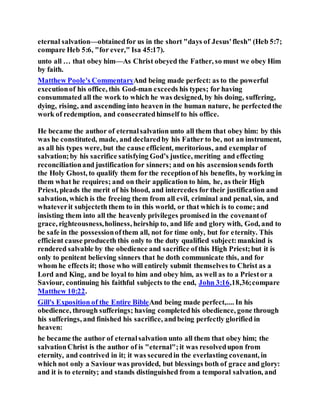
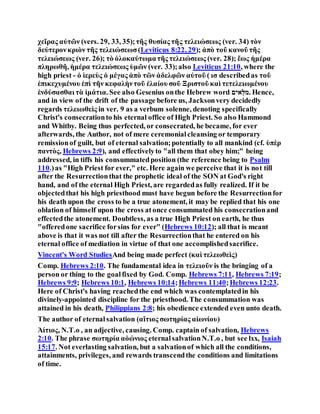
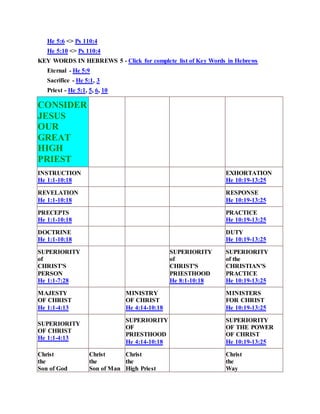
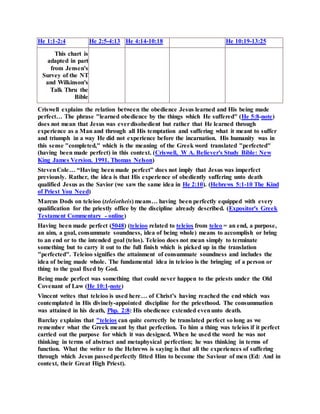
Hebrews 5:9 9
and, once made perfect, he became the
source of eternal salvationfor all who obey him
BIBLEHUB RESOURCES
Pulpit Commentary Homiletics
Salvation- Its Author And Its Recipients
Hebrews 5:9
W. Jones And being made perfect, he became the Author, etc. The subject of
the writer in this part of his Epistle is the high priesthood of Jesus Christ. In
treating this subjecthe dwells upon the sufferings of Christ in his priestly
office, and a certainperfection which resulted from his sufferings. He was
God's only and well-belovedSon, yet he was not exempt from suffering. "He
learned obedience by the things which he suffered." We must not suppose that
he was not perfectly acquainted with the nature of obedience, or that he did
not fully recognize the duty of it, or that he was in any way indisposedto
render it, before he suffered. The meaning is that though he was so highly
exalted in his relationship to the Father, yet "he was subjectedto learn
experimentally what it is to obey in the midst of suffering." He learnedthe
lessonperfectly. He "became obedientunto death, even the death of the
cross."Our text leads us to consider three things.
I. THE PERFECTIONWHICH CHRIST ATTAINED THROUGH
SUFFERING. "And having been made perfect." Having assumedhuman
nature, Christ was capable of suffering; and in that nature he did indeed
suffer. His entire life upon earth was one of humiliation and sacrifice. Being
sympathetic, the sufferings of men were a constantgrief to him. Being holy,
the sins of men constantly stung his soul with pain. At the last his sufferings
deepenedinto awful intensity. In Gethsemane his sorrow and conflict almost
brought down his human nature unto death. And on the cross his pain and
woe were unutterable, and to us inconceivablysevere. Of all sufferers Christ
is the Sufferer. In all these sufferings he was obedient. He endured them
voluntarily. Through his obedience in suffering he became perfect. The author
of our salvationwas made "perfectthrough sufferings" (Hebrews 2:10). This
acquired perfection was not personalAs God he is eternally perfect; as man
he was perfect without suffering. The perfection of our text is relative. By
suffering he Became perfectin his relation to us as our Savior, our
Intercessor, ourgreatHigh Priest. By suffering:
1. He made a perfect atonement for sin.
2. He became perfectly qualified to sympathize with and to succorhis
suffering people. (Cf. Hebrews 4:14-16)
3. He became a perfect example for his people in their sufferings.
4. He entered upon his perfecttriumph and glory. (Cf. Hebrews 2:9; Hebrews
12:2; Philippians 2:5-11.)
II. THE GREAT END BOTH OF CHRIST'S SUFFERING AND OF HIS
PERFECTIONACQUIRED THROUGH HIS SUFFERING. This end was
that he might Be the Author, or the greatprocuring cause, ofa perfect
salvationfor men. "Being made perfect, he became the Author of eternal
salvation." Here are three points.
1. The salvation. Forgiveness ofsin, freedom from condemnation, deliverance
from the sovereigntyof sin, the awakening of a new ruling principle and
powerin man, conversioninto a condition of holiness, peace andjoy, entrance
into heaven, blessedunion with God.
2. The perpetuity of salvation. "Eternal salvation." No partial, incomplete,
temporary Blessing;but "eternalsalvation" - "the salvationwhich is in Christ
Jesus with eternal glory." Does not this, at least, suggestthat there is no
falling back from the hand of Christ into the power of Satan? Doubtless man
always cando so, inasmuch as he is morally free; but this "eternalsalvation"
establishes man's freedom, yet binds it to holiness, and leads him to cry, "I
delight to do thy will, O my God." This Blessing shallcontinue when bonds
and banks, estates andfortunes, coronets and crowns, shallhave perished.
BlessedBe the Lord for his "eternalsalvation"!
3. The Author of salvation. Our salvation is owing to Jesus Christ. The
ministry of providence, of religious ordinances, and of goodmen, may assist
us in availing ourselves ofthis salvation; but they cannot save us; they are not
"the cause ofsalvation." Our salvationoriginatedin the infinite love of God.
"Godso loved the world," etc. Our salvationwas effectedby his Son, our
Savior. He became man, taught, labored, suffered, lived, died, and ever lives
to save us. He is our only Savior. The greatend of his sufferings was our
"eternalsalvation."
III. THE RECIPIENTSOF THIS SALVATION. "Unto all them that obey
him." This, of course, does notmean that we merit salvationby obeying the
Savior. But those who have merely some doctrinal knowledge ofChrist and
his salvation, those who have only a dead. faith in him, a mere intellectual
assentto the greatfacts of his history and teaching, are not partakers ofhis
salvation. As he attained his mediatorial perfection and glory by complete and
hearty obedience to his Father, so must man obey him if we would attain unto
"eternalsalvation." Salvationis found in obedience to him, because:
1. True and saving faith inspires the life and shapes the conduct. (Of. Acts
15:9; Romans 16:26; Galatians 5:6; James 2:17-26.)
2. Christ saves men from their sins. He is a Prince to rule us, as well as a
Savior to deliver us.
3. All who are being savedby Christ love him, and the loving heart delights to
obey the loved One.
4. The disobedient cannot enter heaven. Heavenis a realm of perfect
obedience to the supreme will, of loyal and loving devotion to God's service.
Unless the spirit of hearty obedience be ours, we are out of sympathy with
heaven.
CONCLUSION.
1. Trust this perfectSavior.
2. Obey him. Copy his own obedience. - W.J.
Biblical Illustrator
With strong crying and tears.
Hebrews 5:7-11
The exercise ofthe Sonof Godin His agony
Alex. Shanks.I. In the first place we shall illustrate the definition of THE
SEASON OF THE AGONY OF THY, SON OF GOD in these words: "The
days of His flesh." In general, it may he observedthat the application of the
term "flesh" to the mystery of His incarnation is remarkable. By the
application of this term something more is expressedthan the subsistence of
our nature in His person.
1. The beginning of these days is at His birth. In His birth the Son of God
entered into the infirmities of our flesh, and, for our sakes,exposedHimself
not only to sufferings attending ordinary births, but unto hardships peculiar
to the circumstances ofHis own extraordinary birth.
2. These days ended at His resurrection. The human nature subsisting in the
person of the Son of God, was the same nature after His resurrectionthat it
had been before His death. But the likeness, orappearance, was different.
Before His death it had "the likeness ofsinful flesh";after His resurrectionit
appearedin the original glory of human nature subsisting still in His person.
3. The number of these days is not exactlyknown. The Author of revelation is
the Judge of what is proper to appear in the witness which He hath testified of
His Son, and what is proper to be concealed.
4. These were the days of His sufferings and temptations. At their beginning,
the Sonof Godentered into His sufferings, and suffered every day until their
end.
5. Towardthe close ofthese days He suffered an agony. Dayafter day, all the
days of His flesh, He waded deeperand deeper in the oceanof sorrow, and
toward the last the waves rose high and broke over Him in the fury and
vengeance ofthe curse.
6. These were the days of His supplication, prayers, and tears.
II. But in regardour text refers unto THE PRAYERS AND
SUPPLICATIONS WHICH IN THE CLOSE OF THE DAYS OF HIS
FLESH HE OFFERED UP, under His agony, we proceedto the secondhead
of our generalmethod, and shall illustrate these words of the text: "WhenHe
had offeredup prayers and supplications, with strong crying and tears, unto
Him who was able to save Him from death."
1. "Offering up prayers and supplications" is the actionof the Son of God
under His agonyin the close of the days of His flesh. In our nature, He is "the
High Priestof our profession";and His suffering and dying for our sins are
representedin many texts of Scripture as actions of a priest offering sacrifice,
and making atonementand reconciliationfor sins.
2. "To Him who was able to save Him from death," is the description of the
objectunto whom the Son of God, under His agony, in the days of His flesh,
offered up prayers and supplications. In our nature, and in that station
wherein the Sonof Godstood, He consideredHis righteous and holy Father as
possessing sovereignpowereverHim with respectto life and death, and
executing the curse upon Him according to the penalty of the law; He
consideredHim as able, not to deliver Him from dying-this is not the objectof
His prayers — but to uphold His suffering nature in conflicting with the pangs
and sorrows ofdeath, and to save Him from the mouth of the lion, and from
the horns of the unicorn, or from being overcome by the prince of this world
who had the power of death; and He consideredHim as able to loose the cords
and pains of death, and, through the blood of the everlasting covenant, to
bring Him againfrom the dead by a glorious resurrectionon the third day.
3. "Strong crying and tears" are expressions ofthe fervency with which the
Son of God, under His agony, in the close ofthe days of His flesh, offered up
prayers and supplications to His righteous Father, who was able to save Him
from death.
III. We proceedto illustrate His ACCEPTANCE,whichis affirmed by the
apostle in the latter part of our text: "Heard in that He feared."
1. The nature of that fear, which is ascribedto the Son of God under His
agony, is to be ascertained. The term used by the apostle, and translated
"fear," signifies godlyfear, accompaniedwith weaknessand feelings in the
present frame of our nature. Impressions of the holiness of His Father,
togetherwith sensations ofHis displeasure, sunk deep into His soul, and
affectedevery member of His body, exciting that fearwhich is the sum of
obedience and the essenceofadoration, and which, in His state, was
accompaniedwith infirmities and feelings of flesh and blood. Obedience and
adorationwere in His prayer; and His agonyitself, in one consideration, was
suffering affliction, and, in another, subjection to the will and obedience to the
commandment of His Father.
2. We shall collectseveralprinciples which gave force to the operation of fear
in the Son of God under His agonyin the days of His flesh.(1)His
apprehensions of the glory and majestyof His Father were clearand
sublime.(2) His burden was heavy and pressedHis suffering nature to the
ground.(3) His sensations ofthe wrath and curse of God were deep and
piercing.(4)His temptations were violent and extraordinary.(5) The sorrows
of death drew up and stoodbefore Him in battle array. But while His soulwas
offering for sin, and sorrowing even unto death, every desponding and gloomy
apprehension which attackedHis faith was resistedand broken, and full
assurance ofHis hope of a resurrectionby the glory of the Fatherheld firm
unto the end. Thy right hand, triumphant Sufferer, doth ever valiantly!
3. The sense in which the Son of God under His agony, in the days of His flesh,
was heard is to be ascertainedand illustrated.(1) The prayers and
supplications, which in the days of His flesh the Son of God offeredup unto
Him who was able to save Him from death, were answered.(2)His fatigued
and dying nature was strengthened.(3)His sacrifice was accepted;and, in the
odour of perfection, came up before His Fatherwith a sweet-smelling
savour.(4)His body was raisedfrom the dead and saw no corruption.(5) He
was receivedup into heaven, crowned with glory and honour, and made
Captain of salvation, to bring unto glory the multitude of sons.
IV. After illustrating the severalparts of our text, SOME APPLICATIONS
are proper for reproof, correction, and instruction, unto the peculiar people
who are in the fellowship of God's dear Son in the first place;and, in the
second, unto the children of disobedience who will not enter into this holy
fellowship.
1. "Holy brethren, considerthe Apostle and High Priest of our profession."
ConsiderHis infirmities, considerHis temptations, considerHis conflict,
considerHis example, consider His acceptance, andconsider His divinity.
2. After these considerations whichhave been addressedunto the peculiar
people who are in the fellowshipof the mystery of godliness, we would have
the children of disobedience to consider the existence and holiness of God; the
provocationwhich they have given Him; the necessityof reconciliation;the
access to the benefit of the reconciliationwhich the merciful and faithful High
Priestof our professionmade for the sins of the people; and the penal and
certain consequences ofrefusing the benefit of this reconciliation.
(Alex. Shanks.)
The mental sadness of Christ
Homilist.I. HIS MIND WAS THE SUBJECT OF INTENSE EMOTIONS.
II. A DREAD OF DEATH SEEMS TO HAVE BEEN ONE OF HIS MOST
DISTRESSING EMOTIONS.
III. UNDER THIS MOST INTENSEEMOTIONHE SOUGHT RELIEF IN
PRAYER.
IV. HIS PRAYERS WERE ANSWEREDIN CONSEQUENCE OF HIS
PIETY. The dread was takenawayand strength given to bear it.
(Homilist.)
The benefit arising to Christ from His ownsufferings
TheologicalSketch-Book.I. His CONDUCT UNDER HIS SUFFERINGS.
Neverwere the sufferings of any creature comparable with those of Christ.
His bodily sufferings perhaps were less than many of His followers have been
calledto endure — but those of His soul were infinitely beyond our conception
(Psalm 22:14, 15;Matthew 26:38; Luke 22:44). Under them He poured out
His heart in prayer unto His heavenly Father. He never lostsight of Godas
His Father, but addressedHim with the greaterearnestness under that
endearing title (Mark 14:36). Not that He repented of the work He had
undertaken; but only desired such a mitigation of His sufferings as might
consistwith His Father's glory and the salvationof men. Nor did He desist
from prayer till He had obtained His request. Him the Father always heard;
nor was an answernow denied Him. Though the cup was not removed, He
was not suffered to faint in drinking it. His sufferings indeed could not be
dispensed with; but they were amply recompensedby —
II. THE BENEFIT HE DERIVED FROM THEM.
1. Personal. It was necessaryforHim, as our High Priest, to experience
everything which His people are calledto endure in their conflicts with sin
and Satan(Hebrews 2:17). Now the difficulty of abiding faithful to God in
arduous circumstances is exceeding great. This is a trial which all His people
are calledto sustain. Though as the Son of God He knew all things in a
speculative manner, yet He could not know this experimentally, but by being
reduced to a suffering condition. This therefore was one benefit which He
derived from His sufferings. He learned by them more tenderly to sympathise
with His afflicted people, and more speedily to succourthem when imploring
His help with strong crying and tears (ver. 18).
2. Official. As the priests were consecratedto their office by the blood of their
sacrifices,so was Jesus by His own blood. From that time He had a right to
impart salvation.
III. LEARN —
1. What we should do under sufferings, or a dread of God's displeasure. We
should not hastily conclude that we are not His children (Hebrews 12:6). We
should rather go with humble boldness to God as our Father(Luke 15:17, 18).
We should plead His gracious promises (Psalm51:15).
2. Whither to go for salvation. The Fatherwas "able to save His Son from
death." And doubtless He can save us also. But He has exalted His Son to be a
Prince and a Saviour (Acts 5:31). To Christ therefore we are to go, and to the
Father through Christ (Ephesians 2:18). In this way we shall find Him to be
the author of eternal salvationto us (Hebrews 7:25).
3. What is to be our conduct when He has savedus? Jesus died "to purchase
to Himself a peculiar people zealous of goodworks." We must therefore obey
Him, and that too as willingly in seasons ofsevere trial as in times of peace.
We must be content to be conformed to the likeness ofour Lord and Master.
Let us be faithful unto death (Revelation2:10).
(TheologicalSketch-Book.)
Our sympathising High Priest
C. H. Spurgeon.I. First, that we may see the suitability of our Lord to deal
with us in our cares and sorrows, we shallview Him as A SUPPLIANT.
1. The text begins with a word which reveals His weakness:"Who in the days
of His flesh." Our blessedLord was in such a condition that He pleaded out of
weakness withthe God who was able to save. When our Lord was compassed
with the weaknessofflesh He was much in prayer.
2. In the days of His flesh our Divine Lord felt His necessities. The words, "He
offered up prayers and supplications," proved that He had many needs. Men
do not pray and supplicate unless they have greaterneed than this world can
satisfy. The Saviour offered no petitions by wayof mere form; His
supplications arose outof an urgent sense ofHis need of heavenly aid.
3. Further, let us see how like the Sonof God was to us in His intensity of
prayer. The intensity of His prayer was suchthat our Lord expressedHimself
in "crying and tears." Since from His lips you hear strong crying, and from
His eyes you see showers oftears, you may well feel that His is a sympathetic
spirit, to whom you may run in the hour of danger, even as the chicks seek the
wings of the hen.
4. We have seenour Lord's needs and the intensity of His prayer; now note
His understanding in prayer. He prayed " unto Him that was able to save Him
from death." The expressionis startling; the Saviour prayed to be saved. In
His direst woe He prayed thoughtfully, and with a clearapprehensionof the
characterof Him to whom He prayed. It is a great help in devotion to pray
intelligently, knowing well the characterof God to whom you are speaking.
Jesus was aboutto die, and therefore the aspectunder which He viewed the
greatFather was as " Him that was able to save Him from death." This
passagemay be read in two ways:it may mean that He would be savedfrom
actually dying if it could be done consistentlywith the glorifying of the Father;
or it may mean that He pleaded to be saved out of death, though He actually
descendedinto it. The word may be rendered either from or out of. The
Saviour viewed the greatFather as able to preserve Him in death from the
powerof death, so that He should triumph on the Cross;and also as able to
bring Him up againfrom among the dead.
5. It will further help you if I now call your attention to His fear. I believe our
old Bibles give us a correcttranslation, much better than the RevisedVersion,
although much canbe saidfor the latter, "With strong crying and tears unto
Him that was able to save Him from death, and was heard in that He feared."
That is to say, He had a fear, a natural and not a sinful fear; and from this
fear He was delivered by the strength brought to Him from heavenby the
angel. God has implanted in all of us the love of life, and we cannot part from
it without a pang: our Lord felt a natural dread of death.
6. But then notice another thing in the text, namely, His successin prayer,
which also brings Him near to us. He was heard "in that He feared." O my
soul! to think that it should be said of thy Lord that He was heard, even as
thou. a poor suppliant, art heard. Yet the cup did not pass from Him, neither
was the bitterness thereofin the leastabated.
II. Behold our Lord as A SON. His prayers and pleadings were those of a son
with a father.
1. The Sonship of our Saviour is well attested. The Lord declaredthis in the
secondPsalm:"Thou art My Son; this day have I begotten Thee." Thrice did
the voice out of the excellentglory proclaim this truth, and He was "declared
to be the Son of God with power, according to the spirit of holiness, by the
resurrectionfrom the dead." So, when you are put to great grief, do not doubt
your sonship.
2. Being a Son, the text goes onto tell us that He had to learn obedience. How
near this brings our Lord to us, that He should be a Sonand should have to
learn! We go to schoolto Christ and with Christ, and so we feel His fitness to
be our compassionateHigh Priest.
3. Jesus must needs learn by suffering. As swimming is only to be learned in
the water, so is obedience only learned by actually doing and suffering the
Divine will.
4. The Lord Jesus Christlearned this obedience to perfection.
5. Our Lord learned by suffering mixed with prayer and supplication. His was
no unsanctified sorrow, His griefs were baptised in prayer. It costHim cries
and tears to learn the lessonofHis sufferings. He never suffered without
prayer, nor prayed without suffering.
III. Behold the Lord Jesus as A SAVIOUR.
1. As a Saviour He is perfect. Nothing is lacking in Him in any one point.
Howeverdifficult your case may seem, He is equal to it. Made perfectby
suffering, He is able to meet the intricacies of your trials, and to deliver you in
the most complicatedemergency.
2. Henceforth He is the author of salvation. Author! How expressive!He is the
cause i,f salvation;the originator, the worker, the producer of salvation.
Salvationbegins with Christ; salvationis carried on by Christ; salvation is
completed by Christ. He has finished it, and you cannotsad to it; it only
remains for you to receive it.
3. Observe that it is eternalsalvation: " the author of eternal salvation." Jesus
does not save us to-day and leave us to perish to-morrow; He knows whatis in
man, and so He has prepared nothing less than eternalsalvation for man.
4. Furthermore, inasmuch as He has learnedobedience and become a perfect
High Priest, His salvationis wide in its range, for it is unto "all them that obey
Him."
5. Note, that He is all this for ever, for He is "a priest for ever." If you could
have seenHim when He came from Gethsemane, yonthink you could have
trusted Him. Oh! trust Him to-day, for He is " called of God to be an High
Priestafter the order of Melchizedec," andthat order of Melchizedec is an
everlasting and perpetual priesthood. He is able today to plead for you, able
to-day to put away your sins.
(C. H. Spurgeon.)
Christ in the infirmity of the flesh
John Owen, D. D.I. THE LORD JESUS CHRIST HIMSELF HAD A TIME
OF INFIRMITYIN THIS WORLD. It is true His infirmities were all sinless,
but all troublesome and grievous. By them was He exposedunto all sorts of
temptations and sufferings, which are the two springs of all that is evil and
dolorous unto our nature. A-d thus it was with Him not a few days, nor a
short seasononly, but during His whole course in this world.
1. It was out of infinite condescensionand love unto our souls, that Christ took
on Himself this condition (Philippians 2:6-8).
2. As He had other ends herein, for the-e things were indispensably required
unto the discharge ofthe sacerdotaloffice, so He designedto set us an
example, that we should not faint under our infirmities and sufferings on their
account(Hebrews 12:2, 3; 1 Peter4:1).(1) His patience, unconquerable and
unmovable in all things that befell Him in the days of His flesh (Isaiah42:2).
Whateverbefell Him, He bore it quietly and patiently.(2) His trust in God. By
this testimony that it is said of Him, "I wilt put My trust in God," doth our
apostle prove that He had the same nature with us, subject to the same
weakness andinfirmities (Hebrews 2:13). And this we are taught thereby, that
there is no managementof our human nature, as now besetwith infirmities,
but by a constanttrust in God.(3) His earnest, fervent prayers and
supplications, which are here expressedby our apostle, and accommodated
unto the days of His flesh.
II. A LIFE OF GLORY MAY ENSUE AFTER A LIFE OF INFIRMITY. We
see that it hath done so with Jesus Christ. His seasonof infirmity issuedin
eternal glory. And nothing but unbelief and sin can hinder ours from doing so
also.
III. THE LORD CHRIST IS NO MORE NOW IN A STATE OF
WEAKNESS AND TEMPTATION;THE DAYS OF HIS FLESH ARE PAST
AND GONE. With His death, ended the days of His flesh. His revival or
return unto life, was into absolute, eternal, unchangeable glory.
IV. THE LORD CHRIST FILLED UP EVERY SEASON WITH DUTY,
WITH THE PROPERDUTY OF IT. The days of His flesh, were the only
seasonwhereinHe could offer to God; and He missed it not, He did so
accordingly. It is true, in His glorified state, He continually represents in
heaven, the offering that He made of Himself on the earth, in an effectual
application of it unto the advantage of the elect. But the offering itself was in
the days of His flesh. Then was His body capable of pain, His soul of sorrow,
His nature of dissolution, all which were necessaryunto this duty.
V. THE LORD CHRIST, IN HIS OFFERINGUP HIMSELF FOR US,
LABOURED AND TRAVAILED IN SOUL, TO BRING THE WEEKUNTO
A GOOD AND HOLY ISSUE. A hard labour it was, and as such, it is here
expressed. He went through it with fears, sorrows,tears, outcries, prayers,
and humble supplications.
1. All the holy, natural affections of His soul were filled, takenup, and
extended to the utmost capacity, in acting and suffering.
2. All His graces,the gracious qualifications ofHis mind and affections were,
in a like manner, in the height of their exercise. Boththose whose immediate
objectwas God Himself, and those which respectedthe Church, were all of
them excited, drawn forth, arid engaged. As(1)Faith and trust in God. These
Himself expresseth, in His greatesttrial, as those which He betook Himself
unto (Isaiah 50:7, 8; Psalm 22:9, 10; Hebrews 2:13). These gracesin Him were
now tried to the utmost. All their strength, all their efficacywas exercisedand
proved.(2) Love to mankind. As this in His Divine nature was the peculiar
spring of that infinite condescension, wherebyHe took our nature on Him, for
the work of mediation (Philippians 2:6-8); so it wrought mightily and
effectually in His human nature, in the whole course ofHis obedience, but
especiallyin the offering of Himself unto God for us.(3) Zealto the glory of
God. This was committed unto Him, and concerning this, He took care that it
might not miscarry.(4) He was now in the highestexercise ofobedience unto
God, and that in such a peculiar manner as before He had no occasionfor.
3. He did so also with respectto that confluence of calamities, distresses, pains,
and miseries, which was upon His whole nature. And that in these consisted
no small part of His trials, wherein He underwent and suffered the utmost
which human nature is capable to undergo, is evident from the description
given of His dolorous sufferings both in prophecy (Psalm 22.;Isaiah 53.)and
in the story of what befell Him in the evangelists. And in this manner of His
death, there were sundry things concurring.(1) A natural signof His readiness
to embrace all sinners that should come unto Him, His arms being, as it were,
stretchedout to receive them (Isaiah 45:22, 1).(2)A moral tokenof His
condition, being left as one rejectedof all betweenheaven and earth for a
season;but in Himself interposing betweenheavenand .earth for the justice of
God and sins of men, to make reconciliationand peace (Ephesians if. 16,
17).(3)The accomplishmentof sundry types; as —(a) Of that of him who was
hanged on a tree, as cursedof the Lord (Deuteronomy 21:22).(b) Of the
brazen serpentwhich was lifted up in the wilderness (John 2:14), with respect
whereunto He says, that when He is lifted up, He would draw all men to Him
(John 12:32).(c)Of the wave-offering, which was moved, shaken, and turned
severalways, to declare that the Lord Christ in this offering of Himself,
should have respectunto all parts of the world, and all sorts of men (Exodus
29:26).(4)The conflictHe had with Satan, and all the powers of darkness, was
another part of His travail. And herein He laboured for that victory and
successwhichin the issue He did obtain (Colossians 2:13, 14;Hebrews 2:14; 1
John 3:18).(5) His inward conflict, in the making His soul an offering for sin,
in His apprehensions, and undergoing of the wrath of God due unto sin, hath
been already spokenunto, so far as is necessaryunto our presentpurpose.(6)
In, and during all these things, there was in His eye continually that
unspeakable glorythat was set before Him, of being the repairer of the
breaches ofthe creation, the rest,referof mankind, the captain of salvation
unto all that obey Him, the destruction of Satan, with his kingdom of sin and
darkness, and in all the greatrestorerof Divine glory, to the eternal praise of
God. Whilst all these things were in the height of their transaction, is it any
wonder if the Lord Christ laboured and travailed in soul, according to the
description here given of Him?
VI. THE LORD CHRIST, IN THE TIME OF HIS OFFERING AND
SUFFERING, CONSIDERINGGOD WITH WHOM HE HAD TO DO, AS
THE SOVEREIGN LORD OF LIFE AND DEATH, AS THE SUPREME
RECTOR AND JUDGE OF ALL, CASTS HIMSELF BEFOREHIM WITH
MOST FERVENT PRAYERS FOR DELIVERANCE,FROM THE
SENTENCE OF DEATHAND THE CURSE OF THE LAW.
1. HOW greata matter it was, to make peace with God for sinners, to make
atonement and reconciliationfor sin. This is the life and spirit of our religion,
the centre wherein all the lines of it do meet (Philippians 3:8-10 Corinthians if.
2; Galatians 6:14).
2. A sight and sense ofthe wrath of God due unto sin, will be full of dread and
terror for the souls of men, and will put them to a greatconflict with wrestling
for deliverance.
VII. IN ALL THE PRESSURESTHAT WERE ON THE LORD JESUS
CHRIST, IN ALL THE DISTRESSES HE HAD TO CONFLICT WITHAL
IN HIS SUFFERING, HIS FAITH FOR DELIVERANCE AND SUCCESS
WAS FIRM AND UNCONQUERABLE. This was the ground He stoodupon
in all His prayers and supplications.
VIII. THE SUCCESS OF OUR LORD JESUS CHRIST, IN HIS TRIALS, AS
OUR HEAD AND SURETY, IS A PLEDGE AND ASSURANCE OF
SUCCESS UNTO US IN ALL OUR SPIRITUAL CONFLICTS.
(John Owen, D. D.)
Christ's sufferings
E. Deering, B. D.In this one sentence there is more for us to learn than either
eye hath seenor earhath heart or all flesh in this life shall attain unto: it is the
depth of the glorious gospelwhich the angels do desire to behold.
I. We have to learn by the example of our Saviour Christ in this place, THAT
IN ALL TEMPTATIONS WE SHOULD APPROACHUNTO OUR GOD,
and make our complaints unto Him, who is only able and ready for to help us.
In all miseries we are not sunken so deep in sorrow as He that for our sakes
made prayers end supplications, with strong cryings and with tears, and was
delivered from His fear.
II. The secondpoint that we have here to learn in this example of our Saviour
Christ is, TO KNOW UNTO WHOM WE SHOULD MAKE OUR PRAYERS
IN THE DAY OF TROUBLE, which the apostle testifieth in these words: that
Christ made His prayers unto Him that was able to deliver Him from death. It
followethin the text: with greatcrying and with tears.
III. Here we have to NOTE, IN WHAT MEASURE OUR SAVIOUR CHRIST
WAS AFFLICTED, evenso far, that He cried out in the bitterness of His soul.
Who hath been ever so full of woe, and who hath been brought so low into the
dust of death? His virtues were unspeakable, and righteous above all measure,
yet was He accountedamong the wicked. And if these were the causesthat
Christ had to complain, then think not that His cryings were above His
sorrow;to see so near unto His heart, even in His own person, innocence
blamed, virtue defaced, righteousnesstrodden down, holiness profaned, love
despised, glory contemned, honour reviled, all goodness ashamed, faith
oppugned, and life wounded to death; how could He yet abstain from strong
crying and tears, when the malice of Satanhad gottenso great a conquest?
His grief was exceeding to see all virtue and godliness so trodden under feet
and Satanto prevail againstman, to his everlasting condemnation. No
creature could ever bear such a perfect image of a man of sorrow. But the
height and depth of all miseries was yet behind: the sin that He hated He must
take it upon His own body, and bear the wrath of His Father, that was poured
out againstit. This is the fulness of all pain that compassedHim round about,
which no tongue is able to utter, and no heart canconceive.
IV. But let us now see what the apostle further teachethus, and while our
Saviour Christ is in these greatextremities, WHAT FRUIT OF WELL-
DOING HE HATH LEARNED BY IT. It followeth, and although He were the
Son, yet learned He obedience by the things He suffered. Lo, this was no little
profit of all His troubles; He learned thereby, how and what it was to obey His
Father; He might have greatboldness that His obedience was perfect. The
shame of the world, the afflictions of the flesh, the vexations of the mind, the
pains of hell, when these could make Him utter no other words but," Father,
as Thou wilt, so let it be done," what hope, what faith did He surely build on,
that His obedience was precious in the sight of His Father? This example is
our instruction. We know then best how we love the Lord, when we feel by
experience what we will suffer for His sake. So faint not in your mournings,
but endure patiently; you know not the happiness of that which seemethyour
misery; let this be the first cause why we should be glad of temptations. Lo,
these are the healthful counsels ofthe Lord towardus, that we should be made
like unto His Son Christ in many afflictions, that at the last we might be also
like Him in eternal glory. Thus far we have heard two specialcauseswhy we
ought to rejoice in all temptations: the one, that so we learn true obedience;
the other, that by them we be made like unto Christ. The third cause atthis
time which I will touch, is this: God sendeth us sundry chastisements, and
especiallythat which is most grievous of all other, the anguish of spirit, and
affliction of the soul; for this purpose, that we should be warned in time how
to turn unto Him and be free from the plague when it cometh. It followethin
the apostle:"And being consecrate, He was made the author of salvation to all
them that obey Him."
V. In these words we are taught, WHAT FRUIT AND COMMODITYWE
HAVE THROUGH THESE BITTER SUFFERINGSOF OUR SAVIOUR
CHRIST, AND ALSO BY WHAT MEANS WE ARE MADE PARTAKERS
OF IT. The fruit is eternalsalvation, the means to go unto it is obedience. In
the first we learn that all promise and hope of life is in Christ alone;He hath
alone the words of life, and he that dwelleth not in Him, shall see no life: but
the wrath of God abideth on him. Take hold of Christ, and take hold of life;
reachforth thine hand to any other thing, and thou reachestunto vanity
which cannot help.
(E. Deering, B. D.)
Distractions in prayer
E. B. Pusey, D. D.Such is the pattern which He, who is our pattern, gives us of
acceptable effectualprayer. What are our prayers? Heavy, for the most part,
and earthly; often we are unwilling to begin them, readily falling in with some
plea, why we should not pray now, readily ceasing. And well may we have no
pleasure in prayers such as we too often offer. Or of those she really desire to
pray, how many have their minds so little controlledat other times, or so
thronged with the things of this life, that the thoughts of the world pour in
upon them, when they would pray. Step by step, we sunk amid the
distractions of the world, and stepby step only may we hope that our Father
will raise us out of the mire wherein we plunged ourselves. Rut our first step,
the very beginning and condition of our restoration, is to unlearn the
distractions whereby we have been beset. In seeking to remedy our
distractions, our first labour must be to amend ourselves. Suchas we are at
other times, such will our prayers be. A person cannot be full of cares, and
riches, and pleasures, and enjoyments, and vanities of this life, up to the very
moment when he falls down at God's footstool, and leave these companions of
his other hours behind him, so that they will not thrust themselves in with him
into the holy presence. We cannotkeepour thoughts disengagedatprayer, if
they are through the day engaged;we cannot keepout vain thoughts then, if
at other times we yield to them. We must live more to God, if we would pray
more to God; we must be less engrossedwith the world, if we would not have
the world thrust itself in upon our prayers and stifle them. But still further,
even when we would serve God, or do our duty in this life, we must see that we
do our very duties calmly. There is a religious, as well as a worldly,
distraction. We may mix up self in doing duty, as well as when we make self
our end. Religious excitement, or excitement about things of religion, may as
effectually bar our praying as eagernessaboutworldly things. We may be
engagedaboutthe things of God, yet our mind may all the while centre in
these things, not in God. Holy Scripture joins these two together, calmness or
sobriety and prayer; " Be ye therefore sober, and watch unto prayer." Peace
is the beginning and end of prayer; its condition and its reward. Resign
yourselves, that ye may pray, and God will guard your thoughts, and hold
them to Himself. If, also, you would guard againstwandering in prater, you
must practise yourself in keeping a check upon your thoughts at other times.
In this busy age, in which every one would know about everything, and, like
the Athenians, our occupationseems to be to know some new thing, and what
conveys news is thought the instrument of knowledge,and knowledge ofevery
sort is thought a good, it is not a light matter, but one to which we must take
greatheed; what we hear, and admit into our minds. Our minds are holy
things: they are the temples of God; and so, for His honor's sake who has so
hallowedthem, we should be on our guard what we allow to enter there. Be
not curious about things which concernyou not: what happens in the street,
or passes by you, or befalls a neighbour, unless charity requires it of you.
These things waste the mind more than you canwell think. Rather recollect
that your concernis not with the world; your home, your hopes, your abiding-
place, is not here, but in God; your citizenship is not on earth, but in the
heavens;your places here shall shortly know you no more; the earth shall
contain no more of you than the dust of your bodies, in keeping for you
againstthe resurrection. Then, on the other hand, as we seek, during the day,
to weakenthe hold which the world has upon us and our thoughts, so must we
by His grace to strengthen our own capacityof turning to God. Away from the
world and to God! Commit to Him thoughts, words, and works, to be
"orderedby His governance, to do that is righteous in His sight";to be
"begun, continued, and ended" in Him. So when you come to your fuller and
more set devotions, you may hope that He, whom you serve continually, will
keepyou then also, and will vouchsafe Himself to visit you, and be in your
thoughts, which you would fain make His, and will shut out the world by
filling your thoughts with Himself. It is the infrequency of prayer which
makes prayer so difficult. It is not a greateffort now and then, which makes
the things even of this life easyto us; it is their being the habit of our bodies or
our minds. It was by continued exercise whichwe were not aware of, that our
bodies, as children, were strengthened; it was by continued practice that we
learnt anything. By continued gazing at far-off objects, the eye sees further
than others; by continued practice the hand becomes steadiedand obeys the
motions of our mind. So and much more must the mind, by continual exercise,
be steadied, to fix itself on Him whom it cannotgrasp, and look up to Him
whom it cannotsee. Yea, so much the more exceedinglymust it with strong
effort fix itself by His grace onHim, because we cannotsee Him or approach
to Him, but by His revealing Himself and coming down to us, and giving us
eyes to see and hearts to comprehend; and this He will do only to the earnest
and persevering, and to us severally, as we are such. They then will pray best,
who, praying truly, pray oftenest. This, also, is one greatblessing of the
practice of ejaculatoryprayer, that is, prayer which is darted up from the
mind in the little intervals which occur, whateverwe are doing, Nothing goes
on without breaks, to leave us space to turn to God. Amid conversationthere
is silence;in the busiestlife there are moments, if we would mark them, when
we must remain idle. We are kept waiting, or we must bear what is
wearisome;let prayer take the place of impatience. In preparing for business,
let prayer take the place of eagerness;in closing it, of self-satisfaction. Are we
weary? be it our refreshment! Are we strong? let us hallow our strength by
thanksgiving! The very preparation or close ofany business brings with it of
necessitya pause, teaching us by this very respite to begin and end with
prayer; with prayer beforehand for His help, or at the end thanksgiving to
Him who carried us through it, or for pardon for what has been amiss in it.
Such are some of the more distant preparations for prayer, such as it should
be, fixed and earnest;to strive to make God, not the world, the end of our
lives; not to be taken up even with our duties in the world, but amid them to
seek Him; to subdue self, and put a restraint upon our senses atother times,
that we may have the controlover them then; to lift our thoughts to Him at
other times, so will they rise more readily then. These are, in their very
nature, slowly learnt. Yet as, if wholly learnt, it were heaven itself, so is each
step, a stepheavenwards. Yet there are many more immediate helps, at the
very time of prayer. Neglectnothing which can produce reverence. Pass notat
once from the things of this world to prayer, but collectthyself. Think what
thou art, what God is; thyself a child, and God thy Father; but also thyself
dust and ashes, God, a consuming fire, before whom angels hide their faces:
thyself unholy, God holy; thyself a sinner, God thy Judge. Then forgetnot
that of thyself thou canstnot pray. We come before Him, as helpless
creatures, who need to be taught what to ask for, and knowing, to be enabled
to ask, and a-king, to be enabled to persevere to ask. Thenwatch thyself, what
helps or hinders thee to fix thy mind on God. Then as to the words of our
prayer: we should beware how we pass hastily over any of our prayers. It is
not how much we say, but what we pray, which is of real moment. Then, the
best models of prayer consistof brief petitions, as suited to men in need; for
when they really feel their need, they use not many words. "Lord, save us, we
perish," is the cry of need. And so the petitions of the pattern of all prayer,
our Lord's, are very short, but eachcontaining manifold prayers. So are the
Psalms in prayer or praise:"Blot out all mine iniquities," "Create in me a
new heart," "Castme not awayfrom Thy presence,""Save me by Thy
Name." In this way we may collectour strength and attention for each
petition, and so pray on, step by step, through the whole, resting at eachstep
on Him, who alone can carry us to the end, and if, by human frailty, we be
distracted, sum up briefly with one strong concentratedeffort what we have
lost by wandering. In public prayer the case is different. For here, if we
wander, the prayers meanwhile go on, and we find that we have losta portion
of our daily bread; that God's Church on earth has been praising with angels
and archangels andthe Church in heaven, while we have been bringing our
sheepand our oxen and our money-changing, the things of this life, into God's
presence and the court of heaven. Yet the remedies are the same, and we have
even greaterhelps. The majesty of the place may well awe us with devotion,
and will aid us to it, if we waste not its impressiveness by our negligence or
frivolity. Come we then calmly to this holy place, not thinking or speaking, up
to its very threshold, of things of earth, but as men bent on a greatservice,
where much is at stake;coming to a holy presence, from whom depends our
all. Pray we, as we enter it, that God would guard our thoughts and compose
oar minds and fix them on Him. Employ we any leisure before the service b,
gins, in thought or private prayer; guard we our eyes from straying to those
around us; listen we reverently to His holy word; use the pause before each
prayer to ask Godto enable us to pray this prayer also;and so pray each
separate prayer, as far as we can, relying on His gracious aid. Yet we are not
to think that by these or any other remedies distraction is to be cured at once.
We cannotundo at once the habit, it may be, of years. Distractionwill come
through weakness,ill-health, fatigue: only pray, guard, strive againstit;
humble yourselves under it, and for the pastnegligences,ofwhich it is mostly
the sadfruit; rely less upon yourself, castyourselfmore upon God, hang more
wholly upon Him, and long the more for that blessedtime, when the redeemed
of the Lord shall serve Him day and night without distraction.
(E. B. Pusey, D. D.)
Begging prayers
Henry T. Williams. — A little boy, one of the Sunday-schoolchildren in
Jamaica, calledupon the "missionaryand statedthat he had lately been very
ill, and in his sickness oftenwishedhis minister had been presentto pray with
him. "But Thomas," saidthe missionary, "I hope you prayed." "Oh yes, sir."
"Well, how did you pray?" "Why, sir, I begged."
(Henry T. Williams.)
The grace oftears"LordJesus, give me the grace oftears."
( Augustine.)
Tears a safety-valve
Albert Smith.The safety-valve of the heart when too much pressure is laid on.
(Albert Smith.)Yet learned He obedience by the things which He suffered.
Suffering the schoolof obedience
ArchdeaconH. E. Manning.I. GOD HAS LAID EVEN UPON SORROW
THE DESTINYOF FULFILLING HIS PURPOSES OF MERCY. In the
beginning, sorrow was the wages ofsin, penal and working death; by the law
of Christ's redemption, it is become a discipline of cleansing and perfection.
To the impenitent, and such as will not obey the truth, it is still, as ever, a dark
and crushing penalty; to the contrite and obedient it is as the refiner's fire,
keenand searching, purging out the soils, and perfecting the renewalof our
spiritual nature. It is the discipline of saints, and the safest, though the
austerest, schoolofsanctity; and that because suffering, or, as we are wont to
say, trial, turns our knowledge into reality. There is laid upon us a mighty
hand, from whose shadow we cannotflee. All generaltruths teem with a
particular meaning, and speak to us with a piercing emphasis. Equally true
this is, also, ofall bright and blessedtruths: they also are quickened with a
living energy. The promises of heaven, and the times of refreshing, and the
rest of the saints, and the love of God, and the presence ofChrist, which we
have so long thought of, and talkedabout, and felt after, and yet never seemed
to grasp — all these likewise become realities. Theyseemto gather round us,
and shed sensible influences of peace upon our suffering hearts; and this is
what we mean when we say, "I have long known these things to be true, but
now I feelthem to be true."
II. And, in the next place, SUFFERINGSSO PUT OUR FAITH ON TRIAL
AS TO STRENGTHEN AND CONFIRM IT. They develop what was lying
hid in us, unknown even to ourselves. And therefore we often see persons, who
have shown no very greattokens of high devotion, come out, under the
pressure of trials, into a more elevatedbearing. This is especiallytrue of
sicknessand affliction. Notonly are persons of a holy life made to shine with a
more radiant brightness, but common Christians, of no note or visibleness,
are changedto a saintly character. They wrestle with their trial, as the
patriarch with his unknown companion, and will not let it go without a
blessing;and thereby the gifts which lie enwrapped in a regenerate nature are
unfolded into life and energy.
III. Once more: NOTHING SO LIKENS US TO THE EXAMPLE OF
CHRIST AS SUFFERING.All that suffer are not therefore saints; alas!far
from it, for many suffer without the fruits of sanctity; but all saints at some
time, and in some way and measure, have entered into the mystery of
suffering. And this throws light on a very perplexing thought in which we
sometimes entangle ourselves;I mean, on the wonderful factthat oftentimes
the same persons are as visibly marked by sorrows as by sanctity. They seem
never to pass out of the shadow of affliction; they seemto be a mark for all the
storms and arrows of adversity, the world esteems them to be "stricken,
smitten of God, and afflicted"; even religious people are perplexed at their
trials. When we see eminently holy persons suddenly bereaved, or suffering
sharp bodily anguish, and their trials long drawn out, or multiplied by
succession, we oftensay, How strange and dark is this dispensation!Who
would have thought that one so poor, so patient, and resigned, should have
been so visited and overwhelmedby strokes?And yet all this shows how
shallow and blind our faith is, for we know little even of those we know best;
we readily overrate their character, at all events they are far otherwise in the
esteemof God than in our judgment; our thoughts are not His thoughts: we
setup a poor, dim, depressedstandard of perfection and we should miserably
defraud even those we love most if it were in our powerto mete out their trials
by our measures;we little know what God is doing, and how can we know the
way? And we often think that the sorrows ofthe saints are sent for their
punishment, when they are sent for their perfection. We forgetthat Christ
suffered, and why; and how He learned obedience, and what that obedience
was. He was made "perfect" by sufferings, and that "perfection," whatsoever
it be, has an ineffable depth of meaning. It was not only a sacerdotal
perfection by consecrationto the priesthood of Melchisedec,but something of
which that was the formal expressionand manifestationof a great spiritual
reality, a perfection of holiness, knowledge,obedience, sympathy, and will.
And of this perfection, after the measures ofa creature, and the proportions
of our mere manhood, are the saints made to partake;they are purified, that
they may be made perfect.
(ArchdeaconH. E. Manning.)
Learning obedience
T. V. Tymms."ThoughHe was a Son, He learned." Though a Son, i.e., though
He was so exalteda being, not a mere servant like the angels, but One whom
the angels worship. Nota servant like Moses orlike Aaron, but the Son by
whom God made the worlds, yet even He had something to learn, and learned
it in the days of His flesh. There is a mystery here, yet if we are content to
inquire instead of speculate we shall find sufficient answer. There is light in
the word " obedience." He learned not the art and wisdom of commanding,
this belongedto His Eternal Nature. But obedience is an art which belongs of
right to lower ranks of being. The Highest cannot, as the Highest, obey, for
there is no authority above His own. Obedience may be taught from a throne,
but it cannotbe learned by one who occupies it. Thus, even the Son of God
might learn obedience if He saw fit to empty Himself of Divine prerogative
and take upon Him the form of a servant, wearing our human nature and
accepting our duties and temptations. Therefore because obedienceis so
foreign to the Divine nature, it is a thing which the Sonof God could learn by
becoming incarnate, and could only learn by stooping to share our discipline
and bear the Divine will as a yoke instead of wield it as a sceptre. Viewing the
Sonship of Christ under another aspect, it might have been thought that a
perfect Sonwould have needed no more teaching, and that when found in
fashion as man, His filial spirit, His perfect readiness to obey would have
sufficed. But this is denied. Having become a servant, having come down
under the yoke of commandments, it is insisted that the Sonwent right
through the actualcourse of human discipline, evading nothing, missing
nothing, until He crownedHis obedience by submission, even unto death.
Though a Son He learnt obedience by suffering. Could He not learn it
otherwise? We know that suffering is needful in our case because ourspirits
are so faulty, because we are so prone to err and go astray. But a Son, a
perfect SonI surely such an One having no share in our defects might have
learnt obedience without pain! Can we be wrong in such a view? Perhaps not.
If a faultless Son beganlife in a faultless world; if He were born into a sinless
family, or were createdin a paradise where no fall had takenplace, He might
possibly have learned obedience by a painless and unfailing life of conformity
to the Father's will. But whatevermight have been possible in heaven or in
paradise, painless obedience was not possible in the moral wilderness. In a
world where sin abounded Christ had constantly to choose betweenaffliction
and iniquity. Without using miraculous powers to screenHimself from the
natural consequences ofHis actions, He was obliged to suffer. The suffering
was at once the measure and test of His obedience, and thus it was He passed
through pain to perfectness as a learner in the schoolof human life. This must
be so, yet still our hearts cry out in pity for One so holy and true — surely it
was not needful for Him to suffer so much! Could not the Fatherhave spared
His well-belovedSon such extreme agonies while obedience was being
learned? The answeris clear. This might have been possible under some
circumstances. An easierlife might have been laid out for Jesus as it is laid out
for most of us. He might have lived obediently in the midst of plenty. Why
then should the Father be pleasedto set His well-belovedSon such agonising
tasks, why be pleasedto bruise and put to grief the Son who always did His
will? That is a question which admits of many answers. It is one which none
but the Father Himself canansweraltogether, yet part of His answershines
before us here. The Son of God came not to learn obedience for Himself, but
for our sakes.He came not merely to become perfect As a man before God
who reads the heart, but to be visibly perfect before men who can only read
actions. He came to be made thus visibly perfect not only as a man, but as a
Saviour and as the Author of obedience in us. Look at a few reasons why
death, the death of the Cross, was needfulto this end. Christ came to set us an
example. He came to do much more than this, but that was one greatobjectof
His incarnation. But if He had stopped short of obedience unto death, He
would have left no example how we ought to act when shut up to the dilemma
of being obliged to either sin or die. Christ came to magnify Divine law, to
make it venerable in our sight, and to declare the entire rightness of God's
will. While God's will appoints us a path of flowers, and while duty brings
honour and reward, gratitude and trust are easy. But when duty runs straight
into a Red Sea!When it leads to a fiery furnace! When the soul, intent on
doing right, finds itself alone, misunderstood, and persecuted, then is the time
when the enemy finds a listening earfor his slander, "Godis careless,""God
is cruel," "God is unfaithful to those who are most faithful to Himself."
Where then would be the value of Christ's testimony to the goodnessofGod's
will when most in danger of being doubted, if He Himself had been spared this
terrible temptation? "Be thou faithful unto death";we can hear that from
Christ. Christ came to revealthe Divine sympathy with us in all our
afflictions, but that revelationwould have been very partial if destitute of any
kindly light to shed on dying eyes. We are not all called to martyrdom, hut we
have all to die. But where could we have seenthe sympathy of Christ with
ourselves as mortal, if He had left the world by a private door of rapture?
Wherefore to be our sympathetic Friend in the dark valley, Jesus was
obedient even unto death. Christ came to preach the forgiveness ofsins, to
declare the righteousness ofGod in the actof forgiveness,to commend the
love of God to all men, including the very chief of sinners and the most
malignant of His foes;and in all these things He must have failed had His
obedience stoppedshort of death. Wherefore Jesus was obedientunto death.
Christ came to bring life and immortality to light, and for this end it was
needful He should die and rise again. The mere continuance of His life would
have had no revelation of a future life to us. But an emptied grave visibly
spoils death, breaks the bars of Hades, preaches resurrectionto us, who have
to die, and reveals Jesus as the first-fruits of them that slept. Wherefore that
He might be the Author of an eternal salvationand bring life end immortality
to light, the Son was obedient unto death.
(T. V. Tymms.)
Christ a learner
J. W. Massie,D. D.I. THE DIVINE EXALTATION OF THE CHARACTER
OF HIM WHO IS THE REDEEMEROF MEN, A Son. "Though He were a
Son," "The Son of God," as in the previous context. We understand this
expressionas in the first place presenting the Redeemerin the nature, and
with the attributes of Deity.
II. His GRACIOUS CONDESCENSION."ThoughHe were a Son, yet learned
He obedience," &c. Here we behold the Son of God, He who was infinite in
excellencyand in working, condescending to become a learner, placing
Himself in circumstances in which He might receive instruction. No doubt the
Spirit of Godthat was in Him taught Him better than the scribe, or priest, or
ruler, or parent could; but the child Jesus, growing up to manhood, learned,
receivedthe wisdom, the counsel, the instruction that is from God. But,
"though He were a Son," He learned something more than knowledge.He
learned how to obey. What affections were involved in obedience!What
satisfactionresultedto the obedient mind! What intimate and fervent
communion existed betweenHim that was obeyedand Him that did obey! But
the lowliestcondescensionthat we mark is, that He learned obedience by
suffering. There are many who are willing to obey, and who find pleasure in
obedience, whenthere is only joy, when there is the reward of obedience;but
to go through the deep flood, to pass under the dark cloud, to penetrate the
fiery furnace, and to endure all that could be heaped in the shape of sorrows,
and woes, andto do this that He might "learn obedience" — this was Christ's
condescension. Ah! but He suffered more than this. "The contradiction of
sinners againstHimself" He suffered. He "learned obedience" by suffering
ingratitude from those to whom He showedmercy. He suffered contumely and
reproach, He entered into our sorrows. He Himself "took our griefs and
carried our sorrows." Stillfarther, and even more painful, was His
humiliation. We know what it is to be convinced of sin; we know what it is to
be overwhelmed with shame for sin. I know that Jesus knew no sin; but oh, in
this I see the poignancyof His grief, when all our sins were made to meet on
Him. And He was "made perfect" — He condescendedto be made perfect"by
the things which He suffered," that He should be a perfectly righteous person
in the midst of the most trying circumstances — that He should love even unto
death, though death was heapedupon Him for His love.
III. THE END TO BE ACCOMPLISHED BYHIS HUMILIATION. "That
He might become the author of eternal salvationunto all them that obey
Him." How much there is in those words! There would have been no salvation
for guilty men if Jesus had not come to die. It is in Christ's excellencies
originally; it is in Christ as the perfect Saviour that we can alone have
confidence towards God. He is the author of salvation, inasmuch as He has
"takenawaysin by the sacrifice of Himself"; He is the author of salvation,
inasmuch as He has endured the curse of the brokenlaw, and delivered us
from the sentence ofcondemnation; He is the author of salvation, inasmuch as
He has receivedfrom His Fatherthe promised Spirit, by which poor guilty
sinners are regenerated, and faith wrought in them, to trust in Jesus and His
finished work;He is the author of salvation, inasmuch as He has gone to
heaven to carry on the work, and He ever lives to make intercessionfor His
people, and is " able to save to the very uttermost all that come unto God by
Him." He is the author of salvation, for it is the gospelthat produces the
happy change, that translates from the kingdom of darkness into the kingdom
of light and glory. But it is "eternalsalvation." It is a salvation that, having
been begun, will never be interrupted; it is a salvationthat will be unto the
end; it is a salvationthat will be found, in its consummation, in the presence of
God, where "there is fulness of joy," and at His right hand, where "there are
pleasures for evermore." "Unto all them that obey Him." You will mark what
the obedience is which Christ requires. If He be a Son, He has authority. In
His characterofSon He is "setat the right hand of the Majestyon high."
Now, to obey Christ is to fulfil that which He has enjoined: in the first place,
to acceptof Him as He is offered; in the next place, to come to Him as He
invites; in the third place, to trust in Him as He warrants;in the fourth place,
to plead His finished work, and to seek the enjoyment of forgiveness through
His continual intercession. Bowing to His sceptre, taking up His cross, uniting
ourselves to His people, giving ourselves, first to the Lord, and then to one
another, according to His will. All those that thus obey Him have the
assurance thatHe is "the author of eternalsalvation unto them." Not by
works of righteousness thatthey have done, but they are savedfor His sake,
and the work is wrought in them for His glory, and they are obedient to Him,
having been "made willing in the day of His power."
(J. W. Massie, D. D.)
The suffering Son
John Owen, D. D.I. INFINITE LOVE PREVAILED WITH THE SON OF
GOD, TO LAY ASIDE THE PRIVILEGE OF HIS INFINITE DIGNITY,
THAT HE MIGHT SUFFER FOR US AND OUR REDEMPTION.
"Although He was a Son, yet He learned," &c.
1. The name of "Son" carriethwith it infinite dignity, as our apostle proves at
large (Hebrews 1:3, 4, &c.).
2. He voluntarily laid aside the consideration, advantage,and exercise ofit,
that He might suffer for us. This our apostle fully expresseth(Philippians 2:5-
8). Concerning which we must observe, that the Son of God could not
absolutely and really part with His eternal glory. WhateverHe did, He was
the Sonof God, and God still. But He is saidto empty Himself of His Divine
glory —
(1)With respectto the infinite condescensionofHis person.
(2)With respectto the manifestations of it in this world.
II. IN HIS SUFFERINGS, AND NOTWITHSTANDING THEM ALL, THE
LORD CHRIST WAS THE SON STILL, THE SON OF GOD. He was so both
as to realrelation and as to suitable affection. He had in them all the state of a
Son, and the love of a Son.
III. A PRACTICAL EXPERIENCEOF OBEDIENCE TO GOD IN SOME
CASES WILL COST US DEAR. We cannot learn it but through the suffering
of those things which will assuredlybefall us on the accountthereof. So was it
with the Lord Christ. I intend not here the difficulties we meet withal in
mortifying the internal lusts and corruptions of nature, for these had no place
in the example here proposedto us. Those only are respectedwhich come on
us from without. And it is an especialkind of obedience also, namely, that
which holds some conformity to the obedience of Christ, that is intended.
Wherefore —
1. It must be singular; it must have somewhatin it, that may, in an especial
manner, turn the eyes of others towards it.
2. It is required that this obedience be universal. Sufferings will attend it.
They that live godly in Christ Jesus shallsuffer persecution. For this kind of
obedience will be observedin the world. It cannotescape observation, because
it is singular" and it provokes the world, because it will admit of no
compliance with it. And where the world is first awakenedand then enraged,
suffering of one kind or another will ensue. If it do not bite and tear, it will
bark and rage.
IV. SUFFERINGSUNDERGONEACCORDINGTO THE WILL OF GOD
ARE HIGHLY INSTRUCTIVE. EvenChrist Himself learned by the things
which He suffered, and much more may we who have so much more to learn.
God designs our sufferings to this end, and to this end He blesseththem.
V. IN ALL THESE THINGS, BOTH AS TO SUFFERING, AND
LEARNING, OR PROFITING THEREBY, WE HAVE A GREAT
EXAMPLE IN OUR LORD JESUS CHRIST. AS such is He proposedunto us
in all His course of obedience, especiallyin His sufferings (1 Peter2:2). For He
would leave nothing undone which was any way needful, that His greatwork
of sanctifying and saving His church to the utmost might be perfect.
VI. THE LOVE OF GOD TOWARDS ANY, THE RELATION OF ANY
UNTO GOD, HINDERS NOT BUT THAT THEY MAY UNDERGO GREAT
SUFFERINGSAND TRIALS. The Lord Christ did so, "although He were a
Son." And this instance irrefragably confirms our position. For the love of
God to Jesus Christ was singular and supereminent. And yet His sufferings
and trials were singular also. And in the whole course ofthe Scripture we may
observe that the nearer any have been unto God, the greaterhave been their
trials. For —
1. There is not in such trials and exercisesan) thing that is absolutely evil, but
they are all such as may be rendered good, useful, honourable to the sufferers.
2. The love of Godand the gracious emanations ofit can, and do, abundantly
compensate the temporary evils which any do undergo according to His will.
3. The glory of God, which is the end designedunto, and which shall infallibly
ensue upon all the sufferings of the people of God, and that so much the
greateras any of them, on any account, are nearer than others unto Him, is
such a goodunto them which suffer, as that their sufferings neither are, nor
are esteemedby them to be evil.
(John Owen, D. D.)
The educationof sons of God
C. H. Spurgeon.I. SONSHIP DOES NOT EXEMPT FROM SUFFERING.
1. Noteven Jesus, as a Son, escapedsuffering.
2. No honour put upon sons of God will exempt them from suffering.
3. No holiness of character, nor completeness ofobedience, canexempt the
children of God from the schoolof suffering.
4. No prayer of God's sons, howeverearnest, will remove every thorn in the
flesh from them.
5. No love in God's child, howeverfervent, will prevent his being tried.
II. SUFFERING DOESNOT MAR SONSHIP. The case ofour Lord is set
forth as a model for all the sons of God.
1. His poverty did not disprove His Sonship (Luke 2:12).
2. His temptations did not shake His Sonship (Matthew 4:3).
3. His endurance of slander did not jeopardise it (John 10:36).
4. His fear and sorrow did not put it in dispute (Matthew 26:39).
5. His desertion by men did not invalidate it (John 16:32).
6. His bring forsakenofGod did not alter it (Luke 23:46).
7. His death castno doubt thereon (Mark 15:39). He rose again, and thus
proved His Father's pleasure in Him (John 20:17).
III. OBEDIENCEHAS TO BE LEARNED EVEN BY SONS.
1. It must be learned experimentally.
2. It must be learned by suffering.
3. It must be learned for use in earth and in heaven.
(1)On earth by sympathy with others.
(2)In heaven by perfect praise to God growing out of experience.
IV. SUFFERING HAS A PECULIAR POWER TO TEACH TRUE SONS. It
is a better tutor than all else, because —
1. It touches the man's self; his hone, his flesh, his heart.
2. It tests his graces, andsweeps awaythose shams which are not proofs of
obedience, but pretences ofself-will.
3. It goes to the root, and tests the truth of our new nature. It shows whether
repentance, faith, prayer, &c., are mere importations, or home-grown fruits.
4. It tests our endurance, and makes us see how far we are establishedin the
obedience which we think we possess. Canwe say, "ThoughHe slay me, yet
will I trust in Him"?
(1)The anxious question — Am I a son?
(2)The aspiring desire — Let me learn obedience.
(3)The accepteddiscipline — I submit to suffer.
(C. H. Spurgeon.)
Instructed by suffering
C. H. Spurgeon.Ibear my willing witness that I owe more to the fire, and the
hammer, and the file, than to anything else in my Lord's workshop. I
sometimes question whether I have ever learnedanything exceptthrough the
rod. When my school-roomis darkened, I see most.
(C. H. Spurgeon.)
Suffering a goodteacherof divinityA minister was recovering from a danger,
bus illness, when one of his friends addressedhim thus, "Sir, though God
seems to be bringing you up from the gates ofdeath, yet it will be a long time
before you will sufficiently retrieve your strength, and regain vigour enough
of mind to preachas usual." The goodman answered, "Youare mistaken, my
friend: for this six weeks'illness has taught me more divinity than all my past
studies and all my ten years'ministry put together."
Christ's experience of obedience
J. H. Newman, D. D.Obedience belongs to a servant, but accordance,
concurrence, co-operation, are the characteristicsofa son. In His eternal
union with God there was no distinction of will and work betweenHim and
His Father;as the Father's life was the Son's life, and the Father's glory the
Son's also, so the Sonwas the very Word and Wisdom of the Father, His
Powerand Co-equal Minister in all things, the same and not the same as He
Himself. But in the days of His flesh, when He had humbled Himself to "the
form of a servant," taking on Himself a separate will and a separate work,
and the toil and sufferings incident to a creature, then what had been mere
concurrence became obedience. This, then, is the force of the words, "Though
He was a Son, yet had He experience of obedience." He took on Him a lower
nature, and wrought in it towards a Will higher and more perfectthan it.
Further, "He learned obedience amid suffering," and therefore amid
temptation. Before He came on earth He was infinitely above joy and grief,
fear and anger, pain and heaviness;but afterwards all these properties and
many more were His as fully as they are ours. Before He came on earth He
had hut the perfections of God, but afterwards He had also the virtues of a
creature, such as faith, meekness, self-denial. Before He came on earth He
could not be tempted of evil, but afterwards He had a man's heart, a man's
tears, and a man's wants and infirmities. His Divine nature indeed pervaded
His manhood, so that every deed and word of His in the flesh savouredof
eternity and infinity; but, on the other hand, from the time He was born of the
Virgin Mary, He had a natural fearor danger, a natural shrinking from pain,
though ever subjectto the ruling influence of that Holy and Eternal Essence
which was in Him. Thus He possessedatonce a double assemblageof
attributes, Divine and human. Still He was all-powerful, though in the form of
a servant; still He was all-knowing, though seemingly ignorant; still incapable
of temptation, though exposedto it.
(J. H. Newman, D. D.)
Made perfect.
The perfectSon
L. Adamson, D. D.I. THE PERFECTIONOF THE CHARACTER OF
CHRIST. Of the manner of His life before He assumedthe office of a public
teacherwe know almost nothing, exceptthat He was not addicted to studious
retirement, nor to the acquisition of human science,whichhave been
employed by teachers offalse religions to dazzle the ignorant; but that, living
in the common intercourse of society. He laboured in the occupationof His
reputed father, increasing in mind as in stature. When He appearedas the
MessengerofHeaven He was already complete in the graces whichHis high
characterdemanded, and that knowledge which was requisite for a teacherof
righteousness. His pure life is the best illustration of His moral precepts. His
doctrines were, literally, tidings of joy, for He disclosedthe mercy and grace
of the Divine nature towards penitent offenders, which all the efforts of the
human understanding could never perfectly ascertain. He disclosedthe high
destination of man; He brought life and immortality clearly to light through
His gospel. His precepts, also, were goodtidings; He spake wholesome words,
prescribing a doctrine according to godliness;His aim was to purify the heart
and mind, and to teachus to live soberly, righteously, and godly, to qualify us
for the glory and immortality which He had unfolded. In His temper and
manners Christ exhibited a perfect model of all that canadorn and dignify
human nature; "He did no sin, nor was guile found in His mouth." But it was
not innocence nor purity only that were found in His character;the highest
virtues of our nature were peculiarly His; He exhibited a life, not only of strict
justice, but of overflowing benignity and mercy, of the most tender
compassion, andthe most ardent piety. These virtues were so mingled,
tempered, and contrasted, as to render the whole assemblagedelightful,
graceful, and perfect. the whole life of Christ was a pattern of the sanctity and
beauty which He portrayed in His discourses. Christwas perfectin His
manner of communicating and enjoining His instructions; He spake with
authority, yet with an admirable modesty and simplicity, beautifully
calculatedto inform and to impress the mind and the heart; He inculcates the
most important lessons withsimplicity and plainness adapted to human
capacity;preferring use to the glare of ornament, no quaint play of words
weakensthe force of His emphatic language;all is chaste and pore alike —
full of energyand of grace. Considered, then, even as a man, the characterof
Christ is perfect — nowhere canwe find another so resplendent and so
pleasing — so amiable and so venerable — one which presents so much for
our admiration and our love; its beauties are peculiar, its awful greatness and
dignity are relieved by the most concilating tenderness. "Christwas made
perfect." This expression, besides the meaning in which we have hitherto
takenit, has a specialreference to the subject which is describedin this
chapter; that subject is the priesthood and the sacrifice of Christ. Christ was
made perfect by possessing the natural qualifications of the High Priest. He
was able to have compassiononthe ignorant, the sinning, the weak, and the
afflicted, because He Himself was compassedwith infirmity. In proof of this
the apostle appeals to facts well known in the days of His flesh. He offeredup
prayers and supplications with strong crying and tears. If sympathy arises
from the experience of suffering, and fellowship in affliction, we may well rely
on the fellow feeling of the High Priest, who was made perfectthrough
suffering. whether, then, we view Christ as a teacherof righteousness, oras a
High Priestof goodthings to come, the perfectionof His nature is evident.
II. THE COMPLETE SALVATION OF WHICH HE IS THE AUTHOR.
III. THE CHARACTER OF THOSE TO WHOM THIS SALVATION IS
IMPARTED. Whenwe considerthe high benefits procured for us by Christ,
our hearts are naturally animated with the most grateful affection;and the
natural expressionof that affectionis obedience to the will of our benefactor.
That a goodand ingenuous mind naturally dictates as our right conduct on
such occasions is the very conduct which our Redeemerrequires — that we
may be made meet to be partakers of ,he blessings He hath purchased.
1. What you have heard now affords a most delightful subject of
contemplation. What canbe more pleasantto the human mind than to
considerthe mercy of our Heavenly Father, who hath sentHis Son into the
world to save us — the unsullied purity of the Redeemer's character — the
glorious privileges which He has conferredon this state of being, and the
unfading joys He hath promised in the world to come?
2. It affords a subjectof devout gratitude. What can warm the heart with
lively and pious affectionmore than the display of that love of God, who sent
His Sonto die for us while we were yet sinners?
3. It affords a subjectfor watchful attention. While the pardon of sin has been
purchased by Christ, and the hope of heaven offeredto our view, we are not
releasedfrom the obligations to duty.
(L. Adamson, D. D.)
Jesus, the model of perfection
R. Newton, D. D.I. In the first place, we see the perfection of Jesus as our
Saviour — in the PERFECTEXAMPLE He sets us. He is an example not of
one point of characteronly, but of every point. And He is perfectin them all.
He never failed in any of them. A young man had a situation as clerk in a
mercantile house in one of our large cities. In writing home to his mother one
day he said, "I have been connectedin business, at different times, with a
number of merchants, all of them members of Christian churches; but I must
say that Mr. Johnson, with whom I am now employed, is the best of them all,
in the way in which be governs himself by his religion, in all his business
affairs. I take greatpleasure in watching how faithfully he does this. I must
say of him that he is a Christian all over." It was a greathonour to this good
merchant that one of his clerks should feelobliged to speak thus of him. Now
let us remember these last two illustrations; and let us all try to follow the
example which Jesus sets us, in such a waythat we may be Christians in little
things — and Christians all over.
II. Jesus is a perfect Saviour, in the secondplace, because He gives us
PERFECTHELP. There are three things about Jesus which make Him a
perfect Helper.
1. He is — a near helper. Many persons, when they are in need of help, can
think of their friends at home, who would be glad to help them. But they are
far away, and it is impossible for them to do anything in the way of helping.
But how different it is with Jesus!He is in every place. He is always near. "He
is a God" — a helper — "athand, and not afar off." And this is one thing that
makes Him a perfect Helper.
2. He is — able to help. It sometimes happens that though our friends are near
us in our trouble, yet they are not able to help us. But it is not so with Jesus.
Nothing is impressible with Him. His ability to help is perfect. St. Paul tells us
that — "He is able to save," and to helps" unto the uttermost." "He is able to
do exceeding abundantly above all that we can ask or think."
3. He is willing to help. As one of our beautiful collects says, "He is more
ready to hear than we to pray, and is wont to give more than either we desire
or deserve."
III. But, in the third place, He is a perfect Saviour, because He prepares for
His people a PERFECTHOME in heaven. He will make their bodies perfect,
after the pattern of His own glorious body, as it appeared on the Mount of
Transfiguration. He will make their souls perfect. They will be entirely free
from sin for ever. He will put them in a perfect home.
(R. Newton, D. D.)
The author of eternalsalvation.
Eternal salvationin Christ
J. Cumming, D. D.In what respects is He called"the author of eternal
salvation"? I answer, He is ,he author of it, first in this sense, He rendered it
possible for the justice, the holiness, and the truth of God, to bestow salvation
on whom these attributes could not bestow it, and would not suffer it to be
bestowedon other terms — that is, inconsistently with the glory and the
honour of God. He could not save but by suffering; He could not ransom us at
a less price than His death; and rather than see a world perish, He would not
save Himself from being perfectedby suffering, that we might be savedfrom
irretrievable perdition. Again, He is the author of salvation in this sense, that
He bestows it. He is exalted, "a Prince and a Saviour to give repentance and
remissionof sins." Moreover, Christis the sole author of eternal salvationto
all them that obey Him. He says to you, "Take allthe benefit, and the only
tribute I exactis a tribute which honours me and does not impoverish you —
the tribute of praise and thanksgiving;" in heart, in lip, in life. Having seen
the exclusivenessofHis work, and the exclusiveness ofHis jurisdiction and of
His claims to the glory and honour, let us now inquire what salvationis, and
what salvationmeans. He is the author of eternalsalvation to all them that
obey Him. His greatestgloryis, not that He made the universe, nor yet that
He rules the universe, but that He has redeemeda lost world; lost, not by His
oversight, but by our sin; and by His Cross has brought it back to Himself a
redeemed, a reinstated, and a renovated orb. What is this salvationwhich is so
precious? It is a twofold thing, very easily explained and understood. Two
greatcalamities have struck us from the Fall; namely, that we have lost a
right to heaven by having justly forfeited it, and that if we had the right we
have lost all fitness for it and desire for it by having become polluted, unholy,
impure, corrupt. What will be to us salvationmust be a provision that will put
us right in both respects. The gospeldoes so, orrather our greatHigh Priest
does so. He gives us, first of all, by His sacrifice, His death, a recoveryfrom
the curse which we had earned; and by His obedience or righteousness,
imputed to us, He entitles us to the inheritance which we had forfeited; and by
the gift of His Holy Spirit, "whom," He says, "I will send unto you,"! It
regeneratesour hearts, gives us new tastes, new sympathies, new thoughts,
new life — in short, a new nature. And then one single epithet bestowedupon
this salvationmarks its character;it is "eternalsalvation." Now Adam's
standing was not eternal;it was liable to forfeiture. But our recovered
standing in heaven is eternal, and never liable to any forfeiture. Having seen
this, let me notice, in the next place, the characterof them for whom it is
provided. He became by His consecrationthe author of eternal salvationto all
them that obey Him. First, I observe here there is no national monopoly. It is
not saidto the Jews, and not to the Gentiles, but it is "to all them that obey
Him." In other words, Christianity is not the peculiarity of an age, not the
monopoly of a nation, nor the restriction of a sect;it is not only offeredto the
election, but it is for all them that obey Him. But, you ask, in the next place,
and very justly, What do you mean by obeying? My answeris, that the word
"obey" is not the just expression. The Greek word means, first, "to listen,"
"to hear," "to hearken";secondly, to submit to, to acquiesce;and thirdly, not
its strict meaning, but its intrinsic meaning, to obey, or render obedience to.
Salvationis not like a gleamof sunshine that falls upon the evil and the good,
but something that is given only to them that intelligently acceptit, submit to
it — receive it just as Christ reveals it to them. The patient only that takes the
prescription makes a step towards recoveryfrom his illness. In order to be
benefited by the gospelyou must take it just as it is offered, not upon your
own terms, but upon the terms of the offerer, and thus alone do you receive
eternal salvation.
(J. Cumming, D. D.)
The Saviour you need
C. H. Spurgeon.I. THE UNDOUBTED WILLINGNESS OF JESUS CHRIST
TO SAVE. "Being made perfect, He became the author of eternalsalvation."
Now, if we find that He was willing to undergo the process whichmade Him
completely fit for the office of a Saviour, we may certainly conclude that He is
willing enoughto exercise the qualifications which He has obtained.
II. THE PERFECTFITNESS OF THE SAVIOUR FOR HIS WORK. We will
view the fitness both Godwardand manward.
1. View it Godward. Sinner, if any one is to deal with God for you so as to
avail on your behalf, he must be one of God's choosing, for"no man taketh
this honour upon himself, but he that was calledof God, as was Aaron. So also
Christ glorified not Himself to be made as high priest, but He that said unto
Him, Thou art My Son, to-day have I begottenThee." WhatGod appoints it
must be safe for us to accept. In order that Jesus Christ, being appointed,
should be fit for His office, it was necessarythat He should become man.
Surely it is the sin of sins if we reject a Saviour who has made such a stoop in
order to be perfectly qualified to save. "Being found in fashion as a man," it
was necessarytowards Godthat Jesus should fulfil the law, and work out a
perfect obedience. The High Priestwho is to intercede for us must wearupon
his forehead"Holiness unto the Lord"; and truly such a High Priest we have,
for Jesus is "holy, harmless, undefiled, and separate from sinners." Norwas
this all towards God. The High Priestwho should save us must be able to offer
a sufficient sacrifice, efficacious to make atonement, so as to vindicate eternal
justice and make an end of sin.
2. Christ Jesus, as our High Priest, needed to be perfected manward. O sinner,
considerHis perfections as they concernyourself. That He might save us He
must have power to pardon, and to renew our hearts; these He has to the full,
for all poweris given unto Him in heaven and in earth; He both gives
repentance and remission. There is one delightful thing in Christ's perfect
qualification to save, namely, that He "everliveth to make intercessionfor
us." If Jesus Christwere dead and had left us the boon of salvationthat we
might freely help ourselves to it, we should have much to praise Him for; but
He is not dead, He is alive. He left us a legacy, but many a legacyis left which
never gets to the legatee:lo, the greatMakerof the will is alive to carry out
His own intentions. He died, and so made the legacygood;He rose againand
lives to see that none shall rob any one of His belovedof the portion He has
left. What think you of Christ pleading in heaven? Have you everestimated
the powerof that plea?
III. THE HIGH POSITION WHICH OUR LORD JESUS TAKES IN
REFERENCETO SALVATION. According to the text, "He became the
author of eternal salvation." He is the designer, creator, worker, andcause of
salvation.
IV. THE REMARKABLE CHARACTER OF THE SALVATION WHICH
CHRIST HAS WROUGHT OUT. He is the author of eternalsalvation. Oh,
how I love that word "eternal"!"Eternalsalvation!"
1. It is an eternal salvationas opposedto every other kind of deliverance.
2. It is eternal salvationin this sense, that it rescues frometernal
condemnation and everlasting punishment.
3. It is eternal salvationas opposedto the risk of falling awayand perishing.
4. It will ripen into eternalbliss.
V. THE PERSONSCONCERNEDIN THIS SALVATION. "TO all them that
obey Him." The word "obey" signifies "obedience upon hearing," and this
indicates faith. To obey Christ is in its very essence to trust Him; and we
might read our text as if it said, "The author of eternalsalvation to all them
that believe in Him." If you would be saved your first actof obedience must
be to trust Jesus wholly, simply, heartily, and alone. Recline your soul wholly
on Jesus and you are savednow.
(C. H. Spurgeon.)
Jesus Christ the author of eternal salvation
E. Cooper, M. A.I. THE OFFICE OF CHRIST, "He is the author of eternal
salvation." He has undertaken to give back to us a title to heaven and a fitness
for it. He has undertaken to save us from the dominion of sin, from the power
of the devil, from the pains of hell. He has undertaken to make us the children
of God, and heirs of eternal glory.
II. His FITNESSFOR DISCHARGING THIS OFFICE.
1. He was appointed of God to be our High Priest. This appointment was
absolutely necessaryto make Him duly fitted for the discharge ofHis office.
Without it we could have had no certainty that God would acceptHis
mediation.
2. He had wherewith to offer for the sins of the people. He was able "to make
reconciliationfor iniquity"; to offer such a sacrifice forsin as would take it
away;and to deliver sinners from the punishment due to them by taking it
upon Himself. Thus was "the Captain of our salvationmade perfect through
suffering."
3. Christ is able effectually to intercede for His people. First, in that "He ever
liveth to make intercessionforus." Secondly, in that He has something
available to plead in our behalf, even the infinite merits of His own sufferings.
4. He is not only a priest, but a king. "The government is upon His shoulders."
Whateverhappens in nature and in providence is under His control. The gift
of the Spirit it-elf is at His disposal. He is " King of kings, and Lord of lords";
and "shallreign" as Mediator, "till He hath put all enemies under His feet."
III. THE PERSONSTO WHOM THE BENEFIT OF HIS MEDIATION
WILL REACH. Christ "died for all." He "tasteddeath for every man." His
mediation is sufficient for all. All are invited to share the benefits of it. Christ
is "the author of eternal salvationto all them," but to them only "who obey
Him." This obedience has respectto His whole mediatorial office. Those who
would be savedby Him must obey Him as their Priestand as their King. As
their Priest they must humbly trust in His sacrifice and intercession, and place
all their spiritual concerns in His hands. As their King they must submit to
His government, and keepHis commandments.
(E. Cooper, M. A.)
Christ the author, and obedience the condition, of salvat
Archbishop Tillotson.ion:—
I. How AND BY WHAT MEANS CHRIST IS THE AUTHOR OF OUR
SALVATION; and this is containedin these words, "Being made perfect, He
became the author of eternal salvation";that is, having finished His course,
which was accomplishedin His lastsufferings; and having received the
reward of them, being exalted at the right hand of God, "He became the
author of eternal salvation" to us; so that, by all He did and suffered for us, in
the days of His flesh, and in the state of His humiliation, and by all that He
still continues to do for us now that He is in heaven at the right hand of God;
He hath effectedand brought about the greatwork of our salvation.
1. By the holiness and purity of His doctrine, whereby we are perfectly
instructed in the will of God and our duty, and powerfully excited and
persuaded to the practice of it.
2. The example of our Saviour's life is likewise anotherexcellentmeans to this
end. The law lays an obligation upon us; but a pattern gives life and
encouragement, and renders our duty more easy, and practicable, and
familiar to us; for here we see obedience to the Divine law practisedin our
own nature, and performed by a man like ourselves, "inall things like unto
us, sin only excepted."
3. He is "the author of eternal salvation," as He hath purchasedit for us, by
the "merit of His obedience and sufferings," by which He hath obtained
eternal redemption for us; not only deliverance from the wrath to come, but
eternal life and happiness.
4. Christ is said to be the author of our salvation, in respectof His powerful
and perpetual intercessionfor us at the right hand of God. And this seems to
be more especiallyintimated and intended, in that expressionhere in the text,
that "being made perfectHe became the author of eternal salvationto them
that obey Him."
II. WHAT OBEDIENCE THE GOSPELREQUIRES AS A CONDITION,
AND IS PLEASED TO ACCEPT AS A QUALIFICATION, IN THOSE WHO
HOPE FOR ETERNALSALVATION.
1. Negatively. It is not a mere outward professionof the Christian religion,
and owning of Christ for our Lord and lawgiver, that will be acceptedin this
case.
2. Positively. That which God requires as a condition and will acceptas a
qualification, in those who hope for eternal life, is faith in Christ and a sincere
and universal obedience to the precepts of His holy gospel.
1. There is a virtual and there is an actual obedience to the laws of God. By an
actualobedience I mean the practice of the severalgraces ofChristianity in
the course ofa holy life; when "out of a good conversationmen do show forth
their works";and, by the outward actions of their lives, do give real testimony
of their piety, justice, sobriety, humility, meekness, and charity, and all other
Christian graces and virtues, as occasionis ministered for the exercise of
them. By a virtual obedience I mean a sincere beliefof the gospel, of the
holiness and equity of its precepts, of the truth of its promises, and the terror
of its threatenings, and a true repentance for all our sins. This is obedience in
the rootand principle; for he who sincerely believes the gospel, and does truly
repent of the errors and miscarriagesofhis life, is firmly resolvedto obey the
commandments of God, and to walk before Him in holiness and righteousness
all the days of his life; so that there is nothing that prevents or hinders this
man's actual obedience to the laws of God, in the course ofa holy and good
life, but only the want of time and opportunity for it.
2. There is a perfect, and there is a sincere obedience. Perfectobedience
consists in the exactconformity of our hearts and lives to the law of God,
without the leastimperfection, and without failing in any point or degree of
our duty. And this obedience, as it is not consistentwith the frailty of corrupt
nature, and the imperfection of our present state, so neither doth God require
it of us as a necessarycondition of eternal life. We are, indeed, commanded to
be "perfect, as our Father which is in heaven is perfect." But the plain
meaning of this precept is that we should imitate those Divine perfections of
goodness,and mercy, and patience, and purity, and endeavour to be as like
God in all these as we can, and be still aspiring after a nearerresemblance of
Him, as may be evident to any one who considers the connectionand occasion
of these words. By a sincere obedience I mean such a conformity of our lives
and actions to the law of God, as to the generalcourse and tenor of them, that
we do not live in the habitual practice of any known sin, or in the customary
neglectof any material or considerable part of our known duty; and that we
be not wilfully and deliberately guilty of the single act of notorious sins. And
this obedience, evenin the best of men, is mixed with greatfrailty and
imperfection; but yet, because it is the utmost that we can do in this state of
infirmity and imperfection, the terms of the gospelare so merciful and
gracious, as that God is pleased, for the sake of the meritorious obedience and
sufferings of our blessedSaviour, to acceptthis sincere though imperfect
obedience, and to reward it with eternal life.
(Archbishop Tillotson.)
Author of eternal salvation
G. Lawson.
1. By salvationis meant deliverance from sin and all the consequencesthereof,
so as the party saved is made ever happy. There be both bodily and spiritual,
temporal and eternal dangers whereunto man by sin is liable; and this
salvationis a deliverance from all. There is deliverance as from some evils,
and not all; so deliverance only for a time, and not for ever i but this salvation
is a total deliverance from all evil, and that for ever. Eternalpeace, safety,
felicity, is the issue and consequencethereof.
2. This salvationbeing so noble and glorious an effect, must have some cause,
some author and efficient; and this efficient was Christ; yet Christ as
perfectedand consecrated. Forby His blood and purest sacrifice ofHimself(1)
He satisfied Divine justice and merited this salvation.(2)Being upon His
resurrectionconstituted and made an High Priestand King, and fit to
minister and officiate as a priest and reign as king in heaven, He ascends into
that glorious temple and palace, and is set at the right hand of God.(3)Being
there established, He begins as King to send down the Holy Ghost, reveal the
gospel, and by both to work faith in the hearts of men, and qualify them for
justification and salvation.(4)When men are once qualified and prepared so
as to sue for pardon in His name before the throne of God, He, as Priest,
begins His intercession, and by the plea of His own blood for them procures
their pardon and eternalsalvation; so that, as consecratedand perfect, He
becomes the greatefficient cause ofthis salvation, by way of merit,
intercession, and actualcommunication.
3. If it be communicated from and by Him, it must be receivedin some
subject; and if in Him there be an eternal saving virtue, and He exercise it,
there must be some subjectand persons in whom this saving power shall
produce this effect, so as that they shall be saved. And though this powerbe
able to save all, yet only they and all who obey Him shall be saved:efficient
causes work mosteffectuallyin subjects united and disposedaright. And so it
is in this case;for though the mercies of God, merited by Christ, may be so far
communicable to all, as that all may become savable, whichis a great and
universal benefit, yet they arenot actually communicatedto all, because allare
not obedient. His laws require sincere submissionand obedience in
renouncing all others, and a total dependence upon Him, and Him alone, n
repenting of our sins and believing upon Him. And this sincere faith is the
fundamental virtue, and potentially all obedience.
(G. Lawson.)
Salvationin Christ
W. E. Boardman.Having Christ we have salvation also, while without
receiving Christ Himself we cannot have the salvation. Having the fountain,
we have its issuing streams. Cut off from the fountain the streams will not
flow to us, Christ offers Himself to be the Bridegroomof the soul. He offers to
endow His bride with all the riches of His owninheritance in the heirship of
His Father. Taking Him as oar Bridegroom, and giving ourselves to Him as
the bride espousesher husband, with Him we have all He has as wellas all He
is, while without Him we can have neither. The mistake is that of seeking the
salvationinstead of seeking the Saviour. Just the same mistake that the
affiancedwould make if she should seek to have the possessionsofhim to
whom she was engagedmade over to her from him, without their union in
wedlock, insteadof accepting his offer of himself, and having the hymeneal
bond completed by which he and all he has would become hers.
(W. E. Boardman.)
Salvation, not compulsion
D. Thomas, D. D."Well, then," saida sceptic to me on one occasion, "whyis
the world not saved?" "Myfriend," said I, "you misconceive the power
required to convert souls." There was a little boy in the room; and I
illustrated my meaning by saying, "Suppose I will that that little boy leave the
room. There are two ways in which I could give effect to that will. I could take
him in my arms, and by superior muscular force remove him; or I could take
him on my knee, speak lovingly and persuasivelyto him in order to induce
him to leave the room himself. If I adopted the former, I should merely have
removed his body: his volition would be againstme, and he would feelthat I
had done him violence. If I succeedin the latter, I should have influenced his
mind; and he himself would use his own limbs, and with a happy smile
depart."
(D. Thomas, D. D.)
Unto all them that obey Him.
Obedience due to Christ
W. Jones, D. D.Let us examine our obedience. Christwills us to avoid sins that
cause His gospelto be ill spokenof, by goodworks to adorn it, to stop the
mouths of the adversaries, &c. Do we so? Dothnot drunkenness, covetousness,
pride, malice, and uncleanness abound? As they saidand promised to Joshua,
so let us to Christ — "WhatsoeverThoucommandestus we will do, and
whithersoeverThou sendestus we will go." How must we obey Him?
1. Fully. The young man in the gospelmostproudly vaunted that he had kept
all the commandments from his youth; let us endeavour that we may say so in
truth and sincere heart, and as Zacharias and Elisabeth, "let us walk in all the
commandments and ordinances of the Lord, blameless."
2. Cheerfully. God loves a cheerful giver. "I was glad," says the Psalm, "when
they said, Let us go up into the house of the Lord" (Psalm 122:1).
3. Constantly. A runner hath not the prize till he come to the goal. A tailor
hath not his wages till the garment be finished. A traveller hath not his money
till he come to his journey's end. Here we are as children (1 Corinthians 13.),
growing higher and higher in knowledge, faith, love, obedience, &c.
(W. Jones, D. D.)
The possibility and necessityof gospelobedience
Archbishop Tillotson.I. THE POSSIBILITYOF OUR PERFORMING THIS
CONDITION.
1. We are not sufficient of ourselves, and by any powerin us, to perform the
conditions of the gospel. The grace of God doth clearlyappear in the whole
business of our salvation: "Bygrace ye are saved," says the apostle, "and that
not of yourselves, it is the gift of God." Faith is the gift of God, and so is
repentance.
2. The grace of God is remedy to assistand enable us to the performance of
these conditions; that is, to faith and repentance, and all the purposes of
obedience and a holy life; if we be not wanting to ourselves, anddo not reject
or neglectto make use of that grace which God offers us, and is ready to
afford us in a very plentiful manner.
3. What the grace ofGo t is ready to enable us to do, if we be not wanting to
ourselves, may properly be said to be possible to us, and in some sense in our
power,
II. THE NECESSITYOF THIS OBEDIENCE IN ORDER TO OUR
OBTAINING OF ETERNALLIFE AND HAPPINESS. "Christ is the author
of eternal salvationto them that obey Him"; that is, to such, and only to such,
as live in obedience to the precepts of His holy gospel, to them who frame the
generalcourse of their lives according to His laws. Now the necessityof
obedience, in order to eternal life and happiness, relies upon these three
grounds:
1. The constitution and appointment of God.
2. The generalreasonof rewards.
3. The particular nature of that rewardwhich God will confer upon us for our
obedience.
III. THIS METHOD AND MEANS OF OUR SALVATION IS NO
PREJUDICE TO THE LAW OF FAITH, AND TO THE FREE GRACE AND
MERCYOF GOD DECLARED IN THE GOSPEL. Forso long as these three
things are but assertedandsecured —
1. That faith is the root and principle of obedience and a holy life, and that
without it "it is impossible to please God."
2. That we stand continually in need of the Divine grace and assistanceto
enable us to perform that obedience which the gospelrequires of us, and is
pleasedto acceptin order to eternal life. And —
3. That the forgiveness ofour sins, and the reward of eternal life, are founded
in the free grace and mercy of God, conferring these blessings upon us, not for
the merit of our obedience, but only for the merit and satisfactionof the
obedience and sufferings of our blessedSaviourand Redeemer;I say, so long
an we assertthese things, we give all that the gospelanywhere ascribes to
faith, and to the grace of God revealedin the gospel. Inferences:
1. To convince us that an empty professionof the Christian religion, how
specious and glorious soeverit be, if it be destitute of the fruits of obedience
and a holy life, will by no means avail to bring us to heaven.
2. The considerationof what hath been said should stir us up to a thankful
acknowledgmentof what the author of our salvationhath done for us; and
there is greatreasonfor thankfulness whether we considerthe greatness of
the benefit conferred upon us, or the way and manner in which it was
purchased, or the easyand reasonable terms upon which it may be obtained.
3. Here is abundant encouragementgiven to our obedience;we have the
Divine assistancepromisedto us, to enable us to the performance of the most
difficult parts of our duty; we have the Holy Spirit of God to help our
infirmities, to excite us to that which is good, and to help and strengthen us in
the doing of it. For our further encouragementwe are assuredof the Divine
acceptancein case ofour sincere obedience, notwithstanding the manifold
failings and imperfections of it, for the sake ofthe perfect righteousnessand
obedience and the meritorious sufferings of our blessedSaviour.
4. The considerationof what hath been said upon this argument may s. rye
severelyto rebuke the groundless presumption of those who rely with so much
confidence upon Christ for eternal salvation, without any conscienceorcare
to keepHis commandments; as if salvationlay upon His hands, and He knew
not how to dispose of it, and were glad of any one that would come and take it
off upon any terms. No, "He came to save us from our sins, to redeem us from
all iniquity, and to purify to Himself a peculiar people, zealous of good
works."
(Archbishop Tillotson.)
God's obedience
J. Spencer.Itis reported of the old kings of Peru, that they were won t to use a
tassel, orfringe, made of red wool, which they wore upon their heads, and
when they sent any governorto rule as viceroy in any part of their country,
they delivered unto him one of the threads of their tassel, and, for one of those
simple threads, he was as much obeyedas if he had been the king himself —
yea, it hath so happened that the king had sent a governoronly with this
thread to slay men and women of a whole province, without any further
commission;for of such powerand authority was the king's tasselwith them,
that they willingly submitted thereunto, even at the sight of one thread of it.
Now, it is to be hoped that, if one thread shall be so forcible to draw heathen
obedience, there will be no need of cart-ropes to houl on that which is
Christian. Exemplary was that obedience ofthe Romans which was said to
have come abroad to all men. And certainly gospel obedience is a grace of
much worth, and of greatforce upon the whole man; for when it is once
wrought in the heart, it worketha conformity to all God's will. Be it for life or
death, one word from God will command the whole soul as soonas obedience
hath fouled admittance into the heart.
(J. Spencer.)
Faith and works
John Selden.'Twasan unhappy division that has been made between faith and
works. Thoughin my intellect I may divide them, just as in the candle I know
there is both light and heat, but yet put out the candle, and they are both
gone;one remains not without the other; so it is betwixt faith and works. Nay,
in a right conceptiontides eat opus: if I believe a thing because I am
commanded, that is opus..(JohnSelden.)
COMMENTARIES
Ellicott's Commentary for English Readers(9)And being . . .—Rather, and
having been made perfect. This was the mode in which He who “glorifiedHim
to be made High Priest” (Hebrews 5:5) led Him into the possessionof this
office. The thought of this verse and the last is closelyanalogousto Hebrews
2:9-10 (see Notes), and to Philippians 2:6-13. The transition from the
obedience manifestedby our Lord to that which must be rendered by all who
seek from Him salvation, strikingly recalls Hebrews 5:8; Hebrews 5:12 of the
last-named chapter. He presents to all the model of the obedience to be
rendered to Him, and through Him to the Father. “Eternal” salvation,—for
He is a priest “for ever” (Hebrews 5:6). On the connectionof “salvation” with
His priesthood, see the Note on Hebrews 7:25.
BensonCommentaryHYPERLINK "/hebrews/5-9.htm"Hebrews5:9. And
being made perfect, &c. — Many of the difficulties which we meet with in
Scripture, are entirely owing to our ignorance:some to our ignorance ofthe
subjects under consideration, and others of the meaning of the terms made
use of to express these subjects. This is peculiarly the case here:there would
be no difficulty in conceiving how Christ could be said to be made perfect, if
we observed, 1st, That he was very man, and that his human nature, before
his resurrection, was in a state of infirmity, and not of perfection, his body
being subject to various weaknesses, andthe faculties of his soul, of course,
being influenced thereby. While in his childhood he is said to have increased
in wisdom as well as in stature, namely, as the powers of his mind were
gradually unfolded, and subjects, through the medium of his senses, were
presentedto his contemplation. And if he increasedin wisdom, he must, of
course, have increasedin love to God and man, and all other gracesand
virtues, though always perfectly free from every defilement of sin, internal or
external: but when he was raised from the dead, and exalted to his Father’s
right hand, his human nature was fully and for ever freed from this state of
infirmity, and was rendered completelyperfect. This, however, does not
appear to be the meaning of the word perfect here, but the expressionrather
refers, 2d, To his having fully accomplishedthe work he had to do, and the
sufferings he had to endure in order to his being a perfect Mediatorand
Saviour. Accordingly the expressionhere used by the apostle, τελειωθεις, is
literally being perfected, answering directly to the word used Hebrews 2:10,
τελειωσαι, to perfect by sufferings; only there it is used actively, it became
him (God the Father)to make perfectthe Captain of our salvation;here it is
used passively, with respectto the effect of that act, and signifies his being
consummated, or having finished his whole process, from his leaving the
celestialgloryto his returning to it; which process it was absolutelynecessary
he should accomplish, that his character, as a High-Priest, might be
completed, and he might be consecratedas such. This, 3d, Is another meaning
of the term, and a meaning given it by our translators at the close of the
seventh chapter, where they have rendered τετελειωμενων, (another
participle of the same verb,) consecratedor dedicatedto his high office. The
priests under the law were consecratedby the death and oblation of the beasts
offered in sacrifice attheir consecration, (Exodus 29.,)but it belonged to the
perfection of Christ as a high-priest, that he should be consecratedby his own
sufferings. This was necessaryboth from the nature of the office, to which he
was to be solemnly setapart, and to answerthe types of the Aaronical
priesthood. This, however, was only the external means of his consecration,
and an evidence thereof. He was really consecratedby the act of God the
Father, who said, Thou art my Son, &c., and by his own actwhen he said, Lo,
I come to do thy will, O God. He became the author — Αιτιος, the cause, both
the meritorious and efficient cause;of eternal salvation — As procuring it for
us by his obedience unto death, and conferring it upon us in all its branches,
in consequence ofhis ascensionandexaltation; to all those that obey him —
The expressionis emphatical: the salvation belongs only to those that obey
him, and it belongs to all such. And as the Greek term here used imports to
obey upon hearing, the obedience intended Isaiah, 1 st, Faith, which cometh
by hearing. 2d, The subjectionof the heart, of the will and affections to him, in
consequence offaith; and, 3d, A uniform complying with the will of Godas
far as it is known to us, (Matthew 7:21,) or a conscientious, steady, and
persevering obedience to all the precepts of the gospel. Foronly blessedare
they that do his commandments, because they, and only they, shall have a
right to the tree of life, Revelation22:14. Thus, as Macknightobserves, “in
this verse three things are clearly stated:1st, That obedience to Christ is
equally necessaryto salvation with believing on him. 2d, That he was made
perfect as a high-priest, by offering himself a sacrifice forsin; and, 3d, That
by the merit of that sacrifice he hath obtained pardon and eternal life for
them who obey him.”
Matthew Henry's Concise Commentary5:1-10 The High Priest must be a man,
a partakerof our nature. This shows that man had sinned. ForGod would not
suffer sinful man to come to him alone. But every one is welcome to God, that
comes to him by this High Priest;and as we value acceptancewith God, and
pardon, we must apply by faith to this our great High PriestChrist Jesus, who
can intercede for those that are out of the way of truth, duty, and happiness;
one who has tenderness to lead them back from the by-paths of error, sin, and
misery. Those only canexpect assistance fromGod, and acceptancewithhim,
and his presence and blessing on them and their services,that are calledof
God. This is applied to Christ. In the days of his flesh, Christ made himself
subject to death: he hungered: he was a tempted, suffering, dying Jesus.
Christ setan example, not only to pray, but to be fervent in prayer. How
many dry prayers, how few wetted with tears, do we offer up to God! He was
strengthenedto support the immense weight of suffering laid upon him. There
is no realdeliverance from death but to be carried through it. He was raised
and exalted, and to him was given the powerof saving all sinners to the
uttermost, who come unto God through him. Christ has left us an example
that we should learn humble obedience to the will of God, by all our
afflictions. We need affliction, to teachus submission. His obedience in our
nature encouragesourattempts to obey, and for us to expect support and
comfort under all the temptations and sufferings to which we are exposed.
Being made perfectfor this great work, he is become the Author of eternal
salvationto all that obey him. But are we of that number?
Barnes'Notes on the BibleAnd being made perfect - That is, being made a
"complete" Saviour - a Saviour suited in all respects to redeem people.
Sufferings were necessaryto the "completeness"orthe "finish" of his
characteras a Saviour, not to his moral perfection, for he was always without
sin; see this explained in the notes on Hebrews 2:10.
He became the author - That is, he was the procuring cause (αἴτιος aitios)of
salvation. It is to be tracedwholly to his sufferings and death; see the note,
Hebrews 2:10. "Unto all them that obey him." It is not to save those who live
in sin. Only those who "obey" him have any evidence that they will be saved;
see the note, John 14:15.
Jamieson-Fausset-BrownBible Commentary9. made perfect—completed,
brought to His goalof learning and suffering through death (Heb 2:10)
[Alford], namely, at His glorious resurrectionand ascension.
author—Greek, "cause."
eternal salvation—obtainedfor us in the short "days of Jesus'flesh" (Heb 5:7;
compare Heb 5:6, "for ever," Isa 45:17).
unto all … that obey him—As Christ obeyed the Father, so must we obey Him
by faith.
Matthew Poole's CommentaryAnd being made perfect: as to the powerful
executionof his office, this God-man exceeds his types; for having
consummated all the work to which he was designed, by his doing, suffering,
dying, rising, and ascending into heaven in the human nature, he perfectedthe
work of redemption, and consecratedhimself to his office.
He became the author of eternalsalvation unto all them that obey him: by this
was he constituted, made, and declaredby his Father to be, not an instrument,
as all his types were, but the cause efficient, meritorious, and exemplar of
salvation;by his sacrifice satisfying God’s justice, meriting and effecting
reconciliationand justification for sinners; and on his ascensionsends forth
the Holy Ghost, to qualify them for the receptionof his benefits, by working in
them what he requires; and on their application to him, he, as their High
Priest, pleads the merit of his blood, and intercedes for their justification and
salvation, which is the freeing them from all evil, criminal and penal, sin, and
whateverit subjecteth them to in this world, or that which is to come; and
insisting them into all the heavenly privileges promised in the covenantof
grace, righteousness,holiness, heirship to, and life and glory with, God, and to
be safe in the possessionofthem all, not for time only, but for eternity. This
efficient cause produceth this only to the duty qualified subject:mankind is
rendered salvable by the obedience and sacrifice ofthis High Priest;but it is
only to penitent believing sinners that he doth communicate this, and for
whom he effects it; those who will entirely submit themselves to Christ as a
Lord and King, and be loyal to him and obey him, as well as to a Priestor a
Saviour, continuing his faithful subjects to the end, John 3:16,18,36;compare
Matthew 10:22.
Gill's Exposition of the Entire BibleAnd being made perfect,.... In his
obedience, through sufferings; having completedhis obedience, gone through
his sufferings, and finished his sacrifice, andbeing perfectly glorified in
heaven:
he became the author of eternalsalvation unto all them that obey him; the
salvationChrist is the author of is "eternal";it was resolvedupon from
eternity, and contrived in it; it was securedin the everlasting covenant, in
which not only a Saviour was provided, but blessings both of grace and glory:
and it is to eternity; and stands distinguished from a temporal salvation, and
is opposedto eternal damnation; it is the salvationof the soul, which is
immortal; and it takes in both grace and glory, which are of a durable nature;
and the continuance of it is owing to the abiding and lasting virtue of Christ's
person, blood, and righteousness:and Christ is the cause orauthor of this
salvation, by his obedience and sufferings; by obeying the precept, and
bearing the penalty of the law; by the price of his blood, and by the power of
his arm; by his death and by his life; by his sacrifice on the cross, and by his
intercessionin heaven; by bestowing grace here, and glory hereafter:this
shows that salvation is done, and that Christ is the sole author of it, and that
all the glory of it should be given to him; and those to whom he is the author
of salvation, are such as hearken to the voice of his Gospel, and obey hin in his
ordinances. Christ is not the author of salvationto all men; all men do not
obey him; all those whom Christ saves, he brings them to an obedience to
himself; for his obedience for them does not exempt them from obedience to
him, though their obedience is no cause of their salvation;Christ himself is the
alone author of that.
Geneva Study Bible{5} And being made {k} perfect, he became the author of
eternal salvationunto all them that obey him;
(5) The other part of the first comparison:Christ was consecratedby God the
Father as the author of our salvation, and an High Priest for ever, and
therefore he is a man, though nonetheless he is far above all men.
(k) See Heb 2:10.
EXEGETICAL(ORIGINAL LANGUAGES)
Meyer's NT CommentaryHYPERLINK "/hebrews/5-9.htm"Hebrews5:9. Καὶ
τελειωθείς]and being brought to consummation, i.e. being crownedwith
glory by His exaltation to heaven (comp. Hebrews 2:9-10), sc. in consequence
of the obedience to Godproved by His sufferings and death.
ἐγένετο] He became. Author and Mediator of everlasting blessednessforHis
believers, Christ certainly was evenduring His earthly life. But in an eminent
manner, because formally and manifestly accreditedby God as such, He
became so first by His resurrectionand exaltation.
πᾶσιν] perhaps added in order to indicate the equal claim of the believing
Gentiles also, to the salvation in Christ.
τοῖς ὑπακούουσιναὐτῷ]The expressionattaches itselfin point of form to τὴν
ὑπακοήν, Hebrews 5:8, with which it forms a paronomasia;in point of
subject-matter it is not different from τοῖς πιστεύουσιν (Hebrews 4:3). Comp.
Romans 10:16; 2 Thessalonians 1:8, al.
The mode of expression:αἴτιόντινι εἶναι σωτηρίας (comp. τὸν ἀρχηγὸντῆς
σωτηρίας αὐτῶν, Hebrews 2:10), is also often met with in Philo, Josephus, and
the classicalwriters. Instances in Wetstein, Kypke, and Bleek.
The adjective αἰώνιος with σωτηρία in the N. T. only here. Comp., however,
LXX. Isaiah45:17.
Expositor's Greek TestamentHYPERLINK"/hebrews/5-9.htm"Hebrews5:9.
καὶ τελειωθεὶς … αἰωνίου “and having [thus] been perfectedbecame to all
who obey Him the source [originator] of eternal salvation”. τελειωθείς (v.
Hebrews 2:10) having been perfectly equipped with every qualification for the
priestly office by the discipline already described. Severalinterpreters
(Theodoret, Bleek, Westcott)include in the word the exaltation of Christ, but
illegitimately. The word must be interpreted by its connectionwith ἔμαθεν
ὑπακοήν;and here it means the completion of Christ’s moral discipline, which
ended in His death. He thus became αἴτιος σωτηρίας αἰωνίου author, or cause
of eternal salvation, in fulfilment of the call to an eternalpriesthood, Hebrews
5:6 εἰς τὸν αἰῶνα and Hebrews 5:10. αἴτιος frequently used in a similar sense
from Homer downwards, as in Diod. Sic., iv. 82, αἴτιος ἐγένετο τῆς σωτηρίας.
Aristoph., Clouds, 85, οὗτος γὰρὁ θεὸς αἴτιός μοι τῶν κακῶν. Philo, De Agri.,
22, πᾶσι τοῖς ὑπακούουσιναὐτῷ with a reference to τὴν ὑπακ. of Hebrews 5:8.
The savedmust pass through an experience similar to the Saviour’s. Their
salvationis in learning to obey. Thus they are harmonised to the one supreme
and perfectwill. This is reverselygiven in Hebrews 2:10.
Cambridge Bible for Schools andColleges9. andbeing made perfect]Having
been brought to the goaland consummation in the glory which followedthis
mediatorial work. See Hebrews 2:10 and comp. Luke 13:32, “the third day I
shall be perfected.”
he became the author] Literally, “the cause.”
of eternal salvation]It is remarkable that the epithet aionios is here alone
applied to the substantive “salvation.”
salvationunto all them that obey him] In an author so polished and rhetorical
there seems to be an intentional force and beauty in the repetition in this verse
of the two leading words in the last. Christ prayed to God who was able to
“save” Him out of death, and He became the cause of“eternalsalvation” from
final death; Christ learnt “obedience” by His life of self-sacrifice, andHe
became a Saviour to them that “obey” Him.
Bengel's GnomenHYPERLINK"/hebrews/5-9.htm"Hebrews5:9. Καὶ
τελειωθεὶς, and being made perfect) by sufferings, ch. Hebrews 2:10.—τοῖς
ὑπακούουσιναὐτῷ, to them that obey Him) 2 Corinthians 10:5. We must obey
likewise through sufferings and death [as Christ obeyedthe Father.—V. g.]
and chiefly by faith, ch. Hebrews 11:8.—πᾶσιν, to all) Great power, ch.
Hebrews 2:10-11;Hebrews 2:15.—αἴτιος σωτηρίας αἰωνίου, the author of
eternal salvation)Dessenhabe der liebe Herr JesuDank von uns in Ewigkeit.
“Forwhich the beloved Lord Jesus may have thanks from us in eternity.” E.
Schmidius, piously. Moreoverαἴτιος is a word extremely worthy of Him and
(comp. 1 Samuel 22:22, αἴτιος ψυχῶν)one by which it is intimated, that
Christ, being made perfect, pleads the cause of the brethren, from this
circumstance, becauseit now evidently belongs to Him to accomplish[to make
good]their salvation; for He is able: comp. δυνάμενον, who was able, Hebrews
5:7, ch. Hebrews 7:25 : and ought (it behoved Him) to do so, comp. ὤφειλε, He
ought, ch. Hebrews 2:17. [Der für Etwas stehet, an der man sich halten kann.
He stands for something to which one can cling.—V. g.] We must also observe
the epithet, eternal salvation, which is opposedto the shortness ofthe days of
Jesus’flesh, and flows (is derived) from Hebrews 5:6, for ever. Concerning
this salvation, look back to ch. Hebrews 2:10; Hebrews 2:14, etc. The eternity
of salvationis mentioned, Isaiah45:17. Ἰσραήλ σώζεται ὑπὸ Κυρὶου σωτηρίαν
αἰώνιον, Israelis saved by the Lord with an eternal salvation.
Pulpit CommentaryVerses 9, 10. - And being made perfect, he became unto all
them that obey him the Author of eternal salvation;called (or rather so
addressed)of God a High Priestafter the order of Melchizedek. Here
τελειωθεὶς (translated "being made perfect")refers to the time of his
resurrection, when the sufferings were over and the atonement complete (cf.
Luke 13:32, τῇ τρίτῃ τελειοῦμαι). The word may be used in its generalsense
of perfected, i.e. "being made perfectly that which he was intended to
become" (Delitzsch). In such sense St. Paul uses the word of himself, Οὐκ ὅτι
ἤδη τετελείωμαι (Philippians 3:12). Or the specific sense ofpriestly
consecrationmay be here, as well as in Hebrews 2:10 and Hebrews 7:28,
intended. In Hebrews 7:28 the A.V. renders εἰς τὸν αἰῶνα τετελειωμένονby
"consecratedfor evermore." And this view is supported by passages inthe
LXX., where the word τελείωσις is used with specialreference to the
consecrationof the high priest. Cf. ἔστι γὰρ τελείωσις αὔτη (Exodus 29:22);
τοῦ κριοῦ τῆς τελειώσεως, ὅ ἐστιν Ἀαρών, (vers. 26, 27, 31);τελειῶσαι τὰς
χεῖρας αὐτῶν (vers. 29, 33, 35);τῆς θυσίας τῆς τελειώσεως (ver. 34) τὸν
δεύτερονκριὸν τῆς τελειώσεωσ(Leviticus 8:22, 29); ἀπὸ τοῦ κανοῦ τῆς
τελειώσεως (ver. 26); τὸ ὁλοκαύτωματῆς τελειώσεως (ver. 28); ἕως ἡμέρα
πληρωθῆ, ἡμέρα τελειώσεως ὑμῶν (ver. 33);also Leviticus 21:10, where the
high priest - ὁ ἱερεὺς ὁ μέγας ἀπὸ τῶν ἀδελφῶν αὐτοῦ ( ισ describedas τοῦ
ἐπικεχυμένου ἐπὶ τῆν κεφαλὴντοῦ ἐλαίου σοῦ Ξριστοῦ καὶ τετελειωμένου
ἐνδύσασθαι τὰ ἱμάτια. See also Gesenius onthe Hebrew word ‫אֻּלמ‬‫י‬‫.ם‬ Hence,
and in view of the drift of the passage before us, Jacksonvery decidedly
regards τελειωθεὶς in ver. 9 as a verbum solenne, denoting specifically
Christ's consecrationto his eternal office of High Priest. So also Hammond
and Whitby. Being thus perfected, or consecrated, he became, for ever
afterwards, the Author, not of mere ceremonialcleansing or temporary
remissionof guilt, but of eternal salvation;potentially to all mankind (cf. ὑπὲρ
παντὸς, Hebrews 2:9), and effectivelyto "all them that obey him;" being
addressed, in tiffs his consummatedposition (the reference being to Psalm
110.)as "High Priest for ever," etc. Here again we perceive that it is not till
after the Resurrectionthat the prophetic ideal of the SON at God's right
hand, and of the eternal High Priest, are regardedas fully realized. If it be
objectedthat his high priesthood must have begun before the Resurrectionfor
his death upon the cross to be a true atonement, it may be replied that his one
oblation of himself upon the cross atonce consummated his consecrationand
effectedthe atonement. Doubtless, as a true High Priest on earth, he thus
"offeredone sacrifice forsins for ever" (Hebrews 10:12); all that is meant
above is that it was not till after the Resurrectionthat he entered on his
eternal office of mediation in virtue of that one accomplishedsacrifice.
Vincent's Word StudiesAnd being made perfect (καὶ τελεωθεὶς)
Comp. Hebrews 2:10. The fundamental idea in τελειοῦν is the bringing of a
person or thing to the goalfixed by God. Comp. Hebrews 7:11, Hebrews 7:19;
Hebrews 9:9; Hebrews 10:1, Hebrews 10:14;Hebrews 11:40;Hebrews 12:23.
Here of Christ's having reachedthe end which was contemplatedin his
divinely-appointed discipline for the priesthood. The consummation was
attained in his death, Philippians 2:8; his obedience extended even unto death.
The author of eternalsalvation (αἴτιος σωτηρίας αἰωνίου)
Ἀίτιος, N.T.o , an adjective, causing. Comp. captain of salvation, Hebrews
2:10. The phrase σωτηρία αὀώνιος eternalsalvationN.T.o , but see lxx, Isaiah
15:17. Not everlasting salvation, but a salvationof which all the conditions,
attainments, privileges, and rewards transcendthe conditions and limitations
of time.
Unto all them that obey him (πᾶσιν τοῖς ὑπκούουσιναὐτῷ)
Obey points to obedience, Hebrews 5:8, and salvation to save, Hebrews 5:7. If
the captainof salvationmust learn obedience, so must his followers. Comp. 2
Thessalonians 1:8.
PRECEPT AUSTIN RESOURCES
BRUCE HURT MD
Hebrews 5:9 And having been made perfect, He became to all those who obey Him the
source of eternal salvation (NASB: Lockman)
Greek: kai teleiotheis (APPMSN) egeneto (3SAMI) pasin toiHYPERLINK
"http://studylight.org/lex/grk/view.cgi?number=3588"s hupakouousin (PAPMPD)
auto aitios soterias aioniou,
Amplified: And, [His completed experience] making Him perfectly [equipped], He
became the Author and Source of eternal salvation to all those who give heed and
obey Him (Amplified Bible - Lockman)
Barclay: When he had been made fully fit for his appointed task, he became the
author of eternal salvation to all who obey him, for he had been designated by God a
high priest after the order of Melchizedek. (Westminster Press)
KJV: And being made perfect, he became the author of eternal salvation unto all
them that obey him;
NLT: In this way, God qualified him as a perfect High Priest, and he became the
source of eternal salvation for all those who obey him. (NLT - Tyndale House)
Phillips: Then, when he had been proved the perfect Son, he became the source of
eternal salvation to all who should obey him, (Phillips: Touchstone)
Wuest: and having been brought to the place of completeness, He became to all
those who obey Him, the One who brought into being eternal salvation,
Young's Literal: and having been made perfect, he did become to all those obeying
him a cause of salvation age-during,
AND HAVING BEEN MADE PERFECT: kai teleiotheis (APPMSN):
• Heb 2:10; 11:40; Daniel 9:24; Luke 13:32; John 19:30
• Hebrew 5 Resources - Multiple Sermons and Commentaries
OT PASSAGES QUOTED IN HEBREWS 5 - Click for complete list of OT
Quotations/Allusions
He 5:5 <> Ps 2:7
He 5:6 <> Ps 110:4
He 5:10 <> Ps 110:4
KEY WORDS IN HEBREWS 5 - Click for complete list of Key Words in Hebrews
Eternal - He 5:9
Sacrifice - He 5:1, 3
Priest - He 5:1, 5, 6, 10
CONSIDER
JESUS
OUR
GREAT
HIGH
PRIEST
INSTRUCTION
He 1:1-10:18
EXHORTATION
He 10:19-13:25
REVELATION
He 1:1-10:18
RESPONSE
He 10:19-13:25
PRECEPTS
He 1:1-10:18
PRACTICE
He 10:19-13:25
DOCTRINE
He 1:1-10:18
DUTY
He 10:19-13:25
SUPERIORITY
of
CHRIST'S
PERSON
He 1:1-7:28
SUPERIORITY
of
CHRIST'S
PRIESTHOOD
He 8:1-10:18
SUPERIORITY
of the
CHRISTIAN'S
PRACTICE
He 10:19-13:25
MAJESTY
OF CHRIST
He 1:1-4:13
MINISTRY
OF CHRIST
He 4:14-10:18
MINISTERS
FOR CHRIST
He 10:19-13:25
SUPERIORITY
OF CHRIST
He 1:1-4:13
SUPERIORITY
OF
PRIESTHOOD
He 4:14-10:18
SUPERIORITY
OF THE POWER
OF CHRIST
He 10:19-13:25
Christ
the
Son of God
Christ
the
Son of Man
Christ
the
High Priest
Christ
the
Way
He 1:1-2:4 He 2:5-4:13 He 4:14-10:18 He 10:19-13:25
This chart is
adapted in part
from Jensen's
Survey of the NT
and Wilkinson's
Talk Thru the
Bible
Criswell explains the relation between the obedience Jesus learned and His being made
perfect… The phrase "learned obedience by the things which He suffered" (He 5:8-note)
does not mean that Jesus was everdisobedient but rather that He learned through
experience as a Man and through all His temptation and suffering what it meant to suffer
and triumph in a way He did not experience before the incarnation. His humanity was in
this sense "completed," which is the meaning of the Greek word translated "perfected"
(having been made perfect) in this context. (Criswell, W A. Believer's Study Bible: New
King James Version. 1991. Thomas Nelson)
StevenCole… “Having been made perfect” does not imply that Jesus was imperfect
previously. Rather, the idea is that His experience of obediently suffering unto death
qualified Jesus as the Savior (we saw the same idea in He 2:10). (Hebrews 5:1-10 The Kind
of Priest You Need)
Marcus Dods on teleioo (teleiotheis) means… having been perfectly equipped with every
qualification for the priestly office by the discipline already described. (Expositor's Greek
Testament Commentary - online)
Having been made perfect (5048) (teleioo related to teleios from teleo = an end, a purpose,
an aim, a goal, consummate soundness, idea of being whole) means to accomplish or bring
to an end or to the intended goal (telos). Teleioo does not mean simply to terminate
something but to carry it out to the full finish which is picked up in the translation
"perfected". Teleioo signifies the attainment of consummate soundness and includes the
idea of being made whole. The fundamental idea in teleioo is the bringing of a person or
thing to the goal fixed by God.
Being made perfect was something that could never happen to the priests under the Old
Covenant of Law (He 10:1-note)
Vincent writes that teleioo is used here… of Christ’s having reached the end which was
contemplated in His divinely-appointed discipline for the priesthood. The consummation
was attained in his death, Php. 2:8: His obedience extended evenunto death.
Barclay explains that "teleios can quite correctly be translated perfect so long as we
remember what the Greek meant by that perfection. To him a thing was teleios if it perfect
carried out the purpose for which it was designed. When he used the word he was not
thinking in terms of abstract and metaphysical perfection; he was thinking in terms of
function. What the writer to the Hebrews is saying is that all the experiences of suffering
through which Jesus passedperfectly fitted Him to become the Saviour of men (Ed: And in
context, their Great High Priest).
Wuest - The word “perfect” is the translation of teleios (Ed: Actually it is the verb teleioo).
The fundamental idea in this word is the bringing of a person or thing to the goal fixed by
God. The word speaks here of Messiahhaving reached the end which was contemplated in
His divinely appointed discipline for the priesthood. This consummation was reached in
His substitutionary death on the Cross present the grounds of their salvation. (Hebrews
Commentary online)
In Hebrews 12:2 (see note) Jesus is designated as "the Author and Perfecter of faith"
where perfecter is teleiotes, the Completer, the One Who reached the goal so as to win the
prize so to speak.
Telioo is used 19 times in Hebrews out of a total of 24 NT uses. The uses in Hebrews often
convey the sense of to make perfect or fully cleanse from sin in contrast to ceremonial
(Levitical) cleansing (but see the uses below). The writer is emphasizing the importance of
perfection… (which should cause any Jew who is contemplating the worth of Christ and
the New Covenant to realize his utter hopelessness to every attain perfection under the Old
Covenant).
Hebrews 2:10 (note) For it was fitting for Him, for Whom are all things, and
through Whom are all things, in bringing many sons to glory, to perfect the author
of their salvation through sufferings (What sufferings? Certainly one would
consider His temptation by Satan in the barren wilderness [see Mt 4:1-11, Lk 4:1ff,
Mk 1:12, 13] and Gethsemane [Mt 26:36,44, Lk 22:39,44][in agony He was praying
very fervently]).
Comment: This does not imply any moral imperfection in the Lord Jesus, but
speaks of the consummation of the human experience of suffering the death of the
Cross, through which He must pass if He is to become the Author or Captain of our
salvation.
Hebrews 5:9 (note) And having been made perfect, He became to all those who obey
Him the source of eternal salvation,
Hebrews 7:19 (note) (for the Law made nothing perfect), and on the other hand
there is a bringing in of a better hope, through which we draw near to God.
Comment: The Old Covenant could reveal sin but it could never remove sin, and so
it had to be removed. It gave no security. It gave no peace for a man never obtained
a clean conscience.
Hebrews 7:28 (note) For the Law appoints men as high priests who are weak, but
the word of the oath, which came after the Law, appoints a Son, made perfect
forever.
Hebrews 9:9 (note) which is a symbol for the present time. Accordingly both gifts
and sacrifices are offered which cannot make the worshiper perfect in conscience,
Comment: No perfection possible under the Old Covenant.
Hebrews 10:1 (note) For the Law, since it has only a shadow of the good things to
come and not the very form of things, can never by the same sacrifices year by year,
which they offer continually, make perfect those who draw near.
Comment: Contrast with Jesus in Hebrews 5:9 above. The idea in Hebrews 10:1 is
that the ceremonial law could not actually save the believer. Its work was always
short of completeness.
Hebrews 10:14 (note) For by one offering He has perfected for all time those who
are sanctified.
Comment: Wuest writes "Here, the completeness of the state of salvation of the
believer is in view. Everything essential to the salvation of the individual is included
in the gift of salvation which the sinner receives by faith in Messiah’s sacrifice. The
words “for ever” here are to be construed with “perfected.” It is a permanent state
of completeness in salvation to which reference is made. The words “them that are
sanctified” are descriptive of the believer. He is one set apart for God) (ibid)
Hebrews 11:40 (note) because God had provided something better for us, so that
apart from us they should not be made perfect.
Hebrews 12:23 (note) (But you have come… ) to the general assembly and church of
the first-born who are enrolled in heaven, and to God, the Judge of all, and to the
spirits of righteous men made perfect,
In summary, the fundamental idea of teleioo is the bringing of a person or thing to the goal
fixed by God.
It is interesting and doubtless no mere coincidence that in the Septuagint (LXX) teleioo is
translated numerous times as consecrated or consecration, especially speaking of
consecration of the priests (cf Jesus our "great High Priest") (Ex 29:9, 29, 33, 35 Lv 4:5;
8:33; 16:32; 21:10; Nu 3:3). The Septuagint translators used the verb teleioo in the special
sense of consecration to priestly service and this official concept most likely stands behind
the writer's use in this passage in He 5:9 where it signifies that Jesus has been fully
equipped to come before God His priestly role on behalf of all who believe in Him.
Messiah's perfection equated with His holding fast His sinless integrity in face of the most
extreme trial and suffering and thus accomplishing His intended goal. (cp Jn 4:34, Jn 17:4
same verb teleioo, to help understand "perfect" as it applies to Jesus and cp teleo in Jn
19:30)
Note that made perfect does not imply any imperfection in Christ ("One who has been
tempted in all things as we are, yet without sin" - He 4:15-note), which might be the way
one reads it based on the common way be made perfect is used in English language. The
meaning of teleioo (idea of reaching the intended goal - see above) in Greek clearly explains
the author's intended thrust in the original Greek language in which the letter was written
and read. It is difficult to translate this succinctly into English. The original readers would
have had no difficulty understanding the intended meaning.
The appointed way to Savior of the World involved treading the path of testing, the Cross
preceding the Crown. In the face of even the most pressing hardship and suffering, Jesus
remained obedient to His Father. Having successfully endured the trial of life He was
proven fit to be the Savior of God’s people.
Spurgeon - What,” says one, “did Christ need to be made perfect?” Not in His nature, for
He was always perfect in both His divine and His human nature; but perfect as a Savior,
perfect as a Sympathizer—above all, according to the connection, perfect as a High Priest.
“Being perfected, he became the source of eternal salvation to all those who obey him.”
Christ will not save those who refuse to obey Him, those who will not believe in Him. There
must be an obedient faith, rendered unto Him, or else the virtue of His passion and death
cannot come to us. As a high priest He is perfect, because He has suffered to the end all that
was needful to make Him like unto His brothers. He has read the book of obedience quite
through. He was not spared one heavy stroke of divine discipline. You and I never go to the
end of grief. We are spared the utmost depth; but not so our Lord. The Lord sets us a
service proportioned to our strength; but what a service was exacted of the Son of God!
Ours is a lightened burden; but the Well-beloved was not spared the last ounce of crushing
sorrow. “For it was fitting for him for whom are all things and through whom are all things
in bringing many sons to glory to perfect the originator of their salvation through
sufferings” (Heb 2:10).
Phil Newton…
And having been made perfect implies that there was no stone left unturned when it
comes to your salvation; there is nothing left dangling. I dare say that there are
some among us who are likely struggling over this.
It is so common to think that Jesus has done a wonderful job,
but there's a little left for me to do to finish the task of salvation.
What can you add to that which Jesus has fulfilled? Can you be more obedient than
Him Who is "without sin"? Can you add to the satisfaction of God in the smiting of
His own Son with His fully measured wrath? Can you do more than the One Who
was raised from the dead?…
Do you know Christ, not as a mediator, but as your Mediator? "Yes I do," you say.
Then continue on in the faith, obediently following Jesus Christ. "Be diligent to
enter His rest." He continues to mediate for you. Every breath you draw in Jesus'
name, every prayer you utter, and every act of service comes because he mediates
for you. You may find yourself weak and your spiritual limbs barely dragging
along. But you have a high priest who represents you before God and who invites
you to the bounty of his grace for weary pilgrims. "Come to Me, all who are weary
and heavy-laden, and I will give you rest. Take My yoke upon you, and learn from
Me, for I am gentle and humble in heart, and you will find rest for your souls. For
My yoke is easy and My burden is light" (Mt 11:28, 29, 30). (Jesus Christ: Qualified
as High Priest Hebrews 5:1-10)
Earlier we read that…
it was fitting for Him, for Whom are all things, and through Whom are all things, in
bringing many sons to glory, to perfect the author of their salvation through
sufferings. (He 2:10-note)
HE BECAME TO ALL THOSE WHO OBEY HIM: egeneto (3SAMI) pasin tois
hupakouousin auto:PAP:
• Heb 12:2; Ps 68:18-20; Isaiah 45:22; 49:6; Acts 3:15; Acts 4:12
• Hebrew 5 Resources - Multiple Sermons and Commentaries
SPIRIT ENABLED OBEDIENCE
IS THE FRUIT OF GENUINE FAITH
See Relationship of faith and obedience
Became (1096) (ginomai) means to come into existence and the aorist tense indicates a
completed action in the past.
He became - This indicates a change of relationship that follows Christ's perfecting. The
suffering that led to the perfecting did something, and specifically brought into existence
Jesus as the source of eternal salvation. Jesus has always been the One through Whom
redemption of this fallen world would come, having been promised by God in the Garden
of Eden after Adam sinned, where it was foretold that the Seed(Christ) would crush the
head of Satan (Ge 3:15 ~ the so-called "protevangelium" or "first giving" of the Gospel).
But it was not until Christ's incarnation and His perfection that the promise became
reality. Don't misunderstand -- sinners have always been savedby faith in the Promised
Seed, the Messiah. The OT saints were savedby a faith that looked forward to the Cross,
while NT saints look back to the finished work of Christ on Calvary. In both instances that
faith was shown to be genuine in that it brought forth the fruit of obedience. As discussed
more below obedience does not save anyone, but it does demonstrate the reality of one's
faith.
To all those (present tense = continuously) obeying Him. This is descriptive of the saved(the
fruit = obedience) not the grounds of their salvation (the root = faith). See related study of
"obedience of faith" in Ro 1:5-note and contrast Paul's teaching in 2Th 1:8. If one is not
obedient (we are not talking perfect obedience but a lifestyle [present tense] that tends
toward obedience. In short = "Not perfection, but direction!"), then he or she needs to
ponder Paul's words in 2Cor 13:5-note.
Obedience involves active listening and choosing to respond positively to Christ’s call and
command. Obedience is an evidence of true discipleship, as Jesus Himself stated…
And why do you call Me "'Lord, Lord' and do not (Greek = "ou" = strongest
negative = absolutely) do (present tense = as their habitual practice or direction)
what I say?" (Luke 6:46).
But He said, "On the contrary, blessedare those who hear the word of God, and
observe (present tense = as their habitual practice or direction) it." (Lk 11:28)
Not everyone who says to Me, 'Lord, Lord,' will enter the kingdom of heaven; but
he who does (present tense = as a lifestyle = direction not perfection - "Doing" does
not save them but serves as a "marker" of their genuine salvation) the will of My
Father who is in heaven. Many will say to Me on that day, 'Lord, Lord, did we not
prophesy in Your name, and in Your name cast out demons, and in Your name
perform many miracles?' And then I will declare to them, 'I never knew you;
DEPART FROM ME, YOU WHO PRACTICE (present tense = as a lifestyle)
LAWLESSNESS.'
Therefore everyone who hears these words of Mine, and acts (present tense = as
their lifestyle) upon them, may be compared to a wise man, who built his house
upon the rock. "And the rain descended, and the floods came, and the winds blew,
and burst against that house; and yet it did not fall, for it had been founded upon
the rock.
And everyone who hears these words of Mine, and does not act (present tense = as a
lifestyle) upon them, will be like a foolish man, who built his house upon the sand.
And the rain descended, and the floods came, and the winds blew, and burst against
that house; and it fell, and great was its fall." (Mt 7:21-note, Mt 7:22, 23-note, Mt
7:24, 25-note, Mt 7:26, 27-note)
StevenCole… Jesus became the cause of salvation “to all those who obey Him.” This is not
teaching salvation by works. Rather, to have saving faith is to obey Jesus, who commanded,
“Repent and believe in the gospel” (Mk 1:15). Paul refers to “the obedience of faith” (Ro
1:5-note; see also 1Pe 1:2-note). You cannot separate saving faith from obedient faith, or
unbelief from disobedience (Ed: Compare especially He 3:18, 19-note) (He 4:18, 19; 4:6,
11). Those who truly believe in Jesus as Savior live in obedience to Him as Lord. Those who
claim to believe but who live in disobedience to Him are not truly saved(Mt 7:21-note, Mt
7:22, 23-note). (Hebrews 5:1-10 The Kind of Priest You Need)
Phil Newton does not mince words writing… Let's be honest. Much of what is claimed to be
Christian is pure antinomianism (Ed: Anti = against + nomos = law ~ and so living as if
there were no laws). That is, there are many who want the eternal benefits of Christians
without desiring the present, ongoing walk of obedience as Christians. They are lawless-
without Christ. Does that describe you? Then wake up to what is truly Christian. Turn
from your hypocrisy to the High Priest who has mediated before God on your behalf.
(Jesus Christ: Qualified as High Priest Hebrews 5:1-10)
Marvin Vincent… If the captain of salvation must learn obedience, so must his followers.
Cp. 2Th. 1:8.
Spurgeon on all who obey - Not to some few, not to a little select company here and there,
but “to all those who obey him.” To obey Christ is in its very essence to trust Him, or
believe in Him; and we might read our text as if it said, “The author of eternal salvation to
all those who believe in him.” If you would be saved, your first act of obedience must be to
trust Jesus wholly, simply, heartily, and alone. Recline your soul wholly on Jesus and you
are savednow. Is that all? Certainly, that is all! But it says “obey”? Precisely so; and do
you not know that every man who trusts Christ obeys him? The moment you put yourself
into His hands you must obey Him, or you have not trusted Him.
Obey (5218) (hupakouo [word study] from hupó = under + akoúo = physical hearing and
apprehension of something with the mind - akouo gives us our English acoustics - the
science of design which helps one hear) (Click study on related noun hupakoe) literally
means to listen under with attentiveness and to respond positively to what is heard. The
sense is that one understands and responds accordingly. Note that hupakouo implies an
inward attitude of respect and honor, as well as external acts of obedience. (See Torrey's
Topic on Obedience)
Guzik notes… that this salvation is extended to all who obey Him. In this sense, all who
obey Him is used synonymously for believing on Him - which simply assumes that believers
will obey! (Hebrews 5)
Faith and obedience are closely related, C H Spurgeon writing that…
Faith and obedience are bound up in the same bundle. He that obeys God, trusts
God; and he that trusts God, obeys God.
If you desire Christ for a perpetual guest, give him all the keys of your heart; let not
one cabinet be locked up from him; give him the range of every room and the key of
every chamber.
The doctor feels your pulse. “I will send you some medicine,” says he, “that will be
very useful, and besides that, you must take a warm bath.” He comes the next day;
you say to him, “Doctor, I thought you were going to heal me. I am not a bit better.”
“Why,” said he, “you do not trust me.” “I do, sir; I am sure I have every faith in
you.” “No,” says he, “you do not believe in me, for there is that bottle of medicine
untouched; you have not taken a drop of it. Have you had the bath?” “No, sir.”
“Well, you are making a fool of me; the fact is I shall not come again. You do not
believe in me. I am no physician to you.” Every man who believes Christ obeys Him;
believing and obeying always run side by side.
There are at least four NT uses of hupakouo that relate to the gospel and salvation - Acts
6:7, Ro 6:17-note, Ro 10:16-note, 2Thess 1:8 and Hebrews 5:9 (See these verses below).
These uses of hupakouo are closely related to the phrase "obedience of faith" Dr Charles
Ryrie summarizing the two main ways one might interpret this phrase explaining that it
could refer to "Either obedience that leads to initial faith (as in Acts 6:7) or obedience that
results from faith. (The Ryrie Study Bible: New American Standard Translation: 1995.
Moody Publishers)
After some study on this phrase obedience of faith including review of a balanced, well
written analysis by D. B. Garlington ("The Obedience of Faith in the Letter to the Romans
Part I: The Meaning of hupakoen pisteos Ro 1:5; 16:26" in the Westminster Theological
Journal Vol. 52, Page 223, Fall, 1990), leads me to favor this phrase as referring to
obedience that emanates from genuine faith.
• See All 3 Parts of Garlington's Article on Obedience of Faith - Part 1, Part 2, Part 3
A T Robertson writes that in Romans 1:5 obedience of faith in the original Greek text
reflects what is referred to as the… Subjective genitive as in Ro 16:26, the obedience which
springs from faith (the act of assent or surrender). (Word Pictures in the NT)
Marvin Vincent another respected Greek scholar says that… Obedience of faith is the
obedience which characterizes and proceeds from faith. (Vincent, M. R. Word studies in
the New Testament Vol. 3, Page 1-5)
Expositor's Bible Commentary explaining the "obedience of faith" writes that… The
desired response to the gospel message is "obedience that comes from faith" (Gaebelein, F,
Editor: Expositor's Bible Commentary 6-Volume New Testament. Zondervan Publishing)
Robert Haldane commenting on the "obedience of faith" writes that… Some understand
this of the obedience which faith produces; but the usual import of the expression, as well
as the connection in this place, determines it to apply to the belief of the Gospel. Obedience
is no doubt an effect produced by that belief; but the office of an Apostle was, in the first
place, to persuade men to believe the Gospel. This is the grand object, which includes the
other. The Gospel reforms those who believe it; but it would be presenting an imperfect
view of the subject to say that it was given to reform the world. It was given that men might
believe and be saved. The obedience, then, here referred to, signifies submission to the
doctrine of the Gospel. (Haldane, R. An exposition of Romans)
The UBS translator's handbook comments that "Believe and obey translates “obedience of
faith.” This is not “obedience to the faith” (Moffatt), but obedience that is caused by faith
(NEB “to faith and obedience”; Goodspeed “obedience and faith”). Although “obedience”
and “faith” are nouns in Greek, they describe events rather than objects, and so are better
rendered by verbs. The last clause in verse 5, introduced by in order to lead, reflects only a
preposition in Greek. However, the relationship between the “apostleship” and the
“obedience of faith” involves obvious purpose. Furthermore, in most languages one must
make explicit the role of Paul with respect to the people of all nations, and for this reason
the TEV makes this relationship explicit by means of the somewhat expanded rendering in
order to lead people of all nations to believe and obey. (Newman, B. M., & Nida, E. A.. A
handbook on Paul's letter to the Romans. UBS handbook series; Helps for translators Page
12. New York: United Bible Societies)
Life Application Bible Commentary writes that "obedience of faith" refers to…
the obedience that comes from faith. This was the desired response to the gospel
message and the goal of Paul’s ministry to the Roman Christians—that they would
obey God because of their faith in God. The only source for the kind of obedience
expected is faith in the one true God and in Jesus Christ, his Son.
Faith and obedience
are inseparable.
Where one is lacking, the other will not be found either. Real faith will always lead
to obedience; real obedience comes from faith. (Barton, B, et al: The NIV Life
Application Commentary Series: Tyndale)
THE SOURCE OF ETERNAL SALVATION: aitios soterias aionios:
• Heb 2:3; 9:12,15; Ps 45:17; 51:6,8; 2Th 2:16; 2Timothy 2:10; 1John 5:20; Jude 1:21
• Heb 11:8; Isa 50:10; 55:3; Zech 6:15; Mt 7:24, 25, 26, 27; 17:5; Acts 5:32; Ro 1:5;
Ro 2:8; 6:17; 10:16; 15:18; 2Cor 10:5; 2Ths 1:8; 1Pe 1:22
• Hebrew 5 Resources - Multiple Sermons and Commentaries
Denny - Jesus is Author of ‘eternal’ salvation (He 5:9KJV), i.e., of final salvation, which
has no peril beyond; all that salvation can mean is secured by Him. (Death of Christ)
The Source - Compare the writer's other descriptions of Jesus…
"The Captain (author, founder, leader, pioneer, prince leader) of their salvation"
(KJV, see note Hebrews 2:10)
"as a Forerunner ("scout") for us" (see note Hebrews 6:20)
"Jesus, the Author and Perfecter of faith" (see note Hebrews 12:2)
Spurgeon comments on Jesus our Source Who is also our Captain, our Forerunner - If you
were on board a vessel, and had lost your bearings, you would be glad enough to see a pilot
in the offing. Here he is on board, and you say, “Pilot, do you know where we are?” “Yes,”
says he, “of course I do. I can tell you within a yard.” “It is well, Mr. Pilot, but can you
bring us to the port we want to make?” “Certainly,” says he. “Do you know the coast?”
“Coast, sir! I know every bit of headland, and rock, and quicksand, as well as I know the
cut of my face in a looking-glass. I have passed over every inch of it in all tides and all
weathers. I am a child at home here.” “But, pilot, do you know that treacherous shoal?”
“Yes, and I remember almost running aground upon it once, but we escapedjust in time. I
know all those sands as well as if they were my own children.” You feel perfectly safe in
such hands. Such is the qualification of Christ to pilot sinners to heaven. There is not a bay,
or a creek, or a rock, or a sand between the Maelstrom of hell and the Fair Havens of
heaven but what Christ has sounded all the deeps and the shallows, measured the force of
the current, and seenthe set of the stream. He knows how to steerso as to bring the ship
right away by the best course into the heavenly harbor.
Source (159) (aitios from aitéo = ask) describes the relation existing between two or more
objects or events, specifically referring to the cause or source, the point at which something
begins its course or existence. Aitios means that in which the cause of anything resides.
Note that because of this meaning some translations render aitios author. “that in which
the cause of anything resides.” Messiahin His death on the Cross is the Source, Author and
Cause of our salvation. His death is the Source from which our salvation proceeds.
In English source is defined as a spring or fountain head from which a river or stream
issues, which is an interesting thought in regard to Jesus and salvation.
Aitios was a technical, legal term describing the grounds for an accusation in court or the
content of the legal charges brought against someone (thus an accusation, charge,
complaint)
Luke 23:4 And Pilate said to the chief priests and the multitudes, "I find no guilt in
this man… 14 and said to them, "You brought this man to me as one who incites the
people to rebellion, and behold, having examined Him before you, I have found no
guilt in this man regarding the charges which you make against Him… 22 And he
said to them the third time, "Why, what evil has this man done? I have found in
Him no guilt demanding death; I will therefore punish Him and release Him.
Acts 19:40 For indeed we are in danger of being accused of a riot in connection with
today's affair, since there is no real cause for it; and in this connection we shall be
unable to account for this disorderly gathering.
Hebrews 5:9 And having been made perfect, He became to all those who obey Him
the source of eternal salvation
Jesus is the Source of Eternal Salvation because He is the…
• Purification ("Purifier") (Hebrews 1:3)
• Author (Captain, Pioneer, Champion, Leader) (Hebrews 2:10)
• Propitiation ("Propitiator") (Hebrews 2:17)
• Anchor (Hebrews 6:19)
• Forerunner (Hebrews 6:20)
• Torn Veil (Hebrews 10:20)
• Great Shepherd (Hebrews 13:20)
Why is He our eternal Source? Because His sacrifice was once for all and thus He abides a
Priest forever according to the order of Melchizedek. And from a practical standpoint
eternal salvation is a deliverance which keeps the believer safe both in time and in eternity.
In other words "in Christ' (see discussion in Christ and in Christ Jesus) the believer is safe
for ever. There are no circumstances that can pluck him from Christ’s hand.
Spurgeon - He is the designer, creator, worker, and cause of salvation. By Him salvation
has been accomplished: “His right hand and His holy arm have secured His victory” (Psa
98:1); “He has trodden the wine press alone, and of the people there was none with him.”
He is the author of salvation in this sense: that every blessing comes through Him. All the
various departments of salvation, whether they be election, calling, justification, or
sanctification, all bless us through Him, according as the Father has chosen us in Him from
before the foundation of the world. In Him we are called, in Him preserved, in Him
accepted; all grace flows from Him. Christ is all, and in all. Salvation within us is all His
work. When the Jewish high priest had offered a sacrifice, the worshiper went home
satisfied, for the blood was sprinkled and the offering accepted. But in a short time he
sinned again, and he had to bring another sacrifice. Once a year, when the high priest
entered within the veil and came out and pronounced a blessing on the people, all Israel
went home glad; but next year there must be the same remembrance of sin, and the same
sprinkling with blood, for the blood of bulls and of goats could not really put away sin. It
was only a type. How blessedis the truth that our Lord Jesus will not need to bring another
sacrifice at any time, for He has obtained eternal salvation through His one offering. Jesus
does not save us today, and leave us to perish tomorrow. He knows what is in man, and so
He has prepared nothing less than eternal salvation for man. A salvation that was not
eternal would turn out to be no salvation at all. Those whom Jesus savedare savedindeed.
Man can be the author of temporary salvation; but only He who is “a high priest forever”
can bring in a salvation that endures forever.
Eternal salvation - It is somewhat surprising that there are only three adjectives used in the
New Testament to describe our salvation…
so great salvation (He 2:3-note)
eternal salvation (He 5:9-note)
the common salvation (Jude 1:3)
StevenCole…
Eternal salvation is contrasted with the temporary nature of the Old Testament
sacrifices, which could never make perfect those who offered them (He 10:1, 2, 3, 4).
The word translated “the source” (NASB, NIV; “author,” NKJV) of eternal
salvation means “the cause.” The cause of our salvation is not that God foresaw that
we would believe. The cause of our salvation is that the triune God “chose us in Him
before the foundation of the world” (Eph. 1:4). (Hebrews 5:1-10 The Kind of Priest
You Need)
Praise Him, praise Him—Jesus, our blessèdRedeemer,
For our sins He suffered, and bled, and died;
He our rock, our hope of eternal salvation,
Hail Him, hail Him, Jesus the Crucified.
(Praise Him, Praise Him)
Eternal (166) (aionios from aion) means perpetual eternal, everlasting, without beginning
or end (as of God), that which is always. Eternal is a key word Hebrews: blood of eternal
covenant (He 13:20-note). He offered Himself through His eternal spirit (He 9:14-note) and
has become the Author/Source of eternal salvation (He 5:9-note). He has obtained eternal
redemption (He 9:12-note) and enables men to receive of the eternal inheritance (He 9:15-
note; He 13:20-note).
Vincent comments that an eternal salvation is… a salvation of which all the conditions,
attainments, privileges, and rewards transcend the conditions and limitations of time.
Phillip Hughes… In this affirmation, too, the thought of Hebrews 2:10-note is
recapitulated, for the description of Christ here as "the source of eternal salvation"
corresponds to his designation there as "the pioneer of our salvation." He, and no one else,
is the cause of man's redemption: it is from him that it flows to us. His bearing of our
imperfection, the punishment of which he endured and exhausted, made available his
perfection for the rehabilitation of mankind—with the qualification, however, that the
eternal salvation of which he is the source is a reality in the experience only of those who
obey him. As Westcott observes, "continuous active obedience is the sign of real faith"; and
this applies quite pointedly to the recipients of this letter whose obedience shows signs of
wavering. Here again, then, they are being reminded, as previously they have more
forcefully been reminded (cf. He 2:3-note; He 3:12, 13-note, He 3:14, 15-note, He 3:16, 17-
note, He 3:18, 19-note.; He 4:11-note), that this great salvation belongs only to those who
persevere in obedience to Christ. (A Commentary on the Epistle to the Hebrews)
DIGRESSIONON
SALVATION
Salvation (4991) (soteria from soter = Savior in turn from sozo = save, rescue, deliver)
(Click here or here for in depth discussion of the related terms soter and sozo) describes the
rescue or deliverance from danger, destruction and peril. "Salvation" is a broader term in
Greek than we often think of in English. Other concepts that are inherent in soteria include
restoration to a state of safety, soundness, health and well being as well as preservation
from danger of destruction.
The idea of salvation is that the power of God rescues people from the penalty of sin, which
is spiritual death which is followed by eternal separation from the presence of His Glory.
Salvation delivers the believer from the power of sin (see discussion on Romans 6:1 thru Ro
8:31 beginning with notes at Romans 6:1-3)
Salvation carried tremendous meaning in Paul’s day, the most basic being “deliverance,”
and it was applied to personal and national deliverance. The emperor was looked on as a
"savior" as was the physician who healed you of illness.
It is interesting that Collin's (secular) dictionary defines "salvation" as
"the act of preserving or the state of being preserved from harm… deliverance by
redemption from the power of sin and from the penalties ensuing from it."!
In short, this so great a salvation (He 2:3-note) is not just escape from the penalty of sin but
includes the ideas of safety, deliverance from slavery and preservation from danger or
destruction. In addition, this so great a salvation includes the idea of what is often referred
to as the Three Tenses of Salvation (justification = past tense salvation = deliverance from
sin's penalty, sanctification = present tense salvation = deliverance from sin's power and
glorification = future tense salvation = deliverance from sin's presence). It follows that the
discerning student will check the context to determine which of the three "tenses" a given
use of soteria is referring to.
Mankind has continually looked for salvation of one kind or another. Greek philosophy
had turned inward and begun to focus on changing man’s inner life through moral reform
and self-discipline. The Greek Stoic philosopher Epictetus called his lecture room “the
hospital for sick souls.” Epicurus called his teaching “the medicine of salvation.” Seneca
taught that all men were looking ad salutem (“toward salvation”) and that men are
overwhelmingly conscious of their weakness and insufficiency in necessary things and that
we therefore need “a hand let down to lift us up”. Seneca was not far from the truth as
Scripture testifies
"(Jehovah speaking) Is My hand so short that it cannot ransom? Or have I no
power to deliver?… Behold, the LORD'S hand is not so short that it cannot save…
(Jeremiah speaking) 'Ah Lord GOD! Behold, Thou hast made the heavens and the
earth by Thy great power and by Thine outstretched arm! Nothing is too difficult
for Thee" (Isa 50:2… Isaiah 59:1… Jeremiah 32:17)
Salvation through Christ is God’s powerful hand extended down to lost souls to lift them
up.
In context of Hebrews 1, this great salvation has first of all such a great Savior, Who
has completed the purification for our sins (which deserved death) and has
furnished us with His ministering angels to help those who will inherit salvation.
This salvation was first spoken thru the Lord Jesus (it not so clearly spoken in the
OT)
Harry Ironside observes… How carefully the Holy Ghost guards against the least
suggestion of defilement in Christ's nature while insisting on the reality of His humanity.
Great indeed is the mystery of godliness, for He, the Holy One, appeared in flesh. And now
as the exaltedPriest, He enters into all the sorrows of His people, sympathizing with them
in all their infirmities. He does not sympathize with our sins, and indeed we would not wish
Him to, but He does feel for us in all our weakness and is waiting to supply needed strength
for every trial. (Ironside Expository Commentary on Hebrews.
THE PERFECTING OF CHRIST
by F B Meyer
FOR THE long and steepascent of life, our Father has given us a Companion, a Captain of
the march, a Brother, evenJesus our Lord, who passedthrough the suffering of death, and
is now crowned with glory and honour (Heb 2:9, 10, 11). He has passed along our pathway,
and climbed our steepascents, that He might become our merciful and faithful Friend and
Helper. In this sense He was perfected, and became unto all them that obey Him the
Author of eternal salvation.
As regards His Nature, it was impossible for Him to be otherwise than perfect. In Him all
the fullness of the Divine Nature dwelt without let or hindrance. But since the children
partook of flesh and blood, He also Himself partook of the same; it behooved Him in all
things to be made like unto His brethren. To each of us He says: "I have trodden this path
before Thee, and know every inch of the way."
Christ is the Great-Heart,
the Companion for all pilgrim souls.
But if we are to walk with Him, and realize His eternal salvation, we must learn to obey.
This is the lessontaught to the scientist by Nature. He must be exact, minute, microscopic
in his attention and obedience to details. If he should fail in one tiny point, his best-
conceived plans and experiments must fail. Exact obedience is essential to the engineer. The
slightest inadvertence will clog and stop the mightiest machine that human ingenuity ever
invented. It is, however,
in the spiritual sphere that disobedience
brings the greatest and most momentous catastrophes.
We must learn to obey, evenin the dark! (Ed: "Especially" in the dark!) Not ours to make
reply, or to question God's dealings. He withholds His reasons, but demands our obedience.
The strength to obey is God given. (Php 2:13, Ezek 36:27a) There appeared an angel from
Heaven to strengthen Christ, and to each of us treading dark and hard paths, that angel
comes still (Ed: Even better than an "angel", we now have the eternally indwelling Spirit of
Christ!). But you never know the angel till you reach your Gethsemane. It is because our
Lord learned these things by experience, that He is perfected to impart eternal salvation to
every soul of man.
PRAYER - Eternal Saviour, who knowest each stepof this difficult pathway of life, we
come to Thee for Thy gracious help; enable us to obey Thy promptings, and in every hour
of mortal weakness and fear stand beside us to be our very present help. AMEN. (F B
Meyer. Our Daily Walk)
Not Even Close! - A 33-year-old Frenchman was nailed to a cross in the patio of a plush
hotel in the Dominican Republic as his "contribution to salvation and peace among
mankind." He wanted to hang there for 3 days, but within 24 hours he was so weak that he
was forced to give up his plan. Even before that, the cross had to be laid horizontally on the
ground to alleviate his suffering. It was obvious to all that he couldn't continue to endure
the terrible ordeal he had imposed on himself.
The failure of this man's "sacrifice" stands in striking contrast to the unique atoning work
of the Lord Jesus, who truly became "the author of eternal salvation" (Hebrews 5:9). The
writer of Hebrews explained that Christ is our High Priest forever, interceding continually
before God's throne on our behalf (7:25). As God in the flesh, He alone could become our
substitute and offer Himself as a sacrifice for sins "once for all" (10:10). No other human
being is able to take "this honor to himself" (5:4).
Throughout history, many have claimed to be the Messiah. But Jesus Christ is in a class by
Himself—and He died on Calvary's cross for you. Have you trusted in the crucified and
risen Savior? If not, do so today! —Mart De Haan (Our Daily Bread, Copyright RBC
Ministries, Grand Rapids, MI. Reprinted by permission. All rights reserved)
Won't you accept this dear Savior?
For time is swift passing away;
There's no one to save you but Jesus,
There's no other way but His way. —Hunter
Only God's gift can erase man's guilt.
Fanny Crosby exhorts us in her hymn to lay hold on eternal salvation (Play hymn)…
The Hope Set Before You
Lay hold on the hope set before you,
And let not a moment be lost,
The Savior has purchased your ransom,
But think what a price it hath cost!
Refrain
Lay hold on eternal salvation,
Lay hold on the gift of God’s only Son;
Lay hold on His infinite mercy,
Lay hold on the Mighty One!
Lay hold on the hope set before you,
Of life that you now may receive,
If, gladly His mercy accepting,
You truly repent and believe.
Refrain
Lay hold on the hope set before you,
Of joy that no mortal can speak;
It telleth of rest for the weary,
Through Jesus, the lowly and meek.
Refrain
Lay hold on the hope set before you,
A hope that is steadfast and sure;
O haste to the blessèdRedeemer,
The loving, the perfect and pure.
Refrain
J C Philpot's devotional on He 5:9…
By his sufferings in the garden and upon the cross the Lord Jesus was made perfect.
But what perfection was this? It clearly does not mean that by these sufferings in the
garden and upon the cross our Lord was made perfect as the Son of God, nor
perfect as the Son of man, for he was perfect before as possessing infinite perfection
in his eternal Godhead, and was endued also with every possible perfection of which
his sacred humanity was capable. He needed no perfection to be added to his
Godhead; it was not susceptible of it; no perfection to be added to his manhood, for
it was "the holy one" in union with eternal Deity.
But he needed to be made perfect as a High Priest. It was through his sufferings that
he was consecrated or dedicated in an especial manner to the priesthood, for this
corresponds with his own words--"And for their sakes I sanctify myself" (John
17:19); that is, I consecrate or dedicate myself to be their High Priest. The two main
offices of the high priest were to offer sacrifice and make intercession. Sacrifice
came first; and the sufferings of our Lord in the garden and upon the cross were a
part of this sacrifice. He was therefore "made perfect through suffering," that is,
through his sufferings, blood-shedding, and death he was consecrated to perform
that other branch of the priestly office which he now executes.
Thus as Aaron was consecrated by the sacrifice of a bullock and a ram, of which the
blood was not only poured out at the bottom of the altar and sprinkled upon it, but
put also on his right ear and hand and foot, so was his great and glorious Anti-type
consecrated through his own sacrifice and blood-shedding on the cross; and thus
being made perfect, or rather, as the word literally means, being perfected, he
became the author of eternal salvation unto all those who obey him. (J. C. Philpot.
Daily Portions).
Hebrews 5:10 being designated by God as a high priest according to the order of
Melchizedek (NASB: Lockman)
Greek: prosagoreutheiHYPERLINK
"http://studylight.org/lex/grk/view.cgi?number=4316"s (APPMSN) hupo tou theou
archiereus kata ten taxin Melchisedek.
Amplified: Being designated and recognized and saluted by God as High Priest after
the order (with the rank) of Melchizedek. (Amplified Bible - Lockman)
Barclay: for he had been designated by God a high priest after the order of
Melchizedek. (Westminster Press)
KJV: Called of God an high priest after the order of Melchisedec.
NLT: And God designated him to be a High Priest in the line of Melchizedek. (NLT
- Tyndale House)
Phillips: being now recognised by God himself as High Priest "after the order of
Melchizedek. (Phillips: Touchstone)
Wuest: designated by God a high priest after the order of Melchizedek;
Young's Literal: having been addressed by God a chief priest, according to the
order of Melchisedek,
BEING DESIGNATED BY GOD AS A HIGH PRIEST ACCORDING TO THE ORDER
OF MELCHIZEDEK: prosagoreutheis (APPMSN) hupo tou theou archiereus kata ten
taxin melchisedek:
• Heb 5:,6; 6:20
• Hebrew 5 Resources - Multiple Sermons and Commentaries
StevenCole… Then (He 5:10) the author comes back to God’s designating Jesus as a high
priest according to the order of Melchizedek, which places Him in a category by Himself,
above the Levitical priests. He will develop this further in chapter 7, after the extended
exhortation of chapter 6. His point, then, in this section is to show that Jesus Christ
perfectly fulfills and exceeds the qualifications of the high priest in the Old Testament. To
go back to that old systemwould be to return to a severely inferior systemand to abandon
the high priest that we desperately need. (Hebrews 5:1-10 The Kind of Priest You Need)
Designated (4316) (prosagoreuo [only found here in the NT] from prós = to, + agoreúo =
speak in turn from agora = market place, town square which provided a public platform
for speakers) means to address or accost by name, to call by name or to give a name in
public. It can convey the idea of a formal and solemn ascription of a title.
Wuest adds that Jesus "was addressed or saluted by God as a high priest after the order of
Melchisedec. God thus addressed Him because He had passedthrough and completed His
earthly discipline." (Hebrews Commentary online)
When did God solemnly ascribe the name and title of high priest to the Messiah? Here are
at least 3 thoughts to consider (the following note by Hughes adds another thought)…
(1) The first was alluded to in shadow form in the OT, by the historical appearance
of Melchizedek some 2000 years earlier (prior to His first advent).
(2) Then through His prophet David some 1000 years before Messiah's first advent,
God had formally ascribed to Him the title of Priest in Psalm 110:4.
(3) There was another public giving of Christ's name as Priest at His first advent.
When would that have occurred? Recall that when Messiahdied on the Cross the
veil separating the outer Holy Place from the inner Holy of Holies was torn from top
to bottom. The ripping of the veil from top to bottom marked a setting aside of the
old and a public hailing so to speak that Christ had inaugurated a new priesthood.
(cp Mt 27:51, Heb 10:19, 20, 21-note)
Phillip Hughes answers the question of when Christ was designated High Priest in a
slightly different way noting that… The "designation" of Christ as high priest both
precedes and follows the incarnation. It precedes it in that the coming of the Son into the
world was in accordance with the predetermined purpose of God for the redemption of the
world—thus those who are God's redeemed people were chosen in Christ before the
foundation of the world (Eph 1:4-note); and it follows the incarnation in that what was
before intended and anticipated is now completed, so that through His life, death, and
exaltation Christ is revealed as our great High Priest. Moreover, he is this in a unique
sense; hence the definition, in fulfilment of Psalm 110:4, after the order of Melchizedek,
which places him in a category quite distinct from that of the Levitical order of the old
covenant. (A Commentary on the Epistle to the Hebrews - recommended)
High priest (749) (archiereus from arche = first in a series, the leader or ruler + hiereus =
priest) (Dictionary articles - Easton's; ISBE) refers to the priest that was chief over all the
other priests in Israel. This office was established by God through Moses instructions in the
Pentateuch. The high priest functioned as the mediator (another article on "Mediator")
between Jehovah and Israel performing sacrifices and rituals like other priests, but in
addition acting to expiate the sins of the nation on the annual Day of Atonement. (See
excellent article on Priest, Priesthood in Baker's Evangelical Dictionary of Biblical
Theology)
It is a bit ironic that the Jewish high priest Caiaphas was residing over the Sanhedrin
during trial of Jesus, the trial which would lead to His death and pave the way for His
eternal High Priesthood!
Eerdman's Bible Dictionary explains that…
The high priest descended from Eleazar, the son of Aaron. The office was normally
hereditary and was conferred upon an individual for life (Nu 25:10-13). The candidate was
consecrated in a seven-day ceremony which included investiture with the special clothing of
his office as well as anointments and sacrifices (Ex 29:1-37; Lev 8:5-35).
The high priest was bound to a higher degree of ritual purity than ordinary Levitical
priests. He could have no contact with dead bodies, including those of his parents. Nor
could he rend his clothing or allow his hair to grow out as signs of mourning. He could not
marry a widow, divorced woman, or harlot, but only an Israelite virgin (Lev. 21:10-15).
Any sin committed by the high priest brought guilt upon the entire nation and had to be
countered by special sacrifice (Lev 4:1-12). Upon a high priest’s death manslayers were
releasedfrom the cities of refuge (Nu 35:25, 28, 32). (Eerdman's Bible Dictionary)
Archiereus occurs only in the Gospels (Matthew - 25 times, Mark 21 times, Luke 15 times,
John 20 times), Acts 22 times and Hebrews (see below). The references to the high priests in
the Gospels and Acts refers primarily to their bitter opposition to Jesus Who the writer of
Hebrews identifies as our everlasting High Priest.
Clearly archiereus is a key word in the book of Hebrews, and a review of these 17 verses
reveals various characteristics (bold) of Jesus role as the great High Priest (some of the uses
of high priest obviously do not refer to Jesus but to the Jewish high priests).
Hebrews 2:17 (note) Therefore, He had to be made like His brethren in all things, that He
might become a merciful and faithful high priest in things pertaining to God, to make
propitiation for the sins of the people.
Hebrews 3:1 (note) Therefore, holy brethren, partakers of a heavenly calling, consider
Jesus, the Apostle and High Priest of our confession.
Hebrews 4:14 (note) Since then we have a great high priest who has passedthrough the
heavens, Jesus the Son of God, let us hold fast our confession.
Hebrews 4:15 (note) For we do not have a high priest who cannot sympathize with our
weaknesses, but One who has been tempted in all things as we are, yet without sin.
Hebrews 5:1 (note) For every high priest taken from among men is appointed on behalf of
men in things pertaining to God, in order to offer both gifts and sacrifices for sins;
Hebrews 5:5 (note) So also Christ did not glorify Himself so as to become a high priest, but
He who said to Him, "Thou art My Son, Today I have begotten Thee";
Hebrews 5:10 (note) being designated by God as a high priest according to the order of
Melchizedek.
A DIVINE
PARENTHESIS
Hebrews 6:20 (note) where Jesus has entered as a forerunner for us, having become a high
priest forever according to the order of Melchizedek.
Hebrews 7:26 (note) For it was fitting that we should have such a high priest, holy,
innocent, undefiled, separated from sinners and exalted above the heavens;
Hebrews 7:27 (note) who does not need daily, like those high priests, to offer up sacrifices,
first for His own sins, and then for the sins of the people, because this He did once for all
when He offered up Himself.
Hebrews 7:28 (note) For the Law appoints men as high priests who are weak, but the word
of the oath, which came after the Law, appoints a Son, made perfect forever.
Hebrews 8:1 (note) Now the main point in what has been said is this: we have such a high
priest, who has taken His seat at the right hand of the throne of the Majesty in the heavens,
Hebrews 8:3 (note) For every high priest is appointed to offer both gifts and sacrifices;
hence it is necessary that this high priest also have something to offer.
Hebrews 9:7 (note) but into the second only the high priest enters, once a year, not without
taking blood, which he offers for himself and for the sins of the people committed in
ignorance.
Hebrews 9:11 (note) But when Christ appeared as a high priest of the good things to come,
He entered through the greater and more perfect tabernacle, not made with hands, that is
to say, not of this creation;
Hebrews 9:25 (note) nor was it that He should offer Himself often, as the high priest enters
the holy place year by year with blood not his own.
Hebrews 13:11 (note) For the bodies of those animals whose blood is brought into the holy
place by the high priest as an offering for sin, are burned outside the camp.
In the preceding list of occurrences of "high priest", notice that the the author inserts a
"divine parenthesis" between the descriptions of Melchizedek. And so beginning in
Hebrews 5:11 and extending through Hebrews 6:19 the writer proceeds to issue another
solemn warning to his Jewish audience. Their spiritual immaturity forces him to attempt to
arouse them out of their spiritual sloth and lethargy by warning them in unequivocal terms
of the serious danger in which they find themselves.
Spurgeon - It is a glorious mark of our Lord Jesus that He was “called of God a High
Priest.” He did not assume this office to Himself, but this high honor was laid upon Him by
God Himself. Then the apostle appeared to be going on to enlarge upon the Melchizedek
priesthood, but he stopped. Perhaps he recollected what his Mastersaid to his disciples on
one occasion, “I have yet many things to say unto you, but you cannot hear them now.”
According to the order of Melchizedek - What the writer has been trying to convince his
Jewish readers of is the truth that Jesus must be a priest of another (different) order, an
order which the Jews should have had at least an "inkling" concerning, because it had
been clearly declared in Psalm 110 some 1000 years prior to His first advent.
Order (5010) (taxis from tasso = arrange in order) means a setting in order, hence order,
arrangement, disposition. Tasso was used to describe troops in an order or rank. A military
line is ordered and thus unbroken, intact. Tasso is a fixed succession (of rank or character)
and here describes a priest of the same order, rank, or quality as Melchizedek. [Heb 7:11],
not according to the order or rank of Aaron.
CHRIST and MELCHIZEDEK
It is instructive to recall how Christ is similar to Melchizedek.
(1) Both Christ and Melchizedek were men
Hebrews 7:4 (note) Now observe how great this man was to whom Abraham, the
patriarch, gave a tenth of the choicest spoils.
1Timothy 2:5 For there is one God, and one mediator also between God and men,
the man Christ Jesus,
(2) Both were king-priests
Genesis 14:18 And Melchizedek king of Salem brought out bread and wine; now he
was a priest of God Most High.
Zechariah 6:12 "Then say to him, 'Thus says the LORD of hosts, "Behold, a man
whose name is Branch, for He will branch out from where He is; and He will build
the temple of the LORD.13 "Yes, it is He who will build the temple of the LORD,
and He who will bear the honor and sit and rule on His throne. Thus, He will be a
priest on His throne, and the counsel of peace will be between the two offices."' (see
also notes on "King of kings" Revelation19:16)
(3) Both were appointed directly by God
Hebrews 7:21 (note) (for they indeed became priests without an oath, but He with
an oath through the One who said to Him, "THE LORD HAS SWORN AND WILL
NOT CHANGE HIS MIND, 'THOU ART A PRIEST FOREVER'")
(4) Both were called "King of righteousness" and "King of peace"
Hebrews 7:2 (note) to whom also Abraham apportioned a tenth part of all the spoils,
was first of all, by the translation of his name, king of righteousness, and then also
king of Salem, which is king of peace.
Isaiah 11:5 Also righteousness will be the belt about His loins, And faithfulness the
belt about His waist.
Jeremiah 23:5 "Behold, the days are coming," declares the LORD, "When I shall
raise up for David a righteous Branch; And He will reign as king and act wisely And
do justice and righteousness in the land.
Melchizedek (see article Melchizedek or Here)
Believers, Jewish and Gentiles now have a great High Priest. The writer is exhorting his
readers to hold fast to Him. Don't drift. Don't go back to the ritual and the ceremony of the
Aaronic priesthood. There is now a Priest of a totally different order. By way of application
to all Gentile believers who read this letter, the writer is saying in essence don't run to
anyone else for mercy, for grace, for sympathy, for aid in your time of need. Run to your
Great High Priest. Are you in need of mercy, grace, sympathy, help? If you think you are
not, then in fact you are in greater need than you can evenimagine!
I NeedThee Every Hour
I need Thee every hour, most gracious Lord;
No tender voice like Thine can peace afford.
Refrain
I need Thee, O I need Thee;
Every hour I need Thee;
O bless me now, my Savior,
I come to Thee.
I need Thee every hour, stay Thou nearby;
Temptations lose their power when Thou art nigh.
Refrain
I need Thee every hour, in joy or pain;
Come quickly and abide, or life is in vain.
Refrain
I need Thee every hour; teach me Thy will;
And Thy rich promises in me fulfill.
Refrain
I need Thee every hour, most Holy One;
O make me Thine indeed, Thou blessèdSon.
Refrain
Words by Annie S Hawks/Music by Robert Lowry - Click to read the fascinating story of
how this hymn came into being! It might not be inspired as Scripture is inspired but this
powerful hymn certainly appears to have been initiated by God Himself!
Ray Stedman sums up Hebrews 5:9,10 writing that these passages… take us to the Cross.
Having learned obedience in Gethsemane, Jesus is now perfectly qualified to become at
once the sin offering and the high priest who offers it. This anticipates the clause of He
9:14, "through the eternal Spirit [he] offered himself unblemished to God." This perfect
sacrifice, offered by the perfect priest, entirely supersedes the Aaronic priesthood and is
again designated by God as of the order of Melchizedek. The phrase appears five times in
Hebrews and becomes the subject of the epistle from He 5:6 to He 7:28. It is the
Melchizedek priesthood that is described by He 2:18: "Because he himself suffered when
he was tempted, he is able to help those who are being tempted." In view of this help so
easily available, why do we insist so strenuously on obtaining only human help? The
mutual assistance of others like ourselves is scripturally valid and often helpful, but it was
never intended to replace the help available from our great "Melchizedek." Let us go
boldly and much more frequently to our high priest who sits on the throne of grace, ready
and able to help. (Hebrews Commentary)
Come, Ye Disconsolate (Play)
Come, ye disconsolate, where'er ye languish,
Come to the mercy seat, fervently kneel.
Here bring your wounded heart, here tell your anguish,
Earth has no sorrows that heaven cannot heal!
BARCLAY
ii) Jesus has gone through the bitterest experiences of men and understands manhood in all
its strength and weakness. The writer to the Hebrews has four great thoughts about him.
(a) He remembers Jesus in Gethsemane. That is what he is thinking of when he speaks of
Jesus' prayers and entreaties, his tears and his cry. The word he uses for cry (krauge,
Greek #2906) is very significant. It is a cry which a man does not choose to utter but is
wrung from him in the stress of some tremendous tension or searing pain. So, then, the
writer to the Hebrews says that there is no agony of the human spirit through which Jesus
has not come. The rabbis had a saying: "There are three kinds of prayers, each loftier than
the preceding--prayer, crying and tears. Prayer is made in silence; crying with raised voice;
but tears overcome all things." Jesus knew eventhe desperate prayer of tears.
(b) Jesus learned from all his experiences because he met them all with reverence. The
Greek phrase for "He learned from what he suffered" is a linguistic jingle--emathen
(Greek #3129) aph' (Greek #575) hon (Greek #3739) epathen (Greek #3958). And this is a
thought which keeps recurring in the Greek thinkers. They are always connecting mathein
(Greek #3129), to learn, and pathein (Greek #3958), to suffer. Aeschylus, the earliest of the
great Greek dramatists, had as a kind of continual text: "Learning comes from suffering"
(pathei mathos). He calls suffering a kind of savage grace from the gods. Herodotus
declared that his sufferings were acharista mathemata, ungracious ways of learning. A
modern poet says of the poets:
"We learned in suffering what we teach in song."
God speaks to men in many experiences of life, and not least in those which try their hearts
and souls. But we can hear his voice only when we accept in reverence what comes to us. If
we accept it with resentment, the rebellious cries of our own heart make us deaf to the voice
of God.
(c) By means of the experiences through which he passed, the King James Version says that
Jesus was made perfect (teleioun, Greek #5048). Teleioun is the verb of the adjective teleios
(Greek #5046). Teleios can quite correctly be translated "perfect" so long as we remember
what the Greek meant by that perfection. To him a thing was teleios (Greek #5046) if it
perfectly carried out the purpose for which it was designed. When he used the word he was
not thinking in terms of abstract and metaphysical perfection; he was thinking in terms of
function. What the writer to the Hebrews is saying is that all the experiences of suffering
through which Jesus passedperfectly fitted him to become the Saviour of men.
(d) The salvation which Jesus brought is an eternal salvation. It is something which keeps a
man safe both in time and in eternity. With Christ a man is safe for ever. There are no
circumstances that can pluck him from Christ's hand.
STEVEN COLE
The Kind of Priest You Need (Hebrews 5:1-
10)
RelatedMedia
00:00
00:00
We begin here in Hebrews the major section of the book that runs through chapter 10, on
Jesus as our high priest. As I pointed out in the introductory message, Hebrews is the only
book in the New Testament to teach that Jesus is our high priest.
I would guess that if you were honest, many of you would admit to thinking, “Couldn’t we
study something more practical? I’m struggling in my marriage! I’m trying to raise kids in
this evil world! I’m wrestling with personal problems! And now we’re going to plunge into
six chapters dealing with Jesus as our high priest? Can’t you find something more relevant
to preach on?”
On this matter, Donald Hagner (Encountering the Book of Hebrews [Baker Academic], p.
82) offers a helpful word:
Until one gains an adequate sense of the overwhelming majesty of the thrice-holy God and
simultaneously a true sense of one’s sinfulness and unworthiness (as Isaiah did [Isa. 6:1-5]),
one is not in a position to understand or appreciate the importance of priests and their
work. Our failure on these two points probably is what makes the idea of priesthood
unfamiliar and without apparent significance or meaning. One of the reasons that the Old
Testament is indispensable to understanding the New Testament is exactly here, since on
the one hand, it provides us with a sense of the sovereignty, majesty, and power of God,
and on the other hand, it confronts us with the reality of human failures and needs. In the
light of these two points, the importance of sacrifices and priests readily emerges.
This is one of the most important spiritual truths that you can learn: Growth in the
Christian life requires gaining a clearer understanding of who God is and who you are, which
drives you in desperation to the cross of Jesus Christ. This is why Paul gloried in the cross
(Gal. 6:14): he saw God as the one who dwells in unapproachable light, he saw himself as
the chief of sinners, and he saw the cross as the place where he found mercy (1 Tim. 6:16;
1:14-16).
This is the point that John Calvin makes so eloquently in the opening chapters of The
Institutes of the Christian Religion (ed. by John McNeill [Westminster Press]). His opening
sentence is: “Nearly all the wisdom we possess, that is to say, true and sound wisdom,
consists of two parts: the knowledge of God and of ourselves.” McNeill comments (1:36,
footnote 3), “These decisive words set the limits of Calvin’s theology and condition every
subsequent statement.” Calvin begins by showing that none of us will seek God until we
first become displeased with ourselves as sinners. He also argues (1:37) that…
… [M]an never achieves a clear knowledge of himself unless he has first looked upon God’s
face, and then descends from contemplating him to scrutinize himself. For we always seem
to ourselves righteous and upright and wise and holy—this pride in innate in all of us—
unless by clear proofs we stand convinced of our own unrighteousness, foulness, folly, and
impurity. Moreover, we are not thus convinced if we look merely to ourselves and not also
to the Lord, who is the sole standard by which this judgment must be measured.
Thus if you want to know the significance of this central theme of the Book of Hebrews, you
must ask God for a clearer understanding of His absolute holiness and majesty, and for a
deeper insight into your own sinfulness and uncleanness apart from Christ. This will lead
you into a deeper appreciation of what Jesus did for you on the cross as the high priest who
entered the holy place, not with the blood of bulls and goats, but with His own blood (9:11-
14). And, you will find that a deeper appreciation of God’s holiness, your own sinfulness,
and the sufficiency of Christ’s sacrifice is one of the most practical doctrines in the Bible,
because it humbles your pride. Pride is at the root of every relational conflict and just
about any sin that you can name.
With that as an introduction, I am again going to follow the Puritan method of first
explaining the doctrine and then giving its “use,” or application. The theme of our text is:
Jesus Christ perfectly fulfills the qualifications for the kind of high priest that we all need.
Doctrine:
1. The qualifications for human high priests were to mediate between men and God, to
sympathize with his fellow sinners, and to be called by God to the office (5:1-4).
“For” (5:1) points back to 4:14-15 to show that our high priest fulfills the requirements of
the priesthood. In 5:1-4, he lists three qualifications for Aaronic priests: their work (5:1);
their identification with the people (5:2-3); and, their appointment (5:4). In 5:5-10, he
shows in reverse order how Jesus fulfills and exceeds these, as a high priest forever
according to the order of Melchizedek.
A. The work of the high priest: As a mediator, he offers gifts and sacrifices for sins on behalf of men in things
pertaining to God (5:1).
If men are not sinners, separated from a holy God, then there is no need for priests. They
were appointed (5:4 will show that God appointed them) “on behalf of men in things
pertaining to God, in order to offer both gifts and sacrifices for sins.” No Jew was free to
enter the Holy of Holies to meet directly with God. Even the high priest could only go in
there once a year on the Day of Atonement, and very carefully at that, or God would kill
him instantly. Every Jew knew that he desperately needed a mediator between him and
God, and the high priest was that God-ordained mediator.
“Gifts and sacrifices” probably here is a general description of all of the designated
offerings (Philip Hughes, A Commentary on the Epistle to the Hebrews [Eerdmans], p. 175).
The task of making such offerings was reserved for the priests. Israel’s first king, Saul,
took it upon himself to offer sacrifices, and for this presumption, God removed the
kingdom from Saul’s descendants and gave it to David (1 Sam. 13:1-14). Later, King
Uzziah, who was otherwise a godly king, presumed to take incense and offer it before the
Lord. As a result, God struck him instantly with leprosy (2 Chron. 26:16-21). The priests
alone were designated to make offerings to God on behalf of the people.
Note that these offerings were “for sins.” The entire Jewish sacrificial system, but
especially the Day of Atonement, underscored the problem of human sinfulness in the
presence of the holy God. Without the appropriate sacrifice, sinners could not approach
God or be reconciled to Him. God designed all of this to point ahead to the person and
work of Jesus Christ, the Lamb of God, who offered Himself as the perfect and final
sacrifice for our sins.
This means that you cannot be reconciled to God until you see your great need as a sinner
before His holy presence. It is that awareness of your true condition that causes you to cry
out, with the publican in Jesus’ story, “God, be merciful to me, the sinner” (Luke 18:13).
The gospel is not, “If you’ve got a few problems, try Jesus. He can help you.” The gospel
has to do with our fundamental alienation from God because of our sins, and the gracious
provision that God has made in His Son.
B. The identification of the high priest with the people: He can sympathize with them, since he is a fellow
sinner (5:2-3).
An effective mediator truly understands the condition of those he represents. The Jewish
high priests could understand the problem of sinners because, before they could go into the
Holy of Holies to atone for the sins of the people, they had to offer a sacrifice for their own
sins (Lev. 16:6; Heb. 7:27; 9:7). An awareness of their own weaknesses enabled the
Levitical priests to “deal gently with the ignorant and misguided.” The Greek word
translated “deal gently” meant to take “the middle course between apathy and anger”
(Leon Morris, The Expositor’s Bible Commentary, ed. by Frank Gaebelein [Zondervan],
12:47). The priest should not act indifferently toward sin, but neither should he be harsh
with repentant sinners, since he knew from personal experience how prone we are to sin.
C. The appointment of the high priest: He does not take it upon himself, but must be called by God (5:4).
Although in the first century the Jewish high priesthood had degenerated into a political
appointment, the author overlooks that and goes back to the original intention. God called
Aaron to the office of high priest (Exod. 28:1-3), and he served as the example for all that
followed. God’s appointment of Aaron to this office was confirmed during the rebellion of
Korah, who accused Moses and Aaron of appointing themselves (Num. 16:1-35). God
showed the rebels and all of Israel that He had appointed Moses and Aaron by causing the
ground to open up and swallow the rebels and their households. When some in the
congregation grumbled at this judgment, a plague broke out and killed over 14,000.
That was a sober lessonthat no one may dare to approach God in the way of man’s own
choosing. The only way to approach God is through the way of God’s choosing, through
His ordained mediator. In the Old Testament, that mediator was the high priest. But the
fact that all of these priests were themselves sinners pointed to the inadequacy of that old
covenant and the need for the perfect high priest, the Lord Jesus Christ.
2. Jesus perfectly fulfills and exceeds the qualifications for the high priest (5:5-10).
The author shows here how Jesus not only fulfilled the requirements for the Aaronic
priesthood, but superceded them by being a priest forever according to the order of
Melchizedek (a theme he will expand on in chapter 7). He presents Jesus’ qualifications in
reverse order to those of the high priest:
A. The appointment of Jesus as high priest: He did not take it upon Himself, but God appointed Him as a
priest according to the order of Melchizedek (5:5-6).
The author cites again (see 1:5) Psalm 2:7 to show that eventhough the Christ is the Son of
God, in a unique relationship with the Father, He did not glorify Himself by taking the
office of high priest unto Himself. Rather, God designated Him as such, and not just a
priest in the limited human sense of the Aaronic priests, but “a priest forever according to
the order of Melchizedek.” (Ps. 110:4). Psalm 110:1 shows that the Son’s exaltedposition is
to sit at the Father’s right hand in the place of sovereign rule. But Psalm 110:4 shows that
in this Messiah, the offices of King and Priest will be united, as He is designated a priest
forever according to the order of Melchizedek. The point of the two quotations here is to
show that Jesus did not presume to take the office of high priest by His own authority, but
God appointed Him to this place.
B. The identification of Jesus,our high priest, with us: He prayed and learned obedience through what He
suffered (5:7-8).
These verses elaborate on 4:15, that Jesus can sympathize with our weaknesses because He
has been tempted in all things as we are, yet without sin. Similar to the Levitical priests,
Jesus could identify with the weaknesses of the people. But, unlike these priests, He had no
sin of His own. “In the days of His flesh” refers to Jesus’ earthly life, but verse 7 especially
points to Jesus’ agony in the Garden of Gethsemane as He wrestled with the imminent
prospect of taking our sins upon Himself. Jesus’ intense struggle in the Garden was not just
over the thought of the physical agony of crucifixion. Rather, He was struggling with the
thought of being separated from the Father as He bore our sin. This was so intense that He
literally sweat blood.
None of the gospel accounts report Jesus’ “loud crying and tears,” but this information
probably came directly from one of the apostles who were present. It shows us that even
though Jesus is fully God, and the cross was central to God’s predetermined plan (Acts
2:23; 4:27-28), the actual implementation of that plan was not easy. It was not just
playacting a role! Jesus’ suffering in the Garden and on the cross was more intense than we
can everimagine, because we do not know what it was like to be one with the Father from
all eternity until that dreadful hour.
There is debate about the content of Jesus’ request. If He was asking to be savedfrom
death, in what sense was His prayer heard, since He was not delivered from that awful
death? Probably Jesus was asking to be sustained through the agony of bearing our sins,
and to be brought through death into resurrection and complete restoration with the
Father. The word “piety” (NASB) is better rendered “reverent submission” (NIV). It refers
to His reverential submission to the will of the Father when He prayed, “not My will, but
Yours be done” (Luke 22:42).
When it says, “Although He was a Son, He learned obedience from the things which He
suffered,” it does not mean that He was formerly disobedient. The first phrase is better
translated, “Son though He was.” It points to His position as God’s unique Son (5:5). Jesus
“learned obedience” in the sense that He experienced what obedience means through what
He suffered. He was always obedient to the Father’s will, but the proof of obedience is
revealed in situations where obedience is not pleasant. Suppose that when my children were
younger, I told you, “I have obedient kids. Let me prove it to you: Kids, eat your ice
cream.” You would say, “That’s no test of obedience!” The real test would be, “Kids, clean
your rooms!” Jesus experienced obedience to the maximum when He went to the cross.
The author’s point is that Jesus is our perfect high priest in that His prayers and obedience
through His sufferings show that He can sympathize with us in our sufferings. Therefore,
we should obediently persevere in trials through prayer.
C. The work of Jesus,the perfect high priest: He is the source of eternal salvation to all who obey Him (5:9-
10).
“Having been made perfect” does not imply that Jesus was imperfect previously. Rather,
the idea is that His experience of obediently suffering unto death qualified Jesus as the
Savior (we saw the same idea in 2:10). “Eternal salvation” is contrasted with the temporary
nature of the Old Testament sacrifices, which could never make perfect those who offered
them (10:1-4). The word translated “the source” (NASB, NIV; “author,” NKJV) of eternal
salvation means “the cause.” The cause of our salvation is not that God foresaw that we
would believe. The cause of our salvation is that the triune God “chose us in Him before the
foundation of the world” (Eph. 1:4).
Jesus became the cause of salvation “to all those who obey Him.” This is not teaching
salvation by works. Rather, to have saving faith is to obey Jesus, who commanded, “Repent
and believe in the gospel” (Mark 1:15). Paul refers to “the obedience of faith” (Rom. 1:5;
see also 1 Pet. 1:2). You cannot separate saving faith from obedient faith, or unbelief from
disobedience (Heb. 4:18-19; 4:6, 11). Those who truly believe in Jesus as Savior live in
obedience to Him as Lord. Those who claim to believe but who live in disobedience to Him
are not truly saved(Matt. 7:21-23).
Then (5:10) the author comes back to God’s designating Jesus as a high priest according to
the order of Melchizedek, which places Him in a category by Himself, above the Levitical
priests. He will develop this further in chapter 7, after the extended exhortation of chapter
6. His point, then, in this section is to show that Jesus Christ perfectly fulfills and exceeds
the qualifications of the high priest in the Old Testament. To go back to that old system
would be to return to a severely inferior systemand to abandon the high priest that we
desperately need.
Use (application):
Although there are no commands or direct applications in our text, there are many
applications just beneath the surface:
1. If our sin is so hideous that God required nothing less than the death of His perfect,
sinless Son as the only solution, then we would be foolish to think that any human solution
will suffice.
Any system of salvation by good works trashes Christ’s death as unnecessary. Why did He
have to offer up loud crying and tears if we’re inherently good enough to get into heaven?
Why did Jesus have to suffer and die if we can be savedby our own efforts? Anything that
adds our works to Christ’s sacrifice as the necessary condition for salvation is an affront to
His atoning death.
2. If God’s wrath against sin is so dreadful, then we need to flee to the cross for refuge and
daily live with gratitude that Jesus bore our penalty on the cross.
A. W. Pink wrote (An Exposition of Hebrews [electronic ed., Ephesians Four Group:
Escondido, CA], p. 247),
Into what infinite depths of humiliation did the Son of God descend! How unspeakably
dreadful was His anguish! What a hideous thing sin must be if such a sacrifice was
required for its atonement! How real and terrible a thing is the wrath of God! What love
moved Him to suffer so on our behalf! What must be the portion of those who despise and
reject such a Saviour!
3. Obedient faith is the only kind of faith that saves.
This is not to contradict the first point, but to clarify and complement it. We are savedby
faith alone, apart from works, but the kind of faith that saves necessarily issues in good
works (Eph. 2:8-10). The one who says that he has faith, but has no works, is deceiving
himself (James 2:14-26). We should be as devoted to God and His will, no matter what the
cost, as Jesus was.
4. Prayer and obedient faith are inextricably linked.
Jesus prayed in the Garden so that He could obey on the cross. Prayer and obedience are
inextricably linked. “Pray that you may not enter into temptation” (Luke 22:40). We must
follow Jesus in His prayer life if we wish to follow Him in His obedience to the Father.
5. God’s love for us does not preclude His taking us through great trials.
The Father loved the Son, and yet the cross was His destiny. He loves us, and yet brings us
to glory through many sufferings. John Piper observes, “No one ever said that they learned
their deepest lessons of life, or had their sweetest encounters with God, on the sunny days.
People go deep with God when the drought comes” (Don’t Waste Your Life [Crossway], p.
73). C. H. Mackintosh, commenting on the death of Lazarus (John 11), said, “Never
interpret God’s love by your circumstances; but always interpret your circumstances by
His love” (Miscellaneous Writings [Loizeaux Brothers], 6:17-18, “Bethany”).
6. Feeling deep emotions during trials is not wrong, but we must submit our emotions to
the will of God.
The often-repeated comment, “Emotions aren’t right or wrong; emotions just are” has a
grain of truth in it, but a lot of error. The truth is, don’t deny the emotions that you are
experiencing. The error is, your emotions may be acceptable in God’s sight, or they may be
sinful. Grief in a time of loss is acceptable. Railing at God or being bitter towards Him is
sinful. Though God strip us of everything, as He did with Job, we should through our tears
say with Job, “The Lord gave and the Lord has taken away. Blessedbe the name of the
Lord” (Job 1:21).
7. Even as God answered Christ’s prayers for deliverance through death and resurrection,
so He sometimes answers our prayers in ways that seemcontradictory to our request.
Some say that we are not praying in faith if we pray, “Lord, Your will be done.” They say
that we must be bold to ask God for what we want and claim it by faith. It seems, though,
that Jesus didn’t understand this principle. He prayed, “Father, if You are willing, remove
this cup from Me; yet not My will, but Yours be done” (Luke 22:42). God answered Jesus’
prayer by sustaining Him through the cross and into the resurrection and ascension. He
may not answer our requests exactly as we pray. Often “we do not know how to pray as we
should, but the Spirit Himself intercedes for us with groanings too deep for words” (Rom.
8:26).
You need a high priest because God is infinitely holy and you are a sinner. Jesus Christ is
that high priest. Flee to Him for salvation and live daily at the foot of the cross!
DiscussionQuestions
1. Why is the prevalent teaching about building your self-esteemopposed to growth in
godliness?
2. Can you think of any sin in which pride is not at the root? In light of this, how can
we grow in true humility?
3. How can we evaluate whether our emotions in any situation are right or wrong?
4. Is it always right to pray (for ourselves or for others) for deliverance from a trial?
How can we know what to pray?
Copyright, Steven J. Cole, 2004, All Rights Reserved.
THE AUTHOR OF ETERNAL SALVATION
Dr. W. A. Criswell
Hebrews 5:9
6-28-59 7:30 p.m.
Let us turn to the Book of Hebrews. The text is Hebrews 5:9. Let us read those first nine
verses: Hebrews 5:1-9. Do we all have it? The fifth chapter of the Book of Hebrews –
Hebrews 5:1-9; now together:
For every high priest taken from among men is ordained for men in things pertaining to
God, that he may offer both gifts and sacrifices for sins;
Who can have compassion on the ignorant and on them that are out of the way, for that he
himself also is compassed with infirmity.
And by reason hereof he ought as for the people, so also for himself, to offer for sins.
And no man taketh this honor unto himself, but he that is called of God, as was Aaron.
So also Christ glorified not Himself to be made a High Priest, but He that said unto Him:
"Thou art My Son, today have I begotten Thee."
As He saith also in another place: "Thou art a priest forever after the order of
Melchizedek";
Who, in the days of His flesh, when He had offered up prayers and supplications, with
strong crying and tears unto Him that was able to save Him from death, and was heard in
that He feared,
Though He were a Son, yet learned He obedience by the things which He suffered.
And being made perfect, He became the author of eternal salvation unto all them that obey
Him.
[Hebrews 5:1-9]
And the text is Hebrews 5:9: "And being made perfect, He became the author of eternal
salvation unto all them that obey Him."
When the awakened sinner faces inevitable death and judgment – and, by and by, all of us
come to that stark reality: "It is appointed unto men once to die, and after that the
judgment" [Hebrews 9:27]. When a lost, condemned sinner comes to that stark, dark,
tragic reality, he cries: "What shall I do, and how shall I be saved?"
And, first of all, he inevitably looks to himself. For one thing, he will reform: "I will cease
this, and I will add this." And by self-reformation, he seeks to prepare himself to meet God.
Then, sometimes, he will look to his feelings and he will try to have the right kind of
feelings, and he will defend himself in the feelings that he has as he faces the judgment of
God. Then, sometimes, he will turn to rites and rituals and ceremonies and by these
institutions and ordinances – the observance of this, and the paying attention to that, and
the bowing before the other, and following all of those prescribed ordinances – he will
think by those rituals and ceremonies to prepare himself to meet God.
But a man had as live, look in the ribs of death to find life. He had as well dig in the dreary
vaults of outer darkness to find light as to turn to himself and find in himself this way and
ableness to stand in the judgment day of Almighty God. It would be as easy for a man to
save himself and to prepare himself to stand before God in himself – it would be as easy for
him to look to himself for salvation as it would be for him to raise himself from the dead.
One would be just as easy as the other. When we die, our frames are helpless, and when we
die, our souls without a Savior are lost [Matthew 7:21-23].
God hath prepared a way for a lost, condemned, dying, judgment-bound sinner to be
saved, and God points to His Son: Turn and look [John 3:14-15]. He was made perfect for
that purpose [Hebrews 5:9]. He has perfect fitness as the Savior.
In no sense does the word "perfect" in the Bible mean "without sin, without blemish,
without spot." The word means "He is perfectly fitted." He has been brought to that place.
He has achieved that place that God hath chosen for Him, hath appointed Him, hath
ordained Him. And God says in this text that Jesus has perfect fitness for our being a
Savior; and to those who obey Him, He is the author of an eternal salvation [Hebrews 5:9].
So we’re not to look to ourselves. We’re to look to Him, andwe’re not to find in frames and
in feelings and in reformations and in rituals and in ceremonies and in ordinances and in
organizations and in joinings up – we’re not to find in these things our ableness to stand in
the judgment day of Almighty God. But we are to look to Him whom God hath prepared to
be our perfect Savior.
Now, this passage that you read is a presentation of the perfect fitness of our Lord to be our
Savior. There are two ways that the passage speaks of in which Jesus, being made perfect –
in which Jesus was made to be our perfect Savior. The first way is God-ward and the
second way is man-ward.
He speaks of three things here in the passage by which the perfect fitness of Jesus is
exhibited to us as our Savior God-ward, and the first is this. Our Savior – to represent us,
to stand for us, to be all-sufficient and adequate for us – our Savior must be a man who is
appointed and ordained of God [Hebrews 5:4].
I could not be a savior nor could any other man be a savior for the simple reason that God
hath not chosen us. God hath not appointed us. God hath not ordained us. The Savior, who
must stand as our representative before the high courts and the judgment bar of God
[Hebrews 5:1], must be one who is appointed of God, ordained of God, chosen of God. In
the passage that you read: "And no man taketh this honor unto himself, but he that is
called," [Hebrews 5:4] – that is chosen, that is ordained of God. "So also Christ glorified
not Himself to be made an high priest, but He was chosen of God" [Hebrews 5:5]. He was
ordained of heaven.
The first qualification of our representative who is to plead our cause in the great judgment
day of the Almighty is that he is to be ordained. He is to be chosen. He is to be appointed by
God. And that ordained representative who is to be our advocate, our pleader, our
representative, and our Savior is Jesus Christ, God’s Son [1 John 2:1].
The second qualification that He must have God-ward is that He must be acceptable unto
God [Hebrews 5:3]. This representative, this Savior of ours, in His perfect fitness to be our
Savior, being made perfect [Hebrews 5:9] – this representative and Savior of ours must be
acceptable unto God. By that, I think the Lord especially means there is no other order of
beings that God has created who could stand in our steadand in our place.
An angel could not represent us. A cherub, a seraph, could not stand in our place. The Law
has to do with a man, and it is the obedience of man that God requires [Romans 2:11-16;
James 2:10]. There must be a Second Adam to head a new and a regenerated and a
spiritual race, and an angel could not do that. An angel would not be acceptable unto God.
But the new Adam, the new head of the new race, is found in the perfect obedience of Jesus,
our Savior [1 Corinthians 15:45]. And for that purpose, He came into the world that He
might fulfill the Law [Matthew 5:17], that He might be obedient unto God [John 6:38]. And
from the day of His childhood when He said: "Wist ye not I must be about My Father’s
business?" [Luke 2:] until the day that He died on the cross and cried, "It is finished"
[John 19:30], He was a perfectly, obedient servant of God [John 17:4; 1 Peter 2:2]. He was
acceptable unto God.
The third qualification of our representative and our advocate must be – third, He must
offer a sacrifice that is acceptable unto God: "Every high priest taken from among men . . .
or in things pertaining to God, that He may offer sacrifice for sin" [Hebrews 5:1]. The
sacrifice that He makes must be acceptable unto God, and the sacrifice must be efficacious
for the atonement of our sins, the washing away of our guilt.
The lamb that was brought had to be without spot and blemish [Exodus 12:5], and the high
priest carefully examined it before it was offered on the altar. So the sacrifice that atones
for our iniquities must be acceptable unto God, and God carefully examines it. And when a
man comes before the Almighty and he offers the propitiation and the expiation of his own
works, of his own goodness, of his own righteousness, God says they are as dirty as filthy
rags [Isaiah 64:6]. When the Lord examines our souls and He examines our hearts and He
examines our lives, He finds blemish and spot and stain and darkness and guilt [Romans
3:10-18], and there is no sacrifice that we can bring unto God as an expiation of our sins
that is acceptable unto Him [Romans 6:23].
But our Savior has offered a perfect sacrifice, and He is, in that, perfectly fitted to be our
Savior [Hebrews 5:9; 1 Peter 1:18-19]. God examines the heart, the soul, the life, the mind,
the deeds, the days of our Lord, and they are perfectly acceptable unto Him: "And the
blood and expiation, when I see it, I will pass over you" [from Exodus 12:13] is the blood of
expiation that washes us from all of our sins [1 John 1:7]. God does not demand payment
twice. He does not exact the penalty twice, and when God accepts the sacrifice of the Son of
God in our steadand for our sins, we are no longer under the wrath and the judgment and
the damnation of an everlasting punishment [Romans 5:1; 1 Thessalonians 1:10]. God
accepts the sacrifice of Jesus in our stead [Colossians 2:13-14].
When you read in these papers of the heinous and terrible crime, and a man is brought and
accused at the bar of justice, and he is tried and he is convicted and he is executed, the case
is closed. It is never opened again.
I can so well remember in the days of kidnapping of the Lindbergh baby [Charles A.
Lindbergh, Jr., 1932] when they brought that man whom the state accused, a man named
Hauptmann [Bruno Richard Hauptmann, 1899-1936]. And when he was tried and when he
was executed, all of the things that went before – the accusations, the testimonies – all of
those things that accused him and condemned him, they filled the headlines. They filled the
papers. It was the talk of every table. It was the conversation of every group.
I have never seenin my life any trial that everreached the pitch of emotional intensity that
the trial of the kidnapper of the Lindbergh baby brought to pass in the American public.
And the day that man who was convicted was executed, from that day until this, outside of
a historical reference, I have never heard it mentioned again. There is no such thing in any
court of justice or any court of law where a penalty is exacted twice. When it is paid, the
case is closed and closed forever.
So it is in the judgment bar of Almighty God. When the penalty is paid, when the sentence
is executed, when the blood and the life is poured out, God says: "It is enough," and He
does not exact payment twice [Hebrews 10:14]. Either Christ dies or I die [Romans 6:23].
He dies or you die. Christ died [Romans 5:8]. There is no need for the exacting of another
penalty. The case is closed[Romans 6:10]. It is over [Hebrews 9:28]. It is done for [1 Peter
3:18]. It is finished [John 19:30]. Expiation and atonement is complete [Colossians 2:13-14].
It is just for us to accept the gift of life and to live [John 1:12; Ephesians 2:8-9].
He is the perfect Savior God-ward. He’s appointed of God [Hebrews 5:5-6]. He is
acceptable unto God, and the sacrifice that He offers is efficacious. God says: "When I see
the blood, I will pass over you" [Exodus 12:13]. "In His own body, He bare our sins on the
tree" [1 Peter 2:24]. "This Man, having once made a sacrifice for sins, sat down upon the
right hand of Majesty on High" [Hebrews 10:12].
There is no more sacrifice. It is complete. It is over. It is finished. God is propitiated in His
Son [1 John 2:2]. The great transaction is made [2 Corinthians 5:21]. He is the perfect
Savior [Hebrews 5:9]. In His perfect fitness to be our Savior, He is our perfect Savior God-
ward.
He is our perfect Savior man-ward. The reading of the text just before: "In the days of His
flesh, praying, supplicating and strong crying and tears . . . though He were a Son, yet
learned He obedience by the things which He suffered" [from Hebrews 5:7-8]. And, now,
being our perfect Savior, He’s our perfect Savior man-ward. Because He came down into
this dark and cursed world that He might live our life and weep our tears and bear our
burdens and taste death for every man [Hebrews 2:9], He’s our perfect Savior man-ward.
This is the great recurring theme of the author of the Hebrews: that God became man that
He might lift man up to God; that He can be moved with the feeling of our infirmities
[Hebrews 4:15]; that He was tried in all points as we are, though without sin, that we might
come boldly to the throne of grace and find grace to help in time of need [Hebrews 4:16].
He is our perfect Savior man-ward.
In the passage that you just read, He must be one taken from among men that he might
have compassion on the unknowing and on them that are out of the way [Hebrews 5:1-2].
The great, great diatribe against our Lord by those who sought His destruction was this:
"That fellow receives sinners and eats with them" [Luke 15:2]. Out of all of the things they
could say, that was the thing that they avowed: "He receives sinners. He sympathizes with
men. He mingles with men. When their tears fall, His fall. When they’re burdened, He’s
burdened."
"Himself bare our sicknesses and carried our infirmities" [Matthew 8:17]. He left the
throne for the cross for that purpose [Philippians 2:5-8; Hebrews 2:9]. He left the
adoration of angels for the mockery of menials [Mark 5:40] and a blaspheming crowd
[Matthew 12:22-24, 27:22-24]. For that purpose, He left yonder glorious regions of light to
come down with us in the valley of the shadow of death [Psalm 23:4], with us who sit in
darkness [Matthew 4:16-17]. He came down for that purpose: that He might be to us man-
ward, human-ward, infirmity-ward our great and perfect Savior [1 Timothy 1:15; Hebrews
5:9].
And the text says "He became the author of eternal salvation" [Hebrews 5:9]. I like that
word, don’t you? "He became the author of eternal salvation" [Hebrews 5:9]. And by that,
this author refers – and we shall in many instances come back to it as he progresses in the
writing of this book – by that, he refers to the fact that in Christ we have one atonement for
sin, and there is one gift of salvation, and it is all-adequate and all-sufficient and never
needs to be repeated again.
When the Hebrew came to the high priest, he brought a sacrifice. He brought a ram
[Leviticus 6:6-7]. He brought a lamb [Leviticus 5:5-6]. If he was very poor, he brought a
turtledove or a pigeon [Leviticus 5:7, 11]. He had sin, and he brought a sacrifice for
atonement, for expiation, for the washing away of the guilt of his soul. And there, before his
eyes, the priest slew the lamb or the bullock or the turtledove or the pigeon, and his blood
was poured out and it was offered up unto God [Leviticus 5:8-10]. And the Hebrew went
back home with his conscience cleansed and his heart free. Expiation had been made for
his sin.
Then he was back again with another lamb or with another bullock or with another ram or
with another turtledove or with another pigeon. He had sinned again. He had fallen into
transgression and shortcoming again. And, here, that same Hebrew is back again with
another sacrifice – another lamb, another turtledove, or another pigeon. And all of his life
did he live in that constant remembrance of sin – coming back with the sacrifice, coming
back with blood and expiation, coming back with atonement, for he had sinned. And sin
demanded a sacrifice again and again and again [Hebrews 10:1-4].
In the most holy of all the high days of Israel, the high Day of Atonement, the priest
gathered all of the nation at the door of the congregation of the Lord [Leviticus 16:29-30,
34], and there the animal of sacrifice was presented before Jehovah. The hands of the high
priest were clasped over the head of the animal in confession and in prayer, and the animal
was slain and its blood carried into the Holy of Holies and there presented unto God as an
expiation for the sins of the people [Leviticus 16:11-20]. Then then he came out and the
scapegoat was sent away [Leviticus 16:21]: a picture, a type, of the bearing away of the sins
of the people [Leviticus 16:22].
What a holy ordinance and what a heavenly, sober, sanctifying ritual. And when you look
upon it, how meaningful, how significant. And after it was over and the scapegoat sent
away, after the blood had been poured out, after the priest had entered into the Holy of
Holies to bear it up and to present it before God – the nation went home with its conscience
cleansed and its sin expiated.
But at that same time – at the same period, at the same hour, on the same day – the
following year, the same people were back again [Leviticus 16:29-30]. And there was the
same high priest with a sacrificial animal, with his hands clasped in confession over his
head, the animal slain, the blood poured out again, the scapegoat sent out into the
wilderness again and the people sent back home again.
And every year, there was the same remembrance of sin [Hebrews 10:1-3] for the blood of
bulls and of goats could never suffice for the washing away of the guilt of the soul [Hebrews
10:4]. This author says: "Being made perfect – our perfect Savior – He became the author
of an eternal salvation" [Hebrews 5:9]. It’s once and for all [Hebrews 10:14]. He doesn’t
die twice [1 Peter 3:18]. One time [Hebrews 9:28]. And the pouring out of His blood of
atonement, expiation is all-sufficient and all-adequate [Romans 3:21-26]. There is no more
remembrance of sins. Sins of the past, sins of the present, sins of the future have all been
washed away in the blood of the Lamb [Colossians 2:13-14] – one sacrifice [Romans 6:10].
And to those who turn in faith to Him, He offers an eternal salvation [Ephesians 2:8-9;
Hebrews 5:9].
I like, I say, that word "eternal." Don’t you? "I give unto them eternal life" [Hebrews
10:28]. If it’s temporary, it’s not eternal. If you can lose it, it’snot eternal. If it has to be
done again and again, it’s not eternal. If it has to be repeated every year, it is not eternal.
"I give unto them eternal life" [John 10:28]. And then, lest you might misunderstand, "and
they shall never perish" [John 10:28] – never, ever. "Neither shall anyone pluck them out
of my hand" [John 10:28] lest you still might misunderstand. Then, that we might be
further assured: "My Father, who gave them Me, is greater than all; and no one is able to
pluck them out of My Father’s hand. I and My Father are one." [John 10:29-30]
It is an eternal, everlasting gift. It is forever and forever. Paul closes his eighth chapter of
Romans with the triumphant passage:
I am persuaded that neither death nor life, nor angels nor principalities nor powers, nor
things present nor things to come,
Nor height or depth,nor any other creation, shall be able to separate us from the love God
which is in Christ Jesus our Lord.
[Romans 8:38-39]
He offers an eternal salvation. It lasts forever and forever and forever.
I have found that true in experience. If a man has everbeen saved, if he has everbeen
regenerated, if he has evercome under the blood of the Cross, he will never ultimately fall
away from it, forget it. He will never ultimately fall into those ways of sin and blasphemy
that mean perdition and damnation. He can’t. He won’t. He may drift. He may stumble. He
may turn, but he’ll always come back – always.
I do not know of a better way to present that to you than in a revival meeting that I held
one time. And the people said, "Out here on the edge of town is a man who, in the days of
his youth, had a godly father and a godly mother. And he was a godly son – converted and
savedand baptized and honored the Lord with his life. And, now, he’s out there running a
joint, running a den, running a dive, running a honky tonk." And they said to me, "Out of
the love of the memory of his godly parents and out of love of the memory of his youth, we
thoughtwhile you were here maybe you could see him."
Well, I went out there on the edge of the little city, and there was one of those vile-smelling,
sorry, no-count dives. Walk in, there’s a little dance floor and a juke box over here on this
side where you drink beer. And the thing smells. It’s an affront to everything that is decent
and good and nice.
And I askedwhere the owner was, and one of those cheap girls said, "Back there." So I
went through a door and into the back, and there at a table sat a man. I introduced myself
– the preacher in the church holding the revival – and askedhim if he were the owner of
the place and if his name were thus and so.
And, "Yes."
I askedif I might sit down by his side and talk to him.
He said, "Yes."
So I sat down by his side, and I began to talk to him. Well, you know this before I evensay
it. I began to talk to him about his mother. You know, it’s a remarkable thing. Fellow can
be just as hard as nails – just as blasphemous as he can be – but if he had a godly mother
and a godly home, just ask him about his mother. His mind will go back to another day and
another time and another life.
It wasn’t long until he was saying to me, "I am so miserable and I’m so wretched, I could
die." He said, "I have thought about it; Ihave considered it – this place and this life and
these people."
Well, I said to him, "Why don’t you stand up? Why don’t you go down there to the
church? Why don’t you go down that aisle? Why don’t you come back to God? Why don’t
you?"
He said, "I will."
That night, when I got through preaching, down the aisle that fellow came. He stood before
the congregation and said, "You know me and what I been doing and the life I been living.
But," he said, "Tonight, I’m coming back to God. I have been so wretched and so
miserable, andI’mselling that thing and I’mgetting out of that business. I don’t know what
I’ll do, but God helping me, from now on, I’m coming back to the Lord and back to His
church."
And he did. He sold that dump. He got him another job. He was that same, righteous,
devout, holy, godly Christian again.
You try it. If you have ever been really saved, if you have everbeen honestly, really,
genuinely regenerated, you try it. Go out there in the world. Live with dirty and filthy
people. Give your life to every off-colored party and every unholy and blasphemous thing
that a sinner can share and enjoy. And down underneath, there’ll be something in you
crying out against it. There’ll be a voice you can’t still! There’llbe a love you can’t forget.
There’llbe a dedication you can’t drown. It is the seedof God that never dies, and you’ll be
back. You’ll come back. He is that perfect Savior, and He became the author of an eternal
salvation [Hebrews 5:9]. You don’t lose it. You are held in God’s unchanging hand [John
10:28-30].
I must close, but this passage closes with an appeal. You have it translated here in the word
"unto all them that obey Him" [Hebrews 5:9]. You would think from that that you kept
commandments in order to be saved. The author had nothing like that in his mind. And to
translate that "obey" is not quite what it is. That Greek word there is hupakouō. The word
"to hear" is akouō; "acoustic," akoustikon; "to hear" – akouō. Hupakouō means "to
harken to, to listen to." And He’s our perfect Savior, and "He became the author of eternal
salvation unto all of them who will harken to Him, who will listen to Him" [Hebrews 5:9].
There is a voice to hear. That’s why he said here, in that previous chapter – the third one –
"Today, if you will hear His voice, harden not your hearts" [Hebrews 3:15]. "If you will
hear His voice . . . " and he repeats that same thing again in the text [Hebrews 5:9]. He’s
our perfect Savior and the author of an eternal salvation unto all them that will hear Him,
that will listen to Him, that will harken to Him, and that’s His appeal: "Oh, listen. Hear
and hear,but really hear. Listen. Harken to Him."
Why a man is lost is because he won’t hear. He won’t harken. He won’t heed. Saul would
not listen to Samuel, and he lost his kingdom [1 Samuel 13:13-14, 15:1-26]. Rehoboam
would not listen to the sages of his day, and he lost his throne and his house [2 Chronicles
10:1-19].
Listen to Him. Listen to Him. "The author of an eternal salvation unto all them that will
harken to Him" [Hebrews 5:9]. Listen to Him. Listen to Him. He speaks. He speaks to
you.Listen to Him. Listen to Him. "To all those who hear Him, who harken to Him"
[Hebrews 5:9]. Those ten lepers listened to the Savior, and on their way to the priest they
were cleansed [Luke 17:11-14]. That blind man to whom the Lord said "go wash in the
pool of Siloam" – and he listened to the Lord, and when he washed, he became seeing [John
9:1-7].
Listen to Him. Harken to Him. When Naaman stood before Elisha, the man of God, Elisha
said: "Go down to the Jordan and dip seventimes and thy flesh will come again unto thee
like the flesh of a little child and thou shalt be clean" [2 Kings 5:9-10].
And Naaman was wroth and indignant. He’d been humiliated. "I thought at least the
prophet would come out and strike his hand over the place and adjure the name of his God
and heal the leper. Are not Abanah,are not Pharpar – rivers of Damascus – better than all
of the waters of Israel? Man, I’d wash in them and be clean." And he turned and went
away in wrath! [from2 Kings 5:11-12]
Andwhile he was driving his chariot away furiously, one of his servants standing by his side
said, "My father, if the prophet had bid thee do some great and mighty thing, wouldst thou
not have done it? How much rather than when he says wash and be clean?" [2 Corinthians
5:13]. Naaman turned his chariot, went down to the Jordan River, dipped himself one time
and twice, five times and six, and when he dipped himself the seventhtime, his flesh came
again like unto the flesh of a little child. And he was clean according to the saying of the
man of God [2 Kings 5:14]. Listen, harken, heed it, and you’ll be saved.
Oh, oh, while we make this appeal, and while our people sing this song, and while the Holy
Spirit of God speaks to your heart, will you listen? Will you obey Him? Will you come?
Will you trust Him? Will you be saved? Will you do it now? Tonight? Will you?
There is a stairwell, and there; there’s a stairwell, and there. If you’re in this balcony
around, would you come? Would you make it tonight? "Here I am, and here I come." On
this lower floor, wherever you are, the Spirit of God speaks to you. Out of your place, into
the aisle and down here to the front, will you come? Will you make it tonight? "Here I am,
preacher. I give you my hand. I give my heart to God." Taking Him as Savior or putting
your life with us in the fellowship of the church, will you come now? Will you make it
tonight while we stand and while we sing?
OUR DAILY BREAD
Having been perfected, He became the author of eternal salvation to all who obey Him. —
Hebrews 5:9
comment
journal
share
give
Today's Scripture:
Hebrews 5:1-11
A 33-year-old Frenchman was nailed to a cross in the patio of a plush hotel in the
Dominican Republic as his “contribution to salvation and peace among mankind.” He
wanted to hang there for 3 days, but within 24 hours he was so weak that he was forced to
give up his plan. Even before that, the cross had to be laid horizontally on the ground to
alleviate his suffering. It was obvious to all that he couldn’t continue to endure the terrible
ordeal he had imposed on himself.
The failure of this man’s “sacrifice” stands in striking contrast to the unique atoning work
of the Lord Jesus, who truly became “the author of eternal salvation” (Hebrews 5:9). The
writer of Hebrews explained that Christ is our High Priest forever, interceding continually
before God’s throne on our behalf (7:25). As God in the flesh, He alone could become our
substitute and offer Himself as a sacrifice for sins “once for all” (10:10). No other human
being is able to take “this honor to himself” (5:4).
Throughout history, many have claimed to be the Messiah. But Jesus Christ is in a class by
Himself—and He died on Calvary’s cross for you. Have you trusted in the crucified and
risen Savior? If not, do so today!
By: Mart DeHaan
Help more people find Jesus this Easter.
GIVE
Reflect & Pray
Won't you accept this dear Savior?
For time is swift passing away;
There's no one to save you but Jesus,
There's no other way but His way. —Hunter
Only God's gift can erase man's guilt.
PHIL NEWTON
Jesus Christ: Qualified as High Priest
Hebrews 5:1-10
February 11, 2001
Paul declared there is "one mediator between God and men, the man Christ Jesus, who gave himself as a
ransom for all" (I Tim. 2:5-6). Part of the Old Testament economy was the ministry of the priest. He servedin
mediatorial fashion for Israel. Most important among the priestly family of Levi was the high priest, a
descendent of Aaron. He had the responsibility to bear upon his shoulders and over his heart the sin and
spiritual needs of the people of God before the mercy seat of God. He stood before God on behalf of the
people. If God accepted him and his sacrifice, then the people were accepted before God. So intimately
enveloping was the mediatorial relationship that the whole of the people of God were represented in the high
priest. Their spiritual standing depended upon his success in the exercise of his office as high priest. Yet in
reality, everything the high priest did had no lasting value. He was a foreshadowing of the great high priest,
our Lord Jesus Christ.
Our writer intentionally contrasts the high priests of ancient Israel with the high priestly ministry of Jesus
Christ. As they were appointed, so was He-as eternal high priest. As they offered sacrifices, so did He-the
sacrifice of his own life's blood. As they were to deal fairly and gently with the people, so did He-for he
sympathizes with our weaknesses and knows our temptations. But here the comparison stops. For the high
priests of Israel needed a high priest themselves! They were sinners. They had no edge before God in spite of
their noble office. While offering sacrifice for the sins of the people, they first had to offer sacrifice for their
own sins (v. 3).
The existence of the office of high priest presupposes the existence of the sinfulness and helplessness of man.
If man were not a sinner then he would have no need for a high priest to mediate the way to God for him. He
could approach God in the nakedness of his humanity without fear of wrath or judgment. But such is not the
case. "No creature is hidden from His sight, but all things are open and laid bare before the eyes of Him with
whom we have to do." Every secret sin we harbor, every defiling habit we consider sanctified to ourselves,
every rebellious thought and attitude, God sees-and with him we have a day of reckoning.
Such condition of every human heart pleads for God to provide the priestly mediator worthy in his own being
and nature to open the way to God for us. Not that we assert this need for God on our own! For the bent of
our natures is contrary to the ways and will of God. Every man does what is right in his own sight-not right in
the sight of God. But in the richness of divine mercy and for the sake of his own glory, God has shown
kindness to sinners by providing the one high priest who can fully identify with us in our weakness and at the
same time satisfy all of the righteous requirements of God.
Christ's high priestly work stands at the center of his redemptive activity. It is as a sinner recognizes that
Jesus Christ is his very own high priest that he believes unto salvation. Martin Luther pointed out, "It is not
enough for a Christian that Christ was instituted high priest to act on behalf of men, unless he also believes
that he himself is one of these men for whom Christ was appointed high priest" [quoted by P. E. Hughes, The
Epistle to the Hebrews, 175]. As we understand that Christ alone is qualified as high priest, then we will keep our
faith focused upon him. How is he your high priest?
I. Jesus-High Priest in his Person
The New Testament writers make much of the person of Christ; and rightly so, for the whole of our salvation
hinges on his qualification for the divine offices of Prophet, Priest, and King. As this writer has shown in the
first and second chapters, it was not an angel or a host of angels that took on the infirmity of a human nature
nor did they bear the judgment of God on behalf of the undeserving. But it was the Son, declared by the
Father, revealed in the incarnation, and made glorious in his death and resurrection that "by the grace of
God he might taste death for everyone" (2:9).
It seems that this pastoral writer wanted to help his weak flock to look at Jesus Christ from every angle. For
their thoughts of abandoning the faith or falling back into Judaism or trusting in angelic mediators in the
place of Jesus Christ put them into eternal harm's way. Their fears of imminent persecution could be
assuaged by a greater confidence in Jesus Christ and understanding the effectiveness of his work. Let us too
find strength for the journey by seeing the person of Christ as revealed in our text.
1. Declaration of the Son
After giving a thumbnail sketch of the office of high priest, the writer moves to Jesus Christ. The high priests
of their past had taken office only after divine appointment. They were accountable to Him before whom they
offered "both gifts and sacrifices for sins," a phrase that points to the whole mediatorial work of the high
priest, to "deal gently with the ignorant and misguided." This meant that they were not to be too hard on one
side or too soft and nonchalant on the other. They were to take "the middle course between apathy and
anger" [L. Morris, EBC, 47]. And why were they to do this? Obviously one reason was because the people
lacked knowledge of the ways of God and followed the bent of wrong direction. But also because the high
priest was himself "beset with weakness." For this reason he had to offer confession and sacrifice for his own
sins before sprinkling the blood of the sacrifice upon the mercy seat for the people.
Our writer agrees to a point concerning Christ and the other high priests. "So also Christ did not glorify
Himself so as to become a high priest," that is, Jesus did not claim this office himself. It was by divine
appointment and declaration that our Lord is high priest. Never do we find Jesus Christ glorifying himself.
Throughout the Gospels we see over and over that Jesus sought to glorify the Father. Even in his death, he
sought the glory of the Father who required death of him and sent the Son for this purpose. But there is a
major difference in Jesus Christ and the other high priests. "But He who said to Him, 'YOU ARE MY SON,
TODAY I HAVE BEGOTTEN YOU'; just as he says also in another passage, 'YOU ARE A PRIEST
FOREVER ACCORDING TO THE ORDER OF MELCHIZEDEK'."
None of the angels were declared to be the Son of God. The same is true of the high priests. They were sons of
Aaron, the first high priest in the tribe of Levi and father and grandfather of all who followed. Quoting from
the second Psalm a passage already quoted in 1:5, the writer now declares the uniqueness of the sonship of
Jesus Christ. In that Psalm the ancient hymnist muses on the nations' rebellion against the Creator as
Sovereign. Here he declares that God the Creator has "installed" His King-Jesus Christ the Lord-to rule the
nations! How does he identify this King? "YOU ARE MY SON, TODAY I HAVE BEGOTTEN YOU." Even
in the face of Neronian persecution these struggling believers could have confidence that God the Son reigns!
They did not have to go on in fear but with confidence that his purposes would be accomplished because he
reigns over the nations.
The emphasis on "You are My Son" points to the Incarnation. He is the eternal Son of God without
beginning or end; but he is also the Son born in time-born of woman, embracing a human nature forever. We
could think of his reigning over humanity from his lofty heavenly throne without being human. But we could
not think of him serving as our high priest without being one of us. Thus the Incarnation is the declaration of
the Son of God becoming a son of man, so that as high priest mediating the way for us, we might become sons
of God.
2. Appointment of the Mediator
Here is the mysterious entrance of Christ being "a priest forever according to the order of Melchizedek." All
of the other high priests were of the Aaronic order, in the lineage of Aaron. But Melchizedek, that mysterious
figure in Genesis to whom Abraham paid tithes, was both king and priest. Aaron's sons were priests, not
kings. But the Messianic second psalm declares Christ as King. Now our writer quotes from Psalm 110 that
declares this same Messiah to wear the robe and crown of high priest "according to the order of
Melchizedek." While Melchizedek will be a primary character in our study of chapter seven and beyond, let
me suffice our understanding of him by pointing out that Melchizedek "represented a non-Jewish, a universal
priesthood" [B. F. Westcott, quoted by P. Hughes 181]. This priestly work of Jesus Christ would not be
limited to the borders of Israel or the race of Abraham's sons. For in the sufficiency of the work of Jesus
Christ, "He became to all those who obey Him the source of eternal salvation."
We must not miss the emphasis of verse six. For the writer stresses that while the Jewis h high priests were
appointed divinely in the order of Aaron to serve their office, the appointment of Jesus Christ supercedes all of
them. His appointment is unique in that he has no claim to the high priesthood humanly speaking since he
was from the tribe of Judah, not the tribe of Levi. The high priesthood was not up for grabs or given to the
highest bidder. It was a sacred trust of Aaron's sons. But Christ was appointed as the only high priest whose
mediatorial work would have eternal value. All of the others were mere shadows of Him who would be
appointed by God as Mediator. Without a mediator we have no way to God. We have seen that time after
time in analyzing our sinful condition. Only one has been appointed. Only one has been accepted by God: the
Son whom he declared, "a priest forever according to the order of Melchizedek."
Here was the predicament facing this first century audience. Some were thinking that they could chart their
own course to God. They could divine their own way to eternal life. Much like the multitudes in our own day
that think that the rules change or bend for them, they thought that obedient faith in Jesus Christ was not the
only way to God. But the only priest whose work is "forever" is Jesus Christ. Therefore, the only one who can
break through the barrier of our sinfulness and deliver us in righteousness to the Creator is the One who
bore God's judgment for us at the cross.
Are you one whose faith in Jesus Christ is slipping and sliding away? There's one anchor for the soul-Jesus
Christ.
II. Jesus-High Priest in his Practice
Our writer gives us a picture of the humanity of God the Son as he faithfully exercised his divinely appointed
office of high priest. In seeing Christ bearing the emblems of his mediatorial office the struggling believer can
find new courage to press on in the face of trials, persecution, and even doubts. Paul reminds us concerning
Christ, "Who, although He existed in the form of God, did not regard equality with God a thing to be
grasped, but emptied Himself, taking the form of a bond-servant, and being made in the likeness of men"
(Phil. 2:6-7). As man Jesus Christ was not less than God. He remained God throughout his earthly
pilgrimage. Yet, to use J. B. Phillips translation, "For he, who had always been God by nature, did not cling
to his prerogatives as God's equal, but stripped himself of all privilege by consenting to be a slave by nature
and being born as mortal man." Jesus Christ lived as a man-for that is exactly what he was (and is!). Just as
we live in dependence upon the Father and his provisions, so did Jesus Christ. That is why the writer is
pressing this point, for these struggling believers needed to see that Christ had set the way of obedience
before them. They were to be strengthened by looking to him who "learned obedience from the things which
he suffered."
1. Agony of his office
Our writer could have said, "In the days of his humanity," in order to soften the effect of Christ being a man.
But he chose to use the coarse, earthy sounding term sarx or flesh to emphasize that Jesus Christ's humanity
and dependence upon the Father as a man was real. "In the days of His flesh, he offered up both prayers and
supplications with loudcrying and tears to the One able to save Him from death, and he was heard because of
His piety." It is obvious that the pastoral writer refers to the scene in the Garden of Gethsemane in which
Jesus Christ faced the travail of his soul before the Father. He was soon to be arrested, mocked, falsely
accused, scorned, scourged, and then led to the cross. It was not the physical agony of the cross that weighed
upon our Lord. Some have made much of this and indeed it was no small thing. But we are encouraged to
think of Ridley, Latimer, Rogers, Anne Askew, and Tyndale who faced the agony of the flames joyfully and
with resolution. It was something greater taking place that brought such cries from our Lord. Philip Hughes
captures it:
But now in the Garden the moment has come, in his self-identification with mankind, to plumb
human depravity and fallenness to its very depths as he prepares, in all his innocence and purity, to
submit himself in the place of sinners to the fierceness of God's wrath against the sins of men. This
meant an experience incomparable in the horror of its tor ment, from which his whole being shrank
instinctively but which was inescapable if the purpose of his coming was to be achieved [182]
All of the purity of his soul would be opened to the pitch-black darkness of human sinfulness. Our lies, lusts,
deceitfulness, anger, complaining, cheating accompanied an innumerable host of sins, saturating as a sponge
in water upon the spotless bosom of Jesus Christ. Our rebellion against the Law of God and our unbelief in
him as a merciful redeemer, in all of its lurid detail strikes the Son. In his own being he felt the combined
weight of the world's sins. That is why we find him agonizing in the Garden as he fulfilled his high priestly
office. He was soon to "appear before God" on our behalf, sprinkling his own blood upon the mercy seat,
satisfying the divine cry of "Justice, Justice, Justice!" See him bearing your sin. See him agonizing over his
separation from the Father. See how he feels the pains of hell upon his own spotless soul. And for whom? For
someone who has known the glories of the gospel and is creeping back into the world or retreating to his own
devices.
Get your eyes off of your own complaints and your own self-pity! Look at Him who "offered up both prayers
and supplications with loud crying and tears." What was he doing? As the only sinless man he was expressing
the agony of bearing sin; and as the only great high priest he was submitting to the will of the Father. And the
Father "heard Him because of His piety." He does not hear us because of our "piety" or godly fear. He hears
us because of Jesus Christ! Rather than die in the Garden from the horrid weight of separation from the
Father and bearing the weight of our sin, the Father sustained the Son through the trauma of the cross, so
that he might declare, "It is finished!" His prayers were heard and the answer came as he successfully bore
the judgment of God for us at the cross and then rose from the dead in victory.
2. Culmination of his office
What did Jesus do throughout the earthly journey to the cross? He fully obeyed the Father. "Although He
was a Son [or 'Son though He was'], He learned obedience from the things which He suffered." Let us come
back to our first century audience. The bottom line was that they struggled with following or obeying Jesus
Christ. Do you find yourself in the same position? Their faith was being called into question by their
hesitation to obey. So the writer turns their attention-and ours-to Jesus Christ. We can rejoice that Jesus
Christ obeyed the Father! The Son's obedience was with the full responsibility of being high priest for all the
redeemed. We might pay closer attention to our obedience and actions when we have a responsibility because
there is a sense of accountability for a right performance. Our eternities rested upon the obedience of Jesus
Christ. Without his sinless life and perfect obedience, the cross was useless. There was no adequate sacrifice if
the sacrificial victim was polluted by the very sins that he was seeking to atone for.
The condition of Christ's obedience involved suffering. He joyfully obeyed the Father and simultaneously
suffered through trials and temptations of immense proportions (4:14). And why did our high priest do this?
The writer answers, "He became to all those who obey Him the source of eternal life." Since Jesus Christ
faithfully fulfilledhis office as high priest-and continues to do so in heaven on our behalf-then you too walk in
obedience to him. You too continue on in the faith. You too be steadfast in persevering as believers. Because
Jesus Christ was faithful in his obedience he enables you that have found refuge in him to persevere in the
faith.
III. Jesus-High Priestin his Perfection
When a group of astronauts return from space and touch down, they can tell mission control, "Miss ion
accomplished!" That is what our text is expressing to us. Jesus finished the redemptive mission the Father
sent him to do. We who believe are on the receiving end of all the richness of knowing him. What cause do we
have to look elsewhere for salvation? Can we find it in ourselves or in another religion or in another priest?
"And having been made perfect, He became to all those who obey Him the source of eternal salvation, being
designated by God as a high priest according to the order of Melchizedek."
1. Integrity as Mediator
The perfection that our writer mentions is not that of one who was imperfect and needed to make changes.
Instead it points to completion or fulfillment of every demand upon him. "And having been made perfect"
implies that there was no stone left unturned when it comes to your salvation; there is nothing left dangling. I
dare say that there are some among us who are likely struggling over this. It is so common to think that Jesus
has done a wonderful job, but there's a little left for me to do to finish the task of salvation. What can you add
to that which Jesus has fulfilled? Can you be more obedient than him who is "without sin"? Can you add to
the satisfaction of God in the smiting of his own Son with his fully measured wrath? Can you do more than
the One who was raised from the dead?
With complete integrity the Bible can declare Jesus Christ to be "the source of eternal salvation" for all of you
who obey Him. There is never a hedging at this point. There is never Jesus Christ plus anything added to the
invitation to be saved. Nor do you find Jesus Christ plus something for your assurance. All of our hope rests
in him.
Skeptics in our day cast doubt upon Christ being who he claimed to be. Others sneer at the bloody cross as
though it was the evidence of a primitive religion, adequate for ancient times, but not one sophisticated
enough for modern times. But the point of repeating Christ's unique designation "as a high priest according
to the order of Melchizedek" is to awaken us to the veracity of Jesus Christ alone as our Mediator.
Do you know Christ, not as a mediator, but as your Mediator? "Yes I do," you say. Then continue on in the
faith, obediently following Jesus Christ. "Be diligent to enter His rest." He continues to mediate for you.
Every breath you draw in Jesus' name, every prayer you utter, and every act of service comes because he
mediates for you. You may find yourself weak and your spiritual limbs barely dragging along. But you have a
high priest who represents you before God and who invites you to the bounty of his grace for weary pilgrims.
"Come to Me, all who are weary and heavy-laden, and I will give you rest. Take My yoke upon you, and learn
from Me, for I am gentle and humble in heart, and you will find rest for your souls. For My yoke is easy and
My burden is light" (Matthew 11:28-30).
2. Integrity as followers
How far could this little band of believers go and still be called believers? Our writer shows his concern for
them and calls them to demonstrating their faith by obedience. "He became to all those who obey Him the
source of eternal salvation." This is an obedience that follows or better, accompanies faith. Westcott
observed, "Continuous active obedience is the sign of real faith" [P. Hughes 188]. Here is precisely what
James expands upon in his epistle, that a true faith will sow itselfin obedience.
Let's be honest. Much of what is claimed to be Christian is pure antinomianism. That is, there are many who
want the eternal benefits of Christians without desiring the present, ongoing walk of obedience as Christians.
They are lawless-without Christ. Does that describe you? Then wake up to what is truly Christian. Turn from
your hypocrisy to the high priest who has mediated before God on your behalf.
Conclusion
Strength for the journey, however difficult it might be, is found in your great high priest. See Christ as your
High Priest. See him representing you before the Father. And keep going on in the journey until you see your
high priest face-to-face.
Permissions: You are permitted and encouraged to reproduce and distribute this material
in any format provided that you do not alter the wording in any way and you do not charge
a fee beyond the cost of reproduction. For web posting, a link to this document on our
website is preferred. Any exceptions to the above must be explicitly approved by South
Woods Baptist Church.
Please include the following statement on any distributed copy:
Copyright South Woods Baptist Church. Website: www.southwoodsbc.org. Used by
permission as granted on web site. Questions, comments, and suggestions about our site
can be sent here.
3175 Germantown Rd. S. | Memphis, Tennessee | 38119 | (901)758-1213
Copyright 2011, South Woods Baptist Church, All Rights Reserved
He Is the Source of Eternal Salvation for All
Who Obey Him
• Resource by
John Piper
javascript:;
/authors/john-piper
J o h n P i p e r P h o t o
/authors/john-piper
https://twitter.com/JohnPiper
https://www.desiringgod.org/bookshttps://www.desiringgod.org/books/desiring-
godhttps://www.desiringgod.org/books/why-i-love-the-apostle-paul
/interviews/john-pipers-death-row-plea
/labs/the-peace-of-god-does-not-produce-passivity
/interviews/am-i-mainly-the-product-of-my-background
/messages/do-not-take-gods-name-in-vain
/labs/how-gods-peace-guards-our-hearts-and-minds
/interviews/if-god-is-sovereign-are-my-prayers-pointless/authors/john-piper
• Scripture: Hebrews 5:4–10 Topic: The Person of Christ
And no one takes the honor [of the high priesthood] to himself, but receives it when
he is called by God, evenas Aaron was. 5 So also Christ did not glorify Himself so as
to become a high priest, but He who said to Him, "Thou art my Son, today I have
begotten Thee" [glorified Christ]; 6 just as He says also in another passage, "Thou
art a priest forever according to the order of Melchizedek." 7 In the days of His
flesh, He offered up both prayers and supplications with loud crying and tears to the
One able to save Him from death, and He was heard because of His piety. 8
Although He was a Son, He learned obedience from the things which He suffered. 9
And having been made perfect, He became to all those who obey Him the source of
eternal salvation, 10 being designated by God as a high priest according to the order
of Melchizedek.
Dignity, Eternity, and Purity
l "
I want to hang the message this morning on three words that describe Christ in this
passage: dignity, eternity, and purity. Now I know that those are big words for children, and
maybe evenfor adults. But do you know what wise children say? Wise children say,
"Pastor John uses some big words, and I don't understand them all; but I'm glad he
doesn't just use words that I already understand, because then he would have to leave out a
lot of important things in the Bible and I wouldn't grow in my understanding." So let me
try, for the children and the adults, to tell you what I mean by dignity, eternity, and purity.
But let's set the stage with the main point. The main point of this passage (verses 4–10) is
found in verse 9b: "He [Christ] became to all those who obey Him the source of eternal
salvation." Christ is the source of eternal salvation—salvation from the guilt and
condemnation and power of sin and from the wrath of God and the fear of death and a life
of meaningless work. And this verse says that all of that salvation comes from Christ. He is
the source, or the cause, of that salvation. And it is eternal: "he became the source of
eternal salvation." It lasts forever. It starts in this life and it lasts through death, through
judgment, and goes on forever and ever. This is what the book of Hebrews is about. It is
what the Bible is about—salvation that lasts forever based on Jesus Christ.
That's the main point of these verses. "Christ became the source of eternal salvation for all
who obey him." Everything else in these verses explains how Christ could do that. That's
where the words dignity, eternity, and purity come in. I want to try to show from these
verses that Christ became the source of eternal salvation because of his
• dignity as the Son of God, and because of his
• eternity in the priestly order of Melchizedek, and because of his
• purity in the crucible of suffering.
Dignity means worthiness of honor. A dog has more dignity than an ant; that is, it's worthy
of more honor. That's why nobody gets upset when you poison ants, but would get angry at
you if you poisoned all the dogs in the neighborhood. And children have more dignity than
dogs, because humans are worthy of more honor than dogs are. The humane society
gathers up stray dogs and mercifully puts some of them to sleep. But nobody would let
them do that with children. And God has more dignity than children—or adults—because
he created us and owns us and is infinitely superior to us in every way. So dignity means
worthiness of honor. Christ has infinite dignity as the Son of God.
Eternity means forever. Something that has eternity has no beginning and no ending. If
something lasts for a while and stops, it does not have eternity. If something didn't exist for
a long time and then it was created or came into being, it doesn't have eternity. Eternity
means forever—backward and forward. No beginning and no ending. Christ has eternity
in the priestly order of Melchizedek (which I will explain in a minute).
Purity means unsoiled, not dirty. It means that when Jesus suffered and was tempted, he
did not give in to the impurities of anger or bitterness or cursing or self-pity and unbelief.
He prayed for help and God helped him stay pure.
Christ Is our Source of Eternal Salvation Because of Those
Qualities
l "
Now the main point is this: Christ became for us a source of eternal salvation because of his
dignity, eternity, and purity.
Someone may ask, "What about his death for our sins? I thought he became the source of
salvation by dying for our sins. Why talk about his dignity and eternity and purity as the
way he became the source of eternal salvation?" That's a very good question. There are
three reasons.
One is because that is what this text does: it talks about Christ's dignity as the Son of God
and his eternity as a priest like Melchizedek and his purity in suffering.
The second reason is that these three things explain why Jesus was a suitable Savior to die
for our sins. And when you know why he was a suitable Savior, your confidence in your
salvation and your Savior is stronger; and when your confidence is stronger, you are more
courageous to live the kind of risk-taking, self-sacrificing love that this book is going to call
for in chapters 10–13.
The third reason Hebrews talks about the dignity and eternity and purity of Jesus as the
way he became our source of eternal salvation is that knowing him—really knowing who he
is and what he is like and what he experienced—makes a personal relationship possible.
The less you know about a person, the less you can have significant personal relationship
with him or her. We need to meet the real Jesus in the Word of God. We need to see him in
his dignity as the Son of God and in his eternity as a priest in the order of Melchizedek and
in his purity in the midst of incredible suffering. This is how you have a personal
relationship with Jesus.
For these three reasons at least, Hebrews tells us that Christ has become the source of
eternal salvation because of his dignity, his eternity, and his purity. So let's look at these
one at a time. And pray as we go that the effect will be deepened confidence in your
salvation and deeper love in your personal relationship with Jesus.
Christ's Dignity—Glorified by God the Father
l "
Verse 4 begins, "And no one takes the honor [of the high priesthood] to himself, but
receives it when he is called by God, evenas Aaron was [see Exodus 28:1]." In other words,
the office of high priest is an office of immense dignity and you can't just decide to have it.
God has to call you to it like he called Aaron in the Old Testament.
Then verse 5 says, "So also Christ did not glorify Himself so as to become a high priest, but
he who said to Him, 'Thou art my Son, today I have begotten Thee' [He glorifies Christ in
this way]." In other words, Christ did not glorify himself with the dignity of the office of
high priest; God the Father did. But what's surprising about this verse is that the title "Son
of God" replaces the title "High Priest." The first half of the verse says that Christ did not
glorify himself as High Priest, and we expect the second half of the verse to say, "No, God
made him High Priest." But instead it quotes Psalm 2:7 about God begetting Christ as his
Son.
The point, I think, is that Christ is qualified to be our High Priest and to become the source
of eternal salvation because he is the Son of God, and it was God himself who qualified
Christ in this way. Christ is begotten of God from all eternity; and God declared him the
Son of God in power by raising him from the dead (cf. Hebrews 1:5; Acts 13:33).
So Christ has the dignity to be our High Priest and to become the source of eternal
salvation. No one but the Son of God could do it. No other being in the universe has the
dignity that was required to obtain an eternal salvation. It took an infinite dignity. No
priest of Aaron's line and no angel in heaven could do it. Only one could do it—the Son of
God. So we see how important it is to know the dignity of Christ.
All hell will rage at you one day with this one message—especially when you are nearing
death: your salvation is not sufficient; your guilt remains; condemnation hangs over your
head; and the wrath of God is not removed. At that moment you will need truth about the
foundation of your eternal salvation. And one truth that will strengthen your confidence in
that hour is the truth that you have no ordinary High Priest, but one who has the infinite
dignity of the Son of God, and he has therefore become the source of eternal salvation.
Eternity of Christ—High Priest Forever
l "
Second, consider the eternity of Christ as a priest in the order of Melchizedek. He has
become the source of eternal salvation because he is an eternal priest. Verse 7: "Just as He
says also in another passage [Psalm 110:4], 'Thou art a priest forever according to the
order of Melchizedek.'"
Now Hebrews 7 takes up this Melchizedek idea in detail. So I am going to save most of our
thoughts about it until that sermon. But let me give you a summary here. Melchizedek is
mentioned two times in the Old Testament (Genesis 14:18 and Psalm 110:4), that's all. In
Genesis he meets Abraham coming back from a military conquest and blesses him, and
Abraham gives him tithes. The text simply says, "He was a priest of God Most High."
There is no information about his parents or his ethnic origin. He appears and disappears
until a thousand years later in the time of David, who quotes God as saying that the
Messiahis "a priest forever according to the order of Melchizedek." And that's it. Nothing
more about Melchizedek until this writer mentions him here.
The point is this: Melchizedek symbolizes in the Old Testament a priesthood different from
the priesthood of Aaron and the tribe of Levi. Melchizedek became a kind of symbolic
pointer to a priesthood with no beginning and no ending. That's why Psalm 110 and
Hebrews 5:6 stress the word "forever"—"You are a priest forever according to the order of
Melchizedek."
Now we'll come back to Melchizedek in chapter 7 but the point here is this: Not only does
Christ have the dignity of the Son of God, but he also has the eternity of the "priestly order
of Melchizedek." What Melchizedek symbolized, Christ realized. Christ really is a High
Priest, as Hebrews 7:3 says, "having neither beginning of days nor end of life." He has
eternity.
That is the second reason he has become for us a source of "eternal salvation." Not only
was his death infinitely valuable and infinitely effective because he has infinite dignity, but
he goes on ministering the effect of that death for us in heaven forever and everand never
dies. He has eternity in the order of Melchizedek.
This too is for the sake of your confidence in the face of fear and doubt and temptation and
accusation. Do you want to become an oak tree saint instead of a cattail saint? The Bible
says, "Meditate on the Word of God day and night" (Psalm 1). This is the sort of thing to
meditate on: Christ has become a source of eternal salvation because he has the dignity of
the Son of God and because he has the eternity of the priesthood of Melchizedek.
Here's another way to say it. You can ask your friends, Wouldn't it be an all-satisfying
experience if two things were true? 1) If you had a treasure of infinite value—I mean
infinite with nothing lacking that is truly valuable; and 2) if you had the guarantee that you
could go on enjoying its infinite resources forever and ever with no end and no
diminishment? In other words, infinite value with infinite duration is what would bring us
complete satisfaction. The best thing possible and never-ending enjoyment. Then tell them
that this is exactly why you are a Christian—because Christ has become the source of
eternal salvation because he is the infinitely valuable Son of God and because his care and
advocacy is never-ending.
Christ's Purity—He Learned Obedience
l "
But there is one last foundation for our eternal salvation. Christ became the source of
eternal salvation, not only because of his dignity and eternity, but also because of his purity.
And not just the purity that he brought to his ministry as the Son of God, but purity that
he had to forge in the furnace of suffering.
If you ask, Did his divine dignity and his priestly eternity give him automatic purity? the
answer is No. It was not automatic. Verse 8 says, "Although He was a Son, He learned
obedience from the things which He suffered." This does not mean he moved from being
disobedient to being obedient. It means he moved from being untested to being testedand
proven. He moved from obeying without any suffering to obeying through unspeakable
suffering. It means that the gold of his natural purity was put in the crucible and melted
down with white-hot pain, so that he could learn from experience what suffering is and
prove that his purity would persevere.
And did this come automatically? No. Verse 7 says that it was prayed for and begged for
and cried out for and wept for with tears. This was no fake test of Christ's purity.
Everything in the universe hung on this test.
Was it brief? Some take verse 7 to refer only to the battle in Gethsemane when he sweat
drops of blood and pleaded with God. I don't think so. Notice the word "days" in verse 7—
"In the days of His flesh." Not just a night or a day, but during all the "days of his
humanity" he was wrestling and praying and begging and crying out and weeping. It was
not brief. It was a lifetime of warfare against sin.
And when verse 7b says that he was praying and crying "to the One able to save Him from
death," does that mean that he was mainly praying for deliverance from physical death?
Was that the main aim of his praying in the days of his flesh? I don't think so, because
verse 7 says "he was heard." I think that means God gave him what he asked for, and verse
8 describes the effect of that answered prayer: he learned obedience. Jesus was praying for
obedience—for persevering purity.
In other words, Jesus knew that there was a death worse than death. Much worse. Physical
death is bad enough and he desired that there be another way to do the Father's will than
to die on the cross. But far more horrible than dying on the cross was the impurity of
unbelief and disobedience. That was the great and horrible threat. So he prayed all his life
against that, and he was heard by his Father and, instead of caving in to sin, he learned
obedience from what he suffered.
He became a source of eternal salvation because of his dignity as the Son of God and his
eternity in the priesthood of Melchizedek and his purity in the crucible of incredible
suffering.
Do You Have This Eternal Salvation?
l "
Which leaves one last question: Do you have this eternal salvation? Not everyone does.
Verse 9 tells us who does: "And having been made perfect, He became to all those who obey
Him the source of eternal salvation." Those who are obeying Christ have the eternal
salvation that he obtained for us. Are you obeying Christ? Or are you living in
disobedience to his will?
One thing is very clear from Hebrews: the will of Christ that has to be obeyed is first and
foremost the command to trust him, to hold fast to our hope (3:6), to guard against a heart
of unbelief (3:12), to hold fast to our confession (4:14), and to draw near to Christ for help
(4:16). In other words, the first and main act of obedience is to believe in the promises of
God (3:18–19) and to hope in him. All other obedience, according to Hebrews, is the fruit of
this first and root act of obedience (10:34; 11:8, 24–26; 13:5–6, 13–14). So daily acts of
practical obedience are the evidence of this first obedient act of saving faith.
If you are not walking in obedience to Jesus, then I call you to repent and to stop putting
your hope in the promises of sin and to start putting it in the promises of God. He is the
source of eternal salvation to all who obey him, that is, to all who hope in his promises and
live like it.
THE AUTHOR OF ETERNAL SALVATION
Dr. W. A. Criswell
Hebrews 5:9
6-28-59 7:30 p.m.
Let us turn to the Book of Hebrews. The text is Hebrews 5:9. Let us read those first nine
verses: Hebrews 5:1-9. Do we all have it? The fifth chapter of the Book of Hebrews –
Hebrews 5:1-9; now together:
For every high priest taken from among men is ordained for men in things pertaining to
God, that he may offer both gifts and sacrifices for sins;
Who can have compassion on the ignorant and on them that are out of the way, for that he
himself also is compassed with infirmity.
And by reason hereof he ought as for the people, so also for himself, to offer for sins.
And no man taketh this honor unto himself, but he that is called of God, as was Aaron.
So also Christ glorified not Himself to be made a High Priest, but He that said unto Him:
"Thou art My Son, today have I begotten Thee."
As He saith also in another place: "Thou art a priest forever after the order of
Melchizedek";
Who, in the days of His flesh, when He had offered up prayers and supplications, with
strong crying and tears unto Him that was able to save Him from death, and was heard in
that He feared,
Though He were a Son, yet learned He obedience by the things which He suffered.
And being made perfect, He became the author of eternal salvation unto all them that obey
Him.
[Hebrews 5:1-9]
And the text is Hebrews 5:9: "And being made perfect, He became the author of eternal
salvation unto all them that obey Him."
When the awakened sinner faces inevitable death and judgment – and, by and by, all of us
come to that stark reality: "It is appointed unto men once to die, and after that the
judgment" [Hebrews 9:27]. When a lost, condemned sinner comes to that stark, dark,
tragic reality, he cries: "What shall I do, and how shall I be saved?"
And, first of all, he inevitably looks to himself. For one thing, he will reform: "I will cease
this, and I will add this." And by self-reformation, he seeks to prepare himself to meet God.
Then, sometimes, he will look to his feelings and he will try to have the right kind of
feelings, and he will defend himself in the feelings that he has as he faces the judgment of
God. Then, sometimes, he will turn to rites and rituals and ceremonies and by these
institutions and ordinances – the observance of this, and the paying attention to that, and
the bowing before the other, and following all of those prescribed ordinances – he will
think by those rituals and ceremonies to prepare himself to meet God.
But a man had as live, look in the ribs of death to find life. He had as well dig in the dreary
vaults of outer darkness to find light as to turn to himself and find in himself this way and
ableness to stand in the judgment day of Almighty God. It would be as easy for a man to
save himself and to prepare himself to stand before God in himself – it would be as easy for
him to look to himself for salvation as it would be for him to raise himself from the dead.
One would be just as easy as the other. When we die, our frames are helpless, and when we
die, our souls without a Savior are lost [Matthew 7:21-23].
God hath prepared a way for a lost, condemned, dying, judgment-bound sinner to be
saved, and God points to His Son: Turn and look [John 3:14-15]. He was made perfect for
that purpose [Hebrews 5:9]. He has perfect fitness as the Savior.
In no sense does the word "perfect" in the Bible mean "without sin, without blemish,
without spot." The word means "He is perfectly fitted." He has been brought to that place.
He has achieved that place that God hath chosen for Him, hath appointed Him, hath
ordained Him. And God says in this text that Jesus has perfect fitness for our being a
Savior; and to those who obey Him, He is the author of an eternal salvation [Hebrews 5:9].
So we’re not to look to ourselves. We’re to look to Him, andwe’re not to find in frames and
in feelings and in reformations and in rituals and in ceremonies and in ordinances and in
organizations and in joinings up – we’re not to find in these things our ableness to stand in
the judgment day of Almighty God. But we are to look to Him whom God hath prepared to
be our perfect Savior.
Now, this passage that you read is a presentation of the perfect fitness of our Lord to be our
Savior. There are two ways that the passage speaks of in which Jesus, being made perfect –
in which Jesus was made to be our perfect Savior. The first way is God-ward and the
second way is man-ward.
He speaks of three things here in the passage by which the perfect fitness of Jesus is
exhibited to us as our Savior God-ward, and the first is this. Our Savior – to represent us,
to stand for us, to be all-sufficient and adequate for us – our Savior must be a man who is
appointed and ordained of God [Hebrews 5:4].
I could not be a savior nor could any other man be a savior for the simple reason that God
hath not chosen us. God hath not appointed us. God hath not ordained us. The Savior, who
must stand as our representative before the high courts and the judgment bar of God
[Hebrews 5:1], must be one who is appointed of God, ordained of God, chosen of God. In
the passage that you read: "And no man taketh this honor unto himself, but he that is
called," [Hebrews 5:4] – that is chosen, that is ordained of God. "So also Christ glorified
not Himself to be made an high priest, but He was chosen of God" [Hebrews 5:5]. He was
ordained of heaven.
The first qualification of our representative who is to plead our cause in the great judgment
day of the Almighty is that he is to be ordained. He is to be chosen. He is to be appointed by
God. And that ordained representative who is to be our advocate, our pleader, our
representative, and our Savior is Jesus Christ, God’s Son [1 John 2:1].
The second qualification that He must have God-ward is that He must be acceptable unto
God [Hebrews 5:3]. This representative, this Savior of ours, in His perfect fitness to be our
Savior, being made perfect [Hebrews 5:9] – this representative and Savior of ours must be
acceptable unto God. By that, I think the Lord especially means there is no other order of
beings that God has created who could stand in our steadand in our place.
An angel could not represent us. A cherub, a seraph, could not stand in our place. The Law
has to do with a man, and it is the obedience of man that God requires [Romans 2:11-16;
James 2:10]. There must be a Second Adam to head a new and a regenerated and a
spiritual race, and an angel could not do that. An angel would not be acceptable unto God.
But the new Adam, the new head of the new race, is found in the perfect obedience of Jesus,
our Savior [1 Corinthians 15:45]. And for that purpose, He came into the world that He
might fulfill the Law [Matthew 5:17], that He might be obedient unto God [John 6:38]. And
from the day of His childhood when He said: "Wist ye not I must be about My Father’s
business?" [Luke 2:] until the day that He died on the cross and cried, "It is finished"
[John 19:30], He was a perfectly, obedient servant of God [John 17:4; 1 Peter 2:2]. He was
acceptable unto God.
The third qualification of our representative and our advocate must be – third, He must
offer a sacrifice that is acceptable unto God: "Every high priest taken from among men . . .
or in things pertaining to God, that He may offer sacrifice for sin" [Hebrews 5:1]. The
sacrifice that He makes must be acceptable unto God, and the sacrifice must be efficacious
for the atonement of our sins, the washing away of our guilt.
The lamb that was brought had to be without spot and blemish [Exodus 12:5], and the high
priest carefully examined it before it was offered on the altar. So the sacrifice that atones
for our iniquities must be acceptable unto God, and God carefully examines it. And when a
man comes before the Almighty and he offers the propitiation and the expiation of his own
works, of his own goodness, of his own righteousness, God says they are as dirty as filthy
rags [Isaiah 64:6]. When the Lord examines our souls and He examines our hearts and He
examines our lives, He finds blemish and spot and stain and darkness and guilt [Romans
3:10-18], and there is no sacrifice that we can bring unto God as an expiation of our sins
that is acceptable unto Him [Romans 6:23].
But our Savior has offered a perfect sacrifice, and He is, in that, perfectly fitted to be our
Savior [Hebrews 5:9; 1 Peter 1:18-19]. God examines the heart, the soul, the life, the mind,
the deeds, the days of our Lord, and they are perfectly acceptable unto Him: "And the
blood and expiation, when I see it, I will pass over you" [from Exodus 12:13] is the blood of
expiation that washes us from all of our sins [1 John 1:7]. God does not demand payment
twice. He does not exact the penalty twice, and when God accepts the sacrifice of the Son of
God in our steadand for our sins, we are no longer under the wrath and the judgment and
the damnation of an everlasting punishment [Romans 5:1; 1 Thessalonians 1:10]. God
accepts the sacrifice of Jesus in our stead [Colossians 2:13-14].
When you read in these papers of the heinous and terrible crime, and a man is brought and
accused at the bar of justice, and he is tried and he is convicted and he is executed, the case
is closed. It is never opened again.
I can so well remember in the days of kidnapping of the Lindbergh baby [Charles A.
Lindbergh, Jr., 1932] when they brought that man whom the state accused, a man named
Hauptmann [Bruno Richard Hauptmann, 1899-1936]. And when he was tried and when he
was executed, all of the things that went before – the accusations, the testimonies – all of
those things that accused him and condemned him, they filled the headlines. They filled the
papers. It was the talk of every table. It was the conversation of every group.
I have never seenin my life any trial that everreached the pitch of emotional intensity that
the trial of the kidnapper of the Lindbergh baby brought to pass in the American public.
And the day that man who was convicted was executed, from that day until this, outside of
a historical reference, I have never heard it mentioned again. There is no such thing in any
court of justice or any court of law where a penalty is exacted twice. When it is paid, the
case is closed and closed forever.
So it is in the judgment bar of Almighty God. When the penalty is paid, when the sentence
is executed, when the blood and the life is poured out, God says: "It is enough," and He
does not exact payment twice [Hebrews 10:14]. Either Christ dies or I die [Romans 6:23].
He dies or you die. Christ died [Romans 5:8]. There is no need for the exacting of another
penalty. The case is closed[Romans 6:10]. It is over [Hebrews 9:28]. It is done for [1 Peter
3:18]. It is finished [John 19:30]. Expiation and atonement is complete [Colossians 2:13-14].
It is just for us to accept the gift of life and to live [John 1:12; Ephesians 2:8-9].
He is the perfect Savior God-ward. He’s appointed of God [Hebrews 5:5-6]. He is
acceptable unto God, and the sacrifice that He offers is efficacious. God says: "When I see
the blood, I will pass over you" [Exodus 12:13]. "In His own body, He bare our sins on the
tree" [1 Peter 2:24]. "This Man, having once made a sacrifice for sins, sat down upon the
right hand of Majesty on High" [Hebrews 10:12].
There is no more sacrifice. It is complete. It is over. It is finished. God is propitiated in His
Son [1 John 2:2]. The great transaction is made [2 Corinthians 5:21]. He is the perfect
Savior [Hebrews 5:9]. In His perfect fitness to be our Savior, He is our perfect Savior God-
ward.
He is our perfect Savior man-ward. The reading of the text just before: "In the days of His
flesh, praying, supplicating and strong crying and tears . . . though He were a Son, yet
learned He obedience by the things which He suffered" [from Hebrews 5:7-8]. And, now,
being our perfect Savior, He’s our perfect Savior man-ward. Because He came down into
this dark and cursed world that He might live our life and weep our tears and bear our
burdens and taste death for every man [Hebrews 2:9], He’s our perfect Savior man-ward.
This is the great recurring theme of the author of the Hebrews: that God became man that
He might lift man up to God; that He can be moved with the feeling of our infirmities
[Hebrews 4:15]; that He was tried in all points as we are, though without sin, that we might
come boldly to the throne of grace and find grace to help in time of need [Hebrews 4:16].
He is our perfect Savior man-ward.
In the passage that you just read, He must be one taken from among men that he might
have compassion on the unknowing and on them that are out of the way [Hebrews 5:1-2].
The great, great diatribe against our Lord by those who sought His destruction was this:
"That fellow receives sinners and eats with them" [Luke 15:2]. Out of all of the things they
could say, that was the thing that they avowed: "He receives sinners. He sympathizes with
men. He mingles with men. When their tears fall, His fall. When they’re burdened, He’s
burdened."
"Himself bare our sicknesses and carried our infirmities" [Matthew 8:17]. He left the
throne for the cross for that purpose [Philippians 2:5-8; Hebrews 2:9]. He left the
adoration of angels for the mockery of menials [Mark 5:40] and a blaspheming crowd
[Matthew 12:22-24, 27:22-24]. For that purpose, He left yonder glorious regions of light to
come down with us in the valley of the shadow of death [Psalm 23:4], with us who sit in
darkness [Matthew 4:16-17]. He came down for that purpose: that He might be to us man-
ward, human-ward, infirmity-ward our great and perfect Savior [1 Timothy 1:15; Hebrews
5:9].
And the text says "He became the author of eternal salvation" [Hebrews 5:9]. I like that
word, don’t you? "He became the author of eternal salvation" [Hebrews 5:9]. And by that,
this author refers – and we shall in many instances come back to it as he progresses in the
writing of this book – by that, he refers to the fact that in Christ we have one atonement for
sin, and there is one gift of salvation, and it is all-adequate and all-sufficient and never
needs to be repeated again.
When the Hebrew came to the high priest, he brought a sacrifice. He brought a ram
[Leviticus 6:6-7]. He brought a lamb [Leviticus 5:5-6]. If he was very poor, he brought a
turtledove or a pigeon [Leviticus 5:7, 11]. He had sin, and he brought a sacrifice for
atonement, for expiation, for the washing away of the guilt of his soul. And there, before his
eyes, the priest slew the lamb or the bullock or the turtledove or the pigeon, and his blood
was poured out and it was offered up unto God [Leviticus 5:8-10]. And the Hebrew went
back home with his conscience cleansed and his heart free. Expiation had been made for
his sin.
Then he was back again with another lamb or with another bullock or with another ram or
with another turtledove or with another pigeon. He had sinned again. He had fallen into
transgression and shortcoming again. And, here, that same Hebrew is back again with
another sacrifice – another lamb, another turtledove, or another pigeon. And all of his life
did he live in that constant remembrance of sin – coming back with the sacrifice, coming
back with blood and expiation, coming back with atonement, for he had sinned. And sin
demanded a sacrifice again and again and again [Hebrews 10:1-4].
In the most holy of all the high days of Israel, the high Day of Atonement, the priest
gathered all of the nation at the door of the congregation of the Lord [Leviticus 16:29-30,
34], and there the animal of sacrifice was presented before Jehovah. The hands of the high
priest were clasped over the head of the animal in confession and in prayer, and the animal
was slain and its blood carried into the Holy of Holies and there presented unto God as an
expiation for the sins of the people [Leviticus 16:11-20]. Then then he came out and the
scapegoat was sent away [Leviticus 16:21]: a picture, a type, of the bearing away of the sins
of the people [Leviticus 16:22].
What a holy ordinance and what a heavenly, sober, sanctifying ritual. And when you look
upon it, how meaningful, how significant. And after it was over and the scapegoat sent
away, after the blood had been poured out, after the priest had entered into the Holy of
Holies to bear it up and to present it before God – the nation went home with its conscience
cleansed and its sin expiated.
But at that same time – at the same period, at the same hour, on the same day – the
following year, the same people were back again [Leviticus 16:29-30]. And there was the
same high priest with a sacrificial animal, with his hands clasped in confession over his
head, the animal slain, the blood poured out again, the scapegoat sent out into the
wilderness again and the people sent back home again.
And every year, there was the same remembrance of sin [Hebrews 10:1-3] for the blood of
bulls and of goats could never suffice for the washing away of the guilt of the soul [Hebrews
10:4]. This author says: "Being made perfect – our perfect Savior – He became the author
of an eternal salvation" [Hebrews 5:9]. It’s once and for all [Hebrews 10:14]. He doesn’t
die twice [1 Peter 3:18]. One time [Hebrews 9:28]. And the pouring out of His blood of
atonement, expiation is all-sufficient and all-adequate [Romans 3:21-26]. There is no more
remembrance of sins. Sins of the past, sins of the present, sins of the future have all been
washed away in the blood of the Lamb [Colossians 2:13-14] – one sacrifice [Romans 6:10].
And to those who turn in faith to Him, He offers an eternal salvation [Ephesians 2:8-9;
Hebrews 5:9].
I like, I say, that word "eternal." Don’t you? "I give unto them eternal life" [Hebrews
10:28]. If it’s temporary, it’s not eternal. If you can lose it, it’snot eternal. If it has to be
done again and again, it’s not eternal. If it has to be repeated every year, it is not eternal.
"I give unto them eternal life" [John 10:28]. And then, lest you might misunderstand, "and
they shall never perish" [John 10:28] – never, ever. "Neither shall anyone pluck them out
of my hand" [John 10:28] lest you still might misunderstand. Then, that we might be
further assured: "My Father, who gave them Me, is greater than all; and no one is able to
pluck them out of My Father’s hand. I and My Father are one." [John 10:29-30]
It is an eternal, everlasting gift. It is forever and forever. Paul closes his eighth chapter of
Romans with the triumphant passage:
I am persuaded that neither death nor life, nor angels nor principalities nor powers, nor
things present nor things to come,
Nor height or depth,nor any other creation, shall be able to separate us from the love God
which is in Christ Jesus our Lord.
[Romans 8:38-39]
He offers an eternal salvation. It lasts forever and forever and forever.
I have found that true in experience. If a man has everbeen saved, if he has everbeen
regenerated, if he has evercome under the blood of the Cross, he will never ultimately fall
away from it, forget it. He will never ultimately fall into those ways of sin and blasphemy
that mean perdition and damnation. He can’t. He won’t. He may drift. He may stumble. He
may turn, but he’ll always come back – always.
I do not know of a better way to present that to you than in a revival meeting that I held
one time. And the people said, "Out here on the edge of town is a man who, in the days of
his youth, had a godly father and a godly mother. And he was a godly son – converted and
savedand baptized and honored the Lord with his life. And, now, he’s out there running a
joint, running a den, running a dive, running a honky tonk." And they said to me, "Out of
the love of the memory of his godly parents and out of love of the memory of his youth, we
thoughtwhile you were here maybe you could see him."
Well, I went out there on the edge of the little city, and there was one of those vile-smelling,
sorry, no-count dives. Walk in, there’s a little dance floor and a juke box over here on this
side where you drink beer. And the thing smells. It’s an affront to everything that is decent
and good and nice.
And I askedwhere the owner was, and one of those cheap girls said, "Back there." So I
went through a door and into the back, and there at a table sat a man. I introduced myself
– the preacher in the church holding the revival – and askedhim if he were the owner of
the place and if his name were thus and so.
And, "Yes."
I askedif I might sit down by his side and talk to him.
He said, "Yes."
So I sat down by his side, and I began to talk to him. Well, you know this before I evensay
it. I began to talk to him about his mother. You know, it’s a remarkable thing. Fellow can
be just as hard as nails – just as blasphemous as he can be – but if he had a godly mother
and a godly home, just ask him about his mother. His mind will go back to another day and
another time and another life.
It wasn’t long until he was saying to me, "I am so miserable and I’m so wretched, I could
die." He said, "I have thought about it; Ihave considered it – this place and this life and
these people."
Well, I said to him, "Why don’t you stand up? Why don’t you go down there to the
church? Why don’t you go down that aisle? Why don’t you come back to God? Why don’t
you?"
He said, "I will."
That night, when I got through preaching, down the aisle that fellow came. He stood before
the congregation and said, "You know me and what I been doing and the life I been living.
But," he said, "Tonight, I’m coming back to God. I have been so wretched and so
miserable, andI’mselling that thing and I’mgetting out of that business. I don’t know what
I’ll do, but God helping me, from now on, I’m coming back to the Lord and back to His
church."
And he did. He sold that dump. He got him another job. He was that same, righteous,
devout, holy, godly Christian again.
You try it. If you have ever been really saved, if you have everbeen honestly, really,
genuinely regenerated, you try it. Go out there in the world. Live with dirty and filthy
people. Give your life to every off-colored party and every unholy and blasphemous thing
that a sinner can share and enjoy. And down underneath, there’ll be something in you
crying out against it. There’ll be a voice you can’t still! There’llbe a love you can’t forget.
There’llbe a dedication you can’t drown. It is the seedof God that never dies, and you’ll be
back. You’ll come back. He is that perfect Savior, and He became the author of an eternal
salvation [Hebrews 5:9]. You don’t lose it. You are held in God’s unchanging hand [John
10:28-30].
I must close, but this passage closes with an appeal. You have it translated here in the word
"unto all them that obey Him" [Hebrews 5:9]. You would think from that that you kept
commandments in order to be saved. The author had nothing like that in his mind. And to
translate that "obey" is not quite what it is. That Greek word there is hupakouō. The word
"to hear" is akouō; "acoustic," akoustikon; "to hear" – akouō. Hupakouō means "to
harken to, to listen to." And He’s our perfect Savior, and "He became the author of eternal
salvation unto all of them who will harken to Him, who will listen to Him" [Hebrews 5:9].
There is a voice to hear. That’s why he said here, in that previous chapter – the third one –
"Today, if you will hear His voice, harden not your hearts" [Hebrews 3:15]. "If you will
hear His voice . . . " and he repeats that same thing again in the text [Hebrews 5:9]. He’s
our perfect Savior and the author of an eternal salvation unto all them that will hear Him,
that will listen to Him, that will harken to Him, and that’s His appeal: "Oh, listen. Hear
and hear,but really hear. Listen. Harken to Him."
Why a man is lost is because he won’t hear. He won’t harken. He won’t heed. Saul would
not listen to Samuel, and he lost his kingdom [1 Samuel 13:13-14, 15:1-26]. Rehoboam
would not listen to the sages of his day, and he lost his throne and his house [2 Chronicles
10:1-19].
Listen to Him. Listen to Him. "The author of an eternal salvation unto all them that will
harken to Him" [Hebrews 5:9]. Listen to Him. Listen to Him. He speaks. He speaks to
you.Listen to Him. Listen to Him. "To all those who hear Him, who harken to Him"
[Hebrews 5:9]. Those ten lepers listened to the Savior, and on their way to the priest they
were cleansed [Luke 17:11-14]. That blind man to whom the Lord said "go wash in the
pool of Siloam" – and he listened to the Lord, and when he washed, he became seeing [John
9:1-7].
Listen to Him. Harken to Him. When Naaman stood before Elisha, the man of God, Elisha
said: "Go down to the Jordan and dip seventimes and thy flesh will come again unto thee
like the flesh of a little child and thou shalt be clean" [2 Kings 5:9-10].
And Naaman was wroth and indignant. He’d been humiliated. "I thought at least the
prophet would come out and strike his hand over the place and adjure the name of his God
and heal the leper. Are not Abanah,are not Pharpar – rivers of Damascus – better than all
of the waters of Israel? Man, I’d wash in them and be clean." And he turned and went
away in wrath! [from2 Kings 5:11-12]
Andwhile he was driving his chariot away furiously, one of his servants standing by his side
said, "My father, if the prophet had bid thee do some great and mighty thing, wouldst thou
not have done it? How much rather than when he says wash and be clean?" [2 Corinthians
5:13]. Naaman turned his chariot, went down to the Jordan River, dipped himself one time
and twice, five times and six, and when he dipped himself the seventhtime, his flesh came
again like unto the flesh of a little child. And he was clean according to the saying of the
man of God [2 Kings 5:14]. Listen, harken, heed it, and you’ll be saved.
Oh, oh, while we make this appeal, and while our people sing this song, and while the Holy
Spirit of God speaks to your heart, will you listen? Will you obey Him? Will you come?
Will you trust Him? Will you be saved? Will you do it now? Tonight? Will you?
There is a stairwell, and there; there’s a stairwell, and there. If you’re in this balcony
around, would you come? Would you make it tonight? "Here I am, and here I come." On
this lower floor, wherever you are, the Spirit of God speaks to you. Out of your place, into
the aisle and down here to the front, will you come? Will you make it tonight? "Here I am,
preacher. I give you my hand. I give my heart to God." Taking Him as Savior or putting
your life with us in the fellowship of the church, will you come now? Will you make it
tonight while we stand and while we sing?
Our High Priest, Called and Compassionate:
Hebrews
Hebrews 5:1-10
Dr. S. Lewis Johnson comments on the fulfillment of the requirements for the role of High
Priest by Christ Jesus.
SLJ Institute > General Epistles > Hebrews > Our High Priest, Called and Compassionate:
Hebrews
Listen Now
Audio Player
https://s3-us-west-2.amazonaws.com/sljinstitute-
production/new_testament/Hebrews/15_SLJ_Hebrews.mp3
00:00
01:00:02
Use Up/Down Arrow keys to increase or decrease volume.
Read the Sermon
Transcript
[Prayer] Father, we thank Thee for the great promises of the word of God and, especially,
for the promises concerning a faithful high priest, who ever lives to make intercession for
us. We thank Thee for the greatness of the Son of God. We thank Thee for the magnificent
sacrifice that was accomplished in our behalf, which has made it possible for him to
minister eternal salvation to us. We ask, Lord, that Thou wilt be with us as we study in this
our. May our minds be open to Thy truth. May we be responsive to it in our lives and we
pray that we may, in our Christian testimony, be not only faithful but fruitful. We are
especially grateful for a High Priest who has been tempted as we are, so often, and yet he
was without sin, and knows how to deliver us in the testings and the trials of life. Lord,
teach us to lean upon him in the experiences of life and receive from him what our Savior
longs to do for us. May our hour this evening contribute to that.
We pray, in Jesus’ name. Amen.
[Message] Well, our subject for tonight as we continue our exposition of the Epistle to the
Hebrews is “Our High priest, Called and Compassionate,” and we are turning to chapter 5,
verse 1 through verse 10 of the letter to the Hebrews.
This, of course, is really the primary subject of the Epistle to the Hebrews, the High
Priesthood of Christ and its ramifications and so, it’s extremely important that we follow
carefully along and listen with open minds and hearts to what he is saying to us. The
author of the epistle writes in verse 1, chapter 5.
“For every high priest taken from among men is appointed for men in things pertaining to
God, that he may offer both gifts and sacrifices for sins. He can have compassion on those
who are ignorant and going astray, since he himself is also subject to weakness. Because of
this he is required as for the people, so also for himself, to offer sacrifices for sins. And no
man takes this honor to himself, but he who is called by God, just as Aaron was. So also
Christ did not glorify Himself to become High Priest, but it was He who said to Him, ‘You
are My Son, today I have begotten You.’ As He also says in another place, ‘You are a priest
forever According to the order of Melchizedek,’ who in the days of His flesh, [Now, this, of
course, is not Melchizedek, but the High Priest after his order.] who in the days of His
flesh, when He had offered up prayers and supplications, with vehement cries and tears to
Him who was able to save Him from death, and was heard because of His godly fear,
though He was a Son, yet He learned obedience by the things which He suffered. And
having been perfected, He became the author of eternal salvation to all who obey Him,
called by God as High Priest according to the order of Melchizedek.”
Now, I think, when you look at this section at the first, you get the impression that the
author has a seemingly academic aim in writing this section, because what he is talking
about is the qualifications for high priesthood and how Jesus Christ has met them. But, in
the course of doing that, there is a window that is opened on Gethsemane, and that
overshadows in the minds of many readers, the academic interest.
Now, there are several noteworthy points in this remarkable reference to Jesus Christ’s
training school, for high priesthood. Notice that he says in verse 7, that “He offered up
strong crying and tears.” Or as my version has, “vehement cries and tears.” Now, why did
the author find these words, “strong crying and tears?” Well, now, probably most of you in
this room have read the Bible enough to know that if you were to look for these, you would
go back to the Garden of Gethsemane. But you would not find strong crying and tears. In
other words, in the Bible, other than this passage, there is no reference to our Lord’s strong
crying and tears. There are some statements that are somewhat similar, and one gets the
impression, as you read it, evenif you were not thoughtful enough to say, “where did this
author get that?” Or, “I don’t remember that,” and start looking for it, well, you would
probably look at those passages and you would find some statements that were very similar
to this. But you will not find “strong crying and tears.” So it’s reasonable to ask where he
got it. And the chances are that where he got it was an independent witness to the passion
of our Lord, historically.
Now, Luke tells us, in the opening verses of his gospel, that many had taken it to themselves
to prepare an account of our Lord’s ministry. In other words, Luke’s gospel tells us, in the
first four verses, that others tried to do exactly what he did. And, therefore, there was in
the earlier stages of the Christian church, material that we don’t have today. So what we
have to say, with reference to this is, that this is probably a phrase or two that was taken
from one of those accounts, true, in itself, for not everything that our Lord said and did is
found in the New Testament as John tells us in his gospel. So here is a little phrase “strong
crying and tears” that comes from another source of the ministry of the Lord Jesus Christ,
an independent witness. And what’s so interesting about it, to me, as a person who has
taught New Testament and theology for many years, is that what this is, is an independent
witness to the historicity of the passion accounts or the accounts of the suffering of our
Lord Jesus Christ. So if you are looking for further substantiation of the historicity of the
things that are found in the Gospel accounts, this would be further evidence of them.
Now, I’m not looking for them. I’m perfectly satisfied with what we have, but it is
encouraging to know, at least, that there were many accounts of our Lord’s ministry, and
what we have is not simply those four Gospel accounts.
Now, there’s another thing that is interesting. It is statedhere that “He was heard, in that
He feared.” The New King James Version, which I’m reading from has, “His godly fear.”
So he became the partaker of our trials. His dealing with them is the pattern of our piety or
our religious experience, and it is a picture of the path to answered prayer; what happened
in Gethsemane.
And there is a third thing that, I think, is interesting and it seems to overshadow the
academic interest of the passage. We read in verse 8, “Though He was a Son, yet He
learned obedience by the things which He suffered.”
Now, that might seemstrange to you. If you have been taught that Jesus Christ was very
God of very God, as the ancient creeds have put it, you might ask the question, “How could
our Lord learn anything? Is he not God himself?” And the Christian Church has from its
beginning proclaimed that particular truth; that the Son of God, the Lord Jesus Christ was
very God of very God. He is God. He’s worshiped as God. And so how can you say, “He
learned obedience,” if you affirm the omniscience of God? Well, of course, our Lord, we’ve
said so often in Believers Chapel, not I but other teachers, as well, that the Lord Jesus is
one in person. He’s not two persons, he’s one person, but he possesses two natures; a
human nature, a divine nature. There are qualities that pertain to both. The person, of
course, possesses the qualities of both of the natures.
Now, with reference to his human nature, he learned. Now, we have many instances of that
in the Gospel of Luke, for example, we read in verse 80 of chapter 1, “So the child grew and
became strong in spirit, and was in the desert, till the day of His manifestation to Israel.” In
verse 52 of chapter 2, we read, “And Jesus increased in wisdom and statue and in favor
with God and men.” Now, if he increased in wisdom, he did not increase in wisdom in his
divine nature, for he was omniscient. But he increased in wisdom in his human nature or in
the sphere of his human nature. So here we read, “He learned obedience.”
Now, the Lord Jesus also made an interesting comment in John chapter 6 in verse 45, that
pertains to all of the servants of the Lord. Let me read the verse for you. John 6, verse 45,
the Lord Jesus speaking, “It is written in the prophets, ‘And they shall all be taught by
God.’ Therefore, everyone who has heard and learned from the Father comes to Me.” In
other words, the Lord says, “All those disciples of the Lord God are taught by Him.” Our
Lord was no exception. As the second person of the Trinity, as the incarnate Son, he too,
increased in wisdom and stature, with God and men, and he learned obedience by the
things, which he suffered. So he too was one of God’s Children. All of God’s Children go to
school. And he went to school in this specific aspect.
James Stalker has an interesting comment. I think I can find it and read it to you, and it
bears on that point. I thought I could find it. And, I know, I can find it, if you can just wait
a minute. [Laughter] I looked at the wrong page here. This is it! I’m not omniscient and
perfect like Rush Limbaugh. “It belongs to the very essence of human nature that it must
grow from stage to stage. And the perfection of our Lord, just because it was human had to
realize itself on every step of the ladder of development. He was always both perfect on the
stage which he had reached, and at the same time, rising to a higher stage of perfection.” So
he learned obedience, but he was never disobedient. He learned obedience by experiencing
it. He did not learn to obey, in the sense that he was disobedient and learned to obey; like
every one of you in this audience, if you are obeying, had to learn. What you told your
children was meant to teach them to obey. Our Lord did not have to learn to obey, but he
went through the experience of obedience, responding to the requirement of obedience at
each step of the way.
So we’re turning to a most interesting section and, I agree with Mr. Spurgeon, who said
with reference to this, “Come, Holy Spirit, and take of the things of Christ and show them
unto us?” What a marvelous prayer. It’s the kind of prayer that you and I, I believe, ought
to have every time we open up Holy Scripture.
Now, let’s look at the requirements for priesthood, which are set forth in verse 1 through
verse 4. Incidentally, if I had been dividing up the Book of Hebrews into chapters, I don’t
think I would have made the chapter division here. Probably, it would have been better to
make the chapter division at chapter 4, verse 14, because this is a continuation very closely
related to it. In fact, you can tell by the first verse of chapter 5, “For every high priest,”
because the “For” is going to tell us how he meets the requirements of the high priesthood
and why we ought to be so encouraged thereby, as to fulfill that exhortation, “Let us
therefore come boldly to the throne of grace that we may obtain mercy and find grace to
help in time of need.” “For,” he meets the requirements of high priesthood. And this is how
he does it. He has genuine humanity, and he also is called of God. It isn’t enough to simply
have genuine humanity. One must also be called of God.
“For every high priest taken from among men is appointed for men in things pertaining to
God, that he may offer both gifts and sacrifices for sins. He can have compassion on those
who are ignorant and going astray.”
What a beautiful little phrase that underlines our depravity, our human inability. We are
ignorant and we are constantly going astray. Look at your life. Look at your heart and you
will thoroughly agree, I know, if the Holy Spirit is guiding your thinking, you are ignorant
of the truth that you ought to know, and you constantly find yourself going astray.
“Since he himself is also subject to weakness.”
Now, it’s very interesting that he does not say that he is subject to going astray constantly,
weakness that’s a little bit different. He has the weaknesses of any human being, who has a
human body. In other words, he may be tired, weary, all of those things that suggest
weakness, but not sin. So he is, himself, subject to weakness, not sin. This author will tell us
later on, that he is anything but that. He is holy, harmless, undefiled, separate from sinners.
But he is subject to weakness.
“Because of this he is required as for the people, so also for himself, to offer sacrifices for
sin.”
James Moffat, who wrote a very significant commentary on the Epistle to the Hebrews,
says with reference to this that, “Jesus, our great High Priest, was humane as well as
human. Not simply one of us, but one of us in perfection, in the sense, at each stage of the
way he’s what human nature ought to be.” Humane, as well as human. The dangers of the
priests of old were the dangers of anyone in authority; to be severe, too severe, or to be too
weak. Those are the kinds of dangers, incidentally, that fathers and mothers have. They are
afflicted with the two types of possibilities of mistakes. Be too severe onyour children and
then, on the other hand, be too lax in the discipline, which you are required to give to them.
So this two-fold description of men; those who are ignorant and going astray are those who
need priests who are not too severe, and on the other hand are not too lax.
This is so very striking. I think it has so many applications to the Lord’s work. I remember,
many years ago, we had a person in our Sunday school, teaching. He was a very good
teacher in many ways but he also was a teacher who was very strict. Whether he was too
strict or not, I’m not prepared to judge. I didn’t sit in on the Sunday school class. But I do
know this that one of the children, who’s now almost middle age, that is, almost thirty-five,
almost middle age, a young man, was one that this teacher had a great deal of trouble with.
And many years ago, I wrote in my notes a little account of it, in which he had a telephone
conversation with me and complained of this child in his class because he showed no
interest in his class and then he went on to rave over two retarded children that he did have
in his class.
Now, what is interesting about this is the person who did this was an individual who for
thirty-five years was absolutely indifferent to the things of the Lord. And here he was
complaining over a twelve year old who was not listening to him teach the Sunday school
class. So often we are like that, are we not? The very sins that characterize us, either now
or have, are those that we quickly see in others. And then we want to be judgmental about
it. Now, that individual I’ve not seenin a long time. But the young man, who was so
indifferent, is a man who appears quite frequently in Believers Chapel, listening to the
ministry of the word of God. So the person who was absolutely uninterested is at the
present time, somewhat interested, at least. Whereas, I haven’t seenthe teacher for fifteen
years. So, and I’m not saying he’s not interested, but we just cannot tell. We do know this
that the genuine priest must be humane as well as human.
Now, he must have more than that. It’s not enough to be humane; it’s not enough simply to
be human. A man in Israel would be human, of course. That would qualify us. All of us
would have in Israel, if we were Israelites, we would have one qualification for the high
priest. We would be human. That’s probably the only qualification that I would have.
Human. At least, fall into the category. But humane is something else. But do you know
that if, in Israel, the first place, you had to be an Israelite that eliminated all the Gentiles.
But, if you were an Israelite, you had not simply to be humane and human but you had to
be called. That is, you had to be in the right family, the right tribe, not only in the right
tribe but in the right family and, as a matter of fact, the high priest in one specific line. So
an individual had to be called. Notice the 4th verse.
“And no man takes this honor to himself, but he who is called by God, just as Aaron was.”
So Aaron was human and, evidently, I’m not going to pass judgment on Aaron. Every now
and then he manifested the fact that he was one of those who was ignorant and going
astray, but God appointed him to the high priesthood and so he was called of God. Called
of God to be the high priest of Israel because the high priest must represent man with
reference to God. And since he must represent man with reference to God, God’s approval
must be given for that. For, no one of us, can of ourselves represent others with reference to
God. As a matter of fact, an individual who does not know the Lord is not in the family of
God, he does not have the entrée with the Lord God that the saints should have. So Aaron
was called by God. He was humane or human, called by God. These two qualifications
marked him out as the high priest of Israel. “Just as Aaron was,” we read.
Now, what that suggests to us, of course, is that the individuals who were high priests had
special prerogatives, only they could approach the Lord God and enter that holiest of all,
once a year, on the Day of Atonement. That was their right to do that, and no one else’s, no
matter how great and marvelous, obedient and loving, with reference to God, and
successful in work a prophet was, he could not be that high priest, unless he was from the
right family and had been appointed by God. That’s illustrated in the Old Testament, in
the case of those who sought to intrude upon the priesthood when they were not members
of the right family and called.
Now, we have an instance of this in the case of Korah in Numbers chapter 16 in verse 10
and 21. You may remember it. And in chapter 16 in verse 10, with reference to Korah, and
those who rebelled, it is said, “‘And that He has brought you near to Himself, you and all
your brethren, the sons of Levi, with you? Are you seeking the priesthood also?’ Korah is
challenged.” And then later on in verse 21, we read, “Separate yourselves from among this
congregation, that I may consume them in a moment.” The Lord speaking to Moses and
Aaron because it was such a evil thing for Korah and others to rebel and seek to take the
priesthood to themselves when God had reservedit for Aaron and his family.
Now, I think, in our day, we have something that’s very similar to that. We have
individuals who stand behind the pulpit in churches who are not born again. They don’t
belong to the family of God, but they stand as, in many cases, Christian ministers. They
have the proper credentials, outwardly. They belong to a particular church and, probably,
hands have been laid upon their heads at one time or another. Dr. Ironside used to call it
“empty hands upon empty heads.” [Laughter] But, at any rate, they have been ordained
and they are standing the pulpit, opening up the Bible often, and seeking to give teaching,
but they don’t really belong to the family of God and have not been called by him.
Now, calling is a slightly different thing today. I’ll just call it “led by God the Holy Spirit,”
to give themselves with their gift to the ministry of the word of God. We have a great deal
of that. Sunday morning, when I came in, Lane gave me a letter from a man in Canada,
New Brunswick, actually. And this man is a man who said in his letter that he had listened
to the tape ministry of Believers Chapel and he had gone through the Systematic Theology
tapes, and he was now teaching the Bible. He’d been in contact with an elderly lady. And
an elderly lady had also been listening to the radio and, evidently, come into contact with a
Dallas-ite. Now, the Dallas-ite is a “minister.” And he had been in contact with her. She
had, evidently, listened to him on the radio, and so he had begun to send her literature.
This is the kind of literature.
“Dear Sister Dorothy, have I sent you my nineteen page, nineteen ninety-three predictions
and perspectives on the mood and future of America yet? Even though I gave them to a few
of my other closest friends back in January, the Lord reminded me early this morning,
“You didn’t send the prophesies to Sister Dorothy.” This is all a letter that he, himself, had
made up. What should I do? I said [tears it up] [Laughter] Anyway, he goes on. I won’t
read the whole thing to you because it’s two pages but he gets over into the good part
before long because he wants her money is what he wants. “God spoke to me.” First of all,
he sent in the letter a little packet of holy water from the holy lands, plural. “God leads me
to tell you to follow his holy instructions to break the Devil’s spirit that has been assigned
to buffet and confuse you. The Devil is mad. Boy, is he evermad. He cannot stand it
because you’ve decided to follow God’s ways. He’s being trying to afflict your money and
confuse your mind through another person. God spoke to me that he was using water to
heal the sick before he everstarted using oil. God’s man told Namaan to dip in water seven
times, and his leprosy was healed. Even the Holy Ghost came upon Jesus, Himself, as He
came up out of the water. Sister Dorothy, I have personally been involved with your
problems and I have been warring against the attacks of the Devil, has been,” that’s wiped
out a little bit, “giving you, in the spirit realm where I have been warring. Sister Dorothy,
please listen to me in the spirit. Now, the Holy Spirit speaks to me to ask you to get involved
with your answer. Yes, deliverance from this spirit principality of the Devil.”
I don’t want to take too much time with this, but it’s so interesting. “Go into a quiet room,
by yourself and say this prayer.” There are four steps. Four spiritual laws with new
wording. “Say this prayer, ‘In the name of Jesus, Lord, this is Sister Dorothy.” [More
laughter] “In the name of Jesus say, Lord, this is Sister Dorothy,” not a very high
understanding of the omniscience of the Lord, is it? “I realize that the source of all my
problems has been in the spirit realm. Now, Pastor,” he mentions his name, I’ll save that
for the final part, “and I are going to break that spirit principality of the Devil. Then, open
up the holy water, by tearing off one end, take the spirit.” Now, that’s messedup a little bit,
I may have to take my glasses out. “And speak,” Oh, I see, “the spirit soaked prayer cloth
out of the packet and anoint your fingers. Then, anoint every piece of money you have with
this water.” [More laughter] “Yes, that’s right, every bill, every piece of change, and even
all of the checks and credit cards that you may have. Anoint them with this holy water of
the holy lands. Next, take this holy water and anoint the picture or photograph of that
person that you care about deeply, the one who the Devil’s spirit has been affecting.”
Now, he’s made that up, that someone’s bothering her. “If you do not have a picture or a
photograph, then anoint something they have touched, instead; perhaps a letter or a piece
of clothing. God will show you. Then, since God moves because of a seed, re-anoint your
two largest bills and send them to this ministry in the enclosed envelop.” [Roaring
laughter] “First thing tomorrow morning along with the water of the spirit soaked
towelette. This way, this holy spirit water will have made a complete circle from me, here in
Dallas, to you there in Canada, and back to me. God may lead you to send a check, for
exactly fifty-nine nineteen, instead of your two largest bills.” Especially if the two largest
bills don’t make fifty-nine dollars and nineteen cents. I’m reading that. That’s a gloss on
the side of the page. “This will represent Isaiah 59:19, which I am praying for you. ‘When
the enemy comes in like a flood, the spirit of the Lord will lift up a standard against it.’”
Well now, I would want to say that that man is not called to the ministry of our Lord and
Savior Jesus Christ. Now, I cannot prove that. I can just only go by things like this. It so
happens, this is Pastor W. V. Grant, who Steve Blow, in the Dallas Morning News, has
written two articles about in recent days. This is the one who pleads that he’s poor and has
on the rolls a nine hundred thousand dollar home out in the southern part of Dallas,
another home, a hundred and fifty-thousand dollars approximately, a hundred forty-
something thousand. He drives two Ferrari’s. And his wife, poor wife, she only has a
Mercedes, one or two of them, in her name. And this is the individual, on the radio, who’s
appealing for funds. This is, to my mind, very parallel to those who, like Korah, tried to
take the priesthood to themselves.
Well, now, the author has said then that two qualifications are necessary and now, let’s see
how these things are realized in our Lord Jesus Christ. In verse 5 through verse 8, he
makes the points that our Lord meets these qualifications. Notice the two words that begin
verse 5, “So also,” just as one must be humane as well as human, “So also Christ did not
glorify Himself to become High Priest, but it was He who said to Him, ‘You are My Son,
Today I have begotten You.’” And I must add here, “who has glorified You.” That’s the
point of it. As he also says in another place, “You are a priest forever according to the
order of Melchizedek.” In other words, our Lord has been truly called by God. He is God’s
Son and because he is God’s Son, he has God’s life, and because he has God’s life, he is
qualified for the priesthood. Because the priesthood, the ultimate priesthood, that to which
the levitical priesthood pointed forward, must be a priesthood that can bring sinners into
relationship with the Lord God in heaven. So he must be not only a man but he must be an
infinitely holy, perfect man. And only such can a divine person be. So our author takes the
passage from Psalm 2 and then the passage from Psalm 110, puts them together and says in
effect, “So also Christ was glorified by God,” in calling him to the ministry of High Priest.
“You are My Son, today I have begotten You.” “You are a priest forever according to the
order of Melchizedek.” So Sonship means God’s life, which qualifies for the eternal
priesthood.
Now, that’s precisely what he said in verse 14 of chapter 4, “Seeing then that we have a
great High Priest who has passedthrough the heavens, Jesus the Son of God.” Jesus,
human Son of God, infinitely holy person.
Now, what about the genuine humanity? Well verses 7 and 8, are our author’s exposition of
that. He goes back to the days when he was a man on earth, days of poverty, days of
weariness, days of reproach, days of supreme testing. And he writes concerning Him.
“Who, in the days of His flesh, when He had offered up prayers and supplications, with
vehement cries and tears to Him who was able to save Him from death, and was heard
because of His godly fear, though He was a Son, yet He learned obedience by the things
which He suffered. And having been perfected, He became the author of eternal salvation
to all who obey Him, called by God as High Priest according to the order of Melchizedek.”
Now, what I want you to do is to turn back to Matthew chapter 26, verse 36 through verse
46, which is the Matthian account of what we are talking about here. Matthew chapter 26,
in verse 36, our author says this concerning the Gethsemane account.
“Then Jesus came with them to a place called Gethsemane, [The Olive Press, incidentally]
and said to the disciples, “Sit here while I go and pray over there.” And He took with Him
Peter and the two sons of Zebedee, and He began to be sorrowful and deeply distressed.
Then He said to them, ‘My soul is exceedingly sorrowful, evento death. Stay here and
watch with Me.’ He went a little farther and fell on His face, and prayed, saying, ‘O My
Father, if it is possible, let this cup pass from Me; nevertheless, not as I will, but as You
will.’ Then He came to the disciples and found them sleeping, and said to Peter, ‘What!
Could you not watch with Me one hour? Watch and pray, lest you enter into temptation.
The spirit indeed is willing, but the flesh is weak.’ [Well, it’s obvious that Peter, the first
Pope, is not qualified to be the high priest that our Lord is.] Again, a second time, He went
away and prayed, saying, ‘O My Father, if this cup cannot pass away from Me unless I
drink it, Your will be done.’ And He came and found them asleepagain, for their eyes were
heavy. So He left them, went away again, and prayed the third time, saying the same
words. Then He came to His disciples and said to them, ‘Are you still sleeping and resting?
Behold, the hour is at hand, and the Son of Man is being betrayed into the hands of sinners.
Rise, let us be going. See, My betrayer is at hand.’”
Now, the story is very simple. There are the prayers that closed the Upper Room discourse,
the great prayer of John 17. Then they sang a hymn and they went into Gethsemane
crossing the Kidron. And then from the eleven, eight were separated and the three were
called by our Lord to go further into the garden. “He took with Him Peter and the two sons
of Zebedee.” And then, later on, he, himself, leaves them. So he’s by himself, a stones throw
probably from them. And the first petition we’ve read. I needn’t read that over again, for
the sake of time. But you can obviously see from it that our Lord was very deeply disturbed
by what was happening. Very agitated before he gave this particular series of prayers for
our Lord.
One of the older students of Scripture has said something about this. Let me see if I can
find that within my notes. I’m not sure I can; but perhaps I can. Because the words are
exceedingly interesting and, I think, exceedingly good. And I put one of these things out of
order in my notes. But, this is it. One of the older students of the word of God, Robert
Trail, speaking about this, talking about the fact that there he lay upon the ground, like a
worm, recalling the Messianic text. But I’m a worm in no man. “He filled the silent night
with his crying,” Trail said, “And watered the cold earth with his tears, more precious than
the dew of Hermon or any moisture next unto his own blood that everfell on God’s earth,
since the creation.” A magnificent statement concerning the suffering of our Lord!
Now, James Denney said that what was happening was that “He was drinking the cup,
which our sins had mingled.” Now, it is evident from what takes place previously, because
the Lord’s Supper has just been instituted. And he has said, “For this is My blood of the
New Covenant, which is shed for many, for the remission of sins,” that our Lord is thinking
about the Cross on Calvary, and so these petitions are petitions in the light of what he, as
the God-man knows now is just before him, the suffering on Calvary’s Cross. And Luke
tells us that this was such a tremendously difficult situation for him, with reference to the
anticipation of this that he even, as he puts it, “being in an agony, prayed more earnestly.
Then His sweat became like great drops of blood falling down to the ground.”
Hematidrosis, the pouring out of blood. Rare, yet, documented in the literature and,
evidently, our Lord suffered that.
Now, the third petition is the last of them. And this is what he says in it. “O My Father, if
this cup cannot pass away from Me unless I drink it, Your will be done.” What is meant by
this? Now, you could think of a lot of things that might be offered as explanations of this
tortured petition. Well, you could say, “Perhaps this is the grief of broken family ties.” The
Lord Jesus must now be separated from Mary, his mother, and from his brethren and he
knows that and, therefore, he is in an agony over the fact that he’s to be separated from
them.
Martha and I attended a funeral this morning and the mother is a very, very dear friend of
mine and my family. For many years, was ministering to us and our family. And I, I must
confess, when I saw her walk out of that church, weeping, and crying. When I finally got to
her face, I’m not a person who is affected, usually, by things like that, but I finally got to
her in the car as we were going to the cemetery, and I, actually, could not get out a word.
Isn’t that right Martha? I couldn’t get out a word. Martha got a new revelation of what a
soft heart I have. But no, it was very meaningful for me, for someone who had been so close
in our family, not in my family, but one who was as close as someone in our family, to
suffer the loss of her son, suddenly, of a heart attack.
It wasn’t that in our Lord’s case. Was it loneliness? The loneliness of misunderstanding?
After all, these individuals who were the closest companions of our Lord didn’t
understand. They were off sleeping, while he’s thinking about the New Covenant and what
must transpire because the New Covenant being affirmed demands a sacrifice. A High
Priest, first of all, must offer a sacrifice. And that’s upon his mind, the priestly sacrifice,
surely. But, the loneliness of misunderstanding, the shame of the Roman Gibbet? He must
die as a criminal, the Son of God, the Holy Son of God, the person who walked for thirty
plus years the roads of the land of Palestine and never once sinned, and now he must die on
a Roman Gibbet or cross, which is, of course, a criminal’s cross. He must die a criminal’s
cross. Was that reason for the agony?
Was it the anguish of suspense over God’s will? Now, he, as you and I must find God’s will,
remember? He never knew what was wrong, but every step of the way he must listen for
God’s steps for him and God’s words for him. He tells us in the Gospel of John that he
speaks the words that God speaks to him. He does the things that God tells him, the Father
tells him to do. So he must listen for direction as the God-man. And was it the anguish of
suspense that He prays, “O My Father, if this cup cannot pass away from Me unless I drink
it, Your will be done.” He’s just prayed just previously, “If it is possible, let this cup pass
from Me; nevertheless, not what I will, but what You will.” Is it the hellish ordeal of
demonic opposition? Because did not our Lord say, “This is your hour.” And the power of
darkness? Was that the cause of the agony? Was it the horror of contact with sin? Well,
yes, there must have been some of that.
But I’d like to just suggest what must be obvious to you. If you’ve sat in Believers Chapel
for awhile, you know these facts. All of the teachers here, so far as I know, teach this. That
this was the agony of the anticipation of the divine condemnation of sin which he must bear
for others. Was it un-heroic of him? No, I don’t think it was un-heroic of Him. You might
turn around and say, “Why, Latemer and Ridley and others of the martyrs of the Christian
Church, they died in a much more heroic way than Jesus of Nazareth, agonizing on the
ground with great drops of blood pouring from his body over the agony. Is he the
illustration for us in this?” Well, Isaiah tells us, “All we like sheephave gone astray.” We
turned every one to his own way, and the Lord hath laid on him the inequity of us all.
Some people who study the atonement tell us, that our Lord died as an example. Abelard
taught that, one of the older theologians, always referred to as the Abelardian View of the
Atonement. Something very similar to the exemplary theory of the atonement.
Now, our Lord was an example for us, but he was more than an example. And when you
look at this, if you say that he just died as an example, his example’s not very good. Many
of the saints have died heroically. They’ve rejoiced at the fact that they were entering into
the presence of the Lord and have entered the presence of the Lord with calmness and
equanimity of mind. But our Lord, groveling on the ground, I’m sure you can see that the
Abelardian view of the atonement cannot explain this. If we acknowledge that Jesus Christ
was truly, the Son of God, the eternal Son of God, there must be something so serious, so
agonizing in itself, that it alone can account for the way in which our Lord acts in
Gethsemane. And it alone can explain why on the cross, he can say, “My God, My God,
why hast Thou forsaken Me?” And then later say, “It is finished. Father, into Thy hands I
commit my spirit.”
We sing here sometimes the hymn that has the little line, “Death and the curse were in our
cup, O Christ, ’twas full for Thee!” What our Lord was doing was doing what Klaus
Skeldar has said. “He was learning obedience by the things that he suffered.” Now, again, I
think I have this in my notes somewhere. I hope I can find it in a hurry, because it was a
marvelous little statement that Professor Skeldar made, with reference to our Lord. I have
found it. Put the sign on my car. “Christ himself though not inconstant in the sense of less
faithful was, nonetheless, as bearer of natural, creaturely human life subject to the natural
law of undulation, capable of learning, susceptible of accretion in his temporal human
existence; in his fidelity he was constant, but not impassive.” That is not unfeeling. “He was
not a petrifaction.” That is our Lord, in his suffering. Perfectly human and at the same
time, infinitely divine Son of God.
Well what is the result of that? Verses 9 and 10, back in the Epistle to the Hebrews, give us
the resultant salvation. “And,” I love that little conjunction, “And,”
“And having been perfected, He became the author of eternal salvation to all who obey
Him.” We live in the day where preachers hope to be relevant. Relevance. Who would want
to preach theology? One of the marvelous things about theology is it is relevant. If you’re
going to preach something that will always be relevant, it must be what? Eternal. It must
be truth that is eternal. And so in the case of our Lord and Savior Jesus Christ. “Having
been perfected, He became the author of eternal salvation to all who obey Him, called by
God as High Priest “according to the order of Melchizedek.”
How relevant that is to have an eternal priest, from the beginning of time to the end of
time, someone to whom we can go, in all of the experiences of life. Oh, the wonderful
confidence and safety from knowledge that God, against whom we’ve sinned, has
appointed the Son our Priest. It’s safe to accept him. Always relevant! Always relevant, my
friends, to turn to Him.
God and the Son, this is a startling thing. I remember the day when I was reading this,
after I had read this chapter, I don’t know how many times, taught many classes, a word
dawned on me. It says, “No man takes this honor to himself.” No man takes this honor?
What honor? What’s the honor? Why, it’s the honor of being High Priest. It’s an honor to
be our High Priest. You might say, “What is the honor of that?” Why would the Lord call
being my High Priest an honor? But that’s what Scripture does call it. “No man takes this
honor to himself, but he who is called of God.” God and the Son of God count it an honor
to serve me, all the needy, as their priest. He delights in the work of his priesthood. Trust
him, my Christian friend and let him prove his greatness in your life. And let him be
satisfied, and in fact, glory in the fact that he is your priest.
Well, I don’t have time to talk about the great text in the Book of Jeremiah, which bears on
this point. In that text, Jeremiah chapter 12, verse 5, expresses the necessity of this
overcoming faith, for triumphant passage through the trials of life. In temptations, in
sickness, in sorrow, evenin loss of one’s financial resources by things that may happen, or
the loss of a friend, in questions of conscience. Have you everbeen plagued by your
conscience, over things that have transpired in your past? I have. I have been plagued by
those things. And I can remember of some of those things, I was plagued by them for a
considerable period of time. And when you turn those things over to the Lord and those
things too, our High Priest takes care of.
There’s a marvelous little thing that, well, I really don’t have time to do this. I’m sorry.
We’ll have to put that, and Rush Limbaugh has a little thing with a question mark. So we’ll
have to leave it at that. It’s time for me to stop.
I just hope that the thought of a great High Priest may so grip you that the trials of your
life, the problems of your life, the experiences of your life, and all of the infinite details of
each one of you here in this audience, that you’ll bring them to your great High Priest, in
confident assurance that he will care for them.
Let’s bow in a word of prayer.
[Prayer] Father, we are so thankful to Thee for our great High Priest. Where would we be,
Lord, if we had no great High Priest, who has offered that sacrifice that satisfaction which
has washed out our past, made us clean, set us apart as the children of God, for now and
for eternity.
Lord, if there should be someone in this audience who has not yet come to the priest for
forgiveness and cleansing, may they, right at this moment, offer the pray, turning to our
Lord who loved us and gave himself for us.
We pray, in His name. Amen.
C. SIMEON
Verses 7-9
DISCOURSE: 2287
CHRIST BENEFITED BY HIS OWN SUFFERINGS
Hebrews 5:7-9. Who in the days of his flesh, when he had offered up prayers and
supplications with strong crying and tears unto him that was able to save him from death, and
was heard in that he feared; though he were a Son, yet learned he obedience by the things
which he suffered; and being made perfect, he became the author of eternal salvation unto all
them that obey him.
THE priestly office, as marked out by God, belonged exclusively to the tribe of Levi. Yet
our Lord, though he was not of that tribe to which the priesthood appertained, was truly
and properly a High-priest. He was constituted a priest of a different order from that of
Aaron, and executed the duties of the priesthood in a far different manner than it was
possible for any other person to perform them. He offered not the blood of bulls and of
goats, but his own body, for the sins of the world. The Apostle describing the manner in
which he ministered, sets before us,
I. His conduct under his sufferings—
Neverwere the sufferings of any creature comparable with those of Christ—
[His bodily sufferings perhaps were less than many of his followers have been called to
endure [Note: It is possible indeed that the perfect temperature of his body might give a
more exquisite sensibility to the organs; but this is no where affirmed in Scripture.]; but
those of his soul were infinitely beyond our conceptions [Note: Psalms 22:14-15. with
Matthew 26:38.]: the assaults of Satan, and the wrath of God, combined to produce that
bloody sweat in the garden of Gethsemane [Note: Luke 22:44.].]
Under them he poured out his heart in prayer unto his heavenly Father—
[He never lost sight of God as his Father, but addressed him with the greater earnestness
under that endearing title [Note: Mark 14:36.]: he knew that his Father was “able to save
him from death:” he therefore repeatedly besought him to remove the bitter cup, and
urged his petitions “with strong cries and floods of tears;” not that he repented of the work
he had undertaken; but only desired such a mitigation of his sufferings as might consist
with his Father’s glory, and the salvation of men [Note: John 12:27-28. As a man, he could
not but feel, and as a good man, he could not but deprecate, the wrath of God: but he
desired nothing that was inconsistent with the Divine will, Matthew 26:39.].]
Nor did he desist from prayer till he had obtained his request—
[Him the Father always heard, nor was an answer now denied him: he was delivered from
that which he chiefly deprecated [Note: The learned differ about the sense of ἀπὸ
τῆςεὐλαβείας; some translate it pro reverenti β, others ex metu. See Beza on Hebrews 5:7.].
Though the cup was not removed, he was not suffered to faint in drinking it: he was
strengthened by an angel in answer to his prayer [Note: Luke 22:43.], and clearly shewed
what an answer he had received, by the dignified composure with which he immediately
resigned himself into the hands of his enemies [Note: John 18:4-8; John 18:11.].]
His sufferings indeed could not be dispensed with; but they were amply recompensed by,
II. The benefit he derived from them—
The benefits accruing to our Lord from his own sufferings were,
1. Personal—
[It was necessary for him as our High-priest to experience every thing which his people are
called to endure in their conflicts with sin and Satan [Note: Hebrews 2:17.]. Now the
difficulty of abiding faithful to God in arduous circumstances is exceeding great: this is a
trial which all his people are called to sustain, and under it they more particularly need his
almighty succour; this therefore he submitted to learn. Though as the Son of God he knew
all things in a speculative manner, yet he could not know this experimentally, but by being
reduced to a suffering condition; this therefore was one benefit which he derived from his
sufferings. He learned by them more tenderly to sympathize with his afflicted people, and
more speedily to succour them when imploring his help with strong crying and tears [Note:
Hebrews 2:18.].]
2. Official—
[As the priests were consecrated to their office by the blood of their sacrifices, so was Jesus
by his own blood [Note: τελειωθεὶς sometimes means “consecrated:” see Hebrews 7:28.].
From that time he had a right to impart salvation: from that time also he exercisedthat
right. The persons indeed to whom alone he is “the author of eternal salvation,” are, “those
who obey him.” Not that they possess this qualification before he vouchsafes his mercy to
them; but he invariably transforms his people into his own image, and makes them, like
himself, obedient unto death [Note: Philippians 2:8.].]
We may learn from hence,
1. What we should do under sufferings, or a dread of God’s displeasure—
[We should not hastily conclude that we are not his children [Note: Hebrews 12:6.]: we
should rather go with humble boldness to God as our Father [Note: Luke 15:17-18.]; we
should plead his gracious promises [Note: Psalms 50:15.]; nor can we possibly be too
earnest, provided we be content that his will should be done. (Alas! that there should be so
little resemblance between our prayers and those of Christ!) We should however consider
that as the best answer to prayer, which most enables us to glorify God.]
2. Whither to go for salvation—
[The Father was “able to save his Son from death,” and doubtless he can save us also; but
he has exalted his Son to be a Prince and a Saviour [Note: Acts 5:31.]. To Christ therefore
we are to go, and to the Father through Christ [Note: Ephesians 2:18.]. In this way we shall
find him to be the author of eternal salvation to us [Note: Hebrews 7:25.].]
3. What is to be our conduct when he has savedus—
[Jesus died “to purchase to himself a peculiar people zealous of good works.” We must
therefore obey him, and that too as willingly in seasons of severe trial as in times of peace:
we must be content to be conformed to the likeness of our Lord and Master. Let us be
faithful unto death, and he will give us a crown of life [Note: Revelation2:10.].]
THE SAVIOR YOU NEED NO. 1172
A SERMON DELIVERED ON LORD’S DAY MORNING, MAY 10, 1874, BY C. H.
SPURGEON, AT THE METROPOLITAN TABERNACLE, NEWINGTON.
“And being made perfect, He became the author of eternal salvation unto all them that
obey Him.” Hebrews 5:9.
THE great folly of awakened sinners lies in looking to themselves when they are
convinced that they are lost. When the law condemns them; when they have the
sentence of death ringing with its dolorous knell through their consciences, they
nevertheless turn to themselves for help. As well might they search for life within the
ribs of death, or dig for light in the dreary vaults of outer darkness! First, they try what
outward reformation can do, and they are amazed when they discover their own
impotence; then they turn their eyes towards their feelings, and either they labor after
tears and mental tortures till they grow conceitedly miserable, or else they yield to
hopelessness, because they find their heart to be as an adamant stone! They frequently
fly to ceremonies and go far in formalism but find no peace. And often they turn to the
belief of orthodox doctrines and seek salvation in mere head knowledge of the Word of
God, forgetting that Jesus once said, “You search the Scriptures, for in them you think
you have eternal life; but you will not come unto Me that you might have eternal life.”
In some shape or other, all natural men seek refuge in self and fly there, again and
again, and again, though often driven from it! Their so doing is useless and foolish,
dishonoring to God, and defiling to themselves. If men would but believe the truth of
God, they would know that they can no more save themselves than they can turn evil
into good, or hell into heaven! It would be a grand thing if they could be made to
understand that they have abundant power to destroy themselves, but that all their help
for salvation lies wholly in Jesus Christ! When they are convinced of this, they will cast
themselves upon the Redeemer, and peace and joy will fill their spirits. This is the stern
labor which utterly baffles the preacher; it is a work which only the Holy Spirit can
accomplish. To wean the sinner from the breasts of self, to rescue him from his proud
delusions, to make him see that salvation must come from above as the pure gift of
divine grace; this, though it appears simple enough, requires a miracle of divine grace!
God the Holy Spirit generally uses as a cure for this foolish looking to self the exhibition
of Christ Jesus; Christ supplants self; Looking unto Jesus puts an end to looking to self
and feelings and works. Now I shall endeavor to preach Jesus Christ in the fullness of
His perfection as a Savior, that poor sinners may not look for perfection in themselves,
nor search for any fitness or strength in them, but may flee to Jesus, in whom
everything requisite for their salvation is so richly provided! I. Five thoughts grow out
of the text, and the first is this: beloved seekerafter peace, believe in THE
UNDOUBTED WILLINGNESS OF JESUS CHRIST TO SAVE! Where do I find this
in the text? I find it just below its surface and here it is; as God, the Lord Jesus is and
always was perfect in the most emphatic sense; as man, Christ’s character is also
perfect from the first, having in it neither deficiency nor excess. But as Mediator, High
Priest, and Savior, He had to undergo a process to make Him perfectly qualified, for the
text says, “Being made perfect, He became the author of eternal salvation.” Now, if we
find that He was willing to undergo the process which made Him completely fit for the
office of a Savior, we may certainly conclude that He is willing enough to exercise the
qualifications which He has obtained! Suppose that we have before us a person who is
anxious to wait upon the sick. She is a woman of most excellent character; in all
respects, faultless, but not yet fitted for a nurse till she shall have walked the hospitals.
To do this she must give up the comforts of home, undertake a world of drudgery, and
see much that will cause her pain, for she must see and understand what sickness means
or she will be of no
The Savior You NeedSermon #1172
Tell someone today how much you love Jesus Christ Volume 20
2
2
use. Now, if this person is willing, for the sake of becoming a nurse, to undergo personal
discomfort and physical weariness; to put herself to much self-denial, and to exercise
much anxious thought, and if, indeed, all the preparatory process has been already
undergone, who doubts her willingness, afterwards, to exercise the office of a nurse for
which she has taken so much pains to fit herself? Does not the case speak for itself?
Then transfer it to the Lord Jesus; He has undergone all that was necessary to make
Him a complete Savior, in all points qualified for His work, and none may dare insult
Him by saying that He is unwilling to exercise His office and save the sons of men!
Remember that what the Son of God underwent to fit Him for a Savior was extremely
humiliating and painful; He left the throne for the cross, the adoration of angels for the
mockery of menials; He came from yonder bright world, where they need not the light
of the sun, to visit those who sit in darkness, and in the Valley of the Shadow of Death!
He was so poor that He had not where to lay His head; so despised that evenHis own
received Him not, but hid, as it were, their faces from Him; He endured death, itself, in
the most cruel circumstances of ignominy and pain! All this was necessary before He
could be made perfect as a Priest and a Savior, and all this He has undergone and has
cried concerning it all, “It is finished!” What are yon scars on His hands? What but the
tokens of His fitness for His office? What is that gash in His side? What but the warrant
that the work is complete which renders Him a perfect Savior? And will you tell me,
after all this, that He declines to save; that He turns a deaf ear to a sinner’s cry; that
you have pleaded with Him by the month together, and yet have not been answered;
that you are willing to come and fling yourself at His feet, but He is unwilling to receive
you? Oh, utter not a lie at once so groundless, so dishonoring to Him, and so defiling to
yourself! Jesus must be willing to save, or else He neverwould have submitted to so
painful a preparation in order that He might be installed in His office as Mediator! He
would not have toiled so sternly to reach that high position in which He is able to save
unto the uttermost them that come unto God by Him, if He had not a hearty goodwill
towards sinners, and a readiness to receive them! Trembling sinner, if you conclude
that Jesus Christ is not willing to save, you must suppose that He prepared Himself
deliberately and with painful cost, to do nothing! For if He does not save men, and then
He came without an errand, and died without a purpose! He certainly did not come to
condemn them—“For God sent not His Son into the world to condemn the world, but
that the world through Him might be saved.” “The Son of Man is come to seek and to
save that which was lost.” If, then, He does not save that which is lost, He has prepared
Himself for nothing; has lived in vain; and shed His blood without purpose! If you can
think this of Him and of His work, I marvel at your unbelief and tremble to think how
fatally sin has blinded your eyes! Moreover, if you think Jesus is unwilling to save, you
will have to suppose that, having spent a life in obedience and endured a death of
agony, He has, after all, changed His mind and renounced the object once so dear to
Him! You will have to believe that the heart which bled, and evenafter death poured
out both blood and water, has suddenly become petrified! That the eyes which wept
over Jerusalem retain no longer any pity for the sons of men, and that He who prayed
for His murderers, “Father, forgive them,” has now become stern in spirit, and will
have nothing to do with sinners when they seek His mercy! Oh, do not dishonor my
Lord so greatly as to think thus of Him! Lo, He is “Jesus Christ, the same yesterday,
today, and forever”! Interrogate those scars and see if there is a change in Him; look
into His face and see if love has departed! He is in heaven at this day, everliving to
make intercession for sinners—and I ask you, would He continue to intercede if He had
ceasedto love? Would He not throw up the office in disgust if His nature were so
transformed that He no longer cared to save the lost? Away with your dishonoring
fears! Do you dream that Jesus has savedall He designed to bless, and that the full
count of His redeemed is made up? Do you imagine that the merit of His blood has
come to an end; that His power and willingness to forgive have gone clean from Him? It
cannot be so, for is it not written, “Ask of Me and I will give You the heathen for Your
inheritance, and the uttermost parts of the earth for Your possession”? And,
remember, that has not been fulfilled yet! It is written, “By His knowledge shall My
righteous servant justify many,” but as yet the many have not been justified, for the
number of the savedis small compared with the multitude descended to hell! Will not
Jesus have the pre-eminence? Will He not redeem unto Himself a number that no man
can number? When the whole poem of human history has been written, will it not be
found to be in honor of
Sermon #1172 The Savior You Need
Volume 20 Tell someone today how much you love Jesus Christ
3
3
divine grace abounding over sin, Christ victor over Satan, mercy triumphant over
wrath? Will not Jesus and His seedoutnumber the seedof the serpent? How else would
it be true that His bruised heel shall break the serpent’s head? Instead of believing that
Jesus has ceasedto save, I look for a fuller display of His power in glad days when
nations shall be born at once! The fountain flows on with undiminished stream—O
sinner, drink and live! You must not imagine, poor, trembling sinner, that the dear
Redeemerhas undergone all His agonies to prepare Him to save men, and yet is
unwilling to perform His sacred office! Such a wicked fancy will be ruinous to your soul
and grievous to His Spirit! Oh, that you would go and try Him! You would find Him
ready to save you! II. The second thought will bring us nearer to the text. Consider, I
pray you, in the second place, THE PERFECT FITNESS OF THE SAVIOR FOR HIS
WORK. We will view the fitness both Godward and manward. View it Godward.
Sinner, if anyone can deal with God for you, so as to avail on your behalf, he must be
one of God’s choosing, for “no man takes this honor upon himself, but he that was
called of God, as was Aaron. So, also, Christ glorified not Himself to be made an High
Priest, but He that said unto Him, You are my Son, today have I begotten You.” Christ
was ordained of God from all eternity to stand as the representative of His people
before the throne of God! “It pleased the Father to bruise Him.” “The Lord has laid on
Him the iniquity of us all.” He from old eternity was set apart to be the High Priest and
the Redeemer of His people! Can you not, in this, see grounds for resting upon Him?
What God appoints, it must be safe for us to accept; in order that Jesus Christ, being
appointed, should be fit for His office, it was necessary that He should become man.
Man had sinned, and man must make reparation to the broken law. God would not
accept an angel as a substitute, for the law had to do with man! And as the race had
revolted, it must be through one of the race that God’s justice should be vindicated.
But Jesus was God—how, then, could He become our Savior? Behold the mystery! God
was manifest in the flesh; He descended to the manger of Bethlehem; He nestled in a
woman’s bosom, for as the children were partakers of flesh and blood, He, Himself, also
took part in the same. Sinner, behold your incarnate God! The Eternal One dwells
among dying men, veiled in their mortal flesh, that He may save men! This is the
greatest fact everrelated in human ears; we hear it as a common thing, but the angels
have never ceasedto wonder since they first sang of it, and charmed the listening
shepherds. God has come down to man to lift man up to God! Surely it is the sin of sins
if we reject a Savior who has made such a stoop in order to be perfectly qualified to
save! “Being found in fashion as a man,” it was necessary towards God that Jesus
should fulfill the law and work out a perfect obedience; the obedience of an angel would
not have met the case; it was from man that obedience was required, and a man must
render it. Behold, then, this Second Adam, this new head of our race, rendering to God
the complete obedience which the law demanded, loving God with all His heart, and His
neighbor as Himself. From the time when He said to His mother, “Know you not that I
must be about My Father’s business?” till the time when He exultingly cried, “It is
finished!” He was in all things the obedient servant of the great Father! And now His
righteousness stands for us, and we are “accepted in the Beloved.” The High Priest who
is to intercede for us must wear upon His forehead, “Holiness unto the Lord,” and truly
such a High Priest we have, for Jesus is, “Holy, harmless, undefiled, and separate from
sinners.” Nor was this all! The High Priest who should save us must be able to offer a
sufficient sacrifice, efficacious to make atonement, so as to vindicate eternal justice, and
make an end of sin. Oh, hear this, you sinners, and let it ring like music in your ears—
Jesus Christ has not offered the blood of bullocks nor of goats, but He has presented
His own blood upon the altar! “He, Himself, bore our sins in His own body on the tree.”
“This man, after He had offered one sacrifice for sins forever, sat down at the right
hand of God, from henceforth expecting till His enemies are made His footstool. For by
one offering He has perfected forever them that are sanctified.” The blood of bulls and
of goats could never take away sin, but the blood of the Son of God has infinite
efficacy—and for every one for whom the great surety died, all sin was put away since
He bore its penalty! The law could ask no more. Pitiful, indeed, is the man’s case who
has no interest in the atoning sacrifice! His sin lies heavy upon him, and God’s wrath
hangs over him! Wretched is the sinner who, being conscious of his guilt and being bid
to believe in Jesus, yet continues to look to himself—and so does dishonor to this
sacrifice, so precious in the sight of the Lord. The
The Savior You NeedSermon #1172
Tell someone today how much you love Jesus Christ Volume 20
4
4
blood of Jesus speaks betterthings than that of Abel, and woe to the man who despises
its gracious cry— “How they deserve the deepest hell, That slight the joys above!
What chains of vengeance must they feel, Who break such cords of love.” Godward,
then, Christ became perfect as our Savior! And when He had finished His work, the
Lord certified the completion and acceptance of it by raising Him from the dead, and
giving Him a place at His right hand. He who, as Judge, was offended by our sin, is now
well-pleased in His Son, and has established a covenant of peace with us for His sake!
Is God satisfied with Jesus, and are you dissatisfied? Is infinite justice content and do
your doubts and fears prevent your being reconciled? Do you stand by and say that
Jesus cannot save you, when God’s word declares that He is able to save to the
uttermost them that come unto God by Him? Do you set up your prejudices and
unbelief under the pretence of humility, in opposition to the declaration of God, who
cannot lie? The Lord declares His approbation of His dear Son—why, then, do you
quibble? God forbid that you should indulge in such a sin any longer! Rather end your
opposition and where God finds rest, there find rest yourself! If the Lord is content to
save those who obey Jesus, be obedient by the help of God’s blessedSpirit! But,
beloved, I have said that Christ Jesus, as our High Priest, needed to be perfected
manward. O sinner, consider His perfections as they concern you! That He might save
us He must have power to pardon and to renew our hearts. These He has to the fullest,
for all power is given unto Him in heaven and in earth. He gives both repentance and
remission, but, alas, we are afraid of Him! We shrink from approaching Him, and,
therefore, to make Him a perfect Savior He must be tender of heart, willing to come to
us when we will not come to Him, compassionate to our ignorance, and ready to help
our infirmities. It needs one who can stoop to bind up gaping wounds which cannot heal
themselves; one who does not mind touching the leper, or bending over the fever-
stricken, or going to the grave where corruption pollutes the air; one who does not ask
the leper to first make himself clean, but comes into contact with him in all his foulness
and abomination—and saves him! Now, brothers and sisters, Jesus bids us come to Him
because He is meek and lowly in heart. It is said of Him, “This man receives sinners and
eats with them.” He was called “A friend of publicans and sinners.” His name is love,
and His heart is pity. To make tenderness practical, a man must not only have a gentle
nature, but he must have undergone the sufferings which he pities, so as to sympathize
with them. We may try, dear friends, to sympathize with persons in certain afflictions,
but the attempt does not succeed unless we have walked in the same paths. Now,
sinner, have you a broken heart? So had Christ, for He said, “Reproach has broken My
heart.” Are you trembling under divine wrath? He, also, cried, “Why have You
forsaken Me?” What burden do you bear? His load was far heavier than yours! Are
you wounded? He was nailed to the cross! Do you feel exceedingly sorrowful, evenunto
death? So did He until the bloody sweat stood on His brow! He is a brotherly Savior,
well trained in sorrow’s school, deeply versed in the science of consolation. Jesus knows
the ins and outs of our nature; He knows what is in man. Now, this is a grand
qualification. If you go to a physician, and yours is a very peculiar case, you may be
doubtful as to his skill; but when he shows that he knows all about you by describing
the symptoms exactly as they occur, and adds, “I was once afflicted with this same
sickness, myself,” you say to yourself, “This man will suit me!” Just so is it with Jesus—
“He knows what fierce temptations mean, For He has felt the same.” So far as it is
possible for a sinless one to do so, He sympathizes with the whole of your condition; He
knows the struggles within, the fears, the bitter tears, the groans which cannot be
uttered; He knows every jot and tittle of your experience, and is, therefore, eminently
qualified to cope with your case. If you were on board a vessel and had lost your
bearings, you would be glad enough to see a pilot in the offing. Here he is on board, and
you say, “Pilot, do you know where we are?” “Yes,” he says, “of course I do. I can tell
you within a yard.” “It is well, Mr. Pilot, but can you bring us to the port we need
Sermon #1172 The Savior You Need
Volume 20 Tell someone today how much you love Jesus Christ
5
5
to make?” “Certainly,” he says. “Do you know the coast?” “Coast, sir! I know every bit
of headland, rock, and quicksand, as well as I know the cut of my face in a mirror! I
have passedover every inch of it in all tides and all weathers; I am a child at home
here.” “But, pilot, do you know that treacherous shoal?” “Yes, and I remember almost
running aground upon it once, but we escaped just in time. I know all those sands as
well as if they were my own children.” You feel perfectly safe in such hands. Such is the
qualification of Christ to pilot sinners to heaven! There is not a bay, or a creek, or a
rock, or a sand between the maelstrom of hell and the fair havens of heaven but what
Christ has sounded all the deeps and the shallows, measured the force of the current,
and seenthe set of the stream! He knows how to steerso as to bring the ship right away
by the best course into the heavenly harbor. There is one delightful thing in Christ’s
perfect qualification to save, namely, that He “everlives to make intercession for us.” If
Jesus Christ was dead, and had left us the blessing of salvation that we might freely
help ourselves to it, we should have much to praise Him for, but He is not dead, He is
alive! He left us a legacy, but many a legacy is left which never gets to the legates! Lo,
the great maker of the will is alive to carry out His own intentions! He died, and so
made the legacy good! He rose again, and lives to see that none shall rob any one of His
beloved of the portion He has left! What do you think of Christ pleading in heaven?
Have you ever estimated the power of that plea? He is day and night pleading for all
them that obey Him—pleading for sinners—pleading with God that pardon may be
given to the greatest of offenders! And does He plead in vain? Is He unacceptable with
the Father? It cannot be imagined! Why, then, O sinner, do you continue to look to
yourself? How much wiser would it be for you to turn your eyes to your Lord! You say,
“I am not perfect.” Why do you want to be? The perfection is in Him! “But, alas, I am
not this, and I am not that.” What has that to do with it? Jesus is all that is needed! If
you were to be your own Savior, you would be in a bad case, indeed, for you are all
faults and failings! But if He is the Savior, why do you talk about what you are? He is
fully equipped for the world; He never askedyour help; it is an insult to suppose that
He needs it! What if you are dead in sin, yes, and rotten in vice and corruption? He is
able to raise you from the dead and to make you sit at His own right hand in the
heavenly places, for He is a perfect Savior, and is able to save to the uttermost! III. The
third point is this. I want you to notice THE HIGH POSITION WHICH OUR LORD
JESUS TAKES IN REFERENCE TO SALVATION. According to the text, “He became
the author of eternal salvation.” He is the designer, creator, worker, and cause of
salvation. By Him salvation has been accomplished—“His right hand and His holy arm
have gotten Him the victory.” “He has trod the winepress alone, and of the people there
was none with Him.” He is the author of salvation in this sense that every blessing
comes through Him; all the various departments of salvation, whether they are election,
calling, justification, or sanctification—all bless us through Him, according as the
Father has chosen us in Him from before the foundation of the world! In him we are
called, in Him preserved, in Him accepted—all grace flows from Him! Christ is all and
in all! Salvation within us is all His work; He sought us as well as bought us; His Spirit
gives us the first sense of sin, and leads us to faith; He Himself draws us to Himself! His
name is Jesus, for He saves His people from their sins! Let me compare salvation to a
book, of which Jesus is the sole author. No one has contributed a line or a thought to it;
He has never askedany human mind to write a preface to His work; the first word is
from His pen. Some of you are trying to preface Christ’s work, but your toil is fruitless!
He will never bind up your wretched introduction with His golden lines of love. Come
to Him without a preface, just as you are, steepedup to the throat in the foulness of sin,
begrimed with the slime of Sodom! Come to Him without previous preparation and lay
your heart’s tablets before Him that He may write on them. He is an author so skillful
that none have everdiscovered the smallest error in His work, for there are no
mistakes—and no amendments are everneeded. When He saves, He saves completely;
He does not ask us to revise and perfect His writing, it is perfected by His own hand! He
is an author to whose writing there are no addendum—it is finished, and he is accursed
who shall add a line! We have to take the finished salvation and rejoice in it—but we
may never add to it! Christ is an author who needs no man’s imprimatur—He, Himself,
has dignity and authority enough to make His work illustrious without the patronage of
man. Christ is the author of salvation! What you
The Savior You NeedSermon #1172
Tell someone today how much you love Jesus Christ Volume 20
6
6
have to do, sinner, is to take it—not preface it, improve it, or add to it—but to take it
just as it is! There it is for you! It is to be had for the taking—hold out your trembling
hand and receive it! Bring your empty cup and hold it under the divine fountain, and
let it be filled! Faith to accept it is all that is required. Why is it that you delay? You
need to make yourself better before you believe in Jesus? That is to say, you want to be
the author of your salvation and so elbow Christ out of His place! “Oh, but,” you will
say, “I cannot pray as I need to.” If you could pray as you ought, would Christ then be
able to save you? He needs your prayers to help Him, does He? “Oh, but I do not feel as
I ought.” Your feelings are to help Christ, are they? “Oh, but I need to be different.”
And if you were different, then Christ would be able to save you—but as you now are
He cannot save you? Do you mean that? Do you dare to say that He cannot forgive you
this very moment, while the word is coming out of my mouth? Do you mean that this
very instant, just as you are—a sinful and all but damned sinner—that He cannot
forgive you now if you trust Him? If that is what you mean, you are deceived, for He is
able to save you now! Having been made perfect, He is the author of eternal salvation to
everyone that obeys Him, and He is able at this moment to speak peace to the
conscience of anyone and everyone who now obeys Him! God grant you grace to catch
the thought which I have sincerely tried to make plain, but which only the Spirit of God
can lead you to understand! IV. My next thought is this. Dwell for a few minutes in
devout meditation upon THE REMARKABLE CHARACTER OF THE
REVELATION WHICH CHRIST HAS WORKED OUT. He is the author of eternal
salvation. Oh, how I love that word, “eternal.” “Eternal salvation!” When the Jewish
high priest had offered a sacrifice, the worshipper went home satisfied, for the blood
was sprinkled and the offering accepted. But in a short time he sinned again, and he
had to bring another sacrifice. Once a year, when the high priest entered within the veil,
and came out and pronounced a blessing on the people, all Israel went home glad. But
next year there must be the same remembrance of sin and the same sprinkling with
blood—for the blood of bulls and of goats could not really put away sin—it was only a
type. How blessedis the truth of God that our Lord Jesus will not need to bring another
sacrifice at any time, for He has obtained eternal salvation through His one offering! It
is an eternal salvation as opposed to every other kind of deliverance! There are
salvations spoken of in the Bible which are transient, for they only deal with temporal
trouble and passing distress. But he who is once taken out of the horrible pit of
unforgiven sin by the hand of Christ will never lie in that horrible place again! Being
raised from the dead, we die no more! We are effectually delivered from the dominion
of sin when Jesus Christ comes forth to save us! It is eternal salvation in this sense, that
it rescues us from eternal condemnation and everlasting punishment! Glory be to God;
everlasting punishment shall never fall on the believer, for everlasting salvation puts it
far away! It is eternal salvation as opposed to the risk of falling away and perishing.
Some of our brethren seemvery pleased with a salvation of a temporary character
whose continuance depends upon their own behavior; I do not envy them, and shall not
try to rob them of their treasure, for I would not have their salvation if they were to
press me everso much! I am a great deal more satisfied to have eternal salvation—a
salvation based upon a finished work, carried on by divine power—and undertaken by
an unchangeable Savior! “Oh, but,” I hear some say, “you may have eternal life today,
and lose it tomorrow.” What do words mean? How can that life be eternal which you
can lose? Why, then, the life could not have been eternal! Your doctrine is a mistake in
language, a contradiction in terms. “He that believes in Him has everlasting life.” “I
give unto My sheepeternal life, and they shall never perish, neither shall any pluck
them out of My hand.” “Because I live you shall live also.” Sinner, if you believe in
Jesus, He will not save you today, and let you perish tomorrow! He will give you eternal
salvation, which neither death nor hell, nor time, nor eternity shall everdestroy, for,
“who shall separate us from the love of God which is in Christ Jesus our Lord?” The
man who believes in Jesus is not as happy, but he is as safe from final condemnation as
if he were already in heaven— “His honor is engaged to save The meanest of His sheep!
All that His heavenly Father gave, His hands securely keep! Nor death nor hell shall
everremove
Sermon #1172 The Savior You Need
Volume 20 Tell someone today how much you love Jesus Christ
7
7
His favorites from His breast, In the dear bosom of His love They must forever rest.”
If this doctrine is not taught in Scripture, nothing is taught there at all, and words have
no meaning! On the very forefront of Scripture is written, “He that believes shall be
saved.” God grant us grace to realize that promise! When the text says, “eternal
salvation,” it means that it will ripen into eternal bliss! You are saved from eternal
misery; you are preserved by eternal life from falling back upon your old life—and you
shall be brought to eternal bliss! Whoever Christ saves shall see the face of God with
joy forever, as surely as he is born! Christ was made perfect on purpose that He might
be the author of eternal salvation! V. The last thought is THE PERSONS
CONCERNED IN THIS SALVATION. “To all them that obey Him.” The word,
“obey,” here, according to Dr. Owen’s admirable translation, signifies “obedience upon
hearing.” And he very rightly says that this indicates faith. To obey Christ is, in its very
essence, to trust Him or believe in Him. And we might read our text as if it said, “The
author of eternal salvation to all them that believe in Him.” If you would be saved, your
first act of obedience must be to trust Jesus wholly, simply, heartily, and only! Recline
your soul wholly on Jesus, and you are saved now! “Is that all?” Certainly, that is all!
“But it says ‘obey.’” Precisely so, and do you not know that every man who trusts
Christ obeys Him? I gave just now the illustration of a pilot. The pilot comes on board
and says, “If I am to steeryou into harbor you must trust me with the command of the
vessel.” That is done and he gives orders, “Reef that sail!” Suppose the captain says to
the sailor, “Leave that sail alone, I tell you!” Is it not clear that he does not trust the
pilot? If he trusted him, he would have his orders carried out. Suppose the pilot cries
out to the engineer, “Ease her!” and the captain countermands the order? The pilot is
evidently not trusted, and if the vessel runs ashore it will be no fault of his. So is it with
regard to our Lord. The moment you put yourself into His hands you must obey Him,
or you have not trusted Him. To change the figure—the doctor feels your pulse. “I will
send you some medicine,” he says, “that will be very useful, and besides that, you must
take a warm bath.” He comes the next day. You say to him, “Doctor, I thought you
were going to heal me. I am not a bit better.” “Why,” says he, “you do not trust me.” “I
do, sir! I am sure I have every faith in you.” “No,” he says, “you do not believe in me,
for there is that bottle of medicine untouched! You have not taken a drop of it. Have
you had the bath?” “No, sir.” “Well, you are making a fool of me! The fact is, I shall not
come again; you do not believe in me. I am no physician to you.” Every man who
believes Christ obeys Him—believing and obeying always run side by side. Do you not
know that Christ does not come merely to blot out the past; He comes to save us from
being what we are, to save us from a bad temper, from a proud eye, from a wanton
look, from a corrupt heart, from covetous desires, from a rebellious will and an indolent
spirit? Now this cannot be done unless we obey, for if we are to continue to live in sin,
salvation is a mere word, and to boast of it would be ridiculous! How can we be saved
from sin if we are living in sin? A man says, “Christ savedme, and yet I get drunk.” Sir,
you lie! How can you be savedfrom drunkenness when you are living in drunkenness?
“But Christ saved me,” says another, “although I am worldly and wild and frivolous.”
How did He save you? Man alive! Do you tell me the doctor has healed you of the
leprosy while yet it is white on your brow? How can you say he has healed you of chills
while you are, evennow, shivering with it? Surely you do not know what you are
talking about! Christ comes to save us from living as we once did; He comes to make
new men of us; to give us new hearts and right spirits. And when He does this, He will
not let us go back to our old sins again, but leads us onward in the path of holiness.
Mark well that every man who obeys Christ shall be savedwhatever His past life may
have been! Every one of you, whatever your present condition may be, shall be savedif
you obey the Redeemer, for, “He is the author of eternal salvation to all them that obey
Him.” But mark, not to one more—no soul that refuses to obey Christ shall have any
part or lot in this matter! Menmay make what professions they please, but they shall
never gain eternal salvation unless they obey Jesus. Those gates which open to let in the
obedient, close fast to shut out the unbelieving and disobedient! “God so loved the
world, that He gave His only-begotten Son, that whoever believes in Him might not
perish but have everlasting life.” The extent of God’s love to the world is this—He loves
it so
The Savior You NeedSermon #1172
Tell someone today how much you love Jesus Christ Volume 20
8
8
as to save all who believe in Jesus—but He will never save a soul which dies unbelieving
and disobedient. If you reject Christ, you shut in your own face the only door of hope,
“for he that believes not is condemned already.” I am sometimes confronted with this
statement—that faith is the gift of God and is worked in man by the power of the Spirit
of God; therefore I have no business to command and entreat men to believe. I am not
slow to answer my opposers, for in my inward soul I know that saving faith always is
the gift of God, and is in every case the work of the Holy Spirit! But I am not, yet, an
idiot, and therefore I also know that faith is the act of man! The Holy Spirit does not
believe for us! What has He to believe? The Holy Spirit does not repent for us! What
has He to repent of? You must, yourself, believe, and it must be your own personal act,
or you will never be saved! I charge you before God; do not let the grand truth of God
that faith is the gift of God, ever lead you to forget that you never will be savedunless
you personally believe in Jesus! If you believe in the Lord Jesus Christ you shall be
saved, for here is the gospel—“He that believes and is baptized shall be saved.” And
here is the solemn penalty appended to it, “He that believes not shall be damned.”
Sinner, there was never such a Savior as Christ is! He is the very Savior for you—He is
both willing and able to save, and knows how to do it! He has promised to save all that
trust Him. Go and try Him, and if this morning, you shall trust Him and He repels you,
come and tell me—and I will leave off preaching! When I find my Mastercasts out
those that come to Him, I will put my shutters up and have done with the business of
the gospel! I can only speak as I find. I went to Him trembling and dismayed, and I
thought He would never receive me, but I received as my welcome “Come in, you
blessedof the Lord, why do you stand outside?” He washed me from my sins in the
same hour, and sent me on my way rejoicing! And here I have been, these 23 years,
preaching free grace and dying love, and never have I yet lighted upon a sinner whom
Jesus has cast out! And when I do meet with such a case, I must have done preaching
for very shame! I am not afraid, however, for such a case shall never be heard of in this
world! No, nor in the infernal deep does there lie a single soul condemned for sin who
would dare to say, “I sought the Lord and He would not hear me; I trusted in Christ
and He would not save me; I pleaded the promise but it was not fulfilled.” No, it shall
never be! While God is true, no believer shall perish! Here is the promise, “Him that
comes unto Me I will in no wise cast out.” Happy is the preacher who has such a gospel
to preach as I have preached to you! But I cannot make you receive it; I can bring the
horse to the water, but I cannot make him drink. God must do this. Oh, that He may
lead you to receive eternal salvation by Jesus Christ, to the glory of His name! Amen.
The Credentials of Jesus (5:5-10)
The writer now shows that Jesus, as a high priest, fulfills each of those qualifications,
though he is of a different order than that of Aaron. The fourth qualification is mentioned
first---the need to be appointed by God. That divine appointment was found in the words of
Psalm 2, quoted once before in 1:5, You are my Son; today I have become your Father. This
precisely identifies the one who will be made a priest (my Son), and is immediately linked
with the words of Psalm 110:4, You are a priest forever, in the order of Melchizedek. This
first of eight mentions of Melchizedek in Hebrews stresses the right of Jesus to serve
because his appointment came directly from God and is confirmed by Psalms 2 and 110.
The second qualification (to offer gifts and sacrifices for sins) is not mentioned of Jesus
here, possibly because it has been described already in 2:17. This will be dealt with
extensively in chapters 8 and 9, particularly in 8:3. That Jesus met this credential in full is
the major theme of Hebrews and is, therefore, taken for granted in this demonstration of
his priestly qualifications.
But Jesus' fulfillment of the third qualification (to feel his own weakness and sins) is
described in the words of verses 7-8. These strange verses explain how a sinless person
could nevertheless feel his own weakness and sins. The major commentators agree that
they describe the experience of Jesus in the dark shadows of Gethsemane. There---with
only Peter, James and John nearby---he experienced a protracted period of excruciating
torment of spirit which found expression in groanings ("If it be possible, Father, let this
cup pass") and streaming tears, and ended in a terrible sweat, almost like blood.
There is a great mystery here. Jesus seems to face the experience with puzzlement and deep
unrest of heart. For the first time in his ministry, he appeals to his own disciples for help,
asking them to watch and pray for him. He confesses being deeply troubled in his spirit.
Each of his three prayers questions the necessity for this experience and each is addressed
to the one who could save him from death. Luke tells us that before the third prayer an
angel was sent to strengthen him. Perhaps this is what the words of 5:7 refer to, he was
heard because of his reverent submission. His cry to the Father was one of such desperate
need that the Father answered by strengthening him through an angel. But when the angel
had finished, the third and most terrible experience began.
The author implies that Jesus faced the emotional misery which sin produces: its shame,
guilt and despair. He felt the iron bands of sin's enslaving power. He was oppressed by a
sense of hopelessness, total discouragement and utter defeat. He is anticipating the moment
on the cross when he would be forsaken of the Father, since he would then be bearing the
sin of the world as though it were his own. The very thought of it crushed his heart as in a
winepress. No sinner on earth has ever felt the stain and shame of sin as he did. He
understood exactly the same feeling we have (in much lesserdegree) when we are angry
with ourselves and so filled with shame and self-loathing that we cannot believe that God
can do anything but hate us for our evil. Jesus knows what that is like. He went the whole
way and took the full brunt. We will never pass through a Gethsemane as torturous as he
did. He saw our sins as his own, and thus fulfilled beyond any other priest's experience the
ability to deal gently with other's sins since he was so fully aware of the sense of personal
defilement sin leaves.
This also explains the unusual words of 5:8, Although he was a son, he learned obedience
from what he suffered. There in Gethsemane he learned how it feels to obey when such
obedience only promises further pain. He could and did add to his prayers, "yet not my
will, but yours be done." Thus Jesus learned obedience when every fiber of his being
longed to escape. He had gladly been obedient to the Father all his life. In Gethsemane it
was hard, excruciatingly hard, for him to accept God's will, just as it often seems hard to us
to obey it. But this is because we are impure, not pure. Nevertheless, eventhough he was a
son who loved to obey his Father, yet he learned obedience the hard way through his
experience in Gethsemane.
Verses 9-10 take us to the cross. Having learned obedience in Gethsemane, Jesus is now
perfectly qualified to become at once the sin offering and the high priest who offers it. This
anticipates the clause of 9:14, "through the eternal Spirit [he] offered himself unblemished
to God." This perfect sacrifice, offered by the perfect priest, entirely supersedes the
Aaronic priesthood and is again designated by God as of the order of Melchizedek. The
phrase appears five times in Hebrews and becomes the subject of the epistle from 5:6 to
7:28. It is the Melchizedek priesthood that is described by 2:18: "Because he himself
suffered when he was tempted, he is able to help those who are being tempted." In view of
this help so easily available, why do we insist so strenuously on obtaining only human help?
The mutual assistance of others like ourselves is scripturally valid and often helpful, but it
was never intended to replace the help available from our great "Melchizedek." Let us go
boldly and much more frequently to our high priest who sits on the throne of grace, ready
and able to help.
Come, ye disconsolate, where'er ye languish,
Come to the mercy seat, fervently kneel.
Here bring your wounded heart, here tell your anguish,
Earth has no sorrows that heaven cannot heal!
The Spiritual State of the Readers (5:11-14)
The paragraph from 5:11 to 6:3 turns aside for the moment to examine the spiritual
condition of the readers of this epistle. Verses 11-13 describe their immature state; verse 14
shows them what they should be; and 6:1-3 tells them how to get there. There will follow, in
6:4-8, the third major warning passage of Hebrews and in 6:9-20, the writer lifts his
readers to a new level of hope based upon the oath and promise of God given to Abraham.
He then will resume the discussion of the Melchizedek priesthood in chapter 7.
It has been quite evident thus far in Hebrews that the pastor's heart of the author has been
deeply troubled over the spiritual state of some of his readers. Twice he has warned them
at some length that they are in danger of repeating the unbelief of the Israelites in the
wilderness and failing, therefore, to enter into the spiritual rest which they had been
promised. Once again he confronts them with their perilous state. (19)
They are slow to learn, he declares, and because of this dullness, he has difficulty in
explaining to them the extraordinary advantages of the Melchizedek priesthood of Jesus. If
they had been growing as they should, they ought by now to be able to pass the great truths
of the faith along to others. They would no longer be learning elementary truths of God's
word for themselves but could be teachers of those coming after them. The high priestly
ministry which Jesus wants them to learn represents an advance on the introductory truths
of the Christian faith. But instead of responding to his exhortations they seemto require
those basic truths to be explained to them again. At best, they are spiritual infants who
need to be taught over and over the elementary truths as a baby needs to be fed milk and is
not ready for solid food. At worst, they are not Christians at all, but are like many of the
Israelites in the wilderness. They also are in danger of failing to act in faith on the teaching
they have received. Fear that this may be their condition is what leads the author to issue
the solemn warning of 6:4-8, though in 6:9, he indicates that he does not yet believe they
are all in such a fearful state.
The cause of their immaturity is clearly described in 5:13. They are not acquainted with the
teaching about righteousness. Commentators differ as to whether righteousness here refers
to conduct or imputed worth. Hughes opts for the latter view, describing it as "the teaching
about righteousness which is fundamental to the Christian faith, namely, the insistence on
Christ as our righteousness (1 Corinthians. 1:30, 2 Corinthians. 5:21) as opposed to self-
righteousness or works-righteousness" (1977:191). Ignorance of having a righteous position
in God's eyes already through faith in Christ has been the cause of much useless laboring
to earn righteousness through the centuries. It invariably produces a form of legalism
which tries to earn "brownie points" with God to gain his acceptance. The dullness which
does not understand the divine program that leads to right conduct manifests its ignorance
by being unable to "distinguish good from evil." But those who, by persistent obedience to
the truth, are able to grasp such solid food will give evidence of it in wise and wholesome
conduct. They will identify evil as evil, evenwhen it looks good, and follow good because it
is good, evenwhen it looks evil.
How do Christians train themselves to be able to understand the teaching about
righteousness? The steps are the same in any age. (1) Begin with truth you already know
but have not been obeying. Does God want you to stop some activity you know to be
wrong? Does Scripture exhort you to change your attitude, forgive someone, reach out with
help to another? No further light will be given until you begin to obey the light you already
have. (2) Reviewthe promises of God for help from on high to obey his word, for example,
Hebrews 2:18; 4:14-16; 2 Timothy 2:7. (3) Claim those promises for yourself, do whatever
you need to do, and count on God's grace to see youthrough the consequences. (4) Follow
this procedure whenever you become aware of areas of your life and thinking that need to
be changed. This is the constant use which will enable one to grow and to handle the solid
food of the teaching about righteousness. Paul, in Ephesians 4:14, says, "Then we will no
longer be infants, tossedback and forth by the waves, and blown here and there by every
wind of teaching and by the cunning and craftiness of men in their deceitful scheming."
Since understanding and practicing the truth of the high priestly ministry of Jesus leads
believers to such maturity, it is obvious that it is one of the most important truths of
Scripture and also one which every Christian should seek diligently to grasp and practice.
6:1 Therefore let us leave the elementary teachings about Christ and go on to maturity, not
laying again the foundation of repentance from acts that lead to death, and of faith in God, 2
instruction about baptisms, the laying on of hands, the resurrection of the dead, and eternal
judgment. 3 And God permitting, we will do so. 4 It is impossible for those who have once been
enlightened, who have tasted the heavenly gift, who have shared in the Holy Spirit, 5 who have
tasted the goodness of the word of God and the powers of the coming age, 6 if they fall away,
to be brought back to repentance, because to their loss they are crucifying the Son of God all
over again and subjecting him to public disgrace. 7 Land that drinks in the rain often falling
on it and that produces a crop useful to those for whom it is farmed receives the blessing of
God. 8 But land that produces thorns and thistles is worthless and is in danger of being
cursed. In the end it will be burned. 9 Even though we speak like this, dear friends, we are
confident of better things in your case --things that accompany salvation. 10 God is not
unjust; he will not forget your work and the love you have shown him as you have helped his
people and continue to help them. 11 We want each of you to show this same diligence to the
very end, in order to make your hope sure. 12 We do not want you to become lazy, but to
imitate those who through faith and patience inherit what has been promised. 13 When God
made his promise to Abraham, since there was no one greater for him to swear by, he swore by
himself, 14 saying, "I will surely bless you and give you many descendants." 15 And so after
waiting patiently, Abraham received what was promised. 16 Men swear by someone greater
than themselves, and the oath confirms what is said and puts an end to all argument. 17
Because God wanted to make the unchanging nature of his purpose very clear to the heirs of
what was promised, he confirmed it with an oath. 18 God did this so that, by two
unchangeable things in which it is impossible for God to lie, we who have fled to take hold of
the hope offered to us may be greatly encouraged. 19 We have this hope as an anchor for the
soul, firm and secure. It enters the inner sanctuary behind the curtain, 20 where Jesus, who
went before us, has entered on our behalf. He has become a high priest forever, in the order of
Melchizedek.
Repentance Can Be Impossible! (6:1-20)
Life presents a thousand examples of the need to act on knowledge before any benefit is
received. It is not enough to know a telephone number; if you want to talk to someone, you
must dial the number. It is not enough to know the price of an object; if you want it, you
must pay that price. It is not enough to know where India is; if you want to see it, you must
go there. So it should not seemstrange that the writer of Hebrews insists that to know Jesus
you must receive him by faith and obey his teaching.
The unfortunate chapter division at this point tends to minimize the opening Therefore of
chapter 6. Our author does not propose to teach his readers again the elementary truths of
God's word though he has told them their dullness seems to require it. They already know
the teaching; what they need now is personal commitment to it. This can only be achieved
by going on to those actions of faith that produce maturity. For this reason he urges them
to leave the elementary teachings about Christ and go on from words to applications.
Elementary teachings is not a reference to regeneration, but means introductory
information that could lead to regeneration.
Leave These Elementary Teachings (6:1-3)
The rudiments he asks them to leave consist of six matters under two heads: (1) the
foundation of repentance from acts that lead to death, and of faith in God; and (2) instruction
about baptisms, the laying on of hands, the resurrection of the dead, and eternal judgment.
These transitional truths lead from Jewish beliefs and practices to a full sharing in Christ.
Though Bruce takes them as a Jewish list and others as Christian, the truth is they are
both, as Bruce concedes that each "acquires a new significance in a Christian context"
(1964:112).The point is that they do not represent anything but the barest beginnings of
Christian faith. It is necessary to go from the knowledge of these initial truths to
experiences which actually draw upon the priestly ministry of Jesus for this is what would
lead them from head knowledge to heart response.
This rudimentary foundation is easily recognizable as the same one which Jesus and the
apostles preached, namely, "repent and believe." Repentance is a permanent change of
mind which results in right behavior ("Produce fruit in keeping with repentance"---Mt
3:8). The change they needed was to cease trusting in acts that lead to death (a phrase which
is repeated in 9:14) or useless rituals, as the NIV alternatively translates. Tasker describes
the result as "an abandonment of the attempt to obtain righteousness by seeking to obey
the precepts of a lifeless moral code" (quoted by Bruce 1964:113). After turning from
lifeless works (repentance), a positive action of faith in God must be taken. This recalls for
us Paul's word to believers in Thessalonica: "You turned to God from idols to serve the
living and true God." Repentance and faith are two sides of the same coin. They form the
essential foundation upon which one may enter the Christian life.
Still, certain instruction in important doctrines was carried over from Old Testament
teachings. This instruction falls into two sets: baptisms and laying on of hands, and
resurrection of the dead and eternal judgment. The first set touches upon the beginning of
the Christian life; the second set speaks of its final events. Together they bracket Christian
doctrine, involving both impartation of life and accountability of experience.
It is evident from the ministry of John the Baptist that Christian baptism emerged from the
Jewish practice of ritual ablutions or washings. This would explain the unusual plural here
(from baptismos used of Jewish ablutions, rather than from the more common baptisma
which is employed for Christian baptisms). It may, however, be an oblique reference to
John's teaching in 1 John 5:7-8, "For there are three that testify: the Spirit, the water and
the blood; and the three are in agreement" which does tie water baptism with the Christian
teachings of Spirit and blood. The point the writer wishes to make is that baptism is an
initiatory rite and must not be regarded as fulfilling all that a Christian is expected to know
or do.
The laying on of hands was widely practiced in the early church, sometimes for the
imparting of the Holy Spirit (Acts 8:17), sometimes for healing (Acts 28:8), sometimes for
ordaining or commissioning (Acts 13:3). Though borrowed from Judaism, its Christian
usage would need to be explained to the new convert. It is an act of identification, tying the
individual to either the activity of God or that of the body of Christ. This, too, represents a
beginning and not an end.
The doctrine of resurrection is central to Christianity though not to Judaism. It was taught
in the Old Testament (Is 26:19; Dan 12:2) and was important to the Pharisees (Acts 23:6),
but its central position in the New Testament demanded further instruction and repeated
exposure to the testimony of apostles and other eyewitnesses to the resurrection of Jesus.
Since his resurrection is an essential element of the Melchizedek priesthood, it would be
especially important that Christian converts be fully informed on this matter. The
Pharisaic view of a resurrection at the end of time was nothing more than a mere
introduction to this great theme.
The theme of judgment to come is also clearly taught in the Old Testament (Is 33:22;
Genesis 18:25). The figure of the Son of Man, who approaches the Ancient of Days to
receive authority to judge (Dan 7:914), would most certainly be identified as Jesus to any
scribe from a Jewish background. The author will refer to such judgment in 9:27, but the
full development of this theme awaits the recognition of Jesus as the one who speaks from
heaven (12:25) before the terrible shaking of the heavens and the earth.
This foundation and accompanying instruction could, if appropriated by faith, bring a Jew
to new life in Christ. This would not be difficult to accept since it was based upon truth
already taught in the Law and the Prophets. But though some among these Hebrews knew
these truths intellectually, they gave little indication in their behavior that they had
combined them with personal faith (4:2). The combination of the word about Christ with
individual faith should have produced a Spirit-born vitality and enthusiasm which would
make it delightfully easy to instruct them in the wonders of the Melchizedek priesthood.
But since this élan is so visibly absent the writer must warn them that something is
seriously lacking. It is dangerous to stay forever on the foundation; in fact, it is impossible.
If they are not willing or able to move on to more mature understanding, they are in grave
peril of losing what they already have, and that irretrievably! Growth in truth is something
all Christians (note the we in v. 3) must do, God permitting.
Surely God would permit all of us to go on to maturity in the Christian life whenever we
wished to do so! Or would he? This is the very question raised by the words God permitting.
It seems to parallel the quotation in 3:11, "So I declared on oath in my anger, 'They shall
never enter my rest.'" The unbelieving Israelites in the desert wanted to enter into Canaan,
and, presumably, into the spiritual rest which Canaan symbolized. But they could not, for
God would not permit it! Hence they must continue to wander in the wilderness till all were
dead. Far from being a polite cliché or pious wish, these words God permitting form the
fulcrum on which the warning of verses 4-8 turns.
The Danger of Knowledge Without Faith (6:4-8)
This solemn warning marks one of the great theological battlefields of Scripture. Here the
clashing proponents of Calvinism and Arminianism have wheeled and charged, unleashing
thunderous volleys of acrimony against one another, only to generate much heat and little
profit. The Calvinists, mindful of the doctrine of the perseverance of the saints (eternal
security), seize upon the words It is impossible . . . if they fall away, to be brought back to
repentance. "These cannot," they say, "be truly regenerated Christians, no matter how
strongly the descriptive phrases of verses 4-5 seemto imply they are, for otherwise they
would not fall away into irremediable apostasy."
On the other hand, the Arminians focus on the descriptive phrases and say, "It is
impossible to portray true Christians any more powerfully and accurately than is done
here; therefore, since they are said to fall away it is clear that regeneration can be lost after
it has been obtained." A third group of interpreters insist that the question of eternal
salvation is not in question here at all, since it is only a matter of urging new Christians on
to further understanding of their fellowship with Christ.
As in the case of many clashes over Scripture, there is truth in different views. (20) We are
helped here by viewing the readers not as a homogenous group who must all be classified in
one category or another. Rather, they are a mixed assembly, among whom were many
genuine believers needing a degree of prodding to go on in their experience of truth. There
were also some who professed faith in Christ but who gave no evidence in their behavior or
attitudes that they were truly regenerate. This is the case in many churches today and has
been so in every generation of believers from the first century on. No matter what careful
expedients are employed to make sure that all church members are born again, it is almost
certain that there is no congregation which is not just such a mixed multitude as the writer
of Hebrews addresses. The ratio of true believers to apparent believers may vary widely,
but since we cannot distinguish these by observation (or evencareful testing), we must view
these warnings as applying to us all.
Just how far religious experience can go and yet still fall short of regeneration is described
by five phrases in verses 4-5. Let us look at them one by one. First is, those who have once
been enlightened. Some of the early church Fathers linked this enlightenment with baptism,
but that only identifies the effect with the cause. It plainly means an intellectual
understanding of God's redemptive actions. The light of the gospel can be receivedwithout
leading to baptism, but those who were baptized normally did so because they understood
the truth about Jesus and his atonement and wished to avail themselves of its privileges.
The once likely means "once for all" (Gk: hapax), indicating that enlightenment cannot be
repeated since a full understanding admits of no improvement. One sees this in the
epignosin, "full knowledge," of 10:26. But though knowledge is prerequisite to faith, it does
not always indicate that saving faith is present.
The second description is that they have tasted the heavenly gift. The gift can be the Holy
Spirit (2:4) or Jesus himself (In 4:10; 2 Corinthians 9:15), since both come from heaven.
The mention of the Spirit in the next phrase seems to indicate the gift here is Jesus. Some
commentators see this "tasting" as referring to the sacrament of the Lord's Supper, which
identifies its elements as the body and blood of Jesus. Those who do have saving faith
would surely observe this sacrament, yet it is quite possible to participate in baptism and
the Lord's Supper without actual faith. Even if the reference is not to the Eucharist, it is
still true that one can have much knowledge of Jesus and evenhave "tasted" of his
blessings, without personal commitment to him (John 2:23-25).
The third distinctive, who have shared in the Holy Spirit, seems at first glance almost
conclusive that these are true Christians. Paul's admonition "If anyone does not have the
Spirit of Christ, he does not belong to Christ" marks the presence of the Spirit as the seal
of a regenerated life. But there are other ministries of the Spirit that precede those of
indwelling. One can become a sharer in or partaker of the Spirit by responding for a time
to his drawing power intended to lead one ultimately to Christ. The translation "shared"
implies something done in company with others, and may well be linked with the "laying
on of hands" referred to in 6:2 (Kistemaker 1984:159). This would envision a group
response to the gospel, as we see in many evangelistic rallies today, but it does not mean
that all who so respond exercise saving faith. Since enlightenment and tasting are also
ministries of the Spirit, they join the others as true of those who have traveled for a ways
on their journey to faith, but who have not necessarily arrived.
A fourth mark of spiritual progress is to have tasted the goodness of the word of God. Since
it is by the "living and enduring word of God" that men and women are born again (1
Peter 1:23), it is necessary to hear it first, and then "taste" its goodness. The readers of this
epistle had done this, but there is no indication in this phrase that they have responded
with personal faith. Some very likely have, but others have stopped short of the goal. And
this arouses the concern of the writer.
The last, and fifth, advantage possessedby these Hebrews is that they have tasted the
powers of the coming age. Hughes rightly says, "These powers may confidently be identified
with the signs, wonders, and miracles mentioned earlier in 2:4 as accompaniments of the
preaching of the gospel" (1977:211). These miracles were predicted in Isaiah 35:56 as
accompanying the appearance of God among his people:
Then will the eyes of the blind be opened
and the ears of the deaf unstopped.
Then will the lame leap like a deer,
and the mute tongue shout for joy.
Jesus plainly saw himself fulfilling these words (Lk 7:22). It is apparent from these words
in Hebrews that, eventually, in the divine program they would be manifest at both the first
and second comings of Jesus. They belong primarily to the coming age, which is clearly not
the new heavens and earth; these miracles of restoration will not be needed in that perfect
day. They will be seen, finally, in the kingdom age when the prophet's picture finds its
complete fulfillment. But the "taste" which many of these readers had had in the time of
Jesus and the apostles was unconvincing evidence evento their own eyes. Like the Israelites
who murmured in the wilderness, despite the miracles of supply they witnessed, these also
failed to "share in the faith of those who obeyed" the word they heard.
Simon Magus (Acts 8:9-24) serves to illustrate the possibility that some who experience
such convincing proofs can nevertheless fall short of saving faith and turn away into
apostasy. He professed belief in Jesus, was baptized and yet was severely rebuked by Peter
because his "heart was not right before God." He was still a "captive to sin." Even more to
the point is Judas, who walked and talked daily with the Lord, heard his superb teaching,
witnessed many miracles and was himself sent out to minister in the power of God. But
Jesus called him "the son of perdition" and "a devil" (John 6:70). Judas did not receive
salvation and then lose it. Despite his enormous exposure to truth and grace, it is plain that
he resistedpersonal conversion and at last turned away from eternal life to a sad and
eternal death.
Verse 6 describes the grim result of turning back to unbelief after receiving the full
enlightenment provided. Repentance is the gateway to eternal life, as many Scriptures
make clear. (21) After being brought by the Spirit-given blessings of verses 4-5 to the very
edge of repentance, those who fall back into unbelief cannot be brought to that same place
again, since nothing more could be added to that which proved insufficient before. Their
state is now hopeless. As Bruce cogently observes, "God has pledged Himself to pardon all
who truly repent, but Scripture and experience alike suggest that it is possible for human
beings to arrive at a state of heart and life where they can no longer repent" (1964:124).
What blocks their way of return is that they have put themselves into the position of those
who deliberately refused Jesus' claim to be the Son of God and forced him to the shame
and humiliation of the cross. The NIV because to their loss does not translate the Greek
heautois well. "To themselves" (KJV) or "on their own account" (RSV) is better. That is,
they fall away deliberately, unwilling to separate themselves from those who actually
condemned Jesus to be crucified. Their hearts are hardened in flint like determination to
have things their own rebellious way.
Verses 7-8 illustrate their situation exactly. The rain that falls from heaven corresponds to
the enlightening blessings of verses 4-5. If the seedof the word of God is truly present in the
soil (the hearts of men and women), the rain causes fruitful crops to grow, fulfilling the
blessing intended by God. But where the word of truth, though heard, has been rejected,
the rain can only quicken that which is already in the soil (thorns and thistles), and
continued rain will only make matters worse, not better. Such fruitless land will merit the
ultimate cursing of God and be finally given over to burning. Such a scenario parallels the
condition Jesus describes of certain branches of the true vine which do not abide in him,
and are therefore cut off and gathered into the fire and burned (John 15:2, 6).
Consistently throughout Scripture those who are genuinely Christ's do not fall away into
apostasy. Thus Paul reminds the Philippians that the God who began a good work in them
would complete it on the day of Christ. What our author fears is that there may be among
his readers many who claimed to be Christians, perhaps witnessed for him, participated in
the church, yet have refused to repent. Turning back from the light they have perceived,
they prove to be enemies of Christ and not a part of the people of God at all!
Good Works Proves Faith Is Real (6:9-12)
Having issued this warning, the pastor's heart of the writer expresses reassurance and
encouragement in verses 9-12. Though some among them deserve his sobering caution,
nevertheless he does not see them all in this dangerous state. It is clear that he sincerely
believes that the larger part of his readers are truly savedand only need exhortation to
diligence and patience. Their works of love and support to other believers strongly testify
to their genuine faith, for as James declares, a faith that does not result in works is dead!
(James 2:26).
Verse 11 states again the truth found everywhere in Scripture: The only reliable sign of
regeneration is a faith that does not fail and continues to the end of life. It may at times
falter and grow dim as it faces various trials and pressures, but it cannot be wholly
abandoned, for Jesus has promised, "I give them eternal life, and they shall never perish;
no one can snatch them out of my hand" (John 10:28).
One wag has observed, "If your faith fizzles before you finish, it's because it was faulty
from the first!" I recall once receiving a phone call from a young new Christian who said,
"I've decided to give up being a Christian; I can't handle it anymore." Knowing him well, I
said, "I agree. That's probably what you ought to do." There was silence on the line for a
moment, and then he said, "You know I can't do that!" And I said, "No, I know you can't."
And he couldn't---and he didn't!
The Promise and Oath of God (6:13-15)
True faith by nature awakens hope. In verses 11-12, the author urges the Hebrews to learn
how to nurture faith and make their hope sure. The role models for this nurturing are the
patriarchs, notably Abraham. Abraham's faith flourished because it fastenedupon two
facets of God's dealings with him: God's promise and his oath. A promise of many
descendants was given to Abraham while he was still in Haran, recorded in Genesis 12:1-3.
It was repeated when he arrived at Shechem (Genesis 12:6-7) and reiterated on several
occasions after that. Supported by these renewed promises, Abraham waited for twenty-
five years until he was one hundred years old when Isaac was finally born. When Isaac had
grown into young manhood, God commanded Abraham to offer Isaac as a sacrifice on
Mount Moriah, now called the Temple Mount in Jerusalem. At the last moment, God
stopped Abraham's hand. And after this dramatic act of Abraham's faith, God renewed his
promise of many descendants and confirmed it with an oath (Genesis 22:17). Since this
oath appears in verse 14 and then is followed by Abraham waiting patiently to receive what
was promised, it seems to refer, not to the birth of Isaac which had occurred many years
before, but to the birth of Jacob who would be the father of the twelve tribes from which
Israel sprang. Abraham was still living when Jacob and Esau were born to Isaac and
Rebekah. So Abraham's faith, grown through the years of waiting, led at last to the
fulfillment of his hope that he would have a line of descendants through whom all nations
would be blessed. That hope found its ultimate fulfillment in Jesus, who said of Abraham,
"Your father Abraham rejoiced at the thought of seeing my day; he saw it and was glad"
(John 8:56).
The Anchor of the Soul (6:16-20)
The author now applies this to his readers, in verses 16-20, by declaring that God, in his
eagerness to convey to men and women of faith the total trustworthiness of his word,
condescended to the human practice of adding a solemn oath to the promise he had given.
Perhaps many today have had the experience of being put under oath in a courtroom or
before a notary public. It is sobering to realize that any attempt at lying after the oath has
been taken will result in punishment. Before the law, a mere promise to tell the truth is not
enough---an oath must be taken. With God, of course, his promise is just as reliable as his
oath---he cannot lie because his whole nature is truthful. But because he wanted to make the
unchanging nature of his purpose very clear to any who seek his help, he condescended to
add to his promise a solemn oath. So by these two unchangeable things in which it is
impossible for God to lie, the readers of this letter, and we who share it with them, are
greatly encouraged to take hold of the hope offered. Since God cannot lie to us, and
actually confirmed his promise with an oath, let us, as the writer says, be greatly
encouraged.
What, specifically, is that hope? It is the Melchizedek ministry of Jesus, as verses 19-20
make clear. He has already entered heaven on our behalf and stands ready as a great high
priest to impart comfort, strength, forgiveness, love, joy and peace to any who flee to him
for refuge in time of trouble. Like an anchor which holds a boat steady in the midst of a
storm, he can sustain and steady us when we are battered and beaten by life. He can do this
forever since he is not an Aaronic priest who can only minister for one lifetime, but a priest
after the order of Melchizedek who ministers in the power of an endless life! An old hymn
catches the thought well:
We have an anchor that keeps the soul,
Steadfast and sure while the billows roll.
Anchored to the rock which cannot move,
Grounded firm and deep in the Savior's love.
The author of Hebrews pictures our faith entering the sanctuary in heaven where Jesus sits
upon the throne. There it lays hold of his mercy and grace so fully that we are held fast, as
though by a great anchor, against the beating waves of trouble and doubt. Held steady in
the midst of trying circumstances, we grow in the certainty of our hope of glory. With these
encouraging words of hope, he introduces the grand theme of his epistle: the new
priesthood which operates on the basis of a new covenant and makes possible a fruitful life
of faith in a faithless and hostile world.
7:1 This Melchizedek was king of Salem and priest of God Most High. He met Abraham
returning from the defeat of the kings and blessed him, 2 and Abraham gave him a tenth of
everything. First, his name means "king of righteousness"; then also, "king of Salem" means
"king of peace." 3 Without father or mother, without genealogy, without beginning of days or
end of life, like the Son of God he remains a priest forever. 4 Just think how great he was:
Even the patriarch Abraham gave him a tenth of the plunder! 5 Now the law requires the
descendants of Levi who become priests to collect a tenth from the people --that is, their
brothers --even though their brothers are descended from Abraham. 6 This man, however, did
not trace his descent from Levi, yet he collected a tenth from Abraham and blessed him who
had the promises. 7 And without doubt the lesser person is blessed by the greater. 8 In the one
case, the tenth is collected by men who die; but in the other case, by him who is declared to be
living. 9 One might even say that Levi, who collects the tenth, paid the tenth through
Abraham, 10 because when Melchizedek met Abraham, Levi was still in the body of his
ancestor. 11 If perfection could have been attained through the Levitical priesthood (for on
the basis of it the law was given to the people), why was there still need for another priest to
come --one in the order of Melchizedek, not in the order of Aaron? 12 For when there is a
change of the priesthood, there must also be a change of the law. 13 He of whom these things
are said belonged to a different tribe, and no one from that tribe has ever served at the altar.
14 For it is clear that our Lord descended from Judah, and in regard to that tribe Moses said
nothing about priests. 15 And what we have said is even more clear if another priest like
Melchizedek appears, 16 one who has become a priest not on the basis of a regulation as to his
ancestry but on the basis of the power of an indestructible life. 17 For it is declared: "You are
a priest forever, in the order of Melchizedek." 18 The former regulation is set aside because it
was weak and useless 19 (for the law made nothing perfect), and a better hope is introduced,
by which we draw near to God. 20 And it was not without an oath! Others became priests
without any oath, 21 but he became a priest with an oath when God said to him: "The Lord
has sworn and will not change his mind: `You are a priest forever.'" 22 Because of this oath,
Jesus has become the guarantee of a better covenant. 23 Now there have been many of those
priests, since death prevented them from continuing in office; 24 but because Jesus lives
forever, he has a permanent priesthood. 25 Therefore he is able to save completely those who
come to God through him, because he always lives to intercede for them. 26 Such a high priest
meets our need --one who is holy, blameless, pure, set apart from sinners, exalted above the
heavens. 27 Unlike the other high priests, he does not need to offer sacrifices day after day,
first for his own sins, and then for the sins of the people. He sacrificed for their sins once for
all when he offered himself. 28 For the law appoints as high priests men who are weak; but
the oath, which came after the law, appointed the Son, who has been made perfect forever.
Our Melchizedek (7:1-28)
Imagine this scenario. You are working as a junior executive in a large, well-known and
prosperous firm. Your boss calls you in one day and commends you highly for the quality
of your work and suggests you are being considered for a prestigious new position that will
involve a handsome salary increase. But, he suggests, there is one possible hindrance. Your
Christian convictions are well known and have been generally respected. But the new work
will require a more liberal attitude toward certain ethical decisions you will need to make.
You will be asked to overlook certain legal requirements and shade the truth somewhat in
working out various business deals. The job is yours if you are willing to flex a bit, but it
will go to someone else if you refuse. What will you do? Who will help you make a decision
that will maintain your integrity in this pressure of temptation?
Transfer this scene from the twentieth century A. D. to the twentieth century B.C., the time
of Abraham. Abraham has accomplished a remarkable and widely effective feat---with
only 318 followers he successfully repelled an invasion of Palestine by a great coalition of
the superpowers of that day. He has releasedmany prominent citizens whom the invaders
had captured and was returning home with wagons loaded with the treasures of Sodom
which he had recovered. The grateful king of Sodom wishes to reward him by making him
rich and giving him a position of honor in the lascivious lifestyle of Sodom. What would
Abraham say? To whom should he turn for counsel?
Before he arrives at Sodom, Abraham is met at Salem (now Jerusalem) by its king and
priest, Melchizedek. There he is refreshed physically and morally by the ministry of
Melchizedek who greatly strengthens Abraham to resist the subtle appeal of the king of
Sodom. In gratitude for this timely help, Abraham gives Melchizedek a tenth of the
plunder he has won, and when the king of Sodom makes his offer, Abraham is fully
prepared to say no! It is this incident that forms the historic basis for the commission of
God, given centuries later through David in Psalm 110 to the Messiah, "You are a priest
forever, in the order of Melchizedek."
The unfolding of the meaning of the Melchizedek priesthood of Jesus is the goal toward
which the author has been aiming eversince 2:17, where he first uses the term high priest
with reference to Jesus. This mysterious Melchizedek is mentioned in the Old Testament
only twice, yet our author sees him prefiguring the most important ministry of Christ to his
people today. The chapter establishes Melchizedek's historic identity; his precedence and
superiority to the Levitical priesthood; the consequent need for a radical replacement of
the Law; and the remarkable advantages which the Melchizedek ministry affords. These
themes are little noted or understood in the average church today but desperately needed if
the church (or the individual Christian) is to confront the world with power and grace.
Who was Melchizedek? (7:1-3)
The typology of the event recorded in Genesis 14:18-20, where Abraham returns from his
conquest of four invading kings and is met by Melchizedek at the Valley of Shaveh
(probably the valley of the Kidron at Jerusalem), is explained by the writer in verses 1-3.
Melchizedek was both a king and a priest, and so is Jesus! Melchizedek blessedAbraham,
refreshing and strengthening him with bread and wine. So Jesus strengthens and refreshes
those who come to his throne of grace for help (4:16). Abraham paid a tithe (ten per cent)
of all his goods to Melchizedek as an acknowledgment of his position as priest of the Most
High God. So believers are to acknowledge Jesus as the one who has bought us with a price,
and to recognize we are no longer owners of ourselves or all we possess (1 Corinthians 6:19-
20)!
Melchizedek was both king of righteousness (the meaning of his name) and king of peace
(Salem means peace). So Jesus is the sovereign possessorof both righteousness and peace,
and can dispense them to his own as gifts which they may continually have but can never
earn! Finally, as Melchizedek appears in the record of Scripture with no mention of his
parents or his children (though he was a normal human being, certainly with parents and
probably with children)---nor does the Genesis account mention his birth or his death---so
the risen Jesus has neither beginning nor end, nor a human parentage to his resurrected
life. Therefore, he can serve as a merciful and faithful high priest forever (7:23-25)!
Though some commentators have viewed Melchizedek as a preincarnate appearance of
Christ, the phrase like the Son of God seems to militate against that. "Melchizedek thus was
the facsimile of which Christ is the reality" (Hawley 1969:552). To a modem congregation,
this passage should be presented as a vivid picture of the help which is available for
believers today from our great high priest who can give us righteousness and peace from
within if we "come to the throne of grace to receive mercy and find grace to help us in our
time of need." (22)
The Melchizedek Priesthood Superior to the Levitical (7:4-10)
This focus on Melchizedek in Hebrews is intended to bring out the inherent superiority of
the priesthood of Jesus to that of the Aaronic line, the descendants of Levi, who had
ministered in the tabernacle and temple throughout Jewish history until the Hasmonean
line was established. Verses 4-10 argue this superiority further. The author argues that
Melchizedek is greater than Abraham, the great-grandfather of Levi, for four reasons:
1. Though the Levitical priests also received tithes from their Israelite brethren, their
descent from Abraham marked their priesthood as less important than that of the one to
whom Abraham tithed, namely Melchizedek (vv. 5-6).
2. Abraham was blessedby Melchizedek at the time of their encounter, and normally the
lesseris blessedby the greater (v. 7).
3. Levitical priests all eventually die but, as Psalm 110:4 declares, the One who ministers in
the order of Melchizedek lives forever (v. 8).
4. In some genetic sense, Levi, great-grandson of Abraham, actually also paid tithes to
Melchizedek since he was at the time a part of Abraham's reproductive systemwhich
would produce Isaac, then Jacob and, ultimately, Levi (vv. 9-10). This line of argument
may seemstrange to our Western, individualistic mentality, but it reflects the more
accurate realization of the links between generations, and the fact that we are governed
more by our ancestry than we often believe. The same line of argument is found in Romans
5:12, where Paul declares that the whole human race has sinned in Adam, and that death is
therefore universal because of Adam's sin. He sees the whole human race as potentially
present in Adam when Adam sinned, and therefore participating with him in the aftermath
of that sin.
The Aaronic Priesthood and Law Replaced (7:11-19)
The argument of verses 11-19 constitutes a bold, and evenradical, declaration by the
writer. This section asserts unequivocally that the death and resurrection of Jesus has
introduced a new and permanent priesthood that brings the Levitical priesthood to an end
and, with it, the demise of the law of Moses. It is important to note in verses 11-12 that the
law was originally given to support the priesthood, not the other way around. The
priesthood and the tabernacle with its sacrifices were the means God employed to render
the sinful people acceptable to himself They constituted the shadow of Jesus in the Old
Testament. Then the law was given with its sharp demands to awaken the people to their
true condition so that they might avail themselves of the sacrifices. This agrees fully with
Paul's statement in Romans 5:20 and Galatians 3:19-23 that the law was a teacher to lead
to Christ (represented in Israel by the tabernacle and its priesthood).
To suggest that either of these venerable institutions (the priesthood and the law) were
inadequate and needed change was to assault Judaism in its most sacred and revered
precincts. But that this was the teaching of Christians from the beginning is seenin the
savage charges hurled at Stephen, and later Paul, when they engaged certain Jewish
leaders in religious dialog. See, for instance, Acts 6:14, where Stephen's opponents testified,
"We have heard him say that this Jesus of Nazareth will destroy this place [the temple] and
change the customs Moses handed down to us."
If (as some Jews thought) perfection could be achieved by means of the law and priesthood,
the author asks in verses 11-14 what need would there be for God to announce a new
priesthood as he did through David in Psalm 110? He clearly implies that the Melchizedek
priesthood of Jesus was in the mind of God centuries before the Levitical priesthood and
the law. These latter could never have produced the perfection of character which God
required. His argument is that if the priesthood of Jesus has now replaced that of Levi,
then the law of Moses must also be replaced because it is the natural accompaniment of the
Levitical priesthood. Sacrifices and offerings would no longer be useful for covering sins,
and the law which awakened sin must pass as well. It is a powerful declaration which
would arouse immediate antagonism among certain Jews, as indeed history has shown. He
further indicates Jesus' priesthood as being different from the Aaronic in that those priests
all belonged to the tribe of Levi while Jesus came from the tribe of Judah. Since Moses said
nothing about that tribe serving as priests, it is plain that the present priesthood of Jesus
does not rest on Moses orhis law. It is the ultimate provision for dealing with human sin
and weakness toward which the Levitical priesthood and law pointed.
One reason the law and the priesthood could not accomplish the perfection God requires is
given in verses 15-18. Levitical priests were ordained only if they could prove their ancestry
from Levi, and must be replaced at death by another of the same line. By contrast, Jesus
holds the Melchizedek priesthood forever because he possesses an indestructible life. It is
not merely endless; by its very nature it cannot be ended! As Psalm 110:4 declares, it is
"forever." Nor does it require specific ancestral descent. Any man who fit the
qualifications could serve and, as we have seen, Jesus is the only man who fulfills all the
qualifications. So for the fourth time, Psalm 110:4 is quoted, You are a priest forever, in the
order of Melchizedek. All the limitations created by sinful humanity are removed and a
perfect priest now serves who works effectually and lives forever.
The glorious result of this is stated in verse 18: the former regulation (the priesthood and
the law) is set aside as weak and useless since it cannot cleanse from sin or provide power to
obey. A better hope is brought in to replace it which will do what the law and the priesthood
could not do---enable us to draw near to God. In 10:22 the writer will exhort his readers to
do this very thing, since it is now fully possible because of the Melchizedek priesthood of
Jesus.
The Levitical priesthood was ended because its purpose was fulfilled. It is, and always has
been, weak and useless to go further and actually remove sin. That was done and perfectly
done in the sacrifice of Jesus. But removal of sin is not the only thing sinners need---they
also need a continuing supply of refreshment, strength and wisdom to enable them to live
in a hostile world. This is now supplied through the Melchizedek priesthood. Kistemaker
states the truth well: "Through his unique sacrifice he [Jesus] fulfilled the responsibilities
of the Aaronic priesthood, and through his endless life he assumes the priesthood in the
order of Melchizedek" (1984:196). The "picture" of the Old Testament is fulfilled
accurately and the better hope of the new covenant is introduced. (23)
The Guarantee of a New Covenant (7:20-28)
Many items on the market today carry with them a warranty or guarantee. It constitutes
the manufacturer's promise that the item sold will fulfill the buyer's expectations. Our
author now sees God's oath, uttered in a fifth reference to Psalm 110:4, as the guarantee
that the better hope available from the new Melchizedek will be delivered as promised. No
such oath was given in establishing the Levitical priesthood. As in 6:17, where God's oath
to Abraham is said "to make the unchanging nature of his purpose very clear to the heirs
of what was promised," so again God's oath in Psalm 110:4 reassures believers today that
God has provided a merciful, faithful, faultless, competent and sympathetic high priest. He
will meet their needs for cleansing, courage, wisdom, and personal support in danger or
sorrow. This "stress-management program" is fully and continuously available. Also he
will not change his mind about it, for, indeed, he offers no other alternative! The old
covenant will no longer work and no secular or pagan solution to the problem of sin and
spiritual immaturity is acceptable.
This thought introduces the word covenant for the first time in Hebrews In verse 22 the
new covenant promised in Jeremiah 31:31-34 is linked directly with the Melchizedek
priesthood of Jesus. The word enguos ("guarantee"), used only here in the New Testament,
describes Jesus' relationship to that new covenant. Verses 23-25 point out the way he
guarantees, not merely mediates, the covenant. A mediator would offer the covenant, but it
would be up to the believer to receive it. A guarantor, however, sees to it that the covenant
is fulfilled, eventhough the believer resists and stumbles at times. It is because Jesus lives
forever that he can guarantee ultimate results. No Levitical priest could compete in that
aspect of priesthood since their personal death ended their ministrations. But Jesus has a
permanent priestly office and the conclusion naturally follows: he can save totally,
completely, all who come to God through him. As Jude 24 declares, they shall be presented
before his glorious presence without fault and with great joy! He does this by continually
interceding in prayer for them before the Father. Paul likewise recognizes this in Romans
8:34, "Christ Jesus, who died---more than that, who was raised to life---is at the right hand
of God and is also interceding for us."
Bruce (1964:155) suggests we have a sample of that intercession in our Lord's prayer for
Peter (Lk 22:32) and in his high priestly prayer of John 17. In answer to those prayers, all
believers are being shaped and polished by the Spirit into the likeness of Christ (2
Corinthians 3:18). That perfect likeness is gradually growing within us, along with the
daily manifestations of imperfection and evil which come from the "old man" still resident
in our fleshly bodies. But at the resurrection all that old life ends forever and only the
perfection of Christ remains, formed in us by the Spirit. We are saved completely by the
work and prayers of Jesus.
In the closing words of the chapter, verses 26-28, the author summarizes the qualities
which make Jesus, our Melchizedek the perfect fulfillment of the needs of sinful humans
living in a confused and God-ignoring age.
1. As to his person, he was and is holy---that is, morally flawless, perfectly balanced,
without impurity or lack.
2. He also was, and is, blameless, as perfect outwardly as he is holy inwardly.
3. In his dealings with others, he was, and is, pure; for he is without stain, untouched by the
defilement around him.
4. He is set apart from sinners, though not in any isolative sense, for he kept company with
the disreputable as well as with the respected. He came to call sinners, not the (self)
righteous, to repentance. But he is eternally the Son of God, while we are sons of God only
by redemption. Peter instinctively recognized this separation when he cried out to Jesus
upon seeing the miraculous catch of fishes, "Go away from me, Lord; I am a sinful man!"
(Lk 5:8).
5. Jesus' final personal qualification is that he is exalted above the heavens. This is
confirmed by the statement of 1:3, "He sat down at the right hand of the Majesty in
heaven." No higher authority can be found in all the universe. He is, in the words of Paul,
"far above all rule and authority, power and dominion, and every title that can be given,
not only in the present age but also in the one to come" (Ephesians 1:21).
As to his work his sinlessness means he does not need to sacrifice for his own sins, but
nevertheless he offered himself as a sacrifice, which he did once for all. It is of continuing
and eternal merit. The Levitical system of animal sacrifices is ended, and with it, the
regulations for priesthood. The oath of God, found in Psalm 110:4, now establishes the Son
of God as high priest forever in the order of Melchizedek.
Such then is our Melchizedek, God's provision for help in our daily life, incomparable in
greatness, inexhaustible in resource, infinite in patience, infallible in wisdom and interested
in all that concerns us. We can now understand much more clearly why the writer of
Hebrews longed to impart information about the Melchizedek priesthood of Jesus to his
readers and bewailed their dullness and slowness to learn (5:11-12). But it leaves us with
the question, Are we any more alert than they? Do we actually avail ourselves in this
modem world of the provision for the help which this chapter describes? Let us each
answer as best we can!
8:1 The point of what we are saying is this: We do have such a high priest, who sat down at
the right hand of the throne of the Majesty in heaven, 2 and who serves in the sanctuary, the
true tabernacle set up by the Lord, not by man. 3 Every high priest is appointed to offer both
gifts and sacrifices, and so it was necessary for this one also to have something to offer. 4 If he
were on earth, he would not be a priest, for there are already men who offer the gifts
prescribed by the law. 5 They serve at a sanctuary that is a copy and shadow of what is in
heaven. This is why Moses was warned when he was about to build the tabernacle: "See to it
that you make everything according to the pattern shown you on the mountain." 6 But the
ministry Jesus has received is as superior to theirs as the covenant of which he is mediator is
superior to the old one, and it is founded on better promises. 7 For if there had been nothing
wrong with that first covenant, no place would have been sought for another. 8 But God found
fault with the people and said: "The time is coming, declares the Lord, when I will make a
new covenant with the house of Israel and with the house of Judah. 9 It will not be like the
covenant I made with their forefathers when I took them by the hand to lead them out of
Egypt, because they did not remain faithful to my covenant, and I turned away from them,
declares the Lord. 10 This is the covenant I will make with the house of Israel after that time,
declares the Lord. I will put my laws in their minds and write them on their hearts. I will be
their God, and they will be my people. 11 No longer will a man teach his neighbor, or a man
his brother, saying, `Know the Lord,' because they will all know me, from the least of them to
the greatest. 12 For I will forgive their wickedness and will remember their sins no more." 13
By calling this covenant "new," he has made the first one obsolete; and what is obsolete and
aging will soon disappear.
The New Covenant (8:1-13)
On the night in which he was betrayed, Jesus took a cup of wine, passedit to his disciples
and said: "Drink from it, all of you. This is my blood of the covenant, which is poured out
for many for the forgiveness of sins" (Mt 26:27-28). With those words and that symbolic
action, he borrowed the phrase used by Moses when he took the blood of an animal,
sprinkled it on the people and said, "This is the blood of the covenant that the LORD has
made with you in accordance with all these words" (Ex 24:8). The contrast was deliberate.
Moses usedthe blood of an animal; Jesus used wine as a symbol of his own blood. Moses
spoke of the covenant of the law; Jesus alluded to the new covenant of grace. Moses spoke
of God's words which provided for the partial covering of sins so God could remain with
his people; Jesus promised the actual remission of sins so God could live within his people
forever. It is that excellent new covenant which chapters 8-10 of Hebrews now expounds.
The Royal High Priest (8:1-6)
We have already seenthat a covenant rests upon a priesthood, not the other way around. It
is the priesthood that makes the covenant effective. Just as the old covenant of law could
never be more effective than the priesthood it represented, so the new covenant of grace
can never do more than the high priest from whom it flows. So, in 8:1-2, the writer turns
his spotlight on the central figure again: The point of what we are saying is this: We do have
such a high priest. He is not only a priest but a king, and he sits on the throne of universal
authority. Doubtless, this refers again to Psalm 110. His priesthood is a royal one which
gives him, as Jesus himself declared, "all authority in heaven and on earth" (Mt 28:18).
Furthermore, it is exercisednot in a tabernacle or temple on earth, but in what might well
be called the "control room" of the universe, the heavenly sanctuary, the true tabernacle.
The mention of a true tabernacle set up by the Lord, not by man refers back to 3:5-6, where
Christ as Son serves in a greater house than Moses servedin. As we saw there, "we
[believers] are his house" of which the tabernacle erectedin the wilderness is but a picture
or type. True is not used in contrast to something false, but means "original," in contrast to
that which was a copy. Here the symbols of God's throne and a true sanctuary are
combined to describe the supremacy of the new covenant over the old. Both symbols are
located in heaven and identified in some way with Christ's house. These relationships will
become clearer as the author moves into the next two chapters.
Verses 3-6 declare again that the offering of gifts and sacrifices is essential to the work of a
priest (5:1), but the sacrifice Jesus offered went far beyond anything being offered in the
temple on earth. His was not that of a mere animal but of a living person as the writer has
just declared in 7:27. Note that he ties the priestly ministry then going on in the temple with
that prescribed for the tabernacle of old, and speaks of both as a copy and shadow of what is
in heaven. (24)
Stress is laid on the instruction which God gave to Moses about building the tabernacle in
the wilderness exactly to the pattern given him on Mount Sinai. This temporary tabernacle
was only a copy of something eternal and central to all things, a heavenly tabernacle which
Moses saw. In Revelation 8:3-5 and 11:19, this heavenly sanctuary appears again, but there
it is called a temple. This lends justification to the view of many that the writer of Hebrews
saw the temple in Jerusalem as the legitimate successorto the tabernacle in the wilderness.
The tabernacle/temple passed away, as it was intended to do, but the truth it was meant to
teach abides forever. That truth will be developed further in Hebrews 9, but here it
introduces the extensive quote from Jeremiah 31 which describes the new arrangement for
living which our great high priest both mediates and guarantees. It is called the new
covenant. This new provision of God for his people is twice described in verse 6 as superior
(kreittosin, "better"), because it is built on better promises. Those promises are listed by
Jeremiah as threefold: an inner understanding of truth, an intimate relationship with God
and an absolute forgiveness of all sins.
The BetterCovenant (8:7-13)
The quotation itself is found in Jeremiah 31:31-34. So important does the writer consider
this that he partially quotes it again in 10:16-17. As he has done before (4:8; 7:11; 8:4), he
argues from a logical consequence: if there had been nothing wrong with that first covenant,
no place would have been sought for another. Two things were found wrong with the
covenant of the law. First, the people did not fulfill its conditions, despite their initial
avowal to do so (Ex 24:3). Second, it was not sufficiently powerful to motivate them to
obedience since it was not written on their minds or hearts (Calvin 1949:187). Israel's
failure is reflected in the phrases God found fault with the people and they did not remain
faithful to my covenant. This new covenant is declared to involve a different relationship
between God and his people from that under the old covenant, precisely because the old
covenant did not keepthe people from failure and God had to turn away from them.
Therefore, in verses 10-12, the gracious provisions of the new covenant are detailed. It must
not be ignored that in both the original passage from Jeremiah and here, it is clearly stated
that the new covenant is to be made with the house of Israel and with the house of Judah.
Both verse 8 and verse 10 refer to a time when this occurs. Since the two divisions of the
kingdom (Israel-Judah) are distinguished, this is clearly a literal promise. Such a time will
indeed come when the ancient divisions will be forgotten and Israel shall be one nation
living in the land promised them. Ezekiel confirms this in Ezekiel 37:15-23. At that time, he
states, God promises to cleanse them, and "they will be my people, and I will be their
God," the very words used by Jeremiah as the main provision of the new covenant. This,
too, is the substance of Isaiah's awed prophecy:
Who has everheard of such a thing?
Who has everseensuch things?
Can a country be born in a day
or a nation be brought forth in a moment?
Yet no sooner is Zion in labor
than she gives birth to her children. (Is 66:8)
New Testament support for a time when Israel will be savedis found in Paul's words,
paraphrasing Isaiah 59:20-21: "The deliverer will come from Zion; he will turn godlessness
away from Jacob. And this is my covenant with them when I take away their sins"
(Romans 11:26-27).
Though the writer of Hebrews undoubtedly applies this new covenant to the church, those
commentators who deny its future application to the nation of Israel ignore great areas of
Old and New Testament prophecy. (25) The basis for applying this passage to the church,
though it is not stated in Hebrews is Paul's declaration in Romans 15:4 that "everything
that was written in the past was written to teach us, so that through endurance and the
encouragement of the Scriptures we might have hope." And again, "These things happened
to them [Israel] as examples [Gk: typikos, as 'types'] and were written down as warnings
for us, on whom the fulfillment of the ages has come" (1 Corinthians 10:11).
But whatever or whenever the application, the terms of the new covenant are exciting.
First, I will put my laws in their minds and write them on their hearts. Every true Christian
knows that when he or she was regenerated, a change occurred in their motivation. They
found they wanted to do things they formerly did not want to do; for example, reading the
Bible, or attending church, or praying and meditating. They found their reaction to evil in
their own life was also different. What they once enjoyed without qualm, they began to be
disturbed about and evento hate. They experienced at least something of the struggle
which Paul so eloquently describes in Romans 7:15-19. This is the practical experience of
the promise of the new covenant, to give a new and inner understanding of both good and
evil. The laws of godly behavior are written on their hearts.
The second provision is equally remarkable: I will be their God, and they will be my people.
No longer will a man teach his neighbor, or a man his brother, saying, "Know the Lord, "
because they will all know me, from the least of them to the greatest. Every true Christian
also knows the inner sense of belonging to God in a new way. God is no longer seenas a
stern Judge, but a loving Father. Believers are no longer outside the community of faith as
aliens or exiles. They are now members of a family. They discover that whenever other
members of the family are met, they too know the Father just as they know him. This new
intimacy with God and his children becomes the bedrock of emotional stability in the
Christian's experience. Notice how John develops this in 1 John 2:9-14.
The new covenant's third provision is: I will forgive their wickedness and will remember
their sins no more. This is, perhaps, the most difficult aspect for us to believe, for it forces
us to do two difficult things: recognize that we do wicked things, and believe that God has
already made ample provision to set aside that wickedness and continue treating us as his
beloved children. Any sin called to our attention by our conscience needs only to be
acknowledged to be set aside. Provision for God to do so justly rests on the death of Christ
on our behalf, not on our sense of regret or our promise to do better. As Paul states in
Romans 8:31, God is always for us, he is never against us. He does not ignore iniquity in us,
but is merciful toward us. When we acknowledge it, there is no reproach---or replay---from
him! We can live with a daily sense of cleansing by the precious blood of Jesus. That will do
wonders for our sense of guilt or inadequacy.
The author's point in verse 13 is simply that when the new covenant takes effect, there no
longer is any reason to rely upon the old one. This does not mean the law of Moses (the Ten
Commandments) is done away with, for Jesus himself teaches that it will last as long as the
heavens and the earth (Mt 5:18). (26) What these words in verse 13 mean is that the law's
work is finished when men and women come to Christ. It could not make them perfect, but
they have now come to One who can! Since the Aaronic priesthood under which the law
was given has now been replaced by the Melchizedek priesthood of Jesus, there is no longer
any need for the law to work its condemning work in a believer's life. "Therefore, there is
now no condemnation for those who are in Christ Jesus" (Romans 8:1). Awareness of sin is
now the work of the indwelling Spirit, not to condemn, but to restore us, when we repent,
to useful and fruitful service.
Many commentators have pointed out that historically the phrase in verse 13 what is
obsolete and aging will soon disappear may well point to an awareness on the author's part
that the priesthood of Israel, the temple in which they served, and all the rituals and
sacrifices of the law which they performed, were about to be ended by the overthrow of
Jerusalem as Jesus had predicted. This seems to be additional evidence that the letter to the
Hebrews predates A D. 70.
In chapter 9, we will return to the tabernacle and its ritual that we may more clearly grasp
the realities of the new covenant and the freedom it gives us to live in a pressure-filled,
baffling and bewildered world by the power that flows from our high priest today.
9:1 Now the first covenant had regulations for worship and also an earthly sanctuary. 2 A
tabernacle was set up. In its first room were the lampstand, the table and the consecrated
bread; this was called the Holy Place. 3 Behind the second curtain was a room called the Most
Holy Place, 4 which had the golden altar of incense and the gold-covered ark of the covenant.
This ark contained the gold jar of manna, Aaron's staff that had budded, and the stone tablets
of the covenant. 5 Above the ark were the cherubim of the Glory, overshadowing the
atonement cover. But we cannot discuss these things in detail now. 6 When everything had
been arranged like this, the priests entered regularly into the outer room to carry on their
ministry. 7 But only the high priest entered the inner room, and that only once a year, and
never without blood, which he offered for himself and for the sins the people had committed in
ignorance. 8 The Holy Spirit was showing by this that the way into the Most Holy Place had
not yet been disclosed as long as the first tabernacle was still standing. 9 This is an illustration
for the present time, indicating that the gifts and sacrifices being offered were not able to clear
the conscience of the worshiper. 10 They are only a matter of food and drink and various
ceremonial washings --external regulations applying until the time of the new order. 11 When
Christ came as high priest of the good things that are already here, he went through the
greater and more perfect tabernacle that is not man-made, that is to say, not a part of this
creation. 12 He did not enter by means of the blood of goats and calves; but he entered the
Most Holy Place once for all by his own blood, having obtained eternal redemption. 13 The
blood of goats and bulls and the ashes of a heifer sprinkled on those who are ceremonially
unclean sanctify them so that they are outwardly clean. 14 How much more, then, will the
blood of Christ, who through the eternal Spirit offered himself unblemished to God, cleanse
our consciences from acts that lead to death, so that we may serve the living God! 15 For this
reason Christ is the mediator of a new covenant, that those who are called may receive the
promised eternal inheritance --now that he has died as a ransom to set them free from the sins
committed under the first covenant. 16 In the case of a will, it is necessary to prove the death
of the one who made it, 17 because a will is in force only when somebody has died; it never
takes effect while the one who made it is living. 18 This is why even the first covenant was not
put into effect without blood. 19 When Moses had proclaimed every commandment of the law
to all the people, he took the blood of calves, together with water, scarlet wool and branches of
hyssop, and sprinkled the scroll and all the people. 20 He said, "This is the blood of the
covenant, which God has commanded you to keep." 21 In the same way, he sprinkled with the
blood both the tabernacle and everything used in its ceremonies. 22 In fact, the law requires
that nearly everything be cleansed with blood, and without the shedding of blood there is no
forgiveness. 23 It was necessary, then, for the copies of the heavenly things to be purified with
these sacrifices, but the heavenly things themselves with better sacrifices than these. 24 For
Christ did not enter a man-made sanctuary that was only a copy of the true one; he entered
heaven itself, now to appear for us in God's presence. 25 Nor did he enter heaven to offer
himself again and again, the way the high priest enters the Most Holy Place every year with
blood that is not his own. 26 Then Christ would have had to suffer many times since the
creation of the world. But now he has appeared once for all at the end of the ages to do away
with sin by the sacrifice of himself. 27 Just as man is destined to die once, and after that to
face judgment, 28 so Christ was sacrificed once to take away the sins of many people; and he
will appear a second time, not to bear sin, but to bring salvation to those who are waiting for
him.
The True Tabernacle (9:1-28)
In C. S. Lewis' well-known Chronicles of Narnia, he describes how several quite ordinary
English children, while playing hide-and-seek enter a quite ordinary English wardrobe.
Pressing deeper into the familiar garments, they suddenly find themselves in a strange and
mysterious land. Some such phenomenon occurs to those who think deeply about what
Scripture says about that humble structure of skins and panels called the tabernacle. At
first, all is factual, measurable and straightforward. But as we press deeper the walls
silently move back the commonplace begins to glow, and soon we find ourselves before the
awesome throne of God in a heavenly temple, surrounded by myriads of worshipping
angels, and watching the ritual of redemption through wholly transformed eyes.
This could well have been the experience of the apostle John which he records vividly in
Revelation 4 and 5. Until A. D. 70, the rituals of the law were performed daily, weekly and
yearly in the temple at Jerusalem. Yet the writer of Hebrews only obliquely refers to the
temple. Rather, he centers his thought on the tabernacle which was set up by Moses inthe
wilderness according to the pattern shown him on Mount Sinai. As we have already noted,
the writer sees the temple as a continuation of the tabernacle. That tabernacle was intended
to hold such a central place in the life of Israel that Moses was warned not to deviate one
iota from the pattern given him when he had it constructed. Everything about the building
and its furniture was meant as a teaching tool by which supremely important truth could
be conveyed.
The Furniture of the Tabernacle Described (9:1-5)
As the author points out in verses 1-10, the typology of the tabernacle has great meaning
for believers today since it depicts the eternal verities which Moses sawand which were
associatedwith the new covenant and its priesthood. If we wish to understand that new
priesthood and covenant, we must carefully study the tabernacle, both its structure and its
rituals. This teaching would be readily acceptable to the readers of this treatise who came
from Jewish backgrounds. The writer builds on this knowledge to unfold the great
advantages of the new ministry.
The tabernacle had three main parts: an outer court, which was entered through a single
gate and in which stood the brazen altar of sacrifice; the brass basin, or laver, used for the
cleansing of the priests; and the skin-covered, rectangular building of the tabernacle
proper. That building was divided into two rooms and separated by a curtain. The first
room was called the Holy Place and contained the seven-branched lampstand (the
Menorah), the table of showbread and the golden altar of incense. In verse 4, the writer
places the altar of incense within the second room, the Most Holy Place (more literally in
Hebrew idiom the "Holy of Holies"), because it was closely associatedin worship with the
ark of the covenant and its mercy seat. But the ark of the covenant actually stood alone
behind the second curtain. In this Most Holy Place the ark of the covenant represented the
dwelling place of God, visible in the Shekinah, or glowing light, which rested between the
cherubim atop the mercy seat. Within the ark were Israel's most treasured possessions: the
jar of manna which never spoiled (Ex 16:32); Aaron's staff which had sprouted and borne
fruit when Aaron's priesthood had been challenged by the heads of the other tribes (Num
17:8-10); and the actual tables of the law which Moses hadbrought down from the
mountain, written on by the finger of God (Ex 32:15). (27)
The Meaning of the Ritual (9:6-10)
Verses 6-7 remind readers that there was a special sanctity about the Most Holy Place and
the ark of the covenant. No ordinary Israelite could everenter the Holy Place where the
Menorah, table of showbread and altar of incense stood, but the priests went in there daily
to perform their ministrations. But eventhe priests could not enter the Most Holy Place
and stand before the ark of the covenant. Only the high priest could do so, and then only
once a year on the Day of Atonement (Yom Kippur). He must take with him a basin of
blood from the goat which had been sacrificed on that day and sprinkle that blood on the
mercy seat for his own sins and the sins of the people (Lev 16). The question which must
come before us in reading this is, What did all this carefully prepared building, furniture
and ritual represent? What was the reality of which all this was only a copy? Or, to put it
most simply, What did Moses see onthe holy mountain which he faithfully reproduced in a
symbolic copy, the tabernacle? The answer to this is suggestedby certain statements that
follow, notably verses 8, 11, and 23-24. But the writer now states he does not want to be tied
up with the details of the tabernacle's meaning but hastens to stress a most important
point.
The Levitical offerings had to be repeated continually---even the offering of the high priest
on the Day of Atonement when he entered the Holy of Holies once a year. This endless
repetition meant that nothing permanent was everaccomplished by the Aaronic
priesthood. The central statement is verse 8 which declares what the Holy Spirit meant to
say by this repeated sacrifice. Unfortunately, the verse is almost always badly translated.
Most versions, like the NIV, take the last phrase as suggesting that while the
tabernacle/temple was still existing, the way into the true sanctuary was not yet revealed.
But that would be tantamount to saying that until A D. 70, when the temple would be
destroyed, there was no way of understanding how the death of Jesus had opened a new
and living way into the true sanctuary, the presence of God. If taken in this way, it would
give no meaning at all to the rent veil at the time of the crucifixion and no hope that
anyone, before A D. 70, had found salvation through the sacrifice of Jesus!
A better translation makes it all clear. (28) The Greek phrase eti tes protes skenes echouses
stasin should not be rendered, "while the first tabernacle is still standing," but "while the
first tabernacle still has any standing!" That indicates the writer is saying that the repeated
sacrifices of the old covenant were meant by the Holy Spirit to predict a perfect sacrifice
that was yet to come, but it could not be apprehended while still relying on the old way of
access to God! In other words, the truth of the reality could not be grasped while one was
yet clinging to the shadows. The first tabernacle had to lose its standing before the reality it
prefigured could be apprehended This meaning is confirmed by the opening words of verse
9, This is an illustration for the present time. The old arrangement pictured the new, but the
old proved ineffective, for it could not touch the inner, but only the outer, life. The veil that
stood before the Most Holy Place constituted a barrier to the presence of God. All
Israelites, who knew of that barrier, must have felt a continuing deep sense of personal
uncleanness until the next year's Day of Atonement. Their consciences would know no
relief, for they must feel separated from God until the yearly sacrifice could be repeated.
The tabernacle worship, with all the provisions of bread, incense, offerings---even the
ornate building itself with its altars---was all a kind of religious play. It was meant to teach
the people what was going on in their inner life and what was still needed to truly free them
from sin's burden and give them unfettered and continuing access to the Living God. Their
bodies could be rendered temporarily clean before God by the various ceremonial washings
(v. 10), but their consciences remained defiled. Since they could find no heart-rest in the
tabernacle ritual, they were being encouraged to look beyond the outward drama to what
was important. But when Christ died and the veil of the temple was tom from top to bottom
God was saying: "The time has come; the way of access is fully open; the need for pictures
is over."
This has been the argument of Hebrews all along. To cling to the shadows of the past and
not to move on to the clear light of the great reality in Christ is to put our whole eternal
destiny at stake and, in fact, to be in danger of drifting into a total apostasy. Let the
tabernacle and its ritual lose its standing in our eyes. Go on to the reality to which the Holy
Spirit is pointing---the full forgiveness of sins of the new covenant and the resulting
intimacy with God.
Those who today try to earn a sense of being pleasing to God by good behavior need to
hear this lesson. Neverknowing when they have done enough, they feel troubled and
restive without any heart-peace and thus are often driven to extreme measures of self-
punishment and despair. They need to cease from their efforts and trust in Christ's
completed work.
The Application to Christians (9:11-14)
The section from verses 11-14 confronts us anew with the question raised above, What is
the reality of which the tabernacle was a copy? Verse 11 says it was a greater and more
perfect tabernacle . . . not man-made, . . . not a part of this creation. Verse 24 adds, he entered
heaven itself, now to appear for us in God's presence. We have already been given a clue to
the meaning of this in 3:6, "For Christ is faithful as a son over God's house. And we are his
house." He dwells within us as he said he would (John 14:23) and as Paul affirms
(Ephesians 3:16-17). The fact that this house is also termed heaven is difficult for us to
grasp, since we tend to think of heaven spatially. It is "up there" or "out there" or evenin
some distant part of outer space. If we would eliminate spatial terms from our thinking, we
could come to think of heaven as simply another dimension of existence, as another realm
of invisible realities just beyond our senses---inother words, the spiritual kingdom in which
God, angels and evendemons, function. (29) What the Bible seeks to teach us, and what is
difficult for us to apprehend, is that we too can function in this dimension. It is the
dimension of our spirits. Thus, Paul can say, "And God raised us up with Christ and seated
us with him in the heavenly realms in Christ Jesus" (Ephesians 2:6). Jesus tells us, "God is
spirit, and his worshipers must worship in spirit and in truth" (John 4:24), and Paul adds,
"He who unites himself with the Lord is one with him in spirit" (1 Corinthians 6:17).
All of this strongly suggests that what Moses sawon the mountain was the human person
as we are meant to be, the dwelling place of God---the Holy of Holies. John tells us in
Revelation, "Now the dwelling of God is with men, and he will live with them. They will be
his people, and God himself will be with them and be their God." If that language sounds
reminiscent of the promises of the new covenant described in Hebrews 8, it is no accident.
God had this in mind from the very beginning, as David declares in Psalm 8: "You made
him [human beings] a little lower than the heavenly beings and crowned him with glory
and honor." These words, as we have seen, were quoted by the writer in 2:58 and to this, he
appended: "Yet at present we do not see everything subject to him. But we see Jesus . . ."
Jesus, as high priest of the good things that are already here, has found a way to repossess
the human spirit and cleanse it with the "better sacrifice" of himself (9:23), and to dwell
within forever by means of the eternal Spirit (9:14).
This view of the true tabernacle as the human person is also supported by Paul in his
description of what awaits believers at death. "Now we know that if the earthly tent we live
in is destroyed, we have a building from God, an eternal house in heaven, not built by
human hands" (2 Corinthians 5:1). Here the phrase "not built by human hands" is the
same as that in Hebrews 9:11 translated "not man-made." It is clearly a reference to the
resurrection of the body. This would also explain the phrase not a part of this creation in
Hebrews Our humanity was not created as glorified already. A glorified body is an
additional step which Adam did not know in his earthly existence and which would,
therefore, be "not of this creation." (30)
The point our author makes in 9:11-14 is that if the blood of goats and bulls and the ashes
of a heifer offered in the tabernacle of old sufficed to cleanse the sins of those ceremonially
unclean and to forgive the rebellions of the past so that the people were temporarily
acceptable to God, how much more does the blood of Christ cleanse our consciences from
sin's defilement today? They had only animals to offer in sacrifice, and it was necessary to
repeat them again and again. But Christ offered only one sacrifice, not an animal but
himself, and he did it once for all. This indicated its continuing, unbroken efficacy, which
obtained not merely a temporary and outward cleansing, but eternal redemption. As we
have seen, it is the conscience within which acts as a barrier to God's presence. Like Adam
after the Fall, we tend to hide ourselves from God, fearing his judgment. Conscience cannot
be rendered inactive by our will, though its voice can be muffled. It is only silenced when
we see that God is not unhappy or angry with us. But since Jesus offered himself
unblemished to God in our place, God's justice no longer makes demands upon us. We
may, therefore, set aside useless rituals and so feel ourselves free in his presence to serve
the Living God.
Jesus' Last Will and Testament (9:15-28)
The passage from 9:15 through 9:28 takes a slightly different slant. Though the same term
covenant is used as in verses 1-14, it is now treated more as a bequest being administered by
a living executor after the death of the will-maker. However, Christ is seenboth as the will-
maker who dies, and the executor who administers the estate, just as he was both the
offering for sin and the high priest who offered it. The phrase For this reason, which
introduces verse 15, looks back to the close of verse 14, that we may serve the living God.
The promised Messiahadministers the new covenant to those who are called in order that
they may be equipped to serve the living and true God. That equipping capability of the
new covenant is called the promised eternal inheritance. We have already seenthat it
consists of an inner understanding of the nature of both good and evil; an intimate, Father-
child relationship with God; and a total and continuing forgiveness of sins. This is the
inheritance which our Mediator offers to us whenever we come to the throne of grace
(4:16) to receive it by faith. Just as the heir of a fortune may draw from its resources at any
time, so we are expected to draw from this great bequest, as it is now available to us after
the death of the testator.
The last clause of verse 15 introduces the author's emphasis on the bequest, or promised
eternal inheritance, flowing from the death of Jesus. Verses 16-17 argue that the covenant
(viewed as a will) cannot take effect apart from the death of the will-maker. This principle
is seenevenin the first covenant (v. 18-22) since Moses, having read the law to the people,
took the blood of animals and sprinkled the scroll of the law, the people and everything
connected with the service of the tabernacle (Lev 8:10, 19, 30). He thus indicated that the
old covenant was based upon death---the death of animals. Without such a death, eventhe
limited forgiveness provided for in the first covenant could not take effect, for without the
shedding of blood there is no forgiveness. A striking scene is described in Exodus 24:8 when
Moses sprinkled the blood upon the people. It was meant to impress on them that sin
cannot be set aside, evenby a loving God, without a death occurring. His judicial sentence,
"the soul who sins is the one who will die" (Ezekiel 18:4), must be carried out. By
sprinkling the blood of an animal on the people, Moses is saying that God would accept
that substitution as a temporary reprieve until the true Substitute should come. The people
must realize that sin is serious, since only death can relieve it. When the new covenant
replaces the old, it not only removes sin through the death of Jesus but provides a new
understanding and a new intimacy that make the service of God a delight and an enriching
experience.
By contrast, the author stresses againthe value of the death of Jesus. Verses 23-26 speak of
the blood of Jesus as an infinitely better sacrifice than the animal deaths that purified the
copies of the heavenly things contained in the tabernacle. Though the imagery here is drawn
from the Day of Atonement, we must not think of Jesus as bearing a basin of his own blood
into heaven to present it before the throne of God at his ascension, as some commentators
have concluded. The rending of the curtain in the temple at the time of the crucifixion is
ample evidence to indicate that the blood shed in the death of Jesus was the moment when
full atonement for sin was accomplished. (31)
The writer lays great stress on the contrast between the repeated offerings of the high
priest in the tabernacle on the Day of Atonement and the one offering of Jesus upon the
cross. Because of the infinitely superior nature of Christ's sacrifice, founded on his deity
and sinless humanity, his one offering was enough for all time. He need not suffer many
times since the creation of the world to do away with sin, but the one sacrifice of himself was
sufficient.
As we have already noted, the entrance, by faith, of Jesus into the spirit of a believer gives
this person access to the heavenly reality which corresponds to the earthly Holy of Holies.
That is where God now dwells (John 14:20, 23), and where our great high priest makes
intercession for his own. He has no need to suffer and die again since his perfect sacrifice of
himself completely satisfied every demand of divine justice. He can now sustain and
support his people without any limitation on himself arising from their sins, since that has
been settledforever in the once-for-all sacrifice of the cross. The phrase the end of the ages
designates the present age as the last of a series. It marks the end of human history as we
now
know it and will terminate in the events which Jesus foretold would occur "at the end of
the age" (Mt 24-25). Throughout this section the emphasis of the writer has been on the
uniqueness of Christ's death. Again and again he has called it "once-for-all" (hapax or
ephapax). That thought comes to the fore again in verses 27-28. Just as any fallen human
being is destined to die once for all time, with judgment awaiting beyond death, so Christ
also died once for all time to deal with sin. For the many who trust in him, it is not
judgment that awaits beyond their personal death. This judgment has been forever
removed by the sacrifice of Christ. Instead, they may confidently expect that he will appear
a second time, not to bear sin, but to bring salvation to those who are waiting for him.
This salvation points to the resurrection of the body. For them, the spirit has been
regenerated already and the soul is being saved as Christlikeness is formed in that believer
(2 Corinthians 3:18). What yet awaits is the raising of the body so that the whole person
becomes a dwelling place of God forever. This is the only place in the New Testament
where the return of Christ is called a second coming. During his first coming, he dealt with
the problem of human sin on the cross; at his second coming the full effect of that sacrifice
will be manifested in the resurrection (or "transformation"---1 Corinthians 15:51-52) of
the bodies of those who wait for him.
In these closing verses of chapter 9, the writer returns briefly to the thought of 2:5-9 and
his view of Jesus as God's ideal human being, who rules over the world to come. That view
of the final triumph of Jesus will appear again at the end of chapter 10, as the author
concludes his survey of the privileges and possibilities of the new covenant. As always, the
thought of the return of Christ raises the question Peter askedin light of such events,
"What kind of people ought you to be? You ought to live holy and godly lives as you look
forward to the day of God" (2 Peter 3 12).
End of Part I.
NOTES, Chapters 1-9.
(1). 1:1. See Wescott for a thorough treatment of verse one, discussing the meaning of
polymeros ("at many times"), and polytropos ("in many ways") and especially the contrast
of the Old Covenant with the New.
(2). l:2. The vastness of the created universe has become more mind-boggling as scientists
receive information transmitted back to earth by interplanetary machines. New objects
discovered in space, such as black holes, quasars, novas and so forth challenge astronomers
and physicists to solve evermore complex riddles. Rather than finding answers to old
questions, science is finding more and more questions. This in no way threatens Christian
faith in Jesus as Lord in his universe. Rather, it enhances his majesty immeasurably and
should cause us to believe in marvel and wonder at the thought that such a Being should
consent to redeem us at the infinite price of the cross.
1:3. On the relationships among the persons of the Trinity, I would recommend Wood
1978. Eschewing such feeble illustrations of the Trinity as an egg or the three forms of
water, Wood shows how the truth of the Trinity is stamped on all the universe in the basic
structure of Time, Space and Matter, revealing clearly how the Son manifests the exact
character of the Father.
The use of the Greek charakter ("exact representation") is a strong argument against the
claim of groups like Jehovah's Witnesses who present Jesus as the highest of God's
creation, but not himself sharing the nature of God. To support this claim the Jehovah's
Witnesses publish their own edition of the Scriptures which mistranslates Greek texts such
as John 1:1 and Colossians 1:15-17 to support their position. The claim that Jesus
represents in human form the exact character of God is astonishing but too well supported
by the Scriptures to deny.
(3). 1:4-5. Hughes (1987:52-53) ties this passage with the expectations of the Qumran
community rather than with Paul's warning in Colossians 2:18. But in either case Jesus
was being subordinated to an angel or angels, and this constituted the danger which is
faced in Hebrews
l:6. The angel Gabriel told Mary at the annunciation that the child to be born would be
called "the Son of the Most High" (Lk 1:32) Also at Jesus' baptism the Father's voice
proclaimed, "You are my Son whom I love" (Mk 1:11), and again at the transfiguration,
"This is my Son" (Lk 9:35).
(4). 1:6. Kistemaker (1984:40) has a helpful note for those who might be troubled by the
failure to find any reference to the worship of angels in the Hebrew text of Deuteronomy
32:43 or in English versions based on that text He says:
The writer of Hebrews quotes from the Hymn of Moses as it was rendered in the
Septuagint. The Greek translation of Deuteronomy 32 was well known to him and his
audience because in the dispersion the Jews used the Septuagint in the synagogues. The
early Christians adopted the liturgy with variations to express the Christian emphasis.
The author's use of a quote from the Septuagint that is without an exact equivalent in the
Hebrew text in our possessiondoes not mean that the doctrine of inspiration has been
undermined. The Holy Spirit, who is the primary author of Scripture and inspired every
human writer, directed the author of Hebrews to select a quote from the Hymn of Moses in
the Greek. When the author incorporated the line into his epistle, that line became inspired
Scripture.
For a thorough study of the meaning of prototokos ("firstborn") in Hebrews see Helyer
1976. Jehovah's Witnesses in their New World Translation claim that the title "firstborn of
all creation" means that Jesus is the first created being, based on the analogy of a human
family where the first-born child is younger than his parents. To suppose this they must
insert the word other into Colossians 1:16: "For by him ail other things were created." But
there is no support for this in the Greek text. They also ignore the fact that in the Old
Testament there are several instances where the son designated the firstborn was not the
one born first. Ishmael was thirteen years older than Isaac, but it is Isaac who is the
firstborn. Though Esau was born first, Jacob becomes the firstborn. Even with Joseph's
sons, Manassehand Ephraim, a transference of the right of firstborn is made by Jacob
when he prays for the two, making Ephraim, the younger, the firstborn.
(5). 1:9. Bruce, Morris, Kistemaker and others see the "companions" of the King as the
Christians described in Hebrews 3:14 and called his "brothers" in 2:11. Hughes does not
agree with this. Since Jesus is often seenin Scripture as accompanied by great hosts of
angels (Mt 25:31; 2 Thessalonians 1:7, Jude 14) and since the context of Hebrews 1:4-14 is
clearly a contrast between the Lord and angels. it seems most probable that angels are the
companions referred to in the psalm.
(6). 2:1-3. It is a great mistake to set the law and the gospel in opposition to one another.
Westcott is right when he remarks: "Throughout the Epistle the law is regarded as a
gracious manifestation of the divine will, and not as a code of stem discipline" (1889:37).
Similarly, Bruce observes, "In this epistle, moreover, the law is not a principle set in
opposition to the grace manifested in Christ's saving work, but rather an anticipatory
sketch of that saving work" (1964:28 29).
2:3. If the writer had himself heard Jesus he would have undoubtedly said so. Instead he
speaks gratefully of the confirming ministry of those who did hear him. It is noteworthy
that he does not quote the word of Jesus anywhere in this epistle.
(7). 2:5-18. This section affords an excellent basis for a sermon or sermons on the work of
Christ. In this brief paragraph we learn that Jesus' death and resurrection accomplished at
least four great transactions on our behalf:
1. He recaptured our lost destiny (vv. 5-9).
2. He recovered our lost unity (vv. 10-13).
3. He releasedus from Satanic bondage (vv. 14-15).
4. He restores us in times of failure (vv. 16-18).
(8). 2:12-13. Hughes has a helpful note concerning New Testament use of Old Testament
quotations. He says, "A noteworthy aspect of the New Testament is the manner in which it
shows that Christ and his apostles, when they cited passages from the Old Testament, did
not flourish them in isolation as proof-texts uprooted from their environment (something
Satan is adept at doing, Mt. 4:6) but had careful regard to the context from which they
were taken. The full significance of a statement can be appreciated only against the
background of its total context" (1977:107).
(9). 2:16. Hughes (l977:115-18) questions the NIV translation it is not the angels he helps.
The Greek epilambano is frequently translated "to take hold of' or "to appropriate," and
the KJV reflects this, translating the phrase "he took not on him the nature of angels."
scholars through the Reformation took the phrase in that sense and not until the
seventeenthcentury and later did the thought "it is not to angels that he gives help"
become accepted. Both thoughts are consistent with the immediate context. He took upon
himself, not the nature of angels, but of humanity in order that he might help, not angels,
but the seedof Abraham.
(10). 3:1. Though it was Moses' brother Aaron who was high priest of Israel by title, it was
Moses andnot Aaron who interceded for the people before God (Ex 32:11-14). (Exodus
4:14-16) indicates that God permitted Aaron to share the ministry which was originally
intended only for Moses.
(11). 3:6. The KJV adds the words "firm unto the end" which NIV, RSV and NEB regard
as an insertion from verse 14. The thought of continuance is still there is omitted.
(12). 3:7. Note again how concerned the writer is to identify Scripture as originating not
with human beings but with God. The formula as the Holy Spirit says underscores the
solemnity of the warning which marks the writer's conviction that the Psalms are the very
voice of God.
(13). 3:14. Kistemaker writes, "The parallel between Hebrews 3:6 and Hebrews 3:14 is
striking. The imagery in verse 6 is of the house of God over which Christ has been placed
as son and of which we are part. In verse 14 the same relationship is described as a sharing
in Christ. And the courage and hope that we should 'hold on to' (v. 6) are identified as 'the
confidence we had al first' (v. 14)" (1984:96).
(14). 3:18. Paul draws this same parallel in I Corinthians 10:1-5. In Egypt the Israelites all
killed the passoverlamb (foreshadowing the Cross of Christ). They all passedthrough the
Red Sea (which Paul says corresponds to baptism). They all enjoyed the protection and
guidance of the cloud and the fire in the wilderness (picturing the fatherly care of God
today). And they all were fed by the manna and drank of the Rock (both symbols of
Christ). But despite these outward signs, they never had really believed God but only
sought to use him to avoid danger or unpleasantness. This is, sadly, the state of many
today.
(15). 4:2. Many find it difficult to believe that the same gospel which is preached today (that
is, the gospel of Christ) was also proclaimed to Israel in the wilderness. But note the two
phrases we have had the gospel preached to us (v. 2) and those who formerly had the gospel
preached to them (v. 6). No distinction is made in these uses of gospel. Also Paul states in I
Corinthians 10:3, "They drank from the spiritual rock that accompanied them, and that
rock was Christ " This implies an understanding on the part of some at least that the
events they experienced, the sacrifices they offered, the ritual they fulfilled, were ail
designed to teach them truth about a Redeemerwho was, to the eyes of faith, their ground
of atonement with God, though he had not yet appeared in history. Of course these same
elements could be experienced mechanically, without faith, and were thus meaningless as
far as personal salvation was concerned.
(16). 4:3-4. Did all those who died in the wilderness also perish eternally? Clearly not, since
Moses, Aaron and Miriam are included in their number. Some, then, died before Canaan
because they were unbelieving in relation to the picture of rest (Canaan) but did not perish
eternally. But the majority were not only unbelieving about Canaan but also unbelieving
about the redemptive provisions that pointed to Christ, and these we must presume to have
been lost eternally.
(17). 4:10. I highly recommend Heschel 1975 for an insightful study on the sabbath from a
Jewish viewpoint. Also Peterson 1987 has a most helpful chapter on a Christian pastor's
observance of "sabbath" once a week.
(18). 5:4 The Mormons claim that their male members are priests of the order of
Melchizedek and that their prophet, Joseph Smith, held both the Aaronic and Melchizedek
priesthoods. But this is a wholly gratuitous claim since it rests on no objective appointment
by God but only on a subjective assertion in which they take this honor upon themselves.
(19). 5:12. A similar condition existedin Corinth where, in I Corinthians 3:1-3, Paul calls
his readers "mere infants in Christ." He sees them as true believers (as the "in Christ"
indicates) but says they are acting as "men of the flesh." It is difficult to tell the difference
when their behavior is worldly and their learning listless.
(20). 6:3. A possible harmonizing of the Calvinist and Arminian views surrounding this
passage may be found in the appendix. Henrichsen argues that the passage is not about
eternal salvation at ail, "In summary, the writer is saying that when a Christian fails into
sin, it is impossible for him to be renewed through another conversion experience, because
that would be equivalent to 'crucifying the Son of God all over again and subjecting him to
public disgrace' " (1979:78). This interpretation would mean that it is impossible to treat
the Savior so disgracefully, but that is just what the writer of Hebrews is warning his
readers against doing. The passage, in this view, becomes only a hypothetical case which
has no basis in reality.
6:4 Some have made the point that Jesus' tasting of death (2:9) clearly describes a full and
complete death. Therefore, they argue, tasting the heavenly gift must mean an actual
participation in the life of Jesus. But "taste" (Gk: geuomai) is not always used in this way.
In Matthew 27:34 it refers to Jesus' tasting the wine that was offered him on the cross but
refusing to drink it. Thus here and in 6:5 "tasting" may indicate something only partial.
(21). 6:6. Hughes states, "The tenses of the Greek participles are significant: the aorist
participle parapesontas indicates a decisive moment of commitment to apostasy, the point
of no return; the present participles anastaurountas and paradeigmatizontas indicate the
continuing state of those who have once lapsed into apostasy: they keepon crucifying the
Son of God and holding him up to contempt" (1977:218). Some have understood the latter
part of this verse to be a temporal statement ("It is impossible to renew them again unto
repentance while or so long as they crucify to themselves the Son of God") rather than a
causal one ("It is impossible to renew them again unto repentance because they crucify . .
."). Bruce says of this, "To say that they cannot be brought to repentance so long as they
persist in their renunciation of Christ would be a truism hardly worth putting into words"
(1964:124).
(22). 7:3. Resurrection is the visible manifestation of eternal life, and John declares, "This
life is in his Son" (I John 5:11). Eternal life is apart from time, having no beginning or
ending, and thus Jesus is properly described as without beginning of days or end of life.
For those interested in alternative views of the identity of Melchizedek, Hughes (1977:237-
45) supplies a survey of Jewish and Christian thought on this subject through the centuries.
Early Jewish thought regarded Melchizedek as a heavenly being, but the rabbis of the first
century sought to identify him with Shem, the oldest son of Noah, to counteract the
Christian view of him as a type of Christ. The early Christian writers for the most part
objected to this as invalidating the claim of Hebrews that Melchizedek vas "without
genealogy since the genealogy of Shem was well known.
Certain Gnostic cults taught that Melchizedek was a theophany of the Holy Spirit, while a
later sect saw him as a preincarnate appearance of the Son of God. But Epiphanius (d. 403)
responded to that suggestion, saying, "If Melchizedek resembles the Son of God, he cannot
at the same time be the same as the Son of God; for how can a servant be the same as his
master?"
Scrolls found in Cave 11 at Qumran speak of Melchizedek as the coming great Deliverer of
the Jewish remnant and equate him with the archangel Michael. If the readers of Hebrews
were being attracted to the teachings of the DeadSea sect, the author's treatment of
Melchizedek would go far to correct misunderstanding of his importance. The Latin father
Jereome states that the reliable church authors he had consulted on the identification of
Melchizedek included Irenaeus, Hippolytus, Eusebius of Caesarea and Apollinaris, who all
viewed Melchizedek as a human being. Most of the Reformers followed this view, though
modem commentators have occasionally made other identifications. (23). 7:18-19. A
problem recurrent in Hebrews arises from the clear teaching that animal sacrifices could
not and did not remove the sin of the offerer How then could a holy God have any part
with yet unholy people? The answer is that when an Old Testament believer offered a
sacrifice with a trustful and repentant heart, God would, in grace, view it as pointing to the
death of Jesus and the believer's an of faith would, like that of Abraham, be "counted for
righteousness." Sometimes the personal faith of the offerer did see beyond the animal blood
to the promised sacrifice which God would offer. David evidently saw this for he cries to
God, "You do not delight in [animal] sacrifice, or I would bring it; you do not take pleasure
in burnt offerings" (Ps 51:16).
(24). 8:5. The typology of the tabernacle has been greatly neglected by modem scholars,
though obviously the writer of Hebrews makes much of it, and many nineteenth-century
commentators treated it seriously. If, as this passage suggests, it is the key to understanding
the present ministry of Jesus in the inner lives of his people, it deserves far more study than
it is now receiving.
(25). 8:8-12. There is no inherent need to pit amillennialism against premillennialism in
these matters. Amillennialism is true when it metaphorically applies the literal promises
made to Israel to the redeemed human spirit today. But that does not necessarily mean
there will be no literal fulfillment to Israel. It is not an either/or situation, but a both/and!
The promises to Abraham and David concerning the land and the throne have never yet
been fulfilled in history, but will be when Jeremiah's vision of the new covenant applied to
Israel is fulfilled, as Paul also envisaged in Romans 11:15 and 26-27.
(26). 8:13. In Galatians 3:25 Paul concludes a long section on the relationship of law to
believers with these words: "Now that faith has come, we are no longer under the
supervision of the law." This has been taken by some to mean that the Ten
Commandments no longer are valid for Christians and serve no purpose in their lives. But
in Romans 10:4 Paul states, "Christ is the end of the law for righteousness to everyone who
believes"---that is, as far as obtaining righteousness is concerned, Christ is the end of the
law (for law cannot make us righteous). But in other matters the law still serves believers,
as Paul makes clear in 1 Timothy 1:8: "We know that the law is good if one uses it
properly." He then goes on to cite many sinful acts and attitudes which the law helps us to
discover within ourselves so that we may then acknowledge them and place them under the
blood of Jesus which "purifies us from all sin" (1 John 1:7).
(27). 9:4 The manna would remind Israel of God's miraculous and loving care of them in
the wilderness; the rod of Aaron would mark the Levitical priesthood as divinely instituted
and far more important than any human provision; and the stone tablets of the covenant
would speak of the holy character which God's people must continually measure
themselves against. Together they spoke of God's love, God's redemption and God's
holiness. These find their counterpart in Christian experience: God's love for us initiates
his redemptive activity (John 3:16); God's provision for us goes far beyond what any
amount of human counseling or control can achieve (2 Corinthians 5:17); and God's
sanctifying work within us produces at last a Christlike character that is fully acceptable to
a holy God (2 Corinthians 3:18).
(28). 9:8. A comparison of standard texts will indicate this:
KJV---"the way into the holiest of ail was not yet made manifest, while as the first
tabernacle was yet standing."
RSV---"the way into the sanctuary is not yet opened as long as the outer tent is still
standing."
NEB---"so long as the earlier tent still stands, the way into the sanctuary remains
unrevealed."
NIV---"the way into the Most Holy Place had not yet been disclosed as long as the first
tabernacle was still standing."
Philippians---"the way to the holy of holies was not yet open, that is, so long as the first tent
and ail that it stands for still exist."
Hughes suggests this understanding in saying that ekein stasin goes beyond the meaning "to
continue in existence." Following Teodorica, he says its force is "to have legal standing" or
"official sanction" (1977:322).
(29). 9:11. In equating the human spirit with heaven, I do not mean to imply that the
human spirit in which the Spirit of Christ dwells is equivalent with all that Scripture
includes in the word heaven. I simply mean that there is an obvious correspondence
between the two and that in the spirit we are in some sense living in heaven now (Ephesians
2:6).
Moses saw, of course, the whole person---body, soul and spirit (Genesis 2:7; 1
Thessalonians 5:23). This would explain the threefold division of the tabernacle. The outer
court corresponds to the body; the Holy Place, to the soul; and the Most Holy Place, to the
spirit. Even the furniture of the tabernacle corresponds to elements in us. For instance, the
furniture of the Holy Place was the lampstand, the table of bread, and the altar of incense.
If the Holy Place is the soul of man, these pieces would suggest the mind (lampstand), the
emotions (bread as a symbol of social intercourse) and the will (altar of incense, which
reflects the choices God approves). But Moses was shown that though God dwells in the
human spirit and makes us different from the animals, we have no access to him because of
sin. We are described as "dead in trespasses and sins" and said to be "alienated from
God," "without God in the world." But Paul states the great truth of Hebrews 9 in these
words "But now in Christ Jesus you who once were far away have been brought near
through the blood of Christ" (Ephesians 2:13).
(30). 9:24. Hughes (1977:283-290) has a helpful excursus on the various interpretations of
the terms the true tent and the greater and more perfect tent. These views include the
humanity of Jesus, the human body, the church as the body of Christ, the souls of God's
people, the literal heavens and simply the presence of God. All of these have elements of
truth about them but suffer from the spatial concepts still included in them. The truth is we
do not know very much about the realm of spirit. This is probably what Paul means by his
famous statement in I Corinthians 13:9-10, "For we know in part and we prophesy in part,
but when perfection comes, the imperfect disappears."
(31). 9:24. To adequately picture an event having many implications, such as the cross,
required a multiplication of actions in the Old Testament which would not be necessary to
duplicate in the reality. For instance, the Day of Atonement required two goats: one a
scapegoat to be releasedinto the wilderness, and the other to be slain and its blood
sprinkled within the Most Holy Place. Both actions were needed to depict the death of Jesus
as both bearing sin away forever and cleansing believers from its defilement. Similarly, the
dying of Jesus fulfilled both the offering of a sacrifice and the presentation of its blood by
the high priest.
From HEBREWS (IMP New Testament Commentary Series) by Ray C. Stedman. (c) 1992
by Ray C. Stedman. Usedby permission of InterVarsity Press, P. O. Box 1400, Downers
Grove, Illinois 60515. All rights reserved. No part of this excerpt may be reproduced,
sorted in a retrieval systemor transmitted in any form or by any means, electronic,
mechanical, photocopied, recorded or otherwise without prior permission from
InterVarsity Press.
Ray Stedman Library
Our Perfect High Priest. Hebrews 5:1-10 3/5/06 #12
I. Introduction and review. Do you fully appreciate the high priesthood of Christ?
II. The qualifications of the high priest: He is appointed by God from among men. v. 1-
4
A.Every high priest is a man who sympathetically represents men to God. v. 1-3 1.The
priest serves as a mediator between God and man. 2.Why did God choose men, instead
of angels, to serve as priests? v. 1 3.The Aaronic priests could humanely deal with those
whom they represent. v. 2 Some failed. I Sa. 1:12f 2:12f Eze. 34:1f 4.The kindness of
the priests was extended to the ignorant and misguided, not to those who deliberately
defied God. 10:26-29 6:4-6 Num. 15:27-31 5.The Aaronic priests were sinners who
needed to offer sacrifices for themselves. v. 3 7:27 Lev. 4:3-12 9:7 16:6,11,15
B.Every high priest must be appointed by God. v. 1a,4 1.Aaron and his descendants
were chosen of God to be priests. Ex. 28:1f Lev. 8-9 2.God judged those who didn’t
respect the priesthood. 9:4 Nu. 16-17 II Chr. 26:16f
C.The function of the high priest is to offer sacrifices for sins. v. 1b 1. We need
reconciliation to God. 2.God offers hope to sinners. 3.On the Day of Atonement the high
priest would enter the most holy place with sacrificial blood to purge the sins of the
people he represents. Lev. 16:6,11
D.Our author implicitly compares Aaron’s priesthood to Christ’s. 7:23-25 1.The
Aaronic priesthood prepares and points to Christ’s Priesthood. 2.The Aaronic
priesthood had shortcomings which is why it needed to be replaced. 3.Christ is
superior to Aaron. v. 3 4:15 7:28
E.Application. 1.While we no longer have priests and mediators, God does appoint
leaders for the church. I Tim. 2:5 3:1-7 Acts 20:28 Mt. 23:9 2.Many aspiring
religious leaders are not called by God. Js. 3:1f Mt. 23:1-12 II Cor. 2:17 I Tim.
6:3-6 3.We should only employ the form of church government God has ordained. 4.We
need leaders who treat the sheepgently. I Pe. 5:2-3 Ga. 6:1 I Ti. 1:15-16 5.Our
leaders preach the full and sufficient sacrifice of Christ. I Cor. 2:2 6.God still has
compassion on ignorant sinners. Acts 17:23 I Tim. 1:13 7.Those who deliberately defy
God will be judged.
III. Jesus is perfectly qualified to be the greatest and final High Priest. v. 5-10
A.He has been appointed by God. v. 5-6 Ps. 2:7 110:4 1.He did not seize this honor for
Himself. v. 5a John 8:54 7:18 8:42 10:18 Phil. 2:5f
2.The Psalms declare God’s appointment of Christ to the high priesthood. v. 5b-6
1:5,13 Psalm 2:7 110:4 Acts 13:33 3.The Son is fully qualified to serve as High Priest.
4.He is a Priest forever according to the order of Melchizedek. v. 6 5:10 6:20 7:1-22 Ps.
110:4 Gen. 14:18-20
B.He is fully human and able to sympathize with our needs. v. 7-8 4:15 2:18 1.When
did He suffer in this way? Jo. 1:14,29 12:47 Ro. 8:3 Mark 1:35 6:46 14:32ff John 17:1ff
In the days of His flesh. 2.Why did He so agonize? Mk. 8:34 10:45 14:34 15:34 Ps. 22:1-
2 38:8-10 Is. 53:6,10 II Co. 5:21 I Pe. 3:18 Cursed of God. 3.For what did He offer
prayers? Mt. 26:42 4.In what sense did the Father hear Him? Ps. 22:24 116:1-4 Acts
2:24 5.How could God the Son learn? v. 8 10:7 Luke 1:80 2:52 Phil. 2:8 6.What did He
learn? v. 8 Isa. 50:4f Rom. 5:19.
C.Christ has offered the full and final sacrifice for His people’s eternal salvation. v. 9
1.In what sense was the Perfect One perfected? 2:10 7:28 Ex. 29:9,29,33 Jo. 19:30 2.As
the result of His perfect obedience, He is appointed high priest. 3.He gives eternal
salvation to all who obey Him. 4.In what sense are we savedby obedience? II Th. 1:8
Rom. 1:5 16:26 John 6:29
D.He is a greater high priest than Aaron. v. 10 1.He is of a superior order
(Melchizedek). A King and a Priest. 2.His is an everlasting Priesthood. 7:22-25 3.He
offered a once and for all sacrifice. 9:12 6:19-20 Isa. 45:17 4.He is more sympathetic
and more able to help. 4:15 5:2 5.Jesus renders Aaron’s priesthood obsolete.
E.Application. 1.We, too, are engaged in warfare against sin. Be ready to follow in
Jesus’ steps, submitting to God’s will evenin hardship. 11:35 Mark 8:34f 2.We too
must learn obedience through suffering. 12:5f 3.Remember you have a great High
Priest Who represents you in heaven.
https://web.archive.org/web/20161220033846/http://www.grcbible.org/pdf/060305AM%
20-%20Jim%20Newheiser.pdf
A. PINK
Verses 8-10
Christ Superior to Aaron.
( Hebrews 5:8-10).
The first ten verses of Hebrews 5 present to us a subject of such vast and vital importance
that we dare not hurry over our exposition of them. They bring to' our view the person of
the Lord Jesus and His official work as the great High Priest of God's people. They set
forth His intrinsic sufficiency for the discharge of the honorous but arduous functions of
that office. They show us His right and title for the executing thereof. They reveal His full
qualifications thereunto. They make known the nature and costliness of His sacrificial
work. They declare the triumphant issue thereof. Yet plain as is their testimony, the subject
of which they treat is so dimly apprehended by most Christians today, that we deem it
necessary to devote a lengthy introduction to the setting forth of the principal features
belonging to the Priesthood of Christ.
Let us begin by asking the question, Why did God ordain the office of priesthood? Wherein
lay the necessity for it? The first and most obvious answer Isaiah , Because of sin. Sin
created a breech between a holy God and His sinful creatures. Were God to advance
toward them in His essential character it could only be in judgment, involving their sure
destruction; for He "will by no means clear the guilty" ( Exodus 34:7). Nor was the sinner
capable of making the slightest advance toward God, for he was "alienated from the life of
God" ( Ephesians 4:18), and thus, "dead in trespasses and sins" ( Ephesians 2:1); and as
such, not only powerless to perform a spiritual Acts , but completely devoid of all spiritual
aspirations. Looked at in himself, the case of fallen man was utterly hopeless.
But God has designs of grace unto men, not unto all men, but unto a remnant of them
chosen out of a fallen race. Had God shown grace to all of Adam's descendants, the glory of
His grace had been clouded, for it would have looked as though the provisions of grace
were something which were due men from God, because of His having failed to preserve
them from falling into sin. But grace is unmerited favor, something to which no creature is
entitled, something which he cannot in any wise claim from God. Therefore it must be
exercisedin a sovereign manner by the Author of it ( Exodus 33:19), that grace may appear
to be grace ( Romans 11:6).
But in determining to show grace unto that people whom He had chosen in Christ before
the foundation of the world ( Ephesians 1:4 , 2 Timothy 1:9), God must act in harmony
with His own perfections. The sin of His people could not be ignored. Justice clamored for
its punishment. If they were to be delivered from its penal consequences, it could only be by
an adequate satisfaction being made for them. Without blood shedding there is no
remission of sins. An atonement was a fundamental necessity. Grace could not be shown at
the expense of justice; no, grace must "reign through righteousness" ( Romans 5:21).
Grace could only be exercisedon the ground of accomplished redemption ( Romans 3:24).
And who was capable of rendering a perfect satisfaction unto the law of God? Who was
qualified to meet all the demands of Divine holiness, if a sinful people were to be redeemed
consistently with its claims? Who was competent both to assume the responsibilities of that
people, and discharge them to the full satisfaction of the Most High? Who was able both to
honor the rights of the Almighty, and yet enter sympathetically into the weakness and
needs of those who were to be saved? Clearly, the only solution to this problem and the
only answer to these questions lay in a Mediator, one who had both ability and title to act
on God's behalf and on theirs. For this reason was the Son of God appointed to be made in
the likeness of sin's flesh, that as the God-man He might be a "merciful and faithful High
Priest" ( Hebrews 2:17); for mediatorship is the chief thing in priesthood.
Now this is what is brought before us in the opening verse of Hebrews 5. There we are
shown three parties: on the one side God, on the other side men, and the high priest as the
connecting link between: "For every high priest taken from among men is ordained for
men in things pertaining to God, that he may offer both gifts and sacrifices for sins" (verse
1). No correct conception of priesthood can exist where this double relation and this double
service are not perceived. In Christ alone is this perfectly made good. He is the one
connecting link between Heavenand earth, the only Mediator between God and "men" ( 1
Timothy 2:5). From Deity above, He is the Mediator downward to men beneath; and from
men below, He is the Head upward to God. Priesthood is the alone channel of living
relationship with a holy God. Solemn and awful proof of this is found in the fact that Satan,
and then Adam, fell because there was no Mediator who stood between them and God, to
maintain them in their standing before Him.
Above we have said, that Christ is the one connecting link between Heavenand earth, that
He alone bridges the chasm between God and His people, considered as fallen and mined
sinners. Our last sentence really sums up the whole of Hebrews chapters 1,2. There we have
a lengthy argument setting forth the relation between the two natures in Christ, the Divine
and the human, and the needs-be of both to fit Him for the priestly office. He must be the
Son of God in human nature. He must "in all things be made like unto His brethren" in
order that He might be "a merciful and faithful High Priest;" in order that He might
"make propitiation for the sins of the people;" and in order that He might be "able to
succor them that are tempted." Hebrews 2:17 , 18 brings us to the climax of the apostle's
argument in those two chapters.
The priestly work of Christ was to "make propitiation for the sins of the people." It was to
render a complete satisfaction to God on behalf of all their liabilities. It was to "magnify
the law and make it honorable." ( Isaiah 42:21). In order to do this it was necessary for the
law to be kept, to be perfectly obeyed in thought, word and deed. Accordingly, the Son of
God was "made under the law" ( Galatians 4:4), and "fulfilled" its requirements (
Matthew 5:17). And this perfect obedience of Christ, performed substitutionally and
officially, is now imputed to His people: as it is written, "By the obedience of One shall
many be (legally) made righteous" ( Romans 5:19). But "magnifying the law" also involved
His enduring its penalty on the behalf of His peoples' violation of its precepts, and this He
suffered, and so "redeemed us from the curse of the law" by "being made a curse for us" (
Galatians 3:13).
To sum up now the ground we have covered 1. The occasion of Christ's priesthood was sin:
it was this which alienated the creature from the Creator 2. The source of Christ's
priesthood was grace: rebels were not entitled to it; such a wondrous provision proceeded
solely from the Divine favor 3. The Junction of Christ's priesthood is mediation, to come
between, to officiate for men God-wards 4. The qualification for perfect priesthood is a
God-man: none but God could meet the requirements of God; none but Man could meet
the needs of men 5. The work of priesthood is to make propitiation for sin. To these we may
add: 6. The design of priesthood is that the claims of God may be honored, the person of
Christ glorified, and His people redeemed 7. The outcome of His priesthood is the
maintaining of His people in the favor of God. Other subsidiary points will come before us,
D.V, in the later chapters.
Verses 8 , 9 of Hebrews 5 complete the passage which was before us in the preceding
article. That we may the better perceive their scope and meaning, let us recapitulate the
teaching of the earlier verses. In this first division of Hebrews 5 the apostle's design was to
show how that Christ fulfilled the Aaronic type. First, He had been Divinely called or
appointed to the priestly office (verses 4-6). Second, to fit Him for compassion on behalf of
those for whom He officiated, He was "compassed with (sinless) infirmity" (verses 3 , 7).
Third, He had "offered" to God, as Priest, "as for the people so also for himself" (verse 3),
"strong crying and tears" (verse 7). That which is now to be before us, brings out still other
perfections of Christ which qualified Him to fill the sacerdotal office, and also makes
known the happy issues therefrom.
"Though He were a Song of Solomon , yet learned He obedience by the things which He
suffered" (verse 8). In view of His unspeakable humiliation, portrayed in the previous
verse, the Divine dignity of our High Priest is here mentioned both to guard and enhance
His glory. "The things discoursed in the foregoing verse seemto have an inconsistency with
the account given us concerning the person of Jesus Christ at the entrance of this Epistle.
For He is therein declared to be the Son of God, and that in such a glorious manner as to be
deservedly exalted above all the angels in heaven. Here He is represented as in a low,
distressed condition, humbly, as it were, begging for His life, and pleading with ‘strong
crying and tears' before Him who was able to deliver Him. These things might seemunto
the Hebrews to have some kind of repugnancy unto one another. And, indeed, they are a
‘stone of stumbling, and a rock of offense,' unto many at this day; they are not able to
reconcile them in their carnal minds and reasonings . . .
"The aim of the apostle in this place Isaiah , not to repel the objections of unbelievers, but
to instruct the faith of those who do believe in the truth of these things. For He doth not
only manifest that they were all possible, upon the account of His participation of flesh and
blood, who was in Himself the eternal Son of God; but also that the whole of the
humiliation and distress therein ascribed unto Him was necessary, with respect unto the
office which He had undertaken to discharge, and the work which was committed unto
Him. And this he doth in the next ensuing and following verses" (Dr. John Owen).
"Though He were a Song of Solomon , yet learned He obedience by the things which He
suffered" (verse 8). First, what relation does this statement bear to the passage of which it
is a part? Second, what is the particular "obedience" here referred to? Third, in what
sense did the Son "learn obedience"? Fourth, how did the things "which He suffered"
teach Him obedience? Fifth, what are the practical lessons here pointed for us? These are
some of the questions raised by our verse which call for answer.
"Though He were a Son" looks back more immediately to verse 5 , where a part of Psalm
2:7 is quoted. "That quotation has also reminded us of the Divine dignity and excellence of
Christ as the ground of His everlasting priesthood. Jesus had a Divine commission; He was
appointed by the Father because He was the Son; and thus He was possessedof all requisite
qualifications for His office. Nevertheless the Son had to ‘learn obedience.' He must not
only possess authority and dignity, but be able to sympathize with the condition of sinners.
By entering the circle of human experience He was made a merciful and faithful High
Priest, and through suffering fitted for compassionately guiding our highest interests, as
well as conducting our cause. The bond of brotherhood, the identity of suffering and
sorrow, fitted Him to be touched with the feeling of our infirmities. He was made like unto
His brethren ( Hebrews 2:17); He suffered, that He might be in a position to succor them
that are tempted ( Hebrews 2:18); He was made in all respects like us, with the single
exception of personal sinfulness ( Hebrews 4:15); and He learned obedience by what He
suffered. The design of all this was, that He might be a compassionate and sympathizing
High Priest" (Professor Smeaton).
Here then is the answer to our first question. In the 8th verse the Holy Spirit is still showing
how that which was found in the type (verse 3), is also to be seenin the Antitype. What
could more emphatically exemplify the fact that our High Priest was "compassed with
infirmity" than to inform us that He not only felt acutely the experiences through which He
passed, but also that He "learned obedience" by those very experiences? Nor need we
hesitate to go as far as the Spirit of truth has gone; rather must we seek grace to believe all
that He has said. None were more jealous of the Son's glory than Hebrews , and none knew
so well how His glory had been displayed by His voluntary descent into such unfathomable
depths of shame. While holding firmly to Christ's absolute deity, we must not (through a
false conception of His dignity) shrink from following Him in thought and affection into
that abyss of humiliation unto which, for our sakes, He came. When Scripture says, "He
learned obedience" we must not whittle down these words to mean anything less than they
affirm.
"Yet learned He obedience" brings out, very forcibly, the reality of the humanity which the
Son assumed. He became true Man. If we bow to the inspired statement that "Jesus
increased in wisdom and stature, and in favor with God and man" ( Luke 2:52), why
balk—as many have—at He "learned obedience?" True, blessedly true, these words do not
signify that there was in Him a will which resistedthe law of God, and which needed severe
discipline to bring it into subjection. As Calvin well says, "Not that He was driven to this by
force, or that He had need of being thus exercised, as the case is with oxen or horses when
their ferocity is to be tamed; for He was abundantly willing to render to His Father the
obedience which He owed." No, He declared, "I delight to do Thy will, O God" ( Psalm
40:8). And again, "My meat is to do the will of Him that sent Me" ( John 4:34).
But what is "obedience?" It is subjection to the will of another: it is an owning of the
authority of another; it is performing the pleasure of another. This was an entirely new
experience for the Son. Before His incarnation, He had Himself occupied the place of
authority, of supreme authority. His seat had been the throne of the universe. From it He
had issued commands and had enforced obedience. But now He had taken the place of a
servant. He had assumed a creature nature. He had become man. And in this new place
and role He conducted Himself with befitting submission to Another. He had been "made
under the law," and its precepts must be honored by Him. But more: the place He had
taken was an official one. He had come here as the Surety of His people. He had come to
discharge their liabilities. He had come to work out a perfect righteousness for them; and
therefore, as their Representative, He must obey God's law. As the One who was here to
maintain the claims of God, He must "magnify the law and make it honorable," by yielding
to it a voluntary, perfect, joyous compliance.
Again; the "obedience" of Christ formed an essential part of His priestly oblation. This was
typified of old—though very few have perceived it—in the animals prescribed for sacrifice:
they were to be "without spot, without blemish." That denoted their excellency; only the
"choice of the flock" ( Ezekiel 24:5) were presented to God. The antitype of this pointed to
far more than the sinlessness of Christ—that were merely negative. It had in view His
positive perfections, His active obedience, His personal excellency. When Christ "offered
Himself without spot to God" ( Hebrews 9:14), He presented a Sacrifice which had already
fulfilled every preceptive requirement of the law. And it was as Priest that He thus offered
Himself to God, thereby fulfilling the Aaronic type. But in all things He has the pre-
eminence, for at the cross He was both Offerer and Offering. Thus there is the most
intimate connection between the contents of verse 8 and its context, especially with verse 7.
"Yet learned He obedience." The incarnate Son actually entered into the experience of
what it was to obey. He denied Himself, He renounced His own will, He "pleasednot
Himself" ( Romans 15:3). There was no insubordination in Him, nothing disinclined to
God's law; instead, His obedience was voluntary and hearty. But by being "made under the
law" as Prayer of Manasseh, He "learned" what Divine righteousness required of Him; by
receiving commandment to lay down His life ( John 10:18), He "learned" the extent of that
obedience which holiness demanded. Again; as the God- Prayer of Manasseh, Christ
"learned" obedience experimentally. As we learn the sweetness orbitterness of food by
actually tasting it, so He learned what submission is by yielding to the Father's will. "But,
moreover, there was still somewhat peculiar in that obedience which the Son of God is said
to learn from His own sufferings, namely, what it is for a sinless person to suffer for
sinners, ‘the Just for the unjust.' The obedience herein was peculiar unto Him, nor do we
know, nor can we have an experience of the ways and paths of it" (Dr. John Owen).
"By the things which He suffered" announces the means by which He learned obedience.
Everything that Christ suffered, from first to last, during the days of His flesh, is here
included. His entire course was one of suffering, and He had the experience of obedience in
it all. Every scene through which He passedprovided occasion for the exercise of those
graces wherein obedience consists. Meekness and lowliness ( Matthew 11:29), self-denial (
Romans 15:3), patience ( Revelation 1:9), faith ( Hebrews 2:13), were habitually resident in
His holy nature, but they were only capable of exercise by reason of His suffering. As His
suffering increased, so His obedience grew in extent and intensity, by the very pressure
brought to bear upon it; the hotter the conflict grew, the more His inward submission was
manifested outwardly (compare Isaiah 50:6 , 7). There was not only sufferings passively
endured, but obedience in suffering, and that the most amazing and unparalleled.
To sum up now the important teachings of this wonderful verse: He who personally was
high above all obedience, stooped so low as to enter the place of obedience. In that place He
learned, by His sufferings, the actual experience of obedience—He obeyed. Hereby we
learn what was required to the right discharge of Surety-ship: there must needs be both an
active and a passive obedience vicariously rendered. The opening word "though" intimates
that the high dignity of His person did not exempt Him from the humiliation which our
salvation involved. The word "yet" is a note of exclamation, to deepen our sense of
wonderment at His infinite condescension on our behalf, for in His place of servitude He
never ceasedto be the Lord of glory. "He was no less God when He died, than when He was
‘declared to be the Son of God with power, by the resurrection from the dead,' Romans
1:4' (Dr. John Owen).
And what are the practical lessons here pointed for us? First, our Redeemerhas left us an
example that we should follow His steps. He has shown us how to wear our creature
nature: complete and unquestioning subjection to God is that which is required of us.
Second, Christ has hereby taught us the extent to which God ought to be submitted unto:
He was "obedient unto death." Third, obedience to God cost something: "Yea, and all that
will live godly in Christ Jesus shall suffer persecution" ( 2 Timothy 3:12). Fourth,
sufferings undergone according to the will of God are highly instructive. Christ Himself
learned by the things which He suffered; much more may we do Song of Solomon , who
have so much more to learn ( Hebrews 12:10 , 11). Fifth, God's love for us does not exempt
from suffering. Though the Son of His love, Christ was not spared great sorrows and trials:
sufficient for the disciple to be as his Master.
"And being made perfect, He became the Author of eternal salvation unto all them that
obey Him" (verse 9). "The apostle having declared the sufferings of Christ as our High
Priest, in His offering of Himself, with the necessity thereof, proceeds now to declare both
what was effectedthereby, and what was the especial design of God therein. And this in
general was that, the Lord Christ, considering our lost condition, might be every way fitted
to be a ‘perfect cause of eternal salvation unto all that obey Him,' There are, therefore, two
things in the words, both which God aimed at and accomplished in the sufferings of Christ
1. On His own part, that He might be ‘made perfect;' not absolutely, but with respect unto
the administration of His office in the behalf of sinners 2. With respect unto believers, that
He might be unto them the ‘Author of eternal salvation'" (Dr. John Owen). This is a good
epitome of the teaching of the 9th verse, but a number of things in it call for fuller
elucidation.
"And being made perfect." The word, "perfect" is one which is found frequently in this
Epistle. It signifies "to consummate" or "complete." It also means "to dedicate" or "fully
consecrate." Our present passage contains its second occurrence, the first being in Hebrews
2:10 , to which we must refer the reader. There the verb is used actively with respect to the
Father: it became Him to "make perfect" the Captain of our salvation. Here it is used
passively, telling of the effect of that act of God on the person of Christ; by His suffering He
was "perfected." It has reference to the setting apart of Christ as Priest. "The legal high
priests were consecrated by the sufferings and deaths of the beasts which were offered in
sacrifice at their consecration ( Exodus 29). But it belonged unto the perfection of the
priesthood of Christ to be consecrated in and by His own sufferings" (Dr. John Owen). It is
most important to note that the reference here is to what took place in "the days of His
flesh," not at His resurrection or ascension—verses 7-9 form one complete statement. The
Greek is evenmore emphatic than the A.V.: "And having been perfected became to those
that obey Him all, the Author of salvation eternal." It was not in heaven that He was
"perfected," but before He "became the Author of salvation"—cf. Hebrews 10:14 , which
affirms our oneness with Him in His approved obedience and accomplished sacrifice.
"And being made perfect" does not contemplate any change wrought in His person, but
speaks of His being fully qualified to officiate as Priest, to present Himself to God as a
perfect sacrifice for the sins of His people. His official "perfecting" was accomplished in
and by means of His sufferings. By His offering up of Himself He was consecrated to the
priestly office, and by the active presentation of His sacrifice to God He discharged the
essential function thereof. Thus, the inspired declaration we are now considering furnishes
another flat contradiction (cf. Hebrews 2:17) of those who affirm that Christ was not
constituted and consecrated High Priest till His resurrection. True, there were other acts
and duties pertaining to His sacerdotal office yet to be performed, but these depend for
their efficacy on His previous sufferings; those He was now made meet for. The "being
made perfect" or "consecrated" to the priestly office at the Cross, finds a parallel in our
Lord's own words, "For their sakes I sanctify (dedicate) Myself" ( John 17:19). "Here is
the ultimate end why it was necessary for Christ to suffer: that He might thus become
initiated into His priesthood" (John Calvin).
"He became the Author of eternal salvation." "Having thus been made perfect through
such intense, obediental, pious suffering—having thus obtained all the merit, all the power
and authority, all the sympathy, which are necessary to the discharge of the high priestly
functions of Savior, ‘He is become the Author of eternal salvation.' This is the second
statement which the apostle makes in illustration of the principle, that our Lord has proved
Himself qualified for the office to which He has been divinely appointed by a successful
discharge of its functions, the subsidiary clause, ‘being made perfect,' connects this second
statement with the first; showing how our Lord's ‘learning obedience by the things which
He suffered in the days of His flesh'—His humbled state led to His being now, in His
exalted state, ‘the Author of salvation to all who obey Him'.... ‘Being made perfect' is just
equivalent to ‘having thus obtained' every necessary qualification for actually saving
them" (Dr. J. Brown).
The "Author of salvation" conveys a slightly different thought than the "Captain of
salvation" in Hebrews 2:10. There it is Christ actually conducting many sons, by the
powerful administration of His Word and Spirit, unto glory. Here it is the work of Christ
as the meritorious and efficient Cause of their salvation. It was the perfect satisfaction
which He rendered to God, the propitiatory sacrifice of Himself, which has secured the
eternal deliverance of His people from the penal consequences of their sins. By His
expiation He became the purchaser and procurer of our redemption. His intercession and
His gift of the Spirit are the effects and fruits of His perfect oblation. "He has done
everything that is necessary to make the salvation of His people consistent with, and
illustrative of, the perfections of the Divine character and the principles of the Divine
government; and He actually does save His people from guilt, depravity and misery—He
actually makes them really holy and happy hereafter" (Dr. J. Brown).
The salvation which Christ has procured and now secures unto all His people, is here said
to be an "eternal" one. First of all, none other was suited unto us. By virtue of the nature
which we have receivedfrom God, we are made for eternal duration. But by sin we made
ourselves obnoxious to eternal damnation, being by nature "the children of wrath, evenas
others" ( Ephesians 2:3). Therefore an eternal salvation was our deep and dire need.
Second, the merits of our Savior being infinite, required from the hand of Justice a
corresponding salvation, one infinite in value and in duration: cf. Hebrews 9:12. Third, the
salvation procured by our great High Priest is here contrasted with that obtained by the
Levitical high priest: the atonement which Aaron made, held good for one year only (
Leviticus 16); but that which Christ has accomplished, is of eternal validity.
"To all them that obey Him" describes those who are the beneficiaries of our High Priest's
atonement. "The expression is emphatical. To all and every one of them that obey Him; not
any one of them shall be exempted from a share and interest in this salvation; nor shall any
one of any other sort be admitted thereunto" (Dr. John Owen). It is not all men universally,
but those only who bow to His scepter. The recipients of His great salvation are here
spoken of according to the terms of human accountability. All who hear the Gospel are
commanded to believe ( 1 John 3:23); such is their responsibility. The "obedience" of this
verse is an evangelical, not a legal one: it is the "obedience of faith" ( Romans 16:26). So
also in Acts 5:32 we read of the Holy Spirit "whom God hath given to them that obey
Him." But this "obedience" is not to be restricted to the initial Acts , but takes in the whole
life of faith. A Christian, in contradistinction from a non-Christian, is one who obeys Christ
( John 14:23). The "all them that obey Him" of Hebrews 5:9 is in opposition to "yet learned
He obedience" in the previous verse: it identifies the members with their Head!
Before taking up the next verse, let us seek to point out how that the passage which has
been before us, not only shows Christ provided the substance of what was foreshadowed by
the Levitical priests, but also how that He excelledthem at every point, thus demonstrating
the immeasurable superiority of Christ over Aaron. First, Aaron was but a man (verse 1);
Christ, the "Son." Second, Aaron offered "sacrifices" (verse 1); Christ offered one perfect
sacrifice, once for all. Third, Aaron was "compassed with infirmity" (verse 2); Christ was
the "mighty" One ( Psalm 89:19). Fourth, Aaron needed to offer for his own sins (verse 3);
Christ was sinless. Fifth, Aaron offered a sacrifice external to himself; Christ offered
Himself. Sixth, Aaron effectedonly a temporary salvation. Christ secured an eternal one.
Seventh, Aaron's atonement was for Israel only; Christ's for "all them that obey Him."
"Called of God an high priest after the order of Melchizedek" (verse 10). This verse forms
the transition between the first division of Hebrews 5 , and its second which extends to the
end of chapter 7—the second being interrupted by a lengthy parenthesis. In the first
section treating of our Lord's priesthood, the apostle has amplified his statement in
Hebrews 2:17 , 18 , and has furnished proof that Christ fulfilled the Aaronic type. In the
second section wherein he treats of our Lord's sacerdotal office, he amplifies his
declaration in Hebrews 4:15 , and shows that in Christ we have not only an High Priest, but
"a great High Priest." The different aspects of his theme treated of in these two divisions of
Hebrews 5 is intimated by the variation to be noted in verses 6 ,10. In the former he says,
"Thou art a priest forever after the order of Melchizedek," but in verse 10 he adds,
"Called of God an High Priest after the order of Melchizedek."
The Greek word for "called" in verse 10 is entirely different from the one used in verse 4 ,
"called of God." The former signifies to ordain or appoint; the latter to salute or greet. To
the right understanding of the purport of verse 10 , it is essential to observe carefully the
exact point at which this statement is introduced: it is not till after the declarations that
Christ had "offered up" (verse 7), had "learned obedience" (verse 7), had been "made
perfect," and had become "the Author of salvation" (verse 9), we are told that God saluted
Christ as "High Priest after the order of Melchizedek." What is found in verse 6 does not
in any wise weaken the force of this, still less does it clash with it. In verses 5 , 6 the Spirit is
not treating of the order of Christ's priesthood, but is furnishing proof that He had been
called to that office by God Himself.
We do not propose to offer an exposition of the contents of this 10th verse on the present
occasion, but content ourselves with directing attention to the important fact that it was
consequent upon His being officially "made perfect" and becoming "the Author of eternal
salvation," that Christ was saluted by God as "High Priest after the order of Melchizedek."
This act of God's followed the Savior's death and resurrection. It was God's greeting of the
glorious Conqueror of sin and death. Hence the propriety of His new title. If the reader
refers to Genesis 14he will find that the historical Melchizedek first comes on the scene to
greet Abraham after his notable conquest of Chedorlaomer and his allies. It was upon his
"return from the slaughter" of the kings, that Melchizedek appeared and blessedhim.
Thus he owned Abraham's triumph. In like manner, God has greetedthe mighty Victor.
May the Spirit of God fit our hearts and minds for a profounder insight of His living
oracles.
Third Millennium Study Bible
Notes on Hebrews 5:9-6:12
Made perfect - Hebrews 5:9-10
Hebrews 5:9-10 does not mean that Jesus finally became sinless (see below), but that he
finished the course of suffering that was set before him, including his sacrificial death.
Owen says:
Made perfect means dedicated, consecrated, sanctified, and set apart, and this
through some kind of suffering. So, under the law, the high priests were consecrated
through the suffering and death of the animals that were offered in sacrifice at their
consecration (Exod. 29). But it belonged to the perfection of Christ's priesthood to
be consecrated in and by his own sufferings.
Lenski states, "Made complete" means complete as "the cause of eternal salvation."
Without suffering the death which Jesus suffered he would not have been the complete
Savior. To be Prophet and King would not have been enough; he had to be also High Priest
and bring the blood of the all-sufficient atonement; that is his own blood. Having done this,
he was then "perfect" (Heb. 2:19; 7:28) or rather was "completely qualified," to serve as a
uniquely effective High Priest. Jesus is the ONLY source of "eternal salvation" (John 14:6).
Jesus lives forever to intercede as his elect's High Priest (Heb. 7:24-25). See BC 21.
Go On to Maturity - Hebrews 5:11-6:12
Christ's priestly ministry after the order of Melchizedek was "hard to explain" (Heb. 5:11)
because of the readers' immaturity. The writer therefore exhorted his readers to "go on to
maturity" (Heb. 6:1).
Slow to learn - Hebrews 5:11
The Greek word here translated "slow" is rendered as "lazy" in Hebrews 6:12, suggesting
that the danger of indolence is in view throughout this section. Lenski states:
The writer is very frank with his readers. We have noted this in his admonitions,
which are direct and do not mince words. He has touched upon the subject of
Christ's High Priesthood which is not prefigured in Aaron but in the remarkable
king-priest Melchizedek who, more than Aaron, reflects the greatness and the
endlessness of Christ's High Priesthood. Shall the writer go on and say more on this
subject evenas there is much more of the highest value to be said? Something has
come over his readers that makes him hesitate. . . . Their ears have become sluggish.
The writer tells them plainly what is the matter with them. Their sorry condition
makes it hard for him to expound what God says in reference to Christ and
Melchizedek. He intends to make the attempt in spite of this evenas he has already
begun to do (Heb. 5:4-10). His object in scoring his readers as he now does is to
rouse them to use their ears as they formerly did; besides this he justifies himself for
presenting the subject (Heb. 7:1, etc.) in utmost simplicity as one feeds milk to
babes. They themselves are the cause for his proceeding in ABC fashion.
Owen to comments on "you are slow to learn."
This is the reason why these things are hard to explain. The Hebrews were slothful,
slow, dull of hearing. The word slow does not appear elsewhere in the New
Testament, except in Hebrews 6:12, where it is translated as "lazy." The apostle
declares that these Hebrews are at fault here. "You are," he says, "in your listening
to the Word, like lazy people, who do no work and achieve nothing because of their
dull, inactive inclinations." These kind of people are graphically depicted by
Solomon (see Proverbs 12:27; 15:19; 18:9; 19:24, 25; 22:13; 24:30-34; 26:13-15). In
the reproach that Christ will issue on unfaithful ministers on the last day, there is
nothing greater than that they were "lazy" (Matthew 25:26). The natural dullness of
our minds to receive spiritual things may also be meant here, although it is our
depraved affections that are condemned.
Elementary truths of God's word - Hebrews 5:12-14
The original audience did not understand the ABC's of the faith once delivered to the saints
(Jude 1:3). These "ought" to be teachers implies an 'obligation' and was not just the
'desire' of the author. Examples of the "elementary truths" are listed in Hebrews 6:1-2.
Although milk is nourishing for infants (1 Pet. 2:2), the author's exhortation was that his
readers become mature Christians, for whom solid food is appropriate (1 Cor. 3:1-2). The
maturity that is needed in order to grasp Christ's priestly ministry includes not only
intellectual sophistication but also spiritual discernment arising from consistent obedience
to God's revealed will (Phil. 1:9-11). See WCF 14.3; WLC 77, 159.
Kistemaker comments on the ABC's ("elementary" stoicheia Heb. 5:12), applying it to the
Church today:
Writers of catechisms in the time of the Reformation incorporated three Christian
documents into their teachings: the Apostles Creed, the Ten Commandments, and
the Lord's Prayer. These they considered the ABC's of the Christian faith. If a
believer knew how to explain the basic doctrines of these three elements of Christian
belief, he was expected to testify for Christ and teach others.
When Jesus was Made Perfect (my paper for my Hebrews
class)
Son though he was, he learned obedience from what he suffered and, once made perfect, he
became the source of eternal salvation for all who obey him (Hebrews 5:8-9 TNIV)
The Bible, and, in particular, the letter to the Hebrews, is a very complex work. There are
multiple layers of meaning and the symbolism is, more likely than not, unparalleled in any
other work in human history. The problem is, we of a Western mind tend to miss most of
this. We have been fully immersed in a mentality that focuses on an A + B always equals C
equation. And when we see something that seems to go against this grain, we have a natural
tendency to either ignore it or explain it away. That is what Hebrews 5:8-9 does.
The picture of Jesus presented by Traditional Christianity is that of a man born of a virgin
who lived a completely sinless life, and was in fact perfect from eventhe time of his
conception, was crucified, died, was buried, and was raised again on the third day. A short
time later, he literally ascended to Heaven. But what if some of this is not really found in
the narrative stories of the Gospels?
I assert, based on this text in Hebrews, that Jesus, while being born of a virgin made
pregnant by the Holy Spirit, was not instantly perfect when he was born but rather
attained perfection. This is not to say that he was not the perfect incarnation of God, but
only that, like all of us, his life was a journey. If the only temptations and the only struggles
Jesus had in this life were those experienced while in the desert and on the cross, then it
could not be true that he was “tempted in every way, just as we are” yet remained sinless
(Hebrews 4:15). For him to be tempted in every way like us, he had to be tempted in every
way that we are tempted.
But back to the topic at hand.
As I stated above, I assert, based on this text in Hebrews, that Jesus was not instantly
perfect when he was born but rather attained perfection. So let’s take some time to study
this passage of Scripture in a little more detail.
Son though he was
Although Jesus was God’s Son, this does not mean that Jesus was otherworldly. Jesus was
a very human person. He evenstruggled with God’s will for his life. Remember what he
prayed in the garden? He told God that he would rather not do what God wanted him to
do. He clearly said, “My Father, if it is possible, may this cup be taken from me” (Matthew
26:39). True, he does go on to say that he would rather God’s will happen. But notice this:
his will, Jesus’ will, is to not suffer. Jesus wants out. So eventhough Jesus was God’s son,
he still had in him a desire for something other than what was allotted for him.
This shows us a very human side of Jesus. Jesus was just like you an me. When faced with a
choice between suffering and freedom, who would rather suffer than go free? It simply
goes against human nature. And Jesus was human. Jesus struggled with his will and God’s
will. Jesus, although God’s son, had a will of his own and desires of his own. Yes, he was
consumed with God and consumed with doing what God had sent him to do, but he was
also human and he showed this side of himself openly. He evensaid at one point that the
only one who is good is God. Jesus didn’t evencall himself good.
Even though he was God’s son, he didn’t seemto see being God as something for him to
assume. Paul eventells us as much.
[Jesus], though he was in the form of God, did not count equality with God a thing to be
grasped, but made himself nothing, taking the form of a servant, being born in the likeness of
men. And being found in human form, he humbled himself by becoming obedient to the point
of death, even death on a cross. (Philippians 2:6-8 ESV Emphasis mine)
So eventhough Jesus was God’s son, there is more to him than that.
And this is where our Western minds come into the picture. We tend to only see one facet
of something when it comes to the Biblical narrative. We will either see Jesus as fully God
or fully human. And more likely than not, we who come at Jesus from a Christian
perspective will only see him as fully God. But with Jesus, it is not an either/or issue. It is a
both/and. Jesus is both fully God and fully human. We must acknowledge both and we
must acknowledge each one separately if we are to completely understand Jesus.
But where do we go from here? Even though Jesus was God’s son, what? What’s the next
step? Where does the progression take us? You might be surprised.
He learned obedience from what he suffered
Jesus was not instantly obedient upon his birth, but rather he “learned” his obedience, just
like every single one of us. It started with his earthly parents. When he was a young child,
he and his family had been traveling with some other families. When they left the town they
had traveled to, Mary realized that Jesus was not with them. She searched and searched
for him but could not find him. They eventually decided to turn around and go look for
him. They found him in the temple teaching and asking questions. Mary said to him, “Son,
why have you treated us like this? Your father and I have been anxiously searching for
you” (Luke 2:48). These are not the words of a parent laughing as her kid jumped out and
scared her. These are the words of a frightened mother. A mother who was scolding her
son. Needless to say, we see no more of this in the Scriptures. Jesus had learned.
But there is more to it than that. He also learned his obedience, and this is what the passage
states, from what he suffered. According to John Gill,
through sufferings he became obedient to death, eventhe death of the cross: and this he
learnt
And John Wesley states,
The word learned, premised to the word suffered, elegantly shows how willingly he learned.
He learned obedience, when be began to suffer; when he applied himself to drink that cup
There is agreement here. Jesus learned.
Once made perfect, he became the source of eternal salvation
This is where there is some controversy. I have yet to find a commentary that honestly
deals with what is being said here. R. C. Sproul, one of the prominent Biblical scholars of
our day, makes this statement in the Reformation Study Bible in reference to this part of
the passage:
This does not mean that Jesus finally became sinless, since He was always without sin
(4:15)
How are statements like these honestly dealing with the text? In fact, the verse in Hebrews
that he links to this doesn’t evensupport what he is trying to say. Hebrews 4:15 says,
For we do not have a high priest who is unable to empathize with our weaknesses, but we have
one who has been tempted in every way, just as we are—yet he did not sin.
Nowhere in this verse does it say that Jesus was always without sin. It says that he was
tempted just like we are but didn’t sin. It is reading something into the text that is simply
not there that reads this as saying that Jesus was always without sin. (Let me note here that
I am not denying that Jesus was perfectly sinless. I believe that he was. But I do not believe
that one can gather that information from this particular passage in the book of Hebrews.
It is a stretch at the least and an example of eisogesis at most.)
What we see here, based on the Greek, is that Jesus learned obedience and once he had
reached maturity, “he became the source of eternal salvation for all who obey him”. Jesus
progressed in the journey of life until he was fully mature, just like all of us, and, once he
was mature, once he had been made perfect, once he had attained a spiritual state beyond
what any of us will attain, he became the source of eternal salvation.
For all who obey him
But salvation is not free from responsibility. For Jesus to be our source of salvation, we
must obey him. He must be our ruler; our lord. He must lead and guide every stepthat we
take. It is true that we are saved by faith alone, for Paul says,
[W]e maintain that a person is justified by faith apart from observing the law. (Romans 3:28)
And we are also savedby faith and works, as James tells us,
You see that people are justified by what they do and not by faith alone. (James 2:24)
So, while we are saved by faith alone, we are also saved by what we do. And according to
the author of Hebrews, Jesus doesn’t become the source of eternal salvation for someone
unless they obey him.
Conclusion
There are many more facets to this passage, but let this suffice for now. Jesus, although he
was God’s son, learned obedience and learned it through what he suffered. He was not
always perfect, but, like all of us, his life was a journey and he was tempted in every way we
are tempted to show us that any temptation, no matter how small or great, can be
overcome. And once made perfect, once every temptation had been overcome, the final
temptation being to live rather than die, he became the source of our salvation, but only if
we are willing to obey him.
Sources
Scriptures taken from the Holy Bible, Today’s New International Version TNIV.
Copyright 2001, 2005 by International Bible Society. All rights reserved worldwide.
Fredrick William Danker. A Greek-English Lexicon of the New Testament and Other
Early Christian Literature (Third Edition [BDAG]). Chicago, IL: The University of
Chicago Press. 2000.
The Greek New Testament (Third Edition). Edited by Kurt Aland, Matthew Black, Carlo
M. Martini, Bruce M. Metzger, and Allen Wikgren. West Germany: American Bible
Society. 1975.
R. C. Sproul. The Reformation Study Bible. Lake Mary, FL: Ligonier Ministries. 2005.
Ray Summers (Revisedby Thomas Sawyer). Essentials of New Testament Greek (Revised).
United States of America: Broadman and Holman. 1995.
https://apuritanmindset.wordpress.com/2007/04/30/when-jesus-was-made-perfect-my-
paper-for-my-hebrews-class/
Why Did Jesus Need to Be “Made Perfect”
through Suffering?
Ray Pritchard
“It was fitting that God . . . should make the author of their salvation perfect through
suffering" (Hebrews 2:10).
The whole earthly life of Jesus is summed up in one phrase. He was made “perfect through
suffering.” But wasn’t Jesus perfect when he was born in the manger? And didn’t he live a
sinless life? Wasn’t his death the death of an innocent man? Yes. He was morally perfect.
That is one kind of perfection or completion.
But there is another kind of perfection or completion that comes only by experience. Jesus
entered fully into the sufferings of this world and emerged victorious over them. He was
completed in his experience on the earth by the things he suffered. That is why he may be
called the “author” of our salvation.
Christ came to blaze the trail so we might follow him on to glory. But the trail is marked
with suffering, with tears, with rejection, and it ultimately leads to the cross. Anyone who
follows Jesus will end up where he ended up–outside Jerusalem on a hill shaped like a
skull. He is not just leading us to heaven. He is leading us to glory. There is glory at the end
of the Christian life. Jesus came from heaven so we might follow him in suffering and like
him be made complete through suffering.
That explains so much that happens to us. What is God doing in your life and in mine? He
is putting us through the Curriculum of Grace in the School of Suffering. School starts the
moment we trust Christ and ends the day we die. How will we everpass the test and win
the degree? By keeping our eyes onJesus. He’s the valedictorian of the class. He never
failed a test. He blazed the trail through the School of Suffering that we might follow in his
path. He is leading us to glory one step at a time. Ray Pritchard
Most Relevant Verses
Hebrews 2:10
Verse Concepts
/topics/The-Gospel-Of-Salvation/topics/Suffering/topics/Raising-Children/topics/Christ-
The-Beginning/topics/Nature/topics/Christ,-Names-For/topics/Beginning-Of-
Salvation/topics/Perfection,-Divine/topics/Adoption-Through-Christ
/topics/Believers-As-Sons-Of-God/topics/Reinstatement/topics/Existence-Through-
God/topics/God,-Perfection-Of/topics/People-Made-Perfect/topics/Glory/topics/God~s-
Fullness/topics/Incarnation/topics/Names-And-Titles-For-Christ
For it was fitting for Him, for whom are all things, and through whom are all things, in
bringing many sons to glory, to perfect the author of their salvation through sufferings.
Hebrews 5:9
Verse Concepts
/topics/Salvation,-Described-As/topics/Christ,-Names-For/topics/eternal-life,-gift-of
/topics/Eternal-Deliverance/topics/God,-The-Eternal/topics/Perfection,-Divine
And having been made perfect, He became to all those who obey Him the source of eternal
salvation,
Hebrews 7:28
Verse Concepts
/topics/Consecration/topics/Unblemishment/topics/Jesus-Christ,-Eternity-Of
/topics/God,-Perfection-Of/topics/Priesthood,-In-Nt/topics/Rivers
For the Law appoints men as high priests who are weak, but the word of the oath, which
came after the Law, appoints a Son, made perfect forever.
Our Captain Made Perfect Through
Sufferings
• Resource by
John Piper
javascript:;
/authors/john-piper
J o h n P i p e r P h o t o
/authors/john-piper
https://twitter.com/JohnPiper
https://www.desiringgod.org/bookshttps://www.desiringgod.org/books/desiring-
godhttps://www.desiringgod.org/books/why-i-love-the-apostle-paul
/interviews/john-pipers-death-row-plea
/labs/the-peace-of-god-does-not-produce-passivity
/interviews/am-i-mainly-the-product-of-my-background
/messages/do-not-take-gods-name-in-vain
/labs/how-gods-peace-guards-our-hearts-and-minds
/interviews/if-god-is-sovereign-are-my-prayers-pointless/authors/john-piper
• Scripture: Hebrews 2:9–13 Topic: The Person of Christ
But we do see Him who has been made for a little while lower than the angels,
namely, Jesus, because of the suffering of death crowned with glory and honor, that
by the grace of God He might taste death for everyone. 10 For it was fitting for Him,
for whom are all things, and through whom are all things, in bringing many sons to
glory, to perfect the author of their salvation through sufferings. 11 For both He
who sanctifies and those who are sanctified are all from one Father; for which
reason He is not ashamed to call them brethren, 12 saying, "I WILL PROCLAIM
THY NAME TO MY BRETHREN. IN THE MIDSTOF THE CONGREGATION I
WILL SING THY PRAISE." 13 And again, "I WILL PUT MY TRUST IN HIM."
And again, "BEHOLD, I AND THE CHILDREN WHOM GOD HAS GIVEN ME."
Jesus Is Not an Angel
l "
Let me try to bring you into the sequence of thought in chapters 1 and 2 of Hebrews. The
writer wants us to realize that Jesus Christ is not an angel. He is worshiped by angels (1:6)
because he is himself God (1:8). He is God's final decisive word to the world in these last
days. God has spoken to us in these last days by a Son (1:2). And this writer wants us to
join the angels in worshiping this great God-revealing, God-expressing Son. So he piles up
glories in 1:2–4: he is the heir of all things; through him all things were made; he is the
radiance of God's glory and the exact representation of God's nature; he upholds the
universe by the word of his power; he made purification for sins once for all time and then
sat down at the right hand of the Majesty of God in heaven where he reigns today until all
his enemies are put under his feet (1:13).
Do Not Neglect Such a Great Salvation
l "
Now on the basis of that tremendous celebration of the greatness of Christ, the writer in
chapter 2 warns us about the utter craziness of not paying attention to this final Word of
God (1:1–2), and of neglecting our great salvation (1:3). "How shall we escape if we neglect
so great a salvation?" He says it is suicidal to hear about such a great Savior and such a
great salvation and then to neglect it while we busy ourselves with other things and prove
by our neglect that we do not think it is great, and therefore have never really seenit and
tasted it in truth.
Then he goes on to talk in 2:5ff. about the greatness of what our salvation really is. And
what he focuses on is the purpose of God for us humans to one day have a magnificent
position of glory and honor under God and over the creation he has made. In 2:6–8 he
quotes Psalm 8 about how man is crowned with glory and honor and has all things in
subjection under his feet. But he is not naïve. He knows that this great destiny appointed
for man is not now a reality. So he says at the end of verse 8: "But now we do not yet see all
things subjected to him." Instead of gloriously ruling over creation, man suffers and dies.
We may be able to get to the moon and wipe out polio and split the atom, but we cannot
stop aging and death. Psalm 8 has a fulfillment that is not yet seen.
Jesus Is the Forerunner of a New Humanity
l "
What then is the answer to our hopeless subjection to death? How are we going to attain
the destiny that Psalm 8 holds out to us? The answer the writer gives is that Jesus Christ
came into the world as a human being so that he could be the forerunner of a new
humanity that will burst the bonds of sin and futility and death and enter the glory and
honor promised by God.
This is what he says in verse 9. We don't see all things yet subject to man, but what do we
see now?
But we do see Him who has been made for a little while lower than the angels,
namely, Jesus, because of the suffering of death crowned with glory and honor, that
by the grace of God He might taste death for everyone.
In other words, even though you and I do not yet have the glory and honor promised in
Psalm 8 because we suffer and die, nevertheless Jesus has come into the world as a human
being and has broken through the futility and death and risen into the glory and honor
promised to us so that he is our "Captain" or "Forerunner."
He Is Bringing Many Sons to Glory
l "
The reason I call him a Captain and Forerunner is because verse 10 makes clear that what
the Son of God was doing when he became a human being was "leading many sons to
glory." Look at verse 10: "For it was fitting for Him [i.e., God the Father], for whom are
all things, and through whom are all things, in bringing many sons to glory, to perfect the
author of their salvation through sufferings." Now there are a lot of important things to see
in that verse, but notice first just this: what God is doing in sending his Son into the world
to suffer is bringing many sons to glory.
What glory is he talking about? It's the same glory promised in Psalm 8 in Hebrews 2:7,
"You have crowned him with glory and honor and appointed him over the works of your
hands." This is the glory we have fallen from in our sin and rebellion against God. But now
God is undertaking a "great salvation." He sends his Son to taste death for us, deliver us
from the futility and defeat and misery and condemnation of sin and death, and lead us to
glory. To do this he has suffered and entered before us into that very glory, as verse 9 says:
"Jesus, because of the suffering of death [is] crowned with glory and honor."
So he is our Forerunner. He becomes a human being. He suffers and he dies in our place.
He rises from the dead victorious, and he enters into glory. Why? So that he might "lead
many sons to glory."
So what we need to see here is that the writer is still talking about the Great Salvation
mentioned in verse 3. Our great salvation is that we are destined for glory through the
incarnation, suffering, death, resurrection, and glorification of Jesus Christ our
Forerunner. The promise of Psalm 8 will be fulfilled for us because it has already been
fulfilled in Jesus, our Forerunner. He "tasted death for us" so that he could "lead us to
glory."
This is a great salvation because the destiny we are savedfor is great: we will one day break
free from cancer and paralysis and arthritis and blindness and depression and corruption
and futility and inherit the glory of the risen Son of God. He has been crowned with glory
and honor (2:9); and that is where he is leading us. And it is a great salvation because the
Savior is great: This is the Son of God who came, not an angel, not a mere human being,
but the Son of God, who is God—worshiped and revered forever. No one less than God has
come to lead us to glory. So this is a great salvation because the Forerunner is great and
because the goal is great. The Forerunner is the Son of God and the goal is glory of God.
What Is the Opposite of Neglecting Our Great Salvation?
l "
So don't neglect your great salvation. Do you neglect your salvation? Do you take the
greatness of it for granted? One of the reasons for weakness in the Christian church is that
so many neglect the greatness of their salvation. What is the opposite of neglecting your
great salvation? Hebrews 2:1 says it's "paying close attention to what we have heard."
Hebrews 3:1 says it's to "consider Jesus, the Apostle and High Priest of our confession."
Hebrews 3:12–13 says it is "taking care lest there should be in any one of you an evil,
unbelieving heart . . . but encouraging one another day after day . . . lest any one of you be
hardened by the deceitfulness of sin." Hebrews 4:16 says it is "drawing near to the throne
of grace for help." Hebrews 10:23 says it is "holding fast our confession without wavering."
Hebrews 10:35 says it is "not throwing away your confidence which has great reward."
Hebrews 12:1–2 says it is "running the race set before us by looking to Jesus the pioneer
and perfecter of our faith." Hebrews 12:25 says it is "not refusing him who is speaking
from heaven."
Not neglecting your great salvation means applying yourself to think about your salvation;
and to meditate on why it is great; and to focus on the greatness of Jesus Christ the
Forerunner, Captain, Pioneer, and Perfecter of our salvation; and to pray for help in all of
this at the throne of grace. Not neglecting is the opposite of coasting and then dabbling and
then forgetting.
My father and I collected coins zealously for several of my growing up years. We had
dozens of those foldout blue books that had each coin ordered by year and place of minting.
Daddy would bring new coins home from his travels and we would study them and look up
their worth in the manual. Then something happened. We began to neglect it. Other things
started to draw us away. We stopped focusing and planning and thinking, and began to
drift. For a few years there were little spurts of recovered interest, but it didn't last. Today,
I have no idea where all those blue books are. They were worth thousands of dollars, but
today I have no interest and there is no connection. Maybe with you it was dolls, or
baseball cards, or model airplanes. Once there was intense interest, and then neglect and
drifting and forgetting.
That is the way many treat the great salvation of Jesus Christ, which is millions of times
more valuable and more important than a coin collection. A short spurt of intense interest
and attention. Then, as Jesus said, the "the worries of the world, and the deceitfulness of
riches, and the desires for other things enter in and choke the word." First there is a kind
of hit-and-miss dabbling with the things of God, and then drifting, and then finally a
forgetting and cold indifference.
The book of Hebrews is one extended, God-given help not to let that happen. This book is
itself a "not neglecting" of our great salvation. Hebrews is a long meditation on the
greatness of our salvation. This book models for us what we can do with our great
salvation. We can ponder its greatness, and probe into why it is the way it is, and dig to the
very bottom of why our salvation took place this way and not that way. That's what this
writer does. And he is doing it to help us do it. This is God's Word to help us and teach us
not to neglect our great salvation.
How Hebrews Encourages Us to Value Our Salvation
l "
Let's look at how it does this in verse 10. This is the writer's meditation on part of the
greatness of our salvation, namely, how fitting it was that the Son of God, who is very God,
should suffer as a human being. Verse 9 ends by saying he tasted death for us. Then verse
10 explains why this was fitting, or appropriate: "For it was fitting for Him [God], for
whom are all things, and through whom are all things, in bringing many sons to glory, to
perfect the author of their salvation through sufferings." So the writer is doing what we
need to do often: he is meditating on the way God accomplished salvation. And he is
pondering why Christ suffered. He is probing into why it was "fitting."
This is a remarkable thing. Think about it. You might think, Well God is God and he can
save any way he pleases. If he does something, it is good and right. He is God. So don't try
to probe into whether his way of salvation is "fitting" or not. Just accept it.
But that is not the way out writer thinks about God and about salvation. He thinks that if
God does it there must be something deeply "fitting" about it. There must be something
coherent or symmetrical or beautiful about it. He thinks that not neglecting our great
salvation involves thinking about this. It involves asking why God did it the way he did it
and coming to conclusions that cause us to worship and rejoice and obey.
It Was Fitting That the Son of God Should Suffer
l "
So let me mention at least three things that I see in this text (not the only things) that
account for the fittingness of Christ's sufferings. That's what verse 10 says is fitting: that
God should perfect his Son through sufferings as a way of bringing many sons to glory.
1. The Means of "Perfecting" the Son
First, notice that these sufferings are seenas the means by which God "perfects" his Son.
What does that mean? Does it mean that Jesus was sinfully imperfect and had to suffer in
order to rid himself of sin? No, because this book, more than any other letter, is insistent
that Christ was free from sin (4:15; 7:26; 9:14). What then? Hebrews 5:8–9 gives the
answer:
Although He was a Son, He learned obedience from the things which He suffered. 9
And having been made perfect, He became to all those who obey Him the source of
eternal salvation.
Here being "made perfect" means "learning obedience" through suffering. This does not
mean that he was once disobedient and then became obedient. It means that Jesus moved
from untested obedience into suffering and then through suffering into testedand proven
obedience. And this proving himself obedient through suffering was his "being perfected."
Now the writer says (in Hebrews 2:10) that it was fitting for Christ to attain this proven
perfection through sufferings. Why? Because Christ is leading many sons to glory and so
he must succeedwhere we failed. We have all suffered and failed to be perfected by it.
Instead we murmur and complain and get angry at God and his providence. In this way we
will never attain the glory of God. Psalm 8 will never be true for us. Someone must come
and rescue us and lead us to glory. And if Christ is going to lead us to glory, then he must
succeedin sufferings where we failed. And that he did. He was perfected in them. He
always obeyed when tested, evenwhen testedwith the most horrible sufferings. So he is a
fitting Captain and Forerunner and Leader to glory. And the salvation he accomplished is
the greater for this fittingness.
2. For the Sake of Unity, Sympathy, and Camaraderie
Here is a second reason that it is "fitting" that Christ lead many sons to glory through
sufferings. One great aim of God in salvation is that he have a great unified family of
children with Jesus Christ being essentially different from and yet deeply united to his
other human brothers and sisters. But if all the brothers and sisters in a family have
experienced suffering except one, the unity is jeopardized. And so for the sake of a common
spirit of unity and sympathy and camaraderie, evenin suffering, Christ takes on human
nature and leads many sons to glory through suffering and death.
I get this from the connection between verses 10 and 11. Verse 10 says that it's fitting for
God to bring many sons to glory through the sufferings of his Son. And then verse 11 gives
a reason for why it is fitting:
For both He who sanctifies [Jesus, cf. 13:12] and those who are sanctified [the
brothers he is leading to glory] are all from one [Father, or human nature]; for
which reason He is not ashamed to call them brethren, saying [in Psalm 22:22], "I
will proclaim thy name to my brethren . . . "
In other words, the reason it is fitting for Christ to suffer to lead many sons to glory is that
this suffering expresses his being a good brother. Let yourself think on this. Give some time
to pondering this truth: that Christ suffered—his Father willed that he suffer (really suffer
horrendous pain!)—because God aims to create a family that is so unified and so deeply
interwoven and empathetic that the family would be jeopardized if the perfect oldest
brother does not go through all the pain of the rest of the children. This too is part of what
makes our salvation great.
3. Displaying the Infinite Value of the Father's Glory
Finally, here's a third reason why it is fitting for God to bring many sons to glory through
the sufferings of his Son. God created all things and governs all things to magnify his own
glory—his own freedom and self-sufficiency and all-satisfying worth. And the willingness
of the Son of God to suffer in obedience to the Father shows the infinite greatness of the
Father's worth and the infinite value of the Father's glory.
I get this from the key phrases in verse 10:
For it was fitting for Him [God, the father], for whom are all things, and through
whom are all things, in bringing many sons to glory, to perfect the author of their
salvation through sufferings.
Notice the crucial words, "for whom are all things." It was fitting for this God to lead sons
to glory through suffering. Which God? The God "for whom are all things." In other
words, the God who creates and sustains and governs all things to magnify his glory. All
things exist for the glory of God—to show how all-sufficient and all-satisfying God is in
himself.
And the writer says that it is fitting for this God to lead many sons to glory through
suffering. Why? Evidently because the willingness of his Son to suffer is the brightest
display of the Father's glory in all the universe. In the book of Hebrews willingness to
suffer loss is evidence of great confidence in God to bring us through to glory (10:32–34;
11:24–26; 13:5–6, 12–13). So with Jesus. Hebrews 12:2 says that Jesus "endured the cross
and despised the shame for the joy that was set before him." What joy? The joy of sitting
down at the right hand of God's majesty surrounded by a countless company of worshiping
brothers and sisters.
So the depth of Christ's suffering was the measure of his confidence in all-satisfying joy of
God's glory.
This is the ultimate reason that it was fitting for such a great and glorious God to lead
many sons to glory through the suffering of his Son. It is fitting because it magnifies the
glory of God most. This is finally why our salvation is so great. It is a salvation that has
God at the beginning and God at the end. How can it not be an unspeakably great
salvation? O do not neglect this great salvation!
Biblical Hermeneutics
1. Home
2. Questions
3. Tags
4. Users
5. Unanswered
What does “made perfect” mean in Heb 5:9?
Ask Question
Asked 4 years, 1 month ago
Active 1 year, 7 months ago Viewed 2k times
10
2 /posts/21323/timeline
Hebrews 5:8-10 (ESV)
Although he was a son, he learned obedience through what he suffered. And being
made perfect, he became the source of eternal salvation to all who obey him, being
designated by God a high priest after the order of Melchizedek.
Wasn't the Son of God already perfect? How could he become more or better than he was?
jesus hebrews christology
se-share-sheet#willShow s-popover:shown-se-share-sheet#didShow" data-controller="se-
share-sheet s-popover" data-se-share-sheet-location="1" data-se-share-sheet-
social="facebook twitter " data-se-share-sheet-post-type="question" data-se-share-sheet-
subtitle="" data-se-share-sheet-title="Share a link to this question"share
improve this question
edited Nov 27 '16 at 19:52
/users/10955/enegue /users/10955/enegue
enegue
3,93911 gold badge99 silver badges2929 bronze badges
askedJan 21 '16 at 21:02
/users/11623/melvintj /users/11623/melvintj
Melvintj
10933 bronze badges
add a comment l "
7 Answers
active oldest votes
7 /posts/21334/timeline
Although he was a son, he learned obedience through what he suffered. And being
made perfect (τελειωθεὶς), he became the source of eternal salvation to all who obey
him, being designated by God a high priest after the order of Melchizedek. (Hebrews
5:8-10 ESV)
How this applies to Jesus who was already perfect can be seenin how the word is used
elsewhere:
And he said to them, “Go and tell that fox, ‘Behold, I cast out demons and perform
cures today and tomorrow, and the third day I finish my course (τελειοῦμαι). (Luke
13:32 ESV)
It is possible to start something yet stop before it is unfinished: Jesus finished the course He
chose.
Jesus said to them, “My food is to do the will of him who sent me and to accomplish
(τελειώσω) his work. (John 4:34 ESV)
It is possible to go where you are sent and fail to accomplish the task, either by stopping or
by substituting personal purpose in place of the one who sent: Jesus accomplished the work
He was sent to do. Jesus did not change the course or change objectives.
For it was fitting that he, for whom and by whom all things exist, in bringing many
sons to glory, should make the founder of their salvation perfect (τελειῶσαι) through
suffering. (Hebrews 2:10 ESV)
It is possible to be the founder of something which has been established by less than perfect
means: Jesus is the founder of a salvation made perfect through suffering.
In addition, the proper understanding of terms must be consistent with Scripture. Truth is
not an intellectual or abstract concept:
Then Jesus said to those Jews who believed Him, “If you abide in My word, you are
My disciples indeed. And you shall know the truth, and the truth shall make you free.”
(John 8:31-32)
Truth is a process which begins with a belief which is affirmed (or proven false) by abiding,
or doing what it says. What this means is that even a correct belief does not bring
knowledge of truth unless it is applied. The knowledge of every truth in the Kingdom of
God is experiential.
Jesus who is God yet takes up life in human form is described as the truth (John 14:6). Like
all mankind this can only be demonstrated by doing. In other words, despite having all
knowledge He must still do what it says. When He does, He does not gain some new
knowledge or truth; rather He has proven that what He said was always true. So the latter
state compared to the initial has been perfected, eventhough it was the same truth from
beginning to end.
se-share-sheet#willShow s-popover:shown-se-share-sheet#didShow" data-controller="se-
share-sheet s-popover" data-se-share-sheet-location="2" data-se-share-sheet-
social="facebook twitter " data-se-share-sheet-post-type="answer" data-se-share-sheet-
subtitle="" data-se-share-sheet-title="Share a link to this answer"share
improve this answer
edited Jul 13 '16 at 17:58
answered Jan 22 '16 at 18:40
/users/8450/revelation-lad /users/8450/revelation-lad
Revelation Lad
6,29633 gold badges1414 silver badges5353 bronze badges
• 1
very clear and convincing. – Your Josh Mar 6 at 16:23
add a comment l "
1 /posts/23314/timeline
At least since Plato (pronounced "Play-Doh") Western philosophers have been discussing
what constitutes "perfection":
http://plato.stanford.edu/entries/perfectionism-moral/#TwoVerPer
Philosophic ideas of perfection have led to the "textbook" list of attributes of God that start
with the prefix "omni", such as "omniscient" and "omnipotent":
http://www.theattributesofgod.org/list-of-attributes.html
Among these philosophy supplies the following precept:
Self-Sufficiency of God - God has no needs, cannot improve and does not change.
We, on the other hand, as created beings rely completely on God for our every
breath. [ibid]
So, if God were to learn something new it would reveal that he was not previously
"perfect" (in the philosophic definition) and that is unacceptable. This gives logical rise to
the Calvinist view that absolutely everything in all eternity, forward and back is an
emanation of God's eternal will. He never learns anything at any time because from
eternity past he has not changed, improved or admitted to any imperfection, lack, etc.
Trinitarians claim that Jesus has all of the qualities and attributes of the Western
philosophers. Therefore it is deemed impossible that Jesus would learn anything, have
anything everout of his absolute control, have any lack, need, or want, etc. Hence the
question.
However, it is evident from the scriptures that Jesus is utterly dependent on God at all
times and for all things:
Joh 14:10 Do you not believe that I am in the Father and the Father is in me? The
words that I say to you I do not speak on my own authority, but the Father who
dwells in me does his works.
Mar 13:32 "But concerning that day or that hour, no one knows, not eventhe angels
in heaven, nor the Son, but only the Father.
Mat_27:46 And about the ninth hour Jesus cried with a loud voice, saying, Eli, Eli,
lama sabachthani? that is to say, My God, my God, why hast thou forsaken me?
Luk 2:52 And Jesus increased in wisdom and in stature and in favor with God and
man.
Luk_23:46 And when Jesus had cried with a loud voice, he said, Father, into thy
hands I commend my spirit: and having said thus, he gave up the ghost.
So since Jesus is utterly dependent on God, learns and evendies he obviously does not
feature the attributes of God and is not God.
To get around this we are told that he temporarily "emptied himself" of his divine
attributes (while retaining "divinity" in a more abstract sense) and/or temporarily emptied
himself of the prerogative to use his super powers. Yet conversely, in the scriptures, Jesus
always confesses that whatever super powers he has he has them from God:
Joh 5:19 So Jesus said to them, "Truly, truly, I say to you, the Son can do nothing of
his own accord, but only what he sees the Father doing. For whatever the Father
does, that the Son does likewise. Joh 5:20 For the Father loves the Son and shows
him all that he himself is doing. And greater works than these will he show him, so
that you may marvel. Joh 5:21 For as the Father raises the dead and gives them life,
so also the Son gives life to whom he will. Joh 5:22 The Father judges no one, but
has given all judgment to the Son, Joh 5:23 that all may honor the Son, just as they
honor the Father. Whoever does not honor the Son does not honor the Father who
sent him. Joh 5:24 Truly, truly, I say to you, whoever hears my word and believes
him who sent me has eternal life. He does not come into judgment, but has passed
from death to life. Joh 5:25 "Truly, truly, I say to you, an hour is coming, and is
now here, when the dead will hear the voice of the Son of God, and those who hear
will live. Joh 5:26 For as the Father has life in himself, so he has granted the Son
also to have life in himself. Joh 5:27 And he has given him authority to execute
judgment, because he is the Son of Man. Joh 5:28 Do not marvel at this, for an hour
is coming when all who are in the tombs will hear his voice Joh 5:29 and come out,
those who have done good to the resurrection of life, and those who have done evil to
the resurrection of judgment. Joh 5:30 "I can do nothing on my own. As I hear, I
judge, and my judgment is just, because I seek not my own will but the will of him
who sent me.
So, the scriptures have no problem with Jesus learning, but Trinitarians have a yuge
problem with it.
So in what way does the author of To The Hebrews depict Jesus as not being self-
sufficient?:
Self-Sufficiency of God - God has no needs, cannot improve and does not change.
We, on the other hand, as created beings rely completely on God for our every
breath. [ibid]
So obviously Jesus is not God since he is utterly dependent on God for all things, including
his every breath:
Rom 6:9 We know that Christ, being raised from the dead, will never die again; death no
longer has dominion over him.
That is, God raised him from the dead and freed him from death's dominion over him.
Therefore Jesus breathes because of God.
So this segues nicely into the ways that God "perfected" Jesus, per Hebrews:
• he appointed Jesus and raised him from the dead:
Act 17:31 because he has fixed a day on which he will judge the world in
righteousness by a man whom he has appointed; and of this he has given assurance
to all by raising him from the dead."
Heb 5:1 For every high priest chosen from among men is appointed to act on behalf
of men in relation to God, to offer gifts and sacrifices for sins. Heb 5:4 And no one
takes this honor for himself, but only when called by God, just as Aaron was. Heb
5:5 So also Christ did not exalt himself to be made a high priest, but was appointed
by him who said to him, "You are my Son, today I have begotten you"; Heb 5:6 as
he says also in another place, "You are a priest forever, after the order of
Melchizedek."
• God beset Jesus with weaknesses:
Heb 5:2 He can deal gently with the ignorant and wayward, since he himself is beset
with weakness.
ISV Heb 2:10 It was fitting that God, for whom and through whom everything
exists, should make the pioneer of their salvation perfect through suffering as part
of his plan to glorify many children, Heb 2:11 because both the one who sanctifies
and those who are being sanctified all have the same Father [εξ ενος]. That is why
Jesus is not ashamed to call them brothers Heb 2:12 when he says, "I will announce
your name to my brothers. I will praise you within the congregation." Heb 2:13 And
again, "I will trust him." And again, "I am here with the children God has given
me." ... Heb 2:17 thereby becoming like his brothers in every way, so that he could
be a merciful and faithful high priest in service to God and could atone for the
people's sins. Heb 2:18 Because he himself suffered when he was tempted, he is able
to help those who are being tempted.
• Jesus was obligated to offer sacrifices for his own sin in addition to that of the
People (the Jews) because of his moral vulnerability:
Heb 5:3 Because of this he is obligated to offer sacrifice for his own sins just as he
does for those of the people.
• because of his moral vulnerability he experienced great anguish and relied upon
God in a life-or-death struggle against sin and death:
Heb 5:7 As a mortal man, he offered up prayers and appeals with loud cries and
tears to the one [God] who was able to save him from death, and he was heard
because of his devotion to God. Heb 5:8 Son though he was, he learned obedience
through his sufferings Heb 5:9 and, once made perfect, he became the source of
eternal salvation for all who obey him,
So to answer the question, it is crystal clear that Jesus was a man chosen, ordained,
providentially appointed to suffer, utterly dependent and who became a more
compassionate person by his moral vulnerability and utter dependence on God. No amount
of "workarounds" can change this depiction of a non-divine savior. He underwent a
process to improve him by making him more compassionate through suffering.
se-share-sheet#willShow s-popover:shown-se-share-sheet#didShow" data-controller="se-
share-sheet s-popover" data-se-share-sheet-location="2" data-se-share-sheet-
social="facebook twitter " data-se-share-sheet-post-type="answer" data-se-share-sheet-
subtitle="" data-se-share-sheet-title="Share a link to this answer"share
improve this answer
answered Jul 13 '16 at 15:30
user10231
add a comment l "
0 /posts/21379/timeline
The fact of Jesus's obedience, could only be ascertained after he died, because of the
wording of "he learned obedience through what he suffered. And being made perfect..."
implies that he became "perfected" only as a result of him being "obedient unto death",
since it is also written "he humbled himself by becoming obedient to death". In short, his
obedience was proven by his sufferings, which could only end at the moment of his death,
and it was his obedience that perfected Him, meaning that had he not been sinless, he
would not be in the position to have all sin removed from him after he died, see more on
this further.
The real question here is, how could he become perfect after he died? Zechariah 3 reveals
this to us, when we see that Jesus, here "Joshua", who is brought before God, bearing the
sin of the world as illustrated by his dirty garments, gets the coat of world's sin taken off
him and new garments given to him, which symbolizes him regaining the perfection he lost
through acquiring the world's sin. The word "perfect" here, I believe, is used in the sense
of having no sin.
So, again, it is not that Jesus was not perfect. He had to be perfect and sinless in order to
not die for his own sin, but for the world's sin only, otherwise he would never regain
perfection, since the presence of his own sin would mean that this removal of dirty of
garments from him in heaven would not anymore be justified. The sin that he acquired was
made his only temporarily, to cause him to experience all the sufferings and condemnation
for it which were meant for us, so that we wouldn't have to.
se-share-sheet#willShow s-popover:shown-se-share-sheet#didShow" data-controller="se-
share-sheet s-popover" data-se-share-sheet-location="2" data-se-share-sheet-
social="facebook twitter " data-se-share-sheet-post-type="answer" data-se-share-sheet-
subtitle="" data-se-share-sheet-title="Share a link to this answer"share
improve this answer
edited Jan 31 '16 at 21:08
answered Jan 27 '16 at 8:02
/users/11950/dmitri /users/11950/dmitri
Dmitri
6122 bronze badges
add a comment l "
0 /posts/25904/timeline
The Greek text of Heb. 5:9 states,
Θʹ καὶ τελειωθεὶς ἐγένετο τοῖς ὑπακούουσιν αὐτῷ πᾶσιν αἴτιος σωτηρίας αἰωνίου TR,
1550
The Greek word τελειωθεὶς is a participle declined in the nominative case, masculine
gender, singular number and conjugated in the aorist tense, passive voice, from the lemma
τελειόω. The lemma τελειόω occurs 9 times in the Epistle to the Hebrews, which accounts
for more than 1/3 of its total occurrences.
In this particular context, it is linked to the preceding aorist verb ἔπαθεν (“he suffered”),
producing the following thought in English: “...from the things he suffered, and when he
was perfected...” In other words, the perfection of the Lord Jesus Christ—at least in this
particular context—coincided with his sufferings. Earlier in the same epistle, we see his
suffering and perfection explicitly connected to his death:1
9 But we do see Him who was made for a little while lower than the angels, namely,
Jesus, because of the suffering of death crowned with glory and honor, so that by
the grace of God He might taste death for everyone. 10 For it was fitting for Him, for
whom are all things, and through whom are all things, in bringing many sons to
glory, to perfect the author of their salvation through sufferings. NASB
Θʹ τὸν δὲ βραχύ τι παρ᾽ ἀγγέλους ἠλαττωμένον βλέπομεν Ἰησοῦν διὰ τὸ πάθημα τοῦ
θανάτου δόξῃ καὶ τιμῇ ἐστεφανωμένον ὅπως χάριτι θεοῦ ὑπὲρ παντὸς γεύσηται
θανάτου Ιʹ Ἕπρεπεν γὰρ αὐτῷ δι᾽ ὃν τὰ πάντα καὶ δι᾽ οὗ τὰ πάντα πολλοὺς υἱοὺς εἰς
δόξαν ἀγαγόντα τὸν ἀρχηγὸν τῆς σωτηρίας αὐτῶν διὰ παθημάτων τελειῶσαι TR, 1550
Wasn’t the Son of God already perfect? How could become more or better than he
was?
Of course the Son of God, being God, is perfect, but the Epistle to the Hebrews emphasizes
that the same Son of God became man, and as the Son of Man, he was not perfected in his
humanity until after his death, resurrection, ascension, and finally, glorification.
Footnotes
1 Heb. 2:9–10
se-share-sheet#willShow s-popover:shown-se-share-sheet#didShow" data-controller="se-
share-sheet s-popover" data-se-share-sheet-location="2" data-se-share-sheet-
social="facebook twitter " data-se-share-sheet-post-type="answer" data-se-share-sheet-
subtitle="" data-se-share-sheet-title="Share a link to this answer"share
improve this answer
answered Nov 27 '16 at 19:08
user862
add a comment l "
0 /posts/33886/timeline
The western idea of perfection is 'flawless'. The biblical idea of perfection is 'complete'.
Jesus was sent to perform specific works assignedby the Father. He completed those works
on the cross. James tells us faith is made perfect by works. In other words, faith becomes
complete when it manifests itself through works.
se-share-sheet#willShow s-popover:shown-se-share-sheet#didShow" data-controller="se-
share-sheet s-popover" data-se-share-sheet-location="2" data-se-share-sheet-
social="facebook twitter " data-se-share-sheet-post-type="answer" data-se-share-sheet-
subtitle="" data-se-share-sheet-title="Share a link to this answer"share
improve this answer
answered Jul 18 '18 at 3:22
/users/25807/marc-heatherington /users/25807/marc-heatherington
Marc Heatherington
1
• Welcome to BHSX. I think this misses the verb sense in verb "teleiotheis" = have
been [already] made perfect/complete. Thus, Jesus did not become complete, He was
already complete/mature and this enabled others to become obedient (v9) because
Jesus was the source of eternal salvation. Your comment about works is
theologically valid (from other places) but not evident in this verse. My literal
translation: "Having been made complete, he became to those obeying Him [the]
source of eternal salvation." – user25930 Aug 7 '18 at 0:23
add a comment l "
-1 /posts/21325/timeline
As a non-Christian, I take it to mean, "manufactured perfectly" in the that he was
"produced" from Mary's womb. The people who translated the English quote you provide
thought of God (Jesus) as eternal, unchanging, so your question makes a lot of sense but I
think if you look at it like an imperfect translation you'll see the slightly different angle on
"made." As the "[helpful three point test]HYPERLINK
"https://hermeneutics.meta.stackexchange.com/a/803/423"1" (from a comment) suggests,
For example the slightly different language in NASB:
And having been made perfect
Comparing translations is always risky, here's the Orthodox Church's chosen version of
the New Testament, NKJV:
And having been perfected
And the 1599 Bible:
8 And though he were the Son, yet learned he obedience, by the things which he
suffered.
9 And being consecrated, was made the author of eternal salvation unto all them
that obey him:
10 And is called of God an high Priest after the order of Melchizedek.
So bottom line I would start with what virtually all Christians agree on, that God is
Trinity, Jesus is God, and God is eternal and everlasting, and you come to a consistent
understanding of "made"
Or as my local Orthodox priest likes to say, "God did learn, God always knew."
Per a comment that links to the "helpful three-point test" I am not presenting my own
beliefs, I am 1) focusing on what the English translations meant to their original authors, 2)
looking at the production of various translations and the different nuances in the language
chosen to reflect the original non-English texts, and 3) I am not telling anyone what to
believe.
Further when I say "my local Orthodox priest" I am not saying I am Orthodox, I am
saying the original church historically set up by Jesus Christ teaches an unchanging God,
most all Christian denominations believe in that, and the text should be interpreted in that
light.
Thanks for the feedback, any other suggestions welcome.
se-share-sheet#willShow s-popover:shown-se-share-sheet#didShow" data-controller="se-
share-sheet s-popover" data-se-share-sheet-location="2" data-se-share-sheet-
social="facebook twitter " data-se-share-sheet-post-type="answer" data-se-share-sheet-
subtitle="" data-se-share-sheet-title="Share a link to this answer"share
improve this answer
edited Mar 16 '17 at 15:49
/users/-1/community /users/-1/community
Community♦
1
answered Jan 21 '16 at 22:47
/users/11643/jimlohse /users/11643/jimlohse
JimLohse
11188 bronze badges
• 1
Welcome to Biblical Hermeneutics Stack Exchange! Be sure to take our site tour to
learn more about us. Please keepin mind that this is not a Christian site. Be sure to
check out what makes us different from other sites that study the Bible. – Paul
Vargas Jan 22 '16 at 0:06
• @PaulVargas I edited my question to reflect your general criticism, though the page
you link to has so many points, it's not clear which ones you are referring to, if you
want to chat about it let me know thanks. – JimLohse Jan 22 '16 at 1:40
add a comment l "
-1 /posts/32790/timeline
Jesus Christ neither existedas a Son nor a human being before his incarnation. He existed
as 'Word' the God of the Old Testament. In the beginning was the Word, and the Word
was with God, and the Word was God (Jn1:1). Two separate God beings of the one God
family existing together. 'Word' was with God who became Father later when 'Word"
became flesh. God created everything through 'Word' (Jn1:3). 'Word' created everything
in the world. When Word became flesh he emptied himself, he ceasedto exist as Word or
God. He became a man like any other human being, tempted in all points as we are, yet
without sin (Philippines 2:7, Hebrews 4:15). He was not perfect as God but resistedall the
temptations and overcame them by the indwelling of the Holy Spirit whereas we fail
mostly. Through his sufferings he built the Godly characters as a man, became perfect. We
are to imitate and to become perfect like him to enter his divine Family in the resurrection.
se-share-sheet#willShow s-popover:shown-se-share-sheet#didShow" data-controller="se-
share-sheet s-popover" data-se-share-sheet-location="2" data-se-share-sheet-
social="facebook twitter " data-se-share-sheet-post-type="answer" data-se-share-sheet-
subtitle="" data-se-share-sheet-title="Share a link to this answer"share
improve this answer
edited Apr 21 '18 at 16:26
answered Apr 21 '18 at 14:41
/users/25296/s-tham /users/25296/s-tham
S.Tham
111 bronze badge
• S. Tham, Thanks for the answer. Some hints to help you in the future. This site
deals with hermeneutics. They are interested in responses that deal specifically with
the texts being referenced by the questioner. So, your answer should at least begin
with grammatical or contextual support for the referenced test. While some people
may agree with your general response here, the questioner has askeda specific
question to the text referenced. We should at least start with that context. – alb May
1 '18 at 23:29
• Ok I wil. I overlooked the primary question but what caught my eye was the second
sentence below the question - 'Wasn't the Son of God.......". and answered that
question accordingly. I regret the error and my apologies. – S.Tham May 3 '18 at
1:00

Jesus was made perfect

  • 1.
    JESUS WAS MADEPERFECT EDITED BY GLENN PEASE Hebrews 5:9 9 and, once made perfect, he became the source of eternal salvationfor all who obey him BIBLEHUB RESOURCES Pulpit Commentary Homiletics Salvation- Its Author And Its Recipients Hebrews 5:9 W. Jones And being made perfect, he became the Author, etc. The subject of the writer in this part of his Epistle is the high priesthood of Jesus Christ. In treating this subjecthe dwells upon the sufferings of Christ in his priestly office, and a certainperfection which resulted from his sufferings. He was God's only and well-belovedSon, yet he was not exempt from suffering. "He learned obedience by the things which he suffered." We must not suppose that he was not perfectly acquainted with the nature of obedience, or that he did not fully recognize the duty of it, or that he was in any way indisposedto render it, before he suffered. The meaning is that though he was so highly exalted in his relationship to the Father, yet "he was subjectedto learn experimentally what it is to obey in the midst of suffering." He learnedthe lessonperfectly. He "became obedientunto death, even the death of the cross."Our text leads us to consider three things. I. THE PERFECTIONWHICH CHRIST ATTAINED THROUGH SUFFERING. "And having been made perfect." Having assumedhuman nature, Christ was capable of suffering; and in that nature he did indeed suffer. His entire life upon earth was one of humiliation and sacrifice. Being sympathetic, the sufferings of men were a constantgrief to him. Being holy, the sins of men constantly stung his soul with pain. At the last his sufferings
  • 2.
    deepenedinto awful intensity.In Gethsemane his sorrow and conflict almost brought down his human nature unto death. And on the cross his pain and woe were unutterable, and to us inconceivablysevere. Of all sufferers Christ is the Sufferer. In all these sufferings he was obedient. He endured them voluntarily. Through his obedience in suffering he became perfect. The author of our salvationwas made "perfectthrough sufferings" (Hebrews 2:10). This acquired perfection was not personalAs God he is eternally perfect; as man he was perfect without suffering. The perfection of our text is relative. By suffering he Became perfectin his relation to us as our Savior, our Intercessor, ourgreatHigh Priest. By suffering: 1. He made a perfect atonement for sin. 2. He became perfectly qualified to sympathize with and to succorhis suffering people. (Cf. Hebrews 4:14-16) 3. He became a perfect example for his people in their sufferings. 4. He entered upon his perfecttriumph and glory. (Cf. Hebrews 2:9; Hebrews 12:2; Philippians 2:5-11.) II. THE GREAT END BOTH OF CHRIST'S SUFFERING AND OF HIS PERFECTIONACQUIRED THROUGH HIS SUFFERING. This end was that he might Be the Author, or the greatprocuring cause, ofa perfect salvationfor men. "Being made perfect, he became the Author of eternal salvation." Here are three points. 1. The salvation. Forgiveness ofsin, freedom from condemnation, deliverance from the sovereigntyof sin, the awakening of a new ruling principle and powerin man, conversioninto a condition of holiness, peace andjoy, entrance into heaven, blessedunion with God. 2. The perpetuity of salvation. "Eternal salvation." No partial, incomplete, temporary Blessing;but "eternalsalvation" - "the salvationwhich is in Christ Jesus with eternal glory." Does not this, at least, suggestthat there is no falling back from the hand of Christ into the power of Satan? Doubtless man always cando so, inasmuch as he is morally free; but this "eternalsalvation" establishes man's freedom, yet binds it to holiness, and leads him to cry, "I delight to do thy will, O my God." This Blessing shallcontinue when bonds and banks, estates andfortunes, coronets and crowns, shallhave perished. BlessedBe the Lord for his "eternalsalvation"! 3. The Author of salvation. Our salvation is owing to Jesus Christ. The ministry of providence, of religious ordinances, and of goodmen, may assist us in availing ourselves ofthis salvation; but they cannot save us; they are not
  • 3.
    "the cause ofsalvation."Our salvationoriginatedin the infinite love of God. "Godso loved the world," etc. Our salvationwas effectedby his Son, our Savior. He became man, taught, labored, suffered, lived, died, and ever lives to save us. He is our only Savior. The greatend of his sufferings was our "eternalsalvation." III. THE RECIPIENTSOF THIS SALVATION. "Unto all them that obey him." This, of course, does notmean that we merit salvationby obeying the Savior. But those who have merely some doctrinal knowledge ofChrist and his salvation, those who have only a dead. faith in him, a mere intellectual assentto the greatfacts of his history and teaching, are not partakers ofhis salvation. As he attained his mediatorial perfection and glory by complete and hearty obedience to his Father, so must man obey him if we would attain unto "eternalsalvation." Salvationis found in obedience to him, because: 1. True and saving faith inspires the life and shapes the conduct. (Of. Acts 15:9; Romans 16:26; Galatians 5:6; James 2:17-26.) 2. Christ saves men from their sins. He is a Prince to rule us, as well as a Savior to deliver us. 3. All who are being savedby Christ love him, and the loving heart delights to obey the loved One. 4. The disobedient cannot enter heaven. Heavenis a realm of perfect obedience to the supreme will, of loyal and loving devotion to God's service. Unless the spirit of hearty obedience be ours, we are out of sympathy with heaven. CONCLUSION. 1. Trust this perfectSavior. 2. Obey him. Copy his own obedience. - W.J. Biblical Illustrator With strong crying and tears.
  • 4.
    Hebrews 5:7-11 The exerciseofthe Sonof Godin His agony Alex. Shanks.I. In the first place we shall illustrate the definition of THE SEASON OF THE AGONY OF THY, SON OF GOD in these words: "The days of His flesh." In general, it may he observedthat the application of the term "flesh" to the mystery of His incarnation is remarkable. By the application of this term something more is expressedthan the subsistence of our nature in His person. 1. The beginning of these days is at His birth. In His birth the Son of God entered into the infirmities of our flesh, and, for our sakes,exposedHimself not only to sufferings attending ordinary births, but unto hardships peculiar to the circumstances ofHis own extraordinary birth. 2. These days ended at His resurrection. The human nature subsisting in the person of the Son of God, was the same nature after His resurrectionthat it had been before His death. But the likeness, orappearance, was different. Before His death it had "the likeness ofsinful flesh";after His resurrectionit appearedin the original glory of human nature subsisting still in His person. 3. The number of these days is not exactlyknown. The Author of revelation is the Judge of what is proper to appear in the witness which He hath testified of His Son, and what is proper to be concealed. 4. These were the days of His sufferings and temptations. At their beginning, the Sonof Godentered into His sufferings, and suffered every day until their end. 5. Towardthe close ofthese days He suffered an agony. Dayafter day, all the days of His flesh, He waded deeperand deeper in the oceanof sorrow, and toward the last the waves rose high and broke over Him in the fury and vengeance ofthe curse. 6. These were the days of His supplication, prayers, and tears. II. But in regardour text refers unto THE PRAYERS AND SUPPLICATIONS WHICH IN THE CLOSE OF THE DAYS OF HIS FLESH HE OFFERED UP, under His agony, we proceedto the secondhead of our generalmethod, and shall illustrate these words of the text: "WhenHe had offeredup prayers and supplications, with strong crying and tears, unto Him who was able to save Him from death." 1. "Offering up prayers and supplications" is the actionof the Son of God under His agonyin the close of the days of His flesh. In our nature, He is "the High Priestof our profession";and His suffering and dying for our sins are
  • 5.
    representedin many textsof Scripture as actions of a priest offering sacrifice, and making atonementand reconciliationfor sins. 2. "To Him who was able to save Him from death," is the description of the objectunto whom the Son of God, under His agony, in the days of His flesh, offered up prayers and supplications. In our nature, and in that station wherein the Sonof Godstood, He consideredHis righteous and holy Father as possessing sovereignpowereverHim with respectto life and death, and executing the curse upon Him according to the penalty of the law; He consideredHim as able, not to deliver Him from dying-this is not the objectof His prayers — but to uphold His suffering nature in conflicting with the pangs and sorrows ofdeath, and to save Him from the mouth of the lion, and from the horns of the unicorn, or from being overcome by the prince of this world who had the power of death; and He consideredHim as able to loose the cords and pains of death, and, through the blood of the everlasting covenant, to bring Him againfrom the dead by a glorious resurrectionon the third day. 3. "Strong crying and tears" are expressions ofthe fervency with which the Son of God, under His agony, in the close ofthe days of His flesh, offered up prayers and supplications to His righteous Father, who was able to save Him from death. III. We proceedto illustrate His ACCEPTANCE,whichis affirmed by the apostle in the latter part of our text: "Heard in that He feared." 1. The nature of that fear, which is ascribedto the Son of God under His agony, is to be ascertained. The term used by the apostle, and translated "fear," signifies godlyfear, accompaniedwith weaknessand feelings in the present frame of our nature. Impressions of the holiness of His Father, togetherwith sensations ofHis displeasure, sunk deep into His soul, and affectedevery member of His body, exciting that fearwhich is the sum of obedience and the essenceofadoration, and which, in His state, was accompaniedwith infirmities and feelings of flesh and blood. Obedience and adorationwere in His prayer; and His agonyitself, in one consideration, was suffering affliction, and, in another, subjection to the will and obedience to the commandment of His Father. 2. We shall collectseveralprinciples which gave force to the operation of fear in the Son of God under His agonyin the days of His flesh.(1)His apprehensions of the glory and majestyof His Father were clearand sublime.(2) His burden was heavy and pressedHis suffering nature to the ground.(3) His sensations ofthe wrath and curse of God were deep and piercing.(4)His temptations were violent and extraordinary.(5) The sorrows
  • 6.
    of death drewup and stoodbefore Him in battle array. But while His soulwas offering for sin, and sorrowing even unto death, every desponding and gloomy apprehension which attackedHis faith was resistedand broken, and full assurance ofHis hope of a resurrectionby the glory of the Fatherheld firm unto the end. Thy right hand, triumphant Sufferer, doth ever valiantly! 3. The sense in which the Son of God under His agony, in the days of His flesh, was heard is to be ascertainedand illustrated.(1) The prayers and supplications, which in the days of His flesh the Son of God offeredup unto Him who was able to save Him from death, were answered.(2)His fatigued and dying nature was strengthened.(3)His sacrifice was accepted;and, in the odour of perfection, came up before His Fatherwith a sweet-smelling savour.(4)His body was raisedfrom the dead and saw no corruption.(5) He was receivedup into heaven, crowned with glory and honour, and made Captain of salvation, to bring unto glory the multitude of sons. IV. After illustrating the severalparts of our text, SOME APPLICATIONS are proper for reproof, correction, and instruction, unto the peculiar people who are in the fellowship of God's dear Son in the first place;and, in the second, unto the children of disobedience who will not enter into this holy fellowship. 1. "Holy brethren, considerthe Apostle and High Priest of our profession." ConsiderHis infirmities, considerHis temptations, considerHis conflict, considerHis example, consider His acceptance, andconsider His divinity. 2. After these considerations whichhave been addressedunto the peculiar people who are in the fellowshipof the mystery of godliness, we would have the children of disobedience to consider the existence and holiness of God; the provocationwhich they have given Him; the necessityof reconciliation;the access to the benefit of the reconciliationwhich the merciful and faithful High Priestof our professionmade for the sins of the people; and the penal and certain consequences ofrefusing the benefit of this reconciliation. (Alex. Shanks.) The mental sadness of Christ Homilist.I. HIS MIND WAS THE SUBJECT OF INTENSE EMOTIONS. II. A DREAD OF DEATH SEEMS TO HAVE BEEN ONE OF HIS MOST DISTRESSING EMOTIONS. III. UNDER THIS MOST INTENSEEMOTIONHE SOUGHT RELIEF IN PRAYER.
  • 7.
    IV. HIS PRAYERSWERE ANSWEREDIN CONSEQUENCE OF HIS PIETY. The dread was takenawayand strength given to bear it. (Homilist.) The benefit arising to Christ from His ownsufferings TheologicalSketch-Book.I. His CONDUCT UNDER HIS SUFFERINGS. Neverwere the sufferings of any creature comparable with those of Christ. His bodily sufferings perhaps were less than many of His followers have been calledto endure — but those of His soul were infinitely beyond our conception (Psalm 22:14, 15;Matthew 26:38; Luke 22:44). Under them He poured out His heart in prayer unto His heavenly Father. He never lostsight of Godas His Father, but addressedHim with the greaterearnestness under that endearing title (Mark 14:36). Not that He repented of the work He had undertaken; but only desired such a mitigation of His sufferings as might consistwith His Father's glory and the salvationof men. Nor did He desist from prayer till He had obtained His request. Him the Father always heard; nor was an answernow denied Him. Though the cup was not removed, He was not suffered to faint in drinking it. His sufferings indeed could not be dispensed with; but they were amply recompensedby — II. THE BENEFIT HE DERIVED FROM THEM. 1. Personal. It was necessaryforHim, as our High Priest, to experience everything which His people are calledto endure in their conflicts with sin and Satan(Hebrews 2:17). Now the difficulty of abiding faithful to God in arduous circumstances is exceeding great. This is a trial which all His people are calledto sustain. Though as the Son of God He knew all things in a speculative manner, yet He could not know this experimentally, but by being reduced to a suffering condition. This therefore was one benefit which He derived from His sufferings. He learned by them more tenderly to sympathise with His afflicted people, and more speedily to succourthem when imploring His help with strong crying and tears (ver. 18). 2. Official. As the priests were consecratedto their office by the blood of their sacrifices,so was Jesus by His own blood. From that time He had a right to impart salvation. III. LEARN — 1. What we should do under sufferings, or a dread of God's displeasure. We should not hastily conclude that we are not His children (Hebrews 12:6). We should rather go with humble boldness to God as our Father(Luke 15:17, 18). We should plead His gracious promises (Psalm51:15).
  • 8.
    2. Whither togo for salvation. The Fatherwas "able to save His Son from death." And doubtless He can save us also. But He has exalted His Son to be a Prince and a Saviour (Acts 5:31). To Christ therefore we are to go, and to the Father through Christ (Ephesians 2:18). In this way we shall find Him to be the author of eternal salvationto us (Hebrews 7:25). 3. What is to be our conduct when He has savedus? Jesus died "to purchase to Himself a peculiar people zealous of goodworks." We must therefore obey Him, and that too as willingly in seasons ofsevere trial as in times of peace. We must be content to be conformed to the likeness ofour Lord and Master. Let us be faithful unto death (Revelation2:10). (TheologicalSketch-Book.) Our sympathising High Priest C. H. Spurgeon.I. First, that we may see the suitability of our Lord to deal with us in our cares and sorrows, we shallview Him as A SUPPLIANT. 1. The text begins with a word which reveals His weakness:"Who in the days of His flesh." Our blessedLord was in such a condition that He pleaded out of weakness withthe God who was able to save. When our Lord was compassed with the weaknessofflesh He was much in prayer. 2. In the days of His flesh our Divine Lord felt His necessities. The words, "He offered up prayers and supplications," proved that He had many needs. Men do not pray and supplicate unless they have greaterneed than this world can satisfy. The Saviour offered no petitions by wayof mere form; His supplications arose outof an urgent sense ofHis need of heavenly aid. 3. Further, let us see how like the Sonof God was to us in His intensity of prayer. The intensity of His prayer was suchthat our Lord expressedHimself in "crying and tears." Since from His lips you hear strong crying, and from His eyes you see showers oftears, you may well feel that His is a sympathetic spirit, to whom you may run in the hour of danger, even as the chicks seek the wings of the hen. 4. We have seenour Lord's needs and the intensity of His prayer; now note His understanding in prayer. He prayed " unto Him that was able to save Him from death." The expressionis startling; the Saviour prayed to be saved. In His direst woe He prayed thoughtfully, and with a clearapprehensionof the characterof Him to whom He prayed. It is a great help in devotion to pray intelligently, knowing well the characterof God to whom you are speaking. Jesus was aboutto die, and therefore the aspectunder which He viewed the greatFather was as " Him that was able to save Him from death." This
  • 9.
    passagemay be readin two ways:it may mean that He would be savedfrom actually dying if it could be done consistentlywith the glorifying of the Father; or it may mean that He pleaded to be saved out of death, though He actually descendedinto it. The word may be rendered either from or out of. The Saviour viewed the greatFather as able to preserve Him in death from the powerof death, so that He should triumph on the Cross;and also as able to bring Him up againfrom among the dead. 5. It will further help you if I now call your attention to His fear. I believe our old Bibles give us a correcttranslation, much better than the RevisedVersion, although much canbe saidfor the latter, "With strong crying and tears unto Him that was able to save Him from death, and was heard in that He feared." That is to say, He had a fear, a natural and not a sinful fear; and from this fear He was delivered by the strength brought to Him from heavenby the angel. God has implanted in all of us the love of life, and we cannot part from it without a pang: our Lord felt a natural dread of death. 6. But then notice another thing in the text, namely, His successin prayer, which also brings Him near to us. He was heard "in that He feared." O my soul! to think that it should be said of thy Lord that He was heard, even as thou. a poor suppliant, art heard. Yet the cup did not pass from Him, neither was the bitterness thereofin the leastabated. II. Behold our Lord as A SON. His prayers and pleadings were those of a son with a father. 1. The Sonship of our Saviour is well attested. The Lord declaredthis in the secondPsalm:"Thou art My Son; this day have I begotten Thee." Thrice did the voice out of the excellentglory proclaim this truth, and He was "declared to be the Son of God with power, according to the spirit of holiness, by the resurrectionfrom the dead." So, when you are put to great grief, do not doubt your sonship. 2. Being a Son, the text goes onto tell us that He had to learn obedience. How near this brings our Lord to us, that He should be a Sonand should have to learn! We go to schoolto Christ and with Christ, and so we feel His fitness to be our compassionateHigh Priest. 3. Jesus must needs learn by suffering. As swimming is only to be learned in the water, so is obedience only learned by actually doing and suffering the Divine will. 4. The Lord Jesus Christlearned this obedience to perfection.
  • 10.
    5. Our Lordlearned by suffering mixed with prayer and supplication. His was no unsanctified sorrow, His griefs were baptised in prayer. It costHim cries and tears to learn the lessonofHis sufferings. He never suffered without prayer, nor prayed without suffering. III. Behold the Lord Jesus as A SAVIOUR. 1. As a Saviour He is perfect. Nothing is lacking in Him in any one point. Howeverdifficult your case may seem, He is equal to it. Made perfectby suffering, He is able to meet the intricacies of your trials, and to deliver you in the most complicatedemergency. 2. Henceforth He is the author of salvation. Author! How expressive!He is the cause i,f salvation;the originator, the worker, the producer of salvation. Salvationbegins with Christ; salvationis carried on by Christ; salvation is completed by Christ. He has finished it, and you cannotsad to it; it only remains for you to receive it. 3. Observe that it is eternalsalvation: " the author of eternal salvation." Jesus does not save us to-day and leave us to perish to-morrow; He knows whatis in man, and so He has prepared nothing less than eternalsalvation for man. 4. Furthermore, inasmuch as He has learnedobedience and become a perfect High Priest, His salvationis wide in its range, for it is unto "all them that obey Him." 5. Note, that He is all this for ever, for He is "a priest for ever." If you could have seenHim when He came from Gethsemane, yonthink you could have trusted Him. Oh! trust Him to-day, for He is " called of God to be an High Priestafter the order of Melchizedec," andthat order of Melchizedec is an everlasting and perpetual priesthood. He is able today to plead for you, able to-day to put away your sins. (C. H. Spurgeon.) Christ in the infirmity of the flesh John Owen, D. D.I. THE LORD JESUS CHRIST HIMSELF HAD A TIME OF INFIRMITYIN THIS WORLD. It is true His infirmities were all sinless, but all troublesome and grievous. By them was He exposedunto all sorts of temptations and sufferings, which are the two springs of all that is evil and dolorous unto our nature. A-d thus it was with Him not a few days, nor a short seasononly, but during His whole course in this world. 1. It was out of infinite condescensionand love unto our souls, that Christ took on Himself this condition (Philippians 2:6-8).
  • 11.
    2. As Hehad other ends herein, for the-e things were indispensably required unto the discharge ofthe sacerdotaloffice, so He designedto set us an example, that we should not faint under our infirmities and sufferings on their account(Hebrews 12:2, 3; 1 Peter4:1).(1) His patience, unconquerable and unmovable in all things that befell Him in the days of His flesh (Isaiah42:2). Whateverbefell Him, He bore it quietly and patiently.(2) His trust in God. By this testimony that it is said of Him, "I wilt put My trust in God," doth our apostle prove that He had the same nature with us, subject to the same weakness andinfirmities (Hebrews 2:13). And this we are taught thereby, that there is no managementof our human nature, as now besetwith infirmities, but by a constanttrust in God.(3) His earnest, fervent prayers and supplications, which are here expressedby our apostle, and accommodated unto the days of His flesh. II. A LIFE OF GLORY MAY ENSUE AFTER A LIFE OF INFIRMITY. We see that it hath done so with Jesus Christ. His seasonof infirmity issuedin eternal glory. And nothing but unbelief and sin can hinder ours from doing so also. III. THE LORD CHRIST IS NO MORE NOW IN A STATE OF WEAKNESS AND TEMPTATION;THE DAYS OF HIS FLESH ARE PAST AND GONE. With His death, ended the days of His flesh. His revival or return unto life, was into absolute, eternal, unchangeable glory. IV. THE LORD CHRIST FILLED UP EVERY SEASON WITH DUTY, WITH THE PROPERDUTY OF IT. The days of His flesh, were the only seasonwhereinHe could offer to God; and He missed it not, He did so accordingly. It is true, in His glorified state, He continually represents in heaven, the offering that He made of Himself on the earth, in an effectual application of it unto the advantage of the elect. But the offering itself was in the days of His flesh. Then was His body capable of pain, His soul of sorrow, His nature of dissolution, all which were necessaryunto this duty. V. THE LORD CHRIST, IN HIS OFFERINGUP HIMSELF FOR US, LABOURED AND TRAVAILED IN SOUL, TO BRING THE WEEKUNTO A GOOD AND HOLY ISSUE. A hard labour it was, and as such, it is here expressed. He went through it with fears, sorrows,tears, outcries, prayers, and humble supplications. 1. All the holy, natural affections of His soul were filled, takenup, and extended to the utmost capacity, in acting and suffering. 2. All His graces,the gracious qualifications ofHis mind and affections were, in a like manner, in the height of their exercise. Boththose whose immediate
  • 12.
    objectwas God Himself,and those which respectedthe Church, were all of them excited, drawn forth, arid engaged. As(1)Faith and trust in God. These Himself expresseth, in His greatesttrial, as those which He betook Himself unto (Isaiah 50:7, 8; Psalm 22:9, 10; Hebrews 2:13). These gracesin Him were now tried to the utmost. All their strength, all their efficacywas exercisedand proved.(2) Love to mankind. As this in His Divine nature was the peculiar spring of that infinite condescension, wherebyHe took our nature on Him, for the work of mediation (Philippians 2:6-8); so it wrought mightily and effectually in His human nature, in the whole course ofHis obedience, but especiallyin the offering of Himself unto God for us.(3) Zealto the glory of God. This was committed unto Him, and concerning this, He took care that it might not miscarry.(4) He was now in the highestexercise ofobedience unto God, and that in such a peculiar manner as before He had no occasionfor. 3. He did so also with respectto that confluence of calamities, distresses, pains, and miseries, which was upon His whole nature. And that in these consisted no small part of His trials, wherein He underwent and suffered the utmost which human nature is capable to undergo, is evident from the description given of His dolorous sufferings both in prophecy (Psalm 22.;Isaiah 53.)and in the story of what befell Him in the evangelists. And in this manner of His death, there were sundry things concurring.(1) A natural signof His readiness to embrace all sinners that should come unto Him, His arms being, as it were, stretchedout to receive them (Isaiah 45:22, 1).(2)A moral tokenof His condition, being left as one rejectedof all betweenheaven and earth for a season;but in Himself interposing betweenheavenand .earth for the justice of God and sins of men, to make reconciliationand peace (Ephesians if. 16, 17).(3)The accomplishmentof sundry types; as —(a) Of that of him who was hanged on a tree, as cursedof the Lord (Deuteronomy 21:22).(b) Of the brazen serpentwhich was lifted up in the wilderness (John 2:14), with respect whereunto He says, that when He is lifted up, He would draw all men to Him (John 12:32).(c)Of the wave-offering, which was moved, shaken, and turned severalways, to declare that the Lord Christ in this offering of Himself, should have respectunto all parts of the world, and all sorts of men (Exodus 29:26).(4)The conflictHe had with Satan, and all the powers of darkness, was another part of His travail. And herein He laboured for that victory and successwhichin the issue He did obtain (Colossians 2:13, 14;Hebrews 2:14; 1 John 3:18).(5) His inward conflict, in the making His soul an offering for sin, in His apprehensions, and undergoing of the wrath of God due unto sin, hath been already spokenunto, so far as is necessaryunto our presentpurpose.(6) In, and during all these things, there was in His eye continually that
  • 13.
    unspeakable glorythat wasset before Him, of being the repairer of the breaches ofthe creation, the rest,referof mankind, the captain of salvation unto all that obey Him, the destruction of Satan, with his kingdom of sin and darkness, and in all the greatrestorerof Divine glory, to the eternal praise of God. Whilst all these things were in the height of their transaction, is it any wonder if the Lord Christ laboured and travailed in soul, according to the description here given of Him? VI. THE LORD CHRIST, IN THE TIME OF HIS OFFERING AND SUFFERING, CONSIDERINGGOD WITH WHOM HE HAD TO DO, AS THE SOVEREIGN LORD OF LIFE AND DEATH, AS THE SUPREME RECTOR AND JUDGE OF ALL, CASTS HIMSELF BEFOREHIM WITH MOST FERVENT PRAYERS FOR DELIVERANCE,FROM THE SENTENCE OF DEATHAND THE CURSE OF THE LAW. 1. HOW greata matter it was, to make peace with God for sinners, to make atonement and reconciliationfor sin. This is the life and spirit of our religion, the centre wherein all the lines of it do meet (Philippians 3:8-10 Corinthians if. 2; Galatians 6:14). 2. A sight and sense ofthe wrath of God due unto sin, will be full of dread and terror for the souls of men, and will put them to a greatconflict with wrestling for deliverance. VII. IN ALL THE PRESSURESTHAT WERE ON THE LORD JESUS CHRIST, IN ALL THE DISTRESSES HE HAD TO CONFLICT WITHAL IN HIS SUFFERING, HIS FAITH FOR DELIVERANCE AND SUCCESS WAS FIRM AND UNCONQUERABLE. This was the ground He stoodupon in all His prayers and supplications. VIII. THE SUCCESS OF OUR LORD JESUS CHRIST, IN HIS TRIALS, AS OUR HEAD AND SURETY, IS A PLEDGE AND ASSURANCE OF SUCCESS UNTO US IN ALL OUR SPIRITUAL CONFLICTS. (John Owen, D. D.) Christ's sufferings E. Deering, B. D.In this one sentence there is more for us to learn than either eye hath seenor earhath heart or all flesh in this life shall attain unto: it is the depth of the glorious gospelwhich the angels do desire to behold. I. We have to learn by the example of our Saviour Christ in this place, THAT IN ALL TEMPTATIONS WE SHOULD APPROACHUNTO OUR GOD, and make our complaints unto Him, who is only able and ready for to help us. In all miseries we are not sunken so deep in sorrow as He that for our sakes
  • 14.
    made prayers endsupplications, with strong cryings and with tears, and was delivered from His fear. II. The secondpoint that we have here to learn in this example of our Saviour Christ is, TO KNOW UNTO WHOM WE SHOULD MAKE OUR PRAYERS IN THE DAY OF TROUBLE, which the apostle testifieth in these words: that Christ made His prayers unto Him that was able to deliver Him from death. It followethin the text: with greatcrying and with tears. III. Here we have to NOTE, IN WHAT MEASURE OUR SAVIOUR CHRIST WAS AFFLICTED, evenso far, that He cried out in the bitterness of His soul. Who hath been ever so full of woe, and who hath been brought so low into the dust of death? His virtues were unspeakable, and righteous above all measure, yet was He accountedamong the wicked. And if these were the causesthat Christ had to complain, then think not that His cryings were above His sorrow;to see so near unto His heart, even in His own person, innocence blamed, virtue defaced, righteousnesstrodden down, holiness profaned, love despised, glory contemned, honour reviled, all goodness ashamed, faith oppugned, and life wounded to death; how could He yet abstain from strong crying and tears, when the malice of Satanhad gottenso great a conquest? His grief was exceeding to see all virtue and godliness so trodden under feet and Satanto prevail againstman, to his everlasting condemnation. No creature could ever bear such a perfect image of a man of sorrow. But the height and depth of all miseries was yet behind: the sin that He hated He must take it upon His own body, and bear the wrath of His Father, that was poured out againstit. This is the fulness of all pain that compassedHim round about, which no tongue is able to utter, and no heart canconceive. IV. But let us now see what the apostle further teachethus, and while our Saviour Christ is in these greatextremities, WHAT FRUIT OF WELL- DOING HE HATH LEARNED BY IT. It followeth, and although He were the Son, yet learned He obedience by the things He suffered. Lo, this was no little profit of all His troubles; He learned thereby, how and what it was to obey His Father; He might have greatboldness that His obedience was perfect. The shame of the world, the afflictions of the flesh, the vexations of the mind, the pains of hell, when these could make Him utter no other words but," Father, as Thou wilt, so let it be done," what hope, what faith did He surely build on, that His obedience was precious in the sight of His Father? This example is our instruction. We know then best how we love the Lord, when we feel by experience what we will suffer for His sake. So faint not in your mournings, but endure patiently; you know not the happiness of that which seemethyour misery; let this be the first cause why we should be glad of temptations. Lo,
  • 15.
    these are thehealthful counsels ofthe Lord towardus, that we should be made like unto His Son Christ in many afflictions, that at the last we might be also like Him in eternal glory. Thus far we have heard two specialcauseswhy we ought to rejoice in all temptations: the one, that so we learn true obedience; the other, that by them we be made like unto Christ. The third cause atthis time which I will touch, is this: God sendeth us sundry chastisements, and especiallythat which is most grievous of all other, the anguish of spirit, and affliction of the soul; for this purpose, that we should be warned in time how to turn unto Him and be free from the plague when it cometh. It followethin the apostle:"And being consecrate, He was made the author of salvation to all them that obey Him." V. In these words we are taught, WHAT FRUIT AND COMMODITYWE HAVE THROUGH THESE BITTER SUFFERINGSOF OUR SAVIOUR CHRIST, AND ALSO BY WHAT MEANS WE ARE MADE PARTAKERS OF IT. The fruit is eternalsalvation, the means to go unto it is obedience. In the first we learn that all promise and hope of life is in Christ alone;He hath alone the words of life, and he that dwelleth not in Him, shall see no life: but the wrath of God abideth on him. Take hold of Christ, and take hold of life; reachforth thine hand to any other thing, and thou reachestunto vanity which cannot help. (E. Deering, B. D.) Distractions in prayer E. B. Pusey, D. D.Such is the pattern which He, who is our pattern, gives us of acceptable effectualprayer. What are our prayers? Heavy, for the most part, and earthly; often we are unwilling to begin them, readily falling in with some plea, why we should not pray now, readily ceasing. And well may we have no pleasure in prayers such as we too often offer. Or of those she really desire to pray, how many have their minds so little controlledat other times, or so thronged with the things of this life, that the thoughts of the world pour in upon them, when they would pray. Step by step, we sunk amid the distractions of the world, and stepby step only may we hope that our Father will raise us out of the mire wherein we plunged ourselves. Rut our first step, the very beginning and condition of our restoration, is to unlearn the distractions whereby we have been beset. In seeking to remedy our distractions, our first labour must be to amend ourselves. Suchas we are at other times, such will our prayers be. A person cannot be full of cares, and riches, and pleasures, and enjoyments, and vanities of this life, up to the very moment when he falls down at God's footstool, and leave these companions of his other hours behind him, so that they will not thrust themselves in with him
  • 16.
    into the holypresence. We cannotkeepour thoughts disengagedatprayer, if they are through the day engaged;we cannot keepout vain thoughts then, if at other times we yield to them. We must live more to God, if we would pray more to God; we must be less engrossedwith the world, if we would not have the world thrust itself in upon our prayers and stifle them. But still further, even when we would serve God, or do our duty in this life, we must see that we do our very duties calmly. There is a religious, as well as a worldly, distraction. We may mix up self in doing duty, as well as when we make self our end. Religious excitement, or excitement about things of religion, may as effectually bar our praying as eagernessaboutworldly things. We may be engagedaboutthe things of God, yet our mind may all the while centre in these things, not in God. Holy Scripture joins these two together, calmness or sobriety and prayer; " Be ye therefore sober, and watch unto prayer." Peace is the beginning and end of prayer; its condition and its reward. Resign yourselves, that ye may pray, and God will guard your thoughts, and hold them to Himself. If, also, you would guard againstwandering in prater, you must practise yourself in keeping a check upon your thoughts at other times. In this busy age, in which every one would know about everything, and, like the Athenians, our occupationseems to be to know some new thing, and what conveys news is thought the instrument of knowledge,and knowledge ofevery sort is thought a good, it is not a light matter, but one to which we must take greatheed; what we hear, and admit into our minds. Our minds are holy things: they are the temples of God; and so, for His honor's sake who has so hallowedthem, we should be on our guard what we allow to enter there. Be not curious about things which concernyou not: what happens in the street, or passes by you, or befalls a neighbour, unless charity requires it of you. These things waste the mind more than you canwell think. Rather recollect that your concernis not with the world; your home, your hopes, your abiding- place, is not here, but in God; your citizenship is not on earth, but in the heavens;your places here shall shortly know you no more; the earth shall contain no more of you than the dust of your bodies, in keeping for you againstthe resurrection. Then, on the other hand, as we seek, during the day, to weakenthe hold which the world has upon us and our thoughts, so must we by His grace to strengthen our own capacityof turning to God. Away from the world and to God! Commit to Him thoughts, words, and works, to be "orderedby His governance, to do that is righteous in His sight";to be "begun, continued, and ended" in Him. So when you come to your fuller and more set devotions, you may hope that He, whom you serve continually, will keepyou then also, and will vouchsafe Himself to visit you, and be in your thoughts, which you would fain make His, and will shut out the world by
  • 17.
    filling your thoughtswith Himself. It is the infrequency of prayer which makes prayer so difficult. It is not a greateffort now and then, which makes the things even of this life easyto us; it is their being the habit of our bodies or our minds. It was by continued exercise whichwe were not aware of, that our bodies, as children, were strengthened; it was by continued practice that we learnt anything. By continued gazing at far-off objects, the eye sees further than others; by continued practice the hand becomes steadiedand obeys the motions of our mind. So and much more must the mind, by continual exercise, be steadied, to fix itself on Him whom it cannotgrasp, and look up to Him whom it cannotsee. Yea, so much the more exceedinglymust it with strong effort fix itself by His grace onHim, because we cannotsee Him or approach to Him, but by His revealing Himself and coming down to us, and giving us eyes to see and hearts to comprehend; and this He will do only to the earnest and persevering, and to us severally, as we are such. They then will pray best, who, praying truly, pray oftenest. This, also, is one greatblessing of the practice of ejaculatoryprayer, that is, prayer which is darted up from the mind in the little intervals which occur, whateverwe are doing, Nothing goes on without breaks, to leave us space to turn to God. Amid conversationthere is silence;in the busiestlife there are moments, if we would mark them, when we must remain idle. We are kept waiting, or we must bear what is wearisome;let prayer take the place of impatience. In preparing for business, let prayer take the place of eagerness;in closing it, of self-satisfaction. Are we weary? be it our refreshment! Are we strong? let us hallow our strength by thanksgiving! The very preparation or close ofany business brings with it of necessitya pause, teaching us by this very respite to begin and end with prayer; with prayer beforehand for His help, or at the end thanksgiving to Him who carried us through it, or for pardon for what has been amiss in it. Such are some of the more distant preparations for prayer, such as it should be, fixed and earnest;to strive to make God, not the world, the end of our lives; not to be taken up even with our duties in the world, but amid them to seek Him; to subdue self, and put a restraint upon our senses atother times, that we may have the controlover them then; to lift our thoughts to Him at other times, so will they rise more readily then. These are, in their very nature, slowly learnt. Yet as, if wholly learnt, it were heaven itself, so is each step, a stepheavenwards. Yet there are many more immediate helps, at the very time of prayer. Neglectnothing which can produce reverence. Pass notat once from the things of this world to prayer, but collectthyself. Think what thou art, what God is; thyself a child, and God thy Father; but also thyself dust and ashes, God, a consuming fire, before whom angels hide their faces: thyself unholy, God holy; thyself a sinner, God thy Judge. Then forgetnot
  • 18.
    that of thyselfthou canstnot pray. We come before Him, as helpless creatures, who need to be taught what to ask for, and knowing, to be enabled to ask, and a-king, to be enabled to persevere to ask. Thenwatch thyself, what helps or hinders thee to fix thy mind on God. Then as to the words of our prayer: we should beware how we pass hastily over any of our prayers. It is not how much we say, but what we pray, which is of real moment. Then, the best models of prayer consistof brief petitions, as suited to men in need; for when they really feel their need, they use not many words. "Lord, save us, we perish," is the cry of need. And so the petitions of the pattern of all prayer, our Lord's, are very short, but eachcontaining manifold prayers. So are the Psalms in prayer or praise:"Blot out all mine iniquities," "Create in me a new heart," "Castme not awayfrom Thy presence,""Save me by Thy Name." In this way we may collectour strength and attention for each petition, and so pray on, step by step, through the whole, resting at eachstep on Him, who alone can carry us to the end, and if, by human frailty, we be distracted, sum up briefly with one strong concentratedeffort what we have lost by wandering. In public prayer the case is different. For here, if we wander, the prayers meanwhile go on, and we find that we have losta portion of our daily bread; that God's Church on earth has been praising with angels and archangels andthe Church in heaven, while we have been bringing our sheepand our oxen and our money-changing, the things of this life, into God's presence and the court of heaven. Yet the remedies are the same, and we have even greaterhelps. The majesty of the place may well awe us with devotion, and will aid us to it, if we waste not its impressiveness by our negligence or frivolity. Come we then calmly to this holy place, not thinking or speaking, up to its very threshold, of things of earth, but as men bent on a greatservice, where much is at stake;coming to a holy presence, from whom depends our all. Pray we, as we enter it, that God would guard our thoughts and compose oar minds and fix them on Him. Employ we any leisure before the service b, gins, in thought or private prayer; guard we our eyes from straying to those around us; listen we reverently to His holy word; use the pause before each prayer to ask Godto enable us to pray this prayer also;and so pray each separate prayer, as far as we can, relying on His gracious aid. Yet we are not to think that by these or any other remedies distraction is to be cured at once. We cannotundo at once the habit, it may be, of years. Distractionwill come through weakness,ill-health, fatigue: only pray, guard, strive againstit; humble yourselves under it, and for the pastnegligences,ofwhich it is mostly the sadfruit; rely less upon yourself, castyourselfmore upon God, hang more wholly upon Him, and long the more for that blessedtime, when the redeemed of the Lord shall serve Him day and night without distraction.
  • 19.
    (E. B. Pusey,D. D.) Begging prayers Henry T. Williams. — A little boy, one of the Sunday-schoolchildren in Jamaica, calledupon the "missionaryand statedthat he had lately been very ill, and in his sickness oftenwishedhis minister had been presentto pray with him. "But Thomas," saidthe missionary, "I hope you prayed." "Oh yes, sir." "Well, how did you pray?" "Why, sir, I begged." (Henry T. Williams.) The grace oftears"LordJesus, give me the grace oftears." ( Augustine.) Tears a safety-valve Albert Smith.The safety-valve of the heart when too much pressure is laid on. (Albert Smith.)Yet learned He obedience by the things which He suffered. Suffering the schoolof obedience ArchdeaconH. E. Manning.I. GOD HAS LAID EVEN UPON SORROW THE DESTINYOF FULFILLING HIS PURPOSES OF MERCY. In the beginning, sorrow was the wages ofsin, penal and working death; by the law of Christ's redemption, it is become a discipline of cleansing and perfection. To the impenitent, and such as will not obey the truth, it is still, as ever, a dark and crushing penalty; to the contrite and obedient it is as the refiner's fire, keenand searching, purging out the soils, and perfecting the renewalof our spiritual nature. It is the discipline of saints, and the safest, though the austerest, schoolofsanctity; and that because suffering, or, as we are wont to say, trial, turns our knowledge into reality. There is laid upon us a mighty hand, from whose shadow we cannotflee. All generaltruths teem with a particular meaning, and speak to us with a piercing emphasis. Equally true this is, also, ofall bright and blessedtruths: they also are quickened with a living energy. The promises of heaven, and the times of refreshing, and the rest of the saints, and the love of God, and the presence ofChrist, which we have so long thought of, and talkedabout, and felt after, and yet never seemed to grasp — all these likewise become realities. Theyseemto gather round us, and shed sensible influences of peace upon our suffering hearts; and this is what we mean when we say, "I have long known these things to be true, but now I feelthem to be true." II. And, in the next place, SUFFERINGSSO PUT OUR FAITH ON TRIAL AS TO STRENGTHEN AND CONFIRM IT. They develop what was lying
  • 20.
    hid in us,unknown even to ourselves. And therefore we often see persons, who have shown no very greattokens of high devotion, come out, under the pressure of trials, into a more elevatedbearing. This is especiallytrue of sicknessand affliction. Notonly are persons of a holy life made to shine with a more radiant brightness, but common Christians, of no note or visibleness, are changedto a saintly character. They wrestle with their trial, as the patriarch with his unknown companion, and will not let it go without a blessing;and thereby the gifts which lie enwrapped in a regenerate nature are unfolded into life and energy. III. Once more: NOTHING SO LIKENS US TO THE EXAMPLE OF CHRIST AS SUFFERING.All that suffer are not therefore saints; alas!far from it, for many suffer without the fruits of sanctity; but all saints at some time, and in some way and measure, have entered into the mystery of suffering. And this throws light on a very perplexing thought in which we sometimes entangle ourselves;I mean, on the wonderful factthat oftentimes the same persons are as visibly marked by sorrows as by sanctity. They seem never to pass out of the shadow of affliction; they seemto be a mark for all the storms and arrows of adversity, the world esteems them to be "stricken, smitten of God, and afflicted"; even religious people are perplexed at their trials. When we see eminently holy persons suddenly bereaved, or suffering sharp bodily anguish, and their trials long drawn out, or multiplied by succession, we oftensay, How strange and dark is this dispensation!Who would have thought that one so poor, so patient, and resigned, should have been so visited and overwhelmedby strokes?And yet all this shows how shallow and blind our faith is, for we know little even of those we know best; we readily overrate their character, at all events they are far otherwise in the esteemof God than in our judgment; our thoughts are not His thoughts: we setup a poor, dim, depressedstandard of perfection and we should miserably defraud even those we love most if it were in our powerto mete out their trials by our measures;we little know what God is doing, and how can we know the way? And we often think that the sorrows ofthe saints are sent for their punishment, when they are sent for their perfection. We forgetthat Christ suffered, and why; and how He learned obedience, and what that obedience was. He was made "perfect" by sufferings, and that "perfection," whatsoever it be, has an ineffable depth of meaning. It was not only a sacerdotal perfection by consecrationto the priesthood of Melchisedec,but something of which that was the formal expressionand manifestationof a great spiritual reality, a perfection of holiness, knowledge,obedience, sympathy, and will. And of this perfection, after the measures ofa creature, and the proportions
  • 21.
    of our meremanhood, are the saints made to partake;they are purified, that they may be made perfect. (ArchdeaconH. E. Manning.) Learning obedience T. V. Tymms."ThoughHe was a Son, He learned." Though a Son, i.e., though He was so exalteda being, not a mere servant like the angels, but One whom the angels worship. Nota servant like Moses orlike Aaron, but the Son by whom God made the worlds, yet even He had something to learn, and learned it in the days of His flesh. There is a mystery here, yet if we are content to inquire instead of speculate we shall find sufficient answer. There is light in the word " obedience." He learned not the art and wisdom of commanding, this belongedto His Eternal Nature. But obedience is an art which belongs of right to lower ranks of being. The Highest cannot, as the Highest, obey, for there is no authority above His own. Obedience may be taught from a throne, but it cannotbe learned by one who occupies it. Thus, even the Son of God might learn obedience if He saw fit to empty Himself of Divine prerogative and take upon Him the form of a servant, wearing our human nature and accepting our duties and temptations. Therefore because obedienceis so foreign to the Divine nature, it is a thing which the Sonof God could learn by becoming incarnate, and could only learn by stooping to share our discipline and bear the Divine will as a yoke instead of wield it as a sceptre. Viewing the Sonship of Christ under another aspect, it might have been thought that a perfect Sonwould have needed no more teaching, and that when found in fashion as man, His filial spirit, His perfect readiness to obey would have sufficed. But this is denied. Having become a servant, having come down under the yoke of commandments, it is insisted that the Sonwent right through the actualcourse of human discipline, evading nothing, missing nothing, until He crownedHis obedience by submission, even unto death. Though a Son He learnt obedience by suffering. Could He not learn it otherwise? We know that suffering is needful in our case because ourspirits are so faulty, because we are so prone to err and go astray. But a Son, a perfect SonI surely such an One having no share in our defects might have learnt obedience without pain! Can we be wrong in such a view? Perhaps not. If a faultless Son beganlife in a faultless world; if He were born into a sinless family, or were createdin a paradise where no fall had takenplace, He might possibly have learned obedience by a painless and unfailing life of conformity to the Father's will. But whatevermight have been possible in heaven or in paradise, painless obedience was not possible in the moral wilderness. In a world where sin abounded Christ had constantly to choose betweenaffliction
  • 22.
    and iniquity. Withoutusing miraculous powers to screenHimself from the natural consequences ofHis actions, He was obliged to suffer. The suffering was at once the measure and test of His obedience, and thus it was He passed through pain to perfectness as a learner in the schoolof human life. This must be so, yet still our hearts cry out in pity for One so holy and true — surely it was not needful for Him to suffer so much! Could not the Fatherhave spared His well-belovedSon such extreme agonies while obedience was being learned? The answeris clear. This might have been possible under some circumstances. An easierlife might have been laid out for Jesus as it is laid out for most of us. He might have lived obediently in the midst of plenty. Why then should the Father be pleasedto set His well-belovedSon such agonising tasks, why be pleasedto bruise and put to grief the Son who always did His will? That is a question which admits of many answers. It is one which none but the Father Himself canansweraltogether, yet part of His answershines before us here. The Son of God came not to learn obedience for Himself, but for our sakes.He came not merely to become perfect As a man before God who reads the heart, but to be visibly perfect before men who can only read actions. He came to be made thus visibly perfect not only as a man, but as a Saviour and as the Author of obedience in us. Look at a few reasons why death, the death of the Cross, was needfulto this end. Christ came to set us an example. He came to do much more than this, but that was one greatobjectof His incarnation. But if He had stopped short of obedience unto death, He would have left no example how we ought to act when shut up to the dilemma of being obliged to either sin or die. Christ came to magnify Divine law, to make it venerable in our sight, and to declare the entire rightness of God's will. While God's will appoints us a path of flowers, and while duty brings honour and reward, gratitude and trust are easy. But when duty runs straight into a Red Sea!When it leads to a fiery furnace! When the soul, intent on doing right, finds itself alone, misunderstood, and persecuted, then is the time when the enemy finds a listening earfor his slander, "Godis careless,""God is cruel," "God is unfaithful to those who are most faithful to Himself." Where then would be the value of Christ's testimony to the goodnessofGod's will when most in danger of being doubted, if He Himself had been spared this terrible temptation? "Be thou faithful unto death";we can hear that from Christ. Christ came to revealthe Divine sympathy with us in all our afflictions, but that revelationwould have been very partial if destitute of any kindly light to shed on dying eyes. We are not all called to martyrdom, hut we have all to die. But where could we have seenthe sympathy of Christ with ourselves as mortal, if He had left the world by a private door of rapture? Wherefore to be our sympathetic Friend in the dark valley, Jesus was
  • 23.
    obedient even untodeath. Christ came to preach the forgiveness ofsins, to declare the righteousness ofGod in the actof forgiveness,to commend the love of God to all men, including the very chief of sinners and the most malignant of His foes;and in all these things He must have failed had His obedience stoppedshort of death. Wherefore Jesus was obedientunto death. Christ came to bring life and immortality to light, and for this end it was needful He should die and rise again. The mere continuance of His life would have had no revelation of a future life to us. But an emptied grave visibly spoils death, breaks the bars of Hades, preaches resurrectionto us, who have to die, and reveals Jesus as the first-fruits of them that slept. Wherefore that He might be the Author of an eternal salvationand bring life end immortality to light, the Son was obedient unto death. (T. V. Tymms.) Christ a learner J. W. Massie,D. D.I. THE DIVINE EXALTATION OF THE CHARACTER OF HIM WHO IS THE REDEEMEROF MEN, A Son. "Though He were a Son," "The Son of God," as in the previous context. We understand this expressionas in the first place presenting the Redeemerin the nature, and with the attributes of Deity. II. His GRACIOUS CONDESCENSION."ThoughHe were a Son, yet learned He obedience," &c. Here we behold the Son of God, He who was infinite in excellencyand in working, condescending to become a learner, placing Himself in circumstances in which He might receive instruction. No doubt the Spirit of Godthat was in Him taught Him better than the scribe, or priest, or ruler, or parent could; but the child Jesus, growing up to manhood, learned, receivedthe wisdom, the counsel, the instruction that is from God. But, "though He were a Son," He learned something more than knowledge.He learned how to obey. What affections were involved in obedience!What satisfactionresultedto the obedient mind! What intimate and fervent communion existed betweenHim that was obeyedand Him that did obey! But the lowliestcondescensionthat we mark is, that He learned obedience by suffering. There are many who are willing to obey, and who find pleasure in obedience, whenthere is only joy, when there is the reward of obedience;but to go through the deep flood, to pass under the dark cloud, to penetrate the fiery furnace, and to endure all that could be heaped in the shape of sorrows, and woes, andto do this that He might "learn obedience" — this was Christ's condescension. Ah! but He suffered more than this. "The contradiction of sinners againstHimself" He suffered. He "learned obedience" by suffering ingratitude from those to whom He showedmercy. He suffered contumely and
  • 24.
    reproach, He enteredinto our sorrows. He Himself "took our griefs and carried our sorrows." Stillfarther, and even more painful, was His humiliation. We know what it is to be convinced of sin; we know what it is to be overwhelmed with shame for sin. I know that Jesus knew no sin; but oh, in this I see the poignancyof His grief, when all our sins were made to meet on Him. And He was "made perfect" — He condescendedto be made perfect"by the things which He suffered," that He should be a perfectly righteous person in the midst of the most trying circumstances — that He should love even unto death, though death was heapedupon Him for His love. III. THE END TO BE ACCOMPLISHED BYHIS HUMILIATION. "That He might become the author of eternal salvationunto all them that obey Him." How much there is in those words! There would have been no salvation for guilty men if Jesus had not come to die. It is in Christ's excellencies originally; it is in Christ as the perfect Saviour that we can alone have confidence towards God. He is the author of salvation, inasmuch as He has "takenawaysin by the sacrifice of Himself"; He is the author of salvation, inasmuch as He has endured the curse of the brokenlaw, and delivered us from the sentence ofcondemnation; He is the author of salvation, inasmuch as He has receivedfrom His Fatherthe promised Spirit, by which poor guilty sinners are regenerated, and faith wrought in them, to trust in Jesus and His finished work;He is the author of salvation, inasmuch as He has gone to heaven to carry on the work, and He ever lives to make intercessionfor His people, and is " able to save to the very uttermost all that come unto God by Him." He is the author of salvation, for it is the gospelthat produces the happy change, that translates from the kingdom of darkness into the kingdom of light and glory. But it is "eternalsalvation." It is a salvation that, having been begun, will never be interrupted; it is a salvationthat will be unto the end; it is a salvationthat will be found, in its consummation, in the presence of God, where "there is fulness of joy," and at His right hand, where "there are pleasures for evermore." "Unto all them that obey Him." You will mark what the obedience is which Christ requires. If He be a Son, He has authority. In His characterofSon He is "setat the right hand of the Majestyon high." Now, to obey Christ is to fulfil that which He has enjoined: in the first place, to acceptof Him as He is offered; in the next place, to come to Him as He invites; in the third place, to trust in Him as He warrants;in the fourth place, to plead His finished work, and to seek the enjoyment of forgiveness through His continual intercession. Bowing to His sceptre, taking up His cross, uniting ourselves to His people, giving ourselves, first to the Lord, and then to one another, according to His will. All those that thus obey Him have the
  • 25.
    assurance thatHe is"the author of eternalsalvation unto them." Not by works of righteousness thatthey have done, but they are savedfor His sake, and the work is wrought in them for His glory, and they are obedient to Him, having been "made willing in the day of His power." (J. W. Massie, D. D.) The suffering Son John Owen, D. D.I. INFINITE LOVE PREVAILED WITH THE SON OF GOD, TO LAY ASIDE THE PRIVILEGE OF HIS INFINITE DIGNITY, THAT HE MIGHT SUFFER FOR US AND OUR REDEMPTION. "Although He was a Son, yet He learned," &c. 1. The name of "Son" carriethwith it infinite dignity, as our apostle proves at large (Hebrews 1:3, 4, &c.). 2. He voluntarily laid aside the consideration, advantage,and exercise ofit, that He might suffer for us. This our apostle fully expresseth(Philippians 2:5- 8). Concerning which we must observe, that the Son of God could not absolutely and really part with His eternal glory. WhateverHe did, He was the Sonof God, and God still. But He is saidto empty Himself of His Divine glory — (1)With respectto the infinite condescensionofHis person. (2)With respectto the manifestations of it in this world. II. IN HIS SUFFERINGS, AND NOTWITHSTANDING THEM ALL, THE LORD CHRIST WAS THE SON STILL, THE SON OF GOD. He was so both as to realrelation and as to suitable affection. He had in them all the state of a Son, and the love of a Son. III. A PRACTICAL EXPERIENCEOF OBEDIENCE TO GOD IN SOME CASES WILL COST US DEAR. We cannot learn it but through the suffering of those things which will assuredlybefall us on the accountthereof. So was it with the Lord Christ. I intend not here the difficulties we meet withal in mortifying the internal lusts and corruptions of nature, for these had no place in the example here proposedto us. Those only are respectedwhich come on us from without. And it is an especialkind of obedience also, namely, that which holds some conformity to the obedience of Christ, that is intended. Wherefore — 1. It must be singular; it must have somewhatin it, that may, in an especial manner, turn the eyes of others towards it.
  • 26.
    2. It isrequired that this obedience be universal. Sufferings will attend it. They that live godly in Christ Jesus shallsuffer persecution. For this kind of obedience will be observedin the world. It cannotescape observation, because it is singular" and it provokes the world, because it will admit of no compliance with it. And where the world is first awakenedand then enraged, suffering of one kind or another will ensue. If it do not bite and tear, it will bark and rage. IV. SUFFERINGSUNDERGONEACCORDINGTO THE WILL OF GOD ARE HIGHLY INSTRUCTIVE. EvenChrist Himself learned by the things which He suffered, and much more may we who have so much more to learn. God designs our sufferings to this end, and to this end He blesseththem. V. IN ALL THESE THINGS, BOTH AS TO SUFFERING, AND LEARNING, OR PROFITING THEREBY, WE HAVE A GREAT EXAMPLE IN OUR LORD JESUS CHRIST. AS such is He proposedunto us in all His course of obedience, especiallyin His sufferings (1 Peter2:2). For He would leave nothing undone which was any way needful, that His greatwork of sanctifying and saving His church to the utmost might be perfect. VI. THE LOVE OF GOD TOWARDS ANY, THE RELATION OF ANY UNTO GOD, HINDERS NOT BUT THAT THEY MAY UNDERGO GREAT SUFFERINGSAND TRIALS. The Lord Christ did so, "although He were a Son." And this instance irrefragably confirms our position. For the love of God to Jesus Christ was singular and supereminent. And yet His sufferings and trials were singular also. And in the whole course ofthe Scripture we may observe that the nearer any have been unto God, the greaterhave been their trials. For — 1. There is not in such trials and exercisesan) thing that is absolutely evil, but they are all such as may be rendered good, useful, honourable to the sufferers. 2. The love of Godand the gracious emanations ofit can, and do, abundantly compensate the temporary evils which any do undergo according to His will. 3. The glory of God, which is the end designedunto, and which shall infallibly ensue upon all the sufferings of the people of God, and that so much the greateras any of them, on any account, are nearer than others unto Him, is such a goodunto them which suffer, as that their sufferings neither are, nor are esteemedby them to be evil. (John Owen, D. D.) The educationof sons of God C. H. Spurgeon.I. SONSHIP DOES NOT EXEMPT FROM SUFFERING.
  • 27.
    1. Noteven Jesus,as a Son, escapedsuffering. 2. No honour put upon sons of God will exempt them from suffering. 3. No holiness of character, nor completeness ofobedience, canexempt the children of God from the schoolof suffering. 4. No prayer of God's sons, howeverearnest, will remove every thorn in the flesh from them. 5. No love in God's child, howeverfervent, will prevent his being tried. II. SUFFERING DOESNOT MAR SONSHIP. The case ofour Lord is set forth as a model for all the sons of God. 1. His poverty did not disprove His Sonship (Luke 2:12). 2. His temptations did not shake His Sonship (Matthew 4:3). 3. His endurance of slander did not jeopardise it (John 10:36). 4. His fear and sorrow did not put it in dispute (Matthew 26:39). 5. His desertion by men did not invalidate it (John 16:32). 6. His bring forsakenofGod did not alter it (Luke 23:46). 7. His death castno doubt thereon (Mark 15:39). He rose again, and thus proved His Father's pleasure in Him (John 20:17). III. OBEDIENCEHAS TO BE LEARNED EVEN BY SONS. 1. It must be learned experimentally. 2. It must be learned by suffering. 3. It must be learned for use in earth and in heaven. (1)On earth by sympathy with others. (2)In heaven by perfect praise to God growing out of experience. IV. SUFFERING HAS A PECULIAR POWER TO TEACH TRUE SONS. It is a better tutor than all else, because — 1. It touches the man's self; his hone, his flesh, his heart. 2. It tests his graces, andsweeps awaythose shams which are not proofs of obedience, but pretences ofself-will. 3. It goes to the root, and tests the truth of our new nature. It shows whether repentance, faith, prayer, &c., are mere importations, or home-grown fruits. 4. It tests our endurance, and makes us see how far we are establishedin the obedience which we think we possess. Canwe say, "ThoughHe slay me, yet will I trust in Him"?
  • 28.
    (1)The anxious question— Am I a son? (2)The aspiring desire — Let me learn obedience. (3)The accepteddiscipline — I submit to suffer. (C. H. Spurgeon.) Instructed by suffering C. H. Spurgeon.Ibear my willing witness that I owe more to the fire, and the hammer, and the file, than to anything else in my Lord's workshop. I sometimes question whether I have ever learnedanything exceptthrough the rod. When my school-roomis darkened, I see most. (C. H. Spurgeon.) Suffering a goodteacherof divinityA minister was recovering from a danger, bus illness, when one of his friends addressedhim thus, "Sir, though God seems to be bringing you up from the gates ofdeath, yet it will be a long time before you will sufficiently retrieve your strength, and regain vigour enough of mind to preachas usual." The goodman answered, "Youare mistaken, my friend: for this six weeks'illness has taught me more divinity than all my past studies and all my ten years'ministry put together." Christ's experience of obedience J. H. Newman, D. D.Obedience belongs to a servant, but accordance, concurrence, co-operation, are the characteristicsofa son. In His eternal union with God there was no distinction of will and work betweenHim and His Father;as the Father's life was the Son's life, and the Father's glory the Son's also, so the Sonwas the very Word and Wisdom of the Father, His Powerand Co-equal Minister in all things, the same and not the same as He Himself. But in the days of His flesh, when He had humbled Himself to "the form of a servant," taking on Himself a separate will and a separate work, and the toil and sufferings incident to a creature, then what had been mere concurrence became obedience. This, then, is the force of the words, "Though He was a Son, yet had He experience of obedience." He took on Him a lower nature, and wrought in it towards a Will higher and more perfectthan it. Further, "He learned obedience amid suffering," and therefore amid temptation. Before He came on earth He was infinitely above joy and grief, fear and anger, pain and heaviness;but afterwards all these properties and many more were His as fully as they are ours. Before He came on earth He had hut the perfections of God, but afterwards He had also the virtues of a creature, such as faith, meekness, self-denial. Before He came on earth He could not be tempted of evil, but afterwards He had a man's heart, a man's
  • 29.
    tears, and aman's wants and infirmities. His Divine nature indeed pervaded His manhood, so that every deed and word of His in the flesh savouredof eternity and infinity; but, on the other hand, from the time He was born of the Virgin Mary, He had a natural fearor danger, a natural shrinking from pain, though ever subjectto the ruling influence of that Holy and Eternal Essence which was in Him. Thus He possessedatonce a double assemblageof attributes, Divine and human. Still He was all-powerful, though in the form of a servant; still He was all-knowing, though seemingly ignorant; still incapable of temptation, though exposedto it. (J. H. Newman, D. D.) Made perfect. The perfectSon L. Adamson, D. D.I. THE PERFECTIONOF THE CHARACTER OF CHRIST. Of the manner of His life before He assumedthe office of a public teacherwe know almost nothing, exceptthat He was not addicted to studious retirement, nor to the acquisition of human science,whichhave been employed by teachers offalse religions to dazzle the ignorant; but that, living in the common intercourse of society. He laboured in the occupationof His reputed father, increasing in mind as in stature. When He appearedas the MessengerofHeaven He was already complete in the graces whichHis high characterdemanded, and that knowledge which was requisite for a teacherof righteousness. His pure life is the best illustration of His moral precepts. His doctrines were, literally, tidings of joy, for He disclosedthe mercy and grace of the Divine nature towards penitent offenders, which all the efforts of the human understanding could never perfectly ascertain. He disclosedthe high destination of man; He brought life and immortality clearly to light through His gospel. His precepts, also, were goodtidings; He spake wholesome words, prescribing a doctrine according to godliness;His aim was to purify the heart and mind, and to teachus to live soberly, righteously, and godly, to qualify us for the glory and immortality which He had unfolded. In His temper and manners Christ exhibited a perfect model of all that canadorn and dignify human nature; "He did no sin, nor was guile found in His mouth." But it was not innocence nor purity only that were found in His character;the highest virtues of our nature were peculiarly His; He exhibited a life, not only of strict justice, but of overflowing benignity and mercy, of the most tender compassion, andthe most ardent piety. These virtues were so mingled, tempered, and contrasted, as to render the whole assemblagedelightful, graceful, and perfect. the whole life of Christ was a pattern of the sanctity and beauty which He portrayed in His discourses. Christwas perfectin His
  • 30.
    manner of communicatingand enjoining His instructions; He spake with authority, yet with an admirable modesty and simplicity, beautifully calculatedto inform and to impress the mind and the heart; He inculcates the most important lessons withsimplicity and plainness adapted to human capacity;preferring use to the glare of ornament, no quaint play of words weakensthe force of His emphatic language;all is chaste and pore alike — full of energyand of grace. Considered, then, even as a man, the characterof Christ is perfect — nowhere canwe find another so resplendent and so pleasing — so amiable and so venerable — one which presents so much for our admiration and our love; its beauties are peculiar, its awful greatness and dignity are relieved by the most concilating tenderness. "Christwas made perfect." This expression, besides the meaning in which we have hitherto takenit, has a specialreference to the subject which is describedin this chapter; that subject is the priesthood and the sacrifice of Christ. Christ was made perfect by possessing the natural qualifications of the High Priest. He was able to have compassiononthe ignorant, the sinning, the weak, and the afflicted, because He Himself was compassedwith infirmity. In proof of this the apostle appeals to facts well known in the days of His flesh. He offeredup prayers and supplications with strong crying and tears. If sympathy arises from the experience of suffering, and fellowship in affliction, we may well rely on the fellow feeling of the High Priest, who was made perfectthrough suffering. whether, then, we view Christ as a teacherof righteousness, oras a High Priestof goodthings to come, the perfectionof His nature is evident. II. THE COMPLETE SALVATION OF WHICH HE IS THE AUTHOR. III. THE CHARACTER OF THOSE TO WHOM THIS SALVATION IS IMPARTED. Whenwe considerthe high benefits procured for us by Christ, our hearts are naturally animated with the most grateful affection;and the natural expressionof that affectionis obedience to the will of our benefactor. That a goodand ingenuous mind naturally dictates as our right conduct on such occasions is the very conduct which our Redeemerrequires — that we may be made meet to be partakers of ,he blessings He hath purchased. 1. What you have heard now affords a most delightful subject of contemplation. What canbe more pleasantto the human mind than to considerthe mercy of our Heavenly Father, who hath sentHis Son into the world to save us — the unsullied purity of the Redeemer's character — the glorious privileges which He has conferredon this state of being, and the unfading joys He hath promised in the world to come?
  • 31.
    2. It affordsa subjectof devout gratitude. What can warm the heart with lively and pious affectionmore than the display of that love of God, who sent His Sonto die for us while we were yet sinners? 3. It affords a subjectfor watchful attention. While the pardon of sin has been purchased by Christ, and the hope of heaven offeredto our view, we are not releasedfrom the obligations to duty. (L. Adamson, D. D.) Jesus, the model of perfection R. Newton, D. D.I. In the first place, we see the perfection of Jesus as our Saviour — in the PERFECTEXAMPLE He sets us. He is an example not of one point of characteronly, but of every point. And He is perfectin them all. He never failed in any of them. A young man had a situation as clerk in a mercantile house in one of our large cities. In writing home to his mother one day he said, "I have been connectedin business, at different times, with a number of merchants, all of them members of Christian churches; but I must say that Mr. Johnson, with whom I am now employed, is the best of them all, in the way in which be governs himself by his religion, in all his business affairs. I take greatpleasure in watching how faithfully he does this. I must say of him that he is a Christian all over." It was a greathonour to this good merchant that one of his clerks should feelobliged to speak thus of him. Now let us remember these last two illustrations; and let us all try to follow the example which Jesus sets us, in such a waythat we may be Christians in little things — and Christians all over. II. Jesus is a perfect Saviour, in the secondplace, because He gives us PERFECTHELP. There are three things about Jesus which make Him a perfect Helper. 1. He is — a near helper. Many persons, when they are in need of help, can think of their friends at home, who would be glad to help them. But they are far away, and it is impossible for them to do anything in the way of helping. But how different it is with Jesus!He is in every place. He is always near. "He is a God" — a helper — "athand, and not afar off." And this is one thing that makes Him a perfect Helper. 2. He is — able to help. It sometimes happens that though our friends are near us in our trouble, yet they are not able to help us. But it is not so with Jesus. Nothing is impressible with Him. His ability to help is perfect. St. Paul tells us that — "He is able to save," and to helps" unto the uttermost." "He is able to do exceeding abundantly above all that we can ask or think."
  • 32.
    3. He iswilling to help. As one of our beautiful collects says, "He is more ready to hear than we to pray, and is wont to give more than either we desire or deserve." III. But, in the third place, He is a perfect Saviour, because He prepares for His people a PERFECTHOME in heaven. He will make their bodies perfect, after the pattern of His own glorious body, as it appeared on the Mount of Transfiguration. He will make their souls perfect. They will be entirely free from sin for ever. He will put them in a perfect home. (R. Newton, D. D.) The author of eternalsalvation. Eternal salvationin Christ J. Cumming, D. D.In what respects is He called"the author of eternal salvation"? I answer, He is ,he author of it, first in this sense, He rendered it possible for the justice, the holiness, and the truth of God, to bestow salvation on whom these attributes could not bestow it, and would not suffer it to be bestowedon other terms — that is, inconsistently with the glory and the honour of God. He could not save but by suffering; He could not ransom us at a less price than His death; and rather than see a world perish, He would not save Himself from being perfectedby suffering, that we might be savedfrom irretrievable perdition. Again, He is the author of salvation in this sense, that He bestows it. He is exalted, "a Prince and a Saviour to give repentance and remissionof sins." Moreover, Christis the sole author of eternal salvationto all them that obey Him. He says to you, "Take allthe benefit, and the only tribute I exactis a tribute which honours me and does not impoverish you — the tribute of praise and thanksgiving;" in heart, in lip, in life. Having seen the exclusivenessofHis work, and the exclusiveness ofHis jurisdiction and of His claims to the glory and honour, let us now inquire what salvationis, and what salvationmeans. He is the author of eternalsalvation to all them that obey Him. His greatestgloryis, not that He made the universe, nor yet that He rules the universe, but that He has redeemeda lost world; lost, not by His oversight, but by our sin; and by His Cross has brought it back to Himself a redeemed, a reinstated, and a renovated orb. What is this salvationwhich is so precious? It is a twofold thing, very easily explained and understood. Two greatcalamities have struck us from the Fall; namely, that we have lost a right to heaven by having justly forfeited it, and that if we had the right we have lost all fitness for it and desire for it by having become polluted, unholy, impure, corrupt. What will be to us salvationmust be a provision that will put us right in both respects. The gospeldoes so, orrather our greatHigh Priest
  • 33.
    does so. Hegives us, first of all, by His sacrifice, His death, a recoveryfrom the curse which we had earned; and by His obedience or righteousness, imputed to us, He entitles us to the inheritance which we had forfeited; and by the gift of His Holy Spirit, "whom," He says, "I will send unto you,"! It regeneratesour hearts, gives us new tastes, new sympathies, new thoughts, new life — in short, a new nature. And then one single epithet bestowedupon this salvationmarks its character;it is "eternalsalvation." Now Adam's standing was not eternal;it was liable to forfeiture. But our recovered standing in heaven is eternal, and never liable to any forfeiture. Having seen this, let me notice, in the next place, the characterof them for whom it is provided. He became by His consecrationthe author of eternal salvationto all them that obey Him. First, I observe here there is no national monopoly. It is not saidto the Jews, and not to the Gentiles, but it is "to all them that obey Him." In other words, Christianity is not the peculiarity of an age, not the monopoly of a nation, nor the restriction of a sect;it is not only offeredto the election, but it is for all them that obey Him. But, you ask, in the next place, and very justly, What do you mean by obeying? My answeris, that the word "obey" is not the just expression. The Greek word means, first, "to listen," "to hear," "to hearken";secondly, to submit to, to acquiesce;and thirdly, not its strict meaning, but its intrinsic meaning, to obey, or render obedience to. Salvationis not like a gleamof sunshine that falls upon the evil and the good, but something that is given only to them that intelligently acceptit, submit to it — receive it just as Christ reveals it to them. The patient only that takes the prescription makes a step towards recoveryfrom his illness. In order to be benefited by the gospelyou must take it just as it is offered, not upon your own terms, but upon the terms of the offerer, and thus alone do you receive eternal salvation. (J. Cumming, D. D.) The Saviour you need C. H. Spurgeon.I. THE UNDOUBTED WILLINGNESS OF JESUS CHRIST TO SAVE. "Being made perfect, He became the author of eternalsalvation." Now, if we find that He was willing to undergo the process whichmade Him completely fit for the office of a Saviour, we may certainly conclude that He is willing enoughto exercise the qualifications which He has obtained. II. THE PERFECTFITNESS OF THE SAVIOUR FOR HIS WORK. We will view the fitness both Godwardand manward. 1. View it Godward. Sinner, if any one is to deal with God for you so as to avail on your behalf, he must be one of God's choosing, for"no man taketh
  • 34.
    this honour uponhimself, but he that was calledof God, as was Aaron. So also Christ glorified not Himself to be made as high priest, but He that said unto Him, Thou art My Son, to-day have I begottenThee." WhatGod appoints it must be safe for us to accept. In order that Jesus Christ, being appointed, should be fit for His office, it was necessarythat He should become man. Surely it is the sin of sins if we reject a Saviour who has made such a stoop in order to be perfectly qualified to save. "Being found in fashion as a man," it was necessarytowards Godthat Jesus should fulfil the law, and work out a perfect obedience. The High Priestwho is to intercede for us must wearupon his forehead"Holiness unto the Lord"; and truly such a High Priest we have, for Jesus is "holy, harmless, undefiled, and separate from sinners." Norwas this all towards God. The High Priestwho should save us must be able to offer a sufficient sacrifice, efficacious to make atonement, so as to vindicate eternal justice and make an end of sin. 2. Christ Jesus, as our High Priest, needed to be perfected manward. O sinner, considerHis perfections as they concernyourself. That He might save us He must have power to pardon, and to renew our hearts; these He has to the full, for all poweris given unto Him in heaven and in earth; He both gives repentance and remission. There is one delightful thing in Christ's perfect qualification to save, namely, that He "everliveth to make intercessionfor us." If Jesus Christwere dead and had left us the boon of salvationthat we might freely help ourselves to it, we should have much to praise Him for; but He is not dead, He is alive. He left us a legacy, but many a legacyis left which never gets to the legatee:lo, the greatMakerof the will is alive to carry out His own intentions. He died, and so made the legacygood;He rose againand lives to see that none shall rob any one of His belovedof the portion He has left. What think you of Christ pleading in heaven? Have you everestimated the powerof that plea? III. THE HIGH POSITION WHICH OUR LORD JESUS TAKES IN REFERENCETO SALVATION. According to the text, "He became the author of eternal salvation." He is the designer, creator, worker, andcause of salvation. IV. THE REMARKABLE CHARACTER OF THE SALVATION WHICH CHRIST HAS WROUGHT OUT. He is the author of eternalsalvation. Oh, how I love that word "eternal"!"Eternalsalvation!" 1. It is an eternal salvationas opposedto every other kind of deliverance. 2. It is eternal salvationin this sense, that it rescues frometernal condemnation and everlasting punishment.
  • 35.
    3. It iseternal salvationas opposedto the risk of falling awayand perishing. 4. It will ripen into eternalbliss. V. THE PERSONSCONCERNEDIN THIS SALVATION. "TO all them that obey Him." The word "obey" signifies "obedience upon hearing," and this indicates faith. To obey Christ is in its very essence to trust Him; and we might read our text as if it said, "The author of eternalsalvation to all them that believe in Him." If you would be saved your first actof obedience must be to trust Jesus wholly, simply, heartily, and alone. Recline your soul wholly on Jesus and you are savednow. (C. H. Spurgeon.) Jesus Christ the author of eternal salvation E. Cooper, M. A.I. THE OFFICE OF CHRIST, "He is the author of eternal salvation." He has undertaken to give back to us a title to heaven and a fitness for it. He has undertaken to save us from the dominion of sin, from the power of the devil, from the pains of hell. He has undertaken to make us the children of God, and heirs of eternal glory. II. His FITNESSFOR DISCHARGING THIS OFFICE. 1. He was appointed of God to be our High Priest. This appointment was absolutely necessaryto make Him duly fitted for the discharge ofHis office. Without it we could have had no certainty that God would acceptHis mediation. 2. He had wherewith to offer for the sins of the people. He was able "to make reconciliationfor iniquity"; to offer such a sacrifice forsin as would take it away;and to deliver sinners from the punishment due to them by taking it upon Himself. Thus was "the Captain of our salvationmade perfect through suffering." 3. Christ is able effectually to intercede for His people. First, in that "He ever liveth to make intercessionforus." Secondly, in that He has something available to plead in our behalf, even the infinite merits of His own sufferings. 4. He is not only a priest, but a king. "The government is upon His shoulders." Whateverhappens in nature and in providence is under His control. The gift of the Spirit it-elf is at His disposal. He is " King of kings, and Lord of lords"; and "shallreign" as Mediator, "till He hath put all enemies under His feet." III. THE PERSONSTO WHOM THE BENEFIT OF HIS MEDIATION WILL REACH. Christ "died for all." He "tasteddeath for every man." His mediation is sufficient for all. All are invited to share the benefits of it. Christ
  • 36.
    is "the authorof eternal salvationto all them," but to them only "who obey Him." This obedience has respectto His whole mediatorial office. Those who would be savedby Him must obey Him as their Priestand as their King. As their Priest they must humbly trust in His sacrifice and intercession, and place all their spiritual concerns in His hands. As their King they must submit to His government, and keepHis commandments. (E. Cooper, M. A.) Christ the author, and obedience the condition, of salvat Archbishop Tillotson.ion:— I. How AND BY WHAT MEANS CHRIST IS THE AUTHOR OF OUR SALVATION; and this is containedin these words, "Being made perfect, He became the author of eternal salvation";that is, having finished His course, which was accomplishedin His lastsufferings; and having received the reward of them, being exalted at the right hand of God, "He became the author of eternal salvation" to us; so that, by all He did and suffered for us, in the days of His flesh, and in the state of His humiliation, and by all that He still continues to do for us now that He is in heaven at the right hand of God; He hath effectedand brought about the greatwork of our salvation. 1. By the holiness and purity of His doctrine, whereby we are perfectly instructed in the will of God and our duty, and powerfully excited and persuaded to the practice of it. 2. The example of our Saviour's life is likewise anotherexcellentmeans to this end. The law lays an obligation upon us; but a pattern gives life and encouragement, and renders our duty more easy, and practicable, and familiar to us; for here we see obedience to the Divine law practisedin our own nature, and performed by a man like ourselves, "inall things like unto us, sin only excepted." 3. He is "the author of eternal salvation," as He hath purchasedit for us, by the "merit of His obedience and sufferings," by which He hath obtained eternal redemption for us; not only deliverance from the wrath to come, but eternal life and happiness. 4. Christ is said to be the author of our salvation, in respectof His powerful and perpetual intercessionfor us at the right hand of God. And this seems to be more especiallyintimated and intended, in that expressionhere in the text, that "being made perfectHe became the author of eternal salvationto them that obey Him."
  • 37.
    II. WHAT OBEDIENCETHE GOSPELREQUIRES AS A CONDITION, AND IS PLEASED TO ACCEPT AS A QUALIFICATION, IN THOSE WHO HOPE FOR ETERNALSALVATION. 1. Negatively. It is not a mere outward professionof the Christian religion, and owning of Christ for our Lord and lawgiver, that will be acceptedin this case. 2. Positively. That which God requires as a condition and will acceptas a qualification, in those who hope for eternal life, is faith in Christ and a sincere and universal obedience to the precepts of His holy gospel. 1. There is a virtual and there is an actual obedience to the laws of God. By an actualobedience I mean the practice of the severalgraces ofChristianity in the course ofa holy life; when "out of a good conversationmen do show forth their works";and, by the outward actions of their lives, do give real testimony of their piety, justice, sobriety, humility, meekness, and charity, and all other Christian graces and virtues, as occasionis ministered for the exercise of them. By a virtual obedience I mean a sincere beliefof the gospel, of the holiness and equity of its precepts, of the truth of its promises, and the terror of its threatenings, and a true repentance for all our sins. This is obedience in the rootand principle; for he who sincerely believes the gospel, and does truly repent of the errors and miscarriagesofhis life, is firmly resolvedto obey the commandments of God, and to walk before Him in holiness and righteousness all the days of his life; so that there is nothing that prevents or hinders this man's actual obedience to the laws of God, in the course ofa holy and good life, but only the want of time and opportunity for it. 2. There is a perfect, and there is a sincere obedience. Perfectobedience consists in the exactconformity of our hearts and lives to the law of God, without the leastimperfection, and without failing in any point or degree of our duty. And this obedience, as it is not consistentwith the frailty of corrupt nature, and the imperfection of our present state, so neither doth God require it of us as a necessarycondition of eternal life. We are, indeed, commanded to be "perfect, as our Father which is in heaven is perfect." But the plain meaning of this precept is that we should imitate those Divine perfections of goodness,and mercy, and patience, and purity, and endeavour to be as like God in all these as we can, and be still aspiring after a nearerresemblance of Him, as may be evident to any one who considers the connectionand occasion of these words. By a sincere obedience I mean such a conformity of our lives and actions to the law of God, as to the generalcourse and tenor of them, that we do not live in the habitual practice of any known sin, or in the customary neglectof any material or considerable part of our known duty; and that we
  • 38.
    be not wilfullyand deliberately guilty of the single act of notorious sins. And this obedience, evenin the best of men, is mixed with greatfrailty and imperfection; but yet, because it is the utmost that we can do in this state of infirmity and imperfection, the terms of the gospelare so merciful and gracious, as that God is pleased, for the sake of the meritorious obedience and sufferings of our blessedSaviour, to acceptthis sincere though imperfect obedience, and to reward it with eternal life. (Archbishop Tillotson.) Author of eternal salvation G. Lawson. 1. By salvationis meant deliverance from sin and all the consequencesthereof, so as the party saved is made ever happy. There be both bodily and spiritual, temporal and eternal dangers whereunto man by sin is liable; and this salvationis a deliverance from all. There is deliverance as from some evils, and not all; so deliverance only for a time, and not for ever i but this salvation is a total deliverance from all evil, and that for ever. Eternalpeace, safety, felicity, is the issue and consequencethereof. 2. This salvationbeing so noble and glorious an effect, must have some cause, some author and efficient; and this efficient was Christ; yet Christ as perfectedand consecrated. Forby His blood and purest sacrifice ofHimself(1) He satisfied Divine justice and merited this salvation.(2)Being upon His resurrectionconstituted and made an High Priestand King, and fit to minister and officiate as a priest and reign as king in heaven, He ascends into that glorious temple and palace, and is set at the right hand of God.(3)Being there established, He begins as King to send down the Holy Ghost, reveal the gospel, and by both to work faith in the hearts of men, and qualify them for justification and salvation.(4)When men are once qualified and prepared so as to sue for pardon in His name before the throne of God, He, as Priest, begins His intercession, and by the plea of His own blood for them procures their pardon and eternalsalvation; so that, as consecratedand perfect, He becomes the greatefficient cause ofthis salvation, by way of merit, intercession, and actualcommunication. 3. If it be communicated from and by Him, it must be receivedin some subject; and if in Him there be an eternal saving virtue, and He exercise it, there must be some subjectand persons in whom this saving power shall produce this effect, so as that they shall be saved. And though this powerbe able to save all, yet only they and all who obey Him shall be saved:efficient causes work mosteffectuallyin subjects united and disposedaright. And so it
  • 39.
    is in thiscase;for though the mercies of God, merited by Christ, may be so far communicable to all, as that all may become savable, whichis a great and universal benefit, yet they arenot actually communicatedto all, because allare not obedient. His laws require sincere submissionand obedience in renouncing all others, and a total dependence upon Him, and Him alone, n repenting of our sins and believing upon Him. And this sincere faith is the fundamental virtue, and potentially all obedience. (G. Lawson.) Salvationin Christ W. E. Boardman.Having Christ we have salvation also, while without receiving Christ Himself we cannot have the salvation. Having the fountain, we have its issuing streams. Cut off from the fountain the streams will not flow to us, Christ offers Himself to be the Bridegroomof the soul. He offers to endow His bride with all the riches of His owninheritance in the heirship of His Father. Taking Him as oar Bridegroom, and giving ourselves to Him as the bride espousesher husband, with Him we have all He has as wellas all He is, while without Him we can have neither. The mistake is that of seeking the salvationinstead of seeking the Saviour. Just the same mistake that the affiancedwould make if she should seek to have the possessionsofhim to whom she was engagedmade over to her from him, without their union in wedlock, insteadof accepting his offer of himself, and having the hymeneal bond completed by which he and all he has would become hers. (W. E. Boardman.) Salvation, not compulsion D. Thomas, D. D."Well, then," saida sceptic to me on one occasion, "whyis the world not saved?" "Myfriend," said I, "you misconceive the power required to convert souls." There was a little boy in the room; and I illustrated my meaning by saying, "Suppose I will that that little boy leave the room. There are two ways in which I could give effect to that will. I could take him in my arms, and by superior muscular force remove him; or I could take him on my knee, speak lovingly and persuasivelyto him in order to induce him to leave the room himself. If I adopted the former, I should merely have removed his body: his volition would be againstme, and he would feelthat I had done him violence. If I succeedin the latter, I should have influenced his mind; and he himself would use his own limbs, and with a happy smile depart." (D. Thomas, D. D.)
  • 40.
    Unto all themthat obey Him. Obedience due to Christ W. Jones, D. D.Let us examine our obedience. Christwills us to avoid sins that cause His gospelto be ill spokenof, by goodworks to adorn it, to stop the mouths of the adversaries, &c. Do we so? Dothnot drunkenness, covetousness, pride, malice, and uncleanness abound? As they saidand promised to Joshua, so let us to Christ — "WhatsoeverThoucommandestus we will do, and whithersoeverThou sendestus we will go." How must we obey Him? 1. Fully. The young man in the gospelmostproudly vaunted that he had kept all the commandments from his youth; let us endeavour that we may say so in truth and sincere heart, and as Zacharias and Elisabeth, "let us walk in all the commandments and ordinances of the Lord, blameless." 2. Cheerfully. God loves a cheerful giver. "I was glad," says the Psalm, "when they said, Let us go up into the house of the Lord" (Psalm 122:1). 3. Constantly. A runner hath not the prize till he come to the goal. A tailor hath not his wages till the garment be finished. A traveller hath not his money till he come to his journey's end. Here we are as children (1 Corinthians 13.), growing higher and higher in knowledge, faith, love, obedience, &c. (W. Jones, D. D.) The possibility and necessityof gospelobedience Archbishop Tillotson.I. THE POSSIBILITYOF OUR PERFORMING THIS CONDITION. 1. We are not sufficient of ourselves, and by any powerin us, to perform the conditions of the gospel. The grace of God doth clearlyappear in the whole business of our salvation: "Bygrace ye are saved," says the apostle, "and that not of yourselves, it is the gift of God." Faith is the gift of God, and so is repentance. 2. The grace of God is remedy to assistand enable us to the performance of these conditions; that is, to faith and repentance, and all the purposes of obedience and a holy life; if we be not wanting to ourselves, anddo not reject or neglectto make use of that grace which God offers us, and is ready to afford us in a very plentiful manner. 3. What the grace ofGo t is ready to enable us to do, if we be not wanting to ourselves, may properly be said to be possible to us, and in some sense in our power,
  • 41.
    II. THE NECESSITYOFTHIS OBEDIENCE IN ORDER TO OUR OBTAINING OF ETERNALLIFE AND HAPPINESS. "Christ is the author of eternal salvationto them that obey Him"; that is, to such, and only to such, as live in obedience to the precepts of His holy gospel, to them who frame the generalcourse of their lives according to His laws. Now the necessityof obedience, in order to eternal life and happiness, relies upon these three grounds: 1. The constitution and appointment of God. 2. The generalreasonof rewards. 3. The particular nature of that rewardwhich God will confer upon us for our obedience. III. THIS METHOD AND MEANS OF OUR SALVATION IS NO PREJUDICE TO THE LAW OF FAITH, AND TO THE FREE GRACE AND MERCYOF GOD DECLARED IN THE GOSPEL. Forso long as these three things are but assertedandsecured — 1. That faith is the root and principle of obedience and a holy life, and that without it "it is impossible to please God." 2. That we stand continually in need of the Divine grace and assistanceto enable us to perform that obedience which the gospelrequires of us, and is pleasedto acceptin order to eternal life. And — 3. That the forgiveness ofour sins, and the reward of eternal life, are founded in the free grace and mercy of God, conferring these blessings upon us, not for the merit of our obedience, but only for the merit and satisfactionof the obedience and sufferings of our blessedSaviourand Redeemer;I say, so long an we assertthese things, we give all that the gospelanywhere ascribes to faith, and to the grace of God revealedin the gospel. Inferences: 1. To convince us that an empty professionof the Christian religion, how specious and glorious soeverit be, if it be destitute of the fruits of obedience and a holy life, will by no means avail to bring us to heaven. 2. The considerationof what hath been said should stir us up to a thankful acknowledgmentof what the author of our salvationhath done for us; and there is greatreasonfor thankfulness whether we considerthe greatness of the benefit conferred upon us, or the way and manner in which it was purchased, or the easyand reasonable terms upon which it may be obtained. 3. Here is abundant encouragementgiven to our obedience;we have the Divine assistancepromisedto us, to enable us to the performance of the most difficult parts of our duty; we have the Holy Spirit of God to help our
  • 42.
    infirmities, to exciteus to that which is good, and to help and strengthen us in the doing of it. For our further encouragementwe are assuredof the Divine acceptancein case ofour sincere obedience, notwithstanding the manifold failings and imperfections of it, for the sake ofthe perfect righteousnessand obedience and the meritorious sufferings of our blessedSaviour. 4. The considerationof what hath been said upon this argument may s. rye severelyto rebuke the groundless presumption of those who rely with so much confidence upon Christ for eternal salvation, without any conscienceorcare to keepHis commandments; as if salvationlay upon His hands, and He knew not how to dispose of it, and were glad of any one that would come and take it off upon any terms. No, "He came to save us from our sins, to redeem us from all iniquity, and to purify to Himself a peculiar people, zealous of good works." (Archbishop Tillotson.) God's obedience J. Spencer.Itis reported of the old kings of Peru, that they were won t to use a tassel, orfringe, made of red wool, which they wore upon their heads, and when they sent any governorto rule as viceroy in any part of their country, they delivered unto him one of the threads of their tassel, and, for one of those simple threads, he was as much obeyedas if he had been the king himself — yea, it hath so happened that the king had sent a governoronly with this thread to slay men and women of a whole province, without any further commission;for of such powerand authority was the king's tasselwith them, that they willingly submitted thereunto, even at the sight of one thread of it. Now, it is to be hoped that, if one thread shall be so forcible to draw heathen obedience, there will be no need of cart-ropes to houl on that which is Christian. Exemplary was that obedience ofthe Romans which was said to have come abroad to all men. And certainly gospel obedience is a grace of much worth, and of greatforce upon the whole man; for when it is once wrought in the heart, it worketha conformity to all God's will. Be it for life or death, one word from God will command the whole soul as soonas obedience hath fouled admittance into the heart. (J. Spencer.) Faith and works John Selden.'Twasan unhappy division that has been made between faith and works. Thoughin my intellect I may divide them, just as in the candle I know there is both light and heat, but yet put out the candle, and they are both gone;one remains not without the other; so it is betwixt faith and works. Nay,
  • 43.
    in a rightconceptiontides eat opus: if I believe a thing because I am commanded, that is opus..(JohnSelden.) COMMENTARIES Ellicott's Commentary for English Readers(9)And being . . .—Rather, and having been made perfect. This was the mode in which He who “glorifiedHim to be made High Priest” (Hebrews 5:5) led Him into the possessionof this office. The thought of this verse and the last is closelyanalogousto Hebrews 2:9-10 (see Notes), and to Philippians 2:6-13. The transition from the obedience manifestedby our Lord to that which must be rendered by all who seek from Him salvation, strikingly recalls Hebrews 5:8; Hebrews 5:12 of the last-named chapter. He presents to all the model of the obedience to be rendered to Him, and through Him to the Father. “Eternal” salvation,—for He is a priest “for ever” (Hebrews 5:6). On the connectionof “salvation” with His priesthood, see the Note on Hebrews 7:25. BensonCommentaryHYPERLINK "/hebrews/5-9.htm"Hebrews5:9. And being made perfect, &c. — Many of the difficulties which we meet with in Scripture, are entirely owing to our ignorance:some to our ignorance ofthe subjects under consideration, and others of the meaning of the terms made use of to express these subjects. This is peculiarly the case here:there would be no difficulty in conceiving how Christ could be said to be made perfect, if we observed, 1st, That he was very man, and that his human nature, before his resurrection, was in a state of infirmity, and not of perfection, his body being subject to various weaknesses, andthe faculties of his soul, of course, being influenced thereby. While in his childhood he is said to have increased in wisdom as well as in stature, namely, as the powers of his mind were gradually unfolded, and subjects, through the medium of his senses, were presentedto his contemplation. And if he increasedin wisdom, he must, of course, have increasedin love to God and man, and all other gracesand virtues, though always perfectly free from every defilement of sin, internal or external: but when he was raised from the dead, and exalted to his Father’s right hand, his human nature was fully and for ever freed from this state of infirmity, and was rendered completelyperfect. This, however, does not appear to be the meaning of the word perfect here, but the expressionrather refers, 2d, To his having fully accomplishedthe work he had to do, and the sufferings he had to endure in order to his being a perfect Mediatorand
  • 44.
    Saviour. Accordingly theexpressionhere used by the apostle, τελειωθεις, is literally being perfected, answering directly to the word used Hebrews 2:10, τελειωσαι, to perfect by sufferings; only there it is used actively, it became him (God the Father)to make perfectthe Captain of our salvation;here it is used passively, with respectto the effect of that act, and signifies his being consummated, or having finished his whole process, from his leaving the celestialgloryto his returning to it; which process it was absolutelynecessary he should accomplish, that his character, as a High-Priest, might be completed, and he might be consecratedas such. This, 3d, Is another meaning of the term, and a meaning given it by our translators at the close of the seventh chapter, where they have rendered τετελειωμενων, (another participle of the same verb,) consecratedor dedicatedto his high office. The priests under the law were consecratedby the death and oblation of the beasts offered in sacrifice attheir consecration, (Exodus 29.,)but it belonged to the perfection of Christ as a high-priest, that he should be consecratedby his own sufferings. This was necessaryboth from the nature of the office, to which he was to be solemnly setapart, and to answerthe types of the Aaronical priesthood. This, however, was only the external means of his consecration, and an evidence thereof. He was really consecratedby the act of God the Father, who said, Thou art my Son, &c., and by his own actwhen he said, Lo, I come to do thy will, O God. He became the author — Αιτιος, the cause, both the meritorious and efficient cause;of eternal salvation — As procuring it for us by his obedience unto death, and conferring it upon us in all its branches, in consequence ofhis ascensionandexaltation; to all those that obey him — The expressionis emphatical: the salvation belongs only to those that obey him, and it belongs to all such. And as the Greek term here used imports to obey upon hearing, the obedience intended Isaiah, 1 st, Faith, which cometh by hearing. 2d, The subjectionof the heart, of the will and affections to him, in consequence offaith; and, 3d, A uniform complying with the will of Godas far as it is known to us, (Matthew 7:21,) or a conscientious, steady, and persevering obedience to all the precepts of the gospel. Foronly blessedare they that do his commandments, because they, and only they, shall have a right to the tree of life, Revelation22:14. Thus, as Macknightobserves, “in this verse three things are clearly stated:1st, That obedience to Christ is equally necessaryto salvation with believing on him. 2d, That he was made perfect as a high-priest, by offering himself a sacrifice forsin; and, 3d, That by the merit of that sacrifice he hath obtained pardon and eternal life for them who obey him.”
  • 45.
    Matthew Henry's ConciseCommentary5:1-10 The High Priest must be a man, a partakerof our nature. This shows that man had sinned. ForGod would not suffer sinful man to come to him alone. But every one is welcome to God, that comes to him by this High Priest;and as we value acceptancewith God, and pardon, we must apply by faith to this our great High PriestChrist Jesus, who can intercede for those that are out of the way of truth, duty, and happiness; one who has tenderness to lead them back from the by-paths of error, sin, and misery. Those only canexpect assistance fromGod, and acceptancewithhim, and his presence and blessing on them and their services,that are calledof God. This is applied to Christ. In the days of his flesh, Christ made himself subject to death: he hungered: he was a tempted, suffering, dying Jesus. Christ setan example, not only to pray, but to be fervent in prayer. How many dry prayers, how few wetted with tears, do we offer up to God! He was strengthenedto support the immense weight of suffering laid upon him. There is no realdeliverance from death but to be carried through it. He was raised and exalted, and to him was given the powerof saving all sinners to the uttermost, who come unto God through him. Christ has left us an example that we should learn humble obedience to the will of God, by all our afflictions. We need affliction, to teachus submission. His obedience in our nature encouragesourattempts to obey, and for us to expect support and comfort under all the temptations and sufferings to which we are exposed. Being made perfectfor this great work, he is become the Author of eternal salvationto all that obey him. But are we of that number? Barnes'Notes on the BibleAnd being made perfect - That is, being made a "complete" Saviour - a Saviour suited in all respects to redeem people. Sufferings were necessaryto the "completeness"orthe "finish" of his characteras a Saviour, not to his moral perfection, for he was always without sin; see this explained in the notes on Hebrews 2:10. He became the author - That is, he was the procuring cause (αἴτιος aitios)of salvation. It is to be tracedwholly to his sufferings and death; see the note, Hebrews 2:10. "Unto all them that obey him." It is not to save those who live in sin. Only those who "obey" him have any evidence that they will be saved; see the note, John 14:15. Jamieson-Fausset-BrownBible Commentary9. made perfect—completed, brought to His goalof learning and suffering through death (Heb 2:10) [Alford], namely, at His glorious resurrectionand ascension. author—Greek, "cause."
  • 46.
    eternal salvation—obtainedfor usin the short "days of Jesus'flesh" (Heb 5:7; compare Heb 5:6, "for ever," Isa 45:17). unto all … that obey him—As Christ obeyed the Father, so must we obey Him by faith. Matthew Poole's CommentaryAnd being made perfect: as to the powerful executionof his office, this God-man exceeds his types; for having consummated all the work to which he was designed, by his doing, suffering, dying, rising, and ascending into heaven in the human nature, he perfectedthe work of redemption, and consecratedhimself to his office. He became the author of eternalsalvation unto all them that obey him: by this was he constituted, made, and declaredby his Father to be, not an instrument, as all his types were, but the cause efficient, meritorious, and exemplar of salvation;by his sacrifice satisfying God’s justice, meriting and effecting reconciliationand justification for sinners; and on his ascensionsends forth the Holy Ghost, to qualify them for the receptionof his benefits, by working in them what he requires; and on their application to him, he, as their High Priest, pleads the merit of his blood, and intercedes for their justification and salvation, which is the freeing them from all evil, criminal and penal, sin, and whateverit subjecteth them to in this world, or that which is to come; and insisting them into all the heavenly privileges promised in the covenantof grace, righteousness,holiness, heirship to, and life and glory with, God, and to be safe in the possessionofthem all, not for time only, but for eternity. This efficient cause produceth this only to the duty qualified subject:mankind is rendered salvable by the obedience and sacrifice ofthis High Priest;but it is only to penitent believing sinners that he doth communicate this, and for whom he effects it; those who will entirely submit themselves to Christ as a Lord and King, and be loyal to him and obey him, as well as to a Priestor a Saviour, continuing his faithful subjects to the end, John 3:16,18,36;compare Matthew 10:22. Gill's Exposition of the Entire BibleAnd being made perfect,.... In his obedience, through sufferings; having completedhis obedience, gone through his sufferings, and finished his sacrifice, andbeing perfectly glorified in heaven: he became the author of eternalsalvation unto all them that obey him; the salvationChrist is the author of is "eternal";it was resolvedupon from eternity, and contrived in it; it was securedin the everlasting covenant, in which not only a Saviour was provided, but blessings both of grace and glory: and it is to eternity; and stands distinguished from a temporal salvation, and
  • 47.
    is opposedto eternaldamnation; it is the salvationof the soul, which is immortal; and it takes in both grace and glory, which are of a durable nature; and the continuance of it is owing to the abiding and lasting virtue of Christ's person, blood, and righteousness:and Christ is the cause orauthor of this salvation, by his obedience and sufferings; by obeying the precept, and bearing the penalty of the law; by the price of his blood, and by the power of his arm; by his death and by his life; by his sacrifice on the cross, and by his intercessionin heaven; by bestowing grace here, and glory hereafter:this shows that salvation is done, and that Christ is the sole author of it, and that all the glory of it should be given to him; and those to whom he is the author of salvation, are such as hearken to the voice of his Gospel, and obey hin in his ordinances. Christ is not the author of salvationto all men; all men do not obey him; all those whom Christ saves, he brings them to an obedience to himself; for his obedience for them does not exempt them from obedience to him, though their obedience is no cause of their salvation;Christ himself is the alone author of that. Geneva Study Bible{5} And being made {k} perfect, he became the author of eternal salvationunto all them that obey him; (5) The other part of the first comparison:Christ was consecratedby God the Father as the author of our salvation, and an High Priest for ever, and therefore he is a man, though nonetheless he is far above all men. (k) See Heb 2:10. EXEGETICAL(ORIGINAL LANGUAGES) Meyer's NT CommentaryHYPERLINK "/hebrews/5-9.htm"Hebrews5:9. Καὶ τελειωθείς]and being brought to consummation, i.e. being crownedwith glory by His exaltation to heaven (comp. Hebrews 2:9-10), sc. in consequence of the obedience to Godproved by His sufferings and death. ἐγένετο] He became. Author and Mediator of everlasting blessednessforHis believers, Christ certainly was evenduring His earthly life. But in an eminent manner, because formally and manifestly accreditedby God as such, He became so first by His resurrectionand exaltation. πᾶσιν] perhaps added in order to indicate the equal claim of the believing Gentiles also, to the salvation in Christ. τοῖς ὑπακούουσιναὐτῷ]The expressionattaches itselfin point of form to τὴν ὑπακοήν, Hebrews 5:8, with which it forms a paronomasia;in point of
  • 48.
    subject-matter it isnot different from τοῖς πιστεύουσιν (Hebrews 4:3). Comp. Romans 10:16; 2 Thessalonians 1:8, al. The mode of expression:αἴτιόντινι εἶναι σωτηρίας (comp. τὸν ἀρχηγὸντῆς σωτηρίας αὐτῶν, Hebrews 2:10), is also often met with in Philo, Josephus, and the classicalwriters. Instances in Wetstein, Kypke, and Bleek. The adjective αἰώνιος with σωτηρία in the N. T. only here. Comp., however, LXX. Isaiah45:17. Expositor's Greek TestamentHYPERLINK"/hebrews/5-9.htm"Hebrews5:9. καὶ τελειωθεὶς … αἰωνίου “and having [thus] been perfectedbecame to all who obey Him the source [originator] of eternal salvation”. τελειωθείς (v. Hebrews 2:10) having been perfectly equipped with every qualification for the priestly office by the discipline already described. Severalinterpreters (Theodoret, Bleek, Westcott)include in the word the exaltation of Christ, but illegitimately. The word must be interpreted by its connectionwith ἔμαθεν ὑπακοήν;and here it means the completion of Christ’s moral discipline, which ended in His death. He thus became αἴτιος σωτηρίας αἰωνίου author, or cause of eternal salvation, in fulfilment of the call to an eternalpriesthood, Hebrews 5:6 εἰς τὸν αἰῶνα and Hebrews 5:10. αἴτιος frequently used in a similar sense from Homer downwards, as in Diod. Sic., iv. 82, αἴτιος ἐγένετο τῆς σωτηρίας. Aristoph., Clouds, 85, οὗτος γὰρὁ θεὸς αἴτιός μοι τῶν κακῶν. Philo, De Agri., 22, πᾶσι τοῖς ὑπακούουσιναὐτῷ with a reference to τὴν ὑπακ. of Hebrews 5:8. The savedmust pass through an experience similar to the Saviour’s. Their salvationis in learning to obey. Thus they are harmonised to the one supreme and perfectwill. This is reverselygiven in Hebrews 2:10. Cambridge Bible for Schools andColleges9. andbeing made perfect]Having been brought to the goaland consummation in the glory which followedthis mediatorial work. See Hebrews 2:10 and comp. Luke 13:32, “the third day I shall be perfected.” he became the author] Literally, “the cause.” of eternal salvation]It is remarkable that the epithet aionios is here alone applied to the substantive “salvation.” salvationunto all them that obey him] In an author so polished and rhetorical there seems to be an intentional force and beauty in the repetition in this verse of the two leading words in the last. Christ prayed to God who was able to
  • 49.
    “save” Him outof death, and He became the cause of“eternalsalvation” from final death; Christ learnt “obedience” by His life of self-sacrifice, andHe became a Saviour to them that “obey” Him. Bengel's GnomenHYPERLINK"/hebrews/5-9.htm"Hebrews5:9. Καὶ τελειωθεὶς, and being made perfect) by sufferings, ch. Hebrews 2:10.—τοῖς ὑπακούουσιναὐτῷ, to them that obey Him) 2 Corinthians 10:5. We must obey likewise through sufferings and death [as Christ obeyedthe Father.—V. g.] and chiefly by faith, ch. Hebrews 11:8.—πᾶσιν, to all) Great power, ch. Hebrews 2:10-11;Hebrews 2:15.—αἴτιος σωτηρίας αἰωνίου, the author of eternal salvation)Dessenhabe der liebe Herr JesuDank von uns in Ewigkeit. “Forwhich the beloved Lord Jesus may have thanks from us in eternity.” E. Schmidius, piously. Moreoverαἴτιος is a word extremely worthy of Him and (comp. 1 Samuel 22:22, αἴτιος ψυχῶν)one by which it is intimated, that Christ, being made perfect, pleads the cause of the brethren, from this circumstance, becauseit now evidently belongs to Him to accomplish[to make good]their salvation; for He is able: comp. δυνάμενον, who was able, Hebrews 5:7, ch. Hebrews 7:25 : and ought (it behoved Him) to do so, comp. ὤφειλε, He ought, ch. Hebrews 2:17. [Der für Etwas stehet, an der man sich halten kann. He stands for something to which one can cling.—V. g.] We must also observe the epithet, eternal salvation, which is opposedto the shortness ofthe days of Jesus’flesh, and flows (is derived) from Hebrews 5:6, for ever. Concerning this salvation, look back to ch. Hebrews 2:10; Hebrews 2:14, etc. The eternity of salvationis mentioned, Isaiah45:17. Ἰσραήλ σώζεται ὑπὸ Κυρὶου σωτηρίαν αἰώνιον, Israelis saved by the Lord with an eternal salvation. Pulpit CommentaryVerses 9, 10. - And being made perfect, he became unto all them that obey him the Author of eternal salvation;called (or rather so addressed)of God a High Priestafter the order of Melchizedek. Here τελειωθεὶς (translated "being made perfect")refers to the time of his resurrection, when the sufferings were over and the atonement complete (cf. Luke 13:32, τῇ τρίτῃ τελειοῦμαι). The word may be used in its generalsense of perfected, i.e. "being made perfectly that which he was intended to become" (Delitzsch). In such sense St. Paul uses the word of himself, Οὐκ ὅτι ἤδη τετελείωμαι (Philippians 3:12). Or the specific sense ofpriestly consecrationmay be here, as well as in Hebrews 2:10 and Hebrews 7:28, intended. In Hebrews 7:28 the A.V. renders εἰς τὸν αἰῶνα τετελειωμένονby "consecratedfor evermore." And this view is supported by passages inthe LXX., where the word τελείωσις is used with specialreference to the consecrationof the high priest. Cf. ἔστι γὰρ τελείωσις αὔτη (Exodus 29:22); τοῦ κριοῦ τῆς τελειώσεως, ὅ ἐστιν Ἀαρών, (vers. 26, 27, 31);τελειῶσαι τὰς
  • 50.
    χεῖρας αὐτῶν (vers.29, 33, 35);τῆς θυσίας τῆς τελειώσεως (ver. 34) τὸν δεύτερονκριὸν τῆς τελειώσεωσ(Leviticus 8:22, 29); ἀπὸ τοῦ κανοῦ τῆς τελειώσεως (ver. 26); τὸ ὁλοκαύτωματῆς τελειώσεως (ver. 28); ἕως ἡμέρα πληρωθῆ, ἡμέρα τελειώσεως ὑμῶν (ver. 33);also Leviticus 21:10, where the high priest - ὁ ἱερεὺς ὁ μέγας ἀπὸ τῶν ἀδελφῶν αὐτοῦ ( ισ describedas τοῦ ἐπικεχυμένου ἐπὶ τῆν κεφαλὴντοῦ ἐλαίου σοῦ Ξριστοῦ καὶ τετελειωμένου ἐνδύσασθαι τὰ ἱμάτια. See also Gesenius onthe Hebrew word ‫אֻּלמ‬‫י‬‫.ם‬ Hence, and in view of the drift of the passage before us, Jacksonvery decidedly regards τελειωθεὶς in ver. 9 as a verbum solenne, denoting specifically Christ's consecrationto his eternal office of High Priest. So also Hammond and Whitby. Being thus perfected, or consecrated, he became, for ever afterwards, the Author, not of mere ceremonialcleansing or temporary remissionof guilt, but of eternal salvation;potentially to all mankind (cf. ὑπὲρ παντὸς, Hebrews 2:9), and effectivelyto "all them that obey him;" being addressed, in tiffs his consummatedposition (the reference being to Psalm 110.)as "High Priest for ever," etc. Here again we perceive that it is not till after the Resurrectionthat the prophetic ideal of the SON at God's right hand, and of the eternal High Priest, are regardedas fully realized. If it be objectedthat his high priesthood must have begun before the Resurrectionfor his death upon the cross to be a true atonement, it may be replied that his one oblation of himself upon the cross atonce consummated his consecrationand effectedthe atonement. Doubtless, as a true High Priest on earth, he thus "offeredone sacrifice forsins for ever" (Hebrews 10:12); all that is meant above is that it was not till after the Resurrectionthat he entered on his eternal office of mediation in virtue of that one accomplishedsacrifice. Vincent's Word StudiesAnd being made perfect (καὶ τελεωθεὶς) Comp. Hebrews 2:10. The fundamental idea in τελειοῦν is the bringing of a person or thing to the goalfixed by God. Comp. Hebrews 7:11, Hebrews 7:19; Hebrews 9:9; Hebrews 10:1, Hebrews 10:14;Hebrews 11:40;Hebrews 12:23. Here of Christ's having reachedthe end which was contemplatedin his divinely-appointed discipline for the priesthood. The consummation was attained in his death, Philippians 2:8; his obedience extended even unto death. The author of eternalsalvation (αἴτιος σωτηρίας αἰωνίου) Ἀίτιος, N.T.o , an adjective, causing. Comp. captain of salvation, Hebrews 2:10. The phrase σωτηρία αὀώνιος eternalsalvationN.T.o , but see lxx, Isaiah 15:17. Not everlasting salvation, but a salvationof which all the conditions, attainments, privileges, and rewards transcendthe conditions and limitations of time.
  • 51.
    Unto all themthat obey him (πᾶσιν τοῖς ὑπκούουσιναὐτῷ) Obey points to obedience, Hebrews 5:8, and salvation to save, Hebrews 5:7. If the captainof salvationmust learn obedience, so must his followers. Comp. 2 Thessalonians 1:8. PRECEPT AUSTIN RESOURCES BRUCE HURT MD Hebrews 5:9 And having been made perfect, He became to all those who obey Him the source of eternal salvation (NASB: Lockman) Greek: kai teleiotheis (APPMSN) egeneto (3SAMI) pasin toiHYPERLINK "http://studylight.org/lex/grk/view.cgi?number=3588"s hupakouousin (PAPMPD) auto aitios soterias aioniou, Amplified: And, [His completed experience] making Him perfectly [equipped], He became the Author and Source of eternal salvation to all those who give heed and obey Him (Amplified Bible - Lockman) Barclay: When he had been made fully fit for his appointed task, he became the author of eternal salvation to all who obey him, for he had been designated by God a high priest after the order of Melchizedek. (Westminster Press) KJV: And being made perfect, he became the author of eternal salvation unto all them that obey him; NLT: In this way, God qualified him as a perfect High Priest, and he became the source of eternal salvation for all those who obey him. (NLT - Tyndale House) Phillips: Then, when he had been proved the perfect Son, he became the source of eternal salvation to all who should obey him, (Phillips: Touchstone) Wuest: and having been brought to the place of completeness, He became to all those who obey Him, the One who brought into being eternal salvation, Young's Literal: and having been made perfect, he did become to all those obeying him a cause of salvation age-during, AND HAVING BEEN MADE PERFECT: kai teleiotheis (APPMSN): • Heb 2:10; 11:40; Daniel 9:24; Luke 13:32; John 19:30 • Hebrew 5 Resources - Multiple Sermons and Commentaries OT PASSAGES QUOTED IN HEBREWS 5 - Click for complete list of OT Quotations/Allusions He 5:5 <> Ps 2:7
  • 52.
    He 5:6 <>Ps 110:4 He 5:10 <> Ps 110:4 KEY WORDS IN HEBREWS 5 - Click for complete list of Key Words in Hebrews Eternal - He 5:9 Sacrifice - He 5:1, 3 Priest - He 5:1, 5, 6, 10 CONSIDER JESUS OUR GREAT HIGH PRIEST INSTRUCTION He 1:1-10:18 EXHORTATION He 10:19-13:25 REVELATION He 1:1-10:18 RESPONSE He 10:19-13:25 PRECEPTS He 1:1-10:18 PRACTICE He 10:19-13:25 DOCTRINE He 1:1-10:18 DUTY He 10:19-13:25 SUPERIORITY of CHRIST'S PERSON He 1:1-7:28 SUPERIORITY of CHRIST'S PRIESTHOOD He 8:1-10:18 SUPERIORITY of the CHRISTIAN'S PRACTICE He 10:19-13:25 MAJESTY OF CHRIST He 1:1-4:13 MINISTRY OF CHRIST He 4:14-10:18 MINISTERS FOR CHRIST He 10:19-13:25 SUPERIORITY OF CHRIST He 1:1-4:13 SUPERIORITY OF PRIESTHOOD He 4:14-10:18 SUPERIORITY OF THE POWER OF CHRIST He 10:19-13:25 Christ the Son of God Christ the Son of Man Christ the High Priest Christ the Way
  • 53.
    He 1:1-2:4 He2:5-4:13 He 4:14-10:18 He 10:19-13:25 This chart is adapted in part from Jensen's Survey of the NT and Wilkinson's Talk Thru the Bible Criswell explains the relation between the obedience Jesus learned and His being made perfect… The phrase "learned obedience by the things which He suffered" (He 5:8-note) does not mean that Jesus was everdisobedient but rather that He learned through experience as a Man and through all His temptation and suffering what it meant to suffer and triumph in a way He did not experience before the incarnation. His humanity was in this sense "completed," which is the meaning of the Greek word translated "perfected" (having been made perfect) in this context. (Criswell, W A. Believer's Study Bible: New King James Version. 1991. Thomas Nelson) StevenCole… “Having been made perfect” does not imply that Jesus was imperfect previously. Rather, the idea is that His experience of obediently suffering unto death qualified Jesus as the Savior (we saw the same idea in He 2:10). (Hebrews 5:1-10 The Kind of Priest You Need) Marcus Dods on teleioo (teleiotheis) means… having been perfectly equipped with every qualification for the priestly office by the discipline already described. (Expositor's Greek Testament Commentary - online) Having been made perfect (5048) (teleioo related to teleios from teleo = an end, a purpose, an aim, a goal, consummate soundness, idea of being whole) means to accomplish or bring to an end or to the intended goal (telos). Teleioo does not mean simply to terminate something but to carry it out to the full finish which is picked up in the translation "perfected". Teleioo signifies the attainment of consummate soundness and includes the idea of being made whole. The fundamental idea in teleioo is the bringing of a person or thing to the goal fixed by God. Being made perfect was something that could never happen to the priests under the Old Covenant of Law (He 10:1-note) Vincent writes that teleioo is used here… of Christ’s having reached the end which was contemplated in His divinely-appointed discipline for the priesthood. The consummation was attained in his death, Php. 2:8: His obedience extended evenunto death. Barclay explains that "teleios can quite correctly be translated perfect so long as we remember what the Greek meant by that perfection. To him a thing was teleios if it perfect carried out the purpose for which it was designed. When he used the word he was not thinking in terms of abstract and metaphysical perfection; he was thinking in terms of function. What the writer to the Hebrews is saying is that all the experiences of suffering through which Jesus passedperfectly fitted Him to become the Saviour of men (Ed: And in context, their Great High Priest).
  • 54.
    Wuest - Theword “perfect” is the translation of teleios (Ed: Actually it is the verb teleioo). The fundamental idea in this word is the bringing of a person or thing to the goal fixed by God. The word speaks here of Messiahhaving reached the end which was contemplated in His divinely appointed discipline for the priesthood. This consummation was reached in His substitutionary death on the Cross present the grounds of their salvation. (Hebrews Commentary online) In Hebrews 12:2 (see note) Jesus is designated as "the Author and Perfecter of faith" where perfecter is teleiotes, the Completer, the One Who reached the goal so as to win the prize so to speak. Telioo is used 19 times in Hebrews out of a total of 24 NT uses. The uses in Hebrews often convey the sense of to make perfect or fully cleanse from sin in contrast to ceremonial (Levitical) cleansing (but see the uses below). The writer is emphasizing the importance of perfection… (which should cause any Jew who is contemplating the worth of Christ and the New Covenant to realize his utter hopelessness to every attain perfection under the Old Covenant). Hebrews 2:10 (note) For it was fitting for Him, for Whom are all things, and through Whom are all things, in bringing many sons to glory, to perfect the author of their salvation through sufferings (What sufferings? Certainly one would consider His temptation by Satan in the barren wilderness [see Mt 4:1-11, Lk 4:1ff, Mk 1:12, 13] and Gethsemane [Mt 26:36,44, Lk 22:39,44][in agony He was praying very fervently]). Comment: This does not imply any moral imperfection in the Lord Jesus, but speaks of the consummation of the human experience of suffering the death of the Cross, through which He must pass if He is to become the Author or Captain of our salvation. Hebrews 5:9 (note) And having been made perfect, He became to all those who obey Him the source of eternal salvation, Hebrews 7:19 (note) (for the Law made nothing perfect), and on the other hand there is a bringing in of a better hope, through which we draw near to God. Comment: The Old Covenant could reveal sin but it could never remove sin, and so it had to be removed. It gave no security. It gave no peace for a man never obtained a clean conscience. Hebrews 7:28 (note) For the Law appoints men as high priests who are weak, but the word of the oath, which came after the Law, appoints a Son, made perfect forever. Hebrews 9:9 (note) which is a symbol for the present time. Accordingly both gifts and sacrifices are offered which cannot make the worshiper perfect in conscience, Comment: No perfection possible under the Old Covenant. Hebrews 10:1 (note) For the Law, since it has only a shadow of the good things to come and not the very form of things, can never by the same sacrifices year by year, which they offer continually, make perfect those who draw near.
  • 55.
    Comment: Contrast withJesus in Hebrews 5:9 above. The idea in Hebrews 10:1 is that the ceremonial law could not actually save the believer. Its work was always short of completeness. Hebrews 10:14 (note) For by one offering He has perfected for all time those who are sanctified. Comment: Wuest writes "Here, the completeness of the state of salvation of the believer is in view. Everything essential to the salvation of the individual is included in the gift of salvation which the sinner receives by faith in Messiah’s sacrifice. The words “for ever” here are to be construed with “perfected.” It is a permanent state of completeness in salvation to which reference is made. The words “them that are sanctified” are descriptive of the believer. He is one set apart for God) (ibid) Hebrews 11:40 (note) because God had provided something better for us, so that apart from us they should not be made perfect. Hebrews 12:23 (note) (But you have come… ) to the general assembly and church of the first-born who are enrolled in heaven, and to God, the Judge of all, and to the spirits of righteous men made perfect, In summary, the fundamental idea of teleioo is the bringing of a person or thing to the goal fixed by God. It is interesting and doubtless no mere coincidence that in the Septuagint (LXX) teleioo is translated numerous times as consecrated or consecration, especially speaking of consecration of the priests (cf Jesus our "great High Priest") (Ex 29:9, 29, 33, 35 Lv 4:5; 8:33; 16:32; 21:10; Nu 3:3). The Septuagint translators used the verb teleioo in the special sense of consecration to priestly service and this official concept most likely stands behind the writer's use in this passage in He 5:9 where it signifies that Jesus has been fully equipped to come before God His priestly role on behalf of all who believe in Him. Messiah's perfection equated with His holding fast His sinless integrity in face of the most extreme trial and suffering and thus accomplishing His intended goal. (cp Jn 4:34, Jn 17:4 same verb teleioo, to help understand "perfect" as it applies to Jesus and cp teleo in Jn 19:30) Note that made perfect does not imply any imperfection in Christ ("One who has been tempted in all things as we are, yet without sin" - He 4:15-note), which might be the way one reads it based on the common way be made perfect is used in English language. The meaning of teleioo (idea of reaching the intended goal - see above) in Greek clearly explains the author's intended thrust in the original Greek language in which the letter was written and read. It is difficult to translate this succinctly into English. The original readers would have had no difficulty understanding the intended meaning. The appointed way to Savior of the World involved treading the path of testing, the Cross preceding the Crown. In the face of even the most pressing hardship and suffering, Jesus remained obedient to His Father. Having successfully endured the trial of life He was proven fit to be the Savior of God’s people. Spurgeon - What,” says one, “did Christ need to be made perfect?” Not in His nature, for He was always perfect in both His divine and His human nature; but perfect as a Savior, perfect as a Sympathizer—above all, according to the connection, perfect as a High Priest.
  • 56.
    “Being perfected, hebecame the source of eternal salvation to all those who obey him.” Christ will not save those who refuse to obey Him, those who will not believe in Him. There must be an obedient faith, rendered unto Him, or else the virtue of His passion and death cannot come to us. As a high priest He is perfect, because He has suffered to the end all that was needful to make Him like unto His brothers. He has read the book of obedience quite through. He was not spared one heavy stroke of divine discipline. You and I never go to the end of grief. We are spared the utmost depth; but not so our Lord. The Lord sets us a service proportioned to our strength; but what a service was exacted of the Son of God! Ours is a lightened burden; but the Well-beloved was not spared the last ounce of crushing sorrow. “For it was fitting for him for whom are all things and through whom are all things in bringing many sons to glory to perfect the originator of their salvation through sufferings” (Heb 2:10). Phil Newton… And having been made perfect implies that there was no stone left unturned when it comes to your salvation; there is nothing left dangling. I dare say that there are some among us who are likely struggling over this. It is so common to think that Jesus has done a wonderful job, but there's a little left for me to do to finish the task of salvation. What can you add to that which Jesus has fulfilled? Can you be more obedient than Him Who is "without sin"? Can you add to the satisfaction of God in the smiting of His own Son with His fully measured wrath? Can you do more than the One Who was raised from the dead?… Do you know Christ, not as a mediator, but as your Mediator? "Yes I do," you say. Then continue on in the faith, obediently following Jesus Christ. "Be diligent to enter His rest." He continues to mediate for you. Every breath you draw in Jesus' name, every prayer you utter, and every act of service comes because he mediates for you. You may find yourself weak and your spiritual limbs barely dragging along. But you have a high priest who represents you before God and who invites you to the bounty of his grace for weary pilgrims. "Come to Me, all who are weary and heavy-laden, and I will give you rest. Take My yoke upon you, and learn from Me, for I am gentle and humble in heart, and you will find rest for your souls. For My yoke is easy and My burden is light" (Mt 11:28, 29, 30). (Jesus Christ: Qualified as High Priest Hebrews 5:1-10) Earlier we read that… it was fitting for Him, for Whom are all things, and through Whom are all things, in bringing many sons to glory, to perfect the author of their salvation through sufferings. (He 2:10-note) HE BECAME TO ALL THOSE WHO OBEY HIM: egeneto (3SAMI) pasin tois hupakouousin auto:PAP: • Heb 12:2; Ps 68:18-20; Isaiah 45:22; 49:6; Acts 3:15; Acts 4:12 • Hebrew 5 Resources - Multiple Sermons and Commentaries
  • 57.
    SPIRIT ENABLED OBEDIENCE ISTHE FRUIT OF GENUINE FAITH See Relationship of faith and obedience Became (1096) (ginomai) means to come into existence and the aorist tense indicates a completed action in the past. He became - This indicates a change of relationship that follows Christ's perfecting. The suffering that led to the perfecting did something, and specifically brought into existence Jesus as the source of eternal salvation. Jesus has always been the One through Whom redemption of this fallen world would come, having been promised by God in the Garden of Eden after Adam sinned, where it was foretold that the Seed(Christ) would crush the head of Satan (Ge 3:15 ~ the so-called "protevangelium" or "first giving" of the Gospel). But it was not until Christ's incarnation and His perfection that the promise became reality. Don't misunderstand -- sinners have always been savedby faith in the Promised Seed, the Messiah. The OT saints were savedby a faith that looked forward to the Cross, while NT saints look back to the finished work of Christ on Calvary. In both instances that faith was shown to be genuine in that it brought forth the fruit of obedience. As discussed more below obedience does not save anyone, but it does demonstrate the reality of one's faith. To all those (present tense = continuously) obeying Him. This is descriptive of the saved(the fruit = obedience) not the grounds of their salvation (the root = faith). See related study of "obedience of faith" in Ro 1:5-note and contrast Paul's teaching in 2Th 1:8. If one is not obedient (we are not talking perfect obedience but a lifestyle [present tense] that tends toward obedience. In short = "Not perfection, but direction!"), then he or she needs to ponder Paul's words in 2Cor 13:5-note. Obedience involves active listening and choosing to respond positively to Christ’s call and command. Obedience is an evidence of true discipleship, as Jesus Himself stated… And why do you call Me "'Lord, Lord' and do not (Greek = "ou" = strongest negative = absolutely) do (present tense = as their habitual practice or direction) what I say?" (Luke 6:46). But He said, "On the contrary, blessedare those who hear the word of God, and observe (present tense = as their habitual practice or direction) it." (Lk 11:28) Not everyone who says to Me, 'Lord, Lord,' will enter the kingdom of heaven; but he who does (present tense = as a lifestyle = direction not perfection - "Doing" does not save them but serves as a "marker" of their genuine salvation) the will of My Father who is in heaven. Many will say to Me on that day, 'Lord, Lord, did we not prophesy in Your name, and in Your name cast out demons, and in Your name perform many miracles?' And then I will declare to them, 'I never knew you; DEPART FROM ME, YOU WHO PRACTICE (present tense = as a lifestyle) LAWLESSNESS.' Therefore everyone who hears these words of Mine, and acts (present tense = as their lifestyle) upon them, may be compared to a wise man, who built his house upon the rock. "And the rain descended, and the floods came, and the winds blew,
  • 58.
    and burst againstthat house; and yet it did not fall, for it had been founded upon the rock. And everyone who hears these words of Mine, and does not act (present tense = as a lifestyle) upon them, will be like a foolish man, who built his house upon the sand. And the rain descended, and the floods came, and the winds blew, and burst against that house; and it fell, and great was its fall." (Mt 7:21-note, Mt 7:22, 23-note, Mt 7:24, 25-note, Mt 7:26, 27-note) StevenCole… Jesus became the cause of salvation “to all those who obey Him.” This is not teaching salvation by works. Rather, to have saving faith is to obey Jesus, who commanded, “Repent and believe in the gospel” (Mk 1:15). Paul refers to “the obedience of faith” (Ro 1:5-note; see also 1Pe 1:2-note). You cannot separate saving faith from obedient faith, or unbelief from disobedience (Ed: Compare especially He 3:18, 19-note) (He 4:18, 19; 4:6, 11). Those who truly believe in Jesus as Savior live in obedience to Him as Lord. Those who claim to believe but who live in disobedience to Him are not truly saved(Mt 7:21-note, Mt 7:22, 23-note). (Hebrews 5:1-10 The Kind of Priest You Need) Phil Newton does not mince words writing… Let's be honest. Much of what is claimed to be Christian is pure antinomianism (Ed: Anti = against + nomos = law ~ and so living as if there were no laws). That is, there are many who want the eternal benefits of Christians without desiring the present, ongoing walk of obedience as Christians. They are lawless- without Christ. Does that describe you? Then wake up to what is truly Christian. Turn from your hypocrisy to the High Priest who has mediated before God on your behalf. (Jesus Christ: Qualified as High Priest Hebrews 5:1-10) Marvin Vincent… If the captain of salvation must learn obedience, so must his followers. Cp. 2Th. 1:8. Spurgeon on all who obey - Not to some few, not to a little select company here and there, but “to all those who obey him.” To obey Christ is in its very essence to trust Him, or believe in Him; and we might read our text as if it said, “The author of eternal salvation to all those who believe in him.” If you would be saved, your first act of obedience must be to trust Jesus wholly, simply, heartily, and alone. Recline your soul wholly on Jesus and you are savednow. Is that all? Certainly, that is all! But it says “obey”? Precisely so; and do you not know that every man who trusts Christ obeys him? The moment you put yourself into His hands you must obey Him, or you have not trusted Him. Obey (5218) (hupakouo [word study] from hupó = under + akoúo = physical hearing and apprehension of something with the mind - akouo gives us our English acoustics - the science of design which helps one hear) (Click study on related noun hupakoe) literally means to listen under with attentiveness and to respond positively to what is heard. The sense is that one understands and responds accordingly. Note that hupakouo implies an inward attitude of respect and honor, as well as external acts of obedience. (See Torrey's Topic on Obedience) Guzik notes… that this salvation is extended to all who obey Him. In this sense, all who obey Him is used synonymously for believing on Him - which simply assumes that believers will obey! (Hebrews 5) Faith and obedience are closely related, C H Spurgeon writing that…
  • 59.
    Faith and obedienceare bound up in the same bundle. He that obeys God, trusts God; and he that trusts God, obeys God. If you desire Christ for a perpetual guest, give him all the keys of your heart; let not one cabinet be locked up from him; give him the range of every room and the key of every chamber. The doctor feels your pulse. “I will send you some medicine,” says he, “that will be very useful, and besides that, you must take a warm bath.” He comes the next day; you say to him, “Doctor, I thought you were going to heal me. I am not a bit better.” “Why,” said he, “you do not trust me.” “I do, sir; I am sure I have every faith in you.” “No,” says he, “you do not believe in me, for there is that bottle of medicine untouched; you have not taken a drop of it. Have you had the bath?” “No, sir.” “Well, you are making a fool of me; the fact is I shall not come again. You do not believe in me. I am no physician to you.” Every man who believes Christ obeys Him; believing and obeying always run side by side. There are at least four NT uses of hupakouo that relate to the gospel and salvation - Acts 6:7, Ro 6:17-note, Ro 10:16-note, 2Thess 1:8 and Hebrews 5:9 (See these verses below). These uses of hupakouo are closely related to the phrase "obedience of faith" Dr Charles Ryrie summarizing the two main ways one might interpret this phrase explaining that it could refer to "Either obedience that leads to initial faith (as in Acts 6:7) or obedience that results from faith. (The Ryrie Study Bible: New American Standard Translation: 1995. Moody Publishers) After some study on this phrase obedience of faith including review of a balanced, well written analysis by D. B. Garlington ("The Obedience of Faith in the Letter to the Romans Part I: The Meaning of hupakoen pisteos Ro 1:5; 16:26" in the Westminster Theological Journal Vol. 52, Page 223, Fall, 1990), leads me to favor this phrase as referring to obedience that emanates from genuine faith. • See All 3 Parts of Garlington's Article on Obedience of Faith - Part 1, Part 2, Part 3 A T Robertson writes that in Romans 1:5 obedience of faith in the original Greek text reflects what is referred to as the… Subjective genitive as in Ro 16:26, the obedience which springs from faith (the act of assent or surrender). (Word Pictures in the NT) Marvin Vincent another respected Greek scholar says that… Obedience of faith is the obedience which characterizes and proceeds from faith. (Vincent, M. R. Word studies in the New Testament Vol. 3, Page 1-5) Expositor's Bible Commentary explaining the "obedience of faith" writes that… The desired response to the gospel message is "obedience that comes from faith" (Gaebelein, F, Editor: Expositor's Bible Commentary 6-Volume New Testament. Zondervan Publishing) Robert Haldane commenting on the "obedience of faith" writes that… Some understand this of the obedience which faith produces; but the usual import of the expression, as well as the connection in this place, determines it to apply to the belief of the Gospel. Obedience is no doubt an effect produced by that belief; but the office of an Apostle was, in the first place, to persuade men to believe the Gospel. This is the grand object, which includes the other. The Gospel reforms those who believe it; but it would be presenting an imperfect view of the subject to say that it was given to reform the world. It was given that men might
  • 60.
    believe and besaved. The obedience, then, here referred to, signifies submission to the doctrine of the Gospel. (Haldane, R. An exposition of Romans) The UBS translator's handbook comments that "Believe and obey translates “obedience of faith.” This is not “obedience to the faith” (Moffatt), but obedience that is caused by faith (NEB “to faith and obedience”; Goodspeed “obedience and faith”). Although “obedience” and “faith” are nouns in Greek, they describe events rather than objects, and so are better rendered by verbs. The last clause in verse 5, introduced by in order to lead, reflects only a preposition in Greek. However, the relationship between the “apostleship” and the “obedience of faith” involves obvious purpose. Furthermore, in most languages one must make explicit the role of Paul with respect to the people of all nations, and for this reason the TEV makes this relationship explicit by means of the somewhat expanded rendering in order to lead people of all nations to believe and obey. (Newman, B. M., & Nida, E. A.. A handbook on Paul's letter to the Romans. UBS handbook series; Helps for translators Page 12. New York: United Bible Societies) Life Application Bible Commentary writes that "obedience of faith" refers to… the obedience that comes from faith. This was the desired response to the gospel message and the goal of Paul’s ministry to the Roman Christians—that they would obey God because of their faith in God. The only source for the kind of obedience expected is faith in the one true God and in Jesus Christ, his Son. Faith and obedience are inseparable. Where one is lacking, the other will not be found either. Real faith will always lead to obedience; real obedience comes from faith. (Barton, B, et al: The NIV Life Application Commentary Series: Tyndale) THE SOURCE OF ETERNAL SALVATION: aitios soterias aionios: • Heb 2:3; 9:12,15; Ps 45:17; 51:6,8; 2Th 2:16; 2Timothy 2:10; 1John 5:20; Jude 1:21 • Heb 11:8; Isa 50:10; 55:3; Zech 6:15; Mt 7:24, 25, 26, 27; 17:5; Acts 5:32; Ro 1:5; Ro 2:8; 6:17; 10:16; 15:18; 2Cor 10:5; 2Ths 1:8; 1Pe 1:22 • Hebrew 5 Resources - Multiple Sermons and Commentaries Denny - Jesus is Author of ‘eternal’ salvation (He 5:9KJV), i.e., of final salvation, which has no peril beyond; all that salvation can mean is secured by Him. (Death of Christ) The Source - Compare the writer's other descriptions of Jesus… "The Captain (author, founder, leader, pioneer, prince leader) of their salvation" (KJV, see note Hebrews 2:10) "as a Forerunner ("scout") for us" (see note Hebrews 6:20) "Jesus, the Author and Perfecter of faith" (see note Hebrews 12:2) Spurgeon comments on Jesus our Source Who is also our Captain, our Forerunner - If you were on board a vessel, and had lost your bearings, you would be glad enough to see a pilot in the offing. Here he is on board, and you say, “Pilot, do you know where we are?” “Yes,” says he, “of course I do. I can tell you within a yard.” “It is well, Mr. Pilot, but can you bring us to the port we want to make?” “Certainly,” says he. “Do you know the coast?”
  • 61.
    “Coast, sir! Iknow every bit of headland, and rock, and quicksand, as well as I know the cut of my face in a looking-glass. I have passed over every inch of it in all tides and all weathers. I am a child at home here.” “But, pilot, do you know that treacherous shoal?” “Yes, and I remember almost running aground upon it once, but we escapedjust in time. I know all those sands as well as if they were my own children.” You feel perfectly safe in such hands. Such is the qualification of Christ to pilot sinners to heaven. There is not a bay, or a creek, or a rock, or a sand between the Maelstrom of hell and the Fair Havens of heaven but what Christ has sounded all the deeps and the shallows, measured the force of the current, and seenthe set of the stream. He knows how to steerso as to bring the ship right away by the best course into the heavenly harbor. Source (159) (aitios from aitéo = ask) describes the relation existing between two or more objects or events, specifically referring to the cause or source, the point at which something begins its course or existence. Aitios means that in which the cause of anything resides. Note that because of this meaning some translations render aitios author. “that in which the cause of anything resides.” Messiahin His death on the Cross is the Source, Author and Cause of our salvation. His death is the Source from which our salvation proceeds. In English source is defined as a spring or fountain head from which a river or stream issues, which is an interesting thought in regard to Jesus and salvation. Aitios was a technical, legal term describing the grounds for an accusation in court or the content of the legal charges brought against someone (thus an accusation, charge, complaint) Luke 23:4 And Pilate said to the chief priests and the multitudes, "I find no guilt in this man… 14 and said to them, "You brought this man to me as one who incites the people to rebellion, and behold, having examined Him before you, I have found no guilt in this man regarding the charges which you make against Him… 22 And he said to them the third time, "Why, what evil has this man done? I have found in Him no guilt demanding death; I will therefore punish Him and release Him. Acts 19:40 For indeed we are in danger of being accused of a riot in connection with today's affair, since there is no real cause for it; and in this connection we shall be unable to account for this disorderly gathering. Hebrews 5:9 And having been made perfect, He became to all those who obey Him the source of eternal salvation Jesus is the Source of Eternal Salvation because He is the… • Purification ("Purifier") (Hebrews 1:3) • Author (Captain, Pioneer, Champion, Leader) (Hebrews 2:10) • Propitiation ("Propitiator") (Hebrews 2:17) • Anchor (Hebrews 6:19) • Forerunner (Hebrews 6:20) • Torn Veil (Hebrews 10:20) • Great Shepherd (Hebrews 13:20)
  • 62.
    Why is Heour eternal Source? Because His sacrifice was once for all and thus He abides a Priest forever according to the order of Melchizedek. And from a practical standpoint eternal salvation is a deliverance which keeps the believer safe both in time and in eternity. In other words "in Christ' (see discussion in Christ and in Christ Jesus) the believer is safe for ever. There are no circumstances that can pluck him from Christ’s hand. Spurgeon - He is the designer, creator, worker, and cause of salvation. By Him salvation has been accomplished: “His right hand and His holy arm have secured His victory” (Psa 98:1); “He has trodden the wine press alone, and of the people there was none with him.” He is the author of salvation in this sense: that every blessing comes through Him. All the various departments of salvation, whether they be election, calling, justification, or sanctification, all bless us through Him, according as the Father has chosen us in Him from before the foundation of the world. In Him we are called, in Him preserved, in Him accepted; all grace flows from Him. Christ is all, and in all. Salvation within us is all His work. When the Jewish high priest had offered a sacrifice, the worshiper went home satisfied, for the blood was sprinkled and the offering accepted. But in a short time he sinned again, and he had to bring another sacrifice. Once a year, when the high priest entered within the veil and came out and pronounced a blessing on the people, all Israel went home glad; but next year there must be the same remembrance of sin, and the same sprinkling with blood, for the blood of bulls and of goats could not really put away sin. It was only a type. How blessedis the truth that our Lord Jesus will not need to bring another sacrifice at any time, for He has obtained eternal salvation through His one offering. Jesus does not save us today, and leave us to perish tomorrow. He knows what is in man, and so He has prepared nothing less than eternal salvation for man. A salvation that was not eternal would turn out to be no salvation at all. Those whom Jesus savedare savedindeed. Man can be the author of temporary salvation; but only He who is “a high priest forever” can bring in a salvation that endures forever. Eternal salvation - It is somewhat surprising that there are only three adjectives used in the New Testament to describe our salvation… so great salvation (He 2:3-note) eternal salvation (He 5:9-note) the common salvation (Jude 1:3) StevenCole… Eternal salvation is contrasted with the temporary nature of the Old Testament sacrifices, which could never make perfect those who offered them (He 10:1, 2, 3, 4). The word translated “the source” (NASB, NIV; “author,” NKJV) of eternal salvation means “the cause.” The cause of our salvation is not that God foresaw that we would believe. The cause of our salvation is that the triune God “chose us in Him before the foundation of the world” (Eph. 1:4). (Hebrews 5:1-10 The Kind of Priest You Need) Praise Him, praise Him—Jesus, our blessèdRedeemer, For our sins He suffered, and bled, and died; He our rock, our hope of eternal salvation, Hail Him, hail Him, Jesus the Crucified. (Praise Him, Praise Him)
  • 63.
    Eternal (166) (aioniosfrom aion) means perpetual eternal, everlasting, without beginning or end (as of God), that which is always. Eternal is a key word Hebrews: blood of eternal covenant (He 13:20-note). He offered Himself through His eternal spirit (He 9:14-note) and has become the Author/Source of eternal salvation (He 5:9-note). He has obtained eternal redemption (He 9:12-note) and enables men to receive of the eternal inheritance (He 9:15- note; He 13:20-note). Vincent comments that an eternal salvation is… a salvation of which all the conditions, attainments, privileges, and rewards transcend the conditions and limitations of time. Phillip Hughes… In this affirmation, too, the thought of Hebrews 2:10-note is recapitulated, for the description of Christ here as "the source of eternal salvation" corresponds to his designation there as "the pioneer of our salvation." He, and no one else, is the cause of man's redemption: it is from him that it flows to us. His bearing of our imperfection, the punishment of which he endured and exhausted, made available his perfection for the rehabilitation of mankind—with the qualification, however, that the eternal salvation of which he is the source is a reality in the experience only of those who obey him. As Westcott observes, "continuous active obedience is the sign of real faith"; and this applies quite pointedly to the recipients of this letter whose obedience shows signs of wavering. Here again, then, they are being reminded, as previously they have more forcefully been reminded (cf. He 2:3-note; He 3:12, 13-note, He 3:14, 15-note, He 3:16, 17- note, He 3:18, 19-note.; He 4:11-note), that this great salvation belongs only to those who persevere in obedience to Christ. (A Commentary on the Epistle to the Hebrews) DIGRESSIONON SALVATION Salvation (4991) (soteria from soter = Savior in turn from sozo = save, rescue, deliver) (Click here or here for in depth discussion of the related terms soter and sozo) describes the rescue or deliverance from danger, destruction and peril. "Salvation" is a broader term in Greek than we often think of in English. Other concepts that are inherent in soteria include restoration to a state of safety, soundness, health and well being as well as preservation from danger of destruction. The idea of salvation is that the power of God rescues people from the penalty of sin, which is spiritual death which is followed by eternal separation from the presence of His Glory. Salvation delivers the believer from the power of sin (see discussion on Romans 6:1 thru Ro 8:31 beginning with notes at Romans 6:1-3) Salvation carried tremendous meaning in Paul’s day, the most basic being “deliverance,” and it was applied to personal and national deliverance. The emperor was looked on as a "savior" as was the physician who healed you of illness. It is interesting that Collin's (secular) dictionary defines "salvation" as "the act of preserving or the state of being preserved from harm… deliverance by redemption from the power of sin and from the penalties ensuing from it."! In short, this so great a salvation (He 2:3-note) is not just escape from the penalty of sin but includes the ideas of safety, deliverance from slavery and preservation from danger or destruction. In addition, this so great a salvation includes the idea of what is often referred to as the Three Tenses of Salvation (justification = past tense salvation = deliverance from
  • 64.
    sin's penalty, sanctification= present tense salvation = deliverance from sin's power and glorification = future tense salvation = deliverance from sin's presence). It follows that the discerning student will check the context to determine which of the three "tenses" a given use of soteria is referring to. Mankind has continually looked for salvation of one kind or another. Greek philosophy had turned inward and begun to focus on changing man’s inner life through moral reform and self-discipline. The Greek Stoic philosopher Epictetus called his lecture room “the hospital for sick souls.” Epicurus called his teaching “the medicine of salvation.” Seneca taught that all men were looking ad salutem (“toward salvation”) and that men are overwhelmingly conscious of their weakness and insufficiency in necessary things and that we therefore need “a hand let down to lift us up”. Seneca was not far from the truth as Scripture testifies "(Jehovah speaking) Is My hand so short that it cannot ransom? Or have I no power to deliver?… Behold, the LORD'S hand is not so short that it cannot save… (Jeremiah speaking) 'Ah Lord GOD! Behold, Thou hast made the heavens and the earth by Thy great power and by Thine outstretched arm! Nothing is too difficult for Thee" (Isa 50:2… Isaiah 59:1… Jeremiah 32:17) Salvation through Christ is God’s powerful hand extended down to lost souls to lift them up. In context of Hebrews 1, this great salvation has first of all such a great Savior, Who has completed the purification for our sins (which deserved death) and has furnished us with His ministering angels to help those who will inherit salvation. This salvation was first spoken thru the Lord Jesus (it not so clearly spoken in the OT) Harry Ironside observes… How carefully the Holy Ghost guards against the least suggestion of defilement in Christ's nature while insisting on the reality of His humanity. Great indeed is the mystery of godliness, for He, the Holy One, appeared in flesh. And now as the exaltedPriest, He enters into all the sorrows of His people, sympathizing with them in all their infirmities. He does not sympathize with our sins, and indeed we would not wish Him to, but He does feel for us in all our weakness and is waiting to supply needed strength for every trial. (Ironside Expository Commentary on Hebrews. THE PERFECTING OF CHRIST by F B Meyer FOR THE long and steepascent of life, our Father has given us a Companion, a Captain of the march, a Brother, evenJesus our Lord, who passedthrough the suffering of death, and is now crowned with glory and honour (Heb 2:9, 10, 11). He has passed along our pathway, and climbed our steepascents, that He might become our merciful and faithful Friend and Helper. In this sense He was perfected, and became unto all them that obey Him the Author of eternal salvation. As regards His Nature, it was impossible for Him to be otherwise than perfect. In Him all the fullness of the Divine Nature dwelt without let or hindrance. But since the children partook of flesh and blood, He also Himself partook of the same; it behooved Him in all
  • 65.
    things to bemade like unto His brethren. To each of us He says: "I have trodden this path before Thee, and know every inch of the way." Christ is the Great-Heart, the Companion for all pilgrim souls. But if we are to walk with Him, and realize His eternal salvation, we must learn to obey. This is the lessontaught to the scientist by Nature. He must be exact, minute, microscopic in his attention and obedience to details. If he should fail in one tiny point, his best- conceived plans and experiments must fail. Exact obedience is essential to the engineer. The slightest inadvertence will clog and stop the mightiest machine that human ingenuity ever invented. It is, however, in the spiritual sphere that disobedience brings the greatest and most momentous catastrophes. We must learn to obey, evenin the dark! (Ed: "Especially" in the dark!) Not ours to make reply, or to question God's dealings. He withholds His reasons, but demands our obedience. The strength to obey is God given. (Php 2:13, Ezek 36:27a) There appeared an angel from Heaven to strengthen Christ, and to each of us treading dark and hard paths, that angel comes still (Ed: Even better than an "angel", we now have the eternally indwelling Spirit of Christ!). But you never know the angel till you reach your Gethsemane. It is because our Lord learned these things by experience, that He is perfected to impart eternal salvation to every soul of man. PRAYER - Eternal Saviour, who knowest each stepof this difficult pathway of life, we come to Thee for Thy gracious help; enable us to obey Thy promptings, and in every hour of mortal weakness and fear stand beside us to be our very present help. AMEN. (F B Meyer. Our Daily Walk) Not Even Close! - A 33-year-old Frenchman was nailed to a cross in the patio of a plush hotel in the Dominican Republic as his "contribution to salvation and peace among mankind." He wanted to hang there for 3 days, but within 24 hours he was so weak that he was forced to give up his plan. Even before that, the cross had to be laid horizontally on the ground to alleviate his suffering. It was obvious to all that he couldn't continue to endure the terrible ordeal he had imposed on himself. The failure of this man's "sacrifice" stands in striking contrast to the unique atoning work of the Lord Jesus, who truly became "the author of eternal salvation" (Hebrews 5:9). The writer of Hebrews explained that Christ is our High Priest forever, interceding continually before God's throne on our behalf (7:25). As God in the flesh, He alone could become our substitute and offer Himself as a sacrifice for sins "once for all" (10:10). No other human being is able to take "this honor to himself" (5:4). Throughout history, many have claimed to be the Messiah. But Jesus Christ is in a class by Himself—and He died on Calvary's cross for you. Have you trusted in the crucified and risen Savior? If not, do so today! —Mart De Haan (Our Daily Bread, Copyright RBC Ministries, Grand Rapids, MI. Reprinted by permission. All rights reserved)
  • 66.
    Won't you acceptthis dear Savior? For time is swift passing away; There's no one to save you but Jesus, There's no other way but His way. —Hunter Only God's gift can erase man's guilt. Fanny Crosby exhorts us in her hymn to lay hold on eternal salvation (Play hymn)… The Hope Set Before You Lay hold on the hope set before you, And let not a moment be lost, The Savior has purchased your ransom, But think what a price it hath cost! Refrain Lay hold on eternal salvation, Lay hold on the gift of God’s only Son; Lay hold on His infinite mercy, Lay hold on the Mighty One! Lay hold on the hope set before you, Of life that you now may receive, If, gladly His mercy accepting, You truly repent and believe. Refrain Lay hold on the hope set before you, Of joy that no mortal can speak; It telleth of rest for the weary, Through Jesus, the lowly and meek. Refrain Lay hold on the hope set before you, A hope that is steadfast and sure; O haste to the blessèdRedeemer, The loving, the perfect and pure. Refrain J C Philpot's devotional on He 5:9… By his sufferings in the garden and upon the cross the Lord Jesus was made perfect. But what perfection was this? It clearly does not mean that by these sufferings in the garden and upon the cross our Lord was made perfect as the Son of God, nor perfect as the Son of man, for he was perfect before as possessing infinite perfection in his eternal Godhead, and was endued also with every possible perfection of which
  • 67.
    his sacred humanitywas capable. He needed no perfection to be added to his Godhead; it was not susceptible of it; no perfection to be added to his manhood, for it was "the holy one" in union with eternal Deity. But he needed to be made perfect as a High Priest. It was through his sufferings that he was consecrated or dedicated in an especial manner to the priesthood, for this corresponds with his own words--"And for their sakes I sanctify myself" (John 17:19); that is, I consecrate or dedicate myself to be their High Priest. The two main offices of the high priest were to offer sacrifice and make intercession. Sacrifice came first; and the sufferings of our Lord in the garden and upon the cross were a part of this sacrifice. He was therefore "made perfect through suffering," that is, through his sufferings, blood-shedding, and death he was consecrated to perform that other branch of the priestly office which he now executes. Thus as Aaron was consecrated by the sacrifice of a bullock and a ram, of which the blood was not only poured out at the bottom of the altar and sprinkled upon it, but put also on his right ear and hand and foot, so was his great and glorious Anti-type consecrated through his own sacrifice and blood-shedding on the cross; and thus being made perfect, or rather, as the word literally means, being perfected, he became the author of eternal salvation unto all those who obey him. (J. C. Philpot. Daily Portions). Hebrews 5:10 being designated by God as a high priest according to the order of Melchizedek (NASB: Lockman) Greek: prosagoreutheiHYPERLINK "http://studylight.org/lex/grk/view.cgi?number=4316"s (APPMSN) hupo tou theou archiereus kata ten taxin Melchisedek. Amplified: Being designated and recognized and saluted by God as High Priest after the order (with the rank) of Melchizedek. (Amplified Bible - Lockman) Barclay: for he had been designated by God a high priest after the order of Melchizedek. (Westminster Press) KJV: Called of God an high priest after the order of Melchisedec. NLT: And God designated him to be a High Priest in the line of Melchizedek. (NLT - Tyndale House) Phillips: being now recognised by God himself as High Priest "after the order of Melchizedek. (Phillips: Touchstone) Wuest: designated by God a high priest after the order of Melchizedek; Young's Literal: having been addressed by God a chief priest, according to the order of Melchisedek, BEING DESIGNATED BY GOD AS A HIGH PRIEST ACCORDING TO THE ORDER OF MELCHIZEDEK: prosagoreutheis (APPMSN) hupo tou theou archiereus kata ten taxin melchisedek: • Heb 5:,6; 6:20 • Hebrew 5 Resources - Multiple Sermons and Commentaries
  • 68.
    StevenCole… Then (He5:10) the author comes back to God’s designating Jesus as a high priest according to the order of Melchizedek, which places Him in a category by Himself, above the Levitical priests. He will develop this further in chapter 7, after the extended exhortation of chapter 6. His point, then, in this section is to show that Jesus Christ perfectly fulfills and exceeds the qualifications of the high priest in the Old Testament. To go back to that old systemwould be to return to a severely inferior systemand to abandon the high priest that we desperately need. (Hebrews 5:1-10 The Kind of Priest You Need) Designated (4316) (prosagoreuo [only found here in the NT] from prós = to, + agoreúo = speak in turn from agora = market place, town square which provided a public platform for speakers) means to address or accost by name, to call by name or to give a name in public. It can convey the idea of a formal and solemn ascription of a title. Wuest adds that Jesus "was addressed or saluted by God as a high priest after the order of Melchisedec. God thus addressed Him because He had passedthrough and completed His earthly discipline." (Hebrews Commentary online) When did God solemnly ascribe the name and title of high priest to the Messiah? Here are at least 3 thoughts to consider (the following note by Hughes adds another thought)… (1) The first was alluded to in shadow form in the OT, by the historical appearance of Melchizedek some 2000 years earlier (prior to His first advent). (2) Then through His prophet David some 1000 years before Messiah's first advent, God had formally ascribed to Him the title of Priest in Psalm 110:4. (3) There was another public giving of Christ's name as Priest at His first advent. When would that have occurred? Recall that when Messiahdied on the Cross the veil separating the outer Holy Place from the inner Holy of Holies was torn from top to bottom. The ripping of the veil from top to bottom marked a setting aside of the old and a public hailing so to speak that Christ had inaugurated a new priesthood. (cp Mt 27:51, Heb 10:19, 20, 21-note) Phillip Hughes answers the question of when Christ was designated High Priest in a slightly different way noting that… The "designation" of Christ as high priest both precedes and follows the incarnation. It precedes it in that the coming of the Son into the world was in accordance with the predetermined purpose of God for the redemption of the world—thus those who are God's redeemed people were chosen in Christ before the foundation of the world (Eph 1:4-note); and it follows the incarnation in that what was before intended and anticipated is now completed, so that through His life, death, and exaltation Christ is revealed as our great High Priest. Moreover, he is this in a unique sense; hence the definition, in fulfilment of Psalm 110:4, after the order of Melchizedek, which places him in a category quite distinct from that of the Levitical order of the old covenant. (A Commentary on the Epistle to the Hebrews - recommended) High priest (749) (archiereus from arche = first in a series, the leader or ruler + hiereus = priest) (Dictionary articles - Easton's; ISBE) refers to the priest that was chief over all the other priests in Israel. This office was established by God through Moses instructions in the Pentateuch. The high priest functioned as the mediator (another article on "Mediator") between Jehovah and Israel performing sacrifices and rituals like other priests, but in addition acting to expiate the sins of the nation on the annual Day of Atonement. (See
  • 69.
    excellent article onPriest, Priesthood in Baker's Evangelical Dictionary of Biblical Theology) It is a bit ironic that the Jewish high priest Caiaphas was residing over the Sanhedrin during trial of Jesus, the trial which would lead to His death and pave the way for His eternal High Priesthood! Eerdman's Bible Dictionary explains that… The high priest descended from Eleazar, the son of Aaron. The office was normally hereditary and was conferred upon an individual for life (Nu 25:10-13). The candidate was consecrated in a seven-day ceremony which included investiture with the special clothing of his office as well as anointments and sacrifices (Ex 29:1-37; Lev 8:5-35). The high priest was bound to a higher degree of ritual purity than ordinary Levitical priests. He could have no contact with dead bodies, including those of his parents. Nor could he rend his clothing or allow his hair to grow out as signs of mourning. He could not marry a widow, divorced woman, or harlot, but only an Israelite virgin (Lev. 21:10-15). Any sin committed by the high priest brought guilt upon the entire nation and had to be countered by special sacrifice (Lev 4:1-12). Upon a high priest’s death manslayers were releasedfrom the cities of refuge (Nu 35:25, 28, 32). (Eerdman's Bible Dictionary) Archiereus occurs only in the Gospels (Matthew - 25 times, Mark 21 times, Luke 15 times, John 20 times), Acts 22 times and Hebrews (see below). The references to the high priests in the Gospels and Acts refers primarily to their bitter opposition to Jesus Who the writer of Hebrews identifies as our everlasting High Priest. Clearly archiereus is a key word in the book of Hebrews, and a review of these 17 verses reveals various characteristics (bold) of Jesus role as the great High Priest (some of the uses of high priest obviously do not refer to Jesus but to the Jewish high priests). Hebrews 2:17 (note) Therefore, He had to be made like His brethren in all things, that He might become a merciful and faithful high priest in things pertaining to God, to make propitiation for the sins of the people. Hebrews 3:1 (note) Therefore, holy brethren, partakers of a heavenly calling, consider Jesus, the Apostle and High Priest of our confession. Hebrews 4:14 (note) Since then we have a great high priest who has passedthrough the heavens, Jesus the Son of God, let us hold fast our confession. Hebrews 4:15 (note) For we do not have a high priest who cannot sympathize with our weaknesses, but One who has been tempted in all things as we are, yet without sin. Hebrews 5:1 (note) For every high priest taken from among men is appointed on behalf of men in things pertaining to God, in order to offer both gifts and sacrifices for sins; Hebrews 5:5 (note) So also Christ did not glorify Himself so as to become a high priest, but He who said to Him, "Thou art My Son, Today I have begotten Thee"; Hebrews 5:10 (note) being designated by God as a high priest according to the order of Melchizedek. A DIVINE PARENTHESIS
  • 70.
    Hebrews 6:20 (note)where Jesus has entered as a forerunner for us, having become a high priest forever according to the order of Melchizedek. Hebrews 7:26 (note) For it was fitting that we should have such a high priest, holy, innocent, undefiled, separated from sinners and exalted above the heavens; Hebrews 7:27 (note) who does not need daily, like those high priests, to offer up sacrifices, first for His own sins, and then for the sins of the people, because this He did once for all when He offered up Himself. Hebrews 7:28 (note) For the Law appoints men as high priests who are weak, but the word of the oath, which came after the Law, appoints a Son, made perfect forever. Hebrews 8:1 (note) Now the main point in what has been said is this: we have such a high priest, who has taken His seat at the right hand of the throne of the Majesty in the heavens, Hebrews 8:3 (note) For every high priest is appointed to offer both gifts and sacrifices; hence it is necessary that this high priest also have something to offer. Hebrews 9:7 (note) but into the second only the high priest enters, once a year, not without taking blood, which he offers for himself and for the sins of the people committed in ignorance. Hebrews 9:11 (note) But when Christ appeared as a high priest of the good things to come, He entered through the greater and more perfect tabernacle, not made with hands, that is to say, not of this creation; Hebrews 9:25 (note) nor was it that He should offer Himself often, as the high priest enters the holy place year by year with blood not his own. Hebrews 13:11 (note) For the bodies of those animals whose blood is brought into the holy place by the high priest as an offering for sin, are burned outside the camp. In the preceding list of occurrences of "high priest", notice that the the author inserts a "divine parenthesis" between the descriptions of Melchizedek. And so beginning in Hebrews 5:11 and extending through Hebrews 6:19 the writer proceeds to issue another solemn warning to his Jewish audience. Their spiritual immaturity forces him to attempt to arouse them out of their spiritual sloth and lethargy by warning them in unequivocal terms of the serious danger in which they find themselves. Spurgeon - It is a glorious mark of our Lord Jesus that He was “called of God a High Priest.” He did not assume this office to Himself, but this high honor was laid upon Him by God Himself. Then the apostle appeared to be going on to enlarge upon the Melchizedek priesthood, but he stopped. Perhaps he recollected what his Mastersaid to his disciples on one occasion, “I have yet many things to say unto you, but you cannot hear them now.” According to the order of Melchizedek - What the writer has been trying to convince his Jewish readers of is the truth that Jesus must be a priest of another (different) order, an order which the Jews should have had at least an "inkling" concerning, because it had been clearly declared in Psalm 110 some 1000 years prior to His first advent. Order (5010) (taxis from tasso = arrange in order) means a setting in order, hence order, arrangement, disposition. Tasso was used to describe troops in an order or rank. A military line is ordered and thus unbroken, intact. Tasso is a fixed succession (of rank or character)
  • 71.
    and here describesa priest of the same order, rank, or quality as Melchizedek. [Heb 7:11], not according to the order or rank of Aaron. CHRIST and MELCHIZEDEK It is instructive to recall how Christ is similar to Melchizedek. (1) Both Christ and Melchizedek were men Hebrews 7:4 (note) Now observe how great this man was to whom Abraham, the patriarch, gave a tenth of the choicest spoils. 1Timothy 2:5 For there is one God, and one mediator also between God and men, the man Christ Jesus, (2) Both were king-priests Genesis 14:18 And Melchizedek king of Salem brought out bread and wine; now he was a priest of God Most High. Zechariah 6:12 "Then say to him, 'Thus says the LORD of hosts, "Behold, a man whose name is Branch, for He will branch out from where He is; and He will build the temple of the LORD.13 "Yes, it is He who will build the temple of the LORD, and He who will bear the honor and sit and rule on His throne. Thus, He will be a priest on His throne, and the counsel of peace will be between the two offices."' (see also notes on "King of kings" Revelation19:16) (3) Both were appointed directly by God Hebrews 7:21 (note) (for they indeed became priests without an oath, but He with an oath through the One who said to Him, "THE LORD HAS SWORN AND WILL NOT CHANGE HIS MIND, 'THOU ART A PRIEST FOREVER'") (4) Both were called "King of righteousness" and "King of peace" Hebrews 7:2 (note) to whom also Abraham apportioned a tenth part of all the spoils, was first of all, by the translation of his name, king of righteousness, and then also king of Salem, which is king of peace. Isaiah 11:5 Also righteousness will be the belt about His loins, And faithfulness the belt about His waist. Jeremiah 23:5 "Behold, the days are coming," declares the LORD, "When I shall raise up for David a righteous Branch; And He will reign as king and act wisely And do justice and righteousness in the land. Melchizedek (see article Melchizedek or Here) Believers, Jewish and Gentiles now have a great High Priest. The writer is exhorting his readers to hold fast to Him. Don't drift. Don't go back to the ritual and the ceremony of the Aaronic priesthood. There is now a Priest of a totally different order. By way of application to all Gentile believers who read this letter, the writer is saying in essence don't run to anyone else for mercy, for grace, for sympathy, for aid in your time of need. Run to your Great High Priest. Are you in need of mercy, grace, sympathy, help? If you think you are not, then in fact you are in greater need than you can evenimagine! I NeedThee Every Hour
  • 72.
    I need Theeevery hour, most gracious Lord; No tender voice like Thine can peace afford. Refrain I need Thee, O I need Thee; Every hour I need Thee; O bless me now, my Savior, I come to Thee. I need Thee every hour, stay Thou nearby; Temptations lose their power when Thou art nigh. Refrain I need Thee every hour, in joy or pain; Come quickly and abide, or life is in vain. Refrain I need Thee every hour; teach me Thy will; And Thy rich promises in me fulfill. Refrain I need Thee every hour, most Holy One; O make me Thine indeed, Thou blessèdSon. Refrain Words by Annie S Hawks/Music by Robert Lowry - Click to read the fascinating story of how this hymn came into being! It might not be inspired as Scripture is inspired but this powerful hymn certainly appears to have been initiated by God Himself! Ray Stedman sums up Hebrews 5:9,10 writing that these passages… take us to the Cross. Having learned obedience in Gethsemane, Jesus is now perfectly qualified to become at once the sin offering and the high priest who offers it. This anticipates the clause of He 9:14, "through the eternal Spirit [he] offered himself unblemished to God." This perfect sacrifice, offered by the perfect priest, entirely supersedes the Aaronic priesthood and is again designated by God as of the order of Melchizedek. The phrase appears five times in Hebrews and becomes the subject of the epistle from He 5:6 to He 7:28. It is the Melchizedek priesthood that is described by He 2:18: "Because he himself suffered when he was tempted, he is able to help those who are being tempted." In view of this help so easily available, why do we insist so strenuously on obtaining only human help? The mutual assistance of others like ourselves is scripturally valid and often helpful, but it was never intended to replace the help available from our great "Melchizedek." Let us go boldly and much more frequently to our high priest who sits on the throne of grace, ready and able to help. (Hebrews Commentary) Come, Ye Disconsolate (Play) Come, ye disconsolate, where'er ye languish, Come to the mercy seat, fervently kneel.
  • 73.
    Here bring yourwounded heart, here tell your anguish, Earth has no sorrows that heaven cannot heal! BARCLAY ii) Jesus has gone through the bitterest experiences of men and understands manhood in all its strength and weakness. The writer to the Hebrews has four great thoughts about him. (a) He remembers Jesus in Gethsemane. That is what he is thinking of when he speaks of Jesus' prayers and entreaties, his tears and his cry. The word he uses for cry (krauge, Greek #2906) is very significant. It is a cry which a man does not choose to utter but is wrung from him in the stress of some tremendous tension or searing pain. So, then, the writer to the Hebrews says that there is no agony of the human spirit through which Jesus has not come. The rabbis had a saying: "There are three kinds of prayers, each loftier than the preceding--prayer, crying and tears. Prayer is made in silence; crying with raised voice; but tears overcome all things." Jesus knew eventhe desperate prayer of tears. (b) Jesus learned from all his experiences because he met them all with reverence. The Greek phrase for "He learned from what he suffered" is a linguistic jingle--emathen (Greek #3129) aph' (Greek #575) hon (Greek #3739) epathen (Greek #3958). And this is a thought which keeps recurring in the Greek thinkers. They are always connecting mathein (Greek #3129), to learn, and pathein (Greek #3958), to suffer. Aeschylus, the earliest of the great Greek dramatists, had as a kind of continual text: "Learning comes from suffering" (pathei mathos). He calls suffering a kind of savage grace from the gods. Herodotus declared that his sufferings were acharista mathemata, ungracious ways of learning. A modern poet says of the poets: "We learned in suffering what we teach in song." God speaks to men in many experiences of life, and not least in those which try their hearts and souls. But we can hear his voice only when we accept in reverence what comes to us. If we accept it with resentment, the rebellious cries of our own heart make us deaf to the voice of God. (c) By means of the experiences through which he passed, the King James Version says that Jesus was made perfect (teleioun, Greek #5048). Teleioun is the verb of the adjective teleios (Greek #5046). Teleios can quite correctly be translated "perfect" so long as we remember what the Greek meant by that perfection. To him a thing was teleios (Greek #5046) if it perfectly carried out the purpose for which it was designed. When he used the word he was not thinking in terms of abstract and metaphysical perfection; he was thinking in terms of function. What the writer to the Hebrews is saying is that all the experiences of suffering through which Jesus passedperfectly fitted him to become the Saviour of men. (d) The salvation which Jesus brought is an eternal salvation. It is something which keeps a man safe both in time and in eternity. With Christ a man is safe for ever. There are no circumstances that can pluck him from Christ's hand.
  • 74.
    STEVEN COLE The Kindof Priest You Need (Hebrews 5:1- 10) RelatedMedia 00:00 00:00 We begin here in Hebrews the major section of the book that runs through chapter 10, on Jesus as our high priest. As I pointed out in the introductory message, Hebrews is the only book in the New Testament to teach that Jesus is our high priest. I would guess that if you were honest, many of you would admit to thinking, “Couldn’t we study something more practical? I’m struggling in my marriage! I’m trying to raise kids in this evil world! I’m wrestling with personal problems! And now we’re going to plunge into six chapters dealing with Jesus as our high priest? Can’t you find something more relevant to preach on?” On this matter, Donald Hagner (Encountering the Book of Hebrews [Baker Academic], p. 82) offers a helpful word: Until one gains an adequate sense of the overwhelming majesty of the thrice-holy God and simultaneously a true sense of one’s sinfulness and unworthiness (as Isaiah did [Isa. 6:1-5]), one is not in a position to understand or appreciate the importance of priests and their work. Our failure on these two points probably is what makes the idea of priesthood unfamiliar and without apparent significance or meaning. One of the reasons that the Old Testament is indispensable to understanding the New Testament is exactly here, since on the one hand, it provides us with a sense of the sovereignty, majesty, and power of God,
  • 75.
    and on theother hand, it confronts us with the reality of human failures and needs. In the light of these two points, the importance of sacrifices and priests readily emerges. This is one of the most important spiritual truths that you can learn: Growth in the Christian life requires gaining a clearer understanding of who God is and who you are, which drives you in desperation to the cross of Jesus Christ. This is why Paul gloried in the cross (Gal. 6:14): he saw God as the one who dwells in unapproachable light, he saw himself as the chief of sinners, and he saw the cross as the place where he found mercy (1 Tim. 6:16; 1:14-16). This is the point that John Calvin makes so eloquently in the opening chapters of The Institutes of the Christian Religion (ed. by John McNeill [Westminster Press]). His opening sentence is: “Nearly all the wisdom we possess, that is to say, true and sound wisdom, consists of two parts: the knowledge of God and of ourselves.” McNeill comments (1:36, footnote 3), “These decisive words set the limits of Calvin’s theology and condition every subsequent statement.” Calvin begins by showing that none of us will seek God until we first become displeased with ourselves as sinners. He also argues (1:37) that… … [M]an never achieves a clear knowledge of himself unless he has first looked upon God’s face, and then descends from contemplating him to scrutinize himself. For we always seem to ourselves righteous and upright and wise and holy—this pride in innate in all of us— unless by clear proofs we stand convinced of our own unrighteousness, foulness, folly, and impurity. Moreover, we are not thus convinced if we look merely to ourselves and not also to the Lord, who is the sole standard by which this judgment must be measured. Thus if you want to know the significance of this central theme of the Book of Hebrews, you must ask God for a clearer understanding of His absolute holiness and majesty, and for a deeper insight into your own sinfulness and uncleanness apart from Christ. This will lead you into a deeper appreciation of what Jesus did for you on the cross as the high priest who entered the holy place, not with the blood of bulls and goats, but with His own blood (9:11- 14). And, you will find that a deeper appreciation of God’s holiness, your own sinfulness, and the sufficiency of Christ’s sacrifice is one of the most practical doctrines in the Bible, because it humbles your pride. Pride is at the root of every relational conflict and just about any sin that you can name. With that as an introduction, I am again going to follow the Puritan method of first explaining the doctrine and then giving its “use,” or application. The theme of our text is: Jesus Christ perfectly fulfills the qualifications for the kind of high priest that we all need. Doctrine: 1. The qualifications for human high priests were to mediate between men and God, to sympathize with his fellow sinners, and to be called by God to the office (5:1-4). “For” (5:1) points back to 4:14-15 to show that our high priest fulfills the requirements of the priesthood. In 5:1-4, he lists three qualifications for Aaronic priests: their work (5:1); their identification with the people (5:2-3); and, their appointment (5:4). In 5:5-10, he shows in reverse order how Jesus fulfills and exceeds these, as a high priest forever according to the order of Melchizedek.
  • 76.
    A. The workof the high priest: As a mediator, he offers gifts and sacrifices for sins on behalf of men in things pertaining to God (5:1). If men are not sinners, separated from a holy God, then there is no need for priests. They were appointed (5:4 will show that God appointed them) “on behalf of men in things pertaining to God, in order to offer both gifts and sacrifices for sins.” No Jew was free to enter the Holy of Holies to meet directly with God. Even the high priest could only go in there once a year on the Day of Atonement, and very carefully at that, or God would kill him instantly. Every Jew knew that he desperately needed a mediator between him and God, and the high priest was that God-ordained mediator. “Gifts and sacrifices” probably here is a general description of all of the designated offerings (Philip Hughes, A Commentary on the Epistle to the Hebrews [Eerdmans], p. 175). The task of making such offerings was reserved for the priests. Israel’s first king, Saul, took it upon himself to offer sacrifices, and for this presumption, God removed the kingdom from Saul’s descendants and gave it to David (1 Sam. 13:1-14). Later, King Uzziah, who was otherwise a godly king, presumed to take incense and offer it before the Lord. As a result, God struck him instantly with leprosy (2 Chron. 26:16-21). The priests alone were designated to make offerings to God on behalf of the people. Note that these offerings were “for sins.” The entire Jewish sacrificial system, but especially the Day of Atonement, underscored the problem of human sinfulness in the presence of the holy God. Without the appropriate sacrifice, sinners could not approach God or be reconciled to Him. God designed all of this to point ahead to the person and work of Jesus Christ, the Lamb of God, who offered Himself as the perfect and final sacrifice for our sins. This means that you cannot be reconciled to God until you see your great need as a sinner before His holy presence. It is that awareness of your true condition that causes you to cry out, with the publican in Jesus’ story, “God, be merciful to me, the sinner” (Luke 18:13). The gospel is not, “If you’ve got a few problems, try Jesus. He can help you.” The gospel has to do with our fundamental alienation from God because of our sins, and the gracious provision that God has made in His Son. B. The identification of the high priest with the people: He can sympathize with them, since he is a fellow sinner (5:2-3). An effective mediator truly understands the condition of those he represents. The Jewish high priests could understand the problem of sinners because, before they could go into the Holy of Holies to atone for the sins of the people, they had to offer a sacrifice for their own sins (Lev. 16:6; Heb. 7:27; 9:7). An awareness of their own weaknesses enabled the Levitical priests to “deal gently with the ignorant and misguided.” The Greek word translated “deal gently” meant to take “the middle course between apathy and anger” (Leon Morris, The Expositor’s Bible Commentary, ed. by Frank Gaebelein [Zondervan], 12:47). The priest should not act indifferently toward sin, but neither should he be harsh with repentant sinners, since he knew from personal experience how prone we are to sin. C. The appointment of the high priest: He does not take it upon himself, but must be called by God (5:4). Although in the first century the Jewish high priesthood had degenerated into a political appointment, the author overlooks that and goes back to the original intention. God called Aaron to the office of high priest (Exod. 28:1-3), and he served as the example for all that
  • 77.
    followed. God’s appointmentof Aaron to this office was confirmed during the rebellion of Korah, who accused Moses and Aaron of appointing themselves (Num. 16:1-35). God showed the rebels and all of Israel that He had appointed Moses and Aaron by causing the ground to open up and swallow the rebels and their households. When some in the congregation grumbled at this judgment, a plague broke out and killed over 14,000. That was a sober lessonthat no one may dare to approach God in the way of man’s own choosing. The only way to approach God is through the way of God’s choosing, through His ordained mediator. In the Old Testament, that mediator was the high priest. But the fact that all of these priests were themselves sinners pointed to the inadequacy of that old covenant and the need for the perfect high priest, the Lord Jesus Christ. 2. Jesus perfectly fulfills and exceeds the qualifications for the high priest (5:5-10). The author shows here how Jesus not only fulfilled the requirements for the Aaronic priesthood, but superceded them by being a priest forever according to the order of Melchizedek (a theme he will expand on in chapter 7). He presents Jesus’ qualifications in reverse order to those of the high priest: A. The appointment of Jesus as high priest: He did not take it upon Himself, but God appointed Him as a priest according to the order of Melchizedek (5:5-6). The author cites again (see 1:5) Psalm 2:7 to show that eventhough the Christ is the Son of God, in a unique relationship with the Father, He did not glorify Himself by taking the office of high priest unto Himself. Rather, God designated Him as such, and not just a priest in the limited human sense of the Aaronic priests, but “a priest forever according to the order of Melchizedek.” (Ps. 110:4). Psalm 110:1 shows that the Son’s exaltedposition is to sit at the Father’s right hand in the place of sovereign rule. But Psalm 110:4 shows that in this Messiah, the offices of King and Priest will be united, as He is designated a priest forever according to the order of Melchizedek. The point of the two quotations here is to show that Jesus did not presume to take the office of high priest by His own authority, but God appointed Him to this place. B. The identification of Jesus,our high priest, with us: He prayed and learned obedience through what He suffered (5:7-8). These verses elaborate on 4:15, that Jesus can sympathize with our weaknesses because He has been tempted in all things as we are, yet without sin. Similar to the Levitical priests, Jesus could identify with the weaknesses of the people. But, unlike these priests, He had no sin of His own. “In the days of His flesh” refers to Jesus’ earthly life, but verse 7 especially points to Jesus’ agony in the Garden of Gethsemane as He wrestled with the imminent prospect of taking our sins upon Himself. Jesus’ intense struggle in the Garden was not just over the thought of the physical agony of crucifixion. Rather, He was struggling with the thought of being separated from the Father as He bore our sin. This was so intense that He literally sweat blood. None of the gospel accounts report Jesus’ “loud crying and tears,” but this information probably came directly from one of the apostles who were present. It shows us that even though Jesus is fully God, and the cross was central to God’s predetermined plan (Acts 2:23; 4:27-28), the actual implementation of that plan was not easy. It was not just playacting a role! Jesus’ suffering in the Garden and on the cross was more intense than we
  • 78.
    can everimagine, becausewe do not know what it was like to be one with the Father from all eternity until that dreadful hour. There is debate about the content of Jesus’ request. If He was asking to be savedfrom death, in what sense was His prayer heard, since He was not delivered from that awful death? Probably Jesus was asking to be sustained through the agony of bearing our sins, and to be brought through death into resurrection and complete restoration with the Father. The word “piety” (NASB) is better rendered “reverent submission” (NIV). It refers to His reverential submission to the will of the Father when He prayed, “not My will, but Yours be done” (Luke 22:42). When it says, “Although He was a Son, He learned obedience from the things which He suffered,” it does not mean that He was formerly disobedient. The first phrase is better translated, “Son though He was.” It points to His position as God’s unique Son (5:5). Jesus “learned obedience” in the sense that He experienced what obedience means through what He suffered. He was always obedient to the Father’s will, but the proof of obedience is revealed in situations where obedience is not pleasant. Suppose that when my children were younger, I told you, “I have obedient kids. Let me prove it to you: Kids, eat your ice cream.” You would say, “That’s no test of obedience!” The real test would be, “Kids, clean your rooms!” Jesus experienced obedience to the maximum when He went to the cross. The author’s point is that Jesus is our perfect high priest in that His prayers and obedience through His sufferings show that He can sympathize with us in our sufferings. Therefore, we should obediently persevere in trials through prayer. C. The work of Jesus,the perfect high priest: He is the source of eternal salvation to all who obey Him (5:9- 10). “Having been made perfect” does not imply that Jesus was imperfect previously. Rather, the idea is that His experience of obediently suffering unto death qualified Jesus as the Savior (we saw the same idea in 2:10). “Eternal salvation” is contrasted with the temporary nature of the Old Testament sacrifices, which could never make perfect those who offered them (10:1-4). The word translated “the source” (NASB, NIV; “author,” NKJV) of eternal salvation means “the cause.” The cause of our salvation is not that God foresaw that we would believe. The cause of our salvation is that the triune God “chose us in Him before the foundation of the world” (Eph. 1:4). Jesus became the cause of salvation “to all those who obey Him.” This is not teaching salvation by works. Rather, to have saving faith is to obey Jesus, who commanded, “Repent and believe in the gospel” (Mark 1:15). Paul refers to “the obedience of faith” (Rom. 1:5; see also 1 Pet. 1:2). You cannot separate saving faith from obedient faith, or unbelief from disobedience (Heb. 4:18-19; 4:6, 11). Those who truly believe in Jesus as Savior live in obedience to Him as Lord. Those who claim to believe but who live in disobedience to Him are not truly saved(Matt. 7:21-23). Then (5:10) the author comes back to God’s designating Jesus as a high priest according to the order of Melchizedek, which places Him in a category by Himself, above the Levitical priests. He will develop this further in chapter 7, after the extended exhortation of chapter 6. His point, then, in this section is to show that Jesus Christ perfectly fulfills and exceeds the qualifications of the high priest in the Old Testament. To go back to that old system
  • 79.
    would be toreturn to a severely inferior systemand to abandon the high priest that we desperately need. Use (application): Although there are no commands or direct applications in our text, there are many applications just beneath the surface: 1. If our sin is so hideous that God required nothing less than the death of His perfect, sinless Son as the only solution, then we would be foolish to think that any human solution will suffice. Any system of salvation by good works trashes Christ’s death as unnecessary. Why did He have to offer up loud crying and tears if we’re inherently good enough to get into heaven? Why did Jesus have to suffer and die if we can be savedby our own efforts? Anything that adds our works to Christ’s sacrifice as the necessary condition for salvation is an affront to His atoning death. 2. If God’s wrath against sin is so dreadful, then we need to flee to the cross for refuge and daily live with gratitude that Jesus bore our penalty on the cross. A. W. Pink wrote (An Exposition of Hebrews [electronic ed., Ephesians Four Group: Escondido, CA], p. 247), Into what infinite depths of humiliation did the Son of God descend! How unspeakably dreadful was His anguish! What a hideous thing sin must be if such a sacrifice was required for its atonement! How real and terrible a thing is the wrath of God! What love moved Him to suffer so on our behalf! What must be the portion of those who despise and reject such a Saviour! 3. Obedient faith is the only kind of faith that saves. This is not to contradict the first point, but to clarify and complement it. We are savedby faith alone, apart from works, but the kind of faith that saves necessarily issues in good works (Eph. 2:8-10). The one who says that he has faith, but has no works, is deceiving himself (James 2:14-26). We should be as devoted to God and His will, no matter what the cost, as Jesus was. 4. Prayer and obedient faith are inextricably linked. Jesus prayed in the Garden so that He could obey on the cross. Prayer and obedience are inextricably linked. “Pray that you may not enter into temptation” (Luke 22:40). We must follow Jesus in His prayer life if we wish to follow Him in His obedience to the Father. 5. God’s love for us does not preclude His taking us through great trials. The Father loved the Son, and yet the cross was His destiny. He loves us, and yet brings us to glory through many sufferings. John Piper observes, “No one ever said that they learned their deepest lessons of life, or had their sweetest encounters with God, on the sunny days. People go deep with God when the drought comes” (Don’t Waste Your Life [Crossway], p. 73). C. H. Mackintosh, commenting on the death of Lazarus (John 11), said, “Never interpret God’s love by your circumstances; but always interpret your circumstances by His love” (Miscellaneous Writings [Loizeaux Brothers], 6:17-18, “Bethany”).
  • 80.
    6. Feeling deepemotions during trials is not wrong, but we must submit our emotions to the will of God. The often-repeated comment, “Emotions aren’t right or wrong; emotions just are” has a grain of truth in it, but a lot of error. The truth is, don’t deny the emotions that you are experiencing. The error is, your emotions may be acceptable in God’s sight, or they may be sinful. Grief in a time of loss is acceptable. Railing at God or being bitter towards Him is sinful. Though God strip us of everything, as He did with Job, we should through our tears say with Job, “The Lord gave and the Lord has taken away. Blessedbe the name of the Lord” (Job 1:21). 7. Even as God answered Christ’s prayers for deliverance through death and resurrection, so He sometimes answers our prayers in ways that seemcontradictory to our request. Some say that we are not praying in faith if we pray, “Lord, Your will be done.” They say that we must be bold to ask God for what we want and claim it by faith. It seems, though, that Jesus didn’t understand this principle. He prayed, “Father, if You are willing, remove this cup from Me; yet not My will, but Yours be done” (Luke 22:42). God answered Jesus’ prayer by sustaining Him through the cross and into the resurrection and ascension. He may not answer our requests exactly as we pray. Often “we do not know how to pray as we should, but the Spirit Himself intercedes for us with groanings too deep for words” (Rom. 8:26). You need a high priest because God is infinitely holy and you are a sinner. Jesus Christ is that high priest. Flee to Him for salvation and live daily at the foot of the cross! DiscussionQuestions 1. Why is the prevalent teaching about building your self-esteemopposed to growth in godliness? 2. Can you think of any sin in which pride is not at the root? In light of this, how can we grow in true humility? 3. How can we evaluate whether our emotions in any situation are right or wrong? 4. Is it always right to pray (for ourselves or for others) for deliverance from a trial? How can we know what to pray? Copyright, Steven J. Cole, 2004, All Rights Reserved. THE AUTHOR OF ETERNAL SALVATION Dr. W. A. Criswell Hebrews 5:9 6-28-59 7:30 p.m. Let us turn to the Book of Hebrews. The text is Hebrews 5:9. Let us read those first nine verses: Hebrews 5:1-9. Do we all have it? The fifth chapter of the Book of Hebrews – Hebrews 5:1-9; now together:
  • 81.
    For every highpriest taken from among men is ordained for men in things pertaining to God, that he may offer both gifts and sacrifices for sins; Who can have compassion on the ignorant and on them that are out of the way, for that he himself also is compassed with infirmity. And by reason hereof he ought as for the people, so also for himself, to offer for sins. And no man taketh this honor unto himself, but he that is called of God, as was Aaron. So also Christ glorified not Himself to be made a High Priest, but He that said unto Him: "Thou art My Son, today have I begotten Thee." As He saith also in another place: "Thou art a priest forever after the order of Melchizedek"; Who, in the days of His flesh, when He had offered up prayers and supplications, with strong crying and tears unto Him that was able to save Him from death, and was heard in that He feared, Though He were a Son, yet learned He obedience by the things which He suffered. And being made perfect, He became the author of eternal salvation unto all them that obey Him. [Hebrews 5:1-9] And the text is Hebrews 5:9: "And being made perfect, He became the author of eternal salvation unto all them that obey Him." When the awakened sinner faces inevitable death and judgment – and, by and by, all of us come to that stark reality: "It is appointed unto men once to die, and after that the judgment" [Hebrews 9:27]. When a lost, condemned sinner comes to that stark, dark, tragic reality, he cries: "What shall I do, and how shall I be saved?" And, first of all, he inevitably looks to himself. For one thing, he will reform: "I will cease this, and I will add this." And by self-reformation, he seeks to prepare himself to meet God. Then, sometimes, he will look to his feelings and he will try to have the right kind of feelings, and he will defend himself in the feelings that he has as he faces the judgment of God. Then, sometimes, he will turn to rites and rituals and ceremonies and by these institutions and ordinances – the observance of this, and the paying attention to that, and the bowing before the other, and following all of those prescribed ordinances – he will think by those rituals and ceremonies to prepare himself to meet God. But a man had as live, look in the ribs of death to find life. He had as well dig in the dreary vaults of outer darkness to find light as to turn to himself and find in himself this way and ableness to stand in the judgment day of Almighty God. It would be as easy for a man to save himself and to prepare himself to stand before God in himself – it would be as easy for him to look to himself for salvation as it would be for him to raise himself from the dead. One would be just as easy as the other. When we die, our frames are helpless, and when we die, our souls without a Savior are lost [Matthew 7:21-23]. God hath prepared a way for a lost, condemned, dying, judgment-bound sinner to be saved, and God points to His Son: Turn and look [John 3:14-15]. He was made perfect for that purpose [Hebrews 5:9]. He has perfect fitness as the Savior.
  • 82.
    In no sensedoes the word "perfect" in the Bible mean "without sin, without blemish, without spot." The word means "He is perfectly fitted." He has been brought to that place. He has achieved that place that God hath chosen for Him, hath appointed Him, hath ordained Him. And God says in this text that Jesus has perfect fitness for our being a Savior; and to those who obey Him, He is the author of an eternal salvation [Hebrews 5:9]. So we’re not to look to ourselves. We’re to look to Him, andwe’re not to find in frames and in feelings and in reformations and in rituals and in ceremonies and in ordinances and in organizations and in joinings up – we’re not to find in these things our ableness to stand in the judgment day of Almighty God. But we are to look to Him whom God hath prepared to be our perfect Savior. Now, this passage that you read is a presentation of the perfect fitness of our Lord to be our Savior. There are two ways that the passage speaks of in which Jesus, being made perfect – in which Jesus was made to be our perfect Savior. The first way is God-ward and the second way is man-ward. He speaks of three things here in the passage by which the perfect fitness of Jesus is exhibited to us as our Savior God-ward, and the first is this. Our Savior – to represent us, to stand for us, to be all-sufficient and adequate for us – our Savior must be a man who is appointed and ordained of God [Hebrews 5:4]. I could not be a savior nor could any other man be a savior for the simple reason that God hath not chosen us. God hath not appointed us. God hath not ordained us. The Savior, who must stand as our representative before the high courts and the judgment bar of God [Hebrews 5:1], must be one who is appointed of God, ordained of God, chosen of God. In the passage that you read: "And no man taketh this honor unto himself, but he that is called," [Hebrews 5:4] – that is chosen, that is ordained of God. "So also Christ glorified not Himself to be made an high priest, but He was chosen of God" [Hebrews 5:5]. He was ordained of heaven. The first qualification of our representative who is to plead our cause in the great judgment day of the Almighty is that he is to be ordained. He is to be chosen. He is to be appointed by God. And that ordained representative who is to be our advocate, our pleader, our representative, and our Savior is Jesus Christ, God’s Son [1 John 2:1]. The second qualification that He must have God-ward is that He must be acceptable unto God [Hebrews 5:3]. This representative, this Savior of ours, in His perfect fitness to be our Savior, being made perfect [Hebrews 5:9] – this representative and Savior of ours must be acceptable unto God. By that, I think the Lord especially means there is no other order of beings that God has created who could stand in our steadand in our place. An angel could not represent us. A cherub, a seraph, could not stand in our place. The Law has to do with a man, and it is the obedience of man that God requires [Romans 2:11-16; James 2:10]. There must be a Second Adam to head a new and a regenerated and a spiritual race, and an angel could not do that. An angel would not be acceptable unto God. But the new Adam, the new head of the new race, is found in the perfect obedience of Jesus, our Savior [1 Corinthians 15:45]. And for that purpose, He came into the world that He might fulfill the Law [Matthew 5:17], that He might be obedient unto God [John 6:38]. And from the day of His childhood when He said: "Wist ye not I must be about My Father’s business?" [Luke 2:] until the day that He died on the cross and cried, "It is finished"
  • 83.
    [John 19:30], Hewas a perfectly, obedient servant of God [John 17:4; 1 Peter 2:2]. He was acceptable unto God. The third qualification of our representative and our advocate must be – third, He must offer a sacrifice that is acceptable unto God: "Every high priest taken from among men . . . or in things pertaining to God, that He may offer sacrifice for sin" [Hebrews 5:1]. The sacrifice that He makes must be acceptable unto God, and the sacrifice must be efficacious for the atonement of our sins, the washing away of our guilt. The lamb that was brought had to be without spot and blemish [Exodus 12:5], and the high priest carefully examined it before it was offered on the altar. So the sacrifice that atones for our iniquities must be acceptable unto God, and God carefully examines it. And when a man comes before the Almighty and he offers the propitiation and the expiation of his own works, of his own goodness, of his own righteousness, God says they are as dirty as filthy rags [Isaiah 64:6]. When the Lord examines our souls and He examines our hearts and He examines our lives, He finds blemish and spot and stain and darkness and guilt [Romans 3:10-18], and there is no sacrifice that we can bring unto God as an expiation of our sins that is acceptable unto Him [Romans 6:23]. But our Savior has offered a perfect sacrifice, and He is, in that, perfectly fitted to be our Savior [Hebrews 5:9; 1 Peter 1:18-19]. God examines the heart, the soul, the life, the mind, the deeds, the days of our Lord, and they are perfectly acceptable unto Him: "And the blood and expiation, when I see it, I will pass over you" [from Exodus 12:13] is the blood of expiation that washes us from all of our sins [1 John 1:7]. God does not demand payment twice. He does not exact the penalty twice, and when God accepts the sacrifice of the Son of God in our steadand for our sins, we are no longer under the wrath and the judgment and the damnation of an everlasting punishment [Romans 5:1; 1 Thessalonians 1:10]. God accepts the sacrifice of Jesus in our stead [Colossians 2:13-14]. When you read in these papers of the heinous and terrible crime, and a man is brought and accused at the bar of justice, and he is tried and he is convicted and he is executed, the case is closed. It is never opened again. I can so well remember in the days of kidnapping of the Lindbergh baby [Charles A. Lindbergh, Jr., 1932] when they brought that man whom the state accused, a man named Hauptmann [Bruno Richard Hauptmann, 1899-1936]. And when he was tried and when he was executed, all of the things that went before – the accusations, the testimonies – all of those things that accused him and condemned him, they filled the headlines. They filled the papers. It was the talk of every table. It was the conversation of every group. I have never seenin my life any trial that everreached the pitch of emotional intensity that the trial of the kidnapper of the Lindbergh baby brought to pass in the American public. And the day that man who was convicted was executed, from that day until this, outside of a historical reference, I have never heard it mentioned again. There is no such thing in any court of justice or any court of law where a penalty is exacted twice. When it is paid, the case is closed and closed forever. So it is in the judgment bar of Almighty God. When the penalty is paid, when the sentence is executed, when the blood and the life is poured out, God says: "It is enough," and He does not exact payment twice [Hebrews 10:14]. Either Christ dies or I die [Romans 6:23]. He dies or you die. Christ died [Romans 5:8]. There is no need for the exacting of another
  • 84.
    penalty. The caseis closed[Romans 6:10]. It is over [Hebrews 9:28]. It is done for [1 Peter 3:18]. It is finished [John 19:30]. Expiation and atonement is complete [Colossians 2:13-14]. It is just for us to accept the gift of life and to live [John 1:12; Ephesians 2:8-9]. He is the perfect Savior God-ward. He’s appointed of God [Hebrews 5:5-6]. He is acceptable unto God, and the sacrifice that He offers is efficacious. God says: "When I see the blood, I will pass over you" [Exodus 12:13]. "In His own body, He bare our sins on the tree" [1 Peter 2:24]. "This Man, having once made a sacrifice for sins, sat down upon the right hand of Majesty on High" [Hebrews 10:12]. There is no more sacrifice. It is complete. It is over. It is finished. God is propitiated in His Son [1 John 2:2]. The great transaction is made [2 Corinthians 5:21]. He is the perfect Savior [Hebrews 5:9]. In His perfect fitness to be our Savior, He is our perfect Savior God- ward. He is our perfect Savior man-ward. The reading of the text just before: "In the days of His flesh, praying, supplicating and strong crying and tears . . . though He were a Son, yet learned He obedience by the things which He suffered" [from Hebrews 5:7-8]. And, now, being our perfect Savior, He’s our perfect Savior man-ward. Because He came down into this dark and cursed world that He might live our life and weep our tears and bear our burdens and taste death for every man [Hebrews 2:9], He’s our perfect Savior man-ward. This is the great recurring theme of the author of the Hebrews: that God became man that He might lift man up to God; that He can be moved with the feeling of our infirmities [Hebrews 4:15]; that He was tried in all points as we are, though without sin, that we might come boldly to the throne of grace and find grace to help in time of need [Hebrews 4:16]. He is our perfect Savior man-ward. In the passage that you just read, He must be one taken from among men that he might have compassion on the unknowing and on them that are out of the way [Hebrews 5:1-2]. The great, great diatribe against our Lord by those who sought His destruction was this: "That fellow receives sinners and eats with them" [Luke 15:2]. Out of all of the things they could say, that was the thing that they avowed: "He receives sinners. He sympathizes with men. He mingles with men. When their tears fall, His fall. When they’re burdened, He’s burdened." "Himself bare our sicknesses and carried our infirmities" [Matthew 8:17]. He left the throne for the cross for that purpose [Philippians 2:5-8; Hebrews 2:9]. He left the adoration of angels for the mockery of menials [Mark 5:40] and a blaspheming crowd [Matthew 12:22-24, 27:22-24]. For that purpose, He left yonder glorious regions of light to come down with us in the valley of the shadow of death [Psalm 23:4], with us who sit in darkness [Matthew 4:16-17]. He came down for that purpose: that He might be to us man- ward, human-ward, infirmity-ward our great and perfect Savior [1 Timothy 1:15; Hebrews 5:9]. And the text says "He became the author of eternal salvation" [Hebrews 5:9]. I like that word, don’t you? "He became the author of eternal salvation" [Hebrews 5:9]. And by that, this author refers – and we shall in many instances come back to it as he progresses in the writing of this book – by that, he refers to the fact that in Christ we have one atonement for sin, and there is one gift of salvation, and it is all-adequate and all-sufficient and never needs to be repeated again.
  • 85.
    When the Hebrewcame to the high priest, he brought a sacrifice. He brought a ram [Leviticus 6:6-7]. He brought a lamb [Leviticus 5:5-6]. If he was very poor, he brought a turtledove or a pigeon [Leviticus 5:7, 11]. He had sin, and he brought a sacrifice for atonement, for expiation, for the washing away of the guilt of his soul. And there, before his eyes, the priest slew the lamb or the bullock or the turtledove or the pigeon, and his blood was poured out and it was offered up unto God [Leviticus 5:8-10]. And the Hebrew went back home with his conscience cleansed and his heart free. Expiation had been made for his sin. Then he was back again with another lamb or with another bullock or with another ram or with another turtledove or with another pigeon. He had sinned again. He had fallen into transgression and shortcoming again. And, here, that same Hebrew is back again with another sacrifice – another lamb, another turtledove, or another pigeon. And all of his life did he live in that constant remembrance of sin – coming back with the sacrifice, coming back with blood and expiation, coming back with atonement, for he had sinned. And sin demanded a sacrifice again and again and again [Hebrews 10:1-4]. In the most holy of all the high days of Israel, the high Day of Atonement, the priest gathered all of the nation at the door of the congregation of the Lord [Leviticus 16:29-30, 34], and there the animal of sacrifice was presented before Jehovah. The hands of the high priest were clasped over the head of the animal in confession and in prayer, and the animal was slain and its blood carried into the Holy of Holies and there presented unto God as an expiation for the sins of the people [Leviticus 16:11-20]. Then then he came out and the scapegoat was sent away [Leviticus 16:21]: a picture, a type, of the bearing away of the sins of the people [Leviticus 16:22]. What a holy ordinance and what a heavenly, sober, sanctifying ritual. And when you look upon it, how meaningful, how significant. And after it was over and the scapegoat sent away, after the blood had been poured out, after the priest had entered into the Holy of Holies to bear it up and to present it before God – the nation went home with its conscience cleansed and its sin expiated. But at that same time – at the same period, at the same hour, on the same day – the following year, the same people were back again [Leviticus 16:29-30]. And there was the same high priest with a sacrificial animal, with his hands clasped in confession over his head, the animal slain, the blood poured out again, the scapegoat sent out into the wilderness again and the people sent back home again. And every year, there was the same remembrance of sin [Hebrews 10:1-3] for the blood of bulls and of goats could never suffice for the washing away of the guilt of the soul [Hebrews 10:4]. This author says: "Being made perfect – our perfect Savior – He became the author of an eternal salvation" [Hebrews 5:9]. It’s once and for all [Hebrews 10:14]. He doesn’t die twice [1 Peter 3:18]. One time [Hebrews 9:28]. And the pouring out of His blood of atonement, expiation is all-sufficient and all-adequate [Romans 3:21-26]. There is no more remembrance of sins. Sins of the past, sins of the present, sins of the future have all been washed away in the blood of the Lamb [Colossians 2:13-14] – one sacrifice [Romans 6:10]. And to those who turn in faith to Him, He offers an eternal salvation [Ephesians 2:8-9; Hebrews 5:9].
  • 86.
    I like, Isay, that word "eternal." Don’t you? "I give unto them eternal life" [Hebrews 10:28]. If it’s temporary, it’s not eternal. If you can lose it, it’snot eternal. If it has to be done again and again, it’s not eternal. If it has to be repeated every year, it is not eternal. "I give unto them eternal life" [John 10:28]. And then, lest you might misunderstand, "and they shall never perish" [John 10:28] – never, ever. "Neither shall anyone pluck them out of my hand" [John 10:28] lest you still might misunderstand. Then, that we might be further assured: "My Father, who gave them Me, is greater than all; and no one is able to pluck them out of My Father’s hand. I and My Father are one." [John 10:29-30] It is an eternal, everlasting gift. It is forever and forever. Paul closes his eighth chapter of Romans with the triumphant passage: I am persuaded that neither death nor life, nor angels nor principalities nor powers, nor things present nor things to come, Nor height or depth,nor any other creation, shall be able to separate us from the love God which is in Christ Jesus our Lord. [Romans 8:38-39] He offers an eternal salvation. It lasts forever and forever and forever. I have found that true in experience. If a man has everbeen saved, if he has everbeen regenerated, if he has evercome under the blood of the Cross, he will never ultimately fall away from it, forget it. He will never ultimately fall into those ways of sin and blasphemy that mean perdition and damnation. He can’t. He won’t. He may drift. He may stumble. He may turn, but he’ll always come back – always. I do not know of a better way to present that to you than in a revival meeting that I held one time. And the people said, "Out here on the edge of town is a man who, in the days of his youth, had a godly father and a godly mother. And he was a godly son – converted and savedand baptized and honored the Lord with his life. And, now, he’s out there running a joint, running a den, running a dive, running a honky tonk." And they said to me, "Out of the love of the memory of his godly parents and out of love of the memory of his youth, we thoughtwhile you were here maybe you could see him." Well, I went out there on the edge of the little city, and there was one of those vile-smelling, sorry, no-count dives. Walk in, there’s a little dance floor and a juke box over here on this side where you drink beer. And the thing smells. It’s an affront to everything that is decent and good and nice. And I askedwhere the owner was, and one of those cheap girls said, "Back there." So I went through a door and into the back, and there at a table sat a man. I introduced myself – the preacher in the church holding the revival – and askedhim if he were the owner of the place and if his name were thus and so. And, "Yes." I askedif I might sit down by his side and talk to him. He said, "Yes." So I sat down by his side, and I began to talk to him. Well, you know this before I evensay it. I began to talk to him about his mother. You know, it’s a remarkable thing. Fellow can
  • 87.
    be just ashard as nails – just as blasphemous as he can be – but if he had a godly mother and a godly home, just ask him about his mother. His mind will go back to another day and another time and another life. It wasn’t long until he was saying to me, "I am so miserable and I’m so wretched, I could die." He said, "I have thought about it; Ihave considered it – this place and this life and these people." Well, I said to him, "Why don’t you stand up? Why don’t you go down there to the church? Why don’t you go down that aisle? Why don’t you come back to God? Why don’t you?" He said, "I will." That night, when I got through preaching, down the aisle that fellow came. He stood before the congregation and said, "You know me and what I been doing and the life I been living. But," he said, "Tonight, I’m coming back to God. I have been so wretched and so miserable, andI’mselling that thing and I’mgetting out of that business. I don’t know what I’ll do, but God helping me, from now on, I’m coming back to the Lord and back to His church." And he did. He sold that dump. He got him another job. He was that same, righteous, devout, holy, godly Christian again. You try it. If you have ever been really saved, if you have everbeen honestly, really, genuinely regenerated, you try it. Go out there in the world. Live with dirty and filthy people. Give your life to every off-colored party and every unholy and blasphemous thing that a sinner can share and enjoy. And down underneath, there’ll be something in you crying out against it. There’ll be a voice you can’t still! There’llbe a love you can’t forget. There’llbe a dedication you can’t drown. It is the seedof God that never dies, and you’ll be back. You’ll come back. He is that perfect Savior, and He became the author of an eternal salvation [Hebrews 5:9]. You don’t lose it. You are held in God’s unchanging hand [John 10:28-30]. I must close, but this passage closes with an appeal. You have it translated here in the word "unto all them that obey Him" [Hebrews 5:9]. You would think from that that you kept commandments in order to be saved. The author had nothing like that in his mind. And to translate that "obey" is not quite what it is. That Greek word there is hupakouō. The word "to hear" is akouō; "acoustic," akoustikon; "to hear" – akouō. Hupakouō means "to harken to, to listen to." And He’s our perfect Savior, and "He became the author of eternal salvation unto all of them who will harken to Him, who will listen to Him" [Hebrews 5:9]. There is a voice to hear. That’s why he said here, in that previous chapter – the third one – "Today, if you will hear His voice, harden not your hearts" [Hebrews 3:15]. "If you will hear His voice . . . " and he repeats that same thing again in the text [Hebrews 5:9]. He’s our perfect Savior and the author of an eternal salvation unto all them that will hear Him, that will listen to Him, that will harken to Him, and that’s His appeal: "Oh, listen. Hear and hear,but really hear. Listen. Harken to Him." Why a man is lost is because he won’t hear. He won’t harken. He won’t heed. Saul would not listen to Samuel, and he lost his kingdom [1 Samuel 13:13-14, 15:1-26]. Rehoboam
  • 88.
    would not listento the sages of his day, and he lost his throne and his house [2 Chronicles 10:1-19]. Listen to Him. Listen to Him. "The author of an eternal salvation unto all them that will harken to Him" [Hebrews 5:9]. Listen to Him. Listen to Him. He speaks. He speaks to you.Listen to Him. Listen to Him. "To all those who hear Him, who harken to Him" [Hebrews 5:9]. Those ten lepers listened to the Savior, and on their way to the priest they were cleansed [Luke 17:11-14]. That blind man to whom the Lord said "go wash in the pool of Siloam" – and he listened to the Lord, and when he washed, he became seeing [John 9:1-7]. Listen to Him. Harken to Him. When Naaman stood before Elisha, the man of God, Elisha said: "Go down to the Jordan and dip seventimes and thy flesh will come again unto thee like the flesh of a little child and thou shalt be clean" [2 Kings 5:9-10]. And Naaman was wroth and indignant. He’d been humiliated. "I thought at least the prophet would come out and strike his hand over the place and adjure the name of his God and heal the leper. Are not Abanah,are not Pharpar – rivers of Damascus – better than all of the waters of Israel? Man, I’d wash in them and be clean." And he turned and went away in wrath! [from2 Kings 5:11-12] Andwhile he was driving his chariot away furiously, one of his servants standing by his side said, "My father, if the prophet had bid thee do some great and mighty thing, wouldst thou not have done it? How much rather than when he says wash and be clean?" [2 Corinthians 5:13]. Naaman turned his chariot, went down to the Jordan River, dipped himself one time and twice, five times and six, and when he dipped himself the seventhtime, his flesh came again like unto the flesh of a little child. And he was clean according to the saying of the man of God [2 Kings 5:14]. Listen, harken, heed it, and you’ll be saved. Oh, oh, while we make this appeal, and while our people sing this song, and while the Holy Spirit of God speaks to your heart, will you listen? Will you obey Him? Will you come? Will you trust Him? Will you be saved? Will you do it now? Tonight? Will you? There is a stairwell, and there; there’s a stairwell, and there. If you’re in this balcony around, would you come? Would you make it tonight? "Here I am, and here I come." On this lower floor, wherever you are, the Spirit of God speaks to you. Out of your place, into the aisle and down here to the front, will you come? Will you make it tonight? "Here I am, preacher. I give you my hand. I give my heart to God." Taking Him as Savior or putting your life with us in the fellowship of the church, will you come now? Will you make it tonight while we stand and while we sing? OUR DAILY BREAD Having been perfected, He became the author of eternal salvation to all who obey Him. — Hebrews 5:9 comment
  • 89.
    journal share give Today's Scripture: Hebrews 5:1-11 A33-year-old Frenchman was nailed to a cross in the patio of a plush hotel in the Dominican Republic as his “contribution to salvation and peace among mankind.” He wanted to hang there for 3 days, but within 24 hours he was so weak that he was forced to give up his plan. Even before that, the cross had to be laid horizontally on the ground to alleviate his suffering. It was obvious to all that he couldn’t continue to endure the terrible ordeal he had imposed on himself. The failure of this man’s “sacrifice” stands in striking contrast to the unique atoning work of the Lord Jesus, who truly became “the author of eternal salvation” (Hebrews 5:9). The writer of Hebrews explained that Christ is our High Priest forever, interceding continually before God’s throne on our behalf (7:25). As God in the flesh, He alone could become our substitute and offer Himself as a sacrifice for sins “once for all” (10:10). No other human being is able to take “this honor to himself” (5:4). Throughout history, many have claimed to be the Messiah. But Jesus Christ is in a class by Himself—and He died on Calvary’s cross for you. Have you trusted in the crucified and risen Savior? If not, do so today! By: Mart DeHaan Help more people find Jesus this Easter. GIVE Reflect & Pray Won't you accept this dear Savior? For time is swift passing away; There's no one to save you but Jesus, There's no other way but His way. —Hunter Only God's gift can erase man's guilt. PHIL NEWTON Jesus Christ: Qualified as High Priest Hebrews 5:1-10 February 11, 2001
  • 90.
    Paul declared thereis "one mediator between God and men, the man Christ Jesus, who gave himself as a ransom for all" (I Tim. 2:5-6). Part of the Old Testament economy was the ministry of the priest. He servedin mediatorial fashion for Israel. Most important among the priestly family of Levi was the high priest, a descendent of Aaron. He had the responsibility to bear upon his shoulders and over his heart the sin and spiritual needs of the people of God before the mercy seat of God. He stood before God on behalf of the people. If God accepted him and his sacrifice, then the people were accepted before God. So intimately enveloping was the mediatorial relationship that the whole of the people of God were represented in the high priest. Their spiritual standing depended upon his success in the exercise of his office as high priest. Yet in reality, everything the high priest did had no lasting value. He was a foreshadowing of the great high priest, our Lord Jesus Christ. Our writer intentionally contrasts the high priests of ancient Israel with the high priestly ministry of Jesus Christ. As they were appointed, so was He-as eternal high priest. As they offered sacrifices, so did He-the sacrifice of his own life's blood. As they were to deal fairly and gently with the people, so did He-for he sympathizes with our weaknesses and knows our temptations. But here the comparison stops. For the high priests of Israel needed a high priest themselves! They were sinners. They had no edge before God in spite of their noble office. While offering sacrifice for the sins of the people, they first had to offer sacrifice for their own sins (v. 3). The existence of the office of high priest presupposes the existence of the sinfulness and helplessness of man. If man were not a sinner then he would have no need for a high priest to mediate the way to God for him. He could approach God in the nakedness of his humanity without fear of wrath or judgment. But such is not the case. "No creature is hidden from His sight, but all things are open and laid bare before the eyes of Him with whom we have to do." Every secret sin we harbor, every defiling habit we consider sanctified to ourselves, every rebellious thought and attitude, God sees-and with him we have a day of reckoning. Such condition of every human heart pleads for God to provide the priestly mediator worthy in his own being and nature to open the way to God for us. Not that we assert this need for God on our own! For the bent of our natures is contrary to the ways and will of God. Every man does what is right in his own sight-not right in the sight of God. But in the richness of divine mercy and for the sake of his own glory, God has shown kindness to sinners by providing the one high priest who can fully identify with us in our weakness and at the same time satisfy all of the righteous requirements of God. Christ's high priestly work stands at the center of his redemptive activity. It is as a sinner recognizes that Jesus Christ is his very own high priest that he believes unto salvation. Martin Luther pointed out, "It is not enough for a Christian that Christ was instituted high priest to act on behalf of men, unless he also believes that he himself is one of these men for whom Christ was appointed high priest" [quoted by P. E. Hughes, The Epistle to the Hebrews, 175]. As we understand that Christ alone is qualified as high priest, then we will keep our faith focused upon him. How is he your high priest? I. Jesus-High Priest in his Person The New Testament writers make much of the person of Christ; and rightly so, for the whole of our salvation hinges on his qualification for the divine offices of Prophet, Priest, and King. As this writer has shown in the first and second chapters, it was not an angel or a host of angels that took on the infirmity of a human nature nor did they bear the judgment of God on behalf of the undeserving. But it was the Son, declared by the Father, revealed in the incarnation, and made glorious in his death and resurrection that "by the grace of God he might taste death for everyone" (2:9). It seems that this pastoral writer wanted to help his weak flock to look at Jesus Christ from every angle. For their thoughts of abandoning the faith or falling back into Judaism or trusting in angelic mediators in the place of Jesus Christ put them into eternal harm's way. Their fears of imminent persecution could be assuaged by a greater confidence in Jesus Christ and understanding the effectiveness of his work. Let us too find strength for the journey by seeing the person of Christ as revealed in our text. 1. Declaration of the Son After giving a thumbnail sketch of the office of high priest, the writer moves to Jesus Christ. The high priests of their past had taken office only after divine appointment. They were accountable to Him before whom they offered "both gifts and sacrifices for sins," a phrase that points to the whole mediatorial work of the high priest, to "deal gently with the ignorant and misguided." This meant that they were not to be too hard on one
  • 91.
    side or toosoft and nonchalant on the other. They were to take "the middle course between apathy and anger" [L. Morris, EBC, 47]. And why were they to do this? Obviously one reason was because the people lacked knowledge of the ways of God and followed the bent of wrong direction. But also because the high priest was himself "beset with weakness." For this reason he had to offer confession and sacrifice for his own sins before sprinkling the blood of the sacrifice upon the mercy seat for the people. Our writer agrees to a point concerning Christ and the other high priests. "So also Christ did not glorify Himself so as to become a high priest," that is, Jesus did not claim this office himself. It was by divine appointment and declaration that our Lord is high priest. Never do we find Jesus Christ glorifying himself. Throughout the Gospels we see over and over that Jesus sought to glorify the Father. Even in his death, he sought the glory of the Father who required death of him and sent the Son for this purpose. But there is a major difference in Jesus Christ and the other high priests. "But He who said to Him, 'YOU ARE MY SON, TODAY I HAVE BEGOTTEN YOU'; just as he says also in another passage, 'YOU ARE A PRIEST FOREVER ACCORDING TO THE ORDER OF MELCHIZEDEK'." None of the angels were declared to be the Son of God. The same is true of the high priests. They were sons of Aaron, the first high priest in the tribe of Levi and father and grandfather of all who followed. Quoting from the second Psalm a passage already quoted in 1:5, the writer now declares the uniqueness of the sonship of Jesus Christ. In that Psalm the ancient hymnist muses on the nations' rebellion against the Creator as Sovereign. Here he declares that God the Creator has "installed" His King-Jesus Christ the Lord-to rule the nations! How does he identify this King? "YOU ARE MY SON, TODAY I HAVE BEGOTTEN YOU." Even in the face of Neronian persecution these struggling believers could have confidence that God the Son reigns! They did not have to go on in fear but with confidence that his purposes would be accomplished because he reigns over the nations. The emphasis on "You are My Son" points to the Incarnation. He is the eternal Son of God without beginning or end; but he is also the Son born in time-born of woman, embracing a human nature forever. We could think of his reigning over humanity from his lofty heavenly throne without being human. But we could not think of him serving as our high priest without being one of us. Thus the Incarnation is the declaration of the Son of God becoming a son of man, so that as high priest mediating the way for us, we might become sons of God. 2. Appointment of the Mediator Here is the mysterious entrance of Christ being "a priest forever according to the order of Melchizedek." All of the other high priests were of the Aaronic order, in the lineage of Aaron. But Melchizedek, that mysterious figure in Genesis to whom Abraham paid tithes, was both king and priest. Aaron's sons were priests, not kings. But the Messianic second psalm declares Christ as King. Now our writer quotes from Psalm 110 that declares this same Messiah to wear the robe and crown of high priest "according to the order of Melchizedek." While Melchizedek will be a primary character in our study of chapter seven and beyond, let me suffice our understanding of him by pointing out that Melchizedek "represented a non-Jewish, a universal priesthood" [B. F. Westcott, quoted by P. Hughes 181]. This priestly work of Jesus Christ would not be limited to the borders of Israel or the race of Abraham's sons. For in the sufficiency of the work of Jesus Christ, "He became to all those who obey Him the source of eternal salvation." We must not miss the emphasis of verse six. For the writer stresses that while the Jewis h high priests were appointed divinely in the order of Aaron to serve their office, the appointment of Jesus Christ supercedes all of them. His appointment is unique in that he has no claim to the high priesthood humanly speaking since he was from the tribe of Judah, not the tribe of Levi. The high priesthood was not up for grabs or given to the highest bidder. It was a sacred trust of Aaron's sons. But Christ was appointed as the only high priest whose mediatorial work would have eternal value. All of the others were mere shadows of Him who would be appointed by God as Mediator. Without a mediator we have no way to God. We have seen that time after time in analyzing our sinful condition. Only one has been appointed. Only one has been accepted by God: the Son whom he declared, "a priest forever according to the order of Melchizedek." Here was the predicament facing this first century audience. Some were thinking that they could chart their own course to God. They could divine their own way to eternal life. Much like the multitudes in our own day that think that the rules change or bend for them, they thought that obedient faith in Jesus Christ was not the only way to God. But the only priest whose work is "forever" is Jesus Christ. Therefore, the only one who can
  • 92.
    break through thebarrier of our sinfulness and deliver us in righteousness to the Creator is the One who bore God's judgment for us at the cross. Are you one whose faith in Jesus Christ is slipping and sliding away? There's one anchor for the soul-Jesus Christ. II. Jesus-High Priest in his Practice Our writer gives us a picture of the humanity of God the Son as he faithfully exercised his divinely appointed office of high priest. In seeing Christ bearing the emblems of his mediatorial office the struggling believer can find new courage to press on in the face of trials, persecution, and even doubts. Paul reminds us concerning Christ, "Who, although He existed in the form of God, did not regard equality with God a thing to be grasped, but emptied Himself, taking the form of a bond-servant, and being made in the likeness of men" (Phil. 2:6-7). As man Jesus Christ was not less than God. He remained God throughout his earthly pilgrimage. Yet, to use J. B. Phillips translation, "For he, who had always been God by nature, did not cling to his prerogatives as God's equal, but stripped himself of all privilege by consenting to be a slave by nature and being born as mortal man." Jesus Christ lived as a man-for that is exactly what he was (and is!). Just as we live in dependence upon the Father and his provisions, so did Jesus Christ. That is why the writer is pressing this point, for these struggling believers needed to see that Christ had set the way of obedience before them. They were to be strengthened by looking to him who "learned obedience from the things which he suffered." 1. Agony of his office Our writer could have said, "In the days of his humanity," in order to soften the effect of Christ being a man. But he chose to use the coarse, earthy sounding term sarx or flesh to emphasize that Jesus Christ's humanity and dependence upon the Father as a man was real. "In the days of His flesh, he offered up both prayers and supplications with loudcrying and tears to the One able to save Him from death, and he was heard because of His piety." It is obvious that the pastoral writer refers to the scene in the Garden of Gethsemane in which Jesus Christ faced the travail of his soul before the Father. He was soon to be arrested, mocked, falsely accused, scorned, scourged, and then led to the cross. It was not the physical agony of the cross that weighed upon our Lord. Some have made much of this and indeed it was no small thing. But we are encouraged to think of Ridley, Latimer, Rogers, Anne Askew, and Tyndale who faced the agony of the flames joyfully and with resolution. It was something greater taking place that brought such cries from our Lord. Philip Hughes captures it: But now in the Garden the moment has come, in his self-identification with mankind, to plumb human depravity and fallenness to its very depths as he prepares, in all his innocence and purity, to submit himself in the place of sinners to the fierceness of God's wrath against the sins of men. This meant an experience incomparable in the horror of its tor ment, from which his whole being shrank instinctively but which was inescapable if the purpose of his coming was to be achieved [182] All of the purity of his soul would be opened to the pitch-black darkness of human sinfulness. Our lies, lusts, deceitfulness, anger, complaining, cheating accompanied an innumerable host of sins, saturating as a sponge in water upon the spotless bosom of Jesus Christ. Our rebellion against the Law of God and our unbelief in him as a merciful redeemer, in all of its lurid detail strikes the Son. In his own being he felt the combined weight of the world's sins. That is why we find him agonizing in the Garden as he fulfilled his high priestly office. He was soon to "appear before God" on our behalf, sprinkling his own blood upon the mercy seat, satisfying the divine cry of "Justice, Justice, Justice!" See him bearing your sin. See him agonizing over his separation from the Father. See how he feels the pains of hell upon his own spotless soul. And for whom? For someone who has known the glories of the gospel and is creeping back into the world or retreating to his own devices. Get your eyes off of your own complaints and your own self-pity! Look at Him who "offered up both prayers and supplications with loud crying and tears." What was he doing? As the only sinless man he was expressing the agony of bearing sin; and as the only great high priest he was submitting to the will of the Father. And the Father "heard Him because of His piety." He does not hear us because of our "piety" or godly fear. He hears us because of Jesus Christ! Rather than die in the Garden from the horrid weight of separation from the Father and bearing the weight of our sin, the Father sustained the Son through the trauma of the cross, so
  • 93.
    that he mightdeclare, "It is finished!" His prayers were heard and the answer came as he successfully bore the judgment of God for us at the cross and then rose from the dead in victory. 2. Culmination of his office What did Jesus do throughout the earthly journey to the cross? He fully obeyed the Father. "Although He was a Son [or 'Son though He was'], He learned obedience from the things which He suffered." Let us come back to our first century audience. The bottom line was that they struggled with following or obeying Jesus Christ. Do you find yourself in the same position? Their faith was being called into question by their hesitation to obey. So the writer turns their attention-and ours-to Jesus Christ. We can rejoice that Jesus Christ obeyed the Father! The Son's obedience was with the full responsibility of being high priest for all the redeemed. We might pay closer attention to our obedience and actions when we have a responsibility because there is a sense of accountability for a right performance. Our eternities rested upon the obedience of Jesus Christ. Without his sinless life and perfect obedience, the cross was useless. There was no adequate sacrifice if the sacrificial victim was polluted by the very sins that he was seeking to atone for. The condition of Christ's obedience involved suffering. He joyfully obeyed the Father and simultaneously suffered through trials and temptations of immense proportions (4:14). And why did our high priest do this? The writer answers, "He became to all those who obey Him the source of eternal life." Since Jesus Christ faithfully fulfilledhis office as high priest-and continues to do so in heaven on our behalf-then you too walk in obedience to him. You too continue on in the faith. You too be steadfast in persevering as believers. Because Jesus Christ was faithful in his obedience he enables you that have found refuge in him to persevere in the faith. III. Jesus-High Priestin his Perfection When a group of astronauts return from space and touch down, they can tell mission control, "Miss ion accomplished!" That is what our text is expressing to us. Jesus finished the redemptive mission the Father sent him to do. We who believe are on the receiving end of all the richness of knowing him. What cause do we have to look elsewhere for salvation? Can we find it in ourselves or in another religion or in another priest? "And having been made perfect, He became to all those who obey Him the source of eternal salvation, being designated by God as a high priest according to the order of Melchizedek." 1. Integrity as Mediator The perfection that our writer mentions is not that of one who was imperfect and needed to make changes. Instead it points to completion or fulfillment of every demand upon him. "And having been made perfect" implies that there was no stone left unturned when it comes to your salvation; there is nothing left dangling. I dare say that there are some among us who are likely struggling over this. It is so common to think that Jesus has done a wonderful job, but there's a little left for me to do to finish the task of salvation. What can you add to that which Jesus has fulfilled? Can you be more obedient than him who is "without sin"? Can you add to the satisfaction of God in the smiting of his own Son with his fully measured wrath? Can you do more than the One who was raised from the dead? With complete integrity the Bible can declare Jesus Christ to be "the source of eternal salvation" for all of you who obey Him. There is never a hedging at this point. There is never Jesus Christ plus anything added to the invitation to be saved. Nor do you find Jesus Christ plus something for your assurance. All of our hope rests in him. Skeptics in our day cast doubt upon Christ being who he claimed to be. Others sneer at the bloody cross as though it was the evidence of a primitive religion, adequate for ancient times, but not one sophisticated enough for modern times. But the point of repeating Christ's unique designation "as a high priest according to the order of Melchizedek" is to awaken us to the veracity of Jesus Christ alone as our Mediator. Do you know Christ, not as a mediator, but as your Mediator? "Yes I do," you say. Then continue on in the faith, obediently following Jesus Christ. "Be diligent to enter His rest." He continues to mediate for you. Every breath you draw in Jesus' name, every prayer you utter, and every act of service comes because he mediates for you. You may find yourself weak and your spiritual limbs barely dragging along. But you have a high priest who represents you before God and who invites you to the bounty of his grace for weary pilgrims. "Come to Me, all who are weary and heavy-laden, and I will give you rest. Take My yoke upon you, and learn from Me, for I am gentle and humble in heart, and you will find rest for your souls. For My yoke is easy and My burden is light" (Matthew 11:28-30).
  • 94.
    2. Integrity asfollowers How far could this little band of believers go and still be called believers? Our writer shows his concern for them and calls them to demonstrating their faith by obedience. "He became to all those who obey Him the source of eternal salvation." This is an obedience that follows or better, accompanies faith. Westcott observed, "Continuous active obedience is the sign of real faith" [P. Hughes 188]. Here is precisely what James expands upon in his epistle, that a true faith will sow itselfin obedience. Let's be honest. Much of what is claimed to be Christian is pure antinomianism. That is, there are many who want the eternal benefits of Christians without desiring the present, ongoing walk of obedience as Christians. They are lawless-without Christ. Does that describe you? Then wake up to what is truly Christian. Turn from your hypocrisy to the high priest who has mediated before God on your behalf. Conclusion Strength for the journey, however difficult it might be, is found in your great high priest. See Christ as your High Priest. See him representing you before the Father. And keep going on in the journey until you see your high priest face-to-face. Permissions: You are permitted and encouraged to reproduce and distribute this material in any format provided that you do not alter the wording in any way and you do not charge a fee beyond the cost of reproduction. For web posting, a link to this document on our website is preferred. Any exceptions to the above must be explicitly approved by South Woods Baptist Church. Please include the following statement on any distributed copy: Copyright South Woods Baptist Church. Website: www.southwoodsbc.org. Used by permission as granted on web site. Questions, comments, and suggestions about our site can be sent here. 3175 Germantown Rd. S. | Memphis, Tennessee | 38119 | (901)758-1213 Copyright 2011, South Woods Baptist Church, All Rights Reserved He Is the Source of Eternal Salvation for All Who Obey Him • Resource by John Piper javascript:; /authors/john-piper J o h n P i p e r P h o t o /authors/john-piper
  • 95.
    https://twitter.com/JohnPiper https://www.desiringgod.org/bookshttps://www.desiringgod.org/books/desiring- godhttps://www.desiringgod.org/books/why-i-love-the-apostle-paul /interviews/john-pipers-death-row-plea /labs/the-peace-of-god-does-not-produce-passivity /interviews/am-i-mainly-the-product-of-my-background /messages/do-not-take-gods-name-in-vain /labs/how-gods-peace-guards-our-hearts-and-minds /interviews/if-god-is-sovereign-are-my-prayers-pointless/authors/john-piper • Scripture: Hebrews5:4–10 Topic: The Person of Christ And no one takes the honor [of the high priesthood] to himself, but receives it when he is called by God, evenas Aaron was. 5 So also Christ did not glorify Himself so as to become a high priest, but He who said to Him, "Thou art my Son, today I have begotten Thee" [glorified Christ]; 6 just as He says also in another passage, "Thou art a priest forever according to the order of Melchizedek." 7 In the days of His flesh, He offered up both prayers and supplications with loud crying and tears to the One able to save Him from death, and He was heard because of His piety. 8 Although He was a Son, He learned obedience from the things which He suffered. 9 And having been made perfect, He became to all those who obey Him the source of eternal salvation, 10 being designated by God as a high priest according to the order of Melchizedek. Dignity, Eternity, and Purity l " I want to hang the message this morning on three words that describe Christ in this passage: dignity, eternity, and purity. Now I know that those are big words for children, and maybe evenfor adults. But do you know what wise children say? Wise children say, "Pastor John uses some big words, and I don't understand them all; but I'm glad he doesn't just use words that I already understand, because then he would have to leave out a lot of important things in the Bible and I wouldn't grow in my understanding." So let me try, for the children and the adults, to tell you what I mean by dignity, eternity, and purity. But let's set the stage with the main point. The main point of this passage (verses 4–10) is found in verse 9b: "He [Christ] became to all those who obey Him the source of eternal salvation." Christ is the source of eternal salvation—salvation from the guilt and condemnation and power of sin and from the wrath of God and the fear of death and a life of meaningless work. And this verse says that all of that salvation comes from Christ. He is the source, or the cause, of that salvation. And it is eternal: "he became the source of eternal salvation." It lasts forever. It starts in this life and it lasts through death, through judgment, and goes on forever and ever. This is what the book of Hebrews is about. It is what the Bible is about—salvation that lasts forever based on Jesus Christ.
  • 96.
    That's the mainpoint of these verses. "Christ became the source of eternal salvation for all who obey him." Everything else in these verses explains how Christ could do that. That's where the words dignity, eternity, and purity come in. I want to try to show from these verses that Christ became the source of eternal salvation because of his • dignity as the Son of God, and because of his • eternity in the priestly order of Melchizedek, and because of his • purity in the crucible of suffering. Dignity means worthiness of honor. A dog has more dignity than an ant; that is, it's worthy of more honor. That's why nobody gets upset when you poison ants, but would get angry at you if you poisoned all the dogs in the neighborhood. And children have more dignity than dogs, because humans are worthy of more honor than dogs are. The humane society gathers up stray dogs and mercifully puts some of them to sleep. But nobody would let them do that with children. And God has more dignity than children—or adults—because he created us and owns us and is infinitely superior to us in every way. So dignity means worthiness of honor. Christ has infinite dignity as the Son of God. Eternity means forever. Something that has eternity has no beginning and no ending. If something lasts for a while and stops, it does not have eternity. If something didn't exist for a long time and then it was created or came into being, it doesn't have eternity. Eternity means forever—backward and forward. No beginning and no ending. Christ has eternity in the priestly order of Melchizedek (which I will explain in a minute). Purity means unsoiled, not dirty. It means that when Jesus suffered and was tempted, he did not give in to the impurities of anger or bitterness or cursing or self-pity and unbelief. He prayed for help and God helped him stay pure. Christ Is our Source of Eternal Salvation Because of Those Qualities l " Now the main point is this: Christ became for us a source of eternal salvation because of his dignity, eternity, and purity. Someone may ask, "What about his death for our sins? I thought he became the source of salvation by dying for our sins. Why talk about his dignity and eternity and purity as the way he became the source of eternal salvation?" That's a very good question. There are three reasons. One is because that is what this text does: it talks about Christ's dignity as the Son of God and his eternity as a priest like Melchizedek and his purity in suffering. The second reason is that these three things explain why Jesus was a suitable Savior to die for our sins. And when you know why he was a suitable Savior, your confidence in your salvation and your Savior is stronger; and when your confidence is stronger, you are more courageous to live the kind of risk-taking, self-sacrificing love that this book is going to call for in chapters 10–13.
  • 97.
    The third reasonHebrews talks about the dignity and eternity and purity of Jesus as the way he became our source of eternal salvation is that knowing him—really knowing who he is and what he is like and what he experienced—makes a personal relationship possible. The less you know about a person, the less you can have significant personal relationship with him or her. We need to meet the real Jesus in the Word of God. We need to see him in his dignity as the Son of God and in his eternity as a priest in the order of Melchizedek and in his purity in the midst of incredible suffering. This is how you have a personal relationship with Jesus. For these three reasons at least, Hebrews tells us that Christ has become the source of eternal salvation because of his dignity, his eternity, and his purity. So let's look at these one at a time. And pray as we go that the effect will be deepened confidence in your salvation and deeper love in your personal relationship with Jesus. Christ's Dignity—Glorified by God the Father l " Verse 4 begins, "And no one takes the honor [of the high priesthood] to himself, but receives it when he is called by God, evenas Aaron was [see Exodus 28:1]." In other words, the office of high priest is an office of immense dignity and you can't just decide to have it. God has to call you to it like he called Aaron in the Old Testament. Then verse 5 says, "So also Christ did not glorify Himself so as to become a high priest, but he who said to Him, 'Thou art my Son, today I have begotten Thee' [He glorifies Christ in this way]." In other words, Christ did not glorify himself with the dignity of the office of high priest; God the Father did. But what's surprising about this verse is that the title "Son of God" replaces the title "High Priest." The first half of the verse says that Christ did not glorify himself as High Priest, and we expect the second half of the verse to say, "No, God made him High Priest." But instead it quotes Psalm 2:7 about God begetting Christ as his Son. The point, I think, is that Christ is qualified to be our High Priest and to become the source of eternal salvation because he is the Son of God, and it was God himself who qualified Christ in this way. Christ is begotten of God from all eternity; and God declared him the Son of God in power by raising him from the dead (cf. Hebrews 1:5; Acts 13:33). So Christ has the dignity to be our High Priest and to become the source of eternal salvation. No one but the Son of God could do it. No other being in the universe has the dignity that was required to obtain an eternal salvation. It took an infinite dignity. No priest of Aaron's line and no angel in heaven could do it. Only one could do it—the Son of God. So we see how important it is to know the dignity of Christ. All hell will rage at you one day with this one message—especially when you are nearing death: your salvation is not sufficient; your guilt remains; condemnation hangs over your head; and the wrath of God is not removed. At that moment you will need truth about the foundation of your eternal salvation. And one truth that will strengthen your confidence in that hour is the truth that you have no ordinary High Priest, but one who has the infinite dignity of the Son of God, and he has therefore become the source of eternal salvation.
  • 98.
    Eternity of Christ—HighPriest Forever l " Second, consider the eternity of Christ as a priest in the order of Melchizedek. He has become the source of eternal salvation because he is an eternal priest. Verse 7: "Just as He says also in another passage [Psalm 110:4], 'Thou art a priest forever according to the order of Melchizedek.'" Now Hebrews 7 takes up this Melchizedek idea in detail. So I am going to save most of our thoughts about it until that sermon. But let me give you a summary here. Melchizedek is mentioned two times in the Old Testament (Genesis 14:18 and Psalm 110:4), that's all. In Genesis he meets Abraham coming back from a military conquest and blesses him, and Abraham gives him tithes. The text simply says, "He was a priest of God Most High." There is no information about his parents or his ethnic origin. He appears and disappears until a thousand years later in the time of David, who quotes God as saying that the Messiahis "a priest forever according to the order of Melchizedek." And that's it. Nothing more about Melchizedek until this writer mentions him here. The point is this: Melchizedek symbolizes in the Old Testament a priesthood different from the priesthood of Aaron and the tribe of Levi. Melchizedek became a kind of symbolic pointer to a priesthood with no beginning and no ending. That's why Psalm 110 and Hebrews 5:6 stress the word "forever"—"You are a priest forever according to the order of Melchizedek." Now we'll come back to Melchizedek in chapter 7 but the point here is this: Not only does Christ have the dignity of the Son of God, but he also has the eternity of the "priestly order of Melchizedek." What Melchizedek symbolized, Christ realized. Christ really is a High Priest, as Hebrews 7:3 says, "having neither beginning of days nor end of life." He has eternity. That is the second reason he has become for us a source of "eternal salvation." Not only was his death infinitely valuable and infinitely effective because he has infinite dignity, but he goes on ministering the effect of that death for us in heaven forever and everand never dies. He has eternity in the order of Melchizedek. This too is for the sake of your confidence in the face of fear and doubt and temptation and accusation. Do you want to become an oak tree saint instead of a cattail saint? The Bible says, "Meditate on the Word of God day and night" (Psalm 1). This is the sort of thing to meditate on: Christ has become a source of eternal salvation because he has the dignity of the Son of God and because he has the eternity of the priesthood of Melchizedek. Here's another way to say it. You can ask your friends, Wouldn't it be an all-satisfying experience if two things were true? 1) If you had a treasure of infinite value—I mean infinite with nothing lacking that is truly valuable; and 2) if you had the guarantee that you could go on enjoying its infinite resources forever and ever with no end and no diminishment? In other words, infinite value with infinite duration is what would bring us complete satisfaction. The best thing possible and never-ending enjoyment. Then tell them that this is exactly why you are a Christian—because Christ has become the source of eternal salvation because he is the infinitely valuable Son of God and because his care and advocacy is never-ending.
  • 99.
    Christ's Purity—He LearnedObedience l " But there is one last foundation for our eternal salvation. Christ became the source of eternal salvation, not only because of his dignity and eternity, but also because of his purity. And not just the purity that he brought to his ministry as the Son of God, but purity that he had to forge in the furnace of suffering. If you ask, Did his divine dignity and his priestly eternity give him automatic purity? the answer is No. It was not automatic. Verse 8 says, "Although He was a Son, He learned obedience from the things which He suffered." This does not mean he moved from being disobedient to being obedient. It means he moved from being untested to being testedand proven. He moved from obeying without any suffering to obeying through unspeakable suffering. It means that the gold of his natural purity was put in the crucible and melted down with white-hot pain, so that he could learn from experience what suffering is and prove that his purity would persevere. And did this come automatically? No. Verse 7 says that it was prayed for and begged for and cried out for and wept for with tears. This was no fake test of Christ's purity. Everything in the universe hung on this test. Was it brief? Some take verse 7 to refer only to the battle in Gethsemane when he sweat drops of blood and pleaded with God. I don't think so. Notice the word "days" in verse 7— "In the days of His flesh." Not just a night or a day, but during all the "days of his humanity" he was wrestling and praying and begging and crying out and weeping. It was not brief. It was a lifetime of warfare against sin. And when verse 7b says that he was praying and crying "to the One able to save Him from death," does that mean that he was mainly praying for deliverance from physical death? Was that the main aim of his praying in the days of his flesh? I don't think so, because verse 7 says "he was heard." I think that means God gave him what he asked for, and verse 8 describes the effect of that answered prayer: he learned obedience. Jesus was praying for obedience—for persevering purity. In other words, Jesus knew that there was a death worse than death. Much worse. Physical death is bad enough and he desired that there be another way to do the Father's will than to die on the cross. But far more horrible than dying on the cross was the impurity of unbelief and disobedience. That was the great and horrible threat. So he prayed all his life against that, and he was heard by his Father and, instead of caving in to sin, he learned obedience from what he suffered. He became a source of eternal salvation because of his dignity as the Son of God and his eternity in the priesthood of Melchizedek and his purity in the crucible of incredible suffering.
  • 100.
    Do You HaveThis Eternal Salvation? l " Which leaves one last question: Do you have this eternal salvation? Not everyone does. Verse 9 tells us who does: "And having been made perfect, He became to all those who obey Him the source of eternal salvation." Those who are obeying Christ have the eternal salvation that he obtained for us. Are you obeying Christ? Or are you living in disobedience to his will? One thing is very clear from Hebrews: the will of Christ that has to be obeyed is first and foremost the command to trust him, to hold fast to our hope (3:6), to guard against a heart of unbelief (3:12), to hold fast to our confession (4:14), and to draw near to Christ for help (4:16). In other words, the first and main act of obedience is to believe in the promises of God (3:18–19) and to hope in him. All other obedience, according to Hebrews, is the fruit of this first and root act of obedience (10:34; 11:8, 24–26; 13:5–6, 13–14). So daily acts of practical obedience are the evidence of this first obedient act of saving faith. If you are not walking in obedience to Jesus, then I call you to repent and to stop putting your hope in the promises of sin and to start putting it in the promises of God. He is the source of eternal salvation to all who obey him, that is, to all who hope in his promises and live like it. THE AUTHOR OF ETERNAL SALVATION Dr. W. A. Criswell Hebrews 5:9 6-28-59 7:30 p.m. Let us turn to the Book of Hebrews. The text is Hebrews 5:9. Let us read those first nine verses: Hebrews 5:1-9. Do we all have it? The fifth chapter of the Book of Hebrews – Hebrews 5:1-9; now together: For every high priest taken from among men is ordained for men in things pertaining to God, that he may offer both gifts and sacrifices for sins; Who can have compassion on the ignorant and on them that are out of the way, for that he himself also is compassed with infirmity. And by reason hereof he ought as for the people, so also for himself, to offer for sins. And no man taketh this honor unto himself, but he that is called of God, as was Aaron. So also Christ glorified not Himself to be made a High Priest, but He that said unto Him: "Thou art My Son, today have I begotten Thee." As He saith also in another place: "Thou art a priest forever after the order of Melchizedek";
  • 101.
    Who, in thedays of His flesh, when He had offered up prayers and supplications, with strong crying and tears unto Him that was able to save Him from death, and was heard in that He feared, Though He were a Son, yet learned He obedience by the things which He suffered. And being made perfect, He became the author of eternal salvation unto all them that obey Him. [Hebrews 5:1-9] And the text is Hebrews 5:9: "And being made perfect, He became the author of eternal salvation unto all them that obey Him." When the awakened sinner faces inevitable death and judgment – and, by and by, all of us come to that stark reality: "It is appointed unto men once to die, and after that the judgment" [Hebrews 9:27]. When a lost, condemned sinner comes to that stark, dark, tragic reality, he cries: "What shall I do, and how shall I be saved?" And, first of all, he inevitably looks to himself. For one thing, he will reform: "I will cease this, and I will add this." And by self-reformation, he seeks to prepare himself to meet God. Then, sometimes, he will look to his feelings and he will try to have the right kind of feelings, and he will defend himself in the feelings that he has as he faces the judgment of God. Then, sometimes, he will turn to rites and rituals and ceremonies and by these institutions and ordinances – the observance of this, and the paying attention to that, and the bowing before the other, and following all of those prescribed ordinances – he will think by those rituals and ceremonies to prepare himself to meet God. But a man had as live, look in the ribs of death to find life. He had as well dig in the dreary vaults of outer darkness to find light as to turn to himself and find in himself this way and ableness to stand in the judgment day of Almighty God. It would be as easy for a man to save himself and to prepare himself to stand before God in himself – it would be as easy for him to look to himself for salvation as it would be for him to raise himself from the dead. One would be just as easy as the other. When we die, our frames are helpless, and when we die, our souls without a Savior are lost [Matthew 7:21-23]. God hath prepared a way for a lost, condemned, dying, judgment-bound sinner to be saved, and God points to His Son: Turn and look [John 3:14-15]. He was made perfect for that purpose [Hebrews 5:9]. He has perfect fitness as the Savior. In no sense does the word "perfect" in the Bible mean "without sin, without blemish, without spot." The word means "He is perfectly fitted." He has been brought to that place. He has achieved that place that God hath chosen for Him, hath appointed Him, hath ordained Him. And God says in this text that Jesus has perfect fitness for our being a Savior; and to those who obey Him, He is the author of an eternal salvation [Hebrews 5:9]. So we’re not to look to ourselves. We’re to look to Him, andwe’re not to find in frames and in feelings and in reformations and in rituals and in ceremonies and in ordinances and in organizations and in joinings up – we’re not to find in these things our ableness to stand in the judgment day of Almighty God. But we are to look to Him whom God hath prepared to be our perfect Savior.
  • 102.
    Now, this passagethat you read is a presentation of the perfect fitness of our Lord to be our Savior. There are two ways that the passage speaks of in which Jesus, being made perfect – in which Jesus was made to be our perfect Savior. The first way is God-ward and the second way is man-ward. He speaks of three things here in the passage by which the perfect fitness of Jesus is exhibited to us as our Savior God-ward, and the first is this. Our Savior – to represent us, to stand for us, to be all-sufficient and adequate for us – our Savior must be a man who is appointed and ordained of God [Hebrews 5:4]. I could not be a savior nor could any other man be a savior for the simple reason that God hath not chosen us. God hath not appointed us. God hath not ordained us. The Savior, who must stand as our representative before the high courts and the judgment bar of God [Hebrews 5:1], must be one who is appointed of God, ordained of God, chosen of God. In the passage that you read: "And no man taketh this honor unto himself, but he that is called," [Hebrews 5:4] – that is chosen, that is ordained of God. "So also Christ glorified not Himself to be made an high priest, but He was chosen of God" [Hebrews 5:5]. He was ordained of heaven. The first qualification of our representative who is to plead our cause in the great judgment day of the Almighty is that he is to be ordained. He is to be chosen. He is to be appointed by God. And that ordained representative who is to be our advocate, our pleader, our representative, and our Savior is Jesus Christ, God’s Son [1 John 2:1]. The second qualification that He must have God-ward is that He must be acceptable unto God [Hebrews 5:3]. This representative, this Savior of ours, in His perfect fitness to be our Savior, being made perfect [Hebrews 5:9] – this representative and Savior of ours must be acceptable unto God. By that, I think the Lord especially means there is no other order of beings that God has created who could stand in our steadand in our place. An angel could not represent us. A cherub, a seraph, could not stand in our place. The Law has to do with a man, and it is the obedience of man that God requires [Romans 2:11-16; James 2:10]. There must be a Second Adam to head a new and a regenerated and a spiritual race, and an angel could not do that. An angel would not be acceptable unto God. But the new Adam, the new head of the new race, is found in the perfect obedience of Jesus, our Savior [1 Corinthians 15:45]. And for that purpose, He came into the world that He might fulfill the Law [Matthew 5:17], that He might be obedient unto God [John 6:38]. And from the day of His childhood when He said: "Wist ye not I must be about My Father’s business?" [Luke 2:] until the day that He died on the cross and cried, "It is finished" [John 19:30], He was a perfectly, obedient servant of God [John 17:4; 1 Peter 2:2]. He was acceptable unto God. The third qualification of our representative and our advocate must be – third, He must offer a sacrifice that is acceptable unto God: "Every high priest taken from among men . . . or in things pertaining to God, that He may offer sacrifice for sin" [Hebrews 5:1]. The sacrifice that He makes must be acceptable unto God, and the sacrifice must be efficacious for the atonement of our sins, the washing away of our guilt. The lamb that was brought had to be without spot and blemish [Exodus 12:5], and the high priest carefully examined it before it was offered on the altar. So the sacrifice that atones for our iniquities must be acceptable unto God, and God carefully examines it. And when a
  • 103.
    man comes beforethe Almighty and he offers the propitiation and the expiation of his own works, of his own goodness, of his own righteousness, God says they are as dirty as filthy rags [Isaiah 64:6]. When the Lord examines our souls and He examines our hearts and He examines our lives, He finds blemish and spot and stain and darkness and guilt [Romans 3:10-18], and there is no sacrifice that we can bring unto God as an expiation of our sins that is acceptable unto Him [Romans 6:23]. But our Savior has offered a perfect sacrifice, and He is, in that, perfectly fitted to be our Savior [Hebrews 5:9; 1 Peter 1:18-19]. God examines the heart, the soul, the life, the mind, the deeds, the days of our Lord, and they are perfectly acceptable unto Him: "And the blood and expiation, when I see it, I will pass over you" [from Exodus 12:13] is the blood of expiation that washes us from all of our sins [1 John 1:7]. God does not demand payment twice. He does not exact the penalty twice, and when God accepts the sacrifice of the Son of God in our steadand for our sins, we are no longer under the wrath and the judgment and the damnation of an everlasting punishment [Romans 5:1; 1 Thessalonians 1:10]. God accepts the sacrifice of Jesus in our stead [Colossians 2:13-14]. When you read in these papers of the heinous and terrible crime, and a man is brought and accused at the bar of justice, and he is tried and he is convicted and he is executed, the case is closed. It is never opened again. I can so well remember in the days of kidnapping of the Lindbergh baby [Charles A. Lindbergh, Jr., 1932] when they brought that man whom the state accused, a man named Hauptmann [Bruno Richard Hauptmann, 1899-1936]. And when he was tried and when he was executed, all of the things that went before – the accusations, the testimonies – all of those things that accused him and condemned him, they filled the headlines. They filled the papers. It was the talk of every table. It was the conversation of every group. I have never seenin my life any trial that everreached the pitch of emotional intensity that the trial of the kidnapper of the Lindbergh baby brought to pass in the American public. And the day that man who was convicted was executed, from that day until this, outside of a historical reference, I have never heard it mentioned again. There is no such thing in any court of justice or any court of law where a penalty is exacted twice. When it is paid, the case is closed and closed forever. So it is in the judgment bar of Almighty God. When the penalty is paid, when the sentence is executed, when the blood and the life is poured out, God says: "It is enough," and He does not exact payment twice [Hebrews 10:14]. Either Christ dies or I die [Romans 6:23]. He dies or you die. Christ died [Romans 5:8]. There is no need for the exacting of another penalty. The case is closed[Romans 6:10]. It is over [Hebrews 9:28]. It is done for [1 Peter 3:18]. It is finished [John 19:30]. Expiation and atonement is complete [Colossians 2:13-14]. It is just for us to accept the gift of life and to live [John 1:12; Ephesians 2:8-9]. He is the perfect Savior God-ward. He’s appointed of God [Hebrews 5:5-6]. He is acceptable unto God, and the sacrifice that He offers is efficacious. God says: "When I see the blood, I will pass over you" [Exodus 12:13]. "In His own body, He bare our sins on the tree" [1 Peter 2:24]. "This Man, having once made a sacrifice for sins, sat down upon the right hand of Majesty on High" [Hebrews 10:12]. There is no more sacrifice. It is complete. It is over. It is finished. God is propitiated in His Son [1 John 2:2]. The great transaction is made [2 Corinthians 5:21]. He is the perfect
  • 104.
    Savior [Hebrews 5:9].In His perfect fitness to be our Savior, He is our perfect Savior God- ward. He is our perfect Savior man-ward. The reading of the text just before: "In the days of His flesh, praying, supplicating and strong crying and tears . . . though He were a Son, yet learned He obedience by the things which He suffered" [from Hebrews 5:7-8]. And, now, being our perfect Savior, He’s our perfect Savior man-ward. Because He came down into this dark and cursed world that He might live our life and weep our tears and bear our burdens and taste death for every man [Hebrews 2:9], He’s our perfect Savior man-ward. This is the great recurring theme of the author of the Hebrews: that God became man that He might lift man up to God; that He can be moved with the feeling of our infirmities [Hebrews 4:15]; that He was tried in all points as we are, though without sin, that we might come boldly to the throne of grace and find grace to help in time of need [Hebrews 4:16]. He is our perfect Savior man-ward. In the passage that you just read, He must be one taken from among men that he might have compassion on the unknowing and on them that are out of the way [Hebrews 5:1-2]. The great, great diatribe against our Lord by those who sought His destruction was this: "That fellow receives sinners and eats with them" [Luke 15:2]. Out of all of the things they could say, that was the thing that they avowed: "He receives sinners. He sympathizes with men. He mingles with men. When their tears fall, His fall. When they’re burdened, He’s burdened." "Himself bare our sicknesses and carried our infirmities" [Matthew 8:17]. He left the throne for the cross for that purpose [Philippians 2:5-8; Hebrews 2:9]. He left the adoration of angels for the mockery of menials [Mark 5:40] and a blaspheming crowd [Matthew 12:22-24, 27:22-24]. For that purpose, He left yonder glorious regions of light to come down with us in the valley of the shadow of death [Psalm 23:4], with us who sit in darkness [Matthew 4:16-17]. He came down for that purpose: that He might be to us man- ward, human-ward, infirmity-ward our great and perfect Savior [1 Timothy 1:15; Hebrews 5:9]. And the text says "He became the author of eternal salvation" [Hebrews 5:9]. I like that word, don’t you? "He became the author of eternal salvation" [Hebrews 5:9]. And by that, this author refers – and we shall in many instances come back to it as he progresses in the writing of this book – by that, he refers to the fact that in Christ we have one atonement for sin, and there is one gift of salvation, and it is all-adequate and all-sufficient and never needs to be repeated again. When the Hebrew came to the high priest, he brought a sacrifice. He brought a ram [Leviticus 6:6-7]. He brought a lamb [Leviticus 5:5-6]. If he was very poor, he brought a turtledove or a pigeon [Leviticus 5:7, 11]. He had sin, and he brought a sacrifice for atonement, for expiation, for the washing away of the guilt of his soul. And there, before his eyes, the priest slew the lamb or the bullock or the turtledove or the pigeon, and his blood was poured out and it was offered up unto God [Leviticus 5:8-10]. And the Hebrew went back home with his conscience cleansed and his heart free. Expiation had been made for his sin. Then he was back again with another lamb or with another bullock or with another ram or with another turtledove or with another pigeon. He had sinned again. He had fallen into
  • 105.
    transgression and shortcomingagain. And, here, that same Hebrew is back again with another sacrifice – another lamb, another turtledove, or another pigeon. And all of his life did he live in that constant remembrance of sin – coming back with the sacrifice, coming back with blood and expiation, coming back with atonement, for he had sinned. And sin demanded a sacrifice again and again and again [Hebrews 10:1-4]. In the most holy of all the high days of Israel, the high Day of Atonement, the priest gathered all of the nation at the door of the congregation of the Lord [Leviticus 16:29-30, 34], and there the animal of sacrifice was presented before Jehovah. The hands of the high priest were clasped over the head of the animal in confession and in prayer, and the animal was slain and its blood carried into the Holy of Holies and there presented unto God as an expiation for the sins of the people [Leviticus 16:11-20]. Then then he came out and the scapegoat was sent away [Leviticus 16:21]: a picture, a type, of the bearing away of the sins of the people [Leviticus 16:22]. What a holy ordinance and what a heavenly, sober, sanctifying ritual. And when you look upon it, how meaningful, how significant. And after it was over and the scapegoat sent away, after the blood had been poured out, after the priest had entered into the Holy of Holies to bear it up and to present it before God – the nation went home with its conscience cleansed and its sin expiated. But at that same time – at the same period, at the same hour, on the same day – the following year, the same people were back again [Leviticus 16:29-30]. And there was the same high priest with a sacrificial animal, with his hands clasped in confession over his head, the animal slain, the blood poured out again, the scapegoat sent out into the wilderness again and the people sent back home again. And every year, there was the same remembrance of sin [Hebrews 10:1-3] for the blood of bulls and of goats could never suffice for the washing away of the guilt of the soul [Hebrews 10:4]. This author says: "Being made perfect – our perfect Savior – He became the author of an eternal salvation" [Hebrews 5:9]. It’s once and for all [Hebrews 10:14]. He doesn’t die twice [1 Peter 3:18]. One time [Hebrews 9:28]. And the pouring out of His blood of atonement, expiation is all-sufficient and all-adequate [Romans 3:21-26]. There is no more remembrance of sins. Sins of the past, sins of the present, sins of the future have all been washed away in the blood of the Lamb [Colossians 2:13-14] – one sacrifice [Romans 6:10]. And to those who turn in faith to Him, He offers an eternal salvation [Ephesians 2:8-9; Hebrews 5:9]. I like, I say, that word "eternal." Don’t you? "I give unto them eternal life" [Hebrews 10:28]. If it’s temporary, it’s not eternal. If you can lose it, it’snot eternal. If it has to be done again and again, it’s not eternal. If it has to be repeated every year, it is not eternal. "I give unto them eternal life" [John 10:28]. And then, lest you might misunderstand, "and they shall never perish" [John 10:28] – never, ever. "Neither shall anyone pluck them out of my hand" [John 10:28] lest you still might misunderstand. Then, that we might be further assured: "My Father, who gave them Me, is greater than all; and no one is able to pluck them out of My Father’s hand. I and My Father are one." [John 10:29-30] It is an eternal, everlasting gift. It is forever and forever. Paul closes his eighth chapter of Romans with the triumphant passage:
  • 106.
    I am persuadedthat neither death nor life, nor angels nor principalities nor powers, nor things present nor things to come, Nor height or depth,nor any other creation, shall be able to separate us from the love God which is in Christ Jesus our Lord. [Romans 8:38-39] He offers an eternal salvation. It lasts forever and forever and forever. I have found that true in experience. If a man has everbeen saved, if he has everbeen regenerated, if he has evercome under the blood of the Cross, he will never ultimately fall away from it, forget it. He will never ultimately fall into those ways of sin and blasphemy that mean perdition and damnation. He can’t. He won’t. He may drift. He may stumble. He may turn, but he’ll always come back – always. I do not know of a better way to present that to you than in a revival meeting that I held one time. And the people said, "Out here on the edge of town is a man who, in the days of his youth, had a godly father and a godly mother. And he was a godly son – converted and savedand baptized and honored the Lord with his life. And, now, he’s out there running a joint, running a den, running a dive, running a honky tonk." And they said to me, "Out of the love of the memory of his godly parents and out of love of the memory of his youth, we thoughtwhile you were here maybe you could see him." Well, I went out there on the edge of the little city, and there was one of those vile-smelling, sorry, no-count dives. Walk in, there’s a little dance floor and a juke box over here on this side where you drink beer. And the thing smells. It’s an affront to everything that is decent and good and nice. And I askedwhere the owner was, and one of those cheap girls said, "Back there." So I went through a door and into the back, and there at a table sat a man. I introduced myself – the preacher in the church holding the revival – and askedhim if he were the owner of the place and if his name were thus and so. And, "Yes." I askedif I might sit down by his side and talk to him. He said, "Yes." So I sat down by his side, and I began to talk to him. Well, you know this before I evensay it. I began to talk to him about his mother. You know, it’s a remarkable thing. Fellow can be just as hard as nails – just as blasphemous as he can be – but if he had a godly mother and a godly home, just ask him about his mother. His mind will go back to another day and another time and another life. It wasn’t long until he was saying to me, "I am so miserable and I’m so wretched, I could die." He said, "I have thought about it; Ihave considered it – this place and this life and these people." Well, I said to him, "Why don’t you stand up? Why don’t you go down there to the church? Why don’t you go down that aisle? Why don’t you come back to God? Why don’t you?" He said, "I will."
  • 107.
    That night, whenI got through preaching, down the aisle that fellow came. He stood before the congregation and said, "You know me and what I been doing and the life I been living. But," he said, "Tonight, I’m coming back to God. I have been so wretched and so miserable, andI’mselling that thing and I’mgetting out of that business. I don’t know what I’ll do, but God helping me, from now on, I’m coming back to the Lord and back to His church." And he did. He sold that dump. He got him another job. He was that same, righteous, devout, holy, godly Christian again. You try it. If you have ever been really saved, if you have everbeen honestly, really, genuinely regenerated, you try it. Go out there in the world. Live with dirty and filthy people. Give your life to every off-colored party and every unholy and blasphemous thing that a sinner can share and enjoy. And down underneath, there’ll be something in you crying out against it. There’ll be a voice you can’t still! There’llbe a love you can’t forget. There’llbe a dedication you can’t drown. It is the seedof God that never dies, and you’ll be back. You’ll come back. He is that perfect Savior, and He became the author of an eternal salvation [Hebrews 5:9]. You don’t lose it. You are held in God’s unchanging hand [John 10:28-30]. I must close, but this passage closes with an appeal. You have it translated here in the word "unto all them that obey Him" [Hebrews 5:9]. You would think from that that you kept commandments in order to be saved. The author had nothing like that in his mind. And to translate that "obey" is not quite what it is. That Greek word there is hupakouō. The word "to hear" is akouō; "acoustic," akoustikon; "to hear" – akouō. Hupakouō means "to harken to, to listen to." And He’s our perfect Savior, and "He became the author of eternal salvation unto all of them who will harken to Him, who will listen to Him" [Hebrews 5:9]. There is a voice to hear. That’s why he said here, in that previous chapter – the third one – "Today, if you will hear His voice, harden not your hearts" [Hebrews 3:15]. "If you will hear His voice . . . " and he repeats that same thing again in the text [Hebrews 5:9]. He’s our perfect Savior and the author of an eternal salvation unto all them that will hear Him, that will listen to Him, that will harken to Him, and that’s His appeal: "Oh, listen. Hear and hear,but really hear. Listen. Harken to Him." Why a man is lost is because he won’t hear. He won’t harken. He won’t heed. Saul would not listen to Samuel, and he lost his kingdom [1 Samuel 13:13-14, 15:1-26]. Rehoboam would not listen to the sages of his day, and he lost his throne and his house [2 Chronicles 10:1-19]. Listen to Him. Listen to Him. "The author of an eternal salvation unto all them that will harken to Him" [Hebrews 5:9]. Listen to Him. Listen to Him. He speaks. He speaks to you.Listen to Him. Listen to Him. "To all those who hear Him, who harken to Him" [Hebrews 5:9]. Those ten lepers listened to the Savior, and on their way to the priest they were cleansed [Luke 17:11-14]. That blind man to whom the Lord said "go wash in the pool of Siloam" – and he listened to the Lord, and when he washed, he became seeing [John 9:1-7]. Listen to Him. Harken to Him. When Naaman stood before Elisha, the man of God, Elisha said: "Go down to the Jordan and dip seventimes and thy flesh will come again unto thee like the flesh of a little child and thou shalt be clean" [2 Kings 5:9-10].
  • 108.
    And Naaman waswroth and indignant. He’d been humiliated. "I thought at least the prophet would come out and strike his hand over the place and adjure the name of his God and heal the leper. Are not Abanah,are not Pharpar – rivers of Damascus – better than all of the waters of Israel? Man, I’d wash in them and be clean." And he turned and went away in wrath! [from2 Kings 5:11-12] Andwhile he was driving his chariot away furiously, one of his servants standing by his side said, "My father, if the prophet had bid thee do some great and mighty thing, wouldst thou not have done it? How much rather than when he says wash and be clean?" [2 Corinthians 5:13]. Naaman turned his chariot, went down to the Jordan River, dipped himself one time and twice, five times and six, and when he dipped himself the seventhtime, his flesh came again like unto the flesh of a little child. And he was clean according to the saying of the man of God [2 Kings 5:14]. Listen, harken, heed it, and you’ll be saved. Oh, oh, while we make this appeal, and while our people sing this song, and while the Holy Spirit of God speaks to your heart, will you listen? Will you obey Him? Will you come? Will you trust Him? Will you be saved? Will you do it now? Tonight? Will you? There is a stairwell, and there; there’s a stairwell, and there. If you’re in this balcony around, would you come? Would you make it tonight? "Here I am, and here I come." On this lower floor, wherever you are, the Spirit of God speaks to you. Out of your place, into the aisle and down here to the front, will you come? Will you make it tonight? "Here I am, preacher. I give you my hand. I give my heart to God." Taking Him as Savior or putting your life with us in the fellowship of the church, will you come now? Will you make it tonight while we stand and while we sing? Our High Priest, Called and Compassionate: Hebrews Hebrews 5:1-10 Dr. S. Lewis Johnson comments on the fulfillment of the requirements for the role of High Priest by Christ Jesus. SLJ Institute > General Epistles > Hebrews > Our High Priest, Called and Compassionate: Hebrews Listen Now Audio Player https://s3-us-west-2.amazonaws.com/sljinstitute- production/new_testament/Hebrews/15_SLJ_Hebrews.mp3 00:00 01:00:02
  • 109.
    Use Up/Down Arrowkeys to increase or decrease volume. Read the Sermon Transcript [Prayer] Father, we thank Thee for the great promises of the word of God and, especially, for the promises concerning a faithful high priest, who ever lives to make intercession for us. We thank Thee for the greatness of the Son of God. We thank Thee for the magnificent sacrifice that was accomplished in our behalf, which has made it possible for him to minister eternal salvation to us. We ask, Lord, that Thou wilt be with us as we study in this our. May our minds be open to Thy truth. May we be responsive to it in our lives and we pray that we may, in our Christian testimony, be not only faithful but fruitful. We are especially grateful for a High Priest who has been tempted as we are, so often, and yet he was without sin, and knows how to deliver us in the testings and the trials of life. Lord, teach us to lean upon him in the experiences of life and receive from him what our Savior longs to do for us. May our hour this evening contribute to that. We pray, in Jesus’ name. Amen. [Message] Well, our subject for tonight as we continue our exposition of the Epistle to the Hebrews is “Our High priest, Called and Compassionate,” and we are turning to chapter 5, verse 1 through verse 10 of the letter to the Hebrews. This, of course, is really the primary subject of the Epistle to the Hebrews, the High Priesthood of Christ and its ramifications and so, it’s extremely important that we follow carefully along and listen with open minds and hearts to what he is saying to us. The author of the epistle writes in verse 1, chapter 5. “For every high priest taken from among men is appointed for men in things pertaining to God, that he may offer both gifts and sacrifices for sins. He can have compassion on those who are ignorant and going astray, since he himself is also subject to weakness. Because of this he is required as for the people, so also for himself, to offer sacrifices for sins. And no man takes this honor to himself, but he who is called by God, just as Aaron was. So also Christ did not glorify Himself to become High Priest, but it was He who said to Him, ‘You are My Son, today I have begotten You.’ As He also says in another place, ‘You are a priest forever According to the order of Melchizedek,’ who in the days of His flesh, [Now, this, of course, is not Melchizedek, but the High Priest after his order.] who in the days of His flesh, when He had offered up prayers and supplications, with vehement cries and tears to Him who was able to save Him from death, and was heard because of His godly fear, though He was a Son, yet He learned obedience by the things which He suffered. And having been perfected, He became the author of eternal salvation to all who obey Him, called by God as High Priest according to the order of Melchizedek.” Now, I think, when you look at this section at the first, you get the impression that the author has a seemingly academic aim in writing this section, because what he is talking about is the qualifications for high priesthood and how Jesus Christ has met them. But, in the course of doing that, there is a window that is opened on Gethsemane, and that overshadows in the minds of many readers, the academic interest.
  • 110.
    Now, there areseveral noteworthy points in this remarkable reference to Jesus Christ’s training school, for high priesthood. Notice that he says in verse 7, that “He offered up strong crying and tears.” Or as my version has, “vehement cries and tears.” Now, why did the author find these words, “strong crying and tears?” Well, now, probably most of you in this room have read the Bible enough to know that if you were to look for these, you would go back to the Garden of Gethsemane. But you would not find strong crying and tears. In other words, in the Bible, other than this passage, there is no reference to our Lord’s strong crying and tears. There are some statements that are somewhat similar, and one gets the impression, as you read it, evenif you were not thoughtful enough to say, “where did this author get that?” Or, “I don’t remember that,” and start looking for it, well, you would probably look at those passages and you would find some statements that were very similar to this. But you will not find “strong crying and tears.” So it’s reasonable to ask where he got it. And the chances are that where he got it was an independent witness to the passion of our Lord, historically. Now, Luke tells us, in the opening verses of his gospel, that many had taken it to themselves to prepare an account of our Lord’s ministry. In other words, Luke’s gospel tells us, in the first four verses, that others tried to do exactly what he did. And, therefore, there was in the earlier stages of the Christian church, material that we don’t have today. So what we have to say, with reference to this is, that this is probably a phrase or two that was taken from one of those accounts, true, in itself, for not everything that our Lord said and did is found in the New Testament as John tells us in his gospel. So here is a little phrase “strong crying and tears” that comes from another source of the ministry of the Lord Jesus Christ, an independent witness. And what’s so interesting about it, to me, as a person who has taught New Testament and theology for many years, is that what this is, is an independent witness to the historicity of the passion accounts or the accounts of the suffering of our Lord Jesus Christ. So if you are looking for further substantiation of the historicity of the things that are found in the Gospel accounts, this would be further evidence of them. Now, I’m not looking for them. I’m perfectly satisfied with what we have, but it is encouraging to know, at least, that there were many accounts of our Lord’s ministry, and what we have is not simply those four Gospel accounts. Now, there’s another thing that is interesting. It is statedhere that “He was heard, in that He feared.” The New King James Version, which I’m reading from has, “His godly fear.” So he became the partaker of our trials. His dealing with them is the pattern of our piety or our religious experience, and it is a picture of the path to answered prayer; what happened in Gethsemane. And there is a third thing that, I think, is interesting and it seems to overshadow the academic interest of the passage. We read in verse 8, “Though He was a Son, yet He learned obedience by the things which He suffered.” Now, that might seemstrange to you. If you have been taught that Jesus Christ was very God of very God, as the ancient creeds have put it, you might ask the question, “How could our Lord learn anything? Is he not God himself?” And the Christian Church has from its beginning proclaimed that particular truth; that the Son of God, the Lord Jesus Christ was very God of very God. He is God. He’s worshiped as God. And so how can you say, “He learned obedience,” if you affirm the omniscience of God? Well, of course, our Lord, we’ve said so often in Believers Chapel, not I but other teachers, as well, that the Lord Jesus is
  • 111.
    one in person.He’s not two persons, he’s one person, but he possesses two natures; a human nature, a divine nature. There are qualities that pertain to both. The person, of course, possesses the qualities of both of the natures. Now, with reference to his human nature, he learned. Now, we have many instances of that in the Gospel of Luke, for example, we read in verse 80 of chapter 1, “So the child grew and became strong in spirit, and was in the desert, till the day of His manifestation to Israel.” In verse 52 of chapter 2, we read, “And Jesus increased in wisdom and statue and in favor with God and men.” Now, if he increased in wisdom, he did not increase in wisdom in his divine nature, for he was omniscient. But he increased in wisdom in his human nature or in the sphere of his human nature. So here we read, “He learned obedience.” Now, the Lord Jesus also made an interesting comment in John chapter 6 in verse 45, that pertains to all of the servants of the Lord. Let me read the verse for you. John 6, verse 45, the Lord Jesus speaking, “It is written in the prophets, ‘And they shall all be taught by God.’ Therefore, everyone who has heard and learned from the Father comes to Me.” In other words, the Lord says, “All those disciples of the Lord God are taught by Him.” Our Lord was no exception. As the second person of the Trinity, as the incarnate Son, he too, increased in wisdom and stature, with God and men, and he learned obedience by the things, which he suffered. So he too was one of God’s Children. All of God’s Children go to school. And he went to school in this specific aspect. James Stalker has an interesting comment. I think I can find it and read it to you, and it bears on that point. I thought I could find it. And, I know, I can find it, if you can just wait a minute. [Laughter] I looked at the wrong page here. This is it! I’m not omniscient and perfect like Rush Limbaugh. “It belongs to the very essence of human nature that it must grow from stage to stage. And the perfection of our Lord, just because it was human had to realize itself on every step of the ladder of development. He was always both perfect on the stage which he had reached, and at the same time, rising to a higher stage of perfection.” So he learned obedience, but he was never disobedient. He learned obedience by experiencing it. He did not learn to obey, in the sense that he was disobedient and learned to obey; like every one of you in this audience, if you are obeying, had to learn. What you told your children was meant to teach them to obey. Our Lord did not have to learn to obey, but he went through the experience of obedience, responding to the requirement of obedience at each step of the way. So we’re turning to a most interesting section and, I agree with Mr. Spurgeon, who said with reference to this, “Come, Holy Spirit, and take of the things of Christ and show them unto us?” What a marvelous prayer. It’s the kind of prayer that you and I, I believe, ought to have every time we open up Holy Scripture. Now, let’s look at the requirements for priesthood, which are set forth in verse 1 through verse 4. Incidentally, if I had been dividing up the Book of Hebrews into chapters, I don’t think I would have made the chapter division here. Probably, it would have been better to make the chapter division at chapter 4, verse 14, because this is a continuation very closely related to it. In fact, you can tell by the first verse of chapter 5, “For every high priest,” because the “For” is going to tell us how he meets the requirements of the high priesthood and why we ought to be so encouraged thereby, as to fulfill that exhortation, “Let us therefore come boldly to the throne of grace that we may obtain mercy and find grace to help in time of need.” “For,” he meets the requirements of high priesthood. And this is how
  • 112.
    he does it.He has genuine humanity, and he also is called of God. It isn’t enough to simply have genuine humanity. One must also be called of God. “For every high priest taken from among men is appointed for men in things pertaining to God, that he may offer both gifts and sacrifices for sins. He can have compassion on those who are ignorant and going astray.” What a beautiful little phrase that underlines our depravity, our human inability. We are ignorant and we are constantly going astray. Look at your life. Look at your heart and you will thoroughly agree, I know, if the Holy Spirit is guiding your thinking, you are ignorant of the truth that you ought to know, and you constantly find yourself going astray. “Since he himself is also subject to weakness.” Now, it’s very interesting that he does not say that he is subject to going astray constantly, weakness that’s a little bit different. He has the weaknesses of any human being, who has a human body. In other words, he may be tired, weary, all of those things that suggest weakness, but not sin. So he is, himself, subject to weakness, not sin. This author will tell us later on, that he is anything but that. He is holy, harmless, undefiled, separate from sinners. But he is subject to weakness. “Because of this he is required as for the people, so also for himself, to offer sacrifices for sin.” James Moffat, who wrote a very significant commentary on the Epistle to the Hebrews, says with reference to this that, “Jesus, our great High Priest, was humane as well as human. Not simply one of us, but one of us in perfection, in the sense, at each stage of the way he’s what human nature ought to be.” Humane, as well as human. The dangers of the priests of old were the dangers of anyone in authority; to be severe, too severe, or to be too weak. Those are the kinds of dangers, incidentally, that fathers and mothers have. They are afflicted with the two types of possibilities of mistakes. Be too severe onyour children and then, on the other hand, be too lax in the discipline, which you are required to give to them. So this two-fold description of men; those who are ignorant and going astray are those who need priests who are not too severe, and on the other hand are not too lax. This is so very striking. I think it has so many applications to the Lord’s work. I remember, many years ago, we had a person in our Sunday school, teaching. He was a very good teacher in many ways but he also was a teacher who was very strict. Whether he was too strict or not, I’m not prepared to judge. I didn’t sit in on the Sunday school class. But I do know this that one of the children, who’s now almost middle age, that is, almost thirty-five, almost middle age, a young man, was one that this teacher had a great deal of trouble with. And many years ago, I wrote in my notes a little account of it, in which he had a telephone conversation with me and complained of this child in his class because he showed no interest in his class and then he went on to rave over two retarded children that he did have in his class. Now, what is interesting about this is the person who did this was an individual who for thirty-five years was absolutely indifferent to the things of the Lord. And here he was complaining over a twelve year old who was not listening to him teach the Sunday school class. So often we are like that, are we not? The very sins that characterize us, either now or have, are those that we quickly see in others. And then we want to be judgmental about it. Now, that individual I’ve not seenin a long time. But the young man, who was so
  • 113.
    indifferent, is aman who appears quite frequently in Believers Chapel, listening to the ministry of the word of God. So the person who was absolutely uninterested is at the present time, somewhat interested, at least. Whereas, I haven’t seenthe teacher for fifteen years. So, and I’m not saying he’s not interested, but we just cannot tell. We do know this that the genuine priest must be humane as well as human. Now, he must have more than that. It’s not enough to be humane; it’s not enough simply to be human. A man in Israel would be human, of course. That would qualify us. All of us would have in Israel, if we were Israelites, we would have one qualification for the high priest. We would be human. That’s probably the only qualification that I would have. Human. At least, fall into the category. But humane is something else. But do you know that if, in Israel, the first place, you had to be an Israelite that eliminated all the Gentiles. But, if you were an Israelite, you had not simply to be humane and human but you had to be called. That is, you had to be in the right family, the right tribe, not only in the right tribe but in the right family and, as a matter of fact, the high priest in one specific line. So an individual had to be called. Notice the 4th verse. “And no man takes this honor to himself, but he who is called by God, just as Aaron was.” So Aaron was human and, evidently, I’m not going to pass judgment on Aaron. Every now and then he manifested the fact that he was one of those who was ignorant and going astray, but God appointed him to the high priesthood and so he was called of God. Called of God to be the high priest of Israel because the high priest must represent man with reference to God. And since he must represent man with reference to God, God’s approval must be given for that. For, no one of us, can of ourselves represent others with reference to God. As a matter of fact, an individual who does not know the Lord is not in the family of God, he does not have the entrée with the Lord God that the saints should have. So Aaron was called by God. He was humane or human, called by God. These two qualifications marked him out as the high priest of Israel. “Just as Aaron was,” we read. Now, what that suggests to us, of course, is that the individuals who were high priests had special prerogatives, only they could approach the Lord God and enter that holiest of all, once a year, on the Day of Atonement. That was their right to do that, and no one else’s, no matter how great and marvelous, obedient and loving, with reference to God, and successful in work a prophet was, he could not be that high priest, unless he was from the right family and had been appointed by God. That’s illustrated in the Old Testament, in the case of those who sought to intrude upon the priesthood when they were not members of the right family and called. Now, we have an instance of this in the case of Korah in Numbers chapter 16 in verse 10 and 21. You may remember it. And in chapter 16 in verse 10, with reference to Korah, and those who rebelled, it is said, “‘And that He has brought you near to Himself, you and all your brethren, the sons of Levi, with you? Are you seeking the priesthood also?’ Korah is challenged.” And then later on in verse 21, we read, “Separate yourselves from among this congregation, that I may consume them in a moment.” The Lord speaking to Moses and Aaron because it was such a evil thing for Korah and others to rebel and seek to take the priesthood to themselves when God had reservedit for Aaron and his family. Now, I think, in our day, we have something that’s very similar to that. We have individuals who stand behind the pulpit in churches who are not born again. They don’t
  • 114.
    belong to thefamily of God, but they stand as, in many cases, Christian ministers. They have the proper credentials, outwardly. They belong to a particular church and, probably, hands have been laid upon their heads at one time or another. Dr. Ironside used to call it “empty hands upon empty heads.” [Laughter] But, at any rate, they have been ordained and they are standing the pulpit, opening up the Bible often, and seeking to give teaching, but they don’t really belong to the family of God and have not been called by him. Now, calling is a slightly different thing today. I’ll just call it “led by God the Holy Spirit,” to give themselves with their gift to the ministry of the word of God. We have a great deal of that. Sunday morning, when I came in, Lane gave me a letter from a man in Canada, New Brunswick, actually. And this man is a man who said in his letter that he had listened to the tape ministry of Believers Chapel and he had gone through the Systematic Theology tapes, and he was now teaching the Bible. He’d been in contact with an elderly lady. And an elderly lady had also been listening to the radio and, evidently, come into contact with a Dallas-ite. Now, the Dallas-ite is a “minister.” And he had been in contact with her. She had, evidently, listened to him on the radio, and so he had begun to send her literature. This is the kind of literature. “Dear Sister Dorothy, have I sent you my nineteen page, nineteen ninety-three predictions and perspectives on the mood and future of America yet? Even though I gave them to a few of my other closest friends back in January, the Lord reminded me early this morning, “You didn’t send the prophesies to Sister Dorothy.” This is all a letter that he, himself, had made up. What should I do? I said [tears it up] [Laughter] Anyway, he goes on. I won’t read the whole thing to you because it’s two pages but he gets over into the good part before long because he wants her money is what he wants. “God spoke to me.” First of all, he sent in the letter a little packet of holy water from the holy lands, plural. “God leads me to tell you to follow his holy instructions to break the Devil’s spirit that has been assigned to buffet and confuse you. The Devil is mad. Boy, is he evermad. He cannot stand it because you’ve decided to follow God’s ways. He’s being trying to afflict your money and confuse your mind through another person. God spoke to me that he was using water to heal the sick before he everstarted using oil. God’s man told Namaan to dip in water seven times, and his leprosy was healed. Even the Holy Ghost came upon Jesus, Himself, as He came up out of the water. Sister Dorothy, I have personally been involved with your problems and I have been warring against the attacks of the Devil, has been,” that’s wiped out a little bit, “giving you, in the spirit realm where I have been warring. Sister Dorothy, please listen to me in the spirit. Now, the Holy Spirit speaks to me to ask you to get involved with your answer. Yes, deliverance from this spirit principality of the Devil.” I don’t want to take too much time with this, but it’s so interesting. “Go into a quiet room, by yourself and say this prayer.” There are four steps. Four spiritual laws with new wording. “Say this prayer, ‘In the name of Jesus, Lord, this is Sister Dorothy.” [More laughter] “In the name of Jesus say, Lord, this is Sister Dorothy,” not a very high understanding of the omniscience of the Lord, is it? “I realize that the source of all my problems has been in the spirit realm. Now, Pastor,” he mentions his name, I’ll save that for the final part, “and I are going to break that spirit principality of the Devil. Then, open up the holy water, by tearing off one end, take the spirit.” Now, that’s messedup a little bit, I may have to take my glasses out. “And speak,” Oh, I see, “the spirit soaked prayer cloth out of the packet and anoint your fingers. Then, anoint every piece of money you have with
  • 115.
    this water.” [Morelaughter] “Yes, that’s right, every bill, every piece of change, and even all of the checks and credit cards that you may have. Anoint them with this holy water of the holy lands. Next, take this holy water and anoint the picture or photograph of that person that you care about deeply, the one who the Devil’s spirit has been affecting.” Now, he’s made that up, that someone’s bothering her. “If you do not have a picture or a photograph, then anoint something they have touched, instead; perhaps a letter or a piece of clothing. God will show you. Then, since God moves because of a seed, re-anoint your two largest bills and send them to this ministry in the enclosed envelop.” [Roaring laughter] “First thing tomorrow morning along with the water of the spirit soaked towelette. This way, this holy spirit water will have made a complete circle from me, here in Dallas, to you there in Canada, and back to me. God may lead you to send a check, for exactly fifty-nine nineteen, instead of your two largest bills.” Especially if the two largest bills don’t make fifty-nine dollars and nineteen cents. I’m reading that. That’s a gloss on the side of the page. “This will represent Isaiah 59:19, which I am praying for you. ‘When the enemy comes in like a flood, the spirit of the Lord will lift up a standard against it.’” Well now, I would want to say that that man is not called to the ministry of our Lord and Savior Jesus Christ. Now, I cannot prove that. I can just only go by things like this. It so happens, this is Pastor W. V. Grant, who Steve Blow, in the Dallas Morning News, has written two articles about in recent days. This is the one who pleads that he’s poor and has on the rolls a nine hundred thousand dollar home out in the southern part of Dallas, another home, a hundred and fifty-thousand dollars approximately, a hundred forty- something thousand. He drives two Ferrari’s. And his wife, poor wife, she only has a Mercedes, one or two of them, in her name. And this is the individual, on the radio, who’s appealing for funds. This is, to my mind, very parallel to those who, like Korah, tried to take the priesthood to themselves. Well, now, the author has said then that two qualifications are necessary and now, let’s see how these things are realized in our Lord Jesus Christ. In verse 5 through verse 8, he makes the points that our Lord meets these qualifications. Notice the two words that begin verse 5, “So also,” just as one must be humane as well as human, “So also Christ did not glorify Himself to become High Priest, but it was He who said to Him, ‘You are My Son, Today I have begotten You.’” And I must add here, “who has glorified You.” That’s the point of it. As he also says in another place, “You are a priest forever according to the order of Melchizedek.” In other words, our Lord has been truly called by God. He is God’s Son and because he is God’s Son, he has God’s life, and because he has God’s life, he is qualified for the priesthood. Because the priesthood, the ultimate priesthood, that to which the levitical priesthood pointed forward, must be a priesthood that can bring sinners into relationship with the Lord God in heaven. So he must be not only a man but he must be an infinitely holy, perfect man. And only such can a divine person be. So our author takes the passage from Psalm 2 and then the passage from Psalm 110, puts them together and says in effect, “So also Christ was glorified by God,” in calling him to the ministry of High Priest. “You are My Son, today I have begotten You.” “You are a priest forever according to the order of Melchizedek.” So Sonship means God’s life, which qualifies for the eternal priesthood.
  • 116.
    Now, that’s preciselywhat he said in verse 14 of chapter 4, “Seeing then that we have a great High Priest who has passedthrough the heavens, Jesus the Son of God.” Jesus, human Son of God, infinitely holy person. Now, what about the genuine humanity? Well verses 7 and 8, are our author’s exposition of that. He goes back to the days when he was a man on earth, days of poverty, days of weariness, days of reproach, days of supreme testing. And he writes concerning Him. “Who, in the days of His flesh, when He had offered up prayers and supplications, with vehement cries and tears to Him who was able to save Him from death, and was heard because of His godly fear, though He was a Son, yet He learned obedience by the things which He suffered. And having been perfected, He became the author of eternal salvation to all who obey Him, called by God as High Priest according to the order of Melchizedek.” Now, what I want you to do is to turn back to Matthew chapter 26, verse 36 through verse 46, which is the Matthian account of what we are talking about here. Matthew chapter 26, in verse 36, our author says this concerning the Gethsemane account. “Then Jesus came with them to a place called Gethsemane, [The Olive Press, incidentally] and said to the disciples, “Sit here while I go and pray over there.” And He took with Him Peter and the two sons of Zebedee, and He began to be sorrowful and deeply distressed. Then He said to them, ‘My soul is exceedingly sorrowful, evento death. Stay here and watch with Me.’ He went a little farther and fell on His face, and prayed, saying, ‘O My Father, if it is possible, let this cup pass from Me; nevertheless, not as I will, but as You will.’ Then He came to the disciples and found them sleeping, and said to Peter, ‘What! Could you not watch with Me one hour? Watch and pray, lest you enter into temptation. The spirit indeed is willing, but the flesh is weak.’ [Well, it’s obvious that Peter, the first Pope, is not qualified to be the high priest that our Lord is.] Again, a second time, He went away and prayed, saying, ‘O My Father, if this cup cannot pass away from Me unless I drink it, Your will be done.’ And He came and found them asleepagain, for their eyes were heavy. So He left them, went away again, and prayed the third time, saying the same words. Then He came to His disciples and said to them, ‘Are you still sleeping and resting? Behold, the hour is at hand, and the Son of Man is being betrayed into the hands of sinners. Rise, let us be going. See, My betrayer is at hand.’” Now, the story is very simple. There are the prayers that closed the Upper Room discourse, the great prayer of John 17. Then they sang a hymn and they went into Gethsemane crossing the Kidron. And then from the eleven, eight were separated and the three were called by our Lord to go further into the garden. “He took with Him Peter and the two sons of Zebedee.” And then, later on, he, himself, leaves them. So he’s by himself, a stones throw probably from them. And the first petition we’ve read. I needn’t read that over again, for the sake of time. But you can obviously see from it that our Lord was very deeply disturbed by what was happening. Very agitated before he gave this particular series of prayers for our Lord. One of the older students of Scripture has said something about this. Let me see if I can find that within my notes. I’m not sure I can; but perhaps I can. Because the words are exceedingly interesting and, I think, exceedingly good. And I put one of these things out of order in my notes. But, this is it. One of the older students of the word of God, Robert Trail, speaking about this, talking about the fact that there he lay upon the ground, like a
  • 117.
    worm, recalling theMessianic text. But I’m a worm in no man. “He filled the silent night with his crying,” Trail said, “And watered the cold earth with his tears, more precious than the dew of Hermon or any moisture next unto his own blood that everfell on God’s earth, since the creation.” A magnificent statement concerning the suffering of our Lord! Now, James Denney said that what was happening was that “He was drinking the cup, which our sins had mingled.” Now, it is evident from what takes place previously, because the Lord’s Supper has just been instituted. And he has said, “For this is My blood of the New Covenant, which is shed for many, for the remission of sins,” that our Lord is thinking about the Cross on Calvary, and so these petitions are petitions in the light of what he, as the God-man knows now is just before him, the suffering on Calvary’s Cross. And Luke tells us that this was such a tremendously difficult situation for him, with reference to the anticipation of this that he even, as he puts it, “being in an agony, prayed more earnestly. Then His sweat became like great drops of blood falling down to the ground.” Hematidrosis, the pouring out of blood. Rare, yet, documented in the literature and, evidently, our Lord suffered that. Now, the third petition is the last of them. And this is what he says in it. “O My Father, if this cup cannot pass away from Me unless I drink it, Your will be done.” What is meant by this? Now, you could think of a lot of things that might be offered as explanations of this tortured petition. Well, you could say, “Perhaps this is the grief of broken family ties.” The Lord Jesus must now be separated from Mary, his mother, and from his brethren and he knows that and, therefore, he is in an agony over the fact that he’s to be separated from them. Martha and I attended a funeral this morning and the mother is a very, very dear friend of mine and my family. For many years, was ministering to us and our family. And I, I must confess, when I saw her walk out of that church, weeping, and crying. When I finally got to her face, I’m not a person who is affected, usually, by things like that, but I finally got to her in the car as we were going to the cemetery, and I, actually, could not get out a word. Isn’t that right Martha? I couldn’t get out a word. Martha got a new revelation of what a soft heart I have. But no, it was very meaningful for me, for someone who had been so close in our family, not in my family, but one who was as close as someone in our family, to suffer the loss of her son, suddenly, of a heart attack. It wasn’t that in our Lord’s case. Was it loneliness? The loneliness of misunderstanding? After all, these individuals who were the closest companions of our Lord didn’t understand. They were off sleeping, while he’s thinking about the New Covenant and what must transpire because the New Covenant being affirmed demands a sacrifice. A High Priest, first of all, must offer a sacrifice. And that’s upon his mind, the priestly sacrifice, surely. But, the loneliness of misunderstanding, the shame of the Roman Gibbet? He must die as a criminal, the Son of God, the Holy Son of God, the person who walked for thirty plus years the roads of the land of Palestine and never once sinned, and now he must die on a Roman Gibbet or cross, which is, of course, a criminal’s cross. He must die a criminal’s cross. Was that reason for the agony? Was it the anguish of suspense over God’s will? Now, he, as you and I must find God’s will, remember? He never knew what was wrong, but every step of the way he must listen for God’s steps for him and God’s words for him. He tells us in the Gospel of John that he speaks the words that God speaks to him. He does the things that God tells him, the Father
  • 118.
    tells him todo. So he must listen for direction as the God-man. And was it the anguish of suspense that He prays, “O My Father, if this cup cannot pass away from Me unless I drink it, Your will be done.” He’s just prayed just previously, “If it is possible, let this cup pass from Me; nevertheless, not what I will, but what You will.” Is it the hellish ordeal of demonic opposition? Because did not our Lord say, “This is your hour.” And the power of darkness? Was that the cause of the agony? Was it the horror of contact with sin? Well, yes, there must have been some of that. But I’d like to just suggest what must be obvious to you. If you’ve sat in Believers Chapel for awhile, you know these facts. All of the teachers here, so far as I know, teach this. That this was the agony of the anticipation of the divine condemnation of sin which he must bear for others. Was it un-heroic of him? No, I don’t think it was un-heroic of Him. You might turn around and say, “Why, Latemer and Ridley and others of the martyrs of the Christian Church, they died in a much more heroic way than Jesus of Nazareth, agonizing on the ground with great drops of blood pouring from his body over the agony. Is he the illustration for us in this?” Well, Isaiah tells us, “All we like sheephave gone astray.” We turned every one to his own way, and the Lord hath laid on him the inequity of us all. Some people who study the atonement tell us, that our Lord died as an example. Abelard taught that, one of the older theologians, always referred to as the Abelardian View of the Atonement. Something very similar to the exemplary theory of the atonement. Now, our Lord was an example for us, but he was more than an example. And when you look at this, if you say that he just died as an example, his example’s not very good. Many of the saints have died heroically. They’ve rejoiced at the fact that they were entering into the presence of the Lord and have entered the presence of the Lord with calmness and equanimity of mind. But our Lord, groveling on the ground, I’m sure you can see that the Abelardian view of the atonement cannot explain this. If we acknowledge that Jesus Christ was truly, the Son of God, the eternal Son of God, there must be something so serious, so agonizing in itself, that it alone can account for the way in which our Lord acts in Gethsemane. And it alone can explain why on the cross, he can say, “My God, My God, why hast Thou forsaken Me?” And then later say, “It is finished. Father, into Thy hands I commit my spirit.” We sing here sometimes the hymn that has the little line, “Death and the curse were in our cup, O Christ, ’twas full for Thee!” What our Lord was doing was doing what Klaus Skeldar has said. “He was learning obedience by the things that he suffered.” Now, again, I think I have this in my notes somewhere. I hope I can find it in a hurry, because it was a marvelous little statement that Professor Skeldar made, with reference to our Lord. I have found it. Put the sign on my car. “Christ himself though not inconstant in the sense of less faithful was, nonetheless, as bearer of natural, creaturely human life subject to the natural law of undulation, capable of learning, susceptible of accretion in his temporal human existence; in his fidelity he was constant, but not impassive.” That is not unfeeling. “He was not a petrifaction.” That is our Lord, in his suffering. Perfectly human and at the same time, infinitely divine Son of God. Well what is the result of that? Verses 9 and 10, back in the Epistle to the Hebrews, give us the resultant salvation. “And,” I love that little conjunction, “And,”
  • 119.
    “And having beenperfected, He became the author of eternal salvation to all who obey Him.” We live in the day where preachers hope to be relevant. Relevance. Who would want to preach theology? One of the marvelous things about theology is it is relevant. If you’re going to preach something that will always be relevant, it must be what? Eternal. It must be truth that is eternal. And so in the case of our Lord and Savior Jesus Christ. “Having been perfected, He became the author of eternal salvation to all who obey Him, called by God as High Priest “according to the order of Melchizedek.” How relevant that is to have an eternal priest, from the beginning of time to the end of time, someone to whom we can go, in all of the experiences of life. Oh, the wonderful confidence and safety from knowledge that God, against whom we’ve sinned, has appointed the Son our Priest. It’s safe to accept him. Always relevant! Always relevant, my friends, to turn to Him. God and the Son, this is a startling thing. I remember the day when I was reading this, after I had read this chapter, I don’t know how many times, taught many classes, a word dawned on me. It says, “No man takes this honor to himself.” No man takes this honor? What honor? What’s the honor? Why, it’s the honor of being High Priest. It’s an honor to be our High Priest. You might say, “What is the honor of that?” Why would the Lord call being my High Priest an honor? But that’s what Scripture does call it. “No man takes this honor to himself, but he who is called of God.” God and the Son of God count it an honor to serve me, all the needy, as their priest. He delights in the work of his priesthood. Trust him, my Christian friend and let him prove his greatness in your life. And let him be satisfied, and in fact, glory in the fact that he is your priest. Well, I don’t have time to talk about the great text in the Book of Jeremiah, which bears on this point. In that text, Jeremiah chapter 12, verse 5, expresses the necessity of this overcoming faith, for triumphant passage through the trials of life. In temptations, in sickness, in sorrow, evenin loss of one’s financial resources by things that may happen, or the loss of a friend, in questions of conscience. Have you everbeen plagued by your conscience, over things that have transpired in your past? I have. I have been plagued by those things. And I can remember of some of those things, I was plagued by them for a considerable period of time. And when you turn those things over to the Lord and those things too, our High Priest takes care of. There’s a marvelous little thing that, well, I really don’t have time to do this. I’m sorry. We’ll have to put that, and Rush Limbaugh has a little thing with a question mark. So we’ll have to leave it at that. It’s time for me to stop. I just hope that the thought of a great High Priest may so grip you that the trials of your life, the problems of your life, the experiences of your life, and all of the infinite details of each one of you here in this audience, that you’ll bring them to your great High Priest, in confident assurance that he will care for them. Let’s bow in a word of prayer. [Prayer] Father, we are so thankful to Thee for our great High Priest. Where would we be, Lord, if we had no great High Priest, who has offered that sacrifice that satisfaction which has washed out our past, made us clean, set us apart as the children of God, for now and for eternity.
  • 120.
    Lord, if thereshould be someone in this audience who has not yet come to the priest for forgiveness and cleansing, may they, right at this moment, offer the pray, turning to our Lord who loved us and gave himself for us. We pray, in His name. Amen. C. SIMEON Verses 7-9 DISCOURSE: 2287 CHRIST BENEFITED BY HIS OWN SUFFERINGS Hebrews 5:7-9. Who in the days of his flesh, when he had offered up prayers and supplications with strong crying and tears unto him that was able to save him from death, and was heard in that he feared; though he were a Son, yet learned he obedience by the things which he suffered; and being made perfect, he became the author of eternal salvation unto all them that obey him. THE priestly office, as marked out by God, belonged exclusively to the tribe of Levi. Yet our Lord, though he was not of that tribe to which the priesthood appertained, was truly and properly a High-priest. He was constituted a priest of a different order from that of Aaron, and executed the duties of the priesthood in a far different manner than it was possible for any other person to perform them. He offered not the blood of bulls and of goats, but his own body, for the sins of the world. The Apostle describing the manner in which he ministered, sets before us, I. His conduct under his sufferings— Neverwere the sufferings of any creature comparable with those of Christ— [His bodily sufferings perhaps were less than many of his followers have been called to endure [Note: It is possible indeed that the perfect temperature of his body might give a more exquisite sensibility to the organs; but this is no where affirmed in Scripture.]; but those of his soul were infinitely beyond our conceptions [Note: Psalms 22:14-15. with Matthew 26:38.]: the assaults of Satan, and the wrath of God, combined to produce that bloody sweat in the garden of Gethsemane [Note: Luke 22:44.].] Under them he poured out his heart in prayer unto his heavenly Father— [He never lost sight of God as his Father, but addressed him with the greater earnestness under that endearing title [Note: Mark 14:36.]: he knew that his Father was “able to save him from death:” he therefore repeatedly besought him to remove the bitter cup, and urged his petitions “with strong cries and floods of tears;” not that he repented of the work he had undertaken; but only desired such a mitigation of his sufferings as might consist with his Father’s glory, and the salvation of men [Note: John 12:27-28. As a man, he could not but feel, and as a good man, he could not but deprecate, the wrath of God: but he desired nothing that was inconsistent with the Divine will, Matthew 26:39.].]
  • 121.
    Nor did hedesist from prayer till he had obtained his request— [Him the Father always heard, nor was an answer now denied him: he was delivered from that which he chiefly deprecated [Note: The learned differ about the sense of ἀπὸ τῆςεὐλαβείας; some translate it pro reverenti β, others ex metu. See Beza on Hebrews 5:7.]. Though the cup was not removed, he was not suffered to faint in drinking it: he was strengthened by an angel in answer to his prayer [Note: Luke 22:43.], and clearly shewed what an answer he had received, by the dignified composure with which he immediately resigned himself into the hands of his enemies [Note: John 18:4-8; John 18:11.].] His sufferings indeed could not be dispensed with; but they were amply recompensed by, II. The benefit he derived from them— The benefits accruing to our Lord from his own sufferings were, 1. Personal— [It was necessary for him as our High-priest to experience every thing which his people are called to endure in their conflicts with sin and Satan [Note: Hebrews 2:17.]. Now the difficulty of abiding faithful to God in arduous circumstances is exceeding great: this is a trial which all his people are called to sustain, and under it they more particularly need his almighty succour; this therefore he submitted to learn. Though as the Son of God he knew all things in a speculative manner, yet he could not know this experimentally, but by being reduced to a suffering condition; this therefore was one benefit which he derived from his sufferings. He learned by them more tenderly to sympathize with his afflicted people, and more speedily to succour them when imploring his help with strong crying and tears [Note: Hebrews 2:18.].] 2. Official— [As the priests were consecrated to their office by the blood of their sacrifices, so was Jesus by his own blood [Note: τελειωθεὶς sometimes means “consecrated:” see Hebrews 7:28.]. From that time he had a right to impart salvation: from that time also he exercisedthat right. The persons indeed to whom alone he is “the author of eternal salvation,” are, “those who obey him.” Not that they possess this qualification before he vouchsafes his mercy to them; but he invariably transforms his people into his own image, and makes them, like himself, obedient unto death [Note: Philippians 2:8.].] We may learn from hence, 1. What we should do under sufferings, or a dread of God’s displeasure— [We should not hastily conclude that we are not his children [Note: Hebrews 12:6.]: we should rather go with humble boldness to God as our Father [Note: Luke 15:17-18.]; we should plead his gracious promises [Note: Psalms 50:15.]; nor can we possibly be too earnest, provided we be content that his will should be done. (Alas! that there should be so little resemblance between our prayers and those of Christ!) We should however consider that as the best answer to prayer, which most enables us to glorify God.] 2. Whither to go for salvation— [The Father was “able to save his Son from death,” and doubtless he can save us also; but he has exalted his Son to be a Prince and a Saviour [Note: Acts 5:31.]. To Christ therefore
  • 122.
    we are togo, and to the Father through Christ [Note: Ephesians 2:18.]. In this way we shall find him to be the author of eternal salvation to us [Note: Hebrews 7:25.].] 3. What is to be our conduct when he has savedus— [Jesus died “to purchase to himself a peculiar people zealous of good works.” We must therefore obey him, and that too as willingly in seasons of severe trial as in times of peace: we must be content to be conformed to the likeness of our Lord and Master. Let us be faithful unto death, and he will give us a crown of life [Note: Revelation2:10.].] THE SAVIOR YOU NEED NO. 1172 A SERMON DELIVERED ON LORD’S DAY MORNING, MAY 10, 1874, BY C. H. SPURGEON, AT THE METROPOLITAN TABERNACLE, NEWINGTON. “And being made perfect, He became the author of eternal salvation unto all them that obey Him.” Hebrews 5:9. THE great folly of awakened sinners lies in looking to themselves when they are convinced that they are lost. When the law condemns them; when they have the sentence of death ringing with its dolorous knell through their consciences, they nevertheless turn to themselves for help. As well might they search for life within the ribs of death, or dig for light in the dreary vaults of outer darkness! First, they try what outward reformation can do, and they are amazed when they discover their own impotence; then they turn their eyes towards their feelings, and either they labor after tears and mental tortures till they grow conceitedly miserable, or else they yield to hopelessness, because they find their heart to be as an adamant stone! They frequently fly to ceremonies and go far in formalism but find no peace. And often they turn to the belief of orthodox doctrines and seek salvation in mere head knowledge of the Word of God, forgetting that Jesus once said, “You search the Scriptures, for in them you think you have eternal life; but you will not come unto Me that you might have eternal life.” In some shape or other, all natural men seek refuge in self and fly there, again and again, and again, though often driven from it! Their so doing is useless and foolish, dishonoring to God, and defiling to themselves. If men would but believe the truth of God, they would know that they can no more save themselves than they can turn evil into good, or hell into heaven! It would be a grand thing if they could be made to understand that they have abundant power to destroy themselves, but that all their help for salvation lies wholly in Jesus Christ! When they are convinced of this, they will cast themselves upon the Redeemer, and peace and joy will fill their spirits. This is the stern labor which utterly baffles the preacher; it is a work which only the Holy Spirit can accomplish. To wean the sinner from the breasts of self, to rescue him from his proud delusions, to make him see that salvation must come from above as the pure gift of
  • 123.
    divine grace; this,though it appears simple enough, requires a miracle of divine grace! God the Holy Spirit generally uses as a cure for this foolish looking to self the exhibition of Christ Jesus; Christ supplants self; Looking unto Jesus puts an end to looking to self and feelings and works. Now I shall endeavor to preach Jesus Christ in the fullness of His perfection as a Savior, that poor sinners may not look for perfection in themselves, nor search for any fitness or strength in them, but may flee to Jesus, in whom everything requisite for their salvation is so richly provided! I. Five thoughts grow out of the text, and the first is this: beloved seekerafter peace, believe in THE UNDOUBTED WILLINGNESS OF JESUS CHRIST TO SAVE! Where do I find this in the text? I find it just below its surface and here it is; as God, the Lord Jesus is and always was perfect in the most emphatic sense; as man, Christ’s character is also perfect from the first, having in it neither deficiency nor excess. But as Mediator, High Priest, and Savior, He had to undergo a process to make Him perfectly qualified, for the text says, “Being made perfect, He became the author of eternal salvation.” Now, if we find that He was willing to undergo the process which made Him completely fit for the office of a Savior, we may certainly conclude that He is willing enough to exercise the qualifications which He has obtained! Suppose that we have before us a person who is anxious to wait upon the sick. She is a woman of most excellent character; in all respects, faultless, but not yet fitted for a nurse till she shall have walked the hospitals. To do this she must give up the comforts of home, undertake a world of drudgery, and see much that will cause her pain, for she must see and understand what sickness means or she will be of no The Savior You NeedSermon #1172 Tell someone today how much you love Jesus Christ Volume 20 2 2 use. Now, if this person is willing, for the sake of becoming a nurse, to undergo personal discomfort and physical weariness; to put herself to much self-denial, and to exercise much anxious thought, and if, indeed, all the preparatory process has been already undergone, who doubts her willingness, afterwards, to exercise the office of a nurse for which she has taken so much pains to fit herself? Does not the case speak for itself? Then transfer it to the Lord Jesus; He has undergone all that was necessary to make Him a complete Savior, in all points qualified for His work, and none may dare insult Him by saying that He is unwilling to exercise His office and save the sons of men! Remember that what the Son of God underwent to fit Him for a Savior was extremely humiliating and painful; He left the throne for the cross, the adoration of angels for the mockery of menials; He came from yonder bright world, where they need not the light of the sun, to visit those who sit in darkness, and in the Valley of the Shadow of Death! He was so poor that He had not where to lay His head; so despised that evenHis own received Him not, but hid, as it were, their faces from Him; He endured death, itself, in the most cruel circumstances of ignominy and pain! All this was necessary before He could be made perfect as a Priest and a Savior, and all this He has undergone and has cried concerning it all, “It is finished!” What are yon scars on His hands? What but the tokens of His fitness for His office? What is that gash in His side? What but the warrant that the work is complete which renders Him a perfect Savior? And will you tell me,
  • 124.
    after all this,that He declines to save; that He turns a deaf ear to a sinner’s cry; that you have pleaded with Him by the month together, and yet have not been answered; that you are willing to come and fling yourself at His feet, but He is unwilling to receive you? Oh, utter not a lie at once so groundless, so dishonoring to Him, and so defiling to yourself! Jesus must be willing to save, or else He neverwould have submitted to so painful a preparation in order that He might be installed in His office as Mediator! He would not have toiled so sternly to reach that high position in which He is able to save unto the uttermost them that come unto God by Him, if He had not a hearty goodwill towards sinners, and a readiness to receive them! Trembling sinner, if you conclude that Jesus Christ is not willing to save, you must suppose that He prepared Himself deliberately and with painful cost, to do nothing! For if He does not save men, and then He came without an errand, and died without a purpose! He certainly did not come to condemn them—“For God sent not His Son into the world to condemn the world, but that the world through Him might be saved.” “The Son of Man is come to seek and to save that which was lost.” If, then, He does not save that which is lost, He has prepared Himself for nothing; has lived in vain; and shed His blood without purpose! If you can think this of Him and of His work, I marvel at your unbelief and tremble to think how fatally sin has blinded your eyes! Moreover, if you think Jesus is unwilling to save, you will have to suppose that, having spent a life in obedience and endured a death of agony, He has, after all, changed His mind and renounced the object once so dear to Him! You will have to believe that the heart which bled, and evenafter death poured out both blood and water, has suddenly become petrified! That the eyes which wept over Jerusalem retain no longer any pity for the sons of men, and that He who prayed for His murderers, “Father, forgive them,” has now become stern in spirit, and will have nothing to do with sinners when they seek His mercy! Oh, do not dishonor my Lord so greatly as to think thus of Him! Lo, He is “Jesus Christ, the same yesterday, today, and forever”! Interrogate those scars and see if there is a change in Him; look into His face and see if love has departed! He is in heaven at this day, everliving to make intercession for sinners—and I ask you, would He continue to intercede if He had ceasedto love? Would He not throw up the office in disgust if His nature were so transformed that He no longer cared to save the lost? Away with your dishonoring fears! Do you dream that Jesus has savedall He designed to bless, and that the full count of His redeemed is made up? Do you imagine that the merit of His blood has come to an end; that His power and willingness to forgive have gone clean from Him? It cannot be so, for is it not written, “Ask of Me and I will give You the heathen for Your inheritance, and the uttermost parts of the earth for Your possession”? And, remember, that has not been fulfilled yet! It is written, “By His knowledge shall My righteous servant justify many,” but as yet the many have not been justified, for the number of the savedis small compared with the multitude descended to hell! Will not Jesus have the pre-eminence? Will He not redeem unto Himself a number that no man can number? When the whole poem of human history has been written, will it not be found to be in honor of Sermon #1172 The Savior You Need Volume 20 Tell someone today how much you love Jesus Christ 3
  • 125.
    3 divine grace aboundingover sin, Christ victor over Satan, mercy triumphant over wrath? Will not Jesus and His seedoutnumber the seedof the serpent? How else would it be true that His bruised heel shall break the serpent’s head? Instead of believing that Jesus has ceasedto save, I look for a fuller display of His power in glad days when nations shall be born at once! The fountain flows on with undiminished stream—O sinner, drink and live! You must not imagine, poor, trembling sinner, that the dear Redeemerhas undergone all His agonies to prepare Him to save men, and yet is unwilling to perform His sacred office! Such a wicked fancy will be ruinous to your soul and grievous to His Spirit! Oh, that you would go and try Him! You would find Him ready to save you! II. The second thought will bring us nearer to the text. Consider, I pray you, in the second place, THE PERFECT FITNESS OF THE SAVIOR FOR HIS WORK. We will view the fitness both Godward and manward. View it Godward. Sinner, if anyone can deal with God for you, so as to avail on your behalf, he must be one of God’s choosing, for “no man takes this honor upon himself, but he that was called of God, as was Aaron. So, also, Christ glorified not Himself to be made an High Priest, but He that said unto Him, You are my Son, today have I begotten You.” Christ was ordained of God from all eternity to stand as the representative of His people before the throne of God! “It pleased the Father to bruise Him.” “The Lord has laid on Him the iniquity of us all.” He from old eternity was set apart to be the High Priest and the Redeemer of His people! Can you not, in this, see grounds for resting upon Him? What God appoints, it must be safe for us to accept; in order that Jesus Christ, being appointed, should be fit for His office, it was necessary that He should become man. Man had sinned, and man must make reparation to the broken law. God would not accept an angel as a substitute, for the law had to do with man! And as the race had revolted, it must be through one of the race that God’s justice should be vindicated. But Jesus was God—how, then, could He become our Savior? Behold the mystery! God was manifest in the flesh; He descended to the manger of Bethlehem; He nestled in a woman’s bosom, for as the children were partakers of flesh and blood, He, Himself, also took part in the same. Sinner, behold your incarnate God! The Eternal One dwells among dying men, veiled in their mortal flesh, that He may save men! This is the greatest fact everrelated in human ears; we hear it as a common thing, but the angels have never ceasedto wonder since they first sang of it, and charmed the listening shepherds. God has come down to man to lift man up to God! Surely it is the sin of sins if we reject a Savior who has made such a stoop in order to be perfectly qualified to save! “Being found in fashion as a man,” it was necessary towards God that Jesus should fulfill the law and work out a perfect obedience; the obedience of an angel would not have met the case; it was from man that obedience was required, and a man must render it. Behold, then, this Second Adam, this new head of our race, rendering to God the complete obedience which the law demanded, loving God with all His heart, and His neighbor as Himself. From the time when He said to His mother, “Know you not that I must be about My Father’s business?” till the time when He exultingly cried, “It is finished!” He was in all things the obedient servant of the great Father! And now His righteousness stands for us, and we are “accepted in the Beloved.” The High Priest who is to intercede for us must wear upon His forehead, “Holiness unto the Lord,” and truly such a High Priest we have, for Jesus is, “Holy, harmless, undefiled, and separate from
  • 126.
    sinners.” Nor wasthis all! The High Priest who should save us must be able to offer a sufficient sacrifice, efficacious to make atonement, so as to vindicate eternal justice, and make an end of sin. Oh, hear this, you sinners, and let it ring like music in your ears— Jesus Christ has not offered the blood of bullocks nor of goats, but He has presented His own blood upon the altar! “He, Himself, bore our sins in His own body on the tree.” “This man, after He had offered one sacrifice for sins forever, sat down at the right hand of God, from henceforth expecting till His enemies are made His footstool. For by one offering He has perfected forever them that are sanctified.” The blood of bulls and of goats could never take away sin, but the blood of the Son of God has infinite efficacy—and for every one for whom the great surety died, all sin was put away since He bore its penalty! The law could ask no more. Pitiful, indeed, is the man’s case who has no interest in the atoning sacrifice! His sin lies heavy upon him, and God’s wrath hangs over him! Wretched is the sinner who, being conscious of his guilt and being bid to believe in Jesus, yet continues to look to himself—and so does dishonor to this sacrifice, so precious in the sight of the Lord. The The Savior You NeedSermon #1172 Tell someone today how much you love Jesus Christ Volume 20 4 4 blood of Jesus speaks betterthings than that of Abel, and woe to the man who despises its gracious cry— “How they deserve the deepest hell, That slight the joys above! What chains of vengeance must they feel, Who break such cords of love.” Godward, then, Christ became perfect as our Savior! And when He had finished His work, the Lord certified the completion and acceptance of it by raising Him from the dead, and giving Him a place at His right hand. He who, as Judge, was offended by our sin, is now well-pleased in His Son, and has established a covenant of peace with us for His sake! Is God satisfied with Jesus, and are you dissatisfied? Is infinite justice content and do your doubts and fears prevent your being reconciled? Do you stand by and say that Jesus cannot save you, when God’s word declares that He is able to save to the uttermost them that come unto God by Him? Do you set up your prejudices and unbelief under the pretence of humility, in opposition to the declaration of God, who cannot lie? The Lord declares His approbation of His dear Son—why, then, do you quibble? God forbid that you should indulge in such a sin any longer! Rather end your opposition and where God finds rest, there find rest yourself! If the Lord is content to save those who obey Jesus, be obedient by the help of God’s blessedSpirit! But, beloved, I have said that Christ Jesus, as our High Priest, needed to be perfected manward. O sinner, consider His perfections as they concern you! That He might save us He must have power to pardon and to renew our hearts. These He has to the fullest, for all power is given unto Him in heaven and in earth. He gives both repentance and remission, but, alas, we are afraid of Him! We shrink from approaching Him, and, therefore, to make Him a perfect Savior He must be tender of heart, willing to come to us when we will not come to Him, compassionate to our ignorance, and ready to help our infirmities. It needs one who can stoop to bind up gaping wounds which cannot heal themselves; one who does not mind touching the leper, or bending over the fever- stricken, or going to the grave where corruption pollutes the air; one who does not ask
  • 127.
    the leper tofirst make himself clean, but comes into contact with him in all his foulness and abomination—and saves him! Now, brothers and sisters, Jesus bids us come to Him because He is meek and lowly in heart. It is said of Him, “This man receives sinners and eats with them.” He was called “A friend of publicans and sinners.” His name is love, and His heart is pity. To make tenderness practical, a man must not only have a gentle nature, but he must have undergone the sufferings which he pities, so as to sympathize with them. We may try, dear friends, to sympathize with persons in certain afflictions, but the attempt does not succeed unless we have walked in the same paths. Now, sinner, have you a broken heart? So had Christ, for He said, “Reproach has broken My heart.” Are you trembling under divine wrath? He, also, cried, “Why have You forsaken Me?” What burden do you bear? His load was far heavier than yours! Are you wounded? He was nailed to the cross! Do you feel exceedingly sorrowful, evenunto death? So did He until the bloody sweat stood on His brow! He is a brotherly Savior, well trained in sorrow’s school, deeply versed in the science of consolation. Jesus knows the ins and outs of our nature; He knows what is in man. Now, this is a grand qualification. If you go to a physician, and yours is a very peculiar case, you may be doubtful as to his skill; but when he shows that he knows all about you by describing the symptoms exactly as they occur, and adds, “I was once afflicted with this same sickness, myself,” you say to yourself, “This man will suit me!” Just so is it with Jesus— “He knows what fierce temptations mean, For He has felt the same.” So far as it is possible for a sinless one to do so, He sympathizes with the whole of your condition; He knows the struggles within, the fears, the bitter tears, the groans which cannot be uttered; He knows every jot and tittle of your experience, and is, therefore, eminently qualified to cope with your case. If you were on board a vessel and had lost your bearings, you would be glad enough to see a pilot in the offing. Here he is on board, and you say, “Pilot, do you know where we are?” “Yes,” he says, “of course I do. I can tell you within a yard.” “It is well, Mr. Pilot, but can you bring us to the port we need Sermon #1172 The Savior You Need Volume 20 Tell someone today how much you love Jesus Christ 5 5 to make?” “Certainly,” he says. “Do you know the coast?” “Coast, sir! I know every bit of headland, rock, and quicksand, as well as I know the cut of my face in a mirror! I have passedover every inch of it in all tides and all weathers; I am a child at home here.” “But, pilot, do you know that treacherous shoal?” “Yes, and I remember almost running aground upon it once, but we escaped just in time. I know all those sands as well as if they were my own children.” You feel perfectly safe in such hands. Such is the qualification of Christ to pilot sinners to heaven! There is not a bay, or a creek, or a rock, or a sand between the maelstrom of hell and the fair havens of heaven but what Christ has sounded all the deeps and the shallows, measured the force of the current, and seenthe set of the stream! He knows how to steerso as to bring the ship right away by the best course into the heavenly harbor. There is one delightful thing in Christ’s perfect qualification to save, namely, that He “everlives to make intercession for us.” If Jesus Christ was dead, and had left us the blessing of salvation that we might freely help ourselves to it, we should have much to praise Him for, but He is not dead, He is
  • 128.
    alive! He leftus a legacy, but many a legacy is left which never gets to the legates! Lo, the great maker of the will is alive to carry out His own intentions! He died, and so made the legacy good! He rose again, and lives to see that none shall rob any one of His beloved of the portion He has left! What do you think of Christ pleading in heaven? Have you ever estimated the power of that plea? He is day and night pleading for all them that obey Him—pleading for sinners—pleading with God that pardon may be given to the greatest of offenders! And does He plead in vain? Is He unacceptable with the Father? It cannot be imagined! Why, then, O sinner, do you continue to look to yourself? How much wiser would it be for you to turn your eyes to your Lord! You say, “I am not perfect.” Why do you want to be? The perfection is in Him! “But, alas, I am not this, and I am not that.” What has that to do with it? Jesus is all that is needed! If you were to be your own Savior, you would be in a bad case, indeed, for you are all faults and failings! But if He is the Savior, why do you talk about what you are? He is fully equipped for the world; He never askedyour help; it is an insult to suppose that He needs it! What if you are dead in sin, yes, and rotten in vice and corruption? He is able to raise you from the dead and to make you sit at His own right hand in the heavenly places, for He is a perfect Savior, and is able to save to the uttermost! III. The third point is this. I want you to notice THE HIGH POSITION WHICH OUR LORD JESUS TAKES IN REFERENCE TO SALVATION. According to the text, “He became the author of eternal salvation.” He is the designer, creator, worker, and cause of salvation. By Him salvation has been accomplished—“His right hand and His holy arm have gotten Him the victory.” “He has trod the winepress alone, and of the people there was none with Him.” He is the author of salvation in this sense that every blessing comes through Him; all the various departments of salvation, whether they are election, calling, justification, or sanctification—all bless us through Him, according as the Father has chosen us in Him from before the foundation of the world! In him we are called, in Him preserved, in Him accepted—all grace flows from Him! Christ is all and in all! Salvation within us is all His work; He sought us as well as bought us; His Spirit gives us the first sense of sin, and leads us to faith; He Himself draws us to Himself! His name is Jesus, for He saves His people from their sins! Let me compare salvation to a book, of which Jesus is the sole author. No one has contributed a line or a thought to it; He has never askedany human mind to write a preface to His work; the first word is from His pen. Some of you are trying to preface Christ’s work, but your toil is fruitless! He will never bind up your wretched introduction with His golden lines of love. Come to Him without a preface, just as you are, steepedup to the throat in the foulness of sin, begrimed with the slime of Sodom! Come to Him without previous preparation and lay your heart’s tablets before Him that He may write on them. He is an author so skillful that none have everdiscovered the smallest error in His work, for there are no mistakes—and no amendments are everneeded. When He saves, He saves completely; He does not ask us to revise and perfect His writing, it is perfected by His own hand! He is an author to whose writing there are no addendum—it is finished, and he is accursed who shall add a line! We have to take the finished salvation and rejoice in it—but we may never add to it! Christ is an author who needs no man’s imprimatur—He, Himself, has dignity and authority enough to make His work illustrious without the patronage of man. Christ is the author of salvation! What you The Savior You NeedSermon #1172
  • 129.
    Tell someone todayhow much you love Jesus Christ Volume 20 6 6 have to do, sinner, is to take it—not preface it, improve it, or add to it—but to take it just as it is! There it is for you! It is to be had for the taking—hold out your trembling hand and receive it! Bring your empty cup and hold it under the divine fountain, and let it be filled! Faith to accept it is all that is required. Why is it that you delay? You need to make yourself better before you believe in Jesus? That is to say, you want to be the author of your salvation and so elbow Christ out of His place! “Oh, but,” you will say, “I cannot pray as I need to.” If you could pray as you ought, would Christ then be able to save you? He needs your prayers to help Him, does He? “Oh, but I do not feel as I ought.” Your feelings are to help Christ, are they? “Oh, but I need to be different.” And if you were different, then Christ would be able to save you—but as you now are He cannot save you? Do you mean that? Do you dare to say that He cannot forgive you this very moment, while the word is coming out of my mouth? Do you mean that this very instant, just as you are—a sinful and all but damned sinner—that He cannot forgive you now if you trust Him? If that is what you mean, you are deceived, for He is able to save you now! Having been made perfect, He is the author of eternal salvation to everyone that obeys Him, and He is able at this moment to speak peace to the conscience of anyone and everyone who now obeys Him! God grant you grace to catch the thought which I have sincerely tried to make plain, but which only the Spirit of God can lead you to understand! IV. My next thought is this. Dwell for a few minutes in devout meditation upon THE REMARKABLE CHARACTER OF THE REVELATION WHICH CHRIST HAS WORKED OUT. He is the author of eternal salvation. Oh, how I love that word, “eternal.” “Eternal salvation!” When the Jewish high priest had offered a sacrifice, the worshipper went home satisfied, for the blood was sprinkled and the offering accepted. But in a short time he sinned again, and he had to bring another sacrifice. Once a year, when the high priest entered within the veil, and came out and pronounced a blessing on the people, all Israel went home glad. But next year there must be the same remembrance of sin and the same sprinkling with blood—for the blood of bulls and of goats could not really put away sin—it was only a type. How blessedis the truth of God that our Lord Jesus will not need to bring another sacrifice at any time, for He has obtained eternal salvation through His one offering! It is an eternal salvation as opposed to every other kind of deliverance! There are salvations spoken of in the Bible which are transient, for they only deal with temporal trouble and passing distress. But he who is once taken out of the horrible pit of unforgiven sin by the hand of Christ will never lie in that horrible place again! Being raised from the dead, we die no more! We are effectually delivered from the dominion of sin when Jesus Christ comes forth to save us! It is eternal salvation in this sense, that it rescues us from eternal condemnation and everlasting punishment! Glory be to God; everlasting punishment shall never fall on the believer, for everlasting salvation puts it far away! It is eternal salvation as opposed to the risk of falling away and perishing. Some of our brethren seemvery pleased with a salvation of a temporary character whose continuance depends upon their own behavior; I do not envy them, and shall not try to rob them of their treasure, for I would not have their salvation if they were to
  • 130.
    press me eversomuch! I am a great deal more satisfied to have eternal salvation—a salvation based upon a finished work, carried on by divine power—and undertaken by an unchangeable Savior! “Oh, but,” I hear some say, “you may have eternal life today, and lose it tomorrow.” What do words mean? How can that life be eternal which you can lose? Why, then, the life could not have been eternal! Your doctrine is a mistake in language, a contradiction in terms. “He that believes in Him has everlasting life.” “I give unto My sheepeternal life, and they shall never perish, neither shall any pluck them out of My hand.” “Because I live you shall live also.” Sinner, if you believe in Jesus, He will not save you today, and let you perish tomorrow! He will give you eternal salvation, which neither death nor hell, nor time, nor eternity shall everdestroy, for, “who shall separate us from the love of God which is in Christ Jesus our Lord?” The man who believes in Jesus is not as happy, but he is as safe from final condemnation as if he were already in heaven— “His honor is engaged to save The meanest of His sheep! All that His heavenly Father gave, His hands securely keep! Nor death nor hell shall everremove Sermon #1172 The Savior You Need Volume 20 Tell someone today how much you love Jesus Christ 7 7 His favorites from His breast, In the dear bosom of His love They must forever rest.” If this doctrine is not taught in Scripture, nothing is taught there at all, and words have no meaning! On the very forefront of Scripture is written, “He that believes shall be saved.” God grant us grace to realize that promise! When the text says, “eternal salvation,” it means that it will ripen into eternal bliss! You are saved from eternal misery; you are preserved by eternal life from falling back upon your old life—and you shall be brought to eternal bliss! Whoever Christ saves shall see the face of God with joy forever, as surely as he is born! Christ was made perfect on purpose that He might be the author of eternal salvation! V. The last thought is THE PERSONS CONCERNED IN THIS SALVATION. “To all them that obey Him.” The word, “obey,” here, according to Dr. Owen’s admirable translation, signifies “obedience upon hearing.” And he very rightly says that this indicates faith. To obey Christ is, in its very essence, to trust Him or believe in Him. And we might read our text as if it said, “The author of eternal salvation to all them that believe in Him.” If you would be saved, your first act of obedience must be to trust Jesus wholly, simply, heartily, and only! Recline your soul wholly on Jesus, and you are saved now! “Is that all?” Certainly, that is all! “But it says ‘obey.’” Precisely so, and do you not know that every man who trusts Christ obeys Him? I gave just now the illustration of a pilot. The pilot comes on board and says, “If I am to steeryou into harbor you must trust me with the command of the vessel.” That is done and he gives orders, “Reef that sail!” Suppose the captain says to the sailor, “Leave that sail alone, I tell you!” Is it not clear that he does not trust the pilot? If he trusted him, he would have his orders carried out. Suppose the pilot cries out to the engineer, “Ease her!” and the captain countermands the order? The pilot is evidently not trusted, and if the vessel runs ashore it will be no fault of his. So is it with regard to our Lord. The moment you put yourself into His hands you must obey Him, or you have not trusted Him. To change the figure—the doctor feels your pulse. “I will
  • 131.
    send you somemedicine,” he says, “that will be very useful, and besides that, you must take a warm bath.” He comes the next day. You say to him, “Doctor, I thought you were going to heal me. I am not a bit better.” “Why,” says he, “you do not trust me.” “I do, sir! I am sure I have every faith in you.” “No,” he says, “you do not believe in me, for there is that bottle of medicine untouched! You have not taken a drop of it. Have you had the bath?” “No, sir.” “Well, you are making a fool of me! The fact is, I shall not come again; you do not believe in me. I am no physician to you.” Every man who believes Christ obeys Him—believing and obeying always run side by side. Do you not know that Christ does not come merely to blot out the past; He comes to save us from being what we are, to save us from a bad temper, from a proud eye, from a wanton look, from a corrupt heart, from covetous desires, from a rebellious will and an indolent spirit? Now this cannot be done unless we obey, for if we are to continue to live in sin, salvation is a mere word, and to boast of it would be ridiculous! How can we be saved from sin if we are living in sin? A man says, “Christ savedme, and yet I get drunk.” Sir, you lie! How can you be savedfrom drunkenness when you are living in drunkenness? “But Christ saved me,” says another, “although I am worldly and wild and frivolous.” How did He save you? Man alive! Do you tell me the doctor has healed you of the leprosy while yet it is white on your brow? How can you say he has healed you of chills while you are, evennow, shivering with it? Surely you do not know what you are talking about! Christ comes to save us from living as we once did; He comes to make new men of us; to give us new hearts and right spirits. And when He does this, He will not let us go back to our old sins again, but leads us onward in the path of holiness. Mark well that every man who obeys Christ shall be savedwhatever His past life may have been! Every one of you, whatever your present condition may be, shall be savedif you obey the Redeemer, for, “He is the author of eternal salvation to all them that obey Him.” But mark, not to one more—no soul that refuses to obey Christ shall have any part or lot in this matter! Menmay make what professions they please, but they shall never gain eternal salvation unless they obey Jesus. Those gates which open to let in the obedient, close fast to shut out the unbelieving and disobedient! “God so loved the world, that He gave His only-begotten Son, that whoever believes in Him might not perish but have everlasting life.” The extent of God’s love to the world is this—He loves it so The Savior You NeedSermon #1172 Tell someone today how much you love Jesus Christ Volume 20 8 8 as to save all who believe in Jesus—but He will never save a soul which dies unbelieving and disobedient. If you reject Christ, you shut in your own face the only door of hope, “for he that believes not is condemned already.” I am sometimes confronted with this statement—that faith is the gift of God and is worked in man by the power of the Spirit of God; therefore I have no business to command and entreat men to believe. I am not slow to answer my opposers, for in my inward soul I know that saving faith always is the gift of God, and is in every case the work of the Holy Spirit! But I am not, yet, an idiot, and therefore I also know that faith is the act of man! The Holy Spirit does not believe for us! What has He to believe? The Holy Spirit does not repent for us! What
  • 132.
    has He torepent of? You must, yourself, believe, and it must be your own personal act, or you will never be saved! I charge you before God; do not let the grand truth of God that faith is the gift of God, ever lead you to forget that you never will be savedunless you personally believe in Jesus! If you believe in the Lord Jesus Christ you shall be saved, for here is the gospel—“He that believes and is baptized shall be saved.” And here is the solemn penalty appended to it, “He that believes not shall be damned.” Sinner, there was never such a Savior as Christ is! He is the very Savior for you—He is both willing and able to save, and knows how to do it! He has promised to save all that trust Him. Go and try Him, and if this morning, you shall trust Him and He repels you, come and tell me—and I will leave off preaching! When I find my Mastercasts out those that come to Him, I will put my shutters up and have done with the business of the gospel! I can only speak as I find. I went to Him trembling and dismayed, and I thought He would never receive me, but I received as my welcome “Come in, you blessedof the Lord, why do you stand outside?” He washed me from my sins in the same hour, and sent me on my way rejoicing! And here I have been, these 23 years, preaching free grace and dying love, and never have I yet lighted upon a sinner whom Jesus has cast out! And when I do meet with such a case, I must have done preaching for very shame! I am not afraid, however, for such a case shall never be heard of in this world! No, nor in the infernal deep does there lie a single soul condemned for sin who would dare to say, “I sought the Lord and He would not hear me; I trusted in Christ and He would not save me; I pleaded the promise but it was not fulfilled.” No, it shall never be! While God is true, no believer shall perish! Here is the promise, “Him that comes unto Me I will in no wise cast out.” Happy is the preacher who has such a gospel to preach as I have preached to you! But I cannot make you receive it; I can bring the horse to the water, but I cannot make him drink. God must do this. Oh, that He may lead you to receive eternal salvation by Jesus Christ, to the glory of His name! Amen. The Credentials of Jesus (5:5-10) The writer now shows that Jesus, as a high priest, fulfills each of those qualifications, though he is of a different order than that of Aaron. The fourth qualification is mentioned first---the need to be appointed by God. That divine appointment was found in the words of Psalm 2, quoted once before in 1:5, You are my Son; today I have become your Father. This precisely identifies the one who will be made a priest (my Son), and is immediately linked with the words of Psalm 110:4, You are a priest forever, in the order of Melchizedek. This first of eight mentions of Melchizedek in Hebrews stresses the right of Jesus to serve because his appointment came directly from God and is confirmed by Psalms 2 and 110. The second qualification (to offer gifts and sacrifices for sins) is not mentioned of Jesus here, possibly because it has been described already in 2:17. This will be dealt with extensively in chapters 8 and 9, particularly in 8:3. That Jesus met this credential in full is the major theme of Hebrews and is, therefore, taken for granted in this demonstration of his priestly qualifications.
  • 133.
    But Jesus' fulfillmentof the third qualification (to feel his own weakness and sins) is described in the words of verses 7-8. These strange verses explain how a sinless person could nevertheless feel his own weakness and sins. The major commentators agree that they describe the experience of Jesus in the dark shadows of Gethsemane. There---with only Peter, James and John nearby---he experienced a protracted period of excruciating torment of spirit which found expression in groanings ("If it be possible, Father, let this cup pass") and streaming tears, and ended in a terrible sweat, almost like blood. There is a great mystery here. Jesus seems to face the experience with puzzlement and deep unrest of heart. For the first time in his ministry, he appeals to his own disciples for help, asking them to watch and pray for him. He confesses being deeply troubled in his spirit. Each of his three prayers questions the necessity for this experience and each is addressed to the one who could save him from death. Luke tells us that before the third prayer an angel was sent to strengthen him. Perhaps this is what the words of 5:7 refer to, he was heard because of his reverent submission. His cry to the Father was one of such desperate need that the Father answered by strengthening him through an angel. But when the angel had finished, the third and most terrible experience began. The author implies that Jesus faced the emotional misery which sin produces: its shame, guilt and despair. He felt the iron bands of sin's enslaving power. He was oppressed by a sense of hopelessness, total discouragement and utter defeat. He is anticipating the moment on the cross when he would be forsaken of the Father, since he would then be bearing the sin of the world as though it were his own. The very thought of it crushed his heart as in a winepress. No sinner on earth has ever felt the stain and shame of sin as he did. He understood exactly the same feeling we have (in much lesserdegree) when we are angry with ourselves and so filled with shame and self-loathing that we cannot believe that God can do anything but hate us for our evil. Jesus knows what that is like. He went the whole way and took the full brunt. We will never pass through a Gethsemane as torturous as he did. He saw our sins as his own, and thus fulfilled beyond any other priest's experience the ability to deal gently with other's sins since he was so fully aware of the sense of personal defilement sin leaves. This also explains the unusual words of 5:8, Although he was a son, he learned obedience from what he suffered. There in Gethsemane he learned how it feels to obey when such obedience only promises further pain. He could and did add to his prayers, "yet not my will, but yours be done." Thus Jesus learned obedience when every fiber of his being longed to escape. He had gladly been obedient to the Father all his life. In Gethsemane it was hard, excruciatingly hard, for him to accept God's will, just as it often seems hard to us to obey it. But this is because we are impure, not pure. Nevertheless, eventhough he was a son who loved to obey his Father, yet he learned obedience the hard way through his experience in Gethsemane. Verses 9-10 take us to the cross. Having learned obedience in Gethsemane, Jesus is now perfectly qualified to become at once the sin offering and the high priest who offers it. This anticipates the clause of 9:14, "through the eternal Spirit [he] offered himself unblemished to God." This perfect sacrifice, offered by the perfect priest, entirely supersedes the
  • 134.
    Aaronic priesthood andis again designated by God as of the order of Melchizedek. The phrase appears five times in Hebrews and becomes the subject of the epistle from 5:6 to 7:28. It is the Melchizedek priesthood that is described by 2:18: "Because he himself suffered when he was tempted, he is able to help those who are being tempted." In view of this help so easily available, why do we insist so strenuously on obtaining only human help? The mutual assistance of others like ourselves is scripturally valid and often helpful, but it was never intended to replace the help available from our great "Melchizedek." Let us go boldly and much more frequently to our high priest who sits on the throne of grace, ready and able to help. Come, ye disconsolate, where'er ye languish, Come to the mercy seat, fervently kneel. Here bring your wounded heart, here tell your anguish, Earth has no sorrows that heaven cannot heal! The Spiritual State of the Readers (5:11-14) The paragraph from 5:11 to 6:3 turns aside for the moment to examine the spiritual condition of the readers of this epistle. Verses 11-13 describe their immature state; verse 14 shows them what they should be; and 6:1-3 tells them how to get there. There will follow, in 6:4-8, the third major warning passage of Hebrews and in 6:9-20, the writer lifts his readers to a new level of hope based upon the oath and promise of God given to Abraham. He then will resume the discussion of the Melchizedek priesthood in chapter 7. It has been quite evident thus far in Hebrews that the pastor's heart of the author has been deeply troubled over the spiritual state of some of his readers. Twice he has warned them at some length that they are in danger of repeating the unbelief of the Israelites in the wilderness and failing, therefore, to enter into the spiritual rest which they had been promised. Once again he confronts them with their perilous state. (19) They are slow to learn, he declares, and because of this dullness, he has difficulty in explaining to them the extraordinary advantages of the Melchizedek priesthood of Jesus. If they had been growing as they should, they ought by now to be able to pass the great truths of the faith along to others. They would no longer be learning elementary truths of God's word for themselves but could be teachers of those coming after them. The high priestly ministry which Jesus wants them to learn represents an advance on the introductory truths of the Christian faith. But instead of responding to his exhortations they seemto require those basic truths to be explained to them again. At best, they are spiritual infants who need to be taught over and over the elementary truths as a baby needs to be fed milk and is not ready for solid food. At worst, they are not Christians at all, but are like many of the Israelites in the wilderness. They also are in danger of failing to act in faith on the teaching they have received. Fear that this may be their condition is what leads the author to issue the solemn warning of 6:4-8, though in 6:9, he indicates that he does not yet believe they are all in such a fearful state. The cause of their immaturity is clearly described in 5:13. They are not acquainted with the teaching about righteousness. Commentators differ as to whether righteousness here refers to conduct or imputed worth. Hughes opts for the latter view, describing it as "the teaching
  • 135.
    about righteousness whichis fundamental to the Christian faith, namely, the insistence on Christ as our righteousness (1 Corinthians. 1:30, 2 Corinthians. 5:21) as opposed to self- righteousness or works-righteousness" (1977:191). Ignorance of having a righteous position in God's eyes already through faith in Christ has been the cause of much useless laboring to earn righteousness through the centuries. It invariably produces a form of legalism which tries to earn "brownie points" with God to gain his acceptance. The dullness which does not understand the divine program that leads to right conduct manifests its ignorance by being unable to "distinguish good from evil." But those who, by persistent obedience to the truth, are able to grasp such solid food will give evidence of it in wise and wholesome conduct. They will identify evil as evil, evenwhen it looks good, and follow good because it is good, evenwhen it looks evil. How do Christians train themselves to be able to understand the teaching about righteousness? The steps are the same in any age. (1) Begin with truth you already know but have not been obeying. Does God want you to stop some activity you know to be wrong? Does Scripture exhort you to change your attitude, forgive someone, reach out with help to another? No further light will be given until you begin to obey the light you already have. (2) Reviewthe promises of God for help from on high to obey his word, for example, Hebrews 2:18; 4:14-16; 2 Timothy 2:7. (3) Claim those promises for yourself, do whatever you need to do, and count on God's grace to see youthrough the consequences. (4) Follow this procedure whenever you become aware of areas of your life and thinking that need to be changed. This is the constant use which will enable one to grow and to handle the solid food of the teaching about righteousness. Paul, in Ephesians 4:14, says, "Then we will no longer be infants, tossedback and forth by the waves, and blown here and there by every wind of teaching and by the cunning and craftiness of men in their deceitful scheming." Since understanding and practicing the truth of the high priestly ministry of Jesus leads believers to such maturity, it is obvious that it is one of the most important truths of Scripture and also one which every Christian should seek diligently to grasp and practice. 6:1 Therefore let us leave the elementary teachings about Christ and go on to maturity, not laying again the foundation of repentance from acts that lead to death, and of faith in God, 2 instruction about baptisms, the laying on of hands, the resurrection of the dead, and eternal judgment. 3 And God permitting, we will do so. 4 It is impossible for those who have once been enlightened, who have tasted the heavenly gift, who have shared in the Holy Spirit, 5 who have tasted the goodness of the word of God and the powers of the coming age, 6 if they fall away, to be brought back to repentance, because to their loss they are crucifying the Son of God all over again and subjecting him to public disgrace. 7 Land that drinks in the rain often falling on it and that produces a crop useful to those for whom it is farmed receives the blessing of God. 8 But land that produces thorns and thistles is worthless and is in danger of being cursed. In the end it will be burned. 9 Even though we speak like this, dear friends, we are confident of better things in your case --things that accompany salvation. 10 God is not unjust; he will not forget your work and the love you have shown him as you have helped his people and continue to help them. 11 We want each of you to show this same diligence to the very end, in order to make your hope sure. 12 We do not want you to become lazy, but to imitate those who through faith and patience inherit what has been promised. 13 When God
  • 136.
    made his promiseto Abraham, since there was no one greater for him to swear by, he swore by himself, 14 saying, "I will surely bless you and give you many descendants." 15 And so after waiting patiently, Abraham received what was promised. 16 Men swear by someone greater than themselves, and the oath confirms what is said and puts an end to all argument. 17 Because God wanted to make the unchanging nature of his purpose very clear to the heirs of what was promised, he confirmed it with an oath. 18 God did this so that, by two unchangeable things in which it is impossible for God to lie, we who have fled to take hold of the hope offered to us may be greatly encouraged. 19 We have this hope as an anchor for the soul, firm and secure. It enters the inner sanctuary behind the curtain, 20 where Jesus, who went before us, has entered on our behalf. He has become a high priest forever, in the order of Melchizedek. Repentance Can Be Impossible! (6:1-20) Life presents a thousand examples of the need to act on knowledge before any benefit is received. It is not enough to know a telephone number; if you want to talk to someone, you must dial the number. It is not enough to know the price of an object; if you want it, you must pay that price. It is not enough to know where India is; if you want to see it, you must go there. So it should not seemstrange that the writer of Hebrews insists that to know Jesus you must receive him by faith and obey his teaching. The unfortunate chapter division at this point tends to minimize the opening Therefore of chapter 6. Our author does not propose to teach his readers again the elementary truths of God's word though he has told them their dullness seems to require it. They already know the teaching; what they need now is personal commitment to it. This can only be achieved by going on to those actions of faith that produce maturity. For this reason he urges them to leave the elementary teachings about Christ and go on from words to applications. Elementary teachings is not a reference to regeneration, but means introductory information that could lead to regeneration. Leave These Elementary Teachings (6:1-3) The rudiments he asks them to leave consist of six matters under two heads: (1) the foundation of repentance from acts that lead to death, and of faith in God; and (2) instruction about baptisms, the laying on of hands, the resurrection of the dead, and eternal judgment. These transitional truths lead from Jewish beliefs and practices to a full sharing in Christ. Though Bruce takes them as a Jewish list and others as Christian, the truth is they are both, as Bruce concedes that each "acquires a new significance in a Christian context" (1964:112).The point is that they do not represent anything but the barest beginnings of Christian faith. It is necessary to go from the knowledge of these initial truths to experiences which actually draw upon the priestly ministry of Jesus for this is what would lead them from head knowledge to heart response. This rudimentary foundation is easily recognizable as the same one which Jesus and the apostles preached, namely, "repent and believe." Repentance is a permanent change of mind which results in right behavior ("Produce fruit in keeping with repentance"---Mt 3:8). The change they needed was to cease trusting in acts that lead to death (a phrase which is repeated in 9:14) or useless rituals, as the NIV alternatively translates. Tasker describes the result as "an abandonment of the attempt to obtain righteousness by seeking to obey
  • 137.
    the precepts ofa lifeless moral code" (quoted by Bruce 1964:113). After turning from lifeless works (repentance), a positive action of faith in God must be taken. This recalls for us Paul's word to believers in Thessalonica: "You turned to God from idols to serve the living and true God." Repentance and faith are two sides of the same coin. They form the essential foundation upon which one may enter the Christian life. Still, certain instruction in important doctrines was carried over from Old Testament teachings. This instruction falls into two sets: baptisms and laying on of hands, and resurrection of the dead and eternal judgment. The first set touches upon the beginning of the Christian life; the second set speaks of its final events. Together they bracket Christian doctrine, involving both impartation of life and accountability of experience. It is evident from the ministry of John the Baptist that Christian baptism emerged from the Jewish practice of ritual ablutions or washings. This would explain the unusual plural here (from baptismos used of Jewish ablutions, rather than from the more common baptisma which is employed for Christian baptisms). It may, however, be an oblique reference to John's teaching in 1 John 5:7-8, "For there are three that testify: the Spirit, the water and the blood; and the three are in agreement" which does tie water baptism with the Christian teachings of Spirit and blood. The point the writer wishes to make is that baptism is an initiatory rite and must not be regarded as fulfilling all that a Christian is expected to know or do. The laying on of hands was widely practiced in the early church, sometimes for the imparting of the Holy Spirit (Acts 8:17), sometimes for healing (Acts 28:8), sometimes for ordaining or commissioning (Acts 13:3). Though borrowed from Judaism, its Christian usage would need to be explained to the new convert. It is an act of identification, tying the individual to either the activity of God or that of the body of Christ. This, too, represents a beginning and not an end. The doctrine of resurrection is central to Christianity though not to Judaism. It was taught in the Old Testament (Is 26:19; Dan 12:2) and was important to the Pharisees (Acts 23:6), but its central position in the New Testament demanded further instruction and repeated exposure to the testimony of apostles and other eyewitnesses to the resurrection of Jesus. Since his resurrection is an essential element of the Melchizedek priesthood, it would be especially important that Christian converts be fully informed on this matter. The Pharisaic view of a resurrection at the end of time was nothing more than a mere introduction to this great theme. The theme of judgment to come is also clearly taught in the Old Testament (Is 33:22; Genesis 18:25). The figure of the Son of Man, who approaches the Ancient of Days to receive authority to judge (Dan 7:914), would most certainly be identified as Jesus to any scribe from a Jewish background. The author will refer to such judgment in 9:27, but the full development of this theme awaits the recognition of Jesus as the one who speaks from heaven (12:25) before the terrible shaking of the heavens and the earth. This foundation and accompanying instruction could, if appropriated by faith, bring a Jew
  • 138.
    to new lifein Christ. This would not be difficult to accept since it was based upon truth already taught in the Law and the Prophets. But though some among these Hebrews knew these truths intellectually, they gave little indication in their behavior that they had combined them with personal faith (4:2). The combination of the word about Christ with individual faith should have produced a Spirit-born vitality and enthusiasm which would make it delightfully easy to instruct them in the wonders of the Melchizedek priesthood. But since this élan is so visibly absent the writer must warn them that something is seriously lacking. It is dangerous to stay forever on the foundation; in fact, it is impossible. If they are not willing or able to move on to more mature understanding, they are in grave peril of losing what they already have, and that irretrievably! Growth in truth is something all Christians (note the we in v. 3) must do, God permitting. Surely God would permit all of us to go on to maturity in the Christian life whenever we wished to do so! Or would he? This is the very question raised by the words God permitting. It seems to parallel the quotation in 3:11, "So I declared on oath in my anger, 'They shall never enter my rest.'" The unbelieving Israelites in the desert wanted to enter into Canaan, and, presumably, into the spiritual rest which Canaan symbolized. But they could not, for God would not permit it! Hence they must continue to wander in the wilderness till all were dead. Far from being a polite cliché or pious wish, these words God permitting form the fulcrum on which the warning of verses 4-8 turns. The Danger of Knowledge Without Faith (6:4-8) This solemn warning marks one of the great theological battlefields of Scripture. Here the clashing proponents of Calvinism and Arminianism have wheeled and charged, unleashing thunderous volleys of acrimony against one another, only to generate much heat and little profit. The Calvinists, mindful of the doctrine of the perseverance of the saints (eternal security), seize upon the words It is impossible . . . if they fall away, to be brought back to repentance. "These cannot," they say, "be truly regenerated Christians, no matter how strongly the descriptive phrases of verses 4-5 seemto imply they are, for otherwise they would not fall away into irremediable apostasy." On the other hand, the Arminians focus on the descriptive phrases and say, "It is impossible to portray true Christians any more powerfully and accurately than is done here; therefore, since they are said to fall away it is clear that regeneration can be lost after it has been obtained." A third group of interpreters insist that the question of eternal salvation is not in question here at all, since it is only a matter of urging new Christians on to further understanding of their fellowship with Christ. As in the case of many clashes over Scripture, there is truth in different views. (20) We are helped here by viewing the readers not as a homogenous group who must all be classified in one category or another. Rather, they are a mixed assembly, among whom were many genuine believers needing a degree of prodding to go on in their experience of truth. There were also some who professed faith in Christ but who gave no evidence in their behavior or attitudes that they were truly regenerate. This is the case in many churches today and has been so in every generation of believers from the first century on. No matter what careful expedients are employed to make sure that all church members are born again, it is almost certain that there is no congregation which is not just such a mixed multitude as the writer
  • 139.
    of Hebrews addresses.The ratio of true believers to apparent believers may vary widely, but since we cannot distinguish these by observation (or evencareful testing), we must view these warnings as applying to us all. Just how far religious experience can go and yet still fall short of regeneration is described by five phrases in verses 4-5. Let us look at them one by one. First is, those who have once been enlightened. Some of the early church Fathers linked this enlightenment with baptism, but that only identifies the effect with the cause. It plainly means an intellectual understanding of God's redemptive actions. The light of the gospel can be receivedwithout leading to baptism, but those who were baptized normally did so because they understood the truth about Jesus and his atonement and wished to avail themselves of its privileges. The once likely means "once for all" (Gk: hapax), indicating that enlightenment cannot be repeated since a full understanding admits of no improvement. One sees this in the epignosin, "full knowledge," of 10:26. But though knowledge is prerequisite to faith, it does not always indicate that saving faith is present. The second description is that they have tasted the heavenly gift. The gift can be the Holy Spirit (2:4) or Jesus himself (In 4:10; 2 Corinthians 9:15), since both come from heaven. The mention of the Spirit in the next phrase seems to indicate the gift here is Jesus. Some commentators see this "tasting" as referring to the sacrament of the Lord's Supper, which identifies its elements as the body and blood of Jesus. Those who do have saving faith would surely observe this sacrament, yet it is quite possible to participate in baptism and the Lord's Supper without actual faith. Even if the reference is not to the Eucharist, it is still true that one can have much knowledge of Jesus and evenhave "tasted" of his blessings, without personal commitment to him (John 2:23-25). The third distinctive, who have shared in the Holy Spirit, seems at first glance almost conclusive that these are true Christians. Paul's admonition "If anyone does not have the Spirit of Christ, he does not belong to Christ" marks the presence of the Spirit as the seal of a regenerated life. But there are other ministries of the Spirit that precede those of indwelling. One can become a sharer in or partaker of the Spirit by responding for a time to his drawing power intended to lead one ultimately to Christ. The translation "shared" implies something done in company with others, and may well be linked with the "laying on of hands" referred to in 6:2 (Kistemaker 1984:159). This would envision a group response to the gospel, as we see in many evangelistic rallies today, but it does not mean that all who so respond exercise saving faith. Since enlightenment and tasting are also ministries of the Spirit, they join the others as true of those who have traveled for a ways on their journey to faith, but who have not necessarily arrived. A fourth mark of spiritual progress is to have tasted the goodness of the word of God. Since it is by the "living and enduring word of God" that men and women are born again (1 Peter 1:23), it is necessary to hear it first, and then "taste" its goodness. The readers of this epistle had done this, but there is no indication in this phrase that they have responded with personal faith. Some very likely have, but others have stopped short of the goal. And this arouses the concern of the writer.
  • 140.
    The last, andfifth, advantage possessedby these Hebrews is that they have tasted the powers of the coming age. Hughes rightly says, "These powers may confidently be identified with the signs, wonders, and miracles mentioned earlier in 2:4 as accompaniments of the preaching of the gospel" (1977:211). These miracles were predicted in Isaiah 35:56 as accompanying the appearance of God among his people: Then will the eyes of the blind be opened and the ears of the deaf unstopped. Then will the lame leap like a deer, and the mute tongue shout for joy. Jesus plainly saw himself fulfilling these words (Lk 7:22). It is apparent from these words in Hebrews that, eventually, in the divine program they would be manifest at both the first and second comings of Jesus. They belong primarily to the coming age, which is clearly not the new heavens and earth; these miracles of restoration will not be needed in that perfect day. They will be seen, finally, in the kingdom age when the prophet's picture finds its complete fulfillment. But the "taste" which many of these readers had had in the time of Jesus and the apostles was unconvincing evidence evento their own eyes. Like the Israelites who murmured in the wilderness, despite the miracles of supply they witnessed, these also failed to "share in the faith of those who obeyed" the word they heard. Simon Magus (Acts 8:9-24) serves to illustrate the possibility that some who experience such convincing proofs can nevertheless fall short of saving faith and turn away into apostasy. He professed belief in Jesus, was baptized and yet was severely rebuked by Peter because his "heart was not right before God." He was still a "captive to sin." Even more to the point is Judas, who walked and talked daily with the Lord, heard his superb teaching, witnessed many miracles and was himself sent out to minister in the power of God. But Jesus called him "the son of perdition" and "a devil" (John 6:70). Judas did not receive salvation and then lose it. Despite his enormous exposure to truth and grace, it is plain that he resistedpersonal conversion and at last turned away from eternal life to a sad and eternal death. Verse 6 describes the grim result of turning back to unbelief after receiving the full enlightenment provided. Repentance is the gateway to eternal life, as many Scriptures make clear. (21) After being brought by the Spirit-given blessings of verses 4-5 to the very edge of repentance, those who fall back into unbelief cannot be brought to that same place again, since nothing more could be added to that which proved insufficient before. Their state is now hopeless. As Bruce cogently observes, "God has pledged Himself to pardon all who truly repent, but Scripture and experience alike suggest that it is possible for human beings to arrive at a state of heart and life where they can no longer repent" (1964:124). What blocks their way of return is that they have put themselves into the position of those who deliberately refused Jesus' claim to be the Son of God and forced him to the shame and humiliation of the cross. The NIV because to their loss does not translate the Greek heautois well. "To themselves" (KJV) or "on their own account" (RSV) is better. That is, they fall away deliberately, unwilling to separate themselves from those who actually condemned Jesus to be crucified. Their hearts are hardened in flint like determination to have things their own rebellious way.
  • 141.
    Verses 7-8 illustratetheir situation exactly. The rain that falls from heaven corresponds to the enlightening blessings of verses 4-5. If the seedof the word of God is truly present in the soil (the hearts of men and women), the rain causes fruitful crops to grow, fulfilling the blessing intended by God. But where the word of truth, though heard, has been rejected, the rain can only quicken that which is already in the soil (thorns and thistles), and continued rain will only make matters worse, not better. Such fruitless land will merit the ultimate cursing of God and be finally given over to burning. Such a scenario parallels the condition Jesus describes of certain branches of the true vine which do not abide in him, and are therefore cut off and gathered into the fire and burned (John 15:2, 6). Consistently throughout Scripture those who are genuinely Christ's do not fall away into apostasy. Thus Paul reminds the Philippians that the God who began a good work in them would complete it on the day of Christ. What our author fears is that there may be among his readers many who claimed to be Christians, perhaps witnessed for him, participated in the church, yet have refused to repent. Turning back from the light they have perceived, they prove to be enemies of Christ and not a part of the people of God at all! Good Works Proves Faith Is Real (6:9-12) Having issued this warning, the pastor's heart of the writer expresses reassurance and encouragement in verses 9-12. Though some among them deserve his sobering caution, nevertheless he does not see them all in this dangerous state. It is clear that he sincerely believes that the larger part of his readers are truly savedand only need exhortation to diligence and patience. Their works of love and support to other believers strongly testify to their genuine faith, for as James declares, a faith that does not result in works is dead! (James 2:26). Verse 11 states again the truth found everywhere in Scripture: The only reliable sign of regeneration is a faith that does not fail and continues to the end of life. It may at times falter and grow dim as it faces various trials and pressures, but it cannot be wholly abandoned, for Jesus has promised, "I give them eternal life, and they shall never perish; no one can snatch them out of my hand" (John 10:28). One wag has observed, "If your faith fizzles before you finish, it's because it was faulty from the first!" I recall once receiving a phone call from a young new Christian who said, "I've decided to give up being a Christian; I can't handle it anymore." Knowing him well, I said, "I agree. That's probably what you ought to do." There was silence on the line for a moment, and then he said, "You know I can't do that!" And I said, "No, I know you can't." And he couldn't---and he didn't! The Promise and Oath of God (6:13-15) True faith by nature awakens hope. In verses 11-12, the author urges the Hebrews to learn how to nurture faith and make their hope sure. The role models for this nurturing are the patriarchs, notably Abraham. Abraham's faith flourished because it fastenedupon two facets of God's dealings with him: God's promise and his oath. A promise of many descendants was given to Abraham while he was still in Haran, recorded in Genesis 12:1-3. It was repeated when he arrived at Shechem (Genesis 12:6-7) and reiterated on several
  • 142.
    occasions after that.Supported by these renewed promises, Abraham waited for twenty- five years until he was one hundred years old when Isaac was finally born. When Isaac had grown into young manhood, God commanded Abraham to offer Isaac as a sacrifice on Mount Moriah, now called the Temple Mount in Jerusalem. At the last moment, God stopped Abraham's hand. And after this dramatic act of Abraham's faith, God renewed his promise of many descendants and confirmed it with an oath (Genesis 22:17). Since this oath appears in verse 14 and then is followed by Abraham waiting patiently to receive what was promised, it seems to refer, not to the birth of Isaac which had occurred many years before, but to the birth of Jacob who would be the father of the twelve tribes from which Israel sprang. Abraham was still living when Jacob and Esau were born to Isaac and Rebekah. So Abraham's faith, grown through the years of waiting, led at last to the fulfillment of his hope that he would have a line of descendants through whom all nations would be blessed. That hope found its ultimate fulfillment in Jesus, who said of Abraham, "Your father Abraham rejoiced at the thought of seeing my day; he saw it and was glad" (John 8:56). The Anchor of the Soul (6:16-20) The author now applies this to his readers, in verses 16-20, by declaring that God, in his eagerness to convey to men and women of faith the total trustworthiness of his word, condescended to the human practice of adding a solemn oath to the promise he had given. Perhaps many today have had the experience of being put under oath in a courtroom or before a notary public. It is sobering to realize that any attempt at lying after the oath has been taken will result in punishment. Before the law, a mere promise to tell the truth is not enough---an oath must be taken. With God, of course, his promise is just as reliable as his oath---he cannot lie because his whole nature is truthful. But because he wanted to make the unchanging nature of his purpose very clear to any who seek his help, he condescended to add to his promise a solemn oath. So by these two unchangeable things in which it is impossible for God to lie, the readers of this letter, and we who share it with them, are greatly encouraged to take hold of the hope offered. Since God cannot lie to us, and actually confirmed his promise with an oath, let us, as the writer says, be greatly encouraged. What, specifically, is that hope? It is the Melchizedek ministry of Jesus, as verses 19-20 make clear. He has already entered heaven on our behalf and stands ready as a great high priest to impart comfort, strength, forgiveness, love, joy and peace to any who flee to him for refuge in time of trouble. Like an anchor which holds a boat steady in the midst of a storm, he can sustain and steady us when we are battered and beaten by life. He can do this forever since he is not an Aaronic priest who can only minister for one lifetime, but a priest after the order of Melchizedek who ministers in the power of an endless life! An old hymn catches the thought well: We have an anchor that keeps the soul, Steadfast and sure while the billows roll. Anchored to the rock which cannot move, Grounded firm and deep in the Savior's love. The author of Hebrews pictures our faith entering the sanctuary in heaven where Jesus sits upon the throne. There it lays hold of his mercy and grace so fully that we are held fast, as
  • 143.
    though by agreat anchor, against the beating waves of trouble and doubt. Held steady in the midst of trying circumstances, we grow in the certainty of our hope of glory. With these encouraging words of hope, he introduces the grand theme of his epistle: the new priesthood which operates on the basis of a new covenant and makes possible a fruitful life of faith in a faithless and hostile world. 7:1 This Melchizedek was king of Salem and priest of God Most High. He met Abraham returning from the defeat of the kings and blessed him, 2 and Abraham gave him a tenth of everything. First, his name means "king of righteousness"; then also, "king of Salem" means "king of peace." 3 Without father or mother, without genealogy, without beginning of days or end of life, like the Son of God he remains a priest forever. 4 Just think how great he was: Even the patriarch Abraham gave him a tenth of the plunder! 5 Now the law requires the descendants of Levi who become priests to collect a tenth from the people --that is, their brothers --even though their brothers are descended from Abraham. 6 This man, however, did not trace his descent from Levi, yet he collected a tenth from Abraham and blessed him who had the promises. 7 And without doubt the lesser person is blessed by the greater. 8 In the one case, the tenth is collected by men who die; but in the other case, by him who is declared to be living. 9 One might even say that Levi, who collects the tenth, paid the tenth through Abraham, 10 because when Melchizedek met Abraham, Levi was still in the body of his ancestor. 11 If perfection could have been attained through the Levitical priesthood (for on the basis of it the law was given to the people), why was there still need for another priest to come --one in the order of Melchizedek, not in the order of Aaron? 12 For when there is a change of the priesthood, there must also be a change of the law. 13 He of whom these things are said belonged to a different tribe, and no one from that tribe has ever served at the altar. 14 For it is clear that our Lord descended from Judah, and in regard to that tribe Moses said nothing about priests. 15 And what we have said is even more clear if another priest like Melchizedek appears, 16 one who has become a priest not on the basis of a regulation as to his ancestry but on the basis of the power of an indestructible life. 17 For it is declared: "You are a priest forever, in the order of Melchizedek." 18 The former regulation is set aside because it was weak and useless 19 (for the law made nothing perfect), and a better hope is introduced, by which we draw near to God. 20 And it was not without an oath! Others became priests without any oath, 21 but he became a priest with an oath when God said to him: "The Lord has sworn and will not change his mind: `You are a priest forever.'" 22 Because of this oath, Jesus has become the guarantee of a better covenant. 23 Now there have been many of those priests, since death prevented them from continuing in office; 24 but because Jesus lives forever, he has a permanent priesthood. 25 Therefore he is able to save completely those who come to God through him, because he always lives to intercede for them. 26 Such a high priest meets our need --one who is holy, blameless, pure, set apart from sinners, exalted above the heavens. 27 Unlike the other high priests, he does not need to offer sacrifices day after day, first for his own sins, and then for the sins of the people. He sacrificed for their sins once for all when he offered himself. 28 For the law appoints as high priests men who are weak; but the oath, which came after the law, appointed the Son, who has been made perfect forever. Our Melchizedek (7:1-28) Imagine this scenario. You are working as a junior executive in a large, well-known and prosperous firm. Your boss calls you in one day and commends you highly for the quality
  • 144.
    of your workand suggests you are being considered for a prestigious new position that will involve a handsome salary increase. But, he suggests, there is one possible hindrance. Your Christian convictions are well known and have been generally respected. But the new work will require a more liberal attitude toward certain ethical decisions you will need to make. You will be asked to overlook certain legal requirements and shade the truth somewhat in working out various business deals. The job is yours if you are willing to flex a bit, but it will go to someone else if you refuse. What will you do? Who will help you make a decision that will maintain your integrity in this pressure of temptation? Transfer this scene from the twentieth century A. D. to the twentieth century B.C., the time of Abraham. Abraham has accomplished a remarkable and widely effective feat---with only 318 followers he successfully repelled an invasion of Palestine by a great coalition of the superpowers of that day. He has releasedmany prominent citizens whom the invaders had captured and was returning home with wagons loaded with the treasures of Sodom which he had recovered. The grateful king of Sodom wishes to reward him by making him rich and giving him a position of honor in the lascivious lifestyle of Sodom. What would Abraham say? To whom should he turn for counsel? Before he arrives at Sodom, Abraham is met at Salem (now Jerusalem) by its king and priest, Melchizedek. There he is refreshed physically and morally by the ministry of Melchizedek who greatly strengthens Abraham to resist the subtle appeal of the king of Sodom. In gratitude for this timely help, Abraham gives Melchizedek a tenth of the plunder he has won, and when the king of Sodom makes his offer, Abraham is fully prepared to say no! It is this incident that forms the historic basis for the commission of God, given centuries later through David in Psalm 110 to the Messiah, "You are a priest forever, in the order of Melchizedek." The unfolding of the meaning of the Melchizedek priesthood of Jesus is the goal toward which the author has been aiming eversince 2:17, where he first uses the term high priest with reference to Jesus. This mysterious Melchizedek is mentioned in the Old Testament only twice, yet our author sees him prefiguring the most important ministry of Christ to his people today. The chapter establishes Melchizedek's historic identity; his precedence and superiority to the Levitical priesthood; the consequent need for a radical replacement of the Law; and the remarkable advantages which the Melchizedek ministry affords. These themes are little noted or understood in the average church today but desperately needed if the church (or the individual Christian) is to confront the world with power and grace. Who was Melchizedek? (7:1-3) The typology of the event recorded in Genesis 14:18-20, where Abraham returns from his conquest of four invading kings and is met by Melchizedek at the Valley of Shaveh (probably the valley of the Kidron at Jerusalem), is explained by the writer in verses 1-3. Melchizedek was both a king and a priest, and so is Jesus! Melchizedek blessedAbraham, refreshing and strengthening him with bread and wine. So Jesus strengthens and refreshes those who come to his throne of grace for help (4:16). Abraham paid a tithe (ten per cent) of all his goods to Melchizedek as an acknowledgment of his position as priest of the Most High God. So believers are to acknowledge Jesus as the one who has bought us with a price, and to recognize we are no longer owners of ourselves or all we possess (1 Corinthians 6:19-
  • 145.
    20)! Melchizedek was bothking of righteousness (the meaning of his name) and king of peace (Salem means peace). So Jesus is the sovereign possessorof both righteousness and peace, and can dispense them to his own as gifts which they may continually have but can never earn! Finally, as Melchizedek appears in the record of Scripture with no mention of his parents or his children (though he was a normal human being, certainly with parents and probably with children)---nor does the Genesis account mention his birth or his death---so the risen Jesus has neither beginning nor end, nor a human parentage to his resurrected life. Therefore, he can serve as a merciful and faithful high priest forever (7:23-25)! Though some commentators have viewed Melchizedek as a preincarnate appearance of Christ, the phrase like the Son of God seems to militate against that. "Melchizedek thus was the facsimile of which Christ is the reality" (Hawley 1969:552). To a modem congregation, this passage should be presented as a vivid picture of the help which is available for believers today from our great high priest who can give us righteousness and peace from within if we "come to the throne of grace to receive mercy and find grace to help us in our time of need." (22) The Melchizedek Priesthood Superior to the Levitical (7:4-10) This focus on Melchizedek in Hebrews is intended to bring out the inherent superiority of the priesthood of Jesus to that of the Aaronic line, the descendants of Levi, who had ministered in the tabernacle and temple throughout Jewish history until the Hasmonean line was established. Verses 4-10 argue this superiority further. The author argues that Melchizedek is greater than Abraham, the great-grandfather of Levi, for four reasons: 1. Though the Levitical priests also received tithes from their Israelite brethren, their descent from Abraham marked their priesthood as less important than that of the one to whom Abraham tithed, namely Melchizedek (vv. 5-6). 2. Abraham was blessedby Melchizedek at the time of their encounter, and normally the lesseris blessedby the greater (v. 7). 3. Levitical priests all eventually die but, as Psalm 110:4 declares, the One who ministers in the order of Melchizedek lives forever (v. 8). 4. In some genetic sense, Levi, great-grandson of Abraham, actually also paid tithes to Melchizedek since he was at the time a part of Abraham's reproductive systemwhich would produce Isaac, then Jacob and, ultimately, Levi (vv. 9-10). This line of argument may seemstrange to our Western, individualistic mentality, but it reflects the more accurate realization of the links between generations, and the fact that we are governed more by our ancestry than we often believe. The same line of argument is found in Romans 5:12, where Paul declares that the whole human race has sinned in Adam, and that death is therefore universal because of Adam's sin. He sees the whole human race as potentially present in Adam when Adam sinned, and therefore participating with him in the aftermath of that sin.
  • 146.
    The Aaronic Priesthoodand Law Replaced (7:11-19) The argument of verses 11-19 constitutes a bold, and evenradical, declaration by the writer. This section asserts unequivocally that the death and resurrection of Jesus has introduced a new and permanent priesthood that brings the Levitical priesthood to an end and, with it, the demise of the law of Moses. It is important to note in verses 11-12 that the law was originally given to support the priesthood, not the other way around. The priesthood and the tabernacle with its sacrifices were the means God employed to render the sinful people acceptable to himself They constituted the shadow of Jesus in the Old Testament. Then the law was given with its sharp demands to awaken the people to their true condition so that they might avail themselves of the sacrifices. This agrees fully with Paul's statement in Romans 5:20 and Galatians 3:19-23 that the law was a teacher to lead to Christ (represented in Israel by the tabernacle and its priesthood). To suggest that either of these venerable institutions (the priesthood and the law) were inadequate and needed change was to assault Judaism in its most sacred and revered precincts. But that this was the teaching of Christians from the beginning is seenin the savage charges hurled at Stephen, and later Paul, when they engaged certain Jewish leaders in religious dialog. See, for instance, Acts 6:14, where Stephen's opponents testified, "We have heard him say that this Jesus of Nazareth will destroy this place [the temple] and change the customs Moses handed down to us." If (as some Jews thought) perfection could be achieved by means of the law and priesthood, the author asks in verses 11-14 what need would there be for God to announce a new priesthood as he did through David in Psalm 110? He clearly implies that the Melchizedek priesthood of Jesus was in the mind of God centuries before the Levitical priesthood and the law. These latter could never have produced the perfection of character which God required. His argument is that if the priesthood of Jesus has now replaced that of Levi, then the law of Moses must also be replaced because it is the natural accompaniment of the Levitical priesthood. Sacrifices and offerings would no longer be useful for covering sins, and the law which awakened sin must pass as well. It is a powerful declaration which would arouse immediate antagonism among certain Jews, as indeed history has shown. He further indicates Jesus' priesthood as being different from the Aaronic in that those priests all belonged to the tribe of Levi while Jesus came from the tribe of Judah. Since Moses said nothing about that tribe serving as priests, it is plain that the present priesthood of Jesus does not rest on Moses orhis law. It is the ultimate provision for dealing with human sin and weakness toward which the Levitical priesthood and law pointed. One reason the law and the priesthood could not accomplish the perfection God requires is given in verses 15-18. Levitical priests were ordained only if they could prove their ancestry from Levi, and must be replaced at death by another of the same line. By contrast, Jesus holds the Melchizedek priesthood forever because he possesses an indestructible life. It is not merely endless; by its very nature it cannot be ended! As Psalm 110:4 declares, it is "forever." Nor does it require specific ancestral descent. Any man who fit the qualifications could serve and, as we have seen, Jesus is the only man who fulfills all the qualifications. So for the fourth time, Psalm 110:4 is quoted, You are a priest forever, in the order of Melchizedek. All the limitations created by sinful humanity are removed and a
  • 147.
    perfect priest nowserves who works effectually and lives forever. The glorious result of this is stated in verse 18: the former regulation (the priesthood and the law) is set aside as weak and useless since it cannot cleanse from sin or provide power to obey. A better hope is brought in to replace it which will do what the law and the priesthood could not do---enable us to draw near to God. In 10:22 the writer will exhort his readers to do this very thing, since it is now fully possible because of the Melchizedek priesthood of Jesus. The Levitical priesthood was ended because its purpose was fulfilled. It is, and always has been, weak and useless to go further and actually remove sin. That was done and perfectly done in the sacrifice of Jesus. But removal of sin is not the only thing sinners need---they also need a continuing supply of refreshment, strength and wisdom to enable them to live in a hostile world. This is now supplied through the Melchizedek priesthood. Kistemaker states the truth well: "Through his unique sacrifice he [Jesus] fulfilled the responsibilities of the Aaronic priesthood, and through his endless life he assumes the priesthood in the order of Melchizedek" (1984:196). The "picture" of the Old Testament is fulfilled accurately and the better hope of the new covenant is introduced. (23) The Guarantee of a New Covenant (7:20-28) Many items on the market today carry with them a warranty or guarantee. It constitutes the manufacturer's promise that the item sold will fulfill the buyer's expectations. Our author now sees God's oath, uttered in a fifth reference to Psalm 110:4, as the guarantee that the better hope available from the new Melchizedek will be delivered as promised. No such oath was given in establishing the Levitical priesthood. As in 6:17, where God's oath to Abraham is said "to make the unchanging nature of his purpose very clear to the heirs of what was promised," so again God's oath in Psalm 110:4 reassures believers today that God has provided a merciful, faithful, faultless, competent and sympathetic high priest. He will meet their needs for cleansing, courage, wisdom, and personal support in danger or sorrow. This "stress-management program" is fully and continuously available. Also he will not change his mind about it, for, indeed, he offers no other alternative! The old covenant will no longer work and no secular or pagan solution to the problem of sin and spiritual immaturity is acceptable. This thought introduces the word covenant for the first time in Hebrews In verse 22 the new covenant promised in Jeremiah 31:31-34 is linked directly with the Melchizedek priesthood of Jesus. The word enguos ("guarantee"), used only here in the New Testament, describes Jesus' relationship to that new covenant. Verses 23-25 point out the way he guarantees, not merely mediates, the covenant. A mediator would offer the covenant, but it would be up to the believer to receive it. A guarantor, however, sees to it that the covenant is fulfilled, eventhough the believer resists and stumbles at times. It is because Jesus lives forever that he can guarantee ultimate results. No Levitical priest could compete in that aspect of priesthood since their personal death ended their ministrations. But Jesus has a permanent priestly office and the conclusion naturally follows: he can save totally, completely, all who come to God through him. As Jude 24 declares, they shall be presented before his glorious presence without fault and with great joy! He does this by continually interceding in prayer for them before the Father. Paul likewise recognizes this in Romans
  • 148.
    8:34, "Christ Jesus,who died---more than that, who was raised to life---is at the right hand of God and is also interceding for us." Bruce (1964:155) suggests we have a sample of that intercession in our Lord's prayer for Peter (Lk 22:32) and in his high priestly prayer of John 17. In answer to those prayers, all believers are being shaped and polished by the Spirit into the likeness of Christ (2 Corinthians 3:18). That perfect likeness is gradually growing within us, along with the daily manifestations of imperfection and evil which come from the "old man" still resident in our fleshly bodies. But at the resurrection all that old life ends forever and only the perfection of Christ remains, formed in us by the Spirit. We are saved completely by the work and prayers of Jesus. In the closing words of the chapter, verses 26-28, the author summarizes the qualities which make Jesus, our Melchizedek the perfect fulfillment of the needs of sinful humans living in a confused and God-ignoring age. 1. As to his person, he was and is holy---that is, morally flawless, perfectly balanced, without impurity or lack. 2. He also was, and is, blameless, as perfect outwardly as he is holy inwardly. 3. In his dealings with others, he was, and is, pure; for he is without stain, untouched by the defilement around him. 4. He is set apart from sinners, though not in any isolative sense, for he kept company with the disreputable as well as with the respected. He came to call sinners, not the (self) righteous, to repentance. But he is eternally the Son of God, while we are sons of God only by redemption. Peter instinctively recognized this separation when he cried out to Jesus upon seeing the miraculous catch of fishes, "Go away from me, Lord; I am a sinful man!" (Lk 5:8). 5. Jesus' final personal qualification is that he is exalted above the heavens. This is confirmed by the statement of 1:3, "He sat down at the right hand of the Majesty in heaven." No higher authority can be found in all the universe. He is, in the words of Paul, "far above all rule and authority, power and dominion, and every title that can be given, not only in the present age but also in the one to come" (Ephesians 1:21). As to his work his sinlessness means he does not need to sacrifice for his own sins, but nevertheless he offered himself as a sacrifice, which he did once for all. It is of continuing and eternal merit. The Levitical system of animal sacrifices is ended, and with it, the regulations for priesthood. The oath of God, found in Psalm 110:4, now establishes the Son of God as high priest forever in the order of Melchizedek. Such then is our Melchizedek, God's provision for help in our daily life, incomparable in greatness, inexhaustible in resource, infinite in patience, infallible in wisdom and interested in all that concerns us. We can now understand much more clearly why the writer of
  • 149.
    Hebrews longed toimpart information about the Melchizedek priesthood of Jesus to his readers and bewailed their dullness and slowness to learn (5:11-12). But it leaves us with the question, Are we any more alert than they? Do we actually avail ourselves in this modem world of the provision for the help which this chapter describes? Let us each answer as best we can! 8:1 The point of what we are saying is this: We do have such a high priest, who sat down at the right hand of the throne of the Majesty in heaven, 2 and who serves in the sanctuary, the true tabernacle set up by the Lord, not by man. 3 Every high priest is appointed to offer both gifts and sacrifices, and so it was necessary for this one also to have something to offer. 4 If he were on earth, he would not be a priest, for there are already men who offer the gifts prescribed by the law. 5 They serve at a sanctuary that is a copy and shadow of what is in heaven. This is why Moses was warned when he was about to build the tabernacle: "See to it that you make everything according to the pattern shown you on the mountain." 6 But the ministry Jesus has received is as superior to theirs as the covenant of which he is mediator is superior to the old one, and it is founded on better promises. 7 For if there had been nothing wrong with that first covenant, no place would have been sought for another. 8 But God found fault with the people and said: "The time is coming, declares the Lord, when I will make a new covenant with the house of Israel and with the house of Judah. 9 It will not be like the covenant I made with their forefathers when I took them by the hand to lead them out of Egypt, because they did not remain faithful to my covenant, and I turned away from them, declares the Lord. 10 This is the covenant I will make with the house of Israel after that time, declares the Lord. I will put my laws in their minds and write them on their hearts. I will be their God, and they will be my people. 11 No longer will a man teach his neighbor, or a man his brother, saying, `Know the Lord,' because they will all know me, from the least of them to the greatest. 12 For I will forgive their wickedness and will remember their sins no more." 13 By calling this covenant "new," he has made the first one obsolete; and what is obsolete and aging will soon disappear. The New Covenant (8:1-13) On the night in which he was betrayed, Jesus took a cup of wine, passedit to his disciples and said: "Drink from it, all of you. This is my blood of the covenant, which is poured out for many for the forgiveness of sins" (Mt 26:27-28). With those words and that symbolic action, he borrowed the phrase used by Moses when he took the blood of an animal, sprinkled it on the people and said, "This is the blood of the covenant that the LORD has made with you in accordance with all these words" (Ex 24:8). The contrast was deliberate. Moses usedthe blood of an animal; Jesus used wine as a symbol of his own blood. Moses spoke of the covenant of the law; Jesus alluded to the new covenant of grace. Moses spoke of God's words which provided for the partial covering of sins so God could remain with his people; Jesus promised the actual remission of sins so God could live within his people forever. It is that excellent new covenant which chapters 8-10 of Hebrews now expounds. The Royal High Priest (8:1-6) We have already seenthat a covenant rests upon a priesthood, not the other way around. It is the priesthood that makes the covenant effective. Just as the old covenant of law could never be more effective than the priesthood it represented, so the new covenant of grace
  • 150.
    can never domore than the high priest from whom it flows. So, in 8:1-2, the writer turns his spotlight on the central figure again: The point of what we are saying is this: We do have such a high priest. He is not only a priest but a king, and he sits on the throne of universal authority. Doubtless, this refers again to Psalm 110. His priesthood is a royal one which gives him, as Jesus himself declared, "all authority in heaven and on earth" (Mt 28:18). Furthermore, it is exercisednot in a tabernacle or temple on earth, but in what might well be called the "control room" of the universe, the heavenly sanctuary, the true tabernacle. The mention of a true tabernacle set up by the Lord, not by man refers back to 3:5-6, where Christ as Son serves in a greater house than Moses servedin. As we saw there, "we [believers] are his house" of which the tabernacle erectedin the wilderness is but a picture or type. True is not used in contrast to something false, but means "original," in contrast to that which was a copy. Here the symbols of God's throne and a true sanctuary are combined to describe the supremacy of the new covenant over the old. Both symbols are located in heaven and identified in some way with Christ's house. These relationships will become clearer as the author moves into the next two chapters. Verses 3-6 declare again that the offering of gifts and sacrifices is essential to the work of a priest (5:1), but the sacrifice Jesus offered went far beyond anything being offered in the temple on earth. His was not that of a mere animal but of a living person as the writer has just declared in 7:27. Note that he ties the priestly ministry then going on in the temple with that prescribed for the tabernacle of old, and speaks of both as a copy and shadow of what is in heaven. (24) Stress is laid on the instruction which God gave to Moses about building the tabernacle in the wilderness exactly to the pattern given him on Mount Sinai. This temporary tabernacle was only a copy of something eternal and central to all things, a heavenly tabernacle which Moses saw. In Revelation 8:3-5 and 11:19, this heavenly sanctuary appears again, but there it is called a temple. This lends justification to the view of many that the writer of Hebrews saw the temple in Jerusalem as the legitimate successorto the tabernacle in the wilderness. The tabernacle/temple passed away, as it was intended to do, but the truth it was meant to teach abides forever. That truth will be developed further in Hebrews 9, but here it introduces the extensive quote from Jeremiah 31 which describes the new arrangement for living which our great high priest both mediates and guarantees. It is called the new covenant. This new provision of God for his people is twice described in verse 6 as superior (kreittosin, "better"), because it is built on better promises. Those promises are listed by Jeremiah as threefold: an inner understanding of truth, an intimate relationship with God and an absolute forgiveness of all sins. The BetterCovenant (8:7-13) The quotation itself is found in Jeremiah 31:31-34. So important does the writer consider this that he partially quotes it again in 10:16-17. As he has done before (4:8; 7:11; 8:4), he argues from a logical consequence: if there had been nothing wrong with that first covenant, no place would have been sought for another. Two things were found wrong with the covenant of the law. First, the people did not fulfill its conditions, despite their initial avowal to do so (Ex 24:3). Second, it was not sufficiently powerful to motivate them to obedience since it was not written on their minds or hearts (Calvin 1949:187). Israel's
  • 151.
    failure is reflectedin the phrases God found fault with the people and they did not remain faithful to my covenant. This new covenant is declared to involve a different relationship between God and his people from that under the old covenant, precisely because the old covenant did not keepthe people from failure and God had to turn away from them. Therefore, in verses 10-12, the gracious provisions of the new covenant are detailed. It must not be ignored that in both the original passage from Jeremiah and here, it is clearly stated that the new covenant is to be made with the house of Israel and with the house of Judah. Both verse 8 and verse 10 refer to a time when this occurs. Since the two divisions of the kingdom (Israel-Judah) are distinguished, this is clearly a literal promise. Such a time will indeed come when the ancient divisions will be forgotten and Israel shall be one nation living in the land promised them. Ezekiel confirms this in Ezekiel 37:15-23. At that time, he states, God promises to cleanse them, and "they will be my people, and I will be their God," the very words used by Jeremiah as the main provision of the new covenant. This, too, is the substance of Isaiah's awed prophecy: Who has everheard of such a thing? Who has everseensuch things? Can a country be born in a day or a nation be brought forth in a moment? Yet no sooner is Zion in labor than she gives birth to her children. (Is 66:8) New Testament support for a time when Israel will be savedis found in Paul's words, paraphrasing Isaiah 59:20-21: "The deliverer will come from Zion; he will turn godlessness away from Jacob. And this is my covenant with them when I take away their sins" (Romans 11:26-27). Though the writer of Hebrews undoubtedly applies this new covenant to the church, those commentators who deny its future application to the nation of Israel ignore great areas of Old and New Testament prophecy. (25) The basis for applying this passage to the church, though it is not stated in Hebrews is Paul's declaration in Romans 15:4 that "everything that was written in the past was written to teach us, so that through endurance and the encouragement of the Scriptures we might have hope." And again, "These things happened to them [Israel] as examples [Gk: typikos, as 'types'] and were written down as warnings for us, on whom the fulfillment of the ages has come" (1 Corinthians 10:11). But whatever or whenever the application, the terms of the new covenant are exciting. First, I will put my laws in their minds and write them on their hearts. Every true Christian knows that when he or she was regenerated, a change occurred in their motivation. They found they wanted to do things they formerly did not want to do; for example, reading the Bible, or attending church, or praying and meditating. They found their reaction to evil in their own life was also different. What they once enjoyed without qualm, they began to be disturbed about and evento hate. They experienced at least something of the struggle which Paul so eloquently describes in Romans 7:15-19. This is the practical experience of the promise of the new covenant, to give a new and inner understanding of both good and evil. The laws of godly behavior are written on their hearts.
  • 152.
    The second provisionis equally remarkable: I will be their God, and they will be my people. No longer will a man teach his neighbor, or a man his brother, saying, "Know the Lord, " because they will all know me, from the least of them to the greatest. Every true Christian also knows the inner sense of belonging to God in a new way. God is no longer seenas a stern Judge, but a loving Father. Believers are no longer outside the community of faith as aliens or exiles. They are now members of a family. They discover that whenever other members of the family are met, they too know the Father just as they know him. This new intimacy with God and his children becomes the bedrock of emotional stability in the Christian's experience. Notice how John develops this in 1 John 2:9-14. The new covenant's third provision is: I will forgive their wickedness and will remember their sins no more. This is, perhaps, the most difficult aspect for us to believe, for it forces us to do two difficult things: recognize that we do wicked things, and believe that God has already made ample provision to set aside that wickedness and continue treating us as his beloved children. Any sin called to our attention by our conscience needs only to be acknowledged to be set aside. Provision for God to do so justly rests on the death of Christ on our behalf, not on our sense of regret or our promise to do better. As Paul states in Romans 8:31, God is always for us, he is never against us. He does not ignore iniquity in us, but is merciful toward us. When we acknowledge it, there is no reproach---or replay---from him! We can live with a daily sense of cleansing by the precious blood of Jesus. That will do wonders for our sense of guilt or inadequacy. The author's point in verse 13 is simply that when the new covenant takes effect, there no longer is any reason to rely upon the old one. This does not mean the law of Moses (the Ten Commandments) is done away with, for Jesus himself teaches that it will last as long as the heavens and the earth (Mt 5:18). (26) What these words in verse 13 mean is that the law's work is finished when men and women come to Christ. It could not make them perfect, but they have now come to One who can! Since the Aaronic priesthood under which the law was given has now been replaced by the Melchizedek priesthood of Jesus, there is no longer any need for the law to work its condemning work in a believer's life. "Therefore, there is now no condemnation for those who are in Christ Jesus" (Romans 8:1). Awareness of sin is now the work of the indwelling Spirit, not to condemn, but to restore us, when we repent, to useful and fruitful service. Many commentators have pointed out that historically the phrase in verse 13 what is obsolete and aging will soon disappear may well point to an awareness on the author's part that the priesthood of Israel, the temple in which they served, and all the rituals and sacrifices of the law which they performed, were about to be ended by the overthrow of Jerusalem as Jesus had predicted. This seems to be additional evidence that the letter to the Hebrews predates A D. 70. In chapter 9, we will return to the tabernacle and its ritual that we may more clearly grasp the realities of the new covenant and the freedom it gives us to live in a pressure-filled, baffling and bewildered world by the power that flows from our high priest today.
  • 153.
    9:1 Now thefirst covenant had regulations for worship and also an earthly sanctuary. 2 A tabernacle was set up. In its first room were the lampstand, the table and the consecrated bread; this was called the Holy Place. 3 Behind the second curtain was a room called the Most Holy Place, 4 which had the golden altar of incense and the gold-covered ark of the covenant. This ark contained the gold jar of manna, Aaron's staff that had budded, and the stone tablets of the covenant. 5 Above the ark were the cherubim of the Glory, overshadowing the atonement cover. But we cannot discuss these things in detail now. 6 When everything had been arranged like this, the priests entered regularly into the outer room to carry on their ministry. 7 But only the high priest entered the inner room, and that only once a year, and never without blood, which he offered for himself and for the sins the people had committed in ignorance. 8 The Holy Spirit was showing by this that the way into the Most Holy Place had not yet been disclosed as long as the first tabernacle was still standing. 9 This is an illustration for the present time, indicating that the gifts and sacrifices being offered were not able to clear the conscience of the worshiper. 10 They are only a matter of food and drink and various ceremonial washings --external regulations applying until the time of the new order. 11 When Christ came as high priest of the good things that are already here, he went through the greater and more perfect tabernacle that is not man-made, that is to say, not a part of this creation. 12 He did not enter by means of the blood of goats and calves; but he entered the Most Holy Place once for all by his own blood, having obtained eternal redemption. 13 The blood of goats and bulls and the ashes of a heifer sprinkled on those who are ceremonially unclean sanctify them so that they are outwardly clean. 14 How much more, then, will the blood of Christ, who through the eternal Spirit offered himself unblemished to God, cleanse our consciences from acts that lead to death, so that we may serve the living God! 15 For this reason Christ is the mediator of a new covenant, that those who are called may receive the promised eternal inheritance --now that he has died as a ransom to set them free from the sins committed under the first covenant. 16 In the case of a will, it is necessary to prove the death of the one who made it, 17 because a will is in force only when somebody has died; it never takes effect while the one who made it is living. 18 This is why even the first covenant was not put into effect without blood. 19 When Moses had proclaimed every commandment of the law to all the people, he took the blood of calves, together with water, scarlet wool and branches of hyssop, and sprinkled the scroll and all the people. 20 He said, "This is the blood of the covenant, which God has commanded you to keep." 21 In the same way, he sprinkled with the blood both the tabernacle and everything used in its ceremonies. 22 In fact, the law requires that nearly everything be cleansed with blood, and without the shedding of blood there is no forgiveness. 23 It was necessary, then, for the copies of the heavenly things to be purified with these sacrifices, but the heavenly things themselves with better sacrifices than these. 24 For Christ did not enter a man-made sanctuary that was only a copy of the true one; he entered heaven itself, now to appear for us in God's presence. 25 Nor did he enter heaven to offer himself again and again, the way the high priest enters the Most Holy Place every year with blood that is not his own. 26 Then Christ would have had to suffer many times since the creation of the world. But now he has appeared once for all at the end of the ages to do away with sin by the sacrifice of himself. 27 Just as man is destined to die once, and after that to face judgment, 28 so Christ was sacrificed once to take away the sins of many people; and he will appear a second time, not to bear sin, but to bring salvation to those who are waiting for him.
  • 154.
    The True Tabernacle(9:1-28) In C. S. Lewis' well-known Chronicles of Narnia, he describes how several quite ordinary English children, while playing hide-and-seek enter a quite ordinary English wardrobe. Pressing deeper into the familiar garments, they suddenly find themselves in a strange and mysterious land. Some such phenomenon occurs to those who think deeply about what Scripture says about that humble structure of skins and panels called the tabernacle. At first, all is factual, measurable and straightforward. But as we press deeper the walls silently move back the commonplace begins to glow, and soon we find ourselves before the awesome throne of God in a heavenly temple, surrounded by myriads of worshipping angels, and watching the ritual of redemption through wholly transformed eyes. This could well have been the experience of the apostle John which he records vividly in Revelation 4 and 5. Until A. D. 70, the rituals of the law were performed daily, weekly and yearly in the temple at Jerusalem. Yet the writer of Hebrews only obliquely refers to the temple. Rather, he centers his thought on the tabernacle which was set up by Moses inthe wilderness according to the pattern shown him on Mount Sinai. As we have already noted, the writer sees the temple as a continuation of the tabernacle. That tabernacle was intended to hold such a central place in the life of Israel that Moses was warned not to deviate one iota from the pattern given him when he had it constructed. Everything about the building and its furniture was meant as a teaching tool by which supremely important truth could be conveyed. The Furniture of the Tabernacle Described (9:1-5) As the author points out in verses 1-10, the typology of the tabernacle has great meaning for believers today since it depicts the eternal verities which Moses sawand which were associatedwith the new covenant and its priesthood. If we wish to understand that new priesthood and covenant, we must carefully study the tabernacle, both its structure and its rituals. This teaching would be readily acceptable to the readers of this treatise who came from Jewish backgrounds. The writer builds on this knowledge to unfold the great advantages of the new ministry. The tabernacle had three main parts: an outer court, which was entered through a single gate and in which stood the brazen altar of sacrifice; the brass basin, or laver, used for the cleansing of the priests; and the skin-covered, rectangular building of the tabernacle proper. That building was divided into two rooms and separated by a curtain. The first room was called the Holy Place and contained the seven-branched lampstand (the Menorah), the table of showbread and the golden altar of incense. In verse 4, the writer places the altar of incense within the second room, the Most Holy Place (more literally in Hebrew idiom the "Holy of Holies"), because it was closely associatedin worship with the ark of the covenant and its mercy seat. But the ark of the covenant actually stood alone behind the second curtain. In this Most Holy Place the ark of the covenant represented the dwelling place of God, visible in the Shekinah, or glowing light, which rested between the cherubim atop the mercy seat. Within the ark were Israel's most treasured possessions: the jar of manna which never spoiled (Ex 16:32); Aaron's staff which had sprouted and borne fruit when Aaron's priesthood had been challenged by the heads of the other tribes (Num
  • 155.
    17:8-10); and theactual tables of the law which Moses hadbrought down from the mountain, written on by the finger of God (Ex 32:15). (27) The Meaning of the Ritual (9:6-10) Verses 6-7 remind readers that there was a special sanctity about the Most Holy Place and the ark of the covenant. No ordinary Israelite could everenter the Holy Place where the Menorah, table of showbread and altar of incense stood, but the priests went in there daily to perform their ministrations. But eventhe priests could not enter the Most Holy Place and stand before the ark of the covenant. Only the high priest could do so, and then only once a year on the Day of Atonement (Yom Kippur). He must take with him a basin of blood from the goat which had been sacrificed on that day and sprinkle that blood on the mercy seat for his own sins and the sins of the people (Lev 16). The question which must come before us in reading this is, What did all this carefully prepared building, furniture and ritual represent? What was the reality of which all this was only a copy? Or, to put it most simply, What did Moses see onthe holy mountain which he faithfully reproduced in a symbolic copy, the tabernacle? The answer to this is suggestedby certain statements that follow, notably verses 8, 11, and 23-24. But the writer now states he does not want to be tied up with the details of the tabernacle's meaning but hastens to stress a most important point. The Levitical offerings had to be repeated continually---even the offering of the high priest on the Day of Atonement when he entered the Holy of Holies once a year. This endless repetition meant that nothing permanent was everaccomplished by the Aaronic priesthood. The central statement is verse 8 which declares what the Holy Spirit meant to say by this repeated sacrifice. Unfortunately, the verse is almost always badly translated. Most versions, like the NIV, take the last phrase as suggesting that while the tabernacle/temple was still existing, the way into the true sanctuary was not yet revealed. But that would be tantamount to saying that until A D. 70, when the temple would be destroyed, there was no way of understanding how the death of Jesus had opened a new and living way into the true sanctuary, the presence of God. If taken in this way, it would give no meaning at all to the rent veil at the time of the crucifixion and no hope that anyone, before A D. 70, had found salvation through the sacrifice of Jesus! A better translation makes it all clear. (28) The Greek phrase eti tes protes skenes echouses stasin should not be rendered, "while the first tabernacle is still standing," but "while the first tabernacle still has any standing!" That indicates the writer is saying that the repeated sacrifices of the old covenant were meant by the Holy Spirit to predict a perfect sacrifice that was yet to come, but it could not be apprehended while still relying on the old way of access to God! In other words, the truth of the reality could not be grasped while one was yet clinging to the shadows. The first tabernacle had to lose its standing before the reality it prefigured could be apprehended This meaning is confirmed by the opening words of verse 9, This is an illustration for the present time. The old arrangement pictured the new, but the old proved ineffective, for it could not touch the inner, but only the outer, life. The veil that stood before the Most Holy Place constituted a barrier to the presence of God. All Israelites, who knew of that barrier, must have felt a continuing deep sense of personal uncleanness until the next year's Day of Atonement. Their consciences would know no relief, for they must feel separated from God until the yearly sacrifice could be repeated.
  • 156.
    The tabernacle worship,with all the provisions of bread, incense, offerings---even the ornate building itself with its altars---was all a kind of religious play. It was meant to teach the people what was going on in their inner life and what was still needed to truly free them from sin's burden and give them unfettered and continuing access to the Living God. Their bodies could be rendered temporarily clean before God by the various ceremonial washings (v. 10), but their consciences remained defiled. Since they could find no heart-rest in the tabernacle ritual, they were being encouraged to look beyond the outward drama to what was important. But when Christ died and the veil of the temple was tom from top to bottom God was saying: "The time has come; the way of access is fully open; the need for pictures is over." This has been the argument of Hebrews all along. To cling to the shadows of the past and not to move on to the clear light of the great reality in Christ is to put our whole eternal destiny at stake and, in fact, to be in danger of drifting into a total apostasy. Let the tabernacle and its ritual lose its standing in our eyes. Go on to the reality to which the Holy Spirit is pointing---the full forgiveness of sins of the new covenant and the resulting intimacy with God. Those who today try to earn a sense of being pleasing to God by good behavior need to hear this lesson. Neverknowing when they have done enough, they feel troubled and restive without any heart-peace and thus are often driven to extreme measures of self- punishment and despair. They need to cease from their efforts and trust in Christ's completed work. The Application to Christians (9:11-14) The section from verses 11-14 confronts us anew with the question raised above, What is the reality of which the tabernacle was a copy? Verse 11 says it was a greater and more perfect tabernacle . . . not man-made, . . . not a part of this creation. Verse 24 adds, he entered heaven itself, now to appear for us in God's presence. We have already been given a clue to the meaning of this in 3:6, "For Christ is faithful as a son over God's house. And we are his house." He dwells within us as he said he would (John 14:23) and as Paul affirms (Ephesians 3:16-17). The fact that this house is also termed heaven is difficult for us to grasp, since we tend to think of heaven spatially. It is "up there" or "out there" or evenin some distant part of outer space. If we would eliminate spatial terms from our thinking, we could come to think of heaven as simply another dimension of existence, as another realm of invisible realities just beyond our senses---inother words, the spiritual kingdom in which God, angels and evendemons, function. (29) What the Bible seeks to teach us, and what is difficult for us to apprehend, is that we too can function in this dimension. It is the dimension of our spirits. Thus, Paul can say, "And God raised us up with Christ and seated us with him in the heavenly realms in Christ Jesus" (Ephesians 2:6). Jesus tells us, "God is spirit, and his worshipers must worship in spirit and in truth" (John 4:24), and Paul adds, "He who unites himself with the Lord is one with him in spirit" (1 Corinthians 6:17). All of this strongly suggests that what Moses sawon the mountain was the human person as we are meant to be, the dwelling place of God---the Holy of Holies. John tells us in Revelation, "Now the dwelling of God is with men, and he will live with them. They will be
  • 157.
    his people, andGod himself will be with them and be their God." If that language sounds reminiscent of the promises of the new covenant described in Hebrews 8, it is no accident. God had this in mind from the very beginning, as David declares in Psalm 8: "You made him [human beings] a little lower than the heavenly beings and crowned him with glory and honor." These words, as we have seen, were quoted by the writer in 2:58 and to this, he appended: "Yet at present we do not see everything subject to him. But we see Jesus . . ." Jesus, as high priest of the good things that are already here, has found a way to repossess the human spirit and cleanse it with the "better sacrifice" of himself (9:23), and to dwell within forever by means of the eternal Spirit (9:14). This view of the true tabernacle as the human person is also supported by Paul in his description of what awaits believers at death. "Now we know that if the earthly tent we live in is destroyed, we have a building from God, an eternal house in heaven, not built by human hands" (2 Corinthians 5:1). Here the phrase "not built by human hands" is the same as that in Hebrews 9:11 translated "not man-made." It is clearly a reference to the resurrection of the body. This would also explain the phrase not a part of this creation in Hebrews Our humanity was not created as glorified already. A glorified body is an additional step which Adam did not know in his earthly existence and which would, therefore, be "not of this creation." (30) The point our author makes in 9:11-14 is that if the blood of goats and bulls and the ashes of a heifer offered in the tabernacle of old sufficed to cleanse the sins of those ceremonially unclean and to forgive the rebellions of the past so that the people were temporarily acceptable to God, how much more does the blood of Christ cleanse our consciences from sin's defilement today? They had only animals to offer in sacrifice, and it was necessary to repeat them again and again. But Christ offered only one sacrifice, not an animal but himself, and he did it once for all. This indicated its continuing, unbroken efficacy, which obtained not merely a temporary and outward cleansing, but eternal redemption. As we have seen, it is the conscience within which acts as a barrier to God's presence. Like Adam after the Fall, we tend to hide ourselves from God, fearing his judgment. Conscience cannot be rendered inactive by our will, though its voice can be muffled. It is only silenced when we see that God is not unhappy or angry with us. But since Jesus offered himself unblemished to God in our place, God's justice no longer makes demands upon us. We may, therefore, set aside useless rituals and so feel ourselves free in his presence to serve the Living God. Jesus' Last Will and Testament (9:15-28) The passage from 9:15 through 9:28 takes a slightly different slant. Though the same term covenant is used as in verses 1-14, it is now treated more as a bequest being administered by a living executor after the death of the will-maker. However, Christ is seenboth as the will- maker who dies, and the executor who administers the estate, just as he was both the offering for sin and the high priest who offered it. The phrase For this reason, which introduces verse 15, looks back to the close of verse 14, that we may serve the living God. The promised Messiahadministers the new covenant to those who are called in order that they may be equipped to serve the living and true God. That equipping capability of the new covenant is called the promised eternal inheritance. We have already seenthat it consists of an inner understanding of the nature of both good and evil; an intimate, Father-
  • 158.
    child relationship withGod; and a total and continuing forgiveness of sins. This is the inheritance which our Mediator offers to us whenever we come to the throne of grace (4:16) to receive it by faith. Just as the heir of a fortune may draw from its resources at any time, so we are expected to draw from this great bequest, as it is now available to us after the death of the testator. The last clause of verse 15 introduces the author's emphasis on the bequest, or promised eternal inheritance, flowing from the death of Jesus. Verses 16-17 argue that the covenant (viewed as a will) cannot take effect apart from the death of the will-maker. This principle is seenevenin the first covenant (v. 18-22) since Moses, having read the law to the people, took the blood of animals and sprinkled the scroll of the law, the people and everything connected with the service of the tabernacle (Lev 8:10, 19, 30). He thus indicated that the old covenant was based upon death---the death of animals. Without such a death, eventhe limited forgiveness provided for in the first covenant could not take effect, for without the shedding of blood there is no forgiveness. A striking scene is described in Exodus 24:8 when Moses sprinkled the blood upon the people. It was meant to impress on them that sin cannot be set aside, evenby a loving God, without a death occurring. His judicial sentence, "the soul who sins is the one who will die" (Ezekiel 18:4), must be carried out. By sprinkling the blood of an animal on the people, Moses is saying that God would accept that substitution as a temporary reprieve until the true Substitute should come. The people must realize that sin is serious, since only death can relieve it. When the new covenant replaces the old, it not only removes sin through the death of Jesus but provides a new understanding and a new intimacy that make the service of God a delight and an enriching experience. By contrast, the author stresses againthe value of the death of Jesus. Verses 23-26 speak of the blood of Jesus as an infinitely better sacrifice than the animal deaths that purified the copies of the heavenly things contained in the tabernacle. Though the imagery here is drawn from the Day of Atonement, we must not think of Jesus as bearing a basin of his own blood into heaven to present it before the throne of God at his ascension, as some commentators have concluded. The rending of the curtain in the temple at the time of the crucifixion is ample evidence to indicate that the blood shed in the death of Jesus was the moment when full atonement for sin was accomplished. (31) The writer lays great stress on the contrast between the repeated offerings of the high priest in the tabernacle on the Day of Atonement and the one offering of Jesus upon the cross. Because of the infinitely superior nature of Christ's sacrifice, founded on his deity and sinless humanity, his one offering was enough for all time. He need not suffer many times since the creation of the world to do away with sin, but the one sacrifice of himself was sufficient. As we have already noted, the entrance, by faith, of Jesus into the spirit of a believer gives this person access to the heavenly reality which corresponds to the earthly Holy of Holies. That is where God now dwells (John 14:20, 23), and where our great high priest makes intercession for his own. He has no need to suffer and die again since his perfect sacrifice of himself completely satisfied every demand of divine justice. He can now sustain and
  • 159.
    support his peoplewithout any limitation on himself arising from their sins, since that has been settledforever in the once-for-all sacrifice of the cross. The phrase the end of the ages designates the present age as the last of a series. It marks the end of human history as we now know it and will terminate in the events which Jesus foretold would occur "at the end of the age" (Mt 24-25). Throughout this section the emphasis of the writer has been on the uniqueness of Christ's death. Again and again he has called it "once-for-all" (hapax or ephapax). That thought comes to the fore again in verses 27-28. Just as any fallen human being is destined to die once for all time, with judgment awaiting beyond death, so Christ also died once for all time to deal with sin. For the many who trust in him, it is not judgment that awaits beyond their personal death. This judgment has been forever removed by the sacrifice of Christ. Instead, they may confidently expect that he will appear a second time, not to bear sin, but to bring salvation to those who are waiting for him. This salvation points to the resurrection of the body. For them, the spirit has been regenerated already and the soul is being saved as Christlikeness is formed in that believer (2 Corinthians 3:18). What yet awaits is the raising of the body so that the whole person becomes a dwelling place of God forever. This is the only place in the New Testament where the return of Christ is called a second coming. During his first coming, he dealt with the problem of human sin on the cross; at his second coming the full effect of that sacrifice will be manifested in the resurrection (or "transformation"---1 Corinthians 15:51-52) of the bodies of those who wait for him. In these closing verses of chapter 9, the writer returns briefly to the thought of 2:5-9 and his view of Jesus as God's ideal human being, who rules over the world to come. That view of the final triumph of Jesus will appear again at the end of chapter 10, as the author concludes his survey of the privileges and possibilities of the new covenant. As always, the thought of the return of Christ raises the question Peter askedin light of such events, "What kind of people ought you to be? You ought to live holy and godly lives as you look forward to the day of God" (2 Peter 3 12). End of Part I. NOTES, Chapters 1-9. (1). 1:1. See Wescott for a thorough treatment of verse one, discussing the meaning of polymeros ("at many times"), and polytropos ("in many ways") and especially the contrast of the Old Covenant with the New. (2). l:2. The vastness of the created universe has become more mind-boggling as scientists receive information transmitted back to earth by interplanetary machines. New objects discovered in space, such as black holes, quasars, novas and so forth challenge astronomers and physicists to solve evermore complex riddles. Rather than finding answers to old questions, science is finding more and more questions. This in no way threatens Christian faith in Jesus as Lord in his universe. Rather, it enhances his majesty immeasurably and
  • 160.
    should cause usto believe in marvel and wonder at the thought that such a Being should consent to redeem us at the infinite price of the cross. 1:3. On the relationships among the persons of the Trinity, I would recommend Wood 1978. Eschewing such feeble illustrations of the Trinity as an egg or the three forms of water, Wood shows how the truth of the Trinity is stamped on all the universe in the basic structure of Time, Space and Matter, revealing clearly how the Son manifests the exact character of the Father. The use of the Greek charakter ("exact representation") is a strong argument against the claim of groups like Jehovah's Witnesses who present Jesus as the highest of God's creation, but not himself sharing the nature of God. To support this claim the Jehovah's Witnesses publish their own edition of the Scriptures which mistranslates Greek texts such as John 1:1 and Colossians 1:15-17 to support their position. The claim that Jesus represents in human form the exact character of God is astonishing but too well supported by the Scriptures to deny. (3). 1:4-5. Hughes (1987:52-53) ties this passage with the expectations of the Qumran community rather than with Paul's warning in Colossians 2:18. But in either case Jesus was being subordinated to an angel or angels, and this constituted the danger which is faced in Hebrews l:6. The angel Gabriel told Mary at the annunciation that the child to be born would be called "the Son of the Most High" (Lk 1:32) Also at Jesus' baptism the Father's voice proclaimed, "You are my Son whom I love" (Mk 1:11), and again at the transfiguration, "This is my Son" (Lk 9:35). (4). 1:6. Kistemaker (1984:40) has a helpful note for those who might be troubled by the failure to find any reference to the worship of angels in the Hebrew text of Deuteronomy 32:43 or in English versions based on that text He says: The writer of Hebrews quotes from the Hymn of Moses as it was rendered in the Septuagint. The Greek translation of Deuteronomy 32 was well known to him and his audience because in the dispersion the Jews used the Septuagint in the synagogues. The early Christians adopted the liturgy with variations to express the Christian emphasis. The author's use of a quote from the Septuagint that is without an exact equivalent in the Hebrew text in our possessiondoes not mean that the doctrine of inspiration has been undermined. The Holy Spirit, who is the primary author of Scripture and inspired every human writer, directed the author of Hebrews to select a quote from the Hymn of Moses in the Greek. When the author incorporated the line into his epistle, that line became inspired Scripture. For a thorough study of the meaning of prototokos ("firstborn") in Hebrews see Helyer 1976. Jehovah's Witnesses in their New World Translation claim that the title "firstborn of all creation" means that Jesus is the first created being, based on the analogy of a human family where the first-born child is younger than his parents. To suppose this they must insert the word other into Colossians 1:16: "For by him ail other things were created." But
  • 161.
    there is nosupport for this in the Greek text. They also ignore the fact that in the Old Testament there are several instances where the son designated the firstborn was not the one born first. Ishmael was thirteen years older than Isaac, but it is Isaac who is the firstborn. Though Esau was born first, Jacob becomes the firstborn. Even with Joseph's sons, Manassehand Ephraim, a transference of the right of firstborn is made by Jacob when he prays for the two, making Ephraim, the younger, the firstborn. (5). 1:9. Bruce, Morris, Kistemaker and others see the "companions" of the King as the Christians described in Hebrews 3:14 and called his "brothers" in 2:11. Hughes does not agree with this. Since Jesus is often seenin Scripture as accompanied by great hosts of angels (Mt 25:31; 2 Thessalonians 1:7, Jude 14) and since the context of Hebrews 1:4-14 is clearly a contrast between the Lord and angels. it seems most probable that angels are the companions referred to in the psalm. (6). 2:1-3. It is a great mistake to set the law and the gospel in opposition to one another. Westcott is right when he remarks: "Throughout the Epistle the law is regarded as a gracious manifestation of the divine will, and not as a code of stem discipline" (1889:37). Similarly, Bruce observes, "In this epistle, moreover, the law is not a principle set in opposition to the grace manifested in Christ's saving work, but rather an anticipatory sketch of that saving work" (1964:28 29). 2:3. If the writer had himself heard Jesus he would have undoubtedly said so. Instead he speaks gratefully of the confirming ministry of those who did hear him. It is noteworthy that he does not quote the word of Jesus anywhere in this epistle. (7). 2:5-18. This section affords an excellent basis for a sermon or sermons on the work of Christ. In this brief paragraph we learn that Jesus' death and resurrection accomplished at least four great transactions on our behalf: 1. He recaptured our lost destiny (vv. 5-9). 2. He recovered our lost unity (vv. 10-13). 3. He releasedus from Satanic bondage (vv. 14-15). 4. He restores us in times of failure (vv. 16-18). (8). 2:12-13. Hughes has a helpful note concerning New Testament use of Old Testament quotations. He says, "A noteworthy aspect of the New Testament is the manner in which it shows that Christ and his apostles, when they cited passages from the Old Testament, did not flourish them in isolation as proof-texts uprooted from their environment (something Satan is adept at doing, Mt. 4:6) but had careful regard to the context from which they were taken. The full significance of a statement can be appreciated only against the background of its total context" (1977:107). (9). 2:16. Hughes (l977:115-18) questions the NIV translation it is not the angels he helps. The Greek epilambano is frequently translated "to take hold of' or "to appropriate," and the KJV reflects this, translating the phrase "he took not on him the nature of angels." scholars through the Reformation took the phrase in that sense and not until the
  • 162.
    seventeenthcentury and laterdid the thought "it is not to angels that he gives help" become accepted. Both thoughts are consistent with the immediate context. He took upon himself, not the nature of angels, but of humanity in order that he might help, not angels, but the seedof Abraham. (10). 3:1. Though it was Moses' brother Aaron who was high priest of Israel by title, it was Moses andnot Aaron who interceded for the people before God (Ex 32:11-14). (Exodus 4:14-16) indicates that God permitted Aaron to share the ministry which was originally intended only for Moses. (11). 3:6. The KJV adds the words "firm unto the end" which NIV, RSV and NEB regard as an insertion from verse 14. The thought of continuance is still there is omitted. (12). 3:7. Note again how concerned the writer is to identify Scripture as originating not with human beings but with God. The formula as the Holy Spirit says underscores the solemnity of the warning which marks the writer's conviction that the Psalms are the very voice of God. (13). 3:14. Kistemaker writes, "The parallel between Hebrews 3:6 and Hebrews 3:14 is striking. The imagery in verse 6 is of the house of God over which Christ has been placed as son and of which we are part. In verse 14 the same relationship is described as a sharing in Christ. And the courage and hope that we should 'hold on to' (v. 6) are identified as 'the confidence we had al first' (v. 14)" (1984:96). (14). 3:18. Paul draws this same parallel in I Corinthians 10:1-5. In Egypt the Israelites all killed the passoverlamb (foreshadowing the Cross of Christ). They all passedthrough the Red Sea (which Paul says corresponds to baptism). They all enjoyed the protection and guidance of the cloud and the fire in the wilderness (picturing the fatherly care of God today). And they all were fed by the manna and drank of the Rock (both symbols of Christ). But despite these outward signs, they never had really believed God but only sought to use him to avoid danger or unpleasantness. This is, sadly, the state of many today. (15). 4:2. Many find it difficult to believe that the same gospel which is preached today (that is, the gospel of Christ) was also proclaimed to Israel in the wilderness. But note the two phrases we have had the gospel preached to us (v. 2) and those who formerly had the gospel preached to them (v. 6). No distinction is made in these uses of gospel. Also Paul states in I Corinthians 10:3, "They drank from the spiritual rock that accompanied them, and that rock was Christ " This implies an understanding on the part of some at least that the events they experienced, the sacrifices they offered, the ritual they fulfilled, were ail designed to teach them truth about a Redeemerwho was, to the eyes of faith, their ground of atonement with God, though he had not yet appeared in history. Of course these same elements could be experienced mechanically, without faith, and were thus meaningless as far as personal salvation was concerned. (16). 4:3-4. Did all those who died in the wilderness also perish eternally? Clearly not, since
  • 163.
    Moses, Aaron andMiriam are included in their number. Some, then, died before Canaan because they were unbelieving in relation to the picture of rest (Canaan) but did not perish eternally. But the majority were not only unbelieving about Canaan but also unbelieving about the redemptive provisions that pointed to Christ, and these we must presume to have been lost eternally. (17). 4:10. I highly recommend Heschel 1975 for an insightful study on the sabbath from a Jewish viewpoint. Also Peterson 1987 has a most helpful chapter on a Christian pastor's observance of "sabbath" once a week. (18). 5:4 The Mormons claim that their male members are priests of the order of Melchizedek and that their prophet, Joseph Smith, held both the Aaronic and Melchizedek priesthoods. But this is a wholly gratuitous claim since it rests on no objective appointment by God but only on a subjective assertion in which they take this honor upon themselves. (19). 5:12. A similar condition existedin Corinth where, in I Corinthians 3:1-3, Paul calls his readers "mere infants in Christ." He sees them as true believers (as the "in Christ" indicates) but says they are acting as "men of the flesh." It is difficult to tell the difference when their behavior is worldly and their learning listless. (20). 6:3. A possible harmonizing of the Calvinist and Arminian views surrounding this passage may be found in the appendix. Henrichsen argues that the passage is not about eternal salvation at ail, "In summary, the writer is saying that when a Christian fails into sin, it is impossible for him to be renewed through another conversion experience, because that would be equivalent to 'crucifying the Son of God all over again and subjecting him to public disgrace' " (1979:78). This interpretation would mean that it is impossible to treat the Savior so disgracefully, but that is just what the writer of Hebrews is warning his readers against doing. The passage, in this view, becomes only a hypothetical case which has no basis in reality. 6:4 Some have made the point that Jesus' tasting of death (2:9) clearly describes a full and complete death. Therefore, they argue, tasting the heavenly gift must mean an actual participation in the life of Jesus. But "taste" (Gk: geuomai) is not always used in this way. In Matthew 27:34 it refers to Jesus' tasting the wine that was offered him on the cross but refusing to drink it. Thus here and in 6:5 "tasting" may indicate something only partial. (21). 6:6. Hughes states, "The tenses of the Greek participles are significant: the aorist participle parapesontas indicates a decisive moment of commitment to apostasy, the point of no return; the present participles anastaurountas and paradeigmatizontas indicate the continuing state of those who have once lapsed into apostasy: they keepon crucifying the Son of God and holding him up to contempt" (1977:218). Some have understood the latter part of this verse to be a temporal statement ("It is impossible to renew them again unto repentance while or so long as they crucify to themselves the Son of God") rather than a causal one ("It is impossible to renew them again unto repentance because they crucify . . ."). Bruce says of this, "To say that they cannot be brought to repentance so long as they persist in their renunciation of Christ would be a truism hardly worth putting into words"
  • 164.
    (1964:124). (22). 7:3. Resurrectionis the visible manifestation of eternal life, and John declares, "This life is in his Son" (I John 5:11). Eternal life is apart from time, having no beginning or ending, and thus Jesus is properly described as without beginning of days or end of life. For those interested in alternative views of the identity of Melchizedek, Hughes (1977:237- 45) supplies a survey of Jewish and Christian thought on this subject through the centuries. Early Jewish thought regarded Melchizedek as a heavenly being, but the rabbis of the first century sought to identify him with Shem, the oldest son of Noah, to counteract the Christian view of him as a type of Christ. The early Christian writers for the most part objected to this as invalidating the claim of Hebrews that Melchizedek vas "without genealogy since the genealogy of Shem was well known. Certain Gnostic cults taught that Melchizedek was a theophany of the Holy Spirit, while a later sect saw him as a preincarnate appearance of the Son of God. But Epiphanius (d. 403) responded to that suggestion, saying, "If Melchizedek resembles the Son of God, he cannot at the same time be the same as the Son of God; for how can a servant be the same as his master?" Scrolls found in Cave 11 at Qumran speak of Melchizedek as the coming great Deliverer of the Jewish remnant and equate him with the archangel Michael. If the readers of Hebrews were being attracted to the teachings of the DeadSea sect, the author's treatment of Melchizedek would go far to correct misunderstanding of his importance. The Latin father Jereome states that the reliable church authors he had consulted on the identification of Melchizedek included Irenaeus, Hippolytus, Eusebius of Caesarea and Apollinaris, who all viewed Melchizedek as a human being. Most of the Reformers followed this view, though modem commentators have occasionally made other identifications. (23). 7:18-19. A problem recurrent in Hebrews arises from the clear teaching that animal sacrifices could not and did not remove the sin of the offerer How then could a holy God have any part with yet unholy people? The answer is that when an Old Testament believer offered a sacrifice with a trustful and repentant heart, God would, in grace, view it as pointing to the death of Jesus and the believer's an of faith would, like that of Abraham, be "counted for righteousness." Sometimes the personal faith of the offerer did see beyond the animal blood to the promised sacrifice which God would offer. David evidently saw this for he cries to God, "You do not delight in [animal] sacrifice, or I would bring it; you do not take pleasure in burnt offerings" (Ps 51:16). (24). 8:5. The typology of the tabernacle has been greatly neglected by modem scholars, though obviously the writer of Hebrews makes much of it, and many nineteenth-century commentators treated it seriously. If, as this passage suggests, it is the key to understanding the present ministry of Jesus in the inner lives of his people, it deserves far more study than it is now receiving. (25). 8:8-12. There is no inherent need to pit amillennialism against premillennialism in these matters. Amillennialism is true when it metaphorically applies the literal promises
  • 165.
    made to Israelto the redeemed human spirit today. But that does not necessarily mean there will be no literal fulfillment to Israel. It is not an either/or situation, but a both/and! The promises to Abraham and David concerning the land and the throne have never yet been fulfilled in history, but will be when Jeremiah's vision of the new covenant applied to Israel is fulfilled, as Paul also envisaged in Romans 11:15 and 26-27. (26). 8:13. In Galatians 3:25 Paul concludes a long section on the relationship of law to believers with these words: "Now that faith has come, we are no longer under the supervision of the law." This has been taken by some to mean that the Ten Commandments no longer are valid for Christians and serve no purpose in their lives. But in Romans 10:4 Paul states, "Christ is the end of the law for righteousness to everyone who believes"---that is, as far as obtaining righteousness is concerned, Christ is the end of the law (for law cannot make us righteous). But in other matters the law still serves believers, as Paul makes clear in 1 Timothy 1:8: "We know that the law is good if one uses it properly." He then goes on to cite many sinful acts and attitudes which the law helps us to discover within ourselves so that we may then acknowledge them and place them under the blood of Jesus which "purifies us from all sin" (1 John 1:7). (27). 9:4 The manna would remind Israel of God's miraculous and loving care of them in the wilderness; the rod of Aaron would mark the Levitical priesthood as divinely instituted and far more important than any human provision; and the stone tablets of the covenant would speak of the holy character which God's people must continually measure themselves against. Together they spoke of God's love, God's redemption and God's holiness. These find their counterpart in Christian experience: God's love for us initiates his redemptive activity (John 3:16); God's provision for us goes far beyond what any amount of human counseling or control can achieve (2 Corinthians 5:17); and God's sanctifying work within us produces at last a Christlike character that is fully acceptable to a holy God (2 Corinthians 3:18). (28). 9:8. A comparison of standard texts will indicate this: KJV---"the way into the holiest of ail was not yet made manifest, while as the first tabernacle was yet standing." RSV---"the way into the sanctuary is not yet opened as long as the outer tent is still standing." NEB---"so long as the earlier tent still stands, the way into the sanctuary remains unrevealed." NIV---"the way into the Most Holy Place had not yet been disclosed as long as the first tabernacle was still standing." Philippians---"the way to the holy of holies was not yet open, that is, so long as the first tent and ail that it stands for still exist."
  • 166.
    Hughes suggests thisunderstanding in saying that ekein stasin goes beyond the meaning "to continue in existence." Following Teodorica, he says its force is "to have legal standing" or "official sanction" (1977:322). (29). 9:11. In equating the human spirit with heaven, I do not mean to imply that the human spirit in which the Spirit of Christ dwells is equivalent with all that Scripture includes in the word heaven. I simply mean that there is an obvious correspondence between the two and that in the spirit we are in some sense living in heaven now (Ephesians 2:6). Moses saw, of course, the whole person---body, soul and spirit (Genesis 2:7; 1 Thessalonians 5:23). This would explain the threefold division of the tabernacle. The outer court corresponds to the body; the Holy Place, to the soul; and the Most Holy Place, to the spirit. Even the furniture of the tabernacle corresponds to elements in us. For instance, the furniture of the Holy Place was the lampstand, the table of bread, and the altar of incense. If the Holy Place is the soul of man, these pieces would suggest the mind (lampstand), the emotions (bread as a symbol of social intercourse) and the will (altar of incense, which reflects the choices God approves). But Moses was shown that though God dwells in the human spirit and makes us different from the animals, we have no access to him because of sin. We are described as "dead in trespasses and sins" and said to be "alienated from God," "without God in the world." But Paul states the great truth of Hebrews 9 in these words "But now in Christ Jesus you who once were far away have been brought near through the blood of Christ" (Ephesians 2:13). (30). 9:24. Hughes (1977:283-290) has a helpful excursus on the various interpretations of the terms the true tent and the greater and more perfect tent. These views include the humanity of Jesus, the human body, the church as the body of Christ, the souls of God's people, the literal heavens and simply the presence of God. All of these have elements of truth about them but suffer from the spatial concepts still included in them. The truth is we do not know very much about the realm of spirit. This is probably what Paul means by his famous statement in I Corinthians 13:9-10, "For we know in part and we prophesy in part, but when perfection comes, the imperfect disappears." (31). 9:24. To adequately picture an event having many implications, such as the cross, required a multiplication of actions in the Old Testament which would not be necessary to duplicate in the reality. For instance, the Day of Atonement required two goats: one a scapegoat to be releasedinto the wilderness, and the other to be slain and its blood sprinkled within the Most Holy Place. Both actions were needed to depict the death of Jesus as both bearing sin away forever and cleansing believers from its defilement. Similarly, the dying of Jesus fulfilled both the offering of a sacrifice and the presentation of its blood by the high priest. From HEBREWS (IMP New Testament Commentary Series) by Ray C. Stedman. (c) 1992 by Ray C. Stedman. Usedby permission of InterVarsity Press, P. O. Box 1400, Downers Grove, Illinois 60515. All rights reserved. No part of this excerpt may be reproduced, sorted in a retrieval systemor transmitted in any form or by any means, electronic,
  • 167.
    mechanical, photocopied, recordedor otherwise without prior permission from InterVarsity Press. Ray Stedman Library Our Perfect High Priest. Hebrews 5:1-10 3/5/06 #12 I. Introduction and review. Do you fully appreciate the high priesthood of Christ? II. The qualifications of the high priest: He is appointed by God from among men. v. 1- 4 A.Every high priest is a man who sympathetically represents men to God. v. 1-3 1.The priest serves as a mediator between God and man. 2.Why did God choose men, instead of angels, to serve as priests? v. 1 3.The Aaronic priests could humanely deal with those whom they represent. v. 2 Some failed. I Sa. 1:12f 2:12f Eze. 34:1f 4.The kindness of the priests was extended to the ignorant and misguided, not to those who deliberately defied God. 10:26-29 6:4-6 Num. 15:27-31 5.The Aaronic priests were sinners who needed to offer sacrifices for themselves. v. 3 7:27 Lev. 4:3-12 9:7 16:6,11,15 B.Every high priest must be appointed by God. v. 1a,4 1.Aaron and his descendants were chosen of God to be priests. Ex. 28:1f Lev. 8-9 2.God judged those who didn’t respect the priesthood. 9:4 Nu. 16-17 II Chr. 26:16f C.The function of the high priest is to offer sacrifices for sins. v. 1b 1. We need reconciliation to God. 2.God offers hope to sinners. 3.On the Day of Atonement the high priest would enter the most holy place with sacrificial blood to purge the sins of the people he represents. Lev. 16:6,11 D.Our author implicitly compares Aaron’s priesthood to Christ’s. 7:23-25 1.The Aaronic priesthood prepares and points to Christ’s Priesthood. 2.The Aaronic priesthood had shortcomings which is why it needed to be replaced. 3.Christ is superior to Aaron. v. 3 4:15 7:28 E.Application. 1.While we no longer have priests and mediators, God does appoint leaders for the church. I Tim. 2:5 3:1-7 Acts 20:28 Mt. 23:9 2.Many aspiring religious leaders are not called by God. Js. 3:1f Mt. 23:1-12 II Cor. 2:17 I Tim. 6:3-6 3.We should only employ the form of church government God has ordained. 4.We need leaders who treat the sheepgently. I Pe. 5:2-3 Ga. 6:1 I Ti. 1:15-16 5.Our leaders preach the full and sufficient sacrifice of Christ. I Cor. 2:2 6.God still has compassion on ignorant sinners. Acts 17:23 I Tim. 1:13 7.Those who deliberately defy God will be judged. III. Jesus is perfectly qualified to be the greatest and final High Priest. v. 5-10 A.He has been appointed by God. v. 5-6 Ps. 2:7 110:4 1.He did not seize this honor for Himself. v. 5a John 8:54 7:18 8:42 10:18 Phil. 2:5f 2.The Psalms declare God’s appointment of Christ to the high priesthood. v. 5b-6 1:5,13 Psalm 2:7 110:4 Acts 13:33 3.The Son is fully qualified to serve as High Priest.
  • 168.
    4.He is aPriest forever according to the order of Melchizedek. v. 6 5:10 6:20 7:1-22 Ps. 110:4 Gen. 14:18-20 B.He is fully human and able to sympathize with our needs. v. 7-8 4:15 2:18 1.When did He suffer in this way? Jo. 1:14,29 12:47 Ro. 8:3 Mark 1:35 6:46 14:32ff John 17:1ff In the days of His flesh. 2.Why did He so agonize? Mk. 8:34 10:45 14:34 15:34 Ps. 22:1- 2 38:8-10 Is. 53:6,10 II Co. 5:21 I Pe. 3:18 Cursed of God. 3.For what did He offer prayers? Mt. 26:42 4.In what sense did the Father hear Him? Ps. 22:24 116:1-4 Acts 2:24 5.How could God the Son learn? v. 8 10:7 Luke 1:80 2:52 Phil. 2:8 6.What did He learn? v. 8 Isa. 50:4f Rom. 5:19. C.Christ has offered the full and final sacrifice for His people’s eternal salvation. v. 9 1.In what sense was the Perfect One perfected? 2:10 7:28 Ex. 29:9,29,33 Jo. 19:30 2.As the result of His perfect obedience, He is appointed high priest. 3.He gives eternal salvation to all who obey Him. 4.In what sense are we savedby obedience? II Th. 1:8 Rom. 1:5 16:26 John 6:29 D.He is a greater high priest than Aaron. v. 10 1.He is of a superior order (Melchizedek). A King and a Priest. 2.His is an everlasting Priesthood. 7:22-25 3.He offered a once and for all sacrifice. 9:12 6:19-20 Isa. 45:17 4.He is more sympathetic and more able to help. 4:15 5:2 5.Jesus renders Aaron’s priesthood obsolete. E.Application. 1.We, too, are engaged in warfare against sin. Be ready to follow in Jesus’ steps, submitting to God’s will evenin hardship. 11:35 Mark 8:34f 2.We too must learn obedience through suffering. 12:5f 3.Remember you have a great High Priest Who represents you in heaven. https://web.archive.org/web/20161220033846/http://www.grcbible.org/pdf/060305AM% 20-%20Jim%20Newheiser.pdf A. PINK Verses 8-10 Christ Superior to Aaron. ( Hebrews 5:8-10). The first ten verses of Hebrews 5 present to us a subject of such vast and vital importance that we dare not hurry over our exposition of them. They bring to' our view the person of the Lord Jesus and His official work as the great High Priest of God's people. They set forth His intrinsic sufficiency for the discharge of the honorous but arduous functions of that office. They show us His right and title for the executing thereof. They reveal His full qualifications thereunto. They make known the nature and costliness of His sacrificial work. They declare the triumphant issue thereof. Yet plain as is their testimony, the subject of which they treat is so dimly apprehended by most Christians today, that we deem it necessary to devote a lengthy introduction to the setting forth of the principal features belonging to the Priesthood of Christ.
  • 169.
    Let us beginby asking the question, Why did God ordain the office of priesthood? Wherein lay the necessity for it? The first and most obvious answer Isaiah , Because of sin. Sin created a breech between a holy God and His sinful creatures. Were God to advance toward them in His essential character it could only be in judgment, involving their sure destruction; for He "will by no means clear the guilty" ( Exodus 34:7). Nor was the sinner capable of making the slightest advance toward God, for he was "alienated from the life of God" ( Ephesians 4:18), and thus, "dead in trespasses and sins" ( Ephesians 2:1); and as such, not only powerless to perform a spiritual Acts , but completely devoid of all spiritual aspirations. Looked at in himself, the case of fallen man was utterly hopeless. But God has designs of grace unto men, not unto all men, but unto a remnant of them chosen out of a fallen race. Had God shown grace to all of Adam's descendants, the glory of His grace had been clouded, for it would have looked as though the provisions of grace were something which were due men from God, because of His having failed to preserve them from falling into sin. But grace is unmerited favor, something to which no creature is entitled, something which he cannot in any wise claim from God. Therefore it must be exercisedin a sovereign manner by the Author of it ( Exodus 33:19), that grace may appear to be grace ( Romans 11:6). But in determining to show grace unto that people whom He had chosen in Christ before the foundation of the world ( Ephesians 1:4 , 2 Timothy 1:9), God must act in harmony with His own perfections. The sin of His people could not be ignored. Justice clamored for its punishment. If they were to be delivered from its penal consequences, it could only be by an adequate satisfaction being made for them. Without blood shedding there is no remission of sins. An atonement was a fundamental necessity. Grace could not be shown at the expense of justice; no, grace must "reign through righteousness" ( Romans 5:21). Grace could only be exercisedon the ground of accomplished redemption ( Romans 3:24). And who was capable of rendering a perfect satisfaction unto the law of God? Who was qualified to meet all the demands of Divine holiness, if a sinful people were to be redeemed consistently with its claims? Who was competent both to assume the responsibilities of that people, and discharge them to the full satisfaction of the Most High? Who was able both to honor the rights of the Almighty, and yet enter sympathetically into the weakness and needs of those who were to be saved? Clearly, the only solution to this problem and the only answer to these questions lay in a Mediator, one who had both ability and title to act on God's behalf and on theirs. For this reason was the Son of God appointed to be made in the likeness of sin's flesh, that as the God-man He might be a "merciful and faithful High Priest" ( Hebrews 2:17); for mediatorship is the chief thing in priesthood. Now this is what is brought before us in the opening verse of Hebrews 5. There we are shown three parties: on the one side God, on the other side men, and the high priest as the connecting link between: "For every high priest taken from among men is ordained for men in things pertaining to God, that he may offer both gifts and sacrifices for sins" (verse 1). No correct conception of priesthood can exist where this double relation and this double service are not perceived. In Christ alone is this perfectly made good. He is the one connecting link between Heavenand earth, the only Mediator between God and "men" ( 1 Timothy 2:5). From Deity above, He is the Mediator downward to men beneath; and from men below, He is the Head upward to God. Priesthood is the alone channel of living relationship with a holy God. Solemn and awful proof of this is found in the fact that Satan,
  • 170.
    and then Adam,fell because there was no Mediator who stood between them and God, to maintain them in their standing before Him. Above we have said, that Christ is the one connecting link between Heavenand earth, that He alone bridges the chasm between God and His people, considered as fallen and mined sinners. Our last sentence really sums up the whole of Hebrews chapters 1,2. There we have a lengthy argument setting forth the relation between the two natures in Christ, the Divine and the human, and the needs-be of both to fit Him for the priestly office. He must be the Son of God in human nature. He must "in all things be made like unto His brethren" in order that He might be "a merciful and faithful High Priest;" in order that He might "make propitiation for the sins of the people;" and in order that He might be "able to succor them that are tempted." Hebrews 2:17 , 18 brings us to the climax of the apostle's argument in those two chapters. The priestly work of Christ was to "make propitiation for the sins of the people." It was to render a complete satisfaction to God on behalf of all their liabilities. It was to "magnify the law and make it honorable." ( Isaiah 42:21). In order to do this it was necessary for the law to be kept, to be perfectly obeyed in thought, word and deed. Accordingly, the Son of God was "made under the law" ( Galatians 4:4), and "fulfilled" its requirements ( Matthew 5:17). And this perfect obedience of Christ, performed substitutionally and officially, is now imputed to His people: as it is written, "By the obedience of One shall many be (legally) made righteous" ( Romans 5:19). But "magnifying the law" also involved His enduring its penalty on the behalf of His peoples' violation of its precepts, and this He suffered, and so "redeemed us from the curse of the law" by "being made a curse for us" ( Galatians 3:13). To sum up now the ground we have covered 1. The occasion of Christ's priesthood was sin: it was this which alienated the creature from the Creator 2. The source of Christ's priesthood was grace: rebels were not entitled to it; such a wondrous provision proceeded solely from the Divine favor 3. The Junction of Christ's priesthood is mediation, to come between, to officiate for men God-wards 4. The qualification for perfect priesthood is a God-man: none but God could meet the requirements of God; none but Man could meet the needs of men 5. The work of priesthood is to make propitiation for sin. To these we may add: 6. The design of priesthood is that the claims of God may be honored, the person of Christ glorified, and His people redeemed 7. The outcome of His priesthood is the maintaining of His people in the favor of God. Other subsidiary points will come before us, D.V, in the later chapters. Verses 8 , 9 of Hebrews 5 complete the passage which was before us in the preceding article. That we may the better perceive their scope and meaning, let us recapitulate the teaching of the earlier verses. In this first division of Hebrews 5 the apostle's design was to show how that Christ fulfilled the Aaronic type. First, He had been Divinely called or appointed to the priestly office (verses 4-6). Second, to fit Him for compassion on behalf of those for whom He officiated, He was "compassed with (sinless) infirmity" (verses 3 , 7). Third, He had "offered" to God, as Priest, "as for the people so also for himself" (verse 3), "strong crying and tears" (verse 7). That which is now to be before us, brings out still other perfections of Christ which qualified Him to fill the sacerdotal office, and also makes known the happy issues therefrom.
  • 171.
    "Though He werea Song of Solomon , yet learned He obedience by the things which He suffered" (verse 8). In view of His unspeakable humiliation, portrayed in the previous verse, the Divine dignity of our High Priest is here mentioned both to guard and enhance His glory. "The things discoursed in the foregoing verse seemto have an inconsistency with the account given us concerning the person of Jesus Christ at the entrance of this Epistle. For He is therein declared to be the Son of God, and that in such a glorious manner as to be deservedly exalted above all the angels in heaven. Here He is represented as in a low, distressed condition, humbly, as it were, begging for His life, and pleading with ‘strong crying and tears' before Him who was able to deliver Him. These things might seemunto the Hebrews to have some kind of repugnancy unto one another. And, indeed, they are a ‘stone of stumbling, and a rock of offense,' unto many at this day; they are not able to reconcile them in their carnal minds and reasonings . . . "The aim of the apostle in this place Isaiah , not to repel the objections of unbelievers, but to instruct the faith of those who do believe in the truth of these things. For He doth not only manifest that they were all possible, upon the account of His participation of flesh and blood, who was in Himself the eternal Son of God; but also that the whole of the humiliation and distress therein ascribed unto Him was necessary, with respect unto the office which He had undertaken to discharge, and the work which was committed unto Him. And this he doth in the next ensuing and following verses" (Dr. John Owen). "Though He were a Song of Solomon , yet learned He obedience by the things which He suffered" (verse 8). First, what relation does this statement bear to the passage of which it is a part? Second, what is the particular "obedience" here referred to? Third, in what sense did the Son "learn obedience"? Fourth, how did the things "which He suffered" teach Him obedience? Fifth, what are the practical lessons here pointed for us? These are some of the questions raised by our verse which call for answer. "Though He were a Son" looks back more immediately to verse 5 , where a part of Psalm 2:7 is quoted. "That quotation has also reminded us of the Divine dignity and excellence of Christ as the ground of His everlasting priesthood. Jesus had a Divine commission; He was appointed by the Father because He was the Son; and thus He was possessedof all requisite qualifications for His office. Nevertheless the Son had to ‘learn obedience.' He must not only possess authority and dignity, but be able to sympathize with the condition of sinners. By entering the circle of human experience He was made a merciful and faithful High Priest, and through suffering fitted for compassionately guiding our highest interests, as well as conducting our cause. The bond of brotherhood, the identity of suffering and sorrow, fitted Him to be touched with the feeling of our infirmities. He was made like unto His brethren ( Hebrews 2:17); He suffered, that He might be in a position to succor them that are tempted ( Hebrews 2:18); He was made in all respects like us, with the single exception of personal sinfulness ( Hebrews 4:15); and He learned obedience by what He suffered. The design of all this was, that He might be a compassionate and sympathizing High Priest" (Professor Smeaton). Here then is the answer to our first question. In the 8th verse the Holy Spirit is still showing how that which was found in the type (verse 3), is also to be seenin the Antitype. What could more emphatically exemplify the fact that our High Priest was "compassed with infirmity" than to inform us that He not only felt acutely the experiences through which He passed, but also that He "learned obedience" by those very experiences? Nor need we
  • 172.
    hesitate to goas far as the Spirit of truth has gone; rather must we seek grace to believe all that He has said. None were more jealous of the Son's glory than Hebrews , and none knew so well how His glory had been displayed by His voluntary descent into such unfathomable depths of shame. While holding firmly to Christ's absolute deity, we must not (through a false conception of His dignity) shrink from following Him in thought and affection into that abyss of humiliation unto which, for our sakes, He came. When Scripture says, "He learned obedience" we must not whittle down these words to mean anything less than they affirm. "Yet learned He obedience" brings out, very forcibly, the reality of the humanity which the Son assumed. He became true Man. If we bow to the inspired statement that "Jesus increased in wisdom and stature, and in favor with God and man" ( Luke 2:52), why balk—as many have—at He "learned obedience?" True, blessedly true, these words do not signify that there was in Him a will which resistedthe law of God, and which needed severe discipline to bring it into subjection. As Calvin well says, "Not that He was driven to this by force, or that He had need of being thus exercised, as the case is with oxen or horses when their ferocity is to be tamed; for He was abundantly willing to render to His Father the obedience which He owed." No, He declared, "I delight to do Thy will, O God" ( Psalm 40:8). And again, "My meat is to do the will of Him that sent Me" ( John 4:34). But what is "obedience?" It is subjection to the will of another: it is an owning of the authority of another; it is performing the pleasure of another. This was an entirely new experience for the Son. Before His incarnation, He had Himself occupied the place of authority, of supreme authority. His seat had been the throne of the universe. From it He had issued commands and had enforced obedience. But now He had taken the place of a servant. He had assumed a creature nature. He had become man. And in this new place and role He conducted Himself with befitting submission to Another. He had been "made under the law," and its precepts must be honored by Him. But more: the place He had taken was an official one. He had come here as the Surety of His people. He had come to discharge their liabilities. He had come to work out a perfect righteousness for them; and therefore, as their Representative, He must obey God's law. As the One who was here to maintain the claims of God, He must "magnify the law and make it honorable," by yielding to it a voluntary, perfect, joyous compliance. Again; the "obedience" of Christ formed an essential part of His priestly oblation. This was typified of old—though very few have perceived it—in the animals prescribed for sacrifice: they were to be "without spot, without blemish." That denoted their excellency; only the "choice of the flock" ( Ezekiel 24:5) were presented to God. The antitype of this pointed to far more than the sinlessness of Christ—that were merely negative. It had in view His positive perfections, His active obedience, His personal excellency. When Christ "offered Himself without spot to God" ( Hebrews 9:14), He presented a Sacrifice which had already fulfilled every preceptive requirement of the law. And it was as Priest that He thus offered Himself to God, thereby fulfilling the Aaronic type. But in all things He has the pre- eminence, for at the cross He was both Offerer and Offering. Thus there is the most intimate connection between the contents of verse 8 and its context, especially with verse 7. "Yet learned He obedience." The incarnate Son actually entered into the experience of what it was to obey. He denied Himself, He renounced His own will, He "pleasednot Himself" ( Romans 15:3). There was no insubordination in Him, nothing disinclined to
  • 173.
    God's law; instead,His obedience was voluntary and hearty. But by being "made under the law" as Prayer of Manasseh, He "learned" what Divine righteousness required of Him; by receiving commandment to lay down His life ( John 10:18), He "learned" the extent of that obedience which holiness demanded. Again; as the God- Prayer of Manasseh, Christ "learned" obedience experimentally. As we learn the sweetness orbitterness of food by actually tasting it, so He learned what submission is by yielding to the Father's will. "But, moreover, there was still somewhat peculiar in that obedience which the Son of God is said to learn from His own sufferings, namely, what it is for a sinless person to suffer for sinners, ‘the Just for the unjust.' The obedience herein was peculiar unto Him, nor do we know, nor can we have an experience of the ways and paths of it" (Dr. John Owen). "By the things which He suffered" announces the means by which He learned obedience. Everything that Christ suffered, from first to last, during the days of His flesh, is here included. His entire course was one of suffering, and He had the experience of obedience in it all. Every scene through which He passedprovided occasion for the exercise of those graces wherein obedience consists. Meekness and lowliness ( Matthew 11:29), self-denial ( Romans 15:3), patience ( Revelation 1:9), faith ( Hebrews 2:13), were habitually resident in His holy nature, but they were only capable of exercise by reason of His suffering. As His suffering increased, so His obedience grew in extent and intensity, by the very pressure brought to bear upon it; the hotter the conflict grew, the more His inward submission was manifested outwardly (compare Isaiah 50:6 , 7). There was not only sufferings passively endured, but obedience in suffering, and that the most amazing and unparalleled. To sum up now the important teachings of this wonderful verse: He who personally was high above all obedience, stooped so low as to enter the place of obedience. In that place He learned, by His sufferings, the actual experience of obedience—He obeyed. Hereby we learn what was required to the right discharge of Surety-ship: there must needs be both an active and a passive obedience vicariously rendered. The opening word "though" intimates that the high dignity of His person did not exempt Him from the humiliation which our salvation involved. The word "yet" is a note of exclamation, to deepen our sense of wonderment at His infinite condescension on our behalf, for in His place of servitude He never ceasedto be the Lord of glory. "He was no less God when He died, than when He was ‘declared to be the Son of God with power, by the resurrection from the dead,' Romans 1:4' (Dr. John Owen). And what are the practical lessons here pointed for us? First, our Redeemerhas left us an example that we should follow His steps. He has shown us how to wear our creature nature: complete and unquestioning subjection to God is that which is required of us. Second, Christ has hereby taught us the extent to which God ought to be submitted unto: He was "obedient unto death." Third, obedience to God cost something: "Yea, and all that will live godly in Christ Jesus shall suffer persecution" ( 2 Timothy 3:12). Fourth, sufferings undergone according to the will of God are highly instructive. Christ Himself learned by the things which He suffered; much more may we do Song of Solomon , who have so much more to learn ( Hebrews 12:10 , 11). Fifth, God's love for us does not exempt from suffering. Though the Son of His love, Christ was not spared great sorrows and trials: sufficient for the disciple to be as his Master. "And being made perfect, He became the Author of eternal salvation unto all them that obey Him" (verse 9). "The apostle having declared the sufferings of Christ as our High
  • 174.
    Priest, in Hisoffering of Himself, with the necessity thereof, proceeds now to declare both what was effectedthereby, and what was the especial design of God therein. And this in general was that, the Lord Christ, considering our lost condition, might be every way fitted to be a ‘perfect cause of eternal salvation unto all that obey Him,' There are, therefore, two things in the words, both which God aimed at and accomplished in the sufferings of Christ 1. On His own part, that He might be ‘made perfect;' not absolutely, but with respect unto the administration of His office in the behalf of sinners 2. With respect unto believers, that He might be unto them the ‘Author of eternal salvation'" (Dr. John Owen). This is a good epitome of the teaching of the 9th verse, but a number of things in it call for fuller elucidation. "And being made perfect." The word, "perfect" is one which is found frequently in this Epistle. It signifies "to consummate" or "complete." It also means "to dedicate" or "fully consecrate." Our present passage contains its second occurrence, the first being in Hebrews 2:10 , to which we must refer the reader. There the verb is used actively with respect to the Father: it became Him to "make perfect" the Captain of our salvation. Here it is used passively, telling of the effect of that act of God on the person of Christ; by His suffering He was "perfected." It has reference to the setting apart of Christ as Priest. "The legal high priests were consecrated by the sufferings and deaths of the beasts which were offered in sacrifice at their consecration ( Exodus 29). But it belonged unto the perfection of the priesthood of Christ to be consecrated in and by His own sufferings" (Dr. John Owen). It is most important to note that the reference here is to what took place in "the days of His flesh," not at His resurrection or ascension—verses 7-9 form one complete statement. The Greek is evenmore emphatic than the A.V.: "And having been perfected became to those that obey Him all, the Author of salvation eternal." It was not in heaven that He was "perfected," but before He "became the Author of salvation"—cf. Hebrews 10:14 , which affirms our oneness with Him in His approved obedience and accomplished sacrifice. "And being made perfect" does not contemplate any change wrought in His person, but speaks of His being fully qualified to officiate as Priest, to present Himself to God as a perfect sacrifice for the sins of His people. His official "perfecting" was accomplished in and by means of His sufferings. By His offering up of Himself He was consecrated to the priestly office, and by the active presentation of His sacrifice to God He discharged the essential function thereof. Thus, the inspired declaration we are now considering furnishes another flat contradiction (cf. Hebrews 2:17) of those who affirm that Christ was not constituted and consecrated High Priest till His resurrection. True, there were other acts and duties pertaining to His sacerdotal office yet to be performed, but these depend for their efficacy on His previous sufferings; those He was now made meet for. The "being made perfect" or "consecrated" to the priestly office at the Cross, finds a parallel in our Lord's own words, "For their sakes I sanctify (dedicate) Myself" ( John 17:19). "Here is the ultimate end why it was necessary for Christ to suffer: that He might thus become initiated into His priesthood" (John Calvin). "He became the Author of eternal salvation." "Having thus been made perfect through such intense, obediental, pious suffering—having thus obtained all the merit, all the power and authority, all the sympathy, which are necessary to the discharge of the high priestly functions of Savior, ‘He is become the Author of eternal salvation.' This is the second statement which the apostle makes in illustration of the principle, that our Lord has proved
  • 175.
    Himself qualified forthe office to which He has been divinely appointed by a successful discharge of its functions, the subsidiary clause, ‘being made perfect,' connects this second statement with the first; showing how our Lord's ‘learning obedience by the things which He suffered in the days of His flesh'—His humbled state led to His being now, in His exalted state, ‘the Author of salvation to all who obey Him'.... ‘Being made perfect' is just equivalent to ‘having thus obtained' every necessary qualification for actually saving them" (Dr. J. Brown). The "Author of salvation" conveys a slightly different thought than the "Captain of salvation" in Hebrews 2:10. There it is Christ actually conducting many sons, by the powerful administration of His Word and Spirit, unto glory. Here it is the work of Christ as the meritorious and efficient Cause of their salvation. It was the perfect satisfaction which He rendered to God, the propitiatory sacrifice of Himself, which has secured the eternal deliverance of His people from the penal consequences of their sins. By His expiation He became the purchaser and procurer of our redemption. His intercession and His gift of the Spirit are the effects and fruits of His perfect oblation. "He has done everything that is necessary to make the salvation of His people consistent with, and illustrative of, the perfections of the Divine character and the principles of the Divine government; and He actually does save His people from guilt, depravity and misery—He actually makes them really holy and happy hereafter" (Dr. J. Brown). The salvation which Christ has procured and now secures unto all His people, is here said to be an "eternal" one. First of all, none other was suited unto us. By virtue of the nature which we have receivedfrom God, we are made for eternal duration. But by sin we made ourselves obnoxious to eternal damnation, being by nature "the children of wrath, evenas others" ( Ephesians 2:3). Therefore an eternal salvation was our deep and dire need. Second, the merits of our Savior being infinite, required from the hand of Justice a corresponding salvation, one infinite in value and in duration: cf. Hebrews 9:12. Third, the salvation procured by our great High Priest is here contrasted with that obtained by the Levitical high priest: the atonement which Aaron made, held good for one year only ( Leviticus 16); but that which Christ has accomplished, is of eternal validity. "To all them that obey Him" describes those who are the beneficiaries of our High Priest's atonement. "The expression is emphatical. To all and every one of them that obey Him; not any one of them shall be exempted from a share and interest in this salvation; nor shall any one of any other sort be admitted thereunto" (Dr. John Owen). It is not all men universally, but those only who bow to His scepter. The recipients of His great salvation are here spoken of according to the terms of human accountability. All who hear the Gospel are commanded to believe ( 1 John 3:23); such is their responsibility. The "obedience" of this verse is an evangelical, not a legal one: it is the "obedience of faith" ( Romans 16:26). So also in Acts 5:32 we read of the Holy Spirit "whom God hath given to them that obey Him." But this "obedience" is not to be restricted to the initial Acts , but takes in the whole life of faith. A Christian, in contradistinction from a non-Christian, is one who obeys Christ ( John 14:23). The "all them that obey Him" of Hebrews 5:9 is in opposition to "yet learned He obedience" in the previous verse: it identifies the members with their Head! Before taking up the next verse, let us seek to point out how that the passage which has been before us, not only shows Christ provided the substance of what was foreshadowed by the Levitical priests, but also how that He excelledthem at every point, thus demonstrating
  • 176.
    the immeasurable superiorityof Christ over Aaron. First, Aaron was but a man (verse 1); Christ, the "Son." Second, Aaron offered "sacrifices" (verse 1); Christ offered one perfect sacrifice, once for all. Third, Aaron was "compassed with infirmity" (verse 2); Christ was the "mighty" One ( Psalm 89:19). Fourth, Aaron needed to offer for his own sins (verse 3); Christ was sinless. Fifth, Aaron offered a sacrifice external to himself; Christ offered Himself. Sixth, Aaron effectedonly a temporary salvation. Christ secured an eternal one. Seventh, Aaron's atonement was for Israel only; Christ's for "all them that obey Him." "Called of God an high priest after the order of Melchizedek" (verse 10). This verse forms the transition between the first division of Hebrews 5 , and its second which extends to the end of chapter 7—the second being interrupted by a lengthy parenthesis. In the first section treating of our Lord's priesthood, the apostle has amplified his statement in Hebrews 2:17 , 18 , and has furnished proof that Christ fulfilled the Aaronic type. In the second section wherein he treats of our Lord's sacerdotal office, he amplifies his declaration in Hebrews 4:15 , and shows that in Christ we have not only an High Priest, but "a great High Priest." The different aspects of his theme treated of in these two divisions of Hebrews 5 is intimated by the variation to be noted in verses 6 ,10. In the former he says, "Thou art a priest forever after the order of Melchizedek," but in verse 10 he adds, "Called of God an High Priest after the order of Melchizedek." The Greek word for "called" in verse 10 is entirely different from the one used in verse 4 , "called of God." The former signifies to ordain or appoint; the latter to salute or greet. To the right understanding of the purport of verse 10 , it is essential to observe carefully the exact point at which this statement is introduced: it is not till after the declarations that Christ had "offered up" (verse 7), had "learned obedience" (verse 7), had been "made perfect," and had become "the Author of salvation" (verse 9), we are told that God saluted Christ as "High Priest after the order of Melchizedek." What is found in verse 6 does not in any wise weaken the force of this, still less does it clash with it. In verses 5 , 6 the Spirit is not treating of the order of Christ's priesthood, but is furnishing proof that He had been called to that office by God Himself. We do not propose to offer an exposition of the contents of this 10th verse on the present occasion, but content ourselves with directing attention to the important fact that it was consequent upon His being officially "made perfect" and becoming "the Author of eternal salvation," that Christ was saluted by God as "High Priest after the order of Melchizedek." This act of God's followed the Savior's death and resurrection. It was God's greeting of the glorious Conqueror of sin and death. Hence the propriety of His new title. If the reader refers to Genesis 14he will find that the historical Melchizedek first comes on the scene to greet Abraham after his notable conquest of Chedorlaomer and his allies. It was upon his "return from the slaughter" of the kings, that Melchizedek appeared and blessedhim. Thus he owned Abraham's triumph. In like manner, God has greetedthe mighty Victor. May the Spirit of God fit our hearts and minds for a profounder insight of His living oracles.
  • 177.
    Third Millennium StudyBible Notes on Hebrews 5:9-6:12 Made perfect - Hebrews 5:9-10 Hebrews 5:9-10 does not mean that Jesus finally became sinless (see below), but that he finished the course of suffering that was set before him, including his sacrificial death. Owen says: Made perfect means dedicated, consecrated, sanctified, and set apart, and this through some kind of suffering. So, under the law, the high priests were consecrated through the suffering and death of the animals that were offered in sacrifice at their consecration (Exod. 29). But it belonged to the perfection of Christ's priesthood to be consecrated in and by his own sufferings. Lenski states, "Made complete" means complete as "the cause of eternal salvation." Without suffering the death which Jesus suffered he would not have been the complete Savior. To be Prophet and King would not have been enough; he had to be also High Priest and bring the blood of the all-sufficient atonement; that is his own blood. Having done this, he was then "perfect" (Heb. 2:19; 7:28) or rather was "completely qualified," to serve as a uniquely effective High Priest. Jesus is the ONLY source of "eternal salvation" (John 14:6). Jesus lives forever to intercede as his elect's High Priest (Heb. 7:24-25). See BC 21. Go On to Maturity - Hebrews 5:11-6:12 Christ's priestly ministry after the order of Melchizedek was "hard to explain" (Heb. 5:11) because of the readers' immaturity. The writer therefore exhorted his readers to "go on to maturity" (Heb. 6:1). Slow to learn - Hebrews 5:11 The Greek word here translated "slow" is rendered as "lazy" in Hebrews 6:12, suggesting that the danger of indolence is in view throughout this section. Lenski states: The writer is very frank with his readers. We have noted this in his admonitions, which are direct and do not mince words. He has touched upon the subject of Christ's High Priesthood which is not prefigured in Aaron but in the remarkable king-priest Melchizedek who, more than Aaron, reflects the greatness and the endlessness of Christ's High Priesthood. Shall the writer go on and say more on this subject evenas there is much more of the highest value to be said? Something has come over his readers that makes him hesitate. . . . Their ears have become sluggish. The writer tells them plainly what is the matter with them. Their sorry condition makes it hard for him to expound what God says in reference to Christ and Melchizedek. He intends to make the attempt in spite of this evenas he has already begun to do (Heb. 5:4-10). His object in scoring his readers as he now does is to rouse them to use their ears as they formerly did; besides this he justifies himself for
  • 178.
    presenting the subject(Heb. 7:1, etc.) in utmost simplicity as one feeds milk to babes. They themselves are the cause for his proceeding in ABC fashion. Owen to comments on "you are slow to learn." This is the reason why these things are hard to explain. The Hebrews were slothful, slow, dull of hearing. The word slow does not appear elsewhere in the New Testament, except in Hebrews 6:12, where it is translated as "lazy." The apostle declares that these Hebrews are at fault here. "You are," he says, "in your listening to the Word, like lazy people, who do no work and achieve nothing because of their dull, inactive inclinations." These kind of people are graphically depicted by Solomon (see Proverbs 12:27; 15:19; 18:9; 19:24, 25; 22:13; 24:30-34; 26:13-15). In the reproach that Christ will issue on unfaithful ministers on the last day, there is nothing greater than that they were "lazy" (Matthew 25:26). The natural dullness of our minds to receive spiritual things may also be meant here, although it is our depraved affections that are condemned. Elementary truths of God's word - Hebrews 5:12-14 The original audience did not understand the ABC's of the faith once delivered to the saints (Jude 1:3). These "ought" to be teachers implies an 'obligation' and was not just the 'desire' of the author. Examples of the "elementary truths" are listed in Hebrews 6:1-2. Although milk is nourishing for infants (1 Pet. 2:2), the author's exhortation was that his readers become mature Christians, for whom solid food is appropriate (1 Cor. 3:1-2). The maturity that is needed in order to grasp Christ's priestly ministry includes not only intellectual sophistication but also spiritual discernment arising from consistent obedience to God's revealed will (Phil. 1:9-11). See WCF 14.3; WLC 77, 159. Kistemaker comments on the ABC's ("elementary" stoicheia Heb. 5:12), applying it to the Church today: Writers of catechisms in the time of the Reformation incorporated three Christian documents into their teachings: the Apostles Creed, the Ten Commandments, and the Lord's Prayer. These they considered the ABC's of the Christian faith. If a believer knew how to explain the basic doctrines of these three elements of Christian belief, he was expected to testify for Christ and teach others. When Jesus was Made Perfect (my paper for my Hebrews class) Son though he was, he learned obedience from what he suffered and, once made perfect, he became the source of eternal salvation for all who obey him (Hebrews 5:8-9 TNIV) The Bible, and, in particular, the letter to the Hebrews, is a very complex work. There are multiple layers of meaning and the symbolism is, more likely than not, unparalleled in any other work in human history. The problem is, we of a Western mind tend to miss most of this. We have been fully immersed in a mentality that focuses on an A + B always equals C
  • 179.
    equation. And whenwe see something that seems to go against this grain, we have a natural tendency to either ignore it or explain it away. That is what Hebrews 5:8-9 does. The picture of Jesus presented by Traditional Christianity is that of a man born of a virgin who lived a completely sinless life, and was in fact perfect from eventhe time of his conception, was crucified, died, was buried, and was raised again on the third day. A short time later, he literally ascended to Heaven. But what if some of this is not really found in the narrative stories of the Gospels? I assert, based on this text in Hebrews, that Jesus, while being born of a virgin made pregnant by the Holy Spirit, was not instantly perfect when he was born but rather attained perfection. This is not to say that he was not the perfect incarnation of God, but only that, like all of us, his life was a journey. If the only temptations and the only struggles Jesus had in this life were those experienced while in the desert and on the cross, then it could not be true that he was “tempted in every way, just as we are” yet remained sinless (Hebrews 4:15). For him to be tempted in every way like us, he had to be tempted in every way that we are tempted. But back to the topic at hand. As I stated above, I assert, based on this text in Hebrews, that Jesus was not instantly perfect when he was born but rather attained perfection. So let’s take some time to study this passage of Scripture in a little more detail. Son though he was Although Jesus was God’s Son, this does not mean that Jesus was otherworldly. Jesus was a very human person. He evenstruggled with God’s will for his life. Remember what he prayed in the garden? He told God that he would rather not do what God wanted him to do. He clearly said, “My Father, if it is possible, may this cup be taken from me” (Matthew 26:39). True, he does go on to say that he would rather God’s will happen. But notice this: his will, Jesus’ will, is to not suffer. Jesus wants out. So eventhough Jesus was God’s son, he still had in him a desire for something other than what was allotted for him. This shows us a very human side of Jesus. Jesus was just like you an me. When faced with a choice between suffering and freedom, who would rather suffer than go free? It simply goes against human nature. And Jesus was human. Jesus struggled with his will and God’s will. Jesus, although God’s son, had a will of his own and desires of his own. Yes, he was consumed with God and consumed with doing what God had sent him to do, but he was also human and he showed this side of himself openly. He evensaid at one point that the only one who is good is God. Jesus didn’t evencall himself good. Even though he was God’s son, he didn’t seemto see being God as something for him to assume. Paul eventells us as much. [Jesus], though he was in the form of God, did not count equality with God a thing to be grasped, but made himself nothing, taking the form of a servant, being born in the likeness of men. And being found in human form, he humbled himself by becoming obedient to the point of death, even death on a cross. (Philippians 2:6-8 ESV Emphasis mine) So eventhough Jesus was God’s son, there is more to him than that.
  • 180.
    And this iswhere our Western minds come into the picture. We tend to only see one facet of something when it comes to the Biblical narrative. We will either see Jesus as fully God or fully human. And more likely than not, we who come at Jesus from a Christian perspective will only see him as fully God. But with Jesus, it is not an either/or issue. It is a both/and. Jesus is both fully God and fully human. We must acknowledge both and we must acknowledge each one separately if we are to completely understand Jesus. But where do we go from here? Even though Jesus was God’s son, what? What’s the next step? Where does the progression take us? You might be surprised. He learned obedience from what he suffered Jesus was not instantly obedient upon his birth, but rather he “learned” his obedience, just like every single one of us. It started with his earthly parents. When he was a young child, he and his family had been traveling with some other families. When they left the town they had traveled to, Mary realized that Jesus was not with them. She searched and searched for him but could not find him. They eventually decided to turn around and go look for him. They found him in the temple teaching and asking questions. Mary said to him, “Son, why have you treated us like this? Your father and I have been anxiously searching for you” (Luke 2:48). These are not the words of a parent laughing as her kid jumped out and scared her. These are the words of a frightened mother. A mother who was scolding her son. Needless to say, we see no more of this in the Scriptures. Jesus had learned. But there is more to it than that. He also learned his obedience, and this is what the passage states, from what he suffered. According to John Gill, through sufferings he became obedient to death, eventhe death of the cross: and this he learnt And John Wesley states, The word learned, premised to the word suffered, elegantly shows how willingly he learned. He learned obedience, when be began to suffer; when he applied himself to drink that cup There is agreement here. Jesus learned. Once made perfect, he became the source of eternal salvation This is where there is some controversy. I have yet to find a commentary that honestly deals with what is being said here. R. C. Sproul, one of the prominent Biblical scholars of our day, makes this statement in the Reformation Study Bible in reference to this part of the passage: This does not mean that Jesus finally became sinless, since He was always without sin (4:15) How are statements like these honestly dealing with the text? In fact, the verse in Hebrews that he links to this doesn’t evensupport what he is trying to say. Hebrews 4:15 says, For we do not have a high priest who is unable to empathize with our weaknesses, but we have one who has been tempted in every way, just as we are—yet he did not sin. Nowhere in this verse does it say that Jesus was always without sin. It says that he was tempted just like we are but didn’t sin. It is reading something into the text that is simply not there that reads this as saying that Jesus was always without sin. (Let me note here that
  • 181.
    I am notdenying that Jesus was perfectly sinless. I believe that he was. But I do not believe that one can gather that information from this particular passage in the book of Hebrews. It is a stretch at the least and an example of eisogesis at most.) What we see here, based on the Greek, is that Jesus learned obedience and once he had reached maturity, “he became the source of eternal salvation for all who obey him”. Jesus progressed in the journey of life until he was fully mature, just like all of us, and, once he was mature, once he had been made perfect, once he had attained a spiritual state beyond what any of us will attain, he became the source of eternal salvation. For all who obey him But salvation is not free from responsibility. For Jesus to be our source of salvation, we must obey him. He must be our ruler; our lord. He must lead and guide every stepthat we take. It is true that we are saved by faith alone, for Paul says, [W]e maintain that a person is justified by faith apart from observing the law. (Romans 3:28) And we are also savedby faith and works, as James tells us, You see that people are justified by what they do and not by faith alone. (James 2:24) So, while we are saved by faith alone, we are also saved by what we do. And according to the author of Hebrews, Jesus doesn’t become the source of eternal salvation for someone unless they obey him. Conclusion There are many more facets to this passage, but let this suffice for now. Jesus, although he was God’s son, learned obedience and learned it through what he suffered. He was not always perfect, but, like all of us, his life was a journey and he was tempted in every way we are tempted to show us that any temptation, no matter how small or great, can be overcome. And once made perfect, once every temptation had been overcome, the final temptation being to live rather than die, he became the source of our salvation, but only if we are willing to obey him. Sources Scriptures taken from the Holy Bible, Today’s New International Version TNIV. Copyright 2001, 2005 by International Bible Society. All rights reserved worldwide. Fredrick William Danker. A Greek-English Lexicon of the New Testament and Other Early Christian Literature (Third Edition [BDAG]). Chicago, IL: The University of Chicago Press. 2000. The Greek New Testament (Third Edition). Edited by Kurt Aland, Matthew Black, Carlo M. Martini, Bruce M. Metzger, and Allen Wikgren. West Germany: American Bible Society. 1975. R. C. Sproul. The Reformation Study Bible. Lake Mary, FL: Ligonier Ministries. 2005. Ray Summers (Revisedby Thomas Sawyer). Essentials of New Testament Greek (Revised). United States of America: Broadman and Holman. 1995. https://apuritanmindset.wordpress.com/2007/04/30/when-jesus-was-made-perfect-my- paper-for-my-hebrews-class/
  • 182.
    Why Did JesusNeed to Be “Made Perfect” through Suffering? Ray Pritchard “It was fitting that God . . . should make the author of their salvation perfect through suffering" (Hebrews 2:10). The whole earthly life of Jesus is summed up in one phrase. He was made “perfect through suffering.” But wasn’t Jesus perfect when he was born in the manger? And didn’t he live a sinless life? Wasn’t his death the death of an innocent man? Yes. He was morally perfect. That is one kind of perfection or completion. But there is another kind of perfection or completion that comes only by experience. Jesus entered fully into the sufferings of this world and emerged victorious over them. He was completed in his experience on the earth by the things he suffered. That is why he may be called the “author” of our salvation. Christ came to blaze the trail so we might follow him on to glory. But the trail is marked with suffering, with tears, with rejection, and it ultimately leads to the cross. Anyone who follows Jesus will end up where he ended up–outside Jerusalem on a hill shaped like a skull. He is not just leading us to heaven. He is leading us to glory. There is glory at the end of the Christian life. Jesus came from heaven so we might follow him in suffering and like him be made complete through suffering. That explains so much that happens to us. What is God doing in your life and in mine? He is putting us through the Curriculum of Grace in the School of Suffering. School starts the moment we trust Christ and ends the day we die. How will we everpass the test and win the degree? By keeping our eyes onJesus. He’s the valedictorian of the class. He never failed a test. He blazed the trail through the School of Suffering that we might follow in his path. He is leading us to glory one step at a time. Ray Pritchard Most Relevant Verses Hebrews 2:10 Verse Concepts /topics/The-Gospel-Of-Salvation/topics/Suffering/topics/Raising-Children/topics/Christ- The-Beginning/topics/Nature/topics/Christ,-Names-For/topics/Beginning-Of- Salvation/topics/Perfection,-Divine/topics/Adoption-Through-Christ /topics/Believers-As-Sons-Of-God/topics/Reinstatement/topics/Existence-Through- God/topics/God,-Perfection-Of/topics/People-Made-Perfect/topics/Glory/topics/God~s- Fullness/topics/Incarnation/topics/Names-And-Titles-For-Christ
  • 183.
    For it wasfitting for Him, for whom are all things, and through whom are all things, in bringing many sons to glory, to perfect the author of their salvation through sufferings. Hebrews 5:9 Verse Concepts /topics/Salvation,-Described-As/topics/Christ,-Names-For/topics/eternal-life,-gift-of /topics/Eternal-Deliverance/topics/God,-The-Eternal/topics/Perfection,-Divine And having been made perfect, He became to all those who obey Him the source of eternal salvation, Hebrews 7:28 Verse Concepts /topics/Consecration/topics/Unblemishment/topics/Jesus-Christ,-Eternity-Of /topics/God,-Perfection-Of/topics/Priesthood,-In-Nt/topics/Rivers For the Law appoints men as high priests who are weak, but the word of the oath, which came after the Law, appoints a Son, made perfect forever. Our Captain Made Perfect Through Sufferings • Resource by John Piper javascript:; /authors/john-piper J o h n P i p e r P h o t o /authors/john-piper https://twitter.com/JohnPiper https://www.desiringgod.org/bookshttps://www.desiringgod.org/books/desiring- godhttps://www.desiringgod.org/books/why-i-love-the-apostle-paul /interviews/john-pipers-death-row-plea /labs/the-peace-of-god-does-not-produce-passivity /interviews/am-i-mainly-the-product-of-my-background /messages/do-not-take-gods-name-in-vain
  • 184.
    /labs/how-gods-peace-guards-our-hearts-and-minds /interviews/if-god-is-sovereign-are-my-prayers-pointless/authors/john-piper • Scripture: Hebrews2:9–13 Topic: The Person of Christ But we do see Him who has been made for a little while lower than the angels, namely, Jesus, because of the suffering of death crowned with glory and honor, that by the grace of God He might taste death for everyone. 10 For it was fitting for Him, for whom are all things, and through whom are all things, in bringing many sons to glory, to perfect the author of their salvation through sufferings. 11 For both He who sanctifies and those who are sanctified are all from one Father; for which reason He is not ashamed to call them brethren, 12 saying, "I WILL PROCLAIM THY NAME TO MY BRETHREN. IN THE MIDSTOF THE CONGREGATION I WILL SING THY PRAISE." 13 And again, "I WILL PUT MY TRUST IN HIM." And again, "BEHOLD, I AND THE CHILDREN WHOM GOD HAS GIVEN ME." Jesus Is Not an Angel l " Let me try to bring you into the sequence of thought in chapters 1 and 2 of Hebrews. The writer wants us to realize that Jesus Christ is not an angel. He is worshiped by angels (1:6) because he is himself God (1:8). He is God's final decisive word to the world in these last days. God has spoken to us in these last days by a Son (1:2). And this writer wants us to join the angels in worshiping this great God-revealing, God-expressing Son. So he piles up glories in 1:2–4: he is the heir of all things; through him all things were made; he is the radiance of God's glory and the exact representation of God's nature; he upholds the universe by the word of his power; he made purification for sins once for all time and then sat down at the right hand of the Majesty of God in heaven where he reigns today until all his enemies are put under his feet (1:13). Do Not Neglect Such a Great Salvation l " Now on the basis of that tremendous celebration of the greatness of Christ, the writer in chapter 2 warns us about the utter craziness of not paying attention to this final Word of God (1:1–2), and of neglecting our great salvation (1:3). "How shall we escape if we neglect so great a salvation?" He says it is suicidal to hear about such a great Savior and such a great salvation and then to neglect it while we busy ourselves with other things and prove by our neglect that we do not think it is great, and therefore have never really seenit and tasted it in truth. Then he goes on to talk in 2:5ff. about the greatness of what our salvation really is. And what he focuses on is the purpose of God for us humans to one day have a magnificent position of glory and honor under God and over the creation he has made. In 2:6–8 he quotes Psalm 8 about how man is crowned with glory and honor and has all things in subjection under his feet. But he is not naïve. He knows that this great destiny appointed for man is not now a reality. So he says at the end of verse 8: "But now we do not yet see all things subjected to him." Instead of gloriously ruling over creation, man suffers and dies.
  • 185.
    We may beable to get to the moon and wipe out polio and split the atom, but we cannot stop aging and death. Psalm 8 has a fulfillment that is not yet seen. Jesus Is the Forerunner of a New Humanity l " What then is the answer to our hopeless subjection to death? How are we going to attain the destiny that Psalm 8 holds out to us? The answer the writer gives is that Jesus Christ came into the world as a human being so that he could be the forerunner of a new humanity that will burst the bonds of sin and futility and death and enter the glory and honor promised by God. This is what he says in verse 9. We don't see all things yet subject to man, but what do we see now? But we do see Him who has been made for a little while lower than the angels, namely, Jesus, because of the suffering of death crowned with glory and honor, that by the grace of God He might taste death for everyone. In other words, even though you and I do not yet have the glory and honor promised in Psalm 8 because we suffer and die, nevertheless Jesus has come into the world as a human being and has broken through the futility and death and risen into the glory and honor promised to us so that he is our "Captain" or "Forerunner." He Is Bringing Many Sons to Glory l " The reason I call him a Captain and Forerunner is because verse 10 makes clear that what the Son of God was doing when he became a human being was "leading many sons to glory." Look at verse 10: "For it was fitting for Him [i.e., God the Father], for whom are all things, and through whom are all things, in bringing many sons to glory, to perfect the author of their salvation through sufferings." Now there are a lot of important things to see in that verse, but notice first just this: what God is doing in sending his Son into the world to suffer is bringing many sons to glory. What glory is he talking about? It's the same glory promised in Psalm 8 in Hebrews 2:7, "You have crowned him with glory and honor and appointed him over the works of your hands." This is the glory we have fallen from in our sin and rebellion against God. But now God is undertaking a "great salvation." He sends his Son to taste death for us, deliver us from the futility and defeat and misery and condemnation of sin and death, and lead us to glory. To do this he has suffered and entered before us into that very glory, as verse 9 says: "Jesus, because of the suffering of death [is] crowned with glory and honor." So he is our Forerunner. He becomes a human being. He suffers and he dies in our place. He rises from the dead victorious, and he enters into glory. Why? So that he might "lead many sons to glory." So what we need to see here is that the writer is still talking about the Great Salvation mentioned in verse 3. Our great salvation is that we are destined for glory through the incarnation, suffering, death, resurrection, and glorification of Jesus Christ our
  • 186.
    Forerunner. The promiseof Psalm 8 will be fulfilled for us because it has already been fulfilled in Jesus, our Forerunner. He "tasted death for us" so that he could "lead us to glory." This is a great salvation because the destiny we are savedfor is great: we will one day break free from cancer and paralysis and arthritis and blindness and depression and corruption and futility and inherit the glory of the risen Son of God. He has been crowned with glory and honor (2:9); and that is where he is leading us. And it is a great salvation because the Savior is great: This is the Son of God who came, not an angel, not a mere human being, but the Son of God, who is God—worshiped and revered forever. No one less than God has come to lead us to glory. So this is a great salvation because the Forerunner is great and because the goal is great. The Forerunner is the Son of God and the goal is glory of God. What Is the Opposite of Neglecting Our Great Salvation? l " So don't neglect your great salvation. Do you neglect your salvation? Do you take the greatness of it for granted? One of the reasons for weakness in the Christian church is that so many neglect the greatness of their salvation. What is the opposite of neglecting your great salvation? Hebrews 2:1 says it's "paying close attention to what we have heard." Hebrews 3:1 says it's to "consider Jesus, the Apostle and High Priest of our confession." Hebrews 3:12–13 says it is "taking care lest there should be in any one of you an evil, unbelieving heart . . . but encouraging one another day after day . . . lest any one of you be hardened by the deceitfulness of sin." Hebrews 4:16 says it is "drawing near to the throne of grace for help." Hebrews 10:23 says it is "holding fast our confession without wavering." Hebrews 10:35 says it is "not throwing away your confidence which has great reward." Hebrews 12:1–2 says it is "running the race set before us by looking to Jesus the pioneer and perfecter of our faith." Hebrews 12:25 says it is "not refusing him who is speaking from heaven." Not neglecting your great salvation means applying yourself to think about your salvation; and to meditate on why it is great; and to focus on the greatness of Jesus Christ the Forerunner, Captain, Pioneer, and Perfecter of our salvation; and to pray for help in all of this at the throne of grace. Not neglecting is the opposite of coasting and then dabbling and then forgetting. My father and I collected coins zealously for several of my growing up years. We had dozens of those foldout blue books that had each coin ordered by year and place of minting. Daddy would bring new coins home from his travels and we would study them and look up their worth in the manual. Then something happened. We began to neglect it. Other things started to draw us away. We stopped focusing and planning and thinking, and began to drift. For a few years there were little spurts of recovered interest, but it didn't last. Today, I have no idea where all those blue books are. They were worth thousands of dollars, but today I have no interest and there is no connection. Maybe with you it was dolls, or baseball cards, or model airplanes. Once there was intense interest, and then neglect and drifting and forgetting. That is the way many treat the great salvation of Jesus Christ, which is millions of times more valuable and more important than a coin collection. A short spurt of intense interest
  • 187.
    and attention. Then,as Jesus said, the "the worries of the world, and the deceitfulness of riches, and the desires for other things enter in and choke the word." First there is a kind of hit-and-miss dabbling with the things of God, and then drifting, and then finally a forgetting and cold indifference. The book of Hebrews is one extended, God-given help not to let that happen. This book is itself a "not neglecting" of our great salvation. Hebrews is a long meditation on the greatness of our salvation. This book models for us what we can do with our great salvation. We can ponder its greatness, and probe into why it is the way it is, and dig to the very bottom of why our salvation took place this way and not that way. That's what this writer does. And he is doing it to help us do it. This is God's Word to help us and teach us not to neglect our great salvation. How Hebrews Encourages Us to Value Our Salvation l " Let's look at how it does this in verse 10. This is the writer's meditation on part of the greatness of our salvation, namely, how fitting it was that the Son of God, who is very God, should suffer as a human being. Verse 9 ends by saying he tasted death for us. Then verse 10 explains why this was fitting, or appropriate: "For it was fitting for Him [God], for whom are all things, and through whom are all things, in bringing many sons to glory, to perfect the author of their salvation through sufferings." So the writer is doing what we need to do often: he is meditating on the way God accomplished salvation. And he is pondering why Christ suffered. He is probing into why it was "fitting." This is a remarkable thing. Think about it. You might think, Well God is God and he can save any way he pleases. If he does something, it is good and right. He is God. So don't try to probe into whether his way of salvation is "fitting" or not. Just accept it. But that is not the way out writer thinks about God and about salvation. He thinks that if God does it there must be something deeply "fitting" about it. There must be something coherent or symmetrical or beautiful about it. He thinks that not neglecting our great salvation involves thinking about this. It involves asking why God did it the way he did it and coming to conclusions that cause us to worship and rejoice and obey. It Was Fitting That the Son of God Should Suffer l " So let me mention at least three things that I see in this text (not the only things) that account for the fittingness of Christ's sufferings. That's what verse 10 says is fitting: that God should perfect his Son through sufferings as a way of bringing many sons to glory. 1. The Means of "Perfecting" the Son First, notice that these sufferings are seenas the means by which God "perfects" his Son. What does that mean? Does it mean that Jesus was sinfully imperfect and had to suffer in order to rid himself of sin? No, because this book, more than any other letter, is insistent that Christ was free from sin (4:15; 7:26; 9:14). What then? Hebrews 5:8–9 gives the answer:
  • 188.
    Although He wasa Son, He learned obedience from the things which He suffered. 9 And having been made perfect, He became to all those who obey Him the source of eternal salvation. Here being "made perfect" means "learning obedience" through suffering. This does not mean that he was once disobedient and then became obedient. It means that Jesus moved from untested obedience into suffering and then through suffering into testedand proven obedience. And this proving himself obedient through suffering was his "being perfected." Now the writer says (in Hebrews 2:10) that it was fitting for Christ to attain this proven perfection through sufferings. Why? Because Christ is leading many sons to glory and so he must succeedwhere we failed. We have all suffered and failed to be perfected by it. Instead we murmur and complain and get angry at God and his providence. In this way we will never attain the glory of God. Psalm 8 will never be true for us. Someone must come and rescue us and lead us to glory. And if Christ is going to lead us to glory, then he must succeedin sufferings where we failed. And that he did. He was perfected in them. He always obeyed when tested, evenwhen testedwith the most horrible sufferings. So he is a fitting Captain and Forerunner and Leader to glory. And the salvation he accomplished is the greater for this fittingness. 2. For the Sake of Unity, Sympathy, and Camaraderie Here is a second reason that it is "fitting" that Christ lead many sons to glory through sufferings. One great aim of God in salvation is that he have a great unified family of children with Jesus Christ being essentially different from and yet deeply united to his other human brothers and sisters. But if all the brothers and sisters in a family have experienced suffering except one, the unity is jeopardized. And so for the sake of a common spirit of unity and sympathy and camaraderie, evenin suffering, Christ takes on human nature and leads many sons to glory through suffering and death. I get this from the connection between verses 10 and 11. Verse 10 says that it's fitting for God to bring many sons to glory through the sufferings of his Son. And then verse 11 gives a reason for why it is fitting: For both He who sanctifies [Jesus, cf. 13:12] and those who are sanctified [the brothers he is leading to glory] are all from one [Father, or human nature]; for which reason He is not ashamed to call them brethren, saying [in Psalm 22:22], "I will proclaim thy name to my brethren . . . " In other words, the reason it is fitting for Christ to suffer to lead many sons to glory is that this suffering expresses his being a good brother. Let yourself think on this. Give some time to pondering this truth: that Christ suffered—his Father willed that he suffer (really suffer horrendous pain!)—because God aims to create a family that is so unified and so deeply interwoven and empathetic that the family would be jeopardized if the perfect oldest brother does not go through all the pain of the rest of the children. This too is part of what makes our salvation great. 3. Displaying the Infinite Value of the Father's Glory Finally, here's a third reason why it is fitting for God to bring many sons to glory through the sufferings of his Son. God created all things and governs all things to magnify his own glory—his own freedom and self-sufficiency and all-satisfying worth. And the willingness
  • 189.
    of the Sonof God to suffer in obedience to the Father shows the infinite greatness of the Father's worth and the infinite value of the Father's glory. I get this from the key phrases in verse 10: For it was fitting for Him [God, the father], for whom are all things, and through whom are all things, in bringing many sons to glory, to perfect the author of their salvation through sufferings. Notice the crucial words, "for whom are all things." It was fitting for this God to lead sons to glory through suffering. Which God? The God "for whom are all things." In other words, the God who creates and sustains and governs all things to magnify his glory. All things exist for the glory of God—to show how all-sufficient and all-satisfying God is in himself. And the writer says that it is fitting for this God to lead many sons to glory through suffering. Why? Evidently because the willingness of his Son to suffer is the brightest display of the Father's glory in all the universe. In the book of Hebrews willingness to suffer loss is evidence of great confidence in God to bring us through to glory (10:32–34; 11:24–26; 13:5–6, 12–13). So with Jesus. Hebrews 12:2 says that Jesus "endured the cross and despised the shame for the joy that was set before him." What joy? The joy of sitting down at the right hand of God's majesty surrounded by a countless company of worshiping brothers and sisters. So the depth of Christ's suffering was the measure of his confidence in all-satisfying joy of God's glory. This is the ultimate reason that it was fitting for such a great and glorious God to lead many sons to glory through the suffering of his Son. It is fitting because it magnifies the glory of God most. This is finally why our salvation is so great. It is a salvation that has God at the beginning and God at the end. How can it not be an unspeakably great salvation? O do not neglect this great salvation! Biblical Hermeneutics 1. Home 2. Questions 3. Tags 4. Users 5. Unanswered What does “made perfect” mean in Heb 5:9? Ask Question Asked 4 years, 1 month ago Active 1 year, 7 months ago Viewed 2k times
  • 190.
    10 2 /posts/21323/timeline Hebrews 5:8-10(ESV) Although he was a son, he learned obedience through what he suffered. And being made perfect, he became the source of eternal salvation to all who obey him, being designated by God a high priest after the order of Melchizedek. Wasn't the Son of God already perfect? How could he become more or better than he was? jesus hebrews christology se-share-sheet#willShow s-popover:shown-se-share-sheet#didShow" data-controller="se- share-sheet s-popover" data-se-share-sheet-location="1" data-se-share-sheet- social="facebook twitter " data-se-share-sheet-post-type="question" data-se-share-sheet- subtitle="" data-se-share-sheet-title="Share a link to this question"share improve this question edited Nov 27 '16 at 19:52 /users/10955/enegue /users/10955/enegue enegue 3,93911 gold badge99 silver badges2929 bronze badges askedJan 21 '16 at 21:02 /users/11623/melvintj /users/11623/melvintj Melvintj 10933 bronze badges add a comment l " 7 Answers active oldest votes 7 /posts/21334/timeline Although he was a son, he learned obedience through what he suffered. And being made perfect (τελειωθεὶς), he became the source of eternal salvation to all who obey him, being designated by God a high priest after the order of Melchizedek. (Hebrews 5:8-10 ESV) How this applies to Jesus who was already perfect can be seenin how the word is used elsewhere: And he said to them, “Go and tell that fox, ‘Behold, I cast out demons and perform cures today and tomorrow, and the third day I finish my course (τελειοῦμαι). (Luke 13:32 ESV)
  • 191.
    It is possibleto start something yet stop before it is unfinished: Jesus finished the course He chose. Jesus said to them, “My food is to do the will of him who sent me and to accomplish (τελειώσω) his work. (John 4:34 ESV) It is possible to go where you are sent and fail to accomplish the task, either by stopping or by substituting personal purpose in place of the one who sent: Jesus accomplished the work He was sent to do. Jesus did not change the course or change objectives. For it was fitting that he, for whom and by whom all things exist, in bringing many sons to glory, should make the founder of their salvation perfect (τελειῶσαι) through suffering. (Hebrews 2:10 ESV) It is possible to be the founder of something which has been established by less than perfect means: Jesus is the founder of a salvation made perfect through suffering. In addition, the proper understanding of terms must be consistent with Scripture. Truth is not an intellectual or abstract concept: Then Jesus said to those Jews who believed Him, “If you abide in My word, you are My disciples indeed. And you shall know the truth, and the truth shall make you free.” (John 8:31-32) Truth is a process which begins with a belief which is affirmed (or proven false) by abiding, or doing what it says. What this means is that even a correct belief does not bring knowledge of truth unless it is applied. The knowledge of every truth in the Kingdom of God is experiential. Jesus who is God yet takes up life in human form is described as the truth (John 14:6). Like all mankind this can only be demonstrated by doing. In other words, despite having all knowledge He must still do what it says. When He does, He does not gain some new knowledge or truth; rather He has proven that what He said was always true. So the latter state compared to the initial has been perfected, eventhough it was the same truth from beginning to end. se-share-sheet#willShow s-popover:shown-se-share-sheet#didShow" data-controller="se- share-sheet s-popover" data-se-share-sheet-location="2" data-se-share-sheet- social="facebook twitter " data-se-share-sheet-post-type="answer" data-se-share-sheet- subtitle="" data-se-share-sheet-title="Share a link to this answer"share improve this answer edited Jul 13 '16 at 17:58 answered Jan 22 '16 at 18:40 /users/8450/revelation-lad /users/8450/revelation-lad Revelation Lad 6,29633 gold badges1414 silver badges5353 bronze badges • 1 very clear and convincing. – Your Josh Mar 6 at 16:23
  • 192.
    add a commentl " 1 /posts/23314/timeline At least since Plato (pronounced "Play-Doh") Western philosophers have been discussing what constitutes "perfection": http://plato.stanford.edu/entries/perfectionism-moral/#TwoVerPer Philosophic ideas of perfection have led to the "textbook" list of attributes of God that start with the prefix "omni", such as "omniscient" and "omnipotent": http://www.theattributesofgod.org/list-of-attributes.html Among these philosophy supplies the following precept: Self-Sufficiency of God - God has no needs, cannot improve and does not change. We, on the other hand, as created beings rely completely on God for our every breath. [ibid] So, if God were to learn something new it would reveal that he was not previously "perfect" (in the philosophic definition) and that is unacceptable. This gives logical rise to the Calvinist view that absolutely everything in all eternity, forward and back is an emanation of God's eternal will. He never learns anything at any time because from eternity past he has not changed, improved or admitted to any imperfection, lack, etc. Trinitarians claim that Jesus has all of the qualities and attributes of the Western philosophers. Therefore it is deemed impossible that Jesus would learn anything, have anything everout of his absolute control, have any lack, need, or want, etc. Hence the question. However, it is evident from the scriptures that Jesus is utterly dependent on God at all times and for all things: Joh 14:10 Do you not believe that I am in the Father and the Father is in me? The words that I say to you I do not speak on my own authority, but the Father who dwells in me does his works. Mar 13:32 "But concerning that day or that hour, no one knows, not eventhe angels in heaven, nor the Son, but only the Father. Mat_27:46 And about the ninth hour Jesus cried with a loud voice, saying, Eli, Eli, lama sabachthani? that is to say, My God, my God, why hast thou forsaken me? Luk 2:52 And Jesus increased in wisdom and in stature and in favor with God and man. Luk_23:46 And when Jesus had cried with a loud voice, he said, Father, into thy hands I commend my spirit: and having said thus, he gave up the ghost. So since Jesus is utterly dependent on God, learns and evendies he obviously does not feature the attributes of God and is not God. To get around this we are told that he temporarily "emptied himself" of his divine attributes (while retaining "divinity" in a more abstract sense) and/or temporarily emptied
  • 193.
    himself of theprerogative to use his super powers. Yet conversely, in the scriptures, Jesus always confesses that whatever super powers he has he has them from God: Joh 5:19 So Jesus said to them, "Truly, truly, I say to you, the Son can do nothing of his own accord, but only what he sees the Father doing. For whatever the Father does, that the Son does likewise. Joh 5:20 For the Father loves the Son and shows him all that he himself is doing. And greater works than these will he show him, so that you may marvel. Joh 5:21 For as the Father raises the dead and gives them life, so also the Son gives life to whom he will. Joh 5:22 The Father judges no one, but has given all judgment to the Son, Joh 5:23 that all may honor the Son, just as they honor the Father. Whoever does not honor the Son does not honor the Father who sent him. Joh 5:24 Truly, truly, I say to you, whoever hears my word and believes him who sent me has eternal life. He does not come into judgment, but has passed from death to life. Joh 5:25 "Truly, truly, I say to you, an hour is coming, and is now here, when the dead will hear the voice of the Son of God, and those who hear will live. Joh 5:26 For as the Father has life in himself, so he has granted the Son also to have life in himself. Joh 5:27 And he has given him authority to execute judgment, because he is the Son of Man. Joh 5:28 Do not marvel at this, for an hour is coming when all who are in the tombs will hear his voice Joh 5:29 and come out, those who have done good to the resurrection of life, and those who have done evil to the resurrection of judgment. Joh 5:30 "I can do nothing on my own. As I hear, I judge, and my judgment is just, because I seek not my own will but the will of him who sent me. So, the scriptures have no problem with Jesus learning, but Trinitarians have a yuge problem with it. So in what way does the author of To The Hebrews depict Jesus as not being self- sufficient?: Self-Sufficiency of God - God has no needs, cannot improve and does not change. We, on the other hand, as created beings rely completely on God for our every breath. [ibid] So obviously Jesus is not God since he is utterly dependent on God for all things, including his every breath: Rom 6:9 We know that Christ, being raised from the dead, will never die again; death no longer has dominion over him. That is, God raised him from the dead and freed him from death's dominion over him. Therefore Jesus breathes because of God. So this segues nicely into the ways that God "perfected" Jesus, per Hebrews: • he appointed Jesus and raised him from the dead: Act 17:31 because he has fixed a day on which he will judge the world in righteousness by a man whom he has appointed; and of this he has given assurance to all by raising him from the dead." Heb 5:1 For every high priest chosen from among men is appointed to act on behalf of men in relation to God, to offer gifts and sacrifices for sins. Heb 5:4 And no one
  • 194.
    takes this honorfor himself, but only when called by God, just as Aaron was. Heb 5:5 So also Christ did not exalt himself to be made a high priest, but was appointed by him who said to him, "You are my Son, today I have begotten you"; Heb 5:6 as he says also in another place, "You are a priest forever, after the order of Melchizedek." • God beset Jesus with weaknesses: Heb 5:2 He can deal gently with the ignorant and wayward, since he himself is beset with weakness. ISV Heb 2:10 It was fitting that God, for whom and through whom everything exists, should make the pioneer of their salvation perfect through suffering as part of his plan to glorify many children, Heb 2:11 because both the one who sanctifies and those who are being sanctified all have the same Father [εξ ενος]. That is why Jesus is not ashamed to call them brothers Heb 2:12 when he says, "I will announce your name to my brothers. I will praise you within the congregation." Heb 2:13 And again, "I will trust him." And again, "I am here with the children God has given me." ... Heb 2:17 thereby becoming like his brothers in every way, so that he could be a merciful and faithful high priest in service to God and could atone for the people's sins. Heb 2:18 Because he himself suffered when he was tempted, he is able to help those who are being tempted. • Jesus was obligated to offer sacrifices for his own sin in addition to that of the People (the Jews) because of his moral vulnerability: Heb 5:3 Because of this he is obligated to offer sacrifice for his own sins just as he does for those of the people. • because of his moral vulnerability he experienced great anguish and relied upon God in a life-or-death struggle against sin and death: Heb 5:7 As a mortal man, he offered up prayers and appeals with loud cries and tears to the one [God] who was able to save him from death, and he was heard because of his devotion to God. Heb 5:8 Son though he was, he learned obedience through his sufferings Heb 5:9 and, once made perfect, he became the source of eternal salvation for all who obey him, So to answer the question, it is crystal clear that Jesus was a man chosen, ordained, providentially appointed to suffer, utterly dependent and who became a more compassionate person by his moral vulnerability and utter dependence on God. No amount of "workarounds" can change this depiction of a non-divine savior. He underwent a process to improve him by making him more compassionate through suffering. se-share-sheet#willShow s-popover:shown-se-share-sheet#didShow" data-controller="se- share-sheet s-popover" data-se-share-sheet-location="2" data-se-share-sheet- social="facebook twitter " data-se-share-sheet-post-type="answer" data-se-share-sheet- subtitle="" data-se-share-sheet-title="Share a link to this answer"share improve this answer answered Jul 13 '16 at 15:30 user10231
  • 195.
    add a commentl " 0 /posts/21379/timeline The fact of Jesus's obedience, could only be ascertained after he died, because of the wording of "he learned obedience through what he suffered. And being made perfect..." implies that he became "perfected" only as a result of him being "obedient unto death", since it is also written "he humbled himself by becoming obedient to death". In short, his obedience was proven by his sufferings, which could only end at the moment of his death, and it was his obedience that perfected Him, meaning that had he not been sinless, he would not be in the position to have all sin removed from him after he died, see more on this further. The real question here is, how could he become perfect after he died? Zechariah 3 reveals this to us, when we see that Jesus, here "Joshua", who is brought before God, bearing the sin of the world as illustrated by his dirty garments, gets the coat of world's sin taken off him and new garments given to him, which symbolizes him regaining the perfection he lost through acquiring the world's sin. The word "perfect" here, I believe, is used in the sense of having no sin. So, again, it is not that Jesus was not perfect. He had to be perfect and sinless in order to not die for his own sin, but for the world's sin only, otherwise he would never regain perfection, since the presence of his own sin would mean that this removal of dirty of garments from him in heaven would not anymore be justified. The sin that he acquired was made his only temporarily, to cause him to experience all the sufferings and condemnation for it which were meant for us, so that we wouldn't have to. se-share-sheet#willShow s-popover:shown-se-share-sheet#didShow" data-controller="se- share-sheet s-popover" data-se-share-sheet-location="2" data-se-share-sheet- social="facebook twitter " data-se-share-sheet-post-type="answer" data-se-share-sheet- subtitle="" data-se-share-sheet-title="Share a link to this answer"share improve this answer edited Jan 31 '16 at 21:08 answered Jan 27 '16 at 8:02 /users/11950/dmitri /users/11950/dmitri Dmitri 6122 bronze badges add a comment l " 0 /posts/25904/timeline The Greek text of Heb. 5:9 states, Θʹ καὶ τελειωθεὶς ἐγένετο τοῖς ὑπακούουσιν αὐτῷ πᾶσιν αἴτιος σωτηρίας αἰωνίου TR, 1550 The Greek word τελειωθεὶς is a participle declined in the nominative case, masculine gender, singular number and conjugated in the aorist tense, passive voice, from the lemma
  • 196.
    τελειόω. The lemmaτελειόω occurs 9 times in the Epistle to the Hebrews, which accounts for more than 1/3 of its total occurrences. In this particular context, it is linked to the preceding aorist verb ἔπαθεν (“he suffered”), producing the following thought in English: “...from the things he suffered, and when he was perfected...” In other words, the perfection of the Lord Jesus Christ—at least in this particular context—coincided with his sufferings. Earlier in the same epistle, we see his suffering and perfection explicitly connected to his death:1 9 But we do see Him who was made for a little while lower than the angels, namely, Jesus, because of the suffering of death crowned with glory and honor, so that by the grace of God He might taste death for everyone. 10 For it was fitting for Him, for whom are all things, and through whom are all things, in bringing many sons to glory, to perfect the author of their salvation through sufferings. NASB Θʹ τὸν δὲ βραχύ τι παρ᾽ ἀγγέλους ἠλαττωμένον βλέπομεν Ἰησοῦν διὰ τὸ πάθημα τοῦ θανάτου δόξῃ καὶ τιμῇ ἐστεφανωμένον ὅπως χάριτι θεοῦ ὑπὲρ παντὸς γεύσηται θανάτου Ιʹ Ἕπρεπεν γὰρ αὐτῷ δι᾽ ὃν τὰ πάντα καὶ δι᾽ οὗ τὰ πάντα πολλοὺς υἱοὺς εἰς δόξαν ἀγαγόντα τὸν ἀρχηγὸν τῆς σωτηρίας αὐτῶν διὰ παθημάτων τελειῶσαι TR, 1550 Wasn’t the Son of God already perfect? How could become more or better than he was? Of course the Son of God, being God, is perfect, but the Epistle to the Hebrews emphasizes that the same Son of God became man, and as the Son of Man, he was not perfected in his humanity until after his death, resurrection, ascension, and finally, glorification. Footnotes 1 Heb. 2:9–10 se-share-sheet#willShow s-popover:shown-se-share-sheet#didShow" data-controller="se- share-sheet s-popover" data-se-share-sheet-location="2" data-se-share-sheet- social="facebook twitter " data-se-share-sheet-post-type="answer" data-se-share-sheet- subtitle="" data-se-share-sheet-title="Share a link to this answer"share improve this answer answered Nov 27 '16 at 19:08 user862 add a comment l " 0 /posts/33886/timeline The western idea of perfection is 'flawless'. The biblical idea of perfection is 'complete'. Jesus was sent to perform specific works assignedby the Father. He completed those works on the cross. James tells us faith is made perfect by works. In other words, faith becomes complete when it manifests itself through works. se-share-sheet#willShow s-popover:shown-se-share-sheet#didShow" data-controller="se- share-sheet s-popover" data-se-share-sheet-location="2" data-se-share-sheet-
  • 197.
    social="facebook twitter "data-se-share-sheet-post-type="answer" data-se-share-sheet- subtitle="" data-se-share-sheet-title="Share a link to this answer"share improve this answer answered Jul 18 '18 at 3:22 /users/25807/marc-heatherington /users/25807/marc-heatherington Marc Heatherington 1 • Welcome to BHSX. I think this misses the verb sense in verb "teleiotheis" = have been [already] made perfect/complete. Thus, Jesus did not become complete, He was already complete/mature and this enabled others to become obedient (v9) because Jesus was the source of eternal salvation. Your comment about works is theologically valid (from other places) but not evident in this verse. My literal translation: "Having been made complete, he became to those obeying Him [the] source of eternal salvation." – user25930 Aug 7 '18 at 0:23 add a comment l " -1 /posts/21325/timeline As a non-Christian, I take it to mean, "manufactured perfectly" in the that he was "produced" from Mary's womb. The people who translated the English quote you provide thought of God (Jesus) as eternal, unchanging, so your question makes a lot of sense but I think if you look at it like an imperfect translation you'll see the slightly different angle on "made." As the "[helpful three point test]HYPERLINK "https://hermeneutics.meta.stackexchange.com/a/803/423"1" (from a comment) suggests, For example the slightly different language in NASB: And having been made perfect Comparing translations is always risky, here's the Orthodox Church's chosen version of the New Testament, NKJV: And having been perfected And the 1599 Bible: 8 And though he were the Son, yet learned he obedience, by the things which he suffered. 9 And being consecrated, was made the author of eternal salvation unto all them that obey him: 10 And is called of God an high Priest after the order of Melchizedek. So bottom line I would start with what virtually all Christians agree on, that God is Trinity, Jesus is God, and God is eternal and everlasting, and you come to a consistent understanding of "made" Or as my local Orthodox priest likes to say, "God did learn, God always knew."
  • 198.
    Per a commentthat links to the "helpful three-point test" I am not presenting my own beliefs, I am 1) focusing on what the English translations meant to their original authors, 2) looking at the production of various translations and the different nuances in the language chosen to reflect the original non-English texts, and 3) I am not telling anyone what to believe. Further when I say "my local Orthodox priest" I am not saying I am Orthodox, I am saying the original church historically set up by Jesus Christ teaches an unchanging God, most all Christian denominations believe in that, and the text should be interpreted in that light. Thanks for the feedback, any other suggestions welcome. se-share-sheet#willShow s-popover:shown-se-share-sheet#didShow" data-controller="se- share-sheet s-popover" data-se-share-sheet-location="2" data-se-share-sheet- social="facebook twitter " data-se-share-sheet-post-type="answer" data-se-share-sheet- subtitle="" data-se-share-sheet-title="Share a link to this answer"share improve this answer edited Mar 16 '17 at 15:49 /users/-1/community /users/-1/community Community♦ 1 answered Jan 21 '16 at 22:47 /users/11643/jimlohse /users/11643/jimlohse JimLohse 11188 bronze badges • 1 Welcome to Biblical Hermeneutics Stack Exchange! Be sure to take our site tour to learn more about us. Please keepin mind that this is not a Christian site. Be sure to check out what makes us different from other sites that study the Bible. – Paul Vargas Jan 22 '16 at 0:06 • @PaulVargas I edited my question to reflect your general criticism, though the page you link to has so many points, it's not clear which ones you are referring to, if you want to chat about it let me know thanks. – JimLohse Jan 22 '16 at 1:40 add a comment l " -1 /posts/32790/timeline Jesus Christ neither existedas a Son nor a human being before his incarnation. He existed as 'Word' the God of the Old Testament. In the beginning was the Word, and the Word was with God, and the Word was God (Jn1:1). Two separate God beings of the one God family existing together. 'Word' was with God who became Father later when 'Word" became flesh. God created everything through 'Word' (Jn1:3). 'Word' created everything in the world. When Word became flesh he emptied himself, he ceasedto exist as Word or
  • 199.
    God. He becamea man like any other human being, tempted in all points as we are, yet without sin (Philippines 2:7, Hebrews 4:15). He was not perfect as God but resistedall the temptations and overcame them by the indwelling of the Holy Spirit whereas we fail mostly. Through his sufferings he built the Godly characters as a man, became perfect. We are to imitate and to become perfect like him to enter his divine Family in the resurrection. se-share-sheet#willShow s-popover:shown-se-share-sheet#didShow" data-controller="se- share-sheet s-popover" data-se-share-sheet-location="2" data-se-share-sheet- social="facebook twitter " data-se-share-sheet-post-type="answer" data-se-share-sheet- subtitle="" data-se-share-sheet-title="Share a link to this answer"share improve this answer edited Apr 21 '18 at 16:26 answered Apr 21 '18 at 14:41 /users/25296/s-tham /users/25296/s-tham S.Tham 111 bronze badge • S. Tham, Thanks for the answer. Some hints to help you in the future. This site deals with hermeneutics. They are interested in responses that deal specifically with the texts being referenced by the questioner. So, your answer should at least begin with grammatical or contextual support for the referenced test. While some people may agree with your general response here, the questioner has askeda specific question to the text referenced. We should at least start with that context. – alb May 1 '18 at 23:29 • Ok I wil. I overlooked the primary question but what caught my eye was the second sentence below the question - 'Wasn't the Son of God.......". and answered that question accordingly. I regret the error and my apologies. – S.Tham May 3 '18 at 1:00