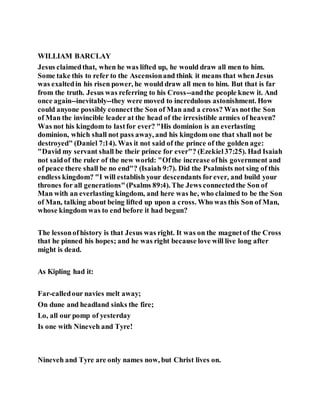
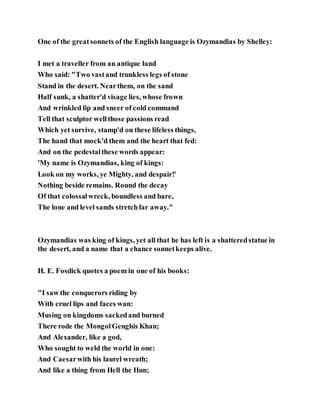
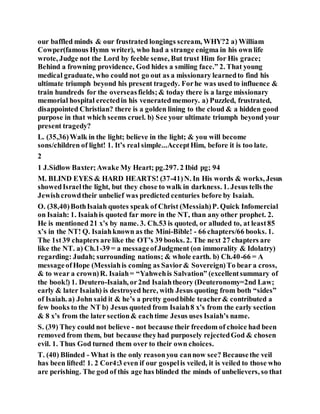
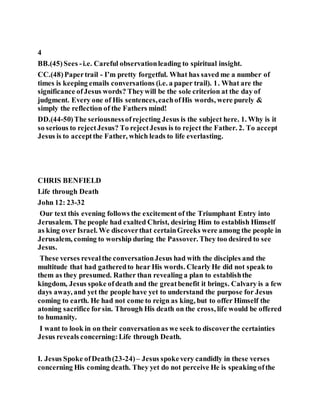
JESUS WAS THE GREATEST ATTRACTION
EDITED BY GLENN PEASE
JOHN 12:32 New InternationalVersion
And I, when I am lifted up from the earth, will draw
all people to myself."
The Great Attraction BY SPURGEON
“And I, if I am lifted up from the earth, will draw all men unto Me.”
John 12:32
THE death of our Lord Jesus Christ must have appeared to His Apostles to be
an unmitigated misfortune. No doubt they conceivedthat it would be the
death of the cause, a heavy blow and a deep discouragement. Smite the
Shepherd and the sheepwill be scattered. Strike the Head and what shall
become of the members? But our Lord instructed His disciples that this,
which seemedso dreary a circumstance, was reallythe most hopeful of all the
points of His history. He assuredthem that by His death He would totally
defeatthe powers of darkness. “Now is the judgment of this world: now shall
the prince of this world be castout.”
He comforted them yet further by the declarationthat His Crucifixion,
instead of driving men awayfrom His doctrine, would give to that doctrine a
peculiar luster and a specialcharm. The Cross ofChrist, with all its ignominy
and shame, is no hindrance to His heavenly teaching but is, in fact, a
matchless loadstone by which men are attractedto it. There is such a thing as
“the offense of the Cross,” andthat offense has not ceased. Butlisten to the
Master’s words, “I, if I am lifted up from the earth, will draw all men unto
Me.” The attractive powerof the Gospellies mainly in the crucifixion of the
Gospel’s greatTeacher.
The text needs, perhaps, to be illustrated by doctrines which He concealed
within itself, and by facts with which it is connected. The Prince of Darkness
had drawn away the sons of men by the fascinationof flesh-pleasing errors,
flattering delusions, alluring pleasures, glittering pomp and outward show. By
these he drew all men unto him. The devil led men captive at his will, seducing
them from bad to worse. He enticedpoor foolish man to his own destruction–
as fish are takenby the bait, as birds are lured by decoys–andas ships are
wreckedby false lights.
An enormous whirlpool of evil had for many an age suckedinto its vortex
multitudes who were sailing upon the sea of life. All overthe oceanof society
the influence of this monstrous whirlpool of evil was felt, more or less
powerfully, so that those who escapedfrom its horrible depths were,
nevertheless, much impeded and diverted in their course–andfound it hard to
reachthe desired haven. Even up to the very mouth of the port of peace, the
powerof this great whirlpool was evidently felt, drawing all men as it could.
Now the Lord Jesus came into the world to produce a counter-attraction, to
setin motion a counter-current. Lo, I saw in vision a mysterious hand
reaching out of a mighty all-attracting magnet from the sky!It was of so
marvelous a powerthat vessels whichwere being whirled towards their
destruction, were, many of them, suddenly diverted in their course and drawn
at once to the magnet and to safety!While others, which did not feelits power
to the same saving extent, and became ultimately victims to evil, were
nevertheless slowedin their course for awhile, hindered in their desperate
folly and prevented from perishing so hastily as they would have done.
Alas, many of them tugged at the oar, or hoisted all sail to escape from the
magnet! And so, as they willfully destroyed themselves, they did saddespite to
their conscienceand perished the more miserably because they despisedthe
greatsalvation. Just as evil draws all of us, more or less, so Jesus Christ more
or less draws all men who hear the Gospel. Some men He draws unto Himself
by the effectualdrawings of His Divine Grace. These are the “all” here
meant–some ofall classes,the all for whom he shed His blood. But where His
name is preached, even those who do not believe in Him feel some of the
influence which Christianity spreads abroad throughout society.
His name leavens the lump. The sweetperfume of His spikenard fills all the
house where He is sitting. Bent upon instituting the new and heavenly
attractionwhich should overcome the powers of evil, our Lord Jesus came
into this world to be lifted up from the earth–notfor Himself–but for the sins
of others. Down from the heights of Glory He descended, moved by
disinterestedlove. Not that He had anything to gain, but that He might
redeem us from our iniquity, and save us from our fearful perils.
On the Cross He effectedthe redemption of His people. Nailed there in
ignominy, in pain, desertionand death, He workedout redemption for His
chosen. But men stoodat a distance from their bestFriend. That is implied in
the text. Why should they need to be drawn to Jesus if they were already near
to Him? Some stoodso far awayfrom the dying Saviorthat they made His
death the subject of mockery, and even found subjects for jest in His dying
groans and pangs. All of us were alienatedfrom God and from Christ, who is
God’s express Image. Our evil hearts had piled greatmountains betweenus
and the Lord Jesus Christ. By nature we do not appreciate His love. We do
not render to Him the gratitude which He deserves. We pass by as though it
were nothing to us that Jesus should die.
Moreover, since man does not come of himself even when he perceives the
gracious errand of the Lord Jesus, ourheavenly Friend condescends to draw
him. The Truth of God is latent in the text–that men not only are at a
distance, but that they will not come to Christ of themselves. The Lord never
does unnecessarywork. We should never hearof Christ’s drawing us if we
would run without drawing! But the factis that we stand awayfrom Christ
and love the distance. Yes, we make the gulf still wider, developing our
original hatred to that which is goodby adding the force of habit to our
original depravity.
Therefore, since men are at a distance and will not come, the Crucified Savior
becomes, Himself, the attractionto men. He casts outfrom Himself bands of
love and cords of gracious constraint–andbinding these around human hearts
He draws them to Himself by an invincible constraint of Divine Grace.
Sinners by nature will not come to Jesus, thoughHis charms might even
attract the blind and arouse the dead. They will not melt, though surely such
beauties might dissolve the adamant, and kindle affectionin rocks of ice! But
Jesus has a wondrous power about Him to woo and win the sons of men. As
out of His mouth goes a two-edgedsword, so out of His heart proceedchains
of gold by which He binds thousands of willing captives to Himself.
This attraction, according to the text, is to be found operating upon all classes,
nations, ranks, and characters ofmen–it is not to be excluded from remote
lands, or dens of infamy nearer home. Here and there kings and princes have
believingly yielded to its power, while multitudes of the poor have had the
Gospelpreachedto them and have receivedit in the love of it. I trust there are
many of us here, belonging, as we do, to different grades and classesofsociety,
who can verify the truth of this text, “I, if I am lifted up, will draw all men
unto Me.” The young, the old, the rich, the poor, the intellectual, the learned,
and the ignorant–some of all sorts does Jesus draw, and thus He earns to
Himself the glory of being the universal attraction–the attractionto which all
hearts must yield when He draws effectuallyby His Grace.
Having thus skimmed over the text and endeavoredto bring before you the
thoughts which it kindles, we shall now speak upon what it is in the Cross
which becomes attractive to men. Secondlywe shall have a word to say
concerning the direction in which Christ Crucified draws. And thirdly, with
what power He draws.
1. First, dear Friends, WHAT IS THE ATTRACTION OF JESUS
CRUCIFIED? It is assertedby our Savior that when lifted up from the
earth He would draw all men–He intended by this His Crucifixion–for
John tells us in the 33 rdverse, “This He said signifying what death He
should die.” Let it not be forgotten, then, that the powerof the Gospel
lies in that which certain persons count to be its weakness andreproach.
Christ dying for sinners is the greatattractionof Christianity!
Certain preachers have missed all in forgetting this. What is Socinianismbut
an attempt to have Christ without His Cross? Thosewho sataround the
Cross, and said, “Let Him come down from the Cross and we will believe
Him,” were the true ancestors ofmodern Unitarians who respectthe
Characterof our Lord, and highly esteemHim as a teacher, but reject Him
utterly as a Substitute, an Atonement and a Sacrifice for sin. They fondly
dream that if they teach His holy life without His ignominious death, men will
be attracted to Him. Such has not proved to be the case. “I, if I am lifted up
from the earth, will draw all men unto Me” is true, and shall be true! But
Christ merely as a wise teacher, and an eminent example has not drawn the
sons of men who are too far fallen to be charmed into holiness by a mere
exhibition of moral excellence, howeverperfect.
Men need not so much a portrait of a man in health as medicine to remove
their own diseases. It has been thought by some, of late, that the proper way to
draw men to the Gospelis to preach the future glory of Christ. This, indeed, is
to be preachedin its place, for every part of Divine Truth should hold its
position in the Gospelharmony. But it is all a mistake, and a very greatand
terrible mistake, too, for men to put the glorified Saviorinto the place of the
crucified Savior. You may preach the millennium–you may extol as much as
you will the magnificence of those happy days when He shall reign from the
river even to the ends of the earth–but you will never make men Christians
that way! I have heard it said that the Jews willbe convertedto Christianity
by the doctrine of the SecondComing since the secondadvent is to us
preciselywhat they think the first advent should be.
But it is not so, Beloved. The only effectualattractionlies where the texts puts
it, “I if I am lifted up.” The Savior Crucified draws the Jew as well as the
Gentile. The sons of Israel shall not be convertedby the doctrine of a glorified
Savior, but by the Man of Sorrows who was despisedand rejectedof men–the
Messiahwho was cut off, but not for Himself–the Sacrifice offeredoutside the
gate. And from where is this supreme attractionof the Cross? I answerthat
by the powerof the Holy Spirit many have been drawn to Christ by the
disinterestedlove which His death manifests. Does thatMan on yonder tree
die without the necessityofdeath out of pure love–outof pure love to those
who hated Him? Out of love to the very men who fastenedHim to the cruel
wood?
Had He nothing to gain? Was it charity in all its perfection–nothing but the
milk-white lily of love? Was there nothing else but charity that could bind
Him to the tree? Nothing! “You know the Grace of our Lord Jesus Christ,
that, though He was rich, yet for your sakes He became poor, that you
through His poverty might be rich.” “Scarcelyfor a righteous man will one
die: yet perhaps for a goodman some would even dare to die. But God
commends His love toward us in that, while we were yet sinners, Christ died
for us.”
Many a heart has been so charmed with this that it has run to Christ, drawn
by the silkenbonds of love! Do not some of you feel as if you could love the
dear Lover of souls this morning? Do not even my feeble descriptions of His
Godlike work entice you? Oh, do you not feelthat you must love One who
loved so truly when there was no benefit for Him to receive in return? Why I
have thought that if Jesus had never died for me, I yet must love Him for
having died for others! And if I had no share in the benefits which His passion
procured, yet I have sometimes felt as if, out of admiration for “love so
amazing, so Divine,” I must give my heart to Him! Here is one master
attractionof the Crucified One.
Others have doubtless been brought to the Savior’s feet by delight in the
satisfactionwhichis rendered to justice by the Redeemer’s death. Many men
reasonthus with themselves:Conscience is uneasy. Offense has been
committed againstGod. Now, in the nature of things, under all law that is at
all respectedthere must be punishment for offenses. Buthow shall the
exercise ofthe prerogative of mercy be rendered perfectly consistentwith the
fulfillment of the penalty? Yonder bleeding Saviorsolves the difficulty. He
dies, “The Justfor the unjust, that He may bring us to God.” “The
chastisementof our peace was upon Him, and with His stripes we are healed.”
Many men, finding their conscience renderedperfectly at ease whenthey have
come to lean themselves upon the factthat Christ died for sinners, have been
so enamored of that glorious Truth of Godthat the attractionhas bound them
to the Cross forever. I must confess thatthis is one of the great considerations
which, in the hand of the Holy Spirit, will keepme a Christian as well as make
me more and more in love with my Lord. I see not where else Justice canmeet
with Mercyand embrace! I know not where else Righteousness andPeace can
kiss eachother excepton the Cross where my Mastergave up His life for
transgressors.
There I see the riddle all solved–fallenman brought back to God–andGod,
justly incensedat man’s offense, able to display His love without in any way
tarnishing His unsullied justice, or even diminishing the severity thereof. O
my Hearers, this is a blessedattraction, indeed! I would to God that it would
attract some of you! O that the thought that your sin canthus be justly
forgiven–that there is “No condemnationto them that are in Christ Jesus,”
since Christ was condemnedin their place–maydraw full many of you to
Himself!
Many others have been drawn to the Gospelby a sense of the exact suitability
of the Atonement of Christ to the necessitiesoftheir condition. As the glove
fits the hand so does the Crucified Savior suit the necessitiesofa sinner. Here
is exactly what the man needs. He feels himself guilty. He dreads the
punishment of his transgression. His conscience,like an adder, stings him.
Like a fire ever fed with fresh fuel, it blazes within him. But when he meets
with Christ, he meets with peace and he says within himself, “This is precisely
what I require. Thirsty, here is living water! Naked, here is a robe of
righteousness!Vile, here is an open fountain! Lost and undone, here is One
who came to seek and to save that which was lost.” Ah, I beseechmy Lord to
make all of you feelyour condition and then you will seta high price upon my
Lord!
Some of you imagine that you are rich and increasedin goods and have need
of nothing–may you feel your deep necessitiesbefore God!May you see how
spiritual the Law of God is so that it touches your thoughts, and your words
and condemns you as much for these as for outward acts of sin. When you
once feel your sinnership, sweetwill the Savior’s name be in your ears, and
you will be drawn to the Cross because the Crucified Savior is all that you
need!
Further, thousands upon thousands have been effectually drawn to Christ by
seeing how graciously, how readily, how wondrously, how abundantly He
pardons as He hangs upon the tree. I cannot understand pardon as coming
directly from God apart from a Mediator. Jehovah, the Judge of all the earth,
is too high, too terrible, too glorious in holiness for sinners to deal with Him
absolutely. Our God is a consuming fire! When He descends onSinai the
mountain smokes and melts as wax.
Behold, the whole earth trembles at His Presence–the pillars thereof are
dissolved! Before Him goes the pestilence, at His feetare coals offire. As He
rides upon the wings of the wind He scatters fromHis pavilion of clouds and
darkness, hailstones andcoals of fire. As for His voice, it is thunder and the
flash of His eyes are lightning. Who can receive pardon from an absolute
God? He is greatand terrible and will by no means clearthe guilty. But when
I see Godin Christ, and know that “in Him”–that Man who died upon the
tree–“dwells allthe fullness of the Godheadbodily,” I cancome to Him
without fear! And with holy joy I can seek forand receive perfectpardon–
from that bleeding hand I dare expect pardon!
I am bold to look for greatpardon from so great a Saviorsuffering so greatly.
When I hear Him say to the dying thief, “Todayshall you be with Me in
Paradise,” Ican hopefully sing–
“The dying thief rejoicedto see
That Fountain in his day.
And there may I, though vile as he,
Washall my sins away!”
It becomes easyfor the soul to understand how sin canbe forgiven when it
sees how sin has been avengedin the Personof Jesus. O Sinners, my Lord
Jesus is able to forgive all manner of sins. “The blood of Jesus ChristHis Son
cleansesus from all sin.” “All manner of sin and blasphemy shall be forgiven
unto men.” “Come now, and let us reasontogether, says the Lord: though
your sins are as scarlet, they shall be as white as snow. Though they are red
like crimson, they shall be as wool.” How blessedto hear these words
preachedfrom that unrivalled pulpit, the Cross!How sweetto hear the dying
lips proclaim abounding mercy! How consoling to hear Him speak of the
riches of Divine Grace who said, “I thirst,” and “Lama Sabacthani!” Oh, this
is to be attracted, indeed! This wondrous pardoning powerof the Crucified
Redeemeris one of the master attractions of the Cross!
But I must not enlarge. One more particular must suffice. Have not many of
us been wonderfully drawn to the Gospelby the intense griefs and agonies of
Jesus? Beloved, whenwe see men in prosperity, it is natural for us to envy.
But it is equally natural for us to pity those who are in suffering–and love is in
the next degree to pity. So I doubt not that when we have setforth Christ
Jesus evidently crucified among you, the gracious Spirit has moved many
tender hearts first to pity, and afterwards to love the bleeding Lamb! What a
melting powerthere is in Gethsemane!Can you view the bloody drops of
sweatas they fall upon the frozen soil and not feel that, in some degree,
invisible but irresistible cords are drawing you to Jesus?
Can you see Him flagellatedin Pilate’s hall, every thong of the scourge tearing
the flesh from His shoulders? Can you see Him as they spit into His lovely face
and mar His blessedvisage, and not feelas if you could gladly fall down and
kiss His feet, and make yourself forever His servant? And, lastly, canyou
behold Him hanging upon the hill of Golgotha to die–canyou mark Him as
His soul is there overwhelmedwith the wrath of God, with the bitterness of
sin, and with a sense of utter desertion–canyou sit down and watch Him there
and not be attractedto Him? Ah, I wish that more of you would feel so
attractedthat you could resistno longerbut would come at once and give
yourselves up to Him!
You may not feel that you could kiss the King upon His Throne, but will you
not kiss the King upon His Cross? Youmay revolt from Him when He wields
a rod of iron, but will you not touch the silver scepterheld in the bloodstained
hands which bled for His enemies? O come here, sons and daughters of men,
and yield yourself to Sorrow’s Lord! Daughters of Jerusalem, come here as of
old and weepboth for Him and for yourselves!O seek a portion in His sin-
atoning death–a place in the Heaven which His resurrectionhas opened!
Before I leave this point, I must observe, dear Friends, that it renders my soul
very greatcomfort to think that the attractive power in my Crucified Lord
does not lie in the eloquence ofthose who preach, nor in the logic and power
of persuasionof those who proclaim His Gospel!Ah, poor fools that we are,
when we preachwe sometimes think souls must be savedbecause we are
fluent! And at another time we suppose no goodwill be done because we
spoke in greatmental bondage. But, it is not the man who tells the story, nor
the style in which he tells it–it is the tale itself which wins under God the Holy
Spirit!
There is in the Cross itself a power. The Holy Spirit rests like a dove upon that
blood-stained tree and through Him saving Grace comes streaming downto
human hearts. It is not of man, neither by man, for the attractions of Jesus
crucified are as a dew from the Lord which carries not for man, neither waits
for the sons of men.
II. We proceedto enquire in WHAT DIRECTION DOESTHE CROSS
ATTRACT? In one word–it attracts towards everything that is goodand
blessed. No man was everenticed to evil by a Crucified Savior. The emotions
which are properly excited in the soulby the doctrine of the Atonement, must
always be towards goodness.The preaching of the Cross does no mischief. Its
sacredstreambears no man towards the rock of ruin, but its tendencies are
everywhere and at all times towards man’s best and happiest estate.
Let us observe that the Cross of Christ draws men from despairto hope.
Many have been ready to die of despair because theyhave said, “There is no
salvationfor me.” To such as these the first beam of hope has come through a
Crucified Savior–they have stumbled upon that precious soul-saving text,
“The blood of Jesus Christ, His Son, cleansesfrom all sin,” and have been set
at liberty! That text has opened the gate of Heaven to many hundreds, and I
do not doubt it will to thousands more. They have seenhow Jesus'suffering
put aside the necessityof our suffering for sin–and peace at once has bedewed
the soul.
It is no mean thing to draw men away from despair, for despairis the root of
many sins. When a man says, “There is no hope,” then he hunts after sin like
an eagerhound after his game. To teacha man that there is hope–that there is
hope for him–is to give him a fair breeze heavenward!, Jesus Crucified
presents this to anxious souls. It attracts men, in the next place, from fear to
faith. They have been accustomedto think of God with trembling, and to be
constantly alarmed at His Presence. Sinhas become a burden, but they have
not knownhow to be delivered from it and have fearedthat they must bear it
forever–but the Saviorlifted up upon the Cross inspires faith.
We think of Him, and as we think we believe! We meditate, and as we
meditate we trust! Confidence comes in by the way of Calvary. The means of
creating faith, through the power of the Holy Spirit, is the Cross itself. God
works faith in us, but it is through His dying Son. That was a terrible scene in
Edinburgh when those lofty houses were filled with occupants who were
unable to escape fromthe smothering smoke and the spreading fire. Suppose
a fire escape couldhave been brought to the rescue, yet there is one thing the
fire escape couldnot have done. If these poor creatures had been too faint and
stifled to getout of the windows, it could not have lifted them onto itself and
yet that would have been one of the things required for their rescue.
But this the Gospelof Jesus does!It not only comes to men and says, “Now I
will save you, if you will getinto Me,” but it takes hold of a man and puts him
into itself–forJesus Christ attracts men to Himself–not only comes near
enough to them for them to graspHim, but, as the magnet does with the iron,
so Jesus lays hold on sinners' hearts. Jesus Crucifiedconducts the man from
dread to love. Before God he stoodshivering like a slave, crying, “How shall I
escape from His Presence?O that I had the wings of the morning that I might
fly even to the uttermost parts of the sea, ordive beneath Hell’s darkestwave
that I might hide from the yet more terrible Hell of the glance of God’s fiery
eyes!”
But when he sees Godreconciledin Jesus, then the sinner sings–
“Till God in human flesh I see,
My thoughts no comfort find.
The holy, just, and sacredThree
Are terrors to my mind.
But if Immanuel’s face appears,
My hope, my joy begins!
His name forbids my slavish fear,
His Grace removes my sins.”
In this way the soul is led to love God. “We love Him because He first loved
us.” Then the attractions of the Cross bring us up from sin to obedience.
When we are washedin the precious blood we feel grateful to our Lord Jesus
and we cannot live to sin. We are dead to it. We cannotany longer take
pleasure in that which costHim His life. It is impossible for us to count that
sweetwhich we know was bitterness to Him. “What will you have me to do?”
becomes the question. We submit ourselves with our whole heart to His
gracious sway, and to run in the way of His Commandments becomes our
soul’s delight.
Thus we are led constantly, also, by the Cross from selfto Jesus. Nothing will
kill selflike a sight of the Crucified. Lift up the Saviorand down self must go.
High thoughts of Christ are always attendedby low thoughts of self and vice
versa. Think much of yourself? You will think little of the Savior! But a very
low esteemofour own merit brings a very high esteemofthe merits of Christ–
and it is a blessedthing when self is wholly beaten down! It is a victory which
altogetheris not won by us, I fear, till we lay down our bodies. But if anything
can hang up King Self upon the tree until the evening, it is a sight of the tree
upon which the Savior bled.
Finally the uplifted Redeemerdraws us awayfrom earth to Heaven. Earth
holds us fast–we cannotescape from its hold, but we feela heavenward
drawing. It is Jesus Christ who is drawing us–that same Christ who has gone
up to the Throne after having trod the winepress. He daily attracts us upward
to Himself. Do you not feelHis drawing? Oh, I think you do! When the boy’s
kite goes up very high into the air and gets into the clouds, he cannot see it.
Yet he declares, “Itis there.” Why? “Why,” he says, “Ican feel its pull.” And
we know the Lord Jesus Christ is there–He that was crucified, for we can feel
Him pull–we can feelHim draw.
O that we could give ourselves whollyup to Him and mount towards Him! I
trust we have experiencedsome of that mounting, for He has “raisedus up
together, and made us sit togetherin heavenly places” in Him. We know what
the resurrection-life means. We do not forevergrovel in worldly cares and
carnalthoughts, but sometimes, at least, we getup into the higher atmosphere
and have near and dear communion with the Well-Beloved. Savior, draw us
more and more!
We return to enquire with what order of powerdoes the Saviorlifted up draw
men? What are the characteristicsandqualities of this power? In brief, first
of all, the powerwith which Christ draws us is, according to the text, a very
gentle power. “I, if I am lifted up, will draw all men.” Drawing is very
different from driving. The way by which Jesus leads His followers is by soft,
gentle influences. “I will draw men.” The Law is a schoolmasterto bring us to
Christ. And the preaching of the terrors of the Law are very useful in their
way. But whenever a sinner really comes to Christ, the lastaction is never a
drive–it is always a draw. The dove may have been driven part of the wayto
the ark by the wind, but the last actof getting into the ark was when Noah put
out his hand and pulled the dove into the ark.
The real actwhich brings us into connectionwith Christ is always a drawing
act–anactof gentleness. Everyconvertedman may say, when he is converted,
“Your gentlenesshas made me great.” The heathenpictures one of their
goddessesin her chariot drawn by doves. Surely it is by doves that we are
drawn in the chariot of the Gospeltowards the Lord Jesus!How very gentle,
though all but Omnipotent, is the influence of the sun upon the earth and all
the planets! How they constantly revolve around and follow him in his
wondrous march–yetyou never feel that he draws!
If you harness a horse to your chariot, he tugs and pulls by fits and starts. But
the father of lights draws all the ponderous planets along their appointed
ways, and yet there is not enough of a jar to shake anaphid from a rosebud!
So there is no noise in the loving drawing of the Savior. Much of the
fanaticism which comes with religious excitements is not of God. The genuine
dew of Heaven falls calmly–
“As in soft silence vernal showers
Fall to refresh the fields and flowers,
So in sweetsilence fromabove
Drops the sweetinfluence of His love.”
Christ’s drawings are gentle.
In the next place, observe that Christ’s drawings are gracious, for is it not of
Grace that He should draw at all? If any of you were about to give away
bread to the poor and they would not come for it, I think you would say, “Let
them go without it.” You would not attempt to bring them to the feast. No,
you would say, “It is goodenough on my part to be ready to relieve them. But
if they will not come, then let their starving be upon their own heads.”
But see whatJesus does!He does not throw a life belt to poor drowning men.
Yes, he does–buthe does more, for this life belt has the wonderful quality of
attracting the man unto itself so that though, at first, he might be unwilling to
be rescued–this mystic life belt changes his will so that he is willing to be
saved. But, next, Jesus draws with a widespreadpower. “I will draw all men
unto Me.” Notevery man. Every man is not effectually drawn, for millions of
men never heard the name of Jesus Christat all–but men of all sorts–“all
men,” that is Jews and Gentiles. It is an “all” signifying all sorts of men. And
what a wonderful thing it is that the Cross ofChrist does draw all men!
Many thought it never could draw the “roughs”–the harlots the street Arabs–
but there have been found for Christ some of His mightiest trophies among
the lowestofthe low! Norshould we think that the Cross cannotattract the
rich, and that it is of little use putting the Gospelbefore the fashionable
classes. Ah, do not tell us this! There is a boundless power in the Cross of
Christ. If we preachit to kings and princes, we need not be ashamed. If we
could have a parliament of men who were as bad as devils, as proud as
Pharaoh, and as furious as Saul of Tarsus–ifwe preachedChrist Crucified to
them–it would not be in vain!
This attractionhas, in the fourth place, an effectualpower, for Jesus Christ, in
His own electones, draws most effectually. I said very gently, but none the less
mightily because ofthe gentleness!The swallows fly across the sea to distant
lands. Did you ever feel the influence which attracts them? It is not
perceptible by the most delicate of instruments and yet how effectualit is!
They cannot lag behind when the time has come. See how they twitter over the
gables of our houses and leave those neatly built habitations beneath our
eaves. Manya weary mile lies the goalof their pilgrimage acrossthe sea, but
there they go! A mysterious influence draws them and He who thus draws the
swallow to other lands, and guides it in its flight, draws men to the Cross so
that they never rest till they have left their haunts of sin and come to live
where Jesus Christ distributes peace!
I will add, for the comfort of some who are here, that Jesus Christ draws
today with a present power. “I, if I am lifted up from the earth, will draw all
men unto Me.” That means that He is drawing them NOW!He does not say
that He will, sometimes. He draws now! Oh, I know not whom He may be
drawing, but I do trust He is drawing some of you! Here I stand with the
Gospelto preach to you like one with a magnet in his hand. Now, do I know
who are God’s elect? I do not, but I shall soonfind out! Are you not like a
greatheap of steelfilings and ashes mixed together? I cannotseparate you,
neither need I put the filings on this side and ashes on the other! I have only to
thrust in the magnet and the division will be effectually made.
Jesus Crucified is the greatdiscriminator! His Atonement is the great detector
of God’s elect!The Gospelreveals the eternal purpose. If God intends to save
you, you will fly to His dear Son. If you are left to perish, it will be because of
your own willfulness in neglecting the Savior and turning your back upon the
fountain which cleansesfrom all sin. Jesus draws today, and Jesus willdraw
still. Happy days are coming when He will draw more mightily, when they
shall run unto Him! Even multitudes that knew Him not shall run unto Him,
because ofthe Holy One of Israelwho has magnified Him. “He shall see ofthe
travail of His soul, and shall be satisfied.”
DearSavior, this morning–
“Draw reluctant hearts!
To You let sinners fly,
And taste the bliss Your love imparts,
And drink and never die.”
The lessons to be drawn from the whole we will give you in two or three
words. First, to Believers working for Christ. Learn from the text that if you
would win souls you must draw them rather than drive them. Very few people
are bullied into Heaven! The way to bring men to Jesus Christ is not by rough
words, and dark looks, and continually warning them–but rather by gentle
invitations. Tenderly as a nurse with her child must we seek to win souls.
In the secondplace, if we would win souls, Jesus Christ must be our great
attraction. In the class in the Sunday school, visiting from house to house, or
elsewhere,we must keepclose to the text, and the text must be the Cross. I
must confess there is a very greatsweetnessto my soul in preaching about
Christ. I hope it is never a wearinessto preach any part of Divine Truth. But
oh, it is delight itself to preach up the Master!Then we have to deal with the
kernelof the matter. When we preach Jesus Christ, oh, then we are not
putting out the plates and the knives and the forks for the feast–weare
handing out the bread itself!
Now we are not, as it were, working in the field at the hedging and the
ditching and the sowing, but we are gathering the golden sheaves and bringing
the harvesthome. If we want a hundredfold harvest we must sow seedwhich
was steepedin the blood of Cavalry! And, dear Friends, if you want to be
drawn nearerto Christ yourselves, do not go to Moses to help you, but get to
Christ! Go to Christ to get to Christ. “I, if I am lifted up from the earth, will
draw all men”–where?–“unto Me.” Jesusdraws to Himself! Remember, you
have never experiencedthe fullness of the drawing unless you are drawn to
Christ. If you are only drawn to holiness, or drawn to a Church, or to good
experiences you have not obtained the fullness and soul of the matter. You
must be drawn to Christ–right away from ordinances and everything else–till
you getinto His bosom. Then you wall have found the summum bonum! Then
you will have reachedthat which Christ would have you obtain–that for
which He died that you might obtain when He, on the tree was lifted up–that
He might draw you unto Himself. And now, Sinner, if you would come to
Jesus, letthe text whisper a comfortable word in your ear. He must draw you!
Think much upon His death. Turn, this afternoon, to those chapters in the
Evangelists where His death is recorded. Picture that dying Savior to yourself,
and ask yourself, “Is this anything to me? Have I a share in it?” Then cover
your face with your hands, and kneeldown and cry, “O God, be merciful to
me a sinner! Wash me in the precious blood.” Before long you shall feel that
the precious Christ has drawn you to Himself and that you are saved! The
Lord bless you for Jesus'sake. Amen.
BIBLEHUB RESOURCES
Divine Attraction
John 12:32
J.R. Thomson
The shadow of the cross lay athwart the path of Jesus. His soul was troubled,
for the hour was come. The grain of wheatwas about to fall into the soil, and
there to die. Yet our Saviorlookedbeyond the near to the distant future. He
knew that, though the hour was come, it was the hour in which God should be
glorified; that though the seedshould die, it should bear much fruit; that
though he himself was about to be lifted up from the earth, he should draw all
men unto himself.
I. WHO WAS HE WHO LOOKED FORWARD TO A PROSPECT SO
GLORIOUS? This must be asked, becausethe words used are such as from
ordinary lips might naturally be deemed but vain boasting. How often have
conquerors hoped to subdue the world, thinkers to convert all mankind to
their opinions, preachers and promulgators of religious systems to win the
empire over the hearts of the race!Experience has dispelled many such
illusions; and we are slow to acceptclaims to universal dominion. Who, then,
was he who uttered this confident expectation - that all men should be drawn
to him? To all outward appearance a peasant, a teacher, a healer, a reformer,
a benefactorof his fellow men. What prospectwas there of one in such a
position realizing a hope so vast? And how, if he was about to be crucified,
could he find the cross a means to such an end? The thing seemedincredible,
even to his own adherents and friends. If Jesus had been a mere man,
although a saint or a prophet, such language would have been egotism. But
Jesus knew the purpose of the Father, and felt within him the consciousnessof
powerto achieve a work so great. And the events which followed - the
Resurrectionand Ascension, and especiallythe Pentecostaloutpouring -
opened the eyes of his disciples to the glory of their Master's Person, the
powerof his Spirit, the certainty of the prospecthe beheld,
II. WHAT WAS THE CONDITION OF THE EXERCISE OF THIS
SUPERHUMAN' POWER? The expression, "lifting up," as applied by Jesus
to himself, is interpreted for us by the evangelist. Used three times, it denotes,
in eachinstance, the manner of Christ's death, the lifting up upon the cross.
This was, indeed, to be followedby the lifting up to the Throne of empire and
of glory. As a Savior, Jesus was crucified;as a Divine Savior, he was exalted.
The wisdom of God, the power of God, were to be displayed in this triumph of
humiliation, suffering, and death.
III. WHAT WAS THE NATURE, THE ACTION, OF THIS ATTRACTIVE
POWER? It is very significantthat the "drawing" which Jesus exercised
displayed itself even whilst he hung upon the tree. The multitude gathered
around; and if the soldiers viewed the scene with indifference, there were
women who watchedand wept, and there were among the people those who
smote their breasts in sorrow and in fear. But we have to notice, not the
curiosity or the natural emotions excited by the spectacleofone suffering
crucifixion, but the spiritual attractionof Calvary. The incomparable love and
pity manifested by the Crucified possessa mysterious charm. It is the
Shepherd smitten for the flock he came to save, it is the Friend laying down
his life for his friends, who exercises this Divine magnetism. They who discern
in the Lord's sufferings and death the appointed means of man's redemption,
who know that "with his stripes we are healed," can understand how a
spiritual force emanates from the cross as gravitationfrom a centralsun.
Man's nature is such as to be affectedby the exhibition on Christ's part of
love strongerthan death, of compassionworthy of a God. That the sacrifice of
our Redeemerhad its bearing upon the government of God - this is clearly
taught in Scripture. But here our Lord lays stress upon its bearing upon the
heart of man, upon human societyand human prospects.
IV. WHITHER DOES THE CRUCIFIED ONE DRAW THOSE WHOM HIS
INFLUENCE AFFECTS?The suffering, the glorified Redeemerdraws men
awayfrom sinful affections and sinful courses;he draws them unto safety,
peace, and life. But it is observable that Christ declares his purpose to draw
them "unto himself," i.e. to enjoy his fellowship, to participate in his
character. A personalpower draws men to a personal Savior, Friend, and
Lord. Men are drawn by the cross, notto Christianity, but to Christ.
V. WHAT IS THE RANGE OF THIS ATTRACTION? Jesusis a universal
Savior. He proposes and promises to draw all men unto himself. The
firstfruits of this harvest were yielded whilst he still hung upon the tree. The
conversionof the dying malefactor, the enlightenment of the centurion, were
an earnestof greatervictories. It was the intention of Christ to save friends
and foes, Jews andGentiles. And the facts of history are a proof of the extent
to which this intention has already been fulfilled. The idolaterhas forsakenhis
"gods many;" the Jewishrabbi has abandoned confidence in the "letter," and
has learnedto rejoice in "the Spirit;" the philosopher has found the wisdom
of God better than the wisdom of this world. Human beings of all grades have
felt and yielded to the Divine attraction of the cress. The young and the old,
the profligate and the ascetic, the tempted, the aged, and the dying, are day by
day being drawn unto the heart of Immanuel. The marvels of Pentecostwere
an omen of a new life for all nations of mankind. The apostles themselves
witnessedenoughto convince them of the truth of their Master's words, the
depth of their Master's insight, the vastness oftheir Master's prophetic view.
Looking back, and looking around, we learn to look forward with an inspiring
confidence to the realizationof a promise so benevolent and so glorious as this
from the lips of him who was about to die. - T.
Biblical Illustrator
Now is the Judgment of this world.
John 12:31-33
The world's hour of deepestrevolution
F. Godet, D. D.
It was the signal —
I. OF ITS JUDGMENT. To judge is to verify the moral condition. The
judgment of the world is basedupon the Cross, inasmuchas this discloses the
moral condition of man in his natural state. Man, by raising this throne for
Jesus, judged himself, and manifested the enmity to God which is in his heart.
Having erectedit, he judges himself still more decidedly by his relation
thereto; for either by faith he finds therein his salvation, or by unbelief his
condemnation. Of this choice the final judgment will be only the ratification.
Thus the judgment of the world dates from GoodFriday. Its first external
manifestation was the destruction of Jerusalem;its secondwill be the
judgment of the Church; its third the last judgment predicted (Matthew 24.;
25) on the very day on which these words were uttered.
II. OF THE EXPULSION OF ITS ANCIENT MASTER. The Cross filled up
the measure of tolerance grantedto the perversity of the Prince of this world.
The Crucifixion was the most odious and unpardonable transgressionof
Satan; this crime put an end to the long suffering of Godconcerning him, and,
consequently, to his dominion over mankind. The Rabbis habitually designate
Satan"the prince of this world," but place the Jews outside his kingdom,
while Jesus includes them as well as the heathen therein (chap. John 8) "Out"
signifies not only out of his office and power, but chiefly out of the world —
his ancientrealm — as is shown by the connectionof these words with the
preceding, and the oppositionbetweenvers. 31 and 32.
III. THE ACCESSION OF ITS NEW SOVEREIGN.The overthrow coincides
with the accession. Jesus declaresHimself appointed to fill this part. But,
strange to say, it is not upon this earth, whence Satanis castout, that He will
establishHis kingdom. He will not become, as the Jews expected, the successor
of His adversary, and, consequently, another prince of this world; He, as well
as His rival, will leave the earth; He will be raisedfrom it and above it, and in
a higher sphere He will draw to Himself His subjects and realize His kingdom.
"Lifted up" must be understood here in the same amphibiologicalsense as at
John 3:14 and John 8:28. His lifting up on the cross, that throne of love,
appears to Him as the gloriously ironicalemblem of His elevationto the
throne of glory. And this comparisonis based on a deep truth. For was it not
the Cross whichcreatedthe abyss betweenChrist and the world (Galatians
6:14), and rendered the purely heavenly form of the kingdom of Godfor the
present necessary? "From" or"out of the earth" designates anignominious
expulsion from earthly existence by any capitalpunishment, and cannotrefer
to the small distance betweenthe ground and the feetof the crucified. It is
"lifted up," which refers to the Cross. The Cross and the Ascensionunited
freed Jesus from all earthly ties and national obligations, and placed Him in a
position to extend His agencyto the whole world (Romans 10:12). Once raised
to heaven, Jesus will draw around Him a new people, strangers to earth, and,
like Himself, of a heavenly nature. He will be both the Author and End of this
Divine attraction.
(F. Godet, D. D.)
The Cross
B. W. Noel, M. A.
In the Cross Christ saw a provision for three greatobjects. Byit —
I. THE WORLD SHOULD BE JUDGED. Godjudged our sins in the person
of Jesus, visited our guilt upon Him condemned in our place. That is the true
measure, as it is the most awful punishment of our guilt. If men sin on they
may see, as clearlyas if it were come already, their eternal doom. How cana
sinner be so deluded as to think he will escape whenhe sees the Son of God
hanging there. Let him look and realize who He was, and then feel, "I am
condemned." Thus Christ knew that the Cross would convince men of sin.
What the law could not do, what no mercies or judgments of God could do,
this would effect, and His heart exulted in the thought that men at last would
see that there was no hope for them save in turning to God through Him.
II. THE PRINCE OF THIS WORLD REJECTED. Thatbeing whose empire
none else could shake, whose dominion over men's minds and habits none else
could destroy, Jesus saw dethroned. God had predicted this. "The seedof the
woman," etc. To accomplishthis was the end of His coming. "Forthis purpose
is the Sonof God manifested," etc. This end is gained when Satan is banished
from the human heart. The Cross avails for this —
1. By having procured the gift of the Spirit who turns men "from the power of
Satanunto God."
2. By furnishing the most powerful motives to turn from sin, inasmuch as it
reveals the guilt and danger of sin, and endears believers to the Saviour who
died to reconcile them to God, and therefore weans them from sin.
3. By securing powerful help in such a view of the love of God as inspires faith
and hope.
III. HUMAN SOULS DRAWN TO CHRIST.
1. The means — wondrous, the last, apparently, calculatedto serve this
purpose.
2. The method — "draw," not compel, by the attraction of love.
3. The object — "all men." Gentiles as well as Jews.
4. The result — "to Me."
(B. W. Noel, M. A.)
The death of Christ and its results
J. Brown, D. D.
I. THE DEATH OF CHRIST.
1. The fact of His death predicted. It was a wonderful thing that He should
die, for death is the penalty of sin. and He was sinless, and can only take effect
on humanity, whereas He was Divine.
2. The manner of His death described — crucifixion. The mystery thickens. If
He must die, surely it should be naturally and peacefully, or if not, gloriously,
as a hero, and amidst the blessings ofHis race. No, He must die as a felon, a
death —
(1)profoundly humiliating;
(2)excruciatingly painful.
3. The nature of His death unfolded. Its manner partly indicates its nature.
(1)It was penal. He suffered under Romanand Divine law, but how
differently.
(2)It was vicarious, since He was innocent.
(3)It was expiatory (Isaiah 53:5, 6).
II. ITS RESULTS.
1. The judgment of the world.(1) What this means. In the Scriptures to judge
means to govern. Hence the "Judges."As King and Ruler the Messiahis
frequently predicted as Judge. This interpretation agrees with the context.
The Son of Man is glorified by being made King of the world; how, therefore,
is the world to be judged by being ruled by Him? A new order of Divine
administration has been commenced, having for its objectthe subjectionof
the world to God.(2) How is this judgment the result of Christ's death?
(a)It was the promised and richly-merited reward of His death (Isaiah 53:10-
12; Philippians 2:5-11).
(b)It is the necessarymeans of His carrying into accomplishment the great
design of His death, the salvationof His chosenpeople (John 17:2).
2. The expulsion of the prince of this world (John 14:30;John 16:8-11;
Ephesians 2:2).(1) Who is he?
(a)A real personalexistence.
(b)A potentate.
(c)Exercising dominion over this world.
(d)But not independently and uncontrolled, but largely as the executionerof
Divine justice, and limited in power by the duration of "this world."(2) What
is his expulsion? His being castout —
(a)From the human heart.
(b)From the religious and civil institutions he had controlled.(3) How is he
castout?
(a)Christ bore the penalty of that for which he held men in bondage, and men
paid their debt and suffered their punishment in Christ their substitute.
(b)By the powerof the Spirit, by which men canresist the devil and make him
flee.
3. This drawing of all men to Christ.(1) What this drawing is.
(a)All men, without exception, become the subjects of His mediatorial
government.
(b)All men, without distinction, become the objects of the invitations of His
gospel.
(c)All whom the Father has given Him, an innumerable company out of every
kindred, etc., are put in possessionofthe blessings of His salvation.(2)How it
is connectedwith His lifting up. Had not atonement been made there could
have been no salvation to offer, or give or receive. Christ's death removed all
obstacles to this, and securedthe effectualagencyof the Spirit.
(J. Brown, D. D.)
I, if I be lifted up, will draw all men unto me.
The uplifted Saviour
J. Graham.
Nothing is more wonderful about Christ than His unfaltering confidence in
the boundlessness andperpetuity of His power, especiallywhenwe consider
the circumstances in which it was expressedand the grounds on which it was
based. The assertionbefore us is that of a fanatic or of a God.
I. THE EXTENT OF THE SAVIOUR'S DRAWING. "All men."
1. The meaning of universal terms in Scripture must be determined —(1) By
its greatacknowledgedprinciples. One of these is the freedom of the will. So
the text signifies merely that there is sufficient power in Christ to draw all
men; but the melancholy fact is that many "will not come unto Him that they
may have life."(2)By the context. Spokenas it was in connectionwith the visit
of the Greeks, the text means that the benefits of Christ's redemption were not
restrictedto the Jews, but were thrown open to the world.
2. While, however, some shall reachdestruction because they will choose the
broad way, there is a vastly preponderating aggregatewho shall he brought to
Christ. The drawing commencedwith the dying thief. Sevenweeks afterwards
three thousand were drawn. Then the whole of the Acts furnishes illustrations.
Then eighteencenturies of Church history, particularly greatmovements like
Methodism and missions. Finally, the Apocalyptic visions shall be realized.
II. WHAT IS THERE IN THE UPLIFTED SAVIOUR SO CALCULATED
TO ATTRACT. In Him is disclosed —
1. The ground of full and free pardon for the very chief of sinners. This gives
hope to the most despairing, who can getrest nowhere else.
2. Ample provision for the purification of sinful hearts.
3. All those qualities calculatedto draw the sympathies and aspirations of the
renewedheart.
(1)The love of truth is satisfiedin Him, who is the Truth.
(2)The yearning for fellowship is satisfiedin His Brotherhood.
(3)The sense ofright binds us to Him as our RedeemerSovereign.
(4)The desire for spiritual beauty is gratified in Him, who is the altogether
lovely.
(5)Impulses to serve our brethren are sanctifiedand empoweredby the
constraint of His self-sacrificing love.
III. THE AGENCY EMPLOYED.
1. The power of Providence or government of the world is committed to the
Redeemerfor the ingathering and completion of the Church.
2. The Holy Spirit draws hearts to the Saviour. He is Christ's Witness and
Glorifier. "No man cansay that Jesus is the Christ but by the Holy Ghost."
For this purpose He abides with the Church forever. Hence —
3. The Church is Christ's visible agencyfor this greatwork, which is
discharged—
(1)By private testimony.
(2)Public proclamation.
(J. Graham.)
Christ lifted up
C. H. Spurgeon.
Christ crucified. —
I. CHRIST'S GLORY. Because —
1. The manifestation of glorious love.
2. The demonstration of glorious fortitude.
3. The completion of glorious work.
4. The achievement of glorious triumph.
II. THE MINISTER'S THEME. Christlifted up, and not —
1. Hell and damnation.
2. Mere doctrine.
3. Inoperative morality.
4. Sacredor secularlearning.
III. THE HEART'S ATTRACTION. Christdraws —
1. Like a trumpet attracting men to hear the proclamation.
2. Like a net drawing men out of the sea ofsin.
3. With the bands of love.
4. As a standard in the centre of gathering.
5. As a chariot in which souls are drawn to heaven.
(C. H. Spurgeon.)
Why Christ was lifted up
A. J. Gordon.
Expressionof text used three times to teach that the Son of Man must be lifted
up in order —
I. TO GIVE A DEMONSTRATION OF HIS DIVINE MANHOOD (chap.
John 7:28).
1. Christ proved Himself to be true man by dying as every man dies.
2. He proved Himself to be Divine by dying as no other man ever died.
(1)His death unique in its supernatural accompaniment.
(2)In its voluntariness.
II. TO BRING TO BEAR THE MOST POWERFULDIVINE
ATTRACTION UPON MAN (John 12:32).
1. The strongestbonds of attraction betweenman and man are love and
sympathy. These two are braided togetherin a two-fold cord in Christ
crucified.
2. He was lifted up to draw men out of and keepthem awayfrom the sins that
had kept them from Him.
III. TO ACCOMPLISHA DIVINE REDEMPTIONFOR MAN (chap. John
3:14). Salvationis absolutely fastenedto Christ crucified.
1. Without the shedding of blood is no remission.
2. The Divine imperative "must.
(A. J. Gordon.)
The greatattraction
C. H. Spurgeon.
1. Christ's death must have seemedto His apostles anunmitigated misfortune;
but He showedthem that it was really the most hopeful of all points in His
history.
2. The text must be illustrated by doctrines that are concealedin it, and facts
with which it is connected. The prince of darkness enticedpoor foolish man to
his destructionas fish are takenby the bait, birds lured by decoys, barques
wreckedby false lights or suckedinto the whirlpool. Christ came to produce a
counter attraction. But men stoodat a distance from their best Friend; but
since man does not come of himself, even when he perceives the gracious
errand of Jesus, He condescends to attracthim, and that by means of the
Cross.
I. WHAT IS THE ATTRACTION OF JESUS CRUCIFIED? Itlies in that
which some count its weaknessandreproach. Certain preachers have missed
all in forgetting this. Socinians have fondly dreamed that His holy life will
provide the attraction. Such has not proved to be the case. Norhas the
millennial glory of Christ proved attractive; but men have been drawn to the
Cross —
1. By the disinterestedlove there manifested. "Scarcelyfora righteous man,"
etc.
2. By the satisfactionthere rendered to justice, through which pardon is
provided, and may be acceptedhonourably.
3. By its exact suitability to man's necessities — thirsty, here is living water;
naked, here is a robe of righteousness;vile, here it a fountain; lost, here is
salvation.
4. By its agonies, the culmination of all previous sorrows.
II. IN WHAT DIRECTION DOES THE CROSS ATTRACT.
1. From despair to hope.
2. From fear to faith.
3. From dread to love.
4. From sin to obedience.
5. From self to Jesus.
6. From earth to heaven.
III. WHAT ARE THE CHARACTERISTICS AND QUALITIES OF THIS
POWER.
1. Gentle.
2. Gracious.
3. Wide.
4. Effectual.
5. Present.
(C. H. Spurgeon.)
Wondrous attraction
H. O. Mackey.
In the Paris Salonsome few years ago there was a bust of the painter Baudry,
by Paul Dubois. Mr. E. Gosse wassitting contemplating the bust, when an
American gentleman passed, caughtsight of it, and, hovering round it for
some time, came and satdown by his side and watchedit. Presentlyhe turned
to Mr. Gosse, inquiring if he could tell him whose it was, and whether it was
thought much of, adding, with a charming modesty, "I don't know anything
about art; but I found I could not getpast that head." Would we could so set
forth Christ that His word might be fulfilled! "I, if I be lifted up," etc.
(H. O. Mackey.)
Invisible attraction
T. De Witt Talmage, D. D.
A little boy was flying a kite, which had soaredso high as to be almost out of
sight. Seeing him looking so intensely upward, a gentleman askedhim what he
had there. "A kite, sir," was the boy's reply. "A kite!" said the gentleman;
"how can that be, I don't see it?" "Ah! I feel it pulling, sir," was the boy's
unanswerable reply. This should be our evidence that our Saviour is above —
we should feel Him pulling.
(T. De Witt Talmage, D. D.)
The attractiveness ofChrist
F. Ferguson, D. D.
This subject ought to be attractive. There is the attractionof one dew drop for
another, as they hang togetheron the same blade, and, running together, fall
from their momentary glory into a common grave. There is the attraction of
the flame for the moth, as it flutters and darts around the fatal glow, until at
last it falls, wingless and scorched, upon the floor. There is the attractionof
the magnetfor the particles of matter through which it is passed, in virtue of
which it draws some of them to itself, and has no influence upon others. There
is the attractionof the moon for the sea, its pale light shining in tremulous
bars on the bosomof the melancholy deep, as it rises and falls, like a dark and
guilty conscienceheaving and sobbing under the ghostlymemories of its past
misdeeds. And there is the attractionof the sun for all createdthings within
the circle of the worlds that sweeparound him as their centre, finding life and
gladness in his beams. The latter is the highest and most glorious form in
which the principle of attraction displays itself, and it is that which is exerted
by the Sun of Righteousness. Christis the luminous centre and the effulgent
source of all vitality and blessing in the universe of souls.
(F. Ferguson, D. D.)
The attractiveness ofthe cross
G. Matheson, B. D.
There is a moral powerin beauty; it elevates the heart of the man who sees it.
It is not enough that a man should display the law of holiness; he must display
the beauty of holiness. There are some whose religionhas every quality but
one — attractive. ness. They are animated by the sincerestmotives;they are
ruled by the tenderestconscience;they are influenced by the purest desires;
yet their religionis withal a weaponin the hand, not a magnet in the heart; it
drives, but it does not draw. They are impressed above all things with the
power" of the Lord, and they would like to display His power; but they do not
see that the uppermost garment of the religious life must be the beauty of the
Lord. They have not measuredthe force of the words of the text. The highest
powerof the Cross is ability to allure — its beauty. The glory of religion lies in
the number of things it can attract.
(G. Matheson, B. D.)
The attractive power of Christ
J. Rawlinson.
I. THE IMPORTANT EVENT THE TEXT ANTICIPATES.
1. Primarily the Crucifixion (John 3:14-15).
2. Christ's exaltationto the mediatorial throne.
3. The preaching of the gospel, whichdisplays both the Cross and the throne.
This comprehends —
(1)The recitalof the manner of the Redeemer's death.
(2)The declarationof the greatdesign of His death.
(3)The proclamationof His powerto save, with the terms on which He saves.
II. THE GRAND PURPOSE THE TEXT REVEALS.
1. The point to which He attracts. "Me." The centre of humanity, toward
which all should gravitate.
2. The manner in which He attracts. By Himself, the Father, and the Holy
Spirit. But the uplifting is adapted to the end.
(1)What is more calculatedto arrest attention than the spectacle ofsuch a
Sufferer dying for the sake of a sinful world.
(2)The view of the Divine characterpresentedis eminently attractive.
(3)The felt wants of our nature are here supplied.
3. The scale on which He attracts. "All men." Some resist. Objects are
interposed betweenthe magnet and the substance. But Christ attracts men
from every race.
(J. Rawlinson.)
The attractive power of Christ
J. G. Lowrie, M. A.
I. Observe HOW UNIVERSALLY OPERATIVE IS THAT MYSTERIOUS
LAW BY WHICH MEN ARE DRAWN TO CHRIST. Explain it how we may,
Christ is today the central figure in the thoughts of the civilized world, and is
becoming more and more so. Forthe past 1800 years interestin Him has been
Steadily growing. How many volumes it would take, e.g., to presenta faithful
accountof "Christ in Song" since Luke penned the "Overture of the Angels"
down to the time when Keble wrote "Sun of my Soul"!Is the world tired of
singing about Christ because He has occupiedthe central field so long? It is a
fact of no little interest that Christ is the only Personall nations of the world
have ever united to praise in the same forms of speech. Again, it might be
shown that Christ occupies the same position through the ages in art and
generalliterature. No one has ever receivedsuch tributes from men of genius
as Christ, and about no one is the printing-press so busy.
II. WHAT IS IT IN MAN THAT IS THUS DRAWN OUT TO CHRIST. With
some it is admiration for His characterand teachings;with others it is the
interest that a reformer awakens;with others a sense ofHis Divinity. But if we
stop here we shall lose sight of the true reason, so wellstatedby Napoleon.
"Jesus alone founded His empire on love, and to this very day millions would
die for Him." It is the human heart that is drawn out towards Christ. As we
test the power of the magnet by the weight we attach to it, so Satan
experiments with the heart of man. Take a typical case — that of Paul. He
weightedPaul's heart with worldly allurements; but Paul cried, "What things
were gain to me," etc. (Philippians 3:71): then with persecutions;but Paul
said, "I take pleasure in infirmities," etc. (2 Corinthians 12:10): finally with
death; but Paul exulted, "Who shall separate me" (Romans 8:35-39). When a
bar of soft iron is brought into contactwith a powerful magnet it becomes
magnetic, and continues so while in contact;but remove it, and its virtue is
gone. So the believer, to be attractive, must live near to Christ (chap. John
13:35).
III. WHAT IS IT IN CHRIST THAT HAS SUCH POWER TO KINDLE
NEW AFFECTIONS AND SET UP NEW RELATIONS AMONG MEN? Not
merely the influence of His life or doctrines, or of the mysterious union of the
Divine with the human, but supremely His Cross. And why His Cross we
cannot exactlyanalyze. We cannot explain the mysterious principle that we
see operating in the galvanic battery; but there is clearlysomething, and we
call it Magnetism. And the mysterious something in the Cross we callLove (2
Corinthians 5:15; Jeremiah 31:3). Here is a love that has at its command the
resources ofthe Godhead. "In Him dwelleth all the fulness of the Godhead,"
and a perfectsympathy with all human weaknesses(Hebrews 4:15). What
wonder that sinners are drawn to such a Saviour.
IV. THE MANNER IN WHICH THAT POWER IS BROUGHT TO BEAR
UPON MEN. By drawing (Psalm 110:3;Song of Solomon 1:4; Psalm 73:28).
(J. G. Lowrie, M. A.)
The attractive power of the crucified Saviour
C. H. Spurgeon.
1. When a man is leading a greatreligious movement, the worstthing that
could usually happen is that he should die. The death of a pastor is often a
hindrance to a goodwork. But here is one greatreligious Leader who,
through death, draws all men to Himself.
2. But if the death of a religious leaderis a disgracefulone, what damage his
influence suffers — e.g., Dr. Dodd, who was hung for forgery. But behold a
wonder I The death of Jesus on a malefactor's crossis the secretofHis highest
influence.
I. THE ATTRACTIVE POWER OF THE CRUCIFIED SAVIOUR. Himself.
1. Some suppose that Christ was lifted up to draw men unto the priests.
2. To draw men to a church might satisfy a religious bigotry.
3. But Christ alone can satisfytheir souls.
II. HOW THAT POWER IS EXERCISED TODAY. There are degrees of
drawing. Those who have never heard of Christ are drawn in a sense, forthe
world is pervaded with His influence.
1. Some say that the force that draws man is light; but men are sometimes
driven awayby light. They rebel againstit, and use the truth to their own
detriment.
2. Men are won to Christ by the force of love. Even earthly love is powerful.
Swayedby love, what have not mothers done. Jesus'powerlay in His
irresistible love.
3. By His sufferings. In the old martyr days, what made England Protestant
was the death of martyrs.
4. By the instrumentality of other men. Not by ministers only, but by holy life
and loving words.
III. WHAT IT EVIDENTLY IMPLIES.
1. That men were far off from Christ. The older philosophers taught that men
started like a sheet of white paper, and decried original sin. But the newer
philosophers tell us that we have inherited all the desires and vices of our
animal ancestors.
2. That men would not come to Christ unless He drew them.
3. That if we feel ourselves drawn, the wisestthing for us to do is to yield.
(C. H. Spurgeon.)
The attractive power of Christ crucified
Canon Liddon.
1. Standing alone, these words might be understood to refer to the Ascension.
St. Petertwice applies the expressionto that event. But St. John explains the
text according to our Lord's own meaning in John 3:14, and John 13:28.
2. The Apostle has preservedthe text for the purpose of enforcing his main
theme — the Divinity of Christ — whereas the stress in the other Gospels is on
the manhood, although neither side of our Lord's Personis overlookedby
either. This generaldifference culminates in the picture of the Crucifixion. To
the Three that is the lowestdepth of Christ's humiliation, and their task is to
train our sympathies with the perfect Man. But to St. John the cross is not a
scaffoldbut a throne; not defeatbut victory; not a repulsion but a world-wide
attraction.
3. If Christianity had come from man its chief attraction would not have been
placed here, but to Christ on the Mount or beyond the stars. The wisdom of
the Teacher, the prowess ofthe Conqueror, the majesty of the King would
have been put forward, and a veil drawn over these dark hours. Insteadof
this, Christianity boasts ofthat which to human eyes must have appeared a
failure. Twenty years after this prediction St. Paul echoesit, "We preach
Christ crucified," and implies that that is the compendium of all Christian
doctrine and morality, "I determined," etc. Wherein consists this attraction?
In —
I. THE MORAL BEAUTY AND STRENGTHOF SELF-SACRIFICE. This
fascinates because —
1. It requires a moral effort of the highest kind, and commands admiration
exactly proportioned to its intensity.
2. It is rare. The mass of men follow self. The majestic power of keeping well
in hand the forces that belong to the life of nature is as rare as it is beautiful.
As we admire gems and flowers for their rarity as well as for their beauty, so
we are drawn to greatexamples of self-sacrifice.
3. It is fertilizing. It is not unproductive moral beauty or energyrun to waste.
All the gooddone among men is proportioned to the amount of sacrifice
employed. To witness sacrifice is to breathe a bracing atmosphere, and to be
capable of it is already to be strong. All intense labour, and particularly that
which is at the same time unrecognized or discouraged, is sacrifice ofa high
order. Such has been that of discoverers whosediscoverieshave been made
public after death. Faraday's life was one example of disinterestedness and
vast results of sacrificiallabour. There are also lives in which sacrifice is pure
suffering, undergone for a greatcause or truth. The old pagans knew how to
appreciate, e.g., the deaths of the three hundred at Thermopylae. And who
that has ever witnessedthe welcome a man receives who saves a fellow
creature from a watery grave, or a burning house, can doubt the empire of
sacrifice overevery class in society. Our Lord said, "It is more blessedto give
than to receive." Thateachgift of what is dear to self adds immeasurably to
moral capital is a matter of experience. Wealthconsists not in the abundance
of things external to ourself but in internal possession, in the force and
freedom of the will to do good. That is God-like and Christ-like. Christ
surrendered long before all that man cares formost, but on the cross He gave
His life. Had He come amongst us without this mark, not doctrine, prowess or
majesty would have drawn us to Him.
II. THE SUFFERINGSENDURED.
1. Life is made up largely of pain of body or mind. Some have not begun to
feel it, but all do before life closes.Whataccountcan be given of this empire of
pain.
(1)It is a punishment — the advertisement that a deeperevil lies beneath.
(2)A purification.
(3)A preventative.
2. Still, an abstractdoctrine in justification of pain is not sufficient to support
us. We need the sympathy of a fellow sufferer. Now, if Christ had come fenced
in among all the comforts of life by a superhuman power, and, after teaching
the true theory of pain, had died on a soft bed, He might have been honoured
as a greatteacher, but would not have drawn all men unto Him. As it is, He is
the Universal Sympathizer. "It behoved Him in all things to be made like unto
His brethren." Therefore, aftera life of varied suffering, He enforces His
teaching by a supreme example of an excruciating death.
III. THE ATONEMENT HE OFFERED.
1. The prevalence of sacrifice expressesa truth recognizeduniversally by the
conscience, viz., that man carries about him that which is offensive to the
purity of heaven. The depth of the sense ofsin is proportioned to the soul's
vision of moral truth, which becomes cleareras the law of God is more clearly
revealed. The law affords a standard of duty, but gives no means of realizing
it. Would, then, Christ have drawn all men unto Him had He only left the
Sermon on the Mount? Nay, they who have felt the reproaches ofthe
Decalogue wouldhave felt more keenlythe reproaches ofthe Beatitudes.
2. Christ draws all men because He alone offers relief to this our deepestneed.
The Bible describes three forms which a sense of sin takes, and how Christ
crucified relieves us from each.(1)It tells man that sin is like a tyrant who
keeps him fettered, and then points to Christ as paying down a ransom by His
death.(2) It tells us that since God is holy, sin makes God and man at enmity;
and that Jesus removes this by an atonement.(3) It insists that sin once
committed is not like a vapour which melts awayinto the sky, but that it
leaves a positive load of guilt behind it, and then it points to Jesus as taking
this load and offering for it as a propitiation His supreme act of obedience.
3. Faith unites us with the all-sacrificing Christ. Conclusion:
1. The Cross is the one real principle of unity to the human family.
2. To this common centre we are drawn one by one.
(Canon Liddon.)
The attractionof the Cross
DeanVaughan.
This is one of God's paradoxes. Christendom gathers once a year to
commemorate and contemplate a brutal public execution. How is this? The
Cross is —
I. AN ATTRACTION OF ADMIRATION.
1. Who has not felt his heart burn within him as he reads or sees a life given
for another? If a man saves his wife or child from a burning house and
perishes we have a natural admiration for the sacrifice. If the sacrifice be one
all of duty; if the captain remains with the wreck and dies at his post, or still
more, if a man die as a martyr the self-devotiondemands higher praise. Yet
once more, if the life be thus given not in heat and emotion, but with calm
reflectionwhen it might have been avoided, the considerationis heightened.
2. Christ attracts in part with the help of admiration. This is the first feeling a
man has who contemplates the Cross. We see there. even before reaching the
higher ground of the Divinity and Incarnation, an innocent person, the victim
of an old-world formalism, the best of men enduring voluntarily the worstof
deaths as a condition of giving life to the world. The observerof the
Crucifixion desires to penetrate the heart of the Sufferer, and as he passes in
review the prayer for the murderers, the gentle answerto the penitent, the
tender consignmentof His mother to John, what heart canfind no affinity of
admiration? For here in its highest form is what men most admire —
strength, courage, presenceofmind, tenacity of purpose, might of will, and all
combined with perfect tenderness, love and sympathy.
II. AN ATTRACTION OF FAITH, growing, in due course, outof admiration.
The objectof the lifting up was no mere exhibition of a superhuman
excellence, but the bearing awayof sin. The moment you rob the Cross ofthis,
you take out of it the magnetic virtue. As a mere display of heroic courage
other deaths have rivalled it; other martyrs have yielded their life: we admire
the sacrifice, but it would be a misnomer to saythat it draws us to them.
Though admiration may draw us towards Him, faith alone can draw us to
Him. Put thy trust in that death: it has in it the balm of all sorrow, the
satisfactionofall want, the healing of all disease, andthe quickening of all
death.
(DeanVaughan.)
The powerof the Cross
T. Davies, Ph. D.
The gospel, with the Cross as its centre, is destined to exert an influence over
the whole race.
I. WHEREVER IT IS PROCLAIMED IT CREATES A GENERAL
INTERESTAND EXERTS A UNIVERSAL INFLUENCE. The factis as
startling as the assertion. Millions of sympathetic hearts clusterround the
Cross, ofall orders of intellect, all nationalities, etc. Even infidels, in spite of
their antipathies, are drawn to the Cross to write lives of Christ. How canwe
accountfor this greatinfluence?
1. The life and sufferings of Jesus are in the highest degree expressions ofthe
Divine mind and heart. Nature is full of attractions. It is uphill work to scale
the mountain, but the tourist is drawn up by an irresistible influence. We are
always ready for another country walk. Man soongets tired of human
productions, but never of the works ofGod. The Divine alone can capture the
spirit of man, and the Cross is the sublimest exhibition of the Divine.
2. Christ's life and sufferings supply a particular craving in the human breast.
What an attractiona fountain has for a crowd of thirsty people, and the Cross
attracts because there is that in it which alone canquench the thirst of the
spirit. The greatquestions, "How shall a man be just with God?" "How shall
consciencebe satisfied?" are only answeredthere.
3. The same life and sufferings have conferred inestimable blessings on
mankind. The influence radiating from the Cross has banished superstitions,
liberated slaves, promoted peace, goodgovernment, etc., and therefore forces
the most reluctant to give it a silent tribute of respect.
II. THE SPECIAL INFLUENCE OF THE CROSS IS THE SALVATION OF
OUR SOULS. Some lives are more effective at a distance;but the nearer we
come to Christ the better. Thousands are near enough to the Cross to be
touched by its influence, but not its transforming power. There is here —
1. A sacrifice forsin. The Cross is the power which draws us to God for
reconciliation.
2. Sanctificationfrom sin — "Whereby the World is crucified unto Me."
3. Elevationabove sin "Unto Me."
(T. Davies, Ph. D.)
The attractionof the Cross
J. Angell James.
(MissionarySermon): — The text presents us with —
I. THE GREAT OBJECT OF MISSIONARYZEAL. Such an object
associatesourcause with —
1. The design of the Son of God in redemption, the salvationof the human
soul.
2. The ultimate end of all Providential arrangements. Providence is the
direction of all human events with reference to the kingdom of Christ.
3. The best interests of the human race. If we succeedin drawing men to
Christ we save their souls from death, and provide them with a blissful
eternity; besides which religion is a civilizing process,and has the promise of
the life that now is.
II. THE GRAND INSTRUMENT OF MISSIONARYEXERTIONS — the
doctrine of the Cross. We see something resembling the splendid fable of
Constantine's conversion — "By this conquer." We preach a true crusade
whose objectis not the recoveryof the holy sepulchre, but the setting forth of
Him who is the Resurrectionand the Life, and whose weaponsare not carnal
but spiritual.
1. What is included in the doctrine of the Cross.(1)The manner of Christ's
death — agonizing, ignominious.(2)The design of Christ's death, "Whom God
hath setforth to be a propitiation."(3) The Divinity of Christ's Personas
constituting the value of His satisfaction. While the hope of a guilty world can
rest nowhere but on an atonement, that in its turn can be supported by
nothing short of the Rock of Ages.(4)The gratuitous manner in which its
blessings are bestowed:"by faith that it might be by grace."(5)Its moral
tendency and design as respects the heart and conduct of those by whom it is
received. "I am crucified with Christ."
2. The various powers of attraction which the doctrine of the Cross exerts.(1)
The stupendous fact arrests and fixes the attention. The whole fabric of
Christianity, both as to doctrines and duties, is founded on a fact; and that
fact, drawn out into details more touching and tender than canbe found in
any history or romance. Conceive the effect upon pagans, conversantwith
nothing but the puerilities of a barbarous state, who heard for the first time of
the death of the Sonof God.(2)As an exhibition of unparalleled love, it melts
and captivates the heart. John calls it the manifestation of love, as if nothing
more now remained to be known of love in any age or world; St. Paul speaks
of it as the commendation of love, as if nothing more could now ever be said
upon the subject; and Christ uses the remarkable emphasis, "God so loved,"
etc. There is a mighty power in love, and the heart which wraps itself up in the
covering of a stubborn and reckless despairagainstthe attacks ofseverity,
like the flower which closes atthe approach of the angry blast, will put forth
all the better parts of its nature to the smiles of love, like the tendrils of the sea
anemone when it feels the first wave of the returning tide upon its native
rock.(3)As a systemof mediation, it allays the fears of a guilty conscience,and
draws the soul into confidence in God. The idea of retributive justice seems
far more easilydeducible by the sinner from the light of nature, than that of
mercy. What is the meaning of all those bloody sacrifices? Butthe Cross puts
an authorized and perfect satisfactionto justice in the sinner's hand.(4) By
admitting an individual appropriation of its benefits, it appeals to all the
feelings of self-regardand personalinterest. It is the glory of the gospelthat,
while it makes ample provision for the world, it lays its blessings atthe feet of
every individual.(5) By the suitableness and certainty of its blessings, it
awakenshope and establishes faith. Are we guilty, here is pardon; "rebels,
here is reconciliation;unholy, here is sanctification;agitated, here is peace for
a wounded spirit; without knowledge ofor hope for the future, here is life and
immortality.
3. The effects which the doctrine of the Cross has produced.(1) In Judaism, at
the metropolis, and in heathen lands.(2) In heathenism at Antioch, Corinth,
Athens, and more recently in India, etc.
III. THE FIRST CONSUMMATION OF MISSIONARYSUCCESS.
1. Review the present results of missionaryzeal.
2. Forecastits future triumph.
(J. Angell James.)
The attractionof the Cross
R. Fuller, D. D.
The Crucifixion furnished a significant type of the influence which the Cross
would exert. Witnessing that spectaclewere all classesofmen. In the Roman
centurion behold a representative of the intellectualand scepticalconvinced,
saying, "This is the Son of God." In the multitude remark the carelessand
thoughtless roused and agitated, "smiting heavily on their breasts." In the
thief see the power of the Cross to stir and still the guilty clamour within.
Whateverthe intellect of man there is an argument in the Cross to convince
him; whateverhis heedlessnessthere is an energyin the Cross to rouse him;
whateverhis guilt there is a magnetism to draw, a magic to change, and a
mystery to save him.
(R. Fuller, D. D.)
Christ the GreatMagnet
T. L. Cuyler.
When I was a student at Princeton, ProfessorHenry had so constructeda
huge bar of iron, bent into the form of a horseshoe, thatit used to hang
suspended from another iron bar above it. Not only did it hang there, but it
upheld four thousand pounds weightattached to it! That horseshoe magnet
was not welded or glued to the metal above it; but through the iron wire coiled
round it there ran a subtle current of electricityfrom a galvanic battery. Stop
the flow of the current one instant, and the huge horseshoedropped. So does
all the lifting power of a Christian come from the currents of spiritual
influence which flow into his heart from the living Jesus. The strength of the
Almighty One enters into the believer. If his connectionwith Christ is cut off,
in an instant he becomes as weak as anyother man.
(T. L. Cuyler.)
The greatattraction
C. H. Spurgeon.
Our world has two forces:it has one tendency to run off at a tangent from its
orbit; but the sun draws it by a centripetal power, and attracts it to itself, and
so betweenthe two forces it is kept in a perpetual circle. Oh, Christian! thou
wilt never walk aright, and keepin the orbit of truth, if it be not for the
influence of Christ perpetually attracting thee to the centre. Thou feelest(and
if thou dost not feelalways, it is still there) — thou feelestan attraction
betweenthine heart and Christ; and Christ is perpetually drawing thee to
Himself, to His likeness, to His character, to His love, to His bosom, and in
that way thou art kept from thy natural tendency to fly off, and to be lost in
the wide fields of sin.
(C. H. Spurgeon.)
The moral attraction and separationof the Cross
A. T. Gordon.
He was lifted up, that He might draw all men unto Him by drawing them out
of, and awayfrom, the sins that had put them so far off from Him. The sun,
lifted into the meridian heavens, draws through its far-reaching beams from
ten thousand lakes, and rivers, and oceans. Butthere is separationas wellas
attraction. Here a crystal drop is lifted from a muddy pool, but with no trace
of impurity remaining in it; and there anotherdrop is drawn from the Dead
Sea waters, but with no taint of the acrid salts left in it. There is attractionand
separationin one process.So, the beams of love from Christ's Cross fall upon
this sinful world, and draw men to Him. Notalone to win you to Himself did
Jesus die; but also to win you awayforever from the sins that have held you in
the bondage of corruption. "Thou shalt call His name Jesus;for He shall save
His people from their sins."
(A. T. Gordon.)
The universality of Christ
H. Melvill, B. D.
The image, which most naturally suggestsitselfto the mind on reading the
declaration, is that of the loadstone attracting on all sides the iron to itself. But
this is a defective image; the loadstone draws only one kind of substance;
Christ declares that He will draw all men, howeverdiverse their character.
Some of the ancient philosophers, observing the attractive power of the earth,
by which various bodies are made to fall towards its surface, inclined to the
opinion that the earth itself was one huge loadstone. Sir Isaac Newtonfairly
argued that the earth attracts a feather as much as a piece of iron; whereas
the loadstone attracts only iron, and he therefore contendedthere could be
nothing analogous betweenthe loadstone and the earth. Now it will follow
from this, that Christ must be thought of as having the properties of the earth
rather than of the loadstone. Some bodies indeed are so light that they float in
the air, but this is not because the earth attracts them not, but simply because
the air resists their descent. If there were no air, the tiniest leaf would fall as
rapidly as a mass of lead. And here we cannot but observe a beautiful analogy.
Only a few are actually drawn to Christ, the greatmass of men continue at a
distance. But Christ, like the earth, attracts all — though, as with the earth,
all come not to Him. Why, then, are not all literally drawn unto Him? Oh! just
because there is a carnal atmosphere round them, which neutralizes, as it
were, the attractive power;and thousands float in it, who, if it were destroyed,
would rush eagerlyto Jesus as their centre. So that in these respects the earth,
though not the lodestone, is the exactemblem of Christ; there is attractive
virtue enough in eachcase to draw all; but in eachcase there is also a resisting
medium which prevents the lighter bodies from descending. And it is possible,
that this is something more than imagery, and ought to be receivedas
interpretation. It is clearthat the fact of one substance drawing another does
not depend on the two being actually brought into contact. The earth draws
the featheras much as it draws the lead; yet the feather falls not, and the lead
rushes. Thus with Christ: it is not that He did not die for all; it is not that He
does not love all; it is not that He does not invite all; and therefore we cannot
be warranted in saying that He does not draw all — just as the earth draws
all. But the feather of the unstable and worldly mind descends not, whilst the
lead of the wearyand heavy-laden spirit approaches Him rapidly. All are
drawn; but one is inflated with vanity, and therefore floats; another is
burdened with sin, and therefore falls. So that by illustration, at least, if not
by argument, we make out that Christ might sayof Himself that He would
draw all, and yet know that all would not come to Him for life.
(H. Melvill, B. D.)
The mighty magnet
Homiletic Review.
The attractionof gravitationis an invisible force, whose centre is the sun. This
natural force illustrates the attractive power of the Cross. The Cross attracts
—
I. BY ITS EXHIBITION OF JUSTICE (Romans 3:25).
1. Violated law demands the punishment of the guilty. This principle is
inherent in man's conscience.There is a distinction betweenchastisementand
punishment. The one originates in love, and its end is the goodof the offender;
the other originates in justice, and its end is the maintenance of the majesty of
law.
2. The Cross of Christ satisfies the demand of conscienceforjustice. Christ is
"the propitiation for our sins" (2 John 2:2).(1) The sufferings of Christ were
penal. He bore our sins (Isaiah 53:4-6). He was "made a curse for us"
(Galatians 3:13). "God made Him to be sin for us, who knew no sin" (2
Corinthians 5:21).(2) The sufferings of Christ were vicarious (1 Corinthians
15:3).(3) All the difficulties of this truth find their practical solution in the
union of the believer with Christ (Hebrews 10:22).
II. BY ITS EXHIBITION OF LOVE.
1. It has its origin in love (1 John 3:16).
2. It reconciles the attributes of God. The substitution of Christ for sinners is
not a mere arbitrary interference (Psalm 85:10).
3. The sacrifice of the Cross was voluntary, and in accordancewitha covenant
arrangementbetweenthe Father and the Son (John 10:17, 18).
III. THIS EXHIBITION OF LOVE AND JUSTICE IN THE CROSS OF
CHRIST IS THE MIGHTY MAGNET OF THE SPIRITUAL WORLD.
1. The power which draws near to the Cross is the work of the Holy Spirit
(John 16:8-11).
2. There is no passion, affection, ordesire of the human heart which the Holy
Spirit cannot subdue by the Cross.
3. The attractive powerof the Cross, through the influences of the Holy Spirit,
is the same yesterday, today, and forever.
(Homiletic Review.)
Christ drawing all
J. G. Greenhough, M. A.
Note:
I. CHRIST'S SUBLIME CONFIDENCE.He knew that the triumphal
processionto Jerusalemwas but a funeral march. The Church has had many
moments of despairsince then, but never one like that. There is much to
wearyand depress in the slow progress ofthe Church, yet how much brighter
is our outlook than His. Yet He never faltered. And He is standing in the midst
of His waiting Church today, sure of Himself, and of His truth and His
destiny.
II. THE CONDITION OF VICTORY"lifted up." Eighteenhundred years
were needed to explain this — lifted up out of the passions ofmen, their
prejudices, errors, misconceptions, sins — He was so far above His age that it
has takeneighteencenturies of moral growth to enable men to partially
understand Him. By and by the world will see the King in His beauty, and
then this promise will be fulfilled.
III. THE TRUE CHARACTER OF CHRIST'S POWER — "draw." It is the
magic attraction of Divine beauty, and not the compulsion of Divine terrors.
He would have no slaves, but free men. He disdained to entice men by the
bribes of this world or the next. He had faith in human nature, and laid hold
of its aspirations with His love.
IV. THE VAST KINGDOM OVER WHICH CHRIST WILL REIGN — "all
men." The text lies parallel to Christ's prophecy of one fold and one shepherd,
and the apostles'anticipation of the complete victory Christ will win when He
shall put all things under His feet.
(J. G. Greenhough, M. A.)
Christ drawing, not dragging
Abp. Trench.
The words σύρω and ἐλκύω differ. In σύρειν, as in our "drag," there lies
always the notion of force, e.g., the headlong course of a river; and it will
follow, that where persons, and not merely things, are in question, σύρειν, will
involve the notion of violence (Acts 8:3; Acts 14:19;Acts 17:6). But in ἐλκύειν
this notion does not of necessitylie. It may be there (Acts 16:19;Acts 21:30;
James 2:6), but not of necessity, any more than in our "draw," which we use
of a mental and moral attraction, or in the Latin traho. Only by keeping in
mind this difference can we vindicate from erroneous interpretation this
doctrinally important passage.The word here is ἐλκύσω. But how does a
crucified, and thus an exalted, Saviour draw all men unto Him? Not by force,
for the will is incapable of force, but by the Divine attractionof His love.
Again (John 6:44) "Fatherwhich hath sent Me draw him" (ἐλκύση ἀυτόν).
Now, as many as feel bound to deny any gratia irresistibilis, which turns man
into a mere machine, and by which, willing or unwilling, he is draggedto God,
must at once assertthat this ἐλκύση can mean no more than the potent
allurements, the allective force of love, the attracting of men by the Father to
the Son; compare Jeremiah31:3 (ἔλκυσα σε), and Song of Solomon 1:3,
4. Did we find σύρειν on either of these occasions (not that I can conceive this
possible), the assertors ofa gratia irresistibilis, might then urge the
declarations ofour Lord as leaving no room for any other meaning but theirs;
but not as they now stand. In agreementwith all this, in ἐλκύειν, is
predominantly the sense ofa drawing to a certain point, in σύριεν merely of
dragging after one. Thus Lucian likens a man to a fish already hookedand
draggedthrough the water. Notseldom there will lie in συριεν the notion of
this dragging being on the ground, inasmuch as that will trail upon the
ground (Isaiah3:16), which is forcibly draggedalong with no will of its own:
as for example, a dead body. We may compare John 21:6, 11, with ver. 8 of
the same chapter, in proof of what has just been asserted. At ver. 6 and 11
ἐλκύειν is used: for there a drawing of the net to a certainpoint is intended:
by the disciples to themselves in the ship, by Peterto himself upon the shore.
But at ver. 8, ἐλκύειν gives place to συριεν, for nothing is there intended but
the dragging of the net, which had been fastenedto the ship, after it through
the water.
(Abp. Trench.)
The powerof Christ's death
F. Carter.
I. THE MANIFESTATION OF THE POWER OF CHRIST'S DEATH.
1. Evidences ofthis power are to be found in the national and sociallife of
countries wherever His death has been proclaimed. Is it not marvellous that
an obscure teacher, who spent but a few years in making known His doctrines
to a despisedpeople, and was so despised by them that they put Him to death,
should draw to Him the steadfastgaze ofall who have heard His name?
2. Within the broad circle of popular homage to Christ, there is the narrower
one containing those who are personally attachedto Him. He who was
despisedand crucified is loved by millions with an ardour that death cannot
quench.
3. Whatevermay now be the powerof Christ's death, it will be greaterstill.
"Every knee shall bow" to Him. The fulness of the promise is not yet realized;
but because the stream of homage has daily risen higher, the hope is kindled
that the whole family of man will be gathered into the household of God.
4. But if this hope be not realized, in yet another sense allmen will be drawn
to Christ. "When He comethwith clouds every eye shall see Him."
II. WHENCE COMES THIS ATTRACTIVE POWER?
1. Christ's death is significant, because in it He triumphed over the prince of
this world (ver. 31). He shook the kingdom of evil to its foundation, and gave
to all the power to become the sons of God. So men are drawn to Him as their
Deliverer.
2. Christ's death exemplifies the highest form of self-sacrifice, anddeclares
with greatestemphasis the love of God. The world knows ofno greaterforces
than love and self-sacrifice.
3. Christ's death is the ground of the impartation of spiritual life (ver. 24).
(F. Carter.)
The centripetal powerof Christ overcoming the centrifugal attraction of sin
Homiletic Review.
I. MAN THE WANDERER. The centrifugalinfluence of sin has been felt not
only by devils, but by men. It has so separatedman from Godthat he has
neither the disposition nor the ability to return.
1. Cain-like he has gone out from the presence of God.
2. Prodigal-like he has gone into a far country.
3. Pharaoh-like he has asked, "Who is the Lord that I should serve Him?"
4. Eve-like he has been seducedfrom his allegiance.
II. CHRIST THE RESTORER. A Divine Person, one representative and a
substitute.
1. He has provided for our restorationby the Cross. He was lifted up in the
very heart of Satan's kingdom. In the midst of fiery flying serpents He heals
our diseasesandrestores us to our place of duty in His kingdom.
2. From earth to heaven. "Led captivity captive." "A highway shall be there."
"I am the Way." Thus only is the wandering star brought back to its orbit by
the attractionof the Sun of Righteousness.
III. THE BLESSINGS THUS SECURED.
1. Man is freed from sin; its guilt, pollution, love, power, alienation, and curse.
2. Mammon is no longerHis Master. As the greaterfire extinguishes the less,
so the love of Christ puts out the love of Mammon.
3. He is drawn to Christ. This first; to Church and ordinances after. Union is
followedby communion. Being like Him, we shall spend eternity with Him.
IV. APPLICATION. Men by nature are drawn by sin to hell; they must by
grace be drawn from sin to heaven. Which powercontrols you, the centrifugal
or the centripetal? The one will land you in the zenith of glory; the other sink
you in the nadir of despair.
(Homiletic Review.)
Christ's kingdom
Marcus Dods, D. D.
I. THE OBJECTOF CHRIST WAS TO DRAW ALL MEN UNTO HIM. The
opposition in which He sets Himself to the prince of this world (ver. 31)shows
us that by drawing He means attracting as a king attracts to his name, claims,
standard, person. Note some of the characteristicsofthis kingdom.
1. It is a kingdom; a community of men under one Head. Those who are
attractedto Christ are formed into one solid body or community. Being
drawn to Christ, we enter into fellowship with all the goodwho are labouring
in the cause ofhumanity. Every man out of Christ is an isolatedindividual.
2. It is a universal kingdom — "all men." The idea of universal monarchy has
visited the greatminds of our race. But an effectualinstrument has ever been
wanting. Christ turns this grandestdream into a rational hope. He appeals to
what is universally present in human nature, and there is that in Him which
every man needs. He does not say that His kingdom will be quickly formed. If
it has takena million ages forthe rocks to knit and form for us a standing
ground and a dwelling place, we must not expectthat this kingdom, which is
to be the one enduring result of this world's history, and which canbe built up
only of thoroughly convinced men, and of generations slowlyweededof
traditional prejudices and customs, can be completedin a few years.
3. Being universal it is necessarilyinward. What is common to all men lies
deepestin each. Christ knew what was in man, and knew also that He could
swayall that was in man. This He would do by the simple moral process of
drawing. It is by inward conviction, not outward compulsion, men are to
become His subjects. And because Christ's rule is inward, it is therefore of
universal application. The inmost choice being governedby Christ, all
conduct is governedby Christ. The kingdom of Christ claims all human life as
its own. If the statesmanis a Christian, it will be seenin his policy; if the poet,
his song will betray it, etc. Christianity does not mean churches, creeds,
Bibles, but the Spirit of Christ. It is the most portable and flexible of all
religions, and therefore the most persuasive and dominant in the life of its
adherent.
II. THE CONDITION OF HIS ATTAINING IT. NotHis remarkable life, but
His shameful death. Wherein then consists the superiority of the latter as a
constraining force?
1. Becauseit presents in a dramatic and compactmanner the devotedness
which is diffused through every part of the life, and was the culmination and
sealof the life.
2. BecauseChristwas the representative of God, and His death the last
syllable of the utterance of God's greatlove for man. It draws us because the
very heart of God is laid bare to us. It is this which is specialto the death of
Christ, and separates itfrom all other deaths. Nothing could be more noble or
pathetic than the wayin which Roman after Roman met His death. But
beyond respectfuladmiration they win from us no further sentiment; they
have no connectionwith us. But Christ's death concerns all men, and the
result of our contemplation of it is not that we admire, but are drawn into new
relations with Him whom that death reveals.
(Marcus Dods, D. D.)
A lessonfor preachers and churches
J. Brown, D. D.
"You have," said the Hon. and Rev. W.B. Cadogan, to a young clergyman,
"but one thing to do; exalt Jesus, andthe promise is, 'I will draw all men unto
Him.'" The Moravians laboured in Greenland for a number of years with no
apparent fruit. When they spoke to the savages ofthe being and attributes of
God — of the sin of man — of the necessityofan atonement — of the evil of
sin — of the excellenceofholiness — of the glories of heaven, or of the horrors
of hell — their hearers talked of soul catching, and said they did not
understand these things. But, on one of the missionaries one day describing to
them, with unusual minuteness, the sufferings and death of Christ, one of the
savagessuddenly stepped forward, and said, "How was that? Tell me it once
more. I also would fain be saved." This amazed and delighted the
missionaries, and led them to adopt a new method with their pagandisciples.
They preachedthe Cross. Theyheld up Jesus, lifted up from the earth, and
virtue came forth from Him. The poor brutalized Greenlanders were
interested; their dark understandings were enlightened; their stubborn hearts
melted; in a word, they were drawn to Christ; the Spirit wielded resistlessly
His favourite instrument — the Cross.
(J. Brown, D. D.)
Nothing but the Cross draws for any length of time
J. C. Jones, D. D.
Take Unitarianism, for instance, Christianity with the Cross left out, the
Gospelwith the Atonement struck off. What is the result? It does not "draw."
One of the leaders of EnglishUnitarianism declaredpublicly in Birmingham
the other day that Unitarianism failed to "draw." The English public will not
attend their chapels. Thatis just what Christ fore. saw. He knew that nought
save His Cross wouldserve to draw men. "And I, if I be lifted up, will draw."
It is not His character, thoughspotlesslywhite, not His teaching, though
sublimely pure, not His person, though mysteriously Divine, but His Cross
that is the centre of the world's attraction. The popularity as wellas the
efficacyof Christianity is mainly dependent on the Cross.
(J. C. Jones, D. D.)
COMMENTARIES
Ellicott's Commentary for English Readers
(32) And I, if I be lifted up from the earth.—The pronoun is strongly
emphatic. “And I,” in opposition to the prince of this world; the conquerorin
opposition to the vanquished foe. The conditional form, “If I be lifted up,”
answers to the “troubled soul” of John 12:27. He knows that it will be so, but
He leaves the future to declare its own truths. Comp. the phrases, “If it be
possible,” “Ifthis may not pass awayfrom Me” (Matthew 26:39; Matthew
26:42), and Note on John 14:3. The words “lifted up” have occurredbefore in
John 3:14; John 8:28; but the contexthere shows that they include the
thought of the ascensioninto heaven. It is from the heavenly throne that the
Messiahwill rule over His spiritual kingdom.
Will draw all men unto me.—Better, . . . unto Myself. The words “all men”
are not to be limited by interpretations which refer them to nations, or to elect
persons within nations; but are to be taken in all the fulness of their width as
meaning simply what they say—“all.”The drawing unto Himself is the
assertionofHis reign over the world, from which the prince of evil shall be
castout. He will Himself be the centre of the new kingdom, from which none
shall be shut out. These Greekswho are drawn to Him now are the first-fruits
of the harvest of which the whole world is the field, and of which the lastday
is to be the greatingathering. The word “draw” occurs once in the New
Testament, besides this passage, in a moral sense (John 6:44; comp. Note on it
there). It is accomplishedin the work of the Holy Spirit, whose missionto the
Church was dependent on the ascensionofour Lord (John 7:39; John 16:7);
and the promise is fulfilled even in the case ofthose who resistthe Holy
Spirit’s influence. They are drawn by the moral power of the life and death
and resurrectionof Christ brought home to them by the Holy Ghost; but no
moral power can compela will which is free. (Comp. Note on John 6:37.) The
whole mission-work of the Church and every effort which Christianity brings
to bear upon the evil of the world implies this moral drawing; and implies,
too, the powerof man to rejectit. But we may not say this moral power is not
leading men to Christ, where we can leasttrace it, and we may not say that
there is any limit where its influence ends. (Comp. Note on 1Peter3:19.)
MacLaren's Expositions
John
THE UNIVERSAL MAGNET
John 12:32.
‘Never man spake like this Man,’ said the wondering Temple officials who
were sent to apprehend Jesus. There are many aspects ofour Lord’s teaching
in which it strikes one as unique; but perhaps none is more singular than the
boundless boldness of His assertionsofHis importance to the world. Just
think of such sayings as these:‘I am the Light of the world’; ‘I am the Bread
of Life’; ‘I am the Door’;‘A greaterthan Solomon is here’; ‘In this place is
One greaterthan the Temple.’ We do not usually attach much importance to
men’s estimate of themselves;and gigantic claims such as these are generally
met by incredulity or scorn. But the strange thing about Christ’s loftiest
assertions ofHis world-wide worth and personal sinlessness is that they
provoke no contradiction, and that the world takes Him at His own valuation.
So profound is the impression that He has made, that men assentwhen He
says, ‘I am meek and lowly in heart,’ and do not answeras they would to
anybody else, ‘If you were, you would never have said so.’
Now there is no more startling utterance of this extraordinary self-
consciousnessofJesus Christ than the words that I have used for my text.
They go deep down into the secretof His power. They open a glimpse into His
inmost thoughts about Himself which He very seldom shows us. And they
come to eachof us with a very touching and strong personal appeal as to what
we are doing with, and how we individually are responding to, that universal
appeal on which He says that He is exercising.
I. So I wish to dwell on these words now, and ask you first to notice here our
Lord’s forecasting ofthe Cross.
A handful of Greeks had come up to Jerusalemto the Passover, and they
desired to see Jesus, perhaps only because they had heard about Him, and to
gratify some fleeting curiosity; perhaps for some deeperand more sacred
reason. But in that tiny incident our Lord sees the first greenblade coming up
above the ground which was the prophet of an abundant harvest; the first
drop of a greatabundance of rain. He recognisesthat He is beginning to pass
out from Israelinto the world. But the thought of His world-wide influence
thus indicated and prophesied immediately brings along with it the thought of
what must be gone through before that influence can be established. And he
discerns that, like the corn of wheatthat falls into the ground, the condition of
fruitfulness for Him is death.
Now we are to remember that our Lord here is within a few hours of
Gethsemane, and a few days of the Cross, and that events had so unfolded
themselves that it neededno prophet to see that there could only be one end to
the duel which he had deliberately brought about betweenHimself and the
rulers of Israel. So that I build nothing upon the anticipation of the Cross,
which comes out at this stage in our Lord’s history, for any man in His
position might have seen, as clearly as He did, that His path was blocked, and
that very near at hand, by the grim instrument of death. But then remember
that this same expressionof my text occurs at a very much earlierperiod of
our Lord’s career, and that if we acceptthis Gospelof John, at the very
beginning of it He said, ‘As Moseslifted up the serpent in the wilderness, even
so must the Son of Man be lifted up’; and that that was no mere passing
thought is obvious from the factthat midway in His career, if we acceptthe
testimony of the same Gospel, He used the same expressionto cavilling
opponents when He said: ‘When ye have lifted up the Sonof Man, then shall
ye know that I am He.’ And so at the beginning, in the middle, and at the end
of His careerthe same idea is castinto the same words, a witness of the hold
that it had upon Him, and the continual presence of it to His consciousness.
I do not need to refer here to other illustrations and proofs of the same thing,
only I desire to say, as plainly and strongly as I can, that modern ideas that
Jesus Christ only recognisedthe necessityofHis death at a late stage of His
work, and that like other reformers, He beganwith buoyant hope, and
thought that He had but to speak and the world would hear, and, like other
reformers, was disenchantedby degrees, are, in my poor judgment, utterly
baseless, andbluntly contradictedby the Gospelnarratives. And so, dear
brethren, this is the image that rises before us, and that ought to appeal to us
all very plainly; a Christ who, from the first moment of His consciousness of
Messiahship-andhow early that consciousnesswas I am not here to inquire-
was conscious likewiseofthe death that was to close it. ‘He came not to be
ministered unto, but to minister,’ and likewise forthis end, ‘to give His life a
ransom for the many.’ That gracious, gentle life, full of all charities, and long-
suffering, and sweetgoodness,and patience, was not the life of a Man whose
heart was at leisure from all anxiety about Himself, but the life of a Man
before whom there stood, ever grim and distinct away on the horizon, the
Cross and Himself upon it. You all remember a well-knownpicture that
suggeststhe ‘Shadow of Death,’the shadow of the Cross falling, unseen by
Him, but seenwith open eyes of horror by His mother. But the reality is a far
more pathetic one than that; it is this, that He came on purpose to die.
But now there is another point suggestedby these remarkable words, and that
is that our Lord regardedthe Cross ofshame as exaltationor ‘lifting up.’ I do
not believe that the use of this remarkable phrase in our text finds its
explanation in the few inches of elevationabove the surface of the ground to
which the crucified victims were usually raised. That is there, of course, but
there is something far deeper and more wonderful than that in the
background, and it is this in part, that that Cross, to Christ’s eyes, bore a
double aspect. So far as the inflicters or the externals of it were concerned, it
was ignominy, shame, agony, the very lowestpoint of humiliation. But there
was another side to it. What in one aspectis the nadir, the lowestpoint
beneath men’s feet, is in another aspectthe zenith, the very highestpoint in
the bending heavenabove us. So throughout this Gospel, and very
emphatically in the text, we find that we have the complement of the Pauline
view of the Cross, whichis, that it was shame and agony. For our Lord says,
‘Now the hour is come when the Son of Man shall be glorified.’ Whether it is
glory or shame depends on what it was that bound Him there. The reasonfor
His enduring it makes it the very climax and flaming summit of His flaming
love. And, therefore, He is lifted up not merely because the Cross is elevated
above the ground on the little elevationof Calvary, but that Cross is His
throne, because there, in highest and sovereignfashion, are set forth His
glories, the glories of His love, and of the ‘grace and truth’ of which He was
‘full.’
So let us not forgetthis double aspect, and whilst we bow before Him who
‘endured the Cross, despising the shame,’let us also try to understand and to
feel what He means when, in the vision of it, He said, ‘the hour is come that
the Sonof Man shall be glorified.’ It was meant for mockery, but mockery
veiled unsuspected truth when they twined round His pale brows the crown of
thorns, thereby setting forth unconsciouslythe everlasting truth that
sovereigntyis won by suffering; and placedin His unresisting hand the
sceptre of reed, thereby setting forth the deep truth of His kingdom, that
dominion is exercisedin gentleness. Mightierthan all rods of iron, or sharp
swords which conquerors wield, and more lustrous and splendid than tiaras of
gold glistening with diamonds, are the sceptre of reed in the hands, and the
crownof thorns on the head, of the exalted, because crucified, Man of
Sorrows.
But there is still another aspectofChrist’s vision of His Cross, forthe ‘lifting
up’ on it necessarilydraws after it the lifting up to the dominion of the
heavens. And so the Apostle, using a word kindred with that of my text, but
intensifying it by addition, says, ‘He became obedient even unto the death of
the Cross, whereforeGodalso hath highly lifted Him up.’
So here we have Christ’s own conceptionof His death, that it was inevitable,
that it was exaltationeven in the actof dying, and that it drew after it, of
inevitable necessity, dominion exercisedfrom the heavens over all the earth.
He was lifted up on Calvary, and because He was lifted up He has carriedour
manhood into the place of glory, and sitteth at the right hand of the Majesty
on high. So much for the first point to which I would desire to turn your
attention.
II. Now we have here our Lord disclosing the secretof His attractive power.
‘I, if I be lifted up from the earth, will draw all men unto Me.’ That ‘if’
expresses no doubt, it only sets forth the condition. The Christ lifted up on the
Cross is the Christ that draws men. Now I would have you notice the fact that
our Lord thus unveils, as it were, where His power to influence individuals
and humanity chiefly resides. He speaks aboutHis death in altogethera
different fashion from that of other men, for He does not merely say, ‘If I be
lifted up from the earth, this story of the Cross will draw men,’ but He says, ‘I
will’ do it; and thus contemplates, as I shall have to say in a moment,
continuous personalinfluence all through the ages.
Now that is not how other people have to speak about their deaths, for all
other men who have influenced the world for goodor for evil, thinkers and
benefactors, andreformers, socialand religious, all of them come under the
one law that their death is no part of their activity, but terminates their work,
and that thereafter, with few exceptions, and for brief periods, their influence
is a diminishing quantity. So one Apostle had to say, ‘To abide in the flesh is
more needful for you,’ and another had to say, ‘I will endeavour that after my
deceaseye may keepin mind the things that I have told you’; and all thinkers
and teachers and helpers glide away further and further, and are wrapped
about with thicker and thicker mists of oblivion, and their influence becomes
less and less.
The best that history can sayabout any of them is, ‘This man, having served
his generationby the will of God, fell on sleep.’But that other Man who was
lifted on the Cross saw no corruption, and the death which puts a period to all
other men’s work was planted right in the centre of His, and was itself part of
that work, and was followedby a new form of it which is to endure for ever.
The Cross is the magnet of Christianity. Jesus Christdraws men, but it is by
His Cross mainly, and that He felt this profoundly is plain enough, not only
from such utterances as this of my text, but, to go no further, from the fact
that He has askedus to remember only one thing about Him, and has
establishedthat ordinance of the Communion or the Lord’s Supper, which is
to remind us always, and to bear witness to the world, of where is the centre of
His work, and the fact which He most desires that men should keepin mind,
not the graciousnessofHis words, not their wisdom, not the gooddeeds that
He did, but ‘This is My body brokenfor you . . . this cup is the New Testament
in My blood.’ A religion which has for its chief rite the symbol of a death,
must enshrine that death in the very heart of the forces to which it trusts to
renew the world, and to bless individual souls.
If, then, that is true, if Jesus Christ was not all wrong when He spoke as He
did in my text, then the question arises, what is it about His death that makes
it the magnetthat will draw all men? Men are drawn by cords of love. They
may be driven by other means, but they are drawn only by love. And what is
it that makes Christ’s death the highest and noblest and most wonderful and
transcendentmanifestation of love that the world has ever seen, or ever can
see? No doubt you will think me very narrow and old-fashioned when I
answerthe question, with the profoundest convictionof my own mind, and, I
hope, the trust of my own heart. The one thing that entitles men to interpret
Christ’s death as the supreme manifestation of love is that it was a death
voluntarily undertaken for a world’s sins.
If you do not believe that, will you tell me what claim on your heart Christ has
because He died? Has Socrates anyclaim on your heart? And are there not
hundreds and thousands of martyrs who have just as much right to be
regardedwith reverence and affection as this Galileancarpenter’s Sonhas,
unless, when He died, He died as the Sacrifice forthe sins of the whole world,
and for yours and mine? I know all the pathetic beauty of the story. I know
how many men’s hearts are moved in some degree by the life and death of our
Lord, who yet would hesitate to adopt the full-toned utterance which I have
now been giving. But I would beseechyou, dear friends, to lay this question
seriouslyto heart, whether there is any legitimate reasonfor the reverence,
the love, the worship, which the world is giving to this Galileanyoung man, if
you strike out the thought that it was because He loved the world that He
chose to die to loose it from the bands of its sin. It may be, it is, a most pathetic
and lovely story, but it has not powerto draw all men, unless it deals with that
which all men need, and unless it is the self-surrender of the Son of God for
the whole world.
III. And now, lastly, we have here our Lord anticipating continuous and
universal influence.
I have already drawn attention to the peculiar fullness of the form of
expressionin my text, which, fairly interpreted, does certainly imply that our
Lord at that supreme moment looked forward, as I have already said, to His
death, not as putting a period to His work, but as being the transition from
one form of influence operating upon a very narrow circle, to another form of
influence which would one day flood the world. I do not need to dwell upon
that thought, beyond seeking to emphasise this truth, that one ought to feel
that Jesus Christ has a living connectionnow with eachof us. It is not merely
that the story of the Cross is left to work its results, but, as I for my part
believe, that the dear Lord, who, before He became Man, was the Light of the
World, and enlightened every man that came into it, after His death is yet
more the Light of the World, and is exercising influence all over the earth, not
only by conscienceand the light that is within us, nor only through the effects
of the recordof His past, but by the continuous operations of His Spirit. I do
not dwell upon that thought further than to saythat I beseechyou to think of
Jesus Christ, not as One who died for our sins only, but as one who lives to-
day, and to-day, in no rhetoricalexaggerationbut in simple and profound
truth, is ready to help and to bless and to be with every one of us. ‘It is Christ
that died, yea, rather that is risen again, who is even at the right hand of God,
who also maketh intercessionforus.’
But, beyond that, mark His confidence of universal influence: ‘I will draw all
men.’ I need not dwell upon the distinct adaptation of Christian truth, and of
that sacrifice onthe Cross, to the needs of all men. It is the universal remedy,
for it goes directto the universal epidemic. The thing that men and women
want most, the thing that you want most, is that your relation with God shall
be set right, and that you shall be delivered from the guilt of past sin, from the
exposure to its powerin the present and in the future. Whateverdiversities of
climate, civilisation, culture, character the world holds, every man is like
every other man in this, that he has ‘sinned and come short of the glory of
God.’ And it is because Christ’s Cross goesdirectto dealwith that condition
of things that the preaching of it is a gospel, not for this phase of societyor
that type of men or the other stage ofculture, but that it is meant for, and is
able to deliver and to bless, every man.
So, brethren, a universal attraction is raying out from Christ’s Cross, and
from Himself to eachof us. But that universal attraction canbe resisted. If a
man plants his feet firmly and wide apart, and holds on with both hands to
some staple or holdfast, then the drawing cannot draw. There is the
attraction, but he is not attracted. You demagnetise Christianity, as all history
shows, if you strike out the death on the Cross fora world’s sin. What is left is
not a magnet, but a bit of scrap iron. And you can take yourselfaway from
the influence of the attractionif you will, some of us by active resistance,some
of us by mere negligence, as a cord castoversome slippery body with the
purpose of drawing it, may slip off, and the thing lie there unmoved.
And so I come to you now, dear friends, with the plain question, What are you
doing in response to Christ’s drawing of you? He has died for you on the
Cross;does that not draw? He lives to bless you; does that not draw? He loves
you with love changeless as a God, with love warm and emotionalas a man;
does that not draw? He speaks to you, I venture to say, through my poor
words, and says, ‘Come unto Me, and I will give you rest’; does that not
draw? We are all in the bog. He stands on firm ground, and puts out a hand.
If you like to clutch it, by the pledge of the nail-prints on the palm, He will lift
you from ‘the horrible pit and the miry clay, and setyour feet upon a rock.’
God grant that all of us may say, ‘Draw us, and we will run after Thee’!
Matthew Henry's Concise Commentary
12:27-33 The sin of our souls was the troubled of Christ's soul, when he
undertook to redeem and save us, and to make his soul an offering for our sin.
Christ was willing to suffer, yet prayed to be savedfrom suffering. Prayer
againsttrouble may well agree with patience under it, and submission to the
will of God in it. Our Lord Jesus undertook to satisfy God's injured honour,
and he did it by humbling himself. The voice of the Fatherfrom heaven,
which had declaredhim to be his beloved Son, at his baptism, and when he
was transfigured, was heard proclaiming that He had both glorified his name,
and would glorify it. Christ, reconciling the world to God by the merit of his
death, broke the powerof death, and castout Satanas a destroyer. Christ,
bringing the world to God by the doctrine of his cross, broke the powerof sin,
and castout Satan as a deceiver. The soul that was at a distance from Christ,
is brought to love him and trust him. Jesus was now going to heaven, and he
would draw men's hearts to him thither. There is power in the death of Christ
to draw souls to him. We have heard from the gospelthat which exalts free
grace, and we have heard also that which enjoins duty; we must from the
heart embrace both, and not separate them.
Barnes'Notes on the Bible
Be lifted up - See John 3:14; John 8:28.
Will draw - John 6:44. The same word is used in both places.
All men - I will incline all kinds of men; or will make the way open by the
cross, so that all men may come. I will provide a way which shall present a
strong motive or inducement - the strongestthat can be presented to all men
to come to me.
Jamieson-Fausset-BrownBible Commentary
32. And I, if I be lifted up from the earth, will draw all men unto me—The "I"
here is emphatic—I, taking the place of the world's ejectedprince. "If lifted
up," means not only after that I have been lifted up, but, through the virtue of
that uplifting. And truly, the death of the Cross, in all its significance, revealed
in the light, and borne in upon the heart, by the power of the Holy Ghost,
possesses anattractionover the wide world—to civilized and savage, learned
and illiterate, alike—whichbreaks downall opposition, assimilates allto itself,
and forms out of the most heterogeneous anddiscordant materials a kingdom
of surpassing glory, whose uniting principle is adoring subjection "to Him
that loved them." "Will draw all men 'UNTO ME,'" says He. What lips could
venture to utter such a word but His, which "dropt as an honeycomb," whose
manner of speaking was evermore in the same spirit of conscious equality
with the Father?
Matthew Poole's Commentary
Ver. 32,33. Howeverthis term of lifting up Christ is taken in some other
scriptures, it is by the evangelisthimself in this text expounded concerning his
death, so as there is no room for any other interpretation of it in this text. The
word that is used, is hardly to be found in any place (exceptwhere in
Scripture it relates to Christ) signifying to die, or put to death; but is very
proper, both to express the kind of his death, which was a lifting up upon the
cross, from the earth into the air; and to let us know that his death was a
lifting up of his name: as it was the lowestdegree ofhis humiliation, so it was
nearestto his exaltation. It was his highest actof obedience to the will of his
Father, that for which his Fatherhighly exaltedhim, giving him a name which
is above every name, Philippians 2:9; and also that which made his name
famous over all the world, by the preaching of the gospel;for as the apostles,
so all the ministers of the gospelsince their times, preacha Christ crucified.
Saith our Saviour, If, or although, I be put to death by the hands of the Jews,
lifted up upon the cross betweenheavenand earth, yet this shall not hinder
my Father’s glorifying of himself in and by me; for instead of obscuring or
hindering my Father’s glory, by this I shall further promote it. Forby the
preaching of my cross, and publication of my gospelto all nations, and by the
efficacious concurrenceofmy Holy Spirit, togetherwith the preaching of the
gospel, I shall draw (though not all, and every man, yet) multitudes of men
and women after me, so as they shall embrace and believe in me, having died
and risen up again from the dead, and being by my apostles, andother
ministers of the gospel, held forth as the object of people’s faith, to be by them
laid hold upon in order to their eternallife and salvation. He used the term of
lifting up, (saith the evangelist), to signify the particular death he should die,
by being crucified; in which death the bodies of the crucified abode not upon
the earth, as when they were at any time stoned, or strangled, or beheaded,
&c., but were lifted up from the earth to be nailed to the cross, andhung in
the air until they died.
Gill's Exposition of the Entire Bible
And I, if I be lifted up from the earth,.... The death of Christ is here signified
by his being "lifted up from the earth", in allusion to the lifting up of the
brazen serpenton the pole; and shows, that his death would not be natural,
but violent, and would be public, and not private; and fitly expresseshis
mediation betweenGod, and men, being lifted up betweenthe heavens and the
earth; and points out the death of the cross, as is intimated in the next verse:
and the "if" here does not suppose that his death, and the manner of it, were
uncertain, for it was determined by God, agreedto by himself, predicted in
the Scriptures, signified by types, and foretold by himself, and was necessary
for the salvationof his people; but it designs the time of his drawing persons
to himself, which is afterwards expressed, and may be rendered, "when I am
lifted up", as it is by the Syriac, Arabic, and Persic versions:now when this
will be, Christ says,
I will draw all men to me; which is not to be understood of the concourseof
people about him, when on the cross, some forhim, and others againsthim,
some to bewail him, and others to reproachhim; but rather of the gathering
of the electto him, and in him, as their head and representative, when he was
crucified for them; or of the collection of them, through the ministry of the
apostles, andof their being brought to believe on him for eternallife and
salvation:and this drawing of them to him, in consequence ofhis death,
supposes distance from him, want of power, and will, to came to him, and the
efficacious graceofGod to bring them, though without any force and
compulsion; and this is to be understood not of every individual of human
nature; for all are not drawn to Christ, or enabled to come to him, and believe
in him. There were many of the Jews who would not, and did not come to him
for life; and who instead of being drawn to him in this sense, whenlifted up on
the cross, vilified and reproachedhim; moreover, in the preceding verse, "a
world" is spokenof, whose judgment, or condemnation, was now come; and
besides, there was at this time a multitude of souls in hell, who could not, nor
never will be, drawn to Christ; and a greaternumber still there will be at the
last day, who, insteadof drawing to him in this gracious wayand manner, will
be bid to depart from him, as having been workers of iniquity. Christ died
indeed for all men who are drawn unto him; but this is not true of all men,
that are, were, or shall be in the world. Add to this, that the word "men" is
not in the text, it is only "all":Beza's most ancient copy, and some others, and
the Vulgate Latin version read"all things"; and by "all" are meant, all the
electof God, all the children of God, "that were scatteredabroad";the Persic
version reads, "I will draw my friends to me"; it designs some of all sorts of
men, of every state, condition, age, sex, and nation, Gentiles as wellas Jews,
and especiallythe former; which agrees withthe ancient prophecy, Genesis
49:10, and with the context, and the occasionofthe words, which was the
desire of the Greeks, thatwere come to the feast, to see Jesus;and which was
a specimenof the large numbers of them, that should be drawn to Christ,
through the preaching of the Gospel, afterhis death: the Jews say, that in the
time to come, or in the days of the Messiah, allthe proselytes shallbe
"drawn", shall freely become proselytes (e). The allusionhere, is to the setting
up of a standard or ensign, to gatherpersons together. Christ's cross is the
standard, his love is the banner, and he himself is the ensign, which draw souls
to himself, and engage them to enlist themselves under him, and become his
volunteers in the day his power;see Isaiah11:10.
(e) T. Bab. Avoda Zara, fol. 24. 1. & Gloss. in ib.
Geneva Study Bible
And I, if I be {e} lifted up from the earth, will draw {f} all men unto me.
(e) Christ used a word which has a double meaning, for it signifies either to
lift up or to get out of the way: for he intended them to think of his death, but
the Jews seemedto take it anotherway.
(f) Chrysostomand Theophylact saythat this word all refers to all nations:
that is, not only to the Jews.
EXEGETICAL(ORIGINAL LANGUAGES)
Meyer's NT Commentary
John 12:32-33. And I shall establishmy owndominion in room of the devil’s
rule.
κἀγώ]with victorious emphasis, in opposition to the devil.
ἐὰν ὑψωθῶ ἐκ τ. γῆς] so that I shall be no more upon the earth. Comp. on
ὑψόω ἐκ, Psalm9:14. Probably Jesus (differently in John 3:14) used the verb
‫הארץ‬ ‫מן‬ ‫הרמתי‬ ‫אם‬ :(.ryS .pmoc)‫.רום‬ This exaltation from earth into heaven to
the Father(John 7:33; Acts 2:33; Acts 6:31) was to be brought about by the
death of the cross;and this manner of His death, Jesus, in the opinion of John,
indicated (John 18:32, John 21:19)by the word ὑψωθῶ (comp. John 3:14,
John 8:28). According to John, it is then the designationof the return from
earth to heaven, which Jesus gives by ὑψωθῶ ἐκ τ. γ., not merely a
representationof His death, so far as the latter exalts him to the Father, but
an announcement of the manner of the death (comp. John 18:32, John 21:19),
through which He will end His earthly life, because He was to die exalted on
the cross. Butthis interpretation of John’s does not justify us in straightway
understanding ὑψ. ἐκ τ. γ. of the crucifixion (so the Fathers, and most older
commentators, including Kling, Frommann, Hengstenberg), which is
forbidden by ἐκ τῆς γῆς, nor in finding therein[115]a “sermo anceps” (Beza
and severalothers, including Luthardt, Ebrard, Godet, comp. Engelhardt),
since by the very force of ἐκ τ. γ. the double sense is excluded. It belongs to the
freedom of mystic expositionlinking itself to a single word (comp. John 9:7),
as it was sufficiently suggested, especiallyhere, by the recollectionofthe
ὑψωθῆναι already employed in John 3:14, and is therewith just as justifiable
in itself in the sense ofits time as it is wanting in authority for the historical
understanding. To this mystical interpretation is opposed, indeed, the
expressionἐκ τῆς γῆς (comp. Isaiah53:8); but John was sufficiently faithful in
his accountnot to omit this ἐκ τ. γῆς for the sake ofhis interpretation of
ὑψωθῶ, and simply adhered to this ὑψ., and disregardedthe context.[116]
On ἐάν, comp. on John 14:3.
πάντας ἑλκ. πρὸς ἐμαυτ.]all, i.e. not merely adherents of all nations, or all
electedones and the like, but all men, so that thus none remain belonging to
the ἄρχωντοῦ κόσμου τούτου. Butto the latter, to the devil, stands opposed,
not the mere πρὸς ἐμέ, but to myself, to my own community. Comp. John
14:3; ἐμαυτόνnever stands for the simple ἐμέ, not even in John 14:21 (against
Tholuck). The ἑλκύειν takes place by means of the Holy Spirit, who, given by
the exaltedLord (John 7:39, John 16:7), and representing Himself (John
14:18-19), wins men for Christ in virtue of faith, and, by means of internal
moral compulsion, places them in the fellowship of love, of obedience, and of
the true and everlasting ζωή with Him. Comp. John 6:44, where this is said of
the Father. The fulfilment of this promise is world-historical, and continually
in process ofrealization (Romans 10:18), until finally the great goalwill be
reached, when all will be drawn to the Son, and form one flock under one
shepherd (John 10:16). In this sense πάντας is to be left without any arbitrary
limitation (Luthardt’s limitation is baseless:all, namely, those whom He
draws to Himself). For the manner in which Paul recognisedthe wayand
manner of the lastconsummation of the promise thus made, see Romans
11:25-26.
[115]“His suspensionon the cross appears to Him the magnificently ironical
emblem of His elevationon the throne,” Godet. An ironical touch would here
be very strange.
[116]Scholtensets aside the whole comment as an interpolation.
Expositor's Greek Testament
John 12:32. ὑψωθῶ ἐκ τῆς γῆς is explained as indicating or hinting, σημαίνων,
“by what death He was to die,” i.e., that He was to be raisedon the cross. Cf.
John 3:14. It was the cross which was to become His throne and by which He
was to draw men to Him as His subjects. In ὑψωθῶ therefore, although the
direct reference is to His elevationon the cross, there is a sub-suggestionof
being elevatedto a throne. “σημαίνεινnotat aliquid futurum vaticinando cum
ambiguitate quadam atque obscuritate innuere.” Kypke. So Plutarch says of
the Oracle, οὔτε λέγει οὔτε κρύπτει ἀλλὰ σημαίνει.
Cambridge Bible for Schools andColleges
32. And I] ‘I’ is very emphatic in opposition to ‘the ruler of this world.’ The
glorified Christ will rule men’s hearts in place of the devil.
be lifted up] Raisedup to heaven by means of the Cross:we need not, as in
John 3:14 and John 8:28, confine the meaning to the Crucifixion, although the
lifting up on the Cross may be specially indicated. The words ‘from the earth’
(literally, out of the earth) seemto point to the Ascension;yet the Cross itself,
apparently so repulsive, has through Christ’s Deathbecome an attraction;
and this may be the meaning here. For the hypothetical form ‘if I be lifted up,’
comp. ‘if I go,’John 14:3. In both cases Christis concernednot with the time
of the act, but with the consequencesofit; hence He does not say‘when,’ but
‘if.’
will draw] There are two Greek words for ‘draw’ in the N.T., one of which
necessarilyimplies violence, the other does not: it is the latter that is used here
and in John 6:44; the former is used Acts 14:19;Acts 17:6. Man’s will is free;
he can refuse to be drawn: and there is no violence;the attractionis moral.
We see from John 6:44 that before the ‘lifting up’ it is the Father who draws
men to the Son.
all men] Notonly the Jews representedby the Twelve, but the Gentiles
representedby these Greeks.
unto me] Better, unto Myself, up from the earth.
Bengel's Gnomen
John 12:32. Κἀγώ) and I, I truly. The antithesis is, the prince of this world.—
ὑψυθῶ, I shall have been lifted up) See John 12:33, and ch. John 3:14, “As
Moses lifted up the serpentin the wilderness, even so must the Sonof man be
lifted up.”—ἐκ τῆς γῆς) from the earth. Comp. Acts 8:33, “His life is taken
from the earth.” In the very cross there was already something that tended
towards glory.—πάντας, all) even the Gentiles, John 12:20 [the Greeks, for
instance, who applied to Philip, wishing to see Jesus], Satanshallnot be able
to retain them; and himself shall give way. Here the answeris given to the
request mentioned at John 12:21, “We would see Jesus.”—ἑλκύσω, Iwill
draw) from earth, upwards. By this word a poweris indicated in oppositionto
the prince of the world, who shall no longer detain his captives.
Pulpit Commentary
Verses 32, 33. - And I, if I be lifted out of (or, from) the earth, will draw all
(men) to myself. Now this he spake, signifying by what death he was about to
die. Ὑψωθῶ has been by Meyer, as well as many of the Fathers, referredto
the Lord's resurrectionand ascension. The ἐκ τῆς γῆς would certainly be in
favor of it, and be a possible rendering if we hold (with Westcottand others)
that resurrectionand uplifting from the earth involve and presuppose a
previous death, or that John always speaks ofChrist's death as itself a
glorious thing, as itself the commencementof the supreme glory of the Son of
man. On the other hand - though this idea is reiterated by the opponents of
the Fourth Gospel - there is nothing in the New Testamentwhich makes the
cross ofChrist in itself a symbol of the exaltationof Jesus. Moreover, the next
verse compels a closerreference to "the way in which he was about to die" - a
mode of departure admirably expressedby the term "uplifting." The
language ofJesus to Nicodemus, in which the same word occurs in describing
the lifting up of the Son of man after the fashion in which the serpent was
uplifted in the wilderness, confirms this interpretation of the evangelist, which
we have no claim to traverse (cf. also John 18:32; John 21:19). Christ declared
that the attraction of the cross wouldbe mightier than all the fascinationof
the prince of this world. The word ἐλκύσω, "I will draw," is applied elsewhere
(John 6:44) to the Father's work of grace, whichpreveniently prepares men to
come to Christ. In these words we learn that the attraction of the cross of
Christ will prove to be the mightiest and most sovereignmotive ever brought
to bear on the human will, and, when wielded by the Holy Spirit as a
revelation of the matchless love of God, will involve the most sweeping judicial
sentence that can be pronounced upon the world and its prince. In John 16:11
the belief or the convictionthat the prince of this world has been already
condemned (κέκριται)is one of the great results of the missionof the
Comforter.
Vincent's Word Studies
Be lifted up (ὑψωθῶ)
See on John 3:14. The primary reference is to the cross, but there is included a
reference to the resurrectionand ascension. Bengelsays:"In the very cross
there was already something tending towards glory." Wyc., enhanced.
From the earth (ἐκ τῆς γῆς)
Literally, out of the earth.
Will draw (ἑλκύσω)
See on John 6:44.
All men (πάντας)
Some high authorities read πάντα, all things.
Unto Me (πρὸς ἐμαυτόν)
Rev., rightly, unto myself: in contrastwith the prince of this world.
PRECEPTAUSTIN RESOURCES
WILLIAM BARCLAY
Jesus claimedthat, when he was lifted up, he would draw all men to him.
Some take this to refer to the Ascensionand think it means that when Jesus
was exaltedin his risen power, he would draw all men to him. But that is far
from the truth. Jesus was referring to his Cross--andthe people knew it. And
once again--inevitably--they were moved to incredulous astonishment. How
could anyone possibly connectthe Son of Man and a cross? Was notthe Son
of Man the invincible leader at the head of the irresistible armies of heaven?
Was not his kingdom to lastfor ever? "His dominion is an everlasting
dominion, which shall not pass away, and his kingdom one that shall not be
destroyed" (Daniel 7:14). Was it not said of the prince of the golden age:
"David my servant shall be their prince for ever"? (Ezekiel37:25). Had Isaiah
not saidof the ruler of the new world: "Ofthe increase ofhis government and
of peace there shall be no end"? (Isaiah 9:7). Did the Psalmists not sing of this
endless kingdom? "I will establish your descendants forever, and build your
thrones for all generations"(Psalms 89:4). The Jews connectedthe Son of
Man with an everlasting kingdom, and here was he, who claimed to be the Son
of Man, talking about being lifted up upon a cross. Who was this Son of Man,
whose kingdom was to end before it had begun?
The lessonofhistory is that Jesus was right. It was on the magnetof the Cross
that he pinned his hopes; and he was right because love will live long after
might is dead.
As Kipling had it:
Far-calledour navies melt away;
On dune and headland sinks the fire;
Lo, all our pomp of yesterday
Is one with Nineveh and Tyre!
Nineveh and Tyre are only names now, but Christ lives on.
One of the greatsonnets of the English language is Ozymandias by Shelley:
I met a traveller from an antique land
Who said: "Two vastand trunkless legs of stone
Stand in the desert. Nearthem, on the sand
Half sunk, a shatter'd visage lies, whose frown
And wrinkled lip and sneer of cold command
Tell that sculptor wellthose passions read
Which yet survive, stamp'd on these lifeless things,
The hand that mock'd them and the heart that fed:
And on the pedestalthese words appear:
'My name is Ozymandias, king of kings:
Look on my works, ye Mighty, and despair!'
Nothing beside remains. Round the decay
Of that colossalwreck, boundless and bare,
The lone and level sands stretchfar away."
Ozymandias was king of kings, yet all that he has left is a shatteredstatue in
the desert, and a name that a chance sonnetkeeps alive.
H. E. Fosdick quotes a poem in one of his books:
"I saw the conquerors riding by
With cruel lips and faces wan:
Musing on kingdoms sackedand burned
There rode the MongolGenghis Khan;
And Alexander, like a god,
Who sought to weld the world in one:
And Caesarwith his laurel wreath;
And like a thing from Hell the Hun;
And, leading like a star, the van,
Heedless ofupstretched arm and groan,
Inscrutable Napoleonwent,
Dreaming of Empire, and alone....
Then all they perished from the earth,
As fleeting shadows from a glass,
And, conquering down the centuries,
Came Christ the swordless onan ass."
The empires founded on force have vanished, leaving only a memory which
with the years becomes everfainter. But the empire of Christ, founded upon a
Cross, eachyearextends its sway.
In Shaw's play, when Joanof Arc knows that she has been betrayed to the
stake by the leaders of her own people, she turns to them and says:"I will go
out now to the common people, and let the love in their eyes comfort me for
the hate in yours. You will all be glad to see me burnt; but if I go through the
fire I shall go through it to their hearts for ever and ever." That is a parable
of what happened to Jesus. His death upon the Cross made him go through
men's hearts for ever and for ever. The conquering Messiahofthe Jews is a
figure about whom scholars write their books;but the Prince of Love on the
Cross is a king who has his throne for everin the hearts of men. The only
secure foundation for a kingdom is sacrificiallove.
BRIAN BELL
John 12:27-50 7-19-09 “The Cross,the Divine Magnet!”
I. INTRO:A. Jesus respondedas though the Greeks weren’teven present.
Jesus is preoccupied with one thing, His death. From vs 23 to vs.50 as His last
public teaching, Jesus concentrateson4 Major Themes:1. The Cross is
Imminent (only 4 days away;vs.23-28);The Pain is Great(vs.27); The Needis
Urgent (35,36);The Response willbe varied (37; 42,43)2. The Cross, was His
final word/His final answer!
II. THE CROSS, THE DIVINE MAGNET!A. LIFTED UP! (27-36)B. (27,28)
My soulis troubled - everything which really counts really costs!1. This went
beyond the physical & emotionalagony that awaitedHim. 2. This was the
result of bearing the weight of the sin of the whole world, as a sinless being. 3.
Yet, while He contemplated praying to God for deliverance, He remained on
the course towardwhat God had willed for Him.
C. He was savednot from the hour, but out of the hour. D. Father, glorify
Your Name - Oh that we would setthe promotion of God’s glory above any
thought of ourselves![May this be the master-principle of our lives!] 1. Bring
glory to YOUR Name Lord!
E. (31) When Jesus is lifted up, Satanis castdown. 1. When heaven bleeds on
the cross, hellis defeatedby its own schemes.
F. (32) In vs.24 we saw the Necessityof the cross;In vs.27 we see the Anguish
of the cross;In vs.28 the MasterPrinciple of the cross;here in vs.32 we see the
Triumph of the cross G. The cross is the divine magnet! And our attitude
toward it shows whatwe are… either steelshavings drawn to it, or ashes that
feel no magnetic draw.
H. If I am lifted up - obviously speaking of His crucifixion (vs.33)1. Yet here,
Calvary is Transformed! - He looks beyond the revolting externals to the
inner glory & ultimate triumph of it.
1
2. His crucifixion became His coronation!3. As Paul said, the Son of God, who
loved me and gave Himself for me. Gal.2:20 4. Yes, Calvary is Transfigured! -
Redeeming grace transforms the Cross into a Throne!
I. The Cross...the mosteloquent word in all the vocabulary of God!1 1. The
tragic, yet magnetic Cross![which draws all peoples to Him!] 2. “Thatwhich
showedhow much He was hated, is that for which He is now most loved!” :) J.
God, the ultimate target of sin! 1. Whatever sin you commit, in its final
meaning it is a wound inflicted upon God. a) Sin is not just a breaking of His
law, but a wounding of His heart!!!!!! b) And that is why He was there at
Calvary, as that broken-heartedsufferer. c) Jesus took our place! (1) {Loves
transfigures Calvary; then Calvary transfigures everything else}
K. Can you see your ultimate triumph beyond your present tragedy? 1.
Illustration: A young Christian student offered his life for overseas missionary
service & labors hard at study to become a qualified doctor, is suddenly
afflicted with an illness the very year he qualifies, & is informed that he can
never go out as a missionary. Is God mocking him? These life enigmas make
our baffled minds & our frustrated longings scream, WHY?2 a) William
Cowper(famous Hymn writer), who had a strange enigma in his own life
wrote, Judge not the Lord by feeble sense, But trust Him for His grace;
Behind a frowning providence, God hides a smiling face.” 2. That young
medical graduate, who could not go out as a missionary learnedto find his
ultimate triumph beyond his present tragedy. Forhe was used to influence &
train hundreds for the overseasfields;& today there is a large missionary
memorial hospital erectedin his veneratedmemory. a) Puzzled, frustrated,
disappointed Christian? there is a golden lining to the cloud & a hidden good
purpose in that which seems cruel. b) See your ultimate triumph beyond your
present tragedy?
L. (35,36)Walk in the light; believe in the light; & you will become
sons/children of light! 1. It’s real simple...AcceptHim, before it is too late.
2
1 J.Sidlow Baxter;Awake My Heart; pg.297. 2 Ibid pg; 94
M. BLIND EYES & HARD HEARTS! (37-41)N. In His words & works, Jesus
showedIsraelthe light, but they chose to walk in darkness. 1. Jesus tells the
Jewishcrowdtheir unbelief was predicted centuries before by Isaiah.
O. (38,40)BothIsaiah quotes speak of Christ (Messiah)P. Quick Infomercial
on Isaiah: 1. Isaiahis quoted far more in the NT, than any other prophet. 2.
He is mentioned 21 x’s by name. 3. Ch.53 is quoted, or alluded to, at least85
x’s in the NT! Q. Isaiahknown as the Mini-Bible! - 66 chapters/66 books. 1.
The 1st39 chapters are like the OT’s 39 books. 2. The next 27 chapters are
like the NT. a) Ch.1-39 = a messageofJudgment (on immorality & Idolatry)
regarding: Judah; surrounding nations; & whole earth. b) Ch.40-66 = A
messageof Hope (Messiahis coming as Savior& Sovereign)To bear a cross,
& to wear a crown)R. Isaiah= “Yahwehis Salvation” (excellentsummary of
the book!) 1. Deutero-Isaiah, or2nd Isaiahtheory (Deuteronomy=2nd Law;
early & later Isaiah) is destroyed here, with Jesus quoting from both “sides”
of Isaiah. a) John said it & he’s a pretty goodbible teacher& contributed a
few books to the NT b) Jesus quoted from Isaiah8 x’s from the early section
& 8 x’s from the later section& eachtime Jesus uses Isaiah’s name.
S. (39) They could not believe - not because their freedom of choice had been
removed from them, but because theyhad purposely rejectedGod & chosen
evil. 1. Thus God turned them over to their own choices.
T. (40) Blinded - What is the only reasonyou cannow see? Becausethe veil
has been lifted! 1. 2 Cor4:3 even if our gospelis veiled, it is veiled to those who
are perishing. The god of this age has blinded the minds of unbelievers, so that
they cannot see the light of the gospelof the glory of Christ, who is the image
of God.
U. (40) This verse is found 7 x’s in the bible, & eachtime it speaksof
judgment. 1. It is a repeatedwarning that reminds the unsaved not to take
their spiritual opportunities lightly. While you have the light, believe in the
light (36).
3
a) This doesn’t mean much to us who can “make light” (electricityin every
home, streetlights everywhere, flashlights, back up lights, candles, cellphone
lights, etc) b) Back whenwe 1stjoined Harold & Natalie in Haiti (before
generators, before solarpower)we had to rely upon “Hinche Electric” (which
was a giant Generatorin town, that they would run, if & when they had
diesel, & if & when they decidedto run it) (1) We understood, A little while
longerthe light is with you. Walk while you have the light, lest darkness
overtake you; he who walks in darkness does not know where he is going.
While you have the light, believe in the light, 2. Seek the Lord while He may
be found.
V. Hardened - formation of a callous. W. Habits are formed by the result of
our choices.1. Our day by day choices gradually turn into habits. 2. Example:
Trail through a forest! - A pioneer canbarely see the trail; but when followed
by another, then another, years later it becomes a highway. 3. This works for
both good& bad habits.
X. They did not believe(37)[though they had seenthe evidence for His divine
Sonship] They could not believe(39)[because their hearts had become hard &
their eyes blind] They should not believe(39)[because the had spurned His
grace!]
Y. PRAISE OF MEN, PRAISE OF GOD! (42-50)Z. (42) Remember how
severe this was, putting out of the synagogue meant, separationfrom public
worship & from socialinteractions.
AA.(43) They loved the praise of men - & so do I, & so do you. 1. But, I don’t
want to offend anyone! I don’t want to be a freak!I don’t want to be
embarrassed!I don’t want to be hated! 2. I love the praise of men; I love what
people think of me; I love my glory; I love my reputation; I love myself...more
than God. 3. Jesus received praise from the Fatheraudibly(28), we most likely
won’t. a) Well, we will later “welldone my good& faithful servant”. (1) Can
we wait, or do we need it now? b) Do you want to hear that from our Father
who art in heavenor men on the street?
4
BB.(45)Sees -i.e. Careful observationleading to spiritual insight.
CC.(48)Papertrail - I’m pretty forgetful. What has saved me a number of
times is keeping emails conversations (i.e. a paper trail). 1. What are the
significance ofJesus words? Theywill be the sole criterion at the day of
judgment. Every one of His sentences,eachofHis words, were purely &
simply the reflection of the Fathers mind!
DD.(44-50)The seriousnessofrejecting Jesus is the subject here. 1. Why is it
so serious to rejectJesus? To rejectJesus is to reject the Father. 2. To accept
Jesus is to acceptthe Father, which leads to life everlasting.
CHRIS BENFIELD
Life through Death
John 12: 23-32
Our text this evening follows the excitement of the Triumphant Entry into
Jerusalem. The people had exalted Christ, desiring Him to establish Himself
as king over Israel. We discoverthat certainGreeks were among the people in
Jerusalem, coming to worship during the Passover. They too desired to see
Jesus.
These verses revealthe conversationJesus had with the disciples and the
multitude that had gatheredto hear His words. Clearly He did not speak to
them as they presumed. Rather than revealing a plan to establishthe
kingdom, Jesus spoke ofdeath and the greatbenefit it brings. Calvary is a few
days away, and yet the people have yet to understand the purpose for Jesus
coming to earth. He had not come to reign as king, but to offer Himself the
atoning sacrifice forsin. Through His death on the cross, life would be offered
to humanity.
I want to look in on their conversationas we seek to discoverthe certainties
Jesus reveals concerning:Life through Death.
I. Jesus Spoke ofDeath(23-24)– Jesus spokevery candidly in these verses
concerning His coming death. They yet do not perceive He is speaking ofthe
cross, but Jesus reveals greattruth concerning His coming death and the
benefit it will bring. Consider:
A. His Sovereignty (23) – And Jesus answeredthem, saying, The hour is come,
that the Son of man should be glorified. Jesus wellunderstood the purpose for
His coming and He knew the hour was approaching. As we read the Gospels,
many times we find occasionswhere the Pharisees andreligious elite sought to
kill Jesus, but His hour was not yet come. Those who followedHim sought to
make Him king, but it was not time for His reign upon this earth. The time for
His death was quickly approaching and Jesus was fully aware and in control
of the situation.
 We must understand that Jesus’death was not an unfortunate, tragic event
that simply happened through the hatred of many. This was all within the
sovereignwill of God and Jesus’death on Calvary was fulfilled just as God
had planned. Heb.2:9 – But we see Jesus, who was made a little lower than the
angels for the suffering of death, crownedwith glory and honour; that he by
the grace ofGod should taste death for every man.
B. His Sacrifice (24a) – Verily, verily, I sayunto you, Excepta corn of wheat
fall into the ground and die, it abideth alone. Jesus uses a simple illustration to
revealprofound truth. He speaks ofa grain of
May 25, 2014
P a s t o r C h r i s B e n f i e l d , F e l l o w s h i p M i s s i o n a r y B a p t i s t
C h u r c h
Page 2
wheat. If that grain does not fall into the ground and germinate to produce a
plant, it will abide alone and bring little benefit. However, if it is placedin the
ground and allowedto germinate, it will produce much fruit through another
stalk of wheat. The seedsacrifices forthe harvest.
 Although they do not understand, Jesus speaksofthe sacrifice He will soon
make for the benefit of humanity. He had to offer Himself in death in order
for us to have life. His death and glorious resurrectionbecame the first-fruits
of many to come!
C. His Salvation (24b) – but if it die, it bringeth forth much fruit. While the
grain of wheat, the seedperishes in the ground, through the seedmuch fruit is
produced through the stalk that grows from the seed. One grain of wheat
produces many grains that follow.
 That is exactly what Jesus did for us. He offered Himself on the cross as a
ransom for sin. He bore our sin and judgment, laying down His life and giving
up the ghost. They placed His lifeless body in a borrowed tomb. Three days
later His rose triumphant oversin, death, and hell. Through His sacrificial
death on the cross, many are made alive in Him. We have the hope and
assurance ofeternallife because ofJesus’sacrifice forour sin. Heb.2:10 – For
it became him, for whom are all things, and by whom are all things, in
bringing many sons unto glory, to make the captain of their salvation perfect
through sufferings.
II. Jesus Spoke ofDiscernment(25-26)– Those who heard His words that day
did not comprehend what He said, but Jesus offers spiritual guidance in these
verses. We need to understand and heed His words. Consider:
A. The Paradox(25) – He that loveth his life shall lose it; and he that hateth
his life in this world shall keepit unto life eternal. This statement appears to
be a paradox, a contradiction of truth, but they reveal the way to life eternal.
Jesus declares thatwe must lose our life in order to live. We must understand
that He is speaking in a spiritual sense. We must be willing to hate the life of
sin, literally die to ourselves in order to experience life eternal. The old man of
sin must be crucified and die in order for us to be resurrecteda new creature
in Christ.
 Many today are unwilling to let go of this life in order to gain eternal life.
We must die to self if we are to be born again. We must desire the
righteousness ofChrist more than the pleasures of the flesh. Luke 9:23 – And
he said to them all, If any man will come after me, let him deny himself, and
take up his cross daily, and follow me.
May 25, 2014
P a s t o r C h r i s B e n f i e l d , F e l l o w s h i p M i s s i o n a r y B a p t i s t
C h u r c h
Page 3
B. The Promise (26) – If any man serve me, let him follow me; and where I
am, there shall also my servant be: if any man serve me, him will my Father
honour. Jesus knew these words would be hard to receive. Manywould
question the benefit of dying to self. They would not understand the reasoning
behind such a request. Jesus offers comfort and assurance to those who will
die to selfin order to follow Jesus. Thosewho follow Him are promised
eternity with Him. He has gone away, but He is coming again, that where He
is we may dwell also. Godthe Fatherwill also honor all who follow Jesus.
 This remains hard for many to receive, but what a blessedinheritance is
offered those who come to Christ in salvation. If we live 100 years upon this
earth, life is but a vapor. We face much difficulty, adversity, and pain. If we
will but die to self, believing in Christ by faith, we are promised an eternal
inheritance with Him in heaven. I don’t know how you feel, but that is a deal
worth taking! We cantrade the sin and sorrow of this life for eternal life and
spend our eternity with Christ our Lord!
III. Jesus Spoke ofDeliverance (27-32)– Here we find Jesus’words
concerning the sacrifice He would make for our sin and the deliverance He
would bring to fallen man. Notice:
A. His Agony (27) – Now is my soul troubled; and what shall I say? Father,
save me from this hour: but for this cause came I unto this hour. We know
Jesus was divine, but He was also human. The cross is but days away, and as
He looks towardthe suffering He would endure He expresses His agony. He
well understood the sacrifice He must make. He knew that was the purpose
for His coming. He does not refuse the cross, althoughHe could have. His
humanity dreaded the suffering, pain, and loneliness He would experience.
 I am convincedJesus knew exactlywhat He would face. He knew what He
would have to endure. He would bear the sin of all humanity. He would suffer
the righteous judgment of God in His body. He would endure a seasonon the
cross where the Father would have to turn from Him, looking awayfrom the
sin. Surely His humanity dreaded all this, and yet He willingly embracedthe
suffering to purchase our redemption!
B. His Appeal (28) – Father, glorify thy name. Then came there a voice from
heaven, saying, I have both glorified it, and will glorify it again. Here we
discoverthe submission Christ displayed to the Father. Facing the cruel death
of the cross, He wanted to ensure the Father’s name was glorified. Rather
than seeking sympathy, He sought to honor the Father. That ought to
challenge us to seek God’s gloryand honor in all we do as well.
May 25, 2014
P a s t o r C h r i s B e n f i e l d , F e l l o w s h i p M i s s i o n a r y B a p t i s t
C h u r c h
Page 4
 The Father reveals Christ had alreadyglorified Godmany times in His life
and He would glorify Him againas He submitted to the cross. Christlived a
perfect life that glorified and honored God in every aspect, evenin His
suffering and death.
C. His Authority (31) – Now is the judgment of this world: now shall the
prince of this world be castout. Ever since the fall of man in the Gardenof
Eden, sin and death had ruled the earth. Satanbecame the prince of this earth
and humanity groanedunder the curse. Christ came to defeatsin, Satan, and
death. He came to redeem fallen man and setat liberty those held captive by
sin.
 We know sin brings forth death. We are all born in sin and face the curse of
death because ofour sin. As Jesus offeredHimself the atoning sacrifice and
rose triumphant from the grave, He forever defeatedsin, death, and hell.
Satanhas power, but he doesn’t have all power. In fact, he was powerlessto
stop the work of Christ in fulfilling the plan of Godfor redemption! Rev.1:18
– I am he that liveth, and was dead; and, behold, I am alive for evermore,
Amen; and have the keys of hell and of death.
D. His Access (32) – And I, if I be lifted up from the earth, will draw all men
unto me. Likely the people failed to comprehend this as well. Jesus wasn’t
speaking ofsitting upon an earthly throne, but being lifted betweenheaven
and earth on a cruel cross. He spoke ofHis atoning death. As He offered
Himself upon the cross, He granted access to losthumanity. He provided the
means of our salvation. His death appeasedthe righteous demands of God and
made the way for lost sinners to be reconciledto God.
 Clearly Jesus spoke ofHis death here, but there is also greatapplication for
us. Jesus alone provides salvation. He is man’s only hope of forgiveness ofsin
and reconciliationto God. We need to do all we can to lift Him up before a
lost and dying world. We must exalt Christ as Savior and Lord. We must
point others to Him if there is any hope of their salvation! The Greeks
declaredin V.21: Sir, we would see Jesus. Maywe exalt Him so others may
see!
Conclusion:I tried to imagine the passionwith which Jesus spoke these
words. Calvary was quickly approaching. Soonafter having this conversation,
He would give His life on the cross. I realize He did that for me. He loved me
enough to bear my sin and die in my place. He did that for you as well. His
greatlove was proven on Calvary.
Do you know Christ as your Lord and Savior? Christian, are you serving
Him in a way that He deserves? Are you seeking to honor Him with your life?
He is worthy of our service. If there is a need, come to Christ. He canpardon,
forgive, and save!
CALVIN
Verse 32
32.If I be lifted up. Next follows the method by which the judgment shall be
conducted; namely, Christ, being lifted up on the cross, shallgather all men to
himself, in order that he may raise them from earth to heaven. The Evangelist
says, that Christ pointed out the manner of his death; and, therefore, the
meaning undoubtedly is, that the cross will be, as it were, a chariot, by which
he shall raise all men, along with himself, to his Father. It might have been
thought, that at that time he was carriedawayfrom the earth, so as no longer
to have any interests in common with men; but he declares, thathe will go in a
very different manner, so as to draw upwards to himself those who were fixed
on the earth. Now, though he alludes to the form of his death, yet he means
generally, that his death will not be a division to separate him from men, but
that it will be an additional means of drawing earth upwards towards heaven.
I will draw all men to myself. The word all, which he employs, must be
understood to refer to the children of God, who belong to his flock. Yet I agree
with Chrysostom, who says that Christ used the universal term, all, because
the Church was to be gatheredequally from among Gentiles and Jews,
according to that saying,
There shall be one shepherd, and one sheepfold,
(John 10:16.)
The old Latin translationhas, I will draw all things to me; and Augustine
maintains that we ought to read it in that manner; but the agreementof all the
Greek manuscripts ought to have greaterweight with us.
STEVEN COLE
Christ Lifted Up (John 12:27-36a)
RelatedMedia
00:00
00:00
October5, 2014
If you’re like me, you hate to trouble someone on your behalf. I don’t like to
ask for help or inconvenience another person unless it’s absolutelynecessary.
But in one instance, I’m very grateful that another personwas troubled on my
behalf. I’m not glad that he had to be troubled, but I am glad that willingly he
was troubled for me when I didn’t even know that I neededhis help. I am
speaking ofthe Lord Jesus, for whom the thought of going to the cross to bear
my sins causedHim to say (John 12:27), “Now My soul has become troubled
....” You and I were the cause ofJesus’trouble. As He states, He came for the
very purpose of being troubled by being lifted up on the cross to die for our
sins.
We’re in the last week ofJesus’life before He was crucified. He is in
Jerusalemat the Feastof the Passover. Some Greeks came seeking Jesus,
which causedHim to say (John 12:23), “The hour has come for the Son of
Man to be glorified.” That hour was the hour of the cross. The gospelwould
now go out from Israelto all peoples. As Paul explains (Romans 11), Israel’s
rejectionof their Messiahresultedin the goodnews going out to the Gentiles.
The main theme of our text is the uplifted Christ, by which Jesus meant, as
John explains (12:33), Jesus’deathon the cross. Jesus usedthe same term as
He spoke to Nicodemus (John 3:14), “As Moses liftedup the serpent in the
wilderness, evenso must the Son of Man be lifted up.” He used it again(John
8:28), “When you lift up the Son of Man, then you will know that I am He,
and I do nothing on My own initiative, but I speak these things as the Father
taught Me.” Usually the verb means to exalt someone (e.g. Acts 2:33), and I
think John wants us to see a double meaning: Jesus’being lifted up on the
cross, whichwas the ultimate in shame, resulted in His being exalted as the
Savior of the world. It resulted in God’s glory and Satan’s defeat. The cross
became the watershedevent in human history and it’s the watershedin your
history. How you respond to Christ lifted up on the cross determines your
eternal destiny. So the messageapplied is:
Christ’s being lifted up on the cross should cause you to believe in Him while
you still have time.
We see here the anguish, the aim, the aftermath, and the appeal of Christ’s
being lifted up on the cross:
1. The anguish of Christ’s being lifted up was because He would bear God’s
wrath for our sins (John 12:27).
Jesus said(John 12:27), “Now Mysoul has become troubled; and what shall I
say, ‘Father, save Me from this hour’? But for this purpose I came to this
hour.” As Jesus thought about the approaching hour when He who knew no
sin would become sin on our behalf, His soul was deeply troubled. This causes
Him to ask hypothetically, “And what shall I say, ‘Father, save Me from this
hour’?” This is similar to His agonyin the Garden when He prayed, (Luke
22:42), “Father, if You are willing, remove this cup from Me.” But there He
added, “Yet, not My will, but Yours be done.” Here He adds (John 12:27b-
28a), “But for this purpose I came to this hour. Father, glorify Your name.”
Here we peerinto the deep mystery of the two natures of Jesus Christ. Being
one with the Father from all eternity (John 10:30), He had never experienced
even a split-secondbreak in their perfectfellowship. As a sinless man, His
time on earth was markedby that same unbroken fellowship. But when He
went to the cross, there was that humanly incomprehensible moment when He
cried out (Matt. 27:46), “My God, My God, why have You forsakenMe?” At
that moment, God“made Him who knew no sin to be sin on our behalf” (2
Cor. 5:21). He bore the awful punishment of God’s wrath that we deserved.
That’s why Jesus’soul was troubled as He thought about the cross. Consider
three applications:
First, the doctrine of justification by faith alone means that our sins were
imputed to Him and His righteousness wasimputed to us the instant that we
believed in Him. We stand totally forgiven and righteous before God, not
because ofany works that we have done, but only because Jesus’blood and
righteousness have been imputed to our accountthrough faith alone. Because
Jesus was troubled for our sins on the cross, we don’t need to be troubled on
judgment day! He bore all our guilt on the cross so that we canenjoy peace
with God!
Second, since our sins caused our loving Saviorso much anguish and pain, we
should hate our sins and fight every day to kill them. All too often, we flirt
with our sins or we try to manage them. But you can’t flirt with or manage an
enemy that seeks to kill you. It would be like our country trying to flirt with or
manage the Islamic extremists who want either to convert us or kill us. The
only way to deal with such an ominous threat is to fight it to the death. The
only way to deal with your sins is to put them to death by the Holy Spirit’s
power(Rom. 8:13).
Third, when you’re struggling with powerful emotions, it is always right to
submit your feelings to God’s purpose to glorify Himself. Our Lord is our
example here in how to deal with our feelings. Jesus hadhuman feelings, but
He was free from all sin. Here, He honestly expresses His revulsion at the
thought of the cross, but He quickly submits to the will and glory of God. We
should do the same. If you’re facing a difficult trial and you’re overwhelmed
with powerful feelings so that you don’t even know what to pray, you can
always pray, “Father, glorify Your name.” Your aim, like Jesus’aim, should
be to glorify the Fatherin all that you do.
The Psalms offer a lot of help here. Often David was overwhelmed with
anxiety or fear or despair over some life-threatening situation. His enemies
were hot on his trail, threatening his life. But he honestly poured out his
complaint to God and then cried out (Ps. 57:11), “Be exaltedabove the
heavens, O God; let Your glory be above all the earth.” So, you can be honest
with your feelings before God as long as you submit them to His purpose to be
glorified through all that you endure for Jesus’sake. Followour Savior’s the
example, who felt such powerful anguish as He facedthe cross.
2. The aim of Christ’s being lifted up was to glorify the Father (John 12:28-
30).
Jesus prayed (John 12:28a), “Father, glorify Your name.” John adds (12:28b),
“Then a voice came out of heaven: ‘I have both glorified it, and will glorify it
again.’”
If I were to ask, “Why did Christ die?” you would probably answer, “Christ
died to save us from our sins.” That is correct, of course. But that isn’t the
main reasonChrist died. He died first and foremostto glorify the Father.
Jesus was willing to endure the awful agony of the cross in order to glorify the
Father’s name. The cross showedthe angels and principalities in heavenly
places, along with the whole world, the unfathomable riches of the love and
grace ofGod. Jesus was willing to bear that horrible punishment because He
loved us even while we were yet sinners.
The cross also displayedGod’s infinite holiness and justice. He could not just
brush away our sins without the penalty being paid. His righteous wrath has
to be poured out on sinners. The wagesofour sin is death, or eternal
separationfrom God. That penalty is either on you or on Jesus becauseyou
have trusted in Him. Through the cross, Godcan be both just and the justifier
of the one who has faith in Jesus (Rom. 3:26).
John (12:28b) reports that a voice came out of heaven, “I have both glorified
it, and will glorify it again.” Godhad glorified His name through Jesus’life
and ministry to that point; He would be glorified againthrough Jesus’death,
resurrection, ascension, and His secondcoming in glory.
But then John (12:29)adds, “So the crowd of people who stoodby and heard
it were saying that it had thundered; others were saying, ‘An angelhas spoken
to Him.’” John added this verse to illustrate what he will explain further in
verses 37-40:the spiritual blindness of those who reject Christ. Some took a
naturalistic approachto the voice from heaven, saying that it had thundered.
Others took a spiritual approach, saying that an angelhad spokento Jesus.
But they all missed the point that God was authenticating Jesus and His
ministry.
Then John (12:30) adds, “Jesus answeredandsaid, ‘This voice has not come
for My sake, but for your sakes.’” There were three times in Jesus’ministry
that the Father spoke out of heaven: His baptism, transfiguration, and here.
Eachtime He endorsedJesus and His ministry. Jesus didn’t need the Father’s
approval, because He knew that He always had it. The voice was for the sake
of those who heard it. They should have realized that God setHis sealof
approval on Jesus.
But, you may wonder, how could the voice from heaven have been for the sake
of the crowdif they couldn’t understand it? I take it to be similar to Jesus’
admonition, “He who has ears to hear, let him hear” (Matt. 11:15). In other
words, if Jesus’hearers would ask Godto open their ears and give them a
heart to obey, they would know the truth. But, tragically, most of them
shruggedoff Jesus’words and missed their Messiah.
But it’s no different today: God has spokenclearlythrough His Word, giving
testimony to Jesus as the only Savior. Yet some explain Christianity in
completely naturalistic terms, like those who said that it thundered, while
others launch off into mystical spirituality, like those who said that an angel
had spokento Jesus. Butboth sides miss God’s testimony to His Son. They
don’t have spiritual ears to hear spiritual truth, even when Godspeaks
clearly.
We’ve seenthat the anguish of Christ’s being lifted up was because He would
bear God’s wrath for our sins. The aim of His being lifted up was to glorify
the Father.
3. The aftermath of Christ’s being lifted up was that the world is judged,
Satanwill be castout, and Jesus will draw all people to Himself (John 12:31-
33).
In these verses, Jesus elaborates onthe aftermath or results of the cross:The
world is judged; Satan will be castout; and all men will be drawn to Jesus.
But at first glance, these do not seemto be true. The world has gone on in its
sinful ways for two thousand years without judgment. Satan seems to be alive
and well on planet earth. And obviously, all people are not being drawn to
Jesus. So, whatdid Jesus mean?
A. The world is judged.
In one sense, the world has been under judgment since Adam’s sin. Exceptfor
Jesus, everyperson has been born in sin, under God’s wrath, headed for
eternal condemnationunless God’s grace breaks into his life. But the death of
Christ represents a decisive judgment on this sinful world. I understand this
to mean that now that Jesus has come, He is the absolute standard of
judgment. He is the Light to which people either come for salvationor run
from because they love their sin (John 3:19-21;12:35-36).
The purpose of the light is not to castshadows,but light inevitably does cast
shadows. Jesus’purpose for coming was not to judge the world, but to save it
(John 3:17). But His coming drew a line that divides all people. What people
do with Jesus determines their eternal destiny. As John 3:18 states, “He who
believes in Him is not judged; he who does not believe has been judged
already, because he has not believed in the name of the only begottenSon of
God.”
The Jewishleaders thought that they were judging Jesus by crucifying Him,
but by rejecting Jesus they pronounced judgment on themselves. Even so
today, people judge themselves by how they judge Jesus. If they trust in Him
as Savior and Lord, they will be saved. But if they ignore Him or demote Him
to being just a greatreligious teacher, they do so to their own condemnation.
As 1 John 5:9-10 makes clear,
If we receive the testimony of men, the testimony of God is greater;for the
testimony of God is this, that He has testified concerning His Son. The one
who believes in the Sonof God has the testimony in himself; the one who does
not believe God has made Him a liar, because he has not believed in the
testimony that God has given concerning His Son.
B. Satanwill be castout.
By “the ruler of this world,” Jesus was referring to Satan (John 14:30;16:11).
The cross seemedto be a victory for Satan, but it actually was the moment of
his defeat, because Christtriumphed there over sin and death. Satanis active
today, as Paul shows when he says that we must put on the full armor of God
so that we canwithstand Satan’s attacks (Eph. 6:10-20). Peterwarns us that
the devil prowls about like a roaring lion seeking to devour us through trials
and persecution(1 Pet. 5:8-10). My understanding of Revelation20:1-9 is that
Satanis not bound now, but he will be bound during most of the millennium.
At the end of that time, he will be releasedbriefly to deceive the nations. Then
his final judgment will come, when he is castinto the lake of fire forever (Rev.
20:10).
But Jesus’deathand resurrectionsealedSatan’s doom. He is now a defeated
foe in the sense that through the gospel, the worstof sinners can be delivered
from his domain of darkness and transferred to Christ’s kingdom of light
(Col. 1:13). Because ofthe cross, Satancanno longer successfullyaccuse those
who are in Christ (Rev. 12:10). Through the cross, Jesusrobbed Satanof the
powerof death, so that we who believe are freed from the fear of death (Heb.
2:14-15). We can resistthe devil and overcome him through Christ’s victory
on the cross (1 Pet. 5:8-10;James 4:7).
C. Jesus is drawing all people to Himself.
Sometimes preachers use Jesus’words in verse 32 to mean that if we exalt
Jesus (“lift Him up”), He will draw people to Himself. That is true, and as I
explained, John probably intended a double meaning. But in verse 33, John
makes it clearthat by “lifted up,” Jesus primarily was referring to being lifted
up on the cross. His death on the cross would draw all men to Himself. But,
what does that mean? Obviously, not even close to a majority of people who
have lived since the cross have been drawn to Jesus.
The context helps us interpret this point. The Greeks have just come to Philip
asking to see Jesus. At this point, Jesus announces that the hour has come for
Him to be glorified. Part of His glory (as I explained in the last message)is
that after the cross, the gospelwould now go out to the whole world. So by “all
men,” Jesus does not mean all without exception, but all without distinction.
As Paul put it (Rom. 1:16), “ForI am not ashamedof the gospel, for it is the
powerof God for salvationto everyone who believes, to the Jew first and also
to the Greek.”
The word “draw” is the same word that Jesus usedin John 6:44, “No one can
come to Me unless the Father who sent Me draws him; and I will raise him up
on the last day.” This points to the factthat people lack the spiritual ability to
come to Christ unless God powerfully works to open their blind eyes and
softentheir hard hearts so that they can believe (John 12:39-40). Butwhen He
does draw them, they will come to Jesus. As He said (John 6:37), “All that the
Father gives Me will come to Me, and the one who comes to Me I will certainly
not castout.”
We’ve seenthat the anguish of Christ’s being lifted up on the cross was
because He would bear God’s wrath for our sins. The aim of His being lifted
up was to glorify the Father. The aftermath of His being lifted up was that the
world was judged, Satan was castout, and Jesus would draw all people to
Himself. Finally,
4. The appeal of Christ’s being lifted up is that we should believe in Him while
we still have time (John 12:34-36b).
(By “appeal,” I mean “entreaty,” but that doesn’talliterate with anguish, aim,
and aftermath!) We should understand the crowd’s response in verse 34 to be
a defiant challenge, nota sincere question. (Their “we” and “You” are
emphatic in the Greek text, pitting them againstJesus.)TheyanswerJesus,
“We have heard out of the Law that the Christ is to remain forever; and how
can You say, ‘The Son of Man must be lifted up’? Who is this Son of Man?”
Apparently, they understood Jesus’words about being lifted up to refer to His
death. Their challenge to Jesus couldhave been based on severalScriptures.
Psalm110:4 says that Messiahis a priest forever after the order of
Melchizedek. Daniel7:13-14 says that the Sonof Man will receive an eternal
kingdom. It’s interesting that Jesus did not callHimself the Son of Man when
He referred to being lifted up, but perhaps the crowd had heard Him say that
the hour had come for the Sonof Man to be glorified (John 12:23)and
connectedthe dots.
Jesus realizedthat answering their question would not getto their root
problem. If their problem had been theological, Jesus couldhave replied,
“Haven’t you read Isaiah53, about Messiahdying for His people’s sins?
Haven’t you read Psalm22 about Messiah’s deathor Daniel9:26, which says
that Messiahwill be cut off?” But the Jews’problem was not theological,but
moral. They were walking in spiritual and moral darkness. So Jesus replied
(John 12:35-36a):“Fora little while longer the Light is among you. Walk
while you have the Light, so that darkness will not overtake you; he who
walks in the darkness does not know where he goes. While you have the Light,
believe in the Light, so that you may become sons of Light.”
Note that Jesus emphasizes “light” five times. He is the Light of the world, but
in just a few days, He would be gone. Theyhad a narrow window of
opportunity to give up their preconceivednotions about Messiahbeing a
political saviorand to act on the truth that He had given them about Himself.
But that truth centeredon the fact that they were sinners, walking in
darkness, and they neededto come to Jesus as the Light, which implied
turning from their sins. The main issue was (and still is), “While you have the
Light, believe in the Light, so that you may become sons of Light” (John
12:36a).
Conclusion
I conclude with three applications:
First, be careful how you ask questions of the Lord. Don’t be like these Jews,
who challengedJesus defiantly. Their minds were made up: “We know, based
on Scripture, that the Christ is to remain forever.” And so they missed the
Light who was standing right in front of them! Ask your questions
submissively, prayerfully, and with a heart to obey the truth.
Second, believe in Christ while you still can! There is an urgency about the
messageyou have just heard. Tomorrow may be too late! The secondhalf of
verse 36 says that after Jesus spoke these things, He went awayand hid
Himself from them. That is a greattragedy, to have Jesus withdraw from you!
Now is the day of salvation!
Third, be willing to let God change you by confronting your sins. I’ve seen
Christians who love to debate theology, but they don’t allow the light of God’s
Word to confront their sins. While it’s goodto gain more theologicallight, we
need to focus on living by the light that we have. Come to God’s Word with
the prayer, “Lord, where do I need to change?”
Application Questions
Some say, “Emotions aren’t right or wrong; emotions just are.” In light of
Jesus’emotions here and the rest of Scripture, is that statementvalid? Are
some emotions sinful?
Some argue that we should “be honest with God” about how we feel, even to
the point of raging againstHim. Agree or disagree?Support your answerwith
Scripture.
What are the practical implications of Satanbeing “castout”? Should we
command evil spirits in the name of Jesus?
Roman Catholics and evangelicalsdiffer over the doctrine of justification by
faith alone. Is this doctrine essentialto the gospel? Is it significant enoughto
divide over?
Copyright, Steven J. Cole, 2014,All Rights Reserved
MAGNETIC CHRIST
Dr. W. A. Criswell
John 12:32
4-17-88 8:15 a.m.
And once again, welcome to the throngs of you who share this hour on radio.
Did you know in a matter of a few, few days, this radio station will go from ten
thousand watts to one hundred thousand watts? There is no radio on the
North American continent that will be bigger, more powerful than the radio
station we own here in our wonderful First Baptist Church of Dallas;God be
praised for the opportunity, preaching the gospel. I think one of the things
God has done in this modern age is to make it possible for the prophecy to be
true that everyone shall hear before the Lord comes, and that is TV and radio.
And by the way, tell everybody if you are not going to come to the First
Baptist Church at eleveno’clock everySunday morning, you canlisten, watch
the service on Channel 5.
In our preaching through the Gospelof John, we are in chapter 12. And in
the heart of the twelfth chapter is one of the most unusual dispensational
incidents to be found in the Word of God. Beginning in verse 20:
There were certain Greeks among them that came up to the feast:
They came to Philip, who was of Bethsaida of Galilee, and desired him,
saying, Sir, we would see Jesus.
Philip cometh and telleth Andrew: and againAndrew and Philip tell Jesus.
And Jesus answeredthem, saying, The hour is come, the Sonof Man is to be
glorified.
[John 12:20-23]
Then follows His Word. And verse 32, which is my text and the subject of the
Magnetic Christ, "And I, if I be lifted up from the earth, will draw all men
unto Me." [John 12: 32]
Now look at this carefully for just a moment. When these Greeks came to the
feast, to the Passover, andmade the requests, "Sir, we would see Jesus,"our
Lord was deeply perturbed in His soul by that request. In this passagehere,
He speaks ofthe grain of wheat that falls into the ground and dies, that it
might bring forth a harvest. He says in verse 27, "Now is My soul troubled;
and what shall I say? Forthis hour came I unto the world," and then that
glorious text of the morning sermon.
Another thing about this passage:betweenthe triumphal entry of our Lord
into Jerusalemon Sunday and the PassoverFeastonThursday night, the
other Gospels have many, many things to say, many chapters. Johnspeaks,
records just this one incident; that’s all.
Will you notice againthat these Greeks came to Philip, and then he to
Andrew. They’re the only two apostles with Greek names: Philip and
Andrew. And they were plunged into consternationby the question, by these
Greeks, "We wantto see Jesus." Yousee, there is a word in the Greek
language, Hellenists, that referred to Greek-speaking Jews. But the word
hellenes refers to pagan Greeks, pagans. And this is the word used here.
These Greeksare not Hellenists; they are hellenes, they are paganGreeks.
And when they come to Philip, he doesn’t know what to do. And Philip takes
their request to Andrew, and he doesn’t know what to do. And Andrew and
Philip both come to Jesus and say, "What shall we do?"
Now the trouble is dispensational. For the Lord Himself, had said – and I’m
reading it now out of chapter 10 and verses 5 and 6 in the First Gospel:
Jesus sentthe twelve, and commanded them, saying, Go not into the way of
the Gentiles, and into any city of the Samaritans enter ye not:
But go rather to the lost sheepof the house of Israel.
[Matthew 10:5-6]
Now as though you might think, "Now that’s unusual," you turn to Matthew
15 and verse 24. "Jesus answeredand said, I am not sent but unto the lost
sheepof the house of Israel." Well, what do you do with these Greeks,these
paganGreeks who have come, saying, "We want to see Jesus"? WhenJesus
says, "I am not sent but unto the lost sheepof the house of Israel" [Matthew
15:24]. It positeda question that they didn’t know how to answer.
You see there’s the closing ofthe old dispensation. This is the end of the Old
Testament, and this is the opening of the new dispensation – dispensation, the
program of God in dealing with His people, how He deals with people. This is
the beginning of a new dispensation. "I was sent not but to the lostsheep of
the house of Israel," the old dispensation. And the new one, "All authority is
given unto Me in heaven and in earth. Go ye therefore and preach the gospel
to all nations, baptizing them in the name of the triune God" [Matthew 28:18-
20]. That’s this. And the incomparably meaningful and moving Word of our
Lord which is our text, "And I, if I be lifted up from the earth, will draw all
men unto Me" [John 12:32], the universality of the gospel, the new
dispensation.
This last week, this immediate week, I went to a scholarshare banquetof our
preacher’s schoolhere, our college. And one of the things they did there, they
had students – they tell me there are about forty-three of them all together–
they had students there. Thatnight, there were about fifteen of them lined up.
And they were from the nations under the sun: Africa, South America, Asia,
Europe, all those continents. And those young preachers calledof God, saved
by the grace ofthe Lord, stoodup and quoted in their tongue and in their
language their favorite verse in the Bible. It’s a new world; Jesus lifted up.
"And I, if I be lifted up from the earth, will draw all men unto Me." It was
true when He was crucified. He was crucified just north of the Damascus
Gate, the greatroad that ran from north to south. And He was exposedthere
before the world. The Gospels saythe multitudes passedby looking at Him.
That was the purpose of God. He was crucified naked. All of your pictures
clothe Him, at leastwith a loincloth. Notso. He was crucified naked. The
Lord purposed, intended, that His Sonbe exposedto the whole world.
And when they took Him down from the cross, the same universality of word
was spokenfrom lip to lip and heart to heart. Do you remember the twenty-
fourth chapterof the Gospelof Luke, as those two disciples walkedto
Emmaus so sad? Suddenly there’s a third person walking with them,
unknown to them, the Lord Jesus. And He asked, "Why they are sad" [Luke
24:17].
And they explained to him, "Are you the only strangerin Jerusalemand You
don’t know what has come to pass in these few days?" [Luke 24:18]. And that
has been true through all of the centuries since, the meaning of the message
that unfolds concerning Christ our crucified Lord. No one yet has been able
to plummet the depths of the atoning grace of God in Christ Jesus. And I’m
standing here, still adding to it, after one thousand nine hundred eighty-eight
years. "And I, if I be lifted up from the earth, will draw all men unto Me."
How to reach the masses, menof every birth? For an answer, Jesus gave the
key: "And I, if I be lifted up from the earth, will draw all men unto Me."
I want you to notice in your King James Versionthat that word "men" is in
italics. That means it’s not in the original. What our Lord says, "If I be lifted
up, I will draw panta, panta" – they just added the word men – panta; that is,
our Lord’s message ofredemptive grace will not bring every individual to a
saving faith, but panta, out of every nation and tribe and tongue and language
under the sun, there will be those who will be brought to the Lord Jesus,
everywhere. Richand poor, old and young, male and female, learned and
unlearned, black and white, red and yellow, from the ends of the earth, they’ll
be drawn unto Him.
Now my word. This is the greatcommitment of the true preacherand pastor;
lifting up our Lord Jesus Christ. That’s his tremendous assignmentand
calling from heaven; to preachJesus and Him crucified.
You know it’s an unusual thing when you read the apostles’epistles. The
secondchapterand the secondverse of the first Corinthian letter, Paul writes,
"ForI determined not to know anything among you, save Jesus Christ, and
Him crucified" [1 Corinthians 2:2]. Well, what happened? Why is he so
emphatically committed? "I determined not to know anything among you,
save Jesus Christ, and Him crucified." Well, the answeris very simple.
Everywhere that Paul preachedthe gospel, he was persecuted:he was put in
jail, he was beat, he was stoned, except when he came to philosophical,
intellectual university city of Athens.
And when he stood there and preachedJesus crucifiedand raised, the Stoics
graciouslybowedand said, "We’ll just hear you againof this matter" [Acts
17:32]. That’s the way the Stoics, they left; they walkedout. The Epicureans
were more crude, "Ha, ha, ha, ha, ha! Such inanity," and they left. Now I
can tell you this. It’s a thousand times easierto bear the brunt of persecution
than it is to be laughed at and ridiculed. And that’s what happened to Paul
when he preachedabout Jesus on the cross in the university city of Athens.
And as he walkedfrom Athens to Corinth, he turned over in his mind, "Will I
stay by the old gospel? The gospelofthe cross? The gospelof the blood? Or
shall I exchange it for the latest sophistry and the current philosophy?" And
that’s why the sentence, "Idetermined not to know anything among you, save
Jesus Christ, and Him crucified" [1 Corinthians 2:2]. Don’t you wish that all
the preachers in the world would be like Paul?
How many of our modern preachers exchange the gospelofthe crucified Lord
for the latestsophistry, for the latest fad, economics,politics, socialreform,
even book reviews and entertainment? O Lord!
I one time heard of an engineerwho drove his train to a wreck. And when
they calledhim before the board of inquiry, the engineersaid, "I saw the flag,
but it was white!" And the men in the railroad said, "It was red." The flag
was calledfor. It had been read, but the colorhad gone out of it. So much of
modern preaching is like that. The blood is an offense, the offense of the
cross. The color’s gone outof it. "And I, if I be lifted up from the earth, will
draw all men unto Me."
The preaching of the gospelof the redeeming blood of Christ; this is the
incomparable, marvelous opportunity of the Sunday schoolteacher, to lift up
Jesus. Iheard of a Sunday schoolteacher, a little timid, timorous woman,
who when no one else would take the class, volunteeredto teacha dozen
Intermediate boys; rough, uncouth. And when that little, tiny, timorous self
effacing woman came in to teach their class – that’s about the biggestjoke
they’d everheard of or seenin their lives – and when they came to Sunday
schoolthe next Sunday, they brought a snake with them. That timid, little
woman was frightened to death, those boys with that snake.
But in the grace ofGod, she held out her hand and askedfor it. And to the
amazement of that bunch of rough Intermediates, she took it and held it back
of its head. And it curled itself around her little arm. And she held it up and
quoted John 3:14:
As Moses lifted up the serpent in the wilderness, so must the Son of Man be
lifted up:
That whosoeverbelievethin Him should not perish, but have everlasting life.
[John 3:14-15]
And they told me that every one of those boys in those days that followedwere
won to Christ.
Anywhere in the Bible is a goodwhere to preach about Jesus, to teachabout
our Lord. If you’re in the Book ofGenesis – as I am on Wednesdaynight –
the greatcreation, He is the Creator. If you’re reading about the flood, He is
the ark of hope. If you’re talking about the journey through the wilderness,
He is the Rock from which comes our living water and the manna of life sent
down from God from heaven. "And I, if I be lifted up from the earth, will
draw all men unto Me."
To the architectHe Is the Chief Cornerstone.
To the astronomerHe Is the Bright and Morning Star.
To the farmer He Is the Lord of the Harvest.
To the florist He’s the Rose ofSharon, the Lily of the Valley.
To the bakerHe Is the Breadof Life.
To the banker He’s the Riches of the World.
To the doctor He’s the GreatPhysician.
To the educatorHe’s the Incomparable Professor.
To the judge He’s the Chief Justice of the Supreme Court.
To the jury He’s the Faithful and Tried Witness.
To the lawyer He’s the GreatAdvocate and Counselor.
To the philosopher He’s the Way and the Truth and the Life.
To the theologianHe’s the Author and the Finisher of our faith.
To the lost He’s the Lamb of God that takes awaythe sin of the world.
And to the savedHe’s my Lord and my God.
[Anonymous]
"And I, if I be lifted up from the earth, will draw all men unto Me."
This is the incomparable opportunity of the parent: the father and the mother
in the home with their children, lifting up the Lord, telling them, teaching
them about Jesus our Savior.
Yesterday, I married a couple that came down here from Muskogee,
Oklahoma. I was so complimented. Got to thinking about those days in
Oklahoma. In the Kiamichi Valley, way back yonder in those years gone by,
there were violent men. One of them, an outlaw and a desperado and a
murder and a robber, they sentencedto death, to be executedin the
penitentiary at McAlister. And before they executedhim, he made a request.
"Could I see my little girl before I die?" You see, the law had takenthat little
child out of the shanty in the Kiamichi Valley, and she was adopted by a
beautiful Christian family. And, of course, that godly father and mother, the
adoptive parents, taught the little girl about Jesus.
Well, the state honored his request, and they brought that little girl to the
penitentiary at McAlister, for that desperado to see the child before he was
executed. And she talked to him and told him about the things she’d been
taught in that Christian home about Jesus and about heaven.
And you know what? The daily papers of Oklahoma, whenthey published
the story of the execution of that man, they also said, "He said, ‘If we had just
known about Jesus in the Kiamichi Valley, everything would have been so
different.’" I thought of that poem, "Since Jesus came to our house, what a
difference Jesus makes." O God, that in our houses, and in our homes, and
with our parents and with our children there might be that wonderful
dedication. Lift Him up and "I will draw unto Me."
And may I close with a word about eachone of us? Justthe sweetest, quietist,
dearest, preciousesttestimony of the Lord Jesus whereverwe go, whereverwe
work, with whomeverwe meet; not argumentative, debative, not offensive,
just sweetly, beautifully, lovingly, endearingly, speaking a goodword about
Jesus. Iheard of a commuter on a Long Island railroad train out of New
York City. Whenever the commuter train left the subway station in the city,
this young man, soft-spokenand beautifully dressed, would go to the front of
the cars, and as he would walk through the cars, he would say, "Excuse me,
sir. Excuse me, miss, if there is someone in your family who is blind or if you
have a friend who is blind, tell them to call Dr. Carl. He restoredmy sight."
Didn’t argue, no debate, just a testimony, "He restoredmy sight."
I thought of that blind man in the ninth chapter of this Book ofJohn, when
the Sanhedrin accostedhim and said, "But this Jesus is a seditionistand a
insurrectionist and a sinner!" The man replied, "Whether He is or no, I do
not know. What I do know is this: Where as I was blind, now I can see" [John
9:14-30]. That’s our testimony. We’re not arguing, we’re not debating, we’re
not coercive. We’re justsaying what the Lord has done for us. And that’ll fill
volumes, that’ll fill libraries. "Oh, oh, oh, what He’s done for me."
It is a wonderful thing that can happen when Jesus is lifted up. "I’ll draw all
unto Me."
And as we stand in this moment and sing our hymn of appeal, a family you, to
come into the fellowshipof our dear church, a couple or just a somebody one,
"Pastorthis is God’s day for me, and I’m coming." Downone of these
stairways, the front or the back, or down one of these aisles, "Pastor, this is
God’s day and hour for me, and here I stand." Make thatdecisionnow in
your heart, and on the first note of this first stanza, answerwith your life, do
it now, make it now, while we stand and while we sing.
(31-33)Jesus plainly proclaims His death.
“Now is the judgment of this world; now the ruler of this world will be cast
out. And I, if I am lifted up from the earth, will draw all peoples to Myself.”
This He said, signifying by what death He would die.
a. Now is the judgment of this world: The spirit of this world was judged by
the wayit treated Jesus at the cross. The cross not only judged the world it
also defeatedSatan(now the ruler of this world will be castout). The defeat of
the world (culture in opposition to Jesus)and Satan was God’s victory and the
victory of the people of God.
i. We could define this world in the sense Jesusspoke ofas culture in
opposition to Jesus. This culture has a leader, a ruler of this world – Satan,
the greatadversaryto God (John 14:30, 16:11;2 Corinthians 4:4, Ephesians
2:2, 6:12).
b. Now the ruler of this world will be castout: Satan, the greatadversary, was
in some sense castout by what Jesus accomplishedatthe cross. Satanwas cast
out of any rightful authority over God’s people.
i. “But the world’s judgment on Jesus, directedby the sinisterspirit-ruler
(archon) of the present order, would be overruled in a higher court; that
spirit-ruler himself would be dislodged.” (Bruce)
ii. “It was because ofdisobedience that man was driven by God out of the
Garden of Eden for having submitted to the prince of this world (John 12:31);
now by the perfectobedience of Jesus on the cross the prince of this world will
be deposedfrom his present ascendancy.”(Tasker)
iii. Colossians 2:14-15 vividly described the defeatof Satanat the cross:
having wiped out the handwriting of requirements that was againstus, which
was contrary to us. And He has takenit out of the way, having nailed it to the
cross. Having disarmed principalities and powers, He made a public spectacle
of them, triumphing over them in it.
c. If I am lifted up from the earth: The verb used for lifted has a deliberate
double meaning. It means both a literal elevation(as in being raisedup on a
cross)and exaltation (being raised in rank or honor). Jesus promised that
when He was lifted (elevated, exalted)on the cross He would draw all peoples
to Himself.
i. “In ὑψωθῶ [lifted] therefore, although the direct reference is to His
elevationon the cross, there is a sub-suggestionofbeing elevatedto a throne…
It was the cross which was to become His throne and by which He was to
draw men to Him as His subjects.” (Dods)
ii. If I am lifted up: “If, as often, has the force of ‘when’. There is no doubt in
Jesus’mind that He will be crucified.” (Tasker)
iii. Jesus knew that the benefit of His work on the cross would go far beyond
blessing and salvationto the Jewishpeople. He would draw all peoples to
Himself.
iv. Draw all peoples:“The Cross is the magnetof Christianity. Jesus Christ
draws men, but it is by His Cross mainly…You demagnetize Christianity, as
all history shows, if you strike out the death on the Cross for a world’s sin.
What is left is not a magnet, but a bit of scrapiron.” (Maclaren)
v. All peoples:“There is no exclusion of any class orcreature from the mercy
of God in Christ Jesus. ‘I, if I be lifted up, will draw all men unto me’; and the
history of the church proves how true this is: the muster-roll of the converted
includes princes and paupers, peers and potmen.” (Spurgeon)
d. This He said, signifying by what death He would die: Jesus did not only
know that He would die, but also that He would die on a cross, lifted up from
the earth. Jesus knew the painful and humiliating manner of His death, but
still obeyedGod’s will.
https://enduringword.com/bible-commentary/john-12/
12:32 pavnta" eJlkuvsw proV" ejmautovn This verse must be taken with
6:44. There no one comes unless the Father draws them; here, Jesus says he
will draw all men (but of course, not all will come). What are we to make of
the statement? In what sense does Jesusdraw all men, since not all come? It
seems there are two possibilities:
(1) “all” does not really mean “all,” but only “those who are to be drawn by
the Father” (6:44);
(2) “all” means “all men” but since not all come to Jesus, then not all respond
to the “drawing” which Jesus speaksofhere. In this latter case the “drawing”
does not correspondto the efficacious call, but rather speaks ofa “potential”
open to anyone who will.
Which of these is the more probable? I am inclined to prefer the former view,
because I see the “all” as a reference not to every single individual person(as
in Rom 8:29-30), but as a reference to “all classesofmen”—men from “every
nation and tribe and people and tongue” (cf. Rev 7:9-10). See also the notes on
the significance ofthe triumphal entry at 12:19 and 4 D The coming of the
Gentiles (Greeks) (12:20-26), bothof which suggestthat it is classesof
individuals that are responding to Jesus. Note how this interpretation fits with
the mention in 12:23 of the coming of Jesus’hour, which was also the subject
of 12:27, 28, 29, 30, 31, and the presentverse.
https://bible.org/seriespage/15-exegetical-commentary-john-12
Christ Drawing All Men
John 12:27-36
Dr. S. Lewis Johnsongives in depth exposition on the nature of Christ Jesus'
salvationof both Jews and Gentiles. Dr. Johnsoncomments on how Jesus'
response to the Greeks signifies the greaterpurpose of his mission.
SLJ Institute > Gospelof John > Christ Drawing All Men
Listen Now
Audio Player
00:00
00:00
Use Up/Down Arrow keys to increase ordecrease volume.
Readthe Sermon
Transcript
[Message]Now, forthe Scripture reading today will you turn with me to John
chapter 12? John chapter 12 and we’re going to read verse 27 through verse
36. Remember that we are in the context of our Lord’s visit from the Greeks
who have said, “Sir, we would see Jesus.”Philip came and told Andrew,
Andrew and Philip togethertold the Lord. And Jesus had said when heard,
“The hour has come that the son of man should be glorified.” And so he
recognizedin this that a significantchange in the divine program is taking
place with his death and that the ministry which has been directed primarily
to the nation Israel, his own ministry was as a minister of the circumcisionto
confirm the promises made unto the Father, is now broadening out and is
going to be directed more directly to the Gentiles. And so he recognizes that.
And it’s a very serious time for him because of course it reminds him of the
fact that the cross lies shortly ahead. “Now, he has saidjust above, except a
corn of wheat fall into the ground and die it abideth alone. But if it die it
bringeth forth much fruit.”
And now in verse 27,
“‘Now is my soul troubled. And what shall I say? Father, save me from that
hour? But for this cause came I unto this hour. Father, glorify Thy name’.
Then came there a voice from heavensaying, ‘I have both glorified it and will
glorify it again.’The people therefore that stoodby and heard it said that it
thundered. Others said an angelspake to him. Jesus answeredand said, ‘This
voice came not because ofme but for your sakes. Now, is the judgment of the
world. Now shall the prince of this world be castout. And if I be lifted up
from the earth will draw all men unto me.’ This he said signifying by what
death he should die. The people answeredhim, ‘We have heard out of the law
that Christ abideth forever. And how sayestThou the sonof man must be
lifted up. Who is this son of man?’ Then Jesus saidunto them, ‘Yet a little
while is the light with you. Walk while ye have the light lestdarkness come
upon your. For he that walkethin darkness knowethnot wither he goeth.
While ye have the light believe in the light that ye may be the children of
light.’ These things spake Jesus,and departed and did hide himself from
them.”
May God bless this reading of his word. We bow togethernow in a moment of
prayer.
[Prayer] Father, we are grateful to Thee for the opportunity that is ours again
today to turn to the Scriptures and have them minister to us the things of our
greatGod and SaviorJesus Christ. We thank Thee that there was a day in his
ministry when his soul was troubled and we thank Thee for all that he
underwent that we might have life. We thank Thee for the much fruit that has
resulted from the falling into the ground of the corn of wheat and its death for
we know that we are the result of that and we are grateful. We thank Thee for
the life that we have and we desire, Lord, to glorify him who has made it
possible.
May through the ministry of the word today there come some more fruit from
the corn of wheatthat fell onto the ground and died. We thank Thee too,
Lord, for the words of exhortation that if we should save our lives we must
lose it and if we desire to save them then they shall be lost. O Lord, give us
faithfulness to the Lord Jesus Christ and to the message thathe has left us to
propagate and make known.
We thank Thee for all of the promises of the word of God. And we pray, Lord,
Thy blessing upon the ministry today whereverit goes forth, not only here but
whereverthe Lord Jesus Christ is lifted up may there be fruit. We pray
especiallyfor those who are ill, those whose names are mentioned in the
calendarof concern. We bring them, Lord, to Thee and we pray that Thou
wilt minister to them to the glory of our name. For our country, for the whole
body of Christ, for the ministry of the chapel, its elders and its deacons, its
outreachthrough the Bible classesandthe radio ministry, we pray, Lord, Thy
blessing upon it. Bless also the meeting tomorrow night here. We commit it all
to Thee with Thanksgiving and praise. For Jesus Christ’s sake. Amen.
[Message]The subjectfor today in the ministry of the word is “Christ
Drawing all Men”. We are in a most critical part of the Gospelof John for it is
in this chapter that the apostle concludes his accountof the ministry of the
Lord Jesus Christ to the Jewishnation and gives in the latter part of the
chapter a review of the significance ofthe ministry of our Lord to Israel. He
has been the recipient of this request from the Greeks, “Sir, we would see
Jesus.” And our Lord has recognizedin that the fact that there is a significant
change in the program of God.
It’s sometimes forgottenby us that the Lord Jesus came as a minister of the
circumcision. That is, a minister of Israelto confirm the promises made unto
the fathers. That is, he came in order to confirm the promises made to
Abraham, Isaac, and Jacob and that ultimately out of this would flow
salvationto the Gentiles. But it is to the Jew first and then to the Greek. That
is the order of things.
One sees this in our Lord’s earthy ministry and not simply in the incident in
which he sent the disciples out and told them not to go exceptinto the wayof
the lostsheep of the house of Israel. There is an incident in our Lord’s life that
illustrates it quite well, too. Remember when the woman of cannon came out
of the coasts andcried unto him saying, “Have mercy on me, O Lord, Thou
son of David. My daughter is grievously vexed with a devil.” And she kept
repeating this and our Lord Jesus did not even both to answerher.
And finally, “The disciples came to him and besought him,” the text of
Scripture says, “saying, ‘Send her away for she cries after us.'” They were
upset and irritated with the factthat she was following along and crying out to
our Lord, “Have mercy upon me, O Lord, Thou son of David. My daughter is
grievously vexed with a devil.” And he was paying her no attention
whatsoever. Finally, the Lord turned and said, “I’m not sent but unto the lost
sheepof the house of Israel.” And one would think from that that it would
have been impossible for her to receive any mercy from him at all. It was an
obvious outward rebuff. But she came and worshipped him and she said,
“Lord, help me.” And our Lord repeatedthe sense ofhis words. He said, “It’s
not meat to take the children’s bread and to give it to dogs.” What a rebuff.
She was not one of the children. She was one of the little doggies. Butshe said,
“True, Lord.” In other words, by some flash of insight from the Holy Spirit
she came to understand that being a gentile she did not have the claim upon
him that Israeldid. And she said, “Truth, Lord. Yet the dogs eatof the
crumbs which fall from the master’s table.” Now, whethershe wittingly
understood or unwittingly — it’s not necessaryto talk about it now. It’s
evident that she’s takenthe proper place. She’s taken the secondaryplace.
And Jesus then said unto her, “Oh woman, greatis thy faith. Be it unto you
even as thou wilt.” “I am not sent but unto the lostsheepof the house of
Israel,” but even then of course there was a possibility of Gentiles being saved
if they took their proper place before the Lord as receiving salvationthrough
Israel.
Now when the Greeks come — a word that may simply mean gentile — the
Greeks came and said, “We would see Jesus.” OurLord recognizes that the
change in the direct program of God is soonat hand and it will not be long
until the age will be introduced in which the full number of the Gentiles are to
come into the body of Christ. Now, the Lord recognizes that this is going to
mean his death and that’s why he says, “Now is my soul troubled.”
This sectionis very difficult in some ways. It’s also very deep in others. But
it’s a very blessedsectionto one who has greatdevotion to the Lord Jesus
Christ. In one of the commentaries one of the commentators said, “What
deeps calling to deeps are in them, these words.” And of course, the proper
approachto them is to approach them in faith. As Cooperwrote, “Blind
unbelief is sure to err and scanhis work in vein. God is his owninterpreter
and he will make it plain.” This is perfect illustration incidentally, this section
that we have read, of a statement that Jesus has just made. He said in verse
25, “He that loveth his life shall lose it and he that hateth his life in this world
shall keepit to life eternal.” Well, what follows is a beautiful illustration, a
perfect illustration, of hating ones life in this world.
He speaks ofhis struggle. “Now is my soul troubled, and what shall is say?”
This no doubt has been going on for a considerable periodof time. That seem
to be indicated by the very way in which he phrases it. “Now has my soul
become troubled and is troubled.” We have a bit of a problem here in the
rendering of verse 27 and I want to say just a word about it because you may
have a version that reads little bit differently from the one from which I’m
reading. The one I’m reading, the Authorized Version, says, “Now is my soul
troubled, and what shall I say? Father, save me from this hour. But for this
cause came I unto this hour.” In other words, an interrogation and then a
declaration.
Well, if this is a question and then a declarationwhat is meant by this? “What
shall I say? Father, save me from this hour.” Well, I could understand this in
two ways. I could understand this to be a prayer for deliverance from the
hour, not from the death but from the hour. That is, from the agonyof the
death. Well, that would make sense. No one would excuse ofour Lord of the
necessityfor desirability of escape fromthe agonyof death. He realizes he
must die. He has prophesied severaltimes before this that he is going to
Jerusalem. He will be put to death. He will be buried. He will rise again from
the dead. But our Lord being fully human did not look forward to the physical
suffering of death. And so one can understand how he might say, “Save me
from this hour,” in the sense of, “Save me from the agony of this death.”
All of us know that who’ve ever had an operation. We go to a doctor. He
examines us. We tell him our problems. He diagnosesour difficulty and he
says to us, “You need an operation.” Well, we want the operationbecause we
want the deliverance but we don’t look forward to the physical agonyof the
operationitself. So one might think of our Lord as addressing his petition to
the agonyof his death. “Father, save me from this our.” Not from the death
but from the agony of the death. But the difficulty with this view is that it
cannot handle that but that follows. “Butfor this cause came I unto this
hour.” And that seems to contradict that particular petition. In fact you can
notice, as you look at our Lord’s comments with reference to his death, a
growing identification with what is going to happen; a degration of the
suffering. He has said just previous to this that he had a baptism to be
baptized with, a reference to his death. “And how am I straightened until it be
accomplished”
Here he says, “Father, save me from this hour.” And in a few moments in the
garden in Gethsemane he will say, “O my Father, if it be possible let this cup
pass from me. Nevertheless,not my will but Thine be done.” So as our Lord
approachedthe cross he did feelthe intensification of the physical suffering
that was before him. Well in the light of that some of have suggestedthat
perhaps this declaration, if that’s the way it should be translated, is a pray for
resurrection. “Father, save me from this hour.” That is, “Save me from the
hour in the sense that though I know I’m going to die give me resurrection.
Save from this death that I am to die.” And those who have suggestedthis
interpretation have frequently cited Hebrews chapter5 and verse 7 as a
parallel text in which the author of that epistle speaking ofour Lord says,
“Who in the days of his flesh when he had offered up prayers and
supplications with strong crying and tears, unto him that was able to save him
from death and was heard in that he feared,” suggesting that it’s a prayer for
resurrection. But again, one can hardly understand how he cansay, “But for
his cause came I unto this hour. Father, save me. Bring me through death and
resurrectionbut,” — well, the “but” just does not fit with the context. And so
it’s probably true that we are to take verse 27 as containing two questions.
“Now is my soul troubled. And what shall is say?” Firstquestion. “Father,
save me from this hour.” Secondquestion — should I pray, “Father, save me
from this hour.” No? It’s for this very reasonthat I have come to this hour so
I should not pray to be delivered from what has been my purpose in coming,
to come to this very hour. Well, that seems to make better since. It’s a
rejectionof temptation to turn from this hour and I rather think that that is
what our Lord means. “My soul is troubled. What shall is say? Father, save
me from this hour. It’s for this very reasonthat I have come to this hour. I
would not pray that.”
Now, I think there’s something else that one should comment upon here. It’s
obviously that we have here a statementthat reflects the full humanity of our
Lord. We sometimes in our anxiety to be sure that others affirm the deity of
the Lord Jesus and to realize that he is the greatdivine Son of God overlook
his true humanity. And here is a text that sets it out very starkly. He can say
just previous to this, “How am I straightened until this death be
accomplished? Now, shallI pray save me from this hour? My soul is
troubled.” And then in a moment he will say, “O my Father, if it be possible
let this cup pass from me.” One senses the fact that the Lord Jesus entered
fully into these sufferings that were lying before him. What intensity of
suffering he knew as a man.
Now, most of us fall out into sin long before the temptation becomes as severe
as the temptation that our Lord Jesus underwent. No one knows the
intensification of the human sufferings that Jesus knew. I saythe reasonis is
because we fail. Why, we fall out at the ten percent degree of testing or the
twenty percentdegree of testing. But our Lord went on to the one hundred
percent degree of testing and overcame. So he knew testings, and tensions, and
trials that you and I have no idea about in his human nature. And this is very
revealing. Very revealing of the things into which he entered.
The reasons, we know lateron from other teaching in the New Testament, is
that he might have sympathy with individuals who are in testings and that we
might realize that he knows exactlythe kinds of testing that we have to face.
Furthermore, I think you can see in this a marvelous exhibition of the
sincerity, the purity, in factthe pellucid characterof the Lord Jesus Christ
thoroughly open to what was happening to him.
You know, I could see goodreasonwhy as a human being who is a sinner that
he would never say these things. “Now is my soul troubled.” Is not he the one
who has comfortedthe disciples? Is not he one who says, “Mypeace I give
unto you, my peace I leave with you.”? Is not he one who is a beautiful
illustration of the factthat if you trust in God you may expectthe Lord to
uphold you at all times? And yet he confesseshere to the fact that his own soul
is troubled. Later on the same kind of thing will appear again in the garden of
Gethsemane and finally on the cross he will cry out, “MyGod, my God, why
hast Thou forsakenme?” All of these things express not only his humanity but
his sincerity in the unfolding of the factthat he too must lean upon the Father
as he was carrying out his mediatorial work. He is very God of very God. But
he is also very man of very man.
“Now is my soul troubled. And what shall I say? Father, save me from this
hour. But for this cause came I unto this hour.” And then characteristic ofour
Lord is, “Father, glorify Thy name. No matter what it costs glorify Thy
name.” What a magnificent illustration of committal into the hands of the
Lord. Now then, at this point there came a voice from heaven saying, “I have
both glorified it and will glorify it again.” This is a rather interesting thing.
The voice comes from heaven and the voice says, “Ihave both glorified it and
will glorify it again.” And the people stoodby and heard it. And some of them
said it thundered. Others said an angel. And then our Lord gives the correct
interpretation. Now you’ll notice from this that there are three interpretations
then that are given to the voice that came from heaven. Let’s look at the voice
first. Then we want to about the interpretation.
Now, the Father says, “I have both glorified the name of God and I will glorify
it againin the son.” Suppose the Lord Jesus had died in his sleepabout this
time. Suppose for example, just for the sake ofsupposition, let’s suppose that
you had the next day openedup the JerusalemHerald and you’d read across
it, “Jesus ofNazarethDies in His Sleep, Apparent Victim of Heart Attack”.
Well of course, that would have disastrous consequencesforus as we look at
it. But think about it for a moment. People would say, “He was a great
prophet. We surely had some idea of God from him that we never had from
any other prophet. He was surely the greatestofall the prophets and when
one saw him in his ministry one gaineda goodimpression of what God must
be like.”
It’s true that if our Lord had died in his sleepit could be said that God’s name
was glorified through him. But the Fathersaid, “I have both glorified it and
will glorify it again.” Of course, he didn’t die in his sleep. Men could have
said, “I gainedthe truest picture of God I’ve ever gainedanywhere just from
the observance ofthe life of Jesus ofNazareth.” But there is far more to it
than that. “I will glorify again.” And so we have afterwards the agony in
Gethsemane, the final days in Jerusalem, the agonyof the cross and his death,
the victory of his resurrection, the victory of his ascension, the victory of the
outpouring of the Holy Spirit and the victory of the much fruit that has flowed
down to this present day. And some of you in this audience are that much
fruit that has come from the corner when the Lord God saidfrom heaven, “I
have both glorified it and will glorify again,” we have then the death of the
Lord Jesus. Notsimply a man, not simply a greatprophet, but one through
whom God has spokenas through no other one for he is the Son of God.
Now, I saidthat three interpretations were given. You know, things in this life
are often very mysterious. They’re often meaningful, too. A baby’s birth, full
of mystery that often takes us right to God. Science maytell us briskly what
happened but their explanations are usually superficial. “Justthunder,” one
might say. Even the daily round in the drama played before angels is of
tremendous importance. We sometimes forgetthat. We are the theatre of
angels. Isn’t that interesting? You and I are like people on a stage and the
angels are watching. Our sins today don’t vex us very much. They’re not
particularly meaningful to us, just thunder. They hurt and break the heart of
God. Our lighthearted look at divine forgiveness, whichhas costthe Lord
Jesus Christ the shedding of his blood — some people hear that Jesus died for
sinners and they say just thunder. Others sense that there’s something
different about it. There’s some significance there. They don’t quite pierce
through to what it is. Let me illustrate.
If you were to speak to a wild beastwhat would that wild beasthear? Well, he
would hear a sound but that’s about all. But now if you were to speak to a
trained animal and you were to say to a trained animal, “Sit.” And the
animals sat. That animal has comprehended something a little more than just
sound. He has sensedthat there is some meaning in what you have uttered. He
doesn’t sit when you say other things, but when you saysit he sits. Now, wild
beasts hearsounds. Trained animals gain some sense ofmeaning and people
are able to think.
When the Gospelgoes outthere are some people who say simply, “It’s a noise
and that’s all. It’s a noise. It has no real sense ofmeaning to them at all.” The
Apostle Paul puts it plainly when he says, “The natural man receivethnot the
things of the spirit of God. They’re foolishness to him. Neither canhe know
for they are spiritually discerned.” And then there are some individuals who
sense that there is meaning in the gospel but they haven’t really graspedit for
themselves. They caneven tell you the facts of the gospel. Theycan say, “I
attend Believers Chapelor some other Evangelicalchurch where they know
the facts of the gospel. And some unfortunately even think that if they sense
the meaning of the gospel, thatis that our Lord has a churched an atoning
work of sorts for sinners, that they are alright.
And then, of course, there is the comprehensionthat comes whenthe Holy
Spirit illumes us, and gives us faith, and we comprehend not simply the sound
and not simply the meaning but we’ve understood it spiritually and receivedit
for ourselves. Well, they said it’s thunder. An angelspoke to him. They sensed
it was a divine conversationof some kind. Well, they didn’t really hear it but
Jesus heard it. I have both glorified it and I will glorify it again.”
I’d like to say to you at this point: what’s the gospelto you? Thunder? An
angel’s voice? A divine messageofsome kind but you don’t really understand
it’s meaning? Or is it something that really has come to you in its full
significance, andyou have responded to it and rejoice in it? How about it?
Shall we have an altar call?
Well, the sound is to be to them what the Greeks were to him: revelation. You
see, whenthe Lord Jesus heard that some were wanting to see him who were
Gentiles that was a messageto him: the time is near. And so when the sound
came from heaven it was to be for the disciples the sense too that something
important is happening. Our Lord has to explain. And we read, “This voice
didn’t come because ofme but it came for you. And first of all, now is the
judgment of this world.” The cross is a divine decisionconcerning the world.
The whole world lies within the wickedone and when the Lord Jesus dies on
the cross atCalvary it’s a magnificent unfolding of what is in your heart.
What is in the heart of Jews andwhat is in the hearts of us Gentiles is
magnificently displayed and made public when Jesus Christdies on the cross.
We’re sinners. We are rebellious againstGod. We are enemies of God. We are
weak. We are without strength. We cannot save ourselves. Notonly that, we
fight vigorously and violently against the divine help that is available. The
revelation of God from heavenhas appearedand men are holding down the
truth in unrighteousness, but the cross is the revelation of the true nature of
man. We crucified the Son of God. We are guilty of the death of the divine
deliverer.
We saythe truth will out. A parent or parents cruelly beat their child, and this
goes onfor weeks,and months and sometimes years. But ultimately it appears
in the newspapers. The truth will out. Menare engagedin crookedbusiness
deals constantly and finally the truth comes out. Textof Scripture says, “Be
sure you have sins will find you out.” It evenfinds out politicians. Politicians
can carry on crookedbusiness deals and carry them on, and cover up, and
coverup, and coverup until finally something happens and the truth comes
out. Well, the truth is out with reference to the world. It crucified Christ. It is
guilty. The truth is out with reference to our hearts. They are rebellious
againstGod. Well, that’s the first thing. The world is judged in the cross of
Christ. And when he cries out, “My God, my God, why hastThou forsaken
me?” and becomes the sin offering that is the judgment of the world. But not
only that. He says, “Now, shallthe prince of this world be castout.” The
prince of this world is satan. “The whole world lies in the wickedone,” John
will saylater on in his first epistle. And the world’s ruler, satan, is castout
because that by which he held men, the guilt of their sins, is born by the Lord
Jesus Christ. That’s the secondthing. The world’s ruler is to be castout and
one may be delivered from the bondage to satanthrough faith in the Lord
Jesus Christ.
And then he says in the 32nd verse that if he is lifted up from the earth he will
draw all men to him. Now, when he says lifted up he means of course
crucified. If you’ll go back to the 3rd chapter and the 14th verse the Lord
Jesus saidin his interview with Nicodemus — Nicodemus, as Moses lifted up
the serpentin the wilderness, even so must the son of man be lifted up that
whosoeverbelievethhim should not perish but have eternal life. In the 8th
chapter in the 28th verse another lifting to the lifting up is found. And in this
chapter the Lord Jesus said, “Whenye have lifted up the sonof man then
shall ye know that I am he and that I do nothing of myself.” To be lifted up is
to be crucified, as John goes onto say. This he said signifying by what death
he should die. If I be lifted up, the cross — the cross is the end of our Lord’s
earthly existence in his particular mediatorial work that he did up to that
point. But it is not the conclusionof his mediatorial work for he will carry it
on in resurrectionand ascensionatthe right hand of the Fahter. And he is
doing that today.
Now, having been lifted up on the cross he is drawing all men to him. You
know, when the Bible says that he will draw all men to him it speaks
effectually. This word draw is a word that is never used except of effectual
drawing. There is always an implication of some resistancebut the resistance
is overcome. Effectualdrawing in spite of resistance is the idea. “If I be lifted
up from the earth I will draw all men to me.” Remember the text back in the
6th chapter? “No man cancome to me except the Father which hath sent me
draw him.” And so to be lifted up then is to be crucified, but to be crucified is
to open up the possibility that men shall be drawn to him. How? Drawnby the
spirit. Drawn by the word of God. That’s how men come to Christ. They come
because the Holy Spirit uses the word of God, creates a desire within them to
come when they were rebellious. Those who were willing to crucify him have
so been transformed by the word of God and the spirit of God that they
embrace him, and they are thankful and grateful and they come to worship
him. Just like that woman of Canaanwho came and worshipped him, that’s
the product of the Holy Spirit and the word of God.
Napoleononce — and saint Helena in his exile has been quoted as saying
looking back over his life that Alexander, and Cesar and he had founded
mighty empires basedupon force but that Jesus Christhad built his upon the
love of redemption. And today millions would die for him but their empires
are vanished. “If I be lifted up I will draw all men to me.”
I’ve wonderedabout this. Does the story of the cross stillhave its appealto
us? I wonderdoes it really stab us? Does it really thrill us? Why has it become
a twice-told tale? Have we heard constantlyby the dull ear of a drowsy man
with a wandering half attention who knew positive boredom? When Christ
calls to you from the cross andsays, “Is it nothing to you all ye that pass by,”
do you for once take a little introspective look and as you think about it really
turn and look to him and say, “Well, really not very much.” Does the cross
really mean much to you? You know it is something with which human beings
can become bored. Sadbut true. You can actually become bored. I don’t
blame it, of course, on the word.
In Christianity Today a couple of issues back Euticus [phonetic] who writes in
Christianity Today, has an article entitled “Dying in Leviticus”. While I
greatly like expositional sermons I find myself turned off by a long series. I
can’t be the only one who feels that way. I remember one church member who
said that his pastor had preached for a year a half on Philippians. When it
was over most people still loved the pastorbut everyone hated the book of
Philippians. [Laughter] Now, a lot of funny things in this article. A lot of
funny things. But it’s a sadarticle. Isn’t it sad? I’m not sure I would want to
hear a year and a half on Philippians, but I sure wouldn’t blame it on
Philippians.
Lots of funny things. You know what this article reveals? It reveals that
Euticus doesn’t really have too much love for the Bible. A man could never
feel that about eth word of God rightly no matter what a man did to the word
of God. I’ve heard some awful expository sermons. I’ve heard a series ofawful
sermons. They were Christian but awful. Poorexegesis. Poorinterpretation.
But the word of God is the word of God. I don’t think I could ever feelbored
with the word of God. Whenever I feel bored with the word of God, if there is
such a thing, is that I recognize that as there’s something wrong here not here.
“So is it nothing to you all ye that pass by?” The Old Testamentputs it in the
mouth of the sufferer. And do you really reply, “Well, really not very much.”
Now, I don’t want to pass this up. He says, “And I, if I be lifted up, will draw
all men to me. ” what is meant by all men? Now, let me ask you to think about
it for moment. If all men means all men and if drawing is effectualdrawing,
that is they come though they may be resistant. But they do come effectually.
What are we shut up to? Universalism. “And I, if I be lifted up, shall draw all
men to me.” Is our Lord lifted up? Yes, he’s lifted up. Does he draw everyone
to him without exception? No, if there’s one thing the Bible teaches it’s that
there is no such doctrine as universalism. There are men who are saved and
there are men who are lost. Does all men mean everybody without exception?
No. We’ve seenthis so often through the gospelof John. It’s sad that it has to
keepbeing sad.
Now, in the context some Greeks have come to our Lord and have said, “Sir,
we would see Jesus.”“I’m not sent but unto the lost sheepof the house of
Israel,” Jesus said. But now, “If I be lifted up I will draw all men to myself.”
There can be only one thing that he means. “I am drawing both Jews and
Greeks. All men. All men without distinction, not all men without exception.”
Sound exegesis canonly mean that. How simple. So often we are bound by
traditional exegesis, neverhaving really given it much thought. If I’m lifted up
I will draw both Jews and Gentiles. Eventhe Interpreter’s Bible, not known
for greatorthodoxies says, “This is a text that has to do with the universal
range of the atonement embracing Jews andGentiles. The age is changing
with the cross. The gospel’sgoing out to the Gentiles as Paul will learn
through his ownexperience.” And now the final words, “This he said
signifying by what death he should die.” The people answeredhim, “We’ve
heard out of he law that Christ abideth forever. And how sayestThouthe son
of man must be lifted up? Who is this son of man?”
If you went in a theologicalseminaryyou’d find that question is still being
debated today. The scholars are seekingto answerthe question, “Who is this
son of man?” And some of us are telling us that this is a phrase that refers to a
figure of lowliness. Some who are much nearerto the truth are finding in
these words a title of all gust dignity and power. The son of man. “Who is this
son of man?” The divine son.
Now, Jesus issues aninvitation and an exhortation. “Yet a little while is the
light with you.” What an invitation. What an invitation. The light is with you.
And he continues, “Walk while ye have the light lest darkness come upon you
for he that walkethin darkness knowethnot wither he goeth. While ye have
light believe in the light that ye may be the children of the light.” Yes, it is
possible to have the light and not really believe in the light. And it’s not
enough to have the light. There are men who had the light. Judas had the
light. Had the light of the messages ofthe Lord Jesus Christ and the light of
personalfellowship with him. But he did not believe in the light. He did not
walk in the light. And finally, out of remorse realizing what had happened to
him with death working in his soul he took his ownlife.
Take Balaam. If he were to answera question on a Bible quiz, “What prophet
gave four early magnificent messianic prophecies of the coming of the
redeemerthe Lord Jesus Christ?” The correctanswerwould be Balaam. Four
magnificent messianic promises by a man whom the New Testamentmakes
very plain was not a believing man. Amazing isn’t it that a false prophet could
have such light but not walk in the light or believe in the light?
So Jesus says, “The light’s with you. Walk while you have the light lest
darkness come upon you. While you have the light believe in the light that you
may the children of the light.” Evangelists in Bunyan’s allegorypointing with
his finger over a very wide field said, “Do you see yonder wickedgate?” The
man said, “No.” Thensaid the other, “Do you see yonder shining light?” He
said, “I think I do.” Then saidEvangelist, “Keepthat light in your eye and go
directly there too so shalt thou see the gate at which when thou knockestit
shall be told to thee what thou shalt do.” You have the light. Walk by the light.
And while you have it believe in the light that you may become children of the
light, so Jesus would tell us. “Come to the light to shining for thee. Sweetlythe
light has dawned upon me, once I was blind but now I can see. The light of the
world is Jesus,” we sing.
Well, it’s a tremendous picture of our Lord’s passionfor the souls of men for
me and as he draws may we respond, “Draw me. We will run after Thee.”
And what a magnificent revelation too of his sympathy and strength for those
in trouble. Though he were a son yet learned he obedience by the things which
he suffered for in that he himself hath suffered being tempted he is able to
suckerthem that are tempted. For we have not an high priest who cannot be
touched with the feeling of our infirmities but was in all points testedlike as
we are, yet without sin. Wherefore, he is able to save unto the uttermost, those
that come unto God by him seeing that he ever liveth to make intercessionfor
them.
Come to Christ. He’s offeredthe sacrifice that is for sinners. It is for all men.
Jews and Gentiles. It is for sinners and if God the Holy Spirit has revealed
your condition come to him. Receive him. Do not leave this auditorium having
failed to settle the question not simply of having the light but of believing the
light and becoming a child of the light. May God help you.
[Prayer] Father, we are grateful to Thee for these magnificent words of the
Lord Jesus. O God, through the Holy Spirit draw men to Christ. By the word
in the spirit bring them to the faith that is genuine. May it not be said of any
in this auditorium they had the light but they didn’t believe in the light.
Father, if there are some here who have never believed, at this very moment
may they lift their hearts to Thee and say, “I thank Thee for Jesus Christ who
died for sinners. I’m a sinner. I wish the salvationthat he offers. I believe in
him.
The NecessaryDeathof the King
Sermons John 12:12–33 1277 Mar30, 1980
Play Audio
Add to Playlist
A + A - Reset
This morning in our study of the Word of God I want us to walk where Jesus
walkedthrough a narrative passagethat records for us that Palm Sunday
many years ago when He entered Jerusalem. John's Gospel, Chapter12. For
this Sunday and next and on Friday as well, we want to examine the events of
this week whenour Lord entered the city, died on the cross, androse again
from the grave.
John, Chapter 12 is one of the severalGospelaccounts of the day knownas
Palm Sunday, that Sunday when Christ entered the city of Jerusalemto the
Hosanna's of the multitude. Traditionally Palm Sunday is a time of
celebration. Palm Sunday is a day for Hallelujahs, a day for Hosannas. As
King Jesus enters Jerusalemto the praise of His people, the waving of palm
branches, the casting oftheir garments at His feet. This is the day when the
people of Jerusalemand of all Israelgatheredto the Passover. People who
were even gentile proselytes to Judaism, were all in a massive mob hailing
Him as Son of David, King of Israel. A day in which the anticipation of the
long awaitedMessiahseemedto have met its fruition, its fulfillment. Finally
He had come. Finally the one they had prayed for and longedfor had arrived.
Tragically, by Friday He was dead; really, at the hands of the very people who
had hailed Him on Sunday. And so we look at John 12 to see the King who
came to die. Let me give you just a little bit of an insight into the preliminary
events. You can never treat the story of Christ during the holy week unless
you include the resurrectionof Lazarus. And yet it amazes me how time after
time, when chroniclers wish to tell us what happened to Christ the week He
died, they give little or not reference to the resurrectionof Lazarus which is
the heart of the whole issue. Forit was the raising of Lazarus from the dead
that setoff the tremendous events of Palm Sunday which led to his death. And
unless you understand how the resurrectionof Lazarus fits you will not
understand why things happened the way they happened to Christ.
Mostall films and television programs that depict the life of Christ leave
much to be desired. I don't think I've ever seenone that really properly dealt
with the significance ofthe resurrection of Lazarus. Lazarus was well known.
He and his sisters, Maryand Martha, lived in a suburb of Jerusalemknown
as Bethany. They were deeply religious people. They lived a maximum of two
miles from the temple itself. And their matter of life was to be involved in the
very concourse ofJerusalem, in its religionand in its economics,and in its
sociallife. They were apparently hospitable people as we find them opening
their home to the Lord and His disciples on many occasions. WhenLazarus
died it was apparent that there was a mass of humanity there to mourn his
death, just as there was to celebrate his resurrection. They were well known
people.
And when Lazarus died it was a fact that he was dead. He was buried and in
the grave for four days. And the Jews evenbelieve that on the fourth day,
whateverspirit of the man lingered around the body left because the decay
was so vile. And since they didn't embalm at all, the decompositionwould be
so severe that the spirit would then depart on the fourth day. That was their
tradition. And so he was dead. And he was good and dead by their own
standard. And they knew it. And they knew the locationof his burial. There
was no question that he was dead.
And then all of a sudden Jesus came, and he was alive. And he walkedout of
that grave. And he was loosedfrom his grave clothes. And he was involved
againin his community. And the word of the resurrectionof Lazarus went
like wildfire through the congregationmassing itselfin Jerusalemfor the
greatevents of the Passover. Here was one who raisedthe dead. There was a
lot of word around about Jesus. He had made some shocking and startling
claims. He had healed people. And some of them were around. And he had fed
people without food. He had to create it Himself. And some of them may have
been around, or at leastfamiliar with those in Galilee who were. There was
plenty of information about Jesus. And now this cataclysmic eventof raising
Lazarus from the dead brought the city to a fever pitch about the potentiality
of this man being the long awaitedMessiah.
And so Jesus captures the moment for Himself because His hour has come.
On previous occasions, Jesusavoidedthe confrontation that He seeks atthis
hour because it is absolutely necessarythat He move immediately now to the
cross. He has from the foundation of the world been designedto die as the
PassoverLamb. And it is Passoverseason. It is the right year, and the right
week, and the right day, and the right hour. The prophets have laid it out
clearly and explicitly. For example, in Daniel Chapter 9, the prophet Daniel
says that there will be 69 weeks ofyears, or 69 times sevenfrom the decree to
rebuild the city to the day that the Messiahthe Prince enters it. There will be
69 weeks ofyears. That means 483 years from the decree to rebuild to the city
to the time the Messiahenters the city as its Prince. That's what Daniel said.
The decree to the entrance, 483 years. Now they counted their years as 360
day years. There was a very gifted and intelligent man with ScotlandYard in
the lastgeneration, by the name of Sir RobertAnderson. He decided to make
a study of this and whether the prophecy was actually accurate. And so, using
all of the historical information he could, he determined that the decree of
Artaxerxes to rebuild the city came on the 14th of March in 445 B.C. And
Jesus enteredJerusalemon the 6th of April 32 A.D. And Sir Robert Anderson
said from 14th of March 445 B.C. by Jewishcounting to 6th of April 32 A.D.
is exactly 173,180days or to the day 483 years. Jesus enteredthe city at the
exactday, the exactmoment. And whereas in prior times he had avoided the
conflicts and the confrontations saying frequently, "Mine hour is not yet
come." This time His hour was come. And it didn't matter what was going on
with Pharisees andRomans, He would force the issue to be at that cross atthe
prescribed moment. To setthe stage He raised Lazarus from the dead. He
didn't want to heal Lazarus when he was sick. He heard that Lazarus was sick
and he stayed up where he was, up by the Jordan, and he stayed there for four
days to make Lazarus good and dead, and so everybody would know it, and to
fulfill that Jewishtradition after the fourth day the spirit departs to let them
know that he was dead. And at that moment He entered the scene and raised
him from the dead because He wanted to setthe stage to force His own death.
Earlier in the GospelofJohn He had said, "No man takes my life from me. I
lay it down of myself." He was the architect of every move. And so as we
approachPalm Sunday, there's a certainsense in which we cannotbelieve the
Hosannas. We cannotacceptthe Hallelujahs. Somewhere behind the praise,
there lingers an echo of "crucify Him, crucify Him, crucify Him." There is a
dichotomy. There is a paradox. There is a mingling of two attitudes. And
Jesus is very much aware ofthem both. He accepts the Hosannas for what
they are, expressions ofthe fickle, politically oriented, self-centeredgroup of
people who would like to have Rome off their necks a little more.
Let me give you an insight into the day before Palm Sunday. Chapter 12:1
"The Jesus six days before the Passovercame to Bethany where Lazarus was
who had been dead whom He raisedfrom the dead." And of course the
Scripture points that out because that's the key to the whole thing. There they
made Him a supper. "And Martha served, and Lazarus was one of them that
satat the table with Him." You see how it continues to point to the fact that
Lazarus was dead, was raised, and is now eating. But look what happens.
"Then took Mary a pound," by the way a pound is 12 ounces. It's a Jewish
pound, not an American pound. It would be 12 ounces. "Ofointment," and
the word ointment is perfume, literally 12 ounces of perfume. Now that's a lot
of perfume. That would last a long time. I don't know if you've bought any
perfume lately. But you get a little tiny thing of perfume for ____, andyou pay
a lot of money for it if it's real perfume. Well this was 12 ounces of perfume
made out of spike nard. Now that doesn't mean anything to us. But to them it
did. Nard was a very rare herb that came only from get this, the Himalaya
Mountains on the westof China. And to get that they had to go way into the
mountains to collectthe herb. And it had to be transported on camelback all
the wayacross Asia to find its way into Jerusalem. It was worth a fortune.
And it says so. It says it was very costly. It was extravagant. And another
Gospeltells us, I think it's Matthew, that records that she kept it in an
alabasterbox. This was a priceless commodity. Twelve ounces of perfume
imported from the Himalaya Mountains.
What did she do with it? She anointed the feetof Jesus. Now waita minute.
You don't use that kind of stuff to washsomebody's feet. The roads were
dusty and dirty, and feetgot dirty. But you do not washpeople's feet in
priceless perfume imported from the Himalaya Mountains. Well I tell you
another thing you don't do either. It says, "And she wiped His feet with her
hair." Now let me tell you something about Jewishtradition. There was a rule
in Jewishtradition and it was simply this: a woman never unbinds her hair in
the presence ofa man who's not her husband. ___ ____ propriety. Only a
woman of the world or the streetwould do that. She flew in the face, defying
all of tradition by even unbinding her hair, and then to take her hair and use
her hair to washthe feet. By the way, it does tell us a little bit about how long
hair must have been in those days. She washedHis feet with her hair. And the
house was filled with the odor of the ointment. Well there would be no doubt
about that. Twelve ounces ofthat stuff would do it. I imagine the
neighborhood gotthe wind.
You know what I believe? I believe the Holy Spirit records that because to me
that's the apex of love. When love has reachedits limits, love gives. And when
love reaches the limits of its giving, it gives the greatestthing it has, a thing of
most value. And I am confident without doubt that the most priceless
commodity that Mary possessedwas an alabasterbox filled with this stuff.
And that the greatestexpressionofher love was to pour every bit of it on the
feet of Jesus, extravaganthumility and worship. And I think she perceived
that He was going to the cross. And in this outburst of love, she just literally
pours her fortune all over His feet. Extravagantlove!
What did I tell you last week? Nothing wrong with having a treasure. It's
what you use it for isn't it. She poured her treasure at His feet, hardly was
such to be used for that. But to me it shows the pinnacle of love. Those who
chose Christ loved Him with a love that was so magnanimous they couldn't
restrain themselves from pouring out their treasure, from breaking with
propriety and tradition, from doing what just wasn't done because the love
was so totally consuming.
As marvelous as that is, so much the opposite is the next verse, stark in its
contrast. "Then, 'saith one of His disciples, Judas Iscariot, Simon's son who
should betray Him,' Why was not this perfume sold for 300 dinerii and given
to the poor?" Now you say ah, he's a realphilanthropist, got a heart for the
poor. And that's the way they depict him a lot in the movies. That isn't what
the Bible says. This he said, "not that he cared for the poor, but because he
was a thief, and he had the bag, and he bore what was in it." He was stealing
from the till. He was a thief. Don't you ever think for a minute that Judas was
some kind of a misguided patriot. He was an avaricious, greedy, devil-filled
thief, that's all. What a contrast! Here in a little home in Bethany, love reaches
its climax and so does hate.
That very night Judas stole awayand sold Jesus for 30 pieces of silver. Mary
gave all she had, and Judas gotall he could. You see, love and hate reach its
pinnacle in Jesus Christ. He is the dividing line in human destiny. He is the
dividing line in human attitudes. And we all line up with Mary or Judas.
Now what happened the next day after these climactic events? On the very
next day, He entered into the city. It says in verse 12, "On the next day, many
people that were come to the feastwhen they heard that Jesus was coming to
Jerusalem, took branches of palm trees and went forth to meet Him." Stop
right there. Immediately after the events of Bethany, this love hate thing that
you see in a small way in the house at Bethany, you will see in a massive way
in the mob scene that occurs in Jerusalem. Everything is peaking out right
here. Love has reachedits climax. Hatred has reachedits climax. And it all
comes into full mentation on this day and surges towardHis executionon
Friday.
Let's look at the scene. Letme reconstructthe day for you if I can. It's
morning in Bethany. Jesus has spent the night with Mary, Martha, Lazarus.
They have been his hosts. And in the morning, he rises up with His disciples
who are there with Him. And he leaves early. And as they walk, Jerusalemis
here. Bethany is here two miles away. And in betweenis a mountain, just a
hill really. It's called the Mount of Olives. No doubt as Jesus approachedthat
easternslope of that little hill he stopped. And as we put the gospelrecord
together, we see that He said to two of His disciples, "Wouldyou go into a
certain village . . ." And we don't know what village it was, but one of the
suburbs of Jerusalemthat hung around the main city. And He said, would you
go to that suburb and you will find tied to a post two animals, a donkey and a
donkey's colt. And would you bring them to me. His disciples went to the
village which he named. And just as He had said, they found those two
animals. And they untied those animals to take them. And the owners of the
animals said to them, "why are you taking our animals?" to which they
simply replied, "The Lord needs them." That's all they said. And the owners
complied which indicates to me that the owners were already disciples of
Jesus. And so oft they went with the animals. And as they arrived at the point
where Christ had waitedfor them, they took their own garments, the disciples
did, and threw them overthe backs of the animals in order that there might
be a place for the Masterto sit. And you remember that the Masterchose not
the mother, but the colt to ride. I suppose it is fitting that the pure unspotted
Messiahwouldchoose a virgin animal as His beastof burden. And off He
went toward the city. Now by this time, He has a group around Him. His
disciples are there, Mary, Martha, Lazarus, all the little village of Bethany.
I'm sure the people who ownedthe animals were there and all of their friends.
And there's a little crowd beginning to grow around Jesus as He moves
toward the easterngate of the city which faces directly at the Mount of Olives
and right over to Bethany. And so here comes this little group. Well they
know that Lazarus is alive from the dead because they're his friends. So
there's a tremendous excitementabout what is gonna happen. What is going
on here? They are aware of Zechariah 9:9 that the King is going to enter the
city riding on the colt, the fowl of an ass. And the anticipation of their hearts
must be beginning to build and to surge. Maybe this is the hour. Even later
than this, the disciples asked, is this the time when you're gonna restore the
Kingdom to us? And so the fever of the Kingdom, and the overthrow of Rome,
and that the Messiahhad arrived; was this his moment? Was Zechariah 9:9
coming to pass?
And so the little group that started out at Bethany beganto grow as they
moved along the path, and getlarger and larger. And then as they came to the
city, the Gospelrecordtells us that masses of the pilgrims inside the city heard
that Jesus was coming. Theyknew about Jesus. But mostly they knew He had
raisedLazarus from the dead. And there was already a fever pitch in the
religious excitement of the moment in the Passovertime. And so with that,
and on top of that, the word was spreading like wildfire about the power of
Jesus. And some were saying He was the deliverer. He is the Messiah. He is
the King. And others were saying, you know He is in the line of David as well.
And so the thing beganto mound and to build, until the enthusiasm caused
the crowdinside the city to plunge outside that easterngate and meet the little
group coming from Bethany. And so came togetherthese two seas of
humanity like two greatcrashing waves. And in the midst of that rang out the
Hosannas. We see first then the faithful presentationin verses 12 and 13. "On
the next day many people were come to the feast, and when they heard that
Jesus was coming they took branches of palm trees and they went forth to
meet Him." They didn't even waittill he got there. I believe that the pathway
from the Mount of Olives to the easterngate through the little valley of
Kiedron was strewnwith people. The Bible tells us they threw their clothes in
front of the donkey's tracks. They threw palm branches down. And they
hailed Him. And notice what they said in 13, "Hosanna!Blessedis the King of
Israelthat cometh in the name of the Lord." And the other gospels saidthey
calledHim "Sonof David, Son of David!" They knew He was in the royal line.
With all their hearts, they hoped He was the King. I can't tell you how great
the crowdwas, but I can give you a hint. A census done around this time
that's been left for us through archeologicalstudies indicates that at one
Passoverfor example, they killed 256,500lambs, a quarter of a million lambs
at one Passover. Takea minimum of 10 people for a lamb, and that's 2.5 or 6
million people. We don't know how many people were in Jerusalem. But it
was a massive demonstration. And here they were screaming for Christ to be
crownedas King.
Notice that they were waving palm branches. If you studied the Old
Testamentcarefully, we don't have time to get into it, you will find that those
kinds of branches and that kind of celebrationusing branches, is indicative of
salvation. It symbolizes salvation. It also symbolizes strength, and beauty, and
joy that flows from salvation. You see it in Revelations 7:9, also in the second
coming. But it is the sign of salvation, the palm branches, indicating
deliverance and salvation. And so they are crying the He be their savior. You
notice the word, Hosanna. Literally, in the Hebrew, the word means save now.
That's what it means. They are crying for a redeemer, and a deliverer, and a
savior. And they say, "Blessedis the King of Israel that comethin the name of
the Lord." And that is a line right out of the Halel, the last psalm of the Halel,
the singing Psalm, Psalm 118. That's verse 26. And Halel number 118 is called
the Conquerors Psalm. You are the Conqueror! You are the Savior! You are
the deliverer! Boy, those are the right words aren't they. Man does this look
god! I mean the whole crowd has gone after Him. These are the fulfilled
prophecies. So He presents Himself to them and prophecies are fulfilled as He
moved among them. You say, was He thrilled? No. There's a little bi-play that
you have to see in Luke 19. He wasn't thrilled. Why? BecauseHe knew what
was in their hearts. Look at Luke 19:39. Verse 38 begins by saying, "The
people were all saying, 'Blessedbe the King who cometh in the name of the
Lord. Peacein heaven. Glory in the highest!'" Boy, they were having a great
time! Blessedis the King who comes in the name of the Lord. But look at verse
39, "And some of the Pharisees from among the multitude said unto Him,
'Master, rebuke thy disciples.'" Masterisn't an indication of deity. That's just
rabbi, teacher. Don't let them get awaywith this blasphemy calling you by
this. Don't let them call you the King who comes in the name of the Lord.
Glory in the highest. Master, rebuke these people. You see, they're saying in
effect, you're a man and you know it. You're too goodof a teacher. You're too
knowledgeable in the Old Testamentto stand there and take this homage.
Rebuke them! And so he sees behind the Hosannas, the hatred. And there you
see that dichotomy againof love and hate. And he answeredand said unto
them, "I tell you that if these should hold their peace, the stones would
immediately cry out!" This is the day I'm to be hailed as King. If they don't do
it the rocks are gonna do it. Now watch. And when he was come near - He
hasn't even gotten to the gate yet. He's just near it. He beheld the city, and He
did what? He wept. Why did He weep? Becausehe knew the fickleness oftheir
attitude. He knew this was not gonna last at all. He knew this was a homage
that was short live. And when He didn't turn out to be the political deliverer,
the military Messiahtheywanted, they would turn their backs on Him. You
see the people had no spiritual perception. They wanted somebody to knock
off Rome, to getRome off their back, to break the Roman yolk, to set them
free. Why in a conversationin the 8th Chapter of John when Jesus talks to
them about freedom, the Jews had the gall to say to him, "We have never been
a slave to any man." That was ridiculous. They were under Romanslavery
right then. But they would never even admit it. That's how bad they hated
their slavery. And they were looking for a political Messiah. And they
thought, boy anybody that can raise the dead cansure handle the Romans.
Boy, we'll have an insurrection like none ever. They were thinking back to the
Macabeeanrevolution their fathers had told them about when Judas
Macabeeascame out of the hills with his sons, and when Judas Macabeeas led
a revolution, and knockedoff the Greeks and setthem into a temporary time
of freedom. And by the way, when Judas Macabeeasdid that, and arrived at
Jerusalem, they cried out to Him the same things they were saying to Jesus
here. But Jesus knew better. And so when he came near, he beheld the city
and wept saying this - Here is His heart. You want to know what He was
thinking? Here it is, "If thou hadst known, even though, at leastin this thy
day . . ." If you just knew now when I'm here, when it's your day, and it's
your time. If you'd just have known the things which belong to your peace,
but now they're hidden from your eyes. And that's judicial. "Forthe day shall
come upon thee that thine enemies shall casta trench about thee, and compass
thee around, and keepthee on every side. And so lay thee even with the
ground. And thy children within thee. And they shall not leaventhee one stone
upon another because thou knewestnot the time of thy visitation." He says,
when I came, you didn't acceptme. You didn't know God was in your midst.
And because ofthat, you are blind, and you will be destroyed. And less than
40 years later, Titus in his passioncame, built a trench around the city,
surrounded the city, siegedthe city, and slaughtered1,100,000Jewsand
leveled Jerusalem. Jesusknew the fickleness oftheir hearts. He was under no
illusions at all. While they were shouting Hosanna, he was weeping.
I think Jesus, evenrealizing He couldn't speak to the multitude because there
was no way, rode the donkey as a demonstration of the fact that He wasn't the
kind of Messiahthey thought He was. You see, they knew well that when a
king rode a white horse it meant a war, and when a King rode a donkey, it
meant peace. And He rode a donkey. He came to make peace, not war. Peace
betweenmen and God. He was interestedin the inner man, not the outer man.
He wasn't trying to change the politics, He was trying to change men's hearts.
Well, we see the faithful perplexity in verse 16. Jesus found the young ass, sat
on it. For it is written, "Fearnot daughter of Zion, behold thy King cometh
sitting on an ass's colt," fulfilling Zechariah 9:9. And this was exciting to
everybody. But immediately in verse 16, these things understood not His
disciples at the first. Well I can understand that. They didn't understand it.
They're saying, now wait a minute, wait a minute. When we were up there by
the Jordan, Jesus saidI'm to go to Jerusalemand die. Now He comes to die.
And now all of a sudden He gets on a donkey. And He rides into the city. And
Zechariah's prophecy is fulfilled that the King comes ___ ___. Theydidn't
understand it.
The reasons they didn't understand it, you see, is because they could never
understand the interval betweenthe first and the secondcoming because it
was a mystery. No Old Testamentsaintunderstood it. The disciples were in a
basically, perpetual state of confusion. Forexample, Jesus wantedto wash
their feet, and Petersays, "No, no, no, do not washmy feet. You're the king.
You've come to reign, setup your kingdom." And Jesus saidto him, "Peter,
you don't understand what I'm doing now, but you will understand it." In
other words, they didn't perceive the need for humiliation. They saw the
Messiahcoming and reigning. They didn't make the distinction betweena
first and a secondcoming. It was hidden from them. They were confused.
Jesus saidin Chapter 14, "I'm going to go away." And they said, "well, Phillip
says, 'Lord, where are you going to go? We don't know where you're going to
go? And how will we ever getthere?'" They didn't understand it. They were
heart sick. Their hearts were troubled. He was gonna leave them. He says,
"You know the way, 'I am the way, the truth, and the life.'" I'm sure Phillip
still scratchedhis head. He said to him, "Well show us the father." He says,
"Have I been so long with you and you don't know. If you've seenme, you've
seenthe Father." You see, they didn't really understand. They knew Christ,
and they loved Him, and they worshipped Him, and they believed that He was
the Sonof the living God, God in human flesh. But all the parts of the puzzle
never quite came together.
Watch verse 16, "These things understood not His disciples at the first, but
when Jesus was glorified, then remembered they that these things were
written about Him, and that they had done these things unto Him." Listen,
they didn't understand until Christ was glorified. Why? BecausewhenChrist
was glorified and took His place at the right hand of the Father, whom did He
send? He sent the Holy Spirit. That's exactlywhat John 14:26 is saying. It says
this, "Jesus says to His disciples, 'But the comforter who is the Holy Spirit,
whom the Father will send in my name . . .'" now listen, "He will teachyou all
things and bring all things to your light." Remembrance!You can't
remember. You don't understand. I'm going to send the Spirit and the light
will go on. And when the Spirit came, then the Old Testamenthad meaning.
And the things Jesus saidhad meaning, and it all came together. Beloved, do
you know what this says about the Holy Spirit? He is the residenttruth
teacher, isn't He? There's the bestillustration I know of in the Scripture of the
difference betweenliving with and without the indwelling of the Spirit. Those
who lived prior to the coming of the Spirit of God to indwell the church had a
certain mystery all the time about how all these parts of the puzzle came
together. When the Spirit comes, He becomes ourteacher. And so does John
tell us in 1 John 2, that we do not need to be taught by men for we have an
anointing from Godwho teaches us all things, the Spirit of God.
And so at this point they were confused. How can He be gonna die! And he
said that already, but now that all of this hoopla, what's going on? And so the
faithful were perplexed. Look at the fickle people in verse 17, "The people
therefore that were with Him when He calledLazarus out of his grave and
raisedhim from the dead, bore witness." Imean everybody saw the
resurrection. You couldn't deny it. They knew Lazarus had come from the
grave. And for this cause, the people met him. This was what drew the crowd,
you see. This is the whole scene setup. Forthey heard that He had done this
miracle.
Listen, you can always geta crowdif you do miracles. Thrill seekers are
always gonna be in line. They were all there. I mean they were the same kind
of people that were in Galilee when He fed them. They all showedup in the
morning for a free breakfast. Thrill seekers, there's always a lot of them. All
you have to do, and I'll tell you that in the ministry, you watchthe charlatans
and the phonies that try to representChrist and they'll inevitably talk about
miracles because that's how you getthe thrill seekers. That's how you pile up
the people looking for the next supernatural trick, the next sensation. There
they were. They wanted anothermiracle, and the miracle they wanted was to
get Rome off their back. But they weren't legitimate. They were the fickle
people, fickle. Later that week, they screamedfor Barabbas to be releasedand
the sinless Jesus to be crucified. Jesus had a lot of followers like this. In John
Chapter 2 it said He didn't commit Himself to a certain group because He
knew what was in their heart, and it wasn't real. In John Chapter 6 it says
many of His disciples walkedno more with Him. In John Chapter 8 it says
many believed on His name but He never committed Himself to them, but
rather said to them, "If you continue in my word then you're my real disciple
and you shall know the truth and the truth shall make you free." In John
Chapter 12, verse 42 it says, "Manyof the rulers believed on Him, but because
of the Pharisees theydidn't confess Him lest they should be put out of the
synagogue forthey loved the praise of men more than the praise of God." He
always had fickle, phony short lived followers. And here was a whole crowdof
them. And the truth of the matter was expressedin Luke. "They didn't believe
and that's why He cried." Becauseinsteadof really knowing Him as King,
they would be destroyedin a devastationof judgment. You see the frustrated
Pharisees in verse 19. They're really panicky. They want Jesus dead. Back in
verse 57 of Chapter 11 they made that clear. They gave a commandment to
everybody that if anybody knew where He was they should show them so they
could take Him and kill Him. They wanted Him dead. He really was a
problem to them. He contradictedtheir system. He was a rebuke to everything
in their lives and their theology. They wanted Him dead. And they were the
pawns of Satan.
And so when the crowdstarted moving after Him, they panicked in verse 19,
"And the Pharisees therefore saidamong themselves. . .," they started talking
to eachother, "Perceive ye how you prevail." Nothing. Hey nobody's doing
any goodhere. Our ____ falling apart. We're not having our way with the
people. The world has gone after Him. The world has gone after Him. Jesus
knew that wasn't true. But they didn't have any spiritual perception. So they
thought that this was it. They'd lost. The whole world was gonna follow Jesus.
And they were panicky. They wantedHim dead. We meet another group. We
meet the Pagans the following Pagans we callthem. In verse 20, look at this. I
think it's a beautiful little vignette that's said in here. "And there were certain
Pagans,"the word heathen, Pagan, Greek, Gentile, allthe same word. "There
were certain Pagans among them that came up to worship at the feast." What
were these? These were Gentile proselytes to Judaism like Cornelius. They
had believed in the God of Israel. They had identified Him. They were there
for the feasts. So they came. And they came to Phillip in verse 21 of Bethsaida
of Galilee and they desiredhim saying, "Sir we would see Jesus."We'dlike to
see Jesus. Theykind of felt secondclass in a way. Here they were in the midst
of Jerusalem. And they were in the midst of the swirl of Jewishlife. And they
identified with Judaism. But I guess they felt a little bit outside. And they kind
of came to Phillip and said, "Phillip, we'd sure like to see Jesus. We've heard
so much about Him. We'd like to see Him." Well, Phillip cometh and telleth
Andrew. And Andrew and Phillip tell Jesus.
Now you think well oh Phillip would say, "Ohcome on, anybody seeking
Jesus, come on! Let's go see Jesus. He'd love to see you! He doesn'tmind that
your Pagans."Why, after all Haggai2:7 says, "Thathe is the desire of all
nations," not just Israel. "Come on!" But he didn't. Why? Well number one,
maybe Jesus was busy. I mean He had a pretty big crowdaround Him. Maybe
He thought that He and Andrew could handle the problem. But I think
beyond that, he probably remembered some statements Jesus made. One is in
Matthew 10:5, and the other is in Matthew 15:24. And in both those
statements Jesus saidin effect, "I am not come but for the lost sheepof the
house of Israel." And they remembered that the Lord saidHe had come to
Israel. And here were some Pagans. And they were perhaps a little bit fearful
about that because they were thinking, "Well, the Lord is coming to Israel."
And that was true. Even Paul said, "The gospelwas preachedto the Jew,"
what? "First." Why? Well it isn't because they're better. It's because the Lord
wanted a nation to be a witness nation. When Paul went into a city, he wanted
to reachthe Gentiles in that city. He was an apostle to the Gentiles, right? But
where's the first place he went? The Jewishsynagogue.Why? So that he could
win some Jews who were already open to him as a Jew so that he'd have
somebody to help him with the Gentiles. Well in the same wayChrist came to
Israel, not to isolate Israel, but to transform Israelinto a witnessing nation to
reachthe world. Now when Israelrefused in their day of visitation, there was
a wide open door to the gentiles. And that's why the church is the church
made up of all who believe. And I believe this beautiful vignette is setin here
just to let us know that Christ, even at this moment, when He was presented
as the King of Israelto the people of Israel, knew full well that it wouldn't be
Israelthat would want to see Him. It would be Gentiles. Just as the first
announcement of His Messiahshipcame to a half breed Samaritanwoman in
John 4, so the lastgreatannouncement comes here to these Gentiles. He is
truly the Saviorof the whole world. And so in somewhatquizzical reluctance,
Phillip, remembering that Jesus had saidhe'd come to the lost sheepof the
house of Israelgoes to Andrew, and Andrew and Phillip went to Jesus.
"Lord," they probably said, "we're trying to just figure out. Do you want to
talk to these folks?" You know something? It never tells us whether they
came. But you know what I believe. I believe they did come. And I believe that
because I do not know Christ to ever turn down a seeking heart, never. "Him
that cometh unto me," he said in Chapter 6, "I will in no ____,"what? Cast
out. And I believe in 23, "And Jesus answeredthem." I think probably the
"them" would have included those Pagans,a group of disciples and the
seeking Pagans. Ibelieve we're brought to the presence ofChrist.
Now we come to the climax. And I want you to watchthis. Just imagine the
fire of enthusiasm going on. I mean these people are at a fever pitch, yelling
and hollering, thrilled about a miraculous redeemer, deliverer, Savior, Son of
David, King of Israel who's riding into the city fulfilling Zechariah's
prophecy. He has tremendous power. He is gonna be the conqueror. He is
going to do what they want done. He is going to fill all of the anticipation and
all of the hope of Jewishhearts for centuries. And even the Pharisees are in
utter chaos. And the crowdis thrilled. And eventhe Gentiles have gathered
around Him. And it's a glorious moment. And they expect that any moment
the actualfall, and He will reign.
And then He speaks the fatal prediction. "And Jesus answeredthem saying,
'The hour is come that the Son of Man should be glorified.'" Stop right there.
Oh, that sounds good!That's what we wanna here. This is the moment!
History has reachedits climax! You're gonna be glorified! You're gonna be
exalted! And by the way, He calls Himself Sonof Man. Where did He get
that? Do you remember? Daniel 7:13 and 14, that is a Messianictitle attached
to Christ by Daniel in reference to His coming to reign as King of kings at the
end of the times of the Gentiles. So it was an eschatologicalterm, Son of Man.
The term indicated that He was the One that Danielsaid would come and
destroy the governments of the nations, and setup His own eternal Kingdom.
And so He calls Himself by that term. And he says His hour has come, and His
glory is imminent. Man, you can imagine their hearts begin to pound so much
their little tunics were going back and forth.
In the midst of all of that, He says an utterly devastating, shocking thing, verse
24, "Verily, verily I sayunto you, excepta grain of wheatfall into the ground
and die, it abideth alone. But if it die, it bringeth forth much fruit." Now
listen, what is that saying? What is He saying? Simply this, salvationcan't
come to a Jew. Deliverance can'tcome to this nation. Redemption can't come
to these Pagans, these Gentiles unless I - what? Die. That's what he's saying.
That's the end of all their dreams. This is where the crowdpeeled back. What
kind of an illustration is this? Well, take a kernel of wheat, a grain. That grain
has in it, life principal, reproductive capability. But it is encasedin a shell. As
long as that shell holds that life principal inside, nothing happens. You can
store that grain, stack it, setit on a table, whatever. I've even seenlittle boxes.
And you ever seenlittle ____ things with pieces ofgrain. Nothing happens.
What happens when you put that seedinto the ground? The chemicalin the
soil acts on that outer shell, and it rots and decomposes. And when the outer
shell is decomposedand rotted, it breaks away. And the life principal inside is
free to reproduce. But the seedhas to die, doesn'tit? That's what Jesus is
saying. They were agrarian in their society. Theyknew that. He had to be
buried in a sense, a shell of life, rotted and decomposedso that out of it could
spring life. He says, "Look, exceptthis fall into the ground and die, it abides
alone." If Jesus came into the world and was nothing but a goodteacher, if
Jesus came into the world and was nothing more than a moral example, if He
did nothing but just talk to us about God and tell us how to live, and show us
the bestthat a man could be, and went right back to heaven, He'd stay there
forever alone because none of us could getthere. And when these people come
along and say, "Well He was a wonderful teacher, and He was a goodman. He
was a moral giant." If that's all He was then He'll spend forever in heaven
alone. It abides alone.
I heard an interview betweena man who says He's an evangelicalleading.
He's well known. He was talking to a Muslim. They were interacting about
who they believed in. And he said, "Well," this man who claims to be a
Christian said, "Do we believe in the same God?" And he said, "Well our God
is Allah, and your God is God." But He said, "Allah is simply the Arabic word
for God. So if you were in my country and you wantedto talk about your
God, you'd call Him Allah." The man said, "Oh, then we actually worship the
same God." Well I got a little nervous about that point. Then he said, "Well
what do you believe about Christ?" "Well we believe that Christ was a God.
And we believe this and this and it was wonderful. And we believe in Him, and
we believed He was a Savior. And we believe He was a deliverer. And we
believe . . ." He said, "Do you believe that Christ died for our sins and rose
again?" He said, "No, we don't believe that. We believe that Christ avoided
the cross andwe believe that a substitute died there that wasn'treally Christ.
But Christ avoided all that." "Oh!" he said, "In other words, we believe the
same thing about Christ. You just don't believe that He died and rose again."
Well, if you don't believe that, then you don't believe anything about Christ
because that's the epitome of everything. If He doesn't go into the ground and
die, then He abides alone. Then there can be a heaven as big as all infinity but
nobody will be in it but God and His angels. That's it. He has to die or He lives
alone. But if He dies, it says in verse 24, "He brings forth much fruit." You
know something beloved, He did die didn't He? And because He died He
produced a spiritual harvest. What about that much fruit? Go down to verse
32. "And I," He says, "If I be lifted up from the earth, will draw all unto me."
And the all there doesn't mean everybody who everlived. What it means is all
Jews, Gentiles, rich, poor, old, young, all the strata, all the extents of man to
man if I be lifted up. "This," He said, verse 33, "signifying what death He
should die," what death He should die. You see, He had to die. And the people
said in verse 34, "What kind of a Son of Man is this? Who is this? What do we
got here?" Thatwas the beginning of the end for them.
If you don't understand that He had to die for your sin then you don't
understand anything about Christ. He had to die. The wages ofsin is what?
Death. And He bore your death to pay the price for your sin. Oh what a great
thing. Listen, don't get carriedaway with the Hosannas and the Hallelujahs.
Extremely fickle, very passing, Jesus didn't even believe them. Don't you.
When the world starts trying to throw its tokens at Jesus in this week, don't
take it for any more than it is, superficial, unless they want to talk about His
death for sin. I don't know who you all are this morning, or where you are in
your life. But I'll tell you this, if you believe everything there is to believe
about Christ but don't believe He died for your sin and receive that gift of
salvation, all the rest is meaningless, meaningless. He had to die. That's the
meaning that He gave to Palm Sunday. And he takes us immediately from this
day to the day of his death. One writer summed it up this way, "They pluck
their palm branches and hail Him as King early on Sunday. They spreadout
their garments. Hosannas they sing early on Sunday. But where is the noise of
their hurrying feet, the crown they offer, the scepter, the seat? The King
wonders hungry forgotin the streetearly on Monday."
Let's pray. We thank you Fatherfor the hearts of those who are here who
worship you on Monday, Tuesday, every other day as they do on Sunday. We
resistthe tokenismof the world, its fickle homage. And we praise you for that
which is realand genuine. Lord I pray right now for those who may be in our
midst who've never opened their hearts to Christ, who perceive Jesus to be
something less than the crucified Savior. May this be the day when they see
that He had to die or He would have been alone. He had to pay the price for
sin or we could never enter your presence. Maywe see that He was the King
who came to die. And may we love Him on Monday, and Tuesday, and
Wednesday, and Thursday, and Friday, and Saturday. May we be like Mary
who poured out all the treasure she had, not like Judas who tried to get all He
could. May our hearts be filled with love for this One who came, who touched
the earth, an incarnation to die for us. And for those who are here Lord who
have never come to know Jesus Christ, we pray that this might be that great
day, that glorious day when their hard hearts melt at the breath of the Spirit,
and they open themselves to Christ. And for those of us who are already
Christians Lord, may this be a day when we reconfirm our dedication to the
One who bore our sins in His own body, when we relight the fire of our own
Hosannas to give true, and honorable, and righteous praise to the one who is
so deserving. Now may the grace ofGod and the love of Jesus Christ, and the
fellowship of the Holy Spirit be with us now, until we meet again, Amen.
JOHN MACARTHUR
JOHN MACARTHUR
So the first thing that happened was the world thought it was judging Christ.
The table was turned; Christ was judging the world. The secondthing that
happened was Satanthought he was judging Christ - wrong. Christ was
judging Satan- the reverse of what it appeared. And then thirdly, and this
wonderful conclusion, “‘And I, if I be lifted up from the earth, will draw all
men to Myself.’ And he was saying this to indicate by what kind of death He
would die.” The third thing that happened was He was lifted up on a cross as
a sacrifice for sin, and the cross becomes the magnet that draws sinners to
Him for forgiveness and for life. So it climaxes with Him being lifted up and
drawing men to Him. Just like the serpent in the wilderness was lifted up, and
all who lookedwere healed, so all who look at the cross are saved. And they
become the much fruit of verse 24 that are the result of the death of the seed.
What a day. A day of destiny. They judged Him? No, He judged them. Satan
judged Him? No, He judged Satan. They lifted Him up as a criminal? No, He
was lifted up as a savior. He was lifted up in shame? No, He was lifted up in
salvation. It was the reverse of everything they planned. A day of destiny. The
King came, but He came to die that men might live.
ALEXANDER MACLAREN
THE UNIVERSAL MAGNET
John 12:32.
‘Never man spake like this Man,’ said the wondering Temple officials who
were sent to apprehend Jesus. There are many aspects ofour Lord’s teaching
in which it strikes one as unique; but perhaps none is more singular than the
boundless boldness of His assertionsofHis importance to the world. Just
think of such sayings as these:‘I am the Light of the world’; ‘I am the Bread
of Life’; ‘I am the Door’;‘A greaterthan Solomon is here’; ‘In this place is
One greaterthan the Temple.’ We do not usually attach much importance to
men’s estimate of themselves;and gigantic claims such as these are generally
met by incredulity or scorn. But the strange thing about Christ’s loftiest
assertions ofHis world-wide worth and personal sinlessness is that they
provoke no contradiction, and that the world takes Him at His own valuation.
So profound is the impression that He has made, that men assentwhen He
says, ‘I am meek and lowly in heart,’ and do not answeras they would to
anybody else, ‘If you were, you would never have said so.’
Now there is no more startling utterance of this extraordinary self-
consciousnessofJesus Christ than the words that I have used for my text.
They go deep down into the secretof His power. They open a glimpse into His
inmost thoughts about Himself which He very seldom shows us. And they
come to eachof us with a very touching and strong personalappeal as to what
we are doing with, and how we individually are responding to, that universal
appeal on which He says that He is exercising.
I. So I wish to dwell on these words now, and ask you first to notice here our
Lord’s forecasting ofthe Cross.
A handful of Greeks had come up to Jerusalemto the Passover, and they
desired to see Jesus, perhaps only because they had heard about Him, and to
gratify some fleeting curiosity; perhaps for some deeperand more sacred
reason. But in that tiny incident our Lord sees the first greenblade coming up
above the ground which was the prophet of an abundant harvest; the first
drop of a greatabundance of rain. He recognisesthat He is beginning to pass
out from Israelinto the world. But the thought of His world-wide influence
thus indicated and prophesied immediately brings along with it the thought of
what must be gone through before that influence can be established. And he
discerns that, like the corn of wheatthat falls into the ground, the condition of
fruitfulness for Him is death.
Now we are to remember that our Lord here is within a few hours of
Gethsemane, and a few days of the Cross, and that events had so unfolded
themselves that it neededno prophet to see that there could only be one end to
the duel which he had deliberately brought about betweenHimself and the
rulers of Israel. So that I build nothing upon the anticipation of the Cross,
which comes out at this stage in our Lord’s history, for any man in His
position might have seen, as clearly as He did, that His path was blocked, and
that very near at hand, by the grim instrument of death. But then remember
that this same expressionof my text occurs at a very much earlierperiod of
our Lord’s career, and that if we acceptthis Gospelof John, at the very
beginning of it He said, ‘As Moseslifted up the serpent in the wilderness, even
so must the Son of Man be lifted up’; and that that was no mere passing
thought is obvious from the factthat midway in His career, if we acceptthe
testimony of the same Gospel, He used the same expressionto cavilling
opponents when He said: ‘When ye have lifted up the Sonof Man, then shall
ye know that I am He.’ And so at the beginning, in the middle, and at the end
of His careerthe same idea is castinto the same words, a witness of the hold
that it had upon Him, and the continual presence of it to His consciousness.
I do not need to refer here to other illustrations and proofs of the same thing,
only I desire to say, as plainly and strongly as I can, that modern ideas that
Jesus Christ only recognisedthe necessityofHis death at a late stage of His
work, and that like other reformers, He beganwith buoyant hope, and
thought that He had but to speak and the world would hear, and, like other
reformers, was disenchantedby degrees, are, in my poor judgment, utterly
baseless, andbluntly contradictedby the Gospelnarratives. And so, dear
brethren, this is the image that rises before us, and that ought to appeal to us
all very plainly; a Christ who, from the first moment of His consciousness of
Messiahship-andhow early that consciousnesswas I am not here to inquire-
was conscious likewiseofthe death that was to close it. ‘He came not to be
ministered unto, but to minister,’ and likewise forthis end, ‘to give His life a
ransom for the many.’ That gracious, gentle life, full of all charities, and long-
suffering, and sweetgoodness,and patience, was not the life of a Man whose
heart was at leisure from all anxiety about Himself, but the life of a Man
before whom there stood, ever grim and distinct away on the horizon, the
Cross and Himself upon it. You all remember a well-knownpicture that
suggeststhe ‘Shadow of Death,’the shadow of the Cross falling, unseen by
Him, but seenwith open eyes of horror by His mother. But the reality is a far
more pathetic one than that; it is this, that He came on purpose to die.
But now there is another point suggestedby these remarkable words, and that
is that our Lord regardedthe Cross ofshame as exaltationor ‘lifting up.’ I do
not believe that the use of this remarkable phrase in our text finds its
explanation in the few inches of elevationabove the surface of the ground to
which the crucified victims were usually raised. That is there, of course, but
there is something far deeper and more wonderful than that in the
background, and it is this in part, that that Cross, to Christ’s eyes, bore a
double aspect. So far as the inflicters or the externals of it were concerned, it
was ignominy, shame, agony, the very lowestpoint of humiliation. But there
was another side to it. What in one aspectis the nadir, the lowestpoint
beneath men’s feet, is in another aspectthe zenith, the very highestpoint in
the bending heavenabove us. So throughout this Gospel, and very
emphatically in the text, we find that we have the complement of the Pauline
view of the Cross, whichis, that it was shame and agony. For our Lord says,
‘Now the hour is come when the Son of Man shall be glorified.’ Whether it is
glory or shame depends on what it was that bound Him there. The reasonfor
His enduring it makes it the very climax and flaming summit of His flaming
love. And, therefore, He is lifted up not merely because the Cross is elevated
above the ground on the little elevationof Calvary, but that Cross is His
throne, because there, in highest and sovereignfashion, are set forth His
glories, the glories of His love, and of the ‘grace and truth’ of which He was
‘full.’
So let us not forgetthis double aspect, and whilst we bow before Him who
‘endured the Cross, despising the shame,’let us also try to understand and to
feel what He means when, in the vision of it, He said, ‘the hour is come that
the Sonof Man shall be glorified.’ It was meant for mockery, but mockery
veiled unsuspected truth when they twined round His pale brows the crown of
thorns, thereby setting forth unconsciouslythe everlasting truth that
sovereigntyis won by suffering; and placedin His unresisting hand the
sceptre of reed, thereby setting forth the deep truth of His kingdom, that
dominion is exercisedin gentleness. Mightierthan all rods of iron, or sharp
swords which conquerors wield, and more lustrous and splendid than tiaras of
gold glistening with diamonds, are the sceptre of reed in the hands, and the
crownof thorns on the head, of the exalted, because crucified, Man of
Sorrows.
But there is still another aspectofChrist’s vision of His Cross, forthe ‘lifting
up’ on it necessarilydraws after it the lifting up to the dominion of the
heavens. And so the Apostle, using a word kindred with that of my text, but
intensifying it by addition, says, ‘He became obedient even unto the death of
the Cross, whereforeGodalso hath highly lifted Him up.’
So here we have Christ’s own conceptionof His death, that it was inevitable,
that it was exaltationeven in the actof dying, and that it drew after it, of
inevitable necessity, dominion exercised from the heavens over all the earth.
He was lifted up on Calvary, and because He was lifted up He has carriedour
manhood into the place of glory, and sitteth at the right hand of the Majesty
on high. So much for the first point to which I would desire to turn your
attention.
II. Now we have here our Lord disclosing the secretof His attractive power.
‘I, if I be lifted up from the earth, will draw all men unto Me.’ That ‘if’
expresses no doubt, it only sets forth the condition. The Christ lifted up on the
Cross is the Christ that draws men. Now I would have you notice the fact that
our Lord thus unveils, as it were, where His power to influence individuals
and humanity chiefly resides. He speaks aboutHis death in altogethera
different fashion from that of other men, for He does not merely say, ‘If I be
lifted up from the earth, this story of the Cross will draw men,’ but He says, ‘I
will’ do it; and thus contemplates, as I shall have to say in a moment,
continuous personalinfluence all through the ages.
Now that is not how other people have to speak about their deaths, for all
other men who have influenced the world for goodor for evil, thinkers and
benefactors, andreformers, socialand religious, all of them come under the
one law that their death is no part of their activity, but terminates their work,
and that thereafter, with few exceptions, and for brief periods, their influence
is a diminishing quantity. So one Apostle had to say, ‘To abide in the flesh is
more needful for you,’ and another had to say, ‘I will endeavour that after my
deceaseye may keepin mind the things that I have told you’; and all thinkers
and teachers and helpers glide away further and further, and are wrapped
about with thicker and thicker mists of oblivion, and their influence becomes
less and less.
The best that history can sayabout any of them is, ‘This man, having served
his generationby the will of God, fell on sleep.’But that other Man who was
lifted on the Cross saw no corruption, and the death which puts a period to all
other men’s work was planted right in the centre of His, and was itself part of
that work, and was followedby a new form of it which is to endure for ever.
The Cross is the magnet of Christianity. Jesus Christdraws men, but it is by
His Cross mainly, and that He felt this profoundly is plain enough, not only
from such utterances as this of my text, but, to go no further, from the fact
that He has askedus to remember only one thing about Him, and has
establishedthat ordinance of the Communion or the Lord’s Supper, which is
to remind us always, and to bear witness to the world, of where is the centre of
His work, and the fact which He most desires that men should keepin mind,
not the graciousnessofHis words, not their wisdom, not the gooddeeds that
He did, but ‘This is My body brokenfor you . . . this cup is the New Testament
in My blood.’ A religion which has for its chief rite the symbol of a death,
must enshrine that death in the very heart of the forces to which it trusts to
renew the world, and to bless individual souls.
If, then, that is true, if Jesus Christ was not all wrong when He spoke as He
did in my text, then the question arises, what is it about His death that makes
it the magnetthat will draw all men? Men are drawn by cords of love. They
may be driven by other means, but they are drawn only by love. And what is
it that makes Christ’s death the highest and noblest and most wonderful and
transcendentmanifestation of love that the world has ever seen, or ever can
see? No doubt you will think me very narrow and old-fashioned when I
answerthe question, with the profoundest convictionof my own mind, and, I
hope, the trust of my own heart. The one thing that entitles men to interpret
Christ’s death as the supreme manifestation of love is that it was a death
voluntarily undertaken for a world’s sins.
If you do not believe that, will you tell me what claim on your heart Christ has
because He died? Has Socrates anyclaim on your heart? And are there not
hundreds and thousands of martyrs who have just as much right to be
regardedwith reverence and affection as this Galileancarpenter’s Sonhas,
unless, when He died, He died as the Sacrifice forthe sins of the whole world,
and for yours and mine? I know all the pathetic beauty of the story. I know
how many men’s hearts are moved in some degree by the life and death of our
Lord, who yet would hesitate to adopt the full-toned utterance which I have
now been giving. But I would beseechyou, dear friends, to lay this question
seriouslyto heart, whether there is any legitimate reasonfor the reverence,
the love, the worship, which the world is giving to this Galileanyoung man, if
you strike out the thought that it was because He loved the world that He
chose to die to loose it from the bands of its sin. It may be, it is, a most pathetic
and lovely story, but it has not powerto draw all men, unless it deals with that
which all men need, and unless it is the self-surrender of the Son of God for
the whole world.
III. And now, lastly, we have here our Lord anticipating continuous and
universal influence.
I have already drawn attention to the peculiar fullness of the form of
expressionin my text, which, fairly interpreted, does certainly imply that our
Lord at that supreme moment lookedforward, as I have already said, to His
death, not as putting a period to His work, but as being the transition from
one form of influence operating upon a very narrow circle, to another form of
influence which would one day flood the world. I do not need to dwell upon
that thought, beyond seeking to emphasise this truth, that one ought to feel
that Jesus Christ has a living connectionnow with eachof us. It is not merely
that the story of the Cross is left to work its results, but, as I for my part
believe, that the dear Lord, who, before He became Man, was the Light of the
World, and enlightened every man that came into it, after His death is yet
more the Light of the World, and is exercising influence all over the earth, not
only by conscienceand the light that is within us, nor only through the effects
of the recordof His past, but by the continuous operations of His Spirit. I do
not dwell upon that thought further than to saythat I beseechyou to think of
Jesus Christ, not as One who died for our sins only, but as one who lives to-
day, and to-day, in no rhetoricalexaggerationbut in simple and profound
truth, is ready to help and to bless and to be with every one of us. ‘It is Christ
that died, yea, rather that is risen again, who is even at the right hand of God,
who also maketh intercessionforus.’
But, beyond that, mark His confidence of universal influence: ‘I will draw all
men.’ I need not dwell upon the distinct adaptation of Christian truth, and of
that sacrifice onthe Cross, to the needs of all men. It is the universal remedy,
for it goes directto the universal epidemic. The thing that men and women
want most, the thing that you want most, is that your relation with God shall
be set right, and that you shall be delivered from the guilt of past sin, from the
exposure to its powerin the present and in the future. Whateverdiversities of
climate, civilisation, culture, characterthe world holds, every man is like
every other man in this, that he has ‘sinned and come short of the glory of
God.’ And it is because Christ’s Cross goesdirectto dealwith that condition
of things that the preaching of it is a gospel, not for this phase of societyor
that type of men or the other stage ofculture, but that it is meant for, and is
able to deliver and to bless, every man.
So, brethren, a universal attraction is raying out from Christ’s Cross, and
from Himself to eachof us. But that universal attraction canbe resisted. If a
man plants his feet firmly and wide apart, and holds on with both hands to
some staple or holdfast, then the drawing cannot draw. There is the
attraction, but he is not attracted. You demagnetise Christianity, as all history
shows, if you strike out the death on the Cross fora world’s sin. What is left is
not a magnet, but a bit of scrap iron. And you can take yourselfaway from
the influence of the attractionif you will, some of us by active resistance,some
of us by mere negligence, as a cord castoversome slippery body with the
purpose of drawing it, may slip off, and the thing lie there unmoved.
And so I come to you now, dear friends, with the plain question, What are you
doing in response to Christ’s drawing of you? He has died for you on the
Cross;does that not draw? He lives to bless you; does that not draw? He loves
you with love changeless as a God, with love warm and emotionalas a man;
does that not draw? He speaks to you, I venture to say, through my poor
words, and says, ‘Come unto Me, and I will give you rest’; does that not
draw? We are all in the bog. He stands on firm ground, and puts out a hand.
If you like to clutch it, by the pledge of the nail-prints on the palm, He will lift
you from ‘the horrible pit and the miry clay, and setyour feet upon a rock.’
God grant that all of us may say, ‘Draw us, and we will run after Thee’!
RICH CATHERS
John 12:23-33
Sunday Morning Bible Study
September 5, 2010
Introduction
Announce: Baptism. Servant School.
This is the lastweek of Jesus’life.
A few days earlier, Lazarus was raisedfrom the dead and there were a lot of
people who in awe of Jesus and at His power.
We are at Sunday, the day of the “triumphal” entry into Jerusalem, people
shouting “Hosanna”.
A group of Greeks show up and would like to talk to Jesus.
It might not sound at first as if Jesus is saying anything that would interest
these Greeks, but pay attention…
12:23-26 Jesus Teaches onGlory
:23 But Jesus answeredthem, saying, “The hour has come that the Son of
Man should be glorified.
:23 the hour has come – We’ve seenover and over in the Gospelof John how
perfectly timed God’s plans were. There was a specialmoment to which
everything was leading, specificallythe cross. This theme of the “hour” is
seenin verses like:
(Jn 7:30 NKJV) Therefore they soughtto take Him; but no one laid a hand on
Him, because His hour had not yet come.
That special“hour” has now come. This last week is why Jesus came.
:23 glorified – doxazo – to praise, magnify; to honor; to adorn with luster; to
cause the dignity and worth of some person or thing to become manifest and
acknowledged
The theme of today’s study is going to be about “glory”
Jesus right now, today, is “glorified”
His is the ultimate glory:
(Re 1:13–14 NKJV)—13 and in the midst of the sevenlampstands One like
the Sonof Man, clothed with a garment down to the feet and girded about the
chestwith a golden band. 14 His head and hair were white like wool, as white
as snow, and His eyes like a flame of fire
We too will one day be glorified
(1 Jn 3:2 NKJV) 2 Beloved, now we are children of God; and it has not yet
been revealedwhat we shall be, but we know that when He is revealed, we
shall be like Him, for we shall see Him as He is.
Note that “we shall be like Him”. That’s a strong statement. There will be
more than a few similarities betweenJesus being glorified and us being
glorified.
The question is, just how does that happen? Is there a process involved?
:24 Mostassuredly, I sayto you, unless a grain of wheatfalls into the ground
and dies, it remains alone; but if it dies, it produces much grain.
:24 Mostassuredly – the Greek is “amen, amen”, or, “truly, truly”. Jesus
always says this before He makes a profound statement. What follows is very,
very important.
Play “Seeds”clip. It’s the burying of a grain of wheatthat causes a seedto
sprout.
If a grain of wheatstays dry and safe above the ground, it stays a single grain.
But once the grain is buried in the ground, the “death” of that grain is what
results in germination, wheatbegins to grow, which then produces many
grains of wheat.
It may sound as if Jesus is simply talking about a principle that will apply to
Him. But be careful, this same principle applies to all of us.
:25 He who loves his life will lose it, and he who hates his life in this world will
keepit for eternallife.
:25 He who loves his life
This saying of Jesus is recordedby all the other gospelwriters.
This is not an issue where John is “filling in the blanks”. Here John records
what was in the other gospels too becausethis is something VERY important
to Jesus.
(Mt 16:24–26NKJV) —24 Then Jesus saidto His disciples, “If anyone desires
to come after Me, let him deny himself, and take up his cross, and follow Me.
25 For whoeverdesires to save his life will lose it, but whoeverloses his life for
My sake willfind it. 26 For what profit is it to a man if he gains the whole
world, and loses his own soul? Or what will a man give in exchange for his
soul?
Mark (8:34-38) and Luke (9:23-26)recordthe same thing
Lesson
Letting go of the world
There’s a sense in which you need to “hate” your life in this world.
It doesn’t mean that you “hate life”. It means that there are things in this
world that are not goodfor you to be too attachedto.
We need to be careful that we’re not clinging to things in this world that are
going to end up taking us to hell.
We see a problem developing in the life of Lot in the book of Genesis.
The city of Sodomwas sort of like the booming metropolis of Las Vegas in the
ancient world.
It had every sort of sinful pleasure a personcould imagine.
First we see Lot choosing to live close to Sodom.
Then we see Lot living in Sodom.
When God warned Lot to flee Sodombecause of the judgment that was
coming, Lot was a bit reluctant, but finally left when the angels draggedhim
out of Sodom.
But as he and his family were fleeing, Lot’s wife had a hard time letting go of
her life in Sodom, she turned back to look at Sodom and was turned to a pillar
of salt.
Jesus said,
(Lk 17:32–33NKJV) —32 Remember Lot’s wife. 33 Whoeverseeksto save his
life will lose it, and whoeverloses his life will preserve it.
Lot’s wife wanted to “save” herlife in the world, she couldn’t “let go” of
worldly things, and she lost her life as a result.
Illustration
Catching Monkeys
Trappers in Africa (see Monkeytreats)have developed a very simple way of
catching monkeys. They will take something like a gourd or a coconut, and
attachit to a tree with a rope or chain. Then they bore a small hole in the
other end of the coconut, just large enough for a monkey to stick its hand into.
Then they fill the coconutwith “monkeytreats”. When the monkey puts its
hand inside the coconut, he grabs the monkey treat, and as long as he holds
onto the monkeytreat, he is unable to pull his hand back out of the coconut.
Monkeys are quite greedy little creatures. Theywill not let go of the monkey
treats. The trappers caneasily capture the monkey.
I have found a video of this principle in action, filmed live in New York City.
Play Catching a monkey in NYC
What are the “monkey treats” that you find tempting? Are you able to let
them go? Why don’t you?
:26 If anyone serves Me, let him follow Me; and where I am, there My servant
will be also. If anyone serves Me, him My Fatherwill honor.
:26 follow me – It’s a goodthing to follow the teachings ofJesus.
But Jesus says it’s more important that you follow Him, not just His
teachings.
Lesson
Pain and glory
Where does “glory” come from? How does it come?
It comes as we learn to deal with suffering.
(Ro 8:17 NKJV) and if children, then heirs—heirs of God and joint heirs with
Christ, if indeed we suffer with Him, that we may also be glorified together.
Reallife doesn’tcome from pampering yourself, real life comes from dying to
self.
The problem with going through difficult times is that we getlost in trying to
answerthe question, “Why?”
When we follow Jesus, we will find that we too will go through pain, but there
will be a reasonfor it.
We may not always see the reasonimmediately, but it’s there.
Jesus saidthe grain of wheatbecomes more fruitful when it “dies”, whenit is
planted in the ground.
Someone put it this way: “The personGod uses the most must first be hurt
the most”.
Illustration
F.B. Meyerwrote,
“I used to think God’s treasures were on shelves on above another, and the
higher you reached, the more you received. But now I know that God’s
treasures are on shelves one lowerthan the other, and the loweryou go, the
greaterthe reward.”
Illustration:
Watchman Nee wrote:
“Our spirit is releasedaccording to the degree of our brokenness. The one
who has acceptedthe most discipline is the one who can best serve. The more
one is broken, the more sensitive he is. The more we desire to save ourselves,
in that very thing we become spiritually useless. Wheneverwe preserve and
excuse ourselves, atthat point we are deprived of spiritual sensitivity and
supply. Let no one imagine he can be effective and disregardthis basic
principle.”
12:27-33 Predicting the Cross
:27 “Now My soulis troubled, and what shall I say? ‘Father, save Me from
this hour’? But for this purpose I came to this hour.
:27 troubled – tarasso – to agitate;to cause one inward commotion, take away
his calmness ofmind; to render anxious or distressed
There’s a sense in which Jesus is not exactlylooking forward to the suffering
and death that’s up ahead. It “troubles” Him.
In the Garden of Gethsemane, it seems that He struggled.
(Mk 14:35–36NKJV) —35 He went a little farther, and fell on the ground,
and prayed that if it were possible, the hour might pass from Him. 36 And He
said, “Abba, Father, all things are possible for You. Take this cup awayfrom
Me; nevertheless, notwhat I will, but what You will.”
:27 for this purpose I came to this hour –
Even though Jesus is struggling, He knows why He’s at this place.
He knows that His very reasonfor coming to this planet was to go to the cross.
Lesson
The purpose of the cross
The Bible tells us that the result of our sin and rebellion againstGod is death,
separationfrom God:
(Ro 6:23 NKJV) For the wagesofsin is death, but the gift of God is eternal life
in Christ Jesus our Lord.
You can pay the price for your sin by yourself, but that would require going
to hell. God doesn’t want you to do this.
Jesus came to take your place. He came to die in your place.
On the cross, Godexchangedour sin for Jesus’goodness.
(2 Co 5:21 NLT) For God made Christ, who never sinned, to be the offering
for our sin, so that we could be made right with God through Christ.
There was purpose in Jesus’death. There was purpose in Jesus’suffering.
He did this because He loved us.
(1 Jn 3:16a NLT) We know what real love is because Jesusgave up his life for
us.
Jesus knew this purpose. This is why He as God took on human flesh. He
came to die. He didn’t come to have an easylife, He came to die for us.
There was purpose in His suffering.
:28 Father, glorify Your name.” Then a voice came from heaven, saying, “I
have both glorified it and will glorify it again.”
Perhaps the Fatheris talking about the glory that came from Lazarus being
raised, and now the glory that will come after the cross whenJesus is raised.
:29 Therefore the people who stoodby and heard it said that it had thundered.
Others said, “An angelhas spokento Him.”
There was an actual, physical, audible sound that the people heard. They
heard thunder, but John has already told us that God the Fatherhad actually
spokenaudibly and we know that Jesus heard and understood it.
:30 Jesus answeredand said, “This voice did not come because ofMe, but for
your sake.
:31 Now is the judgment of this world; now the ruler of this world will be cast
out.
:31 the ruler of this world – Satan
When Jesus was tempted by Satan, Satanoffered to give Jesus allthe
kingdoms of the world if Jesus wouldsimply bow down to him.
Satanacted as though he was the ruler of the world. Jesus didn’t argue with
Satan. But He also didn’t bow down to him either.
When did Satanbecome the “ruler of the world”? When Adam and Eve
sinned, and gave up their right to rule the world createdby God.
:31 castout – ekballo – to castout, drive out, to send out
We might look at the events at the end of the book of Revelationas when
Satanmeets his final eternal destiny.
(Re 20:10 NKJV) The devil, who deceivedthem, was castinto the lake of fire
and brimstone where the beast and the false prophet are. And they will be
tormented day and night forever and ever.
But the truth is that the actualvictory over Satantook place at the cross.
It was at the cross that Jesus paid for our sins by dying in our place.
(Heb 2:14–15 NKJV) —14 Inasmuch then as the children have partakenof
flesh and blood, He Himself likewise sharedin the same, that through death
He might destroy him who had the powerof death, that is, the devil, 15 and
release those who through fearof death were all their lifetime subject to
bondage.
Even though Satan’s final demise won’t take place for awhile yet, Satan’s
actualdefeat took place at the cross.
:32 And I, if I am lifted up from the earth, will draw all peoples to Myself.”
:33 This He said, signifying by what death He would die.
:32 lifted up – hupsoo – to lift up on high, to exalt
We think “lift up” is talking solely about praising someone.
It is a very common conceptof preachers to use this verse and to saythat if we
“lift up” Jesus, if we “praise” Him loud enough, then all men will come to
Him.
But John clarified that “lifted up” referred to the death He would die, being
lifted up on the cross.
:32 will draw all peoples
Is Jesus saying that all people will be savedif He is crucified?
No, He is saying that the way of salvationwill be open to all peoples.
Remember who Jesus is answering at this moment, the “Greeks” (John12:20)
Salvationis not just for the Jew, but for all people because ofwhat Jesus did
at the cross.
Lesson
Finish your race
Illustration
In the winter of 1925, the city of Nome Alaska faceda deadly epidemic of
Diphtheria. The city was hundreds of miles from the nearestcivilization, cut
off by snow and ice. Teams ofsled dogs and their drivers were askedto
transport the life saving serum through one of the worstwinters on record.
Play “Togo andBalto” clip.
The dogs and their drivers did not quit.
Jesus knew was up aheadof Him.
He chose to stay on track and follow what God wantedfor him.
The writer of Hebrews says,
(Heb 12:1–3 NKJV) —1 Therefore we also, since we are surrounded by so
greata cloud of witnesses, letus lay aside every weight, and the sin which so
easilyensnares us, and let us run with endurance the race that is setbefore us,
2 looking unto Jesus, the author and finisher of our faith, who for the joy that
was setbefore Him endured the cross, despising the shame, and has satdown
at the right hand of the throne of God. 3 For considerHim who endured such
hostility from sinners againstHimself, lest you become wearyand discouraged
in your souls.
Put aside the weights, the “monkey treats”. Finishthe race.
We all know what it’s like to want to quit.
We need to look to Jesus. Look to what Jesus says in this passage.
Is there a purpose in my suffering?
I can sayemphatically that the answeris “Yes”.
1. To use me in the lives of others
(2 Co 1:3–4 NKJV) —3 Blessedbe the God and Fatherof our Lord Jesus
Christ, the Fatherof mercies and God of all comfort, 4 who comforts us in all
our tribulation, that we may be able to comfort those who are in any trouble,
with the comfortwith which we ourselves are comforted by God.
I can tell you that the teachers I most like to listen to are the ones who have
been through greatdifficulty. I know that they understand.
2. To refine my character.
(Ro 5:3–5 NLT) —3 We canrejoice, too, when we run into problems and
trials, for we know that they help us develop endurance.4 And endurance
develops strength of character, and characterstrengthens our confident hope
of salvation.5 And this hope will not leadto disappointment. Forwe know how
dearly God loves us, because he has given us the Holy Spirit to fill our hearts
with his love.
Sometimes it’s only through the furnace of affliction that God is able to
remove the impurities of our characterand to make us a little more like Jesus.
3. I may not know all the reasons.
… at leastin this life. But that’s okay. I know I can trust Him.
(2 Co 4:16–18 NLT)—16 That is why we never give up. Though our bodies
are dying, our spirits are being renewedevery day.17 For our present troubles
are small and won’t last very long. Yet they produce for us a glory that vastly
outweighs them and will last forever!18 So we don’t look at the troubles we
can see now;rather, we fix our gaze on things that cannotbe seen. Forthe
things we see now will soonbe gone, but the things we cannot see will last
forever.
Rev. David Holwick Good Friday
First Baptist Church
Ledgewood, New Jersey
March 29, 2002
John 12:27-33
THE MAGNETISM OF THE CROSS
John 12:32 - "WhenI am lifted up, I will draw all men to myself."
I. My mother, the ambulance-chaser.
A. At sound of any siren, her eyes lit up.
My father was more controlled but if mom was driving we could
expect a U-turn.
She has passedthis trait on to her grandsons.
B. We are fascinatedwith dangerand death.
1) "The FearFactor" ontelevision.
a) How far will people go with danger?
2) NASCAR races. All have crashes. Boring without them.
a) (My mom was a big fan of NASCAR)
3) 9-11 documentary on CBS.
a) Grim, but utterly fascinating.
b) Videotape from inside the tower with lines of people
slowly escaping while debris rains down outside.
c) "Mayday!" is calledout and firefighters race for exit
as everything turns black.
d) I think - how would I have reacted? WouldI have
survived? I always assume I would.
II. We are attractedto disasterand cruelty.
A. Biggesttouristattraction in New York City - Ground Zero.
1) I have been twice.
2) We don't want to dishonor dead, but feelcompelled to look.
B. If Jesus were hanging on our sanctuary cross, wouldyou look?
1) He was crucified by a road leading into the city so
travelers could jeer at him, and they did.
2) You wouldn't want to look - but you would.
3) Military chapel in my high schoolyears - cross rotated
with Catholic and Protestantversions.
The Catholic versionintrigued me.
C. There is no attraction like that to the cross.
1) On the cross we find a Savior.
a) Initial attraction is to the ghoulish nature.
b) Secondlook brings us to the Savior.
2) Cross draws us to him.
III. Comparisonwith snake in wilderness. Numbers 21:4-9
A. Complaining on the journey.
1) They were forced to take a detour.
a) Moseswantedto avoid Edom's hostility.
b) The people sensedthey were going backwardand not
forward.
2) They criticized God and Moses.
a) No bread, no water, just lousy manna.
1> Before they calledit monotonous.
2> Now they callit miserable food.
b) Why'd you bring us here?
3) God sent snakes as judgment.
a) The Israelites repent real quick.
b) Mosesis askedto be an intercessoron their behalf.
B. They, and us, have been unfaithful to God.
1) There is a penalty for our unfaithfulness.
2) Physicaland spiritual death.
C. Unusual remedy - look at snake on a pole.
1) God didn't remove the snakes -he left them there.
a) (He doesn't remove all our troubles either)
2) But he gave them a way of escape, a cure.
a) In the same way, the cross ofJesus is a cure for
our real problem, separationfrom God.
1> It does not remove our turmoil or distress.
2> But it shows us there is hope.
b) MichaelBenson:"It is an awesome thing to be died for."
IV. Someone has takenour place.
A. Televisiontestimony.
1) "GoodMorning America" had next-of-kin of military
casualtiesin Afghanistan.
2) Many of the families expressedtheir faith in Jesus.
3) Young widow to Katie Curic -
"Katie, my husband died for you.
He died for his children and for me.
He died for the country he loved.
He did not die in vain."
B. There is no greatermessage thana substitute.
It was 1941, Auschwitz, Poland.
Maxmilian Kolbe was a Franciscanpriestput in the infamous
death camp for helping Jews escape Naziterrorism.
Months went by and in desperationan escape took place.
The camp policy was enforced.
Ten people would be rounded up randomly and herded into a cell
where they would die of starvationand exposure as a lesson
againstfuture escape attempts.
Names were called.
A Polish Jew, Frandishek Gasovnachek, wasamong them.
He cried, "Wait, I have a wife and children!"
Father Kolbe stepped forward and said, "I will take his place."
Kolbe was marched into the cellwith nine others where he
managedto live until August 14.
This story was chronicled on an NBC news specialseveral
years ago.
Gasovnachek, by this time 82, was shown telling this story
while tears streamed down his cheeks.
A mobile camera followedhim around his little white house to
a marble monument carefully tended with flowers.
The inscription read:
IN MEMORYOF MAXIMILIAN KOLBE.
HE DIED IN MY PLACE.
Every day Gasovnachekhas lived since 1941, he has known,
"I live because someonedied for me."
Every year on August 14 he travels to Auschwitz in memory of
Kolbe.
"Greaterlove has no one than this, than to lay down one's
life for his friends" (John 15:13).
#12620
C. The Cross is a tool of death, not a piece of shiny jewelry.
1) Jesus became sinfor us.
2) It is an awesome thing to be died for.
D. Quote by Rev. George McCloud,
"I simply argue that the cross be raised againat the center
of the marketplace as well as at the steeple of the church.
I recoverthe claim that Jesus was not crucified
on a table betweentwo candles
but on a cross betweentwo thieves,
on a town garbage heap,
at a crossroadof politics so cosmopolitanthat they had to
write his title in Hebrew and Latin and Greek,
and at the kind of place
where cynics talk smut
and thieves cursed
and soldiers gambled
because thatis where he died and that is what he died about
and that is what Christ's followers ought to be about."
#22680
V. We "play church" a lot.
A. Our churches are beautiful and comfortable.
We get all upset about church dinners and programs and
we do this and that.
We try to make everyone happy.
We have padded pews and nice stainedglass.
We present the gospelin a modern way.
B. People wantthe cross.
1) Outside these doors there are people who want to know
about the cross ofChrist.
Becausethey want something that's going to challenge
them to change and make a difference in their lives.
They don't want to know about all this other stuff.
They just want to know, "What canJesus do for me?"
2) (Dover Hospital today - I visit a young couple who,
unknown to me, had just miscarried their baby)
3) We have the answer - lift up the cross.
Lift up the cross!
It is an awesome thing to be died for.
==========================================================
===============
Adapted from the sermon "The Magnetismof the Cross," by Rev. Harold
Armstrong; First Christian Church of Clearwater, Florida;3/10/2002.
SOURCES FOR ILLUSTRATIONS USED IN THIS SERMON:
#12620 "Substitute At Auschwitz," by Victor Knowles, Peace onEarth
Ministries. Adapted from CrossroadsFamily Circle.
#22680 "The CrossMustBe Raised," by Rev. George McCloud, from sermon
by Rev. Harold Armstrong, First Christian Church;
Clearwater, Florida. March10, 2002.
These and 20,000others are part of a database that can be downloaded,
absolutely free, at http://www.holwick.com/database.html
"Jesus'Thoughts on the Way to the Cross"
John 12:27-32
Theme: In this passagewe see something of our Lord's mindset as He entered
Jerusalemon the first Palm Sunday.
(Delivered Palm Sunday, April 1, 2007 atBethany Bible Church. Unless
otherwise noted, all Scripture references are takenfrom The Holy Bible, New
King James Version; copyright 1982, Thomas Nelson, Inc.)
I ask you to turn with me this morning to the twelfth chapter of the Gospelof
John. In this chapter, John tells us about the event that we celebrate on Palm
Sunday; that is, what we traditionally callHis "Triumphal Entry"—His entry
into Jerusalemto die on the cross for us.
His entry into the city was an event that was celebratedby the multitudes of
people—allgatheredto greetHim on that day as He rode into the city 'lowly,
and sitting on a donkey" (Matthew 21:5). They took palm branches in hand,
and met Him with cries of "Hosanna!Blessedis He come comes in the name
of the LORD! The King of Israel" (John 12:14).
The crowds, ofcourse, didn't understand what they were celebrating. They
thought that they were greeting the long-expectedMessiahas a mighty
conquerer; who would then deliver the Jewishpeople from political bondage,
and immediately begin His glorious kingdom reign. They were right to
celebrate;but they didn't understand that victory was going to be established
by Jesus'death on the cross. Theydidn't understand that Jesus came as a
Suffering Savior. They didn't graspthe truth that Jesus expressedwhen, after
He rode into the city, He said,
“The hour has come that the Son of Man should be glorified. Mostassuredly,
I say to you, unless a grain of wheatfalls into the ground and dies, it remains
alone;but if it dies, it produces much grain. He who loves his life will lose it,
and he who hates his life in this world will keepit for eternal life. If anyone
serves Me, let him follow Me; and where I am, there My servant will be also.
If anyone serves Me, him My Father will honor" (John 12:23-26).
We today, however, have an advantage overthe crowds in Jerusalem. We
today know that He came into the city in order to die the cross for sinners like
us. And as those who have placed our trust in His sacrifice for us, we today
have even greatercause than they did to celebrate onPalm Sunday.
* * * * * * * * * *
The story of Jesus'entry in to Jerusalemis one of the rare stories that is
describedby all four of the Gospelwriters. But today, I ask that we focus our
attention particularly on something that is told to us only by the apostle John.
In this particular passage, Johntakes us beyond a mere reporting of the
events themselves, and actually takes us into the very heart of our Savioras
those events took place.
One of John's favorite names for himself was "the disciple whom Jesus
loved." He makes a point of describing himself as the disciple "who also had
leaned on His breastat the supper" (John 21:20). During the lastsupper Jesus
had with His disciples, just before He went to the cross forus, it was John who
satat the supper right next to Jesus—reclinedin such a wayas to lean upon
the Savior's breast(John 13:25).
I often think of how John had the rarestof privileges on that all-important
night—the privilege of hearing, with his own ear, the heart-beat of our Savior.
And if I may sayso, that seems wonderfully symbolic to me. It underscores
the factthat John—more than any of the other Gospelwriters—hada greater
graspof what was truly in our Savior's heart at some of the most crucial
moments of His earthly ministry. And in this morning's passage, Johntells us
more about what our Savior had in the depths of His heart on that first Palm
Sunday.
John writes that, with all the crowds celebrating around Him—and even with
some of the Gentiles seeking Him—Jesus said,
“Now My soul is troubled, and what shall I say? ‘Father, save Me from this
hour’? But for this purpose I came to this hour. Father, glorify Your name.”
Then a voice came from heaven, saying, “I have both glorified it and will
glorify it again." Therefore the people who stood by and heard it said that it
had thundered. Others said, “An angelhas spokento Him.” Jesus answered
and said, “This voice did not come because ofMe, but for your sake. Now is
the judgment of this world; now the ruler of this world will be castout. And I,
if I am lifted up from the earth, will draw all peoples to Myself" (John 12:27-
32).
And John adds, "This He said, signifying by what death He would die" (v.
33); letting us know that the central thing in the mind of our Savior at this
important time—evenas all the people around Him were celebrating and
waving palm branches—wasthe cross.
As we commemorate Palm Sunday together, I suggestthat we look closerat
this passage, andconsiderwhat was in the heart of our Savioras He made His
way toward the cross. As we do so, I pray that the Holy Spirit will transform
our hearts with the love that Jesus demonstratedtoward us on that day; and
will move us to gladly lay down our lives in service to Him in appreciationof
the sacrifice He made for us.
* * * * * * * * * *
The first glimpse we are given of the heart of our Saviorfrom this passageis .
. .
1. HIS TROUBLE BEFORETHE CROSS (v. 27a).
Jesus says these remarkable words—wordsthat, frankly, seemout of place
given all the celebrationand cheers that were going on around Him: "Now
My soulis troubled . . ." (v. 27).
When Jesus speaks ofHis "soul", He speaks ofHis inner-self—the deep,
inward seatof His feelings that were an aspectof His full humanity. And in
these words, Jesus lets it be knownthat—at this important moment, as He
entered into Jerusalem—His soulwas not at peace. He was inwardly
"agitated", and"disturbed", and even captured by a sense of horror over
what was ahead. He was "troubled" inside.
Now, I don't know about you; but the idea of Jesus being 'troubled of soul'
doesn't fit well with my usual conceptionof Him. I'm more accustomedto
thinking of Him in the way that we sing about Him in the old hymn;
Jesus has setthe example,
Dauntless was He, young and brave . . .1
And as we read about Him in the Gospels, that's exactlyhow we almost
always find Him. He was bold, and courageous, andfearless. Yet, when it
comes to the events that surrounded the cross, we find something different in
Him.
We're told by John, for example, that during His lastdinner with the
disciples, He was troubled in spirit, and testified and said, 'Most assuredly, I
say to you, one of you will betray Me'" (John 13:21). And after supper, as He
waited in Gethsemane with His disciples for Judas the Betrayerto come,
Mark tells us that "He took Peter, James and John with Him, and He began to
be troubled and deeply distressed. ThenHe said to them, 'My soul is
exceedinglysorrowful, even to death. Stay here and watch'" (Mark 14:33-34).
If we're going to have an accurate picture of Jesus, then—in addition to the
greatboldness and courage He displayed on almost every other occasion—we
must also include the trouble He felt in His soul before He went to the cross.
* * * * * * * * * *
Why was He troubled of soul? I believe that one very obvious reasonwould be
the natural, human aversionHe felt toward the prospectof the cross. The
cross was anunspeakably cruel and humiliating thing. The Bible tells us,
"Cursedis everyone who hands on a tree" (Galatians 3:13; see also
Deuteronomy 21:23). Jesus wouldnot have been human if He didn't recoilat
the thought of hanging on a cross.
But I believe there were some things more dreadful than the physical agony
and humiliation of a death on the cross that was in His mind. Jesus is the
eternal Sonof God—the Lord of glory (1 Corinthians 2:8)—in human flesh.
And yet, the Bible tells us that God "made Him who knew no sin to be sin for
us, that we might become the righteousness ofGod in Him" (2 Corinthians
5:21). When He hung on the cross, "Jesus Christthe righteous" (1 John 2:1)
bore upon Himself the sins of all humanity and experiencedthe full
outpouring of His Father's wrath on our behalf; because, as the Bible tells us,
"the LORD has laid on Him the iniquity of us all" (Isaiah 53:6). Who could
possibly imagine the agonythis must have meant to Him?—to be the holy and
righteous Son of God, and yet to bear the sins of all humanity?—to bear the
crushing guilt of every actof wickedness andsin that has ever been an offense
to God's holy nature in all of humanity, and to personally, fully pay the price
for it?
I once heard an unbelieving friend ridicule the cross. She saidthat she didn't
think that Jesus'death was significantin any way. "Don'ttell me," she said,
"that Jesus died a more painful death any other human being ever suffered.
Lots of people suffered far worse deaths than He did." And you know;she
may be right. Some may have suffered greaterphysical pains in their death
that were suffered by Jesus on the cross. I'm afraid I don't know enough to
argue otherwise. But I do know that to sayjust that much alone is not to tell
the full story.
The thing that makes Jesus'deathso significant is not the pain He felt, but
who He was—andthe sins that He bore. And if we don't see Him on the cross
as the sinless Sonof God, suffering the outpouring of God's just wrath for sins
that we ourselves have committed, then we are simply not seeing the cross for
what it is. Unless you and I have come to the place in our lives in which we
have lookedupon the cross of Jesus and said, "What He suffered is what I
deserved!It was my sins that put Him on that cross!";then we have not seen
the cross truthfully.
What makes the cross so significantis that it was there that the pure, spotless
Lamb of God paid the death-penalty for my sins in my place. And it was the
prospectof bearing that awful weight of sin that causedJesus to say, "Now
My soulis troubled . . ."
* * * * * * * * * *
What's more, I believe that Jesus also experiencedanxiety in His heart
because, as He bore our sins, He would experience something that had never
occurredin all of eternity before that time, or that would ever occur in all of
eternity againafterwards. Forthe first and only time in all of eternity, the Son
of God would experience separationfrom His Father.
As Jesus hung on the cross, He cried out the most mournful, dreadful cry ever
cried on earth—"MyGod, My God, why have You forsakenMe?" (Mark
15:34). Jesus was quoting the words of Psalm 22—a psalmthat speaks
prophetically of His crucifixion. And in doing so, He expressedthe factthat,
for that brief time, the holy and righteous Father—who cannotlook upon
sin—had to turn away from His beloved Son; because He bore the guilt of
your sins and mine. I don't think that there is any waypossible for us to even
imagine the agonythat such an experience must have meant to our blessed
Savior.
And before we depart from that, let me add one more thing. Do you realize
that Jesus underwent that horrible experience for a brief time, so that you and
I would not have to experience it throughout eternity? You and I are designed
for an eternal relationship with the One who made us for Himself. And yet,
because He cannot tolerate sin in His presence—apartfrom the sacrifice of
Jesus on our behalf—that cry that Jesus made on the cross for a brief time
would be our agonizing cry throughout eternity! "God!Where are You? You
have made me for Yourself; but now, I will never experience the relationship
for which I was made! I will never be with You! I will never know true
satisfactionin my being! My God, My God; why have You forsakenme?"
When Jesus reveals to us that He was 'troubled' in His soul, let's appreciate
the things that He suffered on our behalf on the cross;and let's express our
deepestgratitude to Him for bearing our punishment on the cross in our
place.
* * * * * * * * * *
Now;not only does this passage revealthe trouble that Jesus felt in His soul,
but it also reveals . . .
2. HIS RESOLVE REGARDING THE CROSS (v. 27b).
He said, "Now My soul is troubled, and what shall I say? 'Father, save Me
from this hour'?"
There was a sense in which Jesus prayed something like this in the garden.
Perhaps you remember. He prayed, "O My Father, if it is possible, let this cup
pass from Me . . ." (Matthew 26:39). I believe that those words underscored
the sense oftrouble He felt in His own soulas He facedthe terrible prospectof
the cross—andof bearing our sins and suffering His Father's wrath on our
behalf. Those words helps us to appreciate the high price He paid for us. In
His humanness, He longedfor another way—if such a way could be found.
But we need to remember that He also immediately afterwards prayed, ". . .
[N]evertheless, notas I will, but as You will" (Matthew 26:39). Similarly, He
later prayed, "O My Father, if this cup cannot pass awayfrom Me unless I
drink it, Your will be done" (Matthew 26:42).
In spite of the anguish that He was about to experience, He was resolvedto
obey the will of the Father. And so, when He asks in our passage, "[A]nd what
shall I say? 'Father, save Me from this hour'?", He's describing a rhetorical
prayer that expressedan understandable desire. He had a natural, normal,
very human desire to avoid the agonies ofthe cross. And no doubt, part of the
agonyof the garden involved the terrible temptation from the devil to flee
from the cross if He could. But Jesus expressesHis overcoming resolve when
He says, "But for this purpose I came to this hour" (John 12:27).
* * * * * * * * * *
And please considera couple of things that we discoverfrom these words.
First, notice that our Lord expressesHis sense ofpurpose in the cross.
Literally, He says, "But because ofthis I came . . ." Among the many things
the Sonof Godhad in view when He left His throne of glory, took human
nature unto Himself, become born into the human family, and lived and
walkedamong men; chief among those objectives was the cross. He was born
into this world in order to die for the sins of the world. Christmas happened
so that GoodFriday could happen.
If we don't understand this about Jesus, then we don't understand Him
rightly. He didn't come to this earth to simply be a great'teacher'of religious
truth; although He certainly was that. Nordid He come to this earth to
provide us with a greatexample of sacrificiallove to God; although He is the
supreme example of that. Above all else, He came to this world to demonstrate
His love to us by dying on the cross onour behalf, and saving us from the just
wrath of God for our sins. It was for this reasonthat He came "to this
hour"—that is, this all-important point in His earthly ministry. That is the
great, centralmessage ofthe Gospel—"Jesus Christand Him crucified" (1
Corinthians 2:2).
And second, notice from the context that it was all done in obedience to His
Father. Before these words, He asks (rhetorically)if He should ask the Father
to save Him from this hour. And after these very words, He instead asks that
the Fatherglorify His own name through this hour. In other words, Jesus
attributes the the authority for what He is about to do to the heavenly Father.
The cross ofJesus was not an event that resulted from Jesus'own initiative.
Rather, our salvationthrough the sacrifice ofJesus on the cross was the
initiative of the Father; whose will Jesus was obeying. Jesus is letting us know
in these words that though our sins are an offense to His holy Father, and
though His wrath for our sins is just and righteous, it was nevertheless the
love of the Fatherfor us that moved Him to send His Son.
The Fatheris not the enemy of fallen and needy sinners. The Father is not
againstus. Rather, as Paul writes in Romans 5:8, "But God demonstrates His
own love towardus, in that while we were still sinners, Christ died for us." As
John writes in 1 John 4:10; “In this is love, not that we loved God, but that He
loved us and sent His Son to be the propitiation for our sins.” As it says in 2
Corinthians 5:18-20;
Now all things are of God, who has reconciledus to Himself through Jesus
Christ, and has given us the ministry of reconciliation, that is, that God was in
Christ reconciling the world to Himself, not imputing their trespassesto them,
and has committed to us the word of reconciliation. Now then, we are
ambassadors forChrist, as though God were pleading through us: we implore
you on Christ’s behalf, be reconciledto God (2 Corinthians 5:18-20).
As we considerthe heart-beatof our Savior as He made His way to the cross,
let's be sure that we remember the sense ofresolve He felt before the Father.
Even though His spirit was troubled at the prospect, He nevertheless went. It
was for the cross that He came into this world; and it was done in obedience to
the will of the Father, who loved us and has provide the means for us poor,
needy sinners to be reconciledto Himself.
* * * * * * * * * *
So, Jesus felt troubled in spirit as He made His way toward the cross. But He
also felt a resolve of purpose in faithfully obeying the Father by suffering the
cross for our sins. And this leads us to note . . .
3. HIS CONFIDENCETHROUGHTHE CROSS (vv. 28-30).
Jesus was confidentthat, in going to the cross, His Fatherwould receive glory.
He prayed, "Father, glorify Your name." And it's very interesting to see what
happened afterwards. Johntells us that God the Fatherspoke in response to
Jesus'prayer. "Thena voice came from heaven, saying, 'I have both glorified
it and will glorify it again.'"
Some didn't understand the sound. They thought that it was simply thunder—
but thunder that rumbled in response to Jesus'prayer. Others thought that it
was an angel—but didn't understand the voice or the message. Johnhimself
must have understood something of the message, becauseHe recordedit for
us.
But it was Jesus who explained that it was for the benefit of all who were
standing by—whether they understood or not—that the voice was heard. In
God speaking His response from heaven, He affirmed that He indeed did
intend to be glorified by the cross.
Do you realize that this is the third time in the Gospels that the Father spoke
audibly concerning His Son? The first time was at Jesus'baptism; when He
declared, "This is My beloved Son, in whom I am well pleased" (Matthew
3:17). The secondtime was on the mount of transfiguration; when the Father
told the disciples, "This is My beloved Son, in whom I am well pleased. Hear
Him!" (Matthew 17:5). And now, for a third time, the Father speaks with
respectto Jesus'prayer that He glorify His name through the cross;and He
says, "'I have both glorified it and will glorify it again."
* * * * * * * * * *
How has the Father glorified His name in the past? It was through Jesus'
obedience;because, in His great priestly prayer in John 17—justbefore going
to the cross forus—Jesus prayed, "I have glorified You on the earth. I have
finished the work which You have given Me to do" (John 17:4). And now, the
Father is further glorified in a future sense by the salvation He has
accomplishedfor us through Jesus'cross. Jesusalso prayedin His great
priestly prayer, "And now, O Father, glorify Me togetherwith Yourself, with
the glory which I had with You before the world was" (John 17:5). In offering
this prayer, Jesus made a new and glorious affirmation; "And all Mine are
Yours, and Yours are Mine, and I am glorified in them" (John 17:10).
Have you ever consideredthe ways that the "name"—thatis, the full sense of
who the Father is and what He does—is glorifiedin the cross?Forone thing,
the cross demonstrates the Father's holiness;because it shows that sin is
contrary to His holy character. It also demonstrates the Father's justice;
because it shows that the Father's just characterdemands that sin be paid for.
And it further demonstrates His wrath—something we don't like to think
about—because itwas on the cross that "it pleasedthe LORD to bruise Him"
(Isaiah 53:10). So much of what is true of the Fatheris revealed—and
glorified—by the harsh reality of the cross.
But the cross also brings glory to the Fatherin other ways. It demonstrates
the Father's love; because it was He who willingly gave His Sonto die on our
behalf. It also demonstrates His mercy; because it was on the cross that His
Son "has borne our griefs and carried our sorrows" (Isaiah53:4); so that
"whoeverbelieves in Him should not perish but have eternal life" (John 3:16).
And it also demonstrates His amazing grace;because "asmany as receive
Him [that is, Jesus], to them He gave the right to become children of God, to
those who believe in His name" (John 1:12).
And most of all, the cross glorifies the Father because it will rebound to the
His eternalpraise. By the work that Jesus accomplishedatthe cross, the
Father makes you and me into joint-heirs with Jesus, andfull sharers with
Him in His eternal glory—so that we will enjoy eternal fellowshipwith Him in
His Father's presence!Jesus Himself prayed, "And the glory which You gave
Me I have given them, that they may be one just as We are one: I in them, and
You in Me; that they may be made perfection one, and that the world may
know that You have sent Me, and have loved them as You have loved Me"
(John 17:22-23).
Dearbrothers and sisters in Christ; it is through the cross that the Fatherhas
made us "a chosengeneration, a royal priesthood, a holy nation, His own
specialpeople", that we "may proclaim the praises ofHim" who calledus
"out of darkness into His marvelous light" (1 Peter2:9). No wonder, then,
that the Father affirms that He has both glorified His name—and will glorify
it again—throughthe cross!
* * * * * * * * * *
Finally, I ask you to notice one more thing that was in the heart of our Savior
as He made His waytoward the cross onthat day . . .
4. HIS EXPECTATION AFTERTHE CROSS (vv. 31-32).
When He says, "Now is the judgment of this world; now the ruler of this
world will be castout . . ." He speaks ofthe accomplishmentof these things
with greatcertainty. He says, "Now"—asif they were things that were being
accomplishedeven then—because He was about to go to the cross and do that
which will surely bring them to pass.
First, He fully expectedthat, as a result of the cross, this world system—
literally, this cosmos—willbe brought to the time of "judgment". From that
point on, there will be only two kinds of people in the world: those who will
place their trust in Him and in His sacrifice on the cross, and those who will
not; those who know Him by faith, and those who don't. The cross makes a
distinction in humanity. As it says in John 3:36, "He who believes in the Son
has everlasting life; and he who does not believe the Son shall not see life, but
the wrath of God abides on him". As it says in 1 John 5:11-12, "And this is the
testimony; that Godhas given us eternallife, and this life is in His Son. He
who has the son has life; he who does not have the Sonof God does not have
life."
If Jesus had not gone to the cross, those words wouldnot be true. But because
He did, they are. Now, there is a judgment that has been passedon all the
people of this world. Now, there is a dividing line in eternity with respectto
every member of humanity. Now, everyman and every woman must one day
stand before Jesus Christ—the Judge of all the earth—and give an account
for what they have done with Him and His sacrifice onthe cross.
* * * * * * * * * *
Second, He fully expectedthat, as a result of the cross, the ruler of this world
system—the devil—will be "castout" and brought to utter defeat. The devil
was not yet "castout";because it would only be a short while from this point
that the devil would put it in the heart of Judas to betray the Savior(John
13:27). Soon, Jesus would tell His disciples, "I will no longer talk much with
you, for the ruler of this world is coming, and he has nothing in Me" (John
14:30). And even today, as believers, we are warned, "Be sober, be vigilant;
because your adversarythe devil walks about like a roaring lion, seeking
whom he may devour" (1 Peter5:8).
But though the devil was not yet castout at the time that Jesus wentto the
cross, it was still the cross that completely defeatedhim. He roams about on
this earth as our adversary; but he roams about as a defeatedadversary. The
devil's defeatwas absolutelysecuredfor us when Jesus died in our place.
Every accusationhe can bring againstus was utterly removed by the fact that
Jesus took our punishment for us on the cross, paid the full debt of our sin on
our behalf, and completelyremoved all cause for accusationagainstus before
God (Romans 8:33-34). And so, as a result, we read what it says in Revelation
12:10 of the saints; that "Now salvation, and strength, and the kingdom of our
God, and the powerof His Christ have come, for the accuserofour brethren,
who accusedthem before our God day and night, has been castdown. And
they overcame Him by the blood of the Lamb, and by the word of their
testimony, and they did not love their lives to the death."
Even to this day, the devil rages againstthe saints, and resists the kingdom of
Jesus Christ. He will do so until the day he is, as the Bible promises, castinto
the lake of fire (Revelation20:10). But when Jesus setHimself to go to the
cross, He was able to say that "now the ruler of this world will be castout."
The Bible speaks to the man or womanin Christ, and says that "the God of
peace will crush Satan under your feet shortly" (Romans 16:20).
* * * * * * * * * *
There is a final expectationJesus affirms concerning the cross. He said, "And
I, if I am lifted up from the earth, will draw all peoples to Myself" (v. 32.) And
we know that He is speaking of the cross;because Johnthen tells us, "This He
said, signifying by what death He would die" (v. 33).
There is a double meaning in those words. The Greek wordthat is translated
"lifted up" means to physically raise something aloft; and it describes for us
the factthat He was about to be raised aloft on a cross and displayed before
all the world as He died. And surely, in doing so, He has drawn all peoples to
Himself. He has become the central figure of humanity. All who long for
salvationand for the forgiveness oftheir sins are drawn to Him. Elsewhere,
Jesus says,
And as Moses lifted up the serpent in the wilderness, even so must the Son of
Man be lifted up, that whoever believes in Him should not perish but have
eternal life. For God so loved the world that He gave His only begottenSon,
that whoeverbelieves in Him should not perish but have everlasting life. For
God did not send His Son into the world to condemn the world, but that the
world through Him might be saved(John 3:14-17).
But I can't help noticing that the same Greek word can also be used to
describe the actof exalting someone and magnifying them in the view of
others. In a sense, this single verse—verse 32—isthe theologyof missions in
short summation. The church rests upon—and is spread by—the testimony of
the cross. It rests upon the whole story of the historic fact of Jesus'death,
burial and resurrectionon behalf of sinners. And so, when we who have
trusted Him as our Savior"lift Him up" as we are doing this morning, I
believe God uses our faithfulness to do so, and works to draw others to Him
for salvation.
BecauseJesus willinglywent to Jerusalemto be "lifted up" on the cross—and
when we likewise continue to "lift Him up" by declaring the testimony of His
cross to the world—He is faithful to draw others to Himself.
* * * * * * * * * *
Dearbrothers and sisters;these are the things that were on the heart of our
Lord as He went to the cross onthat first Palm Sunday. May the revelation of
His own heart cause us to love Him more for having died for us.
1HowardB. Grose and Charlotte A. Barnard, "Give of Your Bestto the
Master";public domain
1HowardB. Grose and Charlotte A. Barnard, "Give of Your Bestto the
Master";public domain.
Misseda message?Check the Archives!
Copyright © 2007 BethanyBible Church, All Rights Reserved
OUR DAILY BREAD
I, if I am lifted up from the earth, will draw all peoples to Myself. —
John 12:32
Towering above New York Harbor is the Statue of Liberty. Formore than
100 years, that stately lady, with freedom’s torch held high, has beckoned
millions of people who are choking from the stifling air of tyranny and
oppression. They’ve been drawn to what that monument symbolizes—
freedom.
Inscribed on Lady Liberty’s pedestalare the deeply moving words by Emma
Lazarus: “Give me your tired, your poor, your huddled masses yearning to
breathe free, the wretchedrefuse of your teeming shore. Send these, the
homeless, tempest-tossed, to me: I lift my lamp beside the goldendoor!”
A different monument towers over history, offering spiritual freedom to
enslavedpeople throughout the world. It’s the Roman cross where Jesus
Christ hung 2,000 years ago.At first the scene repels. Thenwe see the sinless
Son of God dying in our place to pay the penalty for our sins. From the cross
we hear the words “Father, forgive them” (Luke 23:34)and “It is finished!”
(John 19:30). As we trust in Christ as our Savior, the heavy burden of guilt
rolls from our sin-wearysouls. We are free for all eternity.
Have you heard and responded to the invitation of the cross?
PINK
Christ Soughtby Gentiles
John 12:20-36
The following is a suggestedAnalysis of the passagewhichis to be before
us:—
1. The desire of the Greeks to see Jesus,verses 20-23.
2. Christ’s response, verses24-26.
3. Christ’s prayer and the Father’s answer, verses 27, 28.
4. The people’s dullness, verses 29, 30.
5. Christ’s prediction, verses 31-33.
6. The people’s query, verse 34.
7. Christ’s warning, verses 35, 36.
The end of our Lord’s public ministry had almost been reached. Less than a
week remained till He should be crucified. But before He lays down His life
His varied glories must be witnessedto. In John 11 we have seena remarkable
proof that He was the Son of God: evidenced by His raising of Lazarus. Next,
we beheld a signalacknowledgmentofHim as the Son of David: testified to by
the jubilant Hosannas ofthe multitudes as the king of Israelrode into
Jerusalem. What is before us now concerns Him more especiallyas the Son of
man. As the Sonof David He is relatedonly to Israel, but His Son of man title
brings in a wider connection. It is as "the Son of man" He comes to the
Ancient of days, and as such there is "given him dominion and glory, and a
kingdom, that all people, nations, and languages, shouldserve him" (Dan.
7:14). In perfect keeping with this, our present passage showsus Gentiles
seeking Him, saving, "We would see," not"the Christ," but "Jesus."Thus the
Father saw to it that His blessedSon should receive this threefold witness ere
He suffered the ignominy of the Cross.
It is both instructive and blessedto trace the links which unite passageto
passage. There is an intimate connectionbetweenthis third sectionof John 12
and what has precededit. Again and againin the course of these expositions
we have called attention to the progressive unfolding of truth in this Gospel,
and here, too, we would observe, briefly, the striking order followedby Christ
in His severalreferencesto His own death and resurrection. In John 10 the
Lord Jesus is before us as the Shepherd, leading God’s electout of Judaism
and bringing them into the place of liberty, and in order to do this He lays
down His life that He may possessthese sheep(verses 11, 15, 17, 18). In John
11 He is seenas the resurrectionand the life, as the Conqueror of death, with
powerin Himself to raise His own—a decidedadvance on the subject of the
previous chapter. But in John 12 He speaks ofHimself as "the corn of wheat"
that falls into the ground and dies, that it may bear "much fruit." This speaks
both of union and communion, blessedlyillustrated in the first sectionof the
chapter, where we have the happy gathering at Bethany suppling with Him.
If the Lord Jesus is to be to others the "resurrection" and the "life", we now
learn what this involved for Him. He should be glorified by being the firstborn
among many brethren. But how? Through death: "Except a cornof wheatfall
into the ground and die, it abideth alone: but if it die, it bringeth forth much
fruit" (John 12:24). Life could not come to us but through His death;
resurrection—life out of death accomplished. Excepta man be born againhe
cannot enter the kingdom of God; and exceptChrist had died none could be
born again. The new birth is the impartation of a new life, and that life none
other than the life of a resurrectedSavior, a life which has passedthrough
death, and, therefore, forever beyond the reach of judgment. "The gift of God
is eternal life in Jesus Christour Lord" (Rom. 6:23 Greek).
Some have experienceda difficulty here: If the Divine life in the believer is the
life of the risen Christ, then what of the Old Testamentsaints. But the
difficulty is more fanciful than real. It is equally true that there could be no
salvationfor any one, no putting awayof sins, until the greatSacrifice had
been offered to God. But surely none will infer from this that no one was
savedbefore the Cross. The fact is that both life and salvationflowed
backwards as wellas forwards from the Cross and the empty sepulcher. It is a
significant thing, however, that nowhere in the Old Testamentare we
expresslytold of believers then possessing"eternallife," and no doubt the
reasonfor this is statedin 2 Timothy 1:10, "But is now made manifest by the
appearing of our SaviorJesus Christ, who hath abolished death, and hath
brought life and immortality to light through the gospel."
It is very striking to observe that our Lord did not speak of the union and
communion of believers with Himself until the Gentiles here sought Him. It is
a higher truth altogetherthan any which He ever addressedto Israel. His
Messiahshipresultedfrom a fleshly relationship, the being "Sonof David,"
and it is on this ground that He was to sit upon the throne of His father David
and "reignover the house of Jacob" (Luke 1:32, 33). But this was not the goal
before Him when He came to earth the first time: to bring a people to His own
place in the glory was the set purpose of His heart (John 14:2, 3). But a
heavenly people must be related to Him by something higher than fleshly ties:
they must be joined to Him in spirit, and this is possible only on the
resurrectionside of death. Hence that word; "Wherefore henceforthknow we
no man after the flesh: yea, though we have knownChrist after the flesh, yet
now henceforth know we him no more" (2 Cor. 5:16). It is the One who has
been "lifted up" (above this earth) that now draws all—electGentiles as well
as Jews—unto Himself.
"And there were certain Greeks among them that came up to worship at the
feast:—The same came therefore to Philip, which was of Bethsaida of Galilee,
and desired him, saying, Sir, we would see Jesus" (John12:20, 21). This is
very striking. The rejection of Christ by Israelwas soonto be publicly
evidenced by them delivering Him up to the Romans. As Danielhad
announced centuries before, after sixty-nine weeks "shallMessiahbe cut off"
(John 9:26). Following His rejectionby the Jews, Godwould visit the Gentiles
"to take out of them a people for his name" (Acts 15:14). This is what was
here foreshadowedby "the Greeks"supplicating Him. The connectionis very
striking: in verse 19 we find the envious Phariseessaying, "The world is gone
after him," here, "And... certainGreeks...saying, We would see Jesus." Itwas
a "first-fruit," as it were, of a coming harvest. It was the pledge of the
"gathering togetherinto one the children of God that were scatteredabroad"
(John 11:52). It was anotherevidence of the fields being "white already to
harvest’’ (John 4:35). These "Greeks" pointedin the direction of those other
"sheep" whichthe GoodShepherd must also bring. It is also significantto
note that just as Gentiles (the wise men from the East)had sought Him soon
after His birth, so now these "Greeks" came to Him shortly before His death.
Exactly who these "Greeks" were we cannotsayfor certain. But there are two
things which incline us to think that very likely they were Syro-Phoenicians.
First, in Mark 7:26, we are told that the woman who came to Christ on behalf
of her obsesseddaughter, was "a Greek, a Syro-Phoenicianby nation."
Second, the fact that these men soughtout Philip, of whom it is expresslysaid
that he "was of Bethsaida ofGalilee"—a cityon the borders of Syro-
Phoenicia. The fact that Philip sought. the counselof Andrew, who also came
from Bethsaida in Galilee (see John1:44), and who would therefore be the one
most likely to know most about these neighboring people, provides further
confirmation. That these "Greeks"were notidolatrous heathen is evidenced
by the fact that they "came up to worship at the feast," the verb showing they
were in the habit of so doing!
These "Greeks"took a lowly place. They "desired" Philip: the Greek wordis
variously rendered "asked," "besought,""prayed." Theysupplicated Philip,
making known their wish, and asking if it were possible to have it granted;
saying, "Sir, we would see Jesus," ormore literally, "Jesus, we desire to see."
At the very time the leaders of Israel soughtto kill Him, the Greeks desiredto
see Him. This was the first voice from the outside world which gave a hint of
the awakening consciousnessthat Jesus was aboutto be the Savior of the
Gentiles as well as the Jews. Ofold it had been said, "And the Desire of all
nations shall come" (Hag. 2:7). That it was more than an idle curiosity which
prompted these Greeks we cannotdoubt, for if it were only a physical sight of
Him which they desired, that could have been easilyobtained as He passedin
and out of the temple or along the streetof Jerusalem, without them
interviewing Philip. It was a personaland intimate acquaintance with Him
that their souls craved. The form in which they statedtheir request was
prophetically significant. It was not "We would hear him," or "We desire to
witness one of his mighty works," but "We would see Jesus." Itis so to-day.
He is no longer here in the flesh: He can no longer be handled or heard. But
He can be seen, seenby the eye of faith!
"Philip cometh and telleth Andrew" (John 12:22). At first sight this may
strike us as strange. Why did not Philip go at once and present this request of
the Greeks to the Savior? Is his tardiness to be attributed to a lack of love for
souls? We do not think so. The first reference to him in this Gospelpictures a
man of true evangelicalzeal. No soonerdid Philip become a followerof Christ
than he "findeth Nathanael, and saith unto him, We have found him, of whom
Moses in the law, and the prophets did write, Jesus ofNazareth" (John 1:45).
How, then, shall we accountfor his now seeking outAndrew instead of the
Lord? Does not Matthew 10:5 help us? When Christ had sentforth the
Twelve on their first preaching tour, He expresslycommanded them, "Go not
into the way of the Gentiles, and into any city of the Samaritans enter ye not."
Furthermore, the disciples had heard Him sayto the Canaanitishwoman, "I
am not sent but unto the lost sheepof the house of Israel" (Matthew 15:24).
Mostprobably it was because these definite statements were in Philip’s mind
that he now sought out Andrew and askedhis advice.
"And again Andrew and Philip tell Jesus" (John12:22). In the light of what
has just been before us, how are we to explain this actionof the two disciples?
Why did they not go to the "Greeks"and politely tell them that it was
impossible to grant their request? Why not have said plainly to them, Jesus is
the MessiahofIsrael, and has no dealings with the Gentiles? We believe that
what had happened just before, had made a deep impression upon the
apostles. The Saviormounting the ass, the acclamations ofthe multitudes
which He had acceptedwithout a protest, His auspicious entrance into
Jerusalem, His cleansing of the temple immediately afterwards (Matthew
21:12, 13), no doubt raisedtheir hopes to the highestpoint. Was the hour of
His ardently desired exaltationreally at hand? Would "the world" now go
after Him (John 12:19) in very truth? Was this request of the "Greeks"a
further indication that He was about to take the kingdom and be "a light to
lighten the Gentiles" as well as "the glory of his people Israel?" In all
probability these were the very thoughts which filled the minds of Andrew
and Philip as they came and told Jesus.
"And Jesus answeredthem, saying, The hour is come, that the Son of man
should be glorified" (John 12:23). Now, for the first time, the Lord declared
that His "hour" had come. At Cana He had said to His mother, "Mine hour is
not yet come" (John 2:5), and about the midst of His public ministry we read,
"No man laid hands on him because his hour was not yet come" (John7:30).
But here He announced that His hour had arrived, the hour when He, as Son
of man, would be "glorified." But what is here meant by Him being
"glorified?" We believe there is a double reference. In view of the connection
here, the occasionwhenthe Lord Jesus uttered these words, their first
meaning evidently was:the time has arrived when the Son of man should be
glorified by receiving the worshipful homage of the Gentiles. He intimated
that the hour was ripe for the blessing of all the families of the earth through
Abraham’s seed. But, linking this verse with the one that immediately follows,
it is equally clearthat He referred to His approaching death. To His followers,
the Cross must appear as the lowestdepths of humiliation, but the Savior
regardedit (also) as His glorification. John13:30, 31 fully bears this out: "He
then having receivedthe sop went immediately out: and it was night.
Therefore, whenhe was gone out, Jesus said, Now is the Son of man glorified,
and God is glorified in him." The two things are intimately related: salvation
could not come to the Gentiles exceptthrough His death.
"And Jesus answeredthem, saving, The hour is come, that the Son of man
should be glorified" (John 12:23). It is by no means easyto determine to
whom Christ uttered these words. We strongly incline to the view that they
were said to the disciples. The record is silent as to whether or not the Lord
here granted these "Greeks" aninterview; that is, whether He left the temple-
enclosure where He then was, and went into the outer court, beyond which
Gentiles were not permitted to pass. Personally, we think, everything
considered, it is most unlikely that He suffered them to enter His presence. If
the wish of these "Greeks" wasnot granted, it would teachthem that
salvationwas not through His perfect life or His wondrous works, but by faith
in Him as the crucified One. They must be taught to look upon Him not as the
MessiahofIsrael, but as "the lamb of God which takethawaythe sin of the
world."
"Verily, verily, I say unto you, Except a corn of wheat fall into the ground and
die, it abideth alone: but if it die, it bringeth forth much fruit" (John 12:24).
Very different were the thoughts of Christ from those which, most probably,
filled the minds of His disciples on this occasion. He looked, no doubt, to the
distant future, but He also contemplatedthe near future. Deathlay in His
path, and this engagedHis attention at the very time when His disciples were
most jubilant and hopeful. There must be the suffering before the glory: the
Cross before the Crown. Outwardly all was ready for His earthly glory. The
multitudes had proclaimedHim king; the Romans were silent, offering no
opposition (a thing most remarkable); the Greeks soughtHim. But the Savior
knew that before He could set up His royal kingdom He must first accomplish
the work of God. None could be with Him in glory exceptHe died.
"Excepta corn of wheat fall into the ground and die, it abideth alone, but if it
die, it bringeth forth much fruit.’! "Nature is summoned here to show the law
of increase which is stamped upon her; and that creative law is made an
argument for the necessityof the death that is before Him. What an exaltation
of the analogiesin Nature to exhibit and use them in such a way as this! And
what a means of interpreting Nature itself is here given us! How it shows that
Christ, ignored by the so-called‘natural’ theology, is the true keyto the
interpretation of Nature, and that the Cross is stamped ineffacably upon it!
Nature is thus invested with the robe of a primeval prophet, and that the
Word, who is God, the Creatorof all things, becomes not merely the
announcement of Scripture, but a plainly demonstratedfact before our eyes
today.
"The grain of wheatfalls into the ground and dies: it has life in it, and carries
it with it through death itself. The death which it undergoes is in the interest
even of the life, which it sets free from its encasement—fromthe limitations
which hedge it in—to lay hold of and assimilate the surrounding material, by
which it expands into the plant which is its resurrection, and thus at lastinto
the many grains which are its resurrection-fruit. How plain it is that this is no
accidentallikeness whichthe Lord here seizes forillustration of His point. It is
as real a prediction as ever came from the lips of an Old Testamentprophet:
every seedsownin the ground to produce a harvest is a positive prediction
that the Giver of life must die. The union of Christ with men is not in
incarnation, though that, of course, was a necessarysteptowards it. But the
blessedman, so come into the world, was a new, a SecondMan, who could not
unite with the old race, and the life was the light of men; but if that were all,
the history would be summed up in the words that follow:‘And the light
shineth in darkness and the darkness comprehendedit not. He was in the
world... and the world knew him not.’ To the dead, life must be communicated
that there may be eyes to see. Mencan only be born again into the family of
God, of which the Son of God as Man is the beginning.
"Yet the life cannot simply communicate the life. Around Him are the bands
of eternal righteousness,which has pronounced condemnation upon the
guilty, and only by the satisfactionofrighteousness in the penalty incurred
can these bands be removed. Death—deathas He endured it—alone can set
Him free from these limitations: He is ‘straitened till it be accomplished.’In
resurrectionHe is enlargedand becomes the Head of a new creation;and ‘if
any man be in Christ, it is new creation’ (2 Cor. 5:17). In those redeemedby
His blood the tree of life has come to its precious fruitage" (Numerical Bible).
"He that loveth his life shall lose it; and he that hateth his life in this world
shall keepit unto life eternal" (John 12:25). First of all, this was a word of
warning for the beloved disciples. They had just witnessedthe palms of
victory waving in His path: soonthey should see Him numbered with the
transgressors. The echoesofthe people’s "Hosannas" were stillsounding in
their ears:in four days’ time they should hear them cry, "Crucify him." Then
they would enter into the followship of His sufferings. But these things must
not move them. They must not, any more than He, count their life dear unto
them. He warns them againstselfishness,againstcowardice,againstshrinking
from a martyr’s cross. But the principle here is of wider application.
There is no link of connectionbetweenthe natural man and God. In the man
Christ Jesus there was a life in perfect harmony with God, but because ofthe
condition of those He came to save He must lay it down. And He has left us an
example that we should follow His steps. If we would save our natural life, we
must lay it down: the one who loves his life in this world must necessarilylose
it, for it is "alienated" from God; but if by the grace of God a man separates
himself in heart from that which is at enmity with God (James 4:4), and
devotes all his energies to God, then shall he have it againin the eternal state.
"If any man serve me, let him follow me; and where I am, there shall also my
servant be: if any man serve me, him will my Fatherhonor" (John 12:26). If
the previous verse was a warning to the disciples, this was spokenfor their
encouragement. "Eachgrainof wheatthat is found on the parent stem follows
of necessityby the law of its own nature the pattern of the grain from which it
came. His people, too, must be prepared to follow Him upon the road on
which He was going. Here is the rule, here is the reward of service:to be with
Christ where He is, is such reward as love itself would seek, crownedwith the
honor which the Father puts upon such loving service. The wayof attainment
is by the path which He had trodden, and what that was, in its general
characterat least, is unmistakably plain" (Mr. F. W. Grant).
"Now is my soul troubled: and what shall I say?" (John 12:27). That was the
beginning of the Savior’s travail ere the new creationcould be born. He was
seizedby an affrighting apprehension of that dying of which He had just
spoken. His holy soul was moved to its very depths by the horror of that
coming "hour." It was the prelude to Gethsemane. It reveals to us something
of His inward sufferings. His anguish was extreme; His heart was suffering
torture—horror, grief, dejection, are all included in the word "troubled."
And what occasionedthis? The insults and sufferings which He was to receive
at the hands of men? The wounding of His heel by the Serpent.> No, indeed. It
was the prospectof being "made a curse for us," of suffering the righteous
wrath of a sin-hating God. "Whatshall I say?" He asks, not"What shall I
choose?" There was no wavering in purpose, no indecision of will. Though His
holy nature shrank from being "made sin," it only marked His perfections to
ask that such a cup might pass from Him. Nevertheless,He bowed,
unhesitatingly, to the Father’s will, saying, "But for this cause came I unto
this hour." The bitter cup was accepted.
"Father, glorify thy name" (John 12:28). Christ had just lookeddeath, in all
its awfulness as the wagesofsin, fully in the face, and He had bowedto it, and
that, that the Fathermight be glorified. This it was which was ever before
Him. Prompt was the Father’s response. "Thencame there a voice from
heaven, saying, I have both glorified, and will glorify again" (John 12:28). The
Son of God had been glorified at the grave of Lazarus as Quickenerof the
dead, and now He is glorified as Son of man by this voice from heaven. But
there is more than this here: the Fatheruses the future tense—"Iwill glorify
again." This He would do in bringing againfrom the dead our Lord Jesus,
that greatShepherd of the sheep: "raisedup from the dead by the glory of the
Father" (Rom. 6:4).
"The people therefore, that stood by, and heard, saidthat it thundered: others
said, An angelspake to him" (John 12:29). What a proof was this that the
natural man is incapable of entering into Divine things. A similar instance is
furnished in the Lord speaking from heavento Saul of Tarsus at the time of
his conversion. In Acts 9:4 we read that a voice spoke unto him, saying, "Saul,
Saul, why persecutestthou me?" In Acts 22:9 we are told by Paul, "Theythat
were with me saw indeed the light, and were afraid; but they heard not the
voice of him that spake to me." They perceived not what He said. As the
Savior had declaredon a former occasion, "Whydo ye not understand my
speech? Evenbecause ye cannot hear my word" (John 8:43). How the failure
of these Jews to recognize the Father’s voice emphasized the absolute
necessityofthe Cross!
"Jesus answeredand said, This voice came not because ofme, but for your
sakes"(John12:30). Three times the Father spoke audibly unto the Son: at
the beginning, in the middle, and at the end of His Messianic career, and in
eachcase it was in view of His death. At the JordanChrist went down,
symbolically, into the place of death; on the Holy Mount Moses andElijah
had talkedwith Him "of his decease" (Luke 9:31); and here, Christ had just
announced that His "hour" was at hand. It is also to be observedthat the first
time the Father’s voice was heard was at Christ’s consecrationto His
prophetic office; the secondtime it was in connectionwith His forthcoming
decease, His priestly work, the offering Himself as a Sacrifice forsin; here, it
followedright on His being hailed as king, and who was about to be invested
(though in mockery) with all the insignia of royalty, and wearHis title, "The
king of the Jews,"evenupon the Cross itself. Mark also the increasing
publicity of these three audible speakingsofthe Father. The first was heard,
we believe, only by John the Baptist; the secondby three of His disciples; but
the third by those who thronged the temple. "Foryour sakes":to strengthen
the faith to the disciples; to remove all excuse from unbelievers.
"Now is the judgment of this world" (John 12:31). How this brings out the
importance and the value of the greatwork which He was about to do! In this
and the following verse, three consequences ofHis death are stated. First, the
world was "judged": its crisis had come:its probation was over: its doom was
sealedby the casting forth of the Son of God. Henceforth, God would save His
people from the world. Second, the world’s Prince here received his sentence,
though its complete execution is yet future. Third. God’s electwould be drawn
by irresistible vower to the One whom the world rejected.
"Now shallthe prince of this world be castout" (John 12:31). The tense of the
verb here denotes that the "casting out" of Satan would be as gradual as the
"drawing" in the next verse (Alford). The Lord here anticipates His victory,
and points out the way in which it should be accomplished:a way that would
have never entered into the heart of men to conceive, forit should be by
shame and pain and death; a waythat seemedan actual triumph for the
enemy. Not only was life to come out of death, but victory out of apparent
defeat. The Saviorcrucified is, in fact, the Saviorglorified!
"Now shallthe prince of this world be castout." As pointed out above, the
casting out of Satanwas to be a gradual process. In the light of this verse, and
other passages (e.g.,Hebrews 2:14, 15), we believe that Satan’s hold over this
world was broken at the Cross. The apostle tells us that Christ "spoiled
principalities and powers, having made a show of them openly; triumphing
over them" (Col. 2:15), and this statement, be it noted, is linked with His
Cross!We believe, then, the first stage in the "casting out" of Satanoccurred
at the Cross, the next will be when he is "castout" of heaven into the earth
(Rev. 12:10);the next, when he is "castinto the bottomless pit" (Rev. 20:3);
the final when he is "castinto the lake of fire and brimstone" (Rev. 20:10).
"And I, if I be lifted up from the earth, will draw all unto me. This he said,
signifying what death he should die" (John 12:32, 33). A truly wonderful and
precious word is this. It is Christ’s own declaration concerning His death and
resurrection. "I, if I be lifted up from the earth" referred to His crucifixion;
but "will draw all unto me" lookedto the resurrection-side ofthe Cross, fora
dead Savior could "draw" nobody. Yet the two things are most intimately
connected. It is not simply that Christ is the magnet; it is the crucified Christ.
"It is crucifixion which has imparted to Him His attractive power; just as it is
death which has given Him His life-giving power. It is not Christ without the
Cross;nor is it the Cross without Christ; it is both of them together" (H.
Bonar). And wherein lies the attraction? "Becauseofthe love which it
embodies. Herein is love—the love that passethknowledge!What so magnetic
as love? Because ofthe righteousness whichit exhibits. It is the Cross of
righteousness. Itis righteousnesscombining with love taking the sinner’s side
againstlaw and judgment. How attractive is righteousness like this! Because
of the truth which it proclaims. All God’s truth is connectedwith the Cross.
Divine wisdomis concentratedthere. How canit but be magnetic? Becauseof
the reconciliationwhich it publishes. It proclaims peace to the sinner, for it
has made peace. Here is the meeting-place betweenmen and God" (Ibid).
But what is meant by "I will draw"? Ah, notice the sentence does not end
there! "I will draw all unto me." The word "men" is not in the original. The
"all" plainly refers to all of God’s elect. The scope ofthe word "all" here is
preciselythe same as in John 6:45—"And they shall be all taught of God." It
is the same "all" as that which the Father has given to Christ (John 6:37).
"The promise, ‘I will draw all unto me must, I think, mean that our Lord
after His crucifixion would draw men of all nations and kindreds and tongues
to Himself, to believe in Him and be His disciples. Once crucified, He would
become a greatcenterof attraction, and draw to Himself; re]easing from the
Devil’s usurped power, vast multitudes of all peoples and countries, to be His
servants and followers. Up to this time all the world had blindly hastened
after Satanand followedhim. After Christ’s crucifixion greatnumbers would
turn awayfrom the powerof Satan and become Christians" (BishopRyle).
Christ’s design was to show that His grace would not be confined to Israel.
The Greek wordhere used for "draw" is a very striking one. Its first
occurrence is in John 6:44, "No man cancome to me, exceptthe Father which
hath sent me draw him." Here it is the power of God overcoming the enmity
of the carnalmind. It occurs againin John 18:10, "Then Simon Peter having a
sworddrew it, and smote the high priest’s servant." Here the term signifies
that Peterlaid firm hold of his sword and pulled it out of its sheath. It is found
againin John 21:6, 11, "Simon Peterwent up and drew the net to land full of
greatfishes." Here it signifies the putting forth of strength so as to drag an
inanimate and heavy object. It is used (in a slightly different form) in James
2:6, "Do not rich men oppress you and draw you before the judgment seats?"
Here it has reference to the impelling of unwilling subjects. From its usage in
the New Testamentwe are therefore obliged to understand Christ here
intimated that, following His crucifixion, He would put forth an invincible
powerso as to effectually draw unto Himself all of God’s elect, which His
omniscient foresightthen saw scatteredamong the Gentiles. A very striking
example of the Divine drawing-poweris found in Judges 4:7, "And I will draw
unto thee to the river Kishon, Sisera, the captain of Jabin’s army, with his
chariots and his multitude; and I will deliver him into thine hands." In like
manner Christ draws us unto Himself.
"Thus it is His heart relieves itself. The glory of God, the overthrow of evil,
the redemption and reconciliationof men is to be accomplishedby that, the
costof which is to be for Him so much. He weighs the gain againstthe
purchase-price for him, and is content" (Mr. Grant).
"The people answeredhim, We have heard out of the law that Christ abideth
for ever: and how sayestthou, The Son of man must be lifted up? who is this
Son of man?" (John 12:34). It seems exceedinglystrange that men acquainted
with the Old Testamentshould have been stumbled when their Messiah
announced that He must die. Isaiah 53, Daniel’s prophecy that He should be
"cut off" (Dan. 9:26), and that solemn word through Zechariah, "Awake, O
sword, againstmy shepherd, and againstthe man that is my fellow, saith the
Lord of hosts: smite the shepherd" (Zech. 13:7), should have shownthem that
His exaltationcould be only after His sufferings.
"Then Jesus saidunto them, Yet a little while is the light with you. Walk while
ye have the light, lestdarkness come upon you: for he that walkethin
darkness knowethnot whither he goeth" (John 12:35). His questioners, most
probably, in their malignant self-conceit, flatteredthemselves that they had
completely puzzled Him. But He next spoke as though He had not heard their
cavil. They were not seeking the truth, and He knew it. Instead of answering
directly, He therefore gave them a solemn warning, reminding them that only
for a short space longerwould they enjoy the greatprivilege then theirs, and
stating what would be the inevitable consequenceif they continued to despise
it.
"While ye have light, believe in the light, that ye may be the children of light.
These things spake Jesus,and departed, and did hide himself from them"
(John 12:36). "Christ had spoken. Introduced at the commencementof the
Gospelas the Light of men (John 1:4), He had proclaimed Himself to be the
Light of the world, that whosoevershouldfollow Him should not walk in
darkness, but have the light of life (John 8:12). He had also said that, as long
as He was in the world, He was the light of it (John 9:5). Soonwould the Light
be withdrawn, His death being near at hand. Is there not, then, something
awfully solemn in these few words of our chapter (John 12:35, 36)? He had
preachedamong them. He had wrought miracles among them. He had kept,
too, in His ministry to the land which God had promised to Abraham. He had
never ministered outside of it. The people in it had enjoyed opportunities
granted to none others. What, now, was the result, as His public ministry was
thus terminating? ‘He departed, and did hide himself from them.’ Who of
them all mourned over His departure? or soughtwhere to find Him?" (Mr. C.
E. Stuart)
Study the following questions on our next lesson:—
1. What is the centraldesign of this passage, John12:37-50?
2. Why is Isaiah53 quoted here, verse 38?
3. Why was it "they could not believe" verse 39?
4. Whose "glory" is referred to in verse 41?
5. Had those mentioned in verse 42 saving faith?
6. When and where did Jesus saywhat is found in verses 44-50?
7. What is the "commandment" of verses 49, 50?
CHARLES SIMEON
THE EFFECTSOF CHRIST’S DEATH
John 12:31, John 12:32. Now is the judgment of this world: now shall the
prince of this world be castout. And I, if I be lifted up from the earth, will
draw all men unto me.
INCONCEIVABLY arduous was the work which Christ had undertaken: yet
amidst his heaviesttrials his confidence never for a moment forsook him. He
had just complained of the insupportable weight of his mental agonies;yet not
so complained, but that he had desiredhis heavenly Father to glorify his own
name, whateversufferings he might have to endure for that end. For the
satisfactionofthose who would otherwise have drawn wrong conclusions from
those sufferings, the Father answeredhim by a voice like thunder, “I have
both glorified it, and will glorify it again:” and immediately Jesus, with his
wonted calmness, resumedhis discourse respecting the nature and necessityof
his approaching death, and confidently predicted,
I. The issue of his conflicts—
The world and Satanwere his greatadversaries:and though by his death they
would appear victorious over him, yet he declaredthat by his death,
1. The world would be judged—
[What we are to understand by “the judgment of this world,” we cannot
absolutely determine: but we apprehend the import of that expressionto be,
that his death would be the means of exhibiting in the clearestview, first, the
wickedness, andnext, the desert of the ungodly world.
Who would have conceivedthe wickednessofthe world to be so great as it
really is? Who would have conceived, that, if God himself should become
incarnate, and sojourn in a familiar manner upon earth, and cause the light of
his perfections to shine around him, and diffuse innumerable blessings by the
unbounded exercise ofomnipotence and love, his creatures should rise up
againsthim, and put him to death? Who would conceive too, that this should
be done, not by ignorant savages, but by the people who had enjoyedthe light
of revelation, heard his gracious instructions, beheld his bright example, and
receivedthe benefit of his miraculous exertions:yea, that it should be done
too, not by the inconsiderate vulgar, but by the rulers themselves, and by the
priests and ministers of God’s sanctuary? This shews what human nature
itself is, even under the greatestpossible advantages:and humiliating is the
picture which it exhibits to us.
But the desert also of the world is manifested to us in the death of Christ: for
Christ suffered the penalty due to sin: “to redeem us from the curse of the
law, he became a curse;” and all the misery that he endured both in body and
soul as our surety and substitute, was our deservedportion. He indeed, by
reasonof his office, could endure it but for a time: but the soul that perishes in
sin, must endure it to all eternity. Death, which to him was the period of his
release, willbe to the condemned soul the commencementof its sorrows, of
sorrows that shall endure to all eternity. The hidings of God’s face and the
sense ofhis wrath will be co-existentwith the soulitself.]
2. The prince thereof would be castout—
[Satan is calledthe prince, and the god, of this world, because he exercisesan
universal government over men who are his willing subjects [Note:Ephesians
2:2. 2 Corinthians 4:4. 2 Timothy 2:26.]. That which has given him this power
is sin: on accountof sin, Godhas delivered men into his hands as their jailor
and their executioner. But Jesus Christ has “finished transgressionand made
an end of sin, and brought in everlasting righteousness;” and has thus rescued
from the hands of Satan a countless multitude, who shall be eternal
monuments of his electing love and his redeeming power. Whilst yet he
hanged on the cross, the Lord Jesus “bruised the serpent’s head [Note:
Genesis 3:15.];” yea, “he spoiled principalities and powers, triumphing over
them openly upon the cross [Note:Colossians 2:15.].” At that moment did
“Satanfall from heaven as lightning:” and though he still retains a swayover
the children of disobedience, yethe is forcedcontinually to give up his vassals
to the Lord Jesus, and is made to flee from those [Note: James 4:7.]whom he
lately “led captive at his will.” Moreover, the time is shortly coming, (yea, in
the Divine purpose it was, as it were, then present,)when he shall be bound in
chains of everlasting darkness, andbe castinto that “lake offire” which has
from the beginning been “prepared for him and for his angels.”]
Next, our Lord predicts,
II. The triumphs of his grace—
By being “lifted up from the earth” was meant, his crucifixion. The expression
refers to the lifting up the brazen serpent in the wilderness, which was a type
and emblem of the death of Christ [Note:Compare Numbers 21:8-9. with
John 3:14-15.]. The Evangelisthimself tells us, that our Lord intended to
intimate the peculiar kind of death which he was to suffer: and the people
themselves understood him as speaking ofhis removal from them by death
[Note:ver. 33, 34.]. Nordid his words convey the idea of uncertainty, which
seems intimated in our translation: the event was fixed in the Divine counsels
from all eternity; and he spoke ofit as certainly to be accomplished[Note:ἐὰν
should be “when,” and not “if.”].
Here then are two things to be noted;
1. The event predicted—
[Christ will “draw all men to himself:” He is that “Shiloh, to whom the
gathering of the people should be;” and we see onthe day of Pentecostthe
commencementof this greatand glorious work. Would we understand
preciselythe import of the expression, there we behold it exemplified in the
clearestview — — — We must not indeed imagine that every individual of
mankind will be drawn to Christ; for in every age many have rejectedhim:
but some of all nations, professions, andcharacters, shallbe drawn to him;
and at last they shall be found a multitude that no man can number [Note:
Daniel 7:13-14.]— — —]
2. The manner in which it shall be accomplished—
[Men are not drawn to him like stocksand stones, but in a way consistentwith
the perfectexercise oftheir own free will. The power indeed is Christ’s; and it
is exerted with effect:but it is made effectual,
First, by shewing men their need of him. The eyes of all the wounded Israelites
were drawn to the brazen serpent in the wilderness:they felt that they were
dying of their wounds; they knew that no human efforts could healthem; and
they were assuredthat a sight of that brazen serpent would effecttheir cure.
This attractionwas sufficient: they lookedand were healed. Thus the jailor
saw his own perishing condition, and asked, “Whatshall I do to be saved?”
and was gladto embrace the Saviour proposed to him [Note:Acts 16:30-31.].
This is universally the first operation of Christ’s victorious grace.
Next, he draws men by the attractive influences of his grace. Becausemen
know not how the Holy Spirit works upon the souls of men, they are ready to
doubt, or even deny, his operations. But who doubts the agencyof the wind?
yet no man knows whence it comes, or whither it goes. Itis visible in its
effects, and therefore its operationis acknowledged, notwithstanding it is
involved in the deepestmystery. Why then should the operationof the Holy
Spirit be doubted, merely because the mode of his agencyis not understood
[Note:John 3:8.]? Were it possible to question the evidence of our senses, we
should deny the virtue of the loadstone, and represent any one as weak or
wickedwho should profess to believe it. But we behold its effects;and our
incredulity is vanquished. So then must we confess the agencyof the Holy
Spirit upon the souls of men, though we cannot comprehend every thing
respecting it. Our Lord has told us, that “no man can come unto him, except
the Fatherdraw him [Note: John 6:44.]:” and the Psalmistaffirms, that God
makes us “willing in the day of his power [Note:Psalms 110:3.].” It is
sufficient for us to know, that he draws us rationally, “with the cords of a
man, and with the bands of love.”
Lastly, he draws men by discovering to them the wonders of his love. Let but a
glimpse of his incomprehensible love be seen, and every thing in the whole
creationwill be darkened: just as a view of the meridian sun renders every
other object invisible. Paul tells us, that “the love of Christ constrained him:”
it carried him awaylike a mighty torrent: nor will the soul of any man who
feels it, be either able or desirous to withstand its influence. As well might the
angels in heavenbe averse to serve their God, as the man that has tastedof
redeeming love.
In this way then does the grace of Christ prevail; and in this way shall it
triumph to the ends of the earth.]
Application—
1. Seek to experience the attractions of his grace—
[Nothing under heavenis so desirable as this — — — Say then, with the
Church of old, “ Draw me, and I will run after thee [Note:Song of Solomon
1:4.]” — — —]
2. Fearnot the counteracting influence of men or devils—
[Men may oppose you, and vaunt themselves againstyou: but they are already
“judged” by the word of God; and, if they repent not, they shall be judged by
the same at the tribunal of their God. If they do not themselves become such
despisedcreatures as they esteemyou to be, they will ere long “awaketo
shame and everlasting contempt.”
Satantoo may harass you: but he is a vanquished enemy: yea, he too “is
judged [Note:John 16:11.]:” and though, “as a roaring lion, he seekethto
devour you,” you are provided with armour, whereby you may withstand him
[Note:Ephesians 6:11-13.]:and you have the promise of God, that “he shall be
shortly bruised under your feet [Note:Romans 16:20.]” — — —]
CHRIST LIFTED UP NO. 139
A SERMON DELIVERED ON SABBATHMORNING, JULY 5, 1857, BY
THE REV. C. H. SPURGEON, AT THE MUSIC HALL, ROYAL SURREY
GARDENS.
“And I, if I be lifted up, will draw all men unto me.” John 12:32.
IT was an extraordinary occasionupon which the Savior uttered these words.
It was the crisis of the world. We very often speak of the “presentcrisis of
affairs,” and it is very common for persons of every period to believe their
own age to be the crisis and turning point of the whole world’s history. They
rightly imagine that very much of the future depends upon their present
exertions. But they wrongly stretchthe thought and imagine that the period of
their existence is the very hinge of the history of the world—that it is the
crisis. Now, howeverit may be correct, in a modified sense, that every period
of time is in some sense a crisis, yet there never was a time which could be
truly calleda crisis in comparisonwith the seasonwhenour Saviorspoke. In
the thirty-first verse, immediately preceding my text, we find in the English
translation, “Now is the judgment of this world.” But we find in the Greek,
“Now is the crisis of this world.” The world had come to a solemn crisis—now
was the greatturning point of all the world’s history. Should Christ die, or
should He not? If He would refuse the bitter cup of agony, the world is
doomed. If He should pass onward, do battle with the powers of death and
hell and come off a victor, then the world is blessedand her future shall be
glorious. Shall He succumb? Then is the world crushed and ruined beneath
the trail of the old serpent. Shall He conquer? Shall He lead captivity captive
and receive gifts for men? Then this world shall yet see times when there shall
be “a new heavenand a new earth, wherein dwells righteousness.” “Nowis
the crisis of this world!” “The crisis,” He says, “is two-fold. Dealing with
Satanand men. I will tell you the result of it. ‘Now shall the prince of this
world be castout.’ Fearnot that hell shall conquer. I shall casthim out. And
on the other hand, doubt not that I shall be victorious over the hearts of men.
‘I, if I be lifted up, will draw all men unto me.’” Remembering the occasion
upon which these words were uttered, we shall now proceedto a discussionof
them. We have three things to notice. Christ crucified, Christ’s glory. He calls
it a lifting Him up. Christ crucified, the minister’s theme. It is the minister’s
business to lift Christ up in the Gospel. Christcrucified, the heart’s attraction.
“I, if I be lifted up, will draw all men unto me.” His own glory—the minister’s
theme—the heart’s attraction. I. I begin then, CHRIST’S CRUCIFIXION IS
CHRIST’S GLORY. He uses the words, “lifted up,” to express the manner of
His death. “‘I, if I be lifted up, will draw all men unto me.’ This he said,
signifying what death he should die.” But notice the choice of the word to
express His death. He does not say, I, if I be crucified, I, if I be hangedon the
tree. No, but “I, if I be lifted up” and in the Greek there is the meaning of
exaltation. “I, if I be exalted—I, if I be lifted on high.” He took the outward
and visible fashion of the cross, it being a lifting of Him up, to be the type and
symbol of the glory with which the cross shouldinvest even Him. “I, if I be
lifted up.” Now the cross of Christ is Christ’s glory. We will show you how.
Man seeks to win his glory by the slaughterof others—Christby the slaughter
of Himself. Men seek to getcrowns of gold—He soughta crown of thorns.
Men think that glory lies in being exalted over others—Christthought that
His glory did lie in becoming “a worm and no man,” a scoffand reproach
amongstall who beheld Him. He
Christ lifted Up Sermon #139
Volume 3
2
2
stoopedwhen He conqueredand He counted that the glory lay as much in the
stooping as in the conquest. Christ was glorifiedon the cross, we say, first,
because love is always glorious. If I might prefer any glory, I should ask to be
beloved by men. Surely, the greatestglorythat a man can have among his
fellows is not that of mere admiration, when they stare at him as he passes
through the street, and throng the avenues to behold him as he rides in his
triumph. The greatestfame, the greatestgloryof a patriot is the love of his
country—to feel that young men and maidens, old men and sires, are
prepared to fall at his feet in love, to give up all they have to serve him who
has servedthem. Christ won more love by the cross than He everdid
elsewhere.O Lord Jesus, You would never have been as much loved if You
had satin heavenforever, as You are now loved since You have stoopedto
death. Not cherubim and seraphim and angels cladin light could ever have
loved with hearts so warm as Your redeemedabove, or even Your redeemed
below. You won love more abundantly by the nail than by Your scepter. Your
open side brought You no emptiness of love, for Your people love You with all
their hearts. Christ won glory by His cross. He was never so lifted up as when
He was castdown. And the Christian will bear witness that though he loves
his Masteranywhere, yet nothing moves his heart to rapture and vehemence
of love like the story of the crucifixion and the agonies ofCalvary. Again,
Christ at that time won much glory by fortitude. The cross was a trial of
Christ’s fortitude and strength, and therein it was a garden in which His glory
might be planted. The laurels of His crownwere sownin a soil that was
saturatedwith His own blood. Sometimes the ambitious soldierpants for
battle, because in days of peace he cannot distinguish himself. “Here I sit,” he
says, “and rust my sword in my scabbard and win no glory. Let me rush to
the cannon’s mouth. Though some call honor a painted bauble, it may be so,
yet I am a soldier and I want it.” And he pants for the encounter that he may
win glory. Now, in an infinitely higher sense than that poor glory which the
soldier gets, Christ lookedupon the cross as being His way to honor. “Oh!”
He said, “now shall be the time of My endurance. I have suffered much, but I
shall suffer more, and then shall the world see whata strong heart of love I
have.” How patient is the Lamb, how mighty to endure. Neverwould Christ
have had such plans of praise and such songs of honor as He now wins, if He
had avoided the conflict, and the battle, and the agony. We might have
blessedHim for what He is and for what He wishedto do. We might have
loved Him for the very longings of His heart, but we never could have praised
Him for His strong endurance, for His intrepid spirit, for His unconquerable
love, if we had not seenHim put to the severe testof crucifixion and the
agonies ofthat awful day. Christ did win glory by His being crucified. Again
Christ lookedupon His crucifixion as the completionof all His work and
therefore He lookedupon it as an exaltation. The completion of an enterprise
is the harvestof its honor. Though thousands have perished in the arctic
regions and have obtained fame for their intrepid conduct, yet, my friends, the
man who at last discovers the passageis the most of all honored. And though
we shall forever remember those bold men who pushed their waythrough
winter in all its might and dared the perils of the deep, yet the man who
accomplishes the deed wins more than his share of the glory. Surely the
accomplishmentof an enterprise is just the point where the honor hangs. And
my hearers, Christ longedfor the cross, becauseHe lookedfor it as the goalof
all His exertions. It was to be the place upon which He could say, “It is
finished.” He could never say, “It is finished,” on His throne, but on His cross
He did cry it. He preferred the sufferings of Calvary to the honors of the
multitude who crowded round about Him. For, preach as He might and bless
them as He might and heal them as He might, still was His work undone. He
was straitened. He had a baptism to be baptized with, and how was He
straitened till it was accomplished. “But” He said, “now I pant for My cross,
for it is the top stone of My labor. I long for My sufferings, because they shall
be the completion of My greatwork of grace.” Brethren, it is the end that
brings the honor. It is the victory that crowns the warrior rather than the
battle. And so Christ longedfor
Sermon #139 Christlifted Up
Volume 3
3
3
this, His death, that He might see the completion of His labor. “Ay,” said He,
“when I am crucified, I am exalted, and lifted up.” And once againChrist
lookedupon His crucifixion with the eye of firm faith as the hour of triumph.
His disciples thought that the cross would be a degradation. Christ looked
through the outward and visible, and beheld the spiritual. “The cross,”He
said, “the gallows ofmy doom, may seemto be cursedwith ignominy and the
world shall stand round and hiss at the crucified. My name may be forever
dishonored as one who died upon the tree, and cavilers and scoffers may
forever throw this in the teeth of My friends that I died with the malefactor,
but I look not at the cross as you do. “I know its ignominy, but I despise the
shame—Iam prepared to endure it all. I look upon the cross as the gate of
triumph, as the portal of victory. Oh, shall I tell you what I shall behold upon
the cross— justwhen My eye is swimming with the last tear, and when My
heart is palpitating with its last pang, just when My body is torn with its last
thrill of anguish, then My eye shall see the head of the dragon broken. It shall
see hell’s towers dismantled and its castle fallen. My eye shall see My seed
eternally saved. I shall behold the ransomed coming from their prison-houses.
“In that last moment of My doom, when My mouth is just preparing for its
last cry of, ‘It is finished,’ I shall behold the year of My redeemedcome. I
shall shout My triumph in the delivery of all My beloved! Ay, and I shall see
then the world, My own earth conquered, and usurpers all dethroned, and I
shall behold in vision the glories of the latter days, when I shall sit upon the
throne of My father, David, and judge the earth, attended with the pomp of
angels and the shouts of My beloved!” Yes, Christ saw in His cross the
victories of it and therefore did He pant and long for it as being the place of
victory and the means of conquest. “I,” said Jesus, “ifI be lifted up, if I be
exalted,” He puts His crucifixion as being His glory. This is the first point of
our text. II. But now, secondly, CHRIST HAS ANOTHER LIFTING UP, not
ignominious, but truly honorable. There is a lifting of Him upon the pole of
the Gospel, in the preaching of the Word. Christ Jesus is to be lifted up every
day. For that purpose He came into the world, “Thatlike as Moses lifted up
the serpentin the wilderness,” evenso He might, by the preaching of the
truth, be lifted up, “that whosoeverbelieves in Him should not perish, but
have everlasting life.” Christ is THE MINISTER’S GREAT THEME, in
opposition to a thousand other things which most men choose. I would prefer
that the most prominent feature in my ministry should be the preaching of
Christ Jesus. Christshould be most prominent, not hell and damnation.
God’s ministers must preachGod’s terrors as well as God’s mercies. We are
to preach the thunder of God’s law. If men will sin, we are to tell them that
they must be punished for it. If they will transgress,woe unto the watchman
who is ashamedto say, “The Lord comes that takes vengeance.”We would be
unfaithful to the solemn charge which God has given us if we were wickedlyto
stifle all the threats of God’s Word. Does Godsay, “The wickedshallbe cast
into hell, with all the nations that forgetGod?” It is our business to say so. Did
the loving Savior talk of the pit that burns, of the worm that never dies, and of
the fire that can never be extinguished? It is ours to speak as He spake and
not to mince the matter. It is no mercy to men to hide their doom. But my
brethren, terrors never ought to be the prominent feature of a minister’s
preaching many old divines thought they would do a greatdeal of goodby
preaching this. I do not believe it. Some souls are awakenedand terrified by
such preaching, they, however, are but few. Sometimes, right solemnly, the
sacredmysteries of eternal wrath must be preached, but far more often let us
preach the wondrous love of God. There are more souls won by wooing than
by threatening. It is not hell, but Christ, we desire to preach. O sinners, we
are not afraid to tell you of your doom, but we do not choose to be forever
dwelling on that doleful theme. We love rather to tell you of Christ and Him
crucified. We want to have our preaching rather full of the frankincense of
the merits of Christ than of the smoke, and fire, and terrors
Christ lifted Up Sermon #139
Volume 3
4
4
of Mount Sinai. We are not come unto Mount Sinai, but unto Mount Zion—
where milder words declare the will of God and rivers of salvationare
abundantly flowing. Again the theme of a minister should be Christ Jesus in
opposition to mere doctrine. Some of my goodbrothers are always preaching
doctrine. Well, they are right in doing so, but I would not care to have as the
characteristic ofmy preaching, doctrine only. I would rather have it said, “He
dwelt much upon the person of Christ and seemedbest pleasedwhen he began
to tell about the atonementand the sacrifice. He was not ashamed of the
doctrines, he was not afraid of threatening, but he seemedas if he preached
the threatening with tears in his eyes, and the doctrine solemnly as God’s own
Word. But when he preached of Jesus, his tongue was loosedand his heart
was at liberty.” Brethren, there are some men who preachonly doctrine, who
are an injury, I believe, to God’s church rather than a benefit. I know of men
who have setthemselves up as umpires over all spirits. They are the men.
Wisdom will die with them. If they were once takenaway, the greatstandard
of truth would be removed. We do not wonder that they hate the Pope, two of
a trade never agree, for they are far more popish than he, they being
themselves infallible. I am afraid that very much of the soundness of this age
is but a mere sound, and is not real, does not enter into the eyes of the heart,
nor affectthe being. Brethren, we would rather preach Christ than election.
We love election, we love predestination, we love the greatdoctrines of God’s
Word, but we had rather preach Christ than preachthese. We desire to put
Christ overthe head of the doctrine, we make the doctrine the throne for
Christ to sit on, but we dare not put Christ at the bottom, and then press Him
down and overloadHim with the doctrines of His own Word. And againthe
minister ought to preachChrist in opposition to mere morality. How many
ministers in London could preachas well out of Shakespeare as the Bible, for
all they need is a moral maxim? The goodman never thinks of mentioning
regeneration. He sometimes talks of moral renovation. He does not think of
talking about perseverance by grace. No, continuance in well-doing is his
perpetual cry. He does not think of preaching, “believe and be saved.” No his
continual exhortation is, “GoodChristian people, say your prayers and
behave well, and by these means you shall enter the kingdom of heaven.” The
sum and substance ofhis Gospelis that we can do very well without Christ,
that although certainly there is a little amiss in us, yet if we just mend our
ways in some little degree, that old text, “excepta man be born again,” need
not trouble us. If you want to be made drunkards, if you want to be made
dishonest, if you want to be taught every vice in the world, go and hear a
moral preacher. These gentlemen, in their attempts to reform and make
people moral, are the men that lead them from morality. Hear the testimony
of holy Bishop Lavington, “We have long been attempting to reform the
nation by moral preaching. With what effect!None. On the contrary, we have
dexterously preachedthe people into downright infidelity. We must change
our voice. We must preach Christ and Him crucified, nothing but the Gospel
is the powerof God unto salvation.” And yet one more remark the minister
ought to preachChrist in opposition to some who think they ought to preach
learning. God forbid we should ever preach againstlearning. The more of it a
man can get, the better for him. And the better for his hearers if he has grace
enough to use it well, but there are some who have so much learning that if in
the course oftheir readings they find a very hard word, out comes the pencil-
case. Theyjot it down, to be glorified in the next Sunday morning’s sermon.
Do they find some outlandish German expression, which, if pulled to pieces,
would mean nothing, but which looks as if it must be something wonderful,
that must always come out ,if all the Gospelgoes to the wall. You ought to
pray to God that they may never be allowedto readanything but their Bibles
all week, becausethen you might hear something you could understand, but
this would not suit his reference. If he could be understood, he would not be a
greatpreacher, for a greatpreacher, according to the opinion of some, is a
man who is calledintellectual. That is to say, a man who knows more about
the Bible than the Bible knows about itself, a man who can explain all
mysteries by intellect merely, who smiles at anything like unction and savor,
or the influence of God’s Spirit as being mere fanaticism.
Sermon #139 Christlifted Up
Volume 3
5
5
Intellect with him is everything. You sit and hear him, you go out, “Dearme,
what a remarkable man he is. I suppose he made something out of the text,
but I did not know what it was. He seemedto me to be in a fog himself,
although I admit it was an extremely luminous haze.” Then people will go
againand be sure to take a pew in that church, because they sayhe is such a
cleverman. The only reasonis because they cannot understand him. In
reading the other day a book of advice to ministers, I found it stated, and very
gravely too, by some goodold tutor of a college, “Always have one part of
your sermon which the vulgar cannot comprehend, because in that way you
will have a name for learning and what you say that they canunderstand will
impress them the more. For by putting in a sentence ortwo which is
incomprehensible, you at once strike their minds as being a superior man, and
they believe in the weight and the authority of your learning, and therefore
they will give credence to the rest which they can comprehend.” Now, I hold
that is all wrong. Christ wants us not to preachlearning, but to preach the
goodword of life in the simplest manner possible. Why, if I could only get
lords and ladies to listen to me by preaching to them so that they alone could
understand me, there! They might go and I would not so much as snap my
finger for them all. I would desire so to preach that the servant maid can
understand, that the coachmancanunderstand, that the poor and illiterate
may hear readily and gladly receive the Word. And mark you, there never
will be much goodcome to the ministry until it is simplified, until our brothers
learn one language, whichthey do not seemto know. Latin, Greek, French,
Hebrew, and twenty other languages they know. There is one I would
recommend to their very serious study—it is called Anglo-Saxon. If they
would just try and learn that, it is astonishing what a mighty language they
would find it to be to move the hearts of men. Saxonbefore every language in
the world. When every other has died out for lack of power, Saxon will live
and triumph with its iron tongue and its voice of steel. We must have the
common, plain language in which to address the people. And mark this, we
must have Christ lifted up, Christ crucified, without the gauds and
pretensions of learning, without the trappings of attempted eloquence or
oratory. If Christ Jesus is earnestly preached, He will draw all men unto Him.
III. AND NOW WE GO TO THE THIRD POINT, WHICH IS, INDEED,
THE ESSENCEOF THE TEXT, THE ATTRACTIVE POWER OF THE
CROSS OF CHRIST. If Christ is thus preached, thus fully held forth, thus
simply proclaimed to the people, the effectwill be, He will draw all men unto
Him. Now, I will show the attracting power of Christ in three or four ways.
Christ draws like a trumpet, attracting men to hear the proclamation. Christ
draws like a net, bringing men out of the sea of sin. Christ draws also with
bonds of love. In the next place, Christ attracts like a standard, bringing all
the soldiers round Him, and in the last place, Christ draws like a chariot. “I, if
I be lifted up, I will draw all men unto me.” Now I will try if I can show these
points. First, I said that Christ draws as a trumpet. Men have been likely to
sound a trumpet to attractan audience to the reading of a proclamation. The
people come from their houses at the well-knownsound, to listen to what they
are desiredto know. Now, my brethren, part of the attractive powerof the
Gospellies in attracting people to hear it. You cannot expectpeople to be
blessedby the preaching of the Gospelif they do not hear it. One part of the
battle is to getthem to listen to its sound. Now, the question is askedin these
times, “How are we to get the working classes to listen to the Word?” The
answeris, Christ is His own attraction, Christ is the only trumpet that you
need to trumpet Christ. Preachthe Gospeland the congregationwill come of
themselves. The only infallible way of getting a goodcongregationis to do this.
“Oh!” said a Socinian once, to a goodChristian minister, “I cannotmake it
out. My chapelis always empty and yours always crammed full. And yet I am
sure mine is the more rational doctrine and you are not by any means as
talented a preacheras I am.” “Well,” saidthe other, “I will tell you the reason
why
Christ lifted Up Sermon #139
Volume 3
6
6
your chapel is empty and mine full. The people have a conscience andthat
consciencetells them that what I preach is true and that what you preachis
false, so they will not hear you.” You shall look through the history of this
realm ever since the commencementof the days of Protestantismand I will
dare to say it without fear of contradiction, that you will almost in every case
find that the men who have attractedthe greatestmass ofpeople to hear them
have been men who were the most evangelical—who preachedthe most about
Christ and Him crucified. What was there in Whitefield to attract an
audience except the simple Gospelpreachedwith a vehement oratory that
carried everything before it? Oh, it was not his oratory, but the Gospelthat
drew the people. There is a something about the truth that always makes it
popular. Tellme if a man preaches the truth, his chapel will be empty, sir, I
defy you to prove that. Christ preached His own truth and the common people
heard Him gladly, and the multitude flockedto listen to Him. My good
ministering brother, have you got an empty church? Do you want to fill it? I
will give you a goodrecipe and if you will follow it, you will, in all probability,
have your chapel full to the doors. Burn all your manuscripts, that is Number
One. Give up your notes, that is Number Two. Readyour Bible and preachit
as you find it in the simplicity of its language. And give up all your Latinized
English. Beginto tell the people what you have felt in your own heart and
beseechthe Holy Spirit to make your heart as hot as a furnace for zeal. Then
go out and talk to the people. Speak to them like their brother. Be a man
among men. Tell them what you have felt and what you know, and tell it
heartily with a good, bold face. And my dear friend, I do not care who you
are, you will geta congregation. Butif you say, “Now, to get a congregation, I
must buy an organ.” That will not serve you a bit. “But we must have a good
choir.” I would not care to have a congregationthat comes through a good
choir. “No,” says another, “but really, I must alter a little my style of
preaching.” My dear friend, it is not the style of preaching, it is the style of
feeling. People sometimes beginto mimic other preachers because they are
successful. Why, the worst preachers are those who mimic others whom they
look upon as standards. Preachnaturally. Preachout of your hearts just what
you feelto be true and the old soul-stirring words of the Gospelwill soondraw
a congregation. “Where the body is, there will the eagles be gathered
together.” But if it ended there, what would be the goodof it? If the
congregationcame and listened to the sound and then went awayunsaved, of
what use would it be? So in the next place, Christ acts as a net to draw men
unto Him. The Gospelministry is, in God’s Word, comparedto a fishery.
God’s ministers are the fishermen, they go to catchsouls, as fishermen go to
catchfish. How shall souls be caught? They shall be caught by preaching
Christ. Just preach a sermon that is full of Christ and throw it to your
congregation, as you throw a net into the sea—youneed not look where they
are, nor try to fit your sermon to different cases.But throw it in and as sure as
God’s Word is what it is, it shall not return to Him void. It shall accomplish
that which He pleases andprosper in the thing whereto He has sent it. The
Gospelnever was unsuccessfulwhenit was preachedwith the demonstration
of the Spirit and of power. It is not fine orations upon the death of princes, or
the movements of politics which will save souls. If we wish to have sinners
savedand to have our churches increased, if we desire the spreadof God’s
kingdom, the only thing whereby we can hope to accomplishthe end is the
lifting up of Christ, for, “I, if I be lifted up, will draw all men unto me.” In the
next place, Christ Jesus draws as the cords of love. After men are saved, they
are still apt to go astray. It needs a cord to reach all the way from a sinner to
heaven. And it needs to have a hand pulling at him all the way. Now Christ
Jesus is the band of love that draws the saint to heaven. O child of God, you
would go astrayagain if Jesus did not hold you fast. If He did not draw you to
Himself, you would still, still wander. Christian people are like our earth. Our
world has two forces it has one tendency to run off at a tangent from its orbit,
but the sun draws it by a centripetal powerand attracts it to itself, and so
betweenthe two forces, it is keptin a perpetual circle. Oh! Christian, you
would never walk aright and keepin
Sermon #139 Christlifted Up
Volume 3
7
7
the orbit of truth if it were not for the influence of Christ perpetually
attracting you to the center. You feel, but if you do not feelalways, it is still
there—you feel an attractionbetweenyour heart and Christ, and Christ is
perpetually drawing you to Himself, to His likeness, to His character, to His
love, to His bosom, and in that way you are kept from your natural tendency
to fly off and to be lost in the wide fields of sin. Bless Godthat Christ lifted up
draws all His people unto Him in that fashion. And now, in the next place
Christ Jesus is the center of attraction, even as a standard is the center of
gathering. We want unity in these days. We are now crying out, “Away with
sectarianism.” O for unity! There are some of us who truly pant after it. We
do not talk about an evangelicalalliance,alliancesare made betweenmen of
different countries. We believe that the phrase, “EvangelicalAlliance,” is a
faulty one—it should be, “EvangelicalUnion”—knit togetherin union. Why!
I am not in alliance with a brother of the Church of England. I would not be
in alliance with him if he were ever so good a man! I would be in union with
him, I would love him with all my heart, but I would not make a mere alliance
with him. He never was my enemy and he never shall be. And therefore, it is
not an alliance I want with him, it is a union. And so with all God’s people,
they do not care about alliances. Theylove real union and communion one
with another. Now, what is the right way to bring all the churches to union?
“We must revise the Prayer Book,”says one. You may revise it and revise it as
long as ever you like, you will never bring some of us to agree to it, for we hate
Prayer Booksas such, howevernear perfection. “Wellthen, we must revise
the doctrines, so that they may meet all classes.” Youcannot. That is
impossible. “Well then, we must revise the discipline.” Yes, sweepthe Augean
stable. And then after that, the mass of us will stand as much aloofas ever.
“No, but we must, eachof us, make mutual concessions.”Indeed, I wonder
who will, except the Vicars of Bray, who have no principles at all. For if we
have to make mutual concession, who canbe guaranteedthat I must not
concede a part of what I believe to be true? And that I cannot do, nor canmy
brother on the opposite side. The only standard of union that can ever be
lifted up in England is the cross ofChrist. As soonas we shall begin to preach
Christ and Him crucified, we shall be all one. We can fight anywhere except at
the footof the cross—there itis that the order goes forth, “Sheathe swords.”
And those who were bitter combatants before, come and prostrate themselves
there and say, “You dear Redeemer, You have melted us into one.” Oh! my
brethren, let us all preach the Gospelmightily and there will be union. The
Church of England is becoming more united with Dissenters. Our good
friends at ExeterHall have gone a very long way to bless the world and uproot
the exclusivenessoftheir own system. As sure as ever they are alive, they have
takenthe most excellentstep in the world to pull down the absurd pretensions
of some of their ownbrethren, to the exclusive claim of being “the Church.” I
glory and rejoice in it! I bless God for that movement and I pray that the day
may come when every bishop may do the same. And I do not glory in it
merely because Ilook upon it as the beginning of union, but because ofthe
preaching of the Gospel. But at the same time I know this, let their example be
followedand the barriers betweenDissenters and the Church of England are
not tenable. Even the nationality of Episcopacymust yet come down. If my
lord, the bishop of so-and-so, is to have so many thousands a year for
preaching to a number of people in ExeterHall, I have as much right as he
has to a State grant, for I serve as many Englishmen as he does. There is no
one church in the world that has any right to take a farthing of national
money any more than I have. And if there are ten thousand gathered here, it
is an unrighteous thing that we should have no subsidy from the State, when a
paltry congregationofthirteen and a half in the City of London is to be
supported out of national money. The thing cannot be held long. It is
impossible. Christ’s church will one day rejectthe patronage of the State. Let
all of us begin to preach the Gospeland we shall soonsee that the Gospelis
selfsupporting, and that the Gospeldoes not want entrenchments of bigotry
and narrow-mindedness in order to make it stand.
Christ lifted Up Sermon #139
Volume 3
8
8
No, we shall say, “Brother, there is my pulpit for you. You are an
Episcopalian, preachin my pulpit, you are right welcome. The Episcopalian
will say, “You are a Baptist and my brother, there is the parish church for
you.” And I just announce that the first chance I getto preach in a parish
church, I will do it and risk the consequences. Theyare our structures, they
belong to all England, we can give them to whom we please, and if tomorrow
the will of the sovereignpeople should transfer those edifices to another
denomination, there is nothing in the world that canprevent it. But if not, by
what law of Christian love is one denomination to shut its pulpit doors against
every other? Many of my dear friends in the Episcopalchurch are willing to
lend their edifices but they dare not. But mark you when the Gospelis fully
preached, all those things will be broken down. Forone brother will say, “My
dear friend, you preachChrist and so do I, I cannot shut you out of my
pulpit.” And another will cry, “I am anxious for the salvationof souls and so
are you. Come into my house, come into my heart, I love you.” The only
means of unity we shall ever get will be all of us preaching Christ crucified.
When that is done, when every minister’s heart is in the right place, full of
anxiety for souls, when every minister feels that, be he calledbishop,
presbyter, or preacher, all he wants to do is to glorify God and win souls to
Jesus, then, my dear friends, we can maintain our denominational
distinctions, but the greatbugbear of bigotry and division will have ceased
and schismwill no more be known. For that day I anxiously pray. May God
send it in His own time. As far as I am concerned, here is my hand for every
minister of God in creationand my heart with it, I love all them who love the
Lord Jesus Christ. And I feel persuaded that the nearer we all of us come to
the one point of putting Christ first, Christ last, Christ midst, and Christ
without end—the nearer we shall come to the unity of the one Church of
Christ in the bond of holy permanence. And now I close by noticing the last
sweetthought, “I, if I be lifted up, will draw all men unto me.” Then Christ
Jesus will draw all His people to heaven. He says He will draw them unto
Himself. He is in heaven. Then Christ is the chariot in which souls are drawn
to heaven. The people of the Lord are on their way to heaven, they are carried
in everlasting arms, and those arms are the arms of Christ. Christ is carrying
them up to His own house, to His own throne. By-and-by His prayer, “Father,
I will that they, whom you have given me be with me where I am,” shall be
wholly fulfilled. And it is fulfilling now, for He is like a strong courser
drawing His children in the chariotof the covenantof grace unto Himself. Oh!
blessedbe God, the cross is the plank on which we swim to heaven. The cross
is the greatcovenanttransport which will weatherout the storms and reach
its desired heaven. This is the chariot, the pillars wherewithare of gold and
the bottom thereof silver, it is lined with the purple of the atonement of our
Lord Jesus Christ. And now, poor sinner, I would to God Christ would
pardon you. Remember His death on Calvary. Remember His agonies and
bloody sweat—allthis He did for you, if you feel yourself to be a sinner. Does
not this draw you to Him?
“Thoughyou are guilty He is good, He’ll wash your soulin Jesus’blood.”
You have rebelled againstHim and revolted, but He says, “Return,
backsliding children.” Will not His love draw you? I pray that both may have
their power and influence, that you may be drawn to Christ now, and at last
be drawn to heaven. May God give a blessing for Jesus’sake. Amen.
THE MARVELOUS MAGNET NO. 1717
A SERMON BYC. H. SPURGEON, AT THE METROPOLITAN
TABERNACLE, NEWINGTON,
On an evening when the regularhearers left their seats to be occupied by
strangers.
“I, if I be lifted up from the earth, will draw all men unto Me. This He said,
signifying what death He should die.” John 12:32, 33.
JESUS is the spokesmanhere. He tells of His own death by crucifixion, and of
the result which will follow. It appears, then, that our Lord’s powerto draw
all men to Himself lies mainly in His death. By being lifted up from the earth
upon the cross He was made to die, and He also was made to draw all men
unto Himself. There is an attractive powerabout our Lord’s person, and
about His life, and about His teaching. But, still, the main attractive force lies
in His death upon the cross. Mostcertainlythis is rare and strange, for when a
greatreligious leader dies, a large measure of his personalpower is gone. The
charm of the man’s manner, the impressiveness ofhis personalconviction, the
lofty tone of his daily enthusiasm—these are immense helps to a cause while
they are with us. To lose them is a fearful drawback such as makes it perilous
for a religious leaderto die. Men may remember a leader’s life for a time after
his death. They will do so most emphatically if he has been eminently good.
We sayof the righteous— “Even in their ashes live their usual fires.” From
many a tomb there rises a silent voice more eloquent than the choicestspeech,
“He being dead yet speaks.” Butthere is a measure and boundary to the
influence of a mere memory. How often it is the case that, after a little while,
the leaderhaving gone, the feebler folk gradually drop away, the hypocritical
openly desert, the lukewarm wander, and so the cause dies out. The man’s
successors deserthis principles, or maintain them with but little life and
energy, and therefore, what was once a hopeful effort expires like a dying
taper. For a man’s work to prosper it is not desirable that he should die. Is it
not strange that what is so often fatal to the influence of other men is a gain to
our Lord Jesus Christ? For it is by His death that He possessesHis most
powerful influence overthe sons of men. BecauseJesusdied, He is this day the
mightiest ruler of human minds, the greatcenter to which all hearts are being
drawn. Remember, too, that our Lord Jesus Christ died by a most shameful
death. We have come to use the cross as an ornament, and by some it is
regardedas an objectof reverence. Butthe cross, to speak very plainly, was to
the ancients what the gallows are to us—an odious instrument of death for
felons— exactly that and no more. The death on a cross was one never allotted
to a Roman citizen exceptfor certainheinous crimes. It was regarded as the
death penalty of a slave. It was not only painful, it was disgracefuland
shameful. And to say that a man was crucifiedwas, in our Lord’s time, exactly
tantamount to saying in our speechtoday that he was hanged. It means just
that, and you must acceptthe death of the cross with all the shame that canbe
connectedwith the gallows and the tree of death, or else you will not
understand what it meant to Jesus and His disciples. Now, surely, if a man is
hanged there is an end to his influence among men. When I was looking
through all the Bible commentaries in the English language, Ifound one with
a title page attributing it to Dr. Coke. But on further examination I perceived
that it was the commentary of Dr. Dodd, who was executedfor forgery. After
He had been hanged, of course the publishers could not sella commentary
under his name, and so they engagedanotherlearned doctorto take it under
his wing. The man was hanged, and therefore, people would not read his book,
and you are not at all surprised that it should be so. But here is an amazing
thing. The Lord Jesus has lostno influence by having been hanged upon the
cross. No, ratherit is because ofHis shameful death that He is able to draw all
men unto Himself. His glory rises from His humiliation, His adorable
conquestfrom His shameful death. When He “became obedientunto death,
even the death of the cross,”shame castno shame upon His cause, but gilded
it with glory. Christ’s death of weaknessthrew no weaknessinto Christianity.
Say rather that it is the right arm of her power. By the sign of suffering unto
death, the
2 The Marvelous MagnetSermon#1717
2 Tell someone todayhow much you love Jesus Christ. Volume 29
church has conquered and will conquer still. By a love which is strong as
death, she has always been victorious, and must forever remain so. When she
has not been ashamed to put the cross in the forefront, she has never had to be
ashamed, for God has been with her, and Jesus has drawn all men to Himself.
The crucified Christ has irresistible attractions. When HE stoops into the
utmost suffering and scorneven the brutal must relent. A living Savior, men
may love, but a crucified Savior they must love. If they perceive that He loved
them, and gave Himself for them, their hearts are stolenaway. The city of
Mansoulis captured before the siege begins, whenthe Prince Emanuel
uncovers the beauties of His dying love before the eyes of the rebellious ones.
Let us never be ashamed, dearfriends, to preach Christ crucified—the Son of
God lifted up to die among the condemned. Let those of us who teach in the
Sunday school, orpreach at the streetcorner, or in any other manner try to
setforth the gospel, always keepa dying Christ to the front. Christ without
the cross is no Christ at all. Neverforget that He is the eternalGod, but bind
with that truth the factthat He was nailed to a Roman cross. It is on the tree
He triumphed over Satan, and it is by the cross that He must triumph over the
world. “I, if I am lifted up from the earth, will draw all men unto Me. This He
said, signifying what death He should die.” The greattruth of the text I have
statedto you; let me enlarge thereon. I. I shall try to speak first upon the
ATTRACTIVE FORCE WHICH LIES IN A CRUCIFIED SAVIOR. You
will observe that it is briefly summed up in these words—Himselfto Himself.
“I will draw all men unto Me.” It is not written that Christ will draw all men
to the visible church, for the universal professionof our holy faith is slow
enough in coming. Certainly the Lord Jesus Christwill not lend Himself out
to draw men to your sector to mine. He will draw always towards truth and
righteousness, but not to dead forms or meaningless distinctions, nor to the
memories of former wrongs or party victories. If the Lord should draw men
to the Cathedralor the Tabernacle, the Abbey or the Chapel, it would be of
little service to them, unless in eachcase they found Him. The main thing that
is needed is that they be drawn to Him, and none can draw them to Him but
Him. Himself drawing them to Himself—this is the soul of the text. I dare say
that you have heard the oft-recountedstory of the missionaries among the
Greenlanders. Our Moravian brethren, full of fire and zeal and self-denial,
went right awayamong the ignorant folk of Greenland, as those people then
were, longing to convert them. Using large prudence, they thought, “These
people are so unenlightened that it cannot be of any use to preach Jesus Christ
to them at first. They do not even know that there is a God, so let us begin by
teaching them the nature of the Deity, showing them right and wrong, proving
to them the need of atonement for sin, and setting before them the rewards of
the righteous and the penalties of the wicked.” This was judged to be most fit
preparatory work. Watch for the result! They went on for years, but had no
converts. What was there in all that fine preparatory teaching that could
convert anybody? Jesus was being lockedout of the Greenlanders’hearts by
those who wanted Him to enter. But one day one of the missionaries happened
to read to a poor Greenlander the story of Jesus bleeding on the cross and
how God had sentHis Son to die, “that whoever believes in Him should not
perish, but have everlasting life.” And the Greenlandersaid, “Would you read
me that again? What wonderful words! Did the Son of God die for us poor
Greenlanders that we may live?” The missionary answeredthat it was even
so, and clapping his hands, the simple native cried, “Why did you not tell us
that before?” Ah, just so!Why not tell them this at once, and leave it to clear
its own path? That is the point to begin with. Let us start with the Lamb of
God which takes awaythe sin of the world. “Godso loved the world that He
gave His only begottenSon, that whoeverbelieves in Him should not perish,
but have everlasting life.” To my mind that is the point to begin with and the
point to go on with, yes that is the truth to conclude with, if there can ever be
any conclusionto the grand old story of the incarnate Godwho loved His
enemies, and gave Himself to die in their place, that they might live through
Him. The gospelis Jesus drawing sinners to Himself that they might live
through Him. Dearhearers, do you know what this means? I know that many
of you do, and you are happy, for in this knowledge there is life. Would to
God, that all knew this powerof love in Christ; knew it so as to be drawn by
almighty love to return that love with all their heart, and soul, and strength.
The best thing that canhappen to any of us is to feel Christ drawing him to
Christ, and to find himself sweetlyyielding to the gentle drawing of the
Savior’s love.
Sermon #1717 The Marvelous Magnet3
Volume 29 Tell someone todayhow much you love Jesus Christ. 3
The text says that Jesus Christ will draw all men unto Himself. Now, all men
who hear of Jesus Christ at all are drawn, but they do not all yield. Some of
them pull back, and the most awful thing that ever happens to a man is when
he pulls back till Jesus lets him go. What a fall is that, when the drawing
poweris takenaway, and the man fails backwardinto destruction which he
himself has chosen, having refused eternal life, and resistedthe Savior’s
power! Unhappy is the wretchwho strives againsthis own salvation. Every
man that hears the gospel feels some measure ofits drawing power. I appeal
to any one of you who has been accustomedto hear it. Does not Jesus
sometimes tug hard at your conscience,and though you have pulled back, yet
has He not drawn and drawn again? I remember how He drew me as a child,
and though I drew back from Him, yet He never let me go till He drew me
over the border line. Some of you must well remember how you were drawn
by a mother’s gentle words—by a teacher’s earnestpleadings—bya father’s
admonitions—by a sister’s tears—bya pastor’s entreaties. Permit your
memories to aid me. Bring up before your mind’s eye the many dear ones who
have broken their hearts to win you for Jesus. Yes, you have been drawn. I
suppose that all of you have felt a measure of that drawing. Why, it is not
merely those that hear the gospel, but whole nations have been drawn, in
other respects, by the all-pervading influence of Jesus and His love. At this
instant the influence of Christianity is being felt in every corner of the earth to
an extent which it is not easyto exaggerate. If I had an orator’s power, I
would picture my Saviorcasting golden chains of love over all nations,
whereverthe missionary goes preaching His name. The Lord is taming the
nations as a man by degrees, subdues wild beasts. Jesus is gradually drawing
the heathen to Himself. He has had a long tug at India. That dead weight still
lies in the furrow. But it must come. It must yield. All those that watchit know
that if there is any cause that makes progress in India, it is the cause ofChrist.
The Eastappears never to move, but if there is any move, it is Christward.
Jesus is drawing China slowly. Japanis being drawn as in a net. Where the
testimony of Christ has been borne, the idols begin to shake, and their priests
confess that a change is coming. Every century sees a marked advance in the
world’s condition, and we shall progress at a quickerrate yet, when the
church wakesup to a sense ofher responsibility and the Holy Spirit is poured
out upon the church to turn us all into missionaries, causing us all in some
way or other to preachthe gospelofChrist. Jesus is drawing, drawing, and
drawing. When God meant to scatterthe individuals of our race, they would
not be scattered, they built a towerto be the center of union. And only by
their tongues being so changed that they could not understand one another,
could their resolve to remain in one company be defeated. But now, behold,
the whole earth has the race of men to coverit. The sons of Adam dwell in
every region, and it is the Father’s will to gathertogether in one the redeemed
of the Lord. Therefore He has set in their midst the greatShiloh, of whom it
was prophesied of old, “To Him shall the gathering of the people be.” The
roaming races do not answerto the Father’s call. They do not want to come to
the elder Brother’s rule, but they will have to come, for He must reign. Gentile
and Jew, African and European—theyshall all meet at the cross, the common
centerof our entire manhood, for Christ is lifted up, and He is drawing all
men to Him. But all men are not saved. No, for when drawn they do not
come. Yet Christ crucified is drawing some men of all kinds and sorts to
eternal life. When Jesus died on the cross it was not for my lord and lady only,
nor was it only for the working man, it was for all sorts of people— “While
grace is offered to the prince, The poor may take their share. No mortal has
a just pretense To perish in despair.” He that is best taught and instructed
has often been drawn to Jesus by the Lord’s overpowering charms. Some of
the most learnedof men have been delighted to come to Christ. But the most
illiterate and rude have equally been drawn by Jesus, andit has been their joy
to come. I love to hear of the gospelbeing preachedto the poorestof the poor,
and so preachedthat it reaches those who never were reachedby it before.
Godspeedevery effort by which Jesus is set before the fallen and degraded, so
long as it is the gospeland not mere rant, we wish Godspeedto the most
irregular of witnesses. Ourfears begin only when Jesus is no longerin the
front. We greatly need to have the gospelpreachedin the Westof London,
and so preachedthat our greatones may receive it, and find life through Jesus
Christ. May such a movement soontake place. How I should like to hear of a
convertedduke telling out the gospel, or a re
4 The Marvelous MagnetSermon#1717
4 Tell someone todayhow much you love Jesus Christ. Volume 29
claimed knight of the garter proclaiming mercy for the chief of sinners! Why
not? And blessedbe God, the Savior, lifted up, draws all sorts of men to
Himself—some of every kind, not the Jew alone, as at the first, but the Gentile
too!— “None are excluded but those Who do themselves exclude. Welcome
the learnedand polite, The ignorant and rude.” There is no exclusionof any
class orcreature from the mercy of God in Christ Jesus. “I, if I am lifted up,
will draw all men unto Me,” and the history of the church proves how true
this is. The muster roll of the converted includes princes and paupers, peers
and ale men. But what is this force that attracts men to the crucified Savior?
They do come. There is no doubt about it. Look, sirs, there is nothing in the
world that men will hear so gladly as the gospel. How many years have I stood
in this place to preach to a congregationpreciselysimilar to the present! The
crowds have been here as regularly as the hours, Sunday after Sunday,
morning and evening, year after year. Suppose that I had been appointed to
preach upon a scientific subject? Could I have gained or held such audiences?
I should have been spun out a long while ago if I had been bound to draw
upon myself for my matter. If I had preachedany other than the doctrine of
Christ crucified, I should years ago have scatteredmy audience to the winds
of heaven. But the old theme is always new, always fresh, always attractive.
PreachJesus Christ. That is the recipe for catching men’s ears and laying
hold upon men’s hearts. The name of Jesus is to man’s heart the most mighty
of charms, man’s ears wait for it as the morning hour waits for the sun, or as
the parched earth waits for the shower. Ring out the name of Jesus. It is the
sweetestcaroleversung. Ring it out without fear or stint, for it is always
welcome as the flowers in May. Men will never tire of it till the flowers are
satiatedwith sunlight, and the grass grows wearyofthe dew. The music of
that blessedsilver bell rings out over hill and dale as sweetlyas when, on the
first Christmas night, the angels sang, “Gloryto God in the highest, and on
earth peace, goodwill toward men.” There is about Calvary and its infinite
stoopof divine love a powerthat never dies out, and never will while the
world stands. What is it? From where does this universal attractiveness come?
Well, first, it is the force of love, for Jesus Christ is incarnate love. In Him you
see one who divested Himself of all His glory, that He might save the guilty—
who came down upon earth, not seeking wealthand fame, but simply seeking
to do goodby saving men—who, having laid aside His honor and His glory, at
last laid aside His life, and all for love, for love which met a sad return, for
love which has however, savedits objectives with a greatsalvation. One of the
schoolmen says that, wheneverwe know that another personloves us, we
cannot help giving back a measure of love in return, and I believe that the
statementis true. Certainly, such love as the love of Christ, when it is told out
simply, and men can understand it, is certainto excite an interest, to win a
degree of attention, and so to lead up to better things. Full often this love
proves its powerover observers by transforming them from enemies into
friends, and though they at first despisedthe Redeemer, His love compels
them, at length, to believe and to adore. If I were askedthe secretof the
attracting power of the crucified Savior, I would answerthat it is invincible
love. The only crime that ever could be laid to Jesus’charge was thatof which
the poetsings— “found guilty of excessive love”—loving beyond all reason,
and beyond all bounds—loving as none everloved before. So that if all the
rivers of human love ran togetherthey could not fill such another oceanof
love as was in the heart of Jesus the Savior. This it is—this unique, unrivaled
love—whichdraws men to Jesus. The piercedheart of Christ is a loadstone to
draw all other hearts. No doubt there is also this about the crucified Savior—
that He draws men by the wonderful rest which His death provides for men.
The most earnestChristian man must sometimes have his doubts as to
whether all is right with him. The more sincere a man is the more does he
tremble lest he should deceive himself. You, goodbrother, have your personal
anxieties;certainly I have mine. But when I turn my eyes to Jesus upon the
cross and view the crown of thorns, the sacredhead, the eyes that were red
with weeping, the hands nailed fast to the wood, and the feet dripping with
gore. And when I remember that this shameful death was endured for love of
me, I am so quiet and so happy in my spirit that I cannot tell how peacefully
my life-floods flow. God must forgive my grievous fault, for my Redeemerhas
so grievously answeredfor it. When I see Jesus die I perceive that from now
on divine justice is on the sinner’s side. How can the Lord God punish the
same offense twice—firstthe Substitute and then the
Sermon #1717 The Marvelous Magnet5
Volume 29 Tell someone todayhow much you love Jesus Christ. 5
men for whom that Substitute has bled? Christ has bled as substitute for
every man that believes in Him—therefore is every believer safe. Oh,
brethren, when you are troubled, rest with us, by looking to Calvary. And if
the first glance does not quiet you, look, and look, and look again, for every
grief will die where Jesus died. Not to Bethlehem, where the stars of
Christmas burn, do we look for our greatestcomfort, but to that place where
the sun was darkenedat midday, and the face of eternallove was veiled.
Becausethe Lord of life and glory was dying in siremis, suffering the most
deadly pain for our sakes, therefore His wounds distilled the richest balm that
ever healeda sinner’s wound. Men know this. Reading their Bibles, they soon
find it out. There is no comfort for them againstthe angerof God, and against
their guilty consciences,until they see Christ in their place, suffering for them.
The consciencesees withunspeakable delight the victim provided. She gladly
lays her hand on Jesus’head, and sees hersin transferred to Him, and
punished in Him, and thus it finds rest, like the rest of God. In the expiatory
death of Jesus the law is vindicated, and God is “just, and yet the justifier of
him that believes.” Dearfriends, believe me, Jesus bestowsthe peerless pearl
of perfect rest on every heart that comes to Him. He fills the soul so that it has
no more longings. You know the horseshoe magnet, and you have seenhow
rapidly it picks up pieces of iron. Have you everput a piece of iron right
across the two ends of the magnet? You will then have noticed that it ceases to
attract anything else. The magnetic circuit is completed, and the magnetrests
perfectly quiet, refusing to go beyond its own circle of pure content. When my
soul is filled with Jesus He completes the circuit of my soul’s passions and
longings. He is all my salvation and all my desire. Have you found it so? Has
not your soulcome to an absolutely perfect restwhen it has gotten to Christ?
When He Himself has drawn you to Himself, have you not entered into rest?
Becausemen perceive that such a restis to be had therefore they come to
Christ. He Himself uses this as an argument why they should come.
Remember His cheering words, “Come unto Me, all you that labor and are
heavy laden, and I will give you rest.” This is part of the attractive force which
dwells in the crucified Savior. Then I am sure that there is a greatattraction
about Christ, when we see the change which He works in men. Have you
known a drunk become a Christian, or a thief become upright? Have you seen
a harlot made chaste? Have you marked any of the modern miracles which
are always going on around us in the form of conversions? If you have taken
pleasure in these signs and wonders, I know that you have said, “Lord, I, too,
will come to You to be converted.” The sight of His powerto elevate and
sanctify has attractedyou to Jesus, andyou have fallen at His feet. There is no
true, deep, tender, living conversionexceptthrough the cross, andtherefore
those that are taught of God do love to come to Christ, that sin may be
conquered in them, that the heart of stone may be takenaway, that the heart
of flesh may be given, and that they may walk the happy way of holiness,
according to the example of their adorable Master. I could continue thus to
show what this attractive force is, but, lestI should wearyyou, I will only say
that it lies much in His sufferings themselves. Is it not a strange thing that
suffering attracts? Yes, more, lowly suffering conquers. She sits as a queen
upon her throne, and reigns by the royalty of her resignation. The ship of the
church has plowed its way through seas ofblood. With the blood-red cross at
the masthead, she has pushed on even in the night, throwing the crimson
spray about her. She has never pausedbecause ofpersecution, affliction, or
death. These are the rough winds which fill her sails. No progress is surer
than that which comes of holy suffering. The enemies of the church have
takenher disciples and burned them, but their deaths yielded a sweetsavorof
life. It is questionable if a man’s influence canbe better promoted than by
sending him aloft in a chariot of fire. What made us a Protestantnation for so
many years? I do not saythat we are Protestantnow, but what made us
enthusiasticallyAnti-papist for so many years? The stakesofSmithfield did it.
Men and womenstood and saw the martyrs burned, and as they saw them die,
they said, “These men are right, and the cause forwhich they burn is true.”
And into the very heart of England martyrdom castup a way for the Lord
Jesus, and He entered then and there into Old England’s secretsoul. What the
martyrs did in their measure, by their bitter death-pangs, is being done on a
divine scale by the sufferings of the chief of all martyrs and head of all
witnesses.Bythe agonies ofJesus men’s affections are moved and their hearts
enthralled. Are any of you unconverted, and do you wish to be converted? I
cannot suggesta better exercise than to read over the story of the death of
Christ, as it is told by the four Evangelists. Whenyou have read it once, read
it again. And as you read it say, “Lord, I must have a sadly hard heart, or else
this would move me to tears. I pray You, change my heart.” Then read the
story again, for sure at lastit will
6 The Marvelous MagnetSermon#1717
6 Tell someone todayhow much you love Jesus Christ. Volume 29
touch you. God the Holy Spirit blessing you, it will move you, and you will be
among the “all men” that shall be drawn to Jesus by His own personalforce
So much, then, about what this force is. II. Very briefly, my secondhead is to
be—HOW IS THIS FORCE EXERCISED? This force is exercisedthrough
the Holy Spirit. It is the Spirit of God who puts powerinto the truth about
Christ. And then men feel that truth and come to Christ and live. But our
blessedLord and Master, uses instruments. The force of Christ’s love is
sometimes shownto men by those who already love Him. One Christian
makes many. One believer leads others to faith. To come back to my
metaphor of a magnet, you have sometimes seena battery attachedto a coil,
and then, if you take a nail and put it on the coil, the nail has become a strong
magnet. You notice that the nail turns into a magnet, for you take another
nail, and you put it on the end of it and it holds the secondnail fast. Now
number two is turned into a magnet. Try it. Put a third nail upon it. See, it is
held fast! Number three has become a magnet. Try the next nail, it holds on to
it like grim death, and now number four has become a magnet. Bring another
nail within the influence. Number five has become a magnet. And so it
continues. On and on and on, the magnetism goes, from one nail to another.
But now just go to your battery, and detach one of your wires, and the nails
drop off directly, for the coil has ceasedto be a magnet, and the nails have
ceasedto be magnets too. All the magnetism comes from the first place from
which it started, and when it ceases atthe fountainhead there is an end of it
altogether. Indeed, Jesus Christis the greatattractive magnet, and all must
begin and end with Him. When Jesus lays hold upon us we gethold of a
brother, and before long he turns into a magnet also. Thus from one to
another the mystic influence proceeds, but the whole of the force abides in
Jesus. More and more the kingdom grows, “evermighty to prevail,” but all
the growing and the prevailing come out of Him. So it is that Jesus works—
first by Himself, and then by all who are in Him. May the Lord make us all
magnets for Himself. Jesus says, “I, if I am lifted up, will draw all men unto
Me,” but He leaves roomin His figure for the co-working ofall grateful
hearts. Jesus draws men gradually. Some are brought to Christ in a moment,
but many are drawn by slow degrees. The sun in some parts of the world rises
above the horizon in a single instant. But in our own country, at this seasonof
the year, it is beautiful to watchthe dawn, from the first gray light to the
actualbreak of day. Is it dark, or is it light? Well, it is not quite dark, it is
visible darkness. By-and-by there is light. No sun is up as yet, but yet the light
increases till the Eastbegins to glow, and the Westreflects the radiance. Then,
by-and-by, up rises the greatking of day. So does the Lord bring many to
Himself by gentle degrees.Theycannot tell when they were converted, but
they are converted, for they have come to Christ. Restassuredthat He will not
send you back. Do not say, “I am not converted, for I do not know the moment
of the greatchange.” I knew an old lady once who did not know her birthday,
but I never told her that she was not born because ofthat, for there she was.
And if you do not know when you were made a Christian, yet, if you are a
Christian, it little matters how. If you are really born of God, the date of your
new birth is interesting to curiosity but not important to piety. Salvationis
often accomplishedby a lengthened process. Ihave heard that when they
wanted to bridge a greatchasmthey shot across the river an arrow or a bullet
which drew with it a tiny thread. That was all the communication from bank
to bank, and the rolling torrent was far below. Despise notthe day of small
things! The insignificant beginning was prophetic of grand results. By means
of that little thread they drew acrossa piece of twine, and when they had
safelygraspedit on the other side, they bound a small rope to the end of the
twine, and then they drew the rope across. And then to that rope they tied a
cable, and they drew the cable across, andnow over that chasmthere strides
an iron bridge, along which the steamhorse rattles with his mighty load. So
does Jesus unite us to Himself. He may employ at first an insignificant thread
of thought, then a sense ofpleasantinterest, then some deeperfeeling, then a
crushing emotion, then a faint faith, then stronger faith, then strongeryet,
until, at last, we come to be firmly bound to Christ. Oh, be thankful if you
have only a thread of communication betweenyou and Jesus, for it will leadto
more. Something more hopeful will be drawn across the gulf before long; at
leastI hunger to see it. Christ’s attractions are often very gradually revealed,
and their victorious energy is not felt all at once. Moreover, the cords of our
Lord’s drawings are very secret. You see the swallows twittering round our
roofs, hawking in the air, shooting up into the clouds, or flashing by our ear. It
is summer, and they are paying us their annual visit. They will be with us for
a time, but all of a sudden we will see them getting togetherabout the gable of
an old house, holding agitatedcongregations, andevidently discussing
Sermon #1717 The Marvelous Magnet7
Volume 29 Tell someone todayhow much you love Jesus Christ. 7
matters of importance. The Lord of birds is gently drawing every swallow in
England down towards the African coast, andthey will all go, without
exception, as the secretsummons reaches the flying host. They know but little
of the way, but their flight is not therefore delayed or its course left to
uncertainty. Over thousands of miles of sea and land they pursue their course
until they come to their resting place. And then, next spring, the same power
that drew them southward will draw them all northward again. And here they
will come, and we shall hear their joyous twitter, and say to ourselves,
“Summer is coming, for here are the swallowsagain.”By a secretpowerof
that order does Jesus draw home the strangers and the foreigners whom His
grace has chosen. Theysay to one another, “Come, and let us go up to the
house of the Lord. Let us seek the face of the Savior.” The mystic attractions
of the powerof Christ are secretlydrawing many who knew Him not, and
now they ask their way to Zion with their faces Christ-ward. Look how the
sun draws along the planets. He hastens on in his mighty careerin space—I
know not where, but drawing with him all the worlds which compose the solar
system. All these silently attend his majestic marches. Such is Christ, the great
central sun, all His people follow, for He draws. Stand by the seashore and
notice what the moon can do. You do not even see her, for it is high noon, but
here comes a wave, and then another, and then another, and the tide rises a
little higher today than it did yesterday. What is it that causes this pulse of
life, these heart-throbs of the deep? The moon’s attractive poweris drawing
up the waters from the sea. Even so our glorious Christ, in ways unknown to
us, draws the hearts of men by His mighty Spirit whereverHe pleases, “I, if I
am lifted up, will draw all men unto Me.” Fail not to observe how gently He
does it! The classic heathenadoreda goddess whom they represented as
riding in a chariotdrawn by doves. Surely the most tender mode of impulse—
powerwithout force, motion born of emotion! Certain of us were waftedto
Jesus by some such zephyr. We could not but yield, the softness and
tenderness of every touch of Jesus affectedus infinitely more than force could
possibly have done. Hearts are tender things, and are not to be forced open
with crowbars. The doors of the heart open gently to Him that holds the key,
and who is that but He who made the heart, and bought it with His precious
blood? The gentleness is equal to the power when Jesus draws men to
Himself! But, oh, how effectually! I thought, as I mused upon my text, that I
saw a greatwhirlpool like the maelstromin the north of Norway. I thought I
saw an enormous whirlpool so huge that all the souls of men, like ships of
many different forms, were being drawn towards it. With strained sight I
gazedupon this monstrous death! Woe to those who are suckedin by that
dreadful whirlpool, for there is no escape. The abyss has no bottom;
destruction is sure to all who are caught in the tremendous down-rush! Even
ships far out at sea onother tacks, thoughthey escape this maelstrom, are
hindered in their course by it, for this one monstrous devourer labors to
absorb all and leaves no bay, nor harbor, nor foreignmain unaffectedby its
perpetual draught. As I was thinking of this giant evil, and wondering how I
could navigate my own boat so as to avoid this mouth of hell, I saw a hand
that had the mark of a nail upon its palm, and lo, it held a mighty magnet
which attracted every vesselwith a force greaterthan any born of sea or
storm. This magnet attractedmany ships so that they flew to it at once, and
were gently drawn towards their desired haven in the very teeth of the
maelstrom. I saw other vessels in which the mariners hoisted sail to try to
escape the influence of this magnet, and even put out their oars to strive to get
away, and some of them did so escape. Alas, they floatedfarther and farther
into the maelstrom’s destructive power, to be suckeddown to their perdition.
These were so besottedthat they labored againstmercy and resolvedto be
destroyed. We are glad that all are not left to actso madly. You must have
seenan instance of drawing very often down in the river. A grand vesselis
bound for the Indies, but how can it be taken down to the Nore? It is difficult
to move the heavy craft. There it must lie. But here comes a steam-tug. The
large vesselhands a rope on board the tug and now the steamis up. Tug, tug,
tug, the paddle-wheels revolve and the big ship begins to follow the lead. It is
no longer motionless;it will soonbe walking the waters as a thing of life. A
pleasantsight—the tug draws it gently out to sea and then leaves it to pursue
its distant voyage. Justso may Jesus draw you awayfrom sinful pleasures and
from self-righteousness. III. I shall conclude by drawing one or two lessons.
Then I have done. WHAT DOES ALL THIS IMPLY? “I, if I am lifted up,
will draw all men unto Me.” Well, it means this first—that men, by nature,
are a long wayoff from Christ. You were not born converted. Of that I am
sure. Norwere you born a Christian either, and though they took you to the
font,
8 The Marvelous MagnetSermon#1717
8 Tell someone todayhow much you love Jesus Christ. Volume 29
and said that they made you a “member of Christ, a child of God, and an
inheritor of the kingdom of heaven,” there was not a word of truth in it, for
you were such a child of God that you loved sin, and such a member of Christ
that you knew nothing of Him, and such an inheritor of the kingdom of
heaven that, unless God saves you, you will never getthere. I may say of
Christians who are made in that way, “Eyes have they, but they see not.
Mouths have they, but they speak not, neither speak they through their
throats.” And I fearthat I must add, “Theythat make them are like unto
them: so is everyone that trusts in them.” It is a poor Christianity that is
createdby such monstrous folly. “You must be born again,” and you must be
born againof the Spirit of God, or you cannot enter the kingdom of heaven.
Man is a long way off from Christ, and Christ must draw Him. Friend, ask
Him to draw you. I gather anotherlesson—thatmen will not come to Christ
unless He draws them. Sometimes, when I am trying to prepare a sermon to
preach, I say to myself, “Why must I take all this trouble?” If men were in
their senses theywould run to Christ without calling. Why must we put this
business so temptingly? Why must we plead? Why must we be so earnest?
Becausemen do not want to come, not even to their own Savior. They do not
wish to have their sins forgiven. They do not wish to be renewedin heart. And
they never will come—no, not one mother’s sonof them—unless He that sent
Christ to them shall draw them to Christ. A work of grace in the heart is
absolutely necessarybefore the sacrifice ofthe Lord Jesus will be acceptedby
any one of us. Jesus said, “You will not come to Me that you might have life.”
What our Lord said is true to this hour, man has not improved an atom. But,
then, learn another lesson. If there is any man here that Christ is drawing, he
need not ask, “MayI come?” Ofcourse you may, if you feel drawn to come.
Are you coming? Come, and welcome. Christ never yet turned awaya soul
that came to Him—not one. “Him that comes to Me, I will in no wise cast
out.” If He is drawing you, run, for you have Scriptural warrant for so doing.
“Draw us: we will run after You.” If tonight you feelany kind of tugging at
your heartstrings, do not hesitate a moment. Come along with you. When God
draws, then, is your time to move. What do the sailors say? “There’s a breeze,
Jack. Aye, aye, boys, up with the anchor, now for every stitch of canvas, we
can make headwaynow.” Do you feel any kind of breeze? Is the breath of the
Holy Spirit moving upon you in any degree? Do you feel inclined to say, “I
will go to Jesus”? Then, fly away with you, like a full-sailed ship before a fair
wind. And by God’s help may you soonmake the port of everlasting salvation.
Let us finish up by saying that, if Christ has said that He will draw, then, He
will draw tonight. The attractions of the Lord Jesus are continual. He draws,
and He will always draw. He is drawing now. Do not pull back, lestHis
drawing should cease, andyou should perish, but rather let your heart sing—
“He drew me, and I followedon, Charmed to confess the force divine.” Oh
Spirit of God, draw men to Jesus. This is the way of salvation, trust Christ
and you are saved. Rely wholly upon what Christ is, and what He has done,
and you are saved. In that very act there is a change effectedwithin you which
will show itself forever in your character, forhe that believes in Jesus Christ,
the Sonof God, is born again. The faith which looks to Jesus and the life
which lives upon Jesus come together. I cannottell you which is first—the new
birth, or faith. Can you tell me which spoke ofa wheel moves first? No. And
these are spokes ofone and the same wheel. “He that believes in Him has
everlasting life.” Oh, believe Him! Trust Him. Lay hold upon Him. Accept
Him and go your way, and the mountains and the hills shall break forth
before you into singing, and all the trees of the field shall clap their hands.
Amen. So let it be!

Jesus was the greatest attraction

  • 1.
    JESUS WAS THEGREATEST ATTRACTION EDITED BY GLENN PEASE JOHN 12:32 New InternationalVersion And I, when I am lifted up from the earth, will draw all people to myself." The Great Attraction BY SPURGEON “And I, if I am lifted up from the earth, will draw all men unto Me.” John 12:32 THE death of our Lord Jesus Christ must have appeared to His Apostles to be an unmitigated misfortune. No doubt they conceivedthat it would be the death of the cause, a heavy blow and a deep discouragement. Smite the Shepherd and the sheepwill be scattered. Strike the Head and what shall become of the members? But our Lord instructed His disciples that this, which seemedso dreary a circumstance, was reallythe most hopeful of all the points of His history. He assuredthem that by His death He would totally defeatthe powers of darkness. “Now is the judgment of this world: now shall the prince of this world be castout.” He comforted them yet further by the declarationthat His Crucifixion, instead of driving men awayfrom His doctrine, would give to that doctrine a peculiar luster and a specialcharm. The Cross ofChrist, with all its ignominy and shame, is no hindrance to His heavenly teaching but is, in fact, a matchless loadstone by which men are attractedto it. There is such a thing as “the offense of the Cross,” andthat offense has not ceased. Butlisten to the Master’s words, “I, if I am lifted up from the earth, will draw all men unto Me.” The attractive powerof the Gospellies mainly in the crucifixion of the Gospel’s greatTeacher.
  • 2.
    The text needs,perhaps, to be illustrated by doctrines which He concealed within itself, and by facts with which it is connected. The Prince of Darkness had drawn away the sons of men by the fascinationof flesh-pleasing errors, flattering delusions, alluring pleasures, glittering pomp and outward show. By these he drew all men unto him. The devil led men captive at his will, seducing them from bad to worse. He enticedpoor foolish man to his own destruction– as fish are takenby the bait, as birds are lured by decoys–andas ships are wreckedby false lights. An enormous whirlpool of evil had for many an age suckedinto its vortex multitudes who were sailing upon the sea of life. All overthe oceanof society the influence of this monstrous whirlpool of evil was felt, more or less powerfully, so that those who escapedfrom its horrible depths were, nevertheless, much impeded and diverted in their course–andfound it hard to reachthe desired haven. Even up to the very mouth of the port of peace, the powerof this great whirlpool was evidently felt, drawing all men as it could. Now the Lord Jesus came into the world to produce a counter-attraction, to setin motion a counter-current. Lo, I saw in vision a mysterious hand reaching out of a mighty all-attracting magnet from the sky!It was of so marvelous a powerthat vessels whichwere being whirled towards their destruction, were, many of them, suddenly diverted in their course and drawn at once to the magnet and to safety!While others, which did not feelits power to the same saving extent, and became ultimately victims to evil, were nevertheless slowedin their course for awhile, hindered in their desperate folly and prevented from perishing so hastily as they would have done. Alas, many of them tugged at the oar, or hoisted all sail to escape from the magnet! And so, as they willfully destroyed themselves, they did saddespite to their conscienceand perished the more miserably because they despisedthe greatsalvation. Just as evil draws all of us, more or less, so Jesus Christ more or less draws all men who hear the Gospel. Some men He draws unto Himself by the effectualdrawings of His Divine Grace. These are the “all” here meant–some ofall classes,the all for whom he shed His blood. But where His name is preached, even those who do not believe in Him feel some of the influence which Christianity spreads abroad throughout society. His name leavens the lump. The sweetperfume of His spikenard fills all the house where He is sitting. Bent upon instituting the new and heavenly attractionwhich should overcome the powers of evil, our Lord Jesus came into this world to be lifted up from the earth–notfor Himself–but for the sins of others. Down from the heights of Glory He descended, moved by
  • 3.
    disinterestedlove. Not thatHe had anything to gain, but that He might redeem us from our iniquity, and save us from our fearful perils. On the Cross He effectedthe redemption of His people. Nailed there in ignominy, in pain, desertionand death, He workedout redemption for His chosen. But men stoodat a distance from their bestFriend. That is implied in the text. Why should they need to be drawn to Jesus if they were already near to Him? Some stoodso far awayfrom the dying Saviorthat they made His death the subject of mockery, and even found subjects for jest in His dying groans and pangs. All of us were alienatedfrom God and from Christ, who is God’s express Image. Our evil hearts had piled greatmountains betweenus and the Lord Jesus Christ. By nature we do not appreciate His love. We do not render to Him the gratitude which He deserves. We pass by as though it were nothing to us that Jesus should die. Moreover, since man does not come of himself even when he perceives the gracious errand of the Lord Jesus, ourheavenly Friend condescends to draw him. The Truth of God is latent in the text–that men not only are at a distance, but that they will not come to Christ of themselves. The Lord never does unnecessarywork. We should never hearof Christ’s drawing us if we would run without drawing! But the factis that we stand awayfrom Christ and love the distance. Yes, we make the gulf still wider, developing our original hatred to that which is goodby adding the force of habit to our original depravity. Therefore, since men are at a distance and will not come, the Crucified Savior becomes, Himself, the attractionto men. He casts outfrom Himself bands of love and cords of gracious constraint–andbinding these around human hearts He draws them to Himself by an invincible constraint of Divine Grace. Sinners by nature will not come to Jesus, thoughHis charms might even attract the blind and arouse the dead. They will not melt, though surely such beauties might dissolve the adamant, and kindle affectionin rocks of ice! But Jesus has a wondrous power about Him to woo and win the sons of men. As out of His mouth goes a two-edgedsword, so out of His heart proceedchains of gold by which He binds thousands of willing captives to Himself. This attraction, according to the text, is to be found operating upon all classes, nations, ranks, and characters ofmen–it is not to be excluded from remote lands, or dens of infamy nearer home. Here and there kings and princes have believingly yielded to its power, while multitudes of the poor have had the Gospelpreachedto them and have receivedit in the love of it. I trust there are many of us here, belonging, as we do, to different grades and classesofsociety, who can verify the truth of this text, “I, if I am lifted up, will draw all men
  • 4.
    unto Me.” Theyoung, the old, the rich, the poor, the intellectual, the learned, and the ignorant–some of all sorts does Jesus draw, and thus He earns to Himself the glory of being the universal attraction–the attractionto which all hearts must yield when He draws effectuallyby His Grace. Having thus skimmed over the text and endeavoredto bring before you the thoughts which it kindles, we shall now speak upon what it is in the Cross which becomes attractive to men. Secondlywe shall have a word to say concerning the direction in which Christ Crucified draws. And thirdly, with what power He draws. 1. First, dear Friends, WHAT IS THE ATTRACTION OF JESUS CRUCIFIED? It is assertedby our Savior that when lifted up from the earth He would draw all men–He intended by this His Crucifixion–for John tells us in the 33 rdverse, “This He said signifying what death He should die.” Let it not be forgotten, then, that the powerof the Gospel lies in that which certain persons count to be its weakness andreproach. Christ dying for sinners is the greatattractionof Christianity! Certain preachers have missed all in forgetting this. What is Socinianismbut an attempt to have Christ without His Cross? Thosewho sataround the Cross, and said, “Let Him come down from the Cross and we will believe Him,” were the true ancestors ofmodern Unitarians who respectthe Characterof our Lord, and highly esteemHim as a teacher, but reject Him utterly as a Substitute, an Atonement and a Sacrifice for sin. They fondly dream that if they teach His holy life without His ignominious death, men will be attracted to Him. Such has not proved to be the case. “I, if I am lifted up from the earth, will draw all men unto Me” is true, and shall be true! But Christ merely as a wise teacher, and an eminent example has not drawn the sons of men who are too far fallen to be charmed into holiness by a mere exhibition of moral excellence, howeverperfect. Men need not so much a portrait of a man in health as medicine to remove their own diseases. It has been thought by some, of late, that the proper way to draw men to the Gospelis to preach the future glory of Christ. This, indeed, is to be preachedin its place, for every part of Divine Truth should hold its position in the Gospelharmony. But it is all a mistake, and a very greatand terrible mistake, too, for men to put the glorified Saviorinto the place of the crucified Savior. You may preach the millennium–you may extol as much as you will the magnificence of those happy days when He shall reign from the river even to the ends of the earth–but you will never make men Christians that way! I have heard it said that the Jews willbe convertedto Christianity
  • 5.
    by the doctrineof the SecondComing since the secondadvent is to us preciselywhat they think the first advent should be. But it is not so, Beloved. The only effectualattractionlies where the texts puts it, “I if I am lifted up.” The Savior Crucified draws the Jew as well as the Gentile. The sons of Israel shall not be convertedby the doctrine of a glorified Savior, but by the Man of Sorrows who was despisedand rejectedof men–the Messiahwho was cut off, but not for Himself–the Sacrifice offeredoutside the gate. And from where is this supreme attractionof the Cross? I answerthat by the powerof the Holy Spirit many have been drawn to Christ by the disinterestedlove which His death manifests. Does thatMan on yonder tree die without the necessityofdeath out of pure love–outof pure love to those who hated Him? Out of love to the very men who fastenedHim to the cruel wood? Had He nothing to gain? Was it charity in all its perfection–nothing but the milk-white lily of love? Was there nothing else but charity that could bind Him to the tree? Nothing! “You know the Grace of our Lord Jesus Christ, that, though He was rich, yet for your sakes He became poor, that you through His poverty might be rich.” “Scarcelyfor a righteous man will one die: yet perhaps for a goodman some would even dare to die. But God commends His love toward us in that, while we were yet sinners, Christ died for us.” Many a heart has been so charmed with this that it has run to Christ, drawn by the silkenbonds of love! Do not some of you feel as if you could love the dear Lover of souls this morning? Do not even my feeble descriptions of His Godlike work entice you? Oh, do you not feelthat you must love One who loved so truly when there was no benefit for Him to receive in return? Why I have thought that if Jesus had never died for me, I yet must love Him for having died for others! And if I had no share in the benefits which His passion procured, yet I have sometimes felt as if, out of admiration for “love so amazing, so Divine,” I must give my heart to Him! Here is one master attractionof the Crucified One. Others have doubtless been brought to the Savior’s feet by delight in the satisfactionwhichis rendered to justice by the Redeemer’s death. Many men reasonthus with themselves:Conscience is uneasy. Offense has been committed againstGod. Now, in the nature of things, under all law that is at all respectedthere must be punishment for offenses. Buthow shall the exercise ofthe prerogative of mercy be rendered perfectly consistentwith the fulfillment of the penalty? Yonder bleeding Saviorsolves the difficulty. He
  • 6.
    dies, “The Justforthe unjust, that He may bring us to God.” “The chastisementof our peace was upon Him, and with His stripes we are healed.” Many men, finding their conscience renderedperfectly at ease whenthey have come to lean themselves upon the factthat Christ died for sinners, have been so enamored of that glorious Truth of Godthat the attractionhas bound them to the Cross forever. I must confess thatthis is one of the great considerations which, in the hand of the Holy Spirit, will keepme a Christian as well as make me more and more in love with my Lord. I see not where else Justice canmeet with Mercyand embrace! I know not where else Righteousness andPeace can kiss eachother excepton the Cross where my Mastergave up His life for transgressors. There I see the riddle all solved–fallenman brought back to God–andGod, justly incensedat man’s offense, able to display His love without in any way tarnishing His unsullied justice, or even diminishing the severity thereof. O my Hearers, this is a blessedattraction, indeed! I would to God that it would attract some of you! O that the thought that your sin canthus be justly forgiven–that there is “No condemnationto them that are in Christ Jesus,” since Christ was condemnedin their place–maydraw full many of you to Himself! Many others have been drawn to the Gospelby a sense of the exact suitability of the Atonement of Christ to the necessitiesoftheir condition. As the glove fits the hand so does the Crucified Savior suit the necessitiesofa sinner. Here is exactly what the man needs. He feels himself guilty. He dreads the punishment of his transgression. His conscience,like an adder, stings him. Like a fire ever fed with fresh fuel, it blazes within him. But when he meets with Christ, he meets with peace and he says within himself, “This is precisely what I require. Thirsty, here is living water! Naked, here is a robe of righteousness!Vile, here is an open fountain! Lost and undone, here is One who came to seek and to save that which was lost.” Ah, I beseechmy Lord to make all of you feelyour condition and then you will seta high price upon my Lord! Some of you imagine that you are rich and increasedin goods and have need of nothing–may you feel your deep necessitiesbefore God!May you see how spiritual the Law of God is so that it touches your thoughts, and your words and condemns you as much for these as for outward acts of sin. When you once feel your sinnership, sweetwill the Savior’s name be in your ears, and you will be drawn to the Cross because the Crucified Savior is all that you need!
  • 7.
    Further, thousands uponthousands have been effectually drawn to Christ by seeing how graciously, how readily, how wondrously, how abundantly He pardons as He hangs upon the tree. I cannot understand pardon as coming directly from God apart from a Mediator. Jehovah, the Judge of all the earth, is too high, too terrible, too glorious in holiness for sinners to deal with Him absolutely. Our God is a consuming fire! When He descends onSinai the mountain smokes and melts as wax. Behold, the whole earth trembles at His Presence–the pillars thereof are dissolved! Before Him goes the pestilence, at His feetare coals offire. As He rides upon the wings of the wind He scatters fromHis pavilion of clouds and darkness, hailstones andcoals of fire. As for His voice, it is thunder and the flash of His eyes are lightning. Who can receive pardon from an absolute God? He is greatand terrible and will by no means clearthe guilty. But when I see Godin Christ, and know that “in Him”–that Man who died upon the tree–“dwells allthe fullness of the Godheadbodily,” I cancome to Him without fear! And with holy joy I can seek forand receive perfectpardon– from that bleeding hand I dare expect pardon! I am bold to look for greatpardon from so great a Saviorsuffering so greatly. When I hear Him say to the dying thief, “Todayshall you be with Me in Paradise,” Ican hopefully sing– “The dying thief rejoicedto see That Fountain in his day. And there may I, though vile as he, Washall my sins away!” It becomes easyfor the soul to understand how sin canbe forgiven when it sees how sin has been avengedin the Personof Jesus. O Sinners, my Lord Jesus is able to forgive all manner of sins. “The blood of Jesus ChristHis Son cleansesus from all sin.” “All manner of sin and blasphemy shall be forgiven unto men.” “Come now, and let us reasontogether, says the Lord: though your sins are as scarlet, they shall be as white as snow. Though they are red like crimson, they shall be as wool.” How blessedto hear these words preachedfrom that unrivalled pulpit, the Cross!How sweetto hear the dying lips proclaim abounding mercy! How consoling to hear Him speak of the riches of Divine Grace who said, “I thirst,” and “Lama Sabacthani!” Oh, this is to be attracted, indeed! This wondrous pardoning powerof the Crucified Redeemeris one of the master attractions of the Cross! But I must not enlarge. One more particular must suffice. Have not many of us been wonderfully drawn to the Gospelby the intense griefs and agonies of
  • 8.
    Jesus? Beloved, whenwesee men in prosperity, it is natural for us to envy. But it is equally natural for us to pity those who are in suffering–and love is in the next degree to pity. So I doubt not that when we have setforth Christ Jesus evidently crucified among you, the gracious Spirit has moved many tender hearts first to pity, and afterwards to love the bleeding Lamb! What a melting powerthere is in Gethsemane!Can you view the bloody drops of sweatas they fall upon the frozen soil and not feel that, in some degree, invisible but irresistible cords are drawing you to Jesus? Can you see Him flagellatedin Pilate’s hall, every thong of the scourge tearing the flesh from His shoulders? Can you see Him as they spit into His lovely face and mar His blessedvisage, and not feelas if you could gladly fall down and kiss His feet, and make yourself forever His servant? And, lastly, canyou behold Him hanging upon the hill of Golgotha to die–canyou mark Him as His soul is there overwhelmedwith the wrath of God, with the bitterness of sin, and with a sense of utter desertion–canyou sit down and watch Him there and not be attractedto Him? Ah, I wish that more of you would feel so attractedthat you could resistno longerbut would come at once and give yourselves up to Him! You may not feel that you could kiss the King upon His Throne, but will you not kiss the King upon His Cross? Youmay revolt from Him when He wields a rod of iron, but will you not touch the silver scepterheld in the bloodstained hands which bled for His enemies? O come here, sons and daughters of men, and yield yourself to Sorrow’s Lord! Daughters of Jerusalem, come here as of old and weepboth for Him and for yourselves!O seek a portion in His sin- atoning death–a place in the Heaven which His resurrectionhas opened! Before I leave this point, I must observe, dear Friends, that it renders my soul very greatcomfort to think that the attractive power in my Crucified Lord does not lie in the eloquence ofthose who preach, nor in the logic and power of persuasionof those who proclaim His Gospel!Ah, poor fools that we are, when we preachwe sometimes think souls must be savedbecause we are fluent! And at another time we suppose no goodwill be done because we spoke in greatmental bondage. But, it is not the man who tells the story, nor the style in which he tells it–it is the tale itself which wins under God the Holy Spirit! There is in the Cross itself a power. The Holy Spirit rests like a dove upon that blood-stained tree and through Him saving Grace comes streaming downto human hearts. It is not of man, neither by man, for the attractions of Jesus crucified are as a dew from the Lord which carries not for man, neither waits for the sons of men.
  • 9.
    II. We proceedtoenquire in WHAT DIRECTION DOESTHE CROSS ATTRACT? In one word–it attracts towards everything that is goodand blessed. No man was everenticed to evil by a Crucified Savior. The emotions which are properly excited in the soulby the doctrine of the Atonement, must always be towards goodness.The preaching of the Cross does no mischief. Its sacredstreambears no man towards the rock of ruin, but its tendencies are everywhere and at all times towards man’s best and happiest estate. Let us observe that the Cross of Christ draws men from despairto hope. Many have been ready to die of despair because theyhave said, “There is no salvationfor me.” To such as these the first beam of hope has come through a Crucified Savior–they have stumbled upon that precious soul-saving text, “The blood of Jesus Christ, His Son, cleansesfrom all sin,” and have been set at liberty! That text has opened the gate of Heaven to many hundreds, and I do not doubt it will to thousands more. They have seenhow Jesus'suffering put aside the necessityof our suffering for sin–and peace at once has bedewed the soul. It is no mean thing to draw men away from despair, for despairis the root of many sins. When a man says, “There is no hope,” then he hunts after sin like an eagerhound after his game. To teacha man that there is hope–that there is hope for him–is to give him a fair breeze heavenward!, Jesus Crucified presents this to anxious souls. It attracts men, in the next place, from fear to faith. They have been accustomedto think of God with trembling, and to be constantly alarmed at His Presence. Sinhas become a burden, but they have not knownhow to be delivered from it and have fearedthat they must bear it forever–but the Saviorlifted up upon the Cross inspires faith. We think of Him, and as we think we believe! We meditate, and as we meditate we trust! Confidence comes in by the way of Calvary. The means of creating faith, through the power of the Holy Spirit, is the Cross itself. God works faith in us, but it is through His dying Son. That was a terrible scene in Edinburgh when those lofty houses were filled with occupants who were unable to escape fromthe smothering smoke and the spreading fire. Suppose a fire escape couldhave been brought to the rescue, yet there is one thing the fire escape couldnot have done. If these poor creatures had been too faint and stifled to getout of the windows, it could not have lifted them onto itself and yet that would have been one of the things required for their rescue. But this the Gospelof Jesus does!It not only comes to men and says, “Now I will save you, if you will getinto Me,” but it takes hold of a man and puts him into itself–forJesus Christ attracts men to Himself–not only comes near enough to them for them to graspHim, but, as the magnet does with the iron,
  • 10.
    so Jesus layshold on sinners' hearts. Jesus Crucifiedconducts the man from dread to love. Before God he stoodshivering like a slave, crying, “How shall I escape from His Presence?O that I had the wings of the morning that I might fly even to the uttermost parts of the sea, ordive beneath Hell’s darkestwave that I might hide from the yet more terrible Hell of the glance of God’s fiery eyes!” But when he sees Godreconciledin Jesus, then the sinner sings– “Till God in human flesh I see, My thoughts no comfort find. The holy, just, and sacredThree Are terrors to my mind. But if Immanuel’s face appears, My hope, my joy begins! His name forbids my slavish fear, His Grace removes my sins.” In this way the soul is led to love God. “We love Him because He first loved us.” Then the attractions of the Cross bring us up from sin to obedience. When we are washedin the precious blood we feel grateful to our Lord Jesus and we cannot live to sin. We are dead to it. We cannotany longer take pleasure in that which costHim His life. It is impossible for us to count that sweetwhich we know was bitterness to Him. “What will you have me to do?” becomes the question. We submit ourselves with our whole heart to His gracious sway, and to run in the way of His Commandments becomes our soul’s delight. Thus we are led constantly, also, by the Cross from selfto Jesus. Nothing will kill selflike a sight of the Crucified. Lift up the Saviorand down self must go. High thoughts of Christ are always attendedby low thoughts of self and vice versa. Think much of yourself? You will think little of the Savior! But a very low esteemofour own merit brings a very high esteemofthe merits of Christ– and it is a blessedthing when self is wholly beaten down! It is a victory which altogetheris not won by us, I fear, till we lay down our bodies. But if anything can hang up King Self upon the tree until the evening, it is a sight of the tree upon which the Savior bled. Finally the uplifted Redeemerdraws us awayfrom earth to Heaven. Earth holds us fast–we cannotescape from its hold, but we feela heavenward drawing. It is Jesus Christ who is drawing us–that same Christ who has gone up to the Throne after having trod the winepress. He daily attracts us upward to Himself. Do you not feelHis drawing? Oh, I think you do! When the boy’s
  • 11.
    kite goes upvery high into the air and gets into the clouds, he cannot see it. Yet he declares, “Itis there.” Why? “Why,” he says, “Ican feel its pull.” And we know the Lord Jesus Christ is there–He that was crucified, for we can feel Him pull–we can feelHim draw. O that we could give ourselves whollyup to Him and mount towards Him! I trust we have experiencedsome of that mounting, for He has “raisedus up together, and made us sit togetherin heavenly places” in Him. We know what the resurrection-life means. We do not forevergrovel in worldly cares and carnalthoughts, but sometimes, at least, we getup into the higher atmosphere and have near and dear communion with the Well-Beloved. Savior, draw us more and more! We return to enquire with what order of powerdoes the Saviorlifted up draw men? What are the characteristicsandqualities of this power? In brief, first of all, the powerwith which Christ draws us is, according to the text, a very gentle power. “I, if I am lifted up, will draw all men.” Drawing is very different from driving. The way by which Jesus leads His followers is by soft, gentle influences. “I will draw men.” The Law is a schoolmasterto bring us to Christ. And the preaching of the terrors of the Law are very useful in their way. But whenever a sinner really comes to Christ, the lastaction is never a drive–it is always a draw. The dove may have been driven part of the wayto the ark by the wind, but the last actof getting into the ark was when Noah put out his hand and pulled the dove into the ark. The real actwhich brings us into connectionwith Christ is always a drawing act–anactof gentleness. Everyconvertedman may say, when he is converted, “Your gentlenesshas made me great.” The heathenpictures one of their goddessesin her chariot drawn by doves. Surely it is by doves that we are drawn in the chariot of the Gospeltowards the Lord Jesus!How very gentle, though all but Omnipotent, is the influence of the sun upon the earth and all the planets! How they constantly revolve around and follow him in his wondrous march–yetyou never feel that he draws! If you harness a horse to your chariot, he tugs and pulls by fits and starts. But the father of lights draws all the ponderous planets along their appointed ways, and yet there is not enough of a jar to shake anaphid from a rosebud! So there is no noise in the loving drawing of the Savior. Much of the fanaticism which comes with religious excitements is not of God. The genuine dew of Heaven falls calmly– “As in soft silence vernal showers Fall to refresh the fields and flowers,
  • 12.
    So in sweetsilencefromabove Drops the sweetinfluence of His love.” Christ’s drawings are gentle. In the next place, observe that Christ’s drawings are gracious, for is it not of Grace that He should draw at all? If any of you were about to give away bread to the poor and they would not come for it, I think you would say, “Let them go without it.” You would not attempt to bring them to the feast. No, you would say, “It is goodenough on my part to be ready to relieve them. But if they will not come, then let their starving be upon their own heads.” But see whatJesus does!He does not throw a life belt to poor drowning men. Yes, he does–buthe does more, for this life belt has the wonderful quality of attracting the man unto itself so that though, at first, he might be unwilling to be rescued–this mystic life belt changes his will so that he is willing to be saved. But, next, Jesus draws with a widespreadpower. “I will draw all men unto Me.” Notevery man. Every man is not effectually drawn, for millions of men never heard the name of Jesus Christat all–but men of all sorts–“all men,” that is Jews and Gentiles. It is an “all” signifying all sorts of men. And what a wonderful thing it is that the Cross ofChrist does draw all men! Many thought it never could draw the “roughs”–the harlots the street Arabs– but there have been found for Christ some of His mightiest trophies among the lowestofthe low! Norshould we think that the Cross cannotattract the rich, and that it is of little use putting the Gospelbefore the fashionable classes. Ah, do not tell us this! There is a boundless power in the Cross of Christ. If we preachit to kings and princes, we need not be ashamed. If we could have a parliament of men who were as bad as devils, as proud as Pharaoh, and as furious as Saul of Tarsus–ifwe preachedChrist Crucified to them–it would not be in vain! This attractionhas, in the fourth place, an effectualpower, for Jesus Christ, in His own electones, draws most effectually. I said very gently, but none the less mightily because ofthe gentleness!The swallows fly across the sea to distant lands. Did you ever feel the influence which attracts them? It is not perceptible by the most delicate of instruments and yet how effectualit is! They cannot lag behind when the time has come. See how they twitter over the gables of our houses and leave those neatly built habitations beneath our eaves. Manya weary mile lies the goalof their pilgrimage acrossthe sea, but there they go! A mysterious influence draws them and He who thus draws the swallow to other lands, and guides it in its flight, draws men to the Cross so
  • 13.
    that they neverrest till they have left their haunts of sin and come to live where Jesus Christ distributes peace! I will add, for the comfort of some who are here, that Jesus Christ draws today with a present power. “I, if I am lifted up from the earth, will draw all men unto Me.” That means that He is drawing them NOW!He does not say that He will, sometimes. He draws now! Oh, I know not whom He may be drawing, but I do trust He is drawing some of you! Here I stand with the Gospelto preach to you like one with a magnet in his hand. Now, do I know who are God’s elect? I do not, but I shall soonfind out! Are you not like a greatheap of steelfilings and ashes mixed together? I cannotseparate you, neither need I put the filings on this side and ashes on the other! I have only to thrust in the magnet and the division will be effectually made. Jesus Crucified is the greatdiscriminator! His Atonement is the great detector of God’s elect!The Gospelreveals the eternal purpose. If God intends to save you, you will fly to His dear Son. If you are left to perish, it will be because of your own willfulness in neglecting the Savior and turning your back upon the fountain which cleansesfrom all sin. Jesus draws today, and Jesus willdraw still. Happy days are coming when He will draw more mightily, when they shall run unto Him! Even multitudes that knew Him not shall run unto Him, because ofthe Holy One of Israelwho has magnified Him. “He shall see ofthe travail of His soul, and shall be satisfied.” DearSavior, this morning– “Draw reluctant hearts! To You let sinners fly, And taste the bliss Your love imparts, And drink and never die.” The lessons to be drawn from the whole we will give you in two or three words. First, to Believers working for Christ. Learn from the text that if you would win souls you must draw them rather than drive them. Very few people are bullied into Heaven! The way to bring men to Jesus Christ is not by rough words, and dark looks, and continually warning them–but rather by gentle invitations. Tenderly as a nurse with her child must we seek to win souls. In the secondplace, if we would win souls, Jesus Christ must be our great attraction. In the class in the Sunday school, visiting from house to house, or elsewhere,we must keepclose to the text, and the text must be the Cross. I must confess there is a very greatsweetnessto my soul in preaching about Christ. I hope it is never a wearinessto preach any part of Divine Truth. But oh, it is delight itself to preach up the Master!Then we have to deal with the
  • 14.
    kernelof the matter.When we preach Jesus Christ, oh, then we are not putting out the plates and the knives and the forks for the feast–weare handing out the bread itself! Now we are not, as it were, working in the field at the hedging and the ditching and the sowing, but we are gathering the golden sheaves and bringing the harvesthome. If we want a hundredfold harvest we must sow seedwhich was steepedin the blood of Cavalry! And, dear Friends, if you want to be drawn nearerto Christ yourselves, do not go to Moses to help you, but get to Christ! Go to Christ to get to Christ. “I, if I am lifted up from the earth, will draw all men”–where?–“unto Me.” Jesusdraws to Himself! Remember, you have never experiencedthe fullness of the drawing unless you are drawn to Christ. If you are only drawn to holiness, or drawn to a Church, or to good experiences you have not obtained the fullness and soul of the matter. You must be drawn to Christ–right away from ordinances and everything else–till you getinto His bosom. Then you wall have found the summum bonum! Then you will have reachedthat which Christ would have you obtain–that for which He died that you might obtain when He, on the tree was lifted up–that He might draw you unto Himself. And now, Sinner, if you would come to Jesus, letthe text whisper a comfortable word in your ear. He must draw you! Think much upon His death. Turn, this afternoon, to those chapters in the Evangelists where His death is recorded. Picture that dying Savior to yourself, and ask yourself, “Is this anything to me? Have I a share in it?” Then cover your face with your hands, and kneeldown and cry, “O God, be merciful to me a sinner! Wash me in the precious blood.” Before long you shall feel that the precious Christ has drawn you to Himself and that you are saved! The Lord bless you for Jesus'sake. Amen. BIBLEHUB RESOURCES Divine Attraction John 12:32 J.R. Thomson The shadow of the cross lay athwart the path of Jesus. His soul was troubled, for the hour was come. The grain of wheatwas about to fall into the soil, and
  • 15.
    there to die.Yet our Saviorlookedbeyond the near to the distant future. He knew that, though the hour was come, it was the hour in which God should be glorified; that though the seedshould die, it should bear much fruit; that though he himself was about to be lifted up from the earth, he should draw all men unto himself. I. WHO WAS HE WHO LOOKED FORWARD TO A PROSPECT SO GLORIOUS? This must be asked, becausethe words used are such as from ordinary lips might naturally be deemed but vain boasting. How often have conquerors hoped to subdue the world, thinkers to convert all mankind to their opinions, preachers and promulgators of religious systems to win the empire over the hearts of the race!Experience has dispelled many such illusions; and we are slow to acceptclaims to universal dominion. Who, then, was he who uttered this confident expectation - that all men should be drawn to him? To all outward appearance a peasant, a teacher, a healer, a reformer, a benefactorof his fellow men. What prospectwas there of one in such a position realizing a hope so vast? And how, if he was about to be crucified, could he find the cross a means to such an end? The thing seemedincredible, even to his own adherents and friends. If Jesus had been a mere man, although a saint or a prophet, such language would have been egotism. But Jesus knew the purpose of the Father, and felt within him the consciousnessof powerto achieve a work so great. And the events which followed - the Resurrectionand Ascension, and especiallythe Pentecostaloutpouring - opened the eyes of his disciples to the glory of their Master's Person, the powerof his Spirit, the certainty of the prospecthe beheld, II. WHAT WAS THE CONDITION OF THE EXERCISE OF THIS SUPERHUMAN' POWER? The expression, "lifting up," as applied by Jesus to himself, is interpreted for us by the evangelist. Used three times, it denotes, in eachinstance, the manner of Christ's death, the lifting up upon the cross. This was, indeed, to be followedby the lifting up to the Throne of empire and of glory. As a Savior, Jesus was crucified;as a Divine Savior, he was exalted. The wisdom of God, the power of God, were to be displayed in this triumph of humiliation, suffering, and death. III. WHAT WAS THE NATURE, THE ACTION, OF THIS ATTRACTIVE POWER? It is very significantthat the "drawing" which Jesus exercised displayed itself even whilst he hung upon the tree. The multitude gathered around; and if the soldiers viewed the scene with indifference, there were women who watchedand wept, and there were among the people those who smote their breasts in sorrow and in fear. But we have to notice, not the curiosity or the natural emotions excited by the spectacleofone suffering
  • 16.
    crucifixion, but thespiritual attractionof Calvary. The incomparable love and pity manifested by the Crucified possessa mysterious charm. It is the Shepherd smitten for the flock he came to save, it is the Friend laying down his life for his friends, who exercises this Divine magnetism. They who discern in the Lord's sufferings and death the appointed means of man's redemption, who know that "with his stripes we are healed," can understand how a spiritual force emanates from the cross as gravitationfrom a centralsun. Man's nature is such as to be affectedby the exhibition on Christ's part of love strongerthan death, of compassionworthy of a God. That the sacrifice of our Redeemerhad its bearing upon the government of God - this is clearly taught in Scripture. But here our Lord lays stress upon its bearing upon the heart of man, upon human societyand human prospects. IV. WHITHER DOES THE CRUCIFIED ONE DRAW THOSE WHOM HIS INFLUENCE AFFECTS?The suffering, the glorified Redeemerdraws men awayfrom sinful affections and sinful courses;he draws them unto safety, peace, and life. But it is observable that Christ declares his purpose to draw them "unto himself," i.e. to enjoy his fellowship, to participate in his character. A personalpower draws men to a personal Savior, Friend, and Lord. Men are drawn by the cross, notto Christianity, but to Christ. V. WHAT IS THE RANGE OF THIS ATTRACTION? Jesusis a universal Savior. He proposes and promises to draw all men unto himself. The firstfruits of this harvest were yielded whilst he still hung upon the tree. The conversionof the dying malefactor, the enlightenment of the centurion, were an earnestof greatervictories. It was the intention of Christ to save friends and foes, Jews andGentiles. And the facts of history are a proof of the extent to which this intention has already been fulfilled. The idolaterhas forsakenhis "gods many;" the Jewishrabbi has abandoned confidence in the "letter," and has learnedto rejoice in "the Spirit;" the philosopher has found the wisdom of God better than the wisdom of this world. Human beings of all grades have felt and yielded to the Divine attraction of the cress. The young and the old, the profligate and the ascetic, the tempted, the aged, and the dying, are day by day being drawn unto the heart of Immanuel. The marvels of Pentecostwere an omen of a new life for all nations of mankind. The apostles themselves witnessedenoughto convince them of the truth of their Master's words, the depth of their Master's insight, the vastness oftheir Master's prophetic view. Looking back, and looking around, we learn to look forward with an inspiring confidence to the realizationof a promise so benevolent and so glorious as this from the lips of him who was about to die. - T.
  • 17.
    Biblical Illustrator Now isthe Judgment of this world. John 12:31-33 The world's hour of deepestrevolution F. Godet, D. D. It was the signal — I. OF ITS JUDGMENT. To judge is to verify the moral condition. The judgment of the world is basedupon the Cross, inasmuchas this discloses the moral condition of man in his natural state. Man, by raising this throne for Jesus, judged himself, and manifested the enmity to God which is in his heart. Having erectedit, he judges himself still more decidedly by his relation thereto; for either by faith he finds therein his salvation, or by unbelief his condemnation. Of this choice the final judgment will be only the ratification. Thus the judgment of the world dates from GoodFriday. Its first external manifestation was the destruction of Jerusalem;its secondwill be the judgment of the Church; its third the last judgment predicted (Matthew 24.; 25) on the very day on which these words were uttered. II. OF THE EXPULSION OF ITS ANCIENT MASTER. The Cross filled up the measure of tolerance grantedto the perversity of the Prince of this world. The Crucifixion was the most odious and unpardonable transgressionof Satan; this crime put an end to the long suffering of Godconcerning him, and, consequently, to his dominion over mankind. The Rabbis habitually designate Satan"the prince of this world," but place the Jews outside his kingdom, while Jesus includes them as well as the heathen therein (chap. John 8) "Out"
  • 18.
    signifies not onlyout of his office and power, but chiefly out of the world — his ancientrealm — as is shown by the connectionof these words with the preceding, and the oppositionbetweenvers. 31 and 32. III. THE ACCESSION OF ITS NEW SOVEREIGN.The overthrow coincides with the accession. Jesus declaresHimself appointed to fill this part. But, strange to say, it is not upon this earth, whence Satanis castout, that He will establishHis kingdom. He will not become, as the Jews expected, the successor of His adversary, and, consequently, another prince of this world; He, as well as His rival, will leave the earth; He will be raisedfrom it and above it, and in a higher sphere He will draw to Himself His subjects and realize His kingdom. "Lifted up" must be understood here in the same amphibiologicalsense as at John 3:14 and John 8:28. His lifting up on the cross, that throne of love, appears to Him as the gloriously ironicalemblem of His elevationto the throne of glory. And this comparisonis based on a deep truth. For was it not the Cross whichcreatedthe abyss betweenChrist and the world (Galatians 6:14), and rendered the purely heavenly form of the kingdom of Godfor the present necessary? "From" or"out of the earth" designates anignominious expulsion from earthly existence by any capitalpunishment, and cannotrefer to the small distance betweenthe ground and the feetof the crucified. It is "lifted up," which refers to the Cross. The Cross and the Ascensionunited freed Jesus from all earthly ties and national obligations, and placed Him in a position to extend His agencyto the whole world (Romans 10:12). Once raised to heaven, Jesus will draw around Him a new people, strangers to earth, and, like Himself, of a heavenly nature. He will be both the Author and End of this Divine attraction. (F. Godet, D. D.) The Cross B. W. Noel, M. A. In the Cross Christ saw a provision for three greatobjects. Byit — I. THE WORLD SHOULD BE JUDGED. Godjudged our sins in the person of Jesus, visited our guilt upon Him condemned in our place. That is the true measure, as it is the most awful punishment of our guilt. If men sin on they may see, as clearlyas if it were come already, their eternal doom. How cana sinner be so deluded as to think he will escape whenhe sees the Son of God hanging there. Let him look and realize who He was, and then feel, "I am condemned." Thus Christ knew that the Cross would convince men of sin. What the law could not do, what no mercies or judgments of God could do,
  • 19.
    this would effect,and His heart exulted in the thought that men at last would see that there was no hope for them save in turning to God through Him. II. THE PRINCE OF THIS WORLD REJECTED. Thatbeing whose empire none else could shake, whose dominion over men's minds and habits none else could destroy, Jesus saw dethroned. God had predicted this. "The seedof the woman," etc. To accomplishthis was the end of His coming. "Forthis purpose is the Sonof God manifested," etc. This end is gained when Satan is banished from the human heart. The Cross avails for this — 1. By having procured the gift of the Spirit who turns men "from the power of Satanunto God." 2. By furnishing the most powerful motives to turn from sin, inasmuch as it reveals the guilt and danger of sin, and endears believers to the Saviour who died to reconcile them to God, and therefore weans them from sin. 3. By securing powerful help in such a view of the love of God as inspires faith and hope. III. HUMAN SOULS DRAWN TO CHRIST. 1. The means — wondrous, the last, apparently, calculatedto serve this purpose. 2. The method — "draw," not compel, by the attraction of love. 3. The object — "all men." Gentiles as well as Jews. 4. The result — "to Me." (B. W. Noel, M. A.) The death of Christ and its results J. Brown, D. D. I. THE DEATH OF CHRIST. 1. The fact of His death predicted. It was a wonderful thing that He should die, for death is the penalty of sin. and He was sinless, and can only take effect on humanity, whereas He was Divine. 2. The manner of His death described — crucifixion. The mystery thickens. If He must die, surely it should be naturally and peacefully, or if not, gloriously, as a hero, and amidst the blessings ofHis race. No, He must die as a felon, a death — (1)profoundly humiliating;
  • 20.
    (2)excruciatingly painful. 3. Thenature of His death unfolded. Its manner partly indicates its nature. (1)It was penal. He suffered under Romanand Divine law, but how differently. (2)It was vicarious, since He was innocent. (3)It was expiatory (Isaiah 53:5, 6). II. ITS RESULTS. 1. The judgment of the world.(1) What this means. In the Scriptures to judge means to govern. Hence the "Judges."As King and Ruler the Messiahis frequently predicted as Judge. This interpretation agrees with the context. The Son of Man is glorified by being made King of the world; how, therefore, is the world to be judged by being ruled by Him? A new order of Divine administration has been commenced, having for its objectthe subjectionof the world to God.(2) How is this judgment the result of Christ's death? (a)It was the promised and richly-merited reward of His death (Isaiah 53:10- 12; Philippians 2:5-11). (b)It is the necessarymeans of His carrying into accomplishment the great design of His death, the salvationof His chosenpeople (John 17:2). 2. The expulsion of the prince of this world (John 14:30;John 16:8-11; Ephesians 2:2).(1) Who is he? (a)A real personalexistence. (b)A potentate. (c)Exercising dominion over this world. (d)But not independently and uncontrolled, but largely as the executionerof Divine justice, and limited in power by the duration of "this world."(2) What is his expulsion? His being castout — (a)From the human heart. (b)From the religious and civil institutions he had controlled.(3) How is he castout? (a)Christ bore the penalty of that for which he held men in bondage, and men paid their debt and suffered their punishment in Christ their substitute. (b)By the powerof the Spirit, by which men canresist the devil and make him flee. 3. This drawing of all men to Christ.(1) What this drawing is.
  • 21.
    (a)All men, withoutexception, become the subjects of His mediatorial government. (b)All men, without distinction, become the objects of the invitations of His gospel. (c)All whom the Father has given Him, an innumerable company out of every kindred, etc., are put in possessionofthe blessings of His salvation.(2)How it is connectedwith His lifting up. Had not atonement been made there could have been no salvation to offer, or give or receive. Christ's death removed all obstacles to this, and securedthe effectualagencyof the Spirit. (J. Brown, D. D.) I, if I be lifted up, will draw all men unto me. The uplifted Saviour J. Graham. Nothing is more wonderful about Christ than His unfaltering confidence in the boundlessness andperpetuity of His power, especiallywhenwe consider the circumstances in which it was expressedand the grounds on which it was based. The assertionbefore us is that of a fanatic or of a God. I. THE EXTENT OF THE SAVIOUR'S DRAWING. "All men." 1. The meaning of universal terms in Scripture must be determined —(1) By its greatacknowledgedprinciples. One of these is the freedom of the will. So the text signifies merely that there is sufficient power in Christ to draw all men; but the melancholy fact is that many "will not come unto Him that they may have life."(2)By the context. Spokenas it was in connectionwith the visit of the Greeks, the text means that the benefits of Christ's redemption were not restrictedto the Jews, but were thrown open to the world. 2. While, however, some shall reachdestruction because they will choose the broad way, there is a vastly preponderating aggregatewho shall he brought to Christ. The drawing commencedwith the dying thief. Sevenweeks afterwards three thousand were drawn. Then the whole of the Acts furnishes illustrations. Then eighteencenturies of Church history, particularly greatmovements like Methodism and missions. Finally, the Apocalyptic visions shall be realized. II. WHAT IS THERE IN THE UPLIFTED SAVIOUR SO CALCULATED TO ATTRACT. In Him is disclosed — 1. The ground of full and free pardon for the very chief of sinners. This gives hope to the most despairing, who can getrest nowhere else.
  • 22.
    2. Ample provisionfor the purification of sinful hearts. 3. All those qualities calculatedto draw the sympathies and aspirations of the renewedheart. (1)The love of truth is satisfiedin Him, who is the Truth. (2)The yearning for fellowship is satisfiedin His Brotherhood. (3)The sense ofright binds us to Him as our RedeemerSovereign. (4)The desire for spiritual beauty is gratified in Him, who is the altogether lovely. (5)Impulses to serve our brethren are sanctifiedand empoweredby the constraint of His self-sacrificing love. III. THE AGENCY EMPLOYED. 1. The power of Providence or government of the world is committed to the Redeemerfor the ingathering and completion of the Church. 2. The Holy Spirit draws hearts to the Saviour. He is Christ's Witness and Glorifier. "No man cansay that Jesus is the Christ but by the Holy Ghost." For this purpose He abides with the Church forever. Hence — 3. The Church is Christ's visible agencyfor this greatwork, which is discharged— (1)By private testimony. (2)Public proclamation. (J. Graham.) Christ lifted up C. H. Spurgeon. Christ crucified. — I. CHRIST'S GLORY. Because — 1. The manifestation of glorious love. 2. The demonstration of glorious fortitude. 3. The completion of glorious work. 4. The achievement of glorious triumph. II. THE MINISTER'S THEME. Christlifted up, and not — 1. Hell and damnation.
  • 23.
    2. Mere doctrine. 3.Inoperative morality. 4. Sacredor secularlearning. III. THE HEART'S ATTRACTION. Christdraws — 1. Like a trumpet attracting men to hear the proclamation. 2. Like a net drawing men out of the sea ofsin. 3. With the bands of love. 4. As a standard in the centre of gathering. 5. As a chariot in which souls are drawn to heaven. (C. H. Spurgeon.) Why Christ was lifted up A. J. Gordon. Expressionof text used three times to teach that the Son of Man must be lifted up in order — I. TO GIVE A DEMONSTRATION OF HIS DIVINE MANHOOD (chap. John 7:28). 1. Christ proved Himself to be true man by dying as every man dies. 2. He proved Himself to be Divine by dying as no other man ever died. (1)His death unique in its supernatural accompaniment. (2)In its voluntariness. II. TO BRING TO BEAR THE MOST POWERFULDIVINE ATTRACTION UPON MAN (John 12:32). 1. The strongestbonds of attraction betweenman and man are love and sympathy. These two are braided togetherin a two-fold cord in Christ crucified. 2. He was lifted up to draw men out of and keepthem awayfrom the sins that had kept them from Him. III. TO ACCOMPLISHA DIVINE REDEMPTIONFOR MAN (chap. John 3:14). Salvationis absolutely fastenedto Christ crucified. 1. Without the shedding of blood is no remission. 2. The Divine imperative "must.
  • 24.
    (A. J. Gordon.) Thegreatattraction C. H. Spurgeon. 1. Christ's death must have seemedto His apostles anunmitigated misfortune; but He showedthem that it was really the most hopeful of all points in His history. 2. The text must be illustrated by doctrines that are concealedin it, and facts with which it is connected. The prince of darkness enticedpoor foolish man to his destructionas fish are takenby the bait, birds lured by decoys, barques wreckedby false lights or suckedinto the whirlpool. Christ came to produce a counter attraction. But men stoodat a distance from their best Friend; but since man does not come of himself, even when he perceives the gracious errand of Jesus, He condescends to attracthim, and that by means of the Cross. I. WHAT IS THE ATTRACTION OF JESUS CRUCIFIED? Itlies in that which some count its weaknessandreproach. Certain preachers have missed all in forgetting this. Socinians have fondly dreamed that His holy life will provide the attraction. Such has not proved to be the case. Norhas the millennial glory of Christ proved attractive; but men have been drawn to the Cross — 1. By the disinterestedlove there manifested. "Scarcelyfora righteous man," etc. 2. By the satisfactionthere rendered to justice, through which pardon is provided, and may be acceptedhonourably. 3. By its exact suitability to man's necessities — thirsty, here is living water; naked, here is a robe of righteousness;vile, here it a fountain; lost, here is salvation. 4. By its agonies, the culmination of all previous sorrows. II. IN WHAT DIRECTION DOES THE CROSS ATTRACT. 1. From despair to hope. 2. From fear to faith. 3. From dread to love. 4. From sin to obedience. 5. From self to Jesus.
  • 25.
    6. From earthto heaven. III. WHAT ARE THE CHARACTERISTICS AND QUALITIES OF THIS POWER. 1. Gentle. 2. Gracious. 3. Wide. 4. Effectual. 5. Present. (C. H. Spurgeon.) Wondrous attraction H. O. Mackey. In the Paris Salonsome few years ago there was a bust of the painter Baudry, by Paul Dubois. Mr. E. Gosse wassitting contemplating the bust, when an American gentleman passed, caughtsight of it, and, hovering round it for some time, came and satdown by his side and watchedit. Presentlyhe turned to Mr. Gosse, inquiring if he could tell him whose it was, and whether it was thought much of, adding, with a charming modesty, "I don't know anything about art; but I found I could not getpast that head." Would we could so set forth Christ that His word might be fulfilled! "I, if I be lifted up," etc. (H. O. Mackey.) Invisible attraction T. De Witt Talmage, D. D. A little boy was flying a kite, which had soaredso high as to be almost out of sight. Seeing him looking so intensely upward, a gentleman askedhim what he had there. "A kite, sir," was the boy's reply. "A kite!" said the gentleman; "how can that be, I don't see it?" "Ah! I feel it pulling, sir," was the boy's unanswerable reply. This should be our evidence that our Saviour is above — we should feel Him pulling. (T. De Witt Talmage, D. D.) The attractiveness ofChrist F. Ferguson, D. D.
  • 26.
    This subject oughtto be attractive. There is the attractionof one dew drop for another, as they hang togetheron the same blade, and, running together, fall from their momentary glory into a common grave. There is the attraction of the flame for the moth, as it flutters and darts around the fatal glow, until at last it falls, wingless and scorched, upon the floor. There is the attractionof the magnetfor the particles of matter through which it is passed, in virtue of which it draws some of them to itself, and has no influence upon others. There is the attractionof the moon for the sea, its pale light shining in tremulous bars on the bosomof the melancholy deep, as it rises and falls, like a dark and guilty conscienceheaving and sobbing under the ghostlymemories of its past misdeeds. And there is the attractionof the sun for all createdthings within the circle of the worlds that sweeparound him as their centre, finding life and gladness in his beams. The latter is the highest and most glorious form in which the principle of attraction displays itself, and it is that which is exerted by the Sun of Righteousness. Christis the luminous centre and the effulgent source of all vitality and blessing in the universe of souls. (F. Ferguson, D. D.) The attractiveness ofthe cross G. Matheson, B. D. There is a moral powerin beauty; it elevates the heart of the man who sees it. It is not enough that a man should display the law of holiness; he must display the beauty of holiness. There are some whose religionhas every quality but one — attractive. ness. They are animated by the sincerestmotives;they are ruled by the tenderestconscience;they are influenced by the purest desires; yet their religionis withal a weaponin the hand, not a magnet in the heart; it drives, but it does not draw. They are impressed above all things with the power" of the Lord, and they would like to display His power; but they do not see that the uppermost garment of the religious life must be the beauty of the Lord. They have not measuredthe force of the words of the text. The highest powerof the Cross is ability to allure — its beauty. The glory of religion lies in the number of things it can attract. (G. Matheson, B. D.) The attractive power of Christ J. Rawlinson. I. THE IMPORTANT EVENT THE TEXT ANTICIPATES.
  • 27.
    1. Primarily theCrucifixion (John 3:14-15). 2. Christ's exaltationto the mediatorial throne. 3. The preaching of the gospel, whichdisplays both the Cross and the throne. This comprehends — (1)The recitalof the manner of the Redeemer's death. (2)The declarationof the greatdesign of His death. (3)The proclamationof His powerto save, with the terms on which He saves. II. THE GRAND PURPOSE THE TEXT REVEALS. 1. The point to which He attracts. "Me." The centre of humanity, toward which all should gravitate. 2. The manner in which He attracts. By Himself, the Father, and the Holy Spirit. But the uplifting is adapted to the end. (1)What is more calculatedto arrest attention than the spectacle ofsuch a Sufferer dying for the sake of a sinful world. (2)The view of the Divine characterpresentedis eminently attractive. (3)The felt wants of our nature are here supplied. 3. The scale on which He attracts. "All men." Some resist. Objects are interposed betweenthe magnet and the substance. But Christ attracts men from every race. (J. Rawlinson.) The attractive power of Christ J. G. Lowrie, M. A. I. Observe HOW UNIVERSALLY OPERATIVE IS THAT MYSTERIOUS LAW BY WHICH MEN ARE DRAWN TO CHRIST. Explain it how we may, Christ is today the central figure in the thoughts of the civilized world, and is becoming more and more so. Forthe past 1800 years interestin Him has been Steadily growing. How many volumes it would take, e.g., to presenta faithful accountof "Christ in Song" since Luke penned the "Overture of the Angels" down to the time when Keble wrote "Sun of my Soul"!Is the world tired of singing about Christ because He has occupiedthe central field so long? It is a fact of no little interest that Christ is the only Personall nations of the world have ever united to praise in the same forms of speech. Again, it might be shown that Christ occupies the same position through the ages in art and
  • 28.
    generalliterature. No onehas ever receivedsuch tributes from men of genius as Christ, and about no one is the printing-press so busy. II. WHAT IS IT IN MAN THAT IS THUS DRAWN OUT TO CHRIST. With some it is admiration for His characterand teachings;with others it is the interest that a reformer awakens;with others a sense ofHis Divinity. But if we stop here we shall lose sight of the true reason, so wellstatedby Napoleon. "Jesus alone founded His empire on love, and to this very day millions would die for Him." It is the human heart that is drawn out towards Christ. As we test the power of the magnet by the weight we attach to it, so Satan experiments with the heart of man. Take a typical case — that of Paul. He weightedPaul's heart with worldly allurements; but Paul cried, "What things were gain to me," etc. (Philippians 3:71): then with persecutions;but Paul said, "I take pleasure in infirmities," etc. (2 Corinthians 12:10): finally with death; but Paul exulted, "Who shall separate me" (Romans 8:35-39). When a bar of soft iron is brought into contactwith a powerful magnet it becomes magnetic, and continues so while in contact;but remove it, and its virtue is gone. So the believer, to be attractive, must live near to Christ (chap. John 13:35). III. WHAT IS IT IN CHRIST THAT HAS SUCH POWER TO KINDLE NEW AFFECTIONS AND SET UP NEW RELATIONS AMONG MEN? Not merely the influence of His life or doctrines, or of the mysterious union of the Divine with the human, but supremely His Cross. And why His Cross we cannot exactlyanalyze. We cannot explain the mysterious principle that we see operating in the galvanic battery; but there is clearlysomething, and we call it Magnetism. And the mysterious something in the Cross we callLove (2 Corinthians 5:15; Jeremiah 31:3). Here is a love that has at its command the resources ofthe Godhead. "In Him dwelleth all the fulness of the Godhead," and a perfectsympathy with all human weaknesses(Hebrews 4:15). What wonder that sinners are drawn to such a Saviour. IV. THE MANNER IN WHICH THAT POWER IS BROUGHT TO BEAR UPON MEN. By drawing (Psalm 110:3;Song of Solomon 1:4; Psalm 73:28). (J. G. Lowrie, M. A.) The attractive power of the crucified Saviour C. H. Spurgeon. 1. When a man is leading a greatreligious movement, the worstthing that could usually happen is that he should die. The death of a pastor is often a
  • 29.
    hindrance to agoodwork. But here is one greatreligious Leader who, through death, draws all men to Himself. 2. But if the death of a religious leaderis a disgracefulone, what damage his influence suffers — e.g., Dr. Dodd, who was hung for forgery. But behold a wonder I The death of Jesus on a malefactor's crossis the secretofHis highest influence. I. THE ATTRACTIVE POWER OF THE CRUCIFIED SAVIOUR. Himself. 1. Some suppose that Christ was lifted up to draw men unto the priests. 2. To draw men to a church might satisfy a religious bigotry. 3. But Christ alone can satisfytheir souls. II. HOW THAT POWER IS EXERCISED TODAY. There are degrees of drawing. Those who have never heard of Christ are drawn in a sense, forthe world is pervaded with His influence. 1. Some say that the force that draws man is light; but men are sometimes driven awayby light. They rebel againstit, and use the truth to their own detriment. 2. Men are won to Christ by the force of love. Even earthly love is powerful. Swayedby love, what have not mothers done. Jesus'powerlay in His irresistible love. 3. By His sufferings. In the old martyr days, what made England Protestant was the death of martyrs. 4. By the instrumentality of other men. Not by ministers only, but by holy life and loving words. III. WHAT IT EVIDENTLY IMPLIES. 1. That men were far off from Christ. The older philosophers taught that men started like a sheet of white paper, and decried original sin. But the newer philosophers tell us that we have inherited all the desires and vices of our animal ancestors. 2. That men would not come to Christ unless He drew them. 3. That if we feel ourselves drawn, the wisestthing for us to do is to yield. (C. H. Spurgeon.) The attractive power of Christ crucified Canon Liddon.
  • 30.
    1. Standing alone,these words might be understood to refer to the Ascension. St. Petertwice applies the expressionto that event. But St. John explains the text according to our Lord's own meaning in John 3:14, and John 13:28. 2. The Apostle has preservedthe text for the purpose of enforcing his main theme — the Divinity of Christ — whereas the stress in the other Gospels is on the manhood, although neither side of our Lord's Personis overlookedby either. This generaldifference culminates in the picture of the Crucifixion. To the Three that is the lowestdepth of Christ's humiliation, and their task is to train our sympathies with the perfect Man. But to St. John the cross is not a scaffoldbut a throne; not defeatbut victory; not a repulsion but a world-wide attraction. 3. If Christianity had come from man its chief attraction would not have been placed here, but to Christ on the Mount or beyond the stars. The wisdom of the Teacher, the prowess ofthe Conqueror, the majesty of the King would have been put forward, and a veil drawn over these dark hours. Insteadof this, Christianity boasts ofthat which to human eyes must have appeared a failure. Twenty years after this prediction St. Paul echoesit, "We preach Christ crucified," and implies that that is the compendium of all Christian doctrine and morality, "I determined," etc. Wherein consists this attraction? In — I. THE MORAL BEAUTY AND STRENGTHOF SELF-SACRIFICE. This fascinates because — 1. It requires a moral effort of the highest kind, and commands admiration exactly proportioned to its intensity. 2. It is rare. The mass of men follow self. The majestic power of keeping well in hand the forces that belong to the life of nature is as rare as it is beautiful. As we admire gems and flowers for their rarity as well as for their beauty, so we are drawn to greatexamples of self-sacrifice. 3. It is fertilizing. It is not unproductive moral beauty or energyrun to waste. All the gooddone among men is proportioned to the amount of sacrifice employed. To witness sacrifice is to breathe a bracing atmosphere, and to be capable of it is already to be strong. All intense labour, and particularly that which is at the same time unrecognized or discouraged, is sacrifice ofa high order. Such has been that of discoverers whosediscoverieshave been made public after death. Faraday's life was one example of disinterestedness and vast results of sacrificiallabour. There are also lives in which sacrifice is pure suffering, undergone for a greatcause or truth. The old pagans knew how to appreciate, e.g., the deaths of the three hundred at Thermopylae. And who
  • 31.
    that has everwitnessedthe welcome a man receives who saves a fellow creature from a watery grave, or a burning house, can doubt the empire of sacrifice overevery class in society. Our Lord said, "It is more blessedto give than to receive." Thateachgift of what is dear to self adds immeasurably to moral capital is a matter of experience. Wealthconsists not in the abundance of things external to ourself but in internal possession, in the force and freedom of the will to do good. That is God-like and Christ-like. Christ surrendered long before all that man cares formost, but on the cross He gave His life. Had He come amongst us without this mark, not doctrine, prowess or majesty would have drawn us to Him. II. THE SUFFERINGSENDURED. 1. Life is made up largely of pain of body or mind. Some have not begun to feel it, but all do before life closes.Whataccountcan be given of this empire of pain. (1)It is a punishment — the advertisement that a deeperevil lies beneath. (2)A purification. (3)A preventative. 2. Still, an abstractdoctrine in justification of pain is not sufficient to support us. We need the sympathy of a fellow sufferer. Now, if Christ had come fenced in among all the comforts of life by a superhuman power, and, after teaching the true theory of pain, had died on a soft bed, He might have been honoured as a greatteacher, but would not have drawn all men unto Him. As it is, He is the Universal Sympathizer. "It behoved Him in all things to be made like unto His brethren." Therefore, aftera life of varied suffering, He enforces His teaching by a supreme example of an excruciating death. III. THE ATONEMENT HE OFFERED. 1. The prevalence of sacrifice expressesa truth recognizeduniversally by the conscience, viz., that man carries about him that which is offensive to the purity of heaven. The depth of the sense ofsin is proportioned to the soul's vision of moral truth, which becomes cleareras the law of God is more clearly revealed. The law affords a standard of duty, but gives no means of realizing it. Would, then, Christ have drawn all men unto Him had He only left the Sermon on the Mount? Nay, they who have felt the reproaches ofthe Decalogue wouldhave felt more keenlythe reproaches ofthe Beatitudes. 2. Christ draws all men because He alone offers relief to this our deepestneed. The Bible describes three forms which a sense of sin takes, and how Christ crucified relieves us from each.(1)It tells man that sin is like a tyrant who
  • 32.
    keeps him fettered,and then points to Christ as paying down a ransom by His death.(2) It tells us that since God is holy, sin makes God and man at enmity; and that Jesus removes this by an atonement.(3) It insists that sin once committed is not like a vapour which melts awayinto the sky, but that it leaves a positive load of guilt behind it, and then it points to Jesus as taking this load and offering for it as a propitiation His supreme act of obedience. 3. Faith unites us with the all-sacrificing Christ. Conclusion: 1. The Cross is the one real principle of unity to the human family. 2. To this common centre we are drawn one by one. (Canon Liddon.) The attractionof the Cross DeanVaughan. This is one of God's paradoxes. Christendom gathers once a year to commemorate and contemplate a brutal public execution. How is this? The Cross is — I. AN ATTRACTION OF ADMIRATION. 1. Who has not felt his heart burn within him as he reads or sees a life given for another? If a man saves his wife or child from a burning house and perishes we have a natural admiration for the sacrifice. If the sacrifice be one all of duty; if the captain remains with the wreck and dies at his post, or still more, if a man die as a martyr the self-devotiondemands higher praise. Yet once more, if the life be thus given not in heat and emotion, but with calm reflectionwhen it might have been avoided, the considerationis heightened. 2. Christ attracts in part with the help of admiration. This is the first feeling a man has who contemplates the Cross. We see there. even before reaching the higher ground of the Divinity and Incarnation, an innocent person, the victim of an old-world formalism, the best of men enduring voluntarily the worstof deaths as a condition of giving life to the world. The observerof the Crucifixion desires to penetrate the heart of the Sufferer, and as he passes in review the prayer for the murderers, the gentle answerto the penitent, the tender consignmentof His mother to John, what heart canfind no affinity of admiration? For here in its highest form is what men most admire — strength, courage, presenceofmind, tenacity of purpose, might of will, and all combined with perfect tenderness, love and sympathy.
  • 33.
    II. AN ATTRACTIONOF FAITH, growing, in due course, outof admiration. The objectof the lifting up was no mere exhibition of a superhuman excellence, but the bearing awayof sin. The moment you rob the Cross ofthis, you take out of it the magnetic virtue. As a mere display of heroic courage other deaths have rivalled it; other martyrs have yielded their life: we admire the sacrifice, but it would be a misnomer to saythat it draws us to them. Though admiration may draw us towards Him, faith alone can draw us to Him. Put thy trust in that death: it has in it the balm of all sorrow, the satisfactionofall want, the healing of all disease, andthe quickening of all death. (DeanVaughan.) The powerof the Cross T. Davies, Ph. D. The gospel, with the Cross as its centre, is destined to exert an influence over the whole race. I. WHEREVER IT IS PROCLAIMED IT CREATES A GENERAL INTERESTAND EXERTS A UNIVERSAL INFLUENCE. The factis as startling as the assertion. Millions of sympathetic hearts clusterround the Cross, ofall orders of intellect, all nationalities, etc. Even infidels, in spite of their antipathies, are drawn to the Cross to write lives of Christ. How canwe accountfor this greatinfluence? 1. The life and sufferings of Jesus are in the highest degree expressions ofthe Divine mind and heart. Nature is full of attractions. It is uphill work to scale the mountain, but the tourist is drawn up by an irresistible influence. We are always ready for another country walk. Man soongets tired of human productions, but never of the works ofGod. The Divine alone can capture the spirit of man, and the Cross is the sublimest exhibition of the Divine. 2. Christ's life and sufferings supply a particular craving in the human breast. What an attractiona fountain has for a crowd of thirsty people, and the Cross attracts because there is that in it which alone canquench the thirst of the spirit. The greatquestions, "How shall a man be just with God?" "How shall consciencebe satisfied?" are only answeredthere. 3. The same life and sufferings have conferred inestimable blessings on mankind. The influence radiating from the Cross has banished superstitions, liberated slaves, promoted peace, goodgovernment, etc., and therefore forces the most reluctant to give it a silent tribute of respect.
  • 34.
    II. THE SPECIALINFLUENCE OF THE CROSS IS THE SALVATION OF OUR SOULS. Some lives are more effective at a distance;but the nearer we come to Christ the better. Thousands are near enough to the Cross to be touched by its influence, but not its transforming power. There is here — 1. A sacrifice forsin. The Cross is the power which draws us to God for reconciliation. 2. Sanctificationfrom sin — "Whereby the World is crucified unto Me." 3. Elevationabove sin "Unto Me." (T. Davies, Ph. D.) The attractionof the Cross J. Angell James. (MissionarySermon): — The text presents us with — I. THE GREAT OBJECT OF MISSIONARYZEAL. Such an object associatesourcause with — 1. The design of the Son of God in redemption, the salvationof the human soul. 2. The ultimate end of all Providential arrangements. Providence is the direction of all human events with reference to the kingdom of Christ. 3. The best interests of the human race. If we succeedin drawing men to Christ we save their souls from death, and provide them with a blissful eternity; besides which religion is a civilizing process,and has the promise of the life that now is. II. THE GRAND INSTRUMENT OF MISSIONARYEXERTIONS — the doctrine of the Cross. We see something resembling the splendid fable of Constantine's conversion — "By this conquer." We preach a true crusade whose objectis not the recoveryof the holy sepulchre, but the setting forth of Him who is the Resurrectionand the Life, and whose weaponsare not carnal but spiritual. 1. What is included in the doctrine of the Cross.(1)The manner of Christ's death — agonizing, ignominious.(2)The design of Christ's death, "Whom God hath setforth to be a propitiation."(3) The Divinity of Christ's Personas constituting the value of His satisfaction. While the hope of a guilty world can rest nowhere but on an atonement, that in its turn can be supported by nothing short of the Rock of Ages.(4)The gratuitous manner in which its
  • 35.
    blessings are bestowed:"byfaith that it might be by grace."(5)Its moral tendency and design as respects the heart and conduct of those by whom it is received. "I am crucified with Christ." 2. The various powers of attraction which the doctrine of the Cross exerts.(1) The stupendous fact arrests and fixes the attention. The whole fabric of Christianity, both as to doctrines and duties, is founded on a fact; and that fact, drawn out into details more touching and tender than canbe found in any history or romance. Conceive the effect upon pagans, conversantwith nothing but the puerilities of a barbarous state, who heard for the first time of the death of the Sonof God.(2)As an exhibition of unparalleled love, it melts and captivates the heart. John calls it the manifestation of love, as if nothing more now remained to be known of love in any age or world; St. Paul speaks of it as the commendation of love, as if nothing more could now ever be said upon the subject; and Christ uses the remarkable emphasis, "God so loved," etc. There is a mighty power in love, and the heart which wraps itself up in the covering of a stubborn and reckless despairagainstthe attacks ofseverity, like the flower which closes atthe approach of the angry blast, will put forth all the better parts of its nature to the smiles of love, like the tendrils of the sea anemone when it feels the first wave of the returning tide upon its native rock.(3)As a systemof mediation, it allays the fears of a guilty conscience,and draws the soul into confidence in God. The idea of retributive justice seems far more easilydeducible by the sinner from the light of nature, than that of mercy. What is the meaning of all those bloody sacrifices? Butthe Cross puts an authorized and perfect satisfactionto justice in the sinner's hand.(4) By admitting an individual appropriation of its benefits, it appeals to all the feelings of self-regardand personalinterest. It is the glory of the gospelthat, while it makes ample provision for the world, it lays its blessings atthe feet of every individual.(5) By the suitableness and certainty of its blessings, it awakenshope and establishes faith. Are we guilty, here is pardon; "rebels, here is reconciliation;unholy, here is sanctification;agitated, here is peace for a wounded spirit; without knowledge ofor hope for the future, here is life and immortality. 3. The effects which the doctrine of the Cross has produced.(1) In Judaism, at the metropolis, and in heathen lands.(2) In heathenism at Antioch, Corinth, Athens, and more recently in India, etc. III. THE FIRST CONSUMMATION OF MISSIONARYSUCCESS. 1. Review the present results of missionaryzeal. 2. Forecastits future triumph.
  • 36.
    (J. Angell James.) Theattractionof the Cross R. Fuller, D. D. The Crucifixion furnished a significant type of the influence which the Cross would exert. Witnessing that spectaclewere all classesofmen. In the Roman centurion behold a representative of the intellectualand scepticalconvinced, saying, "This is the Son of God." In the multitude remark the carelessand thoughtless roused and agitated, "smiting heavily on their breasts." In the thief see the power of the Cross to stir and still the guilty clamour within. Whateverthe intellect of man there is an argument in the Cross to convince him; whateverhis heedlessnessthere is an energyin the Cross to rouse him; whateverhis guilt there is a magnetism to draw, a magic to change, and a mystery to save him. (R. Fuller, D. D.) Christ the GreatMagnet T. L. Cuyler. When I was a student at Princeton, ProfessorHenry had so constructeda huge bar of iron, bent into the form of a horseshoe, thatit used to hang suspended from another iron bar above it. Not only did it hang there, but it upheld four thousand pounds weightattached to it! That horseshoe magnet was not welded or glued to the metal above it; but through the iron wire coiled round it there ran a subtle current of electricityfrom a galvanic battery. Stop the flow of the current one instant, and the huge horseshoedropped. So does all the lifting power of a Christian come from the currents of spiritual influence which flow into his heart from the living Jesus. The strength of the Almighty One enters into the believer. If his connectionwith Christ is cut off, in an instant he becomes as weak as anyother man. (T. L. Cuyler.) The greatattraction C. H. Spurgeon. Our world has two forces:it has one tendency to run off at a tangent from its orbit; but the sun draws it by a centripetal power, and attracts it to itself, and
  • 37.
    so betweenthe twoforces it is kept in a perpetual circle. Oh, Christian! thou wilt never walk aright, and keepin the orbit of truth, if it be not for the influence of Christ perpetually attracting thee to the centre. Thou feelest(and if thou dost not feelalways, it is still there) — thou feelestan attraction betweenthine heart and Christ; and Christ is perpetually drawing thee to Himself, to His likeness, to His character, to His love, to His bosom, and in that way thou art kept from thy natural tendency to fly off, and to be lost in the wide fields of sin. (C. H. Spurgeon.) The moral attraction and separationof the Cross A. T. Gordon. He was lifted up, that He might draw all men unto Him by drawing them out of, and awayfrom, the sins that had put them so far off from Him. The sun, lifted into the meridian heavens, draws through its far-reaching beams from ten thousand lakes, and rivers, and oceans. Butthere is separationas wellas attraction. Here a crystal drop is lifted from a muddy pool, but with no trace of impurity remaining in it; and there anotherdrop is drawn from the Dead Sea waters, but with no taint of the acrid salts left in it. There is attractionand separationin one process.So, the beams of love from Christ's Cross fall upon this sinful world, and draw men to Him. Notalone to win you to Himself did Jesus die; but also to win you awayforever from the sins that have held you in the bondage of corruption. "Thou shalt call His name Jesus;for He shall save His people from their sins." (A. T. Gordon.) The universality of Christ H. Melvill, B. D. The image, which most naturally suggestsitselfto the mind on reading the declaration, is that of the loadstone attracting on all sides the iron to itself. But this is a defective image; the loadstone draws only one kind of substance; Christ declares that He will draw all men, howeverdiverse their character. Some of the ancient philosophers, observing the attractive power of the earth, by which various bodies are made to fall towards its surface, inclined to the opinion that the earth itself was one huge loadstone. Sir Isaac Newtonfairly argued that the earth attracts a feather as much as a piece of iron; whereas the loadstone attracts only iron, and he therefore contendedthere could be
  • 38.
    nothing analogous betweentheloadstone and the earth. Now it will follow from this, that Christ must be thought of as having the properties of the earth rather than of the loadstone. Some bodies indeed are so light that they float in the air, but this is not because the earth attracts them not, but simply because the air resists their descent. If there were no air, the tiniest leaf would fall as rapidly as a mass of lead. And here we cannot but observe a beautiful analogy. Only a few are actually drawn to Christ, the greatmass of men continue at a distance. But Christ, like the earth, attracts all — though, as with the earth, all come not to Him. Why, then, are not all literally drawn unto Him? Oh! just because there is a carnal atmosphere round them, which neutralizes, as it were, the attractive power;and thousands float in it, who, if it were destroyed, would rush eagerlyto Jesus as their centre. So that in these respects the earth, though not the lodestone, is the exactemblem of Christ; there is attractive virtue enough in eachcase to draw all; but in eachcase there is also a resisting medium which prevents the lighter bodies from descending. And it is possible, that this is something more than imagery, and ought to be receivedas interpretation. It is clearthat the fact of one substance drawing another does not depend on the two being actually brought into contact. The earth draws the featheras much as it draws the lead; yet the feather falls not, and the lead rushes. Thus with Christ: it is not that He did not die for all; it is not that He does not love all; it is not that He does not invite all; and therefore we cannot be warranted in saying that He does not draw all — just as the earth draws all. But the feather of the unstable and worldly mind descends not, whilst the lead of the wearyand heavy-laden spirit approaches Him rapidly. All are drawn; but one is inflated with vanity, and therefore floats; another is burdened with sin, and therefore falls. So that by illustration, at least, if not by argument, we make out that Christ might sayof Himself that He would draw all, and yet know that all would not come to Him for life. (H. Melvill, B. D.) The mighty magnet Homiletic Review. The attractionof gravitationis an invisible force, whose centre is the sun. This natural force illustrates the attractive power of the Cross. The Cross attracts — I. BY ITS EXHIBITION OF JUSTICE (Romans 3:25). 1. Violated law demands the punishment of the guilty. This principle is inherent in man's conscience.There is a distinction betweenchastisementand
  • 39.
    punishment. The oneoriginates in love, and its end is the goodof the offender; the other originates in justice, and its end is the maintenance of the majesty of law. 2. The Cross of Christ satisfies the demand of conscienceforjustice. Christ is "the propitiation for our sins" (2 John 2:2).(1) The sufferings of Christ were penal. He bore our sins (Isaiah 53:4-6). He was "made a curse for us" (Galatians 3:13). "God made Him to be sin for us, who knew no sin" (2 Corinthians 5:21).(2) The sufferings of Christ were vicarious (1 Corinthians 15:3).(3) All the difficulties of this truth find their practical solution in the union of the believer with Christ (Hebrews 10:22). II. BY ITS EXHIBITION OF LOVE. 1. It has its origin in love (1 John 3:16). 2. It reconciles the attributes of God. The substitution of Christ for sinners is not a mere arbitrary interference (Psalm 85:10). 3. The sacrifice of the Cross was voluntary, and in accordancewitha covenant arrangementbetweenthe Father and the Son (John 10:17, 18). III. THIS EXHIBITION OF LOVE AND JUSTICE IN THE CROSS OF CHRIST IS THE MIGHTY MAGNET OF THE SPIRITUAL WORLD. 1. The power which draws near to the Cross is the work of the Holy Spirit (John 16:8-11). 2. There is no passion, affection, ordesire of the human heart which the Holy Spirit cannot subdue by the Cross. 3. The attractive powerof the Cross, through the influences of the Holy Spirit, is the same yesterday, today, and forever. (Homiletic Review.) Christ drawing all J. G. Greenhough, M. A. Note: I. CHRIST'S SUBLIME CONFIDENCE.He knew that the triumphal processionto Jerusalemwas but a funeral march. The Church has had many moments of despairsince then, but never one like that. There is much to wearyand depress in the slow progress ofthe Church, yet how much brighter is our outlook than His. Yet He never faltered. And He is standing in the midst
  • 40.
    of His waitingChurch today, sure of Himself, and of His truth and His destiny. II. THE CONDITION OF VICTORY"lifted up." Eighteenhundred years were needed to explain this — lifted up out of the passions ofmen, their prejudices, errors, misconceptions, sins — He was so far above His age that it has takeneighteencenturies of moral growth to enable men to partially understand Him. By and by the world will see the King in His beauty, and then this promise will be fulfilled. III. THE TRUE CHARACTER OF CHRIST'S POWER — "draw." It is the magic attraction of Divine beauty, and not the compulsion of Divine terrors. He would have no slaves, but free men. He disdained to entice men by the bribes of this world or the next. He had faith in human nature, and laid hold of its aspirations with His love. IV. THE VAST KINGDOM OVER WHICH CHRIST WILL REIGN — "all men." The text lies parallel to Christ's prophecy of one fold and one shepherd, and the apostles'anticipation of the complete victory Christ will win when He shall put all things under His feet. (J. G. Greenhough, M. A.) Christ drawing, not dragging Abp. Trench. The words σύρω and ἐλκύω differ. In σύρειν, as in our "drag," there lies always the notion of force, e.g., the headlong course of a river; and it will follow, that where persons, and not merely things, are in question, σύρειν, will involve the notion of violence (Acts 8:3; Acts 14:19;Acts 17:6). But in ἐλκύειν this notion does not of necessitylie. It may be there (Acts 16:19;Acts 21:30; James 2:6), but not of necessity, any more than in our "draw," which we use of a mental and moral attraction, or in the Latin traho. Only by keeping in mind this difference can we vindicate from erroneous interpretation this doctrinally important passage.The word here is ἐλκύσω. But how does a crucified, and thus an exalted, Saviour draw all men unto Him? Not by force, for the will is incapable of force, but by the Divine attractionof His love. Again (John 6:44) "Fatherwhich hath sent Me draw him" (ἐλκύση ἀυτόν). Now, as many as feel bound to deny any gratia irresistibilis, which turns man into a mere machine, and by which, willing or unwilling, he is draggedto God, must at once assertthat this ἐλκύση can mean no more than the potent
  • 41.
    allurements, the allectiveforce of love, the attracting of men by the Father to the Son; compare Jeremiah31:3 (ἔλκυσα σε), and Song of Solomon 1:3, 4. Did we find σύρειν on either of these occasions (not that I can conceive this possible), the assertors ofa gratia irresistibilis, might then urge the declarations ofour Lord as leaving no room for any other meaning but theirs; but not as they now stand. In agreementwith all this, in ἐλκύειν, is predominantly the sense ofa drawing to a certain point, in σύριεν merely of dragging after one. Thus Lucian likens a man to a fish already hookedand draggedthrough the water. Notseldom there will lie in συριεν the notion of this dragging being on the ground, inasmuch as that will trail upon the ground (Isaiah3:16), which is forcibly draggedalong with no will of its own: as for example, a dead body. We may compare John 21:6, 11, with ver. 8 of the same chapter, in proof of what has just been asserted. At ver. 6 and 11 ἐλκύειν is used: for there a drawing of the net to a certainpoint is intended: by the disciples to themselves in the ship, by Peterto himself upon the shore. But at ver. 8, ἐλκύειν gives place to συριεν, for nothing is there intended but the dragging of the net, which had been fastenedto the ship, after it through the water. (Abp. Trench.) The powerof Christ's death F. Carter. I. THE MANIFESTATION OF THE POWER OF CHRIST'S DEATH. 1. Evidences ofthis power are to be found in the national and sociallife of countries wherever His death has been proclaimed. Is it not marvellous that an obscure teacher, who spent but a few years in making known His doctrines to a despisedpeople, and was so despised by them that they put Him to death, should draw to Him the steadfastgaze ofall who have heard His name? 2. Within the broad circle of popular homage to Christ, there is the narrower one containing those who are personally attachedto Him. He who was despisedand crucified is loved by millions with an ardour that death cannot quench. 3. Whatevermay now be the powerof Christ's death, it will be greaterstill. "Every knee shall bow" to Him. The fulness of the promise is not yet realized; but because the stream of homage has daily risen higher, the hope is kindled that the whole family of man will be gathered into the household of God.
  • 42.
    4. But ifthis hope be not realized, in yet another sense allmen will be drawn to Christ. "When He comethwith clouds every eye shall see Him." II. WHENCE COMES THIS ATTRACTIVE POWER? 1. Christ's death is significant, because in it He triumphed over the prince of this world (ver. 31). He shook the kingdom of evil to its foundation, and gave to all the power to become the sons of God. So men are drawn to Him as their Deliverer. 2. Christ's death exemplifies the highest form of self-sacrifice, anddeclares with greatestemphasis the love of God. The world knows ofno greaterforces than love and self-sacrifice. 3. Christ's death is the ground of the impartation of spiritual life (ver. 24). (F. Carter.) The centripetal powerof Christ overcoming the centrifugal attraction of sin Homiletic Review. I. MAN THE WANDERER. The centrifugalinfluence of sin has been felt not only by devils, but by men. It has so separatedman from Godthat he has neither the disposition nor the ability to return. 1. Cain-like he has gone out from the presence of God. 2. Prodigal-like he has gone into a far country. 3. Pharaoh-like he has asked, "Who is the Lord that I should serve Him?" 4. Eve-like he has been seducedfrom his allegiance. II. CHRIST THE RESTORER. A Divine Person, one representative and a substitute. 1. He has provided for our restorationby the Cross. He was lifted up in the very heart of Satan's kingdom. In the midst of fiery flying serpents He heals our diseasesandrestores us to our place of duty in His kingdom. 2. From earth to heaven. "Led captivity captive." "A highway shall be there." "I am the Way." Thus only is the wandering star brought back to its orbit by the attractionof the Sun of Righteousness. III. THE BLESSINGS THUS SECURED. 1. Man is freed from sin; its guilt, pollution, love, power, alienation, and curse. 2. Mammon is no longerHis Master. As the greaterfire extinguishes the less, so the love of Christ puts out the love of Mammon.
  • 43.
    3. He isdrawn to Christ. This first; to Church and ordinances after. Union is followedby communion. Being like Him, we shall spend eternity with Him. IV. APPLICATION. Men by nature are drawn by sin to hell; they must by grace be drawn from sin to heaven. Which powercontrols you, the centrifugal or the centripetal? The one will land you in the zenith of glory; the other sink you in the nadir of despair. (Homiletic Review.) Christ's kingdom Marcus Dods, D. D. I. THE OBJECTOF CHRIST WAS TO DRAW ALL MEN UNTO HIM. The opposition in which He sets Himself to the prince of this world (ver. 31)shows us that by drawing He means attracting as a king attracts to his name, claims, standard, person. Note some of the characteristicsofthis kingdom. 1. It is a kingdom; a community of men under one Head. Those who are attractedto Christ are formed into one solid body or community. Being drawn to Christ, we enter into fellowship with all the goodwho are labouring in the cause ofhumanity. Every man out of Christ is an isolatedindividual. 2. It is a universal kingdom — "all men." The idea of universal monarchy has visited the greatminds of our race. But an effectualinstrument has ever been wanting. Christ turns this grandestdream into a rational hope. He appeals to what is universally present in human nature, and there is that in Him which every man needs. He does not say that His kingdom will be quickly formed. If it has takena million ages forthe rocks to knit and form for us a standing ground and a dwelling place, we must not expectthat this kingdom, which is to be the one enduring result of this world's history, and which canbe built up only of thoroughly convinced men, and of generations slowlyweededof traditional prejudices and customs, can be completedin a few years. 3. Being universal it is necessarilyinward. What is common to all men lies deepestin each. Christ knew what was in man, and knew also that He could swayall that was in man. This He would do by the simple moral process of drawing. It is by inward conviction, not outward compulsion, men are to become His subjects. And because Christ's rule is inward, it is therefore of universal application. The inmost choice being governedby Christ, all conduct is governedby Christ. The kingdom of Christ claims all human life as its own. If the statesmanis a Christian, it will be seenin his policy; if the poet, his song will betray it, etc. Christianity does not mean churches, creeds,
  • 44.
    Bibles, but theSpirit of Christ. It is the most portable and flexible of all religions, and therefore the most persuasive and dominant in the life of its adherent. II. THE CONDITION OF HIS ATTAINING IT. NotHis remarkable life, but His shameful death. Wherein then consists the superiority of the latter as a constraining force? 1. Becauseit presents in a dramatic and compactmanner the devotedness which is diffused through every part of the life, and was the culmination and sealof the life. 2. BecauseChristwas the representative of God, and His death the last syllable of the utterance of God's greatlove for man. It draws us because the very heart of God is laid bare to us. It is this which is specialto the death of Christ, and separates itfrom all other deaths. Nothing could be more noble or pathetic than the wayin which Roman after Roman met His death. But beyond respectfuladmiration they win from us no further sentiment; they have no connectionwith us. But Christ's death concerns all men, and the result of our contemplation of it is not that we admire, but are drawn into new relations with Him whom that death reveals. (Marcus Dods, D. D.) A lessonfor preachers and churches J. Brown, D. D. "You have," said the Hon. and Rev. W.B. Cadogan, to a young clergyman, "but one thing to do; exalt Jesus, andthe promise is, 'I will draw all men unto Him.'" The Moravians laboured in Greenland for a number of years with no apparent fruit. When they spoke to the savages ofthe being and attributes of God — of the sin of man — of the necessityofan atonement — of the evil of sin — of the excellenceofholiness — of the glories of heaven, or of the horrors of hell — their hearers talked of soul catching, and said they did not understand these things. But, on one of the missionaries one day describing to them, with unusual minuteness, the sufferings and death of Christ, one of the savagessuddenly stepped forward, and said, "How was that? Tell me it once more. I also would fain be saved." This amazed and delighted the missionaries, and led them to adopt a new method with their pagandisciples. They preachedthe Cross. Theyheld up Jesus, lifted up from the earth, and virtue came forth from Him. The poor brutalized Greenlanders were interested; their dark understandings were enlightened; their stubborn hearts
  • 45.
    melted; in aword, they were drawn to Christ; the Spirit wielded resistlessly His favourite instrument — the Cross. (J. Brown, D. D.) Nothing but the Cross draws for any length of time J. C. Jones, D. D. Take Unitarianism, for instance, Christianity with the Cross left out, the Gospelwith the Atonement struck off. What is the result? It does not "draw." One of the leaders of EnglishUnitarianism declaredpublicly in Birmingham the other day that Unitarianism failed to "draw." The English public will not attend their chapels. Thatis just what Christ fore. saw. He knew that nought save His Cross wouldserve to draw men. "And I, if I be lifted up, will draw." It is not His character, thoughspotlesslywhite, not His teaching, though sublimely pure, not His person, though mysteriously Divine, but His Cross that is the centre of the world's attraction. The popularity as wellas the efficacyof Christianity is mainly dependent on the Cross. (J. C. Jones, D. D.) COMMENTARIES Ellicott's Commentary for English Readers (32) And I, if I be lifted up from the earth.—The pronoun is strongly emphatic. “And I,” in opposition to the prince of this world; the conquerorin opposition to the vanquished foe. The conditional form, “If I be lifted up,” answers to the “troubled soul” of John 12:27. He knows that it will be so, but He leaves the future to declare its own truths. Comp. the phrases, “If it be possible,” “Ifthis may not pass awayfrom Me” (Matthew 26:39; Matthew 26:42), and Note on John 14:3. The words “lifted up” have occurredbefore in John 3:14; John 8:28; but the contexthere shows that they include the thought of the ascensioninto heaven. It is from the heavenly throne that the Messiahwill rule over His spiritual kingdom. Will draw all men unto me.—Better, . . . unto Myself. The words “all men” are not to be limited by interpretations which refer them to nations, or to elect persons within nations; but are to be taken in all the fulness of their width as meaning simply what they say—“all.”The drawing unto Himself is the assertionofHis reign over the world, from which the prince of evil shall be
  • 46.
    castout. He willHimself be the centre of the new kingdom, from which none shall be shut out. These Greekswho are drawn to Him now are the first-fruits of the harvest of which the whole world is the field, and of which the lastday is to be the greatingathering. The word “draw” occurs once in the New Testament, besides this passage, in a moral sense (John 6:44; comp. Note on it there). It is accomplishedin the work of the Holy Spirit, whose missionto the Church was dependent on the ascensionofour Lord (John 7:39; John 16:7); and the promise is fulfilled even in the case ofthose who resistthe Holy Spirit’s influence. They are drawn by the moral power of the life and death and resurrectionof Christ brought home to them by the Holy Ghost; but no moral power can compela will which is free. (Comp. Note on John 6:37.) The whole mission-work of the Church and every effort which Christianity brings to bear upon the evil of the world implies this moral drawing; and implies, too, the powerof man to rejectit. But we may not say this moral power is not leading men to Christ, where we can leasttrace it, and we may not say that there is any limit where its influence ends. (Comp. Note on 1Peter3:19.) MacLaren's Expositions John THE UNIVERSAL MAGNET John 12:32. ‘Never man spake like this Man,’ said the wondering Temple officials who were sent to apprehend Jesus. There are many aspects ofour Lord’s teaching in which it strikes one as unique; but perhaps none is more singular than the boundless boldness of His assertionsofHis importance to the world. Just think of such sayings as these:‘I am the Light of the world’; ‘I am the Bread of Life’; ‘I am the Door’;‘A greaterthan Solomon is here’; ‘In this place is One greaterthan the Temple.’ We do not usually attach much importance to men’s estimate of themselves;and gigantic claims such as these are generally met by incredulity or scorn. But the strange thing about Christ’s loftiest assertions ofHis world-wide worth and personal sinlessness is that they provoke no contradiction, and that the world takes Him at His own valuation. So profound is the impression that He has made, that men assentwhen He
  • 47.
    says, ‘I ammeek and lowly in heart,’ and do not answeras they would to anybody else, ‘If you were, you would never have said so.’ Now there is no more startling utterance of this extraordinary self- consciousnessofJesus Christ than the words that I have used for my text. They go deep down into the secretof His power. They open a glimpse into His inmost thoughts about Himself which He very seldom shows us. And they come to eachof us with a very touching and strong personal appeal as to what we are doing with, and how we individually are responding to, that universal appeal on which He says that He is exercising. I. So I wish to dwell on these words now, and ask you first to notice here our Lord’s forecasting ofthe Cross. A handful of Greeks had come up to Jerusalemto the Passover, and they desired to see Jesus, perhaps only because they had heard about Him, and to gratify some fleeting curiosity; perhaps for some deeperand more sacred reason. But in that tiny incident our Lord sees the first greenblade coming up above the ground which was the prophet of an abundant harvest; the first drop of a greatabundance of rain. He recognisesthat He is beginning to pass out from Israelinto the world. But the thought of His world-wide influence thus indicated and prophesied immediately brings along with it the thought of what must be gone through before that influence can be established. And he discerns that, like the corn of wheatthat falls into the ground, the condition of fruitfulness for Him is death. Now we are to remember that our Lord here is within a few hours of Gethsemane, and a few days of the Cross, and that events had so unfolded themselves that it neededno prophet to see that there could only be one end to the duel which he had deliberately brought about betweenHimself and the rulers of Israel. So that I build nothing upon the anticipation of the Cross, which comes out at this stage in our Lord’s history, for any man in His position might have seen, as clearly as He did, that His path was blocked, and that very near at hand, by the grim instrument of death. But then remember that this same expressionof my text occurs at a very much earlierperiod of our Lord’s career, and that if we acceptthis Gospelof John, at the very beginning of it He said, ‘As Moseslifted up the serpent in the wilderness, even
  • 48.
    so must theSon of Man be lifted up’; and that that was no mere passing thought is obvious from the factthat midway in His career, if we acceptthe testimony of the same Gospel, He used the same expressionto cavilling opponents when He said: ‘When ye have lifted up the Sonof Man, then shall ye know that I am He.’ And so at the beginning, in the middle, and at the end of His careerthe same idea is castinto the same words, a witness of the hold that it had upon Him, and the continual presence of it to His consciousness. I do not need to refer here to other illustrations and proofs of the same thing, only I desire to say, as plainly and strongly as I can, that modern ideas that Jesus Christ only recognisedthe necessityofHis death at a late stage of His work, and that like other reformers, He beganwith buoyant hope, and thought that He had but to speak and the world would hear, and, like other reformers, was disenchantedby degrees, are, in my poor judgment, utterly baseless, andbluntly contradictedby the Gospelnarratives. And so, dear brethren, this is the image that rises before us, and that ought to appeal to us all very plainly; a Christ who, from the first moment of His consciousness of Messiahship-andhow early that consciousnesswas I am not here to inquire- was conscious likewiseofthe death that was to close it. ‘He came not to be ministered unto, but to minister,’ and likewise forthis end, ‘to give His life a ransom for the many.’ That gracious, gentle life, full of all charities, and long- suffering, and sweetgoodness,and patience, was not the life of a Man whose heart was at leisure from all anxiety about Himself, but the life of a Man before whom there stood, ever grim and distinct away on the horizon, the Cross and Himself upon it. You all remember a well-knownpicture that suggeststhe ‘Shadow of Death,’the shadow of the Cross falling, unseen by Him, but seenwith open eyes of horror by His mother. But the reality is a far more pathetic one than that; it is this, that He came on purpose to die. But now there is another point suggestedby these remarkable words, and that is that our Lord regardedthe Cross ofshame as exaltationor ‘lifting up.’ I do not believe that the use of this remarkable phrase in our text finds its explanation in the few inches of elevationabove the surface of the ground to which the crucified victims were usually raised. That is there, of course, but there is something far deeper and more wonderful than that in the background, and it is this in part, that that Cross, to Christ’s eyes, bore a double aspect. So far as the inflicters or the externals of it were concerned, it was ignominy, shame, agony, the very lowestpoint of humiliation. But there was another side to it. What in one aspectis the nadir, the lowestpoint
  • 49.
    beneath men’s feet,is in another aspectthe zenith, the very highestpoint in the bending heavenabove us. So throughout this Gospel, and very emphatically in the text, we find that we have the complement of the Pauline view of the Cross, whichis, that it was shame and agony. For our Lord says, ‘Now the hour is come when the Son of Man shall be glorified.’ Whether it is glory or shame depends on what it was that bound Him there. The reasonfor His enduring it makes it the very climax and flaming summit of His flaming love. And, therefore, He is lifted up not merely because the Cross is elevated above the ground on the little elevationof Calvary, but that Cross is His throne, because there, in highest and sovereignfashion, are set forth His glories, the glories of His love, and of the ‘grace and truth’ of which He was ‘full.’ So let us not forgetthis double aspect, and whilst we bow before Him who ‘endured the Cross, despising the shame,’let us also try to understand and to feel what He means when, in the vision of it, He said, ‘the hour is come that the Sonof Man shall be glorified.’ It was meant for mockery, but mockery veiled unsuspected truth when they twined round His pale brows the crown of thorns, thereby setting forth unconsciouslythe everlasting truth that sovereigntyis won by suffering; and placedin His unresisting hand the sceptre of reed, thereby setting forth the deep truth of His kingdom, that dominion is exercisedin gentleness. Mightierthan all rods of iron, or sharp swords which conquerors wield, and more lustrous and splendid than tiaras of gold glistening with diamonds, are the sceptre of reed in the hands, and the crownof thorns on the head, of the exalted, because crucified, Man of Sorrows. But there is still another aspectofChrist’s vision of His Cross, forthe ‘lifting up’ on it necessarilydraws after it the lifting up to the dominion of the heavens. And so the Apostle, using a word kindred with that of my text, but intensifying it by addition, says, ‘He became obedient even unto the death of the Cross, whereforeGodalso hath highly lifted Him up.’ So here we have Christ’s own conceptionof His death, that it was inevitable, that it was exaltationeven in the actof dying, and that it drew after it, of inevitable necessity, dominion exercisedfrom the heavens over all the earth. He was lifted up on Calvary, and because He was lifted up He has carriedour manhood into the place of glory, and sitteth at the right hand of the Majesty
  • 50.
    on high. Somuch for the first point to which I would desire to turn your attention. II. Now we have here our Lord disclosing the secretof His attractive power. ‘I, if I be lifted up from the earth, will draw all men unto Me.’ That ‘if’ expresses no doubt, it only sets forth the condition. The Christ lifted up on the Cross is the Christ that draws men. Now I would have you notice the fact that our Lord thus unveils, as it were, where His power to influence individuals and humanity chiefly resides. He speaks aboutHis death in altogethera different fashion from that of other men, for He does not merely say, ‘If I be lifted up from the earth, this story of the Cross will draw men,’ but He says, ‘I will’ do it; and thus contemplates, as I shall have to say in a moment, continuous personalinfluence all through the ages. Now that is not how other people have to speak about their deaths, for all other men who have influenced the world for goodor for evil, thinkers and benefactors, andreformers, socialand religious, all of them come under the one law that their death is no part of their activity, but terminates their work, and that thereafter, with few exceptions, and for brief periods, their influence is a diminishing quantity. So one Apostle had to say, ‘To abide in the flesh is more needful for you,’ and another had to say, ‘I will endeavour that after my deceaseye may keepin mind the things that I have told you’; and all thinkers and teachers and helpers glide away further and further, and are wrapped about with thicker and thicker mists of oblivion, and their influence becomes less and less. The best that history can sayabout any of them is, ‘This man, having served his generationby the will of God, fell on sleep.’But that other Man who was lifted on the Cross saw no corruption, and the death which puts a period to all other men’s work was planted right in the centre of His, and was itself part of that work, and was followedby a new form of it which is to endure for ever. The Cross is the magnet of Christianity. Jesus Christdraws men, but it is by His Cross mainly, and that He felt this profoundly is plain enough, not only from such utterances as this of my text, but, to go no further, from the fact that He has askedus to remember only one thing about Him, and has
  • 51.
    establishedthat ordinance ofthe Communion or the Lord’s Supper, which is to remind us always, and to bear witness to the world, of where is the centre of His work, and the fact which He most desires that men should keepin mind, not the graciousnessofHis words, not their wisdom, not the gooddeeds that He did, but ‘This is My body brokenfor you . . . this cup is the New Testament in My blood.’ A religion which has for its chief rite the symbol of a death, must enshrine that death in the very heart of the forces to which it trusts to renew the world, and to bless individual souls. If, then, that is true, if Jesus Christ was not all wrong when He spoke as He did in my text, then the question arises, what is it about His death that makes it the magnetthat will draw all men? Men are drawn by cords of love. They may be driven by other means, but they are drawn only by love. And what is it that makes Christ’s death the highest and noblest and most wonderful and transcendentmanifestation of love that the world has ever seen, or ever can see? No doubt you will think me very narrow and old-fashioned when I answerthe question, with the profoundest convictionof my own mind, and, I hope, the trust of my own heart. The one thing that entitles men to interpret Christ’s death as the supreme manifestation of love is that it was a death voluntarily undertaken for a world’s sins. If you do not believe that, will you tell me what claim on your heart Christ has because He died? Has Socrates anyclaim on your heart? And are there not hundreds and thousands of martyrs who have just as much right to be regardedwith reverence and affection as this Galileancarpenter’s Sonhas, unless, when He died, He died as the Sacrifice forthe sins of the whole world, and for yours and mine? I know all the pathetic beauty of the story. I know how many men’s hearts are moved in some degree by the life and death of our Lord, who yet would hesitate to adopt the full-toned utterance which I have now been giving. But I would beseechyou, dear friends, to lay this question seriouslyto heart, whether there is any legitimate reasonfor the reverence, the love, the worship, which the world is giving to this Galileanyoung man, if you strike out the thought that it was because He loved the world that He chose to die to loose it from the bands of its sin. It may be, it is, a most pathetic and lovely story, but it has not powerto draw all men, unless it deals with that which all men need, and unless it is the self-surrender of the Son of God for the whole world.
  • 52.
    III. And now,lastly, we have here our Lord anticipating continuous and universal influence. I have already drawn attention to the peculiar fullness of the form of expressionin my text, which, fairly interpreted, does certainly imply that our Lord at that supreme moment looked forward, as I have already said, to His death, not as putting a period to His work, but as being the transition from one form of influence operating upon a very narrow circle, to another form of influence which would one day flood the world. I do not need to dwell upon that thought, beyond seeking to emphasise this truth, that one ought to feel that Jesus Christ has a living connectionnow with eachof us. It is not merely that the story of the Cross is left to work its results, but, as I for my part believe, that the dear Lord, who, before He became Man, was the Light of the World, and enlightened every man that came into it, after His death is yet more the Light of the World, and is exercising influence all over the earth, not only by conscienceand the light that is within us, nor only through the effects of the recordof His past, but by the continuous operations of His Spirit. I do not dwell upon that thought further than to saythat I beseechyou to think of Jesus Christ, not as One who died for our sins only, but as one who lives to- day, and to-day, in no rhetoricalexaggerationbut in simple and profound truth, is ready to help and to bless and to be with every one of us. ‘It is Christ that died, yea, rather that is risen again, who is even at the right hand of God, who also maketh intercessionforus.’ But, beyond that, mark His confidence of universal influence: ‘I will draw all men.’ I need not dwell upon the distinct adaptation of Christian truth, and of that sacrifice onthe Cross, to the needs of all men. It is the universal remedy, for it goes directto the universal epidemic. The thing that men and women want most, the thing that you want most, is that your relation with God shall be set right, and that you shall be delivered from the guilt of past sin, from the exposure to its powerin the present and in the future. Whateverdiversities of climate, civilisation, culture, character the world holds, every man is like every other man in this, that he has ‘sinned and come short of the glory of God.’ And it is because Christ’s Cross goesdirectto dealwith that condition of things that the preaching of it is a gospel, not for this phase of societyor that type of men or the other stage ofculture, but that it is meant for, and is able to deliver and to bless, every man.
  • 53.
    So, brethren, auniversal attraction is raying out from Christ’s Cross, and from Himself to eachof us. But that universal attraction canbe resisted. If a man plants his feet firmly and wide apart, and holds on with both hands to some staple or holdfast, then the drawing cannot draw. There is the attraction, but he is not attracted. You demagnetise Christianity, as all history shows, if you strike out the death on the Cross fora world’s sin. What is left is not a magnet, but a bit of scrap iron. And you can take yourselfaway from the influence of the attractionif you will, some of us by active resistance,some of us by mere negligence, as a cord castoversome slippery body with the purpose of drawing it, may slip off, and the thing lie there unmoved. And so I come to you now, dear friends, with the plain question, What are you doing in response to Christ’s drawing of you? He has died for you on the Cross;does that not draw? He lives to bless you; does that not draw? He loves you with love changeless as a God, with love warm and emotionalas a man; does that not draw? He speaks to you, I venture to say, through my poor words, and says, ‘Come unto Me, and I will give you rest’; does that not draw? We are all in the bog. He stands on firm ground, and puts out a hand. If you like to clutch it, by the pledge of the nail-prints on the palm, He will lift you from ‘the horrible pit and the miry clay, and setyour feet upon a rock.’ God grant that all of us may say, ‘Draw us, and we will run after Thee’! Matthew Henry's Concise Commentary 12:27-33 The sin of our souls was the troubled of Christ's soul, when he undertook to redeem and save us, and to make his soul an offering for our sin. Christ was willing to suffer, yet prayed to be savedfrom suffering. Prayer againsttrouble may well agree with patience under it, and submission to the will of God in it. Our Lord Jesus undertook to satisfy God's injured honour, and he did it by humbling himself. The voice of the Fatherfrom heaven, which had declaredhim to be his beloved Son, at his baptism, and when he was transfigured, was heard proclaiming that He had both glorified his name, and would glorify it. Christ, reconciling the world to God by the merit of his death, broke the powerof death, and castout Satanas a destroyer. Christ, bringing the world to God by the doctrine of his cross, broke the powerof sin, and castout Satan as a deceiver. The soul that was at a distance from Christ, is brought to love him and trust him. Jesus was now going to heaven, and he would draw men's hearts to him thither. There is power in the death of Christ to draw souls to him. We have heard from the gospelthat which exalts free grace, and we have heard also that which enjoins duty; we must from the heart embrace both, and not separate them.
  • 54.
    Barnes'Notes on theBible Be lifted up - See John 3:14; John 8:28. Will draw - John 6:44. The same word is used in both places. All men - I will incline all kinds of men; or will make the way open by the cross, so that all men may come. I will provide a way which shall present a strong motive or inducement - the strongestthat can be presented to all men to come to me. Jamieson-Fausset-BrownBible Commentary 32. And I, if I be lifted up from the earth, will draw all men unto me—The "I" here is emphatic—I, taking the place of the world's ejectedprince. "If lifted up," means not only after that I have been lifted up, but, through the virtue of that uplifting. And truly, the death of the Cross, in all its significance, revealed in the light, and borne in upon the heart, by the power of the Holy Ghost, possesses anattractionover the wide world—to civilized and savage, learned and illiterate, alike—whichbreaks downall opposition, assimilates allto itself, and forms out of the most heterogeneous anddiscordant materials a kingdom of surpassing glory, whose uniting principle is adoring subjection "to Him that loved them." "Will draw all men 'UNTO ME,'" says He. What lips could venture to utter such a word but His, which "dropt as an honeycomb," whose manner of speaking was evermore in the same spirit of conscious equality with the Father? Matthew Poole's Commentary Ver. 32,33. Howeverthis term of lifting up Christ is taken in some other scriptures, it is by the evangelisthimself in this text expounded concerning his death, so as there is no room for any other interpretation of it in this text. The word that is used, is hardly to be found in any place (exceptwhere in Scripture it relates to Christ) signifying to die, or put to death; but is very proper, both to express the kind of his death, which was a lifting up upon the cross, from the earth into the air; and to let us know that his death was a lifting up of his name: as it was the lowestdegree ofhis humiliation, so it was nearestto his exaltation. It was his highest actof obedience to the will of his Father, that for which his Fatherhighly exaltedhim, giving him a name which is above every name, Philippians 2:9; and also that which made his name famous over all the world, by the preaching of the gospel;for as the apostles, so all the ministers of the gospelsince their times, preacha Christ crucified. Saith our Saviour, If, or although, I be put to death by the hands of the Jews, lifted up upon the cross betweenheavenand earth, yet this shall not hinder my Father’s glorifying of himself in and by me; for instead of obscuring or
  • 55.
    hindering my Father’sglory, by this I shall further promote it. Forby the preaching of my cross, and publication of my gospelto all nations, and by the efficacious concurrenceofmy Holy Spirit, togetherwith the preaching of the gospel, I shall draw (though not all, and every man, yet) multitudes of men and women after me, so as they shall embrace and believe in me, having died and risen up again from the dead, and being by my apostles, andother ministers of the gospel, held forth as the object of people’s faith, to be by them laid hold upon in order to their eternallife and salvation. He used the term of lifting up, (saith the evangelist), to signify the particular death he should die, by being crucified; in which death the bodies of the crucified abode not upon the earth, as when they were at any time stoned, or strangled, or beheaded, &c., but were lifted up from the earth to be nailed to the cross, andhung in the air until they died. Gill's Exposition of the Entire Bible And I, if I be lifted up from the earth,.... The death of Christ is here signified by his being "lifted up from the earth", in allusion to the lifting up of the brazen serpenton the pole; and shows, that his death would not be natural, but violent, and would be public, and not private; and fitly expresseshis mediation betweenGod, and men, being lifted up betweenthe heavens and the earth; and points out the death of the cross, as is intimated in the next verse: and the "if" here does not suppose that his death, and the manner of it, were uncertain, for it was determined by God, agreedto by himself, predicted in the Scriptures, signified by types, and foretold by himself, and was necessary for the salvationof his people; but it designs the time of his drawing persons to himself, which is afterwards expressed, and may be rendered, "when I am lifted up", as it is by the Syriac, Arabic, and Persic versions:now when this will be, Christ says, I will draw all men to me; which is not to be understood of the concourseof people about him, when on the cross, some forhim, and others againsthim, some to bewail him, and others to reproachhim; but rather of the gathering of the electto him, and in him, as their head and representative, when he was crucified for them; or of the collection of them, through the ministry of the apostles, andof their being brought to believe on him for eternallife and salvation:and this drawing of them to him, in consequence ofhis death, supposes distance from him, want of power, and will, to came to him, and the efficacious graceofGod to bring them, though without any force and compulsion; and this is to be understood not of every individual of human nature; for all are not drawn to Christ, or enabled to come to him, and believe in him. There were many of the Jews who would not, and did not come to him
  • 56.
    for life; andwho instead of being drawn to him in this sense, whenlifted up on the cross, vilified and reproachedhim; moreover, in the preceding verse, "a world" is spokenof, whose judgment, or condemnation, was now come; and besides, there was at this time a multitude of souls in hell, who could not, nor never will be, drawn to Christ; and a greaternumber still there will be at the last day, who, insteadof drawing to him in this gracious wayand manner, will be bid to depart from him, as having been workers of iniquity. Christ died indeed for all men who are drawn unto him; but this is not true of all men, that are, were, or shall be in the world. Add to this, that the word "men" is not in the text, it is only "all":Beza's most ancient copy, and some others, and the Vulgate Latin version read"all things"; and by "all" are meant, all the electof God, all the children of God, "that were scatteredabroad";the Persic version reads, "I will draw my friends to me"; it designs some of all sorts of men, of every state, condition, age, sex, and nation, Gentiles as wellas Jews, and especiallythe former; which agrees withthe ancient prophecy, Genesis 49:10, and with the context, and the occasionofthe words, which was the desire of the Greeks, thatwere come to the feast, to see Jesus;and which was a specimenof the large numbers of them, that should be drawn to Christ, through the preaching of the Gospel, afterhis death: the Jews say, that in the time to come, or in the days of the Messiah, allthe proselytes shallbe "drawn", shall freely become proselytes (e). The allusionhere, is to the setting up of a standard or ensign, to gatherpersons together. Christ's cross is the standard, his love is the banner, and he himself is the ensign, which draw souls to himself, and engage them to enlist themselves under him, and become his volunteers in the day his power;see Isaiah11:10. (e) T. Bab. Avoda Zara, fol. 24. 1. & Gloss. in ib. Geneva Study Bible And I, if I be {e} lifted up from the earth, will draw {f} all men unto me. (e) Christ used a word which has a double meaning, for it signifies either to lift up or to get out of the way: for he intended them to think of his death, but the Jews seemedto take it anotherway. (f) Chrysostomand Theophylact saythat this word all refers to all nations: that is, not only to the Jews. EXEGETICAL(ORIGINAL LANGUAGES) Meyer's NT Commentary John 12:32-33. And I shall establishmy owndominion in room of the devil’s rule.
  • 57.
    κἀγώ]with victorious emphasis,in opposition to the devil. ἐὰν ὑψωθῶ ἐκ τ. γῆς] so that I shall be no more upon the earth. Comp. on ὑψόω ἐκ, Psalm9:14. Probably Jesus (differently in John 3:14) used the verb ‫הארץ‬ ‫מן‬ ‫הרמתי‬ ‫אם‬ :(.ryS .pmoc)‫.רום‬ This exaltation from earth into heaven to the Father(John 7:33; Acts 2:33; Acts 6:31) was to be brought about by the death of the cross;and this manner of His death, Jesus, in the opinion of John, indicated (John 18:32, John 21:19)by the word ὑψωθῶ (comp. John 3:14, John 8:28). According to John, it is then the designationof the return from earth to heaven, which Jesus gives by ὑψωθῶ ἐκ τ. γ., not merely a representationof His death, so far as the latter exalts him to the Father, but an announcement of the manner of the death (comp. John 18:32, John 21:19), through which He will end His earthly life, because He was to die exalted on the cross. Butthis interpretation of John’s does not justify us in straightway understanding ὑψ. ἐκ τ. γ. of the crucifixion (so the Fathers, and most older commentators, including Kling, Frommann, Hengstenberg), which is forbidden by ἐκ τῆς γῆς, nor in finding therein[115]a “sermo anceps” (Beza and severalothers, including Luthardt, Ebrard, Godet, comp. Engelhardt), since by the very force of ἐκ τ. γ. the double sense is excluded. It belongs to the freedom of mystic expositionlinking itself to a single word (comp. John 9:7), as it was sufficiently suggested, especiallyhere, by the recollectionofthe ὑψωθῆναι already employed in John 3:14, and is therewith just as justifiable in itself in the sense ofits time as it is wanting in authority for the historical understanding. To this mystical interpretation is opposed, indeed, the expressionἐκ τῆς γῆς (comp. Isaiah53:8); but John was sufficiently faithful in his accountnot to omit this ἐκ τ. γῆς for the sake ofhis interpretation of ὑψωθῶ, and simply adhered to this ὑψ., and disregardedthe context.[116] On ἐάν, comp. on John 14:3. πάντας ἑλκ. πρὸς ἐμαυτ.]all, i.e. not merely adherents of all nations, or all electedones and the like, but all men, so that thus none remain belonging to the ἄρχωντοῦ κόσμου τούτου. Butto the latter, to the devil, stands opposed, not the mere πρὸς ἐμέ, but to myself, to my own community. Comp. John 14:3; ἐμαυτόνnever stands for the simple ἐμέ, not even in John 14:21 (against Tholuck). The ἑλκύειν takes place by means of the Holy Spirit, who, given by the exaltedLord (John 7:39, John 16:7), and representing Himself (John
  • 58.
    14:18-19), wins menfor Christ in virtue of faith, and, by means of internal moral compulsion, places them in the fellowship of love, of obedience, and of the true and everlasting ζωή with Him. Comp. John 6:44, where this is said of the Father. The fulfilment of this promise is world-historical, and continually in process ofrealization (Romans 10:18), until finally the great goalwill be reached, when all will be drawn to the Son, and form one flock under one shepherd (John 10:16). In this sense πάντας is to be left without any arbitrary limitation (Luthardt’s limitation is baseless:all, namely, those whom He draws to Himself). For the manner in which Paul recognisedthe wayand manner of the lastconsummation of the promise thus made, see Romans 11:25-26. [115]“His suspensionon the cross appears to Him the magnificently ironical emblem of His elevationon the throne,” Godet. An ironical touch would here be very strange. [116]Scholtensets aside the whole comment as an interpolation. Expositor's Greek Testament John 12:32. ὑψωθῶ ἐκ τῆς γῆς is explained as indicating or hinting, σημαίνων, “by what death He was to die,” i.e., that He was to be raisedon the cross. Cf. John 3:14. It was the cross which was to become His throne and by which He was to draw men to Him as His subjects. In ὑψωθῶ therefore, although the direct reference is to His elevationon the cross, there is a sub-suggestionof being elevatedto a throne. “σημαίνεινnotat aliquid futurum vaticinando cum ambiguitate quadam atque obscuritate innuere.” Kypke. So Plutarch says of the Oracle, οὔτε λέγει οὔτε κρύπτει ἀλλὰ σημαίνει. Cambridge Bible for Schools andColleges 32. And I] ‘I’ is very emphatic in opposition to ‘the ruler of this world.’ The glorified Christ will rule men’s hearts in place of the devil. be lifted up] Raisedup to heaven by means of the Cross:we need not, as in John 3:14 and John 8:28, confine the meaning to the Crucifixion, although the lifting up on the Cross may be specially indicated. The words ‘from the earth’ (literally, out of the earth) seemto point to the Ascension;yet the Cross itself, apparently so repulsive, has through Christ’s Deathbecome an attraction; and this may be the meaning here. For the hypothetical form ‘if I be lifted up,’ comp. ‘if I go,’John 14:3. In both cases Christis concernednot with the time
  • 59.
    of the act,but with the consequencesofit; hence He does not say‘when,’ but ‘if.’ will draw] There are two Greek words for ‘draw’ in the N.T., one of which necessarilyimplies violence, the other does not: it is the latter that is used here and in John 6:44; the former is used Acts 14:19;Acts 17:6. Man’s will is free; he can refuse to be drawn: and there is no violence;the attractionis moral. We see from John 6:44 that before the ‘lifting up’ it is the Father who draws men to the Son. all men] Notonly the Jews representedby the Twelve, but the Gentiles representedby these Greeks. unto me] Better, unto Myself, up from the earth. Bengel's Gnomen John 12:32. Κἀγώ) and I, I truly. The antithesis is, the prince of this world.— ὑψυθῶ, I shall have been lifted up) See John 12:33, and ch. John 3:14, “As Moses lifted up the serpentin the wilderness, even so must the Sonof man be lifted up.”—ἐκ τῆς γῆς) from the earth. Comp. Acts 8:33, “His life is taken from the earth.” In the very cross there was already something that tended towards glory.—πάντας, all) even the Gentiles, John 12:20 [the Greeks, for instance, who applied to Philip, wishing to see Jesus], Satanshallnot be able to retain them; and himself shall give way. Here the answeris given to the request mentioned at John 12:21, “We would see Jesus.”—ἑλκύσω, Iwill draw) from earth, upwards. By this word a poweris indicated in oppositionto the prince of the world, who shall no longer detain his captives. Pulpit Commentary Verses 32, 33. - And I, if I be lifted out of (or, from) the earth, will draw all (men) to myself. Now this he spake, signifying by what death he was about to die. Ὑψωθῶ has been by Meyer, as well as many of the Fathers, referredto the Lord's resurrectionand ascension. The ἐκ τῆς γῆς would certainly be in favor of it, and be a possible rendering if we hold (with Westcottand others) that resurrectionand uplifting from the earth involve and presuppose a previous death, or that John always speaks ofChrist's death as itself a glorious thing, as itself the commencementof the supreme glory of the Son of man. On the other hand - though this idea is reiterated by the opponents of the Fourth Gospel - there is nothing in the New Testamentwhich makes the
  • 60.
    cross ofChrist initself a symbol of the exaltationof Jesus. Moreover, the next verse compels a closerreference to "the way in which he was about to die" - a mode of departure admirably expressedby the term "uplifting." The language ofJesus to Nicodemus, in which the same word occurs in describing the lifting up of the Son of man after the fashion in which the serpent was uplifted in the wilderness, confirms this interpretation of the evangelist, which we have no claim to traverse (cf. also John 18:32; John 21:19). Christ declared that the attraction of the cross wouldbe mightier than all the fascinationof the prince of this world. The word ἐλκύσω, "I will draw," is applied elsewhere (John 6:44) to the Father's work of grace, whichpreveniently prepares men to come to Christ. In these words we learn that the attraction of the cross of Christ will prove to be the mightiest and most sovereignmotive ever brought to bear on the human will, and, when wielded by the Holy Spirit as a revelation of the matchless love of God, will involve the most sweeping judicial sentence that can be pronounced upon the world and its prince. In John 16:11 the belief or the convictionthat the prince of this world has been already condemned (κέκριται)is one of the great results of the missionof the Comforter. Vincent's Word Studies Be lifted up (ὑψωθῶ) See on John 3:14. The primary reference is to the cross, but there is included a reference to the resurrectionand ascension. Bengelsays:"In the very cross there was already something tending towards glory." Wyc., enhanced. From the earth (ἐκ τῆς γῆς) Literally, out of the earth. Will draw (ἑλκύσω) See on John 6:44. All men (πάντας) Some high authorities read πάντα, all things. Unto Me (πρὸς ἐμαυτόν) Rev., rightly, unto myself: in contrastwith the prince of this world. PRECEPTAUSTIN RESOURCES
  • 61.
    WILLIAM BARCLAY Jesus claimedthat,when he was lifted up, he would draw all men to him. Some take this to refer to the Ascensionand think it means that when Jesus was exaltedin his risen power, he would draw all men to him. But that is far from the truth. Jesus was referring to his Cross--andthe people knew it. And once again--inevitably--they were moved to incredulous astonishment. How could anyone possibly connectthe Son of Man and a cross? Was notthe Son of Man the invincible leader at the head of the irresistible armies of heaven? Was not his kingdom to lastfor ever? "His dominion is an everlasting dominion, which shall not pass away, and his kingdom one that shall not be destroyed" (Daniel 7:14). Was it not said of the prince of the golden age: "David my servant shall be their prince for ever"? (Ezekiel37:25). Had Isaiah not saidof the ruler of the new world: "Ofthe increase ofhis government and of peace there shall be no end"? (Isaiah 9:7). Did the Psalmists not sing of this endless kingdom? "I will establish your descendants forever, and build your thrones for all generations"(Psalms 89:4). The Jews connectedthe Son of Man with an everlasting kingdom, and here was he, who claimed to be the Son of Man, talking about being lifted up upon a cross. Who was this Son of Man, whose kingdom was to end before it had begun? The lessonofhistory is that Jesus was right. It was on the magnetof the Cross that he pinned his hopes; and he was right because love will live long after might is dead. As Kipling had it: Far-calledour navies melt away; On dune and headland sinks the fire; Lo, all our pomp of yesterday Is one with Nineveh and Tyre! Nineveh and Tyre are only names now, but Christ lives on.
  • 62.
    One of thegreatsonnets of the English language is Ozymandias by Shelley: I met a traveller from an antique land Who said: "Two vastand trunkless legs of stone Stand in the desert. Nearthem, on the sand Half sunk, a shatter'd visage lies, whose frown And wrinkled lip and sneer of cold command Tell that sculptor wellthose passions read Which yet survive, stamp'd on these lifeless things, The hand that mock'd them and the heart that fed: And on the pedestalthese words appear: 'My name is Ozymandias, king of kings: Look on my works, ye Mighty, and despair!' Nothing beside remains. Round the decay Of that colossalwreck, boundless and bare, The lone and level sands stretchfar away." Ozymandias was king of kings, yet all that he has left is a shatteredstatue in the desert, and a name that a chance sonnetkeeps alive. H. E. Fosdick quotes a poem in one of his books: "I saw the conquerors riding by With cruel lips and faces wan: Musing on kingdoms sackedand burned There rode the MongolGenghis Khan; And Alexander, like a god, Who sought to weld the world in one: And Caesarwith his laurel wreath; And like a thing from Hell the Hun;
  • 63.
    And, leading likea star, the van, Heedless ofupstretched arm and groan, Inscrutable Napoleonwent, Dreaming of Empire, and alone.... Then all they perished from the earth, As fleeting shadows from a glass, And, conquering down the centuries, Came Christ the swordless onan ass." The empires founded on force have vanished, leaving only a memory which with the years becomes everfainter. But the empire of Christ, founded upon a Cross, eachyearextends its sway. In Shaw's play, when Joanof Arc knows that she has been betrayed to the stake by the leaders of her own people, she turns to them and says:"I will go out now to the common people, and let the love in their eyes comfort me for the hate in yours. You will all be glad to see me burnt; but if I go through the fire I shall go through it to their hearts for ever and ever." That is a parable of what happened to Jesus. His death upon the Cross made him go through men's hearts for ever and for ever. The conquering Messiahofthe Jews is a figure about whom scholars write their books;but the Prince of Love on the Cross is a king who has his throne for everin the hearts of men. The only secure foundation for a kingdom is sacrificiallove. BRIAN BELL John 12:27-50 7-19-09 “The Cross,the Divine Magnet!” I. INTRO:A. Jesus respondedas though the Greeks weren’teven present. Jesus is preoccupied with one thing, His death. From vs 23 to vs.50 as His last public teaching, Jesus concentrateson4 Major Themes:1. The Cross is Imminent (only 4 days away;vs.23-28);The Pain is Great(vs.27); The Needis Urgent (35,36);The Response willbe varied (37; 42,43)2. The Cross, was His final word/His final answer!
  • 64.
    II. THE CROSS,THE DIVINE MAGNET!A. LIFTED UP! (27-36)B. (27,28) My soulis troubled - everything which really counts really costs!1. This went beyond the physical & emotionalagony that awaitedHim. 2. This was the result of bearing the weight of the sin of the whole world, as a sinless being. 3. Yet, while He contemplated praying to God for deliverance, He remained on the course towardwhat God had willed for Him. C. He was savednot from the hour, but out of the hour. D. Father, glorify Your Name - Oh that we would setthe promotion of God’s glory above any thought of ourselves![May this be the master-principle of our lives!] 1. Bring glory to YOUR Name Lord! E. (31) When Jesus is lifted up, Satanis castdown. 1. When heaven bleeds on the cross, hellis defeatedby its own schemes. F. (32) In vs.24 we saw the Necessityof the cross;In vs.27 we see the Anguish of the cross;In vs.28 the MasterPrinciple of the cross;here in vs.32 we see the Triumph of the cross G. The cross is the divine magnet! And our attitude toward it shows whatwe are… either steelshavings drawn to it, or ashes that feel no magnetic draw. H. If I am lifted up - obviously speaking of His crucifixion (vs.33)1. Yet here, Calvary is Transformed! - He looks beyond the revolting externals to the inner glory & ultimate triumph of it. 1 2. His crucifixion became His coronation!3. As Paul said, the Son of God, who loved me and gave Himself for me. Gal.2:20 4. Yes, Calvary is Transfigured! - Redeeming grace transforms the Cross into a Throne! I. The Cross...the mosteloquent word in all the vocabulary of God!1 1. The tragic, yet magnetic Cross![which draws all peoples to Him!] 2. “Thatwhich showedhow much He was hated, is that for which He is now most loved!” :) J. God, the ultimate target of sin! 1. Whatever sin you commit, in its final meaning it is a wound inflicted upon God. a) Sin is not just a breaking of His law, but a wounding of His heart!!!!!! b) And that is why He was there at Calvary, as that broken-heartedsufferer. c) Jesus took our place! (1) {Loves transfigures Calvary; then Calvary transfigures everything else} K. Can you see your ultimate triumph beyond your present tragedy? 1. Illustration: A young Christian student offered his life for overseas missionary service & labors hard at study to become a qualified doctor, is suddenly afflicted with an illness the very year he qualifies, & is informed that he can never go out as a missionary. Is God mocking him? These life enigmas make
  • 65.
    our baffled minds& our frustrated longings scream, WHY?2 a) William Cowper(famous Hymn writer), who had a strange enigma in his own life wrote, Judge not the Lord by feeble sense, But trust Him for His grace; Behind a frowning providence, God hides a smiling face.” 2. That young medical graduate, who could not go out as a missionary learnedto find his ultimate triumph beyond his present tragedy. Forhe was used to influence & train hundreds for the overseasfields;& today there is a large missionary memorial hospital erectedin his veneratedmemory. a) Puzzled, frustrated, disappointed Christian? there is a golden lining to the cloud & a hidden good purpose in that which seems cruel. b) See your ultimate triumph beyond your present tragedy? L. (35,36)Walk in the light; believe in the light; & you will become sons/children of light! 1. It’s real simple...AcceptHim, before it is too late. 2 1 J.Sidlow Baxter;Awake My Heart; pg.297. 2 Ibid pg; 94 M. BLIND EYES & HARD HEARTS! (37-41)N. In His words & works, Jesus showedIsraelthe light, but they chose to walk in darkness. 1. Jesus tells the Jewishcrowdtheir unbelief was predicted centuries before by Isaiah. O. (38,40)BothIsaiah quotes speak of Christ (Messiah)P. Quick Infomercial on Isaiah: 1. Isaiahis quoted far more in the NT, than any other prophet. 2. He is mentioned 21 x’s by name. 3. Ch.53 is quoted, or alluded to, at least85 x’s in the NT! Q. Isaiahknown as the Mini-Bible! - 66 chapters/66 books. 1. The 1st39 chapters are like the OT’s 39 books. 2. The next 27 chapters are like the NT. a) Ch.1-39 = a messageofJudgment (on immorality & Idolatry) regarding: Judah; surrounding nations; & whole earth. b) Ch.40-66 = A messageof Hope (Messiahis coming as Savior& Sovereign)To bear a cross, & to wear a crown)R. Isaiah= “Yahwehis Salvation” (excellentsummary of the book!) 1. Deutero-Isaiah, or2nd Isaiahtheory (Deuteronomy=2nd Law; early & later Isaiah) is destroyed here, with Jesus quoting from both “sides” of Isaiah. a) John said it & he’s a pretty goodbible teacher& contributed a few books to the NT b) Jesus quoted from Isaiah8 x’s from the early section & 8 x’s from the later section& eachtime Jesus uses Isaiah’s name. S. (39) They could not believe - not because their freedom of choice had been removed from them, but because theyhad purposely rejectedGod & chosen evil. 1. Thus God turned them over to their own choices. T. (40) Blinded - What is the only reasonyou cannow see? Becausethe veil has been lifted! 1. 2 Cor4:3 even if our gospelis veiled, it is veiled to those who are perishing. The god of this age has blinded the minds of unbelievers, so that
  • 66.
    they cannot seethe light of the gospelof the glory of Christ, who is the image of God. U. (40) This verse is found 7 x’s in the bible, & eachtime it speaksof judgment. 1. It is a repeatedwarning that reminds the unsaved not to take their spiritual opportunities lightly. While you have the light, believe in the light (36). 3 a) This doesn’t mean much to us who can “make light” (electricityin every home, streetlights everywhere, flashlights, back up lights, candles, cellphone lights, etc) b) Back whenwe 1stjoined Harold & Natalie in Haiti (before generators, before solarpower)we had to rely upon “Hinche Electric” (which was a giant Generatorin town, that they would run, if & when they had diesel, & if & when they decidedto run it) (1) We understood, A little while longerthe light is with you. Walk while you have the light, lest darkness overtake you; he who walks in darkness does not know where he is going. While you have the light, believe in the light, 2. Seek the Lord while He may be found. V. Hardened - formation of a callous. W. Habits are formed by the result of our choices.1. Our day by day choices gradually turn into habits. 2. Example: Trail through a forest! - A pioneer canbarely see the trail; but when followed by another, then another, years later it becomes a highway. 3. This works for both good& bad habits. X. They did not believe(37)[though they had seenthe evidence for His divine Sonship] They could not believe(39)[because their hearts had become hard & their eyes blind] They should not believe(39)[because the had spurned His grace!] Y. PRAISE OF MEN, PRAISE OF GOD! (42-50)Z. (42) Remember how severe this was, putting out of the synagogue meant, separationfrom public worship & from socialinteractions. AA.(43) They loved the praise of men - & so do I, & so do you. 1. But, I don’t want to offend anyone! I don’t want to be a freak!I don’t want to be embarrassed!I don’t want to be hated! 2. I love the praise of men; I love what people think of me; I love my glory; I love my reputation; I love myself...more than God. 3. Jesus received praise from the Fatheraudibly(28), we most likely won’t. a) Well, we will later “welldone my good& faithful servant”. (1) Can we wait, or do we need it now? b) Do you want to hear that from our Father who art in heavenor men on the street?
  • 67.
    4 BB.(45)Sees -i.e. Carefulobservationleading to spiritual insight. CC.(48)Papertrail - I’m pretty forgetful. What has saved me a number of times is keeping emails conversations (i.e. a paper trail). 1. What are the significance ofJesus words? Theywill be the sole criterion at the day of judgment. Every one of His sentences,eachofHis words, were purely & simply the reflection of the Fathers mind! DD.(44-50)The seriousnessofrejecting Jesus is the subject here. 1. Why is it so serious to rejectJesus? To rejectJesus is to reject the Father. 2. To accept Jesus is to acceptthe Father, which leads to life everlasting. CHRIS BENFIELD Life through Death John 12: 23-32 Our text this evening follows the excitement of the Triumphant Entry into Jerusalem. The people had exalted Christ, desiring Him to establish Himself as king over Israel. We discoverthat certainGreeks were among the people in Jerusalem, coming to worship during the Passover. They too desired to see Jesus. These verses revealthe conversationJesus had with the disciples and the multitude that had gatheredto hear His words. Clearly He did not speak to them as they presumed. Rather than revealing a plan to establishthe kingdom, Jesus spoke ofdeath and the greatbenefit it brings. Calvary is a few days away, and yet the people have yet to understand the purpose for Jesus coming to earth. He had not come to reign as king, but to offer Himself the atoning sacrifice forsin. Through His death on the cross, life would be offered to humanity. I want to look in on their conversationas we seek to discoverthe certainties Jesus reveals concerning:Life through Death. I. Jesus Spoke ofDeath(23-24)– Jesus spokevery candidly in these verses concerning His coming death. They yet do not perceive He is speaking ofthe
  • 68.
    cross, but Jesusreveals greattruth concerning His coming death and the benefit it will bring. Consider: A. His Sovereignty (23) – And Jesus answeredthem, saying, The hour is come, that the Son of man should be glorified. Jesus wellunderstood the purpose for His coming and He knew the hour was approaching. As we read the Gospels, many times we find occasionswhere the Pharisees andreligious elite sought to kill Jesus, but His hour was not yet come. Those who followedHim sought to make Him king, but it was not time for His reign upon this earth. The time for His death was quickly approaching and Jesus was fully aware and in control of the situation.  We must understand that Jesus’death was not an unfortunate, tragic event that simply happened through the hatred of many. This was all within the sovereignwill of God and Jesus’death on Calvary was fulfilled just as God had planned. Heb.2:9 – But we see Jesus, who was made a little lower than the angels for the suffering of death, crownedwith glory and honour; that he by the grace ofGod should taste death for every man. B. His Sacrifice (24a) – Verily, verily, I sayunto you, Excepta corn of wheat fall into the ground and die, it abideth alone. Jesus uses a simple illustration to revealprofound truth. He speaks ofa grain of May 25, 2014 P a s t o r C h r i s B e n f i e l d , F e l l o w s h i p M i s s i o n a r y B a p t i s t C h u r c h Page 2 wheat. If that grain does not fall into the ground and germinate to produce a plant, it will abide alone and bring little benefit. However, if it is placedin the ground and allowedto germinate, it will produce much fruit through another stalk of wheat. The seedsacrifices forthe harvest.
  • 69.
     Although theydo not understand, Jesus speaksofthe sacrifice He will soon make for the benefit of humanity. He had to offer Himself in death in order for us to have life. His death and glorious resurrectionbecame the first-fruits of many to come! C. His Salvation (24b) – but if it die, it bringeth forth much fruit. While the grain of wheat, the seedperishes in the ground, through the seedmuch fruit is produced through the stalk that grows from the seed. One grain of wheat produces many grains that follow.  That is exactly what Jesus did for us. He offered Himself on the cross as a ransom for sin. He bore our sin and judgment, laying down His life and giving up the ghost. They placed His lifeless body in a borrowed tomb. Three days later His rose triumphant oversin, death, and hell. Through His sacrificial death on the cross, many are made alive in Him. We have the hope and assurance ofeternallife because ofJesus’sacrifice forour sin. Heb.2:10 – For it became him, for whom are all things, and by whom are all things, in bringing many sons unto glory, to make the captain of their salvation perfect through sufferings. II. Jesus Spoke ofDiscernment(25-26)– Those who heard His words that day did not comprehend what He said, but Jesus offers spiritual guidance in these verses. We need to understand and heed His words. Consider: A. The Paradox(25) – He that loveth his life shall lose it; and he that hateth his life in this world shall keepit unto life eternal. This statement appears to be a paradox, a contradiction of truth, but they reveal the way to life eternal. Jesus declares thatwe must lose our life in order to live. We must understand that He is speaking in a spiritual sense. We must be willing to hate the life of sin, literally die to ourselves in order to experience life eternal. The old man of sin must be crucified and die in order for us to be resurrecteda new creature in Christ.
  • 70.
     Many todayare unwilling to let go of this life in order to gain eternal life. We must die to self if we are to be born again. We must desire the righteousness ofChrist more than the pleasures of the flesh. Luke 9:23 – And he said to them all, If any man will come after me, let him deny himself, and take up his cross daily, and follow me. May 25, 2014 P a s t o r C h r i s B e n f i e l d , F e l l o w s h i p M i s s i o n a r y B a p t i s t C h u r c h Page 3 B. The Promise (26) – If any man serve me, let him follow me; and where I am, there shall also my servant be: if any man serve me, him will my Father honour. Jesus knew these words would be hard to receive. Manywould question the benefit of dying to self. They would not understand the reasoning behind such a request. Jesus offers comfort and assurance to those who will die to selfin order to follow Jesus. Thosewho follow Him are promised eternity with Him. He has gone away, but He is coming again, that where He is we may dwell also. Godthe Fatherwill also honor all who follow Jesus.  This remains hard for many to receive, but what a blessedinheritance is offered those who come to Christ in salvation. If we live 100 years upon this earth, life is but a vapor. We face much difficulty, adversity, and pain. If we will but die to self, believing in Christ by faith, we are promised an eternal inheritance with Him in heaven. I don’t know how you feel, but that is a deal worth taking! We cantrade the sin and sorrow of this life for eternal life and spend our eternity with Christ our Lord! III. Jesus Spoke ofDeliverance (27-32)– Here we find Jesus’words concerning the sacrifice He would make for our sin and the deliverance He would bring to fallen man. Notice:
  • 71.
    A. His Agony(27) – Now is my soul troubled; and what shall I say? Father, save me from this hour: but for this cause came I unto this hour. We know Jesus was divine, but He was also human. The cross is but days away, and as He looks towardthe suffering He would endure He expresses His agony. He well understood the sacrifice He must make. He knew that was the purpose for His coming. He does not refuse the cross, althoughHe could have. His humanity dreaded the suffering, pain, and loneliness He would experience.  I am convincedJesus knew exactlywhat He would face. He knew what He would have to endure. He would bear the sin of all humanity. He would suffer the righteous judgment of God in His body. He would endure a seasonon the cross where the Father would have to turn from Him, looking awayfrom the sin. Surely His humanity dreaded all this, and yet He willingly embracedthe suffering to purchase our redemption! B. His Appeal (28) – Father, glorify thy name. Then came there a voice from heaven, saying, I have both glorified it, and will glorify it again. Here we discoverthe submission Christ displayed to the Father. Facing the cruel death of the cross, He wanted to ensure the Father’s name was glorified. Rather than seeking sympathy, He sought to honor the Father. That ought to challenge us to seek God’s gloryand honor in all we do as well. May 25, 2014 P a s t o r C h r i s B e n f i e l d , F e l l o w s h i p M i s s i o n a r y B a p t i s t C h u r c h Page 4  The Father reveals Christ had alreadyglorified Godmany times in His life and He would glorify Him againas He submitted to the cross. Christlived a
  • 72.
    perfect life thatglorified and honored God in every aspect, evenin His suffering and death. C. His Authority (31) – Now is the judgment of this world: now shall the prince of this world be castout. Ever since the fall of man in the Gardenof Eden, sin and death had ruled the earth. Satanbecame the prince of this earth and humanity groanedunder the curse. Christ came to defeatsin, Satan, and death. He came to redeem fallen man and setat liberty those held captive by sin.  We know sin brings forth death. We are all born in sin and face the curse of death because ofour sin. As Jesus offeredHimself the atoning sacrifice and rose triumphant from the grave, He forever defeatedsin, death, and hell. Satanhas power, but he doesn’t have all power. In fact, he was powerlessto stop the work of Christ in fulfilling the plan of Godfor redemption! Rev.1:18 – I am he that liveth, and was dead; and, behold, I am alive for evermore, Amen; and have the keys of hell and of death. D. His Access (32) – And I, if I be lifted up from the earth, will draw all men unto me. Likely the people failed to comprehend this as well. Jesus wasn’t speaking ofsitting upon an earthly throne, but being lifted betweenheaven and earth on a cruel cross. He spoke ofHis atoning death. As He offered Himself upon the cross, He granted access to losthumanity. He provided the means of our salvation. His death appeasedthe righteous demands of God and made the way for lost sinners to be reconciledto God.  Clearly Jesus spoke ofHis death here, but there is also greatapplication for us. Jesus alone provides salvation. He is man’s only hope of forgiveness ofsin and reconciliationto God. We need to do all we can to lift Him up before a lost and dying world. We must exalt Christ as Savior and Lord. We must point others to Him if there is any hope of their salvation! The Greeks declaredin V.21: Sir, we would see Jesus. Maywe exalt Him so others may see!
  • 73.
    Conclusion:I tried toimagine the passionwith which Jesus spoke these words. Calvary was quickly approaching. Soonafter having this conversation, He would give His life on the cross. I realize He did that for me. He loved me enough to bear my sin and die in my place. He did that for you as well. His greatlove was proven on Calvary. Do you know Christ as your Lord and Savior? Christian, are you serving Him in a way that He deserves? Are you seeking to honor Him with your life? He is worthy of our service. If there is a need, come to Christ. He canpardon, forgive, and save! CALVIN Verse 32 32.If I be lifted up. Next follows the method by which the judgment shall be conducted; namely, Christ, being lifted up on the cross, shallgather all men to himself, in order that he may raise them from earth to heaven. The Evangelist says, that Christ pointed out the manner of his death; and, therefore, the meaning undoubtedly is, that the cross will be, as it were, a chariot, by which he shall raise all men, along with himself, to his Father. It might have been thought, that at that time he was carriedawayfrom the earth, so as no longer to have any interests in common with men; but he declares, thathe will go in a very different manner, so as to draw upwards to himself those who were fixed on the earth. Now, though he alludes to the form of his death, yet he means generally, that his death will not be a division to separate him from men, but that it will be an additional means of drawing earth upwards towards heaven. I will draw all men to myself. The word all, which he employs, must be understood to refer to the children of God, who belong to his flock. Yet I agree with Chrysostom, who says that Christ used the universal term, all, because the Church was to be gatheredequally from among Gentiles and Jews, according to that saying, There shall be one shepherd, and one sheepfold, (John 10:16.)
  • 74.
    The old Latintranslationhas, I will draw all things to me; and Augustine maintains that we ought to read it in that manner; but the agreementof all the Greek manuscripts ought to have greaterweight with us. STEVEN COLE Christ Lifted Up (John 12:27-36a) RelatedMedia 00:00 00:00
  • 75.
    October5, 2014 If you’relike me, you hate to trouble someone on your behalf. I don’t like to ask for help or inconvenience another person unless it’s absolutelynecessary. But in one instance, I’m very grateful that another personwas troubled on my behalf. I’m not glad that he had to be troubled, but I am glad that willingly he was troubled for me when I didn’t even know that I neededhis help. I am speaking ofthe Lord Jesus, for whom the thought of going to the cross to bear my sins causedHim to say (John 12:27), “Now My soul has become troubled ....” You and I were the cause ofJesus’trouble. As He states, He came for the very purpose of being troubled by being lifted up on the cross to die for our sins. We’re in the last week ofJesus’life before He was crucified. He is in Jerusalemat the Feastof the Passover. Some Greeks came seeking Jesus, which causedHim to say (John 12:23), “The hour has come for the Son of Man to be glorified.” That hour was the hour of the cross. The gospelwould now go out from Israelto all peoples. As Paul explains (Romans 11), Israel’s rejectionof their Messiahresultedin the goodnews going out to the Gentiles. The main theme of our text is the uplifted Christ, by which Jesus meant, as John explains (12:33), Jesus’deathon the cross. Jesus usedthe same term as He spoke to Nicodemus (John 3:14), “As Moses liftedup the serpent in the wilderness, evenso must the Son of Man be lifted up.” He used it again(John 8:28), “When you lift up the Son of Man, then you will know that I am He, and I do nothing on My own initiative, but I speak these things as the Father taught Me.” Usually the verb means to exalt someone (e.g. Acts 2:33), and I think John wants us to see a double meaning: Jesus’being lifted up on the cross, whichwas the ultimate in shame, resulted in His being exalted as the Savior of the world. It resulted in God’s glory and Satan’s defeat. The cross became the watershedevent in human history and it’s the watershedin your history. How you respond to Christ lifted up on the cross determines your eternal destiny. So the messageapplied is:
  • 76.
    Christ’s being liftedup on the cross should cause you to believe in Him while you still have time. We see here the anguish, the aim, the aftermath, and the appeal of Christ’s being lifted up on the cross: 1. The anguish of Christ’s being lifted up was because He would bear God’s wrath for our sins (John 12:27). Jesus said(John 12:27), “Now Mysoul has become troubled; and what shall I say, ‘Father, save Me from this hour’? But for this purpose I came to this hour.” As Jesus thought about the approaching hour when He who knew no sin would become sin on our behalf, His soul was deeply troubled. This causes Him to ask hypothetically, “And what shall I say, ‘Father, save Me from this hour’?” This is similar to His agonyin the Garden when He prayed, (Luke 22:42), “Father, if You are willing, remove this cup from Me.” But there He added, “Yet, not My will, but Yours be done.” Here He adds (John 12:27b- 28a), “But for this purpose I came to this hour. Father, glorify Your name.” Here we peerinto the deep mystery of the two natures of Jesus Christ. Being one with the Father from all eternity (John 10:30), He had never experienced even a split-secondbreak in their perfectfellowship. As a sinless man, His time on earth was markedby that same unbroken fellowship. But when He went to the cross, there was that humanly incomprehensible moment when He cried out (Matt. 27:46), “My God, My God, why have You forsakenMe?” At that moment, God“made Him who knew no sin to be sin on our behalf” (2 Cor. 5:21). He bore the awful punishment of God’s wrath that we deserved. That’s why Jesus’soul was troubled as He thought about the cross. Consider three applications: First, the doctrine of justification by faith alone means that our sins were imputed to Him and His righteousness wasimputed to us the instant that we believed in Him. We stand totally forgiven and righteous before God, not because ofany works that we have done, but only because Jesus’blood and righteousness have been imputed to our accountthrough faith alone. Because Jesus was troubled for our sins on the cross, we don’t need to be troubled on judgment day! He bore all our guilt on the cross so that we canenjoy peace with God! Second, since our sins caused our loving Saviorso much anguish and pain, we should hate our sins and fight every day to kill them. All too often, we flirt with our sins or we try to manage them. But you can’t flirt with or manage an enemy that seeks to kill you. It would be like our country trying to flirt with or manage the Islamic extremists who want either to convert us or kill us. The
  • 77.
    only way todeal with such an ominous threat is to fight it to the death. The only way to deal with your sins is to put them to death by the Holy Spirit’s power(Rom. 8:13). Third, when you’re struggling with powerful emotions, it is always right to submit your feelings to God’s purpose to glorify Himself. Our Lord is our example here in how to deal with our feelings. Jesus hadhuman feelings, but He was free from all sin. Here, He honestly expresses His revulsion at the thought of the cross, but He quickly submits to the will and glory of God. We should do the same. If you’re facing a difficult trial and you’re overwhelmed with powerful feelings so that you don’t even know what to pray, you can always pray, “Father, glorify Your name.” Your aim, like Jesus’aim, should be to glorify the Fatherin all that you do. The Psalms offer a lot of help here. Often David was overwhelmed with anxiety or fear or despair over some life-threatening situation. His enemies were hot on his trail, threatening his life. But he honestly poured out his complaint to God and then cried out (Ps. 57:11), “Be exaltedabove the heavens, O God; let Your glory be above all the earth.” So, you can be honest with your feelings before God as long as you submit them to His purpose to be glorified through all that you endure for Jesus’sake. Followour Savior’s the example, who felt such powerful anguish as He facedthe cross. 2. The aim of Christ’s being lifted up was to glorify the Father (John 12:28- 30). Jesus prayed (John 12:28a), “Father, glorify Your name.” John adds (12:28b), “Then a voice came out of heaven: ‘I have both glorified it, and will glorify it again.’” If I were to ask, “Why did Christ die?” you would probably answer, “Christ died to save us from our sins.” That is correct, of course. But that isn’t the main reasonChrist died. He died first and foremostto glorify the Father. Jesus was willing to endure the awful agony of the cross in order to glorify the Father’s name. The cross showedthe angels and principalities in heavenly places, along with the whole world, the unfathomable riches of the love and grace ofGod. Jesus was willing to bear that horrible punishment because He loved us even while we were yet sinners. The cross also displayedGod’s infinite holiness and justice. He could not just brush away our sins without the penalty being paid. His righteous wrath has to be poured out on sinners. The wagesofour sin is death, or eternal separationfrom God. That penalty is either on you or on Jesus becauseyou
  • 78.
    have trusted inHim. Through the cross, Godcan be both just and the justifier of the one who has faith in Jesus (Rom. 3:26). John (12:28b) reports that a voice came out of heaven, “I have both glorified it, and will glorify it again.” Godhad glorified His name through Jesus’life and ministry to that point; He would be glorified againthrough Jesus’death, resurrection, ascension, and His secondcoming in glory. But then John (12:29)adds, “So the crowd of people who stoodby and heard it were saying that it had thundered; others were saying, ‘An angelhas spoken to Him.’” John added this verse to illustrate what he will explain further in verses 37-40:the spiritual blindness of those who reject Christ. Some took a naturalistic approachto the voice from heaven, saying that it had thundered. Others took a spiritual approach, saying that an angelhad spokento Jesus. But they all missed the point that God was authenticating Jesus and His ministry. Then John (12:30) adds, “Jesus answeredandsaid, ‘This voice has not come for My sake, but for your sakes.’” There were three times in Jesus’ministry that the Father spoke out of heaven: His baptism, transfiguration, and here. Eachtime He endorsedJesus and His ministry. Jesus didn’t need the Father’s approval, because He knew that He always had it. The voice was for the sake of those who heard it. They should have realized that God setHis sealof approval on Jesus. But, you may wonder, how could the voice from heaven have been for the sake of the crowdif they couldn’t understand it? I take it to be similar to Jesus’ admonition, “He who has ears to hear, let him hear” (Matt. 11:15). In other words, if Jesus’hearers would ask Godto open their ears and give them a heart to obey, they would know the truth. But, tragically, most of them shruggedoff Jesus’words and missed their Messiah. But it’s no different today: God has spokenclearlythrough His Word, giving testimony to Jesus as the only Savior. Yet some explain Christianity in completely naturalistic terms, like those who said that it thundered, while others launch off into mystical spirituality, like those who said that an angel had spokento Jesus. Butboth sides miss God’s testimony to His Son. They don’t have spiritual ears to hear spiritual truth, even when Godspeaks clearly. We’ve seenthat the anguish of Christ’s being lifted up was because He would bear God’s wrath for our sins. The aim of His being lifted up was to glorify the Father.
  • 79.
    3. The aftermathof Christ’s being lifted up was that the world is judged, Satanwill be castout, and Jesus will draw all people to Himself (John 12:31- 33). In these verses, Jesus elaborates onthe aftermath or results of the cross:The world is judged; Satan will be castout; and all men will be drawn to Jesus. But at first glance, these do not seemto be true. The world has gone on in its sinful ways for two thousand years without judgment. Satan seems to be alive and well on planet earth. And obviously, all people are not being drawn to Jesus. So, whatdid Jesus mean? A. The world is judged. In one sense, the world has been under judgment since Adam’s sin. Exceptfor Jesus, everyperson has been born in sin, under God’s wrath, headed for eternal condemnationunless God’s grace breaks into his life. But the death of Christ represents a decisive judgment on this sinful world. I understand this to mean that now that Jesus has come, He is the absolute standard of judgment. He is the Light to which people either come for salvationor run from because they love their sin (John 3:19-21;12:35-36). The purpose of the light is not to castshadows,but light inevitably does cast shadows. Jesus’purpose for coming was not to judge the world, but to save it (John 3:17). But His coming drew a line that divides all people. What people do with Jesus determines their eternal destiny. As John 3:18 states, “He who believes in Him is not judged; he who does not believe has been judged already, because he has not believed in the name of the only begottenSon of God.” The Jewishleaders thought that they were judging Jesus by crucifying Him, but by rejecting Jesus they pronounced judgment on themselves. Even so today, people judge themselves by how they judge Jesus. If they trust in Him as Savior and Lord, they will be saved. But if they ignore Him or demote Him to being just a greatreligious teacher, they do so to their own condemnation. As 1 John 5:9-10 makes clear, If we receive the testimony of men, the testimony of God is greater;for the testimony of God is this, that He has testified concerning His Son. The one who believes in the Sonof God has the testimony in himself; the one who does not believe God has made Him a liar, because he has not believed in the testimony that God has given concerning His Son. B. Satanwill be castout.
  • 80.
    By “the rulerof this world,” Jesus was referring to Satan (John 14:30;16:11). The cross seemedto be a victory for Satan, but it actually was the moment of his defeat, because Christtriumphed there over sin and death. Satanis active today, as Paul shows when he says that we must put on the full armor of God so that we canwithstand Satan’s attacks (Eph. 6:10-20). Peterwarns us that the devil prowls about like a roaring lion seeking to devour us through trials and persecution(1 Pet. 5:8-10). My understanding of Revelation20:1-9 is that Satanis not bound now, but he will be bound during most of the millennium. At the end of that time, he will be releasedbriefly to deceive the nations. Then his final judgment will come, when he is castinto the lake of fire forever (Rev. 20:10). But Jesus’deathand resurrectionsealedSatan’s doom. He is now a defeated foe in the sense that through the gospel, the worstof sinners can be delivered from his domain of darkness and transferred to Christ’s kingdom of light (Col. 1:13). Because ofthe cross, Satancanno longer successfullyaccuse those who are in Christ (Rev. 12:10). Through the cross, Jesusrobbed Satanof the powerof death, so that we who believe are freed from the fear of death (Heb. 2:14-15). We can resistthe devil and overcome him through Christ’s victory on the cross (1 Pet. 5:8-10;James 4:7). C. Jesus is drawing all people to Himself. Sometimes preachers use Jesus’words in verse 32 to mean that if we exalt Jesus (“lift Him up”), He will draw people to Himself. That is true, and as I explained, John probably intended a double meaning. But in verse 33, John makes it clearthat by “lifted up,” Jesus primarily was referring to being lifted up on the cross. His death on the cross would draw all men to Himself. But, what does that mean? Obviously, not even close to a majority of people who have lived since the cross have been drawn to Jesus. The context helps us interpret this point. The Greeks have just come to Philip asking to see Jesus. At this point, Jesus announces that the hour has come for Him to be glorified. Part of His glory (as I explained in the last message)is that after the cross, the gospelwould now go out to the whole world. So by “all men,” Jesus does not mean all without exception, but all without distinction. As Paul put it (Rom. 1:16), “ForI am not ashamedof the gospel, for it is the powerof God for salvationto everyone who believes, to the Jew first and also to the Greek.” The word “draw” is the same word that Jesus usedin John 6:44, “No one can come to Me unless the Father who sent Me draws him; and I will raise him up on the last day.” This points to the factthat people lack the spiritual ability to
  • 81.
    come to Christunless God powerfully works to open their blind eyes and softentheir hard hearts so that they can believe (John 12:39-40). Butwhen He does draw them, they will come to Jesus. As He said (John 6:37), “All that the Father gives Me will come to Me, and the one who comes to Me I will certainly not castout.” We’ve seenthat the anguish of Christ’s being lifted up on the cross was because He would bear God’s wrath for our sins. The aim of His being lifted up was to glorify the Father. The aftermath of His being lifted up was that the world was judged, Satan was castout, and Jesus would draw all people to Himself. Finally, 4. The appeal of Christ’s being lifted up is that we should believe in Him while we still have time (John 12:34-36b). (By “appeal,” I mean “entreaty,” but that doesn’talliterate with anguish, aim, and aftermath!) We should understand the crowd’s response in verse 34 to be a defiant challenge, nota sincere question. (Their “we” and “You” are emphatic in the Greek text, pitting them againstJesus.)TheyanswerJesus, “We have heard out of the Law that the Christ is to remain forever; and how can You say, ‘The Son of Man must be lifted up’? Who is this Son of Man?” Apparently, they understood Jesus’words about being lifted up to refer to His death. Their challenge to Jesus couldhave been based on severalScriptures. Psalm110:4 says that Messiahis a priest forever after the order of Melchizedek. Daniel7:13-14 says that the Sonof Man will receive an eternal kingdom. It’s interesting that Jesus did not callHimself the Son of Man when He referred to being lifted up, but perhaps the crowd had heard Him say that the hour had come for the Sonof Man to be glorified (John 12:23)and connectedthe dots. Jesus realizedthat answering their question would not getto their root problem. If their problem had been theological, Jesus couldhave replied, “Haven’t you read Isaiah53, about Messiahdying for His people’s sins? Haven’t you read Psalm22 about Messiah’s deathor Daniel9:26, which says that Messiahwill be cut off?” But the Jews’problem was not theological,but moral. They were walking in spiritual and moral darkness. So Jesus replied (John 12:35-36a):“Fora little while longer the Light is among you. Walk while you have the Light, so that darkness will not overtake you; he who walks in the darkness does not know where he goes. While you have the Light, believe in the Light, so that you may become sons of Light.” Note that Jesus emphasizes “light” five times. He is the Light of the world, but in just a few days, He would be gone. Theyhad a narrow window of
  • 82.
    opportunity to giveup their preconceivednotions about Messiahbeing a political saviorand to act on the truth that He had given them about Himself. But that truth centeredon the fact that they were sinners, walking in darkness, and they neededto come to Jesus as the Light, which implied turning from their sins. The main issue was (and still is), “While you have the Light, believe in the Light, so that you may become sons of Light” (John 12:36a). Conclusion I conclude with three applications: First, be careful how you ask questions of the Lord. Don’t be like these Jews, who challengedJesus defiantly. Their minds were made up: “We know, based on Scripture, that the Christ is to remain forever.” And so they missed the Light who was standing right in front of them! Ask your questions submissively, prayerfully, and with a heart to obey the truth. Second, believe in Christ while you still can! There is an urgency about the messageyou have just heard. Tomorrow may be too late! The secondhalf of verse 36 says that after Jesus spoke these things, He went awayand hid Himself from them. That is a greattragedy, to have Jesus withdraw from you! Now is the day of salvation! Third, be willing to let God change you by confronting your sins. I’ve seen Christians who love to debate theology, but they don’t allow the light of God’s Word to confront their sins. While it’s goodto gain more theologicallight, we need to focus on living by the light that we have. Come to God’s Word with the prayer, “Lord, where do I need to change?” Application Questions Some say, “Emotions aren’t right or wrong; emotions just are.” In light of Jesus’emotions here and the rest of Scripture, is that statementvalid? Are some emotions sinful? Some argue that we should “be honest with God” about how we feel, even to the point of raging againstHim. Agree or disagree?Support your answerwith Scripture. What are the practical implications of Satanbeing “castout”? Should we command evil spirits in the name of Jesus? Roman Catholics and evangelicalsdiffer over the doctrine of justification by faith alone. Is this doctrine essentialto the gospel? Is it significant enoughto divide over?
  • 83.
    Copyright, Steven J.Cole, 2014,All Rights Reserved MAGNETIC CHRIST Dr. W. A. Criswell John 12:32 4-17-88 8:15 a.m. And once again, welcome to the throngs of you who share this hour on radio. Did you know in a matter of a few, few days, this radio station will go from ten thousand watts to one hundred thousand watts? There is no radio on the North American continent that will be bigger, more powerful than the radio station we own here in our wonderful First Baptist Church of Dallas;God be praised for the opportunity, preaching the gospel. I think one of the things God has done in this modern age is to make it possible for the prophecy to be true that everyone shall hear before the Lord comes, and that is TV and radio. And by the way, tell everybody if you are not going to come to the First Baptist Church at eleveno’clock everySunday morning, you canlisten, watch the service on Channel 5. In our preaching through the Gospelof John, we are in chapter 12. And in the heart of the twelfth chapter is one of the most unusual dispensational incidents to be found in the Word of God. Beginning in verse 20: There were certain Greeks among them that came up to the feast: They came to Philip, who was of Bethsaida of Galilee, and desired him, saying, Sir, we would see Jesus. Philip cometh and telleth Andrew: and againAndrew and Philip tell Jesus. And Jesus answeredthem, saying, The hour is come, the Sonof Man is to be glorified. [John 12:20-23]
  • 84.
    Then follows HisWord. And verse 32, which is my text and the subject of the Magnetic Christ, "And I, if I be lifted up from the earth, will draw all men unto Me." [John 12: 32] Now look at this carefully for just a moment. When these Greeks came to the feast, to the Passover, andmade the requests, "Sir, we would see Jesus,"our Lord was deeply perturbed in His soul by that request. In this passagehere, He speaks ofthe grain of wheat that falls into the ground and dies, that it might bring forth a harvest. He says in verse 27, "Now is My soul troubled; and what shall I say? Forthis hour came I unto the world," and then that glorious text of the morning sermon. Another thing about this passage:betweenthe triumphal entry of our Lord into Jerusalemon Sunday and the PassoverFeastonThursday night, the other Gospels have many, many things to say, many chapters. Johnspeaks, records just this one incident; that’s all. Will you notice againthat these Greeks came to Philip, and then he to Andrew. They’re the only two apostles with Greek names: Philip and Andrew. And they were plunged into consternationby the question, by these Greeks, "We wantto see Jesus." Yousee, there is a word in the Greek language, Hellenists, that referred to Greek-speaking Jews. But the word hellenes refers to pagan Greeks, pagans. And this is the word used here. These Greeksare not Hellenists; they are hellenes, they are paganGreeks. And when they come to Philip, he doesn’t know what to do. And Philip takes their request to Andrew, and he doesn’t know what to do. And Andrew and Philip both come to Jesus and say, "What shall we do?" Now the trouble is dispensational. For the Lord Himself, had said – and I’m reading it now out of chapter 10 and verses 5 and 6 in the First Gospel: Jesus sentthe twelve, and commanded them, saying, Go not into the way of the Gentiles, and into any city of the Samaritans enter ye not: But go rather to the lost sheepof the house of Israel. [Matthew 10:5-6] Now as though you might think, "Now that’s unusual," you turn to Matthew 15 and verse 24. "Jesus answeredand said, I am not sent but unto the lost sheepof the house of Israel." Well, what do you do with these Greeks,these
  • 85.
    paganGreeks who havecome, saying, "We want to see Jesus"? WhenJesus says, "I am not sent but unto the lost sheepof the house of Israel" [Matthew 15:24]. It positeda question that they didn’t know how to answer. You see there’s the closing ofthe old dispensation. This is the end of the Old Testament, and this is the opening of the new dispensation – dispensation, the program of God in dealing with His people, how He deals with people. This is the beginning of a new dispensation. "I was sent not but to the lostsheep of the house of Israel," the old dispensation. And the new one, "All authority is given unto Me in heaven and in earth. Go ye therefore and preach the gospel to all nations, baptizing them in the name of the triune God" [Matthew 28:18- 20]. That’s this. And the incomparably meaningful and moving Word of our Lord which is our text, "And I, if I be lifted up from the earth, will draw all men unto Me" [John 12:32], the universality of the gospel, the new dispensation. This last week, this immediate week, I went to a scholarshare banquetof our preacher’s schoolhere, our college. And one of the things they did there, they had students – they tell me there are about forty-three of them all together– they had students there. Thatnight, there were about fifteen of them lined up. And they were from the nations under the sun: Africa, South America, Asia, Europe, all those continents. And those young preachers calledof God, saved by the grace ofthe Lord, stoodup and quoted in their tongue and in their language their favorite verse in the Bible. It’s a new world; Jesus lifted up. "And I, if I be lifted up from the earth, will draw all men unto Me." It was true when He was crucified. He was crucified just north of the Damascus Gate, the greatroad that ran from north to south. And He was exposedthere before the world. The Gospels saythe multitudes passedby looking at Him. That was the purpose of God. He was crucified naked. All of your pictures clothe Him, at leastwith a loincloth. Notso. He was crucified naked. The Lord purposed, intended, that His Sonbe exposedto the whole world. And when they took Him down from the cross, the same universality of word was spokenfrom lip to lip and heart to heart. Do you remember the twenty- fourth chapterof the Gospelof Luke, as those two disciples walkedto Emmaus so sad? Suddenly there’s a third person walking with them, unknown to them, the Lord Jesus. And He asked, "Why they are sad" [Luke 24:17]. And they explained to him, "Are you the only strangerin Jerusalemand You don’t know what has come to pass in these few days?" [Luke 24:18]. And that has been true through all of the centuries since, the meaning of the message
  • 86.
    that unfolds concerningChrist our crucified Lord. No one yet has been able to plummet the depths of the atoning grace of God in Christ Jesus. And I’m standing here, still adding to it, after one thousand nine hundred eighty-eight years. "And I, if I be lifted up from the earth, will draw all men unto Me." How to reach the masses, menof every birth? For an answer, Jesus gave the key: "And I, if I be lifted up from the earth, will draw all men unto Me." I want you to notice in your King James Versionthat that word "men" is in italics. That means it’s not in the original. What our Lord says, "If I be lifted up, I will draw panta, panta" – they just added the word men – panta; that is, our Lord’s message ofredemptive grace will not bring every individual to a saving faith, but panta, out of every nation and tribe and tongue and language under the sun, there will be those who will be brought to the Lord Jesus, everywhere. Richand poor, old and young, male and female, learned and unlearned, black and white, red and yellow, from the ends of the earth, they’ll be drawn unto Him. Now my word. This is the greatcommitment of the true preacherand pastor; lifting up our Lord Jesus Christ. That’s his tremendous assignmentand calling from heaven; to preachJesus and Him crucified. You know it’s an unusual thing when you read the apostles’epistles. The secondchapterand the secondverse of the first Corinthian letter, Paul writes, "ForI determined not to know anything among you, save Jesus Christ, and Him crucified" [1 Corinthians 2:2]. Well, what happened? Why is he so emphatically committed? "I determined not to know anything among you, save Jesus Christ, and Him crucified." Well, the answeris very simple. Everywhere that Paul preachedthe gospel, he was persecuted:he was put in jail, he was beat, he was stoned, except when he came to philosophical, intellectual university city of Athens. And when he stood there and preachedJesus crucifiedand raised, the Stoics graciouslybowedand said, "We’ll just hear you againof this matter" [Acts 17:32]. That’s the way the Stoics, they left; they walkedout. The Epicureans were more crude, "Ha, ha, ha, ha, ha! Such inanity," and they left. Now I can tell you this. It’s a thousand times easierto bear the brunt of persecution than it is to be laughed at and ridiculed. And that’s what happened to Paul when he preachedabout Jesus on the cross in the university city of Athens. And as he walkedfrom Athens to Corinth, he turned over in his mind, "Will I stay by the old gospel? The gospelofthe cross? The gospelof the blood? Or shall I exchange it for the latest sophistry and the current philosophy?" And that’s why the sentence, "Idetermined not to know anything among you, save
  • 87.
    Jesus Christ, andHim crucified" [1 Corinthians 2:2]. Don’t you wish that all the preachers in the world would be like Paul? How many of our modern preachers exchange the gospelofthe crucified Lord for the latestsophistry, for the latest fad, economics,politics, socialreform, even book reviews and entertainment? O Lord! I one time heard of an engineerwho drove his train to a wreck. And when they calledhim before the board of inquiry, the engineersaid, "I saw the flag, but it was white!" And the men in the railroad said, "It was red." The flag was calledfor. It had been read, but the colorhad gone out of it. So much of modern preaching is like that. The blood is an offense, the offense of the cross. The color’s gone outof it. "And I, if I be lifted up from the earth, will draw all men unto Me." The preaching of the gospelof the redeeming blood of Christ; this is the incomparable, marvelous opportunity of the Sunday schoolteacher, to lift up Jesus. Iheard of a Sunday schoolteacher, a little timid, timorous woman, who when no one else would take the class, volunteeredto teacha dozen Intermediate boys; rough, uncouth. And when that little, tiny, timorous self effacing woman came in to teach their class – that’s about the biggestjoke they’d everheard of or seenin their lives – and when they came to Sunday schoolthe next Sunday, they brought a snake with them. That timid, little woman was frightened to death, those boys with that snake. But in the grace ofGod, she held out her hand and askedfor it. And to the amazement of that bunch of rough Intermediates, she took it and held it back of its head. And it curled itself around her little arm. And she held it up and quoted John 3:14: As Moses lifted up the serpent in the wilderness, so must the Son of Man be lifted up: That whosoeverbelievethin Him should not perish, but have everlasting life. [John 3:14-15] And they told me that every one of those boys in those days that followedwere won to Christ. Anywhere in the Bible is a goodwhere to preach about Jesus, to teachabout our Lord. If you’re in the Book ofGenesis – as I am on Wednesdaynight – the greatcreation, He is the Creator. If you’re reading about the flood, He is
  • 88.
    the ark ofhope. If you’re talking about the journey through the wilderness, He is the Rock from which comes our living water and the manna of life sent down from God from heaven. "And I, if I be lifted up from the earth, will draw all men unto Me." To the architectHe Is the Chief Cornerstone. To the astronomerHe Is the Bright and Morning Star. To the farmer He Is the Lord of the Harvest. To the florist He’s the Rose ofSharon, the Lily of the Valley. To the bakerHe Is the Breadof Life. To the banker He’s the Riches of the World. To the doctor He’s the GreatPhysician. To the educatorHe’s the Incomparable Professor. To the judge He’s the Chief Justice of the Supreme Court. To the jury He’s the Faithful and Tried Witness. To the lawyer He’s the GreatAdvocate and Counselor. To the philosopher He’s the Way and the Truth and the Life. To the theologianHe’s the Author and the Finisher of our faith. To the lost He’s the Lamb of God that takes awaythe sin of the world. And to the savedHe’s my Lord and my God. [Anonymous] "And I, if I be lifted up from the earth, will draw all men unto Me." This is the incomparable opportunity of the parent: the father and the mother in the home with their children, lifting up the Lord, telling them, teaching them about Jesus our Savior. Yesterday, I married a couple that came down here from Muskogee, Oklahoma. I was so complimented. Got to thinking about those days in Oklahoma. In the Kiamichi Valley, way back yonder in those years gone by, there were violent men. One of them, an outlaw and a desperado and a murder and a robber, they sentencedto death, to be executedin the penitentiary at McAlister. And before they executedhim, he made a request. "Could I see my little girl before I die?" You see, the law had takenthat little
  • 89.
    child out ofthe shanty in the Kiamichi Valley, and she was adopted by a beautiful Christian family. And, of course, that godly father and mother, the adoptive parents, taught the little girl about Jesus. Well, the state honored his request, and they brought that little girl to the penitentiary at McAlister, for that desperado to see the child before he was executed. And she talked to him and told him about the things she’d been taught in that Christian home about Jesus and about heaven. And you know what? The daily papers of Oklahoma, whenthey published the story of the execution of that man, they also said, "He said, ‘If we had just known about Jesus in the Kiamichi Valley, everything would have been so different.’" I thought of that poem, "Since Jesus came to our house, what a difference Jesus makes." O God, that in our houses, and in our homes, and with our parents and with our children there might be that wonderful dedication. Lift Him up and "I will draw unto Me." And may I close with a word about eachone of us? Justthe sweetest, quietist, dearest, preciousesttestimony of the Lord Jesus whereverwe go, whereverwe work, with whomeverwe meet; not argumentative, debative, not offensive, just sweetly, beautifully, lovingly, endearingly, speaking a goodword about Jesus. Iheard of a commuter on a Long Island railroad train out of New York City. Whenever the commuter train left the subway station in the city, this young man, soft-spokenand beautifully dressed, would go to the front of the cars, and as he would walk through the cars, he would say, "Excuse me, sir. Excuse me, miss, if there is someone in your family who is blind or if you have a friend who is blind, tell them to call Dr. Carl. He restoredmy sight." Didn’t argue, no debate, just a testimony, "He restoredmy sight." I thought of that blind man in the ninth chapter of this Book ofJohn, when the Sanhedrin accostedhim and said, "But this Jesus is a seditionistand a insurrectionist and a sinner!" The man replied, "Whether He is or no, I do not know. What I do know is this: Where as I was blind, now I can see" [John 9:14-30]. That’s our testimony. We’re not arguing, we’re not debating, we’re not coercive. We’re justsaying what the Lord has done for us. And that’ll fill volumes, that’ll fill libraries. "Oh, oh, oh, what He’s done for me." It is a wonderful thing that can happen when Jesus is lifted up. "I’ll draw all unto Me." And as we stand in this moment and sing our hymn of appeal, a family you, to come into the fellowshipof our dear church, a couple or just a somebody one, "Pastorthis is God’s day for me, and I’m coming." Downone of these stairways, the front or the back, or down one of these aisles, "Pastor, this is
  • 90.
    God’s day andhour for me, and here I stand." Make thatdecisionnow in your heart, and on the first note of this first stanza, answerwith your life, do it now, make it now, while we stand and while we sing. (31-33)Jesus plainly proclaims His death. “Now is the judgment of this world; now the ruler of this world will be cast out. And I, if I am lifted up from the earth, will draw all peoples to Myself.” This He said, signifying by what death He would die. a. Now is the judgment of this world: The spirit of this world was judged by the wayit treated Jesus at the cross. The cross not only judged the world it also defeatedSatan(now the ruler of this world will be castout). The defeat of the world (culture in opposition to Jesus)and Satan was God’s victory and the victory of the people of God. i. We could define this world in the sense Jesusspoke ofas culture in opposition to Jesus. This culture has a leader, a ruler of this world – Satan, the greatadversaryto God (John 14:30, 16:11;2 Corinthians 4:4, Ephesians 2:2, 6:12). b. Now the ruler of this world will be castout: Satan, the greatadversary, was in some sense castout by what Jesus accomplishedatthe cross. Satanwas cast out of any rightful authority over God’s people. i. “But the world’s judgment on Jesus, directedby the sinisterspirit-ruler (archon) of the present order, would be overruled in a higher court; that spirit-ruler himself would be dislodged.” (Bruce) ii. “It was because ofdisobedience that man was driven by God out of the Garden of Eden for having submitted to the prince of this world (John 12:31); now by the perfectobedience of Jesus on the cross the prince of this world will be deposedfrom his present ascendancy.”(Tasker) iii. Colossians 2:14-15 vividly described the defeatof Satanat the cross: having wiped out the handwriting of requirements that was againstus, which was contrary to us. And He has takenit out of the way, having nailed it to the cross. Having disarmed principalities and powers, He made a public spectacle of them, triumphing over them in it. c. If I am lifted up from the earth: The verb used for lifted has a deliberate double meaning. It means both a literal elevation(as in being raisedup on a
  • 91.
    cross)and exaltation (beingraised in rank or honor). Jesus promised that when He was lifted (elevated, exalted)on the cross He would draw all peoples to Himself. i. “In ὑψωθῶ [lifted] therefore, although the direct reference is to His elevationon the cross, there is a sub-suggestionofbeing elevatedto a throne… It was the cross which was to become His throne and by which He was to draw men to Him as His subjects.” (Dods) ii. If I am lifted up: “If, as often, has the force of ‘when’. There is no doubt in Jesus’mind that He will be crucified.” (Tasker) iii. Jesus knew that the benefit of His work on the cross would go far beyond blessing and salvationto the Jewishpeople. He would draw all peoples to Himself. iv. Draw all peoples:“The Cross is the magnetof Christianity. Jesus Christ draws men, but it is by His Cross mainly…You demagnetize Christianity, as all history shows, if you strike out the death on the Cross for a world’s sin. What is left is not a magnet, but a bit of scrapiron.” (Maclaren) v. All peoples:“There is no exclusion of any class orcreature from the mercy of God in Christ Jesus. ‘I, if I be lifted up, will draw all men unto me’; and the history of the church proves how true this is: the muster-roll of the converted includes princes and paupers, peers and potmen.” (Spurgeon) d. This He said, signifying by what death He would die: Jesus did not only know that He would die, but also that He would die on a cross, lifted up from the earth. Jesus knew the painful and humiliating manner of His death, but still obeyedGod’s will. https://enduringword.com/bible-commentary/john-12/ 12:32 pavnta" eJlkuvsw proV" ejmautovn This verse must be taken with 6:44. There no one comes unless the Father draws them; here, Jesus says he will draw all men (but of course, not all will come). What are we to make of the statement? In what sense does Jesusdraw all men, since not all come? It seems there are two possibilities: (1) “all” does not really mean “all,” but only “those who are to be drawn by the Father” (6:44);
  • 92.
    (2) “all” means“all men” but since not all come to Jesus, then not all respond to the “drawing” which Jesus speaksofhere. In this latter case the “drawing” does not correspondto the efficacious call, but rather speaks ofa “potential” open to anyone who will. Which of these is the more probable? I am inclined to prefer the former view, because I see the “all” as a reference not to every single individual person(as in Rom 8:29-30), but as a reference to “all classesofmen”—men from “every nation and tribe and people and tongue” (cf. Rev 7:9-10). See also the notes on the significance ofthe triumphal entry at 12:19 and 4 D The coming of the Gentiles (Greeks) (12:20-26), bothof which suggestthat it is classesof individuals that are responding to Jesus. Note how this interpretation fits with the mention in 12:23 of the coming of Jesus’hour, which was also the subject of 12:27, 28, 29, 30, 31, and the presentverse. https://bible.org/seriespage/15-exegetical-commentary-john-12 Christ Drawing All Men John 12:27-36 Dr. S. Lewis Johnsongives in depth exposition on the nature of Christ Jesus' salvationof both Jews and Gentiles. Dr. Johnsoncomments on how Jesus' response to the Greeks signifies the greaterpurpose of his mission. SLJ Institute > Gospelof John > Christ Drawing All Men Listen Now Audio Player 00:00 00:00
  • 93.
    Use Up/Down Arrowkeys to increase ordecrease volume. Readthe Sermon Transcript [Message]Now, forthe Scripture reading today will you turn with me to John chapter 12? John chapter 12 and we’re going to read verse 27 through verse 36. Remember that we are in the context of our Lord’s visit from the Greeks who have said, “Sir, we would see Jesus.”Philip came and told Andrew, Andrew and Philip togethertold the Lord. And Jesus had said when heard, “The hour has come that the son of man should be glorified.” And so he recognizedin this that a significantchange in the divine program is taking place with his death and that the ministry which has been directed primarily to the nation Israel, his own ministry was as a minister of the circumcisionto confirm the promises made unto the Father, is now broadening out and is going to be directed more directly to the Gentiles. And so he recognizes that. And it’s a very serious time for him because of course it reminds him of the fact that the cross lies shortly ahead. “Now, he has saidjust above, except a corn of wheat fall into the ground and die it abideth alone. But if it die it bringeth forth much fruit.” And now in verse 27, “‘Now is my soul troubled. And what shall I say? Father, save me from that hour? But for this cause came I unto this hour. Father, glorify Thy name’. Then came there a voice from heavensaying, ‘I have both glorified it and will glorify it again.’The people therefore that stoodby and heard it said that it thundered. Others said an angelspake to him. Jesus answeredand said, ‘This voice came not because ofme but for your sakes. Now, is the judgment of the world. Now shall the prince of this world be castout. And if I be lifted up from the earth will draw all men unto me.’ This he said signifying by what death he should die. The people answeredhim, ‘We have heard out of the law that Christ abideth forever. And how sayestThou the sonof man must be lifted up. Who is this son of man?’ Then Jesus saidunto them, ‘Yet a little while is the light with you. Walk while ye have the light lestdarkness come upon your. For he that walkethin darkness knowethnot wither he goeth. While ye have the light believe in the light that ye may be the children of light.’ These things spake Jesus,and departed and did hide himself from them.”
  • 94.
    May God blessthis reading of his word. We bow togethernow in a moment of prayer. [Prayer] Father, we are grateful to Thee for the opportunity that is ours again today to turn to the Scriptures and have them minister to us the things of our greatGod and SaviorJesus Christ. We thank Thee that there was a day in his ministry when his soul was troubled and we thank Thee for all that he underwent that we might have life. We thank Thee for the much fruit that has resulted from the falling into the ground of the corn of wheat and its death for we know that we are the result of that and we are grateful. We thank Thee for the life that we have and we desire, Lord, to glorify him who has made it possible. May through the ministry of the word today there come some more fruit from the corn of wheatthat fell onto the ground and died. We thank Thee too, Lord, for the words of exhortation that if we should save our lives we must lose it and if we desire to save them then they shall be lost. O Lord, give us faithfulness to the Lord Jesus Christ and to the message thathe has left us to propagate and make known. We thank Thee for all of the promises of the word of God. And we pray, Lord, Thy blessing upon the ministry today whereverit goes forth, not only here but whereverthe Lord Jesus Christ is lifted up may there be fruit. We pray especiallyfor those who are ill, those whose names are mentioned in the calendarof concern. We bring them, Lord, to Thee and we pray that Thou wilt minister to them to the glory of our name. For our country, for the whole body of Christ, for the ministry of the chapel, its elders and its deacons, its outreachthrough the Bible classesandthe radio ministry, we pray, Lord, Thy blessing upon it. Bless also the meeting tomorrow night here. We commit it all to Thee with Thanksgiving and praise. For Jesus Christ’s sake. Amen. [Message]The subjectfor today in the ministry of the word is “Christ Drawing all Men”. We are in a most critical part of the Gospelof John for it is in this chapter that the apostle concludes his accountof the ministry of the Lord Jesus Christ to the Jewishnation and gives in the latter part of the chapter a review of the significance ofthe ministry of our Lord to Israel. He has been the recipient of this request from the Greeks, “Sir, we would see Jesus.” And our Lord has recognizedin that the fact that there is a significant change in the program of God. It’s sometimes forgottenby us that the Lord Jesus came as a minister of the circumcision. That is, a minister of Israelto confirm the promises made unto the fathers. That is, he came in order to confirm the promises made to
  • 95.
    Abraham, Isaac, andJacob and that ultimately out of this would flow salvationto the Gentiles. But it is to the Jew first and then to the Greek. That is the order of things. One sees this in our Lord’s earthy ministry and not simply in the incident in which he sent the disciples out and told them not to go exceptinto the wayof the lostsheep of the house of Israel. There is an incident in our Lord’s life that illustrates it quite well, too. Remember when the woman of cannon came out of the coasts andcried unto him saying, “Have mercy on me, O Lord, Thou son of David. My daughter is grievously vexed with a devil.” And she kept repeating this and our Lord Jesus did not even both to answerher. And finally, “The disciples came to him and besought him,” the text of Scripture says, “saying, ‘Send her away for she cries after us.'” They were upset and irritated with the factthat she was following along and crying out to our Lord, “Have mercy upon me, O Lord, Thou son of David. My daughter is grievously vexed with a devil.” And he was paying her no attention whatsoever. Finally, the Lord turned and said, “I’m not sent but unto the lost sheepof the house of Israel.” And one would think from that that it would have been impossible for her to receive any mercy from him at all. It was an obvious outward rebuff. But she came and worshipped him and she said, “Lord, help me.” And our Lord repeatedthe sense ofhis words. He said, “It’s not meat to take the children’s bread and to give it to dogs.” What a rebuff. She was not one of the children. She was one of the little doggies. Butshe said, “True, Lord.” In other words, by some flash of insight from the Holy Spirit she came to understand that being a gentile she did not have the claim upon him that Israeldid. And she said, “Truth, Lord. Yet the dogs eatof the crumbs which fall from the master’s table.” Now, whethershe wittingly understood or unwittingly — it’s not necessaryto talk about it now. It’s evident that she’s takenthe proper place. She’s taken the secondaryplace. And Jesus then said unto her, “Oh woman, greatis thy faith. Be it unto you even as thou wilt.” “I am not sent but unto the lostsheepof the house of Israel,” but even then of course there was a possibility of Gentiles being saved if they took their proper place before the Lord as receiving salvationthrough Israel. Now when the Greeks come — a word that may simply mean gentile — the Greeks came and said, “We would see Jesus.” OurLord recognizes that the change in the direct program of God is soonat hand and it will not be long until the age will be introduced in which the full number of the Gentiles are to come into the body of Christ. Now, the Lord recognizes that this is going to mean his death and that’s why he says, “Now is my soul troubled.”
  • 96.
    This sectionis verydifficult in some ways. It’s also very deep in others. But it’s a very blessedsectionto one who has greatdevotion to the Lord Jesus Christ. In one of the commentaries one of the commentators said, “What deeps calling to deeps are in them, these words.” And of course, the proper approachto them is to approach them in faith. As Cooperwrote, “Blind unbelief is sure to err and scanhis work in vein. God is his owninterpreter and he will make it plain.” This is perfect illustration incidentally, this section that we have read, of a statement that Jesus has just made. He said in verse 25, “He that loveth his life shall lose it and he that hateth his life in this world shall keepit to life eternal.” Well, what follows is a beautiful illustration, a perfect illustration, of hating ones life in this world. He speaks ofhis struggle. “Now is my soul troubled, and what shall is say?” This no doubt has been going on for a considerable periodof time. That seem to be indicated by the very way in which he phrases it. “Now has my soul become troubled and is troubled.” We have a bit of a problem here in the rendering of verse 27 and I want to say just a word about it because you may have a version that reads little bit differently from the one from which I’m reading. The one I’m reading, the Authorized Version, says, “Now is my soul troubled, and what shall I say? Father, save me from this hour. But for this cause came I unto this hour.” In other words, an interrogation and then a declaration. Well, if this is a question and then a declarationwhat is meant by this? “What shall I say? Father, save me from this hour.” Well, I could understand this in two ways. I could understand this to be a prayer for deliverance from the hour, not from the death but from the hour. That is, from the agonyof the death. Well, that would make sense. No one would excuse ofour Lord of the necessityfor desirability of escape fromthe agonyof death. He realizes he must die. He has prophesied severaltimes before this that he is going to Jerusalem. He will be put to death. He will be buried. He will rise again from the dead. But our Lord being fully human did not look forward to the physical suffering of death. And so one can understand how he might say, “Save me from this hour,” in the sense of, “Save me from the agony of this death.” All of us know that who’ve ever had an operation. We go to a doctor. He examines us. We tell him our problems. He diagnosesour difficulty and he says to us, “You need an operation.” Well, we want the operationbecause we want the deliverance but we don’t look forward to the physical agonyof the operationitself. So one might think of our Lord as addressing his petition to the agonyof his death. “Father, save me from this our.” Not from the death but from the agony of the death. But the difficulty with this view is that it
  • 97.
    cannot handle thatbut that follows. “Butfor this cause came I unto this hour.” And that seems to contradict that particular petition. In fact you can notice, as you look at our Lord’s comments with reference to his death, a growing identification with what is going to happen; a degration of the suffering. He has said just previous to this that he had a baptism to be baptized with, a reference to his death. “And how am I straightened until it be accomplished” Here he says, “Father, save me from this hour.” And in a few moments in the garden in Gethsemane he will say, “O my Father, if it be possible let this cup pass from me. Nevertheless,not my will but Thine be done.” So as our Lord approachedthe cross he did feelthe intensification of the physical suffering that was before him. Well in the light of that some of have suggestedthat perhaps this declaration, if that’s the way it should be translated, is a pray for resurrection. “Father, save me from this hour.” That is, “Save me from the hour in the sense that though I know I’m going to die give me resurrection. Save from this death that I am to die.” And those who have suggestedthis interpretation have frequently cited Hebrews chapter5 and verse 7 as a parallel text in which the author of that epistle speaking ofour Lord says, “Who in the days of his flesh when he had offered up prayers and supplications with strong crying and tears, unto him that was able to save him from death and was heard in that he feared,” suggesting that it’s a prayer for resurrection. But again, one can hardly understand how he cansay, “But for his cause came I unto this hour. Father, save me. Bring me through death and resurrectionbut,” — well, the “but” just does not fit with the context. And so it’s probably true that we are to take verse 27 as containing two questions. “Now is my soul troubled. And what shall is say?” Firstquestion. “Father, save me from this hour.” Secondquestion — should I pray, “Father, save me from this hour.” No? It’s for this very reasonthat I have come to this hour so I should not pray to be delivered from what has been my purpose in coming, to come to this very hour. Well, that seems to make better since. It’s a rejectionof temptation to turn from this hour and I rather think that that is what our Lord means. “My soul is troubled. What shall is say? Father, save me from this hour. It’s for this very reasonthat I have come to this hour. I would not pray that.” Now, I think there’s something else that one should comment upon here. It’s obviously that we have here a statementthat reflects the full humanity of our Lord. We sometimes in our anxiety to be sure that others affirm the deity of the Lord Jesus and to realize that he is the greatdivine Son of God overlook his true humanity. And here is a text that sets it out very starkly. He can say
  • 98.
    just previous tothis, “How am I straightened until this death be accomplished? Now, shallI pray save me from this hour? My soul is troubled.” And then in a moment he will say, “O my Father, if it be possible let this cup pass from me.” One senses the fact that the Lord Jesus entered fully into these sufferings that were lying before him. What intensity of suffering he knew as a man. Now, most of us fall out into sin long before the temptation becomes as severe as the temptation that our Lord Jesus underwent. No one knows the intensification of the human sufferings that Jesus knew. I saythe reasonis is because we fail. Why, we fall out at the ten percent degree of testing or the twenty percentdegree of testing. But our Lord went on to the one hundred percent degree of testing and overcame. So he knew testings, and tensions, and trials that you and I have no idea about in his human nature. And this is very revealing. Very revealing of the things into which he entered. The reasons, we know lateron from other teaching in the New Testament, is that he might have sympathy with individuals who are in testings and that we might realize that he knows exactlythe kinds of testing that we have to face. Furthermore, I think you can see in this a marvelous exhibition of the sincerity, the purity, in factthe pellucid characterof the Lord Jesus Christ thoroughly open to what was happening to him. You know, I could see goodreasonwhy as a human being who is a sinner that he would never say these things. “Now is my soul troubled.” Is not he the one who has comfortedthe disciples? Is not he one who says, “Mypeace I give unto you, my peace I leave with you.”? Is not he one who is a beautiful illustration of the factthat if you trust in God you may expectthe Lord to uphold you at all times? And yet he confesseshere to the fact that his own soul is troubled. Later on the same kind of thing will appear again in the garden of Gethsemane and finally on the cross he will cry out, “MyGod, my God, why hast Thou forsakenme?” All of these things express not only his humanity but his sincerity in the unfolding of the factthat he too must lean upon the Father as he was carrying out his mediatorial work. He is very God of very God. But he is also very man of very man. “Now is my soul troubled. And what shall I say? Father, save me from this hour. But for this cause came I unto this hour.” And then characteristic ofour Lord is, “Father, glorify Thy name. No matter what it costs glorify Thy name.” What a magnificent illustration of committal into the hands of the Lord. Now then, at this point there came a voice from heaven saying, “I have both glorified it and will glorify it again.” This is a rather interesting thing. The voice comes from heaven and the voice says, “Ihave both glorified it and
  • 99.
    will glorify itagain.” And the people stoodby and heard it. And some of them said it thundered. Others said an angel. And then our Lord gives the correct interpretation. Now you’ll notice from this that there are three interpretations then that are given to the voice that came from heaven. Let’s look at the voice first. Then we want to about the interpretation. Now, the Father says, “I have both glorified the name of God and I will glorify it againin the son.” Suppose the Lord Jesus had died in his sleepabout this time. Suppose for example, just for the sake ofsupposition, let’s suppose that you had the next day openedup the JerusalemHerald and you’d read across it, “Jesus ofNazarethDies in His Sleep, Apparent Victim of Heart Attack”. Well of course, that would have disastrous consequencesforus as we look at it. But think about it for a moment. People would say, “He was a great prophet. We surely had some idea of God from him that we never had from any other prophet. He was surely the greatestofall the prophets and when one saw him in his ministry one gaineda goodimpression of what God must be like.” It’s true that if our Lord had died in his sleepit could be said that God’s name was glorified through him. But the Fathersaid, “I have both glorified it and will glorify it again.” Of course, he didn’t die in his sleep. Men could have said, “I gainedthe truest picture of God I’ve ever gainedanywhere just from the observance ofthe life of Jesus ofNazareth.” But there is far more to it than that. “I will glorify again.” And so we have afterwards the agony in Gethsemane, the final days in Jerusalem, the agonyof the cross and his death, the victory of his resurrection, the victory of his ascension, the victory of the outpouring of the Holy Spirit and the victory of the much fruit that has flowed down to this present day. And some of you in this audience are that much fruit that has come from the corner when the Lord God saidfrom heaven, “I have both glorified it and will glorify again,” we have then the death of the Lord Jesus. Notsimply a man, not simply a greatprophet, but one through whom God has spokenas through no other one for he is the Son of God. Now, I saidthat three interpretations were given. You know, things in this life are often very mysterious. They’re often meaningful, too. A baby’s birth, full of mystery that often takes us right to God. Science maytell us briskly what happened but their explanations are usually superficial. “Justthunder,” one might say. Even the daily round in the drama played before angels is of tremendous importance. We sometimes forgetthat. We are the theatre of angels. Isn’t that interesting? You and I are like people on a stage and the angels are watching. Our sins today don’t vex us very much. They’re not particularly meaningful to us, just thunder. They hurt and break the heart of
  • 100.
    God. Our lightheartedlook at divine forgiveness, whichhas costthe Lord Jesus Christ the shedding of his blood — some people hear that Jesus died for sinners and they say just thunder. Others sense that there’s something different about it. There’s some significance there. They don’t quite pierce through to what it is. Let me illustrate. If you were to speak to a wild beastwhat would that wild beasthear? Well, he would hear a sound but that’s about all. But now if you were to speak to a trained animal and you were to say to a trained animal, “Sit.” And the animals sat. That animal has comprehended something a little more than just sound. He has sensedthat there is some meaning in what you have uttered. He doesn’t sit when you say other things, but when you saysit he sits. Now, wild beasts hearsounds. Trained animals gain some sense ofmeaning and people are able to think. When the Gospelgoes outthere are some people who say simply, “It’s a noise and that’s all. It’s a noise. It has no real sense ofmeaning to them at all.” The Apostle Paul puts it plainly when he says, “The natural man receivethnot the things of the spirit of God. They’re foolishness to him. Neither canhe know for they are spiritually discerned.” And then there are some individuals who sense that there is meaning in the gospel but they haven’t really graspedit for themselves. They caneven tell you the facts of the gospel. Theycan say, “I attend Believers Chapelor some other Evangelicalchurch where they know the facts of the gospel. And some unfortunately even think that if they sense the meaning of the gospel, thatis that our Lord has a churched an atoning work of sorts for sinners, that they are alright. And then, of course, there is the comprehensionthat comes whenthe Holy Spirit illumes us, and gives us faith, and we comprehend not simply the sound and not simply the meaning but we’ve understood it spiritually and receivedit for ourselves. Well, they said it’s thunder. An angelspoke to him. They sensed it was a divine conversationof some kind. Well, they didn’t really hear it but Jesus heard it. I have both glorified it and I will glorify it again.” I’d like to say to you at this point: what’s the gospelto you? Thunder? An angel’s voice? A divine messageofsome kind but you don’t really understand it’s meaning? Or is it something that really has come to you in its full significance, andyou have responded to it and rejoice in it? How about it? Shall we have an altar call? Well, the sound is to be to them what the Greeks were to him: revelation. You see, whenthe Lord Jesus heard that some were wanting to see him who were Gentiles that was a messageto him: the time is near. And so when the sound
  • 101.
    came from heavenit was to be for the disciples the sense too that something important is happening. Our Lord has to explain. And we read, “This voice didn’t come because ofme but it came for you. And first of all, now is the judgment of this world.” The cross is a divine decisionconcerning the world. The whole world lies within the wickedone and when the Lord Jesus dies on the cross atCalvary it’s a magnificent unfolding of what is in your heart. What is in the heart of Jews andwhat is in the hearts of us Gentiles is magnificently displayed and made public when Jesus Christdies on the cross. We’re sinners. We are rebellious againstGod. We are enemies of God. We are weak. We are without strength. We cannot save ourselves. Notonly that, we fight vigorously and violently against the divine help that is available. The revelation of God from heavenhas appearedand men are holding down the truth in unrighteousness, but the cross is the revelation of the true nature of man. We crucified the Son of God. We are guilty of the death of the divine deliverer. We saythe truth will out. A parent or parents cruelly beat their child, and this goes onfor weeks,and months and sometimes years. But ultimately it appears in the newspapers. The truth will out. Menare engagedin crookedbusiness deals constantly and finally the truth comes out. Textof Scripture says, “Be sure you have sins will find you out.” It evenfinds out politicians. Politicians can carry on crookedbusiness deals and carry them on, and cover up, and coverup, and coverup until finally something happens and the truth comes out. Well, the truth is out with reference to the world. It crucified Christ. It is guilty. The truth is out with reference to our hearts. They are rebellious againstGod. Well, that’s the first thing. The world is judged in the cross of Christ. And when he cries out, “My God, my God, why hastThou forsaken me?” and becomes the sin offering that is the judgment of the world. But not only that. He says, “Now, shallthe prince of this world be castout.” The prince of this world is satan. “The whole world lies in the wickedone,” John will saylater on in his first epistle. And the world’s ruler, satan, is castout because that by which he held men, the guilt of their sins, is born by the Lord Jesus Christ. That’s the secondthing. The world’s ruler is to be castout and one may be delivered from the bondage to satanthrough faith in the Lord Jesus Christ. And then he says in the 32nd verse that if he is lifted up from the earth he will draw all men to him. Now, when he says lifted up he means of course crucified. If you’ll go back to the 3rd chapter and the 14th verse the Lord Jesus saidin his interview with Nicodemus — Nicodemus, as Moses lifted up the serpentin the wilderness, even so must the son of man be lifted up that
  • 102.
    whosoeverbelievethhim should notperish but have eternal life. In the 8th chapter in the 28th verse another lifting to the lifting up is found. And in this chapter the Lord Jesus said, “Whenye have lifted up the sonof man then shall ye know that I am he and that I do nothing of myself.” To be lifted up is to be crucified, as John goes onto say. This he said signifying by what death he should die. If I be lifted up, the cross — the cross is the end of our Lord’s earthly existence in his particular mediatorial work that he did up to that point. But it is not the conclusionof his mediatorial work for he will carry it on in resurrectionand ascensionatthe right hand of the Fahter. And he is doing that today. Now, having been lifted up on the cross he is drawing all men to him. You know, when the Bible says that he will draw all men to him it speaks effectually. This word draw is a word that is never used except of effectual drawing. There is always an implication of some resistancebut the resistance is overcome. Effectualdrawing in spite of resistance is the idea. “If I be lifted up from the earth I will draw all men to me.” Remember the text back in the 6th chapter? “No man cancome to me except the Father which hath sent me draw him.” And so to be lifted up then is to be crucified, but to be crucified is to open up the possibility that men shall be drawn to him. How? Drawnby the spirit. Drawn by the word of God. That’s how men come to Christ. They come because the Holy Spirit uses the word of God, creates a desire within them to come when they were rebellious. Those who were willing to crucify him have so been transformed by the word of God and the spirit of God that they embrace him, and they are thankful and grateful and they come to worship him. Just like that woman of Canaanwho came and worshipped him, that’s the product of the Holy Spirit and the word of God. Napoleononce — and saint Helena in his exile has been quoted as saying looking back over his life that Alexander, and Cesar and he had founded mighty empires basedupon force but that Jesus Christhad built his upon the love of redemption. And today millions would die for him but their empires are vanished. “If I be lifted up I will draw all men to me.” I’ve wonderedabout this. Does the story of the cross stillhave its appealto us? I wonderdoes it really stab us? Does it really thrill us? Why has it become a twice-told tale? Have we heard constantlyby the dull ear of a drowsy man with a wandering half attention who knew positive boredom? When Christ calls to you from the cross andsays, “Is it nothing to you all ye that pass by,” do you for once take a little introspective look and as you think about it really turn and look to him and say, “Well, really not very much.” Does the cross really mean much to you? You know it is something with which human beings
  • 103.
    can become bored.Sadbut true. You can actually become bored. I don’t blame it, of course, on the word. In Christianity Today a couple of issues back Euticus [phonetic] who writes in Christianity Today, has an article entitled “Dying in Leviticus”. While I greatly like expositional sermons I find myself turned off by a long series. I can’t be the only one who feels that way. I remember one church member who said that his pastor had preached for a year a half on Philippians. When it was over most people still loved the pastorbut everyone hated the book of Philippians. [Laughter] Now, a lot of funny things in this article. A lot of funny things. But it’s a sadarticle. Isn’t it sad? I’m not sure I would want to hear a year and a half on Philippians, but I sure wouldn’t blame it on Philippians. Lots of funny things. You know what this article reveals? It reveals that Euticus doesn’t really have too much love for the Bible. A man could never feel that about eth word of God rightly no matter what a man did to the word of God. I’ve heard some awful expository sermons. I’ve heard a series ofawful sermons. They were Christian but awful. Poorexegesis. Poorinterpretation. But the word of God is the word of God. I don’t think I could ever feelbored with the word of God. Whenever I feel bored with the word of God, if there is such a thing, is that I recognize that as there’s something wrong here not here. “So is it nothing to you all ye that pass by?” The Old Testamentputs it in the mouth of the sufferer. And do you really reply, “Well, really not very much.” Now, I don’t want to pass this up. He says, “And I, if I be lifted up, will draw all men to me. ” what is meant by all men? Now, let me ask you to think about it for moment. If all men means all men and if drawing is effectualdrawing, that is they come though they may be resistant. But they do come effectually. What are we shut up to? Universalism. “And I, if I be lifted up, shall draw all men to me.” Is our Lord lifted up? Yes, he’s lifted up. Does he draw everyone to him without exception? No, if there’s one thing the Bible teaches it’s that there is no such doctrine as universalism. There are men who are saved and there are men who are lost. Does all men mean everybody without exception? No. We’ve seenthis so often through the gospelof John. It’s sad that it has to keepbeing sad. Now, in the context some Greeks have come to our Lord and have said, “Sir, we would see Jesus.”“I’m not sent but unto the lost sheepof the house of Israel,” Jesus said. But now, “If I be lifted up I will draw all men to myself.” There can be only one thing that he means. “I am drawing both Jews and Greeks. All men. All men without distinction, not all men without exception.” Sound exegesis canonly mean that. How simple. So often we are bound by
  • 104.
    traditional exegesis, neverhavingreally given it much thought. If I’m lifted up I will draw both Jews and Gentiles. Eventhe Interpreter’s Bible, not known for greatorthodoxies says, “This is a text that has to do with the universal range of the atonement embracing Jews andGentiles. The age is changing with the cross. The gospel’sgoing out to the Gentiles as Paul will learn through his ownexperience.” And now the final words, “This he said signifying by what death he should die.” The people answeredhim, “We’ve heard out of he law that Christ abideth forever. And how sayestThouthe son of man must be lifted up? Who is this son of man?” If you went in a theologicalseminaryyou’d find that question is still being debated today. The scholars are seekingto answerthe question, “Who is this son of man?” And some of us are telling us that this is a phrase that refers to a figure of lowliness. Some who are much nearerto the truth are finding in these words a title of all gust dignity and power. The son of man. “Who is this son of man?” The divine son. Now, Jesus issues aninvitation and an exhortation. “Yet a little while is the light with you.” What an invitation. What an invitation. The light is with you. And he continues, “Walk while ye have the light lest darkness come upon you for he that walkethin darkness knowethnot wither he goeth. While ye have light believe in the light that ye may be the children of the light.” Yes, it is possible to have the light and not really believe in the light. And it’s not enough to have the light. There are men who had the light. Judas had the light. Had the light of the messages ofthe Lord Jesus Christ and the light of personalfellowship with him. But he did not believe in the light. He did not walk in the light. And finally, out of remorse realizing what had happened to him with death working in his soul he took his ownlife. Take Balaam. If he were to answera question on a Bible quiz, “What prophet gave four early magnificent messianic prophecies of the coming of the redeemerthe Lord Jesus Christ?” The correctanswerwould be Balaam. Four magnificent messianic promises by a man whom the New Testamentmakes very plain was not a believing man. Amazing isn’t it that a false prophet could have such light but not walk in the light or believe in the light? So Jesus says, “The light’s with you. Walk while you have the light lest darkness come upon you. While you have the light believe in the light that you may the children of the light.” Evangelists in Bunyan’s allegorypointing with his finger over a very wide field said, “Do you see yonder wickedgate?” The man said, “No.” Thensaid the other, “Do you see yonder shining light?” He said, “I think I do.” Then saidEvangelist, “Keepthat light in your eye and go directly there too so shalt thou see the gate at which when thou knockestit
  • 105.
    shall be toldto thee what thou shalt do.” You have the light. Walk by the light. And while you have it believe in the light that you may become children of the light, so Jesus would tell us. “Come to the light to shining for thee. Sweetlythe light has dawned upon me, once I was blind but now I can see. The light of the world is Jesus,” we sing. Well, it’s a tremendous picture of our Lord’s passionfor the souls of men for me and as he draws may we respond, “Draw me. We will run after Thee.” And what a magnificent revelation too of his sympathy and strength for those in trouble. Though he were a son yet learned he obedience by the things which he suffered for in that he himself hath suffered being tempted he is able to suckerthem that are tempted. For we have not an high priest who cannot be touched with the feeling of our infirmities but was in all points testedlike as we are, yet without sin. Wherefore, he is able to save unto the uttermost, those that come unto God by him seeing that he ever liveth to make intercessionfor them. Come to Christ. He’s offeredthe sacrifice that is for sinners. It is for all men. Jews and Gentiles. It is for sinners and if God the Holy Spirit has revealed your condition come to him. Receive him. Do not leave this auditorium having failed to settle the question not simply of having the light but of believing the light and becoming a child of the light. May God help you. [Prayer] Father, we are grateful to Thee for these magnificent words of the Lord Jesus. O God, through the Holy Spirit draw men to Christ. By the word in the spirit bring them to the faith that is genuine. May it not be said of any in this auditorium they had the light but they didn’t believe in the light. Father, if there are some here who have never believed, at this very moment may they lift their hearts to Thee and say, “I thank Thee for Jesus Christ who died for sinners. I’m a sinner. I wish the salvationthat he offers. I believe in him. The NecessaryDeathof the King Sermons John 12:12–33 1277 Mar30, 1980 Play Audio
  • 106.
    Add to Playlist A+ A - Reset This morning in our study of the Word of God I want us to walk where Jesus walkedthrough a narrative passagethat records for us that Palm Sunday many years ago when He entered Jerusalem. John's Gospel, Chapter12. For this Sunday and next and on Friday as well, we want to examine the events of this week whenour Lord entered the city, died on the cross, androse again from the grave. John, Chapter 12 is one of the severalGospelaccounts of the day knownas Palm Sunday, that Sunday when Christ entered the city of Jerusalemto the Hosanna's of the multitude. Traditionally Palm Sunday is a time of celebration. Palm Sunday is a day for Hallelujahs, a day for Hosannas. As King Jesus enters Jerusalemto the praise of His people, the waving of palm branches, the casting oftheir garments at His feet. This is the day when the people of Jerusalemand of all Israelgatheredto the Passover. People who were even gentile proselytes to Judaism, were all in a massive mob hailing Him as Son of David, King of Israel. A day in which the anticipation of the long awaitedMessiahseemedto have met its fruition, its fulfillment. Finally He had come. Finally the one they had prayed for and longedfor had arrived. Tragically, by Friday He was dead; really, at the hands of the very people who had hailed Him on Sunday. And so we look at John 12 to see the King who came to die. Let me give you just a little bit of an insight into the preliminary events. You can never treat the story of Christ during the holy week unless you include the resurrectionof Lazarus. And yet it amazes me how time after time, when chroniclers wish to tell us what happened to Christ the week He died, they give little or not reference to the resurrectionof Lazarus which is the heart of the whole issue. Forit was the raising of Lazarus from the dead that setoff the tremendous events of Palm Sunday which led to his death. And unless you understand how the resurrectionof Lazarus fits you will not understand why things happened the way they happened to Christ. Mostall films and television programs that depict the life of Christ leave much to be desired. I don't think I've ever seenone that really properly dealt with the significance ofthe resurrection of Lazarus. Lazarus was well known. He and his sisters, Maryand Martha, lived in a suburb of Jerusalemknown as Bethany. They were deeply religious people. They lived a maximum of two miles from the temple itself. And their matter of life was to be involved in the very concourse ofJerusalem, in its religionand in its economics,and in its sociallife. They were apparently hospitable people as we find them opening their home to the Lord and His disciples on many occasions. WhenLazarus
  • 107.
    died it wasapparent that there was a mass of humanity there to mourn his death, just as there was to celebrate his resurrection. They were well known people. And when Lazarus died it was a fact that he was dead. He was buried and in the grave for four days. And the Jews evenbelieve that on the fourth day, whateverspirit of the man lingered around the body left because the decay was so vile. And since they didn't embalm at all, the decompositionwould be so severe that the spirit would then depart on the fourth day. That was their tradition. And so he was dead. And he was good and dead by their own standard. And they knew it. And they knew the locationof his burial. There was no question that he was dead. And then all of a sudden Jesus came, and he was alive. And he walkedout of that grave. And he was loosedfrom his grave clothes. And he was involved againin his community. And the word of the resurrectionof Lazarus went like wildfire through the congregationmassing itselfin Jerusalemfor the greatevents of the Passover. Here was one who raisedthe dead. There was a lot of word around about Jesus. He had made some shocking and startling claims. He had healed people. And some of them were around. And he had fed people without food. He had to create it Himself. And some of them may have been around, or at leastfamiliar with those in Galilee who were. There was plenty of information about Jesus. And now this cataclysmic eventof raising Lazarus from the dead brought the city to a fever pitch about the potentiality of this man being the long awaitedMessiah. And so Jesus captures the moment for Himself because His hour has come. On previous occasions, Jesusavoidedthe confrontation that He seeks atthis hour because it is absolutely necessarythat He move immediately now to the cross. He has from the foundation of the world been designedto die as the PassoverLamb. And it is Passoverseason. It is the right year, and the right week, and the right day, and the right hour. The prophets have laid it out clearly and explicitly. For example, in Daniel Chapter 9, the prophet Daniel says that there will be 69 weeks ofyears, or 69 times sevenfrom the decree to rebuild the city to the day that the Messiahthe Prince enters it. There will be 69 weeks ofyears. That means 483 years from the decree to rebuild to the city to the time the Messiahenters the city as its Prince. That's what Daniel said. The decree to the entrance, 483 years. Now they counted their years as 360 day years. There was a very gifted and intelligent man with ScotlandYard in the lastgeneration, by the name of Sir RobertAnderson. He decided to make a study of this and whether the prophecy was actually accurate. And so, using all of the historical information he could, he determined that the decree of
  • 108.
    Artaxerxes to rebuildthe city came on the 14th of March in 445 B.C. And Jesus enteredJerusalemon the 6th of April 32 A.D. And Sir Robert Anderson said from 14th of March 445 B.C. by Jewishcounting to 6th of April 32 A.D. is exactly 173,180days or to the day 483 years. Jesus enteredthe city at the exactday, the exactmoment. And whereas in prior times he had avoided the conflicts and the confrontations saying frequently, "Mine hour is not yet come." This time His hour was come. And it didn't matter what was going on with Pharisees andRomans, He would force the issue to be at that cross atthe prescribed moment. To setthe stage He raised Lazarus from the dead. He didn't want to heal Lazarus when he was sick. He heard that Lazarus was sick and he stayed up where he was, up by the Jordan, and he stayed there for four days to make Lazarus good and dead, and so everybody would know it, and to fulfill that Jewishtradition after the fourth day the spirit departs to let them know that he was dead. And at that moment He entered the scene and raised him from the dead because He wanted to setthe stage to force His own death. Earlier in the GospelofJohn He had said, "No man takes my life from me. I lay it down of myself." He was the architect of every move. And so as we approachPalm Sunday, there's a certainsense in which we cannotbelieve the Hosannas. We cannotacceptthe Hallelujahs. Somewhere behind the praise, there lingers an echo of "crucify Him, crucify Him, crucify Him." There is a dichotomy. There is a paradox. There is a mingling of two attitudes. And Jesus is very much aware ofthem both. He accepts the Hosannas for what they are, expressions ofthe fickle, politically oriented, self-centeredgroup of people who would like to have Rome off their necks a little more. Let me give you an insight into the day before Palm Sunday. Chapter 12:1 "The Jesus six days before the Passovercame to Bethany where Lazarus was who had been dead whom He raisedfrom the dead." And of course the Scripture points that out because that's the key to the whole thing. There they made Him a supper. "And Martha served, and Lazarus was one of them that satat the table with Him." You see how it continues to point to the fact that Lazarus was dead, was raised, and is now eating. But look what happens. "Then took Mary a pound," by the way a pound is 12 ounces. It's a Jewish pound, not an American pound. It would be 12 ounces. "Ofointment," and the word ointment is perfume, literally 12 ounces of perfume. Now that's a lot of perfume. That would last a long time. I don't know if you've bought any perfume lately. But you get a little tiny thing of perfume for ____, andyou pay a lot of money for it if it's real perfume. Well this was 12 ounces of perfume made out of spike nard. Now that doesn't mean anything to us. But to them it did. Nard was a very rare herb that came only from get this, the Himalaya
  • 109.
    Mountains on thewestof China. And to get that they had to go way into the mountains to collectthe herb. And it had to be transported on camelback all the wayacross Asia to find its way into Jerusalem. It was worth a fortune. And it says so. It says it was very costly. It was extravagant. And another Gospeltells us, I think it's Matthew, that records that she kept it in an alabasterbox. This was a priceless commodity. Twelve ounces of perfume imported from the Himalaya Mountains. What did she do with it? She anointed the feetof Jesus. Now waita minute. You don't use that kind of stuff to washsomebody's feet. The roads were dusty and dirty, and feetgot dirty. But you do not washpeople's feet in priceless perfume imported from the Himalaya Mountains. Well I tell you another thing you don't do either. It says, "And she wiped His feet with her hair." Now let me tell you something about Jewishtradition. There was a rule in Jewishtradition and it was simply this: a woman never unbinds her hair in the presence ofa man who's not her husband. ___ ____ propriety. Only a woman of the world or the streetwould do that. She flew in the face, defying all of tradition by even unbinding her hair, and then to take her hair and use her hair to washthe feet. By the way, it does tell us a little bit about how long hair must have been in those days. She washedHis feet with her hair. And the house was filled with the odor of the ointment. Well there would be no doubt about that. Twelve ounces ofthat stuff would do it. I imagine the neighborhood gotthe wind. You know what I believe? I believe the Holy Spirit records that because to me that's the apex of love. When love has reachedits limits, love gives. And when love reaches the limits of its giving, it gives the greatestthing it has, a thing of most value. And I am confident without doubt that the most priceless commodity that Mary possessedwas an alabasterbox filled with this stuff. And that the greatestexpressionofher love was to pour every bit of it on the feet of Jesus, extravaganthumility and worship. And I think she perceived that He was going to the cross. And in this outburst of love, she just literally pours her fortune all over His feet. Extravagantlove! What did I tell you last week? Nothing wrong with having a treasure. It's what you use it for isn't it. She poured her treasure at His feet, hardly was such to be used for that. But to me it shows the pinnacle of love. Those who chose Christ loved Him with a love that was so magnanimous they couldn't restrain themselves from pouring out their treasure, from breaking with propriety and tradition, from doing what just wasn't done because the love was so totally consuming.
  • 110.
    As marvelous asthat is, so much the opposite is the next verse, stark in its contrast. "Then, 'saith one of His disciples, Judas Iscariot, Simon's son who should betray Him,' Why was not this perfume sold for 300 dinerii and given to the poor?" Now you say ah, he's a realphilanthropist, got a heart for the poor. And that's the way they depict him a lot in the movies. That isn't what the Bible says. This he said, "not that he cared for the poor, but because he was a thief, and he had the bag, and he bore what was in it." He was stealing from the till. He was a thief. Don't you ever think for a minute that Judas was some kind of a misguided patriot. He was an avaricious, greedy, devil-filled thief, that's all. What a contrast! Here in a little home in Bethany, love reaches its climax and so does hate. That very night Judas stole awayand sold Jesus for 30 pieces of silver. Mary gave all she had, and Judas gotall he could. You see, love and hate reach its pinnacle in Jesus Christ. He is the dividing line in human destiny. He is the dividing line in human attitudes. And we all line up with Mary or Judas. Now what happened the next day after these climactic events? On the very next day, He entered into the city. It says in verse 12, "On the next day, many people that were come to the feastwhen they heard that Jesus was coming to Jerusalem, took branches of palm trees and went forth to meet Him." Stop right there. Immediately after the events of Bethany, this love hate thing that you see in a small way in the house at Bethany, you will see in a massive way in the mob scene that occurs in Jerusalem. Everything is peaking out right here. Love has reachedits climax. Hatred has reachedits climax. And it all comes into full mentation on this day and surges towardHis executionon Friday. Let's look at the scene. Letme reconstructthe day for you if I can. It's morning in Bethany. Jesus has spent the night with Mary, Martha, Lazarus. They have been his hosts. And in the morning, he rises up with His disciples who are there with Him. And he leaves early. And as they walk, Jerusalemis here. Bethany is here two miles away. And in betweenis a mountain, just a hill really. It's called the Mount of Olives. No doubt as Jesus approachedthat easternslope of that little hill he stopped. And as we put the gospelrecord together, we see that He said to two of His disciples, "Wouldyou go into a certain village . . ." And we don't know what village it was, but one of the suburbs of Jerusalemthat hung around the main city. And He said, would you go to that suburb and you will find tied to a post two animals, a donkey and a donkey's colt. And would you bring them to me. His disciples went to the village which he named. And just as He had said, they found those two animals. And they untied those animals to take them. And the owners of the
  • 111.
    animals said tothem, "why are you taking our animals?" to which they simply replied, "The Lord needs them." That's all they said. And the owners complied which indicates to me that the owners were already disciples of Jesus. And so oft they went with the animals. And as they arrived at the point where Christ had waitedfor them, they took their own garments, the disciples did, and threw them overthe backs of the animals in order that there might be a place for the Masterto sit. And you remember that the Masterchose not the mother, but the colt to ride. I suppose it is fitting that the pure unspotted Messiahwouldchoose a virgin animal as His beastof burden. And off He went toward the city. Now by this time, He has a group around Him. His disciples are there, Mary, Martha, Lazarus, all the little village of Bethany. I'm sure the people who ownedthe animals were there and all of their friends. And there's a little crowd beginning to grow around Jesus as He moves toward the easterngate of the city which faces directly at the Mount of Olives and right over to Bethany. And so here comes this little group. Well they know that Lazarus is alive from the dead because they're his friends. So there's a tremendous excitementabout what is gonna happen. What is going on here? They are aware of Zechariah 9:9 that the King is going to enter the city riding on the colt, the fowl of an ass. And the anticipation of their hearts must be beginning to build and to surge. Maybe this is the hour. Even later than this, the disciples asked, is this the time when you're gonna restore the Kingdom to us? And so the fever of the Kingdom, and the overthrow of Rome, and that the Messiahhad arrived; was this his moment? Was Zechariah 9:9 coming to pass? And so the little group that started out at Bethany beganto grow as they moved along the path, and getlarger and larger. And then as they came to the city, the Gospelrecordtells us that masses of the pilgrims inside the city heard that Jesus was coming. Theyknew about Jesus. But mostly they knew He had raisedLazarus from the dead. And there was already a fever pitch in the religious excitement of the moment in the Passovertime. And so with that, and on top of that, the word was spreading like wildfire about the power of Jesus. And some were saying He was the deliverer. He is the Messiah. He is the King. And others were saying, you know He is in the line of David as well. And so the thing beganto mound and to build, until the enthusiasm caused the crowdinside the city to plunge outside that easterngate and meet the little group coming from Bethany. And so came togetherthese two seas of humanity like two greatcrashing waves. And in the midst of that rang out the Hosannas. We see first then the faithful presentationin verses 12 and 13. "On the next day many people were come to the feast, and when they heard that
  • 112.
    Jesus was comingthey took branches of palm trees and they went forth to meet Him." They didn't even waittill he got there. I believe that the pathway from the Mount of Olives to the easterngate through the little valley of Kiedron was strewnwith people. The Bible tells us they threw their clothes in front of the donkey's tracks. They threw palm branches down. And they hailed Him. And notice what they said in 13, "Hosanna!Blessedis the King of Israelthat cometh in the name of the Lord." And the other gospels saidthey calledHim "Sonof David, Son of David!" They knew He was in the royal line. With all their hearts, they hoped He was the King. I can't tell you how great the crowdwas, but I can give you a hint. A census done around this time that's been left for us through archeologicalstudies indicates that at one Passoverfor example, they killed 256,500lambs, a quarter of a million lambs at one Passover. Takea minimum of 10 people for a lamb, and that's 2.5 or 6 million people. We don't know how many people were in Jerusalem. But it was a massive demonstration. And here they were screaming for Christ to be crownedas King. Notice that they were waving palm branches. If you studied the Old Testamentcarefully, we don't have time to get into it, you will find that those kinds of branches and that kind of celebrationusing branches, is indicative of salvation. It symbolizes salvation. It also symbolizes strength, and beauty, and joy that flows from salvation. You see it in Revelations 7:9, also in the second coming. But it is the sign of salvation, the palm branches, indicating deliverance and salvation. And so they are crying the He be their savior. You notice the word, Hosanna. Literally, in the Hebrew, the word means save now. That's what it means. They are crying for a redeemer, and a deliverer, and a savior. And they say, "Blessedis the King of Israel that comethin the name of the Lord." And that is a line right out of the Halel, the last psalm of the Halel, the singing Psalm, Psalm 118. That's verse 26. And Halel number 118 is called the Conquerors Psalm. You are the Conqueror! You are the Savior! You are the deliverer! Boy, those are the right words aren't they. Man does this look god! I mean the whole crowd has gone after Him. These are the fulfilled prophecies. So He presents Himself to them and prophecies are fulfilled as He moved among them. You say, was He thrilled? No. There's a little bi-play that you have to see in Luke 19. He wasn't thrilled. Why? BecauseHe knew what was in their hearts. Look at Luke 19:39. Verse 38 begins by saying, "The people were all saying, 'Blessedbe the King who cometh in the name of the Lord. Peacein heaven. Glory in the highest!'" Boy, they were having a great time! Blessedis the King who comes in the name of the Lord. But look at verse 39, "And some of the Pharisees from among the multitude said unto Him,
  • 113.
    'Master, rebuke thydisciples.'" Masterisn't an indication of deity. That's just rabbi, teacher. Don't let them get awaywith this blasphemy calling you by this. Don't let them call you the King who comes in the name of the Lord. Glory in the highest. Master, rebuke these people. You see, they're saying in effect, you're a man and you know it. You're too goodof a teacher. You're too knowledgeable in the Old Testamentto stand there and take this homage. Rebuke them! And so he sees behind the Hosannas, the hatred. And there you see that dichotomy againof love and hate. And he answeredand said unto them, "I tell you that if these should hold their peace, the stones would immediately cry out!" This is the day I'm to be hailed as King. If they don't do it the rocks are gonna do it. Now watch. And when he was come near - He hasn't even gotten to the gate yet. He's just near it. He beheld the city, and He did what? He wept. Why did He weep? Becausehe knew the fickleness oftheir attitude. He knew this was not gonna last at all. He knew this was a homage that was short live. And when He didn't turn out to be the political deliverer, the military Messiahtheywanted, they would turn their backs on Him. You see the people had no spiritual perception. They wanted somebody to knock off Rome, to getRome off their back, to break the Roman yolk, to set them free. Why in a conversationin the 8th Chapter of John when Jesus talks to them about freedom, the Jews had the gall to say to him, "We have never been a slave to any man." That was ridiculous. They were under Romanslavery right then. But they would never even admit it. That's how bad they hated their slavery. And they were looking for a political Messiah. And they thought, boy anybody that can raise the dead cansure handle the Romans. Boy, we'll have an insurrection like none ever. They were thinking back to the Macabeeanrevolution their fathers had told them about when Judas Macabeeascame out of the hills with his sons, and when Judas Macabeeas led a revolution, and knockedoff the Greeks and setthem into a temporary time of freedom. And by the way, when Judas Macabeeasdid that, and arrived at Jerusalem, they cried out to Him the same things they were saying to Jesus here. But Jesus knew better. And so when he came near, he beheld the city and wept saying this - Here is His heart. You want to know what He was thinking? Here it is, "If thou hadst known, even though, at leastin this thy day . . ." If you just knew now when I'm here, when it's your day, and it's your time. If you'd just have known the things which belong to your peace, but now they're hidden from your eyes. And that's judicial. "Forthe day shall come upon thee that thine enemies shall casta trench about thee, and compass thee around, and keepthee on every side. And so lay thee even with the ground. And thy children within thee. And they shall not leaventhee one stone upon another because thou knewestnot the time of thy visitation." He says,
  • 114.
    when I came,you didn't acceptme. You didn't know God was in your midst. And because ofthat, you are blind, and you will be destroyed. And less than 40 years later, Titus in his passioncame, built a trench around the city, surrounded the city, siegedthe city, and slaughtered1,100,000Jewsand leveled Jerusalem. Jesusknew the fickleness oftheir hearts. He was under no illusions at all. While they were shouting Hosanna, he was weeping. I think Jesus, evenrealizing He couldn't speak to the multitude because there was no way, rode the donkey as a demonstration of the fact that He wasn't the kind of Messiahthey thought He was. You see, they knew well that when a king rode a white horse it meant a war, and when a King rode a donkey, it meant peace. And He rode a donkey. He came to make peace, not war. Peace betweenmen and God. He was interestedin the inner man, not the outer man. He wasn't trying to change the politics, He was trying to change men's hearts. Well, we see the faithful perplexity in verse 16. Jesus found the young ass, sat on it. For it is written, "Fearnot daughter of Zion, behold thy King cometh sitting on an ass's colt," fulfilling Zechariah 9:9. And this was exciting to everybody. But immediately in verse 16, these things understood not His disciples at the first. Well I can understand that. They didn't understand it. They're saying, now wait a minute, wait a minute. When we were up there by the Jordan, Jesus saidI'm to go to Jerusalemand die. Now He comes to die. And now all of a sudden He gets on a donkey. And He rides into the city. And Zechariah's prophecy is fulfilled that the King comes ___ ___. Theydidn't understand it. The reasons they didn't understand it, you see, is because they could never understand the interval betweenthe first and the secondcoming because it was a mystery. No Old Testamentsaintunderstood it. The disciples were in a basically, perpetual state of confusion. Forexample, Jesus wantedto wash their feet, and Petersays, "No, no, no, do not washmy feet. You're the king. You've come to reign, setup your kingdom." And Jesus saidto him, "Peter, you don't understand what I'm doing now, but you will understand it." In other words, they didn't perceive the need for humiliation. They saw the Messiahcoming and reigning. They didn't make the distinction betweena first and a secondcoming. It was hidden from them. They were confused. Jesus saidin Chapter 14, "I'm going to go away." And they said, "well, Phillip says, 'Lord, where are you going to go? We don't know where you're going to go? And how will we ever getthere?'" They didn't understand it. They were heart sick. Their hearts were troubled. He was gonna leave them. He says, "You know the way, 'I am the way, the truth, and the life.'" I'm sure Phillip still scratchedhis head. He said to him, "Well show us the father." He says,
  • 115.
    "Have I beenso long with you and you don't know. If you've seenme, you've seenthe Father." You see, they didn't really understand. They knew Christ, and they loved Him, and they worshipped Him, and they believed that He was the Sonof the living God, God in human flesh. But all the parts of the puzzle never quite came together. Watch verse 16, "These things understood not His disciples at the first, but when Jesus was glorified, then remembered they that these things were written about Him, and that they had done these things unto Him." Listen, they didn't understand until Christ was glorified. Why? BecausewhenChrist was glorified and took His place at the right hand of the Father, whom did He send? He sent the Holy Spirit. That's exactlywhat John 14:26 is saying. It says this, "Jesus says to His disciples, 'But the comforter who is the Holy Spirit, whom the Father will send in my name . . .'" now listen, "He will teachyou all things and bring all things to your light." Remembrance!You can't remember. You don't understand. I'm going to send the Spirit and the light will go on. And when the Spirit came, then the Old Testamenthad meaning. And the things Jesus saidhad meaning, and it all came together. Beloved, do you know what this says about the Holy Spirit? He is the residenttruth teacher, isn't He? There's the bestillustration I know of in the Scripture of the difference betweenliving with and without the indwelling of the Spirit. Those who lived prior to the coming of the Spirit of God to indwell the church had a certain mystery all the time about how all these parts of the puzzle came together. When the Spirit comes, He becomes ourteacher. And so does John tell us in 1 John 2, that we do not need to be taught by men for we have an anointing from Godwho teaches us all things, the Spirit of God. And so at this point they were confused. How can He be gonna die! And he said that already, but now that all of this hoopla, what's going on? And so the faithful were perplexed. Look at the fickle people in verse 17, "The people therefore that were with Him when He calledLazarus out of his grave and raisedhim from the dead, bore witness." Imean everybody saw the resurrection. You couldn't deny it. They knew Lazarus had come from the grave. And for this cause, the people met him. This was what drew the crowd, you see. This is the whole scene setup. Forthey heard that He had done this miracle. Listen, you can always geta crowdif you do miracles. Thrill seekers are always gonna be in line. They were all there. I mean they were the same kind of people that were in Galilee when He fed them. They all showedup in the morning for a free breakfast. Thrill seekers, there's always a lot of them. All you have to do, and I'll tell you that in the ministry, you watchthe charlatans
  • 116.
    and the phoniesthat try to representChrist and they'll inevitably talk about miracles because that's how you getthe thrill seekers. That's how you pile up the people looking for the next supernatural trick, the next sensation. There they were. They wanted anothermiracle, and the miracle they wanted was to get Rome off their back. But they weren't legitimate. They were the fickle people, fickle. Later that week, they screamedfor Barabbas to be releasedand the sinless Jesus to be crucified. Jesus had a lot of followers like this. In John Chapter 2 it said He didn't commit Himself to a certain group because He knew what was in their heart, and it wasn't real. In John Chapter 6 it says many of His disciples walkedno more with Him. In John Chapter 8 it says many believed on His name but He never committed Himself to them, but rather said to them, "If you continue in my word then you're my real disciple and you shall know the truth and the truth shall make you free." In John Chapter 12, verse 42 it says, "Manyof the rulers believed on Him, but because of the Pharisees theydidn't confess Him lest they should be put out of the synagogue forthey loved the praise of men more than the praise of God." He always had fickle, phony short lived followers. And here was a whole crowdof them. And the truth of the matter was expressedin Luke. "They didn't believe and that's why He cried." Becauseinsteadof really knowing Him as King, they would be destroyedin a devastationof judgment. You see the frustrated Pharisees in verse 19. They're really panicky. They want Jesus dead. Back in verse 57 of Chapter 11 they made that clear. They gave a commandment to everybody that if anybody knew where He was they should show them so they could take Him and kill Him. They wanted Him dead. He really was a problem to them. He contradictedtheir system. He was a rebuke to everything in their lives and their theology. They wanted Him dead. And they were the pawns of Satan. And so when the crowdstarted moving after Him, they panicked in verse 19, "And the Pharisees therefore saidamong themselves. . .," they started talking to eachother, "Perceive ye how you prevail." Nothing. Hey nobody's doing any goodhere. Our ____ falling apart. We're not having our way with the people. The world has gone after Him. The world has gone after Him. Jesus knew that wasn't true. But they didn't have any spiritual perception. So they thought that this was it. They'd lost. The whole world was gonna follow Jesus. And they were panicky. They wantedHim dead. We meet another group. We meet the Pagans the following Pagans we callthem. In verse 20, look at this. I think it's a beautiful little vignette that's said in here. "And there were certain Pagans,"the word heathen, Pagan, Greek, Gentile, allthe same word. "There were certain Pagans among them that came up to worship at the feast." What
  • 117.
    were these? Thesewere Gentile proselytes to Judaism like Cornelius. They had believed in the God of Israel. They had identified Him. They were there for the feasts. So they came. And they came to Phillip in verse 21 of Bethsaida of Galilee and they desiredhim saying, "Sir we would see Jesus."We'dlike to see Jesus. Theykind of felt secondclass in a way. Here they were in the midst of Jerusalem. And they were in the midst of the swirl of Jewishlife. And they identified with Judaism. But I guess they felt a little bit outside. And they kind of came to Phillip and said, "Phillip, we'd sure like to see Jesus. We've heard so much about Him. We'd like to see Him." Well, Phillip cometh and telleth Andrew. And Andrew and Phillip tell Jesus. Now you think well oh Phillip would say, "Ohcome on, anybody seeking Jesus, come on! Let's go see Jesus. He'd love to see you! He doesn'tmind that your Pagans."Why, after all Haggai2:7 says, "Thathe is the desire of all nations," not just Israel. "Come on!" But he didn't. Why? Well number one, maybe Jesus was busy. I mean He had a pretty big crowdaround Him. Maybe He thought that He and Andrew could handle the problem. But I think beyond that, he probably remembered some statements Jesus made. One is in Matthew 10:5, and the other is in Matthew 15:24. And in both those statements Jesus saidin effect, "I am not come but for the lost sheepof the house of Israel." And they remembered that the Lord saidHe had come to Israel. And here were some Pagans. And they were perhaps a little bit fearful about that because they were thinking, "Well, the Lord is coming to Israel." And that was true. Even Paul said, "The gospelwas preachedto the Jew," what? "First." Why? Well it isn't because they're better. It's because the Lord wanted a nation to be a witness nation. When Paul went into a city, he wanted to reachthe Gentiles in that city. He was an apostle to the Gentiles, right? But where's the first place he went? The Jewishsynagogue.Why? So that he could win some Jews who were already open to him as a Jew so that he'd have somebody to help him with the Gentiles. Well in the same wayChrist came to Israel, not to isolate Israel, but to transform Israelinto a witnessing nation to reachthe world. Now when Israelrefused in their day of visitation, there was a wide open door to the gentiles. And that's why the church is the church made up of all who believe. And I believe this beautiful vignette is setin here just to let us know that Christ, even at this moment, when He was presented as the King of Israelto the people of Israel, knew full well that it wouldn't be Israelthat would want to see Him. It would be Gentiles. Just as the first announcement of His Messiahshipcame to a half breed Samaritanwoman in John 4, so the lastgreatannouncement comes here to these Gentiles. He is truly the Saviorof the whole world. And so in somewhatquizzical reluctance,
  • 118.
    Phillip, remembering thatJesus had saidhe'd come to the lost sheepof the house of Israelgoes to Andrew, and Andrew and Phillip went to Jesus. "Lord," they probably said, "we're trying to just figure out. Do you want to talk to these folks?" You know something? It never tells us whether they came. But you know what I believe. I believe they did come. And I believe that because I do not know Christ to ever turn down a seeking heart, never. "Him that cometh unto me," he said in Chapter 6, "I will in no ____,"what? Cast out. And I believe in 23, "And Jesus answeredthem." I think probably the "them" would have included those Pagans,a group of disciples and the seeking Pagans. Ibelieve we're brought to the presence ofChrist. Now we come to the climax. And I want you to watchthis. Just imagine the fire of enthusiasm going on. I mean these people are at a fever pitch, yelling and hollering, thrilled about a miraculous redeemer, deliverer, Savior, Son of David, King of Israel who's riding into the city fulfilling Zechariah's prophecy. He has tremendous power. He is gonna be the conqueror. He is going to do what they want done. He is going to fill all of the anticipation and all of the hope of Jewishhearts for centuries. And even the Pharisees are in utter chaos. And the crowdis thrilled. And eventhe Gentiles have gathered around Him. And it's a glorious moment. And they expect that any moment the actualfall, and He will reign. And then He speaks the fatal prediction. "And Jesus answeredthem saying, 'The hour is come that the Son of Man should be glorified.'" Stop right there. Oh, that sounds good!That's what we wanna here. This is the moment! History has reachedits climax! You're gonna be glorified! You're gonna be exalted! And by the way, He calls Himself Sonof Man. Where did He get that? Do you remember? Daniel 7:13 and 14, that is a Messianictitle attached to Christ by Daniel in reference to His coming to reign as King of kings at the end of the times of the Gentiles. So it was an eschatologicalterm, Son of Man. The term indicated that He was the One that Danielsaid would come and destroy the governments of the nations, and setup His own eternal Kingdom. And so He calls Himself by that term. And he says His hour has come, and His glory is imminent. Man, you can imagine their hearts begin to pound so much their little tunics were going back and forth. In the midst of all of that, He says an utterly devastating, shocking thing, verse 24, "Verily, verily I sayunto you, excepta grain of wheatfall into the ground and die, it abideth alone. But if it die, it bringeth forth much fruit." Now listen, what is that saying? What is He saying? Simply this, salvationcan't come to a Jew. Deliverance can'tcome to this nation. Redemption can't come to these Pagans, these Gentiles unless I - what? Die. That's what he's saying.
  • 119.
    That's the endof all their dreams. This is where the crowdpeeled back. What kind of an illustration is this? Well, take a kernel of wheat, a grain. That grain has in it, life principal, reproductive capability. But it is encasedin a shell. As long as that shell holds that life principal inside, nothing happens. You can store that grain, stack it, setit on a table, whatever. I've even seenlittle boxes. And you ever seenlittle ____ things with pieces ofgrain. Nothing happens. What happens when you put that seedinto the ground? The chemicalin the soil acts on that outer shell, and it rots and decomposes. And when the outer shell is decomposedand rotted, it breaks away. And the life principal inside is free to reproduce. But the seedhas to die, doesn'tit? That's what Jesus is saying. They were agrarian in their society. Theyknew that. He had to be buried in a sense, a shell of life, rotted and decomposedso that out of it could spring life. He says, "Look, exceptthis fall into the ground and die, it abides alone." If Jesus came into the world and was nothing but a goodteacher, if Jesus came into the world and was nothing more than a moral example, if He did nothing but just talk to us about God and tell us how to live, and show us the bestthat a man could be, and went right back to heaven, He'd stay there forever alone because none of us could getthere. And when these people come along and say, "Well He was a wonderful teacher, and He was a goodman. He was a moral giant." If that's all He was then He'll spend forever in heaven alone. It abides alone. I heard an interview betweena man who says He's an evangelicalleading. He's well known. He was talking to a Muslim. They were interacting about who they believed in. And he said, "Well," this man who claims to be a Christian said, "Do we believe in the same God?" And he said, "Well our God is Allah, and your God is God." But He said, "Allah is simply the Arabic word for God. So if you were in my country and you wantedto talk about your God, you'd call Him Allah." The man said, "Oh, then we actually worship the same God." Well I got a little nervous about that point. Then he said, "Well what do you believe about Christ?" "Well we believe that Christ was a God. And we believe this and this and it was wonderful. And we believe in Him, and we believed He was a Savior. And we believe He was a deliverer. And we believe . . ." He said, "Do you believe that Christ died for our sins and rose again?" He said, "No, we don't believe that. We believe that Christ avoided the cross andwe believe that a substitute died there that wasn'treally Christ. But Christ avoided all that." "Oh!" he said, "In other words, we believe the same thing about Christ. You just don't believe that He died and rose again." Well, if you don't believe that, then you don't believe anything about Christ because that's the epitome of everything. If He doesn't go into the ground and
  • 120.
    die, then Heabides alone. Then there can be a heaven as big as all infinity but nobody will be in it but God and His angels. That's it. He has to die or He lives alone. But if He dies, it says in verse 24, "He brings forth much fruit." You know something beloved, He did die didn't He? And because He died He produced a spiritual harvest. What about that much fruit? Go down to verse 32. "And I," He says, "If I be lifted up from the earth, will draw all unto me." And the all there doesn't mean everybody who everlived. What it means is all Jews, Gentiles, rich, poor, old, young, all the strata, all the extents of man to man if I be lifted up. "This," He said, verse 33, "signifying what death He should die," what death He should die. You see, He had to die. And the people said in verse 34, "What kind of a Son of Man is this? Who is this? What do we got here?" Thatwas the beginning of the end for them. If you don't understand that He had to die for your sin then you don't understand anything about Christ. He had to die. The wages ofsin is what? Death. And He bore your death to pay the price for your sin. Oh what a great thing. Listen, don't get carriedaway with the Hosannas and the Hallelujahs. Extremely fickle, very passing, Jesus didn't even believe them. Don't you. When the world starts trying to throw its tokens at Jesus in this week, don't take it for any more than it is, superficial, unless they want to talk about His death for sin. I don't know who you all are this morning, or where you are in your life. But I'll tell you this, if you believe everything there is to believe about Christ but don't believe He died for your sin and receive that gift of salvation, all the rest is meaningless, meaningless. He had to die. That's the meaning that He gave to Palm Sunday. And he takes us immediately from this day to the day of his death. One writer summed it up this way, "They pluck their palm branches and hail Him as King early on Sunday. They spreadout their garments. Hosannas they sing early on Sunday. But where is the noise of their hurrying feet, the crown they offer, the scepter, the seat? The King wonders hungry forgotin the streetearly on Monday." Let's pray. We thank you Fatherfor the hearts of those who are here who worship you on Monday, Tuesday, every other day as they do on Sunday. We resistthe tokenismof the world, its fickle homage. And we praise you for that which is realand genuine. Lord I pray right now for those who may be in our midst who've never opened their hearts to Christ, who perceive Jesus to be something less than the crucified Savior. May this be the day when they see that He had to die or He would have been alone. He had to pay the price for sin or we could never enter your presence. Maywe see that He was the King who came to die. And may we love Him on Monday, and Tuesday, and Wednesday, and Thursday, and Friday, and Saturday. May we be like Mary
  • 121.
    who poured outall the treasure she had, not like Judas who tried to get all He could. May our hearts be filled with love for this One who came, who touched the earth, an incarnation to die for us. And for those who are here Lord who have never come to know Jesus Christ, we pray that this might be that great day, that glorious day when their hard hearts melt at the breath of the Spirit, and they open themselves to Christ. And for those of us who are already Christians Lord, may this be a day when we reconfirm our dedication to the One who bore our sins in His own body, when we relight the fire of our own Hosannas to give true, and honorable, and righteous praise to the one who is so deserving. Now may the grace ofGod and the love of Jesus Christ, and the fellowship of the Holy Spirit be with us now, until we meet again, Amen. JOHN MACARTHUR JOHN MACARTHUR So the first thing that happened was the world thought it was judging Christ. The table was turned; Christ was judging the world. The secondthing that happened was Satanthought he was judging Christ - wrong. Christ was judging Satan- the reverse of what it appeared. And then thirdly, and this wonderful conclusion, “‘And I, if I be lifted up from the earth, will draw all men to Myself.’ And he was saying this to indicate by what kind of death He would die.” The third thing that happened was He was lifted up on a cross as a sacrifice for sin, and the cross becomes the magnet that draws sinners to Him for forgiveness and for life. So it climaxes with Him being lifted up and drawing men to Him. Just like the serpent in the wilderness was lifted up, and all who lookedwere healed, so all who look at the cross are saved. And they become the much fruit of verse 24 that are the result of the death of the seed. What a day. A day of destiny. They judged Him? No, He judged them. Satan judged Him? No, He judged Satan. They lifted Him up as a criminal? No, He was lifted up as a savior. He was lifted up in shame? No, He was lifted up in salvation. It was the reverse of everything they planned. A day of destiny. The King came, but He came to die that men might live. ALEXANDER MACLAREN THE UNIVERSAL MAGNET
  • 122.
    John 12:32. ‘Never manspake like this Man,’ said the wondering Temple officials who were sent to apprehend Jesus. There are many aspects ofour Lord’s teaching in which it strikes one as unique; but perhaps none is more singular than the boundless boldness of His assertionsofHis importance to the world. Just think of such sayings as these:‘I am the Light of the world’; ‘I am the Bread of Life’; ‘I am the Door’;‘A greaterthan Solomon is here’; ‘In this place is One greaterthan the Temple.’ We do not usually attach much importance to men’s estimate of themselves;and gigantic claims such as these are generally met by incredulity or scorn. But the strange thing about Christ’s loftiest assertions ofHis world-wide worth and personal sinlessness is that they provoke no contradiction, and that the world takes Him at His own valuation. So profound is the impression that He has made, that men assentwhen He says, ‘I am meek and lowly in heart,’ and do not answeras they would to anybody else, ‘If you were, you would never have said so.’ Now there is no more startling utterance of this extraordinary self- consciousnessofJesus Christ than the words that I have used for my text. They go deep down into the secretof His power. They open a glimpse into His inmost thoughts about Himself which He very seldom shows us. And they come to eachof us with a very touching and strong personalappeal as to what we are doing with, and how we individually are responding to, that universal appeal on which He says that He is exercising. I. So I wish to dwell on these words now, and ask you first to notice here our Lord’s forecasting ofthe Cross. A handful of Greeks had come up to Jerusalemto the Passover, and they desired to see Jesus, perhaps only because they had heard about Him, and to gratify some fleeting curiosity; perhaps for some deeperand more sacred reason. But in that tiny incident our Lord sees the first greenblade coming up above the ground which was the prophet of an abundant harvest; the first drop of a greatabundance of rain. He recognisesthat He is beginning to pass out from Israelinto the world. But the thought of His world-wide influence thus indicated and prophesied immediately brings along with it the thought of what must be gone through before that influence can be established. And he discerns that, like the corn of wheatthat falls into the ground, the condition of fruitfulness for Him is death. Now we are to remember that our Lord here is within a few hours of Gethsemane, and a few days of the Cross, and that events had so unfolded
  • 123.
    themselves that itneededno prophet to see that there could only be one end to the duel which he had deliberately brought about betweenHimself and the rulers of Israel. So that I build nothing upon the anticipation of the Cross, which comes out at this stage in our Lord’s history, for any man in His position might have seen, as clearly as He did, that His path was blocked, and that very near at hand, by the grim instrument of death. But then remember that this same expressionof my text occurs at a very much earlierperiod of our Lord’s career, and that if we acceptthis Gospelof John, at the very beginning of it He said, ‘As Moseslifted up the serpent in the wilderness, even so must the Son of Man be lifted up’; and that that was no mere passing thought is obvious from the factthat midway in His career, if we acceptthe testimony of the same Gospel, He used the same expressionto cavilling opponents when He said: ‘When ye have lifted up the Sonof Man, then shall ye know that I am He.’ And so at the beginning, in the middle, and at the end of His careerthe same idea is castinto the same words, a witness of the hold that it had upon Him, and the continual presence of it to His consciousness. I do not need to refer here to other illustrations and proofs of the same thing, only I desire to say, as plainly and strongly as I can, that modern ideas that Jesus Christ only recognisedthe necessityofHis death at a late stage of His work, and that like other reformers, He beganwith buoyant hope, and thought that He had but to speak and the world would hear, and, like other reformers, was disenchantedby degrees, are, in my poor judgment, utterly baseless, andbluntly contradictedby the Gospelnarratives. And so, dear brethren, this is the image that rises before us, and that ought to appeal to us all very plainly; a Christ who, from the first moment of His consciousness of Messiahship-andhow early that consciousnesswas I am not here to inquire- was conscious likewiseofthe death that was to close it. ‘He came not to be ministered unto, but to minister,’ and likewise forthis end, ‘to give His life a ransom for the many.’ That gracious, gentle life, full of all charities, and long- suffering, and sweetgoodness,and patience, was not the life of a Man whose heart was at leisure from all anxiety about Himself, but the life of a Man before whom there stood, ever grim and distinct away on the horizon, the Cross and Himself upon it. You all remember a well-knownpicture that suggeststhe ‘Shadow of Death,’the shadow of the Cross falling, unseen by Him, but seenwith open eyes of horror by His mother. But the reality is a far more pathetic one than that; it is this, that He came on purpose to die. But now there is another point suggestedby these remarkable words, and that is that our Lord regardedthe Cross ofshame as exaltationor ‘lifting up.’ I do not believe that the use of this remarkable phrase in our text finds its
  • 124.
    explanation in thefew inches of elevationabove the surface of the ground to which the crucified victims were usually raised. That is there, of course, but there is something far deeper and more wonderful than that in the background, and it is this in part, that that Cross, to Christ’s eyes, bore a double aspect. So far as the inflicters or the externals of it were concerned, it was ignominy, shame, agony, the very lowestpoint of humiliation. But there was another side to it. What in one aspectis the nadir, the lowestpoint beneath men’s feet, is in another aspectthe zenith, the very highestpoint in the bending heavenabove us. So throughout this Gospel, and very emphatically in the text, we find that we have the complement of the Pauline view of the Cross, whichis, that it was shame and agony. For our Lord says, ‘Now the hour is come when the Son of Man shall be glorified.’ Whether it is glory or shame depends on what it was that bound Him there. The reasonfor His enduring it makes it the very climax and flaming summit of His flaming love. And, therefore, He is lifted up not merely because the Cross is elevated above the ground on the little elevationof Calvary, but that Cross is His throne, because there, in highest and sovereignfashion, are set forth His glories, the glories of His love, and of the ‘grace and truth’ of which He was ‘full.’ So let us not forgetthis double aspect, and whilst we bow before Him who ‘endured the Cross, despising the shame,’let us also try to understand and to feel what He means when, in the vision of it, He said, ‘the hour is come that the Sonof Man shall be glorified.’ It was meant for mockery, but mockery veiled unsuspected truth when they twined round His pale brows the crown of thorns, thereby setting forth unconsciouslythe everlasting truth that sovereigntyis won by suffering; and placedin His unresisting hand the sceptre of reed, thereby setting forth the deep truth of His kingdom, that dominion is exercisedin gentleness. Mightierthan all rods of iron, or sharp swords which conquerors wield, and more lustrous and splendid than tiaras of gold glistening with diamonds, are the sceptre of reed in the hands, and the crownof thorns on the head, of the exalted, because crucified, Man of Sorrows. But there is still another aspectofChrist’s vision of His Cross, forthe ‘lifting up’ on it necessarilydraws after it the lifting up to the dominion of the heavens. And so the Apostle, using a word kindred with that of my text, but intensifying it by addition, says, ‘He became obedient even unto the death of the Cross, whereforeGodalso hath highly lifted Him up.’ So here we have Christ’s own conceptionof His death, that it was inevitable, that it was exaltationeven in the actof dying, and that it drew after it, of
  • 125.
    inevitable necessity, dominionexercised from the heavens over all the earth. He was lifted up on Calvary, and because He was lifted up He has carriedour manhood into the place of glory, and sitteth at the right hand of the Majesty on high. So much for the first point to which I would desire to turn your attention. II. Now we have here our Lord disclosing the secretof His attractive power. ‘I, if I be lifted up from the earth, will draw all men unto Me.’ That ‘if’ expresses no doubt, it only sets forth the condition. The Christ lifted up on the Cross is the Christ that draws men. Now I would have you notice the fact that our Lord thus unveils, as it were, where His power to influence individuals and humanity chiefly resides. He speaks aboutHis death in altogethera different fashion from that of other men, for He does not merely say, ‘If I be lifted up from the earth, this story of the Cross will draw men,’ but He says, ‘I will’ do it; and thus contemplates, as I shall have to say in a moment, continuous personalinfluence all through the ages. Now that is not how other people have to speak about their deaths, for all other men who have influenced the world for goodor for evil, thinkers and benefactors, andreformers, socialand religious, all of them come under the one law that their death is no part of their activity, but terminates their work, and that thereafter, with few exceptions, and for brief periods, their influence is a diminishing quantity. So one Apostle had to say, ‘To abide in the flesh is more needful for you,’ and another had to say, ‘I will endeavour that after my deceaseye may keepin mind the things that I have told you’; and all thinkers and teachers and helpers glide away further and further, and are wrapped about with thicker and thicker mists of oblivion, and their influence becomes less and less. The best that history can sayabout any of them is, ‘This man, having served his generationby the will of God, fell on sleep.’But that other Man who was lifted on the Cross saw no corruption, and the death which puts a period to all other men’s work was planted right in the centre of His, and was itself part of that work, and was followedby a new form of it which is to endure for ever. The Cross is the magnet of Christianity. Jesus Christdraws men, but it is by His Cross mainly, and that He felt this profoundly is plain enough, not only from such utterances as this of my text, but, to go no further, from the fact that He has askedus to remember only one thing about Him, and has establishedthat ordinance of the Communion or the Lord’s Supper, which is to remind us always, and to bear witness to the world, of where is the centre of His work, and the fact which He most desires that men should keepin mind,
  • 126.
    not the graciousnessofHiswords, not their wisdom, not the gooddeeds that He did, but ‘This is My body brokenfor you . . . this cup is the New Testament in My blood.’ A religion which has for its chief rite the symbol of a death, must enshrine that death in the very heart of the forces to which it trusts to renew the world, and to bless individual souls. If, then, that is true, if Jesus Christ was not all wrong when He spoke as He did in my text, then the question arises, what is it about His death that makes it the magnetthat will draw all men? Men are drawn by cords of love. They may be driven by other means, but they are drawn only by love. And what is it that makes Christ’s death the highest and noblest and most wonderful and transcendentmanifestation of love that the world has ever seen, or ever can see? No doubt you will think me very narrow and old-fashioned when I answerthe question, with the profoundest convictionof my own mind, and, I hope, the trust of my own heart. The one thing that entitles men to interpret Christ’s death as the supreme manifestation of love is that it was a death voluntarily undertaken for a world’s sins. If you do not believe that, will you tell me what claim on your heart Christ has because He died? Has Socrates anyclaim on your heart? And are there not hundreds and thousands of martyrs who have just as much right to be regardedwith reverence and affection as this Galileancarpenter’s Sonhas, unless, when He died, He died as the Sacrifice forthe sins of the whole world, and for yours and mine? I know all the pathetic beauty of the story. I know how many men’s hearts are moved in some degree by the life and death of our Lord, who yet would hesitate to adopt the full-toned utterance which I have now been giving. But I would beseechyou, dear friends, to lay this question seriouslyto heart, whether there is any legitimate reasonfor the reverence, the love, the worship, which the world is giving to this Galileanyoung man, if you strike out the thought that it was because He loved the world that He chose to die to loose it from the bands of its sin. It may be, it is, a most pathetic and lovely story, but it has not powerto draw all men, unless it deals with that which all men need, and unless it is the self-surrender of the Son of God for the whole world. III. And now, lastly, we have here our Lord anticipating continuous and universal influence. I have already drawn attention to the peculiar fullness of the form of expressionin my text, which, fairly interpreted, does certainly imply that our Lord at that supreme moment lookedforward, as I have already said, to His death, not as putting a period to His work, but as being the transition from one form of influence operating upon a very narrow circle, to another form of
  • 127.
    influence which wouldone day flood the world. I do not need to dwell upon that thought, beyond seeking to emphasise this truth, that one ought to feel that Jesus Christ has a living connectionnow with eachof us. It is not merely that the story of the Cross is left to work its results, but, as I for my part believe, that the dear Lord, who, before He became Man, was the Light of the World, and enlightened every man that came into it, after His death is yet more the Light of the World, and is exercising influence all over the earth, not only by conscienceand the light that is within us, nor only through the effects of the recordof His past, but by the continuous operations of His Spirit. I do not dwell upon that thought further than to saythat I beseechyou to think of Jesus Christ, not as One who died for our sins only, but as one who lives to- day, and to-day, in no rhetoricalexaggerationbut in simple and profound truth, is ready to help and to bless and to be with every one of us. ‘It is Christ that died, yea, rather that is risen again, who is even at the right hand of God, who also maketh intercessionforus.’ But, beyond that, mark His confidence of universal influence: ‘I will draw all men.’ I need not dwell upon the distinct adaptation of Christian truth, and of that sacrifice onthe Cross, to the needs of all men. It is the universal remedy, for it goes directto the universal epidemic. The thing that men and women want most, the thing that you want most, is that your relation with God shall be set right, and that you shall be delivered from the guilt of past sin, from the exposure to its powerin the present and in the future. Whateverdiversities of climate, civilisation, culture, characterthe world holds, every man is like every other man in this, that he has ‘sinned and come short of the glory of God.’ And it is because Christ’s Cross goesdirectto dealwith that condition of things that the preaching of it is a gospel, not for this phase of societyor that type of men or the other stage ofculture, but that it is meant for, and is able to deliver and to bless, every man. So, brethren, a universal attraction is raying out from Christ’s Cross, and from Himself to eachof us. But that universal attraction canbe resisted. If a man plants his feet firmly and wide apart, and holds on with both hands to some staple or holdfast, then the drawing cannot draw. There is the attraction, but he is not attracted. You demagnetise Christianity, as all history shows, if you strike out the death on the Cross fora world’s sin. What is left is not a magnet, but a bit of scrap iron. And you can take yourselfaway from the influence of the attractionif you will, some of us by active resistance,some of us by mere negligence, as a cord castoversome slippery body with the purpose of drawing it, may slip off, and the thing lie there unmoved.
  • 128.
    And so Icome to you now, dear friends, with the plain question, What are you doing in response to Christ’s drawing of you? He has died for you on the Cross;does that not draw? He lives to bless you; does that not draw? He loves you with love changeless as a God, with love warm and emotionalas a man; does that not draw? He speaks to you, I venture to say, through my poor words, and says, ‘Come unto Me, and I will give you rest’; does that not draw? We are all in the bog. He stands on firm ground, and puts out a hand. If you like to clutch it, by the pledge of the nail-prints on the palm, He will lift you from ‘the horrible pit and the miry clay, and setyour feet upon a rock.’ God grant that all of us may say, ‘Draw us, and we will run after Thee’! RICH CATHERS John 12:23-33 Sunday Morning Bible Study September 5, 2010 Introduction Announce: Baptism. Servant School. This is the lastweek of Jesus’life. A few days earlier, Lazarus was raisedfrom the dead and there were a lot of people who in awe of Jesus and at His power. We are at Sunday, the day of the “triumphal” entry into Jerusalem, people shouting “Hosanna”. A group of Greeks show up and would like to talk to Jesus. It might not sound at first as if Jesus is saying anything that would interest these Greeks, but pay attention… 12:23-26 Jesus Teaches onGlory :23 But Jesus answeredthem, saying, “The hour has come that the Son of Man should be glorified. :23 the hour has come – We’ve seenover and over in the Gospelof John how perfectly timed God’s plans were. There was a specialmoment to which
  • 129.
    everything was leading,specificallythe cross. This theme of the “hour” is seenin verses like: (Jn 7:30 NKJV) Therefore they soughtto take Him; but no one laid a hand on Him, because His hour had not yet come. That special“hour” has now come. This last week is why Jesus came. :23 glorified – doxazo – to praise, magnify; to honor; to adorn with luster; to cause the dignity and worth of some person or thing to become manifest and acknowledged The theme of today’s study is going to be about “glory” Jesus right now, today, is “glorified” His is the ultimate glory: (Re 1:13–14 NKJV)—13 and in the midst of the sevenlampstands One like the Sonof Man, clothed with a garment down to the feet and girded about the chestwith a golden band. 14 His head and hair were white like wool, as white as snow, and His eyes like a flame of fire We too will one day be glorified (1 Jn 3:2 NKJV) 2 Beloved, now we are children of God; and it has not yet been revealedwhat we shall be, but we know that when He is revealed, we shall be like Him, for we shall see Him as He is. Note that “we shall be like Him”. That’s a strong statement. There will be more than a few similarities betweenJesus being glorified and us being glorified. The question is, just how does that happen? Is there a process involved? :24 Mostassuredly, I sayto you, unless a grain of wheatfalls into the ground and dies, it remains alone; but if it dies, it produces much grain. :24 Mostassuredly – the Greek is “amen, amen”, or, “truly, truly”. Jesus always says this before He makes a profound statement. What follows is very, very important. Play “Seeds”clip. It’s the burying of a grain of wheatthat causes a seedto sprout. If a grain of wheatstays dry and safe above the ground, it stays a single grain. But once the grain is buried in the ground, the “death” of that grain is what results in germination, wheatbegins to grow, which then produces many grains of wheat.
  • 130.
    It may soundas if Jesus is simply talking about a principle that will apply to Him. But be careful, this same principle applies to all of us. :25 He who loves his life will lose it, and he who hates his life in this world will keepit for eternallife. :25 He who loves his life This saying of Jesus is recordedby all the other gospelwriters. This is not an issue where John is “filling in the blanks”. Here John records what was in the other gospels too becausethis is something VERY important to Jesus. (Mt 16:24–26NKJV) —24 Then Jesus saidto His disciples, “If anyone desires to come after Me, let him deny himself, and take up his cross, and follow Me. 25 For whoeverdesires to save his life will lose it, but whoeverloses his life for My sake willfind it. 26 For what profit is it to a man if he gains the whole world, and loses his own soul? Or what will a man give in exchange for his soul? Mark (8:34-38) and Luke (9:23-26)recordthe same thing Lesson Letting go of the world There’s a sense in which you need to “hate” your life in this world. It doesn’t mean that you “hate life”. It means that there are things in this world that are not goodfor you to be too attachedto. We need to be careful that we’re not clinging to things in this world that are going to end up taking us to hell. We see a problem developing in the life of Lot in the book of Genesis. The city of Sodomwas sort of like the booming metropolis of Las Vegas in the ancient world.
  • 131.
    It had everysort of sinful pleasure a personcould imagine. First we see Lot choosing to live close to Sodom. Then we see Lot living in Sodom. When God warned Lot to flee Sodombecause of the judgment that was coming, Lot was a bit reluctant, but finally left when the angels draggedhim out of Sodom. But as he and his family were fleeing, Lot’s wife had a hard time letting go of her life in Sodom, she turned back to look at Sodom and was turned to a pillar of salt. Jesus said, (Lk 17:32–33NKJV) —32 Remember Lot’s wife. 33 Whoeverseeksto save his life will lose it, and whoeverloses his life will preserve it. Lot’s wife wanted to “save” herlife in the world, she couldn’t “let go” of worldly things, and she lost her life as a result. Illustration Catching Monkeys Trappers in Africa (see Monkeytreats)have developed a very simple way of catching monkeys. They will take something like a gourd or a coconut, and attachit to a tree with a rope or chain. Then they bore a small hole in the other end of the coconut, just large enough for a monkey to stick its hand into. Then they fill the coconutwith “monkeytreats”. When the monkey puts its hand inside the coconut, he grabs the monkey treat, and as long as he holds onto the monkeytreat, he is unable to pull his hand back out of the coconut. Monkeys are quite greedy little creatures. Theywill not let go of the monkey treats. The trappers caneasily capture the monkey. I have found a video of this principle in action, filmed live in New York City. Play Catching a monkey in NYC
  • 132.
    What are the“monkey treats” that you find tempting? Are you able to let them go? Why don’t you? :26 If anyone serves Me, let him follow Me; and where I am, there My servant will be also. If anyone serves Me, him My Fatherwill honor. :26 follow me – It’s a goodthing to follow the teachings ofJesus. But Jesus says it’s more important that you follow Him, not just His teachings. Lesson Pain and glory Where does “glory” come from? How does it come? It comes as we learn to deal with suffering. (Ro 8:17 NKJV) and if children, then heirs—heirs of God and joint heirs with Christ, if indeed we suffer with Him, that we may also be glorified together. Reallife doesn’tcome from pampering yourself, real life comes from dying to self. The problem with going through difficult times is that we getlost in trying to answerthe question, “Why?” When we follow Jesus, we will find that we too will go through pain, but there will be a reasonfor it. We may not always see the reasonimmediately, but it’s there. Jesus saidthe grain of wheatbecomes more fruitful when it “dies”, whenit is planted in the ground. Someone put it this way: “The personGod uses the most must first be hurt the most”.
  • 133.
    Illustration F.B. Meyerwrote, “I usedto think God’s treasures were on shelves on above another, and the higher you reached, the more you received. But now I know that God’s treasures are on shelves one lowerthan the other, and the loweryou go, the greaterthe reward.” Illustration: Watchman Nee wrote: “Our spirit is releasedaccording to the degree of our brokenness. The one who has acceptedthe most discipline is the one who can best serve. The more one is broken, the more sensitive he is. The more we desire to save ourselves, in that very thing we become spiritually useless. Wheneverwe preserve and excuse ourselves, atthat point we are deprived of spiritual sensitivity and supply. Let no one imagine he can be effective and disregardthis basic principle.” 12:27-33 Predicting the Cross :27 “Now My soulis troubled, and what shall I say? ‘Father, save Me from this hour’? But for this purpose I came to this hour. :27 troubled – tarasso – to agitate;to cause one inward commotion, take away his calmness ofmind; to render anxious or distressed There’s a sense in which Jesus is not exactlylooking forward to the suffering and death that’s up ahead. It “troubles” Him. In the Garden of Gethsemane, it seems that He struggled. (Mk 14:35–36NKJV) —35 He went a little farther, and fell on the ground, and prayed that if it were possible, the hour might pass from Him. 36 And He said, “Abba, Father, all things are possible for You. Take this cup awayfrom Me; nevertheless, notwhat I will, but what You will.” :27 for this purpose I came to this hour – Even though Jesus is struggling, He knows why He’s at this place. He knows that His very reasonfor coming to this planet was to go to the cross. Lesson The purpose of the cross
  • 134.
    The Bible tellsus that the result of our sin and rebellion againstGod is death, separationfrom God: (Ro 6:23 NKJV) For the wagesofsin is death, but the gift of God is eternal life in Christ Jesus our Lord. You can pay the price for your sin by yourself, but that would require going to hell. God doesn’t want you to do this. Jesus came to take your place. He came to die in your place. On the cross, Godexchangedour sin for Jesus’goodness. (2 Co 5:21 NLT) For God made Christ, who never sinned, to be the offering for our sin, so that we could be made right with God through Christ. There was purpose in Jesus’death. There was purpose in Jesus’suffering. He did this because He loved us. (1 Jn 3:16a NLT) We know what real love is because Jesusgave up his life for us. Jesus knew this purpose. This is why He as God took on human flesh. He came to die. He didn’t come to have an easylife, He came to die for us. There was purpose in His suffering. :28 Father, glorify Your name.” Then a voice came from heaven, saying, “I have both glorified it and will glorify it again.” Perhaps the Fatheris talking about the glory that came from Lazarus being raised, and now the glory that will come after the cross whenJesus is raised. :29 Therefore the people who stoodby and heard it said that it had thundered. Others said, “An angelhas spokento Him.” There was an actual, physical, audible sound that the people heard. They heard thunder, but John has already told us that God the Fatherhad actually spokenaudibly and we know that Jesus heard and understood it. :30 Jesus answeredand said, “This voice did not come because ofMe, but for your sake. :31 Now is the judgment of this world; now the ruler of this world will be cast out.
  • 135.
    :31 the rulerof this world – Satan When Jesus was tempted by Satan, Satanoffered to give Jesus allthe kingdoms of the world if Jesus wouldsimply bow down to him. Satanacted as though he was the ruler of the world. Jesus didn’t argue with Satan. But He also didn’t bow down to him either. When did Satanbecome the “ruler of the world”? When Adam and Eve sinned, and gave up their right to rule the world createdby God. :31 castout – ekballo – to castout, drive out, to send out We might look at the events at the end of the book of Revelationas when Satanmeets his final eternal destiny. (Re 20:10 NKJV) The devil, who deceivedthem, was castinto the lake of fire and brimstone where the beast and the false prophet are. And they will be tormented day and night forever and ever. But the truth is that the actualvictory over Satantook place at the cross. It was at the cross that Jesus paid for our sins by dying in our place. (Heb 2:14–15 NKJV) —14 Inasmuch then as the children have partakenof flesh and blood, He Himself likewise sharedin the same, that through death He might destroy him who had the powerof death, that is, the devil, 15 and release those who through fearof death were all their lifetime subject to bondage. Even though Satan’s final demise won’t take place for awhile yet, Satan’s actualdefeat took place at the cross. :32 And I, if I am lifted up from the earth, will draw all peoples to Myself.” :33 This He said, signifying by what death He would die. :32 lifted up – hupsoo – to lift up on high, to exalt We think “lift up” is talking solely about praising someone. It is a very common conceptof preachers to use this verse and to saythat if we “lift up” Jesus, if we “praise” Him loud enough, then all men will come to Him.
  • 136.
    But John clarifiedthat “lifted up” referred to the death He would die, being lifted up on the cross. :32 will draw all peoples Is Jesus saying that all people will be savedif He is crucified? No, He is saying that the way of salvationwill be open to all peoples. Remember who Jesus is answering at this moment, the “Greeks” (John12:20) Salvationis not just for the Jew, but for all people because ofwhat Jesus did at the cross. Lesson Finish your race Illustration In the winter of 1925, the city of Nome Alaska faceda deadly epidemic of Diphtheria. The city was hundreds of miles from the nearestcivilization, cut off by snow and ice. Teams ofsled dogs and their drivers were askedto transport the life saving serum through one of the worstwinters on record. Play “Togo andBalto” clip. The dogs and their drivers did not quit. Jesus knew was up aheadof Him. He chose to stay on track and follow what God wantedfor him. The writer of Hebrews says, (Heb 12:1–3 NKJV) —1 Therefore we also, since we are surrounded by so greata cloud of witnesses, letus lay aside every weight, and the sin which so easilyensnares us, and let us run with endurance the race that is setbefore us, 2 looking unto Jesus, the author and finisher of our faith, who for the joy that was setbefore Him endured the cross, despising the shame, and has satdown at the right hand of the throne of God. 3 For considerHim who endured such hostility from sinners againstHimself, lest you become wearyand discouraged in your souls.
  • 137.
    Put aside theweights, the “monkey treats”. Finishthe race. We all know what it’s like to want to quit. We need to look to Jesus. Look to what Jesus says in this passage. Is there a purpose in my suffering? I can sayemphatically that the answeris “Yes”. 1. To use me in the lives of others (2 Co 1:3–4 NKJV) —3 Blessedbe the God and Fatherof our Lord Jesus Christ, the Fatherof mercies and God of all comfort, 4 who comforts us in all our tribulation, that we may be able to comfort those who are in any trouble, with the comfortwith which we ourselves are comforted by God. I can tell you that the teachers I most like to listen to are the ones who have been through greatdifficulty. I know that they understand. 2. To refine my character. (Ro 5:3–5 NLT) —3 We canrejoice, too, when we run into problems and trials, for we know that they help us develop endurance.4 And endurance develops strength of character, and characterstrengthens our confident hope of salvation.5 And this hope will not leadto disappointment. Forwe know how dearly God loves us, because he has given us the Holy Spirit to fill our hearts with his love. Sometimes it’s only through the furnace of affliction that God is able to remove the impurities of our characterand to make us a little more like Jesus. 3. I may not know all the reasons. … at leastin this life. But that’s okay. I know I can trust Him.
  • 138.
    (2 Co 4:16–18NLT)—16 That is why we never give up. Though our bodies are dying, our spirits are being renewedevery day.17 For our present troubles are small and won’t last very long. Yet they produce for us a glory that vastly outweighs them and will last forever!18 So we don’t look at the troubles we can see now;rather, we fix our gaze on things that cannotbe seen. Forthe things we see now will soonbe gone, but the things we cannot see will last forever. Rev. David Holwick Good Friday First Baptist Church Ledgewood, New Jersey March 29, 2002 John 12:27-33 THE MAGNETISM OF THE CROSS John 12:32 - "WhenI am lifted up, I will draw all men to myself." I. My mother, the ambulance-chaser. A. At sound of any siren, her eyes lit up. My father was more controlled but if mom was driving we could expect a U-turn. She has passedthis trait on to her grandsons. B. We are fascinatedwith dangerand death. 1) "The FearFactor" ontelevision. a) How far will people go with danger? 2) NASCAR races. All have crashes. Boring without them.
  • 139.
    a) (My momwas a big fan of NASCAR) 3) 9-11 documentary on CBS. a) Grim, but utterly fascinating. b) Videotape from inside the tower with lines of people slowly escaping while debris rains down outside. c) "Mayday!" is calledout and firefighters race for exit as everything turns black. d) I think - how would I have reacted? WouldI have survived? I always assume I would. II. We are attractedto disasterand cruelty. A. Biggesttouristattraction in New York City - Ground Zero. 1) I have been twice. 2) We don't want to dishonor dead, but feelcompelled to look. B. If Jesus were hanging on our sanctuary cross, wouldyou look? 1) He was crucified by a road leading into the city so travelers could jeer at him, and they did. 2) You wouldn't want to look - but you would. 3) Military chapel in my high schoolyears - cross rotated with Catholic and Protestantversions. The Catholic versionintrigued me. C. There is no attraction like that to the cross. 1) On the cross we find a Savior. a) Initial attraction is to the ghoulish nature. b) Secondlook brings us to the Savior. 2) Cross draws us to him. III. Comparisonwith snake in wilderness. Numbers 21:4-9
  • 140.
    A. Complaining onthe journey. 1) They were forced to take a detour. a) Moseswantedto avoid Edom's hostility. b) The people sensedthey were going backwardand not forward. 2) They criticized God and Moses. a) No bread, no water, just lousy manna. 1> Before they calledit monotonous. 2> Now they callit miserable food. b) Why'd you bring us here? 3) God sent snakes as judgment. a) The Israelites repent real quick. b) Mosesis askedto be an intercessoron their behalf. B. They, and us, have been unfaithful to God. 1) There is a penalty for our unfaithfulness. 2) Physicaland spiritual death. C. Unusual remedy - look at snake on a pole. 1) God didn't remove the snakes -he left them there. a) (He doesn't remove all our troubles either) 2) But he gave them a way of escape, a cure. a) In the same way, the cross ofJesus is a cure for our real problem, separationfrom God. 1> It does not remove our turmoil or distress. 2> But it shows us there is hope. b) MichaelBenson:"It is an awesome thing to be died for." IV. Someone has takenour place. A. Televisiontestimony.
  • 141.
    1) "GoodMorning America"had next-of-kin of military casualtiesin Afghanistan. 2) Many of the families expressedtheir faith in Jesus. 3) Young widow to Katie Curic - "Katie, my husband died for you. He died for his children and for me. He died for the country he loved. He did not die in vain." B. There is no greatermessage thana substitute. It was 1941, Auschwitz, Poland. Maxmilian Kolbe was a Franciscanpriestput in the infamous death camp for helping Jews escape Naziterrorism. Months went by and in desperationan escape took place. The camp policy was enforced. Ten people would be rounded up randomly and herded into a cell where they would die of starvationand exposure as a lesson againstfuture escape attempts. Names were called. A Polish Jew, Frandishek Gasovnachek, wasamong them. He cried, "Wait, I have a wife and children!" Father Kolbe stepped forward and said, "I will take his place." Kolbe was marched into the cellwith nine others where he managedto live until August 14. This story was chronicled on an NBC news specialseveral years ago.
  • 142.
    Gasovnachek, by thistime 82, was shown telling this story while tears streamed down his cheeks. A mobile camera followedhim around his little white house to a marble monument carefully tended with flowers. The inscription read: IN MEMORYOF MAXIMILIAN KOLBE. HE DIED IN MY PLACE. Every day Gasovnachekhas lived since 1941, he has known, "I live because someonedied for me." Every year on August 14 he travels to Auschwitz in memory of Kolbe. "Greaterlove has no one than this, than to lay down one's life for his friends" (John 15:13). #12620 C. The Cross is a tool of death, not a piece of shiny jewelry. 1) Jesus became sinfor us. 2) It is an awesome thing to be died for. D. Quote by Rev. George McCloud, "I simply argue that the cross be raised againat the center of the marketplace as well as at the steeple of the church. I recoverthe claim that Jesus was not crucified on a table betweentwo candles but on a cross betweentwo thieves,
  • 143.
    on a towngarbage heap, at a crossroadof politics so cosmopolitanthat they had to write his title in Hebrew and Latin and Greek, and at the kind of place where cynics talk smut and thieves cursed and soldiers gambled because thatis where he died and that is what he died about and that is what Christ's followers ought to be about." #22680 V. We "play church" a lot. A. Our churches are beautiful and comfortable. We get all upset about church dinners and programs and we do this and that. We try to make everyone happy. We have padded pews and nice stainedglass. We present the gospelin a modern way. B. People wantthe cross. 1) Outside these doors there are people who want to know about the cross ofChrist. Becausethey want something that's going to challenge them to change and make a difference in their lives. They don't want to know about all this other stuff. They just want to know, "What canJesus do for me?"
  • 144.
    2) (Dover Hospitaltoday - I visit a young couple who, unknown to me, had just miscarried their baby) 3) We have the answer - lift up the cross. Lift up the cross! It is an awesome thing to be died for. ========================================================== =============== Adapted from the sermon "The Magnetismof the Cross," by Rev. Harold Armstrong; First Christian Church of Clearwater, Florida;3/10/2002. SOURCES FOR ILLUSTRATIONS USED IN THIS SERMON: #12620 "Substitute At Auschwitz," by Victor Knowles, Peace onEarth Ministries. Adapted from CrossroadsFamily Circle. #22680 "The CrossMustBe Raised," by Rev. George McCloud, from sermon by Rev. Harold Armstrong, First Christian Church; Clearwater, Florida. March10, 2002. These and 20,000others are part of a database that can be downloaded, absolutely free, at http://www.holwick.com/database.html "Jesus'Thoughts on the Way to the Cross" John 12:27-32 Theme: In this passagewe see something of our Lord's mindset as He entered Jerusalemon the first Palm Sunday.
  • 145.
    (Delivered Palm Sunday,April 1, 2007 atBethany Bible Church. Unless otherwise noted, all Scripture references are takenfrom The Holy Bible, New King James Version; copyright 1982, Thomas Nelson, Inc.) I ask you to turn with me this morning to the twelfth chapter of the Gospelof John. In this chapter, John tells us about the event that we celebrate on Palm Sunday; that is, what we traditionally callHis "Triumphal Entry"—His entry into Jerusalemto die on the cross for us. His entry into the city was an event that was celebratedby the multitudes of people—allgatheredto greetHim on that day as He rode into the city 'lowly, and sitting on a donkey" (Matthew 21:5). They took palm branches in hand, and met Him with cries of "Hosanna!Blessedis He come comes in the name of the LORD! The King of Israel" (John 12:14). The crowds, ofcourse, didn't understand what they were celebrating. They thought that they were greeting the long-expectedMessiahas a mighty conquerer; who would then deliver the Jewishpeople from political bondage, and immediately begin His glorious kingdom reign. They were right to celebrate;but they didn't understand that victory was going to be established by Jesus'death on the cross. Theydidn't understand that Jesus came as a Suffering Savior. They didn't graspthe truth that Jesus expressedwhen, after He rode into the city, He said, “The hour has come that the Son of Man should be glorified. Mostassuredly, I say to you, unless a grain of wheatfalls into the ground and dies, it remains alone;but if it dies, it produces much grain. He who loves his life will lose it, and he who hates his life in this world will keepit for eternal life. If anyone serves Me, let him follow Me; and where I am, there My servant will be also. If anyone serves Me, him My Father will honor" (John 12:23-26). We today, however, have an advantage overthe crowds in Jerusalem. We today know that He came into the city in order to die the cross for sinners like us. And as those who have placed our trust in His sacrifice for us, we today have even greatercause than they did to celebrate onPalm Sunday. * * * * * * * * * * The story of Jesus'entry in to Jerusalemis one of the rare stories that is describedby all four of the Gospelwriters. But today, I ask that we focus our attention particularly on something that is told to us only by the apostle John. In this particular passage, Johntakes us beyond a mere reporting of the events themselves, and actually takes us into the very heart of our Savioras those events took place.
  • 146.
    One of John'sfavorite names for himself was "the disciple whom Jesus loved." He makes a point of describing himself as the disciple "who also had leaned on His breastat the supper" (John 21:20). During the lastsupper Jesus had with His disciples, just before He went to the cross forus, it was John who satat the supper right next to Jesus—reclinedin such a wayas to lean upon the Savior's breast(John 13:25). I often think of how John had the rarestof privileges on that all-important night—the privilege of hearing, with his own ear, the heart-beat of our Savior. And if I may sayso, that seems wonderfully symbolic to me. It underscores the factthat John—more than any of the other Gospelwriters—hada greater graspof what was truly in our Savior's heart at some of the most crucial moments of His earthly ministry. And in this morning's passage, Johntells us more about what our Savior had in the depths of His heart on that first Palm Sunday. John writes that, with all the crowds celebrating around Him—and even with some of the Gentiles seeking Him—Jesus said, “Now My soul is troubled, and what shall I say? ‘Father, save Me from this hour’? But for this purpose I came to this hour. Father, glorify Your name.” Then a voice came from heaven, saying, “I have both glorified it and will glorify it again." Therefore the people who stood by and heard it said that it had thundered. Others said, “An angelhas spokento Him.” Jesus answered and said, “This voice did not come because ofMe, but for your sake. Now is the judgment of this world; now the ruler of this world will be castout. And I, if I am lifted up from the earth, will draw all peoples to Myself" (John 12:27- 32). And John adds, "This He said, signifying by what death He would die" (v. 33); letting us know that the central thing in the mind of our Savior at this important time—evenas all the people around Him were celebrating and waving palm branches—wasthe cross. As we commemorate Palm Sunday together, I suggestthat we look closerat this passage, andconsiderwhat was in the heart of our Savioras He made His way toward the cross. As we do so, I pray that the Holy Spirit will transform our hearts with the love that Jesus demonstratedtoward us on that day; and will move us to gladly lay down our lives in service to Him in appreciationof the sacrifice He made for us. * * * * * * * * * * The first glimpse we are given of the heart of our Saviorfrom this passageis . . .
  • 147.
    1. HIS TROUBLEBEFORETHE CROSS (v. 27a). Jesus says these remarkable words—wordsthat, frankly, seemout of place given all the celebrationand cheers that were going on around Him: "Now My soulis troubled . . ." (v. 27). When Jesus speaks ofHis "soul", He speaks ofHis inner-self—the deep, inward seatof His feelings that were an aspectof His full humanity. And in these words, Jesus lets it be knownthat—at this important moment, as He entered into Jerusalem—His soulwas not at peace. He was inwardly "agitated", and"disturbed", and even captured by a sense of horror over what was ahead. He was "troubled" inside. Now, I don't know about you; but the idea of Jesus being 'troubled of soul' doesn't fit well with my usual conceptionof Him. I'm more accustomedto thinking of Him in the way that we sing about Him in the old hymn; Jesus has setthe example, Dauntless was He, young and brave . . .1 And as we read about Him in the Gospels, that's exactlyhow we almost always find Him. He was bold, and courageous, andfearless. Yet, when it comes to the events that surrounded the cross, we find something different in Him. We're told by John, for example, that during His lastdinner with the disciples, He was troubled in spirit, and testified and said, 'Most assuredly, I say to you, one of you will betray Me'" (John 13:21). And after supper, as He waited in Gethsemane with His disciples for Judas the Betrayerto come, Mark tells us that "He took Peter, James and John with Him, and He began to be troubled and deeply distressed. ThenHe said to them, 'My soul is exceedinglysorrowful, even to death. Stay here and watch'" (Mark 14:33-34). If we're going to have an accurate picture of Jesus, then—in addition to the greatboldness and courage He displayed on almost every other occasion—we must also include the trouble He felt in His soul before He went to the cross. * * * * * * * * * * Why was He troubled of soul? I believe that one very obvious reasonwould be the natural, human aversionHe felt toward the prospectof the cross. The cross was anunspeakably cruel and humiliating thing. The Bible tells us, "Cursedis everyone who hands on a tree" (Galatians 3:13; see also Deuteronomy 21:23). Jesus wouldnot have been human if He didn't recoilat the thought of hanging on a cross.
  • 148.
    But I believethere were some things more dreadful than the physical agony and humiliation of a death on the cross that was in His mind. Jesus is the eternal Sonof God—the Lord of glory (1 Corinthians 2:8)—in human flesh. And yet, the Bible tells us that God "made Him who knew no sin to be sin for us, that we might become the righteousness ofGod in Him" (2 Corinthians 5:21). When He hung on the cross, "Jesus Christthe righteous" (1 John 2:1) bore upon Himself the sins of all humanity and experiencedthe full outpouring of His Father's wrath on our behalf; because, as the Bible tells us, "the LORD has laid on Him the iniquity of us all" (Isaiah 53:6). Who could possibly imagine the agonythis must have meant to Him?—to be the holy and righteous Son of God, and yet to bear the sins of all humanity?—to bear the crushing guilt of every actof wickedness andsin that has ever been an offense to God's holy nature in all of humanity, and to personally, fully pay the price for it? I once heard an unbelieving friend ridicule the cross. She saidthat she didn't think that Jesus'death was significantin any way. "Don'ttell me," she said, "that Jesus died a more painful death any other human being ever suffered. Lots of people suffered far worse deaths than He did." And you know;she may be right. Some may have suffered greaterphysical pains in their death that were suffered by Jesus on the cross. I'm afraid I don't know enough to argue otherwise. But I do know that to sayjust that much alone is not to tell the full story. The thing that makes Jesus'deathso significant is not the pain He felt, but who He was—andthe sins that He bore. And if we don't see Him on the cross as the sinless Sonof God, suffering the outpouring of God's just wrath for sins that we ourselves have committed, then we are simply not seeing the cross for what it is. Unless you and I have come to the place in our lives in which we have lookedupon the cross of Jesus and said, "What He suffered is what I deserved!It was my sins that put Him on that cross!";then we have not seen the cross truthfully. What makes the cross so significantis that it was there that the pure, spotless Lamb of God paid the death-penalty for my sins in my place. And it was the prospectof bearing that awful weight of sin that causedJesus to say, "Now My soulis troubled . . ." * * * * * * * * * * What's more, I believe that Jesus also experiencedanxiety in His heart because, as He bore our sins, He would experience something that had never occurredin all of eternity before that time, or that would ever occur in all of
  • 149.
    eternity againafterwards. Forthefirst and only time in all of eternity, the Son of God would experience separationfrom His Father. As Jesus hung on the cross, He cried out the most mournful, dreadful cry ever cried on earth—"MyGod, My God, why have You forsakenMe?" (Mark 15:34). Jesus was quoting the words of Psalm 22—a psalmthat speaks prophetically of His crucifixion. And in doing so, He expressedthe factthat, for that brief time, the holy and righteous Father—who cannotlook upon sin—had to turn away from His beloved Son; because He bore the guilt of your sins and mine. I don't think that there is any waypossible for us to even imagine the agonythat such an experience must have meant to our blessed Savior. And before we depart from that, let me add one more thing. Do you realize that Jesus underwent that horrible experience for a brief time, so that you and I would not have to experience it throughout eternity? You and I are designed for an eternal relationship with the One who made us for Himself. And yet, because He cannot tolerate sin in His presence—apartfrom the sacrifice of Jesus on our behalf—that cry that Jesus made on the cross for a brief time would be our agonizing cry throughout eternity! "God!Where are You? You have made me for Yourself; but now, I will never experience the relationship for which I was made! I will never be with You! I will never know true satisfactionin my being! My God, My God; why have You forsakenme?" When Jesus reveals to us that He was 'troubled' in His soul, let's appreciate the things that He suffered on our behalf on the cross;and let's express our deepestgratitude to Him for bearing our punishment on the cross in our place. * * * * * * * * * * Now;not only does this passage revealthe trouble that Jesus felt in His soul, but it also reveals . . . 2. HIS RESOLVE REGARDING THE CROSS (v. 27b). He said, "Now My soul is troubled, and what shall I say? 'Father, save Me from this hour'?" There was a sense in which Jesus prayed something like this in the garden. Perhaps you remember. He prayed, "O My Father, if it is possible, let this cup pass from Me . . ." (Matthew 26:39). I believe that those words underscored the sense oftrouble He felt in His own soulas He facedthe terrible prospectof the cross—andof bearing our sins and suffering His Father's wrath on our behalf. Those words helps us to appreciate the high price He paid for us. In
  • 150.
    His humanness, Helongedfor another way—if such a way could be found. But we need to remember that He also immediately afterwards prayed, ". . . [N]evertheless, notas I will, but as You will" (Matthew 26:39). Similarly, He later prayed, "O My Father, if this cup cannot pass awayfrom Me unless I drink it, Your will be done" (Matthew 26:42). In spite of the anguish that He was about to experience, He was resolvedto obey the will of the Father. And so, when He asks in our passage, "[A]nd what shall I say? 'Father, save Me from this hour'?", He's describing a rhetorical prayer that expressedan understandable desire. He had a natural, normal, very human desire to avoid the agonies ofthe cross. And no doubt, part of the agonyof the garden involved the terrible temptation from the devil to flee from the cross if He could. But Jesus expressesHis overcoming resolve when He says, "But for this purpose I came to this hour" (John 12:27). * * * * * * * * * * And please considera couple of things that we discoverfrom these words. First, notice that our Lord expressesHis sense ofpurpose in the cross. Literally, He says, "But because ofthis I came . . ." Among the many things the Sonof Godhad in view when He left His throne of glory, took human nature unto Himself, become born into the human family, and lived and walkedamong men; chief among those objectives was the cross. He was born into this world in order to die for the sins of the world. Christmas happened so that GoodFriday could happen. If we don't understand this about Jesus, then we don't understand Him rightly. He didn't come to this earth to simply be a great'teacher'of religious truth; although He certainly was that. Nordid He come to this earth to provide us with a greatexample of sacrificiallove to God; although He is the supreme example of that. Above all else, He came to this world to demonstrate His love to us by dying on the cross onour behalf, and saving us from the just wrath of God for our sins. It was for this reasonthat He came "to this hour"—that is, this all-important point in His earthly ministry. That is the great, centralmessage ofthe Gospel—"Jesus Christand Him crucified" (1 Corinthians 2:2). And second, notice from the context that it was all done in obedience to His Father. Before these words, He asks (rhetorically)if He should ask the Father to save Him from this hour. And after these very words, He instead asks that the Fatherglorify His own name through this hour. In other words, Jesus attributes the the authority for what He is about to do to the heavenly Father.
  • 151.
    The cross ofJesuswas not an event that resulted from Jesus'own initiative. Rather, our salvationthrough the sacrifice ofJesus on the cross was the initiative of the Father; whose will Jesus was obeying. Jesus is letting us know in these words that though our sins are an offense to His holy Father, and though His wrath for our sins is just and righteous, it was nevertheless the love of the Fatherfor us that moved Him to send His Son. The Fatheris not the enemy of fallen and needy sinners. The Father is not againstus. Rather, as Paul writes in Romans 5:8, "But God demonstrates His own love towardus, in that while we were still sinners, Christ died for us." As John writes in 1 John 4:10; “In this is love, not that we loved God, but that He loved us and sent His Son to be the propitiation for our sins.” As it says in 2 Corinthians 5:18-20; Now all things are of God, who has reconciledus to Himself through Jesus Christ, and has given us the ministry of reconciliation, that is, that God was in Christ reconciling the world to Himself, not imputing their trespassesto them, and has committed to us the word of reconciliation. Now then, we are ambassadors forChrist, as though God were pleading through us: we implore you on Christ’s behalf, be reconciledto God (2 Corinthians 5:18-20). As we considerthe heart-beatof our Savior as He made His way to the cross, let's be sure that we remember the sense ofresolve He felt before the Father. Even though His spirit was troubled at the prospect, He nevertheless went. It was for the cross that He came into this world; and it was done in obedience to the will of the Father, who loved us and has provide the means for us poor, needy sinners to be reconciledto Himself. * * * * * * * * * * So, Jesus felt troubled in spirit as He made His way toward the cross. But He also felt a resolve of purpose in faithfully obeying the Father by suffering the cross for our sins. And this leads us to note . . . 3. HIS CONFIDENCETHROUGHTHE CROSS (vv. 28-30). Jesus was confidentthat, in going to the cross, His Fatherwould receive glory. He prayed, "Father, glorify Your name." And it's very interesting to see what happened afterwards. Johntells us that God the Fatherspoke in response to Jesus'prayer. "Thena voice came from heaven, saying, 'I have both glorified it and will glorify it again.'" Some didn't understand the sound. They thought that it was simply thunder— but thunder that rumbled in response to Jesus'prayer. Others thought that it was an angel—but didn't understand the voice or the message. Johnhimself
  • 152.
    must have understoodsomething of the message, becauseHe recordedit for us. But it was Jesus who explained that it was for the benefit of all who were standing by—whether they understood or not—that the voice was heard. In God speaking His response from heaven, He affirmed that He indeed did intend to be glorified by the cross. Do you realize that this is the third time in the Gospels that the Father spoke audibly concerning His Son? The first time was at Jesus'baptism; when He declared, "This is My beloved Son, in whom I am well pleased" (Matthew 3:17). The secondtime was on the mount of transfiguration; when the Father told the disciples, "This is My beloved Son, in whom I am well pleased. Hear Him!" (Matthew 17:5). And now, for a third time, the Father speaks with respectto Jesus'prayer that He glorify His name through the cross;and He says, "'I have both glorified it and will glorify it again." * * * * * * * * * * How has the Father glorified His name in the past? It was through Jesus' obedience;because, in His great priestly prayer in John 17—justbefore going to the cross forus—Jesus prayed, "I have glorified You on the earth. I have finished the work which You have given Me to do" (John 17:4). And now, the Father is further glorified in a future sense by the salvation He has accomplishedfor us through Jesus'cross. Jesusalso prayedin His great priestly prayer, "And now, O Father, glorify Me togetherwith Yourself, with the glory which I had with You before the world was" (John 17:5). In offering this prayer, Jesus made a new and glorious affirmation; "And all Mine are Yours, and Yours are Mine, and I am glorified in them" (John 17:10). Have you ever consideredthe ways that the "name"—thatis, the full sense of who the Father is and what He does—is glorifiedin the cross?Forone thing, the cross demonstrates the Father's holiness;because it shows that sin is contrary to His holy character. It also demonstrates the Father's justice; because it shows that the Father's just characterdemands that sin be paid for. And it further demonstrates His wrath—something we don't like to think about—because itwas on the cross that "it pleasedthe LORD to bruise Him" (Isaiah 53:10). So much of what is true of the Fatheris revealed—and glorified—by the harsh reality of the cross. But the cross also brings glory to the Fatherin other ways. It demonstrates the Father's love; because it was He who willingly gave His Sonto die on our behalf. It also demonstrates His mercy; because it was on the cross that His Son "has borne our griefs and carried our sorrows" (Isaiah53:4); so that
  • 153.
    "whoeverbelieves in Himshould not perish but have eternal life" (John 3:16). And it also demonstrates His amazing grace;because "asmany as receive Him [that is, Jesus], to them He gave the right to become children of God, to those who believe in His name" (John 1:12). And most of all, the cross glorifies the Father because it will rebound to the His eternalpraise. By the work that Jesus accomplishedatthe cross, the Father makes you and me into joint-heirs with Jesus, andfull sharers with Him in His eternal glory—so that we will enjoy eternal fellowshipwith Him in His Father's presence!Jesus Himself prayed, "And the glory which You gave Me I have given them, that they may be one just as We are one: I in them, and You in Me; that they may be made perfection one, and that the world may know that You have sent Me, and have loved them as You have loved Me" (John 17:22-23). Dearbrothers and sisters in Christ; it is through the cross that the Fatherhas made us "a chosengeneration, a royal priesthood, a holy nation, His own specialpeople", that we "may proclaim the praises ofHim" who calledus "out of darkness into His marvelous light" (1 Peter2:9). No wonder, then, that the Father affirms that He has both glorified His name—and will glorify it again—throughthe cross! * * * * * * * * * * Finally, I ask you to notice one more thing that was in the heart of our Savior as He made His waytoward the cross onthat day . . . 4. HIS EXPECTATION AFTERTHE CROSS (vv. 31-32). When He says, "Now is the judgment of this world; now the ruler of this world will be castout . . ." He speaks ofthe accomplishmentof these things with greatcertainty. He says, "Now"—asif they were things that were being accomplishedeven then—because He was about to go to the cross and do that which will surely bring them to pass. First, He fully expectedthat, as a result of the cross, this world system— literally, this cosmos—willbe brought to the time of "judgment". From that point on, there will be only two kinds of people in the world: those who will place their trust in Him and in His sacrifice on the cross, and those who will not; those who know Him by faith, and those who don't. The cross makes a distinction in humanity. As it says in John 3:36, "He who believes in the Son has everlasting life; and he who does not believe the Son shall not see life, but the wrath of God abides on him". As it says in 1 John 5:11-12, "And this is the testimony; that Godhas given us eternallife, and this life is in His Son. He
  • 154.
    who has theson has life; he who does not have the Sonof God does not have life." If Jesus had not gone to the cross, those words wouldnot be true. But because He did, they are. Now, there is a judgment that has been passedon all the people of this world. Now, there is a dividing line in eternity with respectto every member of humanity. Now, everyman and every woman must one day stand before Jesus Christ—the Judge of all the earth—and give an account for what they have done with Him and His sacrifice onthe cross. * * * * * * * * * * Second, He fully expectedthat, as a result of the cross, the ruler of this world system—the devil—will be "castout" and brought to utter defeat. The devil was not yet "castout";because it would only be a short while from this point that the devil would put it in the heart of Judas to betray the Savior(John 13:27). Soon, Jesus would tell His disciples, "I will no longer talk much with you, for the ruler of this world is coming, and he has nothing in Me" (John 14:30). And even today, as believers, we are warned, "Be sober, be vigilant; because your adversarythe devil walks about like a roaring lion, seeking whom he may devour" (1 Peter5:8). But though the devil was not yet castout at the time that Jesus wentto the cross, it was still the cross that completely defeatedhim. He roams about on this earth as our adversary; but he roams about as a defeatedadversary. The devil's defeatwas absolutelysecuredfor us when Jesus died in our place. Every accusationhe can bring againstus was utterly removed by the fact that Jesus took our punishment for us on the cross, paid the full debt of our sin on our behalf, and completelyremoved all cause for accusationagainstus before God (Romans 8:33-34). And so, as a result, we read what it says in Revelation 12:10 of the saints; that "Now salvation, and strength, and the kingdom of our God, and the powerof His Christ have come, for the accuserofour brethren, who accusedthem before our God day and night, has been castdown. And they overcame Him by the blood of the Lamb, and by the word of their testimony, and they did not love their lives to the death." Even to this day, the devil rages againstthe saints, and resists the kingdom of Jesus Christ. He will do so until the day he is, as the Bible promises, castinto the lake of fire (Revelation20:10). But when Jesus setHimself to go to the cross, He was able to say that "now the ruler of this world will be castout." The Bible speaks to the man or womanin Christ, and says that "the God of peace will crush Satan under your feet shortly" (Romans 16:20). * * * * * * * * * *
  • 155.
    There is afinal expectationJesus affirms concerning the cross. He said, "And I, if I am lifted up from the earth, will draw all peoples to Myself" (v. 32.) And we know that He is speaking of the cross;because Johnthen tells us, "This He said, signifying by what death He would die" (v. 33). There is a double meaning in those words. The Greek wordthat is translated "lifted up" means to physically raise something aloft; and it describes for us the factthat He was about to be raised aloft on a cross and displayed before all the world as He died. And surely, in doing so, He has drawn all peoples to Himself. He has become the central figure of humanity. All who long for salvationand for the forgiveness oftheir sins are drawn to Him. Elsewhere, Jesus says, And as Moses lifted up the serpent in the wilderness, even so must the Son of Man be lifted up, that whoever believes in Him should not perish but have eternal life. For God so loved the world that He gave His only begottenSon, that whoeverbelieves in Him should not perish but have everlasting life. For God did not send His Son into the world to condemn the world, but that the world through Him might be saved(John 3:14-17). But I can't help noticing that the same Greek word can also be used to describe the actof exalting someone and magnifying them in the view of others. In a sense, this single verse—verse 32—isthe theologyof missions in short summation. The church rests upon—and is spread by—the testimony of the cross. It rests upon the whole story of the historic fact of Jesus'death, burial and resurrectionon behalf of sinners. And so, when we who have trusted Him as our Savior"lift Him up" as we are doing this morning, I believe God uses our faithfulness to do so, and works to draw others to Him for salvation. BecauseJesus willinglywent to Jerusalemto be "lifted up" on the cross—and when we likewise continue to "lift Him up" by declaring the testimony of His cross to the world—He is faithful to draw others to Himself. * * * * * * * * * * Dearbrothers and sisters;these are the things that were on the heart of our Lord as He went to the cross onthat first Palm Sunday. May the revelation of His own heart cause us to love Him more for having died for us. 1HowardB. Grose and Charlotte A. Barnard, "Give of Your Bestto the Master";public domain
  • 156.
    1HowardB. Grose andCharlotte A. Barnard, "Give of Your Bestto the Master";public domain. Misseda message?Check the Archives! Copyright © 2007 BethanyBible Church, All Rights Reserved OUR DAILY BREAD I, if I am lifted up from the earth, will draw all peoples to Myself. — John 12:32 Towering above New York Harbor is the Statue of Liberty. Formore than 100 years, that stately lady, with freedom’s torch held high, has beckoned millions of people who are choking from the stifling air of tyranny and oppression. They’ve been drawn to what that monument symbolizes— freedom. Inscribed on Lady Liberty’s pedestalare the deeply moving words by Emma Lazarus: “Give me your tired, your poor, your huddled masses yearning to breathe free, the wretchedrefuse of your teeming shore. Send these, the homeless, tempest-tossed, to me: I lift my lamp beside the goldendoor!” A different monument towers over history, offering spiritual freedom to enslavedpeople throughout the world. It’s the Roman cross where Jesus Christ hung 2,000 years ago.At first the scene repels. Thenwe see the sinless Son of God dying in our place to pay the penalty for our sins. From the cross we hear the words “Father, forgive them” (Luke 23:34)and “It is finished!” (John 19:30). As we trust in Christ as our Savior, the heavy burden of guilt rolls from our sin-wearysouls. We are free for all eternity. Have you heard and responded to the invitation of the cross? PINK Christ Soughtby Gentiles John 12:20-36
  • 157.
    The following isa suggestedAnalysis of the passagewhichis to be before us:— 1. The desire of the Greeks to see Jesus,verses 20-23. 2. Christ’s response, verses24-26. 3. Christ’s prayer and the Father’s answer, verses 27, 28. 4. The people’s dullness, verses 29, 30. 5. Christ’s prediction, verses 31-33. 6. The people’s query, verse 34. 7. Christ’s warning, verses 35, 36. The end of our Lord’s public ministry had almost been reached. Less than a week remained till He should be crucified. But before He lays down His life His varied glories must be witnessedto. In John 11 we have seena remarkable proof that He was the Son of God: evidenced by His raising of Lazarus. Next, we beheld a signalacknowledgmentofHim as the Son of David: testified to by the jubilant Hosannas ofthe multitudes as the king of Israelrode into Jerusalem. What is before us now concerns Him more especiallyas the Son of man. As the Sonof David He is relatedonly to Israel, but His Son of man title brings in a wider connection. It is as "the Son of man" He comes to the Ancient of days, and as such there is "given him dominion and glory, and a kingdom, that all people, nations, and languages, shouldserve him" (Dan. 7:14). In perfect keeping with this, our present passage showsus Gentiles seeking Him, saving, "We would see," not"the Christ," but "Jesus."Thus the Father saw to it that His blessedSon should receive this threefold witness ere He suffered the ignominy of the Cross. It is both instructive and blessedto trace the links which unite passageto passage. There is an intimate connectionbetweenthis third sectionof John 12 and what has precededit. Again and againin the course of these expositions we have called attention to the progressive unfolding of truth in this Gospel, and here, too, we would observe, briefly, the striking order followedby Christ in His severalreferencesto His own death and resurrection. In John 10 the Lord Jesus is before us as the Shepherd, leading God’s electout of Judaism and bringing them into the place of liberty, and in order to do this He lays down His life that He may possessthese sheep(verses 11, 15, 17, 18). In John 11 He is seenas the resurrectionand the life, as the Conqueror of death, with powerin Himself to raise His own—a decidedadvance on the subject of the previous chapter. But in John 12 He speaks ofHimself as "the corn of wheat" that falls into the ground and dies, that it may bear "much fruit." This speaks
  • 158.
    both of unionand communion, blessedlyillustrated in the first sectionof the chapter, where we have the happy gathering at Bethany suppling with Him. If the Lord Jesus is to be to others the "resurrection" and the "life", we now learn what this involved for Him. He should be glorified by being the firstborn among many brethren. But how? Through death: "Except a cornof wheatfall into the ground and die, it abideth alone: but if it die, it bringeth forth much fruit" (John 12:24). Life could not come to us but through His death; resurrection—life out of death accomplished. Excepta man be born againhe cannot enter the kingdom of God; and exceptChrist had died none could be born again. The new birth is the impartation of a new life, and that life none other than the life of a resurrectedSavior, a life which has passedthrough death, and, therefore, forever beyond the reach of judgment. "The gift of God is eternal life in Jesus Christour Lord" (Rom. 6:23 Greek). Some have experienceda difficulty here: If the Divine life in the believer is the life of the risen Christ, then what of the Old Testamentsaints. But the difficulty is more fanciful than real. It is equally true that there could be no salvationfor any one, no putting awayof sins, until the greatSacrifice had been offered to God. But surely none will infer from this that no one was savedbefore the Cross. The fact is that both life and salvationflowed backwards as wellas forwards from the Cross and the empty sepulcher. It is a significant thing, however, that nowhere in the Old Testamentare we expresslytold of believers then possessing"eternallife," and no doubt the reasonfor this is statedin 2 Timothy 1:10, "But is now made manifest by the appearing of our SaviorJesus Christ, who hath abolished death, and hath brought life and immortality to light through the gospel." It is very striking to observe that our Lord did not speak of the union and communion of believers with Himself until the Gentiles here sought Him. It is a higher truth altogetherthan any which He ever addressedto Israel. His Messiahshipresultedfrom a fleshly relationship, the being "Sonof David," and it is on this ground that He was to sit upon the throne of His father David and "reignover the house of Jacob" (Luke 1:32, 33). But this was not the goal before Him when He came to earth the first time: to bring a people to His own place in the glory was the set purpose of His heart (John 14:2, 3). But a heavenly people must be related to Him by something higher than fleshly ties: they must be joined to Him in spirit, and this is possible only on the resurrectionside of death. Hence that word; "Wherefore henceforthknow we no man after the flesh: yea, though we have knownChrist after the flesh, yet now henceforth know we him no more" (2 Cor. 5:16). It is the One who has
  • 159.
    been "lifted up"(above this earth) that now draws all—electGentiles as well as Jews—unto Himself. "And there were certain Greeks among them that came up to worship at the feast:—The same came therefore to Philip, which was of Bethsaida of Galilee, and desired him, saying, Sir, we would see Jesus" (John12:20, 21). This is very striking. The rejection of Christ by Israelwas soonto be publicly evidenced by them delivering Him up to the Romans. As Danielhad announced centuries before, after sixty-nine weeks "shallMessiahbe cut off" (John 9:26). Following His rejectionby the Jews, Godwould visit the Gentiles "to take out of them a people for his name" (Acts 15:14). This is what was here foreshadowedby "the Greeks"supplicating Him. The connectionis very striking: in verse 19 we find the envious Phariseessaying, "The world is gone after him," here, "And... certainGreeks...saying, We would see Jesus." Itwas a "first-fruit," as it were, of a coming harvest. It was the pledge of the "gathering togetherinto one the children of God that were scatteredabroad" (John 11:52). It was anotherevidence of the fields being "white already to harvest’’ (John 4:35). These "Greeks" pointedin the direction of those other "sheep" whichthe GoodShepherd must also bring. It is also significantto note that just as Gentiles (the wise men from the East)had sought Him soon after His birth, so now these "Greeks" came to Him shortly before His death. Exactly who these "Greeks" were we cannotsayfor certain. But there are two things which incline us to think that very likely they were Syro-Phoenicians. First, in Mark 7:26, we are told that the woman who came to Christ on behalf of her obsesseddaughter, was "a Greek, a Syro-Phoenicianby nation." Second, the fact that these men soughtout Philip, of whom it is expresslysaid that he "was of Bethsaida ofGalilee"—a cityon the borders of Syro- Phoenicia. The fact that Philip sought. the counselof Andrew, who also came from Bethsaida in Galilee (see John1:44), and who would therefore be the one most likely to know most about these neighboring people, provides further confirmation. That these "Greeks"were notidolatrous heathen is evidenced by the fact that they "came up to worship at the feast," the verb showing they were in the habit of so doing! These "Greeks"took a lowly place. They "desired" Philip: the Greek wordis variously rendered "asked," "besought,""prayed." Theysupplicated Philip, making known their wish, and asking if it were possible to have it granted; saying, "Sir, we would see Jesus," ormore literally, "Jesus, we desire to see." At the very time the leaders of Israel soughtto kill Him, the Greeks desiredto see Him. This was the first voice from the outside world which gave a hint of the awakening consciousnessthat Jesus was aboutto be the Savior of the
  • 160.
    Gentiles as wellas the Jews. Ofold it had been said, "And the Desire of all nations shall come" (Hag. 2:7). That it was more than an idle curiosity which prompted these Greeks we cannotdoubt, for if it were only a physical sight of Him which they desired, that could have been easilyobtained as He passedin and out of the temple or along the streetof Jerusalem, without them interviewing Philip. It was a personaland intimate acquaintance with Him that their souls craved. The form in which they statedtheir request was prophetically significant. It was not "We would hear him," or "We desire to witness one of his mighty works," but "We would see Jesus." Itis so to-day. He is no longer here in the flesh: He can no longer be handled or heard. But He can be seen, seenby the eye of faith! "Philip cometh and telleth Andrew" (John 12:22). At first sight this may strike us as strange. Why did not Philip go at once and present this request of the Greeks to the Savior? Is his tardiness to be attributed to a lack of love for souls? We do not think so. The first reference to him in this Gospelpictures a man of true evangelicalzeal. No soonerdid Philip become a followerof Christ than he "findeth Nathanael, and saith unto him, We have found him, of whom Moses in the law, and the prophets did write, Jesus ofNazareth" (John 1:45). How, then, shall we accountfor his now seeking outAndrew instead of the Lord? Does not Matthew 10:5 help us? When Christ had sentforth the Twelve on their first preaching tour, He expresslycommanded them, "Go not into the way of the Gentiles, and into any city of the Samaritans enter ye not." Furthermore, the disciples had heard Him sayto the Canaanitishwoman, "I am not sent but unto the lost sheepof the house of Israel" (Matthew 15:24). Mostprobably it was because these definite statements were in Philip’s mind that he now sought out Andrew and askedhis advice. "And again Andrew and Philip tell Jesus" (John12:22). In the light of what has just been before us, how are we to explain this actionof the two disciples? Why did they not go to the "Greeks"and politely tell them that it was impossible to grant their request? Why not have said plainly to them, Jesus is the MessiahofIsrael, and has no dealings with the Gentiles? We believe that what had happened just before, had made a deep impression upon the apostles. The Saviormounting the ass, the acclamations ofthe multitudes which He had acceptedwithout a protest, His auspicious entrance into Jerusalem, His cleansing of the temple immediately afterwards (Matthew 21:12, 13), no doubt raisedtheir hopes to the highestpoint. Was the hour of His ardently desired exaltationreally at hand? Would "the world" now go after Him (John 12:19) in very truth? Was this request of the "Greeks"a further indication that He was about to take the kingdom and be "a light to
  • 161.
    lighten the Gentiles"as well as "the glory of his people Israel?" In all probability these were the very thoughts which filled the minds of Andrew and Philip as they came and told Jesus. "And Jesus answeredthem, saying, The hour is come, that the Son of man should be glorified" (John 12:23). Now, for the first time, the Lord declared that His "hour" had come. At Cana He had said to His mother, "Mine hour is not yet come" (John 2:5), and about the midst of His public ministry we read, "No man laid hands on him because his hour was not yet come" (John7:30). But here He announced that His hour had arrived, the hour when He, as Son of man, would be "glorified." But what is here meant by Him being "glorified?" We believe there is a double reference. In view of the connection here, the occasionwhenthe Lord Jesus uttered these words, their first meaning evidently was:the time has arrived when the Son of man should be glorified by receiving the worshipful homage of the Gentiles. He intimated that the hour was ripe for the blessing of all the families of the earth through Abraham’s seed. But, linking this verse with the one that immediately follows, it is equally clearthat He referred to His approaching death. To His followers, the Cross must appear as the lowestdepths of humiliation, but the Savior regardedit (also) as His glorification. John13:30, 31 fully bears this out: "He then having receivedthe sop went immediately out: and it was night. Therefore, whenhe was gone out, Jesus said, Now is the Son of man glorified, and God is glorified in him." The two things are intimately related: salvation could not come to the Gentiles exceptthrough His death. "And Jesus answeredthem, saving, The hour is come, that the Son of man should be glorified" (John 12:23). It is by no means easyto determine to whom Christ uttered these words. We strongly incline to the view that they were said to the disciples. The record is silent as to whether or not the Lord here granted these "Greeks" aninterview; that is, whether He left the temple- enclosure where He then was, and went into the outer court, beyond which Gentiles were not permitted to pass. Personally, we think, everything considered, it is most unlikely that He suffered them to enter His presence. If the wish of these "Greeks" wasnot granted, it would teachthem that salvationwas not through His perfect life or His wondrous works, but by faith in Him as the crucified One. They must be taught to look upon Him not as the MessiahofIsrael, but as "the lamb of God which takethawaythe sin of the world." "Verily, verily, I say unto you, Except a corn of wheat fall into the ground and die, it abideth alone: but if it die, it bringeth forth much fruit" (John 12:24). Very different were the thoughts of Christ from those which, most probably,
  • 162.
    filled the mindsof His disciples on this occasion. He looked, no doubt, to the distant future, but He also contemplatedthe near future. Deathlay in His path, and this engagedHis attention at the very time when His disciples were most jubilant and hopeful. There must be the suffering before the glory: the Cross before the Crown. Outwardly all was ready for His earthly glory. The multitudes had proclaimedHim king; the Romans were silent, offering no opposition (a thing most remarkable); the Greeks soughtHim. But the Savior knew that before He could set up His royal kingdom He must first accomplish the work of God. None could be with Him in glory exceptHe died. "Excepta corn of wheat fall into the ground and die, it abideth alone, but if it die, it bringeth forth much fruit.’! "Nature is summoned here to show the law of increase which is stamped upon her; and that creative law is made an argument for the necessityof the death that is before Him. What an exaltation of the analogiesin Nature to exhibit and use them in such a way as this! And what a means of interpreting Nature itself is here given us! How it shows that Christ, ignored by the so-called‘natural’ theology, is the true keyto the interpretation of Nature, and that the Cross is stamped ineffacably upon it! Nature is thus invested with the robe of a primeval prophet, and that the Word, who is God, the Creatorof all things, becomes not merely the announcement of Scripture, but a plainly demonstratedfact before our eyes today. "The grain of wheatfalls into the ground and dies: it has life in it, and carries it with it through death itself. The death which it undergoes is in the interest even of the life, which it sets free from its encasement—fromthe limitations which hedge it in—to lay hold of and assimilate the surrounding material, by which it expands into the plant which is its resurrection, and thus at lastinto the many grains which are its resurrection-fruit. How plain it is that this is no accidentallikeness whichthe Lord here seizes forillustration of His point. It is as real a prediction as ever came from the lips of an Old Testamentprophet: every seedsownin the ground to produce a harvest is a positive prediction that the Giver of life must die. The union of Christ with men is not in incarnation, though that, of course, was a necessarysteptowards it. But the blessedman, so come into the world, was a new, a SecondMan, who could not unite with the old race, and the life was the light of men; but if that were all, the history would be summed up in the words that follow:‘And the light shineth in darkness and the darkness comprehendedit not. He was in the world... and the world knew him not.’ To the dead, life must be communicated that there may be eyes to see. Mencan only be born again into the family of God, of which the Son of God as Man is the beginning.
  • 163.
    "Yet the lifecannot simply communicate the life. Around Him are the bands of eternal righteousness,which has pronounced condemnation upon the guilty, and only by the satisfactionofrighteousness in the penalty incurred can these bands be removed. Death—deathas He endured it—alone can set Him free from these limitations: He is ‘straitened till it be accomplished.’In resurrectionHe is enlargedand becomes the Head of a new creation;and ‘if any man be in Christ, it is new creation’ (2 Cor. 5:17). In those redeemedby His blood the tree of life has come to its precious fruitage" (Numerical Bible). "He that loveth his life shall lose it; and he that hateth his life in this world shall keepit unto life eternal" (John 12:25). First of all, this was a word of warning for the beloved disciples. They had just witnessedthe palms of victory waving in His path: soonthey should see Him numbered with the transgressors. The echoesofthe people’s "Hosannas" were stillsounding in their ears:in four days’ time they should hear them cry, "Crucify him." Then they would enter into the followship of His sufferings. But these things must not move them. They must not, any more than He, count their life dear unto them. He warns them againstselfishness,againstcowardice,againstshrinking from a martyr’s cross. But the principle here is of wider application. There is no link of connectionbetweenthe natural man and God. In the man Christ Jesus there was a life in perfect harmony with God, but because ofthe condition of those He came to save He must lay it down. And He has left us an example that we should follow His steps. If we would save our natural life, we must lay it down: the one who loves his life in this world must necessarilylose it, for it is "alienated" from God; but if by the grace of God a man separates himself in heart from that which is at enmity with God (James 4:4), and devotes all his energies to God, then shall he have it againin the eternal state. "If any man serve me, let him follow me; and where I am, there shall also my servant be: if any man serve me, him will my Fatherhonor" (John 12:26). If the previous verse was a warning to the disciples, this was spokenfor their encouragement. "Eachgrainof wheatthat is found on the parent stem follows of necessityby the law of its own nature the pattern of the grain from which it came. His people, too, must be prepared to follow Him upon the road on which He was going. Here is the rule, here is the reward of service:to be with Christ where He is, is such reward as love itself would seek, crownedwith the honor which the Father puts upon such loving service. The wayof attainment is by the path which He had trodden, and what that was, in its general characterat least, is unmistakably plain" (Mr. F. W. Grant). "Now is my soul troubled: and what shall I say?" (John 12:27). That was the beginning of the Savior’s travail ere the new creationcould be born. He was
  • 164.
    seizedby an affrightingapprehension of that dying of which He had just spoken. His holy soul was moved to its very depths by the horror of that coming "hour." It was the prelude to Gethsemane. It reveals to us something of His inward sufferings. His anguish was extreme; His heart was suffering torture—horror, grief, dejection, are all included in the word "troubled." And what occasionedthis? The insults and sufferings which He was to receive at the hands of men? The wounding of His heel by the Serpent.> No, indeed. It was the prospectof being "made a curse for us," of suffering the righteous wrath of a sin-hating God. "Whatshall I say?" He asks, not"What shall I choose?" There was no wavering in purpose, no indecision of will. Though His holy nature shrank from being "made sin," it only marked His perfections to ask that such a cup might pass from Him. Nevertheless,He bowed, unhesitatingly, to the Father’s will, saying, "But for this cause came I unto this hour." The bitter cup was accepted. "Father, glorify thy name" (John 12:28). Christ had just lookeddeath, in all its awfulness as the wagesofsin, fully in the face, and He had bowedto it, and that, that the Fathermight be glorified. This it was which was ever before Him. Prompt was the Father’s response. "Thencame there a voice from heaven, saying, I have both glorified, and will glorify again" (John 12:28). The Son of God had been glorified at the grave of Lazarus as Quickenerof the dead, and now He is glorified as Son of man by this voice from heaven. But there is more than this here: the Fatheruses the future tense—"Iwill glorify again." This He would do in bringing againfrom the dead our Lord Jesus, that greatShepherd of the sheep: "raisedup from the dead by the glory of the Father" (Rom. 6:4). "The people therefore, that stood by, and heard, saidthat it thundered: others said, An angelspake to him" (John 12:29). What a proof was this that the natural man is incapable of entering into Divine things. A similar instance is furnished in the Lord speaking from heavento Saul of Tarsus at the time of his conversion. In Acts 9:4 we read that a voice spoke unto him, saying, "Saul, Saul, why persecutestthou me?" In Acts 22:9 we are told by Paul, "Theythat were with me saw indeed the light, and were afraid; but they heard not the voice of him that spake to me." They perceived not what He said. As the Savior had declaredon a former occasion, "Whydo ye not understand my speech? Evenbecause ye cannot hear my word" (John 8:43). How the failure of these Jews to recognize the Father’s voice emphasized the absolute necessityofthe Cross! "Jesus answeredand said, This voice came not because ofme, but for your sakes"(John12:30). Three times the Father spoke audibly unto the Son: at
  • 165.
    the beginning, inthe middle, and at the end of His Messianic career, and in eachcase it was in view of His death. At the JordanChrist went down, symbolically, into the place of death; on the Holy Mount Moses andElijah had talkedwith Him "of his decease" (Luke 9:31); and here, Christ had just announced that His "hour" was at hand. It is also to be observedthat the first time the Father’s voice was heard was at Christ’s consecrationto His prophetic office; the secondtime it was in connectionwith His forthcoming decease, His priestly work, the offering Himself as a Sacrifice forsin; here, it followedright on His being hailed as king, and who was about to be invested (though in mockery) with all the insignia of royalty, and wearHis title, "The king of the Jews,"evenupon the Cross itself. Mark also the increasing publicity of these three audible speakingsofthe Father. The first was heard, we believe, only by John the Baptist; the secondby three of His disciples; but the third by those who thronged the temple. "Foryour sakes":to strengthen the faith to the disciples; to remove all excuse from unbelievers. "Now is the judgment of this world" (John 12:31). How this brings out the importance and the value of the greatwork which He was about to do! In this and the following verse, three consequences ofHis death are stated. First, the world was "judged": its crisis had come:its probation was over: its doom was sealedby the casting forth of the Son of God. Henceforth, God would save His people from the world. Second, the world’s Prince here received his sentence, though its complete execution is yet future. Third. God’s electwould be drawn by irresistible vower to the One whom the world rejected. "Now shallthe prince of this world be castout" (John 12:31). The tense of the verb here denotes that the "casting out" of Satan would be as gradual as the "drawing" in the next verse (Alford). The Lord here anticipates His victory, and points out the way in which it should be accomplished:a way that would have never entered into the heart of men to conceive, forit should be by shame and pain and death; a waythat seemedan actual triumph for the enemy. Not only was life to come out of death, but victory out of apparent defeat. The Saviorcrucified is, in fact, the Saviorglorified! "Now shallthe prince of this world be castout." As pointed out above, the casting out of Satanwas to be a gradual process. In the light of this verse, and other passages (e.g.,Hebrews 2:14, 15), we believe that Satan’s hold over this world was broken at the Cross. The apostle tells us that Christ "spoiled principalities and powers, having made a show of them openly; triumphing over them" (Col. 2:15), and this statement, be it noted, is linked with His Cross!We believe, then, the first stage in the "casting out" of Satanoccurred at the Cross, the next will be when he is "castout" of heaven into the earth
  • 166.
    (Rev. 12:10);the next,when he is "castinto the bottomless pit" (Rev. 20:3); the final when he is "castinto the lake of fire and brimstone" (Rev. 20:10). "And I, if I be lifted up from the earth, will draw all unto me. This he said, signifying what death he should die" (John 12:32, 33). A truly wonderful and precious word is this. It is Christ’s own declaration concerning His death and resurrection. "I, if I be lifted up from the earth" referred to His crucifixion; but "will draw all unto me" lookedto the resurrection-side ofthe Cross, fora dead Savior could "draw" nobody. Yet the two things are most intimately connected. It is not simply that Christ is the magnet; it is the crucified Christ. "It is crucifixion which has imparted to Him His attractive power; just as it is death which has given Him His life-giving power. It is not Christ without the Cross;nor is it the Cross without Christ; it is both of them together" (H. Bonar). And wherein lies the attraction? "Becauseofthe love which it embodies. Herein is love—the love that passethknowledge!What so magnetic as love? Because ofthe righteousness whichit exhibits. It is the Cross of righteousness. Itis righteousnesscombining with love taking the sinner’s side againstlaw and judgment. How attractive is righteousness like this! Because of the truth which it proclaims. All God’s truth is connectedwith the Cross. Divine wisdomis concentratedthere. How canit but be magnetic? Becauseof the reconciliationwhich it publishes. It proclaims peace to the sinner, for it has made peace. Here is the meeting-place betweenmen and God" (Ibid). But what is meant by "I will draw"? Ah, notice the sentence does not end there! "I will draw all unto me." The word "men" is not in the original. The "all" plainly refers to all of God’s elect. The scope ofthe word "all" here is preciselythe same as in John 6:45—"And they shall be all taught of God." It is the same "all" as that which the Father has given to Christ (John 6:37). "The promise, ‘I will draw all unto me must, I think, mean that our Lord after His crucifixion would draw men of all nations and kindreds and tongues to Himself, to believe in Him and be His disciples. Once crucified, He would become a greatcenterof attraction, and draw to Himself; re]easing from the Devil’s usurped power, vast multitudes of all peoples and countries, to be His servants and followers. Up to this time all the world had blindly hastened after Satanand followedhim. After Christ’s crucifixion greatnumbers would turn awayfrom the powerof Satan and become Christians" (BishopRyle). Christ’s design was to show that His grace would not be confined to Israel. The Greek wordhere used for "draw" is a very striking one. Its first occurrence is in John 6:44, "No man cancome to me, exceptthe Father which hath sent me draw him." Here it is the power of God overcoming the enmity of the carnalmind. It occurs againin John 18:10, "Then Simon Peter having a
  • 167.
    sworddrew it, andsmote the high priest’s servant." Here the term signifies that Peterlaid firm hold of his sword and pulled it out of its sheath. It is found againin John 21:6, 11, "Simon Peterwent up and drew the net to land full of greatfishes." Here it signifies the putting forth of strength so as to drag an inanimate and heavy object. It is used (in a slightly different form) in James 2:6, "Do not rich men oppress you and draw you before the judgment seats?" Here it has reference to the impelling of unwilling subjects. From its usage in the New Testamentwe are therefore obliged to understand Christ here intimated that, following His crucifixion, He would put forth an invincible powerso as to effectually draw unto Himself all of God’s elect, which His omniscient foresightthen saw scatteredamong the Gentiles. A very striking example of the Divine drawing-poweris found in Judges 4:7, "And I will draw unto thee to the river Kishon, Sisera, the captain of Jabin’s army, with his chariots and his multitude; and I will deliver him into thine hands." In like manner Christ draws us unto Himself. "Thus it is His heart relieves itself. The glory of God, the overthrow of evil, the redemption and reconciliationof men is to be accomplishedby that, the costof which is to be for Him so much. He weighs the gain againstthe purchase-price for him, and is content" (Mr. Grant). "The people answeredhim, We have heard out of the law that Christ abideth for ever: and how sayestthou, The Son of man must be lifted up? who is this Son of man?" (John 12:34). It seems exceedinglystrange that men acquainted with the Old Testamentshould have been stumbled when their Messiah announced that He must die. Isaiah 53, Daniel’s prophecy that He should be "cut off" (Dan. 9:26), and that solemn word through Zechariah, "Awake, O sword, againstmy shepherd, and againstthe man that is my fellow, saith the Lord of hosts: smite the shepherd" (Zech. 13:7), should have shownthem that His exaltationcould be only after His sufferings. "Then Jesus saidunto them, Yet a little while is the light with you. Walk while ye have the light, lestdarkness come upon you: for he that walkethin darkness knowethnot whither he goeth" (John 12:35). His questioners, most probably, in their malignant self-conceit, flatteredthemselves that they had completely puzzled Him. But He next spoke as though He had not heard their cavil. They were not seeking the truth, and He knew it. Instead of answering directly, He therefore gave them a solemn warning, reminding them that only for a short space longerwould they enjoy the greatprivilege then theirs, and stating what would be the inevitable consequenceif they continued to despise it.
  • 168.
    "While ye havelight, believe in the light, that ye may be the children of light. These things spake Jesus,and departed, and did hide himself from them" (John 12:36). "Christ had spoken. Introduced at the commencementof the Gospelas the Light of men (John 1:4), He had proclaimed Himself to be the Light of the world, that whosoevershouldfollow Him should not walk in darkness, but have the light of life (John 8:12). He had also said that, as long as He was in the world, He was the light of it (John 9:5). Soonwould the Light be withdrawn, His death being near at hand. Is there not, then, something awfully solemn in these few words of our chapter (John 12:35, 36)? He had preachedamong them. He had wrought miracles among them. He had kept, too, in His ministry to the land which God had promised to Abraham. He had never ministered outside of it. The people in it had enjoyed opportunities granted to none others. What, now, was the result, as His public ministry was thus terminating? ‘He departed, and did hide himself from them.’ Who of them all mourned over His departure? or soughtwhere to find Him?" (Mr. C. E. Stuart) Study the following questions on our next lesson:— 1. What is the centraldesign of this passage, John12:37-50? 2. Why is Isaiah53 quoted here, verse 38? 3. Why was it "they could not believe" verse 39? 4. Whose "glory" is referred to in verse 41? 5. Had those mentioned in verse 42 saving faith? 6. When and where did Jesus saywhat is found in verses 44-50? 7. What is the "commandment" of verses 49, 50? CHARLES SIMEON THE EFFECTSOF CHRIST’S DEATH John 12:31, John 12:32. Now is the judgment of this world: now shall the prince of this world be castout. And I, if I be lifted up from the earth, will draw all men unto me. INCONCEIVABLY arduous was the work which Christ had undertaken: yet amidst his heaviesttrials his confidence never for a moment forsook him. He had just complained of the insupportable weight of his mental agonies;yet not
  • 169.
    so complained, butthat he had desiredhis heavenly Father to glorify his own name, whateversufferings he might have to endure for that end. For the satisfactionofthose who would otherwise have drawn wrong conclusions from those sufferings, the Father answeredhim by a voice like thunder, “I have both glorified it, and will glorify it again:” and immediately Jesus, with his wonted calmness, resumedhis discourse respecting the nature and necessityof his approaching death, and confidently predicted, I. The issue of his conflicts— The world and Satanwere his greatadversaries:and though by his death they would appear victorious over him, yet he declaredthat by his death, 1. The world would be judged— [What we are to understand by “the judgment of this world,” we cannot absolutely determine: but we apprehend the import of that expressionto be, that his death would be the means of exhibiting in the clearestview, first, the wickedness, andnext, the desert of the ungodly world. Who would have conceivedthe wickednessofthe world to be so great as it really is? Who would have conceived, that, if God himself should become incarnate, and sojourn in a familiar manner upon earth, and cause the light of his perfections to shine around him, and diffuse innumerable blessings by the unbounded exercise ofomnipotence and love, his creatures should rise up againsthim, and put him to death? Who would conceive too, that this should be done, not by ignorant savages, but by the people who had enjoyedthe light of revelation, heard his gracious instructions, beheld his bright example, and receivedthe benefit of his miraculous exertions:yea, that it should be done too, not by the inconsiderate vulgar, but by the rulers themselves, and by the priests and ministers of God’s sanctuary? This shews what human nature itself is, even under the greatestpossible advantages:and humiliating is the picture which it exhibits to us. But the desert also of the world is manifested to us in the death of Christ: for Christ suffered the penalty due to sin: “to redeem us from the curse of the law, he became a curse;” and all the misery that he endured both in body and soul as our surety and substitute, was our deservedportion. He indeed, by reasonof his office, could endure it but for a time: but the soul that perishes in sin, must endure it to all eternity. Death, which to him was the period of his release, willbe to the condemned soul the commencementof its sorrows, of sorrows that shall endure to all eternity. The hidings of God’s face and the sense ofhis wrath will be co-existentwith the soulitself.] 2. The prince thereof would be castout—
  • 170.
    [Satan is calledtheprince, and the god, of this world, because he exercisesan universal government over men who are his willing subjects [Note:Ephesians 2:2. 2 Corinthians 4:4. 2 Timothy 2:26.]. That which has given him this power is sin: on accountof sin, Godhas delivered men into his hands as their jailor and their executioner. But Jesus Christ has “finished transgressionand made an end of sin, and brought in everlasting righteousness;” and has thus rescued from the hands of Satan a countless multitude, who shall be eternal monuments of his electing love and his redeeming power. Whilst yet he hanged on the cross, the Lord Jesus “bruised the serpent’s head [Note: Genesis 3:15.];” yea, “he spoiled principalities and powers, triumphing over them openly upon the cross [Note:Colossians 2:15.].” At that moment did “Satanfall from heaven as lightning:” and though he still retains a swayover the children of disobedience, yethe is forcedcontinually to give up his vassals to the Lord Jesus, and is made to flee from those [Note: James 4:7.]whom he lately “led captive at his will.” Moreover, the time is shortly coming, (yea, in the Divine purpose it was, as it were, then present,)when he shall be bound in chains of everlasting darkness, andbe castinto that “lake offire” which has from the beginning been “prepared for him and for his angels.”] Next, our Lord predicts, II. The triumphs of his grace— By being “lifted up from the earth” was meant, his crucifixion. The expression refers to the lifting up the brazen serpent in the wilderness, which was a type and emblem of the death of Christ [Note:Compare Numbers 21:8-9. with John 3:14-15.]. The Evangelisthimself tells us, that our Lord intended to intimate the peculiar kind of death which he was to suffer: and the people themselves understood him as speaking ofhis removal from them by death [Note:ver. 33, 34.]. Nordid his words convey the idea of uncertainty, which seems intimated in our translation: the event was fixed in the Divine counsels from all eternity; and he spoke ofit as certainly to be accomplished[Note:ἐὰν should be “when,” and not “if.”]. Here then are two things to be noted; 1. The event predicted— [Christ will “draw all men to himself:” He is that “Shiloh, to whom the gathering of the people should be;” and we see onthe day of Pentecostthe commencementof this greatand glorious work. Would we understand preciselythe import of the expression, there we behold it exemplified in the clearestview — — — We must not indeed imagine that every individual of mankind will be drawn to Christ; for in every age many have rejectedhim:
  • 171.
    but some ofall nations, professions, andcharacters, shallbe drawn to him; and at last they shall be found a multitude that no man can number [Note: Daniel 7:13-14.]— — —] 2. The manner in which it shall be accomplished— [Men are not drawn to him like stocksand stones, but in a way consistentwith the perfectexercise oftheir own free will. The power indeed is Christ’s; and it is exerted with effect:but it is made effectual, First, by shewing men their need of him. The eyes of all the wounded Israelites were drawn to the brazen serpent in the wilderness:they felt that they were dying of their wounds; they knew that no human efforts could healthem; and they were assuredthat a sight of that brazen serpent would effecttheir cure. This attractionwas sufficient: they lookedand were healed. Thus the jailor saw his own perishing condition, and asked, “Whatshall I do to be saved?” and was gladto embrace the Saviour proposed to him [Note:Acts 16:30-31.]. This is universally the first operation of Christ’s victorious grace. Next, he draws men by the attractive influences of his grace. Becausemen know not how the Holy Spirit works upon the souls of men, they are ready to doubt, or even deny, his operations. But who doubts the agencyof the wind? yet no man knows whence it comes, or whither it goes. Itis visible in its effects, and therefore its operationis acknowledged, notwithstanding it is involved in the deepestmystery. Why then should the operationof the Holy Spirit be doubted, merely because the mode of his agencyis not understood [Note:John 3:8.]? Were it possible to question the evidence of our senses, we should deny the virtue of the loadstone, and represent any one as weak or wickedwho should profess to believe it. But we behold its effects;and our incredulity is vanquished. So then must we confess the agencyof the Holy Spirit upon the souls of men, though we cannot comprehend every thing respecting it. Our Lord has told us, that “no man can come unto him, except the Fatherdraw him [Note: John 6:44.]:” and the Psalmistaffirms, that God makes us “willing in the day of his power [Note:Psalms 110:3.].” It is sufficient for us to know, that he draws us rationally, “with the cords of a man, and with the bands of love.” Lastly, he draws men by discovering to them the wonders of his love. Let but a glimpse of his incomprehensible love be seen, and every thing in the whole creationwill be darkened: just as a view of the meridian sun renders every other object invisible. Paul tells us, that “the love of Christ constrained him:” it carried him awaylike a mighty torrent: nor will the soul of any man who feels it, be either able or desirous to withstand its influence. As well might the
  • 172.
    angels in heavenbeaverse to serve their God, as the man that has tastedof redeeming love. In this way then does the grace of Christ prevail; and in this way shall it triumph to the ends of the earth.] Application— 1. Seek to experience the attractions of his grace— [Nothing under heavenis so desirable as this — — — Say then, with the Church of old, “ Draw me, and I will run after thee [Note:Song of Solomon 1:4.]” — — —] 2. Fearnot the counteracting influence of men or devils— [Men may oppose you, and vaunt themselves againstyou: but they are already “judged” by the word of God; and, if they repent not, they shall be judged by the same at the tribunal of their God. If they do not themselves become such despisedcreatures as they esteemyou to be, they will ere long “awaketo shame and everlasting contempt.” Satantoo may harass you: but he is a vanquished enemy: yea, he too “is judged [Note:John 16:11.]:” and though, “as a roaring lion, he seekethto devour you,” you are provided with armour, whereby you may withstand him [Note:Ephesians 6:11-13.]:and you have the promise of God, that “he shall be shortly bruised under your feet [Note:Romans 16:20.]” — — —] CHRIST LIFTED UP NO. 139 A SERMON DELIVERED ON SABBATHMORNING, JULY 5, 1857, BY THE REV. C. H. SPURGEON, AT THE MUSIC HALL, ROYAL SURREY GARDENS. “And I, if I be lifted up, will draw all men unto me.” John 12:32. IT was an extraordinary occasionupon which the Savior uttered these words. It was the crisis of the world. We very often speak of the “presentcrisis of affairs,” and it is very common for persons of every period to believe their
  • 173.
    own age tobe the crisis and turning point of the whole world’s history. They rightly imagine that very much of the future depends upon their present exertions. But they wrongly stretchthe thought and imagine that the period of their existence is the very hinge of the history of the world—that it is the crisis. Now, howeverit may be correct, in a modified sense, that every period of time is in some sense a crisis, yet there never was a time which could be truly calleda crisis in comparisonwith the seasonwhenour Saviorspoke. In the thirty-first verse, immediately preceding my text, we find in the English translation, “Now is the judgment of this world.” But we find in the Greek, “Now is the crisis of this world.” The world had come to a solemn crisis—now was the greatturning point of all the world’s history. Should Christ die, or should He not? If He would refuse the bitter cup of agony, the world is doomed. If He should pass onward, do battle with the powers of death and hell and come off a victor, then the world is blessedand her future shall be glorious. Shall He succumb? Then is the world crushed and ruined beneath the trail of the old serpent. Shall He conquer? Shall He lead captivity captive and receive gifts for men? Then this world shall yet see times when there shall be “a new heavenand a new earth, wherein dwells righteousness.” “Nowis the crisis of this world!” “The crisis,” He says, “is two-fold. Dealing with Satanand men. I will tell you the result of it. ‘Now shall the prince of this world be castout.’ Fearnot that hell shall conquer. I shall casthim out. And on the other hand, doubt not that I shall be victorious over the hearts of men. ‘I, if I be lifted up, will draw all men unto me.’” Remembering the occasion upon which these words were uttered, we shall now proceedto a discussionof them. We have three things to notice. Christ crucified, Christ’s glory. He calls it a lifting Him up. Christ crucified, the minister’s theme. It is the minister’s business to lift Christ up in the Gospel. Christcrucified, the heart’s attraction. “I, if I be lifted up, will draw all men unto me.” His own glory—the minister’s theme—the heart’s attraction. I. I begin then, CHRIST’S CRUCIFIXION IS CHRIST’S GLORY. He uses the words, “lifted up,” to express the manner of His death. “‘I, if I be lifted up, will draw all men unto me.’ This he said, signifying what death he should die.” But notice the choice of the word to express His death. He does not say, I, if I be crucified, I, if I be hangedon the tree. No, but “I, if I be lifted up” and in the Greek there is the meaning of exaltation. “I, if I be exalted—I, if I be lifted on high.” He took the outward and visible fashion of the cross, it being a lifting of Him up, to be the type and symbol of the glory with which the cross shouldinvest even Him. “I, if I be lifted up.” Now the cross of Christ is Christ’s glory. We will show you how. Man seeks to win his glory by the slaughterof others—Christby the slaughter of Himself. Men seek to getcrowns of gold—He soughta crown of thorns.
  • 174.
    Men think thatglory lies in being exalted over others—Christthought that His glory did lie in becoming “a worm and no man,” a scoffand reproach amongstall who beheld Him. He Christ lifted Up Sermon #139 Volume 3 2 2 stoopedwhen He conqueredand He counted that the glory lay as much in the stooping as in the conquest. Christ was glorifiedon the cross, we say, first, because love is always glorious. If I might prefer any glory, I should ask to be beloved by men. Surely, the greatestglorythat a man can have among his fellows is not that of mere admiration, when they stare at him as he passes through the street, and throng the avenues to behold him as he rides in his triumph. The greatestfame, the greatestgloryof a patriot is the love of his country—to feel that young men and maidens, old men and sires, are prepared to fall at his feet in love, to give up all they have to serve him who has servedthem. Christ won more love by the cross than He everdid elsewhere.O Lord Jesus, You would never have been as much loved if You had satin heavenforever, as You are now loved since You have stoopedto death. Not cherubim and seraphim and angels cladin light could ever have loved with hearts so warm as Your redeemedabove, or even Your redeemed below. You won love more abundantly by the nail than by Your scepter. Your open side brought You no emptiness of love, for Your people love You with all their hearts. Christ won glory by His cross. He was never so lifted up as when He was castdown. And the Christian will bear witness that though he loves his Masteranywhere, yet nothing moves his heart to rapture and vehemence of love like the story of the crucifixion and the agonies ofCalvary. Again, Christ at that time won much glory by fortitude. The cross was a trial of Christ’s fortitude and strength, and therein it was a garden in which His glory might be planted. The laurels of His crownwere sownin a soil that was saturatedwith His own blood. Sometimes the ambitious soldierpants for battle, because in days of peace he cannot distinguish himself. “Here I sit,” he says, “and rust my sword in my scabbard and win no glory. Let me rush to the cannon’s mouth. Though some call honor a painted bauble, it may be so, yet I am a soldier and I want it.” And he pants for the encounter that he may win glory. Now, in an infinitely higher sense than that poor glory which the soldier gets, Christ lookedupon the cross as being His way to honor. “Oh!” He said, “now shall be the time of My endurance. I have suffered much, but I
  • 175.
    shall suffer more,and then shall the world see whata strong heart of love I have.” How patient is the Lamb, how mighty to endure. Neverwould Christ have had such plans of praise and such songs of honor as He now wins, if He had avoided the conflict, and the battle, and the agony. We might have blessedHim for what He is and for what He wishedto do. We might have loved Him for the very longings of His heart, but we never could have praised Him for His strong endurance, for His intrepid spirit, for His unconquerable love, if we had not seenHim put to the severe testof crucifixion and the agonies ofthat awful day. Christ did win glory by His being crucified. Again Christ lookedupon His crucifixion as the completionof all His work and therefore He lookedupon it as an exaltation. The completion of an enterprise is the harvestof its honor. Though thousands have perished in the arctic regions and have obtained fame for their intrepid conduct, yet, my friends, the man who at last discovers the passageis the most of all honored. And though we shall forever remember those bold men who pushed their waythrough winter in all its might and dared the perils of the deep, yet the man who accomplishes the deed wins more than his share of the glory. Surely the accomplishmentof an enterprise is just the point where the honor hangs. And my hearers, Christ longedfor the cross, becauseHe lookedfor it as the goalof all His exertions. It was to be the place upon which He could say, “It is finished.” He could never say, “It is finished,” on His throne, but on His cross He did cry it. He preferred the sufferings of Calvary to the honors of the multitude who crowded round about Him. For, preach as He might and bless them as He might and heal them as He might, still was His work undone. He was straitened. He had a baptism to be baptized with, and how was He straitened till it was accomplished. “But” He said, “now I pant for My cross, for it is the top stone of My labor. I long for My sufferings, because they shall be the completion of My greatwork of grace.” Brethren, it is the end that brings the honor. It is the victory that crowns the warrior rather than the battle. And so Christ longedfor Sermon #139 Christlifted Up Volume 3 3 3 this, His death, that He might see the completion of His labor. “Ay,” said He, “when I am crucified, I am exalted, and lifted up.” And once againChrist lookedupon His crucifixion with the eye of firm faith as the hour of triumph. His disciples thought that the cross would be a degradation. Christ looked
  • 176.
    through the outwardand visible, and beheld the spiritual. “The cross,”He said, “the gallows ofmy doom, may seemto be cursedwith ignominy and the world shall stand round and hiss at the crucified. My name may be forever dishonored as one who died upon the tree, and cavilers and scoffers may forever throw this in the teeth of My friends that I died with the malefactor, but I look not at the cross as you do. “I know its ignominy, but I despise the shame—Iam prepared to endure it all. I look upon the cross as the gate of triumph, as the portal of victory. Oh, shall I tell you what I shall behold upon the cross— justwhen My eye is swimming with the last tear, and when My heart is palpitating with its last pang, just when My body is torn with its last thrill of anguish, then My eye shall see the head of the dragon broken. It shall see hell’s towers dismantled and its castle fallen. My eye shall see My seed eternally saved. I shall behold the ransomed coming from their prison-houses. “In that last moment of My doom, when My mouth is just preparing for its last cry of, ‘It is finished,’ I shall behold the year of My redeemedcome. I shall shout My triumph in the delivery of all My beloved! Ay, and I shall see then the world, My own earth conquered, and usurpers all dethroned, and I shall behold in vision the glories of the latter days, when I shall sit upon the throne of My father, David, and judge the earth, attended with the pomp of angels and the shouts of My beloved!” Yes, Christ saw in His cross the victories of it and therefore did He pant and long for it as being the place of victory and the means of conquest. “I,” said Jesus, “ifI be lifted up, if I be exalted,” He puts His crucifixion as being His glory. This is the first point of our text. II. But now, secondly, CHRIST HAS ANOTHER LIFTING UP, not ignominious, but truly honorable. There is a lifting of Him upon the pole of the Gospel, in the preaching of the Word. Christ Jesus is to be lifted up every day. For that purpose He came into the world, “Thatlike as Moses lifted up the serpentin the wilderness,” evenso He might, by the preaching of the truth, be lifted up, “that whosoeverbelieves in Him should not perish, but have everlasting life.” Christ is THE MINISTER’S GREAT THEME, in opposition to a thousand other things which most men choose. I would prefer that the most prominent feature in my ministry should be the preaching of Christ Jesus. Christshould be most prominent, not hell and damnation. God’s ministers must preachGod’s terrors as well as God’s mercies. We are to preach the thunder of God’s law. If men will sin, we are to tell them that they must be punished for it. If they will transgress,woe unto the watchman who is ashamedto say, “The Lord comes that takes vengeance.”We would be unfaithful to the solemn charge which God has given us if we were wickedlyto stifle all the threats of God’s Word. Does Godsay, “The wickedshallbe cast into hell, with all the nations that forgetGod?” It is our business to say so. Did
  • 177.
    the loving Saviortalk of the pit that burns, of the worm that never dies, and of the fire that can never be extinguished? It is ours to speak as He spake and not to mince the matter. It is no mercy to men to hide their doom. But my brethren, terrors never ought to be the prominent feature of a minister’s preaching many old divines thought they would do a greatdeal of goodby preaching this. I do not believe it. Some souls are awakenedand terrified by such preaching, they, however, are but few. Sometimes, right solemnly, the sacredmysteries of eternal wrath must be preached, but far more often let us preach the wondrous love of God. There are more souls won by wooing than by threatening. It is not hell, but Christ, we desire to preach. O sinners, we are not afraid to tell you of your doom, but we do not choose to be forever dwelling on that doleful theme. We love rather to tell you of Christ and Him crucified. We want to have our preaching rather full of the frankincense of the merits of Christ than of the smoke, and fire, and terrors Christ lifted Up Sermon #139 Volume 3 4 4 of Mount Sinai. We are not come unto Mount Sinai, but unto Mount Zion— where milder words declare the will of God and rivers of salvationare abundantly flowing. Again the theme of a minister should be Christ Jesus in opposition to mere doctrine. Some of my goodbrothers are always preaching doctrine. Well, they are right in doing so, but I would not care to have as the characteristic ofmy preaching, doctrine only. I would rather have it said, “He dwelt much upon the person of Christ and seemedbest pleasedwhen he began to tell about the atonementand the sacrifice. He was not ashamed of the doctrines, he was not afraid of threatening, but he seemedas if he preached the threatening with tears in his eyes, and the doctrine solemnly as God’s own Word. But when he preached of Jesus, his tongue was loosedand his heart was at liberty.” Brethren, there are some men who preachonly doctrine, who are an injury, I believe, to God’s church rather than a benefit. I know of men who have setthemselves up as umpires over all spirits. They are the men. Wisdom will die with them. If they were once takenaway, the greatstandard of truth would be removed. We do not wonder that they hate the Pope, two of a trade never agree, for they are far more popish than he, they being themselves infallible. I am afraid that very much of the soundness of this age is but a mere sound, and is not real, does not enter into the eyes of the heart, nor affectthe being. Brethren, we would rather preach Christ than election.
  • 178.
    We love election,we love predestination, we love the greatdoctrines of God’s Word, but we had rather preach Christ than preachthese. We desire to put Christ overthe head of the doctrine, we make the doctrine the throne for Christ to sit on, but we dare not put Christ at the bottom, and then press Him down and overloadHim with the doctrines of His own Word. And againthe minister ought to preachChrist in opposition to mere morality. How many ministers in London could preachas well out of Shakespeare as the Bible, for all they need is a moral maxim? The goodman never thinks of mentioning regeneration. He sometimes talks of moral renovation. He does not think of talking about perseverance by grace. No, continuance in well-doing is his perpetual cry. He does not think of preaching, “believe and be saved.” No his continual exhortation is, “GoodChristian people, say your prayers and behave well, and by these means you shall enter the kingdom of heaven.” The sum and substance ofhis Gospelis that we can do very well without Christ, that although certainly there is a little amiss in us, yet if we just mend our ways in some little degree, that old text, “excepta man be born again,” need not trouble us. If you want to be made drunkards, if you want to be made dishonest, if you want to be taught every vice in the world, go and hear a moral preacher. These gentlemen, in their attempts to reform and make people moral, are the men that lead them from morality. Hear the testimony of holy Bishop Lavington, “We have long been attempting to reform the nation by moral preaching. With what effect!None. On the contrary, we have dexterously preachedthe people into downright infidelity. We must change our voice. We must preach Christ and Him crucified, nothing but the Gospel is the powerof God unto salvation.” And yet one more remark the minister ought to preachChrist in opposition to some who think they ought to preach learning. God forbid we should ever preach againstlearning. The more of it a man can get, the better for him. And the better for his hearers if he has grace enough to use it well, but there are some who have so much learning that if in the course oftheir readings they find a very hard word, out comes the pencil- case. Theyjot it down, to be glorified in the next Sunday morning’s sermon. Do they find some outlandish German expression, which, if pulled to pieces, would mean nothing, but which looks as if it must be something wonderful, that must always come out ,if all the Gospelgoes to the wall. You ought to pray to God that they may never be allowedto readanything but their Bibles all week, becausethen you might hear something you could understand, but this would not suit his reference. If he could be understood, he would not be a greatpreacher, for a greatpreacher, according to the opinion of some, is a man who is calledintellectual. That is to say, a man who knows more about the Bible than the Bible knows about itself, a man who can explain all
  • 179.
    mysteries by intellectmerely, who smiles at anything like unction and savor, or the influence of God’s Spirit as being mere fanaticism. Sermon #139 Christlifted Up Volume 3 5 5 Intellect with him is everything. You sit and hear him, you go out, “Dearme, what a remarkable man he is. I suppose he made something out of the text, but I did not know what it was. He seemedto me to be in a fog himself, although I admit it was an extremely luminous haze.” Then people will go againand be sure to take a pew in that church, because they sayhe is such a cleverman. The only reasonis because they cannot understand him. In reading the other day a book of advice to ministers, I found it stated, and very gravely too, by some goodold tutor of a college, “Always have one part of your sermon which the vulgar cannot comprehend, because in that way you will have a name for learning and what you say that they canunderstand will impress them the more. For by putting in a sentence ortwo which is incomprehensible, you at once strike their minds as being a superior man, and they believe in the weight and the authority of your learning, and therefore they will give credence to the rest which they can comprehend.” Now, I hold that is all wrong. Christ wants us not to preachlearning, but to preach the goodword of life in the simplest manner possible. Why, if I could only get lords and ladies to listen to me by preaching to them so that they alone could understand me, there! They might go and I would not so much as snap my finger for them all. I would desire so to preach that the servant maid can understand, that the coachmancanunderstand, that the poor and illiterate may hear readily and gladly receive the Word. And mark you, there never will be much goodcome to the ministry until it is simplified, until our brothers learn one language, whichthey do not seemto know. Latin, Greek, French, Hebrew, and twenty other languages they know. There is one I would recommend to their very serious study—it is called Anglo-Saxon. If they would just try and learn that, it is astonishing what a mighty language they would find it to be to move the hearts of men. Saxonbefore every language in the world. When every other has died out for lack of power, Saxon will live and triumph with its iron tongue and its voice of steel. We must have the common, plain language in which to address the people. And mark this, we must have Christ lifted up, Christ crucified, without the gauds and pretensions of learning, without the trappings of attempted eloquence or
  • 180.
    oratory. If ChristJesus is earnestly preached, He will draw all men unto Him. III. AND NOW WE GO TO THE THIRD POINT, WHICH IS, INDEED, THE ESSENCEOF THE TEXT, THE ATTRACTIVE POWER OF THE CROSS OF CHRIST. If Christ is thus preached, thus fully held forth, thus simply proclaimed to the people, the effectwill be, He will draw all men unto Him. Now, I will show the attracting power of Christ in three or four ways. Christ draws like a trumpet, attracting men to hear the proclamation. Christ draws like a net, bringing men out of the sea of sin. Christ draws also with bonds of love. In the next place, Christ attracts like a standard, bringing all the soldiers round Him, and in the last place, Christ draws like a chariot. “I, if I be lifted up, I will draw all men unto me.” Now I will try if I can show these points. First, I said that Christ draws as a trumpet. Men have been likely to sound a trumpet to attractan audience to the reading of a proclamation. The people come from their houses at the well-knownsound, to listen to what they are desiredto know. Now, my brethren, part of the attractive powerof the Gospellies in attracting people to hear it. You cannot expectpeople to be blessedby the preaching of the Gospelif they do not hear it. One part of the battle is to getthem to listen to its sound. Now, the question is askedin these times, “How are we to get the working classes to listen to the Word?” The answeris, Christ is His own attraction, Christ is the only trumpet that you need to trumpet Christ. Preachthe Gospeland the congregationwill come of themselves. The only infallible way of getting a goodcongregationis to do this. “Oh!” said a Socinian once, to a goodChristian minister, “I cannotmake it out. My chapelis always empty and yours always crammed full. And yet I am sure mine is the more rational doctrine and you are not by any means as talented a preacheras I am.” “Well,” saidthe other, “I will tell you the reason why Christ lifted Up Sermon #139 Volume 3 6 6 your chapel is empty and mine full. The people have a conscience andthat consciencetells them that what I preach is true and that what you preachis false, so they will not hear you.” You shall look through the history of this realm ever since the commencementof the days of Protestantismand I will dare to say it without fear of contradiction, that you will almost in every case find that the men who have attractedthe greatestmass ofpeople to hear them have been men who were the most evangelical—who preachedthe most about
  • 181.
    Christ and Himcrucified. What was there in Whitefield to attract an audience except the simple Gospelpreachedwith a vehement oratory that carried everything before it? Oh, it was not his oratory, but the Gospelthat drew the people. There is a something about the truth that always makes it popular. Tellme if a man preaches the truth, his chapel will be empty, sir, I defy you to prove that. Christ preached His own truth and the common people heard Him gladly, and the multitude flockedto listen to Him. My good ministering brother, have you got an empty church? Do you want to fill it? I will give you a goodrecipe and if you will follow it, you will, in all probability, have your chapel full to the doors. Burn all your manuscripts, that is Number One. Give up your notes, that is Number Two. Readyour Bible and preachit as you find it in the simplicity of its language. And give up all your Latinized English. Beginto tell the people what you have felt in your own heart and beseechthe Holy Spirit to make your heart as hot as a furnace for zeal. Then go out and talk to the people. Speak to them like their brother. Be a man among men. Tell them what you have felt and what you know, and tell it heartily with a good, bold face. And my dear friend, I do not care who you are, you will geta congregation. Butif you say, “Now, to get a congregation, I must buy an organ.” That will not serve you a bit. “But we must have a good choir.” I would not care to have a congregationthat comes through a good choir. “No,” says another, “but really, I must alter a little my style of preaching.” My dear friend, it is not the style of preaching, it is the style of feeling. People sometimes beginto mimic other preachers because they are successful. Why, the worst preachers are those who mimic others whom they look upon as standards. Preachnaturally. Preachout of your hearts just what you feelto be true and the old soul-stirring words of the Gospelwill soondraw a congregation. “Where the body is, there will the eagles be gathered together.” But if it ended there, what would be the goodof it? If the congregationcame and listened to the sound and then went awayunsaved, of what use would it be? So in the next place, Christ acts as a net to draw men unto Him. The Gospelministry is, in God’s Word, comparedto a fishery. God’s ministers are the fishermen, they go to catchsouls, as fishermen go to catchfish. How shall souls be caught? They shall be caught by preaching Christ. Just preach a sermon that is full of Christ and throw it to your congregation, as you throw a net into the sea—youneed not look where they are, nor try to fit your sermon to different cases.But throw it in and as sure as God’s Word is what it is, it shall not return to Him void. It shall accomplish that which He pleases andprosper in the thing whereto He has sent it. The Gospelnever was unsuccessfulwhenit was preachedwith the demonstration of the Spirit and of power. It is not fine orations upon the death of princes, or
  • 182.
    the movements ofpolitics which will save souls. If we wish to have sinners savedand to have our churches increased, if we desire the spreadof God’s kingdom, the only thing whereby we can hope to accomplishthe end is the lifting up of Christ, for, “I, if I be lifted up, will draw all men unto me.” In the next place, Christ Jesus draws as the cords of love. After men are saved, they are still apt to go astray. It needs a cord to reach all the way from a sinner to heaven. And it needs to have a hand pulling at him all the way. Now Christ Jesus is the band of love that draws the saint to heaven. O child of God, you would go astrayagain if Jesus did not hold you fast. If He did not draw you to Himself, you would still, still wander. Christian people are like our earth. Our world has two forces it has one tendency to run off at a tangent from its orbit, but the sun draws it by a centripetal powerand attracts it to itself, and so betweenthe two forces, it is keptin a perpetual circle. Oh! Christian, you would never walk aright and keepin Sermon #139 Christlifted Up Volume 3 7 7 the orbit of truth if it were not for the influence of Christ perpetually attracting you to the center. You feel, but if you do not feelalways, it is still there—you feel an attractionbetweenyour heart and Christ, and Christ is perpetually drawing you to Himself, to His likeness, to His character, to His love, to His bosom, and in that way you are kept from your natural tendency to fly off and to be lost in the wide fields of sin. Bless Godthat Christ lifted up draws all His people unto Him in that fashion. And now, in the next place Christ Jesus is the center of attraction, even as a standard is the center of gathering. We want unity in these days. We are now crying out, “Away with sectarianism.” O for unity! There are some of us who truly pant after it. We do not talk about an evangelicalalliance,alliancesare made betweenmen of different countries. We believe that the phrase, “EvangelicalAlliance,” is a faulty one—it should be, “EvangelicalUnion”—knit togetherin union. Why! I am not in alliance with a brother of the Church of England. I would not be in alliance with him if he were ever so good a man! I would be in union with him, I would love him with all my heart, but I would not make a mere alliance with him. He never was my enemy and he never shall be. And therefore, it is not an alliance I want with him, it is a union. And so with all God’s people, they do not care about alliances. Theylove real union and communion one with another. Now, what is the right way to bring all the churches to union?
  • 183.
    “We must revisethe Prayer Book,”says one. You may revise it and revise it as long as ever you like, you will never bring some of us to agree to it, for we hate Prayer Booksas such, howevernear perfection. “Wellthen, we must revise the doctrines, so that they may meet all classes.” Youcannot. That is impossible. “Well then, we must revise the discipline.” Yes, sweepthe Augean stable. And then after that, the mass of us will stand as much aloofas ever. “No, but we must, eachof us, make mutual concessions.”Indeed, I wonder who will, except the Vicars of Bray, who have no principles at all. For if we have to make mutual concession, who canbe guaranteedthat I must not concede a part of what I believe to be true? And that I cannot do, nor canmy brother on the opposite side. The only standard of union that can ever be lifted up in England is the cross ofChrist. As soonas we shall begin to preach Christ and Him crucified, we shall be all one. We can fight anywhere except at the footof the cross—there itis that the order goes forth, “Sheathe swords.” And those who were bitter combatants before, come and prostrate themselves there and say, “You dear Redeemer, You have melted us into one.” Oh! my brethren, let us all preach the Gospelmightily and there will be union. The Church of England is becoming more united with Dissenters. Our good friends at ExeterHall have gone a very long way to bless the world and uproot the exclusivenessoftheir own system. As sure as ever they are alive, they have takenthe most excellentstep in the world to pull down the absurd pretensions of some of their ownbrethren, to the exclusive claim of being “the Church.” I glory and rejoice in it! I bless God for that movement and I pray that the day may come when every bishop may do the same. And I do not glory in it merely because Ilook upon it as the beginning of union, but because ofthe preaching of the Gospel. But at the same time I know this, let their example be followedand the barriers betweenDissenters and the Church of England are not tenable. Even the nationality of Episcopacymust yet come down. If my lord, the bishop of so-and-so, is to have so many thousands a year for preaching to a number of people in ExeterHall, I have as much right as he has to a State grant, for I serve as many Englishmen as he does. There is no one church in the world that has any right to take a farthing of national money any more than I have. And if there are ten thousand gathered here, it is an unrighteous thing that we should have no subsidy from the State, when a paltry congregationofthirteen and a half in the City of London is to be supported out of national money. The thing cannot be held long. It is impossible. Christ’s church will one day rejectthe patronage of the State. Let all of us begin to preach the Gospeland we shall soonsee that the Gospelis selfsupporting, and that the Gospeldoes not want entrenchments of bigotry and narrow-mindedness in order to make it stand.
  • 184.
    Christ lifted UpSermon #139 Volume 3 8 8 No, we shall say, “Brother, there is my pulpit for you. You are an Episcopalian, preachin my pulpit, you are right welcome. The Episcopalian will say, “You are a Baptist and my brother, there is the parish church for you.” And I just announce that the first chance I getto preach in a parish church, I will do it and risk the consequences. Theyare our structures, they belong to all England, we can give them to whom we please, and if tomorrow the will of the sovereignpeople should transfer those edifices to another denomination, there is nothing in the world that canprevent it. But if not, by what law of Christian love is one denomination to shut its pulpit doors against every other? Many of my dear friends in the Episcopalchurch are willing to lend their edifices but they dare not. But mark you when the Gospelis fully preached, all those things will be broken down. Forone brother will say, “My dear friend, you preachChrist and so do I, I cannot shut you out of my pulpit.” And another will cry, “I am anxious for the salvationof souls and so are you. Come into my house, come into my heart, I love you.” The only means of unity we shall ever get will be all of us preaching Christ crucified. When that is done, when every minister’s heart is in the right place, full of anxiety for souls, when every minister feels that, be he calledbishop, presbyter, or preacher, all he wants to do is to glorify God and win souls to Jesus, then, my dear friends, we can maintain our denominational distinctions, but the greatbugbear of bigotry and division will have ceased and schismwill no more be known. For that day I anxiously pray. May God send it in His own time. As far as I am concerned, here is my hand for every minister of God in creationand my heart with it, I love all them who love the Lord Jesus Christ. And I feel persuaded that the nearer we all of us come to the one point of putting Christ first, Christ last, Christ midst, and Christ without end—the nearer we shall come to the unity of the one Church of Christ in the bond of holy permanence. And now I close by noticing the last sweetthought, “I, if I be lifted up, will draw all men unto me.” Then Christ Jesus will draw all His people to heaven. He says He will draw them unto Himself. He is in heaven. Then Christ is the chariot in which souls are drawn to heaven. The people of the Lord are on their way to heaven, they are carried in everlasting arms, and those arms are the arms of Christ. Christ is carrying them up to His own house, to His own throne. By-and-by His prayer, “Father, I will that they, whom you have given me be with me where I am,” shall be
  • 185.
    wholly fulfilled. Andit is fulfilling now, for He is like a strong courser drawing His children in the chariotof the covenantof grace unto Himself. Oh! blessedbe God, the cross is the plank on which we swim to heaven. The cross is the greatcovenanttransport which will weatherout the storms and reach its desired heaven. This is the chariot, the pillars wherewithare of gold and the bottom thereof silver, it is lined with the purple of the atonement of our Lord Jesus Christ. And now, poor sinner, I would to God Christ would pardon you. Remember His death on Calvary. Remember His agonies and bloody sweat—allthis He did for you, if you feel yourself to be a sinner. Does not this draw you to Him? “Thoughyou are guilty He is good, He’ll wash your soulin Jesus’blood.” You have rebelled againstHim and revolted, but He says, “Return, backsliding children.” Will not His love draw you? I pray that both may have their power and influence, that you may be drawn to Christ now, and at last be drawn to heaven. May God give a blessing for Jesus’sake. Amen. THE MARVELOUS MAGNET NO. 1717 A SERMON BYC. H. SPURGEON, AT THE METROPOLITAN TABERNACLE, NEWINGTON, On an evening when the regularhearers left their seats to be occupied by strangers. “I, if I be lifted up from the earth, will draw all men unto Me. This He said, signifying what death He should die.” John 12:32, 33. JESUS is the spokesmanhere. He tells of His own death by crucifixion, and of the result which will follow. It appears, then, that our Lord’s powerto draw all men to Himself lies mainly in His death. By being lifted up from the earth upon the cross He was made to die, and He also was made to draw all men unto Himself. There is an attractive powerabout our Lord’s person, and
  • 186.
    about His life,and about His teaching. But, still, the main attractive force lies in His death upon the cross. Mostcertainlythis is rare and strange, for when a greatreligious leader dies, a large measure of his personalpower is gone. The charm of the man’s manner, the impressiveness ofhis personalconviction, the lofty tone of his daily enthusiasm—these are immense helps to a cause while they are with us. To lose them is a fearful drawback such as makes it perilous for a religious leaderto die. Men may remember a leader’s life for a time after his death. They will do so most emphatically if he has been eminently good. We sayof the righteous— “Even in their ashes live their usual fires.” From many a tomb there rises a silent voice more eloquent than the choicestspeech, “He being dead yet speaks.” Butthere is a measure and boundary to the influence of a mere memory. How often it is the case that, after a little while, the leaderhaving gone, the feebler folk gradually drop away, the hypocritical openly desert, the lukewarm wander, and so the cause dies out. The man’s successors deserthis principles, or maintain them with but little life and energy, and therefore, what was once a hopeful effort expires like a dying taper. For a man’s work to prosper it is not desirable that he should die. Is it not strange that what is so often fatal to the influence of other men is a gain to our Lord Jesus Christ? For it is by His death that He possessesHis most powerful influence overthe sons of men. BecauseJesusdied, He is this day the mightiest ruler of human minds, the greatcenter to which all hearts are being drawn. Remember, too, that our Lord Jesus Christ died by a most shameful death. We have come to use the cross as an ornament, and by some it is regardedas an objectof reverence. Butthe cross, to speak very plainly, was to the ancients what the gallows are to us—an odious instrument of death for felons— exactly that and no more. The death on a cross was one never allotted to a Roman citizen exceptfor certainheinous crimes. It was regarded as the death penalty of a slave. It was not only painful, it was disgracefuland shameful. And to say that a man was crucifiedwas, in our Lord’s time, exactly tantamount to saying in our speechtoday that he was hanged. It means just that, and you must acceptthe death of the cross with all the shame that canbe connectedwith the gallows and the tree of death, or else you will not understand what it meant to Jesus and His disciples. Now, surely, if a man is hanged there is an end to his influence among men. When I was looking through all the Bible commentaries in the English language, Ifound one with a title page attributing it to Dr. Coke. But on further examination I perceived that it was the commentary of Dr. Dodd, who was executedfor forgery. After He had been hanged, of course the publishers could not sella commentary under his name, and so they engagedanotherlearned doctorto take it under his wing. The man was hanged, and therefore, people would not read his book,
  • 187.
    and you arenot at all surprised that it should be so. But here is an amazing thing. The Lord Jesus has lostno influence by having been hanged upon the cross. No, ratherit is because ofHis shameful death that He is able to draw all men unto Himself. His glory rises from His humiliation, His adorable conquestfrom His shameful death. When He “became obedientunto death, even the death of the cross,”shame castno shame upon His cause, but gilded it with glory. Christ’s death of weaknessthrew no weaknessinto Christianity. Say rather that it is the right arm of her power. By the sign of suffering unto death, the 2 The Marvelous MagnetSermon#1717 2 Tell someone todayhow much you love Jesus Christ. Volume 29 church has conquered and will conquer still. By a love which is strong as death, she has always been victorious, and must forever remain so. When she has not been ashamed to put the cross in the forefront, she has never had to be ashamed, for God has been with her, and Jesus has drawn all men to Himself. The crucified Christ has irresistible attractions. When HE stoops into the utmost suffering and scorneven the brutal must relent. A living Savior, men may love, but a crucified Savior they must love. If they perceive that He loved them, and gave Himself for them, their hearts are stolenaway. The city of Mansoulis captured before the siege begins, whenthe Prince Emanuel uncovers the beauties of His dying love before the eyes of the rebellious ones. Let us never be ashamed, dearfriends, to preach Christ crucified—the Son of God lifted up to die among the condemned. Let those of us who teach in the Sunday school, orpreach at the streetcorner, or in any other manner try to setforth the gospel, always keepa dying Christ to the front. Christ without the cross is no Christ at all. Neverforget that He is the eternalGod, but bind with that truth the factthat He was nailed to a Roman cross. It is on the tree He triumphed over Satan, and it is by the cross that He must triumph over the world. “I, if I am lifted up from the earth, will draw all men unto Me. This He said, signifying what death He should die.” The greattruth of the text I have statedto you; let me enlarge thereon. I. I shall try to speak first upon the ATTRACTIVE FORCE WHICH LIES IN A CRUCIFIED SAVIOR. You will observe that it is briefly summed up in these words—Himselfto Himself. “I will draw all men unto Me.” It is not written that Christ will draw all men to the visible church, for the universal professionof our holy faith is slow enough in coming. Certainly the Lord Jesus Christwill not lend Himself out to draw men to your sector to mine. He will draw always towards truth and righteousness, but not to dead forms or meaningless distinctions, nor to the memories of former wrongs or party victories. If the Lord should draw men
  • 188.
    to the Cathedralorthe Tabernacle, the Abbey or the Chapel, it would be of little service to them, unless in eachcase they found Him. The main thing that is needed is that they be drawn to Him, and none can draw them to Him but Him. Himself drawing them to Himself—this is the soul of the text. I dare say that you have heard the oft-recountedstory of the missionaries among the Greenlanders. Our Moravian brethren, full of fire and zeal and self-denial, went right awayamong the ignorant folk of Greenland, as those people then were, longing to convert them. Using large prudence, they thought, “These people are so unenlightened that it cannot be of any use to preach Jesus Christ to them at first. They do not even know that there is a God, so let us begin by teaching them the nature of the Deity, showing them right and wrong, proving to them the need of atonement for sin, and setting before them the rewards of the righteous and the penalties of the wicked.” This was judged to be most fit preparatory work. Watch for the result! They went on for years, but had no converts. What was there in all that fine preparatory teaching that could convert anybody? Jesus was being lockedout of the Greenlanders’hearts by those who wanted Him to enter. But one day one of the missionaries happened to read to a poor Greenlander the story of Jesus bleeding on the cross and how God had sentHis Son to die, “that whoever believes in Him should not perish, but have everlasting life.” And the Greenlandersaid, “Would you read me that again? What wonderful words! Did the Son of God die for us poor Greenlanders that we may live?” The missionary answeredthat it was even so, and clapping his hands, the simple native cried, “Why did you not tell us that before?” Ah, just so!Why not tell them this at once, and leave it to clear its own path? That is the point to begin with. Let us start with the Lamb of God which takes awaythe sin of the world. “Godso loved the world that He gave His only begottenSon, that whoeverbelieves in Him should not perish, but have everlasting life.” To my mind that is the point to begin with and the point to go on with, yes that is the truth to conclude with, if there can ever be any conclusionto the grand old story of the incarnate Godwho loved His enemies, and gave Himself to die in their place, that they might live through Him. The gospelis Jesus drawing sinners to Himself that they might live through Him. Dearhearers, do you know what this means? I know that many of you do, and you are happy, for in this knowledge there is life. Would to God, that all knew this powerof love in Christ; knew it so as to be drawn by almighty love to return that love with all their heart, and soul, and strength. The best thing that canhappen to any of us is to feel Christ drawing him to Christ, and to find himself sweetlyyielding to the gentle drawing of the Savior’s love.
  • 189.
    Sermon #1717 TheMarvelous Magnet3 Volume 29 Tell someone todayhow much you love Jesus Christ. 3 The text says that Jesus Christ will draw all men unto Himself. Now, all men who hear of Jesus Christ at all are drawn, but they do not all yield. Some of them pull back, and the most awful thing that ever happens to a man is when he pulls back till Jesus lets him go. What a fall is that, when the drawing poweris takenaway, and the man fails backwardinto destruction which he himself has chosen, having refused eternal life, and resistedthe Savior’s power! Unhappy is the wretchwho strives againsthis own salvation. Every man that hears the gospel feels some measure ofits drawing power. I appeal to any one of you who has been accustomedto hear it. Does not Jesus sometimes tug hard at your conscience,and though you have pulled back, yet has He not drawn and drawn again? I remember how He drew me as a child, and though I drew back from Him, yet He never let me go till He drew me over the border line. Some of you must well remember how you were drawn by a mother’s gentle words—by a teacher’s earnestpleadings—bya father’s admonitions—by a sister’s tears—bya pastor’s entreaties. Permit your memories to aid me. Bring up before your mind’s eye the many dear ones who have broken their hearts to win you for Jesus. Yes, you have been drawn. I suppose that all of you have felt a measure of that drawing. Why, it is not merely those that hear the gospel, but whole nations have been drawn, in other respects, by the all-pervading influence of Jesus and His love. At this instant the influence of Christianity is being felt in every corner of the earth to an extent which it is not easyto exaggerate. If I had an orator’s power, I would picture my Saviorcasting golden chains of love over all nations, whereverthe missionary goes preaching His name. The Lord is taming the nations as a man by degrees, subdues wild beasts. Jesus is gradually drawing the heathen to Himself. He has had a long tug at India. That dead weight still lies in the furrow. But it must come. It must yield. All those that watchit know that if there is any cause that makes progress in India, it is the cause ofChrist. The Eastappears never to move, but if there is any move, it is Christward. Jesus is drawing China slowly. Japanis being drawn as in a net. Where the testimony of Christ has been borne, the idols begin to shake, and their priests confess that a change is coming. Every century sees a marked advance in the world’s condition, and we shall progress at a quickerrate yet, when the church wakesup to a sense ofher responsibility and the Holy Spirit is poured out upon the church to turn us all into missionaries, causing us all in some way or other to preachthe gospelofChrist. Jesus is drawing, drawing, and drawing. When God meant to scatterthe individuals of our race, they would
  • 190.
    not be scattered,they built a towerto be the center of union. And only by their tongues being so changed that they could not understand one another, could their resolve to remain in one company be defeated. But now, behold, the whole earth has the race of men to coverit. The sons of Adam dwell in every region, and it is the Father’s will to gathertogether in one the redeemed of the Lord. Therefore He has set in their midst the greatShiloh, of whom it was prophesied of old, “To Him shall the gathering of the people be.” The roaming races do not answerto the Father’s call. They do not want to come to the elder Brother’s rule, but they will have to come, for He must reign. Gentile and Jew, African and European—theyshall all meet at the cross, the common centerof our entire manhood, for Christ is lifted up, and He is drawing all men to Him. But all men are not saved. No, for when drawn they do not come. Yet Christ crucified is drawing some men of all kinds and sorts to eternal life. When Jesus died on the cross it was not for my lord and lady only, nor was it only for the working man, it was for all sorts of people— “While grace is offered to the prince, The poor may take their share. No mortal has a just pretense To perish in despair.” He that is best taught and instructed has often been drawn to Jesus by the Lord’s overpowering charms. Some of the most learnedof men have been delighted to come to Christ. But the most illiterate and rude have equally been drawn by Jesus, andit has been their joy to come. I love to hear of the gospelbeing preachedto the poorestof the poor, and so preachedthat it reaches those who never were reachedby it before. Godspeedevery effort by which Jesus is set before the fallen and degraded, so long as it is the gospeland not mere rant, we wish Godspeedto the most irregular of witnesses. Ourfears begin only when Jesus is no longerin the front. We greatly need to have the gospelpreachedin the Westof London, and so preachedthat our greatones may receive it, and find life through Jesus Christ. May such a movement soontake place. How I should like to hear of a convertedduke telling out the gospel, or a re 4 The Marvelous MagnetSermon#1717 4 Tell someone todayhow much you love Jesus Christ. Volume 29 claimed knight of the garter proclaiming mercy for the chief of sinners! Why not? And blessedbe God, the Savior, lifted up, draws all sorts of men to Himself—some of every kind, not the Jew alone, as at the first, but the Gentile too!— “None are excluded but those Who do themselves exclude. Welcome the learnedand polite, The ignorant and rude.” There is no exclusionof any class orcreature from the mercy of God in Christ Jesus. “I, if I am lifted up, will draw all men unto Me,” and the history of the church proves how true this is. The muster roll of the converted includes princes and paupers, peers
  • 191.
    and ale men.But what is this force that attracts men to the crucified Savior? They do come. There is no doubt about it. Look, sirs, there is nothing in the world that men will hear so gladly as the gospel. How many years have I stood in this place to preach to a congregationpreciselysimilar to the present! The crowds have been here as regularly as the hours, Sunday after Sunday, morning and evening, year after year. Suppose that I had been appointed to preach upon a scientific subject? Could I have gained or held such audiences? I should have been spun out a long while ago if I had been bound to draw upon myself for my matter. If I had preachedany other than the doctrine of Christ crucified, I should years ago have scatteredmy audience to the winds of heaven. But the old theme is always new, always fresh, always attractive. PreachJesus Christ. That is the recipe for catching men’s ears and laying hold upon men’s hearts. The name of Jesus is to man’s heart the most mighty of charms, man’s ears wait for it as the morning hour waits for the sun, or as the parched earth waits for the shower. Ring out the name of Jesus. It is the sweetestcaroleversung. Ring it out without fear or stint, for it is always welcome as the flowers in May. Men will never tire of it till the flowers are satiatedwith sunlight, and the grass grows wearyofthe dew. The music of that blessedsilver bell rings out over hill and dale as sweetlyas when, on the first Christmas night, the angels sang, “Gloryto God in the highest, and on earth peace, goodwill toward men.” There is about Calvary and its infinite stoopof divine love a powerthat never dies out, and never will while the world stands. What is it? From where does this universal attractiveness come? Well, first, it is the force of love, for Jesus Christ is incarnate love. In Him you see one who divested Himself of all His glory, that He might save the guilty— who came down upon earth, not seeking wealthand fame, but simply seeking to do goodby saving men—who, having laid aside His honor and His glory, at last laid aside His life, and all for love, for love which met a sad return, for love which has however, savedits objectives with a greatsalvation. One of the schoolmen says that, wheneverwe know that another personloves us, we cannot help giving back a measure of love in return, and I believe that the statementis true. Certainly, such love as the love of Christ, when it is told out simply, and men can understand it, is certainto excite an interest, to win a degree of attention, and so to lead up to better things. Full often this love proves its powerover observers by transforming them from enemies into friends, and though they at first despisedthe Redeemer, His love compels them, at length, to believe and to adore. If I were askedthe secretof the attracting power of the crucified Savior, I would answerthat it is invincible love. The only crime that ever could be laid to Jesus’charge was thatof which the poetsings— “found guilty of excessive love”—loving beyond all reason,
  • 192.
    and beyond allbounds—loving as none everloved before. So that if all the rivers of human love ran togetherthey could not fill such another oceanof love as was in the heart of Jesus the Savior. This it is—this unique, unrivaled love—whichdraws men to Jesus. The piercedheart of Christ is a loadstone to draw all other hearts. No doubt there is also this about the crucified Savior— that He draws men by the wonderful rest which His death provides for men. The most earnestChristian man must sometimes have his doubts as to whether all is right with him. The more sincere a man is the more does he tremble lest he should deceive himself. You, goodbrother, have your personal anxieties;certainly I have mine. But when I turn my eyes to Jesus upon the cross and view the crown of thorns, the sacredhead, the eyes that were red with weeping, the hands nailed fast to the wood, and the feet dripping with gore. And when I remember that this shameful death was endured for love of me, I am so quiet and so happy in my spirit that I cannot tell how peacefully my life-floods flow. God must forgive my grievous fault, for my Redeemerhas so grievously answeredfor it. When I see Jesus die I perceive that from now on divine justice is on the sinner’s side. How can the Lord God punish the same offense twice—firstthe Substitute and then the Sermon #1717 The Marvelous Magnet5 Volume 29 Tell someone todayhow much you love Jesus Christ. 5 men for whom that Substitute has bled? Christ has bled as substitute for every man that believes in Him—therefore is every believer safe. Oh, brethren, when you are troubled, rest with us, by looking to Calvary. And if the first glance does not quiet you, look, and look, and look again, for every grief will die where Jesus died. Not to Bethlehem, where the stars of Christmas burn, do we look for our greatestcomfort, but to that place where the sun was darkenedat midday, and the face of eternallove was veiled. Becausethe Lord of life and glory was dying in siremis, suffering the most deadly pain for our sakes, therefore His wounds distilled the richest balm that ever healeda sinner’s wound. Men know this. Reading their Bibles, they soon find it out. There is no comfort for them againstthe angerof God, and against their guilty consciences,until they see Christ in their place, suffering for them. The consciencesees withunspeakable delight the victim provided. She gladly lays her hand on Jesus’head, and sees hersin transferred to Him, and punished in Him, and thus it finds rest, like the rest of God. In the expiatory death of Jesus the law is vindicated, and God is “just, and yet the justifier of him that believes.” Dearfriends, believe me, Jesus bestowsthe peerless pearl of perfect rest on every heart that comes to Him. He fills the soul so that it has no more longings. You know the horseshoe magnet, and you have seenhow
  • 193.
    rapidly it picksup pieces of iron. Have you everput a piece of iron right across the two ends of the magnet? You will then have noticed that it ceases to attract anything else. The magnetic circuit is completed, and the magnetrests perfectly quiet, refusing to go beyond its own circle of pure content. When my soul is filled with Jesus He completes the circuit of my soul’s passions and longings. He is all my salvation and all my desire. Have you found it so? Has not your soulcome to an absolutely perfect restwhen it has gotten to Christ? When He Himself has drawn you to Himself, have you not entered into rest? Becausemen perceive that such a restis to be had therefore they come to Christ. He Himself uses this as an argument why they should come. Remember His cheering words, “Come unto Me, all you that labor and are heavy laden, and I will give you rest.” This is part of the attractive force which dwells in the crucified Savior. Then I am sure that there is a greatattraction about Christ, when we see the change which He works in men. Have you known a drunk become a Christian, or a thief become upright? Have you seen a harlot made chaste? Have you marked any of the modern miracles which are always going on around us in the form of conversions? If you have taken pleasure in these signs and wonders, I know that you have said, “Lord, I, too, will come to You to be converted.” The sight of His powerto elevate and sanctify has attractedyou to Jesus, andyou have fallen at His feet. There is no true, deep, tender, living conversionexceptthrough the cross, andtherefore those that are taught of God do love to come to Christ, that sin may be conquered in them, that the heart of stone may be takenaway, that the heart of flesh may be given, and that they may walk the happy way of holiness, according to the example of their adorable Master. I could continue thus to show what this attractive force is, but, lestI should wearyyou, I will only say that it lies much in His sufferings themselves. Is it not a strange thing that suffering attracts? Yes, more, lowly suffering conquers. She sits as a queen upon her throne, and reigns by the royalty of her resignation. The ship of the church has plowed its way through seas ofblood. With the blood-red cross at the masthead, she has pushed on even in the night, throwing the crimson spray about her. She has never pausedbecause ofpersecution, affliction, or death. These are the rough winds which fill her sails. No progress is surer than that which comes of holy suffering. The enemies of the church have takenher disciples and burned them, but their deaths yielded a sweetsavorof life. It is questionable if a man’s influence canbe better promoted than by sending him aloft in a chariot of fire. What made us a Protestantnation for so many years? I do not saythat we are Protestantnow, but what made us enthusiasticallyAnti-papist for so many years? The stakesofSmithfield did it. Men and womenstood and saw the martyrs burned, and as they saw them die,
  • 194.
    they said, “Thesemen are right, and the cause forwhich they burn is true.” And into the very heart of England martyrdom castup a way for the Lord Jesus, and He entered then and there into Old England’s secretsoul. What the martyrs did in their measure, by their bitter death-pangs, is being done on a divine scale by the sufferings of the chief of all martyrs and head of all witnesses.Bythe agonies ofJesus men’s affections are moved and their hearts enthralled. Are any of you unconverted, and do you wish to be converted? I cannot suggesta better exercise than to read over the story of the death of Christ, as it is told by the four Evangelists. Whenyou have read it once, read it again. And as you read it say, “Lord, I must have a sadly hard heart, or else this would move me to tears. I pray You, change my heart.” Then read the story again, for sure at lastit will 6 The Marvelous MagnetSermon#1717 6 Tell someone todayhow much you love Jesus Christ. Volume 29 touch you. God the Holy Spirit blessing you, it will move you, and you will be among the “all men” that shall be drawn to Jesus by His own personalforce So much, then, about what this force is. II. Very briefly, my secondhead is to be—HOW IS THIS FORCE EXERCISED? This force is exercisedthrough the Holy Spirit. It is the Spirit of God who puts powerinto the truth about Christ. And then men feel that truth and come to Christ and live. But our blessedLord and Master, uses instruments. The force of Christ’s love is sometimes shownto men by those who already love Him. One Christian makes many. One believer leads others to faith. To come back to my metaphor of a magnet, you have sometimes seena battery attachedto a coil, and then, if you take a nail and put it on the coil, the nail has become a strong magnet. You notice that the nail turns into a magnet, for you take another nail, and you put it on the end of it and it holds the secondnail fast. Now number two is turned into a magnet. Try it. Put a third nail upon it. See, it is held fast! Number three has become a magnet. Try the next nail, it holds on to it like grim death, and now number four has become a magnet. Bring another nail within the influence. Number five has become a magnet. And so it continues. On and on and on, the magnetism goes, from one nail to another. But now just go to your battery, and detach one of your wires, and the nails drop off directly, for the coil has ceasedto be a magnet, and the nails have ceasedto be magnets too. All the magnetism comes from the first place from which it started, and when it ceases atthe fountainhead there is an end of it altogether. Indeed, Jesus Christis the greatattractive magnet, and all must begin and end with Him. When Jesus lays hold upon us we gethold of a brother, and before long he turns into a magnet also. Thus from one to
  • 195.
    another the mysticinfluence proceeds, but the whole of the force abides in Jesus. More and more the kingdom grows, “evermighty to prevail,” but all the growing and the prevailing come out of Him. So it is that Jesus works— first by Himself, and then by all who are in Him. May the Lord make us all magnets for Himself. Jesus says, “I, if I am lifted up, will draw all men unto Me,” but He leaves roomin His figure for the co-working ofall grateful hearts. Jesus draws men gradually. Some are brought to Christ in a moment, but many are drawn by slow degrees. The sun in some parts of the world rises above the horizon in a single instant. But in our own country, at this seasonof the year, it is beautiful to watchthe dawn, from the first gray light to the actualbreak of day. Is it dark, or is it light? Well, it is not quite dark, it is visible darkness. By-and-by there is light. No sun is up as yet, but yet the light increases till the Eastbegins to glow, and the Westreflects the radiance. Then, by-and-by, up rises the greatking of day. So does the Lord bring many to Himself by gentle degrees.Theycannot tell when they were converted, but they are converted, for they have come to Christ. Restassuredthat He will not send you back. Do not say, “I am not converted, for I do not know the moment of the greatchange.” I knew an old lady once who did not know her birthday, but I never told her that she was not born because ofthat, for there she was. And if you do not know when you were made a Christian, yet, if you are a Christian, it little matters how. If you are really born of God, the date of your new birth is interesting to curiosity but not important to piety. Salvationis often accomplishedby a lengthened process. Ihave heard that when they wanted to bridge a greatchasmthey shot across the river an arrow or a bullet which drew with it a tiny thread. That was all the communication from bank to bank, and the rolling torrent was far below. Despise notthe day of small things! The insignificant beginning was prophetic of grand results. By means of that little thread they drew acrossa piece of twine, and when they had safelygraspedit on the other side, they bound a small rope to the end of the twine, and then they drew the rope across. And then to that rope they tied a cable, and they drew the cable across, andnow over that chasmthere strides an iron bridge, along which the steamhorse rattles with his mighty load. So does Jesus unite us to Himself. He may employ at first an insignificant thread of thought, then a sense ofpleasantinterest, then some deeperfeeling, then a crushing emotion, then a faint faith, then stronger faith, then strongeryet, until, at last, we come to be firmly bound to Christ. Oh, be thankful if you have only a thread of communication betweenyou and Jesus, for it will leadto more. Something more hopeful will be drawn across the gulf before long; at leastI hunger to see it. Christ’s attractions are often very gradually revealed, and their victorious energy is not felt all at once. Moreover, the cords of our
  • 196.
    Lord’s drawings arevery secret. You see the swallows twittering round our roofs, hawking in the air, shooting up into the clouds, or flashing by our ear. It is summer, and they are paying us their annual visit. They will be with us for a time, but all of a sudden we will see them getting togetherabout the gable of an old house, holding agitatedcongregations, andevidently discussing Sermon #1717 The Marvelous Magnet7 Volume 29 Tell someone todayhow much you love Jesus Christ. 7 matters of importance. The Lord of birds is gently drawing every swallow in England down towards the African coast, andthey will all go, without exception, as the secretsummons reaches the flying host. They know but little of the way, but their flight is not therefore delayed or its course left to uncertainty. Over thousands of miles of sea and land they pursue their course until they come to their resting place. And then, next spring, the same power that drew them southward will draw them all northward again. And here they will come, and we shall hear their joyous twitter, and say to ourselves, “Summer is coming, for here are the swallowsagain.”By a secretpowerof that order does Jesus draw home the strangers and the foreigners whom His grace has chosen. Theysay to one another, “Come, and let us go up to the house of the Lord. Let us seek the face of the Savior.” The mystic attractions of the powerof Christ are secretlydrawing many who knew Him not, and now they ask their way to Zion with their faces Christ-ward. Look how the sun draws along the planets. He hastens on in his mighty careerin space—I know not where, but drawing with him all the worlds which compose the solar system. All these silently attend his majestic marches. Such is Christ, the great central sun, all His people follow, for He draws. Stand by the seashore and notice what the moon can do. You do not even see her, for it is high noon, but here comes a wave, and then another, and then another, and the tide rises a little higher today than it did yesterday. What is it that causes this pulse of life, these heart-throbs of the deep? The moon’s attractive poweris drawing up the waters from the sea. Even so our glorious Christ, in ways unknown to us, draws the hearts of men by His mighty Spirit whereverHe pleases, “I, if I am lifted up, will draw all men unto Me.” Fail not to observe how gently He does it! The classic heathenadoreda goddess whom they represented as riding in a chariotdrawn by doves. Surely the most tender mode of impulse— powerwithout force, motion born of emotion! Certain of us were waftedto Jesus by some such zephyr. We could not but yield, the softness and tenderness of every touch of Jesus affectedus infinitely more than force could possibly have done. Hearts are tender things, and are not to be forced open with crowbars. The doors of the heart open gently to Him that holds the key,
  • 197.
    and who isthat but He who made the heart, and bought it with His precious blood? The gentleness is equal to the power when Jesus draws men to Himself! But, oh, how effectually! I thought, as I mused upon my text, that I saw a greatwhirlpool like the maelstromin the north of Norway. I thought I saw an enormous whirlpool so huge that all the souls of men, like ships of many different forms, were being drawn towards it. With strained sight I gazedupon this monstrous death! Woe to those who are suckedin by that dreadful whirlpool, for there is no escape. The abyss has no bottom; destruction is sure to all who are caught in the tremendous down-rush! Even ships far out at sea onother tacks, thoughthey escape this maelstrom, are hindered in their course by it, for this one monstrous devourer labors to absorb all and leaves no bay, nor harbor, nor foreignmain unaffectedby its perpetual draught. As I was thinking of this giant evil, and wondering how I could navigate my own boat so as to avoid this mouth of hell, I saw a hand that had the mark of a nail upon its palm, and lo, it held a mighty magnet which attracted every vesselwith a force greaterthan any born of sea or storm. This magnet attractedmany ships so that they flew to it at once, and were gently drawn towards their desired haven in the very teeth of the maelstrom. I saw other vessels in which the mariners hoisted sail to try to escape the influence of this magnet, and even put out their oars to strive to get away, and some of them did so escape. Alas, they floatedfarther and farther into the maelstrom’s destructive power, to be suckeddown to their perdition. These were so besottedthat they labored againstmercy and resolvedto be destroyed. We are glad that all are not left to actso madly. You must have seenan instance of drawing very often down in the river. A grand vesselis bound for the Indies, but how can it be taken down to the Nore? It is difficult to move the heavy craft. There it must lie. But here comes a steam-tug. The large vesselhands a rope on board the tug and now the steamis up. Tug, tug, tug, the paddle-wheels revolve and the big ship begins to follow the lead. It is no longer motionless;it will soonbe walking the waters as a thing of life. A pleasantsight—the tug draws it gently out to sea and then leaves it to pursue its distant voyage. Justso may Jesus draw you awayfrom sinful pleasures and from self-righteousness. III. I shall conclude by drawing one or two lessons. Then I have done. WHAT DOES ALL THIS IMPLY? “I, if I am lifted up, will draw all men unto Me.” Well, it means this first—that men, by nature, are a long wayoff from Christ. You were not born converted. Of that I am sure. Norwere you born a Christian either, and though they took you to the font, 8 The Marvelous MagnetSermon#1717
  • 198.
    8 Tell someonetodayhow much you love Jesus Christ. Volume 29 and said that they made you a “member of Christ, a child of God, and an inheritor of the kingdom of heaven,” there was not a word of truth in it, for you were such a child of God that you loved sin, and such a member of Christ that you knew nothing of Him, and such an inheritor of the kingdom of heaven that, unless God saves you, you will never getthere. I may say of Christians who are made in that way, “Eyes have they, but they see not. Mouths have they, but they speak not, neither speak they through their throats.” And I fearthat I must add, “Theythat make them are like unto them: so is everyone that trusts in them.” It is a poor Christianity that is createdby such monstrous folly. “You must be born again,” and you must be born againof the Spirit of God, or you cannot enter the kingdom of heaven. Man is a long way off from Christ, and Christ must draw Him. Friend, ask Him to draw you. I gather anotherlesson—thatmen will not come to Christ unless He draws them. Sometimes, when I am trying to prepare a sermon to preach, I say to myself, “Why must I take all this trouble?” If men were in their senses theywould run to Christ without calling. Why must we put this business so temptingly? Why must we plead? Why must we be so earnest? Becausemen do not want to come, not even to their own Savior. They do not wish to have their sins forgiven. They do not wish to be renewedin heart. And they never will come—no, not one mother’s sonof them—unless He that sent Christ to them shall draw them to Christ. A work of grace in the heart is absolutely necessarybefore the sacrifice ofthe Lord Jesus will be acceptedby any one of us. Jesus said, “You will not come to Me that you might have life.” What our Lord said is true to this hour, man has not improved an atom. But, then, learn another lesson. If there is any man here that Christ is drawing, he need not ask, “MayI come?” Ofcourse you may, if you feel drawn to come. Are you coming? Come, and welcome. Christ never yet turned awaya soul that came to Him—not one. “Him that comes to Me, I will in no wise cast out.” If He is drawing you, run, for you have Scriptural warrant for so doing. “Draw us: we will run after You.” If tonight you feelany kind of tugging at your heartstrings, do not hesitate a moment. Come along with you. When God draws, then, is your time to move. What do the sailors say? “There’s a breeze, Jack. Aye, aye, boys, up with the anchor, now for every stitch of canvas, we can make headwaynow.” Do you feel any kind of breeze? Is the breath of the Holy Spirit moving upon you in any degree? Do you feel inclined to say, “I will go to Jesus”? Then, fly away with you, like a full-sailed ship before a fair wind. And by God’s help may you soonmake the port of everlasting salvation. Let us finish up by saying that, if Christ has said that He will draw, then, He
  • 199.
    will draw tonight.The attractions of the Lord Jesus are continual. He draws, and He will always draw. He is drawing now. Do not pull back, lestHis drawing should cease, andyou should perish, but rather let your heart sing— “He drew me, and I followedon, Charmed to confess the force divine.” Oh Spirit of God, draw men to Jesus. This is the way of salvation, trust Christ and you are saved. Rely wholly upon what Christ is, and what He has done, and you are saved. In that very act there is a change effectedwithin you which will show itself forever in your character, forhe that believes in Jesus Christ, the Sonof God, is born again. The faith which looks to Jesus and the life which lives upon Jesus come together. I cannottell you which is first—the new birth, or faith. Can you tell me which spoke ofa wheel moves first? No. And these are spokes ofone and the same wheel. “He that believes in Him has everlasting life.” Oh, believe Him! Trust Him. Lay hold upon Him. Accept Him and go your way, and the mountains and the hills shall break forth before you into singing, and all the trees of the field shall clap their hands. Amen. So let it be!