JESUS WAS HARD ON THE RICH
EDITED BY GLENN PEASE
MATTHEW 19:23 Then Jesus said to his disciples,
“Truly I tell you, it is hard for someone who is rich to
enter the kingdom of heaven. 24 Again I tell you, it is
easierfor a camel to go through the eye of a needle
than for someone who is rich to enter the kingdom of
God.”
BIBLEHUB RESOURCES
The Rich Man's Difficulty
Matthew 19:23, 24
W.F. Adeney
Jesus draws a lessonofsad warning from. the failure of the young ruler who
could not bring himself to make the greatsacrifice required as a condition of
his obtaining eternal life. He points out the exceeding difficulty of a rich man's
entrance into the kingdom of heaven.
I. THE EXPLANATION OF THE DIFFICULTY. It is wholly on the side of
the man who is hindered and hampered by his wealth. God has opened the
gate and invited all who will to enter. He is no respecterof persons. He does
not favour the rich to the neglectof the poor; and he does not favour the poor
and deal harshly with the rich. He is just and fair with all. But the rich man
has hindrances in himself.
1. The absorbing interest of riches. The danger is that the wealthy man should
be satisfiedwith his possessions;or, as that is impossible unless he is partially
stupefied by them, that they should so fill his life that he should not have time
or thought for better things. He may be buried under the loadof his own
goods, lostin the mazes of his forestof possessions.
2. The deceitful promise of riches. Jesus spoke ofthe deceitfulness of riches as
one of the weeds that spring up and choke the Word (Matthew 13:22). if
wealth does not yet satisfy, still it promises future satisfaction. The rich man
comes to think he can buy all he wants, if only he canfind the right market.
3. The foolish pride of riches. If ever a man has a right to be proud, it is on
accountof what he is, not because ofwhat he has. The ownerof millions may
be a miserable coward, sensualsot, a senseless fool. Yet the disgraceful
sycophancyof the world teaches him to regard himself as a superior person.
Now, pride is the most effectualharrier to the entrance of the kingdom of
heaven. Only the lowly and humble and childlike can creepthrough its
humble doorway.
4. The hardening selfishness ofriches. Wealth, though it gives the means of
helping others, tends to sealup the fountains of generosityand destroy the
springs of sympathy. The self-indulgent man cannotenter that kingdom, the
citizens of which have to deny themselves and carry the cross.
II. THE LESSONS OF THE DIFFICULTY.
1. The folly of covetousness. Why should we make haste to be rich, if riches
may become a curse to us? If in any case they are likely to bring fresh
difficulties, should we be so anxious to acquire them? How is it that so many
Christian people are to be found eagerlypursuing the race for wealth?
2. The duty of contentment. We may never get riches. What of that if we have
the kingdom of heaven, which is far better? Perhaps we are spared a
dangerous temptation.
3. The need of sympathy with the difficulties of rich men. Jesus did not
denounce the young man who made the greatrefusal. He loved him and pitied
him. If rich men fail, we should remember that they were besetwith
temptations that do not fall to the lot of most of us.
4. Faith in the powerof God. The rich man is gravelywarned. He is in serious
danger. He may fail miserably, crushed by the load of his own wealth. His
salvationwould be a miracle. But God can work miracles. Though it be as
hard for a rich man to save himself as for a camelto pass like a thread
through a needle's eye, God can save him. Therefore
(1) the rich should have the gospelpreachedto them;
(2) we should pray for the rich;
(3) we should rejoice greatlythat there are rich men in the kingdom of God. -
W.F.A.
Biblical Illustrator
That a rich man shall hardly enter into the kingdom of heaven:
Matthew 19:23, 24
The hindrances and temptations of the rich
John Wesley.
I. HINDRANCES.
1. Riches tend to obscure faith; to make one trust in them, instead of in God.
2. They encourage theirpossessorto love the world, and to withhold his heart
from God.
3. They exclude disinterestedlove and goodwilltowardothers.
4. They hinder humility. People dare not tell a rich man of his faults, so he
seldom gets an opportunity of mending them.
5. They prevent meekness.
6. They make a man hard and unyielding, difficult to convince of what is true,
unwilling to be persuaded, or to submit m any way to others.
II. TEMPTATIONS.
1. To atheism. With riches a man seems dependent on no one. He thinks
himself his own master.
2. To idolatry. From the worship of no God there is an easytransition to, the
worship of false gods. He who loves not the Creatorwill certainly love the
creature, e.g., the gratificationof the outward senses. Notnecessarilygluttony
and drunkenness, destroying the body. A moderate sensuality, a regularkind
of epicurism will be quite enough to keepthe souldead to God and all true
religion.
3. To the gratificationof the imagination — beautiful houses, elegant
furniture, curious pictures, delightful gardens. Innocent in themselves, how do
all these things draw off the mind from more serious pursuits!
4. To self-inflation.
5. Pride.
6. Salt-will.
7. Contempt of inferiors.
8. Fretfulness and peevishness. A gentleman of large fortune, while we were
seriouslyconversing, ordered a servantto throw some coals on the fire. As he
did so, a puff of smoke came out, on which the gentleman threw himself back
in his chair and cried out, "Oh, Mr. Wesley, these are the crosses whichI meet
with every day!" I could not help asking, "Pray, Sir John, are these the
heaviestcrossesyoumeet with!" Surely these crosses wouldnot have fretted
him so much if he had had only fifty pounds a year, insteadof five thousand.
(John Wesley.)
Dangerof riches
C. H. Spurgeon.
It is hard to carry a full cup with a steady hand. High places are dizzy places,
and full many have fallen to their eternal rain through climbing aloft without
having grace to look up. Trailing robes raise a dust, and gatherupon
themselves all sorts of filthiness, besides being subjected to needless wearand
tear. A man may have so much of this world that he misses the next. His long
robe may trip him up in the race for the heavenly prize, and he may fall a
victim to the wealth he idolized. Alas, for the poor rich! Faring sumptuously
every day, and yet full often strangers to that deep and peerless joywhich
belongs to those who, in the deep waters ofpoverty, find a boundless bliss in
trusting God. When the rich are savedthey should count it a miracle of grace,
and feelgreat gratitude to Him who enables a camelto go through the eye of a
needle, notwithstanding his hump.
(C. H. Spurgeon.)
Beware ofgrowing covetous
C. H. Spurgeon.
for of all sins this is one of the most insidious. It is like the silting up of a river.
As the stream comes downfrom the land it brings with it sand and earth, and
deposits all these at its mouth, so that by degrees, unless the conservators
catchit carefully, it will block itself up, and leave no channel for ships of great
burden. By daily deposit it imperceptibly creates a bar which is dangerous to
navigation. Many a man when he begins to accumulate wealth commences at
the same moment to ruin his soul; and the more he acquires, the more closely
he blocks up his liberality, which is, so to speak, the very mouth of spiritual
life. Instead of doing more for God, he does less;the more he saves, the more
he wants; and the more he wants of this world, the less he cares forthe world
to come.
(C. H. Spurgeon.)
Salvationeasierfor humble rank
Pope Adrian VI. said that nothing befell him more unhappy in all his life than
that he had been the head of the Church and monarch of the Christian
commonwealth. Another pope said that when he first entered into orders he
had some goodhopes of his salvation; when he became a cardinal he doubted
it; but since he was made pope he almostdespaired of it.
Small threads best for the needle's eye
John Trapp.
Let rich men often ruminate this terrible text, and take heed. Let them
untwist their cables, that is, their heart, by humiliation (James 1:10; James
5:1), till it be made like small threads, as it must be, before they can enter into
the eye of a needle, that is, eternal life.
(John Trapp.)
The tendency of wealth to produce moral insensibility
Bishop H. C. Potter.
When we read history, whether it be the history of Dives in the parable, or of
Shylock in the play, we see how hard wealth can make men — how it can
contracttheir vision and dwarf their aspirations and extinguish their
sympathies. Nay, when we read the lives of our fellow-men, as they are lived
alongside of us, we see how wealth can benumb the conscienceand brutalize
the moral sense, so that a rich man's career shall remind you of nothing so
much as those buccaneers ofthe Spanish main with whom might made right,
and who knew no law but the law of triumphant audacity. When one notes
these things and sees whata power there is in the possessionof wealthto
stimulate the instincts of cruelty and a petty revenge, and to extinguish those
finer traits which make life sweetand sunny — above all, when one sees how
riches rear a dome of brass over so many human lives, and ,hake heavenand
Christ and the life to come as unlonged-for and unappreciated as would be a
lock of a dead child's hair to a pawnbroker — then one can at least
understand why Christ should pronounce the solemn words which are
recordedhere.
(Bishop H. C. Potter.)
The difficulties in the way of salvation for a rich man are
A. Barnes, D. D.
I. THAT RICHES ENGROSS THE AFFECTIONS.
II. MEN CONSIDER WEALTHAS THE CHIEF GOOD, and when this is
obtained think they have gained all.
III. They are PROUD OF THEIR WEALTH, and are unwilling to be
numbered with the poor and despisedfollowers of Jesus.
IV. RICHES ENGROSS THE TIME, fill the mind with cares and anxieties,
and leave little for God.
V. They OFTEN PRODUCELUXURY, dissipation, and vice.
VI. IT IS DIFFICULT TO OBTAIN WEALTH WITHOUT SIN, avarice,
covetousness,fraud, and oppression(1 Timothy 6:9, 10, 17; James 5:1-5; Luke
12:16-21;Luke 16:19-31). All these may be overcome. Godcan give grace to
do it. Though to men it may appear impossible, yet it is easyfor God (ver. 26).
(A. Barnes, D. D.)
The pride of wealth
John Trapp.
Heaven is a statelypalace, with a narrow portal; there must be both stripping
and straining ere one can getthrough this strait gate. The greatestwealthis
ordinarily tumoured up with the greatestswelthof rebellion againstGod.
Pride breeds in wealth as the worm doth in the apple, and he is a greatrich
man indeed and greaterthan his riches, that doth not think himself great
because he is rich. Have them we may, and use them too;but mind them we
may not, nor love them; that is spiritual harlotry, such as God's soul hateth,
and He smiteth His hands at.
(John Trapp.)
Dangerof riches
The Hive.
Though we may not be exposedto this danger, thinking of it may free us from
envy. There is danger in —
I. The ACQUISITION: fraud, etc., heart drawn away from God.
II. The POSSESSION:hoarded, they beget covetousness;enjoyed, lead to riot,
etc., may be loved inordinately; trusted in, may lead to pride and contempt of
the poor. Learn —
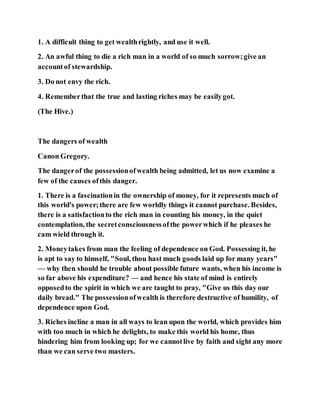
1. A difficult thing to get wealthrightly, and use it well.
2. An awful thing to die a rich man in a world of so much sorrow;give an
accountof stewardship.
3. Do not envy the rich.
4. Rememberthat the true and lasting riches may be easilygot.
(The Hive.)
The dangers of wealth
Canon Gregory.
The dangerof the possessionofwealth being admitted, let us now examine a
few of the causes ofthis danger.
1. There is a fascinationin the ownership of money, for it represents much of
this world's power;there are few worldly things it cannot purchase. Besides,
there is a satisfactionto the rich man in counting his money, in the quiet
contemplation, the secretconsciousnessofthe powerwhich if he pleases he
cam wield through it.
2. Moneytakes from man the feeling of dependence on God. Possessing it, he
is apt to say to himself, "Soul, thou hast much goods laid up for many years"
— why then should he trouble about possible future wants, when his income is
so far above his expenditure? — and hence his state of mind is entirely
opposedto the spirit in which we are taught to pray, "Give us this day our
daily bread." The possessionofwealth is therefore destructive of humility, of
dependence upon God.
3. Riches incline a man in all ways to lean upon the world, which provides him
with too much in which he delights, to make this world his home, thus
hindering him from looking up; for we cannotlive by faith and sight any more
than we can serve two masters.
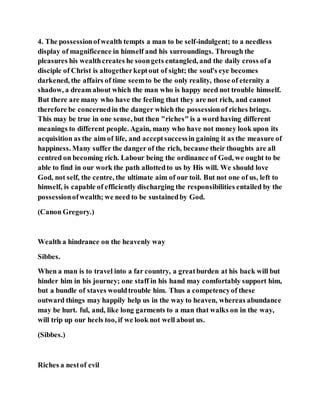
4. The possessionofwealth tempts a man to be self-indulgent; to a needless
display of magnificence in himself and his surroundings. Through the
pleasures his wealthcreates he soongets entangled, and the daily cross ofa
disciple of Christ is altogetherkeptout of sight; the soul's eye becomes
darkened, the affairs of time seemto be the only reality, those of eternity a
shadow, a dream about which the man who is happy need not trouble himself.
But there are many who have the feeling that they are not rich, and cannot
therefore be concernedin the danger which the possessionof riches brings.
This may be true in one sense, but then "riches" is a word having different
meanings to different people. Again, many who have not money look upon its
acquisition as the aim of life, and acceptsuccessin gaining it as the measure of
happiness. Many suffer the danger of the rich, because their thoughts are all
centred on becoming rich. Labour being the ordinance of God, we ought to be
able to find in our work the path allottedto us by His will. We should love
God, not self, the centre, the ultimate aim of our toil. But not one of us, left to
himself, is capable of efficiently discharging the responsibilities entailed by the
possessionofwealth; we need to be sustainedby God.
(Canon Gregory.)
Wealth a hindrance on the heavenly way
Sibbes.
When a man is to travel into a far country, a greatburden at his back will but
hinder him in his journey; one staff in his hand may comfortably support him,
but a bundle of staves wouldtrouble him. Thus a competencyof these
outward things may happily help us in the way to heaven, whereas abundance
may be hurt. ful, and, like long garments to a man that walks on in the way,
will trip up our heels too, if we look not well about us.
(Sibbes.)
Riches a nestof evil
Adams.
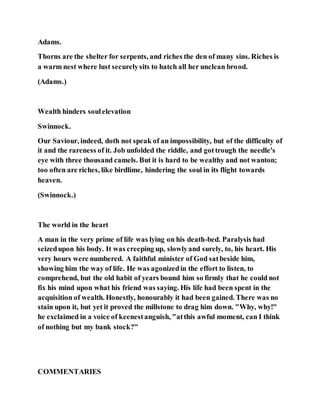
Thorns are the shelter for serpents, and riches the den of many sins. Riches is
a warm nest where lust securelysits to hatch all her unclean brood.
(Adams.)
Wealth hinders soulelevation
Swinnock.
Our Saviour, indeed, doth not speak of an impossibility, but of the difficulty of
it and the rareness of it. Job unfolded the riddle, and gottrough the needle's
eye with three thousand camels. But it is hard to be wealthy and not wanton;
too often are riches, like birdlime, hindering the soul in its flight towards
heaven.
(Swinnock.)
The world in the heart
A man in the very prime of life was lying on his death-bed. Paralysis had
seizedupon his body. It was creeping up, slowlyand surely, to, his heart. His
very hours were numbered. A faithful minister of God satbeside him,
showing him the way of life. He was agonizedin the effort to listen, to
comprehend, but the old habit of years bound him so firmly that he could not
fix his mind upon what his friend was saying. His life had been spent in the
acquisition of wealth. Honestly, honourably it had been gained. There was no
stain upon it, but yet it proved the millstone to drag him down. "Why, why!"
he exclaimed in a voice of keenestanguish, "atthis awful moment, can I think
of nothing but my bank stock?"
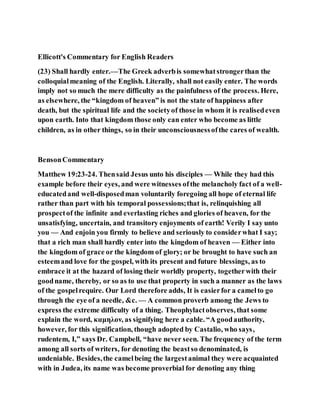
COMMENTARIES
Ellicott's Commentary for English Readers
(23) Shall hardly enter.—The Greek adverbis somewhatstrongerthan the
colloquialmeaning of the English. Literally, shall not easily enter. The words
imply not so much the mere difficulty as the painfulness of the process. Here,
as elsewhere, the “kingdom of heaven” is not the state of happiness after
death, but the spiritual life and the societyof those in whom it is realisedeven
upon earth. Into that kingdom those only can enter who become as little
children, as in other things, so in their unconsciousnessofthe cares of wealth.
BensonCommentary
Matthew 19:23-24. Thensaid Jesus unto his disciples — While they had this
example before their eyes, and were witnesses ofthe melancholy fact of a well-
educatedand well-disposedman voluntarily foregoing all hope of eternal life
rather than part with his temporal possessions;that is, relinquishing all
prospectof the infinite and everlasting riches and glories of heaven, for the
unsatisfying, uncertain, and transitory enjoyments of earth! Verily I say unto
you — And enjoin you firmly to believe and seriously to considerwhat I say;
that a rich man shall hardly enter into the kingdom of heaven — Either into
the kingdom of grace or the kingdom of glory; or be brought to have such an
esteemand love for the gospel, with its present and future blessings, as to
embrace it at the hazard of losing their worldly property, togetherwith their
goodname, thereby, or so as to use that property in such a manner as the laws
of the gospelrequire. Our Lord therefore adds, It is easierfor a camelto go
through the eye of a needle, &c. — A common proverb among the Jews to
express the extreme difficulty of a thing. Theophylactobserves, that some
explain the word, καμηλον, as signifying here a cable. “A goodauthority,
however, for this signification, though adopted by Castalio, who says,
rudentem, I,” says Dr. Campbell, “have never seen. The frequency of the term
among all sorts of writers, for denoting the beastso denominated, is
undeniable. Besides,the camelbeing the largestanimal they were acquainted
with in Judea, its name was become proverbial for denoting any thing
remarkably large, and a camel’s passing through a needle’s eye came, by
consequence,as appears from some rabbinical writings, to express a thing
absolutely impossible.” Our Lord, therefore, here represents the salvationof a
rich man as being next to an impossibility. It was especiallyso in those early
days, when the professionof the gospelexposedmen to so much persecution.
And perhaps, as Dr. Macknightobserves, these strong expressions,in their
strictestsense, must be understood of the state of things at that time
subsisting; yet they are also applicable to rich men in all ages. The reasonis,
“Riches have a woful influence upon piety in two respects. 1st, In the
acquisition; for, not to mention the many frauds and other sins that men
commit to obtain riches, they occasionanendless variety of cares and
anxieties, which draw the affections awayfrom God. 2d, They are offensive to
piety in the possession;because, ifthey are hoarded, they never fail to beget
covetousness,whichis the root of all evil; and if they are enjoyed they become
strong temptations to luxury, drunkenness, lust, pride, and idleness.” But,
besides these, riches are a dangerous snare in severalother respects. 1st, Itis
difficult to possessthem and not inordinately love them, and put that trust in
them which ought to be put only in the living God. Forrich men “obtaining all
the necessaries andsuperfluities of life by means of their riches, are apt to
considerthem as the sources oftheir happiness, and to depend upon them as
such, forgetting altogethertheir dependance on God. It is otherwise with the
poor. They are exposedto manifold afflictions, and labour under the pressure
of continual wants. These serve to convince them of the vanity of the world,
and to put them in mind of their dependance upon God; at the same time, the
unexpected deliverances and supplies which they meet with, rivet the idea
more firmly. Wherefore, in the very nature of things, the poor are nearer to
the kingdom of God than the rich; and if the latter, yielding to the temptations
of their state, trust in their riches, words canscarce be invented strong enough
to paint the difficulty of bringing them to that holy temper of mind which
would qualify them for the kingdom of God.” 2d, It is not easyto possess
riches and not think highly of ourselves onaccountof them, as they certainly
give their possessors a consequencewhichthey otherwise could not have, and
cause them to be lookedup to with respectby all that are round about them.
But, 3d, The most difficult thing of all is, to possessthem and make a right use
of them, even that use which God wills all to make in whose hands he hath
lodged them. In other words, To use them as those who are persuaded that,
properly speaking, they are not proprietors, but merely stewards of them, and
will certainly be called by the greatLord of all to give an accounthow they
have employed every part of them, and what use they have made of the
advantages and opportunities for doing and receiving goodabove others,
which riches put in their power.
Matthew Henry's Concise Commentary
19:23-30 ThoughChrist spoke so strongly, few that have riches do not trust in
them. How few that are poor are not tempted to envy! But men's earnestness
in this matter is like their toiling to build a high wall to shut themselves and
their children out of heaven. It should be satisfactionto those who are in a low
condition, that they are not exposedto the temptations of a high and
prosperous condition. If they live more hardly in this world than the rich, yet,
if they getmore easilyto a better world, they have no reasonto complain.
Christ's words show that it is hard for a rich man to be a goodChristian, and
to be saved. The way to heaven is a narrow way to all, and the gate that leads
into it, a strait gate;particularly so to rich people. More duties are expected
from them than from others, and more sins easilybesetthem. It is hard not to
be charmed with a smiling world. Rich people have a greataccountto make
up for their opportunities above others. It is utterly impossible for a man that
sets his heart upon his riches, to get to heaven. Christ used an expression,
denoting a difficulty altogetherunconquerable by the powerof man. Nothing
less than the almighty grace of God will enable a rich man to get over this
difficulty. Who then can be saved? If riches hinder rich people, are not pride
and sinful lusts found in those not rich, and as dangerous to them? Who can
be saved? say the disciples. None, saith Christ, by any createdpower. The
beginning, progress, and perfecting the work of salvation, depend wholly on
the almighty powerof God, to which all things are possible. Notthat rich
people canbe savedin their worldliness, but that they should be savedfrom it.
Petersaid, We have forsakenall. Alas! it was but a poor all, only a few boats
and nets; yet observe how Peterspeaks, as if it had been some mighty thing.
We are too apt to make the most of our services and sufferings, our expenses
and losses, forChrist. However, Christ does not upbraid them; though it was
but little that they had forsaken, yet it was their all, and as dear to them as if
it had been more. Christ took it kindly that they left it to follow him; he
accepts according to what a man hath. Our Lord's promise to the apostles is,
that when the Sonof man shall sit on the throne of his glory, he will make all
things new, and they shall sit with him in judgement on those who will be
judged according to their doctrine. This sets forth the honour, dignity, and
authority of their office and ministry. Our Lord added, that every one who
had forsakenpossessionsorcomforts, for his sake and the gospel, would be
recompensedat last. May God give us faith to rest our hope on this his
promise; then we shall be ready for every service or sacrifice. Our Saviour, in
the lastverse, does awaya mistake of some. The heavenly inheritance is not
given as earthly ones are, but according to God's pleasure. Let us not trust in
promising appearancesoroutward profession. Others may, for aught we
know, become eminent in faith and holiness.
Barnes'Notes on the Bible
A rich man shall hardly enter into the kingdom of heaven - Shall with
difficulty be saved.
He has much to struggle with, and it will require the greatestofhuman efforts
to break awayfrom his temptations and idols. and to secure his salvation.
Compare the notes at 1 Timothy 6:9-10.
Jamieson-Fausset-BrownBible Commentary
Mt 19:16-30. The RichYoung Ruler. ( = Mr 10:17-31;Lu 18:18-30).
For the exposition, see on[1330]Lu 18:18-30.
Matthew Poole's Commentary
See Poole on"Matthew 19:24".
Gill's Exposition of the Entire Bible
Then said Jesus unto his disciples..... Whenthe young man was gone;taking
this opportunity to make some proper observations for the use and instruction
of his disciples, after, as Mark observes, he had "lookedround about"; with
concern, and in order to affecttheir minds with this incident, and to raise
their attention to what he was about to say:
verily I say unto you, that a rich man shall hardly enter into the kingdom of
heaven: either into the Gospeldispensation, and receive the truths, and
submit to the ordinances of it, or into the kingdom of glory hereafter;not but
that there have been, are, and will be, some that are rich, called by grace,
brought into a Gospelchurch state, and are heirs of the kingdom of heaven;
though these are but comparatively few: nor is it riches themselves that make
the entrance so difficult, and clog the way, either into grace or glory, but
putting trust and confidence in them; and therefore in Mark, they "that have
riches", are by Christ explained of such, that "trust in riches";and which rich
men in common are very apt to do, as this young man did, againstwhich the
apostle cautions,
Geneva Study Bible
{6} Then said Jesus unto his disciples, Verily I sayunto you, That a rich man
shall hardly enter into the kingdom of heaven.
(6) Rich men have need of a singular gift of Godto escape outof the snares of
Satan.
EXEGETICAL(ORIGINAL LANGUAGES)
Expositor's Greek Testament
Matthew 19:23-27. Conversationensuing (Mark 10:23-27;Luke 18:24-27).
Cambridge Bible for Schools andColleges
23. hardly] i. e. with difficulty.
23–26.OfRiches, and the Kingdom of God
Mark 10:23-27. Luke 18:24-27.
These reflections follow naturally on the lastincident.
Bengel's Gnomen
Matthew 19:23. Δυσκόλως, with difficulty) This young man, when he had his
foot already on the threshold, withdrew it on accountof his riches. It is
difficult for a rich man to relinquish all things.[874]
[874]Nay, it is not even readily that he thinks of the subjectof obtaining
eternal life at all.—V. g.
Pulpit Commentary
Verses 23-30. -The dangers of riches and the blessings of self-denied. (Mark
10:23-31;Luke 18:24-30.)Verse 23. - Then said Jesus. He derives an
important lessonfrom the sadresult of the above incident. St Luke connects it
with what had just preceded:"When Jesus saw that he [the ruler] was very
sorrowful, he said." It was a strange and most emphatic assertion, quite alien
from generalopinion and sentiment. A rich man shall hardly (δυσκόλως, with
difficulty) enter into the kingdom of heaven. Remembering that Christ had
just invited the young ruler to range himself on his side and become his
disciple, we see that the primary meaning of the term, "kingdomof heaven,"
here is the Christian Church, the societywhich Jesus came to establish. It was
indeed difficult for a man wealthy, honoured, dignified, to strip himself of his
riches and rank, and openly castin his lot with the despisedJesus and his
followers, voluntarily surrendering all that hitherto had made life beautiful
and worth living. It is difficult for a rich man in any case to serve God
acceptably, as Christ shows with reiteratedemphasis.
STUDYLIGHTRESOURCES
Adam Clarke Commentary
A rich man shall hardly enter - That is, into the spirit and privileges of the
Gospelin this world, and through them into the kingdom of glory. Earthly
riches are a greatobstacle to salvation; because it is almost impossible to
possessthem, and not to set the heart upon them; and they who love the world
have not the love of the Fatherin them. 1 John 2:15. To be rich, therefore, is
in generala greatmisfortune: but what rich man canbe convincedof this? It
is only God himself who, by a miracle of mercy, cando this. Christ himself
affirms the difficulty of the salvation of a rich man, with an oath, verily; but
who of the rich either hears or believes him!
Copyright Statement
These files are public domain.
Bibliography
Clarke, Adam. "Commentary on Matthew 19:23". "The Adam Clarke
Commentary". https:https://www.studylight.org/commentaries/acc/matthew-
19.html. 1832.
return to 'Jump List'
Coffman's Commentaries on the Bible
And Jesus saidunto his disciples, Verily, I say unto you, it is hard for a rich
man to enter into the kingdom of heaven.
Why, then, do we all strive to be rich? Is it that we desire to impede our soul's
entry into the kingdom of God? Do people really wish to do it the hard way?
Then let them getrich. That will provide an acid testthat most people cannot
pass. No wonder an apostle warned againstambition in that quarter (1
Timothy 6:9,10), and that Jesus taughtpeople to seek his kingdom "first"!
(Matthew 6:33). The rich are not hopeless. Christdid not saythey cannot be
saved, only that it is "hard" for them to enter.
Copyright Statement
James Burton Coffman Commentaries reproduced by permission of Abilene
Christian University Press, Abilene, Texas, USA. All other rights reserved.
Bibliography
Coffman, James Burton. "Commentary on Matthew 19:23". "Coffman
Commentaries on the Old and New Testament".
https:https://www.studylight.org/commentaries/bcc/matthew-19.html. Abilene
Christian University Press, Abilene, Texas, USA. 1983-1999.
return to 'Jump List'
John Gill's Exposition of the Whole Bible
Then said Jesus unto his disciples..... Whenthe young man was gone;taking
this opportunity to make some proper observations for the use and instruction
of his disciples, after, as Mark observes, he had "lookedround about"; with
concern, and in order to affecttheir minds with this incident, and to raise
their attention to what he was about to say:
verily I say unto you, that a rich man shall hardly enter into the kingdom of
heaven: either into the Gospeldispensation, and receive the truths, and
submit to the ordinances of it, or into the kingdom of glory hereafter;not but
that there have been, are, and will be, some that are rich, called by grace,
brought into a Gospelchurch state, and are heirs of the kingdom of heaven;
though these are but comparatively few: nor is it riches themselves that make
the entrance so difficult, and clog the way, either into grace or glory, but
putting trust and confidence in them; and therefore in Mark, they "that have
riches", are by Christ explained of such, that "trust in riches";and which rich
men in common are very apt to do, as this young man did, againstwhich the
apostle cautions, 1 Timothy 6:17
Copyright Statement
The New John Gill's Exposition of the Entire Bible Modernisedand adapted
for the computer by Larry Pierce of Online Bible. All Rightes Reserved,
Larry Pierce, Winterbourne, Ontario.
A printed copy of this work can be ordered from: The Baptist Standard
Bearer, 1 Iron Oaks Dr, Paris, AR, 72855
Bibliography
Gill, John. "Commentary on Matthew 19:23". "The New JohnGill Exposition
of the Entire Bible".
https:https://www.studylight.org/commentaries/geb/matthew-19.html. 1999.
return to 'Jump List'
Geneva Study Bible
6 Then said Jesus unto his disciples, Verily I say unto you, That a rich man
shall hardly enter into the kingdom of heaven.
(6) Rich men have need of a singular gift of Godto escape outof the snares of
Satan.
Copyright Statement
These files are public domain.
Text Courtesyof BibleSupport.com. Used by Permission.
Bibliography
Beza, Theodore. "Commentaryon Matthew 19:23". "The 1599 Geneva Study
Bible". https:https://www.studylight.org/commentaries/gsb/matthew-19.html.
1599-1645.
return to 'Jump List'
People's New Testament
A rich man shall hardly enter into the kingdom of heaven. The Lord does not
say that a rich man shall not enter, but that he shall enter with great
difficulty. Mark says that when Christ uttered these words the disciples were
astonished, and then Jesus explained by the words, "How hard it is for them
{that trust in riches} to enter into the kingdom of God," which shows the sense
in which he spoke the words of this verse. A man may {trust} in riches who
has $100, as wellas one who has $100,000.
Copyright Statement
These files are public domain and are a derivative of an electronic edition that
is available on the Christian ClassicsEtherealLibrary Website.
Original work done by Ernie Stefanik. First published online in 1996 atThe
RestorationMovementPages.
Bibliography
Johnson, BartonW. "Commentary on Matthew 19:23". "People's New
Testament". https:https://www.studylight.org/commentaries/pnt/matthew-
19.html. 1891.
return to 'Jump List'
Robertson's WordPictures in the New Testament
It is hard (δυσκολως — duskolōs). With difficulty. Adverb from δυσκολος —
duskolos hard to find food, fastidious, faultfinding, then difficult.
Copyright Statement
The Robertson's WordPictures of the New Testament. Copyright �
Broadman Press 1932,33,Renewal1960. All rights reserved. Used by
permission of Broadman Press (Southern BaptistSunday SchoolBoard)
Bibliography
Robertson, A.T. "Commentary on Matthew 19:23". "Robertson's Word
Pictures of the New Testament".
https:https://www.studylight.org/commentaries/rwp/matthew-19.html.
Broadman Press 1932,33.Renewal1960.
return to 'Jump List'
The Fourfold Gospel
And Jesus saidunto his disciples, Verily I sayunto you, It is hard for a rich
man to enter into the kingdom of heaven1.
It is hard for a rich man to enter into the kingdom of heaven. See .
Copyright Statement
These files are public domain and are a derivative of an electronic edition that
is available on the Christian ClassicsEtherealLibrary Website. These files
were made available by Mr. Ernie Stefanik. First published online in 1996 at
The RestorationMovementPages.
Bibliography
J. W. McGarveyand Philip Y. Pendleton. "Commentaryon Matthew 19:23".
"The Fourfold Gospel".
https:https://www.studylight.org/commentaries/tfg/matthew-19.html.
Standard Publishing Company, Cincinnati, Ohio. 1914.
return to 'Jump List'
Calvin's Commentary on the Bible
Matthew 19:23.A rich man will with difficulty enter. Christ warns them, not
only how dangerous and how deadly a plague avarice is, but also how greatan
obstacle is presented by riches. In Mark, indeed, he mitigates the harshness of
his expression, by restricting it to those only who place confidence in riches
But these words are, I think, intended to confirm, rather than correct, the
former statement, as if he had affirmed that they ought not to think it strange,
that he made the entrance into the kingdom of heaven so difficult for the rich,
because it is an evil almost common to all to trust in their riches Yet this
doctrine is highly useful to all; to the rich, that, being warned of their danger,
they may be on their guard; to the poor, that, satisfiedwith their lot, they may
not so eagerlydesire what would bring more damage than gain. It is true
indeed, that riches do not, in their own nature, hinder us from following God;
but, in consequenceofthe depravity of the human mind, it is scarcelypossible
for those who have a greatabundance to avoid being intoxicated by them. So
they who are exceedinglyrich are held by Satanbound, as it were, in chains,
that they may not raise their thoughts to heaven; nay more, they bury and
entangle themselves, and became utter slaves to the earth. The comparisonof
the camel. , which is soonafter added, is intended to amplify the difficulty; for
it means that the rich are so swelledwith pride and presumption, that they
cannot endure to be reduced to the straits through which Godmakes his
people to pass. The word camel denotes, I think, a rope used by sailors, rather
than the animal so named. (633)
Copyright Statement
These files are public domain.
Bibliography
Calvin, John. "Commentary on Matthew 19:23". "Calvin's Commentary on
the Bible". https:https://www.studylight.org/commentaries/cal/matthew-
19.html. 1840-57.
return to 'Jump List'
Scofield's ReferenceNotes
kingdom
(See Scofield"Matthew 3:2")
Copyright Statement
These files are consideredpublic domain and are a derivative of an electronic
edition that is available in the Online Bible Software Library.
Bibliography
Scofield, C. I. "ScofieldReferenceNoteson Matthew 19:23". "Scofield
Reference Notes(1917Edition)".
https:https://www.studylight.org/commentaries/srn/matthew-19.html. 1917.
return to 'Jump List'
John Trapp Complete Commentary
23 Then saidJesus unto his disciples, Verily I say unto you, That a rich man
shall hardly enter into the kingdom of heaven.
Ver. 23. A rich man shall hardly enter] With that burden of thick clay, that
camels bunch on his back. Heaven is a statelypalace, with a narrow portal;
there must he both stripping and straining ere one can getthrough this strait,
gate. The greatestwealthis ordinarily tumoured up with the greatestswelthof
rebellion againstGod
" Ardua res haec est opibus non tradere mores;
Et cum tot Croesesviceris, esseNumam." Martial.
Vermis divitiarum est superbia, saith Augustine. Pride breeds in wealth as the
worm doth in the apple, and he is a greatrich man indeed, and greaterthan
his riches, that doth not think himself greatbecause he is rich. "Charge those
that are rich, that they be not highminded" (for the devil will soonblow up
such a blab in them, if they watchnot), "and that they trust not in uncertain
riches," 1 Timothy 6:17, so as to make their gold their God, as all worldlings
do, and worse, forcould we but rip up such men’s hearts, we should find
written in them, "The God of this present world." They that mind earthly
things have destruction for their end, Philippians 3:19. Have them we may,
and use them too, but mind them we may not, nor love them, 1 John 2:15; that
is spiritual harlotry, such as God’s soul hateth, and he "smiteth his hands at,"
Ezekiel22:13.
Copyright Statement
These files are public domain.
Text Courtesyof BibleSupport.com. Used by Permission.
Bibliography
Trapp, John. "Commentary on Matthew 19:23". John Trapp Complete
Commentary. https:https://www.studylight.org/commentaries/jtc/matthew-
19.html. 1865-1868.
return to 'Jump List'
Thomas Coke Commentary on the Holy Bible
Matthew 19:23. Shall hardly— Will hardly.
Copyright Statement
These files are public domain.
Text Courtesyof BibleSupport.com. Used by Permission.
Bibliography
Coke, Thomas. "Commentaryon Matthew 19:23". Thomas Coke
Commentary on the Holy Bible.
https:https://www.studylight.org/commentaries/tcc/matthew-19.html. 1801-
1803.
return to 'Jump List'
Expository Notes with PracticalObservations onthe New Testament
Our blessedSaviour takes occasion, from what had passed, to discourse with
his disciples concerning the danger of riches, and the difficulties that attend
rich men in their way to salvation. A rich man shall hardly enter into the
kingdom of heaven.
Whence note, 1. That rich men do certainly meet with more difficulties in
their way to heaven, than other men: it is difficult to withdraw their affections
from riches, to place their supreme love upon God in the midst of their
abundance. It is difficult to depend upon God in a rich condition. The poor
committeth himself to God, but the rich man's wealth is his strong tower. That
yet the fault lies not in riches, but in rich men; who, by placing their trust and
putting their confidence in riches, do render themselves incapable of the
kingdom of God.
Copyright Statement
These files are public domain.
Text Courtesyof BibleSupport.com. Used by Permission.
Bibliography
Burkitt, William. "Commentary on Matthew 19:23". ExpositoryNotes with
PracticalObservations onthe New Testament.
https:https://www.studylight.org/commentaries/wbc/matthew-19.html. 1700-
1703.
return to 'Jump List'
Johann Albrecht Bengel's Gnomonof the New Testament
Matthew 19:23. δυσκόλως, with difficulty) This young man, when he had his
foot already on the threshold, withdrew it on accountof his riches. It is
difficult for a rich man to relinquish all things.(874)
Copyright Statement
These files are public domain.
Text Courtesyof BibleSupport.com. Used by Permission.
Bibliography
Bengel, JohannAlbrecht. "Commentary on Matthew 19:23". Johann
Albrecht Bengel's Gnomonof the New Testament.
https:https://www.studylight.org/commentaries/jab/matthew-19.html. 1897.
return to 'Jump List'
Matthew Poole's EnglishAnnotations on the Holy Bible
See Poole on"Matthew 19:24".
Copyright Statement
These files are public domain.
Text Courtesyof BibleSupport.com. Used by Permission.
Bibliography
Poole, Matthew, "Commentaryon Matthew 19:23". Matthew Poole's English
Annotations on the Holy Bible.
https:https://www.studylight.org/commentaries/mpc/matthew-19.html. 1685.
return to 'Jump List'
Justin Edwards' Family Bible New Testament
Hardly enter; it is with greatdifficulty that he can enter.
Copyright Statement
These files are public domain.
Text Courtesyof BibleSupport.com. Used by Permission.
Bibliography
Edwards, Justin. "Commentary on Matthew 19:23". "FamilyBible New
Testament". https:https://www.studylight.org/commentaries/fam/matthew-
19.html. American TractSociety. 1851.
return to 'Jump List'
Cambridge Greek Testamentfor Schools andColleges
23. τὴν βασ. τῶν οὐρ. Comparing this with Matthew 19:16-17, we note that
ζωὴ αἰώνιος, ἡ ζωὴ and ἠ βασιλεία τῶν οὐρανῶνare used as synonyms.
Copyright Statement
These files are public domain.
Text Courtesyof BibleSupport.com. Used by Permission.
Bibliography
"Commentary on Matthew 19:23". "Cambridge Greek Testamentfor Schools
and Colleges".https:https://www.studylight.org/commentaries/cgt/matthew-
19.html. 1896.
return to 'Jump List'
Whedon's Commentary on the Bible
§ 105. — POSSIBILITYOF RICH MEN’S SALVATION, Matthew 19:23-30.
23. A rich man — Mark says, “thattrusteth in his riches.” But this hardly
alters it. How few rich that do not trust in riches!And how few poor who do
not trust in riches they are not able to acquire!
Copyright Statement
These files are public domain.
Text Courtesyof BibleSupport.com. Used by Permission.
Bibliography
Whedon, Daniel. "Commentary on Matthew 19:23". "Whedon's Commentary
on the Bible". https:https://www.studylight.org/commentaries/whe/matthew-
19.html. 1874-1909.
return to 'Jump List'
PeterPett's Commentary on the Bible
‘And Jesus saidto his disciples, “Truly I say to you, It is hard for a rich man
to enter into the kingly rule of heaven.” ’
As the young man walks awayJesus recognisesthe conflict that is taking place
in his mind, and then turns to His disciples and says sadly, “It is hard for a
rich man to enter into the Kingly Rule of Heaven.” The reasonbehind His
statementis quite clearfrom the young man’s dilemma. Riches prevent a man
from being willing to follow fully in His ways. And the implication of it is that
if a man would enter the Kingly Rule of Heaven he must first deal with the
question of his riches. For to be under the Kingly Rule of Heaven means that
all his riches must be at God’s disposal. And for a rich man that is very hard.
Here was one who could have become ‘a sonof the Kingly Rule of Heaven’
(Matthew 13:38) but he had turned awayfrom it. Some see ‘the Kingly Rule
of Heaven’ here in Matthew 19:23 as signifying the eternal kingly rule beyond
the grave. (It cannotmean a millennial kingdom, for rich men will not find it
hard to enter that). But Jesus has made abundantly clearthat the Kingly Rule
of Heaven has in fact ‘drawn near’ (Matthew 4:17), and that it is among them
(Luke 17:21) and has ‘come upon them’ (Matthew 12:28), and is therefore
there for all who will respond to it. And the impression given here is surely
that the young man has been faced with that choice and has failed to take his
opportunity. For the Kingly Rule of Heaven is not a place, it is a sphere of
Kingly Rule, and a sphere of submission which is past, present and future.
That the Kingly Rule of Heaven, which initially was intended to result from
the Exodus (Exodus 19:6; Exodus 20:1-18;Numbers 23:21;Deuteronomy
33:5; 1 Samuel 8:7), has in one sense always beenopen to man’s response
comes out in the Psalms and is especiallyemphasisedin Isaiah 6 (see Psalms
22:28;Psalms 103:19;Psalms 93:1; Psalms 97:1; Psalms 99:1;Isaiah 6:1-11).
That it is now present among men in a unique way is made clearin Matthew
11:12;Matthew 12:28;Matthew 13:38; Luke 17:21. That it will be takenout
and offeredto the world is made clearin Acts 8:12, where it parallels taking
out the name of Jesus;Acts 19:8, where it parallels the proclamationof ‘The
Way’; Acts 20:25; Acts 28:23;Acts 28:28 where it refers to ‘the things
concerning the Lord Jesus’. Paulwould have had no reasonfor trying to
persuade and teachthe Jews aboutsomething that they believed in
wholeheartedly, the future Kingly Rule of God. What he was seeking to bring
home to them was that the Kingly Rule of God was now open to them in Jesus.
Compare also how he will say in his letters that ‘the Kingly Rule of God is not
eating and drinking, but righteousness,and peace, and joy in the Holy Spirit’
(Romans 14:17) and that we (believers)have been ‘transported into the
Kingly Rule of His belovedSon’ (Colossians 1:13). To Paul as to Jesus the
Kingly Rule of Heaven (God) was both present and future, presentin
experience and future in full manifestation. It can thus be entered now,
Copyright Statement
These files are public domain.
Text Courtesyof BibleSupport.com. Used by Permission.
Bibliography
Pett, Peter. "Commentary on Matthew 19:23". "PeterPett's Commentaryon
the Bible ". https:https://www.studylight.org/commentaries/pet/matthew-
19.html. 2013.
return to 'Jump List'
Schaff's Popular Commentary on the New Testament
Matthew 19:23. A rich man shill enter hardly, i.e., ‘with difficulty,’ into the
kingdom of heaven. Comp. Mark 10:24 : ‘them that trust in riches.’Yet such
trust is the natural result of possession, orof even the strong desire to possess.
Copyright Statement
These files are public domain.
Text Courtesyof BibleSupport.com. Used by Permission.
Bibliography
Schaff, Philip. "Commentary on Matthew 19:23". "Schaff's Popular
Commentary on the New Testament".
https:https://www.studylight.org/commentaries/scn/matthew-19.html. 1879-
90.
return to 'Jump List'
The Expositor's Greek Testament
Matthew 19:23. ἀμὴν, introduces as usual a solemnutterance.— πλούσιος: the
rich man is brought on the stage, notas an objectof envy or admiration,
which he is to the worldly-minded, but as an objectof commiseration.—
δυσκόλως εἰσελεύσεται, etc.:because with difficulty shall he enter the
Kingdom of Heaven. This is stated as a matter of observation, not without
sympathy, and not with any intention to pronounce dogmatically on the case
of the inquirer who had just departed, as if he were an absolutely lost soul. His
case suggestedthe topic of wealth as a hindrance in the divine life.—
δυσκόλως:the adjective δύσκολος means difficult to please as to food ( δυς,
κόλον), hence morose;here used of things, occurs only in this saying in N. T.
Copyright Statement
These files are public domain.
Text Courtesyof BibleSupport.com. Used by Permission.
Bibliography
Nicol, W. Robertson, M.A., L.L.D. "Commentary on Matthew 19:23". The
Expositor's Greek Testament.
https:https://www.studylight.org/commentaries/egt/matthew-19.html. 1897-
1910.
return to 'Jump List'
E.W. Bullinger's Companion Bible Notes
Verily. See note on Matthew 5:18.
hardly = with difficulty.
Copyright Statement
These files are public domain.
Text Courtesyof BibleSupport.com. Used by Permission.
Bibliography
Bullinger, Ethelbert William. "Commentary on Matthew 19:23". "E.W.
Bullinger's Companion bible Notes".
https:https://www.studylight.org/commentaries/bul/matthew-19.html. 1909-
1922.
return to 'Jump List'
The Bible Study New Testament
Jesus then said to his disciples. Notice he does not say "impossible," but "very
hard." A few versions add in Mark 10:24 "Forthose who trust in riches."
Copyright Statement
These files are public domain.
Bibliography
Ice, Rhoderick D. "Commentary on Matthew 19:23". "The Bible Study New
Testament". https:https://www.studylight.org/commentaries/ice/matthew-
19.html. College Press, Joplin, MO. 1974.
return to 'Jump List'
Ellicott's Commentary for English Readers
(23) Shall hardly enter.—The Greek adverbis somewhatstrongerthan the
colloquialmeaning of the English. Literally, shall not easily enter. The words
imply not so much the mere difficulty as the painfulness of the process. Here,
as elsewhere, the “kingdom of heaven” is not the state of happiness after
death, but the spiritual life and the societyof those in whom it is realisedeven
upon earth. Into that kingdom those only can enter who become as little
children, as in other things, so in their unconsciousnessofthe cares of wealth.
Copyright Statement
These files are public domain.
Text Courtesyof BibleSupport.com. Used by Permission.
Bibliography
Ellicott, Charles John. "Commentary on Matthew 19:23". "Ellicott's
Commentary for English Readers".
https:https://www.studylight.org/commentaries/ebc/matthew-19.html. 1905.
return to 'Jump List'
Treasuryof Scripture Knowledge
Then said Jesus unto his disciples, Verily I say unto you, That a rich man shall
hardly enter into the kingdom of heaven.
That
13:22;Deuteronomy 6:10-12;8:10-18;Job 31:24,25;Psalms 49:6,7,16-19;
Proverbs 11:28; Proverbs 30:8,9;Mark 10:23; Luke 12:15-21;16:13,14,19-28;
18:24;1 Corinthians 1:26; 1 Timothy 6:9,10;James 1:9-11;2:6; 5:1-4
enter
5:20; 18:3; 21:31; John 3:3,5; Acts 14:22
Copyright Statement
These files are public domain.
Text Courtesyof BibleSupport.com. Used by Permission.
Bibliography
Torrey, R. A. "Commentary on Matthew 19:23". "The Treasuryof Scripture
Knowledge". https:https://www.studylight.org/commentaries/tsk/matthew-
19.html.
return to 'Jump List'
E.M. Zerr's Commentary on SelectedBooksofthe New Testament
Hardly is from DUSKOLOS which Thayer defines, "with difficulty." The
sacrifices thata rich man is calledupon to make enter so deeply into his
devotion to the business of getting more money, that it is difficult for him to
bring about that change in his manner of life.
Verse24. Needle is from RHAPHIS which Thayerdefines, "a needle," and he
shows that the word comes from BHAPTO which means, "to sew." Donne-
gan defines rhaphis, "a needle, awl, or other instrument for sewing." The
Authorized version renders this verse correctly, for the words are so defined
in the lexiconof the Greek language.
STUDYLIGHTON VERSE 24
Adam Clarke Commentary
A camel- Instead of καμηλον, camel, six MSS. read καμιλον, cable, a mere
gloss insertedby some who did not know that the other was a proverb
common enough among the people of the east.
There is an expressionsimilar to this in the Koran. "The impious, who in his
arrogance shallaccuseour doctrine of falsity, shall find the gates ofheaven
shut: nor shall he enter there till a camelshall pass through the eye of a
needle. It is thus that we shall recompense the wicked." Al Koran. Surat vii.
ver. 37.
It was also a mode of expressioncommon among the Jews, and signified a
thing impossible. Hence this proverb: A camelin Media dances in a cabe;a
measure which held about three pints. Again, No man sees a palm tree of gold,
nor an elephant passing through the eye of a needle. Becausethese are
impossible things. "Rabbi SheshethansweredRabbi Amram, who had
advancedan absurdity, Perhaps thou art one of the Pembidithians who can
make an elephant pass through the eye of a needle; that is, says the Aruch,
'who speak things impossible.'" See Lightfoot and Schoettgenon this place.
Go through - But instead of διελθειν, about eighty MSS. with severalversions
and fathers, have εισελθειν, to enter in; but the difference is of little
importance in an Englishtranslation, though of some consequence to the
eleganceofthe Greek text.
Copyright Statement
These files are public domain.
Bibliography
Clarke, Adam. "Commentary on Matthew 19:24". "The Adam Clarke
Commentary". https:https://www.studylight.org/commentaries/acc/matthew-
19.html. 1832.
return to 'Jump List'
Coffman's Commentaries on the Bible
And againI say unto you, It is easierfor a camel to go through a needle's eye,
than for a rich man to enter into the kingdom of God.
All attempts to make such a thing possible must appear ridiculous in the light
of Christ's statement, a moment later, that such is "impossible" for human
beings. Only the powerof Godcan bring a man of wealthto quit trusting in
his riches and to place his hope in God through Christ, or to possess his
possessionsinsteadof being possessedby them. People of affluence should
always remember that only the powerof the Eternal canempower them to
force their wealth to subserve the purposes of God and His kingdom.
Copyright Statement
James Burton Coffman Commentaries reproduced by permission of Abilene
Christian University Press, Abilene, Texas, USA. All other rights reserved.
Bibliography
Coffman, James Burton. "Commentary on Matthew 19:24". "Coffman
Commentaries on the Old and New Testament".
https:https://www.studylight.org/commentaries/bcc/matthew-19.html. Abilene
Christian University Press, Abilene, Texas, USA. 1983-1999.
return to 'Jump List'
John Gill's Exposition of the Whole Bible
And againI say unto you,.... After the apostles haddiscoveredtheir
astonishment at the above expression, aboutthe difficulty of a rich man
entering into the kingdom of heaven; when they expectedthat, in a short time,
all the rich and greatmen of the nation would espouse the interest of the
Messiah, andacknowledgehim as a temporal king, and add to the grandeur of
his state and kingdom; and after he had in a mild and gentle manner, calling
them "children", explained himself of such, that trusted in uncertain riches,
served mammon, made these their gods, and placed their hope and happiness
in them; in order to strengthen and confirm what he had before asserted, and
to assure, in the strongestmanner, the very greatdifficulty, and seeming
impossibility, of rich men becoming followers of Christ here, or companions
with him hereafter, he expresses himselfin this proverbial way:
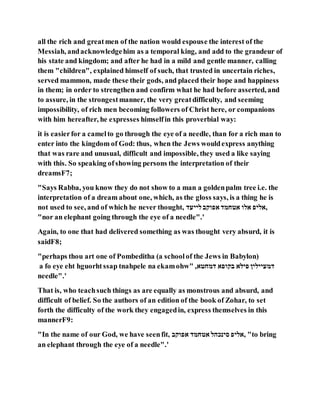
it is easierfor a camelto go through the eye of a needle, than for a rich man to
enter into the kingdom of God: thus, when the Jews wouldexpress anything
that was rare and unusual, difficult and impossible, they used a like saying
with this. So speaking ofshowing persons the interpretation of their
dreamsF7;
"Says Rabba, you know they do not show to a man a goldenpalm tree i.e. the
interpretation of a dream about one, which, as the gloss says, is a thing he is
not used to see, and of which he never thought, ‫לייעד‬‫אפוקב‬ ‫אטחמד‬ ‫אלו‬ ‫,אליפ‬
"nor an elephant going through the eye of a needle".'
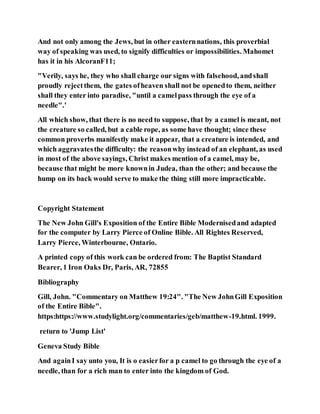
Again, to one that had delivered something as was thought very absurd, it is
saidF8;
"perhaps thou art one of Pombeditha (a schoolof the Jews in Babylon)
a fo eye eht hguorhtssap tnahpele na ekamohw" ,‫דמחטא‬ ‫בקופא‬ ‫פילא‬ ‫דמעיילין‬
needle".'
That is, who teachsuch things as are equally as monstrous and absurd, and
difficult of belief. So the authors of an edition of the book of Zohar, to set
forth the difficulty of the work they engagedin, express themselves in this
mannerF9:
"In the name of our God, we have seenfit, ‫אפוקב‬ ‫אטחמד‬ ‫סינכהל‬ ‫,אליפ‬ "to bring
an elephant through the eye of a needle".'
And not only among the Jews, but in other easternnations, this proverbial
way of speaking was used, to signify difficulties or impossibilities. Mahomet
has it in his AlcoranF11;
"Verily, says he, they who shall charge our signs with falsehood, andshall
proudly rejectthem, the gates ofheaven shall not be openedto them, neither
shall they enter into paradise, "until a camelpass through the eye of a
needle".'
All which show, that there is no need to suppose, that by a camel is meant, not
the creature so called, but a cable rope, as some have thought; since these
common proverbs manifestly make it appear, that a creature is intended, and
which aggravatesthe difficulty: the reasonwhy instead of an elephant, as used
in most of the above sayings, Christ makes mention of a camel, may be,
because that might be more knownin Judea, than the other; and because the
hump on its back would serve to make the thing still more impracticable.
Copyright Statement
The New John Gill's Exposition of the Entire Bible Modernisedand adapted
for the computer by Larry Pierce of Online Bible. All Rightes Reserved,
Larry Pierce, Winterbourne, Ontario.
A printed copy of this work can be ordered from: The Baptist Standard
Bearer, 1 Iron Oaks Dr, Paris, AR, 72855
Bibliography
Gill, John. "Commentary on Matthew 19:24". "The New JohnGill Exposition
of the Entire Bible".
https:https://www.studylight.org/commentaries/geb/matthew-19.html. 1999.
return to 'Jump List'
Geneva Study Bible
And againI say unto you, It is o easierfor a p camel to go through the eye of a
needle, than for a rich man to enter into the kingdom of God.
(o) Literally, "it is of less labour".
(p) Theophylact notes, that by this word is meant a cable rope, but Caninius
alleges outof the Talmuds that it is a proverb, and the word "Camel" signifies
the beastitself.
Copyright Statement
These files are public domain.
Text Courtesyof BibleSupport.com. Used by Permission.
Bibliography
Beza, Theodore. "Commentaryon Matthew 19:24". "The 1599 Geneva Study
Bible". https:https://www.studylight.org/commentaries/gsb/matthew-19.html.
1599-1645.
return to 'Jump List'
John Lightfoot's Commentary on the Gospels
24. And againI say unto you, It is easierfor a camel to go through the eye of a
needle, than for a rich man to enter into the kingdom of God.
[A camel to go through the eye of a needle, &c.]A phrase used in the schools,
intimating a thing very unusual and very difficult. There, where the discourse
is concerning dreams and their interpretation, these words are added. They
do not shew a man a palm tree of gold, nor an elephant going through the eye
of a needle. The Gloss is, "A thing which he was not wont to see, nor
concerning which he everthought."
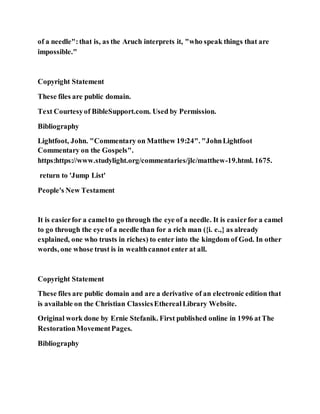
In like manner R. Sheshith answeredR. Amram, disputing with him and
asserting something that was incongruous, in these words;"Perhaps thou art
one of those of Pombeditha, who can make an elephant pass through the eye
of a needle":that is, as the Aruch interprets it, "who speak things that are
impossible."
Copyright Statement
These files are public domain.
Text Courtesyof BibleSupport.com. Used by Permission.
Bibliography
Lightfoot, John. "Commentary on Matthew 19:24". "JohnLightfoot
Commentary on the Gospels".
https:https://www.studylight.org/commentaries/jlc/matthew-19.html. 1675.
return to 'Jump List'
People's New Testament
It is easierfor a camelto go through the eye of a needle. It is easierfor a camel
to go through the eye of a needle than for a rich man ({i. e.,} as already
explained, one who trusts in riches) to enter into the kingdom of God. In other
words, one whose trust is in wealthcannot enter at all.
Copyright Statement
These files are public domain and are a derivative of an electronic edition that
is available on the Christian ClassicsEtherealLibrary Website.
Original work done by Ernie Stefanik. First published online in 1996 atThe
RestorationMovementPages.
Bibliography
Johnson, BartonW. "Commentary on Matthew 19:24". "People's New
Testament". https:https://www.studylight.org/commentaries/pnt/matthew-
19.html. 1891.
return to 'Jump List'
Robertson's WordPictures in the New Testament
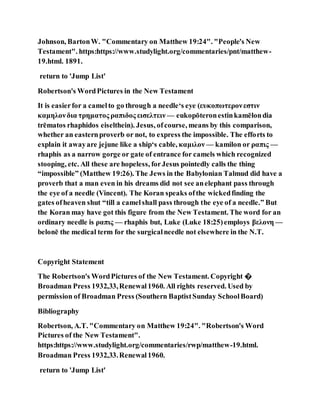
It is easierfor a camelto go through a needle‘s eye (ευκοπωτερονεστιν
καμηλονδια τρηματος ραπιδος εισελτειν — eukopōteronestinkamēlondia
trēmatos rhaphidos eiselthein). Jesus, ofcourse, means by this comparison,
whether an easternproverb or not, to express the impossible. The efforts to
explain it awayare jejune like a ship‘s cable, καμιλον — kamilon or ραπις —
rhaphis as a narrow gorge or gate of entrance for camels which recognized
stooping, etc. All these are hopeless, forJesus pointedly calls the thing
“impossible” (Matthew 19:26). The Jews in the Babylonian Talmud did have a
proverb that a man even in his dreams did not see anelephant pass through
the eye of a needle (Vincent). The Koran speaks ofthe wickedfinding the
gates ofheaven shut “till a camelshall pass through the eye of a needle.” But
the Koran may have got this figure from the New Testament. The word for an
ordinary needle is ραπις — rhaphis but, Luke (Luke 18:25)employs βελονη —
belonē the medical term for the surgicalneedle not elsewhere in the N.T.
Copyright Statement
The Robertson's WordPictures of the New Testament. Copyright �
Broadman Press 1932,33,Renewal1960. All rights reserved. Used by
permission of Broadman Press (Southern BaptistSunday SchoolBoard)
Bibliography
Robertson, A.T. "Commentary on Matthew 19:24". "Robertson's Word
Pictures of the New Testament".
https:https://www.studylight.org/commentaries/rwp/matthew-19.html.
Broadman Press 1932,33.Renewal1960.
return to 'Jump List'
Vincent's Word Studies
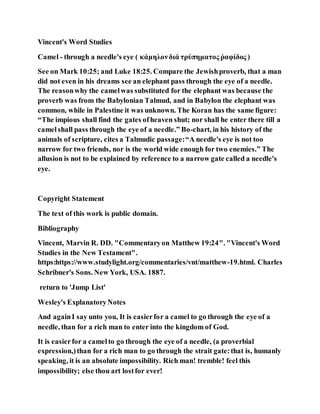
Camel - through a needle's eye ( κάμηλονδιά τρύπηματος ῥαφίδος )
See on Mark 10:25; and Luke 18:25. Compare the Jewishproverb, that a man
did not even in his dreams see an elephant pass through the eye of a needle.
The reasonwhy the camelwas substituted for the elephant was because the
proverb was from the Babylonian Talmud, and in Babylon the elephant was
common, while in Palestine it was unknown. The Koran has the same figure:
“The impious shall find the gates ofheaven shut; nor shall he enter there till a
camelshall pass through the eye of a needle.” Bo-chart, in his history of the
animals of scripture, cites a Talmudic passage:“A needle's eye is not too
narrow for two friends, nor is the world wide enough for two enemies.” The
allusion is not to be explained by reference to a narrow gate called a needle's
eye.
Copyright Statement
The text of this work is public domain.
Bibliography
Vincent, Marvin R. DD. "Commentaryon Matthew 19:24". "Vincent's Word
Studies in the New Testament".
https:https://www.studylight.org/commentaries/vnt/matthew-19.html. Charles
Schribner's Sons. New York, USA. 1887.
return to 'Jump List'
Wesley's ExplanatoryNotes
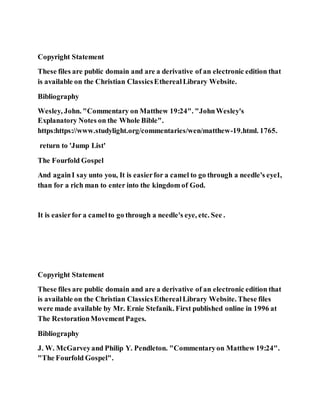
And againI say unto you, It is easierfor a camel to go through the eye of a
needle, than for a rich man to enter into the kingdom of God.
It is easierfor a camelto go through the eye of a needle, (a proverbial
expression,)than for a rich man to go through the strait gate:that is, humanly
speaking, it is an absolute impossibility. Rich man! tremble! feel this
impossibility; else thou art lostfor ever!
Copyright Statement
These files are public domain and are a derivative of an electronic edition that
is available on the Christian ClassicsEtherealLibrary Website.
Bibliography
Wesley, John. "Commentary on Matthew 19:24". "JohnWesley's
Explanatory Notes on the Whole Bible".
https:https://www.studylight.org/commentaries/wen/matthew-19.html. 1765.
return to 'Jump List'
The Fourfold Gospel
And againI say unto you, It is easierfor a camel to go through a needle's eye1,
than for a rich man to enter into the kingdom of God.
It is easierfor a camelto go through a needle's eye, etc. See .
Copyright Statement
These files are public domain and are a derivative of an electronic edition that
is available on the Christian ClassicsEtherealLibrary Website. These files
were made available by Mr. Ernie Stefanik. First published online in 1996 at
The RestorationMovementPages.
Bibliography
J. W. McGarveyand Philip Y. Pendleton. "Commentaryon Matthew 19:24".
"The Fourfold Gospel".
https:https://www.studylight.org/commentaries/tfg/matthew-19.html.
Standard Publishing Company, Cincinnati, Ohio. 1914.
return to 'Jump List'
Abbott's Illustrated New Testament
A strong mode of expressing extreme difficulty.
Copyright Statement
These files are public domain.
Bibliography
Abbott, John S. C. & Abbott, Jacob. "Commentaryon Matthew 19:24".
"Abbott's Illustrated New Testament".
https:https://www.studylight.org/commentaries/ain/matthew-19.html. 1878.
return to 'Jump List'
John Trapp Complete Commentary
24 And again I say unto you, It is easierfor a camelto go through the eye of a
needle, than for a rich man to enter into the kingdom of God.
Ver. 24. It is easierfor a camel, &c.]Or cable rope, as some render it,
καμηλον, καμιλονfunem nauticum. Either serves, for it is a proverbial speech,
setting forth the difficulty of the thing. Difficile est, saith St Jerome, ut
praesentibus bonis quis fruatur et futuris, ut hic ventrem istic mentem
reficiat, ut de deliciis transeat, ut in coelo etin terra gloriosus appareat. Pope
Adrian VI said that nothing befell him more unhappy in all his life than that
he had been head of the Church and monarch of the Christian
commonwealth. "WhenI first entered into orders," saith anotherpope (Plus
Quintus), "I had some goodhopes of my salvation; when I became a cardinal,
I doubted it; but since I came to be a pope I do even almost despair." And well
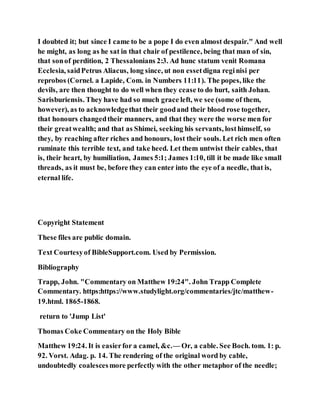
he might, as long as he sat in that chair of pestilence, being that man of sin,
that sonof perdition, 2 Thessalonians 2:3. Ad hunc statum venit Romana
Ecclesia, saidPetrus Aliacus, long since, ut non essetdigna reginisi per
reprobos (Cornel. a Lapide, Com. in Numbers 11:11). The popes, like the
devils, are then thought to do well when they cease to do hurt, saith Johan.
Sarisburiensis. They have had so much grace left, we see (some of them,
however), as to acknowledgethat their goodand their blood rose together,
that honours changedtheir manners, and that they were the worse men for
their greatwealth; and that as Shimei, seeking his servants, losthimself, so
they, by reaching after riches and honours, lost their souls. Let rich men often
ruminate this terrible text, and take heed. Let them untwist their cables, that
is, their heart, by humiliation, James 5:1; James 1:10, till it be made like small
threads, as it must be, before they can enter into the eye of a needle, that is,
eternal life.
Copyright Statement
These files are public domain.
Text Courtesyof BibleSupport.com. Used by Permission.
Bibliography
Trapp, John. "Commentary on Matthew 19:24". John Trapp Complete
Commentary. https:https://www.studylight.org/commentaries/jtc/matthew-
19.html. 1865-1868.
return to 'Jump List'
Thomas Coke Commentary on the Holy Bible
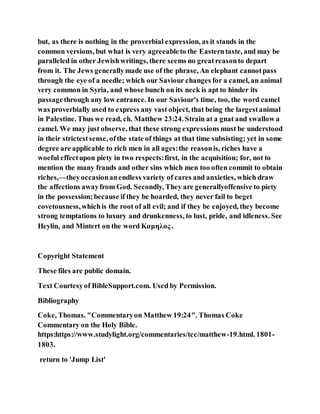
Matthew 19:24. It is easierfor a camel, &c.— Or, a cable. See Boch. tom. 1: p.
92. Vorst. Adag. p. 14. The rendering of the original word by cable,
undoubtedly coalescesmore perfectly with the other metaphor of the needle;
but, as there is nothing in the proverbial expression, as it stands in the
common versions, but what is very agreeableto the Easterntaste, and may be
paralleled in other Jewishwritings, there seems no greatreasonto depart
from it. The Jews generallymade use of the phrase, An elephant cannotpass
through the eye of a needle; which our Saviour changes for a camel, an animal
very common in Syria, and whose bunch on its neck is apt to hinder its
passagethrough any low entrance. In our Saviour's time, too, the word camel
was proverbially used to express any vast object, that being the largestanimal
in Palestine. Thus we read, ch. Matthew 23:24. Strain at a gnat and swallow a
camel. We may just observe, that these strong expressions must be understood
in their strictestsense, ofthe state of things at that time subsisting; yet in some
degree are applicable to rich men in all ages:the reasonis, riches have a
woeful effectupon piety in two respects:first, in the acquisition; for, not to
mention the many frauds and other sins which men too often commit to obtain
riches,—theyoccasionanendless variety of cares and anxieties, which draw
the affections awayfrom God. Secondly, They are generallyoffensive to piety
in the possession;because if they be hoarded, they never fail to beget
covetousness,whichis the root of all evil; and if they be enjoyed, they become
strong temptations to luxury and drunkenness, to lust, pride, and idleness. See
Heylin, and Mintert on the word Καμηλος .
Copyright Statement
These files are public domain.
Text Courtesyof BibleSupport.com. Used by Permission.
Bibliography
Coke, Thomas. "Commentaryon Matthew 19:24". Thomas Coke
Commentary on the Holy Bible.
https:https://www.studylight.org/commentaries/tcc/matthew-19.html. 1801-
1803.
return to 'Jump List'
Expository Notes with PracticalObservations onthe New Testament
These words were a proverbial speechamong the Jews, to signify a thing of
greatdifficulty, next to an impossibility; and they import thus much: "Thatit
is not only a very greatdifficulty, but an impossibility, for such as abound in
worldy wealthto be saved, without an extraordinary grace and assistance
from God. It is hard for a rich man to become happy, evenby God, because he
thinks himself happy without God."
Copyright Statement
These files are public domain.
Text Courtesyof BibleSupport.com. Used by Permission.
Bibliography
Burkitt, William. "Commentary on Matthew 19:24". ExpositoryNotes with
PracticalObservations onthe New Testament.
https:https://www.studylight.org/commentaries/wbc/matthew-19.html. 1700-
1703.
return to 'Jump List'
Greek TestamentCriticalExegeticalCommentary
24.]No alterationto κάμιλονis necessaryor admissible. That word, as
signifying a rope, or cable, seems to have been invented to escape the fancied
difficulty here; see Palm and Rost’s or Liddell and Scott’s Lex. sub voce, and
for the scholia giving the interpretation, Tischendorf’s note here. Lightfoot
brings instances from the Talmud of similar proverbial expressions regarding
an elephant: we have a case in ch. Matthew 23:24, of a camelbeing put for
any thing very large:and we must remember that the object here was to set
forth the greatesthuman impossibility, and to magnify divine grace, which
could accomplisheven that.
Copyright Statement
These files are public domain.
Text Courtesyof BibleSupport.com. Used by Permission.
Bibliography
Alford, Henry. "Commentary on Matthew 19:24". Greek TestamentCritical
ExegeticalCommentary.
https:https://www.studylight.org/commentaries/hac/matthew-19.html. 1863-
1878.
return to 'Jump List'
Heinrich Meyer's Critical and ExegeticalCommentaryon the New Testament
Matthew 19:24. “Difficultatem exaggerat,” Melanchthon. Forπάλιν, comp.
Matthew 18:19. The point of the comparisonis simply the fact of the
impossibility. A similar way of proverbially expressing the utmost difficulty
occurs in the Talmud with reference to an elephant(4) See Buxtorf, Lex. Talm.
p. 1722, andWetstein. To understand the expressionin the text, not in the
sense ofa camel, but of a cable (Castalio, Calvin, Huet, Drusius, Ewald), and,
in order to this, either supposing κάμιλονto be the correctreading (as in
severalcursive manuscripts), or ascribing this meaning to κάμηλος ( τινές in
Theophylactand Euthymius Zigabenus), is all the more inadmissible that
κάμηλος neverhas any other meaning than that of a camel, while the form
κάμιλος canonly be found in Suidas and the ScholiastonArist. Vesp. 1030,
and is to be regarded as proceeding from a misunderstanding of the present
passage. Further, the proverbial expressionregarding the camel likewise
occurs in Matthew 23:24, and the Rabbinical similitude of the elephant is
quite analogous.
εἰσελθεῖν after ῥαφ. is universally interpreted: to enter in (to any place). On
the question as to whether ῥαφίς is to be recognisedas classical, see Lobeck,
ad Phryn. p. 90. To render this word by a narrow gate, a narrow mountain-
pass (so Furer in Schenkel’s Lex. III. p. 476), or anything but a needle, is
simply inadmissible.
The dangerto salvationconnectedwith the possessionofriches does not lie in
these consideredin themselves, but in the difficulty experiencedby sinful man
in subordinating them to the will of God. So Clemens Alexandrinus: τίς ὁ
σωζόμενος πλούσιος. Hermas, Pastor, i. 3. 6.
Copyright Statement
These files are public domain.
Text Courtesyof BibleSupport.com. Used by Permission.
Bibliography
Meyer, Heinrich. "Commentary on Matthew 19:24". Heinrich Meyer's
Critical and ExegeticalCommentary on the New Testament.
https:https://www.studylight.org/commentaries/hmc/matthew-19.html. 1832.
return to 'Jump List'
Johann Albrecht Bengel's Gnomonof the New Testament
Matthew 19:24. κάμηλον, a camel) i.e. the animal of that name; cf. ch.
Matthew 23:24. It is not a rope(875)that is compared to a thread, but the eye
of a needle to a gate.
Copyright Statement
These files are public domain.
Text Courtesyof BibleSupport.com. Used by Permission.
Bibliography
Bengel, JohannAlbrecht. "Commentary on Matthew 19:24". Johann
Albrecht Bengel's Gnomonof the New Testament.
https:https://www.studylight.org/commentaries/jab/matthew-19.html. 1897.
return to 'Jump List'
Matthew Poole's EnglishAnnotations on the Holy Bible
Ver. 23,24. Mark saith, Mark 10:23-25, And Jesus lookedround about, and
saith unto his disciples, How hardly shall they that have riches enter into the
kingdom of God! And the disciples were astonishedat his words. But Jesus
answerethagain, and saith unto them, Children, how hard is it for them that
trust in riches to enter into the kingdom of God. It is easierfor a camelto go
through the eye of a needle, than for a rich man to enter into the kingdom of
God. Luke saith, Luke 18:24,25,And when Jesus saw that he was sorrowful,
he said, How hardly shall they that have riches enter into the kingdom of God!
For it is easierfor a camelto go through a needle’s eye, than for a rich man to
enter into the kingdom of God. Our Lord, seeing the young man that came to
him so briskly, with such a zeal for his soul, and appearing warmth of desire
to be instructed in the right way to heaven, and asking for a task to be set
him; first, what goodthing he should do in order to that end, then calling for
more; when our Saviour had reckonedup some commandments to be
observed, What lack I yet? saith he; go awayquite damped and sorrowful
when our Saviour said not to him, Give thy body to be burned; no, nor yet,
Cut off a right hand or foot, or pluck out a right eye;only part with some of
thy circumstances,Sellthat thou hastand give to the poor; a thing he might
have done, and have been a man still perfect, both as to his essentialand
integral parts: he hence takes occasionto discourse with his disciples the
danger of riches, and the ill influence they have upon men’s souls, with
relation to their eternal welfare. Luke and Mark sayhe spake it by way of
question, How hardly? Matthew delivereth it as spokenpositively,
A rich man shall hardly enter, & c. The sense is the same, only the
interrogationseems to aggravate the difficulty, and to fortify, the affirmation,
as much as to say, A rich man shall very hardly enter into the kingdom of
heaven.
The disciples were astonishedat this, (saith Mark), which made our Saviour
say it over again, with a little exposition, How hard is it for them that trust in
riches to enter into the kingdom of God! Which exposition is so far from a
correctionor abatement of the severity of his former speech, that some judge
it rather a confirmation of it, for he goes onwith saying,
It is easierfor a camelto go through the eye of a needle. But why should this
astonishthe disciples, who had no reasonupon this account to fear for
themselves, who had forsakenall to follow Christ? Possibly, because it was so
contrary to the common opinion of the world, who did not only, as in
Malachi’s time, call the proud happy, but thought Godhad scarce anyfavour
for any but the rich; in oppositionto which Christ, Luke 6:20,24, blesseththe
poor, and pronounces woes to the rich, as having receivedtheir consolation.
As to the words themselves, the designof our Saviour in them was not to
condemn riches, as in themselves damnable; nor yet to deny salvationto all
rich persons:our Lord knew that Abraham, Isaac, Jacob, Job, were all rich
persons, and yet in heaven; so was David and Solomon, &c. He also knew that
riches are the gifts of God, goodthings, not in themselves pernicious. His
design was only to show that they are dangerous temptations, soliciting and
enticing our hearts into so greata love of them, and affectionto them, as is not
consistentwith our duty with reference to God; and giving the heart of man
such advantages for the lusts of pride, covetousness,ambition, oppression,
luxury, (some or other of which are predominant in all souls), that it is very
hard for a rich man so far to deny himself, as to do what he must do if ever he
will be saved. For those words in Mark, them that trust in riches, I take them
rather to give the reasonof the difficulty, than to be an abatement of what he
had before said; for to trust in riches, is to place a happiness in them, to
promise ourselves a security from them, so as to be careless ofa further
happiness, Psalms 49:6 52:7 1 Timothy 6:17. That which makes it so hard for
a rich man to be saved, is the difficulty of having riches and not placing our
felicity in them, being secure because ofthem, and having our hearts cleave
unto them, so as we cannotdeny ourselves in them to obey any command of
God; and the suffering them to be temptations to us to pride, luxury ambition,
oppression, contempt and despising of others, covetousness, &c. Upon these
accounts our Saviour goethon and saith, It is easierfor a camelto go through
the eye of a needle, than for a rich man to enter into the kingdom of God.
Which doubtless was a proverbial expression, in use then amongstthe Jews, to
signify a thing of greatdifficulty, by terms importing impossibility: or else the
phrase may signify an impossibility without the extraordinary influence of
Divine grace, as ourSaviour seemethto expound it in the next verses.
Copyright Statement
These files are public domain.
Text Courtesyof BibleSupport.com. Used by Permission.
Bibliography
Poole, Matthew, "Commentaryon Matthew 19:24". Matthew Poole's English
Annotations on the Holy Bible.
https:https://www.studylight.org/commentaries/mpc/matthew-19.html. 1685.
return to 'Jump List'
Cambridge Greek Testamentfor Schools andColleges
24. κάμηλονδιὰ τρυπήματος ῥαφίδος.An expressionfamiliar to Jews of our
Lord’s time. The exaggerationis quite in the Easternstyle. Some attempts
howeverhave been made to explain away the natural meaning of the words.
κάμιλον, which is said to mean ‘a thick rope,’has been read for κάμηλον. But
the change has no MS. support, and κάμιλος, whichdoes not occurelsewhere,
is probably an invention of the Scholiast. Others have explained τρύπημα
ῥαφίδος to be the name of a gate in Jerusalem. But the existence ofsuch a gate
is not established;and the variety of expressionfor ‘a needle’s eye,’τρύπημα
ῥαφίδος (Matt.), τρυμαλία ῥαφίδος (Mark), τρῆμα βελόνης (Luke), is against
this view. The variation also indicates that the proverb was not current in
Greek. The expressionin Luke is the most classical. ῥαφὶς is rejectedby the
Attic purists: ἡ δὲ ῥαφὶς τί ἐστιν οὐκ ἄν τις γνοίη (Lob. Phryn. p. 90).
τρύπημα was a vernacularword and is found in Aristoph. Pac. 1234.
An easterntravellerhas suggestedthat the associationofideas arose thus:
every camel driver carries with him a large needle to mend his pack-saddle as
occasionrequires, hence the ‘camel’and the ‘needle.’
Copyright Statement
These files are public domain.
Text Courtesyof BibleSupport.com. Used by Permission.
Bibliography
"Commentary on Matthew 19:24". "Cambridge Greek Testamentfor Schools
and Colleges".https:https://www.studylight.org/commentaries/cgt/matthew-
19.html. 1896.
return to 'Jump List'
Whedon's Commentary on the Bible
24. Camel… eye of a needle — That is, it is absolutely a human impossibility.
The emendation made by changing camelto cable is unauthorized. The
phrase is a proverbial expressionfor an absolutely impracticable thing.
Copyright Statement
These files are public domain.
Text Courtesyof BibleSupport.com. Used by Permission.
Bibliography
Whedon, Daniel. "Commentary on Matthew 19:24". "Whedon's Commentary
on the Bible". https:https://www.studylight.org/commentaries/whe/matthew-
19.html. 1874-1909.
return to 'Jump List'
PeterPett's Commentary on the Bible
‘And againI say to you, “It is easierfor a camelto go through a needle’s eye,
than for a rich man to enter into the kingly rule of God.” ’
Jesus then seeks to make the position even clearerby the use of a well known
saying. “It is easierfor a camelto go through a needle’s eye, than for a rich
man to enter into the kingly rule of God.” By this He is saying that it is not
only hard, but will require a miracle (which is what He then goes onto point
out). There is absolutely no reasonfor not taking the cameland the needle’s
eye literally. The camelwas the largestanimal known in Palestine, the
needle’s eye the smallesthole. The whole point of the illustration lies in the
impossibility of it, and the vivid and amusing picture it presents is typical of
the teaching of Jesus. Jesusno doubt had in mind the teaching of the Scribes
and Pharisees,who consideredthat rich men were rich because they were
pleasing to God (compare Psalms 112:3;Proverbs 10:22;Proverbs 22:4), and
that through their riches they had even more opportunity to be pleasing to
God (and mockedat any other suggestion - Luke 16:14). They taught that
riches were a reward for righteousness.But Jesus seesthis as so contradictory
to reality that He pictures them as by this struggling to force a camelthrough
the eye of a needle. In other words they are trying to bring togethertwo things
that are incompatible. So in His eyes their teaching was claiming to do the
impossible, as the example of the rich young man demonstrated, it was
seeking to make the rich godly. And the folly of this is revealedin the fact that
it is ‘the deceitfulness of riches’which is one of the main things that chokes
the word (Matthew 13:22). In this regard the Psalmists regularlyspoke of
those who put their trust in riches, and thereby did not need to rely on God
(Psalms 49:6; Psalms 52:7; Psalms 62:10;Psalms 73:12;Proverbs 11:28;
Proverbs 13:7). This was not to saythat rich men could not be godly. It was
simply to indicate that it was unusual.
‘The Kingly Rule of God.’ It is difficult to see in context how this expression
can be seenas differing in significance from ‘the Kingly Rule of Heaven’ in
Matthew 19:23, for both are indicating a similar situation. It may simply
therefore have been changedfor the sake of variety. But we must considerthe
fact that Matthew’s purpose here might wellbe in order to emphasise the
contrastbetween‘man’ and ‘God’ in terms of the impossibility of entry. The
camelcannot go through the eye of a needle, for the two exist in different
spheres sizewise, how much less then can a RICH MAN enter into the sphere
of GOD’s Kingly Rule. The idea is to be seenas almostludicrous.
Copyright Statement
These files are public domain.
Text Courtesyof BibleSupport.com. Used by Permission.
Bibliography
Pett, Peter. "Commentary on Matthew 19:24". "PeterPett's Commentaryon
the Bible ". https:https://www.studylight.org/commentaries/pet/matthew-
19.html. 2013.
return to 'Jump List'
Schaff's Popular Commentary on the New Testament
Matthew 19:24. Easierfor a camel, etc. A strong declarationof impossibility
(comp. Matthew 19:26). This has been weakenedin two ways:(1.) by the
change of a single letter (in some manuscripts), of the original, altering
‘camel’ into ‘rope;’ (2.) by explaining the eye of a needle to mean the small
gate for foot passengersatthe entrance to cities. The first is incorrect, the
seconduncertain and unnecessary. The literal sense is not too strong, as both
the contextand abundant facts show. Our Lord had already spokenof a
‘camel’ as a figure for something very large (chap. Matthew 23:24);and in the
Talmud the same saying occurs about an elephant ‘The camelwas more
familiar to the hearers of the Saviour than the elephant, and on accountof the
hump on its back, it was especiallyadaptedto symbolize earthly wealthas a
heavy load and serious impediment to entrance through the narrow gate of
the kingdom of heaven.’
Copyright Statement
These files are public domain.
Text Courtesyof BibleSupport.com. Used by Permission.
Bibliography
Schaff, Philip. "Commentary on Matthew 19:24". "Schaff's Popular
Commentary on the New Testament".
https:https://www.studylight.org/commentaries/scn/matthew-19.html. 1879-
90.
return to 'Jump List'
The Expositor's Greek Testament
Matthew 19:24. πάλιν δὲ λέγω: reiterationwith greateremphasis. The strong
language ofJesus here reveals a keensense of disappointment at the loss of so
promising a man to the ranks of disciplehood. He sees so clearlywhat he
might be, were it not for that miserable money.— εὐκοπώτερον, etc.:a
comparisonto express the idea of the impossible. The figure of a camelgoing
through a needle-eye savours of Easternexaggeration. It has been remarked
that the variation in the parallel accounts in respectto the words for a needle
and its eye shows that no corresponding proverb existed in the Greek tongue
(Camb. G. T.). The figure is to be takenas it stands, and not to be “civilised”
(vide H. C.) by taking κάμηλος (orκάμιλος, Suidas)= a cable, or the wicketof
an Oriental house. It may be more legitimate to try to explain how so
grotesque a figure could become current even in Palestine. Furrer suggests a
cameldriver leaning againsthis cameland trying to put a coarse thread
through the eye of a needle with which he sews his sacks,and, failing, saying
with comicalexaggeration:I might put the camelthrough the eye easierthan
this thread (Tscht., für M. und R.).— τρήματος from τιτράω, to pierce.—
ῥαφίδος, a word disapproved by Phryn., who gives βελόνη as the correctterm.
But vide Lobeck’s note, p. 90. It is noticeable that Christ’s tone is much more
severe in reference to wealth than to wedlock. Eunuchism for the kingdom is
optional; possessionofwealth on the other hand seems to be viewed as all but
incompatible with citizenship in the kingdom.
Copyright Statement
These files are public domain.
Text Courtesyof BibleSupport.com. Used by Permission.
Bibliography
Nicol, W. Robertson, M.A., L.L.D. "Commentary on Matthew 19:24". The
Expositor's Greek Testament.
https:https://www.studylight.org/commentaries/egt/matthew-19.html. 1897-
1910.
return to 'Jump List'
George Haydock's Catholic Bible Commentary
===============================
[BIBLIOGRAPHY]
Camelum, Greek:kamelun, which is observedto be different from Greek:
kamilos, a cable, or ship-rope. See Mr. Legh, Critica Sacra.
====================
Copyright Statement
These files are public domain.
Text Courtesyof BibleSupport.com. Used by Permission.
Bibliography
Haydock, George Leo. "Commentaryon Matthew 19:24". "George
Haydock's Catholic Bible Commentary".
https:https://www.studylight.org/commentaries/hcc/matthew-19.html. 1859.
return to 'Jump List'
E.W. Bullinger's Companion Bible Notes
camel. With its burden. Not a cable, as some suggest.
go = pass,
through. Greek. dia. App-104. Matthew 19:1.
the eye. Greek. trupema. Occurs only here.
the eye of a needle. A small door fixed in a gate and opened after dark. To
pass through, the camel must be unloaded. Hence the difficulty of the rich
man. He must be unloaded, and hence the proverb, common in the East. In
Palestine the "camel";in the Babylonian Talmud it is the elephant.
the kingdom of God. The third of five occurrences in Matthew. See note on
Matthew 6:33, and App-114.
Copyright Statement
These files are public domain.
Text Courtesyof BibleSupport.com. Used by Permission.
Bibliography
Bullinger, Ethelbert William. "Commentary on Matthew 19:24". "E.W.
Bullinger's Companion bible Notes".
https:https://www.studylight.org/commentaries/bul/matthew-19.html. 1909-
1922.
return to 'Jump List'
The Bible Study New Testament
Than for a camelto go through. [This may have been a "saying" about a
camelentering a courtyard through a low, narrow gate in the wall calledthe
"eye of a needle." See also Matthew 7:13-14. ] The lessonis clear:the love of
money will keepa person from entering the Kingdom. See Matthew 19:22.
Copyright Statement
These files are public domain.
Bibliography
Ice, Rhoderick D. "Commentary on Matthew 19:24". "The Bible Study New
Testament". https:https://www.studylight.org/commentaries/ice/matthew-
19.html. College Press, Joplin, MO. 1974.
return to 'Jump List'
Ellicott's Commentary for English Readers
(24) It is easierfor a camelto go through the eye of a needle.—Two
explanations have been given of the apparent hyperbole of the words. (1.) It
has been conjecturedthat the Evangelists wrote not κάμηλος (a camel), but
κάμιλος (a cable). Nota single MS., however, gives that reading, and the latter
word, which is not found in any classicalGreekauthor, is supposed by the
best scholars (e.g., Liddell and Scott)to have been invented for the sake of
explaining this passage.(2.)The fact that in some modern Syrian cities the
narrow gate for foot-passengers,atthe side of the larger gate, by which
wagons, camels, and other beasts ofburden enter the city, is known as the
“needle’s eye,” has been assumedto have come down from a remote antiquity,
and our Lord’s words are explained as alluding to it. The fact—to which
attention was first calledin Lord Nugent’s Lands, Classicaland Sacred—is
certainly interesting, and could the earlier use of the term in this sense be
proved, would give a certainvividness to our Lord’s imagery. It is not,
however, necessary. The Talmud gives the parallel phrase of an elephant
passing through a needle’s eye. The Koran reproduces the very words of the
Gospel. There is no reasonto think that the comparison, evenif it was not
already proverbial, would presentthe slightestdifficulty to the minds of the
disciples. Like all such comparisons, it states a generalfact, the hindrance
which wealth presents to the higher growths of holiness, in the boldest possible
form, in order to emphasise its force, and leaves out of sight the limits and
modifications with which it has to be received, and which in this instance
(according to the text on which the English versionis based) were supplied
immediately by our Lord Himself (Mark 10:24).
Copyright Statement
These files are public domain.
Text Courtesyof BibleSupport.com. Used by Permission.
Bibliography
Ellicott, Charles John. "Commentary on Matthew 19:24". "Ellicott's
Commentary for English Readers".
https:https://www.studylight.org/commentaries/ebc/matthew-19.html. 1905.
return to 'Jump List'
Treasuryof Scripture Knowledge
And againI say unto you, It is easierfor a camel to go through the eye of a
needle, than for a rich man to enter into the kingdom of God.
It
So in the Koran, "The impious, who in his arrogance shallaccuseour doctrine
of falsity, shall find the gates ofheaven shut; nor shall he enter till a camel
shall pass through the eye of a needle." It was a common mode of expression
among the Jews to declare any thing that was rare or difficult.
26; 23:24;Jeremiah13:23; Mark 10:24,25;Luke 18:25; John 5:44
PRECEPTAUSTIN RESOURCES
BARCLAY
THE PERIL OF RICHES (Matthew 19:23-26)
19:23-26 Jesus saidto the disciples, "This is the truth I tell you--it is with
difficulty that a rich man shall enter into the Kingdom of Heaven. Again I say
unto you--it is easierfor a camelto pass through the eye of a needle than for a
rich man to enter into the Kingdom of Heaven." When the disciples heard
this, they were exceedinglyastonished. "Whatrich man, then," they said,
"canbe saved?" Jesus lookedatthem, "With men," he said, "this is
impossible, but with God all things are possible."
The case ofthe Rich Young Ruler shed a vivid and a tragic light on the danger
of riches; here was a man who had made the greatrefusal because he had
greatpossessions. Jesusnow goes onto underline that danger. "It is difficult,"
he said, "for a rich man to enter into the Kingdom of Heaven."
To illustrate how difficult that was he used a vivid simile. He said that it was
as difficult for a rich man to enter the Kingdom of Heaven as it was for a
camelto pass through the eye of a needle. Different interpretations have been
given of the picture which Jesus was drawing.
The camel was the largestanimal which the Jews knew. It is said that
sometimes in walledcities there were two gates. There was the greatmain gate
through which all trade and traffic moved. Beside it there was often a little
low and narrow gate. When the greatmain gate was lockedand guarded at
night, the only way into the city was through the little gate, through which
even a man could hardly pass erect. It is said that sometimes that little gate
was called"The Needle's Eye." So it is suggestedthat Jesus was saying that it
was just as difficult for a rich man to enter the Kingdom of Heavenas for a
huge camelto getthrough the little gate through which a man can hardly
pass.
There is another, and very attractive, suggestion. The Greek word for camelis
kamelos (Greek #2574);the Greek word for a ship's hawseris kamilos. It was
characteristic oflater Greek that the vowelsounds tended to lose their sharp
distinctions and to approximate to eachother. In such Greek there would be
hardly any discernible difference betweenthe sound of "i" and "e";they
would both be pronounced as ee is in English. So, then, what Jesus may have
said is that it was just as difficult for a rich man to enter into the Kingdom of
Heaven as it would be to thread a darning-needle with a ship's cable or
hawser. Thatindeed is a vivid picture.
But the likelihood is that Jesus was using the picture quite literally, and that
he was actually saying that it was as hard for a rich man to enter the Kingdom
of Heaven as it was for a camelto go through the eye of a needle. Wherein
then lies this difficulty? Riches have three main effects on a man's outlook.
(i) Riches encourage a false independence. If a man is well-supplied with this
world's goods, he is very apt to think that he can well deal with any situation
which may arise.
There is a vivid instance of this in the letter to the Church of Laodicaea in the
Revelation. Laodicaeawas the richest town in Asia Minor. She was laid waste
by an earthquake in A.D. 60. The Roman government offeredaid and a large
grant of money to repair her shattered buildings. She refused it, saying that
she was wellable to handle the situation by herself. "Laodicaea," saidTacitus,
the Romanhistorian, "rose from the ruins entirely by her own resources and
with no help from us." The Risen Christ hears Laodicaeasay, "I am rich, I
have prospered, and I need nothing" (Revelation3:17).
It was Walpole who coinedthe cynical epigram that every man has his price.
If a man is wealthy he is apt to think that everything has its price, that if he
wants a thing enoughhe canbuy it, that if any difficult situation descends
upon him he can buy his way out of it. He can come to think that he canbuy
his wayinto happiness and buy his way out of sorrow. So he comes to think
that he can well do without God and is quite able to handle life by himself.
There comes a time when a man discovers that that is an illusion, that there
are things which money cannot buy, and things from which money cannot
save him. But always there is the dangerthat greatpossessionsencouragethat
false independence which thinks--until it learns better--that it has eliminated
the need for God.
(ii) Riches shackle a man to this earth. "Where your treasure is," said Jesus,
"there will your heart be also" (Matthew 6:21). If everything a man desires is
containedwithin this world, if all his interests are here, he never thinks of
another world and of a hereafter. If a man has too big a stake on earth, he is
very apt to forgetthat there is a heaven. After a tour of a certain wealthyand
luxurious castle and estate, Dr. Johnsongrimly remarked: "These are the
things which make it difficult to die." It is perfectly possible for a man to be so
interestedin earthly things that he forgets heavenly things, to be so involved
in the things that are seenthat he forgets the things that are unseen--and
therein lies tragedy, for the things which are seenare temporal but the things
which are unseen are eternal.
(iii) Riches tend to make a man selfish. Howevermuch a man has, it is human
for him to want still more, for, as it has been epigrammatically said, "Enough
is always a little more than a man has." Further, once a man has possessed
comfort and luxury, he always tends to fear the day when he may lose them.
Life becomes a strenuous and worried struggle to retain the things he has. The
result is that when a man becomes wealthy, instead of having the impulse to
give things away, he very often has the impulse to cling on to them. His
instinct is to amass more and more for the sake ofthe safety and the security
which he thinks they will bring. The dangerof riches is that they tend to make
a man forgetthat he loses what he keeps, and gains what he gives away.
But Jesus did not say that it was impossible for a rich man to enter the
Kingdom of Heaven. Zacchaeus was one of the richest men in Jericho, yet, all
unexpectedly, he found the way in (Luke 19:9). Josephof Arimathaea was a
rich man (Matthew 27:57); Nicodemus must have been very wealthy, for he
brought spices to anoint the dead body of Jesus, whichwere worth a king's
ransom (John 19:39). It is not that those who have riches are shut out. It is not
that riches are a sin--but they are a danger. The basis of all Christianity is an
imperious sense ofneed; when a man has many things on earth, he is in
danger of thinking that he does not need God; when a man has few things on
earth, he is often driven to God because he has nowhere else to go.
Matthew 19:23-30: “Jesus TeachesHis Disciples About How Hard It Will Be
For A Rich Man To Go To Heaven / PeterAsks Jesus What RewardHis
Followers WillHave”
by
Jim Bomkamp
Back Bible Studies Home Page
1. INTRO
1.1.1. In our study lastweek we saw that a man known as ‘The Rich Young
Ruler’ came to Christ wondering what gooddeed he might do in order to
inherit eternallife, and we observedseveralthings about him:
1.1.1.1. This man was a typical legalisttrying to become acceptedby God
sight basedupon his own rightousness
1.1.1.2. We saw that he was self-deceivedforhe did not even come close to
having an accurate view of himself from God’s perspective
1.1.1.2.1. He actually thought that he had kept God’s commandments all
of his life
1.1.1.3. We saw that Jesus tried to convictthis man of his unrighteousness
and inability to keepGod’s commandments, however the man never seemed
to get what Jesus was telling him
1.1.1.4. Finally, we saw that Jesus realized that what was keeping him from
coming to eternal life and becoming one of His followers was his love of riches,
he loved his riches more than he loved God
1.1.2. In these verses in this study we see that Jesus tells His disciples that it
will be difficult for a personwho is rich to come to eternallife
1.1.2.1. Jesus tells them that God can bring a rich personto salvation
however
1.1.2.2. Peterthen asks Jesus whatrewardthose who will have in His
kingdom who have left everything and followedHim?
1.1.2.3. Jesus tells His apostles that their rewardis that they shall sit upon
12 thrones judging the 12 tribes of Israel
2. VS 19:23-24 - “23 And Jesus saidto His disciples, “Truly I sayto you, it
is hard for a rich man to enter the kingdom of heaven. 24 “And againI say to
you, it is easierfora camel to go through the eye of a needle, than for a rich
man to enter the kingdom of God. ”” - Jesus tells His disciples that it is hard
for a rich man to enter the kingdom of heaven
2.1. Jesus says, ‘Truly’, here in His teaching to give emphasis to
what He is saying, as He meant in the gospels wheneverHe uses the word.
2.2. When Jesus refers to ‘the kingdom of heaven’ in His teaching
He is referring to the rule of God in men’s hearts, that rule that one day will
be consummated when all of God’s people will be togetherin His visible
presence and serve and worship Him forever as God over all.
2.3. Now, over the years that I have been a Christian I have heard
various interpretations for what Jesus was referring to when He saidthat ‘it is
easerfor a camelto go through the eye of a needle’:
2.3.1. Some have saidthat it refers to a narrow gate in the wall of Jerusalem
called, “The Needle’s Eye”, and that in order for a camelto go through this
gate it had to getdown on it’s knees and crawlthrough. The people who
espouse this interpretation teach that the getting down on the knees by the
camelspoke of how a personmust repent in order to getthrough the gate to
heaven.
2.3.1.1. The problem with this interpretation that John MacArthur and
others have pointed out is that there is no evidence that such a gate existedin
Jesus’time. It is a nice idea.
2.3.2. Ihave heard that others have believed that the word for ‘camel’ used
here was a typo and that the word that Jesus actuallyused was a word that
meant ‘rope’, and thus Jesus saidthat it would be like trying to thread a rope
through a needle for a rich man to enter the kingdom of heaven.
2.3.2.1. John MacArthur points out here the problem with this
interpretation is that it would be rather unusual that three of the gospel
writers had the same typo made to their texts.
2.3.3. JohnMacArthur points out that the most probably interpretation of
this verse is that the phrase used by Jesus was a Jewishcolloquialism for what
is impossible. Johnwrites, “It was probably a modified form of a Persian
expressionfor impossibility, “easierforan elephant ato go through the eye of
a needle”, that is quoted in the Talmud. Being the largestanimal known in
Palestine, the camel was substituted for the elephant.”
2.4. Regardlessofwhich interpretation that you make for this
teaching of Jesus, the point that He made does not change. He is teaching His
disciples that it is difficult for a rich person to get to the point in his life where
he is willing to submit himself completely to God in repentance and trust in
Jesus alone for his salvation.
3. VS 19:25-26 - “25 And when the disciples heard this, they were very
astonishedand said, “Then who can be saved?” 26 And looking upon them
Jesus saidto them, “With men this is impossible, but with God all things are
possible.”” - Basedupon Jesus’teaching about the difficulty of a rich man
enter the kingdom of heaven, the disciples ask Jesus, ‘Who then can be
saved?’
3.1. The disciples ‘were very astonished’at this teaching of Jesus
because the Pharisees taughtthat a man with riches had many advantages
spiritually and thus was more likely to make it to heaven.
3.2. In asking this question, the disciples were probably concerned
about what kinds of people they should be willing to spend their time in
preaching the kingdom of heavento if some would never be able to come to
salvationdue to their economic bracket.
3.2.1. In other words, I believe they wanted Jesus to give them some definite
guidelines to use when evaluating whether or not someone would ever be a
potential candidate for becoming one of Jesus’disciples and therefore
inheriting salvation.
3.3. Jesus’reponse to the disciple’s question indicates that God is
powerful enough to bring any man or womanto salvation, and that though
man is limited to his ownresources that God is able to do that which is
impossible in any situation.
3.4. Jesus then teaches His disciples an important principle, that
there is nothing that the Lord is not able to do, for ‘all things are possible’
when it comes to the working of His power.
3.4.1. Sometimeswe Christians don’t have the faith to trust that the Lord can
deal with certaintypes of situations or problems, and thus we either don’t
bring them to prayer at all, or we pray about these things but then we don’t
trust that the Lord will answerour prayers.
3.4.1.1. Women tend to be worriers and fretters, and doing this they are
allowing unbelief to be in their life as they just seem to never be settled or a
peace. Whenconfronted with their unbelief women who worry or are fretters
sometimes will say that you just don’t understand what they are going
through or the situation itself, yet the cause oftheir behavior is just unbelief.
3.4.1.2. Men tend to often get angry or go off on some weird tangent, and
though they may not be willing to admit that what they are really struggling
with is the factthat they are living in unbelief, never the less this is the cause
of their behavior.
3.4.2. We Christians cantake heart that when it comes to praying for our lost
loved ones or friends that seemso far awayfrom the Lord, that God can do
the impossible and bring the lost one to salvation, and thus we must never give
up praying and trusting God to work in their life in a mighty way.
4. VS 19:27-28 - “27 ThenPeter answeredand said to Him, “Behold, we
have left everything and followedYou; what then will there be for us?” 28
And Jesus saidto them, “Truly I sayto you, that you who have followedMe,
in the regenerationwhenthe Son of Man will sit on His glorious throne, you
also shall sit upon twelve thrones, judging the twelve tribes of Israel.” - Peter
asks Jesuswhatreward there will be for His disciples who have left everything
in their old life and followedHim?
4.1. I believe though Peter didn’t realize the benefits of being in
the grace ofGod, this was a very important question for Peterto have asked
and for Jesus to have answered, becausewe must realize that Jesus’disciples
have been following Him and listening to His teaching for these 3 ½ years and
yet we also know that they grappling with the same questions that the general
populace was concerning Jesus, namely, “If Jesus was to be the Jewish
Messiah, why wasn’tHe building up His army and making plans to go and to
conquer the nations and rule over them?”
4.1.1. Eversince Jesus revealedto His disciples that He was in fact the
Messiahthe Sonof the Living God, it seems that the disciples’expectations for
Jesus have being severelytested.
4.1.2. We will see in chapter 20 verse 17 that Jesus now determined that He
was to go to Jerusalem, knowing allalong that He would be crucified there,
and cansee that the disciples were very depressedabout what was going on
with Jesus talking about suffering and dying and now He wantedto go to
Jerusalem.
4.1.3. Since Jesus was notfulfilling the disciples’expectationin becoming a
political Messiah, andwe can guess that their hopes of being His right hand
men and cabinetmembers in His new kingdom were being all but dashed
completely, it was important for them to know what in fact they would be
receiving as a rewardor compensationfor their following and obeying Jesus.
4.2. This question was also inappropriate however, for the believer
in Christ is now in the grace ofGod, and what he really deserves, namely hell,
he doesn’t get. Rather, he receives so many blessings and mercies all of which
are undeserved. If God merely gave eachbelieverpardon for his sins and
eternal life with Him, this alone is a gift that is too greateven to fully
comprehend.
4.3. Jesus tells His twelve apostles that the rewardthat they will
have for following Him in this life is that when He entered His Millenial
Kingdom that they would, ‘sit on twelve thrones judging the twelve tribes of
Israel’.
4.3.1. We don’t have a lot of details given to us about life in the during
Christ’s Millenial Kingdom upon the earth after His ‘SecondComing’ which
will occurat the end of the Seven Year Tribulation of the book of Revelation,
howeverwe do see that there are people and nations living all over the world,
howeverJesus tells us here that the reward for the Twelve Apostles involves
their being made ‘judges’ or rulers over the Twelve Tribes of Israel.
4.3.2. The questionthat I have is how about all of Christ’s other followers on
earth, what shall they be reward with? I believe that it is possibly the case
that we also will be given responsibility over cities, for in Luke 19:12-19 Jesus
taught His disciples the ‘Parable of The Talents’, and in that parable which
pictures symbolically the rewards that Christ’s followers will have, Jesus
shows that being a goodstewardwith the salvationand gifts that the Lord has
given us will result in Him one day giving us charge overan appropriate
number of cites basedupon the degree to which we were faithful, “12 He said
therefore, “A certain nobleman went to a distant country to receive a kingdom
for himself, and then return. 13 “And he calledten of his slaves, and gave
them ten minas, and saidto them, ‘Do business with this until I come back.’
14 “But his citizens hated him, and sent a delegationafter him, saying, ‘We do
not want this man to reign over us.’ 15 “And it came about that when he
returned, after receiving the kingdom, he ordered that these slaves, to whom
he had given the money, be called to him in order that he might know what
business they had done. 16 “And the first appeared, saying, ‘Master, your
mina has made ten minas more.’ 17 “And he said to him, ‘Well done, good
slave, because youhave been faithful in a very little thing, be in authority over
ten cities.’18 “And the secondcame, saying, ‘Your mina, master, has made
five minas.’ 19 “And he said to him also, ‘And you are to be over five cities.’”
4.3.2.1. We know for sure that we who follow Christ in this life shall also
reign with Him, for in Revelation3:21, Jesus gave the church in Laodicea a
promise that is really for all believers, and the promise is that if we overcome
in this life for Him that we will sit with Him on His throne, “21 ‘He who
overcomes, Iwill grant to him to sit down with Me on My throne, as I also
overcame and sat down with My Fatheron His throne.’”
5. VS 19:29 - “29 “And everyone who has left houses or brothers or sisters
or father or mother or children or farms for My name’s sake, shallreceive
many times as much, and shall inherit eternal life.”” - Jesus makes a promise
to all who follow Him that we shall receive back many times as much of
whateverit is that we give up for Him
5.1. In Mark 10:29-30, there is a promise that is very similar to
this one, and it may have been given by Jesus at a different time and location,
“29 Jesus said, “Truly I say to you, there is no one who has left house or
brothers or sisters or mother or father or children or farms, for My sake and
for the gospel’s sake, 30 but that he shall receive a hundred times as much
now in the presentage, houses and brothers and sisters and mothers and
children and farms, along with persecutions;and in the age to come, eternal
life.”
5.1.1. In comparing Jesus’promise given to Mark with this one in Matthew,
we notice that the things that are mentioned that a followermight leave,
‘house or brothers or mother or father or children or farms’, is identical, as is
the reasonthat these were left, ‘for My sake’. However,the rewardor
reciprocationthat will be given for leaving these things is defined a little bit
more clearly: ‘You’ll receive back a hundred times as much ‘in the present
age’
5.1.1.1. This then reveals that the rewards and reciprocationfor following
Jesus in this life are not just to be receivedin the by and by, so to speak, but
that we shall reap blessings in this life.
5.1.1.2. I remember when I gave up my life of sin and rebellion againstGod
and beganto follow Him, that though before I had thought that if I truly
followedthe Lord that my life would be wholesome andholy but extremely
mundane and boring, that I suddenly found myself being a member of a new
family and that suddenly I had more friends in the fellowshipthat I began
attending than I had ever had in my entire life, and these friends were not the
fair-weatherfriends who were friends only when it was convenientand we
had some things in common, these were friends who loved me unconditionally
and not in a fickle manner.
5.1.1.2.1. This is how God gives us a hundred-fold of everything that we
leave behind to follow Him.
5.2. Note also here that Jesus promises to the one who leaves all to
follow Him that He promises that He will give to him ‘eternal life’:
5.2.1. Vines ExpositoryDictionary has the following entry for defining what
‘eternal life’ consists of, “Eternallife is the present actualpossessionofthe
believer because of his relationship with Christ, John 5:24; 1 John 3:14, and
that it will one day extend its domain to the sphere of the body is assuredby
the ResurrectionofChrist, 2 Cor. 5:4; 2 Tim. 1:10. This life is not merely a
principle of power and mobility, however, for it has moral associationswhich
are inseparable from it, as of holiness and righteousness.”
5.2.1.1. John 5:24, “24 “Truly, truly, I say to you, he who hears My word,
and believes Him who sentMe, has eternal life, and does not come into
judgment, but has passedout of death into life.””
5.2.1.2. 1 John 3:14, “14 We know that we have passedout of death into
life, because we love the brethren. He who does not love abides in death.”
5.2.1.3. 2 Cor. 5:4, “4 For indeed while we are in this tent, we groan, being
burdened, because we do not want to be unclothed, but to be clothed, in order
that what is mortal may be swallowedup by life.”
5.2.1.4. 2 Tim. 1:10, “10 but now has been revealedby the appearing of our
Savior Christ Jesus, who abolisheddeath, and brought life and immortality to
light through the gospel.”
5.2.2. EternalLife is more than just physical life after the grave, more than
life that will last forever, rather it is a quality of life also that God places
within believers through the regenerationof the Holy Spirit, however
believers in Christ must learn now to live within this realm as their present
experience by growing in the knowledge andexperience of walking after the
Spirit and not the flesh.
6. VS 19:30 - “30 “Butmany who are first will be last; and the last, first.””
- Jesus teachesHis disciples that many who are first will be last, and visa
versa
6.1. In the gospels we constantlysee that the disciples were always
vying for prominence in Christ’s estimation and in His kingdom, wondering
who would be the greatestin His kingdom, etc., and here we see that Jesus
tells them that ‘many’of those who might have begun to follow Him from the
first will end up being last in the line for rewards and reciprocationin His
kingdom.
6.2. We cansee from verses in the bible such as these that there
are going to be a lot of surprises in heavenwhen it comes to who ends up there
as well as who receives whatrewards.
6.3. What really matters then as far as the eternal rewards that
will be receivedfor following Christ is what He thinks of us, and whether or
not we have been faithful and obedient to Him in our life.
6.4. Becausewe Christians are living in the grace ofGod, all of the rules are
modified, for everything that we receive from God is a gift that is undeserved.
JOHN BROADUS
Hard For The Rich To Be Saved. RewardOf Sacrifices ForChrist's Sake
This section, exceptthe parable, is found also in Mark 10:23-31, Luke 18:24-
30. In both it is immediately connectedas here with the story of the young
ruler. Luke tells us, 'And Jesus seeing him said'; Mark, 'Jesus lookedround
about, and said' While the young man walkedgloomily away, Jesus lookedat
him and at his disciples, and spoke to them the greatlessons whichfollow. The
sectiondivides itself into Luke 18:23-26, Luke 18:27-30, and Matthew 20:1-16.
I. Matthew 19:23-26. Hard For The Rich To Be Saved
Mark 10:23-27, Luke 18:24-27. Verily I say unto you, calling specialattention,
see on "Matthew 5:18". A rich man shall hardly enter. It is hard for a rich
man (Rev. Ver.), was the rendering of Tyndale and followers. The Com. Ver.
though more literal, would now suggestimprobability rather than difficulty.
The Jews inclined to think it much easierfora rich man than for a poor man.
The former had in his very prosperity a proof of the divine favour; he was
prima facie a goodman, and might feel very hopeful about entering the
kingdom. Our Lord had not long before this spokena parable, (Luke 16:19) in
which, contrary to what all Jews wouldhave expected the beggarLazarus
went to Abraham's bosom, and the rich man to torment. Much earlier(comp
on Matthew 5:3) he had shownthat the kingdom of heaven belongs to the
poor, if they have the corresponding poverty in spirit. Kingdom of heaven, see
on "Matthew 3:2". He was far from meaning, that all poor men will be saved,
and all rich men lost; for Lazarus was carried to the bosomof Abraham, who
in life was very rich, as were also Isaac and Jacoband Joseph, David and
Solomon, Nicodemus and JosephofArimathea, and apparently the family of
Bethany. On the perils of riches, compare Matthew 13:22, 1 Timothy 6:9 f.
The expressionin Com. text of Mark 10:24, 'for them that trust in riches,'
must be omitted.(1) This strong statement our Lord now repeats (v. 34), in a
hyperbolical form such as he so often employed to awakenattentionand
compel remembrance. (See on "Matthew 5:39".)It is easierfor a camelto go
through the eye of a needle. So also Mark and Luke. The camelwas the
largestbeastfamiliar to the Jews, andthe needle's eye was the smallest
opening in any familiar object. So the expressiondenotes an impossibility, and
it was so understood by the disciples and so treated by Jesus just after.
(Matthew 19:26) A little later, (Matthew 23:24) our Lord will againuse the
camelas the largestbeastin another hyperbolical expression, "who strain out
the gnat and swallow the cabin the Talmud, for an elephant to go through a
needle's eye is severaltimes employed as an expressionof impossibility, the
Jews in foreign countries having now become familiar with an animal even
largerthan the camel. Our Lord may have been using a proverb (compare on
Matthew 7:3), but there is no proof that such a saying was current in his time.
The (Sura VII, 88) borrows, as it often does, the saying of Jesus:"Those who
say our signs are lies and are too big with pride for them, for these the doors
of heaven shall not be open, and they shall not enter into Paradise until a
camelshall pass into a needle's eye." The notion that the word means a cable,
found in Cyril on Luke, and in a scholium ascribedto Origen(Tisch.), and
mentioned by Theophyl. and Euthym. as held by "some," was merelyan
attempt to soften the incongruity of the image;and the statementof the late
lexicographerSuidas and a scholium on Aristophanes that kamelos is the
animal, kamilos a thick cable, probably arose from that attempt. (Liddell and
Scott.)The Memph., Latin, and Pesh. versions give camel. Origen
understands the camel, and takes the phrase as a figure for the impossible; so
Chrys. and followers. Jerome explains likewise, but adds that as Isaiah
declares (Isaiah60:6) that the camels of Midian and Ephah come to Jerusalem
with gifts, and though curved and distorted they enter the gates of Jerusalem,
so the rich canenter the narrow gate by laying aside their burden of sins and
all their bodily deformity—whichis only his loose allegorizing upon a point
not brought into view by the Saviour. A gloss to Anselm (A. D. 1033-1109),
given in Aquinas, says that "at Jerusalemthere was a certain gate calledthe
Needle's Eye, through which a camelcould not pass, save on its bended knees
and after its burden had been takenoff; and so the rich," etc. This is to all
appearance a conjecture suggestedby Jerome's allegorizing remark. Lord
Nugent many years ago (quoted in Morison, from Kitto) heard at Hebron a
narrow entrance for foot-passengers, by the side of the largergate, called"the
eye of a needle." Fish(p. 165), speaking ofthe Jaffa gate at Jerusalem, says:
"There is here a small gate in the large one, bearing the name Needle's Eye.
My dragomaninformed me of this, and saidit had always been so called. I
afterwards inquired of a Christian Jew, for thirty years a resident in
Jerusalem, who verified the statement, and farther said that any little gate like
that, in a large one, in both Palestine and Egypt, was calleda needle's eye (a
fact which I have since ascertainedfrom other sources)." So faras this usage
really exists, it probably arose from the saying in the New Testament, the
Talmud and the Koran, togetherwith Jerome's allegorizing remark. It is
perfectly evident that Jesus was understood, and meant to be understood, as
stating an impossibility; and as to the incongruity of the image, it is no greater
than that of Matthew 23:24, and employed an animal as familiar to his
hearers as the horse is to us.
Matthew 19:25 f. The disciples were exceedinglyamazed, for this was
contrary to all the notions in which they were reared. Since everybody
believed that a rich man was shownby his wealthto have God's favour, and
could secure further favour by his beneficence, andsince Jesus has declared
that it is practically impossible for a rich man to enter the Messianic kingdom,
they very naturally asked, Who then can be saved? with emphasis on 'who'
and 'can.' Their idea is that things being as the Masterhas stated(which is the
meaning of the particle translated'then'), nobody can be saved. And to this he
assents. As a matter of human power, no one canbe saved;but with God all
things are possible, (compare Luke 1:37, Job 42:2, Genesis 18:14)and the
divine omnipotence may save even a rich man.
CALVIN
Matthew 19:23. A rich man will with difficulty enter. Christ warns them, not
only how dangerous and how deadly a plague avarice is, but also how greatan
obstacle is presented by riches. In Mark, indeed, he mitigates the harshness of
his expression, by restricting it to those only who place confidence in riches
But these words are, I think, intended to confirm, rather than correct, the
former statement, as if he had affirmed that they ought not to think it strange,
that he made the entrance into the kingdom of heaven so difficult for the rich,
because it is an evil almost common to all to trust in their riches Yet this
doctrine is highly useful to all; to the rich, that, being warned of their danger,
they may be on their guard; to the poor, that, satisfiedwith their lot, they may
not so eagerlydesire what would bring more damage than gain. It is true
indeed, that riches do not, in their own nature, hinder us from following God;
but, in consequenceofthe depravity of the human mind, it is scarcelypossible
for those who have a greatabundance to avoid being intoxicated by them. So
they who are exceedinglyrich are held by Satanbound, as it were, in chains,
that they may not raise their thoughts to heaven; nay more, they bury and
entangle themselves, and became utter slaves to the earth. The comparisonof
the camel., which is soonafter added, is intended to amplify the difficulty; for
it means that the rich are so swelledwith pride and presumption, that they
cannot endure to be reduced to the straits through which Godmakes his
people to pass. The word camel denotes, I think, a rope used by sailors, rather
than the animal so named. 633
25. And his disciples, when they heard these things, were greatly amazed. The
disciples are astonished, becauseit ought to awakenin us no little anxiety, that
riches obstruct the entrance into the kingdom of God; for, wherever we turn
our eyes, a thousand obstacleswill presentthemselves. But let us observe that,
while they were struck with astonishment, they did not shrink from the
doctrines of Christ. The case wasdifferent with him who was lately
mentioned; for he was so much alarmed by the severity of the commandment,
that he separatedfrom Christ; while they, though trembling, and inquiring,
who can be saved? do not break off in an opposite direction, but are desirous
to conquer despair. Thus it will be of service to us to tremble at the
threatenings of God: wheneverhe denounces any thing that is gloomy or
dreadful, provided that our minds are not discouraged, but rather aroused.
26. With men this is impossible. Christ does not entirely free the minds of his
disciples from all anxiety; for it is proper that they should perceive how
difficult it is to ascendto heaven; first, that they may direct all their efforts to
this object;and next, that, distrusting themselves, they may implore strength
from heaven. We see how great is our indolence and carelessness;and what
the consequencewouldbe if believers thought that they had to walk at ease,
for pastime, along a smooth and cheerful plain. Such is the reasonwhy Christ
does not extenuate the danger — though he perceives the terror which it
excited in his disciples — but rather increases it; for though formerly he said
only that it was difficult, he now affirms it to be impossible Hence it is evident,
that those teachers are guilty of gross impropriety, who are so much afraid to
speak harshly, that they give indulgence to the slothfulness of the flesh. They
ought to follow, on the contrary, the rule of Christ, who so regulates his style
that, after men have been bowed down within themselves, he teaches themto
rely on the grace ofGod alone, and, at the same time, excites them to prayer.
In this manner, the weaknessofmen is seasonablyrelieved, not by ascribing
anything to them, but by arousing their minds to expect the grace of God. By
this reply of Christ is also refuted that widely embracedprinciple — which
the Papists have borrowed from Jerome — “Whoevershall saythat it is
impossible to keepthe law, let him be accursed. “ForChrist plainly declares,
that it is not possible for men to keepthe way of salvation, exceptso far as the
grace ofGod assists them.
RICH CATHERS
23-26 All is possible with God
:23 Then Jesus saidto His disciples, "Assuredly, I say to you that it is hard for
a rich man to enter the kingdom of heaven.
:24 "And againI say to you, it is easierfor a camel to go through the eye of a
needle than for a rich man to enter the kingdom of God."
There are severalideas as to what Jesus is talking about.
Some suggestthis might be talking about a small door found in some of the
large gates to a city. Supposedly Jerusalemhad this kind of a door in one of its
gates. The idea was to allow people to come in and out of the city on the
Sabbath, but not big wagons and animals carrying large loads. Supposedly
these small doors in a gate were called“needles-eyes”. A camelcould actually
get through one of these doors, but in order to do it, the load had to be taken
off the camel, the camelwould have to geton its knees, and then it would have
to shuffle through on its knees. If this is what Jesus was talking about, then a
rich man could be saved as long as he dumps his load and humbles himself on
his knees.
Others suggestthis is all nonsense.
Jesus is talking about the eye of a sewing needle and trying to get a camelto fit
through it.
Jesus isn’t trying to show that a rich man getting to heaven is hard but
possible. He’s trying to show that it’s impossible, at leasthumanly speaking.
(Mat 19:26 NKJV) …But Jesus lookedatthem and said to them, "With men
this is impossible, but with God all things are possible."
:25 When His disciples heard it, they were greatlyastonished, saying, "Who
then can be saved?"
astonished– ekplesso– to strike out, expel by a blow, drive out or away;to be
struck with amazement, astonished, amazed – we might say “they were blown
away”
The rabbis taught that the closeryou were to God, the wealthieryou became.
The disciples had trouble thinking that a wealthy man would have trouble
getting into heaven.
:26 But Jesus lookedatthem and said to them, "With men this is impossible,
but with God all things are possible."
Jesus isn’t saying that a rich man can’t be saved. He’s simply saying that if it
were up to us humans, it would be impossible.
But salvationisn’t up to humans. It’s up to God. And nothing is impossible
with God.
Illustration
A man dies. Of course, St. Petermeets him at the Pearly Gates. St. Petersays,
“Here’s how it works. You need 100 points to make it into heaven. You tell me
all the goodthings you’ve done, and I give you a certain number of points for
eachitem, depending on how goodit was. When you reach 100 points, you get
in.” “Okay,” the man says, “I was married to the same woman for 50 years
and never cheatedon her, even in my heart.” “That’s wonderful,” says St.
Peter, “that’s worth three points!” “Three points?” he says. “Well, I attended
church all my life and supported its ministry with my tithe and service.”
“Terrific!” says St. Peter. “That’s certainly worth a point.” “One point!?!! I
started a soup kitchen in my city and workedin a shelter for homeless
veterans.” “Fantastic, that’s goodfor two more points,” he says. “Two
points!?!!” Exasperated, the man cries, “At this rate it’ll just be by the grace
of God that I ever getinto heaven.” “Bingo, 100 points! Come on in!”
Know any people where it seems “impossible” that they’d come to the Lord?
(Luke 5:4-7 NKJV) When He had stopped speaking, He said to Simon,
"Launch out into the deep and let down your nets for a catch." {5} But Simon
answeredand said to Him, "Master, we have toiled all night and caught
nothing; nevertheless at Your word I will let down the net." {6} And when
they had done this, they caught a greatnumber of fish, and their net was
breaking. {7} So they signaledto their partners in the other boat to come and
help them. And they came and filled both the boats, so that they beganto sink.
It’s not up to you, it’s up to Jesus. He canfill your nets.
Dr. Knox Chamblin
The Rich and the Kingdom. 19:23-26.
1. The gravity of man's problem. Upon the young man's departure, Jesus says
to his disciples:"I tell you the truth, it is hard for a rich man to enter the
kingdom of heaven. Again I tell you, it is easierfor a camel to go through the
eye of a needle than for a rich man to enter the kingdom of God" (19:23-24).
a. The power of money. The rich man's difficulty witnessesto the enormous
powerof Mammon (Foster, Money, Sex & Power, part 1) — as poignantly
evidenced in the decisionof 19:22.
b. The cameland the eye. We must not weakenthe powerful imagery of v. 24
by imagining that Jesus is speaking of a small gate in the Jerusalemwall. It is
the image's hyperbole that provides its power. "As the largestbeastof burden
in Palestine, the camelmade a goodfigure (cf. 23:24). As the smallestopening
in a familiar object, the needle's eye made an equally goodfigure" (Gundry,
390;he notes that giving the name "Needle's Eye" to a small gate probably
arose out of the presentsaying). Jesus is speaking of something that is
humanly impossible. Something more than human will power(whether of the
rich man or of people around him) is neededto rescue the wealthy from
bondage to Money. Even amidst the hyperbole, there is a note of hope: Jesus
says that it is hard - not impossible - for rich man to enter the kingdom. "It is
easierfor a camel...thanfor a rich man" - words that offer a glimmer of hope
(as would not be the case had Jesus said, "A camel may...a rich man cannot").
2. The power of God's grace.
a. The disciples' pessimism. In response to the words of vv. 23-24, the disciples
ask in astonishment, "Who then can be saved?" (v. 25). They hereby reflect
the commonly-held view, firmly rootedin the OT, that riches signalGod's
favor. (It should be noted that the OT itself combats a one-sidedview on the
matter by placing Joband Ecclesiastes alongside Proverbs in the Wisdom
Literature.) The point of their question: "If even the rich have such difficulty,
how could there be hope for anyone else?"
b. Jesus'optimism. Jesus answers:"With man this is impossible, but with God
all things are possible" (v. 26). The first part of this reply underscores the
point already made in the figure of v. 24. The secondpart is a magnificent
witness to the powerof the divine grace to accomplishwhat man cannotdo.
Only the mighty grace of God canliberate the rich man from his bondage.
What the ultimate decisionof the rich man was, we cannot tell; perhaps the
absence offurther evidence indicates that the decisionof v. 22 was his final
decision. We may say, however, that the sortof struggle reflectedin the man's
sadness, couldprepare one to admit his failure and sin, to recognize his dire
need of the divine grace and power, and in his extremity to callupon God in
faith and repentance. It is just such people that Jesus came to help (1:21; 9:12-
13).
DR. THOMAS CONSTABLE
Verse 23-24
"Truly I sayto you" or "I tell you the truth" introduces another very
important statement(cf. Matthew 5:18; et al.). Jesus evidently referred to a
literal camel and a literal sewing needle (Gr. rhaphidos) here. His statement
appears to have been a common proverbial expressionfor something
impossible. I have not been able to find any basis for the view that "the eye of
the needle" was a small gate, as some commentators have suggested. Jesus
presentedan impossible situation.
"We should recognize that by the standards of first-century Palestine, most
upper-middle-class Westerners and those on the Pacific rim would be
consideredwealthy. For all such persons the questions of wealth, discipleship,
and the poor cannot be side-stepped if following Christ and his teaching
means anything at all." [Note: Hagner, Matthew 14-28 , p562.]
Probably Jesus referred to the kingdom of God in Matthew 19:24 for the sake
of variety since He had just spokenof the kingdom of heaven in Matthew
19:23. Also by using God"s name He stressedGod"s personalauthority. He
proceededto contrasttwo kings:God and Mammon. While some interpreters
take the kingdom of God and the kingdom of heavenas two different
kingdoms, usage argues for their being synonymous. [Note:See my comments
on3:1-2.]
The Characterof the Kingdom, Part 3: The Impossibility of Salvation
Series:Matthew
Sermon by J. Ligon Duncan on Jan10, 1999
Matthew 19:16-26
Print
If you would take Your Bibles in hand and turn with Me to Matthew 19, we'll
continue in our study of this gospelof our Lord Jesus Christ. The passage
that we lookedat last week is directly relevant to the story of the rich young
ruler that we will study today. You remember that as the children were
brought to Christ, Jesus saidthat the kingdom of heaven belongs to such as
these. Now, that statement is made in eachof the gospels, Matthew, Mark and
Luke, in the recounting of that story immediately prior to the story of the
rich young ruler. Clearly, we see a contrasthere betweenchildlike faith and
humility, and this rich young ruler who seems not to know himself very well in
his quest for eternal life. That's very important, because there's a contrast
here. Jesus is teaching in Matthew chapter19 verses 13-15 that those of us
who enter into the kingdom and remain in thekingdom have to recognize their
need, and have to manifest a childlike trust and a childlike humility as being
members of that kingdom. And here againHe reminds us that no man is able
to enter into the kingdom of Godwithout acknowledging his absolute poverty.
And this is something that the rich young ruler had a problem with. So let's
attend God's holy and inspired word, in Matthew chapter 19 beginning in
verse 16.
And behold, one came to Him and said, 'Teacher, whatgoodthing shall I do
that I may obtain eternal life?' And He said to him, 'Why are you asking Me
about what is good? There is only one who is good; but if you wish to enter
into life, keepthe commandments.' He said to Him, 'Which ones?'And Jesus
said, 'You shall not commit murder. You shall not commit adultery. You shall
not steal. You shall not bear false witness. Honor your father and mother, and
you shall love your neighbor as yourself.' The young man said to Him, 'All
these things I have kept; what am I still lacking?'Jesus saidto him, 'If you
wish to be complete, go and sellyour possessionsandgive to the poor, and you
shall have treasure in heaven; and come, follow Me.' But when the young man
heard this statement, he went awaygrieved; for he was one who owned much
property. And Jesus saidto His disciples, 'Truly I say to you, it is hard for a
rich man to enter the kingdom of heaven. Again I say to you, it is easierfor a
camelto go through the eye of a needle, than for a rich man to enter the
kingdom of God.' And when the disciples heard this, they were very
astonishedand said, 'Then who can be saved?'And looking upon them Jesus
said to them, 'With men this is impossible, but with God all things are
possible.'
Thus ends this reading of God's holy, inerrant and inspired word. May He
write its eternal truth upon our hearts. Let's pray again.
Our Father, we ask for spiritual illumination as we come to this greatpassage.
There are so many truths storedup in it for us. We ask that You would do
business with our souls as we bow the knee before the word, and before the
Lord of the word, and ask that by the Spirit our eyes would be opened, and
that we would be made willing hearers and doers of the word of truth. We ask
this in Jesus'name. Amen.
This great passageis familiar to us all. We have, perhaps, heard it from the
time we were in Sunday School. We've heard it preachedon many times. But
it has greattruth stored up for us. You'll see four exchanges in this passage.
Three exchanges betweenJesus and this rich young man, that trade questions
and answers and comments. And then after those three exchanges, yousee a
fourth exchange in the passagewhenthe Lord Jesus comments to His disciples
about this dialogue which He has just engagedin. And these truths here are
just as much for us as they were for the disciples when Jesus first spoke them.
And they're just as much for us as they were for this young man that Jesus
spoke to while He was on his way to Jerusalemto die for our sins.
And I'd like you to look with Me at three or four things that we see very
clearly in this passage.Firstof all, in verses 16 and 17, I want you to look at
this young man who comes to the Lord Jesus Christ. And I want you to see
that there is no more important question that we could ask, than questions
about our eternal destiny. One thing we have to sayfor him, whatever else we
can sayabout this rich young man, he was asking the right question. He was
asking an important question. He was interestedin eternal things, in spiritual
things. Jesus is approached by this man, and we're told in Matthew and Mark
and Luke, various things about him. We're told, first of all, that he was rich.
In Matthew verse 22 you'll see that description made of him. Luke tells us that
he was prominent. Perhaps he was a leaderin his localsynagogue, looked
upon as a godly man, as a moral man, a spiritual man. He was certainly
outwardly moral. He was ready to say in verse 20 of Matthew chapter 19 that
he had kept all these things.
Now without going any further with that we can saythat perhaps, at least,
openly and outwardly he was ready to say, “Yes, I have not committed
murder or adultery. I have not stolen. I have not born false witness. I do
honor my parents, and I attempt to obey the command to love my neighbor as
myself. I'm an outwardly moral person.” And that's more than certain people
in Washington, DC, will be willing to say out loud these days. This is an
outwardly moral man.
Furthermore, we're told in Mark chapter 10 verse 17 that he was eager.Do
you notice that he ran to Jesus. He recognizes Jesus as someone who cangive
him the answerto this very important question. And he's eager.
Furthermore, in that same verse, we're told that he's reverent. He knelt down
before the Lord Jesus as He approachedhim and askedHim this question,
'Goodteacher, what must I do to inherit eternal life?' What a contrast
betweenthis man and the Pharisees andso many in the crowds who had been
apathetic about Christ or malicious towards Him. Over and over in the gospel
of Matthew we have seenpeople approach Jesus who only desired to mock
Him. They had no respector reverence for Him. But this man is not only
spiritually interested, he comes with a reverent posture towards the Lord
Jesus Christ. He has much to commend him. And the question he is pursuing
is of the utmost importance. And it speaks wellof his spiritual interests. He
wants to know how to gain life. “How do I experience life, fellowshipwith
God, here and hereafter. The life of God in the soulof man. I want to know
how I getthat?”
And Jesus'response to this young man, in the very first words He says to him,
shows us both Jesus'deity and His ability to look into the hearts of men. I
want you to look at verse 17 at what Jesus says whenHe responds to the
young man. The young man says to Him, “Whatgoodthing must I do in
order to obtain eternal life?” Jesus'first response is to say, “Why are you
asking Me about what is good? There is only One who is good.” Now I want
you to stop right there. And I want you to recognize whatJesus has done. In a
few moments, this young man is going to claim to be good. When Jesus asks
him to keepthe commandments, this young man is going to say, “I've done
that. I am a goodperson”. And I want you to notice what Jesus has already
said to him before he ever says that. “No one is goodexceptGod.”
Do you realize what the Great Physicianof our souls is doing here? He is
diagnosing this man's spiritual condition before the conversationeverbegins.
And He is saying, “Your fundamental problem is that you think that you are
good. You think that you are spiritually wealthy before the Lord. You do not
recognize your own poverty. No one is goodexcept God.” And then He says,
“Now, keepthe commandments.” The Lord Jesus in this passing comment
before He ever gives an answerto the man's direct question is telling us that
no one is good.
Notice that there are only two exchanges priorto this young man claiming to
be goodin verse 20, Jesus has already told him that only God is good. We men
since Adam are fallen. We're wicked. Our hearts are crooked.We need
redemption and salvationand forgiveness. And so Jesus is administering the
spiritual anecdote that this man needs before the conversationproper even
begins.
Now there are severalthings that we can learn from this, my friends. But the
first thing is this. Are we thinking ourselves about eternalthings? As we come
to this place today to worship the Lord, to take of the Lord's Table, are our
heart's on a thousand other things, all the responsibilities and all the busyness
of life, or are our hearts set on eternal things? You know, one thing you can
say about this man, is that at leasthe was about the right questions. Whatever
else happens to this man in this passageandin the rest of his life, at leasthe
was asking the right questions. Can we say that much about ourselves? Do we
really care more anything else about eternallife. Or is eternal life very far
down on our list of priorities.
I want you to also see that Jesus in this passage zeroesin on the question of the
nature of goodness. The nature of holiness. What does it mean to be good?
That is a very important question. Over and over Jesus has said it means
more than to be outwardly moral. Because ouractions are not only seenin the
outward things that we do, the reality of the goodness ofour actions is not
only seenin the outward things that we do, but in our heart attitude and why
we do them. Goodnessbegins in the heart. And it is implanted there only by
God's grace. And so Jesus is zeroing in on the crucialissue here of what it
means to be good.
And then in verses 18 and 19 we see the young man respond to the Lord Jesus.
And we see his misunderstanding of goodnessand his misunderstanding of the
law. His immediate response to Jesus'words, “keepthe commandments,” is,
“Which ones?” Now that's a strange response fora man. But it belies the
misunderstanding that he has about the nature of the law itself, and the
nature of complete fidelity to the Lord. It's far short of Jesus'penetrating
exposition of the law of God in Matthew chapter 5.
First of all, his statement, “Which ones?” indicates thathe doesn'trealize that
in order to fellowshipwith God, a man has to be completely cleansed. In order
to have eternal life a man has to be transformed from the inside out and to be
perfect as his heavenly Fatheris perfect.
If a man is going to earn his way to salvation, then he's got earnit with
perfection. A few of the commandments won't do. That's not because Godis
nitpicky, I want you to understand. It's not that we do 99.75%of the things
right and that .25 percent hangs us up and God is a greatogre in the sky
ready to pounce upon us when we make one small mistake. No! It is that
those sins which still besetus, which no one else seesbut that we struggle with,
are an indicator; they are a clue to the state of our hearts.
All of us have different sins that vex us. All of us have pet sins. And they're
different in each. Eachof us have different temptations. Each of us have
different inclinations. And those sins, those rootsins, those grand sins which
are the cause the source, the fountainhead of other sins, those sins give us a
clue to the state of heart. We may look outwardly moral to everyone around
us, but when we deal with ourselves in the quietness of our ownroom, and we
look at our own hearts, and we know the things that we struggle with that
maybe even those closestto us don't know about, we know in our heart of
hearts we are not good. We know that we can not earn our way to salvation,
because our hearts are in a state of rebellion. And Jesus is zeroing in on this
man. He wants to getto his root sins. When Jesus says to him, “keepthe
commandments,” Jesus is not telling this young man salvation is by work-
salvationis by earning it- salvationis by your goodworks-Jesus is using that
statementas a spiritual diagnostic toolin order to force this man to look at his
own heart and recognize that he hasn't kept the law.
But the young man doesn'tunderstand. Jesus lists for him then here in verse
19 many commands from the secondtable of the law, and He does it a little bit
out of order. He begins with the command not to commit murder. Then not to
commit adultery. Then not to stealand to lie. And then He goes onback to the
command to honor your father and your mother. He skips the 10th
commandment about not coveting. He holds that one back, and just
remember what Paul says about the relationship betweenthe 10th
commandment and the 1st commandment? Just hold that in the back of your
mind for a moment. He skips that commandment, and then He gives a
summarization of the secondtable of the law. He says, “You shall love your
neighbor as yourself.” Now why does Jesus do that? He does that because,
again, He's zeroing in on this man's heart sin.
I wonder if the reasonthat He lists the 5th commandment last before He
summarizes, I wonder if it's because this young man has a problem in that
area of honoring his father and his mother with his wealth. You remember,
Jesus has spokenbefore in the gospelof Matthew, to Phariseeswho
encouragedpeople to dedicate their material property to the Lord, in order
that they did not have to take care of their elderly parents with that money,
with that resource, with that property. And I wonder if this was one of this
young man's sins, but I certainly know that Jesus'skipping over the 10th
commandment, a commandment which this young man would have been very
familiar with, was designedpreciselyto make him think about that
commandment, and to ask the question of himself, “Do I have a covetous
heart? Am I possessedby my possessions?” And so Jesus begins to expose the
particular rootsin in this young man's heart which was keeping him back
from saving knowledge ofGod. All the other morality, all the other law
keeping outwardly is a sham. Becausethis man is committing the sins of
covetousness andidolatry. He is worshiping the possessions that he has. And
the Lord Jesus Christexposes that in verses 20 through 22.
There Jesus makes it clearthat he expects nothing less than total lordship
over His people. The rich young ruler responds to the Lord Jesus, “All these
things I have kept; what am I still lacking?” I've done that already.Whatelse
do I need to do? He manifests a massive misdiagnosis ofthe state of his heart,
of his moral state. He is blind to his spiritual poverty and need. He is
respected. He is prominent. He is influential. He is wealthy. He is young. His
life is before him. And that state of affluence has trickedhim into thinking
that he is spiritually affluent when, in fact, he is a beggar. And he says to the
Lord Jesus Christ, “I've done that.”
Now, he should have alreadyknown from Jesus'opening words that he hadn't
done that. And he should have already known from Jesus'consistentteaching
throughout His ministry that no man can keepthe commandments. Every
man needs forgiveness ofsins. And so Jesus exposesthis besetting sin by
commanding him to sell everything that he has.
Now I want you to understand, Jesus has no problem with wealth. Jesus is not
saying here that the wealthy cannotbe part of His kingdom. Abraham was a
wealthy man. Zaccheus was a wealthy man. Josephof Arimathea was a
wealthy man. We could list many godly, wealthy men in the Bible. But Jesus is
saying this, “Nothing, absolutely nothing, and especiallynot material
possessions, cancome betweenyour heart and the one true God, and you still
have saving relationship with the one true God.”
And so He takes this young man to the first commandment, and He says, “Sell
everything that you have.” What is Jesus doing? He is saying to the young
man, “Whatis the first commandment? You shall have no other gods before
Me.” And He is saying, “Sir, what will it be? God or mammon. You have
claimed to Me that you have kept all the commandments from Your youth.
Let's just start, say, with the first commandment for an example. Sell
everything that you have. Your God is standing before you. Your possessions
are coming betweenMe and you. Sell everything that you have.”
And what does the young man do? He proves that he was a liar. He had not
kept all the commandments from his youth. Forthe very first commandment
showedhim to be an idolaterbecause of his covetousness.His possessions had
come betweenhim and living fellowship with God. All of us are different. All
of us wrestle with different sin. All of us may not be rich. There may be some
of us who are wrestling with wanting to be rich.Others of us may be poor as
church mice, but proud as the highest heavens. Others of us may have
problems with our tongues - or with lust - or with hatred or bitterness. But
whateverour root sin is, if we will not relinquish it, we lose everything in our
fellowship with God. If we hold something dearer than Him, we are blocking
the wayto fellowshipwith God almighty.
And possessions, in particular, present a tremendous challenge to us. There is
no trial like affluence. Becauseit allows a person to be lulled into complacency
and contentment with the lesserthings and not to lay hold of the greater
things. In the Church of England there is litany that reads like this, “In all
our time of wealth, goodLord, deliver us.” That is a goodprayer. For in the
blessings that God heaps upon us, we all face the temptation of desiring the
gift more than we desire the Giver. And Jesus is looking at this young man,
and He is saying, “You so love what you have, that you've forgottenyYour
love for God. And you love it more than you love your God.” And the young
man went awaysorrowing.
Then the Lord Jesus turns to His disciples immediately, and He teaches them
two very important spiritual lessons. Thesemen were going to be shepherds of
souls, and He wantedthem to learn very important things from this very,
very tragic exchange which He's just had with the rich young man. He wants
them to learn that the love of this world blinds us to spiritual wealth, but that
God's grace is sovereign. In this passage, Jesus makesit clearto His disciples
when He says “It's hard for a rich man to enter into the kingdom of heaven,”
that the love of the world and the love of money make us complacenttowards
heavenly riches, and even experiencing a state of prosperity, in material
terms, can lead us towards complacencytowards the Lord.
This would have been a jolt to Jesus'contemporaries and maybe even to the
disciples. In their day they thought of wealth as a sign of God's divine blessing
upon a man. And here was a man who was outwardly moral.He was
respected. He was wealthy. He showedevery sign of being God's child, and yet
he goes awaysorrowing, andthe disciples say to Jesus, “Thenwho can be
saved?” And Jesus says, “I'mglad you askedthat question.Let Me tell you.
It's impossible with men. You can't earn your salvationby the keeping of the
commandments. You can't be goodenough to be acceptable to God. You've
got to throw yourself on the mercy of God and find the richness of His grace
as the sole ground for your acceptancewith God Almighty.”
Salvationis humanly impossible for all men, whether we're poor or rich. No
matter how apparently moral or apparently divinely favored we may be. No
matter how much money we have, no man canearn the favor of God. That is
only receivedby God's grace.
But I want you to understand that the one thing that can block you from
reaching out for the grace ofGod is fooling yourself into thinking that you are
already rich. You see why Jesus speaks so frankly, so brutally here? This man
has been lulled to sleepthinking that he has it all. And he has nothing, because
he doesn't have God.
This is so applicable to us today, in a day and time where sociologists talk
about us suffering from affluenza. Our very comfort has made us
comfortable to live apart from God. The Lord’s Table tells us that our
worldly comforts mean nothing. And that our worthiness is not the prime
matter. His worthiness, the worthiness of the Lord Jesus Christis the way into
fellowship with God. And the blessings Godgives us there are better than any
of the trinkets we can experience here. Let us look to the Lord in prayer.
Our Lord, we ask that You would bless Your word to our hearts as we come
to fellowship with you at the table of the Lord. We ask these things in Jesus'
name. Amen.
What did Jesus meanwhen He said it is easierfor a camelto go through the
eye of a needle than for a rich man to getinto heaven?
Question:"What did Jesus meanwhen He said it is easierfor a camelto go
through the eye of a needle than for a rich man to get into heaven?"
Answer: There are severaldifferent schools ofthought on what Jesus was
referring to in saying it was easierfor a camelto go through the eye of a
needle than for a rich man to gain eternal life (Matthew 19:24;Mark 10:25;
Luke 18:25). The Persians expressed the conceptof the impossible by saying it
would be easierto put an elephant through the eye of a needle. The camelwas
a Jewishadaptation(the largestanimal in Israelwas a camel).
Some theorize that the needle Jesus was speaking ofwas the Needle Gate,
supposedly a low and narrow after-hours entrance found in the wall
surrounding Jerusalem. It was purposely small for security reasons, anda
camelcould only go through it by stripping off any saddles or packs and
crawling through on its knees. The problem with this theory is there is no
evidence such a gate ever existed. Beyond that, what sane cameldriver would
go through such contortions when largergates were easilyaccessible?
Others claim that the word translated “camel” (Greek:kamelos)should
actually be “cable” (Greek:kamilos). Then the verse would read that it is
easierfor a cable (or rope) to go through the eye of a needle. To believe this,
however, brings up more problems than it solves, namely casting doubt on the
inerrancy and inspiration of Scripture.
The most likely explanation is that Jesus was using hyperbole, a figure of
speechthat exaggerates foremphasis. Jesus usedthis technique at other times,
referring to a “plank” in one’s eye (Matthew 7:3-5) and swallowing a camel
(Matthew 23:24).
Jesus’message is clear—itis impossible for anyone to be saved on his own
merits. Since wealth was seenas proof of God’s approval, it was commonly
taught by the rabbis that rich people were blessedby God and were,
therefore, the most likely candidates for heaven. Jesus destroyedthat notion,
and along with it, the idea that anyone canearn eternal life. The disciples had
the appropriate response to this startling statement. They were utterly
amazed and asked, “Who then can be saved?” in the next verse. If the wealthy
among them, which included the super-spiritual Phariseesand scribes, were
unworthy of heaven, what hope was there for a poor man?
Jesus’answeris the basis of the gospel:"With man this is impossible, but not
with God; all things are possible with God" (Matthew 19:26). Men are saved
through God’s gifts of grace, mercy, and faith (Ephesians 2:8-9). Nothing we
do earns salvationfor us. It is the poor in spirit who inherit the kingdom of
God (Matthew 5:3), those who recognize their spiritual poverty and their
utter inability to do anything to justify themselves to a holy God. The rich
man so often is blind to his spiritual poverty because he is proud of his
accomplishments and has contented himself with his wealth. He is as likely to
humble himself before God as a camel is to crawlthrough the eye of a needle.
GOTQUESTIONS.COM
The Rich Young Ruler, or Salvation:the Gift of God
Matthew 19:16-26
Dr. S. Lewis Johnsongives exposition on Jesus'encouterwith the Rich Young
Ruler, and how Christ used the exchange to express the specific nature of
salvation.
SLJ Institute > Gospelof Matthew > Jesus as the Messiah> The Rich Young
Ruler, or Salvation: the Gift of God
Listen Now
Audio Player
00:00
00:00
Use Up/Down Arrow keys to increase ordecrease volume.
Readthe Sermon
Transcript
This morning for our Scripture reading, since the passagethat we are
expounding in the Gospelof Matthew is also found in both Mark and Luke,
and since the accountin Mark, particularly, adds a point or two that are not
found in the Gospelof Matthew, I would like to read for the Scripture reading
Mark 10:17 through 22, and then we shall attempt to expound the passage
from Matthew 19:16 through 26. So turn in your Bibles Mark 10:17 through
22. It is our Lord’s encounterwith a rich young ruler. Mark 10:17 through 22,
“And when he was gone forth into the way, there came one running
and kneeledto him, and askedhim, ‘Goodmaster what shall I do that
I may inherit eternal life?’ And Jesus saidunto him, ‘Why callestthou
me good? There is none good but one, that is, God. Thou knowestthe
commandments do not commit adultery, do not kill, do not steal, do
not bear false witness, defraud not, honor thy father and mother.’ And
he answeredand saidunto him, ‘Masterall these have I observedfrom
my youth.’ Then Jesus beholding him loved him, and said unto him,
‘One thing thou lackest, go thy way, sell whatsoeverthoughhast and
give to the poor, and thou shalt have treasures in heaven: and come,
take up the cross, andfollow me.’ And he was sadat that saying and
went awaygrieved for he had greatpossessions.”
I think I want to read on through verse 27.
“And Jesus lookedround about, and saith unto his disciples, ‘With
what difficulty shall they that have riches enter into the kingdom of
God. And the disciples were astonishedat his words, but Jesus
answeredagain, and saith unto them, ‘Children how hard it is for them
that trust in riches to enter into the kingdom of God! It is easierfor a
camelto go through the eye of a needle, than for a rich man to enter
into the kingdom of God.’ And they were astonishedout of measure
saying among themselves, ‘Who then can be saved?’and Jesus looking
upon them saith, with men it is impossible but not with God: for with
God all things are possible even the salvationof wickedmen.’”
The passagethat we are looking at for the messagethis morning is a passage
that has been greatlymisunderstood by a number of different people. It has
been misunderstood by the legalists who have takensome comfort from the
fact that the Lord Jesus, in answerto the question, goodmasterwhat good
things shall I do to inherit eternallife, said, if thou wilt enter into life, keepthe
commandments. And since legalists have generallythought that the cross of
Jesus Christ is not sufficient for salvation, but that one must keepthe law in
order to be saved, this has given them a greatdeal of comfort and has enabled
them to find some words from our Lord Jesus that seemto support the idea
that a man gets to heaven by the good works that he does.
It has been misunderstood also by the Unitarians that have thought that in
our Lord’s answer, which he gave to the rich young ruler, that there is an
indication of the fact that he did not considerhimself to be good. Did he not
say there is none goodbut one, that is God, and does not that seemto clearly
say the Lord Jesus himself confessedthat he was not God, and if he confessed
that, how is it possible for Christians to believe that he is God? And so they
hope by that means to come to the doctrine of Unitarian-type of Christianity.
The communists have misunderstood it too, though I don’t think that
communists generallylike to ground their doctrine in holy Scripture, but they
rather like the fact in the 21stverse that the Lord Jesus saidto the rich young
ruler, when he askedwhat lack I yet, if thou will be perfect, go and sell what
thou hast and give to the poor, and thou shall have treasure in heaven and
come follow me. Since communists, at leastpopularly, are thought to rejoice
in the doctrine of dividing the wealth, that would seemto be in accordwith
their doctrine. Of course, incidentally, they always believe in dividing
another’s wealth, not their own, but nevertheless this doctrine, or this
statementof our Lord, would seemto be some manner of support for them.
I think this passagehas also beenmisunderstood by many Christians who
have failed to understand the answerthat the Lord Jesus gave to the rich
young ruler: if thou wilt enter into life keepthe commandments. In some ways
that is the strangestanswerthatthe Lord Jesus evergave, because it seems to
be so out of harmony with the remainder of the word of God.
I listen, well, in fact, I have a friend who was president of a theological
seminary in another state than Texas, and I was with him in a conference one
time many years ago, and he spoke on this passage,and he said in his
introduction in the passagehe had found great difficulty in this passagein the
past and I used to hurry past it, he said, as one does pasta graveyard. And I
do think there are some believers who, in reading the New Testament, come to
this passageandsimply read through it, so puzzled over what our Lord Jesus
has said that they move quickly on to something else.
Campbell Morgan, one of the outstanding expositors of the past generation,
used to say that this passage contains three surprises. First of all, it is a
surprise that there could be a man who lackedonly one thing. It would seem
very strange that the Lord Jesus could say, one thing thou lackest—could
there possibly be one individual who lackedone thing? Well that is surprising
that the Lord Jesus saidone thing thou lackest.
The secondsurprise, Mr. Morganused to say, is that he lackedanything.
Becauseas you look at this man, he was a most unusual man. He had
everything, and in a moment we will talk a little more about it, but the
accountdoes seemto suggestthat he had everything. Someone has written a
little stanza about this man, that he was rich, young and prominent, clean,
keenand reverent. He does seemto be a man who has everything, so far as
human standards go, and that was the secondsurprise.
And then Dr. Morgansaid that the third surprise was that he was ever
surprised after having studied the passage.So it is an interesting passage, and
it is one that I think causes us a greatdeal of difficulty and is nevertheless one
of a greatdeal of interest. Now we are going to look at this passage fromthe
Matthian account, and so I would like for you to take your Bibles and turn to
Matthew 19:16 through 26. And we look first at the conversationthe Lord
Jesus had with the rich young ruler, then we look secondlyat the application
that one draws from this encounter, and finally at the interrogation of the
disciples when they ask the Lord Jesus who then canbe saved. The Matthian
text begins in verse 16 with the words:
“Beholdone came and said unto him goodmaster what goodthing
shall I do that I may have eternal life? And he said unto him, why
callestme good, or why does thou question me concerning that which
is good, there is none goodbut one, that is God, but if thou wilt enter
into life keepthe commandments.”
Now we are not told in this accountin the Gospelof Matthew that this man
who came to the Lord Jesus was a ruler, it is in the Lukan accountthat we
find that he was a ruler. Whether he was a religious ruler or a civil ruler, the
Bible does not say. We will say that he probably was a religious ruler; he
certainly was interestedin spiritual things. He was a young man, Matthew
tells us in one of the later verses ofthis account.
Now if he were a ruler and if he were young and if he were rich, he was
influential. It is evident too that he was a very upright young man. He was just
the kind of man you would want to marry your daughter, the kind of man
that we all would admire, the kind of man who if he came into our midst we
would sooneror later notice him particularly.
He also seems to be the kind of man who has everything under control. As
someone put it; he has all the keys of life hanging at his girdle. It is this young
man who comes up to the Lord Jesus, the text of Mark says that he ran up to
him, he falls down onto his knees before him and in reference asks the
fundamental question of life, what shall I do that I may have eternal life?
Now of course this first request is a request that suggeststhat he is a person
who is afflicted with a form of Pelegianlegalism. He does say, goodmaster,
what goodthings shall I do that I may inherit eternal life or geteternal life?
Now that in itself lets us know that he is a kind of person who thinks that life
comes by the things that we do. There is in human nature, by reasonof the fall
of man, this fundamental string that we all think that we get to heaven by the
things that we do. It is part of our fallenness;it is part of what has happened
as a result of Adam’s sin in the Garden of Eden.
Now today, as we think of the people with whom we do business, day by day,
or with whom we have relationships day by day, I don’t have to tell you that
the world thinks we getto heavenby the things that we do. There are great
numbers of citizens who think that you getto heavenby goodcitizenship, they
think if you are a member of the Rotary or Kiwanis, or the League of Women
Voters, of the John Birch Society, or some other significant human work, that
that in itself gets you membership into the kingdom of God. And if you are a
member of the American Civil Liberties Union, that means that you form part
of the nobility in heaven.
Then there are those that think you getto heavenby virtue of your morality,
that is, by hard work. You are kind, you do not cheaton your income tax, you
give to the cancerfund and other types of endeavors suchas that, and you will
get to heaven.
And then of course there are the greatnumbers of people who think you getto
heaven by religion. They think that church membership means that you are a
member of the heavenly citizenship. That if, furthermore, you learn the
catechismor you have been baptized and attend regularly Sunday school, if
you have signedthe pledge card and if you have become a part of the every
members canvass, that surely you will getto heaven. And if you do not do
something during the seasonof lent and have a St. Christopher’s medal in
your automobile, everything is sure to be alright.
There are even those that think that one gets to heavenby virtue of culture.
You have attended a university, even an Ivy League university, or perhaps
you are a member of the Junior League, orat leastyou have been a member
of the Junior League, maybe even some think that because youare a member
of the historicalsocietyof the Panhandle, you are sure to get to heaven. Or
you are a member of the localcountry club. You are just a generalgood
person who has been brought up in goodTexas culture.
Well I know that these may seemridiculous to you, but I am sure that there
are a lot of people who just under the skin really feellike this. I imagine there
are even some that saythat we get to heaven because we are goodand gentle,
we wouldn’t even squasha rollie pollie bug, as one of my friends likes to say.
You see we have all of these concepts ofrelative human righteousness by
which we think that we shall get into heaven, failing to realize that the
Scripture set forth for us an absolute righteousness, andwe must posses this
absolute righteousness if we are to ever enter into heaven. It is not sufficient to
have human righteousness,it is not sufficient to be admired by human beings.
God demands a perfect righteousness before we shallenter into heaven. We
have to present him with a righteousness whichhe approves and the only
righteousness whichhe approves is a perfectrighteousness. And if we do not
have that perfect righteousness, homo sapiens shall not enter into the kingdom
of God.
The Lord Jesus Christ’s first response to this man who thinks he gets to
heaven by something that he does is, if thou enter into life keepthe
commandments. But he has precededthat with these opening words:there is
none goodbut one, that is God, so why do you call me good? That is a very
interesting statement, because it does seemto suggestthat the Lord Jesus
confesses sin. Why callestthou me good? Does that not seemto saythat the
Lord Jesus himself has confessedto sin? It is a mistake to ask me about
goodness,there is only one personwho is good and that is God.
Now of course we need to remember that there are three persons that may be
calledGod, there is God the Father, there is God the Son, there is God the
Holy Spirit. So we need to remember that the Scriptures are trinitarian. But
what does our Lord mean when he says, why callestthou me good? Wellif
you look carefully at the address that the rich young ruler gave our Lord
Jesus, it may give you a clue. He has calledhim master and he has attachedto
the term masterthe adjective good, goodmaster. Well now master does not
necessarilysuggestdeity; gooddoes.
So that raises the question in our mind of our Lord, speaking humanly. Here
is a man who has addressedme as master, master may refer to just a man
because mastermeans simply, teacher, but he has attached an adjective that
belongs to God. Now it is wrong to attachan adjective that belongs to God to a
term that may refer simply to a man if we do not understand that the Lord
Jesus is God.
Let me illustrate. The emperor JosephII used to travel incognito on extensive
tours through Hungary, Bohemia, France, Spain and Holland. These were his
territories; he traveled incognito and men did not understand, could not see
that he really was the ruler. His purpose of doing this was to find out how
conditions really were in his kingdom, and so he would travel among the
common people and ask questions and try to learn the things they thought
about him. Now in those days if anyone rendered homage to a ruler, to a
human personwho was not the ruler, that of course was the same as
treachery, that is the same as being traitorous to a country today.
So for the king to have acceptedhomage from someone who did not know he
was the king, the kind of homage that belongedonly to a king, would mean
that that personwas a traitor to the king. So you see it is of the essence thata
person understand who he is, to whom he renders divine worship, homage or
regard. So when the Lord Jesus said, callestthou me good, he thought to
evoke from the rich young ruler the confessionthat gooddid belong to him,
because while he was teacherhe was the divine teacher.
Let me illustrate it in another way. Let’s suppose that I am an engineer
working for one of our corporations involved in highly secretbusiness, and
let’s suppose I am a person who is not very wellacquainted with what is going
on in the world, and that so involved and interested in the things that I am
doing technically that I do not even know the name of the president and not
knowing who he is, never having seenhim.
So the time comes for my vacation. I decide I will go to Palm Springs in order
to play a little golf, since I haven’t played in a long time. So I travel out to
Palm Springs, and it just so happens that the president is there for some golf
also. WellI go out to the country club, it happens to be the same one that he is
going to play that day, and I walk up to the first tee, and I don’t have a
partner, and I notice that there is a man over there that seems a little
backwardwith the clubs, but nevertheless, he doesn’t seemto have anybody
playing with him, although he is accompaniedby a lot of men dressedin plain
clothes, so I go over to him not knowing who he is, never having seenhim.
I am an engineerremember, and I walk up to him and I say, “Sirdo you have
a game today?” And he says, no, as a matter of fact I don’t, would you like to
play along with me, and I say yes I certainly would. And he asks me to play
first giving me the honor and so I stand up and hit one down the middle 250
yards straight away, and then he stands up and sprays one off to the right
about 150 yards off the way.
Now I notice that he has a goodmany more people interested in him in spite of
the factthat I have hit mine right down the middle like a professional, but as
we walk down the way we begin to talk. He said what do you do, and I said, I
am an engineer. Well what kind of engineering are you doing? I say, well, I
am with such and such corporation, we are involved in highly secret
government work, but since we are out here on the golf course and there is
nobody around, I think I will tell you what I do. And so I proceedto unfold to
him all the highly secretwork that I am engaged.
Now not knowing that he is the president, though of course ofall the people
who could know that and should know it is the president, but if I do not know
that he is the president and divulge this information to him, I am a traitor to
our country.
Now you see here is a man who has said goodmaster, an adjective that
belongs only to God, but he has attachedit to the term, teacher, and he has
spokento this personwho appears to other men simply as a man and it is only
natural, then, that the Lord Jesus shouldsay, why callestthou me good. He is
trying to evoke from him the confession, why, Lord, the adjective “good”
belongs to you because youare God. So why callestthou me good?
Now his answeris even more startling, however, when he says if you want to
enter into life keep the commandments. Now we have been taught that if we
are to enter into life, we should believe in the Lord Jesus Christand thou shall
be saved. The Lord Jesus answeredthis man who asks whatshall I do that I
may have eternal life, keepthe commandments. Does not that seemstrange
that the Lord Jesus wouldsuggestto this man that a man could getto heaven
by the things that he does?
Well now let me saythis, a man could get to heavenby the things that he does
if he could do his things perfectly, if it were possible for a man to live a perfect
life, if it were possible for him to have all of his actionhave divine approval,
all of his thoughts have divine approval and everything that he has ever done
be in accordancein the perceptive will of God found in the word of God. That
man would get to heaven.
There was such a man who lived a perfect life, our Lord Jesus Christ, and so
as far as he was concernedhe earned eternallife as far as his actions were
concerned, and so theoretically, hypothetically, it is possible for us to think
about earning eternal life, but unfortunately all of us have already sinned in
our representative Adam, and therefore we have failed and we have
confirmed that original imputation of sin by virtue of the life that we have
lived thereafter.
The Apostle Paul, writing in the Epistle to the Galatians says, “Foras many as
are of the works of the law are under the curse, for it is written cursed is
everyone that continuith not in all things which are written in the book of the
law to do them.” So if a man is going to get to heaven by the works route, he
must begin the first moment he breathes a breath, and he cannever stopuntil
finally he has breathed his last, and throughout all of his life it must be a
perfect keeping of the law.
Would you like to try to get to heaven then by goodworks? Cursedis the man
that continuith not in things, which are written in the book of the law to do
them. So if we start out by trying to get to heaven on the works route, it means
absolute perfection, past, present and future. Incidentally, that is why people
who believe that we do get to heaven by the things that we do never have any
assurance ofsalvation. It is right that they shall have no assurance, because
their work if never done until they have breathed their last.
So when the Lord Jesus saidto this man, but if thou will enter into life keep
the commandments, what was he trying to do? Why it is very obvious, he was
trying to point this man to the one fact that he must come to reckonwith if he
is ever to come to know Jesus Christ as Saviorand that is his sin. He has
sought to bring him face to face to the factthat he cannot live this life that he
thinks that he shall gain eternallife by accomplishing. So the reasonthe Lord
Jesus said, if thou shall enter into life keepthe commandments, is to bring this
man to the knowledge ofhis sin.
As a matter of fact, that is the purpose of the law doesn’the, by the law is the
full knowledge ofsin. So the Ten Commandments were given in the Old
Testamentto tell Israel to show Israelthat they could not gain life by the
things that they do. That is a strange answer, keepthe commandments, and
incidentally in some of our editions, the present tense is used, and in some of
our manuscripts the aorist tense is used.
And our Lord Jesus said, go on keeping the commandments, you think that
getting to heaven is by doing some outstanding act, what goodthing shall I do,
some greatwork of philanthropy. No it is not that, it’s going on doing the
commandments one after the other forever. Or whether he means simply keep
the commandments in the sense to do the responsible to do the whole of the
law, the sense is the same.
Now this young man has prodigious, incredible self-confidence, andso we
read in the 18th verse in his secondresponse to the law or howeverin his
secondrequestthat he makes, whichcommandments, which ones? It is almost
as if he said, you name them, I have kept them, or else he was an exceedingly
guile young man. Here is the Lord Jesus saying to him, if you want to enter
into life keepthe commandments, keepthe law of God, and he says which
ones?
Now the Lord Jesus replies, and if you are familiar with the Ten
Commandments—incidentally, all evangelicalsshouldbe familiar with the
Ten Commandments; you should have memorized the Ten Commandments. I
know when I first came to be a Christian, I thought afterwards, why did I
memorize the Ten Commandments? The Ten Commandments cannever give
me life; why should I memorize them? And unfortunately in evangelicalism
there is a tendency to feelthat those commandments are not importance for
us.
I somehow have a feeling that the air conditioning has gone out again.
[Laughter]
But it is important for us to keep, to remember, the Ten Commandments
because much of the gospels [are]built around the knowledge ofthem. For
example, right here, when the Lord Jesus said, keepthe commandments, and
he said, which ones, then the Lord Jesus said, thou shalt do not murder, thou
shalt not commit adultery, thou shalt not steal, thou shalt not bear false
witness, honor thy father and mother.
Now the commandments were divided, remember, in two tables. The first
table had to do with our responsibility to God, the secondtable is primarily to
do with our responsibility to man. So that in the first part of the Ten
Commandments, we are told we must love the Lord our God with all our
hearts, with all our soul, with all our minds. We shall have no other God
before us, summarized in those words that I have just given.
In the secondcommandments we have things that pertain to men, so there are
things that in a sense evidence the truth of fulfillment of the first table of the
law. When we are told not to have any other God before us, the evidence that
we do not is that we keepall of these other things. So the relationship to God
is set first, the relationship to man second. Now you will notice the Lord Jesus
did not cite any of the first commandments, the first table of the law. Why did
he not do that? Well because he wanted to bring this man to something that he
could see which would show him that he was really not keeping the law. He
thought he was keeping the law, but he was not keeping the law, and by
quoting the secondtables of the law and the commandments that have to do
with them, it show his own self deception. Becausehe could see more
concretelythat he was not really the person who had no other God before him
than the true God Jehovah.
So the Lord Jesus then gives him citations from the secondtable of the law.
Now this is I think also a rather striking thing, too. He has in a sense soughtto
show him in concrete actions that he is not fulfilling the law, hoping to remove
this façade that this respectable man was going to getto heavenon the basis of
his respectability. Hell will be loadedwith respectable people, who think that
by their culture and by their human attainments they shall get to heaven.
And you know it is the most difficult thing to get men to believe that we getto
heaven on the basis of grace. Menthink that they getto heavenby virtue of
what they do, but God saves men for nothing.
There was a famous violinist who played on Chicago streets once. He wanted
to prove that men judge music by the price of the seats in the theatre rather
than the excellencyofthe music. And so he put on an old suit, he put on
smokedglasseson, or dark glasseson, and he had a signwhich he hung over
the front of his chest which said, “I am blind,” and then he played several
concerts onthe street, and at the end of the day he had a dollar and sixty-nine
cents in his cup, and he thought he had proved his point that men really
judged music by the price of the seats that they pay for the price of the
concert.
The Lord Jesus, then, having responded by giving the secondtable of the law,
in essence, the young man respondedto him for the third time in verse 20 by
saying, “All these things have I kept from my youth up, what lack I yet?” Now
it is evident that this man has lookedat things from the holy outward
viewpoint, because ofcourse he has not kept all of these things, he has not
kept all of the commandments, but unfortunately we think that we can pick
and chose if we are on the legalistic roadto salvation. We think that, after all,
we may not be so very goodon one part of these commandments, but others
we keepquite well, like the person who read the sermon on the Ten
Commandments and left the auditorium that morning by saying, “Thank God
I have never made a graven image.” He may have broken every other one, but
he was taking pride in the factthat he had kept one of them.
The very factthat this young man says all these things have I kept from youth
up, what lack I yet, is an indication of the fact that he did not have any peace
in his heart. He said what lack I yet? So even though he thought that he had
kept all of these commandments, he had fooledhimself to some extent. The
fact that he used the little word yet showedthat he did not really have any
peace.
Now our Lord’s third response to him might well have been you are jut a liar,
but he graciouslytakes him at his word, still hoping by means of the things
that he says to bring him to the conviction of his sin, and so in the 21stverse
we read, Jesus saidunto him, if thou wilt be perfect, go and sell what thou
hast and give to the poor and thou shalt have treasure in heaven and come
follow me.
Why did he say to this rich young man, go and sellwhat you have and give to
the poor? Is this our Lord’s prescription for everyone? No it is not his
prescription for everyone. It is a kind of ad hoc suggestionforthis man in
order to show him that the thing that is really keeping him from knowing
himself is his riches. These are the things he has made his God. In fact, Paul’s
words, “covetousness, whichis idolatry,” really belonged to this young man
,because he has made his riches his god. And so the words of our Lord Jesus
that he should sellwhat he has is designedto bring him to the realization that
it is his trust in riches that is hindering his riches into the kingdom of heaven.
Many of you know that the church of Rome has contended that this is an extra
suggestionthat the Lord Jesus has given in order that we may obtain a
superogatoryform of goodness—thatis, goodnessbeyond that which is
required. And when individuals do this by taking upon themselves voluntary
poverty, they gain certain merits which fall into the treasury of the merits of
the saints which may be reckonedto others upon payment of certain funds at
certain times.
The Lord Jesus had nothing of that in mind. This was for this young man
only. As a matter of fact, if everybody sold everything that they had, who
would be buyers” [Laughter] So you cansee that this is not something
addressedto everyone. It was addressedto this man whose realproblem as his
riches. And then he adds, come and follow me, and he would have come and
he would have followedhim if he had truly been perfect.
Well, the final reactionof the young man is, and when the young man heard
this, saying his face fell. Matthew doesn’ttell us that. It is Mark who tells us
that his face fell, and he went away, for he had greatpossessions. Fromthe
eagerness whichhe ran into the presence of the Lord Jesus and knelt before
him, he has moved to sorrow convictedby his own actions putting money
before God. He not only had money—there is nothing wrong with having
money—but he loved it, and he loved it so much that it prevented him, at least
at this moment, from entering into the kingdom of the heavens.
Someone has said that the rich young ruler came to the right person, asked
the right question, got the right answer, but made the wrong decision. That is
true. It is sometimes saidby young men, even in theologicalseminaries,that
when love is felt the message is heard. We often hear people make a stupid
comment that if we really love people they will respond to the ministry of the
word of God. That is not true. No one ever loved more than Jesus Christ, and
yet this man did not come. No one ever loved more than the Apostle Paul who
was human, and yet men did not always respondto the apostle’s messages.As
a matter of fact they did not generallyrespond. The Lord Jesus loved
perfectly and only a small remnant of men responded. When love is felt the
messagemay be heard or the message maynot be heard.
You see, there is something more fundamental than the love of the messenger;
it is the work of the Holy Spirit. When the Holy Spirit works in the heart of
men, they do respond. When the Holy Spirit does not work in the heart of men
they do not respond, because menare sinners. And so the rich young ruler, so
loved by the Lord Jesus, turns and with a crestfallencountenance—thatis the
meaning of the word used in Mark to describe it; it is the work used of a
cloudy day—downcasthe turned and left because he had greatpossessions.
Well now at this point, the Lord Jesus offers a few words by way of
application. He says, verily I sayunto you that a rich man shalt with difficulty
enter into the kingdom of heaven. Why is that so? Well it is so because the
ideal tool for resistance is self-sufficiency, cashwise. We all know that if we
could have sufficient funds, we think we canpretty well withstand all of the
crises that may face us, and I think it is a fact of human experience that it is
most easyfor a rich man to resist the dependence that he should show with
relationship to God, for he has so much upon which to rely.
Now as if to stress that the Lord Jesus saidin verse 24, “Again I sayunto you,
it is easierfor a camelto go through the eye of a needle than for a rich man to
enter into the kingdom of God.” There is an old story which is traceable to
only Christian tradition that there was sucha gate in Jerusalemthat was
known as the needle gate, a kind of postern gate which was so small that when
a camelcame to that posterngate, loaded down with the baggage thatwas
upon the camel, it was necessaryfor those who ownedthe camelto take the
baggageoffof the camel, and put the baggage onthe side in order for the
camelto getthrough, and the camelwas supposed to have had to kneelin
order to get through this gate. And if you go to Jerusalemyou might find
some tourist guides who might tell you about that particular tradition as they
show you one of the small gates, but unfortunately it is a Christian midrash; it
doesn’t have any basis in history.
So when the Lord Jesus said, I tell you it is easierfor a camel to go through
the eye of a needle, wellit would be very suggestive that a personhas to kneel
down and take off all of the things that are baggage forhim and nakedly pass
through the gate into the kingdom of heaven, wellthat makes excellent
expository sense, it is just not grounded in historicalfact. What is our Lord
trying to say? He is not trying to say that you canenter into the kingdom of
heaven in this manner, what he is trying to say is that it is impossible for men
to enter into the kingdom of heaven.
Luke makes it very plain that that is so, because whenLuke uses the term for
needle, he uses the term that refers to a surgicalneedle, so he is talking about
something that is impossible. One cannotby any manner of means go through
a surgicalneedle. Now I know there was a chemist friend who once said why it
is easyto get a camelthrough the eye of a needle, all you have to do is to
dissolve it in sulfuric acid and squirt it through, but that of course is not what
is suggestedby the text here. The Lord Jesus is saying it is easierfor a camel
to go through the eye of a needle than for a rich man to enter into the
kingdom of God.
Now Mark tells us, and now there is some question about the text here, he says
that it is easierfor a camelto go through the eye of a needle than for those
who trust in riches to go through the eye of a needle. Whether that text in
Mark is genuine or not, and it is a question, the facts are that that is the
meaning of these words. Our Lord is not talking about a rich man being
impossibly in the kingdom of heaven—we have Josephof Arimathea of the
New Testamentfor example—but what he is talking about is a rich man who
trusts in his riches. That man cannot enter into the kingdom of heaven. It is
impossible for such to enter into the kingdom of the heavens.
Now if you had been standing by the Lord Jesus whatwould you have said by
this point, I think that probably you would have said the same thing the
disciples said. Here is a man, a lovely young man, undoubtedly handsome,
rich, all the keys of life hanging at his girdle, influential religious, honest,
sincere. Theyreplied, who then canbe saved? If this man cannot be saved,
who can possibly be saved? Now you can see these same men do not
understand all of the bases of their salvation.
Now Jesus replies in words in which I think show most effectively the truth
that the apostle Paul expands and expresses in Ephesians 2:8 and 9. “Jesus
beheld them and said unto them with man this is impossible.” Who then can
be saved? Why with a man, it is an impossible thing: no man canbe savedby
virtue of what he does, for by grace are ye savedthrough faith and that not of
yourselves. With men it is impossible.
Ah, but he adds, “But with God all things are possible.” Or, as Paul says, for
thy grace are ye savedthrough faith and that not of yourselves;it is the gift of
God not of works lestany man should boast. You see what we have here really
is a kind of a pre-Pauline Ephesians 2: 8 and 9, so while he has told this man,
keepthe commandments if you wish to enter into life, he wants to show him
that what he really needs is a grace salvation, not a works salvation, becausea
man who trusts in anything other than Jesus Christ cannotpossibly obtain the
eternal life.
May I conclude then by mentioning this? Here is a man whose characterwas
outstanding. He did not lack morality, all of these things have I kept from
youth. He did not lack religion; he was interestedin the fundamental ultimate
question, eternallife. He was interestedin being savedand entering into the
kingdom of the heavens. He was orthodox. He was no Sadducean;he was a
man who believed that these things existed. He was a man who did not lack
humility; he came to Jesus Christ and knelt down before him. He did not lack
sincerity, Jesus lovedhim. He didn’t lack courage,he was a rich young man
who was a ruler and came to this despisedNazareancarpenterand knelt
before him. He was a man who did not lack desire: he ran to him and said,
what goodthings shall I do to have eternal life, and yet in spite of this, Mr.
Lovely-but-lacking, lackedone thing.
And I want to tell you that if you are in the audience and it is true that you
lack only one thing, I congratulate you, but nevertheless if you lack one thing,
I warn you that if you lack one thing you shall not enter into the kingdom of
heaven, for if a man enters into the kingdom of heavens he must have all
things that God requires, and these things are that we have a righteousness
that is acceptable to him. It can only come through the recognitionof our
inability.
You see, the Lord Jesus has really answeredthe question of the rich young
ruler who askedwhatgoodthings shall I do that I might have eternal life.
Jesus said, “With men this is impossible, but with God all things are possible.”
Verse 26 is the answerto verse 16. What was the cause of his failure? Was it
in the Lord Jesus? No, the text of Scripture says he loved him. The cause of
failure was his only failure to recognize that in himself he had nothing of
which to commend himself to God. What has pictured the rich young ruler,
painted him beatifically, painted him as the back of a man who has turned
from the Lord Jesus.
So I say unto you this morning, if you are in this audience and you have for
one moment thought that you get to heaven by the things that you do, to take
a look at this accountof this rich young ruler and his encounter with the Lord
Jesus. No man can get to heavenby the things that he does. All must come and
acknowledge theirown sinfulness and dependence and receive as a free gift
the salvationthat comes by virtue of the atoning work that the Lord Jesus
accomplishedon the cross atCalvary.
If you are here this morning and you have never believed in him, if you have
never before him acknowledgedyour need and turned to the one who died for
sinners, we invite you to do it, and to do it now, for it is of the greatest
importance of the most solemnsignificance that you turn to him now. Let’s
stand for the benediction.
[Prayer] Father, we thank Thee for the word of God. O Fatherenable us,
amid the darkening days in which we live, to show the light of the word of
God. Help us to think right, Lord, about men, what we are apart from Thee,
and most of all, about Jesus Christ, who loved us and gave himself for us, and
who has made it possible through the sacrifice for sin for us to have life.
May Thy blessing go with us, as we part.
For his sake. Amen.
The Poverty of Riches/The Riches of Poverty
Sermons Matthew 19:23–29 2344 Jun5, 1983
Play Audio
Add to Playlist
A + A - Reset
Let’s look togetherat Matthew chapter19. It’s our greatprivilege this
morning to open the Word of God. And what a sacredtrust it is. It’s my
constantprayer in my heart before the Lord that I would be able in some way
to rightly representto you the meaning and significance ofGod’s Word. It is a
holy trust and demands our greatheart attention as we look togetherat what
the Spirit of God would teach us.
We’re looking at verses 23 to 29 of Matthew chapter 19. It is a sectionof
teaching from our Lord that follows the incident with the rich young ruler.
You’ll remember that the rich young ruler had come to the Lord, and he said,
“What do I need to do to obtain eternal life?” That’s a fair question. He came
with the right attitude. He came running, it says in Mark. He came kneeling.
He came to the right person. He askedthe right question. His heart was eager,
and anxious, and unembarrassed.
And the Lord effectivelysaid to him, “You’re not ready to be saved until two
things occur. Number one, you recognize your sin.” Instead of giving him the
gospel, insteadof giving him grace, Jesus gave him law. And He listed the
commandments and the young man had the audacity and the self-deceptionto
say, “All these things have I kept. What lack I yet?” Incredible. That man
couldn’t be saved, because he wouldn’t recognize his sin.
And the secondthing the Lord did was tell him to sell everything he had, give
it to the poor, come and follow Him. And he wouldn’t do that either. That is
the seconddemand that is an elementof salvation, and that is He demanded
that the man submit himself to His lordship. Jesus was saying, “You must
acknowledge yoursin, and you must acknowledgethatI have the right to give
directions in your life.” He wouldn’t do either. He went awaysorrowing.
Sorrowing, why? Well, Mark says he even went awaywith his face gloomy,
glum, drawn, dropped. He really wantedeternal life, but the terms of our
Lord were an impassable barrier to him. And out of that experience, the Lord
teaches abouttrue riches and true poverty; the things that are really valuable
and the things that are not. And so I’d like to entitle this passage,“The
poverty of riches and the riches of poverty.”
There’s a verse in Proverbs which sums up the lessonof our text. It’s chapter
13, verse 7, and it says this: “There is he that makethhimself rich, yet hath
nothing. And there is he that maketh himself poor, yet hath greatriches.”
Paradoxical.
Now we’re all aware that the Bible has a lot to say about riches, and a lot to
say about poverty and maybe nothing is any more direct or clearor
significant than this particular sectiontaught by our Lord. The young man
was a tragedy. He fits into the categoryofLuke 14:33 where Jesus said,
“Whosoeverhe is of you that forsakethnot all that he has cannotbe My
disciple.” And what he held onto was self-righteousnessandpossessions.He
could not come to the point of repentance for his sin, and he could not come to
the point where he would affirm the lordship of Jesus Christ and submit
himself to that no matter what it cost.
Oh, he wantedeternal life. Sure he did; he really wanted it. But he wantedhis
self-righteousnessmore. He wanted eternal life, but he wanted his riches
more. And so he had to forfeit salvation. You see, it isn’t that he didn’t
understand salvation. It isn’t that he didn’t understand that he needed it. It’s
just this: the price was too high. It would have costhim the admission that he
was a sinner, and it would have costhim the subjection of everything he
owned to Jesus Christ – too high. He wouldn’t pay the price. And the lesson
we learned last time when we studied that accountis that if someone wants
anything more than Jesus Christ, they forfeit Christ.
Jesus couldhave succumbed to his terms. Making disciples on their ownterms
is quite easy, quite easy. They’re easily won and they’re easilylost. He could
have gained that man on his own terms, and would have perhaps createda
temporarily enthusiastic followerwho would have turned out to be a second
Judas.
Now out of that incident with that rich young man comes some profound
teaching about true riches. Let’s look, first of all, at the poverty of riches in
verses 23 to 26, the poverty of riches. “Thensaid Jesus unto His disciples,
‘Verily I sayunto you, that a rich man shall with difficulty enter into the
kingdom of heaven.’”
Now let me just sayat the outset, we have seenthe term “kingdom of heaven”
againand again. It is synonymous with the term “kingdom of God.” That’s
clearfrom verse 24 where He makes reference to the same thing, and calls it
the “kingdomof God.” They’re used interchangeably. They simply mean the
sphere of God’s gracious rule. They are synonyms with eternal life. They are
synonyms with everlasting life, synonyms with salvation.
The young man said, “Whatdo I have to do” – verse 16 – “to inherit or obtain
eternal life?” And here Jesus calls that eternallife “entering into the kingdom
of heaven.” So it’s just a term referring to salvation. Now that is its non-
technicalusage. We could get into the development of that, but we’ve done it
in the past. Suffice it to say, this statement by our Lord is clearly, “I sayunto
you that a rich man shall with difficulty enter salvation.” It’s very difficult for
rich people to be saved, that’s what He said, very difficult.
You see, the young man was not willing to forsake alland follow. And Jesus
had said this many times. Matthew 10:38, He said, “If you’re not willing to
take up your cross and follow Me, and deny yourself,” – Matthew 16 –
“you’re not going to be My disciple.” I mean over and over He said that. And
even to this rich young man, in the Mark account, chapter10, verse 21, He
says to him, “You must sellall you have, take up your cross, andfollow Me.”
Take up your cross meaning be willing to die. “You’ve got to abandon
everything, even your own life if I require it. I may not, but you’ve gotto be
willing to do that.” In other words, you come bare and naked through the
narrow gate. And the man was not willing to admit his sinfulness, and he was
not willing to say no to all that he possessed. The price was too high.
So Jesus draws this conclusion:“Truly” – verily means truly, it is a point of
emphasis – “I sayto you that a rich man shall with difficulty” – duskolōs.
That word is only used three times in the New Testament, and it’s eachtime
used in this account:in the accountin Matthew, in the accountin Mark, and
the accountin Luke. It says that our Lord used this word. Now we then have
to take its meaning out of these accounts. So it is difficult for a rich man to
enter salvation.
How difficult is it? We’ve got to geta definition from that word; and since it’s
not used anywhere else, it’s hard to use other Scriptures to define the degree
of difficulty. So we ask just how difficult is it? And the answercomes in the
next verse.
Here’s how difficult it is: “And againI say unto you, it is easierfor a camel to
go through the eye of a needle, than for a rich man to enter into the kingdom
of God.” How difficult is it for a rich man to getsaved? It’s the same
difficulty. No, it’s a greaterdifficulty than to stuff a camelthrough the eye of a
needle.
Now you say, “What in the world is the Lord trying to say here?” Well, just
take it at face value. How difficult is it to stick a camel through the eye of a
needle? It’s so difficult, it’s impossible. You can’t put a camelthrough the eye
of a needle.
You say, “Well, what in the world did this phrase – why does He use this
phrase? Where did it come from?” Well, you see, it was a colloquialism. In
fact, we found in the Talmud a saying that was used in Persia, “It is harder –
it is easier, rather, to put an elephant through the eye of a needle.” It was just
a colloquial phrase used to express something that was impossible. And, of
course, since there were no elephants in Palestine and the camelwas the
largestanimal, the Lord simply uses the colloquialism, only He substitutes a
camelfor an elephant. It was just the way of saying something is impossible.
So the point of the teaching is: How difficult is it for rich people to getsaved?
It’s impossible. You know what this is saying? It is impossible for rich people
to be saved. That’s right. Jesus saidthat. It’s impossible.
You say, “Now waita minute. It’s impossible?” That’s what it says –
impossible. Just as impossible as sticking a camel through the eye of a needle.
Well, you have to understand that. And, boy, you’d be amazed what people
want to do and want to getout of this issue. They want to make it difficult but
not impossible. So they say, “Well, you see, you see, when it talks about the
needle, it’s referring to a gate.” And there was in the wall of Jerusalema
needle gate – it’s a little gate, a little small gate, and it was so small that when
you wanted to put your camel through there, you had to take the load off the
camel’s back, you had to take the saddle off the camel’s back, and you had to
get the cameldown on all fours and sort of shove them through this needle
gate.
You see, the problem with that view is it doesn’tsay needle gate, it says
needle. And we also know that it was a colloquialism that was extant at the
time our Lord used it. And we also know there’s no needle gate. There wasn’t
any needle gate. And we also know that Jews aren’tstupid. They’re not going
to jam camels through needle gates whenfifty feet down the road is a huge
gate. And we also know that if the gate’s too small, they’re going to make it
bigger. There is no needle gate, folks. Where in the world that came from I’ll
never know.
Somebody else says, “No, it’s a scribal error. The word is kamēlos forcamel,
and the word is kamilos, a difference of one vowel;and some scribe goofedit
up. Kamilos means a cable or a rope, and it referred to the rope that they
anchoreda ship with. That doesn’t help. You can’t stick one of those through
a needle either.
Plus you can’t assume that every scribe all the way along made a mistake.
Start doing that with the Bible, and you’re in a lot of trouble – change letters
here and there according to your ownwhim. No. And some have suggested
that if you could just line up the molecules in a camel, you could shoothim
through the eye of a needle. And one guy even suggestedthat if you reduced a
camelto liquid, you could eyedrop him through the eye of a needle.
It is not difficult to enter the kingdom, it is impossible. It’s impossible. And so
the messageofour Lord is on the impossibility of salvation. It is impossible to
be saved. It is exactlywhat our Lord had in mind, of course, in Matthew
chapter 7 when He said, “Narrow is the gate and narrow is the way, and few
there be that” – what? – “that find it.”
And it’s exactly what He had in mind in Matthew chapter 11, verse 12, when
He says, “The violent are trying to seize and take by force the kingdom.” In
other words, they’re struggling and fighting to gettheir way in. It is exactly
what is meant when it says that everyone presses his way into it.
Listen, the rich young ruler wanted to get into the kingdom. And he came
running, and kneeling, and in a sense pressing his way, and violently wanting
to get in, but it was impossible. It was impossible. “The gate is narrow, and the
way is hard, and few there be that find it.” You see, it’s impossible.
“What do you mean it’s impossible?” It’s impossible to be savedwhen you
come for salvationon your own human terms. You understand that? That’s
what He’s saying: it’s impossible. It isn’t difficult in the sense ofjust hard, it’s
impossible. And He really goes to the extreme here.
And so Jesus is saying that, “I demand the impossible.” And what that does, in
effect, is say that nobody can getsaved on their own terms, right? In one fell
swoop, He eliminates all works/righteousnesssystems. He eliminates all man-
made salvation. We say, “Oh, it’s easy. All you have to do is just signon the
dotted line. Just believe – put your hand up or whatever.”
No. This man came;he was ready to do all that. The Lord put up impassable
barriers to him. And when he was insisting on coming on his own terms, it
became impossible. He had no powerto do it himself.
It’s what Jeremiahsaid in Jeremiah 13:23 when he askedwhether the leopard
could change his spots, or the Ethiopian could change his skin. And he said,
“No more can they do that than you who are accustomedto doing evil can do
good.” You see, man can’t be savedby himself: no amount of works, no
amount of religion, no amount of activity, no amount of desire, no amount of
willfulness. It’s impossible. It’s impossible.
And that impossibility of salvation is sort of crystalized in the case ofrich
people for three reasons. The waythat impossibility sortof works itselfout in
the rich people – let me suggestthese to you – first of all, rich people have a
false security. That’s their particular problem. That’s why they can’t save
themselves;they’re obviously unable to do it. And what the barrier to them is
the false sense ofsecurity. See, rich people don’t need God because they’ve got
all their resources. Theycanbuy anything they need. No sense in depending
on God.
You know, the city of Laodicea in Asia Minor was the wealthiestofall the
cities in Asia Minor. In 60 A.D. it had an earthquake, and the city was literally
flattened. And the Roman government commissionedsome emissaries to go to
Laodicea and say, “The government will give you money to rebuild your city.”
They said, “We don’t want any money from the government, we’ll rebuild it
ourselves.” And the pride of Laodicea was that they raisedtheir entire city out
of the ashes without taking a dime from the Roman government.
And that attitude spilled over to the church which was the dead Laodicean
church. And you remember when the Lord wrote them a letter, He said that,
“You Laodiceans say, ‘I am rich, I have prospered, and I need nothing,’ and
you don’t know you’re blind and nakedand wretchedand poor.” Right?
You see, rich people, people who have all the resources in and of themselves,
tend to feel smugly complacent. Look at 1 Timothy chapter 6, verse 17, and
you’ll get sort of an epistle view of the same thing that Matthew 19 is teaching,
same principle. Paul writing to Timothy under the inspiration of the Holy
Spirit tells him how to discharge his ministry, and 1 Timothy is literally filled
with all different aspects ofit.
He gets around to the rich people here in chapter 6, and in verse 17, he says,
“Charge them that are rich in this age,” – the earthly rich, the people who are
banking on their money, the people whose hope is in possessions – “charge
them that they be not high-minded,” – that is snooty, proud, superior – “nor
trust in uncertain riches, but in the living God, who giveth us richly all things
to enjoy.” You see, it is the particular problem of rich people to trust in their
uncertain riches, because they don’t need God. They can buy anything they
need. The rich are satisfiedto trust in their riches.
And then the apostle Paul says to Timothy, “Tellthem they ought to do good,
be rich in goodworks, ready to distribute, willing to share.” You say, “Why
do you tell a rich man that?” Becauseif he’s not willing to do that, then the
rest of the gospeldoesn’tmatter, right? Because if he’s not willing to submit
everything to the lordship of Christ, they don’t need to tell him the rest of it.
If a guy comes to you and he’s very, very rich, you don’t sayto him, “Oh,
listen, wouldn’t you like to ask Jesus in your heart, and just acceptHim, and
then we’ll worry about all that other stuff later?” That isn’t the way the Bible
approaches it. If a rich man comes to you, the best question you can ask him
is, “If the Lord Jesus wants every dime you have, will you give it to Him?”
“Huh-huh-huh.” And if he won’t, that’s end of discussion, right?
So you tell the rich people, “He says do good, rich in goodworks, ready to
distribute, throw it out, give it to people, and willing to share it.” And if they’ll
do that, they’ll lay up in store for themselves a goodfoundation againsta time
to come, that they may lay hold on – it’s not eternallife, aiōnios, it’s ontōs,
real life. Becauselife does not consistin the abundance of the things a man
possesses,Luke 12:15. But these people think reallife is in money. You tell
them if they’ll give it awayand distribute it, they’ll lay hold on a foundation
againsta time to come, and they’ll get a hold of reallife.
So that’s very much like the story of the rich young ruler. It isn’t that you get
savedby giving awayyour money, it’s just that you demonstrate if you have a
lot of it that you’re concernedmore with the lordship of Christ than you are
with holding on to your own resources. And when you come to Christ, you
come on His terms, and the terms are abandonment to Him, forsaking all, and
following Him. It doesn’t mean that He’ll take it all away from you. I mean He
may give you back like He did Abraham, way more than you can handle; or
like Job, give you back far more than He ever took from you. But the only
issue is not whether He will or won’t, it’s whether you’re willing to let Him do
what He will – submitting to His lordship.
So, you see, it’s so difficult for rich people to be saved because theytrust in
their riches. Secondly, they’re bound to this world. Rich people are bound to
this world. Go back to verse 6 of 1 Timothy 6, and there it says, “Godliness
with contentment is greatgain.” I mean have you ever met a contented
person, I mean a really totally contented person? Mostpeople in our
materialistic societyaren’t content because they want something else that they
don’t have. We brought nothing into the world, and it’s certain we can carry
nothing out. No pockets in a corpse, right? Nobody going anywhere with
anything.
So, he says in verse 8, “Having food and clothing, be content.” Foodand
clothing, be content – very convicting verse. And if you’re not satisfiedwith
that and all you want to do is be rich, you’re just going to fall into temptation,
a snare, foolish hurtful lust which drown men in destruction and perdition.
“Forthe love of money is the root of all kinds of evil; causes people to err
from the faith, and pierce themselves through with many sorrows.”
You see whathappens to rich people is they get all tied down to this world,
and everything revolves around this world: how much they’ve gotin the bank,
how many possessions they’ve got, how many cars they’ve got, and so forth
and so forth. And Jesus saidin very clearterms in Matthew 6:21, “Where
your treasure is, there will your” – what? – “heartbe also.” And if all a man
cares aboutis here in this world, he has no thought for the heavenly realm.
And you see whathappens? The gospelcomes to that man, and all of a sudden
he sees all of his money and possessions. The Lord says, “I’ll take it all. Please,
I’d like to have it all subjectedto My lordship.” And he says, “Wait a
minute.”
And that’s exactly what happened, you’ll remember, in Mark chapter 4, when
the Word was thrown out like seedon soil, and it was sewnamong the thorns,
and it says, “The cares ofthis age, and the deceitfulness of riches, and the lust
of other things entered in, chokedthe Word, and it became unfruitful.”
You see, there’s some people they hear it, “Oh, isn’t that wonderful.” They
respond to it. But it isn’t very long until they are deceivedby the substantial
riches that they have, until they are bound up in the caring for the things of
this world and the lust of possessions,and they abandon the gospel. So you
have to deal with that first, otherwise you’re going to getsham converts.
It’s very difficult for rich people to be saved;it’s impossible. In fact, it’s
impossible because in their humanness, they are bound to this world, and they
live and die for the possessionsofthis world, and they trust in those as their
security.
I mean the big fool that we read about in the Bible is the guy in Luke 12, isn’t
he? You remember him? “He spoke a parable to them, ‘The ground of a
certain rich man’ – verse 16 – ‘brought forth plentifully. And he thought
within himself, saying, “What shall I do, because I have no place to bestow my
crops?” – Oh really? You can’t find a poor man with no food? You can’t find
all these folks overhere who have nothing? You have no where to put your
crops, huh? Stashit away, right? – ‘And he said, “This will I do: I will pull
down my barns, and build greater;and there will I bestow all my crops and
my goods. I know what I’ll do, I’ll give it to me. I’ll give it to myself,” – he
couldn’t eat it in ten lifetimes – ‘And I will say to my soul,’ – and he had to
talk to his soul, because he had nobody else to talk to – “Soul, thou hast much
goods laid up for many years.” – boy, don’t think of ever using it for
somebody’s need, just stashit – “Take thine ease.”’”
You know what rich people want? Easylife: eat, drink, be merry, retire at 28.
“Godsaid, ‘You fool, this night thy soul shall be required of thee. Then who
shall those things be which thou hast provided?’ So is he that lays up treasure
for himself and is not rich towardGod.”
Listen, don’t stockpile stuff for some unknown future. You are a stewardof
whateverGod’s given you. Use it for the advance of His kingdom, the glory of
His name; lay up eternal treasure right now. I really can’t getinto too much
future stuff when I see needs immediate. But rich people are bound to the
world, and their only hope is in their money, and so they must stashand store.
And they’ve gotto do that to accumulate it, so they canlive a life of ease. And
they’ve gotto have enoughto support their ease.
So the rich trust in their riches, and are bound to this world. Thirdly, they’re
selfish. I talked to a guy this week who works for a multi, multi millionaire.
He said he’s probably worth $300 million or more. He said, “There’s three
things about him.” He said, “I’ve workedfor other ones, and” – he said –
“they all have three things in common. One, they are very, very rich and
capable of getting richer. Two, they are very eccentric. And three, they are all
extremely selfish – self-centered.” The rich are selfish. They’re consumptive.
They indulge themselves. “Soul, take thine ease, eat, drink and be merry.”
You remember the Luke 16, the parable of the rich man and Lazarus?
Actually, probably not a parable, but a real story. And the rich man fared
sumptuously every day, and Lazarus is laying in the gutter with the dogs
licking his sore, just begging for some crumbs. What kind of a rich guy is
that? I mean it’s gota guy laying out there, the dogs licking his sores, andhe’s
leaving him the gutter, and won’t even give him a few crumbs to eat. What
kind of a person is that? That’s not a Christlike person, is it? What kind of a
person does that? And then that guy winds up in hell, and the beggarwinds
up in Abraham’s bosombeing comforted.
The world is full of people who indulge themselves. See, it’s impossible for
rich people to be saved. They can’t get over the hump of their own
humanness, and they’re evil of their own nature which cannot be reversed;
manifest itself in the love of money and the love of possessions.
Now believe me, when Jesus saidthis, this was a shocking teaching, not only to
the rich young ruler, but to the disciples. You know what the rich young ruler
had been taught? He was involved in rabbinical Judaism, no question, because
he was probably the ruler of a synagogue. And the rabbis taught this: Never
give awaymore than one-fifth of what you possess. To do so is unlawful and
sinful, they said. It’s sinful to give away more than one-fifth.
Now they had to make a law about that, so they could be holy, and still be
selfish. You understand that. And so they made that law. And so he had been
instructed all along, “You just keeppiling it up and piling it up, and you callit
the blessing of God, and you only give awayone little part of it, and that’s how
you buy your wayinto the kingdom.” They actually believed that the richer
you were, therefore, the more, the larger your little fifth was;and the larger
the fifth that you gave away, the more you purchased unto yourself salvation.
For example, did you know that it says in Jewishwritings things like this: “It
is goodto do alms rather than treasure up gold; for alms deliver from death,
and they purge awayevery sin”? Did you know that it says this: “Alms will
atone for sin”? The Talmud says, “Alms giving is more excellent than all
offerings, and is equal to the whole law, and will deliver from the
condemnation of hell and make one perfectly righteous.” And alms means
giving.
So the more money you had, the more you could give. The more you gave, the
more you purchased for yourself salvation. And the more salvationyou were
able to purchase, the higher your status went up in the kingdom. And so they
believed the richer you were, the more readily you were able to enter the
kingdom. Jesus comes along and says, “The richer you are, the harder it is.”
That is a shocking statement, friends. That is a shocking statement, because
they assumedthat rich people got in rather easily.
You want to see how the disciples reacted? Look at verse 25: “WhenHis
disciples heard it, they were exceedinglyamazed.” “Well, what does that
mean?” They were dumbfounded. To put it in the vernacular, they were
blown away. I mean they went right out of their sandals.
“What are You saying?” Theywere dumbfounded. “What are You saying, the
rich people can’t enter the kingdom?” This was contrary to everything they’d
been taught, everything they knew in their tradition. I mean rich people could
buy all the sacrificiallambs in sight. I mean they could atone for everything.
And they could give their money and drop it in those thirteen trumpet-shaped
receptaclesthat lined the court of the women in the temple, and they could
pay their alms and do their thing; and they were just jolted.
But Jesus says the very opposite: “It’s impossible.” No wonder James said,
“You rich men, you better weepand howl for what’s coming on you,” James
5.
They were amazed and they askedthis question, “Who then can be saved? I
mean if rich people can’t be saved, who can be saved? Who canbe saved, poor
people? Poorpeople can’t give away alms so they can’t buy forgiveness. Poor
people can’t even buy sacrifices that are very significant. I mean if rich people
can’t be saved, who can be saved?”
How hard is it for rich people to be saved? Impossible. It’s impossible for
everybody else too. And so, Jesus says, verse 26, “Jesusbeheld them, looked
them in the eye, gazedat them, fixed His eyes on them, and said to them,
‘With men it’s impossible.’” What’s impossible? What’s impossible?
Salvation.
Really, we could entitle the sermon: “The Impossibility of Salvation.” It’s
impossible to be saved on human terms. Can’t do it. You can’t right the ship.
You can’t overcome your own sinful nature. Rich people can’t getover the
dependency on riches, the love of the things of this world, and the
consumptive selfishness that characterizes thatparticular kind of life. They
can’t of their own accord. They can’t. With men, salvationis impossible.
And as I said earlier, that with one fell swoopwipes out all
works/righteousnesssystems.Mencan’t save themselves. All the religionin
the world won’t do it. It is impossible. Not difficult, impossible.
But aren’t you glad it doesn’t end there? I mean I’m very glad for that last
line, aren’t you? “But with God” – what? – “allthings are possible.” Even
rich people can get saved. They’re tough, humanly speaking, tougherthan
others. But with God, all things are possible. Oh, that’s wonderful, goodnews.
Why does it have to be God? Becauseonly God canchange the heart, right?
Only God can do that. You want to hear something very practically applied to
this text? That rich young ruler came to Christ to be saved, and he was asking
for something that was impossible. And when he went awayunsaved, it just
confirmed the impossibility of it. You see the point? That’s what our Lord is
saying. That is the demonstration of the impossibility of being saved on your
own terms short of repenting for your sin, and affirming that you subject
everything in your life to the lordship of Jesus Christ.
And I say, beloved, that is not a doctrine of salvationthat’s being taught
today, but needs to be. But with God, all things are possible. Even God can
overcome that, and only God. Can overcome the love of money, the
selfishness, the earth-bound mentality. Only God can change the heart; and
He can change any heart.
You see, in John 1:12, at the very beginning of John’s gospel, He said, “That
as many as receivedHim, to them gave He the powerto become the sons of
God, even to them that believed on His name.” And it was not by the will of
man, but by God, He says in John 1:13. Godhas to do it. Godhas to do it.
Look at 2 Timothy 2 for a moment. And just a supportive note, a good
reminder, 2 Timothy 2:24, “The servant of the Lord doesn’tfight. The servant
of the Lord doesn’t fight.” In other words, “When we presentthe truth of
Jesus Christ, we don’t get into war about it, we’re gentle to all men, we’re
able to teacheffectively, we’re patient, we’re meek,” – verse 25 – “and we
instruct those that oppose,” – that’s where it stops.
Watch this, folks. We don’t fight. We don’t intimidate. We don’t badger
people. We don’t try to dramatically drag them into some place of repentance
or whatever. We teachthem gently, patiently, meekly; and then we recognize
that only God cangive them repentance to the acknowledging ofthe truth.
And so he says, “Do allof that, if God perhaps will give them repentance.”
And we don’t know if He will or not. But it’s something only Godcan give,
right? “No man comes unto Me except the Father” – what? – “draw him.”
So, evangelism:Is it gentle, patient, meek – in these terms anyway – teaching
to those it oppose? At the same time, it recognizes that that’s all it can do. It
can’t manipulate legitimately. It can’t setits own terms. It canonly beseech
God that He would grant repentance.
Some people have accusedme of preaching a works salvationbecause I feelso
strongly about repentance. And to those people I would answerwith this
verse, and have answered, the point of this verse is that repentance is an
element of salvationwhich also only Godcan do. So there’s no works. I’m not
trying to saythat repentance is a pre-salvation human work, that affirming
the lordship of Christ is a pre-salvationhuman work, all I’m saying is that
where real salvationoccurs, God brings about repentance, and God brings
about submission, and forsaking all, and following Christ. But that is no less
the work of God than the redemptive transactionitself. And that verse says it:
“Godmust give them repentance to the acknowledging ofthe truth, that they
may recoverthemselves out of the snare of the devil.” God has to give that to
them, or they cannot be saved.
Let’s go back to Matthew 19 and wrap up our study in the last few verses, and
it’ll go by very fast. Watchthis. So we see the poverty of riches. Be rich in this
world is to trust in riches, to be earthbound, to be selfishand to be impossible
to be saved– exceptGod should intervene on His terms and by His power.
And now let’s go to the riches of poverty. The corneris turned in verse 27:
“Then answeredPeter,”– Peterspeaking on behalf of the twelve – “and said
unto Him, ‘Behold,’ – exclamation – ‘we have forsakenall, and followed
Thee.’” Now stopthere for a minute.
You know what he’s saying? “Hey, we came on Your terms. Isn’t that good?”
It’s very clear, isn’t it? “We came on your terms. The rich young ruler did
not.” And that’s the contrastthat they see. “I mean he went awaysorrowing.
He wouldn’t forsake alland follow.” Boy, they gotthe message. “Imean we
dropped our nets, we left our tax tables, we said goodbye to our employment,
and goodbye to our families, goodbye to all these. I mean we left everything
and followedYou. We have takenup our cross, andwe have denied
ourselves.”
I think that’s Peter’s definition of salvation:“Behold, we have forsakenall
and followedThee.” See, he hadn’t seenthe cross and the resurrectionyet.
And so on this side of the cross, he is seeing salvationas the Lord presentedit.
And it’s still valid. It is a forsaking of sin and following Christ. It is submitting
to His control, direction, and lordship.
And so he sees himselfand the disciples – obviously, he didn’t know at that
time that Judas was not legitimately a follower. Judas never did abandon the
love of money. In fact, when he knew he wasn’t going to get the money he
thought by being involved in this new political entity calledthe kingdom
which he was hoping for, he tried to get as much money as he could by selling
the Saviorto those who would take His life, and he was going to grab his
money and run. The guilt was overwhelming, and he killed himself.
But at this point, Peter’s not aware ofthat, and he just says on behalf of all of
them, “We’ve forsakenalland followedThee.” It lookedlike that even in
Judas’ case onthe outside. He was willing to do what Moses ofold had done,
to bear the reproachof Christ, and considerit greaterriches than the
treasures of Egypt.
And so they had followed. And he says this: “Whatshall we have therefore?
The rich guy kept all his riches, and he loses eternally. We’ve abandoned
everything in life, what do we gain?”
It isn’t a bad question to ask. Some people have really gottenon Peter’s case.
It’s a very natural question. I mean they followedChrist anticipating the
kingdom. They followedChrist with hope in their hearts that He would sort of
right the nation, that He would throw off the Roman yoke, that He would
bring in the glorious splendor that the prophets had talkedabout. I mean I
think his heart was pretty right on in that area.
And sort of summing up all the anxiety of the disciples, he says, “What’s in it
for us? What are we going to receive?” And I don’t think that he’s totally
frustrated. I think he’s partially frustrated. I think he’s excitedabout what he
anticipates and he wants to hear from the mouth of the Lord Himself what it
is that God has prepared for them that love Him. “Whatare we going to have
therefore? Becausewe’ve come onYour terms. What are the benefits of
salvationto us? We gave it all up. What are we going to get?”
Look what He says. It could take us months just to go through this. “And
Jesus saidto them, ‘Truly I sayunto you, that ye who have followedMe in the
regeneration, whenthe Son of Man shall sit on the throne of His glory, ye shall
also sit on twelve thrones judging the twelve tribes of Israel.’” Boy, what a
statement. I mean that’s pretty exciting stuff, isn’t it?
He says – and look at it again, “He says, ‘You that have followedMe, forsaken
all and followedMe, in the regeneration.’” Whatis the regeneration? The
paliggenesia.Itis a statement referring to the millennial kingdom, the rebirth.
Now that term is only used one other time in the New Testament, it’s Titus
3:5, where it talks about personalnew birth, our new birth. We have been
born again.
Here He’s saying there is going to be a rebirth. It’s not a personalone, it’s the
rebirth of the earth. It’s the restorationof the earth. It’s paradise regained, in
a sense. It’s the millennial kingdom that He’s speaking of.
So in that rebirth of the earth – and it’s a perfectparallel, by the way – we go
along in our sin, we are reborn, we have a new birth, a paliggenesis
individually. We’re born again in Christ. And it’s still not our future eternal
experience. In other words, we are born againright now, but we haven’t yet
entered the final state.
And so it’s used in the same way here. The earth will be reborn in its
millennial definition, its millennial terms, and still be awaiting the new heaven
and the new earth, which is the eternal state. So the analogy is consistent.
And so I believe our Lord is talking about the millennial kingdom, when the
Son of Man will sit on the throne of His glory. And we know that that’s going
to be the case in the Millennium. Psalm2 says that the Lord Jesus Christ, the
Son of God, is going to rule the nations with a rod of iron, they’re going to be
under His feet. He is going to be the King of kings and Lord of lords,
Revelation19 says. He’s coming to reign in glory and power.
He’s coming to rule the earth for a thousand years, it tells us very clearly in
Revelation. The saints are going to come and reign with Him. By the way, Old
Testamentsaints will be there, Danielchapter 7 says. New Testamentsaints
will be there, 1 Corinthians chapter 6, verse 2 says. Tribulation saints are
going to be there as well reigning with Him. And here it says that the apostles
are going to be there. So all the redeemedof all the ages are going to be
reigning in that time when the Lord sits on the throne of His glory.
He comes after the tribulation, Matthew 24:29 and 30. He comes in power and
glory after the tribulation, sets up a kingdom of glory, and rules as the King of
glory for a thousand years. And while He’s doing that, Israelis restored, the
nation is restored, and the apostles – of course, Matthias supplanting Judas –
will rule over, and guide and lead and judge the nations of Israel.
Just think of it in the rebirth. Acts chapter3, Petercalled it the times of
refreshing, or the times of restwhen the earth rests from the curse. He called
it, in verse 21, the times of restitution, when the earth is restoredto the place
that it was before the fall. Matthew 12:32 it’s calledthe age to come, as
opposedto this age, when Christ returns. It’s the time, according to the
prophets, when the Messiahwillrule on the earth, when Israel will be
convertedand restoredto the land, when truth will dominate the earth, when
righteousness willflourish, when peace will prevail, when joy will abound,
when the Holy Spirit’s powerwill be demonstrated, when Satanwill be
bound, Jerusalembe exalted, health and healing will dominate, someone who
dies at a hundred years of age dies as a baby. The earth will produce food like
never before.
The lion will lie down with the lamb. The desertwill blossomlike a rose. Life
will be long; the curse will be lifted. It’s the greatmillennial kingdom. And He
says, “In that kingdom, you twelve will sit on twelve thrones, that is you’ll be
given places of rulership and judgeship overthe twelve tribes of Israel.” Very
clear.
I was reading one of the amillennial commentators this week and I just
couldn’t help but laugh when I read it. Amillennialists don’t believe any
restorationfor Israel’s coming; they don’t believe in any kingdom as such.
And he said – this was the question. When it came to commenting on the
phrase, “they would sit on twelve thrones, judging the twelve tribes of Israel,”
this commentatorsaid, “Now we have to wonder what our Lord meant by the
twelve tribes of Israel.”
Oh we do? What do you think He meant? Take a wild guess. How about the
twelve tribes of Israel. Maybe he meant eight people in Phoenix; because if He
didn’t mean the twelve tribes of Israel, then who’s going to say what He did
mean? Right? I tell you, if you don’t have a millennium with the Lord
reigning over the nation Israel, you’ve gotto do a whole lot of exegetical
gymnastics, and an awful lot of allegorizing of Scriptures all over the Bible to
get Israelout of there when they’re in there all the time. The Son of Man is
going to sit on the throne of His glory, and the apostles are going to be there
ruling over the twelve tribes of Israel.
So the first thing that comes to the poor is that the poor are going to share in
the triumph of Christ. Those that are poor in this life are going to share in the
triumph of Christ. We’re going to reign and rule with Christ. First Peter2
says we’re a holy priesthood, kings and priests, and we’re going to reign. And
we’re going to judge angels even– or rule them, lead in terms of directing
them to the bidding of God.
Secondthing that’s going to happen to the poor, not only do they share in the
triumph of Christ, but they receive more than they gave up. Look at verse 29,
they receive more than they gave up. “Everyone that hath forsakenhouses,
and brethren and sisters, fatherand mother, wife, children, or lands for My
name sake,” – and Mark says – “for My sake andthe gospel’s, shallreceive an
hundredfold.”
Now what is He saying? He’s saying, “Look, whenyou came to Jesus Christ,
you may have had to turn your back on a relationship.” I mean you may have
realized that your becoming a Christian separatesand alienates you from
your spouse;and even though it doesn’t mean you divorce them and you end
the marriage, you know there’s a division there, there’s a gulf there.
Maybe it happened in your family, betweenyour parents and you, or brothers
and sisters and you. Or maybe when you came to Christ, you were kickedout
of your family, you lost the inheritance of the home, you lostthe right to the
family heirlooms or whatever. I mean there was a price to pay. But nobody
has forsakenany of that stuff for My namesake thatisn’t going to getback a
hundredfold. Luke says manifold.
In other words, when you gave that up, you inherited all the body of Christ;
and you’ve got mothers and fathers, and brothers and sisters, and uncles and
aunts, and husbands and wives, and houses and lands worldwide. A fellowship
of those who love the Lord Jesus Christ embrace you. You didn’t give up
anything, really, to speak of.
And by the way, that isn’t future. No, that’s not future. Mark 10:30 says – he
gives the same list, and then says, “Now in this time,” – right now.
You know, when you meet a Christian you’ve never met before, you’re off
somewhere onvacationand you run into a Christian, it’s amazing how
immediately there’s a bond, isn’t it? And you go places, and there’s a home
for you to stay in, somebody to care for you, somebodywants to provide a
meal for you. There’s a family of people who love Christ, and you come into
that family; and there’s far more compensationthan anything you ever gave
up. A hundredfold is just a way of speaking hyperbolically, it’s just manifold.
Far more is gained than everis lost.
So whatever you gave up, look what you gained. I mean you may have thought
you had to getit all for yourself and pile it up; and when you abandoned it to
Christ, you just found out you could go anywhere in the world, and somebody
there would meet your needs. Somebodywho belongs to Jesus Christ would
care for you, would love you.
And then lastly, the poor not only receive a place of ruling in the kingdom,
sharing in Christ’s triumph; not only receive far more than they ever lost in
this life – so now you’ve got this life and the kingdom – but finally, they’ll
inherit everlasting life. The poor will be rewardedfor eternity. And I think
what He means there, very clearly, is they’ll enter into the fullness of what
God has planned in eternity.
So we’ll have blessing now, we’ll have blessing in the kingdom, and ultimately
we’ll have the fullness of all that God has prepared for us in eternity: the full
inheritance, “the completion of salvationfor which our bodies” – Romans 8
says – “now groan, waiting for the redemption of our bodies, that we may
enter into the fullness.” “Whenthat mortal” – 1 Corinthians 15 – “shall put
on immortality, when that corruptible shall put on incorruption, and that
marvelous thing will come to pass that says we shall be like Him; for we shall”
– what? – “see Him as He is.” That’s in the future. All that eternity can
bestow, Ephesians 2 says, that He’ll pour out His grace and His kindness
toward us in Christ Jesus in the ages to come, the ages to come.
So to be poor in this life for the sake ofChrist is to be rich, rich in eternity
with all that God could ever imagine to give to His beloved children. Take
your choice:Rich now, poor forever; Poornow, rich forever.
And add a footnote:If you’re willing to be poor, Godmay make you rich
anyway, even in this life. But you keepthis in mind: You’re poor anyway. I
have a lot. We all have a lot. We’re all the rich, by the way, that this is talking
about. We’re the rich. Compared to the rest of the world, we are the rich.
But you know something? It’s not mine. I’m poor in the sense that I don’t own
any of it. The Lord just keeps depositing it with me to see how I manage it. It
doesn’t belong to me. A very helpful perspective.
I don’t own anything. None of the money that I receive is mine, none of the
things that I have are mine; they’re all His. I gave up everything when I came
to Christ. I abandoned it all to Him. But He’s got a lot of stuff that He sorts
out among us, and we’re to manage it for His glory in the advance of His
kingdom. And I just want to keepmanaging it for His kingdom’s sake. And I
want to keepmyself poor in the sense that I never think I possessanything. I
only have it to be used as He sees fit.
Jim Elliot, that missionarywho was murdered by the Auca Indians in
Ecuadorsome years ago, said, “He is no foolwho gives up what he cannot
keepto gain what he cannotlose.” Let’s bow in prayer.
Father, we thank You for the clarity with which Your Word speaks to us. We
thank You for how the Lord has taught us such practicallessons. We love the
Word. We cherishit every moment spent in its truths; and yet at the same
time, Lord, while we enjoy the privilege, we must acceptthe responsibility. To
whom much is given, much is required. And You have given us much, much.
First of all, Father, we ask that You would grant repentance to the
acknowledging ofthe truth to some today who have been unwilling to repent
of sin, who like the young man, are saying, “What do I lack? I’ve kept all
these things. I’m okaythe wayI am.” Grant them repentance, God. And those
who want to hold on to their life style, and hold on to their money and hold on
to their girlfriend, and hold on to their business, and hold on to everything
else they’ve got, their possessions, andthey’re saying, “The price is too high,
Lord,” break that hold by Your sovereignpower. Fr it’s impossible with men,
but it’s possible with You.
And those of us, Lord, who have forsakenall and come to You, may we
continually be forsaking all. And may we know that we will always be the
poor; and that even what you give us, even if you give us back like You did
Job, far more than we lost, we don’t everown it. We just manage it for the
advance of Your kingdom, and the meeting of the needs of Your people, and
the extensionof Your kingdom.
ALEXANDER MACLAREN
THE REQUIREMENTS OF THE KING
‘And, behold, one came and said unto Him, GoodMaster, what goodthing
shall I do, that I may have eternallife? 17. And He said unto him, Why callest
thou Me good? there is none goodbut One, that is, God: but if thou wilt enter
into life, keepthe commandments. 18. He saith unto Him, Which? Jesus said,
Thou shalt do no murder, Thou shalt not commit adultery, Thou shalt not
steal, Thou shalt not bear false witness, 19. Honour thy father and thy
mother: and, Thou shalt love thy neighbour as thyself. 20. The young man
saith unto Him, All these things have I kept from my youth up: what lack I
yet? 21. Jesus saidunto him, If thou wilt be perfect, go and sell that thou hast,
and give to the poor, and thou shalt have treasure in heaven: and come and
follow Me. 22. But when the young man heard that saying, he went away
sorrowful: for he had greatpossessions.23. Thensaid Jesus unto His disciples,
Verily I say unto you, That a rich man shall hardly enter into the kingdom of
heaven. 24. And again I sayunto you, It is easierfor a camelto go through the
eye of a needle, than for a rich man to enter into the kingdom of God. 25.
When His disciples heard it, they were exceedinglyamazed, saying, Who then
can be saved? 26. But Jesus beheld them, and said unto them, With men this is
impossible; but with Godall things are possible.’—MATT.xix. 16-26.
We have here one of the saddeststories in the gospels. It is a true soul’s
tragedy. The young man is in earnest, but his earnestnesshas not volume and
force enough to float him over the bar. He wishes to have some greatthing
bidden him to do, but he recoils from the sharp test which Christ imposes. He
truly wants the prize, but the costis too great;and yet he wishes it so much
that he goes awaywithout it in deep sorrow, which perhaps, at another day,
ripened into the resolve which then was too high for him. There is a certain
severity in our Lord’s tone, an absence of recognitionof the much goodin the
young man, and a nakedstringency in His demand from him, which sound
almost harsh, but which are set in their true light by Mark’s note, that Jesus
‘loved him,’ and therefore treated him thus. The truest way to draw
ingenuous souls is not to flatter, nor to make entrance easyby dropping the
standard or hiding the requirements, but to callout all their energy by setting
before them the lofty ideal. Easy-going disciples are easilymade—and lost.
Thorough-going ones are most surely won by calling for entire surrender.
I. We may gather togetherthe earlier part of the conversation, as
introductory to the Lord’s requirement (vs. 16-20), in which we have the
picture of a real though imperfect moral earnestness,and may note how
Christ deals with it. Matthew tells us that the questioner was young and rich.
Luke adds that he was a ‘ruler’—a synagogue official, that is—whichwas
unusual for a young man, and indicates that his legalblamelessnesswas
recognised. Mark adds one of his touches, which are not only picturesque, but
character-revealing, by the information that he came ‘running’ to Jesus in the
way, so eagerwas he, and fell at His feet, so reverentialwas he. His first
question is singularly compactedof goodand error. The fact that he came to
Christ for a purely religious purpose, not seeking personaladvantage for
himself or for others, like the crowds who followedfor loaves and cures, nor
laying traps for Him with puzzles which might entangle Him with the
authorities, nor asking theologicalquestions forcuriosity, but honestly and
earnestlydesiring to be helped to lay hold of eternal life, is to be put down to
his credit. He is right in counting it the highest blessing.
Where had he gothold of the thought of ‘eternal life’? It was miles above the
dusty speculations and casuistries ofthe rabbis. Probably from Christ
Himself. He was right in recognising that the conditions of possessing it were
moral, but his conceptionof ‘good’ was superficial, and he thought more of
doing goodthan of being good, and of the desired life as payment for
meritorious actions. In a word, he stoodat the point of view of the old
dispensation. ‘This do, and thou shalt live,’ was his belief; and what he wished
was further instruction as to what ‘this’ was. He was to be praised in that he
docilely brought his question to Jesus, eventhough, as Christ’s answershows,
there was error mingling in his docility. Such is the character—a young man,
rich, influential, touched with reallongings for the highestlife, ready, so far as
he knows himself, to do whateverhe is bidden, in order to secure it.
We might have expectedChrist, who opened His arms wide for publicans and
harlots, to have welcomedthis fair, ingenuous seekerwith some kindly word.
But He has none for him. We adopt the reading of the RevisedVersion, in
which our Lord’s first word is repellent. It is in effect—‘There is no need for
your question, which answers itself. There is one goodBeing, the source and
type of every goodthing, and therefore the good, which you ask about, can
only be conformity to His will. You need not come to Me to know what you
are to do.’ He relegatesthe questioner, not to his own conscience, but to the
authoritative revealedwill of God in the law. Modernviews of Christ’s work,
which put all its stress onthe perfection of His moral character, and His office
as a pattern of righteousness, maywell be rebuked by the factthat He
expresslydisclaimed this character, and declaredthat, if He was only to be
regardedas republishing the law of human conduct, His work was needless.
Men have enough knowledge ofwhat they must do to enter into life, without
Jesus Christ. No doubt, Christ’s moral teaching transcends that given of old;
but His specialwork was not to tell men what to do, but to make it possible for
them to do it; to give, not the law, but the power, both the motive and the
impulse, which will fulfil the law. On another occasionHe answereda similar
question in a different manner. When the Jews askedHim, ‘What must we do,
that we may work the works of God?’He replied by the plain evangelical
statement: ‘This is the work of God, that ye believe on Him whom He hath
sent.’ Why did He not answerthe young ruler thus? Only because He knew
that he needed to be led to that thought by having his ownself-complacency
shattered, and the clinging of his soul to earth laid bare. The whole treatment
of him here is meant to bring him to the apprehensionof faith as preceding all
truly goodwork.
The young man’s secondquestionsays a greatdeal in its one word. It
indicates astonishment at being remanded to these old, well-worn precepts,
and might be rendered, ‘What sort of commandments?’ as if taking it for
granted that they must be new and peculiar. It is the same spirit as that which
in all ages has led men who with partial insight longedafter eternal life, to
seek it by fantastic and unusual roads of extraordinary sacrificesorservices—
the spirit which filled monasteries, and invented hair shirts, and fastings, and
swinging with hooks in your back at Hindoo festivals. The craving for more
than ordinary ‘good works’shows a profound mistake in the estimate of the
ordinary, and a fatal blunder as to the relation between‘goodness’and
‘eternal life.’
So Christ answers the question by quoting the secondhalf of the Decalogue,
which deals with the homeliestduties, and appending to it the summary of the
law, which requires love to our neighbour as to ourselves. Why does He omit
the earlierhalf? Probably because He would meet the error of the question,
by presenting only the plainest, most familiar commandments, and because
He desired to excite the consciousnessofdeficiency, which could be most
easilydone in connectionwith these.
There is a touch of impatience in the rejoinder, ‘All these have I kept,’ and
more than a touch of self-satisfaction. The law has failed to accomplishone of
its chief purposes in the young man, in that it has not taught him his
sinfulness. No doubt he had a right to saythat his outward life had been free
from breaches of such very elementary morality which any old woman could
have taught him. He had never gone below the surface ofthe commandments,
nor below the surface of his acts, or he would not have answeredso jauntily.
He had yet to learn that the height of ‘goodness’is reached, not by adding
some strange new performances to the threadbare precepts of everyday duty,
but by digging deep into these, and bottoming the fabric of our lives on their
inmost spirit. He had yet to learn that whoeversays, ‘All these have I kept,’
thereby convicts himself of understanding neither them nor himself.
Still he was not at rest, although he had, as he fancied, kept them all. His last
question is a plaintive, honest acknowledgmentofthe hungry void within,
which no round of outward obediences caneverfill. He knows that he has not
the inner fountain springing up into eternallife. He is dimly aware of
something wanting, whether in his obedience or no, at all events in his peace;
and he is right in believing that the reasonfor that conscious void is something
wanting in his conduct. But he will not learn what Christ has been trying to
teachhim, that he needs no new commandment, but a deeperunderstanding
and keeping of the old. Hence his question, half a wail of a hungry heart, half
petulant impatience with Christ’s reiteration of obvious duties. There are
multitudes of this kind in all ages, honestlywishing to lay hold of eternal life,
able to point to virtuous conduct, anxious to know and do anything lacking,
and yet painfully certainthat something is wanting somewhere.
II. Now comes the sharp-pointed test, which pricks the brilliant bubble. Mark
tells us that Jesus accompaniedHis word with one of those looks which
searcheda soul, and bore His love into it. ‘If thou wouldestbe perfect,’ takes
up the confessionofsomething ‘lacking,’and shows what that is. It is
unnecessaryto remark that this commandment to sell all and give to the poor
is intended only for the individual case. No otherwould-be disciple was called
upon to do so. It cannot be meant for others; for, if all were sellers, where
would the buyers be? Nor need we do more than point out that the command
of renunciation is only half of Christ’s answer, the other being, ‘Come, follow
Me.’But we are not to slide easilyover the precept with the comfortable
thought that it was specialtreatment for a specialcase. The principle involved
in it is medicine for all, and the only wayof healing for any. This man was tied
to earth by the cords of his wealth. They did not hinder him from keeping the
commandments, for he had no temptations to murder, or adultery, or theft, or
neglectof parents. But they did hinder him from giving his whole self up, and
from regarding eternallife as the most precious of all things. Therefore for
him there was no safetyshort of entire outward denuding himself of them;
and, if he was in earnestout and out in his questions, here was a new thing for
him to do. Others are hindered by other things, and they are calledto
abandon these. The one thing needful for entrance into life is at bottom self-
surrender, and the casting awayof all else for its sovereignsake. ‘I do count
them but dung’ must be the language of every one who will win Christ. The
hands must be emptied of treasures, and the heart sweptclearof lesserloves,
if He is to be graspedby our hands, and to dwell in our hearts. More of us
than we are willing to believe are kept from entire surrender to Jesus Christ,
by money and worldly possessions;and many professing Christians are kept
shrivelled and weak and joyless because they love their wealth more than
their Lord, and would think it madness to do as this man was bidden to do.
When ballast is thrown out, the balloon shoots up. A generalunlading of the
‘thick clay’ which weighs down the Christian life of England, would let
thousands soarto heights which they will never reachas long as they love
money and what it buys as much as they do. The letter of this commandment
may be only applicable in a specialcase (though, perhaps, this one young man
was not the only human being that ever neededthis treatment), but the spirit
is of universal application. No man enters into life who does not count all
things but loss, and does not die to them all, that he may follow Christ.
III. Then comes the collapse ofall the enthusiasm. The questioner’s
earnestnesschills at the touch of the test. What has become of the eagerness
which brought him running to Jesus, and of the willingness to do any hard
task to which he was set? It was real, but shallow. It deceivedhimself. But
Christ’s words cut down to the inner man, and laid bare for his own
inspection the hard core of selfish worldliness which lay beneath. How many
radiant enthusiasms, which cheattheir subjects quite as much as their
beholders, disappear like tinted mist when the hard facts of self-sacrifice
strike againstthem! How much sheerworldliness disguises itselffrom itself
and from others in glistering garments of noble sentiments, which fall at a
touch when realgiving up is called for, and show the ugly thing below! How
much ‘religion’ goes aboutthe world, and gets made ‘a ruler’ of the
synagogue in recognitionof its excellence, whichneeds but this Ithuriel’s
spearto start up in its own shape! The completeness andimmediateness of the
collapse are noticeable. The young man seems to speak no word, and to take
no time for reflection. He stands for a moment as if stunned, and then silently
turns away. What a moment! his fate hung on it. Once more we see the awful
mystery enactedbefore our eyes, of a soul gathering up its powerto put away
life. Who will say that the decisionof a moment, which is the outcome of all
the past, may not fix the whole future? This man had never before been
consciouslybrought to the fork in the road; but now the two ways are before
him, and, knowingly, he choosesthe worse. Christ did not desire him to do so;
but He did desire that he should choose, andshould know that he did. It was
the truest kindness to tear awaythe veil of surface goodnesswhichhid him
from himself, and to force him to a consciousdecision.
One sign of grace he does give, in that he went away ‘sorrowful.’He is not
angry nor careless. He cannot see the fair prospect of the eternal life, which he
had in some real fashion desired, fade away, without a pang. If he goes back to
the world, he goes back feeling more acutelythan ever that it cannot satisfy
him. He loves it too well to give it up, but not enough to feel that it is enough.
Surely, in coming days, that godly sorrow would work a change of the foolish
choice, and we may hope that he found no rest till he castawayall else to
make Christ his own. A soul which has travelled as far on the road to life
eternal as this man had done, can scarcelythereafterwalk the broad road of
selfishness anddeath with entire satisfaction.
IV. The sectioncloseswith Christ’s comment on the sad incident. He speaks
no word of condemnation, but passes atonce from the individual to the
generallessonofthe difficulty which rich men (or, as He explains it in Mark,
men who ‘trust in riches’) have in entering the kingdom. The reflection
breathes a tone of pity, and is not so much blame as a merciful recognitionof
specialtemptations which affectHis judgment, and should modify ours. A
camelwith its greatbody, long neck, and hump, struggling to getthrough a
needle’s eye, is their emblem. It is a new thing to pity rich men, or to think of
their wealth as disqualifying them for anything. The disciples, with childish
naïvté wonder. We may wonder that they wondered. They could not
understand what sort of a kingdom it was into which capitalists would find
entrance difficult. All doors fly open for them to-day, as then. They do not
find much difficulty in getting into the church, howeverhard it may be to get
into the kingdom. But it still remains true that the man who has wealthhas a
hindrance to his religious character, which, like all hindrances, may be made
a help by the use he makes of it; and that the man who trusts in riches, which
he who possessesthem is wofully likely to do, has made the hindrance into a
barrier which he cannot pass.
That is a lessonwhich commercialnations, like England, have need to lay to
heart, not as a worn-out saying of the Bible, which means very little for us, but
as heavy with significance, andpointing to the specialdangers which beset
Christian perfection.
So real is the peril of riches, that Christ would have His disciples regardthe
victory over it as beyond our human power, and beckons us away from the
effort to overcome the love of the world in our strength, pointing us to God, in
whose mighty grace, breathedinto our feeble wills and treacherous hearts, is
the only force which can overcome the attractionof perishable riches, and
make any of us willing or able to renounce them all that we may win Christ.
The young ruler had just shownthat ‘with men this is impossible.’ Perhaps he
still lingered near enough to catchthe assurance that the surrender, which
had been too much for him to achieve, might yet be joyfully made, since ‘with
God all things are possible.’
SERMON:The Rich Young Ruler SCRIPTURE:Matt19:16-30 SPEAKER:
MichaelP. Andrus DATE: September 7, 2008
Turn with me, please, to Matthew 19:16-22. While you’re turning there, you
perhaps will notice that I have skipped severalparagraphs in chapters 18 and
19. That is because we dealt with those topics in other series the past few
years. In 18:15-20 the issue of resolving conflict in the church is discussed,
which was the topic of our series entitled GreatChurch Fights lastfall.i The
Parable of the Unmerciful Servant was preachedin our series onparables a
few summers ago.iiAnd the topic of divorce, chapter 19:1-12, was preachedin
a marriage series.iii
Now I ask you to stand as we readMatthew 19:16-22:Now a man came up to
Jesus and asked, "Teacher, whatgoodthing must I do to get eternallife?"
"Why do you ask me about what is good?" Jesus replied. "There is only One
who is good. If you want to enter life, obey the commandments." "Which
ones?" the man inquired. Jesus replied, " 'Do not murder, do not commit
adultery, do not steal, do not give false testimony, honor your father and
mother,' and 'love your neighbor as yourself.'" "All these I have kept," the
young man said. "What do I still lack?” Jesus answered, "Ifyou want to be
perfect, go, sell your possessionsand give to the poor, and you will have
treasure in heaven. Then come, follow me." When the young man heard this,
he went away sad, because he had greatwealth. This is the Word of the Lord.
Sharing one’s faith is not easyfor most people. One of the hardest aspects of
personalevangelismis figuring out how to break the ice and turn a
conversationtowardspiritual topics. People love to talk about the weather
and sports and even politics, but as soonas you mention God or eternallife,
many people just shut down.
But once in a greatwhile you meet what I like to call a “pre-Christian.” Either
because ofseeds planted by others or due to certain events in his life, he is like
a piece of ripe fruit that’s just ready to drop. The person may ask, “Whatis it
that gives you such peace in your life?” Or they may simply blurt out,“How
can I be sure I’m going to heaven?” Then all you need to do is share the Four
Spiritual Laws or the Roman Roadto Salvation, or the hand illustration
taught at the seminar this past weekend, and the person is ready to pray the
sinner’s prayer.
In His ministry Jesus met both kinds of people. Many had to be skillfully
steeredtowardtheir spiritual need. For example, when talking with the
woman at the wellin John 4 Jesus usedthe everyday circumstances in her life
to get her to think, perhaps for the very first time, about ultimate truth and
her eternaldestiny. Nicodemus is another example in John 3, as Jesus had his
famous “born again” discussionwith that religious leader. Both the woman
and Nicodemus were
2
essentiallyclueless until Jesus pried open their spiritual eyes with questions
and illustrations designedjust for them.
But in our Scripture reading today we come across one ofthose rare
individuals who just comes up to Jesus and pops the question: “Whatmust I
do to geteternal life?” Talk about an opening! You know, this happened once
to the Apostle Paul. The Philippian jailer fell down trembling and asked,
“What must I do to be saved?” Paul’s answerhit the bull’s eye–“Believe on
the Lord Jesus Christand you will be saved.” How can you beat that for
brevity and theologicalaccuracy?
But Jesus’response to the Rich Young Ruler is troubling in the extreme.
Frankly, it violates all the rules I learnedin Bible College, Seminary,
EvangelismExplosion, Campus Crusade, and the Billy Graham Schoolof
Evangelismput together. Jesus wouldhave flunked Evangelism101. It’s
actually kind of embarrassing.
Now please understand that I have my tongue planted squarely in my cheek as
I say that. But allow me to play the devil’s advocate forthe sake oflearning
some important spiritual truth.
A straightforwardquestion from a hot prospect: “Whatgoodthing must I do
to get eternallife?”
When you put the accounts of Matthew, Mark and Luke side-by-side, you
discoverthat the man in our Scripture text today is rich, young, and a ruler.
All three Gospelwriters tell us he was rich; in fact, they all say he was very
rich. Matthew adds that he is young, and Luke calls him a ruler, a broad term
for a personof significant authority and influence. This man reminds me of
one of the young bucks who has made a fortune in computer software by age
30 and, with billions in his portfolio, begins to ask, “Is this all there is?”
But he doesn’t ask the question merely out of intellectual curiosity or
philosophical amusement. He is in dead earnest. Mark tells us he runs to Jesus
and falls on his knees in desperation. The question on his lips is one that every
evangelistloves to hear: “How do I getsaved?” He is a hot prospect for
conversion. He’s ready to sign the card, raise his hand, and walk the aisle.
A puzzling answerfrom Jesus:He says, “Obeythe commandments.”
And just in case you think Jesus is talking about what the man must do after
he is saved, look carefully at His words: “If you want to enter life, obey the
commandments.” Now any first-year Bible College student knows that’s the
wrong answer. Jesusshould have told him, “There is nothing you cando to
earn eternal life; all your righteous deeds are as filthy rags. Abandon your
own efforts and castyourself on Me, because salvationis by grace alone
through faith alone in Christ alone.” Now that would have been a good
answer. But Jesus appeals to the law rather than to grace and faith. Why?
First, notice what leads up to this answer. Matthew tells the story a little
differently than Mark or Luke, but in all three Gospels the rich young ruler
uses the word “good.”In Mark and Luke he
3
says to Jesus, “Goodteacher, whatmust I do?” whereas in Matthew he says,
“Teacher, whatgoodthing must I do?” This isn’t necessarilya contradiction,
for perhaps what the man actually said was, “Goodteacher, whatgoodthing
must I do?” They report what they remember.
But in all three Gospels Jesus picks up on the word “good” and challenges the
man to think about the implications of his use of the term. In Matthew’s
accountJesus says, “Whydo you ask me about what is good?” andin Mark
and Luke He says, “Why do you callme good?” Butin all three He adds,
“There is only One who is good,” speaking, ofcourse, ofGod. Jesus is trying
to move the man’s focus from goodthings to a goodGod because things have
clearly become His idol.iv
But the man needs to not only recognize the unique goodness ofGod; he also
needs to recognize his own unique sinfulness, and I think that’s why Jesus
says to him, “Obeythe commandments.” When the man asks forclarification,
“Which ones?”, Jesus quotes five of the Ten Commandments and then adds a
bonus one–“love your neighbor as yourself.” Perhaps your response is the
same as mine, “Goodgrief, why does Jesus tell him that?” I learned when I
was still a child that the law can’t save anyone; it canonly condemn. It was
drilled into my head that the Ten Commandments were God’s instructions
about how to live a long happy life, not how to gain eternal life.
In fact, I was told that a person could break all the Commandments and so
long as he truly repented he could still enjoy eternal life. (Now I wasn’t
encouragedto break them, mind you; but never was I told that keeping them
had anything to do with inheriting eternal life). Yet here Jesus seems to be
saying to this man, “You want to know what goodthing you can do in order to
inherit eternallife? I’ll tell you what to do–obeythe Law.”
Does Jesus reallybelieve that the Law is this man’s ticketto eternal life? No,
and I’ll tell you why. He has just said that “There is only One who is good.”
The clearimplication is that none of us can keepthe Law fully. He’s trying to
get this man to acknowledgehis spiritual bankruptcy and casthimself on the
mercy of God. But instead the man makes a highly questionable claim and
then asks anotherstraightforwardquestion.
A questionable claim and anotherstraightforward question: “All these I have
kept. What do I still lack?”
First he says to Jesus, “All these I have kept.” In Luke’s accountthe rich
young ruler claims not only to have kept the Law, but to have done so since he
was a boy. I guess he’s saying he never told a lie, always honored his father
and mother, never got drunk, was faithful to his wife, never ripped off a
customer, and never covetedwhat his neighbor had.
But in making that claim he has just told a lie, or perhaps he is simply
deluded. What he clearly fails to understand is that the Law goes much deeper
than the outward rules he claims to have kept. Did you notice that the five
Commandments Jesus reiterates are from the secondhalf of the Decalogue
that deals with horizontal relationships, and are undoubtedly the easierhalf of
the
4
Law to keep. But even these Commandments go much further than he
realizes. You will recallthat in the Sermon on the Mount Jesus made it clear
that lust is a kind of adultery, hatred is a kind of murder, and exaggerationis
a kind of lying. Does this young man realize how demanding and all-pervasive
the moral law of God is? Undoubtedly not.
Furthermore, the Law is a unit. Even if he had somehow keptthe laws
governing horizontal relationships, which are definitely the easierones to
keep, what about the verticalones? The very first Commandment says, “You
shall have no other gods before me.” This is not merely a prohibition against
bowing down to idols; it’s about God being first in our lives. He must take
precedence overevery other loyalty.
Jesus is trying to get this man to realize that while he lays claim to good
religious behavior, there is something in his life that is clearly more important
to him than God. Unless he is willing to let go of this, he cannot at the same
time put His trust in God, and until he does he cannever inherit eternal life.
This use Jesus makes ofthe Law in talking to the Rich Young Ruler is
fascinating to me, because the evangelismtraining we are offering in our Lay
Bible Institute starting on September28 is basedon the fact that the Law is
explicitly helpful in evangelism. In his book The Way of the Master, Ray
Comfort encouragesus to ask the personwe are trying to share our faith with
if they think they are goodenough to getto heaven. Many will respond
positively, so in a kind manner you can explore that with them as follows:
“Have you ever told a lie?” Almost everyone will acknowledgethey have.
Then you ask, “Whatdo you call someone who lies?” A liar. “Have you ever
stolenanything?” Yes. “Whatdo you call someone who steals?”A thief.
“Have you ever hated anyone?” Yes. “Did you know Jesus calls hatred
murder?” “Have you ever felt lust for another person?” Yes. “Did you know
that Jesus saidthe one who lusts has committed adultery in his heart?” Then
you say, “So you’ve just told me you’re a lying, thieving murderer and
adulterer, and yet you think you’re goodenough to getto heaven?”
When spokenwith a smile rather than a spirit of condemnation, this approach
can actually geta person’s attention and bring convictionto their heart in a
way that almostnever happens by simply telling people that God loves them
and has a wonderful plan for their life! And frankly, this use of the Law fits
perfectly with what Paul wrote in Galatians 3:24: “The Law was put in charge
to lead us to Christ that we might be justified by faith.”
Now in verse 20 the Rich Young Ruler follows his bogus claim of having kept
the Law with a secondstraightforwardquestion that gives Jesus still another
perfect opportunity to nail him with the Gospel:“What do I still lack?” he
asks. Maybe now Jesus will tell the young man what Paul told the Philippian
jailer: “Believe on the Lord Jesus Christand you shall be saved.” But He
5
doesn’t.
An even more puzzling answer:“Go, sellyour possessionsand give to the
poor.”
Amazingly Jesus gives the ruler something to achieve rather than something
to believe. What in the world is going on here? Is this the formula for
salvation? Give everything to the poor and God will give you eternal life?
Well, in a sense, forthis particular man, yes. This man needs this specific
challenge because his whole identity is wrapped up in his wealth. But Jesus is
not establishing a universal principle requiring all believers to give away all
their possessions. If that were true then the kingdom would exclude people
like Abraham, David, Solomon, Josephof Arimethea, or Zaccheus, the
wealthy tax collector. Noris Jesus establishing a two tiered Christianity–
normal believers over here and super-spiritual believers who take a vow of
poverty over there.
But Jesus has identified wealth as an issue in this man’s life that is an
insurmountable roadblock to true discipleship. Had Jesus simply come to him
and said, “Believe, and you will be saved,” he would have jumped all over
that, but the basic idolatry issue in his life would have remained unresolved.
Had Jesus told him to tithe his wealth or even give half of it away, I strongly
suspecthe would have agreedto do it. But for this man, to whom money is a
god, giving it all awayis beyond question. He cannotand he will not.
Worldly wealth, friends, canhave a dulling effecton our spiritual lives. The
more we accumulate coins on which is stamped “In God we trust,” the more
difficult it is for us to trust in God. Wealth can take care of our daily bread, so
we don’t have to pray for it, wealth canpurchase medical healing, wealth can
provide for our future, wealth caneliminate our enemies, wealth canbuy us
justice or revenge. What do we need Godfor?
Back in chapter 16 Jesus told the parable of the Shrewd Manager. Here’s how
He summarizes the point of the parable in verse 13: “No servant canserve two
masters. Either he will hate the one and love the other, or he will be devoted to
the one and despise the other. You cannot serve both God and Money.”
But friends, wealth itself is not the real issue here; it’s the love and trust of
wealth. If you look in the very next chapter you find a man named Zaccheus
who also had a money problem. He gave awaya lot of it, but not all of it, yet
Jesus saidabout him, “Todaysalvationhas come to this house.” Abraham,
David, Solomoncould have probably bought and sold this rich young ruler
severaltimes, yet God never told them to sell everything and give to the poor.
The reasonJesus demands it of this man is that He knows his heart and He
knows the man is a money-lover and a money-server. And of course, do not
overlook the factthat Jesus does not simply tell the rich young ruler to sell
everything and give to the poor. He also adds, “Thencome, follow me.”
Following Jesus is really the bottom line, but that can never happen unless the
god of wealth is dethroned.v
When we listen to Jesus talk about eternallife, we find that He focuses on
these two words more
6
than anything else–followme. Certainly that entails a recognitionthat He is
the Saviorof the world, having died for our sins and been raised from the
dead. But it entails more than that. It involves entrusting ourselves fully to
Him as Lord.
With the choice placedbefore him of either surrendering to Jesus or clinging
to his stuff, we read in verse 22, “When the young man heard this, he went
awaysad, because he had greatwealth.” What a tragic response!
A tragic response:“He went awaysad.”
He had greatwealth, but in reality his wealthhad him. It gripped his heart. It
was a ball and chain around his very life. And thus as he walkedawayhe was
dejected. His gold chariot didn’t help. His lake house in Galilee brought him
no joy. His servants couldn’t pull him out of the doldrums.
Please understand, friends, that the struggle to find security in money is not
only a problem for the wealthy. Some money-lovers happen to be very poor.
On the other hand, some very rich people are poor in spirit and walk humbly
before God. And while we’re talking about the danger of putting worldly
priorities in the place of God, let’s not limit ourselves to money and
possessions. There are other things that can be just as effective in keeping us
out of the kingdom. What about those seeking status and success?Whatabout
the intellectually brilliant? What about those rich in moral or artistic
achievement? The question is this: Is there anything in our life that if God
said, “I want you to give that up completely and follow me,” we would be
tempted to walk awaywith head bowedin sadness? Whateverthat might be,
God calls us to renounce all trust and dependence upon it and place our hope
in Him alone.
The rich young ruler goes awaysad, but Jesus sees itas a teachable moment
for His disciples.
An astonishing application: “It is easierfor a camelto go through the eye of a
needle than for a rich man to enter the kingdom of God.”
Let’s pick up our Scripture reading with verse 23:Then Jesus saidto his
disciples, "I tell you the truth, it is hard for a rich man to enter the kingdom
of heaven. Again I tell you, it is easierfor a camelto go through the eye of a
needle than for a rich man to enter the kingdom of God." When the disciples
heard this, they were greatlyastonishedand asked, "Who then can be
saved?" Jesus lookedatthem and said, "With man this is impossible, but with
God all things are possible." Peteransweredhim, "We have left everything to
follow you! What then will there be for us?" Jesus saidto them, "I tell you
the truth, at the renewalof all things, when the Sonof Man sits on his glorious
throne, you who have followedme will also sit on twelve thrones, judging the
twelve tribes of Israel. And everyone who has left houses or brothers
7
or sisters or father or mother or children or fields for my sake will receive a
hundred times as much and will inherit eternal life. But many who are first
will be last, and many who are last will be first.
What does Jesus mean when He says, “It is easierfora camel to go through
the eye of a needle than for a rich man to enter the kingdom of God”? I’ve
heard people try to explain this awayas referring to a certain gate in the wall
of Jerusalemwhere a camel had to kneelin order to getin, the meaning being
that the rich man has to humble himself to getinto heaven. But there’s no
historic evidence of such a gate. All you have to do to understand Jesus is to
look at how the disciples interpret what he says. They ask, “Thenwho then
can be saved?” They know Jesus is speaking ofa real camelgoing through the
eye of a real needle, and they know it can’t be done. And if it’s impossible for
a rich man to get to heaven, then they conclude that everyone’s must be up a
creek without a paddle! After all, their culture saw riches as proof of God’s
blessing. If even those showeredwith God’s favor can’t enter the kingdom,
then who can?
Well, Jesus doesn’tagree with their health/wealththeology, but He does
affirm their understanding that everyone is up a creek without a paddle:
“With man this is impossible.” No one can be saved if it depends on human
ingenuity or hard work or brilliance or anything else dependent upon
mankind. But with God all things are possible, including salvation. I think
Jesus is finally getting it right; He may pass the evangelismcourse afterall.
Salvationis always a miracle of divine grace. Whathuman beings cannotdo,
God can do. Recentlya member of our church came close to getting
electrocuted. As he emergedfrom a damp crawl space under a house he
grabbed a sill on which sat an air conditioner that had not been properly
grounded. As the electricity surgedthrough his body he found he could not let
go. With every ounce of energy he could muster he pulled his hand away and
collapsedon the ground. After a couple of days in the hospital he recovered
fully. But his experience reminds me of how difficult it is for us to pull
ourselves awayfrom things. No matter what it is that we are holding onto for
security, we cannot let go of it without God’s help. Only He can change our
hearts and turn them from ourselves and our stuff to him. But Jesus makes a
secondpoint:
Those who follow Him will never be sorry. The Apostle Peter speaks in verse
27: “We have left everything to follow you! What then will there be for us?”
It’s hard to judge what Peter’s attitude is as he says this, but in His answer
Jesus promises that whatever we lose in following Him, God will make it up to
us. The focus here in Matthew is that He will make it up at the Second
Coming. He says in verse 28, “I tell you the truth, at the renewalof all things,
when the Son of Man sits on his glorious throne . . .” then you can expectto be
repaid for your sacrifice–100 times as much! But Mark tells it differently. In
Mark 10:29-20 we read, "I tell you the truth," Jesus replied, "no one who has
left home or brothers or sisters ormother or father or children or fields for
me and the gospelwill fail to receive a hundred times as much in this present
age (homes, brothers, sisters, mothers, children and fields—and with them,
persecutions)and in the age to come, eternallife.” Jesus is not simply
promising future heavenly blessings in place of present earthly sacrifices.
8
Now I don’t know if this is a guaranteedpromise or a generalone. If a
believer loses his family of origin for the sake ofChrist, the family he receives
that is 100 times as large may be a spiritual family, i.e. a church full of
brothers and sisters in Christ. I have knownmissionaries with very few
earthly investments who have been provided for with beautiful retirement
homes through the benevolence ofthose who honored their service. Godhas
many different ways of fulfilling His promises, but one thing you cancount on
is that if you follow Him, you will never be sorry.
But did you notice that Mark adds–“andwith these things, you will also
receive persecutions”?Why did he have to add that? Becausethe Scriptures
are always honest. Following Jesus is not always going to be a bed of roses, but
the final chapteris going to be sweetindeed.
Conclusion. Now, friends, I have couchedthis message aroundthe theme of
personalevangelism. We’ve asked, in effect, why Jesus breaks allthe rules of
personalevangelismin dealing with this man. It’s because Jesusnevertreats
potential converts as notches on his Bible but as unique individuals, all of
whom have different needs and all of whom must be approacheddifferently.
But I really don’t think that’s the primary point of this passage.I think Jesus
wants to confront eachof us with the question: “Is there anything in your life
so important to you that it is preventing you from following Him?” Anything?
When is a better time to let go of it than right now? ___________
i. The complete Great Church Fights series is
available by following this link:
http://www.firstfreewichita.org/Sermons/sermonschurchfights.aspx. The
sermon that would probably be the most helpful on resolving conflict in the
church is Are We Willing to Become a Peacemaking Church?,
(http://www.fefcwichita.org/pdfsermon/2007/071111ma.pdf)preachedon
November 11, 2007.
ii. This parable was preachedhere at First Free by Matthew T. Gertz on
August 7, 2005, So You Think You Want Justice?:Parable of the Unforgiving
Servant, (http://www.fefcwichita.org/pdfsermon/2005/080705mg.pdf).
iii. I preachedWhy God Hates Divorce on November7, 2004.
(http://www.fefcwichita.org/pdfsermon/Why_God_Hates_Divorce110704MAn
drus.pdf) Another sermonon divorce is A Sermon for the Ages:Hard
Sayings on Adultery, Divorce, and Remarriage, preachedonFebruary 23,
2007. (http://fefcwichita.org/pdfsermon/2007/070225ma.pdf) There is also a
paper on Biblical Ethics of Divorce and Remarriage.
http://www.fefcwichita.org/pdfsermon/2007/Divorce_and_Remarriage.pdf
9
iv. In the Mark and Luke versions Jesus is perhaps also trying to getthe rich
young ruler to acknowledge His deity. Jesus doesn’tdeny that He is good;He
simply affirms that only God is good. Of course, if Jesus is God, then it is
perfectly OK to refer to Him as “Goodteacher.”
v. Is it possible we need to pay a little more attention to Jesus and a little less
attention to Paul on this crucialissue of how to inherit eternal life? Now that
may sound like heresy, but hear me out. The words of Jesus and the words of
Paul are equally inspired and accurate, and there is no real contradiction
betweenthem. But it is obvious that much of what Paul wrote on the doctrine
of salvationwas written againstthe backdrop of strident legalism. It was his
task to stop the pendulum that in the early church was swinging towardan
emphasis on religious performance, and bring it back to the Cross and grace
and faith. The danger (and many have fallen into it) of listening to Paul alone
is that we may come to think that if we simply say, “I believe that Jesus was
the Sonof Godwho died on the cross to forgive my sins,” then we’re saved. To
such thinking our Lord’s brother, James, also inspired by God, writes, “You
say you believe in God. So what? Even Satan’s demons believe that–and
shudder.” But they’re doomed to hell.
G. C. MORGAN
The GospelAccording to Matthew
By
G. Campbell Morgan, D.D.
Copyright © 1929
CHAPTER FIFTY-FOUR
MATTHEW 19:23-20:16
THE main values of this sectionare indicated in the words of Jesus recorded
in verses twenty-six and thirty of chapternineteen, taken in conjunction with
those found in verse sixteen of chapter twenty, “With men this is impossible;
but with God all things are possible . . . but many that are first shall be last;
and the last shall be first . . . So the last shall be first, and the first last.”
These verses bring into immediate prominence our Master’s deductions from
His teaching;but the sectioncannot be intelligently understood save as we
remember its relation to that which has precededit.
In this sectionthe King turned againfrom the crowdto His own disciples. The
paragraph begins, “And Jesus saidunto His disciples,” and it is directly
connectedwith the case ofthe young ruler.
All that our Lord said to His disciples concerning riches and the Kingdom of
God; and all that He saidin answerto a question which Peterpropounded,
grew out of the coming of the young ruler, and our Lord’s dealing with him.
The teaching goes farbeyond the case ofthe young ruler, and far beyond all
similar cases;but it begins there; and we certainly shall not understand our
Lord’s attitude when He spoke of riches, neither shall we understand His
parable, if we forgetthese two preliminary matters; first, that He was talking
to His own disciples;and secondly, that He was speaking to them in the light
of what had happened with regardto the young ruler, and of the attitude of
their minds resulting from His attitude toward the young ruler.
We may, then, divide our study into two parts:
- The first, a comparatively brief, and yet a most important one, Christ’s
comment on the case ofthe rich young ruler, and the resulting conversation. -
Then secondly; Christ having settledthe difficulty suggestedby the disciples,
Peterraised a new question: “Behold, we have forsakenall, and followedthee;
what shall we have therefore?” andChrist answeredhim.
First, Christ’s comment on the case ofthe rich young ruler and the resulting
conversation.
We may read an entirely false meaning into the words of Christ concerning
the rich young ruler unless we are careful to catch the Master’s tone.
Although the fact is not recorded here, one of the other Evangelists makes the
very interesting declarationthat when the rich young ruler had said to Jesus,
in answerto His presentationof the twofold table of the Decalogue as the
standard of measurement, Master, allthese things have I observedfrom my
youth, “Jesus beholding him, loved him.”
Now with that love in His heart, Christ turned to His own disciples and said,
“How hardly shall they that have riches enter into the kingdom of God!”
That was a severe word, but there were tears in it, there was pity in it, there
was love in it. We shall do no violence to this text if we change it slightly, and
read “It is very difficult for a rich man to enter into the Kingdom of heaven.”
And when He repeatedthe same thing with a new emphasis, there was still the
same tone and the same spirit, the tone and spirit of regret, and sorrow, and
love, “And againI say unto you, It is easierfor a camelto go through the eye
of a needle, than for a rich man to enter into the kingdom of God.”
Why is it difficult for a rich man to enter into the Kingdom of heaven?
Here againwe need not indulge in speculation. Let us go back to the King’s
own wonderful Manifesto the Sermon on the Mount.
In His first sentence He set the door open, and revealedhow men may enter
into all the blessednesswhichHe described. “Blessedare the poor in spirit; for
theirs is the Kingdom of heaven.”
Now over againstthat fundamental assertionput those tender, regretful
words of Jesus, It is hard work for a rich man to enter in. Why? Because
wealth means power, and poweris far more likely to create pride than to
create poverty of spirit. It is very difficult for a wealthy man to be poor in
spirit; not impossible in the economyof God; but very, very difficult.
Jesus had seenthe going awayof that rich young ruler, and the cry of His
heart was full of sorrow, for He loved him.
It is more than hard, it is practically impossible. “It is easierfor a camelto go
through the eye of a needle.” possibly by the “needle’s eye,” ourLord referred
to the small gate of a city, through which no camel could pass exceptby being
unloaded, and bending in order to gain entrance.
It is a figure intended to teachthe impossibility, so far as the man himself is
concerned.
It is impossible for any man who is possessedofwealthwhich gives him
power, to become poor in spirit, and learn the lessonofan absolute
submission in his own strength.
Now notice the disciples’question.
When Jesus had said this thing, and saidit with a soband a regretin His
voice, the disciples were astonishedexceedingly, saying, “Who then can be
saved?”
Here we may wrong the disciples if we are not careful. The usual, and
popular, and yet superficial interpretation of this is that they meant to say, “If
a rich man cannotbe saved, who can?” - that they were eachlooking to the
time when rich and influential men would come into the Kingdom the more
easilybecause oftheir wealth. But probably that would be to charge them
with basermaterialism than that of which they were really guilty.
One would rather believe that when Christ said that, they saw very deeply
into the heart of His meaning, and saw that He intended to teachthat absolute
poverty of spirit, freedom from the desire to possessfor selfishpurposes, lay
at the wicket-gateofthe Kingdom; and that they saidin effect, in one of those
confessionsofthe heart that men suddenly make oftentimes, and hardly know
they are making them.
There is not one of us that would not be rich if we could; and if the desire to
possesswealth, and the determination to do it if we were able, prevents us
coming into the Kingdom, who can be saved?
These disciples were in all likelihood more honestthan we often are. They
recognizedthat if they could have possessedthe young man’s wealth, they
would; and they recognizedthat Jesus Christ in His statementof difficulty
was not dealing with a class afterall - He never did deal with a class - but that
He was getting down to the common facts of human nature and human peril;
and they said, “Who then canbe saved?”
Now carefully notice our Lord’s answer, which is an answerto the whole
question, and not to a part of it.
The question is this “If a rich man cannot be saved, who then can be saved?
Who then, in view of these terms and these requirements, canbe savedat all;
what hope is there of any man’s salvation?”
Christ’s answerwas to the question concerning the salvationof man; and not
merely to that concerning the salvationof a rich man “With men this is
impossible;” no man canbe savedout of his own will, by his own
determination, whether he be rich or poor, bond or free, “But with God all
things are possible.”
This word of Christ was not simply His declarationthat a rich man cannot be
savedby the power of men; but that with God he canbe saved. In a moment
He had risen from that first ground of viewing the wealthyclass;into the
largerground of recognizing the underlying humanity of all men.
One other thought as to emphasis here. Our Lord did not say, to men this
thing is impossible, to God all things are possible.
There is a very peculiar value in the preposition which He used. With men
impossible, with God possible. If a man co-operateswith men, makes their
maxims his, makes their methods his, salvationis impossible. So long as a man
lives upon the plane of humanity alone, and loses his touch with God, and
recognitionof Him, he cannot be saved. The material level of life will have
material ideals, a material goal, and material failure. But with God; that is the
man who has linked his life to God will find it possible, be he wealthy or be he
poor, to enter the Kingdom and be saved. So the whole theme of human
salvationlies by suggestionwithin this statement of Jesus.
Now let us considerPeter’s comment and the answering instruction of our
Lord.
Peter’s question went back undoubtedly to the case ofthe rich young ruler,
and we are simply compelled to understand it thus, and to put a resulting
emphasis upon the passage.
“Then answeredPeterand said unto him, Behold, we have forsakenall, and
followedthee; what shall we have therefore?”
Jesus had said to the ruler, “If thou wilt be perfect, go and sell that thou hast,
and give to the poor, and thou shalt have treasure in heaven; and come and
follow Me.”
Petersaid, We have done it; what is the treasure we are to have?
The subject of the possibility of human salvationhad gone out of Peter’s
mind. The Lord had settledthat, and now we have a new subject.
Peterwas, in his deepestthinking, putting himself and others into contrast
with the young ruler. It is as though he said, “A young man came to Thee, O
Master, with greatwealth. You told him what to do, and You promised him
treasure in heaven, and he has turned his back upon Thee, he has not been
obedient. But, Master, we have been obedient, we have left all to follow Thee;
what treasure are we to have?”
Now mark the answerof Jesus, andlet His answerrebuke any tendency in our
soul to be angry with Peteron accountof his question, for the Lord was not
angry with him.
The answerof Jesus moved within two distinct realms;
- First, a definite answerto his question about reward; - Secondly, a warning
againstwhat is revealedin his asking the question.
He said to him in effect, You have askedMe what you shall have, I will tell
you, “Verily” mark the word of authority “I say unto you, That ye who have
followedMe, in the regenerationwhen the Son of man shall sit on the throne
of His glory.”
He took one long glance aheadover the centuries to the day which He
describedas “the regeneration.”
These men were to share in His authority in His Kingdom which is that of
regeneration. Thatwas His first answerto them. But His answerwas broader.
Not only ye, but all others who shall suffer loss, all those people who in the
coming days shall forsake “houses, orbrethren, or sisters, orfather, or
mother, or wife, or children, or lands, for My name’s sake, shallreceive a
hundredfold, and shall inherit everlasting life.”
So that our Lord did not rebuke Peter’s question, but answeredit.
It is as though He said to them, “Is it true you have left all to follow Me? If
you want to know what you shall have, here is My answer, as to you
particularly, the twelve first messengers ofMy love. My Kingdom is the day of
regenerationand restoration, and when I have wonthe victory, you shall be
administrators sitting upon thrones, and judging; and all who suffer loss,
turning the back upon property, and friends, and love, and relations, shall
enter into greatpossessions. I did not speak idly to the young ruler; whoever
sacrifices forMe shall win a hundredfold.”
But now notice the word of warning.
“But,” said Jesus, “manythat are last shall be first; and the last shall be first.”
Then followedthe parable, and it ended with these words, “So the last shall be
first, and the first last.”
Notice carefully these two statements, and the relation of the parable to them.
Christ warnedHis disciples by saying to them; “Manythat are lastshall be
first; and the last shall be first.”
Then He illustrated the meaning of His words by a parable, which was a
parable to His own disciples. We must not take this parable and make it of
generalapplication.
John Ruskin, in his book, Unto This Last, has absolutely missed the meaning
of it. There is an application of it to the socialorderwhich will be realized
when that order becomes Christian. But within the Christian Church it is a
parable concerning precedence in the matters of reward. It is a parable
directed againstPeter’s implication of superiority over the young ruler.
“Behold, we have forsakenall, and followedthee; what shall we have
therefore?”
We are the first of Thy disciples. That man has turned his back, and even
though he comes back presently at the eleventh hour, we are first; “What
shall we have?” There are many first that shall be last, there are lastthat shall
be first. So our Lord would teachthese men the truth concerning precedence
in His Kingdom, and He would correcttheir implication of superiority.
The figure of the householderwas here used by Jesus of Himself. He had used
it upon one occasionofHis own disciples, in chapter thirteen.
He used it in severalparables of Himself.
The whole application of the parable is to service, and the rewardof service
for men in the Kingdom.
- There is no question here about salvation, no question about entering the
Kingdom. - There is no thought about equal payment for unequal work.
If we attempt to base upon this parable the teaching that if a man lives and
loiters through ten hours, and comes in at the eleventh, he is on equal rights
with the man who has workedfrom the beginning, we are absolutelyunfair to
the other parables of Jesus.
If we build upon this parable a doctrine of socialorder, we must also include
the parables of the talents and the pounds, for all three are neededto have a
perfect picture of socialservice.
This parable is intended to teach one simple truth, that a man’s reward will
be, not according to the length of his service, not according to the notoriety of
his service, but according to his fidelity to the opportunity which is given him.
The men at the beginning of the day enteredinto a covenantand an
agreement. The Masterof the vineyard went out later in the day, saw others
standing idle, and sent them in. When He said, “Why stand ye here all the day
idle?” their answerwas, “Becauseno man hath hired us.”
That is why they had not been at work before, they had not had their
opportunity. When He createdopportunity by sending them in, then in that
last hour they were true to the only opportunity they had, and therefore their
reward was as great as the reward of the men that had been at work twelve
hours. It is as though He said to Peter, to revert to our illustration, if that
young man comes now, though he has been long delaying, his reward will be
as greatas yours, if he is faithful.
Yes, but why did not the Lord give him the opportunity before? That is not in
the parable. If we take the other parables we find in that of the pounds, that
He gave to every man a pound. That teaches that there is an opportunity for
every man. If we want the doctrine of opportunity we find it there, not here.
It is absolutely unfair to read into any parable something for which the
parable was not used.
- He first correctedthe false standards of comparison, such as length of
notoriety of service;- He then revealedthe true standard of rewardthat of
fidelity to opportunity.
Here is a man to whom is given the opportunity to speak to thousands upon
thousands of people the greatword of God. It is a great opportunity. But here
is a woman living awayoff upon the mountain, who never saw a city in her
life, but has wrought with God in the training of two or three children. When
that man and womanstand for final reward, they will eachhave their penny if
they have been faithful. This is so in all Christian service.
So in conclusionwe have no right to take this parable and use it in application
to the socialquestions of unregenerate men.
It is impossible to do so without violating the sense ofjustice. Christianity has
no pity for those who, being unfit remain so, in spite of the opportunity for
fitness which He creates.
It is a false message to the age which says that Christianity will take hold of
the unfit man and nurse him and take care of him, when by response to her
evangelhe can be made fit.
- If his unfitness is the unfitness of a physical limitation for which he is not to
blame, Christianity will take hold of him, and love him. - But if the unfitness is
a moral disease whichJesus Christ can correct, then Christianity is sterner
than Hebraism in refusing to feed him or help him until he have taken
advantage of the dynamic of Jesus Christ.
The one plain meaning of this parable is that those highly privileged will not
receive wage according to privilege, but according to fidelity. Or again, those
whose privilege is less, will not receive less wage if they are true to the
opportunity which comes to them.
Consequently, the greatword to eachone of us is a word that warns us against
being proud of anything we have done in the pastand imagining that by
virtue of a greateropportunity we are entering into a greaterreward. It is a
word that drives us back to the whole day, or the one hour of opportunity, in
order that we may fill it to the full with consecratedtoil, and so enter into the
reward which He gives to faithfulness.
~ end of chapter 54 ~
http://www.baptistbiblebelievers.com/
PHIL NEWTON
Barriers to the Kingdom
Matthew 19:16-26
July 25, 2004
The biggestbarrier to Christ's kingdom sits comfortably betweenthe ears.
Few people, perceiving the reality of life beyond the grave, think nothing of
eternity. It is a subject regularly laid at our doorsteps by the daily obituaries
confronting the human obsessionwith life. Though we scarcelyadmit it, each
breath we draw brings us nearer to eternity in facing the Creatorand
Sovereignof this world. That double-fist sized "gray matter" works overtime
to soothe the conscienceand avoid squaring with the teaching of Scripture
regarding eternity. Yet everyday, the heart beats towardthis destiny.
Such was the case with one person that shows up in three of the Gospels. We
call him "the rich young ruler." All three Gospelwriters testify that this man
was rich. Luke tells us that he was a "ruler," which likely means that he was a
leaderin his synagogue (Luke 18:18). Mark tells of his reverence as he knelt
before Jesus (Mark 10:17). All give the impression of his genuineness and
seriousnessconcerning eternallife. But he faced barriers to the kingdom that
he did not realize.
The same is true with many religious people. Some stumble over their
religious practice and never make it into the kingdom. Others stumble over
their diligence in following the commandments. Still others cannotget over
the barrier of their inability to deliver the soul from spiritual darkness. Some
have so many things in life that they construe this as God's favor upon them,
and thus fail to recognize their spiritual barrenness. So absorbedare they in
their concepts ofeternity and spirituality that they stumble over the plain
teaching of the gospel. The story of the rich young ruler proves to be
contemporary, indeed!
What is the basic messagein this personalencounter betweenthe young man
and Jesus Christ? It does show the futility of trusting one's ownrighteousness
or ability for salvation. It also reminds us of how strong the lure of "things"
can be in our lives. But primarily, the story is a message aboutgrace. Eternal
life comes only through the grace of God. Do you really believe this? Or is
grace a nice religious term that you feelcomfortable using but have not
known in practice? Considerthis story as we ask the Holy Spirit to searchour
minds and hearts concerning the certainty of eternallife.
I. Man's delusions
We have no fly-by-night fellow in our story. Here is an earnestman,
desperatelyconcernedabout his eternal destiny. It is not that he has been
outwardly guilty of the worstthat man cando. He was morally respectable -a
goodexample in the community. He had every appearance of a man blessed
by God.
Yet, he knew something to be wrong inwardly - but could not put his finger on
the problem. He hoped that Jesus could shed the light needed to remove the
doubts and the gnawing consciousnessofsomething so wrong, that his eternity
was in question. His anticipation seems to be for a quick, decisive actthat
would put him into spiritually safe territory. He was not ready to embrace the
radically different life that Jesus calledfor.
1. One's ability to achieve righteousness
The question the young man askedChrist is quite telling. "Teacher, what
goodthing shall I do that I may obtain eternallife?" He poses a simple
solution: surely there is some actionto take or some deed to accomplishor
some gift to make that will acquire eternallife. Brought up in a legalistic
setting, this man probably had the impressionthat if I do this, this and this,
then God will make an even exchange of eternallife. Very simple, he thought,
but he just could not discoverwhat the "goodthing" was that he needed to do.
Many find themselves in the same position. And so you have people entering
the ministry, giving large sums of money for goodcauses, volunteering for
service in the church, taking vows of poverty, forswearing different vices - all
with the expectationthat this is the "goodthing" necessaryto "obtain eternal
life."
The whole premise falls flat when we come to the Scripture. Sin has its certain
consequences;an exchange does take place for sin resulting in death. But not
so with eternal life: "for the wages ofsin is death, but the free gift of God is
eternal life through Jesus Christ our Lord" (Rom. 6:23). One is the
consequence ofsinfulness, the other comes through grace;one is justly earned,
the other is freely given by the kindness of God through Christ. Yet this man
thought that eternallife was something that he could "obtain" by performing
particularly gooddeeds.
What is "eternallife" that so compelled him to Christ? By life, it implies a
continued existence - a very realexistence rather than some kind of
ephemeral, ghost-like floating in the afterlife or absorption into the soul of the
universe. "Eternal" serves more to describe the quality than the quantity,
though that too is figured into the term. William Hendriksen wrote, "If "life"
means active response to one's environment, then everlasting life must mean
never-ending, active response to the best environment of all, namely, the
heavenly" [New TestamentCommentary: Matthew, 724]. Jesus tells us, "This
is eternal life, that they may know You, the only true God, and Jesus Christ
whom You have sent" (John 17:3). So it is the never-ending, active
relationship with the living God. Eternallife means eternal fellowship with the
Godhead. It is forever being in the presence ofthe Creatorand Ruler to know
His eternalfavor, to understand the riches of His grace, and to see the beauty
and glory of the Redeemer, JesusChrist.
Now, quite frankly, when we speak ofbeing in the presence ofone so holy and
pure that the exalted seraphim before His throne covertheir faces and feet
because ofthe utter holiness of the Lord (Isa. 6:2-3), then how can anyone
think that he can "obtain eternal life"? How can you, as a sinful person, do
something that would push you over the edge so that you would have enough
righteousness andholiness to dwell forever before the throne of God? How
can one whose nature is bent in rebellion againstGod and whose every day
drips with the evidence of sin in both acts againstGod's law and neglectin
doing God's will, do something to remove such enmity before God?
Here is the delusion common to humanity: I have enough ability to achieve
adequate righteousness to secure eternallife. I think that in me, in whom no
gooddwells (Rom. 3:12) there is sufficient ability to do enough goodto merit
God's eternal favor.
2. One's understanding of God's standards
Jesus questions the young man's understanding of what is truly "good."Then
He tells him, "But if you wish to enter into life, keepthe commandments."
There it is! Just keepthe commandments, and all will be well! As the
commandments express the divine will, the eternal moral standards for
holiness, all one need do is to hold them in obedience to have eternallife. But
it's not quite that simple.
The young man finds this puzzling, so he asks, "Whichones?" There are at
leastten commandments, he figured, so which of them hold the keyto eternal
life? Jesus gave him the secondtable of the law, plus the 2nd great
commandment: "you shall not commit murder; you shall not commit
adultery; you shall not steal;you shall not bear false witness;honor your
father and mother; and you shall love your neighbor as yourself." While the
young man lookedfor the "silver bullet" to eternallife, Jesus skips over the
commands in the first table of the law, namely, you shall have no other gods
before the Lord, you shall not make for yourself a graven image, you shall not
take the Lord's name in vain, and honor the Sabbath day to keepit holy. Our
Lord discerned the spirit of the young man in which he had an elevatedview
of himself and low view of God. The only way that he could truly keepthe 2nd
table of the law was by diligence in the first table. He didn't realize that he
had neither.
Here is where the seconddelusion is evident. The young man had an improper
view of God and His standards for holiness. Thoughunwilling to acknowledge
his ownsin, he thought that the living Godonly needed to see some greatact
on his part or obedience at one particular level, and then God would accept
him for eternity. It is not that he denied the greatness ofGod but he thought
that he had enough ability and personalrighteousness to stand up to the
divine measurement for righteousness. He lookedat eternal life as though it
was a business deal - a religious one, mind you, but a business deal. He could
just perform the appropriate deed, and God's righteous requirements for him,
as a sinner, would be met; eternal life would be his.
He was not unlike many in our world that fail to see the infinite holiness of
God, and who imagine God as a celestialbeing that is a couple of rungs higher
on the ladder than themselves. These dare to parade through life as though
they only needed to tip their hats at God along the way, and all will be well for
eternity. They fail to see the Lord as the one before whom "the nations are
like a drop from a bucket, and are regardedas a speck of dust on the scales,"
so that "all the nations are as nothing before Him, they are regardedby Him
as less than nothing and meaningless" (Isa. 40:15, 17).
3. One's perception of his own righteousness
The delusion continued in the young man's response to Christ. Jesus identified
the secondtable of the law along with the 2nd greatcommandment, as
necessaryto "keep,"in order to have eternallife. "All these things I have
kept; what am I still lacking?" His response tells us more about him than we
dared to know. The phrase, "I have kept," is a word that was used of keeping
watchover sheep (Luke 2:8) and keeping someone under guard (Luke 8:29,
11:21). The implication is that just as the shepherd diligently watches overhis
sheepand the guard diligently watches overhis prisoner, so I have been just
as diligent in keeping all these things. I'm scrupulous in my obedience. I
cannot find any breach of these commands in my life.
Does your heart ache in hearing this young man's response? He knew nothing
of the spirit of the law - the intention that Jesus explained in the Sermonon
the Mount that must own the mind and heart as well as the outward actions.
God gave the law as His divine standard, not for mere outward conformity
but to change the way that we think about life, relationships, possessions,
duty, and responsibilities. Righteousnessis not outward conformity to a setof
rules; it is a completelydifferent disposition of heart and life, a change in
attitude so that the characterofGod is reflectedin every aspectof life and
thought. "All these things I have kept," betrayed a heart of self-righteousness
that was far from God.
Curiously, he asks,"whatam I still lacking?" It's the same word used in
Romans 3:23 meaning, "to fall short" and of the prodigal son being
"impoverished" (Luke 15:14). He could not figure out what he lacked, so he
presses Jesusto give him that one thing that he needs to do to graspeternal
life. What he lackedwas his failure to come to grips with his sinfulness. He
could not see how desperatelydark he appearedbefore the light of God's
holiness. But Jesus would show him by pinpointing the very root of his own
idolatry and selfishness before God.
Could there be someone among us that is living in delusion? You've
consideredyour life, and comparedto many people in the world, you stack up
rather well. Yet you know that something is missing in relationship to God.
You have no assurance ofeternal life; but you do not know why. "Whatam I
still lacking?" youask. Thenconsider Christ's instructions.
II. Christ's instructions
The fact that this young man came to Christ with his questions is admirable.
But why did he do it? He calledJesus a Teacher, but was He no more than
that? Jesus probed the young man by asking, "Why are you asking Me about
what is good?" Whatbrought him to Christ? He certainly saw something
specialin the insights of Jesus Christ. Maybe he had caughtwind of how
Christ had upstaged the Pharisees orhow He had performed miracles. But the
reality that he dared to considerhimself capable of doing "goodthing[s]"
before the One who is infinitely good, helps us understand his delusion. We
would think a personto be arrogantand a fool who would walk up to Michael
Jordan and say, 'You know, I canplay a pretty goodgame of basketball
myself,' or to Bill Gates, 'I know something about making big bucks as well.'
Much more so, how dare anyone that knows he is a sinner claim ability to do
goodthings before the only one that is good? Jesus instructs this young man in
three areas.
1. See Godas He is
The first is very simple. This young man had a deluded view of God. It was
evident by his thinking that he was able to do something goodenough to
measure up to God's divine standards for righteousness.If the nations are but
a speck of dust on the scales, andless than nothing before God, then how did
this man think that he could perform enough goodthings to secure God's
favor? "There is only One who is good," Jesus toldhim. The implication, of
course, is that God is goodand the only one capable of wholly doing good. But
this young man had reduced God to a mechanistic formula. He thought God
could acceptthe best efforts of man as adequate payment for eternal life - a
merchandiser in eternal destiny.
He is not alone. The frivolous way that multitudes of people joke about Godor
toss His holy name around as though it was a cheap exclamationfor making a
point, tells us that he was not alone. At leastthis young man had some
measure of reverence, though his view of God lackedany graspof divine
holiness or righteousness. Hadhe really perceived the righteous characterof
God, he would not dared to have claimed any ability to appease the divine
wrath through some goodaction. He gave no considerationto his enmity with
God. He was content to purchase eternal life to secure his destiny after death,
while living for himself in disregardof a true relationship with God. "Keep
the commandments," Jesus told him. "Which ones?" he replied, as though
relationship to God amounted to stroking God here and there with a little
righteous behavior.
2. See yourselfas you are
At the heart of his failure to see Godwas his failure to see himself as he really
was. Jesus gave him a list of commandments, which he quickly assertedwith
perplexity, "All these things I have kept; what am I still lacking?" Is that all?
He seemedto ask. Well, I've done all of these things. What's missing in my
life? Can you tell me, Jesus? Yes, Jesus did. "If you wish to be complete, go
and sellyour possessions andgive to the poor, and you will have treasure in
heaven; and come, follow Me."
The word "complete" implied "a completely righteous man" [C. Rogers,
Linguistic Key, 43], a man who was now truly in covenantwith God. But did
he want to be "complete" ordid he only want to escape the wrath of God?
Jesus was letting him know that only by such completion could he be in God's
presence.
Jesus had intentionally left one commandment out of His reciting of the
secondtable of the law:you shall not covet. So he calls on him to go awayand
immediately sell his possessions,give the proceeds to the poor, and then follow
after Christ. Like the Apostle Paul as he described his own struggle with
thinking himself to be righteousness whenhe was not, it was "you shall not
covet" that did him in (see Rom. 7). But unfortunately, this young man loved
his possessions more than Christ. Ratherthan seeing his own covetous heart
and repenting, this young man "wentaway grieving; for he was one who
owned much property." The root of his life revealeda covetous heart. Paul
tells us that covetousness (orgreed)"amounts to idolatry" (Col. 3:5). Though
religious, respected, and a man of high moral qualities outwardly, inwardly he
served his own greed, setting it up as an idol before which he worshipedand
sacrificedhis affections. Thatwas the whole point in Christ's seemingly severe
command: to uproot the idolatry of his heart so that he might enter into
kingdom life. John MacArthur put it well, "Salvationis for those who hate
their sin" [MacArthur's NT Commentary: Matthew, III, 190]. This young
man loved his greedmore than Christ; he desired "things" more than
forgiveness.
If the doors to God's kingdom seemlike brass to you, it may be that you have
never come to terms with your own sinfulness. We don't mind talking about
someone else's sinfulness but become very uncomfortable to considerour own.
Yet apart from seeing yourselfas having nothing to assuage God's wrath, no
righteousness to commend you, but only the black darkness of sin filling your
life, you can contentyourself with avoiding the cross ofChrist. But when you
see yourself as you truly are, no one has to persuade you to run to Christ and
castyourself before Him in dependence upon His bloody death at the cross.
3. See salvationas radical devotion
"Come, follow Me," Jesus toldthe young man. Christ would be his treasure!
But he could not serve two masters, so Jesus told him to discharge his other
master. He calledfor repentance and radical devotion to Christ alone. What
other master have you been following? Jesus willnot share His throne.
"Come, follow Me," calls for intentional following of Christ as a disciple. The
test for this young man centeredon his supreme love for his possessions.Your
test might be different. John Broadus comments, "The principle involved is
supreme devotion to Christ. The test of this is different for different people"
[SelectedWorks:Matthew, 407]. The point Jesus makes is that nothing must
take the place of radical, intentional devotion to Jesus Christ. What is a
Christian anyway? He is a followerof Jesus Christ. He cannot follow Christ
while being devoted to another master.
III. God's grace
There is something unsettling in this story. A young man that seemedto show
greatinterest in eternal life finds the road too narrow for his baggage;so he
abandons eternal life for temporal devotion to his possessions."Butwhen the
young man heard this statement, he went awaygrieving; for he was one who
owned much property." This was not what the disciples expectedto see!In the
Jewishmind, a man that owned much property and had goodstanding in the
community had to be in God's favor. Or so they thought. On the contrary,
unless one has turned from the idols of his heart and casthimself in
dependence upon Jesus Christ crucified, he will not know eternallife.
1. Human impossibility
Jesus seeks to uproot the misperceptions of His disciples who equated
possessionswith divine blessing and favor. In their thinking, if anyone had an
advantage in getting into the kingdom, it would have been a rich person who
obviously was under God's blessing. "Truly I say to you, it is hard for a rich
man to enter the kingdom of heaven. Again I say to you, it is easierfora camel
to go through the eye of a needle than for a rich man to enter the kingdom of
God." Stating it first in principle, that a rich man will have a hard time
entering the kingdom due to setting his affections on his wealth, then follows
with a comparison. How easyis it for a camel, the largestanimal in that
regionof the world, to go through the eye of a needle? Why that's impossible,
you say. That is preciselywhat Christ seeks to getacross to all of us.
The young man came to Christ with the mentality that he was capable of
doing something to satisfy God's righteousness andqualify himself to enter
the kingdom. But Jesus wantedhim to understand the absolute impossibility
of what he soughtto do. In spite of this and many other biblical examples,
people still have the mind that they cando something to make themselves
savable. The disciples graspedwhat Jesus was saying. "Whenthe disciples
heard this, they were very astonishedand said, 'Then who can be saved?'"
"Then" drew their conclusionto Christ's argument. If this man could not
qualify for the kingdom, then who could? No one. The human predicament is
worse than we canimagine.
Here we see the thread of grace pulled through the whole story. The young
man relied upon his abilities. Christ put him into a corner to see the folly and
impossibility of achieving enough righteousness to put him into the kingdom.
Until we see this, we will continue to rely upon our own abilities and miss the
grace ofGod that is necessaryfor eternal life.
2. Divine ability
Jesus affirmed precisely what the disciples understood, "With people [men]
this is impossible." As long as we think that we can have a hand in salvation
by our own ability, then we will not come to know the Lord. So many are so
close!They believe in Christ, believe that He died on the cross, but they do not
believe that what Christ did was enough. They still cling to their own ability
before God. Jesus Christ tells us that it is impossible, that man is incapable of
doing anything towardimproving his standing with God.
"But with God all things are possible," He alone is able and capable to deliver
us from the kingdom of darkness into His own kingdom. And He does it
through accepting the death of Christ on our behalf, and counting Christ's
righteousness to be our very own. That is grace!
Conclusion
Are you trusting in the grace of God alone for your salvation? It is not you
plus Christ that saves. It is Christ alone.
Is there an idol of the heart that continues to enslave you and keepyou from
Christ? Throw it down! God can give the grace to do so. Turn from it and
turn to Christ as your Lord and King.
Permissions:You are permitted and encouragedto reproduce and distribute
this material in any format provided that you do not alter the wording in any
way and you do not charge a fee beyond the costof reproduction. For web
posting, a link to this document on our website is preferred. Any exceptions to
the above must be explicitly approved by South Woods BaptistChurch.
Please include the following statement on any distributed copy:
Copyright South Woods BaptistChurch. Website: www.southwoodsbc.org.
Used by permission as granted on web site. Questions, comments, and
suggestionsaboutour site canbe senthere.
3175 GermantownRd. S. | Memphis, Tennessee| 38119| (901)758-1213
Copyright 2011, SouthWoods BaptistChurch, All Rights Reserved
Preacher's Complete HomileticalCommentary
Verses 16-30
CRITICAL NOTES
Mat . GoodMaster.—The betterMSS. omit the adjective, and it has probably
been added here by later copyists to bring the passageinto a verbal agreement
with the narrative of St. Mark and St. Luke. From the prominence given to it
in the form of our Lord's answer, as reported by them, we may reasonably
believe that it was actuallyuttered by the questioner (Plumptre).
Mat . Why callestthou me good?—Here againthe older MSS. give a different
form to our Lord's answer(See R.V.). Keep the commandments.—The
questioner is answeredas from his own point of view. If eternal life was to be
won by doing, there was no need to come to a new Teacherfor a new precept
(Plumptre).
Mat . From my youth up.—Omitted in R.V., as in oldestMSS., but not in the
parallel passages.
Mat . If thou wilt be perfect.—If thou wishestto be characterisedby full-
orbed "goodness" (Morison).
Mat . Hardly.—I.e., with difficulty (see R.V.).
Mat . It is easierfor a camel, etc.—It has been suggestedthat the needle's eye
was an expressionin common use for a narrow gate into a city intended for
foot-passengersonly, and through which, if a camelcould squeeze at all, it
would first need to be unladen and entirely stripped of trappings and
encumbrances. Very possibly this explanation may be right, but it is not
necessaryto scrutinise closelywhat is so obviously the language of hyperbole.
The objectis to stamp on the mind and memory the idea of extreme difficulty,
and it has been shownby Dr. John Lightfoot that a Talmudist used for the
same purpose a phrase still more hyperbolical: "an elephant going through
the eye of a needle" (Fraser).
Mat . Who then can be saved?—Sinceeveryone has more or less of the same
love of the world (De Wette). The question shows that the disciples took their
Masterto be referring not to men of great wealthalone, but to a much larger
class (CanonDuckworth).
Mat . What shall we have therefore?—Thereis something in Peter's question
that abundantly betrays his spiritual imperfection. There was too great
eagerness forreward. Arnot somewhatplainly says, "His eye was on the main
chance." Butstill there was transparency of characterand ingenuousness
manifested by the question which he put. And then, too, it must be borne in
mind that regard to reward is right in its own place; although, assuredly, its
place ever has been, and must for ever be, as it deserves to be, in a very
subordinate sphere of moral motives (Morison). The answerof Christ shows
that all true sacrifice shallhave its reward, but all that looks like sacrifice is
not really such; therefore "many that are first shall be last." Among the
Twelve there was a Judas (Carr).
Mat . The regeneration.—"Therenewalofthings," "the return to a perfect
state," otherwise called"the restitution of all things," nearly = the kingdom of
God (cf. Mat 17:11)(Carr). There is to be a "new birth" for mankind as well
as for the individual (Plumptre). Ye also shall sit upon twelve thrones.—What
approximations to a literal fulfilment there may be in the far-off future lies
behind the veil (ibid.). In at leastone instance the words, absolute as they were
in their form, failed of their fulfilment. The guilt of Judas left one of the
thrones vacant. The promise was given subject to the implied conditions of
faithfulness and endurance lasting even to the end (ibid.).
Mat . Many that are first, etc.—See onMat 19:27.
MAIN HOMILETICS OF THE PARAGRAPH.—Mat
The perils of wealth.—Long as this passageis, it will be found to turn on one
topic throughout, viz., on that "love of money" of which the Apostle tells us
that it is the possible "root" ofall ill. It will be found also to tell us, in regard
to this evil, almost all we require—its specialmalignity, e.g. on the one hand,
and its only cure, on the other.
I. Its specialmalignity.—We may see this, first, in the kind of casesattacked
by this evil. They are often such as appearto be proof againsteverything else.
See this exemplified in the "young man" who here comes to the Saviour (Mat
). How earnestand right his desires!How perfecthis aim! "Thatwhich was
good" (Mat 19:16). How wellordered his life! Even if we suppose his
testimony about himself (Mat 19:20)to refer only to externals, what a record
it was!No impurity, no falsehood, no dishonesty, no failure in duty towards
his parents; nothing, in short, for which even the Saviour could, so far,
reprove him! How simply lovely, in short, such a life! We can hardly wonder
at what we are told about it in Mar 10:21. What we do wonder at is that there
was yet "one" form of excellence in which this young man was "lacking" (Mat
19:21)—one form of evil before which he was found to succumb. How deadly
an evil, therefore, this form of evil must be in itself! We may see this, also, in
the next place, in the kind of results it produced. Considerwhat was actually
done by this subtle evil in this, so far, eminent case. This is very soontold.
When things were put here to the test—whenthis most exemplary youth (in so
many respects)was invited to be "perfect" indeed, and to show that he was
ready to do anything rather than fail in his aim in any direction—then he fell
at a stroke. Then his inward faith in the all-surpassing importance of worldly
gain came out of its secrethiding place, and stood, as it were, in his way (Mat
19:22). From one point of view, he was asked, no doubt, to do much. But he
was promised still more. He was to part with treasure on earth. But he was to
gain treasure in heaven. He was askedto do, therefore, what he knew in his
heart to be both the "good" and the "wise." But he was unable to do it. The
"deceitfulness ofriches" bewildered his judgment and benumbed his desires,
so that he could not do, therefore, what it yet made him bitterly "sorrowful"
to be unable to do. See the effect, therefore, in this most pitiable sorrow, of
this wide fountain of evil. Never, surely, were fairer hopes more disastrously
shattered. Never, surely, goodliervesselwreckedso nearto its port! What
evil, therefore, can be greaterthan that which brought about such an end?
II. The only cure of this evil.—Where alone, for example, on the one hand, an
available remedy can be found, viz., in something, of course, whichshould be
of greaterstrength than the greateststrengthof mankind. The Saviourwill be
found to bring His disciples to this conclusionby degrees. How hard it is, He
says first, for those who have riches at all to enter the kingdom of heaven (Mat
). How hard it is because ofthe factthat, where this is the case,the man who
has once, in consequence, tastedtheir sweetness andseentheir effectis always
tempted to "trust" in them too (Mar 10:24); and to think of them, therefore,
as this "young man" did, as though nothing could stand in their place. In
which case, ofcourse, it becomes "impossible" forhim to suppress the love of
them in his heart (Mat 19:24). How should a man be able to give up that
which he believes to be all? Only God Himself can bring his bewitched steps
into the pathway of life (Mat 19:26). How alone, next, the benefits of the
remedy in question can be securedby ourselves. We see this by the way in
which, in this passage, in the case of some who had overcome the evil in
question (Mat 19:27), the Saviour strengthens them in their decision. He does
so, on the one hand, by solemnly assuring them that all shall be well with such
in the end; that a time is coming in which there shall be a wholly altered
condition of things on the earth, in which He Himself shall be seatedon the
throne of His glory, and all those who have truly followedHim shall have their
share in the same (Mat 19:28). He does so, on the other hand, by assuring
them that, even meanwhile, things shall be for their real goodin a most pre-
eminent way, all that they may so have to lose in this life for His sake being
made up to them a "hundredfold" more (Mat 19:29). This is, therefore, how
He would have us resistthis temptation, viz., by working at these
counterbalancing gains. To avoid thinking too much of the present and
transitory, think more of the future and permanent. To avoid being deceived
by earthly riches, fix your eyes on the true. "Setyour affections," in a word,
"on things above," where they "ought to be fixed." Nothing else is so sure!
Nothing else so safe!Nothing else so transcendently gainful in the very best
sense!And nothing else, therefore, so able to deliver us from this most
insidious and most fatal of snares!
One other thought, to conclude. These solemncautions are not addressedto
rich men, but to poor. The love of money is not a danger to those only who
possessit. To no men, probably, does affluence sometimes seemmore alluring
than to those who see it afar off. Does notthe last commandment also teachus
the same? It is not to those who have, but to those who desire to have, that its
language is addressed. Let all men, therefore, beware of covetousness,
whoeverthey are!
HOMILIES ON THE VERSES
Mat . A sad story.—We have here one of the saddeststories in the Gospels. It
is a true soul's tragedy. The young man is in earnest, but his earnestnesshas
not volume and force enough to float him over the bar. He wishes to have
some greatthing bidden him to do, but he recoils from the sharp testwhich
Christ imposes. He truly wants the prize, but the costis too great;and yet he
wishes it so much that he goes awaywithout it in deep sorrow, whichperhaps,
at another day, ripened into the resolve which was too high for him then.
There is a certainseverity in our Lord's tone, an absence ofrecognitionof the
much goodin the young man, and a nakedstringency in His demand from
him, which sound almost harsh, but which are setin their true light by Mark's
note, that Jesus "lovedhim," and therefore treated him thus. The truest way
to draw ingenuous souls is not to flatter nor to make entrance easyby
dropping the standard or hiding the requirements, but to callout all their
energy by setting before them the lofty ideal. Easy-going disciples are easily
made—and lost. Thorough-going ones are most surely won by calling for
entire surrender.—A. Maclaren, D.D.
Mat . The requirements of the King.—I. We have the picture of a real though
imperfect moral earnestness, andthe way Christ dealt with it.—Matthew tells
us that the questionerwas young and rich. Luke adds that he was a ruler,—a
synagogue official, that is—whichwas unusual for a young man, and indicates
that his legalblamelessnesswas recognised. Mark adds one of his touches,
which are not only picturesque, but character-revealing, by the information
that he came "running" to Jesus in the way, so eagerwas he, and fell at His
feet, so reverentialwas Hebrews 1. His first question is singularly compacted
of goodand error. The factthat he came to Christ for a purely religious
purpose, not seeking personaladvantage forhimself or for others, like the
crowds who followedfor loaves and cures, nor laying traps for Him with
puzzles which might entangle Him with the authorities, nor asking theological
questions for curiosity, but honestly and earnestly wanting to be helped to lay
hold of eternal life, is to be put down to his credit. He is right in counting it the
highest blessing. Where had he got hold of the thought of "eternallife"? It
was miles above the dusty speculations and casuistries ofthe Rabbis. Probably
from Christ Himself. He was right in recognising that the conditions of
possessing it were moral, but his conceptionof "good" was surface,and he
thought more of doing than of being good, and of the desired life as payment
for meritorious actions. In a word, he stood at the point of view of the old
dispensation. "This do, and thou shalt live," was his belief; and what he
wished was further instruction as to what "this" was. He was to be praised in
that he docilely brought his question to Jesus, eventhough, as Christ's answer
shows, there was error mingling in his docility. Such is the character—a
young man, rich, influential, touched with real longings for the highestlife,
ready, so far as he knows himself, to do whateverhe is bidden, in order to
secure it. We might have expectedChrist, who opened His arms wide for
publicans and harlots, to have welcomedthis fair, ingenuous seekerwith some
kindly word. But He has none for him. We adopt the reading of the
Authorised Version, in which our Lord's first word is repellent. It is in effect,
"There is no need for your question, which answers itself. There is one good
Being, the Source and Type of every goodthing, and therefore the good,
which you ask about, canonly be conformity to His will. You need not come to
Me to know what you are to do." He relegatesthe questioner, not to his own
conscience, but to the authoritative revealedwill of God in the law. On
another occasionHe answereda similar question in a different manner (see
Joh 6:28-29). Why did He not answerthe young ruler thus? Only because He
knew that he needed to be led to that thought by having his own self-
complacencyshattered, and the clinging of his soul to earth laid bare. The
whole treatment of him here is meant to bring him to the apprehension of
faith as preceding all truly goodwork.
2. The young man's secondquestion says a greatdeal in its one word. It
indicates astonishment at being remanded to these old, well-worn precepts,
and might be rendered, "What sort of commandments?" as if taking it for
granted that they must be new and peculiar. The craving for more than
ordinary "goodworks" showsa profound mistake in the estimate of the
ordinary, and a fatal blunder as to the relation between"goodness"and
"eternallife." So Christ answers the question by quoting the secondhalf of
the Decalogue,whichdeals with the homeliestduties, and appending to it the
summary of the law, which requires love to our neighbour as to ourselves.
Why does He omit the earlier half? Probably because He would meet the
error of the question by presenting only the plainest, most familiar
commandments, and because He desired to excite the consciousnessof
deficiency, which could be most easily done in connectionwith these.
3. There is a touch of impatience in the rejoinder, "All these I have kept,"
with more than a touch of self-satisfaction. The law has failed to accomplish
one of its chief purposes in the young man, in that it has not taught him his
sinfulness. Still he was not at rest.
4. His last question is a plaintive, honest acknowledgmentofthe hungry void
within, which no round of outward obedience canever fill.
II. Now comes the sharp-pointed test, which pricks the brilliant bubble. Mark
tells us that Jesus accompaniedHis words with one of those looks which
searchedthe soul, and bore His love into it. "If thou wouldst be perfect" takes
up the confessionofsomething "lacking"and shows whatthat is. The
principles involved in the precept is medicine for all, and the only way of
healing for any.
III. Then comes the collapse ofall the enthusiasm.—His earnestnesschills at
the touch of the test. One sign of grace he does give, in that he went away
"sorrowful." He is not angry nor careless. He cannot see the fair prospectof
the eternallife, which he had in some real fashion desired, fade away, without
a pang. If he goes back to the world, he goes back feeling more acutely than
ever that it cannotsatisfy him. He loves it too wellto give it up, but not enough
to feel that it is enough. Surely, in coming days, that godly sorrow would work
a change of the foolish choice, and we may hope that he found no rest till he
castawayall else to make Christ his own. A soul which has travelled so far on
the road to life eternal as this man had done, canscarcelythereafterwalk the
broad read of selfishness anddeath with entire satisfaction.
IV. Christ's comment on the sad incident.—He has no word of condemnation,
but passesatonce from the individual to the generallesson, of the difficulty
which rich men (or, as He explains it in Mark, men who "trust in riches")
have in entering the king dom. The reflection breathes a tone of pity, and is
not so much blame as a merciful recognitionof specialtemptations which
affectHis judgment, and should modify ours.—Ibid.
Mat . The goodness ofGod.—The notionof goodnessis inseparable from the
notion of a God. We cannot ownthe existence of God, but we must confess
also His goodness.
I. What this goodnessis.—
1. The bounty of God.
2. The goodness ofGod comprehends all His attributes. All the acts of God are
nothing else but the effluxes of His goodness, distinguishedby severalnames,
according to the objects it is exercisedabout; as the sea, though it be one mass
of water, yet we distinguish it by severalnames, according to the shores it
washes andbeats upon. When He confers happiness without merit, it is grace;
when He bestows happiness againstmerit, it is mercy; when He bears with
provoking rebels, it is long-suffering; when He performs His promise, it is
truth; when He commiserates a distressedperson, it is pity; when He supplies
an indigent person, it is bounty; when He succours aninnocent person, it is
righteousness;and when He pardons a penitent person, it is mercy; all
summed up in this one name of goodness.
II. The nature of this goodness.
1. He is goodby His own essence.
2. He is the prime and chief goodness.
3. This goodnessis communicative.—Without goodnessHe would cease to be a
Deity, and without diffusiveness He would ceaseto be good(Psa ).
4. God is necessarilygood.
5. He is also freely good.—Itwould not be a supreme goodness, if it were not a
voluntary goodness. It is agreeableto the nature of the highest goodto be
absolutely free, to dispense His goodness in what methods and measures He
pleaseth.
6. This goodnessis communicated with the greatestpleasure (Psa ).—It is the
nature of His goodness to be glad of men's solicitations forit.
III. The manifestations of this goodness.
Conclusion:
1. If God be so good, how unworthy is the contempt or a buse of His goodness
(Jer ).
2. It is matter of comfort in afflictions.
3. Imitate this goodness ofGod (Mat ).—Anon.
Mat . Christ's demand of the young ruler.—Commentators stumble over the
difficulty of this command. But it came to others, and they stood the test. It
came to Peter, and James, and John, and Andrew, when Christ bade them
leave all to follow Him, to become fishers of men. It came to Paul, when Christ
bade him crucify his pride, and go into Damascus,and take his instructions
from one of the despisedand persecutedChristians, who would tell him what
he should do. It came to Luther, when Christ bade him forsake the church of
his fathers and of his childhood; to Coligny, when Christ bade him abandon
wife and home and peace;to William of Orange;to the Puritans; to John
Howard; to David Livingstone. In one form or another it comes to every
Christian; for to every would-be Christian the Mastersays:"Give up your
property, your home, your life itself, and take them back as Mine, and use
them for Me in using them for your fellow-men. He who cannot, does not, do
this, is no Christian. He can do naught but go awaysorrowful: in this life, if he
is keenof conscience;in the life to come, if a false educationhas lulled his
conscienceinto uneasy slumber, but slumber so deep that only the judgment
day canawakenit.—L. Abbott, D.D.
Christ's demand.—There seems to be a twofold danger.
1. On the one hand, lest while trying to explain the words of Christ, we should
find ourselves to be only explaining them away.
2. On the other hand, lestby insisting on their literal and universal
application, we should destroyChristian liberty, should put the letter for the
spirit, rules for principles, and so degrade the gospelinto a systemof purchase
in which a certainoutlay secures unfailing return.—Canon Duckworth.
A surgicalcase.—Clearlyit is a surgicalcase;the medicine of the
commandments will not do; there must be the insertion of the knife, "Go and
sell," etc.—J. M. Gibson, D.D.
St. Anthony.—It was from the story of the rich young man in the gospelthat
the famous Anthony, the very patriarch of Monachism, inferred that it was
his duty to abandon his ancestralestate and live in solitude and poverty.
There is no question of the ardour and sincerity of the man; but as we read
what history has to tell of the moral and socialeffects ofMonachism, we
cannot but reflect how much better it would have been for all Christendom if
Anthony had lived on the estate which he inherited, and used his means and
position for the honour of Christ and the gospelamong the ignorant peasantry
around, rather than have passedhis life in the desert, injuring his own body
by gratuitous hardships, maintaining mysterious combats with fiends, and so
leading hundreds and thousands of misguided men into a similar pursuit of an
illusive, ascetic perfection.—D.Fraser,D.D.
Hindered by one thing.—It is the things which are apparently the smallest
that prevent the greatestresults. A slight defectin the finest bell and it ceases
to sound, a lost key and the richest money-chestis useless. The day of battle
has arrived, the troops are admirably disposed, the despatches ofthe general
fly here and there; suddenly the horse of the adjutant stumbles on a stone; he
arrives a quarter of an hour too late, and the battle is lost. So it is in spiritual
matters. Many a man who has got safelyover the Rhine has been drowned in
a little brook. Sin has no more dangerous delusion than to convince a man
that he is safe if only he avoids the so-calledflagranttransgressions.—A.
Tholuck, D.D.
Mat . Christ's test.—The rich young ruler presentedfine certificates—ofhis
own composition. Christ didn't tearthem up, but He did what you tradesmen
do with an applicant for a vacancy;He gave him a bit of work to try his hand
on. The gentlemanly commandment-keeperwrote no more certificates.—John
McNeill.
Mat . Self-inflicted sorrow.—I. Who was He?—
1. A young man.
2. A well-to-do young man.
3. A young man of considerable Mark 4. A pre-eminently virtuous young man.
5. A young man who was anxious about the life to come.
II. Where had he been of late?—He wentaway. From whom, or from what
place? Christ has answeredthe man's interrogation; Christ has responded to
his entreaty; Christ has given him a definite and conclusive answer. He came
running, he goes lagging. He came complacently; he goes resentfully. He came
as one who would lay a giant's hold upon eternallife; he goes with no shadow
of a hold upon eternal life. He was sorrowfulas he went away;but go awayhe
did, right clean away. And Jesus, looking intently after him, as he went,
intimated to His disciples that he was gone for goodand all; that of his ever
entering into the kingdom of God there was little hope now. In vain his
acknowledgedmoralexcellence. In vain his religious anxiety. In vain his
fellowship with the goodMaster. In this, the momentous crisis of his being,
something had interposed which had marred and ruined all. What could it
be?
III. Why had he gone away?—
1. Had Christ's behaviour to him been unkindly? Some teachers are morose,
ungenial, supercilious, austere.
2. Had Christ's treatment of the case beeninconsiderate?
3. Had Christ's direction to him been unreasonable? Then, why did he go
away? Alas! he loved his possessions more than he loved his soul! He would
not forego the presentfor the future. He would not cease to be what he was
that he might become something better. Whatever his solicitude about eternal
life, that solicitude was secondary, not supreme. And what a thing it was to let
go! what a thing it was to determine to let go! You are struck with the
infatuation of the man! But mind that you are not infatuated too! Think now.
1. In characteryou resemble him.
2. In procedure you resemble him.
3. In disposition you resemble him.—W. Brock, D.D.
Going away from Christ.—"He went away." Whatmore, what else could he
do? He facedalternatives stubborn and fixed when that reply came to him
from Jesus. He must decide for himself now. He did decide.
I. Why did he go? He had greatriches, and the alternative seemedhard. But
this was not a reason;it was only a test. Jesus did not want his money. He
said, "And give to the poor." No, there were two reasons whythe young man
failed.
1. What Jesus required involved the entire revolution of his life. He was a
member of the Sanhedrin; he must now become instantly a true Christian. He
must immediately avow Jesus as the Messiah, andbecome a defender of the
faith which that whole nation hated. All this involved a sudden change in his
history. He was not ready for it.
2. The other reason, however, was probably the critical one; it was his
unregenerate heart that lay at the bottom of the refusal.
II. How did he go?
1. In low dejectionof heart. This young ruler, under pressure of spiritual
need, had come to find a path out from his sense ofguilt and leading to eternal
salvation. He only met heavier admonitions laid on his already sore
conscience. Formerlyhe imagined he had done his entire duty, and still he had
wondered why he was not safe and easyin his mind; now he saw that he was
as hollow as a hypocrite, and his trouble of heart was explained by the fact
that he might have knownbettor; so the trouble was worse.
2. He went awaythoroughly unsettled as to his future. There remains for him
nothing possible excepta religious compromise, and that will never give him
rest.
3. He went awaypitied and mourned by those who loved him.
III. Where did the young ruler go?
1. He went back to the world. It would be a question whether he idolisedhis
old treasures as he once did, whether he was as amiable or as popular as he
had once been. Men who stifle their best emotions, and try to hush their
noblest convictions, are sure to get souredafter a while, and grow unhappy
and cynical; and then they are not agreeable. He went back to his old
companions. It would be likely to sting in his mind a little, this recollectionof
the time when he went forth to find Jesus, and actually kneeleddown in the
road before Him. Some of his Jewishcomrades would taunt him, too, with
having once setout to become a Nazarene.
2. He went on to his grave. It was to be expectedthat there should be a proud
funeral at his abode some while after this, and that he should be laid with his
fathers ostentatiously, with much pomp and attention of socialshow.
3. He went on to the judgment. The will that refused, the heart that was hard,
the pride that was unsubdued, the avarice that was imperious, the
determination which fixed his future destiny where he is now, never were put
into his coffin for a moment, never had any place whatsoeverin the ashes of
his tomb.
4. He went "to his own place." Characterdecides destiny. If any one is ready
to turn awayfrom the Lord where is he going next?—C. S. Robinson, D.D.
Christ left sorrowfully.—It was, we may suppose:
1. The sadness of loss. "And cannot I have eternal life? Is the way so hard?
Are the terms so difficult? Must I relinquish so greata prize, bear so heavy a
cross?"
2. The sadness of disappointment. "Must all I sought and thought I saw in
prospectvanish thus?"
3. The sadness of self-conviction. "Ah! He is right. I did not know myself. It is
I, not He, that is to blame," etc.
4. The sadness of shame. "And I have gone to Him, and He has seenme
through. Oh! that look of gentle pity; those tender tones;that hard but loving
invitation. He saidnot "go," but "come." And I have left Him, declined His
offer, spurned His precepts," etc. But the sorrow did not prevent his going;
did not make Christ relent; did not keepHim from saying, "How hardly," etc.
There are specialtimes when we may be said to leave Christ; when we are
brought very near to Him, and have to make an election, and perhaps for
ever. Such a time is that of deep religious conviction. Such a time is that when
we are obliged by outward circumstances to take a stand. A new position in
life compels us to come out afresh, and either as His servants or His foes.
Some painful enterprise of sin forces on consciencea decision. A
companionship promising pleasure and advantage, requires by its rejection
that we honour, or by its acceptancethatwe renounce, the Saviour. It matters
not what we leave Him in spite of, if we leave Him. The greaterthe difficulties
in leaving Him the more sadand fearful the forsaking. And in leaving Christ
we leave all.—A. J. Morris.
Hindrances to inquirers.—Sometimes the inquirer may not himself suspect
just what the hindrance is until he is probed. In some casesit is a besetting sin
that has got a mastery of the heart. In other cases itis an evil habit, or a
course of sinful practices or secretsensualities, ordishonestmethods in
business, or something else'that must go out before Jesus Christ will come in.
Dr. Charles G. Finney tells us that he once had a man on his knees beside him,
and the man promised to surrender everything to God until it came to his
"business." The man bolted at that testpoint, and said: "I can't give that to
God, for I am a liquor seller."—T.L. Cuyler, D.D.
Mat . The perils of wealth.—"Who everheard," exclaims Paulus de Palacio,
"suchtheology? It was unknown," he adds, "to the Stoics. It was unknown to
the Platonics. It was unknown to the Peripatetics."It is true theology,
nevertheless. It is one of the most difficult things in the world to deal
conscientiouslywith riches—thatis, to keepa goodconscienceand be rich. It
is easyto be rich and honest in the human plane of things. But to take up
riches to the higher plane, in which the will and wish of God are recognised
and adopted as the rule of life, and consequentlyas the rule of giving and of
keeping, is one of the severestpossible tests to which the human heart can be
subjected. Happy is the man of opulence who does not shrink from ascending
to that platform.—J. Morison, D.D.
Mat . The greatquestion.—"Who then," etc.? an admission that all men share
the same guilt and love of the world. How may a rich man enter heaven?
I. It is always difficult in his peculiar circumstances.
II. It is impossible, if in mind and heart he cleaves to his wealth—the
Pharisees.
III. It becomes possible by a miracle of Divine grace—JosephofArimathea.—
J. P. Lange, D.D.
Mat . "What shall we have therefore?"—
1. Albeit it be little that we suffer for Christ, yet we think much of it.
2. Howsoeverit be not worthy to speak of what we do or suffer for Christ, yet
the leastthing done in sincerity is not despisedby Christ, but highly esteemed
and richly rewarded, for Christ promiseth a reward.
3. Christ doth not narrowly mark the infirmitics of His own, but doth cherish
the smallestbeginnings, and fomenteth the smoking flax, as here may be seen
in His answerto Peter. Peter's speechsmellethof pride, yet He passethit over,
saying, "Verily I say unto you," etc.
4. Although Christ doth not always answerHis people's expectationby giving
them the very thing which they look for, yet He will not fail to give them a
better thing; as here the Apostles dreamed of an earthly kingdom and of
earthly honours to be given unto Christ and themselves. This He will not give
them, but He leadeth them higher, showing them that what they loved to have
in this life should be given them in substance, and in a more eminent way, in
the life to come.
5. The day of judgment shall be a sort of regeneration, whereinour bodies and
souls shall be renewedperfectly, for glory and immortality.
6. At that day Christ, even in His human nature, shall be seento reign in
glory, suitable to His Divine majesty.
7. Such as follow Christ must be resolved for Christ's sake to be deprived of
what is dear unto them in this life, if He shall be pleasedto put them to trial.
That is imported in "Every one that forsakeshouses,"etc.
8. What men do lose for Christ shall breed them gaina hundredfold even in
this life, because the comforts and privileges of Christ's kingdom are a
hundredfold better than anything they can be deprived of.
9. Besides whatspiritual gain is gottenin this life to such as suffer for the
gospel, life eternalis also given for an inheritance in the world to come, which
is able to make up all losses sustainedforChrist.—David Dickson.
Mat . The hundredfold.—What is the meaning of the promise, that which
gathers into itself all its various senses andaspects, and reconcilesthem?
Perhaps it may be summed up and expressedunder these three heads:—
I. We find in Christ, in loving and serving Him, all that makes our natural
kinships and our possessions ofreal worth to us.—Our kinships and
possessionsare valuable to us and reachtheir true end only as they minister to
our welfare and culture, as they develop our various faculties and powers, as
they furnish us with opportunities of serving our fellows, and both enable and
incline us to avail ourselves of them.
II. We find in Christ corresponding, yet superior, relationships and pos
sessionsto those which we resign for His sake.—Housesand lands, kinsfolk
and friends, are intended for our culture in virtue and righteousness and
charity; they are also the express types of higher kinships which are open to
us, and of more enduring riches. From the father of our flesh we derive our
first and bestconceptionof the Father of our spirits. The love of womanhelps
us to apprehend and trust the love of Christ. The obedience and simplicity of
childhood speak to us of the wisersimplicity and nobler obedience of
discipleship. The corruptible treasure on earth symbolises, in many ways, the
immortal treasure in heaven. And if we leave, or lose, any of these typical
relationships and possessionsfor Christ's sake, we gainthat which they typify.
III. In virtue of our oneness with Christ we possess allthings and persons in a
deeper, truer way.—Strictly speaking, a man's property is exactly what he can
appropriate; that, and not a jot more. But on what does the power of
appropriation depend? Obviously on the kind of life that is in us, on its
volume and quality, on the vigour and variety of its faculties, and on the
manner in which these faculties have been trained and developed. He who has
most life in him, and in whom this life has been best cultivated, will infallibly
possesshimself of most that is really valuable and enduring. He will see
farther into men, and be able both to do more for them and to get more from
them, than those can do in whom there is less life, or a life less cultivated and
accomplished. All events and all changes, allkinships and possessions,will
have more to say to him, and will more variously and profoundly minister to
his culture and to his welfare. And it is precisely this greatblessing which the
Lord Jesus offers to us. He offers us life of the highest quality, in the richest
abundance.—S. Cox, D.D.
Self-denial and its reward.—Ibeg leave to think that only a hearty recognition
of the Divinity of Jesus Christ cansave both the claims and the promises from
the charge ofabsurdity and blasphemy.
I. What Christ demands from us.—He seems to divide the thing into two, and
betweenthem He places allthe more sacredand precious things of life—
family ties, brother and sister, wife and children, and all these He says we are
to surrender—for His sake. Well, if there is any one thing that modern
Christianity does not need to be taught it is that the New Testamentis not to
be translated literally, as people say. It is a vast deal easierfora man
outwardly to abandon than to abandon in his heart and desire. Christ explains
the words of my text in another of His sayings. If any man loves so and so
more than Me he is not My disciple. As a man thinketh in his heart so is he.
The life is the man.
1. The inward abandonment of everything we possess.—Thatis to say that
honestly we shall put all these things of which we can say, "I have them"—
houses, lands, mills, factories, balancesatour bankers, pictures, home,
honestly we shall put all these second, and put Jesus Christ first.
2. An inward abandonment of all the people that we love is as imperative as
an inward abandonment of all the possessionsthat we have, and just in the
same position as in regardto the former so in regard to this. A mother's
tenderness;a father's care;a wife's self-sacrifice;children's love; all these are
to be rigidly subordinated to the supreme love of Christ and all these are to be
put aside, to be put aside gently and tenderly, with a very loving hand, but yet
with a very firm one, to be put aside if they would at all avail to cross the path
along which our eye should travel, and our heart with our eye, unto Him.
II. The greatand wonderful promise which our Lord sets forth.—It falls into
two parts. A hundredfold they shall receive;eternallife shall inherit.
1. How, in regardto the thought shall receive a hundredfold?—I suppose the
ordinary interpretation given to such a promise as that is something like this,
which is perfectly true and very beautiful—to point out how after a man does
keepearthly brethren or earthly love second, and make Christ first, all the
things He so gives awaybecome more precious; how religion puts a new spirit
into everything; how the love of home held in subordination to the love of
Christ, and all illuminated and irradiated by that love, derives a higher
sweetness thanunder any other circumstances,etc. And in like manner
outward things—houses and lands and so on, held as from Him and
subordinated to Him, used according to His will and for His sake—how they
all become to be enjoyed with a higher power and blessedness,and how better
is the dinner of herbs with God there than greatrevenues without Him; and
all that is wonderfully and beautifully true. But that I do not think goes to the
bottom of the words here, and it would be a self-contradictoryassertionto a
man to say, "Do not care so much about the world, because if you will only do
that you will make a greatdeal more out of it." I think, therefore, we must go
a greatdeal deeper than that thought and see what is the hundredfold
compensationthat the text promises to us. What? Jesus Christ. If you will give
up houses and lands for Me, you will get Me, and I am a hundredfold or, as it
is in some places, manifold, I am infinitely more than you would give up.
2. And "shallinherit everlasting life."—As I take it, the language ofmy text
points rather to the everlasting ages inherited beyond the grave. There is one
point that strikes me as significant, and that is the variety of the expressions of
these two clauses, "shallreceive a hundredfold; shall inherit everlasting life."
"Receive," as the result of a certaincourse of conduct, "inherit," not as the
result of a certaincourse of conduct. The Bible does not represent that eternal
life is given to a man by reasonof anything that he does. The Bible represents
to us that eternal life is given to us by reasonsimply and solelyof God's great
love in Jesus Christ, and that all we have to do is simply to take the gift which
is freely given to us.—A. Maclaren, D.D.
The joy of giving up all for Christ.—A friend once told me what had been the
happiest time in his life. It was soonafter his conversionfrom infidelity; but
that conversioninvolved the loss of friends and fortune. For all, however, he
found amends in Christ; in Christ who had savedhis soul, who had awakened
in him the hope full of immortality, and with whom he could walk and talk the
live-long day, telling Him all that was in his heart, and feeling his own being
refined and exalted by the ennobling fellowship. And the happiest hour was in
the city of Paris, when he satdown on a stone in the Champs Elysées, with no
friend in all the place, and with just two sous in his pocket. "Fornow," he felt,
"Christ is all to me. I have no other friend; I have no other joy." The
equipages rolled past; the gaypeople shouted and laughed, but none of them
all felt so rich or so happy as the strangerwho, there on the stone, satunder
Christ's shadow with greatdelight; not another friend in all the place, but the
Saviour at his side; just a penny in his pocketbut so rich in his new
friendship, that happiness flowedfrom every feature, and he felt "I have all
and abound."—The Church.
The powerof supreme love to Christ.—There is no way of getting away from
the tyrannous dominion of the world exceptby having given ourselves to our
dear Lord and letting His love rise up in our souls, and then just as the electric
light in our streets makes the gas we thought to be so bright look red and
smoky and dim, so this better light in our hearts will dwarf the beauty and
dim the brightness of all other lights by reasonofits purity and strength.—A.
Maclaren, D.D.
Mat . Reversals.—I. Enforce this saying with respectto the final judgment.—
1. In the judgment of reasonmany things that were first come to be last, and
the lastfirst.
2. The judgment of life also illustrates the text.
3. Our text is still more confirmed by the judgment of history.
4. We turn for the chief illustration of our text to the judgment of eternity.
The final judgment will in many cases be the opposite of human judgment,
because ofthe difference of its rule, and because ofthe difference of its
manner of judgment.
II. A few practicalinferences.—
1. In view of this first judgment, we may be patient in the midst of the
inequalities and injustice of the presenttime.
2. Let us be prepared, through Christ, for this strict and just judgment.
3. In view of such a judgment how intensely true we should be.
4. Let us beware how we seek to be first at that day. He is most likely to be
first who seeksnot to be first, who forgets such seeking in the anxiety of his
desire to be and to do good.—A. Goodrich, D.D.
The lastshall be first.—I. Considersome illustrations of this truth.
1. Historical.—Jewscastout, etc.
2. From sociallife.—Thosewith religious disadvantages oftengo to the front.
3. With regardto mental acquisitions.—The lastin Bible knowledge oftenthe
first in rich experience and Christian usefulness.
4. From human character.—The worstbecome the best, while the good often
make but little progress.
II. Make an applicationof this truth.
1. It may check presumption.—Let not those boast who think themselves first
now.
2. It may prevent despair.—Letthose who feelthemselves among the last
persevere.—J. C. G
How to Get a Camelthrough a Needle's Eye
Resource by John Piper
Scripture: Matthew 19:16–30 Topic: Regeneration
And someone came to Him and said, "Teacher, whatgoodthing shall I do that
I may obtain eternal life?" 17 And He said to him, "Why are you asking Me
about what is good? There is only One who is good; but if you wish to enter
into life, keepthe commandments." 18 Then he said to Him, "Which ones?"
And Jesus said, "YOU SHALL NOT COMMIT MURDER;YOU SHALL
NOT COMMIT ADULTERY; YOU SHALL NOT STEAL; YOU SHALL
NOT BEAR FALSE WITNESS;19 HONOR YOUR FATHER AND
MOTHER;and YOU SHALL LOVE YOUR NEIGHBOR AS YOURSELF."
20 The young man saidto Him, "All these things I have kept; what am I still
lacking?" 21 Jesussaidto him, "If you wish to be complete, go and sell your
possessionsand give to the poor, and you will have treasure in heaven;and
come, follow Me." 22 But when the young man heard this statement, he went
awaygrieving; for he was one who ownedmuch property. 23 And Jesus said
to His disciples, "Truly I say to you, it is hard for a rich man to enter the
kingdom of heaven. 24 "Again I say to you, it is easierfor a camel to go
through the eye of a needle, than for a rich man to enter the kingdom of
God." 25 When the disciples heard this, they were very astonishedand said,
"Then who can be saved?" 26 And looking at them Jesus saidto them, "With
people this is impossible, but with God all things are possible." 27 ThenPeter
said to Him, "Behold, we have left everything and followedYou; what then
will there be for us?" 28 And Jesus saidto them, "Truly I sayto you, that you
who have followedMe, in the regenerationwhen the Son of Man will sit on
His glorious throne, you also shallsit upon twelve thrones, judging the twelve
tribes of Israel. 29 "And everyone who has left houses orbrothers or sisters or
father or mother or children or farms for My name's sake, will receive many
times as much, and will inherit eternallife. 30 "But many who are first will be
last; and the last, first."
A GreatInconsistencyWhen Dealing With Impossibilities
This sermon was conceivedseveralweeksago whenI was praying about the
human impossibility of raising another $3.8 million in pledges for the vision of
Education for Exultation and Growing without Growing. I was suddenly
struck with a great inconsistencyin my prayers and in my preaching. Here I
was preaching about the Gideon Venture and the Isaac Factorand the Fish
Factor- that God often choosesto do things in ways that highlight man's
weakness andGod's omnipotence:300 men defeating 120,000 Midianites,
barren and agedSarah giving birth to a son, a coin found in a fish's mouth.
Here I was calling the whole church to pray and give toward the humanly
impossible. "Don't do the math," we said, "ask Godto do the miracle."
And rightly so. Godis doing it. I believe he is pleasedwith our commitment to
do this without debt and to keeplooking to him when we cannotimagine
where another $3.8 million in pledges will come from.
But it hit me very hard that our decade-long prayer goalof 2000 by 2000 ends
officially December31 this year, and we are not pursuing it in prayer in the
same way - I fear preciselybecause it feels impossible. "What's the point?"
our hearts say to us. If it hasn't happened in nine years, how can it happen in
eight months? And suddenly I saw the glaring inconsistencyin my heart. I
was calling us to pray for the pledges toward the new building precisely
because it is humanly impossible; but I was letting 2000 by 2000 fade quietly
into the sunset without the same prayer for the very same reason:it seems
impossible.
We felt led by God in 1990 to formulate what we calleda "prayer goal" of
sending 2000 out from us and of winning 2000 people to Christ. We broke the
sending down into careermissionaries, two kinds of short-termers, pastoral
ministers, parachurch ministers, those who leave to plant churches, and
nationals who come here to study and then go back out from us. You can see
the results. Overall, 988 toward the goalof 2000 have been sent, as of today.
Similarly, there have been a little over 500 towardthe goalof 2000 professions
of faith -about one a week over the decade insteadof the pattern of the book
of Acts: "the Lord added to their number daily as many as were being saved"
(Acts 2:47; 16:5).
So is the prayer goalof 2000 by 2000 impossible? Yes, it is -for man. But is it
impossible for God? What we have said over and over in recentweeks is:"All
things are possible with God." So the aim of this messageis to remedy the
inconsistencyof our praying and my preaching. My aim is to callus for the
next eight months not only to pray towardthe human impossibility of another
$3.8 million in pledges when you have already stretchedto the breaking point,
but also to pray toward1500 more professions offaith and overa thousand
people sentout from us. And to believe that God has ways and means that we
have never dreamed of. I'll mention the details of how we canpray and fast
togetherto this end when I close.
But first, let's let Jesus talk to us this morning about the human impossibility
of these goals - especiallythe goalof winning 1500 people to Christ in the next
eight months - and the divine possibility.
What Does "Salvation" Mean?
In Matthew 19:16-30 the issue is salvation. And that's the issue for us. We
want to pray toward 1500 people who are now lost being saved. So let's notice,
first, six different ways that salvationis described in this text.
1. Verse 16: "And someone came to Him and said, 'Teacher, whatgoodthing
shall I do that I may obtain eternallife?'" That's the first description: "obtain
[or have] eternallife."
2. Verse 17b: Jesus says, "Ifyou wish to enter into life, keepthe
commandments." The secondway to express "salvation" is "enterinto life."
3. Verse 23: "Jesussaidto His disciples, 'Truly I say to you, it is hard for a
rich man to enter the kingdom of heaven.'" Third, you can describe salvation
as "entering the kingdom of heaven."
4. Verse 24: Again Jesus says, "Itis easierfor a camel to go through the eye of
a needle, than for a rich man to enter the kingdom of God." The fourth way to
say it is "enterthe kingdom of God." There is no substantial difference
between"kingdom of heaven" (verse 23) and "kingdomof God" (verse 24).
5. Verse 25: "Whenthe disciples heard this, they were very astonishedand
said, 'Then who canbe saved?'" There is the familiar word "saved." So now
we know "being saved" means here having eternal life and entering the
kingdom of God. The opposite would be eternaldeath and separationfrom
God - a place and a condition which Jesus more than anyone else in the Bible
calls "Hell," a place of greattorment.
6. Verse 29: Jesus says to Peter, "Everyone who has left houses orbrothers or
sisters or father or mother or children or farms for My name's sake, will
receive many times as much, and will inherit eternal life." Here the future
orientation of the passagebecomesclear. "Salvation" means "inheriting
eternal life" in the age to come.
This is what the rich young man was after. And it is what we are after. And it
is what we want others to have through our lives and ministries. That is the
goalof the "harvesting" half of 2000 by 2000. We believe eternallife is at
stake in how people respond to Jesus. We want them to be saved and have
eternal life and enter the kingdom of God and not be condemned on the Day
of Judgment.
So now what does Jesus tell us about this salvation?
Humanly Impossible
The most striking thing he tells us is that the conversionthat leads to this
salvationis humanly impossible. And this is all the more striking because the
question he is answering whenhe says this could easilyhave been answered
without bringing up the issue of the impossibility of conversion.
Let's look at this in the text. This young man, who wants eternal life, claims in
verse 20 to keepthe whole law that Jesus had summed up with "Love your
neighbor as yourself" in verse 19: "All these things I have kept; what am I
still lacking?" Idon't think Jesus agrees withthis man's self-assessment -
namely that he loves his neighbor as himself.
And so, to expose the man's love of money and his dependence on money,
Jesus says in verse 21, "If you wish to be complete [or perfect], go and sell
your possessionsand give to the poor, and you will have treasure in heaven;
and come, follow Me." If you want to be what you need to be and inherit
eternal life, 1) unshackle your heart from your possessions, 2)have a heart for
the poor, 3) treasure God in heaven, and 4) follow me (see also John 10:26-27).
But verse 22 says the young man "wentaway grieving; for he was one who
owned much property." Jesus respondedto this departure in verses 23-24:
"Truly I sayto you, it is hard for a rich man to enter the kingdom of heaven.
(24) Again I say to you, it is easierfora camel to go through the eye of a
needle, than for a rich man to enter the kingdom of God." One thing is crystal
clear:a camel cannotgo through the eye of a needle. It is impossible. And if
you have ever heard anyone saythat this is a reference to a gate in the wall
around Jerusalemwhich was so small that a camelhad to get down low and
take the load off its back, there is no such gate and the context will not allow
such an interpretation.
Jesus interprets his own meaning in his response to what the disciples ask
next. They are astonishedand ask in verse 25, "Thenwho can be saved?"
Now at this point Jesus has the goldenopportunity to answerwith something
like: "The poor can be saved." Or: "Believers canbe saved." Or: "Those who
follow me can be saved." But he does not say any of those. He follows through
with the meaning of what he had just said about the cameland the needle's
eye. He says in verse 26, "With people this is impossible, but with God all
things are possible."
What is Jesus referring to when he says, "This is impossible"? The rich young
man had just been unwilling to leave his possessions, andcare for the poor
and treasure God and follow Jesus. Jesushad said, See how hard it is for a
rich man to be converted into a followerof mine. It's as hard as a camelgoing
through a needle's eye. But then the disciples broaden the issue to everybody:
"Who then can be saved?" And Jesus in essencesays,"The point I am making
about the rich is true for everybody. This is not a problem with money. It's a
problem with the human heart." So he makes the broad generalstatement:
"With people this is impossible." That is, conversionfor everyone is humanly
impossible. Who then can be saved? Answer: No one -unless God intervenes to
do what is humanly impossible.
But Can't a PersonJust Decide?
This is what Jesus meant in John 6:65, "No one can come to Me unless it has
been granted him from the Father." It's what Paul meant in Romans 8:7
where he said, "The mind of the flesh. . . does not submit to the law of God,
for indeed it cannot." And 1 Corinthians 2:14, "A natural man does not
acceptthe things of the Spirit of God, for they are foolishness to him; and he
cannot understand them, because they are spiritually appraised." And
Ephesians 2:5, "We were dead in our trespassesandsins." It is impossible for
a dead man to be converted - unless God does the humanly impossible.
Now there is a kind of theology that says, Yes, with man conversionis
impossible apart from God's grace, but God makes it possible for everyone by
a universal work of grace whichhe gives to all people everywhere. So, this
view says, Godovercomes the deadness ofour fallen nature and makes all
men able to believe.1 So it would be impossible without this grace, but with
this grace it is possible. And God has given it to everyone. And now the
decisive actof conversionis our work, apart from any added work on God's
part.
But that interpretation won't work in this text. Here is a rich man who loves
his riches so much that he choosesto have them rather than to help the poor
or have treasure in heavenor follow Jesus. WhenJesus explains this tragic
choice, whatdoes he say? Does he say: God's universal grace had overcome
the hardness and rebellion of the man's heart and made it possible for him to
leave his riches and love the poor and treasure heaven and trust Jesus, but the
man still did not do it? Is that his explanation for the man' s not leaving his
riches and following Jesus?No. Thatis not his explanation. His explanation of
the man's unwillingness to leave his riches and follow Christ is: With humans
it is impossible.
It's irrelevant in this text to argue that God makes faith possible for all men,
and that the reasonsome don't believe is merely their own independent
liberty. It's irrelevant because the issue here is why this one particular man
does not use his so-called"liberty" to leave his riches and follow Christ. And
what is Jesus'explanation that this particular man, in this moment, would not
leave his riches and follow Jesus? His answeris: With humans it is impossible.
In other words, even if there is a universal grace that enlightens every man
that comes into the world, what Jesus is explaining here is one particular
man's refusal to leave money and follow Jesus, evenwith such a universal
grace. And his explanation for this man, even with such universal grace, is:He
did not follow me because "withhumans it is impossible."
Therefore what Jesus means when he says in verse 26, "With God all things
are possible," is that Godcan and does effectually enable people to leave their
riches and follow Christ. He does grant repentance, as Paul says in 2 Timothy
2:25. He does grant that we come to Christ (John 6:65). He does work in us
the gift of faith (Ephesians 2:8). He does the humanly impossible to convert
sinners and bring them to eternal life.
What Will We Do With This Impossibility?
Now we as individuals and as a church stand at a fork in the road at this point
in the message. 1)We can elevate our human reasonings above Scripture and
say, "Well, if conversionis impossible with man, then I'm not going to pray or
evangelize the lost. Becausemy mind tells me, What's the point?" Or 2) we
can submit to this word of Jesus and to the whole counselof God in the Bible
and say, "Because allthings are possible with God, including the conversion
of the hardest sinner and the most spiritually callous personwe know,
therefore we will pray to this all-powerful God for such conversions, and we
will speak the gospel ofChrist with greatexpectationthat this is the very
means Godwill use to do what is humanly impossible."
There is no doubt which road we should take. It is the road of confident, God-
centered, courageous, loving evangelismand prayer. "All things are possible
with God" was spokennot only over $9 million; it was spokenoveryour
waywardson and your unbelieving dad and self-sufficient brother, your
alcoholic neighborand the secularpeople you work with, Muslim Somalis of
Minneapolis and your Jewishfriends and the kids you go to schoolwith.
Who can be saved? Are you going to stop with the words, "With man this is
impossible"? Or will you go on and rejoice overthe words, "But all things are
possible with God." Think of the hardest unbeliever you know - and then say
with Jesus, "All things are possible with God." Nobody is too hard for God to
save. Therefore letus ask him to do it, and let us boldly fill our mouths with
the gospel, whichis the powerof God unto salvation.
I call you to three specific ways we can be about this as a congregationin the
next eight months:
1. Join DanHolst and the other prayer leaders and me eachmonth for First
Sunday Sunrise Prayerfrom 6:30 to 8:00 am. This will start next Sunday at
6:30 AM and continue on the first Sundays of the month for the rest of the
year with a view to praying that God would do the impossible, not only to
complete the pledges but to complete 2000 by 2000.
2. Join the staff and me for the usual First TuesdayFastat 12:30 this Tuesday.
We skip lunch and worship and pray from 12:30 to 1:00. Only now, we will
enlarge the focus of the first Tuesdayfasts and include our prayer that God
would do these two impossible things - finishing the pledges and finishing 2000
by 2000.
3. Pray earnestlyand expectantly - eachof us - that God would grant us each
to lead one personto Christ this year. Here I give you permission to do the
math. If we long to see 1500people profess faith in Christ this year, how many
people do 1500 people have to win? One each.
With God all things are possible. Let's believe it and let's make it the basis of
our prayer and our giving and our evangelism. Amen.
RAY PRITCHARD
The Miserable Millionaire:Christ Speak to the Problem of Misplaced
Priorities
Matthew 19:16-26
It has been almostten years since I last preachedon the story of the Rich
Young Ruler. That factwouldn’t matter except that in 1991 I startedmy
sermon with the story of a man named Lee Atwater. In the estimation of many
people, he was the man most responsible for electing George Bushpresident in
1988. Backthen he was 39 years old and on top of the world. Then out of
nowhere he developed a massive brain tumor. He was treatedand instead of
getting better, he got worse. Shortlybefore he died, Life magazine published
an article in which he evaluatedhis life in light of his terminal illness:
The ’80s were about acquiring—acquiring wealth, power, prestige. I know. I
acquired more wealth, powerand prestige than most. But you can acquire all
you want and still feel empty. What power wouldn’t I trade for a little more
time with my family? What price wouldn’t I pay for an evening with a friend?
It took a deadly illness to put me eye to eye with that truth, but it is a truth
that the country, caught up in its ruthless ambitions and moral decay, can
learn on my dime. I don’t know who will lead us through the ’90s, but they
must be made to speak to this spiritual vacuum at the heart of American
society, this tumor of the soul (Life magazine, February 1991, p. 67).
As I read that quote for the first time in a decade, the timing of it hit me in the
face. Considerthat final sentence again:“I don’t know who will leadus
through the ’90s, but they must be made to speak to this spiritual vacuum at
the heart of American society, this tumor of the soul.” That was published in
February 1991—tenyears ago this month. Back then almostno one had heard
of Bill Clinton. And come to think of it, no one had heard of Britney Spears
either. And O. J. Simpson was still an American hero. No one knew who
Timothy McVeighwas and no one had heard of Columbine High School.
In putting the matter that way, I do not wish to sound like a cranky pessimist
or a misanthrope who can never be happy. But as we look back over the last
decade and ponder what Lee Atwater said, his words still ring true today.
There is still a spiritual vacuum at the heart of American societyand there is
still a tumor of the soul.
Driving With the Wrong Map
Somewhere I picked up a cartoonthat shows a man driving in his caron the
expressway. The captionreads, “At 20, I couldn’t wait to get on the road. At
30, I learned how to go from 0 to 60 in eight seconds. At 40 I found that I’d
been holding the map upside down and at 50, I discoveredI had the wrong
map altogether.”
That’s the story of an entire generation. My generation. The Baby Boomers.
We were told, “Getup early, work hard, climb to the top, stepon people if
you have to, look out for number one, do it now.” Then when we got going
about 150 miles an hour, we found out, to our utter dismay, the map was
upside down. What we were looking for was in exactlythe opposite direction.
The Rich Young Yuppie
Once there was a young man with big dreams about the future. He was 20 or
25 or he may have been 30 but not much older than that. He was a tiger, a go-
getter, a man on the way to the top. Although I can’t be sure, I think that
perhaps he had made his money in realestate, which is one of the best ways to
make money if you know what you’re doing. (It’s also a goodway to lose it if
you don’t.) He knew what he was doing. Limited partnerships. Condos.
Syndications. Buy low, sell high. Turn swampland into high-rise apartments.
He made a lot of money at a very young age. And he had risen to the top of his
corporation. And he still felt empty.
That was odd because this rising starwas always very religious. He believed in
God and he believed in God’s Word. The TenCommandments were his law
and his way of life. Unlike so many other Baby Boomers, he didn’t forgetthe
Almighty on his way to the top. He prayed and he read the Scriptures and he
truly tried to do the right thing. He was a moral man with a capitalM. He
didn’t stealor cheatto get to the top and he didn’t sleeparound either. He
was a straight arrow in a crookedworld. He was a true believer and a hard
worker, a combination that often leads to worldly success. And still he was
empty on the inside. Something was missing. He didn’t know what that
“something” was but he knew he wasn’tall he could be.
One day that young man went to see a man who was a carpenter from Galilee,
a man named Jesus. This young man at the top of his game, with all the
money you could want, a man who had it all, came to Jesus with a penetrating
question, “Goodteacher, whatmust I do to inherit eternal life?” (Mark
10:17). He wantedeternal life and his heart told him that his money and his
religion weren’t enough. The conversationthat he had with Jesus evidently
made a tremendous impact on the early church because it was repeatednot
once, not twice but three times—in Matthew and Mark and Luke.
A Man We Can All Admire
I submit to you that there is a greatdeal to admire about this young man. He
was obviously a man of goodmoral character. I do not doubt that he obeyed
the law of God to the best of his ability. I think we must admire his courage in
coming to Jesus. Thatcouldn’t have been an easything for him to do. Young
bucks on the way up the ladder normally wouldn’t have time for an itinerant
preacherfrom Galilee. Certainly he is honestin admitting his need. In Mark’s
accountwe learn an additional interesting fact: “As Jesus startedon his way,
a man ran up to him and fell on his knees before him” (Mark 10:17). There’s
nothing subtle about that. He’s aggressive in getting Jesus’attention, and that
too fits the picture for it was his aggressivenessthat had gottenhim where he
was in life.
There’s more. He askedthe right question and he goes to the right person.
He’s saying, “Lord, tell me what you want me to do. If you’ll tell me, I’ll do
it.” He was like a lot of the Jewishpeople in the first century who believed that
after they had obeyedthe laws and commandments of God, that there was still
one thing—one greatand good and righteous and virtuous thing—if they
could only find out what it was and if they could only do it, they would be
guaranteedentrance into heaven. And that’s why this very successfulyoung
man comes to Jesus and kneels before him in the middle of the road.
At this point the story begins to turn in a new direction. Forall his admirable
qualities, the young man was wrong on two counts. Number one, he was
wrong to think that there was something he could do to gainentrance into
heaven. And number two he was wrong to think he could do it if only he knew
what it was.
“Do You Know Who You Are Talking To?”
So he comes to the Lord Jesus with this crucial question. And Jesus gives him
an answerthat has confusedpeople over the generations. The questionseems
simple enough—"Whatmust I do to inherit eternal life?"—but when you
read what Jesus says back to him, it appears that either Jesus doesn’t
understand the question, or Jesus doesn’tknow the answerto the question, or
Jesus just doesn’t want to give him a straight answer.
From our point of view, it doesn’t seemas if the question and the answer
really go together. “Goodteacher, whatmust I do to inherit eternallife?”
(Mark 10:17). And this is Jesus’answer:“Why do you call me good? No one is
good—exceptGodalone” (Mark 10:18). Now that statement, besides being
confusing and seemingly irrelevant, has confusedpeople into thinking that
perhaps Jesus means something like, “Godis good, and you shouldn’t call me
goodbecause I am not really God.” As a matter of fact, that’s preciselythe
opposite of what Jesus means to say. Jesus is taking the word “good” literally.
The young man had calledhim, “Goodteacher.” He said it as a way of being
respectful, but he wasn’t really thinking of the meaning of the word.
Jesus understands that all true goodnesscomes fromGod. He’s saying,
“When you call me good, do you really know what you’re saying? If I am
goodin the ultimate sense, it’s because I am not merely a goodperson, it’s
because I am God in human flesh.” And so, when Jesus says, “Why do you
call me good?” he’s asking the question, “Do you really know who you are
talking to? And do you really know what you are saying?”
The “Big Ten”
Before the young man caneven make an answerto that point, Jesus just
plunges right on. He says, “If you want to enter life, obey the
commandments.” (He means the Ten Commandments): “Do not murder, do
not commit adultery, do not steal, do not give false testimony, honor your
father and mother, and love your neighbor as yourself” (Matthew 19:17-18).
That’s anotherpart of the story that seems a bit irrelevant to us. This fellow
wants to know how to getto heaven. In response, Jesus firstengages him in
what appears to be an abstracttheologicaldiscussion, and then he brings up
the TenCommandments.
What’s really going on here? This first century yuppie wants what so many
people today want. He wanted a list. “Give me a list of the things I need to do
to make sure I go to heaven. Give me a list and I will check it off. Do this, this,
this, and this. When I getto the bottom of the list I’ll know that I’m going to
go to heaven.” So Jesus says, “Fine. If you want a list, I’ll give you a list.
Here’s my list. It’s calledthe Ten Commandments. Why don’t you just try
keeping those for a while?”
Notice that Jesus does not quote from the first part of the Ten
Commandments. He quotes only from the secondpart of the Ten
Commandments. Do you remember the two parts? One part is the vertical—
No other gods, no idols, do not take God’s name lightly, keepthe Sabbath
(Exodus 20:1-11). Those commandments all deal with man’s relationship to
God. The other six commandments are horizontal—dealing with man’s
relationship to his fellow man. They coverhonoring your parents, murder,
adultery, theft, lying, and coveting (Exodus 20:12-17). Jesus doesn’tquote
from the first part at all. He quotes from the secondpart because that’s where
this man had his problem.
SincerelyWrong
He says, “Look, you want a list. Here’s my list. Keep the Ten Commandments.
If you keepthe Ten Commandments perfectly, when you getto the end you
will be okay.” Evidently the young man doesn’tlack for confidence. Here is
his reply: “All these things I have kept since I was a boy” (Luke 18:21). What
should we make of a statementlike that? On one level, it was probably true.
I’m sure he hadn’t literally murdered anyone or committed adultery. On a
deeper level, we cansimply say that he is self-deceived. He is sincere and he is
also sincerelywrong. When anyone says, “I have perfectly kept the Ten
Commandments from the beginning of my life until now,” you automatically
know two things about that person:number one, he doesn’t know anything
about the real meaning of the TenCommandments, and number two, he
doesn’t really know anything about himself.
That brings us back to the deepermeaning of the Ten Commandments, which
Jesus explained in Matthew 5. When the Bible says, “You shall not murder,”
it’s not just talking about taking a gun and putting it to somebody’s head.
Jesus saidif you have an angry thought againstyour brother, if you are bitter
againstthat brother, just that thought itself is murder in your mind. So even
though you are smiling on the outside, on the inside you have broken the Sixth
Commandment because you are filled with hatred and bitterness (Matthew
5:21-22). Rememberwhat Jesus saidabout adultery. Even to look on another
person to lust after them is breaking the commandment againstadultery even
though you never jump in bed with that person(Mathew 5:28). You can break
the Seventh Commandment in your mind while being pure on the outside.
It’s What You Lack That Counts
Although this young man looks goodonthe outside, Jesus is telling him, “Wait
a second, Buster. You’re not as hot as you think you are.” ThenJesus drops
the bombshell: “You still lack one thing” (Luke 18:22). That must have
floored him. It’s like saying to a boxer, “You’re the greatest14-roundboxer in
the world.” Unfortunately, boxing matches go 15 rounds. And you keep
getting knockedoutin the 15th round.” It’s like saying to an artist, “You’re
real goodat what you do except you’re not real goodwith the colorblue. In
fact, your blue stinks.”
When it comes to going to heaven, it’s not what you’ve gotthat counts, it’s
what you lack. What do you suppose this rich young man lacks? Jesus says
something to him that we would never sayto someone we were trying to lead
to Christ: “If you want to be perfect, go, sell your possessions and give to the
poor, and you will have treasure in heaven. Then come, follow me” (Matthew
19:21). Circle those verbs. Go. Sell. Give. Come. Follow. Wow!How would
you like it if we made that a requirement for church membership? Jesus said
to this fellow, “If you want to go to heaven this is what you’ve got to do. Sell
everything. Give what you have to the poor. Then come and follow me.” If we
said that at Calvary, we’d empty out the church pretty fast, I think.
StrangledBy Money
Let’s be honest. These are scarywords. So let me put it in perspective. This is
the only time that Jesus eversaid this to anyone as a condition of eternallife.
But why did he sayit to this earnestyoung man? Becausethat’s where he had
the problem. This fellow who lookedso goodon the outside, on the inside was
totally controlled by the love of money. Jesus was saying to this fine-looking,
upstanding, good, young citizen, “If you want to be my follower, you’re going
to have to break the stranglehold of money on your life.”
For this man, money was not just an object or a thing. Moneyhad become his
God. And Jesus knew it. He is touching this man at the point of his need. And
he’s saying, “You’re going to have to give up your idolatry of money before
you canbe my disciple.” That principle is as true today as it was 2000 years
ago. And because it is true today, we need to say it againin Oak Park and
River Forestwhere we love money, where we worship the things that money
can buy, where we are trying so desperatelyto get to the top of the ladder.
It’s true, isn’t it, that money can choke out the things of God? There are a
greatmany Christians who love Jesus whenthey make $15,000a year. There
are fewerwho love him when they make $30,000. Fewerstill who love him
when they make $50,000. Fewerstill who love him when they make $150,000.
Feweryet who love him when they make half a million dollars a year. There
are a greatmany Christians who would become deeply committed to Jesus
Christ again, if only they would go broke. Go home and think about that.
I’m not saying we have to do literally what Jesus saidhere. But the principle
is entirely true. You cannot love money and be his disciple. You cannot. He set
the rules down 2000 years ago. That’s just the way it is.
There’s another way to look at it. This young man believed what many of us
believe—thatmoney matters. And in one realm it matters a great. Moneyis a
wonderful servantbut a terrible master. Let me repeat two sentences from
that Lee Atwater quote: “But you can acquire all you want and still feel
empty. What power wouldn’t I trade for a little more time with my family?
What price wouldn’t I pay for an evening with a friend?” Money doesn’t
really matter at all in comparisonto things like having goodfriends, a few
extra days with your family, and most of all, when comparedto life itself. This
young man believed the lie that money mattered. Once he figured out that
money doesn’tmatter at all, then he could become a followerof Christ. For
him, that meant giving it all away. What will it mean for you and me?
No SpecialDeals
Finally we come to the most hopeful part of the story. In verse 22 Mathew tells
us that “When the young man heard this, he went awaysad, because he had
greatwealth.” Mark adds that the man’s face fell as he walkedaway(Mark
10:22). I find this hopeful because it means the words of Jesus hit home to
him. He didn’t try to argue and he didn’t pretend that it didn’t matter. I
wonder what happened to him later. This discussiontakes place just a few
days before the crucifixion. Did he eventually become a followerof Jesus? We
don’t know for certain, but I wouldn’t be surprised to see him in heaven.
As far as I know, this is the only case in the New Testamentwhere somebody
came to Jesus and Jesus gave him the truth and let him leave and walk away.
This “rich young ruler’ walkedawaysorrowfulbecause his wealthheld him
back. Jesus didn’t come after him and say, “Let me lowerthe price. Let me
make a deal with you so you canbe my follower.” He just told him the way it
was and the man walkedaway.
This is truly a story for us to ponder. I’m sure most of us would say that we
are not rich. Yet by the standards of 98% of the people in the world, the
poorestpersonin our congregationis wealthy. We’re more like this young
man than we would like to admit. Mostof us would secretlyagree with the
fellow who said, “It doesn’t matter whether you’re rich or poor just so long as
you have a lot of money.” Jesus knew the way we were. And just so we
wouldn’t miss it, Jesus gives us the moral of the story: “How hard it is for the
rich to enter the kingdom of God! Indeed, it is easierfor a camelto go through
the eye of a needle than for a rich man to enter the kingdom of God” (Luke
18:24-25). Have you ever heard anybody explain this by saying that the eye of
the needle represents some kind of tiny passagewayinto the city of Jerusalem
and you had to kneeldown to go through it? I don’t think that’s what it
means at all. When he says the eye of a needle, he means the eye of a needle.
Like the needle you do sewing with. When he says camel, he means a greatbig
old smelly, ugly camelthat you ride across the desert. He says, “Look ata
cameland the eye of a needle. It is easierto get a big ugly camelthrough the
eye of the needle than for a rich man to go to heaven.”
“I Don’t NeedJesus”
Why? Because richpeople trust in their riches. It’s easyfor a poor person to
get savedbecause a poor personsays, “If Jesus doesn’tcome through for me,
I’m sunk.” A rich man says, “If Jesus doesn’tcome through for me, that’s
okay. I’ve gotmy pension. I’ve got my stocks andbonds. I’ve got my options.
I’ve gotmy golden parachute. I’ve gotmy safetynet. If he doesn’t come
through it doesn’t matter. I’m taking care of things myself.”
It is impossible, Jesus says, fora rich man to be saved. Which leads to a very
logicalquestion: “Who then can be saved?” (Matthew 19:25). The answer
comes in verse 26:“With man this is impossible, but with God all things are
possible.” Here is the goodnews of the gospel:Even rich people can be saved
if they will give up their trust in their riches. The richest people on earth can
be saved but they’ve got to stop trusting in their riches and they’ve gotto start
trusting in Jesus Christ and him alone.
No Such Thing as “Serious Money”
Bill Selfwas a pastor for many years in Atlanta. He tells the story of a friend
whose sonwas killed in the crashof an F-14 airplane. His friend saidto him,
“Bill, once you lose your son, you find out that there is no such thing as
serious money. Life and death are serious, money is not” (Investment Vision,
April/May, 1991, p. 62).
We’re just entering tax season. It’s amazing, isn’t it, when we do our income
tax and look at all those forms—Schedule A, B, C, D, E, G, Supplemental
Income, Rental Income, Farm Income, Depreciation, and all the rest. We
punch in all the numbers and when we’re finished, we figure out the bottom
line. And we evaluate how we did lastyear according to the bottom line of our
tax return. But that’s not the real “bottom line.” When you stand before your
Creator, he’s not going to judge you according to your 1040 Long Form. He’s
going to look for something much more substantial than that.
The French philosopher Pascalsaidthat there is a God-shapedvacuum inside
the heart of every person. If you don’t fill that vacuum with God you will fill it
with something else. And when you do, you will find out what that rich young
man found out years ago. You can have it all but it’s still not enough. Since
nature abhors a vacuum, if you don’t fill it with God, you’ll fill it with money
or career, power, prestige, sex, or whateveryou think you canfind in this
world. You will not be satisfied. And it will be said of you as was said of the
rich young ruler, “One thing you lack.” Thatone thing being a living,
dynamic, life-transforming relationship with the Lord Jesus Christ.
I have left out one tiny detail that only Mark includes. In his versionof this
story, he adds that Jesus lovedthis young man and that’s why he told him to
go and sell everything and then become his disciple (Mark 10:21). He knew
this young man was earnestand sincere. He knew he truly wanted eternallife.
He knew that his wealth was holding him back. And he loved him enough to
tell him the truth even though Jesus knew he would walk away. That’s true
love. He loved him enough to let him go in the hope that somedayhe would
come back on his own.
I come to two conclusions and then I am through. Number one: As long as you
make money and the things money can buy are the measure of your life, you
will be empty and unfulfilled.
Number two: Whenever you stop trusting in money and the things that money
can buy and turn your life over to Jesus Christ, then and only then will your
heart be satisfied.
The one thing you lack, God offers to you right now. He offers you forgiveness
and a brand-new life. The one thing you need is yours for the asking. If you
have discoveredthat having it all is not enough, then please consider
something that money can’t buy. Would you like a life-transforming
relationship with Jesus Christ? It’s yours for the asking. Open your heart to
him and he will come in.
Father, you have promised bread for the hungry and rest for the weary. May
those who hunger be filled with the Breadof Life. And may the weary find the
rest that only Jesus cangive. Forgive us for loving money so much that we
have no room for you. Grant that we might realize our deepestneed so that
you canprovide for us the “one thing” we lack. In Jesus name, Amen.
Why People Don’t Follow Jesus Christ
This entry was postedin Matthew (Rayburn) on May 1, 2005 by Rev. Dr.
Robert S. Rayburn.
Matthew 19:16-30
Text Comment
This memorable encounterbetweenthe Lord and a wealthy young man serves
a number of purposes in the teaching of Jesus. Ina culture where wealthwas
almost uniformly regardedas a sign of God’s blessing and where a religious
teacherwas ordinarily expectedto be at leastwell-to-do, the lifestyle of Jesus
and his disciples stood out in distinct contrast. The relationship between
Christian discipleship and money was, therefore, an important issue, not least
to the disciples themselves. The Lord draws attention to this in his own
commentary on his dialogue with the rich young man who had approached
him. However, this encounteralso serves as one of the Gospel’s most
revealing accounts of an unbelieving man in his unbelief, even a man who was
attractedto Jesus and his teaching on some level.
v.16 Luke adds the information that this young man was a ruler, a man
of some substance in society. A man of his time and his spiritual culture, he
assumes that eternal life is to be obtained by his doing something. Indeed,
what gooddeed suggests thathe thought that there was some specific
performance that would earn the favor of God. Give him credit. He was at
leastconcernedabout the most important issue: eternal life. In any case, his
attitude is manifestly not that of one who sees himselfneedy and helpless as a
little child, as in the previous paragraph.
v.17 In a very typical way Jesus forces the man to think about what he just
said and the words he just used. Just what did he mean when he spoke of a
goodthing? The one who is goodnessitselfdefines it for everyone else and he
has done that in his law, his commandments. When we talk about eternallife,
after all, we are talking about God and about his standards.
v.19 In answerto the man’s question, which perhaps may be takento mean,
“which ones especially?”the Lord replies with a selection:commandments six
through nine of the 10 commandments, then commandment 5, out of order,
and then one of the two summary commandments, “Love your neighbor as
yourself.”
v.20 It is only because ofthe influence of Christianity in Westernculture
over the past 2000 years that people blanch at the young man’s response.
Imagine, this man thought he kept the commandments of God and, so
completely, that he felt he could move on to something else in his pursuit of
eternal life!
But, the fact is, this is what people think whatever they may say. Theystill
think it after 2000 years of the influence of the Bible and Christianity in the
world. It is man’s natural soteriologicaltheory, the theory about the way of
salvationthat is the default position of the human heart. It is also the explicit
teaching of all other religions. Even if people wouldn’t claim that they were
perfect, they think – vast multitudes of them think – that they have kept the
commandments of God. Allen Pritzlaff, in a recentletter, tells of attending a
service in a mosque in Omaha, Nebraska. “While visiting a supporting church
in Omaha, Nebraska,I took a member of the church to visit a localmosque on
a Friday to observe their congregationalprayer. The ritual prayer, all done in
Arabic and accompaniedby bowing and prostrations, is always at 2:00 p.m.
localtime throughout North America, and the sermon by the imam (leader of
the mosque) is before that, about 1:30. The imam preachedin Arabic, and
interpreted for himself into English. Although we both knew that Islam
teaches that entry into heavenis dependant upon your works, it was still
shocking to hear a sermon that so stridently preachedit. He presented all the
five “pillars” of Islam (recitation of the creed, prayer, tithing, fasting and the
pilgrimage to Mecca)andsaid that if you do not do them frequently enough
and properly, you will surely go to hell.”
Well, the flip side of that is that, in this imam’s view, you canand many
people do keepthe commandments, those required by God according to
Islam, and many will go to heaven because they have kept them. And what is
true in Islam is widely true in American civil religion– the sort of
unexamined, superficial faith of a greatmany of our fellow citizens – they too
think that they will go to heaven because they have been pretty good,
reasonablygood, acceptablygoodat keeping the commandments of God.
They tell the survey takers this just like this man told Jesus the same thing.
They think and say that even though survey takers tell us that most of them
can’t actually name the ten commandments!
And there were a greatmany Jews in Jesus’day who thought the same of the
ten commandments and the other commandments of the law. Thatman is
able to fulfill the commandments of God perfectly, or at leastadequately, was
so firmly believed by the rabbis that they spoke in all seriousnessofpeople
who had kept the law of God from A to Z. Obviously, only the personwho
has a very superficialview of the law and does not understand the seriousness
of its demands could think such a thing. Only someone who had very little or
no sense of the holiness of Godcould think such a thing. But such was the
thinking of the Lord’s contemporaries andit is just this thinking that he
protests so often and especiallyin the Sermon on the Mount.
On the other hand, the man thinks he may still be lacking in some way.
Perhaps he himself realizes instinctively that all is not well in his soul. His
consciencemay be troubling him. Jesus omitted the 10th commandment,
forbidding a covetous spirit. That was Paul’s undoing and perhaps this man
had felt such selfish desires within himself. He wants to be sure that he has
done enough.
v.21 So far the Lord’s remarks must have struck the young man as quite
conventional. Nothing too radical, nothing controversial. No brilliant new
insight from the controversialrabbi. He says simply that one must keepthe
commandments. Every rabbi said that. But, now, in a few words, the Lord
reveals this man’s heart, his true spiritual situation, and the way that he must
take, the way of faith in Jesus, if he would be saved. Take note that the Lord
doesn’t simply say that the young man must sellwhat he has, but that he must
give the proceeds to the poor. Does he really love his neighbor as himself?
Does he really? The young man thought he had kept the commandments of
God. With a single statement, the Lord exposedhis abjectand pathetic moral
failure. Far from keeping God’s commandments, he didn’t even understand
the first commandment. “You shall have no other God’s before me.” But
money was this man’s god. Jesus askedhim to do what Peter, James, John,
and Matthew had done – leave all to follow the Sonof God.
And the Lord doesn’tleave it at that. It is not all demand. He encouragesthe
man with a great promise: If he were generous in this world as a followerof
Christ he would have treasure in the next world that would make his wealth
now seempitiful in comparison.
v.24 Some of you will have heard that supposedly there was a small postern
gate at one of the Jerusalemgates called“The Needle’sEye,” andthat, while a
camelcould getthrough the gate, its loadhad to be removed from its back.
Widespreadas this interpretation has been in the last 150 years, it is, in fact,
completely fanciful. There is no evidence that such a gate ever existed. It is a
rather feeble effort to take the sting out of the Lord’s stern words. People
wanted him to mean it was a bit harder for a rich man to be saved, not
impossible! A camelor an elephant going through the eye of a needle was, in
fact, a familiar proverb in those days and describedsomething that was
humanly impossible. It amounted to the largestanimal found in Palestine of
that day going through the smallestopening in common use. [Morris, 493]
v.25 The disciples’astonishment is an indication that the spiritual danger
posedby wealthand comfort and powerin this world was not something they
had been taught. It was not a fear that had been instilled in them by the
teaching they had receivedgrowing up in the Judaism of that day.
v.26 It is, of course, true that salvationis as impossible of achievementfor
the poor man as it is for the rich, but that is not the Lord’s point. When one
understands salvation as the gift and accomplishmentof God and Christ and
in no waya man’s achievement, then he will understand how riches get in the
way of a person’s coming to understand his greatneed and his utter
dependence upon the Lord and his grace. Prosperitymakes a person
confident, comfortable with himself, at ease, notdesperate for what he himself
cannot obtain.
v.27 “It is easyfor us to sneerat the question, but which of us has given up
what the disciples’had? Perhaps that is why Jesus gives no rebuke but rather
encouragementto the twelve.” [MichaelGreenin Morris, 495n]
v.29 In other words, no one is going to come out a loserwho makes
sacrifices forJesus Christ and who serves him faithfully in this world. Quite
the contrary. When he is rewardedin the next world, his will be reward
indeed.
v.30 A point that we will return to next time. There is in the kingdom of
God a reversalof the acceptedorderof things, of the way in which things are
typically measured by human beings. The understanding of faith is very
different from that basedon sight. Wealthand prosperity here, if it is not
submitted to Christ, will lead to the lowestand worstposition in the world to
come.
This young man, unlike the Pharisees andthe Sadducees, hadnot come to
Jesus to test him or to trip him up or to catchhim in some controversialreply.
He respectedJesus. He had certainly heard of the miracles. Perhaps on some
occasionhe had himself heard the Lord teachand had sensedwhatso many
sensedwho heard the Lord Jesus, that this was teaching with authority.
There was an insight and an understanding and a power in this teaching that
people were unaccustomedto. Even unbelievers can detectspiritual power in
the teaching and preaching of the truth, especiallywhenthe preacheris as
gifted as Jesus was.
I read recently of Martin Lloyd Jones preaching at the Inter Varsity
Fellowship’s conferenceatTrinity College, Cambridge during the Second
World War. He preached on the raising of Jairus’daughter from Luke 8:41-
56 and focusedon v. 53: “They laughed [Jesus]to scorn, knowing that she
was dead.” Lloyd Jones emphasizedthe limitations of human knowledge and
the powerof Christ. The Masterof Trinity College,the historian G.M.
Trevelyan, who was not a Christian, attended and, after the service, greeted
Lloyd-Jones by saying, “Sir, it has been given to you to speak with great
power.” [In Dudley-Smith, John Stott, i, 123] Well, perhaps it was something
like that that drew this young man to Jesus to ask him the question that was
pressing on his mind. He was sincere in asking the question. He thought that
Jesus, ofall people, would be able to answerit.
Jesus, replied to his question with a question of his own. He was seeking to
make this young man reflect, to think more deeply about himself and about
salvation. And then he turned the man’s attention to the commandments of
God. Would any of us say what Jesus saidto this man? Would we have ever
told this man to go and do more works, to concentrate onobedience to the
commandments of God?
No. Of course not! We would talk about believing in Christ, about faith as
opposedto works. But the Lord Jesus knew his man. He knew his way of
thinking. He was familiar with what to him was the modern mind. He could
see right into this young man’s heart. And so he did what the Bible so
regularly does. He set out the bad news first. There are commandments to
keep. There is a standard that God has setfor human life. The rich young
man rises to the bait. With confidence he claims to have kept all of those
commandments. The man must be brought to see the truth about himself and
Jesus, the skillful psychologistas wellas the skillful teacher, knows how to
make someone see eventruth that is unwelcome and unpleasant and difficult
to believe.
So, in order to bring this man to a knowledge and, still more, a convictionof
his need, he springs the trap. The man has saidthat he has kept the
commandments of God. Really? Let’s see if that is so. And Jesus gives him a
further command, a command that so plainly and so unmistakably places God
and others first and this man and his worldly prosperity second. If we claim
to love God and love our neighbor let us prove it. If we have kept the
commandments of God from our youth, let us demonstrate that
comprehensive obedience. After all, this young man came to Jesus asking
“What goodthing must I do to geteternal life?” He seemedto think that
there was some greateractof obedience, greaterthan anything he had yet
offered to God, that would certainly guarantee him entrance into eternal life.
Jesus told him, in effect, that the love of neighbor as yourself is best expressed
by a deed that would greatlybenefit your neighbor. And as we are talking
about pleasing the holy God, surely we ought not to suppose that half-
measures would be enough. No, if you want to go to heaven by your good
works, then do some really goodworks. Show yourselfa man who loves his
neighbor, really loves him, and then, come follow me.
To people who were confident of their ownrighteousness, oftheir own
capacityto satisfy the requirements of God and heaven, Jesus said, well, let’s
see you try and he put them to a demanding test. And they never met the test.
They couldn’t. It wasn’tin them to do what the Lord’s relentless logic
required of them. Francis Schaeffer, who often met people who were
considering and thinking about the Christian faith but who were, at last,
unwilling to make the commitment, used to sayto such people that there was
nothing left for them but “to ride their tiger.” Ride it until it eats you up.
You know how it would be to ride a tiger. You would have somehow to stay
on its back up near its head so that it couldn’t reachback and grab you with
its huge, sharp teeth and tear you off. If it ran you would have to cling to its
neck for dear life; if it walkedyou would have to take greatcare not to be
caught unawares. Youwould have to remain alert at all times for fear of
being suddenly devoured. Wellits like that for such people who come to
Christ but are unwilling to commit themselves to him on his terms. Jesus told
this man that he had to live on what he believed, to rely on what he had given
himself to. Then he would have to see whatcame of that. If one says and
really means nowadays, “Idon’t believe in moral absolutes,”all we can sayis
“Ride your tiger.” See what you canmake of life without moral absolutes.
See if you can live a life that is consistentwith your beliefs that does not lead
you to despair. See if you canlook your beliefs in the eye and face them
squarely. “Ride your tiger.” And when you tire of trying to make falsehood
work, then come back to Christ. You’ll be ready to follow him then, no
matter the cost, no matter the sacrifice.
Jesus was not like some modern evangelists who are so anxious to see people
savedthat they hide the truth from people who seemto be interested. They
hide the radical implications of faith in Christ, the sacrificesthat one must
make as his followers, the hatred of the world, the temptations and opposition
of the Evil One, the long struggle aheadto put to death the remnants of one’s
sinful nature, all the difficulties that come to a man or womanwho believes in
Jesus and follows him. The greatevangelists ofChristian history never hid
those things. They were quite willing, as Jesus was, to tell someone who was
considering Christ and faith in him that a commitment to Christ was going to
costa greatdeal: was going to costpride, costenergyand effort, perhaps cost
friends, certainly costmoney, and in some places and some times costone’s
very life. They wanted anyone who came to Christ to do so with their eyes
fully open! And believing in God’s powerful grace, they did not doubt that
the Holy Spirit could draw to Christ even that man who saw with perfect
clarity just how greata sacrifice this commitment would require of him.
And it is so no matter the sacrifice;not only for the rich who are anxious to
hold on to their money and don’t want to use it for the sake ofChrist’s
kingdom. There are many sacrifices, many prices to be paid for following
Jesus.
John Stott tells of having spokenat the University of Michigan some years ago
and, during the time he was there, he went to the barber shot at the Student
Union to gethis hair cut. A young mathematics teachercame in and engaged
him in conversation, describing some of the intellectualdifficulties that he
found with the Christian faith. John Stott heard him out and then ‘took the
liberty of telling him of the change from selfto unself that would have to take
place if ever he committed his life to Christ, how he’d have to make Christ the
centre of his life, and himself move over to the circumference.’ The lecturer
listened to this with some dismay, and then blurted out, ‘Gee, I guess I’m very
reluctant for this decentralization!’ John Stott seizedon that word and often
told the story because he thought “decentralization” ‘a magnificent modern
word for conversion,’for coming to faith in Christ. [Dudley-Smith, i, 384]
Well there are a great many people who go awayfrom Jesus, sador not, not
because they are wealthy and fear the hit to their wallet that Christian
commitment will require, but because they see the decentralizationthat must
come and are unwilling to acceptit. They want to stayin the center.
Jesus was willing to force this admissionupon this young man – the admission
that there was a commitment involved that he was unwilling to make, a price
he was unwilling to pay – first because very few are converted the first time
they hear the truth and often the truth must percolate for a time before a
person will embrace it and secondbecause it is the truth, after all, that must
be embraced. Factis, this man had no convictionof his sin; he did not
understand his need. He would never have come to Christ sincerelyin that
state of mind. Jesus oftensaid that he did not come to call the righteous but
sinners, that is, he did not come to call those who think they are righteous.
They will never come, not really, evenif they pretend to, because they don’t
see any real need for Jesus, forhis cross, for his resurrection. Only those who
know how far short they fall, can see why it must be Jesus Christand no one
else, no matter what the costof following him.
There is no point in bringing a personto a commitment to something less than
the true faith of Jesus Christ, to let a personimagine that he is following
Christ only because he doesn’tknow what it means, because he hasn’t been
told what it means to follow Jesus. Our task, as evangelists,is to imitate Jesus.
He didn’t hide the truth, the real implications of Christian faith. He spelled
them out, even if it meant that such a young man as this must go awaysad.
He went awaybut he had the truth in his mind and who knows how that
might work at him and upon him in days, weeks, andmonths to come.
Some of you will remember clearlyDavid Wells preaching in our church
severalyears ago. He was the preacher, if you remember, for the celebration
of the 20th anniversary of my pastorate here in 1998. He has taught for many
years at Gordon ConwellTheologicalSeminaryin Bostonand has been
through those years one of the evangelicalchurch’s most consequential
theologians.
Listen to him describe his own encounterwith Christ as a young man,
perhaps not so unlike this young man who came to Jesus. In his case the
evangelist, JohnStott again, was as straightforward about the nature of the
commitment as Jesus had been. This was at a South African university in
1959 and David was a student of architecture.
“I was an unbeliever at the time and had no Christian friends. I did see the
publicity regarding [John Stott’s] visit…and decidedto go along once. I
actually came in at the end of the week’s seriesofaddresses. Thatnight, John
was speaking aboutthe costof Christian discipleship, a costhe said which
should be weighedcarefully before a Christian commitment was made … I
listened to about half of John’s talk and stumped out, muttering about
religious fanatics! However, two weekslater, I was with a group of students
who were painting in the mountains outside Cape Town. PieterPeltzer, who
was a lecturer in the Schoolof Architecture, took us. The first night, around
the camp fire, he spoke of his ownfaith in Christ. It was exactlywhat John
Stott had been talking about.
I had been very friendly with a Jewishstudent who was fascinatedby
philosophy and he had gottenme immersed in it, too. As I went to bed that
night in the mountains, and pondered these things, it became clearthat the
issues I had been thinking about in philosophy – such as the existence of
absolutes and their nature, as well as the problem of evil – seemedto be
answeredin Christian faith. So, that night, in a shaky way, I committed
myself to Christ.
I had been quite rude to severalof the Christian students in my residence, so
when I returned the first thing I did was to go to them and apologize for what
I had done and identify myself as a new Christian.” [Dudley-Smith, i, 414-
415]
Given the fact that there are very many more rude people and cowardly
people in the world than rich people, I suspectthat many more people have
turned awayfrom Christ because they saw clearly that if they committed
themselves to Christ they would have to apologize to and humble themselves
before a wife or husband, a sonor daughter, a friend, a boss, a fellow worker
or a neighbor or because they saw early that they would have to stand up
before others and identify themselves as a Christian. But the Christians in
David Wells’ life made it perfectly clearto him that a commitment to Christ
would require just such steps on his part, the very things that his sinful nature
would resist doing with might and main. But a real commitment will always
surmount that resistance and it did in his case.
But, back to that rich young man who knew what Christ was asking of him
but was unwilling to make such a sacrifice. Whatof him? Alexander Whyte
preacheda sermon on this text that was long remembered by those who were
in the church to hear it. One of those who was present that Sunday morning
describes the electrifying ending of that sermon.
“‘One trembles to think of the careerand end of this once so promising
youth.’ Then he made the congregation‘see him wheeling blindly down the
black depths of the Inferno, circle after circle, until just as he disappearedon
his waydown its bottomless abyss, he, who had been bending over the pulpit
watching him with blazing eye, shouted, ‘I hear it! It’s the mocking laughter
of the universe, and it’s shouting at him over the edge, “Ha Ha! Kept the
commandments!”’” [G.F. Barbour, Alexander Whyte, 300-301]
He hadn’t kept the commandments – not a one! That was what Jesus proved
to him. But to admit that truth and act on it – to come to Christ for salvation;
to repudiate himself as his own savior – meant sacrifice. And he was
unwilling.
Like it or not; believe it or not; this is the exchange and the only exchange that
human beings ever make. Christ and sacrifice now for limitless treasure and
joy and brilliant light in the world to come or No Christ and no sacrifice for
Christ in this world, with as much pleasure as the tiger will allow you to enjoy,
and no treasure at all, emptiness and darkness and unfulfilled longing and
gnashing of teeth in the world to come.
Matthew 19:23f
by Grant | Jan30, 2009 | Matthew | 0 comments
ReadIntroduction to Matthew
23 Then Jesus saidto His disciples, “Assuredly, I sayto you that it is hard for
a rich man to enter the kingdom of heaven. 24 And againI say to you, it is
easierfor a camelto go through the eye of a needle than for a rich man to
enter the kingdom of God.” 25 When His disciples heard it, they were greatly
astonished, saying, “Who then can be saved?” 26 But Jesus lookedatthem
and said to them, “With men this is impossible, but with God all things are
possible.”
Jesus spoke anotherparable about entering the kingdom of God that explains
why the rich young man in the previous sectionput priority on his wealthover
eternal life.
19:23
Then Jesus saidto His disciples, “Assuredly [Jesus is about to say something
important], I say to you that it is hard for a rich man to enter the kingdom of
heaven [Jesus’future rule on earth].
It is impossible to live for spiritual ends and material ends simultaneously.
19:24
And againI say to you, it is easierfora camel to go through the eye of a
needle than for a rich man to enter the kingdom of God.”
Jesus spoke here in hyperbole for impossibility. The “eye of a needle” is
something impossible for a camelto pass through. A camel was the largest
animal in Israel. Jesus did not convey the idea that rich men cannot possess
the kingdom. This hyperbole indicates that it is impossible for man to earn his
salvation.
19:25
When His disciples heard it, they were greatly astonished, saying, “Who then
can be saved?”
The disciples had the idea that God prospers the rich so that the wealthy had
specialprerogative before God. This is why they were shockedthata rich man
cannot enter the kingdom on his own merits. Wealthis no indication of God’s
approval.
19:26
But Jesus lookedatthem and said to them, “With men this is impossible, but
with God all things are possible.”
It is impossible for men to save their souls by riches. It is very difficult for rich
men not to trust their riches. They would rather trust concrete money in the
bank than the intangible promises of God.
PRINCIPLE:
It is hard to possess riches without trusting them.
APPLICATION:
We tend to make riches an idol. Idols make us independent, especially
independent of God. Riches also make us self-centeredand selfish if we do not
put wealthin perspective.
If salvationwere dependent on personalresource, thenno one, including the
rich, would have salvation. Salvationcomes only from God, the Ultimate
Resource.Wealthhinders the issue. We cannotcome to Godon our own
terms. It takes God’s supernatural intervention to save a wealthy person.
Re 3:17 Becauseyou say, ‘I am rich, have become wealthy, and have need of
nothing’—and do not know that you are wretched, miserable, poor, blind, and
naked—
ALLEN ROSS
Wealth And The Kingdom Of Heaven (Matthew 19:16-30)
We now focus on a sectionof the Gospelthat deals with the question of wealth
in relation to the kingdom of heaven. The passageincludes a confrontation
betweenJesus and a rich young man, and then the teaching of Jesus onthe
subject. The tone for the message is setby the little incident that comes before
this material, the blessing of the children (19:13-15). The disciples did not like
the idea of all the children being brought for blessing, but Jesus did not want
it prevented: “Let the little children come to me, and do not hinder them, for
the kingdom of heaven belongs to such as these.” What Jesus means, of
course, is not that the kingdom of heaven is made up of little children, but that
the kingdom of heaven is made up of people like them, that is, who have a
child-like faith (which is what the accountin Mark and Luke stress). Jesus
sees in them the kind of humility and un-encumbered trust that he is looking
for in people.
But in the rich young man he does not find it.
Reading the Text
16 Now a man came to Jesus and asked, “Teacher, whatgoodthing must I do
to get eternallife?”
17 “Why do you ask me about what is good?” Jesus replied. “There is only
One who is good. If you want to enter life, obey the commandments.”
18 “Which ones?” the man inquired.
Jesus replied, “Do not murder, do not commit adultery, do not steal, do not
give false testimony, 19 honor your father and mother,” and “love your
neighbor as yourself.”
20 “All these I have kept,” the young man said, “Whatdo I still lack?”
21 Jesus answered, “Ifyou want to be perfect, go, sellyour possessions and
give to the poor, and you will have treasure in heaven. Then come, follow me.”
22 When the young man heard this, he went awaysad, because he had great
wealth.
23 Then Jesus saidto his disciples, “I tell you the truth, it is hard for a rich
man to enter the kingdom of heaven. 24 Again I tell you, it is easierfora
camelto go through the eye of a needle than for a rich man to enter the
kingdom of God.”
25 When the disciples heard this, they were greatly astonishedand asked,
“Who then can be saved?”
26 Jesus lookedatthem and said, “With man this is impossible, but with God
all things are possible.”
27 Peter answeredhim, “We have left everything to follow you! What then
will there be for us?”
28 Jesus saidto them, “I tell you the truth, at the renewalof all things, when
the Sonof Man sits on his glorious throne, you who have followedme will also
sit on twelve thrones, judging the twelve tribes of Israel. 29 And everyone who
has left houses or brothers or sisters orfather or mother or children or fields
for my sake will receive a hundred times as much and will inherit eternal life.
30 But many who are first will be last, and many who are lastwill be first.”
Observations on the Text
We have in this passagethe report of an incident with a rich young man that
triggers a discussionabout possessions and the kingdom of heaven. The rich
young man claimed to be righteous, and so wanted to know what thing to do
to guarantee eternallife. He thought the kingdom could be earnedthis way.
Jesus’response was designedto probe how righteous he actually was--did he
obey the letter of the law only, or the spirit as well?--and to show him the true
way to eternal life. The instruction to sellall and follow Christ was designedto
revealthat the man treasuredhis earthly possessions more than the heavenly
hope, that he would rather maintain his lifestyle than become a followerof
Christ.
The secondhalf of the passagerecords Jesus’teachings onthe incident. Here
we have a parallel claim: the rich young man had claimed to have keptthe
law, now Peterclaimed that he and the disciples have left everything to follow
Jesus. Peter’s words reflectsomething of the age--theyhave done something
that deserves God’s favor. Jesus mildly rebuked them, but graciouslytold
them of their inheritance in the kingdom which will be far greaterthan what
they might have earned--it was by grace. Then, with an enigmatic saying Jesus
explained that the rich and famous down here may not be the rich and famous
up there.
The structure of the passageis this:
I. Jesus advises the rich man to give everything to the poor (19:16-22)
A. The rich man desires to know what to do to inherit life (16).
B. Jesus tells him to obey all the commandments (17-19).
C. The rich man claims to have kept all the commands (20).
D. Jesus tells him to be perfect he must give all to the poor (21).
E. The rich man went away sad(22).
II. Jesus teachesthe disciples about the kingdom of heaven (19:23-30).
A. Jesus declaresthat it is hard for a rich man to enter (23, 24).
B. The disciples wonder who can be saved (25).
C. Jesus explains that nothing is impossible with God (26).
D. Peterclaims that the disciples have left all for Christ (27)
E. Jesus promises rewards in the kingdom (28-30).
The passageis not a miraculous work passage to authenticate the person of
Christ--we are past that now. And it has no quotations from the Old
Testamentto show that he is fulfilling the plan of God. No, it is a passage
about the teaching of Jesus on entering the kingdom of heaven, in a culture
that misunderstood the relationship betweenthe priorities of this life and
those of the life to come. Jesus is here seenas one who has authority; and so
the young man seekshim out for the answer. But the man wants the best of
both worlds.
In both halves of the passagethe format is dialogue, and the two sets of
dialogue open the way for Jesus to offer clearteachings. In both parts the
questions and statements of the people seemstraightforward; but the replies
of Jesus have deeper meanings that have to be studied. So once againwe have
a rather simple encounter that uses dialogue; but the dialogue has much
deeper meaning than a simple question and answerdiscussion. Therefore, to
understand what Jesus was saying, we have to study the Old Testament
backgrounda bit on the commandments and their use, then look at the
culture of Jesus’day to see what the prevailing ideas were, and then look at
parallel passagesand teachings in the New Testamenton salvation.
There are a few difficulties in the passagethat will need to be explained in the
study. The first is Jesus’statementthat there is only One who is good. Some
have thought that this was Jesus’indicationthat he was not good, or that he
was not God. But since it is in a question posed to the young man, it has a
more profound meaning than that, as we shall see. Jesus wasasking the man
why he called him good; he was looking for an acknowledgmentby the young
man of who he was, and a commitment to follow him as Lord and Savior. The
secondis Jesus’advice to sell all and follow him. That does not sound like the
New Testamentteaching on the Gospel, as the response ofthe disciples
indicates. If that were the way to getto heaven’s kingdom, it would be based
on works and not grace, but even more significantly, hardly anyone would
enter. What was Jesus doing in telling this man to sell all he had and give to
the poor? We shall see that there are two instructions here, and the first
simply opens the way to the important one: “follow me.” And the third
difficulty comes in Jesus’seeming endorsementof abandoning home and
family to follow him. How does that harmonize with the righteous duty of
taking care of children and family, or, what did Jesus mean when he talked of
those who leave such concerns? Jesuswas notcalling for people to ignore their
duties to take care of their families; but he was calling for a radicalshift in
priorities and commitments.
So in studying this passage we will have to considerseveraltopics:the
acknowledgmentof sin as opposedto self-righteousness;the surrender to
Christ as the way to eternal life; the rewards of the saints and their future
responsibilities;and the nature of the heavenly kingdom and the community
of believers who will be there.
Analysis of the Text
I. The advice to give up everything and follow Christ (19:16-22)
A. How to obtain eternallife (16, 17a). The young man who approachedJesus
is described by the three synoptic Gospels as rich. Mark does not say anything
about his age, but describes him as running up to Jesus and falling on his
knees before him. Matthew records here that the young man said, “Teacher,
what goodthing must I do to get eternallife?”
Here we have a significantproblem in comparing the Gospelaccounts. Mark
and Luke read: Goodteacher, what must I do to inherit eternal life?” Jesus
replied, “Why do you call me good? No one is good--exceptGodalone.” But in
Matthew “good” does not modify “teacher,” but is made part of the question.
And Jesus’answeris adapted to that wording. Some have suggestedthat
“good” was originallyin both places, and the different accounts preserve it in
one or the other places;but that is not very convincing (“Goodteacher, what
goodthing”). The determining factor in correlating these two passagesis the
understanding of the main point of the episode. The rich young man wanted
to earn his place in the kingdom, and he was far from the humility of faith
that is required (see the blessing of the children). In answering him Jesus was
neither claiming to be incompetent to judge what is good, nor denying that he
himself was good. Jesus wantedto show him that he did not understand
goodness,forit is God’s will that determines what is good. The young man
revealedthat he wanted something that was apart from God’s will, and that
he did not understand the goodness ofGod. It is probable that the man said,
“Goodteacher, whatmust I do to inherit eternal life?” and that Jesus said,
“Why do you ask me questions regarding what is good?” Matthew’s summary
of the exchange with his placementof the word “good” in the answerof Jesus
was designedto focus our attention on the central meaning of the exchange,
that the man thought he could earn it by doing that extra gooddeed.
Matthew’s way of summarizing the conversationfits well with the normal
latitude that the evangelists have in reporting the essenceofthe events and
dialogues in such a wayas to clarify the meaning of them. The gospelwriters
often reword some of the material to make the point very clearto their
respective audiences.
The point then is that this young man thought there was some goodthing he
could do, besides keeping all the commandments, that would guarantee his
place in the kingdom. He was not humble and trusting (like the little child),
but confident and self-righteous;and he had the wrong idea of what goodness
was, as Jesus’response showed. Whathe wanted was to earn “eternallife,”
that is, a life that is approved by God and that will guarantee accessto the
kingdom. He thought that Jesus, being a goodteacher, would be able to give
him that answerof what to do.
But Jesus’response wasfirst to question his understanding of what is good.
This is certainly no confession of sin by Jesus, as some have suggested;rather,
Jesus was probing to see if this man understood the standard of goodness.
God is good(Jesus was not focusing on himself, or his relation to the Father);
that is, the standard of goodnesswas Godand his will. If God is good, then
one has to conform to God’s will to do what is good. If anyone wanted to do
that which would guarantee eternallife, it would mean finding and doing the
will of God. This statementthereby opened the way for the discussionof the
commands.
B. Obey the commandments (17b-19). In the exchange that follows Jesus tells
the man to obey the commandments. His answeris intended to imply more
than what is stated. In the Old Testamentthe keeping of the commandments
was an expressionof faith, as it is in the New Testamentas well. Jesus was not
saying that salvation was by works ofobedience;but he was saying that
obedience is the genuine evidence of faith. A true believer obeys the
commands of God.
But his instruction was also designedto uncover the arrogance andself-
righteousness ofthe young man who thought he had kept all the commands.
Thus, Jesus beganby listing the sixth, seventh, eighth, ninth and fifth
commandments from Exodus 20; and then he added “love your neighbor”
from Leviticus 19:18. The reference to the ten commandments was clearand
easyto understand; the inclusion of the command from Leviticus opened up
other obligations not specified.
C. The claim to have kept the commands (20). And yet the young man claimed
to have done all these things throughout his life. There is a self-righteousness
at work here. And yet, it is not a very confident one. The young man’s
additional question of what he still lackedshows that he still did not think his
obedience was enoughto gain salvation. To him there still had to be some
goodwork that was over and above the keeping of the law, and that would
give him the certainty of eternallife. In the first century this was a common
idea: people who lived by the commandments lookedfor that one big thing
they could do that would assure them of the life to come.
D. How to be perfect (21). Jesus then told the young man that if he wantedto
be perfect he would have to sell all and follow him. Jesus was answering the
question of the young man concerning what he had to do to find eternal life.
The answer, essentially, was to come (by faith) and follow Jesus. Butsince the
wealth was going to be the hindrance, he needed to sell it all and give it to the
poor. By selling off his wealthand giving it to the poor the young man would
not only be removing a competing element for his devotion to God, but also
show that he was being obedient to the law, for loving the neighbor as the law
said would require him to do something for those in need. Unfortunately, he
had a divided heart--he could keepthe external commandments, but he did
not want to surrender his life to the Lord and radically change his priorities
and practices.
The word “perfection” throughout the Old Testamenthas the basic idea of
undivided loyalty and complete obedience to the will of God. And what Jesus
was demanding for entrance into the kingdom was just that, true discipleship,
meaning, a complete surrender of the self to Jesus as the Savior. To enter into
eternal life requires surrender to the claim of God on the life, explained
clearly through the Gospelof Jesus Christ. In other words, to obtain eternal
life a personmust realize his or her sinfulness in not measuring up to the
goodness ofGod(the commandments have not all been kept; we are not
perfect), and surrender to the will of God revealedin Jesus Christ (receive
Jesus as Saviorand Lord).
What is clearly revealedhere is that doing the will of God must ultimately
find expressionin following Jesus. You cannot do God’s will and not follow
Christ. That is because throughout the Old Testamentthe promise of the
coming of the Messiahwas the will of God. And, apart from allegiance to him
by faith, there is no salvation. The rich young man’s compliance with the
commandments was worthless, becauseit did not include surrender to the will
of God in Christ Jesus.
E. Deafto the appeal(22). Given the choice ofhis money of surrendering to
follow Christ, the young man chose his money. Forhim salvationwas
impossible, because he was not willing to surrender to the will of God. He was
hoping for another gooddeed to do to cap his obedience to the
commandments; but he was not willing to surrender himself and his wealth to
follow the Lord.
II. The teaching about the kingdom of heaven (16:23-30).
A. A rich man entering the kingdom (23, 24). Jesus was not saying that there
will be no rich people saved--the Old Testamentis filled with samples of
wealthy people who surrendered to the will of God and remained wealthy and
who will have a share in the kingdom. But in the days of Jesus the people had
come to acceptthe teaching that the rich would automatically be in the
kingdom, primarily because their richness was seenas a clearevidence of
God’s blessing on their life (and poverty was seenas a punishment for sin--the
poor were calledsinners). But Jesus here made it clear, that it is hard for a
rich man to enter the kingdom.
Indeed, as verse 24 says, it is humanly impossible. The saying compares the
difficulty to that of a camelgoing through the eye of a needle. Today, tour
guides in Israel/Palestine love to tell tourists that the eye refers to the eye gate,
a smaller gate in the big gate, and that a camel has to get down and squeeze
through--a sign of humility. But there is no support for that view at all. Jesus’
point is that it is impossible with men--and that is how the disciples
understood it.
B. Who can be saved(25)? Jesus’answergreatlyastonishedthe disciples. It
went againstthe conventional thinking of the day. They askedwho could be
saved? In this context“saved” is the same as “entering into the kingdom” or
“obtaining eternallife.” The disciples reasonedthat if the rich people, that is,
those who were so blessedby God (and therefore must be the righteous), can
hardly getin, then who else could be saved?
C. thing is impossible with God (26). The response ofJesus makes it clearthat
salvationis by the grace of God: “With man this (salvation for everyone) is
impossible, but with God all things are possible.” In other words, God is a
God who specializes in the impossible, as history reveals. And salvationis
impossible, apart from the work of God. If salvation is possible with God, then
people, rich or poor, must seek it from God--and that requires complete self-
surrender by faith to his will and plan.
D. The disciples have left all and followedChrist (27). Peter’s response reflects
the common notion of deserving or earning God’s favor--they have left all,
Peterprotested, just as the Lord advised the rich young man. So it did not
seem“impossible” for the twelve. And if they have made such a sacrifice, what
will they getin return?
E. Jesus explains that the rewards are by grace (28-30). Jesus did not
immediately rebuke Peter’s contention, but his answerultimately showed
Peterthat he had missed the point. The reward that is to come to them, the
twelve, in the day of renewal, as well as for all believers, far surpasses any
sacrifice they might have made here. It is not a fair reward, if people were
looking for what is fair; it is a rewardtoo greatfor the sacrifice, becauseit is
by grace.
Jesus looks aheadto his glorious reign at the consummationof the ages (the
“renewal” referring to the beginning of the kingdom) and declares that his
followers will have a share in that kingdom. The New Testamentteaches that
believers will rule with Christ on earth (see Rev. 5:9, 10; Luke 22:30;1 Cor.
6:2). But here Jesus singles out the twelve to sit on twelve thrones judging
Israel. Some scholars interpret “Israel” here to mean the Church, symbolized
by “Israel,” and that the apostles will have some authority over the whole
company of the redeemed. But that view does not do justice to the usage of the
terms in the Book of Matthew that clearlydistinguishes Israeland the
Gentiles. Apparently Jesus was promising that the twelve apostles would
judge national Israel at the consummation, probably for its rejectionof its
Messiah. Clearly, Jesus is the judge who pardons and condemns; but he has
chosento share the administrative duties in his kingdom with those who have
proven faithful.
Jesus then extended the promise of rewards to all who made sacrifices to
follow him. Here he was referring to the costof discipleship: some people had
to abandon family relationships when they chose to follow Christ, and for
them there will be full and abundant compensationin the kingdom. This kind
of sacrifice is often hard for westerners to understand, especiallyin a country
where people generallydo not care what others believe. But in the days of
Jesus whenpeople left the traditions of the family and the teachings of the
Pharisees andfollowedJesus alone, it often meant a radical break with family
(and it still does in families that are rigidly Jewish, and also Islamic). Jesus is
not saying that people should abandon their little children and not fulfill their
family responsibilities. However, Jesus was declaring that to be his disciple
meant a radical change in the priorities in life. And if by following Jesus
someone has sacrificeda relationship with a family or family member, that
person will find in the Messianic community a far greaterfamily that truly
cares for all things spiritual and practical; and that person will also have
found eternal life. The language Jesus usedhere is figurative: abandoning a
father does not mean a hundred fathers will replace him, but that there will be
an abundant provision from God to compensate for the loss.
Jesus closedhis teachings with a proverbial saying--many who are first will be
last, and many who are last will be first. Like so many proverbial sayings, this
is open to differing interpretations. But in this context the message has to do
with who has a reward in the world to come. It is clearthat eternallife (both
the salvationand the life in the world to come)is a work of grace;and the
common notion that the rich, powerful, and prominent of this day will
advance in the kingdom beyond the poor, the weak, andthe obscure, is here
denied. A rich man on earth is not guaranteeda greaterplace in the kingdom
than a poor man, even if people think the rich are blessedby God; that is a
worldly notion of eternallife (remember that the widow who gave a pittance
was receivedby God above those who sounded the trumpet). Those who
surrender to the Lord with a childlike trust will find advancement in the
kingdom and greatreward; but that surrender will involve being willing to
relinquish all that this world has provided for the sake ofserving Christ.
Concluding Observations
Again dialogue serves as the effective way of communicating truth. The
questions of the young man first, and then Peter, raise the issues that Jesus
wanted to discuss. The report of the conversations allows the readers to enter
into the dialogue, listening for what Jesus had to say.
But the whole passagewithits issues must be interpreted within the historical
and biblical contexts of the first centuries. After all, the young man and the
disciples reflect the beliefs of their day, that is, the standard Jewishteaching
that when people please Godby keeping the commandments they not only
have a share in the world to come, but will find greatrewards in this life--
wealth. Jesus repeatedlyset about to tell people that they missed the point,
that there was something much more basic to it all--a complete surrender to
God’s will as revealedin the person of Jesus the Messiah.
The main lessonthat must be developedin this passageconcerns eternallife--
how to obtain it. It is helpful to note first what does not obtain it--goodworks
done without surrendering the will to the Lord. There is a place for good
works of course--theywill be the evidence of a living faith in the Lord. But
salvationis by the grace of God; and without faith it is impossible to please
God. Jesus was notsimply testing the man to see if he was perfect; no, he was
calling the man to follow him with undivided loyalty, and to do that he would
have to jettison those things that prevented him from following Christ. So the
only way to find eternallife is to follow Christ, i.e., believe in him and live
according to his teachings (Jesus himself gave up all the riches of glory to
meet the needs of poor sinners here on earth). To do that calls for humility
(not self-righteousness)and undivided loyalty (serving Christ alone, and not
Christ and mammon). Forthose who do surrender their lives to God and
come to faith in Christ and follow him, God will give them eternal life, and
God will also abundantly bless them, certainly in the kingdom if not now as
well.
The practicalmessageto the personwho is considering becoming a Christian
is clear:completely surrender your life and your substance to Christ. To
surrender to Christ means that one must put Christ first in all things. If
wealth, or position, or life-style, or family hinders one’s loyalty to Christ, then
that has to be dealt with radically. The radicaldiscipleship Jesus taughtdoes
not allow for people to serve God and mammon; their loyalty must be to him
first. Salvationis by God’s grace, through faith; and that faith is a radical
commitment to follow Christ as Saviorand Lord.
For the disciples of Christ the truth of the Gospelmust not be confused with
notions of the world, the current ideas of wealth and prosperity. Wealth is not
necessarilya sign of God’s blessing on a person; and poverty is not necessarily
a sign of God’s judgment. Believers must not evaluate spirituality on the basis
of worldly standards. In the age to come the righteous will be rewarded with a
share in the reign of Christ. But those rewards will be given by God to people
for faithful service, and not necessarilyto people who had wealth and power
here. To please Godbelievers must follow Christ wholeheartedly, and make
doing the will of God the top priority in their life. If God grants them wealth
(as he did with Solomon), then that is fine; but if getting wealthoverrides the
commitment, then there is a real problem. If making money, or a name,
become the primary goals and leave no room for serving Christ, then being a
successby the world’s standards will mean that they are a failure with God
and will not have the rewards of the faithful.
The theme of God’s sovereigngrace underlies the whole passage. No one
should eversay, “I have been obedient to the LORD and therefore he should
bless me this way or that.” Salvation is by grace;rewards in the life to come
are by grace;and all of it is the decisionof God alone. This will be the theme
of the next sectionof the book.
Who Can Enter the Kingdom? Matthew 19:13-26 (The following text is taken
from a sermon preachedby Gil Rugh.)
1. Children and the Kingdom of Heaven 2. The Rich Young Ruler 3. Is
Keeping the TenCommandments GoodEnough? 4. Recognizing One’s
Sinfulness 5. Counting the Cost6. Can a CamelGo Through the Eye of a
Needle? 7. SalvationIs a Supernatural Work of God 8. Having the Right
Perspective
There is a logicalsequence in Matthew 19 that is picked up by the gospel
writers. Matthew, Mark and Luke eachrecordthe material in Matthew 19 in
the same order and in the same connection:Jesus beganby talking about
marriage and matters related to marriage. He then had a brief sectiontalking
about children and followedthat by talking about material possessions and
how material possessionsaffectour relationship with God. So there is a logical
connectionin the material that is being covered.
1. Children and the Kingdom of Heaven
The discussionabout children is not new. Jesus talkedabout children and the
importance of children and used them as an illustration earlierin Matthew 18.
Jesus was askedthe question, “Who then is greatestin the kingdom of
heaven?” (Matt. 18:1) In answerto that question, He gota little child and
stoodthat child in the midst of the disciples, and He told them, “Unless you
are convertedand become like children, you will not enter the kingdom of
heaven. Whoever then humbles himself as this child, he is the greatestin the
kingdom of heaven” (Matt. 18:3-4). The child is an illustration of what we are
to be like if we are to enter the kingdom of heaven and become the children of
God. A child has a humble dependence and trust. This exemplifies what we
are to have as adults in relation to God. The problem is that as we grow older,
other things come into the picture. Our own personalpride grows and
blossoms. We acquire the things of this world. These all become obstacles to
humbling ourselves before God and trusting Him alone for our salvation.
The setting is a little different in Matthew 19:13, “Then some children were
brought to Him so that He might lay His hands on them and pray; and the
disciples rebuked them.” Evidently parents’ bringing their children to Christ
demonstrated recognitionof the greatness ofHis personand of His personal
importance because they desired to have their children blessedby Christ and
prayed for by Christ. The disciples’response indicatedthat they had yet to
understand the importance of children and their childlike faith because they
rebuked these people. They were jealous for Christ’s time. They did not think
that He had time for these little children or that the children should be
pestering Christ in the midst of His busy day. “But Jesus said, „Let the
children alone, and do not hinder them from coming to Me;for the kingdom
of heaven
belongs to such as these.‟ After laying His hands on them, He departed from
there” (Matt. 19:14, 15). Jesus reminded the disciples that this was what His
ministry and messagewere allabout. The kingdom that He offeredbelonged
to such as these.
The same comparisonwas given in Matthew 18. The kingdom of heavenis
that kingdom over which Christ will rule and reign, and it belongs to those
who come and submit to Him in childlike faith. The coming of the children is
to be encouragedbecausechildren come with a humble dependence, reliance
and trust that adults lose as they get older.
This is seenin those who come to trust Christ even today. If you compare how
many are led to Christ by their parents, by Sunday schoolteachers orby Bible
Club teachers whenthey are very young with how many are savedafter they
retire, there is no comparison. You would think that a personwho is more
seniorin years would have all the years of maturity and experience and
therefore a clearerperception of the need for a Savior and a willingness to
trust Him. But it works just the opposite, doesn’t it? Multitudes of children
come to faith in Christ, but it becomes very difficult with the passing of years.
Adults become unwilling to humble themselves. Theydevelop a reliance upon
their possessionsand their goodworks, and it is hard to let go of those things
and trust Christ.
The children are a beautiful example of that willing humble dependence upon
Him. There may be some inference in this passageto a child’s relationship to
Christ although I am not going into that. I have alluded to this on other
occasions thatwhen Christ did refer to children or use them as examples, He
did it with a positive tone. He did not use them as examples of dirty little
sinners, but He used them as examples of what we all are to be like. Are
children saved? The Bible does not say, but where the Bible refers to children,
it does so in a positive sense.
The particular point Jesus was making is the humility and trustfulness of
children. They are willing to rely upon someone. Children put themselves in
someone else’s hands with the faith and the trust that they will be cared for.
We know that children are sinners because allpeople are born sinners, so if
the sin of children is covered, including the sin they are born with, it must be
in the work of Christ. The Bible does not directly address the issue.
I was amazed at how many commentators, including good, solid, evangelical
commentators, wantedto read baptism into Matthew 19:13-15. Their
conclusionwas that since the children were to come to Christ, then we should
baptize them. There is no indication in this passagethat any children were
baptized or that Christ encouragedthem to be baptized. Christ encouraged
the children to come, and we as parents ought to take advantage ofthe
openness of the children to bring the message ofChrist to them.
As adults, we ought to read Matthew 19:13-15 carefully. Sometimes we think
it is beneath us to carry on a children’s ministry. “I mean, after all, I’m a
greatBible teacherand I want to teachadults.” This attitude is similar to the
disciples’attitude and fails to appreciate the emphasis that Christ had. Jesus
rebuked the disciples and told them to encourage the children to come. That is
a goodexample of what we must be like.
2. The Rich Young Ruler
Jesus movedright from that to an example of a man who was unwilling to
have a childlike humble dependence upon Christ alone for His salvation. This
implies a close connectionin the message ofthe children and the accountof
the rich young ruler. It is easyto separate the two, but Jesus had just
emphasized that His followers must become like children. He said the
kingdom of heaven belongs to such as these, meaning to those who become
like children in humble dependence upon Christ. Then the rich young ruler
approachedHim, and he is an example of a man who was unwilling to become
like a child and trust Christ and so forfeited eternal life.
The accountof the rich young ruler begins in Matthew 19:16, 17, “And
someone came to Him and said, „Teacher, whatgoodthing shall I do that I
may obtain eternal life?‟ And He said to him, „Why are you asking Me about
what is good? There is only One who is good.‟” Mark andLuke recordedthis
with some variation in the way it is presented. Mark 10:17 says, “Good
Teacher, whatshall I do to inherit eternal life?” The rich young ruler
addressedChrist as the One who is good. It may be that both occurred, that
he addressedChrist as the Good Teacherandthat he askedHim what good
thing he could do to have eternal life.
Jesus, in Mark’s accountsaid, “Why do you call me good? No one is good
exceptGod alone” (Mark 10:18). In Matthew 19, Jesus asked, “Whyare you
asking Me about what is good? There is only One who is good.” Goodness
resides only ultimately in God. “There is none who does good, there is not
even one,” Paul wrote in Romans 3:12. Jesus drew this young man’s attention
to what he really said. Was Jesus denying that He is God? Was He saying,
“you ought not call me God or look to Me for information about God?”
Obviously not. This accountof the rich young ruler is an excellent example of
how Jesus carriedon an evangelistic outreach. He picked this young man up
right where he was and gently but clearly moved him to the point where he
needed to be.
The rich young ruler is called the rich young ruler because he was all three.
He was rich, he was young and he was a ruler. There is nothing original in the
title. He is calledyoung in Matthew 19:22, “When the young man heard this
statement.” This could refer to someone anywhere up to 40 years of age so he
was young relatively speaking. Luke 18:18 calls him a ruler which indicates he
was probably a ruler in the localsynagogue, “Aruler questioned Him.” This
would mean he was a religious man with a position of power and authority in
the religious community. And he was very rich. At the end of Matthew 19:22,
it says “he was one who owned much property.”
In many ways this was a person who had it all, humanly speaking. He was
young, so he still had the vigor and the health of youth. He was rich, so he had
the opportunity to enjoy the things of this life without the pressure felt by
those who do not have them. He was a ruler so he had prestige, influence and
power.
3. Is Keeping the TenCommandments Good Enough?
He was a very privileged person, and he came to Christ and said, “Teacher,
what goodthing shall I do that I may obtain eternal life?” This shows that he
was also a very perceptive person. He had not allowedhimself to become
completely blinded by his goodlife. He recognizedthat
something was missing in spite of the fact that he was a religious ruler and
had wealthand evidently goodhealth.
It is interesting that this religious young man recognizedthat he needed
eternal life. Eternal life, entering the kingdom and being savedare all used
synonymously in this passage. To have eternallife in the Jewishcontextwas to
be privileged to go into the Messianic kingdomto experience God’s salvation.
I also think it is interesting the way Jesus respondedto him. This man came
and askedwhatgoodthing shall I do to obtain eternallife? Do you know what
some of us would have done? We would say, “Young man, let me tell you,
there’s nothing you can do to obtain eternal life because you don’t get eternal
life by your works.” Jesus Christdid not respond that way.
Three things are necessaryforsalvation. First, recognitionof the need, thus
recognize one’s sinfulness. This young man already had that; he knew that he
was lacking something for eternallife. Second, recognitionofthe personof
Christ, which was whatChrist was dealing with when He askedhim, “why are
you asking Me about what is good? Why do you address Me as one who is
good?” Third, willingness to let go of other things and trust Christ alone for
salvation. Through this discussion, Christ was bringing this young man to that
point.
So Jesus askedhim why he was addressing Him as One who is goodand has
knowledge aboutgoodor God. Jesus wantedhim to stop and think. Did he
really understand who Jesus was?
Jesus did not wait for an answerbut said, “But if you wish to enter into life,
keepthe commandments” (Matt. 19:17). This is not the response we would
have expected. It has never, ever, in any circumstance, in any situation, been
possible to be savedby keeping the commandments. The Scripture is clearon
that.
I want to refer to Romans 3 as a backgroundfor what Christ was doing and
why He was doing it. This young man thought by doing something goodhe
could be saved. That is what the average personthinks today, and that is why
the average personis religious: “by doing the right things, by doing good
things, I can getto heaven.” Jesus referredto keeping the commandments.
There were 613 commandments in the Mosaic Law. They are summarized in
what we callthe Ten Commandments. These commandments are a revelation
of the righteous, holy characterofGod. Paul wrote in Romans 3:20, “Because
by the works of the Law no flesh will be justified in His sight.” God says that
not one person, no flesh, will be declaredrighteous by God by keeping the
Law or doing the commandments. The Law and all of its commandments
were never intended by God to be a means of salvation, but rather, a means of
revelation. The Law was not given to bring salvationbut to enable a personto
understand that he is a sinner in need of salvation. “Through the law comes
the knowledge ofsin” (Rom. 3:20).
Through the Law I learned that I am a sinner. I learned that I fall short of
God’s standards and God’s demands of absolute perfection. The Law was
intended to give me knowledge ofsin. When God said, “Do this; and don’t do
this,” He revealedto me what sin was and then I saw that I constantlyfail to
do what He told me to do and constantlydo what He told me not to do. So I
gained knowledge ofsin through the Law, which was never intended to be a
vehicle of salvation.
Romans 7:7 says, “Whatshall we say then? Is the Law sin? May it never be!
On the contrary, I would not have come to know sin except through the Law;
for I would not have knownabout coveting if the Law had not said, „You shall
not covet.‟”So the Law revealedsin by telling me what sin was, and I was
revealedto be a sinner.
People constantlywant to fall back into the pattern of being savedby
something they do, by trying to be what God wants them to be, and by trying
to obey the commandments of God. It is the constanttendency to fall back
into legalismas a means of salvationor trying to keeplaws to be pleasing to
God. In Galatians 2:16 Paul said, “Nevertheless knowing thata man is not
justified by the works of the Law but through faith in Christ Jesus, evenwe
have believed in Christ Jesus, so that we may be justified by faith in Christ
and not by the works of the Law; since by the works ofthe Law no flesh will
be justified.” Paul started out by saying that we know that a man is not
justified by works. Could God be any clearer? No one is going to be justified
by Him or declaredrighteous by the keeping of the Law or by obeying the Ten
Commandments.
In Matthew 19 why did Jesus Christ tell this young man to keepthe
commandments? He responded to him in a way that would get his attention. If
you could keepall the commandments perfectly all the time, you could go to
heaven. If you could keepall 613 commandments every day, all of your life,
you would go to heaven. Do you know why? Because you would be perfect.
The Law is a revelationof the perfect characterofGod, and if I perfectly obey
His Law, then I would be perfect in accordwith His characterand I could go
to heaven. So if you want to go to heavenby your works, allyou have to do is
be perfect because perfectpeople do not need to be forgiven. Perfectpeople do
not need salvation. If you are not a sinner, then you do not need to be saved.
But we know that all have sinned.
4. Recognizing One‟s Sinfulness
The young man was interested. “Then he said to Him, „Which ones?‟”(Matt.
19:18). He wantedto know which commandments Jesus thought he should
keepin order to getto heaven. Again Jesus did not respond the way I would. I
would have told him he has to keep all 613 commandments. Then the young
man would have askedabout all the other ones that the scribes and Pharisees
had added. But Jesus continuedto bring him along and move him along to the
point that He wantedhim.
Jesus pickedthe commandments from what is calledthe SecondTable of the
Law. “And Jesus said, „You shall not commit murder; You shall not commit
adultery; You shall not steal;You shall not bear false witness;Honor your
father and mother; and You shall love your neighbor as Yourself‟” (Matt.
19:18, 19). The First Table of the Law had to do primarily with a person’s
relationship with God. The SecondTable had to do more with a person’s
relationship with men. Do you know which one Jesus left out of the Second
Table? “You shall not covet.” Jesuswas working with this young man. He did
not want to lose him yet so he listed the commandments that this young man
would have kept. After all, he was a religious ruler, a leader in the synagogue,
and Christ knew that. As such he wouldn’t commit adultery or steal, and he
would want to honor his parents. He would keepall these commandments.
Note what the young man said in response in Matthew 19:20, “The young man
said to Him, „All
these things I have kept. What am I still lacking?‟” He did not say, “I have
kept all these things. Therefore I am going to have eternal life.” He still had
that sense ofneed. Christ beautifully brought him to that point where Christ
did not have to tell him that he lackedsomething. He askedChrist what was
lacking in his life. The issue of obeying the commandments has been taken
care of. Even though he obeyed the commandments, it still hadn’t provided
him eternallife. This is a goodreminder for us as we share Christ with people.
You need to be sensitive to work with them and bring them along; help them
see the need they have.
Christ respondedto him in Matthew 19:21, “Jesussaidto him, „If you wish to
be complete, go and sell your possessionsand give to the poor, and you will
have treasure in heaven; and come, follow Me.‟” Jesus respondedto his
request to know how to be perfector complete, to take care of that which was
lacking. The young man was to leave his possessions andfollow Christ. Is that
not the issue in salvation? The question was, what canI do to have eternal
life? The answerwas, come, follow Me. What must I do to be saved? Believe
on the Lord Jesus Christ and you will be saved. I believe Christ was saying
exactly the same thing.
That is to be takenin the context. True saving faith involves letting go of
everything and everyone else and trusting Christ alone for salvation. He
brought this rich young ruler to the point of tension in his life. Do you know
what the realissue with this rich young man was? It was not adultery or
murder or stealing or honoring parents, but covetousness.It was his love for
his possessions.If there was one thing in his life that was more important to
him than eternallife, it was the things that he had. He could not let go of them
to trust Christ alone. And you cannot be saved by trusting Christ plus your
possessionsany more than you canbe savedby trusting Christ plus your
baptism.
Christ brought this young man to the point of issue in his life. For him, it was
all the things that he had. Does this mean that the first step in being savedis
giving away everything you have? Obviously not. Christ talkedto each
individual a bit differently. It is helpful to have a plan of attack in our
evangelistic outreachand to be sensitive to the people that we are
evangelizing. Jesus dealtwith this young man by recognizing his need. For
him, the possessionsin his life were a barrier and had become more important
than God Himself. If Jesus had told the young man that, the young man would
have probably denied it. But it became clearwhen Christ told him to give it all
away. Jesus promisedthat it would be replacedwith treasure in heaven.
5. Counting the Cost
The young man’s response is amazing, Matthew 19:22, “But when the young
man heard this statement, he went awaygrieving; for he was one who owned
much property.” This is unique in the ministry of Christ that someone would
come to Him like this and go awaydowncastand sorrowful. The man’s
possessionswere more important to him than eternallife. He had just asked,
“What goodthing shall I do that I may obtain eternal life?” (v. 16). And Jesus
said, “Give awayall you have got and follow Me.” But he couldn’t do that, the
rich young man realized that his possessions were more important to him than
eternal life.
This seems so clearin his life, but it goes on all the time today. There are all
sorts of barriers. The example of children is helpful in this context as well.
Their lives are so simple and uncluttered. They do not have lots of things to
muddy the picture. Many people decide they cannot trust Christ
because it would costthem their friends or their jobs or their position of
influence or their inheritance. All these things become so important to them
that they cannotgive them up. Did Jesus mean that you cannot have any
possessionsand be saved? Obviously not. Some of the greatestmenof God
were very wealthy men, but they had to be willing to let go of their wealth.
Abraham is one of the most outstanding examples. He was a man of
tremendous wealth and a righteous man before God. In Genesis 22 Godtold
Abraham to let go of the most important thing in his life, his sonIsaac. God
told him to offer his son up to God. What did Abraham do? He packedthe
donkey and startedoff to do it. This indicates that he had let go of everything,
and his trust was in God. He was a man who had possessions, but they did not
have hold of him. He even let go of that most precious of all possessions for
God.
But this rich young man decided that he could not follow Christ if it meant he
would have to let go of his things. So he turned and went away grieved. Let me
ask you: What does it matter what he had? Now, 2000 years later, no one
knows how much property he owned. Was he a millionaire or a billionaire?
When I was in Israel, I did not see any property marked out, “BELONGED
TO THE RICH YOUNG RULER.” There were no tours of his huge,
wonderful, gold palace. I did not even meet anybody who knew who the rich
young ruler was or where any of his property had been. But in the distorted
vision of that young man at that point in time he decidedthat what he had was
too important to give up for eternal life. It gave him security and a life of
comfort and ease. Am I like the rich young ruler? Can I let go of my
possessionsorthe things which give me security?
Mark 10:21 says that Jesus loved this young man. He really wanted him to
come and follow Him. But this young man went awaygrieved. He did not go
awaylighthearted or happy. He was sorry that he could not have eternal life.
But it was too greata cost.
6. Can a CamelGo Through the Eye of a Needle?
Jesus continued teaching His disciples in Matthew 19:23-25, “And Jesus said
to His disciples, „Truly I say to you, it is hard for a rich man to enter the
kingdom of heaven. Again I say to you, it is easierfora camel to go through
the eye of a needle, than for a rich man to enter the kingdom of God.‟ When
the disciples heard this, they were very astonishedand said, „Then who canbe
saved?‟” Thatword “astonished”literally means something to the effectthat
they were knockedout of their minds. Today one might sayit blew their
minds. They could not get over it.
Jesus saidit is hard for a rich man to enter the kingdom. How hard is hard? It
is easierfor a camelto go through the eye of a needle. Some have tried to
explain this by saying that the camelgate was in one of the inner walls of the
city of Jerusalemand the camelgate was intended for people to go through. If
you unloaded the cameland made it get down on its knees, youcould getthe
camelthrough. But Luke used the word for a surgicalneedle when he
referred to the eye of a needle. As far as anyone cantell, this idea of there
being a camel gate came up in about the sixteenth century and no one has ever
come up with any real camelgate.
The point is not that it is difficult for a rich man to get into heaven. It is
impossible. There was also a proverb or an expressionsimilar to this that the
Babylonians used before New Testamenttimes.
They talked about an elephant going through the eye of a needle. Jesus used
the largestanimal that the Jews were generallyaware ofand had before them
constantly, a camel, expressing impossibility. The disciples recognizedthis.
They were astonished. Then who canbe saved? Riches and prosperity were
takenas blessings from God. If those whom God has blessedin a specialway
cannot getto heaven, who can?
7. SalvationIs a Supernatural Work of God
Christ saidhumanly speaking it is impossible. “And looking at them Jesus
said to them, „With people this is impossible, but with God all things are
possible‟” (Matt. 19:26). It is impossible for men to be savedfrom the human
perspective. With God, all things are possible.
Note what Jesus did in this brief period of time. He establishedthe foundation
by showing that you need a childlike faith in Him for salvation. You must be
like a child who is willing to trust the adult. Think about your children. You
hold them up or you throw them in the air or they want to jump into your
arms. They never say, “What if you don’t catchme?” They’re so trusting.
That is one reasonwhy it is so terrible when children are abused and taken
advantage of. So the foundation is that beautiful childlike trust and
dependence. Then He gave an example of this young man who thought he
could be savedby being the best person that he could be. Christ brought him
to realize that he did have a need. The need was filled first of all by
recognizing who Christ was, the one who was God in the flesh. And secondby
being willing to let go of everything else, trusting Him alone and following
Him.
Then He drew it to a close by telling the disciples that this does not happen
unless God works in a supernatural way. Salvationis the work of God. “For
by grace you have been saved through faith; and that not of yourselves, it is
the gift of God; not as a result of works, so that no one may boast” (Eph. 2:8,
9). The grace ofGod brings about salvationthrough faith. But the foundation
for my salvationis not faith. It is the grace ofGod. The fact that anyone is
savedis a testimony of the greatnessofthe grace ofGod in reaching down and
taking hold of sinful human beings and squeezing them through the eye of
that needle.
It is impossible to ever get a camelthrough the eye of a needle. It would be a
remarkable work of grace. So how does Godever get a camellike me through
the eye of a needle, into heaven? It is impossible for me, but salvationis a
supernatural work of God. He works to reachdown and take sinful human
beings and bring them to the point of being willing to let go of everything and
castthemselves upon God and His mercy for their salvation.
Paul wrote to the Corinthians that not many wise and not many mighty and
not many noble are called. The more possessions andthe more things a person
has, the more difficult it is for that personto let go of what they have. Some of
you have had the opportunity to share the gospelwith someone who is very
wealthy. It canbe very difficult for them to decide to let go of what they have
and what they have accomplishedand what they have acquired and the
security that gives and to humble themselves before God and castthemselves
on the mercy of God for His salvation. It is not impossible from God’s
perspective, but it is impossible from man’s perspective.
8. Having the Right Perspective
Are some very rich people saved? Yes, by the grace ofGod. Are some
relatively rich people saved? Yes, by the grace ofGod. Are some very poor
people saved? Yes, by the grace ofGod. As I studied this passage,I was
thinking of how that impacts the gospelin our world today. Where is the
gospelflourishing and where are people being savedin larger numbers? It is
not in the rich and wealthy countries. Look at our own country, where we are
so blessedand we are the rich of the world. It is very difficult to reach out
with the gospeland make an impact. One would think, with all of our
resources,we ought to be very effective in sharing the gospel. But all the
resources become a hindrance even to believers. I could not help but think as I
read this passageofthe obstacle to faith that riches present and that the more
you have, the more difficult it is to give it up.
Paul wrote to Timothy in 1 Timothy 6:17, “Instruct those who are rich in this
present world not to be conceitedor to fix their hope on the uncertainty of
riches, but on God, who richly supplies us with all things to enjoy.” We are
not to trust in the deceitfulness ofriches. Paul wrote also that some believers
have made a ruin of their lives and of their faith because of their love of
things. I develop a certain security in what I have. Then those possessions
become important and I spend so much of my life acquiring them. Then I
spend the rest of my life trying to be sure I don’t lose them.
Could I walk away from all my possessions?If Christ took them all awayand
I woke up tomorrow and all I had were the clothes on my back and no food
for breakfast, how would that affectmy faith in Him? How shakenwould I
be? Would I believe He could provide me breakfast? Thencould I trust Him
for lunch? Today people are more concernedwith what they are going to do
when they retire. Will SocialSecuritylast? What about our retirement
account? This is what happens when the things of this life press in. For the
unbeliever it is even scarier.
This rich young man made a decision. It seems so obvious as we study it 2000
years later. What a choice!He decided it was too costlyto let go of everything
and follow Jesus Christ. What was the true cost? We tend to measure the cost
by looking at the wrong side. It may costa lot to follow Christ, but in light of
eternity what does it cost?
Peterresponded to Christ in the passage forour next study and pointed out
that he had given up everything to follow Him. Christ promised him that he
would be a ruler in His kingdom and that he would have possessions which
will last. As we look back, who is the wealthiest? Is it the rich young ruler or
the poor young fisherman who left everything to follow Christ? What a
shame. What an exchange.
What stands betweenyou and eternal life? What is more important to you
than eternal life? Is it your friends, your position, your possessions, oryour
health? Is there anything so valuable, so worthwhile that would cause you to
turn around, walk away from Christ and decide it is too costly to give that up?
Would you rather have that than eternallife? Praise God for His grace. He
has offeredHis salvationand in His grace He draws us to that salvation. You
are confrontedwith the same Savior that this rich young ruler was confronted
with and the same decisionhangs over you. Will you let go of whateveryou
are holding onto and humble yourself, trusting Him alone as the One who
died for you?
Third Millennium Study Bible
Notes on Matthew 19:16-20:16
Teacher, whatgoodthing must I do to geteternal life? - Matthew 19:16-30
Though coveredin the Gospelof Mark (see below)there are some differences
in Matthew's account.
In reference to Matthew 19:16-22, the words used in Matthew differ from
those in Mark 10:17-31 and Luke 18:18-30. It is often allegedthat Matthew
changedMark's recordof the young man's words ("Goodteacher. . . what
must I do?" in Mark 10:17)and Jesus'response ("Whydo you call me good?"
in Mark 10:18)to "Teacher, whatgoodthing must I do?" (Matt. 19:16)and
"Why do you ask me about what is good?" (Matt. 19:17)in order to avoid the
supposedimplication that Jesus did not regardhimself as good. But Matthew
did not differ from Mark in his view of Jesus. He highlighted the gooddeed by
which the young man sought to procure eternal life. All three Gospelrecords
focus on the mistake of thinking one can be goodenough to achieve eternal
life. Matthew includes the key phrase "There is only One who is good" (Matt.
19:17), while Mark and Luke include the phrase "No one is good - except God
alone" (Mark 10:18; Luke 18:19), but all three imply the impossibility of
obtaining eternal life by one's own goodness.Therefore, the difference in
information is understood from the fact that Matthew's version focuses onthe
impossibility of gooddeeds as grounds for eternallife, while Mark and Luke
stress the impossibility of being goodenough. This accounts for the fact that
even today different ministers of the Gospelmay preach the same passage in
different ways, as they may, through the Spirit of God, have a different
emphasis depending on the needs of the congregation. See note on Mark
10:18. See WSC 41.
In Matthew 19:21, Jesus'instruction to the young man to sell all he had
demonstrates that what the young man lackedwas the attitude that abandons
everything else (Matt. 16:24) in order to cling to God's unearned grace. If our
worldly riches become more important to us than Jesus, then we, too, must
abandon them. We must count all things as loss for the sake ofgaining Christ
(Phil. 3:7-9).
Regarding Matthew 19:23-26, since the Jews regardedwealthas evidence of
God's approval, they usually thought that the wealthy were the most likely
candidates for the Kingdom. Jesus turned this conceptionon its head. The
result was not loston the disciples, who asked, "Who then can be saved?"
(Matt. 19:25). Indeed, salvation is as impossible for a human being to achieve
as putting the largestanimal in Palestine through a needle's eye. This is
especiallytrue for the wealthy, who are less likely to come to God without
pretensions. Note that the phrases "geteternallife" (Matt. 19:16) and "enter
the kingdom of God" (Matt. 19:24) are equivalent to "be saved."
In context, the word "judging" in Matthew 19:28 means governing, not
sentencing to punishment and Matthew 19:29 the expression, "willreceive a
hundred times" indicates that it is impossible to outgive God.
Regarding Matthew 19:30 the meaning of "the first will be last . . ." reveals
there is no correlationbetweenearthly position and heavenly approval, except
sometimes a negative one. Similarly, there is no causalconnectionbetween
length of earthly labor and size of heavenly reward(cf. Matt. 20:1-16).
Workers in the vineyard - Matthew 20:1-16
This is a hard saying only for those who fail to recognize their absolute
dependence on grace for any goodthing from God's hand. There is no room
for a Christian to be jealous ofthe goodgifts God has given to another.
The very use of the word "for" as the modified repetition of Matthew 19:30 in
Matthew 20:16 show that the parable that begins here is meant as an
explanation of the immediately preceding rule: "But many that are first shall
be last, and many lastshall be first." This is yet another Kingdom parable (cf.
Matt. 13:24, 31, 33, 44, 45, 47;18:23) - this one illustrating what happens
when the reign of God in its final phase (cf. Matt. 4:23; 13:43)is unfolded, "on
judgment day, may be compared to what took place, in the following story-
illustration, betweenan ownerof an estate and his employees, whenthe latter
at day's end receivedtheir 'reward' for the work they had [accomplished]"
(Hendriksen). Those who serve in order to receive a reward will be last, but
those who serve in covenant faithfulness (loyalty) in order to respond in
obedience to Jesus'summons will be first (cf. Matt. 20:1-16).
Here we see a wealthy land owner. Grapes were one of the most important
crops in the land of Israel. They are often used as a metaphor for Israel (cf.
Jer. 2:21; Hos. 10:1). Here Jesus uses the vineyard to representthe sphere of
worldly activity of the Kingdom (cf. Matt. 21:28-46). Jesuspictures harvest
time, when the hiring of seasonalworkersto help with a harvest was common.
The landowner goes earlyto the marketplace, where laborers waitedfor
landowners to hire them. A sum of a denarius was expected, because a
denarius was a day's wage for a laborer.
Wilkin's elaborates onthe work day:
The ancient workdaywas typically divided into three-hour increments,
running from about 6:00 A.M. to 6:00 P.M. The landowner hired the first
workers atthe beginning of the day to work the entire day. At the third hour
(9:00 A.M.), the landownerneeded more laborers for his abundant harvest, so
he went back the marketplace and found people still waiting for the chance to
work. Families in the ancient world often went day to day, earning only
enough for the food for that particular day (cf. Matt. 6:11). If they did not
find work, they would not have enoughto eat, so they continued to wait for
someone to hire them. These laborers agreedto work for "whateveris right"
(Matt. 20:4), expecting most likely to receive a proportionate reduction from
the day's regular denarius. The abundance of the harvest was suchthat the
landowner went againat the sixth hour (12:00 noon) and the ninth hour (3:00
P.M.).
Needing still more laborers, the landowner went back to the town
marketplace and found workers who were desperate enough to remain
waiting for work. It was the eleventh hour (5:00 P.M.), close to the end of the
workday. These workers wouldhave expectedonly one-twelfth of the amount
of those who workedfor the denarius. They were also hired to work in the
vineyard.
However, something rather staggering takesplace. Whenthe stewardof the
landowner (cf. Luke 8:3; Gal. 4:2) pays everyone, the laborers who were hired
last were paid the full denarius (Matt. 20:9); the wages expectedfor a full
day's work! Now, those who were hired first expected more than a day's
wages,more than a denarius (Matt. 20:10). But they receivedthe same thing
as those hired late in the day and so beganto grumble againstthe landowner
(Matt. 20:11). "'These men who were hired last workedonly one hour,' they
said, 'and you have made them equal to us who have borne the burden of the
work and the heatof the day.'" In other words, we workedlonger, harder,
sweatedmore and we get the same as these that did so much less? The self-
centeredservants thought the landownerwas not being fair!
Now, the land owner responds that he was not being unfair, because a
denarius is what they agreedto. It is the landowner's prerogative to give those
hired last a full denarius. Can he not be generous? He says, "Don'tI have the
right to do what I want with my own money? Or are you envious because I am
generous?'"(Matt. 20:15). Wilkins explains the meaning:
Jesus'concluding statement in Matthew 20:16 repeat Matthew 19:30, but
reverses the order to emphasize the conclusionof the parable. Those hired last
were unworthy of what they received, yet they were paid first and treated
with equality to those who were hired first. And those who were hired first
were paid last, and from their point of view, treated unfairly as though they
were equal to those who were last. The intended application to Peter(Matt.
19:27)and his request for preferential treatment and reward is obvious.
Although he and the Twelve were the first to give up all they had to follow
Jesus, contraryto the rich young man, Jesus includes all true disciples as
having done the same thing (Matt. 19:29).
So this parable is a lessonon gratitude and motivation in service. The parable
is not about salvationor gaining eternal life, because salvationis not earned
by works (Eph. 2:8-9; Titus 3:5-6). Nor is the parable about rewards for
service, because Godwill reward believers differently according to their
service (1 Cor. 3:8; John 4:36).

Jesus was hard on the rich

  • 1.
    JESUS WAS HARDON THE RICH EDITED BY GLENN PEASE MATTHEW 19:23 Then Jesus said to his disciples, “Truly I tell you, it is hard for someone who is rich to enter the kingdom of heaven. 24 Again I tell you, it is easierfor a camel to go through the eye of a needle than for someone who is rich to enter the kingdom of God.” BIBLEHUB RESOURCES The Rich Man's Difficulty Matthew 19:23, 24 W.F. Adeney Jesus draws a lessonofsad warning from. the failure of the young ruler who could not bring himself to make the greatsacrifice required as a condition of his obtaining eternal life. He points out the exceeding difficulty of a rich man's entrance into the kingdom of heaven. I. THE EXPLANATION OF THE DIFFICULTY. It is wholly on the side of the man who is hindered and hampered by his wealth. God has opened the gate and invited all who will to enter. He is no respecterof persons. He does
  • 2.
    not favour therich to the neglectof the poor; and he does not favour the poor and deal harshly with the rich. He is just and fair with all. But the rich man has hindrances in himself. 1. The absorbing interest of riches. The danger is that the wealthy man should be satisfiedwith his possessions;or, as that is impossible unless he is partially stupefied by them, that they should so fill his life that he should not have time or thought for better things. He may be buried under the loadof his own goods, lostin the mazes of his forestof possessions. 2. The deceitful promise of riches. Jesus spoke ofthe deceitfulness of riches as one of the weeds that spring up and choke the Word (Matthew 13:22). if wealth does not yet satisfy, still it promises future satisfaction. The rich man comes to think he can buy all he wants, if only he canfind the right market. 3. The foolish pride of riches. If ever a man has a right to be proud, it is on accountof what he is, not because ofwhat he has. The ownerof millions may be a miserable coward, sensualsot, a senseless fool. Yet the disgraceful sycophancyof the world teaches him to regard himself as a superior person. Now, pride is the most effectualharrier to the entrance of the kingdom of heaven. Only the lowly and humble and childlike can creepthrough its humble doorway. 4. The hardening selfishness ofriches. Wealth, though it gives the means of helping others, tends to sealup the fountains of generosityand destroy the springs of sympathy. The self-indulgent man cannotenter that kingdom, the citizens of which have to deny themselves and carry the cross. II. THE LESSONS OF THE DIFFICULTY. 1. The folly of covetousness. Why should we make haste to be rich, if riches may become a curse to us? If in any case they are likely to bring fresh difficulties, should we be so anxious to acquire them? How is it that so many Christian people are to be found eagerlypursuing the race for wealth? 2. The duty of contentment. We may never get riches. What of that if we have the kingdom of heaven, which is far better? Perhaps we are spared a dangerous temptation.
  • 3.
    3. The needof sympathy with the difficulties of rich men. Jesus did not denounce the young man who made the greatrefusal. He loved him and pitied him. If rich men fail, we should remember that they were besetwith temptations that do not fall to the lot of most of us. 4. Faith in the powerof God. The rich man is gravelywarned. He is in serious danger. He may fail miserably, crushed by the load of his own wealth. His salvationwould be a miracle. But God can work miracles. Though it be as hard for a rich man to save himself as for a camelto pass like a thread through a needle's eye, God can save him. Therefore (1) the rich should have the gospelpreachedto them; (2) we should pray for the rich; (3) we should rejoice greatlythat there are rich men in the kingdom of God. - W.F.A. Biblical Illustrator
  • 4.
    That a richman shall hardly enter into the kingdom of heaven: Matthew 19:23, 24 The hindrances and temptations of the rich John Wesley. I. HINDRANCES. 1. Riches tend to obscure faith; to make one trust in them, instead of in God. 2. They encourage theirpossessorto love the world, and to withhold his heart from God. 3. They exclude disinterestedlove and goodwilltowardothers. 4. They hinder humility. People dare not tell a rich man of his faults, so he seldom gets an opportunity of mending them. 5. They prevent meekness. 6. They make a man hard and unyielding, difficult to convince of what is true, unwilling to be persuaded, or to submit m any way to others. II. TEMPTATIONS. 1. To atheism. With riches a man seems dependent on no one. He thinks himself his own master. 2. To idolatry. From the worship of no God there is an easytransition to, the worship of false gods. He who loves not the Creatorwill certainly love the creature, e.g., the gratificationof the outward senses. Notnecessarilygluttony and drunkenness, destroying the body. A moderate sensuality, a regularkind of epicurism will be quite enough to keepthe souldead to God and all true religion. 3. To the gratificationof the imagination — beautiful houses, elegant furniture, curious pictures, delightful gardens. Innocent in themselves, how do all these things draw off the mind from more serious pursuits! 4. To self-inflation.
  • 5.
    5. Pride. 6. Salt-will. 7.Contempt of inferiors. 8. Fretfulness and peevishness. A gentleman of large fortune, while we were seriouslyconversing, ordered a servantto throw some coals on the fire. As he did so, a puff of smoke came out, on which the gentleman threw himself back in his chair and cried out, "Oh, Mr. Wesley, these are the crosses whichI meet with every day!" I could not help asking, "Pray, Sir John, are these the heaviestcrossesyoumeet with!" Surely these crosses wouldnot have fretted him so much if he had had only fifty pounds a year, insteadof five thousand. (John Wesley.) Dangerof riches C. H. Spurgeon. It is hard to carry a full cup with a steady hand. High places are dizzy places, and full many have fallen to their eternal rain through climbing aloft without having grace to look up. Trailing robes raise a dust, and gatherupon themselves all sorts of filthiness, besides being subjected to needless wearand tear. A man may have so much of this world that he misses the next. His long robe may trip him up in the race for the heavenly prize, and he may fall a victim to the wealth he idolized. Alas, for the poor rich! Faring sumptuously every day, and yet full often strangers to that deep and peerless joywhich belongs to those who, in the deep waters ofpoverty, find a boundless bliss in trusting God. When the rich are savedthey should count it a miracle of grace, and feelgreat gratitude to Him who enables a camelto go through the eye of a needle, notwithstanding his hump. (C. H. Spurgeon.) Beware ofgrowing covetous
  • 6.
    C. H. Spurgeon. forof all sins this is one of the most insidious. It is like the silting up of a river. As the stream comes downfrom the land it brings with it sand and earth, and deposits all these at its mouth, so that by degrees, unless the conservators catchit carefully, it will block itself up, and leave no channel for ships of great burden. By daily deposit it imperceptibly creates a bar which is dangerous to navigation. Many a man when he begins to accumulate wealth commences at the same moment to ruin his soul; and the more he acquires, the more closely he blocks up his liberality, which is, so to speak, the very mouth of spiritual life. Instead of doing more for God, he does less;the more he saves, the more he wants; and the more he wants of this world, the less he cares forthe world to come. (C. H. Spurgeon.) Salvationeasierfor humble rank Pope Adrian VI. said that nothing befell him more unhappy in all his life than that he had been the head of the Church and monarch of the Christian commonwealth. Another pope said that when he first entered into orders he had some goodhopes of his salvation; when he became a cardinal he doubted it; but since he was made pope he almostdespaired of it. Small threads best for the needle's eye John Trapp. Let rich men often ruminate this terrible text, and take heed. Let them untwist their cables, that is, their heart, by humiliation (James 1:10; James 5:1), till it be made like small threads, as it must be, before they can enter into the eye of a needle, that is, eternal life. (John Trapp.)
  • 7.
    The tendency ofwealth to produce moral insensibility Bishop H. C. Potter. When we read history, whether it be the history of Dives in the parable, or of Shylock in the play, we see how hard wealth can make men — how it can contracttheir vision and dwarf their aspirations and extinguish their sympathies. Nay, when we read the lives of our fellow-men, as they are lived alongside of us, we see how wealth can benumb the conscienceand brutalize the moral sense, so that a rich man's career shall remind you of nothing so much as those buccaneers ofthe Spanish main with whom might made right, and who knew no law but the law of triumphant audacity. When one notes these things and sees whata power there is in the possessionof wealthto stimulate the instincts of cruelty and a petty revenge, and to extinguish those finer traits which make life sweetand sunny — above all, when one sees how riches rear a dome of brass over so many human lives, and ,hake heavenand Christ and the life to come as unlonged-for and unappreciated as would be a lock of a dead child's hair to a pawnbroker — then one can at least understand why Christ should pronounce the solemn words which are recordedhere. (Bishop H. C. Potter.) The difficulties in the way of salvation for a rich man are A. Barnes, D. D. I. THAT RICHES ENGROSS THE AFFECTIONS. II. MEN CONSIDER WEALTHAS THE CHIEF GOOD, and when this is obtained think they have gained all. III. They are PROUD OF THEIR WEALTH, and are unwilling to be numbered with the poor and despisedfollowers of Jesus. IV. RICHES ENGROSS THE TIME, fill the mind with cares and anxieties, and leave little for God.
  • 8.
    V. They OFTENPRODUCELUXURY, dissipation, and vice. VI. IT IS DIFFICULT TO OBTAIN WEALTH WITHOUT SIN, avarice, covetousness,fraud, and oppression(1 Timothy 6:9, 10, 17; James 5:1-5; Luke 12:16-21;Luke 16:19-31). All these may be overcome. Godcan give grace to do it. Though to men it may appear impossible, yet it is easyfor God (ver. 26). (A. Barnes, D. D.) The pride of wealth John Trapp. Heaven is a statelypalace, with a narrow portal; there must be both stripping and straining ere one can getthrough this strait gate. The greatestwealthis ordinarily tumoured up with the greatestswelthof rebellion againstGod. Pride breeds in wealth as the worm doth in the apple, and he is a greatrich man indeed and greaterthan his riches, that doth not think himself great because he is rich. Have them we may, and use them too;but mind them we may not, nor love them; that is spiritual harlotry, such as God's soul hateth, and He smiteth His hands at. (John Trapp.) Dangerof riches The Hive. Though we may not be exposedto this danger, thinking of it may free us from envy. There is danger in — I. The ACQUISITION: fraud, etc., heart drawn away from God. II. The POSSESSION:hoarded, they beget covetousness;enjoyed, lead to riot, etc., may be loved inordinately; trusted in, may lead to pride and contempt of the poor. Learn —
  • 9.
    1. A difficultthing to get wealthrightly, and use it well. 2. An awful thing to die a rich man in a world of so much sorrow;give an accountof stewardship. 3. Do not envy the rich. 4. Rememberthat the true and lasting riches may be easilygot. (The Hive.) The dangers of wealth Canon Gregory. The dangerof the possessionofwealth being admitted, let us now examine a few of the causes ofthis danger. 1. There is a fascinationin the ownership of money, for it represents much of this world's power;there are few worldly things it cannot purchase. Besides, there is a satisfactionto the rich man in counting his money, in the quiet contemplation, the secretconsciousnessofthe powerwhich if he pleases he cam wield through it. 2. Moneytakes from man the feeling of dependence on God. Possessing it, he is apt to say to himself, "Soul, thou hast much goods laid up for many years" — why then should he trouble about possible future wants, when his income is so far above his expenditure? — and hence his state of mind is entirely opposedto the spirit in which we are taught to pray, "Give us this day our daily bread." The possessionofwealth is therefore destructive of humility, of dependence upon God. 3. Riches incline a man in all ways to lean upon the world, which provides him with too much in which he delights, to make this world his home, thus hindering him from looking up; for we cannotlive by faith and sight any more than we can serve two masters.
  • 10.
    4. The possessionofwealthtempts a man to be self-indulgent; to a needless display of magnificence in himself and his surroundings. Through the pleasures his wealthcreates he soongets entangled, and the daily cross ofa disciple of Christ is altogetherkeptout of sight; the soul's eye becomes darkened, the affairs of time seemto be the only reality, those of eternity a shadow, a dream about which the man who is happy need not trouble himself. But there are many who have the feeling that they are not rich, and cannot therefore be concernedin the danger which the possessionof riches brings. This may be true in one sense, but then "riches" is a word having different meanings to different people. Again, many who have not money look upon its acquisition as the aim of life, and acceptsuccessin gaining it as the measure of happiness. Many suffer the danger of the rich, because their thoughts are all centred on becoming rich. Labour being the ordinance of God, we ought to be able to find in our work the path allottedto us by His will. We should love God, not self, the centre, the ultimate aim of our toil. But not one of us, left to himself, is capable of efficiently discharging the responsibilities entailed by the possessionofwealth; we need to be sustainedby God. (Canon Gregory.) Wealth a hindrance on the heavenly way Sibbes. When a man is to travel into a far country, a greatburden at his back will but hinder him in his journey; one staff in his hand may comfortably support him, but a bundle of staves wouldtrouble him. Thus a competencyof these outward things may happily help us in the way to heaven, whereas abundance may be hurt. ful, and, like long garments to a man that walks on in the way, will trip up our heels too, if we look not well about us. (Sibbes.) Riches a nestof evil
  • 11.
    Adams. Thorns are theshelter for serpents, and riches the den of many sins. Riches is a warm nest where lust securelysits to hatch all her unclean brood. (Adams.) Wealth hinders soulelevation Swinnock. Our Saviour, indeed, doth not speak of an impossibility, but of the difficulty of it and the rareness of it. Job unfolded the riddle, and gottrough the needle's eye with three thousand camels. But it is hard to be wealthy and not wanton; too often are riches, like birdlime, hindering the soul in its flight towards heaven. (Swinnock.) The world in the heart A man in the very prime of life was lying on his death-bed. Paralysis had seizedupon his body. It was creeping up, slowlyand surely, to, his heart. His very hours were numbered. A faithful minister of God satbeside him, showing him the way of life. He was agonizedin the effort to listen, to comprehend, but the old habit of years bound him so firmly that he could not fix his mind upon what his friend was saying. His life had been spent in the acquisition of wealth. Honestly, honourably it had been gained. There was no stain upon it, but yet it proved the millstone to drag him down. "Why, why!" he exclaimed in a voice of keenestanguish, "atthis awful moment, can I think of nothing but my bank stock?" COMMENTARIES
  • 12.
    Ellicott's Commentary forEnglish Readers (23) Shall hardly enter.—The Greek adverbis somewhatstrongerthan the colloquialmeaning of the English. Literally, shall not easily enter. The words imply not so much the mere difficulty as the painfulness of the process. Here, as elsewhere, the “kingdom of heaven” is not the state of happiness after death, but the spiritual life and the societyof those in whom it is realisedeven upon earth. Into that kingdom those only can enter who become as little children, as in other things, so in their unconsciousnessofthe cares of wealth. BensonCommentary Matthew 19:23-24. Thensaid Jesus unto his disciples — While they had this example before their eyes, and were witnesses ofthe melancholy fact of a well- educatedand well-disposedman voluntarily foregoing all hope of eternal life rather than part with his temporal possessions;that is, relinquishing all prospectof the infinite and everlasting riches and glories of heaven, for the unsatisfying, uncertain, and transitory enjoyments of earth! Verily I say unto you — And enjoin you firmly to believe and seriously to considerwhat I say; that a rich man shall hardly enter into the kingdom of heaven — Either into the kingdom of grace or the kingdom of glory; or be brought to have such an esteemand love for the gospel, with its present and future blessings, as to embrace it at the hazard of losing their worldly property, togetherwith their goodname, thereby, or so as to use that property in such a manner as the laws of the gospelrequire. Our Lord therefore adds, It is easierfor a camelto go through the eye of a needle, &c. — A common proverb among the Jews to express the extreme difficulty of a thing. Theophylactobserves, that some explain the word, καμηλον, as signifying here a cable. “A goodauthority, however, for this signification, though adopted by Castalio, who says, rudentem, I,” says Dr. Campbell, “have never seen. The frequency of the term among all sorts of writers, for denoting the beastso denominated, is undeniable. Besides,the camelbeing the largestanimal they were acquainted with in Judea, its name was become proverbial for denoting any thing
  • 13.
    remarkably large, anda camel’s passing through a needle’s eye came, by consequence,as appears from some rabbinical writings, to express a thing absolutely impossible.” Our Lord, therefore, here represents the salvationof a rich man as being next to an impossibility. It was especiallyso in those early days, when the professionof the gospelexposedmen to so much persecution. And perhaps, as Dr. Macknightobserves, these strong expressions,in their strictestsense, must be understood of the state of things at that time subsisting; yet they are also applicable to rich men in all ages. The reasonis, “Riches have a woful influence upon piety in two respects. 1st, In the acquisition; for, not to mention the many frauds and other sins that men commit to obtain riches, they occasionanendless variety of cares and anxieties, which draw the affections awayfrom God. 2d, They are offensive to piety in the possession;because, ifthey are hoarded, they never fail to beget covetousness,whichis the root of all evil; and if they are enjoyed they become strong temptations to luxury, drunkenness, lust, pride, and idleness.” But, besides these, riches are a dangerous snare in severalother respects. 1st, Itis difficult to possessthem and not inordinately love them, and put that trust in them which ought to be put only in the living God. Forrich men “obtaining all the necessaries andsuperfluities of life by means of their riches, are apt to considerthem as the sources oftheir happiness, and to depend upon them as such, forgetting altogethertheir dependance on God. It is otherwise with the poor. They are exposedto manifold afflictions, and labour under the pressure of continual wants. These serve to convince them of the vanity of the world, and to put them in mind of their dependance upon God; at the same time, the unexpected deliverances and supplies which they meet with, rivet the idea more firmly. Wherefore, in the very nature of things, the poor are nearer to the kingdom of God than the rich; and if the latter, yielding to the temptations of their state, trust in their riches, words canscarce be invented strong enough to paint the difficulty of bringing them to that holy temper of mind which would qualify them for the kingdom of God.” 2d, It is not easyto possess riches and not think highly of ourselves onaccountof them, as they certainly give their possessors a consequencewhichthey otherwise could not have, and cause them to be lookedup to with respectby all that are round about them. But, 3d, The most difficult thing of all is, to possessthem and make a right use of them, even that use which God wills all to make in whose hands he hath
  • 14.
    lodged them. Inother words, To use them as those who are persuaded that, properly speaking, they are not proprietors, but merely stewards of them, and will certainly be called by the greatLord of all to give an accounthow they have employed every part of them, and what use they have made of the advantages and opportunities for doing and receiving goodabove others, which riches put in their power. Matthew Henry's Concise Commentary 19:23-30 ThoughChrist spoke so strongly, few that have riches do not trust in them. How few that are poor are not tempted to envy! But men's earnestness in this matter is like their toiling to build a high wall to shut themselves and their children out of heaven. It should be satisfactionto those who are in a low condition, that they are not exposedto the temptations of a high and prosperous condition. If they live more hardly in this world than the rich, yet, if they getmore easilyto a better world, they have no reasonto complain. Christ's words show that it is hard for a rich man to be a goodChristian, and to be saved. The way to heaven is a narrow way to all, and the gate that leads into it, a strait gate;particularly so to rich people. More duties are expected from them than from others, and more sins easilybesetthem. It is hard not to be charmed with a smiling world. Rich people have a greataccountto make up for their opportunities above others. It is utterly impossible for a man that sets his heart upon his riches, to get to heaven. Christ used an expression, denoting a difficulty altogetherunconquerable by the powerof man. Nothing less than the almighty grace of God will enable a rich man to get over this difficulty. Who then can be saved? If riches hinder rich people, are not pride and sinful lusts found in those not rich, and as dangerous to them? Who can be saved? say the disciples. None, saith Christ, by any createdpower. The beginning, progress, and perfecting the work of salvation, depend wholly on the almighty powerof God, to which all things are possible. Notthat rich people canbe savedin their worldliness, but that they should be savedfrom it. Petersaid, We have forsakenall. Alas! it was but a poor all, only a few boats and nets; yet observe how Peterspeaks, as if it had been some mighty thing. We are too apt to make the most of our services and sufferings, our expenses and losses, forChrist. However, Christ does not upbraid them; though it was but little that they had forsaken, yet it was their all, and as dear to them as if
  • 15.
    it had beenmore. Christ took it kindly that they left it to follow him; he accepts according to what a man hath. Our Lord's promise to the apostles is, that when the Sonof man shall sit on the throne of his glory, he will make all things new, and they shall sit with him in judgement on those who will be judged according to their doctrine. This sets forth the honour, dignity, and authority of their office and ministry. Our Lord added, that every one who had forsakenpossessionsorcomforts, for his sake and the gospel, would be recompensedat last. May God give us faith to rest our hope on this his promise; then we shall be ready for every service or sacrifice. Our Saviour, in the lastverse, does awaya mistake of some. The heavenly inheritance is not given as earthly ones are, but according to God's pleasure. Let us not trust in promising appearancesoroutward profession. Others may, for aught we know, become eminent in faith and holiness. Barnes'Notes on the Bible A rich man shall hardly enter into the kingdom of heaven - Shall with difficulty be saved. He has much to struggle with, and it will require the greatestofhuman efforts to break awayfrom his temptations and idols. and to secure his salvation. Compare the notes at 1 Timothy 6:9-10. Jamieson-Fausset-BrownBible Commentary Mt 19:16-30. The RichYoung Ruler. ( = Mr 10:17-31;Lu 18:18-30). For the exposition, see on[1330]Lu 18:18-30. Matthew Poole's Commentary See Poole on"Matthew 19:24". Gill's Exposition of the Entire Bible Then said Jesus unto his disciples..... Whenthe young man was gone;taking this opportunity to make some proper observations for the use and instruction of his disciples, after, as Mark observes, he had "lookedround about"; with
  • 16.
    concern, and inorder to affecttheir minds with this incident, and to raise their attention to what he was about to say: verily I say unto you, that a rich man shall hardly enter into the kingdom of heaven: either into the Gospeldispensation, and receive the truths, and submit to the ordinances of it, or into the kingdom of glory hereafter;not but that there have been, are, and will be, some that are rich, called by grace, brought into a Gospelchurch state, and are heirs of the kingdom of heaven; though these are but comparatively few: nor is it riches themselves that make the entrance so difficult, and clog the way, either into grace or glory, but putting trust and confidence in them; and therefore in Mark, they "that have riches", are by Christ explained of such, that "trust in riches";and which rich men in common are very apt to do, as this young man did, againstwhich the apostle cautions, Geneva Study Bible {6} Then said Jesus unto his disciples, Verily I sayunto you, That a rich man shall hardly enter into the kingdom of heaven. (6) Rich men have need of a singular gift of Godto escape outof the snares of Satan. EXEGETICAL(ORIGINAL LANGUAGES) Expositor's Greek Testament Matthew 19:23-27. Conversationensuing (Mark 10:23-27;Luke 18:24-27). Cambridge Bible for Schools andColleges 23. hardly] i. e. with difficulty. 23–26.OfRiches, and the Kingdom of God Mark 10:23-27. Luke 18:24-27.
  • 17.
    These reflections follownaturally on the lastincident. Bengel's Gnomen Matthew 19:23. Δυσκόλως, with difficulty) This young man, when he had his foot already on the threshold, withdrew it on accountof his riches. It is difficult for a rich man to relinquish all things.[874] [874]Nay, it is not even readily that he thinks of the subjectof obtaining eternal life at all.—V. g. Pulpit Commentary Verses 23-30. -The dangers of riches and the blessings of self-denied. (Mark 10:23-31;Luke 18:24-30.)Verse 23. - Then said Jesus. He derives an important lessonfrom the sadresult of the above incident. St Luke connects it with what had just preceded:"When Jesus saw that he [the ruler] was very sorrowful, he said." It was a strange and most emphatic assertion, quite alien from generalopinion and sentiment. A rich man shall hardly (δυσκόλως, with difficulty) enter into the kingdom of heaven. Remembering that Christ had just invited the young ruler to range himself on his side and become his disciple, we see that the primary meaning of the term, "kingdomof heaven," here is the Christian Church, the societywhich Jesus came to establish. It was indeed difficult for a man wealthy, honoured, dignified, to strip himself of his riches and rank, and openly castin his lot with the despisedJesus and his followers, voluntarily surrendering all that hitherto had made life beautiful and worth living. It is difficult for a rich man in any case to serve God acceptably, as Christ shows with reiteratedemphasis.
  • 18.
    STUDYLIGHTRESOURCES Adam Clarke Commentary Arich man shall hardly enter - That is, into the spirit and privileges of the Gospelin this world, and through them into the kingdom of glory. Earthly riches are a greatobstacle to salvation; because it is almost impossible to possessthem, and not to set the heart upon them; and they who love the world have not the love of the Fatherin them. 1 John 2:15. To be rich, therefore, is in generala greatmisfortune: but what rich man canbe convincedof this? It is only God himself who, by a miracle of mercy, cando this. Christ himself affirms the difficulty of the salvation of a rich man, with an oath, verily; but who of the rich either hears or believes him! Copyright Statement These files are public domain. Bibliography Clarke, Adam. "Commentary on Matthew 19:23". "The Adam Clarke Commentary". https:https://www.studylight.org/commentaries/acc/matthew- 19.html. 1832. return to 'Jump List' Coffman's Commentaries on the Bible And Jesus saidunto his disciples, Verily, I say unto you, it is hard for a rich man to enter into the kingdom of heaven. Why, then, do we all strive to be rich? Is it that we desire to impede our soul's entry into the kingdom of God? Do people really wish to do it the hard way? Then let them getrich. That will provide an acid testthat most people cannot pass. No wonder an apostle warned againstambition in that quarter (1
  • 19.
    Timothy 6:9,10), andthat Jesus taughtpeople to seek his kingdom "first"! (Matthew 6:33). The rich are not hopeless. Christdid not saythey cannot be saved, only that it is "hard" for them to enter. Copyright Statement James Burton Coffman Commentaries reproduced by permission of Abilene Christian University Press, Abilene, Texas, USA. All other rights reserved. Bibliography Coffman, James Burton. "Commentary on Matthew 19:23". "Coffman Commentaries on the Old and New Testament". https:https://www.studylight.org/commentaries/bcc/matthew-19.html. Abilene Christian University Press, Abilene, Texas, USA. 1983-1999. return to 'Jump List' John Gill's Exposition of the Whole Bible Then said Jesus unto his disciples..... Whenthe young man was gone;taking this opportunity to make some proper observations for the use and instruction of his disciples, after, as Mark observes, he had "lookedround about"; with concern, and in order to affecttheir minds with this incident, and to raise their attention to what he was about to say: verily I say unto you, that a rich man shall hardly enter into the kingdom of heaven: either into the Gospeldispensation, and receive the truths, and submit to the ordinances of it, or into the kingdom of glory hereafter;not but that there have been, are, and will be, some that are rich, called by grace, brought into a Gospelchurch state, and are heirs of the kingdom of heaven; though these are but comparatively few: nor is it riches themselves that make the entrance so difficult, and clog the way, either into grace or glory, but putting trust and confidence in them; and therefore in Mark, they "that have riches", are by Christ explained of such, that "trust in riches";and which rich men in common are very apt to do, as this young man did, againstwhich the apostle cautions, 1 Timothy 6:17
  • 20.
    Copyright Statement The NewJohn Gill's Exposition of the Entire Bible Modernisedand adapted for the computer by Larry Pierce of Online Bible. All Rightes Reserved, Larry Pierce, Winterbourne, Ontario. A printed copy of this work can be ordered from: The Baptist Standard Bearer, 1 Iron Oaks Dr, Paris, AR, 72855 Bibliography Gill, John. "Commentary on Matthew 19:23". "The New JohnGill Exposition of the Entire Bible". https:https://www.studylight.org/commentaries/geb/matthew-19.html. 1999. return to 'Jump List' Geneva Study Bible 6 Then said Jesus unto his disciples, Verily I say unto you, That a rich man shall hardly enter into the kingdom of heaven. (6) Rich men have need of a singular gift of Godto escape outof the snares of Satan. Copyright Statement These files are public domain. Text Courtesyof BibleSupport.com. Used by Permission. Bibliography Beza, Theodore. "Commentaryon Matthew 19:23". "The 1599 Geneva Study Bible". https:https://www.studylight.org/commentaries/gsb/matthew-19.html. 1599-1645.
  • 21.
    return to 'JumpList' People's New Testament A rich man shall hardly enter into the kingdom of heaven. The Lord does not say that a rich man shall not enter, but that he shall enter with great difficulty. Mark says that when Christ uttered these words the disciples were astonished, and then Jesus explained by the words, "How hard it is for them {that trust in riches} to enter into the kingdom of God," which shows the sense in which he spoke the words of this verse. A man may {trust} in riches who has $100, as wellas one who has $100,000. Copyright Statement These files are public domain and are a derivative of an electronic edition that is available on the Christian ClassicsEtherealLibrary Website. Original work done by Ernie Stefanik. First published online in 1996 atThe RestorationMovementPages. Bibliography Johnson, BartonW. "Commentary on Matthew 19:23". "People's New Testament". https:https://www.studylight.org/commentaries/pnt/matthew- 19.html. 1891. return to 'Jump List' Robertson's WordPictures in the New Testament It is hard (δυσκολως — duskolōs). With difficulty. Adverb from δυσκολος — duskolos hard to find food, fastidious, faultfinding, then difficult. Copyright Statement
  • 22.
    The Robertson's WordPicturesof the New Testament. Copyright � Broadman Press 1932,33,Renewal1960. All rights reserved. Used by permission of Broadman Press (Southern BaptistSunday SchoolBoard) Bibliography Robertson, A.T. "Commentary on Matthew 19:23". "Robertson's Word Pictures of the New Testament". https:https://www.studylight.org/commentaries/rwp/matthew-19.html. Broadman Press 1932,33.Renewal1960. return to 'Jump List' The Fourfold Gospel And Jesus saidunto his disciples, Verily I sayunto you, It is hard for a rich man to enter into the kingdom of heaven1. It is hard for a rich man to enter into the kingdom of heaven. See . Copyright Statement These files are public domain and are a derivative of an electronic edition that is available on the Christian ClassicsEtherealLibrary Website. These files were made available by Mr. Ernie Stefanik. First published online in 1996 at The RestorationMovementPages. Bibliography J. W. McGarveyand Philip Y. Pendleton. "Commentaryon Matthew 19:23". "The Fourfold Gospel". https:https://www.studylight.org/commentaries/tfg/matthew-19.html. Standard Publishing Company, Cincinnati, Ohio. 1914.
  • 23.
    return to 'JumpList' Calvin's Commentary on the Bible Matthew 19:23.A rich man will with difficulty enter. Christ warns them, not only how dangerous and how deadly a plague avarice is, but also how greatan obstacle is presented by riches. In Mark, indeed, he mitigates the harshness of his expression, by restricting it to those only who place confidence in riches But these words are, I think, intended to confirm, rather than correct, the former statement, as if he had affirmed that they ought not to think it strange, that he made the entrance into the kingdom of heaven so difficult for the rich, because it is an evil almost common to all to trust in their riches Yet this doctrine is highly useful to all; to the rich, that, being warned of their danger, they may be on their guard; to the poor, that, satisfiedwith their lot, they may not so eagerlydesire what would bring more damage than gain. It is true indeed, that riches do not, in their own nature, hinder us from following God; but, in consequenceofthe depravity of the human mind, it is scarcelypossible for those who have a greatabundance to avoid being intoxicated by them. So they who are exceedinglyrich are held by Satanbound, as it were, in chains, that they may not raise their thoughts to heaven; nay more, they bury and entangle themselves, and became utter slaves to the earth. The comparisonof the camel. , which is soonafter added, is intended to amplify the difficulty; for it means that the rich are so swelledwith pride and presumption, that they cannot endure to be reduced to the straits through which Godmakes his people to pass. The word camel denotes, I think, a rope used by sailors, rather than the animal so named. (633) Copyright Statement These files are public domain. Bibliography
  • 24.
    Calvin, John. "Commentaryon Matthew 19:23". "Calvin's Commentary on the Bible". https:https://www.studylight.org/commentaries/cal/matthew- 19.html. 1840-57. return to 'Jump List' Scofield's ReferenceNotes kingdom (See Scofield"Matthew 3:2") Copyright Statement These files are consideredpublic domain and are a derivative of an electronic edition that is available in the Online Bible Software Library. Bibliography Scofield, C. I. "ScofieldReferenceNoteson Matthew 19:23". "Scofield Reference Notes(1917Edition)". https:https://www.studylight.org/commentaries/srn/matthew-19.html. 1917. return to 'Jump List' John Trapp Complete Commentary 23 Then saidJesus unto his disciples, Verily I say unto you, That a rich man shall hardly enter into the kingdom of heaven. Ver. 23. A rich man shall hardly enter] With that burden of thick clay, that camels bunch on his back. Heaven is a statelypalace, with a narrow portal;
  • 25.
    there must heboth stripping and straining ere one can getthrough this strait, gate. The greatestwealthis ordinarily tumoured up with the greatestswelthof rebellion againstGod " Ardua res haec est opibus non tradere mores; Et cum tot Croesesviceris, esseNumam." Martial. Vermis divitiarum est superbia, saith Augustine. Pride breeds in wealth as the worm doth in the apple, and he is a greatrich man indeed, and greaterthan his riches, that doth not think himself greatbecause he is rich. "Charge those that are rich, that they be not highminded" (for the devil will soonblow up such a blab in them, if they watchnot), "and that they trust not in uncertain riches," 1 Timothy 6:17, so as to make their gold their God, as all worldlings do, and worse, forcould we but rip up such men’s hearts, we should find written in them, "The God of this present world." They that mind earthly things have destruction for their end, Philippians 3:19. Have them we may, and use them too, but mind them we may not, nor love them, 1 John 2:15; that is spiritual harlotry, such as God’s soul hateth, and he "smiteth his hands at," Ezekiel22:13. Copyright Statement These files are public domain. Text Courtesyof BibleSupport.com. Used by Permission. Bibliography
  • 26.
    Trapp, John. "Commentaryon Matthew 19:23". John Trapp Complete Commentary. https:https://www.studylight.org/commentaries/jtc/matthew- 19.html. 1865-1868. return to 'Jump List' Thomas Coke Commentary on the Holy Bible Matthew 19:23. Shall hardly— Will hardly. Copyright Statement These files are public domain. Text Courtesyof BibleSupport.com. Used by Permission. Bibliography Coke, Thomas. "Commentaryon Matthew 19:23". Thomas Coke Commentary on the Holy Bible. https:https://www.studylight.org/commentaries/tcc/matthew-19.html. 1801- 1803. return to 'Jump List' Expository Notes with PracticalObservations onthe New Testament Our blessedSaviour takes occasion, from what had passed, to discourse with his disciples concerning the danger of riches, and the difficulties that attend rich men in their way to salvation. A rich man shall hardly enter into the kingdom of heaven. Whence note, 1. That rich men do certainly meet with more difficulties in their way to heaven, than other men: it is difficult to withdraw their affections from riches, to place their supreme love upon God in the midst of their abundance. It is difficult to depend upon God in a rich condition. The poor committeth himself to God, but the rich man's wealth is his strong tower. That yet the fault lies not in riches, but in rich men; who, by placing their trust and
  • 27.
    putting their confidencein riches, do render themselves incapable of the kingdom of God. Copyright Statement These files are public domain. Text Courtesyof BibleSupport.com. Used by Permission. Bibliography Burkitt, William. "Commentary on Matthew 19:23". ExpositoryNotes with PracticalObservations onthe New Testament. https:https://www.studylight.org/commentaries/wbc/matthew-19.html. 1700- 1703. return to 'Jump List' Johann Albrecht Bengel's Gnomonof the New Testament Matthew 19:23. δυσκόλως, with difficulty) This young man, when he had his foot already on the threshold, withdrew it on accountof his riches. It is difficult for a rich man to relinquish all things.(874) Copyright Statement These files are public domain. Text Courtesyof BibleSupport.com. Used by Permission. Bibliography Bengel, JohannAlbrecht. "Commentary on Matthew 19:23". Johann Albrecht Bengel's Gnomonof the New Testament. https:https://www.studylight.org/commentaries/jab/matthew-19.html. 1897. return to 'Jump List'
  • 28.
    Matthew Poole's EnglishAnnotationson the Holy Bible See Poole on"Matthew 19:24". Copyright Statement These files are public domain. Text Courtesyof BibleSupport.com. Used by Permission. Bibliography Poole, Matthew, "Commentaryon Matthew 19:23". Matthew Poole's English Annotations on the Holy Bible. https:https://www.studylight.org/commentaries/mpc/matthew-19.html. 1685. return to 'Jump List' Justin Edwards' Family Bible New Testament Hardly enter; it is with greatdifficulty that he can enter. Copyright Statement These files are public domain. Text Courtesyof BibleSupport.com. Used by Permission. Bibliography Edwards, Justin. "Commentary on Matthew 19:23". "FamilyBible New Testament". https:https://www.studylight.org/commentaries/fam/matthew- 19.html. American TractSociety. 1851. return to 'Jump List' Cambridge Greek Testamentfor Schools andColleges
  • 29.
    23. τὴν βασ.τῶν οὐρ. Comparing this with Matthew 19:16-17, we note that ζωὴ αἰώνιος, ἡ ζωὴ and ἠ βασιλεία τῶν οὐρανῶνare used as synonyms. Copyright Statement These files are public domain. Text Courtesyof BibleSupport.com. Used by Permission. Bibliography "Commentary on Matthew 19:23". "Cambridge Greek Testamentfor Schools and Colleges".https:https://www.studylight.org/commentaries/cgt/matthew- 19.html. 1896. return to 'Jump List' Whedon's Commentary on the Bible § 105. — POSSIBILITYOF RICH MEN’S SALVATION, Matthew 19:23-30. 23. A rich man — Mark says, “thattrusteth in his riches.” But this hardly alters it. How few rich that do not trust in riches!And how few poor who do not trust in riches they are not able to acquire! Copyright Statement These files are public domain. Text Courtesyof BibleSupport.com. Used by Permission. Bibliography Whedon, Daniel. "Commentary on Matthew 19:23". "Whedon's Commentary on the Bible". https:https://www.studylight.org/commentaries/whe/matthew- 19.html. 1874-1909. return to 'Jump List'
  • 30.
    PeterPett's Commentary onthe Bible ‘And Jesus saidto his disciples, “Truly I say to you, It is hard for a rich man to enter into the kingly rule of heaven.” ’ As the young man walks awayJesus recognisesthe conflict that is taking place in his mind, and then turns to His disciples and says sadly, “It is hard for a rich man to enter into the Kingly Rule of Heaven.” The reasonbehind His statementis quite clearfrom the young man’s dilemma. Riches prevent a man from being willing to follow fully in His ways. And the implication of it is that if a man would enter the Kingly Rule of Heaven he must first deal with the question of his riches. For to be under the Kingly Rule of Heaven means that all his riches must be at God’s disposal. And for a rich man that is very hard. Here was one who could have become ‘a sonof the Kingly Rule of Heaven’ (Matthew 13:38) but he had turned awayfrom it. Some see ‘the Kingly Rule of Heaven’ here in Matthew 19:23 as signifying the eternal kingly rule beyond the grave. (It cannotmean a millennial kingdom, for rich men will not find it hard to enter that). But Jesus has made abundantly clearthat the Kingly Rule of Heaven has in fact ‘drawn near’ (Matthew 4:17), and that it is among them (Luke 17:21) and has ‘come upon them’ (Matthew 12:28), and is therefore there for all who will respond to it. And the impression given here is surely that the young man has been faced with that choice and has failed to take his opportunity. For the Kingly Rule of Heaven is not a place, it is a sphere of Kingly Rule, and a sphere of submission which is past, present and future. That the Kingly Rule of Heaven, which initially was intended to result from the Exodus (Exodus 19:6; Exodus 20:1-18;Numbers 23:21;Deuteronomy 33:5; 1 Samuel 8:7), has in one sense always beenopen to man’s response comes out in the Psalms and is especiallyemphasisedin Isaiah 6 (see Psalms 22:28;Psalms 103:19;Psalms 93:1; Psalms 97:1; Psalms 99:1;Isaiah 6:1-11). That it is now present among men in a unique way is made clearin Matthew 11:12;Matthew 12:28;Matthew 13:38; Luke 17:21. That it will be takenout and offeredto the world is made clearin Acts 8:12, where it parallels taking out the name of Jesus;Acts 19:8, where it parallels the proclamationof ‘The Way’; Acts 20:25; Acts 28:23;Acts 28:28 where it refers to ‘the things
  • 31.
    concerning the LordJesus’. Paulwould have had no reasonfor trying to persuade and teachthe Jews aboutsomething that they believed in wholeheartedly, the future Kingly Rule of God. What he was seeking to bring home to them was that the Kingly Rule of God was now open to them in Jesus. Compare also how he will say in his letters that ‘the Kingly Rule of God is not eating and drinking, but righteousness,and peace, and joy in the Holy Spirit’ (Romans 14:17) and that we (believers)have been ‘transported into the Kingly Rule of His belovedSon’ (Colossians 1:13). To Paul as to Jesus the Kingly Rule of Heaven (God) was both present and future, presentin experience and future in full manifestation. It can thus be entered now, Copyright Statement These files are public domain. Text Courtesyof BibleSupport.com. Used by Permission. Bibliography Pett, Peter. "Commentary on Matthew 19:23". "PeterPett's Commentaryon the Bible ". https:https://www.studylight.org/commentaries/pet/matthew- 19.html. 2013. return to 'Jump List' Schaff's Popular Commentary on the New Testament Matthew 19:23. A rich man shill enter hardly, i.e., ‘with difficulty,’ into the kingdom of heaven. Comp. Mark 10:24 : ‘them that trust in riches.’Yet such trust is the natural result of possession, orof even the strong desire to possess.
  • 32.
    Copyright Statement These filesare public domain. Text Courtesyof BibleSupport.com. Used by Permission. Bibliography Schaff, Philip. "Commentary on Matthew 19:23". "Schaff's Popular Commentary on the New Testament". https:https://www.studylight.org/commentaries/scn/matthew-19.html. 1879- 90. return to 'Jump List' The Expositor's Greek Testament Matthew 19:23. ἀμὴν, introduces as usual a solemnutterance.— πλούσιος: the rich man is brought on the stage, notas an objectof envy or admiration, which he is to the worldly-minded, but as an objectof commiseration.— δυσκόλως εἰσελεύσεται, etc.:because with difficulty shall he enter the Kingdom of Heaven. This is stated as a matter of observation, not without sympathy, and not with any intention to pronounce dogmatically on the case of the inquirer who had just departed, as if he were an absolutely lost soul. His case suggestedthe topic of wealth as a hindrance in the divine life.— δυσκόλως:the adjective δύσκολος means difficult to please as to food ( δυς, κόλον), hence morose;here used of things, occurs only in this saying in N. T. Copyright Statement These files are public domain. Text Courtesyof BibleSupport.com. Used by Permission. Bibliography Nicol, W. Robertson, M.A., L.L.D. "Commentary on Matthew 19:23". The Expositor's Greek Testament.
  • 33.
    https:https://www.studylight.org/commentaries/egt/matthew-19.html. 1897- 1910. return to'Jump List' E.W. Bullinger's Companion Bible Notes Verily. See note on Matthew 5:18. hardly = with difficulty. Copyright Statement These files are public domain. Text Courtesyof BibleSupport.com. Used by Permission. Bibliography Bullinger, Ethelbert William. "Commentary on Matthew 19:23". "E.W. Bullinger's Companion bible Notes". https:https://www.studylight.org/commentaries/bul/matthew-19.html. 1909- 1922. return to 'Jump List' The Bible Study New Testament Jesus then said to his disciples. Notice he does not say "impossible," but "very hard." A few versions add in Mark 10:24 "Forthose who trust in riches." Copyright Statement These files are public domain. Bibliography
  • 34.
    Ice, Rhoderick D."Commentary on Matthew 19:23". "The Bible Study New Testament". https:https://www.studylight.org/commentaries/ice/matthew- 19.html. College Press, Joplin, MO. 1974. return to 'Jump List' Ellicott's Commentary for English Readers (23) Shall hardly enter.—The Greek adverbis somewhatstrongerthan the colloquialmeaning of the English. Literally, shall not easily enter. The words imply not so much the mere difficulty as the painfulness of the process. Here, as elsewhere, the “kingdom of heaven” is not the state of happiness after death, but the spiritual life and the societyof those in whom it is realisedeven upon earth. Into that kingdom those only can enter who become as little children, as in other things, so in their unconsciousnessofthe cares of wealth. Copyright Statement These files are public domain. Text Courtesyof BibleSupport.com. Used by Permission. Bibliography Ellicott, Charles John. "Commentary on Matthew 19:23". "Ellicott's Commentary for English Readers". https:https://www.studylight.org/commentaries/ebc/matthew-19.html. 1905. return to 'Jump List' Treasuryof Scripture Knowledge Then said Jesus unto his disciples, Verily I say unto you, That a rich man shall hardly enter into the kingdom of heaven. That
  • 35.
    13:22;Deuteronomy 6:10-12;8:10-18;Job 31:24,25;Psalms49:6,7,16-19; Proverbs 11:28; Proverbs 30:8,9;Mark 10:23; Luke 12:15-21;16:13,14,19-28; 18:24;1 Corinthians 1:26; 1 Timothy 6:9,10;James 1:9-11;2:6; 5:1-4 enter 5:20; 18:3; 21:31; John 3:3,5; Acts 14:22 Copyright Statement These files are public domain. Text Courtesyof BibleSupport.com. Used by Permission. Bibliography Torrey, R. A. "Commentary on Matthew 19:23". "The Treasuryof Scripture Knowledge". https:https://www.studylight.org/commentaries/tsk/matthew- 19.html. return to 'Jump List' E.M. Zerr's Commentary on SelectedBooksofthe New Testament Hardly is from DUSKOLOS which Thayer defines, "with difficulty." The sacrifices thata rich man is calledupon to make enter so deeply into his devotion to the business of getting more money, that it is difficult for him to bring about that change in his manner of life. Verse24. Needle is from RHAPHIS which Thayerdefines, "a needle," and he shows that the word comes from BHAPTO which means, "to sew." Donne- gan defines rhaphis, "a needle, awl, or other instrument for sewing." The Authorized version renders this verse correctly, for the words are so defined in the lexiconof the Greek language.
  • 36.
    STUDYLIGHTON VERSE 24 AdamClarke Commentary A camel- Instead of καμηλον, camel, six MSS. read καμιλον, cable, a mere gloss insertedby some who did not know that the other was a proverb common enough among the people of the east. There is an expressionsimilar to this in the Koran. "The impious, who in his arrogance shallaccuseour doctrine of falsity, shall find the gates ofheaven shut: nor shall he enter there till a camelshall pass through the eye of a needle. It is thus that we shall recompense the wicked." Al Koran. Surat vii. ver. 37. It was also a mode of expressioncommon among the Jews, and signified a thing impossible. Hence this proverb: A camelin Media dances in a cabe;a measure which held about three pints. Again, No man sees a palm tree of gold, nor an elephant passing through the eye of a needle. Becausethese are impossible things. "Rabbi SheshethansweredRabbi Amram, who had advancedan absurdity, Perhaps thou art one of the Pembidithians who can make an elephant pass through the eye of a needle; that is, says the Aruch, 'who speak things impossible.'" See Lightfoot and Schoettgenon this place. Go through - But instead of διελθειν, about eighty MSS. with severalversions and fathers, have εισελθειν, to enter in; but the difference is of little importance in an Englishtranslation, though of some consequence to the eleganceofthe Greek text. Copyright Statement These files are public domain. Bibliography
  • 37.
    Clarke, Adam. "Commentaryon Matthew 19:24". "The Adam Clarke Commentary". https:https://www.studylight.org/commentaries/acc/matthew- 19.html. 1832. return to 'Jump List' Coffman's Commentaries on the Bible And againI say unto you, It is easierfor a camel to go through a needle's eye, than for a rich man to enter into the kingdom of God. All attempts to make such a thing possible must appear ridiculous in the light of Christ's statement, a moment later, that such is "impossible" for human beings. Only the powerof Godcan bring a man of wealthto quit trusting in his riches and to place his hope in God through Christ, or to possess his possessionsinsteadof being possessedby them. People of affluence should always remember that only the powerof the Eternal canempower them to force their wealth to subserve the purposes of God and His kingdom. Copyright Statement James Burton Coffman Commentaries reproduced by permission of Abilene Christian University Press, Abilene, Texas, USA. All other rights reserved. Bibliography Coffman, James Burton. "Commentary on Matthew 19:24". "Coffman Commentaries on the Old and New Testament". https:https://www.studylight.org/commentaries/bcc/matthew-19.html. Abilene Christian University Press, Abilene, Texas, USA. 1983-1999. return to 'Jump List' John Gill's Exposition of the Whole Bible And againI say unto you,.... After the apostles haddiscoveredtheir astonishment at the above expression, aboutthe difficulty of a rich man entering into the kingdom of heaven; when they expectedthat, in a short time,
  • 38.
    all the richand greatmen of the nation would espouse the interest of the Messiah, andacknowledgehim as a temporal king, and add to the grandeur of his state and kingdom; and after he had in a mild and gentle manner, calling them "children", explained himself of such, that trusted in uncertain riches, served mammon, made these their gods, and placed their hope and happiness in them; in order to strengthen and confirm what he had before asserted, and to assure, in the strongestmanner, the very greatdifficulty, and seeming impossibility, of rich men becoming followers of Christ here, or companions with him hereafter, he expresses himselfin this proverbial way: it is easierfor a camelto go through the eye of a needle, than for a rich man to enter into the kingdom of God: thus, when the Jews wouldexpress anything that was rare and unusual, difficult and impossible, they used a like saying with this. So speaking ofshowing persons the interpretation of their dreamsF7; "Says Rabba, you know they do not show to a man a goldenpalm tree i.e. the interpretation of a dream about one, which, as the gloss says, is a thing he is not used to see, and of which he never thought, ‫לייעד‬‫אפוקב‬ ‫אטחמד‬ ‫אלו‬ ‫,אליפ‬ "nor an elephant going through the eye of a needle".' Again, to one that had delivered something as was thought very absurd, it is saidF8; "perhaps thou art one of Pombeditha (a schoolof the Jews in Babylon) a fo eye eht hguorhtssap tnahpele na ekamohw" ,‫דמחטא‬ ‫בקופא‬ ‫פילא‬ ‫דמעיילין‬ needle".' That is, who teachsuch things as are equally as monstrous and absurd, and difficult of belief. So the authors of an edition of the book of Zohar, to set forth the difficulty of the work they engagedin, express themselves in this mannerF9: "In the name of our God, we have seenfit, ‫אפוקב‬ ‫אטחמד‬ ‫סינכהל‬ ‫,אליפ‬ "to bring an elephant through the eye of a needle".'
  • 39.
    And not onlyamong the Jews, but in other easternnations, this proverbial way of speaking was used, to signify difficulties or impossibilities. Mahomet has it in his AlcoranF11; "Verily, says he, they who shall charge our signs with falsehood, andshall proudly rejectthem, the gates ofheaven shall not be openedto them, neither shall they enter into paradise, "until a camelpass through the eye of a needle".' All which show, that there is no need to suppose, that by a camel is meant, not the creature so called, but a cable rope, as some have thought; since these common proverbs manifestly make it appear, that a creature is intended, and which aggravatesthe difficulty: the reasonwhy instead of an elephant, as used in most of the above sayings, Christ makes mention of a camel, may be, because that might be more knownin Judea, than the other; and because the hump on its back would serve to make the thing still more impracticable. Copyright Statement The New John Gill's Exposition of the Entire Bible Modernisedand adapted for the computer by Larry Pierce of Online Bible. All Rightes Reserved, Larry Pierce, Winterbourne, Ontario. A printed copy of this work can be ordered from: The Baptist Standard Bearer, 1 Iron Oaks Dr, Paris, AR, 72855 Bibliography Gill, John. "Commentary on Matthew 19:24". "The New JohnGill Exposition of the Entire Bible". https:https://www.studylight.org/commentaries/geb/matthew-19.html. 1999. return to 'Jump List' Geneva Study Bible And againI say unto you, It is o easierfor a p camel to go through the eye of a needle, than for a rich man to enter into the kingdom of God.
  • 40.
    (o) Literally, "itis of less labour". (p) Theophylact notes, that by this word is meant a cable rope, but Caninius alleges outof the Talmuds that it is a proverb, and the word "Camel" signifies the beastitself. Copyright Statement These files are public domain. Text Courtesyof BibleSupport.com. Used by Permission. Bibliography Beza, Theodore. "Commentaryon Matthew 19:24". "The 1599 Geneva Study Bible". https:https://www.studylight.org/commentaries/gsb/matthew-19.html. 1599-1645. return to 'Jump List' John Lightfoot's Commentary on the Gospels 24. And againI say unto you, It is easierfor a camel to go through the eye of a needle, than for a rich man to enter into the kingdom of God. [A camel to go through the eye of a needle, &c.]A phrase used in the schools, intimating a thing very unusual and very difficult. There, where the discourse is concerning dreams and their interpretation, these words are added. They do not shew a man a palm tree of gold, nor an elephant going through the eye of a needle. The Gloss is, "A thing which he was not wont to see, nor concerning which he everthought." In like manner R. Sheshith answeredR. Amram, disputing with him and asserting something that was incongruous, in these words;"Perhaps thou art one of those of Pombeditha, who can make an elephant pass through the eye
  • 41.
    of a needle":thatis, as the Aruch interprets it, "who speak things that are impossible." Copyright Statement These files are public domain. Text Courtesyof BibleSupport.com. Used by Permission. Bibliography Lightfoot, John. "Commentary on Matthew 19:24". "JohnLightfoot Commentary on the Gospels". https:https://www.studylight.org/commentaries/jlc/matthew-19.html. 1675. return to 'Jump List' People's New Testament It is easierfor a camelto go through the eye of a needle. It is easierfor a camel to go through the eye of a needle than for a rich man ({i. e.,} as already explained, one who trusts in riches) to enter into the kingdom of God. In other words, one whose trust is in wealthcannot enter at all. Copyright Statement These files are public domain and are a derivative of an electronic edition that is available on the Christian ClassicsEtherealLibrary Website. Original work done by Ernie Stefanik. First published online in 1996 atThe RestorationMovementPages. Bibliography
  • 42.
    Johnson, BartonW. "Commentaryon Matthew 19:24". "People's New Testament". https:https://www.studylight.org/commentaries/pnt/matthew- 19.html. 1891. return to 'Jump List' Robertson's WordPictures in the New Testament It is easierfor a camelto go through a needle‘s eye (ευκοπωτερονεστιν καμηλονδια τρηματος ραπιδος εισελτειν — eukopōteronestinkamēlondia trēmatos rhaphidos eiselthein). Jesus, ofcourse, means by this comparison, whether an easternproverb or not, to express the impossible. The efforts to explain it awayare jejune like a ship‘s cable, καμιλον — kamilon or ραπις — rhaphis as a narrow gorge or gate of entrance for camels which recognized stooping, etc. All these are hopeless, forJesus pointedly calls the thing “impossible” (Matthew 19:26). The Jews in the Babylonian Talmud did have a proverb that a man even in his dreams did not see anelephant pass through the eye of a needle (Vincent). The Koran speaks ofthe wickedfinding the gates ofheaven shut “till a camelshall pass through the eye of a needle.” But the Koran may have got this figure from the New Testament. The word for an ordinary needle is ραπις — rhaphis but, Luke (Luke 18:25)employs βελονη — belonē the medical term for the surgicalneedle not elsewhere in the N.T. Copyright Statement The Robertson's WordPictures of the New Testament. Copyright � Broadman Press 1932,33,Renewal1960. All rights reserved. Used by permission of Broadman Press (Southern BaptistSunday SchoolBoard) Bibliography Robertson, A.T. "Commentary on Matthew 19:24". "Robertson's Word Pictures of the New Testament". https:https://www.studylight.org/commentaries/rwp/matthew-19.html. Broadman Press 1932,33.Renewal1960. return to 'Jump List'
  • 43.
    Vincent's Word Studies Camel- through a needle's eye ( κάμηλονδιά τρύπηματος ῥαφίδος ) See on Mark 10:25; and Luke 18:25. Compare the Jewishproverb, that a man did not even in his dreams see an elephant pass through the eye of a needle. The reasonwhy the camelwas substituted for the elephant was because the proverb was from the Babylonian Talmud, and in Babylon the elephant was common, while in Palestine it was unknown. The Koran has the same figure: “The impious shall find the gates ofheaven shut; nor shall he enter there till a camelshall pass through the eye of a needle.” Bo-chart, in his history of the animals of scripture, cites a Talmudic passage:“A needle's eye is not too narrow for two friends, nor is the world wide enough for two enemies.” The allusion is not to be explained by reference to a narrow gate called a needle's eye. Copyright Statement The text of this work is public domain. Bibliography Vincent, Marvin R. DD. "Commentaryon Matthew 19:24". "Vincent's Word Studies in the New Testament". https:https://www.studylight.org/commentaries/vnt/matthew-19.html. Charles Schribner's Sons. New York, USA. 1887. return to 'Jump List' Wesley's ExplanatoryNotes And againI say unto you, It is easierfor a camel to go through the eye of a needle, than for a rich man to enter into the kingdom of God. It is easierfor a camelto go through the eye of a needle, (a proverbial expression,)than for a rich man to go through the strait gate:that is, humanly speaking, it is an absolute impossibility. Rich man! tremble! feel this impossibility; else thou art lostfor ever!
  • 44.
    Copyright Statement These filesare public domain and are a derivative of an electronic edition that is available on the Christian ClassicsEtherealLibrary Website. Bibliography Wesley, John. "Commentary on Matthew 19:24". "JohnWesley's Explanatory Notes on the Whole Bible". https:https://www.studylight.org/commentaries/wen/matthew-19.html. 1765. return to 'Jump List' The Fourfold Gospel And againI say unto you, It is easierfor a camel to go through a needle's eye1, than for a rich man to enter into the kingdom of God. It is easierfor a camelto go through a needle's eye, etc. See . Copyright Statement These files are public domain and are a derivative of an electronic edition that is available on the Christian ClassicsEtherealLibrary Website. These files were made available by Mr. Ernie Stefanik. First published online in 1996 at The RestorationMovementPages. Bibliography J. W. McGarveyand Philip Y. Pendleton. "Commentaryon Matthew 19:24". "The Fourfold Gospel".
  • 45.
    https:https://www.studylight.org/commentaries/tfg/matthew-19.html. Standard Publishing Company,Cincinnati, Ohio. 1914. return to 'Jump List' Abbott's Illustrated New Testament A strong mode of expressing extreme difficulty. Copyright Statement These files are public domain. Bibliography Abbott, John S. C. & Abbott, Jacob. "Commentaryon Matthew 19:24". "Abbott's Illustrated New Testament". https:https://www.studylight.org/commentaries/ain/matthew-19.html. 1878. return to 'Jump List' John Trapp Complete Commentary 24 And again I say unto you, It is easierfor a camelto go through the eye of a needle, than for a rich man to enter into the kingdom of God. Ver. 24. It is easierfor a camel, &c.]Or cable rope, as some render it, καμηλον, καμιλονfunem nauticum. Either serves, for it is a proverbial speech, setting forth the difficulty of the thing. Difficile est, saith St Jerome, ut praesentibus bonis quis fruatur et futuris, ut hic ventrem istic mentem reficiat, ut de deliciis transeat, ut in coelo etin terra gloriosus appareat. Pope Adrian VI said that nothing befell him more unhappy in all his life than that he had been head of the Church and monarch of the Christian commonwealth. "WhenI first entered into orders," saith anotherpope (Plus Quintus), "I had some goodhopes of my salvation; when I became a cardinal,
  • 46.
    I doubted it;but since I came to be a pope I do even almost despair." And well he might, as long as he sat in that chair of pestilence, being that man of sin, that sonof perdition, 2 Thessalonians 2:3. Ad hunc statum venit Romana Ecclesia, saidPetrus Aliacus, long since, ut non essetdigna reginisi per reprobos (Cornel. a Lapide, Com. in Numbers 11:11). The popes, like the devils, are then thought to do well when they cease to do hurt, saith Johan. Sarisburiensis. They have had so much grace left, we see (some of them, however), as to acknowledgethat their goodand their blood rose together, that honours changedtheir manners, and that they were the worse men for their greatwealth; and that as Shimei, seeking his servants, losthimself, so they, by reaching after riches and honours, lost their souls. Let rich men often ruminate this terrible text, and take heed. Let them untwist their cables, that is, their heart, by humiliation, James 5:1; James 1:10, till it be made like small threads, as it must be, before they can enter into the eye of a needle, that is, eternal life. Copyright Statement These files are public domain. Text Courtesyof BibleSupport.com. Used by Permission. Bibliography Trapp, John. "Commentary on Matthew 19:24". John Trapp Complete Commentary. https:https://www.studylight.org/commentaries/jtc/matthew- 19.html. 1865-1868. return to 'Jump List' Thomas Coke Commentary on the Holy Bible Matthew 19:24. It is easierfor a camel, &c.— Or, a cable. See Boch. tom. 1: p. 92. Vorst. Adag. p. 14. The rendering of the original word by cable, undoubtedly coalescesmore perfectly with the other metaphor of the needle;
  • 47.
    but, as thereis nothing in the proverbial expression, as it stands in the common versions, but what is very agreeableto the Easterntaste, and may be paralleled in other Jewishwritings, there seems no greatreasonto depart from it. The Jews generallymade use of the phrase, An elephant cannotpass through the eye of a needle; which our Saviour changes for a camel, an animal very common in Syria, and whose bunch on its neck is apt to hinder its passagethrough any low entrance. In our Saviour's time, too, the word camel was proverbially used to express any vast object, that being the largestanimal in Palestine. Thus we read, ch. Matthew 23:24. Strain at a gnat and swallow a camel. We may just observe, that these strong expressions must be understood in their strictestsense, ofthe state of things at that time subsisting; yet in some degree are applicable to rich men in all ages:the reasonis, riches have a woeful effectupon piety in two respects:first, in the acquisition; for, not to mention the many frauds and other sins which men too often commit to obtain riches,—theyoccasionanendless variety of cares and anxieties, which draw the affections awayfrom God. Secondly, They are generallyoffensive to piety in the possession;because if they be hoarded, they never fail to beget covetousness,whichis the root of all evil; and if they be enjoyed, they become strong temptations to luxury and drunkenness, to lust, pride, and idleness. See Heylin, and Mintert on the word Καμηλος . Copyright Statement These files are public domain. Text Courtesyof BibleSupport.com. Used by Permission. Bibliography Coke, Thomas. "Commentaryon Matthew 19:24". Thomas Coke Commentary on the Holy Bible. https:https://www.studylight.org/commentaries/tcc/matthew-19.html. 1801- 1803. return to 'Jump List'
  • 48.
    Expository Notes withPracticalObservations onthe New Testament These words were a proverbial speechamong the Jews, to signify a thing of greatdifficulty, next to an impossibility; and they import thus much: "Thatit is not only a very greatdifficulty, but an impossibility, for such as abound in worldy wealthto be saved, without an extraordinary grace and assistance from God. It is hard for a rich man to become happy, evenby God, because he thinks himself happy without God." Copyright Statement These files are public domain. Text Courtesyof BibleSupport.com. Used by Permission. Bibliography Burkitt, William. "Commentary on Matthew 19:24". ExpositoryNotes with PracticalObservations onthe New Testament. https:https://www.studylight.org/commentaries/wbc/matthew-19.html. 1700- 1703. return to 'Jump List' Greek TestamentCriticalExegeticalCommentary 24.]No alterationto κάμιλονis necessaryor admissible. That word, as signifying a rope, or cable, seems to have been invented to escape the fancied difficulty here; see Palm and Rost’s or Liddell and Scott’s Lex. sub voce, and for the scholia giving the interpretation, Tischendorf’s note here. Lightfoot brings instances from the Talmud of similar proverbial expressions regarding an elephant: we have a case in ch. Matthew 23:24, of a camelbeing put for any thing very large:and we must remember that the object here was to set forth the greatesthuman impossibility, and to magnify divine grace, which could accomplisheven that.
  • 49.
    Copyright Statement These filesare public domain. Text Courtesyof BibleSupport.com. Used by Permission. Bibliography Alford, Henry. "Commentary on Matthew 19:24". Greek TestamentCritical ExegeticalCommentary. https:https://www.studylight.org/commentaries/hac/matthew-19.html. 1863- 1878. return to 'Jump List' Heinrich Meyer's Critical and ExegeticalCommentaryon the New Testament Matthew 19:24. “Difficultatem exaggerat,” Melanchthon. Forπάλιν, comp. Matthew 18:19. The point of the comparisonis simply the fact of the impossibility. A similar way of proverbially expressing the utmost difficulty occurs in the Talmud with reference to an elephant(4) See Buxtorf, Lex. Talm. p. 1722, andWetstein. To understand the expressionin the text, not in the sense ofa camel, but of a cable (Castalio, Calvin, Huet, Drusius, Ewald), and, in order to this, either supposing κάμιλονto be the correctreading (as in severalcursive manuscripts), or ascribing this meaning to κάμηλος ( τινές in Theophylactand Euthymius Zigabenus), is all the more inadmissible that κάμηλος neverhas any other meaning than that of a camel, while the form κάμιλος canonly be found in Suidas and the ScholiastonArist. Vesp. 1030, and is to be regarded as proceeding from a misunderstanding of the present passage. Further, the proverbial expressionregarding the camel likewise occurs in Matthew 23:24, and the Rabbinical similitude of the elephant is quite analogous. εἰσελθεῖν after ῥαφ. is universally interpreted: to enter in (to any place). On the question as to whether ῥαφίς is to be recognisedas classical, see Lobeck, ad Phryn. p. 90. To render this word by a narrow gate, a narrow mountain- pass (so Furer in Schenkel’s Lex. III. p. 476), or anything but a needle, is simply inadmissible.
  • 50.
    The dangerto salvationconnectedwiththe possessionofriches does not lie in these consideredin themselves, but in the difficulty experiencedby sinful man in subordinating them to the will of God. So Clemens Alexandrinus: τίς ὁ σωζόμενος πλούσιος. Hermas, Pastor, i. 3. 6. Copyright Statement These files are public domain. Text Courtesyof BibleSupport.com. Used by Permission. Bibliography Meyer, Heinrich. "Commentary on Matthew 19:24". Heinrich Meyer's Critical and ExegeticalCommentary on the New Testament. https:https://www.studylight.org/commentaries/hmc/matthew-19.html. 1832. return to 'Jump List' Johann Albrecht Bengel's Gnomonof the New Testament Matthew 19:24. κάμηλον, a camel) i.e. the animal of that name; cf. ch. Matthew 23:24. It is not a rope(875)that is compared to a thread, but the eye of a needle to a gate. Copyright Statement These files are public domain. Text Courtesyof BibleSupport.com. Used by Permission. Bibliography Bengel, JohannAlbrecht. "Commentary on Matthew 19:24". Johann Albrecht Bengel's Gnomonof the New Testament. https:https://www.studylight.org/commentaries/jab/matthew-19.html. 1897. return to 'Jump List'
  • 51.
    Matthew Poole's EnglishAnnotationson the Holy Bible Ver. 23,24. Mark saith, Mark 10:23-25, And Jesus lookedround about, and saith unto his disciples, How hardly shall they that have riches enter into the kingdom of God! And the disciples were astonishedat his words. But Jesus answerethagain, and saith unto them, Children, how hard is it for them that trust in riches to enter into the kingdom of God. It is easierfor a camelto go through the eye of a needle, than for a rich man to enter into the kingdom of God. Luke saith, Luke 18:24,25,And when Jesus saw that he was sorrowful, he said, How hardly shall they that have riches enter into the kingdom of God! For it is easierfor a camelto go through a needle’s eye, than for a rich man to enter into the kingdom of God. Our Lord, seeing the young man that came to him so briskly, with such a zeal for his soul, and appearing warmth of desire to be instructed in the right way to heaven, and asking for a task to be set him; first, what goodthing he should do in order to that end, then calling for more; when our Saviour had reckonedup some commandments to be observed, What lack I yet? saith he; go awayquite damped and sorrowful when our Saviour said not to him, Give thy body to be burned; no, nor yet, Cut off a right hand or foot, or pluck out a right eye;only part with some of thy circumstances,Sellthat thou hastand give to the poor; a thing he might have done, and have been a man still perfect, both as to his essentialand integral parts: he hence takes occasionto discourse with his disciples the danger of riches, and the ill influence they have upon men’s souls, with relation to their eternal welfare. Luke and Mark sayhe spake it by way of question, How hardly? Matthew delivereth it as spokenpositively, A rich man shall hardly enter, & c. The sense is the same, only the interrogationseems to aggravate the difficulty, and to fortify, the affirmation, as much as to say, A rich man shall very hardly enter into the kingdom of heaven. The disciples were astonishedat this, (saith Mark), which made our Saviour say it over again, with a little exposition, How hard is it for them that trust in riches to enter into the kingdom of God! Which exposition is so far from a correctionor abatement of the severity of his former speech, that some judge it rather a confirmation of it, for he goes onwith saying,
  • 52.
    It is easierfora camelto go through the eye of a needle. But why should this astonishthe disciples, who had no reasonupon this account to fear for themselves, who had forsakenall to follow Christ? Possibly, because it was so contrary to the common opinion of the world, who did not only, as in Malachi’s time, call the proud happy, but thought Godhad scarce anyfavour for any but the rich; in oppositionto which Christ, Luke 6:20,24, blesseththe poor, and pronounces woes to the rich, as having receivedtheir consolation. As to the words themselves, the designof our Saviour in them was not to condemn riches, as in themselves damnable; nor yet to deny salvationto all rich persons:our Lord knew that Abraham, Isaac, Jacob, Job, were all rich persons, and yet in heaven; so was David and Solomon, &c. He also knew that riches are the gifts of God, goodthings, not in themselves pernicious. His design was only to show that they are dangerous temptations, soliciting and enticing our hearts into so greata love of them, and affectionto them, as is not consistentwith our duty with reference to God; and giving the heart of man such advantages for the lusts of pride, covetousness,ambition, oppression, luxury, (some or other of which are predominant in all souls), that it is very hard for a rich man so far to deny himself, as to do what he must do if ever he will be saved. For those words in Mark, them that trust in riches, I take them rather to give the reasonof the difficulty, than to be an abatement of what he had before said; for to trust in riches, is to place a happiness in them, to promise ourselves a security from them, so as to be careless ofa further happiness, Psalms 49:6 52:7 1 Timothy 6:17. That which makes it so hard for a rich man to be saved, is the difficulty of having riches and not placing our felicity in them, being secure because ofthem, and having our hearts cleave unto them, so as we cannotdeny ourselves in them to obey any command of God; and the suffering them to be temptations to us to pride, luxury ambition, oppression, contempt and despising of others, covetousness, &c. Upon these accounts our Saviour goethon and saith, It is easierfor a camelto go through the eye of a needle, than for a rich man to enter into the kingdom of God. Which doubtless was a proverbial expression, in use then amongstthe Jews, to signify a thing of greatdifficulty, by terms importing impossibility: or else the phrase may signify an impossibility without the extraordinary influence of Divine grace, as ourSaviour seemethto expound it in the next verses.
  • 53.
    Copyright Statement These filesare public domain. Text Courtesyof BibleSupport.com. Used by Permission. Bibliography Poole, Matthew, "Commentaryon Matthew 19:24". Matthew Poole's English Annotations on the Holy Bible. https:https://www.studylight.org/commentaries/mpc/matthew-19.html. 1685. return to 'Jump List' Cambridge Greek Testamentfor Schools andColleges 24. κάμηλονδιὰ τρυπήματος ῥαφίδος.An expressionfamiliar to Jews of our Lord’s time. The exaggerationis quite in the Easternstyle. Some attempts howeverhave been made to explain away the natural meaning of the words. κάμιλον, which is said to mean ‘a thick rope,’has been read for κάμηλον. But the change has no MS. support, and κάμιλος, whichdoes not occurelsewhere, is probably an invention of the Scholiast. Others have explained τρύπημα ῥαφίδος to be the name of a gate in Jerusalem. But the existence ofsuch a gate is not established;and the variety of expressionfor ‘a needle’s eye,’τρύπημα ῥαφίδος (Matt.), τρυμαλία ῥαφίδος (Mark), τρῆμα βελόνης (Luke), is against this view. The variation also indicates that the proverb was not current in Greek. The expressionin Luke is the most classical. ῥαφὶς is rejectedby the Attic purists: ἡ δὲ ῥαφὶς τί ἐστιν οὐκ ἄν τις γνοίη (Lob. Phryn. p. 90). τρύπημα was a vernacularword and is found in Aristoph. Pac. 1234. An easterntravellerhas suggestedthat the associationofideas arose thus: every camel driver carries with him a large needle to mend his pack-saddle as occasionrequires, hence the ‘camel’and the ‘needle.’ Copyright Statement
  • 54.
    These files arepublic domain. Text Courtesyof BibleSupport.com. Used by Permission. Bibliography "Commentary on Matthew 19:24". "Cambridge Greek Testamentfor Schools and Colleges".https:https://www.studylight.org/commentaries/cgt/matthew- 19.html. 1896. return to 'Jump List' Whedon's Commentary on the Bible 24. Camel… eye of a needle — That is, it is absolutely a human impossibility. The emendation made by changing camelto cable is unauthorized. The phrase is a proverbial expressionfor an absolutely impracticable thing. Copyright Statement These files are public domain. Text Courtesyof BibleSupport.com. Used by Permission. Bibliography Whedon, Daniel. "Commentary on Matthew 19:24". "Whedon's Commentary on the Bible". https:https://www.studylight.org/commentaries/whe/matthew- 19.html. 1874-1909. return to 'Jump List' PeterPett's Commentary on the Bible ‘And againI say to you, “It is easierfor a camelto go through a needle’s eye, than for a rich man to enter into the kingly rule of God.” ’ Jesus then seeks to make the position even clearerby the use of a well known saying. “It is easierfor a camelto go through a needle’s eye, than for a rich man to enter into the kingly rule of God.” By this He is saying that it is not
  • 55.
    only hard, butwill require a miracle (which is what He then goes onto point out). There is absolutely no reasonfor not taking the cameland the needle’s eye literally. The camelwas the largestanimal known in Palestine, the needle’s eye the smallesthole. The whole point of the illustration lies in the impossibility of it, and the vivid and amusing picture it presents is typical of the teaching of Jesus. Jesusno doubt had in mind the teaching of the Scribes and Pharisees,who consideredthat rich men were rich because they were pleasing to God (compare Psalms 112:3;Proverbs 10:22;Proverbs 22:4), and that through their riches they had even more opportunity to be pleasing to God (and mockedat any other suggestion - Luke 16:14). They taught that riches were a reward for righteousness.But Jesus seesthis as so contradictory to reality that He pictures them as by this struggling to force a camelthrough the eye of a needle. In other words they are trying to bring togethertwo things that are incompatible. So in His eyes their teaching was claiming to do the impossible, as the example of the rich young man demonstrated, it was seeking to make the rich godly. And the folly of this is revealedin the fact that it is ‘the deceitfulness of riches’which is one of the main things that chokes the word (Matthew 13:22). In this regard the Psalmists regularlyspoke of those who put their trust in riches, and thereby did not need to rely on God (Psalms 49:6; Psalms 52:7; Psalms 62:10;Psalms 73:12;Proverbs 11:28; Proverbs 13:7). This was not to saythat rich men could not be godly. It was simply to indicate that it was unusual. ‘The Kingly Rule of God.’ It is difficult to see in context how this expression can be seenas differing in significance from ‘the Kingly Rule of Heaven’ in Matthew 19:23, for both are indicating a similar situation. It may simply therefore have been changedfor the sake of variety. But we must considerthe fact that Matthew’s purpose here might wellbe in order to emphasise the contrastbetween‘man’ and ‘God’ in terms of the impossibility of entry. The camelcannot go through the eye of a needle, for the two exist in different spheres sizewise, how much less then can a RICH MAN enter into the sphere of GOD’s Kingly Rule. The idea is to be seenas almostludicrous.
  • 56.
    Copyright Statement These filesare public domain. Text Courtesyof BibleSupport.com. Used by Permission. Bibliography Pett, Peter. "Commentary on Matthew 19:24". "PeterPett's Commentaryon the Bible ". https:https://www.studylight.org/commentaries/pet/matthew- 19.html. 2013. return to 'Jump List' Schaff's Popular Commentary on the New Testament Matthew 19:24. Easierfor a camel, etc. A strong declarationof impossibility (comp. Matthew 19:26). This has been weakenedin two ways:(1.) by the change of a single letter (in some manuscripts), of the original, altering ‘camel’ into ‘rope;’ (2.) by explaining the eye of a needle to mean the small gate for foot passengersatthe entrance to cities. The first is incorrect, the seconduncertain and unnecessary. The literal sense is not too strong, as both the contextand abundant facts show. Our Lord had already spokenof a ‘camel’ as a figure for something very large (chap. Matthew 23:24);and in the Talmud the same saying occurs about an elephant ‘The camelwas more familiar to the hearers of the Saviour than the elephant, and on accountof the hump on its back, it was especiallyadaptedto symbolize earthly wealthas a heavy load and serious impediment to entrance through the narrow gate of the kingdom of heaven.’ Copyright Statement These files are public domain. Text Courtesyof BibleSupport.com. Used by Permission.
  • 57.
    Bibliography Schaff, Philip. "Commentaryon Matthew 19:24". "Schaff's Popular Commentary on the New Testament". https:https://www.studylight.org/commentaries/scn/matthew-19.html. 1879- 90. return to 'Jump List' The Expositor's Greek Testament Matthew 19:24. πάλιν δὲ λέγω: reiterationwith greateremphasis. The strong language ofJesus here reveals a keensense of disappointment at the loss of so promising a man to the ranks of disciplehood. He sees so clearlywhat he might be, were it not for that miserable money.— εὐκοπώτερον, etc.:a comparisonto express the idea of the impossible. The figure of a camelgoing through a needle-eye savours of Easternexaggeration. It has been remarked that the variation in the parallel accounts in respectto the words for a needle and its eye shows that no corresponding proverb existed in the Greek tongue (Camb. G. T.). The figure is to be takenas it stands, and not to be “civilised” (vide H. C.) by taking κάμηλος (orκάμιλος, Suidas)= a cable, or the wicketof an Oriental house. It may be more legitimate to try to explain how so grotesque a figure could become current even in Palestine. Furrer suggests a cameldriver leaning againsthis cameland trying to put a coarse thread through the eye of a needle with which he sews his sacks,and, failing, saying with comicalexaggeration:I might put the camelthrough the eye easierthan this thread (Tscht., für M. und R.).— τρήματος from τιτράω, to pierce.— ῥαφίδος, a word disapproved by Phryn., who gives βελόνη as the correctterm. But vide Lobeck’s note, p. 90. It is noticeable that Christ’s tone is much more severe in reference to wealth than to wedlock. Eunuchism for the kingdom is optional; possessionofwealth on the other hand seems to be viewed as all but incompatible with citizenship in the kingdom.
  • 58.
    Copyright Statement These filesare public domain. Text Courtesyof BibleSupport.com. Used by Permission. Bibliography Nicol, W. Robertson, M.A., L.L.D. "Commentary on Matthew 19:24". The Expositor's Greek Testament. https:https://www.studylight.org/commentaries/egt/matthew-19.html. 1897- 1910. return to 'Jump List' George Haydock's Catholic Bible Commentary =============================== [BIBLIOGRAPHY] Camelum, Greek:kamelun, which is observedto be different from Greek: kamilos, a cable, or ship-rope. See Mr. Legh, Critica Sacra. ==================== Copyright Statement These files are public domain. Text Courtesyof BibleSupport.com. Used by Permission. Bibliography Haydock, George Leo. "Commentaryon Matthew 19:24". "George Haydock's Catholic Bible Commentary". https:https://www.studylight.org/commentaries/hcc/matthew-19.html. 1859. return to 'Jump List'
  • 59.
    E.W. Bullinger's CompanionBible Notes camel. With its burden. Not a cable, as some suggest. go = pass, through. Greek. dia. App-104. Matthew 19:1. the eye. Greek. trupema. Occurs only here. the eye of a needle. A small door fixed in a gate and opened after dark. To pass through, the camel must be unloaded. Hence the difficulty of the rich man. He must be unloaded, and hence the proverb, common in the East. In Palestine the "camel";in the Babylonian Talmud it is the elephant. the kingdom of God. The third of five occurrences in Matthew. See note on Matthew 6:33, and App-114. Copyright Statement These files are public domain. Text Courtesyof BibleSupport.com. Used by Permission. Bibliography Bullinger, Ethelbert William. "Commentary on Matthew 19:24". "E.W. Bullinger's Companion bible Notes". https:https://www.studylight.org/commentaries/bul/matthew-19.html. 1909- 1922. return to 'Jump List' The Bible Study New Testament Than for a camelto go through. [This may have been a "saying" about a camelentering a courtyard through a low, narrow gate in the wall calledthe "eye of a needle." See also Matthew 7:13-14. ] The lessonis clear:the love of money will keepa person from entering the Kingdom. See Matthew 19:22.
  • 60.
    Copyright Statement These filesare public domain. Bibliography Ice, Rhoderick D. "Commentary on Matthew 19:24". "The Bible Study New Testament". https:https://www.studylight.org/commentaries/ice/matthew- 19.html. College Press, Joplin, MO. 1974. return to 'Jump List' Ellicott's Commentary for English Readers (24) It is easierfor a camelto go through the eye of a needle.—Two explanations have been given of the apparent hyperbole of the words. (1.) It has been conjecturedthat the Evangelists wrote not κάμηλος (a camel), but κάμιλος (a cable). Nota single MS., however, gives that reading, and the latter word, which is not found in any classicalGreekauthor, is supposed by the best scholars (e.g., Liddell and Scott)to have been invented for the sake of explaining this passage.(2.)The fact that in some modern Syrian cities the narrow gate for foot-passengers,atthe side of the larger gate, by which wagons, camels, and other beasts ofburden enter the city, is known as the “needle’s eye,” has been assumedto have come down from a remote antiquity, and our Lord’s words are explained as alluding to it. The fact—to which attention was first calledin Lord Nugent’s Lands, Classicaland Sacred—is certainly interesting, and could the earlier use of the term in this sense be proved, would give a certainvividness to our Lord’s imagery. It is not, however, necessary. The Talmud gives the parallel phrase of an elephant passing through a needle’s eye. The Koran reproduces the very words of the Gospel. There is no reasonto think that the comparison, evenif it was not already proverbial, would presentthe slightestdifficulty to the minds of the disciples. Like all such comparisons, it states a generalfact, the hindrance which wealth presents to the higher growths of holiness, in the boldest possible form, in order to emphasise its force, and leaves out of sight the limits and modifications with which it has to be received, and which in this instance
  • 61.
    (according to thetext on which the English versionis based) were supplied immediately by our Lord Himself (Mark 10:24). Copyright Statement These files are public domain. Text Courtesyof BibleSupport.com. Used by Permission. Bibliography Ellicott, Charles John. "Commentary on Matthew 19:24". "Ellicott's Commentary for English Readers". https:https://www.studylight.org/commentaries/ebc/matthew-19.html. 1905. return to 'Jump List' Treasuryof Scripture Knowledge And againI say unto you, It is easierfor a camel to go through the eye of a needle, than for a rich man to enter into the kingdom of God. It So in the Koran, "The impious, who in his arrogance shallaccuseour doctrine of falsity, shall find the gates ofheaven shut; nor shall he enter till a camel shall pass through the eye of a needle." It was a common mode of expression among the Jews to declare any thing that was rare or difficult. 26; 23:24;Jeremiah13:23; Mark 10:24,25;Luke 18:25; John 5:44
  • 62.
    PRECEPTAUSTIN RESOURCES BARCLAY THE PERILOF RICHES (Matthew 19:23-26) 19:23-26 Jesus saidto the disciples, "This is the truth I tell you--it is with difficulty that a rich man shall enter into the Kingdom of Heaven. Again I say unto you--it is easierfor a camelto pass through the eye of a needle than for a rich man to enter into the Kingdom of Heaven." When the disciples heard this, they were exceedinglyastonished. "Whatrich man, then," they said, "canbe saved?" Jesus lookedatthem, "With men," he said, "this is impossible, but with God all things are possible." The case ofthe Rich Young Ruler shed a vivid and a tragic light on the danger of riches; here was a man who had made the greatrefusal because he had greatpossessions. Jesusnow goes onto underline that danger. "It is difficult," he said, "for a rich man to enter into the Kingdom of Heaven." To illustrate how difficult that was he used a vivid simile. He said that it was as difficult for a rich man to enter the Kingdom of Heaven as it was for a camelto pass through the eye of a needle. Different interpretations have been given of the picture which Jesus was drawing. The camel was the largestanimal which the Jews knew. It is said that sometimes in walledcities there were two gates. There was the greatmain gate through which all trade and traffic moved. Beside it there was often a little low and narrow gate. When the greatmain gate was lockedand guarded at night, the only way into the city was through the little gate, through which even a man could hardly pass erect. It is said that sometimes that little gate was called"The Needle's Eye." So it is suggestedthat Jesus was saying that it was just as difficult for a rich man to enter the Kingdom of Heavenas for a huge camelto getthrough the little gate through which a man can hardly pass.
  • 63.
    There is another,and very attractive, suggestion. The Greek word for camelis kamelos (Greek #2574);the Greek word for a ship's hawseris kamilos. It was characteristic oflater Greek that the vowelsounds tended to lose their sharp distinctions and to approximate to eachother. In such Greek there would be hardly any discernible difference betweenthe sound of "i" and "e";they would both be pronounced as ee is in English. So, then, what Jesus may have said is that it was just as difficult for a rich man to enter into the Kingdom of Heaven as it would be to thread a darning-needle with a ship's cable or hawser. Thatindeed is a vivid picture. But the likelihood is that Jesus was using the picture quite literally, and that he was actually saying that it was as hard for a rich man to enter the Kingdom of Heaven as it was for a camelto go through the eye of a needle. Wherein then lies this difficulty? Riches have three main effects on a man's outlook. (i) Riches encourage a false independence. If a man is well-supplied with this world's goods, he is very apt to think that he can well deal with any situation which may arise. There is a vivid instance of this in the letter to the Church of Laodicaea in the Revelation. Laodicaeawas the richest town in Asia Minor. She was laid waste by an earthquake in A.D. 60. The Roman government offeredaid and a large grant of money to repair her shattered buildings. She refused it, saying that she was wellable to handle the situation by herself. "Laodicaea," saidTacitus, the Romanhistorian, "rose from the ruins entirely by her own resources and with no help from us." The Risen Christ hears Laodicaeasay, "I am rich, I have prospered, and I need nothing" (Revelation3:17). It was Walpole who coinedthe cynical epigram that every man has his price. If a man is wealthy he is apt to think that everything has its price, that if he wants a thing enoughhe canbuy it, that if any difficult situation descends upon him he can buy his way out of it. He can come to think that he canbuy his wayinto happiness and buy his way out of sorrow. So he comes to think that he can well do without God and is quite able to handle life by himself. There comes a time when a man discovers that that is an illusion, that there are things which money cannot buy, and things from which money cannot
  • 64.
    save him. Butalways there is the dangerthat greatpossessionsencouragethat false independence which thinks--until it learns better--that it has eliminated the need for God. (ii) Riches shackle a man to this earth. "Where your treasure is," said Jesus, "there will your heart be also" (Matthew 6:21). If everything a man desires is containedwithin this world, if all his interests are here, he never thinks of another world and of a hereafter. If a man has too big a stake on earth, he is very apt to forgetthat there is a heaven. After a tour of a certain wealthyand luxurious castle and estate, Dr. Johnsongrimly remarked: "These are the things which make it difficult to die." It is perfectly possible for a man to be so interestedin earthly things that he forgets heavenly things, to be so involved in the things that are seenthat he forgets the things that are unseen--and therein lies tragedy, for the things which are seenare temporal but the things which are unseen are eternal. (iii) Riches tend to make a man selfish. Howevermuch a man has, it is human for him to want still more, for, as it has been epigrammatically said, "Enough is always a little more than a man has." Further, once a man has possessed comfort and luxury, he always tends to fear the day when he may lose them. Life becomes a strenuous and worried struggle to retain the things he has. The result is that when a man becomes wealthy, instead of having the impulse to give things away, he very often has the impulse to cling on to them. His instinct is to amass more and more for the sake ofthe safety and the security which he thinks they will bring. The dangerof riches is that they tend to make a man forgetthat he loses what he keeps, and gains what he gives away. But Jesus did not say that it was impossible for a rich man to enter the Kingdom of Heaven. Zacchaeus was one of the richest men in Jericho, yet, all unexpectedly, he found the way in (Luke 19:9). Josephof Arimathaea was a rich man (Matthew 27:57); Nicodemus must have been very wealthy, for he brought spices to anoint the dead body of Jesus, whichwere worth a king's ransom (John 19:39). It is not that those who have riches are shut out. It is not that riches are a sin--but they are a danger. The basis of all Christianity is an imperious sense ofneed; when a man has many things on earth, he is in
  • 65.
    danger of thinkingthat he does not need God; when a man has few things on earth, he is often driven to God because he has nowhere else to go. Matthew 19:23-30: “Jesus TeachesHis Disciples About How Hard It Will Be For A Rich Man To Go To Heaven / PeterAsks Jesus What RewardHis Followers WillHave” by Jim Bomkamp Back Bible Studies Home Page 1. INTRO 1.1.1. In our study lastweek we saw that a man known as ‘The Rich Young Ruler’ came to Christ wondering what gooddeed he might do in order to inherit eternallife, and we observedseveralthings about him: 1.1.1.1. This man was a typical legalisttrying to become acceptedby God sight basedupon his own rightousness 1.1.1.2. We saw that he was self-deceivedforhe did not even come close to having an accurate view of himself from God’s perspective 1.1.1.2.1. He actually thought that he had kept God’s commandments all of his life 1.1.1.3. We saw that Jesus tried to convictthis man of his unrighteousness and inability to keepGod’s commandments, however the man never seemed to get what Jesus was telling him
  • 66.
    1.1.1.4. Finally, wesaw that Jesus realized that what was keeping him from coming to eternal life and becoming one of His followers was his love of riches, he loved his riches more than he loved God 1.1.2. In these verses in this study we see that Jesus tells His disciples that it will be difficult for a personwho is rich to come to eternallife 1.1.2.1. Jesus tells them that God can bring a rich personto salvation however 1.1.2.2. Peterthen asks Jesus whatrewardthose who will have in His kingdom who have left everything and followedHim? 1.1.2.3. Jesus tells His apostles that their rewardis that they shall sit upon 12 thrones judging the 12 tribes of Israel 2. VS 19:23-24 - “23 And Jesus saidto His disciples, “Truly I sayto you, it is hard for a rich man to enter the kingdom of heaven. 24 “And againI say to you, it is easierfora camel to go through the eye of a needle, than for a rich man to enter the kingdom of God. ”” - Jesus tells His disciples that it is hard for a rich man to enter the kingdom of heaven 2.1. Jesus says, ‘Truly’, here in His teaching to give emphasis to what He is saying, as He meant in the gospels wheneverHe uses the word. 2.2. When Jesus refers to ‘the kingdom of heaven’ in His teaching He is referring to the rule of God in men’s hearts, that rule that one day will be consummated when all of God’s people will be togetherin His visible presence and serve and worship Him forever as God over all.
  • 67.
    2.3. Now, overthe years that I have been a Christian I have heard various interpretations for what Jesus was referring to when He saidthat ‘it is easerfor a camelto go through the eye of a needle’: 2.3.1. Some have saidthat it refers to a narrow gate in the wall of Jerusalem called, “The Needle’s Eye”, and that in order for a camelto go through this gate it had to getdown on it’s knees and crawlthrough. The people who espouse this interpretation teach that the getting down on the knees by the camelspoke of how a personmust repent in order to getthrough the gate to heaven. 2.3.1.1. The problem with this interpretation that John MacArthur and others have pointed out is that there is no evidence that such a gate existedin Jesus’time. It is a nice idea. 2.3.2. Ihave heard that others have believed that the word for ‘camel’ used here was a typo and that the word that Jesus actuallyused was a word that meant ‘rope’, and thus Jesus saidthat it would be like trying to thread a rope through a needle for a rich man to enter the kingdom of heaven. 2.3.2.1. John MacArthur points out here the problem with this interpretation is that it would be rather unusual that three of the gospel writers had the same typo made to their texts. 2.3.3. JohnMacArthur points out that the most probably interpretation of this verse is that the phrase used by Jesus was a Jewishcolloquialism for what is impossible. Johnwrites, “It was probably a modified form of a Persian expressionfor impossibility, “easierforan elephant ato go through the eye of a needle”, that is quoted in the Talmud. Being the largestanimal known in Palestine, the camel was substituted for the elephant.” 2.4. Regardlessofwhich interpretation that you make for this teaching of Jesus, the point that He made does not change. He is teaching His disciples that it is difficult for a rich person to get to the point in his life where he is willing to submit himself completely to God in repentance and trust in Jesus alone for his salvation.
  • 68.
    3. VS 19:25-26- “25 And when the disciples heard this, they were very astonishedand said, “Then who can be saved?” 26 And looking upon them Jesus saidto them, “With men this is impossible, but with God all things are possible.”” - Basedupon Jesus’teaching about the difficulty of a rich man enter the kingdom of heaven, the disciples ask Jesus, ‘Who then can be saved?’ 3.1. The disciples ‘were very astonished’at this teaching of Jesus because the Pharisees taughtthat a man with riches had many advantages spiritually and thus was more likely to make it to heaven. 3.2. In asking this question, the disciples were probably concerned about what kinds of people they should be willing to spend their time in preaching the kingdom of heavento if some would never be able to come to salvationdue to their economic bracket. 3.2.1. In other words, I believe they wanted Jesus to give them some definite guidelines to use when evaluating whether or not someone would ever be a potential candidate for becoming one of Jesus’disciples and therefore inheriting salvation. 3.3. Jesus’reponse to the disciple’s question indicates that God is powerful enough to bring any man or womanto salvation, and that though man is limited to his ownresources that God is able to do that which is impossible in any situation. 3.4. Jesus then teaches His disciples an important principle, that there is nothing that the Lord is not able to do, for ‘all things are possible’ when it comes to the working of His power. 3.4.1. Sometimeswe Christians don’t have the faith to trust that the Lord can deal with certaintypes of situations or problems, and thus we either don’t bring them to prayer at all, or we pray about these things but then we don’t trust that the Lord will answerour prayers.
  • 69.
    3.4.1.1. Women tendto be worriers and fretters, and doing this they are allowing unbelief to be in their life as they just seem to never be settled or a peace. Whenconfronted with their unbelief women who worry or are fretters sometimes will say that you just don’t understand what they are going through or the situation itself, yet the cause oftheir behavior is just unbelief. 3.4.1.2. Men tend to often get angry or go off on some weird tangent, and though they may not be willing to admit that what they are really struggling with is the factthat they are living in unbelief, never the less this is the cause of their behavior. 3.4.2. We Christians cantake heart that when it comes to praying for our lost loved ones or friends that seemso far awayfrom the Lord, that God can do the impossible and bring the lost one to salvation, and thus we must never give up praying and trusting God to work in their life in a mighty way. 4. VS 19:27-28 - “27 ThenPeter answeredand said to Him, “Behold, we have left everything and followedYou; what then will there be for us?” 28 And Jesus saidto them, “Truly I sayto you, that you who have followedMe, in the regenerationwhenthe Son of Man will sit on His glorious throne, you also shall sit upon twelve thrones, judging the twelve tribes of Israel.” - Peter asks Jesuswhatreward there will be for His disciples who have left everything in their old life and followedHim? 4.1. I believe though Peter didn’t realize the benefits of being in the grace ofGod, this was a very important question for Peterto have asked and for Jesus to have answered, becausewe must realize that Jesus’disciples have been following Him and listening to His teaching for these 3 ½ years and yet we also know that they grappling with the same questions that the general populace was concerning Jesus, namely, “If Jesus was to be the Jewish Messiah, why wasn’tHe building up His army and making plans to go and to conquer the nations and rule over them?”
  • 70.
    4.1.1. Eversince Jesusrevealedto His disciples that He was in fact the Messiahthe Sonof the Living God, it seems that the disciples’expectations for Jesus have being severelytested. 4.1.2. We will see in chapter 20 verse 17 that Jesus now determined that He was to go to Jerusalem, knowing allalong that He would be crucified there, and cansee that the disciples were very depressedabout what was going on with Jesus talking about suffering and dying and now He wantedto go to Jerusalem. 4.1.3. Since Jesus was notfulfilling the disciples’expectationin becoming a political Messiah, andwe can guess that their hopes of being His right hand men and cabinetmembers in His new kingdom were being all but dashed completely, it was important for them to know what in fact they would be receiving as a rewardor compensationfor their following and obeying Jesus. 4.2. This question was also inappropriate however, for the believer in Christ is now in the grace ofGod, and what he really deserves, namely hell, he doesn’t get. Rather, he receives so many blessings and mercies all of which are undeserved. If God merely gave eachbelieverpardon for his sins and eternal life with Him, this alone is a gift that is too greateven to fully comprehend. 4.3. Jesus tells His twelve apostles that the rewardthat they will have for following Him in this life is that when He entered His Millenial Kingdom that they would, ‘sit on twelve thrones judging the twelve tribes of Israel’. 4.3.1. We don’t have a lot of details given to us about life in the during Christ’s Millenial Kingdom upon the earth after His ‘SecondComing’ which will occurat the end of the Seven Year Tribulation of the book of Revelation, howeverwe do see that there are people and nations living all over the world, howeverJesus tells us here that the reward for the Twelve Apostles involves their being made ‘judges’ or rulers over the Twelve Tribes of Israel. 4.3.2. The questionthat I have is how about all of Christ’s other followers on earth, what shall they be reward with? I believe that it is possibly the case
  • 71.
    that we alsowill be given responsibility over cities, for in Luke 19:12-19 Jesus taught His disciples the ‘Parable of The Talents’, and in that parable which pictures symbolically the rewards that Christ’s followers will have, Jesus shows that being a goodstewardwith the salvationand gifts that the Lord has given us will result in Him one day giving us charge overan appropriate number of cites basedupon the degree to which we were faithful, “12 He said therefore, “A certain nobleman went to a distant country to receive a kingdom for himself, and then return. 13 “And he calledten of his slaves, and gave them ten minas, and saidto them, ‘Do business with this until I come back.’ 14 “But his citizens hated him, and sent a delegationafter him, saying, ‘We do not want this man to reign over us.’ 15 “And it came about that when he returned, after receiving the kingdom, he ordered that these slaves, to whom he had given the money, be called to him in order that he might know what business they had done. 16 “And the first appeared, saying, ‘Master, your mina has made ten minas more.’ 17 “And he said to him, ‘Well done, good slave, because youhave been faithful in a very little thing, be in authority over ten cities.’18 “And the secondcame, saying, ‘Your mina, master, has made five minas.’ 19 “And he said to him also, ‘And you are to be over five cities.’” 4.3.2.1. We know for sure that we who follow Christ in this life shall also reign with Him, for in Revelation3:21, Jesus gave the church in Laodicea a promise that is really for all believers, and the promise is that if we overcome in this life for Him that we will sit with Him on His throne, “21 ‘He who overcomes, Iwill grant to him to sit down with Me on My throne, as I also overcame and sat down with My Fatheron His throne.’” 5. VS 19:29 - “29 “And everyone who has left houses or brothers or sisters or father or mother or children or farms for My name’s sake, shallreceive many times as much, and shall inherit eternal life.”” - Jesus makes a promise to all who follow Him that we shall receive back many times as much of whateverit is that we give up for Him
  • 72.
    5.1. In Mark10:29-30, there is a promise that is very similar to this one, and it may have been given by Jesus at a different time and location, “29 Jesus said, “Truly I say to you, there is no one who has left house or brothers or sisters or mother or father or children or farms, for My sake and for the gospel’s sake, 30 but that he shall receive a hundred times as much now in the presentage, houses and brothers and sisters and mothers and children and farms, along with persecutions;and in the age to come, eternal life.” 5.1.1. In comparing Jesus’promise given to Mark with this one in Matthew, we notice that the things that are mentioned that a followermight leave, ‘house or brothers or mother or father or children or farms’, is identical, as is the reasonthat these were left, ‘for My sake’. However,the rewardor reciprocationthat will be given for leaving these things is defined a little bit more clearly: ‘You’ll receive back a hundred times as much ‘in the present age’ 5.1.1.1. This then reveals that the rewards and reciprocationfor following Jesus in this life are not just to be receivedin the by and by, so to speak, but that we shall reap blessings in this life. 5.1.1.2. I remember when I gave up my life of sin and rebellion againstGod and beganto follow Him, that though before I had thought that if I truly followedthe Lord that my life would be wholesome andholy but extremely mundane and boring, that I suddenly found myself being a member of a new family and that suddenly I had more friends in the fellowshipthat I began attending than I had ever had in my entire life, and these friends were not the fair-weatherfriends who were friends only when it was convenientand we had some things in common, these were friends who loved me unconditionally and not in a fickle manner. 5.1.1.2.1. This is how God gives us a hundred-fold of everything that we leave behind to follow Him. 5.2. Note also here that Jesus promises to the one who leaves all to follow Him that He promises that He will give to him ‘eternal life’:
  • 73.
    5.2.1. Vines ExpositoryDictionaryhas the following entry for defining what ‘eternal life’ consists of, “Eternallife is the present actualpossessionofthe believer because of his relationship with Christ, John 5:24; 1 John 3:14, and that it will one day extend its domain to the sphere of the body is assuredby the ResurrectionofChrist, 2 Cor. 5:4; 2 Tim. 1:10. This life is not merely a principle of power and mobility, however, for it has moral associationswhich are inseparable from it, as of holiness and righteousness.” 5.2.1.1. John 5:24, “24 “Truly, truly, I say to you, he who hears My word, and believes Him who sentMe, has eternal life, and does not come into judgment, but has passedout of death into life.”” 5.2.1.2. 1 John 3:14, “14 We know that we have passedout of death into life, because we love the brethren. He who does not love abides in death.” 5.2.1.3. 2 Cor. 5:4, “4 For indeed while we are in this tent, we groan, being burdened, because we do not want to be unclothed, but to be clothed, in order that what is mortal may be swallowedup by life.” 5.2.1.4. 2 Tim. 1:10, “10 but now has been revealedby the appearing of our Savior Christ Jesus, who abolisheddeath, and brought life and immortality to light through the gospel.” 5.2.2. EternalLife is more than just physical life after the grave, more than life that will last forever, rather it is a quality of life also that God places within believers through the regenerationof the Holy Spirit, however believers in Christ must learn now to live within this realm as their present experience by growing in the knowledge andexperience of walking after the Spirit and not the flesh. 6. VS 19:30 - “30 “Butmany who are first will be last; and the last, first.”” - Jesus teachesHis disciples that many who are first will be last, and visa versa
  • 74.
    6.1. In thegospels we constantlysee that the disciples were always vying for prominence in Christ’s estimation and in His kingdom, wondering who would be the greatestin His kingdom, etc., and here we see that Jesus tells them that ‘many’of those who might have begun to follow Him from the first will end up being last in the line for rewards and reciprocationin His kingdom. 6.2. We cansee from verses in the bible such as these that there are going to be a lot of surprises in heavenwhen it comes to who ends up there as well as who receives whatrewards. 6.3. What really matters then as far as the eternal rewards that will be receivedfor following Christ is what He thinks of us, and whether or not we have been faithful and obedient to Him in our life. 6.4. Becausewe Christians are living in the grace ofGod, all of the rules are modified, for everything that we receive from God is a gift that is undeserved. JOHN BROADUS Hard For The Rich To Be Saved. RewardOf Sacrifices ForChrist's Sake This section, exceptthe parable, is found also in Mark 10:23-31, Luke 18:24- 30. In both it is immediately connectedas here with the story of the young ruler. Luke tells us, 'And Jesus seeing him said'; Mark, 'Jesus lookedround about, and said' While the young man walkedgloomily away, Jesus lookedat him and at his disciples, and spoke to them the greatlessons whichfollow. The sectiondivides itself into Luke 18:23-26, Luke 18:27-30, and Matthew 20:1-16. I. Matthew 19:23-26. Hard For The Rich To Be Saved Mark 10:23-27, Luke 18:24-27. Verily I say unto you, calling specialattention, see on "Matthew 5:18". A rich man shall hardly enter. It is hard for a rich man (Rev. Ver.), was the rendering of Tyndale and followers. The Com. Ver.
  • 75.
    though more literal,would now suggestimprobability rather than difficulty. The Jews inclined to think it much easierfora rich man than for a poor man. The former had in his very prosperity a proof of the divine favour; he was prima facie a goodman, and might feel very hopeful about entering the kingdom. Our Lord had not long before this spokena parable, (Luke 16:19) in which, contrary to what all Jews wouldhave expected the beggarLazarus went to Abraham's bosom, and the rich man to torment. Much earlier(comp on Matthew 5:3) he had shownthat the kingdom of heaven belongs to the poor, if they have the corresponding poverty in spirit. Kingdom of heaven, see on "Matthew 3:2". He was far from meaning, that all poor men will be saved, and all rich men lost; for Lazarus was carried to the bosomof Abraham, who in life was very rich, as were also Isaac and Jacoband Joseph, David and Solomon, Nicodemus and JosephofArimathea, and apparently the family of Bethany. On the perils of riches, compare Matthew 13:22, 1 Timothy 6:9 f. The expressionin Com. text of Mark 10:24, 'for them that trust in riches,' must be omitted.(1) This strong statement our Lord now repeats (v. 34), in a hyperbolical form such as he so often employed to awakenattentionand compel remembrance. (See on "Matthew 5:39".)It is easierfor a camelto go through the eye of a needle. So also Mark and Luke. The camelwas the largestbeastfamiliar to the Jews, andthe needle's eye was the smallest opening in any familiar object. So the expressiondenotes an impossibility, and it was so understood by the disciples and so treated by Jesus just after. (Matthew 19:26) A little later, (Matthew 23:24) our Lord will againuse the camelas the largestbeastin another hyperbolical expression, "who strain out the gnat and swallow the cabin the Talmud, for an elephant to go through a needle's eye is severaltimes employed as an expressionof impossibility, the Jews in foreign countries having now become familiar with an animal even largerthan the camel. Our Lord may have been using a proverb (compare on Matthew 7:3), but there is no proof that such a saying was current in his time. The (Sura VII, 88) borrows, as it often does, the saying of Jesus:"Those who say our signs are lies and are too big with pride for them, for these the doors of heaven shall not be open, and they shall not enter into Paradise until a camelshall pass into a needle's eye." The notion that the word means a cable, found in Cyril on Luke, and in a scholium ascribedto Origen(Tisch.), and mentioned by Theophyl. and Euthym. as held by "some," was merelyan
  • 76.
    attempt to softenthe incongruity of the image;and the statementof the late lexicographerSuidas and a scholium on Aristophanes that kamelos is the animal, kamilos a thick cable, probably arose from that attempt. (Liddell and Scott.)The Memph., Latin, and Pesh. versions give camel. Origen understands the camel, and takes the phrase as a figure for the impossible; so Chrys. and followers. Jerome explains likewise, but adds that as Isaiah declares (Isaiah60:6) that the camels of Midian and Ephah come to Jerusalem with gifts, and though curved and distorted they enter the gates of Jerusalem, so the rich canenter the narrow gate by laying aside their burden of sins and all their bodily deformity—whichis only his loose allegorizing upon a point not brought into view by the Saviour. A gloss to Anselm (A. D. 1033-1109), given in Aquinas, says that "at Jerusalemthere was a certain gate calledthe Needle's Eye, through which a camelcould not pass, save on its bended knees and after its burden had been takenoff; and so the rich," etc. This is to all appearance a conjecture suggestedby Jerome's allegorizing remark. Lord Nugent many years ago (quoted in Morison, from Kitto) heard at Hebron a narrow entrance for foot-passengers, by the side of the largergate, called"the eye of a needle." Fish(p. 165), speaking ofthe Jaffa gate at Jerusalem, says: "There is here a small gate in the large one, bearing the name Needle's Eye. My dragomaninformed me of this, and saidit had always been so called. I afterwards inquired of a Christian Jew, for thirty years a resident in Jerusalem, who verified the statement, and farther said that any little gate like that, in a large one, in both Palestine and Egypt, was calleda needle's eye (a fact which I have since ascertainedfrom other sources)." So faras this usage really exists, it probably arose from the saying in the New Testament, the Talmud and the Koran, togetherwith Jerome's allegorizing remark. It is perfectly evident that Jesus was understood, and meant to be understood, as stating an impossibility; and as to the incongruity of the image, it is no greater than that of Matthew 23:24, and employed an animal as familiar to his hearers as the horse is to us. Matthew 19:25 f. The disciples were exceedinglyamazed, for this was contrary to all the notions in which they were reared. Since everybody believed that a rich man was shownby his wealthto have God's favour, and could secure further favour by his beneficence, andsince Jesus has declared
  • 77.
    that it ispractically impossible for a rich man to enter the Messianic kingdom, they very naturally asked, Who then can be saved? with emphasis on 'who' and 'can.' Their idea is that things being as the Masterhas stated(which is the meaning of the particle translated'then'), nobody can be saved. And to this he assents. As a matter of human power, no one canbe saved;but with God all things are possible, (compare Luke 1:37, Job 42:2, Genesis 18:14)and the divine omnipotence may save even a rich man. CALVIN Matthew 19:23. A rich man will with difficulty enter. Christ warns them, not only how dangerous and how deadly a plague avarice is, but also how greatan obstacle is presented by riches. In Mark, indeed, he mitigates the harshness of his expression, by restricting it to those only who place confidence in riches But these words are, I think, intended to confirm, rather than correct, the former statement, as if he had affirmed that they ought not to think it strange, that he made the entrance into the kingdom of heaven so difficult for the rich, because it is an evil almost common to all to trust in their riches Yet this doctrine is highly useful to all; to the rich, that, being warned of their danger, they may be on their guard; to the poor, that, satisfiedwith their lot, they may not so eagerlydesire what would bring more damage than gain. It is true indeed, that riches do not, in their own nature, hinder us from following God; but, in consequenceofthe depravity of the human mind, it is scarcelypossible for those who have a greatabundance to avoid being intoxicated by them. So they who are exceedinglyrich are held by Satanbound, as it were, in chains, that they may not raise their thoughts to heaven; nay more, they bury and entangle themselves, and became utter slaves to the earth. The comparisonof the camel., which is soonafter added, is intended to amplify the difficulty; for it means that the rich are so swelledwith pride and presumption, that they cannot endure to be reduced to the straits through which Godmakes his
  • 78.
    people to pass.The word camel denotes, I think, a rope used by sailors, rather than the animal so named. 633 25. And his disciples, when they heard these things, were greatly amazed. The disciples are astonished, becauseit ought to awakenin us no little anxiety, that riches obstruct the entrance into the kingdom of God; for, wherever we turn our eyes, a thousand obstacleswill presentthemselves. But let us observe that, while they were struck with astonishment, they did not shrink from the doctrines of Christ. The case wasdifferent with him who was lately mentioned; for he was so much alarmed by the severity of the commandment, that he separatedfrom Christ; while they, though trembling, and inquiring, who can be saved? do not break off in an opposite direction, but are desirous to conquer despair. Thus it will be of service to us to tremble at the threatenings of God: wheneverhe denounces any thing that is gloomy or dreadful, provided that our minds are not discouraged, but rather aroused. 26. With men this is impossible. Christ does not entirely free the minds of his disciples from all anxiety; for it is proper that they should perceive how difficult it is to ascendto heaven; first, that they may direct all their efforts to this object;and next, that, distrusting themselves, they may implore strength from heaven. We see how great is our indolence and carelessness;and what the consequencewouldbe if believers thought that they had to walk at ease, for pastime, along a smooth and cheerful plain. Such is the reasonwhy Christ does not extenuate the danger — though he perceives the terror which it excited in his disciples — but rather increases it; for though formerly he said only that it was difficult, he now affirms it to be impossible Hence it is evident, that those teachers are guilty of gross impropriety, who are so much afraid to speak harshly, that they give indulgence to the slothfulness of the flesh. They ought to follow, on the contrary, the rule of Christ, who so regulates his style that, after men have been bowed down within themselves, he teaches themto rely on the grace ofGod alone, and, at the same time, excites them to prayer. In this manner, the weaknessofmen is seasonablyrelieved, not by ascribing
  • 79.
    anything to them,but by arousing their minds to expect the grace of God. By this reply of Christ is also refuted that widely embracedprinciple — which the Papists have borrowed from Jerome — “Whoevershall saythat it is impossible to keepthe law, let him be accursed. “ForChrist plainly declares, that it is not possible for men to keepthe way of salvation, exceptso far as the grace ofGod assists them. RICH CATHERS 23-26 All is possible with God :23 Then Jesus saidto His disciples, "Assuredly, I say to you that it is hard for a rich man to enter the kingdom of heaven. :24 "And againI say to you, it is easierfor a camel to go through the eye of a needle than for a rich man to enter the kingdom of God." There are severalideas as to what Jesus is talking about. Some suggestthis might be talking about a small door found in some of the large gates to a city. Supposedly Jerusalemhad this kind of a door in one of its gates. The idea was to allow people to come in and out of the city on the Sabbath, but not big wagons and animals carrying large loads. Supposedly these small doors in a gate were called“needles-eyes”. A camelcould actually get through one of these doors, but in order to do it, the load had to be taken off the camel, the camelwould have to geton its knees, and then it would have to shuffle through on its knees. If this is what Jesus was talking about, then a rich man could be saved as long as he dumps his load and humbles himself on his knees. Others suggestthis is all nonsense. Jesus is talking about the eye of a sewing needle and trying to get a camelto fit through it.
  • 80.
    Jesus isn’t tryingto show that a rich man getting to heaven is hard but possible. He’s trying to show that it’s impossible, at leasthumanly speaking. (Mat 19:26 NKJV) …But Jesus lookedatthem and said to them, "With men this is impossible, but with God all things are possible." :25 When His disciples heard it, they were greatlyastonished, saying, "Who then can be saved?" astonished– ekplesso– to strike out, expel by a blow, drive out or away;to be struck with amazement, astonished, amazed – we might say “they were blown away” The rabbis taught that the closeryou were to God, the wealthieryou became. The disciples had trouble thinking that a wealthy man would have trouble getting into heaven. :26 But Jesus lookedatthem and said to them, "With men this is impossible, but with God all things are possible." Jesus isn’t saying that a rich man can’t be saved. He’s simply saying that if it were up to us humans, it would be impossible. But salvationisn’t up to humans. It’s up to God. And nothing is impossible with God. Illustration A man dies. Of course, St. Petermeets him at the Pearly Gates. St. Petersays, “Here’s how it works. You need 100 points to make it into heaven. You tell me all the goodthings you’ve done, and I give you a certain number of points for eachitem, depending on how goodit was. When you reach 100 points, you get in.” “Okay,” the man says, “I was married to the same woman for 50 years and never cheatedon her, even in my heart.” “That’s wonderful,” says St. Peter, “that’s worth three points!” “Three points?” he says. “Well, I attended church all my life and supported its ministry with my tithe and service.” “Terrific!” says St. Peter. “That’s certainly worth a point.” “One point!?!! I started a soup kitchen in my city and workedin a shelter for homeless veterans.” “Fantastic, that’s goodfor two more points,” he says. “Two
  • 81.
    points!?!!” Exasperated, theman cries, “At this rate it’ll just be by the grace of God that I ever getinto heaven.” “Bingo, 100 points! Come on in!” Know any people where it seems “impossible” that they’d come to the Lord? (Luke 5:4-7 NKJV) When He had stopped speaking, He said to Simon, "Launch out into the deep and let down your nets for a catch." {5} But Simon answeredand said to Him, "Master, we have toiled all night and caught nothing; nevertheless at Your word I will let down the net." {6} And when they had done this, they caught a greatnumber of fish, and their net was breaking. {7} So they signaledto their partners in the other boat to come and help them. And they came and filled both the boats, so that they beganto sink. It’s not up to you, it’s up to Jesus. He canfill your nets. Dr. Knox Chamblin The Rich and the Kingdom. 19:23-26. 1. The gravity of man's problem. Upon the young man's departure, Jesus says to his disciples:"I tell you the truth, it is hard for a rich man to enter the kingdom of heaven. Again I tell you, it is easierfor a camel to go through the eye of a needle than for a rich man to enter the kingdom of God" (19:23-24). a. The power of money. The rich man's difficulty witnessesto the enormous powerof Mammon (Foster, Money, Sex & Power, part 1) — as poignantly evidenced in the decisionof 19:22. b. The cameland the eye. We must not weakenthe powerful imagery of v. 24 by imagining that Jesus is speaking of a small gate in the Jerusalemwall. It is the image's hyperbole that provides its power. "As the largestbeastof burden in Palestine, the camelmade a goodfigure (cf. 23:24). As the smallestopening in a familiar object, the needle's eye made an equally goodfigure" (Gundry, 390;he notes that giving the name "Needle's Eye" to a small gate probably
  • 82.
    arose out ofthe presentsaying). Jesus is speaking of something that is humanly impossible. Something more than human will power(whether of the rich man or of people around him) is neededto rescue the wealthy from bondage to Money. Even amidst the hyperbole, there is a note of hope: Jesus says that it is hard - not impossible - for rich man to enter the kingdom. "It is easierfor a camel...thanfor a rich man" - words that offer a glimmer of hope (as would not be the case had Jesus said, "A camel may...a rich man cannot"). 2. The power of God's grace. a. The disciples' pessimism. In response to the words of vv. 23-24, the disciples ask in astonishment, "Who then can be saved?" (v. 25). They hereby reflect the commonly-held view, firmly rootedin the OT, that riches signalGod's favor. (It should be noted that the OT itself combats a one-sidedview on the matter by placing Joband Ecclesiastes alongside Proverbs in the Wisdom Literature.) The point of their question: "If even the rich have such difficulty, how could there be hope for anyone else?" b. Jesus'optimism. Jesus answers:"With man this is impossible, but with God all things are possible" (v. 26). The first part of this reply underscores the point already made in the figure of v. 24. The secondpart is a magnificent witness to the powerof the divine grace to accomplishwhat man cannotdo. Only the mighty grace of God canliberate the rich man from his bondage. What the ultimate decisionof the rich man was, we cannot tell; perhaps the absence offurther evidence indicates that the decisionof v. 22 was his final decision. We may say, however, that the sortof struggle reflectedin the man's sadness, couldprepare one to admit his failure and sin, to recognize his dire need of the divine grace and power, and in his extremity to callupon God in faith and repentance. It is just such people that Jesus came to help (1:21; 9:12- 13). DR. THOMAS CONSTABLE
  • 83.
    Verse 23-24 "Truly Isayto you" or "I tell you the truth" introduces another very important statement(cf. Matthew 5:18; et al.). Jesus evidently referred to a literal camel and a literal sewing needle (Gr. rhaphidos) here. His statement appears to have been a common proverbial expressionfor something impossible. I have not been able to find any basis for the view that "the eye of the needle" was a small gate, as some commentators have suggested. Jesus presentedan impossible situation. "We should recognize that by the standards of first-century Palestine, most upper-middle-class Westerners and those on the Pacific rim would be consideredwealthy. For all such persons the questions of wealth, discipleship, and the poor cannot be side-stepped if following Christ and his teaching means anything at all." [Note: Hagner, Matthew 14-28 , p562.] Probably Jesus referred to the kingdom of God in Matthew 19:24 for the sake of variety since He had just spokenof the kingdom of heaven in Matthew 19:23. Also by using God"s name He stressedGod"s personalauthority. He proceededto contrasttwo kings:God and Mammon. While some interpreters take the kingdom of God and the kingdom of heavenas two different kingdoms, usage argues for their being synonymous. [Note:See my comments on3:1-2.] The Characterof the Kingdom, Part 3: The Impossibility of Salvation Series:Matthew
  • 84.
    Sermon by J.Ligon Duncan on Jan10, 1999 Matthew 19:16-26 Print If you would take Your Bibles in hand and turn with Me to Matthew 19, we'll continue in our study of this gospelof our Lord Jesus Christ. The passage that we lookedat last week is directly relevant to the story of the rich young ruler that we will study today. You remember that as the children were brought to Christ, Jesus saidthat the kingdom of heaven belongs to such as these. Now, that statement is made in eachof the gospels, Matthew, Mark and Luke, in the recounting of that story immediately prior to the story of the rich young ruler. Clearly, we see a contrasthere betweenchildlike faith and humility, and this rich young ruler who seems not to know himself very well in his quest for eternal life. That's very important, because there's a contrast here. Jesus is teaching in Matthew chapter19 verses 13-15 that those of us who enter into the kingdom and remain in thekingdom have to recognize their need, and have to manifest a childlike trust and a childlike humility as being members of that kingdom. And here againHe reminds us that no man is able to enter into the kingdom of Godwithout acknowledging his absolute poverty. And this is something that the rich young ruler had a problem with. So let's attend God's holy and inspired word, in Matthew chapter 19 beginning in verse 16. And behold, one came to Him and said, 'Teacher, whatgoodthing shall I do that I may obtain eternal life?' And He said to him, 'Why are you asking Me about what is good? There is only one who is good; but if you wish to enter into life, keepthe commandments.' He said to Him, 'Which ones?'And Jesus said, 'You shall not commit murder. You shall not commit adultery. You shall not steal. You shall not bear false witness. Honor your father and mother, and you shall love your neighbor as yourself.' The young man said to Him, 'All these things I have kept; what am I still lacking?'Jesus saidto him, 'If you wish to be complete, go and sellyour possessionsandgive to the poor, and you shall have treasure in heaven; and come, follow Me.' But when the young man
  • 85.
    heard this statement,he went awaygrieved; for he was one who owned much property. And Jesus saidto His disciples, 'Truly I say to you, it is hard for a rich man to enter the kingdom of heaven. Again I say to you, it is easierfor a camelto go through the eye of a needle, than for a rich man to enter the kingdom of God.' And when the disciples heard this, they were very astonishedand said, 'Then who can be saved?'And looking upon them Jesus said to them, 'With men this is impossible, but with God all things are possible.' Thus ends this reading of God's holy, inerrant and inspired word. May He write its eternal truth upon our hearts. Let's pray again. Our Father, we ask for spiritual illumination as we come to this greatpassage. There are so many truths storedup in it for us. We ask that You would do business with our souls as we bow the knee before the word, and before the Lord of the word, and ask that by the Spirit our eyes would be opened, and that we would be made willing hearers and doers of the word of truth. We ask this in Jesus'name. Amen. This great passageis familiar to us all. We have, perhaps, heard it from the time we were in Sunday School. We've heard it preachedon many times. But it has greattruth stored up for us. You'll see four exchanges in this passage. Three exchanges betweenJesus and this rich young man, that trade questions and answers and comments. And then after those three exchanges, yousee a fourth exchange in the passagewhenthe Lord Jesus comments to His disciples about this dialogue which He has just engagedin. And these truths here are just as much for us as they were for the disciples when Jesus first spoke them. And they're just as much for us as they were for this young man that Jesus spoke to while He was on his way to Jerusalemto die for our sins. And I'd like you to look with Me at three or four things that we see very clearly in this passage.Firstof all, in verses 16 and 17, I want you to look at this young man who comes to the Lord Jesus Christ. And I want you to see that there is no more important question that we could ask, than questions about our eternal destiny. One thing we have to sayfor him, whatever else we can sayabout this rich young man, he was asking the right question. He was
  • 86.
    asking an importantquestion. He was interestedin eternal things, in spiritual things. Jesus is approached by this man, and we're told in Matthew and Mark and Luke, various things about him. We're told, first of all, that he was rich. In Matthew verse 22 you'll see that description made of him. Luke tells us that he was prominent. Perhaps he was a leaderin his localsynagogue, looked upon as a godly man, as a moral man, a spiritual man. He was certainly outwardly moral. He was ready to say in verse 20 of Matthew chapter 19 that he had kept all these things. Now without going any further with that we can saythat perhaps, at least, openly and outwardly he was ready to say, “Yes, I have not committed murder or adultery. I have not stolen. I have not born false witness. I do honor my parents, and I attempt to obey the command to love my neighbor as myself. I'm an outwardly moral person.” And that's more than certain people in Washington, DC, will be willing to say out loud these days. This is an outwardly moral man. Furthermore, we're told in Mark chapter 10 verse 17 that he was eager.Do you notice that he ran to Jesus. He recognizes Jesus as someone who cangive him the answerto this very important question. And he's eager. Furthermore, in that same verse, we're told that he's reverent. He knelt down before the Lord Jesus as He approachedhim and askedHim this question, 'Goodteacher, what must I do to inherit eternal life?' What a contrast betweenthis man and the Pharisees andso many in the crowds who had been apathetic about Christ or malicious towards Him. Over and over in the gospel of Matthew we have seenpeople approach Jesus who only desired to mock Him. They had no respector reverence for Him. But this man is not only spiritually interested, he comes with a reverent posture towards the Lord Jesus Christ. He has much to commend him. And the question he is pursuing is of the utmost importance. And it speaks wellof his spiritual interests. He wants to know how to gain life. “How do I experience life, fellowshipwith God, here and hereafter. The life of God in the soulof man. I want to know how I getthat?”
  • 87.
    And Jesus'response tothis young man, in the very first words He says to him, shows us both Jesus'deity and His ability to look into the hearts of men. I want you to look at verse 17 at what Jesus says whenHe responds to the young man. The young man says to Him, “Whatgoodthing must I do in order to obtain eternal life?” Jesus'first response is to say, “Why are you asking Me about what is good? There is only One who is good.” Now I want you to stop right there. And I want you to recognize whatJesus has done. In a few moments, this young man is going to claim to be good. When Jesus asks him to keepthe commandments, this young man is going to say, “I've done that. I am a goodperson”. And I want you to notice what Jesus has already said to him before he ever says that. “No one is goodexceptGod.” Do you realize what the Great Physicianof our souls is doing here? He is diagnosing this man's spiritual condition before the conversationeverbegins. And He is saying, “Your fundamental problem is that you think that you are good. You think that you are spiritually wealthy before the Lord. You do not recognize your own poverty. No one is goodexcept God.” And then He says, “Now, keepthe commandments.” The Lord Jesus in this passing comment before He ever gives an answerto the man's direct question is telling us that no one is good. Notice that there are only two exchanges priorto this young man claiming to be goodin verse 20, Jesus has already told him that only God is good. We men since Adam are fallen. We're wicked. Our hearts are crooked.We need redemption and salvationand forgiveness. And so Jesus is administering the spiritual anecdote that this man needs before the conversationproper even begins. Now there are severalthings that we can learn from this, my friends. But the first thing is this. Are we thinking ourselves about eternalthings? As we come to this place today to worship the Lord, to take of the Lord's Table, are our heart's on a thousand other things, all the responsibilities and all the busyness of life, or are our hearts set on eternal things? You know, one thing you can say about this man, is that at leasthe was about the right questions. Whatever else happens to this man in this passageandin the rest of his life, at leasthe was asking the right questions. Can we say that much about ourselves? Do we
  • 88.
    really care moreanything else about eternallife. Or is eternal life very far down on our list of priorities. I want you to also see that Jesus in this passage zeroesin on the question of the nature of goodness. The nature of holiness. What does it mean to be good? That is a very important question. Over and over Jesus has said it means more than to be outwardly moral. Because ouractions are not only seenin the outward things that we do, the reality of the goodness ofour actions is not only seenin the outward things that we do, but in our heart attitude and why we do them. Goodnessbegins in the heart. And it is implanted there only by God's grace. And so Jesus is zeroing in on the crucialissue here of what it means to be good. And then in verses 18 and 19 we see the young man respond to the Lord Jesus. And we see his misunderstanding of goodnessand his misunderstanding of the law. His immediate response to Jesus'words, “keepthe commandments,” is, “Which ones?” Now that's a strange response fora man. But it belies the misunderstanding that he has about the nature of the law itself, and the nature of complete fidelity to the Lord. It's far short of Jesus'penetrating exposition of the law of God in Matthew chapter 5. First of all, his statement, “Which ones?” indicates thathe doesn'trealize that in order to fellowshipwith God, a man has to be completely cleansed. In order to have eternal life a man has to be transformed from the inside out and to be perfect as his heavenly Fatheris perfect. If a man is going to earn his way to salvation, then he's got earnit with perfection. A few of the commandments won't do. That's not because Godis nitpicky, I want you to understand. It's not that we do 99.75%of the things right and that .25 percent hangs us up and God is a greatogre in the sky ready to pounce upon us when we make one small mistake. No! It is that those sins which still besetus, which no one else seesbut that we struggle with, are an indicator; they are a clue to the state of our hearts. All of us have different sins that vex us. All of us have pet sins. And they're different in each. Eachof us have different temptations. Each of us have different inclinations. And those sins, those rootsins, those grand sins which
  • 89.
    are the causethe source, the fountainhead of other sins, those sins give us a clue to the state of heart. We may look outwardly moral to everyone around us, but when we deal with ourselves in the quietness of our ownroom, and we look at our own hearts, and we know the things that we struggle with that maybe even those closestto us don't know about, we know in our heart of hearts we are not good. We know that we can not earn our way to salvation, because our hearts are in a state of rebellion. And Jesus is zeroing in on this man. He wants to getto his root sins. When Jesus says to him, “keepthe commandments,” Jesus is not telling this young man salvation is by work- salvationis by earning it- salvationis by your goodworks-Jesus is using that statementas a spiritual diagnostic toolin order to force this man to look at his own heart and recognize that he hasn't kept the law. But the young man doesn'tunderstand. Jesus lists for him then here in verse 19 many commands from the secondtable of the law, and He does it a little bit out of order. He begins with the command not to commit murder. Then not to commit adultery. Then not to stealand to lie. And then He goes onback to the command to honor your father and your mother. He skips the 10th commandment about not coveting. He holds that one back, and just remember what Paul says about the relationship betweenthe 10th commandment and the 1st commandment? Just hold that in the back of your mind for a moment. He skips that commandment, and then He gives a summarization of the secondtable of the law. He says, “You shall love your neighbor as yourself.” Now why does Jesus do that? He does that because, again, He's zeroing in on this man's heart sin. I wonder if the reasonthat He lists the 5th commandment last before He summarizes, I wonder if it's because this young man has a problem in that area of honoring his father and his mother with his wealth. You remember, Jesus has spokenbefore in the gospelof Matthew, to Phariseeswho encouragedpeople to dedicate their material property to the Lord, in order that they did not have to take care of their elderly parents with that money, with that resource, with that property. And I wonder if this was one of this young man's sins, but I certainly know that Jesus'skipping over the 10th commandment, a commandment which this young man would have been very familiar with, was designedpreciselyto make him think about that
  • 90.
    commandment, and toask the question of himself, “Do I have a covetous heart? Am I possessedby my possessions?” And so Jesus begins to expose the particular rootsin in this young man's heart which was keeping him back from saving knowledge ofGod. All the other morality, all the other law keeping outwardly is a sham. Becausethis man is committing the sins of covetousness andidolatry. He is worshiping the possessions that he has. And the Lord Jesus Christexposes that in verses 20 through 22. There Jesus makes it clearthat he expects nothing less than total lordship over His people. The rich young ruler responds to the Lord Jesus, “All these things I have kept; what am I still lacking?” I've done that already.Whatelse do I need to do? He manifests a massive misdiagnosis ofthe state of his heart, of his moral state. He is blind to his spiritual poverty and need. He is respected. He is prominent. He is influential. He is wealthy. He is young. His life is before him. And that state of affluence has trickedhim into thinking that he is spiritually affluent when, in fact, he is a beggar. And he says to the Lord Jesus Christ, “I've done that.” Now, he should have alreadyknown from Jesus'opening words that he hadn't done that. And he should have already known from Jesus'consistentteaching throughout His ministry that no man can keepthe commandments. Every man needs forgiveness ofsins. And so Jesus exposesthis besetting sin by commanding him to sell everything that he has. Now I want you to understand, Jesus has no problem with wealth. Jesus is not saying here that the wealthy cannotbe part of His kingdom. Abraham was a wealthy man. Zaccheus was a wealthy man. Josephof Arimathea was a wealthy man. We could list many godly, wealthy men in the Bible. But Jesus is saying this, “Nothing, absolutely nothing, and especiallynot material possessions, cancome betweenyour heart and the one true God, and you still have saving relationship with the one true God.” And so He takes this young man to the first commandment, and He says, “Sell everything that you have.” What is Jesus doing? He is saying to the young man, “Whatis the first commandment? You shall have no other gods before Me.” And He is saying, “Sir, what will it be? God or mammon. You have
  • 91.
    claimed to Methat you have kept all the commandments from Your youth. Let's just start, say, with the first commandment for an example. Sell everything that you have. Your God is standing before you. Your possessions are coming betweenMe and you. Sell everything that you have.” And what does the young man do? He proves that he was a liar. He had not kept all the commandments from his youth. Forthe very first commandment showedhim to be an idolaterbecause of his covetousness.His possessions had come betweenhim and living fellowship with God. All of us are different. All of us wrestle with different sin. All of us may not be rich. There may be some of us who are wrestling with wanting to be rich.Others of us may be poor as church mice, but proud as the highest heavens. Others of us may have problems with our tongues - or with lust - or with hatred or bitterness. But whateverour root sin is, if we will not relinquish it, we lose everything in our fellowship with God. If we hold something dearer than Him, we are blocking the wayto fellowshipwith God almighty. And possessions, in particular, present a tremendous challenge to us. There is no trial like affluence. Becauseit allows a person to be lulled into complacency and contentment with the lesserthings and not to lay hold of the greater things. In the Church of England there is litany that reads like this, “In all our time of wealth, goodLord, deliver us.” That is a goodprayer. For in the blessings that God heaps upon us, we all face the temptation of desiring the gift more than we desire the Giver. And Jesus is looking at this young man, and He is saying, “You so love what you have, that you've forgottenyYour love for God. And you love it more than you love your God.” And the young man went awaysorrowing. Then the Lord Jesus turns to His disciples immediately, and He teaches them two very important spiritual lessons. Thesemen were going to be shepherds of souls, and He wantedthem to learn very important things from this very, very tragic exchange which He's just had with the rich young man. He wants them to learn that the love of this world blinds us to spiritual wealth, but that God's grace is sovereign. In this passage, Jesus makesit clearto His disciples when He says “It's hard for a rich man to enter into the kingdom of heaven,” that the love of the world and the love of money make us complacenttowards
  • 92.
    heavenly riches, andeven experiencing a state of prosperity, in material terms, can lead us towards complacencytowards the Lord. This would have been a jolt to Jesus'contemporaries and maybe even to the disciples. In their day they thought of wealth as a sign of God's divine blessing upon a man. And here was a man who was outwardly moral.He was respected. He was wealthy. He showedevery sign of being God's child, and yet he goes awaysorrowing, andthe disciples say to Jesus, “Thenwho can be saved?” And Jesus says, “I'mglad you askedthat question.Let Me tell you. It's impossible with men. You can't earn your salvationby the keeping of the commandments. You can't be goodenough to be acceptable to God. You've got to throw yourself on the mercy of God and find the richness of His grace as the sole ground for your acceptancewith God Almighty.” Salvationis humanly impossible for all men, whether we're poor or rich. No matter how apparently moral or apparently divinely favored we may be. No matter how much money we have, no man canearn the favor of God. That is only receivedby God's grace. But I want you to understand that the one thing that can block you from reaching out for the grace ofGod is fooling yourself into thinking that you are already rich. You see why Jesus speaks so frankly, so brutally here? This man has been lulled to sleepthinking that he has it all. And he has nothing, because he doesn't have God. This is so applicable to us today, in a day and time where sociologists talk about us suffering from affluenza. Our very comfort has made us comfortable to live apart from God. The Lord’s Table tells us that our worldly comforts mean nothing. And that our worthiness is not the prime matter. His worthiness, the worthiness of the Lord Jesus Christis the way into fellowship with God. And the blessings Godgives us there are better than any of the trinkets we can experience here. Let us look to the Lord in prayer. Our Lord, we ask that You would bless Your word to our hearts as we come to fellowship with you at the table of the Lord. We ask these things in Jesus' name. Amen.
  • 93.
    What did Jesusmeanwhen He said it is easierfor a camelto go through the eye of a needle than for a rich man to getinto heaven? Question:"What did Jesus meanwhen He said it is easierfor a camelto go through the eye of a needle than for a rich man to get into heaven?" Answer: There are severaldifferent schools ofthought on what Jesus was referring to in saying it was easierfor a camelto go through the eye of a needle than for a rich man to gain eternal life (Matthew 19:24;Mark 10:25; Luke 18:25). The Persians expressed the conceptof the impossible by saying it would be easierto put an elephant through the eye of a needle. The camelwas a Jewishadaptation(the largestanimal in Israelwas a camel). Some theorize that the needle Jesus was speaking ofwas the Needle Gate, supposedly a low and narrow after-hours entrance found in the wall surrounding Jerusalem. It was purposely small for security reasons, anda camelcould only go through it by stripping off any saddles or packs and crawling through on its knees. The problem with this theory is there is no evidence such a gate ever existed. Beyond that, what sane cameldriver would go through such contortions when largergates were easilyaccessible? Others claim that the word translated “camel” (Greek:kamelos)should actually be “cable” (Greek:kamilos). Then the verse would read that it is easierfor a cable (or rope) to go through the eye of a needle. To believe this,
  • 94.
    however, brings upmore problems than it solves, namely casting doubt on the inerrancy and inspiration of Scripture. The most likely explanation is that Jesus was using hyperbole, a figure of speechthat exaggerates foremphasis. Jesus usedthis technique at other times, referring to a “plank” in one’s eye (Matthew 7:3-5) and swallowing a camel (Matthew 23:24). Jesus’message is clear—itis impossible for anyone to be saved on his own merits. Since wealth was seenas proof of God’s approval, it was commonly taught by the rabbis that rich people were blessedby God and were, therefore, the most likely candidates for heaven. Jesus destroyedthat notion, and along with it, the idea that anyone canearn eternal life. The disciples had the appropriate response to this startling statement. They were utterly amazed and asked, “Who then can be saved?” in the next verse. If the wealthy among them, which included the super-spiritual Phariseesand scribes, were unworthy of heaven, what hope was there for a poor man? Jesus’answeris the basis of the gospel:"With man this is impossible, but not with God; all things are possible with God" (Matthew 19:26). Men are saved through God’s gifts of grace, mercy, and faith (Ephesians 2:8-9). Nothing we do earns salvationfor us. It is the poor in spirit who inherit the kingdom of God (Matthew 5:3), those who recognize their spiritual poverty and their utter inability to do anything to justify themselves to a holy God. The rich man so often is blind to his spiritual poverty because he is proud of his accomplishments and has contented himself with his wealth. He is as likely to humble himself before God as a camel is to crawlthrough the eye of a needle. GOTQUESTIONS.COM
  • 95.
    The Rich YoungRuler, or Salvation:the Gift of God Matthew 19:16-26 Dr. S. Lewis Johnsongives exposition on Jesus'encouterwith the Rich Young Ruler, and how Christ used the exchange to express the specific nature of salvation. SLJ Institute > Gospelof Matthew > Jesus as the Messiah> The Rich Young Ruler, or Salvation: the Gift of God Listen Now Audio Player 00:00 00:00 Use Up/Down Arrow keys to increase ordecrease volume. Readthe Sermon Transcript
  • 96.
    This morning forour Scripture reading, since the passagethat we are expounding in the Gospelof Matthew is also found in both Mark and Luke, and since the accountin Mark, particularly, adds a point or two that are not found in the Gospelof Matthew, I would like to read for the Scripture reading Mark 10:17 through 22, and then we shall attempt to expound the passage from Matthew 19:16 through 26. So turn in your Bibles Mark 10:17 through 22. It is our Lord’s encounterwith a rich young ruler. Mark 10:17 through 22, “And when he was gone forth into the way, there came one running and kneeledto him, and askedhim, ‘Goodmaster what shall I do that I may inherit eternal life?’ And Jesus saidunto him, ‘Why callestthou me good? There is none good but one, that is, God. Thou knowestthe commandments do not commit adultery, do not kill, do not steal, do not bear false witness, defraud not, honor thy father and mother.’ And he answeredand saidunto him, ‘Masterall these have I observedfrom my youth.’ Then Jesus beholding him loved him, and said unto him, ‘One thing thou lackest, go thy way, sell whatsoeverthoughhast and give to the poor, and thou shalt have treasures in heaven: and come, take up the cross, andfollow me.’ And he was sadat that saying and went awaygrieved for he had greatpossessions.” I think I want to read on through verse 27. “And Jesus lookedround about, and saith unto his disciples, ‘With what difficulty shall they that have riches enter into the kingdom of God. And the disciples were astonishedat his words, but Jesus answeredagain, and saith unto them, ‘Children how hard it is for them that trust in riches to enter into the kingdom of God! It is easierfor a
  • 97.
    camelto go throughthe eye of a needle, than for a rich man to enter into the kingdom of God.’ And they were astonishedout of measure saying among themselves, ‘Who then can be saved?’and Jesus looking upon them saith, with men it is impossible but not with God: for with God all things are possible even the salvationof wickedmen.’” The passagethat we are looking at for the messagethis morning is a passage that has been greatlymisunderstood by a number of different people. It has been misunderstood by the legalists who have takensome comfort from the fact that the Lord Jesus, in answerto the question, goodmasterwhat good things shall I do to inherit eternallife, said, if thou wilt enter into life, keepthe commandments. And since legalists have generallythought that the cross of Jesus Christ is not sufficient for salvation, but that one must keepthe law in order to be saved, this has given them a greatdeal of comfort and has enabled them to find some words from our Lord Jesus that seemto support the idea that a man gets to heaven by the good works that he does. It has been misunderstood also by the Unitarians that have thought that in our Lord’s answer, which he gave to the rich young ruler, that there is an indication of the fact that he did not considerhimself to be good. Did he not say there is none goodbut one, that is God, and does not that seemto clearly say the Lord Jesus himself confessedthat he was not God, and if he confessed that, how is it possible for Christians to believe that he is God? And so they hope by that means to come to the doctrine of Unitarian-type of Christianity. The communists have misunderstood it too, though I don’t think that communists generallylike to ground their doctrine in holy Scripture, but they rather like the fact in the 21stverse that the Lord Jesus saidto the rich young ruler, when he askedwhat lack I yet, if thou will be perfect, go and sell what thou hast and give to the poor, and thou shall have treasure in heaven and come follow me. Since communists, at leastpopularly, are thought to rejoice in the doctrine of dividing the wealth, that would seemto be in accordwith their doctrine. Of course, incidentally, they always believe in dividing
  • 98.
    another’s wealth, nottheir own, but nevertheless this doctrine, or this statementof our Lord, would seemto be some manner of support for them. I think this passagehas also beenmisunderstood by many Christians who have failed to understand the answerthat the Lord Jesus gave to the rich young ruler: if thou wilt enter into life keepthe commandments. In some ways that is the strangestanswerthatthe Lord Jesus evergave, because it seems to be so out of harmony with the remainder of the word of God. I listen, well, in fact, I have a friend who was president of a theological seminary in another state than Texas, and I was with him in a conference one time many years ago, and he spoke on this passage,and he said in his introduction in the passagehe had found great difficulty in this passagein the past and I used to hurry past it, he said, as one does pasta graveyard. And I do think there are some believers who, in reading the New Testament, come to this passageandsimply read through it, so puzzled over what our Lord Jesus has said that they move quickly on to something else. Campbell Morgan, one of the outstanding expositors of the past generation, used to say that this passage contains three surprises. First of all, it is a surprise that there could be a man who lackedonly one thing. It would seem very strange that the Lord Jesus could say, one thing thou lackest—could there possibly be one individual who lackedone thing? Well that is surprising that the Lord Jesus saidone thing thou lackest. The secondsurprise, Mr. Morganused to say, is that he lackedanything. Becauseas you look at this man, he was a most unusual man. He had everything, and in a moment we will talk a little more about it, but the accountdoes seemto suggestthat he had everything. Someone has written a little stanza about this man, that he was rich, young and prominent, clean, keenand reverent. He does seemto be a man who has everything, so far as human standards go, and that was the secondsurprise. And then Dr. Morgansaid that the third surprise was that he was ever surprised after having studied the passage.So it is an interesting passage, and it is one that I think causes us a greatdeal of difficulty and is nevertheless one of a greatdeal of interest. Now we are going to look at this passage fromthe
  • 99.
    Matthian account, andso I would like for you to take your Bibles and turn to Matthew 19:16 through 26. And we look first at the conversationthe Lord Jesus had with the rich young ruler, then we look secondlyat the application that one draws from this encounter, and finally at the interrogation of the disciples when they ask the Lord Jesus who then canbe saved. The Matthian text begins in verse 16 with the words: “Beholdone came and said unto him goodmaster what goodthing shall I do that I may have eternal life? And he said unto him, why callestme good, or why does thou question me concerning that which is good, there is none goodbut one, that is God, but if thou wilt enter into life keepthe commandments.” Now we are not told in this accountin the Gospelof Matthew that this man who came to the Lord Jesus was a ruler, it is in the Lukan accountthat we find that he was a ruler. Whether he was a religious ruler or a civil ruler, the Bible does not say. We will say that he probably was a religious ruler; he certainly was interestedin spiritual things. He was a young man, Matthew tells us in one of the later verses ofthis account. Now if he were a ruler and if he were young and if he were rich, he was influential. It is evident too that he was a very upright young man. He was just the kind of man you would want to marry your daughter, the kind of man that we all would admire, the kind of man who if he came into our midst we would sooneror later notice him particularly. He also seems to be the kind of man who has everything under control. As someone put it; he has all the keys of life hanging at his girdle. It is this young man who comes up to the Lord Jesus, the text of Mark says that he ran up to him, he falls down onto his knees before him and in reference asks the fundamental question of life, what shall I do that I may have eternal life? Now of course this first request is a request that suggeststhat he is a person who is afflicted with a form of Pelegianlegalism. He does say, goodmaster, what goodthings shall I do that I may inherit eternal life or geteternal life?
  • 100.
    Now that initself lets us know that he is a kind of person who thinks that life comes by the things that we do. There is in human nature, by reasonof the fall of man, this fundamental string that we all think that we get to heaven by the things that we do. It is part of our fallenness;it is part of what has happened as a result of Adam’s sin in the Garden of Eden. Now today, as we think of the people with whom we do business, day by day, or with whom we have relationships day by day, I don’t have to tell you that the world thinks we getto heavenby the things that we do. There are great numbers of citizens who think that you getto heavenby goodcitizenship, they think if you are a member of the Rotary or Kiwanis, or the League of Women Voters, of the John Birch Society, or some other significant human work, that that in itself gets you membership into the kingdom of God. And if you are a member of the American Civil Liberties Union, that means that you form part of the nobility in heaven. Then there are those that think you getto heavenby virtue of your morality, that is, by hard work. You are kind, you do not cheaton your income tax, you give to the cancerfund and other types of endeavors suchas that, and you will get to heaven. And then of course there are the greatnumbers of people who think you getto heaven by religion. They think that church membership means that you are a member of the heavenly citizenship. That if, furthermore, you learn the catechismor you have been baptized and attend regularly Sunday school, if you have signedthe pledge card and if you have become a part of the every members canvass, that surely you will getto heaven. And if you do not do something during the seasonof lent and have a St. Christopher’s medal in your automobile, everything is sure to be alright. There are even those that think that one gets to heavenby virtue of culture. You have attended a university, even an Ivy League university, or perhaps you are a member of the Junior League, orat leastyou have been a member of the Junior League, maybe even some think that because youare a member of the historicalsocietyof the Panhandle, you are sure to get to heaven. Or
  • 101.
    you are amember of the localcountry club. You are just a generalgood person who has been brought up in goodTexas culture. Well I know that these may seemridiculous to you, but I am sure that there are a lot of people who just under the skin really feellike this. I imagine there are even some that saythat we get to heaven because we are goodand gentle, we wouldn’t even squasha rollie pollie bug, as one of my friends likes to say. You see we have all of these concepts ofrelative human righteousness by which we think that we shall get into heaven, failing to realize that the Scripture set forth for us an absolute righteousness, andwe must posses this absolute righteousness if we are to ever enter into heaven. It is not sufficient to have human righteousness,it is not sufficient to be admired by human beings. God demands a perfect righteousness before we shallenter into heaven. We have to present him with a righteousness whichhe approves and the only righteousness whichhe approves is a perfectrighteousness. And if we do not have that perfect righteousness, homo sapiens shall not enter into the kingdom of God. The Lord Jesus Christ’s first response to this man who thinks he gets to heaven by something that he does is, if thou enter into life keepthe commandments. But he has precededthat with these opening words:there is none goodbut one, that is God, so why do you call me good? That is a very interesting statement, because it does seemto suggestthat the Lord Jesus confesses sin. Why callestthou me good? Does that not seemto saythat the Lord Jesus himself has confessedto sin? It is a mistake to ask me about goodness,there is only one personwho is good and that is God. Now of course we need to remember that there are three persons that may be calledGod, there is God the Father, there is God the Son, there is God the Holy Spirit. So we need to remember that the Scriptures are trinitarian. But what does our Lord mean when he says, why callestthou me good? Wellif you look carefully at the address that the rich young ruler gave our Lord Jesus, it may give you a clue. He has calledhim master and he has attachedto the term masterthe adjective good, goodmaster. Well now master does not necessarilysuggestdeity; gooddoes.
  • 102.
    So that raisesthe question in our mind of our Lord, speaking humanly. Here is a man who has addressedme as master, master may refer to just a man because mastermeans simply, teacher, but he has attached an adjective that belongs to God. Now it is wrong to attachan adjective that belongs to God to a term that may refer simply to a man if we do not understand that the Lord Jesus is God. Let me illustrate. The emperor JosephII used to travel incognito on extensive tours through Hungary, Bohemia, France, Spain and Holland. These were his territories; he traveled incognito and men did not understand, could not see that he really was the ruler. His purpose of doing this was to find out how conditions really were in his kingdom, and so he would travel among the common people and ask questions and try to learn the things they thought about him. Now in those days if anyone rendered homage to a ruler, to a human personwho was not the ruler, that of course was the same as treachery, that is the same as being traitorous to a country today. So for the king to have acceptedhomage from someone who did not know he was the king, the kind of homage that belongedonly to a king, would mean that that personwas a traitor to the king. So you see it is of the essence thata person understand who he is, to whom he renders divine worship, homage or regard. So when the Lord Jesus said, callestthou me good, he thought to evoke from the rich young ruler the confessionthat gooddid belong to him, because while he was teacherhe was the divine teacher. Let me illustrate it in another way. Let’s suppose that I am an engineer working for one of our corporations involved in highly secretbusiness, and let’s suppose I am a person who is not very wellacquainted with what is going on in the world, and that so involved and interested in the things that I am doing technically that I do not even know the name of the president and not knowing who he is, never having seenhim. So the time comes for my vacation. I decide I will go to Palm Springs in order to play a little golf, since I haven’t played in a long time. So I travel out to Palm Springs, and it just so happens that the president is there for some golf also. WellI go out to the country club, it happens to be the same one that he is
  • 103.
    going to playthat day, and I walk up to the first tee, and I don’t have a partner, and I notice that there is a man over there that seems a little backwardwith the clubs, but nevertheless, he doesn’t seemto have anybody playing with him, although he is accompaniedby a lot of men dressedin plain clothes, so I go over to him not knowing who he is, never having seenhim. I am an engineerremember, and I walk up to him and I say, “Sirdo you have a game today?” And he says, no, as a matter of fact I don’t, would you like to play along with me, and I say yes I certainly would. And he asks me to play first giving me the honor and so I stand up and hit one down the middle 250 yards straight away, and then he stands up and sprays one off to the right about 150 yards off the way. Now I notice that he has a goodmany more people interested in him in spite of the factthat I have hit mine right down the middle like a professional, but as we walk down the way we begin to talk. He said what do you do, and I said, I am an engineer. Well what kind of engineering are you doing? I say, well, I am with such and such corporation, we are involved in highly secret government work, but since we are out here on the golf course and there is nobody around, I think I will tell you what I do. And so I proceedto unfold to him all the highly secretwork that I am engaged. Now not knowing that he is the president, though of course ofall the people who could know that and should know it is the president, but if I do not know that he is the president and divulge this information to him, I am a traitor to our country. Now you see here is a man who has said goodmaster, an adjective that belongs only to God, but he has attachedit to the term, teacher, and he has spokento this personwho appears to other men simply as a man and it is only natural, then, that the Lord Jesus shouldsay, why callestthou me good. He is trying to evoke from him the confession, why, Lord, the adjective “good” belongs to you because youare God. So why callestthou me good? Now his answeris even more startling, however, when he says if you want to enter into life keep the commandments. Now we have been taught that if we are to enter into life, we should believe in the Lord Jesus Christand thou shall
  • 104.
    be saved. TheLord Jesus answeredthis man who asks whatshall I do that I may have eternal life, keepthe commandments. Does not that seemstrange that the Lord Jesus wouldsuggestto this man that a man could getto heaven by the things that he does? Well now let me saythis, a man could get to heavenby the things that he does if he could do his things perfectly, if it were possible for a man to live a perfect life, if it were possible for him to have all of his actionhave divine approval, all of his thoughts have divine approval and everything that he has ever done be in accordancein the perceptive will of God found in the word of God. That man would get to heaven. There was such a man who lived a perfect life, our Lord Jesus Christ, and so as far as he was concernedhe earned eternallife as far as his actions were concerned, and so theoretically, hypothetically, it is possible for us to think about earning eternal life, but unfortunately all of us have already sinned in our representative Adam, and therefore we have failed and we have confirmed that original imputation of sin by virtue of the life that we have lived thereafter. The Apostle Paul, writing in the Epistle to the Galatians says, “Foras many as are of the works of the law are under the curse, for it is written cursed is everyone that continuith not in all things which are written in the book of the law to do them.” So if a man is going to get to heaven by the works route, he must begin the first moment he breathes a breath, and he cannever stopuntil finally he has breathed his last, and throughout all of his life it must be a perfect keeping of the law. Would you like to try to get to heaven then by goodworks? Cursedis the man that continuith not in things, which are written in the book of the law to do them. So if we start out by trying to get to heaven on the works route, it means absolute perfection, past, present and future. Incidentally, that is why people who believe that we do get to heaven by the things that we do never have any assurance ofsalvation. It is right that they shall have no assurance, because their work if never done until they have breathed their last.
  • 105.
    So when theLord Jesus saidto this man, but if thou will enter into life keep the commandments, what was he trying to do? Why it is very obvious, he was trying to point this man to the one fact that he must come to reckonwith if he is ever to come to know Jesus Christ as Saviorand that is his sin. He has sought to bring him face to face to the factthat he cannot live this life that he thinks that he shall gain eternallife by accomplishing. So the reasonthe Lord Jesus said, if thou shall enter into life keepthe commandments, is to bring this man to the knowledge ofhis sin. As a matter of fact, that is the purpose of the law doesn’the, by the law is the full knowledge ofsin. So the Ten Commandments were given in the Old Testamentto tell Israel to show Israelthat they could not gain life by the things that they do. That is a strange answer, keepthe commandments, and incidentally in some of our editions, the present tense is used, and in some of our manuscripts the aorist tense is used. And our Lord Jesus said, go on keeping the commandments, you think that getting to heaven is by doing some outstanding act, what goodthing shall I do, some greatwork of philanthropy. No it is not that, it’s going on doing the commandments one after the other forever. Or whether he means simply keep the commandments in the sense to do the responsible to do the whole of the law, the sense is the same. Now this young man has prodigious, incredible self-confidence, andso we read in the 18th verse in his secondresponse to the law or howeverin his secondrequestthat he makes, whichcommandments, which ones? It is almost as if he said, you name them, I have kept them, or else he was an exceedingly guile young man. Here is the Lord Jesus saying to him, if you want to enter into life keepthe commandments, keepthe law of God, and he says which ones? Now the Lord Jesus replies, and if you are familiar with the Ten Commandments—incidentally, all evangelicalsshouldbe familiar with the Ten Commandments; you should have memorized the Ten Commandments. I know when I first came to be a Christian, I thought afterwards, why did I memorize the Ten Commandments? The Ten Commandments cannever give
  • 106.
    me life; whyshould I memorize them? And unfortunately in evangelicalism there is a tendency to feelthat those commandments are not importance for us. I somehow have a feeling that the air conditioning has gone out again. [Laughter] But it is important for us to keep, to remember, the Ten Commandments because much of the gospels [are]built around the knowledge ofthem. For example, right here, when the Lord Jesus said, keepthe commandments, and he said, which ones, then the Lord Jesus said, thou shalt do not murder, thou shalt not commit adultery, thou shalt not steal, thou shalt not bear false witness, honor thy father and mother. Now the commandments were divided, remember, in two tables. The first table had to do with our responsibility to God, the secondtable is primarily to do with our responsibility to man. So that in the first part of the Ten Commandments, we are told we must love the Lord our God with all our hearts, with all our soul, with all our minds. We shall have no other God before us, summarized in those words that I have just given. In the secondcommandments we have things that pertain to men, so there are things that in a sense evidence the truth of fulfillment of the first table of the law. When we are told not to have any other God before us, the evidence that we do not is that we keepall of these other things. So the relationship to God is set first, the relationship to man second. Now you will notice the Lord Jesus did not cite any of the first commandments, the first table of the law. Why did he not do that? Well because he wanted to bring this man to something that he could see which would show him that he was really not keeping the law. He thought he was keeping the law, but he was not keeping the law, and by quoting the secondtables of the law and the commandments that have to do with them, it show his own self deception. Becausehe could see more concretelythat he was not really the person who had no other God before him than the true God Jehovah. So the Lord Jesus then gives him citations from the secondtable of the law. Now this is I think also a rather striking thing, too. He has in a sense soughtto
  • 107.
    show him inconcrete actions that he is not fulfilling the law, hoping to remove this façade that this respectable man was going to getto heavenon the basis of his respectability. Hell will be loadedwith respectable people, who think that by their culture and by their human attainments they shall get to heaven. And you know it is the most difficult thing to get men to believe that we getto heaven on the basis of grace. Menthink that they getto heavenby virtue of what they do, but God saves men for nothing. There was a famous violinist who played on Chicago streets once. He wanted to prove that men judge music by the price of the seats in the theatre rather than the excellencyofthe music. And so he put on an old suit, he put on smokedglasseson, or dark glasseson, and he had a signwhich he hung over the front of his chest which said, “I am blind,” and then he played several concerts onthe street, and at the end of the day he had a dollar and sixty-nine cents in his cup, and he thought he had proved his point that men really judged music by the price of the seats that they pay for the price of the concert. The Lord Jesus, then, having responded by giving the secondtable of the law, in essence, the young man respondedto him for the third time in verse 20 by saying, “All these things have I kept from my youth up, what lack I yet?” Now it is evident that this man has lookedat things from the holy outward viewpoint, because ofcourse he has not kept all of these things, he has not kept all of the commandments, but unfortunately we think that we can pick and chose if we are on the legalistic roadto salvation. We think that, after all, we may not be so very goodon one part of these commandments, but others we keepquite well, like the person who read the sermon on the Ten Commandments and left the auditorium that morning by saying, “Thank God I have never made a graven image.” He may have broken every other one, but he was taking pride in the factthat he had kept one of them. The very factthat this young man says all these things have I kept from youth up, what lack I yet, is an indication of the fact that he did not have any peace in his heart. He said what lack I yet? So even though he thought that he had kept all of these commandments, he had fooledhimself to some extent. The
  • 108.
    fact that heused the little word yet showedthat he did not really have any peace. Now our Lord’s third response to him might well have been you are jut a liar, but he graciouslytakes him at his word, still hoping by means of the things that he says to bring him to the conviction of his sin, and so in the 21stverse we read, Jesus saidunto him, if thou wilt be perfect, go and sell what thou hast and give to the poor and thou shalt have treasure in heaven and come follow me. Why did he say to this rich young man, go and sellwhat you have and give to the poor? Is this our Lord’s prescription for everyone? No it is not his prescription for everyone. It is a kind of ad hoc suggestionforthis man in order to show him that the thing that is really keeping him from knowing himself is his riches. These are the things he has made his God. In fact, Paul’s words, “covetousness, whichis idolatry,” really belonged to this young man ,because he has made his riches his god. And so the words of our Lord Jesus that he should sellwhat he has is designedto bring him to the realization that it is his trust in riches that is hindering his riches into the kingdom of heaven. Many of you know that the church of Rome has contended that this is an extra suggestionthat the Lord Jesus has given in order that we may obtain a superogatoryform of goodness—thatis, goodnessbeyond that which is required. And when individuals do this by taking upon themselves voluntary poverty, they gain certain merits which fall into the treasury of the merits of the saints which may be reckonedto others upon payment of certain funds at certain times. The Lord Jesus had nothing of that in mind. This was for this young man only. As a matter of fact, if everybody sold everything that they had, who would be buyers” [Laughter] So you cansee that this is not something addressedto everyone. It was addressedto this man whose realproblem as his riches. And then he adds, come and follow me, and he would have come and he would have followedhim if he had truly been perfect. Well, the final reactionof the young man is, and when the young man heard this, saying his face fell. Matthew doesn’ttell us that. It is Mark who tells us
  • 109.
    that his facefell, and he went away, for he had greatpossessions. Fromthe eagerness whichhe ran into the presence of the Lord Jesus and knelt before him, he has moved to sorrow convictedby his own actions putting money before God. He not only had money—there is nothing wrong with having money—but he loved it, and he loved it so much that it prevented him, at least at this moment, from entering into the kingdom of the heavens. Someone has said that the rich young ruler came to the right person, asked the right question, got the right answer, but made the wrong decision. That is true. It is sometimes saidby young men, even in theologicalseminaries,that when love is felt the message is heard. We often hear people make a stupid comment that if we really love people they will respond to the ministry of the word of God. That is not true. No one ever loved more than Jesus Christ, and yet this man did not come. No one ever loved more than the Apostle Paul who was human, and yet men did not always respondto the apostle’s messages.As a matter of fact they did not generallyrespond. The Lord Jesus loved perfectly and only a small remnant of men responded. When love is felt the messagemay be heard or the message maynot be heard. You see, there is something more fundamental than the love of the messenger; it is the work of the Holy Spirit. When the Holy Spirit works in the heart of men, they do respond. When the Holy Spirit does not work in the heart of men they do not respond, because menare sinners. And so the rich young ruler, so loved by the Lord Jesus, turns and with a crestfallencountenance—thatis the meaning of the word used in Mark to describe it; it is the work used of a cloudy day—downcasthe turned and left because he had greatpossessions. Well now at this point, the Lord Jesus offers a few words by way of application. He says, verily I sayunto you that a rich man shalt with difficulty enter into the kingdom of heaven. Why is that so? Well it is so because the ideal tool for resistance is self-sufficiency, cashwise. We all know that if we could have sufficient funds, we think we canpretty well withstand all of the crises that may face us, and I think it is a fact of human experience that it is most easyfor a rich man to resist the dependence that he should show with relationship to God, for he has so much upon which to rely.
  • 110.
    Now as ifto stress that the Lord Jesus saidin verse 24, “Again I sayunto you, it is easierfor a camelto go through the eye of a needle than for a rich man to enter into the kingdom of God.” There is an old story which is traceable to only Christian tradition that there was sucha gate in Jerusalemthat was known as the needle gate, a kind of postern gate which was so small that when a camelcame to that posterngate, loaded down with the baggage thatwas upon the camel, it was necessaryfor those who ownedthe camelto take the baggageoffof the camel, and put the baggage onthe side in order for the camelto getthrough, and the camelwas supposed to have had to kneelin order to get through this gate. And if you go to Jerusalemyou might find some tourist guides who might tell you about that particular tradition as they show you one of the small gates, but unfortunately it is a Christian midrash; it doesn’t have any basis in history. So when the Lord Jesus said, I tell you it is easierfor a camel to go through the eye of a needle, wellit would be very suggestive that a personhas to kneel down and take off all of the things that are baggage forhim and nakedly pass through the gate into the kingdom of heaven, wellthat makes excellent expository sense, it is just not grounded in historicalfact. What is our Lord trying to say? He is not trying to say that you canenter into the kingdom of heaven in this manner, what he is trying to say is that it is impossible for men to enter into the kingdom of heaven. Luke makes it very plain that that is so, because whenLuke uses the term for needle, he uses the term that refers to a surgicalneedle, so he is talking about something that is impossible. One cannotby any manner of means go through a surgicalneedle. Now I know there was a chemist friend who once said why it is easyto get a camelthrough the eye of a needle, all you have to do is to dissolve it in sulfuric acid and squirt it through, but that of course is not what is suggestedby the text here. The Lord Jesus is saying it is easierfor a camel to go through the eye of a needle than for a rich man to enter into the kingdom of God. Now Mark tells us, and now there is some question about the text here, he says that it is easierfor a camelto go through the eye of a needle than for those who trust in riches to go through the eye of a needle. Whether that text in
  • 111.
    Mark is genuineor not, and it is a question, the facts are that that is the meaning of these words. Our Lord is not talking about a rich man being impossibly in the kingdom of heaven—we have Josephof Arimathea of the New Testamentfor example—but what he is talking about is a rich man who trusts in his riches. That man cannot enter into the kingdom of heaven. It is impossible for such to enter into the kingdom of the heavens. Now if you had been standing by the Lord Jesus whatwould you have said by this point, I think that probably you would have said the same thing the disciples said. Here is a man, a lovely young man, undoubtedly handsome, rich, all the keys of life hanging at his girdle, influential religious, honest, sincere. Theyreplied, who then canbe saved? If this man cannot be saved, who can possibly be saved? Now you can see these same men do not understand all of the bases of their salvation. Now Jesus replies in words in which I think show most effectively the truth that the apostle Paul expands and expresses in Ephesians 2:8 and 9. “Jesus beheld them and said unto them with man this is impossible.” Who then can be saved? Why with a man, it is an impossible thing: no man canbe savedby virtue of what he does, for by grace are ye savedthrough faith and that not of yourselves. With men it is impossible. Ah, but he adds, “But with God all things are possible.” Or, as Paul says, for thy grace are ye savedthrough faith and that not of yourselves;it is the gift of God not of works lestany man should boast. You see what we have here really is a kind of a pre-Pauline Ephesians 2: 8 and 9, so while he has told this man, keepthe commandments if you wish to enter into life, he wants to show him that what he really needs is a grace salvation, not a works salvation, becausea man who trusts in anything other than Jesus Christ cannotpossibly obtain the eternal life. May I conclude then by mentioning this? Here is a man whose characterwas outstanding. He did not lack morality, all of these things have I kept from youth. He did not lack religion; he was interestedin the fundamental ultimate question, eternallife. He was interestedin being savedand entering into the kingdom of the heavens. He was orthodox. He was no Sadducean;he was a
  • 112.
    man who believedthat these things existed. He was a man who did not lack humility; he came to Jesus Christ and knelt down before him. He did not lack sincerity, Jesus lovedhim. He didn’t lack courage,he was a rich young man who was a ruler and came to this despisedNazareancarpenterand knelt before him. He was a man who did not lack desire: he ran to him and said, what goodthings shall I do to have eternal life, and yet in spite of this, Mr. Lovely-but-lacking, lackedone thing. And I want to tell you that if you are in the audience and it is true that you lack only one thing, I congratulate you, but nevertheless if you lack one thing, I warn you that if you lack one thing you shall not enter into the kingdom of heaven, for if a man enters into the kingdom of heavens he must have all things that God requires, and these things are that we have a righteousness that is acceptable to him. It can only come through the recognitionof our inability. You see, the Lord Jesus has really answeredthe question of the rich young ruler who askedwhatgoodthings shall I do that I might have eternal life. Jesus said, “With men this is impossible, but with God all things are possible.” Verse 26 is the answerto verse 16. What was the cause of his failure? Was it in the Lord Jesus? No, the text of Scripture says he loved him. The cause of failure was his only failure to recognize that in himself he had nothing of which to commend himself to God. What has pictured the rich young ruler, painted him beatifically, painted him as the back of a man who has turned from the Lord Jesus. So I say unto you this morning, if you are in this audience and you have for one moment thought that you get to heaven by the things that you do, to take a look at this accountof this rich young ruler and his encounter with the Lord Jesus. No man can get to heavenby the things that he does. All must come and acknowledge theirown sinfulness and dependence and receive as a free gift the salvationthat comes by virtue of the atoning work that the Lord Jesus accomplishedon the cross atCalvary. If you are here this morning and you have never believed in him, if you have never before him acknowledgedyour need and turned to the one who died for
  • 113.
    sinners, we inviteyou to do it, and to do it now, for it is of the greatest importance of the most solemnsignificance that you turn to him now. Let’s stand for the benediction. [Prayer] Father, we thank Thee for the word of God. O Fatherenable us, amid the darkening days in which we live, to show the light of the word of God. Help us to think right, Lord, about men, what we are apart from Thee, and most of all, about Jesus Christ, who loved us and gave himself for us, and who has made it possible through the sacrifice for sin for us to have life. May Thy blessing go with us, as we part. For his sake. Amen. The Poverty of Riches/The Riches of Poverty Sermons Matthew 19:23–29 2344 Jun5, 1983 Play Audio Add to Playlist A + A - Reset Let’s look togetherat Matthew chapter19. It’s our greatprivilege this morning to open the Word of God. And what a sacredtrust it is. It’s my constantprayer in my heart before the Lord that I would be able in some way to rightly representto you the meaning and significance ofGod’s Word. It is a holy trust and demands our greatheart attention as we look togetherat what the Spirit of God would teach us.
  • 114.
    We’re looking atverses 23 to 29 of Matthew chapter 19. It is a sectionof teaching from our Lord that follows the incident with the rich young ruler. You’ll remember that the rich young ruler had come to the Lord, and he said, “What do I need to do to obtain eternal life?” That’s a fair question. He came with the right attitude. He came running, it says in Mark. He came kneeling. He came to the right person. He askedthe right question. His heart was eager, and anxious, and unembarrassed. And the Lord effectivelysaid to him, “You’re not ready to be saved until two things occur. Number one, you recognize your sin.” Instead of giving him the gospel, insteadof giving him grace, Jesus gave him law. And He listed the commandments and the young man had the audacity and the self-deceptionto say, “All these things have I kept. What lack I yet?” Incredible. That man couldn’t be saved, because he wouldn’t recognize his sin. And the secondthing the Lord did was tell him to sell everything he had, give it to the poor, come and follow Him. And he wouldn’t do that either. That is the seconddemand that is an elementof salvation, and that is He demanded that the man submit himself to His lordship. Jesus was saying, “You must acknowledge yoursin, and you must acknowledgethatI have the right to give directions in your life.” He wouldn’t do either. He went awaysorrowing. Sorrowing, why? Well, Mark says he even went awaywith his face gloomy, glum, drawn, dropped. He really wantedeternal life, but the terms of our Lord were an impassable barrier to him. And out of that experience, the Lord teaches abouttrue riches and true poverty; the things that are really valuable and the things that are not. And so I’d like to entitle this passage,“The poverty of riches and the riches of poverty.” There’s a verse in Proverbs which sums up the lessonof our text. It’s chapter 13, verse 7, and it says this: “There is he that makethhimself rich, yet hath nothing. And there is he that maketh himself poor, yet hath greatriches.” Paradoxical. Now we’re all aware that the Bible has a lot to say about riches, and a lot to say about poverty and maybe nothing is any more direct or clearor significant than this particular sectiontaught by our Lord. The young man
  • 115.
    was a tragedy.He fits into the categoryofLuke 14:33 where Jesus said, “Whosoeverhe is of you that forsakethnot all that he has cannotbe My disciple.” And what he held onto was self-righteousnessandpossessions.He could not come to the point of repentance for his sin, and he could not come to the point where he would affirm the lordship of Jesus Christ and submit himself to that no matter what it cost. Oh, he wantedeternal life. Sure he did; he really wanted it. But he wantedhis self-righteousnessmore. He wanted eternal life, but he wanted his riches more. And so he had to forfeit salvation. You see, it isn’t that he didn’t understand salvation. It isn’t that he didn’t understand that he needed it. It’s just this: the price was too high. It would have costhim the admission that he was a sinner, and it would have costhim the subjection of everything he owned to Jesus Christ – too high. He wouldn’t pay the price. And the lesson we learned last time when we studied that accountis that if someone wants anything more than Jesus Christ, they forfeit Christ. Jesus couldhave succumbed to his terms. Making disciples on their ownterms is quite easy, quite easy. They’re easily won and they’re easilylost. He could have gained that man on his own terms, and would have perhaps createda temporarily enthusiastic followerwho would have turned out to be a second Judas. Now out of that incident with that rich young man comes some profound teaching about true riches. Let’s look, first of all, at the poverty of riches in verses 23 to 26, the poverty of riches. “Thensaid Jesus unto His disciples, ‘Verily I sayunto you, that a rich man shall with difficulty enter into the kingdom of heaven.’” Now let me just sayat the outset, we have seenthe term “kingdom of heaven” againand again. It is synonymous with the term “kingdom of God.” That’s clearfrom verse 24 where He makes reference to the same thing, and calls it the “kingdomof God.” They’re used interchangeably. They simply mean the sphere of God’s gracious rule. They are synonyms with eternal life. They are synonyms with everlasting life, synonyms with salvation.
  • 116.
    The young mansaid, “Whatdo I have to do” – verse 16 – “to inherit or obtain eternal life?” And here Jesus calls that eternallife “entering into the kingdom of heaven.” So it’s just a term referring to salvation. Now that is its non- technicalusage. We could get into the development of that, but we’ve done it in the past. Suffice it to say, this statement by our Lord is clearly, “I sayunto you that a rich man shall with difficulty enter salvation.” It’s very difficult for rich people to be saved, that’s what He said, very difficult. You see, the young man was not willing to forsake alland follow. And Jesus had said this many times. Matthew 10:38, He said, “If you’re not willing to take up your cross and follow Me, and deny yourself,” – Matthew 16 – “you’re not going to be My disciple.” I mean over and over He said that. And even to this rich young man, in the Mark account, chapter10, verse 21, He says to him, “You must sellall you have, take up your cross, andfollow Me.” Take up your cross meaning be willing to die. “You’ve got to abandon everything, even your own life if I require it. I may not, but you’ve gotto be willing to do that.” In other words, you come bare and naked through the narrow gate. And the man was not willing to admit his sinfulness, and he was not willing to say no to all that he possessed. The price was too high. So Jesus draws this conclusion:“Truly” – verily means truly, it is a point of emphasis – “I sayto you that a rich man shall with difficulty” – duskolōs. That word is only used three times in the New Testament, and it’s eachtime used in this account:in the accountin Matthew, in the accountin Mark, and the accountin Luke. It says that our Lord used this word. Now we then have to take its meaning out of these accounts. So it is difficult for a rich man to enter salvation. How difficult is it? We’ve got to geta definition from that word; and since it’s not used anywhere else, it’s hard to use other Scriptures to define the degree of difficulty. So we ask just how difficult is it? And the answercomes in the next verse. Here’s how difficult it is: “And againI say unto you, it is easierfor a camel to go through the eye of a needle, than for a rich man to enter into the kingdom of God.” How difficult is it for a rich man to getsaved? It’s the same
  • 117.
    difficulty. No, it’sa greaterdifficulty than to stuff a camelthrough the eye of a needle. Now you say, “What in the world is the Lord trying to say here?” Well, just take it at face value. How difficult is it to stick a camel through the eye of a needle? It’s so difficult, it’s impossible. You can’t put a camelthrough the eye of a needle. You say, “Well, what in the world did this phrase – why does He use this phrase? Where did it come from?” Well, you see, it was a colloquialism. In fact, we found in the Talmud a saying that was used in Persia, “It is harder – it is easier, rather, to put an elephant through the eye of a needle.” It was just a colloquial phrase used to express something that was impossible. And, of course, since there were no elephants in Palestine and the camelwas the largestanimal, the Lord simply uses the colloquialism, only He substitutes a camelfor an elephant. It was just the way of saying something is impossible. So the point of the teaching is: How difficult is it for rich people to getsaved? It’s impossible. You know what this is saying? It is impossible for rich people to be saved. That’s right. Jesus saidthat. It’s impossible. You say, “Now waita minute. It’s impossible?” That’s what it says – impossible. Just as impossible as sticking a camel through the eye of a needle. Well, you have to understand that. And, boy, you’d be amazed what people want to do and want to getout of this issue. They want to make it difficult but not impossible. So they say, “Well, you see, you see, when it talks about the needle, it’s referring to a gate.” And there was in the wall of Jerusalema needle gate – it’s a little gate, a little small gate, and it was so small that when you wanted to put your camel through there, you had to take the load off the camel’s back, you had to take the saddle off the camel’s back, and you had to get the cameldown on all fours and sort of shove them through this needle gate. You see, the problem with that view is it doesn’tsay needle gate, it says needle. And we also know that it was a colloquialism that was extant at the time our Lord used it. And we also know there’s no needle gate. There wasn’t
  • 118.
    any needle gate.And we also know that Jews aren’tstupid. They’re not going to jam camels through needle gates whenfifty feet down the road is a huge gate. And we also know that if the gate’s too small, they’re going to make it bigger. There is no needle gate, folks. Where in the world that came from I’ll never know. Somebody else says, “No, it’s a scribal error. The word is kamēlos forcamel, and the word is kamilos, a difference of one vowel;and some scribe goofedit up. Kamilos means a cable or a rope, and it referred to the rope that they anchoreda ship with. That doesn’t help. You can’t stick one of those through a needle either. Plus you can’t assume that every scribe all the way along made a mistake. Start doing that with the Bible, and you’re in a lot of trouble – change letters here and there according to your ownwhim. No. And some have suggested that if you could just line up the molecules in a camel, you could shoothim through the eye of a needle. And one guy even suggestedthat if you reduced a camelto liquid, you could eyedrop him through the eye of a needle. It is not difficult to enter the kingdom, it is impossible. It’s impossible. And so the messageofour Lord is on the impossibility of salvation. It is impossible to be saved. It is exactlywhat our Lord had in mind, of course, in Matthew chapter 7 when He said, “Narrow is the gate and narrow is the way, and few there be that” – what? – “that find it.” And it’s exactly what He had in mind in Matthew chapter 11, verse 12, when He says, “The violent are trying to seize and take by force the kingdom.” In other words, they’re struggling and fighting to gettheir way in. It is exactly what is meant when it says that everyone presses his way into it. Listen, the rich young ruler wanted to get into the kingdom. And he came running, and kneeling, and in a sense pressing his way, and violently wanting to get in, but it was impossible. It was impossible. “The gate is narrow, and the way is hard, and few there be that find it.” You see, it’s impossible. “What do you mean it’s impossible?” It’s impossible to be savedwhen you come for salvationon your own human terms. You understand that? That’s
  • 119.
    what He’s saying:it’s impossible. It isn’t difficult in the sense ofjust hard, it’s impossible. And He really goes to the extreme here. And so Jesus is saying that, “I demand the impossible.” And what that does, in effect, is say that nobody can getsaved on their own terms, right? In one fell swoop, He eliminates all works/righteousnesssystems. He eliminates all man- made salvation. We say, “Oh, it’s easy. All you have to do is just signon the dotted line. Just believe – put your hand up or whatever.” No. This man came;he was ready to do all that. The Lord put up impassable barriers to him. And when he was insisting on coming on his own terms, it became impossible. He had no powerto do it himself. It’s what Jeremiahsaid in Jeremiah 13:23 when he askedwhether the leopard could change his spots, or the Ethiopian could change his skin. And he said, “No more can they do that than you who are accustomedto doing evil can do good.” You see, man can’t be savedby himself: no amount of works, no amount of religion, no amount of activity, no amount of desire, no amount of willfulness. It’s impossible. It’s impossible. And that impossibility of salvation is sort of crystalized in the case ofrich people for three reasons. The waythat impossibility sortof works itselfout in the rich people – let me suggestthese to you – first of all, rich people have a false security. That’s their particular problem. That’s why they can’t save themselves;they’re obviously unable to do it. And what the barrier to them is the false sense ofsecurity. See, rich people don’t need God because they’ve got all their resources. Theycanbuy anything they need. No sense in depending on God. You know, the city of Laodicea in Asia Minor was the wealthiestofall the cities in Asia Minor. In 60 A.D. it had an earthquake, and the city was literally flattened. And the Roman government commissionedsome emissaries to go to Laodicea and say, “The government will give you money to rebuild your city.” They said, “We don’t want any money from the government, we’ll rebuild it ourselves.” And the pride of Laodicea was that they raisedtheir entire city out of the ashes without taking a dime from the Roman government.
  • 120.
    And that attitudespilled over to the church which was the dead Laodicean church. And you remember when the Lord wrote them a letter, He said that, “You Laodiceans say, ‘I am rich, I have prospered, and I need nothing,’ and you don’t know you’re blind and nakedand wretchedand poor.” Right? You see, rich people, people who have all the resources in and of themselves, tend to feel smugly complacent. Look at 1 Timothy chapter 6, verse 17, and you’ll get sort of an epistle view of the same thing that Matthew 19 is teaching, same principle. Paul writing to Timothy under the inspiration of the Holy Spirit tells him how to discharge his ministry, and 1 Timothy is literally filled with all different aspects ofit. He gets around to the rich people here in chapter 6, and in verse 17, he says, “Charge them that are rich in this age,” – the earthly rich, the people who are banking on their money, the people whose hope is in possessions – “charge them that they be not high-minded,” – that is snooty, proud, superior – “nor trust in uncertain riches, but in the living God, who giveth us richly all things to enjoy.” You see, it is the particular problem of rich people to trust in their uncertain riches, because they don’t need God. They can buy anything they need. The rich are satisfiedto trust in their riches. And then the apostle Paul says to Timothy, “Tellthem they ought to do good, be rich in goodworks, ready to distribute, willing to share.” You say, “Why do you tell a rich man that?” Becauseif he’s not willing to do that, then the rest of the gospeldoesn’tmatter, right? Because if he’s not willing to submit everything to the lordship of Christ, they don’t need to tell him the rest of it. If a guy comes to you and he’s very, very rich, you don’t sayto him, “Oh, listen, wouldn’t you like to ask Jesus in your heart, and just acceptHim, and then we’ll worry about all that other stuff later?” That isn’t the way the Bible approaches it. If a rich man comes to you, the best question you can ask him is, “If the Lord Jesus wants every dime you have, will you give it to Him?” “Huh-huh-huh.” And if he won’t, that’s end of discussion, right? So you tell the rich people, “He says do good, rich in goodworks, ready to distribute, throw it out, give it to people, and willing to share it.” And if they’ll do that, they’ll lay up in store for themselves a goodfoundation againsta time
  • 121.
    to come, thatthey may lay hold on – it’s not eternallife, aiōnios, it’s ontōs, real life. Becauselife does not consistin the abundance of the things a man possesses,Luke 12:15. But these people think reallife is in money. You tell them if they’ll give it awayand distribute it, they’ll lay hold on a foundation againsta time to come, and they’ll get a hold of reallife. So that’s very much like the story of the rich young ruler. It isn’t that you get savedby giving awayyour money, it’s just that you demonstrate if you have a lot of it that you’re concernedmore with the lordship of Christ than you are with holding on to your own resources. And when you come to Christ, you come on His terms, and the terms are abandonment to Him, forsaking all, and following Him. It doesn’t mean that He’ll take it all away from you. I mean He may give you back like He did Abraham, way more than you can handle; or like Job, give you back far more than He ever took from you. But the only issue is not whether He will or won’t, it’s whether you’re willing to let Him do what He will – submitting to His lordship. So, you see, it’s so difficult for rich people to be saved because theytrust in their riches. Secondly, they’re bound to this world. Rich people are bound to this world. Go back to verse 6 of 1 Timothy 6, and there it says, “Godliness with contentment is greatgain.” I mean have you ever met a contented person, I mean a really totally contented person? Mostpeople in our materialistic societyaren’t content because they want something else that they don’t have. We brought nothing into the world, and it’s certain we can carry nothing out. No pockets in a corpse, right? Nobody going anywhere with anything. So, he says in verse 8, “Having food and clothing, be content.” Foodand clothing, be content – very convicting verse. And if you’re not satisfiedwith that and all you want to do is be rich, you’re just going to fall into temptation, a snare, foolish hurtful lust which drown men in destruction and perdition. “Forthe love of money is the root of all kinds of evil; causes people to err from the faith, and pierce themselves through with many sorrows.” You see whathappens to rich people is they get all tied down to this world, and everything revolves around this world: how much they’ve gotin the bank,
  • 122.
    how many possessionsthey’ve got, how many cars they’ve got, and so forth and so forth. And Jesus saidin very clearterms in Matthew 6:21, “Where your treasure is, there will your” – what? – “heartbe also.” And if all a man cares aboutis here in this world, he has no thought for the heavenly realm. And you see whathappens? The gospelcomes to that man, and all of a sudden he sees all of his money and possessions. The Lord says, “I’ll take it all. Please, I’d like to have it all subjectedto My lordship.” And he says, “Wait a minute.” And that’s exactly what happened, you’ll remember, in Mark chapter 4, when the Word was thrown out like seedon soil, and it was sewnamong the thorns, and it says, “The cares ofthis age, and the deceitfulness of riches, and the lust of other things entered in, chokedthe Word, and it became unfruitful.” You see, there’s some people they hear it, “Oh, isn’t that wonderful.” They respond to it. But it isn’t very long until they are deceivedby the substantial riches that they have, until they are bound up in the caring for the things of this world and the lust of possessions,and they abandon the gospel. So you have to deal with that first, otherwise you’re going to getsham converts. It’s very difficult for rich people to be saved;it’s impossible. In fact, it’s impossible because in their humanness, they are bound to this world, and they live and die for the possessionsofthis world, and they trust in those as their security. I mean the big fool that we read about in the Bible is the guy in Luke 12, isn’t he? You remember him? “He spoke a parable to them, ‘The ground of a certain rich man’ – verse 16 – ‘brought forth plentifully. And he thought within himself, saying, “What shall I do, because I have no place to bestow my crops?” – Oh really? You can’t find a poor man with no food? You can’t find all these folks overhere who have nothing? You have no where to put your crops, huh? Stashit away, right? – ‘And he said, “This will I do: I will pull down my barns, and build greater;and there will I bestow all my crops and my goods. I know what I’ll do, I’ll give it to me. I’ll give it to myself,” – he couldn’t eat it in ten lifetimes – ‘And I will say to my soul,’ – and he had to talk to his soul, because he had nobody else to talk to – “Soul, thou hast much
  • 123.
    goods laid upfor many years.” – boy, don’t think of ever using it for somebody’s need, just stashit – “Take thine ease.”’” You know what rich people want? Easylife: eat, drink, be merry, retire at 28. “Godsaid, ‘You fool, this night thy soul shall be required of thee. Then who shall those things be which thou hast provided?’ So is he that lays up treasure for himself and is not rich towardGod.” Listen, don’t stockpile stuff for some unknown future. You are a stewardof whateverGod’s given you. Use it for the advance of His kingdom, the glory of His name; lay up eternal treasure right now. I really can’t getinto too much future stuff when I see needs immediate. But rich people are bound to the world, and their only hope is in their money, and so they must stashand store. And they’ve gotto do that to accumulate it, so they canlive a life of ease. And they’ve gotto have enoughto support their ease. So the rich trust in their riches, and are bound to this world. Thirdly, they’re selfish. I talked to a guy this week who works for a multi, multi millionaire. He said he’s probably worth $300 million or more. He said, “There’s three things about him.” He said, “I’ve workedfor other ones, and” – he said – “they all have three things in common. One, they are very, very rich and capable of getting richer. Two, they are very eccentric. And three, they are all extremely selfish – self-centered.” The rich are selfish. They’re consumptive. They indulge themselves. “Soul, take thine ease, eat, drink and be merry.” You remember the Luke 16, the parable of the rich man and Lazarus? Actually, probably not a parable, but a real story. And the rich man fared sumptuously every day, and Lazarus is laying in the gutter with the dogs licking his sore, just begging for some crumbs. What kind of a rich guy is that? I mean it’s gota guy laying out there, the dogs licking his sores, andhe’s leaving him the gutter, and won’t even give him a few crumbs to eat. What kind of a person is that? That’s not a Christlike person, is it? What kind of a person does that? And then that guy winds up in hell, and the beggarwinds up in Abraham’s bosombeing comforted. The world is full of people who indulge themselves. See, it’s impossible for rich people to be saved. They can’t get over the hump of their own
  • 124.
    humanness, and they’reevil of their own nature which cannot be reversed; manifest itself in the love of money and the love of possessions. Now believe me, when Jesus saidthis, this was a shocking teaching, not only to the rich young ruler, but to the disciples. You know what the rich young ruler had been taught? He was involved in rabbinical Judaism, no question, because he was probably the ruler of a synagogue. And the rabbis taught this: Never give awaymore than one-fifth of what you possess. To do so is unlawful and sinful, they said. It’s sinful to give away more than one-fifth. Now they had to make a law about that, so they could be holy, and still be selfish. You understand that. And so they made that law. And so he had been instructed all along, “You just keeppiling it up and piling it up, and you callit the blessing of God, and you only give awayone little part of it, and that’s how you buy your wayinto the kingdom.” They actually believed that the richer you were, therefore, the more, the larger your little fifth was;and the larger the fifth that you gave away, the more you purchased unto yourself salvation. For example, did you know that it says in Jewishwritings things like this: “It is goodto do alms rather than treasure up gold; for alms deliver from death, and they purge awayevery sin”? Did you know that it says this: “Alms will atone for sin”? The Talmud says, “Alms giving is more excellent than all offerings, and is equal to the whole law, and will deliver from the condemnation of hell and make one perfectly righteous.” And alms means giving. So the more money you had, the more you could give. The more you gave, the more you purchased for yourself salvation. And the more salvationyou were able to purchase, the higher your status went up in the kingdom. And so they believed the richer you were, the more readily you were able to enter the kingdom. Jesus comes along and says, “The richer you are, the harder it is.” That is a shocking statement, friends. That is a shocking statement, because they assumedthat rich people got in rather easily. You want to see how the disciples reacted? Look at verse 25: “WhenHis disciples heard it, they were exceedinglyamazed.” “Well, what does that
  • 125.
    mean?” They weredumbfounded. To put it in the vernacular, they were blown away. I mean they went right out of their sandals. “What are You saying?” Theywere dumbfounded. “What are You saying, the rich people can’t enter the kingdom?” This was contrary to everything they’d been taught, everything they knew in their tradition. I mean rich people could buy all the sacrificiallambs in sight. I mean they could atone for everything. And they could give their money and drop it in those thirteen trumpet-shaped receptaclesthat lined the court of the women in the temple, and they could pay their alms and do their thing; and they were just jolted. But Jesus says the very opposite: “It’s impossible.” No wonder James said, “You rich men, you better weepand howl for what’s coming on you,” James 5. They were amazed and they askedthis question, “Who then can be saved? I mean if rich people can’t be saved, who can be saved? Who canbe saved, poor people? Poorpeople can’t give away alms so they can’t buy forgiveness. Poor people can’t even buy sacrifices that are very significant. I mean if rich people can’t be saved, who can be saved?” How hard is it for rich people to be saved? Impossible. It’s impossible for everybody else too. And so, Jesus says, verse 26, “Jesusbeheld them, looked them in the eye, gazedat them, fixed His eyes on them, and said to them, ‘With men it’s impossible.’” What’s impossible? What’s impossible? Salvation. Really, we could entitle the sermon: “The Impossibility of Salvation.” It’s impossible to be saved on human terms. Can’t do it. You can’t right the ship. You can’t overcome your own sinful nature. Rich people can’t getover the dependency on riches, the love of the things of this world, and the consumptive selfishness that characterizes thatparticular kind of life. They can’t of their own accord. They can’t. With men, salvationis impossible. And as I said earlier, that with one fell swoopwipes out all works/righteousnesssystems.Mencan’t save themselves. All the religionin the world won’t do it. It is impossible. Not difficult, impossible.
  • 126.
    But aren’t youglad it doesn’t end there? I mean I’m very glad for that last line, aren’t you? “But with God” – what? – “allthings are possible.” Even rich people can get saved. They’re tough, humanly speaking, tougherthan others. But with God, all things are possible. Oh, that’s wonderful, goodnews. Why does it have to be God? Becauseonly God canchange the heart, right? Only God can do that. You want to hear something very practically applied to this text? That rich young ruler came to Christ to be saved, and he was asking for something that was impossible. And when he went awayunsaved, it just confirmed the impossibility of it. You see the point? That’s what our Lord is saying. That is the demonstration of the impossibility of being saved on your own terms short of repenting for your sin, and affirming that you subject everything in your life to the lordship of Jesus Christ. And I say, beloved, that is not a doctrine of salvationthat’s being taught today, but needs to be. But with God, all things are possible. Even God can overcome that, and only God. Can overcome the love of money, the selfishness, the earth-bound mentality. Only God can change the heart; and He can change any heart. You see, in John 1:12, at the very beginning of John’s gospel, He said, “That as many as receivedHim, to them gave He the powerto become the sons of God, even to them that believed on His name.” And it was not by the will of man, but by God, He says in John 1:13. Godhas to do it. Godhas to do it. Look at 2 Timothy 2 for a moment. And just a supportive note, a good reminder, 2 Timothy 2:24, “The servant of the Lord doesn’tfight. The servant of the Lord doesn’t fight.” In other words, “When we presentthe truth of Jesus Christ, we don’t get into war about it, we’re gentle to all men, we’re able to teacheffectively, we’re patient, we’re meek,” – verse 25 – “and we instruct those that oppose,” – that’s where it stops. Watch this, folks. We don’t fight. We don’t intimidate. We don’t badger people. We don’t try to dramatically drag them into some place of repentance or whatever. We teachthem gently, patiently, meekly; and then we recognize that only God cangive them repentance to the acknowledging ofthe truth. And so he says, “Do allof that, if God perhaps will give them repentance.”
  • 127.
    And we don’tknow if He will or not. But it’s something only Godcan give, right? “No man comes unto Me except the Father” – what? – “draw him.” So, evangelism:Is it gentle, patient, meek – in these terms anyway – teaching to those it oppose? At the same time, it recognizes that that’s all it can do. It can’t manipulate legitimately. It can’t setits own terms. It canonly beseech God that He would grant repentance. Some people have accusedme of preaching a works salvationbecause I feelso strongly about repentance. And to those people I would answerwith this verse, and have answered, the point of this verse is that repentance is an element of salvationwhich also only Godcan do. So there’s no works. I’m not trying to saythat repentance is a pre-salvation human work, that affirming the lordship of Christ is a pre-salvationhuman work, all I’m saying is that where real salvationoccurs, God brings about repentance, and God brings about submission, and forsaking all, and following Christ. But that is no less the work of God than the redemptive transactionitself. And that verse says it: “Godmust give them repentance to the acknowledging ofthe truth, that they may recoverthemselves out of the snare of the devil.” God has to give that to them, or they cannot be saved. Let’s go back to Matthew 19 and wrap up our study in the last few verses, and it’ll go by very fast. Watchthis. So we see the poverty of riches. Be rich in this world is to trust in riches, to be earthbound, to be selfishand to be impossible to be saved– exceptGod should intervene on His terms and by His power. And now let’s go to the riches of poverty. The corneris turned in verse 27: “Then answeredPeter,”– Peterspeaking on behalf of the twelve – “and said unto Him, ‘Behold,’ – exclamation – ‘we have forsakenall, and followed Thee.’” Now stopthere for a minute. You know what he’s saying? “Hey, we came on Your terms. Isn’t that good?” It’s very clear, isn’t it? “We came on your terms. The rich young ruler did not.” And that’s the contrastthat they see. “I mean he went awaysorrowing. He wouldn’t forsake alland follow.” Boy, they gotthe message. “Imean we dropped our nets, we left our tax tables, we said goodbye to our employment, and goodbye to our families, goodbye to all these. I mean we left everything
  • 128.
    and followedYou. Wehave takenup our cross, andwe have denied ourselves.” I think that’s Peter’s definition of salvation:“Behold, we have forsakenall and followedThee.” See, he hadn’t seenthe cross and the resurrectionyet. And so on this side of the cross, he is seeing salvationas the Lord presentedit. And it’s still valid. It is a forsaking of sin and following Christ. It is submitting to His control, direction, and lordship. And so he sees himselfand the disciples – obviously, he didn’t know at that time that Judas was not legitimately a follower. Judas never did abandon the love of money. In fact, when he knew he wasn’t going to get the money he thought by being involved in this new political entity calledthe kingdom which he was hoping for, he tried to get as much money as he could by selling the Saviorto those who would take His life, and he was going to grab his money and run. The guilt was overwhelming, and he killed himself. But at this point, Peter’s not aware ofthat, and he just says on behalf of all of them, “We’ve forsakenalland followedThee.” It lookedlike that even in Judas’ case onthe outside. He was willing to do what Moses ofold had done, to bear the reproachof Christ, and considerit greaterriches than the treasures of Egypt. And so they had followed. And he says this: “Whatshall we have therefore? The rich guy kept all his riches, and he loses eternally. We’ve abandoned everything in life, what do we gain?” It isn’t a bad question to ask. Some people have really gottenon Peter’s case. It’s a very natural question. I mean they followedChrist anticipating the kingdom. They followedChrist with hope in their hearts that He would sort of right the nation, that He would throw off the Roman yoke, that He would bring in the glorious splendor that the prophets had talkedabout. I mean I think his heart was pretty right on in that area. And sort of summing up all the anxiety of the disciples, he says, “What’s in it for us? What are we going to receive?” And I don’t think that he’s totally frustrated. I think he’s partially frustrated. I think he’s excitedabout what he
  • 129.
    anticipates and hewants to hear from the mouth of the Lord Himself what it is that God has prepared for them that love Him. “Whatare we going to have therefore? Becausewe’ve come onYour terms. What are the benefits of salvationto us? We gave it all up. What are we going to get?” Look what He says. It could take us months just to go through this. “And Jesus saidto them, ‘Truly I sayunto you, that ye who have followedMe in the regeneration, whenthe Son of Man shall sit on the throne of His glory, ye shall also sit on twelve thrones judging the twelve tribes of Israel.’” Boy, what a statement. I mean that’s pretty exciting stuff, isn’t it? He says – and look at it again, “He says, ‘You that have followedMe, forsaken all and followedMe, in the regeneration.’” Whatis the regeneration? The paliggenesia.Itis a statement referring to the millennial kingdom, the rebirth. Now that term is only used one other time in the New Testament, it’s Titus 3:5, where it talks about personalnew birth, our new birth. We have been born again. Here He’s saying there is going to be a rebirth. It’s not a personalone, it’s the rebirth of the earth. It’s the restorationof the earth. It’s paradise regained, in a sense. It’s the millennial kingdom that He’s speaking of. So in that rebirth of the earth – and it’s a perfectparallel, by the way – we go along in our sin, we are reborn, we have a new birth, a paliggenesis individually. We’re born again in Christ. And it’s still not our future eternal experience. In other words, we are born againright now, but we haven’t yet entered the final state. And so it’s used in the same way here. The earth will be reborn in its millennial definition, its millennial terms, and still be awaiting the new heaven and the new earth, which is the eternal state. So the analogy is consistent. And so I believe our Lord is talking about the millennial kingdom, when the Son of Man will sit on the throne of His glory. And we know that that’s going to be the case in the Millennium. Psalm2 says that the Lord Jesus Christ, the Son of God, is going to rule the nations with a rod of iron, they’re going to be
  • 130.
    under His feet.He is going to be the King of kings and Lord of lords, Revelation19 says. He’s coming to reign in glory and power. He’s coming to rule the earth for a thousand years, it tells us very clearly in Revelation. The saints are going to come and reign with Him. By the way, Old Testamentsaints will be there, Danielchapter 7 says. New Testamentsaints will be there, 1 Corinthians chapter 6, verse 2 says. Tribulation saints are going to be there as well reigning with Him. And here it says that the apostles are going to be there. So all the redeemedof all the ages are going to be reigning in that time when the Lord sits on the throne of His glory. He comes after the tribulation, Matthew 24:29 and 30. He comes in power and glory after the tribulation, sets up a kingdom of glory, and rules as the King of glory for a thousand years. And while He’s doing that, Israelis restored, the nation is restored, and the apostles – of course, Matthias supplanting Judas – will rule over, and guide and lead and judge the nations of Israel. Just think of it in the rebirth. Acts chapter3, Petercalled it the times of refreshing, or the times of restwhen the earth rests from the curse. He called it, in verse 21, the times of restitution, when the earth is restoredto the place that it was before the fall. Matthew 12:32 it’s calledthe age to come, as opposedto this age, when Christ returns. It’s the time, according to the prophets, when the Messiahwillrule on the earth, when Israel will be convertedand restoredto the land, when truth will dominate the earth, when righteousness willflourish, when peace will prevail, when joy will abound, when the Holy Spirit’s powerwill be demonstrated, when Satanwill be bound, Jerusalembe exalted, health and healing will dominate, someone who dies at a hundred years of age dies as a baby. The earth will produce food like never before. The lion will lie down with the lamb. The desertwill blossomlike a rose. Life will be long; the curse will be lifted. It’s the greatmillennial kingdom. And He says, “In that kingdom, you twelve will sit on twelve thrones, that is you’ll be given places of rulership and judgeship overthe twelve tribes of Israel.” Very clear.
  • 131.
    I was readingone of the amillennial commentators this week and I just couldn’t help but laugh when I read it. Amillennialists don’t believe any restorationfor Israel’s coming; they don’t believe in any kingdom as such. And he said – this was the question. When it came to commenting on the phrase, “they would sit on twelve thrones, judging the twelve tribes of Israel,” this commentatorsaid, “Now we have to wonder what our Lord meant by the twelve tribes of Israel.” Oh we do? What do you think He meant? Take a wild guess. How about the twelve tribes of Israel. Maybe he meant eight people in Phoenix; because if He didn’t mean the twelve tribes of Israel, then who’s going to say what He did mean? Right? I tell you, if you don’t have a millennium with the Lord reigning over the nation Israel, you’ve gotto do a whole lot of exegetical gymnastics, and an awful lot of allegorizing of Scriptures all over the Bible to get Israelout of there when they’re in there all the time. The Son of Man is going to sit on the throne of His glory, and the apostles are going to be there ruling over the twelve tribes of Israel. So the first thing that comes to the poor is that the poor are going to share in the triumph of Christ. Those that are poor in this life are going to share in the triumph of Christ. We’re going to reign and rule with Christ. First Peter2 says we’re a holy priesthood, kings and priests, and we’re going to reign. And we’re going to judge angels even– or rule them, lead in terms of directing them to the bidding of God. Secondthing that’s going to happen to the poor, not only do they share in the triumph of Christ, but they receive more than they gave up. Look at verse 29, they receive more than they gave up. “Everyone that hath forsakenhouses, and brethren and sisters, fatherand mother, wife, children, or lands for My name sake,” – and Mark says – “for My sake andthe gospel’s, shallreceive an hundredfold.” Now what is He saying? He’s saying, “Look, whenyou came to Jesus Christ, you may have had to turn your back on a relationship.” I mean you may have realized that your becoming a Christian separatesand alienates you from
  • 132.
    your spouse;and eventhough it doesn’t mean you divorce them and you end the marriage, you know there’s a division there, there’s a gulf there. Maybe it happened in your family, betweenyour parents and you, or brothers and sisters and you. Or maybe when you came to Christ, you were kickedout of your family, you lost the inheritance of the home, you lostthe right to the family heirlooms or whatever. I mean there was a price to pay. But nobody has forsakenany of that stuff for My namesake thatisn’t going to getback a hundredfold. Luke says manifold. In other words, when you gave that up, you inherited all the body of Christ; and you’ve got mothers and fathers, and brothers and sisters, and uncles and aunts, and husbands and wives, and houses and lands worldwide. A fellowship of those who love the Lord Jesus Christ embrace you. You didn’t give up anything, really, to speak of. And by the way, that isn’t future. No, that’s not future. Mark 10:30 says – he gives the same list, and then says, “Now in this time,” – right now. You know, when you meet a Christian you’ve never met before, you’re off somewhere onvacationand you run into a Christian, it’s amazing how immediately there’s a bond, isn’t it? And you go places, and there’s a home for you to stay in, somebody to care for you, somebodywants to provide a meal for you. There’s a family of people who love Christ, and you come into that family; and there’s far more compensationthan anything you ever gave up. A hundredfold is just a way of speaking hyperbolically, it’s just manifold. Far more is gained than everis lost. So whatever you gave up, look what you gained. I mean you may have thought you had to getit all for yourself and pile it up; and when you abandoned it to Christ, you just found out you could go anywhere in the world, and somebody there would meet your needs. Somebodywho belongs to Jesus Christ would care for you, would love you. And then lastly, the poor not only receive a place of ruling in the kingdom, sharing in Christ’s triumph; not only receive far more than they ever lost in this life – so now you’ve got this life and the kingdom – but finally, they’ll
  • 133.
    inherit everlasting life.The poor will be rewardedfor eternity. And I think what He means there, very clearly, is they’ll enter into the fullness of what God has planned in eternity. So we’ll have blessing now, we’ll have blessing in the kingdom, and ultimately we’ll have the fullness of all that God has prepared for us in eternity: the full inheritance, “the completion of salvationfor which our bodies” – Romans 8 says – “now groan, waiting for the redemption of our bodies, that we may enter into the fullness.” “Whenthat mortal” – 1 Corinthians 15 – “shall put on immortality, when that corruptible shall put on incorruption, and that marvelous thing will come to pass that says we shall be like Him; for we shall” – what? – “see Him as He is.” That’s in the future. All that eternity can bestow, Ephesians 2 says, that He’ll pour out His grace and His kindness toward us in Christ Jesus in the ages to come, the ages to come. So to be poor in this life for the sake ofChrist is to be rich, rich in eternity with all that God could ever imagine to give to His beloved children. Take your choice:Rich now, poor forever; Poornow, rich forever. And add a footnote:If you’re willing to be poor, Godmay make you rich anyway, even in this life. But you keepthis in mind: You’re poor anyway. I have a lot. We all have a lot. We’re all the rich, by the way, that this is talking about. We’re the rich. Compared to the rest of the world, we are the rich. But you know something? It’s not mine. I’m poor in the sense that I don’t own any of it. The Lord just keeps depositing it with me to see how I manage it. It doesn’t belong to me. A very helpful perspective. I don’t own anything. None of the money that I receive is mine, none of the things that I have are mine; they’re all His. I gave up everything when I came to Christ. I abandoned it all to Him. But He’s got a lot of stuff that He sorts out among us, and we’re to manage it for His glory in the advance of His kingdom. And I just want to keepmanaging it for His kingdom’s sake. And I want to keepmyself poor in the sense that I never think I possessanything. I only have it to be used as He sees fit.
  • 134.
    Jim Elliot, thatmissionarywho was murdered by the Auca Indians in Ecuadorsome years ago, said, “He is no foolwho gives up what he cannot keepto gain what he cannotlose.” Let’s bow in prayer. Father, we thank You for the clarity with which Your Word speaks to us. We thank You for how the Lord has taught us such practicallessons. We love the Word. We cherishit every moment spent in its truths; and yet at the same time, Lord, while we enjoy the privilege, we must acceptthe responsibility. To whom much is given, much is required. And You have given us much, much. First of all, Father, we ask that You would grant repentance to the acknowledging ofthe truth to some today who have been unwilling to repent of sin, who like the young man, are saying, “What do I lack? I’ve kept all these things. I’m okaythe wayI am.” Grant them repentance, God. And those who want to hold on to their life style, and hold on to their money and hold on to their girlfriend, and hold on to their business, and hold on to everything else they’ve got, their possessions, andthey’re saying, “The price is too high, Lord,” break that hold by Your sovereignpower. Fr it’s impossible with men, but it’s possible with You. And those of us, Lord, who have forsakenall and come to You, may we continually be forsaking all. And may we know that we will always be the poor; and that even what you give us, even if you give us back like You did Job, far more than we lost, we don’t everown it. We just manage it for the advance of Your kingdom, and the meeting of the needs of Your people, and the extensionof Your kingdom. ALEXANDER MACLAREN THE REQUIREMENTS OF THE KING ‘And, behold, one came and said unto Him, GoodMaster, what goodthing shall I do, that I may have eternallife? 17. And He said unto him, Why callest
  • 135.
    thou Me good?there is none goodbut One, that is, God: but if thou wilt enter into life, keepthe commandments. 18. He saith unto Him, Which? Jesus said, Thou shalt do no murder, Thou shalt not commit adultery, Thou shalt not steal, Thou shalt not bear false witness, 19. Honour thy father and thy mother: and, Thou shalt love thy neighbour as thyself. 20. The young man saith unto Him, All these things have I kept from my youth up: what lack I yet? 21. Jesus saidunto him, If thou wilt be perfect, go and sell that thou hast, and give to the poor, and thou shalt have treasure in heaven: and come and follow Me. 22. But when the young man heard that saying, he went away sorrowful: for he had greatpossessions.23. Thensaid Jesus unto His disciples, Verily I say unto you, That a rich man shall hardly enter into the kingdom of heaven. 24. And again I sayunto you, It is easierfor a camelto go through the eye of a needle, than for a rich man to enter into the kingdom of God. 25. When His disciples heard it, they were exceedinglyamazed, saying, Who then can be saved? 26. But Jesus beheld them, and said unto them, With men this is impossible; but with Godall things are possible.’—MATT.xix. 16-26. We have here one of the saddeststories in the gospels. It is a true soul’s tragedy. The young man is in earnest, but his earnestnesshas not volume and force enough to float him over the bar. He wishes to have some greatthing bidden him to do, but he recoils from the sharp test which Christ imposes. He truly wants the prize, but the costis too great;and yet he wishes it so much that he goes awaywithout it in deep sorrow, which perhaps, at another day, ripened into the resolve which then was too high for him. There is a certain severity in our Lord’s tone, an absence of recognitionof the much goodin the young man, and a nakedstringency in His demand from him, which sound almost harsh, but which are set in their true light by Mark’s note, that Jesus ‘loved him,’ and therefore treated him thus. The truest way to draw ingenuous souls is not to flatter, nor to make entrance easyby dropping the standard or hiding the requirements, but to callout all their energy by setting before them the lofty ideal. Easy-going disciples are easilymade—and lost. Thorough-going ones are most surely won by calling for entire surrender. I. We may gather togetherthe earlier part of the conversation, as introductory to the Lord’s requirement (vs. 16-20), in which we have the picture of a real though imperfect moral earnestness,and may note how
  • 136.
    Christ deals withit. Matthew tells us that the questioner was young and rich. Luke adds that he was a ‘ruler’—a synagogue official, that is—whichwas unusual for a young man, and indicates that his legalblamelessnesswas recognised. Mark adds one of his touches, which are not only picturesque, but character-revealing, by the information that he came ‘running’ to Jesus in the way, so eagerwas he, and fell at His feet, so reverentialwas he. His first question is singularly compactedof goodand error. The fact that he came to Christ for a purely religious purpose, not seeking personaladvantage for himself or for others, like the crowds who followedfor loaves and cures, nor laying traps for Him with puzzles which might entangle Him with the authorities, nor asking theologicalquestions forcuriosity, but honestly and earnestlydesiring to be helped to lay hold of eternal life, is to be put down to his credit. He is right in counting it the highest blessing. Where had he gothold of the thought of ‘eternal life’? It was miles above the dusty speculations and casuistries ofthe rabbis. Probably from Christ Himself. He was right in recognising that the conditions of possessing it were moral, but his conceptionof ‘good’ was superficial, and he thought more of doing goodthan of being good, and of the desired life as payment for meritorious actions. In a word, he stoodat the point of view of the old dispensation. ‘This do, and thou shalt live,’ was his belief; and what he wished was further instruction as to what ‘this’ was. He was to be praised in that he docilely brought his question to Jesus, eventhough, as Christ’s answershows, there was error mingling in his docility. Such is the character—a young man, rich, influential, touched with reallongings for the highestlife, ready, so far as he knows himself, to do whateverhe is bidden, in order to secure it. We might have expectedChrist, who opened His arms wide for publicans and harlots, to have welcomedthis fair, ingenuous seekerwith some kindly word. But He has none for him. We adopt the reading of the RevisedVersion, in which our Lord’s first word is repellent. It is in effect—‘There is no need for your question, which answers itself. There is one goodBeing, the source and type of every goodthing, and therefore the good, which you ask about, can only be conformity to His will. You need not come to Me to know what you are to do.’ He relegatesthe questioner, not to his own conscience, but to the authoritative revealedwill of God in the law. Modernviews of Christ’s work,
  • 137.
    which put allits stress onthe perfection of His moral character, and His office as a pattern of righteousness, maywell be rebuked by the factthat He expresslydisclaimed this character, and declaredthat, if He was only to be regardedas republishing the law of human conduct, His work was needless. Men have enough knowledge ofwhat they must do to enter into life, without Jesus Christ. No doubt, Christ’s moral teaching transcends that given of old; but His specialwork was not to tell men what to do, but to make it possible for them to do it; to give, not the law, but the power, both the motive and the impulse, which will fulfil the law. On another occasionHe answereda similar question in a different manner. When the Jews askedHim, ‘What must we do, that we may work the works of God?’He replied by the plain evangelical statement: ‘This is the work of God, that ye believe on Him whom He hath sent.’ Why did He not answerthe young ruler thus? Only because He knew that he needed to be led to that thought by having his ownself-complacency shattered, and the clinging of his soul to earth laid bare. The whole treatment of him here is meant to bring him to the apprehensionof faith as preceding all truly goodwork. The young man’s secondquestionsays a greatdeal in its one word. It indicates astonishment at being remanded to these old, well-worn precepts, and might be rendered, ‘What sort of commandments?’ as if taking it for granted that they must be new and peculiar. It is the same spirit as that which in all ages has led men who with partial insight longedafter eternal life, to seek it by fantastic and unusual roads of extraordinary sacrificesorservices— the spirit which filled monasteries, and invented hair shirts, and fastings, and swinging with hooks in your back at Hindoo festivals. The craving for more than ordinary ‘good works’shows a profound mistake in the estimate of the ordinary, and a fatal blunder as to the relation between‘goodness’and ‘eternal life.’ So Christ answers the question by quoting the secondhalf of the Decalogue, which deals with the homeliestduties, and appending to it the summary of the law, which requires love to our neighbour as to ourselves. Why does He omit the earlierhalf? Probably because He would meet the error of the question, by presenting only the plainest, most familiar commandments, and because
  • 138.
    He desired toexcite the consciousnessofdeficiency, which could be most easilydone in connectionwith these. There is a touch of impatience in the rejoinder, ‘All these have I kept,’ and more than a touch of self-satisfaction. The law has failed to accomplishone of its chief purposes in the young man, in that it has not taught him his sinfulness. No doubt he had a right to saythat his outward life had been free from breaches of such very elementary morality which any old woman could have taught him. He had never gone below the surface ofthe commandments, nor below the surface of his acts, or he would not have answeredso jauntily. He had yet to learn that the height of ‘goodness’is reached, not by adding some strange new performances to the threadbare precepts of everyday duty, but by digging deep into these, and bottoming the fabric of our lives on their inmost spirit. He had yet to learn that whoeversays, ‘All these have I kept,’ thereby convicts himself of understanding neither them nor himself. Still he was not at rest, although he had, as he fancied, kept them all. His last question is a plaintive, honest acknowledgmentofthe hungry void within, which no round of outward obediences caneverfill. He knows that he has not the inner fountain springing up into eternallife. He is dimly aware of something wanting, whether in his obedience or no, at all events in his peace; and he is right in believing that the reasonfor that conscious void is something wanting in his conduct. But he will not learn what Christ has been trying to teachhim, that he needs no new commandment, but a deeperunderstanding and keeping of the old. Hence his question, half a wail of a hungry heart, half petulant impatience with Christ’s reiteration of obvious duties. There are multitudes of this kind in all ages, honestlywishing to lay hold of eternal life, able to point to virtuous conduct, anxious to know and do anything lacking, and yet painfully certainthat something is wanting somewhere. II. Now comes the sharp-pointed test, which pricks the brilliant bubble. Mark tells us that Jesus accompaniedHis word with one of those looks which searcheda soul, and bore His love into it. ‘If thou wouldestbe perfect,’ takes up the confessionofsomething ‘lacking,’and shows what that is. It is unnecessaryto remark that this commandment to sell all and give to the poor is intended only for the individual case. No otherwould-be disciple was called
  • 139.
    upon to doso. It cannot be meant for others; for, if all were sellers, where would the buyers be? Nor need we do more than point out that the command of renunciation is only half of Christ’s answer, the other being, ‘Come, follow Me.’But we are not to slide easilyover the precept with the comfortable thought that it was specialtreatment for a specialcase. The principle involved in it is medicine for all, and the only wayof healing for any. This man was tied to earth by the cords of his wealth. They did not hinder him from keeping the commandments, for he had no temptations to murder, or adultery, or theft, or neglectof parents. But they did hinder him from giving his whole self up, and from regarding eternallife as the most precious of all things. Therefore for him there was no safetyshort of entire outward denuding himself of them; and, if he was in earnestout and out in his questions, here was a new thing for him to do. Others are hindered by other things, and they are calledto abandon these. The one thing needful for entrance into life is at bottom self- surrender, and the casting awayof all else for its sovereignsake. ‘I do count them but dung’ must be the language of every one who will win Christ. The hands must be emptied of treasures, and the heart sweptclearof lesserloves, if He is to be graspedby our hands, and to dwell in our hearts. More of us than we are willing to believe are kept from entire surrender to Jesus Christ, by money and worldly possessions;and many professing Christians are kept shrivelled and weak and joyless because they love their wealth more than their Lord, and would think it madness to do as this man was bidden to do. When ballast is thrown out, the balloon shoots up. A generalunlading of the ‘thick clay’ which weighs down the Christian life of England, would let thousands soarto heights which they will never reachas long as they love money and what it buys as much as they do. The letter of this commandment may be only applicable in a specialcase (though, perhaps, this one young man was not the only human being that ever neededthis treatment), but the spirit is of universal application. No man enters into life who does not count all things but loss, and does not die to them all, that he may follow Christ. III. Then comes the collapse ofall the enthusiasm. The questioner’s earnestnesschills at the touch of the test. What has become of the eagerness which brought him running to Jesus, and of the willingness to do any hard task to which he was set? It was real, but shallow. It deceivedhimself. But
  • 140.
    Christ’s words cutdown to the inner man, and laid bare for his own inspection the hard core of selfish worldliness which lay beneath. How many radiant enthusiasms, which cheattheir subjects quite as much as their beholders, disappear like tinted mist when the hard facts of self-sacrifice strike againstthem! How much sheerworldliness disguises itselffrom itself and from others in glistering garments of noble sentiments, which fall at a touch when realgiving up is called for, and show the ugly thing below! How much ‘religion’ goes aboutthe world, and gets made ‘a ruler’ of the synagogue in recognitionof its excellence, whichneeds but this Ithuriel’s spearto start up in its own shape! The completeness andimmediateness of the collapse are noticeable. The young man seems to speak no word, and to take no time for reflection. He stands for a moment as if stunned, and then silently turns away. What a moment! his fate hung on it. Once more we see the awful mystery enactedbefore our eyes, of a soul gathering up its powerto put away life. Who will say that the decisionof a moment, which is the outcome of all the past, may not fix the whole future? This man had never before been consciouslybrought to the fork in the road; but now the two ways are before him, and, knowingly, he choosesthe worse. Christ did not desire him to do so; but He did desire that he should choose, andshould know that he did. It was the truest kindness to tear awaythe veil of surface goodnesswhichhid him from himself, and to force him to a consciousdecision. One sign of grace he does give, in that he went away ‘sorrowful.’He is not angry nor careless. He cannot see the fair prospect of the eternal life, which he had in some real fashion desired, fade away, without a pang. If he goes back to the world, he goes back feeling more acutelythan ever that it cannot satisfy him. He loves it too well to give it up, but not enough to feel that it is enough. Surely, in coming days, that godly sorrow would work a change of the foolish choice, and we may hope that he found no rest till he castawayall else to make Christ his own. A soul which has travelled as far on the road to life eternal as this man had done, can scarcelythereafterwalk the broad road of selfishness anddeath with entire satisfaction. IV. The sectioncloseswith Christ’s comment on the sad incident. He speaks no word of condemnation, but passes atonce from the individual to the generallessonofthe difficulty which rich men (or, as He explains it in Mark,
  • 141.
    men who ‘trustin riches’) have in entering the kingdom. The reflection breathes a tone of pity, and is not so much blame as a merciful recognitionof specialtemptations which affectHis judgment, and should modify ours. A camelwith its greatbody, long neck, and hump, struggling to getthrough a needle’s eye, is their emblem. It is a new thing to pity rich men, or to think of their wealth as disqualifying them for anything. The disciples, with childish naïvté wonder. We may wonder that they wondered. They could not understand what sort of a kingdom it was into which capitalists would find entrance difficult. All doors fly open for them to-day, as then. They do not find much difficulty in getting into the church, howeverhard it may be to get into the kingdom. But it still remains true that the man who has wealthhas a hindrance to his religious character, which, like all hindrances, may be made a help by the use he makes of it; and that the man who trusts in riches, which he who possessesthem is wofully likely to do, has made the hindrance into a barrier which he cannot pass. That is a lessonwhich commercialnations, like England, have need to lay to heart, not as a worn-out saying of the Bible, which means very little for us, but as heavy with significance, andpointing to the specialdangers which beset Christian perfection. So real is the peril of riches, that Christ would have His disciples regardthe victory over it as beyond our human power, and beckons us away from the effort to overcome the love of the world in our strength, pointing us to God, in whose mighty grace, breathedinto our feeble wills and treacherous hearts, is the only force which can overcome the attractionof perishable riches, and make any of us willing or able to renounce them all that we may win Christ. The young ruler had just shownthat ‘with men this is impossible.’ Perhaps he still lingered near enough to catchthe assurance that the surrender, which had been too much for him to achieve, might yet be joyfully made, since ‘with God all things are possible.’
  • 142.
    SERMON:The Rich YoungRuler SCRIPTURE:Matt19:16-30 SPEAKER: MichaelP. Andrus DATE: September 7, 2008 Turn with me, please, to Matthew 19:16-22. While you’re turning there, you perhaps will notice that I have skipped severalparagraphs in chapters 18 and 19. That is because we dealt with those topics in other series the past few years. In 18:15-20 the issue of resolving conflict in the church is discussed, which was the topic of our series entitled GreatChurch Fights lastfall.i The Parable of the Unmerciful Servant was preachedin our series onparables a few summers ago.iiAnd the topic of divorce, chapter 19:1-12, was preachedin a marriage series.iii Now I ask you to stand as we readMatthew 19:16-22:Now a man came up to Jesus and asked, "Teacher, whatgoodthing must I do to get eternallife?" "Why do you ask me about what is good?" Jesus replied. "There is only One who is good. If you want to enter life, obey the commandments." "Which ones?" the man inquired. Jesus replied, " 'Do not murder, do not commit adultery, do not steal, do not give false testimony, honor your father and mother,' and 'love your neighbor as yourself.'" "All these I have kept," the young man said. "What do I still lack?” Jesus answered, "Ifyou want to be perfect, go, sell your possessionsand give to the poor, and you will have treasure in heaven. Then come, follow me." When the young man heard this, he went away sad, because he had greatwealth. This is the Word of the Lord. Sharing one’s faith is not easyfor most people. One of the hardest aspects of personalevangelismis figuring out how to break the ice and turn a conversationtowardspiritual topics. People love to talk about the weather and sports and even politics, but as soonas you mention God or eternallife, many people just shut down.
  • 143.
    But once ina greatwhile you meet what I like to call a “pre-Christian.” Either because ofseeds planted by others or due to certain events in his life, he is like a piece of ripe fruit that’s just ready to drop. The person may ask, “Whatis it that gives you such peace in your life?” Or they may simply blurt out,“How can I be sure I’m going to heaven?” Then all you need to do is share the Four Spiritual Laws or the Roman Roadto Salvation, or the hand illustration taught at the seminar this past weekend, and the person is ready to pray the sinner’s prayer. In His ministry Jesus met both kinds of people. Many had to be skillfully steeredtowardtheir spiritual need. For example, when talking with the woman at the wellin John 4 Jesus usedthe everyday circumstances in her life to get her to think, perhaps for the very first time, about ultimate truth and her eternaldestiny. Nicodemus is another example in John 3, as Jesus had his famous “born again” discussionwith that religious leader. Both the woman and Nicodemus were 2 essentiallyclueless until Jesus pried open their spiritual eyes with questions and illustrations designedjust for them. But in our Scripture reading today we come across one ofthose rare individuals who just comes up to Jesus and pops the question: “Whatmust I do to geteternal life?” Talk about an opening! You know, this happened once to the Apostle Paul. The Philippian jailer fell down trembling and asked, “What must I do to be saved?” Paul’s answerhit the bull’s eye–“Believe on the Lord Jesus Christand you will be saved.” How can you beat that for brevity and theologicalaccuracy?
  • 144.
    But Jesus’response tothe Rich Young Ruler is troubling in the extreme. Frankly, it violates all the rules I learnedin Bible College, Seminary, EvangelismExplosion, Campus Crusade, and the Billy Graham Schoolof Evangelismput together. Jesus wouldhave flunked Evangelism101. It’s actually kind of embarrassing. Now please understand that I have my tongue planted squarely in my cheek as I say that. But allow me to play the devil’s advocate forthe sake oflearning some important spiritual truth. A straightforwardquestion from a hot prospect: “Whatgoodthing must I do to get eternallife?” When you put the accounts of Matthew, Mark and Luke side-by-side, you discoverthat the man in our Scripture text today is rich, young, and a ruler. All three Gospelwriters tell us he was rich; in fact, they all say he was very rich. Matthew adds that he is young, and Luke calls him a ruler, a broad term for a personof significant authority and influence. This man reminds me of one of the young bucks who has made a fortune in computer software by age 30 and, with billions in his portfolio, begins to ask, “Is this all there is?” But he doesn’t ask the question merely out of intellectual curiosity or philosophical amusement. He is in dead earnest. Mark tells us he runs to Jesus and falls on his knees in desperation. The question on his lips is one that every evangelistloves to hear: “How do I getsaved?” He is a hot prospect for conversion. He’s ready to sign the card, raise his hand, and walk the aisle. A puzzling answerfrom Jesus:He says, “Obeythe commandments.”
  • 145.
    And just incase you think Jesus is talking about what the man must do after he is saved, look carefully at His words: “If you want to enter life, obey the commandments.” Now any first-year Bible College student knows that’s the wrong answer. Jesusshould have told him, “There is nothing you cando to earn eternal life; all your righteous deeds are as filthy rags. Abandon your own efforts and castyourself on Me, because salvationis by grace alone through faith alone in Christ alone.” Now that would have been a good answer. But Jesus appeals to the law rather than to grace and faith. Why? First, notice what leads up to this answer. Matthew tells the story a little differently than Mark or Luke, but in all three Gospels the rich young ruler uses the word “good.”In Mark and Luke he 3 says to Jesus, “Goodteacher, whatmust I do?” whereas in Matthew he says, “Teacher, whatgoodthing must I do?” This isn’t necessarilya contradiction, for perhaps what the man actually said was, “Goodteacher, whatgoodthing must I do?” They report what they remember. But in all three Gospels Jesus picks up on the word “good” and challenges the man to think about the implications of his use of the term. In Matthew’s accountJesus says, “Whydo you ask me about what is good?” andin Mark and Luke He says, “Why do you callme good?” Butin all three He adds, “There is only One who is good,” speaking, ofcourse, ofGod. Jesus is trying to move the man’s focus from goodthings to a goodGod because things have clearly become His idol.iv
  • 146.
    But the manneeds to not only recognize the unique goodness ofGod; he also needs to recognize his own unique sinfulness, and I think that’s why Jesus says to him, “Obeythe commandments.” When the man asks forclarification, “Which ones?”, Jesus quotes five of the Ten Commandments and then adds a bonus one–“love your neighbor as yourself.” Perhaps your response is the same as mine, “Goodgrief, why does Jesus tell him that?” I learned when I was still a child that the law can’t save anyone; it canonly condemn. It was drilled into my head that the Ten Commandments were God’s instructions about how to live a long happy life, not how to gain eternal life. In fact, I was told that a person could break all the Commandments and so long as he truly repented he could still enjoy eternal life. (Now I wasn’t encouragedto break them, mind you; but never was I told that keeping them had anything to do with inheriting eternal life). Yet here Jesus seems to be saying to this man, “You want to know what goodthing you can do in order to inherit eternallife? I’ll tell you what to do–obeythe Law.” Does Jesus reallybelieve that the Law is this man’s ticketto eternal life? No, and I’ll tell you why. He has just said that “There is only One who is good.” The clearimplication is that none of us can keepthe Law fully. He’s trying to get this man to acknowledgehis spiritual bankruptcy and casthimself on the mercy of God. But instead the man makes a highly questionable claim and then asks anotherstraightforwardquestion. A questionable claim and anotherstraightforward question: “All these I have kept. What do I still lack?” First he says to Jesus, “All these I have kept.” In Luke’s accountthe rich young ruler claims not only to have kept the Law, but to have done so since he
  • 147.
    was a boy.I guess he’s saying he never told a lie, always honored his father and mother, never got drunk, was faithful to his wife, never ripped off a customer, and never covetedwhat his neighbor had. But in making that claim he has just told a lie, or perhaps he is simply deluded. What he clearly fails to understand is that the Law goes much deeper than the outward rules he claims to have kept. Did you notice that the five Commandments Jesus reiterates are from the secondhalf of the Decalogue that deals with horizontal relationships, and are undoubtedly the easierhalf of the 4 Law to keep. But even these Commandments go much further than he realizes. You will recallthat in the Sermon on the Mount Jesus made it clear that lust is a kind of adultery, hatred is a kind of murder, and exaggerationis a kind of lying. Does this young man realize how demanding and all-pervasive the moral law of God is? Undoubtedly not. Furthermore, the Law is a unit. Even if he had somehow keptthe laws governing horizontal relationships, which are definitely the easierones to keep, what about the verticalones? The very first Commandment says, “You shall have no other gods before me.” This is not merely a prohibition against bowing down to idols; it’s about God being first in our lives. He must take precedence overevery other loyalty. Jesus is trying to get this man to realize that while he lays claim to good religious behavior, there is something in his life that is clearly more important
  • 148.
    to him thanGod. Unless he is willing to let go of this, he cannot at the same time put His trust in God, and until he does he cannever inherit eternal life. This use Jesus makes ofthe Law in talking to the Rich Young Ruler is fascinating to me, because the evangelismtraining we are offering in our Lay Bible Institute starting on September28 is basedon the fact that the Law is explicitly helpful in evangelism. In his book The Way of the Master, Ray Comfort encouragesus to ask the personwe are trying to share our faith with if they think they are goodenough to getto heaven. Many will respond positively, so in a kind manner you can explore that with them as follows: “Have you ever told a lie?” Almost everyone will acknowledgethey have. Then you ask, “Whatdo you call someone who lies?” A liar. “Have you ever stolenanything?” Yes. “Whatdo you call someone who steals?”A thief. “Have you ever hated anyone?” Yes. “Did you know Jesus calls hatred murder?” “Have you ever felt lust for another person?” Yes. “Did you know that Jesus saidthe one who lusts has committed adultery in his heart?” Then you say, “So you’ve just told me you’re a lying, thieving murderer and adulterer, and yet you think you’re goodenough to getto heaven?” When spokenwith a smile rather than a spirit of condemnation, this approach can actually geta person’s attention and bring convictionto their heart in a way that almostnever happens by simply telling people that God loves them and has a wonderful plan for their life! And frankly, this use of the Law fits perfectly with what Paul wrote in Galatians 3:24: “The Law was put in charge to lead us to Christ that we might be justified by faith.” Now in verse 20 the Rich Young Ruler follows his bogus claim of having kept the Law with a secondstraightforwardquestion that gives Jesus still another perfect opportunity to nail him with the Gospel:“What do I still lack?” he asks. Maybe now Jesus will tell the young man what Paul told the Philippian jailer: “Believe on the Lord Jesus Christand you shall be saved.” But He
  • 149.
    5 doesn’t. An even morepuzzling answer:“Go, sellyour possessionsand give to the poor.” Amazingly Jesus gives the ruler something to achieve rather than something to believe. What in the world is going on here? Is this the formula for salvation? Give everything to the poor and God will give you eternal life? Well, in a sense, forthis particular man, yes. This man needs this specific challenge because his whole identity is wrapped up in his wealth. But Jesus is not establishing a universal principle requiring all believers to give away all their possessions. If that were true then the kingdom would exclude people like Abraham, David, Solomon, Josephof Arimethea, or Zaccheus, the wealthy tax collector. Noris Jesus establishing a two tiered Christianity– normal believers over here and super-spiritual believers who take a vow of poverty over there. But Jesus has identified wealth as an issue in this man’s life that is an insurmountable roadblock to true discipleship. Had Jesus simply come to him and said, “Believe, and you will be saved,” he would have jumped all over that, but the basic idolatry issue in his life would have remained unresolved. Had Jesus told him to tithe his wealth or even give half of it away, I strongly suspecthe would have agreedto do it. But for this man, to whom money is a god, giving it all awayis beyond question. He cannotand he will not.
  • 150.
    Worldly wealth, friends,canhave a dulling effecton our spiritual lives. The more we accumulate coins on which is stamped “In God we trust,” the more difficult it is for us to trust in God. Wealth can take care of our daily bread, so we don’t have to pray for it, wealth canpurchase medical healing, wealth can provide for our future, wealth caneliminate our enemies, wealth canbuy us justice or revenge. What do we need Godfor? Back in chapter 16 Jesus told the parable of the Shrewd Manager. Here’s how He summarizes the point of the parable in verse 13: “No servant canserve two masters. Either he will hate the one and love the other, or he will be devoted to the one and despise the other. You cannot serve both God and Money.” But friends, wealth itself is not the real issue here; it’s the love and trust of wealth. If you look in the very next chapter you find a man named Zaccheus who also had a money problem. He gave awaya lot of it, but not all of it, yet Jesus saidabout him, “Todaysalvationhas come to this house.” Abraham, David, Solomoncould have probably bought and sold this rich young ruler severaltimes, yet God never told them to sell everything and give to the poor. The reasonJesus demands it of this man is that He knows his heart and He knows the man is a money-lover and a money-server. And of course, do not overlook the factthat Jesus does not simply tell the rich young ruler to sell everything and give to the poor. He also adds, “Thencome, follow me.” Following Jesus is really the bottom line, but that can never happen unless the god of wealth is dethroned.v When we listen to Jesus talk about eternallife, we find that He focuses on these two words more
  • 151.
    6 than anything else–followme.Certainly that entails a recognitionthat He is the Saviorof the world, having died for our sins and been raised from the dead. But it entails more than that. It involves entrusting ourselves fully to Him as Lord. With the choice placedbefore him of either surrendering to Jesus or clinging to his stuff, we read in verse 22, “When the young man heard this, he went awaysad, because he had greatwealth.” What a tragic response! A tragic response:“He went awaysad.” He had greatwealth, but in reality his wealthhad him. It gripped his heart. It was a ball and chain around his very life. And thus as he walkedawayhe was dejected. His gold chariot didn’t help. His lake house in Galilee brought him no joy. His servants couldn’t pull him out of the doldrums. Please understand, friends, that the struggle to find security in money is not only a problem for the wealthy. Some money-lovers happen to be very poor. On the other hand, some very rich people are poor in spirit and walk humbly before God. And while we’re talking about the danger of putting worldly priorities in the place of God, let’s not limit ourselves to money and possessions. There are other things that can be just as effective in keeping us out of the kingdom. What about those seeking status and success?Whatabout the intellectually brilliant? What about those rich in moral or artistic achievement? The question is this: Is there anything in our life that if God said, “I want you to give that up completely and follow me,” we would be tempted to walk awaywith head bowedin sadness? Whateverthat might be, God calls us to renounce all trust and dependence upon it and place our hope in Him alone.
  • 152.
    The rich youngruler goes awaysad, but Jesus sees itas a teachable moment for His disciples. An astonishing application: “It is easierfor a camelto go through the eye of a needle than for a rich man to enter the kingdom of God.” Let’s pick up our Scripture reading with verse 23:Then Jesus saidto his disciples, "I tell you the truth, it is hard for a rich man to enter the kingdom of heaven. Again I tell you, it is easierfor a camelto go through the eye of a needle than for a rich man to enter the kingdom of God." When the disciples heard this, they were greatlyastonishedand asked, "Who then can be saved?" Jesus lookedatthem and said, "With man this is impossible, but with God all things are possible." Peteransweredhim, "We have left everything to follow you! What then will there be for us?" Jesus saidto them, "I tell you the truth, at the renewalof all things, when the Sonof Man sits on his glorious throne, you who have followedme will also sit on twelve thrones, judging the twelve tribes of Israel. And everyone who has left houses or brothers 7 or sisters or father or mother or children or fields for my sake will receive a hundred times as much and will inherit eternal life. But many who are first will be last, and many who are last will be first. What does Jesus mean when He says, “It is easierfora camel to go through the eye of a needle than for a rich man to enter the kingdom of God”? I’ve
  • 153.
    heard people tryto explain this awayas referring to a certain gate in the wall of Jerusalemwhere a camel had to kneelin order to getin, the meaning being that the rich man has to humble himself to getinto heaven. But there’s no historic evidence of such a gate. All you have to do to understand Jesus is to look at how the disciples interpret what he says. They ask, “Thenwho then can be saved?” They know Jesus is speaking ofa real camelgoing through the eye of a real needle, and they know it can’t be done. And if it’s impossible for a rich man to get to heaven, then they conclude that everyone’s must be up a creek without a paddle! After all, their culture saw riches as proof of God’s blessing. If even those showeredwith God’s favor can’t enter the kingdom, then who can? Well, Jesus doesn’tagree with their health/wealththeology, but He does affirm their understanding that everyone is up a creek without a paddle: “With man this is impossible.” No one can be saved if it depends on human ingenuity or hard work or brilliance or anything else dependent upon mankind. But with God all things are possible, including salvation. I think Jesus is finally getting it right; He may pass the evangelismcourse afterall. Salvationis always a miracle of divine grace. Whathuman beings cannotdo, God can do. Recentlya member of our church came close to getting electrocuted. As he emergedfrom a damp crawl space under a house he grabbed a sill on which sat an air conditioner that had not been properly grounded. As the electricity surgedthrough his body he found he could not let go. With every ounce of energy he could muster he pulled his hand away and collapsedon the ground. After a couple of days in the hospital he recovered fully. But his experience reminds me of how difficult it is for us to pull ourselves awayfrom things. No matter what it is that we are holding onto for security, we cannot let go of it without God’s help. Only He can change our hearts and turn them from ourselves and our stuff to him. But Jesus makes a secondpoint:
  • 154.
    Those who followHim will never be sorry. The Apostle Peter speaks in verse 27: “We have left everything to follow you! What then will there be for us?” It’s hard to judge what Peter’s attitude is as he says this, but in His answer Jesus promises that whatever we lose in following Him, God will make it up to us. The focus here in Matthew is that He will make it up at the Second Coming. He says in verse 28, “I tell you the truth, at the renewalof all things, when the Son of Man sits on his glorious throne . . .” then you can expectto be repaid for your sacrifice–100 times as much! But Mark tells it differently. In Mark 10:29-20 we read, "I tell you the truth," Jesus replied, "no one who has left home or brothers or sisters ormother or father or children or fields for me and the gospelwill fail to receive a hundred times as much in this present age (homes, brothers, sisters, mothers, children and fields—and with them, persecutions)and in the age to come, eternallife.” Jesus is not simply promising future heavenly blessings in place of present earthly sacrifices. 8 Now I don’t know if this is a guaranteedpromise or a generalone. If a believer loses his family of origin for the sake ofChrist, the family he receives that is 100 times as large may be a spiritual family, i.e. a church full of brothers and sisters in Christ. I have knownmissionaries with very few earthly investments who have been provided for with beautiful retirement homes through the benevolence ofthose who honored their service. Godhas many different ways of fulfilling His promises, but one thing you cancount on is that if you follow Him, you will never be sorry. But did you notice that Mark adds–“andwith these things, you will also receive persecutions”?Why did he have to add that? Becausethe Scriptures
  • 155.
    are always honest.Following Jesus is not always going to be a bed of roses, but the final chapteris going to be sweetindeed. Conclusion. Now, friends, I have couchedthis message aroundthe theme of personalevangelism. We’ve asked, in effect, why Jesus breaks allthe rules of personalevangelismin dealing with this man. It’s because Jesusnevertreats potential converts as notches on his Bible but as unique individuals, all of whom have different needs and all of whom must be approacheddifferently. But I really don’t think that’s the primary point of this passage.I think Jesus wants to confront eachof us with the question: “Is there anything in your life so important to you that it is preventing you from following Him?” Anything? When is a better time to let go of it than right now? ___________ i. The complete Great Church Fights series is available by following this link: http://www.firstfreewichita.org/Sermons/sermonschurchfights.aspx. The sermon that would probably be the most helpful on resolving conflict in the church is Are We Willing to Become a Peacemaking Church?, (http://www.fefcwichita.org/pdfsermon/2007/071111ma.pdf)preachedon November 11, 2007. ii. This parable was preachedhere at First Free by Matthew T. Gertz on August 7, 2005, So You Think You Want Justice?:Parable of the Unforgiving Servant, (http://www.fefcwichita.org/pdfsermon/2005/080705mg.pdf). iii. I preachedWhy God Hates Divorce on November7, 2004. (http://www.fefcwichita.org/pdfsermon/Why_God_Hates_Divorce110704MAn drus.pdf) Another sermonon divorce is A Sermon for the Ages:Hard Sayings on Adultery, Divorce, and Remarriage, preachedonFebruary 23, 2007. (http://fefcwichita.org/pdfsermon/2007/070225ma.pdf) There is also a
  • 156.
    paper on BiblicalEthics of Divorce and Remarriage. http://www.fefcwichita.org/pdfsermon/2007/Divorce_and_Remarriage.pdf 9 iv. In the Mark and Luke versions Jesus is perhaps also trying to getthe rich young ruler to acknowledge His deity. Jesus doesn’tdeny that He is good;He simply affirms that only God is good. Of course, if Jesus is God, then it is perfectly OK to refer to Him as “Goodteacher.” v. Is it possible we need to pay a little more attention to Jesus and a little less attention to Paul on this crucialissue of how to inherit eternal life? Now that may sound like heresy, but hear me out. The words of Jesus and the words of Paul are equally inspired and accurate, and there is no real contradiction betweenthem. But it is obvious that much of what Paul wrote on the doctrine of salvationwas written againstthe backdrop of strident legalism. It was his task to stop the pendulum that in the early church was swinging towardan emphasis on religious performance, and bring it back to the Cross and grace and faith. The danger (and many have fallen into it) of listening to Paul alone is that we may come to think that if we simply say, “I believe that Jesus was the Sonof Godwho died on the cross to forgive my sins,” then we’re saved. To such thinking our Lord’s brother, James, also inspired by God, writes, “You say you believe in God. So what? Even Satan’s demons believe that–and shudder.” But they’re doomed to hell.
  • 157.
    G. C. MORGAN TheGospelAccording to Matthew By G. Campbell Morgan, D.D. Copyright © 1929 CHAPTER FIFTY-FOUR MATTHEW 19:23-20:16 THE main values of this sectionare indicated in the words of Jesus recorded in verses twenty-six and thirty of chapternineteen, taken in conjunction with those found in verse sixteen of chapter twenty, “With men this is impossible; but with God all things are possible . . . but many that are first shall be last; and the last shall be first . . . So the last shall be first, and the first last.” These verses bring into immediate prominence our Master’s deductions from His teaching;but the sectioncannot be intelligently understood save as we remember its relation to that which has precededit.
  • 158.
    In this sectiontheKing turned againfrom the crowdto His own disciples. The paragraph begins, “And Jesus saidunto His disciples,” and it is directly connectedwith the case ofthe young ruler. All that our Lord said to His disciples concerning riches and the Kingdom of God; and all that He saidin answerto a question which Peterpropounded, grew out of the coming of the young ruler, and our Lord’s dealing with him. The teaching goes farbeyond the case ofthe young ruler, and far beyond all similar cases;but it begins there; and we certainly shall not understand our Lord’s attitude when He spoke of riches, neither shall we understand His parable, if we forgetthese two preliminary matters; first, that He was talking to His own disciples;and secondly, that He was speaking to them in the light of what had happened with regardto the young ruler, and of the attitude of their minds resulting from His attitude toward the young ruler. We may, then, divide our study into two parts: - The first, a comparatively brief, and yet a most important one, Christ’s comment on the case ofthe rich young ruler, and the resulting conversation. - Then secondly; Christ having settledthe difficulty suggestedby the disciples, Peterraised a new question: “Behold, we have forsakenall, and followedthee; what shall we have therefore?” andChrist answeredhim. First, Christ’s comment on the case ofthe rich young ruler and the resulting conversation. We may read an entirely false meaning into the words of Christ concerning the rich young ruler unless we are careful to catch the Master’s tone. Although the fact is not recorded here, one of the other Evangelists makes the
  • 159.
    very interesting declarationthatwhen the rich young ruler had said to Jesus, in answerto His presentationof the twofold table of the Decalogue as the standard of measurement, Master, allthese things have I observedfrom my youth, “Jesus beholding him, loved him.” Now with that love in His heart, Christ turned to His own disciples and said, “How hardly shall they that have riches enter into the kingdom of God!” That was a severe word, but there were tears in it, there was pity in it, there was love in it. We shall do no violence to this text if we change it slightly, and read “It is very difficult for a rich man to enter into the Kingdom of heaven.” And when He repeatedthe same thing with a new emphasis, there was still the same tone and the same spirit, the tone and spirit of regret, and sorrow, and love, “And againI say unto you, It is easierfor a camelto go through the eye of a needle, than for a rich man to enter into the kingdom of God.” Why is it difficult for a rich man to enter into the Kingdom of heaven? Here againwe need not indulge in speculation. Let us go back to the King’s own wonderful Manifesto the Sermon on the Mount. In His first sentence He set the door open, and revealedhow men may enter into all the blessednesswhichHe described. “Blessedare the poor in spirit; for theirs is the Kingdom of heaven.”
  • 160.
    Now over againstthatfundamental assertionput those tender, regretful words of Jesus, It is hard work for a rich man to enter in. Why? Because wealth means power, and poweris far more likely to create pride than to create poverty of spirit. It is very difficult for a wealthy man to be poor in spirit; not impossible in the economyof God; but very, very difficult. Jesus had seenthe going awayof that rich young ruler, and the cry of His heart was full of sorrow, for He loved him. It is more than hard, it is practically impossible. “It is easierfor a camelto go through the eye of a needle.” possibly by the “needle’s eye,” ourLord referred to the small gate of a city, through which no camel could pass exceptby being unloaded, and bending in order to gain entrance. It is a figure intended to teachthe impossibility, so far as the man himself is concerned. It is impossible for any man who is possessedofwealthwhich gives him power, to become poor in spirit, and learn the lessonofan absolute submission in his own strength. Now notice the disciples’question. When Jesus had said this thing, and saidit with a soband a regretin His voice, the disciples were astonishedexceedingly, saying, “Who then can be saved?”
  • 161.
    Here we maywrong the disciples if we are not careful. The usual, and popular, and yet superficial interpretation of this is that they meant to say, “If a rich man cannotbe saved, who can?” - that they were eachlooking to the time when rich and influential men would come into the Kingdom the more easilybecause oftheir wealth. But probably that would be to charge them with basermaterialism than that of which they were really guilty. One would rather believe that when Christ said that, they saw very deeply into the heart of His meaning, and saw that He intended to teachthat absolute poverty of spirit, freedom from the desire to possessfor selfishpurposes, lay at the wicket-gateofthe Kingdom; and that they saidin effect, in one of those confessionsofthe heart that men suddenly make oftentimes, and hardly know they are making them. There is not one of us that would not be rich if we could; and if the desire to possesswealth, and the determination to do it if we were able, prevents us coming into the Kingdom, who can be saved? These disciples were in all likelihood more honestthan we often are. They recognizedthat if they could have possessedthe young man’s wealth, they would; and they recognizedthat Jesus Christ in His statementof difficulty was not dealing with a class afterall - He never did deal with a class - but that He was getting down to the common facts of human nature and human peril; and they said, “Who then canbe saved?” Now carefully notice our Lord’s answer, which is an answerto the whole question, and not to a part of it.
  • 162.
    The question isthis “If a rich man cannot be saved, who then can be saved? Who then, in view of these terms and these requirements, canbe savedat all; what hope is there of any man’s salvation?” Christ’s answerwas to the question concerning the salvationof man; and not merely to that concerning the salvationof a rich man “With men this is impossible;” no man canbe savedout of his own will, by his own determination, whether he be rich or poor, bond or free, “But with God all things are possible.” This word of Christ was not simply His declarationthat a rich man cannot be savedby the power of men; but that with God he canbe saved. In a moment He had risen from that first ground of viewing the wealthyclass;into the largerground of recognizing the underlying humanity of all men. One other thought as to emphasis here. Our Lord did not say, to men this thing is impossible, to God all things are possible. There is a very peculiar value in the preposition which He used. With men impossible, with God possible. If a man co-operateswith men, makes their maxims his, makes their methods his, salvationis impossible. So long as a man lives upon the plane of humanity alone, and loses his touch with God, and recognitionof Him, he cannot be saved. The material level of life will have material ideals, a material goal, and material failure. But with God; that is the man who has linked his life to God will find it possible, be he wealthy or be he poor, to enter the Kingdom and be saved. So the whole theme of human salvationlies by suggestionwithin this statement of Jesus.
  • 163.
    Now let usconsiderPeter’s comment and the answering instruction of our Lord. Peter’s question went back undoubtedly to the case ofthe rich young ruler, and we are simply compelled to understand it thus, and to put a resulting emphasis upon the passage. “Then answeredPeterand said unto him, Behold, we have forsakenall, and followedthee; what shall we have therefore?” Jesus had said to the ruler, “If thou wilt be perfect, go and sell that thou hast, and give to the poor, and thou shalt have treasure in heaven; and come and follow Me.” Petersaid, We have done it; what is the treasure we are to have? The subject of the possibility of human salvationhad gone out of Peter’s mind. The Lord had settledthat, and now we have a new subject. Peterwas, in his deepestthinking, putting himself and others into contrast with the young ruler. It is as though he said, “A young man came to Thee, O Master, with greatwealth. You told him what to do, and You promised him treasure in heaven, and he has turned his back upon Thee, he has not been obedient. But, Master, we have been obedient, we have left all to follow Thee; what treasure are we to have?”
  • 164.
    Now mark theanswerof Jesus, andlet His answerrebuke any tendency in our soul to be angry with Peteron accountof his question, for the Lord was not angry with him. The answerof Jesus moved within two distinct realms; - First, a definite answerto his question about reward; - Secondly, a warning againstwhat is revealedin his asking the question. He said to him in effect, You have askedMe what you shall have, I will tell you, “Verily” mark the word of authority “I say unto you, That ye who have followedMe, in the regenerationwhen the Son of man shall sit on the throne of His glory.” He took one long glance aheadover the centuries to the day which He describedas “the regeneration.” These men were to share in His authority in His Kingdom which is that of regeneration. Thatwas His first answerto them. But His answerwas broader. Not only ye, but all others who shall suffer loss, all those people who in the coming days shall forsake “houses, orbrethren, or sisters, orfather, or mother, or wife, or children, or lands, for My name’s sake, shallreceive a hundredfold, and shall inherit everlasting life.” So that our Lord did not rebuke Peter’s question, but answeredit. It is as though He said to them, “Is it true you have left all to follow Me? If you want to know what you shall have, here is My answer, as to you particularly, the twelve first messengers ofMy love. My Kingdom is the day of
  • 165.
    regenerationand restoration, andwhen I have wonthe victory, you shall be administrators sitting upon thrones, and judging; and all who suffer loss, turning the back upon property, and friends, and love, and relations, shall enter into greatpossessions. I did not speak idly to the young ruler; whoever sacrifices forMe shall win a hundredfold.” But now notice the word of warning. “But,” said Jesus, “manythat are last shall be first; and the last shall be first.” Then followedthe parable, and it ended with these words, “So the last shall be first, and the first last.” Notice carefully these two statements, and the relation of the parable to them. Christ warnedHis disciples by saying to them; “Manythat are lastshall be first; and the last shall be first.” Then He illustrated the meaning of His words by a parable, which was a parable to His own disciples. We must not take this parable and make it of generalapplication. John Ruskin, in his book, Unto This Last, has absolutely missed the meaning of it. There is an application of it to the socialorderwhich will be realized when that order becomes Christian. But within the Christian Church it is a parable concerning precedence in the matters of reward. It is a parable directed againstPeter’s implication of superiority over the young ruler.
  • 166.
    “Behold, we haveforsakenall, and followedthee; what shall we have therefore?” We are the first of Thy disciples. That man has turned his back, and even though he comes back presently at the eleventh hour, we are first; “What shall we have?” There are many first that shall be last, there are lastthat shall be first. So our Lord would teachthese men the truth concerning precedence in His Kingdom, and He would correcttheir implication of superiority. The figure of the householderwas here used by Jesus of Himself. He had used it upon one occasionofHis own disciples, in chapter thirteen. He used it in severalparables of Himself. The whole application of the parable is to service, and the rewardof service for men in the Kingdom. - There is no question here about salvation, no question about entering the Kingdom. - There is no thought about equal payment for unequal work. If we attempt to base upon this parable the teaching that if a man lives and loiters through ten hours, and comes in at the eleventh, he is on equal rights with the man who has workedfrom the beginning, we are absolutelyunfair to the other parables of Jesus.
  • 167.
    If we buildupon this parable a doctrine of socialorder, we must also include the parables of the talents and the pounds, for all three are neededto have a perfect picture of socialservice. This parable is intended to teach one simple truth, that a man’s reward will be, not according to the length of his service, not according to the notoriety of his service, but according to his fidelity to the opportunity which is given him. The men at the beginning of the day enteredinto a covenantand an agreement. The Masterof the vineyard went out later in the day, saw others standing idle, and sent them in. When He said, “Why stand ye here all the day idle?” their answerwas, “Becauseno man hath hired us.” That is why they had not been at work before, they had not had their opportunity. When He createdopportunity by sending them in, then in that last hour they were true to the only opportunity they had, and therefore their reward was as great as the reward of the men that had been at work twelve hours. It is as though He said to Peter, to revert to our illustration, if that young man comes now, though he has been long delaying, his reward will be as greatas yours, if he is faithful. Yes, but why did not the Lord give him the opportunity before? That is not in the parable. If we take the other parables we find in that of the pounds, that He gave to every man a pound. That teaches that there is an opportunity for every man. If we want the doctrine of opportunity we find it there, not here. It is absolutely unfair to read into any parable something for which the parable was not used.
  • 168.
    - He firstcorrectedthe false standards of comparison, such as length of notoriety of service;- He then revealedthe true standard of rewardthat of fidelity to opportunity. Here is a man to whom is given the opportunity to speak to thousands upon thousands of people the greatword of God. It is a great opportunity. But here is a woman living awayoff upon the mountain, who never saw a city in her life, but has wrought with God in the training of two or three children. When that man and womanstand for final reward, they will eachhave their penny if they have been faithful. This is so in all Christian service. So in conclusionwe have no right to take this parable and use it in application to the socialquestions of unregenerate men. It is impossible to do so without violating the sense ofjustice. Christianity has no pity for those who, being unfit remain so, in spite of the opportunity for fitness which He creates. It is a false message to the age which says that Christianity will take hold of the unfit man and nurse him and take care of him, when by response to her evangelhe can be made fit. - If his unfitness is the unfitness of a physical limitation for which he is not to blame, Christianity will take hold of him, and love him. - But if the unfitness is a moral disease whichJesus Christ can correct, then Christianity is sterner than Hebraism in refusing to feed him or help him until he have taken advantage of the dynamic of Jesus Christ. The one plain meaning of this parable is that those highly privileged will not receive wage according to privilege, but according to fidelity. Or again, those
  • 169.
    whose privilege isless, will not receive less wage if they are true to the opportunity which comes to them. Consequently, the greatword to eachone of us is a word that warns us against being proud of anything we have done in the pastand imagining that by virtue of a greateropportunity we are entering into a greaterreward. It is a word that drives us back to the whole day, or the one hour of opportunity, in order that we may fill it to the full with consecratedtoil, and so enter into the reward which He gives to faithfulness. ~ end of chapter 54 ~ http://www.baptistbiblebelievers.com/ PHIL NEWTON Barriers to the Kingdom Matthew 19:16-26 July 25, 2004 The biggestbarrier to Christ's kingdom sits comfortably betweenthe ears. Few people, perceiving the reality of life beyond the grave, think nothing of eternity. It is a subject regularly laid at our doorsteps by the daily obituaries confronting the human obsessionwith life. Though we scarcelyadmit it, each
  • 170.
    breath we drawbrings us nearer to eternity in facing the Creatorand Sovereignof this world. That double-fist sized "gray matter" works overtime to soothe the conscienceand avoid squaring with the teaching of Scripture regarding eternity. Yet everyday, the heart beats towardthis destiny. Such was the case with one person that shows up in three of the Gospels. We call him "the rich young ruler." All three Gospelwriters testify that this man was rich. Luke tells us that he was a "ruler," which likely means that he was a leaderin his synagogue (Luke 18:18). Mark tells of his reverence as he knelt before Jesus (Mark 10:17). All give the impression of his genuineness and seriousnessconcerning eternallife. But he faced barriers to the kingdom that he did not realize. The same is true with many religious people. Some stumble over their religious practice and never make it into the kingdom. Others stumble over their diligence in following the commandments. Still others cannotget over the barrier of their inability to deliver the soul from spiritual darkness. Some have so many things in life that they construe this as God's favor upon them, and thus fail to recognize their spiritual barrenness. So absorbedare they in their concepts ofeternity and spirituality that they stumble over the plain teaching of the gospel. The story of the rich young ruler proves to be contemporary, indeed! What is the basic messagein this personalencounter betweenthe young man and Jesus Christ? It does show the futility of trusting one's ownrighteousness or ability for salvation. It also reminds us of how strong the lure of "things" can be in our lives. But primarily, the story is a message aboutgrace. Eternal life comes only through the grace of God. Do you really believe this? Or is grace a nice religious term that you feelcomfortable using but have not known in practice? Considerthis story as we ask the Holy Spirit to searchour minds and hearts concerning the certainty of eternallife.
  • 171.
    I. Man's delusions Wehave no fly-by-night fellow in our story. Here is an earnestman, desperatelyconcernedabout his eternal destiny. It is not that he has been outwardly guilty of the worstthat man cando. He was morally respectable -a goodexample in the community. He had every appearance of a man blessed by God. Yet, he knew something to be wrong inwardly - but could not put his finger on the problem. He hoped that Jesus could shed the light needed to remove the doubts and the gnawing consciousnessofsomething so wrong, that his eternity was in question. His anticipation seems to be for a quick, decisive actthat would put him into spiritually safe territory. He was not ready to embrace the radically different life that Jesus calledfor. 1. One's ability to achieve righteousness The question the young man askedChrist is quite telling. "Teacher, what goodthing shall I do that I may obtain eternallife?" He poses a simple solution: surely there is some actionto take or some deed to accomplishor some gift to make that will acquire eternallife. Brought up in a legalistic setting, this man probably had the impressionthat if I do this, this and this, then God will make an even exchange of eternallife. Very simple, he thought, but he just could not discoverwhat the "goodthing" was that he needed to do. Many find themselves in the same position. And so you have people entering the ministry, giving large sums of money for goodcauses, volunteering for service in the church, taking vows of poverty, forswearing different vices - all
  • 172.
    with the expectationthatthis is the "goodthing" necessaryto "obtain eternal life." The whole premise falls flat when we come to the Scripture. Sin has its certain consequences;an exchange does take place for sin resulting in death. But not so with eternal life: "for the wages ofsin is death, but the free gift of God is eternal life through Jesus Christ our Lord" (Rom. 6:23). One is the consequence ofsinfulness, the other comes through grace;one is justly earned, the other is freely given by the kindness of God through Christ. Yet this man thought that eternallife was something that he could "obtain" by performing particularly gooddeeds. What is "eternallife" that so compelled him to Christ? By life, it implies a continued existence - a very realexistence rather than some kind of ephemeral, ghost-like floating in the afterlife or absorption into the soul of the universe. "Eternal" serves more to describe the quality than the quantity, though that too is figured into the term. William Hendriksen wrote, "If "life" means active response to one's environment, then everlasting life must mean never-ending, active response to the best environment of all, namely, the heavenly" [New TestamentCommentary: Matthew, 724]. Jesus tells us, "This is eternal life, that they may know You, the only true God, and Jesus Christ whom You have sent" (John 17:3). So it is the never-ending, active relationship with the living God. Eternallife means eternal fellowship with the Godhead. It is forever being in the presence ofthe Creatorand Ruler to know His eternalfavor, to understand the riches of His grace, and to see the beauty and glory of the Redeemer, JesusChrist. Now, quite frankly, when we speak ofbeing in the presence ofone so holy and pure that the exalted seraphim before His throne covertheir faces and feet because ofthe utter holiness of the Lord (Isa. 6:2-3), then how can anyone think that he can "obtain eternal life"? How can you, as a sinful person, do
  • 173.
    something that wouldpush you over the edge so that you would have enough righteousness andholiness to dwell forever before the throne of God? How can one whose nature is bent in rebellion againstGod and whose every day drips with the evidence of sin in both acts againstGod's law and neglectin doing God's will, do something to remove such enmity before God? Here is the delusion common to humanity: I have enough ability to achieve adequate righteousness to secure eternallife. I think that in me, in whom no gooddwells (Rom. 3:12) there is sufficient ability to do enough goodto merit God's eternal favor. 2. One's understanding of God's standards Jesus questions the young man's understanding of what is truly "good."Then He tells him, "But if you wish to enter into life, keepthe commandments." There it is! Just keepthe commandments, and all will be well! As the commandments express the divine will, the eternal moral standards for holiness, all one need do is to hold them in obedience to have eternallife. But it's not quite that simple. The young man finds this puzzling, so he asks, "Whichones?" There are at leastten commandments, he figured, so which of them hold the keyto eternal life? Jesus gave him the secondtable of the law, plus the 2nd great commandment: "you shall not commit murder; you shall not commit adultery; you shall not steal;you shall not bear false witness;honor your father and mother; and you shall love your neighbor as yourself." While the young man lookedfor the "silver bullet" to eternallife, Jesus skips over the commands in the first table of the law, namely, you shall have no other gods before the Lord, you shall not make for yourself a graven image, you shall not take the Lord's name in vain, and honor the Sabbath day to keepit holy. Our
  • 174.
    Lord discerned thespirit of the young man in which he had an elevatedview of himself and low view of God. The only way that he could truly keepthe 2nd table of the law was by diligence in the first table. He didn't realize that he had neither. Here is where the seconddelusion is evident. The young man had an improper view of God and His standards for holiness. Thoughunwilling to acknowledge his ownsin, he thought that the living Godonly needed to see some greatact on his part or obedience at one particular level, and then God would accept him for eternity. It is not that he denied the greatness ofGod but he thought that he had enough ability and personalrighteousness to stand up to the divine measurement for righteousness. He lookedat eternal life as though it was a business deal - a religious one, mind you, but a business deal. He could just perform the appropriate deed, and God's righteous requirements for him, as a sinner, would be met; eternal life would be his. He was not unlike many in our world that fail to see the infinite holiness of God, and who imagine God as a celestialbeing that is a couple of rungs higher on the ladder than themselves. These dare to parade through life as though they only needed to tip their hats at God along the way, and all will be well for eternity. They fail to see the Lord as the one before whom "the nations are like a drop from a bucket, and are regardedas a speck of dust on the scales," so that "all the nations are as nothing before Him, they are regardedby Him as less than nothing and meaningless" (Isa. 40:15, 17). 3. One's perception of his own righteousness The delusion continued in the young man's response to Christ. Jesus identified the secondtable of the law along with the 2nd greatcommandment, as necessaryto "keep,"in order to have eternallife. "All these things I have
  • 175.
    kept; what amI still lacking?" His response tells us more about him than we dared to know. The phrase, "I have kept," is a word that was used of keeping watchover sheep (Luke 2:8) and keeping someone under guard (Luke 8:29, 11:21). The implication is that just as the shepherd diligently watches overhis sheepand the guard diligently watches overhis prisoner, so I have been just as diligent in keeping all these things. I'm scrupulous in my obedience. I cannot find any breach of these commands in my life. Does your heart ache in hearing this young man's response? He knew nothing of the spirit of the law - the intention that Jesus explained in the Sermonon the Mount that must own the mind and heart as well as the outward actions. God gave the law as His divine standard, not for mere outward conformity but to change the way that we think about life, relationships, possessions, duty, and responsibilities. Righteousnessis not outward conformity to a setof rules; it is a completelydifferent disposition of heart and life, a change in attitude so that the characterofGod is reflectedin every aspectof life and thought. "All these things I have kept," betrayed a heart of self-righteousness that was far from God. Curiously, he asks,"whatam I still lacking?" It's the same word used in Romans 3:23 meaning, "to fall short" and of the prodigal son being "impoverished" (Luke 15:14). He could not figure out what he lacked, so he presses Jesusto give him that one thing that he needs to do to graspeternal life. What he lackedwas his failure to come to grips with his sinfulness. He could not see how desperatelydark he appearedbefore the light of God's holiness. But Jesus would show him by pinpointing the very root of his own idolatry and selfishness before God. Could there be someone among us that is living in delusion? You've consideredyour life, and comparedto many people in the world, you stack up rather well. Yet you know that something is missing in relationship to God.
  • 176.
    You have noassurance ofeternal life; but you do not know why. "Whatam I still lacking?" youask. Thenconsider Christ's instructions. II. Christ's instructions The fact that this young man came to Christ with his questions is admirable. But why did he do it? He calledJesus a Teacher, but was He no more than that? Jesus probed the young man by asking, "Why are you asking Me about what is good?" Whatbrought him to Christ? He certainly saw something specialin the insights of Jesus Christ. Maybe he had caughtwind of how Christ had upstaged the Pharisees orhow He had performed miracles. But the reality that he dared to considerhimself capable of doing "goodthing[s]" before the One who is infinitely good, helps us understand his delusion. We would think a personto be arrogantand a fool who would walk up to Michael Jordan and say, 'You know, I canplay a pretty goodgame of basketball myself,' or to Bill Gates, 'I know something about making big bucks as well.' Much more so, how dare anyone that knows he is a sinner claim ability to do goodthings before the only one that is good? Jesus instructs this young man in three areas. 1. See Godas He is The first is very simple. This young man had a deluded view of God. It was evident by his thinking that he was able to do something goodenough to measure up to God's divine standards for righteousness.If the nations are but a speck of dust on the scales, andless than nothing before God, then how did this man think that he could perform enough goodthings to secure God's favor? "There is only One who is good," Jesus toldhim. The implication, of course, is that God is goodand the only one capable of wholly doing good. But this young man had reduced God to a mechanistic formula. He thought God
  • 177.
    could acceptthe bestefforts of man as adequate payment for eternal life - a merchandiser in eternal destiny. He is not alone. The frivolous way that multitudes of people joke about Godor toss His holy name around as though it was a cheap exclamationfor making a point, tells us that he was not alone. At leastthis young man had some measure of reverence, though his view of God lackedany graspof divine holiness or righteousness. Hadhe really perceived the righteous characterof God, he would not dared to have claimed any ability to appease the divine wrath through some goodaction. He gave no considerationto his enmity with God. He was content to purchase eternal life to secure his destiny after death, while living for himself in disregardof a true relationship with God. "Keep the commandments," Jesus told him. "Which ones?" he replied, as though relationship to God amounted to stroking God here and there with a little righteous behavior. 2. See yourselfas you are At the heart of his failure to see Godwas his failure to see himself as he really was. Jesus gave him a list of commandments, which he quickly assertedwith perplexity, "All these things I have kept; what am I still lacking?" Is that all? He seemedto ask. Well, I've done all of these things. What's missing in my life? Can you tell me, Jesus? Yes, Jesus did. "If you wish to be complete, go and sellyour possessions andgive to the poor, and you will have treasure in heaven; and come, follow Me." The word "complete" implied "a completely righteous man" [C. Rogers, Linguistic Key, 43], a man who was now truly in covenantwith God. But did he want to be "complete" ordid he only want to escape the wrath of God?
  • 178.
    Jesus was lettinghim know that only by such completion could he be in God's presence. Jesus had intentionally left one commandment out of His reciting of the secondtable of the law:you shall not covet. So he calls on him to go awayand immediately sell his possessions,give the proceeds to the poor, and then follow after Christ. Like the Apostle Paul as he described his own struggle with thinking himself to be righteousness whenhe was not, it was "you shall not covet" that did him in (see Rom. 7). But unfortunately, this young man loved his possessions more than Christ. Ratherthan seeing his own covetous heart and repenting, this young man "wentaway grieving; for he was one who owned much property." The root of his life revealeda covetous heart. Paul tells us that covetousness (orgreed)"amounts to idolatry" (Col. 3:5). Though religious, respected, and a man of high moral qualities outwardly, inwardly he served his own greed, setting it up as an idol before which he worshipedand sacrificedhis affections. Thatwas the whole point in Christ's seemingly severe command: to uproot the idolatry of his heart so that he might enter into kingdom life. John MacArthur put it well, "Salvationis for those who hate their sin" [MacArthur's NT Commentary: Matthew, III, 190]. This young man loved his greedmore than Christ; he desired "things" more than forgiveness. If the doors to God's kingdom seemlike brass to you, it may be that you have never come to terms with your own sinfulness. We don't mind talking about someone else's sinfulness but become very uncomfortable to considerour own. Yet apart from seeing yourselfas having nothing to assuage God's wrath, no righteousness to commend you, but only the black darkness of sin filling your life, you can contentyourself with avoiding the cross ofChrist. But when you see yourself as you truly are, no one has to persuade you to run to Christ and castyourself before Him in dependence upon His bloody death at the cross.
  • 179.
    3. See salvationasradical devotion "Come, follow Me," Jesus toldthe young man. Christ would be his treasure! But he could not serve two masters, so Jesus told him to discharge his other master. He calledfor repentance and radical devotion to Christ alone. What other master have you been following? Jesus willnot share His throne. "Come, follow Me," calls for intentional following of Christ as a disciple. The test for this young man centeredon his supreme love for his possessions.Your test might be different. John Broadus comments, "The principle involved is supreme devotion to Christ. The test of this is different for different people" [SelectedWorks:Matthew, 407]. The point Jesus makes is that nothing must take the place of radical, intentional devotion to Jesus Christ. What is a Christian anyway? He is a followerof Jesus Christ. He cannot follow Christ while being devoted to another master. III. God's grace There is something unsettling in this story. A young man that seemedto show greatinterest in eternal life finds the road too narrow for his baggage;so he abandons eternal life for temporal devotion to his possessions."Butwhen the young man heard this statement, he went awaygrieving; for he was one who owned much property." This was not what the disciples expectedto see!In the Jewishmind, a man that owned much property and had goodstanding in the community had to be in God's favor. Or so they thought. On the contrary, unless one has turned from the idols of his heart and casthimself in dependence upon Jesus Christ crucified, he will not know eternallife. 1. Human impossibility
  • 180.
    Jesus seeks touproot the misperceptions of His disciples who equated possessionswith divine blessing and favor. In their thinking, if anyone had an advantage in getting into the kingdom, it would have been a rich person who obviously was under God's blessing. "Truly I say to you, it is hard for a rich man to enter the kingdom of heaven. Again I say to you, it is easierfora camel to go through the eye of a needle than for a rich man to enter the kingdom of God." Stating it first in principle, that a rich man will have a hard time entering the kingdom due to setting his affections on his wealth, then follows with a comparison. How easyis it for a camel, the largestanimal in that regionof the world, to go through the eye of a needle? Why that's impossible, you say. That is preciselywhat Christ seeks to getacross to all of us. The young man came to Christ with the mentality that he was capable of doing something to satisfy God's righteousness andqualify himself to enter the kingdom. But Jesus wantedhim to understand the absolute impossibility of what he soughtto do. In spite of this and many other biblical examples, people still have the mind that they cando something to make themselves savable. The disciples graspedwhat Jesus was saying. "Whenthe disciples heard this, they were very astonishedand said, 'Then who can be saved?'" "Then" drew their conclusionto Christ's argument. If this man could not qualify for the kingdom, then who could? No one. The human predicament is worse than we canimagine. Here we see the thread of grace pulled through the whole story. The young man relied upon his abilities. Christ put him into a corner to see the folly and impossibility of achieving enough righteousness to put him into the kingdom. Until we see this, we will continue to rely upon our own abilities and miss the grace ofGod that is necessaryfor eternal life. 2. Divine ability
  • 181.
    Jesus affirmed preciselywhat the disciples understood, "With people [men] this is impossible." As long as we think that we can have a hand in salvation by our own ability, then we will not come to know the Lord. So many are so close!They believe in Christ, believe that He died on the cross, but they do not believe that what Christ did was enough. They still cling to their own ability before God. Jesus Christ tells us that it is impossible, that man is incapable of doing anything towardimproving his standing with God. "But with God all things are possible," He alone is able and capable to deliver us from the kingdom of darkness into His own kingdom. And He does it through accepting the death of Christ on our behalf, and counting Christ's righteousness to be our very own. That is grace! Conclusion Are you trusting in the grace of God alone for your salvation? It is not you plus Christ that saves. It is Christ alone. Is there an idol of the heart that continues to enslave you and keepyou from Christ? Throw it down! God can give the grace to do so. Turn from it and turn to Christ as your Lord and King. Permissions:You are permitted and encouragedto reproduce and distribute this material in any format provided that you do not alter the wording in any way and you do not charge a fee beyond the costof reproduction. For web posting, a link to this document on our website is preferred. Any exceptions to the above must be explicitly approved by South Woods BaptistChurch. Please include the following statement on any distributed copy:
  • 182.
    Copyright South WoodsBaptistChurch. Website: www.southwoodsbc.org. Used by permission as granted on web site. Questions, comments, and suggestionsaboutour site canbe senthere. 3175 GermantownRd. S. | Memphis, Tennessee| 38119| (901)758-1213 Copyright 2011, SouthWoods BaptistChurch, All Rights Reserved Preacher's Complete HomileticalCommentary Verses 16-30 CRITICAL NOTES Mat . GoodMaster.—The betterMSS. omit the adjective, and it has probably been added here by later copyists to bring the passageinto a verbal agreement with the narrative of St. Mark and St. Luke. From the prominence given to it in the form of our Lord's answer, as reported by them, we may reasonably believe that it was actuallyuttered by the questioner (Plumptre). Mat . Why callestthou me good?—Here againthe older MSS. give a different form to our Lord's answer(See R.V.). Keep the commandments.—The questioner is answeredas from his own point of view. If eternal life was to be won by doing, there was no need to come to a new Teacherfor a new precept (Plumptre). Mat . From my youth up.—Omitted in R.V., as in oldestMSS., but not in the parallel passages. Mat . If thou wilt be perfect.—If thou wishestto be characterisedby full- orbed "goodness" (Morison). Mat . Hardly.—I.e., with difficulty (see R.V.).
  • 183.
    Mat . Itis easierfor a camel, etc.—It has been suggestedthat the needle's eye was an expressionin common use for a narrow gate into a city intended for foot-passengersonly, and through which, if a camelcould squeeze at all, it would first need to be unladen and entirely stripped of trappings and encumbrances. Very possibly this explanation may be right, but it is not necessaryto scrutinise closelywhat is so obviously the language of hyperbole. The objectis to stamp on the mind and memory the idea of extreme difficulty, and it has been shownby Dr. John Lightfoot that a Talmudist used for the same purpose a phrase still more hyperbolical: "an elephant going through the eye of a needle" (Fraser). Mat . Who then can be saved?—Sinceeveryone has more or less of the same love of the world (De Wette). The question shows that the disciples took their Masterto be referring not to men of great wealthalone, but to a much larger class (CanonDuckworth). Mat . What shall we have therefore?—Thereis something in Peter's question that abundantly betrays his spiritual imperfection. There was too great eagerness forreward. Arnot somewhatplainly says, "His eye was on the main chance." Butstill there was transparency of characterand ingenuousness manifested by the question which he put. And then, too, it must be borne in mind that regard to reward is right in its own place; although, assuredly, its place ever has been, and must for ever be, as it deserves to be, in a very subordinate sphere of moral motives (Morison). The answerof Christ shows that all true sacrifice shallhave its reward, but all that looks like sacrifice is not really such; therefore "many that are first shall be last." Among the Twelve there was a Judas (Carr). Mat . The regeneration.—"Therenewalofthings," "the return to a perfect state," otherwise called"the restitution of all things," nearly = the kingdom of God (cf. Mat 17:11)(Carr). There is to be a "new birth" for mankind as well as for the individual (Plumptre). Ye also shall sit upon twelve thrones.—What approximations to a literal fulfilment there may be in the far-off future lies behind the veil (ibid.). In at leastone instance the words, absolute as they were in their form, failed of their fulfilment. The guilt of Judas left one of the
  • 184.
    thrones vacant. Thepromise was given subject to the implied conditions of faithfulness and endurance lasting even to the end (ibid.). Mat . Many that are first, etc.—See onMat 19:27. MAIN HOMILETICS OF THE PARAGRAPH.—Mat The perils of wealth.—Long as this passageis, it will be found to turn on one topic throughout, viz., on that "love of money" of which the Apostle tells us that it is the possible "root" ofall ill. It will be found also to tell us, in regard to this evil, almost all we require—its specialmalignity, e.g. on the one hand, and its only cure, on the other. I. Its specialmalignity.—We may see this, first, in the kind of casesattacked by this evil. They are often such as appearto be proof againsteverything else. See this exemplified in the "young man" who here comes to the Saviour (Mat ). How earnestand right his desires!How perfecthis aim! "Thatwhich was good" (Mat 19:16). How wellordered his life! Even if we suppose his testimony about himself (Mat 19:20)to refer only to externals, what a record it was!No impurity, no falsehood, no dishonesty, no failure in duty towards his parents; nothing, in short, for which even the Saviour could, so far, reprove him! How simply lovely, in short, such a life! We can hardly wonder at what we are told about it in Mar 10:21. What we do wonder at is that there was yet "one" form of excellence in which this young man was "lacking" (Mat 19:21)—one form of evil before which he was found to succumb. How deadly an evil, therefore, this form of evil must be in itself! We may see this, also, in the next place, in the kind of results it produced. Considerwhat was actually done by this subtle evil in this, so far, eminent case. This is very soontold. When things were put here to the test—whenthis most exemplary youth (in so many respects)was invited to be "perfect" indeed, and to show that he was ready to do anything rather than fail in his aim in any direction—then he fell at a stroke. Then his inward faith in the all-surpassing importance of worldly gain came out of its secrethiding place, and stood, as it were, in his way (Mat 19:22). From one point of view, he was asked, no doubt, to do much. But he was promised still more. He was to part with treasure on earth. But he was to gain treasure in heaven. He was askedto do, therefore, what he knew in his
  • 185.
    heart to beboth the "good" and the "wise." But he was unable to do it. The "deceitfulness ofriches" bewildered his judgment and benumbed his desires, so that he could not do, therefore, what it yet made him bitterly "sorrowful" to be unable to do. See the effect, therefore, in this most pitiable sorrow, of this wide fountain of evil. Never, surely, were fairer hopes more disastrously shattered. Never, surely, goodliervesselwreckedso nearto its port! What evil, therefore, can be greaterthan that which brought about such an end? II. The only cure of this evil.—Where alone, for example, on the one hand, an available remedy can be found, viz., in something, of course, whichshould be of greaterstrength than the greateststrengthof mankind. The Saviourwill be found to bring His disciples to this conclusionby degrees. How hard it is, He says first, for those who have riches at all to enter the kingdom of heaven (Mat ). How hard it is because ofthe factthat, where this is the case,the man who has once, in consequence, tastedtheir sweetness andseentheir effectis always tempted to "trust" in them too (Mar 10:24); and to think of them, therefore, as this "young man" did, as though nothing could stand in their place. In which case, ofcourse, it becomes "impossible" forhim to suppress the love of them in his heart (Mat 19:24). How should a man be able to give up that which he believes to be all? Only God Himself can bring his bewitched steps into the pathway of life (Mat 19:26). How alone, next, the benefits of the remedy in question can be securedby ourselves. We see this by the way in which, in this passage, in the case of some who had overcome the evil in question (Mat 19:27), the Saviour strengthens them in their decision. He does so, on the one hand, by solemnly assuring them that all shall be well with such in the end; that a time is coming in which there shall be a wholly altered condition of things on the earth, in which He Himself shall be seatedon the throne of His glory, and all those who have truly followedHim shall have their share in the same (Mat 19:28). He does so, on the other hand, by assuring them that, even meanwhile, things shall be for their real goodin a most pre- eminent way, all that they may so have to lose in this life for His sake being made up to them a "hundredfold" more (Mat 19:29). This is, therefore, how He would have us resistthis temptation, viz., by working at these counterbalancing gains. To avoid thinking too much of the present and transitory, think more of the future and permanent. To avoid being deceived
  • 186.
    by earthly riches,fix your eyes on the true. "Setyour affections," in a word, "on things above," where they "ought to be fixed." Nothing else is so sure! Nothing else so safe!Nothing else so transcendently gainful in the very best sense!And nothing else, therefore, so able to deliver us from this most insidious and most fatal of snares! One other thought, to conclude. These solemncautions are not addressedto rich men, but to poor. The love of money is not a danger to those only who possessit. To no men, probably, does affluence sometimes seemmore alluring than to those who see it afar off. Does notthe last commandment also teachus the same? It is not to those who have, but to those who desire to have, that its language is addressed. Let all men, therefore, beware of covetousness, whoeverthey are! HOMILIES ON THE VERSES Mat . A sad story.—We have here one of the saddeststories in the Gospels. It is a true soul's tragedy. The young man is in earnest, but his earnestnesshas not volume and force enough to float him over the bar. He wishes to have some greatthing bidden him to do, but he recoils from the sharp testwhich Christ imposes. He truly wants the prize, but the costis too great;and yet he wishes it so much that he goes awaywithout it in deep sorrow, whichperhaps, at another day, ripened into the resolve which was too high for him then. There is a certainseverity in our Lord's tone, an absence ofrecognitionof the much goodin the young man, and a nakedstringency in His demand from him, which sound almost harsh, but which are setin their true light by Mark's note, that Jesus "lovedhim," and therefore treated him thus. The truest way to draw ingenuous souls is not to flatter nor to make entrance easyby dropping the standard or hiding the requirements, but to callout all their energy by setting before them the lofty ideal. Easy-going disciples are easily made—and lost. Thorough-going ones are most surely won by calling for entire surrender.—A. Maclaren, D.D. Mat . The requirements of the King.—I. We have the picture of a real though imperfect moral earnestness, andthe way Christ dealt with it.—Matthew tells us that the questionerwas young and rich. Luke adds that he was a ruler,—a
  • 187.
    synagogue official, thatis—whichwas unusual for a young man, and indicates that his legalblamelessnesswas recognised. Mark adds one of his touches, which are not only picturesque, but character-revealing, by the information that he came "running" to Jesus in the way, so eagerwas he, and fell at His feet, so reverentialwas Hebrews 1. His first question is singularly compacted of goodand error. The factthat he came to Christ for a purely religious purpose, not seeking personaladvantage forhimself or for others, like the crowds who followedfor loaves and cures, nor laying traps for Him with puzzles which might entangle Him with the authorities, nor asking theological questions for curiosity, but honestly and earnestly wanting to be helped to lay hold of eternal life, is to be put down to his credit. He is right in counting it the highest blessing. Where had he got hold of the thought of "eternallife"? It was miles above the dusty speculations and casuistries ofthe Rabbis. Probably from Christ Himself. He was right in recognising that the conditions of possessing it were moral, but his conceptionof "good" was surface,and he thought more of doing than of being good, and of the desired life as payment for meritorious actions. In a word, he stood at the point of view of the old dispensation. "This do, and thou shalt live," was his belief; and what he wished was further instruction as to what "this" was. He was to be praised in that he docilely brought his question to Jesus, eventhough, as Christ's answer shows, there was error mingling in his docility. Such is the character—a young man, rich, influential, touched with real longings for the highestlife, ready, so far as he knows himself, to do whateverhe is bidden, in order to secure it. We might have expectedChrist, who opened His arms wide for publicans and harlots, to have welcomedthis fair, ingenuous seekerwith some kindly word. But He has none for him. We adopt the reading of the Authorised Version, in which our Lord's first word is repellent. It is in effect, "There is no need for your question, which answers itself. There is one good Being, the Source and Type of every goodthing, and therefore the good, which you ask about, canonly be conformity to His will. You need not come to Me to know what you are to do." He relegatesthe questioner, not to his own conscience, but to the authoritative revealedwill of God in the law. On another occasionHe answereda similar question in a different manner (see Joh 6:28-29). Why did He not answerthe young ruler thus? Only because He knew that he needed to be led to that thought by having his own self-
  • 188.
    complacencyshattered, and theclinging of his soul to earth laid bare. The whole treatment of him here is meant to bring him to the apprehension of faith as preceding all truly goodwork. 2. The young man's secondquestion says a greatdeal in its one word. It indicates astonishment at being remanded to these old, well-worn precepts, and might be rendered, "What sort of commandments?" as if taking it for granted that they must be new and peculiar. The craving for more than ordinary "goodworks" showsa profound mistake in the estimate of the ordinary, and a fatal blunder as to the relation between"goodness"and "eternallife." So Christ answers the question by quoting the secondhalf of the Decalogue,whichdeals with the homeliestduties, and appending to it the summary of the law, which requires love to our neighbour as to ourselves. Why does He omit the earlier half? Probably because He would meet the error of the question by presenting only the plainest, most familiar commandments, and because He desired to excite the consciousnessof deficiency, which could be most easily done in connectionwith these. 3. There is a touch of impatience in the rejoinder, "All these I have kept," with more than a touch of self-satisfaction. The law has failed to accomplish one of its chief purposes in the young man, in that it has not taught him his sinfulness. Still he was not at rest. 4. His last question is a plaintive, honest acknowledgmentofthe hungry void within, which no round of outward obedience canever fill. II. Now comes the sharp-pointed test, which pricks the brilliant bubble. Mark tells us that Jesus accompaniedHis words with one of those looks which searchedthe soul, and bore His love into it. "If thou wouldst be perfect" takes up the confessionofsomething "lacking"and shows whatthat is. The principles involved in the precept is medicine for all, and the only way of healing for any. III. Then comes the collapse ofall the enthusiasm.—His earnestnesschills at the touch of the test. One sign of grace he does give, in that he went away "sorrowful." He is not angry nor careless. He cannot see the fair prospectof the eternallife, which he had in some real fashion desired, fade away, without
  • 189.
    a pang. Ifhe goes back to the world, he goes back feeling more acutely than ever that it cannotsatisfy him. He loves it too wellto give it up, but not enough to feel that it is enough. Surely, in coming days, that godly sorrow would work a change of the foolish choice, and we may hope that he found no rest till he castawayall else to make Christ his own. A soul which has travelled so far on the road to life eternal as this man had done, canscarcelythereafterwalk the broad read of selfishness anddeath with entire satisfaction. IV. Christ's comment on the sad incident.—He has no word of condemnation, but passesatonce from the individual to the generallesson, of the difficulty which rich men (or, as He explains it in Mark, men who "trust in riches") have in entering the king dom. The reflection breathes a tone of pity, and is not so much blame as a merciful recognitionof specialtemptations which affectHis judgment, and should modify ours.—Ibid. Mat . The goodness ofGod.—The notionof goodnessis inseparable from the notion of a God. We cannot ownthe existence of God, but we must confess also His goodness. I. What this goodnessis.— 1. The bounty of God. 2. The goodness ofGod comprehends all His attributes. All the acts of God are nothing else but the effluxes of His goodness, distinguishedby severalnames, according to the objects it is exercisedabout; as the sea, though it be one mass of water, yet we distinguish it by severalnames, according to the shores it washes andbeats upon. When He confers happiness without merit, it is grace; when He bestows happiness againstmerit, it is mercy; when He bears with provoking rebels, it is long-suffering; when He performs His promise, it is truth; when He commiserates a distressedperson, it is pity; when He supplies an indigent person, it is bounty; when He succours aninnocent person, it is righteousness;and when He pardons a penitent person, it is mercy; all summed up in this one name of goodness. II. The nature of this goodness. 1. He is goodby His own essence.
  • 190.
    2. He isthe prime and chief goodness. 3. This goodnessis communicative.—Without goodnessHe would cease to be a Deity, and without diffusiveness He would ceaseto be good(Psa ). 4. God is necessarilygood. 5. He is also freely good.—Itwould not be a supreme goodness, if it were not a voluntary goodness. It is agreeableto the nature of the highest goodto be absolutely free, to dispense His goodness in what methods and measures He pleaseth. 6. This goodnessis communicated with the greatestpleasure (Psa ).—It is the nature of His goodness to be glad of men's solicitations forit. III. The manifestations of this goodness. Conclusion: 1. If God be so good, how unworthy is the contempt or a buse of His goodness (Jer ). 2. It is matter of comfort in afflictions. 3. Imitate this goodness ofGod (Mat ).—Anon. Mat . Christ's demand of the young ruler.—Commentators stumble over the difficulty of this command. But it came to others, and they stood the test. It came to Peter, and James, and John, and Andrew, when Christ bade them leave all to follow Him, to become fishers of men. It came to Paul, when Christ bade him crucify his pride, and go into Damascus,and take his instructions from one of the despisedand persecutedChristians, who would tell him what he should do. It came to Luther, when Christ bade him forsake the church of his fathers and of his childhood; to Coligny, when Christ bade him abandon wife and home and peace;to William of Orange;to the Puritans; to John Howard; to David Livingstone. In one form or another it comes to every Christian; for to every would-be Christian the Mastersays:"Give up your property, your home, your life itself, and take them back as Mine, and use them for Me in using them for your fellow-men. He who cannot, does not, do
  • 191.
    this, is noChristian. He can do naught but go awaysorrowful: in this life, if he is keenof conscience;in the life to come, if a false educationhas lulled his conscienceinto uneasy slumber, but slumber so deep that only the judgment day canawakenit.—L. Abbott, D.D. Christ's demand.—There seems to be a twofold danger. 1. On the one hand, lest while trying to explain the words of Christ, we should find ourselves to be only explaining them away. 2. On the other hand, lestby insisting on their literal and universal application, we should destroyChristian liberty, should put the letter for the spirit, rules for principles, and so degrade the gospelinto a systemof purchase in which a certainoutlay secures unfailing return.—Canon Duckworth. A surgicalcase.—Clearlyit is a surgicalcase;the medicine of the commandments will not do; there must be the insertion of the knife, "Go and sell," etc.—J. M. Gibson, D.D. St. Anthony.—It was from the story of the rich young man in the gospelthat the famous Anthony, the very patriarch of Monachism, inferred that it was his duty to abandon his ancestralestate and live in solitude and poverty. There is no question of the ardour and sincerity of the man; but as we read what history has to tell of the moral and socialeffects ofMonachism, we cannot but reflect how much better it would have been for all Christendom if Anthony had lived on the estate which he inherited, and used his means and position for the honour of Christ and the gospelamong the ignorant peasantry around, rather than have passedhis life in the desert, injuring his own body by gratuitous hardships, maintaining mysterious combats with fiends, and so leading hundreds and thousands of misguided men into a similar pursuit of an illusive, ascetic perfection.—D.Fraser,D.D. Hindered by one thing.—It is the things which are apparently the smallest that prevent the greatestresults. A slight defectin the finest bell and it ceases to sound, a lost key and the richest money-chestis useless. The day of battle has arrived, the troops are admirably disposed, the despatches ofthe general fly here and there; suddenly the horse of the adjutant stumbles on a stone; he
  • 192.
    arrives a quarterof an hour too late, and the battle is lost. So it is in spiritual matters. Many a man who has got safelyover the Rhine has been drowned in a little brook. Sin has no more dangerous delusion than to convince a man that he is safe if only he avoids the so-calledflagranttransgressions.—A. Tholuck, D.D. Mat . Christ's test.—The rich young ruler presentedfine certificates—ofhis own composition. Christ didn't tearthem up, but He did what you tradesmen do with an applicant for a vacancy;He gave him a bit of work to try his hand on. The gentlemanly commandment-keeperwrote no more certificates.—John McNeill. Mat . Self-inflicted sorrow.—I. Who was He?— 1. A young man. 2. A well-to-do young man. 3. A young man of considerable Mark 4. A pre-eminently virtuous young man. 5. A young man who was anxious about the life to come. II. Where had he been of late?—He wentaway. From whom, or from what place? Christ has answeredthe man's interrogation; Christ has responded to his entreaty; Christ has given him a definite and conclusive answer. He came running, he goes lagging. He came complacently; he goes resentfully. He came as one who would lay a giant's hold upon eternallife; he goes with no shadow of a hold upon eternal life. He was sorrowfulas he went away;but go awayhe did, right clean away. And Jesus, looking intently after him, as he went, intimated to His disciples that he was gone for goodand all; that of his ever entering into the kingdom of God there was little hope now. In vain his acknowledgedmoralexcellence. In vain his religious anxiety. In vain his fellowship with the goodMaster. In this, the momentous crisis of his being, something had interposed which had marred and ruined all. What could it be? III. Why had he gone away?—
  • 193.
    1. Had Christ'sbehaviour to him been unkindly? Some teachers are morose, ungenial, supercilious, austere. 2. Had Christ's treatment of the case beeninconsiderate? 3. Had Christ's direction to him been unreasonable? Then, why did he go away? Alas! he loved his possessions more than he loved his soul! He would not forego the presentfor the future. He would not cease to be what he was that he might become something better. Whatever his solicitude about eternal life, that solicitude was secondary, not supreme. And what a thing it was to let go! what a thing it was to determine to let go! You are struck with the infatuation of the man! But mind that you are not infatuated too! Think now. 1. In characteryou resemble him. 2. In procedure you resemble him. 3. In disposition you resemble him.—W. Brock, D.D. Going away from Christ.—"He went away." Whatmore, what else could he do? He facedalternatives stubborn and fixed when that reply came to him from Jesus. He must decide for himself now. He did decide. I. Why did he go? He had greatriches, and the alternative seemedhard. But this was not a reason;it was only a test. Jesus did not want his money. He said, "And give to the poor." No, there were two reasons whythe young man failed. 1. What Jesus required involved the entire revolution of his life. He was a member of the Sanhedrin; he must now become instantly a true Christian. He must immediately avow Jesus as the Messiah, andbecome a defender of the faith which that whole nation hated. All this involved a sudden change in his history. He was not ready for it. 2. The other reason, however, was probably the critical one; it was his unregenerate heart that lay at the bottom of the refusal. II. How did he go?
  • 194.
    1. In lowdejectionof heart. This young ruler, under pressure of spiritual need, had come to find a path out from his sense ofguilt and leading to eternal salvation. He only met heavier admonitions laid on his already sore conscience. Formerlyhe imagined he had done his entire duty, and still he had wondered why he was not safe and easyin his mind; now he saw that he was as hollow as a hypocrite, and his trouble of heart was explained by the fact that he might have knownbettor; so the trouble was worse. 2. He went awaythoroughly unsettled as to his future. There remains for him nothing possible excepta religious compromise, and that will never give him rest. 3. He went awaypitied and mourned by those who loved him. III. Where did the young ruler go? 1. He went back to the world. It would be a question whether he idolisedhis old treasures as he once did, whether he was as amiable or as popular as he had once been. Men who stifle their best emotions, and try to hush their noblest convictions, are sure to get souredafter a while, and grow unhappy and cynical; and then they are not agreeable. He went back to his old companions. It would be likely to sting in his mind a little, this recollectionof the time when he went forth to find Jesus, and actually kneeleddown in the road before Him. Some of his Jewishcomrades would taunt him, too, with having once setout to become a Nazarene. 2. He went on to his grave. It was to be expectedthat there should be a proud funeral at his abode some while after this, and that he should be laid with his fathers ostentatiously, with much pomp and attention of socialshow. 3. He went on to the judgment. The will that refused, the heart that was hard, the pride that was unsubdued, the avarice that was imperious, the determination which fixed his future destiny where he is now, never were put into his coffin for a moment, never had any place whatsoeverin the ashes of his tomb. 4. He went "to his own place." Characterdecides destiny. If any one is ready to turn awayfrom the Lord where is he going next?—C. S. Robinson, D.D.
  • 195.
    Christ left sorrowfully.—Itwas, we may suppose: 1. The sadness of loss. "And cannot I have eternal life? Is the way so hard? Are the terms so difficult? Must I relinquish so greata prize, bear so heavy a cross?" 2. The sadness of disappointment. "Must all I sought and thought I saw in prospectvanish thus?" 3. The sadness of self-conviction. "Ah! He is right. I did not know myself. It is I, not He, that is to blame," etc. 4. The sadness of shame. "And I have gone to Him, and He has seenme through. Oh! that look of gentle pity; those tender tones;that hard but loving invitation. He saidnot "go," but "come." And I have left Him, declined His offer, spurned His precepts," etc. But the sorrow did not prevent his going; did not make Christ relent; did not keepHim from saying, "How hardly," etc. There are specialtimes when we may be said to leave Christ; when we are brought very near to Him, and have to make an election, and perhaps for ever. Such a time is that of deep religious conviction. Such a time is that when we are obliged by outward circumstances to take a stand. A new position in life compels us to come out afresh, and either as His servants or His foes. Some painful enterprise of sin forces on consciencea decision. A companionship promising pleasure and advantage, requires by its rejection that we honour, or by its acceptancethatwe renounce, the Saviour. It matters not what we leave Him in spite of, if we leave Him. The greaterthe difficulties in leaving Him the more sadand fearful the forsaking. And in leaving Christ we leave all.—A. J. Morris. Hindrances to inquirers.—Sometimes the inquirer may not himself suspect just what the hindrance is until he is probed. In some casesit is a besetting sin that has got a mastery of the heart. In other cases itis an evil habit, or a course of sinful practices or secretsensualities, ordishonestmethods in business, or something else'that must go out before Jesus Christ will come in. Dr. Charles G. Finney tells us that he once had a man on his knees beside him, and the man promised to surrender everything to God until it came to his
  • 196.
    "business." The manbolted at that testpoint, and said: "I can't give that to God, for I am a liquor seller."—T.L. Cuyler, D.D. Mat . The perils of wealth.—"Who everheard," exclaims Paulus de Palacio, "suchtheology? It was unknown," he adds, "to the Stoics. It was unknown to the Platonics. It was unknown to the Peripatetics."It is true theology, nevertheless. It is one of the most difficult things in the world to deal conscientiouslywith riches—thatis, to keepa goodconscienceand be rich. It is easyto be rich and honest in the human plane of things. But to take up riches to the higher plane, in which the will and wish of God are recognised and adopted as the rule of life, and consequentlyas the rule of giving and of keeping, is one of the severestpossible tests to which the human heart can be subjected. Happy is the man of opulence who does not shrink from ascending to that platform.—J. Morison, D.D. Mat . The greatquestion.—"Who then," etc.? an admission that all men share the same guilt and love of the world. How may a rich man enter heaven? I. It is always difficult in his peculiar circumstances. II. It is impossible, if in mind and heart he cleaves to his wealth—the Pharisees. III. It becomes possible by a miracle of Divine grace—JosephofArimathea.— J. P. Lange, D.D. Mat . "What shall we have therefore?"— 1. Albeit it be little that we suffer for Christ, yet we think much of it. 2. Howsoeverit be not worthy to speak of what we do or suffer for Christ, yet the leastthing done in sincerity is not despisedby Christ, but highly esteemed and richly rewarded, for Christ promiseth a reward. 3. Christ doth not narrowly mark the infirmitics of His own, but doth cherish the smallestbeginnings, and fomenteth the smoking flax, as here may be seen in His answerto Peter. Peter's speechsmellethof pride, yet He passethit over, saying, "Verily I say unto you," etc.
  • 197.
    4. Although Christdoth not always answerHis people's expectationby giving them the very thing which they look for, yet He will not fail to give them a better thing; as here the Apostles dreamed of an earthly kingdom and of earthly honours to be given unto Christ and themselves. This He will not give them, but He leadeth them higher, showing them that what they loved to have in this life should be given them in substance, and in a more eminent way, in the life to come. 5. The day of judgment shall be a sort of regeneration, whereinour bodies and souls shall be renewedperfectly, for glory and immortality. 6. At that day Christ, even in His human nature, shall be seento reign in glory, suitable to His Divine majesty. 7. Such as follow Christ must be resolved for Christ's sake to be deprived of what is dear unto them in this life, if He shall be pleasedto put them to trial. That is imported in "Every one that forsakeshouses,"etc. 8. What men do lose for Christ shall breed them gaina hundredfold even in this life, because the comforts and privileges of Christ's kingdom are a hundredfold better than anything they can be deprived of. 9. Besides whatspiritual gain is gottenin this life to such as suffer for the gospel, life eternalis also given for an inheritance in the world to come, which is able to make up all losses sustainedforChrist.—David Dickson. Mat . The hundredfold.—What is the meaning of the promise, that which gathers into itself all its various senses andaspects, and reconcilesthem? Perhaps it may be summed up and expressedunder these three heads:— I. We find in Christ, in loving and serving Him, all that makes our natural kinships and our possessions ofreal worth to us.—Our kinships and possessionsare valuable to us and reachtheir true end only as they minister to our welfare and culture, as they develop our various faculties and powers, as they furnish us with opportunities of serving our fellows, and both enable and incline us to avail ourselves of them.
  • 198.
    II. We findin Christ corresponding, yet superior, relationships and pos sessionsto those which we resign for His sake.—Housesand lands, kinsfolk and friends, are intended for our culture in virtue and righteousness and charity; they are also the express types of higher kinships which are open to us, and of more enduring riches. From the father of our flesh we derive our first and bestconceptionof the Father of our spirits. The love of womanhelps us to apprehend and trust the love of Christ. The obedience and simplicity of childhood speak to us of the wisersimplicity and nobler obedience of discipleship. The corruptible treasure on earth symbolises, in many ways, the immortal treasure in heaven. And if we leave, or lose, any of these typical relationships and possessionsfor Christ's sake, we gainthat which they typify. III. In virtue of our oneness with Christ we possess allthings and persons in a deeper, truer way.—Strictly speaking, a man's property is exactly what he can appropriate; that, and not a jot more. But on what does the power of appropriation depend? Obviously on the kind of life that is in us, on its volume and quality, on the vigour and variety of its faculties, and on the manner in which these faculties have been trained and developed. He who has most life in him, and in whom this life has been best cultivated, will infallibly possesshimself of most that is really valuable and enduring. He will see farther into men, and be able both to do more for them and to get more from them, than those can do in whom there is less life, or a life less cultivated and accomplished. All events and all changes, allkinships and possessions,will have more to say to him, and will more variously and profoundly minister to his culture and to his welfare. And it is precisely this greatblessing which the Lord Jesus offers to us. He offers us life of the highest quality, in the richest abundance.—S. Cox, D.D. Self-denial and its reward.—Ibeg leave to think that only a hearty recognition of the Divinity of Jesus Christ cansave both the claims and the promises from the charge ofabsurdity and blasphemy. I. What Christ demands from us.—He seems to divide the thing into two, and betweenthem He places allthe more sacredand precious things of life— family ties, brother and sister, wife and children, and all these He says we are to surrender—for His sake. Well, if there is any one thing that modern
  • 199.
    Christianity does notneed to be taught it is that the New Testamentis not to be translated literally, as people say. It is a vast deal easierfora man outwardly to abandon than to abandon in his heart and desire. Christ explains the words of my text in another of His sayings. If any man loves so and so more than Me he is not My disciple. As a man thinketh in his heart so is he. The life is the man. 1. The inward abandonment of everything we possess.—Thatis to say that honestly we shall put all these things of which we can say, "I have them"— houses, lands, mills, factories, balancesatour bankers, pictures, home, honestly we shall put all these second, and put Jesus Christ first. 2. An inward abandonment of all the people that we love is as imperative as an inward abandonment of all the possessionsthat we have, and just in the same position as in regardto the former so in regard to this. A mother's tenderness;a father's care;a wife's self-sacrifice;children's love; all these are to be rigidly subordinated to the supreme love of Christ and all these are to be put aside, to be put aside gently and tenderly, with a very loving hand, but yet with a very firm one, to be put aside if they would at all avail to cross the path along which our eye should travel, and our heart with our eye, unto Him. II. The greatand wonderful promise which our Lord sets forth.—It falls into two parts. A hundredfold they shall receive;eternallife shall inherit. 1. How, in regardto the thought shall receive a hundredfold?—I suppose the ordinary interpretation given to such a promise as that is something like this, which is perfectly true and very beautiful—to point out how after a man does keepearthly brethren or earthly love second, and make Christ first, all the things He so gives awaybecome more precious; how religion puts a new spirit into everything; how the love of home held in subordination to the love of Christ, and all illuminated and irradiated by that love, derives a higher sweetness thanunder any other circumstances,etc. And in like manner outward things—houses and lands and so on, held as from Him and subordinated to Him, used according to His will and for His sake—how they all become to be enjoyed with a higher power and blessedness,and how better is the dinner of herbs with God there than greatrevenues without Him; and
  • 200.
    all that iswonderfully and beautifully true. But that I do not think goes to the bottom of the words here, and it would be a self-contradictoryassertionto a man to say, "Do not care so much about the world, because if you will only do that you will make a greatdeal more out of it." I think, therefore, we must go a greatdeal deeper than that thought and see what is the hundredfold compensationthat the text promises to us. What? Jesus Christ. If you will give up houses and lands for Me, you will get Me, and I am a hundredfold or, as it is in some places, manifold, I am infinitely more than you would give up. 2. And "shallinherit everlasting life."—As I take it, the language ofmy text points rather to the everlasting ages inherited beyond the grave. There is one point that strikes me as significant, and that is the variety of the expressions of these two clauses, "shallreceive a hundredfold; shall inherit everlasting life." "Receive," as the result of a certaincourse of conduct, "inherit," not as the result of a certaincourse of conduct. The Bible does not represent that eternal life is given to a man by reasonof anything that he does. The Bible represents to us that eternal life is given to us by reasonsimply and solelyof God's great love in Jesus Christ, and that all we have to do is simply to take the gift which is freely given to us.—A. Maclaren, D.D. The joy of giving up all for Christ.—A friend once told me what had been the happiest time in his life. It was soonafter his conversionfrom infidelity; but that conversioninvolved the loss of friends and fortune. For all, however, he found amends in Christ; in Christ who had savedhis soul, who had awakened in him the hope full of immortality, and with whom he could walk and talk the live-long day, telling Him all that was in his heart, and feeling his own being refined and exalted by the ennobling fellowship. And the happiest hour was in the city of Paris, when he satdown on a stone in the Champs Elysées, with no friend in all the place, and with just two sous in his pocket. "Fornow," he felt, "Christ is all to me. I have no other friend; I have no other joy." The equipages rolled past; the gaypeople shouted and laughed, but none of them all felt so rich or so happy as the strangerwho, there on the stone, satunder Christ's shadow with greatdelight; not another friend in all the place, but the Saviour at his side; just a penny in his pocketbut so rich in his new friendship, that happiness flowedfrom every feature, and he felt "I have all and abound."—The Church.
  • 201.
    The powerof supremelove to Christ.—There is no way of getting away from the tyrannous dominion of the world exceptby having given ourselves to our dear Lord and letting His love rise up in our souls, and then just as the electric light in our streets makes the gas we thought to be so bright look red and smoky and dim, so this better light in our hearts will dwarf the beauty and dim the brightness of all other lights by reasonofits purity and strength.—A. Maclaren, D.D. Mat . Reversals.—I. Enforce this saying with respectto the final judgment.— 1. In the judgment of reasonmany things that were first come to be last, and the lastfirst. 2. The judgment of life also illustrates the text. 3. Our text is still more confirmed by the judgment of history. 4. We turn for the chief illustration of our text to the judgment of eternity. The final judgment will in many cases be the opposite of human judgment, because ofthe difference of its rule, and because ofthe difference of its manner of judgment. II. A few practicalinferences.— 1. In view of this first judgment, we may be patient in the midst of the inequalities and injustice of the presenttime. 2. Let us be prepared, through Christ, for this strict and just judgment. 3. In view of such a judgment how intensely true we should be. 4. Let us beware how we seek to be first at that day. He is most likely to be first who seeksnot to be first, who forgets such seeking in the anxiety of his desire to be and to do good.—A. Goodrich, D.D. The lastshall be first.—I. Considersome illustrations of this truth. 1. Historical.—Jewscastout, etc. 2. From sociallife.—Thosewith religious disadvantages oftengo to the front.
  • 202.
    3. With regardtomental acquisitions.—The lastin Bible knowledge oftenthe first in rich experience and Christian usefulness. 4. From human character.—The worstbecome the best, while the good often make but little progress. II. Make an applicationof this truth. 1. It may check presumption.—Let not those boast who think themselves first now. 2. It may prevent despair.—Letthose who feelthemselves among the last persevere.—J. C. G How to Get a Camelthrough a Needle's Eye Resource by John Piper Scripture: Matthew 19:16–30 Topic: Regeneration And someone came to Him and said, "Teacher, whatgoodthing shall I do that I may obtain eternal life?" 17 And He said to him, "Why are you asking Me about what is good? There is only One who is good; but if you wish to enter into life, keepthe commandments." 18 Then he said to Him, "Which ones?" And Jesus said, "YOU SHALL NOT COMMIT MURDER;YOU SHALL NOT COMMIT ADULTERY; YOU SHALL NOT STEAL; YOU SHALL NOT BEAR FALSE WITNESS;19 HONOR YOUR FATHER AND MOTHER;and YOU SHALL LOVE YOUR NEIGHBOR AS YOURSELF." 20 The young man saidto Him, "All these things I have kept; what am I still lacking?" 21 Jesussaidto him, "If you wish to be complete, go and sell your possessionsand give to the poor, and you will have treasure in heaven;and
  • 203.
    come, follow Me."22 But when the young man heard this statement, he went awaygrieving; for he was one who ownedmuch property. 23 And Jesus said to His disciples, "Truly I say to you, it is hard for a rich man to enter the kingdom of heaven. 24 "Again I say to you, it is easierfor a camel to go through the eye of a needle, than for a rich man to enter the kingdom of God." 25 When the disciples heard this, they were very astonishedand said, "Then who can be saved?" 26 And looking at them Jesus saidto them, "With people this is impossible, but with God all things are possible." 27 ThenPeter said to Him, "Behold, we have left everything and followedYou; what then will there be for us?" 28 And Jesus saidto them, "Truly I sayto you, that you who have followedMe, in the regenerationwhen the Son of Man will sit on His glorious throne, you also shallsit upon twelve thrones, judging the twelve tribes of Israel. 29 "And everyone who has left houses orbrothers or sisters or father or mother or children or farms for My name's sake, will receive many times as much, and will inherit eternallife. 30 "But many who are first will be last; and the last, first." A GreatInconsistencyWhen Dealing With Impossibilities This sermon was conceivedseveralweeksago whenI was praying about the human impossibility of raising another $3.8 million in pledges for the vision of Education for Exultation and Growing without Growing. I was suddenly struck with a great inconsistencyin my prayers and in my preaching. Here I was preaching about the Gideon Venture and the Isaac Factorand the Fish Factor- that God often choosesto do things in ways that highlight man's weakness andGod's omnipotence:300 men defeating 120,000 Midianites, barren and agedSarah giving birth to a son, a coin found in a fish's mouth. Here I was calling the whole church to pray and give toward the humanly impossible. "Don't do the math," we said, "ask Godto do the miracle." And rightly so. Godis doing it. I believe he is pleasedwith our commitment to do this without debt and to keeplooking to him when we cannotimagine where another $3.8 million in pledges will come from.
  • 204.
    But it hitme very hard that our decade-long prayer goalof 2000 by 2000 ends officially December31 this year, and we are not pursuing it in prayer in the same way - I fear preciselybecause it feels impossible. "What's the point?" our hearts say to us. If it hasn't happened in nine years, how can it happen in eight months? And suddenly I saw the glaring inconsistencyin my heart. I was calling us to pray for the pledges toward the new building precisely because it is humanly impossible; but I was letting 2000 by 2000 fade quietly into the sunset without the same prayer for the very same reason:it seems impossible. We felt led by God in 1990 to formulate what we calleda "prayer goal" of sending 2000 out from us and of winning 2000 people to Christ. We broke the sending down into careermissionaries, two kinds of short-termers, pastoral ministers, parachurch ministers, those who leave to plant churches, and nationals who come here to study and then go back out from us. You can see the results. Overall, 988 toward the goalof 2000 have been sent, as of today. Similarly, there have been a little over 500 towardthe goalof 2000 professions of faith -about one a week over the decade insteadof the pattern of the book of Acts: "the Lord added to their number daily as many as were being saved" (Acts 2:47; 16:5). So is the prayer goalof 2000 by 2000 impossible? Yes, it is -for man. But is it impossible for God? What we have said over and over in recentweeks is:"All things are possible with God." So the aim of this messageis to remedy the inconsistencyof our praying and my preaching. My aim is to callus for the next eight months not only to pray towardthe human impossibility of another $3.8 million in pledges when you have already stretchedto the breaking point, but also to pray toward1500 more professions offaith and overa thousand people sentout from us. And to believe that God has ways and means that we have never dreamed of. I'll mention the details of how we canpray and fast togetherto this end when I close. But first, let's let Jesus talk to us this morning about the human impossibility of these goals - especiallythe goalof winning 1500 people to Christ in the next eight months - and the divine possibility.
  • 205.
    What Does "Salvation"Mean? In Matthew 19:16-30 the issue is salvation. And that's the issue for us. We want to pray toward 1500 people who are now lost being saved. So let's notice, first, six different ways that salvationis described in this text. 1. Verse 16: "And someone came to Him and said, 'Teacher, whatgoodthing shall I do that I may obtain eternallife?'" That's the first description: "obtain [or have] eternallife." 2. Verse 17b: Jesus says, "Ifyou wish to enter into life, keepthe commandments." The secondway to express "salvation" is "enterinto life." 3. Verse 23: "Jesussaidto His disciples, 'Truly I say to you, it is hard for a rich man to enter the kingdom of heaven.'" Third, you can describe salvation as "entering the kingdom of heaven." 4. Verse 24: Again Jesus says, "Itis easierfor a camel to go through the eye of a needle, than for a rich man to enter the kingdom of God." The fourth way to say it is "enterthe kingdom of God." There is no substantial difference between"kingdom of heaven" (verse 23) and "kingdomof God" (verse 24). 5. Verse 25: "Whenthe disciples heard this, they were very astonishedand said, 'Then who canbe saved?'" There is the familiar word "saved." So now we know "being saved" means here having eternal life and entering the kingdom of God. The opposite would be eternaldeath and separationfrom God - a place and a condition which Jesus more than anyone else in the Bible calls "Hell," a place of greattorment. 6. Verse 29: Jesus says to Peter, "Everyone who has left houses orbrothers or sisters or father or mother or children or farms for My name's sake, will receive many times as much, and will inherit eternal life." Here the future orientation of the passagebecomesclear. "Salvation" means "inheriting eternal life" in the age to come. This is what the rich young man was after. And it is what we are after. And it is what we want others to have through our lives and ministries. That is the
  • 206.
    goalof the "harvesting"half of 2000 by 2000. We believe eternallife is at stake in how people respond to Jesus. We want them to be saved and have eternal life and enter the kingdom of God and not be condemned on the Day of Judgment. So now what does Jesus tell us about this salvation? Humanly Impossible The most striking thing he tells us is that the conversionthat leads to this salvationis humanly impossible. And this is all the more striking because the question he is answering whenhe says this could easilyhave been answered without bringing up the issue of the impossibility of conversion. Let's look at this in the text. This young man, who wants eternal life, claims in verse 20 to keepthe whole law that Jesus had summed up with "Love your neighbor as yourself" in verse 19: "All these things I have kept; what am I still lacking?" Idon't think Jesus agrees withthis man's self-assessment - namely that he loves his neighbor as himself. And so, to expose the man's love of money and his dependence on money, Jesus says in verse 21, "If you wish to be complete [or perfect], go and sell your possessionsand give to the poor, and you will have treasure in heaven; and come, follow Me." If you want to be what you need to be and inherit eternal life, 1) unshackle your heart from your possessions, 2)have a heart for the poor, 3) treasure God in heaven, and 4) follow me (see also John 10:26-27). But verse 22 says the young man "wentaway grieving; for he was one who owned much property." Jesus respondedto this departure in verses 23-24: "Truly I sayto you, it is hard for a rich man to enter the kingdom of heaven. (24) Again I say to you, it is easierfora camel to go through the eye of a needle, than for a rich man to enter the kingdom of God." One thing is crystal clear:a camel cannotgo through the eye of a needle. It is impossible. And if you have ever heard anyone saythat this is a reference to a gate in the wall around Jerusalemwhich was so small that a camelhad to get down low and
  • 207.
    take the loadoff its back, there is no such gate and the context will not allow such an interpretation. Jesus interprets his own meaning in his response to what the disciples ask next. They are astonishedand ask in verse 25, "Thenwho can be saved?" Now at this point Jesus has the goldenopportunity to answerwith something like: "The poor can be saved." Or: "Believers canbe saved." Or: "Those who follow me can be saved." But he does not say any of those. He follows through with the meaning of what he had just said about the cameland the needle's eye. He says in verse 26, "With people this is impossible, but with God all things are possible." What is Jesus referring to when he says, "This is impossible"? The rich young man had just been unwilling to leave his possessions, andcare for the poor and treasure God and follow Jesus. Jesushad said, See how hard it is for a rich man to be converted into a followerof mine. It's as hard as a camelgoing through a needle's eye. But then the disciples broaden the issue to everybody: "Who then can be saved?" And Jesus in essencesays,"The point I am making about the rich is true for everybody. This is not a problem with money. It's a problem with the human heart." So he makes the broad generalstatement: "With people this is impossible." That is, conversionfor everyone is humanly impossible. Who then can be saved? Answer: No one -unless God intervenes to do what is humanly impossible. But Can't a PersonJust Decide? This is what Jesus meant in John 6:65, "No one can come to Me unless it has been granted him from the Father." It's what Paul meant in Romans 8:7 where he said, "The mind of the flesh. . . does not submit to the law of God, for indeed it cannot." And 1 Corinthians 2:14, "A natural man does not acceptthe things of the Spirit of God, for they are foolishness to him; and he cannot understand them, because they are spiritually appraised." And Ephesians 2:5, "We were dead in our trespassesandsins." It is impossible for a dead man to be converted - unless God does the humanly impossible. Now there is a kind of theology that says, Yes, with man conversionis impossible apart from God's grace, but God makes it possible for everyone by
  • 208.
    a universal workof grace whichhe gives to all people everywhere. So, this view says, Godovercomes the deadness ofour fallen nature and makes all men able to believe.1 So it would be impossible without this grace, but with this grace it is possible. And God has given it to everyone. And now the decisive actof conversionis our work, apart from any added work on God's part. But that interpretation won't work in this text. Here is a rich man who loves his riches so much that he choosesto have them rather than to help the poor or have treasure in heavenor follow Jesus. WhenJesus explains this tragic choice, whatdoes he say? Does he say: God's universal grace had overcome the hardness and rebellion of the man's heart and made it possible for him to leave his riches and love the poor and treasure heaven and trust Jesus, but the man still did not do it? Is that his explanation for the man' s not leaving his riches and following Jesus?No. Thatis not his explanation. His explanation of the man's unwillingness to leave his riches and follow Christ is: With humans it is impossible. It's irrelevant in this text to argue that God makes faith possible for all men, and that the reasonsome don't believe is merely their own independent liberty. It's irrelevant because the issue here is why this one particular man does not use his so-called"liberty" to leave his riches and follow Christ. And what is Jesus'explanation that this particular man, in this moment, would not leave his riches and follow Jesus? His answeris: With humans it is impossible. In other words, even if there is a universal grace that enlightens every man that comes into the world, what Jesus is explaining here is one particular man's refusal to leave money and follow Jesus, evenwith such a universal grace. And his explanation for this man, even with such universal grace, is:He did not follow me because "withhumans it is impossible." Therefore what Jesus means when he says in verse 26, "With God all things are possible," is that Godcan and does effectually enable people to leave their riches and follow Christ. He does grant repentance, as Paul says in 2 Timothy 2:25. He does grant that we come to Christ (John 6:65). He does work in us the gift of faith (Ephesians 2:8). He does the humanly impossible to convert sinners and bring them to eternal life.
  • 209.
    What Will WeDo With This Impossibility? Now we as individuals and as a church stand at a fork in the road at this point in the message. 1)We can elevate our human reasonings above Scripture and say, "Well, if conversionis impossible with man, then I'm not going to pray or evangelize the lost. Becausemy mind tells me, What's the point?" Or 2) we can submit to this word of Jesus and to the whole counselof God in the Bible and say, "Because allthings are possible with God, including the conversion of the hardest sinner and the most spiritually callous personwe know, therefore we will pray to this all-powerful God for such conversions, and we will speak the gospel ofChrist with greatexpectationthat this is the very means Godwill use to do what is humanly impossible." There is no doubt which road we should take. It is the road of confident, God- centered, courageous, loving evangelismand prayer. "All things are possible with God" was spokennot only over $9 million; it was spokenoveryour waywardson and your unbelieving dad and self-sufficient brother, your alcoholic neighborand the secularpeople you work with, Muslim Somalis of Minneapolis and your Jewishfriends and the kids you go to schoolwith. Who can be saved? Are you going to stop with the words, "With man this is impossible"? Or will you go on and rejoice overthe words, "But all things are possible with God." Think of the hardest unbeliever you know - and then say with Jesus, "All things are possible with God." Nobody is too hard for God to save. Therefore letus ask him to do it, and let us boldly fill our mouths with the gospel, whichis the powerof God unto salvation. I call you to three specific ways we can be about this as a congregationin the next eight months: 1. Join DanHolst and the other prayer leaders and me eachmonth for First Sunday Sunrise Prayerfrom 6:30 to 8:00 am. This will start next Sunday at 6:30 AM and continue on the first Sundays of the month for the rest of the
  • 210.
    year with aview to praying that God would do the impossible, not only to complete the pledges but to complete 2000 by 2000. 2. Join the staff and me for the usual First TuesdayFastat 12:30 this Tuesday. We skip lunch and worship and pray from 12:30 to 1:00. Only now, we will enlarge the focus of the first Tuesdayfasts and include our prayer that God would do these two impossible things - finishing the pledges and finishing 2000 by 2000. 3. Pray earnestlyand expectantly - eachof us - that God would grant us each to lead one personto Christ this year. Here I give you permission to do the math. If we long to see 1500people profess faith in Christ this year, how many people do 1500 people have to win? One each. With God all things are possible. Let's believe it and let's make it the basis of our prayer and our giving and our evangelism. Amen. RAY PRITCHARD The Miserable Millionaire:Christ Speak to the Problem of Misplaced Priorities Matthew 19:16-26 It has been almostten years since I last preachedon the story of the Rich Young Ruler. That factwouldn’t matter except that in 1991 I startedmy sermon with the story of a man named Lee Atwater. In the estimation of many people, he was the man most responsible for electing George Bushpresident in 1988. Backthen he was 39 years old and on top of the world. Then out of nowhere he developed a massive brain tumor. He was treatedand instead of getting better, he got worse. Shortlybefore he died, Life magazine published an article in which he evaluatedhis life in light of his terminal illness:
  • 211.
    The ’80s wereabout acquiring—acquiring wealth, power, prestige. I know. I acquired more wealth, powerand prestige than most. But you can acquire all you want and still feel empty. What power wouldn’t I trade for a little more time with my family? What price wouldn’t I pay for an evening with a friend? It took a deadly illness to put me eye to eye with that truth, but it is a truth that the country, caught up in its ruthless ambitions and moral decay, can learn on my dime. I don’t know who will lead us through the ’90s, but they must be made to speak to this spiritual vacuum at the heart of American society, this tumor of the soul (Life magazine, February 1991, p. 67). As I read that quote for the first time in a decade, the timing of it hit me in the face. Considerthat final sentence again:“I don’t know who will leadus through the ’90s, but they must be made to speak to this spiritual vacuum at the heart of American society, this tumor of the soul.” That was published in February 1991—tenyears ago this month. Back then almostno one had heard of Bill Clinton. And come to think of it, no one had heard of Britney Spears either. And O. J. Simpson was still an American hero. No one knew who Timothy McVeighwas and no one had heard of Columbine High School. In putting the matter that way, I do not wish to sound like a cranky pessimist or a misanthrope who can never be happy. But as we look back over the last decade and ponder what Lee Atwater said, his words still ring true today. There is still a spiritual vacuum at the heart of American societyand there is still a tumor of the soul. Driving With the Wrong Map Somewhere I picked up a cartoonthat shows a man driving in his caron the expressway. The captionreads, “At 20, I couldn’t wait to get on the road. At 30, I learned how to go from 0 to 60 in eight seconds. At 40 I found that I’d been holding the map upside down and at 50, I discoveredI had the wrong map altogether.”
  • 212.
    That’s the storyof an entire generation. My generation. The Baby Boomers. We were told, “Getup early, work hard, climb to the top, stepon people if you have to, look out for number one, do it now.” Then when we got going about 150 miles an hour, we found out, to our utter dismay, the map was upside down. What we were looking for was in exactlythe opposite direction. The Rich Young Yuppie Once there was a young man with big dreams about the future. He was 20 or 25 or he may have been 30 but not much older than that. He was a tiger, a go- getter, a man on the way to the top. Although I can’t be sure, I think that perhaps he had made his money in realestate, which is one of the best ways to make money if you know what you’re doing. (It’s also a goodway to lose it if you don’t.) He knew what he was doing. Limited partnerships. Condos. Syndications. Buy low, sell high. Turn swampland into high-rise apartments. He made a lot of money at a very young age. And he had risen to the top of his corporation. And he still felt empty. That was odd because this rising starwas always very religious. He believed in God and he believed in God’s Word. The TenCommandments were his law and his way of life. Unlike so many other Baby Boomers, he didn’t forgetthe Almighty on his way to the top. He prayed and he read the Scriptures and he truly tried to do the right thing. He was a moral man with a capitalM. He didn’t stealor cheatto get to the top and he didn’t sleeparound either. He was a straight arrow in a crookedworld. He was a true believer and a hard worker, a combination that often leads to worldly success. And still he was empty on the inside. Something was missing. He didn’t know what that “something” was but he knew he wasn’tall he could be. One day that young man went to see a man who was a carpenter from Galilee, a man named Jesus. This young man at the top of his game, with all the money you could want, a man who had it all, came to Jesus with a penetrating question, “Goodteacher, whatmust I do to inherit eternal life?” (Mark 10:17). He wantedeternal life and his heart told him that his money and his religion weren’t enough. The conversationthat he had with Jesus evidently
  • 213.
    made a tremendousimpact on the early church because it was repeatednot once, not twice but three times—in Matthew and Mark and Luke. A Man We Can All Admire I submit to you that there is a greatdeal to admire about this young man. He was obviously a man of goodmoral character. I do not doubt that he obeyed the law of God to the best of his ability. I think we must admire his courage in coming to Jesus. Thatcouldn’t have been an easything for him to do. Young bucks on the way up the ladder normally wouldn’t have time for an itinerant preacherfrom Galilee. Certainly he is honestin admitting his need. In Mark’s accountwe learn an additional interesting fact: “As Jesus startedon his way, a man ran up to him and fell on his knees before him” (Mark 10:17). There’s nothing subtle about that. He’s aggressive in getting Jesus’attention, and that too fits the picture for it was his aggressivenessthat had gottenhim where he was in life. There’s more. He askedthe right question and he goes to the right person. He’s saying, “Lord, tell me what you want me to do. If you’ll tell me, I’ll do it.” He was like a lot of the Jewishpeople in the first century who believed that after they had obeyedthe laws and commandments of God, that there was still one thing—one greatand good and righteous and virtuous thing—if they could only find out what it was and if they could only do it, they would be guaranteedentrance into heaven. And that’s why this very successfulyoung man comes to Jesus and kneels before him in the middle of the road. At this point the story begins to turn in a new direction. Forall his admirable qualities, the young man was wrong on two counts. Number one, he was wrong to think that there was something he could do to gainentrance into heaven. And number two he was wrong to think he could do it if only he knew what it was. “Do You Know Who You Are Talking To?”
  • 214.
    So he comesto the Lord Jesus with this crucial question. And Jesus gives him an answerthat has confusedpeople over the generations. The questionseems simple enough—"Whatmust I do to inherit eternal life?"—but when you read what Jesus says back to him, it appears that either Jesus doesn’t understand the question, or Jesus doesn’tknow the answerto the question, or Jesus just doesn’t want to give him a straight answer. From our point of view, it doesn’t seemas if the question and the answer really go together. “Goodteacher, whatmust I do to inherit eternallife?” (Mark 10:17). And this is Jesus’answer:“Why do you call me good? No one is good—exceptGodalone” (Mark 10:18). Now that statement, besides being confusing and seemingly irrelevant, has confusedpeople into thinking that perhaps Jesus means something like, “Godis good, and you shouldn’t call me goodbecause I am not really God.” As a matter of fact, that’s preciselythe opposite of what Jesus means to say. Jesus is taking the word “good” literally. The young man had calledhim, “Goodteacher.” He said it as a way of being respectful, but he wasn’t really thinking of the meaning of the word. Jesus understands that all true goodnesscomes fromGod. He’s saying, “When you call me good, do you really know what you’re saying? If I am goodin the ultimate sense, it’s because I am not merely a goodperson, it’s because I am God in human flesh.” And so, when Jesus says, “Why do you call me good?” he’s asking the question, “Do you really know who you are talking to? And do you really know what you are saying?” The “Big Ten” Before the young man caneven make an answerto that point, Jesus just plunges right on. He says, “If you want to enter life, obey the commandments.” (He means the Ten Commandments): “Do not murder, do not commit adultery, do not steal, do not give false testimony, honor your father and mother, and love your neighbor as yourself” (Matthew 19:17-18). That’s anotherpart of the story that seems a bit irrelevant to us. This fellow wants to know how to getto heaven. In response, Jesus firstengages him in
  • 215.
    what appears tobe an abstracttheologicaldiscussion, and then he brings up the TenCommandments. What’s really going on here? This first century yuppie wants what so many people today want. He wanted a list. “Give me a list of the things I need to do to make sure I go to heaven. Give me a list and I will check it off. Do this, this, this, and this. When I getto the bottom of the list I’ll know that I’m going to go to heaven.” So Jesus says, “Fine. If you want a list, I’ll give you a list. Here’s my list. It’s calledthe Ten Commandments. Why don’t you just try keeping those for a while?” Notice that Jesus does not quote from the first part of the Ten Commandments. He quotes only from the secondpart of the Ten Commandments. Do you remember the two parts? One part is the vertical— No other gods, no idols, do not take God’s name lightly, keepthe Sabbath (Exodus 20:1-11). Those commandments all deal with man’s relationship to God. The other six commandments are horizontal—dealing with man’s relationship to his fellow man. They coverhonoring your parents, murder, adultery, theft, lying, and coveting (Exodus 20:12-17). Jesus doesn’tquote from the first part at all. He quotes from the secondpart because that’s where this man had his problem. SincerelyWrong He says, “Look, you want a list. Here’s my list. Keep the Ten Commandments. If you keepthe Ten Commandments perfectly, when you getto the end you will be okay.” Evidently the young man doesn’tlack for confidence. Here is his reply: “All these things I have kept since I was a boy” (Luke 18:21). What should we make of a statementlike that? On one level, it was probably true. I’m sure he hadn’t literally murdered anyone or committed adultery. On a deeper level, we cansimply say that he is self-deceived. He is sincere and he is also sincerelywrong. When anyone says, “I have perfectly kept the Ten Commandments from the beginning of my life until now,” you automatically know two things about that person:number one, he doesn’t know anything
  • 216.
    about the realmeaning of the TenCommandments, and number two, he doesn’t really know anything about himself. That brings us back to the deepermeaning of the Ten Commandments, which Jesus explained in Matthew 5. When the Bible says, “You shall not murder,” it’s not just talking about taking a gun and putting it to somebody’s head. Jesus saidif you have an angry thought againstyour brother, if you are bitter againstthat brother, just that thought itself is murder in your mind. So even though you are smiling on the outside, on the inside you have broken the Sixth Commandment because you are filled with hatred and bitterness (Matthew 5:21-22). Rememberwhat Jesus saidabout adultery. Even to look on another person to lust after them is breaking the commandment againstadultery even though you never jump in bed with that person(Mathew 5:28). You can break the Seventh Commandment in your mind while being pure on the outside. It’s What You Lack That Counts Although this young man looks goodonthe outside, Jesus is telling him, “Wait a second, Buster. You’re not as hot as you think you are.” ThenJesus drops the bombshell: “You still lack one thing” (Luke 18:22). That must have floored him. It’s like saying to a boxer, “You’re the greatest14-roundboxer in the world.” Unfortunately, boxing matches go 15 rounds. And you keep getting knockedoutin the 15th round.” It’s like saying to an artist, “You’re real goodat what you do except you’re not real goodwith the colorblue. In fact, your blue stinks.” When it comes to going to heaven, it’s not what you’ve gotthat counts, it’s what you lack. What do you suppose this rich young man lacks? Jesus says something to him that we would never sayto someone we were trying to lead to Christ: “If you want to be perfect, go, sell your possessions and give to the poor, and you will have treasure in heaven. Then come, follow me” (Matthew 19:21). Circle those verbs. Go. Sell. Give. Come. Follow. Wow!How would you like it if we made that a requirement for church membership? Jesus said to this fellow, “If you want to go to heaven this is what you’ve got to do. Sell
  • 217.
    everything. Give whatyou have to the poor. Then come and follow me.” If we said that at Calvary, we’d empty out the church pretty fast, I think. StrangledBy Money Let’s be honest. These are scarywords. So let me put it in perspective. This is the only time that Jesus eversaid this to anyone as a condition of eternallife. But why did he sayit to this earnestyoung man? Becausethat’s where he had the problem. This fellow who lookedso goodon the outside, on the inside was totally controlled by the love of money. Jesus was saying to this fine-looking, upstanding, good, young citizen, “If you want to be my follower, you’re going to have to break the stranglehold of money on your life.” For this man, money was not just an object or a thing. Moneyhad become his God. And Jesus knew it. He is touching this man at the point of his need. And he’s saying, “You’re going to have to give up your idolatry of money before you canbe my disciple.” That principle is as true today as it was 2000 years ago. And because it is true today, we need to say it againin Oak Park and River Forestwhere we love money, where we worship the things that money can buy, where we are trying so desperatelyto get to the top of the ladder. It’s true, isn’t it, that money can choke out the things of God? There are a greatmany Christians who love Jesus whenthey make $15,000a year. There are fewerwho love him when they make $30,000. Fewerstill who love him when they make $50,000. Fewerstill who love him when they make $150,000. Feweryet who love him when they make half a million dollars a year. There are a greatmany Christians who would become deeply committed to Jesus Christ again, if only they would go broke. Go home and think about that. I’m not saying we have to do literally what Jesus saidhere. But the principle is entirely true. You cannot love money and be his disciple. You cannot. He set the rules down 2000 years ago. That’s just the way it is. There’s another way to look at it. This young man believed what many of us believe—thatmoney matters. And in one realm it matters a great. Moneyis a wonderful servantbut a terrible master. Let me repeat two sentences from
  • 218.
    that Lee Atwaterquote: “But you can acquire all you want and still feel empty. What power wouldn’t I trade for a little more time with my family? What price wouldn’t I pay for an evening with a friend?” Money doesn’t really matter at all in comparisonto things like having goodfriends, a few extra days with your family, and most of all, when comparedto life itself. This young man believed the lie that money mattered. Once he figured out that money doesn’tmatter at all, then he could become a followerof Christ. For him, that meant giving it all away. What will it mean for you and me? No SpecialDeals Finally we come to the most hopeful part of the story. In verse 22 Mathew tells us that “When the young man heard this, he went awaysad, because he had greatwealth.” Mark adds that the man’s face fell as he walkedaway(Mark 10:22). I find this hopeful because it means the words of Jesus hit home to him. He didn’t try to argue and he didn’t pretend that it didn’t matter. I wonder what happened to him later. This discussiontakes place just a few days before the crucifixion. Did he eventually become a followerof Jesus? We don’t know for certain, but I wouldn’t be surprised to see him in heaven. As far as I know, this is the only case in the New Testamentwhere somebody came to Jesus and Jesus gave him the truth and let him leave and walk away. This “rich young ruler’ walkedawaysorrowfulbecause his wealthheld him back. Jesus didn’t come after him and say, “Let me lowerthe price. Let me make a deal with you so you canbe my follower.” He just told him the way it was and the man walkedaway. This is truly a story for us to ponder. I’m sure most of us would say that we are not rich. Yet by the standards of 98% of the people in the world, the poorestpersonin our congregationis wealthy. We’re more like this young man than we would like to admit. Mostof us would secretlyagree with the fellow who said, “It doesn’t matter whether you’re rich or poor just so long as you have a lot of money.” Jesus knew the way we were. And just so we wouldn’t miss it, Jesus gives us the moral of the story: “How hard it is for the rich to enter the kingdom of God! Indeed, it is easierfor a camelto go through
  • 219.
    the eye ofa needle than for a rich man to enter the kingdom of God” (Luke 18:24-25). Have you ever heard anybody explain this by saying that the eye of the needle represents some kind of tiny passagewayinto the city of Jerusalem and you had to kneeldown to go through it? I don’t think that’s what it means at all. When he says the eye of a needle, he means the eye of a needle. Like the needle you do sewing with. When he says camel, he means a greatbig old smelly, ugly camelthat you ride across the desert. He says, “Look ata cameland the eye of a needle. It is easierto get a big ugly camelthrough the eye of the needle than for a rich man to go to heaven.” “I Don’t NeedJesus” Why? Because richpeople trust in their riches. It’s easyfor a poor person to get savedbecause a poor personsays, “If Jesus doesn’tcome through for me, I’m sunk.” A rich man says, “If Jesus doesn’tcome through for me, that’s okay. I’ve gotmy pension. I’ve got my stocks andbonds. I’ve got my options. I’ve gotmy golden parachute. I’ve gotmy safetynet. If he doesn’t come through it doesn’t matter. I’m taking care of things myself.” It is impossible, Jesus says, fora rich man to be saved. Which leads to a very logicalquestion: “Who then can be saved?” (Matthew 19:25). The answer comes in verse 26:“With man this is impossible, but with God all things are possible.” Here is the goodnews of the gospel:Even rich people can be saved if they will give up their trust in their riches. The richest people on earth can be saved but they’ve got to stop trusting in their riches and they’ve gotto start trusting in Jesus Christ and him alone. No Such Thing as “Serious Money” Bill Selfwas a pastor for many years in Atlanta. He tells the story of a friend whose sonwas killed in the crashof an F-14 airplane. His friend saidto him, “Bill, once you lose your son, you find out that there is no such thing as serious money. Life and death are serious, money is not” (Investment Vision, April/May, 1991, p. 62).
  • 220.
    We’re just enteringtax season. It’s amazing, isn’t it, when we do our income tax and look at all those forms—Schedule A, B, C, D, E, G, Supplemental Income, Rental Income, Farm Income, Depreciation, and all the rest. We punch in all the numbers and when we’re finished, we figure out the bottom line. And we evaluate how we did lastyear according to the bottom line of our tax return. But that’s not the real “bottom line.” When you stand before your Creator, he’s not going to judge you according to your 1040 Long Form. He’s going to look for something much more substantial than that. The French philosopher Pascalsaidthat there is a God-shapedvacuum inside the heart of every person. If you don’t fill that vacuum with God you will fill it with something else. And when you do, you will find out what that rich young man found out years ago. You can have it all but it’s still not enough. Since nature abhors a vacuum, if you don’t fill it with God, you’ll fill it with money or career, power, prestige, sex, or whateveryou think you canfind in this world. You will not be satisfied. And it will be said of you as was said of the rich young ruler, “One thing you lack.” Thatone thing being a living, dynamic, life-transforming relationship with the Lord Jesus Christ. I have left out one tiny detail that only Mark includes. In his versionof this story, he adds that Jesus lovedthis young man and that’s why he told him to go and sell everything and then become his disciple (Mark 10:21). He knew this young man was earnestand sincere. He knew he truly wanted eternallife. He knew that his wealth was holding him back. And he loved him enough to tell him the truth even though Jesus knew he would walk away. That’s true love. He loved him enough to let him go in the hope that somedayhe would come back on his own. I come to two conclusions and then I am through. Number one: As long as you make money and the things money can buy are the measure of your life, you will be empty and unfulfilled. Number two: Whenever you stop trusting in money and the things that money can buy and turn your life over to Jesus Christ, then and only then will your heart be satisfied.
  • 221.
    The one thingyou lack, God offers to you right now. He offers you forgiveness and a brand-new life. The one thing you need is yours for the asking. If you have discoveredthat having it all is not enough, then please consider something that money can’t buy. Would you like a life-transforming relationship with Jesus Christ? It’s yours for the asking. Open your heart to him and he will come in. Father, you have promised bread for the hungry and rest for the weary. May those who hunger be filled with the Breadof Life. And may the weary find the rest that only Jesus cangive. Forgive us for loving money so much that we have no room for you. Grant that we might realize our deepestneed so that you canprovide for us the “one thing” we lack. In Jesus name, Amen. Why People Don’t Follow Jesus Christ This entry was postedin Matthew (Rayburn) on May 1, 2005 by Rev. Dr. Robert S. Rayburn. Matthew 19:16-30 Text Comment This memorable encounterbetweenthe Lord and a wealthy young man serves a number of purposes in the teaching of Jesus. Ina culture where wealthwas almost uniformly regardedas a sign of God’s blessing and where a religious teacherwas ordinarily expectedto be at leastwell-to-do, the lifestyle of Jesus and his disciples stood out in distinct contrast. The relationship between Christian discipleship and money was, therefore, an important issue, not least to the disciples themselves. The Lord draws attention to this in his own commentary on his dialogue with the rich young man who had approached him. However, this encounteralso serves as one of the Gospel’s most revealing accounts of an unbelieving man in his unbelief, even a man who was attractedto Jesus and his teaching on some level.
  • 222.
    v.16 Luke addsthe information that this young man was a ruler, a man of some substance in society. A man of his time and his spiritual culture, he assumes that eternal life is to be obtained by his doing something. Indeed, what gooddeed suggests thathe thought that there was some specific performance that would earn the favor of God. Give him credit. He was at leastconcernedabout the most important issue: eternal life. In any case, his attitude is manifestly not that of one who sees himselfneedy and helpless as a little child, as in the previous paragraph. v.17 In a very typical way Jesus forces the man to think about what he just said and the words he just used. Just what did he mean when he spoke of a goodthing? The one who is goodnessitselfdefines it for everyone else and he has done that in his law, his commandments. When we talk about eternallife, after all, we are talking about God and about his standards. v.19 In answerto the man’s question, which perhaps may be takento mean, “which ones especially?”the Lord replies with a selection:commandments six through nine of the 10 commandments, then commandment 5, out of order, and then one of the two summary commandments, “Love your neighbor as yourself.” v.20 It is only because ofthe influence of Christianity in Westernculture over the past 2000 years that people blanch at the young man’s response. Imagine, this man thought he kept the commandments of God and, so completely, that he felt he could move on to something else in his pursuit of eternal life! But, the fact is, this is what people think whatever they may say. Theystill think it after 2000 years of the influence of the Bible and Christianity in the world. It is man’s natural soteriologicaltheory, the theory about the way of salvationthat is the default position of the human heart. It is also the explicit teaching of all other religions. Even if people wouldn’t claim that they were perfect, they think – vast multitudes of them think – that they have kept the commandments of God. Allen Pritzlaff, in a recentletter, tells of attending a service in a mosque in Omaha, Nebraska. “While visiting a supporting church in Omaha, Nebraska,I took a member of the church to visit a localmosque on
  • 223.
    a Friday toobserve their congregationalprayer. The ritual prayer, all done in Arabic and accompaniedby bowing and prostrations, is always at 2:00 p.m. localtime throughout North America, and the sermon by the imam (leader of the mosque) is before that, about 1:30. The imam preachedin Arabic, and interpreted for himself into English. Although we both knew that Islam teaches that entry into heavenis dependant upon your works, it was still shocking to hear a sermon that so stridently preachedit. He presented all the five “pillars” of Islam (recitation of the creed, prayer, tithing, fasting and the pilgrimage to Mecca)andsaid that if you do not do them frequently enough and properly, you will surely go to hell.” Well, the flip side of that is that, in this imam’s view, you canand many people do keepthe commandments, those required by God according to Islam, and many will go to heaven because they have kept them. And what is true in Islam is widely true in American civil religion– the sort of unexamined, superficial faith of a greatmany of our fellow citizens – they too think that they will go to heaven because they have been pretty good, reasonablygood, acceptablygoodat keeping the commandments of God. They tell the survey takers this just like this man told Jesus the same thing. They think and say that even though survey takers tell us that most of them can’t actually name the ten commandments! And there were a greatmany Jews in Jesus’day who thought the same of the ten commandments and the other commandments of the law. Thatman is able to fulfill the commandments of God perfectly, or at leastadequately, was so firmly believed by the rabbis that they spoke in all seriousnessofpeople who had kept the law of God from A to Z. Obviously, only the personwho has a very superficialview of the law and does not understand the seriousness of its demands could think such a thing. Only someone who had very little or no sense of the holiness of Godcould think such a thing. But such was the thinking of the Lord’s contemporaries andit is just this thinking that he protests so often and especiallyin the Sermon on the Mount. On the other hand, the man thinks he may still be lacking in some way. Perhaps he himself realizes instinctively that all is not well in his soul. His consciencemay be troubling him. Jesus omitted the 10th commandment,
  • 224.
    forbidding a covetousspirit. That was Paul’s undoing and perhaps this man had felt such selfish desires within himself. He wants to be sure that he has done enough. v.21 So far the Lord’s remarks must have struck the young man as quite conventional. Nothing too radical, nothing controversial. No brilliant new insight from the controversialrabbi. He says simply that one must keepthe commandments. Every rabbi said that. But, now, in a few words, the Lord reveals this man’s heart, his true spiritual situation, and the way that he must take, the way of faith in Jesus, if he would be saved. Take note that the Lord doesn’t simply say that the young man must sellwhat he has, but that he must give the proceeds to the poor. Does he really love his neighbor as himself? Does he really? The young man thought he had kept the commandments of God. With a single statement, the Lord exposedhis abjectand pathetic moral failure. Far from keeping God’s commandments, he didn’t even understand the first commandment. “You shall have no other God’s before me.” But money was this man’s god. Jesus askedhim to do what Peter, James, John, and Matthew had done – leave all to follow the Sonof God. And the Lord doesn’tleave it at that. It is not all demand. He encouragesthe man with a great promise: If he were generous in this world as a followerof Christ he would have treasure in the next world that would make his wealth now seempitiful in comparison. v.24 Some of you will have heard that supposedly there was a small postern gate at one of the Jerusalemgates called“The Needle’sEye,” andthat, while a camelcould getthrough the gate, its loadhad to be removed from its back. Widespreadas this interpretation has been in the last 150 years, it is, in fact, completely fanciful. There is no evidence that such a gate ever existed. It is a rather feeble effort to take the sting out of the Lord’s stern words. People wanted him to mean it was a bit harder for a rich man to be saved, not impossible! A camelor an elephant going through the eye of a needle was, in fact, a familiar proverb in those days and describedsomething that was humanly impossible. It amounted to the largestanimal found in Palestine of that day going through the smallestopening in common use. [Morris, 493]
  • 225.
    v.25 The disciples’astonishmentis an indication that the spiritual danger posedby wealthand comfort and powerin this world was not something they had been taught. It was not a fear that had been instilled in them by the teaching they had receivedgrowing up in the Judaism of that day. v.26 It is, of course, true that salvationis as impossible of achievementfor the poor man as it is for the rich, but that is not the Lord’s point. When one understands salvation as the gift and accomplishmentof God and Christ and in no waya man’s achievement, then he will understand how riches get in the way of a person’s coming to understand his greatneed and his utter dependence upon the Lord and his grace. Prosperitymakes a person confident, comfortable with himself, at ease, notdesperate for what he himself cannot obtain. v.27 “It is easyfor us to sneerat the question, but which of us has given up what the disciples’had? Perhaps that is why Jesus gives no rebuke but rather encouragementto the twelve.” [MichaelGreenin Morris, 495n] v.29 In other words, no one is going to come out a loserwho makes sacrifices forJesus Christ and who serves him faithfully in this world. Quite the contrary. When he is rewardedin the next world, his will be reward indeed. v.30 A point that we will return to next time. There is in the kingdom of God a reversalof the acceptedorderof things, of the way in which things are typically measured by human beings. The understanding of faith is very different from that basedon sight. Wealthand prosperity here, if it is not submitted to Christ, will lead to the lowestand worstposition in the world to come. This young man, unlike the Pharisees andthe Sadducees, hadnot come to Jesus to test him or to trip him up or to catchhim in some controversialreply. He respectedJesus. He had certainly heard of the miracles. Perhaps on some occasionhe had himself heard the Lord teachand had sensedwhatso many sensedwho heard the Lord Jesus, that this was teaching with authority. There was an insight and an understanding and a power in this teaching that people were unaccustomedto. Even unbelievers can detectspiritual power in
  • 226.
    the teaching andpreaching of the truth, especiallywhenthe preacheris as gifted as Jesus was. I read recently of Martin Lloyd Jones preaching at the Inter Varsity Fellowship’s conferenceatTrinity College, Cambridge during the Second World War. He preached on the raising of Jairus’daughter from Luke 8:41- 56 and focusedon v. 53: “They laughed [Jesus]to scorn, knowing that she was dead.” Lloyd Jones emphasizedthe limitations of human knowledge and the powerof Christ. The Masterof Trinity College,the historian G.M. Trevelyan, who was not a Christian, attended and, after the service, greeted Lloyd-Jones by saying, “Sir, it has been given to you to speak with great power.” [In Dudley-Smith, John Stott, i, 123] Well, perhaps it was something like that that drew this young man to Jesus to ask him the question that was pressing on his mind. He was sincere in asking the question. He thought that Jesus, ofall people, would be able to answerit. Jesus, replied to his question with a question of his own. He was seeking to make this young man reflect, to think more deeply about himself and about salvation. And then he turned the man’s attention to the commandments of God. Would any of us say what Jesus saidto this man? Would we have ever told this man to go and do more works, to concentrate onobedience to the commandments of God? No. Of course not! We would talk about believing in Christ, about faith as opposedto works. But the Lord Jesus knew his man. He knew his way of thinking. He was familiar with what to him was the modern mind. He could see right into this young man’s heart. And so he did what the Bible so regularly does. He set out the bad news first. There are commandments to keep. There is a standard that God has setfor human life. The rich young man rises to the bait. With confidence he claims to have kept all of those commandments. The man must be brought to see the truth about himself and Jesus, the skillful psychologistas wellas the skillful teacher, knows how to make someone see eventruth that is unwelcome and unpleasant and difficult to believe.
  • 227.
    So, in orderto bring this man to a knowledge and, still more, a convictionof his need, he springs the trap. The man has saidthat he has kept the commandments of God. Really? Let’s see if that is so. And Jesus gives him a further command, a command that so plainly and so unmistakably places God and others first and this man and his worldly prosperity second. If we claim to love God and love our neighbor let us prove it. If we have kept the commandments of God from our youth, let us demonstrate that comprehensive obedience. After all, this young man came to Jesus asking “What goodthing must I do to geteternal life?” He seemedto think that there was some greateractof obedience, greaterthan anything he had yet offered to God, that would certainly guarantee him entrance into eternal life. Jesus told him, in effect, that the love of neighbor as yourself is best expressed by a deed that would greatlybenefit your neighbor. And as we are talking about pleasing the holy God, surely we ought not to suppose that half- measures would be enough. No, if you want to go to heaven by your good works, then do some really goodworks. Show yourselfa man who loves his neighbor, really loves him, and then, come follow me. To people who were confident of their ownrighteousness, oftheir own capacityto satisfy the requirements of God and heaven, Jesus said, well, let’s see you try and he put them to a demanding test. And they never met the test. They couldn’t. It wasn’tin them to do what the Lord’s relentless logic required of them. Francis Schaeffer, who often met people who were considering and thinking about the Christian faith but who were, at last, unwilling to make the commitment, used to sayto such people that there was nothing left for them but “to ride their tiger.” Ride it until it eats you up. You know how it would be to ride a tiger. You would have somehow to stay on its back up near its head so that it couldn’t reachback and grab you with its huge, sharp teeth and tear you off. If it ran you would have to cling to its neck for dear life; if it walkedyou would have to take greatcare not to be caught unawares. Youwould have to remain alert at all times for fear of being suddenly devoured. Wellits like that for such people who come to Christ but are unwilling to commit themselves to him on his terms. Jesus told this man that he had to live on what he believed, to rely on what he had given himself to. Then he would have to see whatcame of that. If one says and
  • 228.
    really means nowadays,“Idon’t believe in moral absolutes,”all we can sayis “Ride your tiger.” See what you canmake of life without moral absolutes. See if you can live a life that is consistentwith your beliefs that does not lead you to despair. See if you canlook your beliefs in the eye and face them squarely. “Ride your tiger.” And when you tire of trying to make falsehood work, then come back to Christ. You’ll be ready to follow him then, no matter the cost, no matter the sacrifice. Jesus was not like some modern evangelists who are so anxious to see people savedthat they hide the truth from people who seemto be interested. They hide the radical implications of faith in Christ, the sacrificesthat one must make as his followers, the hatred of the world, the temptations and opposition of the Evil One, the long struggle aheadto put to death the remnants of one’s sinful nature, all the difficulties that come to a man or womanwho believes in Jesus and follows him. The greatevangelists ofChristian history never hid those things. They were quite willing, as Jesus was, to tell someone who was considering Christ and faith in him that a commitment to Christ was going to costa greatdeal: was going to costpride, costenergyand effort, perhaps cost friends, certainly costmoney, and in some places and some times costone’s very life. They wanted anyone who came to Christ to do so with their eyes fully open! And believing in God’s powerful grace, they did not doubt that the Holy Spirit could draw to Christ even that man who saw with perfect clarity just how greata sacrifice this commitment would require of him. And it is so no matter the sacrifice;not only for the rich who are anxious to hold on to their money and don’t want to use it for the sake ofChrist’s kingdom. There are many sacrifices, many prices to be paid for following Jesus. John Stott tells of having spokenat the University of Michigan some years ago and, during the time he was there, he went to the barber shot at the Student Union to gethis hair cut. A young mathematics teachercame in and engaged him in conversation, describing some of the intellectualdifficulties that he found with the Christian faith. John Stott heard him out and then ‘took the liberty of telling him of the change from selfto unself that would have to take place if ever he committed his life to Christ, how he’d have to make Christ the
  • 229.
    centre of hislife, and himself move over to the circumference.’ The lecturer listened to this with some dismay, and then blurted out, ‘Gee, I guess I’m very reluctant for this decentralization!’ John Stott seizedon that word and often told the story because he thought “decentralization” ‘a magnificent modern word for conversion,’for coming to faith in Christ. [Dudley-Smith, i, 384] Well there are a great many people who go awayfrom Jesus, sador not, not because they are wealthy and fear the hit to their wallet that Christian commitment will require, but because they see the decentralizationthat must come and are unwilling to acceptit. They want to stayin the center. Jesus was willing to force this admissionupon this young man – the admission that there was a commitment involved that he was unwilling to make, a price he was unwilling to pay – first because very few are converted the first time they hear the truth and often the truth must percolate for a time before a person will embrace it and secondbecause it is the truth, after all, that must be embraced. Factis, this man had no convictionof his sin; he did not understand his need. He would never have come to Christ sincerelyin that state of mind. Jesus oftensaid that he did not come to call the righteous but sinners, that is, he did not come to call those who think they are righteous. They will never come, not really, evenif they pretend to, because they don’t see any real need for Jesus, forhis cross, for his resurrection. Only those who know how far short they fall, can see why it must be Jesus Christand no one else, no matter what the costof following him. There is no point in bringing a personto a commitment to something less than the true faith of Jesus Christ, to let a personimagine that he is following Christ only because he doesn’tknow what it means, because he hasn’t been told what it means to follow Jesus. Our task, as evangelists,is to imitate Jesus. He didn’t hide the truth, the real implications of Christian faith. He spelled them out, even if it meant that such a young man as this must go awaysad. He went awaybut he had the truth in his mind and who knows how that might work at him and upon him in days, weeks, andmonths to come. Some of you will remember clearlyDavid Wells preaching in our church severalyears ago. He was the preacher, if you remember, for the celebration
  • 230.
    of the 20thanniversary of my pastorate here in 1998. He has taught for many years at Gordon ConwellTheologicalSeminaryin Bostonand has been through those years one of the evangelicalchurch’s most consequential theologians. Listen to him describe his own encounterwith Christ as a young man, perhaps not so unlike this young man who came to Jesus. In his case the evangelist, JohnStott again, was as straightforward about the nature of the commitment as Jesus had been. This was at a South African university in 1959 and David was a student of architecture. “I was an unbeliever at the time and had no Christian friends. I did see the publicity regarding [John Stott’s] visit…and decidedto go along once. I actually came in at the end of the week’s seriesofaddresses. Thatnight, John was speaking aboutthe costof Christian discipleship, a costhe said which should be weighedcarefully before a Christian commitment was made … I listened to about half of John’s talk and stumped out, muttering about religious fanatics! However, two weekslater, I was with a group of students who were painting in the mountains outside Cape Town. PieterPeltzer, who was a lecturer in the Schoolof Architecture, took us. The first night, around the camp fire, he spoke of his ownfaith in Christ. It was exactlywhat John Stott had been talking about. I had been very friendly with a Jewishstudent who was fascinatedby philosophy and he had gottenme immersed in it, too. As I went to bed that night in the mountains, and pondered these things, it became clearthat the issues I had been thinking about in philosophy – such as the existence of absolutes and their nature, as well as the problem of evil – seemedto be answeredin Christian faith. So, that night, in a shaky way, I committed myself to Christ. I had been quite rude to severalof the Christian students in my residence, so when I returned the first thing I did was to go to them and apologize for what I had done and identify myself as a new Christian.” [Dudley-Smith, i, 414- 415]
  • 231.
    Given the factthat there are very many more rude people and cowardly people in the world than rich people, I suspectthat many more people have turned awayfrom Christ because they saw clearly that if they committed themselves to Christ they would have to apologize to and humble themselves before a wife or husband, a sonor daughter, a friend, a boss, a fellow worker or a neighbor or because they saw early that they would have to stand up before others and identify themselves as a Christian. But the Christians in David Wells’ life made it perfectly clearto him that a commitment to Christ would require just such steps on his part, the very things that his sinful nature would resist doing with might and main. But a real commitment will always surmount that resistance and it did in his case. But, back to that rich young man who knew what Christ was asking of him but was unwilling to make such a sacrifice. Whatof him? Alexander Whyte preacheda sermon on this text that was long remembered by those who were in the church to hear it. One of those who was present that Sunday morning describes the electrifying ending of that sermon. “‘One trembles to think of the careerand end of this once so promising youth.’ Then he made the congregation‘see him wheeling blindly down the black depths of the Inferno, circle after circle, until just as he disappearedon his waydown its bottomless abyss, he, who had been bending over the pulpit watching him with blazing eye, shouted, ‘I hear it! It’s the mocking laughter of the universe, and it’s shouting at him over the edge, “Ha Ha! Kept the commandments!”’” [G.F. Barbour, Alexander Whyte, 300-301] He hadn’t kept the commandments – not a one! That was what Jesus proved to him. But to admit that truth and act on it – to come to Christ for salvation; to repudiate himself as his own savior – meant sacrifice. And he was unwilling. Like it or not; believe it or not; this is the exchange and the only exchange that human beings ever make. Christ and sacrifice now for limitless treasure and joy and brilliant light in the world to come or No Christ and no sacrifice for Christ in this world, with as much pleasure as the tiger will allow you to enjoy,
  • 232.
    and no treasureat all, emptiness and darkness and unfulfilled longing and gnashing of teeth in the world to come. Matthew 19:23f by Grant | Jan30, 2009 | Matthew | 0 comments ReadIntroduction to Matthew 23 Then Jesus saidto His disciples, “Assuredly, I sayto you that it is hard for a rich man to enter the kingdom of heaven. 24 And againI say to you, it is easierfor a camelto go through the eye of a needle than for a rich man to enter the kingdom of God.” 25 When His disciples heard it, they were greatly astonished, saying, “Who then can be saved?” 26 But Jesus lookedatthem and said to them, “With men this is impossible, but with God all things are possible.” Jesus spoke anotherparable about entering the kingdom of God that explains why the rich young man in the previous sectionput priority on his wealthover eternal life. 19:23 Then Jesus saidto His disciples, “Assuredly [Jesus is about to say something important], I say to you that it is hard for a rich man to enter the kingdom of heaven [Jesus’future rule on earth]. It is impossible to live for spiritual ends and material ends simultaneously. 19:24
  • 233.
    And againI sayto you, it is easierfora camel to go through the eye of a needle than for a rich man to enter the kingdom of God.” Jesus spoke here in hyperbole for impossibility. The “eye of a needle” is something impossible for a camelto pass through. A camel was the largest animal in Israel. Jesus did not convey the idea that rich men cannot possess the kingdom. This hyperbole indicates that it is impossible for man to earn his salvation. 19:25 When His disciples heard it, they were greatly astonished, saying, “Who then can be saved?” The disciples had the idea that God prospers the rich so that the wealthy had specialprerogative before God. This is why they were shockedthata rich man cannot enter the kingdom on his own merits. Wealthis no indication of God’s approval. 19:26 But Jesus lookedatthem and said to them, “With men this is impossible, but with God all things are possible.” It is impossible for men to save their souls by riches. It is very difficult for rich men not to trust their riches. They would rather trust concrete money in the bank than the intangible promises of God. PRINCIPLE: It is hard to possess riches without trusting them. APPLICATION: We tend to make riches an idol. Idols make us independent, especially independent of God. Riches also make us self-centeredand selfish if we do not put wealthin perspective. If salvationwere dependent on personalresource, thenno one, including the rich, would have salvation. Salvationcomes only from God, the Ultimate
  • 234.
    Resource.Wealthhinders the issue.We cannotcome to Godon our own terms. It takes God’s supernatural intervention to save a wealthy person. Re 3:17 Becauseyou say, ‘I am rich, have become wealthy, and have need of nothing’—and do not know that you are wretched, miserable, poor, blind, and naked— ALLEN ROSS Wealth And The Kingdom Of Heaven (Matthew 19:16-30) We now focus on a sectionof the Gospelthat deals with the question of wealth in relation to the kingdom of heaven. The passageincludes a confrontation betweenJesus and a rich young man, and then the teaching of Jesus onthe subject. The tone for the message is setby the little incident that comes before this material, the blessing of the children (19:13-15). The disciples did not like the idea of all the children being brought for blessing, but Jesus did not want it prevented: “Let the little children come to me, and do not hinder them, for the kingdom of heaven belongs to such as these.” What Jesus means, of course, is not that the kingdom of heaven is made up of little children, but that the kingdom of heaven is made up of people like them, that is, who have a child-like faith (which is what the accountin Mark and Luke stress). Jesus sees in them the kind of humility and un-encumbered trust that he is looking for in people. But in the rich young man he does not find it. Reading the Text 16 Now a man came to Jesus and asked, “Teacher, whatgoodthing must I do to get eternallife?”
  • 235.
    17 “Why doyou ask me about what is good?” Jesus replied. “There is only One who is good. If you want to enter life, obey the commandments.” 18 “Which ones?” the man inquired. Jesus replied, “Do not murder, do not commit adultery, do not steal, do not give false testimony, 19 honor your father and mother,” and “love your neighbor as yourself.” 20 “All these I have kept,” the young man said, “Whatdo I still lack?” 21 Jesus answered, “Ifyou want to be perfect, go, sellyour possessions and give to the poor, and you will have treasure in heaven. Then come, follow me.” 22 When the young man heard this, he went awaysad, because he had great wealth. 23 Then Jesus saidto his disciples, “I tell you the truth, it is hard for a rich man to enter the kingdom of heaven. 24 Again I tell you, it is easierfora camelto go through the eye of a needle than for a rich man to enter the kingdom of God.” 25 When the disciples heard this, they were greatly astonishedand asked, “Who then can be saved?” 26 Jesus lookedatthem and said, “With man this is impossible, but with God all things are possible.” 27 Peter answeredhim, “We have left everything to follow you! What then will there be for us?” 28 Jesus saidto them, “I tell you the truth, at the renewalof all things, when the Sonof Man sits on his glorious throne, you who have followedme will also sit on twelve thrones, judging the twelve tribes of Israel. 29 And everyone who has left houses or brothers or sisters orfather or mother or children or fields for my sake will receive a hundred times as much and will inherit eternal life. 30 But many who are first will be last, and many who are lastwill be first.” Observations on the Text
  • 236.
    We have inthis passagethe report of an incident with a rich young man that triggers a discussionabout possessions and the kingdom of heaven. The rich young man claimed to be righteous, and so wanted to know what thing to do to guarantee eternallife. He thought the kingdom could be earnedthis way. Jesus’response was designedto probe how righteous he actually was--did he obey the letter of the law only, or the spirit as well?--and to show him the true way to eternal life. The instruction to sellall and follow Christ was designedto revealthat the man treasuredhis earthly possessions more than the heavenly hope, that he would rather maintain his lifestyle than become a followerof Christ. The secondhalf of the passagerecords Jesus’teachings onthe incident. Here we have a parallel claim: the rich young man had claimed to have keptthe law, now Peterclaimed that he and the disciples have left everything to follow Jesus. Peter’s words reflectsomething of the age--theyhave done something that deserves God’s favor. Jesus mildly rebuked them, but graciouslytold them of their inheritance in the kingdom which will be far greaterthan what they might have earned--it was by grace. Then, with an enigmatic saying Jesus explained that the rich and famous down here may not be the rich and famous up there. The structure of the passageis this: I. Jesus advises the rich man to give everything to the poor (19:16-22) A. The rich man desires to know what to do to inherit life (16). B. Jesus tells him to obey all the commandments (17-19). C. The rich man claims to have kept all the commands (20). D. Jesus tells him to be perfect he must give all to the poor (21). E. The rich man went away sad(22). II. Jesus teachesthe disciples about the kingdom of heaven (19:23-30). A. Jesus declaresthat it is hard for a rich man to enter (23, 24). B. The disciples wonder who can be saved (25).
  • 237.
    C. Jesus explainsthat nothing is impossible with God (26). D. Peterclaims that the disciples have left all for Christ (27) E. Jesus promises rewards in the kingdom (28-30). The passageis not a miraculous work passage to authenticate the person of Christ--we are past that now. And it has no quotations from the Old Testamentto show that he is fulfilling the plan of God. No, it is a passage about the teaching of Jesus on entering the kingdom of heaven, in a culture that misunderstood the relationship betweenthe priorities of this life and those of the life to come. Jesus is here seenas one who has authority; and so the young man seekshim out for the answer. But the man wants the best of both worlds. In both halves of the passagethe format is dialogue, and the two sets of dialogue open the way for Jesus to offer clearteachings. In both parts the questions and statements of the people seemstraightforward; but the replies of Jesus have deeper meanings that have to be studied. So once againwe have a rather simple encounter that uses dialogue; but the dialogue has much deeper meaning than a simple question and answerdiscussion. Therefore, to understand what Jesus was saying, we have to study the Old Testament backgrounda bit on the commandments and their use, then look at the culture of Jesus’day to see what the prevailing ideas were, and then look at parallel passagesand teachings in the New Testamenton salvation. There are a few difficulties in the passagethat will need to be explained in the study. The first is Jesus’statementthat there is only One who is good. Some have thought that this was Jesus’indicationthat he was not good, or that he was not God. But since it is in a question posed to the young man, it has a more profound meaning than that, as we shall see. Jesus wasasking the man why he called him good; he was looking for an acknowledgmentby the young man of who he was, and a commitment to follow him as Lord and Savior. The secondis Jesus’advice to sell all and follow him. That does not sound like the New Testamentteaching on the Gospel, as the response ofthe disciples indicates. If that were the way to getto heaven’s kingdom, it would be based on works and not grace, but even more significantly, hardly anyone would
  • 238.
    enter. What wasJesus doing in telling this man to sell all he had and give to the poor? We shall see that there are two instructions here, and the first simply opens the way to the important one: “follow me.” And the third difficulty comes in Jesus’seeming endorsementof abandoning home and family to follow him. How does that harmonize with the righteous duty of taking care of children and family, or, what did Jesus mean when he talked of those who leave such concerns? Jesuswas notcalling for people to ignore their duties to take care of their families; but he was calling for a radicalshift in priorities and commitments. So in studying this passage we will have to considerseveraltopics:the acknowledgmentof sin as opposedto self-righteousness;the surrender to Christ as the way to eternal life; the rewards of the saints and their future responsibilities;and the nature of the heavenly kingdom and the community of believers who will be there. Analysis of the Text I. The advice to give up everything and follow Christ (19:16-22) A. How to obtain eternallife (16, 17a). The young man who approachedJesus is described by the three synoptic Gospels as rich. Mark does not say anything about his age, but describes him as running up to Jesus and falling on his knees before him. Matthew records here that the young man said, “Teacher, what goodthing must I do to get eternallife?” Here we have a significantproblem in comparing the Gospelaccounts. Mark and Luke read: Goodteacher, what must I do to inherit eternal life?” Jesus replied, “Why do you call me good? No one is good--exceptGodalone.” But in Matthew “good” does not modify “teacher,” but is made part of the question. And Jesus’answeris adapted to that wording. Some have suggestedthat “good” was originallyin both places, and the different accounts preserve it in one or the other places;but that is not very convincing (“Goodteacher, what goodthing”). The determining factor in correlating these two passagesis the understanding of the main point of the episode. The rich young man wanted to earn his place in the kingdom, and he was far from the humility of faith that is required (see the blessing of the children). In answering him Jesus was
  • 239.
    neither claiming tobe incompetent to judge what is good, nor denying that he himself was good. Jesus wantedto show him that he did not understand goodness,forit is God’s will that determines what is good. The young man revealedthat he wanted something that was apart from God’s will, and that he did not understand the goodness ofGod. It is probable that the man said, “Goodteacher, whatmust I do to inherit eternal life?” and that Jesus said, “Why do you ask me questions regarding what is good?” Matthew’s summary of the exchange with his placementof the word “good” in the answerof Jesus was designedto focus our attention on the central meaning of the exchange, that the man thought he could earn it by doing that extra gooddeed. Matthew’s way of summarizing the conversationfits well with the normal latitude that the evangelists have in reporting the essenceofthe events and dialogues in such a wayas to clarify the meaning of them. The gospelwriters often reword some of the material to make the point very clearto their respective audiences. The point then is that this young man thought there was some goodthing he could do, besides keeping all the commandments, that would guarantee his place in the kingdom. He was not humble and trusting (like the little child), but confident and self-righteous;and he had the wrong idea of what goodness was, as Jesus’response showed. Whathe wanted was to earn “eternallife,” that is, a life that is approved by God and that will guarantee accessto the kingdom. He thought that Jesus, being a goodteacher, would be able to give him that answerof what to do. But Jesus’response wasfirst to question his understanding of what is good. This is certainly no confession of sin by Jesus, as some have suggested;rather, Jesus was probing to see if this man understood the standard of goodness. God is good(Jesus was not focusing on himself, or his relation to the Father); that is, the standard of goodnesswas Godand his will. If God is good, then one has to conform to God’s will to do what is good. If anyone wanted to do that which would guarantee eternallife, it would mean finding and doing the will of God. This statementthereby opened the way for the discussionof the commands.
  • 240.
    B. Obey thecommandments (17b-19). In the exchange that follows Jesus tells the man to obey the commandments. His answeris intended to imply more than what is stated. In the Old Testamentthe keeping of the commandments was an expressionof faith, as it is in the New Testamentas well. Jesus was not saying that salvation was by works ofobedience;but he was saying that obedience is the genuine evidence of faith. A true believer obeys the commands of God. But his instruction was also designedto uncover the arrogance andself- righteousness ofthe young man who thought he had kept all the commands. Thus, Jesus beganby listing the sixth, seventh, eighth, ninth and fifth commandments from Exodus 20; and then he added “love your neighbor” from Leviticus 19:18. The reference to the ten commandments was clearand easyto understand; the inclusion of the command from Leviticus opened up other obligations not specified. C. The claim to have kept the commands (20). And yet the young man claimed to have done all these things throughout his life. There is a self-righteousness at work here. And yet, it is not a very confident one. The young man’s additional question of what he still lackedshows that he still did not think his obedience was enoughto gain salvation. To him there still had to be some goodwork that was over and above the keeping of the law, and that would give him the certainty of eternallife. In the first century this was a common idea: people who lived by the commandments lookedfor that one big thing they could do that would assure them of the life to come. D. How to be perfect (21). Jesus then told the young man that if he wantedto be perfect he would have to sell all and follow him. Jesus was answering the question of the young man concerning what he had to do to find eternal life. The answer, essentially, was to come (by faith) and follow Jesus. Butsince the wealth was going to be the hindrance, he needed to sell it all and give it to the poor. By selling off his wealthand giving it to the poor the young man would not only be removing a competing element for his devotion to God, but also show that he was being obedient to the law, for loving the neighbor as the law said would require him to do something for those in need. Unfortunately, he had a divided heart--he could keepthe external commandments, but he did
  • 241.
    not want tosurrender his life to the Lord and radically change his priorities and practices. The word “perfection” throughout the Old Testamenthas the basic idea of undivided loyalty and complete obedience to the will of God. And what Jesus was demanding for entrance into the kingdom was just that, true discipleship, meaning, a complete surrender of the self to Jesus as the Savior. To enter into eternal life requires surrender to the claim of God on the life, explained clearly through the Gospelof Jesus Christ. In other words, to obtain eternal life a personmust realize his or her sinfulness in not measuring up to the goodness ofGod(the commandments have not all been kept; we are not perfect), and surrender to the will of God revealedin Jesus Christ (receive Jesus as Saviorand Lord). What is clearly revealedhere is that doing the will of God must ultimately find expressionin following Jesus. You cannot do God’s will and not follow Christ. That is because throughout the Old Testamentthe promise of the coming of the Messiahwas the will of God. And, apart from allegiance to him by faith, there is no salvation. The rich young man’s compliance with the commandments was worthless, becauseit did not include surrender to the will of God in Christ Jesus. E. Deafto the appeal(22). Given the choice ofhis money of surrendering to follow Christ, the young man chose his money. Forhim salvationwas impossible, because he was not willing to surrender to the will of God. He was hoping for another gooddeed to do to cap his obedience to the commandments; but he was not willing to surrender himself and his wealth to follow the Lord. II. The teaching about the kingdom of heaven (16:23-30). A. A rich man entering the kingdom (23, 24). Jesus was not saying that there will be no rich people saved--the Old Testamentis filled with samples of wealthy people who surrendered to the will of God and remained wealthy and who will have a share in the kingdom. But in the days of Jesus the people had come to acceptthe teaching that the rich would automatically be in the kingdom, primarily because their richness was seenas a clearevidence of
  • 242.
    God’s blessing ontheir life (and poverty was seenas a punishment for sin--the poor were calledsinners). But Jesus here made it clear, that it is hard for a rich man to enter the kingdom. Indeed, as verse 24 says, it is humanly impossible. The saying compares the difficulty to that of a camelgoing through the eye of a needle. Today, tour guides in Israel/Palestine love to tell tourists that the eye refers to the eye gate, a smaller gate in the big gate, and that a camel has to get down and squeeze through--a sign of humility. But there is no support for that view at all. Jesus’ point is that it is impossible with men--and that is how the disciples understood it. B. Who can be saved(25)? Jesus’answergreatlyastonishedthe disciples. It went againstthe conventional thinking of the day. They askedwho could be saved? In this context“saved” is the same as “entering into the kingdom” or “obtaining eternallife.” The disciples reasonedthat if the rich people, that is, those who were so blessedby God (and therefore must be the righteous), can hardly getin, then who else could be saved? C. thing is impossible with God (26). The response ofJesus makes it clearthat salvationis by the grace of God: “With man this (salvation for everyone) is impossible, but with God all things are possible.” In other words, God is a God who specializes in the impossible, as history reveals. And salvationis impossible, apart from the work of God. If salvation is possible with God, then people, rich or poor, must seek it from God--and that requires complete self- surrender by faith to his will and plan. D. The disciples have left all and followedChrist (27). Peter’s response reflects the common notion of deserving or earning God’s favor--they have left all, Peterprotested, just as the Lord advised the rich young man. So it did not seem“impossible” for the twelve. And if they have made such a sacrifice, what will they getin return? E. Jesus explains that the rewards are by grace (28-30). Jesus did not immediately rebuke Peter’s contention, but his answerultimately showed Peterthat he had missed the point. The reward that is to come to them, the twelve, in the day of renewal, as well as for all believers, far surpasses any
  • 243.
    sacrifice they mighthave made here. It is not a fair reward, if people were looking for what is fair; it is a rewardtoo greatfor the sacrifice, becauseit is by grace. Jesus looks aheadto his glorious reign at the consummationof the ages (the “renewal” referring to the beginning of the kingdom) and declares that his followers will have a share in that kingdom. The New Testamentteaches that believers will rule with Christ on earth (see Rev. 5:9, 10; Luke 22:30;1 Cor. 6:2). But here Jesus singles out the twelve to sit on twelve thrones judging Israel. Some scholars interpret “Israel” here to mean the Church, symbolized by “Israel,” and that the apostles will have some authority over the whole company of the redeemed. But that view does not do justice to the usage of the terms in the Book of Matthew that clearlydistinguishes Israeland the Gentiles. Apparently Jesus was promising that the twelve apostles would judge national Israel at the consummation, probably for its rejectionof its Messiah. Clearly, Jesus is the judge who pardons and condemns; but he has chosento share the administrative duties in his kingdom with those who have proven faithful. Jesus then extended the promise of rewards to all who made sacrifices to follow him. Here he was referring to the costof discipleship: some people had to abandon family relationships when they chose to follow Christ, and for them there will be full and abundant compensationin the kingdom. This kind of sacrifice is often hard for westerners to understand, especiallyin a country where people generallydo not care what others believe. But in the days of Jesus whenpeople left the traditions of the family and the teachings of the Pharisees andfollowedJesus alone, it often meant a radical break with family (and it still does in families that are rigidly Jewish, and also Islamic). Jesus is not saying that people should abandon their little children and not fulfill their family responsibilities. However, Jesus was declaring that to be his disciple meant a radical change in the priorities in life. And if by following Jesus someone has sacrificeda relationship with a family or family member, that person will find in the Messianic community a far greaterfamily that truly cares for all things spiritual and practical; and that person will also have found eternal life. The language Jesus usedhere is figurative: abandoning a
  • 244.
    father does notmean a hundred fathers will replace him, but that there will be an abundant provision from God to compensate for the loss. Jesus closedhis teachings with a proverbial saying--many who are first will be last, and many who are last will be first. Like so many proverbial sayings, this is open to differing interpretations. But in this context the message has to do with who has a reward in the world to come. It is clearthat eternallife (both the salvationand the life in the world to come)is a work of grace;and the common notion that the rich, powerful, and prominent of this day will advance in the kingdom beyond the poor, the weak, andthe obscure, is here denied. A rich man on earth is not guaranteeda greaterplace in the kingdom than a poor man, even if people think the rich are blessedby God; that is a worldly notion of eternallife (remember that the widow who gave a pittance was receivedby God above those who sounded the trumpet). Those who surrender to the Lord with a childlike trust will find advancement in the kingdom and greatreward; but that surrender will involve being willing to relinquish all that this world has provided for the sake ofserving Christ. Concluding Observations Again dialogue serves as the effective way of communicating truth. The questions of the young man first, and then Peter, raise the issues that Jesus wanted to discuss. The report of the conversations allows the readers to enter into the dialogue, listening for what Jesus had to say. But the whole passagewithits issues must be interpreted within the historical and biblical contexts of the first centuries. After all, the young man and the disciples reflect the beliefs of their day, that is, the standard Jewishteaching that when people please Godby keeping the commandments they not only have a share in the world to come, but will find greatrewards in this life-- wealth. Jesus repeatedlyset about to tell people that they missed the point, that there was something much more basic to it all--a complete surrender to God’s will as revealedin the person of Jesus the Messiah. The main lessonthat must be developedin this passageconcerns eternallife-- how to obtain it. It is helpful to note first what does not obtain it--goodworks done without surrendering the will to the Lord. There is a place for good
  • 245.
    works of course--theywillbe the evidence of a living faith in the Lord. But salvationis by the grace of God; and without faith it is impossible to please God. Jesus was notsimply testing the man to see if he was perfect; no, he was calling the man to follow him with undivided loyalty, and to do that he would have to jettison those things that prevented him from following Christ. So the only way to find eternallife is to follow Christ, i.e., believe in him and live according to his teachings (Jesus himself gave up all the riches of glory to meet the needs of poor sinners here on earth). To do that calls for humility (not self-righteousness)and undivided loyalty (serving Christ alone, and not Christ and mammon). Forthose who do surrender their lives to God and come to faith in Christ and follow him, God will give them eternal life, and God will also abundantly bless them, certainly in the kingdom if not now as well. The practicalmessageto the personwho is considering becoming a Christian is clear:completely surrender your life and your substance to Christ. To surrender to Christ means that one must put Christ first in all things. If wealth, or position, or life-style, or family hinders one’s loyalty to Christ, then that has to be dealt with radically. The radicaldiscipleship Jesus taughtdoes not allow for people to serve God and mammon; their loyalty must be to him first. Salvationis by God’s grace, through faith; and that faith is a radical commitment to follow Christ as Saviorand Lord. For the disciples of Christ the truth of the Gospelmust not be confused with notions of the world, the current ideas of wealth and prosperity. Wealth is not necessarilya sign of God’s blessing on a person; and poverty is not necessarily a sign of God’s judgment. Believers must not evaluate spirituality on the basis of worldly standards. In the age to come the righteous will be rewarded with a share in the reign of Christ. But those rewards will be given by God to people for faithful service, and not necessarilyto people who had wealth and power here. To please Godbelievers must follow Christ wholeheartedly, and make doing the will of God the top priority in their life. If God grants them wealth (as he did with Solomon), then that is fine; but if getting wealthoverrides the commitment, then there is a real problem. If making money, or a name, become the primary goals and leave no room for serving Christ, then being a
  • 246.
    successby the world’sstandards will mean that they are a failure with God and will not have the rewards of the faithful. The theme of God’s sovereigngrace underlies the whole passage. No one should eversay, “I have been obedient to the LORD and therefore he should bless me this way or that.” Salvation is by grace;rewards in the life to come are by grace;and all of it is the decisionof God alone. This will be the theme of the next sectionof the book. Who Can Enter the Kingdom? Matthew 19:13-26 (The following text is taken from a sermon preachedby Gil Rugh.) 1. Children and the Kingdom of Heaven 2. The Rich Young Ruler 3. Is Keeping the TenCommandments GoodEnough? 4. Recognizing One’s Sinfulness 5. Counting the Cost6. Can a CamelGo Through the Eye of a Needle? 7. SalvationIs a Supernatural Work of God 8. Having the Right Perspective There is a logicalsequence in Matthew 19 that is picked up by the gospel writers. Matthew, Mark and Luke eachrecordthe material in Matthew 19 in the same order and in the same connection:Jesus beganby talking about marriage and matters related to marriage. He then had a brief sectiontalking about children and followedthat by talking about material possessions and how material possessionsaffectour relationship with God. So there is a logical connectionin the material that is being covered. 1. Children and the Kingdom of Heaven
  • 247.
    The discussionabout childrenis not new. Jesus talkedabout children and the importance of children and used them as an illustration earlierin Matthew 18. Jesus was askedthe question, “Who then is greatestin the kingdom of heaven?” (Matt. 18:1) In answerto that question, He gota little child and stoodthat child in the midst of the disciples, and He told them, “Unless you are convertedand become like children, you will not enter the kingdom of heaven. Whoever then humbles himself as this child, he is the greatestin the kingdom of heaven” (Matt. 18:3-4). The child is an illustration of what we are to be like if we are to enter the kingdom of heaven and become the children of God. A child has a humble dependence and trust. This exemplifies what we are to have as adults in relation to God. The problem is that as we grow older, other things come into the picture. Our own personalpride grows and blossoms. We acquire the things of this world. These all become obstacles to humbling ourselves before God and trusting Him alone for our salvation. The setting is a little different in Matthew 19:13, “Then some children were brought to Him so that He might lay His hands on them and pray; and the disciples rebuked them.” Evidently parents’ bringing their children to Christ demonstrated recognitionof the greatness ofHis personand of His personal importance because they desired to have their children blessedby Christ and prayed for by Christ. The disciples’response indicatedthat they had yet to understand the importance of children and their childlike faith because they rebuked these people. They were jealous for Christ’s time. They did not think that He had time for these little children or that the children should be pestering Christ in the midst of His busy day. “But Jesus said, „Let the children alone, and do not hinder them from coming to Me;for the kingdom of heaven belongs to such as these.‟ After laying His hands on them, He departed from there” (Matt. 19:14, 15). Jesus reminded the disciples that this was what His ministry and messagewere allabout. The kingdom that He offeredbelonged to such as these.
  • 248.
    The same comparisonwasgiven in Matthew 18. The kingdom of heavenis that kingdom over which Christ will rule and reign, and it belongs to those who come and submit to Him in childlike faith. The coming of the children is to be encouragedbecausechildren come with a humble dependence, reliance and trust that adults lose as they get older. This is seenin those who come to trust Christ even today. If you compare how many are led to Christ by their parents, by Sunday schoolteachers orby Bible Club teachers whenthey are very young with how many are savedafter they retire, there is no comparison. You would think that a personwho is more seniorin years would have all the years of maturity and experience and therefore a clearerperception of the need for a Savior and a willingness to trust Him. But it works just the opposite, doesn’t it? Multitudes of children come to faith in Christ, but it becomes very difficult with the passing of years. Adults become unwilling to humble themselves. Theydevelop a reliance upon their possessionsand their goodworks, and it is hard to let go of those things and trust Christ. The children are a beautiful example of that willing humble dependence upon Him. There may be some inference in this passageto a child’s relationship to Christ although I am not going into that. I have alluded to this on other occasions thatwhen Christ did refer to children or use them as examples, He did it with a positive tone. He did not use them as examples of dirty little sinners, but He used them as examples of what we all are to be like. Are children saved? The Bible does not say, but where the Bible refers to children, it does so in a positive sense. The particular point Jesus was making is the humility and trustfulness of children. They are willing to rely upon someone. Children put themselves in someone else’s hands with the faith and the trust that they will be cared for.
  • 249.
    We know thatchildren are sinners because allpeople are born sinners, so if the sin of children is covered, including the sin they are born with, it must be in the work of Christ. The Bible does not directly address the issue. I was amazed at how many commentators, including good, solid, evangelical commentators, wantedto read baptism into Matthew 19:13-15. Their conclusionwas that since the children were to come to Christ, then we should baptize them. There is no indication in this passagethat any children were baptized or that Christ encouragedthem to be baptized. Christ encouraged the children to come, and we as parents ought to take advantage ofthe openness of the children to bring the message ofChrist to them. As adults, we ought to read Matthew 19:13-15 carefully. Sometimes we think it is beneath us to carry on a children’s ministry. “I mean, after all, I’m a greatBible teacherand I want to teachadults.” This attitude is similar to the disciples’attitude and fails to appreciate the emphasis that Christ had. Jesus rebuked the disciples and told them to encourage the children to come. That is a goodexample of what we must be like. 2. The Rich Young Ruler Jesus movedright from that to an example of a man who was unwilling to have a childlike humble dependence upon Christ alone for His salvation. This implies a close connectionin the message ofthe children and the accountof the rich young ruler. It is easyto separate the two, but Jesus had just emphasized that His followers must become like children. He said the kingdom of heaven belongs to such as these, meaning to those who become like children in humble dependence upon Christ. Then the rich young ruler approachedHim, and he is an example of a man who was unwilling to become like a child and trust Christ and so forfeited eternal life.
  • 250.
    The accountof therich young ruler begins in Matthew 19:16, 17, “And someone came to Him and said, „Teacher, whatgoodthing shall I do that I may obtain eternal life?‟ And He said to him, „Why are you asking Me about what is good? There is only One who is good.‟” Mark andLuke recordedthis with some variation in the way it is presented. Mark 10:17 says, “Good Teacher, whatshall I do to inherit eternal life?” The rich young ruler addressedChrist as the One who is good. It may be that both occurred, that he addressedChrist as the Good Teacherandthat he askedHim what good thing he could do to have eternal life. Jesus, in Mark’s accountsaid, “Why do you call me good? No one is good exceptGod alone” (Mark 10:18). In Matthew 19, Jesus asked, “Whyare you asking Me about what is good? There is only One who is good.” Goodness resides only ultimately in God. “There is none who does good, there is not even one,” Paul wrote in Romans 3:12. Jesus drew this young man’s attention to what he really said. Was Jesus denying that He is God? Was He saying, “you ought not call me God or look to Me for information about God?” Obviously not. This accountof the rich young ruler is an excellent example of how Jesus carriedon an evangelistic outreach. He picked this young man up right where he was and gently but clearly moved him to the point where he needed to be. The rich young ruler is called the rich young ruler because he was all three. He was rich, he was young and he was a ruler. There is nothing original in the title. He is calledyoung in Matthew 19:22, “When the young man heard this statement.” This could refer to someone anywhere up to 40 years of age so he was young relatively speaking. Luke 18:18 calls him a ruler which indicates he was probably a ruler in the localsynagogue, “Aruler questioned Him.” This would mean he was a religious man with a position of power and authority in the religious community. And he was very rich. At the end of Matthew 19:22, it says “he was one who owned much property.”
  • 251.
    In many waysthis was a person who had it all, humanly speaking. He was young, so he still had the vigor and the health of youth. He was rich, so he had the opportunity to enjoy the things of this life without the pressure felt by those who do not have them. He was a ruler so he had prestige, influence and power. 3. Is Keeping the TenCommandments Good Enough? He was a very privileged person, and he came to Christ and said, “Teacher, what goodthing shall I do that I may obtain eternal life?” This shows that he was also a very perceptive person. He had not allowedhimself to become completely blinded by his goodlife. He recognizedthat something was missing in spite of the fact that he was a religious ruler and had wealthand evidently goodhealth. It is interesting that this religious young man recognizedthat he needed eternal life. Eternal life, entering the kingdom and being savedare all used synonymously in this passage. To have eternallife in the Jewishcontextwas to be privileged to go into the Messianic kingdomto experience God’s salvation. I also think it is interesting the way Jesus respondedto him. This man came and askedwhatgoodthing shall I do to obtain eternallife? Do you know what some of us would have done? We would say, “Young man, let me tell you, there’s nothing you can do to obtain eternal life because you don’t get eternal life by your works.” Jesus Christdid not respond that way.
  • 252.
    Three things arenecessaryforsalvation. First, recognitionof the need, thus recognize one’s sinfulness. This young man already had that; he knew that he was lacking something for eternallife. Second, recognitionofthe personof Christ, which was whatChrist was dealing with when He askedhim, “why are you asking Me about what is good? Why do you address Me as one who is good?” Third, willingness to let go of other things and trust Christ alone for salvation. Through this discussion, Christ was bringing this young man to that point. So Jesus askedhim why he was addressing Him as One who is goodand has knowledge aboutgoodor God. Jesus wantedhim to stop and think. Did he really understand who Jesus was? Jesus did not wait for an answerbut said, “But if you wish to enter into life, keepthe commandments” (Matt. 19:17). This is not the response we would have expected. It has never, ever, in any circumstance, in any situation, been possible to be savedby keeping the commandments. The Scripture is clearon that. I want to refer to Romans 3 as a backgroundfor what Christ was doing and why He was doing it. This young man thought by doing something goodhe could be saved. That is what the average personthinks today, and that is why the average personis religious: “by doing the right things, by doing good things, I can getto heaven.” Jesus referredto keeping the commandments. There were 613 commandments in the Mosaic Law. They are summarized in what we callthe Ten Commandments. These commandments are a revelation of the righteous, holy characterofGod. Paul wrote in Romans 3:20, “Because by the works of the Law no flesh will be justified in His sight.” God says that not one person, no flesh, will be declaredrighteous by God by keeping the Law or doing the commandments. The Law and all of its commandments were never intended by God to be a means of salvation, but rather, a means of
  • 253.
    revelation. The Lawwas not given to bring salvationbut to enable a personto understand that he is a sinner in need of salvation. “Through the law comes the knowledge ofsin” (Rom. 3:20). Through the Law I learned that I am a sinner. I learned that I fall short of God’s standards and God’s demands of absolute perfection. The Law was intended to give me knowledge ofsin. When God said, “Do this; and don’t do this,” He revealedto me what sin was and then I saw that I constantlyfail to do what He told me to do and constantlydo what He told me not to do. So I gained knowledge ofsin through the Law, which was never intended to be a vehicle of salvation. Romans 7:7 says, “Whatshall we say then? Is the Law sin? May it never be! On the contrary, I would not have come to know sin except through the Law; for I would not have knownabout coveting if the Law had not said, „You shall not covet.‟”So the Law revealedsin by telling me what sin was, and I was revealedto be a sinner. People constantlywant to fall back into the pattern of being savedby something they do, by trying to be what God wants them to be, and by trying to obey the commandments of God. It is the constanttendency to fall back into legalismas a means of salvationor trying to keeplaws to be pleasing to God. In Galatians 2:16 Paul said, “Nevertheless knowing thata man is not justified by the works of the Law but through faith in Christ Jesus, evenwe have believed in Christ Jesus, so that we may be justified by faith in Christ and not by the works of the Law; since by the works ofthe Law no flesh will be justified.” Paul started out by saying that we know that a man is not justified by works. Could God be any clearer? No one is going to be justified by Him or declaredrighteous by the keeping of the Law or by obeying the Ten Commandments.
  • 254.
    In Matthew 19why did Jesus Christ tell this young man to keepthe commandments? He responded to him in a way that would get his attention. If you could keepall the commandments perfectly all the time, you could go to heaven. If you could keepall 613 commandments every day, all of your life, you would go to heaven. Do you know why? Because you would be perfect. The Law is a revelationof the perfect characterofGod, and if I perfectly obey His Law, then I would be perfect in accordwith His characterand I could go to heaven. So if you want to go to heavenby your works, allyou have to do is be perfect because perfectpeople do not need to be forgiven. Perfectpeople do not need salvation. If you are not a sinner, then you do not need to be saved. But we know that all have sinned. 4. Recognizing One‟s Sinfulness The young man was interested. “Then he said to Him, „Which ones?‟”(Matt. 19:18). He wantedto know which commandments Jesus thought he should keepin order to getto heaven. Again Jesus did not respond the way I would. I would have told him he has to keep all 613 commandments. Then the young man would have askedabout all the other ones that the scribes and Pharisees had added. But Jesus continuedto bring him along and move him along to the point that He wantedhim. Jesus pickedthe commandments from what is calledthe SecondTable of the Law. “And Jesus said, „You shall not commit murder; You shall not commit adultery; You shall not steal;You shall not bear false witness;Honor your father and mother; and You shall love your neighbor as Yourself‟” (Matt. 19:18, 19). The First Table of the Law had to do primarily with a person’s relationship with God. The SecondTable had to do more with a person’s relationship with men. Do you know which one Jesus left out of the Second Table? “You shall not covet.” Jesuswas working with this young man. He did not want to lose him yet so he listed the commandments that this young man
  • 255.
    would have kept.After all, he was a religious ruler, a leader in the synagogue, and Christ knew that. As such he wouldn’t commit adultery or steal, and he would want to honor his parents. He would keepall these commandments. Note what the young man said in response in Matthew 19:20, “The young man said to Him, „All these things I have kept. What am I still lacking?‟” He did not say, “I have kept all these things. Therefore I am going to have eternal life.” He still had that sense ofneed. Christ beautifully brought him to that point where Christ did not have to tell him that he lackedsomething. He askedChrist what was lacking in his life. The issue of obeying the commandments has been taken care of. Even though he obeyed the commandments, it still hadn’t provided him eternallife. This is a goodreminder for us as we share Christ with people. You need to be sensitive to work with them and bring them along; help them see the need they have. Christ respondedto him in Matthew 19:21, “Jesussaidto him, „If you wish to be complete, go and sell your possessionsand give to the poor, and you will have treasure in heaven; and come, follow Me.‟” Jesus respondedto his request to know how to be perfector complete, to take care of that which was lacking. The young man was to leave his possessions andfollow Christ. Is that not the issue in salvation? The question was, what canI do to have eternal life? The answerwas, come, follow Me. What must I do to be saved? Believe on the Lord Jesus Christ and you will be saved. I believe Christ was saying exactly the same thing. That is to be takenin the context. True saving faith involves letting go of everything and everyone else and trusting Christ alone for salvation. He brought this rich young ruler to the point of tension in his life. Do you know what the realissue with this rich young man was? It was not adultery or murder or stealing or honoring parents, but covetousness.It was his love for
  • 256.
    his possessions.If therewas one thing in his life that was more important to him than eternallife, it was the things that he had. He could not let go of them to trust Christ alone. And you cannot be saved by trusting Christ plus your possessionsany more than you canbe savedby trusting Christ plus your baptism. Christ brought this young man to the point of issue in his life. For him, it was all the things that he had. Does this mean that the first step in being savedis giving away everything you have? Obviously not. Christ talkedto each individual a bit differently. It is helpful to have a plan of attack in our evangelistic outreachand to be sensitive to the people that we are evangelizing. Jesus dealtwith this young man by recognizing his need. For him, the possessionsin his life were a barrier and had become more important than God Himself. If Jesus had told the young man that, the young man would have probably denied it. But it became clearwhen Christ told him to give it all away. Jesus promisedthat it would be replacedwith treasure in heaven. 5. Counting the Cost The young man’s response is amazing, Matthew 19:22, “But when the young man heard this statement, he went awaygrieving; for he was one who owned much property.” This is unique in the ministry of Christ that someone would come to Him like this and go awaydowncastand sorrowful. The man’s possessionswere more important to him than eternallife. He had just asked, “What goodthing shall I do that I may obtain eternal life?” (v. 16). And Jesus said, “Give awayall you have got and follow Me.” But he couldn’t do that, the rich young man realized that his possessions were more important to him than eternal life.
  • 257.
    This seems soclearin his life, but it goes on all the time today. There are all sorts of barriers. The example of children is helpful in this context as well. Their lives are so simple and uncluttered. They do not have lots of things to muddy the picture. Many people decide they cannot trust Christ because it would costthem their friends or their jobs or their position of influence or their inheritance. All these things become so important to them that they cannotgive them up. Did Jesus mean that you cannot have any possessionsand be saved? Obviously not. Some of the greatestmenof God were very wealthy men, but they had to be willing to let go of their wealth. Abraham is one of the most outstanding examples. He was a man of tremendous wealth and a righteous man before God. In Genesis 22 Godtold Abraham to let go of the most important thing in his life, his sonIsaac. God told him to offer his son up to God. What did Abraham do? He packedthe donkey and startedoff to do it. This indicates that he had let go of everything, and his trust was in God. He was a man who had possessions, but they did not have hold of him. He even let go of that most precious of all possessions for God. But this rich young man decided that he could not follow Christ if it meant he would have to let go of his things. So he turned and went away grieved. Let me ask you: What does it matter what he had? Now, 2000 years later, no one knows how much property he owned. Was he a millionaire or a billionaire? When I was in Israel, I did not see any property marked out, “BELONGED TO THE RICH YOUNG RULER.” There were no tours of his huge, wonderful, gold palace. I did not even meet anybody who knew who the rich young ruler was or where any of his property had been. But in the distorted vision of that young man at that point in time he decidedthat what he had was too important to give up for eternal life. It gave him security and a life of comfort and ease. Am I like the rich young ruler? Can I let go of my possessionsorthe things which give me security?
  • 258.
    Mark 10:21 saysthat Jesus loved this young man. He really wanted him to come and follow Him. But this young man went awaygrieved. He did not go awaylighthearted or happy. He was sorry that he could not have eternal life. But it was too greata cost. 6. Can a CamelGo Through the Eye of a Needle? Jesus continued teaching His disciples in Matthew 19:23-25, “And Jesus said to His disciples, „Truly I say to you, it is hard for a rich man to enter the kingdom of heaven. Again I say to you, it is easierfora camel to go through the eye of a needle, than for a rich man to enter the kingdom of God.‟ When the disciples heard this, they were very astonishedand said, „Then who canbe saved?‟” Thatword “astonished”literally means something to the effectthat they were knockedout of their minds. Today one might sayit blew their minds. They could not get over it. Jesus saidit is hard for a rich man to enter the kingdom. How hard is hard? It is easierfor a camelto go through the eye of a needle. Some have tried to explain this by saying that the camelgate was in one of the inner walls of the city of Jerusalemand the camelgate was intended for people to go through. If you unloaded the cameland made it get down on its knees, youcould getthe camelthrough. But Luke used the word for a surgicalneedle when he referred to the eye of a needle. As far as anyone cantell, this idea of there being a camel gate came up in about the sixteenth century and no one has ever come up with any real camelgate. The point is not that it is difficult for a rich man to get into heaven. It is impossible. There was also a proverb or an expressionsimilar to this that the Babylonians used before New Testamenttimes.
  • 259.
    They talked aboutan elephant going through the eye of a needle. Jesus used the largestanimal that the Jews were generallyaware ofand had before them constantly, a camel, expressing impossibility. The disciples recognizedthis. They were astonished. Then who canbe saved? Riches and prosperity were takenas blessings from God. If those whom God has blessedin a specialway cannot getto heaven, who can? 7. SalvationIs a Supernatural Work of God Christ saidhumanly speaking it is impossible. “And looking at them Jesus said to them, „With people this is impossible, but with God all things are possible‟” (Matt. 19:26). It is impossible for men to be savedfrom the human perspective. With God, all things are possible. Note what Jesus did in this brief period of time. He establishedthe foundation by showing that you need a childlike faith in Him for salvation. You must be like a child who is willing to trust the adult. Think about your children. You hold them up or you throw them in the air or they want to jump into your arms. They never say, “What if you don’t catchme?” They’re so trusting. That is one reasonwhy it is so terrible when children are abused and taken advantage of. So the foundation is that beautiful childlike trust and dependence. Then He gave an example of this young man who thought he could be savedby being the best person that he could be. Christ brought him to realize that he did have a need. The need was filled first of all by recognizing who Christ was, the one who was God in the flesh. And secondby being willing to let go of everything else, trusting Him alone and following Him. Then He drew it to a close by telling the disciples that this does not happen unless God works in a supernatural way. Salvationis the work of God. “For
  • 260.
    by grace youhave been saved through faith; and that not of yourselves, it is the gift of God; not as a result of works, so that no one may boast” (Eph. 2:8, 9). The grace ofGod brings about salvationthrough faith. But the foundation for my salvationis not faith. It is the grace ofGod. The fact that anyone is savedis a testimony of the greatnessofthe grace ofGod in reaching down and taking hold of sinful human beings and squeezing them through the eye of that needle. It is impossible to ever get a camelthrough the eye of a needle. It would be a remarkable work of grace. So how does Godever get a camellike me through the eye of a needle, into heaven? It is impossible for me, but salvationis a supernatural work of God. He works to reachdown and take sinful human beings and bring them to the point of being willing to let go of everything and castthemselves upon God and His mercy for their salvation. Paul wrote to the Corinthians that not many wise and not many mighty and not many noble are called. The more possessions andthe more things a person has, the more difficult it is for that personto let go of what they have. Some of you have had the opportunity to share the gospelwith someone who is very wealthy. It canbe very difficult for them to decide to let go of what they have and what they have accomplishedand what they have acquired and the security that gives and to humble themselves before God and castthemselves on the mercy of God for His salvation. It is not impossible from God’s perspective, but it is impossible from man’s perspective. 8. Having the Right Perspective Are some very rich people saved? Yes, by the grace ofGod. Are some relatively rich people saved? Yes, by the grace ofGod. Are some very poor people saved? Yes, by the grace ofGod. As I studied this passage,I was
  • 261.
    thinking of howthat impacts the gospelin our world today. Where is the gospelflourishing and where are people being savedin larger numbers? It is not in the rich and wealthy countries. Look at our own country, where we are so blessedand we are the rich of the world. It is very difficult to reach out with the gospeland make an impact. One would think, with all of our resources,we ought to be very effective in sharing the gospel. But all the resources become a hindrance even to believers. I could not help but think as I read this passageofthe obstacle to faith that riches present and that the more you have, the more difficult it is to give it up. Paul wrote to Timothy in 1 Timothy 6:17, “Instruct those who are rich in this present world not to be conceitedor to fix their hope on the uncertainty of riches, but on God, who richly supplies us with all things to enjoy.” We are not to trust in the deceitfulness ofriches. Paul wrote also that some believers have made a ruin of their lives and of their faith because of their love of things. I develop a certain security in what I have. Then those possessions become important and I spend so much of my life acquiring them. Then I spend the rest of my life trying to be sure I don’t lose them. Could I walk away from all my possessions?If Christ took them all awayand I woke up tomorrow and all I had were the clothes on my back and no food for breakfast, how would that affectmy faith in Him? How shakenwould I be? Would I believe He could provide me breakfast? Thencould I trust Him for lunch? Today people are more concernedwith what they are going to do when they retire. Will SocialSecuritylast? What about our retirement account? This is what happens when the things of this life press in. For the unbeliever it is even scarier. This rich young man made a decision. It seems so obvious as we study it 2000 years later. What a choice!He decided it was too costlyto let go of everything and follow Jesus Christ. What was the true cost? We tend to measure the cost
  • 262.
    by looking atthe wrong side. It may costa lot to follow Christ, but in light of eternity what does it cost? Peterresponded to Christ in the passage forour next study and pointed out that he had given up everything to follow Him. Christ promised him that he would be a ruler in His kingdom and that he would have possessions which will last. As we look back, who is the wealthiest? Is it the rich young ruler or the poor young fisherman who left everything to follow Christ? What a shame. What an exchange. What stands betweenyou and eternal life? What is more important to you than eternal life? Is it your friends, your position, your possessions, oryour health? Is there anything so valuable, so worthwhile that would cause you to turn around, walk away from Christ and decide it is too costly to give that up? Would you rather have that than eternallife? Praise God for His grace. He has offeredHis salvationand in His grace He draws us to that salvation. You are confrontedwith the same Savior that this rich young ruler was confronted with and the same decisionhangs over you. Will you let go of whateveryou are holding onto and humble yourself, trusting Him alone as the One who died for you? Third Millennium Study Bible Notes on Matthew 19:16-20:16 Teacher, whatgoodthing must I do to geteternal life? - Matthew 19:16-30 Though coveredin the Gospelof Mark (see below)there are some differences in Matthew's account.
  • 263.
    In reference toMatthew 19:16-22, the words used in Matthew differ from those in Mark 10:17-31 and Luke 18:18-30. It is often allegedthat Matthew changedMark's recordof the young man's words ("Goodteacher. . . what must I do?" in Mark 10:17)and Jesus'response ("Whydo you call me good?" in Mark 10:18)to "Teacher, whatgoodthing must I do?" (Matt. 19:16)and "Why do you ask me about what is good?" (Matt. 19:17)in order to avoid the supposedimplication that Jesus did not regardhimself as good. But Matthew did not differ from Mark in his view of Jesus. He highlighted the gooddeed by which the young man sought to procure eternal life. All three Gospelrecords focus on the mistake of thinking one can be goodenough to achieve eternal life. Matthew includes the key phrase "There is only One who is good" (Matt. 19:17), while Mark and Luke include the phrase "No one is good - except God alone" (Mark 10:18; Luke 18:19), but all three imply the impossibility of obtaining eternal life by one's own goodness.Therefore, the difference in information is understood from the fact that Matthew's version focuses onthe impossibility of gooddeeds as grounds for eternallife, while Mark and Luke stress the impossibility of being goodenough. This accounts for the fact that even today different ministers of the Gospelmay preach the same passage in different ways, as they may, through the Spirit of God, have a different emphasis depending on the needs of the congregation. See note on Mark 10:18. See WSC 41. In Matthew 19:21, Jesus'instruction to the young man to sell all he had demonstrates that what the young man lackedwas the attitude that abandons everything else (Matt. 16:24) in order to cling to God's unearned grace. If our worldly riches become more important to us than Jesus, then we, too, must abandon them. We must count all things as loss for the sake ofgaining Christ (Phil. 3:7-9). Regarding Matthew 19:23-26, since the Jews regardedwealthas evidence of God's approval, they usually thought that the wealthy were the most likely candidates for the Kingdom. Jesus turned this conceptionon its head. The result was not loston the disciples, who asked, "Who then can be saved?" (Matt. 19:25). Indeed, salvation is as impossible for a human being to achieve as putting the largestanimal in Palestine through a needle's eye. This is especiallytrue for the wealthy, who are less likely to come to God without
  • 264.
    pretensions. Note thatthe phrases "geteternallife" (Matt. 19:16) and "enter the kingdom of God" (Matt. 19:24) are equivalent to "be saved." In context, the word "judging" in Matthew 19:28 means governing, not sentencing to punishment and Matthew 19:29 the expression, "willreceive a hundred times" indicates that it is impossible to outgive God. Regarding Matthew 19:30 the meaning of "the first will be last . . ." reveals there is no correlationbetweenearthly position and heavenly approval, except sometimes a negative one. Similarly, there is no causalconnectionbetween length of earthly labor and size of heavenly reward(cf. Matt. 20:1-16). Workers in the vineyard - Matthew 20:1-16 This is a hard saying only for those who fail to recognize their absolute dependence on grace for any goodthing from God's hand. There is no room for a Christian to be jealous ofthe goodgifts God has given to another. The very use of the word "for" as the modified repetition of Matthew 19:30 in Matthew 20:16 show that the parable that begins here is meant as an explanation of the immediately preceding rule: "But many that are first shall be last, and many lastshall be first." This is yet another Kingdom parable (cf. Matt. 13:24, 31, 33, 44, 45, 47;18:23) - this one illustrating what happens when the reign of God in its final phase (cf. Matt. 4:23; 13:43)is unfolded, "on judgment day, may be compared to what took place, in the following story- illustration, betweenan ownerof an estate and his employees, whenthe latter at day's end receivedtheir 'reward' for the work they had [accomplished]" (Hendriksen). Those who serve in order to receive a reward will be last, but those who serve in covenant faithfulness (loyalty) in order to respond in obedience to Jesus'summons will be first (cf. Matt. 20:1-16). Here we see a wealthy land owner. Grapes were one of the most important crops in the land of Israel. They are often used as a metaphor for Israel (cf. Jer. 2:21; Hos. 10:1). Here Jesus uses the vineyard to representthe sphere of worldly activity of the Kingdom (cf. Matt. 21:28-46). Jesuspictures harvest time, when the hiring of seasonalworkersto help with a harvest was common. The landowner goes earlyto the marketplace, where laborers waitedfor
  • 265.
    landowners to hirethem. A sum of a denarius was expected, because a denarius was a day's wage for a laborer. Wilkin's elaborates onthe work day: The ancient workdaywas typically divided into three-hour increments, running from about 6:00 A.M. to 6:00 P.M. The landowner hired the first workers atthe beginning of the day to work the entire day. At the third hour (9:00 A.M.), the landownerneeded more laborers for his abundant harvest, so he went back the marketplace and found people still waiting for the chance to work. Families in the ancient world often went day to day, earning only enough for the food for that particular day (cf. Matt. 6:11). If they did not find work, they would not have enoughto eat, so they continued to wait for someone to hire them. These laborers agreedto work for "whateveris right" (Matt. 20:4), expecting most likely to receive a proportionate reduction from the day's regular denarius. The abundance of the harvest was suchthat the landowner went againat the sixth hour (12:00 noon) and the ninth hour (3:00 P.M.). Needing still more laborers, the landowner went back to the town marketplace and found workers who were desperate enough to remain waiting for work. It was the eleventh hour (5:00 P.M.), close to the end of the workday. These workers wouldhave expectedonly one-twelfth of the amount of those who workedfor the denarius. They were also hired to work in the vineyard. However, something rather staggering takesplace. Whenthe stewardof the landowner (cf. Luke 8:3; Gal. 4:2) pays everyone, the laborers who were hired last were paid the full denarius (Matt. 20:9); the wages expectedfor a full day's work! Now, those who were hired first expected more than a day's wages,more than a denarius (Matt. 20:10). But they receivedthe same thing as those hired late in the day and so beganto grumble againstthe landowner (Matt. 20:11). "'These men who were hired last workedonly one hour,' they said, 'and you have made them equal to us who have borne the burden of the work and the heatof the day.'" In other words, we workedlonger, harder,
  • 266.
    sweatedmore and weget the same as these that did so much less? The self- centeredservants thought the landownerwas not being fair! Now, the land owner responds that he was not being unfair, because a denarius is what they agreedto. It is the landowner's prerogative to give those hired last a full denarius. Can he not be generous? He says, "Don'tI have the right to do what I want with my own money? Or are you envious because I am generous?'"(Matt. 20:15). Wilkins explains the meaning: Jesus'concluding statement in Matthew 20:16 repeat Matthew 19:30, but reverses the order to emphasize the conclusionof the parable. Those hired last were unworthy of what they received, yet they were paid first and treated with equality to those who were hired first. And those who were hired first were paid last, and from their point of view, treated unfairly as though they were equal to those who were last. The intended application to Peter(Matt. 19:27)and his request for preferential treatment and reward is obvious. Although he and the Twelve were the first to give up all they had to follow Jesus, contraryto the rich young man, Jesus includes all true disciples as having done the same thing (Matt. 19:29). So this parable is a lessonon gratitude and motivation in service. The parable is not about salvationor gaining eternal life, because salvationis not earned by works (Eph. 2:8-9; Titus 3:5-6). Nor is the parable about rewards for service, because Godwill reward believers differently according to their service (1 Cor. 3:8; John 4:36).