JESUS WAS GOD'S SERVANT
EDITED BY GLENN PEASE
Acts 4:30 30Stretchout your hand to heal and
perform signs and wonders through the name of your
holy servantJesus."
BIBLEHUB RESOURCES
God's Holy Servant
J. W. Burn.
Acts 4:29-30
And now, Lord, behold their threatenings:and grant to your servants, that
with all boldness they may speak your word,…
(see Acts 3:26): — The term translated in the Authorised Version here, and in
ver. 21, "child" is more correctly rendered in ver. 25, in regardto David,
"servant." The word is so given in Matthew 12:18, where Isaiah13:1 — part
of the greatprophecy of the Servant of the Lord — is applied to Christ. This
prophecy and its fulfilment in Jesus was evidently running in the minds of the
apostles throughout these discourses. The term "holy" in conjunction with
"servant" suggests thatGod has servants who are —
I. WITHOUT HOLINESS — creatures whom God has not endowedwith a
moral being, and can therefore render neither a holy nor an unholy service.
This applies to the laws, forces, substancesofnature to sun, moon, stars, the
earth, and all its inhabitants except man. These perform an unconscious
service.
II. UNHOLY — creatures in antagonismto the Divine will; devils and evil
men. These are servants by right, for God made them for service, equipped
them for service, placedthem in spheres for service, and gave them a work to
do. But their powers and opportunities are occupied in endeavouring to
thwart the Divine purpose. Do they succeed?Nay, they are servants in fact as
well as by right. Let the conduct of the rulers, fitting types of their class, show
this, and Judas also and his confederatesin the Crucifixion. Their service is an
unwilling service.
III. IMPERFECTLYHOLY. Such are true Christians, whose lifelong
experience is gradual separationfrom sin and growing approximation to
complete consecrationto God. In both sides of this experience the Divine and
human co-operate.The blood of Jesus Christ is cleansing them from sin, and
they are cleansing themselves "from all filthiness of flesh and spirit," thus
"perfecting holiness in the fear of God." The Holy Spirit sanctifies, sets them
apart for God. They "present themselves living sacrifices, holy, acceptable to
God." Their service is a conscious andglad service.
IV. HOLY. Such was Adam; such are the angels. But the holiness was not
inherent in the first, for he fell; nor in the second, forsome of their order fell.
Angelic purity is Divinely imparted, and for their Divine work they are
Divinely sustained.
V. DIVINELY HOLY. Such and such only is Jesus.
1. He is holy by nature — essentially, eternally.
2. His work is perfectly holy without a flaw, and such as God can accept
without the leastreservation.
3. His merits make the holiestholy.
(J. W. Burn.)
COMMENTARIES
Ellicott's Commentary for English Readers
(30) By stretching forth thine hand to heal.—There seems something like an
intentional assonance in the Greek words which St. Luke uses—iāsis (healing)
and Jesus (pronouncedIesus)—as though he would indicate that the very
name of Jesus witnessedto His being the greatHealer. A like instance of the
nomen et omen idea is found in the identification by Tertullian (Apol. c. 3) of
Christos and Chrestos (good, orgracious), of which we have, perhaps, a
foreshadowing in 1Peter2:3. (Comp. also Acts 9:34.)
Thy holy child Jesus.—Better, as before, Servant. (See Note on Acts 3:13.)
MacLaren's Expositions
Acts
OBEDIENT DISOBEDIENCE
Acts 4:19 - Acts 4:31.
The only chance for persecutionto succeedis to smite hard and swiftly. If you
cannot strike, do not threaten. Menacing words only give courage. The rulers
betrayed their hesitation when the end of their solemnconclave was but to
‘straitly threaten’; and less heroic confessorsthan Peterand John would have
disregardedthe prohibition as mere wind. None the less the attitude of these
two Galileanfishermen is noble and singular, when their previous cowardice
is remembered. This first collisionwith civil authority gives, as has been
already noticed, the main lines on which the relations of the Church to hostile
powers have proceeded.
I. The heroic refusal of unlawful obedience.
We shall probably not do injustice to John if we suppose that Peterwas
spokesman. If so, the contrastof the tone of his answerwith all previously
recordedutterances of his is remarkable. Warm-heartedimpulsiveness, often
wrong-headedand sometimes illogical, had been their mark; but here we have
calm, fixed determination, which, as is usually its manner, wastes no words,
but in its very brevity impresses the hearers as being immovable. Whence did
this man getthe powerto lay down once for all the foundation principles of
the limits of civil obedience, and of the duty of Christian confession? His
words take rank with the ever-memorable sayings of thinkers and heroes,
from Socratesin his prison telling the Athenians that he loved them, but that
he must ‘obey God rather than you,’ to Luther at Worms with his ‘It is
neither safe nor right to do anything againstconscience. Here I stand; I cando
nothing else. Godhelp me! Amen.’ Peter’s words are the first of a long series.
This first instance of persecutionis made the occasionfor the clearexpression
of the greatprinciples which are to guide the Church. The answerfalls into
two parts, in the first of which the limits of obedience to civil authority are
laid down in a perfectly generalform to which even the Council are expected
to assent, and in the secondan irresistible compulsion to speak is boldly
allegedas driving the two Apostles to a flat refusal to obey.
It was a daring stroke to appeal to the Council for an endorsement of the
principle in Acts 4:19, but the appeal was unanswerable;for this tribunal had
no other ostensible reasonforexistence than to enforce obedience to the law of
God, and to Peter’s dilemma only one reply was possible. But it rested on a
bold assumption, which was calculatedto irritate the court; namely, that there
was a blank contradiction betweentheir commands and God’s, so that to obey
the one was to disobey the other. When that parting of the ways is reached,
there remains no doubt as to which road a religious man must take.
The limits of civil obedience are clearly drawn. It is a duty, because ‘the
powers that be are ordained of God,’ and obedience to them is obedience to
Him. But if they, transcending their sphere, claim obedience which can only
be rendered by disobedience to Him who has appointed them, then they are
no longer His ministers, and the duty of allegiance falls away. But there must
be a plain conflictof commands, and we must take care lest we substitute
whims and fancies of our own for the injunctions of God. Peterwas not guided
by his own conceptions ofduty, but by the distinct precept of his Master,
which had bid him speak. It is not true that it is the cause which makes the
martyr, but it is true that many goodmen have made themselves martyrs
needlessly. This principle is too sharp a weaponto be causelesslydrawnand
brandished. Only an unmistakable oppositionof commandments warrants its
use; and then, he has little right to be calledChrist’s soldier who keeps the
swordin the scabbard.
The articulate refusal in Acts 4:20 bases itselfon the ground of irrepressible
necessity:‘We cannot but speak.’The immediate application was to the facts
of Christ’s life, death, and glory. The Apostles could not help speaking of
these, both because to do so was their commission, and because the knowledge
of them and of their importance forbade silence. The truth implied is of wide
reach. Whoeverhas a real, personalexperience of Christ’s saving power, and
has heard and seenHim, will be irresistibly impelled to impart what he has
received. Speechis a relief to a full heart. The word, concealedin the
prophet’s heart, burned there ‘like fire in his bones, and he was wearyof
forbearing.’ So it always is with deep conviction. If a man has never felt that
he must speak of Christ, he is a very imperfect Christian. The glow of his own
heart, the pity for men who know Him not, his Lord’s command, all concurto
compel speech. The full river cannot be dammed up.
II. The lame and impotent conclusionof the perplexed Council.
How plain the path is when only duty is takenas a guide, and how vigorously
and decisivelya man marches along it! Peterhad no hesitation, and his
resolvedanswercomes crashing in a straight course, like a cannon-ball. The
Council had a much more ambiguous oracle to consultin order to settle their
course, and they hesitate accordingly, and at last do a something which is a
nothing. They wantedto trim their sails to catchpopular favour, and so they
could not do anything thoroughly. To punish or acquit was the only
alternative for just judges. But they were not just; and as Jesus had been
crucified, not because Pilate thought Him guilty, but to please the people, so
His Apostles were let off, not because they were innocent, but for the same
reason. When popularity-hunters geton the judicial bench, societymust be
rotten, and nearing its dissolution. To ‘decree unrighteousness by a law’is
among the most hideous of crimes. Judges ‘willing to wound, and yet afraid to
strike,’are portents indicative of corruption. We may remark here how the
physician’s pen takes note of the patient’s age, as making his cure more
striking, and manifestly miraculous.
III. The Church’s answerto the first assaultof the world’s power.
How beautifully natural that is, ‘Being let go, they went to their own,’ and
how large a principle is expressedin the naive words! The greatlaw of
associationaccording to spiritual affinity has much to do in determining
relations here. It aggregatesmen, according to sorts;but its operation is
thwarted by other conditions, so that companionship is often misery. But a
time comes when it will work unhindered, and men will be united with their
like, as the stones on some sea-beaches are laid in rows, according to their size,
by the force of the sea. Judas ‘went to his own place,’and, in another world,
like will draw to like, and prevailing tendencies will be increasedby
associationwith those who share them.
The prayer of the Church was probably the inspired outpouring of one voice,
and all the people said ‘Amen,’ and so made it theirs. Whose voice it was
which thus put into words the common sentiment we should gladly have
known, but need not speculate. The greatfactis that the Church answered
threats by prayer. It augurs healthy spiritual life when opposition and danger
neither make cheeks blanchwith fear nor flush with anger. No man there
trembled nor thought of vengeance, orof repaying threats with threats. Every
man there instinctively turned heavenwards, and flung himself, as it were,
into God’s arms for protection. Prayer is the strongestweaponthat a
persecutedChurch canuse. Browning makes a tyrant say, recounting how he
had tried to crush a man, that his intended victim
‘Stood erect, caughtat God’s skirts, and prayed,
So I was afraid.’
The contents of the prayer are equally noteworthy. Instead of minutely
studying it verse by verse, we may note some of its salientpoints. Observe its
undaunted courage. Thatcompany never quivered or wavered. Theyhad no
thought of obeying the mandate of the Council. They were a little army of
heroes. Whathad made them so? What but the convictionthat they had a
living Lord at God’s right hand, and a mighty Spirit in their spirits? The
world has never seena transformation like that. Unique effects demand
unique causes fortheir explanation, and nothing but the historical truth of the
facts recordedin the last pages ofthe Gospels and first of the Acts accounts
for the demeanour of these men.
Their courage is strikingly marked by their petition. All they ask is ‘boldness’
to speak a word which shall not be theirs, but God’s. Fearwould have prayed
for protection;passionwould have askedretribution on enemies. Christian
courage and devotion only ask that they may not shrink from their duty, and
that the word may be spoken, whateverbecomes ofthe speakers. The worldis
powerless againstmen like that. Would the Church of to-day meet threats
with like unanimity of desire for boldness in confession? If not, it must be
because it has not the same firm hold of the RisenLord which these first
believers had. The truest courage is that which is conscious ofits weakness,
and yet has no thought of flight, but prays for its own increase.
We may observe, too, the body of belief expressedin the prayer. First it lays
hold on the creative omnipotence of God, and thence passes to the recognition
of His written revelation. The Church has begun to learn the inmost meaning
of the Old Testament, and to find Christ there. David may not have written
the secondPsalm. Its attribution to him by the Church stands on a different
level from Christ’s attribution of authorship, as, for instance, of the hundred
and tenth Psalm. The prophecy of the Psalmis plainly Messianic, howeverit
may have had a historicaloccasionin some forgottenrevolt againstsome
Davidic king; and, while the particular incidents to which the prayer alludes
do not exhaust its far-reaching application, they are rightly regardedas partly
fulfilling it. Herod is a ‘king of the earth,’ Pilate is a ‘ruler’; Roman soldiers
are Gentiles;Jewishrulers are the representatives of‘the people.’Jesus is
‘God’s Anointed.’ The factthat such an unnatural and daring combination of
rebels was predicted in the Psalm bears witness that even that crime at
Calvary was foreordainedto come to pass, and that God’s hand and counsel
ruled. Therefore all other opposition, such as now threatened, will turn out to
be swayedby that same Mighty Hand, to work out His counsel. Why, then,
should the Church fear? If we can see God’s hand moving all things, terror is
dead for us, and threats are like the whistling of idle wind.
Mark, too, the strong expressionof the Church’s dependence on God. ‘Lord’
here is an unusual word, and means ‘Master,’while the Church collectivelyis
called‘Thy servants,’or properly, ‘slaves.’It is a different word from that of
‘servant’ {rather than ‘child’} applied to Jesus in Acts 4:27 - Acts 4:30. God is
the Master, we are His ‘slaves,’bound to absolute obedience, unconditional
submission, belonging to Him, not to ourselves, and therefore having claims
on Him for such care as an owner gives to his slaves orhis cattle. He will not
let them be maltreated nor starved. He will defend them and feed them; but
they must serve him by life, and death if need be. Unquestioning submission
and unreserved dependence are our duties. Absolute ownership and unshared
responsibility for our well-being belong to Him.
Further, the view of Christ’s relationship to God is the same as occurs in other
of the early chapters of the Acts. The title of ‘Thy holy Servant Jesus’dwells
on Christ’s office, rather than on His nature. Here it puts Him in contrast
with David, also called‘Thy servant.’ The latter was imperfectly what Jesus
was perfectly. His complete realisation of the prophetic picture of the Servant
of the Lord in Isaiah is emphasisedby the adjective ‘holy,’ implying complete
devotion or separationto the service of God, and unsullied, unlimited moral
purity. The uniqueness of His relation in this aspectis expressedby the
definite article in the original. He is the Servant, in a sense and measure all
His own. He is further the Anointed Messiah. This was the Church’s message
to Israel and the stay of its own courage, that Jesus was the Christ, the
Anointed and perfect Servant of the Lord, who was now in heaven, reigning
there. All that this faith involved had not yet become clearto their
consciousness, but the Spirit was guiding them stepby step into all the truth;
and what they saw and heard, not only in the historicalfacts of which they
were the witnesses, but in the teaching of that Spirit, they could not but speak.
The answercame swift as the roll of thunder after lightning. They who ask for
courage to do God’s will and speak Christ’s name have never long to wait for
response. The place ‘was shaken,’symbol of the effectof faithful witness-
bearing, or manifestationof the power which was given in answerto their
prayer. ‘They were all filled with the Holy Ghost,’who now did not, as before,
conferability to speak with other tongues, but wrought no less worthily in
heartening and fitting them to speak ‘in their own tongue, wherein they were
born,’ in bold defiance of unlawful commands.
The statementof the answerrepeats the petition verbatim: ‘With all boldness
they spake the word.’ What we desire of spiritual gifts we get, and God
moulds His replies so as to remind us of our petitions, and to show by the
event that these have reachedHis earand guided His giving hand.
Matthew Henry's Concise Commentary
4:23-31 Christ's followers do best in company, provided it is their own
company. It encouragesGod's servants, both in doing work, and suffering
work, that they serve the God who made all things, and therefore has the
disposalof all events;and the Scriptures must be fulfilled. Jesus was anointed
to be a Saviour, therefore it was determined he should be a sacrifice, to make
atonement for sin. But sin is not the less evil for God's bringing goodout of it.
In threatening times, our care should not be so much that troubles may be
prevented, as that we may go on with cheerfulness and courage in our work
and duty. They do not pray, Lord let us go away from our work, now that it is
become dangerous, but, Lord, give us thy grace to go on stedfastly in our
work, and not to fear the face of man. Those who desire Divine aid and
encouragement, may depend upon having them, and they ought to go forth,
and go on, in the strength of the Lord God. Godgave a sign of acceptance of
their prayers. The place was shaken, that their faith might be establishedand
unshaken. God gave them greaterdegrees ofhis Spirit; and they were all
filled with the Holy Ghost, more than ever; by which they were not only
encouraged, but enabled to speak the word of God with boldness. When they
find the Lord Godhelp them by his Spirit, they know they shall not be
confounded, Isa 1.7.
Barnes'Notes on the Bible
By stretching forth thine hand ... - The apostles notonly desired boldness to
speak, but they askedthat God would continue to work miracles, and thus
furnish to them, and to the people, evidence of the truth of what they
delivered. They did not even ask that he would preserve their lives, or keep
them from danger. They were intent on their work, and they confidently
committed their way to God, making it their great objectto promote the
knowledge ofthe truth, and seeking that God would glorify himself by
establishing his kingdom among people.
Signs and wonders - Miracles. (See the notes on Acts 2:43.
Jamieson-Fausset-BrownBible Commentary
29. now, Lord, behold their threatenings—Recognizing in the threatenings of
the Sanhedrim a declarationof warby the combined powers of the world
againsttheir infant cause, they seek not enthusiasticallyto hide from
themselves its critical position, but calmly ask the Lord of heaven and earth to
"look upon their threatenings."
that with all boldness they may speak thy word—Rising above self, they ask
only fearless courageto testify for their Master, and divine attestationto their
testimony by miracles of healing, &c., in His name.
Matthew Poole's Commentary
By stretching forth thine hand; they desire nothing else to embolden them, but
God’s owning them and their work.
That signs and wonders may be done: miracles were then necessary, as being
the sealof their commissionfrom God; they desire to have this patent with
them, to show as often as occasionserved.
By the name of thy holy child Jesus;by the powerand authority of Christ; for
Christ alone they soughtto advance and magnify, and not themselves, by all
the wonders they wrought.
Gill's Exposition of the Entire Bible
By stretching forth thine hand to heal,.... Thatis, by exerting his powerin
healing sicknesses,diseases, andlameness, as in the above instance, by the
hands of the apostles;which, as it would be contrary to the schemes ofthe
Jewishsanhedrim, and would confirm the doctrines of the Gospel;so it would
animate the preachers ofthe word to preach it with more readiness,
cheerfulness, and firmness of mind;
and that signs and wonders may be done by the name of thy holy child Jesus;
as had been done already, and by whose name particularly the lame man at
the temple had receiveda cure, and in whose name the sanhedrim had forbid
the apostles to preach, or to make use of it, in doing any other miracle.
Geneva Study Bible
By stretching forth thine hand to heal; and that signs and wonders may be
done by the name of thy holy child Jesus.
EXEGETICAL(ORIGINAL LANGUAGES)
Expositor's Greek Testament
Acts 4:30. ἐν τῷ κ.τ.λ., Acts 3:26 : a Hebraistic formula; for similar
expressions usedof God cf. Exodus 7:5, Jeremiah15:6, Ezekiel6:14, etc., most
frequently in the act of punishment; but here the contextshows that it is for
healing, Luke 5:13; Luke 6:10; “while thou stretchestforth thine hand”—the
constructionis very frequent in Luke and the Acts, see Burton, N. T. Moods
and Tenses,p. 162, and Friedrich, p. 37. Commenting on the prayer, St.
Chrysostomwrites: “Observe they do not say ‘crush them, castthem down,’
… let us also learn thus to pray. And yet how full of wrath one would be when
fallen upon by men intent upon killing him, and making threats to that effect!
how full of animosity! but not so these saints.”—γίγνεσθαι:A. and R.V. make
γιγ. to depend upon δός, but better to regard it as infinitive of purpose,
subordinate to ἐν τῷ κ.τ.λ. (see Wendt and Page). Weiss regards fromκαὶ
σημ. to γιγ. as the reviser’s insertion.—εἰς ἴασιν: St. Luke alone employs the
goodmedical word ἴασις, see Acts 4:22, and Luke 13:32, so whilst ἰᾶσθαι is
used only three or four times by St. Matthew, two or three times by St. John,
and once by St. Mark, it is used by St. Luke eleventimes in his Gospel, and
three or four times in the Acts. The significantuse of this strictly medical
term, and of the verb ἰᾶσθαι in St. Luke’s writings, comes out by comparing
Matthew 14:36, Mark 6:56, and Luke 6:19, see Hobart. ἴασιν—Ἰησοῦ,
paronomasia;Wordsworth. In this ver., 30, Spitta, agreeing with Weiss as
againstFeine, tracedanother addition in the reviser’s hand through the
influence of source , in which the Apostles appear, not as preachers of the
Gospel, but as performers of miraculous deeds.
Cambridge Bible for Schools andColleges
30. by stretching forth, &c.]Lit. while thou stretchestforth. Thus the mighty
works were to be a sign and testimony to the words which the Apostles spake.
For as had been said of their Master, none could do the works whichthey did
exceptGod were with him. (John 3:2.)
by the name of thy holy child Jesus]Here we have the same word as in Acts
4:27. Read“thy holy Servant Jesus.”
Bengel's Gnomen
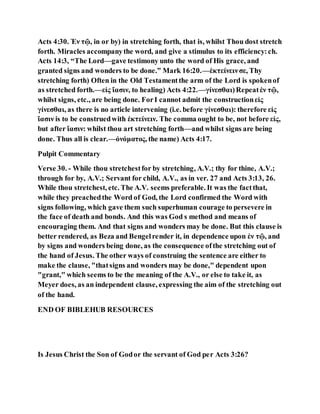
Acts 4:30. Ἐν τῷ, in or by) in stretching forth, that is, whilst Thou dost stretch
forth. Miracles accompanythe word, and give a stimulus to its efficiency:ch.
Acts 14:3, “The Lord—gave testimony unto the word of His grace, and
granted signs and wonders to be done.” Mark 16:20.—ἐκτείνεινσε, Thy
stretching forth) Often in the Old Testamentthe arm of the Lord is spokenof
as stretched forth.—εἰς ἴασιν, to healing) Acts 4:22.—γίνεσθαι)Repeatἐν τῷ,
whilst signs, etc., are being done. ForI cannot admit the constructionεἰς
γίνεσθαι, as there is no article intervening (i.e. before γίνεσθαι): therefore εἰς
ἴασιν is to be construedwith ἐκτείνειν. The comma ought to be, not before εἰς,
but after ἴασιν: whilst thou art stretching forth—and whilst signs are being
done. Thus all is clear.—ὀνόματος, the name) Acts 4:17.
Pulpit Commentary
Verse 30. - While thou stretchestfor by stretching, A.V.; thy for thine, A.V.;
through for by, A.V.; Servant for child, A.V., as in ver. 27 and Acts 3:13, 26.
While thou stretchest, etc. The A.V. seems preferable. It was the factthat,
while they preachedthe Word of God, the Lord confirmed the Word with
signs following, which gave them such superhuman courage to persevere in
the face of death and bonds. And this was God s method and means of
encouraging them. And that signs and wonders may be done. But this clause is
better rendered, as Beza and Bengelrender it, in dependence upon ἐν τῷ, and
by signs and wonders being done, as the consequence ofthe stretching out of
the hand of Jesus. The other ways of construing the sentence are either to
make the clause, "thatsigns and wonders may be done," dependent upon
"grant," which seems to be the meaning of the A.V., or else to take it, as
Meyer does, as an independent clause, expressing the aim of the stretching out
of the hand.
END OF BIBLEHUB RESOURCES
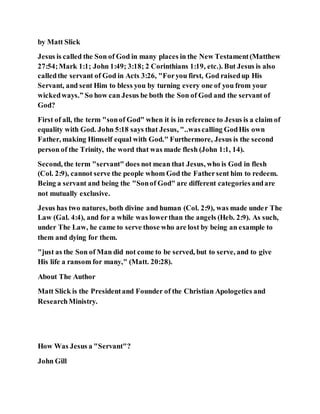
Is Jesus Christ the Son of Godor the servant of God per Acts 3:26?
by Matt Slick
Jesus is called the Son of God in many places in the New Testament(Matthew
27:54;Mark 1:1; John 1:49; 3:18; 2 Corinthians 1:19, etc.). But Jesus is also
calledthe servant of God in Acts 3:26, "Foryou first, God raisedup His
Servant, and sent Him to bless you by turning every one of you from your
wickedways.” So how can Jesus be both the Son of God and the servant of
God?
First of all, the term "sonof God" when it is in reference to Jesus is a claim of
equality with God. John 5:18 says that Jesus, "..wascalling GodHis own
Father, making Himself equal with God." Furthermore, Jesus is the second
person of the Trinity, the word that was made flesh (John 1:1, 14).
Second, the term "servant" does not mean that Jesus, who is God in flesh
(Col. 2:9), cannot serve the people whom God the Fathersent him to redeem.
Being a servant and being the "Sonof God" are different categoriesandare
not mutually exclusive.
Jesus has two natures, both divine and human (Col. 2:9), was made under The
Law (Gal. 4:4), and for a while was lowerthan the angels (Heb. 2:9). As such,
under The Law, he came to serve those who are lost by being an example to
them and dying for them.
"just as the Son of Man did not come to be served, but to serve, and to give
His life a ransom for many," (Matt. 20:28).
About The Author
Matt Slick is the Presidentand Founder of the Christian Apologetics and
ResearchMinistry.
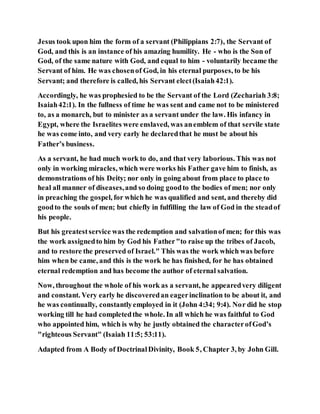
How Was Jesus a "Servant"?
John Gill
Jesus took upon him the form of a servant (Philippians 2:7), the Servant of
God, and this is an instance of his amazing humility. He - who is the Son of
God, of the same nature with God, and equal to him - voluntarily became the
Servant of him. He was chosenof God, in his eternal purposes, to be his
Servant; and therefore is called, his Servant elect(Isaiah42:1).
Accordingly, he was prophesied to be the Servant of the Lord (Zechariah 3:8;
Isaiah42:1). In the fullness of time he was sent and came not to be ministered
to, as a monarch, but to minister as a servant under the law. His infancy in
Egypt, where the Israelites were enslaved, was anemblem of that servile state
he was come into, and very early he declaredthat he must be about his
Father’s business.
As a servant, he had much work to do, and that very laborious. This was not
only in working miracles, which were works his Father gave him to finish, as
demonstrations of his Deity; nor only in going about from place to place to
heal all manner of diseases,and so doing goodto the bodies of men; nor only
in preaching the gospel, for which he was qualified and sent, and thereby did
goodto the souls of men; but chiefly in fulfilling the law of God in the steadof
his people.
But his greatestservice was the redemption and salvationof men; for this was
the work assignedto him by God his Father"to raise up the tribes of Jacob,
and to restore the preserved of Israel." This was the work which was before
him when be came, and this is the work he has finished, for he has obtained
eternal redemption and has become the author of eternal salvation.
Now, throughout the whole of his work as a servant, he appearedvery diligent
and constant. Very early he discoveredan eagerinclination to be about it, and
he was continually, constantlyemployed in it (John 4:34; 9:4). Nor did he stop
working till he had completedthe whole. In all which he was faithful to God
who appointed him, which is why he justly obtained the characterofGod’s
"righteous Servant" (Isaiah 11:5; 53:11).
Adapted from A Body of DoctrinalDivinity, Book 5, Chapter 3, by John Gill.
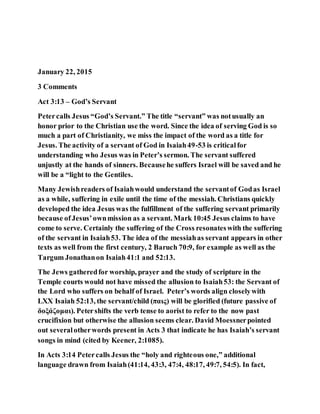
January 22, 2015
3 Comments
Act 3:13 – God’s Servant
Petercalls Jesus “God’s Servant.” The title “servant” was notusually an
honor prior to the Christian use the word. Since the idea of serving God is so
much a part of Christianity, we miss the impact of the word as a title for
Jesus. The activity of a servant of God in Isaiah49-53 is criticalfor
understanding who Jesus was in Peter’s sermon. The servant suffered
unjustly at the hands of sinners. Becausehe suffers Israel will be saved and he
will be a “light to the Gentiles.
Many Jewishreaders of Isaiahwould understand the servantof Godas Israel
as a while, suffering in exile until the time of the messiah. Christians quickly
developed the idea Jesus was the fulfillment of the suffering servant primarily
because ofJesus’ownmission as a servant. Mark 10:45 Jesus claims to have
come to serve. Certainly the suffering of the Cross resonateswith the suffering
of the servant in Isaiah53. The idea of the messiahas servant appears in other
texts as well from the first century, 2 Baruch 70:9, for example as well as the
Targum Jonathanon Isaiah41:1 and 52:13.
The Jews gatheredfor worship, prayer and the study of scripture in the
Temple courts would not have missed the allusion to Isaiah53: the Servant of
the Lord who suffers on behalf of Israel. Peter’s words align closelywith
LXX Isaiah 52:13, the servant/child (παις) will be glorified (future passive of
δοξάζομαι). Petershifts the verb tense to aorist to refer to the now past
crucifixion but otherwise the allusion seems clear. David Moessnerpointed
out severalotherwords present in Acts 3 that indicate he has Isaiah’s servant
songs in mind (cited by Keener, 2:1085).
In Acts 3:14 Petercalls Jesus the “holy and righteous one,” additional
language drawn from Isaiah(41:14, 43:3, 47:4, 48:17, 49:7, 54:5). In fact,
Isaiahcalls God the “Holy One” frequently. Keener points out pagankings
would call themselves “righteous” (1:1091), but a Jewishaudience would have
heard an echo of scripture, Noahor Enoch were “righteous ones,” but most
importantly the servantof God is “my righteous one” (Isa 53:11).
Finally, God glorified Jesus his servant by raising him from the dead. A
Jewishpersonin the crowd might have objectedthat Jesus couldnot be the
messiahsince he was dead – a valid point. But the resurrectionand ascension
of Jesus and demonstrate that he is the messiah, since his glorificationis to the
ultimate place, the right hand of the father.
What is the significance ofPeter’s allusion to the Suffering Servant of Isaiah?
To what extent is he calling attention to the whole context of Isaiah 40-55?
This was a popular text among Jews in the SecondTemple since it looks
forward to the end of the Exile, is Peterclaiming the exile came to an end with
the death of Jesus?
https://readingacts.com/2015/01/22/act-313-gods-servant/
If Jesus is Almighty God, why is he calledGod's servantat Acts 4:30?
Update: Punter, the Bible calls Jesus the "only-begottenSon" of God. (John
1:14; 3:16, 18;1 John 4:9) Jesus, the only-begottenSon, had a beginning to his
life. And Almighty Godcan rightly be calledhis Begetter, orFather, in the
same sense that an earthly father, like Abraham, begets a son. So, Jesus is a...
show more
BestAnswer: This is yet another scripture that shows that Jesus cannotbe
God.
Almighty God doesn't answerto anyone else. He is the highest. There is no
one higher.
Psalm83:18
You won't get a clearunderstandable explanation of this scripture from a
Trinitarian point of view because the Trinity teaching is inexplicable. To say
that God came down in human form to die for us is undermining what Jesus
actually did for us. He died an agonizing death on a torture stake forus.
Also, if he did transform his form & became human & came down to earth to
die for us, then who raisedhim up when he died?
The Trinity is not in the scriptures, doesn't make sense, and is borrowedfrom
paganism.
God is displeasedwith it & will show that displeasure very soon
Make the most of your time
Be more productive and work from virtually anywhere with new Windows 10
Pro devices with the Intel® vPro™ platform and MicrosoftOffice 365.
SponsoredMicrosoft
Becausehe isnt the Almighty God, he is the sonof God. Many people who
believe he is God, or the Fatherdoesnt read the whole bible. They only read
the portions that have him, the father & the holy spirit in the same verse...If
they read the whole bible instead of believing what they are told or taught,
w/out viewing for themselves, they would know that Jesus is the son of God,
his first creation....
1John4:1--beloved ones, do not believe every inspired expression, but test the
inspired expressions to see whether they originate with God, because many
false prophets have gone forth into the world.
Your question is an interesting one & I lookedat the scripture.
Recently, I did some researchinto the origins of the Trinity doctrine as I have
trouble in getting my head around it basically. I found a link that show the
origins of the Trinity & it tells you there that -"the Trinity is actually of
pagan, philosophical ancestry, and was engraftedonto, and accomodatedto,
Christian theology."
http://www.geocities.com/robert_upci/ori...
The cite also named a book which I hope to get& read called The Two
Babylons by Alexander Hyssop. It also tells you that there was no teaching of
Trinity in old TestamentJudaism.
When people are raisedwith certain beliefs (eg Trinity) and their beliefs are
challengedsometimes it motivates those that believe them to behave in a
retaliating wayto the person that is the challenger(in this case yourself). It
can bring out a kind of hostility sometimes, becauseinsteadof looking deeper
into why you may be asking the question, they place wrong motives upon you.
I guess whatI'm trying to sayis forgive the answers thatare patronizing &
condescending (and sometimes downright rude) and don't take them
personally as they cherish heartfelt beliefs that are difficult to let go of (even if
they are wrong)
The recordof Jesus'words and deeds in the Gospels shows thathe really was
God's servant.
That same record shows also that Jesus is not Almighty God.
Beliefin a Trinity makes a mockeryof everything the Bible plainly says. The
Trinity is no "mystery." It's just a falsehood.
Familiarity with the Old Testament"suffering servant" prophecies would
have prevented you from asking this Q in a way that belies your resistance to
the divine nature of Christ.
In Isaiah 52:13 to 53:12 (for example) we read of the prophetic ministry of the
Messiah- Christ. His role as servant is criticalto Jewishthinking and
expectations. Thatis why Christ's servant-hoodis emphasisedin the New
Testament. It is to help identify him as the Messiahto the nation of Israel. It is
one of his vital credentials. In Acts 4, the apostle Peterwas addressing the
Sanhedrin! He had just told these Jews that salvationis found in no-one else
other than Jesus!He quoted the OT about Christ being the stone rejected!He
quoted Psalm2 about such Jews raging againstGod's Anointed One! Getthe
context, and get the meaning!
Your additional comments about Christ being "begotten" also betray your
lack of understanding of the Greek words involved. You imagine it must mean
created. It does not! It means pre-eminence, priority. If Paul wanted to say
Christ was created, he would have used a different Greek word. He never
used that word when speaking of Christ. That is your clue. Think about it and
follow it through. Your eternal salvationdepends on it!
I notice that in the past week you have askedaboutseven different questions. I
wasn't going to answerany of them, because obviouslythey are not honestly
asked. I can't figure out why you ask them.
You've already gotyour mind made up. (Actually thats not true, but I'll
explain that later.)
What is the point of your questions? You have receiveddozens of excellent
Christian answers. You choose to rejectthem before they are even given.
I put you into the same catagorythat I put "Achtung Heiss". In the question
of approx three weeks ago,"The Names ofGod", I showedhow, via his own
remarks, that he does not think for himself, but allows the Watchtowerto do
it for him.
( All interested parties cancheck out the question under my Profile, see his
remarks, and my comments )
You sir, are doing the same thing. The Watchtowerchooses to highlight and
concentrate onevery verse in the New Testamentthat focuses onthe
Humanity of Christ.
As if that somehow calls into question His Godhood.
While at the same time, they either ignore, mistranslate, add to, or outright
fabricate non-existent Greek arguments, to all of the verses whichspeak to
His Divinity and Equality with the Father and the Spirit.
They put forth explanations and spurious arguments that 99% of all Greek
Scholars considerto be a joke.
You follow a dishonest organisation. You are told how to think, and what to
think by the Watchtower. Thats why I say its true and not true at the same
time of "alreadymaking up your mind". They make it up for you.
You deny that? I'll show you how.
If the Watchtowertomorrow morning was to decide that the Holy Spirit,
though still not God, was in facta person, (and not a 'force")you would follow
in 'lockstep'.
And everybody knows it!
You have receiveddozens of Biblical Proofs that Jesus Christ is in fact God in
the Flesh. You are not allowedto receive them. Becauseyou are in factnot a
free agent.
In fact, you cannot receive them. Becausewithoutbeing indwelt by the Holy
Spirit, you cannotunderstand the things of God. They are foolishness to you.
It is like trying to explain a rainbow to a man born blind.
God can reachany heart if it's willing. You have chosento close yours.
You, Achtung, and a few others here on the Y/A pages, have become the
modern day Pharisees.
As Jesus saidto them, He also says to you, "Unless you believe that I AM you
will die in your sins."
All because youwill not think for yourself. And allow the "Wordof Christ to
dwell in you richly".
Like the ProdigalSon, you eatthe food meant for swine, when a Banquet of
Riches is freely available.
You feastupon 'Watchtowers andAwakes" insteadof "The Breadof Life".
What Jesus saidto the people of Israelconcerning the false messiahthat is to
come, could also be applied to you.
In your case it would read:" I have come in my Fathers name, and you do not
receive Me, if another (the Watchtower)comes in their own name, Them, you
will receive."
You Sir, need to repent. If indeed it's still possible. Only God knows if your
heart has been hardened too much.
I sincerelypray not.
who was Jesus Christpraying to? you cannotpray to yourself. Jesus saidhe
cannot do anything without the Fatherin heaven. Jesus always gave creditto
his Father, not to himself. no one has seenJehovahGod, but they seenJesus
Christ. not even Moses seenJehovahGod. when Jesus was baptized, Jehovah
came down like a dove and said this is my son the beloved. so Jesus Christ
cannot be the Almighty God.
Jesus (pbuh) never claim that He is God or litrally sonof God.
If just for argument we acceptHe used word son and father, then God
Almighty has so many Sons, because inBible Prophet Abraham Prophet
Israel, also valled as son of God,
That means ( May God forgive me) God is parenting so many Sons, including
Jesus, Abraham, Israel, and so on.
Exodus 4:22 "Thus saith Jehovah, Israelis my son, even my firstborn."
Also, let us look at Jeremiah 31:9 "I am a father to Israel, and Ephraim is my
firstborn." Ephraim in this verse means Israel. This verse is similar to Exodus
4:22.
http://www.answering-christianity.com/son_translation.htm
he came as God incarnate. Jesus and God and the Holy spirit being one but
separate entities makes this possible. Jesus calledhimself God as well and so
did others. Thomas fell on his hands and knees and calledGod. Jesus said that
was God in John 8:58 as well in John 1:1 he was calledGod. The servant part
of your question is when he was crucified.
The Servant Jesus
Contributed by Howard Gunter on Jan 30, 2018
based on 3 ratings
(rate this sermon)
| 2,943 views
Scripture: Revelation22:16, Zephaniah 3:5, Lamentations 3:23, 1 Chronicles
23:30, Judges 21:4, Joshua 6:12, Mark 1:29-39
Denomination: Evangelical/Non-Denominational
Summary: Jesus always put His service and ministry above Himself.
1 2 3
Next
Midweek Message/Devotion
January 31, 2018
Reading:Mark 1:29-39
The Servant Jesus
As we read on in the Book ofMark about this intriguing ministry of our Lord,
we begin to learn the true meaning of a humble minister. Jesus has just left
the synagogue having taught with the authority of God.
He has gained the awe and amazement of many, who were present at this
teaching and as He confrontedand commanded the departure of a demon
spirit.
As we travel on with Jesus to the home of Simon Peterand his wife, we read
on of his greatmercy and ministry. Peter’s mother-in-law was very sick and
running a high fever. It must have been an uncomfortable position for the
family to try and host such a guestwith all of that going on. As soonas they
mentioned to Jesus that the mother-in-law was sick, HE immediately went to
the bedside, took her by the hand, lifted her up and the fever immediately left
her. v31
Can you just imagine? She was made completely well! So much so that she
beganto serve them. From the sick bed to serving a house full of guests. I
don’t know about you but to me that is a miracle in and of itself.
After the evening meal and after the sun had set, people began to gatherat
Peter’s house to be ministered to by Jesus. Rememberthat healing on the
Sabbath was contrary under Jewishlaw. So, it was afterthe sun had gone
down that the crowds came to be ministered to. The sick came in droves and
also the demon possessed. Greatexcitementamong the people that there was
now hope and promise for healings at the hands of Jesus. Didyou pick up on
Mark’s distinction betweenbeing sick with various diseases andbeing demon
possessed? Notall sicknessis the work of demon possession, any more than
sicknessbeing a form of punishment for the commissionof some sin. We all
get sick from time to time be we righteous and devout or be we sinful.
Video Illustration of the Week
Get weeklyvideos including full access to all illustrations, sermons, and
church media.
Free With PRO →
Jesus ministered to the throngs deep into the night, Jesus must have been
exhausted. Mostpreachers that I know are exhausted from leading a regular
Sunday service. It takes a lot out of the preacher that puts all of himself into
the delivery of a sermon/message. So, Jesusarose veryearly in the morning
and soughtout a quiet and private place to be alone with Godthe Father and
to pray.
When Peter gotup, he was concernedthat Jesus was nowhere around. He and
the others struck out to find Jesus. When they did, they begantelling Him that
everyone was gathering again and wanting to see Him. But and this is an
important part of the message,Jesus explainedto them that He came to
preach in and minister in the synagoguesthroughoutGalilee and so He would
be moving on.
What shall we garnerfrom this reading for applicationin our own lives?
A few points:
1. Healing Peter’s mother-in-law. Here is Jesus the guestof honor serving the
neediestin the householdwhere He was to be honored. Can you not think of a
scenario where this might apply? As a guestin the home of a family, children
are usually excited and seeking a little attention for themselves. Ratherthan
wait for the host to shoo them to another room, why not stop and even sit on
the floor at their level and give them a little of that attention for a few
minutes? I remember after a lawn wedding where I presided, the reception
was held in the home of the bride. The excited mom dropped a large bowl of
potato saladwhich meant brokenchina and mess all over the kitchen floor. I
jumped at the chance to cleanit up for her as she continued getting everything
setup. Now understand that doing so was as much for me to “do something”
rather than just sit in a chair, like a bump on a log. But it did bless that little
family.
2. Even as a guest, there was ministry to be done and Jesus was there to do
just that. As the crowds gathered, He went about laying hands on the sick and
casting out demons. He could just as easilysay, “Bless youbrothers and
sisters!” - Come back in the morning during regular church hours and we’ll
minister to you. What if you receiveda callat the end of your day and a friend
or even an acquaintance cries out, “I need to talk to someone. Canyou meet
me somewhere ormay I come by for a few minutes? You are tired and not
feeling too chipper. But, here God is giving you an opportunity for real
ministry. What? You don’t feel qualified? Just to listen? Just to offer a
shoulder to cry on?
“Everbeen in over your head? Do you ever feel you are not prepared to fulfill
what you know you must do? Did you land in a position and—honestly—
you’re not sure why?” From an article by: By Ron Edmondson, January 29,
in a posting from:
- https://churchleaders.com/pastors/pastor-articles/318087-7-biblical-
characteristics-leadership-tensions.
Edmondson uses Gideon as an example of someone feeling in over his head.
We might look at Moses in his first encounter with God as he was calledto
lead the Israelites.
3. Jesus wantedto be alone with God the first thing in the morning. As we
read through all the gospelmessages, this is a very common practice of His.
Remember, after feeding the five thousand, Jesus wantedto go off and spend
time with God the Father.
And Joshua rose early in the morning, and the priests took up the ark of the
LORD. -Joshua 6:12
So, it was, on the next morning, that the people rose early and built an altar
there and offered burnt offerings and peace offerings. - Judges 21:4
…to stand every morning to thank and praise the LORD, and likewise at
evening. - 1 Chronicles 23:30
They are new every morning; Greatis Your faithfulness. - Lamentations 3:23
The LORD is righteous in her midst,
He will do no unrighteousness.
Every morning He brings His justice to light;
He never fails,
But the unjust knows no shame. - Zephaniah 3:5
Pastor, have you claimed your 14 day PRO trial?
Enter your name and email to begin. Credit card required, cancelany time.
Plus, getemail updates & offers from SermonCentral. Privacy
“I, Jesus, have sent My angel to testify to you these things in the churches. I
am the Rootand the Offspring of David, the Bright and Morning Star.” -
Revelation22:16
A relationship and a Fellowshipwith God first thing in the morning has
always been an important part of the life of believers and seekers. Thesefew
little quotes from the bible are but a few of the many references to a morning
time with God.
4. Everyone wanted Jesus to stay on and continue His ministry at Capernaum.
His reaction:“Let us go into the next towns, that I may preach there also,
because forthis purpose I have come forth.” V 38
Jesus was ona roll. He was suddenly, a hero among the people, accolades
flowing. But His response was – I have work to do – an ordained purpose. He
chose to honor and obey His calling and continue the ministry throughout the
regionof Galilee.
Many would choose to bask in the glory (at leastfor the moment). But Jesus
was not interested in basking in glory. Jesus was interestedin serving God’s
people. That is a choice that all Christians can, make. Titles and honors are
nice but for the most part very self-serving, God is interested in seeing us
serving others.
I will never forgetan experience that I witnessedwhile at the MercyShips
Training Center in Van, Texas. I had come to know a nearby pastorGary
Brandenburg from Grace Church in Tyler, Texas. PastorBrandenburg was
often calledupon for teaching and speaking at various times for Mercy Ships.
Let me just divert and say a little something about my friend Pastor
Brandenburg. He was a professionalbaseball, having played for the Baltimore
Orioles before entering the ministry.
As of my last recollection, he is the leadpastor at FellowshipDallas in Dallas,
Texas. He is a very highly respectedman of God and known throughout the
country among many people.
But what I would really like to share is this. One day, the Mercy Ships
Administration calledon PastorBrandenburg, to be the guestspeakerata
very large and important event. That was over twenty-five years ago and
perhaps he wasn’t quite as well known then. It was a chance for a featherin
his capso to speak and an envious honor. But and I will never forgethis
response. “Iwould really like to acceptthis invitation, but I must turn it
down. Why? PastorBrandenburg had made a commitment to his sons that he
would take them to a sporting event on that date. We all have obligations and
commitments not only to God but to eachother.
Pastor, have you claimed your 14 day PRO trial?
Enter your name and email to begin. Credit card required, cancelany time.
Plus, getemail updates & offers from SermonCentral. Privacy
AAaah success andglory! -OR- service with honor and obedience.
WE LOVE AND SERVE GOD BY LOVING AND SERVING EACH
OTHER
Let us pray
Jesus:A Servant of God
View Larger Image
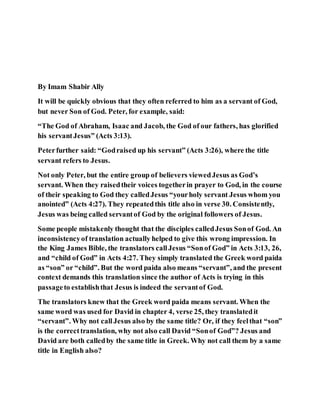
By Imam Shabir Ally
It will be quickly obvious that they often referred to him as a servant of God,
but never Son of God. Peter, for example, said:
“The God of Abraham, Isaac and Jacob, the God of our fathers, has glorified
his servantJesus” (Acts 3:13).
Peterfurther said: “Godraised up his servant” (Acts 3:26), where the title
servant refers to Jesus.
Not only Peter, but the entire group of believers viewedJesus as God’s
servant. When they raisedtheir voices togetherin prayer to God, in the course
of their speaking to God they calledJesus “yourholy servant Jesus whom you
anointed” (Acts 4:27). They repeatedthis title also in verse 30. Consistently,
Jesus was being called servantof God by the original followers of Jesus.
Some people mistakenly thought that the disciples calledJesus Sonof God. An
inconsistencyof translation actually helped to give this wrong impression. In
the King James Bible, the translators callJesus “Sonof God” in Acts 3:13, 26,
and “child of God” in Acts 4:27. They simply translated the Greek word paida
as “son” or “child”. But the word paida also means “servant”, and the present
context demands this translation since the author of Acts is trying in this
passageto establishthat Jesus is indeed the servantof God.
The translators knew that the Greek word paida means servant. When the
same word was used for David in chapter 4, verse 25, they translatedit
“servant”. Why not callJesus also by the same title? Or, if they feelthat “son”
is the correcttranslation, why not also call David “Sonof God”? Jesus and
David are both calledby the same title in Greek. Why not call them by a same
title in English also?
Other translators recognisedthis inconsistencyand correctedit in the modern
translations of the Bible. Therefore the New International Version of the Bible
and many others callJesus Servantof Godin the verses already quoted above.
Nevertheless,the factthat Jesus was God’s servantwas so well known that
even the King James Bible called him by this title in Matthew 12:18. Referring
back to Isaiah 42:1, Matthew identified Jesus as the servant of the one true
God Yahweh.
https://www.whyislam.org/social-issues/jesus-is-a-servant-of-god/
God The Father’s Servant — Jesus
By JoelHemphill
Jesus Christ is for sure the supernaturally conceived, virgin-born, sinless,
human Son of God; savior, redeemer, Messiah, andthe sooncoming ruler of
this planet for 1000 years. And yes, “highly exalted!” However, rather than
being pictured in Holy Scripture as the eternal God, God the Son, or the
secondpersonof a Triune God, Jesus Messiahis often portrayed as God our
Father’s “servant.” Forexample:
• Considercarefully these words from God regarding His coming Messiah,
Jesus, “my servant.”
“Beholdmy servantwhom I uphold; mine elect, in whom my soul delighteth; I
have put my spirit upon him: he shall bring forth judgement to the Gentiles.
He shall not fail nor be discouraged, till he have set judgement in the earth:
and the isles shall wait for his law. Thus saith God the Lord, he that created
the heavens, and stretchedthem out; he that spread forth the earth, and that
which cometh out of it…. I the Lord [God] have called thee [Jesus]in
righteousness, andwill hold thine hand, and will keepthee, and give thee for a
covenantto the people, for a light of the Gentiles;To open the blind eyes…”
(Isaiah 42:1, 4-7). Study this carefully and see, that God calls the Messiah,
“my servant.”
• And againGod says through Isaiah:
“Behold, my servant shall deal prudently, he shall be exalted and extolled, and
be very high. He is despisedand rejectedof men; a man of sorrows, and
acquainted with grief: and we hid as it were our faces from him; he was
despised, and we esteemedhim not. Surely he hath borne our griefs, and
carried our sorrows, yet we did esteemhim stricken, smitten of God, and
afflicted. But he was wounded for our transgressions, he was bruised for our
iniquities: the chastisementof our peace was upon him; and with his stripes
we are healed. Yet it pleasedthe Lord [God] to bruise him; he hath put him to
grief….He shall see of the travail of his soul, and shall be satisfied: by his
knowledge shallmy righteous servant justify many; for he shall bear their
iniquities” (Isaiah52:13; 53:3-5, 10, 11). Again, God says, “my servant.”
• Look closelyat how the apostle Peterviewed Jesus, as told in his sermon in
Acts chapter three, after the healing of the lame man.
“The God of Abraham, Isaac and Jacob, the God of our fathers, has glorified
his servantJesus” (Acts 3:13 NIV; RSV; NEV; JerusalemBible; Phillips
Translation;Today’s English Version; Holman CSB; Nelson’s NCV;etc.).
“When God raisedup his servant, he sent him first to bless you…” (Acts 3:26
NIV; RSV; NEV; JerusalemBible; Phillips Translation;Today’s English
Version; Holman CSB;Nelson’s NCV; etc.).
• That Jesus is God our Father’s “servant” is seenin the Apostles’ prayer to
God in Acts chapter four.
“When they heard this, they raised their voices togetherin prayer to God.
SovereignLord, they said, you made the heaven and the earth and the sea,
and everything in them. Indeed Herod and Pontius Pilate met together….to
conspire againstyour holy servant Jesus”(Acts 4:24, 27 NIV; RSV; NEV;
JerusalemBible; Phillips Translation;Today’s English Version; Holman
CSB;Nelson’s NCV; etc.).
• Notice also verse 30:
“…signs and wonders through the name of thy holy servantJesus” (Acts 4:30
NIV; RSV; NEV; JerusalemBible; Phillips Translation;Today’s English
Version; Holman CSB;Nelson’s NCV; etc.).
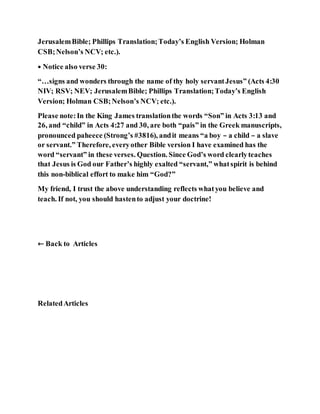
Please note:In the King James translationthe words “Son” in Acts 3:13 and
26, and “child” in Acts 4:27 and 30, are both “pais” in the Greek manuscripts,
pronounced paheece (Strong’s #3816), andit means “a boy – a child – a slave
or servant.” Therefore, everyother Bible version I have examined has the
word “servant” in these verses. Question. Since God’s word clearlyteaches
that Jesus is God our Father’s highly exalted “servant,” whatspirit is behind
this non-biblical effort to make him “God?”
My friend, I trust the above understanding reflects whatyou believe and
teach. If not, you should hastento adjust your doctrine!
← Back to Articles
RelatedArticles
God and the Son of God – Understanding the Difference
By JoelHemphill
We learnedfrom Scripture in my first book that Godis one entity, being,
person. “Hear, O Israel:The [...]
Who Are You Lord
By Jeffery Davies
It is all about One God and One Man. The Father and the Son are two entities
– two individuals. NOT TWO GODS...
You Can Know God
By JoelHemphill
There are awesome mysteries pertaining to the Eternal God which I do not
pretend to have the answerto, neither will I speculate onthem in this book.
About the Author: JoelHemphill
JoelHemphill has traveled extensively singing, and preaching the word of
God. He has written more than 350 songs including the gospelmusic classics
"Considerthe Lilies," "He's still working on me," "Masterofthe Wind" and
a number of other well-knownfavorites. The Hemphills recordedsome 27
albums and had numerous No. 1 and Top 10 songs. Joelwas inducted into the
Southern GospelMusic Hall of Fame on October11, 2007. Led of God, Joel
Hemphill came to more understanding about the One God of the Bible. In
2005 he wrote a book about his journey of faith entitled “To Godbe the
Glory.” Since that time, he has written three other books on One God issues
and traveled extensively speaking aboutthe understanding that the Father is
the only true God and that Jesus is the Christ, God’s Messiah.
Is Jesus God’s Servant or Son?
More Evidence of Biblical Corruption? Pt. 1
Sam Shamoun
Certain Muslim polemicists have capitalizedon the differences betweenthe
various English translations of the Holy Bible in order to castdoubt on the
divinity of the Lord Jesus Christ. An example of such a difference canbe
found in the way that certain Englishversions render the following passages:
“The God of Abraham, and of Isaac, and of Jacob, the God of our fathers,
hath glorified his SonJesus;whom ye delivered up, and denied him in the
presence ofPilate, when he was determined to let him go… Unto you first
God, having raised up his SonJesus, senthim to bless you, in turning away
every one of you from his iniquities.” Acts 3:13, 26 Authorized King James
Version (AV)
“Forof a truth against thy holy child Jesus, whomthou hast anointed, both
Herod, and Pontius Pilate, with the Gentiles, and the people of Israel, were
gatheredtogether… By stretching forth thine hand to heal; and that signs and
wonders may be done by the name of thy holy child Jesus.” Acts 4:27, 30 AV
In these particular verses the AV has the Apostles referring to Jesus as the
Son and holy Child of God. However, the RevisedStandard Version (RSV)
renders these texts differently:
“The God of Abraham and of Isaac and of Jacob, the Godof our fathers,
glorified his servantJesus, whom you delivered up and denied in the presence
of Pilate, when he had decidedto release him… God, having raisedup his
servant, sent him to you first, to bless you in turning every one of you from
your wickedness.”
“for truly in this city there were gatheredtogetheragainstthy holy servant
Jesus, whomthou didst anoint, both Herod and Pontius Pilate, with the
Gentiles and the peoples of Israel… while thou stretchestout thy hand to heal,
and signs and wonders are performed through the name of thy holy servant
Jesus.”
Thus, instead of Jesus being called God’s Son and holy Child, the RSV has the
Apostles identifying him as God’s Servant.
This has led some Islamic apologists to contend that the earliest Christian
confessionwasn’tthat Jesus was(is)God’s Son, but rather God’s servant. It
was only at a latter period that the proclamation was changedfrom Jesus
being the Servant of God to his Son.
As an example of this, note the argument made by Muslim polemicist Misha'al
Abdullah Al-Kadhi:
The Actual [sic] Greek word used is "pias" [sic]or "paida" which mean [sic];
"servant, child, son, manservant." Some translations of the Bible, such as the
popular King James Version, have translated this word as "Son" when it is
attributed to Jesus and "servant" for most everyone else, while more recent
translations of the Bible such as the RevisedStandard Version (RSV) now
honestly translate it as "servant." As we shall see in later chapters, the RSV
was compiled by thirty two Biblical scholars of the highest eminence, backed
by 50 cooperating Christiandenominations from the "most" ancientBiblical
manuscripts available to them today. Chances are that no matter what your
church or denomination you are able to name, that church took part in the
correctionof the King James Version of the Bible which resulted in the RSV.
(Al-Kadhi, What did Jesus really say?, 1.2.3.15Jesusis God's servant)
Dr. Laurence Brown, an atheist convert to Islam, says something similar:
Regarding the religious use of the word ebed, “The term serves as an
expressionof humility used by the righteous before God.”[2]Furthermore,
“After 100 B.C. pais theou more often means “servantof God,” as when
applied to Moses, the prophets, or the three children (Bar. 1:20; 2:20; Dan.
9:35).”[3]A person caneasily getinto doctrinal quicksand: “Of eight
instances of this phrase, one refers to Israel(Lk. 1:54), two refer to David (Lk
1:69; Acts 4:25), and the other five to Jesus (Mt. 12:18;Acts 3:13, 26; 4:27,
30)…. In the few instances in which Jesus is calledpais theou we obviously
have early tradition.”[4] So Jesus did not have exclusive rights to this term,
and where it was employed the term “obviously” stemmed from “early
tradition.” Furthermore, the translation, if impartial, should identify all
individuals to whom the phrase was applied in similar manner. Such,
however, has not been the case.Whereas pais has been translated“servant” in
reference to David (Acts 4:25 and Luke 1:69) and Israel(Luke 1:54), it is
translated “Son” or“holy child” in reference to Jesus (Acts 3:13; 3:26; 4:27;
4:30). Such preferential treatment is canonicallyconsistent, but logically
flawed. Lastly an interesting, if not key, religious parallel is uncovered: “Thus
the Greek phrase pais tou theou, ‘servant of God,’ has exactlythe same
connotationas the Muslim name Abdallah—the ‘servant of Allah.’”[5]
The symmetry is all the more shocking, forthe Holy Qur’an relates Jesus as
having identified himself as just this—Abdallah (abd being Arabic for slave or
servant, Abd-Allah [also spelled “Abdullah”] meaning slave or servant of
Allah). According to the story, when Mary returned to her family with the
newborn Jesus, they accusedher of being unchaste. Speaking from the cradle
in a miracle that gave credence to his claims, baby Jesus defended his
mother’s virtue with the words, “Inni Abdullah …” which means, “I am
indeed a servantof Allah …” (TMQ 19:30) (Brown, Jesus Christ – Son of
God? (part 1 of 2): The Meaning of “Sonof God”)
As does Shabir Ally who writes:
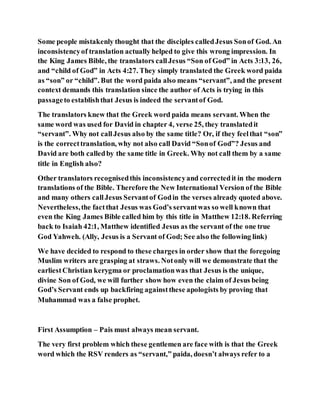
Some people mistakenly thought that the disciples calledJesus Sonof God. An
inconsistencyof translation actually helped to give this wrong impression. In
the King James Bible, the translators callJesus “Son of God” in Acts 3:13, 26,
and “child of God” in Acts 4:27. They simply translated the Greek word paida
as “son” or “child”. But the word paida also means “servant”, and the present
context demands this translation since the author of Acts is trying in this
passageto establishthat Jesus is indeed the servantof God.
The translators knew that the Greek word paida means servant. When the
same word was used for David in chapter 4, verse 25, they translatedit
“servant”. Why not callJesus also by the same title? Or, if they feelthat “son”
is the correcttranslation, why not also call David “Sonof God”? Jesus and
David are both calledby the same title in Greek. Why not call them by a same
title in English also?
Other translators recognisedthis inconsistencyand correctedit in the modern
translations of the Bible. Therefore the New International Version of the Bible
and many others callJesus Servantof Godin the verses already quoted above.
Nevertheless,the factthat Jesus was God’s servantwas so well known that
even the King James Bible called him by this title in Matthew 12:18. Referring
back to Isaiah 42:1, Matthew identified Jesus as the servant of the one true
God Yahweh. (Ally, Jesus is a Servant of God; See also the following link)
We have decided to respond to these charges in order show that the foregoing
Muslim writers are grasping at straws. Notonly will we demonstrate that the
earliestChristian kerygma or proclamationwas that Jesus is the unique,
divine Son of God, we will further show how even the claim of Jesus being
God’s Servant ends up backfiring againstthese apologists by proving that
Muhammad was a false prophet.
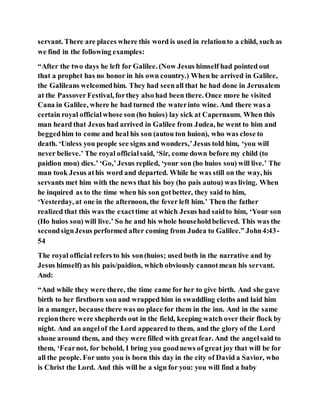
First Assumption – Pais must always mean servant.
The very first problem which these gentlemen are face with is that the Greek
word which the RSV renders as “servant,” paida, doesn’t always refer to a
servant. There are places where this word is used in relationto a child, such as
we find in the following examples:
“After the two days he left for Galilee. (Now Jesus himself had pointed out
that a prophet has no honor in his own country.) When he arrived in Galilee,
the Galileans welcomedhim. They had seenall that he had done in Jerusalem
at the Passover Festival, forthey also had been there. Once more he visited
Cana in Galilee, where he had turned the waterinto wine. And there was a
certain royal officialwhose son (ho huios) lay sick at Capernaum. When this
man heard that Jesus had arrived in Galilee from Judea, he went to him and
beggedhim to come and heal his son (autou ton huion), who was close to
death. ‘Unless you people see signs and wonders,’Jesus told him, ‘you will
never believe.’ The royal officialsaid, ‘Sir, come down before my child (to
paidion mou) dies.’ ‘Go,’Jesus replied, ‘your son (ho huios sou) will live.’ The
man took Jesus athis word and departed. While he was still on the way, his
servants met him with the news that his boy (ho pais autou) was living. When
he inquired as to the time when his son gotbetter, they said to him,
‘Yesterday, at one in the afternoon, the fever left him.’ Then the father
realized that this was the exacttime at which Jesus had saidto him, ‘Your son
(Ho huios sou) will live.’ So he and his whole householdbelieved. This was the
secondsignJesus performed after coming from Judea to Galilee.” John4:43-
54
The royal official refers to his son(huios; used both in the narrative and by
Jesus himself) as his pais/paidion, which obviously cannotmean his servant.
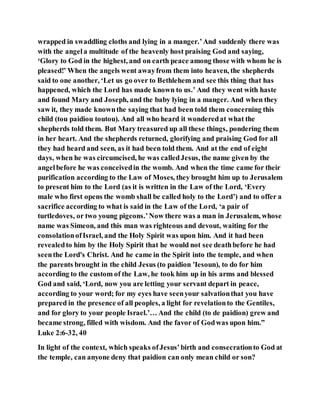
And:
“And while they were there, the time came for her to give birth. And she gave
birth to her firstborn son and wrapped him in swaddling cloths and laid him
in a manger, because there was no place for them in the inn. And in the same
regionthere were shepherds out in the field, keeping watch over their flock by
night. And an angelof the Lord appeared to them, and the glory of the Lord
shone around them, and they were filled with greatfear. And the angelsaid to
them, ‘Fearnot, for behold, I bring you goodnews of great joy that will be for
all the people. For unto you is born this day in the city of David a Savior, who
is Christ the Lord. And this will be a sign for you: you will find a baby
wrapped in swaddling cloths and lying in a manger.’And suddenly there was
with the angela multitude of the heavenly host praising God and saying,
‘Glory to God in the highest, and on earth peace among those with whom he is
pleased!’ When the angels went awayfrom them into heaven, the shepherds
said to one another, ‘Let us go over to Bethlehem and see this thing that has
happened, which the Lord has made known to us.’ And they went with haste
and found Mary and Joseph, and the baby lying in a manger. And when they
saw it, they made knownthe saying that had been told them concerning this
child (tou paidiou toutou). And all who heard it wonderedat what the
shepherds told them. But Mary treasured up all these things, pondering them
in her heart. And the shepherds returned, glorifying and praising God for all
they had heard and seen, as it had been told them. And at the end of eight
days, when he was circumcised, he was calledJesus, the name given by the
angelbefore he was conceivedin the womb. And when the time came for their
purification according to the Law of Moses, they brought him up to Jerusalem
to present him to the Lord (as it is written in the Law of the Lord, ‘Every
male who first opens the womb shall be called holy to the Lord’) and to offer a
sacrifice according to what is said in the Law of the Lord, ‘a pair of
turtledoves, or two young pigeons.’Now there was a man in Jerusalem, whose
name was Simeon, and this man was righteous and devout, waiting for the
consolationofIsrael, and the Holy Spirit was upon him. And it had been
revealedto him by the Holy Spirit that he would not see deathbefore he had
seenthe Lord's Christ. And he came in the Spirit into the temple, and when
the parents brought in the child Jesus (to paidion 'Iesoun), to do for him
according to the custom of the Law, he took him up in his arms and blessed
God and said, ‘Lord, now you are letting your servant depart in peace,
according to your word; for my eyes have seenyour salvationthat you have
prepared in the presence of all peoples, a light for revelationto the Gentiles,
and for glory to your people Israel.’… And the child (to de paidion) grew and
became strong, filled with wisdom. And the favor of Godwas upon him.”
Luke 2:6-32, 40
In light of the context, which speaks ofJesus’birth and consecrationto God at
the temple, can anyone deny that paidion can only mean child or son?
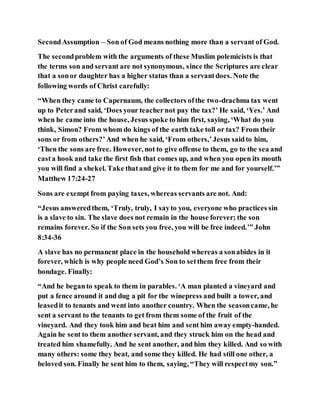
SecondAssumption – Son of God means nothing more than a servant of God.
The secondproblem with the arguments of these Muslim polemicists is that
the terms son and servant are not synonymous, since the Scriptures are clear
that a sonor daughter has a higher status than a servantdoes. Note the
following words of Christ carefully:
“When they came to Capernaum, the collectors ofthe two-drachma tax went
up to Peterand said, ‘Does your teachernot pay the tax?’ He said, ‘Yes.’ And
when he came into the house, Jesus spoke to him first, saying, ‘What do you
think, Simon? From whom do kings of the earth take toll or tax? From their
sons or from others?’And when he said, ‘From others,’Jesus saidto him,
‘Then the sons are free. However, not to give offense to them, go to the sea and
casta hook and take the first fish that comes up, and when you open its mouth
you will find a shekel. Take thatand give it to them for me and for yourself.’”
Matthew 17:24-27
Sons are exempt from paying taxes, whereas servants are not. And:
“Jesus answeredthem, ‘Truly, truly, I sayto you, everyone who practices sin
is a slave to sin. The slave does not remain in the house forever; the son
remains forever. So if the Son sets you free, you will be free indeed.’” John
8:34-36
A slave has no permanent place in the household whereas a sonabides in it
forever, which is why people need God’s Son to setthem free from their
bondage. Finally:
“And he beganto speak to them in parables. ‘A man planted a vineyard and
put a fence around it and dug a pit for the winepress and built a tower, and
leasedit to tenants and went into another country. When the seasoncame, he
sent a servant to the tenants to get from them some of the fruit of the
vineyard. And they took him and beat him and sent him away empty-handed.
Again he sent to them another servant, and they struck him on the head and
treated him shamefully. And he sent another, and him they killed. And so with
many others: some they beat, and some they killed. He had still one other, a
beloved son. Finally he sent him to them, saying, “They will respectmy son.”
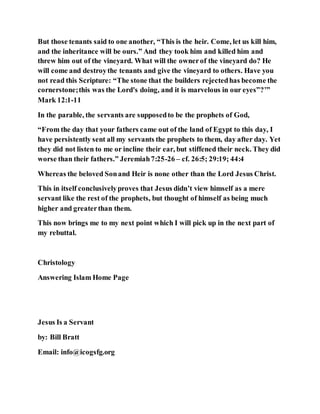
But those tenants said to one another, “This is the heir. Come, let us kill him,
and the inheritance will be ours.” And they took him and killed him and
threw him out of the vineyard. What will the ownerof the vineyard do? He
will come and destroythe tenants and give the vineyard to others. Have you
not read this Scripture: “The stone that the builders rejectedhas become the
cornerstone;this was the Lord's doing, and it is marvelous in our eyes”?’”
Mark 12:1-11
In the parable, the servants are supposedto be the prophets of God,
“From the day that your fathers came out of the land of Egypt to this day, I
have persistently sent all my servants the prophets to them, day after day. Yet
they did not listen to me or incline their ear, but stiffened their neck. They did
worse than their fathers.” Jeremiah7:25-26 – cf. 26:5; 29:19; 44:4
Whereas the beloved Sonand Heir is none other than the Lord Jesus Christ.
This in itself conclusivelyproves that Jesus didn’t view himself as a mere
servant like the rest of the prophets, but thought of himself as being much
higher and greaterthan them.
This now brings me to my next point which I will pick up in the next part of
my rebuttal.
Christology
Answering Islam Home Page
Jesus Is a Servant
by: Bill Bratt
Email: info@icogsfg.org
Have you ever wonderedwhy there are four gospelaccounts in the New
Testament?
Jesus carefullychose His 12 disciples to be witnesses ofHis resurrection.
Matthew, Mark, Luke and John were witnesses ofJesus’life, message,death
and resurrection. As witnesses,they are offering official testimony and
evidence to the jury, which is you and me. As the jury, we must read their
testimony and believe it to be true. If a witness bears false testimony, he could
be chargedwith perjury and be sent to jail.
We, as the jury, must realize that the testimony of all four witnessesmay not
and should not agree, wordfor word. If all four witnesses’testimonywere
identical, word for word, we the jury would conclude that the truth was being
tampered with and that someone was lying.
We also must realize that the testimony of these four witnesses were given
fifteen to sixty years after the ascensionofJesus. Eachtestimony will vary a
little in detail as to the exactsequence ofevents. They didn’t have tape
recorders at that time to recordthe exactwords of Jesus. Theyhad to rely
upon the inspiration of the holy spirit and their memories for their
testimonies.
Another point that we must realize is that eachof the four witnessesis giving
his testimony from his point of view. Matthew wrote from the point of view
that "Jesus is King", Mark’s emphasis was that "Jesus was a servant",
Luke’s point of view was on "Jesus as man" and John’s emphasis was that
"Jesus is God".
In this article, we will focus on Mark’s emphasis in that Jesus was a Servant!
Jesus as a Servant
Luke records in the book of Acts that Jesus was a servant. Let’s notice a
couple of passages:"The God of Abraham, Isaac, andJacob, the God of our
fathers, glorified His Servant Jesus, whomyou delivered up and denied in the
presence ofPilate, when he was determined to let Him go" (Acts 3:13 ). Let’s
continue in verse 26:"To you first, God, having raised up His Servant Jesus,
sent Him to bless you, in turning awayevery one of you from your iniquities."
(See also Acts 4:27,30, Rom15:8).
What is a Servant
Webster’s Dictionarydefines "servant" as:"one that serves others , a public
servant; especially, one that performs duties about the person or home of a
master or personalemployer".
Jesus was a servant to God the Father and to all of mankind. We have already
quoted Acts 3:13 that shows that Jesus was the servant of God. Jesus was also
the servantof all mankind. Jesus serves us in many capacities as our Lord,
Saviour, Deliverer, Redeemer, Friend, Brother, Guardian, Shepherd, King,
Mediator, Master, Healer, Messiah, Apostle and High Priest. (Requestour
article: "Jesus is Your: " which goes into many scriptures showing how
important Jesus is to your salvation.)
An Example of a Servant
Let’s notice what is expectedof a servant: "And which of you, having a
servant plowing or tending sheep, will sayto him when he has come in from
the field, 'Come at once and sit down to eat'? {8} "But will he not rather sayto
him, 'Prepare something for my supper, and gird yourself and serve me till I
have eatenand drunk, and afterwardyou will eatand drink'? {9} "Does he
thank that servant because he did the things that were commanded him? I
think not. {10} "So likewise you, when you have done all those things which
you are commanded, say, 'We are unprofitable servants. We have done what
was our duty to do'" (Luke 17:7-10 ).
The servant is to serve the masterfirst and to do his work immediately.
The word "immediately" appears 108 times in the whole Bible and 36 times in
the book of Mark in the New King James Versionof the Bible. In the King
James Versionthe word "immediately" appears 17 times and the synonym
"straightway" appears 19 times. We cansee that one third of the occurrences
in the Bible of the word "immediately" occurs in the book of Mark which
gives credence to Mark’s theme of "Jesus being a servant".
The Gospelof Mark
Let’s notice the servant aspectof "Jesusas a servant" in the first chapter of
Mark: "The beginning of the gospelof Jesus Christ, the Sonof God. {2} As it
is written in the Prophets:"Behold, I send My messengerbefore Your face,
Who will prepare Your way before You"" (Mark 1:1-2 ).
Notice that God is sending His Son as a messengerwith a job to do.
Verse 10: "And immediately, coming up from the water, He saw the heavens
parting and the Spirit descending upon Him like a dove"
This was at the end of John’s ministry and the beginning of Jesus’ministry.
Notice how a servant is busy and constantly on the move.
Verse 12: "Immediately the Spirit drove Him into the wilderness." Matthew
and Luke say in their accounts that the Spirit led Him into the desert;a king
or a man is led, but Mark implies that the servantis sent.
Verse 29: "Now as soonas they had come out of the synagogue, theyentered
the house of Simon and Andrew, with James and John."
Jesus’ministry was beginning in Galilee and there was no time for leisure in a
servant’s schedule. Jesus and His disciples went "immediately" from the
synagogue to the house of Simon (Peter).
Verse 30: "But Simon's wife's mother lay sick with a fever, and they told Him
about her at once."
As soonas Jesus arrived in the house of Peterhe had a task to perform.
Verse 35: "Now in the morning, having risen a long while before daylight, He
went out and departed to a solitary place;and there He prayed."
A servant needs to get up early in order to have enough time to complete his
tasks. Jesushad to arise early in order to be alone and have time to pray to
God.
Verse 38: "But He said to them, "Let us go into the next towns, that I may
preach there also, because forthis purpose I have come forth.""
The purpose of Jesus coming to earth was to become flesh and dwell or
tabernacle with man (John 1:14). He was to remain busy in preaching the
Gospelof the Kingdom of God. "Now afterJohn was put in prison, Jesus
came to Galilee, preaching the gospelof the kingdom of God, {15} and saying,
"The time is fulfilled, and the kingdom of God is at hand. Repent, and believe
in the gospel""(Mark 1:14-15 ).
Verse 39: "And He was preaching in their synagogues throughoutall Galilee,
and casting out demons. {40} Now a leper came to Him, imploring Him,
kneeling down to Him and saying to Him, "If You are willing, You can make
me clean." {41}Then Jesus, movedwith compassion, stretchedout His hand
and touched him, and said to him, "I am willing; be cleansed."{42}As soonas
He had spoken, immediately the leprosy left him, and he was cleansed. {43}
And He strictly warned him and senthim awayat once."
A servant does not waste time thinking about the glory of his
accomplishments, he has more work to do.
Jesus healedthe leper immediately and sent him awayimmediately.
Verse 44: "and (Jesus)said to him, "See that you saynothing to anyone;but
go your way, show yourself to the priest, and offer for your cleansing those
things which Moses commanded, as a testimony to them." {45} However, he
went out and began to proclaim it freely, and to spread the matter, so that
Jesus couldno longeropenly enter the city, but was outside in deserted places;
and they came to Him from every direction."
A servant works behind the scenesand no one realizes what kind of work is
being done.
Jesus stayedout of the eye of the public after He had healed the leper.
Mark 10:45 - Key Verse in Mark
In the following passageMark highlights Jesus’acts ofservice rather than His
teaching ministry: "Then James and John, the sons of Zebedee, came to Him,
saying, "Teacher, we wantYou to do for us whateverwe ask." {36}And He
said to them, "What do you want Me to do for you?" {37} They said to Him,
"Grant us that we may sit, one on Your right hand and the other on Your left,
in Your glory." {38} But Jesus saidto them, "You do not know what you ask.
Are you able to drink the cup that I drink, and be baptized with the baptism
that I am baptized with?" {39} They said to Him, "We are able." So Jesus
said to them, "You will indeed drink the cup that I drink, and with the
baptism I am baptized with you will be baptized; {40} "but to sit on My right
hand and on My left is not Mine to give, but it is for those for whom it is
prepared." {41} And when the ten heard it, they beganto be greatly
displeasedwith James and John. {42} But Jesus calledthem to Himself and
said to them, "You know that those who are consideredrulers over the
Gentiles lord it over them, and their greatones exercise authority over them.
{43} "Yet it shall not be so among you; but whoeverdesires to become great
among you shall be your servant. {44} "And whoeverof you desires to be first
shall be slave of all. {45} "Foreven the Son of Man did not come to be served,
but to serve, and to give His life a ransom for many"" (Mark 10:35-45 ). (See
also Mark 9:35).
Jesus came to serve rather that to be served. Jesus is saying that greatness
comes through serving.
Today, Jesus continues to serve His disciples before God’s throne as our
Apostle and High Priest(Heb. 3:1) .
In Conclusion:
Remember that a "servant" does his work and his tasks "immediately".
Jesus came to serve rather than to be served. He served by preaching the
gospeland then giving His life as a ransom for many.
Keep the point that "Jesus is a servant" in mind as you read through the book
of Mark.
https://icogsfg.org/jc-servn.html
■ Acts 3:13: Did the apostle Petercall Jesus only a servant of God?
Some Muslims claim that the apostle PetercalledJesus only a servant of God
and not God. Howeverthis is out of the context. The verse is saying:
“The God of Abraham, Isaac and Jacob, the God of our fathers, has glorified
his servantJesus. You handed him over to be killed, and you disownedhim
before Pilate, though he had decided to let him go” (Acts 3:13).
"Servantof God”, or servant of the Lord, is applied in the Old Testamentto
the Messiahin Isaiah42:1, Isaiah52:13 as God’s chosenservant for
accomplishing the work of redemption [1].
The apostle Peterwas the first apostle who called Jesus Christthe only unique
Son of the living God. When Jesus askedall his students: “who do you say I
am”, Peteranswered:
"You are the Christ, the Son of the living God." (Matthew 16:16).
By the expression“living God”, Peterused a characterapplied to the
Supreme Being, not only to distinguish him from the dead idols of paganism,
but also to point him out as the source of life, present, spiritual, and eternal
[2]. Peterconfirmed his faith in the glorious Jesus Christ the restof his life:
“To those who have obtained like precious faith with us by the righteousness
of our God and SaviorJesus Christ” (2 Peter 1:1).
Conclusion:the apostle Peterwas sure Jesus Christ is the divine servant to
complete the rescue plan of mankind.
Notes:
[1] Vincent’s Word Studies, Acts 3.
[2] Clarke’s Commentary on the Bible, Matthew 16.
http://www.ibnzura.com/answer.php?lang=en&id=38001&q=Acts_3:13:_Did_
the_apostle_Peter_call_Jesus_only_a_servant_of_God
9 CharacteristicsofJesus as a Servant
PostedDale Roach
Have you ever thought of Jesus as a servant?
Jesus Christ laid aside his Majestyto come to earth to show us the love of
God. As a result, this actiondisplays the attributes of Jesus as a servant-
leader.
There is no doubt that when Christ came to earth, he revealedhis skills as a
leader. However;he also showedhimself as a servant.
Jesus’ministry has a strong foundation in servanthood. On one occasion, he
told his disciples,
My command is this: Love eachother as I have loved you. Greaterlove has no
one than this: to lay down one’s life for one’s friends. (John 15:12-13)
These are the words of a faithful servant.
Christ’s life and death on the cross are the supreme examples of his
commitment to being a servant. There are severalpassagesofscripture within
the Bible that define the servantrole of Jesus.
Here are nine characteristics of Jesus as a servant to consider.
1 – IsaiahDescribes the Messiah(Jesus)as a Servant
The Old Testamentprophet Isaiah speaks ofthe coming “Messiah” as a
servant. In his writing, the prophet points out the characteristicsofa servant-
leader.
Isaiahwrote,
“Here is my servant, whom I uphold, my chosenone in whom I delight;
I will put my Spirit on him,
and he will bring justice to the nations.
He will not shout or cry out,
or raise his voice in the streets.
A bruised reed he will not break,
and a smoldering wick he will not snuff out.
In faithfulness, he will bring forth justice;
he will not falter or be discouraged
till he establishes justice onearth. In his teaching the islands will put their
hope.” (Isaiah42:1-4, NIV)
In these words, the prophet is pointing out the unique characteristicsofa
servant-leader.
2 – Jesus Describes Himselfas a Servant in His Teaching
In three of the Gospels, Jesusrefers to himself and his ministry in the world.
In these three passagesofscripture, Christ lays out the characteristics ofreal
servanthood.
“ Foreven the Son of Man did not come to be served, but to serve, and to give
his life as a ransom for many.” – Mark 10:45 (NIV)
“…Ihave come down from heaven not to do my will but to do the will of him
who sent me. – John 6:38 (NIV)
“Forwho is greater, the one who is at the table or the one who serves? Is it not
the one who is at the table? But I am among you as one who serves.” – Luke
22:27 (NIV)
Jesus points out in these three scriptures some truths about servanthood. He
teaches that a realservant leader –
does not seek servicefor themselves
aims to serve others
does not propose to do his own will
does not promote himself
3 – Jesus Shows Himself as a Servant By His Actions
One of the strongestexamples ofthe servant attitude of Jesus is when he
washes his disciples’ feetin John, chapter 13.
13 It was just before the PassoverFestival. Jesusknew that the hour had come
for him to leave this world and go to the Father. Having loved his own who
were in the world, he loved them to the end.
2 The evening meal was in progress, andthe devil had already prompted
Judas, the sonof Simon Iscariot, to betray Jesus. 3 Jesus knew that the Father
had put all things under his power, and that he had come from God and was
returning to God; 4 so he got up from the meal, took off his outer clothing,
and wrapped a towelaround his waist. 5 After that, he poured waterinto a
basin and beganto washhis disciples’ feet, drying them with the towelthat
was wrapped around him.
6 He came to Simon Peter, who said to him, “Lord, are you going to washmy
feet?”
7 Jesus replied, “Youdo not realize now what I am doing, but later you will
understand.”
8 “No,” saidPeter, “youshall never washmy feet.”
Jesus answered, “UnlessI washyou, you have no part with me.”
9 “Then, Lord,” Simon Peterreplied, “not just my feet but my hands and my
head as well!”
10 Jesus answered, “Thosewho have had a bath need only to washtheir feet;
their whole body is clean. And you are clean, though not every one of you.” 11
For he knew who was going to betray him, and that was why he said not every
one was clean.
12 When he had finished washing their feet, he put on his clothes and
returned to his place. “Do you understand what I have done for you?” he
askedthem. 13 “You call me ‘Teacher’and‘Lord,’ and rightly so, for that is
what I am. 14 Now that I, your Lord and Teacher, have washedyour feet, you
also should wash one another’s feet. 15 I have set you an example that you
should do as I have done for you. 16 Very truly I tell you, no servant is greater
than his master, nor is a messengergreaterthan the one who sent him. 17
Now that you know these things, you will be blessedif you do them.
Many people do not readily acceptthe idea of becoming a servant.
Simon Peterhad a difficult time allowing Jesus to washhis feet. This action
was the role of the “servant.” Jesus made it clearto Simon that this was
foundational for all that he had taught the disciples.
4 – The Apostle Paul Describes Jesusas a Servant
In his letter to the first-century church at Philippi, the Apostle Paul had this
to say about the servant role of Jesus,
“Who, being in very nature God, did not consider equality with God
something to be used to his own advantage;rather, he made himself nothing
by taking the very nature of a servant, being made in human likeness.” –
Philippians 2:6-7 (NIV) “
Paul also taught the early Christian believers that servanthood and humility
work together. He wrote about the example that Jesus set.
“And being found in appearance as a man, he humbled himself by becoming
obedient to death—evendeath on a cross!” – Philippians 2:8 (NIV)
Therefore, Paulpoints out to the believers that Christ’s example of
servanthoodis one of the most influential messagesofthe New Testament
church.
5 – Jesus Was Nota Self-Promoting Servant
Jesus had severalopportunities to promote himself. He never did. The Gospel
of Matthew tells a story of how Jesus had every opportunity to promote
himself but refused to do it. One of those stories canbe seenhere in the Gospel
of Matthew.
9Departing from there, He went into their synagogue. 10 And a man was there
whose hand was withered. And they questioned Jesus, asking, “Is it lawful to
heal on the Sabbath?”—sothat they might accuse Him. 11 And He said to
them, “Whatman is there among you who has a sheep, and if it falls into a pit
on the Sabbath, will he not take hold of it and lift it out? 12 How much more
valuable then is a man than a sheep! So then, it is lawful to do goodon the
Sabbath.” 13 Then He *saidto the man, “Stretchout your hand!” He stretched
it out, and it was restoredto normal, like the other. 14 But the Pharisees went
out and conspired againstHim, as to how they might destroy Him.
15 But Jesus, aware ofthis, withdrew from there. Many followedHim, and He
healed them all, 16 and warned them not to tell who He was. 17 This was to
fulfill what was spokenthrough Isaiahthe prophet:
18 “Behold, My Servant whom I have chosen;
My Belovedin whom My soul is well-pleased;
I will put My Spirit upon Him,
And He shall proclaim justice to the Gentiles.
19 “He will not quarrel, nor cry out;
Nor will anyone hear His voice in the streets.
20 “A battered reed He will not break off,
And a smoldering wick He will not put out,
Until He leads justice to victory.
21 “And in His name the Gentiles will hope.” – Matthew 12:9-21
6 – Jesus TaughtHis Disciples ThatGreatness is Found in Servanthood
“Jesuscalledthem togetherand said, “You know that the rulers of the
Gentiles lord it over them, and their high officials exercise authority over
them. 26 Not so with you. Instead, whoeverwants to become greatamong you
must be your servant, 27 and whoeverwants to be first must be your slave—
28 just as the Son of Man did not come to be served, but to serve, and to give
his life as a ransom for many.” -Matthew 20:25-28 (NIV)
7 – Jesus as a Servant Leader, TaughtThat Humility and Servanthood
Cannot be Separated
Jesus saidto his disciples in the Gospelof Matthew.
“But when you give to the needy, do not let your left hand know what your
right hand is doing, so that your giving may be in secret. Thenyour Father,
who sees whatis done in secret, will reward you.” – Matthew 6:3-4 (NIV)
8 – Jesus Praisesthe Characterof a Trusting Servant
Realand powerful servanthoodstarts by recognizing the power of others. A
centurion soldier came to Jesus asking for help. Matthew records the story.
5 When Jesus had entered Capernaum, a centurion came to him, asking for
help. 6 “Lord,” he said, “my servant lies at home paralyzed, suffering terribly.”
7 Jesus saidto him, “ShallI come and heal him?”
8 The centurion replied, “Lord, I do not deserve to have you come under my
roof. But just say the word, and my servant will be healed. 9 For I myself am a
man under authority, with soldiers under me. I tell this one, ‘Go,’ andhe goes;
and that one, ‘Come,’and he comes. I say to my servant, ‘Do this,’ and he does
it.”
10 When Jesus heardthis, he was amazed and said to those following him,
“Truly I tell you, I have not found anyone in Israelwith such greatfaith.” –
Matthew 8:5-10
This story has a significantmeaning.
Here is a soldier who has authority and powerat his fingertips. Yet, he placed
himself under the authority of Jesus. The encounter with this soldier
impressed Jesus. The man was willing to place himself under the authority
and leadershipof Jesus much like a servant. This centurion is a perfect
example of humble servanthood. As a result, Jesus said, “Truly I tell you, I
have not found anyone in Israelwith such greatfaith.”
9 – Jesus as a Servant Leader is a PowerfulExample to Follow
When thinking about the servant style of Jesus, it would benefit any leader to
follow his example. John Stott put it this way,
“The authority by which the Christian leaderleads is not power but love, not
force but example, not coercionbut reasonedpersuasion. Leaders have power,
but poweris safe only in the hands of those who humble themselves to serve.”
This style of leadership is preciselythe example that Jesus setfor those who
are willing to follow Him.
Dale Roach
CHRIST THE SERVANT “Behold, my servantwhom I have chosen, my
beloved with whom my soul is well pleased. I will put my Spirit upon him, and
he will proclaim justice to the Gentiles. Matthew 12:18
We could have no greaterexample or hero of a servantthan Jesus Christ. 1.
What did it take for even Jesus Christ to become a servant? (Philippians 2:5-
8)
The above passageshows us that Christ deliberately chose to become a
servant. But it costHim. Later, we will see that servanthoodcomes at a cost
for us too. 2. Note Philippians 2:9-11. How did Godthe Father respond to
Christ’s choice to become a servant?
Later in our series we will also see that the GreatestServantof all commands
His followers, allChristians, to be servants as well.
3. ReadMatthew 20:26-28. Whatwas the basis for Christ being able to
command that His followers be servants?
4. BasedonMark 10:45, what was Christ’s greatestactofservanthood?
5. Why did Christ serve people?
Servanthood
www.legana.org3
6. How else did Christ serve others?
Serving others on God’s behalf is enabled by the gifts and talents God gives
His servants. In Christ’s case, He potentially had every possible gift and talent
with which to serve others. I saypotentially, because Christ - without ever
ceasing to be God - relinquished His power as God. His ability to serve others
was empoweredby the Holy Spirit.
7. Readthe episode of Christ’s service in John 13 from verse 5 to verse 14. Did
Christ need the empowering of the Holy Spirit for this actof service?
8. BasedonJohn 13:14, discuss whetherChrist’s followers need a special
word or anointing from God to serve others
This episode of Christ’s service towardHis disciples is a powerful illustration
of our salvationand sanctification. In order for us to be spiritually clean,
Christ must become our Servant and washus. This is like our salvation. Then
Christ must continue to serve us by washing our faces, hands and feet(note
Exodus 30:19-21). This is why salvationis an actof God’s grace-Godserving
us in a waywe could not serve ourselves. As we shall soonsee in our later
studies on servanthood, serving is an act of grace. Grace is free for the
recipient, but often costlyfor the giver. When it comes to the salvationof a
sinner, the Scriptures reveal what we know intuitively: we cannotsave
ourselves, we needit done for us. BecauseofGod’s greatlove towardus, He
has sentHis Servant as our Servant to be our Saviour. God has served to save
us. He has shown us grace - God’s Riches At Christ’s Expense.
9. How does Acts 3:26 claim that Godwants Christ to serve and bless people?
Amen.
Next study: The Christian As A Servant
Christ, The Servant
4 Studies on Servanthood prepared by Dr Andrew Corbett, Pastorof
LEGANACHRISTIANCHURCH
LEADER’S NOTES We have establishedthat Christ was a servant, in fact-
the Servant. As followers ofChrist we are to be servants like our master
(Matt. 10:25). What we will see is that although the world sees promotion as
moving up, Christ regarded promotion as moving down. John the Baptist
once said that his goalwas to decrease(John3:30). This is completely counter
to the spirit of the world which rewards arrogance, selfishambition, and
manipulated prominence. It is the goalof this study to lead your group into a
commitment to serve others in the spirit of Christ. This spirit will affect the
way they interact with pre-Christians, but especiallywith fellow believers
(Gal. 6:10). When the localchurch assembles it is a display what sacrificial
service looks like. The church is a servant organisation. Butit is more than
this. It is a voluntary servant organisation. The world can barely comprehend
this. This is largely because we live in not just a professionalworld, but a
highly commercialworld where time is money and time is only exchangedfor
money. Yet in a church, an organisedarmy of committed volunteers, people
are not serving for money - even those who are paid (like the pastoralstaff)
are really paid-volunteers. It is not money which causesthem to serve. It is
their devotion to Christ! In fact, the term “minister” actually means servant.
When a business grows, it’s managers and owners are usually promoted. But
when a church grows it’s ministers must be demoted- that is, they decreaseby
increasing their servanthood. This reflects whatJohn the Baptist said when
Christ, the focus of his prophecies, appeared-“I must decrease andHe must
increase.”(John3:30) In this study we will explore why a Christian is a
servant, why this requires humility, and why this is difficult for most
Christians to maintain. As the group leaderyour job is not just to lead your
group through this Bible Study, but to also help your group members to getto
know eachother better with the goalof discovering of how they can serve
eachother better. Members of your Bible Study Group may be carrying
loads, cares orburdens that they have not disclosed. As leader, you can gently
reassure your group that because Christ is The Servant, He canserve us at the
point of our secretneed- whether that need be healing, forgiveness, hope, or
reconciliation. As you lead your group in prayer, you setthe tone for the Bible
Study. As you ask the Study questions and your supplementary questions,
your engagementwith those in your group (by “active listening” that is, eye
contact, verbal acknowledgement, and affirmation of a person’s answer)will
help your group members to have the confidence that they can share issues of
their heart and thus have God minister His changing grace to them.
http://www.findingtruthmatters.org/studies/Servanthood.pdf
God Sent His Servantto Bless You
Resource by John Piper
Scripture: Acts 3:22–26 Topic:The Birth of Christ
Moses said, "The Lord God will raise up for you a prophet from your
brethren as he raisedme up. You shall listen to him in whatever he tells you.
And it shall be that every soul that does not listen to that prophet shall be
destroyedfrom the people." And all the prophets who have spoken, from
Samuel and those who came afterwards, also proclaimedthese days. You are
the sons of the prophets and of the covenantwhich God gave to your fathers,
saying to Abraham, "And in your posterity shall all the families of the earth
be blessed." God, having raised up his servant, sent him to you first, to bless
you in turning every one of you from your wickedness.
I want to persuade you this morning that God is moving toward you with
greatblessing. He is offering you this morning blessing beyond what you now
enjoy. And if you will move towardhim in faith, if you will believe his good
will towardyou and make it your hope and treasure, then you will receive the
blessing of the Lord appointed for you.
God's Intention to Bless People
What this passageteachesus this morning is that God brought Jesus onto the
scene ofhistory to bless people. God saidto his Son in heaven: "The time is
fulfilled; I have promised blessing; now is the time to make goodon my
promise; you will be my emissaryof blessing;I want blessing to come to the
world; I have so much to give; go now and bless my people, bless them; indeed
bless all the families of the earth through them, bless them, bless them."
You can see this in verses 25 and 26:
You are the sons of the prophets and of the covenantwhich God gave to your
fathers, saying to Abraham, "And in your posterity shall all the families of the
earth be blessed." God, having raisedup his servant, sent him to you first, to
bless you in turning every one of you from your wickedness.
So God's blessing is mentioned twice. In verse 26 it says explicitly that God
sent Jesus to the people of IsraelTO BLESS them. And when it says that God
sent him to IsraelFIRST, it means that he will send the blessing on to others
after that. Verse 25 makes plain that this was God's aim in the covenanthe
made with Abraham: "In your posterity ALL THE FAMILIES OF THE
EARTH will be blessed." Blessing forthe Jews and then blessing for all the
peoples—andthat includes you.
So I say this morning that God is moving towardyou with blessing this
morning. You are in verse 25. It doesn't matter that almost 2,000 years have
passed. With God a thousand years is as a day. With him it is as though he
made this promise two days ago. That's how fresh the blessing for you is this
morning. If you will move towardhim this morning in faith, you will receive
the blessing. Thatis what Christmas is all about.
Three Parts to God's "Blessing"
Now the word "blessing" todayis not an exciting word. It feels for many
people unreal, vague, a kind of religious jargon that doesn'tseemto have any
wallop to it. So let me unpack the three things I see in this text that are part of
the blessing Godhas for you this morning. When God sent his servantJesus,
what blessing did he bring? What does Christmas mean in this text?
1. Jesus as the Validation of God's Truthfulness
First, the coming of Jesus is a blessing because it proves the truthfulness of
God—Jesus proves that God keeps his word, he's trustworthy.
God Keeps His Word
To make that point Peterpiles up promises. In verse 22 he says that Moses
predicted the coming of a prophet like himself. In verse 24 he says that all the
prophets from Samuel on down proclaimed these days—the days of Jesus. In
verse 25 he says that Godmade a promise to Abraham about these days. The
point is that when Jesus comes, he confirms the truth of all these promises. He
shows that God is trustworthy; he keeps his word.
Here is the way Paul put it in Romans 15:8: "Christ became a servant to the
circumcised[i.e., the Jews]to show God's truthfulness, and to confirm the
promises given to the fathers." So there it is, stated crystalclear: Christ came
to prove that God tells the truth, that God keeps his promises. Christmas
means that God can be trusted.
The Foundation of All Truth and Morality and Beauty
Now I say that this is part of the BLESSING that he brings—andthat he
offers this morning. It is a blessing because where it is forsaken, moraland
spiritual life disintegrates. The foundation of moral life is God's truthfulness.
A societythat forsakesthe centrality of the absolute truthfulness of God
forsakesthe foundation of truth, the foundation of morality, and the
foundation of beauty.
Christmas is the reassertionofthe foundation of all truth and goodness and
beauty, because Christmas means: God is truthful. God's truthfulness is the
constantin a universe of flux. God's truthfulness is the unwavering absolute.
If we forsake God's truthfulness, the anchor is up, the rudder is loose, the keel
is broken, and the ship of life (political life, sociallife, educationallife,
scientific life, family life) is simply at the mercy of the wind of human wishes.
So I say it with all my heart: demonstrating the truthfulness of God is a great
blessing. Give that blessing to your children. Say to the next generationagain
and again:God is truthful; God keeps his word; God does not lie; God canbe
trusted! That's the first part of the blessing this morning. Receive it as a
wonderful Christmas gift, and give it to as many people as you can.
2. Jesus as a SecondMoses
Second, the coming of Jesus is a blessing because he comes as a prophet like
Moses—akind of secondMoses.
Verse 22: "Mosessaid, The Lord God will raise up for you a prophet from
your brethren as he raisedme up. You shall listen to him in whatever he tells
you."
A Law-Giver Vs. a Grace-Giver?
Now Jesus is that prophet. He fulfills that promise. But someone might say, "I
don't think that's a blessing, because Moseswas a lawgiver, not a grace-giver.
I don't want another Moses. Iwant something that cancels outMoses. Iwant
grace."
Something is wrong with that response. BecausePeterthinks he is giving good
news here. One like Moses has come!The promise is fulfilled! Peterdidn't see
a conflict betweenthe grace of Jesus and the teaching of Moses. The truth is:
we do need a prophet like Moses.
A Prophet Who Reveals the Truth of God
If God is truthful, and his truthfulness is the foundation of all truth and
goodness andbeauty, then we need someone to reveal to us the truth of God.
We can't know this God and we can't know his way unless there is a prophet
to tell us. Jesus said, "I am the way the truth and the life, no one comes to the
Father but by me." That is what it means to be a new Moses. The truth-giver,
the way-shower, the life-giver.
This is not the opposite of grace. This is grace. Gracenotonly pardons sin (v.
19); it also shows the path to life. We not only need Jesus as a priest; we need
him as a prophet. If every lifestyle led to paradise, then perhaps we would
need no prophet like Moses to show us the way to life. But all lifestyles do not
lead to paradise. Some lead to destruction.
Some Lifestyles Lead to Destruction
That's what Petertells us in verse 23: "And it shall be that every soul that
does not listen to that prophet shall be destroyed from the people." There is a
narrow way that leads to life. And there is a broad waythat leads to
destruction (Matthew 7:13–14). And God sent Jesus as a prophet like Moses to
lead us on the one and warn us againstthe other.
Suppose there were a strip of land in Saudi Arabia and suppose that it were
strewn with buried land mines. If a soldier knew the way through the land so
that you would not detonate any mines, and he came and offeredto take you
safelyacross, wouldyou considerit legalistic and ungracious if he said: "I
know the way across;follow me. If you don't, you will be blown to pieces." I
say that is loving and gracious to demand I follow and to warn me that there
is destruction if I leave him.
That is what Peteris saying here: Jesus is the new Moses who canguide you
through the wilderness of life and bring you to the promised land of heaven.
There are land mines of sin that can destroyyou. Follow Jesus andyou will be
safe. He is the way, the truth, and the life.
That's the secondblessing offeredthis morning. Christmas means, first, that
God is truthful. And Christmas means, second, that a new Moses has come to
show us the truth of God and lead us to life, and save us from destruction.
3. Jesus Turns Us from Our Wickedness
Third, the coming of Jesus is a blessing because he turns us from our
wickedness.
Verse 26: "God, having raised up his servant, sent him to you first, to bless
you in turning every one of you from your wickedness."
Jesus comes notjust to show you the truth of God, like a new Moses, but to
work that truth into you by turning you awayfrom evil.
Faith as the Instrument of Sanctification
But notice at the end of verse 26 that it says that he is turning "every one of
you from your wickedness."Whatdoes that mean? Not all those who heard
Peterwere turned from wickedness. It means, I think, that this is a potential
turning in everyone, if they will receive it; if they will trust God for it.
We cansee this condition in Acts 15:9 at the end of the verse: "Godcleansed
their hearts by faith." Faith is the instrument of God's cleansing—the
instrument by which he turns us from wickedness. Oragainwe see it in Acts
26:18 at the end of the verse:" . . . those who are sanctifiedby faith in me
[Jesus]." Faithis God's instrument of sanctification—the wayhe turns us
from wickedness.
This is why I said at the beginning that God is moving toward you this
morning with blessing, and that if you will move toward him and trust him,
you will have the blessing appointed for you.
The New Moses andthe Scribes
So the third blessing offered to us this morning is the active help of Jesus to
overcome wickedness.He will turn us from evil. Christmas means, first, that
God is truthful. It means, second, that a prophet like Moses has come to show
us the way of truth and life. And it means, third, that the new Moses does not
show us the way and then stand aside to watch us struggle. Insteadhe joins us
on the way, gets involved with our lives, and actively turns us—turns us away
from evil, and works the truth of God into us. (Cf. Hebrews 13:20f.)
This is the difference betweenthe new Mosesand what the scribes made out
of the old Moses. Jesus saidin Luke 11:46, "Woe to you teachers ofthe law!
For you load men with burdens hard to bear, and you yourselves do not touch
the burdens with one of your fingers." The new Moses is not like that. His
burden is light and his yoke is easybecause he not only puts it on, he also
helps carry it. He shows us the way of righteousness andhe TURNS us from
the wayof wickedness.
Summary
In summary then, I want to persuade you that God is moving toward you this
morning with blessing. You are among the "families of the earth" mentioned
in verse 25. The promise of blessing is for you.
And I would offer that blessing to you this morning in the form of three
Christmas gifts that Jesus came to give.
First, Jesus came to prove God's truthfulness. It is a precious gift and I urge
you to receive it: believe that God keeps his promises; Godtells the truth; God
can be trusted.
Second, Jesus came as a prophet like Moses.He reveals the truth of God and
the Godof truth. He is the way, the truth, and the life. He is a reliable guide
through the minefield of sin; and he will lead you to the promised land. Trust
him.
Finally, Jesus came to turn us from wickedness.He does not merely point; he
empowers. He is not watching us struggle. He is with us on the way.
Christmas means that God is truthful. Christmas means that Jesus came to
revealthe truth of God. Christmas means that Jesus came to help us live the
truth of God.
Matthew 12:18 18"Hereis my servantwhom I have
chosen, the one I love, in whom I delight; I will put my
Spirit on him, and he will proclaimjusticeto the
nations.
BIBLEHUB RESOURCES
Ellicott's Commentary for English Readers
(18) Beholdmy servant.—Themysterious “servantof the Lord,” who is the
central figure of the last part of Isaiah’s prophecies,appears sometimes as the
representative of Israel’s righteousness,sometimes ofits sins, now as one who
bore his witness as a prophet and messengerofGod, now as standing apart
from all others in solitary greatness,oryet more solitary suffering. In eachof
these aspects the words of Isaiah found their highest fulfilment in the Son of
Man. In referring these words to the Messiah, the Evangelistwas following in
the footsteps ofthe Chaldee Paraphrase, but we must remember also that the
words recorded as heard at the Baptism of Jesus (almostverbally identical
with those of the prophecy now cited) must also have suggestedthe
application, especiallyas connectedwith the promise, “I will put My Spirit
upon Him,” which had then receivedits fulfilment.
He shall shew judgment to the Gentiles.—Theword“judgment” has a wide
range of meaning in the Hebrew of Isaiah, and includes the work of a king, as
teaching, no less than as executing, righteousness. As yet, of course, the work
of preaching the gospelto the Gentiles had not begun, but St. Matthew notes,
as it were, by anticipation, the spirit of love and gentleness which, when he
wrote his Gospel, had brought them also within the range of the judgments—
i.e., of the life-giving truths—of the righteous Judge. It is one of the many
instances in which his record, though obviously written for Jews, is yet
emphatically a Gospelfor the Gentiles.
Matthew Henry's Concise Commentary
12:14-21 The Pharisees took counselto find some accusation, that Jesus might
be condemned to death. Aware of their design, as his time was not come, he
retired from that place. Face does notmore exactly answerto face in water,
than the characterofChrist drawn by the prophet, to his temper and conduct
as described by the evangelists.Let us with cheerful confidence commit our
souls to so kind and faithful a Friend. Farfrom breaking, he will strengthen
the bruised reed; far from quenching the smoking flax, or wick nearly out, he
will rather blow it up into a flame. Let us lay aside contentious and angry
debates;let us receive one another as Christ receives us. And while
encouragedby the gracious kindness of our Lord, we should pray that his
Spirit may rest upon us, and make us able to copy his example.
Barnes'Notes on the Bible
My servant- That is, the Messiah, the Lord Jesus;calleda servant from his
taking the "form" of a "servant," or his being born in a humble condition
Philippians 2:7, and from his obeying or "serving" God. See Hebrews 10:9.
Shall show judgment to the Gentiles - The word "judgment" means, in the
Hebrew, law, "commands, etc.," Psalm19:9; Psalm119:29-30.It means the
"whole systemof truth;" the law of God in general;the purpose, plan, or
"judgment" of God about human duty and conduct. Here it means, evidently,
the systemof "gospeltruth," the Christian scheme.
Gentiles - All who were not Jews. This prophecy was fulfilled by the
multitudes coming to him from Idumea and beyond Jordan, and from Tyre
and Sidon, as recordedby Mark 3:7-8.
Jamieson-Fausset-BrownBible Commentary
18. Behold my servant, whom I have chosen;my beloved, in whom my soul is
well pleased:I will put my Spirit upon him, and he shall show judgment to the
Gentiles.
Matthew Poole's Commentary
The alterationis very little, and we must not expectto meet with quotations
out of the Old Testamentverbatim: it is enoughthat the sense is the same.
Behold my servant, whom I have chosen. The word indifferently signifieth a
child or a servant, Christ is calledthe Lord’s servant, because he took upon
him the form of a servant, and became obedient even to death, Philippians
2:7,8:
Whom I have chosen;my beloved, in whom my soul is well pleased:in Isaiah
it is, whom I uphold; mine elect, in whom my soul delighteth. Matthew seems
to have left out whom I uphold, and to have taken the next words, mine elect,
and to have translated them, whom I have chosen, which was all said by the
prophet. God chose the Lord Jesus Christ to be our Redeemer, and the Head
of the elect;hence we are said to be chosenin him, Ephesians 1:4. Petersaith
he was foreordained, 1 Peter1:20 2:6, he is calleda chief Cornerstone, elect.
My beloved, in whom my soul
is well pleased:in Isaiah it is, in whom my soul delighteth: the sense is the
same.
He shall bring forth judgment to the Gentiles, or to the nations. The words
jpvm, in the Hebrew, krisiv in the Greek, and judgment in the English, are all
so variously used, as gives interpreters a greatlatitude to abound in their
senses.The most probable to me is this: Judgment signifies a thing adjudged:
all judgment is either of approbation or condemnation.
He shall bring forth, or he shall show, the things which God approveth and
judgeth right, both in matters of doctrine, worship, and the government of the
church of God, and in matters which concernthe government of men’s lives
and conversations:and to this end God promises to put his Spirit upon him, so
Isaiah11:2 41:1; and John tells us it was not given him by measure, John 3:34,
which is the same with being anointed with the oil of gladness above his
fellows, Psalm45:7, which the apostle applies to Christ, Hebrews 1:9.
Gill's Exposition of the Entire Bible
Behold, my servant whom I have chosen,....These are the words of God the
Father, speaking to the church, concerning Christ, as mediator; who, as such,
is God's servant, employed by him, and obedient to him, in the work of man's
salvation;and is a righteous, faithful, prudent, and diligent one; whom he,
from all eternity, had chosento this service, and in the fulness of time sent him
to do it, and supported and upheld him in it; for it is whom I uphold, in the
Hebrew text. My beloved, in whom my soul is well pleased;who always was
the objectof his love, not only as his ownand only begottenSon, but as in his
office capacity, as mediator; in regard to which he was his elect, as it is in
Isaiah; and, as such, he was always delighted in his person, well pleasedwith
his office, and the discharge ofit, and which he declaredmore than once by a
voice from heaven, as at his baptism, and at his transfiguration on the mount:
I will put my Spirit upon him; as he did without measure, wherebyhe was
abundantly qualified for his whole work, and particularly for preaching the
Gospel, being richly anointed with gifts and graces,above his fellows;of
which the descentof the Holy Spirit upon him, as a dove at his baptism, which
immediately precededhis public ministry, was a symbol. And he shall show
judgment unto the Gentiles;meaning, not the general judgment, at the last
day, which is committed to him; nor the laws of Justice and equity; but the
Gospel, which is the produce of the God of judgment; best informs the
judgment of men about the business of salvation;gives an accountof the
righteous procedure of God in justifying sinners, by the righteousness ofhis
Son; and teaches mento live soberly, righteously, and godly: this Christ
brought forth, and showed, atthis time, to the Heathens, the Idumeans,
Tyrians, and Sidonians; who flockedunto him; whereby this part of the
prophecy had its fulfilment: in the Hebrew it is, "he shall bring forth"; that is,
out of his heart and mouth, and is the same as "show" here.
Geneva Study Bible
Behold my servant, whom I have chosen;my beloved, in whom my soul is well
pleased:I will put my spirit upon him, and he shall shew {c} judgment to the
Gentiles.
(c) By judgment is meant a godly kingdom, because Christ was to proclaim
true religion among the Gentiles, and to castout superstition; and wherever
this is done, the Lord is said to reign and judge there, that is to say, to govern
and rule matters.
EXEGETICAL(ORIGINAL LANGUAGES)
Meyer's NT Commentary
Matthew 12:18. Isaiah 40:1 ff., a very free rendering of the original Hebrew
text, yet not without some reminiscences ofthe LXX. Forthe ‫ֶע‬‫ב‬ֶ‫ע‬‫י‬ ‫ה‬ ֹ‫ו‬ֹ‫,ה‬ which
the LXX. (Ἰακὼβ ὁ παῖς μου) and modern expositors interpret as applying to
Israelas a nation, or the ideal Israelof the prophets, see, besides, the
commentaries on Isaiah; Drechslerand Delitzschin Rudelbach’s Zeitschr.
1852, 2, p. 258 ff.; Tholuck, d. Propheten u. ihre Weissag. p. 158 ff.; Kleinert
in the Stud. u. Krit. 1862, p. 699 ff.; F. Philippi in the Mecklenb. Zeitschr.
1864, 5, and 6. Matthew understands it as referring to the Messiah. Similarly
the Chaldee paraphrasts and Kimchi, in which they are justified by the
Messianic idea, as fulfilled in Christ, running through the whole passage. See
Acts 3:13; Acts 3:26; Acts 4:27; Acts 4:30; Hengstenberg, Christol. II. p. 216
ff., compared with Kleinert, l.c.
εἰς ὅν] in regard to whom. Directionof the approbation. Comp. 2 Peter1:17.
The aorists, as in Matthew 3:17.
θήσω τὸ πνεῦμα] i.e. I will make Him the possessorand the bearer of my Holy
Spirit, by whose powerHe is to work, Isaiah11:2; Isaiah61:1; Matthew 3:16;
Acts 4:27.
κρίσιν] not: quod fieri par est(Fritzsche); not: justice and righteousness
(Bleek);the goodcause (Schegg);or the cause ofGod (Baumgarten-Crusius);
not: recta cultus divini ratio (Gerhard); nor: doctrina divina (Kuinoel),—
which interpretations have been given in view of the ‫טפׁשמ‬ of the original
(where it denotes the right, i.e. what is right and matter of duty in the true
theocracy. Comp. Ewald on Isaiah, l.c.; Hengstenberg, p. 233;and see in
general, Gesenius, Thes.III. p. 1464). But in the New Testamentκρίσις has no
other meaning but that of final sentence, judgment (also in Matthew 23:23);
and this, in fact, is the sense in which the Hebrew was understood by the LXX.
Matthew’s Greek expressionis doubtless to be understood no less in the sense
of a judicial sentence, i.e. the Messianic judgment, for which the Messiahis
preparing the way through His whole ministry, and which is to be
consummated at the last day.
τοῖς ἔθνεσιν] not: the nations, generally, but the heathen. Similarly also in
Matthew 12:21. The point of fulfilment in the prediction here quoted lies
simply in its serving to describe, as it does in Matthew 12:19 f., the
unostentatious, meek, and gentle nature of Christ’s ministry (Matthew 12:16),
so that it is unnecessaryto look to what precedes in order to find something
corresponding to τοῖς ἔθνεσι (some finding it in the multitudes that followed
Jesus). Jesus did not preachto the heathen till He did it through the apostles,
Ephesians 2:17, a matter altogether beyond the scope ofthe present passage.
It should be observedgenerally, and especiallyin the case ofsomewhat
lengthened quotations from the Old Testament, that it is not intended that
every detail is to find its corresponding fulfilment, but that such fulfilment is
to be lookedfor only in connectionwith that which the connectionshows to be
the main subjectunder consideration.
Cambridge Bible for Schools andColleges
18. my servant] Israelas a nation is calledthe servant of Jehovah, Isaiah41:8.
Here the same title is given to Jesus, as the representative of the nation.
judgment] The Hebrew word is used in a wider sense to denote “religionas
the rule of life;” hence judgment may mean (1) “the law of Christ,” “the
Gospel,” or(2) adhering to the strict meaning of the Greek word, “the divine
sentence ordecree.”
to the Gentiles]Possiblyour Lord in His retirement addressedHimself more
especiallyto the Gentiles—the Greeks,Phœnicians, andothers, settled near
the Lake. “Theyabout Tyre and Sidon, a greatmultitude, … came unto him,”
Mark 3:8.
Bengel's Gnomen
Matthew 12:18. Ἰδοὺ ὁ Παῖς Μου, ὃν ᾑρέτισα·ὁ ἀγαπητός Μου, εἰς ὃν
εὐδόκησενἡ ψυχή Μου·θήσω τὸ πνεῦμά Μου ἐπʼ Αὐτὸν, καὶ κρίσιν τοῖς
ἔθνεσιν ἀπαγγελεῖ·οὐκ ἐρίσει οὐδὲ κραυγάσει, οὐδὲ ἀκούσει τὶς ἐν ταῖς
πλατείαις τὴν φωνὴν Αὐτοῦ· κάλαμονσυντετριμμένονοὐ κατεάξει, καὶ λίνον
τυφόμενονοὐ σβέσει· ἓως ἂν ἐκβάλῃ εἰς νῖκος τὴν κρίσιν· καὶ ἐν τῷ ὀνόματι
Αὐτοῦ ἔθνη ἐλπιοῦσι,—BeholdMy Servant, whom I have chosen;My Beloved,
in whom My soul is well pleased;I will put My Spirit upon Him, and He shall
announce judgment to the Gentiles. He shall not strive nor cry; neither shall
any man hear His voice in the streets. A bruised reed shall He not break, and
smoking flax shall He not quench, till He send forth judgment unto victory.
And, in His name shall the Gentiles trust. The LXX. thus render Isaiah 42:1-
4,—Ἰακὼβ ὁ παῖς Μου, ἀντιλήψομαι αὖτοῦ·Ἰσραὴλὁ ἐκλεκτός Μου,
προσεδέξατο αὐτὸνἡ ψυχή Μου, ἔδωκα τὸ πνεῦμά Μου ἐπʼ αὐτὸν, κρίσιν τοῖς
ἔθνεσιν ἐξοίσει· οὐ κράξεται, οὐδὲ ἀνήσει, οὐδὲ ἀκουσθήσεται ἔξω ἡ φωνὴ
αὐτοῦ·κάλαμονσυντεθλασμένονοὐ συντρίψει, καὶ λίνον καπνιζόμενονοὐ
σβέσει, ἀλλὰ εἰς ἀλήθειαν ἐξοίσει κρίσιν, κ.τ.λ.[559]Jacobis My servant; I
will defend him. Israelis my chosen;My soul has acceptedhim: I have given
my Spirit upon him; he shall bear forth judgment to the Gentiles. He shall not
cry, nor lift up [his voice];nor shall his voice be heard without. A bruised reed
shall he not crush, and smoking flax shall he not quench; but he shall bear
forth judgment unto truth.—ὁ παῖς μου, my servant = the Hebrew ‫]065[,ידוע‬
in Isaiah 42:1. And the LXX. frequently express that Hebrew word[561]by
παῖς,[562]e.g. where Moses, oreven the Messiah, is spokenof. Cf. Acts 3:13;
Acts 3:26; Acts 4:27; Acts 4:30. Forit is not againrepeated in the New
Testamentconcerning the Messiah, eitherbecause neither the Greek παῖς, or
any other word, corresponds sufficiently to that Hebrew word, which the
apostles also usedin the beginning, or else because neitherof them is suitable
to our Lord’s state of glorification. The words, servantand beloved, are
parallel; and also, I have chosen, and I am well pleased.—ᾑρέτισα, I have
chosen—αἱρετίζειν= αἱρετὸνὁρίζειν, to setapart as chosen.—εἰς ὅν, towards
whom) The preposition εἰς denotes the perpetual tendency of the Father’s
mind towards His Beloved[Son]. See 2 Peter1:17.—κρίσιν, judgment)
salutary to men. See Matthew 12:20, and John 16:11.—κρίσις, judgment, is
the separationofsin and righteousness.—τοῖς ἔθνεσιν, to the Gentiles)when
He shall have departed from the Jews.—ἀπαγγελεῖ,He shall announce) He
both performed and announced it. The future tense is employed here; but the
past afterwards by St Paul, Ephesians 2:17 [with reference to the same
matter].
[559]In E. V. it stands thus—“Beholdmy servant, whom I uphold; mine elect,
in whom my soul delighteth: I have put my Spirit upon him; he shall bring
forth judgment to the Gentiles. He shall not cry, nor lift up, nor cause his
voice to be heard in the street. A bruised reed shall he not break, and the
smoking flax shall he not quench: he shall bring forth judgment unto
truth.”—(I. B.)
[560]Sc. ‫דוע‬ servant, with the pronominal suffix ‫,י‬ my.—(I. B.)
[561]‫ד‬ ֹ‫ו‬ֹ‫,ה‬ i.e. a servant: the minister or ambassador sentby God for
accomplishing some service:also a familiar servantchosenand beloved of
God on accountof his piety and approved fidelity; also a term especially
applied to the Messiah. SeeGESENIUS, etc.—(I. B.)
[562]παῖς. According to Schleusner, (1) a child in age;(2) a child in relationto
its parents; (3) one pre-eminently beloved; (4) a servant; (5) the minister of a
king, etc. According to Liddel and Scott, (1) a child in relation to its parents;
(2) a child in age;(3) a servant. The passages, however, in these writers are
too long for insertion, and cannotbe adequatelyabridged.—(I. B.)
Pulpit Commentary
Verse 18. - Behold my servant. Primarily, as would appear, Israelin its ideal,
up to which true Israelites came in measure, but only One came fully. Whom I
have chosen(ο{ν ᾑρέτισα). The Hebrew denotes "lay hold of" (‫,)דטתא‬ i.e. for
myself. Bengelhas a beautiful note on the εἰς ὅν of the ReceivedText, "Αἰς, in,
denotat perpeluam mentis paternae tendentiam erga dilectum, 2 Peter1:17."
According to the LXX. of 1 Chronicles 29:1, David's expressionabout
Solomonaffords a curious parallel, Ὁ υἱός μου εἰς ο{ν ᾑρέτικενἐν αὐτῷ
Κύριος (edit. Dr. Swete). But Lagarde's edition of the Lucianic text
punctuates and accents differently, Ὁ υἱός μου εϊς ο{ν ᾑρέτικεν ἐν αὐτῷ
κύριος, and this is much nearer to the Hebrew. My beloved, in whom my soul
is well pleased(Matthew 3:17, note): I will put my Spirit upon him, and he
shall show (declare, RevisedVersion) judgment to the Gentiles (καὶ κρίσιν
τοῖς ἔθνεσιν ἀπαγγελεῖ). Although κρίσις usually represents in the New
TestamentGod's decisionas to the characterand life of men, it here must be
understood, like mishpat in the original, of the Divine right as made knownto
them for their acceptanceandimitation. It is "the true religion viewed on its
practicalside as a norm and standard for life in all its relations" (Delitzsch).
The thought here, therefore, is not of Christ's power to punish and avenge
(though he refused to use it as yet), but of his bringing a revelation which
should eventually spread, not only to the Jews who now rejectedhim, but to
the Gentiles whom they despised.
STUDYLIGHT RESOURCES
Calvin's Commentary on the Bible
18.Lo, my servant, whom I have chosen. To fix our attention more closelyon
his will, God points out by the finger, as it were, the personwhom he is about
to send; and this is the designof the exclamation, Lo! A similar reasonmay be
assignedfor the epithets that follow, when God calls him his servant, his elect
in whom his soul is well pleased. Forwhence comes it, that men venture to
measure Christ by their own sense, but because they do not considerthat their
redemption depends exclusively on the grace ofGod? When God offers to us
an invaluable treasure, it is excessive andwickedpresumption to regulate our
estimation of it by the disdainful views of our flesh. He is calleda servant, not
as if he were of the ordinary rank, but by wayof eminence, and as the person
to whom God has committed the charge and office of redeeming his Church.
As:
no man taketh this honor to himself, but he who is calledof God
(Hebrews 5:6)
is justly entitled to this rank, God declares that he who comes forwardin this
characterwas electedby his decree. (96)Hence it follows, that men are not at
liberty to rejecthim; because, by doing so, they would be guilty of contempt
and rebellion againstGod. And, indeed, it were the height of absurdity that
our choice orour pride should setaside that calling of God which ought to be
regardedas sacredand inviolable.
My beloved, in whom my soul is well pleased. There is a still wider import in
this statement, which God next makes by the prophet, that the delight of his
soul dwells in Christ; for though the calling of eachof us proceeds from the
free favor of God as its only source, yetin Christ there is this remarkable
peculiarity, that in his person God the Father embraces in his love the whole
Church. As we are all by nature enemies of God, his love will never come to us
till it first begin with the Head; which we have seenon a former occasion, and
will see againunder another passage, (Matthew 17:5.)
He will proclaim judgment to the Gentiles. The prophet gives a brief
description of Christ’s office, when he foretells that he will proclaim judgment
to the Gentiles By the word judgment the Jews understand a government
which is correctlyand properly arranged, in which order and justice prevail.
The designof the prophet is to inform us, that a person will come who will
restore justice that had fallen, who will be the governor not of one nation only,
but will also bring under subjectionto God the Gentiles, among whom
dreadful confusion formerly prevailed. And this is the import of the word
bring forth, which the prophet employs; for it was the office of Christ to
spread throughout the whole world the kingdom of God, which was at that
time confined to the cornerof Judea;(97) as it is saidin another passage,
The Lord will send forth the scepterof thy powerout of Zion,
(Psalms 110:2.)
I will put my Spirit upon him. This explains the manner in which judgment
shall be brought forth. It is no doubt true, that there never was any portion
whateverof righteousnessin the world that did not proceedfrom the Spirit of
God, and that was not maintained by his heavenly power;as none of the kings
of the earth can frame or defend goodorder, exceptso far as he shall be
assistedby the same Spirit. But in bringing forth judgment Christ is greatly
superior to all others, for he has receivedthe Spirit from the Father, that he
may pour it out on all his people; for not only does he by word or writing
prescribe what is proper, but inwardly forms the hearts of men, by the grace
of his Spirit, to preserve the rule of righteousness.

Jesus was god's servant

  • 1.
    JESUS WAS GOD'SSERVANT EDITED BY GLENN PEASE Acts 4:30 30Stretchout your hand to heal and perform signs and wonders through the name of your holy servantJesus." BIBLEHUB RESOURCES God's Holy Servant J. W. Burn. Acts 4:29-30 And now, Lord, behold their threatenings:and grant to your servants, that with all boldness they may speak your word,… (see Acts 3:26): — The term translated in the Authorised Version here, and in ver. 21, "child" is more correctly rendered in ver. 25, in regardto David, "servant." The word is so given in Matthew 12:18, where Isaiah13:1 — part of the greatprophecy of the Servant of the Lord — is applied to Christ. This prophecy and its fulfilment in Jesus was evidently running in the minds of the apostles throughout these discourses. The term "holy" in conjunction with "servant" suggests thatGod has servants who are —
  • 2.
    I. WITHOUT HOLINESS— creatures whom God has not endowedwith a moral being, and can therefore render neither a holy nor an unholy service. This applies to the laws, forces, substancesofnature to sun, moon, stars, the earth, and all its inhabitants except man. These perform an unconscious service. II. UNHOLY — creatures in antagonismto the Divine will; devils and evil men. These are servants by right, for God made them for service, equipped them for service, placedthem in spheres for service, and gave them a work to do. But their powers and opportunities are occupied in endeavouring to thwart the Divine purpose. Do they succeed?Nay, they are servants in fact as well as by right. Let the conduct of the rulers, fitting types of their class, show this, and Judas also and his confederatesin the Crucifixion. Their service is an unwilling service. III. IMPERFECTLYHOLY. Such are true Christians, whose lifelong experience is gradual separationfrom sin and growing approximation to complete consecrationto God. In both sides of this experience the Divine and human co-operate.The blood of Jesus Christ is cleansing them from sin, and they are cleansing themselves "from all filthiness of flesh and spirit," thus "perfecting holiness in the fear of God." The Holy Spirit sanctifies, sets them apart for God. They "present themselves living sacrifices, holy, acceptable to God." Their service is a conscious andglad service. IV. HOLY. Such was Adam; such are the angels. But the holiness was not inherent in the first, for he fell; nor in the second, forsome of their order fell. Angelic purity is Divinely imparted, and for their Divine work they are Divinely sustained. V. DIVINELY HOLY. Such and such only is Jesus.
  • 3.
    1. He isholy by nature — essentially, eternally. 2. His work is perfectly holy without a flaw, and such as God can accept without the leastreservation. 3. His merits make the holiestholy. (J. W. Burn.) COMMENTARIES Ellicott's Commentary for English Readers (30) By stretching forth thine hand to heal.—There seems something like an intentional assonance in the Greek words which St. Luke uses—iāsis (healing) and Jesus (pronouncedIesus)—as though he would indicate that the very name of Jesus witnessedto His being the greatHealer. A like instance of the nomen et omen idea is found in the identification by Tertullian (Apol. c. 3) of Christos and Chrestos (good, orgracious), of which we have, perhaps, a foreshadowing in 1Peter2:3. (Comp. also Acts 9:34.) Thy holy child Jesus.—Better, as before, Servant. (See Note on Acts 3:13.) MacLaren's Expositions Acts
  • 4.
    OBEDIENT DISOBEDIENCE Acts 4:19- Acts 4:31. The only chance for persecutionto succeedis to smite hard and swiftly. If you cannot strike, do not threaten. Menacing words only give courage. The rulers betrayed their hesitation when the end of their solemnconclave was but to ‘straitly threaten’; and less heroic confessorsthan Peterand John would have disregardedthe prohibition as mere wind. None the less the attitude of these two Galileanfishermen is noble and singular, when their previous cowardice is remembered. This first collisionwith civil authority gives, as has been already noticed, the main lines on which the relations of the Church to hostile powers have proceeded. I. The heroic refusal of unlawful obedience. We shall probably not do injustice to John if we suppose that Peterwas spokesman. If so, the contrastof the tone of his answerwith all previously recordedutterances of his is remarkable. Warm-heartedimpulsiveness, often wrong-headedand sometimes illogical, had been their mark; but here we have calm, fixed determination, which, as is usually its manner, wastes no words, but in its very brevity impresses the hearers as being immovable. Whence did this man getthe powerto lay down once for all the foundation principles of the limits of civil obedience, and of the duty of Christian confession? His words take rank with the ever-memorable sayings of thinkers and heroes, from Socratesin his prison telling the Athenians that he loved them, but that he must ‘obey God rather than you,’ to Luther at Worms with his ‘It is neither safe nor right to do anything againstconscience. Here I stand; I cando nothing else. Godhelp me! Amen.’ Peter’s words are the first of a long series.
  • 5.
    This first instanceof persecutionis made the occasionfor the clearexpression of the greatprinciples which are to guide the Church. The answerfalls into two parts, in the first of which the limits of obedience to civil authority are laid down in a perfectly generalform to which even the Council are expected to assent, and in the secondan irresistible compulsion to speak is boldly allegedas driving the two Apostles to a flat refusal to obey. It was a daring stroke to appeal to the Council for an endorsement of the principle in Acts 4:19, but the appeal was unanswerable;for this tribunal had no other ostensible reasonforexistence than to enforce obedience to the law of God, and to Peter’s dilemma only one reply was possible. But it rested on a bold assumption, which was calculatedto irritate the court; namely, that there was a blank contradiction betweentheir commands and God’s, so that to obey the one was to disobey the other. When that parting of the ways is reached, there remains no doubt as to which road a religious man must take. The limits of civil obedience are clearly drawn. It is a duty, because ‘the powers that be are ordained of God,’ and obedience to them is obedience to Him. But if they, transcending their sphere, claim obedience which can only be rendered by disobedience to Him who has appointed them, then they are no longer His ministers, and the duty of allegiance falls away. But there must be a plain conflictof commands, and we must take care lest we substitute whims and fancies of our own for the injunctions of God. Peterwas not guided by his own conceptions ofduty, but by the distinct precept of his Master, which had bid him speak. It is not true that it is the cause which makes the martyr, but it is true that many goodmen have made themselves martyrs needlessly. This principle is too sharp a weaponto be causelesslydrawnand brandished. Only an unmistakable oppositionof commandments warrants its use; and then, he has little right to be calledChrist’s soldier who keeps the swordin the scabbard.
  • 6.
    The articulate refusalin Acts 4:20 bases itselfon the ground of irrepressible necessity:‘We cannot but speak.’The immediate application was to the facts of Christ’s life, death, and glory. The Apostles could not help speaking of these, both because to do so was their commission, and because the knowledge of them and of their importance forbade silence. The truth implied is of wide reach. Whoeverhas a real, personalexperience of Christ’s saving power, and has heard and seenHim, will be irresistibly impelled to impart what he has received. Speechis a relief to a full heart. The word, concealedin the prophet’s heart, burned there ‘like fire in his bones, and he was wearyof forbearing.’ So it always is with deep conviction. If a man has never felt that he must speak of Christ, he is a very imperfect Christian. The glow of his own heart, the pity for men who know Him not, his Lord’s command, all concurto compel speech. The full river cannot be dammed up. II. The lame and impotent conclusionof the perplexed Council. How plain the path is when only duty is takenas a guide, and how vigorously and decisivelya man marches along it! Peterhad no hesitation, and his resolvedanswercomes crashing in a straight course, like a cannon-ball. The Council had a much more ambiguous oracle to consultin order to settle their course, and they hesitate accordingly, and at last do a something which is a nothing. They wantedto trim their sails to catchpopular favour, and so they could not do anything thoroughly. To punish or acquit was the only alternative for just judges. But they were not just; and as Jesus had been crucified, not because Pilate thought Him guilty, but to please the people, so His Apostles were let off, not because they were innocent, but for the same reason. When popularity-hunters geton the judicial bench, societymust be rotten, and nearing its dissolution. To ‘decree unrighteousness by a law’is among the most hideous of crimes. Judges ‘willing to wound, and yet afraid to strike,’are portents indicative of corruption. We may remark here how the
  • 7.
    physician’s pen takesnote of the patient’s age, as making his cure more striking, and manifestly miraculous. III. The Church’s answerto the first assaultof the world’s power. How beautifully natural that is, ‘Being let go, they went to their own,’ and how large a principle is expressedin the naive words! The greatlaw of associationaccording to spiritual affinity has much to do in determining relations here. It aggregatesmen, according to sorts;but its operation is thwarted by other conditions, so that companionship is often misery. But a time comes when it will work unhindered, and men will be united with their like, as the stones on some sea-beaches are laid in rows, according to their size, by the force of the sea. Judas ‘went to his own place,’and, in another world, like will draw to like, and prevailing tendencies will be increasedby associationwith those who share them. The prayer of the Church was probably the inspired outpouring of one voice, and all the people said ‘Amen,’ and so made it theirs. Whose voice it was which thus put into words the common sentiment we should gladly have known, but need not speculate. The greatfactis that the Church answered threats by prayer. It augurs healthy spiritual life when opposition and danger neither make cheeks blanchwith fear nor flush with anger. No man there trembled nor thought of vengeance, orof repaying threats with threats. Every man there instinctively turned heavenwards, and flung himself, as it were, into God’s arms for protection. Prayer is the strongestweaponthat a persecutedChurch canuse. Browning makes a tyrant say, recounting how he had tried to crush a man, that his intended victim ‘Stood erect, caughtat God’s skirts, and prayed,
  • 8.
    So I wasafraid.’ The contents of the prayer are equally noteworthy. Instead of minutely studying it verse by verse, we may note some of its salientpoints. Observe its undaunted courage. Thatcompany never quivered or wavered. Theyhad no thought of obeying the mandate of the Council. They were a little army of heroes. Whathad made them so? What but the convictionthat they had a living Lord at God’s right hand, and a mighty Spirit in their spirits? The world has never seena transformation like that. Unique effects demand unique causes fortheir explanation, and nothing but the historical truth of the facts recordedin the last pages ofthe Gospels and first of the Acts accounts for the demeanour of these men. Their courage is strikingly marked by their petition. All they ask is ‘boldness’ to speak a word which shall not be theirs, but God’s. Fearwould have prayed for protection;passionwould have askedretribution on enemies. Christian courage and devotion only ask that they may not shrink from their duty, and that the word may be spoken, whateverbecomes ofthe speakers. The worldis powerless againstmen like that. Would the Church of to-day meet threats with like unanimity of desire for boldness in confession? If not, it must be because it has not the same firm hold of the RisenLord which these first believers had. The truest courage is that which is conscious ofits weakness, and yet has no thought of flight, but prays for its own increase. We may observe, too, the body of belief expressedin the prayer. First it lays hold on the creative omnipotence of God, and thence passes to the recognition of His written revelation. The Church has begun to learn the inmost meaning of the Old Testament, and to find Christ there. David may not have written the secondPsalm. Its attribution to him by the Church stands on a different level from Christ’s attribution of authorship, as, for instance, of the hundred and tenth Psalm. The prophecy of the Psalmis plainly Messianic, howeverit
  • 9.
    may have hada historicaloccasionin some forgottenrevolt againstsome Davidic king; and, while the particular incidents to which the prayer alludes do not exhaust its far-reaching application, they are rightly regardedas partly fulfilling it. Herod is a ‘king of the earth,’ Pilate is a ‘ruler’; Roman soldiers are Gentiles;Jewishrulers are the representatives of‘the people.’Jesus is ‘God’s Anointed.’ The factthat such an unnatural and daring combination of rebels was predicted in the Psalm bears witness that even that crime at Calvary was foreordainedto come to pass, and that God’s hand and counsel ruled. Therefore all other opposition, such as now threatened, will turn out to be swayedby that same Mighty Hand, to work out His counsel. Why, then, should the Church fear? If we can see God’s hand moving all things, terror is dead for us, and threats are like the whistling of idle wind. Mark, too, the strong expressionof the Church’s dependence on God. ‘Lord’ here is an unusual word, and means ‘Master,’while the Church collectivelyis called‘Thy servants,’or properly, ‘slaves.’It is a different word from that of ‘servant’ {rather than ‘child’} applied to Jesus in Acts 4:27 - Acts 4:30. God is the Master, we are His ‘slaves,’bound to absolute obedience, unconditional submission, belonging to Him, not to ourselves, and therefore having claims on Him for such care as an owner gives to his slaves orhis cattle. He will not let them be maltreated nor starved. He will defend them and feed them; but they must serve him by life, and death if need be. Unquestioning submission and unreserved dependence are our duties. Absolute ownership and unshared responsibility for our well-being belong to Him. Further, the view of Christ’s relationship to God is the same as occurs in other of the early chapters of the Acts. The title of ‘Thy holy Servant Jesus’dwells on Christ’s office, rather than on His nature. Here it puts Him in contrast with David, also called‘Thy servant.’ The latter was imperfectly what Jesus was perfectly. His complete realisation of the prophetic picture of the Servant of the Lord in Isaiah is emphasisedby the adjective ‘holy,’ implying complete devotion or separationto the service of God, and unsullied, unlimited moral
  • 10.
    purity. The uniquenessof His relation in this aspectis expressedby the definite article in the original. He is the Servant, in a sense and measure all His own. He is further the Anointed Messiah. This was the Church’s message to Israel and the stay of its own courage, that Jesus was the Christ, the Anointed and perfect Servant of the Lord, who was now in heaven, reigning there. All that this faith involved had not yet become clearto their consciousness, but the Spirit was guiding them stepby step into all the truth; and what they saw and heard, not only in the historicalfacts of which they were the witnesses, but in the teaching of that Spirit, they could not but speak. The answercame swift as the roll of thunder after lightning. They who ask for courage to do God’s will and speak Christ’s name have never long to wait for response. The place ‘was shaken,’symbol of the effectof faithful witness- bearing, or manifestationof the power which was given in answerto their prayer. ‘They were all filled with the Holy Ghost,’who now did not, as before, conferability to speak with other tongues, but wrought no less worthily in heartening and fitting them to speak ‘in their own tongue, wherein they were born,’ in bold defiance of unlawful commands. The statementof the answerrepeats the petition verbatim: ‘With all boldness they spake the word.’ What we desire of spiritual gifts we get, and God moulds His replies so as to remind us of our petitions, and to show by the event that these have reachedHis earand guided His giving hand. Matthew Henry's Concise Commentary 4:23-31 Christ's followers do best in company, provided it is their own company. It encouragesGod's servants, both in doing work, and suffering work, that they serve the God who made all things, and therefore has the disposalof all events;and the Scriptures must be fulfilled. Jesus was anointed to be a Saviour, therefore it was determined he should be a sacrifice, to make atonement for sin. But sin is not the less evil for God's bringing goodout of it. In threatening times, our care should not be so much that troubles may be
  • 11.
    prevented, as thatwe may go on with cheerfulness and courage in our work and duty. They do not pray, Lord let us go away from our work, now that it is become dangerous, but, Lord, give us thy grace to go on stedfastly in our work, and not to fear the face of man. Those who desire Divine aid and encouragement, may depend upon having them, and they ought to go forth, and go on, in the strength of the Lord God. Godgave a sign of acceptance of their prayers. The place was shaken, that their faith might be establishedand unshaken. God gave them greaterdegrees ofhis Spirit; and they were all filled with the Holy Ghost, more than ever; by which they were not only encouraged, but enabled to speak the word of God with boldness. When they find the Lord Godhelp them by his Spirit, they know they shall not be confounded, Isa 1.7. Barnes'Notes on the Bible By stretching forth thine hand ... - The apostles notonly desired boldness to speak, but they askedthat God would continue to work miracles, and thus furnish to them, and to the people, evidence of the truth of what they delivered. They did not even ask that he would preserve their lives, or keep them from danger. They were intent on their work, and they confidently committed their way to God, making it their great objectto promote the knowledge ofthe truth, and seeking that God would glorify himself by establishing his kingdom among people. Signs and wonders - Miracles. (See the notes on Acts 2:43. Jamieson-Fausset-BrownBible Commentary 29. now, Lord, behold their threatenings—Recognizing in the threatenings of the Sanhedrim a declarationof warby the combined powers of the world againsttheir infant cause, they seek not enthusiasticallyto hide from themselves its critical position, but calmly ask the Lord of heaven and earth to "look upon their threatenings." that with all boldness they may speak thy word—Rising above self, they ask only fearless courageto testify for their Master, and divine attestationto their testimony by miracles of healing, &c., in His name.
  • 12.
    Matthew Poole's Commentary Bystretching forth thine hand; they desire nothing else to embolden them, but God’s owning them and their work. That signs and wonders may be done: miracles were then necessary, as being the sealof their commissionfrom God; they desire to have this patent with them, to show as often as occasionserved. By the name of thy holy child Jesus;by the powerand authority of Christ; for Christ alone they soughtto advance and magnify, and not themselves, by all the wonders they wrought. Gill's Exposition of the Entire Bible By stretching forth thine hand to heal,.... Thatis, by exerting his powerin healing sicknesses,diseases, andlameness, as in the above instance, by the hands of the apostles;which, as it would be contrary to the schemes ofthe Jewishsanhedrim, and would confirm the doctrines of the Gospel;so it would animate the preachers ofthe word to preach it with more readiness, cheerfulness, and firmness of mind; and that signs and wonders may be done by the name of thy holy child Jesus; as had been done already, and by whose name particularly the lame man at the temple had receiveda cure, and in whose name the sanhedrim had forbid the apostles to preach, or to make use of it, in doing any other miracle. Geneva Study Bible By stretching forth thine hand to heal; and that signs and wonders may be done by the name of thy holy child Jesus. EXEGETICAL(ORIGINAL LANGUAGES) Expositor's Greek Testament
  • 13.
    Acts 4:30. ἐντῷ κ.τ.λ., Acts 3:26 : a Hebraistic formula; for similar expressions usedof God cf. Exodus 7:5, Jeremiah15:6, Ezekiel6:14, etc., most frequently in the act of punishment; but here the contextshows that it is for healing, Luke 5:13; Luke 6:10; “while thou stretchestforth thine hand”—the constructionis very frequent in Luke and the Acts, see Burton, N. T. Moods and Tenses,p. 162, and Friedrich, p. 37. Commenting on the prayer, St. Chrysostomwrites: “Observe they do not say ‘crush them, castthem down,’ … let us also learn thus to pray. And yet how full of wrath one would be when fallen upon by men intent upon killing him, and making threats to that effect! how full of animosity! but not so these saints.”—γίγνεσθαι:A. and R.V. make γιγ. to depend upon δός, but better to regard it as infinitive of purpose, subordinate to ἐν τῷ κ.τ.λ. (see Wendt and Page). Weiss regards fromκαὶ σημ. to γιγ. as the reviser’s insertion.—εἰς ἴασιν: St. Luke alone employs the goodmedical word ἴασις, see Acts 4:22, and Luke 13:32, so whilst ἰᾶσθαι is used only three or four times by St. Matthew, two or three times by St. John, and once by St. Mark, it is used by St. Luke eleventimes in his Gospel, and three or four times in the Acts. The significantuse of this strictly medical term, and of the verb ἰᾶσθαι in St. Luke’s writings, comes out by comparing Matthew 14:36, Mark 6:56, and Luke 6:19, see Hobart. ἴασιν—Ἰησοῦ, paronomasia;Wordsworth. In this ver., 30, Spitta, agreeing with Weiss as againstFeine, tracedanother addition in the reviser’s hand through the influence of source , in which the Apostles appear, not as preachers of the Gospel, but as performers of miraculous deeds. Cambridge Bible for Schools andColleges 30. by stretching forth, &c.]Lit. while thou stretchestforth. Thus the mighty works were to be a sign and testimony to the words which the Apostles spake. For as had been said of their Master, none could do the works whichthey did exceptGod were with him. (John 3:2.) by the name of thy holy child Jesus]Here we have the same word as in Acts 4:27. Read“thy holy Servant Jesus.” Bengel's Gnomen
  • 14.
    Acts 4:30. Ἐντῷ, in or by) in stretching forth, that is, whilst Thou dost stretch forth. Miracles accompanythe word, and give a stimulus to its efficiency:ch. Acts 14:3, “The Lord—gave testimony unto the word of His grace, and granted signs and wonders to be done.” Mark 16:20.—ἐκτείνεινσε, Thy stretching forth) Often in the Old Testamentthe arm of the Lord is spokenof as stretched forth.—εἰς ἴασιν, to healing) Acts 4:22.—γίνεσθαι)Repeatἐν τῷ, whilst signs, etc., are being done. ForI cannot admit the constructionεἰς γίνεσθαι, as there is no article intervening (i.e. before γίνεσθαι): therefore εἰς ἴασιν is to be construedwith ἐκτείνειν. The comma ought to be, not before εἰς, but after ἴασιν: whilst thou art stretching forth—and whilst signs are being done. Thus all is clear.—ὀνόματος, the name) Acts 4:17. Pulpit Commentary Verse 30. - While thou stretchestfor by stretching, A.V.; thy for thine, A.V.; through for by, A.V.; Servant for child, A.V., as in ver. 27 and Acts 3:13, 26. While thou stretchest, etc. The A.V. seems preferable. It was the factthat, while they preachedthe Word of God, the Lord confirmed the Word with signs following, which gave them such superhuman courage to persevere in the face of death and bonds. And this was God s method and means of encouraging them. And that signs and wonders may be done. But this clause is better rendered, as Beza and Bengelrender it, in dependence upon ἐν τῷ, and by signs and wonders being done, as the consequence ofthe stretching out of the hand of Jesus. The other ways of construing the sentence are either to make the clause, "thatsigns and wonders may be done," dependent upon "grant," which seems to be the meaning of the A.V., or else to take it, as Meyer does, as an independent clause, expressing the aim of the stretching out of the hand. END OF BIBLEHUB RESOURCES Is Jesus Christ the Son of Godor the servant of God per Acts 3:26?
  • 15.
    by Matt Slick Jesusis called the Son of God in many places in the New Testament(Matthew 27:54;Mark 1:1; John 1:49; 3:18; 2 Corinthians 1:19, etc.). But Jesus is also calledthe servant of God in Acts 3:26, "Foryou first, God raisedup His Servant, and sent Him to bless you by turning every one of you from your wickedways.” So how can Jesus be both the Son of God and the servant of God? First of all, the term "sonof God" when it is in reference to Jesus is a claim of equality with God. John 5:18 says that Jesus, "..wascalling GodHis own Father, making Himself equal with God." Furthermore, Jesus is the second person of the Trinity, the word that was made flesh (John 1:1, 14). Second, the term "servant" does not mean that Jesus, who is God in flesh (Col. 2:9), cannot serve the people whom God the Fathersent him to redeem. Being a servant and being the "Sonof God" are different categoriesandare not mutually exclusive. Jesus has two natures, both divine and human (Col. 2:9), was made under The Law (Gal. 4:4), and for a while was lowerthan the angels (Heb. 2:9). As such, under The Law, he came to serve those who are lost by being an example to them and dying for them. "just as the Son of Man did not come to be served, but to serve, and to give His life a ransom for many," (Matt. 20:28). About The Author Matt Slick is the Presidentand Founder of the Christian Apologetics and ResearchMinistry. How Was Jesus a "Servant"? John Gill
  • 16.
    Jesus took uponhim the form of a servant (Philippians 2:7), the Servant of God, and this is an instance of his amazing humility. He - who is the Son of God, of the same nature with God, and equal to him - voluntarily became the Servant of him. He was chosenof God, in his eternal purposes, to be his Servant; and therefore is called, his Servant elect(Isaiah42:1). Accordingly, he was prophesied to be the Servant of the Lord (Zechariah 3:8; Isaiah42:1). In the fullness of time he was sent and came not to be ministered to, as a monarch, but to minister as a servant under the law. His infancy in Egypt, where the Israelites were enslaved, was anemblem of that servile state he was come into, and very early he declaredthat he must be about his Father’s business. As a servant, he had much work to do, and that very laborious. This was not only in working miracles, which were works his Father gave him to finish, as demonstrations of his Deity; nor only in going about from place to place to heal all manner of diseases,and so doing goodto the bodies of men; nor only in preaching the gospel, for which he was qualified and sent, and thereby did goodto the souls of men; but chiefly in fulfilling the law of God in the steadof his people. But his greatestservice was the redemption and salvationof men; for this was the work assignedto him by God his Father"to raise up the tribes of Jacob, and to restore the preserved of Israel." This was the work which was before him when be came, and this is the work he has finished, for he has obtained eternal redemption and has become the author of eternal salvation. Now, throughout the whole of his work as a servant, he appearedvery diligent and constant. Very early he discoveredan eagerinclination to be about it, and he was continually, constantlyemployed in it (John 4:34; 9:4). Nor did he stop working till he had completedthe whole. In all which he was faithful to God who appointed him, which is why he justly obtained the characterofGod’s "righteous Servant" (Isaiah 11:5; 53:11). Adapted from A Body of DoctrinalDivinity, Book 5, Chapter 3, by John Gill.
  • 17.
    January 22, 2015 3Comments Act 3:13 – God’s Servant Petercalls Jesus “God’s Servant.” The title “servant” was notusually an honor prior to the Christian use the word. Since the idea of serving God is so much a part of Christianity, we miss the impact of the word as a title for Jesus. The activity of a servant of God in Isaiah49-53 is criticalfor understanding who Jesus was in Peter’s sermon. The servant suffered unjustly at the hands of sinners. Becausehe suffers Israel will be saved and he will be a “light to the Gentiles. Many Jewishreaders of Isaiahwould understand the servantof Godas Israel as a while, suffering in exile until the time of the messiah. Christians quickly developed the idea Jesus was the fulfillment of the suffering servant primarily because ofJesus’ownmission as a servant. Mark 10:45 Jesus claims to have come to serve. Certainly the suffering of the Cross resonateswith the suffering of the servant in Isaiah53. The idea of the messiahas servant appears in other texts as well from the first century, 2 Baruch 70:9, for example as well as the Targum Jonathanon Isaiah41:1 and 52:13. The Jews gatheredfor worship, prayer and the study of scripture in the Temple courts would not have missed the allusion to Isaiah53: the Servant of the Lord who suffers on behalf of Israel. Peter’s words align closelywith LXX Isaiah 52:13, the servant/child (παις) will be glorified (future passive of δοξάζομαι). Petershifts the verb tense to aorist to refer to the now past crucifixion but otherwise the allusion seems clear. David Moessnerpointed out severalotherwords present in Acts 3 that indicate he has Isaiah’s servant songs in mind (cited by Keener, 2:1085). In Acts 3:14 Petercalls Jesus the “holy and righteous one,” additional language drawn from Isaiah(41:14, 43:3, 47:4, 48:17, 49:7, 54:5). In fact,
  • 18.
    Isaiahcalls God the“Holy One” frequently. Keener points out pagankings would call themselves “righteous” (1:1091), but a Jewishaudience would have heard an echo of scripture, Noahor Enoch were “righteous ones,” but most importantly the servantof God is “my righteous one” (Isa 53:11). Finally, God glorified Jesus his servant by raising him from the dead. A Jewishpersonin the crowd might have objectedthat Jesus couldnot be the messiahsince he was dead – a valid point. But the resurrectionand ascension of Jesus and demonstrate that he is the messiah, since his glorificationis to the ultimate place, the right hand of the father. What is the significance ofPeter’s allusion to the Suffering Servant of Isaiah? To what extent is he calling attention to the whole context of Isaiah 40-55? This was a popular text among Jews in the SecondTemple since it looks forward to the end of the Exile, is Peterclaiming the exile came to an end with the death of Jesus? https://readingacts.com/2015/01/22/act-313-gods-servant/ If Jesus is Almighty God, why is he calledGod's servantat Acts 4:30? Update: Punter, the Bible calls Jesus the "only-begottenSon" of God. (John 1:14; 3:16, 18;1 John 4:9) Jesus, the only-begottenSon, had a beginning to his life. And Almighty Godcan rightly be calledhis Begetter, orFather, in the same sense that an earthly father, like Abraham, begets a son. So, Jesus is a... show more BestAnswer: This is yet another scripture that shows that Jesus cannotbe God. Almighty God doesn't answerto anyone else. He is the highest. There is no one higher.
  • 19.
    Psalm83:18 You won't geta clearunderstandable explanation of this scripture from a Trinitarian point of view because the Trinity teaching is inexplicable. To say that God came down in human form to die for us is undermining what Jesus actually did for us. He died an agonizing death on a torture stake forus. Also, if he did transform his form & became human & came down to earth to die for us, then who raisedhim up when he died? The Trinity is not in the scriptures, doesn't make sense, and is borrowedfrom paganism. God is displeasedwith it & will show that displeasure very soon Make the most of your time Be more productive and work from virtually anywhere with new Windows 10 Pro devices with the Intel® vPro™ platform and MicrosoftOffice 365. SponsoredMicrosoft Becausehe isnt the Almighty God, he is the sonof God. Many people who believe he is God, or the Fatherdoesnt read the whole bible. They only read the portions that have him, the father & the holy spirit in the same verse...If they read the whole bible instead of believing what they are told or taught, w/out viewing for themselves, they would know that Jesus is the son of God, his first creation....
  • 20.
    1John4:1--beloved ones, donot believe every inspired expression, but test the inspired expressions to see whether they originate with God, because many false prophets have gone forth into the world. Your question is an interesting one & I lookedat the scripture. Recently, I did some researchinto the origins of the Trinity doctrine as I have trouble in getting my head around it basically. I found a link that show the origins of the Trinity & it tells you there that -"the Trinity is actually of pagan, philosophical ancestry, and was engraftedonto, and accomodatedto, Christian theology." http://www.geocities.com/robert_upci/ori... The cite also named a book which I hope to get& read called The Two Babylons by Alexander Hyssop. It also tells you that there was no teaching of Trinity in old TestamentJudaism. When people are raisedwith certain beliefs (eg Trinity) and their beliefs are challengedsometimes it motivates those that believe them to behave in a retaliating wayto the person that is the challenger(in this case yourself). It can bring out a kind of hostility sometimes, becauseinsteadof looking deeper into why you may be asking the question, they place wrong motives upon you. I guess whatI'm trying to sayis forgive the answers thatare patronizing & condescending (and sometimes downright rude) and don't take them personally as they cherish heartfelt beliefs that are difficult to let go of (even if they are wrong) The recordof Jesus'words and deeds in the Gospels shows thathe really was God's servant.
  • 21.
    That same recordshows also that Jesus is not Almighty God. Beliefin a Trinity makes a mockeryof everything the Bible plainly says. The Trinity is no "mystery." It's just a falsehood. Familiarity with the Old Testament"suffering servant" prophecies would have prevented you from asking this Q in a way that belies your resistance to the divine nature of Christ. In Isaiah 52:13 to 53:12 (for example) we read of the prophetic ministry of the Messiah- Christ. His role as servant is criticalto Jewishthinking and expectations. Thatis why Christ's servant-hoodis emphasisedin the New Testament. It is to help identify him as the Messiahto the nation of Israel. It is one of his vital credentials. In Acts 4, the apostle Peterwas addressing the Sanhedrin! He had just told these Jews that salvationis found in no-one else other than Jesus!He quoted the OT about Christ being the stone rejected!He quoted Psalm2 about such Jews raging againstGod's Anointed One! Getthe context, and get the meaning! Your additional comments about Christ being "begotten" also betray your lack of understanding of the Greek words involved. You imagine it must mean created. It does not! It means pre-eminence, priority. If Paul wanted to say Christ was created, he would have used a different Greek word. He never used that word when speaking of Christ. That is your clue. Think about it and follow it through. Your eternal salvationdepends on it!
  • 22.
    I notice thatin the past week you have askedaboutseven different questions. I wasn't going to answerany of them, because obviouslythey are not honestly asked. I can't figure out why you ask them. You've already gotyour mind made up. (Actually thats not true, but I'll explain that later.) What is the point of your questions? You have receiveddozens of excellent Christian answers. You choose to rejectthem before they are even given. I put you into the same catagorythat I put "Achtung Heiss". In the question of approx three weeks ago,"The Names ofGod", I showedhow, via his own remarks, that he does not think for himself, but allows the Watchtowerto do it for him. ( All interested parties cancheck out the question under my Profile, see his remarks, and my comments ) You sir, are doing the same thing. The Watchtowerchooses to highlight and concentrate onevery verse in the New Testamentthat focuses onthe Humanity of Christ. As if that somehow calls into question His Godhood. While at the same time, they either ignore, mistranslate, add to, or outright fabricate non-existent Greek arguments, to all of the verses whichspeak to His Divinity and Equality with the Father and the Spirit.
  • 23.
    They put forthexplanations and spurious arguments that 99% of all Greek Scholars considerto be a joke. You follow a dishonest organisation. You are told how to think, and what to think by the Watchtower. Thats why I say its true and not true at the same time of "alreadymaking up your mind". They make it up for you. You deny that? I'll show you how. If the Watchtowertomorrow morning was to decide that the Holy Spirit, though still not God, was in facta person, (and not a 'force")you would follow in 'lockstep'. And everybody knows it! You have receiveddozens of Biblical Proofs that Jesus Christ is in fact God in the Flesh. You are not allowedto receive them. Becauseyou are in factnot a free agent. In fact, you cannot receive them. Becausewithoutbeing indwelt by the Holy Spirit, you cannotunderstand the things of God. They are foolishness to you. It is like trying to explain a rainbow to a man born blind. God can reachany heart if it's willing. You have chosento close yours.
  • 24.
    You, Achtung, anda few others here on the Y/A pages, have become the modern day Pharisees. As Jesus saidto them, He also says to you, "Unless you believe that I AM you will die in your sins." All because youwill not think for yourself. And allow the "Wordof Christ to dwell in you richly". Like the ProdigalSon, you eatthe food meant for swine, when a Banquet of Riches is freely available. You feastupon 'Watchtowers andAwakes" insteadof "The Breadof Life". What Jesus saidto the people of Israelconcerning the false messiahthat is to come, could also be applied to you. In your case it would read:" I have come in my Fathers name, and you do not receive Me, if another (the Watchtower)comes in their own name, Them, you will receive." You Sir, need to repent. If indeed it's still possible. Only God knows if your heart has been hardened too much. I sincerelypray not.
  • 25.
    who was JesusChristpraying to? you cannotpray to yourself. Jesus saidhe cannot do anything without the Fatherin heaven. Jesus always gave creditto his Father, not to himself. no one has seenJehovahGod, but they seenJesus Christ. not even Moses seenJehovahGod. when Jesus was baptized, Jehovah came down like a dove and said this is my son the beloved. so Jesus Christ cannot be the Almighty God. Jesus (pbuh) never claim that He is God or litrally sonof God. If just for argument we acceptHe used word son and father, then God Almighty has so many Sons, because inBible Prophet Abraham Prophet Israel, also valled as son of God, That means ( May God forgive me) God is parenting so many Sons, including Jesus, Abraham, Israel, and so on. Exodus 4:22 "Thus saith Jehovah, Israelis my son, even my firstborn." Also, let us look at Jeremiah 31:9 "I am a father to Israel, and Ephraim is my firstborn." Ephraim in this verse means Israel. This verse is similar to Exodus 4:22. http://www.answering-christianity.com/son_translation.htm he came as God incarnate. Jesus and God and the Holy spirit being one but separate entities makes this possible. Jesus calledhimself God as well and so
  • 26.
    did others. Thomasfell on his hands and knees and calledGod. Jesus said that was God in John 8:58 as well in John 1:1 he was calledGod. The servant part of your question is when he was crucified. The Servant Jesus Contributed by Howard Gunter on Jan 30, 2018 based on 3 ratings (rate this sermon) | 2,943 views Scripture: Revelation22:16, Zephaniah 3:5, Lamentations 3:23, 1 Chronicles 23:30, Judges 21:4, Joshua 6:12, Mark 1:29-39 Denomination: Evangelical/Non-Denominational Summary: Jesus always put His service and ministry above Himself. 1 2 3 Next Midweek Message/Devotion January 31, 2018 Reading:Mark 1:29-39 The Servant Jesus
  • 27.
    As we readon in the Book ofMark about this intriguing ministry of our Lord, we begin to learn the true meaning of a humble minister. Jesus has just left the synagogue having taught with the authority of God. He has gained the awe and amazement of many, who were present at this teaching and as He confrontedand commanded the departure of a demon spirit. As we travel on with Jesus to the home of Simon Peterand his wife, we read on of his greatmercy and ministry. Peter’s mother-in-law was very sick and running a high fever. It must have been an uncomfortable position for the family to try and host such a guestwith all of that going on. As soonas they mentioned to Jesus that the mother-in-law was sick, HE immediately went to the bedside, took her by the hand, lifted her up and the fever immediately left her. v31 Can you just imagine? She was made completely well! So much so that she beganto serve them. From the sick bed to serving a house full of guests. I don’t know about you but to me that is a miracle in and of itself. After the evening meal and after the sun had set, people began to gatherat Peter’s house to be ministered to by Jesus. Rememberthat healing on the Sabbath was contrary under Jewishlaw. So, it was afterthe sun had gone down that the crowds came to be ministered to. The sick came in droves and also the demon possessed. Greatexcitementamong the people that there was now hope and promise for healings at the hands of Jesus. Didyou pick up on Mark’s distinction betweenbeing sick with various diseases andbeing demon possessed? Notall sicknessis the work of demon possession, any more than sicknessbeing a form of punishment for the commissionof some sin. We all get sick from time to time be we righteous and devout or be we sinful. Video Illustration of the Week Get weeklyvideos including full access to all illustrations, sermons, and church media. Free With PRO →
  • 28.
    Jesus ministered tothe throngs deep into the night, Jesus must have been exhausted. Mostpreachers that I know are exhausted from leading a regular Sunday service. It takes a lot out of the preacher that puts all of himself into the delivery of a sermon/message. So, Jesusarose veryearly in the morning and soughtout a quiet and private place to be alone with Godthe Father and to pray. When Peter gotup, he was concernedthat Jesus was nowhere around. He and the others struck out to find Jesus. When they did, they begantelling Him that everyone was gathering again and wanting to see Him. But and this is an important part of the message,Jesus explainedto them that He came to preach in and minister in the synagoguesthroughoutGalilee and so He would be moving on. What shall we garnerfrom this reading for applicationin our own lives? A few points: 1. Healing Peter’s mother-in-law. Here is Jesus the guestof honor serving the neediestin the householdwhere He was to be honored. Can you not think of a scenario where this might apply? As a guestin the home of a family, children are usually excited and seeking a little attention for themselves. Ratherthan wait for the host to shoo them to another room, why not stop and even sit on the floor at their level and give them a little of that attention for a few minutes? I remember after a lawn wedding where I presided, the reception was held in the home of the bride. The excited mom dropped a large bowl of potato saladwhich meant brokenchina and mess all over the kitchen floor. I jumped at the chance to cleanit up for her as she continued getting everything setup. Now understand that doing so was as much for me to “do something” rather than just sit in a chair, like a bump on a log. But it did bless that little family. 2. Even as a guest, there was ministry to be done and Jesus was there to do just that. As the crowds gathered, He went about laying hands on the sick and casting out demons. He could just as easilysay, “Bless youbrothers and sisters!” - Come back in the morning during regular church hours and we’ll minister to you. What if you receiveda callat the end of your day and a friend
  • 29.
    or even anacquaintance cries out, “I need to talk to someone. Canyou meet me somewhere ormay I come by for a few minutes? You are tired and not feeling too chipper. But, here God is giving you an opportunity for real ministry. What? You don’t feel qualified? Just to listen? Just to offer a shoulder to cry on? “Everbeen in over your head? Do you ever feel you are not prepared to fulfill what you know you must do? Did you land in a position and—honestly— you’re not sure why?” From an article by: By Ron Edmondson, January 29, in a posting from: - https://churchleaders.com/pastors/pastor-articles/318087-7-biblical- characteristics-leadership-tensions. Edmondson uses Gideon as an example of someone feeling in over his head. We might look at Moses in his first encounter with God as he was calledto lead the Israelites. 3. Jesus wantedto be alone with God the first thing in the morning. As we read through all the gospelmessages, this is a very common practice of His. Remember, after feeding the five thousand, Jesus wantedto go off and spend time with God the Father. And Joshua rose early in the morning, and the priests took up the ark of the LORD. -Joshua 6:12 So, it was, on the next morning, that the people rose early and built an altar there and offered burnt offerings and peace offerings. - Judges 21:4 …to stand every morning to thank and praise the LORD, and likewise at evening. - 1 Chronicles 23:30 They are new every morning; Greatis Your faithfulness. - Lamentations 3:23 The LORD is righteous in her midst, He will do no unrighteousness. Every morning He brings His justice to light;
  • 30.
    He never fails, Butthe unjust knows no shame. - Zephaniah 3:5 Pastor, have you claimed your 14 day PRO trial? Enter your name and email to begin. Credit card required, cancelany time. Plus, getemail updates & offers from SermonCentral. Privacy “I, Jesus, have sent My angel to testify to you these things in the churches. I am the Rootand the Offspring of David, the Bright and Morning Star.” - Revelation22:16 A relationship and a Fellowshipwith God first thing in the morning has always been an important part of the life of believers and seekers. Thesefew little quotes from the bible are but a few of the many references to a morning time with God. 4. Everyone wanted Jesus to stay on and continue His ministry at Capernaum. His reaction:“Let us go into the next towns, that I may preach there also, because forthis purpose I have come forth.” V 38 Jesus was ona roll. He was suddenly, a hero among the people, accolades flowing. But His response was – I have work to do – an ordained purpose. He chose to honor and obey His calling and continue the ministry throughout the regionof Galilee. Many would choose to bask in the glory (at leastfor the moment). But Jesus was not interested in basking in glory. Jesus was interestedin serving God’s people. That is a choice that all Christians can, make. Titles and honors are nice but for the most part very self-serving, God is interested in seeing us serving others. I will never forgetan experience that I witnessedwhile at the MercyShips Training Center in Van, Texas. I had come to know a nearby pastorGary Brandenburg from Grace Church in Tyler, Texas. PastorBrandenburg was often calledupon for teaching and speaking at various times for Mercy Ships.
  • 31.
    Let me justdivert and say a little something about my friend Pastor Brandenburg. He was a professionalbaseball, having played for the Baltimore Orioles before entering the ministry. As of my last recollection, he is the leadpastor at FellowshipDallas in Dallas, Texas. He is a very highly respectedman of God and known throughout the country among many people. But what I would really like to share is this. One day, the Mercy Ships Administration calledon PastorBrandenburg, to be the guestspeakerata very large and important event. That was over twenty-five years ago and perhaps he wasn’t quite as well known then. It was a chance for a featherin his capso to speak and an envious honor. But and I will never forgethis response. “Iwould really like to acceptthis invitation, but I must turn it down. Why? PastorBrandenburg had made a commitment to his sons that he would take them to a sporting event on that date. We all have obligations and commitments not only to God but to eachother. Pastor, have you claimed your 14 day PRO trial? Enter your name and email to begin. Credit card required, cancelany time. Plus, getemail updates & offers from SermonCentral. Privacy AAaah success andglory! -OR- service with honor and obedience. WE LOVE AND SERVE GOD BY LOVING AND SERVING EACH OTHER Let us pray Jesus:A Servant of God View Larger Image
  • 32.
    By Imam ShabirAlly It will be quickly obvious that they often referred to him as a servant of God, but never Son of God. Peter, for example, said: “The God of Abraham, Isaac and Jacob, the God of our fathers, has glorified his servantJesus” (Acts 3:13). Peterfurther said: “Godraised up his servant” (Acts 3:26), where the title servant refers to Jesus. Not only Peter, but the entire group of believers viewedJesus as God’s servant. When they raisedtheir voices togetherin prayer to God, in the course of their speaking to God they calledJesus “yourholy servant Jesus whom you anointed” (Acts 4:27). They repeatedthis title also in verse 30. Consistently, Jesus was being called servantof God by the original followers of Jesus. Some people mistakenly thought that the disciples calledJesus Sonof God. An inconsistencyof translation actually helped to give this wrong impression. In the King James Bible, the translators callJesus “Sonof God” in Acts 3:13, 26, and “child of God” in Acts 4:27. They simply translated the Greek word paida as “son” or “child”. But the word paida also means “servant”, and the present context demands this translation since the author of Acts is trying in this passageto establishthat Jesus is indeed the servantof God. The translators knew that the Greek word paida means servant. When the same word was used for David in chapter 4, verse 25, they translatedit “servant”. Why not callJesus also by the same title? Or, if they feelthat “son” is the correcttranslation, why not also call David “Sonof God”? Jesus and David are both calledby the same title in Greek. Why not call them by a same title in English also?
  • 33.
    Other translators recognisedthisinconsistencyand correctedit in the modern translations of the Bible. Therefore the New International Version of the Bible and many others callJesus Servantof Godin the verses already quoted above. Nevertheless,the factthat Jesus was God’s servantwas so well known that even the King James Bible called him by this title in Matthew 12:18. Referring back to Isaiah 42:1, Matthew identified Jesus as the servant of the one true God Yahweh. https://www.whyislam.org/social-issues/jesus-is-a-servant-of-god/ God The Father’s Servant — Jesus By JoelHemphill Jesus Christ is for sure the supernaturally conceived, virgin-born, sinless, human Son of God; savior, redeemer, Messiah, andthe sooncoming ruler of this planet for 1000 years. And yes, “highly exalted!” However, rather than being pictured in Holy Scripture as the eternal God, God the Son, or the secondpersonof a Triune God, Jesus Messiahis often portrayed as God our Father’s “servant.” Forexample: • Considercarefully these words from God regarding His coming Messiah, Jesus, “my servant.” “Beholdmy servantwhom I uphold; mine elect, in whom my soul delighteth; I have put my spirit upon him: he shall bring forth judgement to the Gentiles. He shall not fail nor be discouraged, till he have set judgement in the earth: and the isles shall wait for his law. Thus saith God the Lord, he that created the heavens, and stretchedthem out; he that spread forth the earth, and that which cometh out of it…. I the Lord [God] have called thee [Jesus]in
  • 34.
    righteousness, andwill holdthine hand, and will keepthee, and give thee for a covenantto the people, for a light of the Gentiles;To open the blind eyes…” (Isaiah 42:1, 4-7). Study this carefully and see, that God calls the Messiah, “my servant.” • And againGod says through Isaiah: “Behold, my servant shall deal prudently, he shall be exalted and extolled, and be very high. He is despisedand rejectedof men; a man of sorrows, and acquainted with grief: and we hid as it were our faces from him; he was despised, and we esteemedhim not. Surely he hath borne our griefs, and carried our sorrows, yet we did esteemhim stricken, smitten of God, and afflicted. But he was wounded for our transgressions, he was bruised for our iniquities: the chastisementof our peace was upon him; and with his stripes we are healed. Yet it pleasedthe Lord [God] to bruise him; he hath put him to grief….He shall see of the travail of his soul, and shall be satisfied: by his knowledge shallmy righteous servant justify many; for he shall bear their iniquities” (Isaiah52:13; 53:3-5, 10, 11). Again, God says, “my servant.” • Look closelyat how the apostle Peterviewed Jesus, as told in his sermon in Acts chapter three, after the healing of the lame man. “The God of Abraham, Isaac and Jacob, the God of our fathers, has glorified his servantJesus” (Acts 3:13 NIV; RSV; NEV; JerusalemBible; Phillips Translation;Today’s English Version; Holman CSB; Nelson’s NCV;etc.). “When God raisedup his servant, he sent him first to bless you…” (Acts 3:26 NIV; RSV; NEV; JerusalemBible; Phillips Translation;Today’s English Version; Holman CSB;Nelson’s NCV; etc.). • That Jesus is God our Father’s “servant” is seenin the Apostles’ prayer to God in Acts chapter four. “When they heard this, they raised their voices togetherin prayer to God. SovereignLord, they said, you made the heaven and the earth and the sea, and everything in them. Indeed Herod and Pontius Pilate met together….to conspire againstyour holy servant Jesus”(Acts 4:24, 27 NIV; RSV; NEV;
  • 35.
    JerusalemBible; Phillips Translation;Today’sEnglish Version; Holman CSB;Nelson’s NCV; etc.). • Notice also verse 30: “…signs and wonders through the name of thy holy servantJesus” (Acts 4:30 NIV; RSV; NEV; JerusalemBible; Phillips Translation;Today’s English Version; Holman CSB;Nelson’s NCV; etc.). Please note:In the King James translationthe words “Son” in Acts 3:13 and 26, and “child” in Acts 4:27 and 30, are both “pais” in the Greek manuscripts, pronounced paheece (Strong’s #3816), andit means “a boy – a child – a slave or servant.” Therefore, everyother Bible version I have examined has the word “servant” in these verses. Question. Since God’s word clearlyteaches that Jesus is God our Father’s highly exalted “servant,” whatspirit is behind this non-biblical effort to make him “God?” My friend, I trust the above understanding reflects whatyou believe and teach. If not, you should hastento adjust your doctrine! ← Back to Articles RelatedArticles
  • 36.
    God and theSon of God – Understanding the Difference By JoelHemphill We learnedfrom Scripture in my first book that Godis one entity, being, person. “Hear, O Israel:The [...] Who Are You Lord By Jeffery Davies It is all about One God and One Man. The Father and the Son are two entities – two individuals. NOT TWO GODS... You Can Know God By JoelHemphill There are awesome mysteries pertaining to the Eternal God which I do not pretend to have the answerto, neither will I speculate onthem in this book. About the Author: JoelHemphill JoelHemphill has traveled extensively singing, and preaching the word of God. He has written more than 350 songs including the gospelmusic classics "Considerthe Lilies," "He's still working on me," "Masterofthe Wind" and a number of other well-knownfavorites. The Hemphills recordedsome 27
  • 37.
    albums and hadnumerous No. 1 and Top 10 songs. Joelwas inducted into the Southern GospelMusic Hall of Fame on October11, 2007. Led of God, Joel Hemphill came to more understanding about the One God of the Bible. In 2005 he wrote a book about his journey of faith entitled “To Godbe the Glory.” Since that time, he has written three other books on One God issues and traveled extensively speaking aboutthe understanding that the Father is the only true God and that Jesus is the Christ, God’s Messiah. Is Jesus God’s Servant or Son? More Evidence of Biblical Corruption? Pt. 1 Sam Shamoun Certain Muslim polemicists have capitalizedon the differences betweenthe various English translations of the Holy Bible in order to castdoubt on the divinity of the Lord Jesus Christ. An example of such a difference canbe found in the way that certain Englishversions render the following passages: “The God of Abraham, and of Isaac, and of Jacob, the God of our fathers, hath glorified his SonJesus;whom ye delivered up, and denied him in the presence ofPilate, when he was determined to let him go… Unto you first God, having raised up his SonJesus, senthim to bless you, in turning away every one of you from his iniquities.” Acts 3:13, 26 Authorized King James Version (AV) “Forof a truth against thy holy child Jesus, whomthou hast anointed, both Herod, and Pontius Pilate, with the Gentiles, and the people of Israel, were gatheredtogether… By stretching forth thine hand to heal; and that signs and wonders may be done by the name of thy holy child Jesus.” Acts 4:27, 30 AV
  • 38.
    In these particularverses the AV has the Apostles referring to Jesus as the Son and holy Child of God. However, the RevisedStandard Version (RSV) renders these texts differently: “The God of Abraham and of Isaac and of Jacob, the Godof our fathers, glorified his servantJesus, whom you delivered up and denied in the presence of Pilate, when he had decidedto release him… God, having raisedup his servant, sent him to you first, to bless you in turning every one of you from your wickedness.” “for truly in this city there were gatheredtogetheragainstthy holy servant Jesus, whomthou didst anoint, both Herod and Pontius Pilate, with the Gentiles and the peoples of Israel… while thou stretchestout thy hand to heal, and signs and wonders are performed through the name of thy holy servant Jesus.” Thus, instead of Jesus being called God’s Son and holy Child, the RSV has the Apostles identifying him as God’s Servant. This has led some Islamic apologists to contend that the earliest Christian confessionwasn’tthat Jesus was(is)God’s Son, but rather God’s servant. It was only at a latter period that the proclamation was changedfrom Jesus being the Servant of God to his Son. As an example of this, note the argument made by Muslim polemicist Misha'al Abdullah Al-Kadhi: The Actual [sic] Greek word used is "pias" [sic]or "paida" which mean [sic]; "servant, child, son, manservant." Some translations of the Bible, such as the popular King James Version, have translated this word as "Son" when it is attributed to Jesus and "servant" for most everyone else, while more recent translations of the Bible such as the RevisedStandard Version (RSV) now honestly translate it as "servant." As we shall see in later chapters, the RSV was compiled by thirty two Biblical scholars of the highest eminence, backed by 50 cooperating Christiandenominations from the "most" ancientBiblical manuscripts available to them today. Chances are that no matter what your church or denomination you are able to name, that church took part in the
  • 39.
    correctionof the KingJames Version of the Bible which resulted in the RSV. (Al-Kadhi, What did Jesus really say?, 1.2.3.15Jesusis God's servant) Dr. Laurence Brown, an atheist convert to Islam, says something similar: Regarding the religious use of the word ebed, “The term serves as an expressionof humility used by the righteous before God.”[2]Furthermore, “After 100 B.C. pais theou more often means “servantof God,” as when applied to Moses, the prophets, or the three children (Bar. 1:20; 2:20; Dan. 9:35).”[3]A person caneasily getinto doctrinal quicksand: “Of eight instances of this phrase, one refers to Israel(Lk. 1:54), two refer to David (Lk 1:69; Acts 4:25), and the other five to Jesus (Mt. 12:18;Acts 3:13, 26; 4:27, 30)…. In the few instances in which Jesus is calledpais theou we obviously have early tradition.”[4] So Jesus did not have exclusive rights to this term, and where it was employed the term “obviously” stemmed from “early tradition.” Furthermore, the translation, if impartial, should identify all individuals to whom the phrase was applied in similar manner. Such, however, has not been the case.Whereas pais has been translated“servant” in reference to David (Acts 4:25 and Luke 1:69) and Israel(Luke 1:54), it is translated “Son” or“holy child” in reference to Jesus (Acts 3:13; 3:26; 4:27; 4:30). Such preferential treatment is canonicallyconsistent, but logically flawed. Lastly an interesting, if not key, religious parallel is uncovered: “Thus the Greek phrase pais tou theou, ‘servant of God,’ has exactlythe same connotationas the Muslim name Abdallah—the ‘servant of Allah.’”[5] The symmetry is all the more shocking, forthe Holy Qur’an relates Jesus as having identified himself as just this—Abdallah (abd being Arabic for slave or servant, Abd-Allah [also spelled “Abdullah”] meaning slave or servant of Allah). According to the story, when Mary returned to her family with the newborn Jesus, they accusedher of being unchaste. Speaking from the cradle in a miracle that gave credence to his claims, baby Jesus defended his mother’s virtue with the words, “Inni Abdullah …” which means, “I am indeed a servantof Allah …” (TMQ 19:30) (Brown, Jesus Christ – Son of God? (part 1 of 2): The Meaning of “Sonof God”) As does Shabir Ally who writes:
  • 40.
    Some people mistakenlythought that the disciples calledJesus Sonof God. An inconsistencyof translation actually helped to give this wrong impression. In the King James Bible, the translators callJesus “Son of God” in Acts 3:13, 26, and “child of God” in Acts 4:27. They simply translated the Greek word paida as “son” or “child”. But the word paida also means “servant”, and the present context demands this translation since the author of Acts is trying in this passageto establishthat Jesus is indeed the servantof God. The translators knew that the Greek word paida means servant. When the same word was used for David in chapter 4, verse 25, they translatedit “servant”. Why not callJesus also by the same title? Or, if they feelthat “son” is the correcttranslation, why not also call David “Sonof God”? Jesus and David are both calledby the same title in Greek. Why not call them by a same title in English also? Other translators recognisedthis inconsistencyand correctedit in the modern translations of the Bible. Therefore the New International Version of the Bible and many others callJesus Servantof Godin the verses already quoted above. Nevertheless,the factthat Jesus was God’s servantwas so well known that even the King James Bible called him by this title in Matthew 12:18. Referring back to Isaiah 42:1, Matthew identified Jesus as the servant of the one true God Yahweh. (Ally, Jesus is a Servant of God; See also the following link) We have decided to respond to these charges in order show that the foregoing Muslim writers are grasping at straws. Notonly will we demonstrate that the earliestChristian kerygma or proclamationwas that Jesus is the unique, divine Son of God, we will further show how even the claim of Jesus being God’s Servant ends up backfiring againstthese apologists by proving that Muhammad was a false prophet. First Assumption – Pais must always mean servant. The very first problem which these gentlemen are face with is that the Greek word which the RSV renders as “servant,” paida, doesn’t always refer to a
  • 41.
    servant. There areplaces where this word is used in relationto a child, such as we find in the following examples: “After the two days he left for Galilee. (Now Jesus himself had pointed out that a prophet has no honor in his own country.) When he arrived in Galilee, the Galileans welcomedhim. They had seenall that he had done in Jerusalem at the Passover Festival, forthey also had been there. Once more he visited Cana in Galilee, where he had turned the waterinto wine. And there was a certain royal officialwhose son (ho huios) lay sick at Capernaum. When this man heard that Jesus had arrived in Galilee from Judea, he went to him and beggedhim to come and heal his son (autou ton huion), who was close to death. ‘Unless you people see signs and wonders,’Jesus told him, ‘you will never believe.’ The royal officialsaid, ‘Sir, come down before my child (to paidion mou) dies.’ ‘Go,’Jesus replied, ‘your son (ho huios sou) will live.’ The man took Jesus athis word and departed. While he was still on the way, his servants met him with the news that his boy (ho pais autou) was living. When he inquired as to the time when his son gotbetter, they said to him, ‘Yesterday, at one in the afternoon, the fever left him.’ Then the father realized that this was the exacttime at which Jesus had saidto him, ‘Your son (Ho huios sou) will live.’ So he and his whole householdbelieved. This was the secondsignJesus performed after coming from Judea to Galilee.” John4:43- 54 The royal official refers to his son(huios; used both in the narrative and by Jesus himself) as his pais/paidion, which obviously cannotmean his servant. And: “And while they were there, the time came for her to give birth. And she gave birth to her firstborn son and wrapped him in swaddling cloths and laid him in a manger, because there was no place for them in the inn. And in the same regionthere were shepherds out in the field, keeping watch over their flock by night. And an angelof the Lord appeared to them, and the glory of the Lord shone around them, and they were filled with greatfear. And the angelsaid to them, ‘Fearnot, for behold, I bring you goodnews of great joy that will be for all the people. For unto you is born this day in the city of David a Savior, who is Christ the Lord. And this will be a sign for you: you will find a baby
  • 42.
    wrapped in swaddlingcloths and lying in a manger.’And suddenly there was with the angela multitude of the heavenly host praising God and saying, ‘Glory to God in the highest, and on earth peace among those with whom he is pleased!’ When the angels went awayfrom them into heaven, the shepherds said to one another, ‘Let us go over to Bethlehem and see this thing that has happened, which the Lord has made known to us.’ And they went with haste and found Mary and Joseph, and the baby lying in a manger. And when they saw it, they made knownthe saying that had been told them concerning this child (tou paidiou toutou). And all who heard it wonderedat what the shepherds told them. But Mary treasured up all these things, pondering them in her heart. And the shepherds returned, glorifying and praising God for all they had heard and seen, as it had been told them. And at the end of eight days, when he was circumcised, he was calledJesus, the name given by the angelbefore he was conceivedin the womb. And when the time came for their purification according to the Law of Moses, they brought him up to Jerusalem to present him to the Lord (as it is written in the Law of the Lord, ‘Every male who first opens the womb shall be called holy to the Lord’) and to offer a sacrifice according to what is said in the Law of the Lord, ‘a pair of turtledoves, or two young pigeons.’Now there was a man in Jerusalem, whose name was Simeon, and this man was righteous and devout, waiting for the consolationofIsrael, and the Holy Spirit was upon him. And it had been revealedto him by the Holy Spirit that he would not see deathbefore he had seenthe Lord's Christ. And he came in the Spirit into the temple, and when the parents brought in the child Jesus (to paidion 'Iesoun), to do for him according to the custom of the Law, he took him up in his arms and blessed God and said, ‘Lord, now you are letting your servant depart in peace, according to your word; for my eyes have seenyour salvationthat you have prepared in the presence of all peoples, a light for revelationto the Gentiles, and for glory to your people Israel.’… And the child (to de paidion) grew and became strong, filled with wisdom. And the favor of Godwas upon him.” Luke 2:6-32, 40 In light of the context, which speaks ofJesus’birth and consecrationto God at the temple, can anyone deny that paidion can only mean child or son?
  • 43.
    SecondAssumption – Sonof God means nothing more than a servant of God. The secondproblem with the arguments of these Muslim polemicists is that the terms son and servant are not synonymous, since the Scriptures are clear that a sonor daughter has a higher status than a servantdoes. Note the following words of Christ carefully: “When they came to Capernaum, the collectors ofthe two-drachma tax went up to Peterand said, ‘Does your teachernot pay the tax?’ He said, ‘Yes.’ And when he came into the house, Jesus spoke to him first, saying, ‘What do you think, Simon? From whom do kings of the earth take toll or tax? From their sons or from others?’And when he said, ‘From others,’Jesus saidto him, ‘Then the sons are free. However, not to give offense to them, go to the sea and casta hook and take the first fish that comes up, and when you open its mouth you will find a shekel. Take thatand give it to them for me and for yourself.’” Matthew 17:24-27 Sons are exempt from paying taxes, whereas servants are not. And: “Jesus answeredthem, ‘Truly, truly, I sayto you, everyone who practices sin is a slave to sin. The slave does not remain in the house forever; the son remains forever. So if the Son sets you free, you will be free indeed.’” John 8:34-36 A slave has no permanent place in the household whereas a sonabides in it forever, which is why people need God’s Son to setthem free from their bondage. Finally: “And he beganto speak to them in parables. ‘A man planted a vineyard and put a fence around it and dug a pit for the winepress and built a tower, and leasedit to tenants and went into another country. When the seasoncame, he sent a servant to the tenants to get from them some of the fruit of the vineyard. And they took him and beat him and sent him away empty-handed. Again he sent to them another servant, and they struck him on the head and treated him shamefully. And he sent another, and him they killed. And so with many others: some they beat, and some they killed. He had still one other, a beloved son. Finally he sent him to them, saying, “They will respectmy son.”
  • 44.
    But those tenantssaid to one another, “This is the heir. Come, let us kill him, and the inheritance will be ours.” And they took him and killed him and threw him out of the vineyard. What will the ownerof the vineyard do? He will come and destroythe tenants and give the vineyard to others. Have you not read this Scripture: “The stone that the builders rejectedhas become the cornerstone;this was the Lord's doing, and it is marvelous in our eyes”?’” Mark 12:1-11 In the parable, the servants are supposedto be the prophets of God, “From the day that your fathers came out of the land of Egypt to this day, I have persistently sent all my servants the prophets to them, day after day. Yet they did not listen to me or incline their ear, but stiffened their neck. They did worse than their fathers.” Jeremiah7:25-26 – cf. 26:5; 29:19; 44:4 Whereas the beloved Sonand Heir is none other than the Lord Jesus Christ. This in itself conclusivelyproves that Jesus didn’t view himself as a mere servant like the rest of the prophets, but thought of himself as being much higher and greaterthan them. This now brings me to my next point which I will pick up in the next part of my rebuttal. Christology Answering Islam Home Page Jesus Is a Servant by: Bill Bratt Email: info@icogsfg.org
  • 45.
    Have you everwonderedwhy there are four gospelaccounts in the New Testament? Jesus carefullychose His 12 disciples to be witnesses ofHis resurrection. Matthew, Mark, Luke and John were witnesses ofJesus’life, message,death and resurrection. As witnesses,they are offering official testimony and evidence to the jury, which is you and me. As the jury, we must read their testimony and believe it to be true. If a witness bears false testimony, he could be chargedwith perjury and be sent to jail. We, as the jury, must realize that the testimony of all four witnessesmay not and should not agree, wordfor word. If all four witnesses’testimonywere identical, word for word, we the jury would conclude that the truth was being tampered with and that someone was lying. We also must realize that the testimony of these four witnesses were given fifteen to sixty years after the ascensionofJesus. Eachtestimony will vary a little in detail as to the exactsequence ofevents. They didn’t have tape recorders at that time to recordthe exactwords of Jesus. Theyhad to rely upon the inspiration of the holy spirit and their memories for their testimonies. Another point that we must realize is that eachof the four witnessesis giving his testimony from his point of view. Matthew wrote from the point of view that "Jesus is King", Mark’s emphasis was that "Jesus was a servant", Luke’s point of view was on "Jesus as man" and John’s emphasis was that "Jesus is God". In this article, we will focus on Mark’s emphasis in that Jesus was a Servant! Jesus as a Servant Luke records in the book of Acts that Jesus was a servant. Let’s notice a couple of passages:"The God of Abraham, Isaac, andJacob, the God of our fathers, glorified His Servant Jesus, whomyou delivered up and denied in the presence ofPilate, when he was determined to let Him go" (Acts 3:13 ). Let’s continue in verse 26:"To you first, God, having raised up His Servant Jesus,
  • 46.
    sent Him tobless you, in turning awayevery one of you from your iniquities." (See also Acts 4:27,30, Rom15:8). What is a Servant Webster’s Dictionarydefines "servant" as:"one that serves others , a public servant; especially, one that performs duties about the person or home of a master or personalemployer". Jesus was a servant to God the Father and to all of mankind. We have already quoted Acts 3:13 that shows that Jesus was the servant of God. Jesus was also the servantof all mankind. Jesus serves us in many capacities as our Lord, Saviour, Deliverer, Redeemer, Friend, Brother, Guardian, Shepherd, King, Mediator, Master, Healer, Messiah, Apostle and High Priest. (Requestour article: "Jesus is Your: " which goes into many scriptures showing how important Jesus is to your salvation.) An Example of a Servant Let’s notice what is expectedof a servant: "And which of you, having a servant plowing or tending sheep, will sayto him when he has come in from the field, 'Come at once and sit down to eat'? {8} "But will he not rather sayto him, 'Prepare something for my supper, and gird yourself and serve me till I have eatenand drunk, and afterwardyou will eatand drink'? {9} "Does he thank that servant because he did the things that were commanded him? I think not. {10} "So likewise you, when you have done all those things which you are commanded, say, 'We are unprofitable servants. We have done what was our duty to do'" (Luke 17:7-10 ). The servant is to serve the masterfirst and to do his work immediately. The word "immediately" appears 108 times in the whole Bible and 36 times in the book of Mark in the New King James Versionof the Bible. In the King James Versionthe word "immediately" appears 17 times and the synonym "straightway" appears 19 times. We cansee that one third of the occurrences in the Bible of the word "immediately" occurs in the book of Mark which gives credence to Mark’s theme of "Jesus being a servant".
  • 47.
    The Gospelof Mark Let’snotice the servant aspectof "Jesusas a servant" in the first chapter of Mark: "The beginning of the gospelof Jesus Christ, the Sonof God. {2} As it is written in the Prophets:"Behold, I send My messengerbefore Your face, Who will prepare Your way before You"" (Mark 1:1-2 ). Notice that God is sending His Son as a messengerwith a job to do. Verse 10: "And immediately, coming up from the water, He saw the heavens parting and the Spirit descending upon Him like a dove" This was at the end of John’s ministry and the beginning of Jesus’ministry. Notice how a servant is busy and constantly on the move. Verse 12: "Immediately the Spirit drove Him into the wilderness." Matthew and Luke say in their accounts that the Spirit led Him into the desert;a king or a man is led, but Mark implies that the servantis sent. Verse 29: "Now as soonas they had come out of the synagogue, theyentered the house of Simon and Andrew, with James and John." Jesus’ministry was beginning in Galilee and there was no time for leisure in a servant’s schedule. Jesus and His disciples went "immediately" from the synagogue to the house of Simon (Peter). Verse 30: "But Simon's wife's mother lay sick with a fever, and they told Him about her at once." As soonas Jesus arrived in the house of Peterhe had a task to perform. Verse 35: "Now in the morning, having risen a long while before daylight, He went out and departed to a solitary place;and there He prayed." A servant needs to get up early in order to have enough time to complete his tasks. Jesushad to arise early in order to be alone and have time to pray to God. Verse 38: "But He said to them, "Let us go into the next towns, that I may preach there also, because forthis purpose I have come forth.""
  • 48.
    The purpose ofJesus coming to earth was to become flesh and dwell or tabernacle with man (John 1:14). He was to remain busy in preaching the Gospelof the Kingdom of God. "Now afterJohn was put in prison, Jesus came to Galilee, preaching the gospelof the kingdom of God, {15} and saying, "The time is fulfilled, and the kingdom of God is at hand. Repent, and believe in the gospel""(Mark 1:14-15 ). Verse 39: "And He was preaching in their synagogues throughoutall Galilee, and casting out demons. {40} Now a leper came to Him, imploring Him, kneeling down to Him and saying to Him, "If You are willing, You can make me clean." {41}Then Jesus, movedwith compassion, stretchedout His hand and touched him, and said to him, "I am willing; be cleansed."{42}As soonas He had spoken, immediately the leprosy left him, and he was cleansed. {43} And He strictly warned him and senthim awayat once." A servant does not waste time thinking about the glory of his accomplishments, he has more work to do. Jesus healedthe leper immediately and sent him awayimmediately. Verse 44: "and (Jesus)said to him, "See that you saynothing to anyone;but go your way, show yourself to the priest, and offer for your cleansing those things which Moses commanded, as a testimony to them." {45} However, he went out and began to proclaim it freely, and to spread the matter, so that Jesus couldno longeropenly enter the city, but was outside in deserted places; and they came to Him from every direction." A servant works behind the scenesand no one realizes what kind of work is being done. Jesus stayedout of the eye of the public after He had healed the leper. Mark 10:45 - Key Verse in Mark In the following passageMark highlights Jesus’acts ofservice rather than His teaching ministry: "Then James and John, the sons of Zebedee, came to Him, saying, "Teacher, we wantYou to do for us whateverwe ask." {36}And He said to them, "What do you want Me to do for you?" {37} They said to Him,
  • 49.
    "Grant us thatwe may sit, one on Your right hand and the other on Your left, in Your glory." {38} But Jesus saidto them, "You do not know what you ask. Are you able to drink the cup that I drink, and be baptized with the baptism that I am baptized with?" {39} They said to Him, "We are able." So Jesus said to them, "You will indeed drink the cup that I drink, and with the baptism I am baptized with you will be baptized; {40} "but to sit on My right hand and on My left is not Mine to give, but it is for those for whom it is prepared." {41} And when the ten heard it, they beganto be greatly displeasedwith James and John. {42} But Jesus calledthem to Himself and said to them, "You know that those who are consideredrulers over the Gentiles lord it over them, and their greatones exercise authority over them. {43} "Yet it shall not be so among you; but whoeverdesires to become great among you shall be your servant. {44} "And whoeverof you desires to be first shall be slave of all. {45} "Foreven the Son of Man did not come to be served, but to serve, and to give His life a ransom for many"" (Mark 10:35-45 ). (See also Mark 9:35). Jesus came to serve rather that to be served. Jesus is saying that greatness comes through serving. Today, Jesus continues to serve His disciples before God’s throne as our Apostle and High Priest(Heb. 3:1) . In Conclusion: Remember that a "servant" does his work and his tasks "immediately". Jesus came to serve rather than to be served. He served by preaching the gospeland then giving His life as a ransom for many. Keep the point that "Jesus is a servant" in mind as you read through the book of Mark. https://icogsfg.org/jc-servn.html
  • 50.
    ■ Acts 3:13:Did the apostle Petercall Jesus only a servant of God? Some Muslims claim that the apostle PetercalledJesus only a servant of God and not God. Howeverthis is out of the context. The verse is saying: “The God of Abraham, Isaac and Jacob, the God of our fathers, has glorified his servantJesus. You handed him over to be killed, and you disownedhim before Pilate, though he had decided to let him go” (Acts 3:13). "Servantof God”, or servant of the Lord, is applied in the Old Testamentto the Messiahin Isaiah42:1, Isaiah52:13 as God’s chosenservant for accomplishing the work of redemption [1]. The apostle Peterwas the first apostle who called Jesus Christthe only unique Son of the living God. When Jesus askedall his students: “who do you say I am”, Peteranswered: "You are the Christ, the Son of the living God." (Matthew 16:16). By the expression“living God”, Peterused a characterapplied to the Supreme Being, not only to distinguish him from the dead idols of paganism, but also to point him out as the source of life, present, spiritual, and eternal [2]. Peterconfirmed his faith in the glorious Jesus Christ the restof his life: “To those who have obtained like precious faith with us by the righteousness of our God and SaviorJesus Christ” (2 Peter 1:1).
  • 51.
    Conclusion:the apostle Peterwassure Jesus Christ is the divine servant to complete the rescue plan of mankind. Notes: [1] Vincent’s Word Studies, Acts 3. [2] Clarke’s Commentary on the Bible, Matthew 16. http://www.ibnzura.com/answer.php?lang=en&id=38001&q=Acts_3:13:_Did_ the_apostle_Peter_call_Jesus_only_a_servant_of_God 9 CharacteristicsofJesus as a Servant PostedDale Roach Have you ever thought of Jesus as a servant? Jesus Christ laid aside his Majestyto come to earth to show us the love of God. As a result, this actiondisplays the attributes of Jesus as a servant- leader. There is no doubt that when Christ came to earth, he revealedhis skills as a leader. However;he also showedhimself as a servant. Jesus’ministry has a strong foundation in servanthood. On one occasion, he told his disciples, My command is this: Love eachother as I have loved you. Greaterlove has no one than this: to lay down one’s life for one’s friends. (John 15:12-13) These are the words of a faithful servant.
  • 52.
    Christ’s life anddeath on the cross are the supreme examples of his commitment to being a servant. There are severalpassagesofscripture within the Bible that define the servantrole of Jesus. Here are nine characteristics of Jesus as a servant to consider. 1 – IsaiahDescribes the Messiah(Jesus)as a Servant The Old Testamentprophet Isaiah speaks ofthe coming “Messiah” as a servant. In his writing, the prophet points out the characteristicsofa servant- leader. Isaiahwrote, “Here is my servant, whom I uphold, my chosenone in whom I delight; I will put my Spirit on him, and he will bring justice to the nations. He will not shout or cry out, or raise his voice in the streets. A bruised reed he will not break, and a smoldering wick he will not snuff out. In faithfulness, he will bring forth justice; he will not falter or be discouraged till he establishes justice onearth. In his teaching the islands will put their hope.” (Isaiah42:1-4, NIV) In these words, the prophet is pointing out the unique characteristicsofa servant-leader. 2 – Jesus Describes Himselfas a Servant in His Teaching
  • 53.
    In three ofthe Gospels, Jesusrefers to himself and his ministry in the world. In these three passagesofscripture, Christ lays out the characteristics ofreal servanthood. “ Foreven the Son of Man did not come to be served, but to serve, and to give his life as a ransom for many.” – Mark 10:45 (NIV) “…Ihave come down from heaven not to do my will but to do the will of him who sent me. – John 6:38 (NIV) “Forwho is greater, the one who is at the table or the one who serves? Is it not the one who is at the table? But I am among you as one who serves.” – Luke 22:27 (NIV) Jesus points out in these three scriptures some truths about servanthood. He teaches that a realservant leader – does not seek servicefor themselves aims to serve others does not propose to do his own will does not promote himself 3 – Jesus Shows Himself as a Servant By His Actions One of the strongestexamples ofthe servant attitude of Jesus is when he washes his disciples’ feetin John, chapter 13. 13 It was just before the PassoverFestival. Jesusknew that the hour had come for him to leave this world and go to the Father. Having loved his own who were in the world, he loved them to the end. 2 The evening meal was in progress, andthe devil had already prompted Judas, the sonof Simon Iscariot, to betray Jesus. 3 Jesus knew that the Father had put all things under his power, and that he had come from God and was returning to God; 4 so he got up from the meal, took off his outer clothing, and wrapped a towelaround his waist. 5 After that, he poured waterinto a
  • 54.
    basin and begantowashhis disciples’ feet, drying them with the towelthat was wrapped around him. 6 He came to Simon Peter, who said to him, “Lord, are you going to washmy feet?” 7 Jesus replied, “Youdo not realize now what I am doing, but later you will understand.” 8 “No,” saidPeter, “youshall never washmy feet.” Jesus answered, “UnlessI washyou, you have no part with me.” 9 “Then, Lord,” Simon Peterreplied, “not just my feet but my hands and my head as well!” 10 Jesus answered, “Thosewho have had a bath need only to washtheir feet; their whole body is clean. And you are clean, though not every one of you.” 11 For he knew who was going to betray him, and that was why he said not every one was clean. 12 When he had finished washing their feet, he put on his clothes and returned to his place. “Do you understand what I have done for you?” he askedthem. 13 “You call me ‘Teacher’and‘Lord,’ and rightly so, for that is what I am. 14 Now that I, your Lord and Teacher, have washedyour feet, you also should wash one another’s feet. 15 I have set you an example that you should do as I have done for you. 16 Very truly I tell you, no servant is greater than his master, nor is a messengergreaterthan the one who sent him. 17 Now that you know these things, you will be blessedif you do them. Many people do not readily acceptthe idea of becoming a servant. Simon Peterhad a difficult time allowing Jesus to washhis feet. This action was the role of the “servant.” Jesus made it clearto Simon that this was foundational for all that he had taught the disciples. 4 – The Apostle Paul Describes Jesusas a Servant
  • 55.
    In his letterto the first-century church at Philippi, the Apostle Paul had this to say about the servant role of Jesus, “Who, being in very nature God, did not consider equality with God something to be used to his own advantage;rather, he made himself nothing by taking the very nature of a servant, being made in human likeness.” – Philippians 2:6-7 (NIV) “ Paul also taught the early Christian believers that servanthood and humility work together. He wrote about the example that Jesus set. “And being found in appearance as a man, he humbled himself by becoming obedient to death—evendeath on a cross!” – Philippians 2:8 (NIV) Therefore, Paulpoints out to the believers that Christ’s example of servanthoodis one of the most influential messagesofthe New Testament church. 5 – Jesus Was Nota Self-Promoting Servant Jesus had severalopportunities to promote himself. He never did. The Gospel of Matthew tells a story of how Jesus had every opportunity to promote himself but refused to do it. One of those stories canbe seenhere in the Gospel of Matthew. 9Departing from there, He went into their synagogue. 10 And a man was there whose hand was withered. And they questioned Jesus, asking, “Is it lawful to heal on the Sabbath?”—sothat they might accuse Him. 11 And He said to them, “Whatman is there among you who has a sheep, and if it falls into a pit on the Sabbath, will he not take hold of it and lift it out? 12 How much more valuable then is a man than a sheep! So then, it is lawful to do goodon the Sabbath.” 13 Then He *saidto the man, “Stretchout your hand!” He stretched it out, and it was restoredto normal, like the other. 14 But the Pharisees went out and conspired againstHim, as to how they might destroy Him. 15 But Jesus, aware ofthis, withdrew from there. Many followedHim, and He healed them all, 16 and warned them not to tell who He was. 17 This was to fulfill what was spokenthrough Isaiahthe prophet:
  • 56.
    18 “Behold, MyServant whom I have chosen; My Belovedin whom My soul is well-pleased; I will put My Spirit upon Him, And He shall proclaim justice to the Gentiles. 19 “He will not quarrel, nor cry out; Nor will anyone hear His voice in the streets. 20 “A battered reed He will not break off, And a smoldering wick He will not put out, Until He leads justice to victory. 21 “And in His name the Gentiles will hope.” – Matthew 12:9-21 6 – Jesus TaughtHis Disciples ThatGreatness is Found in Servanthood “Jesuscalledthem togetherand said, “You know that the rulers of the Gentiles lord it over them, and their high officials exercise authority over them. 26 Not so with you. Instead, whoeverwants to become greatamong you must be your servant, 27 and whoeverwants to be first must be your slave— 28 just as the Son of Man did not come to be served, but to serve, and to give his life as a ransom for many.” -Matthew 20:25-28 (NIV) 7 – Jesus as a Servant Leader, TaughtThat Humility and Servanthood Cannot be Separated Jesus saidto his disciples in the Gospelof Matthew. “But when you give to the needy, do not let your left hand know what your right hand is doing, so that your giving may be in secret. Thenyour Father, who sees whatis done in secret, will reward you.” – Matthew 6:3-4 (NIV) 8 – Jesus Praisesthe Characterof a Trusting Servant Realand powerful servanthoodstarts by recognizing the power of others. A centurion soldier came to Jesus asking for help. Matthew records the story.
  • 57.
    5 When Jesushad entered Capernaum, a centurion came to him, asking for help. 6 “Lord,” he said, “my servant lies at home paralyzed, suffering terribly.” 7 Jesus saidto him, “ShallI come and heal him?” 8 The centurion replied, “Lord, I do not deserve to have you come under my roof. But just say the word, and my servant will be healed. 9 For I myself am a man under authority, with soldiers under me. I tell this one, ‘Go,’ andhe goes; and that one, ‘Come,’and he comes. I say to my servant, ‘Do this,’ and he does it.” 10 When Jesus heardthis, he was amazed and said to those following him, “Truly I tell you, I have not found anyone in Israelwith such greatfaith.” – Matthew 8:5-10 This story has a significantmeaning. Here is a soldier who has authority and powerat his fingertips. Yet, he placed himself under the authority of Jesus. The encounter with this soldier impressed Jesus. The man was willing to place himself under the authority and leadershipof Jesus much like a servant. This centurion is a perfect example of humble servanthood. As a result, Jesus said, “Truly I tell you, I have not found anyone in Israelwith such greatfaith.” 9 – Jesus as a Servant Leader is a PowerfulExample to Follow When thinking about the servant style of Jesus, it would benefit any leader to follow his example. John Stott put it this way, “The authority by which the Christian leaderleads is not power but love, not force but example, not coercionbut reasonedpersuasion. Leaders have power, but poweris safe only in the hands of those who humble themselves to serve.” This style of leadership is preciselythe example that Jesus setfor those who are willing to follow Him. Dale Roach
  • 58.
    CHRIST THE SERVANT“Behold, my servantwhom I have chosen, my beloved with whom my soul is well pleased. I will put my Spirit upon him, and he will proclaim justice to the Gentiles. Matthew 12:18 We could have no greaterexample or hero of a servantthan Jesus Christ. 1. What did it take for even Jesus Christ to become a servant? (Philippians 2:5- 8) The above passageshows us that Christ deliberately chose to become a servant. But it costHim. Later, we will see that servanthoodcomes at a cost for us too. 2. Note Philippians 2:9-11. How did Godthe Father respond to Christ’s choice to become a servant? Later in our series we will also see that the GreatestServantof all commands His followers, allChristians, to be servants as well. 3. ReadMatthew 20:26-28. Whatwas the basis for Christ being able to command that His followers be servants? 4. BasedonMark 10:45, what was Christ’s greatestactofservanthood? 5. Why did Christ serve people? Servanthood www.legana.org3 6. How else did Christ serve others?
  • 59.
    Serving others onGod’s behalf is enabled by the gifts and talents God gives His servants. In Christ’s case, He potentially had every possible gift and talent with which to serve others. I saypotentially, because Christ - without ever ceasing to be God - relinquished His power as God. His ability to serve others was empoweredby the Holy Spirit. 7. Readthe episode of Christ’s service in John 13 from verse 5 to verse 14. Did Christ need the empowering of the Holy Spirit for this actof service? 8. BasedonJohn 13:14, discuss whetherChrist’s followers need a special word or anointing from God to serve others This episode of Christ’s service towardHis disciples is a powerful illustration of our salvationand sanctification. In order for us to be spiritually clean, Christ must become our Servant and washus. This is like our salvation. Then Christ must continue to serve us by washing our faces, hands and feet(note Exodus 30:19-21). This is why salvationis an actof God’s grace-Godserving us in a waywe could not serve ourselves. As we shall soonsee in our later studies on servanthood, serving is an act of grace. Grace is free for the recipient, but often costlyfor the giver. When it comes to the salvationof a sinner, the Scriptures reveal what we know intuitively: we cannotsave ourselves, we needit done for us. BecauseofGod’s greatlove towardus, He has sentHis Servant as our Servant to be our Saviour. God has served to save us. He has shown us grace - God’s Riches At Christ’s Expense. 9. How does Acts 3:26 claim that Godwants Christ to serve and bless people? Amen. Next study: The Christian As A Servant Christ, The Servant
  • 60.
    4 Studies onServanthood prepared by Dr Andrew Corbett, Pastorof LEGANACHRISTIANCHURCH LEADER’S NOTES We have establishedthat Christ was a servant, in fact- the Servant. As followers ofChrist we are to be servants like our master (Matt. 10:25). What we will see is that although the world sees promotion as moving up, Christ regarded promotion as moving down. John the Baptist once said that his goalwas to decrease(John3:30). This is completely counter to the spirit of the world which rewards arrogance, selfishambition, and manipulated prominence. It is the goalof this study to lead your group into a commitment to serve others in the spirit of Christ. This spirit will affect the way they interact with pre-Christians, but especiallywith fellow believers (Gal. 6:10). When the localchurch assembles it is a display what sacrificial service looks like. The church is a servant organisation. Butit is more than this. It is a voluntary servant organisation. The world can barely comprehend this. This is largely because we live in not just a professionalworld, but a highly commercialworld where time is money and time is only exchangedfor money. Yet in a church, an organisedarmy of committed volunteers, people are not serving for money - even those who are paid (like the pastoralstaff) are really paid-volunteers. It is not money which causesthem to serve. It is their devotion to Christ! In fact, the term “minister” actually means servant. When a business grows, it’s managers and owners are usually promoted. But when a church grows it’s ministers must be demoted- that is, they decreaseby increasing their servanthood. This reflects whatJohn the Baptist said when Christ, the focus of his prophecies, appeared-“I must decrease andHe must increase.”(John3:30) In this study we will explore why a Christian is a servant, why this requires humility, and why this is difficult for most Christians to maintain. As the group leaderyour job is not just to lead your group through this Bible Study, but to also help your group members to getto know eachother better with the goalof discovering of how they can serve eachother better. Members of your Bible Study Group may be carrying loads, cares orburdens that they have not disclosed. As leader, you can gently reassure your group that because Christ is The Servant, He canserve us at the point of our secretneed- whether that need be healing, forgiveness, hope, or reconciliation. As you lead your group in prayer, you setthe tone for the Bible
  • 61.
    Study. As youask the Study questions and your supplementary questions, your engagementwith those in your group (by “active listening” that is, eye contact, verbal acknowledgement, and affirmation of a person’s answer)will help your group members to have the confidence that they can share issues of their heart and thus have God minister His changing grace to them. http://www.findingtruthmatters.org/studies/Servanthood.pdf God Sent His Servantto Bless You Resource by John Piper Scripture: Acts 3:22–26 Topic:The Birth of Christ Moses said, "The Lord God will raise up for you a prophet from your brethren as he raisedme up. You shall listen to him in whatever he tells you. And it shall be that every soul that does not listen to that prophet shall be destroyedfrom the people." And all the prophets who have spoken, from Samuel and those who came afterwards, also proclaimedthese days. You are the sons of the prophets and of the covenantwhich God gave to your fathers, saying to Abraham, "And in your posterity shall all the families of the earth be blessed." God, having raised up his servant, sent him to you first, to bless you in turning every one of you from your wickedness. I want to persuade you this morning that God is moving toward you with greatblessing. He is offering you this morning blessing beyond what you now enjoy. And if you will move towardhim in faith, if you will believe his good will towardyou and make it your hope and treasure, then you will receive the blessing of the Lord appointed for you. God's Intention to Bless People
  • 62.
    What this passageteachesusthis morning is that God brought Jesus onto the scene ofhistory to bless people. God saidto his Son in heaven: "The time is fulfilled; I have promised blessing; now is the time to make goodon my promise; you will be my emissaryof blessing;I want blessing to come to the world; I have so much to give; go now and bless my people, bless them; indeed bless all the families of the earth through them, bless them, bless them." You can see this in verses 25 and 26: You are the sons of the prophets and of the covenantwhich God gave to your fathers, saying to Abraham, "And in your posterity shall all the families of the earth be blessed." God, having raisedup his servant, sent him to you first, to bless you in turning every one of you from your wickedness. So God's blessing is mentioned twice. In verse 26 it says explicitly that God sent Jesus to the people of IsraelTO BLESS them. And when it says that God sent him to IsraelFIRST, it means that he will send the blessing on to others after that. Verse 25 makes plain that this was God's aim in the covenanthe made with Abraham: "In your posterity ALL THE FAMILIES OF THE EARTH will be blessed." Blessing forthe Jews and then blessing for all the peoples—andthat includes you. So I say this morning that God is moving towardyou with blessing this morning. You are in verse 25. It doesn't matter that almost 2,000 years have passed. With God a thousand years is as a day. With him it is as though he made this promise two days ago. That's how fresh the blessing for you is this morning. If you will move towardhim this morning in faith, you will receive the blessing. Thatis what Christmas is all about. Three Parts to God's "Blessing" Now the word "blessing" todayis not an exciting word. It feels for many people unreal, vague, a kind of religious jargon that doesn'tseemto have any wallop to it. So let me unpack the three things I see in this text that are part of the blessing Godhas for you this morning. When God sent his servantJesus, what blessing did he bring? What does Christmas mean in this text?
  • 63.
    1. Jesus asthe Validation of God's Truthfulness First, the coming of Jesus is a blessing because it proves the truthfulness of God—Jesus proves that God keeps his word, he's trustworthy. God Keeps His Word To make that point Peterpiles up promises. In verse 22 he says that Moses predicted the coming of a prophet like himself. In verse 24 he says that all the prophets from Samuel on down proclaimed these days—the days of Jesus. In verse 25 he says that Godmade a promise to Abraham about these days. The point is that when Jesus comes, he confirms the truth of all these promises. He shows that God is trustworthy; he keeps his word. Here is the way Paul put it in Romans 15:8: "Christ became a servant to the circumcised[i.e., the Jews]to show God's truthfulness, and to confirm the promises given to the fathers." So there it is, stated crystalclear: Christ came to prove that God tells the truth, that God keeps his promises. Christmas means that God can be trusted. The Foundation of All Truth and Morality and Beauty Now I say that this is part of the BLESSING that he brings—andthat he offers this morning. It is a blessing because where it is forsaken, moraland spiritual life disintegrates. The foundation of moral life is God's truthfulness. A societythat forsakesthe centrality of the absolute truthfulness of God forsakesthe foundation of truth, the foundation of morality, and the foundation of beauty. Christmas is the reassertionofthe foundation of all truth and goodness and beauty, because Christmas means: God is truthful. God's truthfulness is the constantin a universe of flux. God's truthfulness is the unwavering absolute. If we forsake God's truthfulness, the anchor is up, the rudder is loose, the keel is broken, and the ship of life (political life, sociallife, educationallife, scientific life, family life) is simply at the mercy of the wind of human wishes.
  • 64.
    So I sayit with all my heart: demonstrating the truthfulness of God is a great blessing. Give that blessing to your children. Say to the next generationagain and again:God is truthful; God keeps his word; God does not lie; God canbe trusted! That's the first part of the blessing this morning. Receive it as a wonderful Christmas gift, and give it to as many people as you can. 2. Jesus as a SecondMoses Second, the coming of Jesus is a blessing because he comes as a prophet like Moses—akind of secondMoses. Verse 22: "Mosessaid, The Lord God will raise up for you a prophet from your brethren as he raisedme up. You shall listen to him in whatever he tells you." A Law-Giver Vs. a Grace-Giver? Now Jesus is that prophet. He fulfills that promise. But someone might say, "I don't think that's a blessing, because Moseswas a lawgiver, not a grace-giver. I don't want another Moses. Iwant something that cancels outMoses. Iwant grace." Something is wrong with that response. BecausePeterthinks he is giving good news here. One like Moses has come!The promise is fulfilled! Peterdidn't see a conflict betweenthe grace of Jesus and the teaching of Moses. The truth is: we do need a prophet like Moses. A Prophet Who Reveals the Truth of God If God is truthful, and his truthfulness is the foundation of all truth and goodness andbeauty, then we need someone to reveal to us the truth of God. We can't know this God and we can't know his way unless there is a prophet to tell us. Jesus said, "I am the way the truth and the life, no one comes to the Father but by me." That is what it means to be a new Moses. The truth-giver, the way-shower, the life-giver.
  • 65.
    This is notthe opposite of grace. This is grace. Gracenotonly pardons sin (v. 19); it also shows the path to life. We not only need Jesus as a priest; we need him as a prophet. If every lifestyle led to paradise, then perhaps we would need no prophet like Moses to show us the way to life. But all lifestyles do not lead to paradise. Some lead to destruction. Some Lifestyles Lead to Destruction That's what Petertells us in verse 23: "And it shall be that every soul that does not listen to that prophet shall be destroyed from the people." There is a narrow way that leads to life. And there is a broad waythat leads to destruction (Matthew 7:13–14). And God sent Jesus as a prophet like Moses to lead us on the one and warn us againstthe other. Suppose there were a strip of land in Saudi Arabia and suppose that it were strewn with buried land mines. If a soldier knew the way through the land so that you would not detonate any mines, and he came and offeredto take you safelyacross, wouldyou considerit legalistic and ungracious if he said: "I know the way across;follow me. If you don't, you will be blown to pieces." I say that is loving and gracious to demand I follow and to warn me that there is destruction if I leave him. That is what Peteris saying here: Jesus is the new Moses who canguide you through the wilderness of life and bring you to the promised land of heaven. There are land mines of sin that can destroyyou. Follow Jesus andyou will be safe. He is the way, the truth, and the life. That's the secondblessing offeredthis morning. Christmas means, first, that God is truthful. And Christmas means, second, that a new Moses has come to show us the truth of God and lead us to life, and save us from destruction. 3. Jesus Turns Us from Our Wickedness Third, the coming of Jesus is a blessing because he turns us from our wickedness.
  • 66.
    Verse 26: "God,having raised up his servant, sent him to you first, to bless you in turning every one of you from your wickedness." Jesus comes notjust to show you the truth of God, like a new Moses, but to work that truth into you by turning you awayfrom evil. Faith as the Instrument of Sanctification But notice at the end of verse 26 that it says that he is turning "every one of you from your wickedness."Whatdoes that mean? Not all those who heard Peterwere turned from wickedness. It means, I think, that this is a potential turning in everyone, if they will receive it; if they will trust God for it. We cansee this condition in Acts 15:9 at the end of the verse: "Godcleansed their hearts by faith." Faith is the instrument of God's cleansing—the instrument by which he turns us from wickedness. Oragainwe see it in Acts 26:18 at the end of the verse:" . . . those who are sanctifiedby faith in me [Jesus]." Faithis God's instrument of sanctification—the wayhe turns us from wickedness. This is why I said at the beginning that God is moving toward you this morning with blessing, and that if you will move toward him and trust him, you will have the blessing appointed for you. The New Moses andthe Scribes So the third blessing offered to us this morning is the active help of Jesus to overcome wickedness.He will turn us from evil. Christmas means, first, that God is truthful. It means, second, that a prophet like Moses has come to show us the way of truth and life. And it means, third, that the new Moses does not show us the way and then stand aside to watch us struggle. Insteadhe joins us on the way, gets involved with our lives, and actively turns us—turns us away from evil, and works the truth of God into us. (Cf. Hebrews 13:20f.) This is the difference betweenthe new Mosesand what the scribes made out of the old Moses. Jesus saidin Luke 11:46, "Woe to you teachers ofthe law! For you load men with burdens hard to bear, and you yourselves do not touch the burdens with one of your fingers." The new Moses is not like that. His
  • 67.
    burden is lightand his yoke is easybecause he not only puts it on, he also helps carry it. He shows us the way of righteousness andhe TURNS us from the wayof wickedness. Summary In summary then, I want to persuade you that God is moving toward you this morning with blessing. You are among the "families of the earth" mentioned in verse 25. The promise of blessing is for you. And I would offer that blessing to you this morning in the form of three Christmas gifts that Jesus came to give. First, Jesus came to prove God's truthfulness. It is a precious gift and I urge you to receive it: believe that God keeps his promises; Godtells the truth; God can be trusted. Second, Jesus came as a prophet like Moses.He reveals the truth of God and the Godof truth. He is the way, the truth, and the life. He is a reliable guide through the minefield of sin; and he will lead you to the promised land. Trust him. Finally, Jesus came to turn us from wickedness.He does not merely point; he empowers. He is not watching us struggle. He is with us on the way. Christmas means that God is truthful. Christmas means that Jesus came to revealthe truth of God. Christmas means that Jesus came to help us live the truth of God. Matthew 12:18 18"Hereis my servantwhom I have chosen, the one I love, in whom I delight; I will put my
  • 68.
    Spirit on him,and he will proclaimjusticeto the nations. BIBLEHUB RESOURCES Ellicott's Commentary for English Readers (18) Beholdmy servant.—Themysterious “servantof the Lord,” who is the central figure of the last part of Isaiah’s prophecies,appears sometimes as the representative of Israel’s righteousness,sometimes ofits sins, now as one who bore his witness as a prophet and messengerofGod, now as standing apart from all others in solitary greatness,oryet more solitary suffering. In eachof these aspects the words of Isaiah found their highest fulfilment in the Son of Man. In referring these words to the Messiah, the Evangelistwas following in the footsteps ofthe Chaldee Paraphrase, but we must remember also that the words recorded as heard at the Baptism of Jesus (almostverbally identical with those of the prophecy now cited) must also have suggestedthe application, especiallyas connectedwith the promise, “I will put My Spirit upon Him,” which had then receivedits fulfilment. He shall shew judgment to the Gentiles.—Theword“judgment” has a wide range of meaning in the Hebrew of Isaiah, and includes the work of a king, as teaching, no less than as executing, righteousness. As yet, of course, the work of preaching the gospelto the Gentiles had not begun, but St. Matthew notes, as it were, by anticipation, the spirit of love and gentleness which, when he wrote his Gospel, had brought them also within the range of the judgments— i.e., of the life-giving truths—of the righteous Judge. It is one of the many instances in which his record, though obviously written for Jews, is yet emphatically a Gospelfor the Gentiles.
  • 69.
    Matthew Henry's ConciseCommentary 12:14-21 The Pharisees took counselto find some accusation, that Jesus might be condemned to death. Aware of their design, as his time was not come, he retired from that place. Face does notmore exactly answerto face in water, than the characterofChrist drawn by the prophet, to his temper and conduct as described by the evangelists.Let us with cheerful confidence commit our souls to so kind and faithful a Friend. Farfrom breaking, he will strengthen the bruised reed; far from quenching the smoking flax, or wick nearly out, he will rather blow it up into a flame. Let us lay aside contentious and angry debates;let us receive one another as Christ receives us. And while encouragedby the gracious kindness of our Lord, we should pray that his Spirit may rest upon us, and make us able to copy his example. Barnes'Notes on the Bible My servant- That is, the Messiah, the Lord Jesus;calleda servant from his taking the "form" of a "servant," or his being born in a humble condition Philippians 2:7, and from his obeying or "serving" God. See Hebrews 10:9. Shall show judgment to the Gentiles - The word "judgment" means, in the Hebrew, law, "commands, etc.," Psalm19:9; Psalm119:29-30.It means the "whole systemof truth;" the law of God in general;the purpose, plan, or "judgment" of God about human duty and conduct. Here it means, evidently, the systemof "gospeltruth," the Christian scheme. Gentiles - All who were not Jews. This prophecy was fulfilled by the multitudes coming to him from Idumea and beyond Jordan, and from Tyre and Sidon, as recordedby Mark 3:7-8. Jamieson-Fausset-BrownBible Commentary 18. Behold my servant, whom I have chosen;my beloved, in whom my soul is well pleased:I will put my Spirit upon him, and he shall show judgment to the Gentiles. Matthew Poole's Commentary
  • 70.
    The alterationis verylittle, and we must not expectto meet with quotations out of the Old Testamentverbatim: it is enoughthat the sense is the same. Behold my servant, whom I have chosen. The word indifferently signifieth a child or a servant, Christ is calledthe Lord’s servant, because he took upon him the form of a servant, and became obedient even to death, Philippians 2:7,8: Whom I have chosen;my beloved, in whom my soul is well pleased:in Isaiah it is, whom I uphold; mine elect, in whom my soul delighteth. Matthew seems to have left out whom I uphold, and to have taken the next words, mine elect, and to have translated them, whom I have chosen, which was all said by the prophet. God chose the Lord Jesus Christ to be our Redeemer, and the Head of the elect;hence we are said to be chosenin him, Ephesians 1:4. Petersaith he was foreordained, 1 Peter1:20 2:6, he is calleda chief Cornerstone, elect. My beloved, in whom my soul is well pleased:in Isaiah it is, in whom my soul delighteth: the sense is the same. He shall bring forth judgment to the Gentiles, or to the nations. The words jpvm, in the Hebrew, krisiv in the Greek, and judgment in the English, are all so variously used, as gives interpreters a greatlatitude to abound in their senses.The most probable to me is this: Judgment signifies a thing adjudged: all judgment is either of approbation or condemnation. He shall bring forth, or he shall show, the things which God approveth and judgeth right, both in matters of doctrine, worship, and the government of the church of God, and in matters which concernthe government of men’s lives
  • 71.
    and conversations:and tothis end God promises to put his Spirit upon him, so Isaiah11:2 41:1; and John tells us it was not given him by measure, John 3:34, which is the same with being anointed with the oil of gladness above his fellows, Psalm45:7, which the apostle applies to Christ, Hebrews 1:9. Gill's Exposition of the Entire Bible Behold, my servant whom I have chosen,....These are the words of God the Father, speaking to the church, concerning Christ, as mediator; who, as such, is God's servant, employed by him, and obedient to him, in the work of man's salvation;and is a righteous, faithful, prudent, and diligent one; whom he, from all eternity, had chosento this service, and in the fulness of time sent him to do it, and supported and upheld him in it; for it is whom I uphold, in the Hebrew text. My beloved, in whom my soul is well pleased;who always was the objectof his love, not only as his ownand only begottenSon, but as in his office capacity, as mediator; in regard to which he was his elect, as it is in Isaiah; and, as such, he was always delighted in his person, well pleasedwith his office, and the discharge ofit, and which he declaredmore than once by a voice from heaven, as at his baptism, and at his transfiguration on the mount: I will put my Spirit upon him; as he did without measure, wherebyhe was abundantly qualified for his whole work, and particularly for preaching the Gospel, being richly anointed with gifts and graces,above his fellows;of which the descentof the Holy Spirit upon him, as a dove at his baptism, which immediately precededhis public ministry, was a symbol. And he shall show judgment unto the Gentiles;meaning, not the general judgment, at the last day, which is committed to him; nor the laws of Justice and equity; but the Gospel, which is the produce of the God of judgment; best informs the judgment of men about the business of salvation;gives an accountof the righteous procedure of God in justifying sinners, by the righteousness ofhis Son; and teaches mento live soberly, righteously, and godly: this Christ brought forth, and showed, atthis time, to the Heathens, the Idumeans, Tyrians, and Sidonians; who flockedunto him; whereby this part of the prophecy had its fulfilment: in the Hebrew it is, "he shall bring forth"; that is, out of his heart and mouth, and is the same as "show" here. Geneva Study Bible
  • 72.
    Behold my servant,whom I have chosen;my beloved, in whom my soul is well pleased:I will put my spirit upon him, and he shall shew {c} judgment to the Gentiles. (c) By judgment is meant a godly kingdom, because Christ was to proclaim true religion among the Gentiles, and to castout superstition; and wherever this is done, the Lord is said to reign and judge there, that is to say, to govern and rule matters. EXEGETICAL(ORIGINAL LANGUAGES) Meyer's NT Commentary Matthew 12:18. Isaiah 40:1 ff., a very free rendering of the original Hebrew text, yet not without some reminiscences ofthe LXX. Forthe ‫ֶע‬‫ב‬ֶ‫ע‬‫י‬ ‫ה‬ ֹ‫ו‬ֹ‫,ה‬ which the LXX. (Ἰακὼβ ὁ παῖς μου) and modern expositors interpret as applying to Israelas a nation, or the ideal Israelof the prophets, see, besides, the commentaries on Isaiah; Drechslerand Delitzschin Rudelbach’s Zeitschr. 1852, 2, p. 258 ff.; Tholuck, d. Propheten u. ihre Weissag. p. 158 ff.; Kleinert in the Stud. u. Krit. 1862, p. 699 ff.; F. Philippi in the Mecklenb. Zeitschr. 1864, 5, and 6. Matthew understands it as referring to the Messiah. Similarly the Chaldee paraphrasts and Kimchi, in which they are justified by the Messianic idea, as fulfilled in Christ, running through the whole passage. See Acts 3:13; Acts 3:26; Acts 4:27; Acts 4:30; Hengstenberg, Christol. II. p. 216 ff., compared with Kleinert, l.c. εἰς ὅν] in regard to whom. Directionof the approbation. Comp. 2 Peter1:17. The aorists, as in Matthew 3:17. θήσω τὸ πνεῦμα] i.e. I will make Him the possessorand the bearer of my Holy Spirit, by whose powerHe is to work, Isaiah11:2; Isaiah61:1; Matthew 3:16; Acts 4:27.
  • 73.
    κρίσιν] not: quodfieri par est(Fritzsche); not: justice and righteousness (Bleek);the goodcause (Schegg);or the cause ofGod (Baumgarten-Crusius); not: recta cultus divini ratio (Gerhard); nor: doctrina divina (Kuinoel),— which interpretations have been given in view of the ‫טפׁשמ‬ of the original (where it denotes the right, i.e. what is right and matter of duty in the true theocracy. Comp. Ewald on Isaiah, l.c.; Hengstenberg, p. 233;and see in general, Gesenius, Thes.III. p. 1464). But in the New Testamentκρίσις has no other meaning but that of final sentence, judgment (also in Matthew 23:23); and this, in fact, is the sense in which the Hebrew was understood by the LXX. Matthew’s Greek expressionis doubtless to be understood no less in the sense of a judicial sentence, i.e. the Messianic judgment, for which the Messiahis preparing the way through His whole ministry, and which is to be consummated at the last day. τοῖς ἔθνεσιν] not: the nations, generally, but the heathen. Similarly also in Matthew 12:21. The point of fulfilment in the prediction here quoted lies simply in its serving to describe, as it does in Matthew 12:19 f., the unostentatious, meek, and gentle nature of Christ’s ministry (Matthew 12:16), so that it is unnecessaryto look to what precedes in order to find something corresponding to τοῖς ἔθνεσι (some finding it in the multitudes that followed Jesus). Jesus did not preachto the heathen till He did it through the apostles, Ephesians 2:17, a matter altogether beyond the scope ofthe present passage. It should be observedgenerally, and especiallyin the case ofsomewhat lengthened quotations from the Old Testament, that it is not intended that every detail is to find its corresponding fulfilment, but that such fulfilment is to be lookedfor only in connectionwith that which the connectionshows to be the main subjectunder consideration. Cambridge Bible for Schools andColleges 18. my servant] Israelas a nation is calledthe servant of Jehovah, Isaiah41:8. Here the same title is given to Jesus, as the representative of the nation.
  • 74.
    judgment] The Hebrewword is used in a wider sense to denote “religionas the rule of life;” hence judgment may mean (1) “the law of Christ,” “the Gospel,” or(2) adhering to the strict meaning of the Greek word, “the divine sentence ordecree.” to the Gentiles]Possiblyour Lord in His retirement addressedHimself more especiallyto the Gentiles—the Greeks,Phœnicians, andothers, settled near the Lake. “Theyabout Tyre and Sidon, a greatmultitude, … came unto him,” Mark 3:8. Bengel's Gnomen Matthew 12:18. Ἰδοὺ ὁ Παῖς Μου, ὃν ᾑρέτισα·ὁ ἀγαπητός Μου, εἰς ὃν εὐδόκησενἡ ψυχή Μου·θήσω τὸ πνεῦμά Μου ἐπʼ Αὐτὸν, καὶ κρίσιν τοῖς ἔθνεσιν ἀπαγγελεῖ·οὐκ ἐρίσει οὐδὲ κραυγάσει, οὐδὲ ἀκούσει τὶς ἐν ταῖς πλατείαις τὴν φωνὴν Αὐτοῦ· κάλαμονσυντετριμμένονοὐ κατεάξει, καὶ λίνον τυφόμενονοὐ σβέσει· ἓως ἂν ἐκβάλῃ εἰς νῖκος τὴν κρίσιν· καὶ ἐν τῷ ὀνόματι Αὐτοῦ ἔθνη ἐλπιοῦσι,—BeholdMy Servant, whom I have chosen;My Beloved, in whom My soul is well pleased;I will put My Spirit upon Him, and He shall announce judgment to the Gentiles. He shall not strive nor cry; neither shall any man hear His voice in the streets. A bruised reed shall He not break, and smoking flax shall He not quench, till He send forth judgment unto victory. And, in His name shall the Gentiles trust. The LXX. thus render Isaiah 42:1- 4,—Ἰακὼβ ὁ παῖς Μου, ἀντιλήψομαι αὖτοῦ·Ἰσραὴλὁ ἐκλεκτός Μου, προσεδέξατο αὐτὸνἡ ψυχή Μου, ἔδωκα τὸ πνεῦμά Μου ἐπʼ αὐτὸν, κρίσιν τοῖς ἔθνεσιν ἐξοίσει· οὐ κράξεται, οὐδὲ ἀνήσει, οὐδὲ ἀκουσθήσεται ἔξω ἡ φωνὴ αὐτοῦ·κάλαμονσυντεθλασμένονοὐ συντρίψει, καὶ λίνον καπνιζόμενονοὐ σβέσει, ἀλλὰ εἰς ἀλήθειαν ἐξοίσει κρίσιν, κ.τ.λ.[559]Jacobis My servant; I will defend him. Israelis my chosen;My soul has acceptedhim: I have given my Spirit upon him; he shall bear forth judgment to the Gentiles. He shall not cry, nor lift up [his voice];nor shall his voice be heard without. A bruised reed shall he not crush, and smoking flax shall he not quench; but he shall bear forth judgment unto truth.—ὁ παῖς μου, my servant = the Hebrew ‫]065[,ידוע‬ in Isaiah 42:1. And the LXX. frequently express that Hebrew word[561]by
  • 75.
    παῖς,[562]e.g. where Moses,oreven the Messiah, is spokenof. Cf. Acts 3:13; Acts 3:26; Acts 4:27; Acts 4:30. Forit is not againrepeated in the New Testamentconcerning the Messiah, eitherbecause neither the Greek παῖς, or any other word, corresponds sufficiently to that Hebrew word, which the apostles also usedin the beginning, or else because neitherof them is suitable to our Lord’s state of glorification. The words, servantand beloved, are parallel; and also, I have chosen, and I am well pleased.—ᾑρέτισα, I have chosen—αἱρετίζειν= αἱρετὸνὁρίζειν, to setapart as chosen.—εἰς ὅν, towards whom) The preposition εἰς denotes the perpetual tendency of the Father’s mind towards His Beloved[Son]. See 2 Peter1:17.—κρίσιν, judgment) salutary to men. See Matthew 12:20, and John 16:11.—κρίσις, judgment, is the separationofsin and righteousness.—τοῖς ἔθνεσιν, to the Gentiles)when He shall have departed from the Jews.—ἀπαγγελεῖ,He shall announce) He both performed and announced it. The future tense is employed here; but the past afterwards by St Paul, Ephesians 2:17 [with reference to the same matter]. [559]In E. V. it stands thus—“Beholdmy servant, whom I uphold; mine elect, in whom my soul delighteth: I have put my Spirit upon him; he shall bring forth judgment to the Gentiles. He shall not cry, nor lift up, nor cause his voice to be heard in the street. A bruised reed shall he not break, and the smoking flax shall he not quench: he shall bring forth judgment unto truth.”—(I. B.) [560]Sc. ‫דוע‬ servant, with the pronominal suffix ‫,י‬ my.—(I. B.) [561]‫ד‬ ֹ‫ו‬ֹ‫,ה‬ i.e. a servant: the minister or ambassador sentby God for accomplishing some service:also a familiar servantchosenand beloved of God on accountof his piety and approved fidelity; also a term especially applied to the Messiah. SeeGESENIUS, etc.—(I. B.)
  • 76.
    [562]παῖς. According toSchleusner, (1) a child in age;(2) a child in relationto its parents; (3) one pre-eminently beloved; (4) a servant; (5) the minister of a king, etc. According to Liddel and Scott, (1) a child in relation to its parents; (2) a child in age;(3) a servant. The passages, however, in these writers are too long for insertion, and cannotbe adequatelyabridged.—(I. B.) Pulpit Commentary Verse 18. - Behold my servant. Primarily, as would appear, Israelin its ideal, up to which true Israelites came in measure, but only One came fully. Whom I have chosen(ο{ν ᾑρέτισα). The Hebrew denotes "lay hold of" (‫,)דטתא‬ i.e. for myself. Bengelhas a beautiful note on the εἰς ὅν of the ReceivedText, "Αἰς, in, denotat perpeluam mentis paternae tendentiam erga dilectum, 2 Peter1:17." According to the LXX. of 1 Chronicles 29:1, David's expressionabout Solomonaffords a curious parallel, Ὁ υἱός μου εἰς ο{ν ᾑρέτικενἐν αὐτῷ Κύριος (edit. Dr. Swete). But Lagarde's edition of the Lucianic text punctuates and accents differently, Ὁ υἱός μου εϊς ο{ν ᾑρέτικεν ἐν αὐτῷ κύριος, and this is much nearer to the Hebrew. My beloved, in whom my soul is well pleased(Matthew 3:17, note): I will put my Spirit upon him, and he shall show (declare, RevisedVersion) judgment to the Gentiles (καὶ κρίσιν τοῖς ἔθνεσιν ἀπαγγελεῖ). Although κρίσις usually represents in the New TestamentGod's decisionas to the characterand life of men, it here must be understood, like mishpat in the original, of the Divine right as made knownto them for their acceptanceandimitation. It is "the true religion viewed on its practicalside as a norm and standard for life in all its relations" (Delitzsch). The thought here, therefore, is not of Christ's power to punish and avenge (though he refused to use it as yet), but of his bringing a revelation which should eventually spread, not only to the Jews who now rejectedhim, but to the Gentiles whom they despised. STUDYLIGHT RESOURCES
  • 77.
    Calvin's Commentary onthe Bible 18.Lo, my servant, whom I have chosen. To fix our attention more closelyon his will, God points out by the finger, as it were, the personwhom he is about to send; and this is the designof the exclamation, Lo! A similar reasonmay be assignedfor the epithets that follow, when God calls him his servant, his elect in whom his soul is well pleased. Forwhence comes it, that men venture to measure Christ by their own sense, but because they do not considerthat their redemption depends exclusively on the grace ofGod? When God offers to us an invaluable treasure, it is excessive andwickedpresumption to regulate our estimation of it by the disdainful views of our flesh. He is calleda servant, not as if he were of the ordinary rank, but by wayof eminence, and as the person to whom God has committed the charge and office of redeeming his Church. As: no man taketh this honor to himself, but he who is calledof God (Hebrews 5:6) is justly entitled to this rank, God declares that he who comes forwardin this characterwas electedby his decree. (96)Hence it follows, that men are not at liberty to rejecthim; because, by doing so, they would be guilty of contempt and rebellion againstGod. And, indeed, it were the height of absurdity that our choice orour pride should setaside that calling of God which ought to be regardedas sacredand inviolable. My beloved, in whom my soul is well pleased. There is a still wider import in this statement, which God next makes by the prophet, that the delight of his soul dwells in Christ; for though the calling of eachof us proceeds from the free favor of God as its only source, yetin Christ there is this remarkable peculiarity, that in his person God the Father embraces in his love the whole Church. As we are all by nature enemies of God, his love will never come to us till it first begin with the Head; which we have seenon a former occasion, and will see againunder another passage, (Matthew 17:5.)
  • 78.
    He will proclaimjudgment to the Gentiles. The prophet gives a brief description of Christ’s office, when he foretells that he will proclaim judgment to the Gentiles By the word judgment the Jews understand a government which is correctlyand properly arranged, in which order and justice prevail. The designof the prophet is to inform us, that a person will come who will restore justice that had fallen, who will be the governor not of one nation only, but will also bring under subjectionto God the Gentiles, among whom dreadful confusion formerly prevailed. And this is the import of the word bring forth, which the prophet employs; for it was the office of Christ to spread throughout the whole world the kingdom of God, which was at that time confined to the cornerof Judea;(97) as it is saidin another passage, The Lord will send forth the scepterof thy powerout of Zion, (Psalms 110:2.) I will put my Spirit upon him. This explains the manner in which judgment shall be brought forth. It is no doubt true, that there never was any portion whateverof righteousnessin the world that did not proceedfrom the Spirit of God, and that was not maintained by his heavenly power;as none of the kings of the earth can frame or defend goodorder, exceptso far as he shall be assistedby the same Spirit. But in bringing forth judgment Christ is greatly superior to all others, for he has receivedthe Spirit from the Father, that he may pour it out on all his people; for not only does he by word or writing prescribe what is proper, but inwardly forms the hearts of men, by the grace of his Spirit, to preserve the rule of righteousness.