RESEARCH POSTER PRESENTATION DESIGN © 2012
www.PosterPresentations.com
The Problem
In brewing, the yeast pitch rate refers to the
amount of yeast that is added to cooled wort in
millions of cells per milliliter. Repeatable
fermentations are not possible without accurate
and precise pitch rates, and healthy
fermentation is vital to successful re-pitching of
yeast for generations. Thus, pitch rate has a
large effect on the final flavor and aroma (seen
below). Currently, there is no widespread
methodology for determining cell counts using
new technology, therefore capabilities of these
measurement methods are unknown.
OBJECTIVE
The Goal
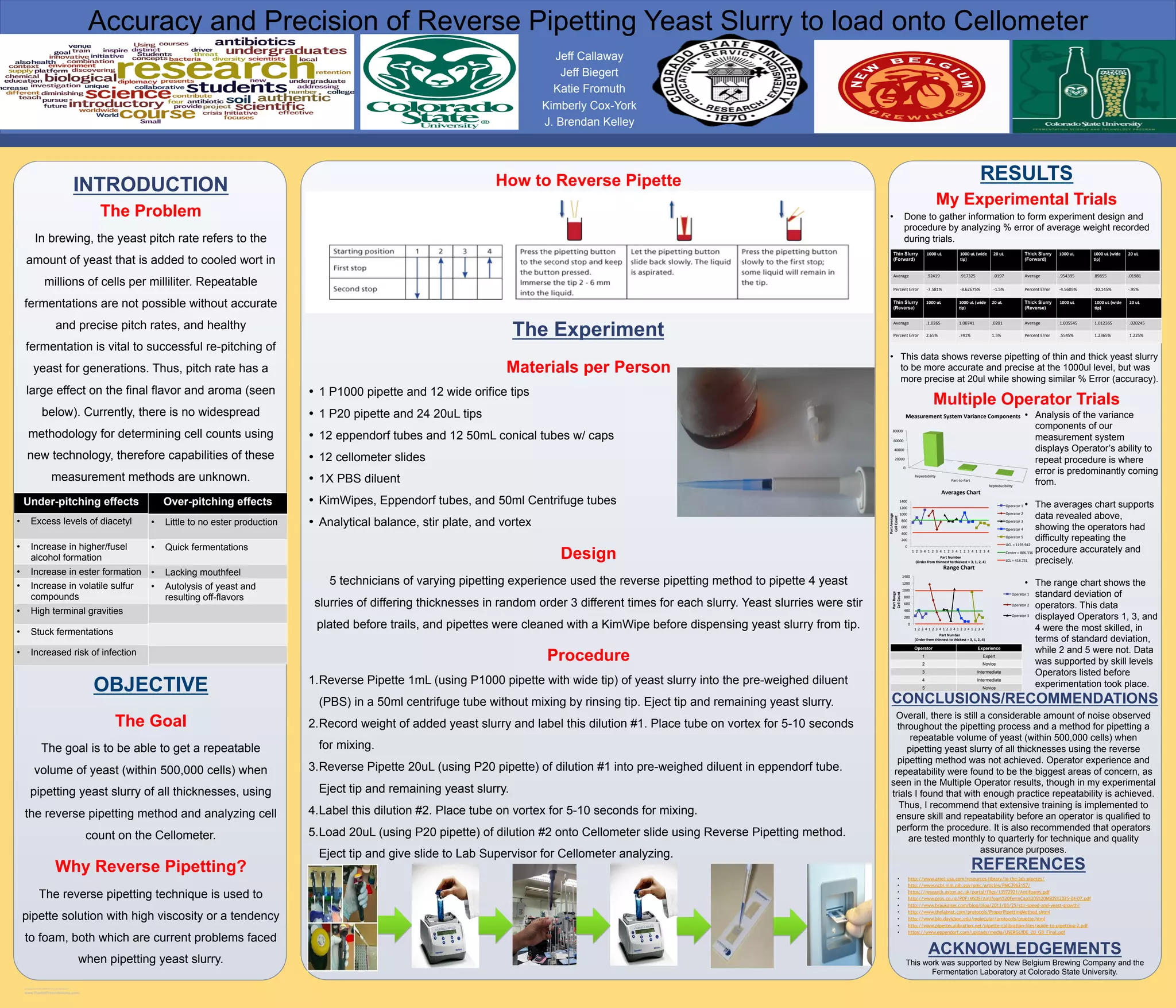
The goal is to be able to get a repeatable
volume of yeast (within 500,000 cells) when
pipetting yeast slurry of all thicknesses, using
the reverse pipetting method and analyzing cell
count on the Cellometer.
Why Reverse Pipetting?
The reverse pipetting technique is used to
pipette solution with high viscosity or a tendency
to foam, both which are current problems faced
when pipetting yeast slurry.
INTRODUCTION How to Reverse Pipette
Materials per Person
•  1 P1000 pipette and 12 wide orifice tips
•  1 P20 pipette and 24 20uL tips
•  12 eppendorf tubes and 12 50mL conical tubes w/ caps
•  12 cellometer slides
•  1X PBS diluent
•  KimWipes, Eppendorf tubes, and 50ml Centrifuge tubes
•  Analytical balance, stir plate, and vortex
Design
5 technicians of varying pipetting experience used the reverse pipetting method to pipette 4 yeast
slurries of differing thicknesses in random order 3 different times for each slurry. Yeast slurries were stir
plated before trails, and pipettes were cleaned with a KimWipe before dispensing yeast slurry from tip.
Procedure
1. Reverse Pipette 1mL (using P1000 pipette with wide tip) of yeast slurry into the pre-weighed diluent
(PBS) in a 50ml centrifuge tube without mixing by rinsing tip. Eject tip and remaining yeast slurry.
2. Record weight of added yeast slurry and label this dilution #1. Place tube on vortex for 5-10 seconds
for mixing.
3. Reverse Pipette 20uL (using P20 pipette) of dilution #1 into pre-weighed diluent in eppendorf tube.
Eject tip and remaining yeast slurry.
4. Label this dilution #2. Place tube on vortex for 5-10 seconds for mixing.
5. Load 20uL (using P20 pipette) of dilution #2 onto Cellometer slide using Reverse Pipetting method.
Eject tip and give slide to Lab Supervisor for Cellometer analyzing.
The Experiment
CONCLUSIONS/RECOMMENDATIONS
RESULTS
My Experimental Trials
•  Done to gather information to form experiment design and
procedure by analyzing % error of average weight recorded
during trials.
•  This data shows reverse pipetting of thin and thick yeast slurry
to be more accurate and precise at the 1000ul level, but was
more precise at 20ul while showing similar % Error (accuracy).
Multiple Operator Trials
REFERENCES
•  http://www.artel-usa.com/resources-library/in-the-lab-pipetes/
•  http://www.ncbi.nlm.nih.gov/pmc/articles/PMC3962157/
•  https://research.aston.ac.uk/portal/files/13572921/Antifoams.pdf
•  http://www.pros.co.nz/PDF/MSDS/Antifoam%20FermCap%20S%20MSDS%2025-04-07.pdf
•  http://www.braukaiser.com/blog/blog/2013/03/25/stir-speed-and-yeast-growth/
•  http://www.thelabrat.com/protocols/ProperPipettingMethod.shtml
•  http://www.bio.davidson.edu/molecular/protocols/pipette.html
•  http://www.pipettecalibration.net/pipette-calibration-files/guide-to-pipetting-2.pdf
•  https://www.eppendorf.com/uploads/media/USERGUIDE_20_GB_Final.pdf
ACKNOWLEDGEMENTS
This work was supported by New Belgium Brewing Company and the
Fermentation Laboratory at Colorado State University.
Jeff Callaway
Jeff Biegert
Katie Fromuth
Kimberly Cox-York
J. Brendan Kelley
	
  
Accuracy and Precision of Reverse Pipetting Yeast Slurry to load onto Cellometer
Under-pitching effects
•  Excess levels of diacetyl
•  Increase in higher/fusel
alcohol formation
•  Increase in ester formation
•  Increase in volatile sulfur
compounds
•  High terminal gravities
•  Stuck fermentations
•  Increased risk of infection
Over-pitching effects
•  Little to no ester production
•  Quick fermentations
•  Lacking mouthfeel
•  Autolysis of yeast and
resulting off-flavors
Overall, there is still a considerable amount of noise observed
throughout the pipetting process and a method for pipetting a
repeatable volume of yeast (within 500,000 cells) when
pipetting yeast slurry of all thicknesses using the reverse
pipetting method was not achieved. Operator experience and
repeatability were found to be the biggest areas of concern, as
seen in the Multiple Operator results, though in my experimental
trials I found that with enough practice repeatability is achieved.
Thus, I recommend that extensive training is implemented to
ensure skill and repeatability before an operator is qualified to
perform the procedure. It is also recommended that operators
are tested monthly to quarterly for technique and quality
assurance purposes.
0	
  
20000	
  
40000	
  
60000	
  
80000	
  
Repeatability	
  
Part-­‐to-­‐Part	
  
Reproducibility	
  
Measurement	
  System	
  Variance	
  Components	
  
0	
  
200	
  
400	
  
600	
  
800	
  
1000	
  
1200	
  
1400	
  
1	
   2	
   3	
   4	
   1	
   2	
   3	
   4	
   1	
   2	
   3	
   4	
   1	
   2	
   3	
   4	
   1	
   2	
   3	
   4	
  
Part	
  Average	
  
Cell	
  Count	
  
Part	
  Number	
  
(Order	
  from	
  thinnest	
  to	
  thickest	
  =	
  3,	
  1,	
  2,	
  4)	
  
Averages	
  Chart	
  
Operator	
  1	
  
Operator	
  2	
  
Operator	
  3	
  
Operator	
  4	
  
Operator	
  5	
  
UCL	
  =	
  1193.942	
  
Center	
  =	
  806.336	
  
LCL	
  =	
  418.731	
  
0	
  
200	
  
400	
  
600	
  
800	
  
1000	
  
1200	
  
1400	
  
1	
   2	
   3	
   4	
   1	
   2	
   3	
   4	
   1	
   2	
   3	
   4	
   1	
   2	
   3	
   4	
   1	
   2	
   3	
   4	
  
Part	
  Range	
  	
  
Cell	
  Count	
  
Part	
  Number	
  
(Order	
  from	
  thinnest	
  to	
  thickest	
  =	
  3,	
  1,	
  2,	
  4)	
  
Range	
  Chart	
  
Operator	
  1	
  
Operator	
  2	
  
Operator	
  3	
  
•  Analysis of the variance
components of our
measurement system
displays Operator’s ability to
repeat procedure is where
error is predominantly coming
from.
•  The averages chart supports
data revealed above,
showing the operators had
difficulty repeating the
procedure accurately and
precisely.
•  The range chart shows the
standard deviation of
operators. This data
displayed Operators 1, 3, and
4 were the most skilled, in
terms of standard deviation,
while 2 and 5 were not. Data
was supported by skill levels
Operators listed before
experimentation took place.
Operator Experience
1 Expert
2 Novice
3 Intermediate
4 Intermediate
5 Novice
Thin Slurry
(Forward)
1000	
  uL	
   1000	
  uL	
  (wide	
  
Rp)	
  
20	
  uL	
  
Average	
   .92419	
   .917325	
   .0197	
  
Percent	
  Error	
   -­‐7.581%	
   -­‐8.62675%	
   -­‐1.5%	
  
Thick Slurry
(Reverse)
1000	
  uL	
   1000	
  uL	
  (wide	
  
Rp)	
  
20	
  uL	
  
Average	
   1.005545	
   1.012365	
   .020245	
  
Percent	
  Error	
   .5545%	
   1.2365%	
   1.225%	
  
Thin Slurry
(Reverse)
1000	
  uL	
   1000	
  uL	
  (wide	
  
Rp)	
  
20	
  uL	
  
Average	
   .1.0265	
   1.00741	
   .0201	
  
Percent	
  Error	
   2.65%	
   .741%	
   1.5%	
  
Thick Slurry
(Forward)
1000	
  uL	
   1000	
  uL	
  (wide	
  
Rp)	
  
20	
  uL	
  
Average	
   .954395	
   .89855	
   .01981	
  
Percent	
  Error	
   -­‐4.5605%	
   -­‐10.145%	
   -­‐.95%	
  

JBK Pipetting_Cellometer Final Poster

  • 1.
    RESEARCH POSTER PRESENTATIONDESIGN © 2012 www.PosterPresentations.com The Problem In brewing, the yeast pitch rate refers to the amount of yeast that is added to cooled wort in millions of cells per milliliter. Repeatable fermentations are not possible without accurate and precise pitch rates, and healthy fermentation is vital to successful re-pitching of yeast for generations. Thus, pitch rate has a large effect on the final flavor and aroma (seen below). Currently, there is no widespread methodology for determining cell counts using new technology, therefore capabilities of these measurement methods are unknown. OBJECTIVE The Goal The goal is to be able to get a repeatable volume of yeast (within 500,000 cells) when pipetting yeast slurry of all thicknesses, using the reverse pipetting method and analyzing cell count on the Cellometer. Why Reverse Pipetting? The reverse pipetting technique is used to pipette solution with high viscosity or a tendency to foam, both which are current problems faced when pipetting yeast slurry. INTRODUCTION How to Reverse Pipette Materials per Person •  1 P1000 pipette and 12 wide orifice tips •  1 P20 pipette and 24 20uL tips •  12 eppendorf tubes and 12 50mL conical tubes w/ caps •  12 cellometer slides •  1X PBS diluent •  KimWipes, Eppendorf tubes, and 50ml Centrifuge tubes •  Analytical balance, stir plate, and vortex Design 5 technicians of varying pipetting experience used the reverse pipetting method to pipette 4 yeast slurries of differing thicknesses in random order 3 different times for each slurry. Yeast slurries were stir plated before trails, and pipettes were cleaned with a KimWipe before dispensing yeast slurry from tip. Procedure 1. Reverse Pipette 1mL (using P1000 pipette with wide tip) of yeast slurry into the pre-weighed diluent (PBS) in a 50ml centrifuge tube without mixing by rinsing tip. Eject tip and remaining yeast slurry. 2. Record weight of added yeast slurry and label this dilution #1. Place tube on vortex for 5-10 seconds for mixing. 3. Reverse Pipette 20uL (using P20 pipette) of dilution #1 into pre-weighed diluent in eppendorf tube. Eject tip and remaining yeast slurry. 4. Label this dilution #2. Place tube on vortex for 5-10 seconds for mixing. 5. Load 20uL (using P20 pipette) of dilution #2 onto Cellometer slide using Reverse Pipetting method. Eject tip and give slide to Lab Supervisor for Cellometer analyzing. The Experiment CONCLUSIONS/RECOMMENDATIONS RESULTS My Experimental Trials •  Done to gather information to form experiment design and procedure by analyzing % error of average weight recorded during trials. •  This data shows reverse pipetting of thin and thick yeast slurry to be more accurate and precise at the 1000ul level, but was more precise at 20ul while showing similar % Error (accuracy). Multiple Operator Trials REFERENCES •  http://www.artel-usa.com/resources-library/in-the-lab-pipetes/ •  http://www.ncbi.nlm.nih.gov/pmc/articles/PMC3962157/ •  https://research.aston.ac.uk/portal/files/13572921/Antifoams.pdf •  http://www.pros.co.nz/PDF/MSDS/Antifoam%20FermCap%20S%20MSDS%2025-04-07.pdf •  http://www.braukaiser.com/blog/blog/2013/03/25/stir-speed-and-yeast-growth/ •  http://www.thelabrat.com/protocols/ProperPipettingMethod.shtml •  http://www.bio.davidson.edu/molecular/protocols/pipette.html •  http://www.pipettecalibration.net/pipette-calibration-files/guide-to-pipetting-2.pdf •  https://www.eppendorf.com/uploads/media/USERGUIDE_20_GB_Final.pdf ACKNOWLEDGEMENTS This work was supported by New Belgium Brewing Company and the Fermentation Laboratory at Colorado State University. Jeff Callaway Jeff Biegert Katie Fromuth Kimberly Cox-York J. Brendan Kelley   Accuracy and Precision of Reverse Pipetting Yeast Slurry to load onto Cellometer Under-pitching effects •  Excess levels of diacetyl •  Increase in higher/fusel alcohol formation •  Increase in ester formation •  Increase in volatile sulfur compounds •  High terminal gravities •  Stuck fermentations •  Increased risk of infection Over-pitching effects •  Little to no ester production •  Quick fermentations •  Lacking mouthfeel •  Autolysis of yeast and resulting off-flavors Overall, there is still a considerable amount of noise observed throughout the pipetting process and a method for pipetting a repeatable volume of yeast (within 500,000 cells) when pipetting yeast slurry of all thicknesses using the reverse pipetting method was not achieved. Operator experience and repeatability were found to be the biggest areas of concern, as seen in the Multiple Operator results, though in my experimental trials I found that with enough practice repeatability is achieved. Thus, I recommend that extensive training is implemented to ensure skill and repeatability before an operator is qualified to perform the procedure. It is also recommended that operators are tested monthly to quarterly for technique and quality assurance purposes. 0   20000   40000   60000   80000   Repeatability   Part-­‐to-­‐Part   Reproducibility   Measurement  System  Variance  Components   0   200   400   600   800   1000   1200   1400   1   2   3   4   1   2   3   4   1   2   3   4   1   2   3   4   1   2   3   4   Part  Average   Cell  Count   Part  Number   (Order  from  thinnest  to  thickest  =  3,  1,  2,  4)   Averages  Chart   Operator  1   Operator  2   Operator  3   Operator  4   Operator  5   UCL  =  1193.942   Center  =  806.336   LCL  =  418.731   0   200   400   600   800   1000   1200   1400   1   2   3   4   1   2   3   4   1   2   3   4   1   2   3   4   1   2   3   4   Part  Range     Cell  Count   Part  Number   (Order  from  thinnest  to  thickest  =  3,  1,  2,  4)   Range  Chart   Operator  1   Operator  2   Operator  3   •  Analysis of the variance components of our measurement system displays Operator’s ability to repeat procedure is where error is predominantly coming from. •  The averages chart supports data revealed above, showing the operators had difficulty repeating the procedure accurately and precisely. •  The range chart shows the standard deviation of operators. This data displayed Operators 1, 3, and 4 were the most skilled, in terms of standard deviation, while 2 and 5 were not. Data was supported by skill levels Operators listed before experimentation took place. Operator Experience 1 Expert 2 Novice 3 Intermediate 4 Intermediate 5 Novice Thin Slurry (Forward) 1000  uL   1000  uL  (wide   Rp)   20  uL   Average   .92419   .917325   .0197   Percent  Error   -­‐7.581%   -­‐8.62675%   -­‐1.5%   Thick Slurry (Reverse) 1000  uL   1000  uL  (wide   Rp)   20  uL   Average   1.005545   1.012365   .020245   Percent  Error   .5545%   1.2365%   1.225%   Thin Slurry (Reverse) 1000  uL   1000  uL  (wide   Rp)   20  uL   Average   .1.0265   1.00741   .0201   Percent  Error   2.65%   .741%   1.5%   Thick Slurry (Forward) 1000  uL   1000  uL  (wide   Rp)   20  uL   Average   .954395   .89855   .01981   Percent  Error   -­‐4.5605%   -­‐10.145%   -­‐.95%