JavaScript Essentials for
Ember Development
Leo Hernandez
@leojh
@leojh
A little about me...
● I work at Third Wave http://thirdwave.it
● I live in South Florida
● I remember when JavaScript was the redheaded stepchild
● Most of my career has been in .Net
● Been focusing heavily on Ember development for the past
year
● I mentor others at ThirdWave on JavaScript and Ember
@leojh
This Talk is Mostly for
Ember or JavaScript
beginners
@leojh
For the Rest of you… it’ll
probably be Old Hat
@leojh
If there is one thing that you should get
from this talk ….
@leojh
If there is one thing that you should take
from this talk ….
Use
@leojh
If there is one thing that you should take
from this talk ….
Use Use
two
@leojh
Why ES6?
@leojh
Essentially modernizes JavaScript
@leojh
Essentially modernizes JavaScript
String Interpolation
Namespacing
Lambda Expressions
Nice var scoping
Default parameters
Iterators
Classes
… and more
@leojh
ES5 - String Formatting
confirmPerson = function(name, state) {
var message = "Please confirm that your name is: " + name + "rn";
message += "and that you live in: " + state + "rn";
message += "and that you are not a robot.";
return confirm(message);
};
confirmPerson('Leo', 'Florida');
@leojh
ES6 - String Formatting
var confirmPerson = function(name, state) {
var message = `Please confirm that your name is: ${name}
and that you live in: ${state}
and that you are not a robot.`;
return confirm(message);
};
confirmPerson('Leo', 'Florida');
@leojh
ES6 - Lambda Expressions
let square = x => x * x;
[1,2,3,4,5].map(num => num * num);
[1,2,3,4,5].forEach(num => {
console.log(num);
})
//Important to note that 'this' keyword is preserved
@leojh
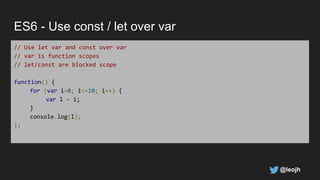
ES6 - Use const / let over var
// Use let var and const over var
// var is function scopes
// let/const are blocked scope
function() {
for (var i=0; i<=10; i++) {
var l = i;
}
console.log(l);
};
@leojh
ES6 - Default parameters
function sayMsg(msg='This is a default message.') {
console.log(msg);
}
sayMsg();
sayMsg('This is a different message!');
@leojh
Let’s talk about ...
@leojh
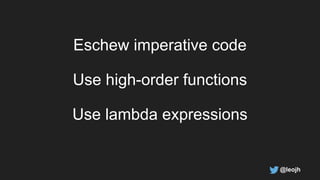
Use high-order functions
Use lambda expressions
Eschew imperative code
@leojh
Before we proceed, let’s review Closures
function outerFunc() {
var name = "Mozilla";
function innerFunc() {
alert(name);
}
return innerFunc();
};
In Brief:
Closures are a language in which variables scoped in an outer/parent function are
available to the child/inner function
@leojh
Eschew imperative code
Stop using:
Switch Statements
For loops
While loops
… and general imperative programming
… find the right high order function to be succinct in your code
@leojh
Use High Order functions instead of imperative code
.forEach() - iterates over a set
.map() - projects a set
.filter() - narrows down a set based on the predicate
.find() - returns first match in a set based on the predicate
.any() - returns true if match is found based on the predicate
.every() - returns true if match is found for all elements in the set (predicate also)
Ember gives us some additional nifty functions so we can avoid the predicate f()
@leojh
Nifty High Order Functions in Ember
.mapBy() - pass in name of a field
.filterBy() - pass in value name of field and value to match
.findBy() - pass in value name of field and value to match
.isAny() - pass in value name of field and value to match
.isEvery() - pass in value name of field and value to match
@leojh
Something even more nifty - Computed Macros
Allow you to use common High Order Functions as observables in your Ember
objects.
import Ember from 'ember';
export default Ember.Service.extend({
items: Ember.computed.alias('model')
subTotal: Ember.computed.sum('items.price'),
});
@leojh
Promises …
@leojh
You should really understand promises
A large part of the Ember framework is based on Promises
When you Provide a model to a Route - That’s a promise
Anytime you go fetch data from the server on Ember Data - That’s a promise
Promises let you circumvent Callback Hell
Sometimes you need to create your own Promises
@leojh
If you’re asking what Callback Hell Is
@leojh
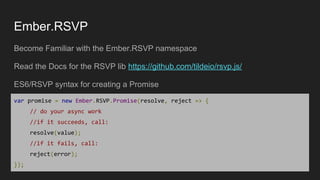
Ember.RSVP
Become Familiar with the Ember.RSVP namespace
Read the Docs for the RSVP lib https://github.com/tildeio/rsvp.js/
ES6/RSVP syntax for creating a Promise
var promise = new Ember.RSVP.Promise(resolve, reject => {
// do your async work
//if it succeeds, call:
resolve(value);
//if it fails, call:
reject(error);
});
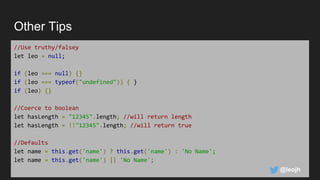
Other Tips
//Use truthy/falsey
let leo = null;
if (leo === null) {}
if (leo === typeof("undefined")) { }
if (leo) {}
//Coerce to boolean
let hasLength = "12345".length; //will return length
let hasLength = !!"12345".length; //will return true
//Defaults
let name = this.get('name') ? this.get('name') : 'No Name';
let name = this.get('name') || 'No Name';
@leojh
Thank you!
@leojh

JavaScript Essentials for Ember development

  • 1.
    JavaScript Essentials for EmberDevelopment Leo Hernandez @leojh @leojh
  • 2.
    A little aboutme... ● I work at Third Wave http://thirdwave.it ● I live in South Florida ● I remember when JavaScript was the redheaded stepchild ● Most of my career has been in .Net ● Been focusing heavily on Ember development for the past year ● I mentor others at ThirdWave on JavaScript and Ember @leojh
  • 3.
    This Talk isMostly for Ember or JavaScript beginners @leojh
  • 4.
    For the Restof you… it’ll probably be Old Hat @leojh
  • 5.
    If there isone thing that you should get from this talk …. @leojh
  • 6.
    If there isone thing that you should take from this talk …. Use @leojh
  • 7.
    If there isone thing that you should take from this talk …. Use Use two @leojh
  • 8.
  • 9.
  • 10.
    Essentially modernizes JavaScript StringInterpolation Namespacing Lambda Expressions Nice var scoping Default parameters Iterators Classes … and more @leojh
  • 11.
    ES5 - StringFormatting confirmPerson = function(name, state) { var message = "Please confirm that your name is: " + name + "rn"; message += "and that you live in: " + state + "rn"; message += "and that you are not a robot."; return confirm(message); }; confirmPerson('Leo', 'Florida'); @leojh
  • 12.
    ES6 - StringFormatting var confirmPerson = function(name, state) { var message = `Please confirm that your name is: ${name} and that you live in: ${state} and that you are not a robot.`; return confirm(message); }; confirmPerson('Leo', 'Florida'); @leojh
  • 13.
    ES6 - LambdaExpressions let square = x => x * x; [1,2,3,4,5].map(num => num * num); [1,2,3,4,5].forEach(num => { console.log(num); }) //Important to note that 'this' keyword is preserved @leojh
  • 14.
    ES6 - Useconst / let over var // Use let var and const over var // var is function scopes // let/const are blocked scope function() { for (var i=0; i<=10; i++) { var l = i; } console.log(l); }; @leojh
  • 15.
    ES6 - Defaultparameters function sayMsg(msg='This is a default message.') { console.log(msg); } sayMsg(); sayMsg('This is a different message!'); @leojh
  • 16.
  • 17.
    Use high-order functions Uselambda expressions Eschew imperative code @leojh
  • 18.
    Before we proceed,let’s review Closures function outerFunc() { var name = "Mozilla"; function innerFunc() { alert(name); } return innerFunc(); }; In Brief: Closures are a language in which variables scoped in an outer/parent function are available to the child/inner function @leojh
  • 19.
    Eschew imperative code Stopusing: Switch Statements For loops While loops … and general imperative programming … find the right high order function to be succinct in your code @leojh
  • 20.
    Use High Orderfunctions instead of imperative code .forEach() - iterates over a set .map() - projects a set .filter() - narrows down a set based on the predicate .find() - returns first match in a set based on the predicate .any() - returns true if match is found based on the predicate .every() - returns true if match is found for all elements in the set (predicate also) Ember gives us some additional nifty functions so we can avoid the predicate f() @leojh
  • 21.
    Nifty High OrderFunctions in Ember .mapBy() - pass in name of a field .filterBy() - pass in value name of field and value to match .findBy() - pass in value name of field and value to match .isAny() - pass in value name of field and value to match .isEvery() - pass in value name of field and value to match @leojh
  • 22.
    Something even morenifty - Computed Macros Allow you to use common High Order Functions as observables in your Ember objects. import Ember from 'ember'; export default Ember.Service.extend({ items: Ember.computed.alias('model') subTotal: Ember.computed.sum('items.price'), }); @leojh
  • 23.
  • 24.
    You should reallyunderstand promises A large part of the Ember framework is based on Promises When you Provide a model to a Route - That’s a promise Anytime you go fetch data from the server on Ember Data - That’s a promise Promises let you circumvent Callback Hell Sometimes you need to create your own Promises @leojh
  • 25.
    If you’re askingwhat Callback Hell Is @leojh
  • 26.
    Ember.RSVP Become Familiar withthe Ember.RSVP namespace Read the Docs for the RSVP lib https://github.com/tildeio/rsvp.js/ ES6/RSVP syntax for creating a Promise var promise = new Ember.RSVP.Promise(resolve, reject => { // do your async work //if it succeeds, call: resolve(value); //if it fails, call: reject(error); });
  • 27.
    Other Tips //Use truthy/falsey letleo = null; if (leo === null) {} if (leo === typeof("undefined")) { } if (leo) {} //Coerce to boolean let hasLength = "12345".length; //will return length let hasLength = !!"12345".length; //will return true //Defaults let name = this.get('name') ? this.get('name') : 'No Name'; let name = this.get('name') || 'No Name'; @leojh
  • 28.