JAVA
Thread
Prepared by
Miss. Arati A. Gadgil
Thread
There are two ways to create a thread
1.By extending Thread class
2. By implementing Runnable interface
2
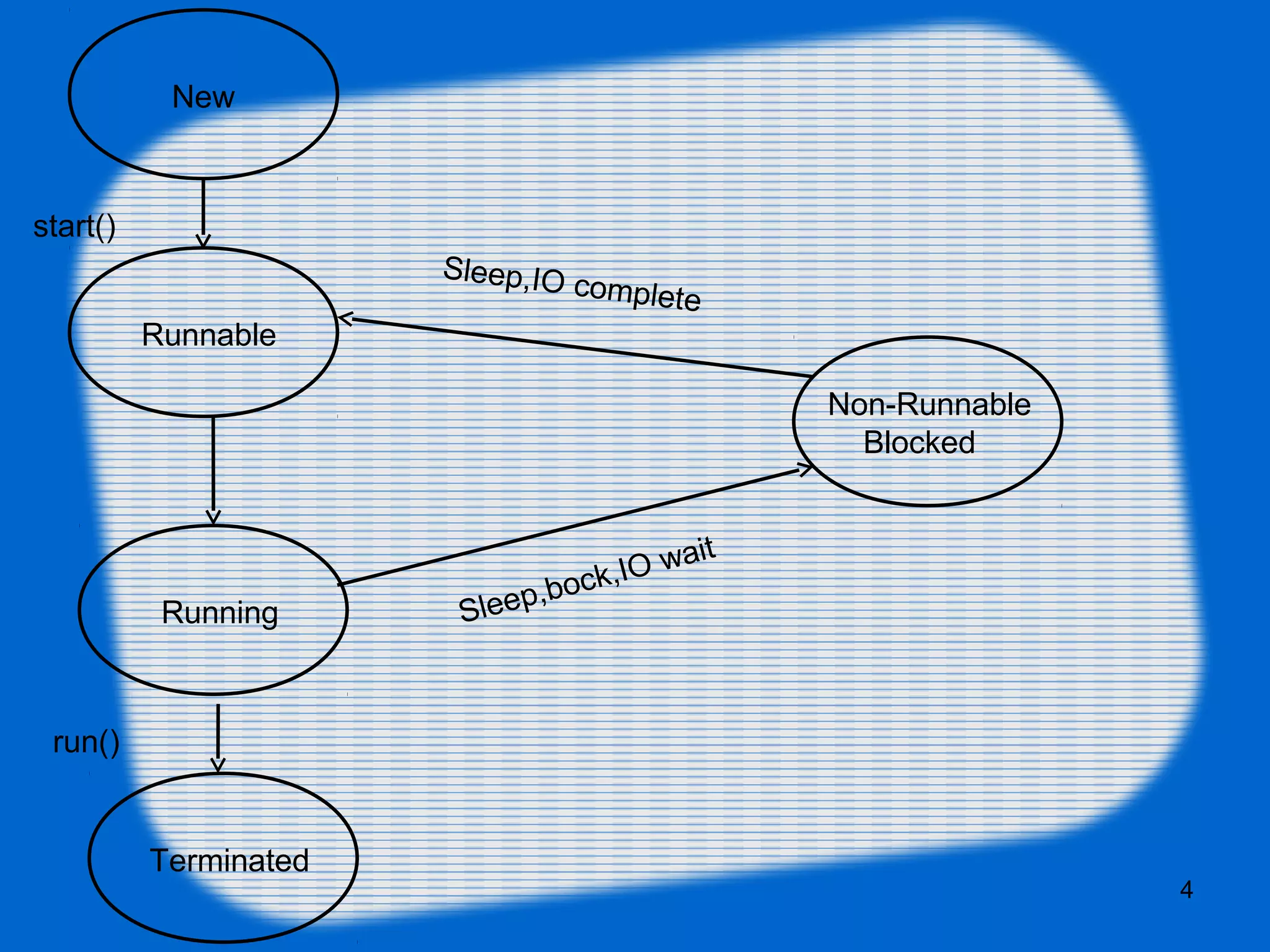
Thread States
1.New
2.Runnable
3.Running
4.Non-Runnable (Blocked)
5.Terminated
3
4
New
Runnable
Running
Terminated
Non-Runnable
Blocked
start()
run()
Sleep,IO complete
Sleep,bock,IO wait
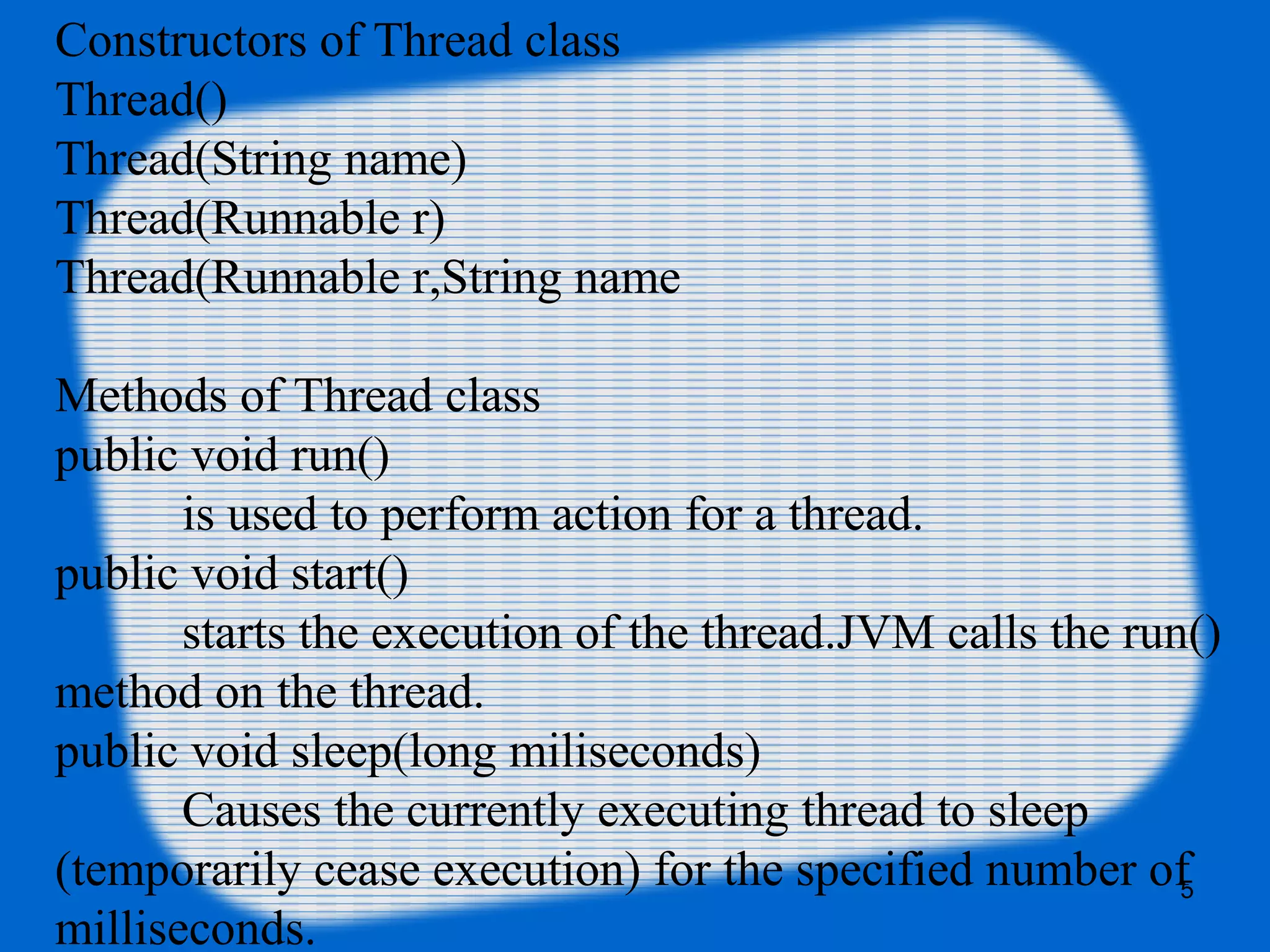
Constructors of Thread class
Thread()
Thread(String name)
Thread(Runnable r)
Thread(Runnable r,String name
Methods of Thread class
public void run()
is used to perform action for a thread.
public void start()
starts the execution of the thread.JVM calls the run()
method on the thread.
public void sleep(long miliseconds)
Causes the currently executing thread to sleep
(temporarily cease execution) for the specified number of
milliseconds.
5
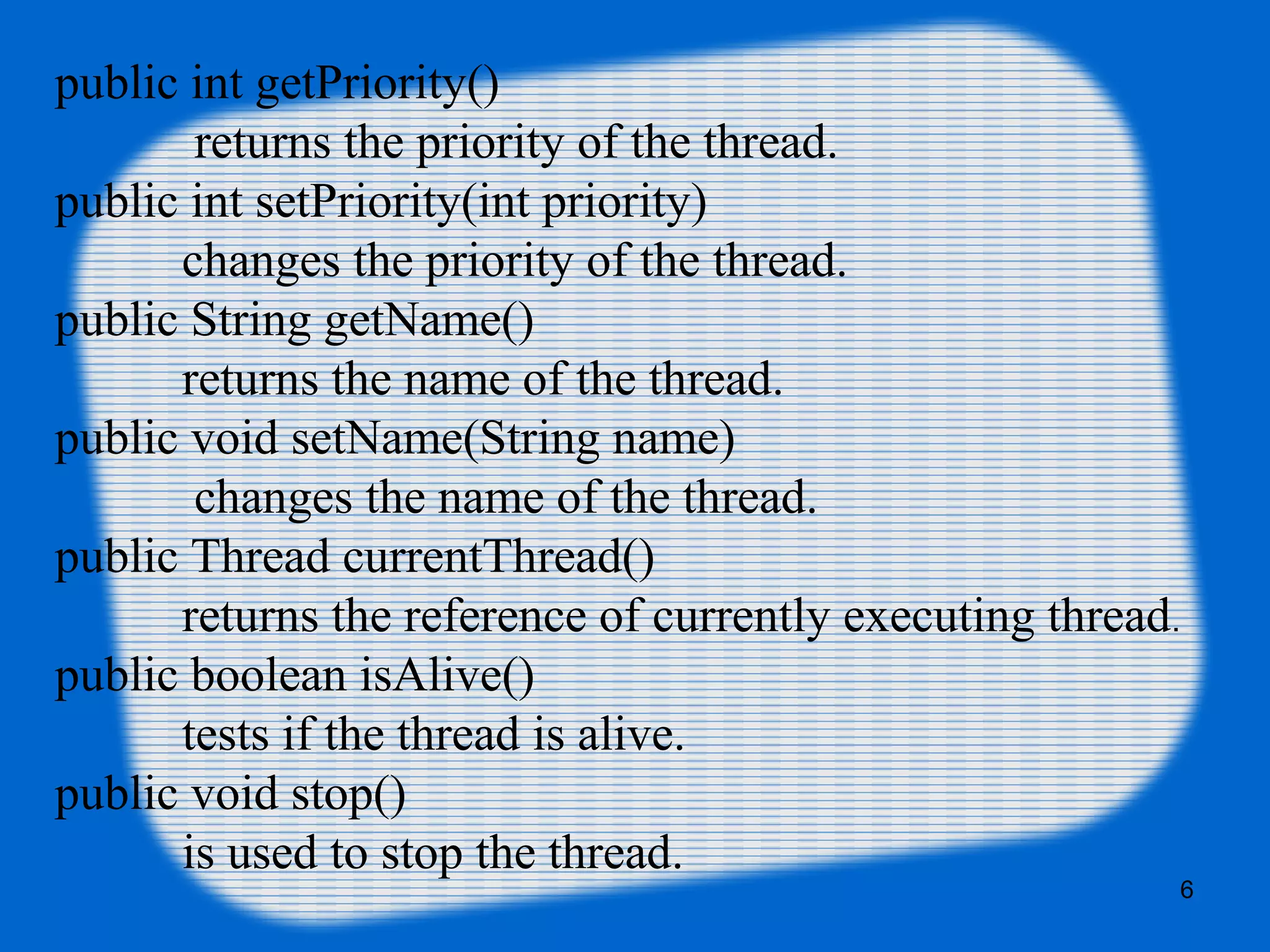
public int getPriority()
returns the priority of the thread.
public int setPriority(int priority)
changes the priority of the thread.
public String getName()
returns the name of the thread.
public void setName(String name)
changes the name of the thread.
public Thread currentThread()
returns the reference of currently executing thread.
public boolean isAlive()
tests if the thread is alive.
public void stop()
is used to stop the thread.
6
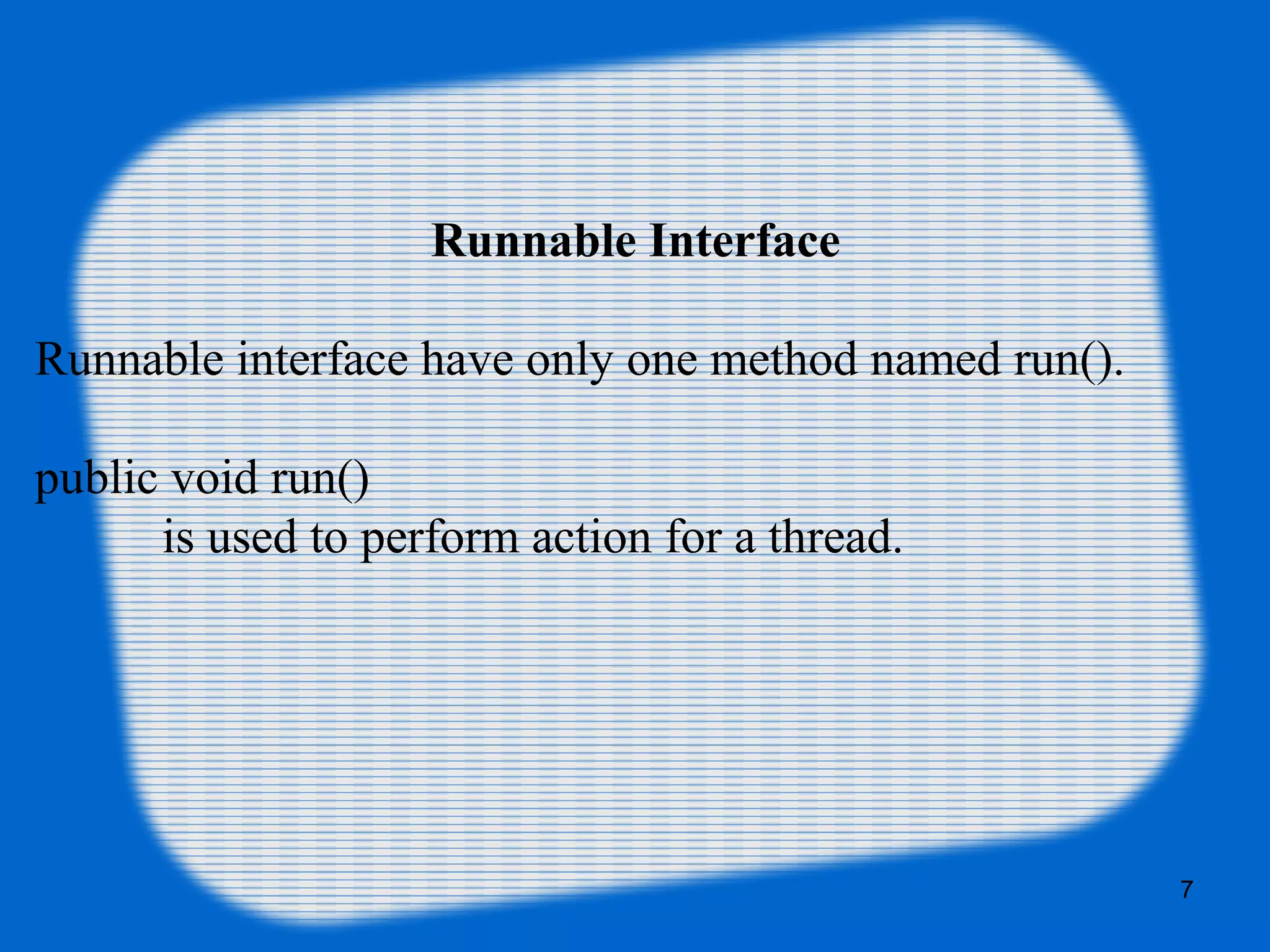
Runnable Interface
Runnable interface have only one method named run().
public void run()
is used to perform action for a thread.
7
class Multi extends Thread
{
public void run()
{
System.out.println("thread is running...");
}
public static void main(String args[])
{
Multi t1=new Multi();
t1.start();
}
}
8
class Multi implements Runnable
{  
public void run()
{  
System.out.println("thread is running...");  
}  
  
public static void main(String args[])
{  
Multi3 m1=new Multi3();  
Thread t1 =new Thread(m1);  
t1.start();  
  }  
}
9
sleep() method
Thread.sleep causes the current thread to suspend execution 
for a specified period.
public static void sleep(long miliseconds)throws 
                                                                  InterruptedException
public static void sleep(long miliseconds, int nanos)throws 
                                                                  InterruptedException
10
join() method
The join method allows one thread to wait for the completion 
of another.
Overloads of join allow the programmer to specify a waiting 
period. However, as with sleep, join is dependent on the OS for 
timing, so we should not assume that join will wait exactly as 
long as we specify.
public void join()throws InterruptedException
public void join(long milliseconds)throws InterruptedException11
Thread Priority
Each thread have a priority. Priorities are represented by a 
number between 1 and 10
3 constants defined in Thread class:
public static int MIN_PRIORITY
public static int NORM_PRIORITY
public static int MAX_PRIORITY
Default priority of a thread is 5 (NORM_PRIORITY). The 
value of MIN_PRIORITY is 1 and the value of 
MAX_PRIORITY is 10.
12
Interrupting a Thread
An interrupt is an indication to a thread that it should stop 
what it is doing and do something else. It's up to the 
programmer to decide exactly how a thread responds to an 
interrupt, but it is very common for the thread to terminate.
Methods
public void interrupt()
public static boolean interrupted()
public boolean isInterrupted()
13
Synchronization in Java
Java synchronized method
If you declare any method as synchronized, it is known as 
synchronized method. Synchronized method is used to lock an 
object for any shared resource.
When a thread invokes a synchronized method, it 
automatically acquires the lock for that object and releases it 
when the thread completes its task.
14
Thank You
15

Java thread