Java Software Solutions 9th Edition Lewis Solutions Manual
1.
Java Software Solutions9th Edition Lewis
Solutions Manual download
https://testbankfan.com/product/java-software-solutions-9th-
edition-lewis-solutions-manual/
Visit testbankfan.com today to download the complete set of
test bank or solution manual
2.
We have selectedsome products that you may be interested in
Click the link to download now or visit testbankfan.com
for more options!.
Java Software Solutions 9th Edition Lewis Test Bank
https://testbankfan.com/product/java-software-solutions-9th-edition-
lewis-test-bank/
Java Software Solutions 8th Edition Lewis Solutions Manual
https://testbankfan.com/product/java-software-solutions-8th-edition-
lewis-solutions-manual/
Java Software Solutions 8th Edition Lewis Test Bank
https://testbankfan.com/product/java-software-solutions-8th-edition-
lewis-test-bank/
Survey of Accounting 6th Edition Warren Solutions Manual
https://testbankfan.com/product/survey-of-accounting-6th-edition-
warren-solutions-manual/
3.
Perspectives on InternationalRelations Power Institutions
and Ideas 5th Edition Nau Test Bank
https://testbankfan.com/product/perspectives-on-international-
relations-power-institutions-and-ideas-5th-edition-nau-test-bank/
Horngrens Accounting Global Edition 10th Edition Nobles
Solutions Manual
https://testbankfan.com/product/horngrens-accounting-global-
edition-10th-edition-nobles-solutions-manual/
Calculus Concepts and Contexts Enhanced Edition 4th
Edition Stewart Test Bank
https://testbankfan.com/product/calculus-concepts-and-contexts-
enhanced-edition-4th-edition-stewart-test-bank/
Microeconomics For Today 9th Edition Tucker Test Bank
https://testbankfan.com/product/microeconomics-for-today-9th-edition-
tucker-test-bank/
Practical Financial Management 8th Edition Lasher
Solutions Manual
https://testbankfan.com/product/practical-financial-management-8th-
edition-lasher-solutions-manual/
102 Chapter 7:Object-Oriented Design
Chapter 7: Object-Oriented Design Lab Exercises
Topics Lab Exercises
Parameter Passing Changing People
Interfaces Using the Comparable Interface
Method Decomposition A Modified MiniQuiz Class
Overloading A Flexible Account Class
A Biased Coin
Static Variables and Methods Opening and Closing Accounts
Counting Transactions
Transfering Funds
Overall class design Random Walks
GUI Layouts Telephone Keypad
6.
Chapter 7: Object-OrientedDesign 103
Changing People
The file ChangingPeople.java contains a program that illustrates parameter passing. The program uses Person objects
defined in the file Person.java. Do the following:
1. Trace the execution of the program using diagrams similar to those in Figure 6.5 of the text (which is a trace of the
program in Listings 6.15–6.17). Also show what is printed by the program.
2. Compile and run the program to see if your trace was correct.
3. Modify the changePeople method so that it does what the documentation says it does, that is, the two Person objects
passed in as actual parameters are actually changed.
// ******************************************************************
// ChangingPeople.java
//
// Demonstrates parameter passing -- contains a method that should
// change to Person objects.
// ******************************************************************
public class ChangingPeople
{
// ---------------------------------------------------------
// Sets up two person objects, one integer, and one String
// object. These are sent to a method that should make
// some changes.
// ---------------------------------------------------------
public static void main (String[] args)
{
Person person1 = new Person ("Sally", 13);
Person person2 = new Person ("Sam", 15);
int age = 21;
String name = "Jill";
System.out.println ("nParameter Passing... Original values...");
System.out.println ("person1: " + person1);
System.out.println ("person2: " + person2);
System.out.println ("age: " + age + "tname: " + name + "n");
changePeople (person1, person2, age, name);
System.out.println ("nValues after calling changePeople...");
System.out.println ("person1: " + person1);
System.out.println ("person2: " + person2);
System.out.println ("age: " + age + "tname: " + name + "n");
}
// -------------------------------------------------------------------
// Change the first actual parameter to "Jack - Age 101" and change
// the second actual parameter to be a person with the age and
// name given in the third and fourth parameters.
// -------------------------------------------------------------------
public static void changePeople (Person p1, Person p2, int age, String name)
{
System.out.println ("nInside changePeople... Original parameters...");
System.out.println ("person1: " + p1);
System.out.println ("person2: " + p2);
System.out.println ("age: " + age + "tname: " + name + "n");
7.
104 Chapter 7:Object-Oriented Design
// Make changes
Person p3 = new Person (name, age);
p2 = p3;
name = "Jack";
age = 101;
p1.changeName (name);
p1.changeAge (age);
// Print changes
System.out.println ("nInside changePeople... Changed values...");
System.out.println ("person1: " + p1);
System.out.println ("person2: " + p2);
System.out.println ("age: " + age + "tname: " + name + "n");
}
}
// ************************************************************
// Person.java
//
// A simple class representing a person.
// ************************************************************
public class Person
{
private String name;
private int age;
// ----------------------------------------------------------
// Sets up a Person object with the given name and age.
// ----------------------------------------------------------
public Person (String name, int age)
{
this.name = name;
this.age = age;
}
// ----------------------------------------------------------
// Changes the name of the Person to the parameter newName.
// ----------------------------------------------------------
public void changeName(String newName)
{
name = newName;
}
// ----------------------------------------------------------
// Changes the age of the Person to the parameter newAge.
// ----------------------------------------------------------
public void changeAge (int newAge)
{
age = newAge;
}
// ----------------------------------------------------------
// Returns the person's name and age as a string.
// ----------------------------------------------------------
public String toString()
{
return name + " - Age " + age;
}
}
8.
Chapter 7: Object-OrientedDesign 105
Using the Comparable Interface
1. Write a class Compare3 that provides a static method largest. Method largest should take three Comparable parameters
and return the largest of the three (so its return type will also be Comparable). Recall that method compareTo is part of
the Comparable interface, so largest can use the compareTo method of its parameters to compare them.
2. Write a class Comparisons whose main method tests your largest method above.
• First prompt the user for and read in three strings, use your largest method to find the largest of the three strings, and
print it out. (It’s easiest to put the call to largest directly in the call to println.) Note that since largest is a static
method, you will call it through its class name, e.g., Compare3.largest(val1, val2, val3).
• Add code to also prompt the user for three integers and try to use your largest method to find the largest of the three
integers. Does this work? If it does, it’s thanks to autoboxing, which is Java 1.5’s automatic conversion of ints to
Integers. You may have to use the -source 1.5 compiler option for this to work.
9.
106 Chapter 7:Object-Oriented Design
A Modified MiniQuiz Class
Files Question.java, Complexity.java, and MiniQuiz.java contain the classes in Listings 6.8-6.10of the text. These classes
demonstrate the use of the Complexity interface; class Question implements the interface, and class MiniQuiz creates two
Question objects and uses them to give the user a short quiz.
Save these three files to your directory and study the code in MiniQuiz.java. Notice that after the Question objects are
created, almost exactly the same code appears twice, once to ask and grade the first question, and again to ask and grade the
second question. Another approach is to write a method askQuestion that takes a Question object and does all the work of
asking the user the question, getting the user’s response, and determining whether the response is correct. You could then
simply call this method twice, once for q1 and once for q2. Modify the MiniQuiz class so that it has such an askQuestion
method, and replace the code in main that asks and grades the questions with two calls to askQuestion. Some things to keep
in mind:
The definition of askQuestion should be inside the MiniQuiz class but after the main method.
Since main is a static method, askQuestion must be static too. (A static method cannot call an instance method of the
same class.) Also, askQuestion is for use only by this class, so it should be declared private. So the header for
askQuestion should look like this:
private static void askQuestion(Question question)
• String possible, which is currently declared in main, will need to be defined in askQuestion instead.
• The Scanner object scan needs to be a static variable and moved outside of main (so it is available to askQuestion).
• You do not need to make any changes to Question.java or Complexity .java.
//****************************************************************
// Question.java Author: Lewis/Loftus
//
// Represents a question (and its answer).
//****************************************************************
public class Question implements Complexity
{
private String question, answer;
private int complexityLevel;
//--------------------------------------------------------------
// Sets up the question with a default complexity.
//--------------------------------------------------------------
public Question (String query, String result)
{
question = query;
answer = result;
complexityLevel = 1;
}
//--------------------------------------------------------------
// Sets the complexity level for this question.
//--------------------------------------------------------------
public void setComplexity (int level)
{
complexityLevel = level;
}
//--------------------------------------------------------------
// Returns the complexity level for this question.
//--------------------------------------------------------------
public int getComplexity()
10.
Chapter 7: Object-OrientedDesign 107
{
return complexityLevel;
}
//--------------------------------------------------------------
// Returns the question.
//--------------------------------------------------------------
public String getQuestion()
{
return question;
}
//--------------------------------------------------------------
// Returns the answer to this question.
//--------------------------------------------------------------
public String getAnswer()
{
return answer;
}
//--------------------------------------------------------------
// Returns true if the candidate answer matches the answer.
//--------------------------------------------------------------
public boolean answerCorrect (String candidateAnswer)
{
return answer.equals(candidateAnswer);
}
//--------------------------------------------------------------
// Returns this question (and its answer) as a string.
//--------------------------------------------------------------
public String toString()
{
return question + "n" + answer;
}
}
//*****************************************************************
// Complexity.java Author: Lewis/Loftus
//
// Represents the interface for an object that can be assigned an
// explicit complexity.
//*****************************************************************
public interface Complexity
{
public void setComplexity (int complexity);
public int getComplexity();
}
11.
108 Chapter 7:Object-Oriented Design
//*****************************************************************
// MiniQuiz.java Author: Lewis/Loftus
//
// Demonstrates the use of a class that implements an interface.
//*****************************************************************
import java.util.Scanner;
public class MiniQuiz
{
//--------------------------------------------------------------
// Presents a short quiz.
//--------------------------------------------------------------
public static void main (String[] args)
{
Question q1, q2;
String possible;
Scanner scan = new Scanner(System.in);
q1 = new Question ("What is the capital of Jamaica?",
"Kingston");
q1.setComplexity (4);
q2 = new Question ("Which is worse, ignorance or apathy?",
"I don't know and I don't care");
q2.setComplexity (10);
System.out.print (q1.getQuestion());
System.out.println (" (Level: " + q1.getComplexity() + ")");
possible = scan.nextLine();
if (q1.answerCorrect(possible))
System.out.println ("Correct");
else
System.out.println ("No, the answer is " + q1.getAnswer());
System.out.println();
System.out.print (q2.getQuestion());
System.out.println (" (Level: " + q2.getComplexity() + ")");
possible = scan.nextLine();
if (q2.answerCorrect(possible))
System.out.println ("Correct");
else
System.out.println ("No, the answer is " + q2.getAnswer ());
}
}
12.
Chapter 7: Object-OrientedDesign 109
A Flexible Account Class
File Account.java contains a definition for a simple bank account class with methods to withdraw, deposit, get the balance
and account number, and return a String representation. Note that the constructor for this class creates a random account
number. Save this class to your directory and study it to see how it works. Then modify it as follows:
1. Overload the constructor as follows:
• public Account (double initBal, String owner, long number) - initializes the balance, owner, and account
number as specified
• public Account (double initBal, String owner) - initializes the balance and owner as specified; randomly
generates the account number.
• public Account (String owner) - initializes the owner as specified; sets the initial balance to 0 and randomly
generates the account number.
2. Overload the withdraw method with one that also takes a fee and deducts that fee from the account.
File TestAccount.java contains a simple program that exercises these methods. Save it to your directory, study it to see what
it does, and use it to test your modified Account class.
//************************************************************
// Account.java
//
// A bank account class with methods to deposit to, withdraw from,
// change the name on, and get a String representation
// of the account.
//************************************************************
public class Account
{
private double balance;
private String name;
private long acctNum;
//-------------------------------------------------
//Constructor -- initializes balance, owner, and account number
//-------------------------------------------------
public Account(double initBal, String owner, long number)
{
balance = initBal;
name = owner;
acctNum = number;
}
//-------------------------------------------------
// Checks to see if balance is sufficient for withdrawal.
// If so, decrements balance by amount; if not, prints message.
//-------------------------------------------------
public void withdraw(double amount)
{
if (balance >= amount)
balance -= amount;
else
System.out.println("Insufficient funds");
}
//-------------------------------------------------
// Adds deposit amount to balance.
//-------------------------------------------------
13.
110 Chapter 7:Object-Oriented Design
public void deposit(double amount)
{
balance += amount;
}
//-------------------------------------------------
// Returns balance.
//-------------------------------------------------
public double getBalance()
{
return balance;
}
//-------------------------------------------------
// Returns a string containing the name, account number, and balance.
//-------------------------------------------------
public String toString()
{
return "Name:" + name +
"nAccount Number: " + acctNum +
"nBalance: " + balance;
}
}
//************************************************************
// TestAccount.java
//
// A simple driver to test the overloaded methods of
// the Account class.
//************************************************************
import java.util.Scanner;
public class TestAccount
{
public static void main(String[] args)
{
String name;
double balance;
long acctNum;
Account acct;
Scanner scan = new Scanner(System.in);
System.out.println("Enter account holder's first name");
name = scan.next();
acct = new Account(name);
System.out.println("Account for " + name + ":");
System.out.println(acct);
System.out.println("nEnter initial balance");
balance = scan.nextDouble();
acct = new Account(balance,name);
System.out.println("Account for " + name + ":");
System.out.println(acct);
14.
Chapter 7: Object-OrientedDesign 111
System.out.println("nEnter account number");
acctNum = scan.nextLong();
acct = new Account(balance,name,acctNum);
System.out.println("Account for " + name + ":");
System.out.println(acct);
System.out.print("nDepositing 100 into account, balance is now ");
acct.deposit(100);
System.out.println(acct.getBalance());
System.out.print("nWithdrawing $25, balance is now ");
acct.withdraw(25);
System.out.println(acct.getBalance());
System.out.print("nWithdrawing $25 with $2 fee, balance is now ");
acct.withdraw(25,2);
System.out.println(acct.getBalance());
System.out.println("nBye!");
}
}
15.
112 Chapter 7:Object-Oriented Design
Modifying the Coin Class
1. Create a new class named BiasedCoin that models a biased coin (heads and tails are not equally likely outcomes of a
flip). To do this modify the coin class from the Listing 5.4 of text (in the file Coin.java) as follows:
Add a private data member bias of type double. This data member will be a number between 0 and 1 (inclusive) that
represents the probability the coin will be HEADS when flipped. So, if bias is 0.5, the coin is an ordinary fair coin.
If bias is 0.6, the coin has probability 0.6 of coming up heads (on average, it comes up heads 60% of the time).
Modify the default constructor by assigning the value 0.5 to bias before the call to flip. This will make the default
coin a fair one.
Modify flip so that it generates a random number then assigns face a value of HEADS if the number is less than the
bias; otherwise it assigns a value of TAILS.
Add a second constructor with a single double parameter—that parameter will be the bias. If the parameter is valid
(a number between 0 and 1 inclusive) the constructor should assign the bias data member the value of the parameter;
otherwise it should assign bias a value of 0.5. Call flip (as the other constructor does) to initialize the value of face.
2. Compile your class to make sure you have no syntax errors.
3. Write a program that uses three BiasedCoin objects. Instantiate one as a fair coin using the constructor with no
parameter. Read in the biases for the other two coins and instantiate those coins using the constructor with the bias as a
parameter. Your program should then have a loop that flips each coin 100 times and counts the number of times each is
heads. After the loop print the number of heads for each coin. Run the program several times testing out different biases.
16.
Chapter 7: Object-OrientedDesign 113
Opening and Closing Accounts
File Account.java (see previous exercise) contains a definition for a simple bank account class with methods to withdraw,
deposit, get the balance and account number, and return a String representation. Note that the constructor for this class
creates a random account number. Save this class to your directory and study it to see how it works. Then write the following
additional code:
1. Suppose the bank wants to keep track of how many accounts exist.
a. Declare a private static integer variable numAccounts to hold this value. Like all instance and static variables, it will
be initialized (to 0, since it’s an int) automatically.
b. Add code to the constructor to increment this variable every time an account is created.
c. Add a static method getNumAccounts that returns the total number of accounts. Think about why this method should
be static - its information is not related to any particular account.
d. File TestAccounts1.java contains a simple program that creates the specified number of bank accounts then uses the
getNumAccounts method to find how many accounts were created. Save it to your directory, then use it to test your
modified Account class.
2. Add a method void close() to your Account class. This method should close the current account by appending
“CLOSED” to the account name and setting the balance to 0. (The account number should remain unchanged.) Also
decrement the total number of accounts.
3. Add a static method Account consolidate(Account acct1, Account acct2) to your Account class that creates a new
account whose balance is the sum of the balances in acct1 and acct2 and closes acct1 and acct2. The new account should
be returned. Two important rules of consolidation:
• Only accounts with the same name can be consolidated. The new account gets the name on the old accounts but a new
account number.
• Two accounts with the same number cannot be consolidated. Otherwise this would be an easy way to double your
money!
Check these conditions before creating the new account. If either condition fails, do not create the new account or close
the old ones; print a useful message and return null.
4. Write a test program that prompts for and reads in three names and creates an account with an initial balance of $ 100 for
each. Print the three accounts, then close the first account and try to consolidate the second and third into a new account.
Now print the accounts again, including the consolidated one if it was created.
//************************************************************
// TestAccounts1
// A simple program to test the numAccts method of the
// Account class.
//************************************************************
import java.util.Scanner;
public class TestAccounts1
{
public static void main(String[] args)
{
Account testAcct;
Scanner scan = new Scanner(System.in);
somewhat the character,habits, and taste of those who live in it;
and that if the architect is to make his influence felt in every detail of
its furnishing and decoration, it will show his feeling, taste, and
character, not his client’s.
There seems at first glance to be some truth in this; but a very little
thought will show, that instead of the power of the members of a
household to impress their own individuality upon their home being
lessened by this extension of the architect’s influence, it would be
greatly increased.
The architect who is worth anything will always design a house
which will fit any particular client much better than would any house
he could possibly find not designed for him: and of furniture, fittings
and decoration, and all else belonging to a house, this is also true.
The client wanting a piece of furniture, can otherwise only select,
from those offered for sale in the shops, that which will most nearly
fill the place of something designed specially to meet his
requirements. His own taste and individuality can have no influence
upon it whatever; no say in the form it shall take; this has been
decided for him by a designer to whom he probably never gives a
thought. But if his architect designs something to fit him & his
house, the client can make his own taste felt from the beginning; he
can make known to his architect his own personality, habits, and
feeling; and have some chance of getting what will accord with
these and moreover be in proper relation with the whole. It is not a
question whether he shall have things to his own design or to that of
another: this would be a different matter altogether: the question is:
Shall he have things designed to fit in with him and his
requirements, or do the best he can with what chance may offer
him?
It has struck me as very wonderful how good a result has in rare
instances been attained by one of true artistic feeling through long
years of careful watchfulness making the most of such opportunities
as came in his way of picking up & gathering round him—often in a
house which has not a redeeming characteristic—furniture and
19.
decoration which hisown taste has told him are good and
reasonably congruous. But I have always felt: What would not this
man have made of it if he had been able to have some influence
upon the design for the house and the things in it! By choosing an
architect capable of sympathy with his own artistic feeling, he could
have done more at the very outset towards procuring a fitting
setting for himself and his life, than he has been able to do by all his
care and thought in selection.
That they who lack taste will also stamp their own individuality on
the house they live in, no matter how extended has been the
architect’s province, we know to our cost to be only too true.
All here know that the only right way to go to work to design
anything is to give it that form which will best enable it to fulfil its
functions, that form which is best adapted to the methods by which
it is to be produced, at the same time giving it the most beautiful
form consistent with & explaining these conditions of purpose and
construction: and I contend further that to gain artistic success the
position it is to occupy must also be taken into consideration; it must
be designed for its place; and, to get the best result, its place must
even be designed for it.
Socially morally and artistically one of the most necessary reforms
to-day is that we should simplify our lives; we should shake
ourselves free from all this hampering web of artificialities in which
we have become so degradingly entangled: and in our homes we
must make this possible for ourselves by first sweeping away all
these fussy substitutes for ornament, all these supposed indications
and requirements of refinement. Then, when we have done this, we
must set ourselves to make those things which are necessary and
helpful to real life and true refinement also beautiful.
But have you ever seen the ordinary room with nothing but the bare
necessaries of educated and refined life in it? I can assure you the
effect is not comfortable. And it is not to be wondered at that people
condemned to live in such rooms should try to supplement their
baldness by all sorts of added ornament and bric-à-brac. Some time
20.
ago a picturedealer was looking at some of our designs for rooms,
and he said: “Yes, but it cannot be expected that I should admire
them. You, and those who follow your teaching are the worst
enemies I have. I want people to have houses of the ordinary type,
that they may always be trying in vain to make something of them,
by patiently buying & buying in the hope that by adding first this
then that some approach to a satisfactory result may be obtained.
Each of these rooms is in itself a complete and satisfactory whole:
there is no temptation to add anything.”
Lest the foregoing should give any the impression that I do not find
places for pictures, I will let this bring me to what sooner or later
this evening I shall be called upon to justify myself in, namely, the
amount of realism I admit in a picture to which I accord a place as
an element of decoration. I hold that the degree of
conventionalisation justifiably demanded in any decoration is only
such as is necessitated by the following: The limitations of the
materials and the processes by which it is to be produced; a just
appreciation of the special beauties of these materials and
characteristics of these processes; and a full recognition of its proper
relations to all by which it will be surrounded, and with which it is to
be combined as a component part of an architectural whole. There is
no need for adding any further artificial restrictions. But as a
legitimate reason for convention I would add a perfectly frank
acknowledgment of considerations of economy. If you use one
process in preference to another because it is less costly, there is no
occasion to disguise this. But, spite of the convention justified by this
needful economy, seek to retain something of the effect which the
motif that gave the inspiration had upon you.
The easel picture hung on the walls of our houses is certainly
unsatisfactory; that it is only more so when hung on the walls of an
exhibition all will admit: but that all the advance we have made in
our power to represent nature in realistic portraiture is in the wrong
direction we cannot admit. We may insist that our easel pictures
shall be regarded as complete in themselves, and thought of as
detached & dissociated from all that surrounds them; but this is
21.
demanding an impossibility:they must form part of a whole. We find
the easel picture is less unsatisfactory if we do nothing more for it
than consider its frame, the colour scheme of its setting and
surroundings with relation to it: give it a definite place made for it,
and it is better still. But let us add to all its other dignity this too,
that it fulfils all the demands made upon it in its capacity as an
element of decoration, and it will be by so much the greater. The
imaginative picture, or the picture giving a bit of nature with her
mood, and having something of the effect upon one the real scene
would have, only gains by being at the same time also decorative.
And it is equally true that if decoration, by the suggestion of a
beautiful scene, can also have upon us something of the uplifting
effect such a scene would have, as a decoration it is finer.
Do not let us have convention pure and simple. If we are to retain all
that art has gained in the development of the easel picture, we must
face the problem fairly, not shirk it. Let us first have something
which we feel to be really beautiful, and then let us suffer it to
undergo only such conventionalisation as is dictated naturally by the
conditions and processes of its production, the limitations of the
materials from which it is to be created, and a true feeling for
fitness; never losing sight of the essential elements of the beauty of
our motif and the factors in creating that beauty, and sacrificing
nothing we can help of its meaning and charm.
BARRY PARKER.
23.
OF FURNITURE. Part2.
HERE is one point touched upon by Mr. Parker in
his paper, about which I should like to say a few
words: I refer to the question of simplicity in
furnishing. I feel that in showing to an assembly
of art workers many of the illustrations which we
wish to show, some further explanation on this
point is due.
There may be rooms required for state purposes in the palaces of
kings or the mansions of the great, which call for elaborate & very
ornate furnishing: such I do not propose now to consider. I would
refer rather to the homes of average middle-class people, where this
style of furnishing would be out of place.
Such people have usually thought it necessary for their houses to
contain several sitting-rooms, calling them dining-room, drawing-
room, and breakfast-room, although the means at the disposal of
the great majority would not allow three decent rooms; and the
desired number could only be obtained by reducing them all to tiny
box-like chambers, not one of them large enough to make a
comfortable living apartment. From this supposed necessity has
sprung the typical modern suburban residence, which consists of a
series of these small box-like chambers more or less cleverly fitted
together; while to meet the demand thus caused, we find the
warehouses filled with ready-made furniture, supposed to be
suitable to these rooms, inscribed “drawing-room suite,” “dining-
room suite,” and so on. These also I will not consider; they have no
interest, no actual touch on life. Such houses and the furniture which
is made for them are no more fitted to the lives of nine out of ten
middle-class families than would be the old hall and solar of the
24.
middle ages withtheir rude fittings. My contention is that the great
majority of middle-class families live in one sitting-room. It is even
pathetic to watch their attempts to do this in houses which seem
specially designed to make it as difficult as possible. Many make the
dining-room serve them for a living-room, wasting the best room in
the house by keeping it vacant, except on more or less state
occasions; others live in the drawing-room, taking their meals only in
the dining-room. But whatever the arrangement, they all alike seem
to be hampered for want of a good comfortable living-room
designed and furnished as such.
I want specially to speak of rooms of this class, in the designing and
furnishing of which we are at once brought into touch with the daily
life of the household, and have scope to consider and meet their
actual requirements. In such a room, if they possessed it, most
families would take some at any rate of their meals; suitable table
and seats must therefore be provided, with something of the nature
of a sideboard or dresser to hold the many accessories which are
most conveniently kept in the room. The ladies would do their work
here and should have cupboards or other provision for their
numerous apparatus. A piano and place to keep music will generally
need providing; while book shelves, cupboards or drawers for
newspapers and magazines, will be required; and some kind of
writing table or bureau properly fitted to contain the household
stationery & business papers would mostly be a great boon. The
room too should have cosy seats, and something in the way of a
sofa or settle as the family will sit and rest here; and these must be
comfortably placed in relation to the fire, door, and windows. A place
would not uncommonly have to be found for children to spend at
any rate part of the day, which implies a toy drawer and some space
for play.
It is of course only in the smaller middle-class house—which by the
way is numerically far the most important—that the whole of the
family life is carried on in one sitting-room: but the need of a good
living-room is none the less felt in many a larger house where the
means of the occupants will allow of their having more rooms than
25.
one in regularuse. In such houses some of the functions of the
living room will no doubt be provided for separately. There will be a
nursery or play-room for the bairns in one house; a special room for
meals in another: in one, afternoon callers will be received in a
boudoir; in another, a study or library will be set apart for more
studious pursuits; while the tastes of some families may demand a
room set apart for music. But whatever rooms may be added, still, in
the great majority of cases, there will be needed one to serve as a
general living-room. Just as in the middle ages the great hall was
the centre of the house, all the other chambers clustering round and
being subordinate to it; so in the modern middle class house a good
living room is the first essential, and all the other rooms should be
considered in relation to it.
This living room requires furniture and fittings specially suited to its
various functions, and its requirements can no more be met by a
suite of dining-room or drawing-room furniture than they could by a
set of kitchen things. If we remember that large numbers of such
houses as we are speaking of are worked with one servant, and the
majority with not more than two; it will be obvious that this room,
which in so many cases will be used for an early breakfast, must be
so arranged that it can be easily and quickly cleaned. If we consider
further the great number of articles that must be kept handy in such
a room, to say nothing of the people themselves who are to occupy
it—for whom after all the room exists, and as a back-ground for
whose life it alone has any reason for being—it will be evident that
the furniture cannot well be too simple.
If the result is not to become a crowded jumble, ample allowance
must be made, in considering the decorations and furnishing, for the
life that is to come into the room, and for the hundred and one
articles which we may call the implements of such life. These of
themselves must form a large element, good or bad, in the
decoration of a room; and could they all be obtained graceful and
beautiful, there would be a liberal supply of ornament. But this is
one of the greatest difficulties; for, while it is possible to find
beautiful plaster-work, carving, gesso panels, and so forth, it is
26.
almost impossible toobtain the necessary implements of life even
tolerably elegant.
In vain do we seek to make a room look beautiful by the elaboration
of its decoration and furniture, irrespective of all that goes to make
up the life that will be lived in it. The successful room is the one
which looks well with all the life in it, not the one which looks its
best before it is occupied. It is only by making proper allowance for
this life that a living room can be made to look well. Great simplicity
is needed in the treatment of a room which may so soon become
crowded and restless; but which may also, if properly treated, be
more charming and homelike than any other, just because it is so full
of life and the evidences of life—a decoration after all by no means
to be despised.
RAYMOND UNWIN.
28.
BUILDING & NATURALBEAUTY.
ROUND the cottage I live in there is a large
rookery, spreading over many trees which form a
small wood on the hillside. Last year a pair of
rooks began to build a nest in a beech-tree that
stands by the cottage: they chose a large bough
over-hanging the road, quite away from the
general colony, and in a very prominent position.
This was evidently the cause of great annoyance to the black-coated
community, who again and again destroyed the half-built nest. The
enterprising pair maintained their position however; and after some
weeks of contention got the nest completed, by working in turns,
one mounting guard while the other fetched the twigs. They reared
their family without further molestation, so far as I could observe;
but this spring the first thing the rooks did was to destroy the last
remnants of the nest left by the winter storms.
This interesting little episode of rook life set me musing as to why
the community should object to this nest. I could only suppose that
its isolated and prominent position offended their sense of the
general fitness of things, and that they wished to guard against the
first beginnings of “Suburban Villadom.” If so, we must I think
commend alike their good sense and their good taste. For there is
nothing which it seems more hopeless to harmonize with natural
scenery than the modern town suburb. We find plenty of cities,
towns, and villages, castles, mansions, and cottages, which are a joy
in the landscape; but when a modern town begins to sprawl its
squalor or its suburban gentility out into the fields, what desecration
of scenery follows! Most people feel this without realising the cause
very fully. But if we look for it, we shall find that modern suburbs
29.
specially offend incoming between the town and the country; so
that, however the city may be fitted to beautify the landscape, we
cannot see it from the fields; nor can we catch a refreshing glimpse
of the cool green hillside from amidst our busy streets. For between
lie miles of jerry cottages built in rows, or acres of ill-assorted villas,
each set in a scrap of so-called landscape garden.
In the old towns which we admire when we chance to come on
them, we notice that the country comes up clean and fresh right to
the point where the town proper begins: and it does begin indeed:
honest town, confessed, which does not seek to look half-
countrified. In the oldest cities we sometimes find a wall with the
country coming right up to the gates, which adds to this effect. In
old times all the townspeople lived in the town, and tried to make it
comely as a town; and when this was done it generally looked
pleasing in the landscape. It was possible to get most charming
peeps of country from its streets—framed in perhaps with an old
gateway, or with some decent town buildings. Of our modern
citizens, all who can afford it live outside the town, removed from
those who work to make them wealthy. Hence they lose interest in
the town as a dwelling-place, and we get a great central business
quarter, surrounded by the residential suburbs containing only poor
town buildings or nondescript half-country dwellings. It is not
however with suburbs only that we spoil scenery; in isolated
buildings, or groups of buildings, we very often put up what is
offensive to the lover of country; and it will I think be both
interesting and useful to enquire a little further why the buildings
which our forefathers put up mostly adorn a landscape, while our
own erections so frequently spoil it.
Much of the charm of old buildings is no doubt due to the kindly
hand of Time, which not only heals the scars that man makes on the
earth, but tones down the raw surfaces, and softens the hard lines
and colours of anything he may build. But not to Father Time can we
give all the credit. It will be more than he can do, I think, to make
our modern suburbs look as beautiful, as fitting in the scenery, as
many an old city or country town does. Apart from the question of
30.
beauty in thestyle of building, which of course is an obvious factor
of great influence, there are a few more easily understood reasons
for the difference between old and new. If we take for example their
position: do not old houses and villages generally seem to nestle in a
valley, under a hill, or by the edge of a wood or copse, and both by
their placing and style convey the idea of shelter and retreat?
Sometimes this characteristic was carried so far, that we find houses
placed so as to get little or no view. But they were built for busy
people who lived mainly out of doors, and returned to their shelter
at night as the rooks come home to roost. Too often now we place a
building so as to strike a note of defiance with surrounding nature.
The thing stands out hard and prominent in the landscape; shouts at
you across the valley; and through not co-operating with the scene,
fails to convey anything of that sense of nestling in a fitting nook, or
on an appropriate ledge—that sheltering under Nature’s wing as it
were—which makes a building look really at home.
Then, too, does not the old building seem almost to grow out of the
ground on which it stands? Built of the local stone; roofed with
material common to the district—thatch, stone shingles, or grey
slates, perhaps; harmonizing in colour with the rocks and soil; it is
as appropriate to the earth on which it rests, as the twig built nest of
the rook is to the tree top on which it sways so lightly and yet so
securely.
As we pass from county to county, rejoicing in the unspoilt bits of old
villages and towns, we cannot but notice how much of the restful
quiet beauty is due to the general harmony. We see the grey stone-
roofed village of Yorkshire and Derbyshire, so quietly fitting to the
country of rocks and stone walls; the green slate of Cumberland and
Westmoreland, that country of bright colouring; the thatch of
Shropshire or Somerset, always cosy and homely looking, whether
on the timber-framed building or on the whitewashed cottage; or
again, the purple slates of North Wales, unobtrusive among the dark
blue shadows of her towering peaks, and fitly covering in the
cottage whose walls are of rough slabs of the same slate. The red
tile, too, coloured with the iron which tints the soil, more widely
31.
distributed and ingreater variety than any of the roof coverings,
though not exactly a natural product only needs to be clothed with
the golden green of the lichen to look as much at home as any of
the rest: we know it well in Staffordshire, and to think of Whitby
without its red roofs is to realise at once what beauty it can give to a
scene. Each of these roof coverings has a special beauty of its own;
some look well almost anywhere; but we do not always realise how
much of roofs we see in a landscape, or to what extent the restful
charm of old places springs from their harmony with surroundings
and the general prevalence of one material in the district.
Our fathers were not tempted as we are in this. They had to use the
local material and to stick to it. There were no railways in their time
carrying blue slates to Whitby, or red tiles to North Wales. Now all
these materials are brought to our doors, and the builder chooses
each according to his own fad; and so we get all sorts of materials
and colours hopelessly jumbled up together, with no thought of
general harmony.
Our manufactured materials too are less beautiful. Our tiles by
perfect machinery are made so true and flat that a modern tile roof
looks as though it had been ironed with a polishing iron, like a shirt
front. And both our tiles and bricks tend to become so hard and
forbidding that no kindly lichen will clothe them, no wind and rain
soften and tone them. It gives one something of a shock to see the
delicate clematis and the clinging ivy struggling with a wall which,
after twenty or thirty years, still looks as hard and new as the day it
was built. The old tiles were a little curled in burning, and had a
surface rough enough to afford lodgment for moss and lichen; and
so the lines were less hard, and the newness of surface and colour
soon mellowed into all sorts of lovely shades.
Many an old building that has little pretension to fine architecture,
yet adorns a scene of natural beauty by its simple fitness of design,
where a modern one would probably spoil it. Such design was the
outcome of a natural effort to get the most use and convenience out
of materials thoroughly known. Hence a general suitability is found
32.
between design andmaterial, and an obvious connection between
quaint features and the want that has called them into being. Look
at the plainest old four-square thatched cottage, and there will
nearly always be some interest in the way the thatch has been
coaxed up over a window, or a ridge worked to avoid a chimney
gutter, which redeems it from baldness. The same skilful handling of
tiles is found in all real tile districts; and so we find many
picturesque gables, which we should miss in a country of slates or
stone shingles.
There is on all hands evidence of a willingness to give labour without
stint; to do a job well and a bit more; to linger over it, and see if a
little more work here and there would not improve the look. In fact,
we read in these old buildings, as in an open book, of a simple
workman who was something of an artist, one who could take
pleasure in his work, finding joy in the perfection of what he
created, and delight in its comeliness.
Whenever we again raise up such an army of builders, working at
their trades with the pleasure of artists, then will all buildings
become as beautiful as of old; then will it be possible for such
workmen, co-operating with a true architect or master builder, to
raise fine architecture, like our old cathedrals and abbeys. No effort
of office-trained architects, with workmen whose chief interest on
the job is to find ‘knocking-off time,’ can ever take the place of the
co-operation between real craftsmen under the leadership of the
most able among them: for it is to this that we owe most of the
building that we can truly say adorns our country.
RAYMOND UNWIN.
34.
CO-OPERATION IN BUILDING.
Sbeautiful as an old English village.” The phrase
arrests our attention and calls up many a
pleasant picture stored in our minds; but with the
remembered beauty there comes too the
associated sadness of something loved that is fast
passing away. The picture we recall may be the
view down some long wide village street
bordered with clusters of cottages, some opening direct on to the
roadside, some with their bright bits of flower border in front; here
and there a break in the buildings is marked with the dark foliage of
trees in a larger garden; a dignified forecourt with its iron railings
reveals an old manor house, or a gate-way in a high wall overhung
by elms leads to the vicarage; while at the street end where the
road turns away is the lich-gate, leading to the church whose
parapetted roof and slender spire rising far above all the surrounding
buildings complete the whole group. Or maybe we picture to
ourselves rather some village green, with the rows of sunny
whitewashed houses, the barns and haystacks of an occasional
farmyard, the end of an orchard, and the village school, that are
gathered round it.
In such views as these there are houses and buildings of all sizes:
the hut in which the old road-mender lives by himself, the inn with
its ancient sign, the prosperous yeoman’s homestead, the
blacksmith’s house and forge, the squire’s hall, the vicarage, and the
doctor’s house, are all seemingly jumbled together; and mingled
with them are barns and village shops, wood-yards and wheel-
wrights’ sheds. Yet there is no sense of confusion; on the contrary
the scene gives us that peaceful feeling which comes from the
35.
perception of orderlyarrangement. This is the more surprising
because the order is rather intuitively felt than seen or consciously
realised by the beholder. It is due very largely to the beautiful
grouping of buildings and roofs, a grouping which has come so
inevitably that it seems as if it would be somewhat difficult to avoid
it, or to utterly spoil it. Certainly where many buildings of various
characters and sizes are gathered together, as in a village, a
picturesqueness of grouping is rarely absent even when the
individual buildings have in themselves no special beauty; and very
often the introduction of one or two really ugly modern buildings
detracts little from this particular charm.
The village was the expression of a small corporate life in which all
the different units were personally in touch with each other,
conscious of and frankly accepting their relations, and on the whole
content with them. This relationship reveals itself in the feeling of
order which the view induces. Every building honestly confesses just
what it is, and so falls into its place. The smallest cottage has its
share of the village street on to which the manor house also fronts.
It is content with that share and with its condition, and does not try
to look like a villa. It is this crystallisation of the elements of the
village in accordance with a definitely organized life of mutual
relations, respect or service, which gives the appearance of being an
organic whole, the home of a community, to what would otherwise
be a mere conglomeration of buildings. This effect is greatly
enhanced where the central feature around which the village has
clustered, the church, castle, or manor house, is of sufficient size
and architectural interest to challenge comparison with the whole
village rather than with the individual houses. The impressive pile of
the old Priory as seen across the valley towering above all the other
grey roofed buildings of the little town of Cartmel, is a fine example
of this. The sense of unity is further increased in most old villages by
a general harmony in colour and style of the buildings themselves,
due to the prevalent use of certain materials, which are usually
those found in the district.
36.
In the modernbuilding-estate all these elements of beauty are
entirely wanting. The land is cut up into little plots all about the
same size; these are sold to a chance collection of people who erect
on them houses of any conceivable style, or lack of style; each deals
with his own plot quite regardless of the others; and every house
seems to be wishing to dissociate itself as much as possible from its
neighbours, to look as distinct and imposing as it can. Ground
enough not being allowed for each house to stand comfortably
within its plot, such separation as exists only makes it possible for
every house to block the view from some other, and easy for the
occupants to over-look their neighbours and realise their near
presence all round to a maximum extent. No grouping of buildings is
thought of nor any organized arrangement, beyond occasionally
some feeble attempt at laying out streets; and it is rarely indeed that
we seem able to erect a public building of any sort at all in scale
with the extent of the surrounding houses.
To compensate for the loss of the interest springing from variety of
grouping, a loss specially evident in the old-fashioned four-square
suburban villa, an attempt is now mostly made to introduce some
special features into each individual house, and so to create an
artificial picturesqueness. This is not uncommonly done by
needlessly cutting up the roof with turrets from which there is no
outlook, or gables which serve no purpose except to provide an
excuse for a little black and white half-timber work. A street of such
houses is however even less satisfactory than one of the old square
box houses, in that it is more artificial, and lacks a certain element of
dignity which its predecessor often acquired from its very simplicity.
In short, around all our towns are spread patches of villadom of the
beauty of which no one can cherish any memories, but the ugliness
of which causes them to be regarded by many with a cordial hatred;
so much so that to the lover of natural scenery the commencement
of a new house is regarded as a sure sign of the coming destruction
of the old beauty.
Modern conditions of life and work are not conducive to the
production of great architecture, and it seems probable that we shall
37.
have to awaitsome change in these conditions before much that is
really fine in building will be accomplished. But in the simpler
buildings required for domestic purposes there are marked signs of
improvement. Already a few architects are meeting our wants
without affectation or pedantry, but with simple directness and
honesty of construction, and are producing individual buildings of
great beauty; but so long as these remain isolated examples, mere
units in a chance collection, they can do little to help the whole
effect. The various buildings must be brought into harmonious
relations one with another; the suburb or settlement must be
conceived in some broader spirit and developed in relation to a
definite idea of the whole, if any improvement is to be effected.
We cannot of course put back the hands of time, nor can we re-
create the spirit which built the old churches that crown so many
villages. The relationships of feudalism have gone, and democracy
has yet to evolve some definite relationships of its own, which when
they come will doubtless be as picturesque as the old forms. But
allowing full force to these disadvantages, we could, if we really
desired it, even now so arrange a new building site that it should not
be an actual eye-sore, and might manage that it should have some
little of the charm of the old village.
Thanks to the growth of taste among all classes of people there is
springing up a demand for something of the kind. In all the large
towns are numbers of people who hate the ugly & dreary life that
they are condemned to live in them, who love the country and
country life, and who will travel long distances to and from their
work that they may be able to enjoy them. These people do not
want to live in isolated houses, out of sight of their neighbours; they
are townspeople of sociable instincts: but neither do they desire to
live in a mere extension of the fringe of the town. What they really
want are country villages, little centres of life large enough and
varied enough to give them interesting human society and a few of
the more necessary comforts of modern life, such as a post office, a
railway station, efficient drainage and water supply. These people
have many common interests, much that all would wish to preserve
38.
See plates 11,
38and 39.
in a new home, as, for example, fresh air, and an open view of
country that cannot readily be spoilt. Just such an amount of
associated action as would ensure these advantages for them all,
would suffice to give the sense of cohesion to the whole settlement
which is so lamentably wanting when each struggles ineffectually to
secure as much as he can of them for himself alone. With some co-
operation the maximum of these advantages could be obtained for
every individual house, be it large or small; without it none but those
rich enough to purchase a large tract of country for themselves can
be secure of even a limited share of them.
Within easy reach of large towns, estates & farms are constantly
changing hands at prices little above their value as agricultural land.
Frequently we find the enterprising purchaser takes advantage of
the demand for country homes: he spends a few hundred pounds in
developing his purchase as a building estate, by making roads and
laying drains; then he cuts it up into small plots and sells it at three,
five, or even ten times the rate at which he bought it. If a few of
those who wish to secure a country home were to purchase such an
estate or farm among them, they could get all the advantage of
cheap land themselves. If they were then to develop the site on co-
operative lines, they could obtain many other equally solid
advantages. The houses could be grouped together and so arranged
that each would obtain a sunny aspect and an open outlook; and
portions of the land could be reserved for ever from being built upon
to secure these views.
The arrangement that should be adopted to obtain
the best result, would depend entirely on the nature
of the site. If it were on the ridge of some rising
ground, probably the best plan would be to group the houses at
each side of a good broad roadway, taking the wide village street as
the suggestion; while on a good southern slope, the most successful
plan might be to gather the houses and other buildings on three
sides of an open space, adopting the village green as the model.
Where the site was large enough, and the slope sufficient, a second
green with its houses could be arranged, low enough not to obstruct
39.
the view fromthe upper one; or where two sides of a valley were
included, villages might be placed on each of the slopes, leaving the
valley below for ever free to afford a pleasant prospect for each
village. The particular arrangement to be adopted would be a matter
for most careful thought, and no building should be commenced
until some definite conception of what the completed village was to
be like had been worked out. The sites for prospective schools,
church, or other public buildings, should be reserved from the first,
in accordance with the size to which the available land would allow
the community to grow. The houses should be clustered together as
much as possible, not set villa-wise each in the centre of a little plot.
Some few houses of wealthier members could stand back in larger
grounds, taking advantage of outlying positions or sharing in the
common outlook as seemed best: their gardens and entrances would
make pleasant openings in the buildings. But the majority of the
houses should be gathered into groups, which would inevitably
acquire picturesqueness from the variety both in size and form of the
buildings.
A good number of the houses too might be open to the road or
green. The unfenced common coming right up to one’s doorstep,
always gives a charming sense of openness whether viewed from
within or from without; a sense in no way diminished by the contrast
that occasional fenced gardens or forecourts offer where the houses
are set back somewhat. All sorts of individual tastes and needs
would afford opportunity for obtaining variety: the one thing to be
avoided at all costs would be the producing of anything like a street
of detached villas.
The common insatiable desire for detachment is very remarkable; it
appears to arise mainly from a resigned acceptance of the jerry
builder’s party wall as the inevitable one. Everyone suspects a party
wall, looks to hear through it his neighbour’s child in the dead of
night, or his piano on a Sunday afternoon. Guarantee a sound-proof
party wall, and few will be able to give any valid reason why there
should be from ten to fifty feet of useless ground between every two
houses. In a properly built house, one is really much less conscious
40.
See plates 36
and38.
of one’s neighbour, and much less over-looked by him, if his house is
attached, than if it is a few yards away. Where it is desired, however,
many minor devices, such as a highly walled garden or a covered-in
yard, may be used with effect to increase the number of separate
houses without destroying the grouping.
Artistically, the success of the plan would depend largely on the
clustering of the buildings, the avoidance of mere rows on the one
hand and of detached villas on the other. But, in addition, some
controlling influence must maintain a certain degree of harmony. The
use of local materials as far as possible should be encouraged, and
the introduction of discordant colours or styles of building be
prevented. The extremest degree of simplicity should be allowed,
but anything pretentious, showy, or false, be rigidly excluded.
Probably this general control could be best secured by giving to
some architect in full sympathy with the scheme powers similar to
those usually possessed by the agent of a large ground landlord,
though exercised in the latter case more often to maintain the value
of the property than its beauty.
The question of design in the individual building is one that cannot
be touched on here, though obviously a matter of vital importance
to the degree of beauty attainable; rather I seek to emphasize the
great advance which is possible to us by a right use of such taste
and designing ability as may be readily commanded to-day. So soon
as the desire for some collective beauty in our buildings has been
stimulated, the chief difficulty will have been overcome. If by some
little co-operation we can arouse interest and pride in the matter,
time will develop that collective appreciation of what is fitting, to
which we must look for final success.
Association for mutual help in various ways is
undoubtedly the growing influence which is destined
to bring to communities that crystalline structure
which was so marked a feature of feudal society, and the lack of
which is so characteristic of our own. When our new settlements
begin to feel this influence they will again take on some of the unity
41.
which comes fromorganic growth. And as this influence increases in
force, and interest and thought become more and more centred in
the communal institutions and buildings, so will these begin to grow
in beauty; for the people will wish to adorn them. The beauty of the
village and its public buildings will then become a first consideration,
and the pride of the inhabitants will be displayed in these, not in the
aggressive elaboration of their own houses.
There is the more hope of this because the practical advantages to
be derived from such co-operation as suggested, are so great and
obvious as to form just such a reliable basis of utility as is required
for the healthy growth of art. Without going fully into this side of the
question, a few of the more obvious directions in which co-operation
could help people of limited means, after they had associated for the
purpose of purchasing and developing their settlement, may be
referred to. The improvement and use of the land not required for
building purposes, by draining, planting of fruit trees, or the erection
of a suitable dairy, would be one of the first and most important of
these; this would secure a good supply of pure milk and fresh farm
produce, and at the same time allow the open ground to be enjoyed
to the full for recreative purposes. A laundry would be another
enterprise specially easy to organize on co-operative lines, and even
in a village too small to support a fully staffed laundry, it would make
all the difference if everyone could have the advantage of a well
appointed wash-house instead of having to use the ordinary
inconvenient cramped scullery with no proper appliances. In a
community where several business men daily journeyed to the town,
a co-operative conveyance to and from the station could be arranged
in connection with the farm, as could also the general carriage and
cartage requirements. In providing education for the young and
recreation for all, association would be invaluable; while it could
easily be used as a means of buying, on advantageous terms, in
large quantities, commodities which cannot economically be
obtained in the country in small quantities, and of securing many
valuable services for all which would be out of the reach of
individuals.
42.
See plates 6to
10, also 34 and
35.
It is of course not necessary that the first steps towards the
development of such a building scheme should be taken by the
prospective tenants. A landowner might well work on this line; he
would find in it a means of adding greatly to the value of estates
which might not be available for an ordinary building scheme. If he
would lay out a plot of land and offer to all comers a site of such size
as they wanted with sufficient open land between them and any
future buildings that might block their view secured by perpetual
guarantee, he would get plenty of applications even in positions that
are not the most favourable. He could also, by building some houses
of various sizes and carefully grouping them, give an example of the
sort of building he would encourage, which would soon be followed.
By retaining some control of plans for buildings to be carried out by
others on his land, he would be able to secure a general harmony
and a consistent development. He could too enlist the interest of his
tenants or purchasers in the growth of the colony, and foster among
them co-operative effort in that direction.
On the same lines, also, the state or municipal landlord might relieve
the over-crowding in towns by developing hamlets and villages in
the out-lying districts wherever they had, or could get, suitable land.
And even in the towns and immediately surrounding suburbs, much
might be done to remove the dreary ugliness of the streets by the
use of co-operation in building, and by the fostering of it in the
occupants of the houses. The arrangement would need to be
different for a town or suburb, where land would be costly, from that
suggested for a village. For just as the price of land in the centre of
cities regulates to a large extent the height to which it is profitable
to carry up the buildings, so on the outskirts it must determine the
area of land that can be allowed to each house. By co-operation it
may be secured, however, that all the land which can be afforded
shall be available to give air and outlook to all alike, while its actual
occupation can be reserved for those who really want a garden.
In the country we have seen how co-operation could
give back to us some of the picturesqueness of old
villages. In the same way it would add character and
43.
dignity to ourtowns, even to rows of cottages. What more
satisfactory town buildings could one desire than some of the old
colleges? Yet these consist primarily of rows of small tenements
grouped round quadrangles or gardens with certain common rooms
attached. The hall, the chapel, and the gatehouse, are prominent
features; while the cloisters, where such exist, affording covered
ways from the tenements to the common rooms, help to give a
sense of unity to the whole. Why should not cottages be grouped
into quadrangles, having all the available land in a square in the
centre? Some of the space so often wasted in a useless front parlour
in each cottage, could be used to form instead a Common Room, in
which a fire might always be burning in an evening, where comfort
for social intercourse, for reading, or writing, could always be found.
Such a room could be used also for music & general recreation, and
might add much colour to the lives of all those who frequented it. To
this Common Room could be added a laundry and drying-room fitted
with a few modern appliances which would not only reduce by half
the labour and time occupied in the weekly wash, but would take the
bulky copper and mangle out of each cottage, and relieve them all of
the unpleasantness of the steam and the encumbrance of the drying
clothes. In connection with this a bath-room could be arranged for
groups of the smallest cottages, while the growth of co-operation
would soon bring the common bakehouse and kitchen. From this to
the preparation of meals and the serving of them in the Common
Room would be only a matter of time; for the advantage of it is
obvious. Instead of thirty or forty housewives preparing thirty or
forty little scrap dinners, heating a like number of ovens, boiling
thrice the number of pans & cleaning them all up again, two or three
of them retained as cooks by the little settlement would do the
whole, and could give better and cheaper meals into the bargain.
It is not only to those who live in cottages that co-operation offers
advantages. From another class we hear much of the great servant
difficulty. Hotels, boarding houses, and hydropathics, are springing
up in every direction to accommodate those who are seeking to
escape from the worry of servants, the trouble and expense of jerry-
44.
built houses, andthe endless small anxieties that go to the running
of a separate establishment. But hotels and boarding houses do not
really meet the wants of this class. What they need is some
arrangement by which they could retain the privacy and individuality
of a separate house, while gaining the advantage, which they have
in a boarding house, of properly organized service and skilled
cooking. These needs would be admirably met by groups of houses
arranged to give ready access to a communal establishment, where
meals would be supplied, laid either in the common dining room or
in the private house as desired; where the occasional use of
commodious rooms could be obtained for entertaining purposes; and
from whence properly trained effective helps could be sent out daily,
for as long or as short a time as might be required, to do all the
domestic work of the separate houses, or such part of it as the
occupants might prefer not to do themselves. Such an establishment
could readily be built and worked on co-operative lines, giving many
of the advantages of hotel life without entailing its disadvantages or
its costliness.
The planning of the Common Rooms would require much thought
and care. On this would depend greatly the success of the co-
operative effort. The usual small meeting-room, high, four-square,
having a great deal of tawdry decoration, but lacking anything
whatever to give a sense of comfort or to add a bit of interest,
would be fatal. High the rooms should be, in parts, sufficient to give
air space and promote easy ventilation. But there should be deep
recesses or ingles with low ceilings, places which by the contrast of
their special cosiness should attract people to sit there. If there
could be a little gallery for the musicians, a deep balcony overlooking
the street or the gardens for the smokers, these would prove great
attractions for which everyone would gladly dispense with the
adornments usually thought necessary for public rooms: though
adornments of a more interesting character there well might be, and
undoubtedly would be, when people came to appreciate their
Common Rooms. As such co-operative quadrangles multiplied, the
necessary variety to suit different habits of life would arise; for even
45.
those composed ofhouses of similar size would become
differentiated, somewhat as different colleges in a university acquire
a character for hard reading, for athletics, or for sport, and each
could choose according to his tastes. The essential thing from the
æsthetic point of view is that there shall be enough co-operation to
secure some grouping of buildings, some centralising influence on
them.
How different our streets would look if instead of the rows upon
rows of dreary uninteresting cottages and hardly less dreary terraces
of larger houses, we could have blocks such as suggested. Some
might be adorned with a colonnade facing the street, and leading to
the common rooms at the corner; some might have a comely arched
gateway into the court as a special feature, through which, as one
passed, a peep at the quadrangle, tennis ground, or garden, would
be obtained. There need be nothing elaborate about such buildings.
Quite simple cottages or houses, with some variety of size to suit
large and small families, a little taste in proportioning doors,
windows, and other details, a little imagination in welding them into
a complete whole—these would suffice to change our dreary streets
into something, the beauty and interest of which would be a
constant source of pleasure.
Architecture has always reflected the condition of the society in
which it flourished, being great in times of organisation, and
deteriorating in times of disintegration. Recently it has very clearly
represented the inordinate desire for individual independence. One
sees terraces of houses, each painted a different colour to try and
emphasize their independence. Or one may find the gable end of a
porch which is common to two villas, painted half a bright green to
match one house, half a chocolate red to accord with the other.
These may be extreme instances, but they are very typical of the
length to which independence has been carried. Society is, however,
now realising very fast that this independence is no end in itself, and
is only good in that it sets free the individuals to form new
relationships based on mutual association. This is already having its
effect on architecture, in that it is now not uncommon for the
46.
individual to makesome effort to have his buildings made beautiful
for the public to look at, as well as convenient for himself: the
interest of the community in the matter is so far acknowledged. Very
soon it will seem equally obvious that the relations of the separate
buildings to each other should be considered, and concerted effort
be directed to the creation of streets with at least some unity and
dignity of effect, and settlements that, if they may not have all the
charm of the old English village, shall at any rate look at home in
their country surroundings.
RAYMOND UNWIN.
48.
Welcome to ourwebsite – the perfect destination for book lovers and
knowledge seekers. We believe that every book holds a new world,
offering opportunities for learning, discovery, and personal growth.
That’s why we are dedicated to bringing you a diverse collection of
books, ranging from classic literature and specialized publications to
self-development guides and children's books.
More than just a book-buying platform, we strive to be a bridge
connecting you with timeless cultural and intellectual values. With an
elegant, user-friendly interface and a smart search system, you can
quickly find the books that best suit your interests. Additionally,
our special promotions and home delivery services help you save time
and fully enjoy the joy of reading.
Join us on a journey of knowledge exploration, passion nurturing, and
personal growth every day!
testbankfan.com





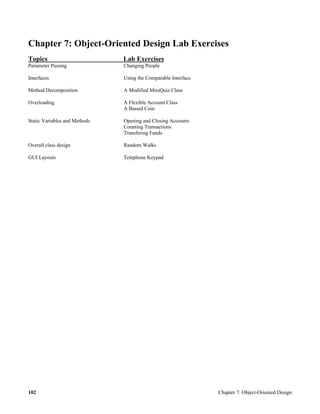
![Chapter 7: Object-Oriented Design 103
Changing People
The file ChangingPeople.java contains a program that illustrates parameter passing. The program uses Person objects
defined in the file Person.java. Do the following:
1. Trace the execution of the program using diagrams similar to those in Figure 6.5 of the text (which is a trace of the
program in Listings 6.15–6.17). Also show what is printed by the program.
2. Compile and run the program to see if your trace was correct.
3. Modify the changePeople method so that it does what the documentation says it does, that is, the two Person objects
passed in as actual parameters are actually changed.
// ******************************************************************
// ChangingPeople.java
//
// Demonstrates parameter passing -- contains a method that should
// change to Person objects.
// ******************************************************************
public class ChangingPeople
{
// ---------------------------------------------------------
// Sets up two person objects, one integer, and one String
// object. These are sent to a method that should make
// some changes.
// ---------------------------------------------------------
public static void main (String[] args)
{
Person person1 = new Person ("Sally", 13);
Person person2 = new Person ("Sam", 15);
int age = 21;
String name = "Jill";
System.out.println ("nParameter Passing... Original values...");
System.out.println ("person1: " + person1);
System.out.println ("person2: " + person2);
System.out.println ("age: " + age + "tname: " + name + "n");
changePeople (person1, person2, age, name);
System.out.println ("nValues after calling changePeople...");
System.out.println ("person1: " + person1);
System.out.println ("person2: " + person2);
System.out.println ("age: " + age + "tname: " + name + "n");
}
// -------------------------------------------------------------------
// Change the first actual parameter to "Jack - Age 101" and change
// the second actual parameter to be a person with the age and
// name given in the third and fourth parameters.
// -------------------------------------------------------------------
public static void changePeople (Person p1, Person p2, int age, String name)
{
System.out.println ("nInside changePeople... Original parameters...");
System.out.println ("person1: " + p1);
System.out.println ("person2: " + p2);
System.out.println ("age: " + age + "tname: " + name + "n");](https://image.slidesharecdn.com/7526-250712072253-5dce5002/85/Java-Software-Solutions-9th-Edition-Lewis-Solutions-Manual-6-320.jpg)
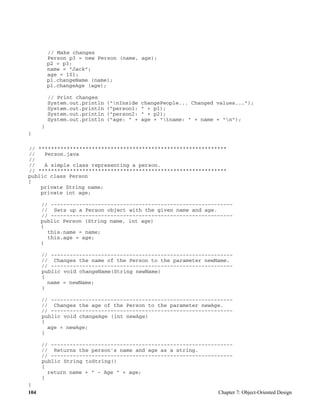
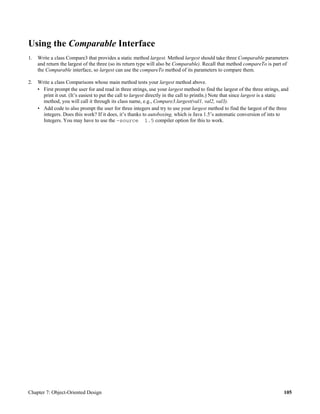
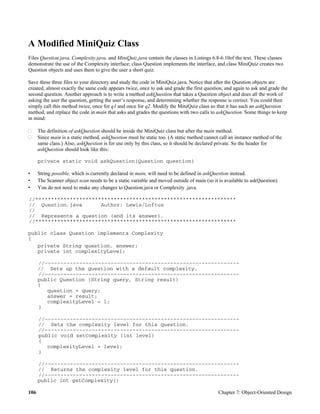
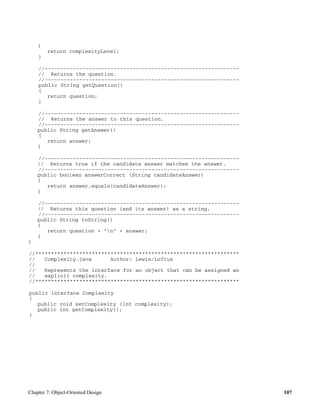
![108 Chapter 7: Object-Oriented Design
//*****************************************************************
// MiniQuiz.java Author: Lewis/Loftus
//
// Demonstrates the use of a class that implements an interface.
//*****************************************************************
import java.util.Scanner;
public class MiniQuiz
{
//--------------------------------------------------------------
// Presents a short quiz.
//--------------------------------------------------------------
public static void main (String[] args)
{
Question q1, q2;
String possible;
Scanner scan = new Scanner(System.in);
q1 = new Question ("What is the capital of Jamaica?",
"Kingston");
q1.setComplexity (4);
q2 = new Question ("Which is worse, ignorance or apathy?",
"I don't know and I don't care");
q2.setComplexity (10);
System.out.print (q1.getQuestion());
System.out.println (" (Level: " + q1.getComplexity() + ")");
possible = scan.nextLine();
if (q1.answerCorrect(possible))
System.out.println ("Correct");
else
System.out.println ("No, the answer is " + q1.getAnswer());
System.out.println();
System.out.print (q2.getQuestion());
System.out.println (" (Level: " + q2.getComplexity() + ")");
possible = scan.nextLine();
if (q2.answerCorrect(possible))
System.out.println ("Correct");
else
System.out.println ("No, the answer is " + q2.getAnswer ());
}
}](https://image.slidesharecdn.com/7526-250712072253-5dce5002/85/Java-Software-Solutions-9th-Edition-Lewis-Solutions-Manual-11-320.jpg)
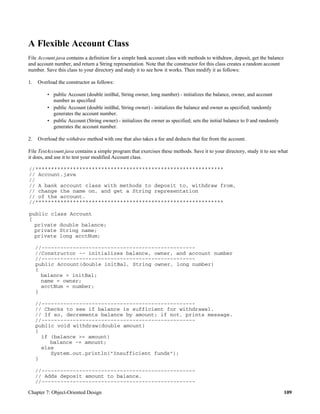
![110 Chapter 7: Object-Oriented Design
public void deposit(double amount)
{
balance += amount;
}
//-------------------------------------------------
// Returns balance.
//-------------------------------------------------
public double getBalance()
{
return balance;
}
//-------------------------------------------------
// Returns a string containing the name, account number, and balance.
//-------------------------------------------------
public String toString()
{
return "Name:" + name +
"nAccount Number: " + acctNum +
"nBalance: " + balance;
}
}
//************************************************************
// TestAccount.java
//
// A simple driver to test the overloaded methods of
// the Account class.
//************************************************************
import java.util.Scanner;
public class TestAccount
{
public static void main(String[] args)
{
String name;
double balance;
long acctNum;
Account acct;
Scanner scan = new Scanner(System.in);
System.out.println("Enter account holder's first name");
name = scan.next();
acct = new Account(name);
System.out.println("Account for " + name + ":");
System.out.println(acct);
System.out.println("nEnter initial balance");
balance = scan.nextDouble();
acct = new Account(balance,name);
System.out.println("Account for " + name + ":");
System.out.println(acct);](https://image.slidesharecdn.com/7526-250712072253-5dce5002/85/Java-Software-Solutions-9th-Edition-Lewis-Solutions-Manual-13-320.jpg)
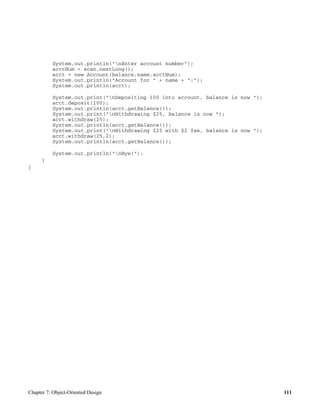
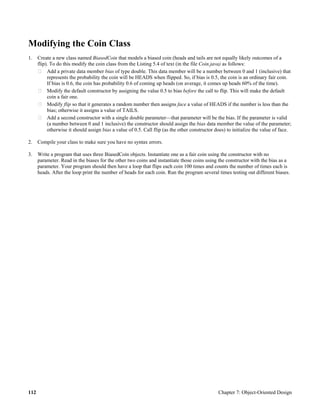
![Chapter 7: Object-Oriented Design 113
Opening and Closing Accounts
File Account.java (see previous exercise) contains a definition for a simple bank account class with methods to withdraw,
deposit, get the balance and account number, and return a String representation. Note that the constructor for this class
creates a random account number. Save this class to your directory and study it to see how it works. Then write the following
additional code:
1. Suppose the bank wants to keep track of how many accounts exist.
a. Declare a private static integer variable numAccounts to hold this value. Like all instance and static variables, it will
be initialized (to 0, since it’s an int) automatically.
b. Add code to the constructor to increment this variable every time an account is created.
c. Add a static method getNumAccounts that returns the total number of accounts. Think about why this method should
be static - its information is not related to any particular account.
d. File TestAccounts1.java contains a simple program that creates the specified number of bank accounts then uses the
getNumAccounts method to find how many accounts were created. Save it to your directory, then use it to test your
modified Account class.
2. Add a method void close() to your Account class. This method should close the current account by appending
“CLOSED” to the account name and setting the balance to 0. (The account number should remain unchanged.) Also
decrement the total number of accounts.
3. Add a static method Account consolidate(Account acct1, Account acct2) to your Account class that creates a new
account whose balance is the sum of the balances in acct1 and acct2 and closes acct1 and acct2. The new account should
be returned. Two important rules of consolidation:
• Only accounts with the same name can be consolidated. The new account gets the name on the old accounts but a new
account number.
• Two accounts with the same number cannot be consolidated. Otherwise this would be an easy way to double your
money!
Check these conditions before creating the new account. If either condition fails, do not create the new account or close
the old ones; print a useful message and return null.
4. Write a test program that prompts for and reads in three names and creates an account with an initial balance of $ 100 for
each. Print the three accounts, then close the first account and try to consolidate the second and third into a new account.
Now print the accounts again, including the consolidated one if it was created.
//************************************************************
// TestAccounts1
// A simple program to test the numAccts method of the
// Account class.
//************************************************************
import java.util.Scanner;
public class TestAccounts1
{
public static void main(String[] args)
{
Account testAcct;
Scanner scan = new Scanner(System.in);](https://image.slidesharecdn.com/7526-250712072253-5dce5002/85/Java-Software-Solutions-9th-Edition-Lewis-Solutions-Manual-16-320.jpg)








![Internet and Web Technology (CLASS-16) [Basic Elements of Java Program] | NIC...](https://cdn.slidesharecdn.com/ss_thumbnails/iwtclass-16-200811210335-thumbnail.jpg?width=640&height=640&fit=bounds)


