CHAPTER 1: OBJECTORIENTED PROGRAMMING
WITH JAVA
CLASS: BSc 3rd
SEMESTER | NEP|JAVA PROGRAMMING | L2
Continued……. From the last session
3.
BASICS OF JAVAPROGRAMMING
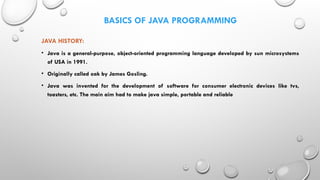
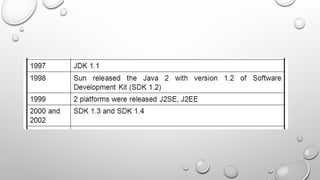
JAVA HISTORY:
• Java is a general-purpose, object-oriented programming language developed by sun microsystems
of USA in 1991.
• Originally called oak by James Gosling.
• Java was invented for the development of software for consumer electronic devices like tvs,
toasters, etc. The main aim had to make java simple, portable and reliable
6.
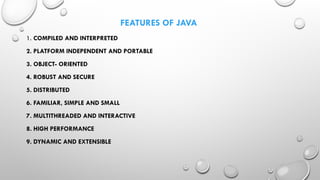
FEATURES OF JAVA
1.COMPILED AND INTERPRETED
2. PLATFORM INDEPENDENT AND PORTABLE
3. OBJECT- ORIENTED
4. ROBUST AND SECURE
5. DISTRIBUTED
6. FAMILIAR, SIMPLE AND SMALL
7. MULTITHREADED AND INTERACTIVE
8. HIGH PERFORMANCE
9. DYNAMIC AND EXTENSIBLE
7.
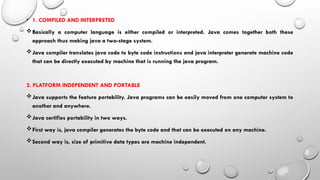
• 1. COMPILEDAND INTERPRETED
Basically a computer language is either compiled or interpreted. Java comes together both these
approach thus making java a two-stage system.
Java compiler translates java code to byte code instructions and java interpreter generate machine code
that can be directly executed by machine that is running the java program.
2. PLATFORM INDEPENDENT AND PORTABLE
Java supports the feature portability. Java programs can be easily moved from one computer system to
another and anywhere.
Java certifies portability in two ways.
First way is, java compiler generates the byte code and that can be executed on any machine.
Second way is, size of primitive data types are machine independent.
8.
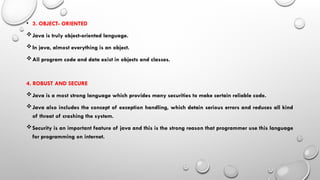
• 3. OBJECT-ORIENTED
Java is truly object-oriented language.
In java, almost everything is an object.
All program code and data exist in objects and classes.
4. ROBUST AND SECURE
Java is a most strong language which provides many securities to make certain reliable code.
Java also includes the concept of exception handling, which detain serious errors and reduces all kind
of threat of crashing the system.
Security is an important feature of java and this is the strong reason that programmer use this language
for programming on internet.
9.
• 5. DISTRIBUTED
Javais called as distributed language for construct applications on networks which can contribute both
data and programs.
Java applications can open and access remote objects on internet easily. That means multiple
programmers at multiple remote locations to work together on single task.
6. SIMPLE AND SMALL
Java is very small and simple language. Java does not use pointer and header files, goto statements, etc.
It eliminates operator overloading and multiple inheritance.
7. MULTITHREADED AND INTERACTIVE
Multithreaded means managing multiple tasks simultaneously.
Java maintains multithreaded programs. That means we need not wait for the application to complete one
task before starting next task. This feature is helpful for graphic applications
10.
• 8. HIGHPERFORMANCE
Java performance is very extraordinary for an interpreted language, majorly due to the use of
intermediate byte code.
Java architecture is also designed to reduce overheads during runtime. The incorporation of multithreading
improves the execution speed of program.
9. DYNAMIC AND EXTENSIBLE
Java is also dynamic language. Java is capable of dynamically linking in new class, libraries,
methods and objects.
Java program is support functions written in other language such as c and c++, known as
native methods.
11.
JAVA DIFFERS FROMC
Java does not include the C unique statement keywords sizeof, and typedef
Java does not contain the data types: struct and union
Java does not define the type modifiers keywords auto, extern, register, signed and unsigned
Java does not support explicit pointer type
Java does not have a preprocessor and therefore we cannot use #define, #include, and #ifdef
statements
Java requires that the functions with no arguments must be declared with empty parenthesis and
not with the void keyword as done in C
Java adds new operators such as instancesof and >>>
Java adds labeled break and continue statements
12.
JAVA DIFFERS FROMC++ (COMPARISON IN JAVA AND C++)
Java C++
1. Java is true object-oriented language C++ is basically c with object-oriented extension
2. Java does not support operator overloading C++ supports operator overloading
3. It supports labels with loops and statement blocks It supports goto statement
4. Java compiled into byte code for the java virtual machine. Source code can be written to be platform independent the
source code is independent on operating system and written to take advantage of platform
C++ typically compiled into machine code.
6. Java does not support multiple inheritance of classes it supports interface C++ supports multiple inheritance of classes.
7. Java does not support global variable. Every variable should declare in class C++ support global variable.
8. Java does not use pointer. C++ uses pointer.
9. It strictly enforces an OOP paradigm. It allows both procedural programming and OOP.
10. There are no header files in java We have to use header file in C++