BILURUBIN METABOLISM
AND
JAUNDICE
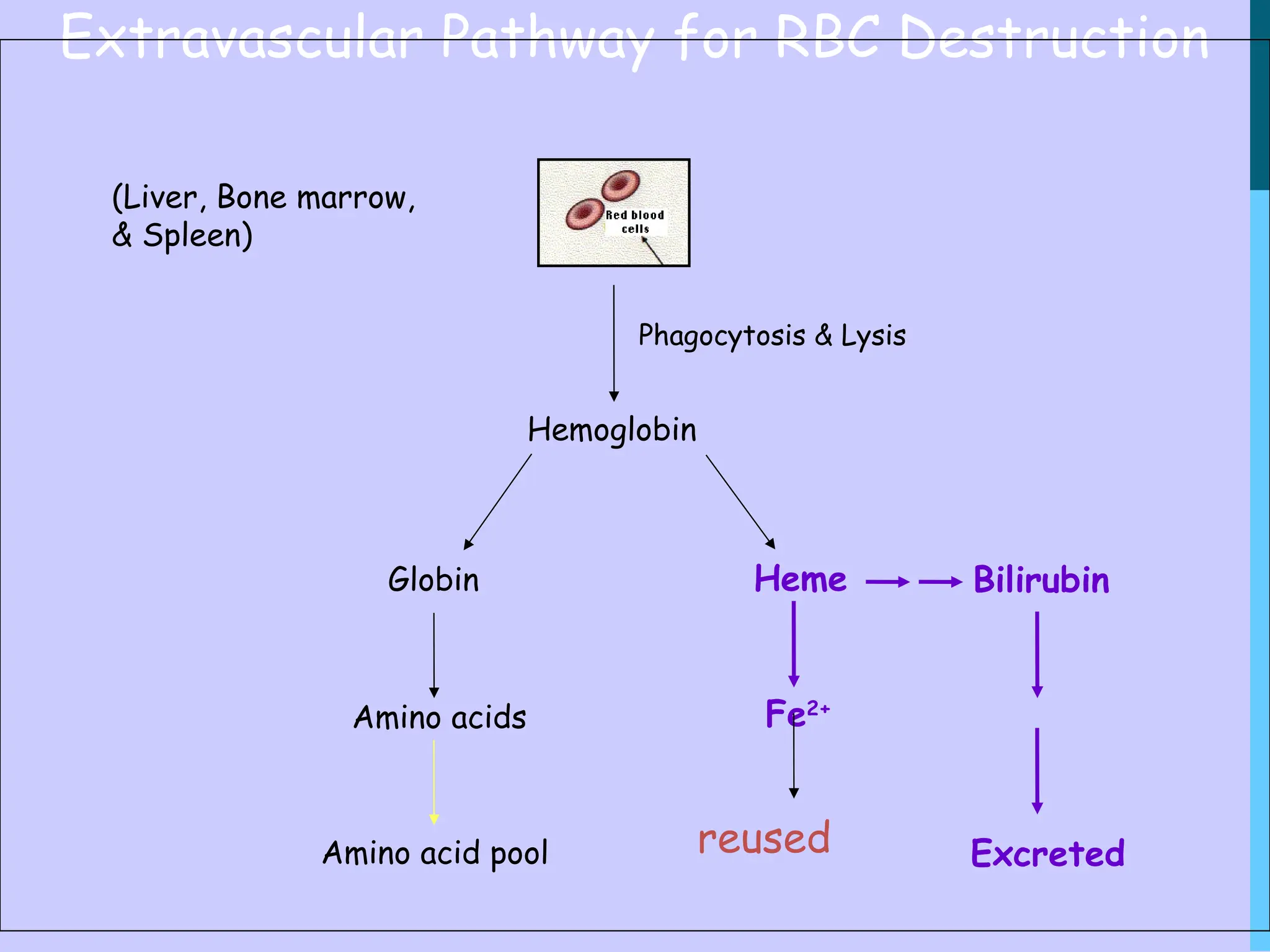
FATE OF RED BLOOD CELLS
 Life span in blood stream is 60-120 days
 Senescent RBCs are phagocytosed and lysed
by tissue macrophages which are a part of
reticuloendothelial system.
 Lysis can also occur intravascularly (in blood
stream)
Extravascular Pathway for RBC Destruction
(Liver, Bone marrow,
& Spleen)
Hemoglobin
Globin
Amino acids
Amino acid pool
Heme Bilirubin
Fe2+
Excreted
Phagocytosis & Lysis
reused
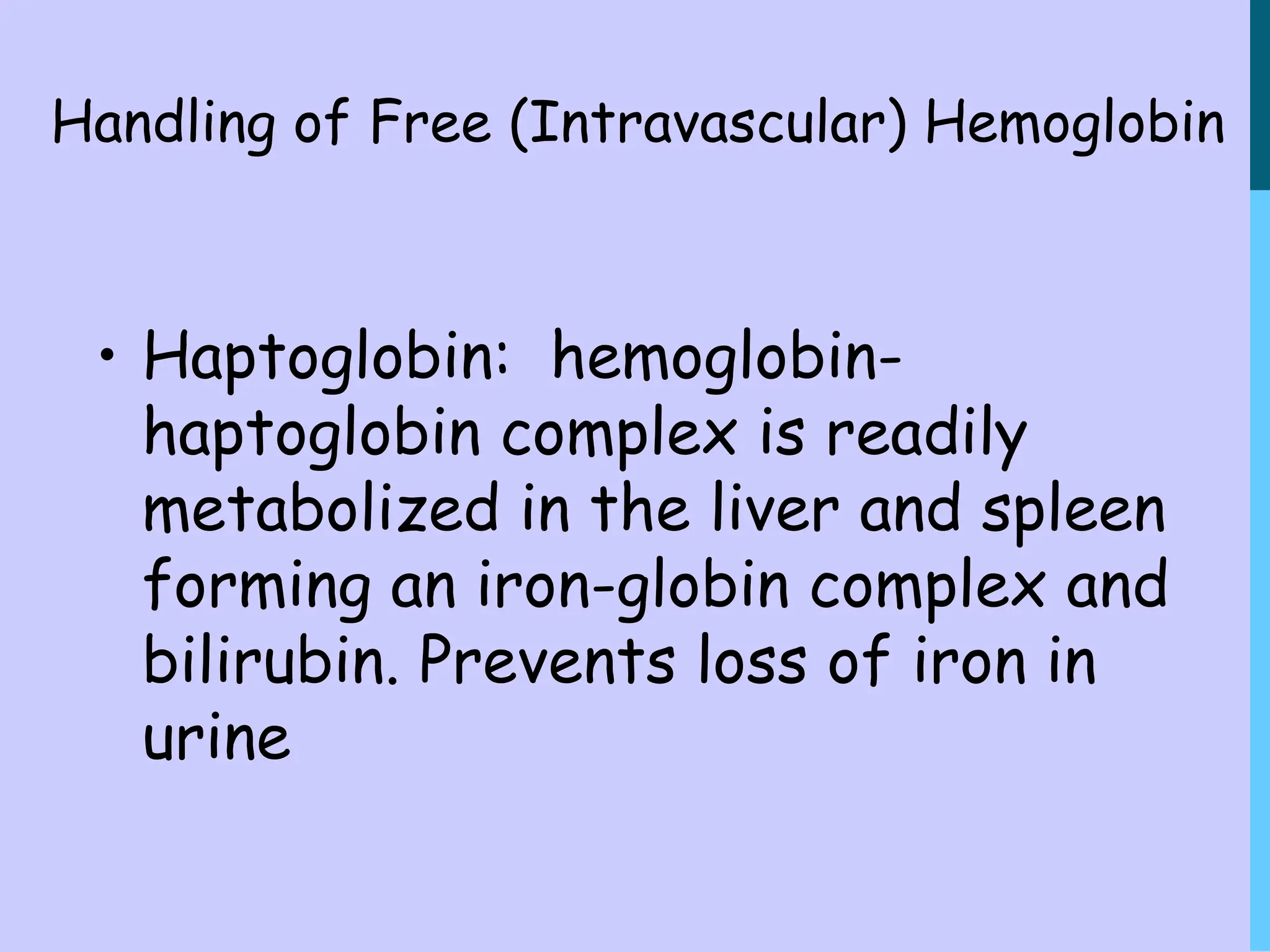
Handling of Free (Intravascular) Hemoglobin
• Haptoglobin: hemoglobin-
haptoglobin complex is readily
metabolized in the liver and spleen
forming an iron-globin complex and
bilirubin. Prevents loss of iron in
urine
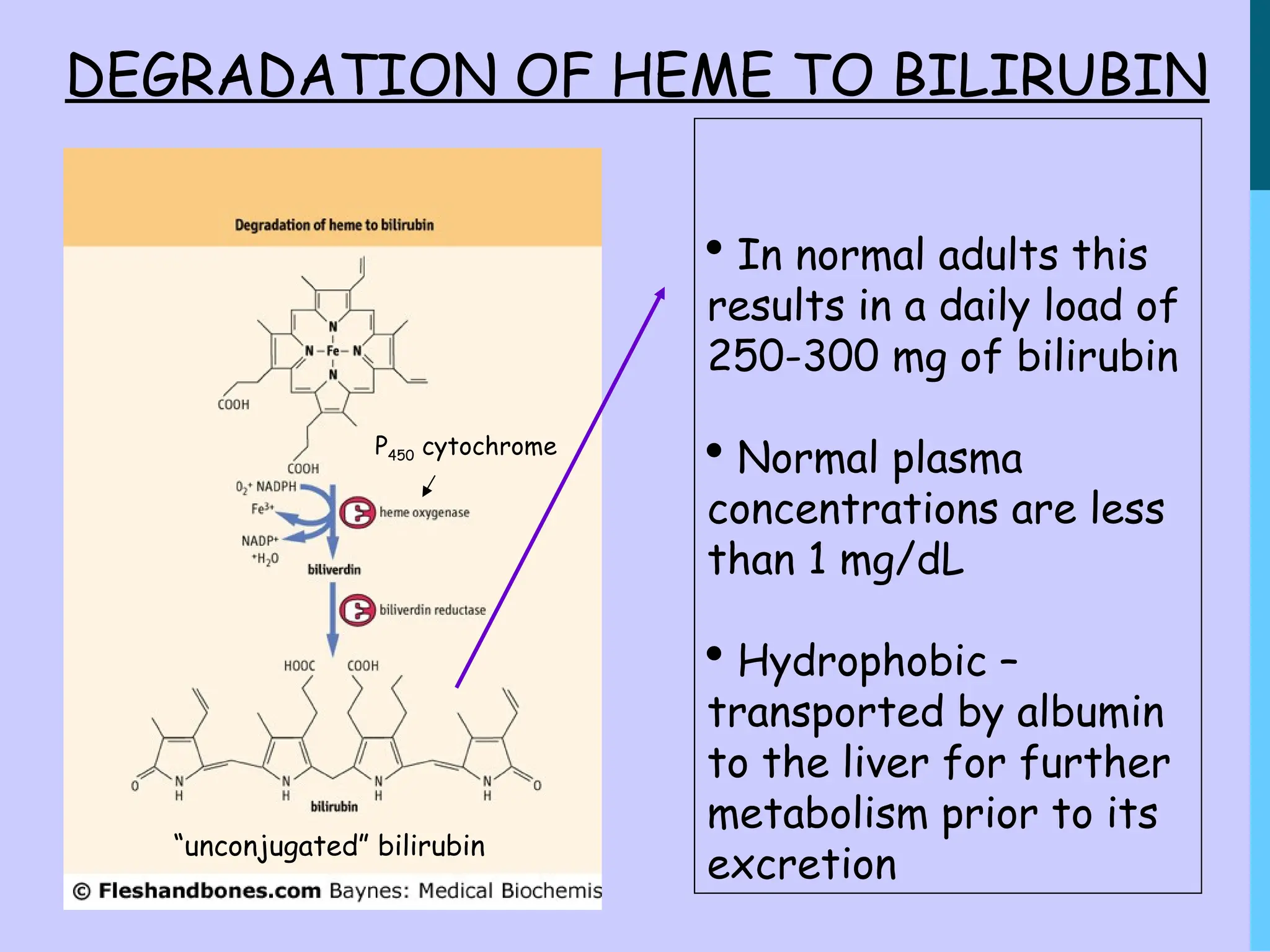
DEGRADATION OF HEME TO BILIRUBIN
P450 cytochrome
 In normal adults this
results in a daily load of
250-300 mg of bilirubin
 Normal plasma
concentrations are less
than 1 mg/dL
 Hydrophobic –
transported by albumin
to the liver for further
metabolism prior to its
excretion
“unconjugated” bilirubin
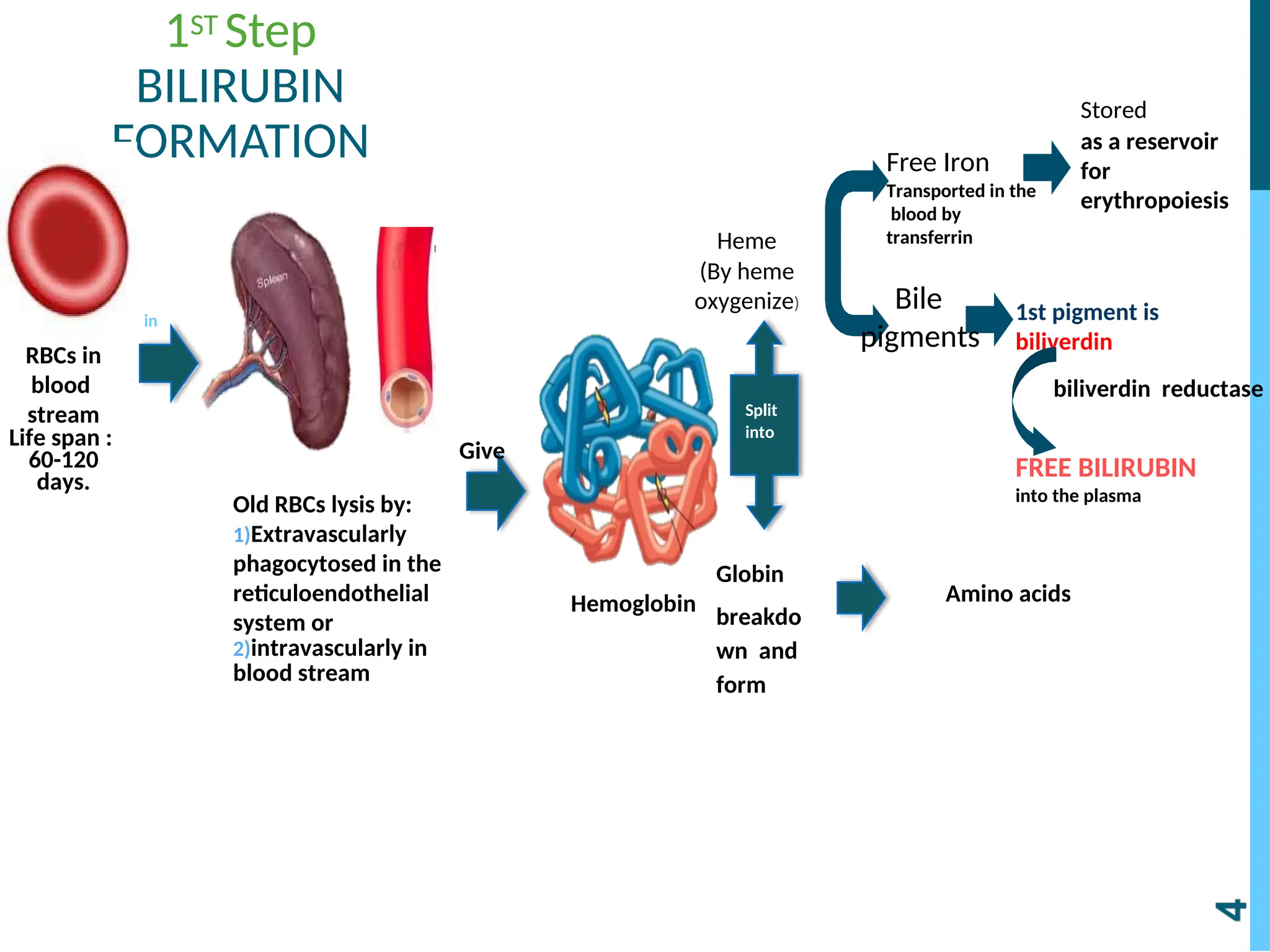
1ST Step
BILIRUBIN
FORMATION
RBCs in
blood
stream
Life span :
60-120
days.
Old RBCs lysis by:
1)Extravascularly
phagocytosed in the
reticuloendothelial
system or
2)intravascularly in
blood stream
Hemoglobin
in
Give
Split
into
Globin
breakdo
wn and
form
Amino acids
Free Iron
Transported in the
blood by
transferrin
Stored
as a reservoir
for
erythropoiesis
1st pigment is
biliverdin
FREE BILIRUBIN
into the plasma
Bile
pigments
biliverdin reductase
Heme
(By heme
oxygenize)
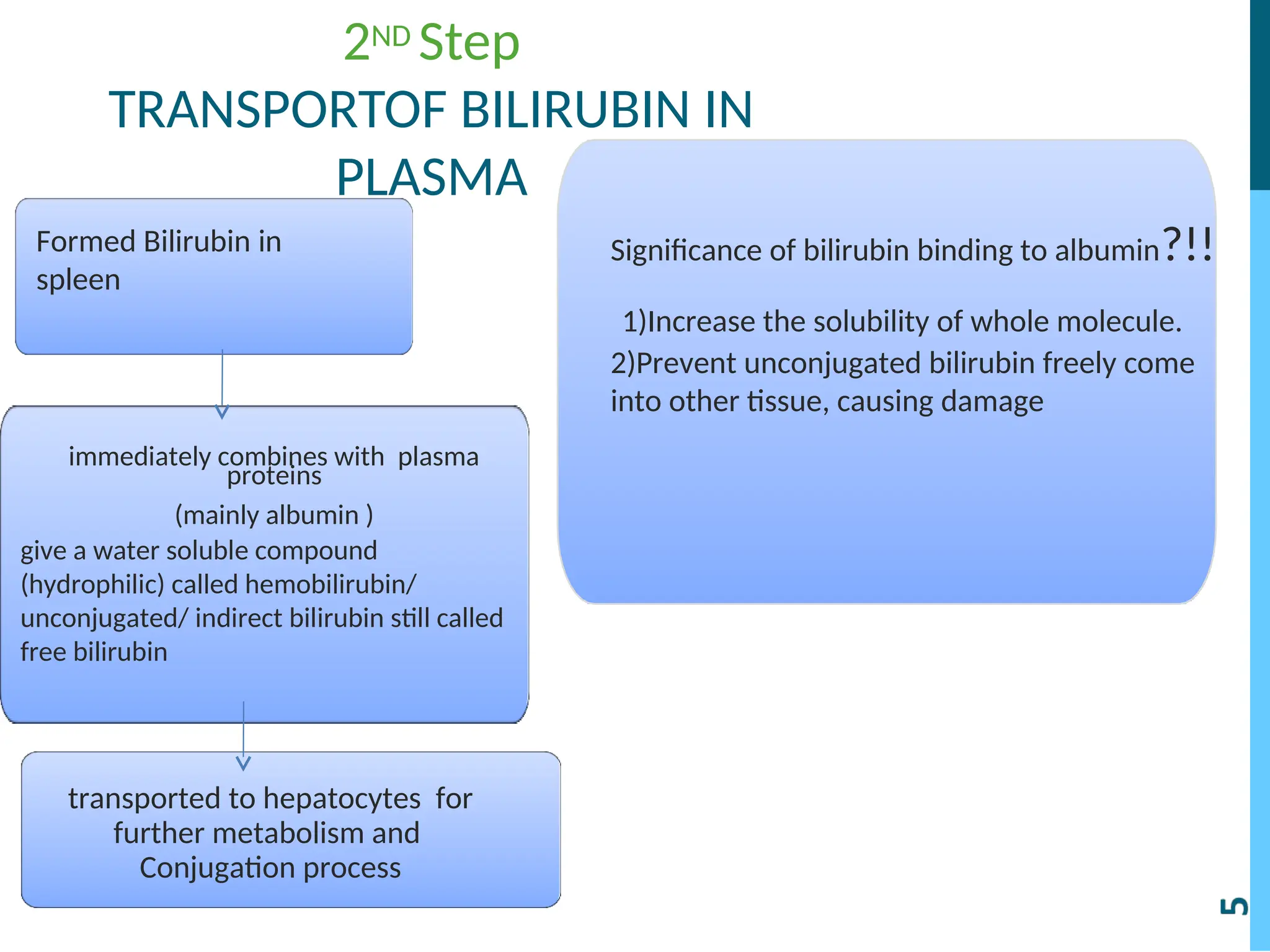
2ND Step
TRANSPORTOF BILIRUBIN IN
PLASMA
Formed Bilirubin in
spleen
immediately combines with plasma
proteins
(mainly albumin )
give a water soluble compound
(hydrophilic) called hemobilirubin/
unconjugated/ indirect bilirubin still called
free bilirubin
transported to hepatocytes for
further metabolism and
Conjugation process
Significance of bilirubin binding to albumin?!!
1)Increase the solubility of whole molecule.
2)Prevent unconjugated bilirubin freely come
into other tissue, causing damage
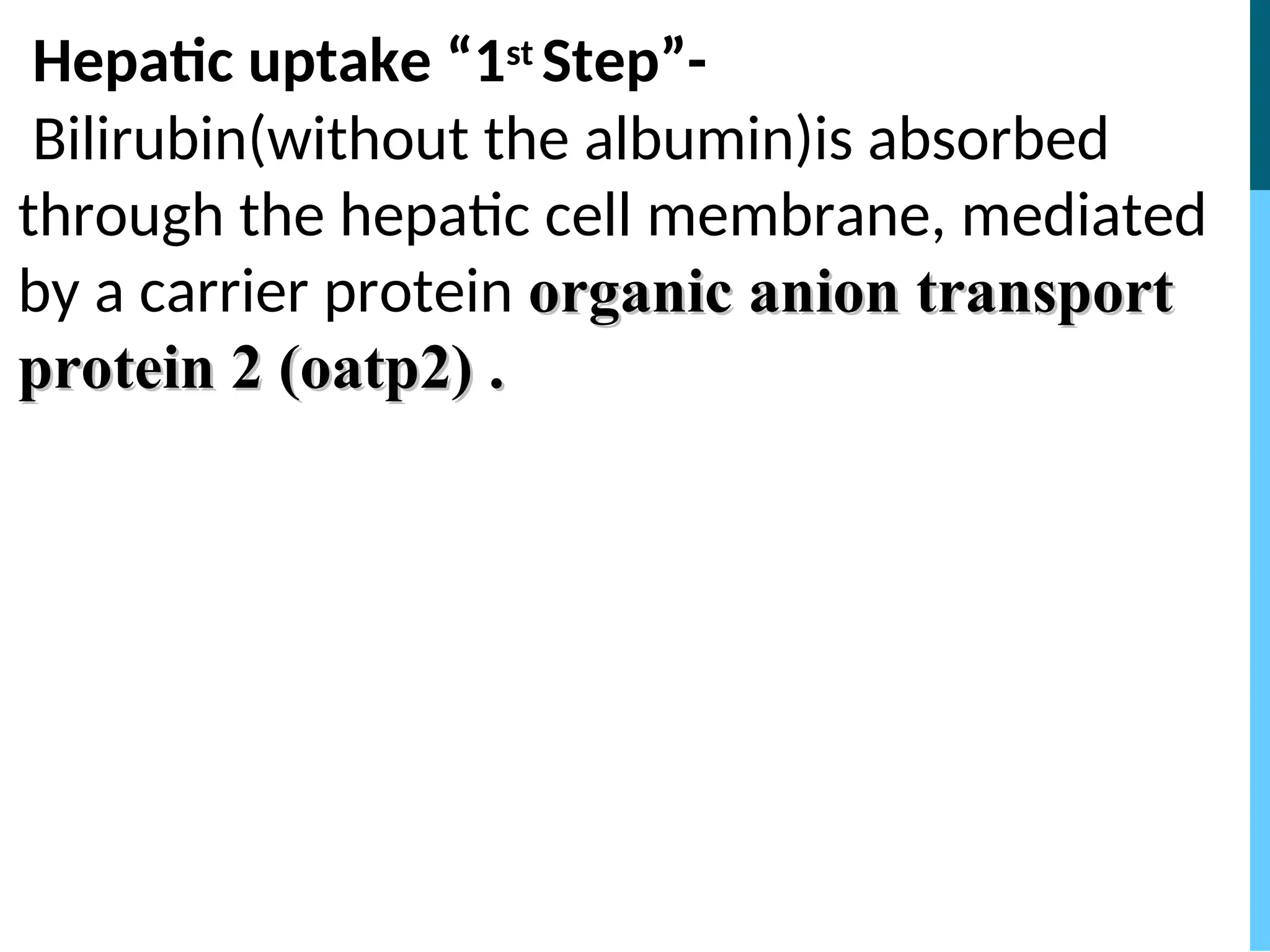
Hepatic uptake “1st Step”-
Bilirubin(without the albumin)is absorbed
through the hepatic cell membrane, mediated
by a carrier protein organic anion transport
organic anion transport
protein 2 (oatp2) .
protein 2 (oatp2) .
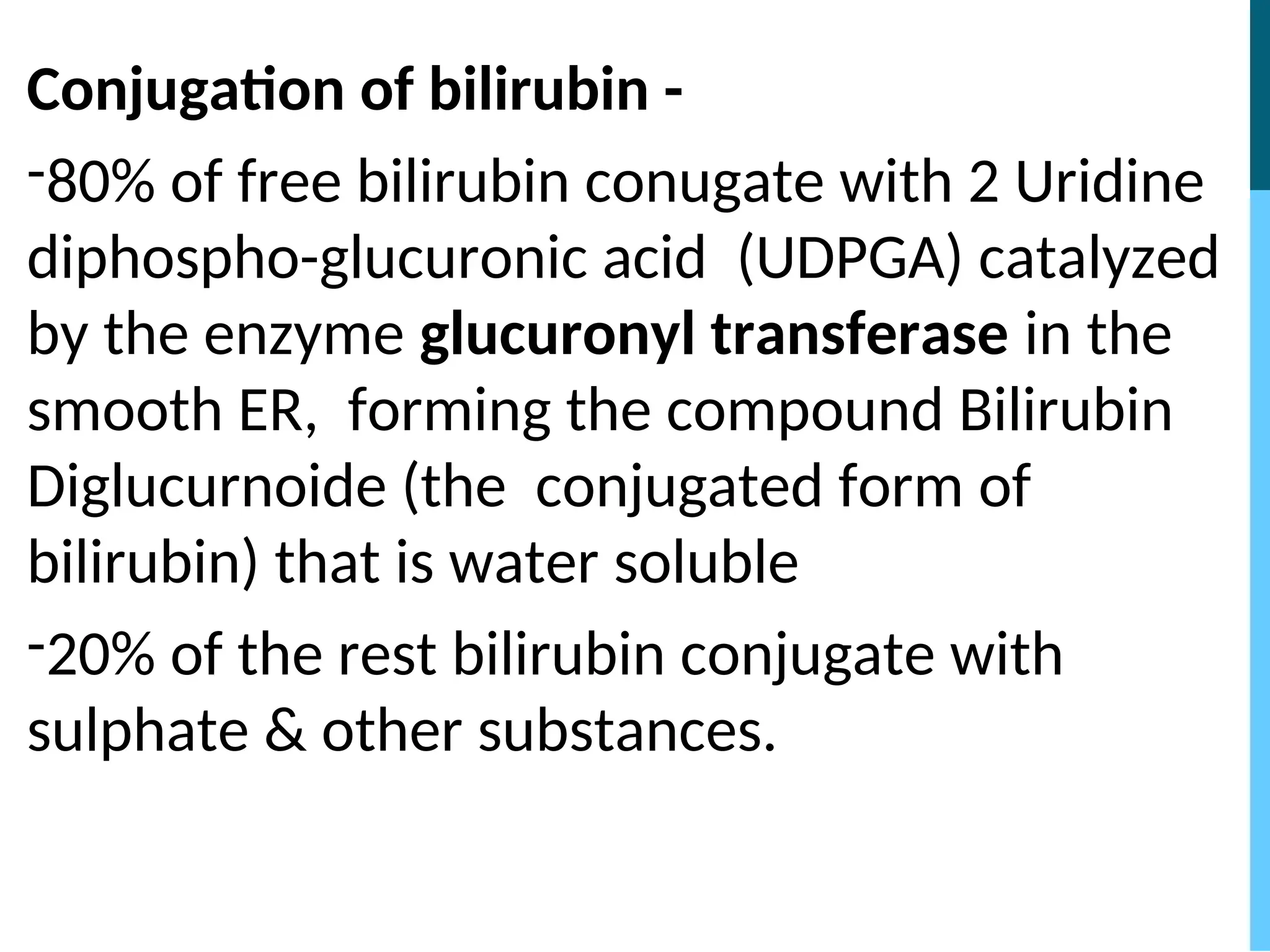
Conjugation of bilirubin -
-80% of free bilirubin conugate with 2 Uridine
diphospho-glucuronic acid (UDPGA) catalyzed
by the enzyme glucuronyl transferase in the
smooth ER, forming the compound Bilirubin
Diglucurnoide (the conjugated form of
bilirubin) that is water soluble
-20% of the rest bilirubin conjugate with
sulphate & other substances.
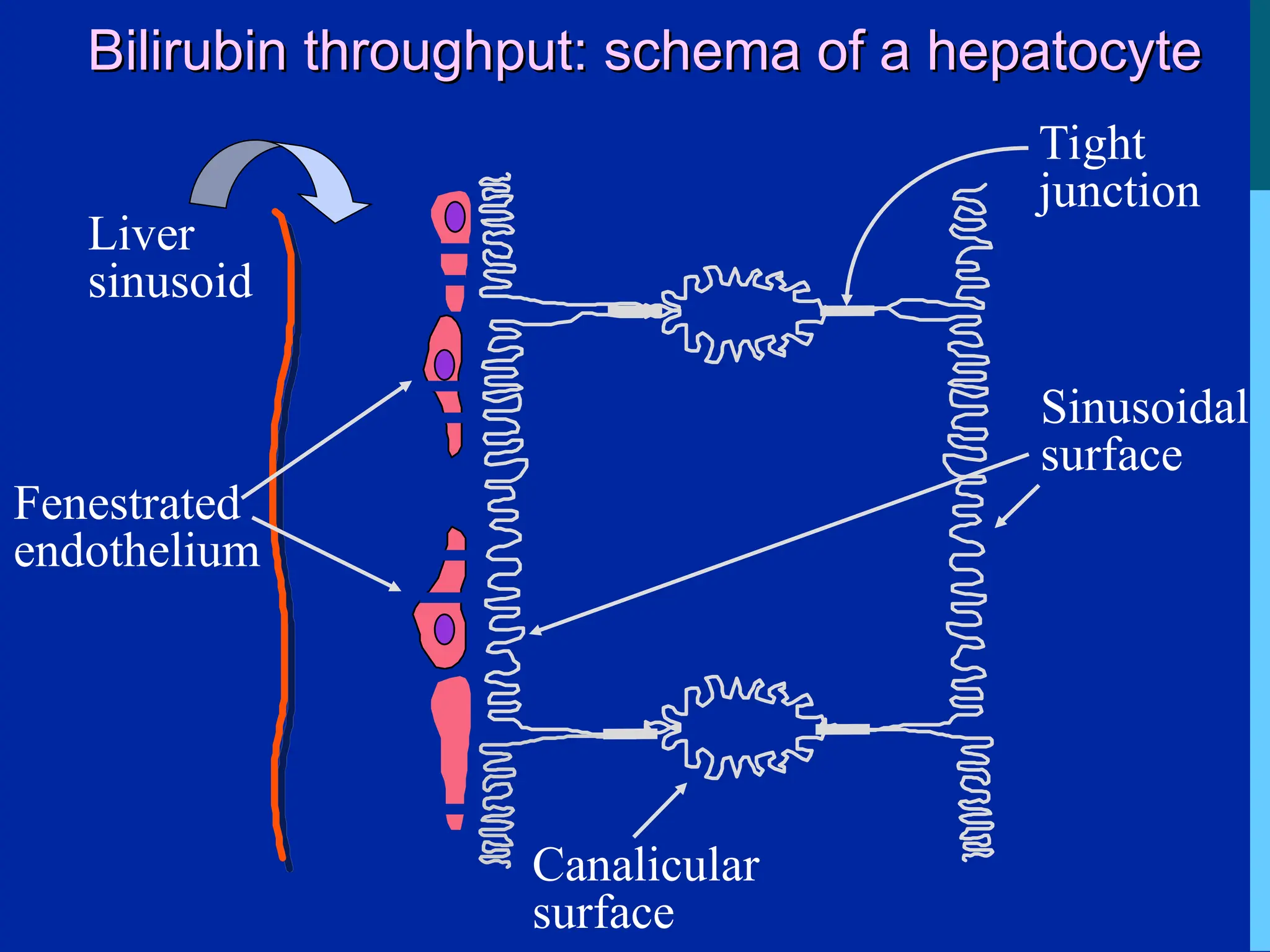
Bilirubin throughput: schema of a hepatocyte
Sinusoidal
surface
Canalicular
surface
Tight
junction
Liver
sinusoid
Fenestrated
endothelium
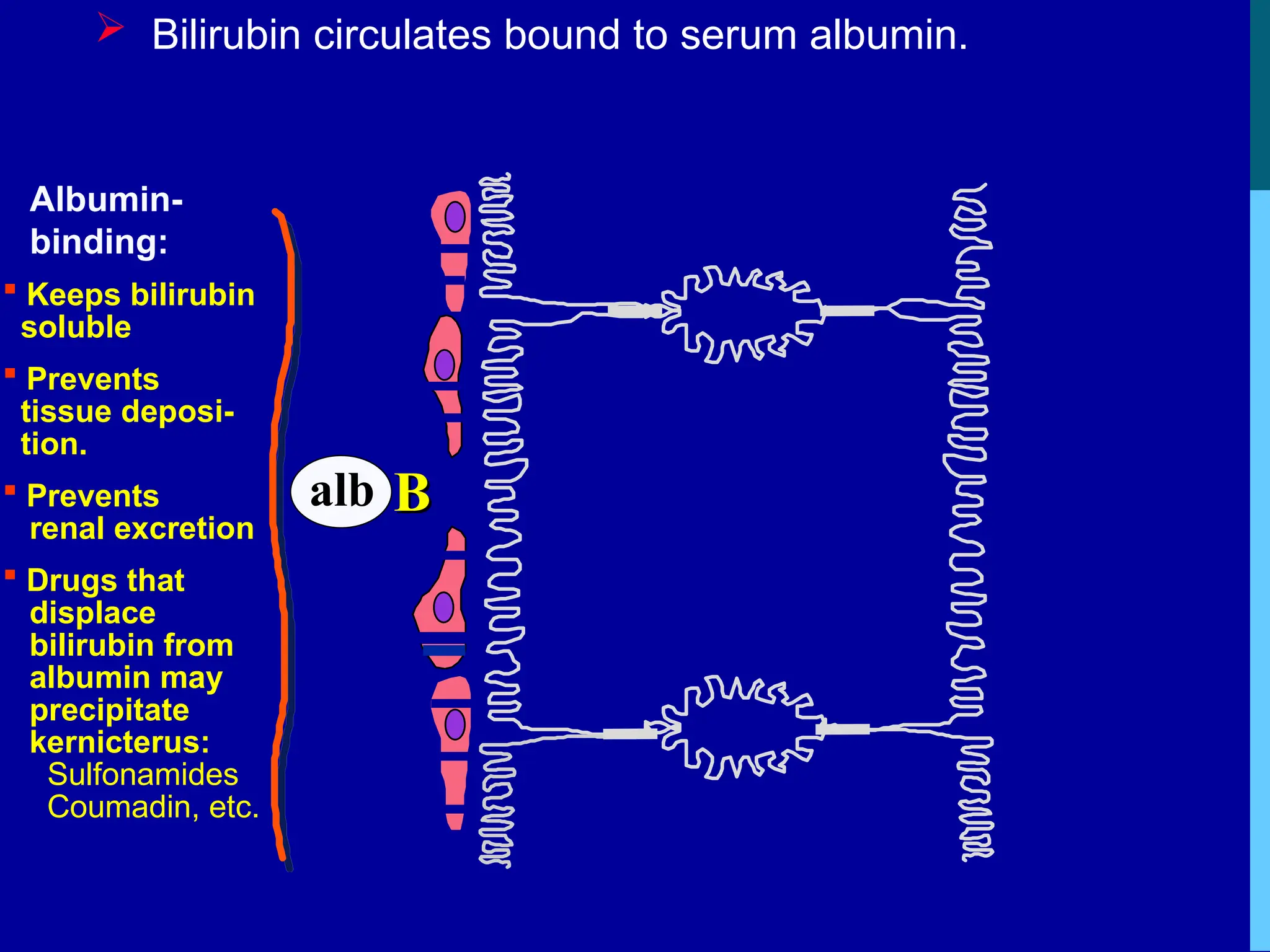
 Bilirubin circulates bound to serum albumin.
B
B
alb
Albumin-
binding:
 Keeps bilirubin
soluble
 Prevents
tissue deposi-
tion.
 Prevents
renal excretion
 Drugs that
displace
bilirubin from
albumin may
precipitate
kernicterus:
Sulfonamides
Coumadin, etc.
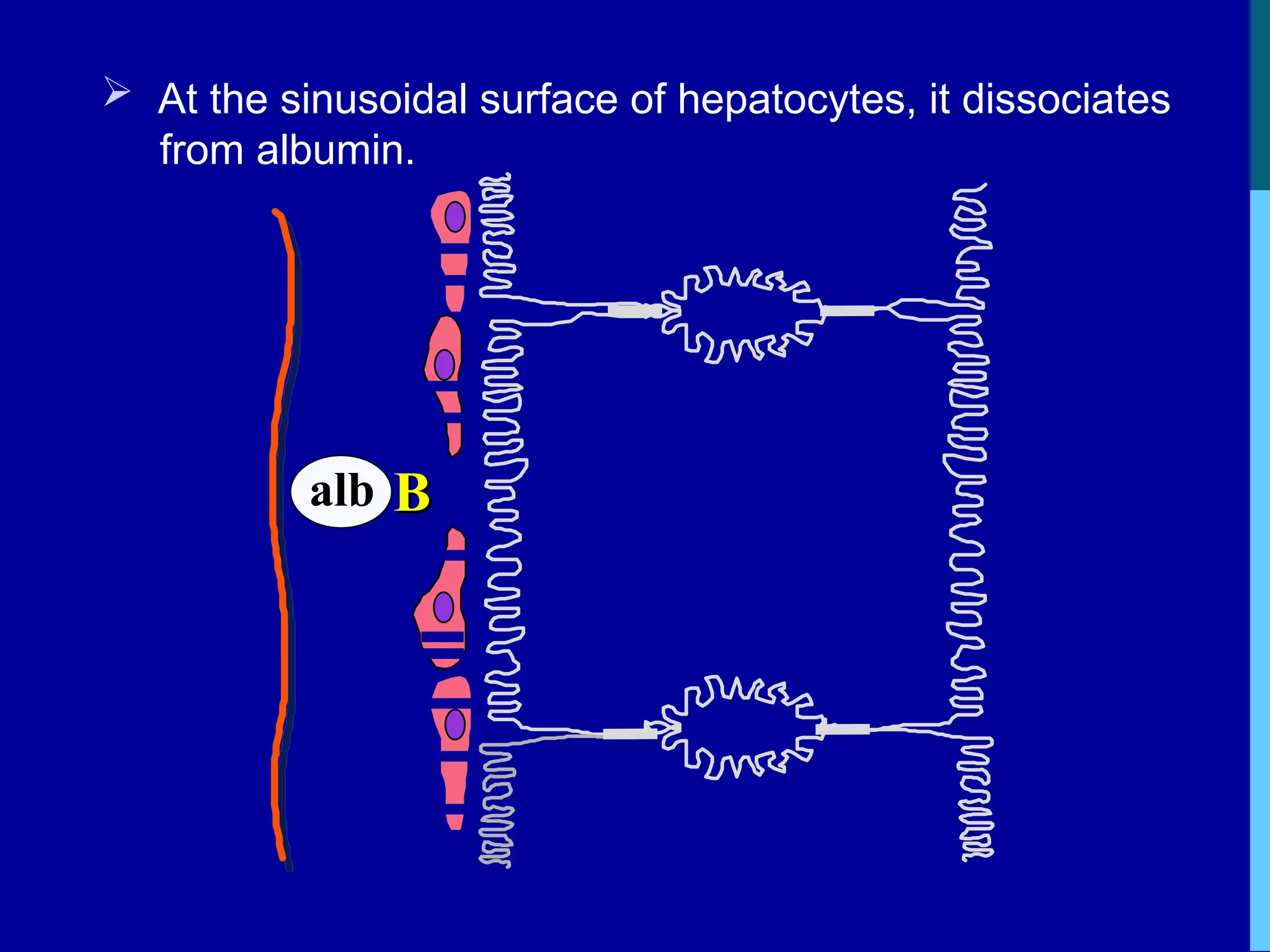
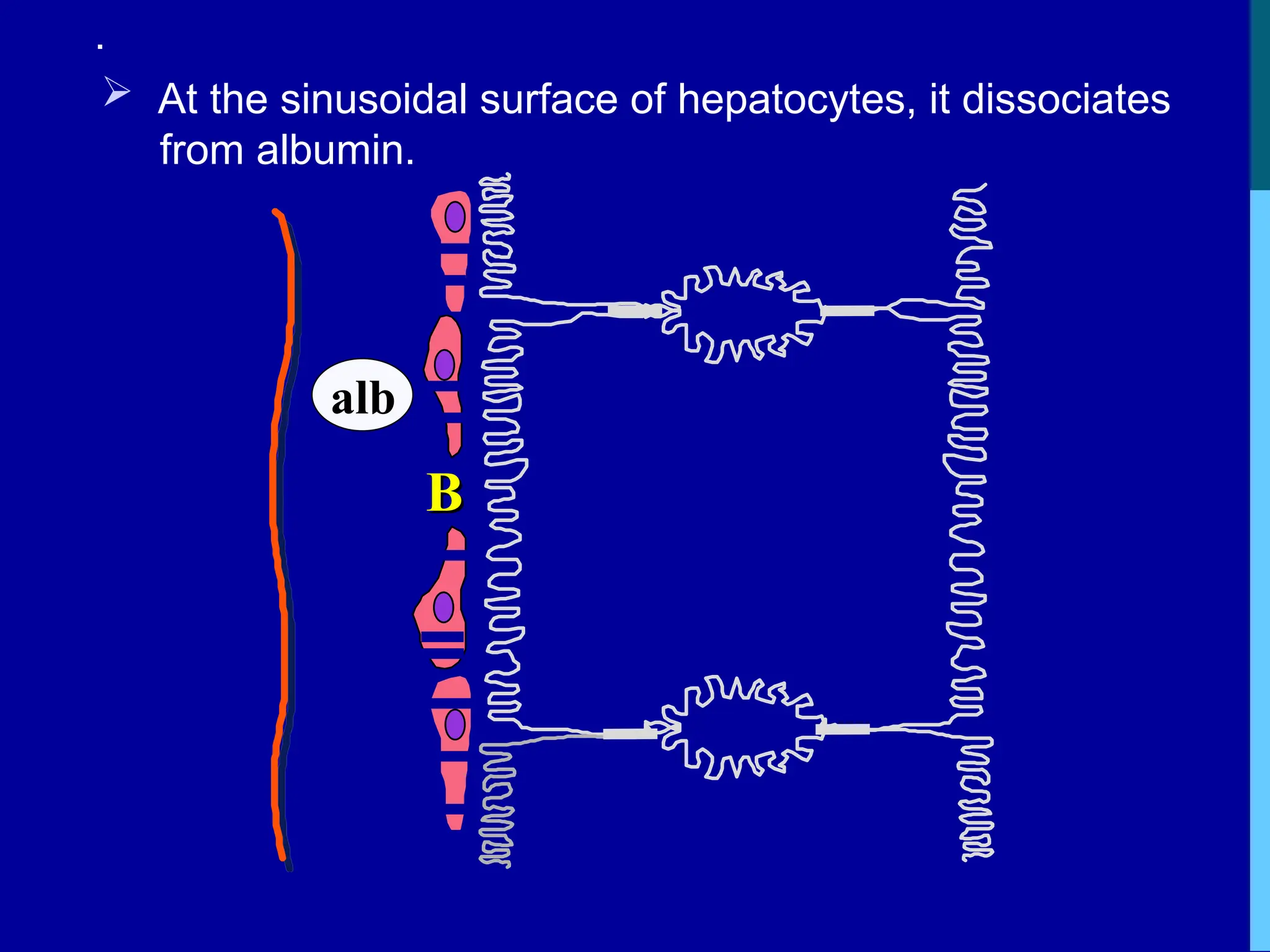
 At the sinusoidal surface of hepatocytes, it dissociates
from albumin.
B
B
alb
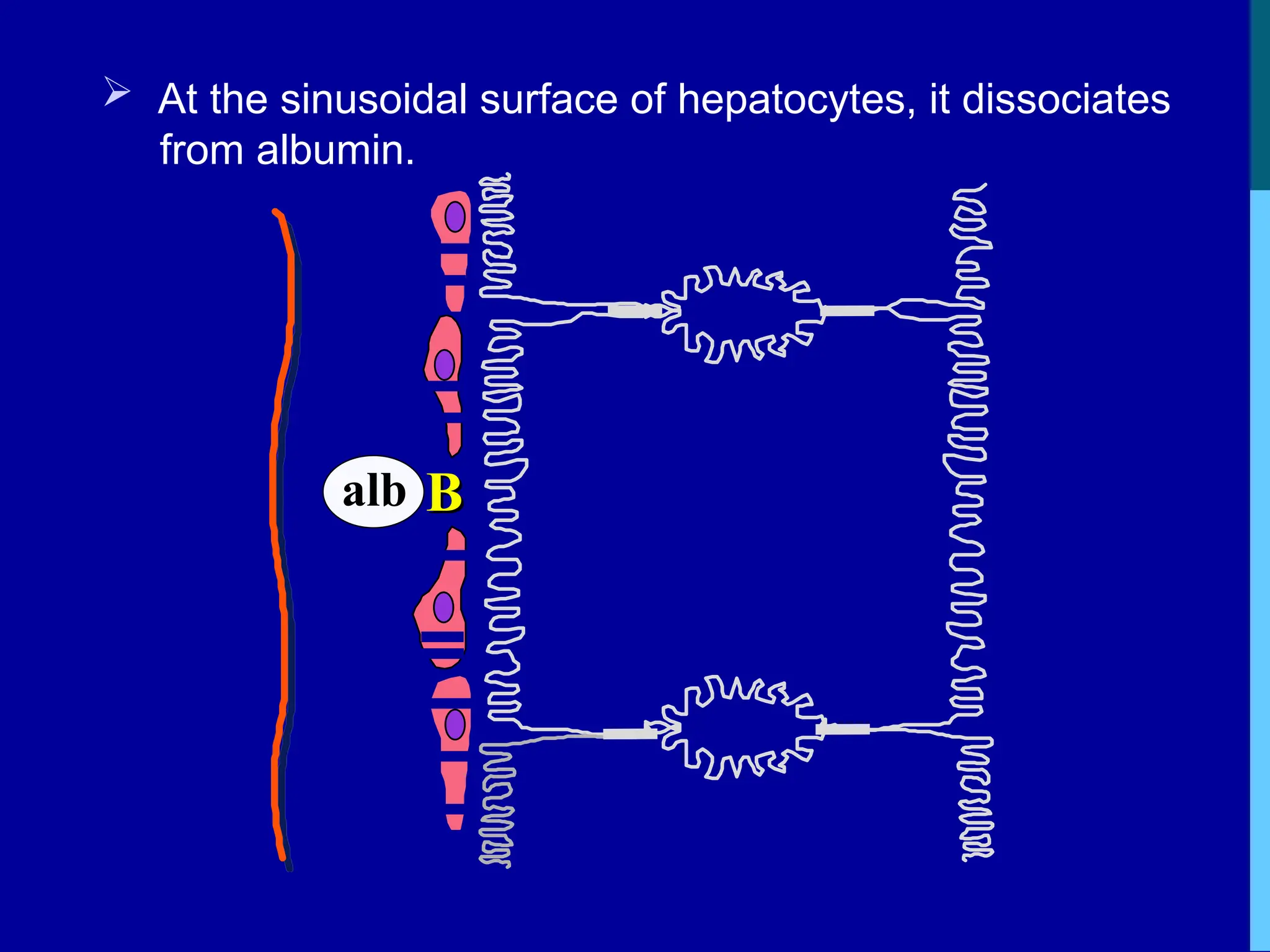
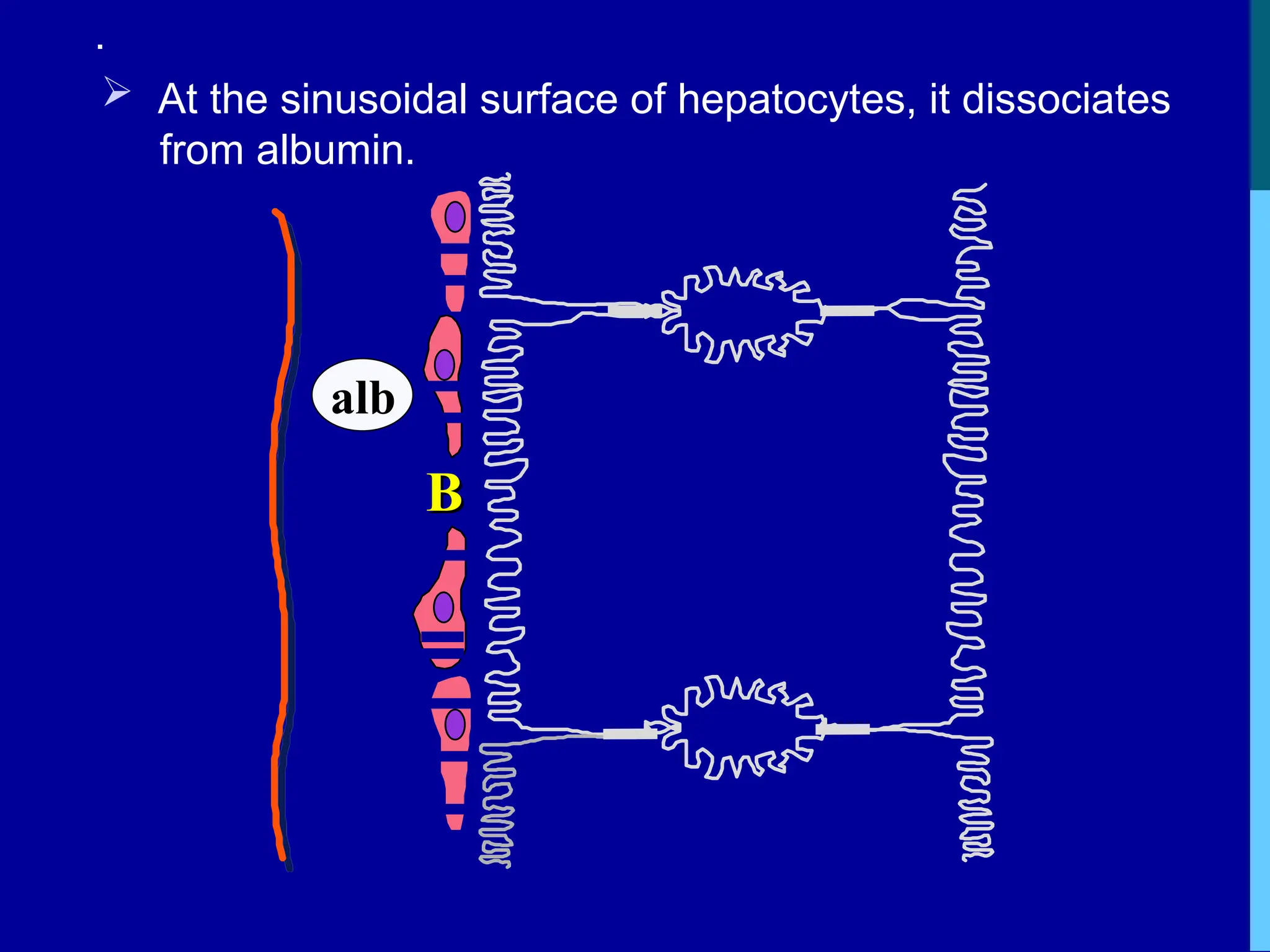
 At the sinusoidal surface of hepatocytes, it dissociates
from albumin.
B
B
alb
.
 At the sinusoidal surface of hepatocytes, it dissociates
from albumin.
B
B
alb
.
 At the sinusoidal surface of hepatocytes, it dissociates
from albumin.
B
B
alb
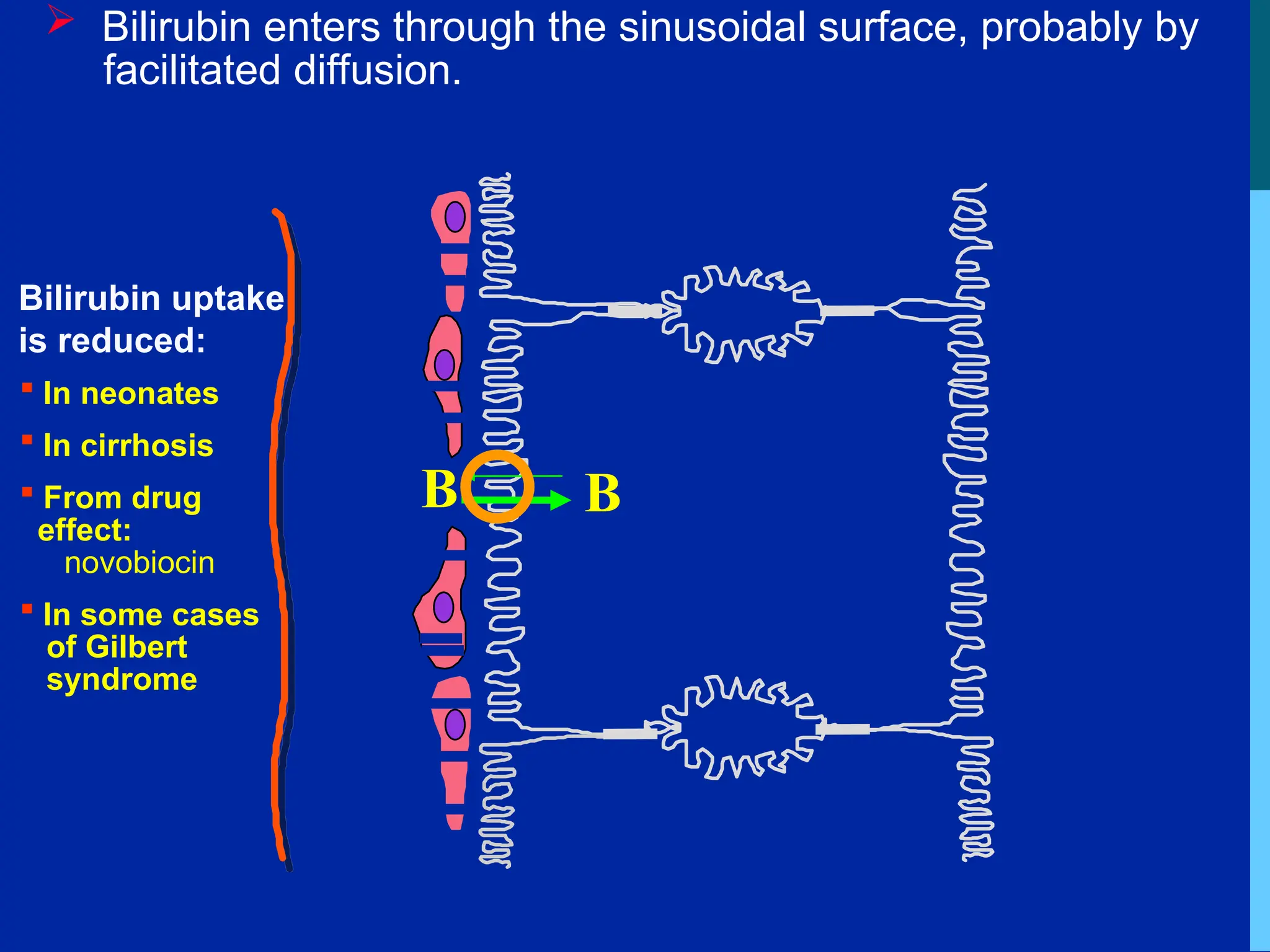
 Bilirubin enters through the sinusoidal surface, probably by
facilitated diffusion.
B
B
Bilirubin uptake
is reduced:
 In neonates
 In cirrhosis
 From drug
effect:
novobiocin
 In some cases
of Gilbert
syndrome
B
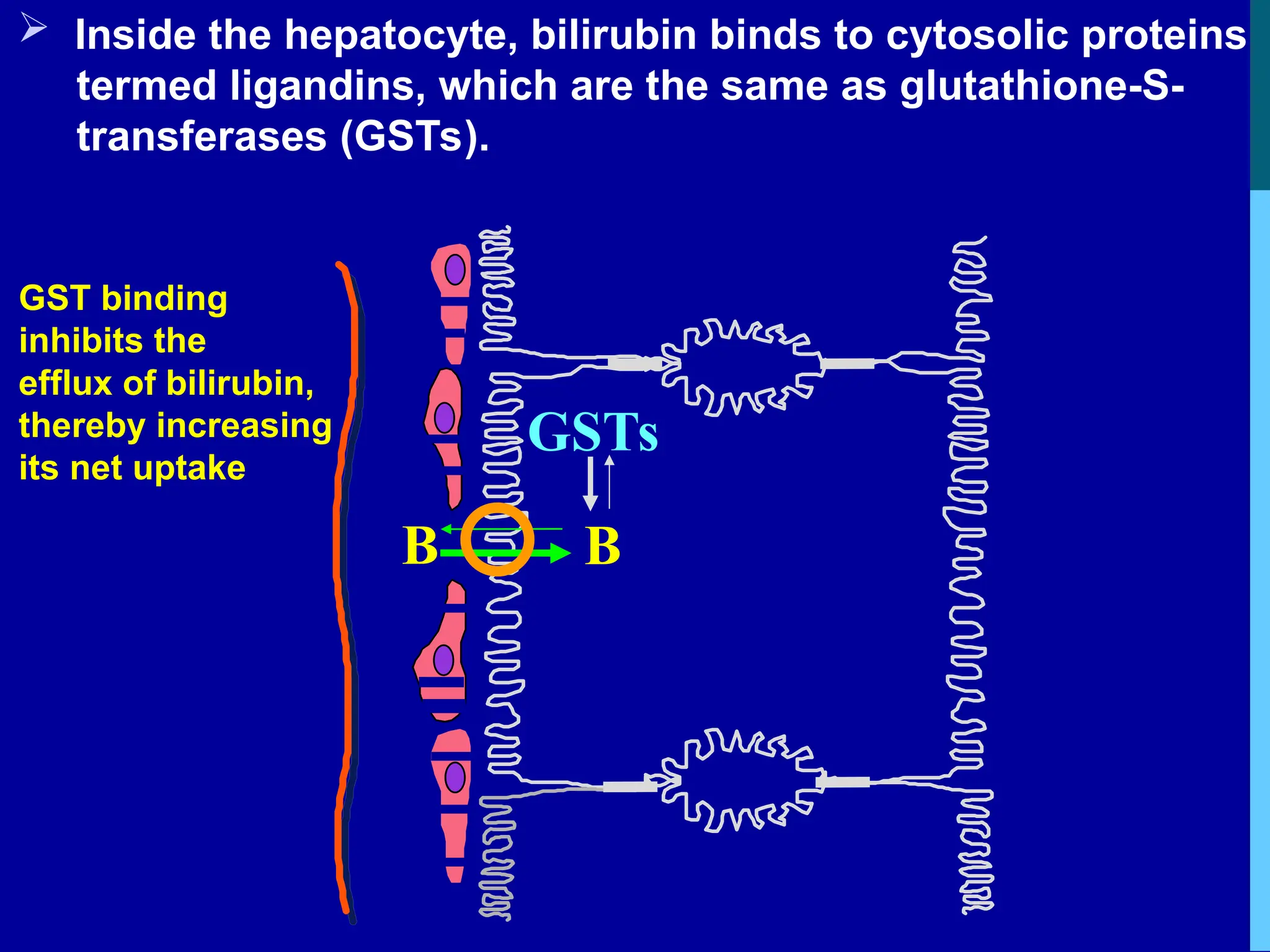
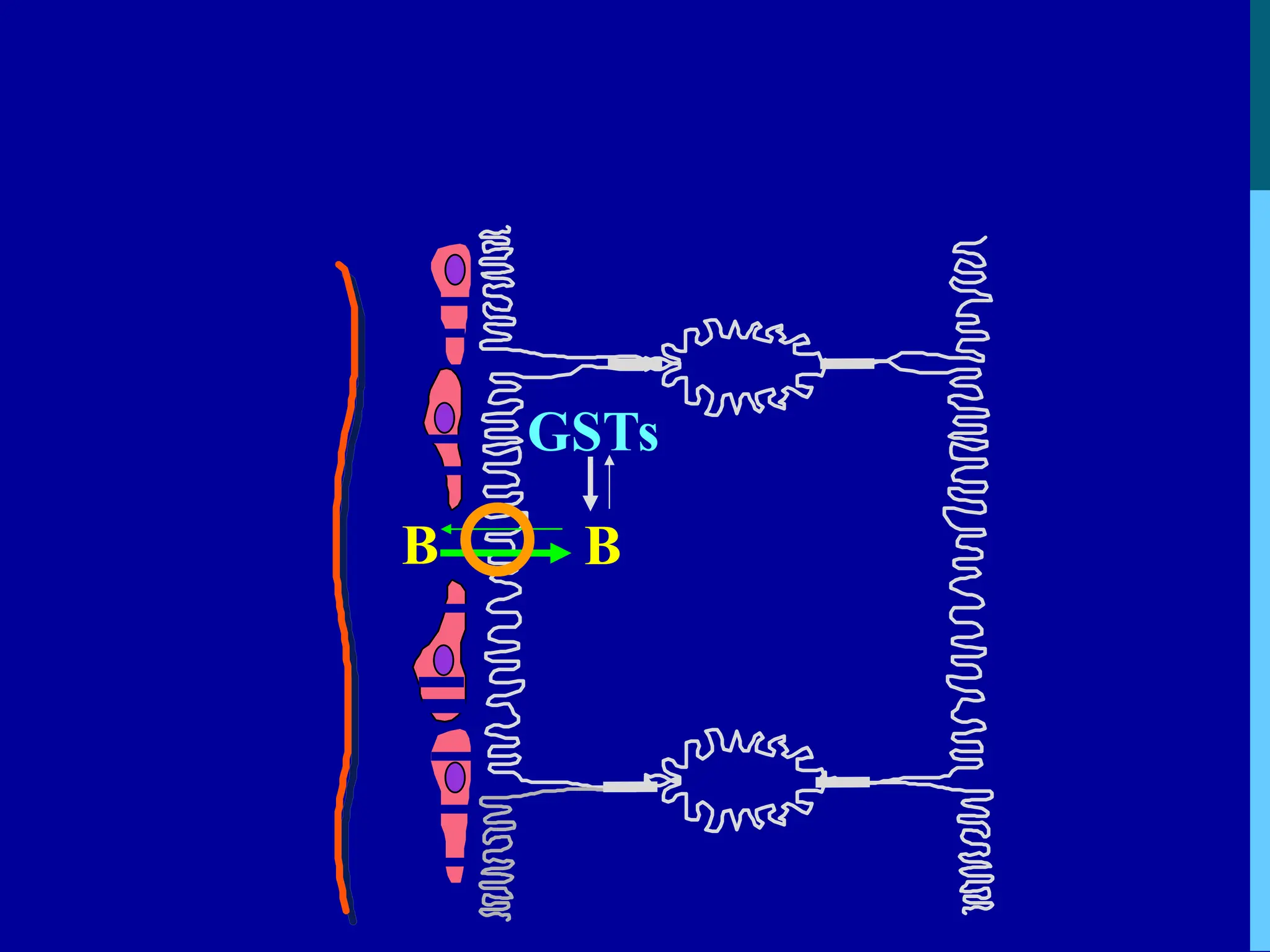
 Inside the hepatocyte, bilirubin binds to cytosolic proteins
termed ligandins, which are the same as glutathione-S-
transferases (GSTs).
GSTs
B
GST binding
inhibits the
efflux of bilirubin,
thereby increasing
its net uptake
B
GSTs
B
B
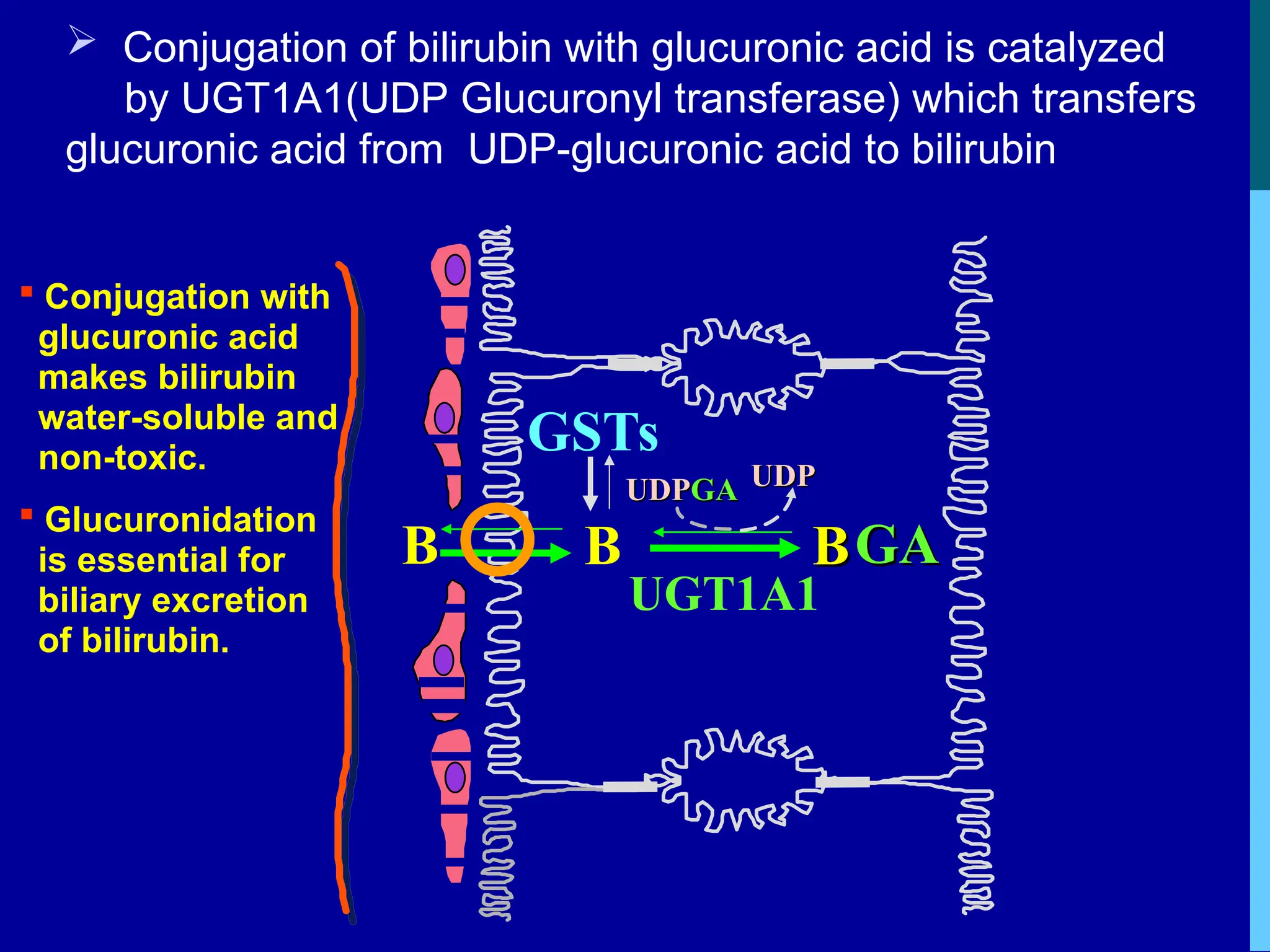
 Conjugation of bilirubin with glucuronic acid is catalyzed
by UGT1A1(UDP Glucuronyl transferase) which transfers
glucuronic acid from UDP-glucuronic acid to bilirubin
GSTs
UDP
UDPGA
GA UDP
UDP
B
BGA
GA
UGT1A1
B
 Conjugation with
glucuronic acid
makes bilirubin
water-soluble and
non-toxic.
 Glucuronidation
is essential for
biliary excretion
of bilirubin.
Seceretion of conjugated bilirubin
-“Cholebilirubin” in the bile
by liver hepatocytes is by active transport (which
needs energy)into bile canaliculi--- it’s a
rate limiting step, susceptible to impairment in liver
disease
-Color of bile is due to bilirubin
-Daily load of bilirubin: 250-300 mg in normal adults
.
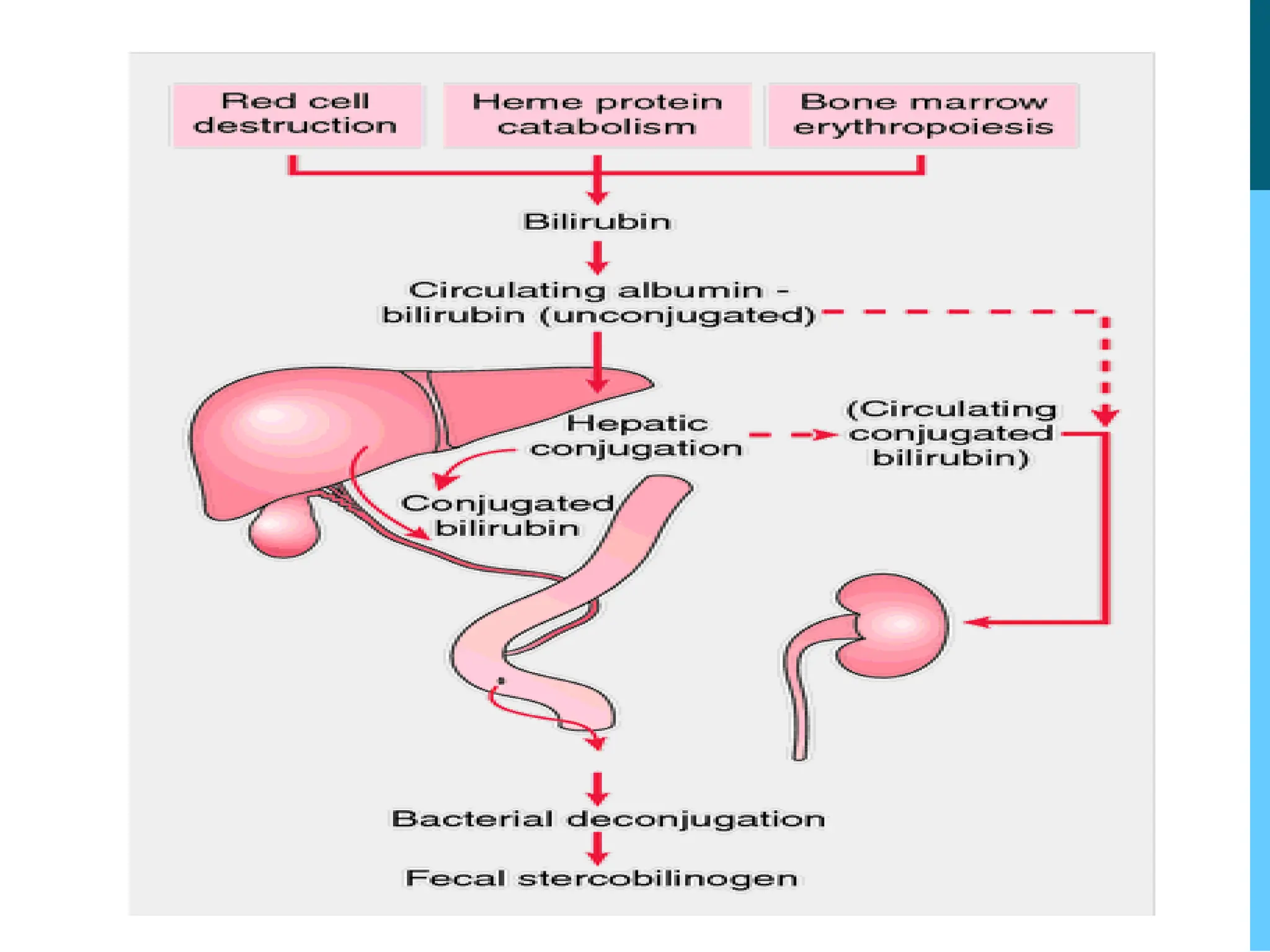
Conjugated” bilirubin is water soluble.it is secreted
by the hepatocytes into the biliary canaliculi and
enters the gut
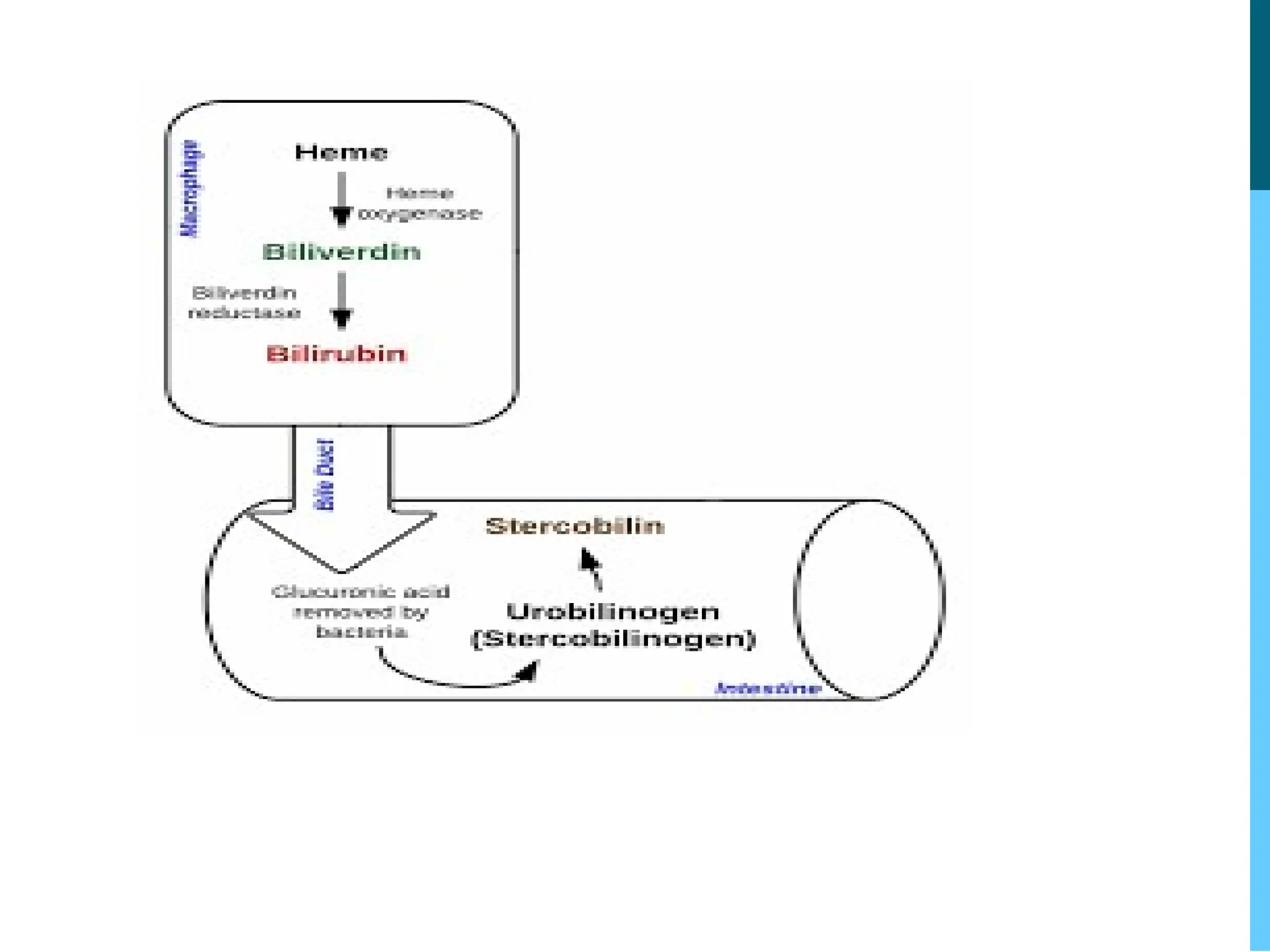
 Converted to stercobilinogen (urobilinogen)
(colorless) by bacteria in the gut which is
excreted in feces-80% and
20% enters entero hepatic circulation ---enters
general circulation ----gets filtered in kidney and
excreted as urinary urobilinogen or re-excreted by
liver.
HYPERBILIRUBINEMIA
 Increased plasma concentrations of bilirubin (> 2 mg/dL)
occurs when
there is an imbalance between its production and excretion
 Recognized clinically as jaundice
Jaundice

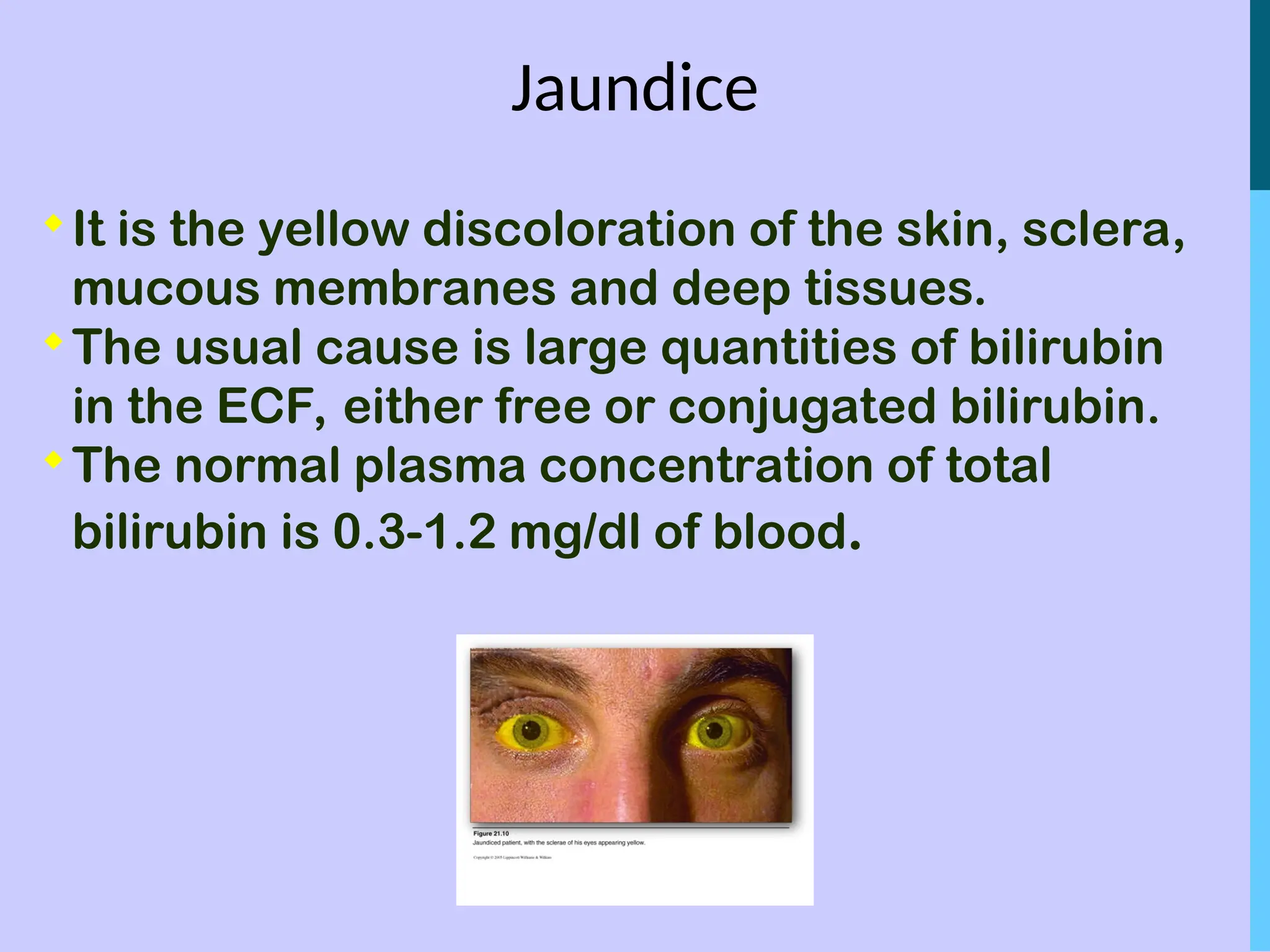
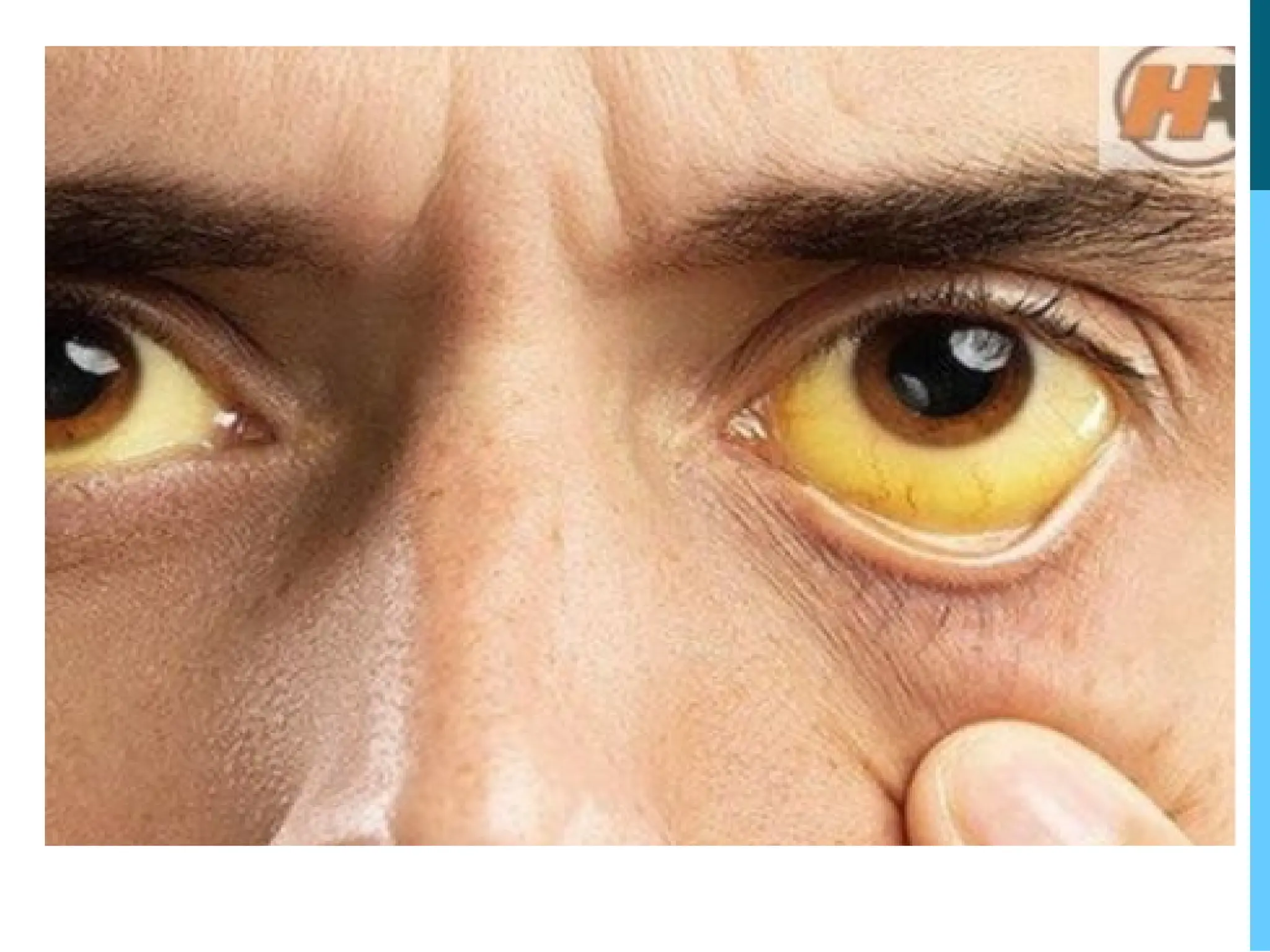
It is the yellow discoloration of the skin, sclera,
mucous membranes and deep tissues.

The usual cause is large quantities of bilirubin
in the ECF, either free or conjugated bilirubin.

The normal plasma concentration of total
bilirubin is 0.3-1.2 mg/dl of blood.
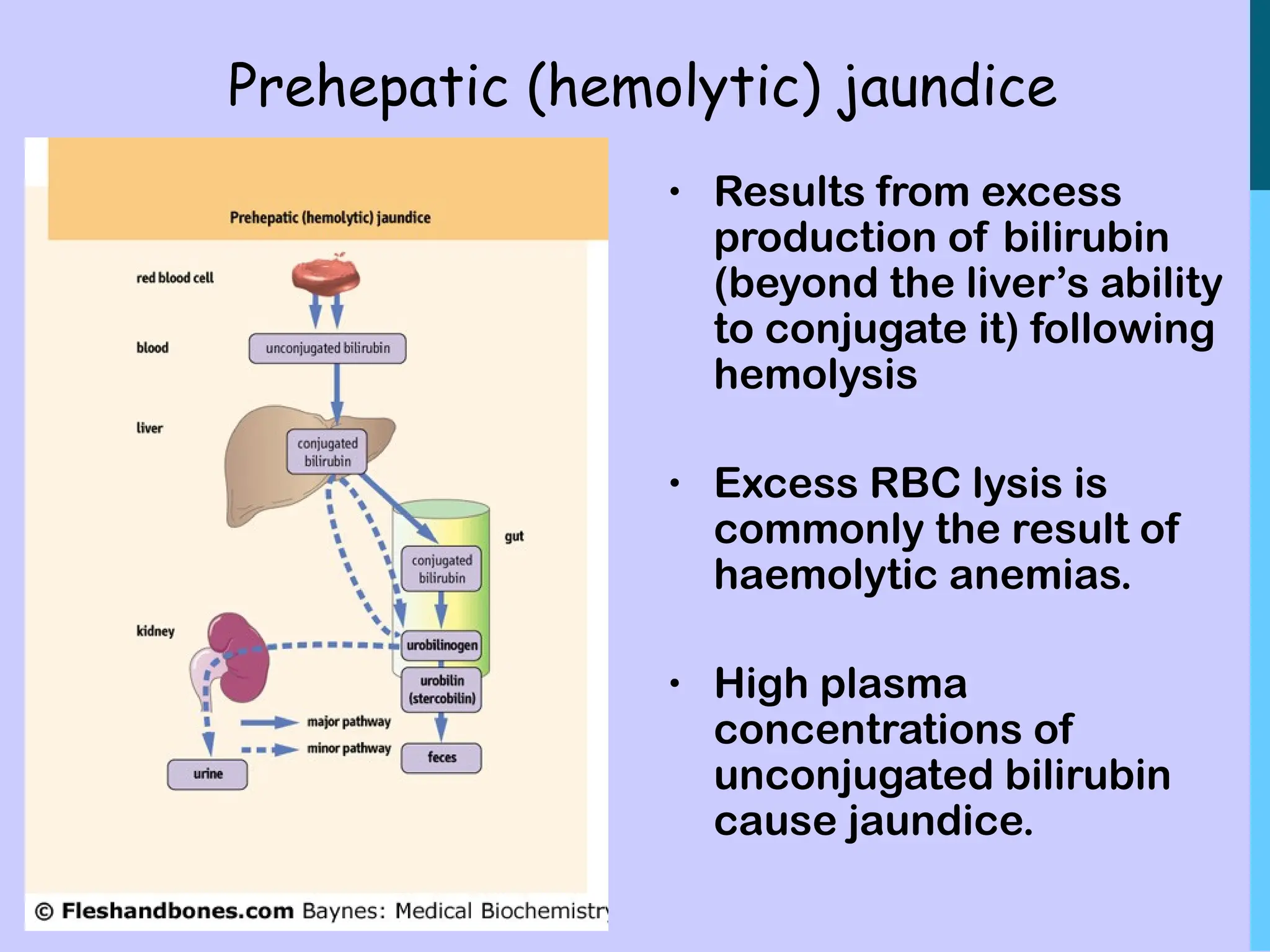
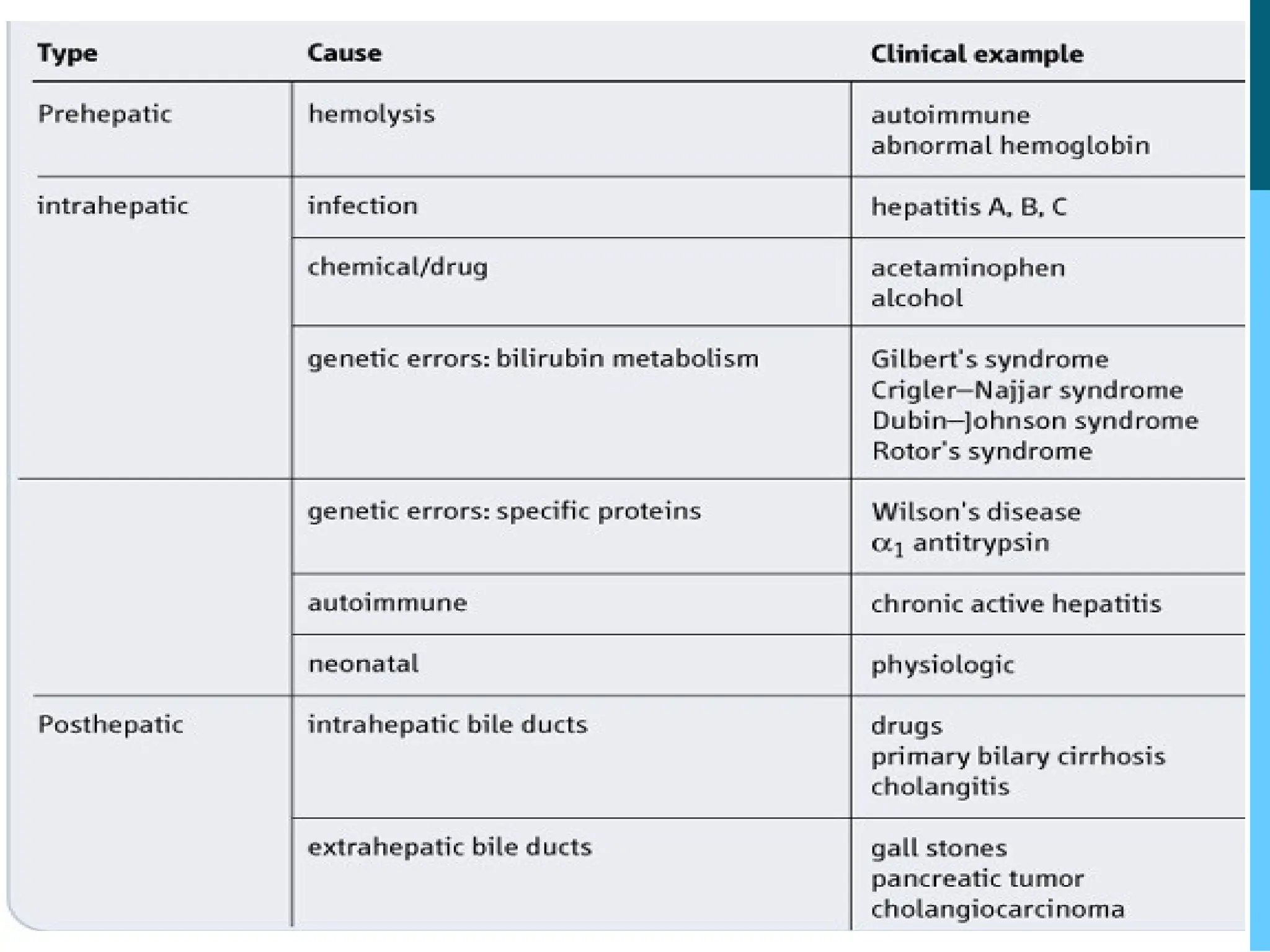
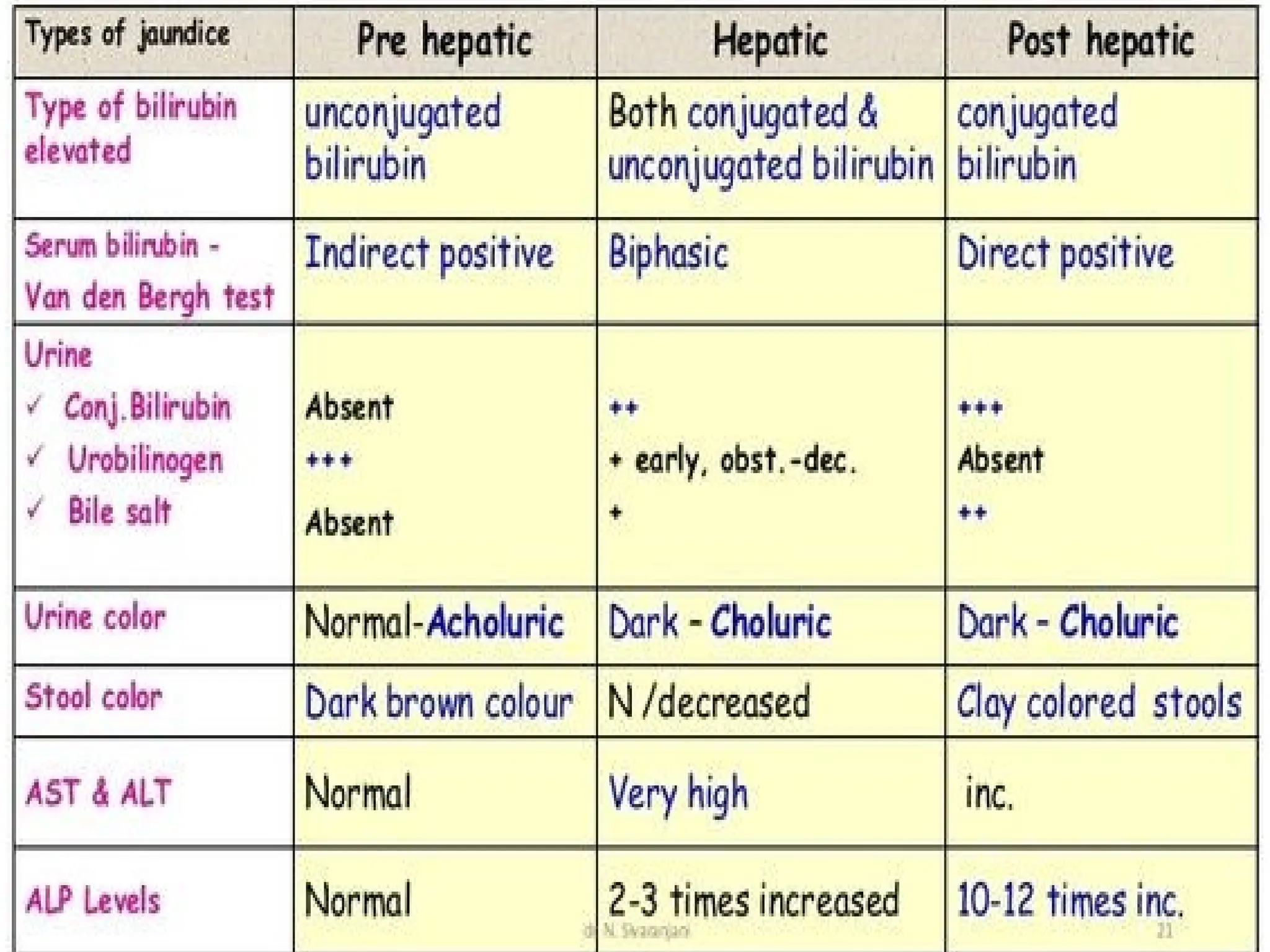
Prehepatic (hemolytic) jaundice
• Results from excess
production of bilirubin
(beyond the liver’s ability
to conjugate it) following
hemolysis
• Excess RBC lysis is
commonly the result of
haemolytic anemias.
• High plasma
concentrations of
unconjugated bilirubin
cause jaundice.
Intrahepatic jaundice
• In hepatocellular (or intrahepatic) jaundice, there
is dysfunction of the hepatic cells. The liver loses
the ability to conjugate bilirubin, but in cases
where it also may become cirrhotic,
it compresses the intra-hepatic portions of the
biliary tree to cause a degree of obstruction-
Impaired uptake, conjugation, and secretion of
bilirubin
• This leads to both unconjugated and
conjugated bilirubin in the blood,
accompanied by other abnormalities in
biochemical markers of liver function
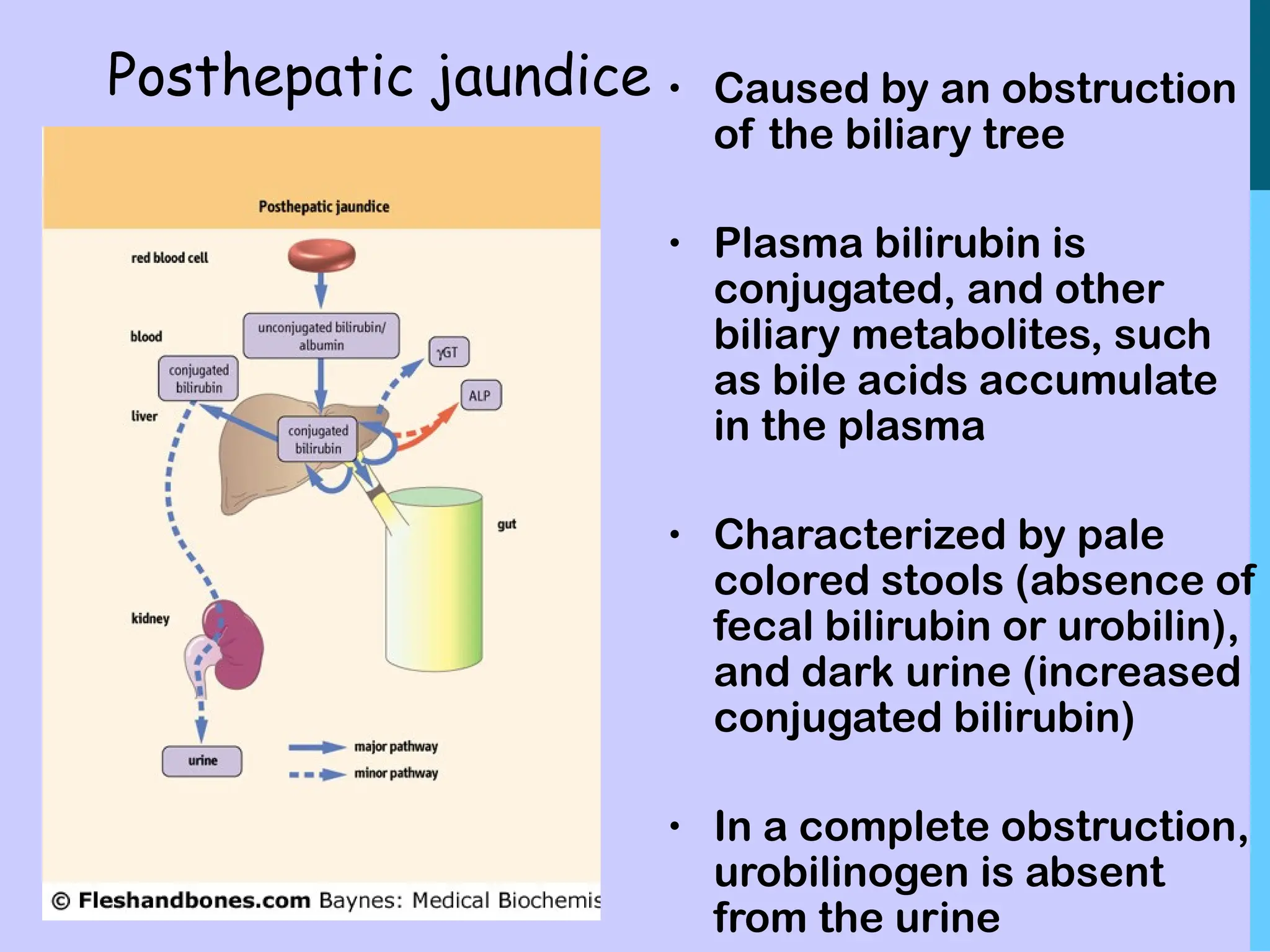
Posthepatic jaundice • Caused by an obstruction
of the biliary tree
• Plasma bilirubin is
conjugated, and other
biliary metabolites, such
as bile acids accumulate
in the plasma
• Characterized by pale
colored stools (absence of
fecal bilirubin or urobilin),
and dark urine (increased
conjugated bilirubin)
• In a complete obstruction,
urobilinogen is absent
from the urine
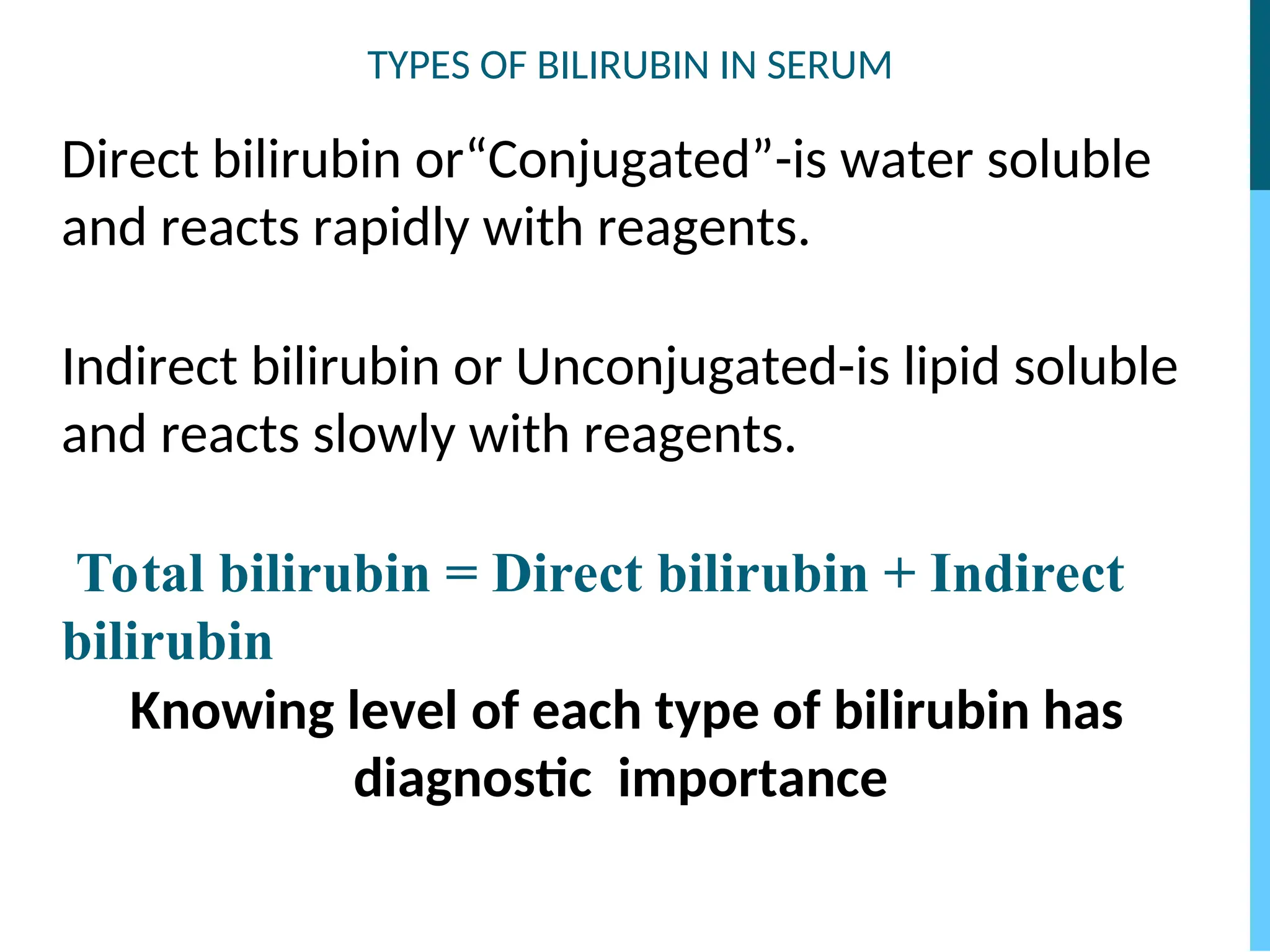
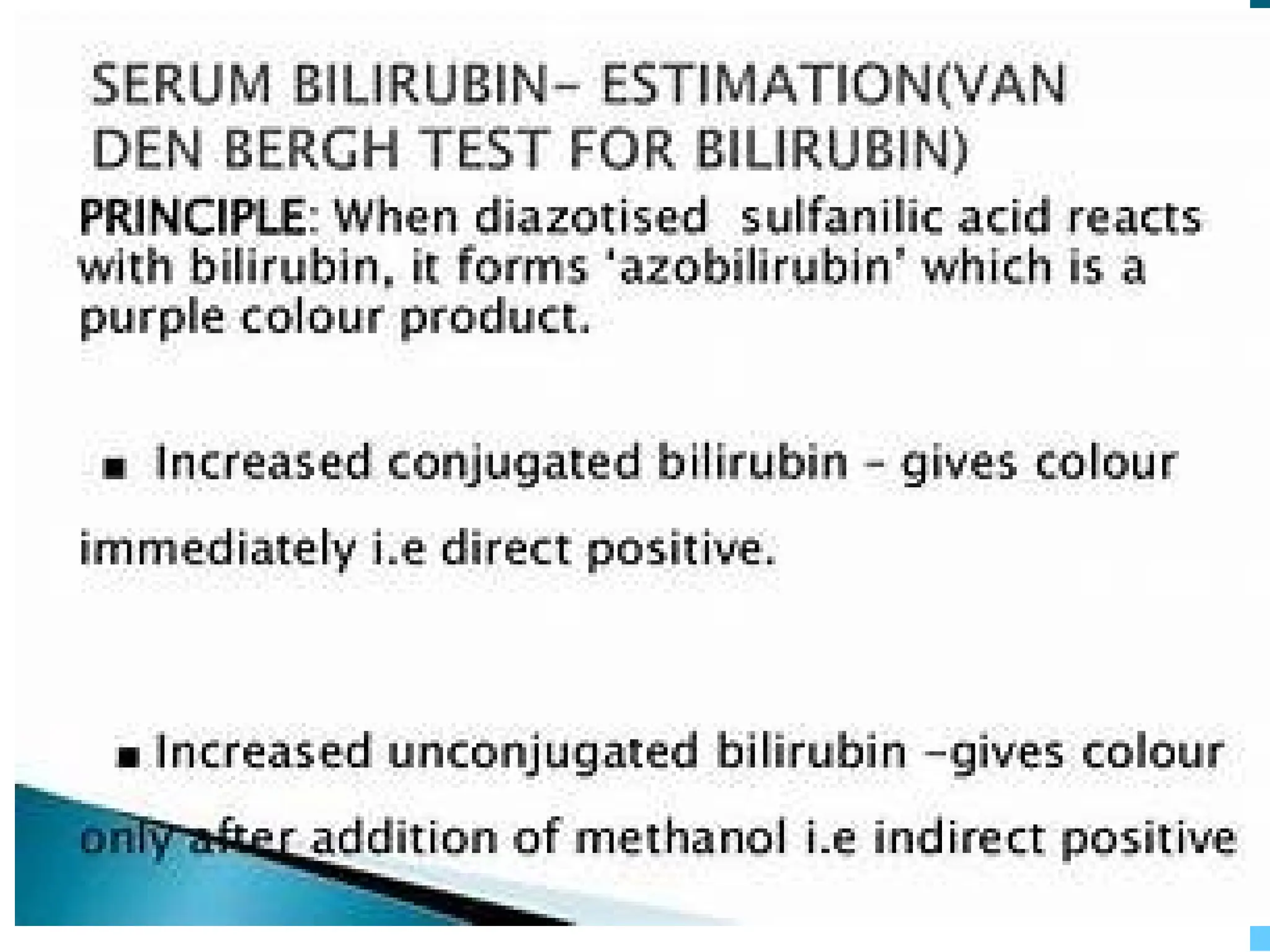
TYPES OF BILIRUBIN IN SERUM
Direct bilirubin or“Conjugated”-is water soluble
and reacts rapidly with reagents.
Indirect bilirubin or Unconjugated-is lipid soluble
and reacts slowly with reagents.
Total bilirubin = Direct bilirubin + Indirect
bilirubin
Knowing level of each type of bilirubin has
diagnostic importance
Diagnoses of Jaundice
Thank you for
your attention!

JAUNDICE for first mbbs acc to nmc curriculum

  • 1.
  • 2.
    FATE OF REDBLOOD CELLS  Life span in blood stream is 60-120 days  Senescent RBCs are phagocytosed and lysed by tissue macrophages which are a part of reticuloendothelial system.  Lysis can also occur intravascularly (in blood stream)
  • 3.
    Extravascular Pathway forRBC Destruction (Liver, Bone marrow, & Spleen) Hemoglobin Globin Amino acids Amino acid pool Heme Bilirubin Fe2+ Excreted Phagocytosis & Lysis reused
  • 4.
    Handling of Free(Intravascular) Hemoglobin • Haptoglobin: hemoglobin- haptoglobin complex is readily metabolized in the liver and spleen forming an iron-globin complex and bilirubin. Prevents loss of iron in urine
  • 5.
    DEGRADATION OF HEMETO BILIRUBIN P450 cytochrome  In normal adults this results in a daily load of 250-300 mg of bilirubin  Normal plasma concentrations are less than 1 mg/dL  Hydrophobic – transported by albumin to the liver for further metabolism prior to its excretion “unconjugated” bilirubin
  • 6.
    1ST Step BILIRUBIN FORMATION RBCs in blood stream Lifespan : 60-120 days. Old RBCs lysis by: 1)Extravascularly phagocytosed in the reticuloendothelial system or 2)intravascularly in blood stream Hemoglobin in Give Split into Globin breakdo wn and form Amino acids Free Iron Transported in the blood by transferrin Stored as a reservoir for erythropoiesis 1st pigment is biliverdin FREE BILIRUBIN into the plasma Bile pigments biliverdin reductase Heme (By heme oxygenize)
  • 8.
    2ND Step TRANSPORTOF BILIRUBININ PLASMA Formed Bilirubin in spleen immediately combines with plasma proteins (mainly albumin ) give a water soluble compound (hydrophilic) called hemobilirubin/ unconjugated/ indirect bilirubin still called free bilirubin transported to hepatocytes for further metabolism and Conjugation process Significance of bilirubin binding to albumin?!! 1)Increase the solubility of whole molecule. 2)Prevent unconjugated bilirubin freely come into other tissue, causing damage
  • 9.
    Hepatic uptake “1stStep”- Bilirubin(without the albumin)is absorbed through the hepatic cell membrane, mediated by a carrier protein organic anion transport organic anion transport protein 2 (oatp2) . protein 2 (oatp2) .
  • 10.
    Conjugation of bilirubin- -80% of free bilirubin conugate with 2 Uridine diphospho-glucuronic acid (UDPGA) catalyzed by the enzyme glucuronyl transferase in the smooth ER, forming the compound Bilirubin Diglucurnoide (the conjugated form of bilirubin) that is water soluble -20% of the rest bilirubin conjugate with sulphate & other substances.
  • 11.
    Bilirubin throughput: schemaof a hepatocyte Bilirubin throughput: schema of a hepatocyte Sinusoidal surface Canalicular surface Tight junction Liver sinusoid Fenestrated endothelium
  • 12.
     Bilirubin circulatesbound to serum albumin. B B alb Albumin- binding:  Keeps bilirubin soluble  Prevents tissue deposi- tion.  Prevents renal excretion  Drugs that displace bilirubin from albumin may precipitate kernicterus: Sulfonamides Coumadin, etc.
  • 13.
     At thesinusoidal surface of hepatocytes, it dissociates from albumin. B B alb
  • 14.
     At thesinusoidal surface of hepatocytes, it dissociates from albumin. B B alb
  • 15.
    .  At thesinusoidal surface of hepatocytes, it dissociates from albumin. B B alb
  • 16.
    .  At thesinusoidal surface of hepatocytes, it dissociates from albumin. B B alb
  • 17.
     Bilirubin entersthrough the sinusoidal surface, probably by facilitated diffusion. B B Bilirubin uptake is reduced:  In neonates  In cirrhosis  From drug effect: novobiocin  In some cases of Gilbert syndrome
  • 18.
    B  Inside thehepatocyte, bilirubin binds to cytosolic proteins termed ligandins, which are the same as glutathione-S- transferases (GSTs). GSTs B GST binding inhibits the efflux of bilirubin, thereby increasing its net uptake
  • 19.
  • 20.
    B  Conjugation ofbilirubin with glucuronic acid is catalyzed by UGT1A1(UDP Glucuronyl transferase) which transfers glucuronic acid from UDP-glucuronic acid to bilirubin GSTs UDP UDPGA GA UDP UDP B BGA GA UGT1A1 B  Conjugation with glucuronic acid makes bilirubin water-soluble and non-toxic.  Glucuronidation is essential for biliary excretion of bilirubin.
  • 21.
    Seceretion of conjugatedbilirubin -“Cholebilirubin” in the bile by liver hepatocytes is by active transport (which needs energy)into bile canaliculi--- it’s a rate limiting step, susceptible to impairment in liver disease -Color of bile is due to bilirubin -Daily load of bilirubin: 250-300 mg in normal adults
  • 22.
    . Conjugated” bilirubin iswater soluble.it is secreted by the hepatocytes into the biliary canaliculi and enters the gut  Converted to stercobilinogen (urobilinogen) (colorless) by bacteria in the gut which is excreted in feces-80% and 20% enters entero hepatic circulation ---enters general circulation ----gets filtered in kidney and excreted as urinary urobilinogen or re-excreted by liver.
  • 25.
    HYPERBILIRUBINEMIA  Increased plasmaconcentrations of bilirubin (> 2 mg/dL) occurs when there is an imbalance between its production and excretion  Recognized clinically as jaundice
  • 26.
    Jaundice  It is theyellow discoloration of the skin, sclera, mucous membranes and deep tissues.  The usual cause is large quantities of bilirubin in the ECF, either free or conjugated bilirubin.  The normal plasma concentration of total bilirubin is 0.3-1.2 mg/dl of blood.
  • 28.
    Prehepatic (hemolytic) jaundice •Results from excess production of bilirubin (beyond the liver’s ability to conjugate it) following hemolysis • Excess RBC lysis is commonly the result of haemolytic anemias. • High plasma concentrations of unconjugated bilirubin cause jaundice.
  • 29.
    Intrahepatic jaundice • Inhepatocellular (or intrahepatic) jaundice, there is dysfunction of the hepatic cells. The liver loses the ability to conjugate bilirubin, but in cases where it also may become cirrhotic, it compresses the intra-hepatic portions of the biliary tree to cause a degree of obstruction- Impaired uptake, conjugation, and secretion of bilirubin • This leads to both unconjugated and conjugated bilirubin in the blood, accompanied by other abnormalities in biochemical markers of liver function
  • 30.
    Posthepatic jaundice •Caused by an obstruction of the biliary tree • Plasma bilirubin is conjugated, and other biliary metabolites, such as bile acids accumulate in the plasma • Characterized by pale colored stools (absence of fecal bilirubin or urobilin), and dark urine (increased conjugated bilirubin) • In a complete obstruction, urobilinogen is absent from the urine
  • 32.
    TYPES OF BILIRUBININ SERUM Direct bilirubin or“Conjugated”-is water soluble and reacts rapidly with reagents. Indirect bilirubin or Unconjugated-is lipid soluble and reacts slowly with reagents. Total bilirubin = Direct bilirubin + Indirect bilirubin Knowing level of each type of bilirubin has diagnostic importance
  • 35.
  • 36.