The Life and
Times of
William
Shakespeare
by Jackie Fulker
Target Learners
High School English
Language Arts Students
→ Juniors/Seniors
enrolled in British
Literature
Smartboard Lesson
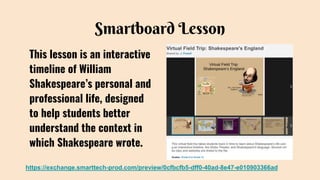
This lesson is an interactive
timeline of William
Shakespeare’s personal and
professional life, designed
to help students better
understand the context in
which Shakespeare wrote.
https://exchange.smarttech-prod.com/preview/0cfbcfb5-dff0-40ad-8e47-e010903366ad
Using this Lesson
● As a class, my students and I will work through the lesson on the
smartboard, clicking on the various links sprinkled throughout so that
it won’t just be me lecturing them using a powerpoint.
○ I will ask students to volunteer to be clickers and readers to get
them more involved.
● Each time there is a gray box covering information, students will
brainstorm within their small groups what is behind the box. We will
share answers as a class and reveal what is behind the box.
Reworking this Lesson
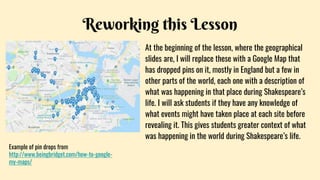
At the beginning of the lesson, where the geographical
slides are, I will replace these with a Google Map that
has dropped pins on it, mostly in England but a few in
other parts of the world, each one with a description of
what was happening in that place during Shakespeare’s
life. I will ask students if they have any knowledge of
what events might have taken place at each site before
revealing it. This gives students greater context of what
was happening in the world during Shakespeare’s life.
Example of pin drops from
http://www.beingbridget.com/how-to-google-
my-maps/
Reworking this Lesson
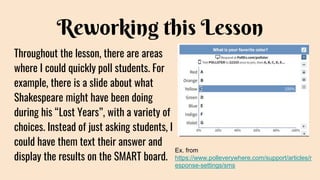
Throughout the lesson, there are areas
where I could quickly poll students. For
example, there is a slide about what
Shakespeare might have been doing
during his “Lost Years”, with a variety of
choices. Instead of just asking students, I
could have them text their answer and
display the results on the SMART board.
Ex. from
https://www.polleverywhere.com/support/articles/r
esponse-settings/sms
Reworking this Lesson
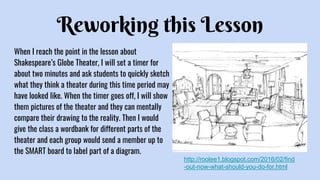
When I reach the point in the lesson about
Shakespeare’s Globe Theater, I will set a timer for
about two minutes and ask students to quickly sketch
what they think a theater during this time period may
have looked like. When the timer goes off, I will show
them pictures of the theater and they can mentally
compare their drawing to the reality. Then I would
give the class a wordbank for different parts of the
theater and each group would send a member up to
the SMART board to label part of a diagram.
http://roolee1.blogspot.com/2016/02/find
-out-now-what-should-you-do-for.html
Reworking this Lesson
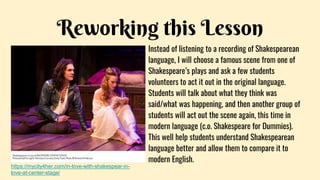
Instead of listening to a recording of Shakespearean
language, I will choose a famous scene from one of
Shakespeare’s plays and ask a few students
volunteers to act it out in the original language.
Students will talk about what they think was
said/what was happening, and then another group of
students will act out the scene again, this time in
modern language (c.o. Shakespeare for Dummies).
This well help students understand Shakespearean
language better and allow them to compare it to
modern English.
https://mycity4her.com/in-love-with-shakespear-in-
love-at-center-stage/
Reworking this Lesson
Finally, I would change the assessment options to give students more variety in how they can engage
with the material and be assessed.
● Option 1: Create a newspaper article about an event from Shakespeare’s life, whether personal,
professional, or political. Use Elizabethan language consistently throughout your article. (This
option is taken from the original lesson, just slightly tweaked.)
● Option 2: With a group, write and film a dramatic scene using Shakespearean language.
● Option 3: Create your own Google Map of England with at least 10 pins, each with a description
of an event (at least 5 sentences) that happened there during Shakespeare’s life.
● Option 4: Create a sketch-timeline of at least 12 events from Shakespeare’s life. Sketches
must have plenty of effort put into them and include a short description of each event (at least
one sentence).
Universal Design for Learning
● The lesson I chose supports Universal Design for Learning by
allowing students to engage with the material through pictures,
videos, and recordings. The lesson also three different options
for assessment, allowing students to highlight their strengths
while also showcasing what they have learned.
● What I added to better support UDL:
○ More opportunities for engagement and discussion
○ Opportunity for artistic engagement
○ Opportunity for kinesthetic engagement
○ Greater variation of assessment options
■ Students can express what they have learned in
different ways→ more than just writing

Jackie Fulker EDP 279 Unit 4.1

  • 1.
    The Life and Timesof William Shakespeare by Jackie Fulker
  • 2.
    Target Learners High SchoolEnglish Language Arts Students → Juniors/Seniors enrolled in British Literature
  • 3.
    Smartboard Lesson This lessonis an interactive timeline of William Shakespeare’s personal and professional life, designed to help students better understand the context in which Shakespeare wrote. https://exchange.smarttech-prod.com/preview/0cfbcfb5-dff0-40ad-8e47-e010903366ad
  • 4.
    Using this Lesson ●As a class, my students and I will work through the lesson on the smartboard, clicking on the various links sprinkled throughout so that it won’t just be me lecturing them using a powerpoint. ○ I will ask students to volunteer to be clickers and readers to get them more involved. ● Each time there is a gray box covering information, students will brainstorm within their small groups what is behind the box. We will share answers as a class and reveal what is behind the box.
  • 5.
    Reworking this Lesson Atthe beginning of the lesson, where the geographical slides are, I will replace these with a Google Map that has dropped pins on it, mostly in England but a few in other parts of the world, each one with a description of what was happening in that place during Shakespeare’s life. I will ask students if they have any knowledge of what events might have taken place at each site before revealing it. This gives students greater context of what was happening in the world during Shakespeare’s life. Example of pin drops from http://www.beingbridget.com/how-to-google- my-maps/
  • 6.
    Reworking this Lesson Throughoutthe lesson, there are areas where I could quickly poll students. For example, there is a slide about what Shakespeare might have been doing during his “Lost Years”, with a variety of choices. Instead of just asking students, I could have them text their answer and display the results on the SMART board. Ex. from https://www.polleverywhere.com/support/articles/r esponse-settings/sms
  • 7.
    Reworking this Lesson WhenI reach the point in the lesson about Shakespeare’s Globe Theater, I will set a timer for about two minutes and ask students to quickly sketch what they think a theater during this time period may have looked like. When the timer goes off, I will show them pictures of the theater and they can mentally compare their drawing to the reality. Then I would give the class a wordbank for different parts of the theater and each group would send a member up to the SMART board to label part of a diagram. http://roolee1.blogspot.com/2016/02/find -out-now-what-should-you-do-for.html
  • 8.
    Reworking this Lesson Insteadof listening to a recording of Shakespearean language, I will choose a famous scene from one of Shakespeare’s plays and ask a few students volunteers to act it out in the original language. Students will talk about what they think was said/what was happening, and then another group of students will act out the scene again, this time in modern language (c.o. Shakespeare for Dummies). This well help students understand Shakespearean language better and allow them to compare it to modern English. https://mycity4her.com/in-love-with-shakespear-in- love-at-center-stage/
  • 9.
    Reworking this Lesson Finally,I would change the assessment options to give students more variety in how they can engage with the material and be assessed. ● Option 1: Create a newspaper article about an event from Shakespeare’s life, whether personal, professional, or political. Use Elizabethan language consistently throughout your article. (This option is taken from the original lesson, just slightly tweaked.) ● Option 2: With a group, write and film a dramatic scene using Shakespearean language. ● Option 3: Create your own Google Map of England with at least 10 pins, each with a description of an event (at least 5 sentences) that happened there during Shakespeare’s life. ● Option 4: Create a sketch-timeline of at least 12 events from Shakespeare’s life. Sketches must have plenty of effort put into them and include a short description of each event (at least one sentence).
  • 10.
    Universal Design forLearning ● The lesson I chose supports Universal Design for Learning by allowing students to engage with the material through pictures, videos, and recordings. The lesson also three different options for assessment, allowing students to highlight their strengths while also showcasing what they have learned. ● What I added to better support UDL: ○ More opportunities for engagement and discussion ○ Opportunity for artistic engagement ○ Opportunity for kinesthetic engagement ○ Greater variation of assessment options ■ Students can express what they have learned in different ways→ more than just writing