J.Christopher McGee


  Resume & Portfolio
J. Christopher McGee
                                                                                                          j.christopher.mcgee@gmail.com


Objective

         To gain employment in the Architecture/Design Industry where my innovative ideas, creative abilities, technical skills,
         and diverse experience may be used to increase efficiency and profitability in a challenging and inspiring environment.

Goals

         To achieve a level of design that brings meaning and imagination to the built environment and helps people’s lives
             to be healthier, happier, more comfortable, and more sustainable
         To examine themes of scale, culture, nature, pattern, color, landscape, movement, and story in architecture
         To further my knowledge in the use of materials, architectural detailing, and general methods of construction
         To become a knowledgeable and profitable architect and add value to a firm

Education

         Savannah College of Art and Design (SCAD), Savannah, GA
            Masters of Architecture, Bachelors of Architecture, Minor in Architectural History
            Cumulative GPA 3.85, Magna cum Laude, 3rd in class, 2005

         Rocky Bayou Christian School, Niceville, FL, 2000

Experience

         Cherry Huffman Architects (AIA NC Firm of the Year 2009), Raleigh, NC, Intern, September 1, 2005 – October 30, 2007:
            Extensive experience in K-12 and Residential design and construction documents
            Managed an elementary school and a residential project

         Blinn Van Mater Architect, Fort Walton Beach, FL, Intern, summer 2002:
             Mixed-use, Residential, schematic design, and rendering

         Fort Walton Beach Mainstreet Program, Volunteer, winter 2003

Skills

         Software: Revit, AutoCAD, MicroStation, SketchUp, Photoshop, Illustrator, InDesign, Microsoft Office, Mac OS X 10.4 –
             10.6, and Windows XP, 7
         Accomplished in graphic presentation, hand and computer rendering, construction documents, schematic design, models,
             sketching, hand drafting, and writing
         Experienced at preparing and leading presentations
         Collaborative in team environments

Honors

         The Chapel Hill Residence project I managed at Cherry Huffman Architects was selected as the “Home of the Month” for
             April 2010 by the News & Observer, the series is a program sponsored by the North Carolina State School of Design
         2007 “Market Value” Architecture competition, entry selected for exhibition, Charlottesville, VA
         2005 Academic Achievement Award in Architecture, SCAD, only two are given annually in a graduating class
         Nominated by SCAD Architecture faculty to submit for the SOM Prize 2005
         Member of Tau Sigma Delta
         Juror for architecture studio critiques and an advisor for architectural graphics, SCAD
         Received the May and Paul Poetter Scholarship, SCAD
J. Christopher McGee
                                                                                                         j.christopher.mcgee@gmail.com


Exhibitions

      The University of Miami, FL, “Pier Museum: Miami 2009” Architecture competition in 2009
      The Southeastern Center for Contemporary Arts, Winston Salem, NC, “Eat My Dust” exhibition in 2007
      CCDC Charlottesville, VA, “Market Value” Architecture competition in 2007
      The Savannah Municipal Planning Authority, Studio VII Project in 2004
      Paris, France, “Pour l’amour des Chiens” exhibition in 2003
      Work has also been exhibited in Eichberg; Anderson; Alexander; and Wallin Halls at SCAD 2000-05

Activities

       Accomplished western style horseback rider, artist, traveler, sailor, avid hiker, dog lover, amateur photographer, reader,
           and coffee and tea enthusiast
       Counterpane School volunteer, Fayetteville, GA, assisted with floor plans for use in future renovation, summer 2010
       Designed “Local” logo for First City Bank, Fort Walton Beach, FL, summer 2009
       Backpacked through 14 countries spanning 6 continents in 9 months in 2008
       Jackaroo at Gwydir River Trail Rides, Jackaroo Jillaroo Adventure, Bingara, NSW, Australia July 5, 2008 – Sept. 17, 2008
       Travel: traveled extensively throughout Western Europe, summer 2000; Scandinavia, summer 2002-03; Hawaii, summer
           2004; Italy, winter 2004; Eastern Europe, summer 2005; Spain, winter 2007
       SPARKcon volunteer 2006-07, a creative culture conference for the North Carolina Triangle area
       AIAS Member 2000-05; SCAD AIAS Communications Officer 2003; organized “Dinner with an Architect” 2003; assisted
           with the James Howard Kunstler Lecture 2003; taught the Architectural Lettering Workshop, fall 2004; assisted and
           taught in the SCAD AIAS volunteer program Archi-Pet-Ture in 2003-04 teaching Elementary students architecture
           through the design of a pet home at the Charles Ellis Montessori Academy in Savannah, GA, this program won the
           2003 AIAS National Community Service Honor Award
       SCAD Ambassador 2002-05, worked with prospective students and their parents through the Admissions department
       Project Green Member, a student organization focusing on sustainable design, 2003-05
       Journalist for the COMpost newsletter produced by Project Green, 2004-05
       SCAD Sailing Club 2002-04
       SCAD New York City Off-Campus Program, summer 2003
       Co-designer of Rocky Bayou Christian School “Jousting Knight” logo, 2000
       SCAD Rising Star, summer 1999
Chapel Hill Residence                                                selected as The News and Observer’s April 2010 Home of the Month, published April 24, 2010

A Cherry Huffman Architects Project Completed 2009: Residential Addition/Renovation, Sustainable Design                           Chapel Hill, North Carolina


                                                                                                                                               01: Front Elevation

Description

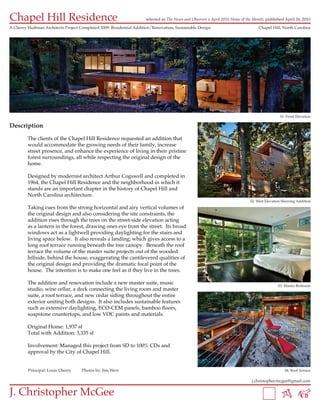
         The clients of the Chapel Hill Residence requested an addition that
         would accommodate the growing needs of their family, increase
         street presence, and enhance the experience of living in their pristine
         forest surroundings, all while respecting the original design of the
         home.

         Designed by modernist architect Arthur Cogswell and completed in
         1964, the Chapel Hill Residence and the neighborhood in which it
         stands are an important chapter in the history of Chapel Hill and
         North Carolina architecture.
                                                                                                                              02: West Elevation Showing Addition
         Taking cues from the strong horizontal and airy vertical volumes of
         the original design and also considering the site constraints, the
         addition rises through the trees on the street-side elevation acting
         as a lantern in the forest, drawing ones eye from the street. Its broad
         windows act as a lightwell providing daylighting for the stairs and
         living space below. It also reveals a landing; which gives access to a
         long roof terrace running beneath the tree canopy. Beneath the roof
         terrace the volume of the master suite projects out of the wooded
         hillside, behind the house, exaggerating the cantilevered qualities of
         the original design and providing the dramatic focal point of the
         house. The intention is to make one feel as if they live in the trees.

         The addition and renovation include a new master suite, music                                                                        03: Master Bedroom
         studio, wine cellar, a deck connecting the living room and master
         suite, a roof terrace, and new cedar siding throughout the entire
         exterior uniting both designs. It also includes sustainable features
         such as extensive daylighting, ECO-CEM panels, bamboo floors,
         soapstone countertops, and low VOC paints and materials.

         Original Home: 1,937 sf
         Total with Addition: 3,335 sf

         Involvement: Managed this project from SD to 100% CDs and
         approval by the City of Chapel Hill.


         Principal: Louis Cherry     Photos by: Jim West                                                                                         04: Roof Terrace

                                                                                                                               j.christopher.mcgee@gmail.com


J. Christopher McGee
Wakelon Elementary School
A Cherry Huffman Architects Project Completed 2006: Prototype School                      Zebulon, North Carolina


                                                                                              01: Multipurpose Room

Description

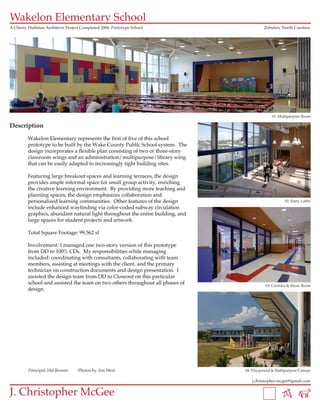
         Wakelon Elementary represents the first of five of this school
         prototype to be built by the Wake County Public School system. The
         design incorporates a flexible plan consisting of two or three-story
         classroom wings and an administration/multipurpose/library wing
         that can be easily adapted to increasingly tight building sites.

         Featuring large breakout spaces and learning terraces, the design
         provides ample informal space for small group activity, enriching
         the creative learning environment. By providing more teaching and
         planning spaces, the design emphasizes collaboration and
         personalized learning communities. Other features of the design                             02: Entry Lobby
         include enhanced wayfinding via color-coded subway circulation
         graphics, abundant natural light throughout the entire building, and
         large spaces for student projects and artwork.

         Total Square Footage: 99,562 sf

         Involvement: I managed one two-story version of this prototype
         from DD to 100% CDs. My responsibilities while managing
         included: coordinating with consultants, collaborating with team
         members, assisting at meetings with the client, and the primary
         technician on construction documents and design presentation. I
         assisted the design team from DD to Closeout on this particular
         school and assisted the team on two others throughout all phases of               03: Corridor & Music Room
         design.


         Principal: Hal Bowen      Photos by: Jim West                          04: Playground & Multipurpose Canopy

                                                                                   j.christopher.mcgee@gmail.com


J. Christopher McGee
Embrace: Miami Pier Museum
Competition entry: Arquitectum Pier-Museum, Miami 2009: Cultural Monument                      South Beach, Miami, Florida


                                                                                                01: Beach View South Elevation

Concept

        Embrace
        Part of Speech: verb
        Definition: include in one’s beliefs; take into account
        Synonyms: accept, accomodate, admit, adopt, avail oneself of,
        comprehend, comprise, contain, cover, deal with, embody, enclose,
        encompass, espouse, get into, go in for, grab, have, incorporate,
        involve, make use of, provide for, receive, seize, subsume, take
        advantage of, in, take on, take up, welcome.
        Antonyms: disbeleive, distrust, exclude, reject, shun.

        These synonyms and antonyms describe the issues surrounding an                              02: Beach Steps Perspective
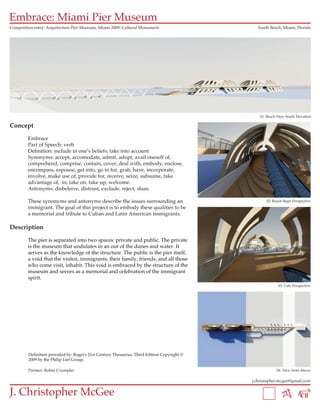
        immigrant. The goal of this project is to embody these qualities to be
        a memorial and tribute to Cuban and Latin American immigrants.

Description

        The pier is separated into two spaces: private and public. The private
        is the museum that undulates in an out of the dunes and water. It
        serves as the knowledge of the structure. The public is the pier itself,
        a void that the visitor, immigrants, their family, friends, and all those
        who come visit, inhabit. This void is embraced by the structure of the
        museum and serves as a memorial and celebration of the immigrant
        spirit.
                                                                                                           03: Cafe Perspective


         Definition provided by: Roget's 21st Century Thesaurus, Third Edition Copyright ©
         2009 by the Philip Lief Group.

         Partner: Robin Crumpler                                                                          04: View from Above

                                                                                             j.christopher.mcgee@gmail.com


J. Christopher McGee
Marshland CoOp
Studio V Project: Sustainable Design, Brownfield Reclamation                                  Thunderbolt, Georgia


                                                                                             01: Aerial Perspective East

Concept

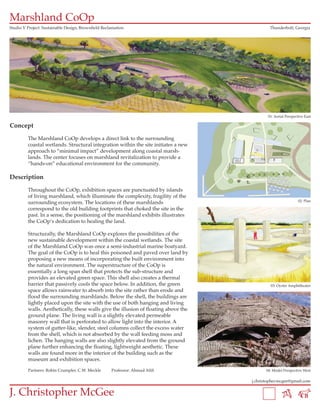
         The Marshland CoOp develops a direct link to the surrounding
         coastal wetlands. Structural integration within the site initiates a new
         approach to “minimal impact” development along coastal marsh-
         lands. The center focuses on marshland revitalization to provide a
         “hands-on” educational environment for the community.

Description

         Throughout the CoOp, exhibition spaces are punctuated by islands
         of living marshland, which illuminate the complexity, fragility of the
                                                                                                               02: Plan
         surrounding ecosystem. The locations of these marshlands
         correspond to the old building footprints that choked the site in the
         past. In a sense, the positioning of the marshland exhibits illustrates
         the CoOp’s dedication to healing the land.

         Structurally, the Marshland CoOp explores the possibilities of the
         new sustainable development within the coastal wetlands. The site
         of the Marshland CoOp was once a semi-industrial marine boatyard.
         The goal of the CoOp is to heal this poisoned and paved over land by
         proposing a new means of incorporating the built environment into
         the natural environment. The superstructure of the CoOp is
         essentially a long span shell that protects the sub-structure and
         provides an elevated green space. This shell also creates a thermal
         barrier that passively cools the space below. In addition, the green                 03: Oyster Amphitheater
         space allows rainwater to absorb into the site rather than erode and
         flood the surrounding marshlands. Below the shell, the buildings are
         lightly placed upon the site with the use of both hanging and living
         walls. Aesthetically, these walls give the illusion of floating above the
         ground plane. The living wall is a slightly elevated permeable
         masonry wall that is perforated to allow light into the interior. A
         system of gutter-like, slender, steel columns collect the excess water
         from the shell, which is not absorbed by the wall feeding moss and
         lichen. The hanging walls are also slightly elevated from the ground
         plane further enhancing the floating, lightweight aesthetic. These
         walls are found more in the interior of the building such as the
         museum and exhibition spaces.

         Partners: Robin Crumpler, C.W. Meckle       Professor: Ahmad Afifi                 04: Model Perspective West

                                                                                     j.christopher.mcgee@gmail.com


J. Christopher McGee
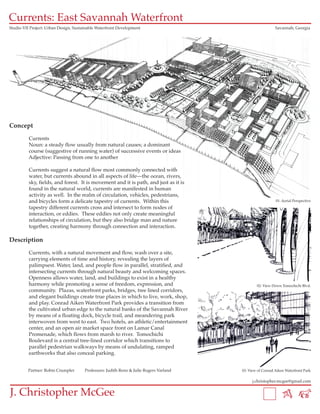
Currents: East Savannah Waterfront
Studio VII Project: Urban Design, Sustainable Waterfront Development                                       Savannah, Georgia


Concept

          Currents
          Noun: a steady flow usually from natural causes; a dominant
          course (suggestive of running water) of successive events or ideas
          Adjective: Passing from one to another

          Currents suggest a natural flow most commonly connected with
          water, but currents abound in all aspects of life—the ocean, rivers,
          sky, fields, and forest. It is movement and it is path, and just as it is
          found in the natural world, currents are manifested in human
          activity as well. In the realm of circulation, vehicles, pedestrians,
          and bicycles form a delicate tapestry of currents. Within this                                   01: Aerial Perspective
          tapestry different currents cross and intersect to form nodes of
          interaction, or eddies. These eddies not only create meaningful
          relationships of circulation, but they also bridge man and nature
          together, creating harmony through connection and interaction.

Description

          Currents, with a natural movement and flow, wash over a site,
          carrying elements of time and history, revealing the layers of
          palimpsest. Water, land, and people flow in parallel, stratified, and
          intersecting currents through natural beauty and welcoming spaces.
          Openness allows water, land, and buildings to exist in a healthy
          harmony while promoting a sense of freedom, expression, and                           02: View Down Tomochichi Blvd.
          community. Plazas, waterfront parks, bridges, tree lined corridors,
          and elegant buildings create true places in which to live, work, shop,
          and play. Conrad Aiken Waterfront Park provides a transition from
          the cultivated urban edge to the natural banks of the Savannah River
          by means of a floating dock, bicycle trail, and meandering park
          interwoven from west to east. Two hotels, an athletic/entertainment
          center, and an open air market space front on Lamar Canal
          Promenade, which flows from marsh to river. Tomochichi
          Boulevard is a central tree-lined corridor which transitions to
          parallel pedestrian walkways by means of undulating, ramped
          earthworks that also conceal parking.


         Partner: Robin Crumpler       Professors: Judith Reno & Julie Rogers Varland   03: View of Conrad Aiken Waterfront Park

                                                                                              j.christopher.mcgee@gmail.com


J. Christopher McGee

J. Christopher McGee Resume & Portfolio

  • 1.
    J.Christopher McGee Resume & Portfolio
  • 2.
    J. Christopher McGee j.christopher.mcgee@gmail.com Objective To gain employment in the Architecture/Design Industry where my innovative ideas, creative abilities, technical skills, and diverse experience may be used to increase efficiency and profitability in a challenging and inspiring environment. Goals To achieve a level of design that brings meaning and imagination to the built environment and helps people’s lives to be healthier, happier, more comfortable, and more sustainable To examine themes of scale, culture, nature, pattern, color, landscape, movement, and story in architecture To further my knowledge in the use of materials, architectural detailing, and general methods of construction To become a knowledgeable and profitable architect and add value to a firm Education Savannah College of Art and Design (SCAD), Savannah, GA Masters of Architecture, Bachelors of Architecture, Minor in Architectural History Cumulative GPA 3.85, Magna cum Laude, 3rd in class, 2005 Rocky Bayou Christian School, Niceville, FL, 2000 Experience Cherry Huffman Architects (AIA NC Firm of the Year 2009), Raleigh, NC, Intern, September 1, 2005 – October 30, 2007: Extensive experience in K-12 and Residential design and construction documents Managed an elementary school and a residential project Blinn Van Mater Architect, Fort Walton Beach, FL, Intern, summer 2002: Mixed-use, Residential, schematic design, and rendering Fort Walton Beach Mainstreet Program, Volunteer, winter 2003 Skills Software: Revit, AutoCAD, MicroStation, SketchUp, Photoshop, Illustrator, InDesign, Microsoft Office, Mac OS X 10.4 – 10.6, and Windows XP, 7 Accomplished in graphic presentation, hand and computer rendering, construction documents, schematic design, models, sketching, hand drafting, and writing Experienced at preparing and leading presentations Collaborative in team environments Honors The Chapel Hill Residence project I managed at Cherry Huffman Architects was selected as the “Home of the Month” for April 2010 by the News & Observer, the series is a program sponsored by the North Carolina State School of Design 2007 “Market Value” Architecture competition, entry selected for exhibition, Charlottesville, VA 2005 Academic Achievement Award in Architecture, SCAD, only two are given annually in a graduating class Nominated by SCAD Architecture faculty to submit for the SOM Prize 2005 Member of Tau Sigma Delta Juror for architecture studio critiques and an advisor for architectural graphics, SCAD Received the May and Paul Poetter Scholarship, SCAD
  • 3.
    J. Christopher McGee j.christopher.mcgee@gmail.com Exhibitions The University of Miami, FL, “Pier Museum: Miami 2009” Architecture competition in 2009 The Southeastern Center for Contemporary Arts, Winston Salem, NC, “Eat My Dust” exhibition in 2007 CCDC Charlottesville, VA, “Market Value” Architecture competition in 2007 The Savannah Municipal Planning Authority, Studio VII Project in 2004 Paris, France, “Pour l’amour des Chiens” exhibition in 2003 Work has also been exhibited in Eichberg; Anderson; Alexander; and Wallin Halls at SCAD 2000-05 Activities Accomplished western style horseback rider, artist, traveler, sailor, avid hiker, dog lover, amateur photographer, reader, and coffee and tea enthusiast Counterpane School volunteer, Fayetteville, GA, assisted with floor plans for use in future renovation, summer 2010 Designed “Local” logo for First City Bank, Fort Walton Beach, FL, summer 2009 Backpacked through 14 countries spanning 6 continents in 9 months in 2008 Jackaroo at Gwydir River Trail Rides, Jackaroo Jillaroo Adventure, Bingara, NSW, Australia July 5, 2008 – Sept. 17, 2008 Travel: traveled extensively throughout Western Europe, summer 2000; Scandinavia, summer 2002-03; Hawaii, summer 2004; Italy, winter 2004; Eastern Europe, summer 2005; Spain, winter 2007 SPARKcon volunteer 2006-07, a creative culture conference for the North Carolina Triangle area AIAS Member 2000-05; SCAD AIAS Communications Officer 2003; organized “Dinner with an Architect” 2003; assisted with the James Howard Kunstler Lecture 2003; taught the Architectural Lettering Workshop, fall 2004; assisted and taught in the SCAD AIAS volunteer program Archi-Pet-Ture in 2003-04 teaching Elementary students architecture through the design of a pet home at the Charles Ellis Montessori Academy in Savannah, GA, this program won the 2003 AIAS National Community Service Honor Award SCAD Ambassador 2002-05, worked with prospective students and their parents through the Admissions department Project Green Member, a student organization focusing on sustainable design, 2003-05 Journalist for the COMpost newsletter produced by Project Green, 2004-05 SCAD Sailing Club 2002-04 SCAD New York City Off-Campus Program, summer 2003 Co-designer of Rocky Bayou Christian School “Jousting Knight” logo, 2000 SCAD Rising Star, summer 1999
  • 4.
    Chapel Hill Residence selected as The News and Observer’s April 2010 Home of the Month, published April 24, 2010 A Cherry Huffman Architects Project Completed 2009: Residential Addition/Renovation, Sustainable Design Chapel Hill, North Carolina 01: Front Elevation Description The clients of the Chapel Hill Residence requested an addition that would accommodate the growing needs of their family, increase street presence, and enhance the experience of living in their pristine forest surroundings, all while respecting the original design of the home. Designed by modernist architect Arthur Cogswell and completed in 1964, the Chapel Hill Residence and the neighborhood in which it stands are an important chapter in the history of Chapel Hill and North Carolina architecture. 02: West Elevation Showing Addition Taking cues from the strong horizontal and airy vertical volumes of the original design and also considering the site constraints, the addition rises through the trees on the street-side elevation acting as a lantern in the forest, drawing ones eye from the street. Its broad windows act as a lightwell providing daylighting for the stairs and living space below. It also reveals a landing; which gives access to a long roof terrace running beneath the tree canopy. Beneath the roof terrace the volume of the master suite projects out of the wooded hillside, behind the house, exaggerating the cantilevered qualities of the original design and providing the dramatic focal point of the house. The intention is to make one feel as if they live in the trees. The addition and renovation include a new master suite, music 03: Master Bedroom studio, wine cellar, a deck connecting the living room and master suite, a roof terrace, and new cedar siding throughout the entire exterior uniting both designs. It also includes sustainable features such as extensive daylighting, ECO-CEM panels, bamboo floors, soapstone countertops, and low VOC paints and materials. Original Home: 1,937 sf Total with Addition: 3,335 sf Involvement: Managed this project from SD to 100% CDs and approval by the City of Chapel Hill. Principal: Louis Cherry Photos by: Jim West 04: Roof Terrace j.christopher.mcgee@gmail.com J. Christopher McGee
  • 5.
    Wakelon Elementary School ACherry Huffman Architects Project Completed 2006: Prototype School Zebulon, North Carolina 01: Multipurpose Room Description Wakelon Elementary represents the first of five of this school prototype to be built by the Wake County Public School system. The design incorporates a flexible plan consisting of two or three-story classroom wings and an administration/multipurpose/library wing that can be easily adapted to increasingly tight building sites. Featuring large breakout spaces and learning terraces, the design provides ample informal space for small group activity, enriching the creative learning environment. By providing more teaching and planning spaces, the design emphasizes collaboration and personalized learning communities. Other features of the design 02: Entry Lobby include enhanced wayfinding via color-coded subway circulation graphics, abundant natural light throughout the entire building, and large spaces for student projects and artwork. Total Square Footage: 99,562 sf Involvement: I managed one two-story version of this prototype from DD to 100% CDs. My responsibilities while managing included: coordinating with consultants, collaborating with team members, assisting at meetings with the client, and the primary technician on construction documents and design presentation. I assisted the design team from DD to Closeout on this particular school and assisted the team on two others throughout all phases of 03: Corridor & Music Room design. Principal: Hal Bowen Photos by: Jim West 04: Playground & Multipurpose Canopy j.christopher.mcgee@gmail.com J. Christopher McGee
  • 6.
    Embrace: Miami PierMuseum Competition entry: Arquitectum Pier-Museum, Miami 2009: Cultural Monument South Beach, Miami, Florida 01: Beach View South Elevation Concept Embrace Part of Speech: verb Definition: include in one’s beliefs; take into account Synonyms: accept, accomodate, admit, adopt, avail oneself of, comprehend, comprise, contain, cover, deal with, embody, enclose, encompass, espouse, get into, go in for, grab, have, incorporate, involve, make use of, provide for, receive, seize, subsume, take advantage of, in, take on, take up, welcome. Antonyms: disbeleive, distrust, exclude, reject, shun. These synonyms and antonyms describe the issues surrounding an 02: Beach Steps Perspective immigrant. The goal of this project is to embody these qualities to be a memorial and tribute to Cuban and Latin American immigrants. Description The pier is separated into two spaces: private and public. The private is the museum that undulates in an out of the dunes and water. It serves as the knowledge of the structure. The public is the pier itself, a void that the visitor, immigrants, their family, friends, and all those who come visit, inhabit. This void is embraced by the structure of the museum and serves as a memorial and celebration of the immigrant spirit. 03: Cafe Perspective Definition provided by: Roget's 21st Century Thesaurus, Third Edition Copyright © 2009 by the Philip Lief Group. Partner: Robin Crumpler 04: View from Above j.christopher.mcgee@gmail.com J. Christopher McGee
  • 7.
    Marshland CoOp Studio VProject: Sustainable Design, Brownfield Reclamation Thunderbolt, Georgia 01: Aerial Perspective East Concept The Marshland CoOp develops a direct link to the surrounding coastal wetlands. Structural integration within the site initiates a new approach to “minimal impact” development along coastal marsh- lands. The center focuses on marshland revitalization to provide a “hands-on” educational environment for the community. Description Throughout the CoOp, exhibition spaces are punctuated by islands of living marshland, which illuminate the complexity, fragility of the 02: Plan surrounding ecosystem. The locations of these marshlands correspond to the old building footprints that choked the site in the past. In a sense, the positioning of the marshland exhibits illustrates the CoOp’s dedication to healing the land. Structurally, the Marshland CoOp explores the possibilities of the new sustainable development within the coastal wetlands. The site of the Marshland CoOp was once a semi-industrial marine boatyard. The goal of the CoOp is to heal this poisoned and paved over land by proposing a new means of incorporating the built environment into the natural environment. The superstructure of the CoOp is essentially a long span shell that protects the sub-structure and provides an elevated green space. This shell also creates a thermal barrier that passively cools the space below. In addition, the green 03: Oyster Amphitheater space allows rainwater to absorb into the site rather than erode and flood the surrounding marshlands. Below the shell, the buildings are lightly placed upon the site with the use of both hanging and living walls. Aesthetically, these walls give the illusion of floating above the ground plane. The living wall is a slightly elevated permeable masonry wall that is perforated to allow light into the interior. A system of gutter-like, slender, steel columns collect the excess water from the shell, which is not absorbed by the wall feeding moss and lichen. The hanging walls are also slightly elevated from the ground plane further enhancing the floating, lightweight aesthetic. These walls are found more in the interior of the building such as the museum and exhibition spaces. Partners: Robin Crumpler, C.W. Meckle Professor: Ahmad Afifi 04: Model Perspective West j.christopher.mcgee@gmail.com J. Christopher McGee
  • 8.
    Currents: East SavannahWaterfront Studio VII Project: Urban Design, Sustainable Waterfront Development Savannah, Georgia Concept Currents Noun: a steady flow usually from natural causes; a dominant course (suggestive of running water) of successive events or ideas Adjective: Passing from one to another Currents suggest a natural flow most commonly connected with water, but currents abound in all aspects of life—the ocean, rivers, sky, fields, and forest. It is movement and it is path, and just as it is found in the natural world, currents are manifested in human activity as well. In the realm of circulation, vehicles, pedestrians, and bicycles form a delicate tapestry of currents. Within this 01: Aerial Perspective tapestry different currents cross and intersect to form nodes of interaction, or eddies. These eddies not only create meaningful relationships of circulation, but they also bridge man and nature together, creating harmony through connection and interaction. Description Currents, with a natural movement and flow, wash over a site, carrying elements of time and history, revealing the layers of palimpsest. Water, land, and people flow in parallel, stratified, and intersecting currents through natural beauty and welcoming spaces. Openness allows water, land, and buildings to exist in a healthy harmony while promoting a sense of freedom, expression, and 02: View Down Tomochichi Blvd. community. Plazas, waterfront parks, bridges, tree lined corridors, and elegant buildings create true places in which to live, work, shop, and play. Conrad Aiken Waterfront Park provides a transition from the cultivated urban edge to the natural banks of the Savannah River by means of a floating dock, bicycle trail, and meandering park interwoven from west to east. Two hotels, an athletic/entertainment center, and an open air market space front on Lamar Canal Promenade, which flows from marsh to river. Tomochichi Boulevard is a central tree-lined corridor which transitions to parallel pedestrian walkways by means of undulating, ramped earthworks that also conceal parking. Partner: Robin Crumpler Professors: Judith Reno & Julie Rogers Varland 03: View of Conrad Aiken Waterfront Park j.christopher.mcgee@gmail.com J. Christopher McGee