Introduction to Information Technology
Turban, Rainer and Potter
Chapter 1 Introduction : Business and Information Technology
1
CHAPTER 1
INTRODUCTION :
BUSINESS AND
INFORMATION TECHNOLOGY
Introduction to Information Technology
Turban, Rainer and Potter
Chapter 1 Introduction : Business and Information Technology
2
Learning Objectives
Discuss business pressures and responses in
today’s Information Age
Differentiate between data and information, and
describe the characteristics of high-quality data.
Name and describe the components of an
information system.
Describe the capabilities expected of information
systems in modern organizations.
Describe opportunities for strategic use of
information systems.
Introduction to Information Technology
Turban, Rainer and Potter
Chapter 1 Introduction : Business and Information Technology
3
Case : Blades Board & Skate rapid growth
 The Business Problem
 retailer of ice and inline skates and
snowboards
 the business needed a computer system that could
instantly track sales and inventory at all of its stores
 The Solution
 point-of-sales (POS) systems
 computerized cash registers that use specialized software
to record transaction data such as the stock numbers of
items sold, cost , time of sale, and information on the
customer, such as name
 help retailers cut costs, increase profits, and serve
customers better by making the most of sales information
Introduction to Information Technology
Turban, Rainer and Potter
Chapter 1 Introduction : Business and Information Technology
4
The Results
Case (continued…)
 Quicker, more accurate, and more
detailed picture of sales and inventory
 Tied into the firm’s accounting software
 Order products from vendors only when
needed, decreasing the amount of
warehouse space
Introduction to Information Technology
Turban, Rainer and Potter
Chapter 1 Introduction : Business and Information Technology
5
What have we learned from this case??
Case (continued…)
 interrelating with other systems
 Permeating (spread through) every business process
 enabling tremendous gains in knowledge, productivity, and
profitability
 A great variety of information can now be gathered at
each part of each business process, and information
can be distributed throughout the organization, giving
knowledge and insight for competitive decision
making and strategic advantage.
 Information Technologies are woven into
complex systems
Introduction to Information Technology
Turban, Rainer and Potter
Chapter 1 Introduction : Business and Information Technology
6
Business in the Information Age:
Pressures
 Global Competition for Market and for Labor
 Need for Real-time Operations
 Changing Work Force
 Customer-Oriented Operations
 Technological Innovation and Obsolescence (no
longer useful)
 Information Overload
 Social Responsibility of Organizations
 Government Regulation and Deregulation
 Ethical Issues
 Organizational Responses to Business Pressures in
the Information Age
Introduction to Information Technology
Turban, Rainer and Potter
Chapter 1 Introduction : Business and Information Technology
7
Business in the Information Age:
Responses
 Strategic Systems
 Customer Focus and Customer Service
 mass customization
 Continuous Improvement Efforts
 just-in-time (JIT)  total quality management (TQM)
 Business Process Reengineering
 Empowering Employees and Fostering Collaborative Work
 Team-based Structure
 Business Alliances
 supply chain management and enterprise resource planning (ERP)
 Electronic Commerce (E Commerce)
Introduction to Information Technology
Turban, Rainer and Potter
Chapter 1 Introduction : Business and Information Technology
8
Business Pressures & Organizational
Responses : Summary
Business Pressures
Global Competition for
Market and Labor
Need for Real-time
Operations
Changing Work Force
Customer Orientation
Technological Innovation
and Obsolescence
Information Overload
Social Responsibility
Government Regulation
and Deregulation
Ethical Issues
Organizational Responses
Strategic Systems
Customer Focus and
Customer Service
Continuous Improvement
Efforts (Just-in-Time,
Total Quality
Management)
Business Process
Reengineering (BPR)
Team-based Structure
Business Alliances
Electronic Commerce
Introduction to Information Technology
Turban, Rainer and Potter
Chapter 1 Introduction : Business and Information Technology
9
Why You Need to Learn About
Information Technology
IT is Generally Interesting
IT Facilitates Work in Organizations
IT Offers Career Opportunities
IT is Used by All Departments
 Locating real estate at nations bank
 Using IT to strategic advantage at McDonald’s
Canada
 Using IT to manage human resources at the
City of Winnipeg in Manitoba, Canada
Introduction to Information Technology
Turban, Rainer and Potter
Chapter 1 Introduction : Business and Information Technology
10
Why You Need to Learn About
Information Technology (continued…)
Web-based One-to-One Marketing at Liberty
Financial Companies
 one-to-one Web Marketing
 aims to personalize a user’s online experience by offering
services and advertisements that are likely to appeal to
that person
 Web-site operator can use the information it collects on
individuals to provide customized content
 used Web-based marketing software to build its
database of customer profiles
 investors able to find exactly the information they
need, quickly and easily from Web sites
Introduction to Information Technology
Turban, Rainer and Potter
Chapter 1 Introduction : Business and Information Technology
11
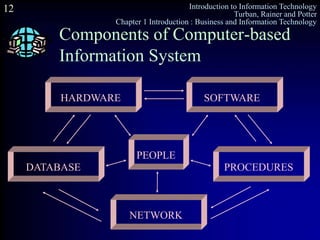
What is a Computer-Based
Information System?
 Hardware  Software
 Database  Network
 Procedures  People
A computer-based information system (CBIS) is an
information system that uses computer and often
telecommunications technology to perform some or
all of its intended tasks. An information technology
is a particular component of a system, like a personal
computer, a printer, or a network. But few
information technologies are used alone. Rather,
they are most effective combined into information
systems. The basic components of information
systems are the following:
Introduction to Information Technology
Turban, Rainer and Potter
Chapter 1 Introduction : Business and Information Technology
12
Components of Computer-based
Information System
PEOPLE
HARDWARE SOFTWARE
DATABASE
NETWORK
PROCEDURES
Introduction to Information Technology
Turban, Rainer and Potter
Chapter 1 Introduction : Business and Information Technology
13
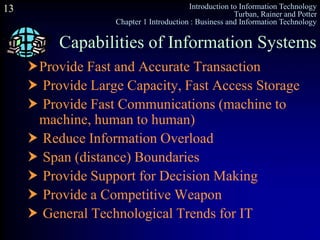
Provide Fast and Accurate Transaction
 Provide Large Capacity, Fast Access Storage
 Provide Fast Communications (machine to
machine, human to human)
 Reduce Information Overload
 Span (distance) Boundaries
 Provide Support for Decision Making
 Provide a Competitive Weapon
 General Technological Trends for IT
Capabilities of Information Systems
Introduction to Information Technology
Turban, Rainer and Potter
Chapter 1 Introduction : Business and Information Technology
14
Strategic Questions and
Information Technology Answer
Information Technology and organizational
strategy are inseparable
Porter’s strategic analysis model (5 forces
models)
 the relative power of buyers and suppliers, threats
from substitute products and services, and the
ease or difficulty with which new competitors can
enter the industry
Value chain
 the discrete steps involved in the manufacturing
of a product or the provision of a service
Introduction to Information Technology
Turban, Rainer and Potter
Chapter 1 Introduction : Business and Information Technology
15
Strategic Questions
 Can we use IT to gain leverage (influence) over our suppliers? To improve
our bargaining power? To reduce their bargaining power?
 Can we use IT to reduce purchasing costs? To reduce our order processing
costs? To reduce suppliers’ billing costs?
 Can we use IT to identify alternative supply sources? To locate substitute
products? To identify lower-price suppliers?
 Can we use IT to improve the quality of products and services we receive
from suppliers? To reduce order lead times? To monitor quality? To
leverage supplier service data for better service to our customers?
 Can we use IT to give us access to vital information about our suppliers
that will help us reduce our costs? To select the most appropriate
products? To negotiate price breaks? To monitor work progress and
readjust our schedules? To assess quality control?
 Can we use IT to give our suppliers information important to them that
will in turn yield a cost, quality, or service reliability advantage to us? To
conduct electronic exchange of data to reduce their costs? To provide
master production schedule changes?
Strategic Questions (continued…)
Introduction to Information Technology
Turban, Rainer and Potter
Chapter 1 Introduction : Business and Information Technology
16
Strategic Questions (continued…)
Strategic Questions
 Can we use IT to reduce our customer’s cost of doing business with us? To
reduce paperwork for ordering or paying? To provide status information
more rapidly? To reduce our costs and prices?
 Can we provide some unique information to our customers that will make
them buy our products/service? Can we provide better billing or account
status data? Can we provide options to switch to higher-value substitutes?
Can we be first with an easy-to-duplicate feature that will provide value
simply by being first?
 Can we use IT to increase our customers’ costs of switching to a new
supplier? Can we provide proprietary hardware or software? Can we
make customers dependent upon us for their data? Can we make our
customer service more personalized?
 Can we use external database sources to learn more about our customers
and discover possible market niches? To relate buying from us to buying
other products? To analyze customers interactions with us and questions to
us to develop customized products/services or methods of responding to
customer needs?
Introduction to Information Technology
Turban, Rainer and Potter
Chapter 1 Introduction : Business and Information Technology
17
Strategic Questions (continued…)
Strategic Questions
 Can we use IT to help our customers increase their revenues? To provide
proprietary market data to them? To support their access to their markets
through our channels?
 Can we use IT to raise the entry barriers of new competitors into our
markets? To redefine product features around IT components? To provide
customer services through IT?
 Can we use IT to differentiate our products/services? To highlight existing
differentiations? To create new differentiations?
 Can we use IT to make a preemptive move over our competition? To offer
something new because we have proprietary data?
 Can we use IT to provide substitutes? To simulate other products? To
enhance our existing products?
 Can we use IT to match an existing competitor’s offerings? Are competitor
products/services based on unique IT capabilities or technologies and
capabilities generally available?
Introduction to Information Technology
Turban, Rainer and Potter
Chapter 1 Introduction : Business and Information Technology
18
 Information Technology Answers
Information Technology Answer
(continued…)
 Consolidated Stores invested $80 million in
KBToys.com, a site it will jointly own with startup
BrainPlay.com
 PetSmart plans to invest $16 million in 1999 in
PetSmart.com, a site it will jointly own with startup
PetJungle.com
 Toys “R” Us invested $80 million to relaunch
Toysrus.com, which will be run as a standalone
business
 CVS spent $30 million to buy online pharmacy
Soma.com
Introduction to Information Technology
Turban, Rainer and Potter
Chapter 1 Introduction : Business and Information Technology
19
For Accounting
 Information systems capture, organize,
analyze, and disseminate data and
information throughout modern organizations
For Finance
 Information systems turn financial world on
speed, volume, and accuracy of information
flow
What’s in IT for Me?
Introduction to Information Technology
Turban, Rainer and Potter
Chapter 1 Introduction : Business and Information Technology
20
What’s in IT for Me? (continued …)
 For Marketing
 The Internet and the World Wide Web have
opened an entirely new channel for marketing
and provided much closer contact between the
consumer and the supplier
For Production/Operations Management
 Every process in a product or service’s value
chain can be enhanced by the proper use of
computer-based information systems
Introduction to Information Technology
Turban, Rainer and Potter
Chapter 1 Introduction : Business and Information Technology
21
What’s in IT for Me? (continued …)
 For Human Resource Management
 Employees can handle much of their personal
business themselves, and the Internet makes a
tremendous amount of information available to the
job seeker
For Management Information Systems (MIS)
 The opportunities for those planning a career in MIS
grows as fast as the adoption of information
technologies into organizations everywhere
Introduction to Information Technology
Turban, Rainer and Potter
Chapter 1 Introduction : Business and Information Technology
22
Thank You

IT_business.ppt

  • 1.
    Introduction to InformationTechnology Turban, Rainer and Potter Chapter 1 Introduction : Business and Information Technology 1 CHAPTER 1 INTRODUCTION : BUSINESS AND INFORMATION TECHNOLOGY
  • 2.
    Introduction to InformationTechnology Turban, Rainer and Potter Chapter 1 Introduction : Business and Information Technology 2 Learning Objectives Discuss business pressures and responses in today’s Information Age Differentiate between data and information, and describe the characteristics of high-quality data. Name and describe the components of an information system. Describe the capabilities expected of information systems in modern organizations. Describe opportunities for strategic use of information systems.
  • 3.
    Introduction to InformationTechnology Turban, Rainer and Potter Chapter 1 Introduction : Business and Information Technology 3 Case : Blades Board & Skate rapid growth  The Business Problem  retailer of ice and inline skates and snowboards  the business needed a computer system that could instantly track sales and inventory at all of its stores  The Solution  point-of-sales (POS) systems  computerized cash registers that use specialized software to record transaction data such as the stock numbers of items sold, cost , time of sale, and information on the customer, such as name  help retailers cut costs, increase profits, and serve customers better by making the most of sales information
  • 4.
    Introduction to InformationTechnology Turban, Rainer and Potter Chapter 1 Introduction : Business and Information Technology 4 The Results Case (continued…)  Quicker, more accurate, and more detailed picture of sales and inventory  Tied into the firm’s accounting software  Order products from vendors only when needed, decreasing the amount of warehouse space
  • 5.
    Introduction to InformationTechnology Turban, Rainer and Potter Chapter 1 Introduction : Business and Information Technology 5 What have we learned from this case?? Case (continued…)  interrelating with other systems  Permeating (spread through) every business process  enabling tremendous gains in knowledge, productivity, and profitability  A great variety of information can now be gathered at each part of each business process, and information can be distributed throughout the organization, giving knowledge and insight for competitive decision making and strategic advantage.  Information Technologies are woven into complex systems
  • 6.
    Introduction to InformationTechnology Turban, Rainer and Potter Chapter 1 Introduction : Business and Information Technology 6 Business in the Information Age: Pressures  Global Competition for Market and for Labor  Need for Real-time Operations  Changing Work Force  Customer-Oriented Operations  Technological Innovation and Obsolescence (no longer useful)  Information Overload  Social Responsibility of Organizations  Government Regulation and Deregulation  Ethical Issues  Organizational Responses to Business Pressures in the Information Age
  • 7.
    Introduction to InformationTechnology Turban, Rainer and Potter Chapter 1 Introduction : Business and Information Technology 7 Business in the Information Age: Responses  Strategic Systems  Customer Focus and Customer Service  mass customization  Continuous Improvement Efforts  just-in-time (JIT)  total quality management (TQM)  Business Process Reengineering  Empowering Employees and Fostering Collaborative Work  Team-based Structure  Business Alliances  supply chain management and enterprise resource planning (ERP)  Electronic Commerce (E Commerce)
  • 8.
    Introduction to InformationTechnology Turban, Rainer and Potter Chapter 1 Introduction : Business and Information Technology 8 Business Pressures & Organizational Responses : Summary Business Pressures Global Competition for Market and Labor Need for Real-time Operations Changing Work Force Customer Orientation Technological Innovation and Obsolescence Information Overload Social Responsibility Government Regulation and Deregulation Ethical Issues Organizational Responses Strategic Systems Customer Focus and Customer Service Continuous Improvement Efforts (Just-in-Time, Total Quality Management) Business Process Reengineering (BPR) Team-based Structure Business Alliances Electronic Commerce
  • 9.
    Introduction to InformationTechnology Turban, Rainer and Potter Chapter 1 Introduction : Business and Information Technology 9 Why You Need to Learn About Information Technology IT is Generally Interesting IT Facilitates Work in Organizations IT Offers Career Opportunities IT is Used by All Departments  Locating real estate at nations bank  Using IT to strategic advantage at McDonald’s Canada  Using IT to manage human resources at the City of Winnipeg in Manitoba, Canada
  • 10.
    Introduction to InformationTechnology Turban, Rainer and Potter Chapter 1 Introduction : Business and Information Technology 10 Why You Need to Learn About Information Technology (continued…) Web-based One-to-One Marketing at Liberty Financial Companies  one-to-one Web Marketing  aims to personalize a user’s online experience by offering services and advertisements that are likely to appeal to that person  Web-site operator can use the information it collects on individuals to provide customized content  used Web-based marketing software to build its database of customer profiles  investors able to find exactly the information they need, quickly and easily from Web sites
  • 11.
    Introduction to InformationTechnology Turban, Rainer and Potter Chapter 1 Introduction : Business and Information Technology 11 What is a Computer-Based Information System?  Hardware  Software  Database  Network  Procedures  People A computer-based information system (CBIS) is an information system that uses computer and often telecommunications technology to perform some or all of its intended tasks. An information technology is a particular component of a system, like a personal computer, a printer, or a network. But few information technologies are used alone. Rather, they are most effective combined into information systems. The basic components of information systems are the following:
  • 12.
    Introduction to InformationTechnology Turban, Rainer and Potter Chapter 1 Introduction : Business and Information Technology 12 Components of Computer-based Information System PEOPLE HARDWARE SOFTWARE DATABASE NETWORK PROCEDURES
  • 13.
    Introduction to InformationTechnology Turban, Rainer and Potter Chapter 1 Introduction : Business and Information Technology 13 Provide Fast and Accurate Transaction  Provide Large Capacity, Fast Access Storage  Provide Fast Communications (machine to machine, human to human)  Reduce Information Overload  Span (distance) Boundaries  Provide Support for Decision Making  Provide a Competitive Weapon  General Technological Trends for IT Capabilities of Information Systems
  • 14.
    Introduction to InformationTechnology Turban, Rainer and Potter Chapter 1 Introduction : Business and Information Technology 14 Strategic Questions and Information Technology Answer Information Technology and organizational strategy are inseparable Porter’s strategic analysis model (5 forces models)  the relative power of buyers and suppliers, threats from substitute products and services, and the ease or difficulty with which new competitors can enter the industry Value chain  the discrete steps involved in the manufacturing of a product or the provision of a service
  • 15.
    Introduction to InformationTechnology Turban, Rainer and Potter Chapter 1 Introduction : Business and Information Technology 15 Strategic Questions  Can we use IT to gain leverage (influence) over our suppliers? To improve our bargaining power? To reduce their bargaining power?  Can we use IT to reduce purchasing costs? To reduce our order processing costs? To reduce suppliers’ billing costs?  Can we use IT to identify alternative supply sources? To locate substitute products? To identify lower-price suppliers?  Can we use IT to improve the quality of products and services we receive from suppliers? To reduce order lead times? To monitor quality? To leverage supplier service data for better service to our customers?  Can we use IT to give us access to vital information about our suppliers that will help us reduce our costs? To select the most appropriate products? To negotiate price breaks? To monitor work progress and readjust our schedules? To assess quality control?  Can we use IT to give our suppliers information important to them that will in turn yield a cost, quality, or service reliability advantage to us? To conduct electronic exchange of data to reduce their costs? To provide master production schedule changes? Strategic Questions (continued…)
  • 16.
    Introduction to InformationTechnology Turban, Rainer and Potter Chapter 1 Introduction : Business and Information Technology 16 Strategic Questions (continued…) Strategic Questions  Can we use IT to reduce our customer’s cost of doing business with us? To reduce paperwork for ordering or paying? To provide status information more rapidly? To reduce our costs and prices?  Can we provide some unique information to our customers that will make them buy our products/service? Can we provide better billing or account status data? Can we provide options to switch to higher-value substitutes? Can we be first with an easy-to-duplicate feature that will provide value simply by being first?  Can we use IT to increase our customers’ costs of switching to a new supplier? Can we provide proprietary hardware or software? Can we make customers dependent upon us for their data? Can we make our customer service more personalized?  Can we use external database sources to learn more about our customers and discover possible market niches? To relate buying from us to buying other products? To analyze customers interactions with us and questions to us to develop customized products/services or methods of responding to customer needs?
  • 17.
    Introduction to InformationTechnology Turban, Rainer and Potter Chapter 1 Introduction : Business and Information Technology 17 Strategic Questions (continued…) Strategic Questions  Can we use IT to help our customers increase their revenues? To provide proprietary market data to them? To support their access to their markets through our channels?  Can we use IT to raise the entry barriers of new competitors into our markets? To redefine product features around IT components? To provide customer services through IT?  Can we use IT to differentiate our products/services? To highlight existing differentiations? To create new differentiations?  Can we use IT to make a preemptive move over our competition? To offer something new because we have proprietary data?  Can we use IT to provide substitutes? To simulate other products? To enhance our existing products?  Can we use IT to match an existing competitor’s offerings? Are competitor products/services based on unique IT capabilities or technologies and capabilities generally available?
  • 18.
    Introduction to InformationTechnology Turban, Rainer and Potter Chapter 1 Introduction : Business and Information Technology 18  Information Technology Answers Information Technology Answer (continued…)  Consolidated Stores invested $80 million in KBToys.com, a site it will jointly own with startup BrainPlay.com  PetSmart plans to invest $16 million in 1999 in PetSmart.com, a site it will jointly own with startup PetJungle.com  Toys “R” Us invested $80 million to relaunch Toysrus.com, which will be run as a standalone business  CVS spent $30 million to buy online pharmacy Soma.com
  • 19.
    Introduction to InformationTechnology Turban, Rainer and Potter Chapter 1 Introduction : Business and Information Technology 19 For Accounting  Information systems capture, organize, analyze, and disseminate data and information throughout modern organizations For Finance  Information systems turn financial world on speed, volume, and accuracy of information flow What’s in IT for Me?
  • 20.
    Introduction to InformationTechnology Turban, Rainer and Potter Chapter 1 Introduction : Business and Information Technology 20 What’s in IT for Me? (continued …)  For Marketing  The Internet and the World Wide Web have opened an entirely new channel for marketing and provided much closer contact between the consumer and the supplier For Production/Operations Management  Every process in a product or service’s value chain can be enhanced by the proper use of computer-based information systems
  • 21.
    Introduction to InformationTechnology Turban, Rainer and Potter Chapter 1 Introduction : Business and Information Technology 21 What’s in IT for Me? (continued …)  For Human Resource Management  Employees can handle much of their personal business themselves, and the Internet makes a tremendous amount of information available to the job seeker For Management Information Systems (MIS)  The opportunities for those planning a career in MIS grows as fast as the adoption of information technologies into organizations everywhere
  • 22.
    Introduction to InformationTechnology Turban, Rainer and Potter Chapter 1 Introduction : Business and Information Technology 22 Thank You