Interagency Threat Assessment and Coordination Group
INTELLIGENCE GUIDE
FOR FIRST RESPONDERS
Legal Disclaimer
Nothing in this handbook shall be construed to impair or otherwise affect
the authority granted by law to a department or agency, or the head thereof.
Additionally, the handbook is not intended to, and does not, create any right
or benefit, substantive or procedural, enforceable at law or in equity, by
any party against the United States, its departments, agencies or entities, its
officers, employees, or agents, or any other person.
i
Table of Contents
Introduction
What is Intelligence?
	 8 The Intelligence Community 	
	 10 The Intelligence Cycle
	 12 Categories of Finished Intelligence
I
1
5
Handling of “Controlled Unclassified Information”
Security Clearances
What Intelligence Can and Cannot Do
17
21
25
GENERAL
HOW TOII
ii
Intelligence Products Typically Available to First Responders
Accessing Intelligence Community Products
Understanding Threat Information
Understanding Estimative Language
29
35
41
49
III REFERENCE
Intelligence Community Terminology
Intelligence Community Acronyms and Abbreviations
55
85
SECTION
I
ITACG: intelligence guide for first responders
General
Introduction
01
ITACG:intelligenceguideforfirstresponders
intelligenceguideforfirstresponders|introduction
2
This Interagency Threat Assessment and Coordination Group (ITACG) Intelligence
Guide for First Responders is designed to assist state, local, tribal law enforcement,
firefighting, homeland security, and appropriate private sector personnel in access-
ing and understanding Federal counterterrorism, homeland security, and weapons of
mass destruction intelligence reporting. Most of the information contained in this
guide was compiled, derived, and adapted from existing Intelligence Community and
open source references.
The ITACG consists of state, local, and tribal first responders and federal intelligence
analysts from the Department of Homeland Security and the Federal Bureau of Investi-
gation, working at the National Counterterrorism Center (NCTC) to enhance the sharing
of federal counterterrorism, homeland security, and weapons of mass destruction
information with state, local, and tribal consumers of intelligence.
introduction
intelligenceguideforfirstresponders|introduction
Fig.1 - Current and former members of the
ITACG Detail; clockwise from the top:
New Jersey State Police, Seattle Fire Depart-
ment, Federal Bureau of Investigation,
Boston Police Department, Illinois State Po-
lice, Phoenix Police Department (2007-2008),
Six Nations Tuscarora, Las Vegas Police De-
partment, Department of Homeland Security,
DC Metropolitan Police (2008-2009)
3
What is Intelligence?
05
ITACG:intelligenceguideforfirstresponders
intelligenceguideforfirstresponders|introduction
what is intelligence?1
“Intelligence is the product resulting from the collection, processing, integration, evaluation, analysis,
and interpretation of available information concerning foreign nations, hostile or potentially hostile forces
or elements, or areas of actual or potential operations. The term is also applied to the activity which results
in the product and to the organizations engaged in such activity.”
22 June 2007 edition of Joint Pub 2-0, Joint Intelligence
There are six basic intelligence sources2
:
Signals Intelligence (SIGINT) is derived from the exploitation of foreign electronic emissions.
SIGINT can be in the form of the actual information content of a signal or in the form of its
temporal and spectral characteristics called signal operating parameters. SIGINT includes both
the raw data and the analysis product of that data. SIGINT breaks down into four sub disciplines:
Electronic Intelligence (ELINT), Communications Intelligence (COMINT), Foreign Instrumentation
Signals Intelligence (FISINT), and weapons-related Command and Control Signals (PROFORMA).
Imagery Intelligence (IMINT) is a product that is the result of processing and exploiting raw
imagery (information) and creating an analyzed product (intelligence). An image alone is only
information in the form of pixels, digits, or other forms of graphic representation and the data
behind that portrayal. When studied for content with an understanding of portrayal, imaging
processes, and the place, objects and time captured by that process, or through comparison to
other images and consideration in light of other information or intelligence, imagery intelligence
(IMINT) can be created.
6
intelligenceguideforfirstresponders|introduction
7
Measurement and Signature Intelligence (MASINT) is scientific and technical intelligence
information obtained by quantitative and qualitative analysis of data (metric, angle, spatial,
wavelength, time dependence, modulation, plasma, and hydromagnetic) derived from spe-
cific technical sensors for the purpose of identifying any distinctive features associated with
the source, emitter, or sender and to facilitate subsequent identification and/or measurement
of the same.
Human-Source Intelligence (HUMINT) is intelligence derived from human beings who may act
as both sources and collectors, and where the human is the primary collection instrument. This
includes all forms of intelligence gathered by humans, from direct reconnaissance and obser-
vation to the use of recruited agents. HUMINT may also encompass interrogation techniques,
including the process of questioning detainees conducted in compliance with U.S. law and regu-
lation, international law, executive orders, and other operationally specific guidelines. HUMINT
can provide a wide range of information which includes but is not limited to adversary plans
and intentions, deliberations and decisions, research and development goals and strategies,
doctrine, leadership, political or military relationships, weapons systems, physical and cultural
infrastructure, and medical conditions. HUMINT can often collect information that is difficult or
sometimes impossible to collect by other, more technical, means.
Open-Source Intelligence (OSINT) is unclassified information of potential intelligence value that
is available to the general public.
Geospatial Intelligence (GEOINT) is the intelligence derived from the exploitation of imagery
and geospatial information to describe, assess, and visually depict physical features and geo-
graphically referenced activities on the Earth.
intelligenceguideforfirstresponders|whatisintelligence
The Intelligence Community (IC) is a federation of
executive branch agencies and organizations that work
separately and together to conduct intelligence activities necessary for the conduct
of foreign relations and the protection of the national security of the United States.
These activities include:
Collection of information needed by the president, the National Security Coun-•	
cil, the Secretaries of State and Defense, and other Executive Branch officials for
the performance of their duties and responsibilities;
Production and dissemination of intelligence;•	
Collection of information concerning, and the conduct of activities to protect•	
against, intelligence activities directed against the U.S., international terrorist
and international narcotics activities, and other hostile activities directed against
the U.S. by foreign powers, organizations, persons, and their agents.
Special activities;•	
Administrative and support activities within the U.S. and abroad necessary for•	
the performance of authorized activities; and
Such other intelligence activities as the President may direct from time to time.•	
the intelligence community 3
“The United States intelligence effort shall provide the President, the
National Security Council, and the Homeland Security Council with the
necessary information on which to base decisions concerning the develop-
ment and conduct of foreign, defense and economic policy, and the pro-
tection of United States national interests from foreign security threats.
All departments and agencies shall cooperate fully to fulfill this goal.”
Executive Order 12333
8
intelligenceguideforfirstresponders|whatisintelligence
9
The Intelligence Community (IC) refers to those agencies and
organizations involved in intelligence activities: 4
Air Force Intelligence•	
Army Intelligence•	
Central Intelligence Agency (CIA)•	
Coast Guard (USCG)•	
Defense Intelligence Agency (DIA)•	
Department of Energy (DoE) Office of Intelligence•	
Department of Homeland Security (DHS), Office of Intelligence•	
and Analysis
Department of State Bureau of Intelligence and Research (INR)•	
Department of the Treasury (DoT), Treasury Office of Terrorism•	
and Financial Intelligence
Office of the Director of National Intelligence (ODNI)•	
Drug Enforcement Administration (DEA), Office of National•	
Security Intelligence
Federal Bureau of Investigation (FBI), National Security Branch•	
Marine Corps Intelligence•	
National Geospatial-Intelligence Agency (NGA)•	
National Reconnaissance Office (NRO)•	
National Security Agency (NSA)•	
Naval Intelligence•
intelligenceguideforfirstresponders|whatisintelligence
the intelligence cycle 5
The intelligence cycle is the process of developing raw information into finished
intelligence for policymakers, military commanders, and other consumers to use in
decision-making and actions.
Five steps constitute the intelligence cycle:
1. Planning and Direction: Establishing the intelligence requirements of
the policymakers – the President, the National Security Council, military
commanders, and other officials in major departments and governmental
agencies.
2. Collection: Gathering of raw data from which finished intelligence is pro-
duced. There are six basic intelligence sources, or collection disciplines:
a. Signals Intelligence (SIGINT)
b.	Imagery Intelligence (IMINT)
c.	 Measurement and Signature Intelligence (MASINT)
d.	Human-Source Intelligence (HUMINT)
e.	 Open-Source Intelligence (OSINT)
f.	 Geospatial Intelligence (GEOINT)
3. Processing and Exploitation: Conversion of large amounts of data to a
form suitable for the production of finished intelligence; includes transla-
tions, decryption, and interpretation of information stored on film and mag-
netic media through the use of highly refined photographic and electronic
processes.
10
intelligenceguideforfirstresponders|whatisintelligence
11
4. Analysis and Production: Integration, evaluation, and analysis of all avail-
able data and the preparation of a variety of intelligence products, including
timely, single-source, event-oriented reports and longer term, all-source,
finished intelligence studies.
5. Dissemination: Delivering the products to consumers who request them.
Some intelligence information is sent directly to consumers, usually by
electronic means, because it is self-explanatory. More often, analysts check
information to see how it relates to other information they have received.
They evaluate the information and make comments. When information
has been reviewed and correlated with information available from other
sources, it is called finished intelligence.
intelligenceguideforfirstresponders|whatisintelligence
12
Categories of finished
Intelligence 6
There are five categories of finished intelligence available to the consumer
of intelligence:
1. Current intelligence addresses day-to-day events, seeking to apprise
consumers of new developments and related background, to assess
their significance, to warn of their near-term consequences, and to
signal potentially dangerous situations in the near future. Current intel-
ligence is presented in daily, weekly, and some monthly publications, and
frequently in ad hoc written memorandums and oral briefings to senior
officials.
2. Estimative intelligence looks forward to assess potential developments
that could affect U.S. national security. Like all kinds of intelligence,
estimative intelligence starts with the available facts, but then explores
the unknown, even the unknowable. Estimative intelligence helps poli-
cymakers to think strategically about long-term threats by discussing the
implications of a range of possible outcomes and alternative scenarios.
National Intelligence Estimates, which are estimative reports produced
by the National Intelligence Council, are the Director of National Intelli-
gence’s (DNI) most authoritative written assessments of national security
issues.
intelligenceguideforfirstresponders|whatisintelligence
13
3. Warning intelligence sounds an alarm or gives notice to policymakers.
It connotes urgency and implies the potential need for policy action in
response. Warning includes identifying or forecasting events that could
cause the engagement of U.S. military forces, or those that would have
a sudden and deleterious effect on U.S. foreign policy concerns (for
example, coups, third-party wars, refugee situations). Warning analysis
involves exploring alternative futures and low probability/high impact
scenarios. The National Intelligence Officer (NIO) for Warning serves
as the DNI’s and the IC’s principal adviser on warning. All agencies and
intelligence staffs have designated warning components, and some have
specific warning responsibilities.
4. Research intelligence is presented in monographs and in-depth studies
by virtually all agencies. Research underpins both current and estimative
intelligence.
intelligenceguideforfirstresponders|whatisintelligence
5. Scientific and technical intelligence includes information on techni-
cal developments and characteristics, performance, and capabilities
of foreign technologies including weapon systems or subsystems. This
information is derived from analysis of all-source data, including tech-
nical measurements. Generally, such technical analysis and reporting
responds to specific national requirements derived from the weapons
acquisition process, arms control negotiations, or military operations.
It covers the entire spectrum of sciences, technologies, weapon sys-
tems, and integrated operations. This type of intelligence is provided to
consumers via in-depth studies, detailed system handbooks, executive
summaries, focused assessments and briefs, and automated databases.
14
IIHow To
SECTION
ITACG: intelligence guide for first responders
Handling of “Controlled
Unclassified Information”
17
ITACG:intelligenceguideforfirstresponders
intelligenceguideforfirstresponders|handling“forofficialuseonly”information
18
handling “controlled
unclassified information” 7
Controlled Unclassified Information (CUI) is a categorical designation that refers to
unclassified information that does not meet the standards for National Security Classi-
fication under Executive Order 12958, as amended, but is pertinent to the national in-
terests of the United States or to the important interests of entities outside the Federal
Government, and under law or policy requires protection from unauthorized disclo-
sure, special handling safeguards, or prescribed limits on exchange or dissemination.
CUI includes many caveats, such as “FOR OFFICIAL USE ONLY” (FOUO).
Information labeled FOUO should be safeguarded, and withheld from public release
until approved for release by the originating agency. 8
FOUO is not a classification, but a dissemination control marking. It is used to identify
unclassified information of a sensitive nature, not otherwise categorized by statute or
regulation, the unauthorized disclosure of which could adversely impact a person’s
privacy or welfare, the conduct of Federal programs, or other programs or operations
essential to the national interest.
intelligenceguideforfirstresponders|handling“forofficialuseonly”information
19
Dissemination of FOUO is restricted to persons with “need-to-know.” Need-to-know
is defined as the determination made by an authorized holder of information that a
prospective recipient requires access to specific information in order to perform or as-
sist in the lawful and authorized governmental function, i.e., access is required for the
performance of official duties. Typical FOUO requirements include:
1. FOUO information will not be disseminated in any manner – orally, visually,
or electronically – to unauthorized personnel.
2. The holder of the information will comply with access and dissemination
restrictions.
3. Ensure the recipient of FOUO has valid need-to-know, and that precautions
are taken to prevent unauthorized individuals from overhearing the conver-
sation, observing the materials, or otherwise obtaining the information.
Many government agencies use the FOUO caveat, but other caveats, such as, LAW
ENFORCEMENT SENSITIVE (LES), and OFFICIAL USE ONLY (OUO), are also used. In
many instances the requirement for safeguarding this information is equivalent;
however, these agencies may have additional requirements concerning the safe-
guarding of sensitive information.
Security Clearances
21
ITACG:intelligenceguideforfirstresponders
intelligenceguideforfirstresponders|securityclearances
22
security CLEARANCES 9
Most information needed by state, local, and tribal first responders can be shared
at an unclassified level. In those instances where it is necessary to share classified
information, it can usually be accomplished at the Secret level.
State and local officials who require access to classified material must apply for a se-
curity clearance through FBI or DHS. The process involves completing a Questionnaire
for National Security Positions, submitting fingerprints, and undergoing a background
investigation.
Records checks for Secret and Top Secret security clearance are mandated by
Presidential Executive Order (EO). The EO requires these procedures in order for a
security clearance to be granted and they cannot be waived.
1. Secret Clearances: A Secret security clearance may be granted to those
persons who “need-to-know” national security information, classified at
the Confidential or Secret level. A Secret security clearance takes the least
amount of time to process.
intelligenceguideforfirstresponders|securityclearances
23
2. Top Secret Clearances: A Top Secret clearance may be granted to those
persons who “need-to-know” national security information, classified up to
the Top Secret level, and who need unescorted access to sensitive facilities,
when necessary.
a.	 In addition to all the requirements at the Secret level, a background investi-
gation, covering a 10-year time period, is required.
b.	Once favorably adjudicated for a Top Secret security clearance, the candi-
date will be required to sign a Non-Disclosure Agreement.
For additional information, visit http://www.fbi.gov/clearance/securityclearance.htm
or contact your local FBI Field Office.
PIC OF SCALE
What Intelligence
Can and Cannot Do
25
ITACG:intelligenceguideforfirstresponders
intelligenceguideforfirstresponders|whatintelligencecanandcannotdo
26
what intelligence
can (and cannot) do 10
Intelligence information can be an extremely powerful tool. It is most useful when the
consumer has a clear understanding of what intelligence can and cannot do. While
laws, policies, capabilities, and standards are constantly changing, these general guide-
lines can help consumers make the most of this resource.
1. what intelligence can do: Intelligence information can
provide valuable services, such as:
• Providing decision advantage, by improving the decision-making of
consumers and partners while hindering that of our enemies.
• Warning of potential threats.
• Insight into key current events.
• Situational awareness.
• Long-term strategic assessments on issues of ongoing interest.
• Assistance in preparation for senior-level meetings that include national
security-related subjects.
• Pre-travel security overviews and support.
• Reports on specific topics, either as part of ongoing reporting or upon
request for short-term needs.
• Compiling U.S. Government knowledge on persons of interest.
intelligenceguideforfirstresponders|whatintelligencecanandcannotdo
27
2. what intelligence cannot do: Realistic expectations
will help the consumer fill their intelligence needs. Some things that intel-
ligence cannot do include:
• Predict the future. Intelligence can provide assessments of likely scenarios
or developments, but there is no way to predict what will happen with
certainty.
• Violate U.S. law. The activities of the IC must be conducted consistent with
all applicable laws and executive orders, to include the National Security
Act of 1947, as amended, the Foreign Intelligence Surveillance Act, the
Intelligence Reform and Terrorism Prevention Act (IRTPA), the Privacy Act
of 1974, the Detainee Treatment Act, Homeland Security Act of 2002, as
amended, Executive Order 12333, and the Military Commission Act.
All activities of the IC are subject to extensive and rigorous oversight both within the
Executive Branch and by the Legislative Branch, as required by the National Security
Act of 1947, as amended.
unclassified//fouo
intelligenceguideforfirstresponders|whatintelligencecanandcannotdo
28
Intelligence Products
Typically Available to
First Responders
29
ITACG:intelligenceguideforfirstresponders
intelligenceguideforfirstresponders|intelligenceproductstypicallyavailabletofirstresponders
30
intelligence products
typically available to first
responders 11
The following types of products can be found on a variety of classified and unclassified
systems, including FBI’s Law Enforcement Online (LEO), and DHS’s Homeland Secure
Information Network-Intelligence (HSIN-I) via the Internet, and NCTC Online-SECRET
(NOL-S) via secret level systems, such as FBI Network (FBINet), Homeland Secure Data
Network (HSDN), Joint Deployable Intelligence Support System (JDISS), and Secure In-
ternet Protocol Routed Network (SIPRNet).
1. Situational Awareness and Threat Reporting: These are breaking news
events to chief executives and command centers with state, local, and tribal
law enforcement agencies via HSIN-I, LEO, text messaging, or e-mail. These
reports are often produced jointly by DHS and FBI.
2. Information Report: These are specially formatted messages transmit-
ted electronically, which enable the timely dissemination of unevaluated
intelligence within the Intelligence Community and law enforcement. The
information conveyed in these products may be non-specific or fragmentary
and simply constitute suspicious activity, but still be of intelligence value.
These products include:
a.	 IIR (Intelligence Information Report)
b.	HIR (Homeland Information Report)
intelligenceguideforfirstresponders|intelligenceproductstypicallyavailabletofirstresponders
31
3. Intelligence Assessment (IA): Finished intelligence products resulting from
the intelligence analysis process. Assessments may address tactical, strate-
gic, or technical intelligence requirements.
4. Threat Assessment (TA) or Special Assessment (SA): Provides in-depth
analysis related to a specific event or body of threat reporting.
5. Intelligence Bulletin (IB): Finished intelligence products used to dissemi-
nate information of interest, such as significant developments and trends, to
the intelligence and law enforcement communities in an article format. An IB
does not address threat warning information.
6. Joint Intelligence Assessment (IA) or Intelligence Bulletin (IB):
Assessments or bulletins which are written jointly by two or more IC agen-
cies (dual or multiple seals). These products may address the same types
of requirements as Intelligence Assessments or Intelligence Bulletins. These
joint products may be formatted differently than single seal versions, de-
pending on the format agreed to by participating agencies.
intelligenceguideforfirstresponders|intelligenceproductstypicallyavailabletofirstresponders
7. Other Reports: These include intelligence summaries and briefs produced
daily, which cover current counterterrorism, homeland security, and WMD-
related information. Examples include:
a.	 Roll Call Release: The Roll Call Release is a collaborative FOUO-only product
developed by DHS, FBI, and the ITACG. The product is written specifically
for state, local, and tribal first responders, and focuses on terrorist tactics,
techniques, procedures; terrorism trends; and indicators of suspicious activ-
ity. The product is written on an ad hoc basis, is focused on one subject, and
fits on one page. These products are posted on HSIN-I and LEO.
b.	Terrorism Summary (TERRSUM): The TERRSUM is a SECRET collateral digest
of terrorism-related intelligence of interest to Federal and non-Federal law
enforcement, security and military personnel. Produced Monday through
Friday, the TERRSUM includes terrorism-related intelligence available to
NCTC and other Intelligence Community elements. The product is posted
on NOL-S.
32
intelligenceguideforfirstresponders|notes
notes
_____________________________________________________
_____________________________________________________
_____________________________________________________
_____________________________________________________
_____________________________________________________
_____________________________________________________
_____________________________________________________
_____________________________________________________
_____________________________________________________
_____________________________________________________
_____________________________________________________
_____________________________________________________
_____________________________________________________
_____________________________________________________
_____________________________________________________
intelligenceguideforfirstresponders|accessingintelligencecommunityproducts
Accessing Intelligence
Community Products
35
ITACG:intelligenceguideforfirstresponders
intelligenceguideforfirstresponders|accessingintelligencecommunityproducts
accessing intelligence
community products 12
Classified and unclassified intelligence can be accessed by first responders through
multiple systems and websites. In some cases an account is required, while other
times all that is needed is access to a specific computer network. Many of these sourc-
es of information only require that an individual perform homeland security or law
enforcement activities on behalf of a state, local, or tribal government; a few require
security clearances and access to secure systems.
1. UNCLASSIFIED Intelligence Products
a.	 Homeland Security Information Network – Intelligence (HSIN-I):
HSIN-I is an official government information sharing and electronic
communications portal. It provides DHS, FBI, NCTC, other federal and
non-federal intelligence products at the FOUO level. Accounts are available
to federal, state, local, and tribal personnel performing homeland security
or law enforcement duties. HSIN-I can be accessed from any computer
system with an Internet connection. Access is by invitation only.
i.	 Website: https://hsin-intel.dhs.gov
ii.	Access: Contact the helpdesk at 1-877-624-3771 or e-mail
hsin.intel@hq.dhs.gov for sponsor contact information.
Sponsors for state, local, and tribal can be contacted through the State
and Local Fusion Centers.
36
intelligenceguideforfirstresponders|accessingintelligencecommunityproducts
37
b.	Law Enforcement Online (LEO): LEO can be accessed from any computer
system with an Internet connection. It is an official government informa-
tion sharing and electronic communications portal. LEO provides FBI,
joint FBI-DHS, NCTC, and non-federally produced intelligence products at
the FOUO level. Accounts are available to federal, state, local, and tribal
personnel performing homeland security or law enforcement duties and
personnel from foreign law enforcement agencies.
i.	 Website: http://www.leo.gov
ii.	Access: Go to http://www.leo.gov, click on the “LEO Membership
Criteria” and then click on the “LEO User Application”, or contact LEO
Helpdesk at 1-888-334-4536, or e-mail helpdesk@leo.gov.
c.	 Intelink-U: Intelink-U is the Intelligence Community’s “Sensitive but
Unclassified” (SBU) information sharing network. Content is provided by
the Intelligence Community, other government agencies, foreign partners,
academia, and open sources. Accounts are available to individuals with
federal, state, local, and tribal homeland security and law enforcement
responsibilities.
i.	 Website: https://www.intelink.gov
ii.	Access: Go to https://www.intelink.gov, click on “Sign In”, and proceed
to “New Account Registration”.
d.	Regional Information Sharing Systems Network (RISSNET): RISSNET
facilitates information sharing within the law enforcement community
to combat multi-jurisdictional criminal activities and conspiracies. It is
composed of six multi-state intelligence centers (RISS Intelligence Centers).
Membership comprises federal, state, local, and tribal law enforcement
agencies. Access is requested through the regional RISS Intelligence
Centers.
intelligenceguideforfirstresponders|accessingintelligencecommunityproducts
i.	 Website: http://www.riss.net
ii.	Contact information available at http://www.riss.net/Centers.aspx.
e.	 DHS Technical Resources for Incident Prevention (TRIPwire): TRIPwire
is a secure information sharing network for law enforcement, bomb squads,
and other first responders. Content consists of current terrorist bombing
tactics, techniques, and procedures.
i.	 Website: https://www.tripwire-dhs.net
ii.	Access: Apply online at https://www.tripwire-dhs.net.
f.	 Federal Protective Service Portal (FPS Portal): The FPS Portal is a compi-
lation of FOUO products for law enforcement and first responders.
i.	 Website: https://fps.esportals.net
ii.	Access: For membership contact helpdesk@espgroup.net or
877-624-3771.
g.	 Open Source Center (OSC): OSC contains open source reporting, analysis,
and translations of foreign policy and national security issues.
Accounts are available to individuals with federal, state, and local homeland
security and counterterrorism responsibilities.
i.	 Website: http://www.opensource.gov
ii.	Access: Apply online at http://www.opensource.gov.
38
intelligenceguideforfirstresponders|accessingintelligencecommunityproducts
39
2. SECRET Intelligence Products
a.	 NCTC Online-SECRET (NOL-S): NOL-S can be accessed from any SECRET
U.S. Government information system (HSDN, FBINet, JDISS, or SIPRNet).
i.	 Website: https://nol.nctc.sgov.gov
ii.	Access: Authorized access to HSDN, FBINet, JDISS, or SIPRNet is the
only requirement.
b.	Office of Intelligence and Analysis (OI&A) Webpage, DHS: The OI&A
homepage can be accessed from any SECRET U.S. Government information
system (HSDN, FBINet, JDISS, or SIPRNet).
i.	 Website: http://dhs.csp.sgov.gov
ii.	Access: Authorized access to HSDN, FBINet, JDISS, or SIPRNet is the
only requirement.
c.	 FBINet: The FBI intranet can only be accessed from an FBINet computer.
i.	 Website: http://intranet.fbinet.fbi
ii.	Access: Authorized access to an FBINet system.
d.	FBI Intelink/SIPRNet: Can be accessed from any SECRET U.S. Government
information system (HSDN, FBINet, JDISS, or SIPRNET).
i.	 Website: http://www.fbi.sgov.gov
ii.	Access: Authorized access to HSDN, FBINet, JDISS, or SIPRNET is the
only requirement.
Understanding Threat
Information
41
ITACG:intelligenceguideforfirstresponders
intelligenceguideforfirstresponders|understandingthreatinformation
42
understanding threat
information 13
A raw intelligence report, alert, warning, or notification is a message that provides
timely dissemination of unevaluated intelligence within the U.S. intelligence, federal
law enforcement, and state, local, tribal and private sector communities. This is infor-
mation that individuals or organizations need in order to make decisions. The informa-
tion may be nonspecific or fragmentary and simply constitute suspicious activity but
still be of intelligence value.
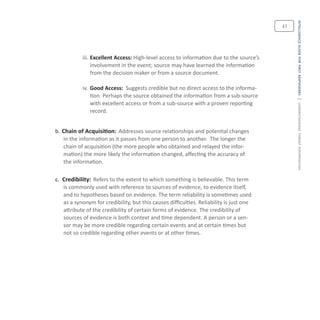
1. criteria: The Intelligence Community uses the following criteria to
understand threat information:
a.	 Access: Addresses the ability of the source to obtain the information.
Some common levels of source access are:
i.	 Direct Access: The intelligence source has direct knowledge of the
intelligence fact reported or appears to be in the direct contact with
those personally involved or knowledgeable.
ii.	Indirect Access: Some distance between the source and origin of the
information. The intelligence source is reporting information obtained
at one or more steps removed from those with first-hand knowledge.
intelligenceguideforfirstresponders|understandingthreatinformation
43
iii.	Excellent Access: High-level access to information due to the source’s
involvement in the event; source may have learned the information
from the decision maker or from a source document.
iv.	Good Access: Suggests credible but no direct access to the informa-
tion. Perhaps the source obtained the information from a sub-source
with excellent access or from a sub-source with a proven reporting
record.
b. Chain of Acquisition: Addresses source relationships and potential changes
in the information as it passes from one person to another. The longer the
chain of acquisition (the more people who obtained and relayed the infor-
mation) the more likely the information changed, affecting the accuracy of
the information.
c. Credibility: Refers to the extent to which something is believable. This term
is commonly used with reference to sources of evidence, to evidence itself,
and to hypotheses based on evidence. The term reliability is sometimes used
as a synonym for credibility, but this causes difficulties. Reliability is just one
attribute of the credibility of certain forms of evidence. The credibility of
sources of evidence is both context and time dependent. A person or a sen-
sor may be more credible regarding certain events and at certain times but
not so credible regarding other events or at other times.
intelligenceguideforfirstresponders|understandingthreatinformation
44
d. Reliability: A criteria of credibility applied to the primary source provides a
likelihood that the most recent reporting can be assessed to be an accurate
representation of the events reported based on the past performance of
the source. An analyst’s judgment on the intelligence source for a particular
report.
i.	 Reliable: Established reporting record judged to be accurate.
i.	 “Source has reported reliably in the past”
ii.	“Source has reported reliably over 1-10+ years”
ii.	 Uncertain: Limited reporting record and/or some uncertainty as to the reli-
ability of the source or sources: “Reporting reliability cannot be confirmed.”
iii.	Unknown: Previously unreported source.
intelligenceguideforfirstresponders|understandingthreatinformation
45
2. source categories: The Intelligence Community assesses the
source of the information to assist in understanding threat information.
The following terms are commonly used in describing sources:
a.	 Contact: Unilateral contacts who provide information voluntarily and in
confidence, but for whom a formal relationship has not been established:
“A contact with (direct/indirect/good/excellent) access who spoke in
confidence. This is the first reporting from source, reliability cannot be
determined.“
b.	Collaborative Source: Newly established sources with whom a formal rela-
tionship has recently been established. The reliability statement is based on
a combination of the quantity and quality of the source’s reporting: “A col-
laborative source with (direct/indirect/good/excellent) access (some/much/
all) of who’s reporting has been corroborated over the past two years.”
c.	 Established Source: Sources with which a relationship has been estab-
lished and, if revealed, would possibly endanger his/her status, reputa-
tion, or security. The reliability statement is based on a combination of the
quantity and quality of the source’s reporting: “An established source with
(direct/indirect/good/excellent) access (some/much/all) of who’s reporting
has been corroborated over the past two years.”
intelligenceguideforfirstresponders|understandingthreatinformation
d.	Walk-in/Call-in/Write-in: A previously unknown individual who makes
contact with an official U.S. person, installation, or website and volunteers
his/her information, with or without requesting some form of assistance in
return. Examples:
i.	 “A write-in to an official U.S. Government website. The information
was conveyed in writing, via email or other form of correspondence.”
ii. “A write-in to an official government agency. The information was
conveyed in writing, via email or other form of correspondence.”
iii. “A walk-in to an official government agency. The information was
conveyed in a face-to-face manner.”
iv.	 “A call-in to an official government agency. The information was
conveyed telephonically.”
e.	 Sensitive Source: A source, which if compromised, might reduce the abil-
ity to use the source in support of future collection activities: “A sensitive
source with excellent access.”
46
intelligenceguideforfirstresponders|understandingthreatinformation
3. additional source statement examples:
a.	 “Source obtained the information from a reliable sub-source with
direct access.”
b.	“Source obtained the information from a sub-source whose reporting
record has not been established.”
c.	 “Source was aware that his information would reach the U.S. Government
and may have intended his remarks to influence as well as to inform.”
d.	“The veracity of this source’s information is seriously doubted but is being
reported here because of the nature of the threat discussed.”
e.	 “The information was provided by the source who spoke in confidence and
without the knowledge of his government’s superiors. The information may
not be discussed with any foreign government officials, especially those of
the source’s government.”
f.	 “The information provided in this report may have been intended to influ-
ence as well as to inform.”
47
Understanding
Estimative Language
49
ITACG:intelligenceguideforfirstresponders
intelligenceguideforfirstresponders|understandingestimativelanguage
50
understanding estimative
language 14
When the Intelligence Community uses words such as “we judge” or “we assess”—
terms that are used synonymously—as well as “we estimate,” “likely” or “indicate,”
the Intelligence Community is trying to convey an analytical assessment or judgment.
These assessments, which are based on incomplete or at times fragmentary informa-
tion, are not a fact, proof, or knowledge. Some analytical judgments are based directly
on collected information; others rest on assessments that serve as building blocks. In
either type of judgment, the Intelligence Community does not have “evidence” that
shows something to be a fact or that definitively links two items or issues.
Intelligence judgments pertaining to likelihood are intended to reflect the Communi-
ty’s sense of the probability of a development or event.
intelligenceguideforfirstresponders|understandingestimativelanguage
51
The Intelligence Community does not intend the term “unlikely” to imply that an event
will not happen. It uses “probably” and “likely” to indicate that there is a greater
than even chance. The Intelligence Community uses words such as “we cannot dis-
miss,” “we cannot rule out,” and “we cannot discount” to reflect an unlikely—or even
remote—event whose consequences are such that it warrants mentioning. Words
such as “may be” and “suggest” are used to reflect situations in which the Intelligence
Community is unable to assess the likelihood generally because relevant information
is nonexistent, sketchy, or fragmented.
In addition to using words within a judgment to convey degrees of likelihood, the Intel-
ligence Community also ascribes “high,” “moderate,” or “low” confidence levels based
on the scope and quality of information supporting its judgments.
1. “high confidence” generally indicates that the Intelligence Communi-
ty’s judgments are based on high-quality information and/or that the nature
of the issue makes it possible to render a solid judgment.
2. “moderate confidence” generally means that the information is
interpreted in various ways, that the Intelligence Community has alternative
views, or that the information is credible and plausible but not corroborated
sufficiently to warrant a higher level of confidence.
3. “low confidence” generally means that the information is scant,
questionable or very fragmented and it is difficult to make solid analytic
inferences, or that the Intelligence Community has significant concerns or
problems with the sources.
intelligenceguideforfirstresponders|notes
notes
______________________________________________________
______________________________________________________
__________________________________________________________________
_________________________________________________________________
____________________________________________________________
____________________________________________________________
____________________________________________________________
___________________________________________________________
____________________________________________________________
____________________________________________________________
____________________________________________________________
___________________________________________________________
____________________________________________________________
____________________________________________________________
____________________________________________________________
IIIReference
SECTION
ITACG: intelligence guide for first responders
54
Intelligence
community Terminology
55
ITACG:intelligenceguideforfirstresponders
56
intelligence community
terminology 15
The following terminology is not exhaustive, but contains the terms which are likely to
be encountered by first responders reading intelligence material. While there may be
other definitions for these terms, the definitions used in this guide were selected to be
the most relevant to our intended audience.
intelligenceguideforfirstresponders|intelligencecommunityterminology
57
A
Actionable: (1) Information that is directly useful to customers for immediate exploi-
tation without having to go through the full intelligence production process; it may
address strategic or tactical needs, close support of US negotiating teams, or action
elements dealing with such matters as international terrorism or narcotics. (2) Intel-
ligence and information with sufficient specificity and detail that explicit responses to
prevent a crime or terrorist attack can be implemented.
Access: The means, ability, or permission to approach, enter, or use a resource.
All-Source Intelligence: Intelligence information derived from any or all of the intel-
ligence disciplines, including SIGINT, HUMINT, IMINT, MASINT, OSINT, and GEOINT.	
Analysis: The process by which people transform information into intelligence; sys-
tematic examination in order to identify significant facts, make judgments, and draw
conclusions.
B
Basic Intelligence: Fundamental intelligence concerning the general situation,
resources, capabilities, and vulnerabilities of foreign countries and areas that may be
used as reference material in the planning of operations at any level and in evaluating
subsequent information relating to the same subject.
Behaviors: Observable actions one uses to achieve results.
intelligenceguideforfirstresponders|intelligencecommunityterminology
C
Case Officer: A professional employee of an intelligence organization who is respon-
sible for providing direction for an agent operation.
Clandestine Activity: An activity that is usually extensive, goal-oriented, planned, and
executed to conceal the existence of the operation. Only participants and the agency
sponsoring the activity are intended to know about the operation. “Storefront” opera-
tions, “stings,” and certain concentrated undercover investigations can be classified as
clandestine activities.
Classification: The determination that official information requires, in the interest
of national security, a specific degree of protection against unauthorized disclosure,
coupled with a designation signifying that such a determination has been made; the
designation is normally termed a security classification and includes Confidential,
Secret, and Top Secret.
Collation (of information): A review of collected and evaluated information to deter-
mine its substantive applicability to a case or problem at issue and placement of useful
information into a form or system that permits easy and rapid access and retrieval.
Collection (of information): The identification, location, and recording/storing of
information—typically from an original source and using both human and technologi-
cal means—for input into the intelligence cycle for the purpose of meeting a defined
tactical or strategic intelligence goal.
Collection Plan: The preliminary step toward completing an assessment of intelligence
requirements to determine what type of information needs to be collected, alterna-
tives for how to collect the information, and a timeline for collecting the information.
58
intelligenceguideforfirstresponders|intelligencecommunityterminology
Communications Intelligence (COMINT): The capture of information, either encrypt-
ed or in “plaintext,” exchanged between intelligence targets or transmitted by a known
or suspected intelligence target for the purposes of tracking communications patterns
and protocols (traffic analysis), establishing links between intercommunicating parties
or groups, and/or analysis of the substantive meaning of the communication.
Conclusion: A definitive statement about a suspect, action, or state of nature based on
the analysis of information.
Confidential: Information which if made public could be expected to cause damage to
national security.
Consumer: The user of finished intelligence.
Coordination: The process of interrelating work functions, responsibilities, duties,
resources, and initiatives directed toward goal attainment.
Counterintelligence: Information gathered and activities conducted to identify,
deceive, exploit, disrupt, or protect against espionage, other intelligence activities,
sabotage, or assassinations conducted for or on behalf of foreign powers, organiza-
tions, or persons, or their agents, or international terrorist organizations or activities.
Counterterrorism: Offensive measures taken to prevent, deter, and respond to a ter-
rorist act, or the documented threat of such an act.
Covert: Planned and executed to conceal the collection of information and/or the
identity of any officer or agent participating in the activity. Intelligence operations
conducted in secrecy.
59
intelligenceguideforfirstresponders|intelligencecommunityterminology
Critical Infrastructure Information: Information not customarily in the public domain
and related to the security of critical infrastructure or protected systems— (1) actual,
potential, or threatened interference with, attack on, compromise of, or incapacitation
of critical infrastructure or protected systems by either physical or computer-based
attack or other similar conduct (including the misuse of or unauthorized access to all
types of communications and data transmission systems) that violates Federal, State,
or local law, harms interstate commerce of the United States, or threatens public
health or safety; (2) the ability of any critical infrastructure or protected system to
resist such interference, compromise, or incapacitation, including any planned or past
assessment, projection, or estimate of the vulnerability of critical infrastructure or a
protected system, including security testing, risk evaluation thereto, risk management
planning, or risk audit; or (3) any planned or past operational problem or solution
regarding critical infrastructure or protected systems, including repair, recovery, re-
construction, insurance, or continuity, to the extent it is related to such interference,
compromise, or incapacitation.” Homeland Security Act of 2002, as amended.
Cryptanalysis: The process of deciphering encrypted communications of an intelli-
gence target.
Cryptography: The creation of a communications code/encryption system for commu-
nication transmission with the intent of precluding the consumption and interpretation
of one’s own messages.
Cryptology: The study of communications encryption methods that deal with the de-
velopment of “codes” and the “scrambling” of communications in order to prevent the
interception of the communications by an unauthorized or unintended party.
Current Intelligence: Intelligence of all types and forms of immediate interest to the
users of intelligence; it may be disseminated without complete evaluation, interpreta-
tion, analysis, or integration.
60
intelligenceguideforfirstresponders|intelligencecommunityterminology
D
Deconfliction: The process or system used to determine whether multiple law en-
forcement agencies are investigating the same person or crime and which provides
notification to each agency involved of the shared interest in the case, as well as
providing contact information. This is an information and intelligence sharing process
that seeks to minimize conflicts between agencies and maximize the effectiveness of
an investigation.
Deductive Logic: The reasoning process of taking information and arriving at conclu-
sions from within that information.
Deployment: The short-term assignment of personnel to address specific national
security-related problems or demands.
Dissemination (of Intelligence): The process of effectively distributing analyzed intelli-
gence utilizing certain protocols in the most appropriate format to those in need of the
information to facilitate their accomplishment of organizational goals.
Downgrade: The process of editing or otherwise altering intelligence materials, infor-
mation, reports, or other products to conceal and protect intelligence sources, meth-
ods, capabilities, analytical procedures, or privileged information in order to permit
wider distribution. (see Sanitization)
61
intelligenceguideforfirstresponders|intelligencecommunityterminology
E
Essential Elements of Information (EEI): Items of intelligence information essential
for timely decisions and for enhancement of operations that relate to foreign powers,
forces, targets, or the physical environments. (see Priority Intelligence Requirement
(PIR))
Estimate: (1) An analysis of a situation, development, or trend that identifies its major
elements, interprets the significance, and appraises the future possibilities and the
prospective results of the various actions that might be taken. (2) An appraisal of the
capabilities, vulnerabilities, and potential courses of action of a foreign nation or com-
bination of nations in consequence of a specific national plan, policy, decision, or con-
templated course of action. (3) An analysis of an actual or contemplated clandestine
operation in relation to the situation in which it is or would be conducted in order to
identify and appraise such factors as available and needed assets, potential obstacles,
accomplishments, and consequences.
Estimative Intelligence: A category of intelligence that attempts to project prob-
able future foreign courses of action and developments and their implications for U.S.
interests; it may or may not be coordinated and may be national or departmental
intelligence.
Evaluation: An appraisal of the worth of an intelligence activity, information, or prod-
uct in terms of its contribution to a specific goal. All information collected for the intel-
ligence cycle is reviewed for its quality with an assessment of the validity and reliability
of the information.
62
intelligenceguideforfirstresponders|intelligencecommunityterminology
Exploitation: The process of obtaining intelligence information from any source and
taking advantage of it for intelligence purposes.
F
Field Intelligence Group (FIG): The centralized intelligence component in a Federal
Bureau of Investigation field office that is responsible for the management, execution,
and coordination of intelligence functions within the field office region.
Finished Intelligence: (1) The product resulting from the collection, processing,
integration, analysis, evaluation, and interpretation of available information concerning
foreign countries or areas. (2) The final result of the production step of the intelligence
cycle; the intelligence product.
Foreign Intelligence Surveillance Act (FISA): The FISA of 1978 prescribes procedures
for the physical and electronic surveillance and collection of “foreign intelligence infor-
mation” between or among “foreign powers” on territory under United States control.
FISA is codified in 50 U.S.C. §§1801-1811, 1821-29, 1841-46, and 1861-62. The Act was
amended by the USA PATRIOT Act of 2001, primarily to include terrorism by groups
that are not specifically backed by a foreign government.
For Official Use Only (FOUO): A dissemination control marking used to identify
unclassified information of a sensitive nature, not otherwise categorized by statute
or regulation, the unauthorized disclosure of which could adversely impact a person’s
privacy or welfare, the conduct of Federal programs, or other programs or operations
essential to the national interest.
63
intelligenceguideforfirstresponders|intelligencecommunityterminology
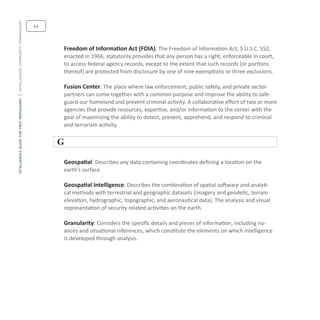
Freedom of Information Act (FOIA): The Freedom of Information Act, 5 U.S.C. 552,
enacted in 1966, statutorily provides that any person has a right, enforceable in court,
to access federal agency records, except to the extent that such records (or portions
thereof) are protected from disclosure by one of nine exemptions or three exclusions.
Fusion Center: The place where law enforcement, public safety, and private sector
partners can come together with a common purpose and improve the ability to safe-
guard our homeland and prevent criminal activity. A collaborative effort of two or more
agencies that provide resources, expertise, and/or information to the center with the
goal of maximizing the ability to detect, prevent, apprehend, and respond to criminal
and terrorism activity.
G
Geospatial: Describes any data containing coordinates defining a location on the
earth’s surface.
Geospatial Intelligence: Describes the combination of spatial software and analyti-
cal methods with terrestrial and geographic datasets (imagery and geodetic, terrain
elevation, hydrographic, topographic, and aeronautical data). The analysis and visual
representation of security related activities on the earth.
Granularity: Considers the specific details and pieces of information, including nu-
ances and situational inferences, which constitute the elements on which intelligence
is developed through analysis.
64
intelligenceguideforfirstresponders|intelligencecommunityterminology
H
Highside: Jargon for top secret government computer systems.
Homeland Security Advisory System: Designed to guide DHS protective measures
when specific information to a particular sector or geographic region is received. It
combines threat information with vulnerability assessments and provides communica-
tions to public safety officials and the public. The system includes:
•	 Homeland Security Threat Advisories contain actionable information about
an incident involving, or a threat targeting, critical national networks, infra-
structures, or key assets.
•	 Homeland Security Information Bulletins communicate information of inter-
est to the nation’s critical infrastructures that do not meet the timeliness,
specificity, or significance thresholds of warning messages.
•	 Color-coded Threat Level System is used to communicate with public safety
officials and the public at-large through a threat-based, color-coded system
so that protective measures can be implemented to reduce the likelihood
or impact of an attack. There are five levels: Low, Guarded, Elevated, High,
and Severe.
Hypothesis (from Criminal Intelligence Analysis): An interim conclusion regarding
persons, events, and/or commodities based on the accumulation and analysis of
intelligence information that is to be proven or disproved by further investigation
and analysis.
65
intelligenceguideforfirstresponders|intelligencecommunityterminology
I
Imagery Intelligence (IMINT): includes representations of objects reproduced elec-
tronically or by optical means on film, electronic display devices, or other media. Imag-
ery can be derived from visual photography, radar sensors, infrared sensors, lasers, and
electro-optics.
Indications and Warning (I&W): Those intelligence activities intended to detect and
report time-sensitive intelligence information on developments that could involve
a threat to U.S. or Allied military, political, or economic interests, or to U.S. citizens
abroad.
Indicator: Generally defined and observable actions that, based on an analysis of past
known behaviors and characteristics, collectively suggest that a person may be com-
mitting, preparing to commit, or has committed an unlawful act.
Inductive Logic: The reasoning process of taking diverse pieces of specific information
and inferring a broader meaning of the information through the course of hypothesis
development.
Inference Development: The creation of a probabilistic conclusion, estimate, or pre-
diction related to an intelligence target based upon the use of inductive or deductive
logic in the analysis of raw information related to the target.
Informant: An individual not affiliated with a law enforcement agency who provides
information about criminal behavior to a law enforcement agency. An informant may
be a community member, a businessperson, or a criminal informant who seeks to
protect himself/herself from prosecution and/or provide the information in exchange
for payment.
66
intelligenceguideforfirstresponders|intelligencecommunityterminology
Information: Pieces of raw, unanalyzed data that identify persons, evidence, or events
or illustrate processes that indicate the incidence of a criminal event or witnesses or
evidence of a criminal event.
Information Sharing Environment: As stated in the Information Sharing Environment
Implementation Plan, “information sharing environment” and “ISE” mean an approach
that facilitates the sharing of terrorism information. [IRTPA 1016(a)(2)] The ISE is to
provide and facilitate the means for sharing terrorism information among all appropri-
ate Federal, State, local, and tribal entities, and the private sector through the use of
policy guidelines and technologies. [Extracted from IRTPA 1016(b)(2)] To the greatest
extent practicable, the ISE is to provide the functional equivalent of or otherwise sup-
port a decentralized, distributed, and coordinated environment.
Information Sharing System: An integrated and secure methodology, whether com-
puterized or manual, designed to efficiently and effectively distribute critical infor-
mation about offenders, crimes, and/or events in order to enhance prevention and
apprehension activities by law enforcement.
Intelligence Analyst: A professional position in which the incumbent is responsible
for taking the varied facts, documentation of circumstances, evidence, interviews, and
any other material related to a crime and organizing them into a logical and related
framework for the purposes of developing a criminal case, explaining a criminal phe-
nomenon, describing crime and crime trends and/or preparing materials for court and
prosecution, or arriving at an assessment of a crime problem or crime group.
Intelligence Activity: A generic term used to encompass any or all of the efforts and
endeavors undertaken by intelligence organizations, including collection, analysis,
production, dissemination, and covert or clandestine activities.
67
intelligenceguideforfirstresponders|intelligencecommunityterminology
Intelligence Agency: A component organization of the Intelligence Community.
Intelligence Community: A federation of Executive Branch agencies and organiza-
tions that work separately and together to conduct intelligence activities necessary
for the conduct of foreign relations and the protection of the national security of the
U.S.. These organizations are (in alphabetical order): Air Force Intelligence, Army Intel-
ligence, Central Intelligence Agency, Coast Guard Intelligence, Defense Intelligence
Agency, Department of Energy, Department of Homeland Security, Department of
State, Department of the Treasury, Director of National Intelligence, Drug Enforcement
Administration, Federal Bureau of Investigation, Marine Corps Intelligence, National
Geospatial-Intelligence Agency, National Reconnaissance Office, National Security
Agency, and Navy Intelligence.
Intelligence Cycle: The steps by which information is converted into intelligence and
made available to users. The cycle has been described as including five steps: planning
and direction; collection; processing and exploitation; analysis and production; and
dissemination.
Intelligence Information: Unevaluated material that may be used in the production of
intelligence.
Intelligence Assessment: Refers to longer, often detailed intelligence products; en-
compasses most analytical studies dealing with subjects of policy significance.
Intelligence Bulletin: Refers to shorter, often less detailed intelligence products which
focus on a particular incident.
68
intelligenceguideforfirstresponders|intelligencecommunityterminology
Intelligence Estimate: An analysis of a situation, development, or trend that identifies
its major elements, interprets the significance, and appraises the future possibilities
and the prospective results of the various actions that might be taken.
Intelligence-Led Policing: The dynamic use of intelligence to guide operational law
enforcement activities to targets, commodities, or threats for both tactical responses
and strategic decision making for resource allocation and/or strategic responses.
Intelligence Mission: The role that the intelligence function of an agency fulfills in
support of the overall mission of the agency; it specifies in general language what the
function is intended to accomplish.
Intelligence Needs: Intelligence requirements not being addressed in current intel-
ligence activities.
Intelligence Officer: A professional employee of an intelligence organization.
Intelligence Products: Reports or documents that contain assessments, forecasts, as-
sociations, links, and other outputs from the analytic process.
Intelligence Requirement: Any subject, general or specific, upon which there is a
need for the collection of intelligence information or the production of intelligence.
69
intelligenceguideforfirstresponders|intelligencecommunityterminology
J
Joint Regional Information Exchange System (JRIES): A subscriber-supported ana-
lytical and resource system for local, state, and federal law enforcement, with an inter-
face to the U.S. Department of Defense, that provides secure sensitive but unclassified
real-time information with databases, e-mail, media studies, threat reporting, analytic
tools, and mapping and imagery tools.
K
Known or Suspected Terrorist: Pursuant to Homeland Security Presidential Directive
6 (HSPD-6), a known or suspected terrorist is an individual “known or appropriately
suspected to be or have been engaged in conduct constituting, in preparation for, in
aid of, or related to terrorism.”
L
Law Enforcement Sensitive (LES): Unclassified information originated by the FBI that
may be used in criminal prosecution and requires protection against unauthorized
disclosure to protect sources and methods, investigative activity, evidence, and the
integrity of pretrial investigative reports.
Low Side: Jargon for non-top secret computer system; can be used to refer to unclassi-
fied or secret-level systems.
70
intelligenceguideforfirstresponders|intelligencecommunityterminology
M
Measurement and Signature Intelligence (MASINT): Technically derived intelli-
gence data other than imagery and SIGINT. The data results in intelligence that locates,
identifies, or describes distinctive characteristics of targets. It employs a broad group of
disciplines including nuclear, optical, radio frequency, acoustics, seismic, and materials
sciences.
Methods: These are the methodologies (e.g., electronic surveillance or undercover
operations) of how critical information is obtained and recorded.
N
National Counterterrorism Center (NCTC): NCTC serves as the primary organization
in the United States Government for integrating and analyzing all intelligence pertain-
ing to terrorism possessed or acquired by the United States Government (except purely
domestic terrorism); serves as the central and shared knowledge bank on terrorism
information; provides all-source intelligence support to government-wide counterter-
rorism activities; establishes the information technology (IT) systems and architectures
within the NCTC and between the NCTC and other agencies that enable access to, as
well as integration, dissemination, and use of, terrorism information.
National Security: Measures adopted by the government of a nation in order to as-
sure the safety of its citizens, guard against attack, and prevent disclosure of sensitive
or classified information which might threaten or embarrass said nation.
71
intelligenceguideforfirstresponders|intelligencecommunityterminology
National Security Intelligence: The collection and analysis of information concerned
with the relationship and equilibrium of the United States with foreign powers, or-
ganizations, and persons with regard to political and economic factors, as well as the
maintenance of the United States’ sovereign principles.
Network: A structure of interconnecting components designed to communicate with
each other and perform a function or functions as a unit in a specified manner.
No Fly: An individual not allowed on commercial flights due to terrorism concerns.
No-Fly List: A list created and maintained by the U.S. Government to keep known or
suspected terrorists off commercial flights.
O
Open Source: Information of potential intelligence value that is available to the gen-
eral public.
Open-Source Intelligence (OSINT): Publicly available information appearing in print
or electronic form including radio, television, newspapers, journals, the Internet, com-
mercial databases, and videos, graphics, and drawings.
Operational Intelligence: Information is evaluated and systematically organized on an
active or potential target, such as groups of or individual criminals, relevant premises,
contact points, and methods of communication. This process is developmental in
nature wherein there are sufficient articulated reasons to suspect criminal activity.
Intelligence activities explore the basis of those reasons and newly developed informa-
tion in order to develop a case for arrest or indictment.
72
intelligenceguideforfirstresponders|intelligencecommunityterminology
Operations Security: A systematic, proven process by which a government, organiza-
tion, or individual can identify, control, and protect generally unclassified information
about an operation/activity and, thus, deny or mitigate an adversary’s/competitor’s
ability to compromise or interrupt said operation/activity.
P
Personally Identifiable Information: Any information that permits the identity of
an individual to be directly or indirectly inferred, including other information that is
linked or linkable to an individual. “Individual” includes, but is not limited to, U.S.
citizens, legal permanent residents, and visitors to the U.S. “Information” includes any
information about an individual maintained by an agency, including, but not limited to,
education, financial transactions, medical history, and criminal or employment history
and information which can be used to distinguish or trace an individual’s identity, such
as their name, social security number, date and place of birth, mother’s maiden name,
biometric records, etc., including any other personal information which is linked or
linkable to an individual. [See Executive Office of the President, Office of Management
and Budget, July 12, 2006, M-06-19].
Plus 1: (1) One additional of something. (2) An individual’s name plus an additional
data element (e.g., date of birth, SSN, passport number). Typically used in reference to
information, beyond an individual’s name, required to confirm an individual’s identity.
Policy: The principles and values that guide the performance of a duty. A policy is not
a statement of what must be done in a particular situation. Rather, it is a statement of
guiding principles that should be followed in activities which are directed toward the
attainment of goals.
73
intelligenceguideforfirstresponders|intelligencecommunityterminology
Prediction: The projection of future actions or changes in trends based on an analysis
of information depicting historical trends from which a forecast is based.
Priority Intelligence Requirement: A prioritized informational need that is critical to
mission success.
Privacy (Information): The assurance that legal and constitutional restrictions on the
collection, maintenance, use, and disclosure of personally identifiable information will
be adhered to by criminal justice agencies, with use of such information to be strictly
limited to circumstances where legal process permits use of the personally identifiable
information.
Privacy (Personal): The assurance that legal and constitutional restrictions on the
collection, maintenance, use, and disclosure of behaviors of an individual, including
his/her communications, associations, and transactions, will be adhered to by criminal
justice agencies, with use of such information to be strictly limited to circumstances
where legal process authorizes surveillance and investigation.
Privacy Act: The Privacy Act of 1974, 5 U.S.C. § 552a, establishes a code of fair infor-
mation practices that governs the collection, maintenance, use, and dissemination of
personally identifiable information about individuals that is maintained in systems of
records by federal agencies. A system of records is a group of records under the control
of an agency from which information is retrieved by the name of the individual or by
some identifier assigned to the individual. The Privacy Act requires that agencies give
the public notice of their systems of records by publication in the Federal Register. The
Privacy Act prohibits the disclosure of information from a system of records absent the
written consent of the subject individual, unless the disclosure is pursuant to one of
twelve statutory exceptions. The Act also provides individuals with a means by which
to seek access to and amendment of their records, and sets forth various agency re-
cord-keeping requirements.
74
intelligenceguideforfirstresponders|intelligencecommunityterminology
Private Sector Partners: As used in the ISE Implementation Plan, “private sector
partners” includes vendors, owners, and operators of products and infrastructures
participating in the ISE.
Q
Qualitative (Methods): Research methods that collect and analyze information which
is described in narrative or rhetorical form, with conclusions drawn based on the cu-
mulative interpreted meaning of that information.
Quantitative (Methods): Research methods that collect and analyze information
which can be counted or placed on a scale of measurement that can be statistically
analyzed.
R
Raw Data: Bits of data collected which individually convey little or no useful
information and must be collated, aggregated, or interpreted to provide meaningful
information.
Raw Intelligence: A colloquial term meaning collected intelligence information that
has not yet been converted into finished intelligence.
Regional Information Sharing Systems (RISS): Composed of six regional intelligence
centers that provide secure communications, information sharing resources, and
investigative support to combat multijurisdictional crime and terrorist threats to local,
state, tribal, and federal member law enforcement agencies in all 50 states, the District
of Columbia, U.S. territories, Australia, Canada, and England.
75
Requirements (Intelligence): The types of intelligence operational law enforcement
elements need from the intelligence function within an agency or other intelligence-
producing organizations in order for law enforcement officers to maximize protection
and preventive efforts as well as identify
and arrest persons who are criminally
liable.
Responsibility: Reflects how the author-
ity of a unit or individual is used and
determines whether goals have been
accomplished and the mission fulfilled
in a manner that is consistent with the
defined limits of authority.
Risk: Defined as the potential for unde-
sirable outcomes for a given situation
or problem.
Risk Assessment: An analysis of a target,
illegal commodity, or victim to identify
the probability of being attacked or
criminally compromised and to analyze
vulnerabilities.
76
intelligenceguideforfirstresponders|intelligencecommunityterminology
S
Sanitization: The process of editing or otherwise altering intelligence materials,
information, reports, or other products to conceal and protect intelligence sources,
methods, capabilities, analytical procedures, or privileged information in order to
permit wider dissemination.
Secret: Information which if made public could be expected to cause serious damage
to national security.
Selectee (TSA): An individual who must undergo additional security screening before
being permitted to board a commercial aircraft.
Sensitive But Unclassified (SBU) Information: Information that has not been clas-
sified by a federal law enforcement agency which pertains to significant law en-
forcement cases under investigation and criminal intelligence reports which require
dissemination criteria to only those persons necessary to further the investigation or to
prevent a crime or terrorist act.
Sensitive Compartmented Information (SCI): Classified information concerning or
derived from intelligence sources, methods, or analytical processes that is required
to be handled within formal access control systems established by the Director of
National Intelligence.
Sensitive Compartmented Information Facility (SCIF): An accredited area, room,
group of rooms, buildings, or installation where SCI may be stored, used, discussed,
and/or processed.
77
intelligenceguideforfirstresponders|intelligencecommunityterminology
Signals Intelligence (SIGINT): Intelligence derived from signal intercepts comprising,
individually or in combination, all communications intelligence (COMINT), electronic
intelligence (ELINT), and/or foreign instrumentation signals intelligence (FISINT)
Source: A book, statement, person, etc., supplying information. From an intelligence
perspective, these are persons (human intelligence or HUMINT) who collect or possess
critical information needed for intelligence analysis.
Suspicious Activity Report (SAR): The reporting of suspicious activity to an appro-
priate government agency, defined as behavior that may be indicative of intelligence
gathering or preoperational planning related to terrorism, criminal espionage, or other
illicit intention.
System of Records: Pursuant to the Privacy Act of 1974, a System of Records is a
group of any records under the control of any agency from which information is re-
trieved by the name of the individual or by some identifying number, symbol, or other
identifier assigned to the individual. The Privacy Act requires each agency to publish
notice of its systems of records in the Federal Register. This notice is generally referred
to as a system of records notice (SORN).
T
Tactical Intelligence: Evaluated information on which immediate enforcement action
can be based; intelligence activity focused specifically on developing an active case.
Target: (1) Any person, organization, group, crime or criminal series, or commodity
being subject to investigation and intelligence analysis. (2) An individual, operation, or
activity which an adversary has determined possesses information that might prove
useful in attaining his/her objective.
78
intelligenceguideforfirstresponders|intelligencecommunityterminology
79
Target Profile: A profile that is person-specific and contains sufficient detail to initiate
a target operation or support an ongoing operation against an individual or networked
group of individuals.
Targeting: The identification of crimes, crime trends, and crime patterns that have dis-
cernable characteristics which make collection and analysis of intelligence information
an efficient and effective method for identifying, apprehending, and prosecuting those
who are criminally responsible.
Tear-line: Intelligence information which has been sanitized (removal of sources and
methods) in order to distribute this information at a lower classification.
Tear-Line Report: A report containing classified intelligence or information that is pre-
pared in such a manner that data relating to intelligence sources and methods are eas-
ily removed from the report to protect sources and methods from disclosure. Typically,
the information below the “tear line” can be released as sensitive but unclassified.
Terrorism: Premeditated, politically motivated violence perpetrated against noncom-
batant targets by sub-national groups or clandestine agents, usually intended to influ-
ence an audience. Title 22, U.S.C. Section 265f (d)
Terrorist Screening Center (TSC): Established in support of Homeland Security Presi-
dential Directive 6 (HSPD-6), dated September 16, 2003, to consolidate the Federal
Government’s approach to terrorism screening and provide for the appropriate and
lawful use of terrorist information in screening processes. The TSC maintains the Feder-
al Government’s consolidated and integrated terrorist watch list, known as the TSDB.
intelligenceguideforfirstresponders|intelligencecommunityterminology
80
Terrorist Screening Database (TSDB): The database which contains the consolidated
and integrated terrorist watch list maintained by the Federal Bureau of Investigation’s
Terrorist Screening Center (TSC). The No Fly and Selectee List are components of the
TSDB.
Third-Agency Rule: An agreement wherein a source agency releases information
under the condition that the receiving agency does not release the information to any
other agency—that is, a third agency.
Threat: (1) The capability of an adversary coupled with his intentions to undertake any
action detrimental to the interests of the United States. (2) A source of unacceptable
risk.
Threat Assessment: An assessment of a criminal or terrorist presence within a
jurisdiction integrated with an assessment of potential targets of that presence and a
statement of probability that the criminal or terrorist will commit an unlawful act. The
assessment focuses on the criminal’s or terrorist’s opportunity, capability, and willing-
ness to fulfill the threat.
Top Secret: Information which if made public could be expected to cause exceptionally
grave damage to national security.
intelligenceguideforfirstresponders|intelligencecommunityterminology
U
Unauthorized Disclosure: A communication or physical transfer to an unauthorized
recipient.
Unclassified: Information not subject to a security classification, i.e., information
not CONFIDENTIAL, SECRET or TOP SECRET. Although Unclassified information is not
subject to security classification, there may be limits on disclosure. (See Section 8.
Handling of “Controlled Unclassified Information.”)
V
Validity: Asks the question, “Does the information actually represent what we believe
it represents?”
Variable: Any characteristic on which individuals, groups, items, or incidents differ.
Vet: (1) To subject a proposal, work product, or concept to an appraisal by command
personnel and/or experts to ascertain the product’s accuracy, consistency with phi-
losophy, and/or feasibility before proceeding. (2) To subject information or sources to
careful examination or scrutiny to determine suitability.
81
intelligenceguideforfirstresponders|intelligencecommunityterminology
Vulnerability: Susceptibility to attack, exploitation, or injury; an inherent weakness or
flaw. One of three key aspects of determining risk: vulnerability, threat, and impact.
Vulnerability Assessment: An assessment of possible criminal or terrorist group
targets within a jurisdiction integrated with an assessment of the target’s weaknesses,
likelihood of being attacked, and ability to withstand an attack.
W
Warning: To notify in advance of possible harm or victimization as a result of informa-
tion and intelligence gained concerning the probability of a crime or terrorist attack.
X
Y
Z
82
intelligenceguideforfirstresponders|notes
notes
_____________________________________________________
_____________________________________________________
_____________________________________________________
_____________________________________________________
_____________________________________________________
_____________________________________________________
_____________________________________________________
_____________________________________________________
_____________________________________________________
_____________________________________________________
_____________________________________________________
_____________________________________________________
_____________________________________________________
_____________________________________________________
_____________________________________________________
Intelligence
community Acronyms
& Abbreviations
85
ITACG:intelligenceguideforfirstresponders
86
intelligence
community acronyms
& abbreviations 16
The following list is not exhaustive, but contains the acronyms and abbreviations which
are likely to be encountered by first responders reading intelligence material.
intelligenceguideforfirstresponders|intelligencecommunityacronymsandabbreviations
87
A
AAR: After Action Report
ACIC: Army Counterintelligence Center
AFIS: Automated Fingerprint Identification System
AFOSI: Air Force Office of Special Investigations
AKA: Also Known As
AMCIT: American Citizen
AMEMB: American Embassy
ANW: Alerts, Notifications, and Warnings
AQ: al-Qa’ida
AQIM: al-Qa’ida in the Islamic Maghreb (formerly Salafist Group for Preaching
and Combat [GSPC])
ATF: Bureau of Alcohol, Tobacco, and Firearms
AUC: United Self-Defense Forces of Colombia
B
BPA: Border Patrol Agent
BW: Biological Warfare
C
C: Confidential
CBP: U.S. Customs and Border Protection, DHS
CBR: Chemical, Biological and Radiological
CBRN: Chemical, Biological, Radiological and Nuclear
CBRNE: Chemical, Biological, Radiological, Nuclear and Explosives
intelligenceguideforfirstresponders|intelligencecommunityacronymsandabbreviations
88
CBT: Computer-Based Training
CBW: Chemical and Biological Warfare
CDD: Chemical Dispersion Device
CI: Counterintelligence
CI Poly: Counterintelligence Polygraph
CIA: Central Intelligence Agency
CIR: Central Intelligence Report
CIR: Counterintelligence Report
CIS: Bureau of Citizenship and Immigration Services, DHS
CLASS: Consular Lookout and Support System
COI: Community of Interest
COMINT: Communications Intelligence
COMSEC: Communications Security
CONOPS: Concept of Operations
CONUS: Continental U.S.
COOP: Continuity of Operations
CT: Counterterrorism
CTC: Counterterrorism Center
CUI: Controlled Unclassified Information
D
D/CIA: Director Central Intelligence Agency (formerly DCI)
DCI: Director of Central Intelligence (now Director of National Intelligence [DNI])
D&D: Denial and Deception
DEA: Drug Enforcement Administration
DHS: Department of Homeland Security
intelligenceguideforfirstresponders|intelligencecommunityacronymsandabbreviations
89
DIA: Defense Intelligence Agency
DISES: Defense Intelligence Senior Executive Service
DISL: Defense Intelligence Senior Level
DNI: Director of National Intelligence (replaces Director of Central Intelligence (DCI))
DOB: Date of Birth
DOD: Department of Defense
DOE: Department of Energy
DOS: Department of State
DPOB: Date and Place of Birth
DSS: Diplomatic Security Service
DT: Domestic Terrorism
E
EAAQ: East Africa al Qa’ida
EEI: Essential Element of Information (now PIR)
EIF: Entry into Force
ELINT: Electronic Intelligence
EO: Executive Order
EPA: Environmental Protection Agency
ETA: Estimated time of arrival
ETA: Basque Fatherland and Liberty
EWI: Entry without inspection
intelligenceguideforfirstresponders|intelligencecommunityacronymsandabbreviations
90
F
FAA: Federal Aviation Administration
FAM: Federal Air Marshal
FARC: Revolutionary Armed Forces of Colombia
FBI: Federal Bureau of Investigation
FBIS: Foreign Broadcast Information System (now Open Source Center)
FCPO: Fusion Center Program Office
FEMA: Federal Emergency Management Agency
FGI: Foreign Government Information
FIG: Field Intelligence Group, FBI
FIR: Field Information Report
FIS: Foreign Intelligence Service
FISA: Foreign Intelligence Surveillance Act
FNU: First Name Unknown
FPO: Federal Protective Service Officer
FOIA: Freedom of Information Act
FOUO: For Official Use Only
FPS: Federal Protective Service
FPU: Force Protective Unit
G
GEOINT: Geospatial Intelligence
GIA: Armed Islamic Group
GS: General Schedule
GWOT: Global War on Terror
intelligenceguideforfirstresponders|intelligencecommunityacronymsandabbreviations
91
H
HCS: Human Control System
HIR: Homeland Information Report
HITRAC: Homeland Infrastructure Threat and Risk Analysis Center, DHS
HSC: Homeland Security Council
HSDN: Homeland Secure Data Network
HSIN: Homeland Security Information Network (DHS web portal)
HSIN-I: Homeland Security Information Network-Intelligence (DHS web portal)
HS-SLIC: Homeland Security State and Local Intelligence Community of Interest
HUMINT: Human Intelligence
HUM: Harakat ul-Mujahidin
I
I&W: Indications and Warning
IA: Intelligence Assessment
IA: Intelligence Analyst
IAEA: International Atomic Energy Agency
IBIS: Interagency Border Inspection System
IC: Intelligence Community
ICD: Improvised Chemical Device
ICD: Intelligence Community Directive (replaces Director of Central Intelligence
Directives, or DCIDs)
ICCD: Improvised Chemical Dispersion Device
ICE: U.S. Immigration and Customs Enforcement, DHS
IDENT: Automated Biometric Fingerprint Identification System
IED: Improvised Explosive Device
intelligenceguideforfirstresponders|intelligencecommunityacronymsandabbreviations
92
IG: Inspector General
IICT: Interagency Intelligence Committee on Terrorism, NCTC
IIR: Intelligence Information Report
IJU: Islamic Jihad Union
IMINT: Imagery Intelligence
IMU: Islamic Movement of Uzbekistan
INA: Immigration and Nationality Act
IND: Improvised Nuclear Device
INFOSEC: Information Security
INR: Bureau of Intelligence and Research, DOS
INTERPOL: International Police
IRT: Incident Response Team
IRTPA: Intelligence Reform and Terrorism Prevention Act of 2004
ISC: Information Sharing Council
ISE: Information Sharing Environment
IT: International Terrorism
ITACG: Interagency Threat Assessment and Coordination Group, NCTC
J
JCS: Joint Chiefs of Staff
JEM: Jaish-e-Mohammed
JI: Jemaah Islamiya
JITF-CT: Joint Intelligence Task Force-Combating Terrorism, DIA
JRIES: Joint Regional Information Exchange System
JSA: Joint Special Assessment
JTF: Joint Task Force
JTTF: Joint Terrorism Task Force
JWICS: Joint Worldwide Intelligence Communication System
intelligenceguideforfirstresponders|intelligencecommunityacronymsandabbreviations
93
K
L
LAN: Local Area Network
LEA: Law Enforcement Agency
LEO: Law Enforcement Officer
LEO: Law Enforcement Online (FBI UNCLASS web portal)
LES: Law Enforcement Sensitive
LIFG: Libya Islamic Fighting Group
LNU: Last Name Unknown
LPR: Lawful Permanent Resident
LT: Lashkar-e Tayyiba
LTTE: Liberation Tigers of the Tamil Eelam
M
MANPADS: Man-Portable Air Defense System
MASINT: Measurement and Signature Intelligence
MEK: Mujahedin-e Khalq
MI: Military Intelligence
MOA: Memorandum of Agreement
MOU: Memorandum of Understanding
intelligenceguideforfirstresponders|intelligencecommunityacronymsandabbreviations
94
N
NAILS: National Automated Immigration Lookout System
NIE: National Intelligence Estimate
NCIC: National Crime Information Center
NCIS: Naval Criminal Investigative Service
NCIX: National Counterintelligence Executive
NCPC: National Counter Proliferation Center
NCR: National Capital Region
NCTC: National Counterterrorism Center
NFI: No Further Information
NGA: National Geospatial-Intelligence Agency (formerly NIMA)
NIC: National Intelligence Council
NIE: National Intelligence Estimate
NIO: National Intelligence Officer
NIP: National Intelligence Program
NIPF: National Intelligence Priorities Framework
NIMA: National Imagery and Mapping Agency (now NGA)
NJTTF: National Joint Terrorism Task Force
NLETS: National Law Enforcement Telecommunication System
NOC: National Operations Center, DHS
NOFORN: Not Releasable to Foreign Nationals
NOIWON: National Operations and Intelligence Watch Officers Network
NOL: NCTC Online
NOL-J: NCTC Online-JWICS
NOL-S: NCTC Online-SIPRNET (also NCTC Online-Secret)
NRO: National Reconnaissance Office
NSA: National Security Agency
intelligenceguideforfirstresponders|intelligencecommunityacronymsandabbreviations
95
NSC: National Security Council
NSEERS: National Security Entry-Exit Registration System
NSIS: National Strategy for Information Sharing
NSTL: National Security Threat List
NSTR: Nothing Significant to Report
NSTS: National Secure Telephone System
NTM: National Technical Means
NTR: Nothing to Report
O
OCONUS: Outside the Continental United States
ODNI: Office of the Director of National Intelligence
OI&A: Office of Intelligence & Analysis, DHS
OPSEC: Operations Security
ORCON: Originator Controlled Dissemination
OSC: Open Source Center (formerly FBIS)
OSINT: Open Source Intelligence
OSIS: Open Source Information System
P
PIR: Priority Intelligence Requirement (formerly EEI)
PM-ISE: Program Manager-Information Sharing Environment
POB: Place of Birth
POC: Point of Contact
POE: Port of Entry
intelligenceguideforfirstresponders|intelligencecommunityacronymsandabbreviations
PM: Production Management
PNR: Passenger Name Record
PPN: Passport Number
PSA: Protective Security Advisor, DHS
Q
QJBR: al-Qa’ida in Iraq (Tanzim Qa’idat al-Jihad fi Bilad al-Rafidayn)
R
RDD: Radiation Dispersal Device
RFI: Request for Information
RFP: Request for Proposal
RISS: Regional Information Sharing System
RISSNET: Regional Information Sharing System Network
RO: Reporting Officer
RSO: Regional Security Office or Officer
S
S: Secret
S&T: Science & Technology
S&L: State and Local
SA: Situational Awareness
SA: Special Assessment
SAP: Special Access Program
96
intelligenceguideforfirstresponders|intelligencecommunityacronymsandabbreviations
SAR: Suspicious Activity Report
SBI: Special Background Investigation
SBU: Sensitive But Unclassified
SCI: Sensitive Compartmented Information
SCIF: Sensitive Compartmented Information Facility
SEG: Special Events Group
SES: Senior Executive Service
SETA: Special Events Threat Assessment
SEVIS: Student Exchange Visitor Information System
SI: Sensitive Information
SI: Special Intelligence
SIA: Supervisory Intelligence Analyst
SIO: Supervisory Intelligence Officer
SIOC: Strategic Information and Operations Center, FBI
SIPRNET: Secret Internet Protocol Routed Network
SIS: Senior Intelligence Service
SNIS: Senior National Intelligence Service
SOP: Standard Operating Procedure
SLAM: SIOC Law Enforcement Alert Messaging
STE: Secure Telephone
SLFC: State and Local Fusion Center
SLT: State, Local, and Tribal
SLTP: State, Local, Tribal, and Private Sector
STU III: Secure Telephone Unit III
SSI: Sensitive Security Information
SSO: Special Security Officer
SME: Subject Matter Expert
SVTC: Secure Video Teleconference
97
intelligenceguideforfirstresponders|intelligencecommunityacronymsandabbreviations
T
TA: Threat Analysis
TA: Threat Assessment
TD: Teletype Dissemination
TDX: Teletype Dissemination Sensitive
TDY: Temporary Duty
TECS: Treasury Enforcement Communications System
TIDE: Terrorist Identities Data Mart Environment
TLO: Terrorism Liaison Officer
TS: Top Secret
TSA: Transportation Security Administration
TSANOF: TSA No Fly List
TSASEL: TSA Selectee List
TSC: Terrorist Screening Center
TSDB: Terrorist Screening Database
TSO: Transportation Security Officer
TSOC: Transportation Security Operations Center
TS/SCI: Top Secret/Sensitive Compartmented Information
TTP: Tactics, Techniques, and Procedures
U
U: Unclassified
UASI: Urban Areas Security Initiative
UBL: Usama Bin Ladin
U//FOUO: Unclassified//For Official Use Only
UI: Unidentified
UNC: Unclassified
98
intelligenceguideforfirstresponders|intelligencecommunityacronymsandabbreviations
UNCLASS: Unclassified
UNK: Unknown
USA: U.S. Attorney
USC: U.S. Citizen
USCG: U.S. Coast Guard
USDI: Undersecretary of Defense for Intelligence
USEMB: U.S. Embassy
USIC: U.S. Intelligence Community
USPER: U.S. Person
V
VBIED: Vehicle Borne Improvised Explosive Device
VGTOF: Violent Gang & Terrorist Organization File
VTC: Video Teleconference
VWI: Virtual Walk-In
VWP: Visa Waiver Program
W
WMD: Weapons of Mass Destruction
X
Y
Z
99
100
1
http://www.intelink.ic.gov/wiki/Intelligence
2
http://www.intelink.ic.gov/wiki/Intelligence_Sources_and_Methods
3
http://www.intelligence.gov/1who.shtml
4
http://www.intelink.ic.gov/wiki/Intelligence_community
5
http://www.intelligence.gov/2-business.shtml
6
http://www.intelligence.gov/2-business.shtml
7
http://www.archives.gov/cui/
8
DHS MD 11042.1
9
http://www.fbi.gov/clearance/securityclearance.htm
10
2009 National Intelligence – a consumer’s guide; http://www.intelink.ic.gov/wiki/
Intelligence_Community_Customer_Handbook
11
Multiple Sources
12
Multiple Sources
13
FBI Intelligence Information Report (IIR) Handbook, 10/23/2006
14
What We Mean When We Say: An Explanation of Estimative Language
15
Multiple Sources
16
Multiple Sources
END NOTES
intelligenceguideforfirstresponders|notes
notes
_____________________________________________________
_____________________________________________________
_____________________________________________________
_____________________________________________________
_____________________________________________________
_____________________________________________________
_____________________________________________________
_____________________________________________________
_____________________________________________________
_____________________________________________________
_____________________________________________________
_____________________________________________________
_____________________________________________________
_____________________________________________________
_____________________________________________________
intelligenceguideforfirstresponders|notes
notes
______________________________________________________
______________________________________________________
__________________________________________________________________
_________________________________________________________________
____________________________________________________________
____________________________________________________________
____________________________________________________________
___________________________________________________________
____________________________________________________________
____________________________________________________________
____________________________________________________________
___________________________________________________________
____________________________________________________________
____________________________________________________________
____________________________________________________________
intelligenceguideforfirstresponders|notes
notes
_____________________________________________________
_____________________________________________________
_____________________________________________________
_____________________________________________________
_____________________________________________________
_____________________________________________________
_____________________________________________________
_____________________________________________________
_____________________________________________________
_____________________________________________________
_____________________________________________________
_____________________________________________________
_____________________________________________________
_____________________________________________________
_____________________________________________________
This document can also be found in printable format
at https://hsin-intel.dhs.gov or http://www.leo.gov.
0 9 0 6 6 9 1 3
Corporate Resources & Infrastructure
CREATIVE SERVICES
ITACG intelligence guide for first responders

ITACG_Guide_for_First_Responders_2011

  • 1.
    Interagency Threat Assessmentand Coordination Group INTELLIGENCE GUIDE FOR FIRST RESPONDERS
  • 4.
    Legal Disclaimer Nothing inthis handbook shall be construed to impair or otherwise affect the authority granted by law to a department or agency, or the head thereof. Additionally, the handbook is not intended to, and does not, create any right or benefit, substantive or procedural, enforceable at law or in equity, by any party against the United States, its departments, agencies or entities, its officers, employees, or agents, or any other person.
  • 5.
    i Table of Contents Introduction Whatis Intelligence? 8 The Intelligence Community 10 The Intelligence Cycle 12 Categories of Finished Intelligence I 1 5 Handling of “Controlled Unclassified Information” Security Clearances What Intelligence Can and Cannot Do 17 21 25 GENERAL HOW TOII
  • 6.
    ii Intelligence Products TypicallyAvailable to First Responders Accessing Intelligence Community Products Understanding Threat Information Understanding Estimative Language 29 35 41 49 III REFERENCE Intelligence Community Terminology Intelligence Community Acronyms and Abbreviations 55 85
  • 7.
    SECTION I ITACG: intelligence guidefor first responders General
  • 9.
  • 10.
    intelligenceguideforfirstresponders|introduction 2 This Interagency ThreatAssessment and Coordination Group (ITACG) Intelligence Guide for First Responders is designed to assist state, local, tribal law enforcement, firefighting, homeland security, and appropriate private sector personnel in access- ing and understanding Federal counterterrorism, homeland security, and weapons of mass destruction intelligence reporting. Most of the information contained in this guide was compiled, derived, and adapted from existing Intelligence Community and open source references. The ITACG consists of state, local, and tribal first responders and federal intelligence analysts from the Department of Homeland Security and the Federal Bureau of Investi- gation, working at the National Counterterrorism Center (NCTC) to enhance the sharing of federal counterterrorism, homeland security, and weapons of mass destruction information with state, local, and tribal consumers of intelligence. introduction
  • 11.
    intelligenceguideforfirstresponders|introduction Fig.1 - Currentand former members of the ITACG Detail; clockwise from the top: New Jersey State Police, Seattle Fire Depart- ment, Federal Bureau of Investigation, Boston Police Department, Illinois State Po- lice, Phoenix Police Department (2007-2008), Six Nations Tuscarora, Las Vegas Police De- partment, Department of Homeland Security, DC Metropolitan Police (2008-2009) 3
  • 13.
  • 14.
    intelligenceguideforfirstresponders|introduction what is intelligence?1 “Intelligenceis the product resulting from the collection, processing, integration, evaluation, analysis, and interpretation of available information concerning foreign nations, hostile or potentially hostile forces or elements, or areas of actual or potential operations. The term is also applied to the activity which results in the product and to the organizations engaged in such activity.” 22 June 2007 edition of Joint Pub 2-0, Joint Intelligence There are six basic intelligence sources2 : Signals Intelligence (SIGINT) is derived from the exploitation of foreign electronic emissions. SIGINT can be in the form of the actual information content of a signal or in the form of its temporal and spectral characteristics called signal operating parameters. SIGINT includes both the raw data and the analysis product of that data. SIGINT breaks down into four sub disciplines: Electronic Intelligence (ELINT), Communications Intelligence (COMINT), Foreign Instrumentation Signals Intelligence (FISINT), and weapons-related Command and Control Signals (PROFORMA). Imagery Intelligence (IMINT) is a product that is the result of processing and exploiting raw imagery (information) and creating an analyzed product (intelligence). An image alone is only information in the form of pixels, digits, or other forms of graphic representation and the data behind that portrayal. When studied for content with an understanding of portrayal, imaging processes, and the place, objects and time captured by that process, or through comparison to other images and consideration in light of other information or intelligence, imagery intelligence (IMINT) can be created. 6
  • 15.
    intelligenceguideforfirstresponders|introduction 7 Measurement and SignatureIntelligence (MASINT) is scientific and technical intelligence information obtained by quantitative and qualitative analysis of data (metric, angle, spatial, wavelength, time dependence, modulation, plasma, and hydromagnetic) derived from spe- cific technical sensors for the purpose of identifying any distinctive features associated with the source, emitter, or sender and to facilitate subsequent identification and/or measurement of the same. Human-Source Intelligence (HUMINT) is intelligence derived from human beings who may act as both sources and collectors, and where the human is the primary collection instrument. This includes all forms of intelligence gathered by humans, from direct reconnaissance and obser- vation to the use of recruited agents. HUMINT may also encompass interrogation techniques, including the process of questioning detainees conducted in compliance with U.S. law and regu- lation, international law, executive orders, and other operationally specific guidelines. HUMINT can provide a wide range of information which includes but is not limited to adversary plans and intentions, deliberations and decisions, research and development goals and strategies, doctrine, leadership, political or military relationships, weapons systems, physical and cultural infrastructure, and medical conditions. HUMINT can often collect information that is difficult or sometimes impossible to collect by other, more technical, means. Open-Source Intelligence (OSINT) is unclassified information of potential intelligence value that is available to the general public. Geospatial Intelligence (GEOINT) is the intelligence derived from the exploitation of imagery and geospatial information to describe, assess, and visually depict physical features and geo- graphically referenced activities on the Earth.
  • 16.
    intelligenceguideforfirstresponders|whatisintelligence The Intelligence Community(IC) is a federation of executive branch agencies and organizations that work separately and together to conduct intelligence activities necessary for the conduct of foreign relations and the protection of the national security of the United States. These activities include: Collection of information needed by the president, the National Security Coun-• cil, the Secretaries of State and Defense, and other Executive Branch officials for the performance of their duties and responsibilities; Production and dissemination of intelligence;• Collection of information concerning, and the conduct of activities to protect• against, intelligence activities directed against the U.S., international terrorist and international narcotics activities, and other hostile activities directed against the U.S. by foreign powers, organizations, persons, and their agents. Special activities;• Administrative and support activities within the U.S. and abroad necessary for• the performance of authorized activities; and Such other intelligence activities as the President may direct from time to time.• the intelligence community 3 “The United States intelligence effort shall provide the President, the National Security Council, and the Homeland Security Council with the necessary information on which to base decisions concerning the develop- ment and conduct of foreign, defense and economic policy, and the pro- tection of United States national interests from foreign security threats. All departments and agencies shall cooperate fully to fulfill this goal.” Executive Order 12333 8
  • 17.
    intelligenceguideforfirstresponders|whatisintelligence 9 The Intelligence Community(IC) refers to those agencies and organizations involved in intelligence activities: 4 Air Force Intelligence• Army Intelligence• Central Intelligence Agency (CIA)• Coast Guard (USCG)• Defense Intelligence Agency (DIA)• Department of Energy (DoE) Office of Intelligence• Department of Homeland Security (DHS), Office of Intelligence• and Analysis Department of State Bureau of Intelligence and Research (INR)• Department of the Treasury (DoT), Treasury Office of Terrorism• and Financial Intelligence Office of the Director of National Intelligence (ODNI)• Drug Enforcement Administration (DEA), Office of National• Security Intelligence Federal Bureau of Investigation (FBI), National Security Branch• Marine Corps Intelligence• National Geospatial-Intelligence Agency (NGA)• National Reconnaissance Office (NRO)• National Security Agency (NSA)• Naval Intelligence•
  • 18.
    intelligenceguideforfirstresponders|whatisintelligence the intelligence cycle5 The intelligence cycle is the process of developing raw information into finished intelligence for policymakers, military commanders, and other consumers to use in decision-making and actions. Five steps constitute the intelligence cycle: 1. Planning and Direction: Establishing the intelligence requirements of the policymakers – the President, the National Security Council, military commanders, and other officials in major departments and governmental agencies. 2. Collection: Gathering of raw data from which finished intelligence is pro- duced. There are six basic intelligence sources, or collection disciplines: a. Signals Intelligence (SIGINT) b. Imagery Intelligence (IMINT) c. Measurement and Signature Intelligence (MASINT) d. Human-Source Intelligence (HUMINT) e. Open-Source Intelligence (OSINT) f. Geospatial Intelligence (GEOINT) 3. Processing and Exploitation: Conversion of large amounts of data to a form suitable for the production of finished intelligence; includes transla- tions, decryption, and interpretation of information stored on film and mag- netic media through the use of highly refined photographic and electronic processes. 10
  • 19.
    intelligenceguideforfirstresponders|whatisintelligence 11 4. Analysis andProduction: Integration, evaluation, and analysis of all avail- able data and the preparation of a variety of intelligence products, including timely, single-source, event-oriented reports and longer term, all-source, finished intelligence studies. 5. Dissemination: Delivering the products to consumers who request them. Some intelligence information is sent directly to consumers, usually by electronic means, because it is self-explanatory. More often, analysts check information to see how it relates to other information they have received. They evaluate the information and make comments. When information has been reviewed and correlated with information available from other sources, it is called finished intelligence.
  • 20.
    intelligenceguideforfirstresponders|whatisintelligence 12 Categories of finished Intelligence6 There are five categories of finished intelligence available to the consumer of intelligence: 1. Current intelligence addresses day-to-day events, seeking to apprise consumers of new developments and related background, to assess their significance, to warn of their near-term consequences, and to signal potentially dangerous situations in the near future. Current intel- ligence is presented in daily, weekly, and some monthly publications, and frequently in ad hoc written memorandums and oral briefings to senior officials. 2. Estimative intelligence looks forward to assess potential developments that could affect U.S. national security. Like all kinds of intelligence, estimative intelligence starts with the available facts, but then explores the unknown, even the unknowable. Estimative intelligence helps poli- cymakers to think strategically about long-term threats by discussing the implications of a range of possible outcomes and alternative scenarios. National Intelligence Estimates, which are estimative reports produced by the National Intelligence Council, are the Director of National Intelli- gence’s (DNI) most authoritative written assessments of national security issues.
  • 21.
    intelligenceguideforfirstresponders|whatisintelligence 13 3. Warning intelligencesounds an alarm or gives notice to policymakers. It connotes urgency and implies the potential need for policy action in response. Warning includes identifying or forecasting events that could cause the engagement of U.S. military forces, or those that would have a sudden and deleterious effect on U.S. foreign policy concerns (for example, coups, third-party wars, refugee situations). Warning analysis involves exploring alternative futures and low probability/high impact scenarios. The National Intelligence Officer (NIO) for Warning serves as the DNI’s and the IC’s principal adviser on warning. All agencies and intelligence staffs have designated warning components, and some have specific warning responsibilities. 4. Research intelligence is presented in monographs and in-depth studies by virtually all agencies. Research underpins both current and estimative intelligence.
  • 22.
    intelligenceguideforfirstresponders|whatisintelligence 5. Scientific andtechnical intelligence includes information on techni- cal developments and characteristics, performance, and capabilities of foreign technologies including weapon systems or subsystems. This information is derived from analysis of all-source data, including tech- nical measurements. Generally, such technical analysis and reporting responds to specific national requirements derived from the weapons acquisition process, arms control negotiations, or military operations. It covers the entire spectrum of sciences, technologies, weapon sys- tems, and integrated operations. This type of intelligence is provided to consumers via in-depth studies, detailed system handbooks, executive summaries, focused assessments and briefs, and automated databases. 14
  • 23.
    IIHow To SECTION ITACG: intelligenceguide for first responders
  • 25.
    Handling of “Controlled UnclassifiedInformation” 17 ITACG:intelligenceguideforfirstresponders
  • 26.
    intelligenceguideforfirstresponders|handling“forofficialuseonly”information 18 handling “controlled unclassified information”7 Controlled Unclassified Information (CUI) is a categorical designation that refers to unclassified information that does not meet the standards for National Security Classi- fication under Executive Order 12958, as amended, but is pertinent to the national in- terests of the United States or to the important interests of entities outside the Federal Government, and under law or policy requires protection from unauthorized disclo- sure, special handling safeguards, or prescribed limits on exchange or dissemination. CUI includes many caveats, such as “FOR OFFICIAL USE ONLY” (FOUO). Information labeled FOUO should be safeguarded, and withheld from public release until approved for release by the originating agency. 8 FOUO is not a classification, but a dissemination control marking. It is used to identify unclassified information of a sensitive nature, not otherwise categorized by statute or regulation, the unauthorized disclosure of which could adversely impact a person’s privacy or welfare, the conduct of Federal programs, or other programs or operations essential to the national interest.
  • 27.
    intelligenceguideforfirstresponders|handling“forofficialuseonly”information 19 Dissemination of FOUOis restricted to persons with “need-to-know.” Need-to-know is defined as the determination made by an authorized holder of information that a prospective recipient requires access to specific information in order to perform or as- sist in the lawful and authorized governmental function, i.e., access is required for the performance of official duties. Typical FOUO requirements include: 1. FOUO information will not be disseminated in any manner – orally, visually, or electronically – to unauthorized personnel. 2. The holder of the information will comply with access and dissemination restrictions. 3. Ensure the recipient of FOUO has valid need-to-know, and that precautions are taken to prevent unauthorized individuals from overhearing the conver- sation, observing the materials, or otherwise obtaining the information. Many government agencies use the FOUO caveat, but other caveats, such as, LAW ENFORCEMENT SENSITIVE (LES), and OFFICIAL USE ONLY (OUO), are also used. In many instances the requirement for safeguarding this information is equivalent; however, these agencies may have additional requirements concerning the safe- guarding of sensitive information.
  • 29.
  • 30.
    intelligenceguideforfirstresponders|securityclearances 22 security CLEARANCES 9 Mostinformation needed by state, local, and tribal first responders can be shared at an unclassified level. In those instances where it is necessary to share classified information, it can usually be accomplished at the Secret level. State and local officials who require access to classified material must apply for a se- curity clearance through FBI or DHS. The process involves completing a Questionnaire for National Security Positions, submitting fingerprints, and undergoing a background investigation. Records checks for Secret and Top Secret security clearance are mandated by Presidential Executive Order (EO). The EO requires these procedures in order for a security clearance to be granted and they cannot be waived. 1. Secret Clearances: A Secret security clearance may be granted to those persons who “need-to-know” national security information, classified at the Confidential or Secret level. A Secret security clearance takes the least amount of time to process.
  • 31.
    intelligenceguideforfirstresponders|securityclearances 23 2. Top SecretClearances: A Top Secret clearance may be granted to those persons who “need-to-know” national security information, classified up to the Top Secret level, and who need unescorted access to sensitive facilities, when necessary. a. In addition to all the requirements at the Secret level, a background investi- gation, covering a 10-year time period, is required. b. Once favorably adjudicated for a Top Secret security clearance, the candi- date will be required to sign a Non-Disclosure Agreement. For additional information, visit http://www.fbi.gov/clearance/securityclearance.htm or contact your local FBI Field Office.
  • 32.
  • 33.
    What Intelligence Can andCannot Do 25 ITACG:intelligenceguideforfirstresponders
  • 34.
    intelligenceguideforfirstresponders|whatintelligencecanandcannotdo 26 what intelligence can (andcannot) do 10 Intelligence information can be an extremely powerful tool. It is most useful when the consumer has a clear understanding of what intelligence can and cannot do. While laws, policies, capabilities, and standards are constantly changing, these general guide- lines can help consumers make the most of this resource. 1. what intelligence can do: Intelligence information can provide valuable services, such as: • Providing decision advantage, by improving the decision-making of consumers and partners while hindering that of our enemies. • Warning of potential threats. • Insight into key current events. • Situational awareness. • Long-term strategic assessments on issues of ongoing interest. • Assistance in preparation for senior-level meetings that include national security-related subjects. • Pre-travel security overviews and support. • Reports on specific topics, either as part of ongoing reporting or upon request for short-term needs. • Compiling U.S. Government knowledge on persons of interest.
  • 35.
    intelligenceguideforfirstresponders|whatintelligencecanandcannotdo 27 2. what intelligencecannot do: Realistic expectations will help the consumer fill their intelligence needs. Some things that intel- ligence cannot do include: • Predict the future. Intelligence can provide assessments of likely scenarios or developments, but there is no way to predict what will happen with certainty. • Violate U.S. law. The activities of the IC must be conducted consistent with all applicable laws and executive orders, to include the National Security Act of 1947, as amended, the Foreign Intelligence Surveillance Act, the Intelligence Reform and Terrorism Prevention Act (IRTPA), the Privacy Act of 1974, the Detainee Treatment Act, Homeland Security Act of 2002, as amended, Executive Order 12333, and the Military Commission Act. All activities of the IC are subject to extensive and rigorous oversight both within the Executive Branch and by the Legislative Branch, as required by the National Security Act of 1947, as amended. unclassified//fouo
  • 36.
  • 37.
    Intelligence Products Typically Availableto First Responders 29 ITACG:intelligenceguideforfirstresponders
  • 38.
    intelligenceguideforfirstresponders|intelligenceproductstypicallyavailabletofirstresponders 30 intelligence products typically availableto first responders 11 The following types of products can be found on a variety of classified and unclassified systems, including FBI’s Law Enforcement Online (LEO), and DHS’s Homeland Secure Information Network-Intelligence (HSIN-I) via the Internet, and NCTC Online-SECRET (NOL-S) via secret level systems, such as FBI Network (FBINet), Homeland Secure Data Network (HSDN), Joint Deployable Intelligence Support System (JDISS), and Secure In- ternet Protocol Routed Network (SIPRNet). 1. Situational Awareness and Threat Reporting: These are breaking news events to chief executives and command centers with state, local, and tribal law enforcement agencies via HSIN-I, LEO, text messaging, or e-mail. These reports are often produced jointly by DHS and FBI. 2. Information Report: These are specially formatted messages transmit- ted electronically, which enable the timely dissemination of unevaluated intelligence within the Intelligence Community and law enforcement. The information conveyed in these products may be non-specific or fragmentary and simply constitute suspicious activity, but still be of intelligence value. These products include: a. IIR (Intelligence Information Report) b. HIR (Homeland Information Report)
  • 39.
    intelligenceguideforfirstresponders|intelligenceproductstypicallyavailabletofirstresponders 31 3. Intelligence Assessment(IA): Finished intelligence products resulting from the intelligence analysis process. Assessments may address tactical, strate- gic, or technical intelligence requirements. 4. Threat Assessment (TA) or Special Assessment (SA): Provides in-depth analysis related to a specific event or body of threat reporting. 5. Intelligence Bulletin (IB): Finished intelligence products used to dissemi- nate information of interest, such as significant developments and trends, to the intelligence and law enforcement communities in an article format. An IB does not address threat warning information. 6. Joint Intelligence Assessment (IA) or Intelligence Bulletin (IB): Assessments or bulletins which are written jointly by two or more IC agen- cies (dual or multiple seals). These products may address the same types of requirements as Intelligence Assessments or Intelligence Bulletins. These joint products may be formatted differently than single seal versions, de- pending on the format agreed to by participating agencies.
  • 40.
    intelligenceguideforfirstresponders|intelligenceproductstypicallyavailabletofirstresponders 7. Other Reports:These include intelligence summaries and briefs produced daily, which cover current counterterrorism, homeland security, and WMD- related information. Examples include: a. Roll Call Release: The Roll Call Release is a collaborative FOUO-only product developed by DHS, FBI, and the ITACG. The product is written specifically for state, local, and tribal first responders, and focuses on terrorist tactics, techniques, procedures; terrorism trends; and indicators of suspicious activ- ity. The product is written on an ad hoc basis, is focused on one subject, and fits on one page. These products are posted on HSIN-I and LEO. b. Terrorism Summary (TERRSUM): The TERRSUM is a SECRET collateral digest of terrorism-related intelligence of interest to Federal and non-Federal law enforcement, security and military personnel. Produced Monday through Friday, the TERRSUM includes terrorism-related intelligence available to NCTC and other Intelligence Community elements. The product is posted on NOL-S. 32
  • 41.
    intelligenceguideforfirstresponders|notes notes _____________________________________________________ _____________________________________________________ _____________________________________________________ _____________________________________________________ _____________________________________________________ _____________________________________________________ _____________________________________________________ _____________________________________________________ _____________________________________________________ _____________________________________________________ _____________________________________________________ _____________________________________________________ _____________________________________________________ _____________________________________________________ _____________________________________________________
  • 42.
  • 43.
  • 44.
    intelligenceguideforfirstresponders|accessingintelligencecommunityproducts accessing intelligence community products12 Classified and unclassified intelligence can be accessed by first responders through multiple systems and websites. In some cases an account is required, while other times all that is needed is access to a specific computer network. Many of these sourc- es of information only require that an individual perform homeland security or law enforcement activities on behalf of a state, local, or tribal government; a few require security clearances and access to secure systems. 1. UNCLASSIFIED Intelligence Products a. Homeland Security Information Network – Intelligence (HSIN-I): HSIN-I is an official government information sharing and electronic communications portal. It provides DHS, FBI, NCTC, other federal and non-federal intelligence products at the FOUO level. Accounts are available to federal, state, local, and tribal personnel performing homeland security or law enforcement duties. HSIN-I can be accessed from any computer system with an Internet connection. Access is by invitation only. i. Website: https://hsin-intel.dhs.gov ii. Access: Contact the helpdesk at 1-877-624-3771 or e-mail hsin.intel@hq.dhs.gov for sponsor contact information. Sponsors for state, local, and tribal can be contacted through the State and Local Fusion Centers. 36
  • 45.
    intelligenceguideforfirstresponders|accessingintelligencecommunityproducts 37 b. Law Enforcement Online(LEO): LEO can be accessed from any computer system with an Internet connection. It is an official government informa- tion sharing and electronic communications portal. LEO provides FBI, joint FBI-DHS, NCTC, and non-federally produced intelligence products at the FOUO level. Accounts are available to federal, state, local, and tribal personnel performing homeland security or law enforcement duties and personnel from foreign law enforcement agencies. i. Website: http://www.leo.gov ii. Access: Go to http://www.leo.gov, click on the “LEO Membership Criteria” and then click on the “LEO User Application”, or contact LEO Helpdesk at 1-888-334-4536, or e-mail helpdesk@leo.gov. c. Intelink-U: Intelink-U is the Intelligence Community’s “Sensitive but Unclassified” (SBU) information sharing network. Content is provided by the Intelligence Community, other government agencies, foreign partners, academia, and open sources. Accounts are available to individuals with federal, state, local, and tribal homeland security and law enforcement responsibilities. i. Website: https://www.intelink.gov ii. Access: Go to https://www.intelink.gov, click on “Sign In”, and proceed to “New Account Registration”. d. Regional Information Sharing Systems Network (RISSNET): RISSNET facilitates information sharing within the law enforcement community to combat multi-jurisdictional criminal activities and conspiracies. It is composed of six multi-state intelligence centers (RISS Intelligence Centers). Membership comprises federal, state, local, and tribal law enforcement agencies. Access is requested through the regional RISS Intelligence Centers.
  • 46.
    intelligenceguideforfirstresponders|accessingintelligencecommunityproducts i. Website: http://www.riss.net ii. Contactinformation available at http://www.riss.net/Centers.aspx. e. DHS Technical Resources for Incident Prevention (TRIPwire): TRIPwire is a secure information sharing network for law enforcement, bomb squads, and other first responders. Content consists of current terrorist bombing tactics, techniques, and procedures. i. Website: https://www.tripwire-dhs.net ii. Access: Apply online at https://www.tripwire-dhs.net. f. Federal Protective Service Portal (FPS Portal): The FPS Portal is a compi- lation of FOUO products for law enforcement and first responders. i. Website: https://fps.esportals.net ii. Access: For membership contact helpdesk@espgroup.net or 877-624-3771. g. Open Source Center (OSC): OSC contains open source reporting, analysis, and translations of foreign policy and national security issues. Accounts are available to individuals with federal, state, and local homeland security and counterterrorism responsibilities. i. Website: http://www.opensource.gov ii. Access: Apply online at http://www.opensource.gov. 38
  • 47.
    intelligenceguideforfirstresponders|accessingintelligencecommunityproducts 39 2. SECRET IntelligenceProducts a. NCTC Online-SECRET (NOL-S): NOL-S can be accessed from any SECRET U.S. Government information system (HSDN, FBINet, JDISS, or SIPRNet). i. Website: https://nol.nctc.sgov.gov ii. Access: Authorized access to HSDN, FBINet, JDISS, or SIPRNet is the only requirement. b. Office of Intelligence and Analysis (OI&A) Webpage, DHS: The OI&A homepage can be accessed from any SECRET U.S. Government information system (HSDN, FBINet, JDISS, or SIPRNet). i. Website: http://dhs.csp.sgov.gov ii. Access: Authorized access to HSDN, FBINet, JDISS, or SIPRNet is the only requirement. c. FBINet: The FBI intranet can only be accessed from an FBINet computer. i. Website: http://intranet.fbinet.fbi ii. Access: Authorized access to an FBINet system. d. FBI Intelink/SIPRNet: Can be accessed from any SECRET U.S. Government information system (HSDN, FBINet, JDISS, or SIPRNET). i. Website: http://www.fbi.sgov.gov ii. Access: Authorized access to HSDN, FBINet, JDISS, or SIPRNET is the only requirement.
  • 49.
  • 50.
    intelligenceguideforfirstresponders|understandingthreatinformation 42 understanding threat information 13 Araw intelligence report, alert, warning, or notification is a message that provides timely dissemination of unevaluated intelligence within the U.S. intelligence, federal law enforcement, and state, local, tribal and private sector communities. This is infor- mation that individuals or organizations need in order to make decisions. The informa- tion may be nonspecific or fragmentary and simply constitute suspicious activity but still be of intelligence value. 1. criteria: The Intelligence Community uses the following criteria to understand threat information: a. Access: Addresses the ability of the source to obtain the information. Some common levels of source access are: i. Direct Access: The intelligence source has direct knowledge of the intelligence fact reported or appears to be in the direct contact with those personally involved or knowledgeable. ii. Indirect Access: Some distance between the source and origin of the information. The intelligence source is reporting information obtained at one or more steps removed from those with first-hand knowledge.
  • 51.
    intelligenceguideforfirstresponders|understandingthreatinformation 43 iii. Excellent Access: High-levelaccess to information due to the source’s involvement in the event; source may have learned the information from the decision maker or from a source document. iv. Good Access: Suggests credible but no direct access to the informa- tion. Perhaps the source obtained the information from a sub-source with excellent access or from a sub-source with a proven reporting record. b. Chain of Acquisition: Addresses source relationships and potential changes in the information as it passes from one person to another. The longer the chain of acquisition (the more people who obtained and relayed the infor- mation) the more likely the information changed, affecting the accuracy of the information. c. Credibility: Refers to the extent to which something is believable. This term is commonly used with reference to sources of evidence, to evidence itself, and to hypotheses based on evidence. The term reliability is sometimes used as a synonym for credibility, but this causes difficulties. Reliability is just one attribute of the credibility of certain forms of evidence. The credibility of sources of evidence is both context and time dependent. A person or a sen- sor may be more credible regarding certain events and at certain times but not so credible regarding other events or at other times.
  • 52.
    intelligenceguideforfirstresponders|understandingthreatinformation 44 d. Reliability: Acriteria of credibility applied to the primary source provides a likelihood that the most recent reporting can be assessed to be an accurate representation of the events reported based on the past performance of the source. An analyst’s judgment on the intelligence source for a particular report. i. Reliable: Established reporting record judged to be accurate. i. “Source has reported reliably in the past” ii. “Source has reported reliably over 1-10+ years” ii. Uncertain: Limited reporting record and/or some uncertainty as to the reli- ability of the source or sources: “Reporting reliability cannot be confirmed.” iii. Unknown: Previously unreported source.
  • 53.
    intelligenceguideforfirstresponders|understandingthreatinformation 45 2. source categories:The Intelligence Community assesses the source of the information to assist in understanding threat information. The following terms are commonly used in describing sources: a. Contact: Unilateral contacts who provide information voluntarily and in confidence, but for whom a formal relationship has not been established: “A contact with (direct/indirect/good/excellent) access who spoke in confidence. This is the first reporting from source, reliability cannot be determined.“ b. Collaborative Source: Newly established sources with whom a formal rela- tionship has recently been established. The reliability statement is based on a combination of the quantity and quality of the source’s reporting: “A col- laborative source with (direct/indirect/good/excellent) access (some/much/ all) of who’s reporting has been corroborated over the past two years.” c. Established Source: Sources with which a relationship has been estab- lished and, if revealed, would possibly endanger his/her status, reputa- tion, or security. The reliability statement is based on a combination of the quantity and quality of the source’s reporting: “An established source with (direct/indirect/good/excellent) access (some/much/all) of who’s reporting has been corroborated over the past two years.”
  • 54.
    intelligenceguideforfirstresponders|understandingthreatinformation d. Walk-in/Call-in/Write-in: A previouslyunknown individual who makes contact with an official U.S. person, installation, or website and volunteers his/her information, with or without requesting some form of assistance in return. Examples: i. “A write-in to an official U.S. Government website. The information was conveyed in writing, via email or other form of correspondence.” ii. “A write-in to an official government agency. The information was conveyed in writing, via email or other form of correspondence.” iii. “A walk-in to an official government agency. The information was conveyed in a face-to-face manner.” iv. “A call-in to an official government agency. The information was conveyed telephonically.” e. Sensitive Source: A source, which if compromised, might reduce the abil- ity to use the source in support of future collection activities: “A sensitive source with excellent access.” 46
  • 55.
    intelligenceguideforfirstresponders|understandingthreatinformation 3. additional sourcestatement examples: a. “Source obtained the information from a reliable sub-source with direct access.” b. “Source obtained the information from a sub-source whose reporting record has not been established.” c. “Source was aware that his information would reach the U.S. Government and may have intended his remarks to influence as well as to inform.” d. “The veracity of this source’s information is seriously doubted but is being reported here because of the nature of the threat discussed.” e. “The information was provided by the source who spoke in confidence and without the knowledge of his government’s superiors. The information may not be discussed with any foreign government officials, especially those of the source’s government.” f. “The information provided in this report may have been intended to influ- ence as well as to inform.” 47
  • 57.
  • 58.
    intelligenceguideforfirstresponders|understandingestimativelanguage 50 understanding estimative language 14 Whenthe Intelligence Community uses words such as “we judge” or “we assess”— terms that are used synonymously—as well as “we estimate,” “likely” or “indicate,” the Intelligence Community is trying to convey an analytical assessment or judgment. These assessments, which are based on incomplete or at times fragmentary informa- tion, are not a fact, proof, or knowledge. Some analytical judgments are based directly on collected information; others rest on assessments that serve as building blocks. In either type of judgment, the Intelligence Community does not have “evidence” that shows something to be a fact or that definitively links two items or issues. Intelligence judgments pertaining to likelihood are intended to reflect the Communi- ty’s sense of the probability of a development or event.
  • 59.
    intelligenceguideforfirstresponders|understandingestimativelanguage 51 The Intelligence Communitydoes not intend the term “unlikely” to imply that an event will not happen. It uses “probably” and “likely” to indicate that there is a greater than even chance. The Intelligence Community uses words such as “we cannot dis- miss,” “we cannot rule out,” and “we cannot discount” to reflect an unlikely—or even remote—event whose consequences are such that it warrants mentioning. Words such as “may be” and “suggest” are used to reflect situations in which the Intelligence Community is unable to assess the likelihood generally because relevant information is nonexistent, sketchy, or fragmented. In addition to using words within a judgment to convey degrees of likelihood, the Intel- ligence Community also ascribes “high,” “moderate,” or “low” confidence levels based on the scope and quality of information supporting its judgments. 1. “high confidence” generally indicates that the Intelligence Communi- ty’s judgments are based on high-quality information and/or that the nature of the issue makes it possible to render a solid judgment. 2. “moderate confidence” generally means that the information is interpreted in various ways, that the Intelligence Community has alternative views, or that the information is credible and plausible but not corroborated sufficiently to warrant a higher level of confidence. 3. “low confidence” generally means that the information is scant, questionable or very fragmented and it is difficult to make solid analytic inferences, or that the Intelligence Community has significant concerns or problems with the sources.
  • 60.
    intelligenceguideforfirstresponders|notes notes ______________________________________________________ ______________________________________________________ __________________________________________________________________ _________________________________________________________________ ____________________________________________________________ ____________________________________________________________ ____________________________________________________________ ___________________________________________________________ ____________________________________________________________ ____________________________________________________________ ____________________________________________________________ ___________________________________________________________ ____________________________________________________________ ____________________________________________________________ ____________________________________________________________
  • 61.
  • 62.
  • 63.
  • 64.
    56 intelligence community terminology 15 Thefollowing terminology is not exhaustive, but contains the terms which are likely to be encountered by first responders reading intelligence material. While there may be other definitions for these terms, the definitions used in this guide were selected to be the most relevant to our intended audience. intelligenceguideforfirstresponders|intelligencecommunityterminology
  • 65.
    intelligenceguideforfirstresponders|intelligencecommunityterminology 57 A Actionable: (1) Informationthat is directly useful to customers for immediate exploi- tation without having to go through the full intelligence production process; it may address strategic or tactical needs, close support of US negotiating teams, or action elements dealing with such matters as international terrorism or narcotics. (2) Intel- ligence and information with sufficient specificity and detail that explicit responses to prevent a crime or terrorist attack can be implemented. Access: The means, ability, or permission to approach, enter, or use a resource. All-Source Intelligence: Intelligence information derived from any or all of the intel- ligence disciplines, including SIGINT, HUMINT, IMINT, MASINT, OSINT, and GEOINT. Analysis: The process by which people transform information into intelligence; sys- tematic examination in order to identify significant facts, make judgments, and draw conclusions. B Basic Intelligence: Fundamental intelligence concerning the general situation, resources, capabilities, and vulnerabilities of foreign countries and areas that may be used as reference material in the planning of operations at any level and in evaluating subsequent information relating to the same subject. Behaviors: Observable actions one uses to achieve results.
  • 66.
    intelligenceguideforfirstresponders|intelligencecommunityterminology C Case Officer: Aprofessional employee of an intelligence organization who is respon- sible for providing direction for an agent operation. Clandestine Activity: An activity that is usually extensive, goal-oriented, planned, and executed to conceal the existence of the operation. Only participants and the agency sponsoring the activity are intended to know about the operation. “Storefront” opera- tions, “stings,” and certain concentrated undercover investigations can be classified as clandestine activities. Classification: The determination that official information requires, in the interest of national security, a specific degree of protection against unauthorized disclosure, coupled with a designation signifying that such a determination has been made; the designation is normally termed a security classification and includes Confidential, Secret, and Top Secret. Collation (of information): A review of collected and evaluated information to deter- mine its substantive applicability to a case or problem at issue and placement of useful information into a form or system that permits easy and rapid access and retrieval. Collection (of information): The identification, location, and recording/storing of information—typically from an original source and using both human and technologi- cal means—for input into the intelligence cycle for the purpose of meeting a defined tactical or strategic intelligence goal. Collection Plan: The preliminary step toward completing an assessment of intelligence requirements to determine what type of information needs to be collected, alterna- tives for how to collect the information, and a timeline for collecting the information. 58
  • 67.
    intelligenceguideforfirstresponders|intelligencecommunityterminology Communications Intelligence (COMINT):The capture of information, either encrypt- ed or in “plaintext,” exchanged between intelligence targets or transmitted by a known or suspected intelligence target for the purposes of tracking communications patterns and protocols (traffic analysis), establishing links between intercommunicating parties or groups, and/or analysis of the substantive meaning of the communication. Conclusion: A definitive statement about a suspect, action, or state of nature based on the analysis of information. Confidential: Information which if made public could be expected to cause damage to national security. Consumer: The user of finished intelligence. Coordination: The process of interrelating work functions, responsibilities, duties, resources, and initiatives directed toward goal attainment. Counterintelligence: Information gathered and activities conducted to identify, deceive, exploit, disrupt, or protect against espionage, other intelligence activities, sabotage, or assassinations conducted for or on behalf of foreign powers, organiza- tions, or persons, or their agents, or international terrorist organizations or activities. Counterterrorism: Offensive measures taken to prevent, deter, and respond to a ter- rorist act, or the documented threat of such an act. Covert: Planned and executed to conceal the collection of information and/or the identity of any officer or agent participating in the activity. Intelligence operations conducted in secrecy. 59
  • 68.
    intelligenceguideforfirstresponders|intelligencecommunityterminology Critical Infrastructure Information:Information not customarily in the public domain and related to the security of critical infrastructure or protected systems— (1) actual, potential, or threatened interference with, attack on, compromise of, or incapacitation of critical infrastructure or protected systems by either physical or computer-based attack or other similar conduct (including the misuse of or unauthorized access to all types of communications and data transmission systems) that violates Federal, State, or local law, harms interstate commerce of the United States, or threatens public health or safety; (2) the ability of any critical infrastructure or protected system to resist such interference, compromise, or incapacitation, including any planned or past assessment, projection, or estimate of the vulnerability of critical infrastructure or a protected system, including security testing, risk evaluation thereto, risk management planning, or risk audit; or (3) any planned or past operational problem or solution regarding critical infrastructure or protected systems, including repair, recovery, re- construction, insurance, or continuity, to the extent it is related to such interference, compromise, or incapacitation.” Homeland Security Act of 2002, as amended. Cryptanalysis: The process of deciphering encrypted communications of an intelli- gence target. Cryptography: The creation of a communications code/encryption system for commu- nication transmission with the intent of precluding the consumption and interpretation of one’s own messages. Cryptology: The study of communications encryption methods that deal with the de- velopment of “codes” and the “scrambling” of communications in order to prevent the interception of the communications by an unauthorized or unintended party. Current Intelligence: Intelligence of all types and forms of immediate interest to the users of intelligence; it may be disseminated without complete evaluation, interpreta- tion, analysis, or integration. 60
  • 69.
    intelligenceguideforfirstresponders|intelligencecommunityterminology D Deconfliction: The processor system used to determine whether multiple law en- forcement agencies are investigating the same person or crime and which provides notification to each agency involved of the shared interest in the case, as well as providing contact information. This is an information and intelligence sharing process that seeks to minimize conflicts between agencies and maximize the effectiveness of an investigation. Deductive Logic: The reasoning process of taking information and arriving at conclu- sions from within that information. Deployment: The short-term assignment of personnel to address specific national security-related problems or demands. Dissemination (of Intelligence): The process of effectively distributing analyzed intelli- gence utilizing certain protocols in the most appropriate format to those in need of the information to facilitate their accomplishment of organizational goals. Downgrade: The process of editing or otherwise altering intelligence materials, infor- mation, reports, or other products to conceal and protect intelligence sources, meth- ods, capabilities, analytical procedures, or privileged information in order to permit wider distribution. (see Sanitization) 61
  • 70.
    intelligenceguideforfirstresponders|intelligencecommunityterminology E Essential Elements ofInformation (EEI): Items of intelligence information essential for timely decisions and for enhancement of operations that relate to foreign powers, forces, targets, or the physical environments. (see Priority Intelligence Requirement (PIR)) Estimate: (1) An analysis of a situation, development, or trend that identifies its major elements, interprets the significance, and appraises the future possibilities and the prospective results of the various actions that might be taken. (2) An appraisal of the capabilities, vulnerabilities, and potential courses of action of a foreign nation or com- bination of nations in consequence of a specific national plan, policy, decision, or con- templated course of action. (3) An analysis of an actual or contemplated clandestine operation in relation to the situation in which it is or would be conducted in order to identify and appraise such factors as available and needed assets, potential obstacles, accomplishments, and consequences. Estimative Intelligence: A category of intelligence that attempts to project prob- able future foreign courses of action and developments and their implications for U.S. interests; it may or may not be coordinated and may be national or departmental intelligence. Evaluation: An appraisal of the worth of an intelligence activity, information, or prod- uct in terms of its contribution to a specific goal. All information collected for the intel- ligence cycle is reviewed for its quality with an assessment of the validity and reliability of the information. 62
  • 71.
    intelligenceguideforfirstresponders|intelligencecommunityterminology Exploitation: The processof obtaining intelligence information from any source and taking advantage of it for intelligence purposes. F Field Intelligence Group (FIG): The centralized intelligence component in a Federal Bureau of Investigation field office that is responsible for the management, execution, and coordination of intelligence functions within the field office region. Finished Intelligence: (1) The product resulting from the collection, processing, integration, analysis, evaluation, and interpretation of available information concerning foreign countries or areas. (2) The final result of the production step of the intelligence cycle; the intelligence product. Foreign Intelligence Surveillance Act (FISA): The FISA of 1978 prescribes procedures for the physical and electronic surveillance and collection of “foreign intelligence infor- mation” between or among “foreign powers” on territory under United States control. FISA is codified in 50 U.S.C. §§1801-1811, 1821-29, 1841-46, and 1861-62. The Act was amended by the USA PATRIOT Act of 2001, primarily to include terrorism by groups that are not specifically backed by a foreign government. For Official Use Only (FOUO): A dissemination control marking used to identify unclassified information of a sensitive nature, not otherwise categorized by statute or regulation, the unauthorized disclosure of which could adversely impact a person’s privacy or welfare, the conduct of Federal programs, or other programs or operations essential to the national interest. 63
  • 72.
    intelligenceguideforfirstresponders|intelligencecommunityterminology Freedom of InformationAct (FOIA): The Freedom of Information Act, 5 U.S.C. 552, enacted in 1966, statutorily provides that any person has a right, enforceable in court, to access federal agency records, except to the extent that such records (or portions thereof) are protected from disclosure by one of nine exemptions or three exclusions. Fusion Center: The place where law enforcement, public safety, and private sector partners can come together with a common purpose and improve the ability to safe- guard our homeland and prevent criminal activity. A collaborative effort of two or more agencies that provide resources, expertise, and/or information to the center with the goal of maximizing the ability to detect, prevent, apprehend, and respond to criminal and terrorism activity. G Geospatial: Describes any data containing coordinates defining a location on the earth’s surface. Geospatial Intelligence: Describes the combination of spatial software and analyti- cal methods with terrestrial and geographic datasets (imagery and geodetic, terrain elevation, hydrographic, topographic, and aeronautical data). The analysis and visual representation of security related activities on the earth. Granularity: Considers the specific details and pieces of information, including nu- ances and situational inferences, which constitute the elements on which intelligence is developed through analysis. 64
  • 73.
    intelligenceguideforfirstresponders|intelligencecommunityterminology H Highside: Jargon fortop secret government computer systems. Homeland Security Advisory System: Designed to guide DHS protective measures when specific information to a particular sector or geographic region is received. It combines threat information with vulnerability assessments and provides communica- tions to public safety officials and the public. The system includes: • Homeland Security Threat Advisories contain actionable information about an incident involving, or a threat targeting, critical national networks, infra- structures, or key assets. • Homeland Security Information Bulletins communicate information of inter- est to the nation’s critical infrastructures that do not meet the timeliness, specificity, or significance thresholds of warning messages. • Color-coded Threat Level System is used to communicate with public safety officials and the public at-large through a threat-based, color-coded system so that protective measures can be implemented to reduce the likelihood or impact of an attack. There are five levels: Low, Guarded, Elevated, High, and Severe. Hypothesis (from Criminal Intelligence Analysis): An interim conclusion regarding persons, events, and/or commodities based on the accumulation and analysis of intelligence information that is to be proven or disproved by further investigation and analysis. 65
  • 74.
    intelligenceguideforfirstresponders|intelligencecommunityterminology I Imagery Intelligence (IMINT):includes representations of objects reproduced elec- tronically or by optical means on film, electronic display devices, or other media. Imag- ery can be derived from visual photography, radar sensors, infrared sensors, lasers, and electro-optics. Indications and Warning (I&W): Those intelligence activities intended to detect and report time-sensitive intelligence information on developments that could involve a threat to U.S. or Allied military, political, or economic interests, or to U.S. citizens abroad. Indicator: Generally defined and observable actions that, based on an analysis of past known behaviors and characteristics, collectively suggest that a person may be com- mitting, preparing to commit, or has committed an unlawful act. Inductive Logic: The reasoning process of taking diverse pieces of specific information and inferring a broader meaning of the information through the course of hypothesis development. Inference Development: The creation of a probabilistic conclusion, estimate, or pre- diction related to an intelligence target based upon the use of inductive or deductive logic in the analysis of raw information related to the target. Informant: An individual not affiliated with a law enforcement agency who provides information about criminal behavior to a law enforcement agency. An informant may be a community member, a businessperson, or a criminal informant who seeks to protect himself/herself from prosecution and/or provide the information in exchange for payment. 66
  • 75.
    intelligenceguideforfirstresponders|intelligencecommunityterminology Information: Pieces ofraw, unanalyzed data that identify persons, evidence, or events or illustrate processes that indicate the incidence of a criminal event or witnesses or evidence of a criminal event. Information Sharing Environment: As stated in the Information Sharing Environment Implementation Plan, “information sharing environment” and “ISE” mean an approach that facilitates the sharing of terrorism information. [IRTPA 1016(a)(2)] The ISE is to provide and facilitate the means for sharing terrorism information among all appropri- ate Federal, State, local, and tribal entities, and the private sector through the use of policy guidelines and technologies. [Extracted from IRTPA 1016(b)(2)] To the greatest extent practicable, the ISE is to provide the functional equivalent of or otherwise sup- port a decentralized, distributed, and coordinated environment. Information Sharing System: An integrated and secure methodology, whether com- puterized or manual, designed to efficiently and effectively distribute critical infor- mation about offenders, crimes, and/or events in order to enhance prevention and apprehension activities by law enforcement. Intelligence Analyst: A professional position in which the incumbent is responsible for taking the varied facts, documentation of circumstances, evidence, interviews, and any other material related to a crime and organizing them into a logical and related framework for the purposes of developing a criminal case, explaining a criminal phe- nomenon, describing crime and crime trends and/or preparing materials for court and prosecution, or arriving at an assessment of a crime problem or crime group. Intelligence Activity: A generic term used to encompass any or all of the efforts and endeavors undertaken by intelligence organizations, including collection, analysis, production, dissemination, and covert or clandestine activities. 67
  • 76.
    intelligenceguideforfirstresponders|intelligencecommunityterminology Intelligence Agency: Acomponent organization of the Intelligence Community. Intelligence Community: A federation of Executive Branch agencies and organiza- tions that work separately and together to conduct intelligence activities necessary for the conduct of foreign relations and the protection of the national security of the U.S.. These organizations are (in alphabetical order): Air Force Intelligence, Army Intel- ligence, Central Intelligence Agency, Coast Guard Intelligence, Defense Intelligence Agency, Department of Energy, Department of Homeland Security, Department of State, Department of the Treasury, Director of National Intelligence, Drug Enforcement Administration, Federal Bureau of Investigation, Marine Corps Intelligence, National Geospatial-Intelligence Agency, National Reconnaissance Office, National Security Agency, and Navy Intelligence. Intelligence Cycle: The steps by which information is converted into intelligence and made available to users. The cycle has been described as including five steps: planning and direction; collection; processing and exploitation; analysis and production; and dissemination. Intelligence Information: Unevaluated material that may be used in the production of intelligence. Intelligence Assessment: Refers to longer, often detailed intelligence products; en- compasses most analytical studies dealing with subjects of policy significance. Intelligence Bulletin: Refers to shorter, often less detailed intelligence products which focus on a particular incident. 68
  • 77.
    intelligenceguideforfirstresponders|intelligencecommunityterminology Intelligence Estimate: Ananalysis of a situation, development, or trend that identifies its major elements, interprets the significance, and appraises the future possibilities and the prospective results of the various actions that might be taken. Intelligence-Led Policing: The dynamic use of intelligence to guide operational law enforcement activities to targets, commodities, or threats for both tactical responses and strategic decision making for resource allocation and/or strategic responses. Intelligence Mission: The role that the intelligence function of an agency fulfills in support of the overall mission of the agency; it specifies in general language what the function is intended to accomplish. Intelligence Needs: Intelligence requirements not being addressed in current intel- ligence activities. Intelligence Officer: A professional employee of an intelligence organization. Intelligence Products: Reports or documents that contain assessments, forecasts, as- sociations, links, and other outputs from the analytic process. Intelligence Requirement: Any subject, general or specific, upon which there is a need for the collection of intelligence information or the production of intelligence. 69
  • 78.
    intelligenceguideforfirstresponders|intelligencecommunityterminology J Joint Regional InformationExchange System (JRIES): A subscriber-supported ana- lytical and resource system for local, state, and federal law enforcement, with an inter- face to the U.S. Department of Defense, that provides secure sensitive but unclassified real-time information with databases, e-mail, media studies, threat reporting, analytic tools, and mapping and imagery tools. K Known or Suspected Terrorist: Pursuant to Homeland Security Presidential Directive 6 (HSPD-6), a known or suspected terrorist is an individual “known or appropriately suspected to be or have been engaged in conduct constituting, in preparation for, in aid of, or related to terrorism.” L Law Enforcement Sensitive (LES): Unclassified information originated by the FBI that may be used in criminal prosecution and requires protection against unauthorized disclosure to protect sources and methods, investigative activity, evidence, and the integrity of pretrial investigative reports. Low Side: Jargon for non-top secret computer system; can be used to refer to unclassi- fied or secret-level systems. 70
  • 79.
    intelligenceguideforfirstresponders|intelligencecommunityterminology M Measurement and SignatureIntelligence (MASINT): Technically derived intelli- gence data other than imagery and SIGINT. The data results in intelligence that locates, identifies, or describes distinctive characteristics of targets. It employs a broad group of disciplines including nuclear, optical, radio frequency, acoustics, seismic, and materials sciences. Methods: These are the methodologies (e.g., electronic surveillance or undercover operations) of how critical information is obtained and recorded. N National Counterterrorism Center (NCTC): NCTC serves as the primary organization in the United States Government for integrating and analyzing all intelligence pertain- ing to terrorism possessed or acquired by the United States Government (except purely domestic terrorism); serves as the central and shared knowledge bank on terrorism information; provides all-source intelligence support to government-wide counterter- rorism activities; establishes the information technology (IT) systems and architectures within the NCTC and between the NCTC and other agencies that enable access to, as well as integration, dissemination, and use of, terrorism information. National Security: Measures adopted by the government of a nation in order to as- sure the safety of its citizens, guard against attack, and prevent disclosure of sensitive or classified information which might threaten or embarrass said nation. 71
  • 80.
    intelligenceguideforfirstresponders|intelligencecommunityterminology National Security Intelligence:The collection and analysis of information concerned with the relationship and equilibrium of the United States with foreign powers, or- ganizations, and persons with regard to political and economic factors, as well as the maintenance of the United States’ sovereign principles. Network: A structure of interconnecting components designed to communicate with each other and perform a function or functions as a unit in a specified manner. No Fly: An individual not allowed on commercial flights due to terrorism concerns. No-Fly List: A list created and maintained by the U.S. Government to keep known or suspected terrorists off commercial flights. O Open Source: Information of potential intelligence value that is available to the gen- eral public. Open-Source Intelligence (OSINT): Publicly available information appearing in print or electronic form including radio, television, newspapers, journals, the Internet, com- mercial databases, and videos, graphics, and drawings. Operational Intelligence: Information is evaluated and systematically organized on an active or potential target, such as groups of or individual criminals, relevant premises, contact points, and methods of communication. This process is developmental in nature wherein there are sufficient articulated reasons to suspect criminal activity. Intelligence activities explore the basis of those reasons and newly developed informa- tion in order to develop a case for arrest or indictment. 72
  • 81.
    intelligenceguideforfirstresponders|intelligencecommunityterminology Operations Security: Asystematic, proven process by which a government, organiza- tion, or individual can identify, control, and protect generally unclassified information about an operation/activity and, thus, deny or mitigate an adversary’s/competitor’s ability to compromise or interrupt said operation/activity. P Personally Identifiable Information: Any information that permits the identity of an individual to be directly or indirectly inferred, including other information that is linked or linkable to an individual. “Individual” includes, but is not limited to, U.S. citizens, legal permanent residents, and visitors to the U.S. “Information” includes any information about an individual maintained by an agency, including, but not limited to, education, financial transactions, medical history, and criminal or employment history and information which can be used to distinguish or trace an individual’s identity, such as their name, social security number, date and place of birth, mother’s maiden name, biometric records, etc., including any other personal information which is linked or linkable to an individual. [See Executive Office of the President, Office of Management and Budget, July 12, 2006, M-06-19]. Plus 1: (1) One additional of something. (2) An individual’s name plus an additional data element (e.g., date of birth, SSN, passport number). Typically used in reference to information, beyond an individual’s name, required to confirm an individual’s identity. Policy: The principles and values that guide the performance of a duty. A policy is not a statement of what must be done in a particular situation. Rather, it is a statement of guiding principles that should be followed in activities which are directed toward the attainment of goals. 73
  • 82.
    intelligenceguideforfirstresponders|intelligencecommunityterminology Prediction: The projectionof future actions or changes in trends based on an analysis of information depicting historical trends from which a forecast is based. Priority Intelligence Requirement: A prioritized informational need that is critical to mission success. Privacy (Information): The assurance that legal and constitutional restrictions on the collection, maintenance, use, and disclosure of personally identifiable information will be adhered to by criminal justice agencies, with use of such information to be strictly limited to circumstances where legal process permits use of the personally identifiable information. Privacy (Personal): The assurance that legal and constitutional restrictions on the collection, maintenance, use, and disclosure of behaviors of an individual, including his/her communications, associations, and transactions, will be adhered to by criminal justice agencies, with use of such information to be strictly limited to circumstances where legal process authorizes surveillance and investigation. Privacy Act: The Privacy Act of 1974, 5 U.S.C. § 552a, establishes a code of fair infor- mation practices that governs the collection, maintenance, use, and dissemination of personally identifiable information about individuals that is maintained in systems of records by federal agencies. A system of records is a group of records under the control of an agency from which information is retrieved by the name of the individual or by some identifier assigned to the individual. The Privacy Act requires that agencies give the public notice of their systems of records by publication in the Federal Register. The Privacy Act prohibits the disclosure of information from a system of records absent the written consent of the subject individual, unless the disclosure is pursuant to one of twelve statutory exceptions. The Act also provides individuals with a means by which to seek access to and amendment of their records, and sets forth various agency re- cord-keeping requirements. 74
  • 83.
    intelligenceguideforfirstresponders|intelligencecommunityterminology Private Sector Partners:As used in the ISE Implementation Plan, “private sector partners” includes vendors, owners, and operators of products and infrastructures participating in the ISE. Q Qualitative (Methods): Research methods that collect and analyze information which is described in narrative or rhetorical form, with conclusions drawn based on the cu- mulative interpreted meaning of that information. Quantitative (Methods): Research methods that collect and analyze information which can be counted or placed on a scale of measurement that can be statistically analyzed. R Raw Data: Bits of data collected which individually convey little or no useful information and must be collated, aggregated, or interpreted to provide meaningful information. Raw Intelligence: A colloquial term meaning collected intelligence information that has not yet been converted into finished intelligence. Regional Information Sharing Systems (RISS): Composed of six regional intelligence centers that provide secure communications, information sharing resources, and investigative support to combat multijurisdictional crime and terrorist threats to local, state, tribal, and federal member law enforcement agencies in all 50 states, the District of Columbia, U.S. territories, Australia, Canada, and England. 75
  • 84.
    Requirements (Intelligence): Thetypes of intelligence operational law enforcement elements need from the intelligence function within an agency or other intelligence- producing organizations in order for law enforcement officers to maximize protection and preventive efforts as well as identify and arrest persons who are criminally liable. Responsibility: Reflects how the author- ity of a unit or individual is used and determines whether goals have been accomplished and the mission fulfilled in a manner that is consistent with the defined limits of authority. Risk: Defined as the potential for unde- sirable outcomes for a given situation or problem. Risk Assessment: An analysis of a target, illegal commodity, or victim to identify the probability of being attacked or criminally compromised and to analyze vulnerabilities. 76 intelligenceguideforfirstresponders|intelligencecommunityterminology
  • 85.
    intelligenceguideforfirstresponders|intelligencecommunityterminology S Sanitization: The processof editing or otherwise altering intelligence materials, information, reports, or other products to conceal and protect intelligence sources, methods, capabilities, analytical procedures, or privileged information in order to permit wider dissemination. Secret: Information which if made public could be expected to cause serious damage to national security. Selectee (TSA): An individual who must undergo additional security screening before being permitted to board a commercial aircraft. Sensitive But Unclassified (SBU) Information: Information that has not been clas- sified by a federal law enforcement agency which pertains to significant law en- forcement cases under investigation and criminal intelligence reports which require dissemination criteria to only those persons necessary to further the investigation or to prevent a crime or terrorist act. Sensitive Compartmented Information (SCI): Classified information concerning or derived from intelligence sources, methods, or analytical processes that is required to be handled within formal access control systems established by the Director of National Intelligence. Sensitive Compartmented Information Facility (SCIF): An accredited area, room, group of rooms, buildings, or installation where SCI may be stored, used, discussed, and/or processed. 77
  • 86.
    intelligenceguideforfirstresponders|intelligencecommunityterminology Signals Intelligence (SIGINT):Intelligence derived from signal intercepts comprising, individually or in combination, all communications intelligence (COMINT), electronic intelligence (ELINT), and/or foreign instrumentation signals intelligence (FISINT) Source: A book, statement, person, etc., supplying information. From an intelligence perspective, these are persons (human intelligence or HUMINT) who collect or possess critical information needed for intelligence analysis. Suspicious Activity Report (SAR): The reporting of suspicious activity to an appro- priate government agency, defined as behavior that may be indicative of intelligence gathering or preoperational planning related to terrorism, criminal espionage, or other illicit intention. System of Records: Pursuant to the Privacy Act of 1974, a System of Records is a group of any records under the control of any agency from which information is re- trieved by the name of the individual or by some identifying number, symbol, or other identifier assigned to the individual. The Privacy Act requires each agency to publish notice of its systems of records in the Federal Register. This notice is generally referred to as a system of records notice (SORN). T Tactical Intelligence: Evaluated information on which immediate enforcement action can be based; intelligence activity focused specifically on developing an active case. Target: (1) Any person, organization, group, crime or criminal series, or commodity being subject to investigation and intelligence analysis. (2) An individual, operation, or activity which an adversary has determined possesses information that might prove useful in attaining his/her objective. 78
  • 87.
    intelligenceguideforfirstresponders|intelligencecommunityterminology 79 Target Profile: Aprofile that is person-specific and contains sufficient detail to initiate a target operation or support an ongoing operation against an individual or networked group of individuals. Targeting: The identification of crimes, crime trends, and crime patterns that have dis- cernable characteristics which make collection and analysis of intelligence information an efficient and effective method for identifying, apprehending, and prosecuting those who are criminally responsible. Tear-line: Intelligence information which has been sanitized (removal of sources and methods) in order to distribute this information at a lower classification. Tear-Line Report: A report containing classified intelligence or information that is pre- pared in such a manner that data relating to intelligence sources and methods are eas- ily removed from the report to protect sources and methods from disclosure. Typically, the information below the “tear line” can be released as sensitive but unclassified. Terrorism: Premeditated, politically motivated violence perpetrated against noncom- batant targets by sub-national groups or clandestine agents, usually intended to influ- ence an audience. Title 22, U.S.C. Section 265f (d) Terrorist Screening Center (TSC): Established in support of Homeland Security Presi- dential Directive 6 (HSPD-6), dated September 16, 2003, to consolidate the Federal Government’s approach to terrorism screening and provide for the appropriate and lawful use of terrorist information in screening processes. The TSC maintains the Feder- al Government’s consolidated and integrated terrorist watch list, known as the TSDB.
  • 88.
    intelligenceguideforfirstresponders|intelligencecommunityterminology 80 Terrorist Screening Database(TSDB): The database which contains the consolidated and integrated terrorist watch list maintained by the Federal Bureau of Investigation’s Terrorist Screening Center (TSC). The No Fly and Selectee List are components of the TSDB. Third-Agency Rule: An agreement wherein a source agency releases information under the condition that the receiving agency does not release the information to any other agency—that is, a third agency. Threat: (1) The capability of an adversary coupled with his intentions to undertake any action detrimental to the interests of the United States. (2) A source of unacceptable risk. Threat Assessment: An assessment of a criminal or terrorist presence within a jurisdiction integrated with an assessment of potential targets of that presence and a statement of probability that the criminal or terrorist will commit an unlawful act. The assessment focuses on the criminal’s or terrorist’s opportunity, capability, and willing- ness to fulfill the threat. Top Secret: Information which if made public could be expected to cause exceptionally grave damage to national security.
  • 89.
    intelligenceguideforfirstresponders|intelligencecommunityterminology U Unauthorized Disclosure: Acommunication or physical transfer to an unauthorized recipient. Unclassified: Information not subject to a security classification, i.e., information not CONFIDENTIAL, SECRET or TOP SECRET. Although Unclassified information is not subject to security classification, there may be limits on disclosure. (See Section 8. Handling of “Controlled Unclassified Information.”) V Validity: Asks the question, “Does the information actually represent what we believe it represents?” Variable: Any characteristic on which individuals, groups, items, or incidents differ. Vet: (1) To subject a proposal, work product, or concept to an appraisal by command personnel and/or experts to ascertain the product’s accuracy, consistency with phi- losophy, and/or feasibility before proceeding. (2) To subject information or sources to careful examination or scrutiny to determine suitability. 81
  • 90.
    intelligenceguideforfirstresponders|intelligencecommunityterminology Vulnerability: Susceptibility toattack, exploitation, or injury; an inherent weakness or flaw. One of three key aspects of determining risk: vulnerability, threat, and impact. Vulnerability Assessment: An assessment of possible criminal or terrorist group targets within a jurisdiction integrated with an assessment of the target’s weaknesses, likelihood of being attacked, and ability to withstand an attack. W Warning: To notify in advance of possible harm or victimization as a result of informa- tion and intelligence gained concerning the probability of a crime or terrorist attack. X Y Z 82
  • 91.
    intelligenceguideforfirstresponders|notes notes _____________________________________________________ _____________________________________________________ _____________________________________________________ _____________________________________________________ _____________________________________________________ _____________________________________________________ _____________________________________________________ _____________________________________________________ _____________________________________________________ _____________________________________________________ _____________________________________________________ _____________________________________________________ _____________________________________________________ _____________________________________________________ _____________________________________________________
  • 93.
  • 94.
    86 intelligence community acronyms & abbreviations16 The following list is not exhaustive, but contains the acronyms and abbreviations which are likely to be encountered by first responders reading intelligence material. intelligenceguideforfirstresponders|intelligencecommunityacronymsandabbreviations
  • 95.
    intelligenceguideforfirstresponders|intelligencecommunityacronymsandabbreviations 87 A AAR: After ActionReport ACIC: Army Counterintelligence Center AFIS: Automated Fingerprint Identification System AFOSI: Air Force Office of Special Investigations AKA: Also Known As AMCIT: American Citizen AMEMB: American Embassy ANW: Alerts, Notifications, and Warnings AQ: al-Qa’ida AQIM: al-Qa’ida in the Islamic Maghreb (formerly Salafist Group for Preaching and Combat [GSPC]) ATF: Bureau of Alcohol, Tobacco, and Firearms AUC: United Self-Defense Forces of Colombia B BPA: Border Patrol Agent BW: Biological Warfare C C: Confidential CBP: U.S. Customs and Border Protection, DHS CBR: Chemical, Biological and Radiological CBRN: Chemical, Biological, Radiological and Nuclear CBRNE: Chemical, Biological, Radiological, Nuclear and Explosives
  • 96.
    intelligenceguideforfirstresponders|intelligencecommunityacronymsandabbreviations 88 CBT: Computer-Based Training CBW:Chemical and Biological Warfare CDD: Chemical Dispersion Device CI: Counterintelligence CI Poly: Counterintelligence Polygraph CIA: Central Intelligence Agency CIR: Central Intelligence Report CIR: Counterintelligence Report CIS: Bureau of Citizenship and Immigration Services, DHS CLASS: Consular Lookout and Support System COI: Community of Interest COMINT: Communications Intelligence COMSEC: Communications Security CONOPS: Concept of Operations CONUS: Continental U.S. COOP: Continuity of Operations CT: Counterterrorism CTC: Counterterrorism Center CUI: Controlled Unclassified Information D D/CIA: Director Central Intelligence Agency (formerly DCI) DCI: Director of Central Intelligence (now Director of National Intelligence [DNI]) D&D: Denial and Deception DEA: Drug Enforcement Administration DHS: Department of Homeland Security
  • 97.
    intelligenceguideforfirstresponders|intelligencecommunityacronymsandabbreviations 89 DIA: Defense IntelligenceAgency DISES: Defense Intelligence Senior Executive Service DISL: Defense Intelligence Senior Level DNI: Director of National Intelligence (replaces Director of Central Intelligence (DCI)) DOB: Date of Birth DOD: Department of Defense DOE: Department of Energy DOS: Department of State DPOB: Date and Place of Birth DSS: Diplomatic Security Service DT: Domestic Terrorism E EAAQ: East Africa al Qa’ida EEI: Essential Element of Information (now PIR) EIF: Entry into Force ELINT: Electronic Intelligence EO: Executive Order EPA: Environmental Protection Agency ETA: Estimated time of arrival ETA: Basque Fatherland and Liberty EWI: Entry without inspection
  • 98.
    intelligenceguideforfirstresponders|intelligencecommunityacronymsandabbreviations 90 F FAA: Federal AviationAdministration FAM: Federal Air Marshal FARC: Revolutionary Armed Forces of Colombia FBI: Federal Bureau of Investigation FBIS: Foreign Broadcast Information System (now Open Source Center) FCPO: Fusion Center Program Office FEMA: Federal Emergency Management Agency FGI: Foreign Government Information FIG: Field Intelligence Group, FBI FIR: Field Information Report FIS: Foreign Intelligence Service FISA: Foreign Intelligence Surveillance Act FNU: First Name Unknown FPO: Federal Protective Service Officer FOIA: Freedom of Information Act FOUO: For Official Use Only FPS: Federal Protective Service FPU: Force Protective Unit G GEOINT: Geospatial Intelligence GIA: Armed Islamic Group GS: General Schedule GWOT: Global War on Terror
  • 99.
    intelligenceguideforfirstresponders|intelligencecommunityacronymsandabbreviations 91 H HCS: Human ControlSystem HIR: Homeland Information Report HITRAC: Homeland Infrastructure Threat and Risk Analysis Center, DHS HSC: Homeland Security Council HSDN: Homeland Secure Data Network HSIN: Homeland Security Information Network (DHS web portal) HSIN-I: Homeland Security Information Network-Intelligence (DHS web portal) HS-SLIC: Homeland Security State and Local Intelligence Community of Interest HUMINT: Human Intelligence HUM: Harakat ul-Mujahidin I I&W: Indications and Warning IA: Intelligence Assessment IA: Intelligence Analyst IAEA: International Atomic Energy Agency IBIS: Interagency Border Inspection System IC: Intelligence Community ICD: Improvised Chemical Device ICD: Intelligence Community Directive (replaces Director of Central Intelligence Directives, or DCIDs) ICCD: Improvised Chemical Dispersion Device ICE: U.S. Immigration and Customs Enforcement, DHS IDENT: Automated Biometric Fingerprint Identification System IED: Improvised Explosive Device
  • 100.
    intelligenceguideforfirstresponders|intelligencecommunityacronymsandabbreviations 92 IG: Inspector General IICT:Interagency Intelligence Committee on Terrorism, NCTC IIR: Intelligence Information Report IJU: Islamic Jihad Union IMINT: Imagery Intelligence IMU: Islamic Movement of Uzbekistan INA: Immigration and Nationality Act IND: Improvised Nuclear Device INFOSEC: Information Security INR: Bureau of Intelligence and Research, DOS INTERPOL: International Police IRT: Incident Response Team IRTPA: Intelligence Reform and Terrorism Prevention Act of 2004 ISC: Information Sharing Council ISE: Information Sharing Environment IT: International Terrorism ITACG: Interagency Threat Assessment and Coordination Group, NCTC J JCS: Joint Chiefs of Staff JEM: Jaish-e-Mohammed JI: Jemaah Islamiya JITF-CT: Joint Intelligence Task Force-Combating Terrorism, DIA JRIES: Joint Regional Information Exchange System JSA: Joint Special Assessment JTF: Joint Task Force JTTF: Joint Terrorism Task Force JWICS: Joint Worldwide Intelligence Communication System
  • 101.
    intelligenceguideforfirstresponders|intelligencecommunityacronymsandabbreviations 93 K L LAN: Local AreaNetwork LEA: Law Enforcement Agency LEO: Law Enforcement Officer LEO: Law Enforcement Online (FBI UNCLASS web portal) LES: Law Enforcement Sensitive LIFG: Libya Islamic Fighting Group LNU: Last Name Unknown LPR: Lawful Permanent Resident LT: Lashkar-e Tayyiba LTTE: Liberation Tigers of the Tamil Eelam M MANPADS: Man-Portable Air Defense System MASINT: Measurement and Signature Intelligence MEK: Mujahedin-e Khalq MI: Military Intelligence MOA: Memorandum of Agreement MOU: Memorandum of Understanding
  • 102.
    intelligenceguideforfirstresponders|intelligencecommunityacronymsandabbreviations 94 N NAILS: National AutomatedImmigration Lookout System NIE: National Intelligence Estimate NCIC: National Crime Information Center NCIS: Naval Criminal Investigative Service NCIX: National Counterintelligence Executive NCPC: National Counter Proliferation Center NCR: National Capital Region NCTC: National Counterterrorism Center NFI: No Further Information NGA: National Geospatial-Intelligence Agency (formerly NIMA) NIC: National Intelligence Council NIE: National Intelligence Estimate NIO: National Intelligence Officer NIP: National Intelligence Program NIPF: National Intelligence Priorities Framework NIMA: National Imagery and Mapping Agency (now NGA) NJTTF: National Joint Terrorism Task Force NLETS: National Law Enforcement Telecommunication System NOC: National Operations Center, DHS NOFORN: Not Releasable to Foreign Nationals NOIWON: National Operations and Intelligence Watch Officers Network NOL: NCTC Online NOL-J: NCTC Online-JWICS NOL-S: NCTC Online-SIPRNET (also NCTC Online-Secret) NRO: National Reconnaissance Office NSA: National Security Agency
  • 103.
    intelligenceguideforfirstresponders|intelligencecommunityacronymsandabbreviations 95 NSC: National SecurityCouncil NSEERS: National Security Entry-Exit Registration System NSIS: National Strategy for Information Sharing NSTL: National Security Threat List NSTR: Nothing Significant to Report NSTS: National Secure Telephone System NTM: National Technical Means NTR: Nothing to Report O OCONUS: Outside the Continental United States ODNI: Office of the Director of National Intelligence OI&A: Office of Intelligence & Analysis, DHS OPSEC: Operations Security ORCON: Originator Controlled Dissemination OSC: Open Source Center (formerly FBIS) OSINT: Open Source Intelligence OSIS: Open Source Information System P PIR: Priority Intelligence Requirement (formerly EEI) PM-ISE: Program Manager-Information Sharing Environment POB: Place of Birth POC: Point of Contact POE: Port of Entry
  • 104.
    intelligenceguideforfirstresponders|intelligencecommunityacronymsandabbreviations PM: Production Management PNR:Passenger Name Record PPN: Passport Number PSA: Protective Security Advisor, DHS Q QJBR: al-Qa’ida in Iraq (Tanzim Qa’idat al-Jihad fi Bilad al-Rafidayn) R RDD: Radiation Dispersal Device RFI: Request for Information RFP: Request for Proposal RISS: Regional Information Sharing System RISSNET: Regional Information Sharing System Network RO: Reporting Officer RSO: Regional Security Office or Officer S S: Secret S&T: Science & Technology S&L: State and Local SA: Situational Awareness SA: Special Assessment SAP: Special Access Program 96
  • 105.
    intelligenceguideforfirstresponders|intelligencecommunityacronymsandabbreviations SAR: Suspicious ActivityReport SBI: Special Background Investigation SBU: Sensitive But Unclassified SCI: Sensitive Compartmented Information SCIF: Sensitive Compartmented Information Facility SEG: Special Events Group SES: Senior Executive Service SETA: Special Events Threat Assessment SEVIS: Student Exchange Visitor Information System SI: Sensitive Information SI: Special Intelligence SIA: Supervisory Intelligence Analyst SIO: Supervisory Intelligence Officer SIOC: Strategic Information and Operations Center, FBI SIPRNET: Secret Internet Protocol Routed Network SIS: Senior Intelligence Service SNIS: Senior National Intelligence Service SOP: Standard Operating Procedure SLAM: SIOC Law Enforcement Alert Messaging STE: Secure Telephone SLFC: State and Local Fusion Center SLT: State, Local, and Tribal SLTP: State, Local, Tribal, and Private Sector STU III: Secure Telephone Unit III SSI: Sensitive Security Information SSO: Special Security Officer SME: Subject Matter Expert SVTC: Secure Video Teleconference 97
  • 106.
    intelligenceguideforfirstresponders|intelligencecommunityacronymsandabbreviations T TA: Threat Analysis TA:Threat Assessment TD: Teletype Dissemination TDX: Teletype Dissemination Sensitive TDY: Temporary Duty TECS: Treasury Enforcement Communications System TIDE: Terrorist Identities Data Mart Environment TLO: Terrorism Liaison Officer TS: Top Secret TSA: Transportation Security Administration TSANOF: TSA No Fly List TSASEL: TSA Selectee List TSC: Terrorist Screening Center TSDB: Terrorist Screening Database TSO: Transportation Security Officer TSOC: Transportation Security Operations Center TS/SCI: Top Secret/Sensitive Compartmented Information TTP: Tactics, Techniques, and Procedures U U: Unclassified UASI: Urban Areas Security Initiative UBL: Usama Bin Ladin U//FOUO: Unclassified//For Official Use Only UI: Unidentified UNC: Unclassified 98
  • 107.
    intelligenceguideforfirstresponders|intelligencecommunityacronymsandabbreviations UNCLASS: Unclassified UNK: Unknown USA:U.S. Attorney USC: U.S. Citizen USCG: U.S. Coast Guard USDI: Undersecretary of Defense for Intelligence USEMB: U.S. Embassy USIC: U.S. Intelligence Community USPER: U.S. Person V VBIED: Vehicle Borne Improvised Explosive Device VGTOF: Violent Gang & Terrorist Organization File VTC: Video Teleconference VWI: Virtual Walk-In VWP: Visa Waiver Program W WMD: Weapons of Mass Destruction X Y Z 99
  • 108.
    100 1 http://www.intelink.ic.gov/wiki/Intelligence 2 http://www.intelink.ic.gov/wiki/Intelligence_Sources_and_Methods 3 http://www.intelligence.gov/1who.shtml 4 http://www.intelink.ic.gov/wiki/Intelligence_community 5 http://www.intelligence.gov/2-business.shtml 6 http://www.intelligence.gov/2-business.shtml 7 http://www.archives.gov/cui/ 8 DHS MD 11042.1 9 http://www.fbi.gov/clearance/securityclearance.htm 10 2009National Intelligence – a consumer’s guide; http://www.intelink.ic.gov/wiki/ Intelligence_Community_Customer_Handbook 11 Multiple Sources 12 Multiple Sources 13 FBI Intelligence Information Report (IIR) Handbook, 10/23/2006 14 What We Mean When We Say: An Explanation of Estimative Language 15 Multiple Sources 16 Multiple Sources END NOTES
  • 109.
    intelligenceguideforfirstresponders|notes notes _____________________________________________________ _____________________________________________________ _____________________________________________________ _____________________________________________________ _____________________________________________________ _____________________________________________________ _____________________________________________________ _____________________________________________________ _____________________________________________________ _____________________________________________________ _____________________________________________________ _____________________________________________________ _____________________________________________________ _____________________________________________________ _____________________________________________________
  • 110.
    intelligenceguideforfirstresponders|notes notes ______________________________________________________ ______________________________________________________ __________________________________________________________________ _________________________________________________________________ ____________________________________________________________ ____________________________________________________________ ____________________________________________________________ ___________________________________________________________ ____________________________________________________________ ____________________________________________________________ ____________________________________________________________ ___________________________________________________________ ____________________________________________________________ ____________________________________________________________ ____________________________________________________________
  • 111.
    intelligenceguideforfirstresponders|notes notes _____________________________________________________ _____________________________________________________ _____________________________________________________ _____________________________________________________ _____________________________________________________ _____________________________________________________ _____________________________________________________ _____________________________________________________ _____________________________________________________ _____________________________________________________ _____________________________________________________ _____________________________________________________ _____________________________________________________ _____________________________________________________ _____________________________________________________
  • 112.
    This document canalso be found in printable format at https://hsin-intel.dhs.gov or http://www.leo.gov.
  • 114.
    0 9 06 6 9 1 3 Corporate Resources & Infrastructure CREATIVE SERVICES ITACG intelligence guide for first responders