“It will discourse most eloquent music”
Sonifying Variants of Hamlet
Iain Emsley
Oxford e-Research Centre, University of Oxford
iain.emsley@oerc.ox.ac.uk
@iainemsley
@minnelieder
1
Overview
• Introduction to Sonification
• Sonifying Hamlet
• Auditory Beacons
• Visualization
• Conclusions
• Future work
2
Introduction to Sonification
• What is sonification?
– Sonification is an alternative to visualization
“the use of nonspeech audio to convey information.
More specifically, sonification is the transformation of
data relations into perceived relations in an acoustic
signal for the purposes of facilitating communication
or interpretation.”
(Kramer, 1997) (bold is mine)
3
Introduction to Sonification
• TEI-Comparator – James Cummings and Arno
Mittelbach
• Listening to Wikipedia - Hatnote
• We Need Us - Julie Freeman
• Sonification of hyperstructures - De Roure,
Blackburn et al.
4
Hinman Collator image
By Folger Shakespeare Library, Washington, DC (Julie Ainsworth, photographer)
(http://luna.folger.edu/luna/servlet/s/919x31) [CC BY-SA 4.0 (http://creativecommons.org/licenses/by-
sa/4.0)], via Wikimedia Commons
Sonifying Hamlet
6
• Sonifying the Variants
• Auditory Beacons
• Visualization
Sonifying the Variants
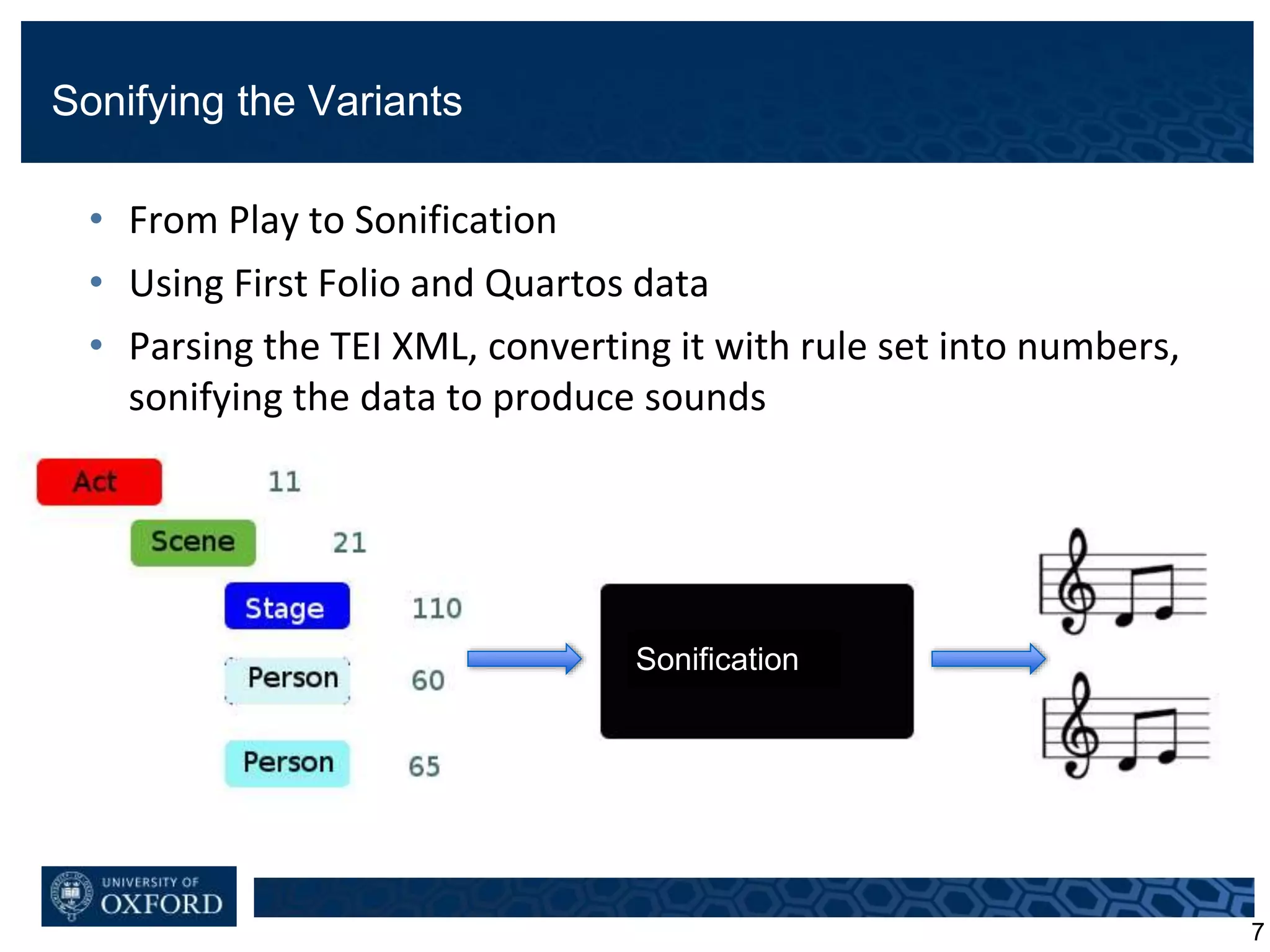
• From Play to Sonification
• Using First Folio and Quartos data
• Parsing the TEI XML, converting it with rule set into numbers,
sonifying the data to produce sounds
7
Sonification
Auditory Beacons
• Acts and Scenes
– Different Instruments and Pitches
• Stage Directions
– Different instruments
– Period versus Modern sounds?
• Speakers
– Increasing volume
– Stereoscopic illusion using two streams
Visualization
9
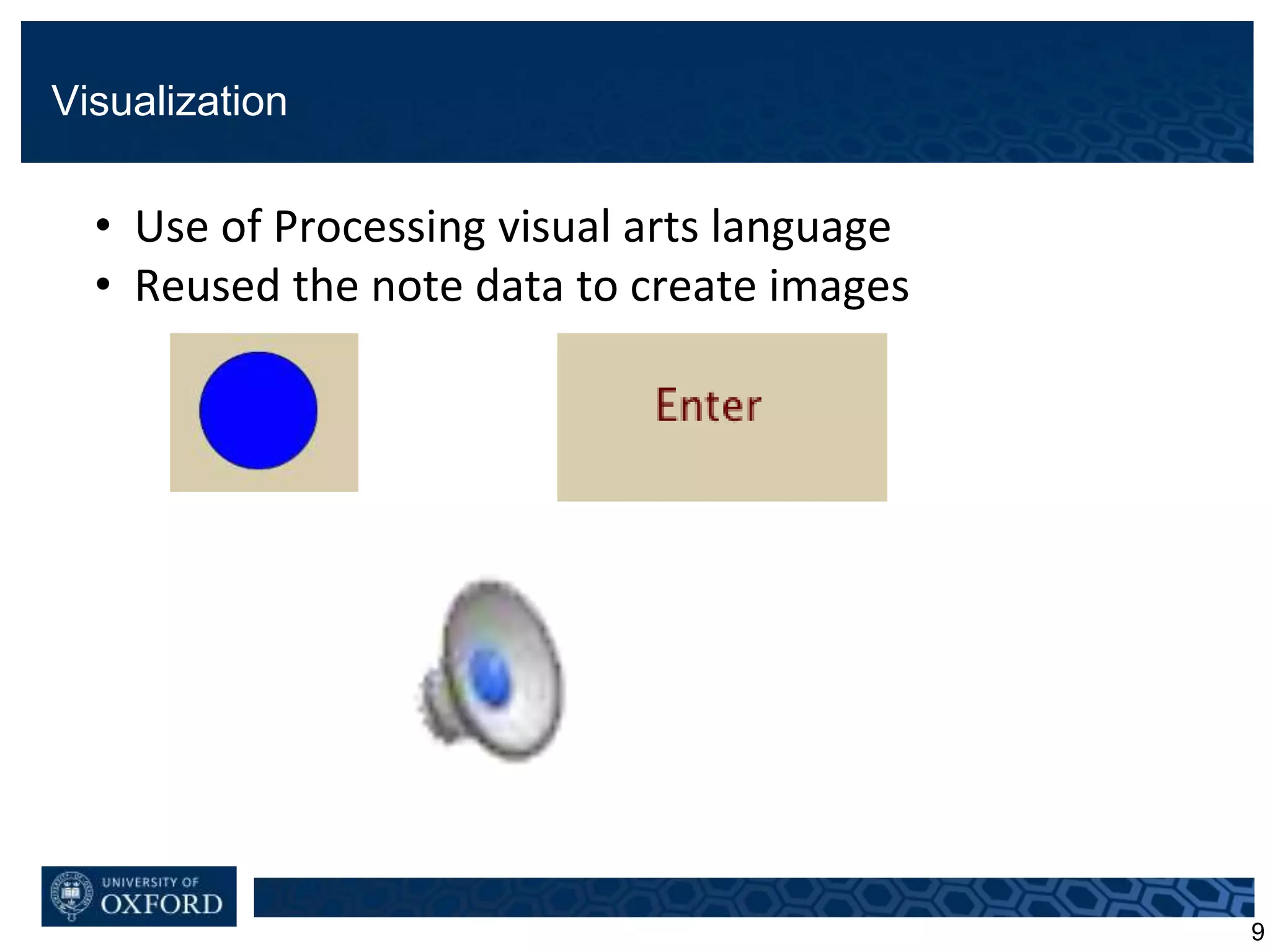
• Use of Processing visual arts language
• Reused the note data to create images
Conclusions
• Sonification has potential in comparing texts
• Perceptions altered
– Choices of sound
– Use of multiple parameters
• Use of spatial as well as temporal events to
help users
10
Future Work
• Work on different sounds for elements
• Transforming and linking the structures
• Sonifying speeches with the choice elements
• Using metadata for additional sonification
– Perceptions of speaker’s characteristics through pitches
– Characteristics of speech: blank prose and rhyme
• Filtering
Acknowledgements
• The work is part of an MSc project in Software Engineering being
supported by the Oxford e-Research Centre.
• Thanks to Pip Willcox, Rahim Lakhoo and Professor David De
Roure.
“It will discourse most eloquent music”: Sonifying variants of Hamlet
http://ora.ox.ac.uk/objects/uuid:1785e0ac-5cbb-4d35-8546-4495aa8baec8
Thank you for listening
Any questions?
iain.emsley@oerc.ox.ac.uk
@iainemsley
@minnelieder
13
References
Gregory Kramer. 1993. Auditory Display: Sonification, Audification, and Auditory Interfaces. Perseus Publishing.
`The Search for the “Killer Application”: Drawing the Boundaries around the Sonification of Scientific Data`, Supper, Alexandra in The Oxford Handbook of
Sound Studies, Pinch, Trevor, and Bijsterveld, Karin 2012. New York: Oxford University Press, New York, p253
Keith V. Nesbitt and Stephen Barrass, Finding Trading Patterns in Stock Market Data, IEEE Computer Graphics and Applications 24:5, IEEE Computer
Society, pp 45-55, 2004
Digital facsimile of the Bodleian First Folio of Shakespeare's plays, Arch. G c.7, First Folio home page, http://firstfolio.bodleian.ox.ac.uk/
C Hinman, Mechanized collation; a preliminary report., Papers of the Bibliographical Society of America 41 (1947): 99-106.
Smith, Steven Escar. 2000. "'The Eternal Verities Verified': Charlton Hinman and the Roots of Mechanical Collation." Studies in Bibliography 53. 129-62.
The tragedy of Hamlet Prince of Denmarke: an electronic edition, Hamlet, First Quarto, 1603. British Library Shelfmark: C.34.k.1,
http://www.quartos.org/XML_Orig/ham-1603-22275x-bli-c01_orig.xml
The tragedy of Hamlet Prince of Denmarke: an electronic editionHamlet, Second Quarto Variant, 1605. British Library Shelfmark: C.34.k.2,
http://www.quartos.org/XML_Orig/ham-1605-22276a-bli-c01_orig.xml
The Holinshed Project: Comparing and linking two editions of Holinshed's Chronicle, James Cummings and Arno Mittelbach, International Journal of
Humanities and Arts Computing. Volume 4, Issue 1-2, Page 39-53, ISSN 1753- 8548, Available Online http://dx.doi.org/10.3366/ijhac.2011.0006 October
2010,
Keith V. Nesbitt and Stephen Barrass, of a Multimodal Sonification and Visualisation of Depth of Market Stock Data,. Nakatsu and H. Kawahara (eds),
International Conference on Auditory Display (ICAD), 2002 , pp2—5
De Roure, David C., Cruickshank, Don G., Michaelides, Danius T., Page, Kevin R. and Weal, Mark J. (2002) On Hyperstructure and Musical Structure. The
Thirteenth ACM Conference on Hypertext and Hypermedia (Hypertext 2002), Maryland, USA, 11 - 15 Jun 2002. ACM, 95-104.
Holden, Claire 2012. Recreating early 19th- century style in a 21st-century marketplace: An orchestral violinist’s perspective. Presented at: Institute of
Musical Research DeNote Seminar, Senate House, London, 30 January 2012.
Sonification report: Status of the field and research agenda Prepared for the National Science Foundation by members of the International Community for
Auditory Display (1997) by G. Kramer, B. Walker, T. Bonebright, et al., http://sonify.psych.gatech.edu/publications/pdfs/1999-NSF-Report.pdf
Lehmann, L., Mittelbach, A., Cummings, J., Rensing, C., & Steinmetz, R. 2010. Automatic Detection and Visualisation of Overlap for Tracking of Information
Flow. In Proceedings I-Know.
William W. Gaver. 1986. Auditory icons: using sound in computer interfaces. Hum.-Comput. Interact. 2, 2 (June 1986), 167-177.
DOI=http://dx.doi.org/10.1207/s15327051hci0202_3

"It will discourse most eloquent music": Sonify Variants of Hamlet

  • 1.
    “It will discoursemost eloquent music” Sonifying Variants of Hamlet Iain Emsley Oxford e-Research Centre, University of Oxford iain.emsley@oerc.ox.ac.uk @iainemsley @minnelieder 1
  • 2.
    Overview • Introduction toSonification • Sonifying Hamlet • Auditory Beacons • Visualization • Conclusions • Future work 2
  • 3.
    Introduction to Sonification •What is sonification? – Sonification is an alternative to visualization “the use of nonspeech audio to convey information. More specifically, sonification is the transformation of data relations into perceived relations in an acoustic signal for the purposes of facilitating communication or interpretation.” (Kramer, 1997) (bold is mine) 3
  • 4.
    Introduction to Sonification •TEI-Comparator – James Cummings and Arno Mittelbach • Listening to Wikipedia - Hatnote • We Need Us - Julie Freeman • Sonification of hyperstructures - De Roure, Blackburn et al. 4
  • 5.
    Hinman Collator image ByFolger Shakespeare Library, Washington, DC (Julie Ainsworth, photographer) (http://luna.folger.edu/luna/servlet/s/919x31) [CC BY-SA 4.0 (http://creativecommons.org/licenses/by- sa/4.0)], via Wikimedia Commons
  • 6.
    Sonifying Hamlet 6 • Sonifyingthe Variants • Auditory Beacons • Visualization
  • 7.
    Sonifying the Variants •From Play to Sonification • Using First Folio and Quartos data • Parsing the TEI XML, converting it with rule set into numbers, sonifying the data to produce sounds 7 Sonification
  • 8.
    Auditory Beacons • Actsand Scenes – Different Instruments and Pitches • Stage Directions – Different instruments – Period versus Modern sounds? • Speakers – Increasing volume – Stereoscopic illusion using two streams
  • 9.
    Visualization 9 • Use ofProcessing visual arts language • Reused the note data to create images
  • 10.
    Conclusions • Sonification haspotential in comparing texts • Perceptions altered – Choices of sound – Use of multiple parameters • Use of spatial as well as temporal events to help users 10
  • 11.
    Future Work • Workon different sounds for elements • Transforming and linking the structures • Sonifying speeches with the choice elements • Using metadata for additional sonification – Perceptions of speaker’s characteristics through pitches – Characteristics of speech: blank prose and rhyme • Filtering
  • 12.
    Acknowledgements • The workis part of an MSc project in Software Engineering being supported by the Oxford e-Research Centre. • Thanks to Pip Willcox, Rahim Lakhoo and Professor David De Roure. “It will discourse most eloquent music”: Sonifying variants of Hamlet http://ora.ox.ac.uk/objects/uuid:1785e0ac-5cbb-4d35-8546-4495aa8baec8
  • 13.
    Thank you forlistening Any questions? iain.emsley@oerc.ox.ac.uk @iainemsley @minnelieder 13
  • 14.
    References Gregory Kramer. 1993.Auditory Display: Sonification, Audification, and Auditory Interfaces. Perseus Publishing. `The Search for the “Killer Application”: Drawing the Boundaries around the Sonification of Scientific Data`, Supper, Alexandra in The Oxford Handbook of Sound Studies, Pinch, Trevor, and Bijsterveld, Karin 2012. New York: Oxford University Press, New York, p253 Keith V. Nesbitt and Stephen Barrass, Finding Trading Patterns in Stock Market Data, IEEE Computer Graphics and Applications 24:5, IEEE Computer Society, pp 45-55, 2004 Digital facsimile of the Bodleian First Folio of Shakespeare's plays, Arch. G c.7, First Folio home page, http://firstfolio.bodleian.ox.ac.uk/ C Hinman, Mechanized collation; a preliminary report., Papers of the Bibliographical Society of America 41 (1947): 99-106. Smith, Steven Escar. 2000. "'The Eternal Verities Verified': Charlton Hinman and the Roots of Mechanical Collation." Studies in Bibliography 53. 129-62. The tragedy of Hamlet Prince of Denmarke: an electronic edition, Hamlet, First Quarto, 1603. British Library Shelfmark: C.34.k.1, http://www.quartos.org/XML_Orig/ham-1603-22275x-bli-c01_orig.xml The tragedy of Hamlet Prince of Denmarke: an electronic editionHamlet, Second Quarto Variant, 1605. British Library Shelfmark: C.34.k.2, http://www.quartos.org/XML_Orig/ham-1605-22276a-bli-c01_orig.xml The Holinshed Project: Comparing and linking two editions of Holinshed's Chronicle, James Cummings and Arno Mittelbach, International Journal of Humanities and Arts Computing. Volume 4, Issue 1-2, Page 39-53, ISSN 1753- 8548, Available Online http://dx.doi.org/10.3366/ijhac.2011.0006 October 2010, Keith V. Nesbitt and Stephen Barrass, of a Multimodal Sonification and Visualisation of Depth of Market Stock Data,. Nakatsu and H. Kawahara (eds), International Conference on Auditory Display (ICAD), 2002 , pp2—5 De Roure, David C., Cruickshank, Don G., Michaelides, Danius T., Page, Kevin R. and Weal, Mark J. (2002) On Hyperstructure and Musical Structure. The Thirteenth ACM Conference on Hypertext and Hypermedia (Hypertext 2002), Maryland, USA, 11 - 15 Jun 2002. ACM, 95-104. Holden, Claire 2012. Recreating early 19th- century style in a 21st-century marketplace: An orchestral violinist’s perspective. Presented at: Institute of Musical Research DeNote Seminar, Senate House, London, 30 January 2012. Sonification report: Status of the field and research agenda Prepared for the National Science Foundation by members of the International Community for Auditory Display (1997) by G. Kramer, B. Walker, T. Bonebright, et al., http://sonify.psych.gatech.edu/publications/pdfs/1999-NSF-Report.pdf Lehmann, L., Mittelbach, A., Cummings, J., Rensing, C., & Steinmetz, R. 2010. Automatic Detection and Visualisation of Overlap for Tracking of Information Flow. In Proceedings I-Know. William W. Gaver. 1986. Auditory icons: using sound in computer interfaces. Hum.-Comput. Interact. 2, 2 (June 1986), 167-177. DOI=http://dx.doi.org/10.1207/s15327051hci0202_3

Editor's Notes

  • #4 Sonification as an alternative or complement to visualisation. This is the standard definition of sonification. *pause* We believe that it can be extended into analytics. Previous work has focused on the transformation. We are looking at way of facilitating interpretation and understanding of changes.
  • #5 TEI Comparator used for visual comparisons of words for the Holinshed Chroniciles. We look at the editorial structures in auditory fashion. In Listening..., Hatnote sonifies the size of change using a Wikipedia feed with a simple sonification. We try to move to music rather than sound. We Need Us is sonification and visualisation of click and swipe data De Roure, Blackburn sonify an artificial hyperstructure using algorithmic composition. We sonify extracted structures and transform them. Clearly there is another related work…
  • #6 Took inspiration from the Hinman Collator and the stereoscope.
  • #7 William Gaver 1982 paper.
  • #8  ----- Meeting Notes (25/10/15 20:38) ----- Pipeline to transform the XML into numbers according to a simple set of rules. These numbers are then transformed into sound in the black box. Mention the Hinman collator here and stereoscopy. Used the First Folio Hamlet and the Quartos variants as the test data. One stream Two steams to create an audio version of a steroscopic illusion.
  • #9 Challenges of making the information useful for the listener. Builds on the work of William Gaver, going back to the early 1980s. Acts & Scenes are relatively static. We can be confident that they will be in each play. Stage directions - use different instruments. *pause* do we use the period sounds versus modern sounds? How does this affect the listener? Speakers - same instrument with different pitches. Also use increasing volumes as a way marker. play twice – once before and then after explanation.
  • #10  ----- Meeting Notes (25/10/15 20:38) ----- Abstract notation: use of bars and circles for speakers. Aided the comprehension. Issues of timing and synchronization between events. Expand on this in the talk verbally. Add “exeunt” to slide
  • #11 Either single channel or stereo channels. Stereo channels allows for stereoscopic channels. This emulates the collation illusion in audio. Sonification for interpretation and analysis. It is not as well researched as visualization for this case. Need to involve specialists to make this more useful.
  • #12 Period versus Modern sounds ; historicist arguments and understanding the staging and period Mention the workshop Transforming Writing out the timing data to link the structures together using SMIL or MEI. Sonifying the words: Need an algorithm for this The choice element provides a different set of challenges Metadata: Use of gender Use of rhythm elements -> rhyming or prose Filtering: Already some filtering for elements to map. But may be useful to add a way for a user to filter further elements.