Information
Technology Trends
Dr. Merle P. Martin
MIS Department
CSU Sacramento
Acknowledgements
 Dr. Russell Ching (MIS Dept)
Source Materiel / Graphics
 Edie Schmidt (UMS) - Graphic Design
 Prentice Hall Publishing (Permissions)
Martin, Analysis and Design of
Business Information Systems, 1995
Agenda
 Information as Power
 The IT System
 IT Trends
 IT Issues
 Chief Information Officer (CIO)
Information as Power
 Collapse of Communism
 Information and
Totalitarianism
 Information and
Organizations
Power
Just in case
Information Overload
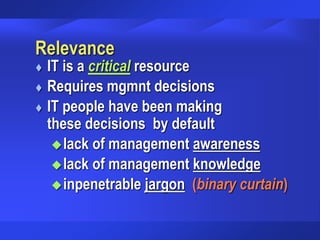
Relevance
 IT is a critical resource
 Requires mgmnt decisions
 IT people have been making
these decisions by default
lack of management awareness
lack of management knowledge
inpenetrable jargon (binary curtain)
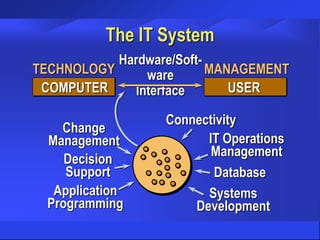
The IT System
TECHNOLOGY MANAGEMENT
COMPUTER USER
Hardware/Soft-
ware
Interface
Change
Management
Decision
Support
Application
Programming
Systems
Development
Database
IT Operations
Management
Connectivity
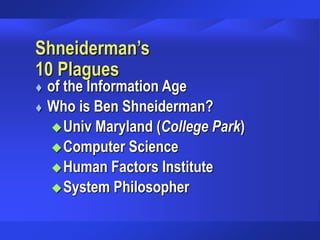
Shneiderman’s
10 Plagues
 of the Information Age
 Who is Ben Shneiderman?
Univ Maryland (College Park)
Computer Science
Human Factors Institute
System Philosopher
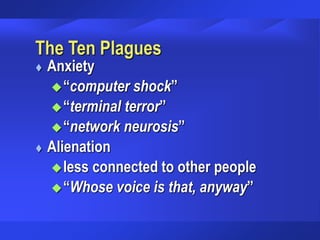
The Ten Plagues
 Anxiety
“computer shock”
“terminal terror”
“network neurosis”
 Alienation
less connected to other people
“Whose voice is that, anyway”
Ten Plagues (cont.)
 Information-poor minority
another way for
disadvantaged to
be more disadvantaged
 Impotence of individual
everyone treated the same
no special treatment for exceptions
Ten Plagues (cont.)
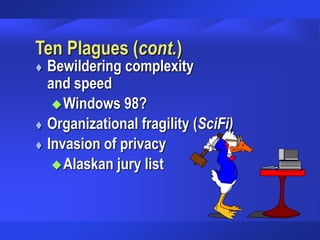
 Bewildering complexity
and speed
Windows 98?
 Organizational fragility (SciFi)
 Invasion of privacy
Alaskan jury list
Ten Plagues
 Unemployment
and displacement
clerks / typesetters
VP - mortgage loan decision
replaced by Expert System (ES)
 Lack of professional responsibility
“Sorry, the computer won’t let
me ________.”
Ten Plagues
 Deteriorating image
of people
“smart machines”
“intelligent terminals”
“expert systems”
“Maybe they’ll keep us as pets.”
Shneiderman’s computer with
arms and legs.
Ten Plagues (cont.)
What are some of
your experiences?
IT Trends
 Hardware
 Software
 Data
 Telecommunications
 Systems Development
 End-users
Hardware Trends
 Batch to on-line
Batch is delayed
processing
 Airport limousine
 Monthly billing application
On-line is instantaneous processing
 Airport taxi
 Airline Reservation System
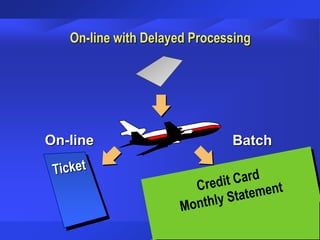
On-line with Delayed Processing
On-line Batch
Hardware Trends
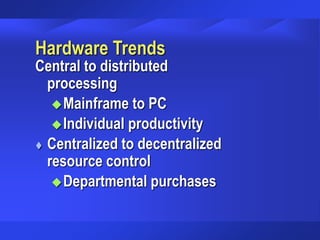
Central to distributed
processing
Mainframe to PC
Individual productivity
 Centralized to decentralized
resource control
Departmental purchases
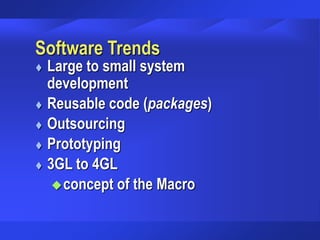
Software Trends
 Large to small system
development
 Reusable code (packages)
 Outsourcing
 Prototyping
 3GL to 4GL
concept of the Macro
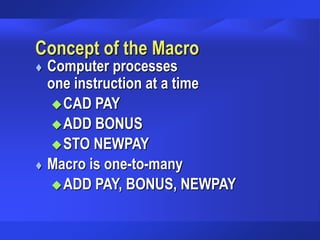
Concept of the Macro
 Computer processes
one instruction at a time
CAD PAY
ADD BONUS
STO NEWPAY
 Macro is one-to-many
ADD PAY, BONUS, NEWPAY
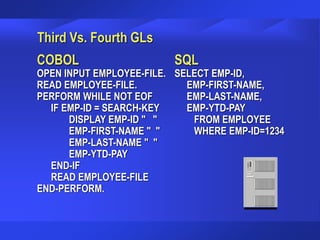
Third Vs. Fourth GLs
COBOL
OPEN INPUT EMPLOYEE-FILE.
READ EMPLOYEE-FILE.
PERFORM WHILE NOT EOF
IF EMP-ID = SEARCH-KEY
DISPLAY EMP-ID " "
EMP-FIRST-NAME " "
EMP-LAST-NAME " "
EMP-YTD-PAY
END-IF
READ EMPLOYEE-FILE
END-PERFORM.
SQL
SELECT EMP-ID,
EMP-FIRST-NAME,
EMP-LAST-NAME,
EMP-YTD-PAY
FROM EMPLOYEE
WHERE EMP-ID=1234
Data Trends
 Centralized to
decentralized
mainframe to PC
 Keystroke to optical scanning
voice?
 Multimedia
voice / animation / video, etc.
 Data to information
Telecomm Trends
 Link organizations to
customers
 Amer Hosp Supply (AHS)
suppliers
Porter Model
 LAN to WAN
 Internet
Development Trends
“Information systems are
becoming too complex to
develop by conventional means.”
John Podlipnik
Vice President,
American Management Systems
Increasing Complexity
 Program Lines of Code
1970’s - 10,000
1980’s - 100,00+
1990’s - 1,000,000+
 Type Hardware
1970’s - Standalone
1980’s - Networked
1990’s - Distributed
Increasing Complexity
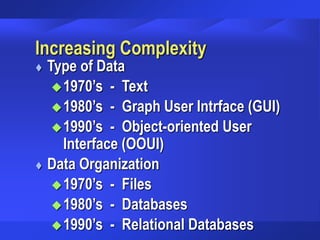
 Type of Data
1970’s - Text
1980’s - Graph User Intrface (GUI)
1990’s - Object-oriented User
Interface (OOUI)
 Data Organization
1970’s - Files
1980’s - Databases
1990’s - Relational Databases
Increasing Complexity
 Software Languages
1970’s - 3GL
1980’s - 3GL / 4GL
1990’s - 3GL / 4GL / Objects
 Application of Blaab’s Law
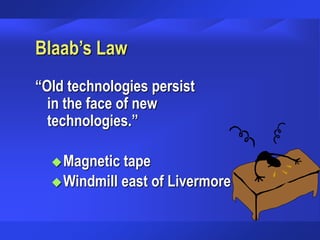
Blaab’s Law
“Old technologies persist
in the face of new
technologies.”
Magnetic tape
Windmill east of Livermore
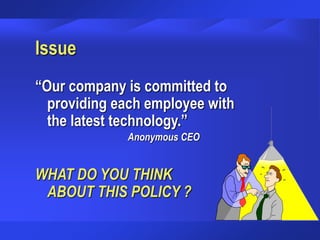
Issue
“Our company is committed to
providing each employee with
the latest technology.”
Anonymous CEO
WHAT DO YOU THINK
ABOUT THIS POLICY ?
Increasing Complexity
 Standards
1970’s - None
1980’s - Some
1990’s - “Open”
Podlipnik’s Question:
“How do we deal with changing:
business environment ,
technology landscape AND
increasingly complex systems?”
Podlipnik’s Answer
 Advanced user interfaces
user-centered
methodologies
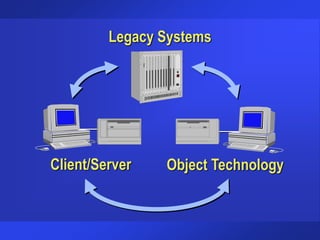
 Client / server solutions
integration to legacy systems
 Object-oriented techniques
 Open systems
to address technology evolution
Legacy Systems
Client/Server Object Technology
End-user Trends
 More knowledgeable users
More demanding of IT
 More opportunities for
misuse of IT resources
mischief
computer crime
 IT people as communicators
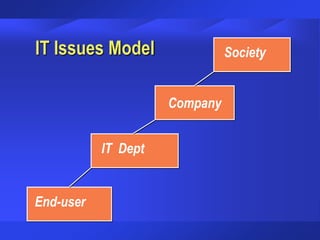
IT Issues Model
End-user
IT Dept
Company
Society
End-user IT Issues
 Computer Literacy
What is it?
Costs
How do we deliver?
Changing content
Shneiderman plagues
 anxiety and alienation
 information poor minority
End-user Issues
 User development
how much?
power / control / misuse
 Safe IT work environment
(Ergonomics)
 IT humanization
Human Factors
deteriorating image of people
IT Department Issues
 Centralize or decentralize
IT resources
 Interconnectivity
islands of technology
 Alignment of IT dept. goals
with organization
 Organizational level
VP? Report to whom?
Department Issues
 Technology transfer
“bewildering complexity
and speed”
scouting the future
predicting trends
technology mapping
prototyping / demonstrations
technology implementation
Company IT Issues
 Strategic role of IT
 Computer crime / security
 Reengineering with IT
 Business value of IT (e.g, waste)
 IT Top-down planning
Company Issues
 Organizational fragility
Worst case scenarios
Contingency Management
 Electronic Data Systems
(EDS) example
Change Management
Societal Issues
 Ethics
“professional responsibility”
 Individual privacy
 Unemployment / displacement
 Social responsibility
Chief Information
Officer (CIO)
 VP for IT Services
 Understands business
 Technology transfer
 Create IT vision
sell it !
 Implement IT infrastructure
chassis for building on
Issue
Does your firm have a CIO?
To whom does the CIO report?
Has the CIO created an IT vision?
Does the CIO have a technical or
management background?
TELL US YOUR EXPERIENCES!
Points to Remember
 IT Trends
 IT Issues
 CIO
 Apply to a business organization
Exercises
Research paper

IT-Trends information technology trends.

  • 1.
    Information Technology Trends Dr. MerleP. Martin MIS Department CSU Sacramento
  • 2.
    Acknowledgements  Dr. RussellChing (MIS Dept) Source Materiel / Graphics  Edie Schmidt (UMS) - Graphic Design  Prentice Hall Publishing (Permissions) Martin, Analysis and Design of Business Information Systems, 1995
  • 3.
    Agenda  Information asPower  The IT System  IT Trends  IT Issues  Chief Information Officer (CIO)
  • 4.
    Information as Power Collapse of Communism  Information and Totalitarianism  Information and Organizations Power Just in case Information Overload
  • 5.
    Relevance  IT isa critical resource  Requires mgmnt decisions  IT people have been making these decisions by default lack of management awareness lack of management knowledge inpenetrable jargon (binary curtain)
  • 6.
    The IT System TECHNOLOGYMANAGEMENT COMPUTER USER Hardware/Soft- ware Interface Change Management Decision Support Application Programming Systems Development Database IT Operations Management Connectivity
  • 7.
    Shneiderman’s 10 Plagues  ofthe Information Age  Who is Ben Shneiderman? Univ Maryland (College Park) Computer Science Human Factors Institute System Philosopher
  • 8.
    The Ten Plagues Anxiety “computer shock” “terminal terror” “network neurosis”  Alienation less connected to other people “Whose voice is that, anyway”
  • 9.
    Ten Plagues (cont.) Information-poor minority another way for disadvantaged to be more disadvantaged  Impotence of individual everyone treated the same no special treatment for exceptions
  • 10.
    Ten Plagues (cont.) Bewildering complexity and speed Windows 98?  Organizational fragility (SciFi)  Invasion of privacy Alaskan jury list
  • 11.
    Ten Plagues  Unemployment anddisplacement clerks / typesetters VP - mortgage loan decision replaced by Expert System (ES)  Lack of professional responsibility “Sorry, the computer won’t let me ________.”
  • 12.
    Ten Plagues  Deterioratingimage of people “smart machines” “intelligent terminals” “expert systems” “Maybe they’ll keep us as pets.” Shneiderman’s computer with arms and legs.
  • 13.
    Ten Plagues (cont.) Whatare some of your experiences?
  • 14.
    IT Trends  Hardware Software  Data  Telecommunications  Systems Development  End-users
  • 15.
    Hardware Trends  Batchto on-line Batch is delayed processing  Airport limousine  Monthly billing application On-line is instantaneous processing  Airport taxi  Airline Reservation System
  • 16.
    On-line with DelayedProcessing On-line Batch
  • 17.
    Hardware Trends Central todistributed processing Mainframe to PC Individual productivity  Centralized to decentralized resource control Departmental purchases
  • 18.
    Software Trends  Largeto small system development  Reusable code (packages)  Outsourcing  Prototyping  3GL to 4GL concept of the Macro
  • 19.
    Concept of theMacro  Computer processes one instruction at a time CAD PAY ADD BONUS STO NEWPAY  Macro is one-to-many ADD PAY, BONUS, NEWPAY
  • 20.
    Third Vs. FourthGLs COBOL OPEN INPUT EMPLOYEE-FILE. READ EMPLOYEE-FILE. PERFORM WHILE NOT EOF IF EMP-ID = SEARCH-KEY DISPLAY EMP-ID " " EMP-FIRST-NAME " " EMP-LAST-NAME " " EMP-YTD-PAY END-IF READ EMPLOYEE-FILE END-PERFORM. SQL SELECT EMP-ID, EMP-FIRST-NAME, EMP-LAST-NAME, EMP-YTD-PAY FROM EMPLOYEE WHERE EMP-ID=1234
  • 21.
    Data Trends  Centralizedto decentralized mainframe to PC  Keystroke to optical scanning voice?  Multimedia voice / animation / video, etc.  Data to information
  • 22.
    Telecomm Trends  Linkorganizations to customers  Amer Hosp Supply (AHS) suppliers Porter Model  LAN to WAN  Internet
  • 23.
    Development Trends “Information systemsare becoming too complex to develop by conventional means.” John Podlipnik Vice President, American Management Systems
  • 24.
    Increasing Complexity  ProgramLines of Code 1970’s - 10,000 1980’s - 100,00+ 1990’s - 1,000,000+  Type Hardware 1970’s - Standalone 1980’s - Networked 1990’s - Distributed
  • 25.
    Increasing Complexity  Typeof Data 1970’s - Text 1980’s - Graph User Intrface (GUI) 1990’s - Object-oriented User Interface (OOUI)  Data Organization 1970’s - Files 1980’s - Databases 1990’s - Relational Databases
  • 26.
    Increasing Complexity  SoftwareLanguages 1970’s - 3GL 1980’s - 3GL / 4GL 1990’s - 3GL / 4GL / Objects  Application of Blaab’s Law
  • 27.
    Blaab’s Law “Old technologiespersist in the face of new technologies.” Magnetic tape Windmill east of Livermore
  • 28.
    Issue “Our company iscommitted to providing each employee with the latest technology.” Anonymous CEO WHAT DO YOU THINK ABOUT THIS POLICY ?
  • 29.
    Increasing Complexity  Standards 1970’s- None 1980’s - Some 1990’s - “Open”
  • 30.
    Podlipnik’s Question: “How dowe deal with changing: business environment , technology landscape AND increasingly complex systems?”
  • 31.
    Podlipnik’s Answer  Advanceduser interfaces user-centered methodologies  Client / server solutions integration to legacy systems  Object-oriented techniques  Open systems to address technology evolution
  • 32.
  • 33.
    End-user Trends  Moreknowledgeable users More demanding of IT  More opportunities for misuse of IT resources mischief computer crime  IT people as communicators
  • 34.
    IT Issues Model End-user ITDept Company Society
  • 35.
    End-user IT Issues Computer Literacy What is it? Costs How do we deliver? Changing content Shneiderman plagues  anxiety and alienation  information poor minority
  • 36.
    End-user Issues  Userdevelopment how much? power / control / misuse  Safe IT work environment (Ergonomics)  IT humanization Human Factors deteriorating image of people
  • 37.
    IT Department Issues Centralize or decentralize IT resources  Interconnectivity islands of technology  Alignment of IT dept. goals with organization  Organizational level VP? Report to whom?
  • 38.
    Department Issues  Technologytransfer “bewildering complexity and speed” scouting the future predicting trends technology mapping prototyping / demonstrations technology implementation
  • 39.
    Company IT Issues Strategic role of IT  Computer crime / security  Reengineering with IT  Business value of IT (e.g, waste)  IT Top-down planning
  • 40.
    Company Issues  Organizationalfragility Worst case scenarios Contingency Management  Electronic Data Systems (EDS) example Change Management
  • 41.
    Societal Issues  Ethics “professionalresponsibility”  Individual privacy  Unemployment / displacement  Social responsibility
  • 42.
    Chief Information Officer (CIO) VP for IT Services  Understands business  Technology transfer  Create IT vision sell it !  Implement IT infrastructure chassis for building on
  • 43.
    Issue Does your firmhave a CIO? To whom does the CIO report? Has the CIO created an IT vision? Does the CIO have a technical or management background? TELL US YOUR EXPERIENCES!
  • 44.
    Points to Remember IT Trends  IT Issues  CIO  Apply to a business organization Exercises Research paper