Muslim Personal Law
• Law: is set of rules and regulations, for
establishing and maintaining social order.
• Who is Muslim: Any person who professes the
Islamic religion, that is, acknowledges i) That there
is but one God and that Prophet(PBUH) is His last
prophet, is a Muslim.
• Muslim by Birth: It means that the parents of a
child are Muslims and he has followed the same
religion.
• Muslim by Conversion: means that a person has
changed his religion and embraced Islam.
• Sects: Muslims are divided in to two sects, the
Sunnis and the Shias.
• Muslim Personal law: is the branch of an
Islamic Law in which we study among family
matters such as Marriage, Will, Dower, Waqf,
Divorce, Gift etc
• Islamic Jurisprudence: Deals with origin of
Islamic Law. Its boudary is very vast
comparatively family laws. Such as sources of
Isamic law Quran, Sunnah etc
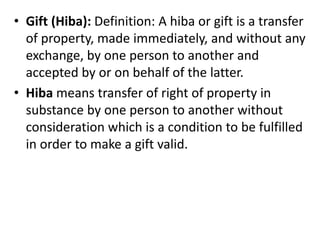
• Gift (Hiba): Definition: A hiba or gift is a transfer
of property, made immediately, and without any
exchange, by one person to another and
accepted by or on behalf of the latter.
• Hiba means transfer of right of property in
substance by one person to another without
consideration which is a condition to be fulfilled
in order to make a gift valid.
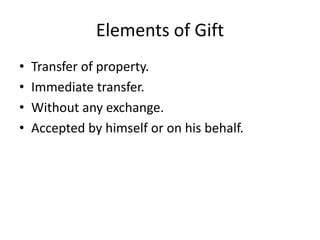
Elements of Gift
• Transfer of property.
• Immediate transfer.
• Without any exchange.
• Accepted by himself or on his behalf.
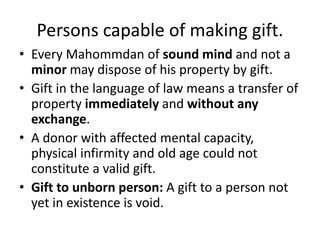
Persons capable of making gift.
• Every Mahommdan of sound mind and not a
minor may dispose of his property by gift.
• Gift in the language of law means a transfer of
property immediately and without any
exchange.
• A donor with affected mental capacity,
physical infirmity and old age could not
constitute a valid gift.
• Gift to unborn person: A gift to a person not
yet in existence is void.
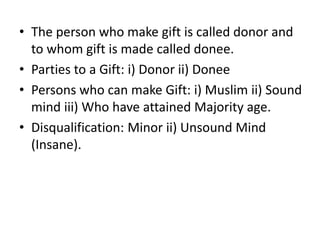
• The person who make gift is called donor and
to whom gift is made called donee.
• Parties to a Gift: i) Donor ii) Donee
• Persons who can make Gift: i) Muslim ii) Sound
mind iii) Who have attained Majority age.
• Disqualification: Minor ii) Unsound Mind
(Insane).
Essentials of a valid gift
• Subject of Gift must belong to donor.
• Subject of Gift must be in existence.
• Donor must make gift by his free will.
• Gift must be accepted by the donee.
• Delivery of possession of the subject matter
must be done.
• Declaration of gift by the donor.
• Two types of property movable and
immovable property. i.e land, goods.

Islamic law

  • 1.
  • 2.
    • Law: isset of rules and regulations, for establishing and maintaining social order. • Who is Muslim: Any person who professes the Islamic religion, that is, acknowledges i) That there is but one God and that Prophet(PBUH) is His last prophet, is a Muslim. • Muslim by Birth: It means that the parents of a child are Muslims and he has followed the same religion. • Muslim by Conversion: means that a person has changed his religion and embraced Islam. • Sects: Muslims are divided in to two sects, the Sunnis and the Shias.
  • 3.
    • Muslim Personallaw: is the branch of an Islamic Law in which we study among family matters such as Marriage, Will, Dower, Waqf, Divorce, Gift etc • Islamic Jurisprudence: Deals with origin of Islamic Law. Its boudary is very vast comparatively family laws. Such as sources of Isamic law Quran, Sunnah etc
  • 4.
    • Gift (Hiba):Definition: A hiba or gift is a transfer of property, made immediately, and without any exchange, by one person to another and accepted by or on behalf of the latter. • Hiba means transfer of right of property in substance by one person to another without consideration which is a condition to be fulfilled in order to make a gift valid.
  • 5.
    Elements of Gift •Transfer of property. • Immediate transfer. • Without any exchange. • Accepted by himself or on his behalf.
  • 6.
    Persons capable ofmaking gift. • Every Mahommdan of sound mind and not a minor may dispose of his property by gift. • Gift in the language of law means a transfer of property immediately and without any exchange. • A donor with affected mental capacity, physical infirmity and old age could not constitute a valid gift. • Gift to unborn person: A gift to a person not yet in existence is void.
  • 7.
    • The personwho make gift is called donor and to whom gift is made called donee. • Parties to a Gift: i) Donor ii) Donee • Persons who can make Gift: i) Muslim ii) Sound mind iii) Who have attained Majority age. • Disqualification: Minor ii) Unsound Mind (Insane).
  • 8.
    Essentials of avalid gift • Subject of Gift must belong to donor. • Subject of Gift must be in existence. • Donor must make gift by his free will. • Gift must be accepted by the donee. • Delivery of possession of the subject matter must be done. • Declaration of gift by the donor.
  • 9.
    • Two typesof property movable and immovable property. i.e land, goods.