1
UUUK3153: ISLAMIC BANKING AND FINANCE
Name: Nur Aliah bt Amran
Matrics number: A166840
Date: Monday, 23 September 2019
Tutorial Question and Notes/Answers
Soalan 1 - Bincangkan istilah berikut
1. Deficit fund
units
Any individual, group, or entity (such as a broker or dealer) that
obtains funds from surplus spending units by way of the financial markets. One
of the most common ways to do so is to sell financial instruments or securities.
2. Double
coincidence
of wants
The coincidence of wants (often known as double coincidence of wants) is an
economic phenomenon where two parties each hold an item the other wants, so
they exchange these items directly without any monetary medium. This type of
exchange is the foundation of a bartering economy. Double coincidence of wants
means that both of the parties have to agree to sell and buy each commodity.
Under this system, problems arise through the improbability of the wants, needs,
or events that cause or motivate a transaction occurring at the same time and the
same place. One example is the bar musician who is "paid" with liquor or food,
items which his landlord will not accept as rent payment, when the musician
would rather have a month's shelter. If, instead, the musician's landlord were to
throw a party and desire music for it, hiring the musician to play it by offering the
month's rent in exchange, a coincidence of wants would exist.
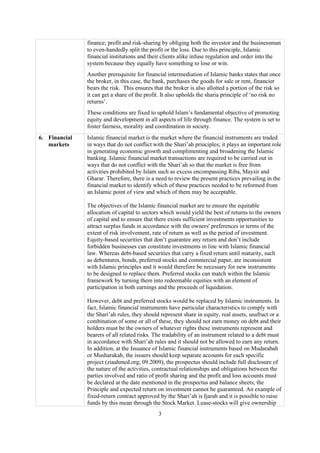
3. Equity
4. Essential
risk
The essential risk is inherent in all business transactions. This business risk is
necessary and must be undertaken to reap the associated reward or profit. Ibn
Taymiyyah says:
“Risk falls into two categories commercial risk, where one would buy a
commodity in order to sell it for profit, and rely on Allah for that. This risk is
necessary for merchants, and although one might occasionally lose, but this is the
nature of commerce. The other type of risk is that of gambling, which implies
2
eating wealth for nothing ( ‫بالباطل‬‫المال‬‫اكل‬ .(This is what Allah and His Messenger
(p.b.u.h.) prohibited” (Ibn Taymiyyah, 1996).
Two legal maxims are associating returns to essential risks form the basis of
Islamic economic transactions. The first maxim states ‘ ‫بالغرم‬‫الغنم‬ ” ,‘entitlement to
profit is accompanied by responsibility for attendant expenses and possible loss”
(Tyser, Demetriades, & Effendi, 2000). This maxim attaches the ‘entitlement of
gain’ to the ‘responsibility of loss’. For instance, in a sale contract, before selling
the commodity the owner has to bear all types of risks associated with the
commodity. This risk will be transferred to the buyer when he will possess the
commodity in the form of complete ownership. One of the basic requirements of
a sale contract is transfer of complete ownership (milkiyyah tammah), which
cannot be acquired without transferring risks and liabilities. Any condition that
effects the transfer of risks and responsibilities will result in the contract
becoming unlawful. Furthermore, the aforesaid maxim is usually used to propose
the preference for profit-and-loss-sharing (PLS) financing instruments like
musharakah and mudarabah (International Shariah Research Academy for Islamic
Finance, 2012).
The second maxim is derived from the Prophetic saying “ ‫بالضمان‬‫الخراج‬ ]”
“Entitlement to] profit is dependent on responsibility [for attendant expenses and
possible loss and defects]” (Tyser, Demetriades, & Effendi, 2000). The maxim
asserts that the party enjoying the full benefit of an asset should bear the risks of
ownership of that asset. However, linking returns to risks of ownership does not
necessarily relates to PLS contracts. The principle points out the risks related to
ownership associated with sale and leasing transactions. For instance, the
implication for a sale-based transaction is that the seller must bear all the risks
associated with the object of the sale while concluding the contract and in a
leasing contract, the lessor should be responsible for the asset leased out during
the time of contract.
5. Financial
intermediar
y
Financial intermediation was practiced in the early days of Islam. It originated
from the principle of al-muḍārib udārib which translates into “the one who
mobilizes funds, on profit-sharing basis, can extend these funds to the users on
the same basis”. The intermediation took place when caravan traders which were
financed by muḍārabah (trust financing) were permitted to sell them at higher
prices and make surplus.
With regards to intermediation, Islamic banks are responsible for detecting
suitable and reliable projects to finance and as well as supervise its development.
However, as an intermediary, they should not participate in the management and
policy-making section. By giving that responsibility to the entrepreneur, the bank
can keep an objective view on the development of that project.
Islamic banks’ intermediate by mobilizing funds from their clients and delivering
it to businessmen/entrepreneurs with a legit business plan looking for investors.
The sharia laid down specific rules and restrictions of the economic activity in a
community to promote a high degree of justice and equity in the production,
exchange and distribution of wealth.
As a result, Islamic financial laws lay great emphasis on the social and economic
justice which makes Islamic banks such a great choice for financial intermediary;
they prioritize the client’s interest, the economy’s interest and the society’s
interest before the bank’s interest as opposed to the conventional banks which
only give precedence to their profit.
To ensure justice, Islamic banks abide by one of the fundamental principles of
3
finance; profit and risk-sharing by obliging both the investor and the businessman
to even-handedly split the profit or the loss. Due to this principle, Islamic
financial institutions and their clients alike infuse regulation and order into the
system because they equally have something to lose or win.
Another prerequisite for financial intermediation of Islamic banks states that once
the broker, in this case, the bank, purchases the goods for sale or rent, financier
bears the risk. This ensures that the broker is also allotted a portion of the risk so
it can get a share of the profit. It also upholds the sharia principle of ‘no risk no
returns’.
These conditions are fixed to uphold Islam’s fundamental objective of promoting
equity and development in all aspects of life through finance. The system is set to
foster fairness, morality and coordination in society.
6. Financial
markets
Islamic financial market is the market where the financial instruments are traded
in ways that do not conflict with the Shari’ah principles; it plays an important role
in generating economic growth and complimenting and broadening the Islamic
banking. Islamic financial market transactions are required to be carried out in
ways that do not conflict with the Shari’ah so that the market is free from
activities prohibited by Islam such as excess encompassing Riba, Maysir and
Gharar. Therefore, there is a need to review the present practices prevailing in the
financial market to identify which of these practices needed to be reformed from
an Islamic point of view and which of them may be acceptable.
The objectives of the Islamic financial market are to ensure the equitable
allocation of capital to sectors which would yield the best of returns to the owners
of capital and to ensure that there exists sufficient investments opportunities to
attract surplus funds in accordance with the owners' preferences in terms of the
extent of risk involvement, rate of return as well as the period of investment.
Equity-based securities that don’t guarantee any return and don’t include
forbidden businesses can constitute investments in line with Islamic financial
law. Whereas debt-based securities that carry a fixed return until maturity, such
as debentures, bonds, preferred stocks and commercial paper, are inconsistent
with Islamic principles and it would therefore be necessary for new instruments
to be designed to replace them. Preferred stocks can match within the Islamic
framework by turning them into redeemable equities with an element of
participation in both earnings and the proceeds of liquidation.
However, debt and preferred stocks would be replaced by Islamic instruments. In
fact, Islamic financial instruments have particular characteristics to comply with
the Shari’ah rules, they should represent share in equity, real assets, usufruct or a
combination of some or all of these, they should not earn money on debt and their
holders must be the owners of whatever rights these instruments represent and
bearers of all related risks. The tradability of an instrument related to a debt must
in accordance with Shari’ah rules and it should not be allowed to earn any return.
In addition, at the Issuance of Islamic financial instruments based on Mudarabah
or Musharakah, the issuers should keep separate accounts for each specific
project (ziaahmed.org; 09.2009), the prospectus should include full disclosure of
the nature of the activities, contractual relationships and obligations between the
parties involved and ratio of profit sharing and the profit and loss accounts must
be declared at the date mentioned in the prospectus and balance sheets; the
Principle and expected return on investment cannot be guaranteed. An example of
fixed-return contract approved by the Shari’ah is Ijarah and it is possible to raise
funds by this mean through the Stock Market. Lease-stocks will give ownership
4
to the stockholders of the leased equipment, from which they will receive a
known flow of rent. This is allowed in Shari’ah since they will have to borne the
risk of the eventual value being much lower than was estimated.
Furthermore, since the entire capital resources, both short-term and long-term, in
Islamic system are equity-based and not debt-based there is a need for a
continuous pricing mechanism to the Islamic financial system to prevent it from
major shocks and crashes (ziaahmed.org; 09.2009). For this purpose, there are
three key areas of the market that need to be constantly reviewed that are
speculation, information disclosure standards and the regulations guiding
operations and trading practices. Speculation can cause wild swings in the market
through misallocation of resources resulting in losses and gains entirely unrelated
to real economic effects. Such results are like the results of gambling, involving
transfer of resources among the participants but adding nothing to the initial stock
of resources. The adequate flow of public information is what protects investors
by ensuring that significant changes in shareholding are not the result of some
people having inside information not available to the public. And the regulations
guiding operations and trading practices require restrictions to ensure an adequate
flow of information about the business whose securities are being traded and to
control the trading practices in the market. These define the role of brokers and
dealers, set margin limits and control fees and commissions.
7. Islamic
capital
market
In an Islamic capital market (ICM) market transactions are carried out in ways
that do not conflict with the conscience of Muslims and the religion of Islam.
Here, there is assertion of religious law so that the market is free from activities
prohibited by Islam such as usury (riba), gambling (maisir) and ambiguity
(gharar).
The ICM is a component of the overall capital market in Malaysia. It plays an
important role in generating economic growth for the country. The ICM functions
as a parallel market to the conventional capital market, and plays a
complementary role to the Islamic banking system in broadening and deepening
the Islamic financial markets in Malaysia.
As the market became more complex and sophisticated, it needed supportive
infrastructure so that the system could operate and function more efficiently and
effectively. The SC’s early initiative in setting up a dedicated Islamic Capital
Market Department (ICMD) within its Strategy and Development Business
Group was to provide the much needed infrastructure support. The mandate of
the ICMD is to carry out research and development activities including
formulating and facilitating a long-term plan to further strengthen the ICM in
Malaysia.
The Shariah Advisory Council (SAC) was established in May 1996 to advise the
Commission on Shariah matters pertaining to the ICM. Members of the SAC are
qualified individuals who can present Shariah opinions and have vast experience
in the application of Shariah, particularly in the areas of Islamic economics and
finance.
Today, various capital market products are available for Muslims who only seek
to invest and transact in the ICM. Such products include the SC list of Shariah-
compliant securities, sukuk, Islamic unit trusts, Shariah indices, warrants (TSR),
call warrants and crude palm oil futures contract.
8. Islamic Islamic finance is a financial system that operates according to Islamic law
5
finance (which is called sharia) and is, therefore, sharia-compliant. Just like conventional
financial systems, Islamic finance features banks, capital markets, fund managers,
investment firms, and insurance companies. However, these entities are governed
both by Islamic law and the finance industry rules and regulations that apply to
their conventional counterparts.
Although the Islamic finance industry itself is quite young, Islamic theories of
economics have existed for more than a millennium; by the mid-12th century, in
fact, many Muslims scholars had presented key concepts of Islamic economics
that are still relevant today.
But political and social turmoil put the brakes on Islamic finance for a very long
time; only in the 20th century did Muslim scholars and academics seriously begin
to revisit these topics (and, in doing so, set the stage for the modern Islamic
finance industry to emerge in the 1970s).
The search for balance
Islamic economics is based on core concepts of balance, which help ensure that
the motives and objectives driving the Islamic finance industry are beneficial to
society.
• Balancing material pursuits and spiritual needs
• Balancing individual and social needs
9. Islamic
financial
system
The Islamic financial system is not much different from the products and services
in the traditional financial system but it operations are essentially based on a
certain set of moral and ethical principles that determined what is viewed as
morally ‘right’ implying actions and transactions that promote public good, and
‘wrong’ implying actions and transactions likely to be against the public good.
Describing the Islamic financial system simply as "interest-free" does not provide
a correct picture of the system as a whole and tends to create confusion.
While prohibiting the receipt and payment of interest is the nucleus of the system,
it is supported by other principles of Islamic teachings advocating individuals'
rights and duties, property rights, equitable distribution of wealth, risk-
sharing, fulfilment of obligations and the sanctity of contracts. The Islamic
financial system is not limited to banking but covers insurance, capital formation,
capital markets, and all types of financial intermediation and suggests that
moral and ethical aspects in the regulatory framework are also necessary in
addition to prudent and sound controls.
10. Islamic
money
market
Unique to Malaysia, the settlement of large-value payments within the Islamic
banking sector is conducted via a separate system of Islamic current accounts
maintained at Bank Negara Malaysia. This separation ensures a clear segregation
of funds between conventional and Islamic banking at the settlement level to
ensure compliance from the Shariah perspective. Nonetheless, liquidity in both
systems are linked given third-party payments between banking customers in the
two sectors, as well as the participation of conventional banking institutions in
Islamic banking products.
The primary objective of the Bank’s monetary operations in the Islamic money
market is to ensure sufficient liquidity for the efficient functioning of the Islamic
interbank market. The monetary policy target is only implemented in the
conventional money market, where interest rate based instruments are the
primary funding instrument. The Bank influences Islamic interbank market
liquidity through an array of Shariah-compliant instruments, the main instrument
6
being the Qard acceptance (loan). Through the Qard acceptance, the Bank
manages liquidity in the context of a surplus liquidity environment by inviting
Islamic banking institutions to place their surplus funds with the Bank. The Bank
also uses Commodity Murabahah Programme (CMP) to manage liquidity. CMP
utilises mainly crude palm oil-based contracts as the underlying commodity
transactions to facilitate liquidity management via a commodity trading platform
such as Bursa Suq Al Sila’, or other commodity providers.
For longer-term liquidity management, the Bank issues Bank Negara Monetary
Notes-i (BNMN-i) which are structured based on Islamic concepts of Murabahah
(BNMN-Murabahah), Ijarah (BNMN-Ijarah), Bai Bithaman Ajil (BNMN-BBA)
and Istithmar (BNMN-Istithmar). The key objectives of issuing BNMN-i are to
increase efficiency and flexibility in liquidity management in the Islamic money
market by diversifying Islamic financial instrument and expanding the Shariah
concept used in BNM’s Islamic monetary operation.
11. Islamic real
estate
investment
trust
The first Islamic REIT (Real Estate Investment Trust) in the world was Malaysia-
based Al-Aqar KPJ REIT, launched on June 2006. Al-Aqar KPJ REIT initial
investment were six hospitals valued at USD 138 million. The second Islamic
REIT was also Malaysia-based, Al-Hadaharah Boustead REIT, with initial
investment in palm oil plantation estates valued at USD 136 million and was
launched on February 2007. The third Islamic REIT and world’s first Islamic
industrial/office REIT was the Malaysia-based AXIS REIT. AXIS REIT was
initially launched as conventional REIT in August 2005 but subsequently
restructured to be Shariah-compliant in December 2008. In May 2013, Malaysia
issued world’s first stapled REIT, KLCC REIT. A stapled REIT is an investment
vehicle which ‘stapled’ two or more entities/instruments into a new financial
instrument.
Even Singapore has issued its first Islamic REIT, Sabana REIT, and subsequently
listed it on the Singapore Exchange Securities Trading Limited in 2010. As of
third quarter 2013, Sabana REIT portfolio consisted of 22 properties valued at
SGD 1.22 billion, making it the world’s largest Islamic REIT. Yet, as of this
writing, Indonesia being the largest Muslim populated country in the ASEAN
region has not issued any Islamic REIT.
12. Justice Financial justice is a requirement that helps Islamic finance products function in a
Shariah compliant way. The Western financial system looks at making profit
through interest payments and makes the beneficiary liable for any risk. Islamic
finance paves way for the sharing of profit/loss and risk involved in proportional
manner
Financial justice is a basic requirement for the functioning of Islamic finance
products. Western or conventional financing looks forward to profit through
interest payments and makes the beneficiary completely liable for any risk.
Contrary to this, Islamic financing paves the way for the sharing of net profit/loss
and the risk involved in a proportional manner between the lender and the
beneficiary. Therefore, if a financier is expecting a claim on profits of a project, it
is necessary that he/she should also carry a proportional share of the loss of that
project.
13. Unit of
account
Islamic economics regards money as a unit of account, medium of exchange,
store of value. Money is not regarded a merchandise to be sold or bought.
Deferred exchanges are allowed only when one of the exchanged items is money
due to its being a standard of deferred payments.
7
14. Maqāṣid al-
Sharīʿah
According to Ibn Ashur, maqasid al-Shariah (objectives of Shariah) is a term that
refers to the preservation of order, achievement of benefit and prevention of harm
or corruption, establishment of equality among people, causing the law to be
revered, obeyed and effective as well as enabling the ummah to become
powerful, respected and confident.
Hifz al mal (preservation of wealth) is one of the most important objectives of the
Shariah. The Muslim jurists assert that the concept of hifz al mal goes beyond its
literal meaning. It does not mean to preserve the wealth per se, but the concept
also covers the encouragement to generate, accumulate, preserve as well as
distribute the wealth in a just and fair manner.
The Shariah teachings emphasise strongly on preserving one’s wealth. Hence, it
has prescribed certain parameters such as for the ownership to be legally
recognised and has outlined specific punishments for transgressing the right of
others. For example, the Quran has explicitly described the punishment for theft
without taking any consideration of the offender’s gender. This can be found in
Surah al- Maidah verse 38 whereby Allah has said,
“[As for] the thief, the male and the female, amputate their hands in recompense
for what they committed as a deterrent [punishment] from Allah . And Allah is
Exalted in Might and Wise.”
15. Permissible
risk
Risk management is permissible in Islam (Abdul Kader Malim, 2015). Its
concept is acceptable to contemporary Islamic scholars based on the Quranic
verse (Al-Baqarah: 282) which requires Muslims to record debt or provide
witnesses, and the supporting Hadith (Sunan al-Tirmidhi: 2517) which requires
Bedouin to tie the camel before leaving its fate to God (tawakkal). Therefore, the
management must be parallel with Shariah principles because it involves the
process of protecting individuals or their properties from facing the probability of
loss. It considers the protection of wealth (hifz al-mal) as a value which is
emphasized in Islam. From the Islamic perspective, risk is allowed and it differs
from gharar which is prohibited.
16. Primary
market
A ‘capital market’ is a market for issuance and sale of bonds, stocks or similar
securities to raise long-term capital. The maturity of securities distinguishes debt
capital markets from ‘money market’, where trading is in short term debt
instruments with a tenor of less than one year or so. Capital markets are divided
into debt capital markets and equity capital markets. The Sukuk market falls into
falls into the debt capital market arena because contemporary Sukuk are
structures to produce a fixedincome return for Sukuk holders. Capital markets are
also classified into primary markets and secondary markets. In the primary
market an investor buys securities which are issued for the first time. Existing
securities are purchased and sold in the secondary market. Primary capital
markets are important for capital development of an economy.
17. Prohibited
risk
Gharar.
Gharar is an Arabic word that is associated with uncertainty, deception and risk.
It is a significant concept in Islamic finance and is used to measure the legitimacy
of a hazardous sale or risky investment pertaining to either short selling, the
selling of goods or assets of uncertain quality or delivery, gambling or contracts
that are not drawn out in clear terms. Gharar is generally prohibited under Islam;
there are strict rules in Islamic finance against transactions that are highly
uncertain or that may cause any injustice or deceit against any of the parties.
In finance, gharar is observed within derivative transactions such as
8
forwards, futures and options, as well as in short selling and in speculation. In
Islamic finance, most derivative contracts are forbidden and considered invalid
because of the uncertainty involved in the future delivery of the underlying asset.
Islamic finance also strictly prohibits extending loans with interest, which it
considers usury.
18. Secondary
market
The secondary market is where investors buy and sell securities they already
own. It is what most people typically think of as the "stock market," though
stocks are also sold on the primary market when they are first issued. The
national exchanges, such as the New York Stock Exchange (NYSE) and
the NASDAQ, are secondary markets.
Capital markets include primary markets, where new stock and bond issues are
sold to investors, and secondary markets, where existing securities are traded.
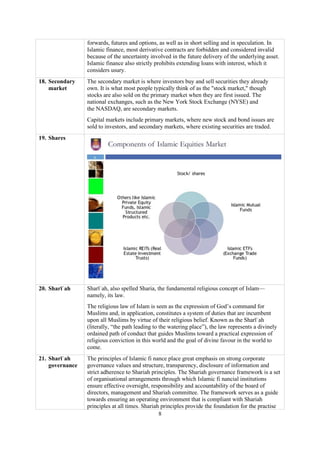
19. Shares
20. Sharīʿah Sharīʿah, also spelled Sharia, the fundamental religious concept of Islam—
namely, its law.
The religious law of Islam is seen as the expression of God’s command for
Muslims and, in application, constitutes a system of duties that are incumbent
upon all Muslims by virtue of their religious belief. Known as the Sharīʿah
(literally, “the path leading to the watering place”), the law represents a divinely
ordained path of conduct that guides Muslims toward a practical expression of
religious conviction in this world and the goal of divine favour in the world to
come.
21. Sharīʿah
governance
The principles of Islamic fi nance place great emphasis on strong corporate
governance values and structure, transparency, disclosure of information and
strict adherence to Shariah principles. The Shariah governance framework is a set
of organisational arrangements through which Islamic fi nancial institutions
ensure effective oversight, responsibility and accountability of the board of
directors, management and Shariah committee. The framework serves as a guide
towards ensuring an operating environment that is compliant with Shariah
principles at all times. Shariah principles provide the foundation for the practise
9
of Islamic fi nance through the observance of the tenets, conditions and principles
propagated by Islam. Comprehensive compliance with Shariah principles would
bring confi dence to the general public and the fi nancial markets on the
credibility of Islamic fi nance operations. In Malaysia, the Bank has established
the necessary mechanism for the Islamic fi nancial system to operate in a manner
consistent with Shariah muamalah principles, with a clearly defi ned institutional
arrangement within Islamic fi nancial institutions regulated by the Bank. A two-
tiered Shariah governance structure has been established, comprising an apex
Shariah advisory body at the Bank and a supervisory Shariah committee formed
at the respective Islamic fi nancial institutions.
22. Ṣukūk A sukuk is an Islamic financial certificate, similar to a bond in Western finance,
that complies with Islamic religious law commonly known as Sharia. Since the
traditional Western interest-paying bond structure is not permissible, the issuer of
a sukuk sells an investor group a certificate, and then uses the proceeds to
purchase an asset, of which the investor group has partial ownership. The issuer
must also make a contractual promise to buy back the bond at a future date at
par value.
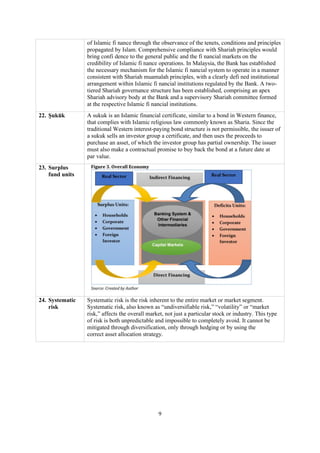
23. Surplus
fund units
24. Systematic
risk
Systematic risk is the risk inherent to the entire market or market segment.
Systematic risk, also known as “undiversifiable risk,” “volatility” or “market
risk,” affects the overall market, not just a particular stock or industry. This type
of risk is both unpredictable and impossible to completely avoid. It cannot be
mitigated through diversification, only through hedging or by using the
correct asset allocation strategy.
10
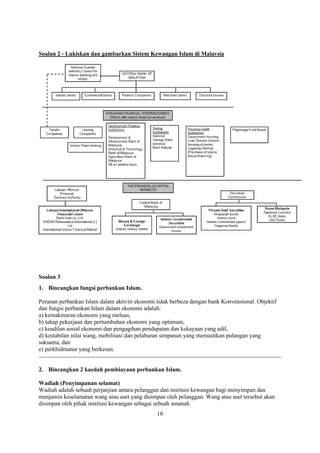
Soalan 2 - Lukiskan dan gambarkan Sistem Kewangan Islam di Malaysia
Soalan 3
1. Bincangkan fungsi perbankan Islam.
Peranan perbankan Islam dalam aktiviti ekonomi tidak berbeza dengan bank Konvensional. Objektif
dan fungsi perbankan Islam dalam ekonomi adalah:
a) kemakmuran ekonomi yang meluas,
b) tahap pekerjaan dan pertumbuhan ekonomi yang optimum,
c) keadilan sosial ekonomi dan pengagihan pendapatan dan kekayaan yang adil,
d) kestabilan nilai wang, mobilisasi dan pelaburan simpanan yang memastikan pulangan yang
saksama, dan
e) perkhidmatan yang berkesan.
2. Bincangkan 2 kaedah pembiayaan perbankan Islam.
Wadiah (Penyimpanan selamat)
Wadiah adalah sebuah perjanjian antara pelanggan dan institusi kewangan bagi menyimpan dan
menjamin keselamatan wang atau aset yang disimpan oleh pelanggan. Wang atau aset tersebut akan
disimpan oleh pihak institusi kewangan sebagai sebuah amanah.
11
Ijarah Thumma Bai’ (Sewa beli)
Konsep ini diadaptasi bagi membiayai barangan pengguna yang kebiasaannya bernilai tinggi. Ia
terdiri daripada kontrak Ijarah (pajakan) dan kontrak Bai’ (jual beli).
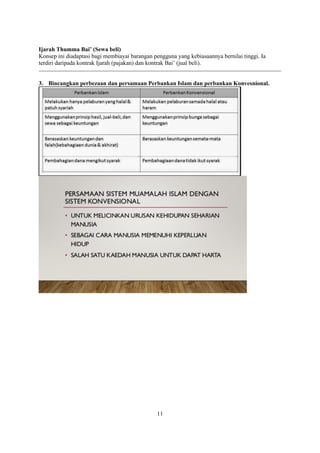
3. Bincangkan perbezaan dan persamaan Perbankan Islam dan perbankan Konvesnional.
12
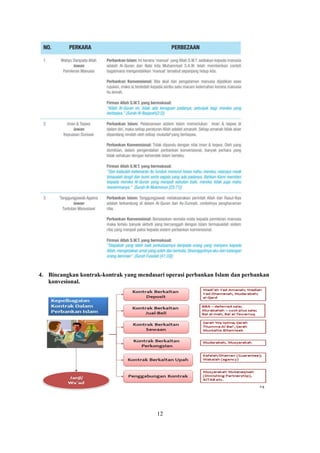
4. Bincangkan kontrak-kontrak yang mendasari operasi perbankan Islam dan perbankan
konvesional.
13
Kontrak pada perbankan syariah memiliki sejumlah perbedaan mendasar dibandingkan dengan
kontrak perbankan konvensional. Produk bank syariah secara umum menerapkan prinsip bagi hasil,
jual-beli dan sewa/ jasa, karena dalam ekonomi Islam yang menjadi dasar operasional bank syariah,
pengenaan bunga pada pemberian pinjaman uang tidak diperkenankan. Namun, perbedaan ini,
terutama dalam prinsip jual beli mura>bahah, membawa konsekwensi kurang kompetitifnya produk
bank syariah di bandingkan bank konvensional. Ini karena pemberian jasa keuangan berupa kredit
dalam bank konvensional tidak dikenakan Pajak Penambahan Nilai (PPN), sementara pembiayaan
dalam perbankan syariah khususnya yang menggunakan skim jual beli mura>bahah. 22 Secara hukum
dikenakan Pajak Pertambahan Nilai (PPN) sebanyak dua kali.
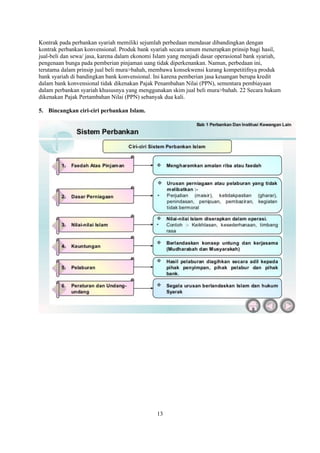
5. Bincangkan ciri-ciri perbankan Islam.

Islamic banking and finance - Tutorial Class 1 (Q&A's)

  • 1.
    1 UUUK3153: ISLAMIC BANKINGAND FINANCE Name: Nur Aliah bt Amran Matrics number: A166840 Date: Monday, 23 September 2019 Tutorial Question and Notes/Answers Soalan 1 - Bincangkan istilah berikut 1. Deficit fund units Any individual, group, or entity (such as a broker or dealer) that obtains funds from surplus spending units by way of the financial markets. One of the most common ways to do so is to sell financial instruments or securities. 2. Double coincidence of wants The coincidence of wants (often known as double coincidence of wants) is an economic phenomenon where two parties each hold an item the other wants, so they exchange these items directly without any monetary medium. This type of exchange is the foundation of a bartering economy. Double coincidence of wants means that both of the parties have to agree to sell and buy each commodity. Under this system, problems arise through the improbability of the wants, needs, or events that cause or motivate a transaction occurring at the same time and the same place. One example is the bar musician who is "paid" with liquor or food, items which his landlord will not accept as rent payment, when the musician would rather have a month's shelter. If, instead, the musician's landlord were to throw a party and desire music for it, hiring the musician to play it by offering the month's rent in exchange, a coincidence of wants would exist. 3. Equity 4. Essential risk The essential risk is inherent in all business transactions. This business risk is necessary and must be undertaken to reap the associated reward or profit. Ibn Taymiyyah says: “Risk falls into two categories commercial risk, where one would buy a commodity in order to sell it for profit, and rely on Allah for that. This risk is necessary for merchants, and although one might occasionally lose, but this is the nature of commerce. The other type of risk is that of gambling, which implies
  • 2.
    2 eating wealth fornothing ( ‫بالباطل‬‫المال‬‫اكل‬ .(This is what Allah and His Messenger (p.b.u.h.) prohibited” (Ibn Taymiyyah, 1996). Two legal maxims are associating returns to essential risks form the basis of Islamic economic transactions. The first maxim states ‘ ‫بالغرم‬‫الغنم‬ ” ,‘entitlement to profit is accompanied by responsibility for attendant expenses and possible loss” (Tyser, Demetriades, & Effendi, 2000). This maxim attaches the ‘entitlement of gain’ to the ‘responsibility of loss’. For instance, in a sale contract, before selling the commodity the owner has to bear all types of risks associated with the commodity. This risk will be transferred to the buyer when he will possess the commodity in the form of complete ownership. One of the basic requirements of a sale contract is transfer of complete ownership (milkiyyah tammah), which cannot be acquired without transferring risks and liabilities. Any condition that effects the transfer of risks and responsibilities will result in the contract becoming unlawful. Furthermore, the aforesaid maxim is usually used to propose the preference for profit-and-loss-sharing (PLS) financing instruments like musharakah and mudarabah (International Shariah Research Academy for Islamic Finance, 2012). The second maxim is derived from the Prophetic saying “ ‫بالضمان‬‫الخراج‬ ]” “Entitlement to] profit is dependent on responsibility [for attendant expenses and possible loss and defects]” (Tyser, Demetriades, & Effendi, 2000). The maxim asserts that the party enjoying the full benefit of an asset should bear the risks of ownership of that asset. However, linking returns to risks of ownership does not necessarily relates to PLS contracts. The principle points out the risks related to ownership associated with sale and leasing transactions. For instance, the implication for a sale-based transaction is that the seller must bear all the risks associated with the object of the sale while concluding the contract and in a leasing contract, the lessor should be responsible for the asset leased out during the time of contract. 5. Financial intermediar y Financial intermediation was practiced in the early days of Islam. It originated from the principle of al-muḍārib udārib which translates into “the one who mobilizes funds, on profit-sharing basis, can extend these funds to the users on the same basis”. The intermediation took place when caravan traders which were financed by muḍārabah (trust financing) were permitted to sell them at higher prices and make surplus. With regards to intermediation, Islamic banks are responsible for detecting suitable and reliable projects to finance and as well as supervise its development. However, as an intermediary, they should not participate in the management and policy-making section. By giving that responsibility to the entrepreneur, the bank can keep an objective view on the development of that project. Islamic banks’ intermediate by mobilizing funds from their clients and delivering it to businessmen/entrepreneurs with a legit business plan looking for investors. The sharia laid down specific rules and restrictions of the economic activity in a community to promote a high degree of justice and equity in the production, exchange and distribution of wealth. As a result, Islamic financial laws lay great emphasis on the social and economic justice which makes Islamic banks such a great choice for financial intermediary; they prioritize the client’s interest, the economy’s interest and the society’s interest before the bank’s interest as opposed to the conventional banks which only give precedence to their profit. To ensure justice, Islamic banks abide by one of the fundamental principles of
  • 3.
    3 finance; profit andrisk-sharing by obliging both the investor and the businessman to even-handedly split the profit or the loss. Due to this principle, Islamic financial institutions and their clients alike infuse regulation and order into the system because they equally have something to lose or win. Another prerequisite for financial intermediation of Islamic banks states that once the broker, in this case, the bank, purchases the goods for sale or rent, financier bears the risk. This ensures that the broker is also allotted a portion of the risk so it can get a share of the profit. It also upholds the sharia principle of ‘no risk no returns’. These conditions are fixed to uphold Islam’s fundamental objective of promoting equity and development in all aspects of life through finance. The system is set to foster fairness, morality and coordination in society. 6. Financial markets Islamic financial market is the market where the financial instruments are traded in ways that do not conflict with the Shari’ah principles; it plays an important role in generating economic growth and complimenting and broadening the Islamic banking. Islamic financial market transactions are required to be carried out in ways that do not conflict with the Shari’ah so that the market is free from activities prohibited by Islam such as excess encompassing Riba, Maysir and Gharar. Therefore, there is a need to review the present practices prevailing in the financial market to identify which of these practices needed to be reformed from an Islamic point of view and which of them may be acceptable. The objectives of the Islamic financial market are to ensure the equitable allocation of capital to sectors which would yield the best of returns to the owners of capital and to ensure that there exists sufficient investments opportunities to attract surplus funds in accordance with the owners' preferences in terms of the extent of risk involvement, rate of return as well as the period of investment. Equity-based securities that don’t guarantee any return and don’t include forbidden businesses can constitute investments in line with Islamic financial law. Whereas debt-based securities that carry a fixed return until maturity, such as debentures, bonds, preferred stocks and commercial paper, are inconsistent with Islamic principles and it would therefore be necessary for new instruments to be designed to replace them. Preferred stocks can match within the Islamic framework by turning them into redeemable equities with an element of participation in both earnings and the proceeds of liquidation. However, debt and preferred stocks would be replaced by Islamic instruments. In fact, Islamic financial instruments have particular characteristics to comply with the Shari’ah rules, they should represent share in equity, real assets, usufruct or a combination of some or all of these, they should not earn money on debt and their holders must be the owners of whatever rights these instruments represent and bearers of all related risks. The tradability of an instrument related to a debt must in accordance with Shari’ah rules and it should not be allowed to earn any return. In addition, at the Issuance of Islamic financial instruments based on Mudarabah or Musharakah, the issuers should keep separate accounts for each specific project (ziaahmed.org; 09.2009), the prospectus should include full disclosure of the nature of the activities, contractual relationships and obligations between the parties involved and ratio of profit sharing and the profit and loss accounts must be declared at the date mentioned in the prospectus and balance sheets; the Principle and expected return on investment cannot be guaranteed. An example of fixed-return contract approved by the Shari’ah is Ijarah and it is possible to raise funds by this mean through the Stock Market. Lease-stocks will give ownership
  • 4.
    4 to the stockholdersof the leased equipment, from which they will receive a known flow of rent. This is allowed in Shari’ah since they will have to borne the risk of the eventual value being much lower than was estimated. Furthermore, since the entire capital resources, both short-term and long-term, in Islamic system are equity-based and not debt-based there is a need for a continuous pricing mechanism to the Islamic financial system to prevent it from major shocks and crashes (ziaahmed.org; 09.2009). For this purpose, there are three key areas of the market that need to be constantly reviewed that are speculation, information disclosure standards and the regulations guiding operations and trading practices. Speculation can cause wild swings in the market through misallocation of resources resulting in losses and gains entirely unrelated to real economic effects. Such results are like the results of gambling, involving transfer of resources among the participants but adding nothing to the initial stock of resources. The adequate flow of public information is what protects investors by ensuring that significant changes in shareholding are not the result of some people having inside information not available to the public. And the regulations guiding operations and trading practices require restrictions to ensure an adequate flow of information about the business whose securities are being traded and to control the trading practices in the market. These define the role of brokers and dealers, set margin limits and control fees and commissions. 7. Islamic capital market In an Islamic capital market (ICM) market transactions are carried out in ways that do not conflict with the conscience of Muslims and the religion of Islam. Here, there is assertion of religious law so that the market is free from activities prohibited by Islam such as usury (riba), gambling (maisir) and ambiguity (gharar). The ICM is a component of the overall capital market in Malaysia. It plays an important role in generating economic growth for the country. The ICM functions as a parallel market to the conventional capital market, and plays a complementary role to the Islamic banking system in broadening and deepening the Islamic financial markets in Malaysia. As the market became more complex and sophisticated, it needed supportive infrastructure so that the system could operate and function more efficiently and effectively. The SC’s early initiative in setting up a dedicated Islamic Capital Market Department (ICMD) within its Strategy and Development Business Group was to provide the much needed infrastructure support. The mandate of the ICMD is to carry out research and development activities including formulating and facilitating a long-term plan to further strengthen the ICM in Malaysia. The Shariah Advisory Council (SAC) was established in May 1996 to advise the Commission on Shariah matters pertaining to the ICM. Members of the SAC are qualified individuals who can present Shariah opinions and have vast experience in the application of Shariah, particularly in the areas of Islamic economics and finance. Today, various capital market products are available for Muslims who only seek to invest and transact in the ICM. Such products include the SC list of Shariah- compliant securities, sukuk, Islamic unit trusts, Shariah indices, warrants (TSR), call warrants and crude palm oil futures contract. 8. Islamic Islamic finance is a financial system that operates according to Islamic law
  • 5.
    5 finance (which iscalled sharia) and is, therefore, sharia-compliant. Just like conventional financial systems, Islamic finance features banks, capital markets, fund managers, investment firms, and insurance companies. However, these entities are governed both by Islamic law and the finance industry rules and regulations that apply to their conventional counterparts. Although the Islamic finance industry itself is quite young, Islamic theories of economics have existed for more than a millennium; by the mid-12th century, in fact, many Muslims scholars had presented key concepts of Islamic economics that are still relevant today. But political and social turmoil put the brakes on Islamic finance for a very long time; only in the 20th century did Muslim scholars and academics seriously begin to revisit these topics (and, in doing so, set the stage for the modern Islamic finance industry to emerge in the 1970s). The search for balance Islamic economics is based on core concepts of balance, which help ensure that the motives and objectives driving the Islamic finance industry are beneficial to society. • Balancing material pursuits and spiritual needs • Balancing individual and social needs 9. Islamic financial system The Islamic financial system is not much different from the products and services in the traditional financial system but it operations are essentially based on a certain set of moral and ethical principles that determined what is viewed as morally ‘right’ implying actions and transactions that promote public good, and ‘wrong’ implying actions and transactions likely to be against the public good. Describing the Islamic financial system simply as "interest-free" does not provide a correct picture of the system as a whole and tends to create confusion. While prohibiting the receipt and payment of interest is the nucleus of the system, it is supported by other principles of Islamic teachings advocating individuals' rights and duties, property rights, equitable distribution of wealth, risk- sharing, fulfilment of obligations and the sanctity of contracts. The Islamic financial system is not limited to banking but covers insurance, capital formation, capital markets, and all types of financial intermediation and suggests that moral and ethical aspects in the regulatory framework are also necessary in addition to prudent and sound controls. 10. Islamic money market Unique to Malaysia, the settlement of large-value payments within the Islamic banking sector is conducted via a separate system of Islamic current accounts maintained at Bank Negara Malaysia. This separation ensures a clear segregation of funds between conventional and Islamic banking at the settlement level to ensure compliance from the Shariah perspective. Nonetheless, liquidity in both systems are linked given third-party payments between banking customers in the two sectors, as well as the participation of conventional banking institutions in Islamic banking products. The primary objective of the Bank’s monetary operations in the Islamic money market is to ensure sufficient liquidity for the efficient functioning of the Islamic interbank market. The monetary policy target is only implemented in the conventional money market, where interest rate based instruments are the primary funding instrument. The Bank influences Islamic interbank market liquidity through an array of Shariah-compliant instruments, the main instrument
  • 6.
    6 being the Qardacceptance (loan). Through the Qard acceptance, the Bank manages liquidity in the context of a surplus liquidity environment by inviting Islamic banking institutions to place their surplus funds with the Bank. The Bank also uses Commodity Murabahah Programme (CMP) to manage liquidity. CMP utilises mainly crude palm oil-based contracts as the underlying commodity transactions to facilitate liquidity management via a commodity trading platform such as Bursa Suq Al Sila’, or other commodity providers. For longer-term liquidity management, the Bank issues Bank Negara Monetary Notes-i (BNMN-i) which are structured based on Islamic concepts of Murabahah (BNMN-Murabahah), Ijarah (BNMN-Ijarah), Bai Bithaman Ajil (BNMN-BBA) and Istithmar (BNMN-Istithmar). The key objectives of issuing BNMN-i are to increase efficiency and flexibility in liquidity management in the Islamic money market by diversifying Islamic financial instrument and expanding the Shariah concept used in BNM’s Islamic monetary operation. 11. Islamic real estate investment trust The first Islamic REIT (Real Estate Investment Trust) in the world was Malaysia- based Al-Aqar KPJ REIT, launched on June 2006. Al-Aqar KPJ REIT initial investment were six hospitals valued at USD 138 million. The second Islamic REIT was also Malaysia-based, Al-Hadaharah Boustead REIT, with initial investment in palm oil plantation estates valued at USD 136 million and was launched on February 2007. The third Islamic REIT and world’s first Islamic industrial/office REIT was the Malaysia-based AXIS REIT. AXIS REIT was initially launched as conventional REIT in August 2005 but subsequently restructured to be Shariah-compliant in December 2008. In May 2013, Malaysia issued world’s first stapled REIT, KLCC REIT. A stapled REIT is an investment vehicle which ‘stapled’ two or more entities/instruments into a new financial instrument. Even Singapore has issued its first Islamic REIT, Sabana REIT, and subsequently listed it on the Singapore Exchange Securities Trading Limited in 2010. As of third quarter 2013, Sabana REIT portfolio consisted of 22 properties valued at SGD 1.22 billion, making it the world’s largest Islamic REIT. Yet, as of this writing, Indonesia being the largest Muslim populated country in the ASEAN region has not issued any Islamic REIT. 12. Justice Financial justice is a requirement that helps Islamic finance products function in a Shariah compliant way. The Western financial system looks at making profit through interest payments and makes the beneficiary liable for any risk. Islamic finance paves way for the sharing of profit/loss and risk involved in proportional manner Financial justice is a basic requirement for the functioning of Islamic finance products. Western or conventional financing looks forward to profit through interest payments and makes the beneficiary completely liable for any risk. Contrary to this, Islamic financing paves the way for the sharing of net profit/loss and the risk involved in a proportional manner between the lender and the beneficiary. Therefore, if a financier is expecting a claim on profits of a project, it is necessary that he/she should also carry a proportional share of the loss of that project. 13. Unit of account Islamic economics regards money as a unit of account, medium of exchange, store of value. Money is not regarded a merchandise to be sold or bought. Deferred exchanges are allowed only when one of the exchanged items is money due to its being a standard of deferred payments.
  • 7.
    7 14. Maqāṣid al- Sharīʿah Accordingto Ibn Ashur, maqasid al-Shariah (objectives of Shariah) is a term that refers to the preservation of order, achievement of benefit and prevention of harm or corruption, establishment of equality among people, causing the law to be revered, obeyed and effective as well as enabling the ummah to become powerful, respected and confident. Hifz al mal (preservation of wealth) is one of the most important objectives of the Shariah. The Muslim jurists assert that the concept of hifz al mal goes beyond its literal meaning. It does not mean to preserve the wealth per se, but the concept also covers the encouragement to generate, accumulate, preserve as well as distribute the wealth in a just and fair manner. The Shariah teachings emphasise strongly on preserving one’s wealth. Hence, it has prescribed certain parameters such as for the ownership to be legally recognised and has outlined specific punishments for transgressing the right of others. For example, the Quran has explicitly described the punishment for theft without taking any consideration of the offender’s gender. This can be found in Surah al- Maidah verse 38 whereby Allah has said, “[As for] the thief, the male and the female, amputate their hands in recompense for what they committed as a deterrent [punishment] from Allah . And Allah is Exalted in Might and Wise.” 15. Permissible risk Risk management is permissible in Islam (Abdul Kader Malim, 2015). Its concept is acceptable to contemporary Islamic scholars based on the Quranic verse (Al-Baqarah: 282) which requires Muslims to record debt or provide witnesses, and the supporting Hadith (Sunan al-Tirmidhi: 2517) which requires Bedouin to tie the camel before leaving its fate to God (tawakkal). Therefore, the management must be parallel with Shariah principles because it involves the process of protecting individuals or their properties from facing the probability of loss. It considers the protection of wealth (hifz al-mal) as a value which is emphasized in Islam. From the Islamic perspective, risk is allowed and it differs from gharar which is prohibited. 16. Primary market A ‘capital market’ is a market for issuance and sale of bonds, stocks or similar securities to raise long-term capital. The maturity of securities distinguishes debt capital markets from ‘money market’, where trading is in short term debt instruments with a tenor of less than one year or so. Capital markets are divided into debt capital markets and equity capital markets. The Sukuk market falls into falls into the debt capital market arena because contemporary Sukuk are structures to produce a fixedincome return for Sukuk holders. Capital markets are also classified into primary markets and secondary markets. In the primary market an investor buys securities which are issued for the first time. Existing securities are purchased and sold in the secondary market. Primary capital markets are important for capital development of an economy. 17. Prohibited risk Gharar. Gharar is an Arabic word that is associated with uncertainty, deception and risk. It is a significant concept in Islamic finance and is used to measure the legitimacy of a hazardous sale or risky investment pertaining to either short selling, the selling of goods or assets of uncertain quality or delivery, gambling or contracts that are not drawn out in clear terms. Gharar is generally prohibited under Islam; there are strict rules in Islamic finance against transactions that are highly uncertain or that may cause any injustice or deceit against any of the parties. In finance, gharar is observed within derivative transactions such as
  • 8.
    8 forwards, futures andoptions, as well as in short selling and in speculation. In Islamic finance, most derivative contracts are forbidden and considered invalid because of the uncertainty involved in the future delivery of the underlying asset. Islamic finance also strictly prohibits extending loans with interest, which it considers usury. 18. Secondary market The secondary market is where investors buy and sell securities they already own. It is what most people typically think of as the "stock market," though stocks are also sold on the primary market when they are first issued. The national exchanges, such as the New York Stock Exchange (NYSE) and the NASDAQ, are secondary markets. Capital markets include primary markets, where new stock and bond issues are sold to investors, and secondary markets, where existing securities are traded. 19. Shares 20. Sharīʿah Sharīʿah, also spelled Sharia, the fundamental religious concept of Islam— namely, its law. The religious law of Islam is seen as the expression of God’s command for Muslims and, in application, constitutes a system of duties that are incumbent upon all Muslims by virtue of their religious belief. Known as the Sharīʿah (literally, “the path leading to the watering place”), the law represents a divinely ordained path of conduct that guides Muslims toward a practical expression of religious conviction in this world and the goal of divine favour in the world to come. 21. Sharīʿah governance The principles of Islamic fi nance place great emphasis on strong corporate governance values and structure, transparency, disclosure of information and strict adherence to Shariah principles. The Shariah governance framework is a set of organisational arrangements through which Islamic fi nancial institutions ensure effective oversight, responsibility and accountability of the board of directors, management and Shariah committee. The framework serves as a guide towards ensuring an operating environment that is compliant with Shariah principles at all times. Shariah principles provide the foundation for the practise
  • 9.
    9 of Islamic finance through the observance of the tenets, conditions and principles propagated by Islam. Comprehensive compliance with Shariah principles would bring confi dence to the general public and the fi nancial markets on the credibility of Islamic fi nance operations. In Malaysia, the Bank has established the necessary mechanism for the Islamic fi nancial system to operate in a manner consistent with Shariah muamalah principles, with a clearly defi ned institutional arrangement within Islamic fi nancial institutions regulated by the Bank. A two- tiered Shariah governance structure has been established, comprising an apex Shariah advisory body at the Bank and a supervisory Shariah committee formed at the respective Islamic fi nancial institutions. 22. Ṣukūk A sukuk is an Islamic financial certificate, similar to a bond in Western finance, that complies with Islamic religious law commonly known as Sharia. Since the traditional Western interest-paying bond structure is not permissible, the issuer of a sukuk sells an investor group a certificate, and then uses the proceeds to purchase an asset, of which the investor group has partial ownership. The issuer must also make a contractual promise to buy back the bond at a future date at par value. 23. Surplus fund units 24. Systematic risk Systematic risk is the risk inherent to the entire market or market segment. Systematic risk, also known as “undiversifiable risk,” “volatility” or “market risk,” affects the overall market, not just a particular stock or industry. This type of risk is both unpredictable and impossible to completely avoid. It cannot be mitigated through diversification, only through hedging or by using the correct asset allocation strategy.
  • 10.
    10 Soalan 2 -Lukiskan dan gambarkan Sistem Kewangan Islam di Malaysia Soalan 3 1. Bincangkan fungsi perbankan Islam. Peranan perbankan Islam dalam aktiviti ekonomi tidak berbeza dengan bank Konvensional. Objektif dan fungsi perbankan Islam dalam ekonomi adalah: a) kemakmuran ekonomi yang meluas, b) tahap pekerjaan dan pertumbuhan ekonomi yang optimum, c) keadilan sosial ekonomi dan pengagihan pendapatan dan kekayaan yang adil, d) kestabilan nilai wang, mobilisasi dan pelaburan simpanan yang memastikan pulangan yang saksama, dan e) perkhidmatan yang berkesan. 2. Bincangkan 2 kaedah pembiayaan perbankan Islam. Wadiah (Penyimpanan selamat) Wadiah adalah sebuah perjanjian antara pelanggan dan institusi kewangan bagi menyimpan dan menjamin keselamatan wang atau aset yang disimpan oleh pelanggan. Wang atau aset tersebut akan disimpan oleh pihak institusi kewangan sebagai sebuah amanah.
  • 11.
    11 Ijarah Thumma Bai’(Sewa beli) Konsep ini diadaptasi bagi membiayai barangan pengguna yang kebiasaannya bernilai tinggi. Ia terdiri daripada kontrak Ijarah (pajakan) dan kontrak Bai’ (jual beli). 3. Bincangkan perbezaan dan persamaan Perbankan Islam dan perbankan Konvesnional.
  • 12.
    12 4. Bincangkan kontrak-kontrakyang mendasari operasi perbankan Islam dan perbankan konvesional.
  • 13.
    13 Kontrak pada perbankansyariah memiliki sejumlah perbedaan mendasar dibandingkan dengan kontrak perbankan konvensional. Produk bank syariah secara umum menerapkan prinsip bagi hasil, jual-beli dan sewa/ jasa, karena dalam ekonomi Islam yang menjadi dasar operasional bank syariah, pengenaan bunga pada pemberian pinjaman uang tidak diperkenankan. Namun, perbedaan ini, terutama dalam prinsip jual beli mura>bahah, membawa konsekwensi kurang kompetitifnya produk bank syariah di bandingkan bank konvensional. Ini karena pemberian jasa keuangan berupa kredit dalam bank konvensional tidak dikenakan Pajak Penambahan Nilai (PPN), sementara pembiayaan dalam perbankan syariah khususnya yang menggunakan skim jual beli mura>bahah. 22 Secara hukum dikenakan Pajak Pertambahan Nilai (PPN) sebanyak dua kali. 5. Bincangkan ciri-ciri perbankan Islam.