Junqing Zhai Department of Education & Professional Studies King’s College London [email_address] Engaging Children in Learning Plant-Based Science: The Pedagogical Practices of Botanic Garden Educators
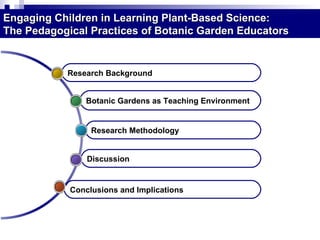
Conclusions and Implications Discussion Research Methodology Botanic Gardens as Teaching Environment Research Background Engaging Children in Learning Plant-Based Science: The Pedagogical Practices of Botanic Garden Educators
Learning outside the classroom manifesto (DfES 2006) QCA ‘big picture’ (2008): credits learning outside the classroom as a key construct of the curriculum New National Curriculum driven: learning beyond the classroom/school  Limited research about school trips to botanic garden, especially the teaching practices of botanic garden educators Research Background
Learning topics in science and geography curricula as driving force for school trips to botanic gardens  Botanic gardens as resources for environmental education  School trip to botanic garden has impacted on students’ learning, both cognitively and affectively Learning in botanic gardens is experiential-based and knowledge is constructed through social interactions Botanic Gardens as Learning/Teaching Environments
How are botanic garden educator guided lessons to school groups structured? What strategies do the botanic garden educators adopt to facilitate and support visiting schoolchildren’s learning? Research Questions
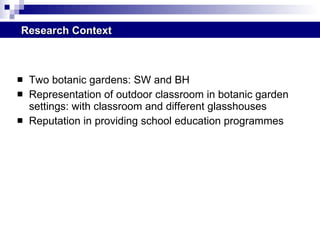
Two botanic gardens: SW and BH Representation of outdoor classroom in botanic garden settings: with classroom and different glasshouses Reputation in providing school education programmes Research Context
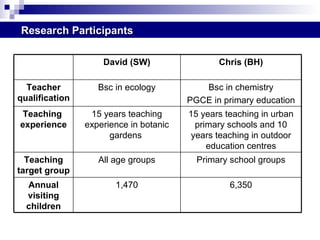
Research Participants 6,350 1,470 Annual visiting children Primary school groups All age groups Teaching target group 15 years teaching in urban primary schools and 10 years teaching in outdoor education centres 15 years teaching experience in botanic gardens  Teaching  experience Bsc in chemistry PGCE in primary education Bsc in ecology Teacher qualification Chris (BH) David (SW)
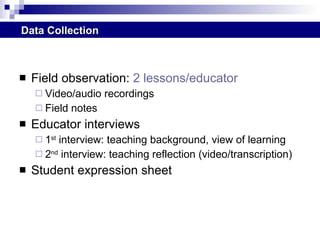
Field observation:  2 lessons/educator Video/audio recordings Field notes Educator interviews  1 st  interview: teaching background, view of learning 2 nd  interview: teaching reflection (video/transcription) Student expression sheet  Data Collection
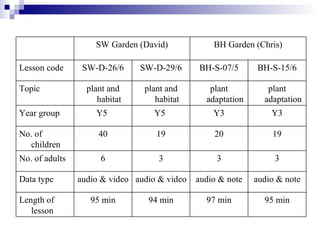
95 min 97 min 94 min 95 min Length of lesson audio & note audio & note audio & video audio & video Data type 3 3 3 6 No. of adults 19 20 19 40 No. of children Y3 Y3 Y5  Y5  Year group plant adaptation plant adaptation plant and habitat plant and habitat Topic BH-S-15/6 BH-S-07/5 SW-D-29/6 SW-D-26/6 Lesson code BH Garden (Chris) SW Garden (David)
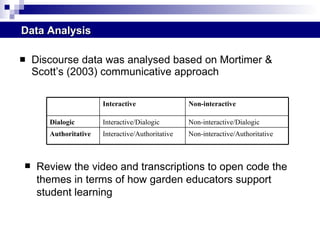
Discourse data was analysed based on Mortimer & Scott’s (2003) communicative approach  Data Analysis Review the video and transcriptions to open code the themes in terms of how garden educators support student learning Non-interactive/Authoritative Interactive/Authoritative Authoritative  Non-interactive/Dialogic Interactive/Dialogic Dialogic  Non-interactive Interactive
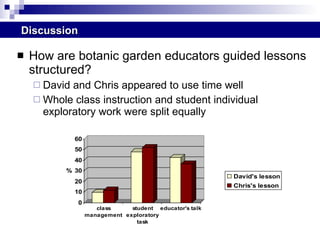
How are botanic garden educators guided lessons structured? David and Chris appeared to use time well Whole class instruction and student individual exploratory work were split equally  Discussion
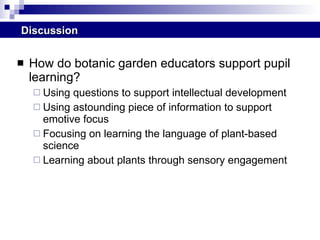
How do botanic garden educators support pupil learning? Using questions to support intellectual development Using astounding piece of information to support emotive focus Focusing on learning the language of plant-based science Learning about plants through sensory engagement Discussion
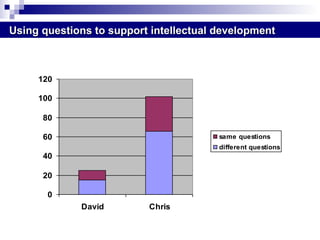
Using questions to support intellectual development
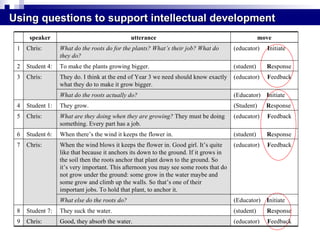
Using questions to support intellectual development (educator)  F eedback Good, they absorb the water. Chris: 9 (student)  R esponse They suck the water. Student 7: 8 (Educator)  I nitiate What else do the roots do? (educator)  F eedback When the wind blows it keeps the flower in. Good girl. It’s quite like that because it anchors its down to the ground. If it grows in the soil then the roots anchor that plant down to the ground. So it’s very important. This afternoon you may see some roots that do not grow under the ground: some grow in the water maybe and some grow and climb up the walls. So that’s one of their important jobs. To hold that plant, to anchor it.  Chris: 7 (student)  R esponse When there’s the wind it keeps the flower in. Student 6: 6 (educator)  F eedback What are they doing when they are growing?  They must be doing something. Every part has a job. Chris: 5 (Student)  R esponse They grow. Student 1: 4 (Educator)  I nitiate What do the roots actually do? (educator)  F eedback They do. I think at the end of Year 3 we need should know exactly what they do to make it grow bigger.  Chris: 3 (student)  R esponse To make the plants growing bigger. Student 4: 2 (educator)  I nitiate What do the roots do for the plants? What’s their job? What do they do? Chris: 1 move utterance speaker
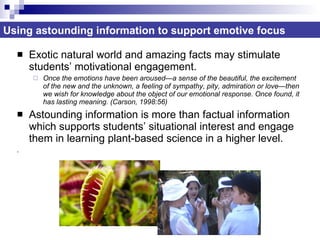
Exotic natural world and amazing facts may stimulate students’ motivational engagement.  Once the emotions have been aroused—a sense of the beautiful, the excitement of the new and the unknown, a feeling of sympathy, pity, admiration or love—then we wish for knowledge about the object of our emotional response. Once found, it has lasting meaning. (Carson, 1998:56) Astounding information is more than factual information which supports students’ situational interest and engage them in learning plant-based science in a higher level. . Using astounding information to support emotive focus
Learning the language of science is a major part of science education (Wellington and Osborne, 2001). Learning to talk science is more than simply being able to verbalise the appropriate words, phrases, and scientific terminology.  Chris:  What temperature is it? S9:  18 Chris:  18 Celsius S9:  Celsius Chris:  Remember to put a unit . Ok? If you go to a shop somebody doesn’t say  18 but they say 18 pence or 18 pounds, so we have to say 18 Celsius. It’s a challenge to botanic garden educators to promote learning the language of plant-based science to the students whose first language is not English  Focusing on learning the language of plant-based science
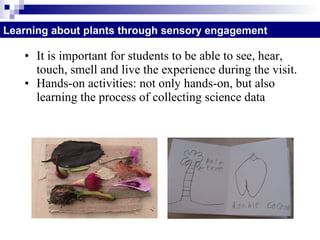
It is important for students to be able to see, hear, touch, smell and live the experience during the visit.  Hands-on activities: not only hands-on, but also learning the process of collecting science data  Learning about plants through sensory engagement
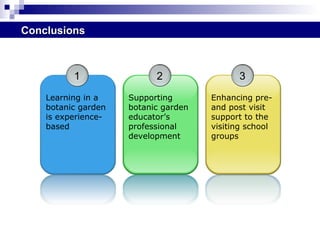
Conclusions 1 Learning in a botanic garden is experience-based 2 Supporting botanic garden educator’s professional development 3 Enhancing pre- and post visit support to the visiting school groups
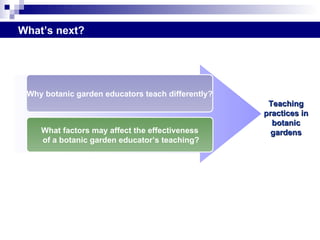
Why botanic garden educators teach differently? What factors may affect the effectiveness of a botanic garden educator’s teaching? Teaching practices in botanic gardens What’s next?
Junqing Zhai Department of Education & Professional Studies King’s College London [email_address] Engaging Children in Learning Plant-Based Science: The Pedagogical Practices of Botanic Garden Educators

ISEC 2009 Presentation

  • 1.
    Junqing Zhai Departmentof Education & Professional Studies King’s College London [email_address] Engaging Children in Learning Plant-Based Science: The Pedagogical Practices of Botanic Garden Educators
  • 2.
    Conclusions and ImplicationsDiscussion Research Methodology Botanic Gardens as Teaching Environment Research Background Engaging Children in Learning Plant-Based Science: The Pedagogical Practices of Botanic Garden Educators
  • 3.
    Learning outside theclassroom manifesto (DfES 2006) QCA ‘big picture’ (2008): credits learning outside the classroom as a key construct of the curriculum New National Curriculum driven: learning beyond the classroom/school Limited research about school trips to botanic garden, especially the teaching practices of botanic garden educators Research Background
  • 4.
    Learning topics inscience and geography curricula as driving force for school trips to botanic gardens Botanic gardens as resources for environmental education School trip to botanic garden has impacted on students’ learning, both cognitively and affectively Learning in botanic gardens is experiential-based and knowledge is constructed through social interactions Botanic Gardens as Learning/Teaching Environments
  • 5.
    How are botanicgarden educator guided lessons to school groups structured? What strategies do the botanic garden educators adopt to facilitate and support visiting schoolchildren’s learning? Research Questions
  • 6.
    Two botanic gardens:SW and BH Representation of outdoor classroom in botanic garden settings: with classroom and different glasshouses Reputation in providing school education programmes Research Context
  • 7.
    Research Participants 6,3501,470 Annual visiting children Primary school groups All age groups Teaching target group 15 years teaching in urban primary schools and 10 years teaching in outdoor education centres 15 years teaching experience in botanic gardens Teaching experience Bsc in chemistry PGCE in primary education Bsc in ecology Teacher qualification Chris (BH) David (SW)
  • 8.
    Field observation: 2 lessons/educator Video/audio recordings Field notes Educator interviews 1 st interview: teaching background, view of learning 2 nd interview: teaching reflection (video/transcription) Student expression sheet Data Collection
  • 9.
    95 min 97min 94 min 95 min Length of lesson audio & note audio & note audio & video audio & video Data type 3 3 3 6 No. of adults 19 20 19 40 No. of children Y3 Y3 Y5 Y5 Year group plant adaptation plant adaptation plant and habitat plant and habitat Topic BH-S-15/6 BH-S-07/5 SW-D-29/6 SW-D-26/6 Lesson code BH Garden (Chris) SW Garden (David)
  • 10.
    Discourse data wasanalysed based on Mortimer & Scott’s (2003) communicative approach Data Analysis Review the video and transcriptions to open code the themes in terms of how garden educators support student learning Non-interactive/Authoritative Interactive/Authoritative Authoritative Non-interactive/Dialogic Interactive/Dialogic Dialogic Non-interactive Interactive
  • 11.
    How are botanicgarden educators guided lessons structured? David and Chris appeared to use time well Whole class instruction and student individual exploratory work were split equally Discussion
  • 12.
    How do botanicgarden educators support pupil learning? Using questions to support intellectual development Using astounding piece of information to support emotive focus Focusing on learning the language of plant-based science Learning about plants through sensory engagement Discussion
  • 13.
    Using questions tosupport intellectual development
  • 14.
    Using questions tosupport intellectual development (educator) F eedback Good, they absorb the water. Chris: 9 (student) R esponse They suck the water. Student 7: 8 (Educator) I nitiate What else do the roots do? (educator) F eedback When the wind blows it keeps the flower in. Good girl. It’s quite like that because it anchors its down to the ground. If it grows in the soil then the roots anchor that plant down to the ground. So it’s very important. This afternoon you may see some roots that do not grow under the ground: some grow in the water maybe and some grow and climb up the walls. So that’s one of their important jobs. To hold that plant, to anchor it. Chris: 7 (student) R esponse When there’s the wind it keeps the flower in. Student 6: 6 (educator) F eedback What are they doing when they are growing? They must be doing something. Every part has a job. Chris: 5 (Student) R esponse They grow. Student 1: 4 (Educator) I nitiate What do the roots actually do? (educator) F eedback They do. I think at the end of Year 3 we need should know exactly what they do to make it grow bigger. Chris: 3 (student) R esponse To make the plants growing bigger. Student 4: 2 (educator) I nitiate What do the roots do for the plants? What’s their job? What do they do? Chris: 1 move utterance speaker
  • 15.
    Exotic natural worldand amazing facts may stimulate students’ motivational engagement. Once the emotions have been aroused—a sense of the beautiful, the excitement of the new and the unknown, a feeling of sympathy, pity, admiration or love—then we wish for knowledge about the object of our emotional response. Once found, it has lasting meaning. (Carson, 1998:56) Astounding information is more than factual information which supports students’ situational interest and engage them in learning plant-based science in a higher level. . Using astounding information to support emotive focus
  • 16.
    Learning the languageof science is a major part of science education (Wellington and Osborne, 2001). Learning to talk science is more than simply being able to verbalise the appropriate words, phrases, and scientific terminology. Chris: What temperature is it? S9: 18 Chris: 18 Celsius S9: Celsius Chris: Remember to put a unit . Ok? If you go to a shop somebody doesn’t say 18 but they say 18 pence or 18 pounds, so we have to say 18 Celsius. It’s a challenge to botanic garden educators to promote learning the language of plant-based science to the students whose first language is not English Focusing on learning the language of plant-based science
  • 17.
    It is importantfor students to be able to see, hear, touch, smell and live the experience during the visit. Hands-on activities: not only hands-on, but also learning the process of collecting science data Learning about plants through sensory engagement
  • 18.
    Conclusions 1 Learningin a botanic garden is experience-based 2 Supporting botanic garden educator’s professional development 3 Enhancing pre- and post visit support to the visiting school groups
  • 19.
    Why botanic gardeneducators teach differently? What factors may affect the effectiveness of a botanic garden educator’s teaching? Teaching practices in botanic gardens What’s next?
  • 20.
    Junqing Zhai Departmentof Education & Professional Studies King’s College London [email_address] Engaging Children in Learning Plant-Based Science: The Pedagogical Practices of Botanic Garden Educators