Outline
• Domains &Domain analysis context
• Domain and their boundaries.
• Domain concepts identification.
• Domain dictionaries and domain catalog.
• Identifying and organizing business rules.
2
Ref: Ashrafi and Ashrafi: Object-Oriented Systems Design and Methodology, Int Ed., Chapter 5-6
3.
5- 3
Domain Analysis
•Domain analysis identifies business concepts
that will be refined into the building blocks of
an analysis model for the information
system.
4.
Domain Definition
• Abusiness domain is an area of related
activities that operate on a set of shared
rules and concepts:
– Business domains are organized domains.
• Members’ interaction affects the domains and its
members
– Business domains are goal-oriented.
• Have missions
– Business domains can change fast.
4
5.
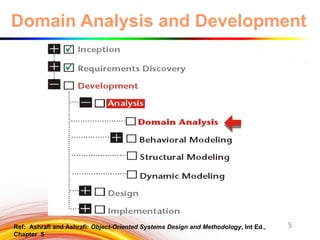
Domain Analysis andDevelopment
5
Ref: Ashrafi and Ashrafi: Object-Oriented Systems Design and Methodology, Int Ed.,
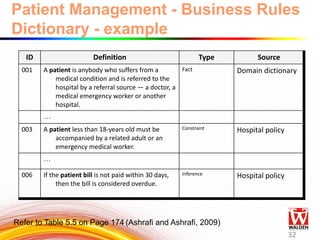
Chapter 5
Outline
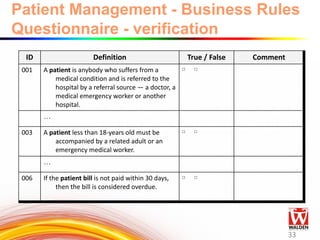
• Domains &Domain analysis context
• Domain and their boundaries.
• Domain concepts identification.
• Domain dictionaries and domain catalog.
• Identifying and organizing business rules.
7
Ref: Ashrafi and Ashrafi: Object-Oriented Systems Design and Methodology, Int Ed., Chapter 5-6
8.
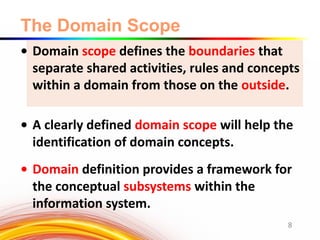
The Domain Scope
•Domain scope defines the boundaries that
separate shared activities, rules and concepts
within a domain from those on the outside.
• A clearly defined domain scope will help the
identification of domain concepts.
• Domain definition provides a framework for
the conceptual subsystems within the
information system.
8
Outline
• Domains &Domain analysis context
• Domain and their boundaries.
• Domain concepts identification.
• Domain dictionaries and domain catalog.
• Identifying and organizing business rules.
10
Ref: Ashrafi and Ashrafi: Object-Oriented Systems Design and Methodology, Int Ed., Chapter 5-6
11.
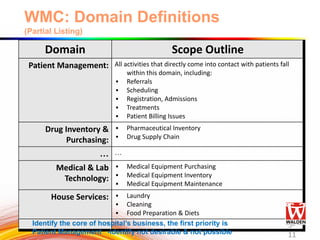
WMC: Domain Definitions
(PartialListing)
Domain Scope Outline
Patient Management: All activities that directly come into contact with patients fall
within this domain, including:
▪ Referrals
▪ Scheduling
▪ Registration, Admissions
▪ Treatments
▪ Patient Billing Issues
Drug Inventory &
Purchasing:
▪ Pharmaceutical Inventory
▪ Drug Supply Chain
… …
Medical & Lab
Technology:
▪ Medical Equipment Purchasing
▪ Medical Equipment Inventory
▪ Medical Equipment Maintenance
House Services: ▪ Laundry
▪ Cleaning
▪ Food Preparation & Diets
… …
5-
11
Identify the core of hospital’s business, the first priority is
Patient Management -identify not desirable & not possible
12.
5- 12
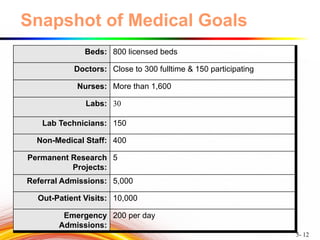
Beds: 800licensed beds
Doctors: Close to 300 fulltime & 150 participating
Nurses: More than 1,600
Labs: 30
Lab Technicians: 150
Non-Medical Staff: 400
Permanent Research
Projects:
5
Referral Admissions: 5,000
Out-Patient Visits: 10,000
Emergency
Admissions:
200 per day
Snapshot of Medical Goals
13.
The Scope ofWalden’s Patient
Management
Sub-domain of Patient Management
– Referral
– Appointment
– Registration
– Medical Service
– Hospitalization
– Cost & Record Keeping
– Discharge
– Patient Billing
13
Refer to Table 5.3 on Page 160 (Ashrafi and Ashrafi, 2009)
14.
5- 14
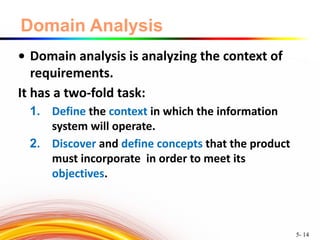
Domain Analysis
•Domain analysis is analyzing the context of
requirements.
It has a two-fold task:
1. Define the context in which the information
system will operate.
2. Discover and define concepts that the product
must incorporate in order to meet its
objectives.
15.
Domain concepts identification
•Domain concepts are
– objects,
– processes,
– people and
– rules
that constitute the goals, the behavior and
the structure of a domain.
15
16.
5- 16
Finding DomainConcepts
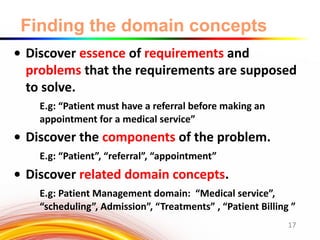
1. Discover the essence of the requirements.
2. Discover problems that the requirements
are supposed to solve.
3. Discover the components of the problem.
4. Discover related domain concepts.
17.
Finding the domainconcepts
• Discover essence of requirements and
problems that the requirements are supposed
to solve.
E.g: “Patient must have a referral before making an
appointment for a medical service”
• Discover the components of the problem.
E.g: “Patient”, “referral”, “appointment”
• Discover related domain concepts.
E.g: Patient Management domain: “Medical service”,
“scheduling”, Admission”, “Treatments” , “Patient Billing ”
17
18.
Finding Domain Concepts
Example:“Transport shellfishes for distribution”
1. Discover essence of requirements and
problems
“Shellfish decays fast in normal temperature”
2. Discover the components of the problem.
“Shellfish”, “Decay”, “Temperature”
3. Discover related domain concepts.
in shellfish distribution domain “Market”,
“Container”, “Fishing Source” , “ volume”
18
19.
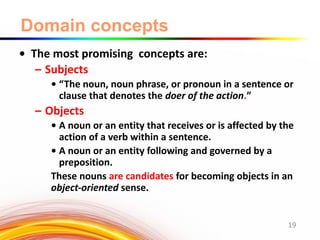
Domain concepts
• Themost promising concepts are:
– Subjects
• “The noun, noun phrase, or pronoun in a sentence or
clause that denotes the doer of the action.”
– Objects
• A noun or an entity that receives or is affected by the
action of a verb within a sentence.
• A noun or an entity following and governed by a
preposition.
These nouns are candidates for becoming objects in an
object-oriented sense.
19
20.
Domain Concepts
– Verbs
•canindicate processes
•can also hide nouns, or grammatical objects:
E.g., “order a book” is a variant of “place an
order for book.”
The object/noun “order” is hidden in the verb
“order.”
20
21.
An Example: DomainConcepts
A Sub-Domain Medical Service:
“Any patient has held the appointment for a
medical treatment. It depends on the nature of the
medical service, that may involve doctors, nurses
and lab technicians who provide the patient with
appropriate service (s).”
• What concepts we can identify?
• Patient
• Appointment
• Medical Service,
• doctors, nurses,
• lab technicians, 21
22.
Outline
• Domains &Domain analysis context
• Domain and their boundaries.
• Domain concepts identification.
• Domain dictionaries and domain catalog.
• Identifying and organizing business rules.
22
Ref: Ashrafi and Ashrafi: Object-Oriented Systems Design and Methodology, Int Ed., Chapter 5-6
23.
Domain Dictionary
Domain dictionaryorganizes domain concepts.
• It is the link between stakeholders who must verify
the concepts and the analysts who would use them
as the foundation for building a conceptual model
of the system.
• To populate the dictionary, we turn to all the
products of information gathering: requirements,
interviews, manuals.
23
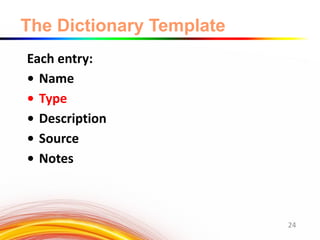
The Dictionary Template
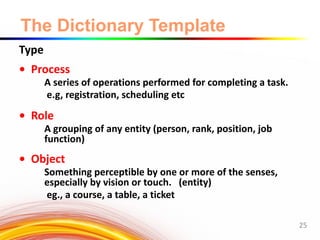
Type
•Process
A series of operations performed for completing a task.
e.g, registration, scheduling etc
• Role
A grouping of any entity (person, rank, position, job
function)
• Object
Something perceptible by one or more of the senses,
especially by vision or touch. (entity)
eg., a course, a table, a ticket
25
26.
The Dictionary Template
Type(cont)
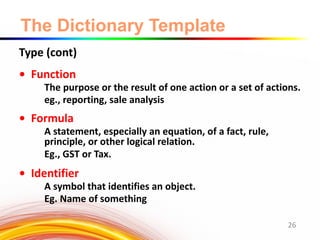
• Function
The purpose or the result of one action or a set of actions.
eg., reporting, sale analysis
• Formula
A statement, especially an equation, of a fact, rule,
principle, or other logical relation.
Eg., GST or Tax.
• Identifier
A symbol that identifies an object.
Eg. Name of something
26
27.
Domain Dictionary -WMC: Patient
Management
Name Type Description
Appointment Process Scheduling of a patient to receive medical service(s). Performed by the
appointment clerk.
Appointment Object The scheduled date and time for providing a medical service to a patient.
Appointment Clerk Role Makes appointments for the patient.
Medical Service Object Any service of medical nature provided by medical staff to a patient:
diagnosis, prescription, administration of drugs, lab tests, etc.
Medical Service Function The act of providing a medical service to the patient by medical staff.
… … …
Referral Source Role A primary care physician, an emergency medical worker or an outside
hospital that refers a patient for an appointment to receive a medical
service. Patient himself or herself can be a referral source.
Registration Process Carried out before a set of medical services are performed. The process
gathers new or changed personal and insurance information for a new or
an existing patient. A hospital ID card may be issued as part of this
process. Performed by the registration clerk.
Registration Clerk Role Performs registration.
5-
27
28.
Outline
• Domains &Domain analysis context
• Domain and their boundaries.
• Domain concepts identification.
• Domain dictionaries and domain catalog.
• Identifying and organizing business rules.
28
Ref: Ashrafi and Ashrafi: Object-Oriented Systems Design and Methodology, Int Ed., Chapter 5-6
29.
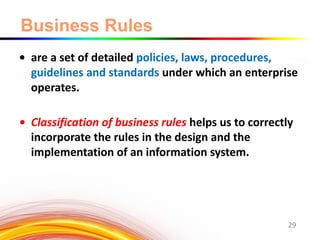
Business Rules
• area set of detailed policies, laws, procedures,
guidelines and standards under which an enterprise
operates.
• Classification of business rules helps us to correctly
incorporate the rules in the design and the
implementation of an information system.
29
30.
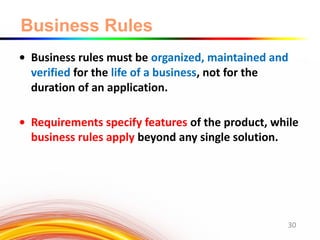
Business Rules
• Businessrules must be organized, maintained and
verified for the life of a business, not for the
duration of an application.
• Requirements specify features of the product, while
business rules apply beyond any single solution.
30
31.
Patient Management -Business
Rules Dictionary - template
• The template used in dictionary
– Id
– Definition
– Type (facts, inferences, action enablers,
constraints)
– Source –reference to a document/origin
– Other attributes such as dynamic/static
• Refer to Table 5.5 on Page 174. (Ashrafi and Ashrafi, 2009
31
32.
Patient Management -Business Rules
Dictionary - example
ID Definition Type Source
001 A patient is anybody who suffers from a
medical condition and is referred to the
hospital by a referral source — a doctor, a
medical emergency worker or another
hospital.
Fact Domain dictionary
…
003 A patient less than 18-years old must be
accompanied by a related adult or an
emergency medical worker.
Constraint Hospital policy
…
006 If the patient bill is not paid within 30 days,
then the bill is considered overdue.
Inference Hospital policy
5-
32
Refer to Table 5.5 on Page 174 (Ashrafi and Ashrafi, 2009)
33.
Patient Management -Business Rules
Questionnaire - verification
ID Definition True / False Comment
001 A patient is anybody who suffers from a
medical condition and is referred to the
hospital by a referral source — a doctor, a
medical emergency worker or another
hospital.
□ □
…
003 A patient less than 18-years old must be
accompanied by a related adult or an
emergency medical worker.
□ □
…
006 If the patient bill is not paid within 30 days,
then the bill is considered overdue.
□ □
5-
33