INDIAN
PHARMACEUTICALS
MARKET
Presentation Outline
1. The Indian Domestic Pharma market
2. Future Scope of IPM
3. Indian Pharma Market Segments
4. Rural Markets – The Next Frontier
5. IPM – Challenges & Critical Success Factors
Indian domestic pharma market
Indian Domestic Market
 The Indian Pharmaceutical Industry (IPI) is globally the 3rd largest in terms of
volume and 10th in terms of value.
 More than 24,000 registered units (330 in organized sector)
 The top ten companies make up for more than a third of the market.
 The total market size of USD 12.3 billion includes domestic consumption market of
6.0 billion (contributing ~48.6%) and the exports market being 6.3 billion (contributing
~51.4%).
 India's drugs and pharmaceuticals industry is expected to grow at a (CAGR) of 14
per cent to reach a turnover of Rs 2.91 trillion (US$ 47.06 billion) by 2018.
 Capable of fulfilling 70% of country’s demands
 API / Intermediates / Formulation / Capsules / Tablets / Injections etc.
 Top Indian companies  significant footprint at Global level including markets like
US, Europe & Japan.
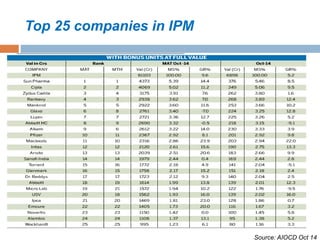
Top 25 companies in IPM
Source: AIOCD Oct 14
Therapy Areas in IPM
 Anti infectives is the biggest
therapy area.
 Chronic therapy areas
growing at much faster rate.
 GI, Nutrition, Respiratory,
Diabetic, Derma, Ophthal
segments are growing at
double digits.
Source: AIOCD OCT 14
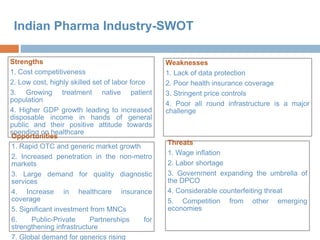
Indian Pharma Industry-SWOT
Strengths
1. Cost competitiveness
2. Low cost, highly skilled set of labor force
3. Growing treatment native patient
population
4. Higher GDP growth leading to increased
disposable income in hands of general
public and their positive attitude towards
spending on healthcare
Weaknesses
1. Lack of data protection
2. Poor health insurance coverage
3. Stringent price controls
4. Poor all round infrastructure is a major
challenge
Opportunities
1. Rapid OTC and generic market growth
2. Increased penetration in the non-metro
markets
3. Large demand for quality diagnostic
services
4. Increase in healthcare insurance
coverage
5. Significant investment from MNCs
6. Public-Private Partnerships for
strengthening infrastructure
7. Global demand for generics rising
Threats
1. Wage inflation
2. Labor shortage
3. Government expanding the umbrella of
the DPCO
4. Considerable counterfeiting threat
5. Competition from other emerging
economies
Key Recent Trends and Implications
Increase
Investment &
MNC activity
Increasing
reach in
Non-Metro
markets
Growing
Insurance
Changing
disease
profile
Healthcare
Innovation
•Shift towards a
Networked
business model
•Increasing
M&A and
Alliances
•Consolidation
in the market
•Seen as the
next volume
driver, though
costs of
operation is
high due to
poor health
infrastructure
•More number
of patients will
be coming in for
treatment
•Shift towards
biotech &
specialty
therapies,
increased
investment inn
R&D and acute
disease
segment will
sustain strong
growth
•Use of
technology & It
for innovation in
healthcare
delivery e.g.
Mobile clinics
MNCs vs Indian companies - Business
Models
Future Scope of IPM
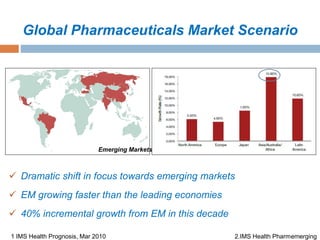
Global Pharmaceuticals Market Scenario
 Dramatic shift in focus towards emerging markets
 EM growing faster than the leading economies
 40% incremental growth from EM in this decade
Emerging Markets
1 IMS Health Prognosis, Mar 2010 2.IMS Health Pharmemerging
India – Country profile
 Republic of India
 7th largest country by area
 World’s 3rd largest economy by PPP
 Currency – Indian Rupee
 Official languages – Hindi & English
 28 states & 7 Union Territories
 Capital – Delhi
 Multilingual – Multi-ethnic society
 Population: 1.2 billion+ @ 1.3%
Indexmundi.com, wikipedia.org
FUTURE IPM (2020)
 In pessimistic scenario
characterised by
regulatory controls &
economic slowdown.
 Growth drivers are
Epidemiological factors,
Increasing PPP,
increasing accessibility,
rural penetration.
Source: Mckinsey analysis 2020.
2013
Pessimistic
case
Base
case
Aggressive
case
12.33 $
$ 35
$ 55
$ 70
17% CAGR
14.5% CAGR
10% CAGR
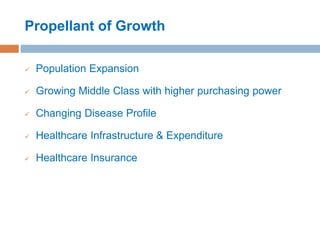
Propellant of Growth
 Population Expansion
 Growing Middle Class with higher purchasing power
 Changing Disease Profile
 Healthcare Infrastructure & Expenditure
 Healthcare Insurance
Population Expansion & Middle class
HPP
 2nd most populous country in the world
 Rapidly Expanding Middle Class (USD 5K – USD 25K)
 1/3rd population expected to join middle class in near future.
Population Growth Projections 1 Ascent of Middle Class as % of Population2
1 ISI analytics 2010 2.Economic Times, PwC
Expenditure Break - % of Disposable
Income
Consistent
increasing
spend on
healthcare
IDFC Institutional Securities, Indian Pharma (June 2010)
 Government has increased health expenditure from 1.4 per cent to
2.5 per cent of GDP by the end of the twelfth Five-Year Plan (2012-
2017)
Eg. Central Government Health Scheme (CGHS), National Programme
for Healthcare of the Elderly (NPHCE), Rashtriya Arogya Nidhi (RAN)
and Janani Suraksha Yojana (JSY)
Source: EIU Report, Datamonitor, primary interviews, Deloitte Consulting LLP analysis
 Increase in public spending would lead to more penetration of
healthcare opportunities for rural and remote areas
Eg. RSBY ( Rashtriya Swasthya Bima Yojana)
Source: High Level Expert Group on UHC, 2011 Source: Pharma 2020 Mckinsey &
 Increase in disposable income will help in larger per capita health
care expenditure
 Rising rural market will increase the volume consumption
Source: Pharma 2020 Mckinsey &
Changing Disease Profile
Chronic  Increase
 Ageing Population
 Lifestyle
 Diabetes capital
 Pollution
Shift in Disease Profile towards Chronic
Acute  Maintained
 Mass therapy
 Public hygiene
 Sanitation
IDFC Institutional Securities, Indian Pharma (June 2010)
 Increasing population as well as increase in geriatric population will
thus increase the patient pool
 Declining Crude death rate will thus result in higher life expectancy
Source: Office of the Registrar General and Census Commisioner of India,
various years
 Growing incomes and a faster pace of life, increased sedentary living,
high work stress, rising pollution levels and consumption of unhealthy fast
food are factors leading to a rise in lifestyle disorders
Source: Patel et al., 2011
Source: EIU Report, Datamonitor, primary interviews, Deloitte Consulting LLP analysis
 India has about 65 million diabetics, will see the number grow to 100
million by 2030
 Chronic diseases like cardiovascular disease and diabetes are expected
to drive demand for new drugs
 Apart from nearly 65 million diabetics, India has 77 million pre-
diabetics
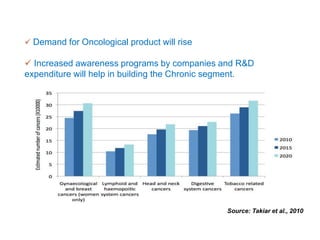
 Demand for Oncological product will rise
 Increased awareness programs by companies and R&D
expenditure will help in building the Chronic segment.
Source: Takiar et al., 2010
Healthcare Infrastructure & Expenditure
Healthcare
infrastructure
Healthcare
expenditure
1.5
Mn
2.3
Mn
3.7
Mn
‘10 ‘15 ‘20
Fast expanding Pvt hospitals coupled with
significant investment in medical
infrastructure (estimated 200 Bn USD)
expected to propel the growth of India HC.
Telemedicine and usage of web based
technology expected to improve health
outcomes
Np of hospital beds
6.7
Govt spend on HC in
USD Bn
2006 2009
11.7
760
940
No of physicians
(‘000s)
‘10 ‘20
Govt committed to establish rural hospitals
with initiatives like National Rural
Health Mission & sponsored programmes
like RSBY
Govt spend on HC as % of GDP expected
to increase to 3% till 2020
7.7
9.2
2007 2008
+18%
Share of
GDP% 0.84% 0.88%0.84% 0.93%
Source: India Pharma 2020, Mc Kinsey; Overview of Indian Pharma Market, Accenture, Sept 11; Secondary published reports and websites
Health Insurance
80% India’s Healthcare
expense = Out of
Pocket
This limits the propensity of
Indians to spend on
healthcare, particularly in
lower & middle class ~ 95%
population
Pricing
Gov.
Pol
OOP
ISI analytics, Healthcare Industry (2010), General Insurance Council of India (2010)
Other Factors :
Increasing demand for high-quality services
 Affordability
 Growing medical tourism industry
 Increasing Literacy rate will thus increase drug compliance
 M&A and JV will increase market penetration
 Patent cliff will increase the generic market
 Domestic R&D capability will govern growth and shape the market
opportunity
Indian pharma market segments
Branded Generics Market
 Indian market largely dominated
by branded generics – 90%
 Generics & innovator products
constitute 10% with an
approximate split 6% & 4%
respectively
 Patented products to capture
around 10% MS by 2020.
 Market for patented products to
be concentrated in therapeutic
areas – CNS, Oncology,
diabetics, & CVS
INN – International Nonproprietary Name Industry Interviews – PwC,
Medical Representative – The key link
 Avg. No. of medical reps
meeting a doctor per day: 15
 Average call time: 3 mins
 Average Number of Calls: 9-
10
 Approx Doctor list ~ 150
doctors
 Approx No. of Products ~ 5 –
7
Continued….
 New models of sales force coverage and excellence are
emerging
 Debate: Coverage vs Capabilities
 Content marketing by MR’s
Emkay Research – August 2010, McKinsey
Rural Markets
Rural Markets – The Next Frontier
 Metro and Tier-I accounts for
30% of IPM
 Rural market accounts for 20% of
IPM and is estimated to move up
at 25% till 2020.
 The driver of growth for rural
market is affordability which will
be covered under RSBY.
 The other factors are better
infrastructure (i.e. hospital),
skilled manpower (i.e. doctor)
and healthcare awareness
among people.
Challenges & critical success factors
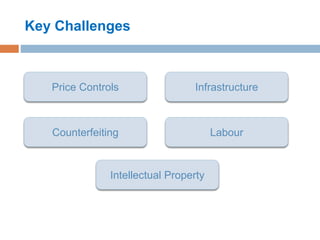
Key Challenges
Price Controls
Labour
Intellectual Property
Counterfeiting
Infrastructure
Healthcare penetration in rural areas is significantly lower than in urban
areas
Critical Success Factors
Increasing public spend
on Healthcare
Innovation
Use of Technology
Infrastructure
Development
Health Insurance
Enabling Policies &
regulatory framework
THANK YOU

Ipm

  • 1.
  • 2.
    Presentation Outline 1. TheIndian Domestic Pharma market 2. Future Scope of IPM 3. Indian Pharma Market Segments 4. Rural Markets – The Next Frontier 5. IPM – Challenges & Critical Success Factors
  • 3.
  • 4.
    Indian Domestic Market The Indian Pharmaceutical Industry (IPI) is globally the 3rd largest in terms of volume and 10th in terms of value.  More than 24,000 registered units (330 in organized sector)  The top ten companies make up for more than a third of the market.  The total market size of USD 12.3 billion includes domestic consumption market of 6.0 billion (contributing ~48.6%) and the exports market being 6.3 billion (contributing ~51.4%).  India's drugs and pharmaceuticals industry is expected to grow at a (CAGR) of 14 per cent to reach a turnover of Rs 2.91 trillion (US$ 47.06 billion) by 2018.  Capable of fulfilling 70% of country’s demands  API / Intermediates / Formulation / Capsules / Tablets / Injections etc.  Top Indian companies  significant footprint at Global level including markets like US, Europe & Japan.
  • 5.
    Top 25 companiesin IPM Source: AIOCD Oct 14
  • 6.
    Therapy Areas inIPM  Anti infectives is the biggest therapy area.  Chronic therapy areas growing at much faster rate.  GI, Nutrition, Respiratory, Diabetic, Derma, Ophthal segments are growing at double digits. Source: AIOCD OCT 14
  • 7.
    Indian Pharma Industry-SWOT Strengths 1.Cost competitiveness 2. Low cost, highly skilled set of labor force 3. Growing treatment native patient population 4. Higher GDP growth leading to increased disposable income in hands of general public and their positive attitude towards spending on healthcare Weaknesses 1. Lack of data protection 2. Poor health insurance coverage 3. Stringent price controls 4. Poor all round infrastructure is a major challenge Opportunities 1. Rapid OTC and generic market growth 2. Increased penetration in the non-metro markets 3. Large demand for quality diagnostic services 4. Increase in healthcare insurance coverage 5. Significant investment from MNCs 6. Public-Private Partnerships for strengthening infrastructure 7. Global demand for generics rising Threats 1. Wage inflation 2. Labor shortage 3. Government expanding the umbrella of the DPCO 4. Considerable counterfeiting threat 5. Competition from other emerging economies
  • 8.
    Key Recent Trendsand Implications Increase Investment & MNC activity Increasing reach in Non-Metro markets Growing Insurance Changing disease profile Healthcare Innovation •Shift towards a Networked business model •Increasing M&A and Alliances •Consolidation in the market •Seen as the next volume driver, though costs of operation is high due to poor health infrastructure •More number of patients will be coming in for treatment •Shift towards biotech & specialty therapies, increased investment inn R&D and acute disease segment will sustain strong growth •Use of technology & It for innovation in healthcare delivery e.g. Mobile clinics
  • 9.
    MNCs vs Indiancompanies - Business Models
  • 10.
  • 11.
    Global Pharmaceuticals MarketScenario  Dramatic shift in focus towards emerging markets  EM growing faster than the leading economies  40% incremental growth from EM in this decade Emerging Markets 1 IMS Health Prognosis, Mar 2010 2.IMS Health Pharmemerging
  • 12.
    India – Countryprofile  Republic of India  7th largest country by area  World’s 3rd largest economy by PPP  Currency – Indian Rupee  Official languages – Hindi & English  28 states & 7 Union Territories  Capital – Delhi  Multilingual – Multi-ethnic society  Population: 1.2 billion+ @ 1.3% Indexmundi.com, wikipedia.org
  • 13.
    FUTURE IPM (2020) In pessimistic scenario characterised by regulatory controls & economic slowdown.  Growth drivers are Epidemiological factors, Increasing PPP, increasing accessibility, rural penetration. Source: Mckinsey analysis 2020. 2013 Pessimistic case Base case Aggressive case 12.33 $ $ 35 $ 55 $ 70 17% CAGR 14.5% CAGR 10% CAGR
  • 14.
    Propellant of Growth Population Expansion  Growing Middle Class with higher purchasing power  Changing Disease Profile  Healthcare Infrastructure & Expenditure  Healthcare Insurance
  • 15.
    Population Expansion &Middle class HPP  2nd most populous country in the world  Rapidly Expanding Middle Class (USD 5K – USD 25K)  1/3rd population expected to join middle class in near future. Population Growth Projections 1 Ascent of Middle Class as % of Population2 1 ISI analytics 2010 2.Economic Times, PwC
  • 16.
    Expenditure Break -% of Disposable Income Consistent increasing spend on healthcare IDFC Institutional Securities, Indian Pharma (June 2010)
  • 17.
     Government hasincreased health expenditure from 1.4 per cent to 2.5 per cent of GDP by the end of the twelfth Five-Year Plan (2012- 2017) Eg. Central Government Health Scheme (CGHS), National Programme for Healthcare of the Elderly (NPHCE), Rashtriya Arogya Nidhi (RAN) and Janani Suraksha Yojana (JSY) Source: EIU Report, Datamonitor, primary interviews, Deloitte Consulting LLP analysis
  • 18.
     Increase inpublic spending would lead to more penetration of healthcare opportunities for rural and remote areas Eg. RSBY ( Rashtriya Swasthya Bima Yojana) Source: High Level Expert Group on UHC, 2011 Source: Pharma 2020 Mckinsey &
  • 19.
     Increase indisposable income will help in larger per capita health care expenditure  Rising rural market will increase the volume consumption Source: Pharma 2020 Mckinsey &
  • 20.
    Changing Disease Profile Chronic Increase  Ageing Population  Lifestyle  Diabetes capital  Pollution Shift in Disease Profile towards Chronic Acute  Maintained  Mass therapy  Public hygiene  Sanitation IDFC Institutional Securities, Indian Pharma (June 2010)
  • 21.
     Increasing populationas well as increase in geriatric population will thus increase the patient pool  Declining Crude death rate will thus result in higher life expectancy Source: Office of the Registrar General and Census Commisioner of India, various years
  • 22.
     Growing incomesand a faster pace of life, increased sedentary living, high work stress, rising pollution levels and consumption of unhealthy fast food are factors leading to a rise in lifestyle disorders Source: Patel et al., 2011 Source: EIU Report, Datamonitor, primary interviews, Deloitte Consulting LLP analysis
  • 23.
     India hasabout 65 million diabetics, will see the number grow to 100 million by 2030  Chronic diseases like cardiovascular disease and diabetes are expected to drive demand for new drugs  Apart from nearly 65 million diabetics, India has 77 million pre- diabetics
  • 24.
     Demand forOncological product will rise  Increased awareness programs by companies and R&D expenditure will help in building the Chronic segment. Source: Takiar et al., 2010
  • 25.
    Healthcare Infrastructure &Expenditure Healthcare infrastructure Healthcare expenditure 1.5 Mn 2.3 Mn 3.7 Mn ‘10 ‘15 ‘20 Fast expanding Pvt hospitals coupled with significant investment in medical infrastructure (estimated 200 Bn USD) expected to propel the growth of India HC. Telemedicine and usage of web based technology expected to improve health outcomes Np of hospital beds 6.7 Govt spend on HC in USD Bn 2006 2009 11.7 760 940 No of physicians (‘000s) ‘10 ‘20 Govt committed to establish rural hospitals with initiatives like National Rural Health Mission & sponsored programmes like RSBY Govt spend on HC as % of GDP expected to increase to 3% till 2020 7.7 9.2 2007 2008 +18% Share of GDP% 0.84% 0.88%0.84% 0.93% Source: India Pharma 2020, Mc Kinsey; Overview of Indian Pharma Market, Accenture, Sept 11; Secondary published reports and websites
  • 26.
    Health Insurance 80% India’sHealthcare expense = Out of Pocket This limits the propensity of Indians to spend on healthcare, particularly in lower & middle class ~ 95% population Pricing Gov. Pol OOP ISI analytics, Healthcare Industry (2010), General Insurance Council of India (2010)
  • 27.
    Other Factors : Increasingdemand for high-quality services  Affordability  Growing medical tourism industry  Increasing Literacy rate will thus increase drug compliance  M&A and JV will increase market penetration  Patent cliff will increase the generic market  Domestic R&D capability will govern growth and shape the market opportunity
  • 28.
  • 29.
    Branded Generics Market Indian market largely dominated by branded generics – 90%  Generics & innovator products constitute 10% with an approximate split 6% & 4% respectively  Patented products to capture around 10% MS by 2020.  Market for patented products to be concentrated in therapeutic areas – CNS, Oncology, diabetics, & CVS INN – International Nonproprietary Name Industry Interviews – PwC,
  • 30.
    Medical Representative –The key link  Avg. No. of medical reps meeting a doctor per day: 15  Average call time: 3 mins  Average Number of Calls: 9- 10  Approx Doctor list ~ 150 doctors  Approx No. of Products ~ 5 – 7
  • 31.
    Continued….  New modelsof sales force coverage and excellence are emerging  Debate: Coverage vs Capabilities  Content marketing by MR’s Emkay Research – August 2010, McKinsey
  • 32.
  • 33.
    Rural Markets –The Next Frontier  Metro and Tier-I accounts for 30% of IPM  Rural market accounts for 20% of IPM and is estimated to move up at 25% till 2020.  The driver of growth for rural market is affordability which will be covered under RSBY.  The other factors are better infrastructure (i.e. hospital), skilled manpower (i.e. doctor) and healthcare awareness among people.
  • 34.
    Challenges & criticalsuccess factors
  • 35.
    Key Challenges Price Controls Labour IntellectualProperty Counterfeiting Infrastructure
  • 36.
    Healthcare penetration inrural areas is significantly lower than in urban areas
  • 37.
    Critical Success Factors Increasingpublic spend on Healthcare Innovation Use of Technology Infrastructure Development Health Insurance Enabling Policies & regulatory framework
  • 38.