
Topic : Inventory Control Techniques
 Inventory control may be defined as “the systematic
control over the procurement, storage and usage of
materials.
 According to L.V Fine, “the planning and
scheduling of materials used in manufacturing
process. it is possible to exercise control over the
three types of inventories recognized by the
accountant as raw-materials, work-in-progress and
finished goods”.
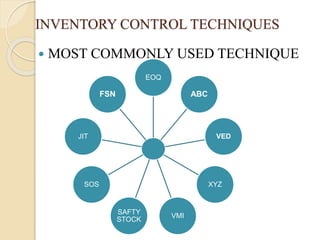
INVENTORY CONTROL TECHNIQUES
 MOST COMMONLY USED TECHNIQUE
EOQ
ABC
VED
XYZ
VMI
SAFTY
STOCK
SOS
JIT
FSN
ABC Analysis
• In materials management, the ABC analysis (or Selective
Inventory Control) is an inventory categorization technique.
• ABC analysis divides an inventory into three categories- "A
items" with very tight control and accurate records, "B items"
with less tightly controlled and good records, and "C items"
with the simplest controls possible and minimal records.
• ABC analysis provides a mechanism for identifying items that
will have a significant impact on overall inventory cost
• 'A' items are very important for an organization. Because
of the high value of these 'A' items, frequent value
analysis is required.
• 'B' items are important, but of course less important than
'A' items and more important than 'C' items. Therefore 'B'
items are intergroup items.
• 'C' items are marginally important
Advantages:
• Level of control
• Careful accounting
• Safety stock
Disadvantages :
• Listing and calculation is difficult
• There could be some excess stock of C-category items
leading to deterioration
• Some B-category items could be vital, hence needing more
alternation
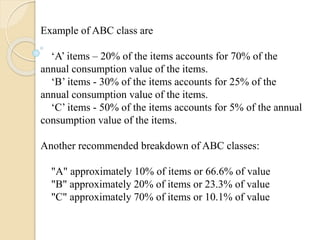
Example of ABC class are
‘A’ items – 20% of the items accounts for 70% of the
annual consumption value of the items.
‘B’ items - 30% of the items accounts for 25% of the
annual consumption value of the items.
‘C’ items - 50% of the items accounts for 5% of the annual
consumption value of the items.
Another recommended breakdown of ABC classes:
"A" approximately 10% of items or 66.6% of value
"B" approximately 20% of items or 23.3% of value
"C" approximately 70% of items or 10.1% of value
VED Analysis
 It is one of the inventory management techniques.
 In VED analysis, the items are classified on the
basis of their criticality to the production process
or other services.
 In VED classification of materials,
V stands for – Vital items
E stands for - Essential items
D stands for – Desirable items
 Vital items are those without which the
production process would come to a standstill.
 Essential items are those whose stock out
would adversely affect the efficiency of the
production system i.e. temporary losses or
dislocation of production.
 Desirable items which are required but do not
immediately cause a loss of production.
 In FSN analysis, items are classified according to their
rate of consumption. The items are classified broadly into
three groups: F – means Fast moving, S – means Slow
moving, N – means Non-moving.
 The items considered to be “active” may be reviewed
regularly on more frequent basis.
 Items whose stocks at hand are higher as compared to their
rates of consumption.
 Non-moving items whose consumption is “nil” or almost
insignificant
FSN Analysis
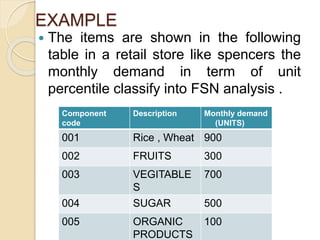
EXAMPLE
 The items are shown in the following
table in a retail store like spencers the
monthly demand in term of unit
percentile classify into FSN analysis .
Component
code
Description Monthly demand
(UNITS)
001 Rice , Wheat 900
002 FRUITS 300
003 VEGITABLE
S
700
004 SUGAR 500
005 ORGANIC
PRODUCTS
100
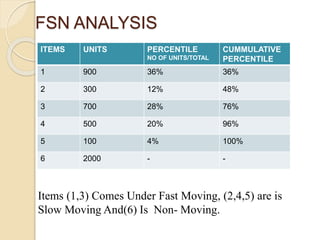
FSN ANALYSIS
ITEMS UNITS PERCENTILE
NO OF UNITS/TOTAL
CUMMULATIVE
PERCENTILE
1 900 36% 36%
2 300 12% 48%
3 700 28% 76%
4 500 20% 96%
5 100 4% 100%
6 2000 - -
Items (1,3) Comes Under Fast Moving, (2,4,5) are is
Slow Moving And(6) Is Non- Moving.
THANK YOU

Inventory Control Techniques

  • 1.
    Topic : InventoryControl Techniques
  • 2.
     Inventory controlmay be defined as “the systematic control over the procurement, storage and usage of materials.  According to L.V Fine, “the planning and scheduling of materials used in manufacturing process. it is possible to exercise control over the three types of inventories recognized by the accountant as raw-materials, work-in-progress and finished goods”.
  • 3.
    INVENTORY CONTROL TECHNIQUES MOST COMMONLY USED TECHNIQUE EOQ ABC VED XYZ VMI SAFTY STOCK SOS JIT FSN
  • 4.
    ABC Analysis • Inmaterials management, the ABC analysis (or Selective Inventory Control) is an inventory categorization technique. • ABC analysis divides an inventory into three categories- "A items" with very tight control and accurate records, "B items" with less tightly controlled and good records, and "C items" with the simplest controls possible and minimal records. • ABC analysis provides a mechanism for identifying items that will have a significant impact on overall inventory cost
  • 5.
    • 'A' itemsare very important for an organization. Because of the high value of these 'A' items, frequent value analysis is required. • 'B' items are important, but of course less important than 'A' items and more important than 'C' items. Therefore 'B' items are intergroup items. • 'C' items are marginally important
  • 6.
    Advantages: • Level ofcontrol • Careful accounting • Safety stock
  • 7.
    Disadvantages : • Listingand calculation is difficult • There could be some excess stock of C-category items leading to deterioration • Some B-category items could be vital, hence needing more alternation
  • 8.
    Example of ABCclass are ‘A’ items – 20% of the items accounts for 70% of the annual consumption value of the items. ‘B’ items - 30% of the items accounts for 25% of the annual consumption value of the items. ‘C’ items - 50% of the items accounts for 5% of the annual consumption value of the items. Another recommended breakdown of ABC classes: "A" approximately 10% of items or 66.6% of value "B" approximately 20% of items or 23.3% of value "C" approximately 70% of items or 10.1% of value
  • 9.
    VED Analysis  Itis one of the inventory management techniques.  In VED analysis, the items are classified on the basis of their criticality to the production process or other services.  In VED classification of materials, V stands for – Vital items E stands for - Essential items D stands for – Desirable items
  • 10.
     Vital itemsare those without which the production process would come to a standstill.  Essential items are those whose stock out would adversely affect the efficiency of the production system i.e. temporary losses or dislocation of production.  Desirable items which are required but do not immediately cause a loss of production.
  • 11.
     In FSNanalysis, items are classified according to their rate of consumption. The items are classified broadly into three groups: F – means Fast moving, S – means Slow moving, N – means Non-moving.  The items considered to be “active” may be reviewed regularly on more frequent basis.  Items whose stocks at hand are higher as compared to their rates of consumption.  Non-moving items whose consumption is “nil” or almost insignificant FSN Analysis
  • 12.
    EXAMPLE  The itemsare shown in the following table in a retail store like spencers the monthly demand in term of unit percentile classify into FSN analysis . Component code Description Monthly demand (UNITS) 001 Rice , Wheat 900 002 FRUITS 300 003 VEGITABLE S 700 004 SUGAR 500 005 ORGANIC PRODUCTS 100
  • 13.
    FSN ANALYSIS ITEMS UNITSPERCENTILE NO OF UNITS/TOTAL CUMMULATIVE PERCENTILE 1 900 36% 36% 2 300 12% 48% 3 700 28% 76% 4 500 20% 96% 5 100 4% 100% 6 2000 - - Items (1,3) Comes Under Fast Moving, (2,4,5) are is Slow Moving And(6) Is Non- Moving.
  • 14.