
BY: INDRA MANI MISHRA
(M.Sc. Nursing , B.Sc. Biotechnology,
Diploma in Hospital Management)
NURSING TUTOR AT RIMSCON,RANCHI
3/27/2015 XIDAS, INVENTORY CONTROL 2
All the materials , parts, suppliers, expenses
and in process or finished products recorded
on the books by an organization and kept in its
stocks, warehouses (godam) or plant for some
period of time.
3/27/2015 XIDAS, INVENTORY CONTROL 3
Inventory control is the technique of
maintaining the size of the inventory at some
desired level keeping in view the best
economic interest of an organization.
3/27/2015 XIDAS, INVENTORY CONTROL 4
 Protection against fluctuations in demand;
 Better use of men, machines and material;
 Protection against fluctuations in output;
 Control of stock volume;
 Control of stock distribution.
 Type of product
 Type of manufacture
 Volume of production
 Ensures an adequate supply of materials
 Minimizes inventory costs
 Facilitates purchasing economies
 Eliminates duplication in ordering
 Better utilization of available stocks
 Provides a check against the loss of materials
 Facilitates cost accounting activities
 Enables management in cost comparison
 Locates & disposes inactive & obsolete store items
 Consistent & reliable basis for financial statements
3/27/2015 XIDAS, INVENTORY CONTROL 7
 Planning the inventories;
 Procurement (INTAZAM, BYAWASTHA KARNA)
of inventories;
 Receiving and inspection of inventories;
 Storing and issuing the inventories;
 Recording the receipt and issues of
inventories.
 Physical verification of inventories;
 Follow-up function ;
 Material standardization and substitution.
3/27/2015 XIDAS, INVENTORY CONTROL 8
 Deciding the maximum- minimum limits of
inventory;
 Determination of Reorder point;
 Determination of reorder quantity;
 Perpetual inventory control;
 ABC analysis;
 Method of control through turn over.
 Dependent demand- Demand for one product
is linked with demand for another product,
such as components, subassemblies etc.
 Independent demand- Demand for a product/
service occurs independently of demand for
any other for any other product or service, such
as finished product, service parts, lubricants,
cutting oil, greases, preservatives etc.
 To provide a cushion between forecasted and
actual demand for a material.
 To provide maximum supply service consistent
with maximum efficiency and optimum
investment.
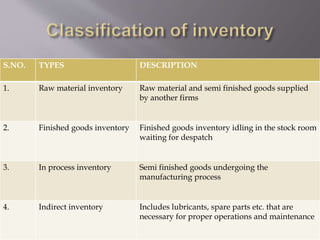
S.NO. TYPES DESCRIPTION
1. Raw material inventory Raw material and semi finished goods supplied
by another firms
2. Finished goods inventory Finished goods inventory idling in the stock room
waiting for despatch
3. In process inventory Semi finished goods undergoing the
manufacturing process
4. Indirect inventory Includes lubricants, spare parts etc. that are
necessary for proper operations and maintenance
 Determination of where the recorder will be
recorded
 Determination of quantity to be ordered.
 Possibility of discount for bulk purchase
 Delivery in time
 Workers and machinery need not to be idle
 Unforeseen circumstances can be handled to
some extent
 Charges of damage , pilferage, replacement etc.
are more
 Increase in insurance charges
 Increase charge for obsolescence
 Working capital is tied up
 Increased overhead expenses
 More space required
Always Better Control (ABC) Analysis
 This technique divides inventory into three
categories A, B & C based on their annual
consumption value.
 It is also known as Selective Inventory Control
Method (SIM)
 This method is a means of categorizing
inventory items according to the potential
amount to be controlled.
 ABC analysis has universal application for
fields requiring selective control.
 Make the list of all items of inventory.
 Determine the annual volume of usage & money value
of each item.
 Multiply each item’s annual volume by its rupee value.
 Compute each item’s percentage of the total inventory
in terms of annual usage in rupees.
 Select the top 10% of all items which have the highest
rupee percentages & classify them as “A” items.
 Select the next 20% of all items with the next highest
rupee percentages & designate them “B” items.
 The next 70% of all items with the lowest rupee
percentages are “C” items.
 Helps to exercise selective control
 Gives rewarding results quickly
 Helps to point out obsolete stocks easily.
 In case of “A” items careful attention can be paid
at every step such as estimate of requirements,
purchase, safety stock, receipts, inspections, issues,
etc. & close control is maintained.
 In case of “C” items, recording & follow up, etc.
may be dispensed with or combined.
 Helps better planning of inventory control
 Provides sound basis for allocation of funds &
human resources.
 Proper standardization & codification of
inventory items needed.
 Considers only money value of items &
neglects the importance of items for the
production process or assembly or functioning.
 Periodic review becomes difficult if only ABC
analysis is recalled.
 When other important factors make it
obligatory to concentrate on “C” items more,
the purpose of ABC analysis is defeated.
 VED: Vital, Essential & Desirable classification
 VED classification is based on the criticality of the inventories.
 Vital items – Its shortage may cause havoc & stop the work in
organization. They are stocked adequately to ensure smooth
operation.
 Essential items - Here, reasonable risk can be taken. If not
available, the plant does not stop; but the efficiency of operations
is adversely affected due to expediting expenses. They should be
sufficiently stocked to ensure regular flow of work.
 Desirable items – Its non availability does not stop the work
because they can be easily purchased from the market as & when
needed. They may be stocked very low or not stocked.
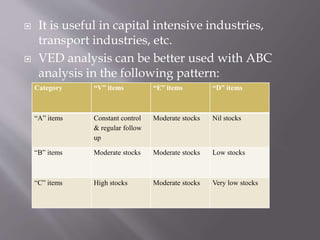
 It is useful in capital intensive industries,
transport industries, etc.
 VED analysis can be better used with ABC
analysis in the following pattern:
Category “V” items “E” items “D” items
“A” items Constant control
& regular follow
up
Moderate stocks Nil stocks
“B” items Moderate stocks Moderate stocks Low stocks
“C” items High stocks Moderate stocks Very low stocks
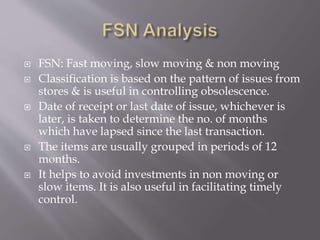
 FSN: Fast moving, slow moving & non moving
 Classification is based on the pattern of issues from
stores & is useful in controlling obsolescence.
 Date of receipt or last date of issue, whichever is
later, is taken to determine the no. of months
which have lapsed since the last transaction.
 The items are usually grouped in periods of 12
months.
 It helps to avoid investments in non moving or
slow items. It is also useful in facilitating timely
control.
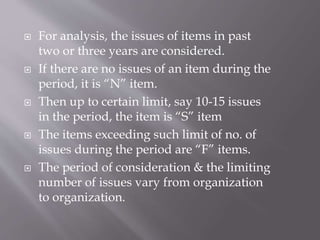
 For analysis, the issues of items in past
two or three years are considered.
 If there are no issues of an item during the
period, it is “N” item.
 Then up to certain limit, say 10-15 issues
in the period, the item is “S” item
 The items exceeding such limit of no. of
issues during the period are “F” items.
 The period of consideration & the limiting
number of issues vary from organization
to organization.
THANK YOU

Inventory

  • 1.
    BY: INDRA MANIMISHRA (M.Sc. Nursing , B.Sc. Biotechnology, Diploma in Hospital Management) NURSING TUTOR AT RIMSCON,RANCHI
  • 2.
    3/27/2015 XIDAS, INVENTORYCONTROL 2 All the materials , parts, suppliers, expenses and in process or finished products recorded on the books by an organization and kept in its stocks, warehouses (godam) or plant for some period of time.
  • 3.
    3/27/2015 XIDAS, INVENTORYCONTROL 3 Inventory control is the technique of maintaining the size of the inventory at some desired level keeping in view the best economic interest of an organization.
  • 4.
    3/27/2015 XIDAS, INVENTORYCONTROL 4  Protection against fluctuations in demand;  Better use of men, machines and material;  Protection against fluctuations in output;  Control of stock volume;  Control of stock distribution.
  • 5.
     Type ofproduct  Type of manufacture  Volume of production
  • 6.
     Ensures anadequate supply of materials  Minimizes inventory costs  Facilitates purchasing economies  Eliminates duplication in ordering  Better utilization of available stocks  Provides a check against the loss of materials  Facilitates cost accounting activities  Enables management in cost comparison  Locates & disposes inactive & obsolete store items  Consistent & reliable basis for financial statements
  • 7.
    3/27/2015 XIDAS, INVENTORYCONTROL 7  Planning the inventories;  Procurement (INTAZAM, BYAWASTHA KARNA) of inventories;  Receiving and inspection of inventories;  Storing and issuing the inventories;  Recording the receipt and issues of inventories.  Physical verification of inventories;  Follow-up function ;  Material standardization and substitution.
  • 8.
    3/27/2015 XIDAS, INVENTORYCONTROL 8  Deciding the maximum- minimum limits of inventory;  Determination of Reorder point;  Determination of reorder quantity;  Perpetual inventory control;  ABC analysis;  Method of control through turn over.
  • 9.
     Dependent demand-Demand for one product is linked with demand for another product, such as components, subassemblies etc.  Independent demand- Demand for a product/ service occurs independently of demand for any other for any other product or service, such as finished product, service parts, lubricants, cutting oil, greases, preservatives etc.
  • 10.
     To providea cushion between forecasted and actual demand for a material.  To provide maximum supply service consistent with maximum efficiency and optimum investment.
  • 11.
    S.NO. TYPES DESCRIPTION 1.Raw material inventory Raw material and semi finished goods supplied by another firms 2. Finished goods inventory Finished goods inventory idling in the stock room waiting for despatch 3. In process inventory Semi finished goods undergoing the manufacturing process 4. Indirect inventory Includes lubricants, spare parts etc. that are necessary for proper operations and maintenance
  • 12.
     Determination ofwhere the recorder will be recorded  Determination of quantity to be ordered.
  • 13.
     Possibility ofdiscount for bulk purchase  Delivery in time  Workers and machinery need not to be idle  Unforeseen circumstances can be handled to some extent
  • 14.
     Charges ofdamage , pilferage, replacement etc. are more  Increase in insurance charges  Increase charge for obsolescence  Working capital is tied up  Increased overhead expenses  More space required
  • 15.
    Always Better Control(ABC) Analysis  This technique divides inventory into three categories A, B & C based on their annual consumption value.  It is also known as Selective Inventory Control Method (SIM)  This method is a means of categorizing inventory items according to the potential amount to be controlled.  ABC analysis has universal application for fields requiring selective control.
  • 16.
     Make thelist of all items of inventory.  Determine the annual volume of usage & money value of each item.  Multiply each item’s annual volume by its rupee value.  Compute each item’s percentage of the total inventory in terms of annual usage in rupees.  Select the top 10% of all items which have the highest rupee percentages & classify them as “A” items.  Select the next 20% of all items with the next highest rupee percentages & designate them “B” items.  The next 70% of all items with the lowest rupee percentages are “C” items.
  • 17.
     Helps toexercise selective control  Gives rewarding results quickly  Helps to point out obsolete stocks easily.  In case of “A” items careful attention can be paid at every step such as estimate of requirements, purchase, safety stock, receipts, inspections, issues, etc. & close control is maintained.  In case of “C” items, recording & follow up, etc. may be dispensed with or combined.  Helps better planning of inventory control  Provides sound basis for allocation of funds & human resources.
  • 18.
     Proper standardization& codification of inventory items needed.  Considers only money value of items & neglects the importance of items for the production process or assembly or functioning.  Periodic review becomes difficult if only ABC analysis is recalled.  When other important factors make it obligatory to concentrate on “C” items more, the purpose of ABC analysis is defeated.
  • 19.
     VED: Vital,Essential & Desirable classification  VED classification is based on the criticality of the inventories.  Vital items – Its shortage may cause havoc & stop the work in organization. They are stocked adequately to ensure smooth operation.  Essential items - Here, reasonable risk can be taken. If not available, the plant does not stop; but the efficiency of operations is adversely affected due to expediting expenses. They should be sufficiently stocked to ensure regular flow of work.  Desirable items – Its non availability does not stop the work because they can be easily purchased from the market as & when needed. They may be stocked very low or not stocked.
  • 20.
     It isuseful in capital intensive industries, transport industries, etc.  VED analysis can be better used with ABC analysis in the following pattern: Category “V” items “E” items “D” items “A” items Constant control & regular follow up Moderate stocks Nil stocks “B” items Moderate stocks Moderate stocks Low stocks “C” items High stocks Moderate stocks Very low stocks
  • 21.
     FSN: Fastmoving, slow moving & non moving  Classification is based on the pattern of issues from stores & is useful in controlling obsolescence.  Date of receipt or last date of issue, whichever is later, is taken to determine the no. of months which have lapsed since the last transaction.  The items are usually grouped in periods of 12 months.  It helps to avoid investments in non moving or slow items. It is also useful in facilitating timely control.
  • 22.
     For analysis,the issues of items in past two or three years are considered.  If there are no issues of an item during the period, it is “N” item.  Then up to certain limit, say 10-15 issues in the period, the item is “S” item  The items exceeding such limit of no. of issues during the period are “F” items.  The period of consideration & the limiting number of issues vary from organization to organization.
  • 23.